New :


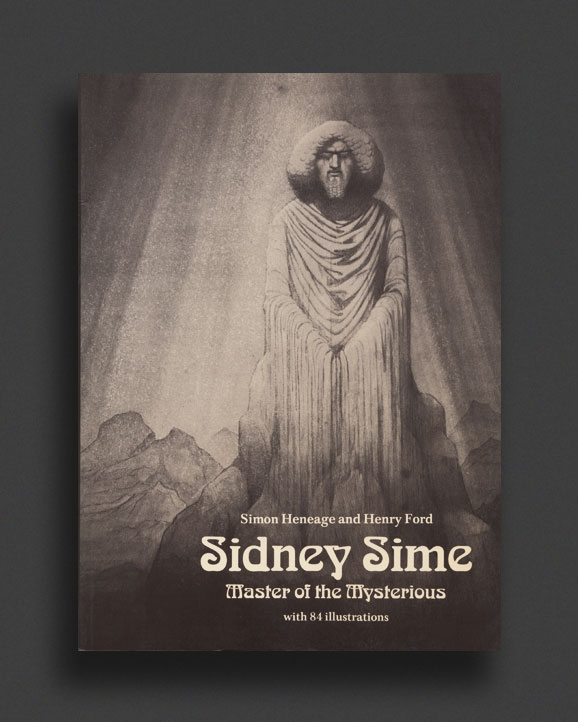

Sidney Sime
Master of the Mysterious
1980, English
Softcover, 96 pages, 28 x 20.5 cm
1st Edition, Out of print title / used / very good
$70.00 - In stock -
First edition of the long out-of-print monograph on the work of Sidney Sime (1867-1941), remembered for his fantastic and satirical artwork, especially his story illustrations for Irish author Lord Dunsany. Published in 1980, Master of the Mysterious collects Sime's incredible paintings, illustrations and graphic works, which are extremely hard to find documented anywhere today, alongside in-depth biographical texts by authors Simon Heneage and Henry Ford, tracing his entire life and career. Includes bibliography, published works, and a full index, making it the most comprehensive resource on the artist ever printed.
"Sidney Sime is probably the greatest imaginative English artist since Blake."—Hannen Swaffer, The Graphic, 1922
Sidney Sime (1867-1941) was an artist whose mysterious and fantastic illustrations were published in the well-known magazines of the turn of the century. He was also a graphic humorist, theatre designer and book illustrator whose imagery became inseparable from the new world of weird fiction and books of horror. Along with long and harmonious collaboration with Lord Dunsany, the Irish story-teller and playwright, a partnership without peer in the annals of fantasy illustration, Sime also provided illustrations to stories by William Hope Hodgson and Arthur Machen, amongst others. Mentioned in the same breath as Goya, Aubrey Beardsley, Arthur Rackham and Kay Nielsen, there is nothing quite like the mysterious works of Sime. Born in Manchester in poverty, Sime began his career working in the mines, before studying at the Liverpool School of Art. Sime had a meteoric career. He rose from pit-boy to artist in the space of a few years and made his name in London largely as an illustrator though he was also a painter of distinction. His abhorrence of Exhibitions (‘that last infirmity of senile kind’) and the effect of the First World War when artists tended to join movements and become socially conscious left the self-doubting individualist Sime somewhat isolated, becoming a recluse in his country house in Surrey. While his reputation languished and talent was neglected by a wider audience, his profound influence has been recorded in the work of writer H. P. Lovecraft and artist Roger Dean. One wouldn't be surprised if Sydney Sime's imagery was a precursor to worlds later created by Miyazaki, Dr. Seuss, and Moebius.
Very Good copy.
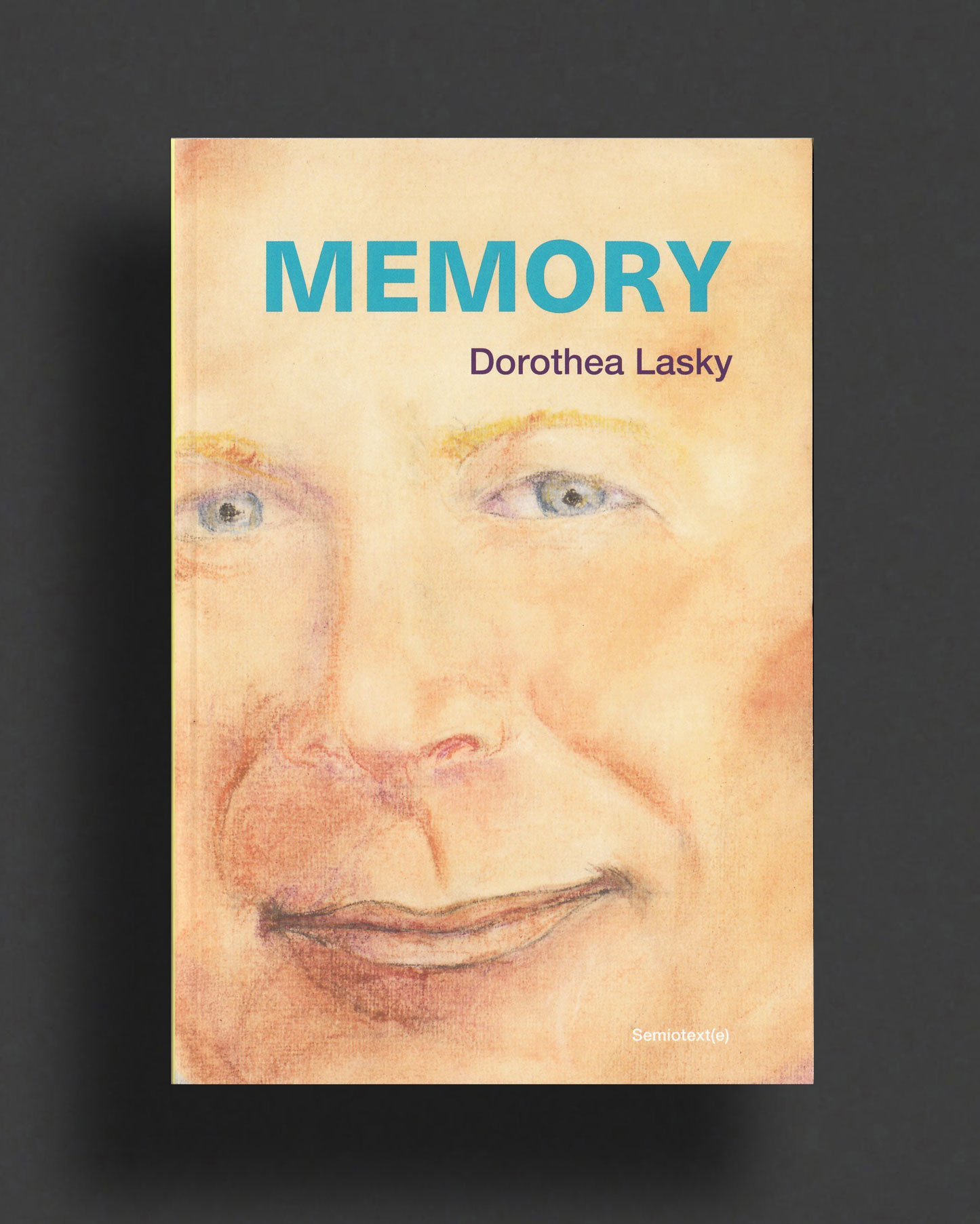

MEMORY
By Dorothea Lasky
2025, English
Softcover, 320 pages, 19.8 x 12.9 cm
$36.00 - In stock -
A spiritual homage to Bernadette Mayer’s monumental artwork of the same title, Dorothea Lasky’s MEMORY is a cycle of “poet’s essays” stirred by two profound questions. What constitutes personhood and consciousness? What memories get lost, and why?
Expansive in her quest for answers, Lasky launches an inspired investigation of the forces that form our lives and deepest senses of ourselves. She identifies three dimensions of memory—historical, personal, and artistic—and in her singularly clear voice, undertakes to enter into their mysteries. From those recesses, she returns with a wide-ranging collection of essays that like lyric poems find the universal inside the particular. MEMORY reflects on the banal, private emotions and ancestral trauma, dear departed poets (Lucie Brock-Broido, Diane di Prima, Kevin Killian), her father’s battle with Alzheimer’s, and cultural events that have become charged sites of collective reminiscence (the moon landing, the music of Neutral Milk Hotel). Other pieces face the flip side of memory, asking what’s left where memory is absent, and what’s “real” beyond the horizon of death. The book closes with “Time, the Rose, and the Moon,” an ars poetica published here in English for the first time, which offers the ancient symbol of the Ouroboros as a figure for the nonlinear processes of time, memory, and art.
Like Mayer before her, Lasky reveals memory to be huge and haunting, as she accumulates impressions that challenge the very possibility of fixed meaning. “Every rose has the scent of death,” she writes. “And poetry is a perfume. That will stay on your body forever. … Whatever happens this time around, remember that.”
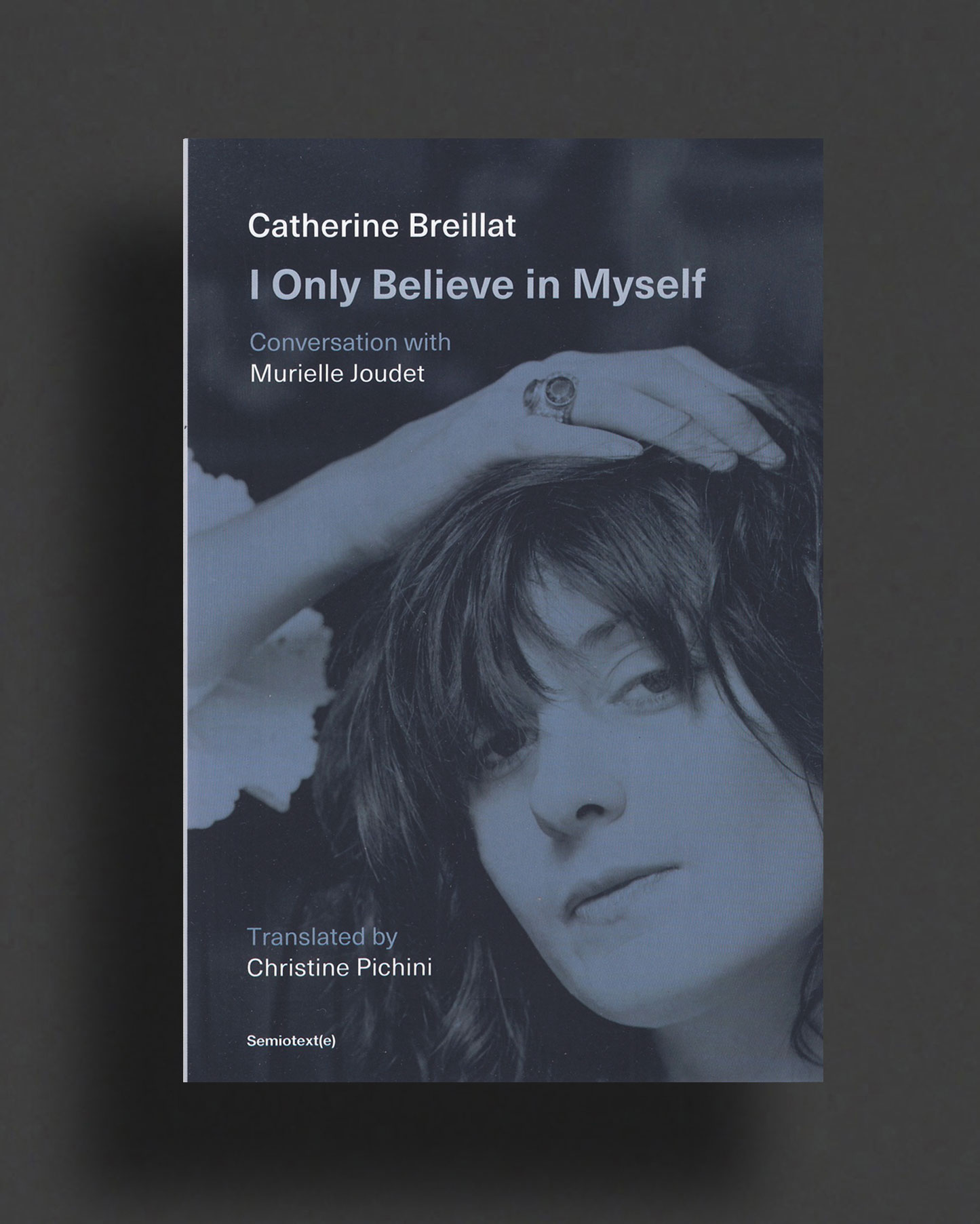
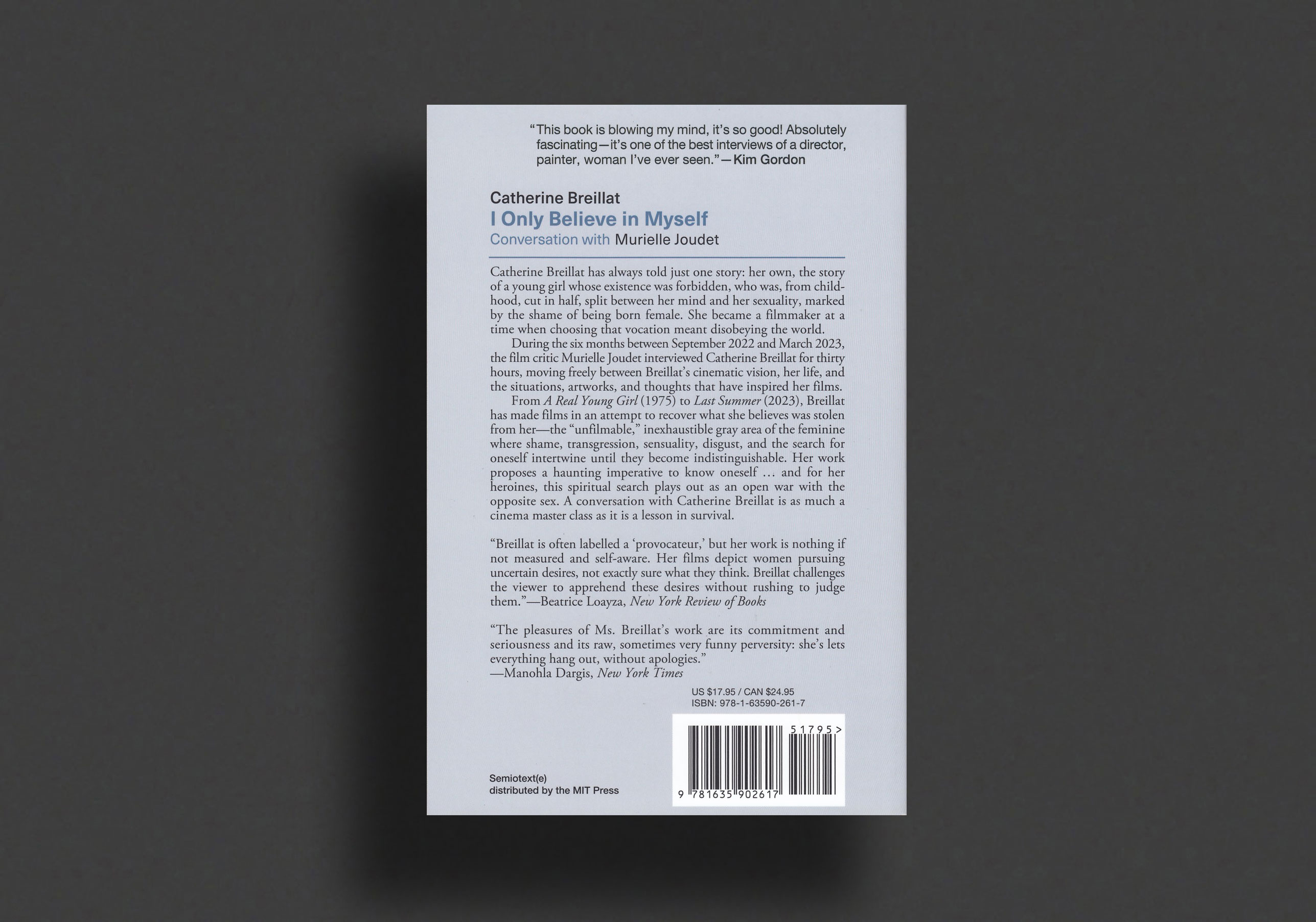
I Only Believe in Myself (Conversation with Murielle Joudet)
by Catherine Breillat
2025, English
Softcover, 224 pages, 20 x 13.67 cm
$39.00 - In stock -
A long-form dialogue—on cinema and survival—with the visionary French filmmaker.
"The virtuous always engage in a pseudoreligious morality. But there’s one thing they never say: the desire for pleasure is thought in motion. It’s what makes you transfigure a dull and repetitive sexual act into something that can bring you to ecstasy and an idea of eternity..."—Catherine Breillat to Murielle Joudet
Catherine Breillat has always told just one story: her own, the story of a young girl whose existence was forbidden, who was, from childhood, cut in half, split between her mind and her sexuality, marked by the shame of being born female. She became a filmmaker at a time when choosing that vocation meant disobeying the world.
During six months between September 2022 and March 2023, the film critic Murielle Joudet interviewed Catherine Breillat for thirty hours, often following up with further discussion over the phone. Joudet and Breillat discuss each of her films in chronological order, moving freely between Breillat’s cinematic vision, her life, and the situations, artworks, and thought that have inspired her films.
From A Real Young Girl (1975) to Last Summer (2023), Breillat has made films in an attempt to recover what she believes was stolen from her— the “unfilmable,” inexhaustible grey area of the feminine where shame, transgression, sensuality, disgust, and the search for oneself intertwine until they become indistinguishable. Her work proposes a haunting imperative to know oneself... and for her heroines, this spiritual search plays out as an open war with the opposite sex.
A conversation with Catherine Breillat is as much a cinema master class as it is a lesson in survival.
Catherine Breillat is a filmmaker and writer based in Paris. She is known not only for her films focusing on themes of sexuality but also for her bestselling novels.
Murielle Joudet is a film critic for Le Monde, as well as for TV and radio. She is the author of Isabelle Huppert- Vivre ne nous regarde pas (2018), Gena Rowlands- On aurait d dormir (2020), and La Seconde Femme- Ce que les actrices font la vieillesse (2022).
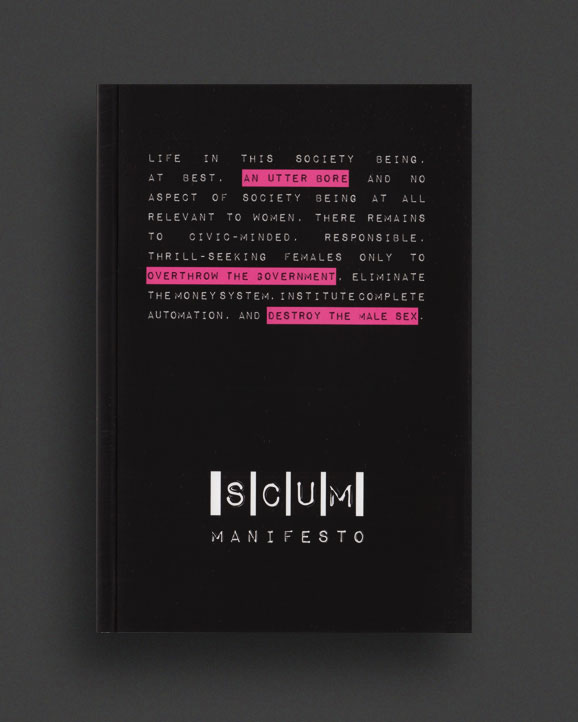
S.C.U.M Manifesto
by Valerie Solanas
2013, English
Softcover, 90 pages, 16.5 x 11.5 cm
$28.00 - In stock -
First circulated on the streets of Greenwich Village in 1967, the SCUM Manifesto is a searing indictment of patriarchal culture in all its forms. Shifting fluidly between the worlds of satire and straightforward critique, this classic is a call to action--a radical feminist vision for a different world. This is an update of the essential AK Press edition, with a new foreword by Michelle Tea.
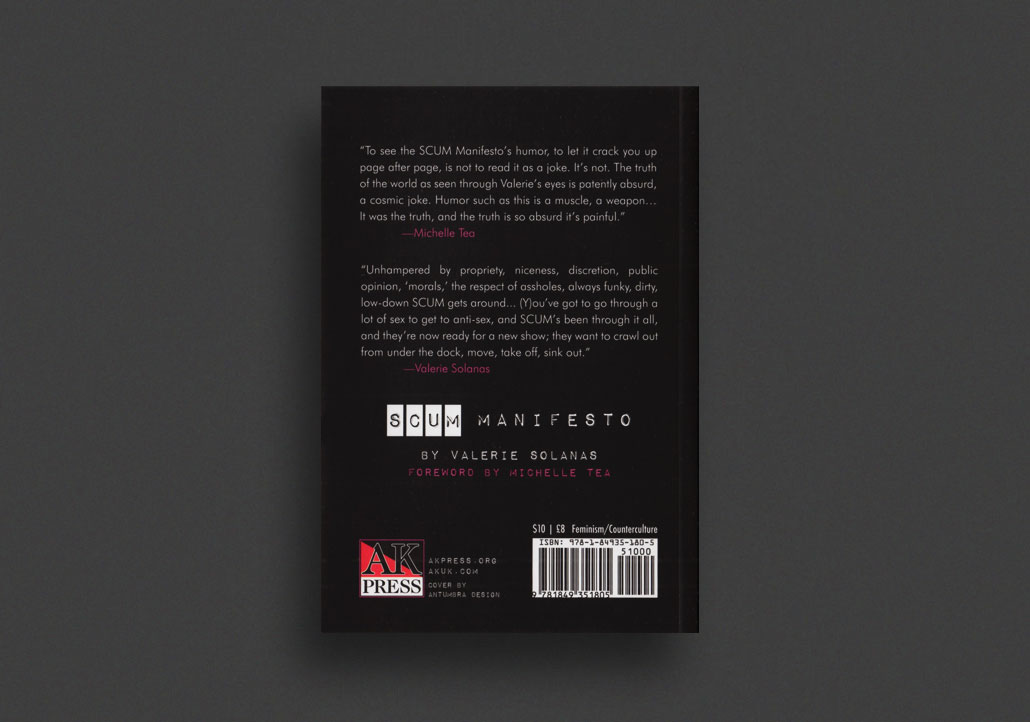
"To see the SCUM Manifesto's humor, to let it crack you up page after page, is not to read it as a joke. It's not. The truth of the world as seen though Valerie's eyes is patently absurd, a cosmic joke. Humor such as this is a muscle, a weapon... It was the truth, and the truth is so absurd it's painful."—Michelle Tea
"Unhampered by propriety, niceness, discretion, public opinion, 'morals', the respect of assholes, always funky, dirty, low-down SCUM gets around... You've got to go through a lot of sex to get to anti-sex, and SCUM's been through it all, and they're now ready for a new show; they want to crawl out from under the dock, move, take off, sink out."—Valerie Solanas
Valerie Solanas was a radical feminist playwright and social propagandist who was arrested in 1968 after her attempted assassination of Andy Warhol. Deemed a paranoid schizophrenic by the state, Solanas was immortalized in the 1996 film I Shot Andy Warhol.
Michael Krebber
Alien Hybrid Creatures
2005, English / German
Softcover, 184 pages, 15.2 x 20 cm
1st Edition, Out of print title / as new
$260.00 - In stock -
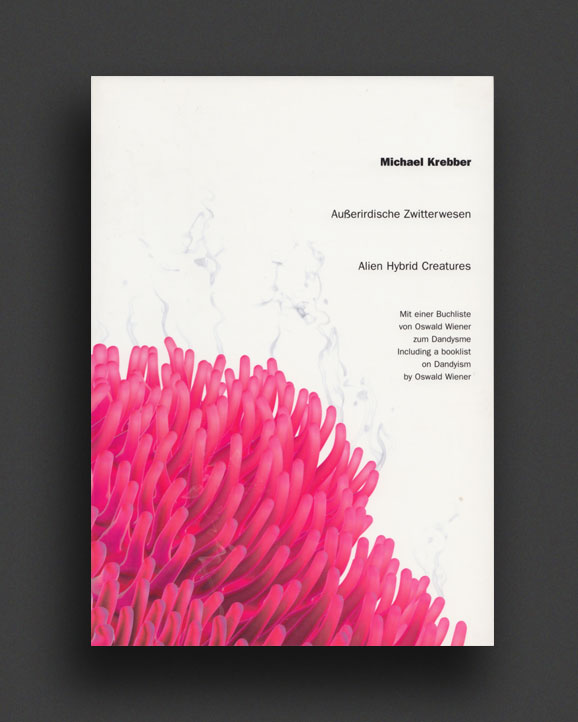
As new copy of the out-of-print and fantastic 2005 artist book Alien Hybrid Creatures by German painter Michael Krebber.
Alien Hybrid Creatures addresses, amongst other things, the historical figure of the dandy--and among the dandies implicated is the spawning sea anemone on the cover. It functions as a reading list for the Seminar "Dandyism I/II (Düsseldorf Academy of Art) 2001/2002, with additional material from Krebber's seminar "Geniuses and Dandies/Historical and Theoretical Reflections" 2001. Such material includes the work of Joris-Karl Huysmans, Bernhard Willhelm, Robert Bresson, Kai Althoff, Charles Baudelaire, Odilion Redon, Merlin Carpenter, Devince, Josephine Pryde, Kenneth Anger, Albert Camus, Cosmia Von Bonin, Jack Smith, John Waters, Susan Sontag, Russ Meyers, Marcel Broodthaers, and French & Saunders (amongst many more).
Alien Hybrid Creatures was published on the occasion of Michael Krebber's legendary lecture "Puberty in Painting", delivered in the context of Renate Goldmann's seminar at the Institute of Art History at the University of Cologne in 2003.
Essay by Oswald Wiener.
Designed by Markus Ziegler in cooperation with Yvonne Quirmbach.
Now a very scarce collector's item. Some light shelf wear only.
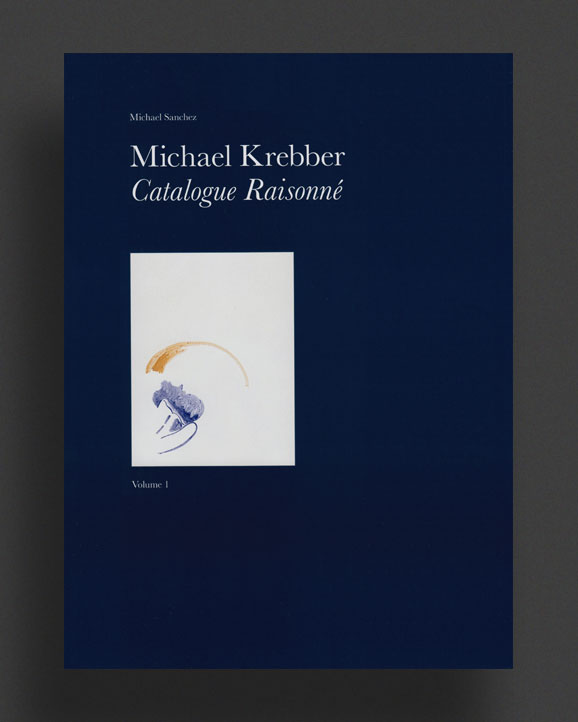
Michael Krebber
Catalogue Raisonné
2022, English
Hardcover, 608 pages, 27.9 x 20.1 cm
$280.00 - In stock -
Presenting the complete works of Germany’s greatest living minimalist painter.
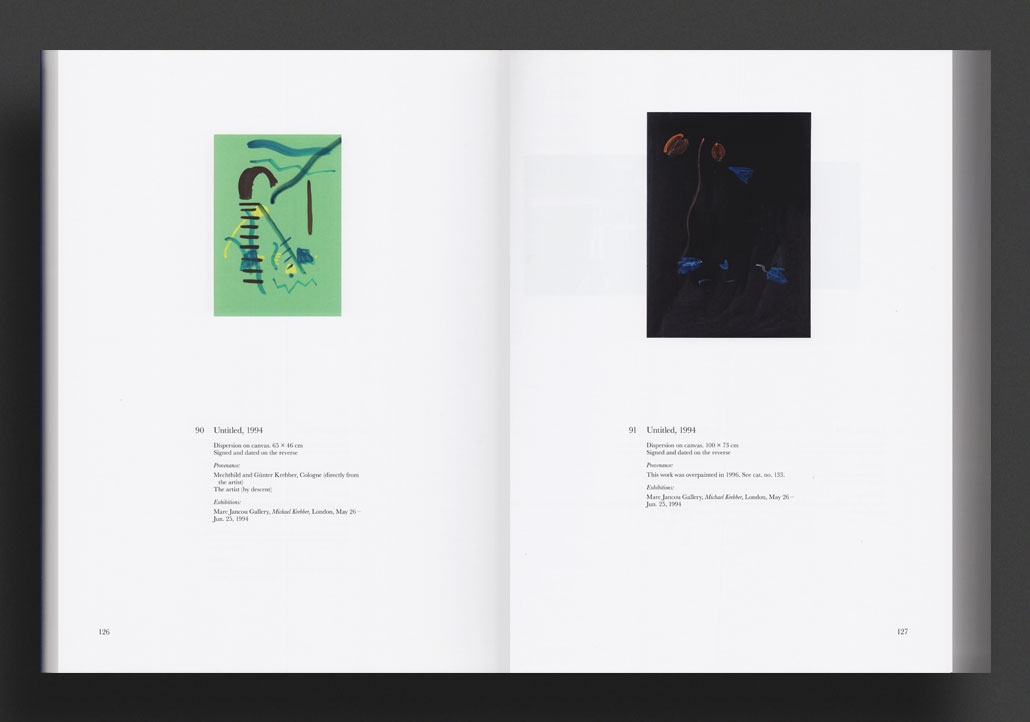
A central figure in contemporary painting, Michael Krebber has never been the subject of a comprehensive scholarly monograph. The Michael Krebber Catalogue Raisonné is a projected multivolume catalogue of the artist’s complete work, compiling high-quality photographs, material descriptions, and provenance of his output in all media.
Focused on his early work, this first volume includes paintings, sculptures, works on paper, and film from 1972 to the year 2000. Opening with a historical essay that traces the genesis of Krebber’s practice in relation to contemporaries such as Martin Kippenberger and Albert Oehlen, the book also contains numerous short texts analysing and contextualising individual works.
In addition to a full biography and bibliography, the catalogue raisonné features extensive documentation of Krebber’s early exhibitions, many of which have not been published before.
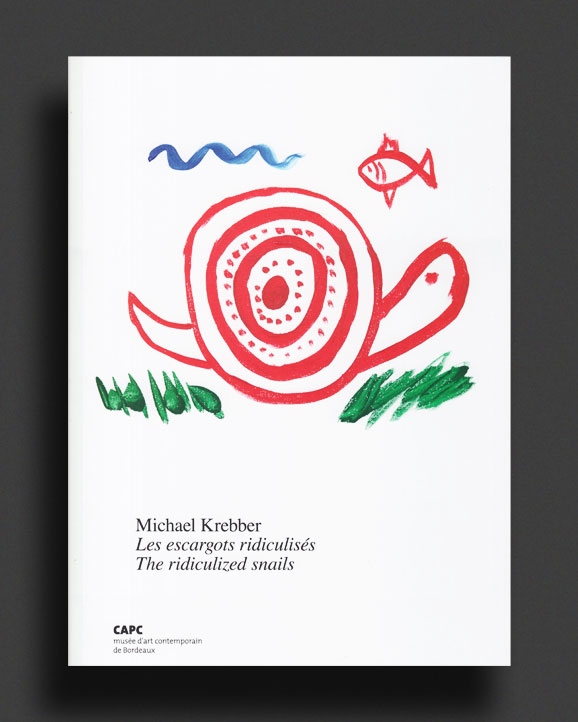
Michael Krebber
The Ridiculized Snails
2012, English / French
Softcover, 324 pages, 21 x 29.7 cm
$78.00 - In stock -
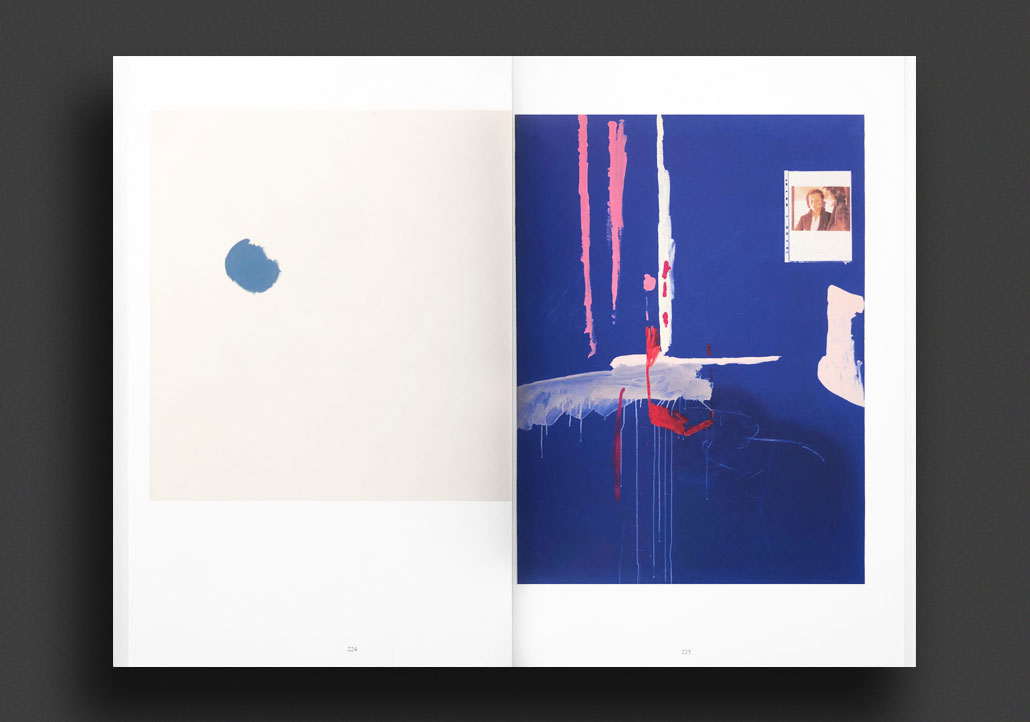
Published on the occasion of his retrospective at CAPC, Bordeaux, in 2012-2013, this book is the first major reference monograph published on the German artist Michael Krebber. This comprehensive volume is heavily illustrated with colour photographs of his works spanning from the 1980's to today.
Michael Krebber (born 1954, lives and works in Cologne) is currently considered to be one of the most emblematic personalities of the international contemporary art scene. Having had a major influence on the art scene in Cologne during the 80's and 90's and ever since, Michael Krebber has a conceptual approach to painting that he explores beyond all pictorial conventions. His practice is marked by ambivalence, subversion, intransigence, and a feigned body language. Krebber is a dandy painter.
Although he appears to be a discreet character, both perplexed and ambivalent about the very nature of his practice, he nevertheless remains an influential first-class smuggler into the world of art on both the theoretical and economic levels. The dialogue that he maintains with his students at the Staatliche Hochschule in Frankfurt, sets him up as a “literary character,” the implementer of his very own process, which has fascinated the emerging generation.
Highly recommended.
Edited by Michael Krebber and Alexis Vaillant.
Texts by Catherine Chevalier and Magnus Schäfer.
Graphic design: Surface.


Art-Rite
2019, English
Softcover, 678 pages, 21.5 x 27.5 cm
Ed. of 2000,
1st Edition, Out of print title / as new
$120.00 - In stock -
As New still-sealed copy. Out of print.
Edited by Walter Robinson, Edit DeAk, and Joshua Cohn, Art-Rite was published in New York City between 1973 and 1978. The periodical has long been celebrated for its underground/overground position and its cutting, humorous, on-the-streets coverage and critique of the art world. Art-Rite moved easily through the expansive community it mapped out, paying homage to an emergent generation of artists, including many who were—or would soon become—the defining voices of the era. Through hundreds of interviews, reviews, statements, and projects for the page—as well as artist-focused and thematic issues on video, painting, performance, and artists’ books—Art-Rite’s sharp editorial vision and commitment to spotlighting the work of artists stands as a meaningful and lasting contribution to the art history of New York City and beyond.
All issues of Art-Rite are collected and published here.
Featured artists include Vito Acconci, Kathy Acker, Bas Jan Ader, Laurie Anderson, John Baldessari, Gregory Battcock, Lynda Benglis, Mel Bochner, Marcel Broodthaers, Trisha Brown, Chris Burden, Scott Burton, Ulises Carrión, Judy Chicago, Lucinda Childs, Christo, Diego Cortez, Hanne Darboven, Agnes Denes, Ralston Farina, Richard Foreman, Peggy Gale, Gilbert & George, John Giorno, Philip Glass, Leon Golub, Peter Grass, Julia Heyward, Nancy Holt, Ray Johnson, Joan Jonas, Richard Kern, Lee Krasner, Shigeko Kubota, Les Levine, Sol LeWitt, Lucy Lippard, Babette Mangolte, Brice Marden, Agnes Martin, Gordon Matta-Clark, Rosemary Mayer, Annette Messager, Elizabeth Murray, Alice Neel, Brian O’Doherty, Genesis P-Orridge, Nam June Paik, Charlemagne Palestine, Judy Pfaff, Lil Picard, Yvonne Rainer, Judy Rifka, Dorothea Rockburne, Ed Ruscha, Robert Ryman, David Salle, Carolee Schneemann, Richard Serra, Jack Smith, Patti Smith, Robert Smithson, Holly Solomon, Naomi Spector, Nancy Spero, Pat Steir, Frank Stella, Alan Suicide (Vega), David Tremlett, Richard Tuttle, Andy Warhol, William Wegman, Lawrence Weiner, Hannah Wilke, Robert Wilson, Yuri, and Irene von Zahn.
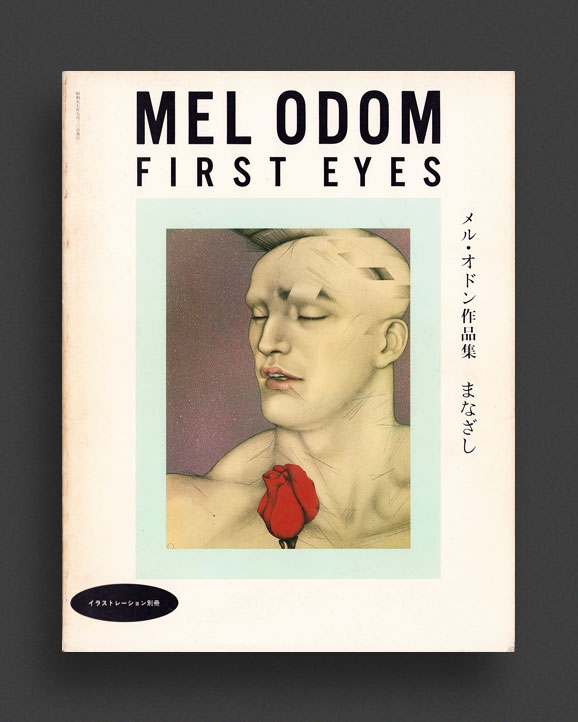
Mel Odom
First Eyes
1982, English / Japanese
1st Edition, Out of print title / used / very good
$70.00 - In stock -
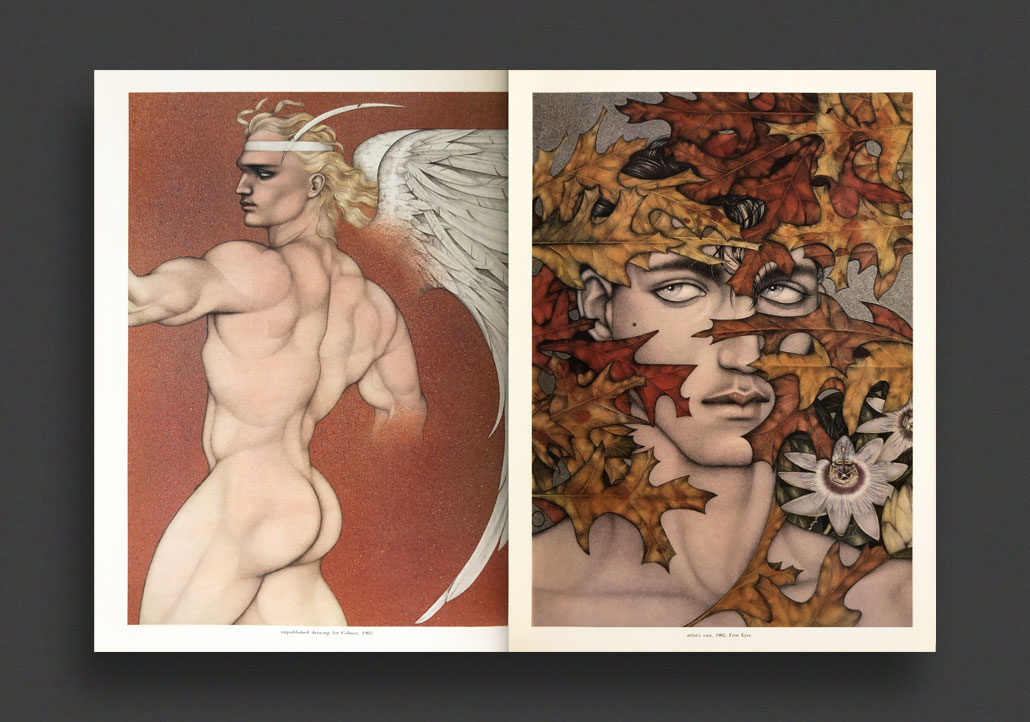
First printing of the first ever book on the work of queer American illustrator Mel Odom (b. 1950), published in Japan in 1982. Profusely illustrated throughout with Odom's dreamy, highly-stylised, erotically-charged fantasy illustrations, made famous adorning the paperback covers of novels by Patrick White and in the pages of Blue Boy and through Odom's award-winning and still lauded tenure at Playboy. Odom's delicate and dreamy men struck a chord with the viewing public. They were finally seeing male figures of lust depicted lovingly, softly, in the sea of aggressive hyper-masculinity that dominated gay aesthetics of the time. Alongside his many masterful works (that owe much to art deco, the silver screen, and pre-Raphaelite sensuality) reproduced together for the first time, First Eyes also includes Odom's childhood drawings, photographic portraits, his sculptural painted masks, and much more. All texts in English and Japanese.
Very Good copy with light tan/wear.
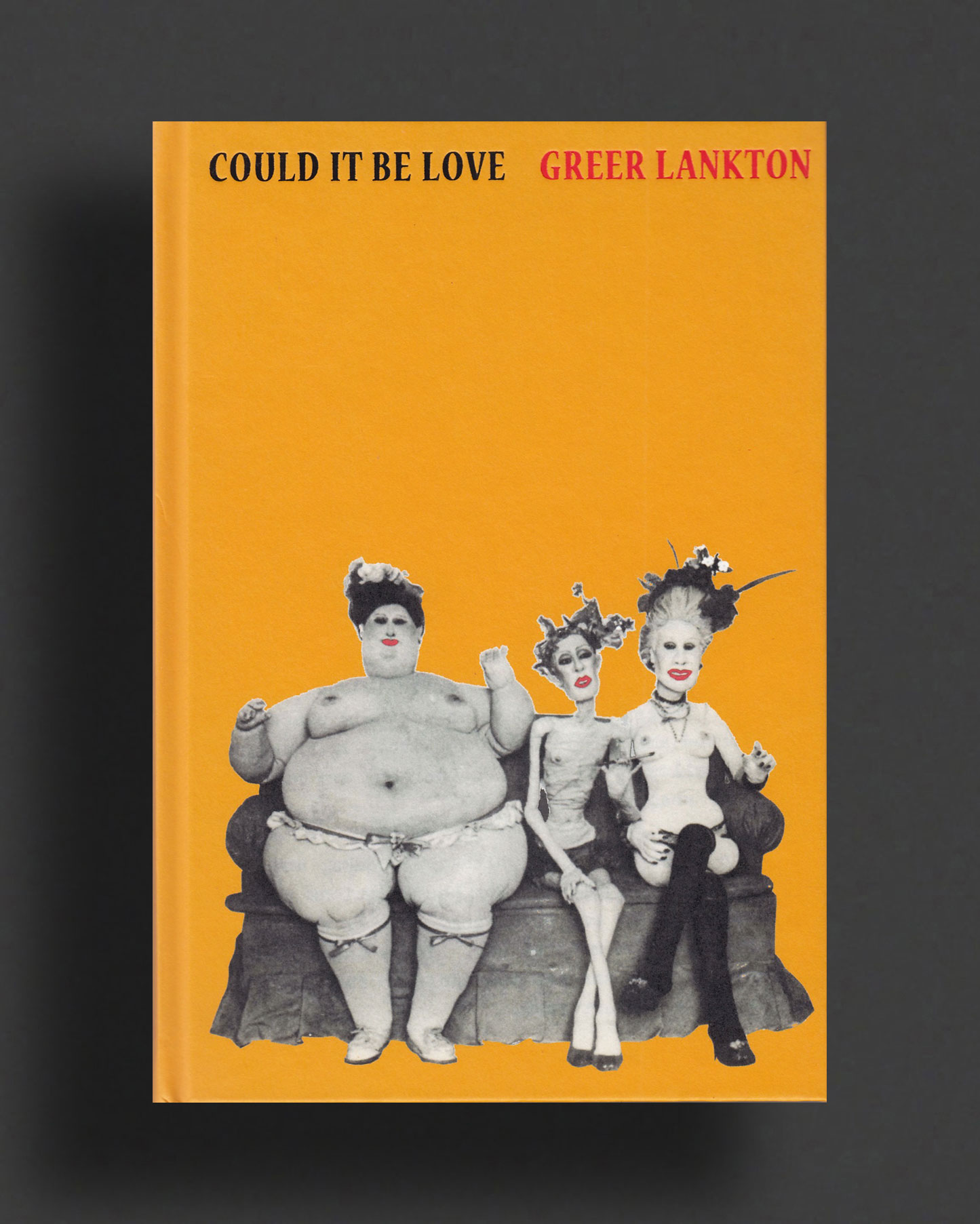
Greer Lankton
Could It Be Love
2025, English
Hardcover, 128 pages, 24.2 x 17.2 cm
$90.00 - In stock -
Edited by Francis Schichtel, Jordan Weitzman, Nan Goldin.
Text by Hilton Als.
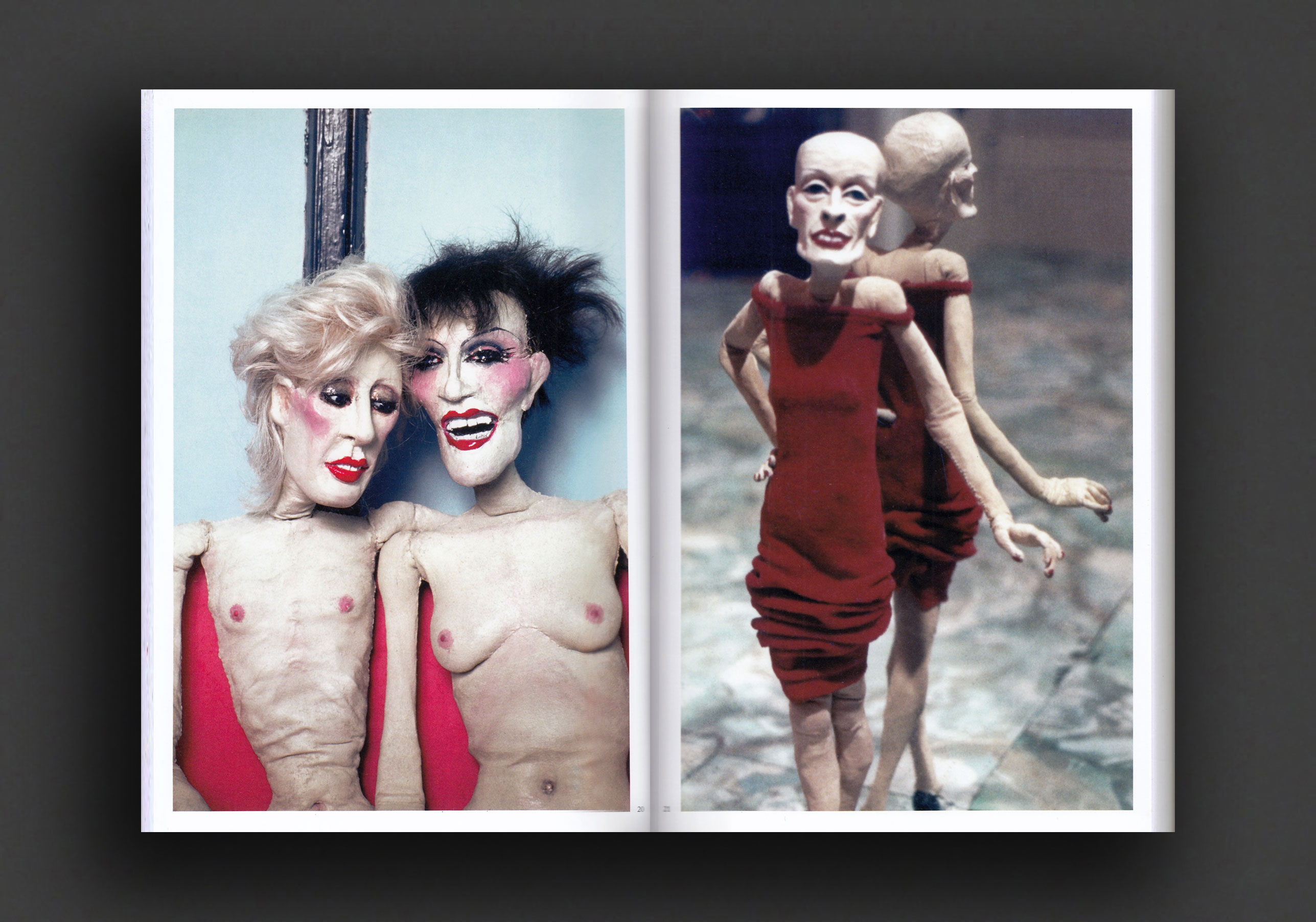
Lankton's iconic and startling doll sculptures as we have never seen them before: through her own eyes
This is the first monograph on the trans visionary artist Greer Lankton (1958–96), whose lifelike doll sculptures shocked 1980s New York. Lankton's dolls, which she began making as a child and produced obsessively until her death at age 38, were a means to explore her fraught relationship with the human body. In the book's 100 photographs, all shot by Lankton herself, these figures take on a life of their own, kvetching at a party, strolling along a beach, or lounging on a stoop in the East Village. Among this extraordinary cast of oddballs—usually femme, often freakish, always radiating a glamorous confidence—we find characters of Lankton's own invention alongside well-known icons such as Divine, Coco Chanel, Andy Warhol and even Lankton herself.
Born in 1958 to a Presbyterian minister in Michigan, Greer Lankton moved to New York in 1978 and became a rising star of the downtown scene. There, her deviant elegance was immortalized in photographs by Peter Hujar, David Armstrong and Lankton's close friend Nan Goldin, who described her as "one of the luminaries of the East Village renaissance: beautiful, glamorous, wild and hysterically funny." Lankton's work was a neighborhood fixture, in exhibitions at the gallery Civilian Warfare and in regular window displays at Einstein's Boutique, and was also celebrated farther afield, in era-defining group shows at PS1 and the Venice Biennale. Her final work, an immersive installation created for the Mattress Factory in 1996, remains on permanent view.
“Now I’m completely bowled over. Greer Lankton has got to be a genius…these are her dolls at her best... One scene is a birthday party for a ninety year old woman of culture and taste. I can’t describe anything that is going on in this scenario because I could actually write a complete novel about the party and the party people…. What a celebration! Hallelujah!!! —Cookie Mueller
“Greer Lankton’s dolls are entire biographies on legs, whole movies, three-dimensional Alice Neels. And they’re all self-projections, all of her contradictory impulses--abjection and eminence, dissipation and what comes after, gender fixed or fluid--examined lovingly and pitilessly. She could locate variously aged and battered versions of herself on the street, in a movie, at a party, alone on a park bench--with her eye she could see herself from outer space, sub speciae aeternitatis. And her taste and her skills were impeccably suited to her unique medium. Why did we have to lose her?”—Lucy Sante
“I found my first encounters with Greer Lankton’s grotesque dolls shocking. My cohort of 80’s artists challenged authorship and valued detachment and did not warm to raw displays of intimacy (and god forbid craft) that were the core of Greer’s prescient, messy battle with beauty and pain. Current culture is hungry for exactly what Greer’s art serves up - the exploration of gender, imperfection, self-expression and authenticity.”—Laurie Simmons
“Lankton’s creatures live in a psychic interline where genitals and gender identity are scrambled in the play of appearances, and reveal an exacerbated, possibly mutilated sexuality as the trigger of personality. Like Theodora Skiptare’s housewife automata that vomit and menstruate, Lankton’s ambisexual dolls wear faces of crumbling self-assurance, or even moronic friendliness and self-contentment, while breathing pain in and out through their pores."—Gary Indiana, Art in America, 1984
“Of course, to say that a doll by Greer Lankton is “just a doll” is absurd. Lankton’s dolls are like no other dolls, and no Lankton doll is like any of her dolls. For that matter many Lankton dolls weren’t even like themselves from one moment to the next. Lankton constantly reworked them ‘changing their gender, identities, sizes and clothes.’ But some…change by being photographed from different angles, using different lighting and backgrounds. Simple as the photographs are, they manage to bring the dolls to life, give them a story.”—Douglas Crimp
“She has become, to this young community what Rimbaud must have been to Paris in the 1920's. She has been compared to Hans Bellmar and to Frida Kahlo, for both have created highly self referential imagery affected heavily by events which have changed the course of their lives.”—Dean Savard, co-founder of Civilian Warfare


Gérard Gachet
Desseins
1988, French
Softcover (w. dust jacket), 64 pages, 32 x 24 cm
1st Edition, Out of print title / used / fine
$180.00 - Out of stock
Very rare first 1988 edition of the only art book on the work of Moroccan-born, French graphic artist Gérard Gachet (1935–1985), published by Editions Natiris three years after the mysterious artist's death. Profusely illustrated throughout in colour and monochrome, Desseins is a collection of Gachet’s best drawings, which given how long it took him to produce each one represents the bulk of his lifetime’s output. Gachet’s friend Jacques Laurent (1919–2000), the writer and journalist, contributed a short preface.
Gachet's exquisite erotic magical realism is obsessive, singular and irreducible, served by a secret compulsion, "by the demanding technique that he, a stubborn alchemist, knew how to place at his disposal."
Moving to Paris, he spent a year at the École des Beaux Arts, followed by two years at the École des Arts Decoratifs in Strasbourg. After working in theatre design and teaching, he settled in Strasbourg in 1965 to concentrate on his own artistic work. A lifelong insomniac, Gachet did the painstaking preparatory work for his drawings at night or in the early hours of the morning, when his sensitivity and perceptions were heightened. He would spend his mornings by the river, the natural world an immense influence on his compositions, before he set to work. Rejecting conventional drawing techniques, he normally worked with a ballpoint pen, achieving a softness of line which no ordinary pen could give him, or with fine-tipped charcoal, each drawing usually representing a month’s work. Though his work is charged with a carnal, animal, natural sensuality, and is sometimes violent, it is never cruel. Skulls and skeletons, the symbols of death, haunt many of his drawings alongside women’s breasts, buttocks and vulvas, the source of life and a subject he found eternally fascinating.
"Gérard Gachet left us a body of work that begs to be captured in words. It is romantic, fantastical, realistic. It vibrates, as he himself clearly felt, with the breath of the ancient Germanic Rhine, which carries along in sheaves, twists, and tempestuous waves the beards, the hair, the women's pubic hair. One can sense the presence of the fir trees around the bodies arched by spasms. But all materials tempt this great artist: granular, scaly, polished, sticky, bushy. Under the light of the storm—sometimes muted and heavy, sometimes dazzling—women's genitals are partially revealed, painted with tragic precision. Yet, Gérard Gachet's eroticism is not merely morbid; it is betrayed by a sensual love of bodily forms whose harmonious curves are caressed by a painter who cannot help but—even if he has given himself an abstract starting point or if he claims a symbolic meaning—communicate his desire and pleasure to us. And no doubt he feared addressing the sexuality of our gaze too directly, hence these reptiles and amphibians which, according to him, rejected anthropomorphism—a superfluous fear. The vulvas of his women can be as unsettling as those of Courbet's women, but, enigmatic, they repel as much as they attract."—from Jacques Laurent's preface
Fine copy in Fine dust jacket.
Akio Fuji
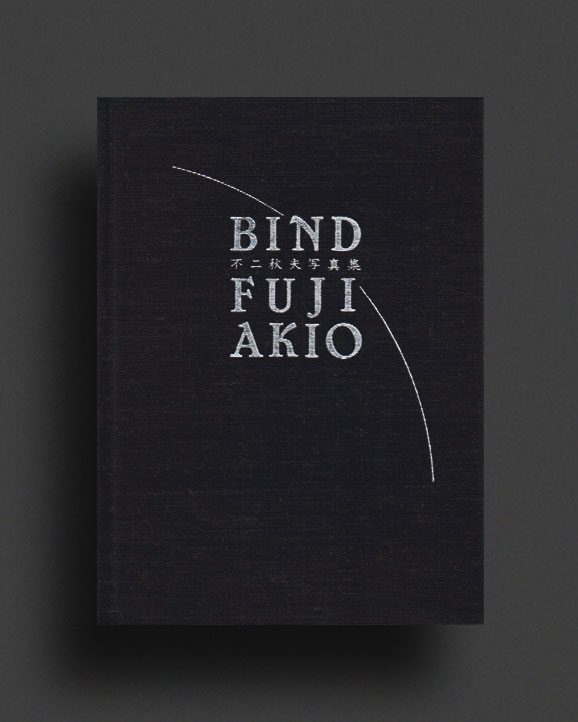
Bind
1992, Japanese
Hardcover (clothbound), 96 pages, 18 x 13.5 cm
1st Edition, Out of print title / used / fine
$300.00 - In stock -
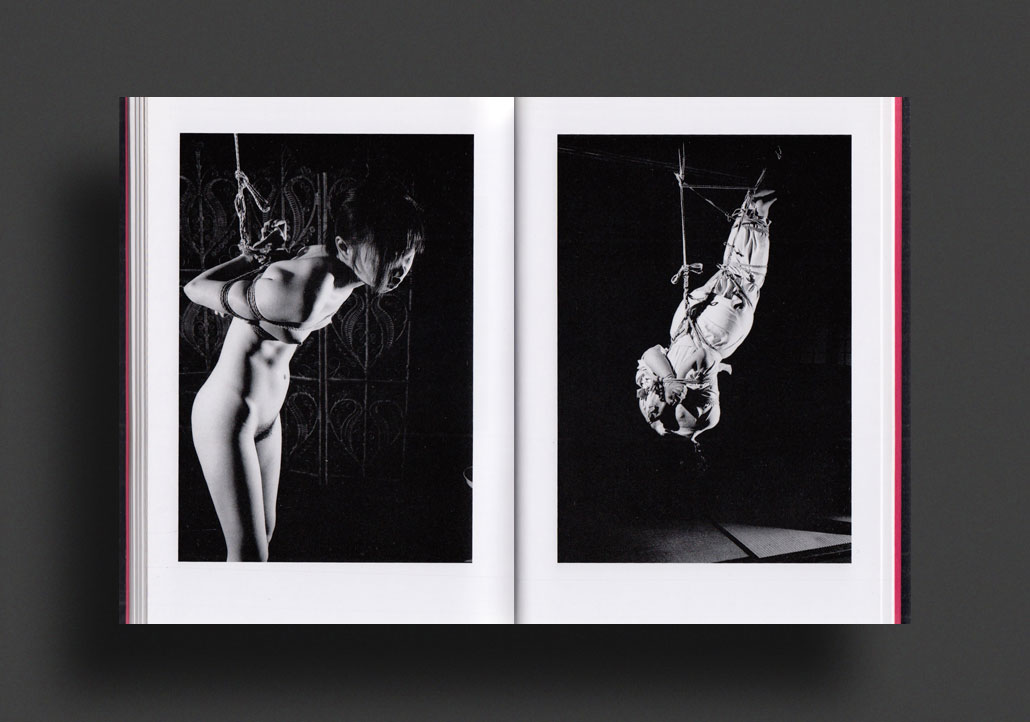
Rare first edition of one of the greatest kinbaku photo books ever published, Bind by Akio Fuji. Published in 1992 by Mole Gallery, Tokyo, to accompany Fuji's exhibition of the same name, Bind is now a classic photo book of masterful aesthetic bondage photography, featuring the rope work of Chimo Nureki, gloriously reproduced in lush black and white plates bound in silver-foiled cloth hardcovers. Exquisite compositions capturing the two artists at the height of their powers, and an important book and exhibition for bringing the world of kinbaku to the recognition of the fine art world in Japan the 1990's.
Akio Fuji (b. 1959) is a pioneer of bondage photography in Japan, founding the legendary bondage enthusiast circle "Kinbiken" in Tokyo in 1985 with rope master Chimuo Nureki (who also produced the magazines Kitan Club and Uramado), developing into the cult kinbaku bulletin Kinbiken Communications, with core contributions by both Fuji and Nureki, Katsuya Kasui, Masami Akita (Merzbow), Yuri Sunohara, Asoji Muroi, Akira Minomura, and other members of the circle. The object of the group was to study the beauty of bondage, observing the techniques of master Nureki through a membership with one of the most distinctive facets of the club being that the bondage women participate as members themselves. Says Nureki, “One of the main reasons I started this circle was to provide a facility for masochistic women, who are often misunderstood and therefore despised.” Kinbiken Communications remain one of the most desirable kinbaku publications of this period, the photography from which is showcased here in Akio Fuji's debut collection, featured heavily in Masami Akita's compilation of the “History of Bondage Photography in Japan”.
Fine copy.


Kama-Soutra
Illustrations by G. Rolland
1975, French
Softcover, 72 pages, 27 x 21 cm
1st Edition, Out of print title / used / very good
$100.00 - In stock -
Rare first private-press edition of this 1975 book of erotic artwork by G. Rolland illustrating a selection of explicit text from the Indian classic Kama Sutra, self-published by Achevé d’imprimer sur les Presses Spéciales de G. Rolland in France. The mysterious artist/author/publisher presents a sequence of 24 full-page monochrome explicit sex scenes throughout the book, showcasing the many positions of the Kama Sutra with a heavy emphasis on detailed penetration, much in the tradition of classic French curiosa.
Very Good copy, light wear to cover, light knock to base. Original Milano bookshop sticker to the back cover remains.
CLiCHE
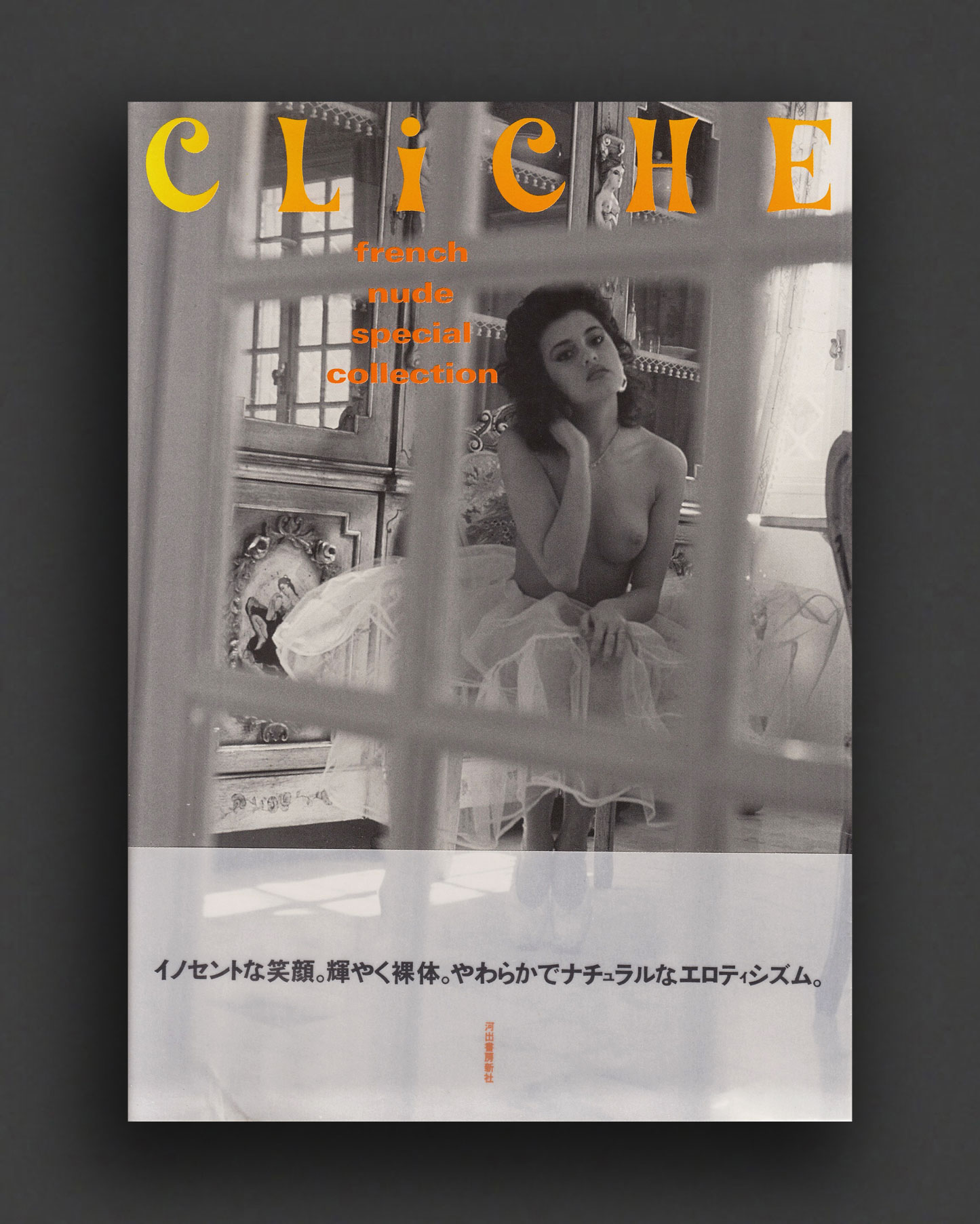
French Nude Special Collection
1993, French / Japanese
Softcover (w. dust jacket and wax paper obi), 80 pages, 30 x 21cm
1st Edition, Out of print title / used / very good
$100.00 - In stock -
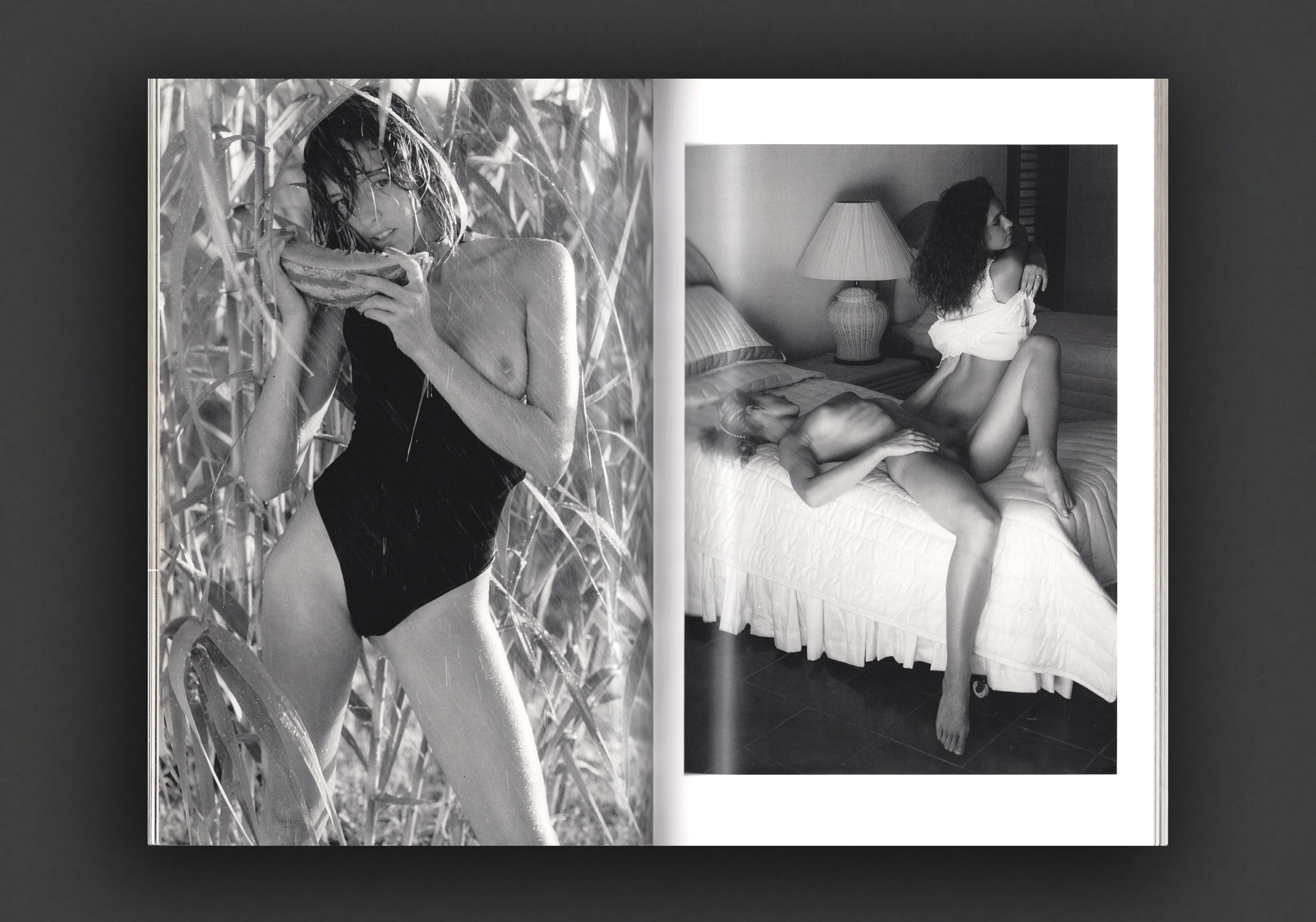
Very rare Japanese photo book collection of black and white female nude photography from highly regarded French erotic photography magazine Cliché International and Pink Star, published by Pink Star Editions in the late 1980s and early 1990s. Designed by the one-and-only Makoto Orui of Fiction Inc. and Purple fame, the stunning reproductions on gloss stock are wordless and uncredited in his trade-mark lush scrapbook style. That said, CLiCHE is notably the work of Jacques Bourboulon, Irina Ionesco, Michel Moreau, and other French photographers featured in Cliché International and Pink Star Editions.
Very Good, VG dust jacket w. VG obi, some discolouration to spine edge.

Chris Killip
In Flagrante
1988, English
Hardcover (clothbound w. dust jacket), 96 pages, 31x 26 cm
1st Edition, Out of print title / used / fine
$850.00 - In stock -
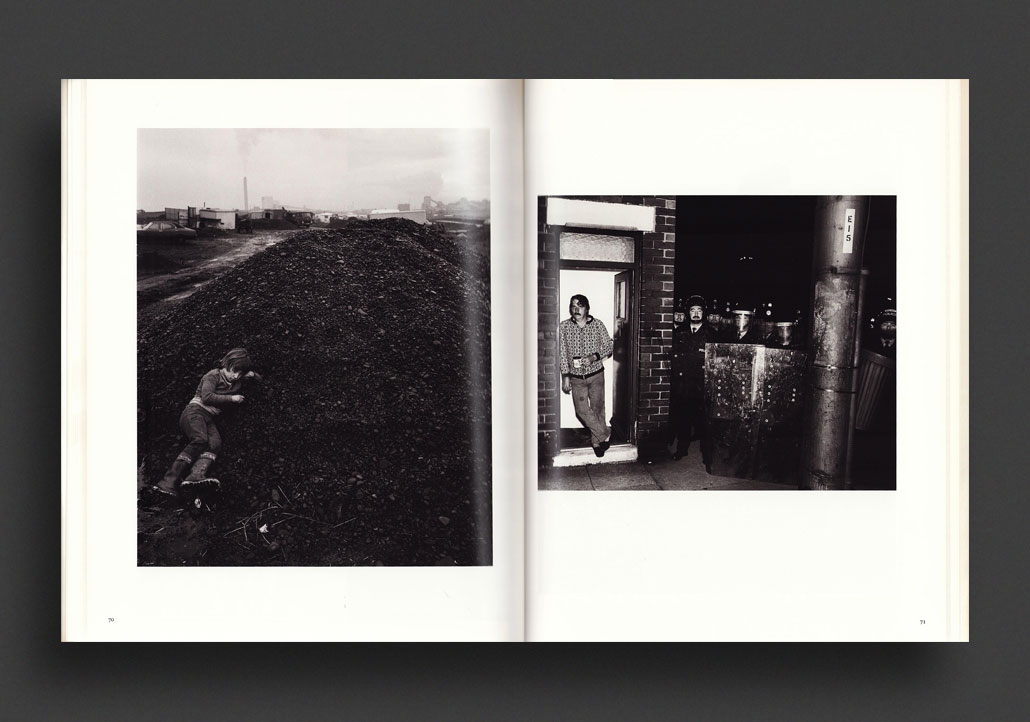
Very rare first 1988 edition, first printing of Chris Killip's masterpiece, In Flagrante, one of the greatest photo books of the late 20th century by one of Europe's most outstanding and uncompromising photographers, published by Secker & Warburg, London. For this book Killip became the first recipient of the prestigious Henri Cartier-Bresson Award. Extremely rare in this original UK hardcover edition.
In Flagrante is a beautiful, brutal, powerful and enduring collection of black and white photographs made in Northern England during its "de-industrialisation" between 1973 and 1985. Set against the miners strike and the dark age of the Thatcher years, Killip's arresting "portraits of Tyneside's working class communities amongst the signifiers of the region's declining industrial landscape" are recognised as among the most important visual records of living in 1980s Britain. Gerry Badger describes the photographs as "taken from a point of view that opposed everything [Thatcher] stood for". "A dark, pessimistic journey, perhaps even a secret odyssey, where rigorous documentary is suffused with a contemplative inwardness, a rare quality in modern photography." Killip has chosen, for the book's epigraph, Yeats's poem, "He wishes for the cloths of Heaven", with the famous closing lines, "tread softly because you tread on my dreams", a choice which Berger & Grant, in their essay, describe as "searingly apt. for it is as if all the photos here have been branded, like a hundred cattle, with the tenderness of those eight lines." The essay which follows the photographs is the result of a unique and remarkable collaboration between John Berger and Sylvia Grant.
Highest recommendation in the rarest edition.
Chris Killip (1946—2020) was was a Manx photographer born in Douglas, Isle of Man. Leaving school at age sixteen he become a beach photographer while working at his father's pub on the Isle of Man in order to earn enough money to leave the Isle of Man. By 1964 he took up photography full-time, working as a freelance assistant for various photographers in London from 1966—69. In 1969, after seeing his very first exhibition of photography at MoMA, he decided to leave commercial photography to return to photograph in the Isle of Man. The work from this time was eventually published by the Arts Council as Isle of Man: A Book about the Manx in 1980 with a text by John Berger. Killip received the Henri Cartier-Bresson Award for his acclaimed second book In Flagrante and was shortlisted for the Deutsche Börse Photography Foundation Prize. Killip worked at Harvard University from 1991 to 2017, as a Professor of Visual and Environmental Studies. He exhibited all over the world, wrote extensively, appeared on radio and television, and curated many exhibitions.
Near Fine copy in NF dust jacket, protected by archival mylar wrap.
Streetwise
Photographs by Mary Ellen Mark
1988, English
Softcover, 80 pages, 28 x 25.5 cm
1st Edition, Out of print title / used / very good
$220.00 - In stock -
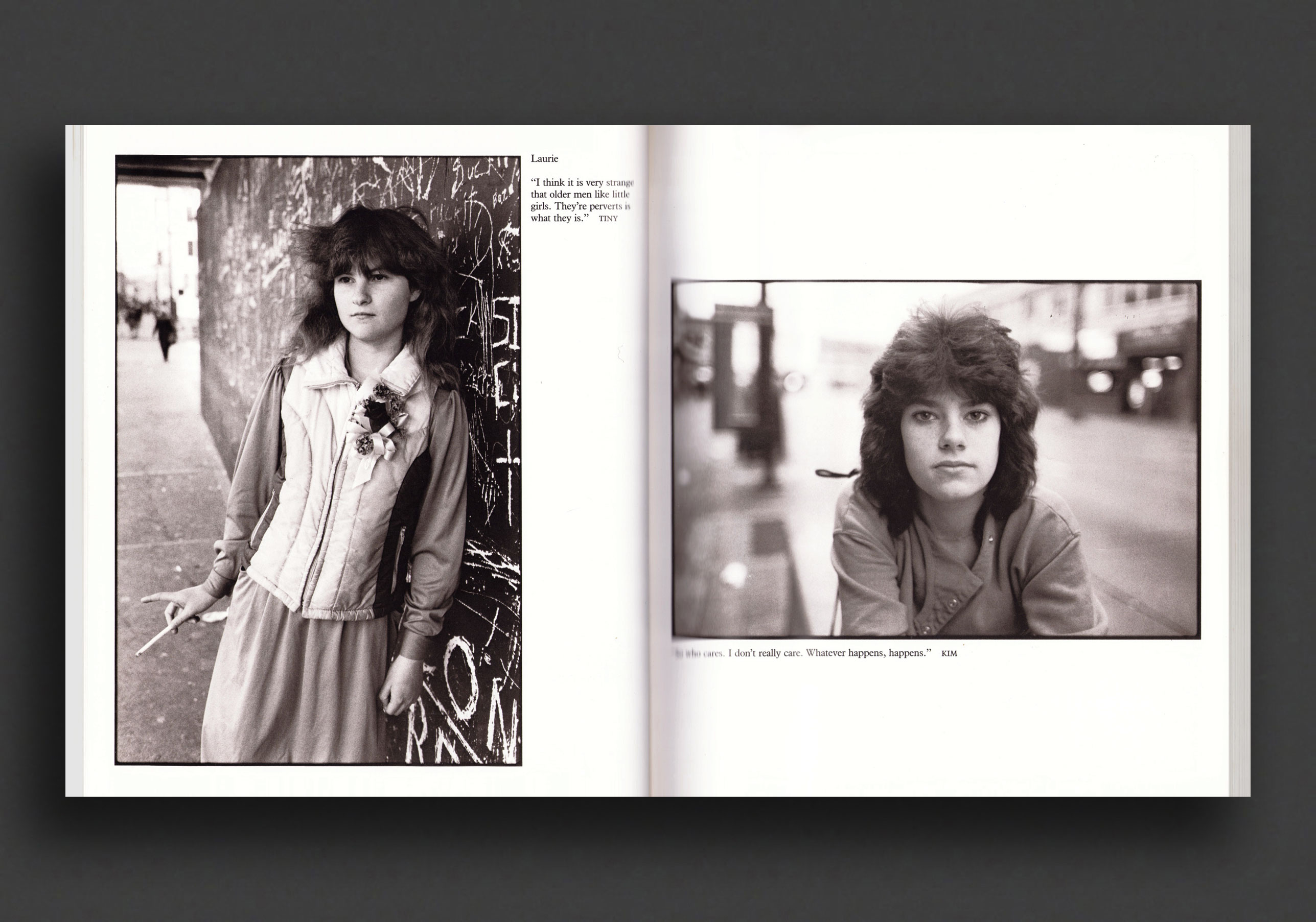
These are faces you will never forget.
Lulu, a high-strung 19-year-old with "an extraordinary sense of justice." Lulu was killed in a knife fight while defending a wronged friend.
"Tiny," a 13-year-old malnourished child prostitute with dreams of a horse farm, diamonds and furs, and a baby of her own.
Rat and Mike, 16-year-olds who roller skate in the halls of a condemned building and share tips on eating from dumpsters.
Dewayne, a fragile 16-year-old errand boy for drug pushers, who hanged himself in the cell of a juvenile facility when faced with the prospect of returning to the streets.
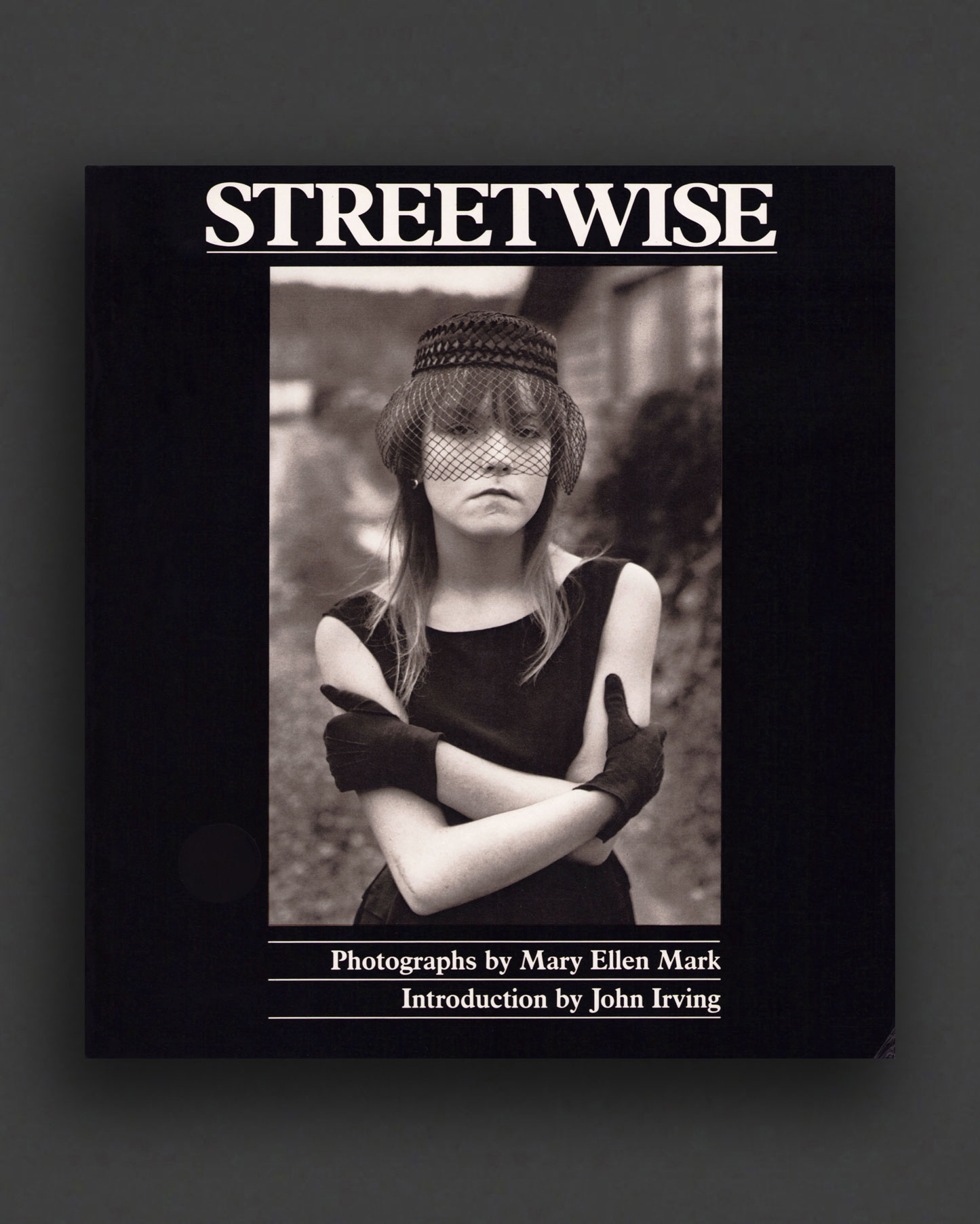
First 1988 edition of Streetwise by Mary Ellen Mark, published by Aperture, one of the best documentary photo books, period. Mark's intimate and moving portrait of teenagers in the streets of 1980's Seattle who survive as pimps, prostitutes, panhandlers and small-time drug dealers to get by. Heartbreaking and inspiring, Mark's cast of youths exude attitude and spirt in defiance of their dangerous circumstances. Streetwise captures not only the children's lives on the streets but, in their expressions and mannerisms, the effect of that life on them. With a text adapted from the film documentary made by Mark's husband, filmmaker Martin Bell, this book is a powerful education into one of the darker sides of American life.
"The photographs... are always poignant even when these children are laughing, it tears at your heart strings."—The Washington Post Book World
"I cared about the children when I looked at their portraits. The sense of hardship and waste of potential came to haunt me. The text made me marvel at the details of their difficult lives; it sent me back to study their portraits all over again."—Elsa Dorfman, The Women's Review of Books
"What distinguishes... Ms. Mark's photographs... is their shunning of sordid details in favor of a deeper and more intimate approach to their subjects—Diane Jacobs, The New York Times Book Review
Introduction by John Irving.
Foreword by Jerry Easterly.
dited by Nancy Baker.
Very Good copy with only notable defect being a black sticker to the front cover we are not willing to remove. Otherwise only light cover wear, minor laminate peeling to bottom-right corner of cover, light shelf wear. Tightly bound, interior near Fine. Preserved in archival sleeve.

International Shop Design / Ladenbauten - International
1967, English / German
Hardcover (w. dust jacket), 167 pages, 28.5 x 22.5 cm
1st Edition, Out of print title / used / good
$65.00 - In stock -
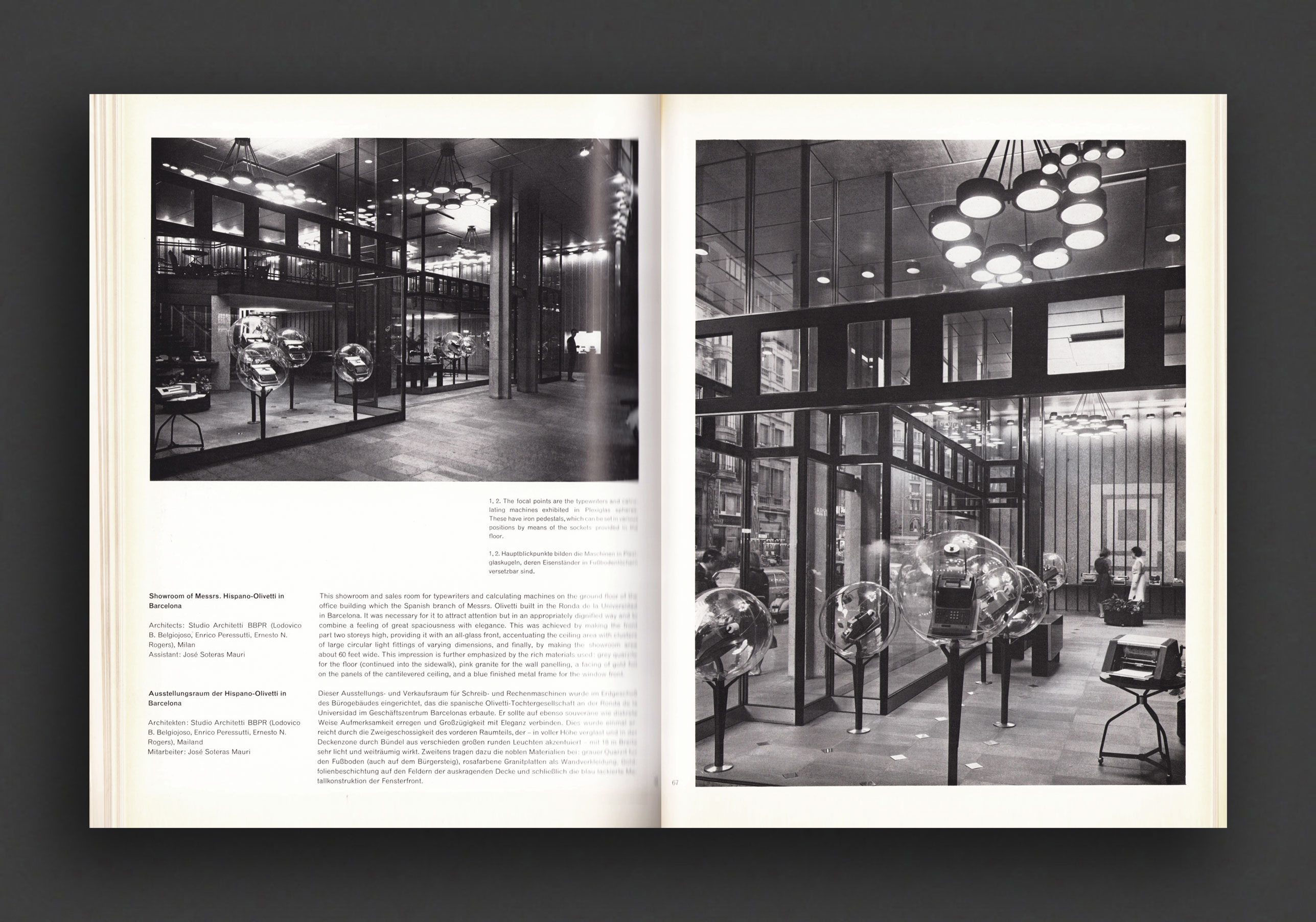
Wonderful 1967 hardcover book on cutting edge International Shop Design from the mid-1960s, edited by Karl Kaspar and published by Verlag Gerd Hatje, Stuttgart. Bi-lingual English and German texts accompany beautiful monochrome interior photography and technical drawings of lavish (mostly) European retail spaces that put contemporary retail design to shame, including stores for fashion, jewellery, photographic equipment, shoes, textiles, electrical appliances, bookshops, travel bureaux, hairdressing salons, showrooms for Knoll International, Olivetti, and IBM, and much more. Includes architects/designers: Robin Day, Joe Columbo, Hans Hollein, Franco Albini, Marvin B. Affrime, Gordon Andrews, Carl Aubock, Ingeborg August, BPRR Studio Architetti, Walter G. Bee, Walter Belz, Emiliano Bernasconi, Gian Antonio Bernasconi, Werner Blaser, Jørgen Bo, Gordon Bowyer & Ursula Bowyer, H. Brauns, Cesare Casati, Gaviglio Chini, Lacca Christen, Andreas Colombo, Conran Design Group, Claus Cullmann, Robin Day, Redfern & Partners Diamond, Madigan Edwards Torzillo & Partners, Hans Eichenberger, Frank R. Falla, Fautz & Rau, Sverre Fehn, Luigi Figini, Rodney Fitch, Gianfranco Frattini, Alexander Girardi, Rolf Gutbier, Franca Helg, Bård Henriksen, Hans Hollein, Enzo Hybsch, R. Jäneschitz-Kriegl, Hans Kammerer, Morris Ketchum Jr. & Associates, Knoll International Planungsabteilung, Knoll Planning Unit, Aris Konstantinidis, E. und G. Kuhn, Henry F. Kurz, Julio Lafuente, Victor Lundy, Gerald Luss, Helmut Magg, Karl Mang and Eva Mang, José Sotera Mauri, Mavis Milburn, Peter Moro & Partners, Arne Neegård, Eliot Noyes & Associates, Hans Peter Piel, Gino Pollini, Giancarlo Pozzo, Max Rasser, David Rock, Rosenthal Studio B, Carlo Scarpa, Pierluigi Spadolini, Francis B. Tamborini, The Space Design Group, Tibere Vadi, Vittoriano Vigano, Hans G. Walter, Ward & Saks, Inc., Bryan & Norman Westwood, Piet & Partners.
Good copy with tanning to edges of block and dust jacket, wear to cloth boards extremities. Tapes marks to interior initial blanks/dust jacket interior.
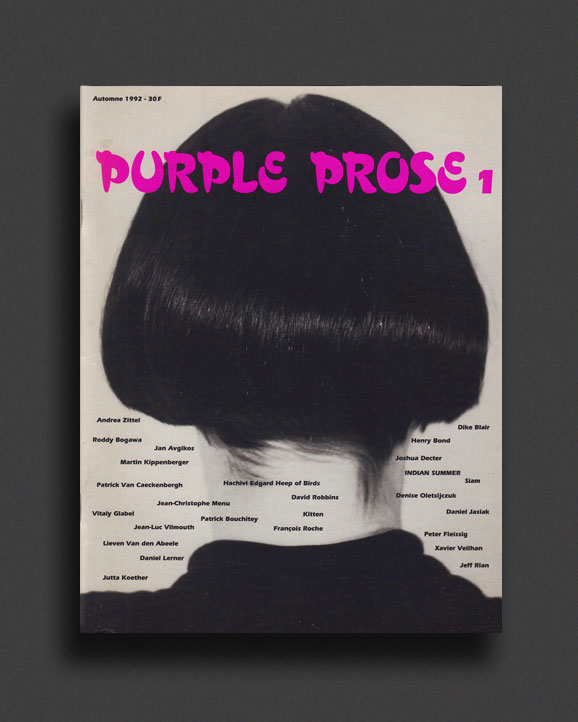
Purple Prose 1
Automne / Autumn 1992
1992, English / French
Softcover (staple-bound), 64 pages, 24.5 x 19 cm
1st Edition, Out of print title / used / very good
$580.00 - In stock -
The true beginning of Purple — the very rare first issue of Elein Fleiss and Olivier Zahm's Purple Prose, published in 1992. Founded as a reaction against the superficial glamour of the 1980’s, Purple Prose embraced the immediate fanzine aesthetics of what became referred to as 1990's anti-fashion, a far cry from what we now identify with Purple Fashion with.
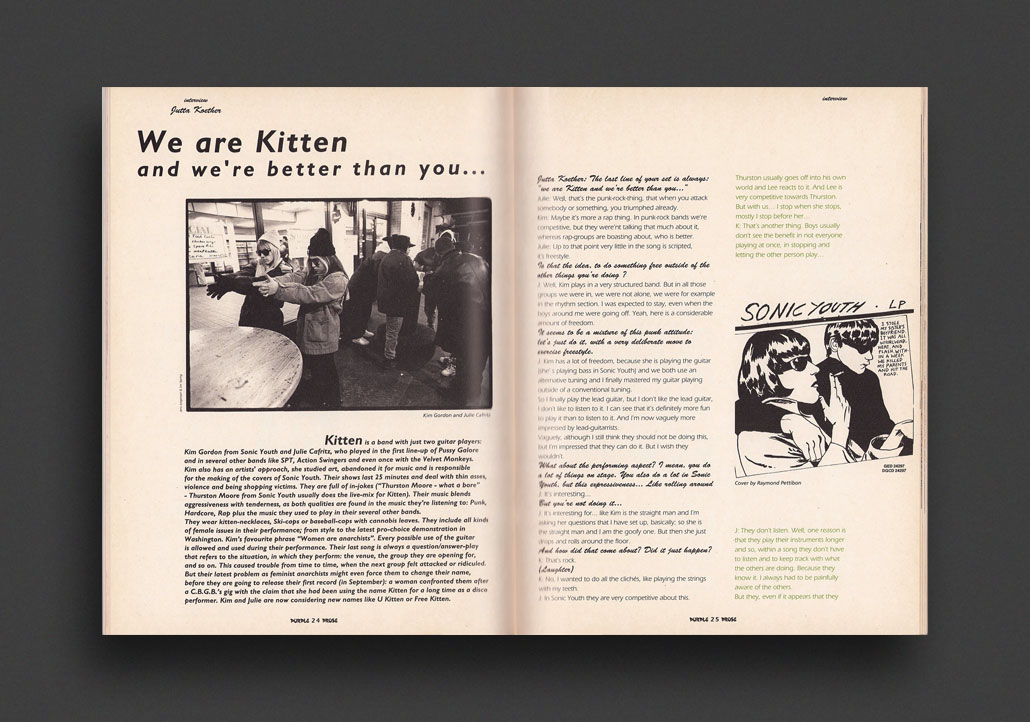
Purple Prose 1, Automne 1992, features contributions by Dike Blair, Andrea Zittel, Joshua Decter, Henry Bond, Daniel Lemer, Jutta Koether, Andrea Zittel, Roddy Bogawa, Jon Moritsugu, Jacques Boyreau, Jan Avgikos, Martin Kippenberger, Patrick Van Caeckenbergh, Edgar Heap of Birds, David Robbins, Jean-Christophe Menu, Vitaly Glabel, Kitten (pre—Free Kitten: Kim Gordon of Sonic Youth and Pussy Galore's Julia Cafritz), Patrick Bouchitey, Jean-Luc Vilmouth, François Roche, and many more.
Soon after the birth of Purple Prose, Zahm created spin-off publications like Purple Sexe, Purple Fiction and what we now know and love, Purple Fashion. Zahm aimed at fusing together his two worlds, fashion and art, in creating Purple Fashion.
Before entering the world of fashion, Zahm worked as an art critic with widespread recognition for his work as a curator as well as his participation in over 150 exhibitions featuring international contemporary art. In 1994, Zahm and Fleiss curated “The Winter of Love,” a hit show for the Museum of Modern Art in Paris that they later took to P.S.1 in New York. In responding to the superficial glamour of the 1980s, Zahm co-founded Purple Prose magazine. In the introduction of Purple Anthology, Zahm shares why he chose to create Purple Prose:
"We launched Purple Prose in the early 1990s without any means, and without any experience, because we wanted to make a magazine that was radically different. We wanted to support the artists around us that no one else supported, much less talked about. [..] It would be a form of opposition of our own".
Very Good—Near Fine copy, light wear.
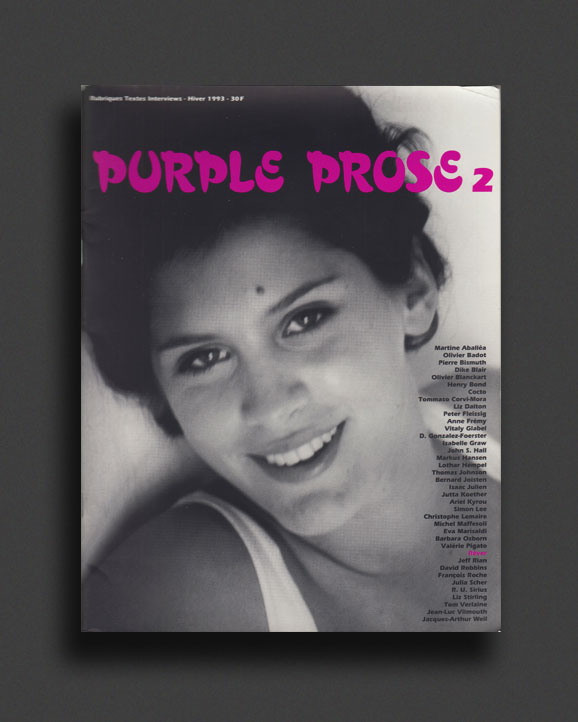
Purple Prose 2
Hiver / Winter 1993
1993, French / English
Softcover (staple-bound), 80 pages, 24.5 x 18 cm
1st Edition, Out of print title / used / very good
$200.00 - Out of stock
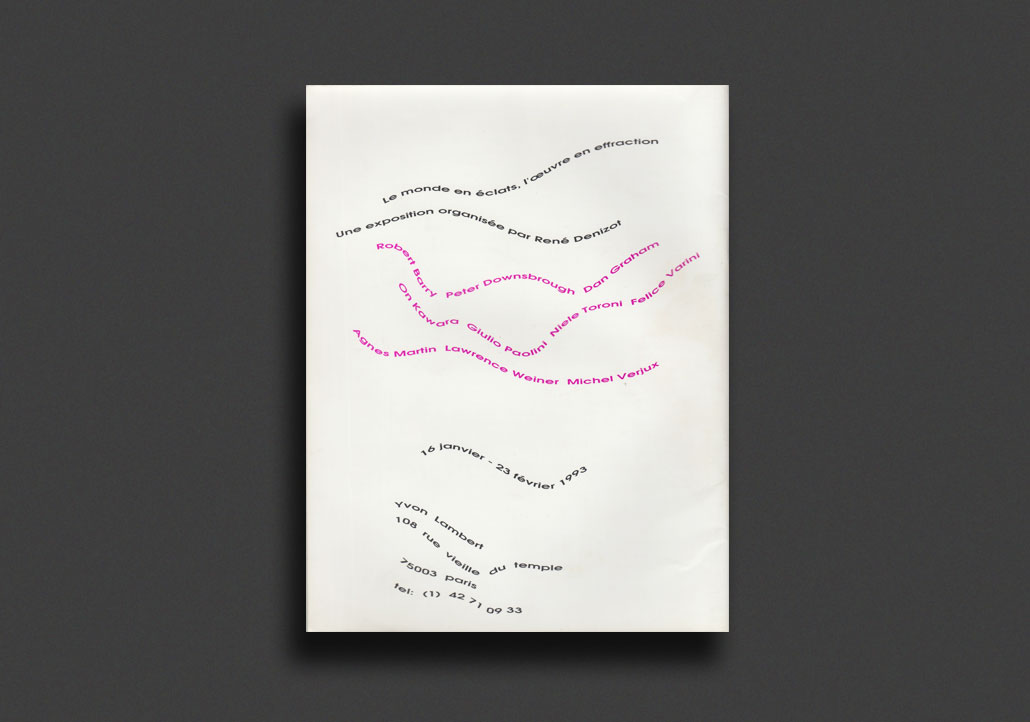
The very scarce second issue of Elein Fleiss and Olivier Zahm's Purple Prose, the Parisian literary art zine that began the world of Purple. Founded in 1992 as a reaction against the superficial glamour of the 1980’s, Purple Prose embraced the immediate fanzine aesthetics of what became referred to as 1990's anti-fashion, a far cry from what we now identify with Purple Fashion with.
Purple Prose 2 (Winter 1993) features: Martine Aballea, Olivier Badot, Pierre Bismuth, Dike Blair, Olivier Blanckart, Henry Bond, Cocto, Tommaso Corvi-Mora, Liz Dalton, Peter Fleissig, Anne Frémy, Vitaly Glabel, Dominique Gonzalez-Foerster, Isabelle Graw, John S. Hall, Markus Hansen, Lothar Hempel, Thomas Johnson, Bernard Jolsten, Isaac Julien, Jutta Koether, Ariel Kyrou, Simon Lee, Christophe Lemaire, Michel Maffesoli, Eva Marisaldi, Barbara Osborn, Valerie Pigato, Jeff Rian, David Robbins, François Roche, Julia Scher, R. U. Sirius, Liz Stirling, Tom Verlaine, Jean-Luc Vilmouth, Jacques-Arthur Weil.
Soon after the birth of Purple Prose, Zahm created spin-off publications like Purple Sexe, Purple Fiction and what we now know and love, Purple Fashion. Zahm aimed at fusing together his two worlds, fashion and art, in creating Purple Fashion.
Before entering the world of fashion, Zahm worked as an art critic with widespread recognition for his work as a curator as well as his participation in over 150 exhibitions featuring international contemporary art. In 1994, Zahm and Fleiss curated “The Winter of Love,” a hit show for the Museum of Modern Art in Paris that they later took to P.S.1 in New York. In responding to the superficial glamour of the 1980s, Zahm co-founded Purple Prose magazine. In the introduction of Purple Anthology, Zahm shares why he chose to create Purple Prose:
"We launched Purple Prose in the early 1990s without any means, and without any experience, because we wanted to make a magazine that was radically different. We wanted to support the artists around us that no one else supported, much less talked about. [..] It would be a form of opposition of our own".
Very Good—Near Fine copy, light wear.

Purple Journal Numéro Zéro
2004, French
Softcover (staple-bound), unpaginated, 27.5 x 21 cm
1st Edition, Out of print title / used / very good
$200.00 - In stock -
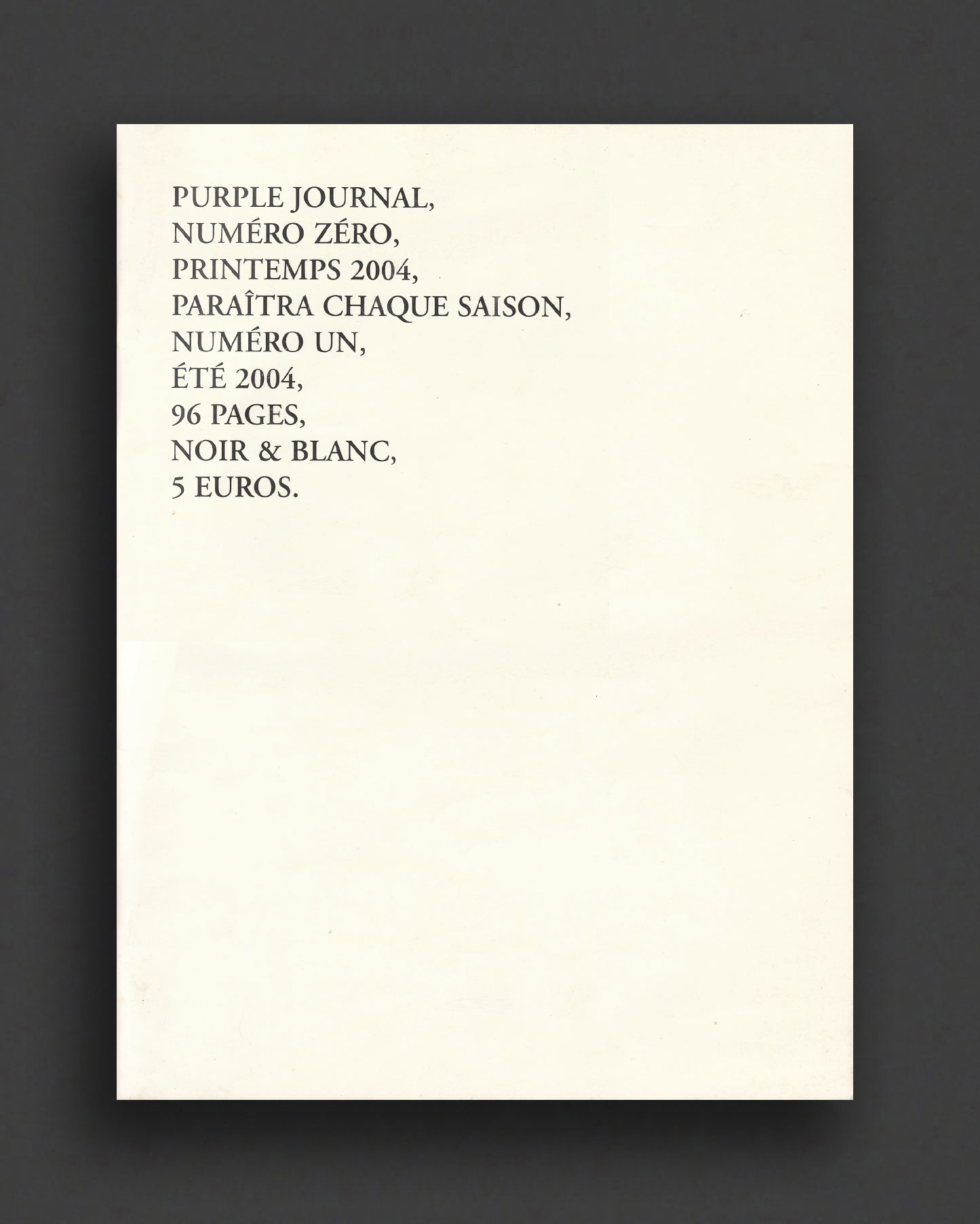
Very rare issue zero of Purple Journal, edited by Elein Fleiss with artistic direction by Laetitia Benat, Christophe Brunnquell and Fleiss. Published in Spring 2004 by Purple Institute, Purple Journal was the precursor to “Le Purple Journal” (French version) and “The Purple Journal” (English version), each published in 12 issues between 2004 and 2008, with a single bi-lingual last issue 13. "Purple Journal" has only one issue—Numéro Zéro—and it is so beautifully put together as a singular publication. Printed in monochrome throughout, this volume features photography by Laetitia Benat, Giasco Bertoli, Mark Borthwick, Christophe Brunnquell, Susan Cianciolo, Anders Edström, Marina Faust, Elein Fleiss, Jonathan Hallam, Angela Hill, Takashi Homma, Pierre Leguillon, Katja Rahlwes, Henry Roy, Sabine Schruender, Robert Stadler, Chikashi Suzuki, Camille Vivier, with folios featuring Rainer Werner Fassbinder, Cat Power, Martin Margiela, Harmony Korine, Vito Acconci, Comme des Garçons, Lou Barlow, Serge Manzon, Cosmic Wonder, Susan Cianciolo, Helmut Lang, Isamu Noguchi, Zucca, Ann-Sofie Back, Anders Edström, Lutz, Agathe Godard, and more.
The back cover features a "Comme des Garçons" advertisement.
In 1992 Olivier Zahm and his partner Elein Fleiss printed the first issue of Purple Prose, a Parisian literary art zine that over the years has evolved into Purple Fashion Magazine. Soon after the birth of Purple Prose, Zahm and Fleiss created spin-off publications like les cahiers purple, Purple Sexe, Purple Journal, Purple Fiction, and of course, Purple Fashion, a library that fused the arts and literature with fashion and defined what has come to be known as anti-fashion in the 1990s—2000s.
Very Good copy, light wear.
Hiromix
Hiromix Works
2000, English
Hardcover (w. obi), 280 pages, 24 x 17.5 cm
1st Edition, Out of print title / used / very good
$150.00 - In stock -
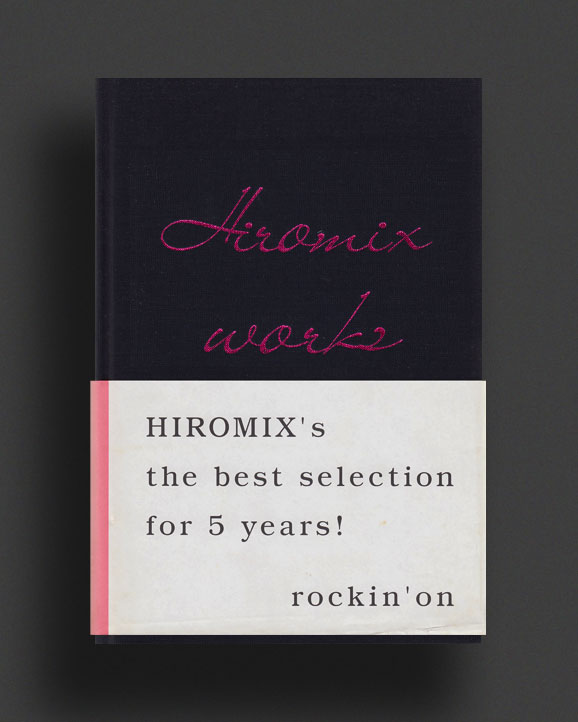
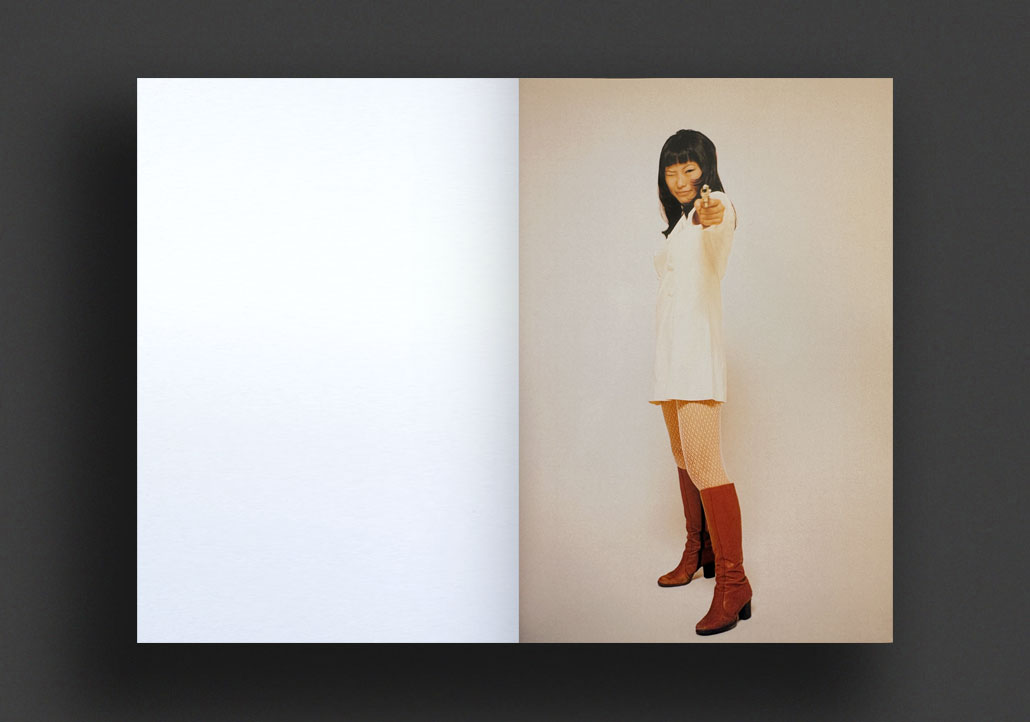
First 2000 edition and first printing. Hiromix Works is iconic Tokyo photographer Hiromix's selection of her best photographs spanning 1995—2000. Born Tokyo in 1976, Hiromix (Hiromi Toshikawa) is a Tokyo photographer who, along with Yurie Nagashima and Mika Ninagawa, is considered the main instigator of the girly photo boom in the 1990s, a photographic movement in which Japanese teenagers, and especially, teenage Japanese women from the early 90's, took center stage in a new visual language. Championed by photographers Takashi Homma and Nobuyoshi Araki, to whom he dedicated this book, Hiromix was selected by Araki to win the 11th New Cosmos of Photography award in 1995 with a series of photographs depicting high school life from a teenager's perspective — images of her half-eaten breakfast, blurred portraits of her friends, stuffed toys, flowers, musicians, images that helped to build a world of the intimately feminine, personal and unknown to a nation accustomed to overly sexualized representations of women, created, of course, by men. In 2001, Hiromix was the youngest person ever to win the 26th Kimura Ihei Photography Award. Hiromix Works is a heavy hardcover compilation of her best 1990's photographs, during the time where she was also working as a photographer for ‘Rockin' On’, a Japanese bi-monthly music magazine, and publisher of this prized first book. Issued only in Japan, includes many works shot for Studio Voice, Purple, Rockin' On, Self Service, Purple Sexe, Visionaire...
VG—Near Fine first edition, with obi.
PURPLE SEXE NO. 6
Summer 2000
2000, English
Softcover (staple-bound), unpaginated, 25.5 x 18 cm
1st Edition, Out of print title / used / good
$140.00 - In stock -
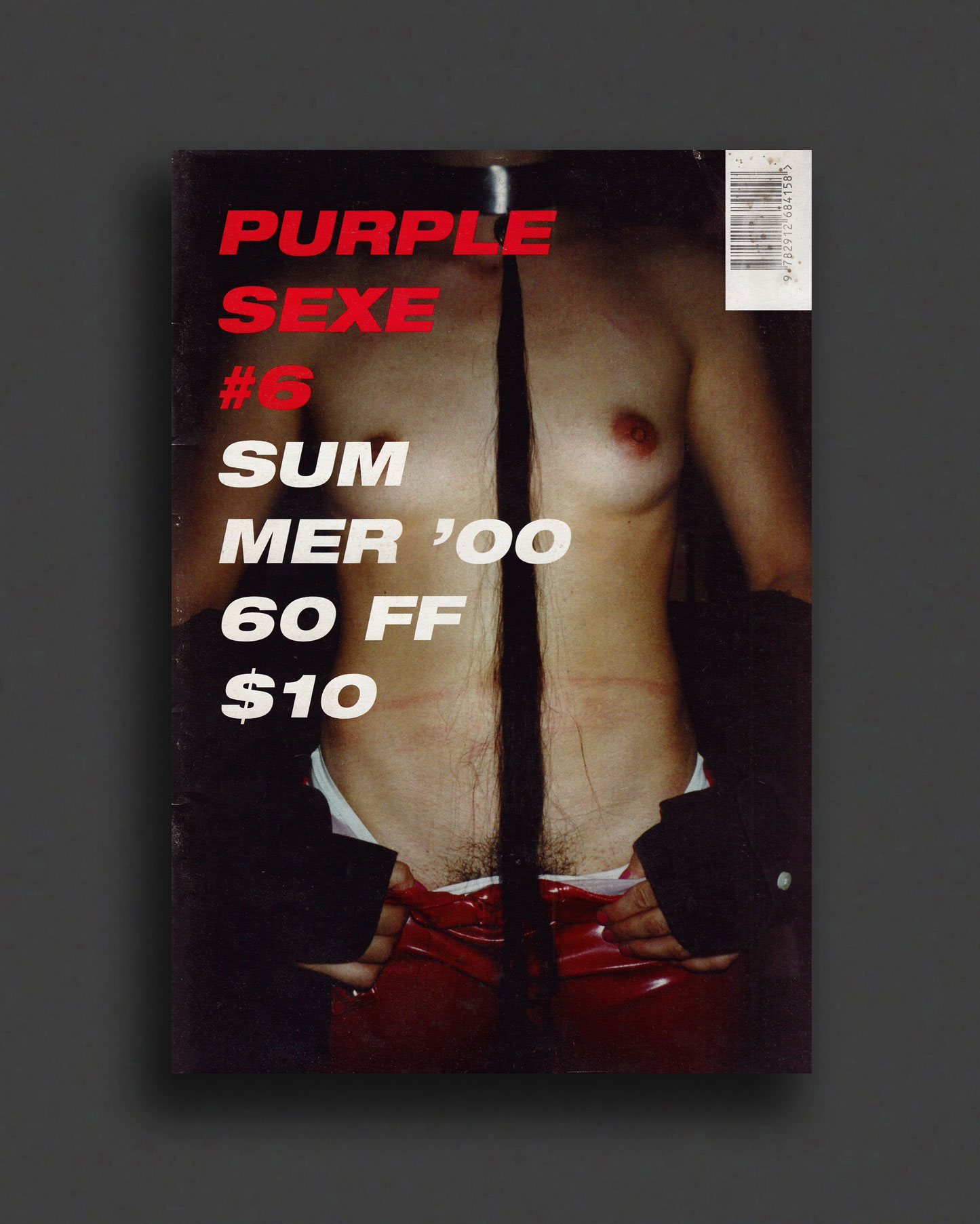
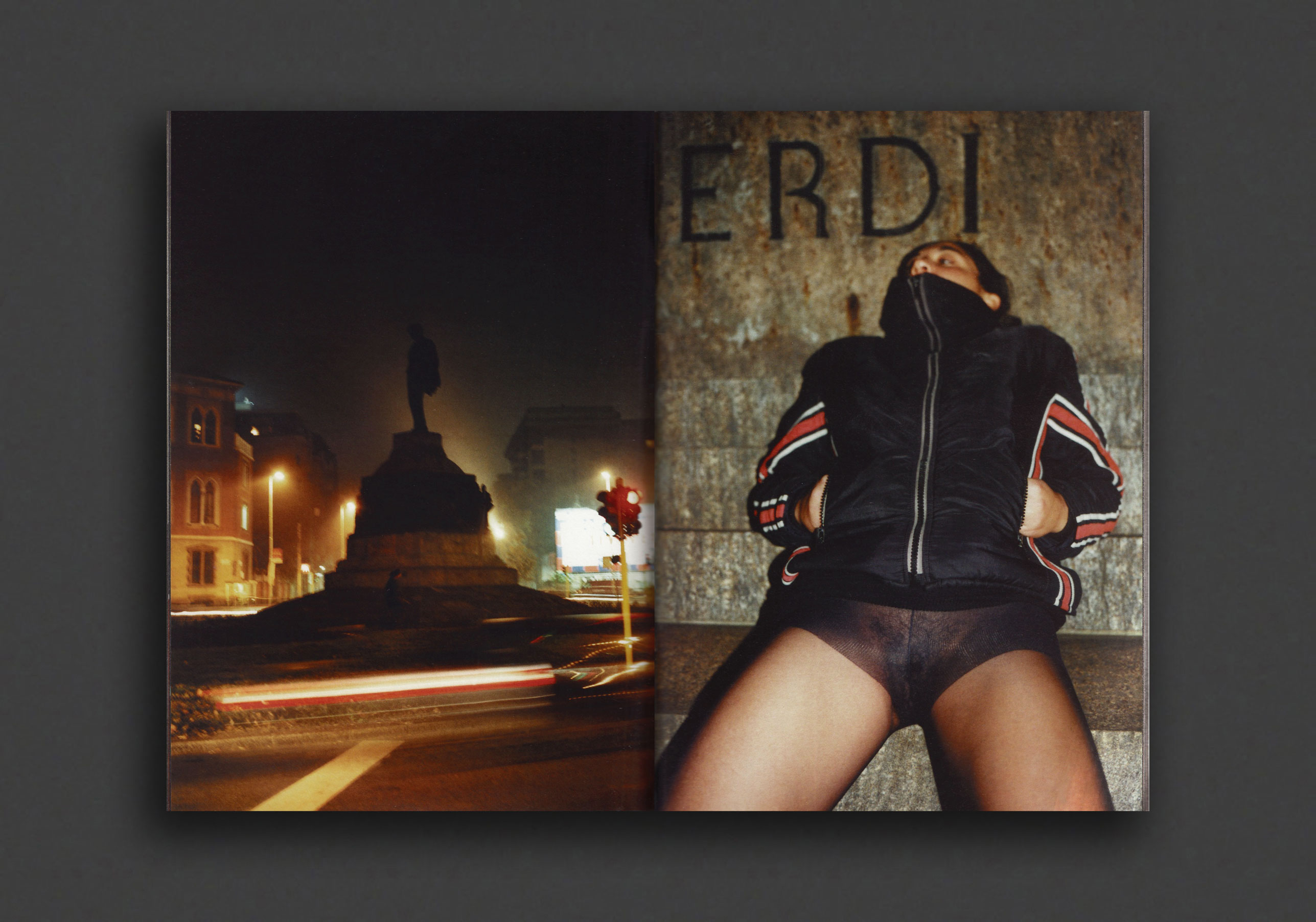
The scarce sixth issue (of eight total, published between 1998-2001) of Olivier Zahm's short-lived, erotically charged photography journal "Purple Sexe". This issue in the larger format designed by Christophe Brunnquell is cover to cover gloss erotic photography by Giasco Bertoli in an issue-length portfolio devoted entirely to Milan (including Fontana and Pirelli).
In 1992 Olivier Zahm and his partner Elein Fleiss printed the first issue of Purple Prose, a Parisian literary art zine that over the years has evolved into Purple Fashion Magazine. Soon after the birth of Purple Prose, Zahm created spin-off publications like Purple Sexe, Purple Fiction and what we now know and love, Purple Fashion. Zahm aimed at fusing together his two worlds, fashion and art, in creating Purple and Purple Fashion. Purple Sexe remains one of the scarcest of the early Purple series', published in the same format as Purple Prose and Purple Fiction in late 1990s. A magazine devoted to sexuality, only 8 issues of Purple Sexe were ever published between 1998 - 2001, edited by Olivier Zahm and commencing the same year as Purple, which was a fusion of Purple Prose, Fiction, Fashion, and Sexe.
Good copy with light wear to cover extremities, light marking to barcode area.


Namio Harukawa
2021, English
Hardcover, 76 Pages, 20 x 25 cm
$70.00 - In stock -
Back in print! The first posthumous book by Japanese fetish artist Namio Harukawa (May 1947 – April 24, 2020), dedicated to Harukawa’s archive of rarely published work.
Creating a visionary language through the medium of pencil drawings, Harukawa worked for 60 years under a pseudonym, Namio Harukawa: formed from an anagram of “Naomi”, a reference to Jun’ichirō Tanizaki’s novel, and actress Masumi Harukawa, using it until his death in 2020.
Forniphilia and domination has fascinated and preoccupied Harukawa, in his artistic practice, and was central to his life work. His artwork typically featured voluptuous women dominating and humiliating smaller men. His work has been exhibited internationally and received critical praise, from Oniroku Dan to Madonna, and found new contemporary relevance on social networks, from feminists, to liberators.
The book also contains an essay by academic Pernilla Ellens, editor of Post Butt and The true meaning of S.M.H. and is designed by Sam Boxer, Art Director of Gut Magazine.

Shunji Onkura
Tokyo X
2000, English / Japanese
Softcover (w. obi), 256 pages, 25.5 x 17.5 cm
1st Edition, Out of print title / used / very good
$70.00 - Out of stock
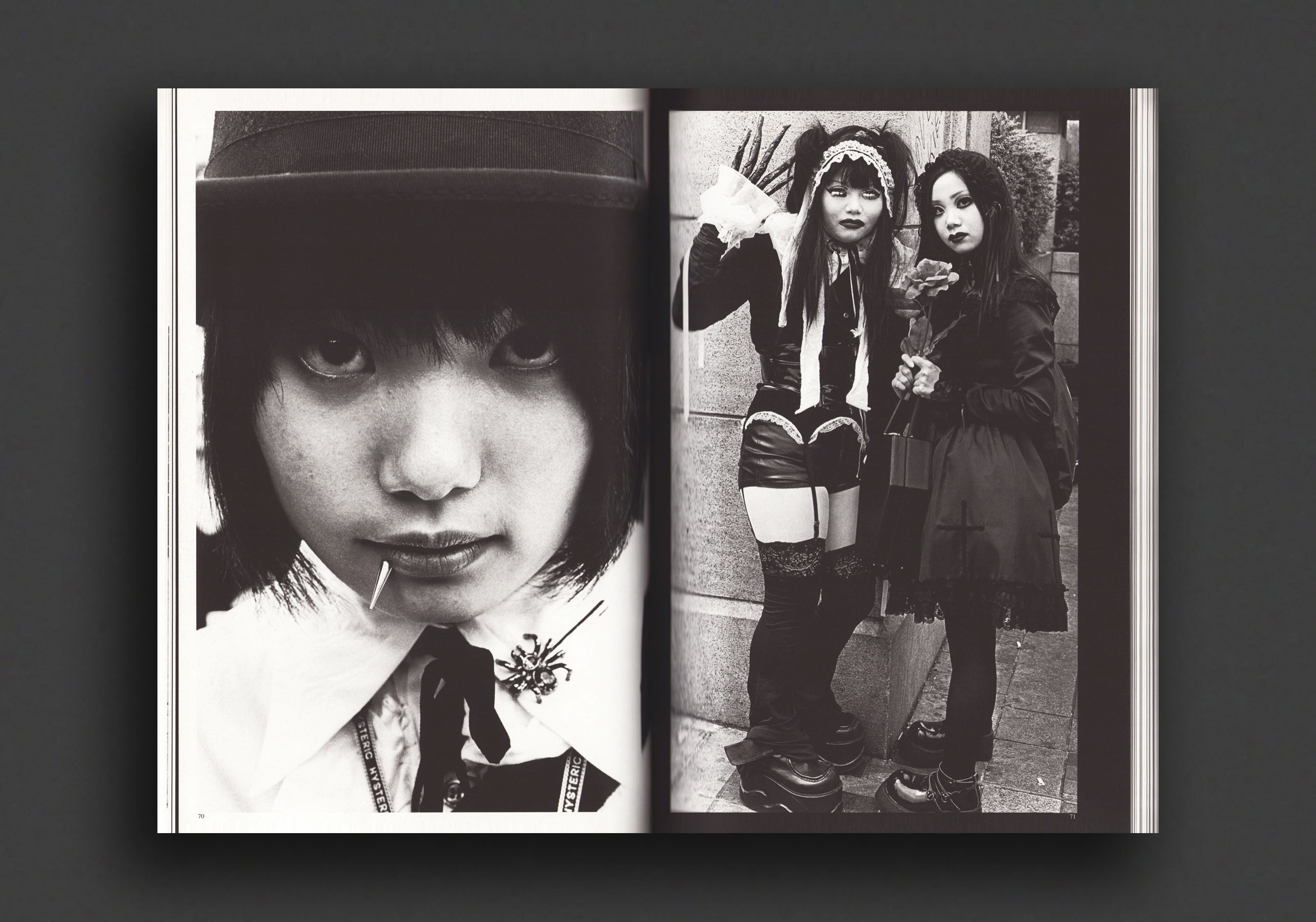
"In Ohkura's stark vision Tokyo is an inorganic machine where everyone and everything exists only to serve the ringmaster of commerce. Activity, however frenetic, is futile. Work, leisure, love, pleasure, all are just forms of human bondage."—Giles Murray
Scarce first 2000 edition of Onkura's incredible Tokyo X — stark black and white imagery from the metropolis, published by Kondansha International. Texts in English and Japanese. With Afterword by Shunji Onkura.
The book ran into multiple print-runs, this is the first, stated within.
"Tokyo—exciting, flamboyant—is much, much more than that. It is nothing less than a monstrous hellhole inhabited by the most alienated people on the face of the earth. It is this city of eviscerated, hollow men and women that has been so unforgettably captured in the powerful photography of Tokyo X. Here, Tokyo, which the afterword declares to be the handiwork of "a demon-like ruler whose power is so vast that it envelopes the entire planet and transcends all human understanding and religion," is seen as the unfortunate future brought into an unprepared present. This is the world that Tarkovsky borrowed for the alien capital in "Solaris" and the location of Ridley Scott's "Blade Runner." It is the scene for Katsuhiro Otomo's "Akira." It is what perhaps awaits all mankind. This is the conclusion, after reading Tokyo X, that one is forced to draw. Shunji Ohkura, famous for his photography of Kabuki, fashion, and insects, was so moved by the plight of Tokyo in the 1990s that he forced himself to record the carnage in the 251 scenes revealed in this book. The photos, seemingly randomly arranged, in fact constitute a linked series of visual poems that resonate and reverberate throughout the mind until the dark shroud covering the city of Tokyo seems to cloud the whole of one's vision. Tokyo X must be seen to be believed."
Very Good copy with original obi. Light wear to obi and cover extremities, else Fine throughout.
