World Food Books' programme is largely produced on Kulin Nation land. We acknowledge the Wurundjeri people of the Kulin Nation as the first and continuing custodians of this land, and pay respect to their Elders past, present, and emerging.
World Food Books is an arts and special interests bookshop in Naarm / Melbourne. Founded in 2010, World Food Books is devoted to the presentation of a rotating, hand-selection of international art, design, literary and counterculture publications with an emphasis on the anti-traditional, the experimental, the avant-garde, the heretic, the marginal.
Presenting new titles alongside rare and out-of-print books, catalogues and journals spanning the fields of modern and contemporary art, design, photography, illustration, film, literature, poetry, cultural theory, philosophy, sexuality, popular and underground culture in its many radical forms, World Food Books wishes to encourage adventurous, thoughtful and open-minded reading, looking, writing, and exchange of publishing and ideas, both current and historical.
As well as our bookshop, located in Melbourne's historical Nicholas Building, all of our inventory is available internationally via our online mail-order service.
World Food Books semi-regularly co-ordinates "Occasions", a programme of exhibits and events at the bookshop and in partnership with other hosts (such as museums and art galleries) that develop out of the activities, relationships and content of the bookshop itself.
World Food Books
The Nicholas Building
37 Swanston Street
Room 5, Level 6
Melbourne 3000
Australia
SHOP HOURS:
Thu–Fri 12–6, Sat 12–5
WEB-SHOP OPEN 24/7
World Food Books
Postal Address:
PO Box 435
Flinders Lane
Victoria 8009
Australia
Art
Theory / Essay
Architecture / Interior
Graphic Design / Typography
Photography
Fashion
Eros
LGBTQ+
Fiction / Poetry
Weird / Speculative / Science Fiction / Horror
Transgressive / Visceral / Abject
Symbolism / Decadence / Fin de siècle
Film / Video
Painting
Sculpture / Installation
Performance / Dance / Theater
Drawing
Sound / Music
Curatorial
Group Shows / Collections
Periodicals
Out-of-print / Rare
Posters / Ephemera / Discs
Signed Books
World Food Books Gift Voucher
World Food Book Bag
Australian Art
Australian Fiction
Australian Science Fiction / Speculative Fiction
Australian Poetry
Australian Photography
Japanese Photography
Conceptual Art
Minimal Art
Dada
'Pataphysics / Oulipo
Fluxus
Concrete Poetry
Pop Art
Surrealism
Arte Povera
Arte Informale / Haute Pâte / Tachism
Nouveau Réalisme / Zero / Kinetic
Situationism / Lettrism
Collage / Mail Art / Xerox Art
Art Brut / Folk / Visionary / Fantastic
Illustration / Graphic Art / Bandes Dessinées
Furniture
Italian Radical Design / Postmodernism
Textiles
Ceramics / Glass
Counterculture
Protest / Revolt
Philosophy
Psychoanalysis
Anthropology
Anarchism
Socialism / Anarchism / Communism / Capitalism
Literary Theory / Semiotics / Language
Feminism / Women's Studies
Gender Studies / Sexuality
Anthropology
Fetishism / BDSM
Drugs / Psychedelia
Crime / Violence
Animal Rights / Veganism
Occult / Esoterica
Ecology / Earth / Alternative Living
Whole Earth / Crafts
All prices in AUD (Australian dollars)
Pick-Ups
Pick-up orders can be collected in our bookshop during opening hours after order date. Please collect any Pick-up orders within 2 weeks of ordering as we have limited storage space. Orders will be released back into stock if not collected within this time. No refunds can be made for pick-ups left un-collected. If you cannot make it in to the bookshop in this time-frame, please choose postage option.
Return Policy
All sales are final. We do accept returns (for refund or exchange) for items received in error. All our orders are packed with special care using heavy-duty padding and cardboard book-mailers or bubble mailers (for smaller books), using reinforcement where required. We cannot take responsibility for any lost, stolen or damaged parcels.
Insurance
Should you wish to insure your package, please email us directly after placing your order and we can organise this at a small extra expense. Although all standard/express tracked packages are very safe and dependable, we cannot take responsibility for any lost, stolen or damaged parcels. We recommend insurance on valuable orders.
Interested in selling your old books, catalogues, journals, magazines, comics, fanzines, ephemera? We are always looking for interesting, unusual and out-of-print books to buy. We only buy books in our fields of interest and specialty, and that we feel we can resell.
We base these prices on desirability, market value, in-print prices, condition and our current stock levels. We offer cash, store credit, and can take stock on consignment. All
about 25% of the price we expect to get when we sell them, or 30% in store credit. We base these prices on desirability, market value, in-print prices, condition and our current stock levels.
Sell your books any day of the week. You can drop them off and return later. If you have a lot of books, we can visit your Sydney home.
We buy books that we feel we can resell. We offer about 25 % of the price we expect to get when we sell them, or 30% in store credit. We base these prices on desirability, market value, in-print prices, condition and our current stock levels.
Philadelphia Wireman
03 August - 01 September, 2018
World Food Books is proud to announce our next Occasion, the first presentation of sculptures by Philadelphia Wireman in Australia.
The Philadelphia Wireman sculptures were found abandoned in an alley off Philadelphia’s South Street on trash night in 1982. Their discovery in a rapidly-changing neighbourhood undergoing extensive renovation, compounded with the failure of all attempts to locate the artist, suggests that the works may have been discarded after the maker’s death. Dubbed the "Philadelphia Wireman" during the first exhibition of this work, in 1985, the maker’s name, age, ethnicity, and even gender remain uncertain. The entire collection totals approximately 1200 pieces, all intricately bound together with tightly-wound heavy-gauge wire (along with a few small, abstract marker drawings, reminiscent both of Mark Tobey and J.B. Murry). The dense construction of the work, despite a modest range of scale and materials, is singularly obsessive and disciplined in design: a wire armature or exoskeleton firmly binds a bricolage of found objects including plastic, glass, food packaging, umbrella parts, tape, rubber, batteries, pens, leather, reflectors, nuts and bolts, nails, foil, coins, toys, watches, eyeglasses, tools, and jewellery.
Heavy with associations—anthropomorphic, zoomorphic, and socio-cultural responses to wrapped detritus—the totemic sculptures by Philadelphia Wireman have been discussed in the context of work created to fulfil the shamanistic needs of alternative religions in American culture. Curators, collectors, and critics have variously compared certain pieces to sculpture from Classical antiquity, Native American medicine bundles, African-American memory jugs, and African fetish objects. Reflecting the artist’s prolific and incredibly focused scavenging impulse, and despite—or perhaps enhanced by—their anonymity, these enigmatic objects function as urban artefacts and arbiters of power, though their origin and purpose is unknown. Philadelphia Wireman, whatever their identity, possessed an astonishing ability to isolate and communicate the concepts of power and energy through the selection and transformation of ordinary materials. Over the course of the past two decades, this collection has come to be regarded as an important discovery in the field of self-taught art and vernacular art.
Presented in collaboration with Fleisher-Ollman Gallery, Philadelphia, and Robert Heald, Wellington.
Susan Te Kahurangi King
02 February - 10 March, 2018
Susan Te Kahurangi King (24 February 1951 - ) has been a confident and prolific artist since she was a young child, drawing with readily available materials - pencils, ballpoint pens and felt-tip markers, on whatever paper is at hand. Between the ages of four and six Susan slowly ceased verbal communication. Her grandparents William and Myrtle Murphy had developed a special bond with Susan so they took on caring responsibilities for extended periods. Myrtle began informally archiving her work, carefully collecting and storing the drawings and compiling scrapbooks. No drawing was insignificant; every scrap of paper was kept. The King family are now the custodians of a vast collection containing over 7000 individual works, from tiny scraps of paper through to 5 meter long rolls.
The scrapbooks and diaries reveal Myrtle to be a woman of great patience and compassion, seeking to understand a child who was not always behaving as expected. She encouraged Susan to be observant, to explore her environment and absorb all the sights and sounds. Myrtle would show Susan’s drawings to friends and people in her community that she had dealings with, such as shopkeepers and postal workers, but this was not simply a case of a grandmother’s bias. She recognised that Susan had developed a sophisticated and unique visual language and sincerely believed that her art deserved serious attention.
This was an unorthodox attitude for the time. To provide some context, Jean Dubuffet coined the term Art Brut in 1945 to describe work created by self-taught artists – specifically residents of psychiatric institutions and those he considered to be visionaries or eccentrics. In 1972 Roger Cardinal extended this concept by adopting the term Outsider Art to describe work made by non-academically trained artists operating outside of mainstream art networks through choice or circumstance. Susan was born in Te Aroha, New Zealand in 1951, far from the artistic hubs of Paris and London that Dubuffet and Cardinal operated in. That Myrtle fêted Susan as a self-taught artist who deserved to be taken seriously shows how progressive her attitudes were.
Susan’s parents Doug and Dawn were also progressive. Over the years they had consulted numerous health practitioners about Susan’s condition, as the medical establishment could not provide an explanation as to why she had lapsed into silence. Dawn educated herself in the field of homeopathy and went on to treat all twelve of her children using these principles – basing prescriptions on her observations of their physical, mental and emotional state.
Doug was a linguist with an interest in philosophy who devoted what little spare time he had to studying Maori language and culture. To some extent their willingness to explore the fringes of the mainstream made them outsiders too but it was their commitment to living with integrity and their respect for individuality that ensured Susan’s creativity was always encouraged.
Even though Susan’s family supported her artistic pursuits, some staff in schools and hospitals saw it as an impediment to her assimilation into the community and discouraged it in a variety of ways. Her family was not always aware of this and therefore did not fully understand why Susan stopped drawing in the early 1990s. However, rather than dwell on the challenges that Susan faced in pursuit of her artistic practice, they prefer to highlight her achievements. In 2008 Susan began drawing again in earnest, after an almost 20 year interruption, and her work is now shown in galleries around the world.
Susan grew up without television and has been heavily influenced by the comics she read as a child. She is absolutely fearless in the appropriation of recognizable characters, such as Donald Duck and Mickey Mouse, in her work. She twists their limbs, contorts their faces, compresses them together, blends them into complex patterned backgrounds - always imbuing them with an incredible energy. Although Susan often used pop culture characters in her work they are not naive or childlike. These are drawings by a brilliant self-taught artist who has been creating exceptional work for decades without an audience in mind.
Mladen Stilinović
"Various Works 1986 - 1999"
02 February 16 - September 10, 2016
Various works 1986 - 1999, from two houses, from the collections of John Nixon, Sue Cramer, Kerrie Poliness, Peter Haffenden and Phoebe Haffenden.
Including: Geometry of Cakes (various shelves), 1993; Poor People’s Law (black and white plate), 1993; White Absence (glasses, ruler, set square, silver spoon, silver ladel with skin photograph and wooden cubes), 1990-1996; Exploitation of the Dead (grey and red star painting, wooden painting, black spoon with red table, red plate), 1984-1990; Money and Zeros (zero tie, paintings made for friends in Australia (Sue, John, Kerrie), numbers painting), 1991-1992; Words - Slogans (various t-shirts) - “they talk about the death of art...help! someone is trying to kill me”, “my sweet little lamb”, “work is a disease - Karl Marx”; Various artist books, catalogues, monographs, videos; Poster from exhibition Insulting Anarchy; "Circular" Croatian - Australian edition; Artist book by Vlado Martek (Dostoyevsky); more.
Thanks to Mladen Stilinović and Branka Stipančić.
Jonathan Walker
Always Will Need To Wear Winter Shirt Blue + Ochre Small Check Pattern
21 August - 21 September, 2015
Untitled
I am not a great reader of poetry but I always return to the work of Melbourne poet, Vincent Buckley (1925- 1988). Perhaps I find his most tantalising piece to be not a finished poem but a fragment left on a scrap of paper discovered on his desk after the poet’s death.
The poetry gathers like oil
In the word-core, and spreads
It has its music meet,
Its music is in movement.
This fragment is more the shell left behind from a volatile thought than a finished poem. I find the last two lines honest but awkward whereas the first two lines work like an arrow. Most likely he could not find a resolution so it was left. Still, in its present form, it remains an eloquent testimony to the ultimate failure of a medium to express mobile thought and sensation, in Buckley’s case, through verbal language. It’s an important matter because this is something all artists have to deal with regardless of the medium.
I have never written a poem, however, I am forever copying fragments from books on paper scraps in a vain effort to fix certain notions in my head. At first, they function as bookmarks that are sometimes returned to when I open the book. But before long, as they accumulate, they fall out littering the table interspersed with A4 photocopies, bills, books and medications.
To return to Buckley’s fragment, the first two lines very much evoke how I paint nowadays. As you age, detail diminishes and patches of light become more luminous and float. I feel the most honest way of dealing with this is by smearing the oil paint on the canvas with the fingers and working close-up, blind. Only if the patches coalesce into an approaching image can the work gain a life.
-
Jonathan Walker was born in Melbourne, Australia and brought up on a dairy farm in Gippsland. In the 1970’s he studied painting at RMIT and won the Harold Wright Scholarship to the British Museum, London. During the 1980’s he exhibited at Pinacotheca Gallery, Richmond and had work shown at the NGV and Heidi City Art Gallery. Over the same period he designed the cover for the “Epigenesi” LP by Giancarlo Toniutti, Italy and conducted a mail exchange work with Achim Wollscheid, Germany. The work with artists through the post resulted in an article published in the bicentenary issue of Art and Australia 1988. He showed in artist run spaces such as WestSpace in the 90’s and 2000’s, and until 2012, taught painting at Victoria University, which is where we (Colleen Ahern and Lisa Radford) as organisers of the exhibition, among many others, had the privilege of being his student.
Walker’s knowledge was imparted to students through the careful selection of music, literature, and artists found in books that he himself had ordered for the library. Walker’s strategy was the generosity of sharing his vast knowledge with references specific to each student and their context.
Walker’s paintings share a similar focus and intimacy.
This exhibition presents a small selection of recent paintings alongside a publication that includes Walker’s writing. Observational and analytical, Walker’s work is a type of material notation — the time of day, colour and how it is blended, the both specific and fleeting location of a reflection on lino or the question of whether a chair leg should be included in a painting.
Please join us on Friday August 21 between 6-8pm to celebrate the opening of the exhibition.
Curated by Colleen Ahern and Lisa Radford.
B. Wurtz
Curated by Nic Tammens
March 26 - April 4, 2015
B.Wurtz works from a basement studio in his home on Manhattan’s Lower East Side.
This local fact is attested to by the plastic shopping bags and newsprint circulars that appear in his work. As formal objects, they don’t make loud claims about their origins but nonetheless transmit street addresses and places of business from the bottom of this long thin island. Like plenty of artists, Wurtz is affected by what is local and what is consumed. His work is underpinned by this ethic. It often speaks from a neighborhood or reads like the contents of a hamper:
“BLACK PLUMS $1.29 lb.”
“Food Bazaar”
“USDA Whole Pork Shoulder Picnic 99c lb.”
“RITE AID Pharmacy, with us it’s personal.”
“H. Brickman & Sons.”
“Sweet Yams 59c lb."
Most of the work in this exhibition was made while the artist was in residence at Dieu Donne, a workshop dedicated to paper craft in Midtown. Here Wurtz fabricated assemblages with paper and objects that are relatively lightweight, with the intention that they would be easily transportable to Australia. This consideration isn’t absolute in Wurtz’s work, but was prescriptive for making the current exhibition light and cheap. Packed in two boxes, these works were sent from a USPS post office on the Lower East Side and delivered to North Melbourne by Australia Post.
Wurtz appears courtesy of Metro Pictures, New York.
Thanks to Rob Halverson, Joshua Petherick, Sari de Mallory, Matt Hinkley, Helen Johnson, Fayen d'Evie, Ask Kilmartin, Lisa Radon, Ellena Savage, Yale Union, and "Elizabeth".
John Nixon
"Archive"
December 15 - January 20, 2014
The presentation of John Nixon's archive offered a rare showcase of this extensive collection of the artist's own publications, catalogues, posters, ephemera, editions and more, from the mid 1980s onwards, alongside a selection of his artworks.
Organized by John Nixon, Joshua Petherick and Matt Hinkley.
<a href=http://wfb.public-office.info/artist/john-nixon>All titles by John Nixon
"Habitat"
at Minerva, Sydney (organised by Joshua Petherick and Matt Hinkley)
November 15 - December 20, 2014
Lupo Borgonovo, Janet Burchill & Jennifer McCamley,
Lewis Fidock, HR Giger, Piero Gilardi, Veit Laurent Kurz,
Cinzia Ruggeri, Michael E. Smith, Lucie Stahl, Daniel Weil, Wols
Press Release:
“...It contained seven objects. The slender fluted bone, surely formed for flight, surely from the wing of some large bird. Three archaic circuitboards, faced with mazes of gold. A smooth white sphere of baked clay. An age-blackened fragment of lace. A fingerlength segment of what she assumed was bone from a human wrist, grayish white, inset smoothly with the silicon shaft of a small instrument that must once have ridden flush with the surface of the skin - but the thing’s face was seared and blackened.”
William Gibson, “Count Zero”, 1986
"Autumn Projects Archive"
Curated by Liza Vasiliou
March 6 - March 15, 2014
World Food Books, in conjunction with the Virgin Australia Melbourne Fashion Festival 2014, presented the Autumn Projects archive, consisting of a selection of early examples in Australian fashion with a particular interest in collecting designers and labels from the period beginning in the 1980’s, who significantly influenced the discourse of Australian Fashion.
Curated by Liza Vasiliou, the exhibition provided a unique opportunity to view pieces by designers Anthea Crawford, Barbara Vandenberg, Geoff Liddell and labels CR Australia, Covers, Jag along with early experimental collage pieces by Prue Acton and Sally Browne’s ‘Fragments’ collection, suspended throughout the functioning World Food Books shop in Melbourne.
H.B. Peace
presented by CENTRE FOR STYLE
November 14, 2013
"Hey Blinky, you say chic, I say same"
Anon 2013
H.B. Peace is a clothing collaboration between great friends Blake Barns and Hugh Egan Westland. Their pieces explore the divergences between 'character’ and ‘personality’ in garments....etc
Special Thanks to Joshua Petherick and Matt Hinkley of WFB and Gillian Mears
and a Very Special Thank you to Audrey Thomas Hayes for her shoe collaboration.
Janet Burchill & Jennifer McCamley
"Aesthetic Suicide"
May 10 - June 8, 2013
The first of our occasional exhibitions in the World Food Books office/shop space in Melbourne, "Aesthetic Suicide" presented a body of new and older works together by artists Janet Burchill & Jennifer McCamley, including videos, prints, a wall work, and publications.
During shop open hours videos played every hour, on the hour.
$.00 - Out of stock
The eternal clean out! New items weekly.
https://worldfoodbooks.com/category/sale
Published by World Food Books / Melbourne
$20.00 - In stock -
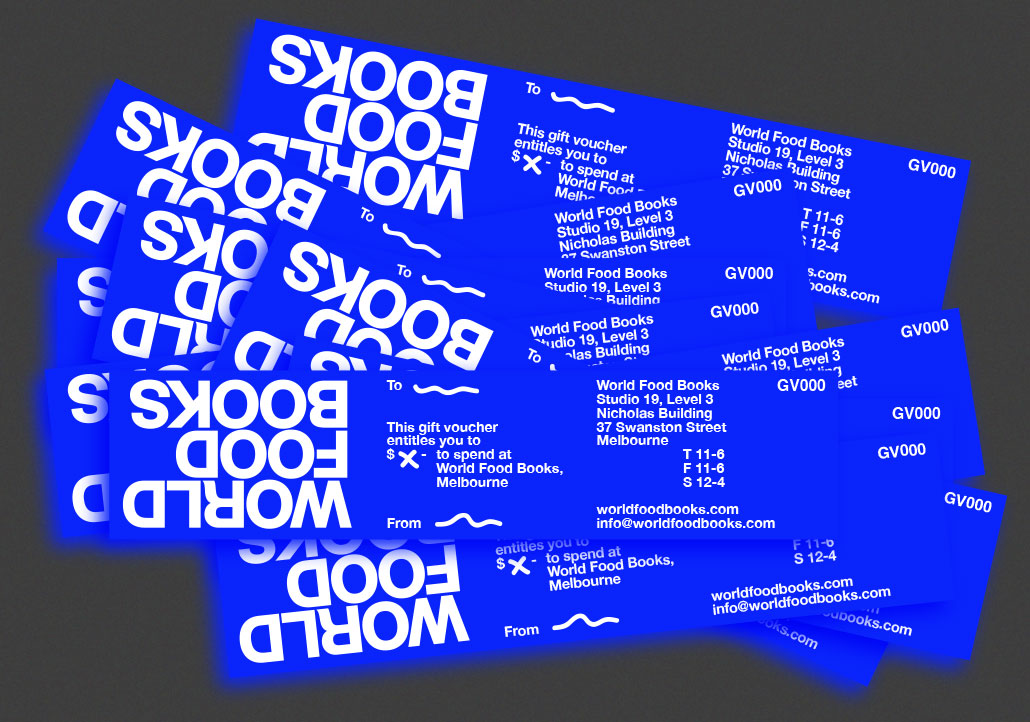
A World Food Books gift voucher is redeemable in our Melbourne bookshop or via our webshop (here). An e-voucher (printable pdf) will be sent to your purchase email address (please notify us if you wish to have the voucher sent to an alternate address and wish us to fill in the receiver's details on the card).
Gift vouchers can be purchased in increments of $20 (Australian Dollars) and the total amount can simply be added to by increasing the quantity in your shopping cart. eg. A quantity of 5 gift vouchers will result in an item total of $100 - a $100 gift voucher. Simply click "ADD TO CART" 5 times, or update your quantity in the shopping cart.
If you wish to purchase multiple, separate gift vouchers in one go, please just email us and we can personally prepare and email you a payment request.
Please note: Please select Pick-Up on gift voucher purchse to avoid any postage charges. Accidental postage charges will be refunded right away!
Thank you.
For any questions, please don't hesitate to email: [email protected]
2009 / 2012, English
Hardcover, 288 pages, 30 x 23.5 cm
1st Edition, Out of print title / used / very good
Published by
Bazillion Points / New York
$100.00 - In stock -
Rare first 2009 edition, 2012 printing.
This formidable oversized hardcover runs 288 pages (including a 32-page color section), and combines hundreds of unseen early Hellhammer and Celtic Frost photos with a vast treasure trove of artwork and memorabilia. A substantial written component by Fischer details his upbringing on the outskirts of Zurich, Switzerland, and the hardships and triumphs he faced bringing the visions of his groundbreaking bands Hellhammer and eventually Celtic Frost to reality. In addition, the book includes an introduction by Nocturno Culto of Norwegian black metal act Darkthrone, and a foreword by noted metal author Joel McIver.
Without question Only Death Is Real goes farther than any other source in exploring the origins of underground heavy metal. The wealth of visual information is astounding, both in terms of documenting early 1980s headbangers and exposing the still-relevant imagery of the first Hellhammer and Celtic Frost photo sessions. On top of that, the written chapters combine Tom Fischer s often shocking stories with lengthy quotes from Martin Eric Ain and the other main Hellhammer members, explaining in intimately human terms how extreme metal was born.
VG copy, only light shelf wear/bumping to hardcovers.
2011, English
Hardcover, 722 pages, 28 x 22 cm
1st Edition, Out of print title / used / very good
Published by
Bazillion Points / New York
$120.00 - In stock -
Rare first 2011 printing.
Founded in 1985 in Sarpsborg, Norway, Slayer Magazine quickly rose to prominence by championing countless unsigned death metal pioneers. The pages of the magazine became a written gospel for the fledgling extreme metal underground, combining eye-ripping graphics, brutally honest writing, and a relentless and sick sense of humor. As black metal rose to prominence in Norway in the 1990s, Slayer Magazine remained the final word on the moods and motivations of those dark times. This book is densely illustrated with early candid photos of classic heavy metal bands including Kreator, Mayhem, Emperor, Darkthrone, Napalm Death, and Morbid Angel. In addition to rare archival material unseen in decades, the book includes unreleased and exclusive interviews and artwork, including historical photographs, and never-before-seen portrait photography by editor Jon "Metalion" Kristiansen.
VG—NF copy, only light wear to covers.
2011, English
Hardcover, 272 pages, 28 x 23.5 cm
1st Edition, Out of print title / used / very good
Published by
Bazillion Points / New York
$45.00 - In stock -
Rare first 2011 printing.
During the early 1980s, when heavy metal was defined by MTV and mile-high hair, San Francisco’s small community of dedicated headbangers scorned image and instead risked life and limb in search of the ultimate in musical thrills. Locals Exodus and Los Angeles transplants Metallica reigned in small clubs like the Old Waldorf, The Stone, and the infamous East Bay bastion of heaviness, Ruthie’s Inn. Thrash metal upstarts Slayer and Megadeth found a second home in the Bay Area, while a homegrown breed of tempo-crazed teenagers like Legacy, Possessed, Death Angel, Heathen, and Vio-lence brought Bay Area thrash metal to critical mass.
Photographers Harald Oimoen and Brian Lew were dodging bodies from the very start, in front of the stage, backstage, and on the stage itself. They captured the public victories and private parties of a scene where fans and musical idols were equally hellbent on faster, heavier music and endless outrageous fun. Oimoen and Lew fought on the frontline of a war for individuality, snapping frame by frame as thrash metal was born, along with stagediving, crowd-walking, and countless other magical moments filled with key local personalities. Somewhere along the way, Oimoen and Lew’s friends in Metallica, Slayer, and Megadeth became legends.
Today, the Big Four thrash metal bands pictured in this book are the reigning elder statesmen of heavy metal. Their fellow ragers in Exodus, D.R.I., Testament, Death Angel, Possessed, and Forbidden remain ambassadors of a Bay Area metal scene that continues to thrive and command fascination around the world. This stunning volume collects over 400 amazing color and black-and-white photos, plus passionate personal accounts by Bay Area veterans Harald Oimoen, Brian Lew, Ron Quintana of Metal Mania, Gary Holt of Exodus, Alex Skolnick of Testament, and Robb Flynn of Machine Head. From DIY origins to world domination, the Bay Area thrash metal scene screams to life in these fearless pages.
“This will not be a history book, but rather a time machine back to the ‘bonded by blood’ days of the original Bay Area Metal scene. Before they played the Bay Area, Slayer wore makeup onstage—after that first Bay Area show they never wore makeup again. This book will show people why.”—Brian Lew
VG copy, only light wear to covers.
1991, English
Softcover, 192 pages, 21 x 14 cm
1st Edition, Out of print title / used / fine
Published by
City Lights Books / San Francisco
$55.00 - Out of stock
First 1991 City Lights edition of The Powers of The Word : Selected Essays and Notes 1927-1943 by early 20th-century French spiritual para-surrealist writer, critic, poet, and early, outspoken practitioner of pataphysics, René Daumal (1908-1944). Edited, translated and with introduction by Mark Polizzotti.
"Since his death in 1944, Rene Daumal has come to be recognized as one of the original minds of the twentieth century French letters. Poet, essayist, philosopher and translator, Sanscrit scholar and pupil of Gurdjieff, Daumal was a founder of the Grand Jeu group. He was iconoclastic and eclectic, able to embrace simultaneously Alfred Jarry's Pataphysics and Hindu teachings.
Daumal's two major works in English translation, Mount Analogue and A Night of Serious Drinking, have long been classics in this country; but until now, readers have not had access to the full range of his thought. The Powers of the Word spans a lifetime of essays and notes-many here translated for the first time-from the earliest incitements to drug use and revolt; through Daumal's unique readings of literary works; to his more mature, but no less ardent, meditations." — publisher's blurb
Fine copy. First 1991 Ed.
1970, German
Softcover, unpaginated, 18 x 12 cm
1st Edition, Out of print title / used / very good
Published by
Kiepenheuer & Witsch / Köln
$100.00 - In stock -
Scarce first 1970 German edition of Roland Topor's famous book collection Die Masochisten (The Masochists), one of the finest examples of the artist's profound command of illustrated dark humour. Almost entirely made up of wordless b/w illustrations, with a foreword in german by German designer, illustrator and typographer, Hannes Jähn.
Roland Topor (1938—1997) was one of the most unique and versatile French artists of the second half of the 20th century, working prolifically as a provocative and spirited illustrator, author, humorist, satirist, poet, painter, performer, sculptor, playwright, film and TV writer, filmmaker and actor, and much more. A founder of the Panic Movement, an art collective formed by Fernando Arrabal, Alejandro Jodorowsky, and Roland Topor in Paris in 1962, Topor was known for the surreal and absurdist nature of his work.
Very Good copy. A crisp, solidly bound copy with some foxing/tanning to pages, usual spine edge tanning to bright fluro pink boards (most often bleached out).
1987, English
Hardcover (w. dust jacket), 166 pages, 21 x 14.5 cm
1st Edition, Out of print title / used / fine
Published by
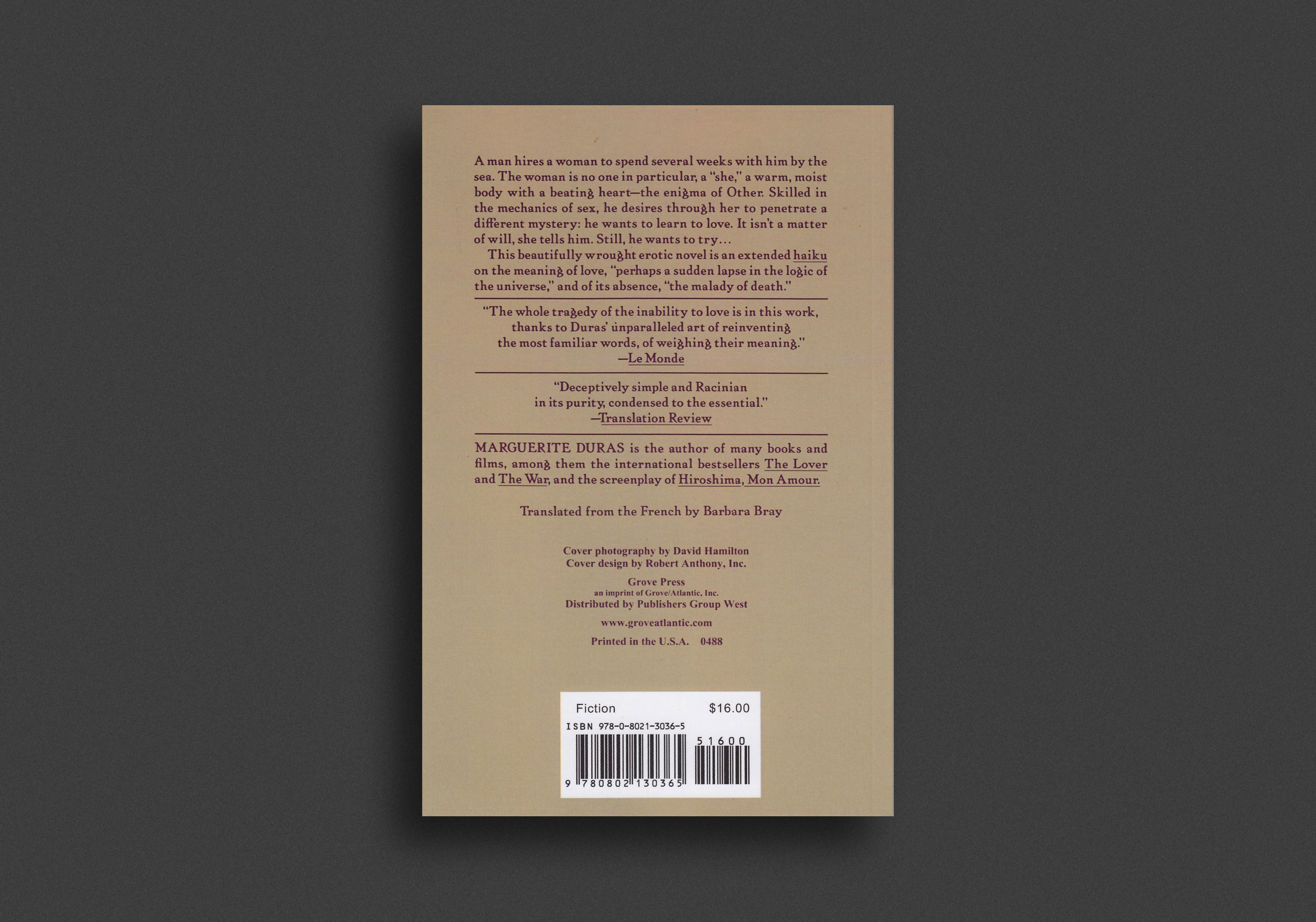
Grove Press / New York
$25.00 - In stock -
First 1987 hardcover English edition of The Compass Stone by Panic Movement founder Fernando Arrabal, translated to English by Andrew Hurley for Grove Press.
"In The Compass Stone, his second novel to be published in English, Fernando Arrabal creates a narrative counterpart to his "theater of panic," which has won him a reputation as one of the most significant dramatists of our time. The Compass Stone is in the form of a memoir by an unnamed chronicler, a twenty-year-old woman who lives in the greenhouse of a mansion occupied by her crippled father, the Maimed One, and his two grotesque handmaidens, the Sisters. The high walls surrounding the mansion enclose a world unique to Arrabal's imagination, a Boschian allegory world in which guilt, sadism, bondage, and murder all fit together to form a surprisingly coherent universe.
In the dark, disturbing language of dream, the young woman records how she arranges sexual encounters with unsuspecting gentlemen and slits their throats at the moment of orgasm. She listens, unperturbed, as one of her friends, the aesthete S-, becomes enthralled by the police investigation of these crimes and speculates on the identity and motives of the murderess, coming closer and closer to the truth. She takes time off from her ritual of sex and death to observe the insect life of the greenhouse in meticulous detail and to commune with the sumo wrestler K-, practitioner of an ardent and sensual asceticism. The strange strands of her narrative are linked by incantatory strings of questions about love and hate, good and evil, damnation and redemption, in a surreal Socratic interrogation of life and its meaning."
Fernando Arrabal (b. 1932) is a Spanish playwright, novelist, poet, and filmmaker best known as a founder of the Panic Movement (Mouvement Panique), an avant-garde art movement he established in 1962 with Alejandro Jodorowsky and Roland Topor. Closely associated and influenced by Surrealism, 'Pataphysics and the Theatre of the Absurd, Arrabal’s work blends dark humor, political rebellion, eroticism, and dreamlike imagery, often reflecting the trauma of the Spanish Civil War and his father’s disappearance under Franco’s regime. Exiled to France in the 1950s, Arrabal has directed seven full-length feature films and has published over 100 plays; 14 novels; 800 poetry collections, chapbooks, and artists' books; several essays; and his notorious "Letter to General Franco" during the dictator's lifetime, constantly challenging authoritarianism and conventional morality, making him one of the most provocative figures in postwar European avant-garde literature and theater.
NF copy in NF dust jacket.
1981 / 1984, English
Softcover, 212 pages, 12.5 x 19.5 cm
1st Edition, Out of print title / used / very good
Published by
Methuen Publishing / London
$20.00 - In stock -
Published in 1981, this study argues against vague interpretations of fantasy as mere escapism and seeks to define it as a distinct kind of narrative. A general theoretical section introduces recent work on fantasy. notably Tzvetan Todorov's The Fantastic A Structural Approach to a Literary Genre (1973). Dr Jackson. however, extends Todorov's ideas to include aspects of psychoanalytic theory seeing fantasy as primarily an expression of unconscious drives, she stresses the importance of the writings of Freud and subsequent theorists when analysing recurrent themes, such as doubling or multiplying selves, mirror images, metamorphosis and bodily disintegration. Gothic fiction, classic Victorian fantasies, the 'fantastic realism' of Dickens and Dostoevsky, tales by Mary Shelley, James Hogg, E. T. A. Hoffman, George Eliot, Henry James, Joseph Conrad, R L. Stevenson, Franz Kafka, Mervyn Peake and Thomas Pynchon are among the texts covered. Through a reading of these frequently disquieting works Dr Jackson moves towards a definition of fantasy as a historically determined form, whose ambiguities are seen as expressing cultural unease. These issues are discussed in relation to a wide range of fantasies with varying images of desire and disenchantment.
Very Good copy. 1984 printing.
1997, English
Hardcover (w. dust jacket), 112 pages, 24. 5 x 17 cm
1st Edition, Out of print title / used / very good
Published by
Prestel / Munich
$25.00 - In stock -
First 1997 HC edition of this fascinating book examines the relationship between music and painting in Klee's art. A talented violinist as well as a painter, Klee drew much of the inspiration for his abstract art from musical rhythms and structures. Like a composer, he developed and harmonized pictorial themes, weaving a complex series of signs and symbols into his painting. The book focuses on Klee's decadelong tenure at the Bauhaus, where the artist's theories and practices first merged. Illustrated throughout with full-color reproductions of Klee's paintings and etchings, as well as entries from his diaries, this unique study sheds light on an important aspect of Klee's work while providing insights into his development as an abstract artist.
VG copy in VG dj.
1971, English
Softcover, 362 pages, 20.5 x 13 cm
1st Edition, Out of print title / used / good
Published by
Princeton University Press / New York
$25.00 - In stock -
1971 Princeton edition.
A landmark, now classic, study of the rich cinematic history of the Weimar Republic, From Caligari to Hitler was first published by Princeton University Press in 1947. Siegfried Kracauer—a prominent German film critic and member of Walter Benjamin's and Theodor Adorno's intellectual circle—broke new ground in exploring the connections between film aesthetics, the prevailing psychological state of Germans in the Weimar era, and the evolving social and political reality of the time. Kracauer's pioneering book, which examines German history from 1921 to 1933 in light of such movies as The Cabinet of Dr. Caligari, M, Metropolis, and The Blue Angel, has never gone out of print.
"The thesis of this unusually interesting book is that the German films of the twenties were filled with premonitions of the German totalitarianism of the thirties: that Hitler arose as the resolution of psychological dilemmas which had been reflected in the German movies and which accounted for both their greatness and their decline. ... Dr. Kracauer illustrates his theme by a readable account of the evolution of the German film industry and of the creation of the masterpieces.... The book's premise, of course, is that the films of a nation irresistibly disclose its dominant psychological dispositions. ... This is an extraordinarily fruitful and stimulating approach."—Arthur M. Schlesinger, Jr., The Nation
"This is an important book. It is important to the film student and researcher, important to the student of foreign affairs, but over and beyond that, it is important to anyone interested in the relationship of a society to its art."—Theatre Arts
"Kracauer's work is not only the best history of the German film written so far but beyond it a critical study of the period which nobody can afford to ignore."—Ulrich Gregor, Neue Deutsche Hefte
"This remarkable book, though described by its author as a psychological history of the German film, is in fact much more than that. Written by a man who is at once an authority on the social and economic structures of the German middle classes and on the German cinema, it analyzes those tendencies, which, from 1920 to 1933, ended in the rule of Hitler ... this is the first time that a sober and protracted study of human behavior has been carried out by the light of the screen."—New Republic
SIEGFRIED KRACAUER was a consultant to the Bollingen and Old Dominion Foundations and an Associate Member of the Columbia University Seminars until his death on November 26, 1966.
Good copy with Average covers due to rubbing wear/spine creasing. VG interior, with previous owner's name to first blank (artist/teacher Bernhard Sachs), light tanning.
1968 / 1976, English
Softcover, 272 pages, 20.5 x 13.8 cm
Out of print title / used / very good
Published by
Harper Perennial / New York
$25.00 - In stock -
"For an acquaintance with the thought of Heidegger, What Is Called Thinking? is as important as Being and Time. It is the only systematic presentation of the thinker's late philosophy, and... it is perhaps the most exciting of his books. The translation is admirable. Without ever neglecting the severe terminological demands of the German text, Glenn Gray and Fred Wieck have transposed it into clear, un-tortured English prose."—HANNAH ARENDT
"Heidegger has tried to reinterpret the purport of his first major work, Being and Time, as meaning an opening of the horizon of Being through man's horizon of thinking. What is Called Thinking? no doubt provides his most far-reaching and persistent attempt to define the direction of such a reinterpretation."—CYRIL WELCH, Journal of the American Academy of Religions
"As near a definitive statement of Heidegger's new period as can be found."—JEAN M. PERREAULT
VG copy, light wear/tanning.
2019, English
Softcover, 82 pages, 12.8 x 19
Published by
Blank Forms / New York
$42.00 - Out of stock
One of the world’s most singular guitarists, Loren Connors is among few living musicians whose prolific body of work can be said to be wholly justified in its plenitude. On more than 100 records across almost four decades, Connors has wrung distinct shades of ephemeral blues from his guitar, its sound ever-shifting while remaining unmistakably his own. From his early, splintered take on the Delta bottleneck style through his song-based albums with Suzanne Langille and on to the painterly abstraction that defines his current work, Connors has earned the admiration of many, leading to collaborations with the likes of John Fahey, Jim O’Rourke, Keiji Haino, and Kim Gordon.
In the mid-80s, Connors took a partial break from music and focused instead on the art of haiku, for which he received the Lafcadio Hearn Award in 1987. With his wife Suzanne Langille he also co-wrote an article on blues and haiku, “The Dancing Ear,” published in the Haiku Society of America’s journal. It was during this period that Connors penned the material that appears in Autumn’s Sun, a chapbook first published by Thurston Moore and Byron Coley’s Glass Eye in 1999. The text features diary excerpts from 1987, lyrically fragmented observations interspersed with haiku-like poems that paint an idyllic impression of the passing seasons in his home of New Haven, Connecticut. With synesthetic perception, Connors gazes from tranquil domestic streets. Sycamore, elm, and catalpa trees are activated by the breeze and made to rustle in unison with their natural and artificial surroundings, including the howling dogs from which Connors derived his ‘Mazzacane’ moniker. As summer fades to winter, Connors portrays death as an undramatic certitude, the flux of his own maturation reflected in musings on his son’s. Like his music, Autumn’s Sun is tender without being sentimental, conjuring those rare, delicate moments when time stands still.
This edition includes “The Dancing Ear” and an introduction by Lawrence Kumpf.
1995, English
Softcover (staple-bound), 16 pages, 25.8 x 17 cm
1st Edition, Out of print title / used / very good
Published by
Verotik / Los Angles
$15.00 - In stock -
August 1995 issue 5 of Verotika comics (The New Covenant), the "Bad Girls of Horror" issue, featuring the work of Martin Emond, Nancy A. Collins, Lucy Taylor, Kim Hagen, Stan Shaw and Simon Bisley. First printing.
VG copy.
2000, Japanese
Hardcover (w. dust jacket and obi strip), 48 pages, 31 x 22 cm
1st Edition, Out of print title / used / fine
Published by
Bungeisha / Tokyo
$150.00 - In stock -
The one and only hardcover monograph dedicated to the fantastic world of artist Ran Akiyoshi (1922—1982), now rare and out-of-print. Virtually unknown and undocumented outside of Japan, Akiyoshi never held an exhibition nor sold any of his drawings in his lifetime. Much like the work of Toshio Saeki or Namio Harukawa, Akiyoshi's creations proliferated throughout the bountiful pages of Tokyo's underground, particularly SM / kinbaku, publishing scene in the 1960s—1970s. Yet Akiyoshi's phantasmagoric world of erotic fantasy is like no other, building sado-masochistic themes within unique, somewhat Lovecraftian and Bosch-esque dreamscapes populated by mythological goddesses and grotesque creatures. His peculiar fantasy drawings were highly praised by Japanese novelist and art critic, Tatsuhiko Shibusawa, an instrumental figure in the Japanese avant-garde who translated de Sade and Bataille to Japanese, and specialised in the study of medieval demonology. This lavishly illustrated hardcover volume collects Akiyoshi's many works together for the first time, surveying his entire career.
Born in Kyongsong (present Seoul), Korea in 1922, Akiyoshi was publicly schooled and self-taught in drawing. After WWII, he moved to Japan, traveled around Kyushu area and finally settled in Tokyo in 1946. Akiyoshi started working for adult entertainment magazines such as "Decameron","Fuzoku Soushi", and "Uramado" in 1950. Around 1958, he began focusing on original drawings while continuing to draw illustrations for various magazines. In the 1970s, Akiyoshi provided iconic cover and insert illustrations to a number of prominent SM magazines, including "SM King", "SM Kitan", and "SM Club". He never held an exhibition nor sold any of his drawings in his lifetime. Akiyoshi died from heart failure in 1982 at the age of 58.
Very Good—Fine copy.
2024, Japanese
Softcover (w. dust jacket + obi), 176 pages, 19 x 15 cm
Published by
Atelier Third / Tokyo
$70.00 - In stock -
Brand new book collecting 200 rare and phenomenal illustrations of the legendary underground Japanese artist Ran Akiyoshi (1922—1982), many never seen before in print. Virtually unknown and undocumented outside of Japan, Akiyoshi never held an exhibition nor sold any of his drawings in his lifetime. Much like the work of Toshio Saeki or Namio Harukawa, Akiyoshi's creations proliferated throughout the bountiful pages of Tokyo's underground SM / fetish publishing scene in the 1960s—1970s. Yet Akiyoshi's phantasmagoric world of erotic fantasy is like no other, building sado-masochistic themes within unique, somewhat Lovecraftian and Bosch-esque dreamscapes populated by mythological goddesses and grotesque creatures. His peculiar fantasy drawings were highly praised by Japanese novelist and art critic, Tatsuhiko Shibusawa, an instrumental figure in the Japanese avant-garde who translated de Sade and Bataille to Japanese, and specialised in the study of medieval demonology.
Born in Kyongsong (present Seoul), Korea in 1922, Akiyoshi was publicly schooled and self-taught in drawing. After WWII, he moved to Japan, traveled around Kyushu area and finally settled in Tokyo in 1946. Akiyoshi started working for adult entertainment magazines such as "Decameron","Fuzoku Soushi", and "Uramado" in 1950. Around 1958, he began focusing on original drawings while continuing to draw illustrations for various magazines. In the 1970s, Akiyoshi provided iconic cover and insert illustrations to a number of prominent SM magazines, including "SM King", "SM Kitan", and "SM Club". A prolific and private artists, he never held an exhibition nor sold any of his drawings in his lifetime. Akiyoshi died from heart failure in 1982 at the age of 58.
2014, Japanese
Hardcover (w. obi), 64 pages, 26 x 19 cm
1st Edition, Out of print title / as new
Published by
Atelier Third / Japan
$80.00 - In stock -
Rare copy of Japanese artist Toru Nishimaki’s first art book, “Pollen of the Rocaille”, published in Japan in 2014 and long out-of-print. 13 years since his first solo exhibition, Toru Nishimaki (b. Tokyo, 1964), has been committed to what the artist has dubbed "black caricatures," using his pencil to bring the viewer deep into a world of densely rendered, transgressive eroticism. Nishimaki's unique works depict cherubic, often genderqueer, boys/girls/hermaphrodites engaging in all kinds of unadulterated erotic and immoral behaviour (sitophilia, emetophilia, coprophilia) amidst an enchanted gothic setting of period train-compartments, children's toys and tea cakes — a "utopia where everyone is happy to drown in their fetish". An extraordinary vision that brings to mind scenes from Věra Chytilová's Daisies (1966) or Dusan Makevejev's Sweet Movie (1974)! Also includes fantastic prose from the artist (in Japanese) that leads the viewer further into the narrative of this unique world.
As New copy! With obi (not pictured).
2009, Japanese
Softcover, 190 pages, 21 x 15 cm
1st Edition, Out of print title / used / very good
Published by
Atelier Third / Tokyo
$60.00 - Out of stock
Special 2009 issue of Talking Heads magazine with the feature "My Love is Corpse", entirely devoted to death in the arts and culture. Profusely illustrated throughout in colour and b/w featuring Japanese corpse photographer Kiyotaka Tsurisaki, doll portraits by Tari Nakagawa (with model Yuko Igeta), polish painter Zdzisław Beksiński, Hermann Nitsch, the erotic macabre photography of Atsushi Tani, Eros and Thanatos and the work of artist Yasuyuki Nishio, Unica Zürn and Hans Bellmer, puppeteer Kurotani Miyako, illustrator Toru Nishimaki, painter Hartmut Lincke, illustrator Rie Yamashina, Occult and Revelation, medical museums, corpse love in film and publishing, and much more.
Talking Heads is the glossy arts magazine of Japanese publisher Atelier Third, specialists in the cutting-edge of subcultural Japanese artists working across doll art, ero guro, gothic-lolita and the historical erotic SM works of the abnormal museum, publishing the work of Seiu Ito, Yoshifumi Hayashi, Shintaro Kago, Ran Akiyoshi, Kanaki Tama, Saori Furukawa, Toru Nishimaki, and many more.
VG copy.
1987, German
Poster, 42 x 49
1st Edition, Out of print title / used / very good
Published by
Gelbe Musik / Berlin
Galerie Vorsetzen / Hamburg
$150.00 - In stock -
Rare original poster produced to accompany the exhibition “Künstlerschallplatten,” organised by Gelbe Musik, Berlin, and presented at Galerie Vorsetzen, Hamburg, March 14 – April 4, 1987, a spatial installation by Claus Böhmler, Hanne Darboven and Stephan von Huene, featuring artist's records and record objects by Joseph Beuys, Henning Christiansen, Jack Goldstein, Philip Corner, Hermann Nitsch, Terry Fox, Charlemagne Palestine, Wolf Vostell, A. R. Penck, Dieter Roth, Yves Klein, Imi Knoebel, John Cage, Alan Kaprow, Rolf Julius, Conrad Schnitzler, Robert Rauschenberg, Harry Bertoia, Claus Böhmler, Hanne Darboven, Jean Dubuffet, Milan Knížák, Nam June Paik, Stuart Sherman, Christian Marclay, Lawrence Weiner, Valie Export, Reiner Ruthenbeck, Zoviet France, Keith Sonnier, Andy Warhol, Albert Oehlen, Sarkis, Arthur Köpcke, Michael Snow, and many more, plus room installations by Claus Böhmler, Hanne Darboven and Stephan von Huene.
Gelbe Musik was a gallery/storefront founded in 1981 by Ursula Block as an offshoot of Galerie Block, operated by her husband René Block (who has published editions by Marina Abramović, Joseph Beuys, Robert Filliou, Alfredo Jaar, On Kawara, Roman Opalka, Nam June Paik, Dieter Roth, Rosemarie Trockel, Ben Vautier Ben, Wolf Vostell Wolf, Lawrence Weiner and countless others). It remained the only record store dedicated to artists' recordings. Ursula Block was also responsible for Broken Music, an early (and still unrivalled) exhibition and catalogue of artists' records from 1989. “Künstlerschallplatten", two years prior, could be seen as the pre-cursor to that exhibition.
Ursula Block is a curator living in Berlin, Germany. From 1981 until 2014, she ran gelbe Musik, a gallery and record shop in Berlin that featured work by artists at the crossroads between music and art.
Very Good copy with light creasing as issued.
2002, English
Softcover, 216 pages, 23.5 x 15.5 cm
1st Edition, Out of print title / used / fine
Published by
The Athlone Press / UK
Continuum / London
$35.00 - In stock -
First Athlone/Continuum UK 2002 edition.
The Essence of Human Freedom is a groundbreaking work that provides a compelling philosophical account of humanity's potential for liberty. It is fundamental for understanding Heidegger's view of Greek philosophy and its relationship to modern philosophy. In no other work by Heidegger do we find as detailed a consideration of Kant's practical philosophy or of Aristotle's Metaphysics as is given here. Translated by Ted Sadler. Dr Ted Sadler, studied at the University of Sydney and has taught philosophy widely at Australian universities.
"It is only a small exaggeration to say that each of Martin Heidegger's works seems to be the key to his thought every book is bracing and magnetic The effect is similar to what we see in the best political philosophy. Being stirred to think is as important as the question being thought about. Heidegger not only encourages thought, he also instructs us in how to begin thinking Heidegger at his best calls forth what once was called courage of the intellect. Heidegger sees his characteristic path in The Essence of Human Freedom and The Essence of Truth as grounded in and circling back to history...The main things to be learned from these books concern what it means to confront essential questions at the level of Heidegger, Kant, Plato, and Aristotle. For the student, to be serious involves just such a confrontation." Claremont Review of Books, Summer 2005--Sanford Lakoff
The Essence of Human Freedom is a fundamental text for understanding Heidegger's view of Greek philosophy and its relationship to modern philosophy. After a preliminary discussion of the problem of freedom and its relationship to philosophy, Heidegger devotes Part One primarily to the meaning of 'being' in Greek metaphysics, thus providing the framework for his interpretation of Kant's treatment of freedom and causality in Part Two.
In no other work by Heidegger do we find as detailed a consideration of Kant's practical philosophy as given in the present text. Further, in no other work is Heidegger's interpretation of Aristotle's Metaphysics presented with comparable thoroughness. These previously untranslated lectures were delivered by Heidegger at the University of Freiburg in the summer of 1930.
Martin Heidegger (1889-1976) is now regarded as one of the twentieth century's most important philosophers, whose work, particularly Being and Time, has influenced not only philosophy but also theology, political science and aesthetics. The Athlone Contemporary European Thinkers series includes several published and forthcoming works by Heidegger.
Ted Sadler, the translator of the work, studied at the University of Sydney and has taught philosophy widely at Australian universities. He is the author of Nietzsche: Truth and Redemption and Heidegger and Aristotle, and the translator of Towards a Definition of Philosophy and The Essence of Truth, in this series.
VG—NF edition.
1990 / 1997, English
Softcover, 234 pages, 23.5 x 15.5 cm
1st Edition, Out of print title / used / very good
Published by
Indiana University Press / Indiana
$30.00 - In stock -
‘…one of Heidegger’s most important and extraordinary works…indispensable for anyone interested in Heidegger’s thought as well as in current trends in hermeneutics, ethics, and political philosophy’ - Interpretation . ‘ Kant and the Problem of Metaphysics is among the most important readings in this century of Kant’s Critique of Pure Reason . This authoritative English translation will play an important role in determining Heidegger’s reputation in the coming years’ - Choice . ‘Heidegger’s interpretation of Kant remains a challenging way to address the issues that both Kant and Heidegger saw as crucial…In reading [Kant and the Problem of Metaphysics] we can struggle with some basic issues of human existence in the company of two great minds’ - International Philosophical Quarterly .Since its original publication in 1929, Martin Heidegger’s provocative book on Kant’s Critique of Pure Reason has attracted much attention both as an important contribution to twentieth-century Kant scholarship and as a pivotal work in Heidegger’s own development after Being and Time. The work is significant not only for its illuminating assessment of Kant’s thought but also for its elaboration of themes first broached in Being and Time, especially the problem of how Heidegger proposed to enact his destruction of the metaphysical tradition and the role that his reading of Kant would play therein.
VG—NF bottom spine bump, light wear.
1996, English
Softcover, 148 pages, 23.5 x 15.5 cm
1st Edition, Out of print title / used / good
Published by
Indiana University Press / Indiana
$25.00 - In stock -
The Principle of Reason, the text of an important and influential lecture course that Martin Heidegger gave in 1955-56, takes as its focal point Leibniz's principle: nothing is without reason. Heidegger shows here that the principle of reason is in fact a principle of being. Much of his discussion is aimed at bringing his readers to the "leap of thinking," which enables them to grasp the principle of reason as a principle of being. This text presents Heidegger's most extensive reflection on the notion of history and its essence, the Geschick of being, which is considered on of the most important developments in Heidegger's later thought. One of Heidegger's most artfully composed texts, it also contains important discussions of language, translation, reason, objectivity, and technology as well as remarkable readings of Leibniz, Kant, Aristotle, and Goethe, among others.
First 1996 Indiana edition with bump/crush to bottom spine front corner, otherwise Near Fine.
1996, Japanese
Softcover (w. dust jacket and obi-strip), 256 pages, 21 x 14.8 cm
1st Edition, Out of print title / used / very good
Published by
Core Magazine / Tokyo
$120.00 - In stock -
Don't judge a book by it's cover — you've been warned! Straight out of the young nihilist 90s, the second volume of the very short-lived and absolutely demented Seikimatsu Club (End of the Century Club), published in Tokyo between 1996—2000 for a total of only five volumes. This second volume, "Deathtpia in Suburbia", has the feature theme of Horror! Bizarre! Bizarre! Cruelty! and is packed to the absolute brim with "corpses, freaks, spectacles, murders, suicides, autopsies, rapes, sickness, pain, accident, war, religious rituals, violence, forensics, foetuses. A shocking document that eliminates all fiction (all genuine)!"
With contributors to this issue including Masami Akita (Merzbow), Masaaki Aoyama (author), Kiyotaka Tsurisaki (corpse photographer), Suehiro Maruo (ero guro manga artist), Teruo Ishii (ero guro film director), Kotaro Kobayashi (Too Negative editor-in-chief), Trevor Brown (artist), you should know what you are getting yourself into.
Following the trajection of fellow Japanese abnormal subculture magazines such as Kotaro Kobayashi's notorious Too Negative, Ultra Negative, ORG, etc., and in the spirit of a new wave of 90's nihilist publishing around the world (Answer Me!, Killing Times, Fuck!, AMOK, Feral House, etc.) End of the Century Club stares directly into the dark recesses of humanity and presents its viewers with the uncompromising extremes of our global culture. The real stuff. Where Too Negative presents itself as a glossy colour photo/art magazine, End of the Century Club is almost like a Whole Earth Catalog to the authentic macabre. With articles, interviews, reports, catalogues and hundreds of images spanning all manner of medical/autopsy/corpse photography, death journalism, serial killers, formalihide babies, war/shock accident/crime scenes, hara-kiri, murder, rape, slaughterhouse, forensic books, international underground magazines, Photobook of World Diseases, City of Sodom, corpses on the internet, Underground Baby Contest, Atlas of Dermatology, complete guide to Freaks movies, the Garbage Pail Kids, religious ceremonies, animal deformities, Interview with "The King of Cult" ero guro film director Teruo Ishii, bizarro sex, acrotomophila, artist Joel Peter Witkin's world, interview with Masaaki Aoyama, interview with corpse photographer Kotaro Kobayashi (Death, Hardcore Works, Too Negative, Billy, etc.), photography of George Dureau, interview with fetish film director and producer Kaoru Adachi, interview with experimental film director Shozin Fukui (Metal Days, Gerorisuto, Caterpillar, 964 Pinocchio, Rubber's Lover...), article on "Serial Killers & Record Junkies" by Toshihiko Hironaka (of Boris, Balzac, Hellbent fame), and all sorts of other curios from the mondo, bizarro realm.
Includes "gorgeous" 24-page high-quality corpse photo booklet feature and cover art by Trevor Brown.
Not for the fain-hearted. You'll feel like a shower after.
Very Good copy with dust jacket and obi.
1997, Japanese
Softcover (w. dust jacket and obi-strip), 256 pages, 21 x 14.8 cm
1st Edition, Out of print title / used / very good
Published by
Core Magazine / Tokyo
$120.00 - In stock -
Don't judge a book by it's cover — you've been warned! Straight out of the young nihilist 90s, the third volume of the very short-lived and absolutely demented Seikimatsu Club (End of the Century Club), published in Tokyo between 1996—2000 for a total of only five volumes. This third volume, "The World You Don't Know", has the feature theme of exposing "a reality erased from everyday life", which sums it up... packed to the absolute brim with "freaks, corpses, bestiality, autopsies, fetal executions, lynchings, traffic accidents, plane crashes, amputee, heteromorphic animals, freak shows, corpse museums, shemales, etc. A shocking document that eliminates all fiction (all genuine)!"
With contributors to this issue including Masami Akita (Merzbow), Masaaki Aoyama (author), Kiyotaka Tsurisaki (corpse photographer), Hideshi Hino (horror manga artist / Guinea Pig director), Kotaro Kobayashi (Too Negative editor-in-chief), Trevor Brown (artist), you should know what you are getting yourself into.
Following the trajection of fellow Japanese abnormal subculture magazines such as Kotaro Kobayashi's notorious Too Negative, Ultra Negative, ORG, etc., and in the spirit of a new wave of 90's nihilist publishing around the world (Answer Me!, Killing Times, Fuck!, AMOK, Feral House, etc.) End of the Century Club stares directly into the dark recesses of humanity and presents its viewers with the uncompromising extremes of our global culture. The real stuff. Where Too Negative presents itself as a glossy colour photo/art magazine, End of the Century Club is almost like a Whole Earth Catalog to the authentic macabre. With articles, interviews, reports, catalogues and hundreds of images spanning all manner of medical/autopsy/corpse photography, death journalism, serial killers, formalihide babies, war/shock accident/crime scenes, human intersection, murder art show, lobster boy, 3D stereo photography hall of horrors, donkey fucker (please no!), strange diseases of the world, amputee lovers, siamese twins, deformed children, amazing Photo Press historical stories, animal deformities, huge Hideshi Hino art gallery, book guide and interview, ALARMA! photo gallery, Trevor Brown art gallery, corpse photography, columns and features on and by Kiyotaka Tsurisaki (Death, Hardcore Works, Too Negative, Ultra Negative, Billy, etc.), Father Yod (YaHoWha 13) record guide, Medical Atlas by Naruhiko Tanaka, lots of noise record reviews by Masami Akita (Merzbow) inc. Smell & Quim, M.B., Lustmord, Ramleh, Genocide Organ, Richard Ramirez, Agoraphobic Nosebleed, Whitehouse, Extreme Hair Stench, Genital Masticator, Traci Lords Loves Noise, Morder, etc., interview with artist Wes Benscoter (heavy metal illustrator for Slayer, Mortician, Kreator, Deceased, Cattle Decapitation, etc) on the occasion of his NG Gallery body painting show, complete Freak book library, and all sorts of other curios from the mondo, bizarro realm. Lots of full colour gore.
Not for the fain-hearted. You'll feel like a shower after.
Very Good copy with dust jacket and obi.