New :


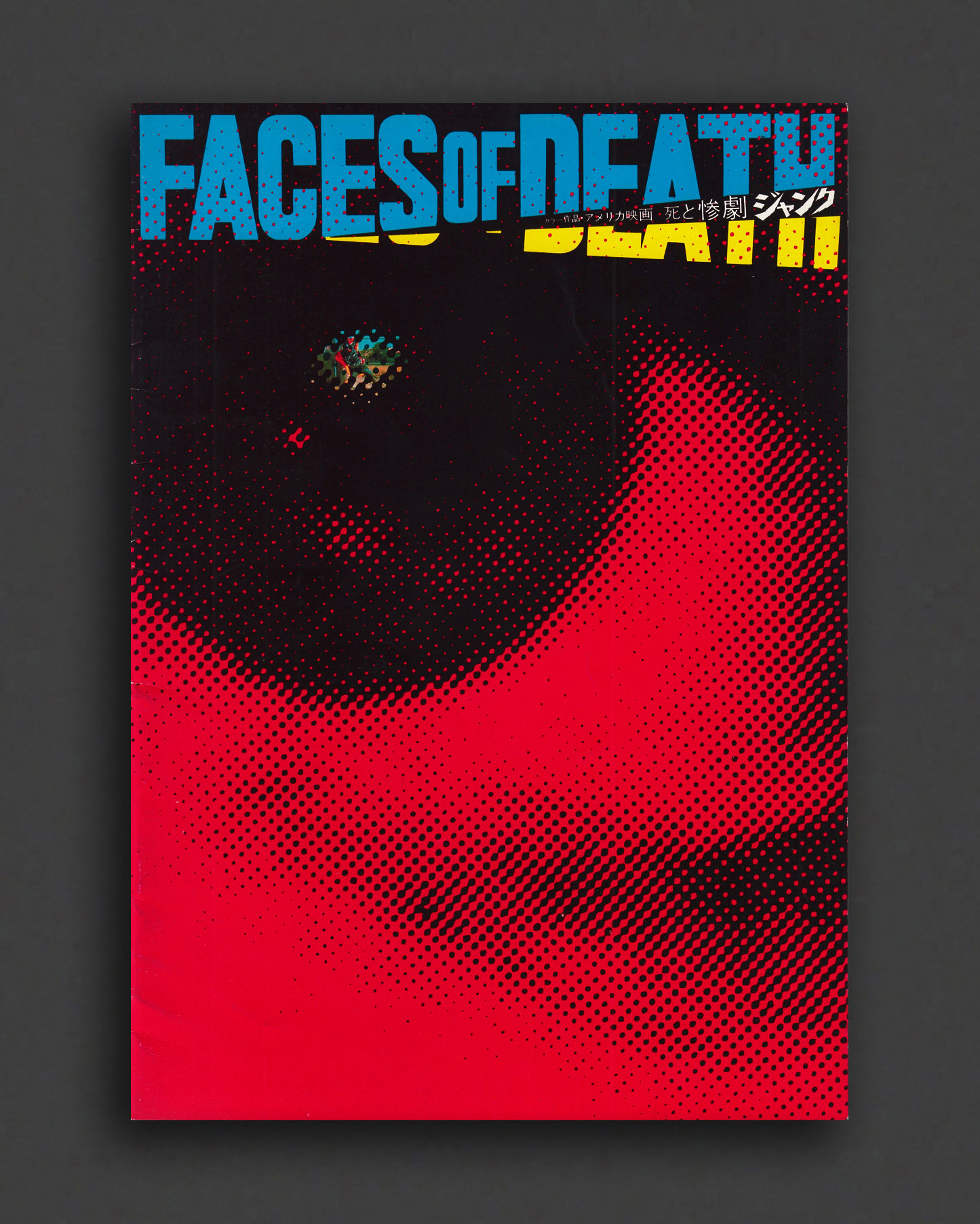

Faces of Death (John Alan Schwartz)
1980, Japanese
Softcover (staple-bound), 20 pages, 29.5 x 21 cm
1st Edition, Out of print title / used / very good
$80.00 - In stock -
"Experience the graphic reality of DEATH, close-up"
Very rare Japanese souvenir photo booklet for Faces of Death, the controversial 1978 American mondo horror film written and directed by John Alan Schwartz, credited under the pseudonyms "Conan Le Cilaire" and "Alan Black" respectively.
Banned in 46 countries, Faces of Death is regarded as one of the most depraved films ever – a ‘shockumentary’ full of autopsies, plane crashes, animal attacks, executions, even the inspiration for Spielberg's monkey brains scene in Indiana Jones. When Faces of Death hit Japanese cinemas in 1978, under the title Junk, it was a massive hit. But it wasn't until the VHS boom that Faces of Death became a cult classic. It was illegal to distribute it in Britain, but it was unstoppable in the USA. When a wave of violent horror films that came to be known as “video nasties” flooded rental stores, Faces of Death was “the most popular nasty of them all.”
The film, presented as if it were an actual documentary, centers on pathologist Francis B. Gröss, played by actor Michael Carr, who presents the viewer with footage showing different gruesome ways of dying from a variety of sources. Many scenes were faked for the film, but most portions include pre-existing video footage of real deaths and its aftermath. Unrecommended viewing.
Heavily illustrated throughout with glossy colour and b/w stills from the film, alongside texts in Japanese about the film, cast and production information.
Very Good copy with light wear.


Faces of Death 2 (John Alan Schwartz)
Japanese film booklet 1981
1981, Japanese
Softcover (staple-bound), 20 pages, 29.5 x 21 cm
1st Edition, Out of print title / used / very good
$80.00 - In stock -
Very rare Japanese souvenir photo booklet for Faces of Death 2, the controversial straight-to-video 1981 American mondo horror documentary film directed by John Alan Schwartz, the follow-up to 1978's Faces of Death, credited under the pseudonyms "Conan Le Cilaire" & "Alan Black" respectively. Mortuaries, accidents and police work are filmed by TV crews and home video cameras. Faces of Death II contained real footage of a dead body being pulled from under a pier, Guerrilla death squads in El Salvador, napalm bombings in Vietnam, Buddhist self-immolations, the drugging of a monkey, a dolphin slaughter, a train disaster in India, Cambodian patients with leprosy, a death museum featuring Joaquin Murrieta's preserved head, a driver high on PCP and a boxer going down for his “final” count. Much like the PSA Aircraft crash, the assassination attempt on President Ronald Reagan occurred recently before the film's completion, and was included as well. Heavily illustrated throughout with glossy colour and b/w stills from the film, alongside texts in Japanese about the film, cast and production information.
Very Good copy with light wear.


Autopsy (Juan Logar)
Japanese film booklet 1973
1973, Japanese
Softcover (staple-bound), 12 pages, 29.5 x 21 cm
1st Edition, Out of print title / used / very good
$90.00 - In stock -
Wonderful, very rare Japanese souvenir photo booklet for Autopsia (Autopsy), a 1973 Spanish Mondo-style docudrama by director Juan Logar about a war correspondent who comes back home and has a spiritual crisis about his own mortality. Surreal fantasy sequences are mixed with graphic real autopsy footage. Heavily illustrated throughout with b/w stills from the film, alongside texts in Japanese about the film, cast and production information.
Very Good copy with light wear.


The Holy Mountain (Alejandro Jodorowsky)
Japanese Film Brochure
1988, Japanese
Softcover (staple-bound), 28 pages, 29.5 x 18.5 cm
1st Edition, Out of print title / used / very good
$90.00 - In stock -
Very rare Japanese brochure from around 1988, promoting the release on VHS (we think!) of The Holy Mountain, the cult classic 1973 Mexican surreal film directed, written, produced, co-scored, co-edited by and starring Alejandro Jodorowsky, who also designed sets and costumes, inspired in part by René Daumal's Mount Analogue. The scandal of the 1973 Cannes Film Festival, Alejandro Jodorowsky's flood of sacrilegious imagery and existential symbolism is a surreal sojourn for enlightenment pitting illusion against truth. In a corrupt, greed-fueled world, a powerful alchemist leads a messianic character and seven materialistic figures representing the negative aspects of the seven planets, to the Holy Mountain, where they hope to achieve enlightenment. Following Jodorowsky's underground hit El Topo, acclaimed by both John Lennon and George Harrison, the film was produced by the Beatles manager Allen Klein and John Lennon and Yoko Ono put up production money. It was shown at various international film festivals in 1973, including Cannes, and limited screenings in New York and San Francisco, gaining cult status. The Holy Mountain is a mythical, mystical masterpiece, a Hieronymus Bosch painting come to life - part spiritual quest, part science fiction, part social satire, and completely without comparison.
This rare collectible brochure published by Allen Klein's ABKCO gives synopsis and introduction to the film, illustrated throughout with glorious stills, including a four-panel colour fold-out, Japanese texts, cast and production information, even Holy Mountain manga! A wonderful piece of printed history to Jodorowsky's masterpiece.
Very Good copy with some handling pinches.


Satyricon (Federico Fellini)
Japanese film booklet 1969
1969, Japanese
Softcover (staple-bound), 24 pages plus fold-out, 29.5 x 21 cm
1st Edition, Out of print title / used / good
$40.00 - In stock -
Wonderful, scarce Japanese souvenir photo booklet for Federico Fellini's Satyricon, a 1969 Italian fantasy drama film written and directed by Federico Fellini and loosely based on Petronius's work Satyricon, written during the reign of Emperor Nero and set in Imperial Rome. The award-winning film is divided into nine episodes, following Encolpius (Martin Potter) and his friend Ascyltus (Hiram Keller) as they try to win the heart of a young boy named Gitón within a surreal and dreamlike Roman landscape. It received acclaim from international critics, with particular praise toward Fellini's direction and Danilo Donati's vivid production design. Heavily illustrated throughout with glossy colour and b/w stills from the film, alongside texts in Japanese about the film, cast, and production information. Includes four-panel double-sided colour fold-out.
Good copy with light wear.


La Planete Sauvage
Japanese Film Brochure
1985, Japanese
Softcover (staple-bound), 16 pages, 25.7 x 18.2 cm
1st Edition, Out of print title / used / fine
$80.00 - In stock -
Very rare Japanese brochure from around 1985, promoting the release on VHS (we think!) of La Planete Sauvage (Fantastic Planet), the 1973 French/Czech experimental science fiction animated film, directed by René Laloux and written and designed by Laloux and illustrator Roland Topor. The film was animated at Jiří Trnka Studio in Prague. The allegorical story, set on the distant planet Ygam, is based on the 1957 novel Oms en série by French writer Stefan Wul. Enslaved humans called Oms are the playthings of giant blue native inhabitants, the Draags. Terr, kept as a pet since infancy, escapes from his gigantic child captor and is swept up by a band of radical fellow Oms, who are resisting the Draags’ oppression and violence. La Planete Sauvage was awarded the Grand Prix special jury prize at the 1973 Cannes Film Festival. It is one of the greatest animations ever made.
This collectible brochure gives synopsis and introduction to the film, illustrated throughout with stills, Topor's designs, Japanese texts, cast and catalogue information. A wonderful piece of printed history to René Laloux's chilling psychedelic masterpiece.
Very Good—Fine copy.
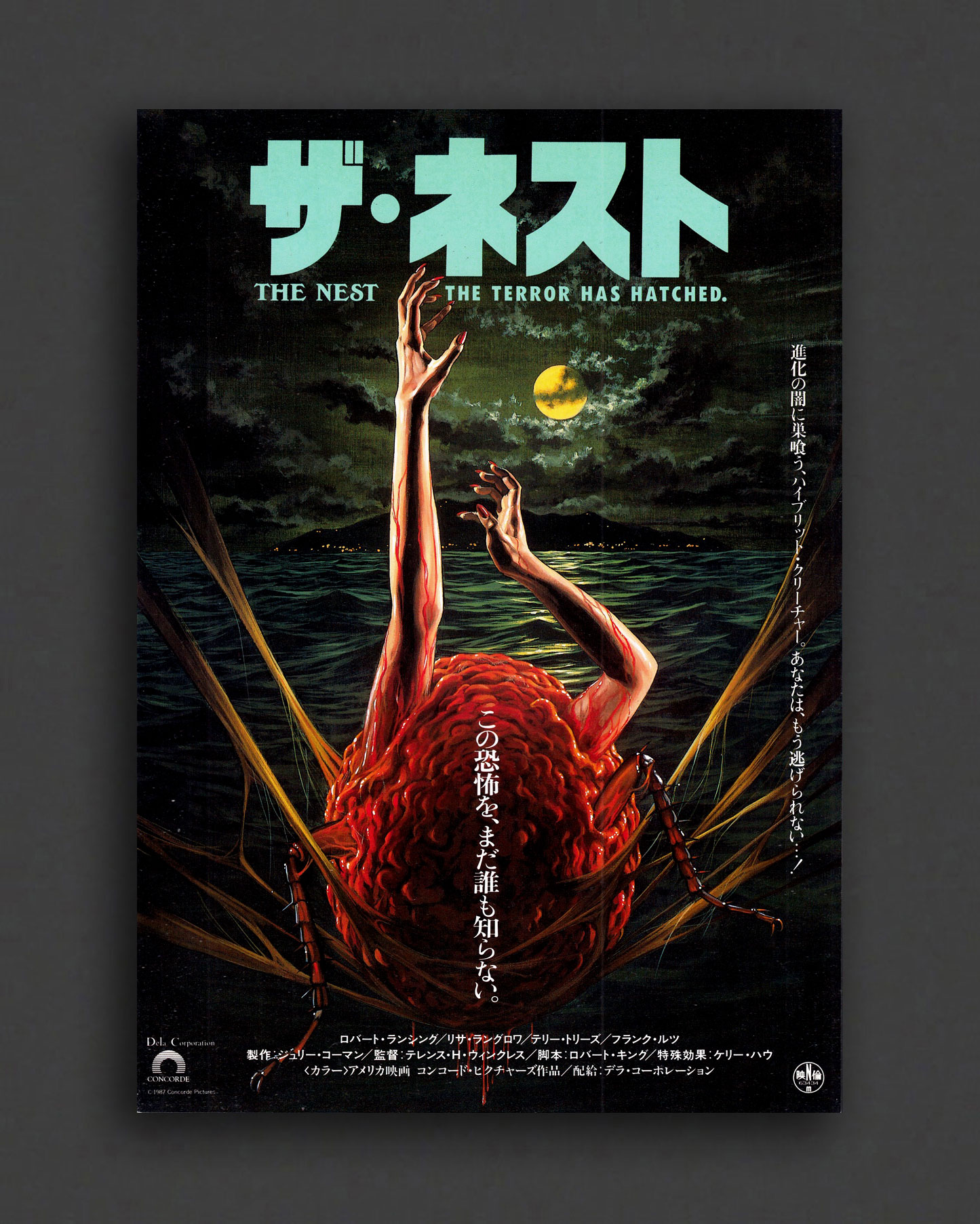
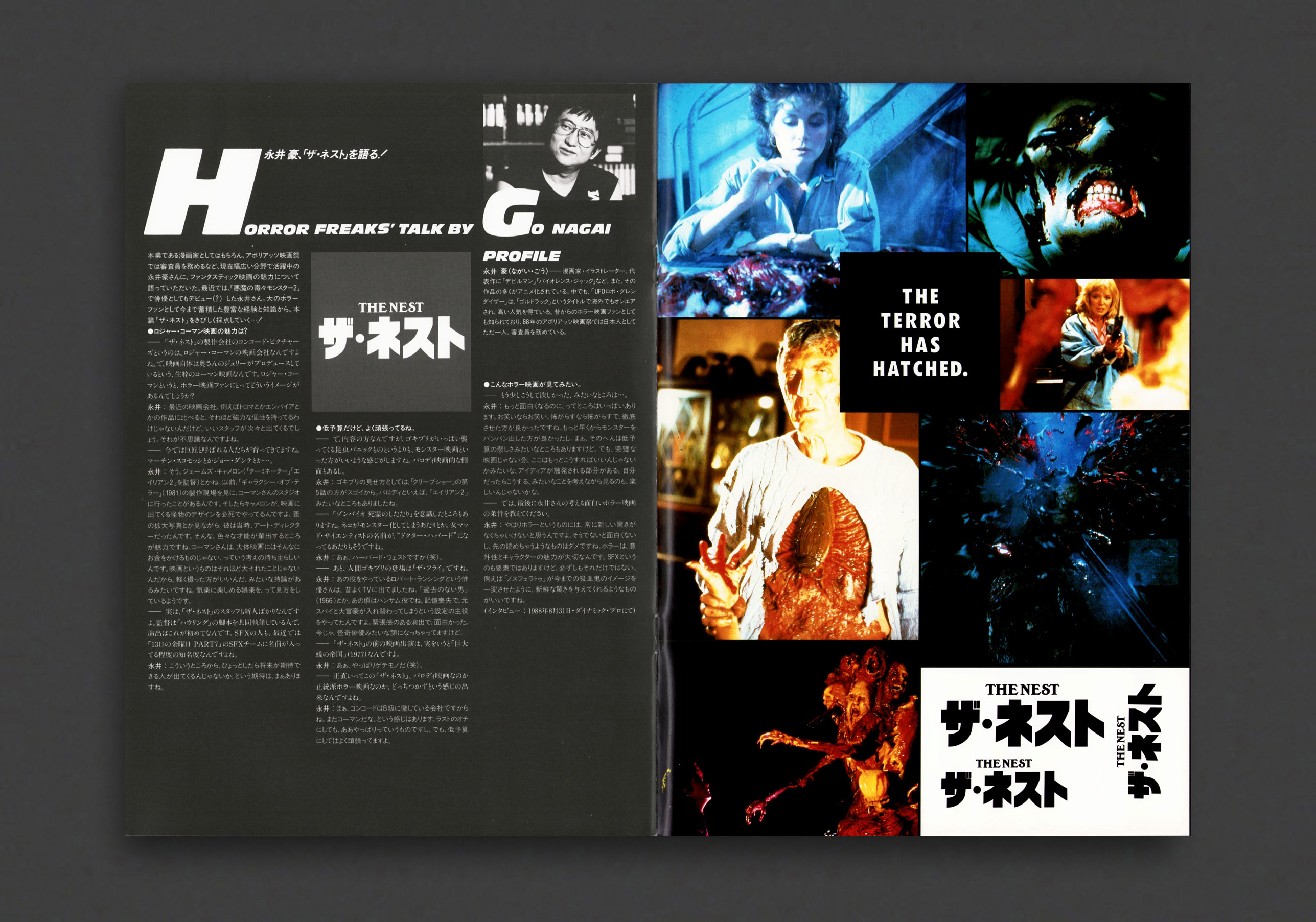
The Nest (Terence H. Winkless)
Japanese film booklet 1987
1987, Japanese
Softcover (staple-bound), 8 pages, 29.5 x 21 cm
1st Edition, Out of print title / used / fine
$15.00 - In stock -
Rare 1987 Japanese souvenir photo booklet for the The Nest, a 1988 American science-fiction horror film directed by Terence H. Winkless of Bloodfist (1989) fame. After writing for The Howling, The Nest was Winkless' directorial debut, produced by Julie Corman. Based on the 1980 novel of the same name by Eli Cantor (published under the pseudonym Gregory A. Douglas), the film stars Robert Lansing, Lisa Langlois, Franc Luz, and Terri Treas and takes place in a small New England town that is overrun by genetically engineered killer cockroaches. Heavily illustrated throughout with glossy colour and b/w stills from the film, alongside texts in Japanese about the film, cast and production information.
Very Good—Near Fine copy with light wear.

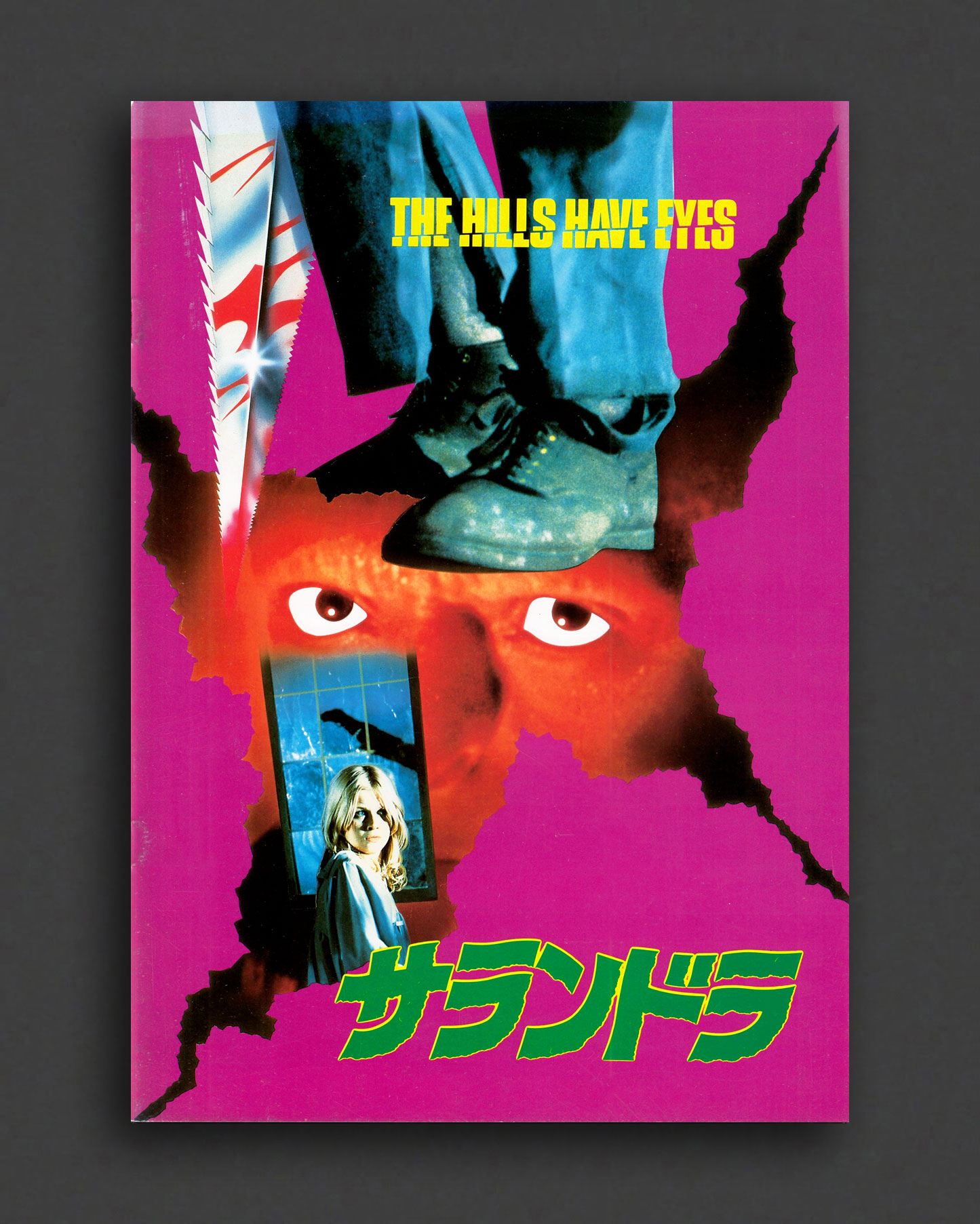
The Hills Have Eyes (Wes Craven)
Japanese film booklet 1984
1984, Japanese
Softcover (staple-bound), 24 pages, 29.5 x 21 cm
1st Edition, Out of print title / used / very good
$45.00 - Out of stock
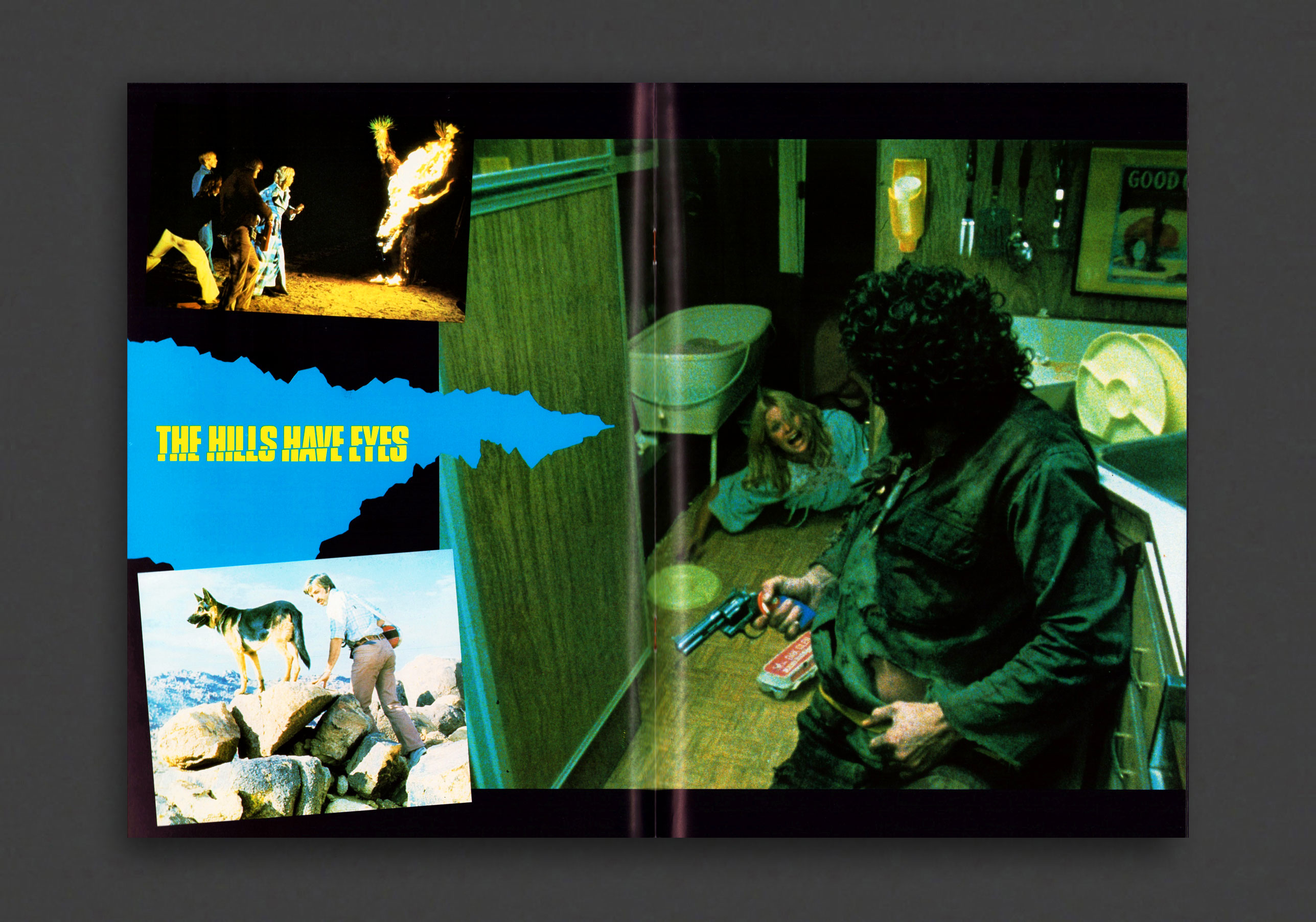
Rare 1984 Japanese souvenir photo booklet for the 1977 American cult horror classic The Hills Have Eyes, written, directed, and edited by Wes Craven, following his directorial debut, The Last House on the Left (1972). Starring Susan Lanier, Michael Berryman, and Dee Wallace, the film follows the Carters, a suburban family targeted by a family of cannibal savages after becoming stranded in the Nevada desert. Heavily illustrated throughout with glossy colour and b/w stills from the film, alongside texts in Japanese about the film, cast and production information.
Very Good copy with light wear.
Death Warmed Up (David Blyth)
Japanese film booklet 1986
1986, Japanese
Softcover (staple-bound), 16 pages, 29.5 x 21 cm
1st Edition, Out of print title / used / very good
$45.00 - In stock -
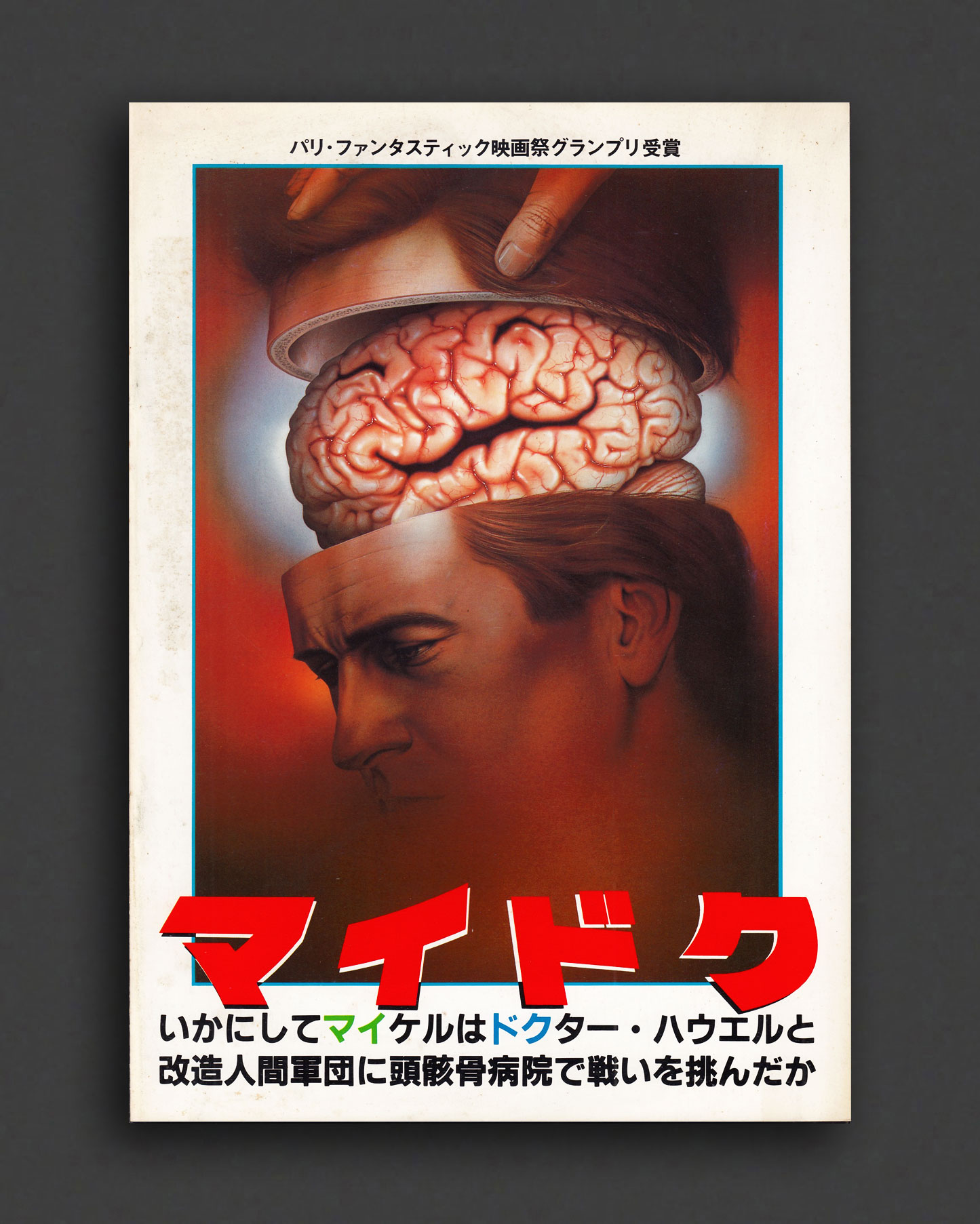
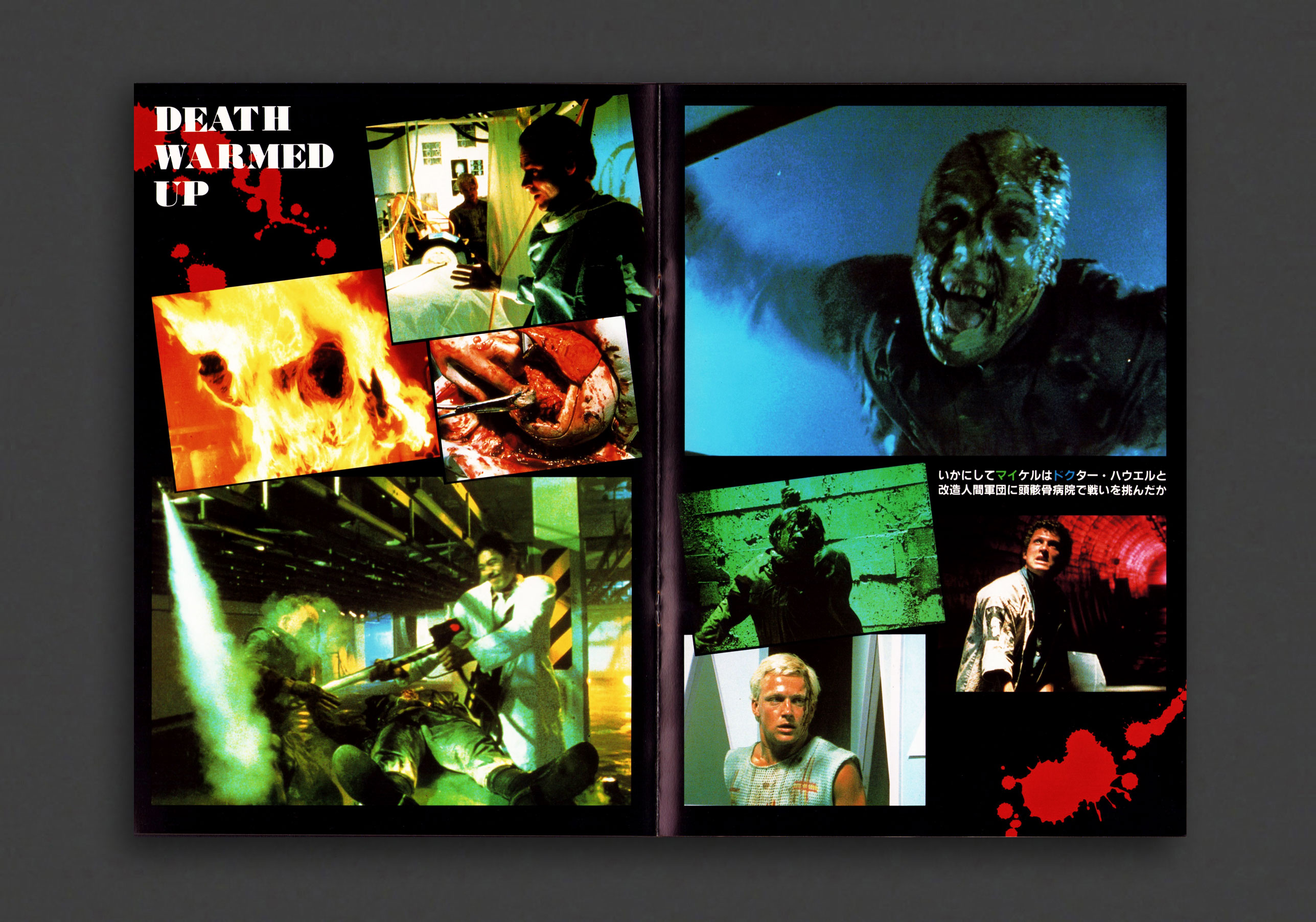
Very rare 1986 Japanese souvenir photo booklet for the 1984 New Zealand zombie film Death Warmed Up directed by David Blyth. Pre-dating Peter Jackson's arrival (Bad Taste) by three years, New Zealand's first horror movie sees Michael Hurst making his movie debut as he fights mutants (including Bruno Lawrence) on Waiheke Island. Hurst's character is out to avenge the mad scientist who forced him to kill his parents. A grand prize-winner at a French fantasy festival, with cult director Alejandro Jodorowsky on the jury. Heavily illustrated throughout with glossy colour and b/w stills from the film, alongside texts in Japanese about the film, cast, and production information.
"It was New Zealand’s first film to heavily borrow exploitation elements from the international horror scene and package them up with enough antipodean flavours to energise a generation of movie mad kiwis."–Ant Timpson, on the 'Words & More' section of his blog Filmhead
Very Good copy with light wear.


Poltergeist (Tobe Hooper)
Japanese film booklet 1982
1982, Japanese
Softcover (staple-bound), 24 pages, 29.5 x 21 cm
1st Edition, Out of print title / used / very good
$45.00 - Out of stock
Rare Japanese souvenir photo booklet for Tobe Hooper's masterpiece Poltergeist, a 1982 American supernatural horror film directed by Tobe Hooper from a story by Steven Spielberg. Starring JoBeth Williams, Craig T. Nelson and Beatrice Straight, the film focuses on a suburban family whose home is invaded by malevolent ghosts that abduct their youngest daughter. Spielberg conceived Poltergeist as a horror sequel to his 1977 film Close Encounters of the Third Kind titled Night Skies; however, Hooper was less interested in the sci-fi elements and suggested they collaborate on a ghost story. The film received critical acclaim and commerical success and is considered a horror classic. Heavily illustrated throughout with glossy colour and b/w stills from the film, alongside texts in Japanese about the film, cast, and production information.
Very Good copy with some light spine wear.
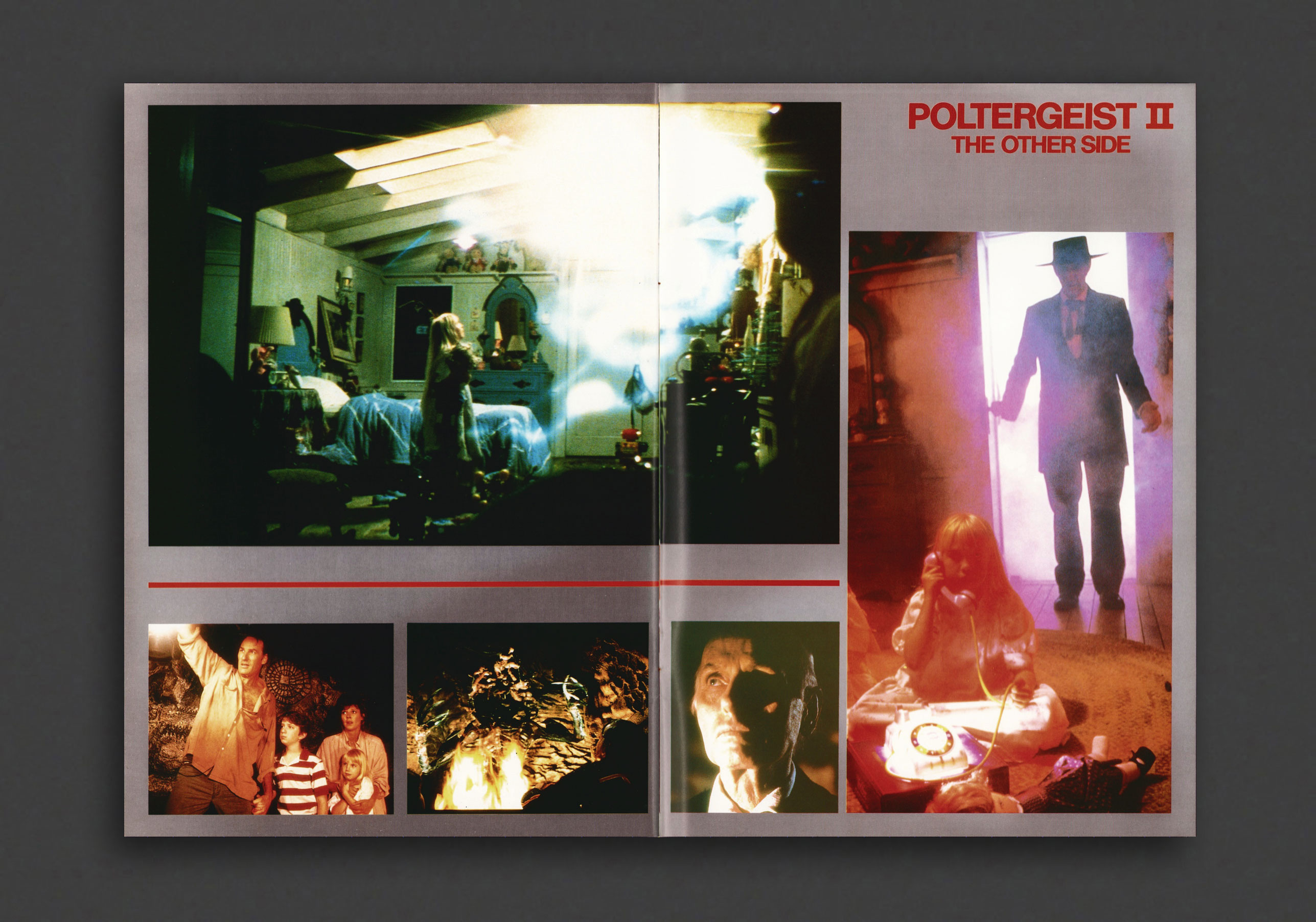
Poltergeist II: The Other Side (Brian Gibson)
Japanese film booklet 1986
1986, Japanese
Softcover (staple-bound), 24 pages, 29.5 x 21 cm
1st Edition, Out of print title / used / very good
$30.00 - In stock -
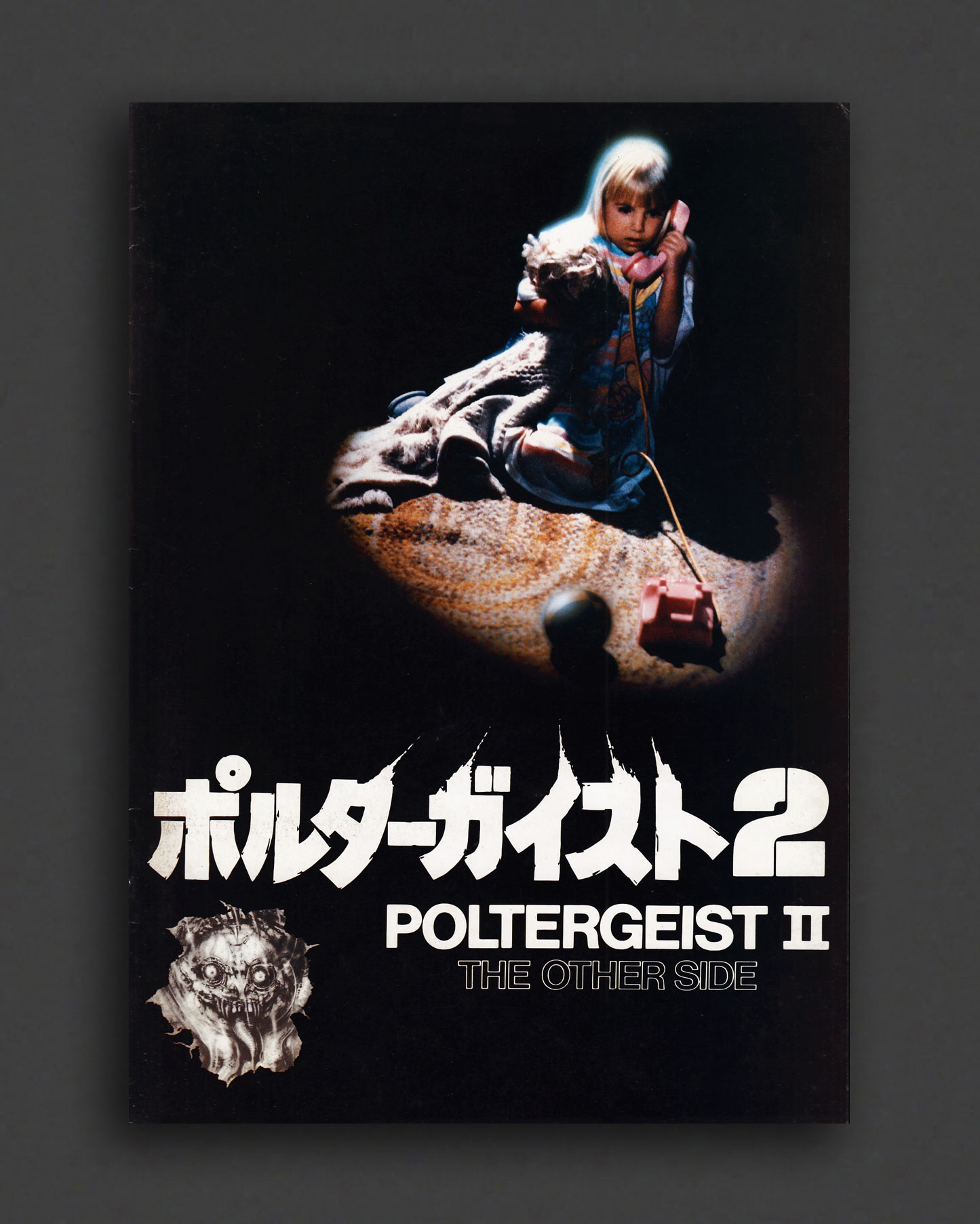
Japanese souvenir photo booklet for Poltergeist II: The Other Side (also known simply as Poltergeist II) the 1986 American supernatural horror film directed by Brian Gibson, a direct sequel to Tobe Hooper's masterpiece Poltergeist (1982). Featuring JoBeth Williams, Craig T. Nelson, Oliver Robins, Heather O'Rourke and Zelda Rubinstein reprising their roles from the first film, plus Will Sampson, Julian Beck and Geraldine Fitzgerald, the second entry in the Poltergeist film series follows the Freeling family who again finds themselves under attack from the supernatural forces led by "the Beast", the monstrous, biomechanical entity manifesting from the spirit of the evil preacher Reverend Henry Kane, designed by surrealist artist H.R. Giger, famous for the Alien xenomorph. Giger's dark, biomechanical style was applied to Kane's manifestations, including the "Vomit Creature" and the massive "Great Beast" that appears in the astral plane, a design realized by effects artists. Heavily illustrated throughout with glossy colour and b/w stills from the film, alongside texts in Japanese about the film, cast, and production information.
VG with some light wear.


Philosophy In The Boudoir / Minski the Cruel
The Marquis de Sade
2004, English
Softcover, 134 pages, 15.5 x 23 cm
$35.00 - Out of stock
Philosophy In The Boudoir (La philosophie dans le boudoir, 1795), is the most concise, representative text of all the Marquis de Sade's works, containing his notorious doctrine of libertinage expounded in full, coupled with liberal doses of savage, unbridled eroticism, cruelty and violent sexuality. The renegade philosophies put forward here would later rank among the cornerstones of Andre Breton's surrealist manifesto. This new edition includes "Minski the Cruel, a brand-new, unexpurgated translation of a key episode from de Sade's "Juliette.
Though initially considered a work of pornography, La philosophie dans le boudoir has come to be considered a socio-political drama and perhaps the most representative of the Marquis de Sade's work and philosophy on religion and morality. Dedicated to "voluptuaries of all ages, of every sex", it tells of a young virgin ruthlessly stripped of virtue and schooled in the ways of sexual perversion and libertine philosophy.
Taken from the forward by James Havoc: The Marquis de Sade (1740 - 1814) was a self-proclaimed libertine. His doctrine of libertinage as expounded in "Philosophy in the Boudoir" - his masterpiece - now reads like a blueprint for those manifestos drawn up will over a century later by Andre Breton; indeed "Philosophy in the Boudoir" has often been regarded as being amongst the first Surrealist texts - the others also being works by De Sade. In the course of this book - erotic, comical, and terrifyingly bleak in turn - he contrives to heap scorn on Christianity, God, and the Church, religion in general, history, marriage and the nuclear family, morality, all love other than sexual love, faith, hope and charity, parenthood, vaginal sex; i.e. all forms of humanity and virtue. At the same time, he advocates atheism, murder and reflexive crimes, torture, cruelty, abortion, all kind of sexual perversion, incest, adultery, self-abuse, ad infinitum; his sexually violent visions mark him as a precursor of modern psychology.
Very Good copy.
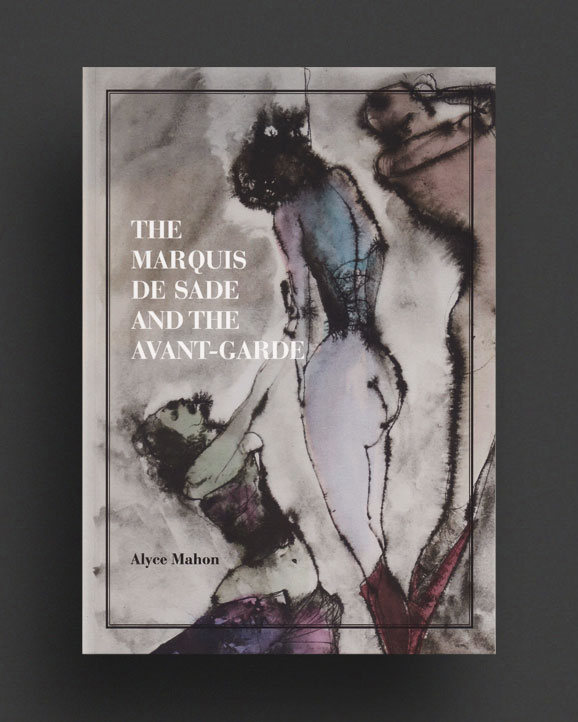
The Marquis de Sade and the Avant-Garde
by Alyce Mahon
2020, English
Softcover, 296 pages, 25.5 x 17.8 cm
$80.00 - In stock -
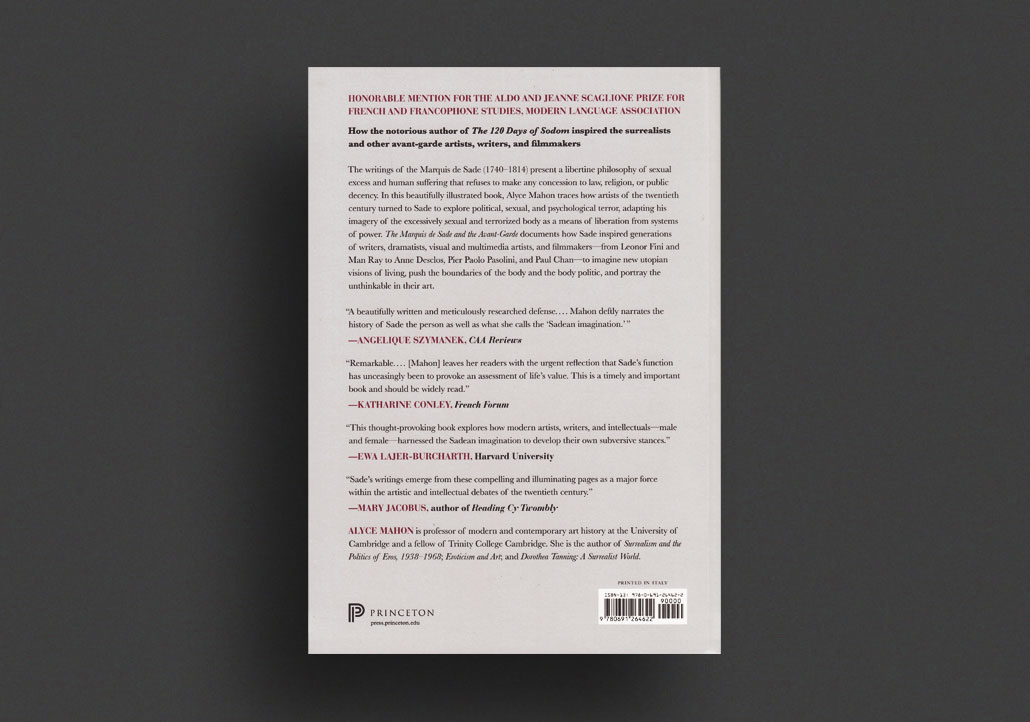
How the notorious author of The 120 Days of Sodom inspired the surrealists and other avant-garde artists, writers, and filmmakers.
The writings of the Marquis de Sade (1740–1814) present a libertine philosophy of sexual excess and human suffering that refuses to make any concession to law, religion, or public decency. In this groundbreaking cultural history, Alyce Mahon traces how artists of the twentieth century turned to Sade to explore political, sexual, and psychological terror, adapting his imagery of the excessively sexual and terrorized body as a means of liberation from systems of power.
Mahon shows how avant-garde artists, writers, dramatists, and filmmakers drew on Sade’s “philosophy in the bedroom” to challenge oppressive regimes and their restrictive codes and conventions of gender and sexuality. She provides close analyses of early illustrated editions of Sade’s works and looks at drawings, paintings, and photographs by leading surrealists such as André Masson, Leonor Fini, and Man Ray. She explains how Sade’s ideas were reflected in the writings of Guillaume Apollinaire and the fiction of Anne Desclos, who wrote her erotic novel, Story of O, as a love letter to critic Jean Paulhan, an admirer of Sade. Mahon explores how Sade influenced the happenings of Jean-Jacques Lebel, the theater of Peter Brook, the cinema of Pier Paolo Pasolini, and the multimedia art of Paul Chan. She also discusses responses to Sade by feminist theorists such as Simone de Beauvoir, Susan Sontag, and Angela Carter.
Beautifully illustrated, The Marquis de Sade and the Avant-Garde demonstrates that Sade inspired generations of artists to imagine new utopian visions of living, push the boundaries of the body and the body politic, and portray the unthinkable in their art.
Alyce Mahon is Professor of Modern and Contemporary Art and a Fellow of Trinity College at the University of Cambridge, England. Born in Galway in the west of Ireland, she studied Modern English and History of Art at Trinity College Dublin and then took her doctoral degree at the Courtauld Institute of Art, University of London (1999), prior to being appointed at the University of Cambridge in 2000. She specialises in Surrealism, feminist art practice, and contemporary art and politics in her publications and work as curator. Recent exhibitions she has curated include the first major retrospective of American Surrealist 'Dorothea Tanning' for the Reina Sofia Madrid and Tate Modern London (2018-19) and 'SADE: Freedom or Evil' for the CCCB (2023).
The Other Face of Love
by Raymond de Becker
1969, English
Hardcover, 210 pages, 26 x 18 cm
1st Edition, Out of print title / used / good
$40.00 - In stock -
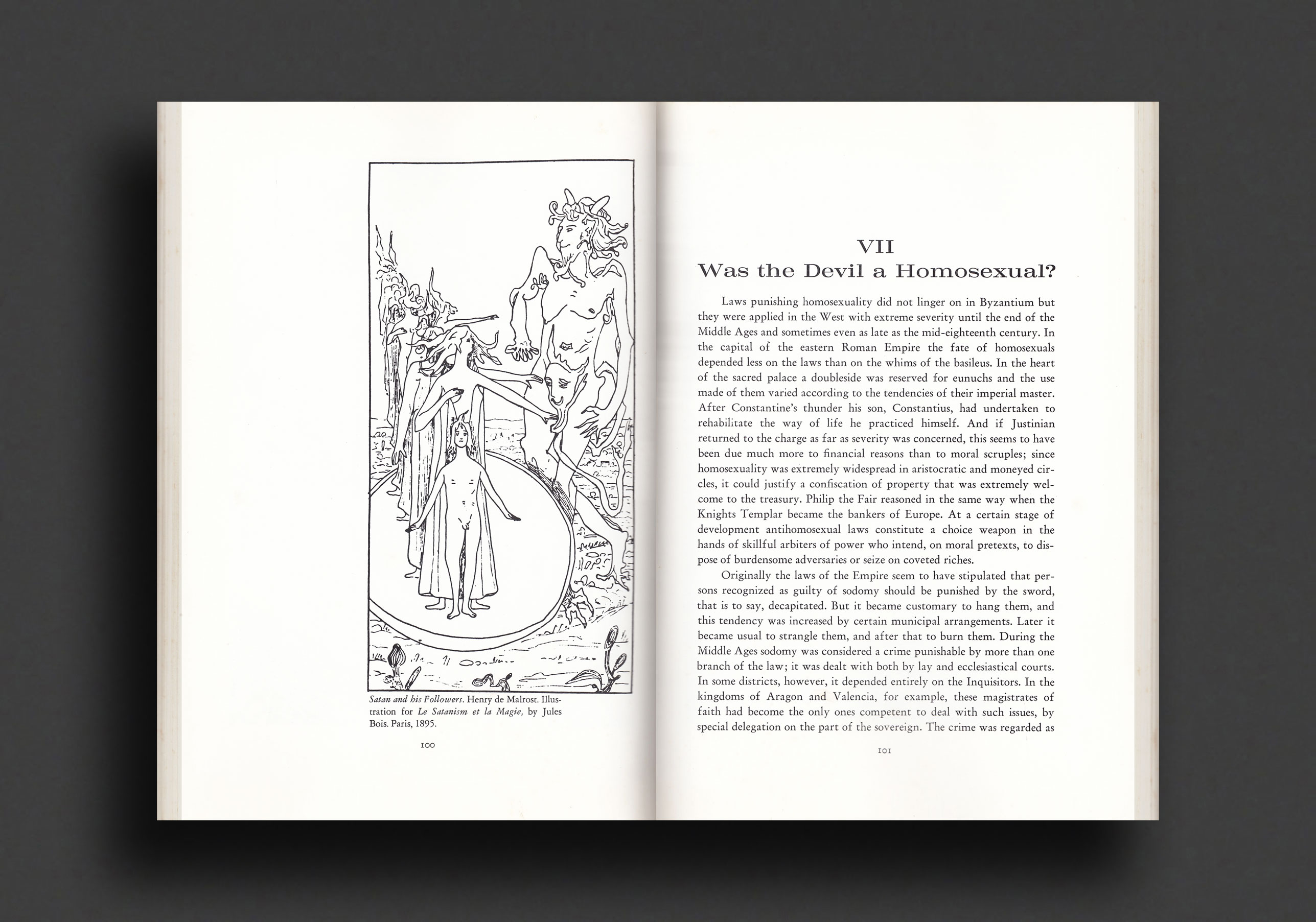
First 1969 hardcover edition of The Other Face of Love by Raymond de Becker, published by Grove Press, New York. A definitive and profusely illustrated study of the history of homosexuality, through literature, mythology, psychology, religion, the arts, with chapters on Greece and Rome, the Moslem East, the latent Homosexual Structure of Christianity, the Renaissance and contemporary issues written before gay liberation. Through the arts and letters, the devil, the uncertainties of science, and much more, the world of same-sex love is illustrated with hundreds of illustrations, drawings, film stills, paintings, photographs and objets d'art. Translated from the French by Margaret Crosland and Alan Daventry. Includes bibliographical footnotes.
Good—VG copy w/o dust jacket, light foxing to block edges, light wear to extremities.
Weegee
Naked City
1973, English
Softcover, 244 pages, 22.2 x 15.2 cm
Out of print title / used / very good
$40.00 - Out of stock
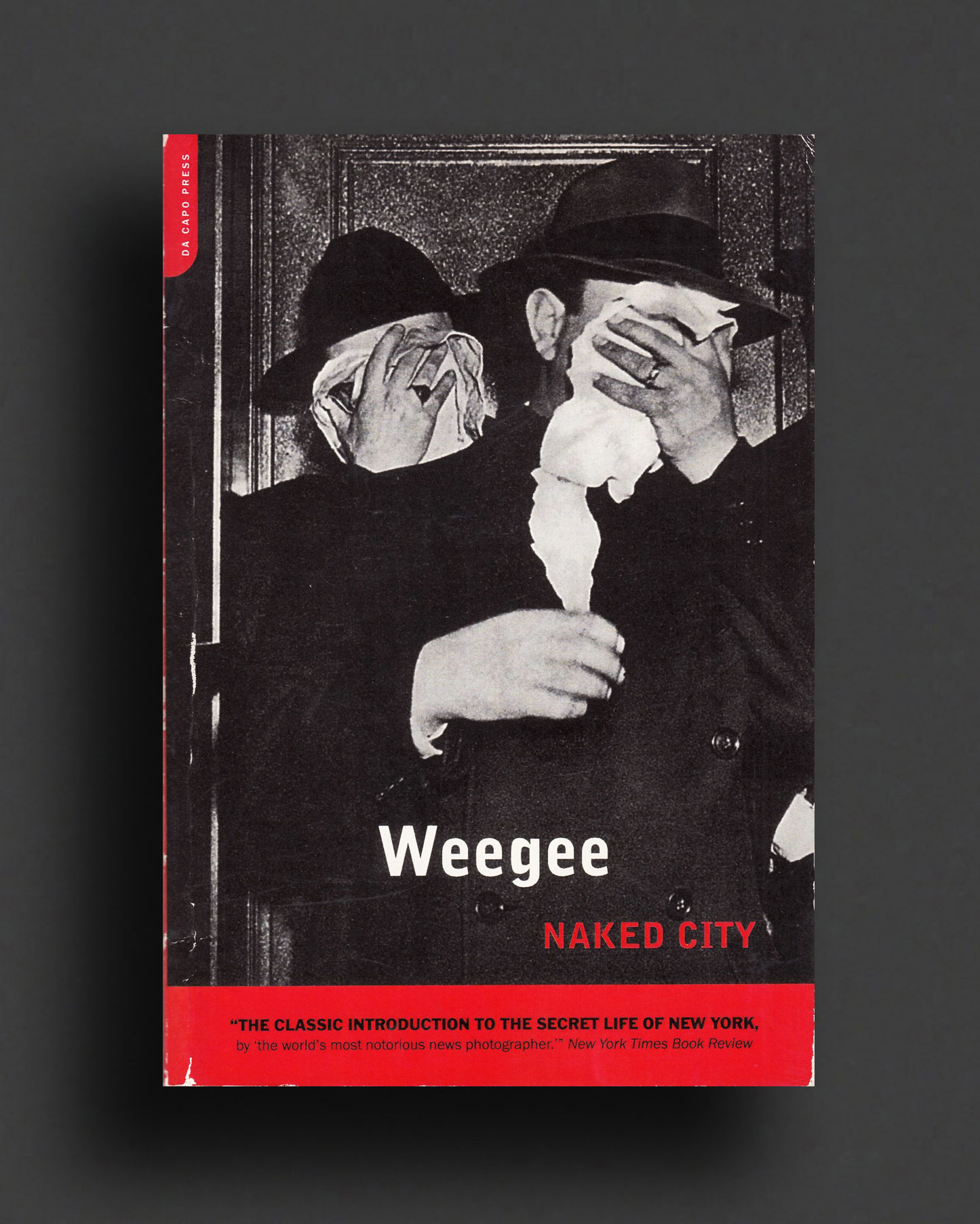
2002 paperback edition of the 1945 masterpiece 'Naked City' by the founding father of gritty, urban photojournalism. A walk on the wild side of New York.
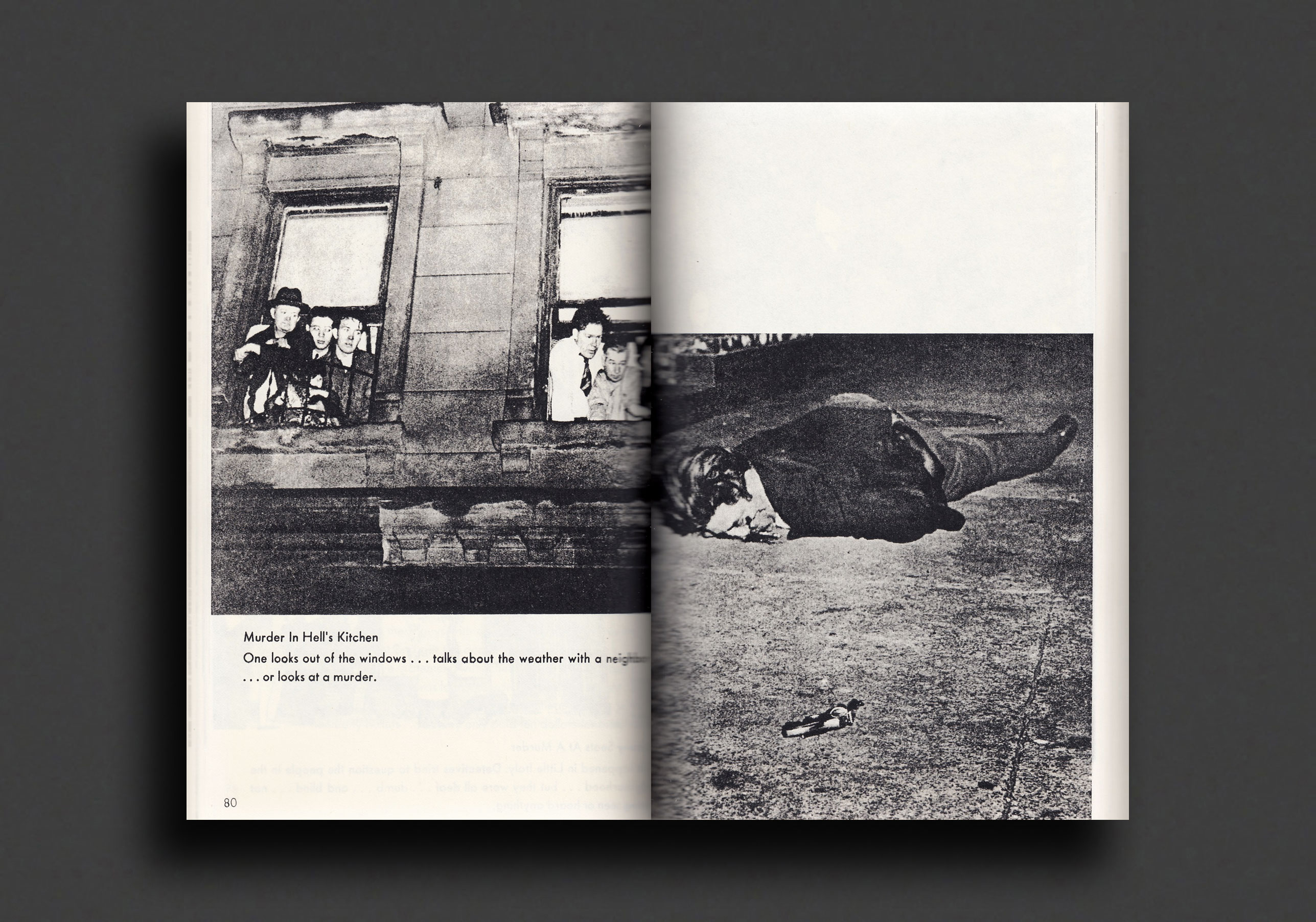
Weegee (1900-1968) is widely acknowledged to be both the originator and reigning king of candid photojournalism, ushering in the age of tabloid culture while simultaneously elevating the sordid side of human life to the status of high art. For Naked City, his first collection, Weegee cruised the teeming streets of 1940s New York in the wee hours in search of the sensational. His photographs were lewd, louche, and licentious, but always brimming with life (except when they were brimming with death). Weegee's profound influence on other photographers over the last half-century derives not only from his sensational subject matter and his use of the blinding, close-up flash, but also from his eagerness to photograph the city at all hours, at all levels. Snapping lovers on the beach at 3:00 in the morning, transgender prostitutes in police buggies, bejeweled society ladies at balls, the desperately poor-no one knew New York like Weegee did. Naked City showcases his talent, his love of the city, and his taste for the absurd and the unbelievable, in a book that will always stand as a classic introduction to the secret life of New York.
"The disasters and spectacles [Weegee] photographed... lay bare the facts of terror and mortality that underlie it."—Village Voice
Arthur Fellig (1899-1968), better known as Weegee, was an Austrian immigrant who worked as a freelance news photographer in New York City. Beginning his career on the police beat, where he specialized in crime and catastrophe, he roamed the city during the 1930s and 1940s in search of the "Page One" photo. His work now resides in the permanent collection of the Museum of Modern Art.
VG copy with some wear to cover extremities.


James Ensor
1860-1949 (+ related materials)
2005, English / Japanese
Hardcover, 200 pages, 26 x 19.5 cm
1st Edition, Out of print title / as new
$90.00 - In stock -
Major Japanese hardcover monographic catalogue published on the occasion of a major travelling exhibition of James Ensor's work, hosted at 5 different museums across Japan in 2005. Profusely illustrated with reproductions of Ensor's paintings, prints and drawings, photographs, essays, descriptions of works, bibliography, biography, and much more, in bi-lingual English and Japanese. A most handsome copy of this fine book, with exhibition ticket stub neatly pasted into colophon page, Ensor exhibition flyer/poster inserted, along with Ensor-focussed newsletter from the museum, and further insert about related Belgian Symbolist exhibit.
James Sidney Edouard, Baron Ensor (13 April 1860 – 19 November 1949) was a Belgian painter and printmaker, an important influence on expressionism and surrealism who lived in Ostend for almost his entire life. He was associated with the artistic group Les XX. While Ensor's early works, such as Russian Music (1881) and The Drunkards (1883), depict realistic scenes in a somber style, his palette subsequently brightened and he favored increasingly bizarre subject matter. Such paintings as The Scandalized Masks (1883) and Skeletons Fighting over a Hanged Man (1891) feature figures in grotesque masks inspired by the ones sold in his mother's gift shop for Ostend's annual Carnival. Subjects such as carnivals, masks, puppetry, skeletons, and fantastic allegories are dominant in Ensor's mature work. Ensor dressed skeletons up in his studio and arranged them in colorful, enigmatic tableaux on the canvas, and used masks as a theatrical aspect in his still lifes. Attracted by masks' plastic forms, bright colors, and potential for psychological impact, he created a format in which he could paint with complete freedom. James Ensor is considered to be an innovator in 19th-century art. Although he stood apart from other artists of his time, he significantly influenced such 20th-century artists as Paul Klee, George Grosz, Wols, and many expressionist and surrealist painters of the 20th century.
Near Fine.
Kishin Shinoyama
Beyond the Bridge
1976, English
Softcover, 208 pages, 25.5 x 16.5 cm
1st Edition, Out of print title / used / very good
$100.00 - In stock -
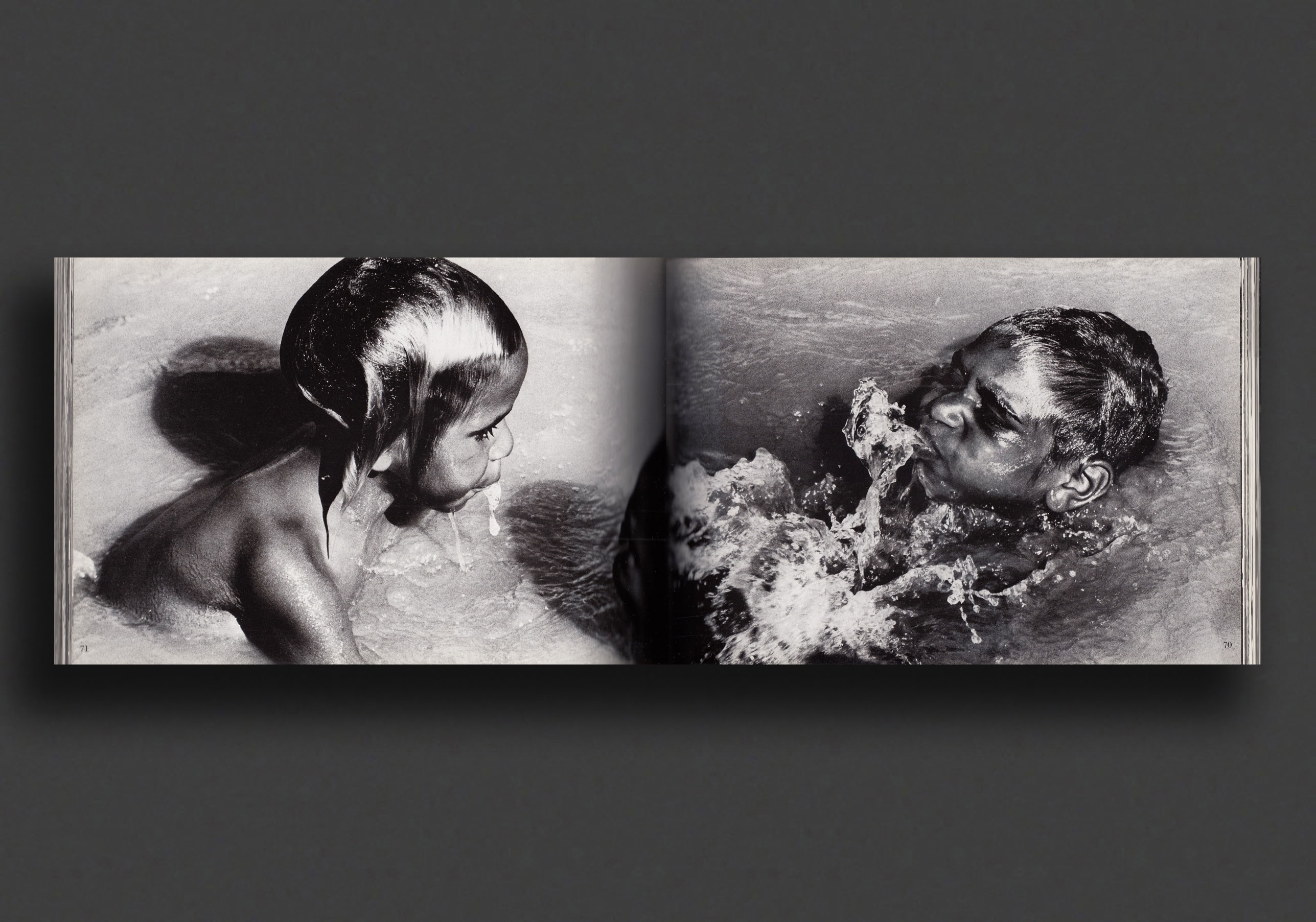
Published by Qantas Airlines, Tokyo, in 1976 and originally not for commercial sale, this wonderful photo book by the legendary Kishin Shinoyama was produced to promote Australia as a travel destination to a Japanese audience. Bound in landscape format with over 200 full-bleed black and white photographs, the entire book documents mid-1970s Australia through the lens of one of Japan's leading photographers. One of Shinoyama's best and least known books, with his stunning candid snaps — gorgeous sharp contrast and heavy grain imagery of Australian beach-life, the urban streets, pubs, markets, rural towns, and breathtaking outback landscapes. Kishin covered a lot of ground, shooting the people and places of Whale Beach, Sydney — Mermaid Beach, Gold Coast — Coolangatta, Queensland — Emu Bottom, Melbourne — York, West Australia — Ayers Rock, Alice Springs — Adelaide Airport — Alice Springs — Sandown Race-course, Melbourne — Paris Market, Sydney — Paddington, Sydney — Ingleside Ranch, Sydney — Old Sydney Town — Melbourne city — Sydney city — Healesville, Melbourne. All photos, only 3 pages of Japanese text.
This copy with the original Qantas promotional materials still bound-in. A treasure of an Australian souvenir photo book. Would love to see the out-takes!
Very Good copy with light wear but missing the first blank page.


Nobuyoshi Araki
Pseudo-Reportage
1980, Japanese
Softcover (w. metallic dust jacket), 324 pages, 25.6 x 15.3 cm
1st Edition, Out of print title / used / good
$180.00 - In stock -
First 1980 edition of Nobuyoshi Araki's Pseudo-Reportage, over 300 pages of Araki's photographic reportage spanning 1977—1979, and one of more uncommon and best Araki books. Wrapped in silver and pink metallic dust jacket, Pseudo-Reportage is akin to his famed Tokyo Luckyhole, a visual record tracing Araki's movements through the Tokyo nightlife (mostly) of the late 1970's and a tour to the haunts of New York City in 1979 on the occasion of a group exhibition at the International Center of Photography — JAPAN: A SELF PORTRAIT, in which Daido Moriyama, Eikoh Hosoe, Tomatsu, Fukase also participated. Lots of sex clubs, bars, restaurants, and lots of women — the Japanese Empress, female kickboxers, girl glam rockers, hostesses, girls, girls, girls. Explicit, profound, charming, Araki.
"With an epigraph, Photos are jokes on society. The high ([Japan's] Empress) and the low (female kickboxers) are combined; Araki's great wit in full display."—Kōtarō Iizawa
Good copy in Good dust jacket, light edge wear/spine sunning/foxing. Book block is cocked from storage.


Nobuyoshi Araki
Chiro, My Love
1990 / 1995, Japanese
Hardcover, 120 pages, 13 x 19 cm
1st Edition, Out of print title / used / very good
$70.00 - Out of stock
First 1990 edition, 1995 second print of this iconic photobook by Araki, distributed on the day of the funeral of Yoko, Araki's wife who died of cancer in 1990. One of the most popular of Araki's books, 'Chiro, My Love' is a delightful book devoted entirely to Araki's photographs of he and his wife Yoko's beloved cat, Chiro. Consisting of some 100 black and white photographs, this photographic essay presents Chiro in a variety of different moods and situations. On the balcony and on the roof of the neighborhood, on the sofa, in the shower, in Yoko's arms, on the sleeping belly of Araki... The figure of Chiro behaving freely, and Araki taking the shutter to love it. Poignant in retrospect as it includes a number of photos of Chiro with Yoko. ‘Yoko was very much looking forward to this book; its a pity she couldnt live to see it.’ Like Masahisa Fukase's "Sasuke", this is an intimate book for cats and photographers.
Very Good hardcover copy.
Roberte Ce Soir and The Revocation of the Edict of Nantes
by Pierre Klossowski
2002, English
Softcover, 214 pages, 21.6 x 14 cm
1st Edition, Out of print title / used / fine
$35.00 - Out of stock
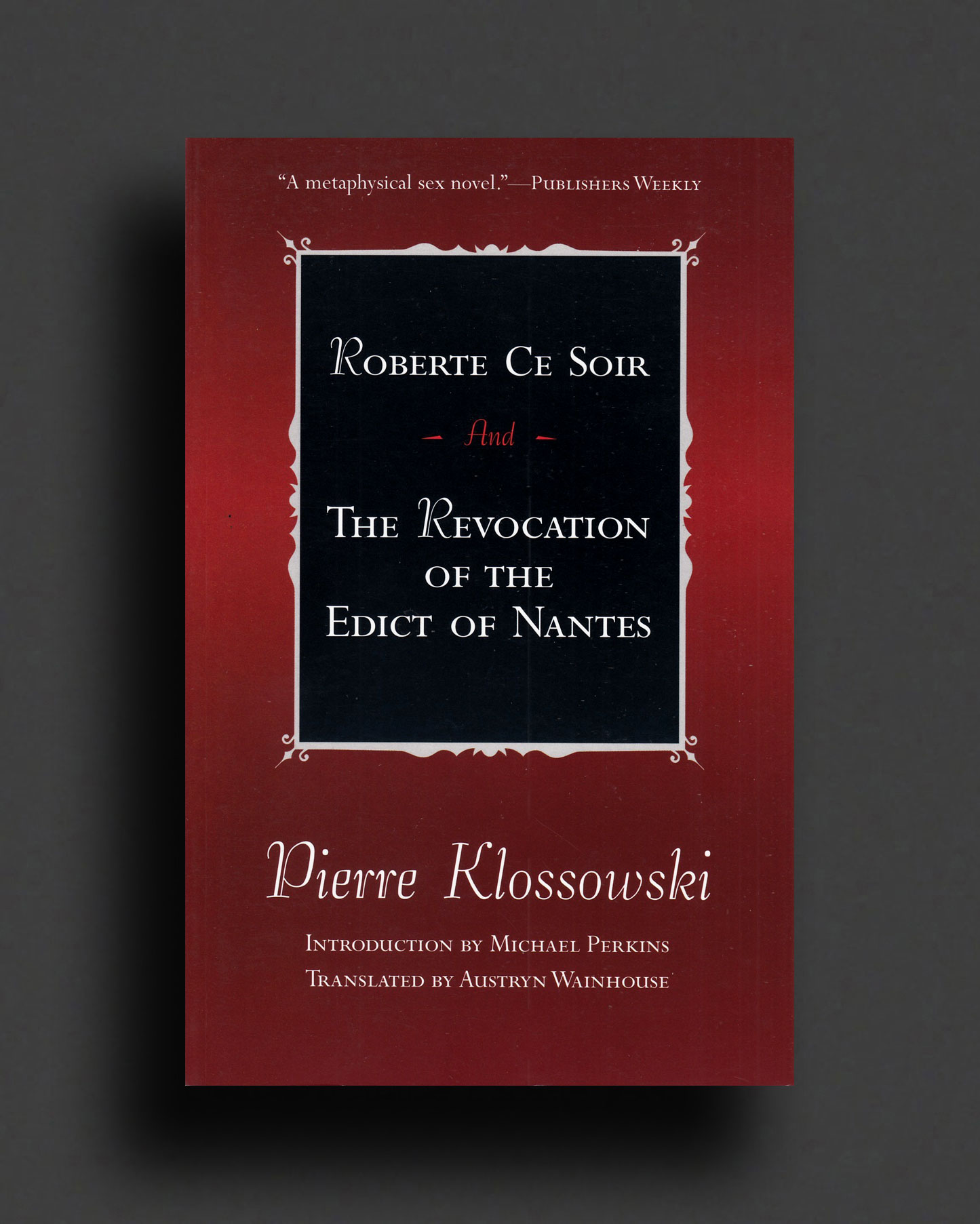
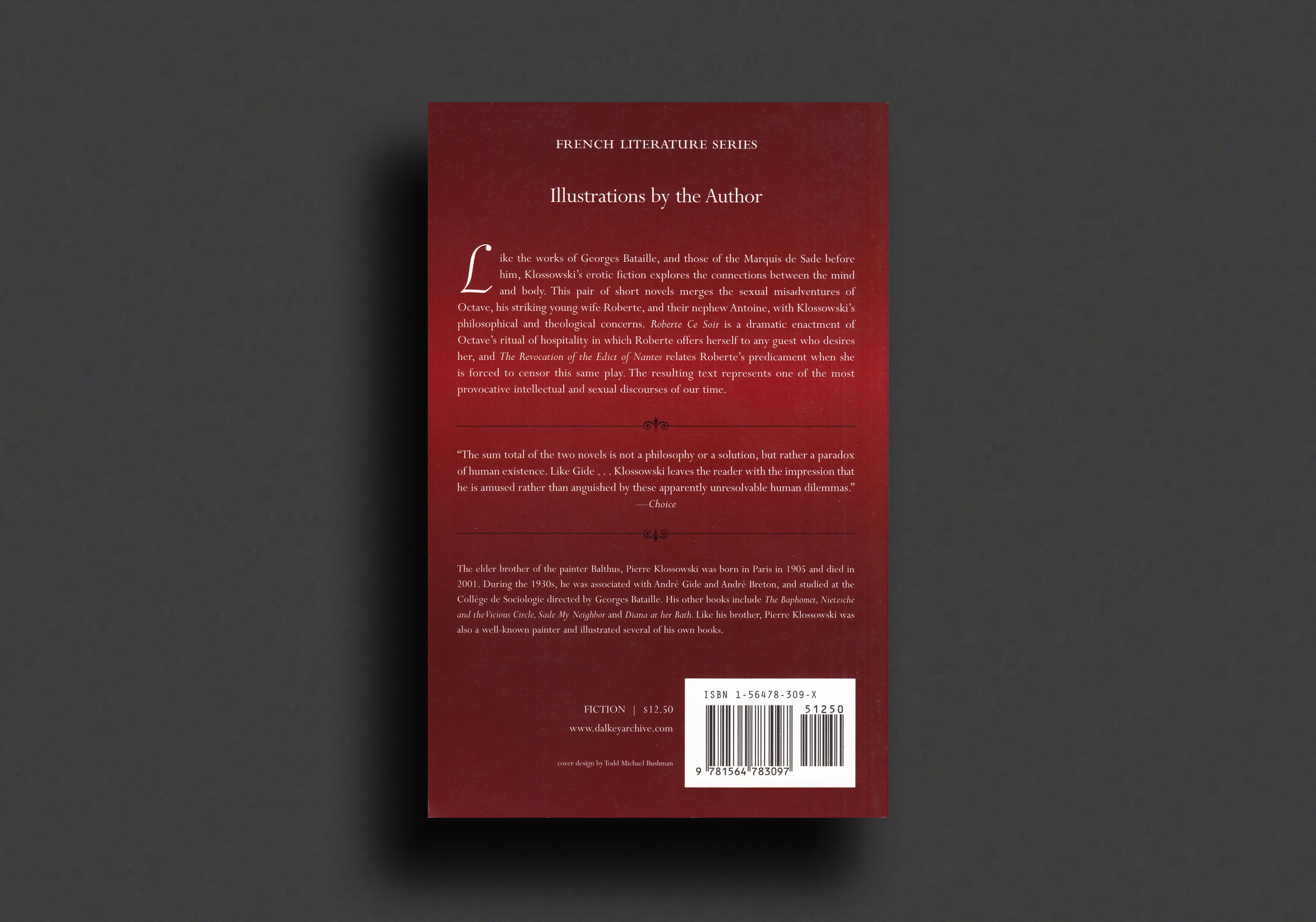
Now out-of-print first 2002 Dalkey Archive English-language edition of Klossowski's Roberte Ce Soir and The Revocation of the Edict of Nantes. Together these two novels comprise the most fascinating, obsessive, and erotic works of contemporary French fiction. Like the works of Georges Bataille, and those of the Marquis de Sade before him, Klossowski's erotic fiction explores the connections between the mind and body. This pair of short novels merges the sexual misadventures of Octave, his striking young wife Roberte, and their nephew Antoine, with Klossowski's philosophical and theological concerns. Roberte Ce Soir is a dramatic enactment of Octave's ritual of hospitality in which Roberte offers herself to any guest who desires her, and The Revocation of the Edict of Nantes relates Roberte's predicament when she is forced to censor this same play. The resulting text represents one of the most painstakingly baroque, provocative intellectual and sexual discourses of our time.
Pierre Klossowski (1905—2001) was a French writer, translator and artist, widely rcognized as a central figure in the contemporary French avant-garde. He was the eldest son of the artists Erich Klossowski and Baladine Klossowska, and his younger brother was the painter Balthus.
As a writer, Pierre Klossowski wrote full length volumes on the Marquis de Sade and Friedrich Nietzsche, a number of essays on literary and philosophical figures, and five novels. Roberte Ce Soir (Roberte in the Evening) provoked controversy due to its graphic depiction of sexuality.[1] He translated several important texts (by Virgil, Ludwig Wittgenstein, Martin Heidegger, Friedrich Hölderlin, Franz Kafka, Nietzsche, and Walter Benjamin) into French, worked on films and was also an artist, illustrating many of the scenes from his novels. Klossowski participated in most issues of George Bataille's review, Acéphale, in the late 1930s.
His 1969 book, Nietzsche and the Vicious Circle, greatly influenced French philosophers such as Michel Foucault, Gilles Deleuze, and Jean-François Lyotard.
Winner of the National Book Award for translation and a graduate of Harvard University, translator Austryn Wainhouse left the United States for Paris partway through graduate work at the University of Iowa. He has worked in France as an editor and translator ever since. He was the first to translate the Marquis de Sade, including de Sade's 120 Days of Sodom, Juliette, and Justine. And he has translated the works of many other vital writers, including Pierre Klossowski, Georges Bataille, Simone de Beauvoir, and Jean Cocteau. Hedyphagetica, his only work of fiction, was first published by the Olympia Press. Wainhouse lives in the South of France.
Fine—As New copy. Ex-libris stamp to title page.
Justine, Philosophy in the Bedroom, and Other Writings
by Marquis de Sade
1994, English
Softcover, 784 pages, 27.1 x 17 cm
Out of print title / used / very good
$40.00 - In stock -
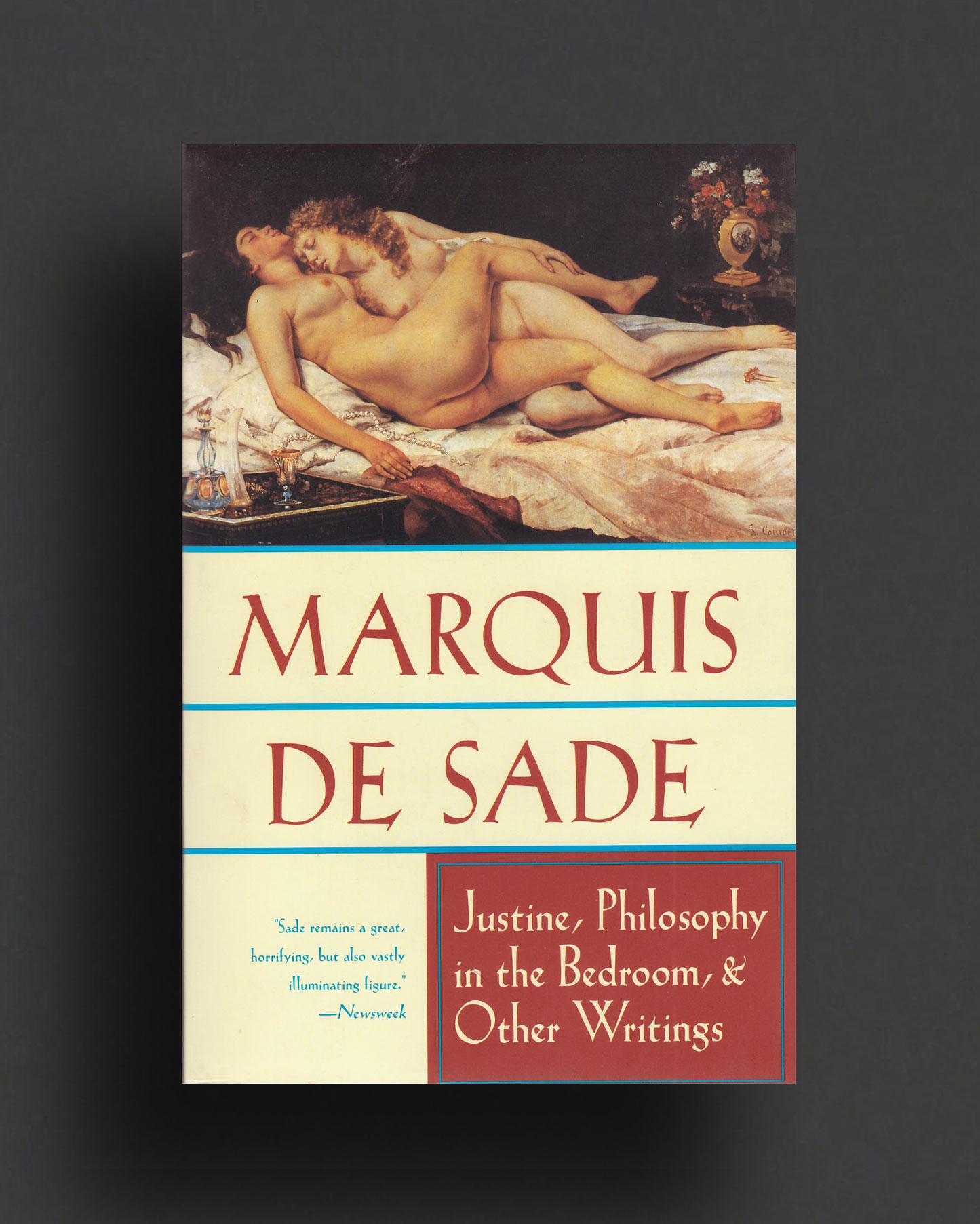
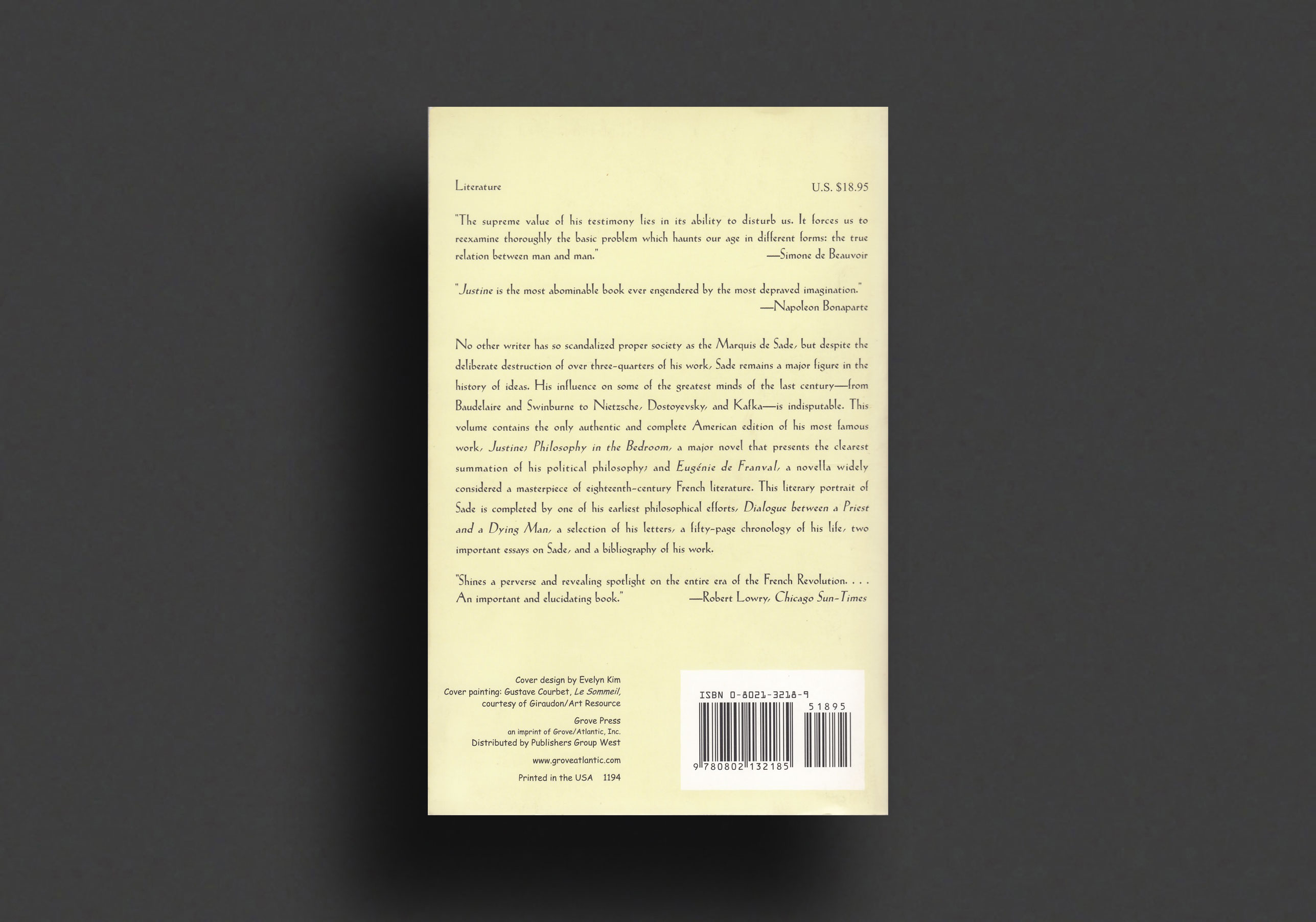
No other writer has so scandalized proper society as the Marquis de Sade, but despite the deliberate destruction of over three-quarters of his work, Sade remains a major figure in the history of ideas. His influence on some of the greatest minds of the last century -- from Baudelaire and Swinburne to Nietzsche, Dostoyevksy, and Kafka -- is indisputable. This volume contains the only authentic and complete American edition of his most famous work, "Justine; Philosophy in the Bedroom, " a major novel that presents the clearest summation of his political philosophy; Eugenie de Franval, a novella widely considered to be a masterpiece of eighteenth-century French literature; and the only authentic and complete American edition of his most famous work, Justine. This literary portrait of Sade is completed by one of his earliest philosophical efforts, Dialogue between a Priest and a Dying Man, a selection of his letters, a fifty-page chronology of his life, two important essays on Sade, and a bibliography of his work.
VG copy.
Michio Soejima & Yukio Arizono
Adult Photography, Peeping
1981, Japanese
Softcover (w. dust jacket), 230 pages, 17.4 x 10.8 cm
1st Edition, Out of print title / used / very good
$90.00 - In stock -
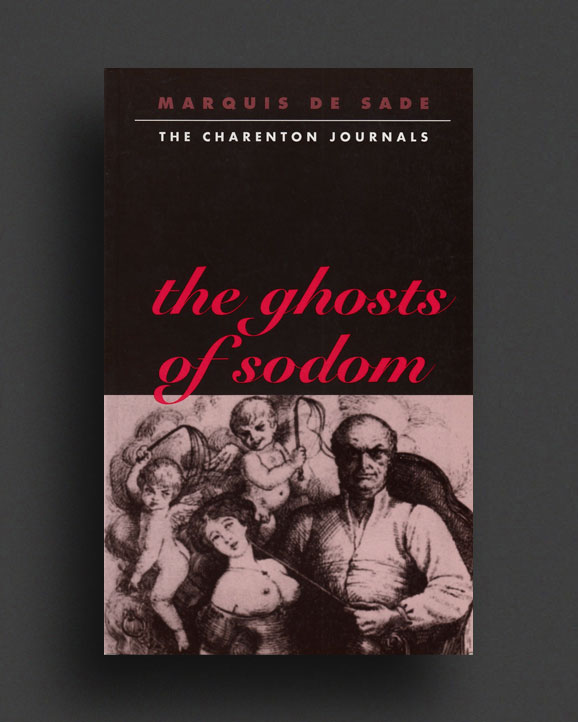
The Ghosts of Sodom: The Charenton Journals
by Marquis de Sade
2003, English
Softcover, 138 pages, 21.5 x13.5 cm
1st Edition, Out of print title / used / very good
$35.00 - In stock -
First 2008 English-language print of The Lost Journals Of The Marquis De Sade.
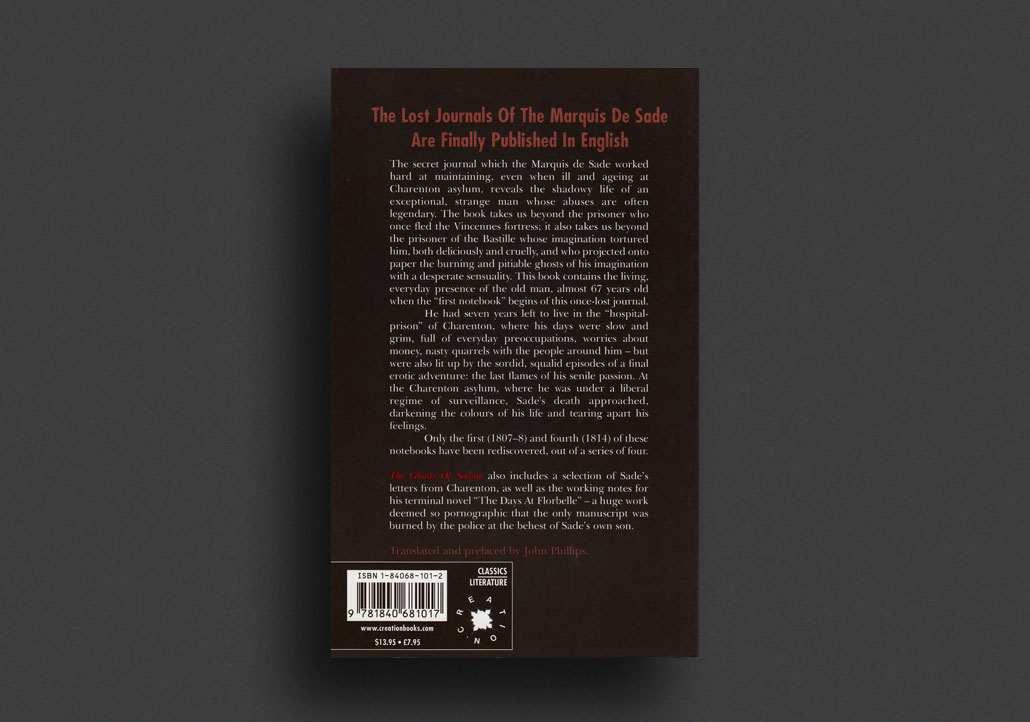
The secret journal which the Marquis de Sade worked hard at maintaining, even when ill and ageing at Charenton asylum, reveals the shadowy life of an exceptional, strange man whose abuses are often legendary. The book takes us beyond the prisoner who once fled the Vincennes fortress; it also takes us beyond the prisoner of the Bastille whose imagination tortured him, both deliciously and cruelly, and who projected onto paper the burning and pitiable ghosts of his imagination with a desperate sensuality. This book contains the living, everyday presence of the old man, almost 67 years old when the "first notebook" begins of this once-lost journal.
He had seven years left to live in the "hospital-prison" of Charenton, where his days were slow and grim, full of everyday preoccupations, worries about money, nasty quarrels with the people around him - but were also lit up by the sordid, squalid episodes of a final erotic adventure: the last flames of his senile passion. At the Charenton asylum, where he was under a liberal regime of surveillance, Sade's death approached, darkening the colours of his life and tearing apart his feelings.
Only the first (1807-8) and fourth (1814) of these notebooks have been rediscovered, out of a series of four.
The Ghosts Of Sodom also includes a selection of Sade's letters from Charenton, as well as the working notes for his terminal novel "The Days At Florbelle" - a huge work deemed so pornographic that the only manuscript was burned by the police at the behest of Sade's own son.
