New :


Hieronymus Bosch
1966, English
Hardcover (w. dust jacket), 452 pages,
1st Edition, Out of print title / used / very good
$100.00 - In stock -
First 1966 English-language edition of this huge monograph by Hieronymus Bosch (1450—1516) authority de Tolnay, the definitive work on the fifteenth-century Dutch/Netherlandish artist, containing not only a full introduction to Bosch's life and work, but a complete catalogue raisonné of all his paintings and drawings, including fold-out panels.
Hieronymus Bosch (1450—1516) was a Dutch/Netherlandish painter from Brabant. He is one of the most notable representatives of the Early Netherlandish painting school, his work, generally oil on oak wood, mainly contains fantastic illustrations of religious concepts and narratives. His pessimistic fantastical style cast a wide influence on northern art of the 16th century, with Pieter Bruegel the Elder being his best-known follower. Within his lifetime his work was collected in the Netherlands, Austria, and Spain, and widely copied, especially his macabre and nightmarish depictions of hell. Little is known of Bosch's life. He spent most of it in the town of 's-Hertogenbosch, where he was born in his grandfather's house. Today, Bosch is seen as a hugely individualistic painter with deep insight into humanity's desires and deepest fears. Attribution has been especially difficult; today only about 25 paintings are confidently given to his hand along with eight drawings. About another half-dozen paintings are confidently attributed to his workshop. His most acclaimed works consist of a few triptych altarpieces, including The Garden of Earthly Delights.
VG/VG DJ in mylar wrap.
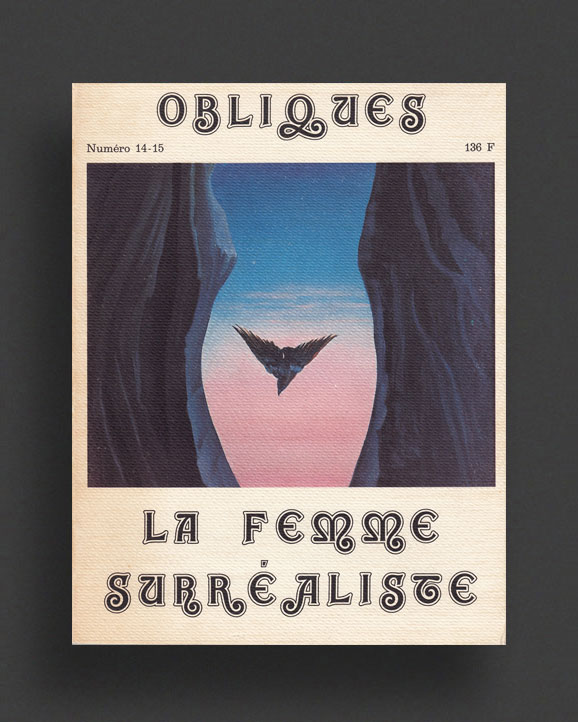
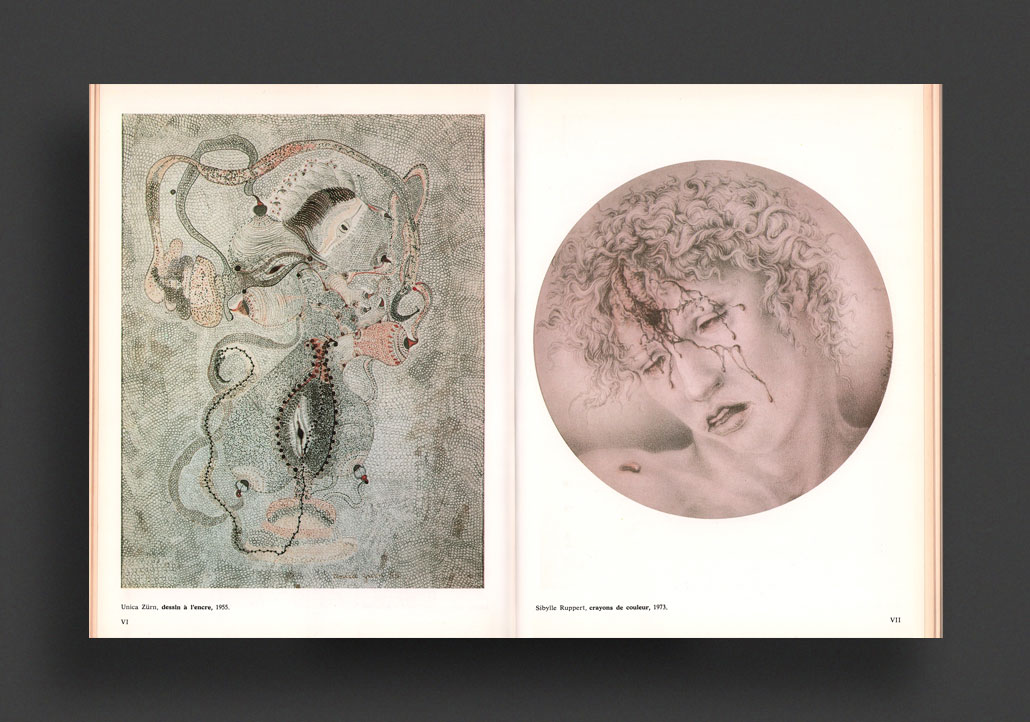
Obliques No. 14-15 : La Femme Surréaliste
1977, French
Softcover, 352 pages, 28 x 22 cm
1st Edition, Out of print title / used / very good
$160.00 - Out of stock
The landmark, over-sized Obliques special double issue, "La Femme Surréaliste", published in Paris in 1977. The French literary journal Obliques (who published special issues on Artaud, Bellmer, Kafka, Klossowski, Vian, Sartre, Robbe-Grillet, Strindberg, Genet...) was the first publisher to present a comprehensive list of the literary and plastic production of Surrealist women with this gorgeous volume, long before the works of surrealist women, as a corpus, began to be more widely studied in the 1980s. Featuring well known names, but also many female artists neglected and seldom mentioned in the recent (strangely narrow-minded) re-evaluation of this period, this beautifully printed issue of Obliques is an incredibly valuable reference on a movement that was decidedly ‘feminine’. Edited by Roger Borderie with Michel Camus, it features profiles on the work and writing of Belen, Maya Bell, Bona, Leonora Carrington, Lise Deharme, Jacqueline Duprey, Aube Elléouët, Josette Exandier, Leonor Fini, Aline Gagnaire, Giovanna, Jane Graverol, Marianne Van Hirtum, Rozeta Hum, Valentine Hugo, Karskaya, Greta Knutson, Laure, Gina Pane, Annie Lebrun, Georgette Magritte, Manina, Joyce Mansour, Nora Mitrani, Meret Oppenheim, Mimi Parent, Valentine Penrose, Gisele Prassinos, Karina Raeck, Remedios Varo, Sibylle Ruppert, Colette Thomas, Toyen, Isabelle Waldberg, Unica Zurn, Cécile Reims, Dorothea Tanning, Greta Knutson, and more. Additional texts and works by Beatrice Didier, Cécile Reims, Michel Butor, Michel Sicard, Andre Pieyre De Mandiargues, Jean Roudaut, Rene Micha, Gerard Legrand, Jean Pfeiffer, Jacques Laurans, Michel Carassou, Annie Lebrun, Charles Bachat, Olivier Milliard, Robert Brechon, Jules Michelet, Jerome Prieur, Xaviere Gauthier, Elsa Thoresen Gouveia, plus a gallery by Titi Parant and Henri Maccheroni's Portraits Corrigés. Profusely illustrated with artworks, mostly in b/w with some colour sections.
Very Good copy of the lovely softcover edition with textured boards. Sunning to spine edge, light general wear.


Paul Thek
(SM)
1969, English / Dutch
Illustrated 10-page fold-out (w. loose leaf inserts), 27 × 83 cm
1st Edition, Out of print title / used / very good
$220.00 - Out of stock
Extremely rare early Paul Thek Stedelijk Museum Amsterdam catalogue, published in 1969. Designed by Wim Crouwel (Total Design) in the form of a 10-page illustrated leporello fold-out of Thek's installations and sculptures and published with SM no. 460. One of the hardest of all Stedelijk Museum catalogues to find, this copy comes complete with the often missing SM biographical/interview/text insert, and also the loose strip inlay with text advertising ‘a document made by Paul Thek and Edwin Klein’ (published that same year), making it a most complete copy available.
Very Good-Fine with all included, preserved in plastic sleeve.
An American sculptor, painter, and installation artist, Paul Thek (1933-1988) is primarily known for hyper-realistic works of human body parts executed in fleshlike beeswax and for his strongly symbolic, room-size installations constructed from transitory materials. A major figure on the 1960s New York art scene, Thek also spent time in Europe, where he paved the way for artists adopting collaborative strategies. Although he gained a large following and was featured in more than one hundred solo and group exhibitions, the anti-establishment "artist's artist" was practically forgotten at the time of his death from AIDS related illness in New York City in 1988, aged 54.
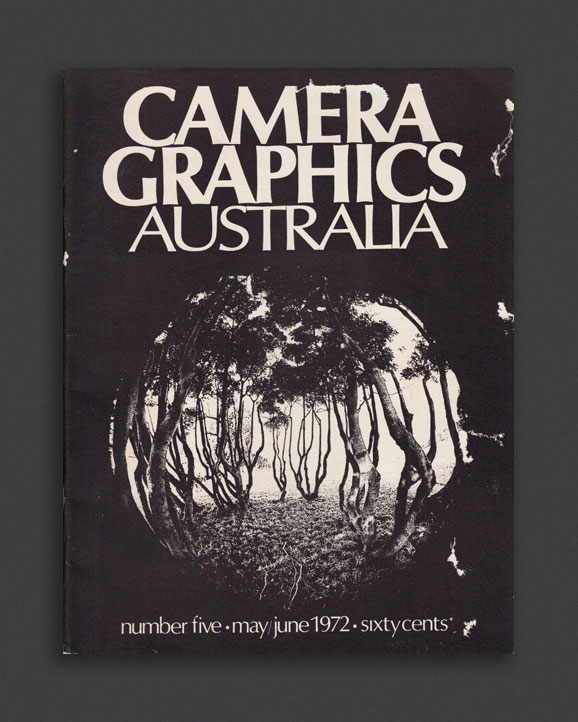

Camera Graphics Australia no. 5
May/June 1972
1972, English
Softcover (staple-bound), 48 pages, 28 x 21.5 cm
1st Edition, Out of print title / used / good
$40.00 - In stock -
Rare copy of this fantastic, seldom seen issue of Camera Graphics Australia (no. 5), published in May/June 1972, published by Payton, McMahons Point, NSW, featuring the work of Australian photographers Sue Ford, Paul Cox, Greg Weight, Roger Warwick Scott, Rob Walls, Lissa Coote, Stan Ciccone (inc. front cover), illustrated review of Toowoomba '72 International Salon, illustrated review on American documentary photojournalist Leonard Freed's Germany... As well as the featured photographic portfolios, the magazine includes essays, news, reviews for photo books, exhibitions, products, photography/camera related advertising, and more.
Good copy with edge wear to textured card covers, some shallow insect marking to front.
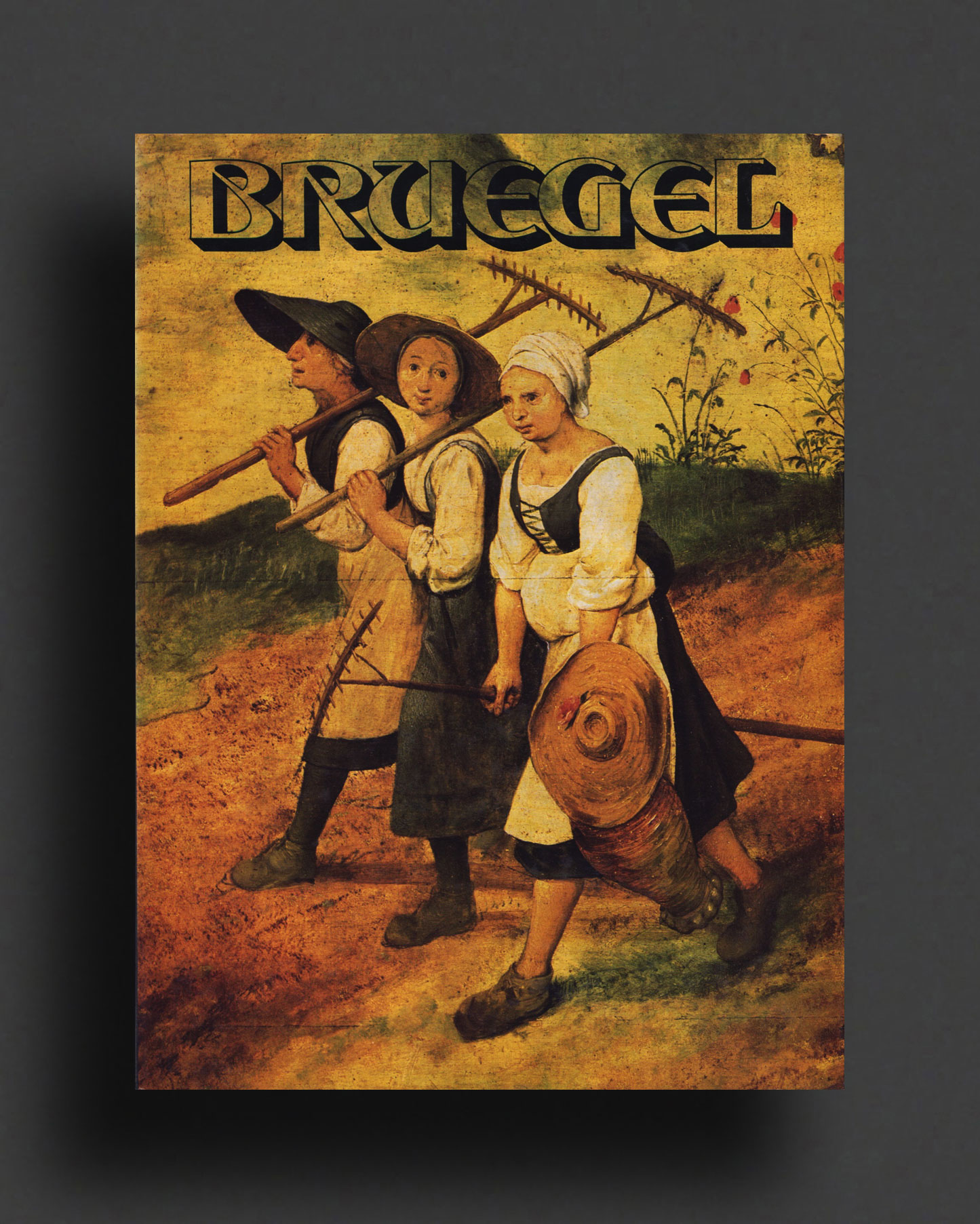
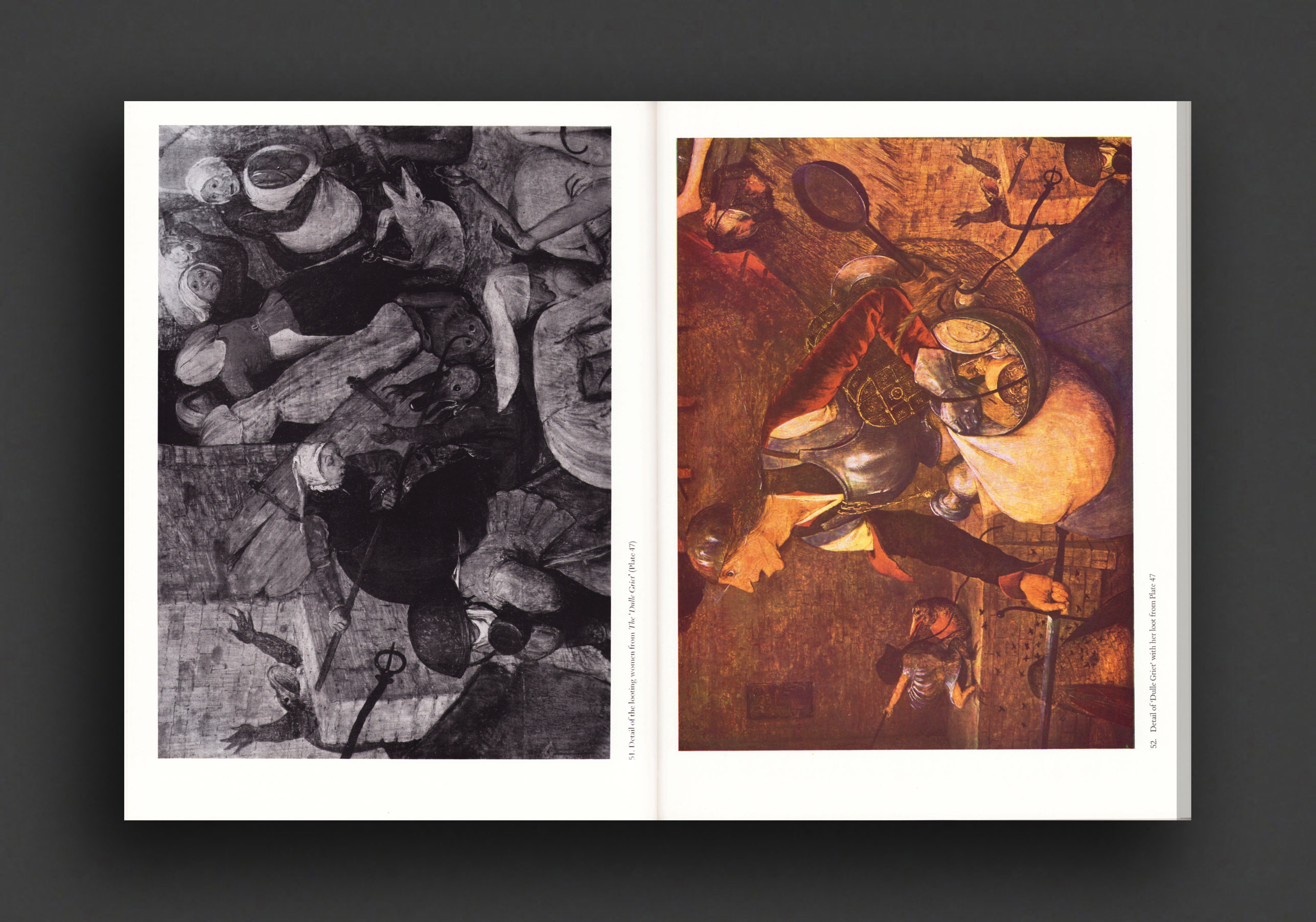
Pieter Bruegel
Complete Edition of the Paintings
1974, English
Hardcover (w. dust jacket), 206 pages, 31 x 23 cm
Out of print title / used / very good
$45.00 - In stock -
The much scarcer (revised and expanded) 1974 edition of this classic 1955 survey of the paintings of the astoundingly inventive painter and draftsman, Pieter Bruegel the Elder, one of the most significant artists of Dutch and Flemish Renaissance painting. Issued by Phaidon, London, this hardcover volume is profusely illustrated with colour and b/w plates of his paintings in full, along with many details, accompanied by English texts and a complete list of works that have lost none of their wonder and continue to be one of the most inspiring catalogues in the history of painting.
"Pieter Bruegel the Elder began his career in 1551, at a period when Michelangelo was painting his last frescoes; and when death took Bruegel in 1569, at the summit of his achievement, the youthful El Greco had just completed his fırst paintings.
The creative originality of Bruegel's inventions is very powerful. It has rightly been said that he discovered the world of the peasants as a new field of artistic representation, that he was the fırst painter to characterize the appearance of the four seasons in nature, and that he depicted both the tragic and the comic elements of human life with a deep understanding.
About forty of his paintings, nearly half of them in Vienna, others in Naples, Brussels, Madrid, London, New York, and elsewhere, have survived. Many of them are rather large and contain a great wealth of figures; hence this volume comprises, in addition to complete renderings, a great number of detail reproductions, which not only show certain beautiful parts of the pictures, but also convey the force and boldness of Bruegel's imagination and of his brush work. [...]"—from inner jacket
VG in VG dust jacket.
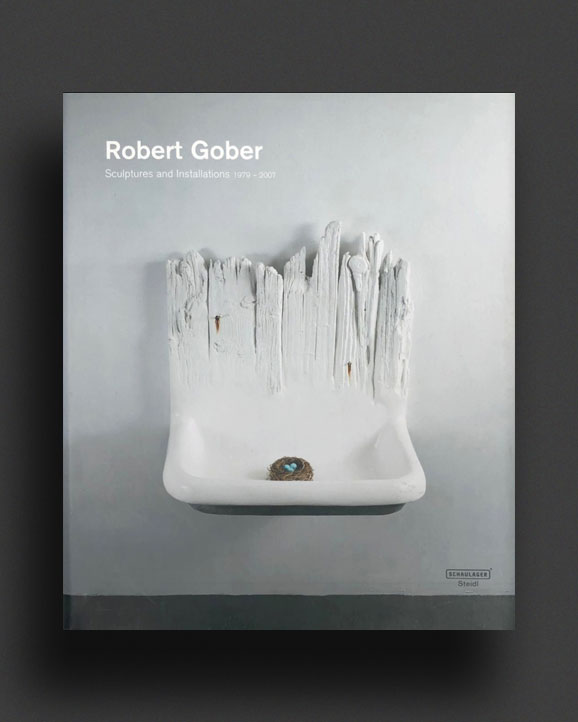

Robert Gober
Sculptures and Installations 1979-2007
2007, English
Hardcover (w. dust jacket), 544 pages, 30.5 x 25.5 cm
1st Edition, Out of print title / used / very good
$380.00 - In stock -
The monumental, and very rare catalogue raisonné of American artist Robert Gober's (b. 1954) sculptures and installations, published on the occasion of the retrospective exhibition "Robert Gober. Work 1976-2007" at Schaulager, Basel by the great Steidl publishing house with Schaulager. At 544 pages, this incredible, handsomely designed hardcover book catalogues Gober's work as he developed an iconography once beautifully described as 'The Poetics of the Drain'. It charts his journey through his heart breaking reaction to the emergence of AIDs in the New York community, whilst grappling with issues around childhood, domesticity, sexuality, victimization and religion, relative to the disenfranchised and spurned, melding the human body with the drain. The book firmly places him in the forefront of his generation of artists.
Lavishly illustrated with approximately 250 works, all of which are reproduced in large format along with behind the scenes production/studio photography and comprehensive descriptions complemented by the artist's own commentary on individual works, as well as technical information on their manufacture. With an introductory essay by Elisabeth Sussman, curator at the Whitney Museum of American Art in New York, this volume remains the most exhaustive and revealing volume on Gober's oeuvre.
A highly sought after book, especially in the more collectible English edition.
Near Fine copy in VG dust jacket, light traces of wear to extremities.
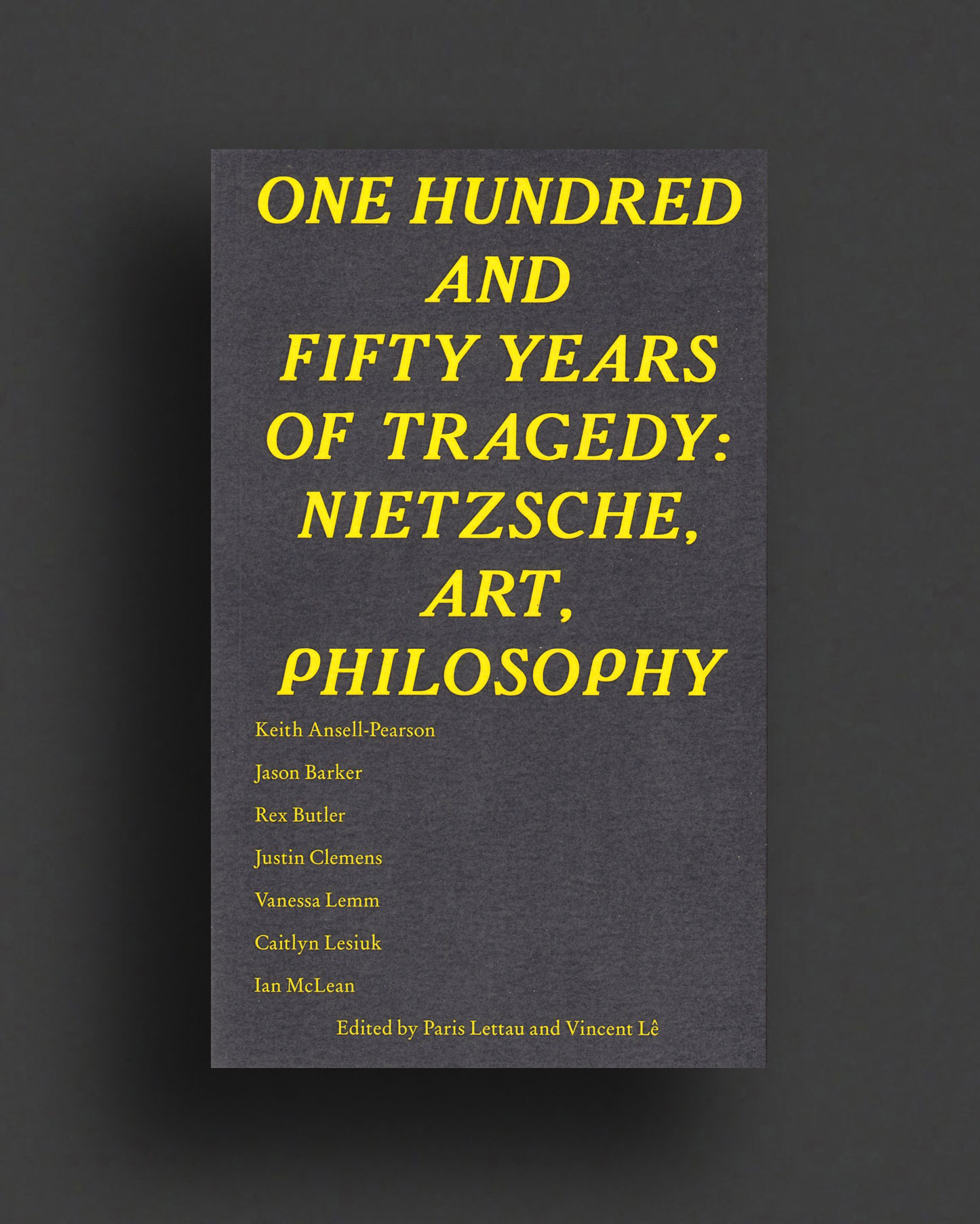
One Hundred and Fifty Years of Tragedy: Nietzsche, Art, Philosophy
Edited by Paris Lettau & Vincent Le
2026, English
Softcover, 190 pages, 20 x 12 cm
$30.00 - In stock -
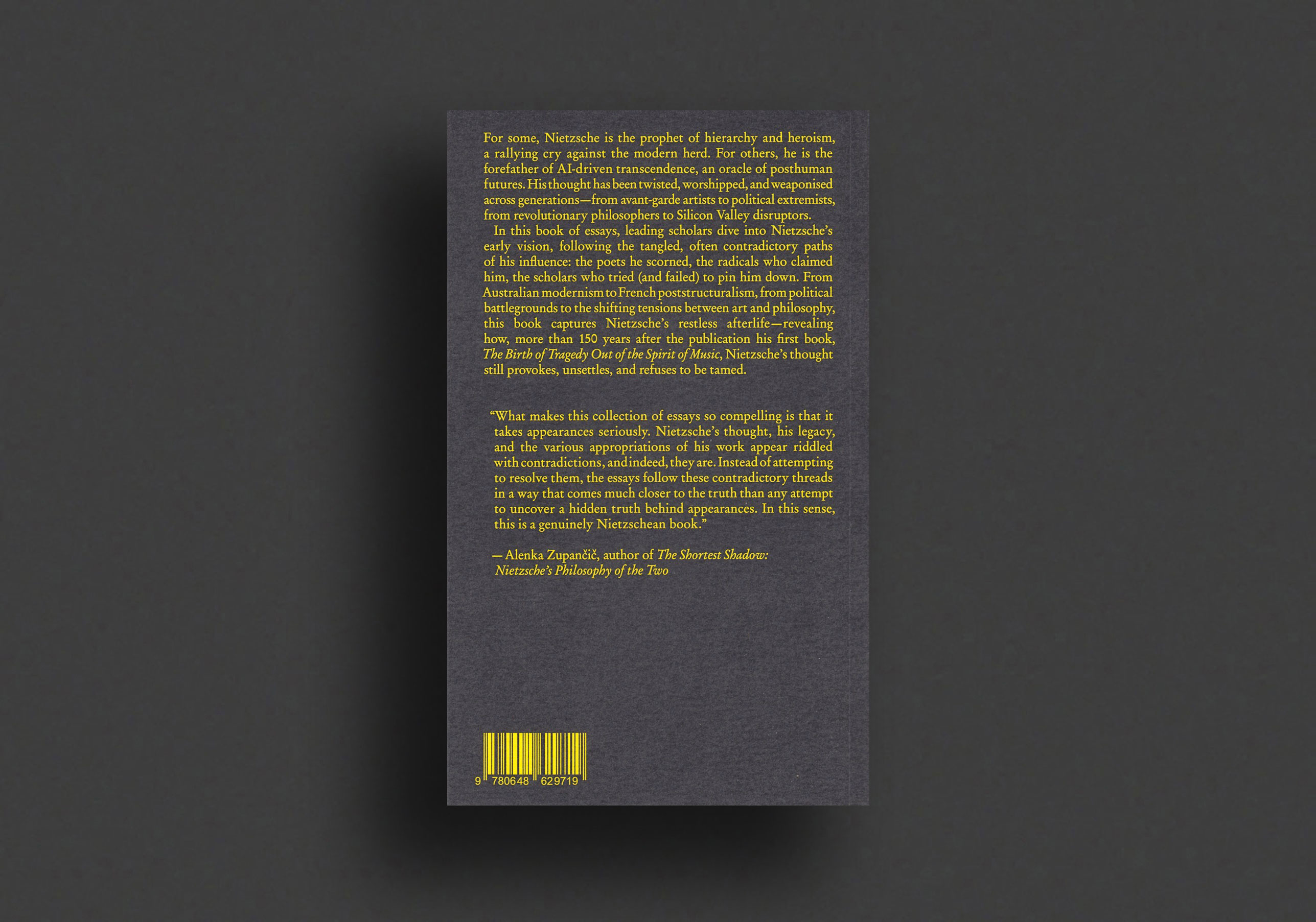
For some, Nietzsche is the prophet of hierarchy and heroism, a rallying cry against the modern herd. For others, he is the forefather of AI-driven transcendence, an oracle of posthuman futures. His thought has been twisted, worshipped, and weaponised across generations—from avant-garde artists to political extremists, from revolutionary philosophers to Silicon Valley disruptors.
In this book of essays, leading scholars dive into Nietzsche’s early vision, following the tangled, often contradictory paths of his influence: the poets he scorned, the radicals who claimed him, the scholars who tried (and failed) to pin him down. From Australian modernism to French poststructuralism, from political battlegrounds to the shifting tensions between art and philosophy, this book captures Nietzsche’s restless afterlife—revealing how, more than 150 years after the publication of his first book, The Birth of Tragedy Out of the Spirit of Music, Nietzsche’s thought still provokes, unsettles, and refuses to be tamed.
Francis Bacon
Paintings
2025, English
Hardcover, 568 pages, 30 x 24.5 cm
$110.00 - In stock -
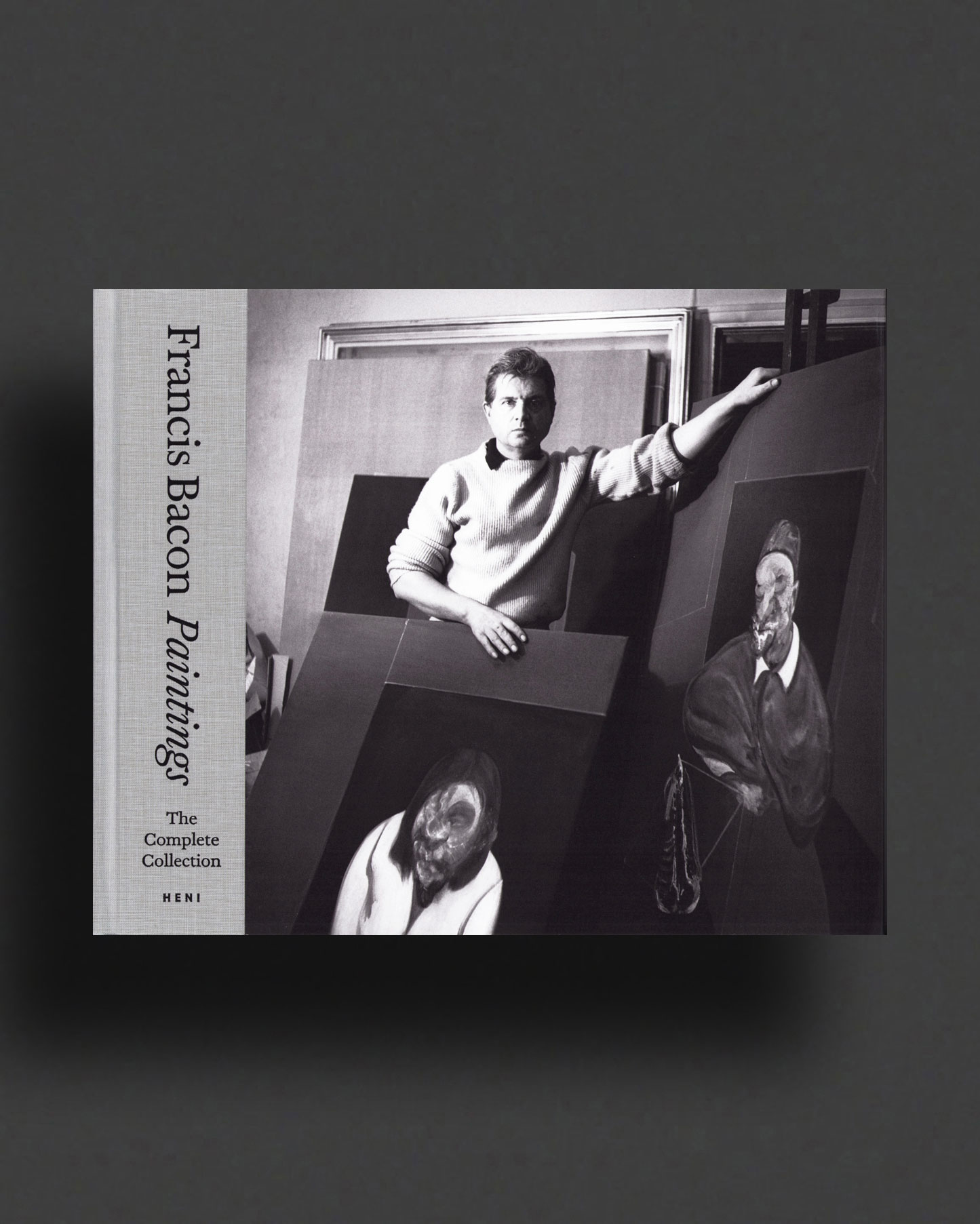
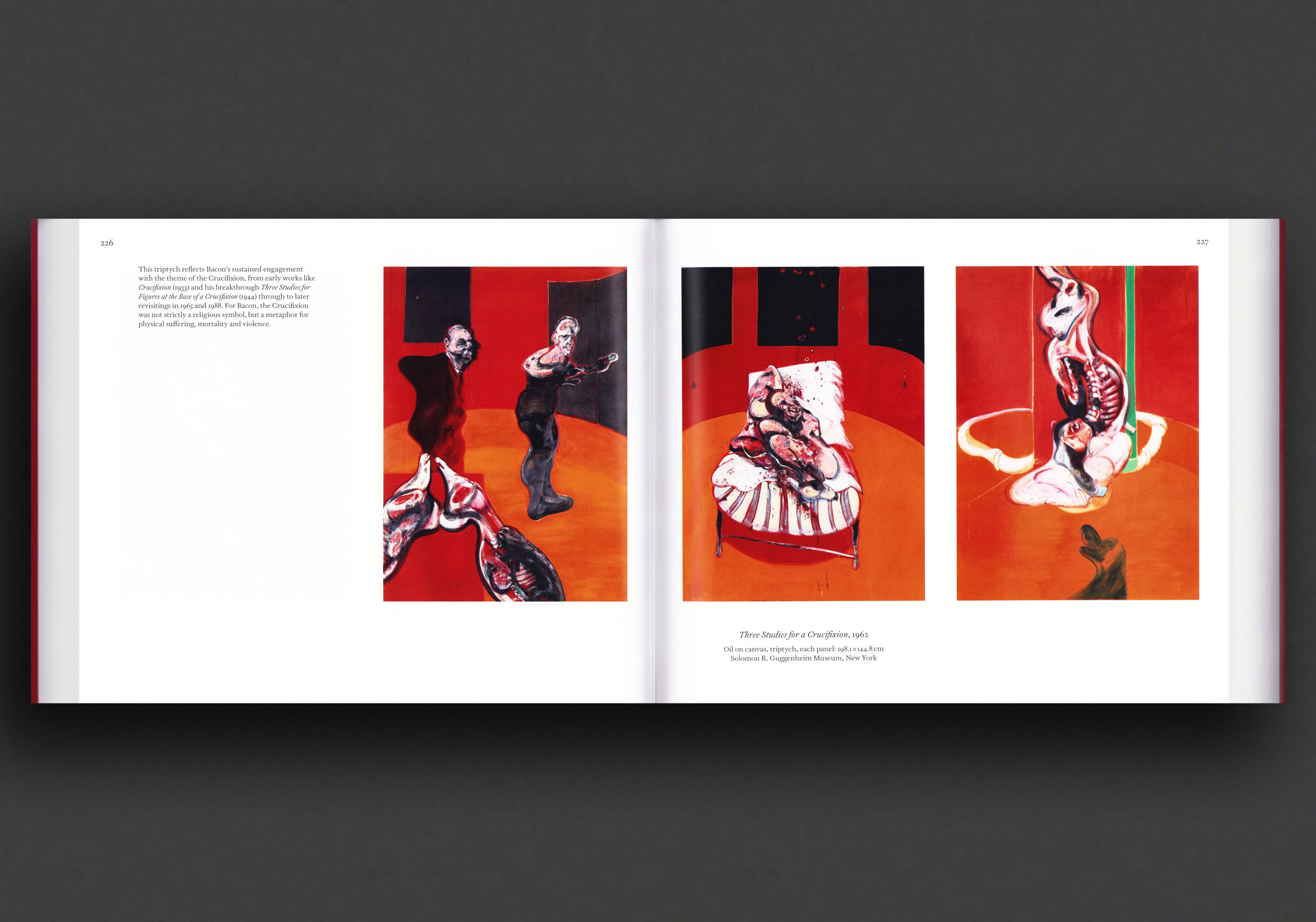
Francis Bacon: Paintings is a collection of the complete paintings of Irish-born British figurative painter Francis Bacon. 745 illustrations. Accompanied by a curated selection of compelling quotes — from figures such as Lucian Freud, Roald Dahl and Damien Hirst — the book guides the reader through the evolution of Bacon’s distinctive aesthetic.
A master of the grotesque, Bacon created art that is both unsettling and hypnotic, repulsive and irresistible. Emerging from a turbulent inner life and the devastation of World War II, his images retain a quality of urgency that continues to resonate with contemporary audiences.
Over a career spanning more than five decades, Bacon produced almost 500 paintings, including his signature diptychs and triptychs. From his early Surrealist experiments of the 1920s to the stark, elegiac works completed just before his death, this book charts a lifetime of radical and groundbreaking artistry.
Waystations of the Deep Night
by Marcel Brion
2020, English
Softcover, 256 pages, 20.6 x 13.72 cm
$36.00 - In stock -
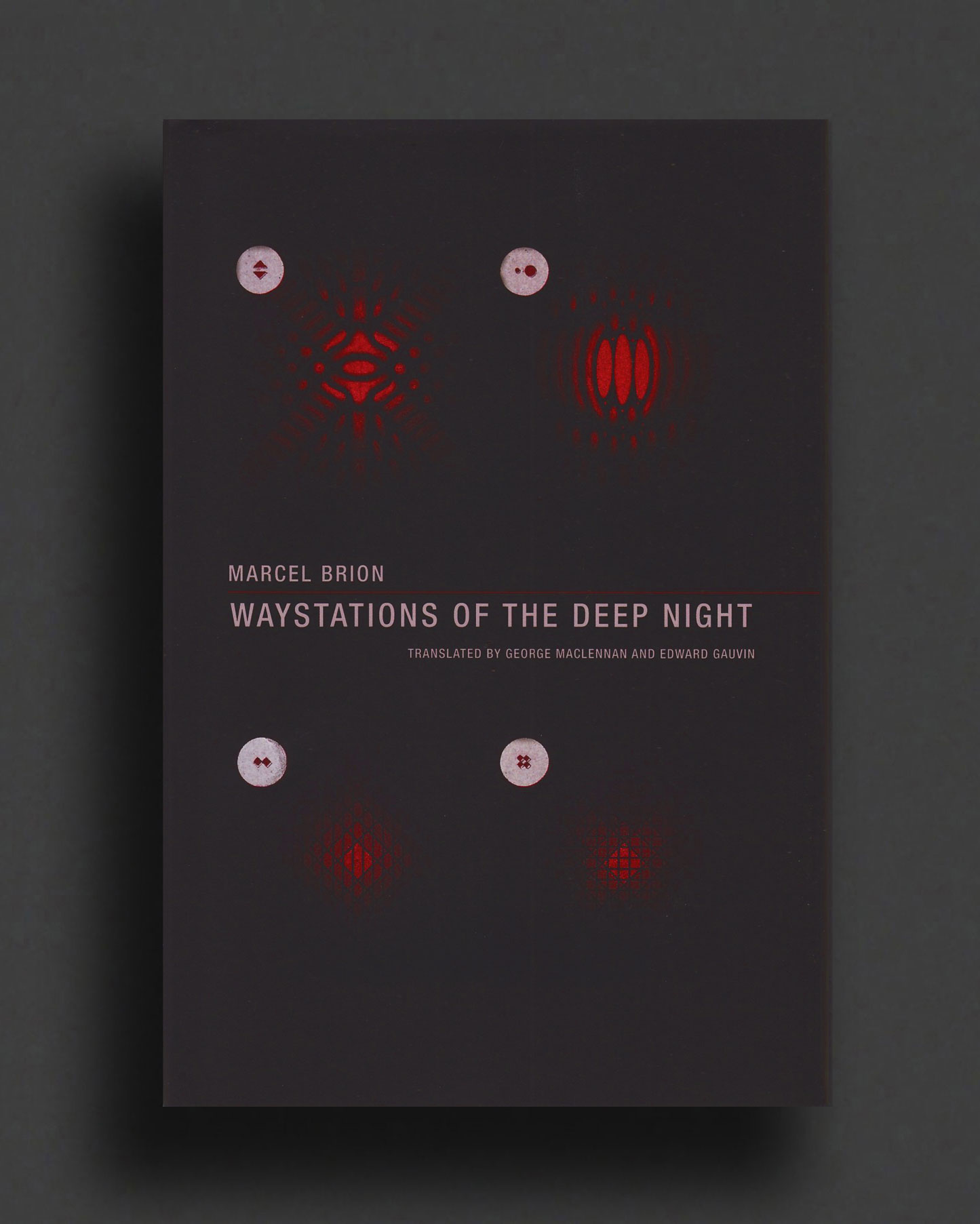
A canonical gem of the nocturnal fantastic, in the tradition of German Romantics such as E.T.A. Hoffmann and Novalis.
Translated by George MacLennan and Edward Gauvin, with an introduction by George MacLennan.
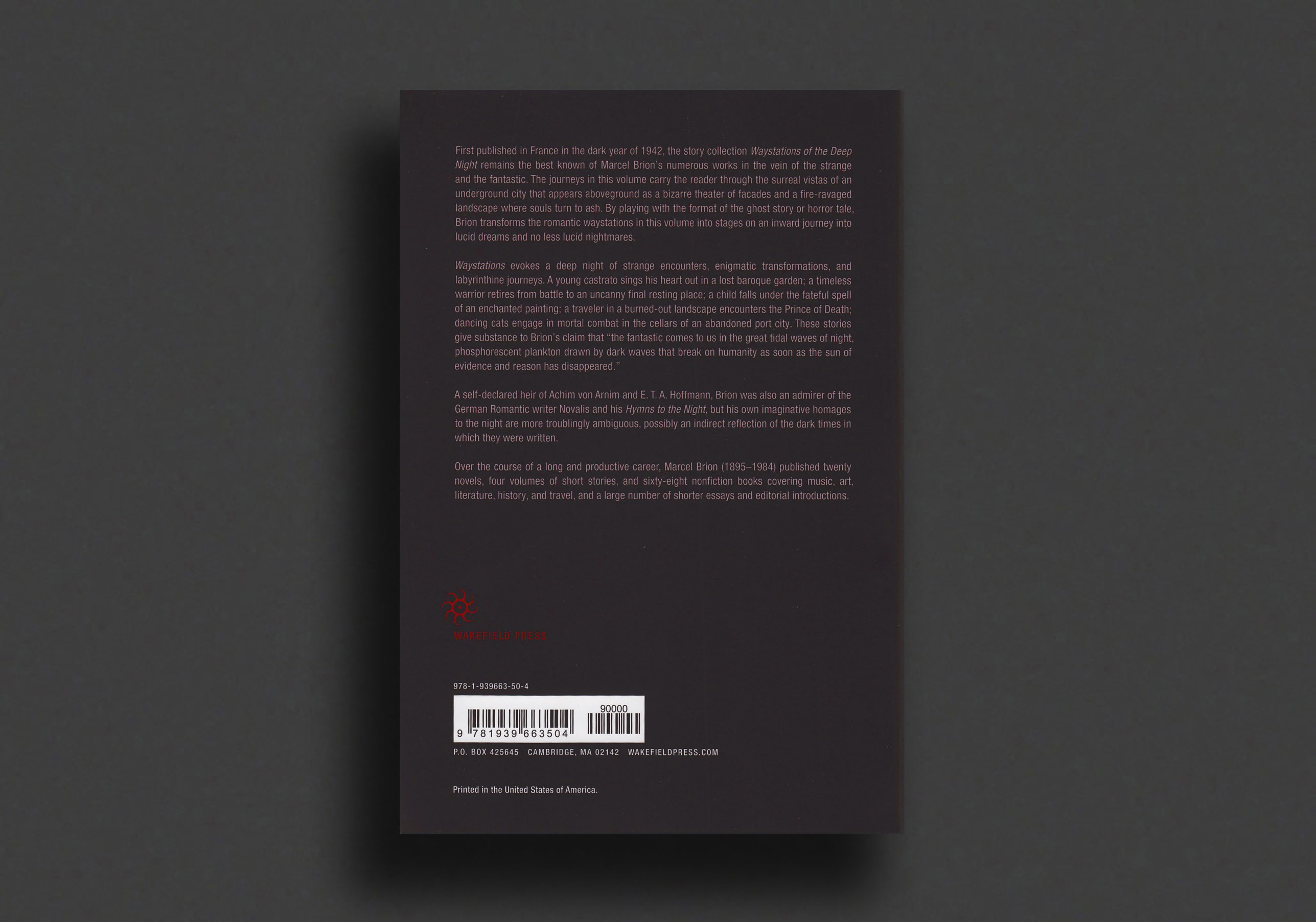
First published in France in the dark year of 1942, the story collection Waystations of the Deep Night remains the best-known of Marcel Brion's numerous novels and stories in the vein of the strange and the fantastic. The journeys in this volume carry the reader through the surreal vistas of an underground city that appears aboveground as a bizarre theater of facades and a fire-ravaged landscape where souls turn to ash. A young castrato sings his heart out in a lost baroque garden; a child falls under the fateful spell of an enchanted painting; a traveler in a burned-out landscape encounters the Prince of Death; and dancing cats engage in mortal combat in the cellars of an abandoned port city.
A self-declared heir of Achim von Arnim and E.T.A. Hoffmann, Brion was also an admirer of the German Romantic writer Novalis and his sequence of Hymns to the Night, but his own imaginative homages to the night are more troublingly ambiguous, possibly an indirect reflection of the dark times in which they were written.
Born in Marseille in 1895, Marcel Brion was a freelance writer and critic. In 1964 he was elected to the Académie française in recognition of both his critical and creative writing, Over the course of a long and productive career he published 20 novels, four volumes of short stories and some 68 nonfiction books covering music, art, literature, history and travel. He died in Paris in 1984.


Furor & Mystery and Other Writings
by René Char
2011, English / French
Softcover, 558 pages, 23 x 15 cm
$52.00 - In stock -
René Char (1907-1988) was one of France's most respected 20th century poets. Part of the Surrealist group in the late 1920's-1930's, he gradually drifted away from the group. During WWII he joined the resistance and wrote his forceful prose poems describing what he saw and experienced. This large, bilingual anthology, includes all of his well known books Feuillets d'Hypnos and Fureur et Mystere as well as a sampling of other poems and prose poems. Insightful essays are provided by Sandra Bermann, Mary Ann Caws, and Nancy Kline.


The Complete C Comics
by Joe Brainard
2025, English
Hardcover, 200 pages, 36.2 x 22 cm
$78.00 - In stock -
In the mid-1960s, legendary artist and writer Joe Brainard (I Remember) teamed with poets such as John Ashbery, Frank O'Hara, Barbara Guest, Ron Padgett, Kenneth Koch, Ted Berrigan, and many more for these pioneering collaborative comic strips-unavailable for decades and collected here for the first time.
"PEOPLE OF THE WORLD... RELAX!"
In the creative hotbed of 1960s New York, Joe Brainard was a whirlwind. He was a maker of paintings, assemblages, collages, book covers, poetry-reading flyers, and more. But some of his most exciting work was done with his friends. In 1964, the twenty-two-year-old Brainard turned his talents to rewiring the lowly comic book form into something new and surprising. He invited his friends Frank O'Hara, Ted Berrigan, John Ashbery, Kenneth Koch, Peter Schjeldahl, Barbara Guest, Ron Padgett, and others-all of them New York School poets-to collaborate with him on comics that they would write and he would draw.
The results were unlike any comics seen before. Previously available only on the rare-book market (at very high prices) but available here under one cover for the first time, the two issues of C Comics still feel as fresh as when the first page rolled off the mimeograph machine more than sixty years ago. Brainard's energetic line and joyful humor charge across every page, illustrating O'Hara's recasting of a cowboy as a mash-note-writing lover, Padgett's experiments with traditional cartoon sound effects (ROAR! GRRR! SKREE!), cameos by Ernie Bushmiller's Nancy, and heaps of Dadaesque delights.
This edition includes a foreword from Padgett and an essay by comics historian Bill Kartalopolous, who details the creation (and creators) of C Comics. A masterpiece of collaboration and spontaneity, C Comics is a testament to the vastness of Brainard's creativity and his ability to push any artistic form in a new and powerful direction.


I Remember
by Joe Brainard
2001, English
Softcover, 192 pages, 17.3 x 11.2 cm
$30.00 - In stock -
The American artist's much-imitated memoir, described by Paul Auster as "one of the few totally original books I have ever read."
Edited by Ron Padgett.
Joe Brainard's I Remember is a literary and artistic cult classic, praised and admired by writers from Paul Auster to John Ashery and Edmund White. As autobiography, Brainard's method was brilliantly simple: to set down specific memories as they rose to the surface of his consciousness, each prefaced by the refrain "I remember"
"I remember when I thought that if you did anything bad, policemen would put you in jail."
Brainard's enduring gem of a book has been issued in various forms over the past thirty years. In 1970, Angel Hair books published the first edition of I Remember, which quickly sold out; he wrote two subsequent volumes for Angel Hair, More I Remember (1972) and More I Remember More (1973), both of which proved as popular as the original. In 1973, the Museum of Modern Art in New York published Brainard's I Remember Christmas, a new text for which he also contributed a cover design and four drawings. Excerpts from the Angel Hair editions appeared in Interview, Gay Sunshine, The World and the New York Herald. Then in 1975, Full Court Press issued a revised version collecting all three of the Angel Hair volumes and added new material, using the original title I Remember.
This complete edition is prefaced by poet and translator Ron Padgett.
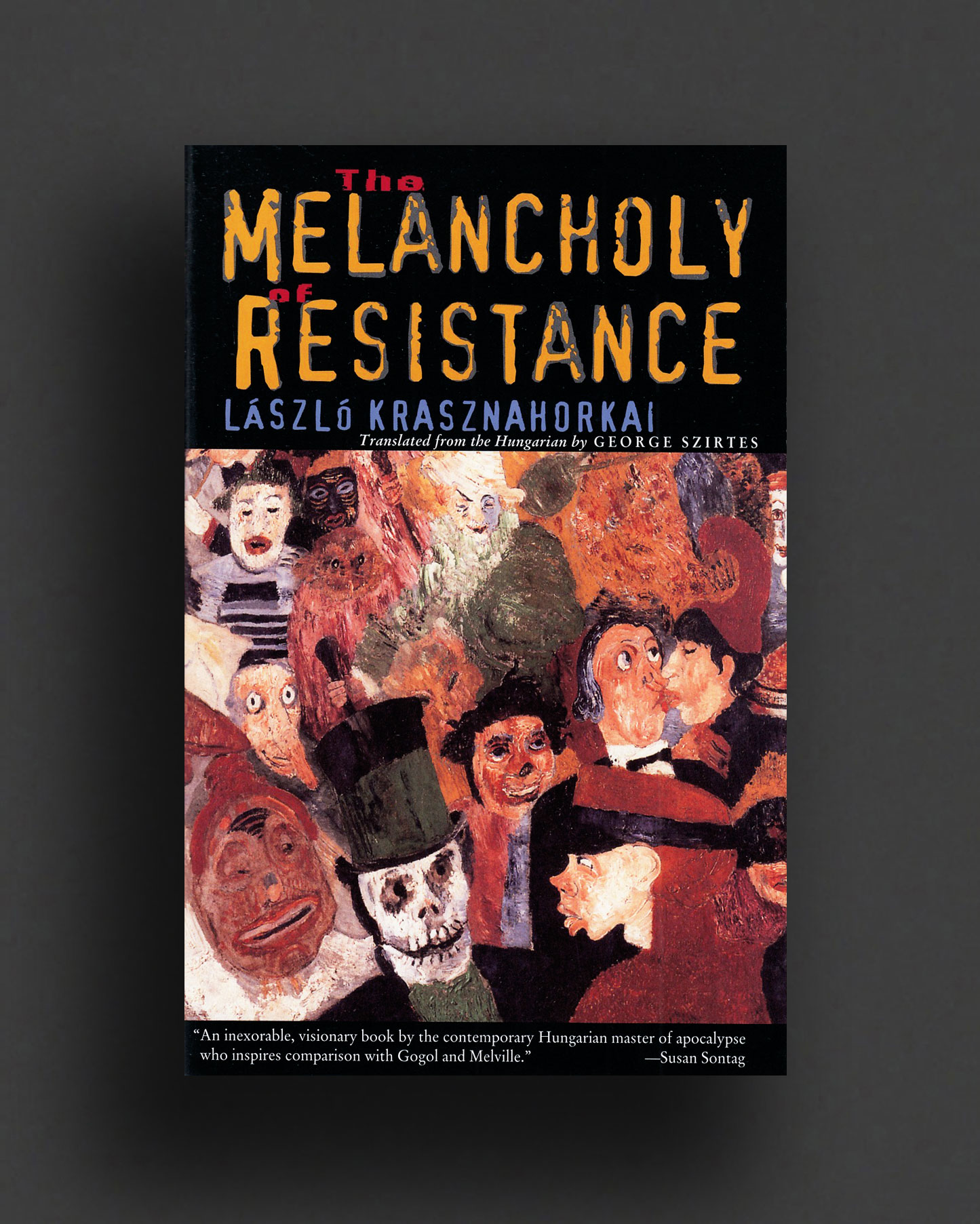

The Melancholy of Resistance
by László Krasznahorkai
2002, English
Softcover, 320 pages, 19.7 x 13.4 cm
$36.00 - In stock -
The Hungarian master’s first work to appear in English, and still one of the best. Translated from Hungarian by George Szirtes.
"This is a book about a world into which the Leviathan has returned. The universality of its vision rivals that of Gogol's Dead Souls and far surpasses all the lesser concerns of contemporary writing."—W. G. Sebald
"Satantango and The Melancholy of Resistance are irresistible, unforgettable and required reading."—Eileen Battersby, The Irish Times
The Melancholy of Resistance, László Krasznahorkai's magisterial, surreal novel, depicts a chain of mysterious events in a small Hungarian town. A circus, promising to display the stuffed body of the largest whale in the world, arrives in the dead of winter, prompting bizarre rumors. Word spreads that the circus folk have a sinister purpose in mind, and the frightened citizens cling to any manifestation of order they can find —music, cosmology, fascism. The novel's characters are unforgettable: the evil Mrs. Eszter, plotting her takeover of the town; her weakling husband; and Valuska, our hapless hero with his head in the clouds, who is the tender center of the book, the only pure and noble soul to be found.
Compact, powerful and intense, The Melancholy of Resistance, as its enormously gifted translator George Szirtes puts it, "is a slow lava flow of narrative, a vast black river of type." And yet, miraculously, the novel, in the words of The Guardian, "lifts the reader along in lunar leaps and bounds."
László Krasznahorkai lives in the hills of Szentlászló. He has written five novels and won numerous prizes. New Directions also publishes his novels War and War and Satantango; another novel, Seiobo There Below, is forthcoming.
George Szirtes is a poet who was born in Budapest in 1948 and is now living in London.
His translations have won the European Translation Prize and the Gold Star Award for the Republic of Hungary.
Cover painting: James Ensor, "The Entry of Christ into Brussels in 1889" (detail)
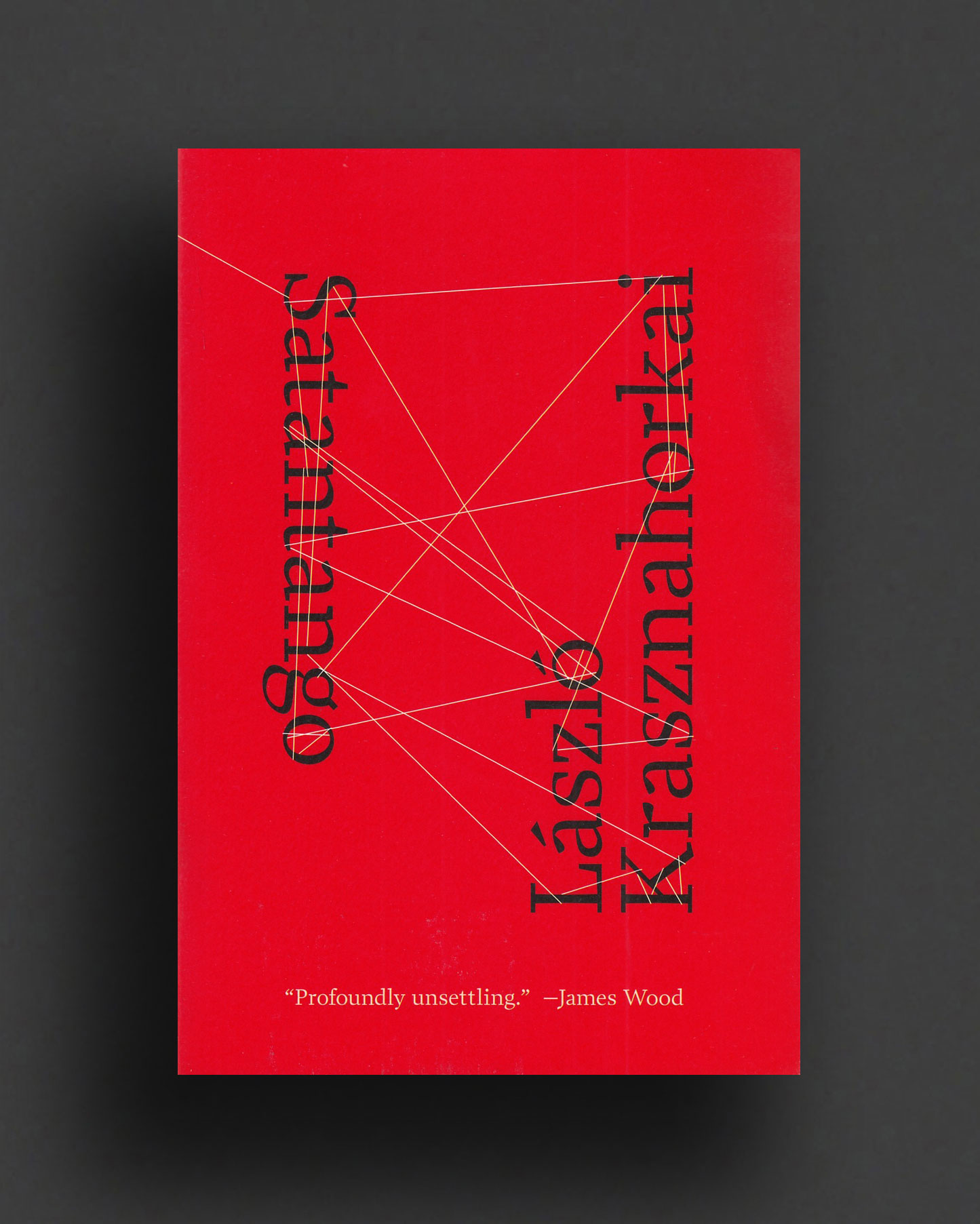
Satantango
by László Krasznahorkai
2013, English
Softcover, 288 pages, 20 x 14 cm
$36.00 - In stock -
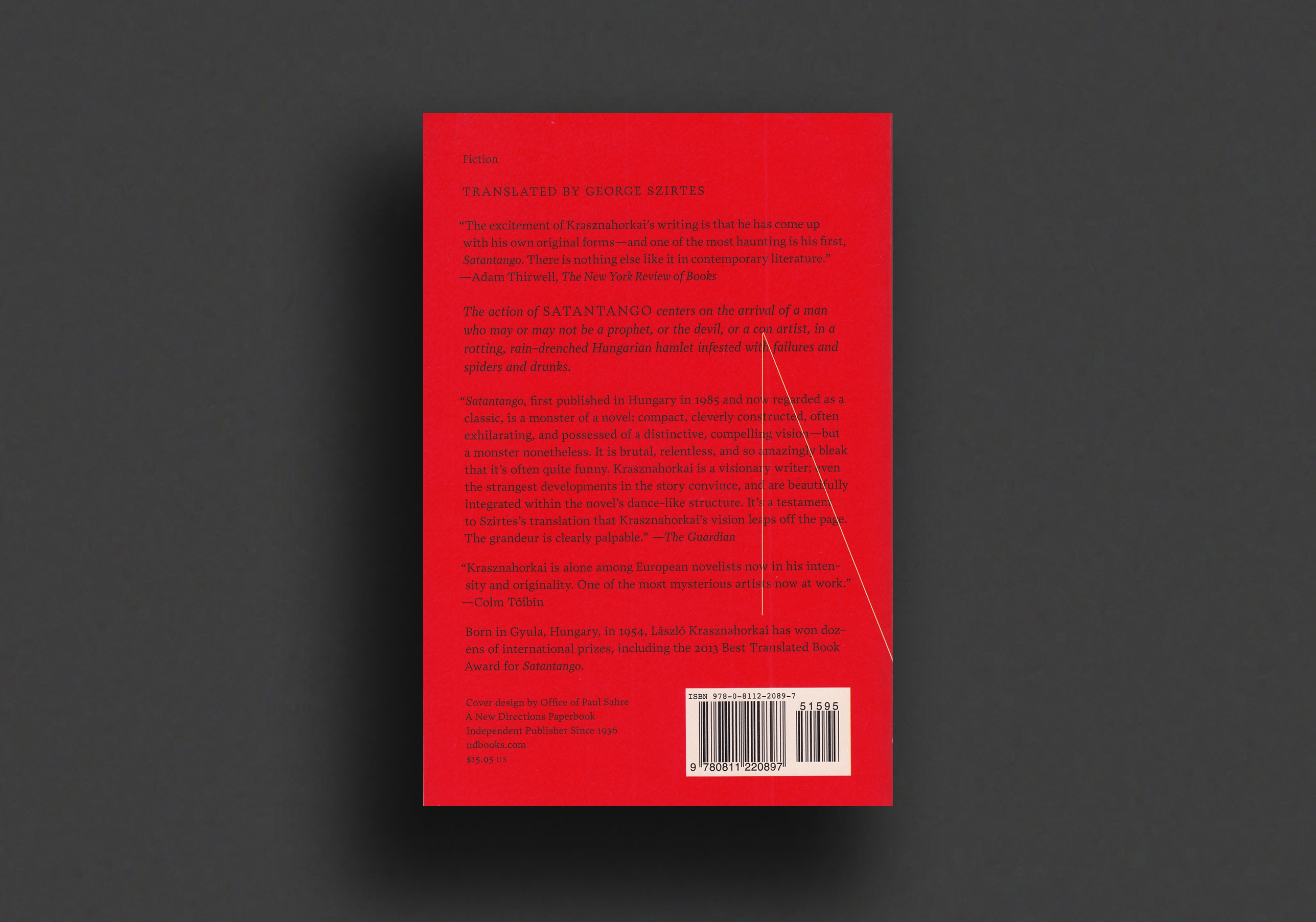
Now in paperback, Satantango, the novel that inspired Bela Tarr's classic film, is proof that the devil has all the good times. Set in an isolated hamlet, the novel unfolds over the course of a few rain-soaked days. Only a dozen inhabitants remain in the bleak village, rank with the stench of failed schemes, betrayals, failure, infidelity, sudden hopes, and aborted dreams. "Their world," in the words of the renowned translator George Szirtes is "rough and ready, lost somewhere between the cosmic and tragic, in one small insignificant corner of the cosmos. Theirs is the dance of death." Into this world comes, it seems, a messiah...
"He offers us stories that are relentlessly generative and defiantly irresolvable. They are haunting, pleasantly weird, and, ultimately, bigger than the worlds they inhabit."—The New York Times Book Review
"The excitement of Krasznahorkai's writing is that he has come up with his own original forms - and one of the most haunting is his first, Satantango. There is nothing else like it in contemporary literature."—Adam Thirwell, The New York Review of Books
"Satantango is a monster of a novel: compact, cleverly constructed, often exhilarating, and possessed of a distinctive, compelling vision - but a monster nonetheless...The grandeur is clearly palpable."—The Guardian
"Krasznahorkai is alone among European novelists now in his intensity and originality. One of the most mysterious artists now at work."—Colm Toibin
"Profoundly unsettling."—James Wood, The New Yorker
"His inexhaustible yet claustrophobic prose, with its long, tight, weaving sentences, each like a tantalising tightrope between banality and apocalypse, places the author in a European tradition of Beckett, Bernhard, and Kafka."—James Hopkin, The Independent


The World Goes On
by László Krasznahorkai
2024, English
Softcover, 311 pages, 20.4 x 13.5 cm
$36.00 - In stock -
Winner of The Nobel Prize in Literature 2025
In The World Goes On, a narrator first speaks directly, then narrates a number of unforgettable stories, and then bids farewell (“here I would leave this earth and these stars, because I would take nothing with me”).
As László Krasznahorkai himself explains: “Each text is about drawing our attention away from this world, speeding our body toward annihilation, and immersing ourselves in a current of thought or a narrative…”
A Hungarian interpreter obsessed with waterfalls, at the edge of the abyss in his own mind, wanders the chaotic streets of Shanghai. A traveler, reeling from the sights and sounds of Varanasi, India, encounters a giant of a man on the banks of the Ganges ranting on and on about the nature of a single drop of water. A child laborer in a Portuguese marble quarry wanders off from work one day into a surreal realm utterly alien from his daily toils.
“The excitement of his writing is that he has come up with his own original forms—there is nothing else like it in contemporary literature.”


Lee Lozano
In The Studio
2026, English
Hardcover (clothbound flexi), 160 pages, 17.5 x 12.5 cm
$38.00 - Out of stock
Focusing on the artist's daring and provocative paintings, this new publication offers a fascinating introduction to Lee Lozano's pioneering practice.
During her short but prolific career, Lee Lozano produced a body of work of striking formal breadth and complexity, ranging from expressionist figurative drawings and paintings to minimalist abstract canvases and, finally, the late conceptual works for which she become well-known. An illuminating text by Lucrezia Calabrò Visconti-co-curator of 'Lee Lozano: Strike', a major survey exhibition that travelled from Turin's Pinacoteca Agnelli to Paris's Bourse de Commerce - is accompanied by a meticulous exhibition history that features a wealth of ephemera and archival material.
Remembered for her withdrawal and ultimate rejection of the art world, Lozano produced an oeuvre united by her determination to expose the ruthless division of the world into categories such as gender and to reject capitalism's demand for constant production. Capturing the unapologetic confidence and striking complexity that defined the artist's singular practice, In the Studio: Lee Lozano is an excellent resource for both newcomers and longtime admirers of Lozano's radical work.
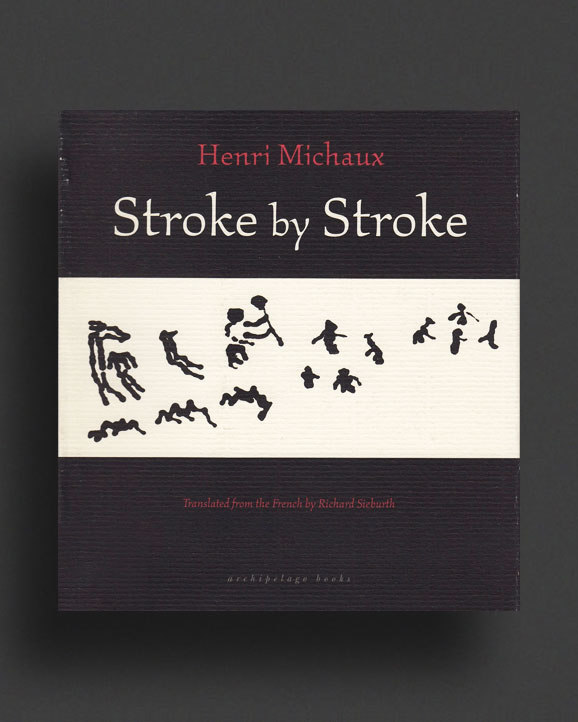
Stroke by Stroke
by Henri Michaux
2006, English
Softcover, 160 pages, 15.24 x 1.91 x 16.51 cm
$40.00 - In stock -
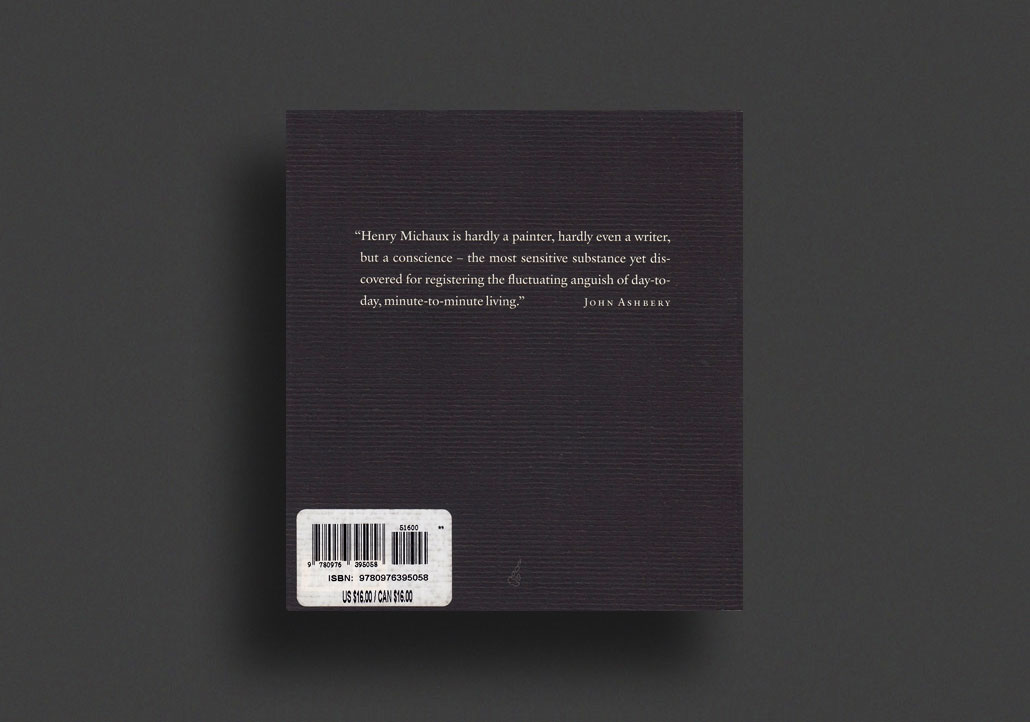
Stroke by Stroke is a pairing of two of Henri Michaux's most suggestive texts, Stroke by Stroke (Par des traits, 1984) and Grasp (Saisir, 1979), written towards the end of his life. Michaux's ideogrammic ink drawings accompany his poetic explorations of animals, humans, and the origins of language. This series of verbal and pictorial gestures is at once explosive and contemplative. Michaux emerges at his most Zen.
"I first encountered Michaux's astonishing work in Stroke By Stroke, a physically and conceptually beautiful little book . . . Reading Stroke By Stroke, I felt invited to travel "toward greater ungraspability"—and in our uncertain times, Michaux's ease with that is deeply reassuring."—Martha Cooley, The Common
Henri Michaux (1899-1994) was born in Namur, Belgium. His travels throughout the Americas, Asia, and Africa inspired his first two books, Ecuador and A Barbarian in Asia. In 1948, after the death of his wife, he devoted himself increasingly to his distinctive calligraphic ink drawings. Averse to publicity of any sort, in 1965 he refused the French Grand Prix National des Lettres. Michaux's other works in English translation include Emergences-Resurgences (Skira, 2001), Darkness Moves: An Henri Michaux Anthology (California, 1997), Tent Posts (Sun and Moon, 1997), and A Barbarian in Asia (New Directions, 1986).
Richard Sieburth's translations include Georg Büchner's Lenz, Friedrich Holderlin's Hymns and Fragments, Walter Benjamin's Moscow Diary, Gérard de Nerval's Selected Writings, Henri Michaux's Emergences/Resurgences, Michel Leiris' Nights as Day, Days as Night, and Gershom Scholem's The Fullness of Time. His English edition of the Nerval won the 2000 PEN/ Book-of-the-Month-Club Translation Prize. His recent translation of Maurice Sceve's Délie was a finalist for the PENTranslation Prize and the Weidenfeld Prize.


June No. 1
October 1978 (Magazine)
1978, Japanese
Softcover, 25.5 x 18 cm
1st Edition, Out of print title / used / good
$80.00 - In stock -
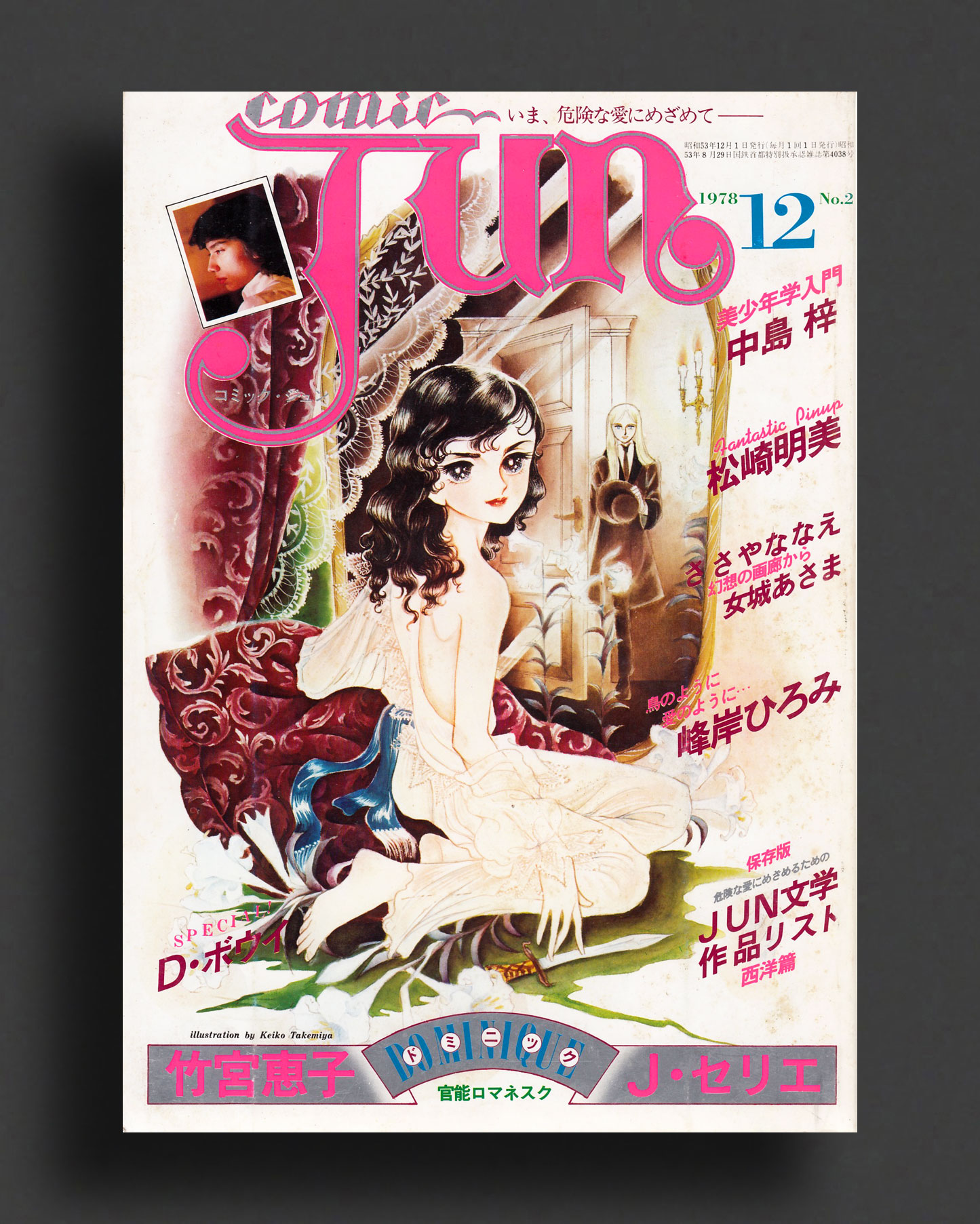
Rare premiere issue (October 1978) of June (magazine), the first yaoi (boys love or "BL") magazine in Japan, founded in 1978, named after the French author Jean Genet, with "june" being a play on the Japanese pronunciation of his name. An underground cult hit, June became synonymous with the BL genre, publishing male/male tanbi ("aesthetic") romances — stories written for and about the worship of idealised beauty, tragedy, and homoerotic romance between androgynous men and beautiful male youths, narratives that emphasise homosociality and de-emphasize socio-cultural homophobia, rich in decadence through the use of flowery language, baroque sexual fantasies and unusual kanji. The yaoi genre was coined by the female manga artists Yasuko Sakata and Akiko Hatsu and originated in the 1970s as a subgenre of shōjo manga, or comics for girls, influenced by the rising popularity of depictions of bishōnen ("beautiful boys"), a term for androgynous or effeminate male characters. June ushered in a new wave of — primarily female — manga artists and writers, including Keiko Takemiya, Tomomi Kobayashi, Kaoru Kurimoto, and Akimi Yoshida, and male artists such as Sadao Hasegawa, Gekko Hayashi, and Ben Kimura, publishing unsolicited manuscripts and homoerotic artworks alongside critical writings, reviews, and historical pieces, all centred around boys. Although it began typically as a genre by and for women, distinct from bara (gay manga created by men), June increasingly appealed to a gay audience, and played a significant role in the construction of a collective gay identity in Japan, alongside pioneering gay manga magazines such Barazoku, which featured many of the same artists. The June imprint ran various editions of the magazine, including the "large format" with many photos of youths and colour artworks, the popular Roman June ("Romantic June") which contained a mix of stories and manga, and Shousetsu June, and the original manga magazine.
The yaoi genre of June (also referred to as shōnen-ai "boy love") was heavily inspired by European decadent literature, philosophy, the homoerotic writings of Japanese authors Taruho Inagaki, Yukio Mishima, Yasunari Kawabata, Jun'ichirō Tanizaki, and the Bildungsroman (coming-of-age) literary genre as much as it was by pop culture and the androgyny of musicians such as David Bowie, Marc Bolan and David Sylvian, or actor Björn Andrésen's portrayal of Thaddeus in Visconti's 1971 film adaptation of Death in Venice. Early issues are be filled to the brim with lavish illustrations and comic stories, erotic fantasy fiction, photographs of "beautiful boys" (young film stars, catholic choir boys, musicians...), reviews, interviews, and essays, all rich with romantic connotations to the age of Decadence, Symbolism, and the aesthetics of the Victorian and Edwardian eras, as well as Japanese folklore.
Good—Very Good copy of this scarce early issue of June, published by Sun Publishing, Tokyo.
June No. 2
December 1978 (Magazine)
1978, Japanese
Softcover, 25.5 x 18 cm
1st Edition, Out of print title / used / good
$80.00 - In stock -
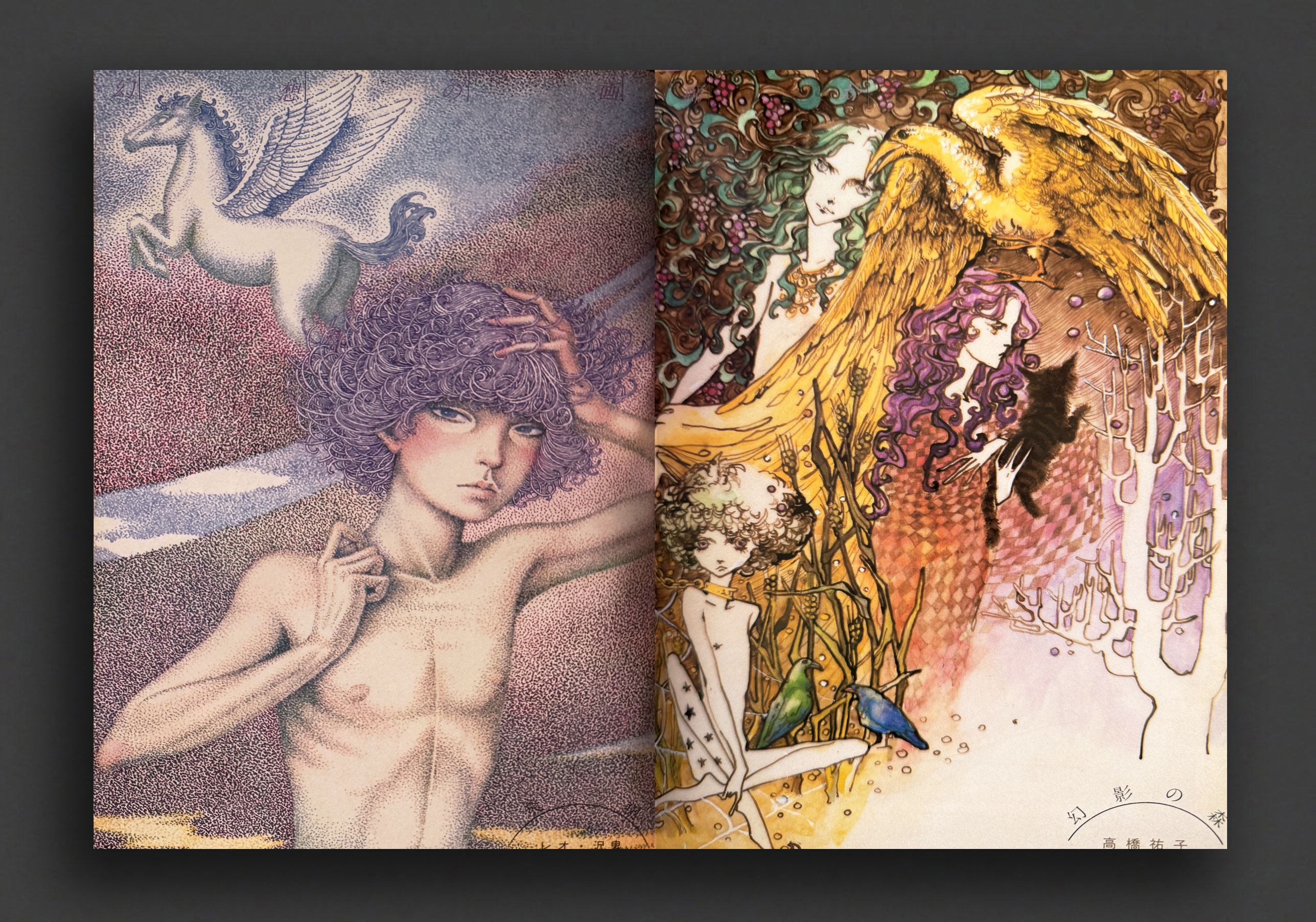
Issue No 2 (December 1978) of June (magazine), the first yaoi (boys love or "BL") magazine in Japan, founded in 1978, named after the French author Jean Genet, with "june" being a play on the Japanese pronunciation of his name. An underground cult hit, June became synonymous with the BL genre, publishing male/male tanbi ("aesthetic") romances — stories written for and about the worship of idealised beauty, tragedy, and homoerotic romance between androgynous men and beautiful male youths, narratives that emphasise homosociality and de-emphasize socio-cultural homophobia, rich in decadence through the use of flowery language, baroque sexual fantasies and unusual kanji. The yaoi genre was coined by the female manga artists Yasuko Sakata and Akiko Hatsu and originated in the 1970s as a subgenre of shōjo manga, or comics for girls, influenced by the rising popularity of depictions of bishōnen ("beautiful boys"), a term for androgynous or effeminate male characters. June ushered in a new wave of — primarily female — manga artists and writers, including Keiko Takemiya, Tomomi Kobayashi, Kaoru Kurimoto, and Akimi Yoshida, and male artists such as Sadao Hasegawa, Gekko Hayashi, and Ben Kimura, publishing unsolicited manuscripts and homoerotic artworks alongside critical writings, reviews, and historical pieces, all centred around boys. Although it began typically as a genre by and for women, distinct from bara (gay manga created by men), June increasingly appealed to a gay audience, and played a significant role in the construction of a collective gay identity in Japan, alongside pioneering gay manga magazines such Barazoku, which featured many of the same artists. The June imprint ran various editions of the magazine, including the "large format" with many photos of youths and colour artworks, the popular Roman June ("Romantic June") which contained a mix of stories and manga, and Shousetsu June, and the original manga magazine.
The yaoi genre of June (also referred to as shōnen-ai "boy love") was heavily inspired by European decadent literature, philosophy, the homoerotic writings of Japanese authors Taruho Inagaki, Yukio Mishima, Yasunari Kawabata, Jun'ichirō Tanizaki, and the Bildungsroman (coming-of-age) literary genre as much as it was by pop culture and the androgyny of musicians such as David Bowie, Marc Bolan and David Sylvian, or actor Björn Andrésen's portrayal of Thaddeus in Visconti's 1971 film adaptation of Death in Venice.
These early issues are filled to the brim with lavish illustrations and comic stories, erotic fantasy fiction, photographs of "beautiful boys" (young film stars, catholic choir boys, musicians...), reviews, interviews, and essays, all rich with romantic connotations to the age of Decadence, Symbolism, and the aesthetics of the Victorian and Edwardian eras, as well as Japanese folklore.
Good—Very Good copy of this scarce early issue of June, published by Sun Publishing, Tokyo.

The Screwball Asses and Other Texts
by Christian Maurel
2025, English
Softcover, 96 pages, 17.7 x 11.4 cm
$35.00 - In stock -
A foundational work of queer theory.
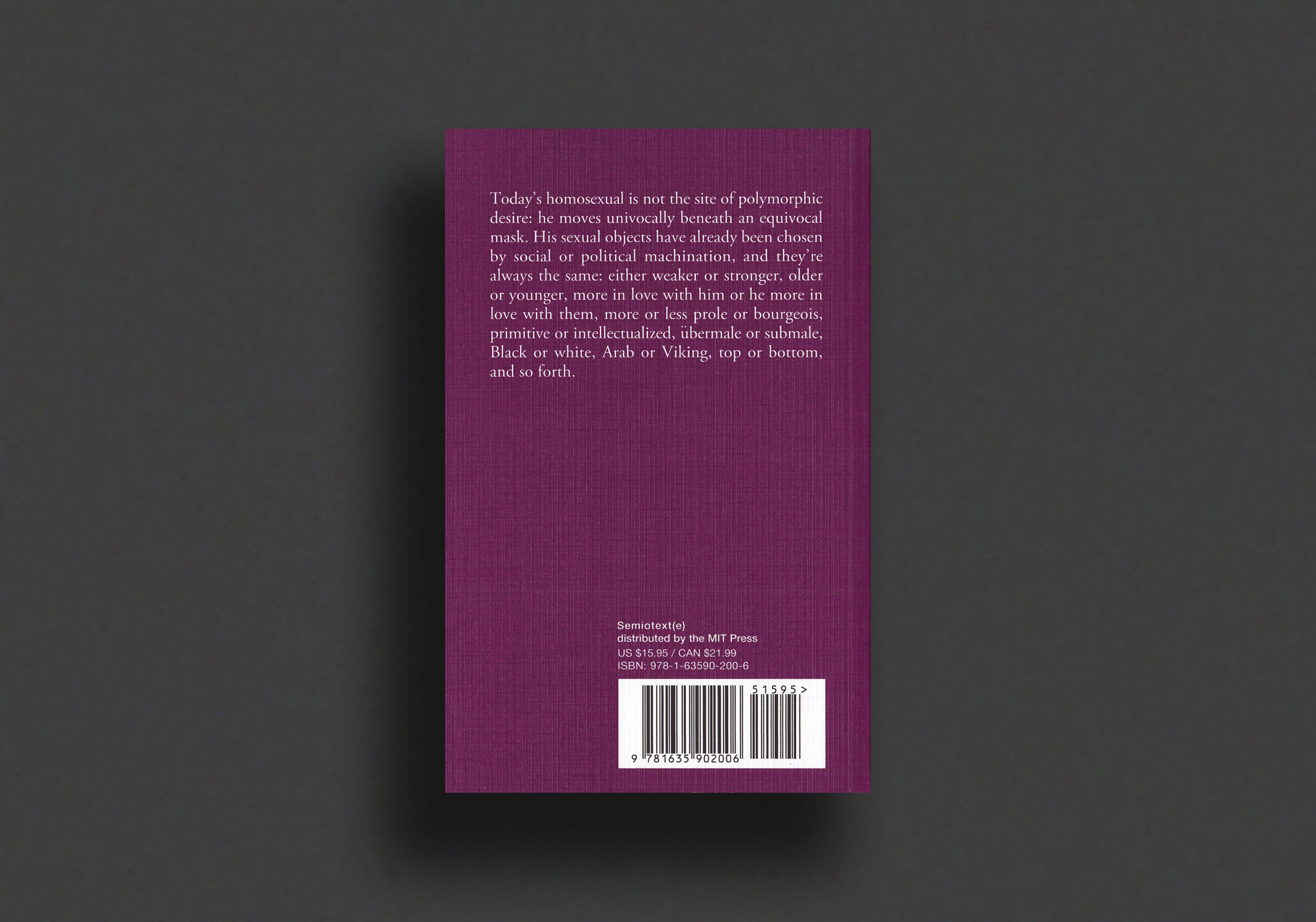
First published anonymously in the notorious "Three Billion Perverts" issue of Félix Guattari's journal Recherches—banned by French authorities upon its release in 1973—The Screwball Asses was erroneously attributed to Guy Hocquenghem when it was first published in English in 2009. This second edition of that translation, with a new preface by Hocquenghem biographer Antoine Idier that clarifies the different theoretical positions within France's Front Homosexuel d'Action Révolutionaire, returns the text to its true author: writer, journalist, and activist Christian Maurel.
In this dramatic treatise on erotic desire, Maurel takes on the militant delusions and internal contradictions of the gay-liberation movement. He vivisects not only the stifled mores of bourgeois capitalism, but also the phallocratic concessions of so-called homophiles and, ultimately, the very act of speaking desire. Rejecting any “pure theory” of homosexuality that would figure its “otherness” as revolutionary, Maurel contends that the ruling classes have invented homosexuality as a sexual ghetto, splitting and mutilating desire in the process. It is only when nondesire and the desire of desire are enacted simultaneously through speech and body that homosexuality can finally be sublimated under the true act of “making love.” There are thousands of sexes on earth, according to Maurel, but only one sexual desire. The Screwball Asses is a revelatory disquisition.
Introduction by Antoine Idier
Translated by Noura Wedell
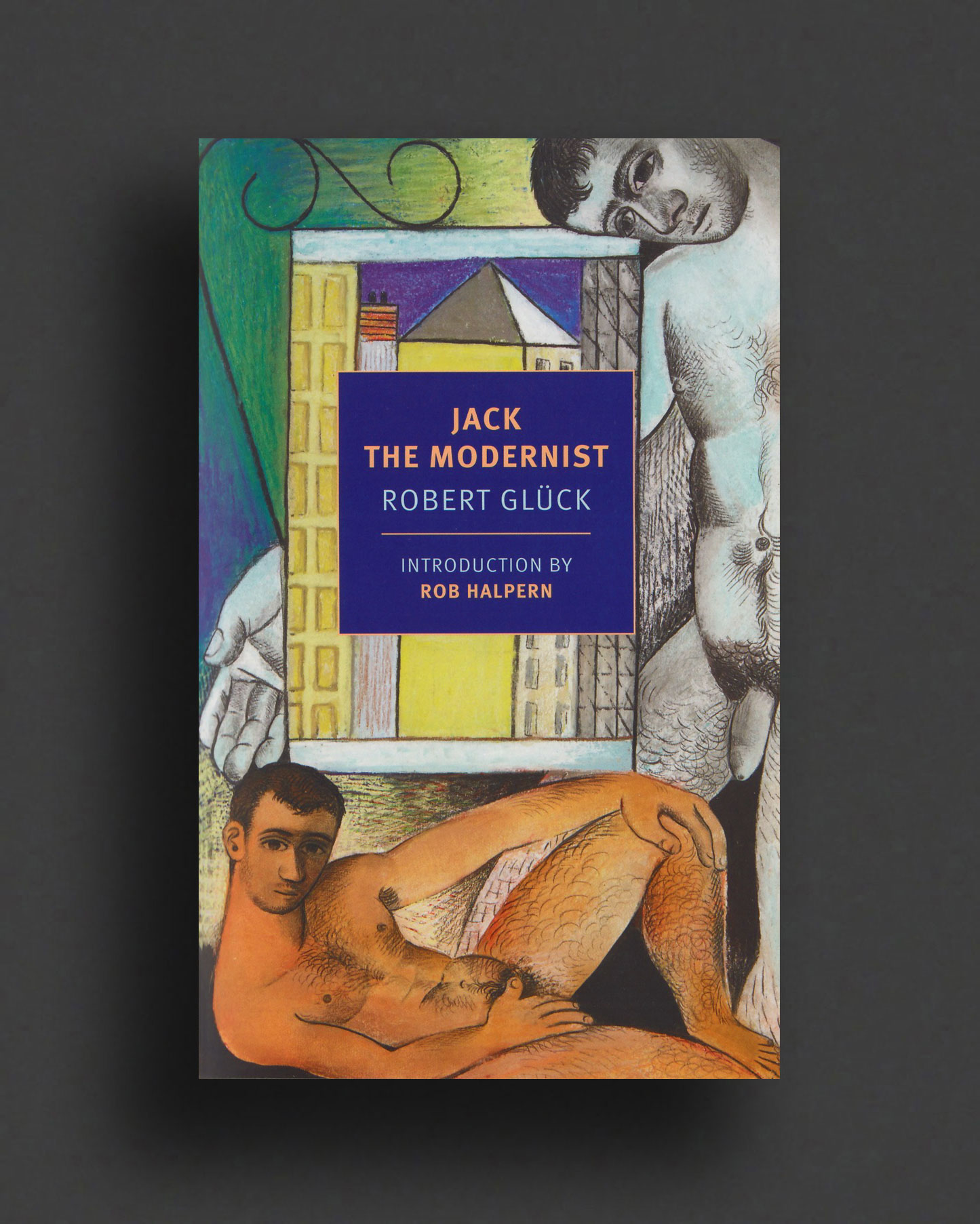
Jack the Modernist
by Robert Glück
2025, English
Softcover, 176 pages, 12.7 x 20.2 cm
$36.00 - Out of stock
A cult classic now back in print, this novel about sex, obsession, and art is one of the defining works of 1980s gay fiction.
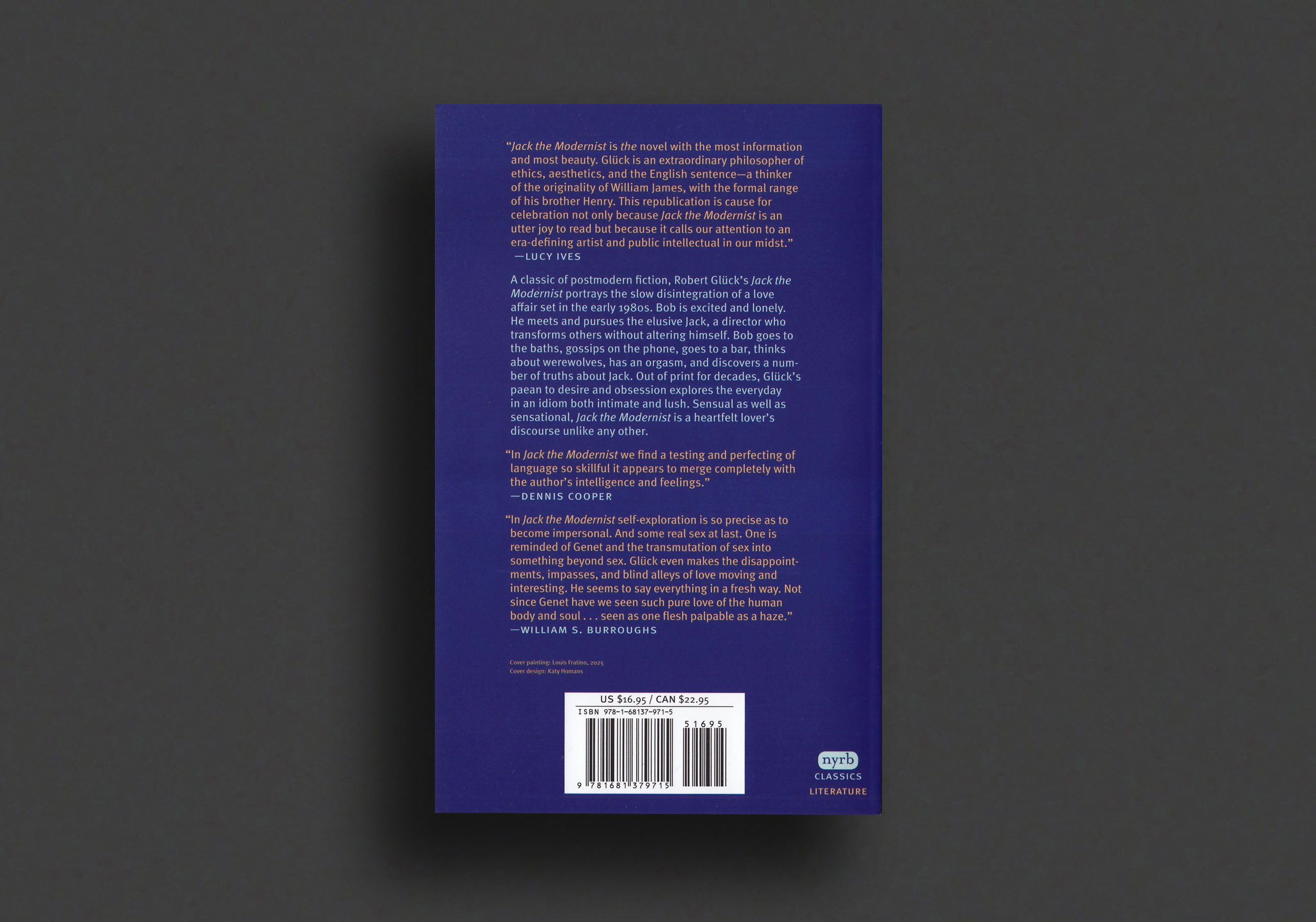
A classic of postmodern fiction, Robert Glück’s Jack the Modernist portrays the slow disintegration of a love affair set in the early 1980s. Bob is excited and lonely. He meets and pursues the elusive Jack, a director who is able to transform others without altering himself. Bob goes to the baths, gossips on the phone, goes to a bar, thinks about werewolves, has an orgasm, and discovers a number of truths about Jack. Out of print for decades, Glück’s paean to desire and obsession explores the everyday in an idiom both intimate and lush. Sensual as well as sensational, self-conscious, but never self-serious, Jack the Modernist is a candid and heartfelt lover’s discourse unlike any other.
“Jack the Modernist is the novel with the most information and most beauty. Glück is an extraordinary philosopher of ethics, aesthetics, and the English sentence—a thinker of the originality of William James, with the formal range of his brother Henry. This republication is cause for celebration not only because Jack the Modernist is an utter joy to read but because it calls our attention to an era-defining artist and public intellectual in our midst.”
—LUCY IVES
“In Jack the Modernist we find a testing and perfecting of language so skillful it appears to merge completely with the author’s intelligence and feelings.”
—DENNIS COOPER
“In Jack the Modernist self-exploration is so precise as to become impersonal. And some real sex at last. One is reminded of Genet and the transmutation of sex into something beyond sex. Glück even makes the disappointments, impasses, and blind alleys of love moving and interesting. He seems to say everything in a fresh way. Not since Genet have we seen such pure love of the human body and soul . . . seen as one flesh palpable as a haze.”
—WILLIAM S. BURROUGHS


Roman Poems
By Pier Paolo Pasolini
1986 / 2005, English / Italian
Softcover, 96 pages, 12.2 x 16.1 cm
$34.00 - In stock -
The Italian film-maker Pier Paolo Pasolini was first and always a poet—the most important civil poet, according to Alberto Moravia, in Italy in the second half of this century. His poems were at once deeply personal and passionately engaged in the political turmoil of his country. In 1949, after his homosexuality led the Italian Communist Party to expel him on charges of "moral and political unworthiness," Pasolini fled to Rome. This selection of poems from his early impoverished days on the outskirts of Rome to his last (with a backward longing glance at his native Friuli) is at the center of his poetic and filmic vision of modern Italian life as an Inferno.
"From all these refusals, we know what Pasolini stood against—political ideologies of all kinds, the complacency inherent in the established social order, the corruption of the institutions of church and state. If Pasolini could be said to have stood for anything it was for the struggles of Italy's working class—both the rural peasants and those barracked in the urban slums at the edges of Italian cities—whose humanity he evoked with great eloquence and nuance. But it is his refusals that animate his legacy with an incandescent rage, a passionate and profound fury that did not, as Zigaina suggests, cry out for death—but for just the opposite." —Nathaniel Rich, The New York Review of Books
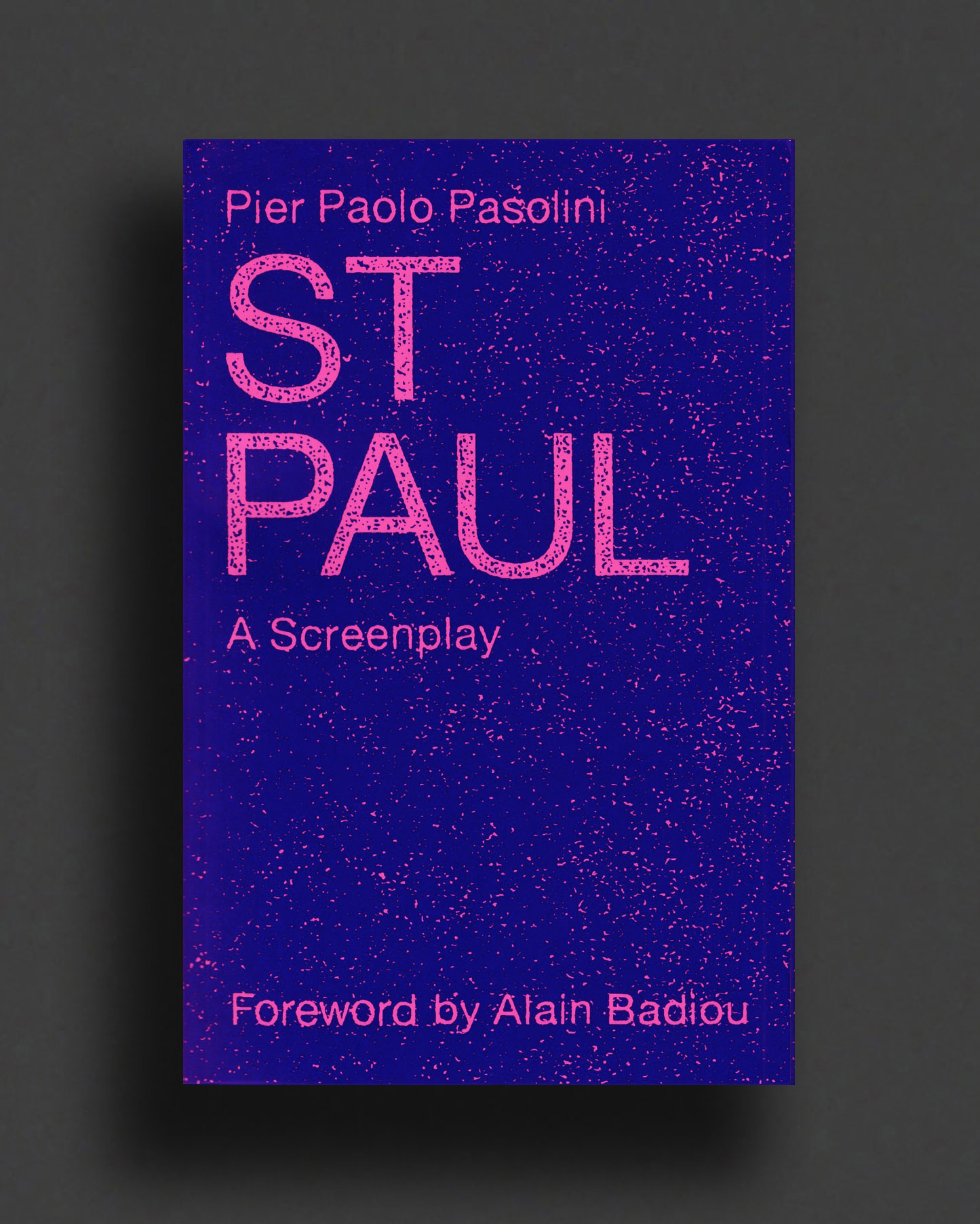
St. Paul
by Pier Paolo Pasolini
2025, English
Softcover, 240 pages, 20 x 13 cm
$46.00 - In stock -
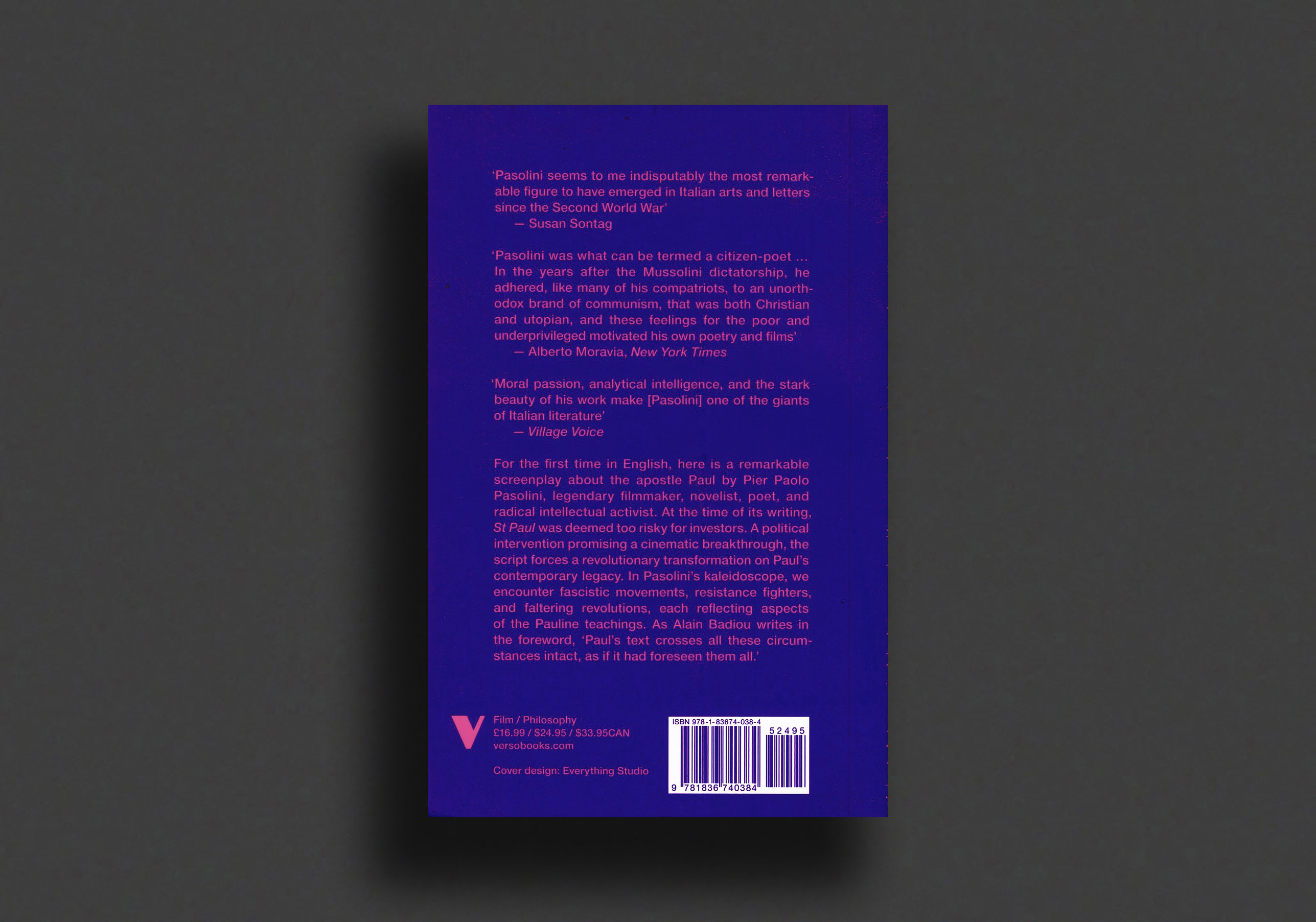
Presented here for the first time in English is a remarkable screenplay about the apostle Paul by Pier Paolo Pasolini, legendary filmmaker, novelist, poet, and radical intellectual activist. Written between the appearance of his renowned film Teorema and the shocking, controversial Salò, or the 120 Days of Sodom, St Paul was deemed too risky for investors. At once a political intervention and cinematic breakthrough, the script forces a revolutionary transformation on the contemporary legacy of Paul. In Pasolini's kaleidoscope, we encounter fascistic movements, resistance fighters, and faltering revolutions, each of which reflects on aspects of the Pauline teachings. From Jerusalem to Wall Street and Greenwich Village, from the rise of SS troops to the death of Martin Luther King, Jr, here— as Alain Badiou writes in the foreword—"Paul's text crosses all these circumstances intact, as if it had foreseen them all."
This is a key addition to the growing debate around St Paul and to the proliferation of literature centred on the current turn to religion in philosophy and critical theory, which embraces contemporary figures such as Alain Badiou, Slavoj Žižek and Giorgio Agamben.
Translated by Elizabeth A. Castelli
Preface by Alain Badiou
Introduction by Ward Blanton

PIN–UP MAGAZINE ISSUE 6
S/S 2009
2009, English
Softcover (staple-bound), 128 pages, 28.5 x 23.5 cm
1st Edition, Out of print title / used / very good
$150.00 - In stock -
Rare and collectible early issue of the acclaimed 'Magazine for Architectural Entretainment', PIN–UP. Issue 6, S/S 2009, back when the print-run was surprisingly small and magazines were still fantastic.
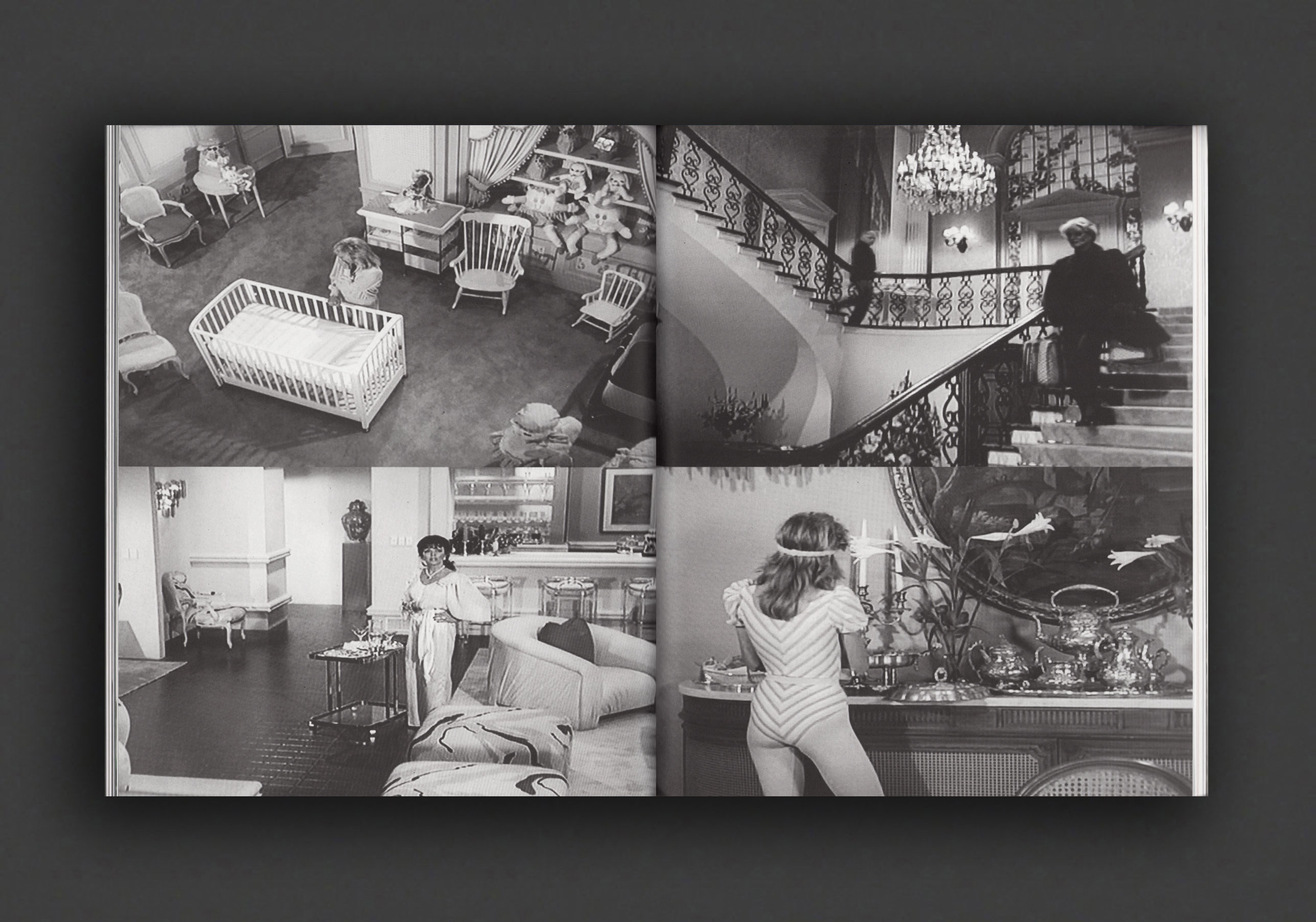
"PIN–UP 6, Spring Summer 2009. A mid-recession tour de force. Hot fluorescent pink, green, purple, and orange. A potent mix of Meier, Wines, and Ishigami. Plus: flowers, Sylvia Lavin, and Dynasty. The last PIN–UP to be staple-bound. A must-have in any PIN–UP collection."—from PIN-UP website
Featuring:
RICHARD MEIER
The authority on all things white is one colorful character
Interview by Horacio Silva
Photography by Katja Rahlwes
DAVID KOHN
The cunning fox behind London’s new eclecticism
Interview by Caroline Roux
Photography by Devin Blair
ROY MCMAKIN
Forever blurring the makers of art, architecture, and design
Interview by Michael Ned Holte
Photography by Julika Rudelius
JUNYA ISHIGAMI
The minimalist’s darling is a nature lover at heart
Interview by Beatrice Galilee
Photography by Takashi Homma
JAMES WINES
The perpetual nonconformist has the last laugh
Interview by Michael Bullock
Photography by Miguel Villalobos
Also:
Floor plans from Dark Rooms Atlas examine the ideal architecture of gay cruising spots in Barcelona. Andreas Angelidakis tinkers with the intersection between technology and physicality, using programs like Second Life to create his playfully geometric structures. Brooklyn-based design studio labDORA fuses computer-coded design with waxy blobs. A look into Eric Lloyd Wright’s unfinished house, a sparse concrete structure perched on the summit of California’s Malibu hills. Art by Thomas Ravens juxtapose the whimsy of watercolors with images of failed utopia. PIN–UP pays homage to Dan Friedman via collage, mixing the artist’s wacky furniture with found objects. Sketches for chairs by various designers reveal the complicated and raw psychology behind creating one of the most fundamental entities of design. PIN–UP reconsiders the basic shapes of architecture via bouquets and topiary arrangements. Screenshots from Dynasty pay tribute to set designer Brock Broughton. Suleman Anaya examines the logic behind architecture’s emotional impact, both in films and in his life. Maia Morgensztern writes about the economic and cultural impact of opening a Louvre museum on the island of Saadiyat, located off the coast of Abu Dhabi. Sylvia Lavin on the impact that Richard Neutra’s windows had on reshaping postwar buildings. Paul Elliman remembers Dan Friedman and the interplay between design and contemporary art. And a look at the interactive, anamorphosis paintings of Felice Varini, who uses light projectors to paint shapes that seemingly levitate within the space.
Very Good copy, light wear.
