New :


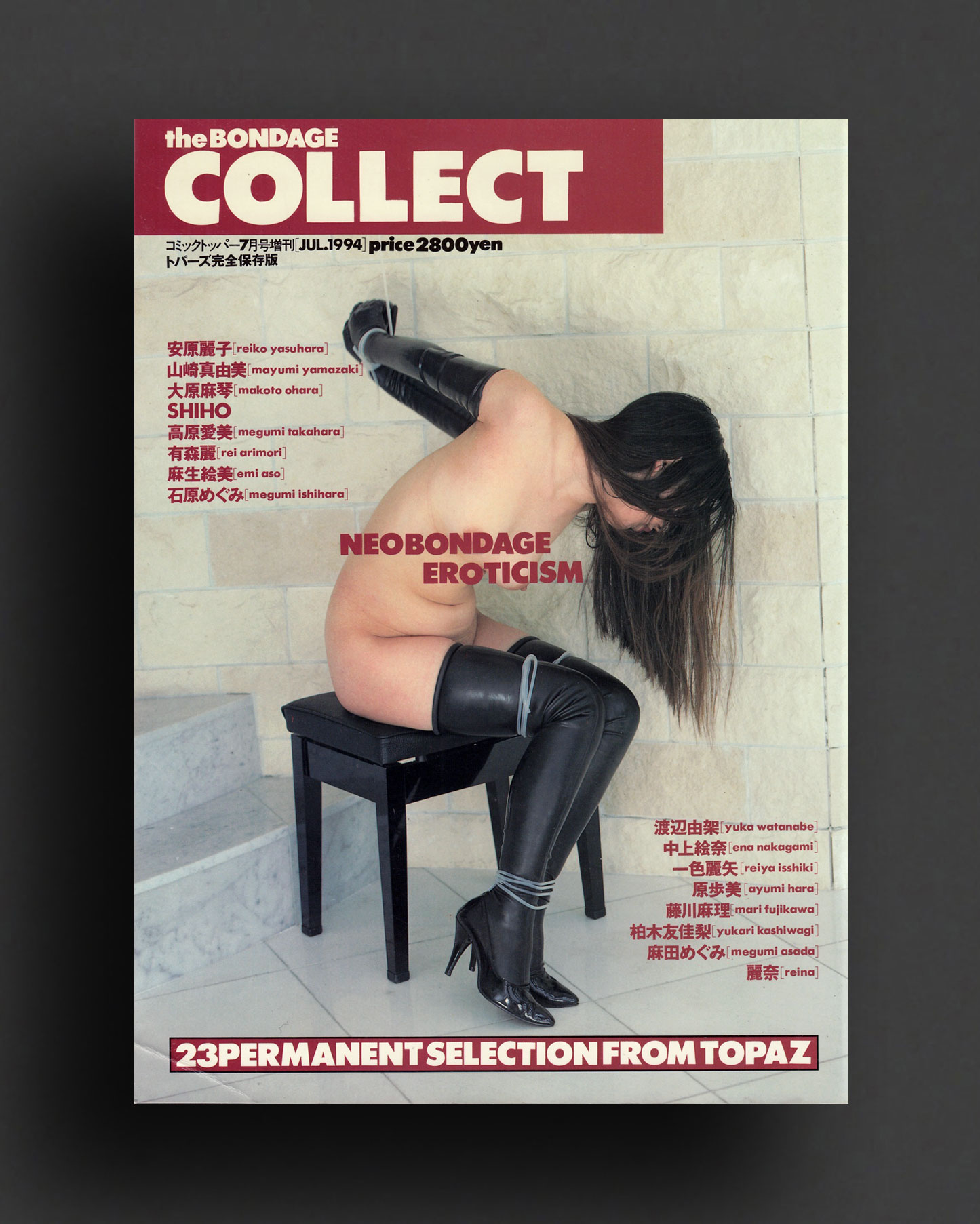
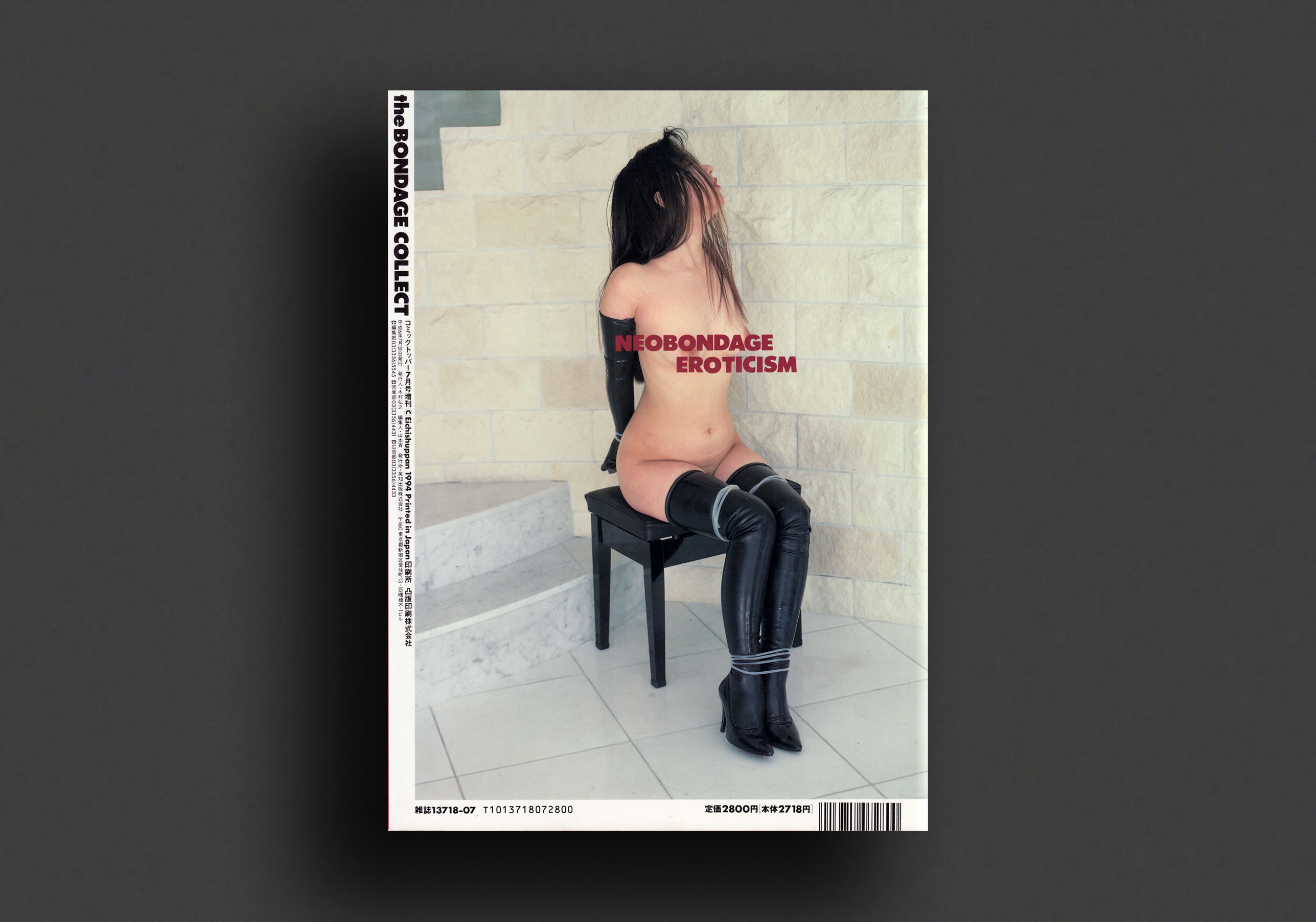
The Bondage Collect: Neobondage Eroticism
23 Permanent Selection from Topaz
1994, Japanese
Softcover, unpaginated, 28.5 x 21 cm
1st Edition, Out of print title / used / very good
$100.00 - In stock -
Published by Topaz magazine in 1994, this photo book collects 23 of the feature photoshoots in their entirety from the pages of the short-lived but excellent early 90's Japanese bondage magazine. Edited by Hitoshi Yamamoto, Kazuyoshi Kimoto, Hiroyuki Yano, Naoki Katayama. Features the models: Reiko Yasuhara, Mayumi Yamazaki, Makoto Ohara, Megumi Takahara, Rei Arimori, Emi Aso, Megumi Ishihara, Yuka watanabe, Ena Nakagami, Reiya Isshiki, Ayumi Hara, Mari Fujikawa, Yukari Kashiwagi, Megumi Asada, Reina. Photography by Norio Sugiura, Teruo Maeba, Tsunehiro Takakuwa, Shinji Yamazaki, Wakao Takahashi, Ryosuke Aikawa, Chikashi Yokouchi. Stylists: Jun Yoshida, Takuya Mimi Sayuri Kojima, Hiro Seino, Yumi Nakamori. Hair & Makeup: Rina Matsuhaga, Hiromi Katoh. Special thanks to A.Z.Z.L.O. Discipline!
Edited by Kimura Hiroyuki, Topaz burst onto the flourishing SM scene as the influence of Kinbaku/Shibari culture, fetish fashion, "abnormal" sexual practices, modern primitive, and underground SM culture was becoming hugely influential on high-end fashion, glamour photography, and art/film/music at large. A similar approach to SM Sniper, sharing many of the same contributors such as SM archivist and noise musician Masami Akita (Merzbow), Topaz emphasised the new wave of artistic output from the real protagonists of the experimental SM counterculture in Japan (and abroad), centering around the work of the models, stylists, make-up artists, and fashions designers, as much as the kinbakushi, writers or photographers. Topaz benefited from the large format of a glossy, full-colour magazine, rather than the usual mook format of SM magazines, each issue packed with hundreds of images, a double-sided full-colour fold-out poster, original full-colour glossy photo-shoots, art galleries, reports and reviews on developments in the underground (noise music, pink film, sex clubs, erotic art, etc.), instructional and historical articles, rare interviews and profiles with the featured models and artists, and photo features on all manner of sexual customs and practices (transsexualism, lesbianism, virtual sex, rubberism, medical fetish, prostitution, techno sex...). One of the most under-rated SM mags from Tokyo, brimming with information on underground publishing, boutiques, and erotic art largely lost to time.
Mature audiences only.
Near Fine copy, single corner crease to cover.

Peeping Magazine 11
November 1984
1982, Japanese
Softcover (staple-bound), 96 pages, 26 x 18.5 cm
1st Edition, Out of print title / used / very good
$65.00 - Out of stock
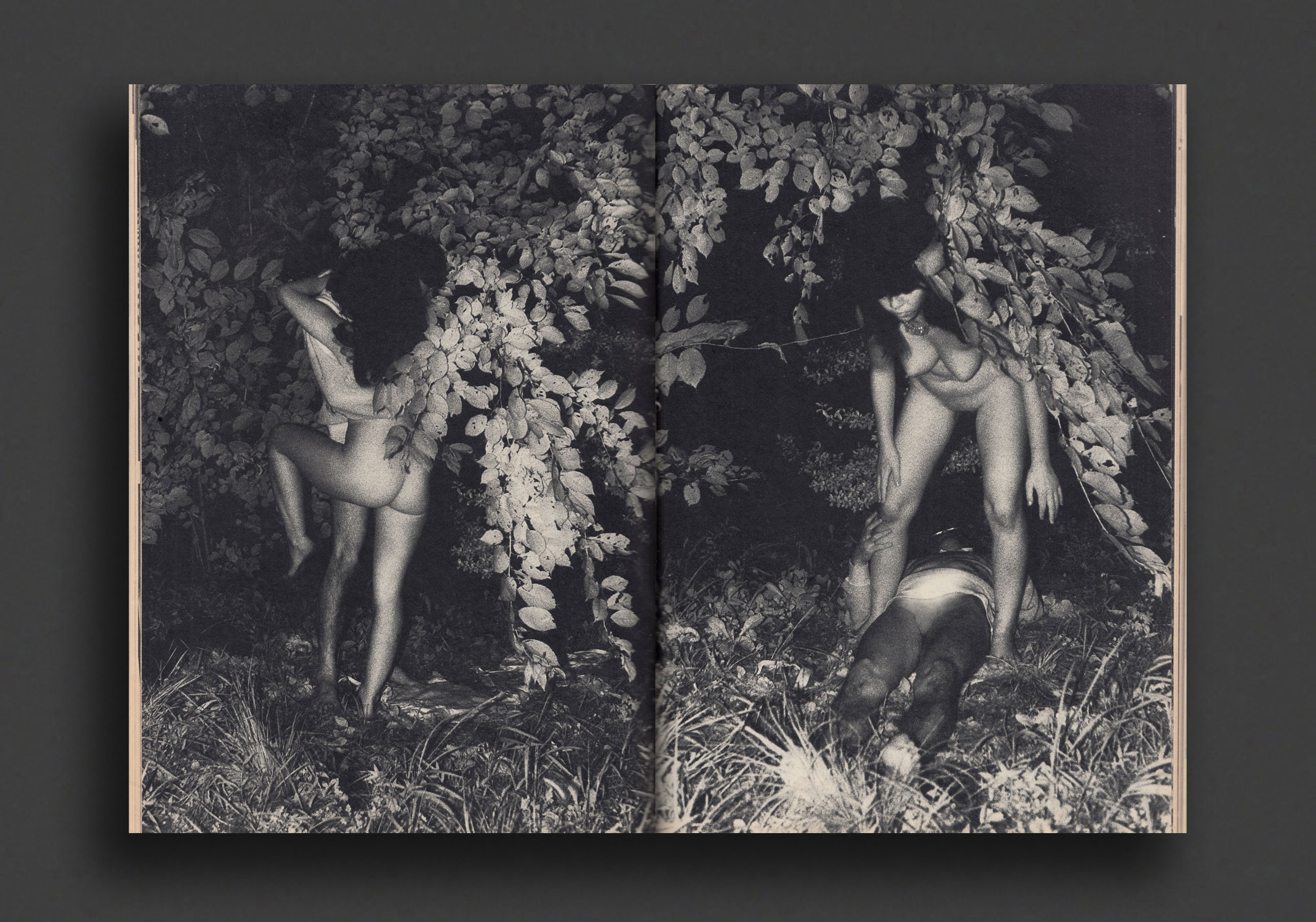
1984 issue of Peeping Magazine, a specialty deviant photography magazine published in Tokyo in the 1980's that covers all manner of voyeuristic close-up/peeper/FLASH/Infrared/Monroe-effect photography (ala Kohei Yoshiyuki and Ikko Kagari) with full-colour and b/w photo features of innovative, controversial, spy photography. Clandestine trysts in the park at night, girls next door, sports action, nature calls (urination)... Staged? simulated? real? professional? amateur? art as criminal impulse? Who knows. Questionable, sure. Certainly a fascinating reflection of the loneliness and desperation that so often accompanies sexual or human desire in a big, cold metropolis like Tokyo.
Mature audiences only.
Very Good copy, light wear.


Masatoshi Osanai
Binding Force
1990, Japanese
Softcover (w. dust jacket), unpaginated, 21.5 x 27.5 cm
1st Edition, Out of print title / used / very good
$180.00 - Out of stock
First, only edition of this great bondage photo book by Masatoshi Osanai, published by S&M Sniper's Million publishing house. "Binding Force" is a collection of works by the Japanese photographer who worked as a portrait photographer of idols and celebrities throughout the 1980s to the 1990s. This is his only book of bondage photography, announced in 1990 as "the first face restraint photo book in Japan!!". Like Helmut Newton and Robert Mapplethorpe, Osanai seamlessly works between portraiture and fetish photography, creating a conceptual photo book made up entirely of headshots of models gagged and bound in various face restraints, gas masks and the like. "It's a non-comedy. It's a comedy. It's the beauty of a mask, the wilderness of pleasure, or the grave marker of ecstasy that appears at the end of a transformation." (rough translation from the publisher's blurb). Includes texts (in Japanese) by Shuhei Takahashi and Akira Nagae.
Very Good—Near Fine copy in VG dust jacket.

Passion
Queen's Photo Special / M's Craving... or Madness
1980?, Japanese
Softcover (w. dust jacket), unpaginated, 26 x 18.5 cm
1st Edition, Out of print title / used / very good
$65.00 - In stock -
"Kneel down and lick the queen's toes, slaves"
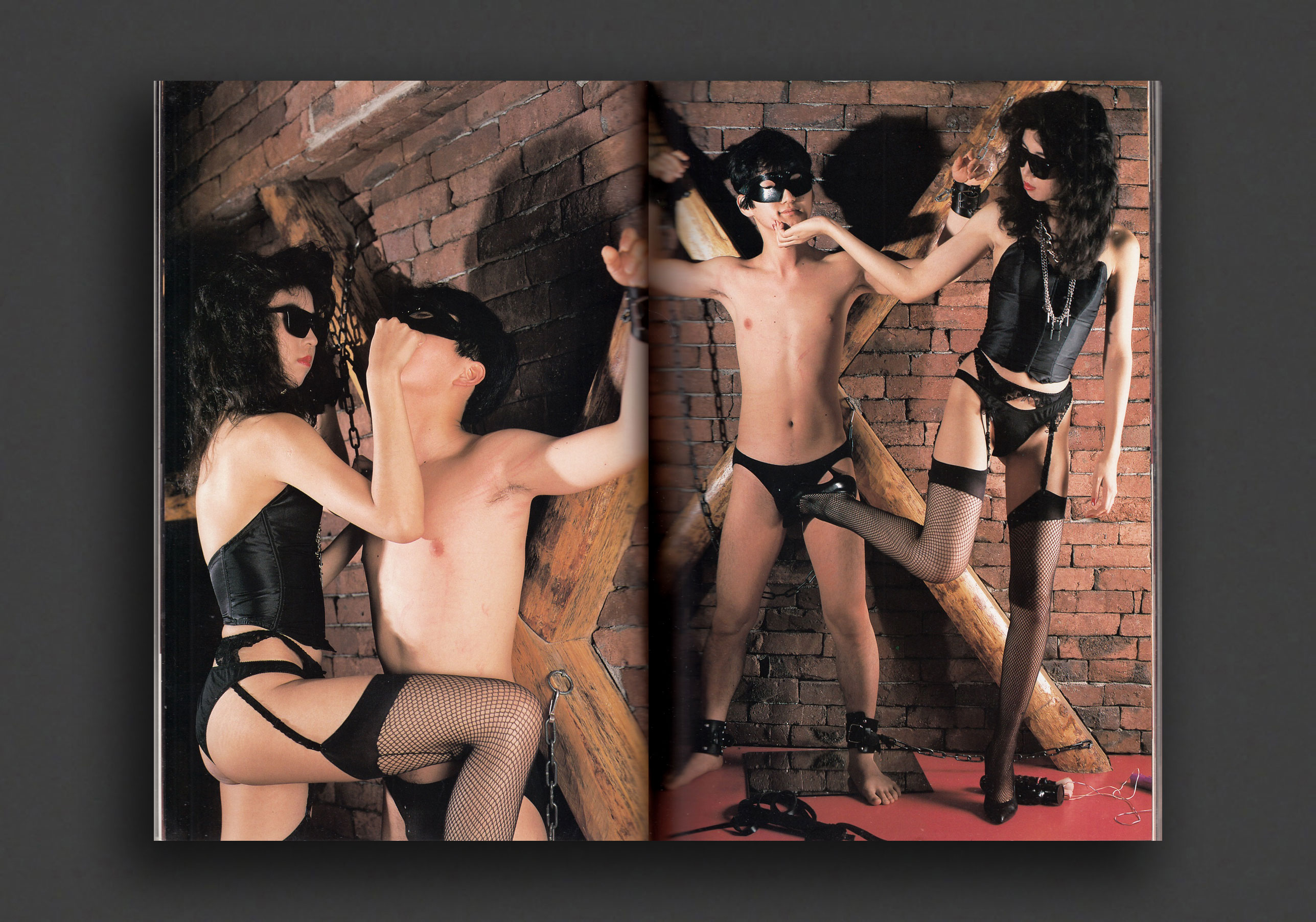
Typically rather anonymous, dateless Japanese vending-machine fetish photo magazine from the 1980s. These are great. Passion is cover-to-cover, full-colour, gloss femdom photography of two young Japanese women in fetish wear enjoying the torture of their young male slave in a dungeon.
Mature-audiences only.
Very Good copy.
SECRET MAGAZINE
March 1995
1995, English
Softcover (staple-bound), 90 pages, 30 x 21 cm
1st Edition, Out of print title / used / very good
$45.00 - Out of stock
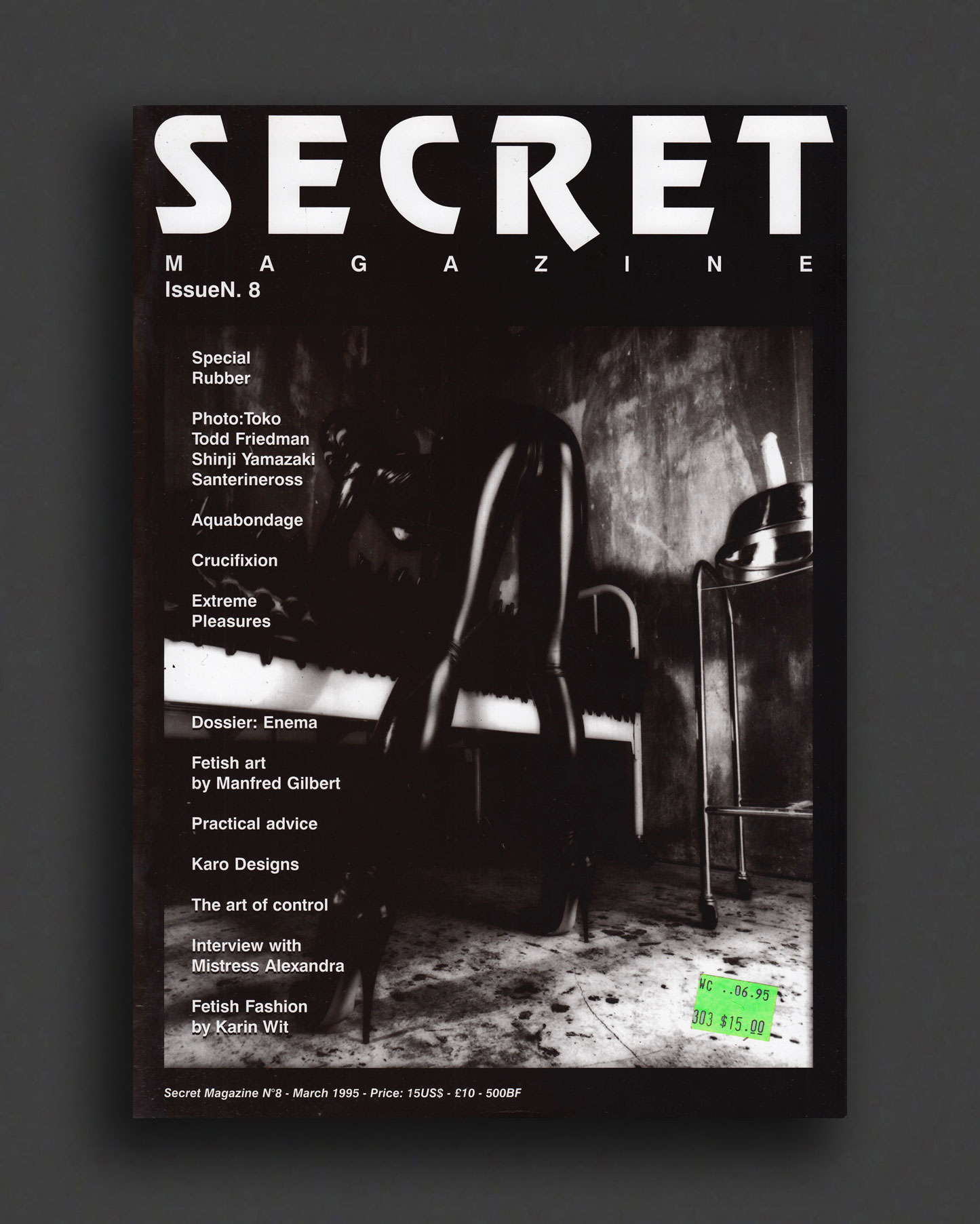
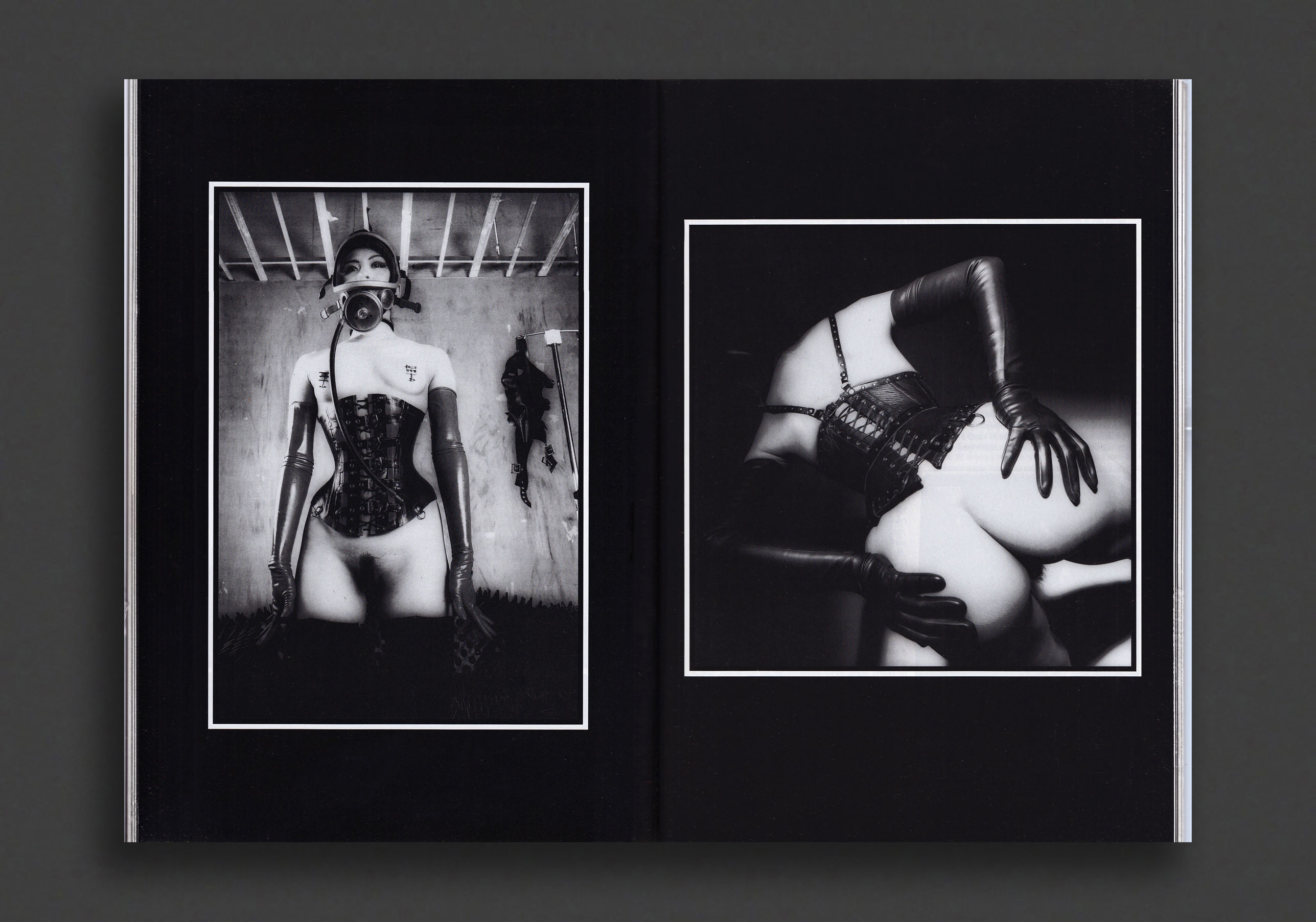
March 1995 issue of Secret Magazine, a legendary fetish and bondage art magazine edited by Jürgen Boedt, published out of Brussels, Belgium, and well respected across the globe. Striking b/w glossy pages filled with photo portfolios, fetish artwork galleries, kink advice, stories, reports from around the fetish world, interviews and much more. One of the last traditional Black and White Bondage Art magazines in Europe.
Very Good copy with general light magazine wear.
Franz Von Bayros
Erzählungen am Toilettentische (portfolio)
1976, French / Japanese
Hardcover portfolio + 18 print plates + insert booklet, 30.5 x 23 cm
Hand-numbered of 970 copies,
1st Edition, Out of print title / used / good
$190.00 - In stock -
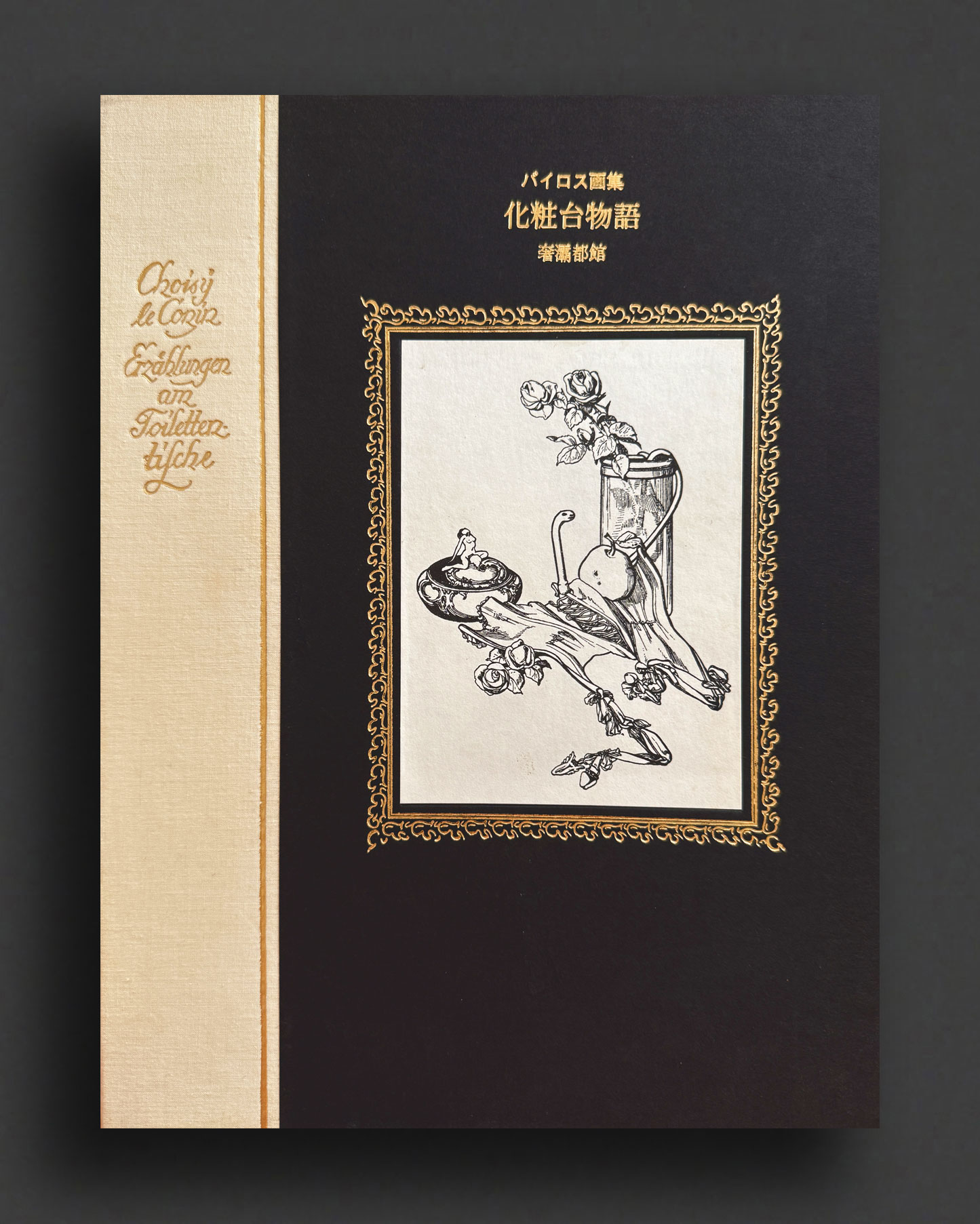
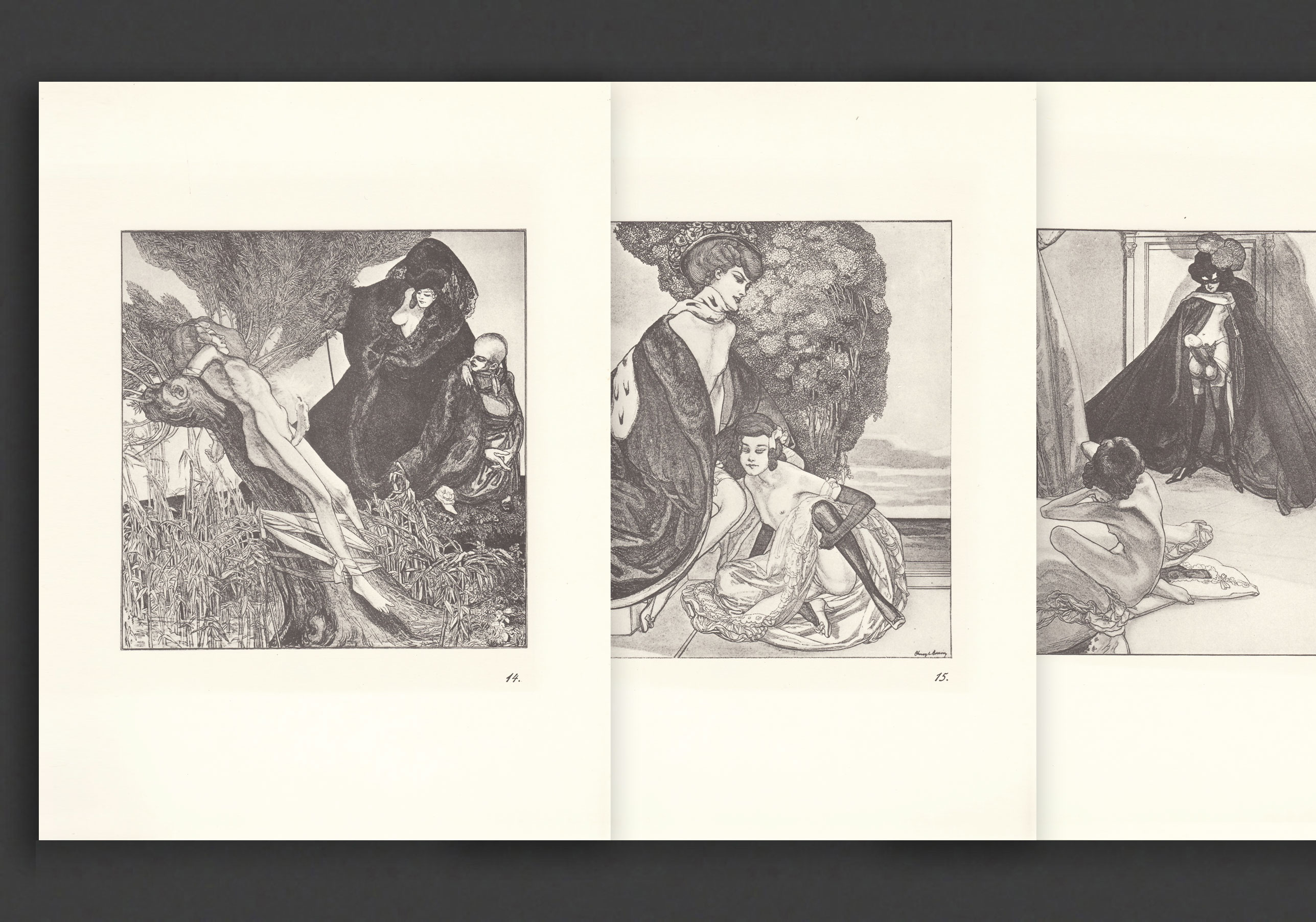
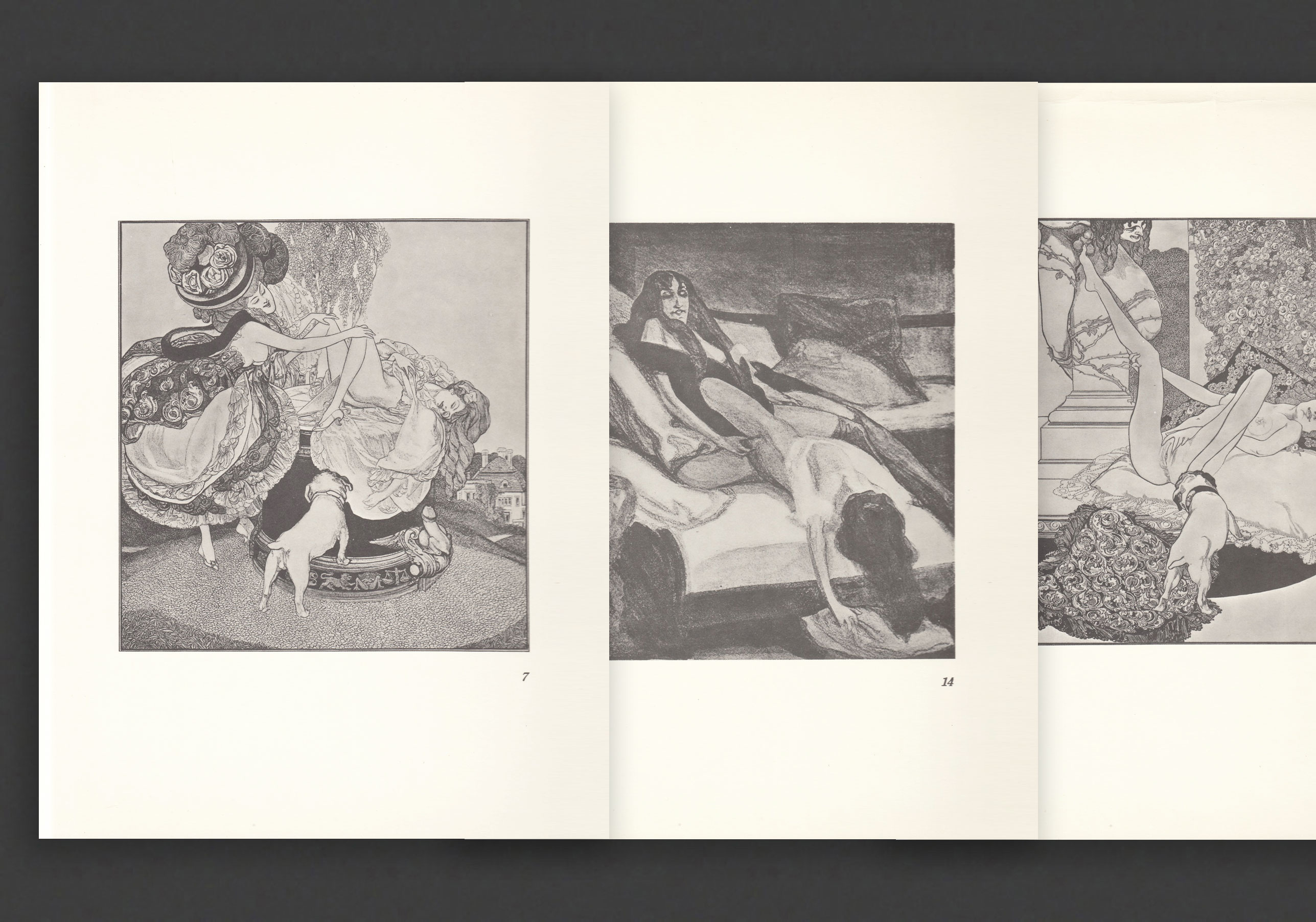
Lovely 1976 limited edition hardcover portfolio of Franz Von Bayros' "Erzählungen am Toilettentische" (1908) an erotic suite first published privately in 1911, published in Japan by Gakutokan. 18 beautifully produced plates housed in gilded, debossed-plate illustrated hardcover clothbound folio, hand-numbered "454" of 970 copies. One of the finest works of the Austrian graphic artist, illustrator, and painter of the fin de siècle, Franz von Bayros (b. 1866, Zagreb; d. 1924, Vienna), considered one of the great erotomaniacs, alongside Aubrey Beardsley and Félicien Rops. His illustrations for classics of erotic literature are characterized by compositional talent, subtle play with ornament, and a delight in opulent settings.
Born in Zabreb, Croatia, Franz von Bayros (1866–1924) was an Austrian commercial artist, illustrator and painter. A leading figure in the Decadent artistic movement, his work challenged Victorian modesty, exploring phantasmagoric imagery and taboo erotic themes such as lesbian relationships, bestiality and sado-masochism, coupled with a keen sense of humour and warmth given to the subject. Franz’s brilliant draughtsmanship, design sense and his carefully-considered erotic imagination made his work eminently approachable and desirable, both as high-quality art and as a vehicle for exploring the limits of sexual experience, yet the scandalous nature of his work led to his arrest and temporary exile from Germany in 1911, returning to an Austria to face the outbreak of war and alienation.
During his prolific period creating erotic works for limited edition collector's portfolios and rare book prints, Franz Von Bayros created illlustrations for Fleurettens Purpurschnecke (1905), Die Memoiren der Fanny Hill (1906), La Bohème (1906), Im Garten der Aphrodite (In the Garden of Aphrodite) (1907), Les Cent Nouvelles (1907), Die Grenouillère (1907), Die hübsche Andalusierin (1907), Manon Lescaut and the Chevalier des Grieux (1911), Erzählungen am Toilettentische (1911), Le Decameron (1911), amongst many more, as well as a brilliant array of ex-libris bookplate illustration.
Very Good copy.
Franz Von Bayros
Im Garten der Aphrodite (portfolio)
1976, French / Japanese
Hardcover portfolio + 21 print plates, 30.5 x 23 cm
Hand-numbered of 970 copies,
1st Edition, Out of print title / used / very good
$190.00 - In stock -
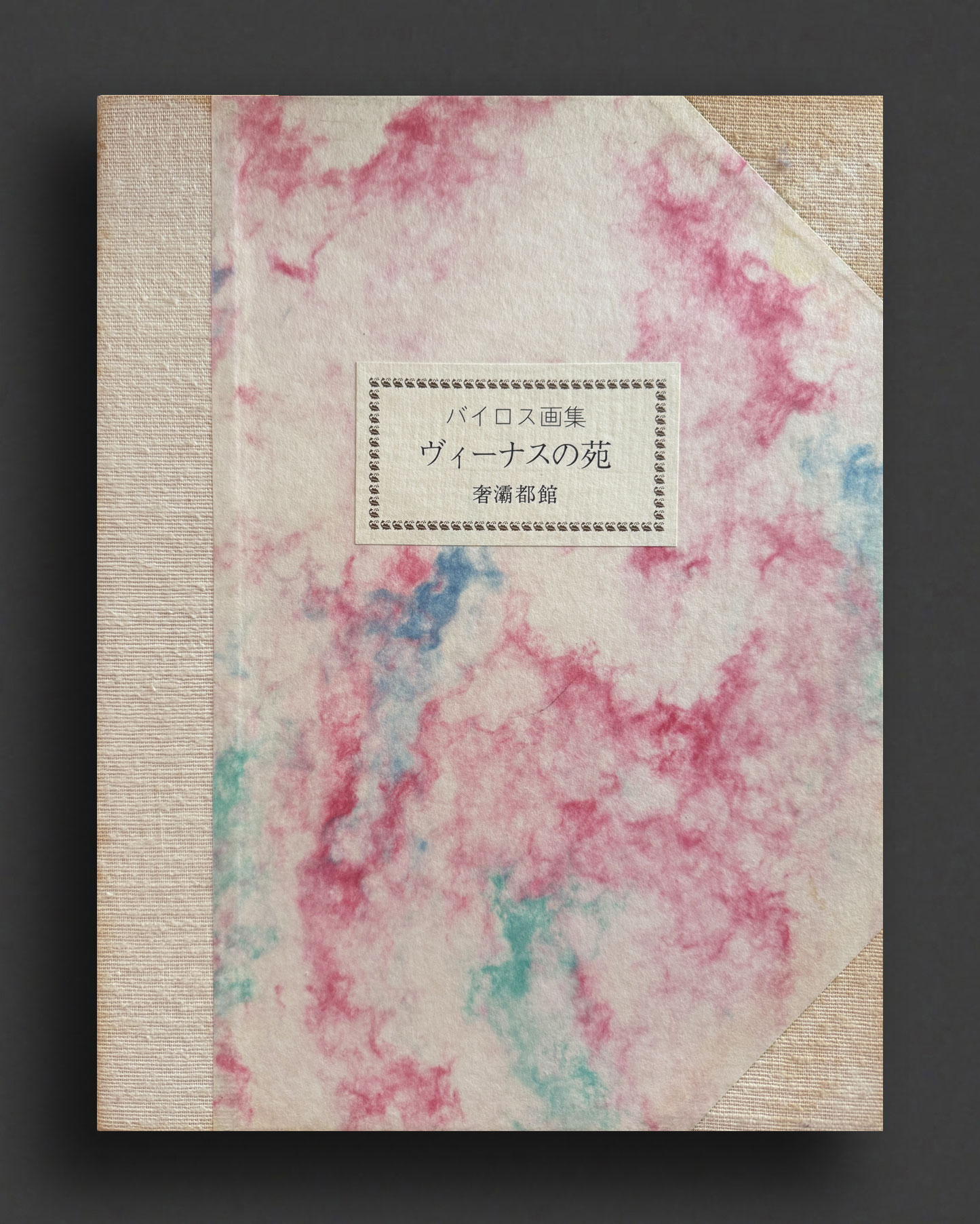
Lovely 1976 limited edition hardcover portfolio of Franz Von Bayros' "Im Garten der Aphrodite" (1907) an erotic suite first published privately in 1910, published in Japan by Gakutokan. 21 beautifully produced plates housed in marbled hardcover clothbound folio, hand-numbered "456" of 970 copies. One of the finest works of the Austrian graphic artist, illustrator, and painter of the fin de siècle, Franz von Bayros (b. 1866, Zagreb; d. 1924, Vienna), considered one of the great erotomaniacs, alongside Aubrey Beardsley and Félicien Rops. His illustrations for classics of erotic literature are characterized by compositional talent, subtle play with ornament, and a delight in opulent settings.
Born in Zabreb, Croatia, Franz von Bayros (1866–1924) was an Austrian commercial artist, illustrator and painter. A leading figure in the Decadent artistic movement, his work challenged Victorian modesty, exploring phantasmagoric imagery and taboo erotic themes such as lesbian relationships, bestiality and sado-masochism, coupled with a keen sense of humour and warmth given to the subject. Franz’s brilliant draughtsmanship, design sense and his carefully-considered erotic imagination made his work eminently approachable and desirable, both as high-quality art and as a vehicle for exploring the limits of sexual experience, yet the scandalous nature of his work led to his arrest and temporary exile from Germany in 1911, returning to an Austria to face the outbreak of war and alienation.
During his prolific period creating erotic works for limited edition collector's portfolios and rare book prints, Franz Von Bayros created illlustrations for Fleurettens Purpurschnecke (1905), Die Memoiren der Fanny Hill (1906), La Bohème (1906), Im Garten der Aphrodite (In the Garden of Aphrodite) (1907), Les Cent Nouvelles (1907), Die Grenouillère (1907), Die hübsche Andalusierin (1907), Manon Lescaut and the Chevalier des Grieux (1911), Erzählungen am Toilettentische (1911), Le Decameron (1911), amongst many more, as well as a brilliant array of ex-libris bookplate illustration.
Very Good copy. Some tanning to cloth extremities.


Franz Von Bayros
Art Book Vol. I + II
1979 / 1980, Japanese
2 hardcover volumes (w. dust jackets), 140 pages ea., 26.5 x 20 cm
1st Edition, Out of print title / used / very good
$120.00 - In stock -
First hardcover editions of both erotic art book collections of Franz Von Bayros, published by Gakutokan, Tokyo, 1979 and 1980. Born in Zabreb, Croatia, Franz von Bayros (1866–1924) was an Austrian commercial artist, illustrator and painter. A leading figure in the Decadent artistic movement, his work challenged Victorian modesty, exploring phantasmagoric imagery and taboo erotic themes such as lesbian relationships, bestiality and sado-masochism, coupled with a keen sense of humour and warmth given to the subject. Franz’s brilliant draughtsmanship, design sense and his carefully-considered erotic imagination made his work eminently approachable and desirable, both as high-quality art and as a vehicle for exploring the limits of sexual experience, yet the scandalous nature of his work led to his arrest and temporary exile from Germany in 1911, returning to an Austria to face the outbreak of war and alienation.
During his prolific period creating erotic works for limited edition collector's portfolios and rare book prints, Franz Von Bayros created illlustrations for Fleurettens Purpurschnecke (1905), Die Memoiren der Fanny Hill (1906), La Bohème (1906), Im Garten der Aphrodite (In the Garden of Aphrodite) (1907), Les Cent Nouvelles (1907), Die Grenouillère (1907), Die hübsche Andalusierin (1907), Manon Lescaut and the Chevalier des Grieux (1911), Erzählungen am Toilettentische (1911), Le Decameron (1911), amongst many more, as well as a brilliant array of ex-libris bookplate illustration.
Together threse books reproduced these erotic artworks of Franz Von Bayros, including the ex-libris works and private commissions. All reproduced in b/w with colour lead plates and accompanying Japanese/German/French bibliographic information and minimal text in Japanese. Almost entirely both made of images.
VG/VG

Topaz Vol. 1 (THE BONDAGE MAGAZINE)
April 1993
1993, Japanese
Softcover, 140 + pages, 29 x 21 cm
1st Edition, Out of print title / used / very good
$70.00 - In stock -
"For All Beautiful and Sensual Pleasure"
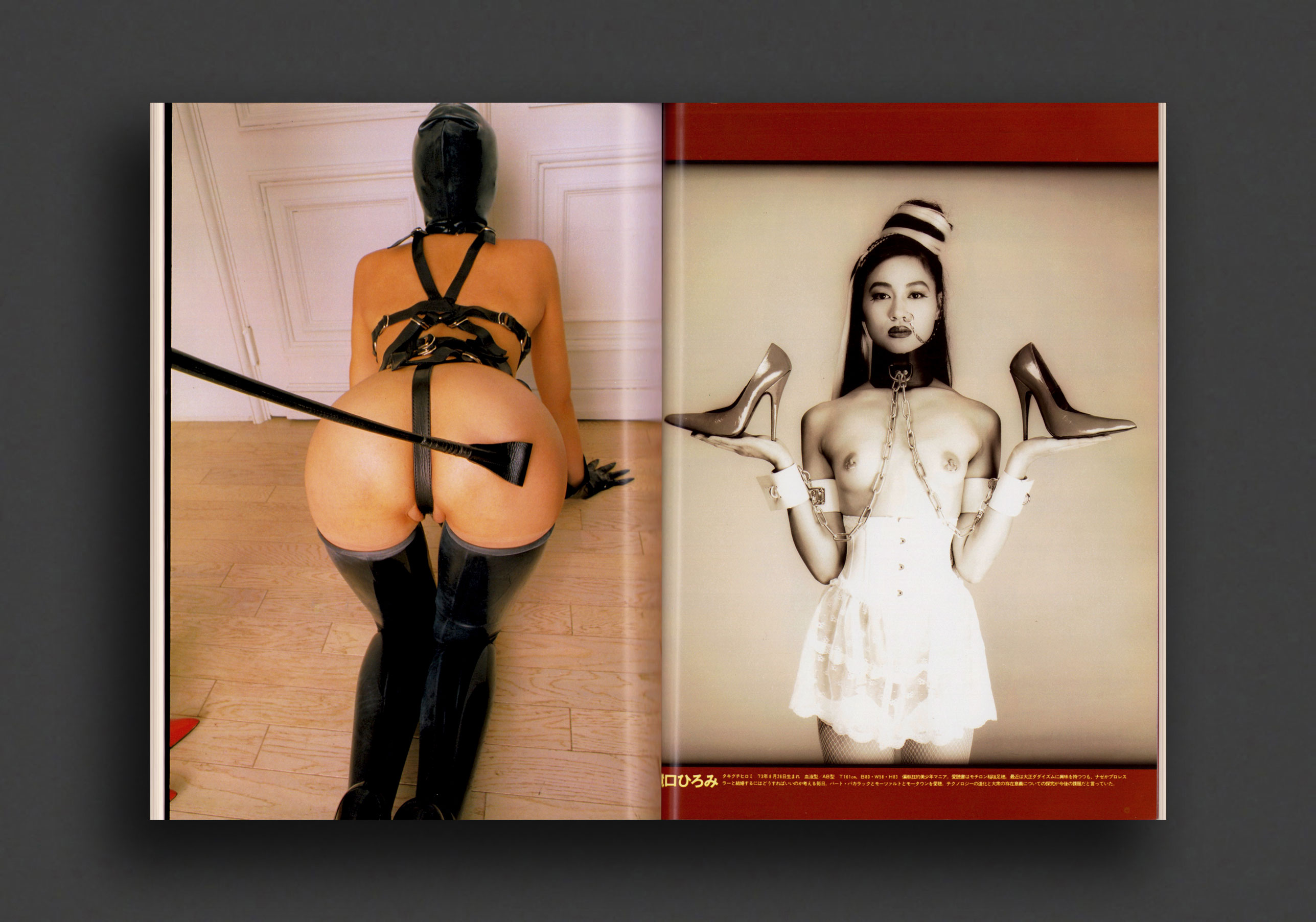
Inaugural April 1993 issue of Japan's short-lived Topaz magazine, published by Eichi Publishing. Edited by Kimura Hiroyuki, Topaz burst onto the flourishing SM scene as the influence of Kinbaku/Shibari culture, fetish fashion, "abnormal" sexual practices, modern primitive, and underground SM culture was becoming hugely influential on high-end fashion, glamour photography, and art/film/music at large. A similar approach to SM Sniper, sharing many of the same contributors such as SM archivist and noise musician Masami Akita (Merzbow), Topaz emphasised the new wave of artistic output from the real protagonists of the experimental SM counterculture in Japan (and abroad), centering around the work of the models, stylists, make-up artists, and fashions designers, as much as the kinbakushi, writers or photographers. Topaz benefited from the large format of a glossy, full-colour magazine, rather than the usual mook format of SM magazines, each issue packed with hundreds of images, a double-sided full-colour fold-out poster, original full-colour glossy photo-shoots, art galleries, reports and reviews on developments in the underground (noise music, pink film, sex clubs, erotic art, etc.), instructional and historical articles, rare interviews and profiles with the featured models and artists, and photo features on all manner of sexual customs and practices (transsexualism, lesbianism, virtual sex, rubberism, medical fetish, prostitution, techno sex...). One of the most under-rated SM mags from Tokyo, brimming with information on underground publishing, boutiques, and erotic art largely lost to time.
Very Good copy.

Topaz Vol. 3 (THE BONDAGE MAGAZINE)
October 1993
1993, Japanese
Softcover, 140 + pages, 29 x 21 cm
1st Edition, Out of print title / used / very good
$65.00 - In stock -
"For All Beautiful and Sensual Pleasure"
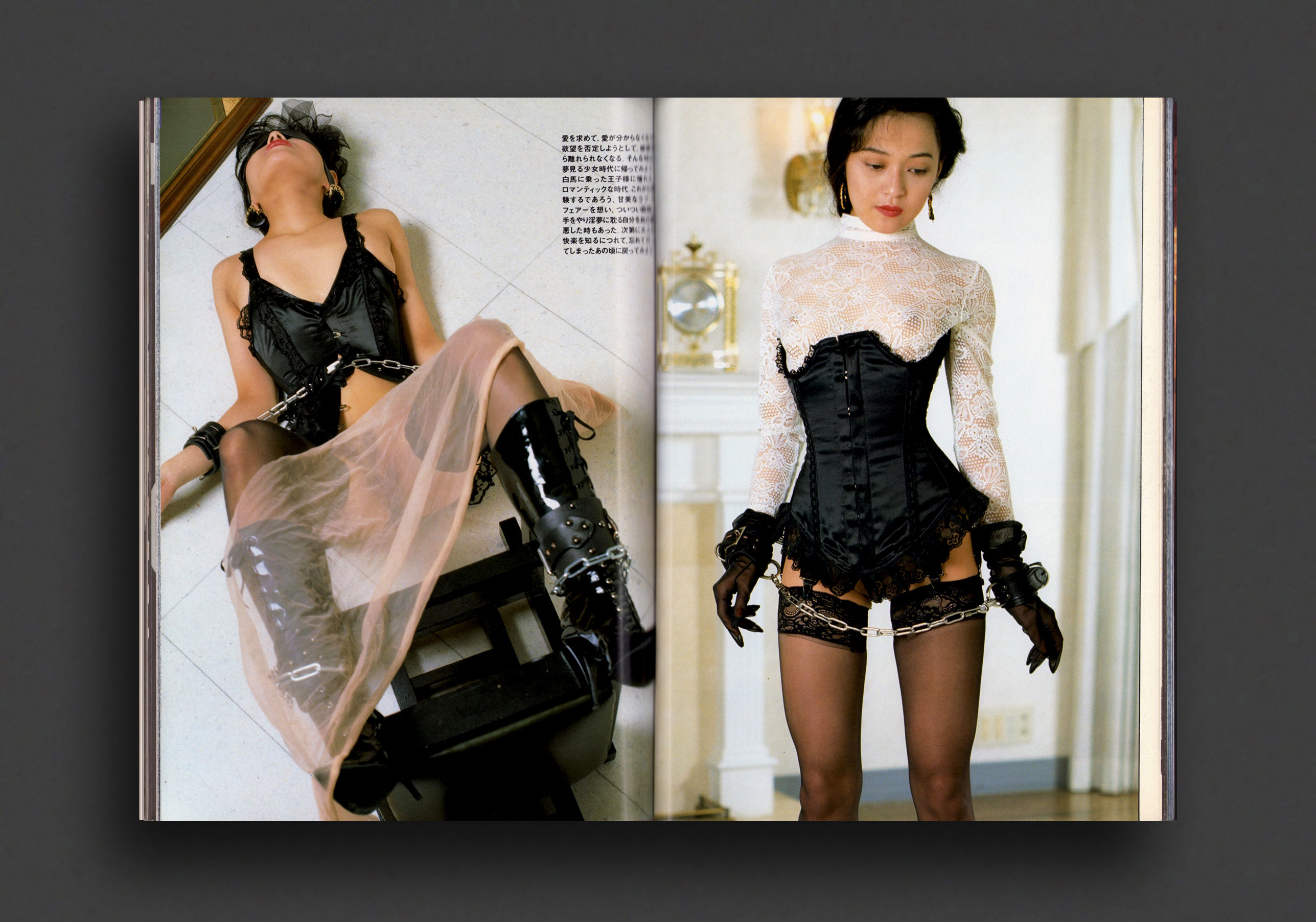
October 1993 issue of Japan's short-lived Topaz magazine, first published by Eichi Publishing in April 1993. Edited by Kimura Hiroyuki, Topaz burst onto the flourishing SM scene as the influence of Kinbaku/Shibari culture, fetish fashion, "abnormal" sexual practices, modern primitive, and underground SM culture was becoming hugely influential on high-end fashion, glamour photography, and art/film/music at large. A similar approach to SM Sniper, sharing many of the same contributors such as SM archivist and noise musician Masami Akita (Merzbow), Topaz emphasised the new wave of artistic output from the real protagonists of the experimental SM counterculture in Japan (and abroad), centering around the work of the models, stylists, make-up artists, and fashions designers, as much as the kinbakushi, writers or photographers. Topaz benefited from the large format of a glossy, full-colour magazine, rather than the usual mook format of SM magazines, each issue packed with hundreds of images, a double-sided full-colour fold-out poster, original full-colour glossy photo-shoots, art galleries, reports and reviews on developments in the underground (noise music, pink film, sex clubs, erotic art, etc.), instructional and historical articles, rare interviews and profiles with the featured models and artists, and photo features on all manner of sexual customs and practices (transsexualism, lesbianism, virtual sex, rubberism, medical fetish, prostitution, techno sex...). One of the most under-rated SM mags from Tokyo, brimming with information on underground publishing, boutiques, and erotic art largely lost to time.
Very Good copy.

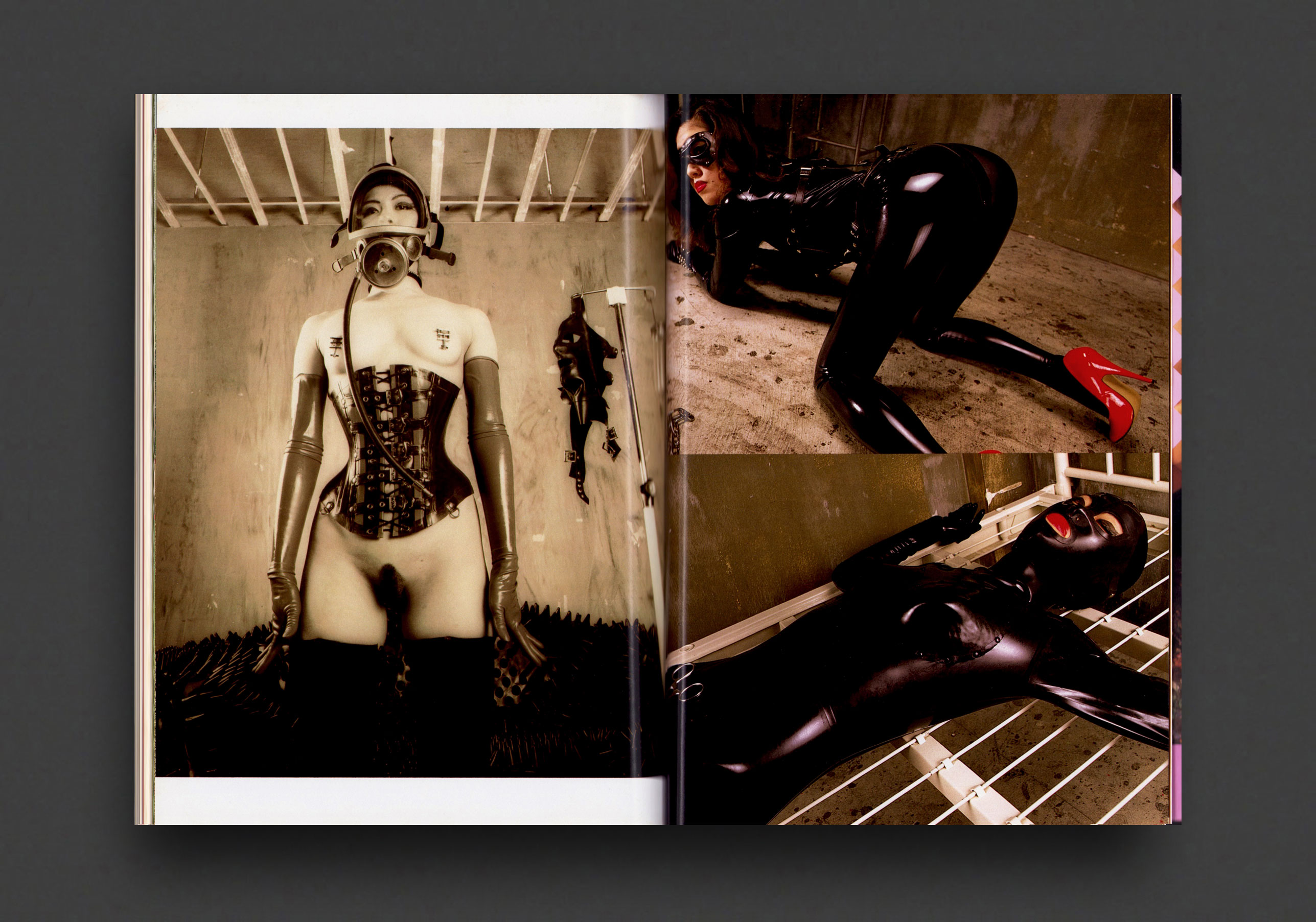
Topaz Vol. 4 (THE BONDAGE MAGAZINE)
December 1993
1993, Japanese
Softcover, 140 + pages, 29 x 21 cm
1st Edition, Out of print title / used / very good
$65.00 - In stock -
"For All Beautiful and Sensual Pleasure"
December 1993 issue of Japan's short-lived Topaz magazine, first published by Eichi Publishing in April 1993. Edited by Kimura Hiroyuki, Topaz burst onto the flourishing SM scene as the influence of Kinbaku/Shibari culture, fetish fashion, "abnormal" sexual practices, modern primitive, and underground SM culture was becoming hugely influential on high-end fashion, glamour photography, and art/film/music at large. A similar approach to SM Sniper, sharing many of the same contributors such as SM archivist and noise musician Masami Akita (Merzbow), Topaz emphasised the new wave of artistic output from the real protagonists of the experimental SM counterculture in Japan (and abroad), centering around the work of the models, stylists, make-up artists, and fashions designers, as much as the kinbakushi, writers or photographers. Topaz benefited from the large format of a glossy, full-colour magazine, rather than the usual mook format of SM magazines, each issue packed with hundreds of images, a double-sided full-colour fold-out poster, original full-colour glossy photo-shoots, art galleries, reports and reviews on developments in the underground (noise music, pink film, sex clubs, erotic art, etc.), instructional and historical articles, rare interviews and profiles with the featured models and artists, and photo features on all manner of sexual customs and practices (transsexualism, lesbianism, virtual sex, rubberism, medical fetish, prostitution, techno sex...). One of the most under-rated SM mags from Tokyo, brimming with information on underground publishing, boutiques, and erotic art largely lost to time.
Very Good copy.

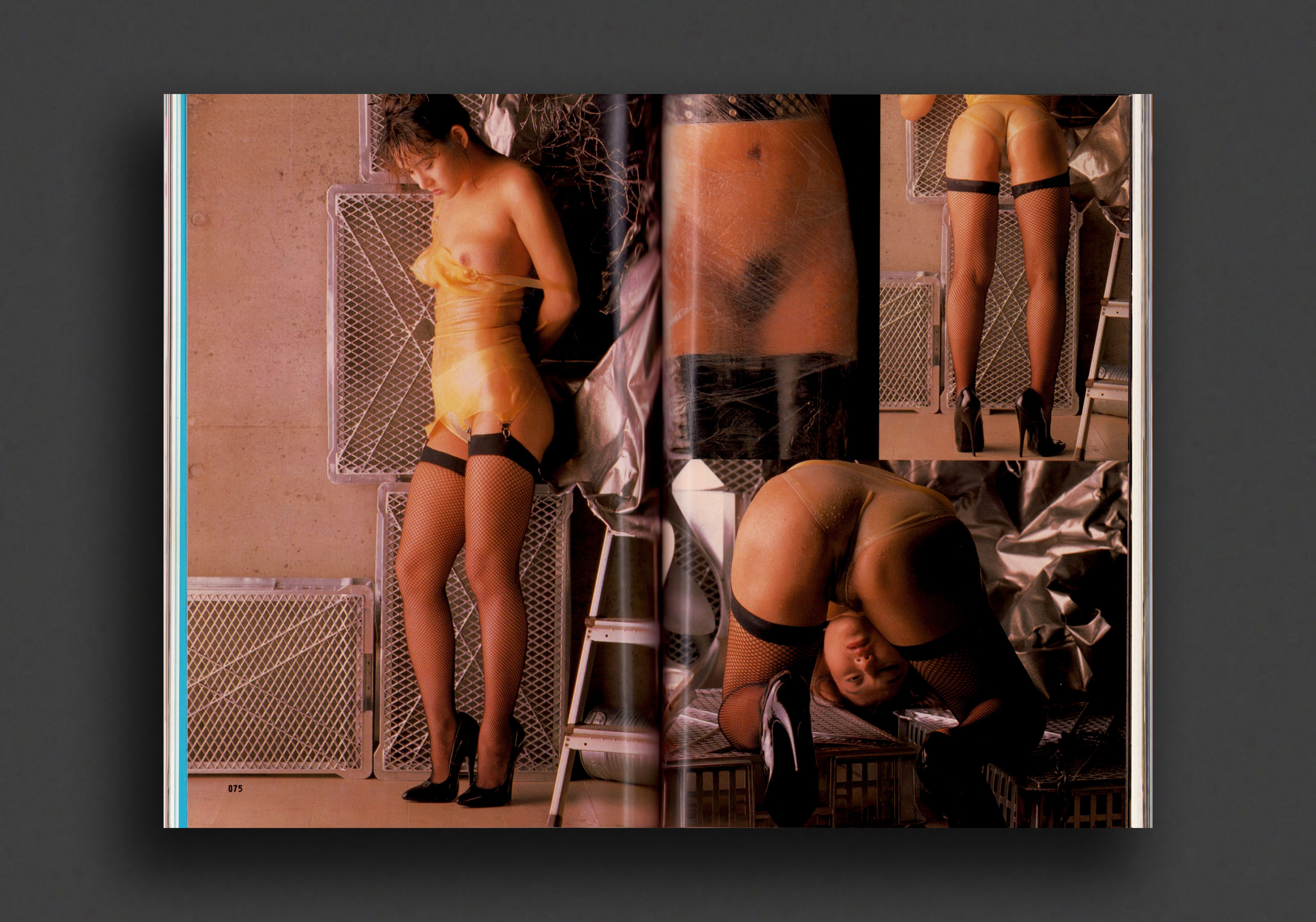
Topaz Vol. 5 (THE BONDAGE MAGAZINE)
February 1994
1994, Japanese
Softcover, 140 + pages, 26 x 18 cm
1st Edition, Out of print title / used / very good
$55.00 - In stock -
"For All Beautiful and Sensual Pleasure"
February 1994 issue of Japan's short-lived Topaz magazine, first published by Eichi Publishing in April 1993. Edited by Kimura Hiroyuki, Topaz burst onto the flourishing SM scene as the influence of Kinbaku/Shibari culture, fetish fashion, "abnormal" sexual practices, modern primitive, and underground SM culture was becoming hugely influential on high-end fashion, glamour photography, and art/film/music at large. A similar approach to SM Sniper, sharing many of the same contributors such as SM archivist and noise musician Masami Akita (Merzbow), Topaz emphasised the new wave of artistic output from the real protagonists of the experimental SM counterculture in Japan (and abroad), centering around the work of the models, stylists, make-up artists, and fashions designers, as much as the kinbakushi, writers or photographers. Topaz benefited from the large format of a glossy, full-colour magazine, rather than the usual mook format of SM magazines, each issue packed with hundreds of images, a double-sided full-colour fold-out poster, original full-colour glossy photo-shoots, art galleries, reports and reviews on developments in the underground (noise music, pink film, sex clubs, erotic art, etc.), instructional and historical articles, rare interviews and profiles with the featured models and artists, and photo features on all manner of sexual customs and practices (transsexualism, lesbianism, virtual sex, rubberism, medical fetish, prostitution, techno sex...). One of the most under-rated SM mags from Tokyo, brimming with information on underground publishing, boutiques, and erotic art largely lost to time.
This issue was slightly smaller in dimensions and skipped the poster.
Very Good copy.

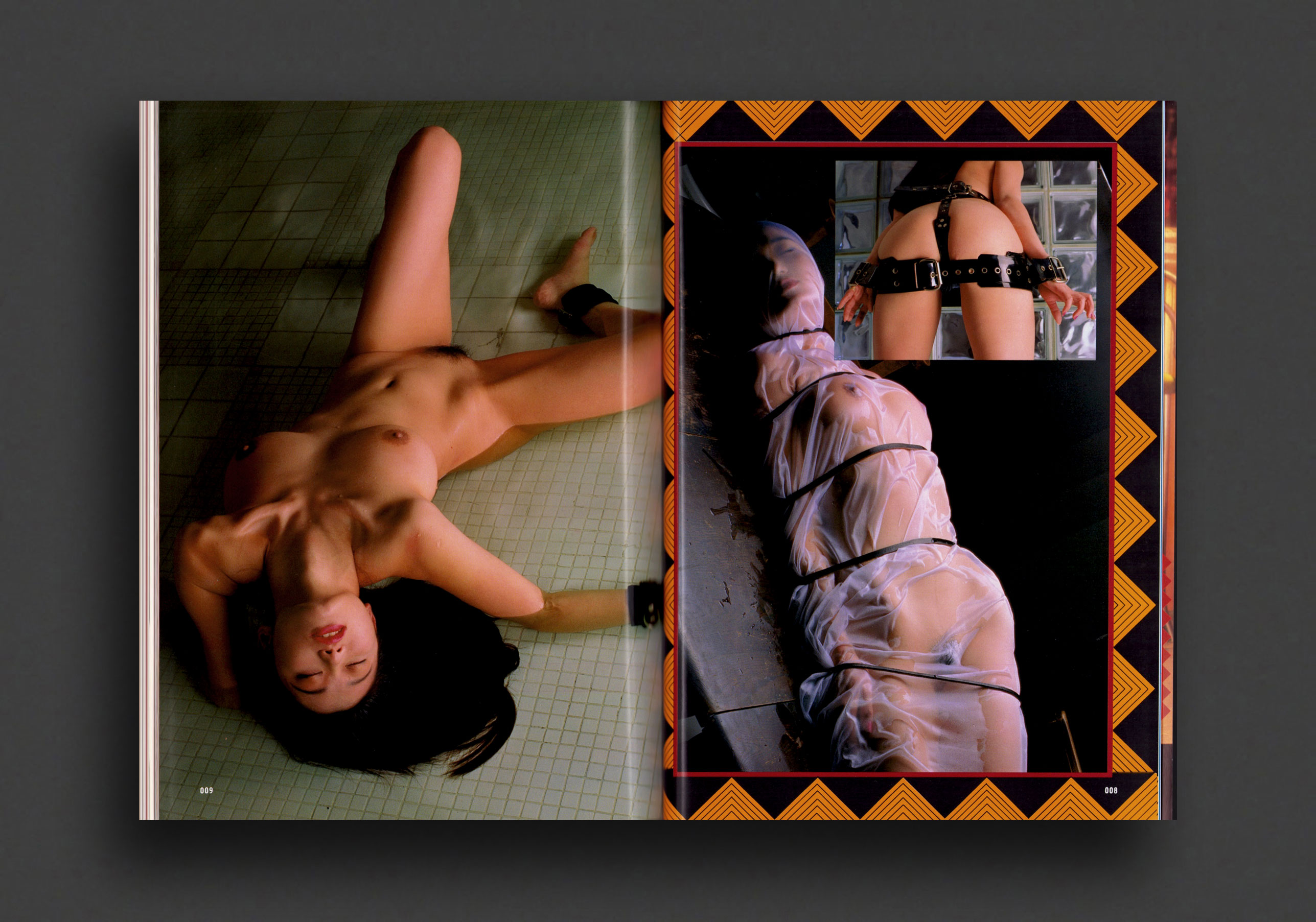
Topaz Vol. 6 (THE BONDAGE MAGAZINE)
April 1994
1994, Japaanese
Softcover, 140 + pages, 29 x 21 cm
1st Edition, Out of print title / used / very good
$65.00 - In stock -
"For All Beautiful and Sensual Pleasure"
April 1994 issue of Japan's short-lived Topaz magazine, first published by Eichi Publishing in April 1993. Edited by Kimura Hiroyuki, Topaz burst onto the flourishing SM scene as the influence of Kinbaku/Shibari culture, fetish fashion, "abnormal" sexual practices, modern primitive, and underground SM culture was becoming hugely influential on high-end fashion, glamour photography, and art/film/music at large. A similar approach to SM Sniper, sharing many of the same contributors such as SM archivist and noise musician Masami Akita (Merzbow), Topaz emphasised the new wave of artistic output from the real protagonists of the experimental SM counterculture in Japan (and abroad), centering around the work of the models, stylists, make-up artists, and fashions designers, as much as the kinbakushi, writers or photographers. Topaz benefited from the large format of a glossy, full-colour magazine, rather than the usual mook format of SM magazines, each issue packed with hundreds of images, a double-sided full-colour fold-out poster, original full-colour glossy photo-shoots, art galleries, reports and reviews on developments in the underground (noise music, pink film, sex clubs, erotic art, etc.), instructional and historical articles, rare interviews and profiles with the featured models and artists, and photo features on all manner of sexual customs and practices (transsexualism, lesbianism, virtual sex, rubberism, medical fetish, prostitution, techno sex...). One of the most under-rated SM mags from Tokyo, brimming with information on underground publishing, boutiques, and erotic art largely lost to time.
Very Good copy.

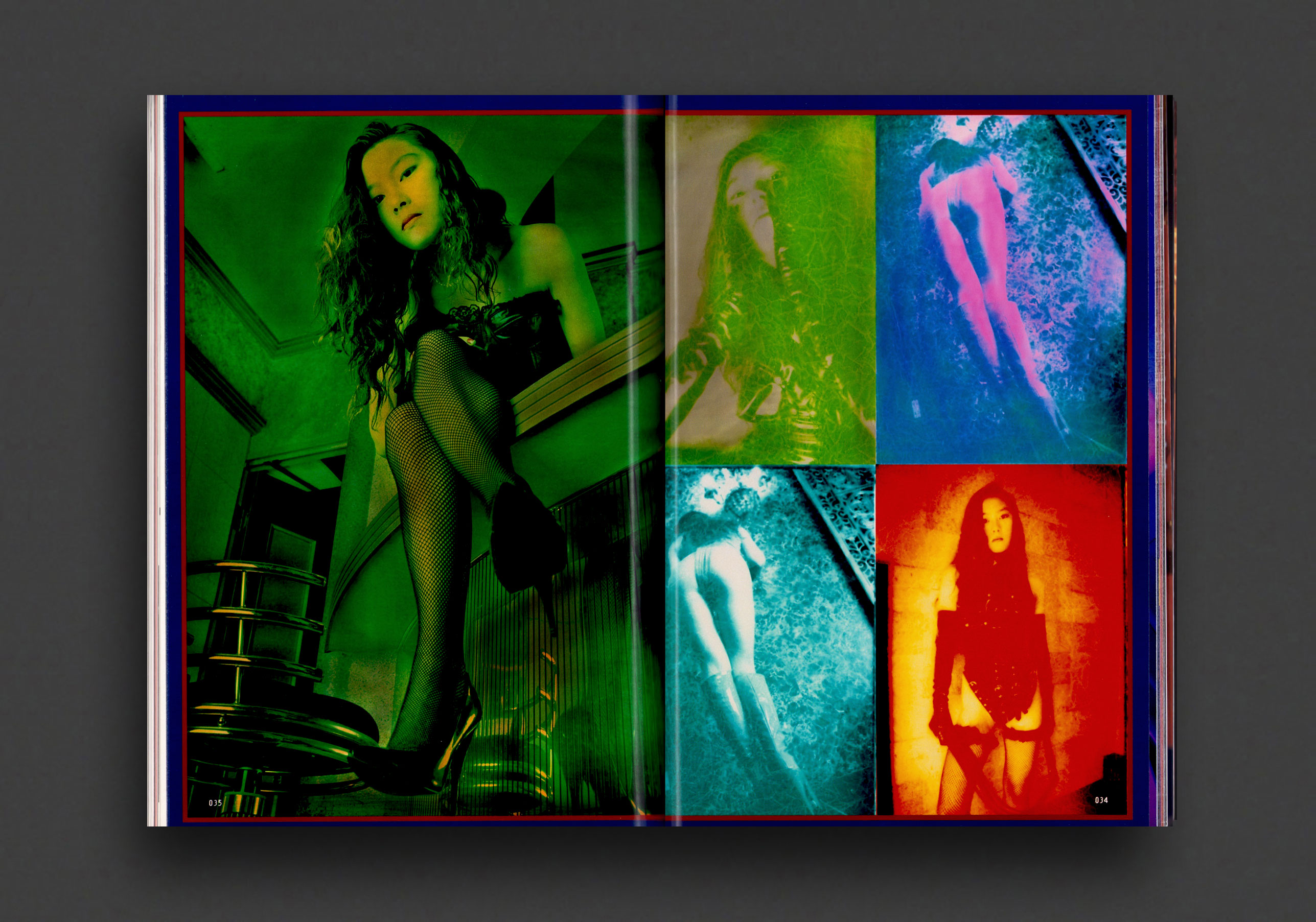
Topaz Vol. 8 (THE BONDAGE MAGAZINE)
August 1994
1994, Japanese
Softcover, 140 + pages, 29 x 21 cm
1st Edition, Out of print title / used / very good
$65.00 - In stock -
"For All Beautiful and Sensual Pleasure"
August 1994 issue of Japan's short-lived Topaz magazine, first published by Eichi Publishing in April 1993. Edited by Kimura Hiroyuki, Topaz burst onto the flourishing SM scene as the influence of Kinbaku/Shibari culture, fetish fashion, "abnormal" sexual practices, modern primitive, and underground SM culture was becoming hugely influential on high-end fashion, glamour photography, and art/film/music at large. A similar approach to SM Sniper, sharing many of the same contributors such as SM archivist and noise musician Masami Akita (Merzbow), Topaz emphasised the new wave of artistic output from the real protagonists of the experimental SM counterculture in Japan (and abroad), centering around the work of the models, stylists, make-up artists, and fashions designers, as much as the kinbakushi, writers or photographers. Topaz benefited from the large format of a glossy, full-colour magazine, rather than the usual mook format of SM magazines, each issue packed with hundreds of images, a double-sided full-colour fold-out poster, original full-colour glossy photo-shoots, art galleries, reports and reviews on developments in the underground (noise music, pink film, sex clubs, erotic art, etc.), instructional and historical articles, rare interviews and profiles with the featured models and artists, and photo features on all manner of sexual customs and practices (transsexualism, lesbianism, virtual sex, rubberism, medical fetish, prostitution, techno sex...). One of the most under-rated SM mags from Tokyo, brimming with information on underground publishing, boutiques, and erotic art largely lost to time.
Very Good copy.


Mike Kelley
Catholic Tastes
1993, English
Softcover, 256 pages, 24 x 16.5 cm
1st Edition, Out of print title / used / very good
$340.00 - In stock -
Still, and will probably always be, the best book on Mike Kelley. First edition, now very collectible. This definitive survey was published in 1993 in conjunction with "Mike Kelley", a travelling exhibition held at Whitney Museum of American Art, New York; Los Angeles County Museum of Art, LA; and Moderna Museet, Stockholm, throughout 1994. Mike Kelley, one of the leading Californian artists of the 1990s, was a proponent of abject or pathetic art, an anti-aesthetic, anti-heroic movement, which criticized social and artistic issues through banality and humour. Exploring the work of this great and controversial performance artist and sculptor at the mid-way point in his career, this dense book presents thirteen essays, plus an introduction, discussing Kelley's projects, performances, and the ideas and diverse influences that motivate his work - contemporary art, rock and roll, social commentary and pop culture. Profusely illustrated throughout in colour and black and white, with texts by Elizabeth Sussman, David Marsh, Richard Armstrong, Timothy Martin, Howard Singerman, Colin Gardner, Dennis Cooper & Casey McKinney, John Miller, Ralph Rugoff, Kim Gordon, Howard N. Fox, Diedrich Diederichsen, Jutta Koether, Martin Prinzhorn, Paul Schimmel, John G. Hanhardt. No less! Includes a bibliography and exhibition history. Catalogue designed by Lorraine Wild and ReVerb.
Highly recommended.
Good—Very Good copy, with some general light wear to covers/spine.
Maria Anto
2004, English / Polish
Hardcover, 216 pages, 30 x 24 cm
1st Edition, Out of print title / used / very good
$160.00 - In stock -
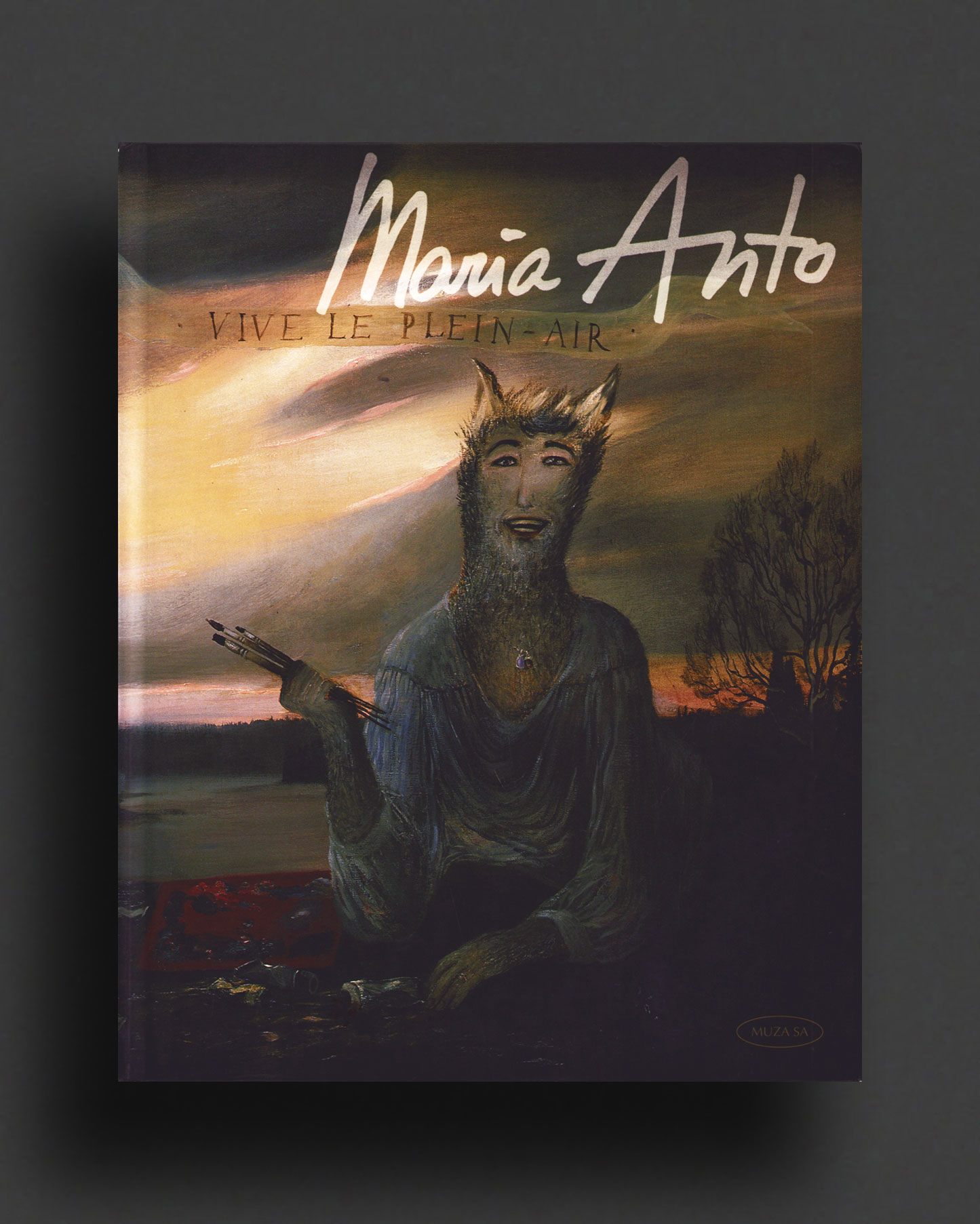
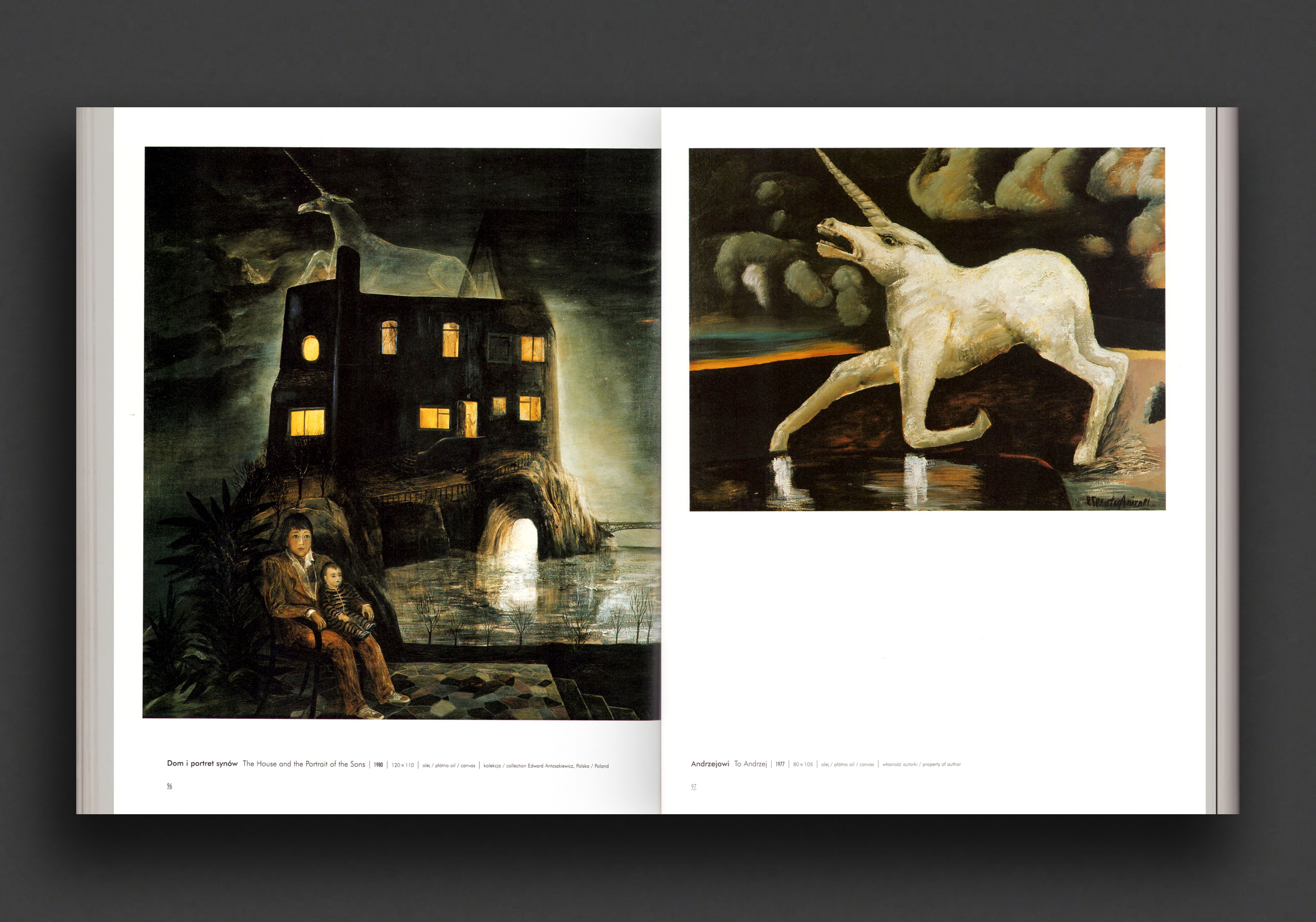
The most comprehensive monograph ever published on Polish painter Maria Anto (1936–2007), renowned for her metaphysical, dreamlike vision that merges figuration with elements of naïve art and poetic symbolism. Edited by Elżbieta Olszewska, this 2004 hardcover volume, long out-of-print, is profusely illustrated in colour with reproductions of over 220 of her paintings, criminally little seen outside Poland, alongside a full autobiography by Anto giving intimate insight into her artwork, exhibition reviews, a timeline of her life and work, lists of exhibitions and awards, and a lengthy interview with Małgorzata Bocheńska. Texts are in bi-lingual Polish / English. Includes her Tarot paintings.
Anto's paintings are characterized by simplified yet fantastic forms, flattened perspectives, magical creatures, and luminous, often unreal colour palettes, creating an atmosphere suspended between reality and imagination. Inspired by Italian trecento painting, surrealism, the works of Marc Chagall and Henri Rousseau, and drawing on mythology, folklore, and inner landscapes, Anto’s work evokes a quiet, contemplative dimension in which solitary figures, animals, and fantastical architectures appear timeless and introspective. Balancing innocence with metaphysical depth, her art occupies a unique place in Polish postwar painting, distinguished by its emotional subtlety, symbolic resonance, and enduring sense of mystery. Contrary to the prevailing currents, Maria Anto managed (quite quickly) to appear in the world of art, although she always remained somewhat independent - on the sidelines of groups and painting trends. The artist graduated from the Academy of Fine Arts in Warsaw in 1960, and already in 1963 represented Poland at the São Paulo Biennale. She repeatedly took part in plein-air painting workshops in Białowieża, where she created her most significant works. "The spirits of Białowieża make me see more. I discover places of power, primeval enchanted spots there." During martial law she actively participated in the independent culture movement. She worked and exhibited prolifically from behind The Iron Curtain. Nevertheless, she remained forgotten for some time after her death, and is still hardly known outside Poland or Italy, where she exhibited most. From today’s perspective, Maria Anto’s art forms an exceptionally original and poetic language that distinguished her from the Warsaw avant-garde. Anto remained faithful to her aesthetic choices throughout her lifetime, creating an astounding collection of works, achieving an undisputed individualism as a painter.
Very Good copy, light wear/age.
Clovis Trouille
1972, Japanese
Hardcover (in slipcase with dust jacket + obi), 80 pages, 32 x 25 cm
1st Edition, Out of print title / used / good
$90.00 - In stock -
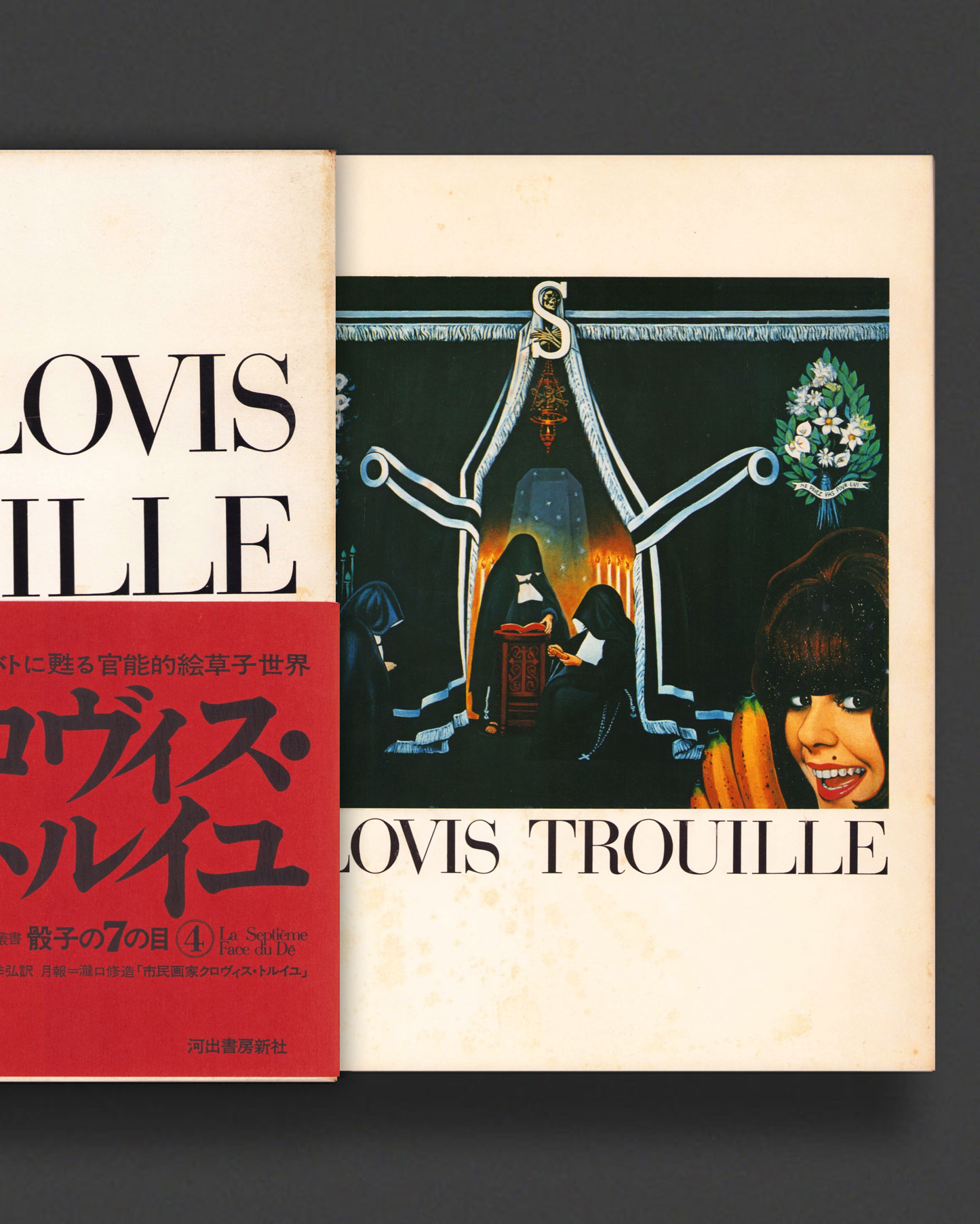
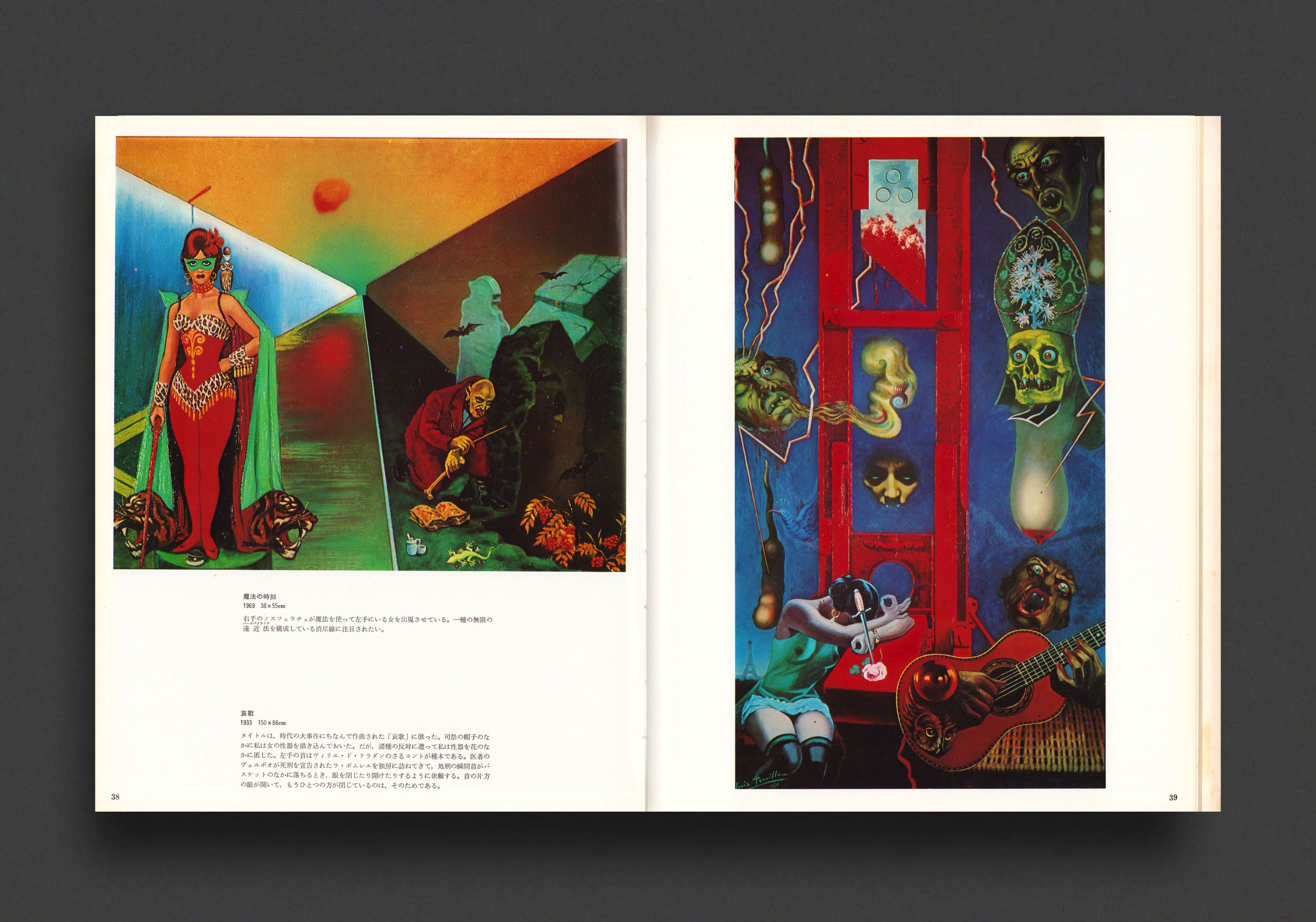
Wonderful 1972 slip-cased hardcover monograph on seldom documented, elusive French artist Clovis Trouille. Bound in pink cloth and wrapped in illustrated original dust-jacket, this heavily illustrated book surveys Trouille's vibrant and controversial paintings through beautiful colour and monochrome gravure reproductions, alongside various texts, biography, bibliography and portrait of the artist — a most complete copy including all insert booklets. Published as volume 4 of the deluxe La Septième Face du Dé series by Kawade Shobo Shinsha in Japan in the 1970s after the Editions Filipacchi series. All editions now out-of-print.
Clovis Trouille (1889-1975)—Trouille in colloquial French means fear—was a French artist known for paintings of erotic and anti-clerical subjects. Trouille was born in La Fère, France, and was trained at the École des Beaux-Arts of Amiens from 1905 to 1910. He was drafted on 2 August, 1914. His service in World War I made him an anarchist and his painting followed suit. His hatred of the military, paired with his contempt for the Church as a corrupt institution, provided Trouille with the inspiration for decades of work. Trouille always paddled upstream in a river of Christian morality, military patriotism and bourgeois ostentation with lightness, irony and obstinacy. His erotic and gaudy work delivered a slap in the face to both religion and war. Trouille has often been classed as a "Sunday painter." He's also been referred to as an "Angel of Bad Taste," and a purveyor of "horrotica", with Trouille's other common subjects being sex, perversion and all manner of depravity (ala de Sade). After his work was seen by Louis Aragon and Salvador Dalí, Trouille was declared a Surrealist by André Breton, though Trouille was rather ambivalent, accepting the designation to have his work reach an audience rather than embracing the movement. He was always his own painter. He worked primarily for himself, did not like to sell his paintings, had no interest in self-promotion or the art world, and made his living as a restorer and decorator of department store mannequins. Nonetheless, he maintained contact with the surrealists, including Breton and Marcel Jean. Trouille died on 24 September 1975 in Neuilly-sur-Marne.
Most complete copy of this 1972

On Painting
By Gilles Deleuze
2025, English
Softcover, 360 pages, 21.5 x 14 cm
$62.00 - In stock -
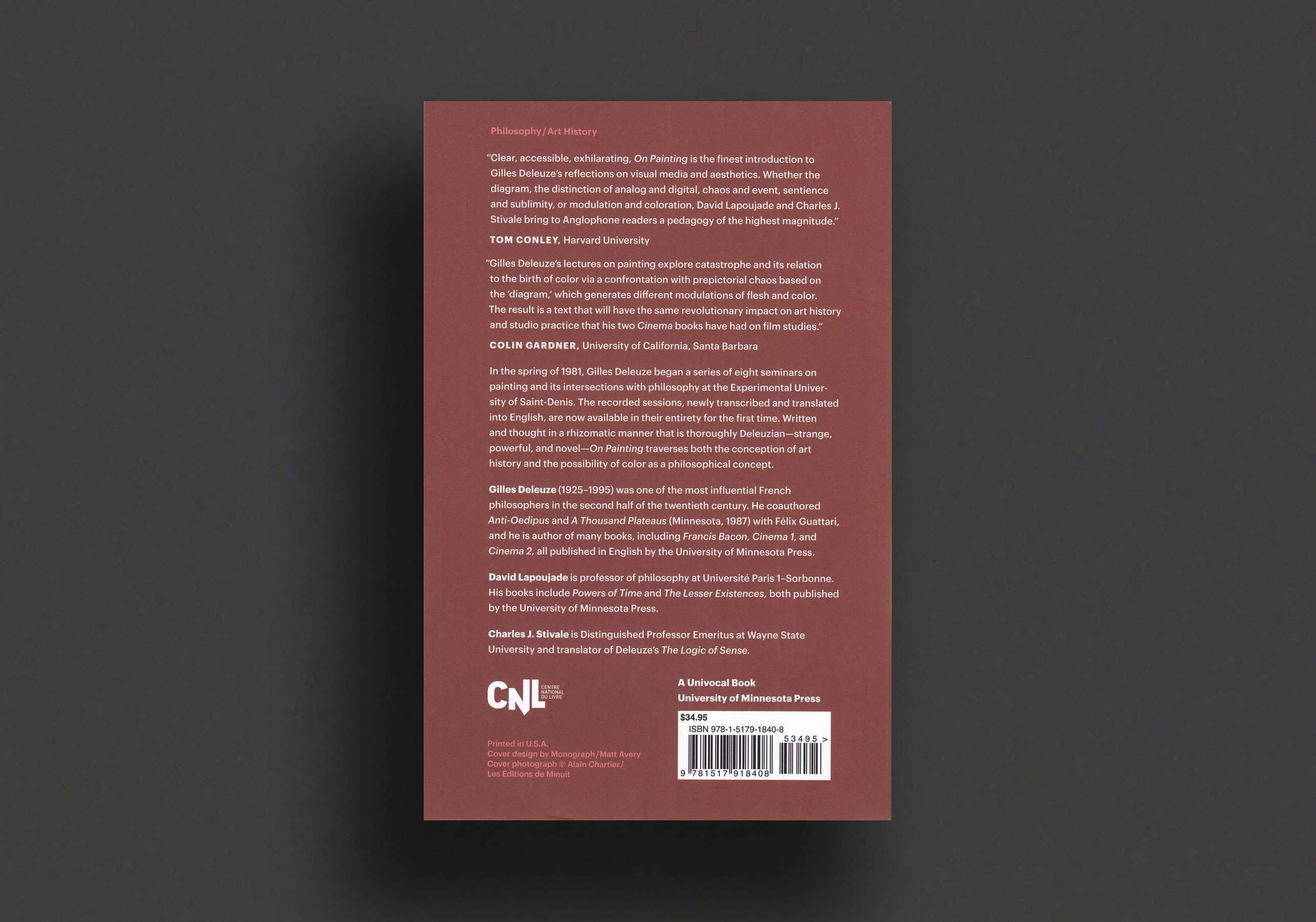
From 1970 until 1987, Gilles Deleuze held a weekly seminar at the Experimental University of Vincennes and, starting in 1980, at Saint-Denis. In the spring of 1981, he began a series of eight seminars on painting and its intersections with philosophy. The recorded sessions, newly transcribed and translated into English, are now available in their entirety for the first time. Extensively annotated by philosopher David Lapoujade, On Painting illuminates Deleuze's thinking on artistic creation, significantly extending the lines of thought in his book Francis Bacon.
Through paintings and writing by Rembrandt, Delacroix, Turner, Cezanne, Van Gogh, Klee, Pollock, and Bacon, Deleuze explores the creative process, from chaos to the pictorial fact. The introduction and use of color feature prominently as Deleuze elaborates on artistic and philosophical concepts such as the diagram, modulation, code, and the digital and the analogical. Through this scrutiny, he raises a series of profound and stimulating questions for his students: How does a painter ward off greyness and attain color? What is a line without contour? Why paint at all?
Written and thought in a rhizomatic manner that is thoroughly Deleuzian-strange, powerful, and novel-On Painting traverses both the conception of art history and the possibility of color as a philosophical concept.
Edited by David Lapoujade, translated by Charles J. Stivale.

Spinoza: Practical Philosophy
By Gilles Deleuze
1988, English
Softcover, 130 pages, 20.5 x 14 cm
1st Edition, Out of print title / used / fine
$30.00 - Out of stock
First 1988 edition.
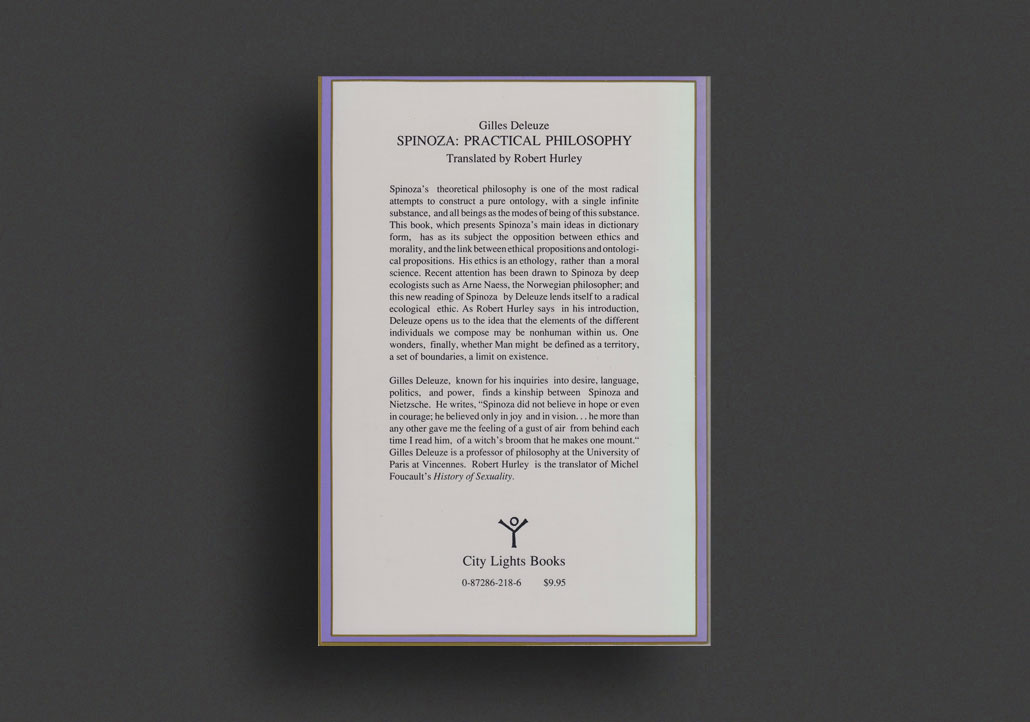
Spinoza’s theoretical philosophy is one of the most radical attempts to construct a pure ontology, with a single infinite substance, and all beings as the modes of being of this substance.
This book, which presents Spinoza’s main ideas in dictionary form, has as its subject the opposition between ethics and morality, and the link between ethical propositions and ontological propositions. His ethics is an ethology, rather than a moral science. Recent attention has been drawn to Spinoza by deep ecologists such as Arne Naess, the Norwegian philosopher; and this new reading of Spinoza by Deleuze lends itself to a radical ecological ethic. As Robert Hurley says in his introduction, Deleuze opens us to the idea that the elements of the different individuals we compose may be nonhuman within us. One wonders, finally, whether Man might be defined as a territory, a set of boundaries, a limit on existence.
VG—NF.


PANSY December 1978 Edition 11
1978, Japanese
Softcover (staple-bound), 25.5 x 18 cm
1st Edition, Out of print title / used / very good
$90.00 - In stock -
Super rare glam rock issue of the super rare PANSY fanzine, published by Queer Kids in Tokyo in the 1970s. Never seen another issue ever before (apparently 12 were produced), PANSY applies the queer gaze to the world of glam rock, post punk, new romantic... T-Rex/Marc Bolan, New York Dolls, David Bowie, Japan, Slade, Roxy Music, Raped, Brats ... photographing, interviewing, and profiling the princes of the new androgynous wave with school diary visual sensibility and DIY hand-collage aesthetic throughout. Includes a New York Dolls family tree, loads of magazine clipped pictures, and hand-written Japanese texts. Very obscure, very charming, very Japanese.
Very Good copy with small previous sticker damage to top of spine (front/back), otherwise only light edge wear and age.

BOY London
Blackmail
1980?, English
Softcover (staple-bound), 16 pages, 29.5 x 20.8 cm
1st Edition, Out of print title / used / good
$150.00 - In stock -
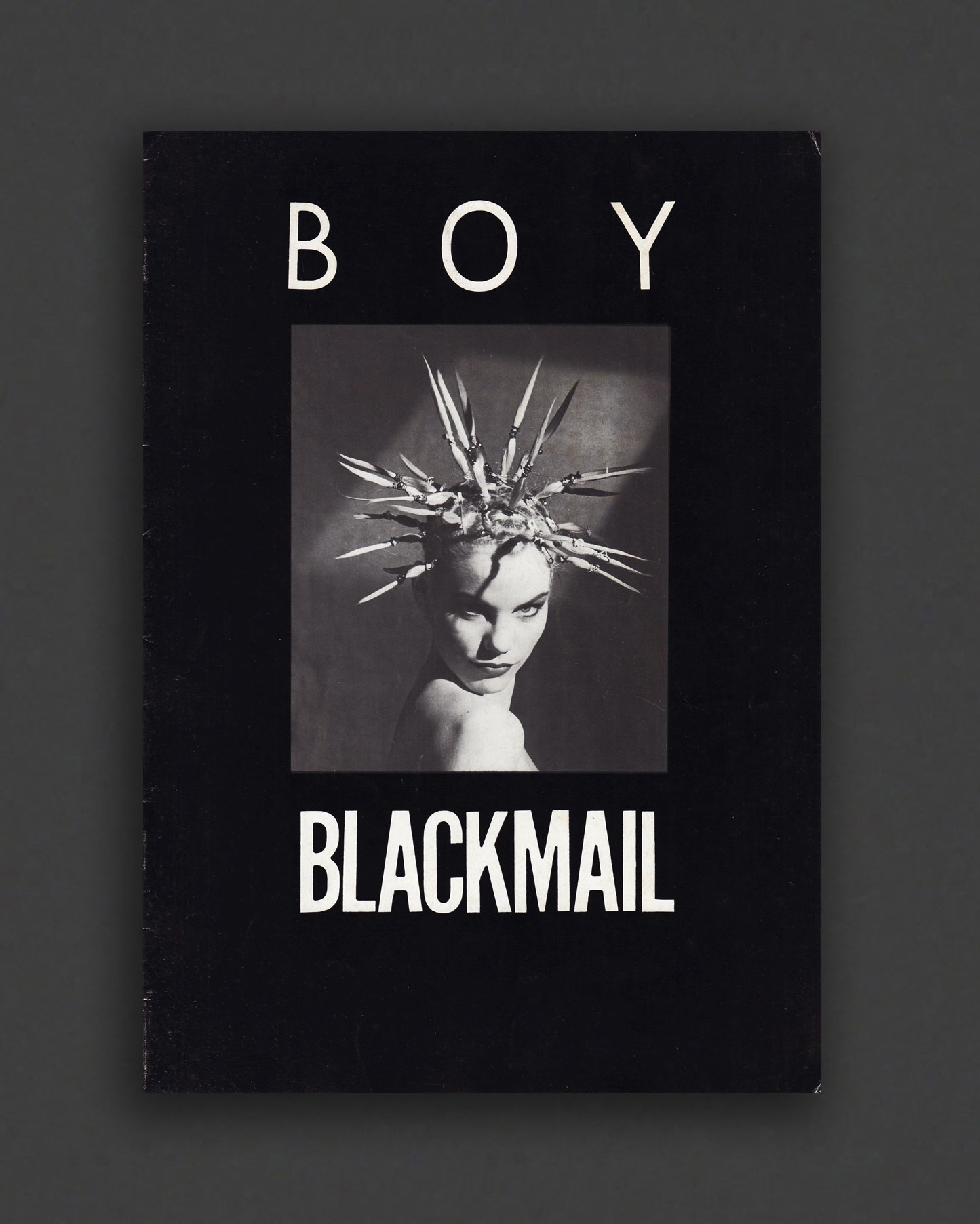
Very rare original BOY London Blackmail catalogue circa early—mid 1980s, featuring all the classic BOY range from one of London’s most iconic original punk shops/fashion labels, founded in 1976 by Stephane Raynor. Likely designed by Peter "Sleazy" Christopherson (Throbbing Gristle/Psychic TV/Coil/Hipgnosis) who designed the BOY logo and much of their visual collateral, his photo catalogue, featuring models from around the London punk scene, was originally privately issued by BOY London to be used for mail-order and wholesale orders. It features all the original Vivienne Westwood and Malcolm McLaren Seditionaries designs, from the t-shirts (Sex Pistols' God Save The Queen, Destroy, Tom of Finland, etc.) to footwear, parachute shirts, bondage trousers and mohair jumpers, which were all sold in BOY after Seditionaries closed in September 1980. It also features BOY's own (equally iconic) designs and wild styling, with amazing hair and make-up by Jalle. Extremely rare piece of London's punk fashion history.
Good copy with light general handling wear/spine pinching.

The 120 Days of Sodom
The Marquis de Sade
2016, English
Softcover, 464 pages, 19.7 x 13 cm
$28.00 - In stock -
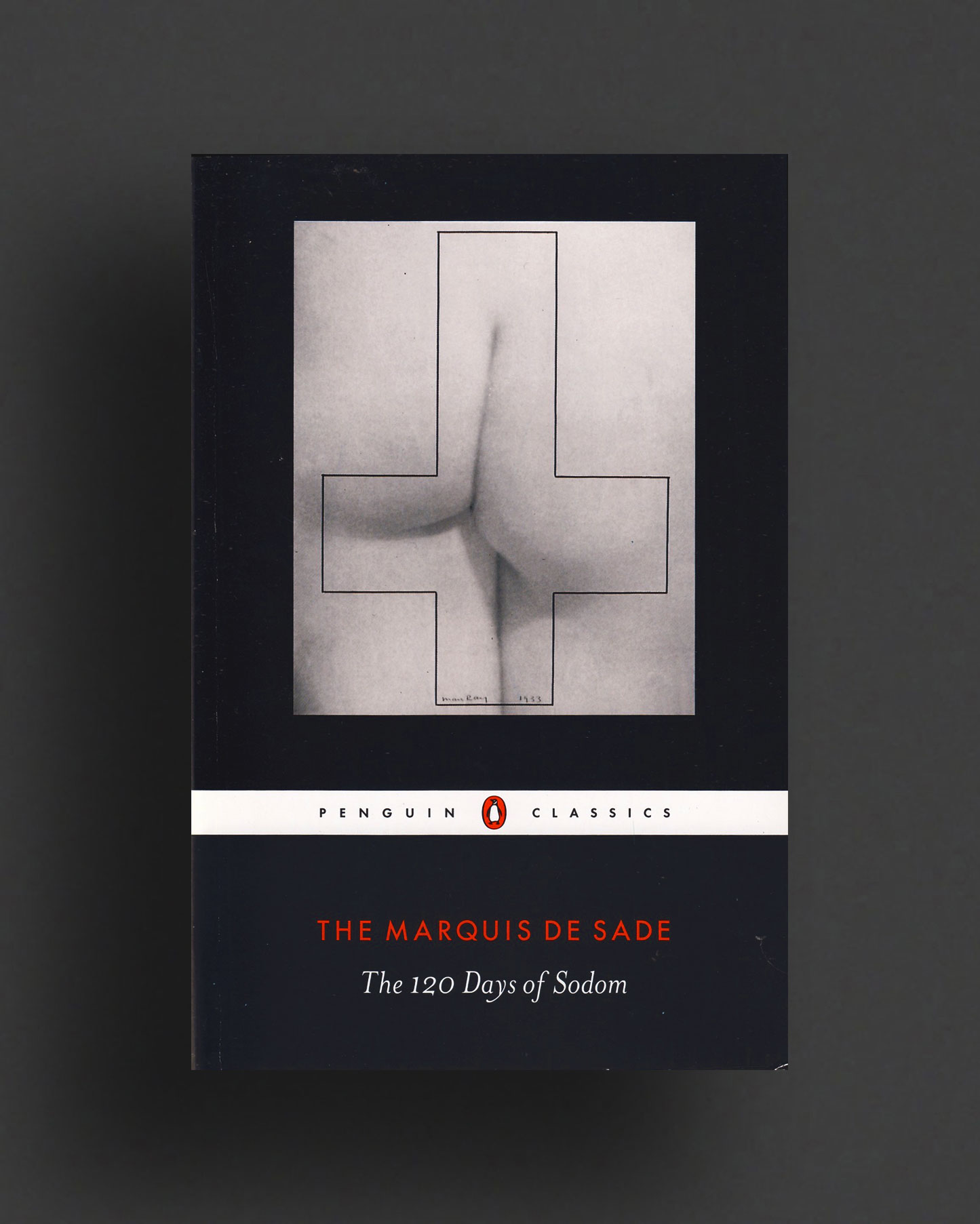
A new translation of Sade's most notorious, shocking, and influential novel
This distressing but hugely important text, which the Marquis de Sade himself called "the most impure tale that has ever been written since the world exists," has influenced countless major artists and thinkers throughout history. Flaubert and Baudelaire both read Sade, the surrealists were obsessed with him, filmmakers like Pasolini saw parallels with twentieth-century history in his writings, and feminists such as Simone de Beauvoir and Angela Carter fought over him. This new translation brings Sade's provocative novel into Penguin Classics for the first time, and will reignite the debate around this most controversial of writers.
For more than seventy years, Penguin has been the leading publisher of classic literature in the English-speaking world. With more than 1,700 titles, Penguin Classics represents a global bookshelf of the best works throughout history and across genres and disciplines. Readers trust the series to provide authoritative texts enhanced by introductions and notes by distinguished scholars and contemporary authors, as well as up-to-date translations by award-winning translators.
Sexy Look Vol. 6 No. 4
April 1988
1988, Japanese
Softcover (staple-bound), 98 pages, 27 x 21 cm
1st Edition, Out of print title / used / very good
$45.00 - Out of stock
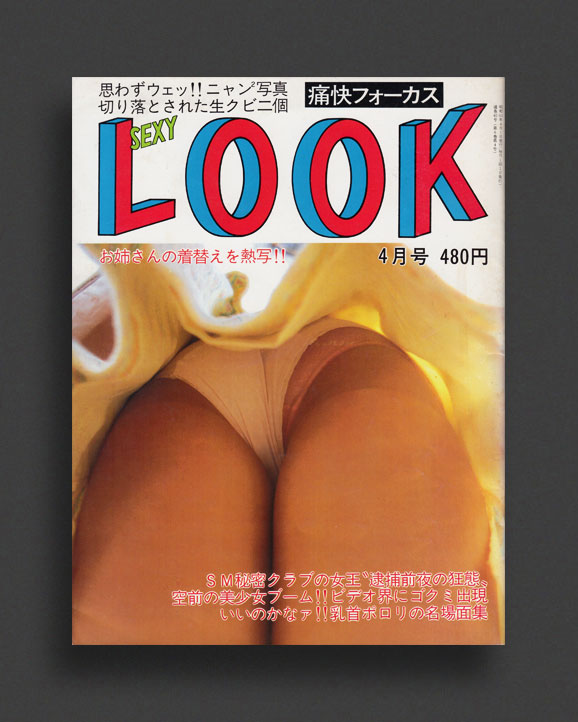
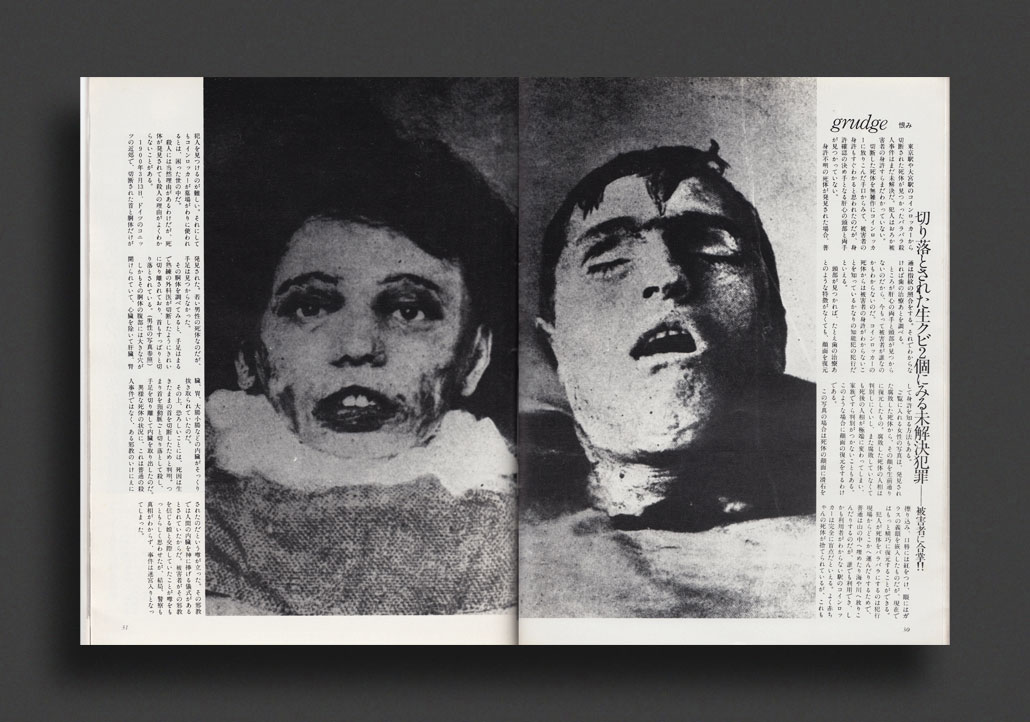
April 1988 issue of Sun Publishing's Sexy Look magazine, a highly collected glossy photo magazine from Tokyo that is made up entirely of colour and b/w spreads throughout that take a single word or phrase, like an accumulative gentlemen's magazine cum encyclopedia of the bizarre, to introduce the reader to titillating thrills, perversions, weird crimes, unusual customs, anthropological oddities, and the 1980s Japanese sex industry from all angles each month. The most prominent angle was a low one, as primarily the magazine was an excuse for the many contributing photographers to take "close-up" peeper/FLASH photography of women (ala Kohei Yoshiyuki and Ikko Kagari). Lots of Tokyo sex club material, with spreads punctuated by ads for pink videos and sex toys.
Very Good copy, light wear.
Sanne Sannes
The Face of Love
1972, English
Hardcover (clothbound), unpaginated, 28.5 x 22 cm
1st Edition, Out of print title / used / average
$250.00 - In stock -
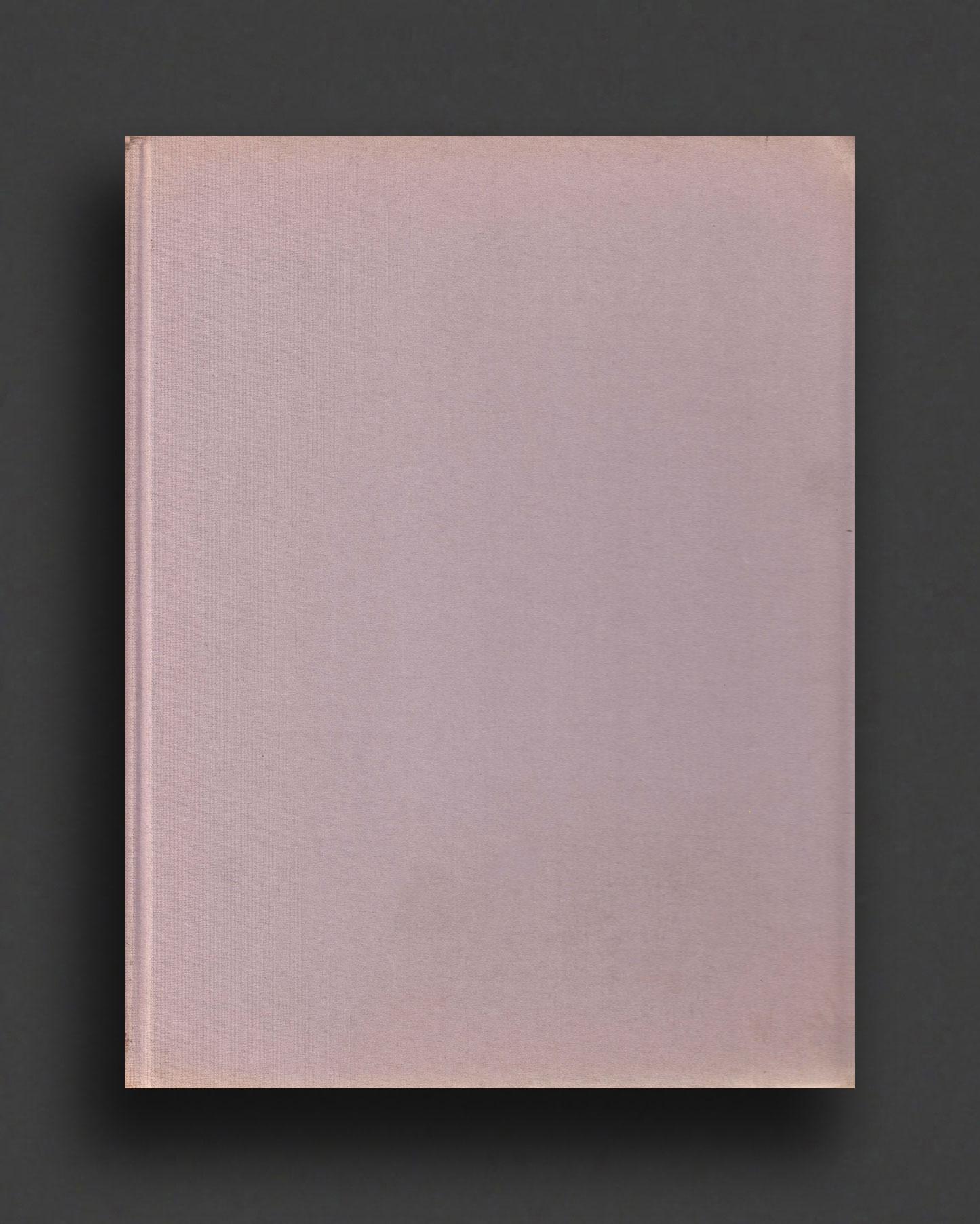
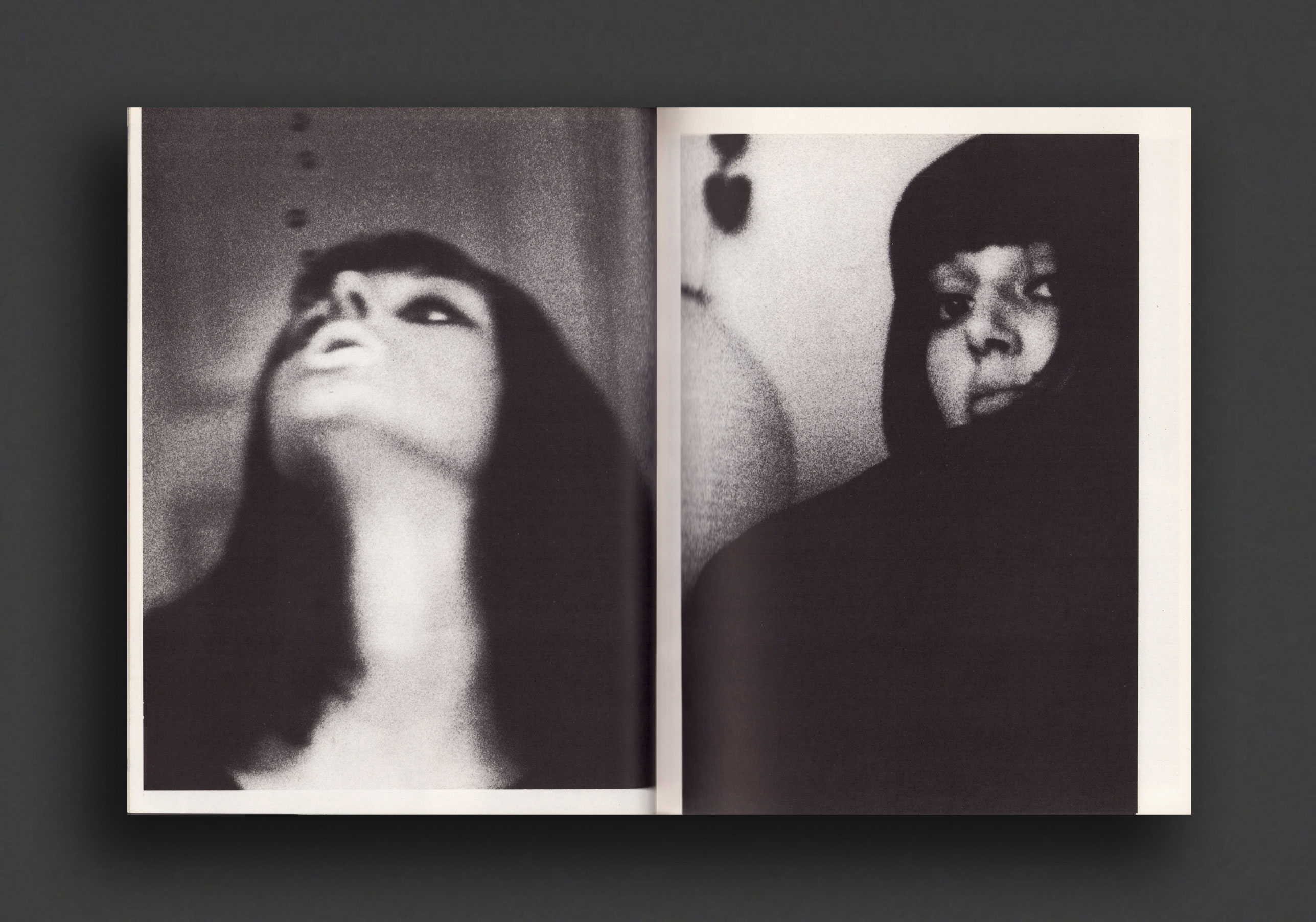
Rare copy of “The Face Of Love”, a seldom seen classic erotic photo book from the 1960s by the remarkable and misunderstood Dutch photographer Sanne Sannes, one of the archetypal visionaries of sixties Amsterdam, who was tragically killed in 1967 in an automobile accident at the age of thirty. A beautiful book of Sannes' experimental heavy grain b/w nude photography, effectively employing blur, bokeh, close-ups, etc. to express the emotional nature of his subjects hidden from view. In the strong contrast between light and darkness, life and death, Sannes' outstanding camera work reveals the fascinating beauty of women with an intimate honesty seldom seen. "The Face of Love" was posthumously published in 1972 and contains about 200 full-page illustrations with accompanying essays by Jim Hughes and Louwrien Wijers.
"Sanne Sannes was the enfant terrible in photography, doing things which are not done; neither sharpness, nor clearness, not one technical axiom in photography meant anything to him. He was an artist at work.
A painter, at first only using black and white, later mixing the colors of his film in an imaginative way. His main subject was the full range of emotions connected with love: the sexy and erotic as well as the desireous and paralyzing love-emotions. His work showed a warm heart for the way women love. He was eager to know their inmost feelings and constantly he tried to hit the source of their emotions."—Louwrien Wijers
"Sanne Sannes did not make easy photographs. Certainly, he did not make pretty photographs. I'm not even sure he made photographs. He made explorations of people, of their outsides and their insides, and sent back picture postcards of their psyches. If you looked hard at some of these, you could make out a scribbled message: "Having a great time. Glad you're here."—Jim Hughes
"Suddenly the subject he often talked about was there. Death obsessed him. Life enthralled him. He played the game of life with insatiable enthusiasm. Laughing defiantly, speaking satirically, moving firmly and working energetically, he proved himself indomitable every moment and in every situation. He was the jolly joker in this game of his. He made all the tricks. Then all of a sudden the winner lost. Sanne Sannes' brilliant mind, moving mastership and inspiring personality were destroyed in a fatal car crash Thursday March 23, 1967, three days after his thirtieth birthday."—Louwrien Wijers
The Dutch photographer Sanne Sannes (Groningen, 1937-1967) is known for his experimental black and white photographs with large film grains and fast shutter speeds. His work is full of erotic and mysterious portraits of women. Sannes, referred to by some as the Marquis de Sade of Holland, was an elusive personality, just like his works, and died at the young age of 30.
Average—Good copy without dust jacket. Some tanning to edges and creasing to some pages, heavy "fan" creasing on one spread with some resultant damage. Otherwise generally Good throughout.
