New :


James Ensor
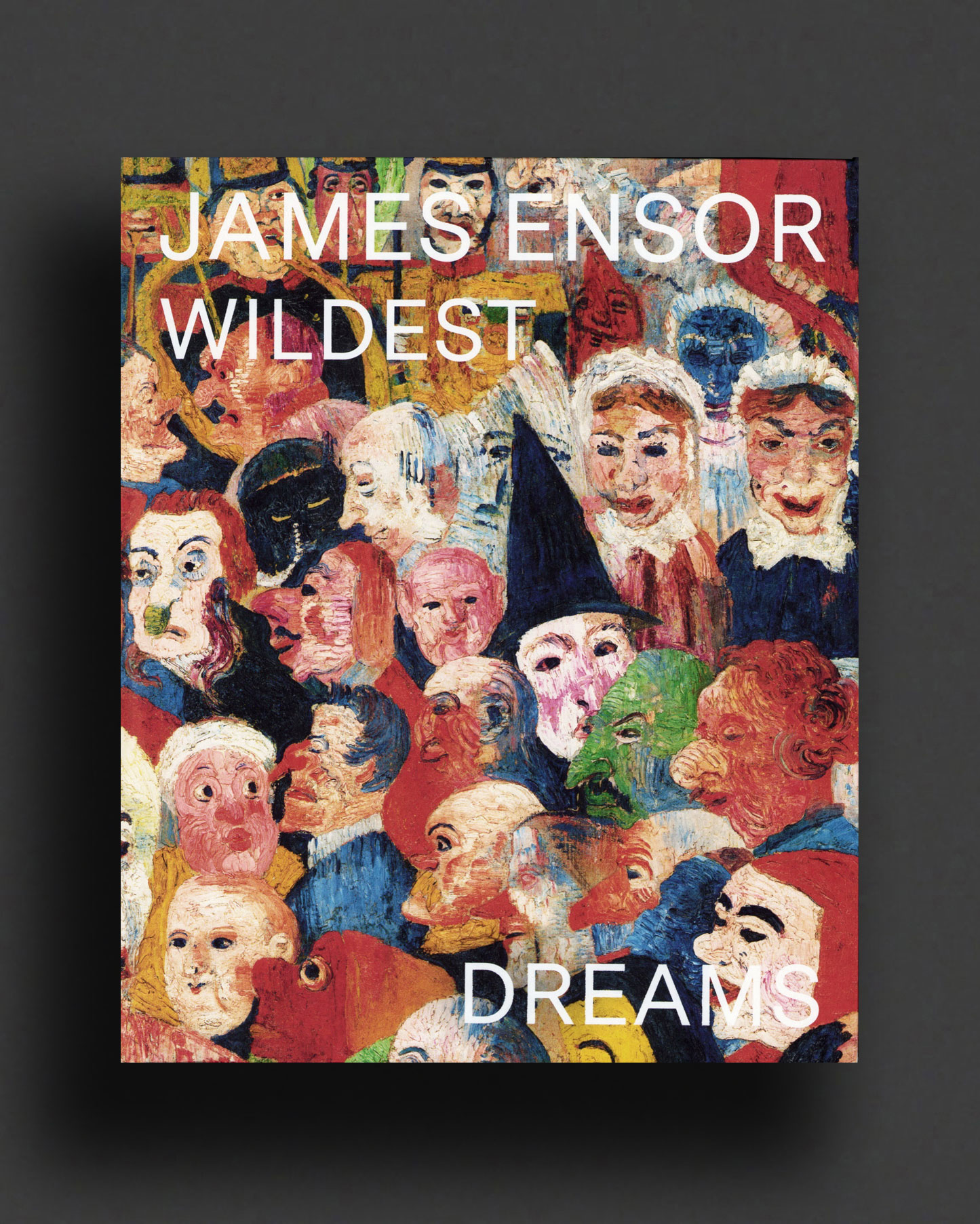
Wildest Dreams, Beyond Impressionism
2025, English
Hardcover, 272 pages, 28 x 23 cm
$99.00 - In stock -
English edition of this wonderful tribute to one of the fathers of international modernism, James Ensor.
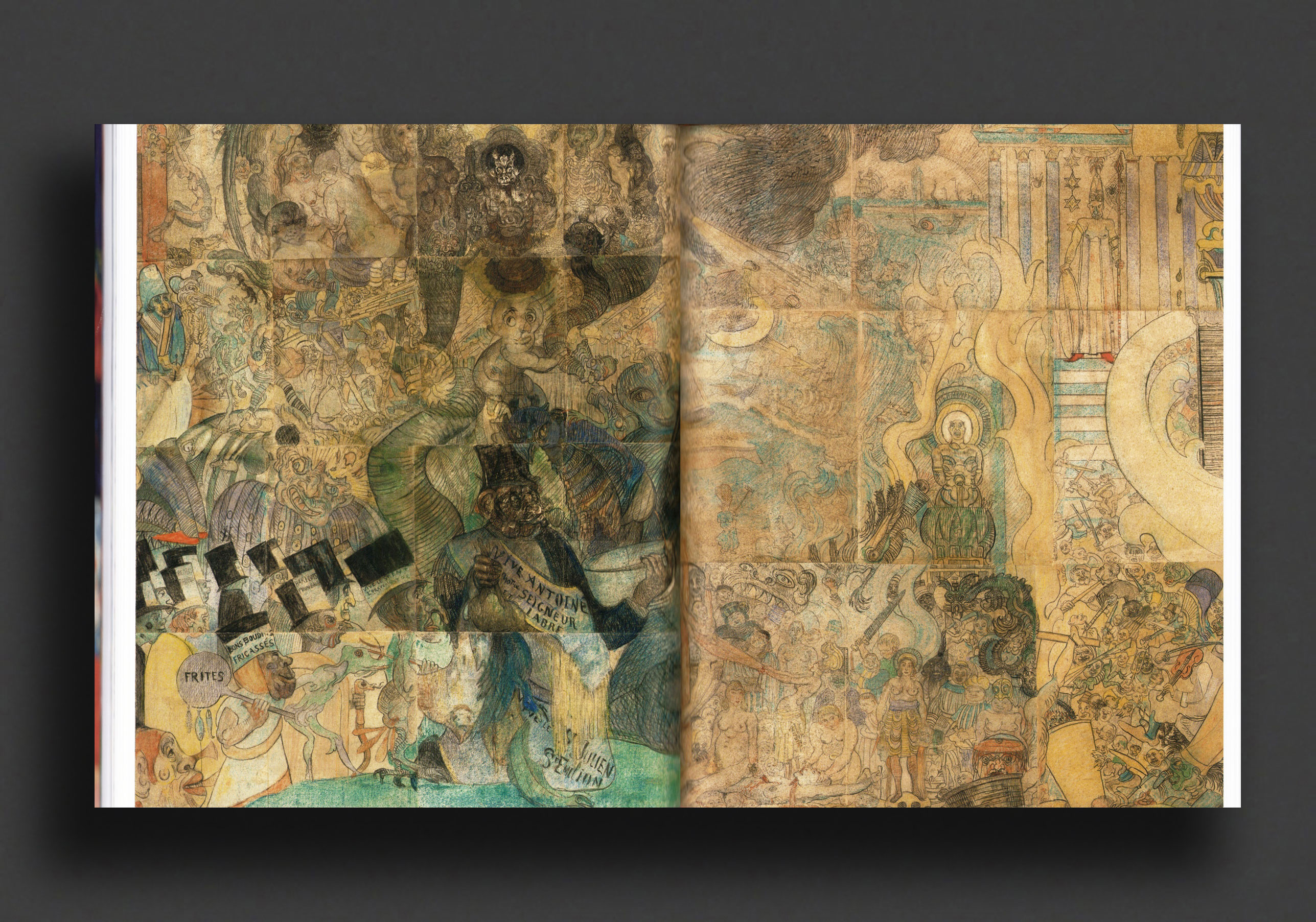
James Ensor’s visionary spirit takes us on a journey through his manifold universe of still lifes, self-portraits, savage visions, carnival and satire. In the course of his career, Ensor grew into an unruly gamechanger who personally reset the rules of art. As he did so, he resolutely distanced himself from the classical European ideal of beauty and from the Impressionism that had initially fascinated him.
Ensor did not limit himself to painting – he also unleashed his passion for experiment in detailed drawings, huge collages and potent etchings. His love for the fanciful resulted in characteristically grotesque representations of countless wild dreams.
The pulse of a thrilling late nineteenth century beats through the more than two hundred works reproduced in this book. Ensor constantly surprises us with his contrasts between the comical and the macabre, the refined and the wanton, atmospheric bourgeois interiors and morbid skeletons.
Drawing on their wide-ranging expertise, fifteen authors each highlight specific facets of the Ostend artist’s developing practice to paint a fresh and comprehensive picture of Ensor’s life and work.
This publication accompanies the exhibition In Your Wildest Dreams – Ensor Beyond Impressionism from 28 September 2024 until 19 January 2025 at the Royal Museum of Fine Arts Antwerp (KMSKA).


HANS BELLMER
PHOTOGRAPHE
1983, Japanese
Hardcover (clothbound w. dustjacket), 152 pages, 20.5 x 30 cm
1st Edition, Out of print title / used / very good
$150.00 - In stock -
Exquisitely designed and produced book dedicated entirely to the photography of the German artist Hans Bellmer (1902—1975). Produced in French by Editions Filipacchi, Centre Georges Pompidou, and Musee National D'art Moderne in Paris in 1983, this scarce Japanese hardcover printing (produced and printed in Japan that same year) features a different cover, with translations to the Japanese language of the introductory essay and texts. A beautiful photo book densely illustrated with colour and black and white reproductions of Bellmer's infamous doll photography, his many studies of the female nude (including those of his wife, artist Unica Zürn), and rare photography of his objects and sculptural assemblages, his studio, and more, this volume captures an important Surrealist visionary and one of the most daring artists of the 20th century through his stunning photography. Features the wonderful "La Poupee" — Hans Bellmer's articulated, anatomically amorphous Surrealist doll, reconfigured and captured through Bellmer's intimate hand-painted photographic images. "La Poupee" acquired iconic status as perhaps the purest exemplification of the Surrealist ideal of "convulsive beauty." Bellmer constructed his first doll in the early 1930s. André Breton and Paul Eluard described it as "the first and only Surrealist object with a universal, provocative power".
German artist Hans Bellmer (1902—1975) was one of the most subversive artists associated with Surrealism, famous—notorious, even—for his erotic engravings, objects and photographs. Many of Bellmer's works were inspired by the literary works of Comte de Lautréamont, Marquis de Sade and Georges Bataille, amongst others.
Very Good copy in VG dust jacket with light wear/light foxing.


Mike Kelley
Timeless Painting
2020, English
Hardcover, 200 pages, 26.7 x 33 cm
$120.00 - In stock -
Featuring paintings from series that span from 1994 through 2009, this volume traces Mike Kelley's (1954–2012) engagement with the medium through bodies of work including The Thirteen Seasons (Heavy on the Winter), a series of oval-shaped paintings on wood; Timeless Painting, which marked Kelley's distinct return to painting in colour, and which he described as "mannerist take-offs on Hans Hofmann's compositional theory of ‘push and pull'"; and the Horizontal Tracking Shots series.
Unica Zürn
Alben: Books & Sketchbooks
2009, English / German
Hardcover, 336 pages, 23 x 30 cm
1st Edition, Out of print title / used / very good
$300.00 - In stock -
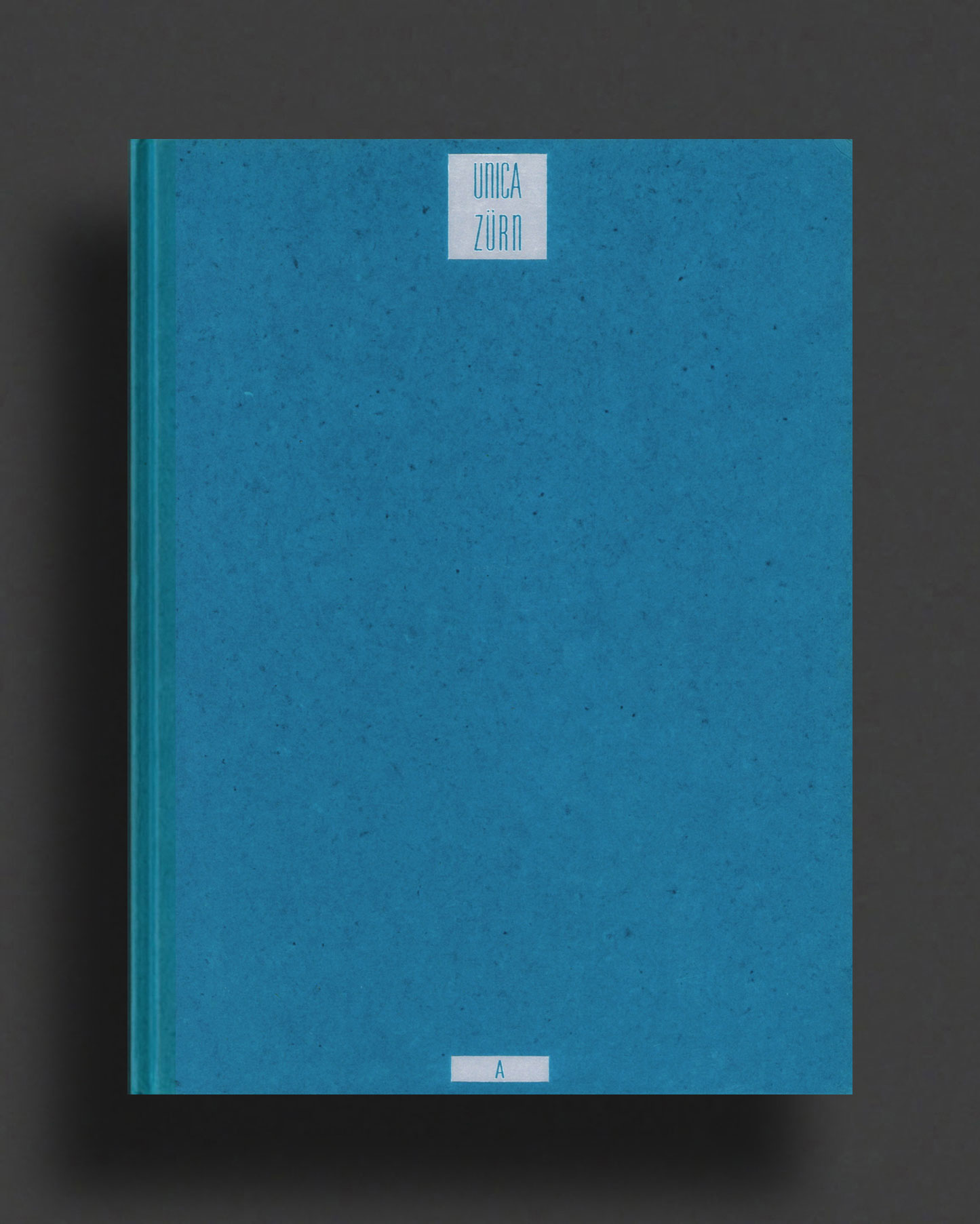
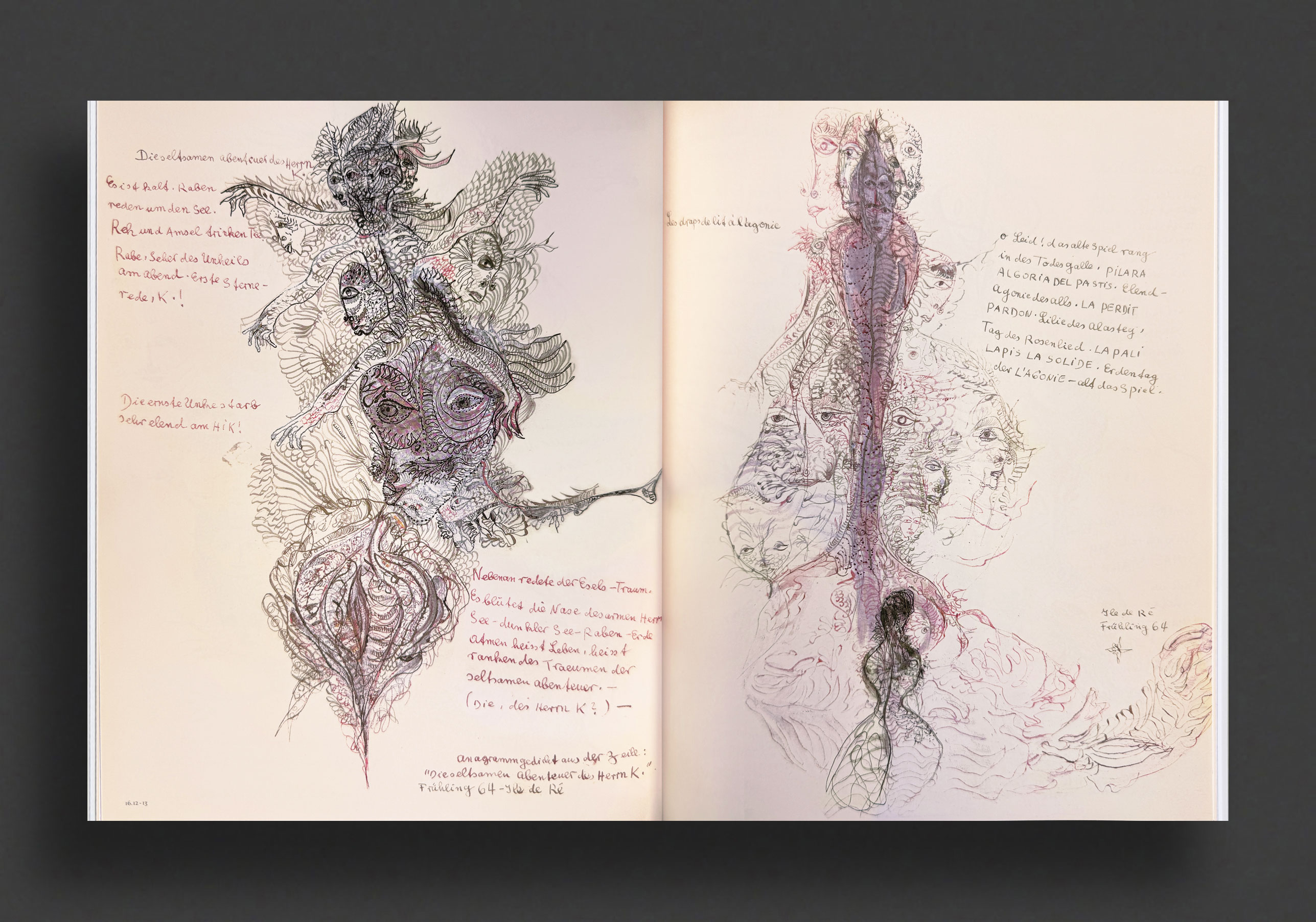
First limited hardcover edition of this wonderful Unica Zürn (1916-1970) collection of artworks. Beautifully produced, profusely illustrated, and long out-of-print, this rare volume is still one of the most cherished and comprehensive collections of Zürn's artwork ever published. This lovely limited-edition survey collects together her drawings done between 1954 and 1967, 300 drawings almost all unpublished, facsimiles of her sketch-books, and reproductions of her highly-collectible artist books produced throughout her life (Hexentexte, Oracles et Spectacles, etc.), all accompanied by bibliographic information, making it a invaluable reference. Illustrated introduction by publisher Erich Brinkmann. Texts in bi-lingual German and English.
The German artist and writer Unica Zurn (1916-1970) joined the ranks of Surrealism in the 1950s, after moving to Paris and taking up residence with the German-born Surrealist Hans Bellmer. Drawn to the movement's espousal of automatic drawing and writing, Zurn pursued Henri Michaux's declaration that "the hand dreams," making a vocation of these techniques with drawings and paintings that are labyrinthine in detail, as one form sprouts out of another. Zurn has left us an account of the sensation of automatic drawing: "After an initial moment when the pen 'swims' hesitantly on the paper, she discovers the place assigned to the first eye. It is only when she is being watched from the depths of the paper that she begins to get her bearings and, effortlessly, one motif is added to another." This lovely limited-edition survey reproduces drawings done between 1954 and 1967.
The German artist and writer Unica Zürn (1916-1970) joined the ranks of Surrealism in the 1950s, after moving to Paris and taking up residence with fellow German-born Surrealist Hans Bellmer. Already an accomplished author, Zürn was drawn to the Surrealist movement's espousal of automatic drawing and writing, Zürn pursued Henri Michaux's declaration that "the hand dreams," making a vocation of these techniques with her dense, otherworldly drawings and paintings that are labyrinthine in detail, as one form sprouts out of another. Also with her experimental anagrams, natural extensions of her established interest in hidden meanings and coincidences. Zürn produced most of her oeuvre during this intensive period in the 1950s and 60s, though one marked by her deteriorating mental health. Many of her works were made during periods of hospitalisation. In 1970, Zürn leapt to her death from the balcony of the Paris apartment she had shared with Bellmer. Upon his death in 1975, Bellmer was buried, at his request, next to Zürn in Paris’s Père-Lachaise Cemetery. Their grave is marked with the words Bellmer wrote for Zürn’s funeral wreath nearly five years before: “My love will follow you into Eternity.”
Zürn has left us an account of the sensation of automatic drawing: "After an initial moment when the pen 'swims' hesitantly on the paper, she discovers the place assigned to the first eye. It is only when she is being watched from the depths of the paper that she begins to get her bearings and, effortlessly, one motif is added to another."
Very Good copy, light wear.
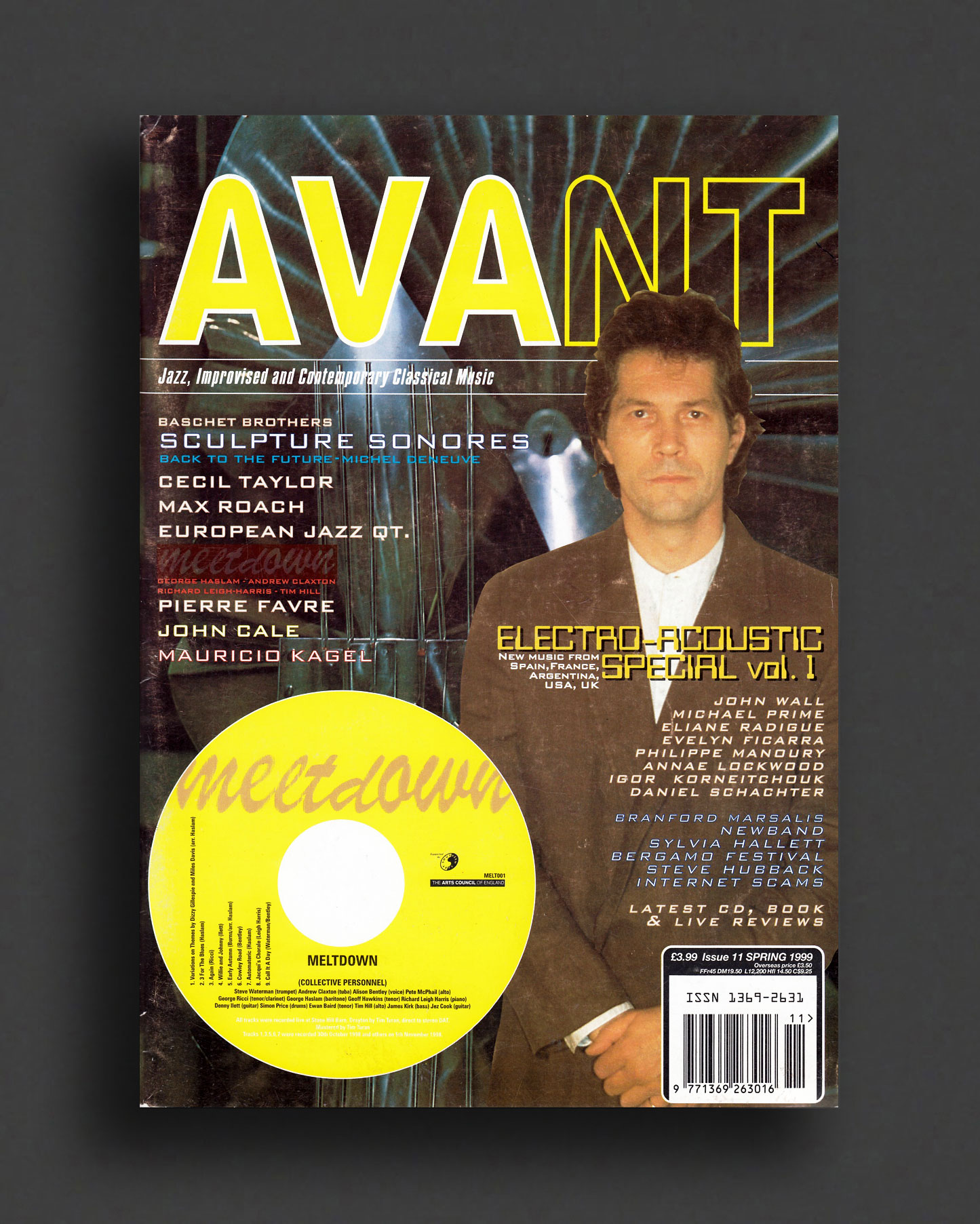
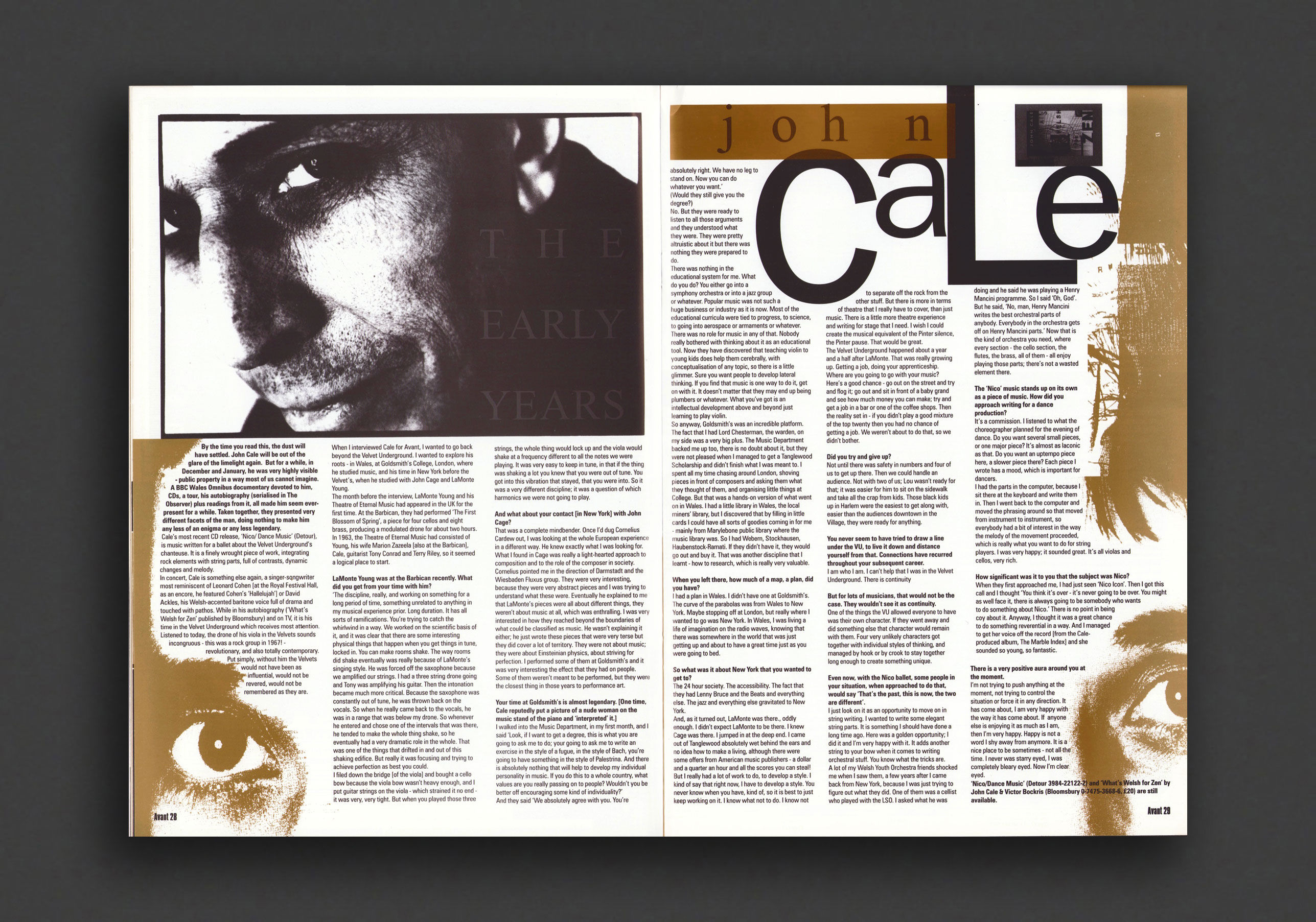
Avant No. 11, Spring 1999
Jazz, Improvised and Contemporary Classical Music
1999, English
Softcover (staple-bound), 66 pages, 30 x 21 cm
1st Edition, Out of print title / used / good
$10.00 - In stock -
Featuring the Baschet Brothers' Sculpture Sonores, Cecil Taylor, Max Roach, John Cale, Eliane Radigue, Pierre Favre, Mauricio Kagel, Annae Lockwood, and many more. In-depth articles, interviews, reviews, all heavily illustrated.
Good copy, light wear, missing CD.
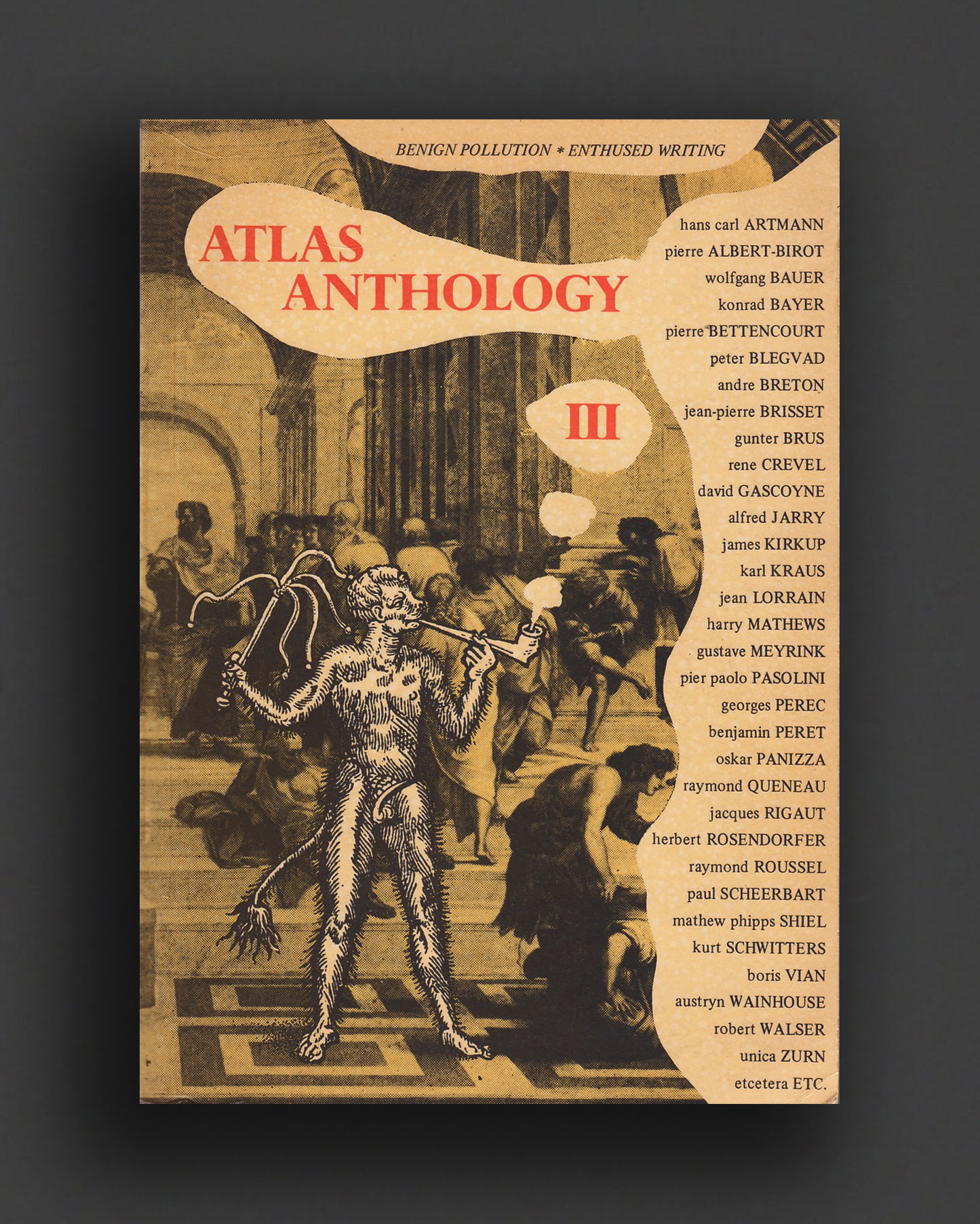
Atlas Anthology 3
Edited by Alastair Brotchie & Malcolm Green
1985, English
Softcover (w. paste-ins), 224 pages, 21 x 15 cm
1st Edition, Out of print title / used / very good
$100.00 - In stock -
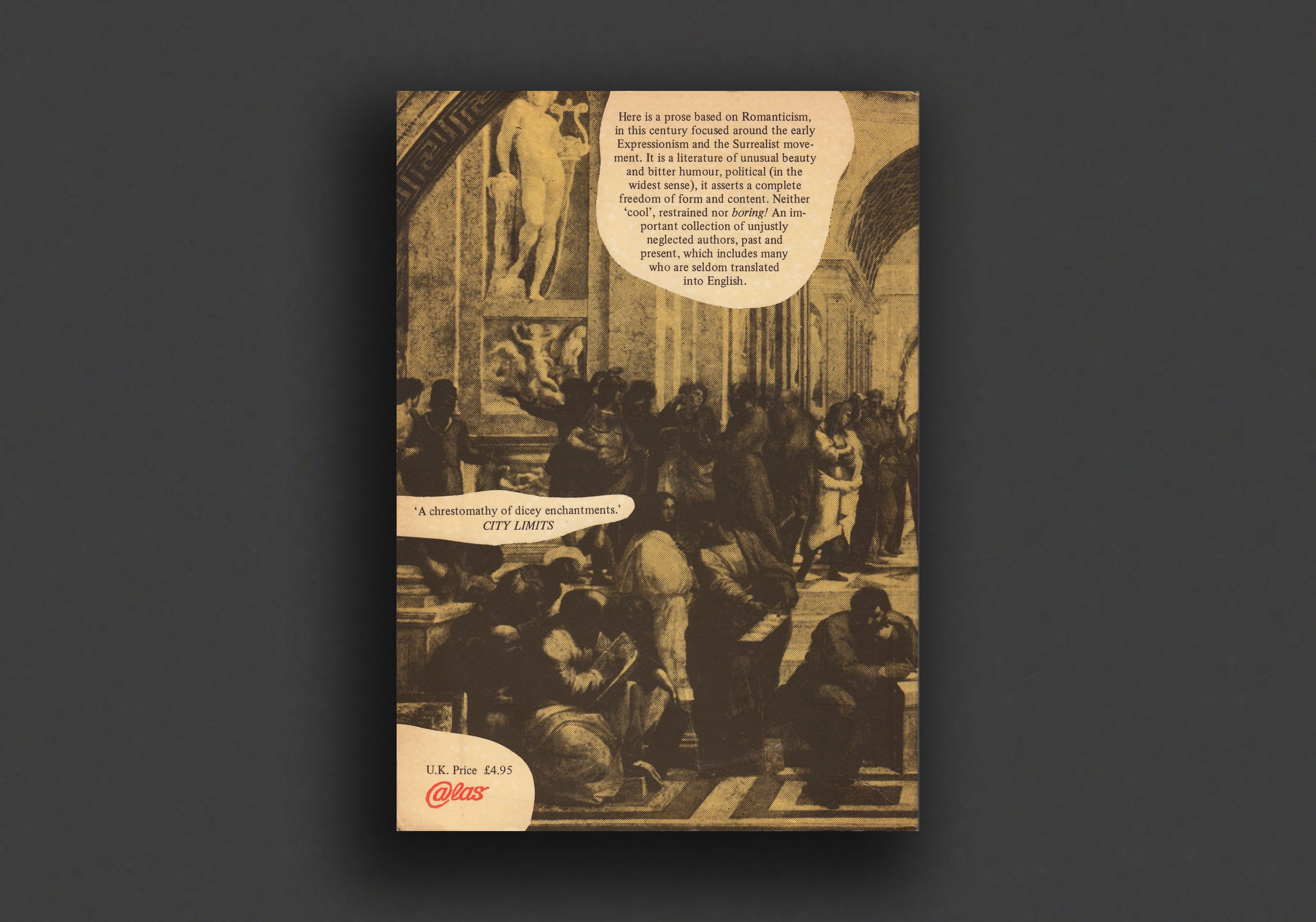
"A chrestomathy of dicey enchantments.'—CITY LIMITS
Now rare, long out-of-print 1985 Atlas Anthology 3, edited by Alastair Brotchie & Malcolm Green. "Benign Pollution, Enthused Writing". The third production from the legendary Atlas Press, the third general anthology and the first book to be actually typeset (a very expensive business in those days).
Features: Hans Carl Artmann, Pierre Albert-Birot, Wolfgang Bauer, Konrad Bayer, Pierre Bettencourt, Peter Blegvad, Andre Breton, Jean-Pierre Brisset, Günter Brus, René Crevel, David Gascoyne, Alfred Jarry, James Kirkup, Karl Kraus, Jean Lorrain, Harry Mathews, Gustave Meyrink, Pier Paolo Pasolini, Georges Perec, Benjamin Peret, Oskar Panizza, Raymond Queneau, Jacques Rigaut, Herbert Rosendorfer, Raymond Roussel, Paul Scheerbart, Mathew Phipps Shiel, Kurt Schwitters, Boris Vian, Austryn Wainhouse, Robert Walser, Unica Zürn, Etcetera Etc.
"Here is a prose based on Romanticism, in this century focused around the early Expressionism and the Surrealist movement. It is a literature of unusual beauty and bitter humour, political (in the widest sense), it asserts a complete freedom of form and content. Neither 'cool', restrained nor boring! An important collection of unjustly neglected authors, past and present, which includes many who are seldom translated into English."
Highest recommendation.
Good—Very Good copy complete with all the paste-ins. General wear and tanning.


Hajime Sawatari
Nadia
1973, Japanese
Softcover, 108 pages, 28 x 30 cm
1st Edition, Out of print title / used / very good
$280.00 - In stock -
Rare first 1973 edition of acclaimed Japanese photographer Hajime Sawatari's cult photo book "Nadia" (aka Doll Forest Museum/Nadia in the Woods). Sawatari began working as a freelancer in 1966, photographing for many leading fashion magazines in Japan. Sawatari fell in love with the Italian fashion model Nadia Galli while working with her on an advertisement back in 1971. Driven by the photographer’s desire to capture on film everything about the person he loved, Sawatari took Nadia with him on an extensive journey. Traveling around Karuizawa in the summer, Venice, Sicily and other locations in Nadia’s home country, Karuizawa in the Winter, and Tokyo, his focus on Nadia switched between viewing her as a photographic subject and a lover, resulting in Sawatari establishing his own unique semi-fictional style of “capturing a woman in a back-and-forth between reality and fiction,” which marked a clear departure from his previous female portraits, and opened a new frontier in the realm of photography. This dreamlike and intimate series of monochrome portraits of Nadia weaves a fairytale-like, visual travelogue akin to Sawatari's other cult classic of the same year, Alice. Playful, intimate and at times hallucinatory, the book closes with a lovely hand-written letter by Nadia in Japanese and a photographic portrait of Sawatari, also by Nadia. A gorgeous book.
Number 3 in Camera Mainichi's Private series.
Very Good copy, tightly bound and clean with some wear to covers, corners. Very nice copy for a book that is usually heavily damaged.

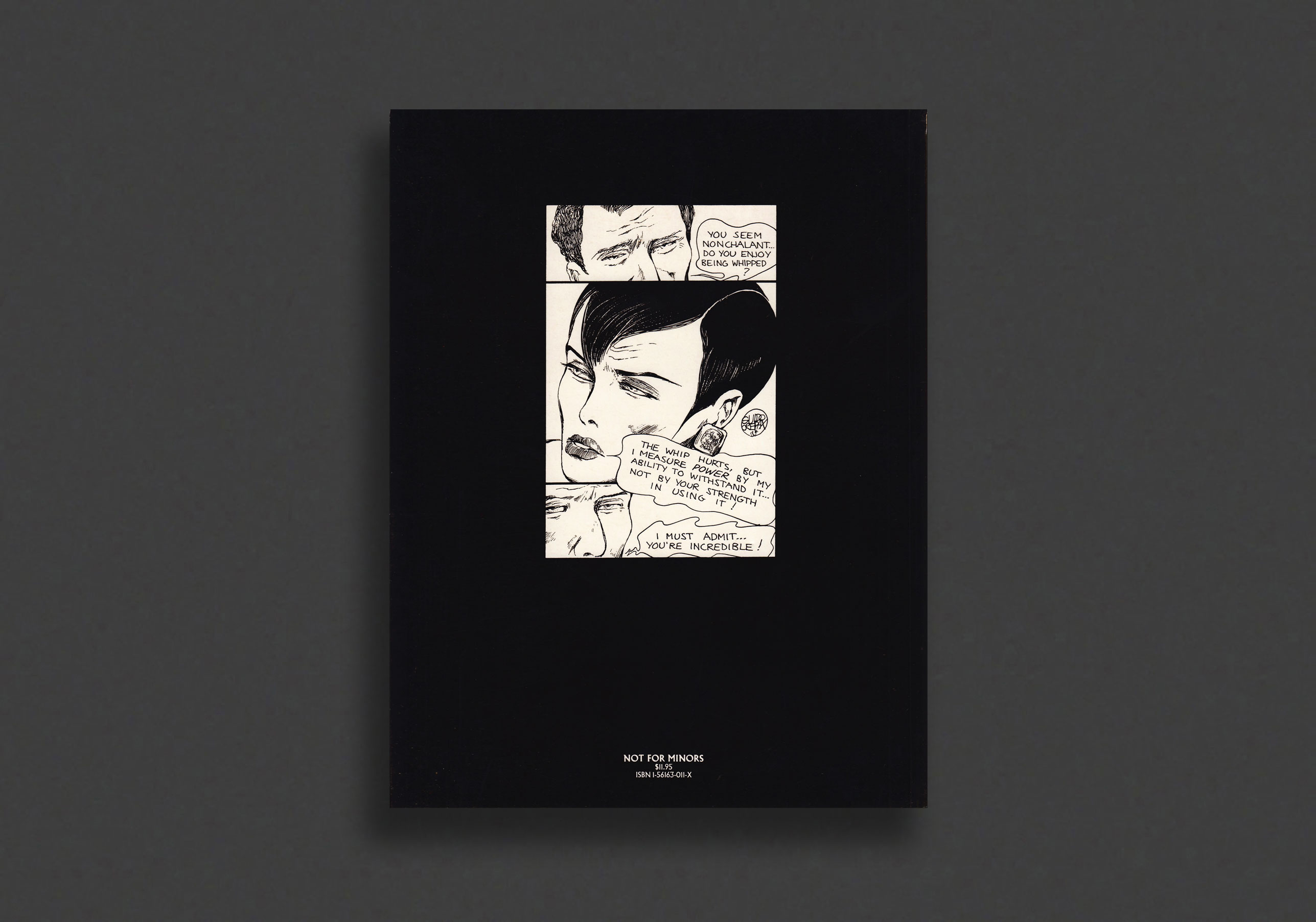
Guido Crepax, Pauline Réage
The Story of O Volume 3
1991, English
Softcover, 96 pages, 28 x 21.5 cm
1st Edition, Out of print title / used / very good
$70.00 - In stock -
First 1991 English-language softcover edition, volume 3, of Italian illustrator Guido Crepax's famous graphic adaptation of The Story of O, one of the most famous erotic novels of all time, by French literary critic, journalist, and novelist, Anne Cécile Desclos (1907—1998), under the pen name Pauline Réage. A beautiful display of Crepax's dizzying, rhythmic paneling and beautiful, erotically-charged ink work, as imaginative as the literary work of Réage.
"A rare thing, a pornographic book well written and without a trace of obscenity"—Graham Greene.
Guido Crepas (15 July 1933 in Milan - 31 July 2003 in Milan), better known by his nom de plume Guido Crepax, was an Italian comics artist. He studied at the School of Architecture at the University of Milan. After graduating, he made his debut in comic books in 1959 when he contributed his work to Tempo Medico. He joined the new magazine Linus in 1965 with a fantasy comic, 'Neutron', a superhero comic about an art critic with the mysterious power to stop humans or objects via his gaze. It featured a minor character called Valentina, a fashionable, communist Milanese photographer born in 1942, who quickly became Crepax's protagonist and his most famous creation. Valentina became an underground icon of 1960s culture. Crepax's work became noted for his very sophisticated expressionistic yet graphic drawing style, his truely innovative panel work and his unusual compositions that seemed to have more in common with modern art and film than comic strips. His psychedelic, dreamlike storylines were immersive, generally involving a strong dose of erotism and a predilection towards sadomasochism and the surreal. After 'Valentina', other titles followed, such as 'L'Astronave Pirata' (1968), 'La Casa Matta' (1969), 'La Calata di Mac Similiano' (1969), 'Belinda', 'Anita' and 'Bianca'. Crepax's illustrated adaptations of classic erotic stories like De Sade's 'Justine', Pauline Réage's 'Histoire d'O' and Sacher-Masoch's 'Venus in Furs' brought him further acclaim, especially to English audiences who had mostly only read translated Crepax through the pages of Heavy Metal magazine.
Very Good copy.
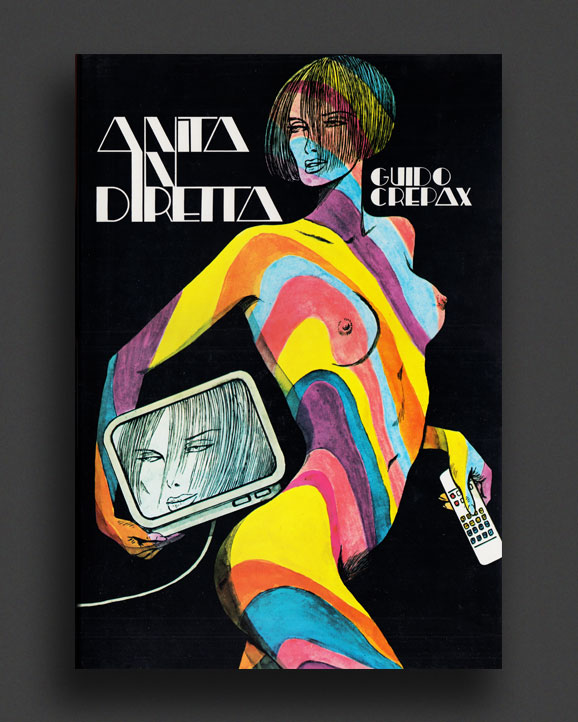

Guido Crepax
Anita in Diretta
1988, Italian
Hardcover (w. dust jacket), 94 pages, 23.5 x 31 cm
1st Edition, Out of print title / used / fine
$70.00 - Out of stock
Wonderful large-format, hardcover 1988 edition of Guido Crepax's 'Anita in Diretta', one of the great Crepax books in all it's dizzying, rhythmic paneling and beautiful use of colour, compiling two complimentary Anita stories - 'Input Anita' (1986) and 'Anita Color' (1987). Here Crepax evokes two fantastic erotic "environments" that stem from the growing universe of technology in the 1980s and the world's new-found obsession with screens. In the first, Anita is swept into a vortex of mental delirium because she anthropomorphises the data of her computer and transforms into reality what appears on her screen. In the second, in parallel, Anita masturbates to her television, fantasising about the endless characters and scenarios that change with each flick of the remote. Anita meets-clashes in both cases with the magical surface of the unifying screen, a producer of cold imagination, which the individual transforms into a lived, private experience. This participation is strongly unconscious, and in Crepax's stories there is an unacknowledged denunciation of fantasy based on technology. The last step in each story is in fact the "dispossession" of Anita's personality by the fantasy machine, her fall into psychosis, demonstrating that the excess of empathy into the illusionary screen ends up producing a new, dangerous reality.
Guido Crepas (15 July 1933 in Milan - 31 July 2003 in Milan), better known by his nom de plume Guido Crepax, was an Italian comics artist. He studied at the School of Architecture at the University of Milan. After graduating, he made his debut in comic books in 1959 when he contributed his work to Tempo Medico. He joined the new magazine Linus in 1965 with a fantasy comic, 'Neutron', a superhero comic about an art critic with the mysterious power to stop humans or objects via his gaze. It featured a minor character called Valentina, a fashionable, communist Milanese photographer born in 1942, who quickly became Crepax's protagonist and his most famous creation. Valentina became an underground icon of 1960s culture. Crepax's work became noted for his very sophisticated expressionistic yet graphic drawing style, his truely innovative panel work and his unusual compositions that seemed to have more in common with modern art and film than comic strips. His psychedelic, dreamlike storylines were immersive, generally involving a strong dose of erotism and a predilection towards sadomasochism and the surreal. After 'Valentina', other titles followed, such as 'L'Astronave Pirata' (1968), 'La Casa Matta' (1969), 'La Calata di Mac Similiano' (1969), 'Belinda', 'Anita' and 'Bianca'. Crepax's illustrated adaptations of classic erotic stories like De Sade's 'Justine', Pauline Réage's 'Histoire d'O' and Sacher-Masoch's 'Venus in Furs' brought him further acclaim, especially to English audiences who had mostly only read translated Crepax through the pages of Heavy Metal magazine.

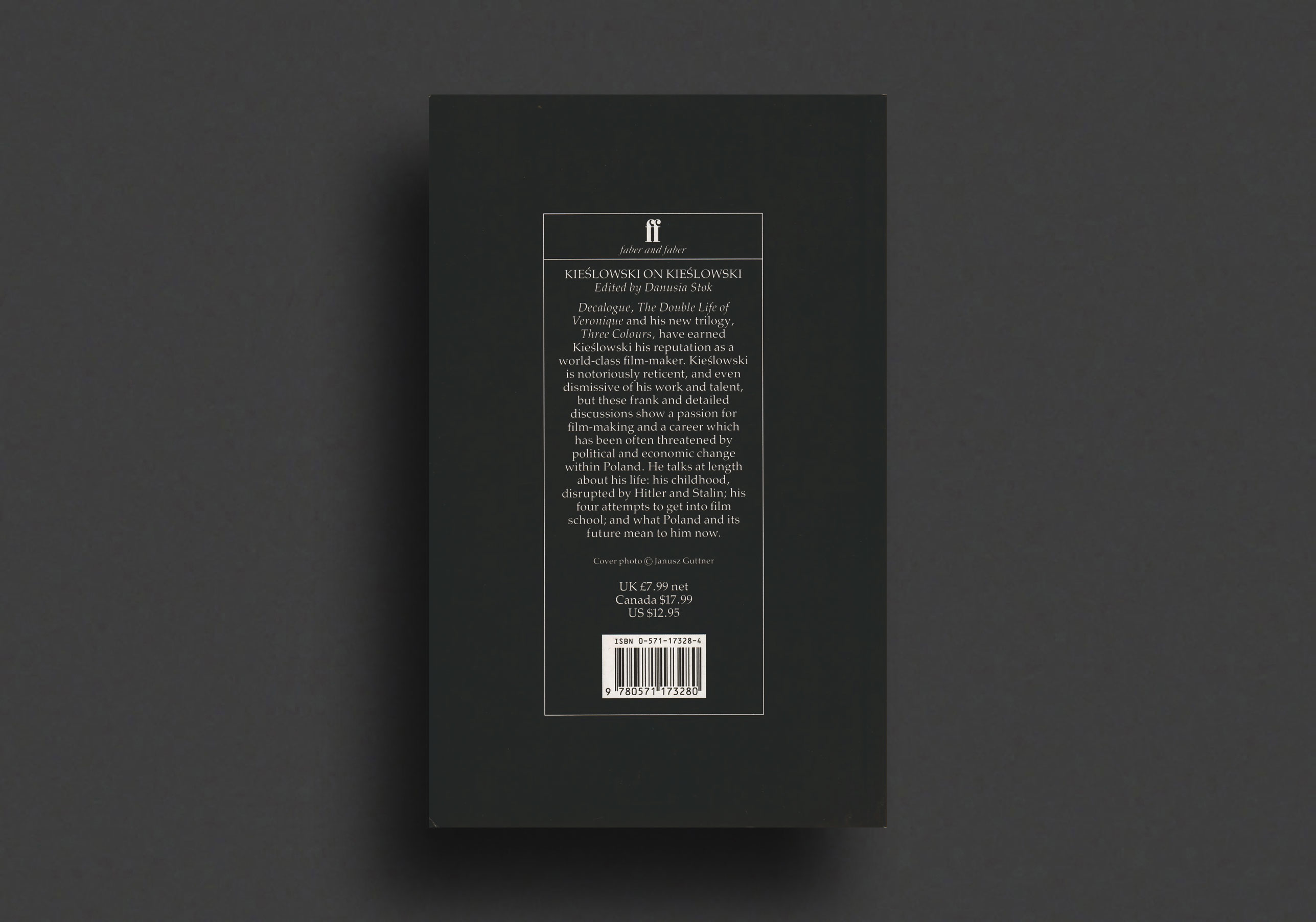
Kieślowski on Kieślowski
Edited by Danusia Stok
1995, English
Softcover, 270 pages, 21.5 x 13.5 cm
1st Edition, Out of print title / used / very good
$40.00 - Out of stock
Krzysztof Kieślowski's untimely death in 1996 robbed cinema of one of its great visionaries. Published a year before his passing, this 1995 English paperback edition of Kieślowski on Kieślowski, published by Faber & Faber and edited by Danusia Stok provides an rare, intimate insight into his world, moving between Poland and France and creating some of the most important cinematic works of the late 20th century.
"Decalogue, The Double Life of Veronique and his new trilogy, Three Colours, have earned Kieslowski his reputation as a world-class film-maker. Kieślowski is notoriously reticent, and even dismissive of his work and talent, but these frank and detailed discussions show a passion for film-making and a career which has been often threatened by political and economic change within Poland. He talks at length about his life: his childhood, disrupted by Hitler and Stalin; his four attempts to get into film school; and what Poland and its future mean to him now."
VG copy, light tanning to block, light wear.


A Crackup at the Race Riots
by Harmony Korine
1998, English
Softcover, 176 pages, 23 x 14 cm
1st Edition, Out of print title / used / good
$85.00 - In stock -
First edition.
"There is no place for plot, linear narrative, character development, or scene setting in Harmony Korine's audacious and original first novel, A Crackup at the Race Riots. The twenty-three-year-old filmmaker has created a bold work of fiction, a montage that takes literary convention and explodes it in a sequence of half-remembered scenes, suicide notes, dialogue fragments, movie ideas, rumors, and jokes. Korine's eye and ear are exquisitely tuned to the absurd, to the hypocrisy and hilarity that comprise our national obsessions with death, dirt, poverty, celebrity, religion, and gossip. He captures the fragmented moments of a life observed through the demented lens of media, TV, and teen obsession. The reinvented wheel of Korine's darkly bizarre imagination, A Crackup at the Race Riots is the ultimate postmodern novel-funny, offensive, depraved, and sad."
"The new heir, the man, the sweet edge of the future."—Jim Carroll, author of The Basketball Diaries
"I was struck from the very beginning that there is a totally independent & new voice in writing. I believe that [he] is a great talent as a writer."—Werner Herzog
HARMONY KORINE is the self-educated twenty-three-year-old who wrote the screenplay for the controversial film Kids. His directorial debut, Gummo, received the 1997 Venice Film Critics' Award and the Rotterdam Film Festival Critics' Award. Korine was raised in the carnival and currently resides in West Virginia.
Good copy with wear to extremities, Tightly bound, no spine creases.


Leonor Fini
Peinture
1980, French
Hardcover (w. dust jacket), 179 pages, 30.5 x 30.5 cm
1st Edition, Out of print title / used / fine
$150.00 - Out of stock
The most extensive monograph on the work of Argentine artist Leonor Fini (1918-1996), published in 1980 by Clairefontaine, Lausanne. With text by Constantin Jelenski, this over-sized hardcover volume is profusely illustrated throughout with Fini's incredible paintings, along with portraits, a list of exhibitions and bibliography.
Leonor Fini (1907–1996), an Argentine painter, designer, illustrator, and author, known for her depictions of powerful women, is considered one of the most important women artists of the twentieth century and also one of the most misunderstood.
Fini had no formal artistic training. Born in Buenos Aires, she travelled extensively from a young age, living in Milan and then moving to Paris in 1931-32 where she was considered part of a pre-war generation of Parisian artists, becoming acquainted with Carlo Carrà and Giorgio de Chirico, who inspired much of her work, and also Paul Éluard, Max Ernst, Georges Bataille, Henri Cartier-Bresson, Picasso, Salvador Dalí, and André Pieyre de Mandiargues. She had her first one person show in Paris when she was twenty-five at a gallery directed by Christian Dior. Her work caught on fast and was included in the pivotal and groundbreaking Fantastic Art, Dada and Surrealism exhibition at the MOMA in 1936 while at the same time she had her first New York exhibition at the avant-garde Julien Levy Galley. Surrealist artists in France came to know her as important in the movement. She is mentioned in most comprehensive works about surrealism, although she did not consider herself a surrealist, nor a part of any particular artistic movement. Fini preferred to stake her own claim on modernism with a vision that owes more to the farthest shores of her imagination than to any affiliation with art trends, schools or movements. The originality of her art as well as her intelligence, famous wit and charisma accorded her celebrity status in the Paris art world and beyond beginning in the late thirties. Her panache and glamour, once they found a place in the collective imagination of the time, turned her into a much-publicized fashion and feminist icon. Always controversial, with as many detractors as admirers, she lived and painted consummately on her own terms.
In Paris in 1939 she curated the inaugural exhibition of her friend Leo Castelli’s first gallery (of surrealist furniture) and shortly thereafter, just before the German occupation, she traveled with André and a new lover to Arcachon in the southwest of France to begin waiting out the war. She remained there for almost a year with Salvador and Gala Dali before moving to Monte Carlo where she met the young Italian diplomat, Stanislao Lepri who became one of the great and enduring loves of her life. As the war intensified she moved with Stanislao to Rome where she lived, worked and formed close friendships with Anna Magnani, Luchino Visconti and other leading figures of world of art and letters. After the Liberation of Paris in 1946 she returned there to live and work for the remainder of her life, exhibiting extensively around the world.
The predominant themes in Leonor Fini’s art are sexual tensions, mysteries and games. One of her favored subjects is the interplay between the dominant female and the passive male, and in many of her most powerful works the female takes the form of the sphinx to which she felt a strong identification. She was also a renowned portraitist, and among her subjects were such friends as writers André Pieyre de Mandiargues, Jean Genet, Klaus Mann (son of Thomas), such actresses as Anna Magnani and Suzanne Flon, ballerina Margot Fonteyn, film director Luchino Visconti and artists Meret Oppenheim and Leonora Carrington.
Her genius for stage and screen design is evident in her numerous ground breaking theater decors with their elaborate conception, costumes and phantasmagorical masks. She designed for the Paris Opera, George Balanchine’s ballet Palais de Crystal, and choreographer Roland Petit’s company Ballets de Paris, for Maria Callas at the La Scala theater in Milan, as well as over seventy productions at theaters in Paris between 1946 and 1969. She had a unique talent for film design and created costumes for Fellini's 8 ½ as well as for Renato Castellani's Romeo and Juliet and John Huston’s A Walk with Love and Death.
In the 1970s, she wrote three novels, Rogomelec, Moumour, Contes pour enfants velu and Oneiropompe. Her friends included Jean Cocteau, Giorgio de Chirico, and Alberto Moravia, Fabrizio Clerici and most of the other artists and writers inhabiting or visiting Paris. She illustrated many works by the great authors and poets, including Edgar Allan Poe, Charles Baudelaire and Shakespeare, as well as texts by new writers. She was very generous with her illustrations and donated many drawings to writers to help them get published. She is, perhaps, best known for her graphic illustrations for Histoire d'O.
The provocative and much-publicized life of Leonor Fini was pure theater. Her story is that of a hard-won struggle to forge her life as a woman artist in a man’s world and to invent herself on her own terms. It is the story of a woman possessing exceptional independence, a highly original vision and great personal magnetism who lived passionately through her art and friendships and in the process became a feminist role model.
Fine copy in Near Fine dust jacket.


Rita Ackerman
Works 1993—1996
1997, Japanese / English
Hardcover (w. dust jacket), 70 pages, 26 x 21 cm
1st Edition, Out of print title / used / very good
$120.00 - Out of stock
The incredible first monograph that doubles as an artist's book of work by Hungarian New York-based artist Rita Ackerman spanning the years 1993—1996, edited and designed by Makoto Ohrui from Fiction Inc., published by Rockin' On in 1997 and only available in Japan. Long out-of-print, this numbered hardcover volume, with illustrated vellum dust jacket, is illustrated profusely with seventy of Ackerman's drawings, paintings and collages throughout in colour and b/w with many fold-outs and notebook scans, accompanied by essays.
New York City based artist Rita Ackerman was born in Budapest in 1968. She studied at the University of Fine Arts in Budapest and The New York Studio School of Drawing, Painting and Sculpture from the years of 1989 to 1992. Ackermann invented images that became instant sensations, perturbing young girls that are now part of the universe of global imagery. Her drawings and paintings between 1993-95 depict compositions of adolescent female figures of clonelike multiples engaging in various self-destructive and hazardous activities. Her early works with their ambiguous presence serve as bridges between high and low culture, just as the myths and folk tales which often serve as merits to Ackermann's compositions. Later, Ackerman would abandon the figure, erasing the very matter of her own work, in a complex layering of visual language oscillating between abstraction and figuration into a subconscious unfolding of form—concealed deeply in the abstraction of the omnipresence.
First edition, VG copy in VG dust jacket.
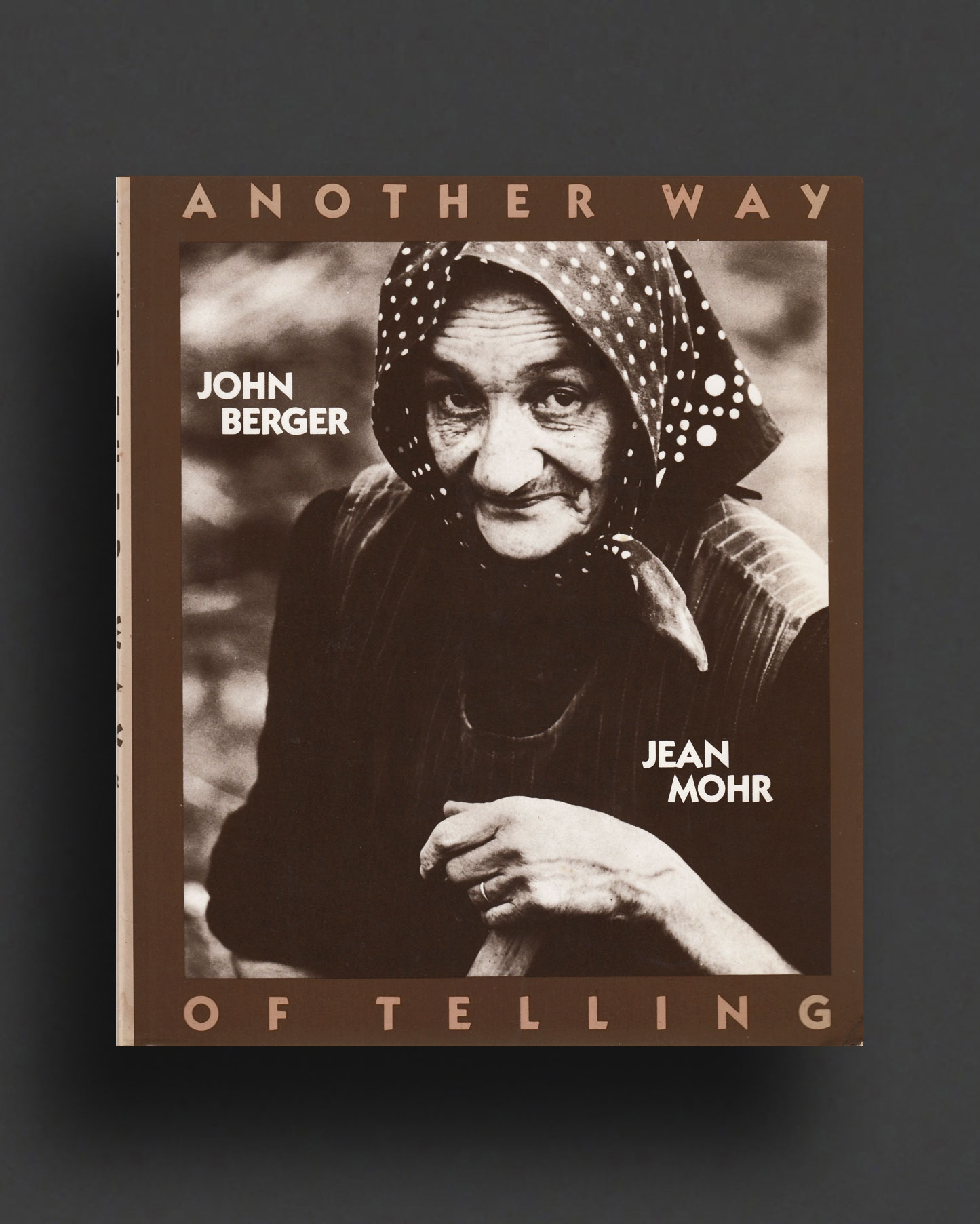
John Berger / Jean Mohr
Another Way of Telling
1982, English
Softcover, 300 pages, 20 x 17 cm
1st Edition, Out of print title / used / very good
$25.00 - In stock -
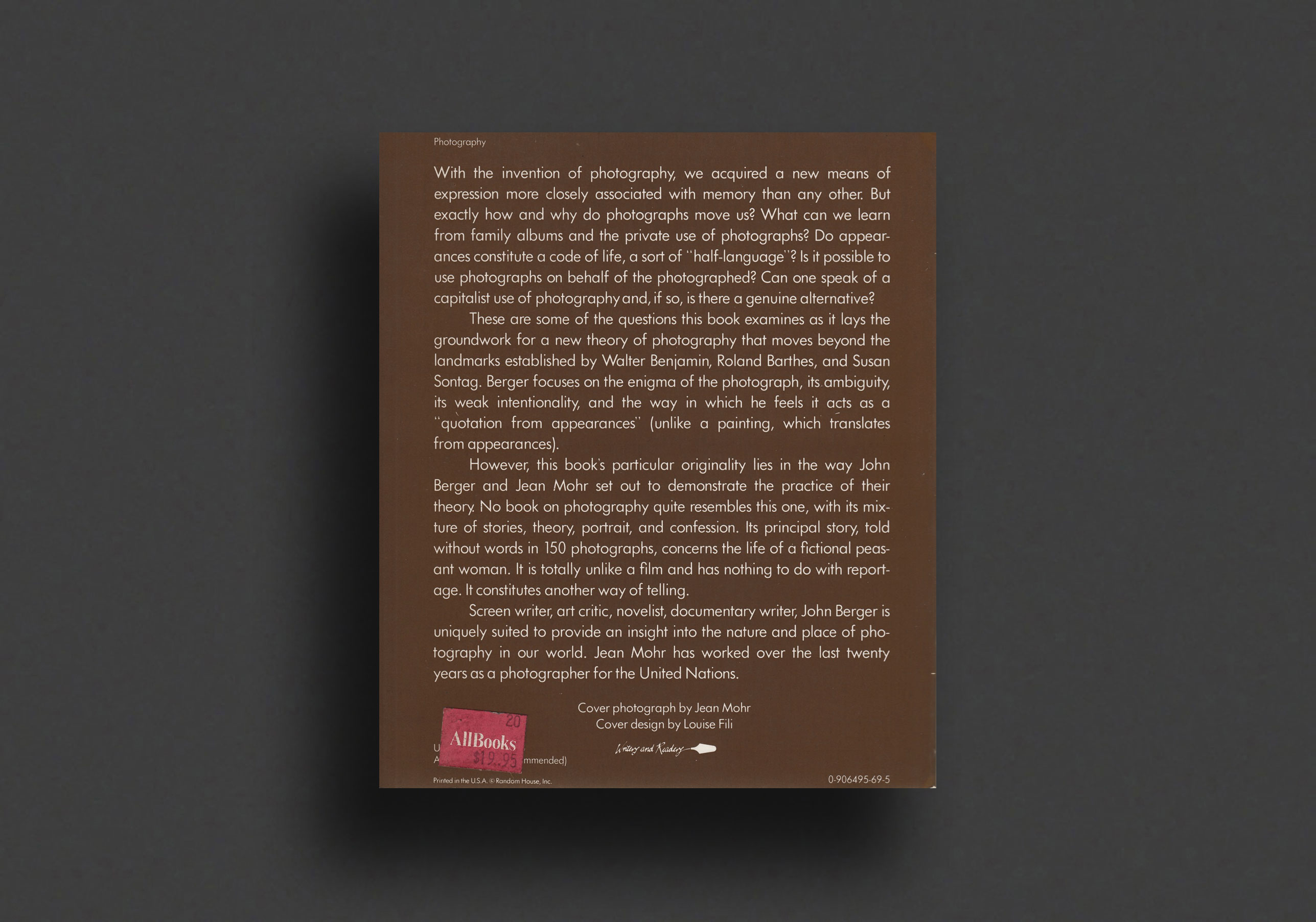
With the invention of photography, we acquired a new means of expression more closely associated with memory than any other. But exactly how and why do photographs move us? What can we learn from family albums and the private use of photographs? Do appearances constitute a code of life, a sort of "half-language"? Is it possible to use photographs on behalf of the photographed? Can one speak of a capitalist use of photography and, if so, is there a genuine alternative?
These are some of the questions this book examines as it lays the groundwork for a new theory of photography that moves beyond the landmarks established by Walter Benjamin, Roland Barthes, and Susan Sontag. Berger focuses on the enigma of the photograph, its ambiguity, its weak intentionality, and the way in which he feels it acts as a
"quotation from appearances" (unlike a painting, which translates from appearances).
However, this book's particular originality lies in the way John Berger and Jean Mohr set out to demonstrate the practice of their theory. No book on photography quite resembles this one, with its mixture of stories, theory, portrait, and confession. Its principal story, told without words in 150 photographs, concerns the life of a fictional peasant woman. It is totally unlike a film and has nothing to do with report-age. It constitutes another way of telling.
Screen writer, art critic, novelist, documentary writer, John Berger is uniquely suited to provide an insight into the nature and place of photography in our world. Jean Mohr has worked over the last twenty years as a photographer for the United Nations.
VG copy light wear to extremities, light creasing to spine.
Italian Renaissance Illuminations
J. J. G. Alexander
1977, English
Softcover, 118 pages, 28 x 20.5 cm
1st Edition, Out of print title / used / good
$15.00 - In stock -
First 1977 edition.
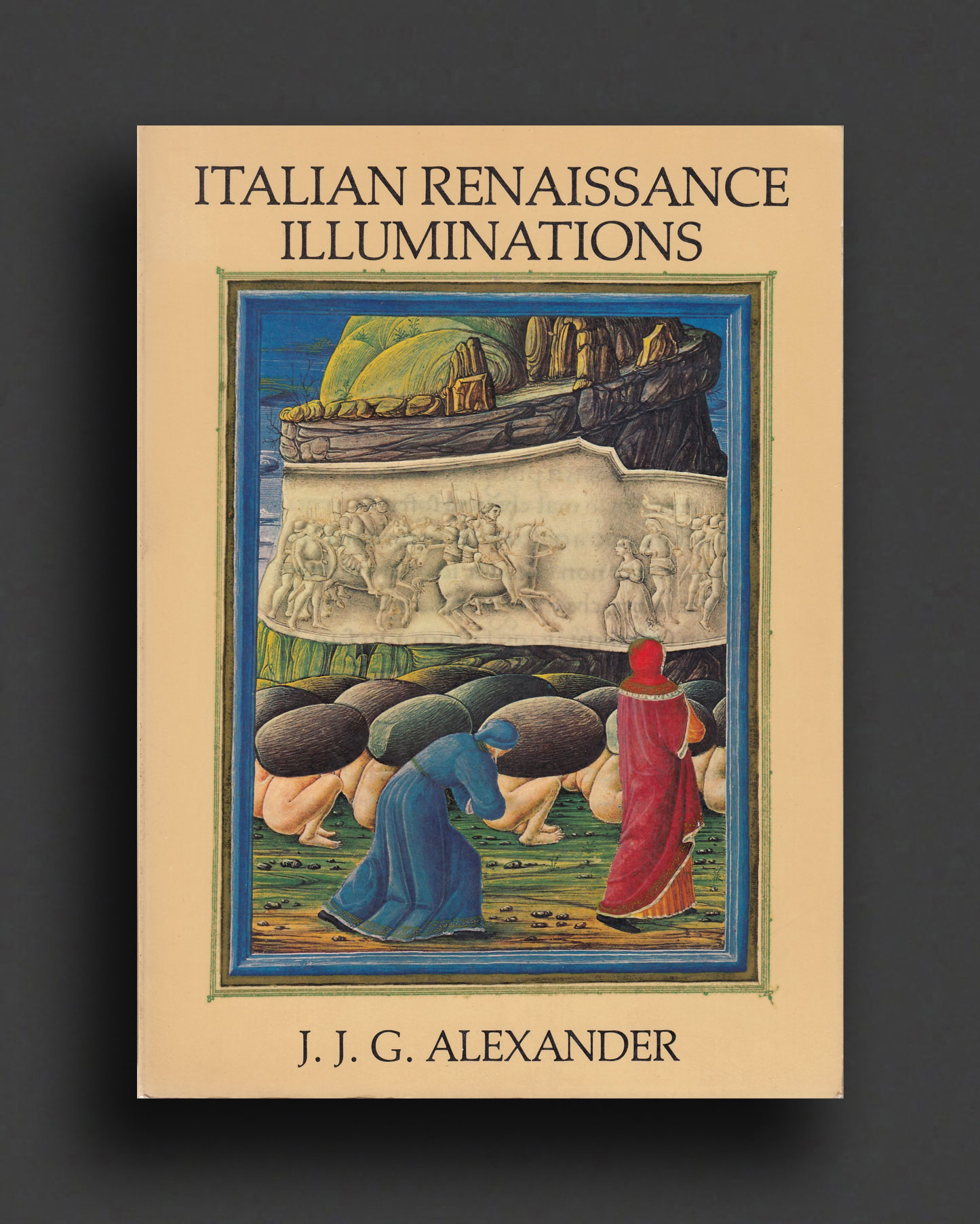
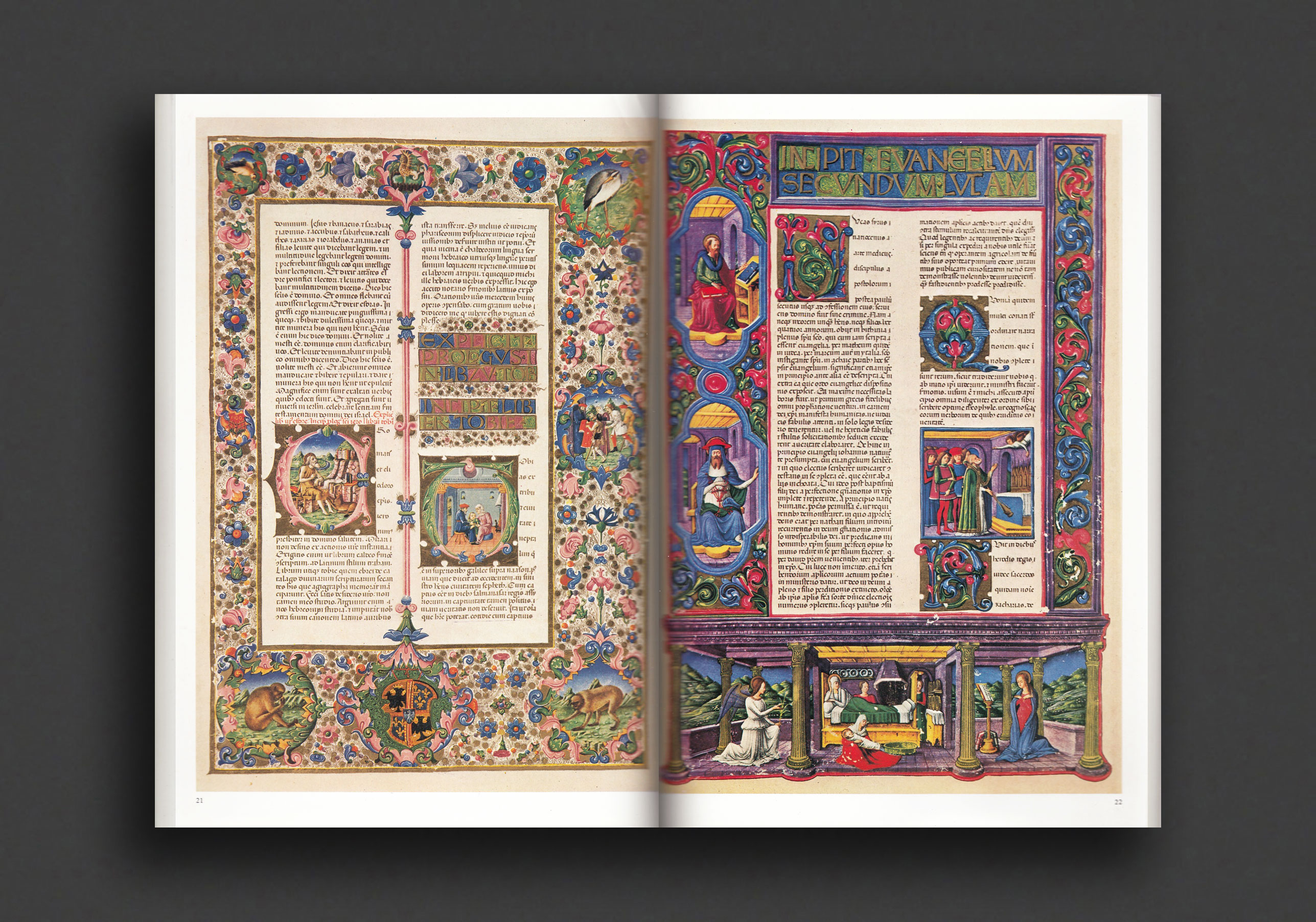
"The ancient art of book illumination was transformed by the intellectual, spiritual and artistic rebirth of Europe and by the revival of classical influence in Italy which occurred in the early part of the fifteenth century. There were new patrons, new artists, and a new style. The Medici of Florence, the Visconti of Milan and the Gonzaga of Mantua all collected extensive libraries. No longer was the art of book illumination confined to the monasteries. Giulio Clovio (whom Vasari called "the Michelangelo in miniature of our day"), Lorenzo Monaco and Mantegna enriched this vital art form from their metropolitan workshops. A number of fresco painters, Fra Angelico and Pisanello among them, also executed miniatures. In the hands of these craftsmen, the unreal creatures of the Middle Ages became men and women of flesh and blood. From the surviving manuscripts of the period,
J. J. G. Alexander has selected the masterpieces of Renaissance illumination and has provided the Introduction and Commentaries on the individual folios reproduced in Italian Renaissance Illuminations.
Good copy with substantial knock to top-left corner, light general wear.
Committing Photography
by Su Braden
1983, English
Softcover, 122 pages, 24.5 x 17.5 cm
1st Edition, Out of print title / used / very good
$20.00 - In stock -
First 1983 edition.
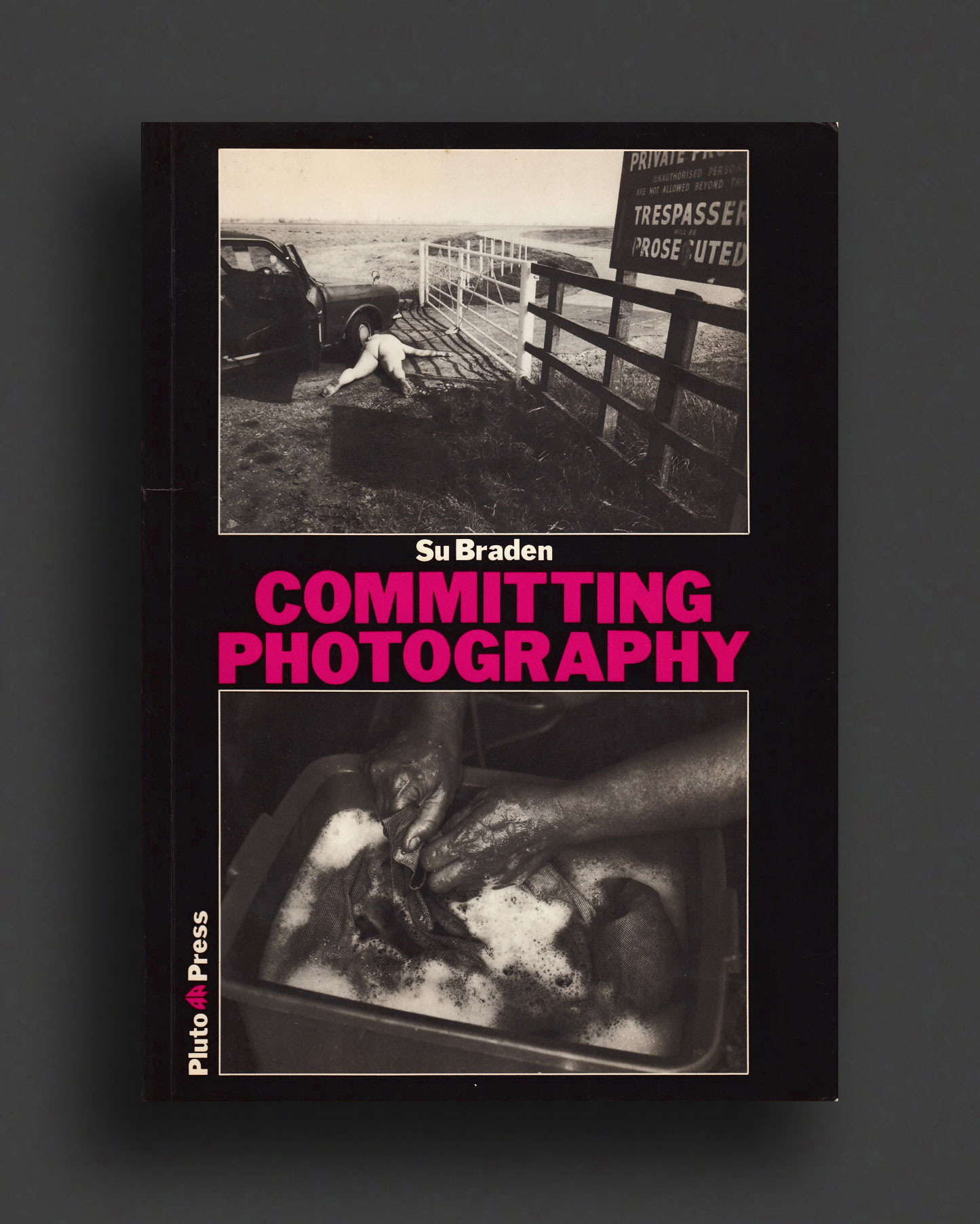
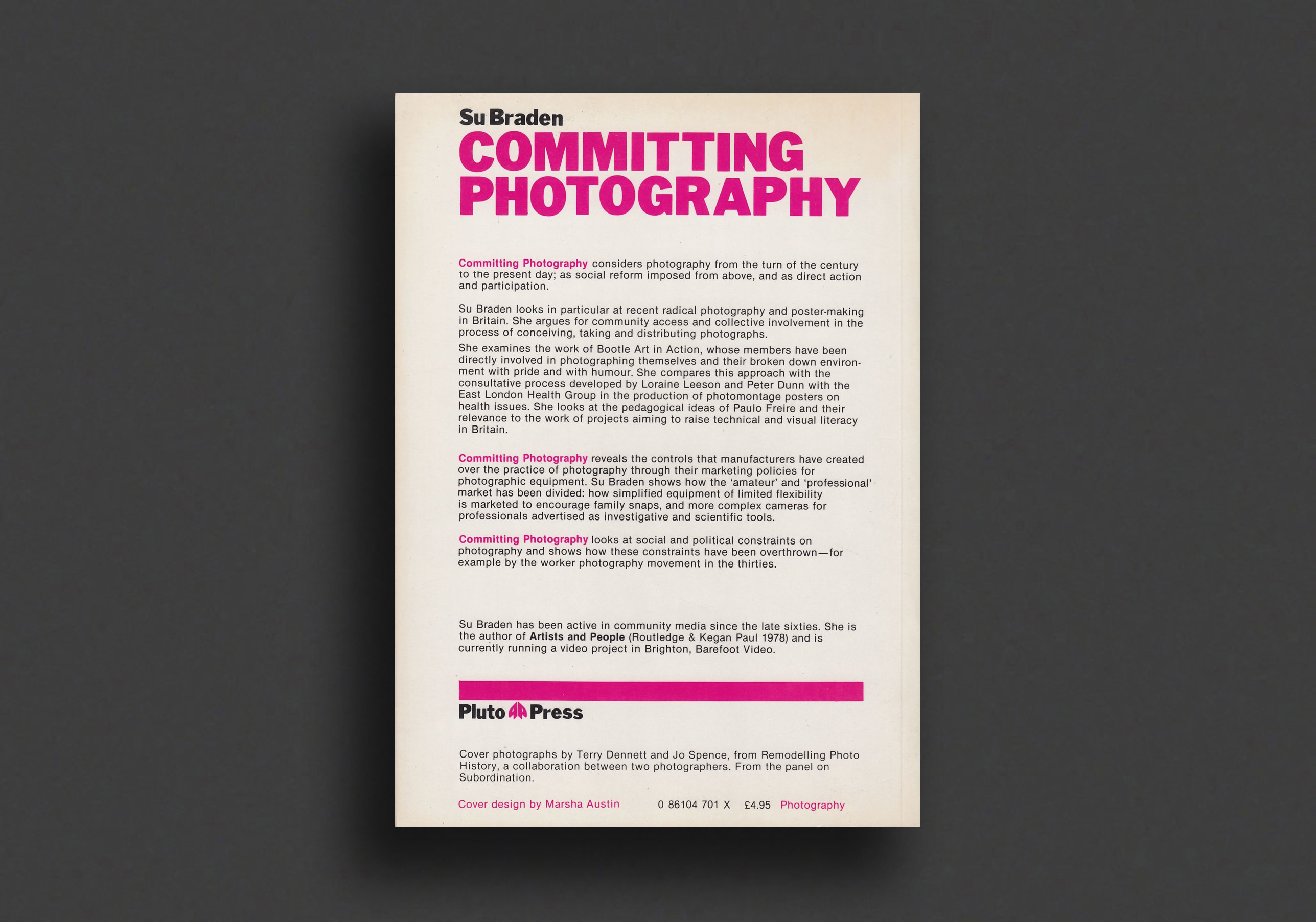
"Committing Photography considers photography from the turn of the century to the present day; as social reform imposed from above, and as direct action and participation. Su Braden looks in particular at recent radical photography and poster-making in Britain. She argues for community access and collective involvement in the process of conceiving, taking and distributing photographs.
She examines the work of Bootle Art in Action, whose members have been directly involved in photographing themselves and their broken down environment with pride and with humour. She compares this approach with the consultative process developed by Loraine Leeson and Peter Dunn with the East London Health Group in the production of photomontage posters on health issues. She looks at the pedagogical ideas of Paulo Freire and their relevance to the work of projects aiming to raise technical and visual literacy in Britain.
Committing Photography reveals the controls that manufacturers have created over the practice of photography through their marketing policies for photographic equipment. Su Braden shows how the 'amateur' and 'professional' market has been divided: how simplified equipment of limited flexibility is marketed to encourage family snaps, and more complex cameras for professionals advertised as investigative and scientific tools.
Committing Photography looks at social and political constraints on photography and shows how these constraints have been overthrown —for example by the worker photography movement in the thirties."
Su Braden has been active in community media since the late sixties. She is the author of Artists and People (Routledge & Kegan Paul 1978) and is currently running a video project in Brighton, Barefoot Video.
VG copy, monor wear to extremities.
Buying Love
Ten Photographers View Prostitution
1987, German
Softcover, 136 pages, 28 x 24.5 cm
1st Edition, Out of print title / used / very good
$65.00 - In stock -
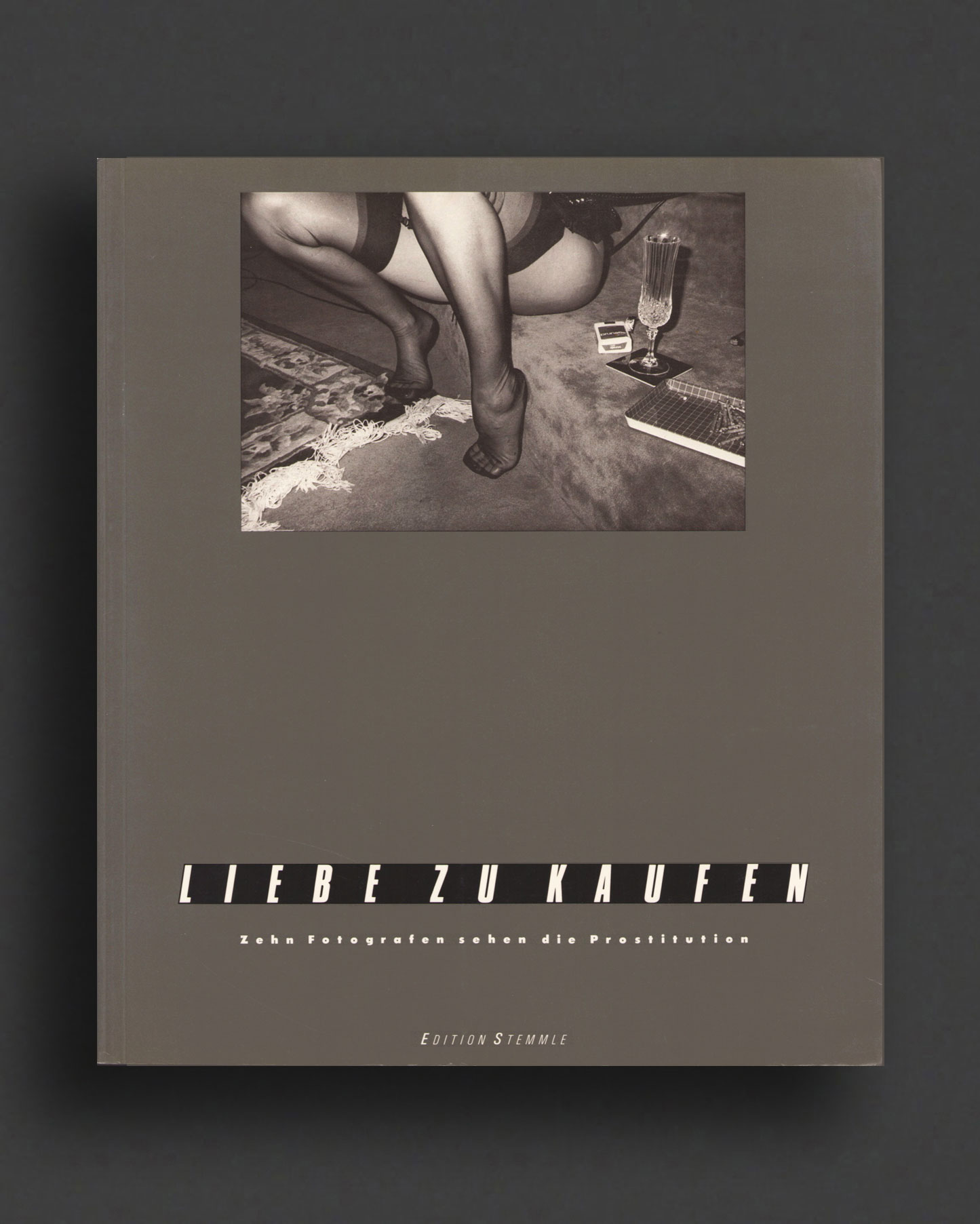
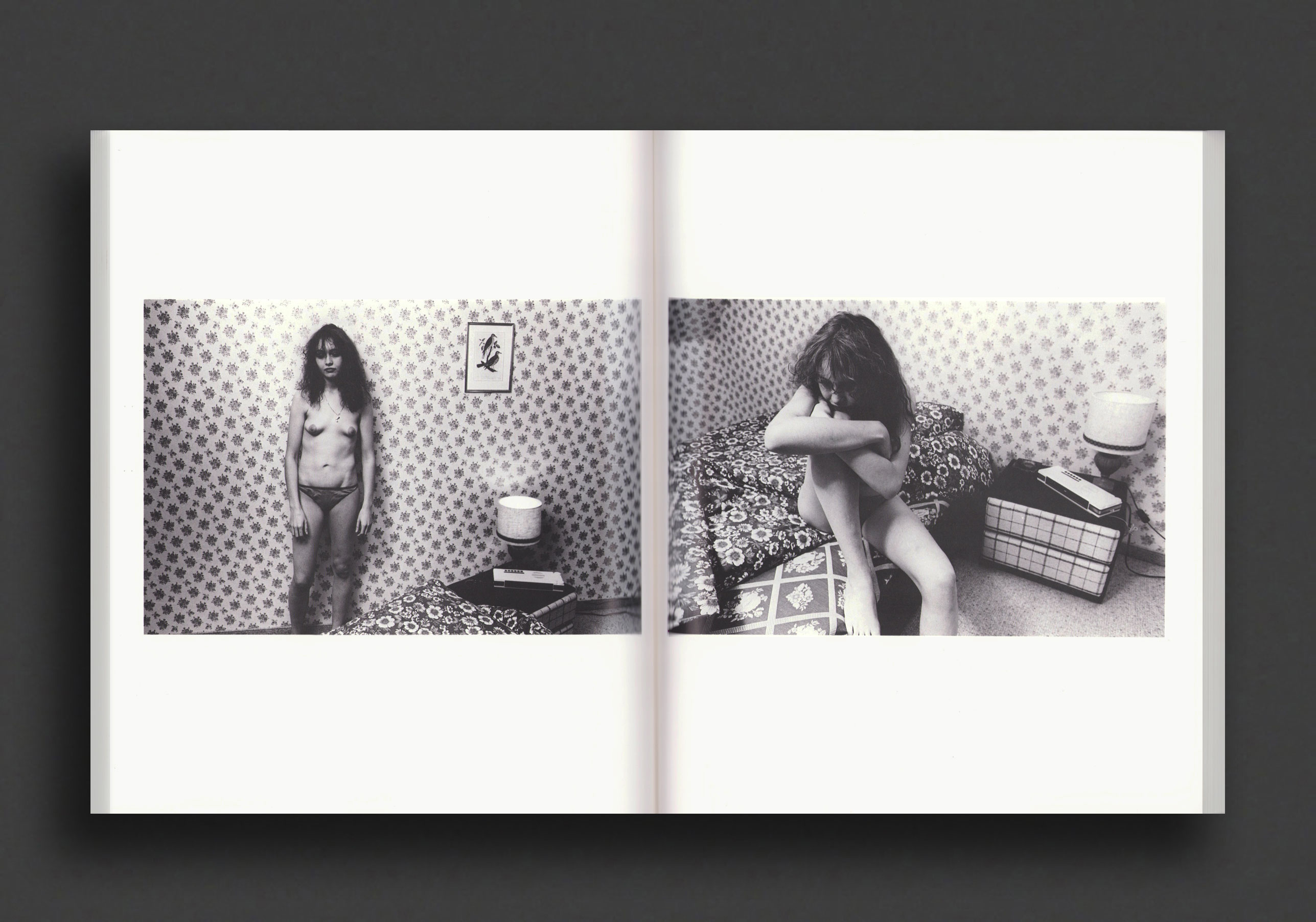
First 1987 edition of Buying Love or Love for Sale, "Liebe Zu Kaufen," published in this edition only, only in Germany. Wonderful collection of photographic folios by three female and seven male photographers documenting the world of prostitution. Features the work of Jérôme De Perlinghi, Jean-Jacques Dicker, Michael von Graffenried, Roswitha Hecke, Barbara Kramp, Vivienne Maricevic, Urs Marty, Andrzej Tyszko, Alberto Venzago, Christian Vogt.
"Prostitution, not only the oldest profession, but also one that has always fascinated photographers. This book shows how this subject is approached and "seen" by these various photographers, and what personal motivations and experiences lie behind their photographic work."
Edited by Volker Wachs with an essay by Markus Imboden.
Very Good copy with some wear to extremities.


Aquirax Uno
Masquerade
1982, Japanese
Softcover (w. dust jacket and plastic sleeve), 126 pages, 33 x 25 cm
1st Edition, Out of print title / used / very good
$140.00 - Out of stock
Published in 1982 and long out-of-print, Masquerade is one of the finest artist books of Japanese illustrator and graphic artist Aquirax Uno. Lavishly illustrated and elaborately designed and directed by the artist himself, this beautiful album collects Uno's most stunning fantastical illustration and painting throughout the 1960s—1980s, alongside texts and photography of Uno in his atelier. Masquerade collates a cross-section of Uno's graphic work spanning his entire career, his iconic and innovative print, book, and theatre works, including many new, unpublished works and illustrations printed in large format across many full-colour fold-outs — a wonderful way to capture his decadent, provocative, stream of consciousness line work in intimate detail. Highly recommended!
Aquirax Uno, also known as Akira Uno (b. 1934) is a Japanese graphic artist, illustrator and painter who was very influential in the 1960s and 1970s. His incredibly unique work is characterized by fantastic visuals, capricious and sensuous line flow, flamboyant (and occasionally grotesque) eroticism, and frequent use of collage and psychedelic bright colours. Uno was prominently involved with the Japanese underground art of the 1960s–1970s, and is particularly notable for his frequent collaborations with Shuji Terayama and his experimental theater Tenjo Sajiki.
Aquirax Uno, also known as Akira Uno (b. 1934) is a Japanese graphic artist, illustrator and painter who was very influential in the 1960s–1970s. His incredibly unique work is characterized by fantastic visuals, capricious and sensuous line flow, flamboyant (and occasionally grotesque) eroticism, and frequent use of collage and psychedelic bright colours. Uno was prominently involved with the Japanese underground art of the 1960s–1970s, and is particularly notable for his frequent collaborations with Shuji Terayama and his experimental theater Tenjo Sajiki.
Good copy with heavy foxing to cover edges and end pages, original publisher's textured plastic protector sleeve with usual slight shrinkage from age, edge wear. Sample images only.

H. R. Giger
Biomechanics
1989, Japanese
Softcover (w. dust jacket + ephemera), 96 pages, 42.5 x 30.5 cm
1st Edition, Out of print title / used / very good
$200.00 - In stock -
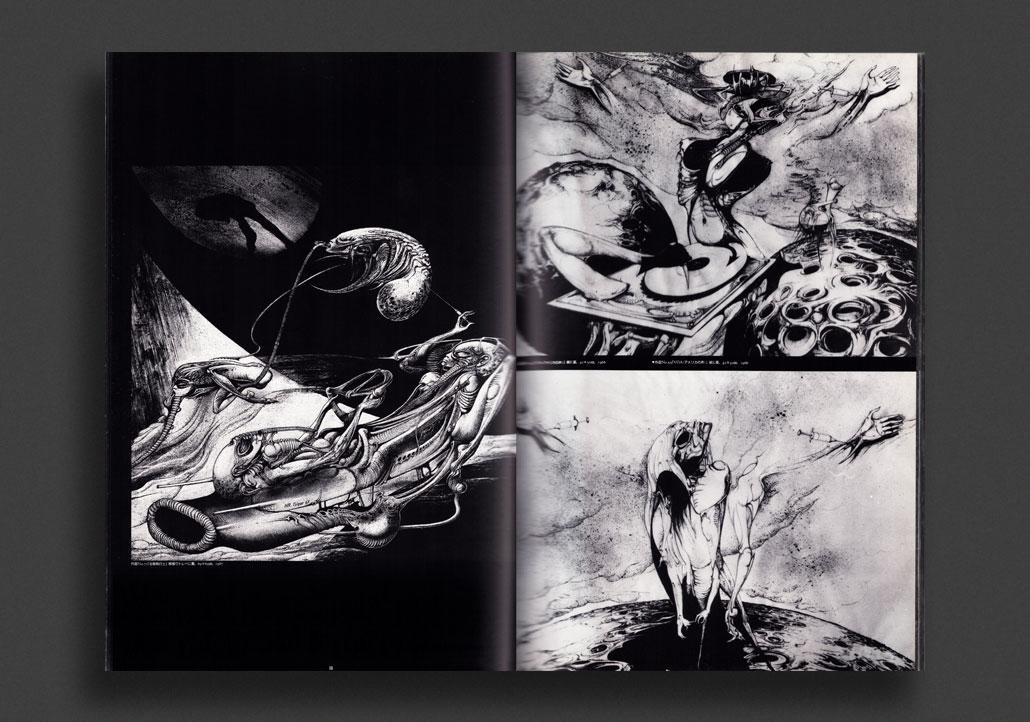
Rare first 1989 Japanese edition of H. R. Giger's Biomechanics. In his classic series of oversized and visually immersive early art volumes, this book comprises a retrospective showcase, from 1964—88, of Giger's work, designed by and with running commentary by Giger himself, with over 200 drawings, paintings, and sculptures, and including concept art for the film Poltergeist II, and design paintings for Emerson, Lake, and Palmer albums, his lost film work and early cartoons. With a foreword by legendary Science Fiction author and longtime Giger fan Harlan Ellison, who dubs him "our latter-day Hieronymus Bosch."
Note: the Japanese editions of these books often had better reproductions from the original plates than the German and English language editions.
Includes Treville publisher ephemera inserted as issued, including an illustrated advert for Giger poster editions, etc.
Very Good in Very Good dust jacket. Excellent, well-preserved copy.
Giger's Alien
1986, Japanese
Softcover, 76 pages, 29.7 x 29.7 cm
Out of print title / used / very good
$90.00 - In stock -
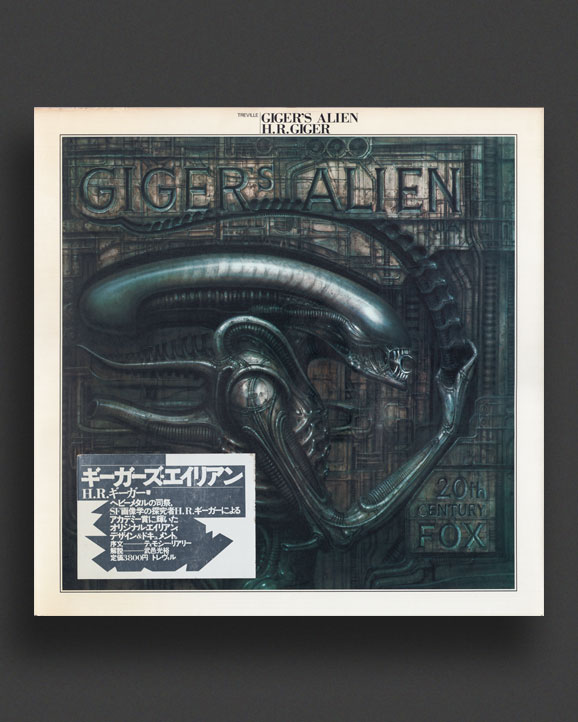
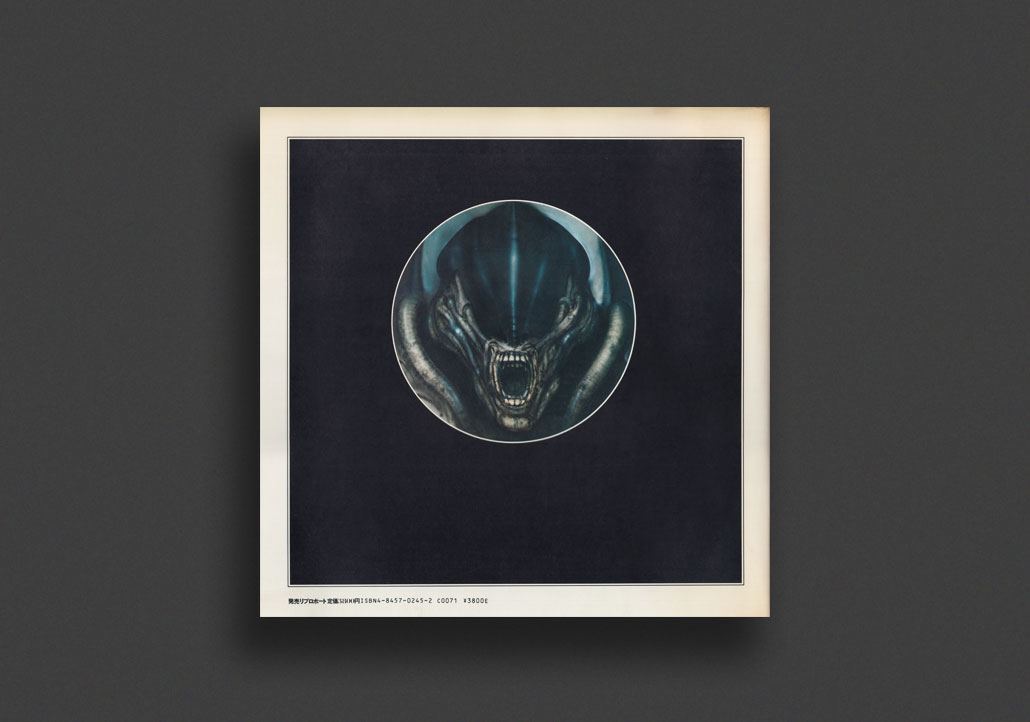
Japanese 1986 edition of the classic "Giger's Alien", a visually stunning and wonderfully insightful book for any fan of the art of H.R. Giger, Ridley Scott and Dan O'Bannon's Alien film or in the production of science-fiction/horror/special effects in any way. A must.
"Giger's Alien provides a complete record of the months and months of painstaking work that resulted in two hours of terrifying celluloid. Sketches, original paintings, photographs of scenery and the Alien under construction and scenes from the film are linked by Giger's detailed diary of his thoughts and actions at the time".
Very Good copy in original dust jacket of this title. Only light wear, beautifully preserved.
H. R. Giger
N.Y. CITY
1981 / 1988, English / Japanese
Softcover (w. dust jacket + Japanese booklet), 48 pages, 40 x 28 cm
1st Edition, Out of print title / used / good
$140.00 - In stock -
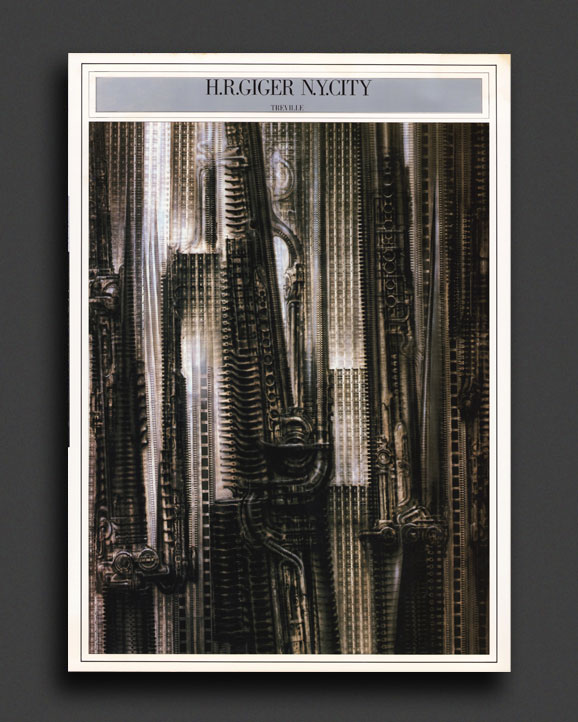
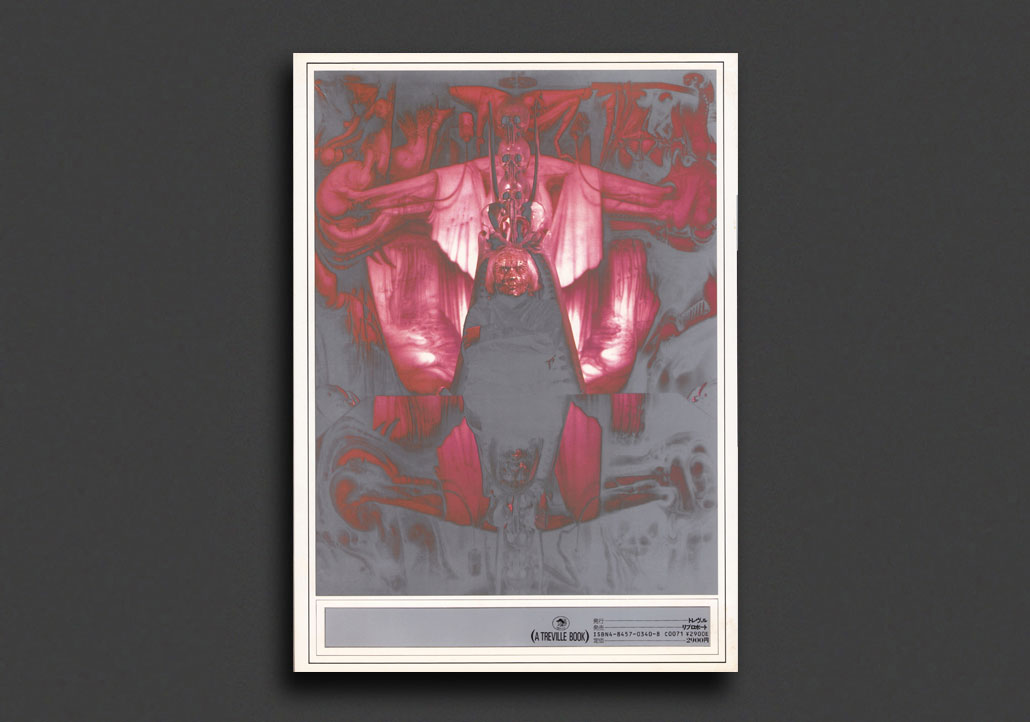
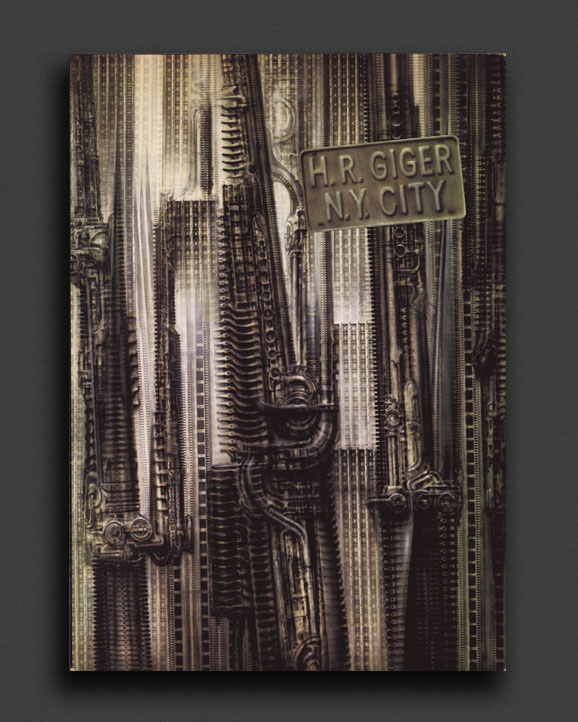
1988 Japanese re-edition by Treville of the original out-of-print 1981 Charles Tuttle edition (entirely in English language). This IS actually just the 1981 edition wrapped in a new glossy dust jacket and re-issued in 1988 with an insert booklet designed by Treville to translate all the book's English texts to Japanese for the first time. Two editions in one, you also have the beautifully produced over-sized 1981 book by H. R. Giger. Foreword by Timothy Leary.
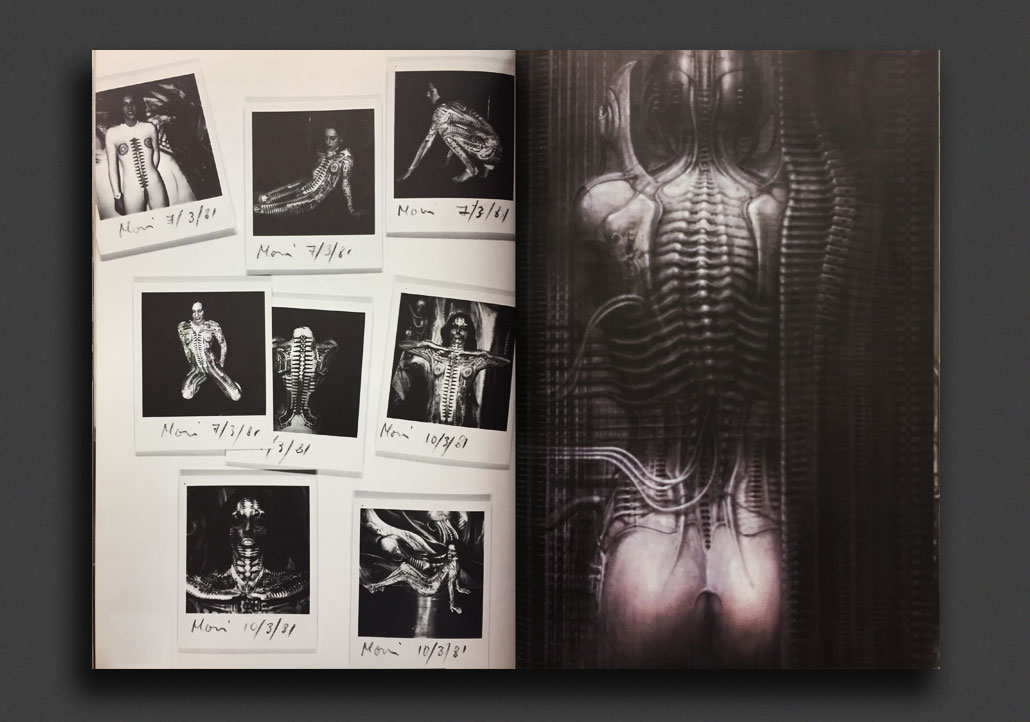
In 1981, a year after being awarded the Oscar for Best Achievement for Visual Effects for Alien, the book H.R. GIGER N.Y. CITY was published. This series of post Alien works, the result of an intense period of non-stop painting, literally day and night, were inspired by Giger's trip to New York City and a template which his colleague Cornelius de Fries, brought back from one of his excursions into the electronic industry. The stencil was actually a sheet of scrap metal from which electrical components had been punched out. Alongside these incredible works are drawings, articles, press clippings, posters and polaroids from Giger's time in New York City.
Fantastic Swiss surrealist painter, sculptor and set designer Hans Rudolf “Ruedi” Giger was born in 1940, the son of a chemist. He spoke of a father who viewed art as a "breadless profession", and strongly encouraged his son to enter into pharmaceutics. Despite this, in 1962, he moved to Zürich, where he studied Architecture and industrial design at the School of Applied Arts until 1970. Giger's style and thematic execution have been hugely influential. His design for the Alien was inspired by his painting Necronom IV and earned him an Oscar in 1980. His books of paintings, particularly Necronomicon and Necronomicon II (1985) and the frequent appearance of his art in Omni magazine continued his rise to international prominence. Giger is also well known for artwork on several music recording albums. His most distinctive stylistic innovation is that of a representation of human bodies and machines in a cold, interconnected relationship, he described as "biomechanical". His paintings often display fetishistic sexual imagery. His main influences were painters Ernst Fuchs and Salvador Dalí. He was also a personal friend of Timothy Leary. Giger suffered from night terrors and his paintings are all to some extent inspired by his experiences with that particular sleep disorder, making his first paintings as a means of art therapy. In 1998 Giger acquired the Château St. Germain in Gruyères, Switzerland, and it now houses the H. R. Giger Museum, a permanent repository of his work.
VG—Good copy, VG dust jacket, fine booklet insert. Book itself has foxing to preliminaries, light wear/tanning, otherwise a tight copy.


Rei Kawakubo and Comme des Garçons
by Deyan Sudjic
1991, Japanese
Hardcover (w. dust jacket and obi-strip), 160 pages, 21 x 20.9 cm
1st Edition, Out of print title / used / fine
$260.00 - Out of stock
First Japanese hardcover edition of the first in-depth study of Comme des Garçons and its elusive creator, Rei Kawakubo, that remains to this day an absolute and unparalleled reference. London Design Museum director and editor/writer (Blueprint, Domus) Deyan Sudjic takes a rare and invaluable look into the early years of Comme des Garçons, a fashion label that since the debut Paris Fashion show in 1981 has gripped the imagination of the fashion-buying public and press as well as becoming a major figure in the transformation of modern Japan. Heavily illustrated in colour and b/w with examples of many rarely seen photographs of the CdG collections and campaigns, store designs, Kawakubo's furniture collection, ephemera and publications (including the history of the famous "Six" magazine, and much more, the book is broken up into detailed chapters: "Starting from Zero", "The Making of a Collection", "Building an Empire", "Red is Black", "Fashion is Design", along with a bibliography and chronology. With photographs by Peter Lindbergh, Arthur Elgort, Bruce Weber, Paolo Roversi, Hans Feurer, and many more, this beautiful volume remains the most the desirable and thorough overview of the CdG universe ever published. Japanese edition, Japanese texts.
Fine copy with same dust jacket and original publisher's obi-strip, preserved in a mylar wrap. One of the nicest copies we've seen.
Comme des Garçons
1981—1986
1986, Japanese
Hardcover (cloth-bound), 152 pages, 36.5 x 29 cm
1st Edition, Out of print title / used / good
$400.00 - In stock -
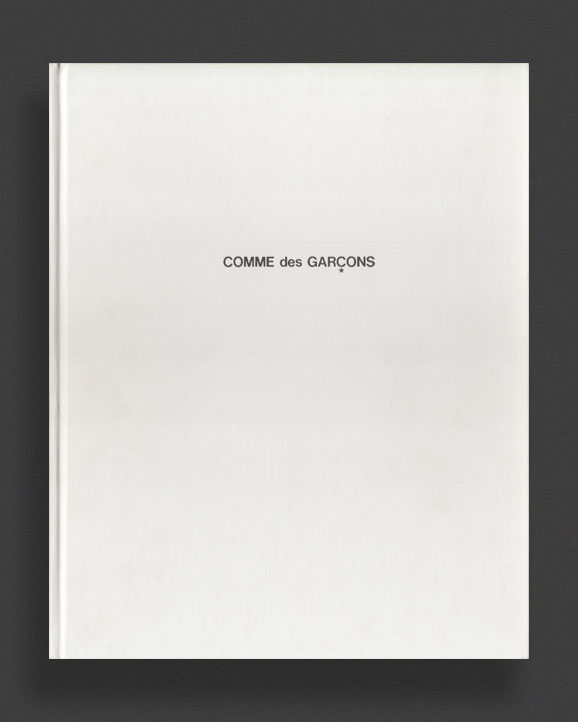
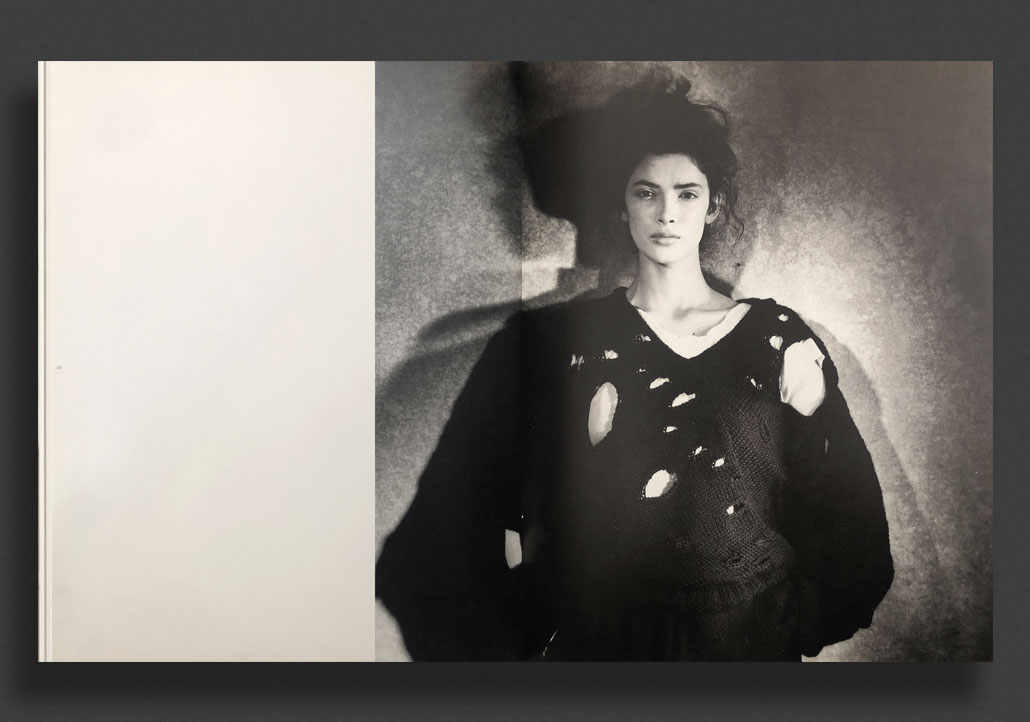
One of the most beautiful and sought after fashion photo-books ever published. First 1986 hardcover edition of Comme des Garçons 1981—1986. A document of early 1980s Comme through the iconic images of Arthur Elgort, Hans Feurer, Eddy Kohli, Peter Lindbergh, Steven Meisel, Paolo Roversi, Oliviero Toscani, and Bruce Weber.
Since the inception of Japanese fashion label Comme des Garçons in 1969, founder Rei Kawakubo applied a particular aesthetic to every aspect of Comme des Garçons, extending her vision to the company's packaging, furniture, interior design, graphic design, and publishing, including a selection of some of the fashion world's most visually compelling and challenging books and printed materials.
This wonderful and very iconic collection of photographs presents Rei Kawakubo's groundbreaking, innovative designs from an exciting period of Comme des Garçons history, between 1981 and 1986, as photographed by some of the most important fashion photographers of our time, including Arthur Elgort, Hans Feurer, Eddy Kohli, Peter Lindbergh, Steven Meisel, Paolo Roversi, Oliviero Toscani, and Bruce Weber, among others.
This gorgeous and rare clothbound volume perfectly captures a very important and exciting moment in the history of fashion, and is considered one of the most-collectable and prized fashion photo-books to come out of the 1980s.
Good copy without slipcase. This would be a Very Good copy but the only notable damage is a section of the hardcover edges on the open side has become frayed with friction. This only effects the overhang of the hardboards, which have done their job in protecting the entire book content, which remains undamaged. Otherwise only light wear. A heavily discounted copy for this one area of damage. Please contact if you wish for specific photographs.


Comme des Garçons
1981—1986
1986, Japanese
Hardcover (cloth-bound in slip-case), 152 pages, 36.5 x 29 cm
1st Edition, Out of print title / used / very good
$850.00 - In stock -
One of the most beautiful and sought after fashion photo-books ever published. First 1986 hardcover, slipcased edition of Comme des Garçons 1981—1986. A document of early 1980s Comme through the iconic images of Arthur Elgort, Hans Feurer, Eddy Kohli, Peter Lindbergh, Steven Meisel, Paolo Roversi, Oliviero Toscani, and Bruce Weber.
Since the inception of Japanese fashion label Comme des Garçons in 1969, founder Rei Kawakubo applied a particular aesthetic to every aspect of Comme des Garçons, extending her vision to the company's packaging, furniture, interior design, graphic design, and publishing, including a selection of some of the fashion world's most visually compelling and challenging books and printed materials.
This wonderful and very iconic collection of photographs presents Rei Kawakubo's groundbreaking, innovative designs from an exciting period of Comme des Garçons history, between 1981 and 1986, as photographed by some of the most important fashion photographers of our time, including Arthur Elgort, Hans Feurer, Eddy Kohli, Peter Lindbergh, Steven Meisel, Paolo Roversi, Oliviero Toscani, and Bruce Weber, among others.
This gorgeous and rare clothbound volume, housed in original printed cardboard slip-case, perfectly captures a very important and exciting moment in the history of fashion, and is considered one of the most-collectable and prized fashion photo-books to come out of the 1980s.
Very Good-Fine copy preserved in Very Good cardboard slipcase with only light tanning / light wear.
