World Food Books' programme is largely produced on Kulin Nation land. We acknowledge the Wurundjeri people of the Kulin Nation as the first and continuing custodians of this land, and pay respect to their Elders past, present, and emerging.
World Food Books is an arts and special interests bookshop in Naarm / Melbourne. Founded in 2010, World Food Books is devoted to the presentation of a rotating, hand-selection of international art, design, literary and counterculture publications with an emphasis on the anti-traditional, the experimental, the avant-garde, the heretic, the marginal.
Presenting new titles alongside rare and out-of-print books, catalogues and journals spanning the fields of modern and contemporary art, design, photography, illustration, film, literature, poetry, cultural theory, philosophy, sexuality, popular and underground culture in its many radical forms, World Food Books wishes to encourage adventurous, thoughtful and open-minded reading, looking, writing, and exchange of publishing and ideas, both current and historical.
As well as our bookshop, located in Melbourne's historical Nicholas Building, all of our inventory is available internationally via our online mail-order service.
World Food Books semi-regularly co-ordinates "Occasions", a programme of exhibits and events at the bookshop and in partnership with other hosts (such as museums and art galleries) that develop out of the activities, relationships and content of the bookshop itself.
World Food Books
The Nicholas Building
37 Swanston Street
Room 5, Level 6
Melbourne 3000
Australia
SHOP HOURS:
Thu–Fri 12–6
Sat 12–5
WEB-SHOP OPEN 24/7
World Food Books
Postal Address:
37 Swanston Street
Room 5, Level 6
Melbourne 3000
Australia
Art
Theory / Essay
Architecture / Interior
Graphic Design / Typography
Photography
Fashion
Eros
LGBTQ+
Fiction / Poetry
Weird / Speculative / Science Fiction / Horror
Transgressive / Visceral / Abject
Symbolism / Decadence / Fin de siècle
Film / Video
Painting
Sculpture / Installation
Performance / Dance / Theater
Drawing
Sound / Music
Curatorial
Group Shows / Collections
Periodicals
Out-of-print / Rare
Posters / Ephemera / Discs
Signed Books
World Food Books Gift Voucher
World Food Book Bag
Australian Art
Australian Fiction
Australian Science Fiction / Speculative Fiction
Australian Poetry
Australian Photography
Japanese Photography
Conceptual Art
Minimal Art
Dada
'Pataphysics / Oulipo
Fluxus
Concrete Poetry
Pop Art
Surrealism
Arte Povera
Arte Informale / Haute Pâte / Tachism
Nouveau Réalisme / Zero / Kinetic
Situationism / Lettrism
Collage / Mail Art / Xerox Art
Art Brut / Folk / Visionary / Fantastic
Illustration / Graphic Art / Bandes Dessinées
Furniture
Italian Radical Design / Postmodernism
Textiles
Ceramics / Glass
Counterculture
Protest / Revolt
Philosophy
Psychoanalysis
Anthropology
Anarchism
Socialism / Anarchism / Communism / Capitalism
Literary Theory / Semiotics / Language
Feminism / Women's Studies
Gender Studies / Sexuality
Anthropology
Fetishism / BDSM
Drugs / Psychedelia
Crime / Violence
Animal Rights / Veganism
Occult / Esoterica
Ecology / Earth / Alternative Living
Whole Earth / Crafts
All prices in AUD (Australian dollars)
Pick-Ups
Pick-up orders can be collected in our bookshop during opening hours after order date. Please collect any Pick-up orders within 2 weeks of ordering as we have limited storage space. Orders will be released back into stock if not collected within this time. No refunds can be made for pick-ups left un-collected. If you cannot make it in to the bookshop in this time-frame, please choose postage option.
Return Policy
All sales are final. We do accept returns (for refund or exchange) for items received in error. All our orders are packed with special care using heavy-duty padding and cardboard book-mailers or bubble mailers (for smaller books), using reinforcement where required. We cannot take responsibility for any lost, stolen or damaged parcels.
Insurance
Should you wish to insure your package, please email us directly after placing your order and we can organise this at a small extra expense. Although all standard/express tracked packages are very safe and dependable, we cannot take responsibility for any lost, stolen or damaged parcels. We recommend insurance on valuable orders.
Interested in selling your old books, catalogues, journals, magazines, comics, fanzines, ephemera? We are always looking for interesting, unusual and out-of-print books to buy. We only buy books in our fields of interest and specialty, and that we feel we can resell.
We base these prices on desirability, market value, in-print prices, condition and our current stock levels. We offer cash, store credit, and can take stock on consignment. All
about 25% of the price we expect to get when we sell them, or 30% in store credit. We base these prices on desirability, market value, in-print prices, condition and our current stock levels.
Sell your books any day of the week. You can drop them off and return later. If you have a lot of books, we can visit your Sydney home.
We buy books that we feel we can resell. We offer about 25 % of the price we expect to get when we sell them, or 30% in store credit. We base these prices on desirability, market value, in-print prices, condition and our current stock levels.
Philadelphia Wireman
03 August - 01 September, 2018
World Food Books is proud to announce our next Occasion, the first presentation of sculptures by Philadelphia Wireman in Australia.
The Philadelphia Wireman sculptures were found abandoned in an alley off Philadelphia’s South Street on trash night in 1982. Their discovery in a rapidly-changing neighbourhood undergoing extensive renovation, compounded with the failure of all attempts to locate the artist, suggests that the works may have been discarded after the maker’s death. Dubbed the "Philadelphia Wireman" during the first exhibition of this work, in 1985, the maker’s name, age, ethnicity, and even gender remain uncertain. The entire collection totals approximately 1200 pieces, all intricately bound together with tightly-wound heavy-gauge wire (along with a few small, abstract marker drawings, reminiscent both of Mark Tobey and J.B. Murry). The dense construction of the work, despite a modest range of scale and materials, is singularly obsessive and disciplined in design: a wire armature or exoskeleton firmly binds a bricolage of found objects including plastic, glass, food packaging, umbrella parts, tape, rubber, batteries, pens, leather, reflectors, nuts and bolts, nails, foil, coins, toys, watches, eyeglasses, tools, and jewellery.
Heavy with associations—anthropomorphic, zoomorphic, and socio-cultural responses to wrapped detritus—the totemic sculptures by Philadelphia Wireman have been discussed in the context of work created to fulfil the shamanistic needs of alternative religions in American culture. Curators, collectors, and critics have variously compared certain pieces to sculpture from Classical antiquity, Native American medicine bundles, African-American memory jugs, and African fetish objects. Reflecting the artist’s prolific and incredibly focused scavenging impulse, and despite—or perhaps enhanced by—their anonymity, these enigmatic objects function as urban artefacts and arbiters of power, though their origin and purpose is unknown. Philadelphia Wireman, whatever their identity, possessed an astonishing ability to isolate and communicate the concepts of power and energy through the selection and transformation of ordinary materials. Over the course of the past two decades, this collection has come to be regarded as an important discovery in the field of self-taught art and vernacular art.
Presented in collaboration with Fleisher-Ollman Gallery, Philadelphia, and Robert Heald, Wellington.
Susan Te Kahurangi King
02 February - 10 March, 2018
Susan Te Kahurangi King (24 February 1951 - ) has been a confident and prolific artist since she was a young child, drawing with readily available materials - pencils, ballpoint pens and felt-tip markers, on whatever paper is at hand. Between the ages of four and six Susan slowly ceased verbal communication. Her grandparents William and Myrtle Murphy had developed a special bond with Susan so they took on caring responsibilities for extended periods. Myrtle began informally archiving her work, carefully collecting and storing the drawings and compiling scrapbooks. No drawing was insignificant; every scrap of paper was kept. The King family are now the custodians of a vast collection containing over 7000 individual works, from tiny scraps of paper through to 5 meter long rolls.
The scrapbooks and diaries reveal Myrtle to be a woman of great patience and compassion, seeking to understand a child who was not always behaving as expected. She encouraged Susan to be observant, to explore her environment and absorb all the sights and sounds. Myrtle would show Susan’s drawings to friends and people in her community that she had dealings with, such as shopkeepers and postal workers, but this was not simply a case of a grandmother’s bias. She recognised that Susan had developed a sophisticated and unique visual language and sincerely believed that her art deserved serious attention.
This was an unorthodox attitude for the time. To provide some context, Jean Dubuffet coined the term Art Brut in 1945 to describe work created by self-taught artists – specifically residents of psychiatric institutions and those he considered to be visionaries or eccentrics. In 1972 Roger Cardinal extended this concept by adopting the term Outsider Art to describe work made by non-academically trained artists operating outside of mainstream art networks through choice or circumstance. Susan was born in Te Aroha, New Zealand in 1951, far from the artistic hubs of Paris and London that Dubuffet and Cardinal operated in. That Myrtle fêted Susan as a self-taught artist who deserved to be taken seriously shows how progressive her attitudes were.
Susan’s parents Doug and Dawn were also progressive. Over the years they had consulted numerous health practitioners about Susan’s condition, as the medical establishment could not provide an explanation as to why she had lapsed into silence. Dawn educated herself in the field of homeopathy and went on to treat all twelve of her children using these principles – basing prescriptions on her observations of their physical, mental and emotional state.
Doug was a linguist with an interest in philosophy who devoted what little spare time he had to studying Maori language and culture. To some extent their willingness to explore the fringes of the mainstream made them outsiders too but it was their commitment to living with integrity and their respect for individuality that ensured Susan’s creativity was always encouraged.
Even though Susan’s family supported her artistic pursuits, some staff in schools and hospitals saw it as an impediment to her assimilation into the community and discouraged it in a variety of ways. Her family was not always aware of this and therefore did not fully understand why Susan stopped drawing in the early 1990s. However, rather than dwell on the challenges that Susan faced in pursuit of her artistic practice, they prefer to highlight her achievements. In 2008 Susan began drawing again in earnest, after an almost 20 year interruption, and her work is now shown in galleries around the world.
Susan grew up without television and has been heavily influenced by the comics she read as a child. She is absolutely fearless in the appropriation of recognizable characters, such as Donald Duck and Mickey Mouse, in her work. She twists their limbs, contorts their faces, compresses them together, blends them into complex patterned backgrounds - always imbuing them with an incredible energy. Although Susan often used pop culture characters in her work they are not naive or childlike. These are drawings by a brilliant self-taught artist who has been creating exceptional work for decades without an audience in mind.
Mladen Stilinović
"Various Works 1986 - 1999"
02 February 16 - September 10, 2016
Various works 1986 - 1999, from two houses, from the collections of John Nixon, Sue Cramer, Kerrie Poliness, Peter Haffenden and Phoebe Haffenden.
Including: Geometry of Cakes (various shelves), 1993; Poor People’s Law (black and white plate), 1993; White Absence (glasses, ruler, set square, silver spoon, silver ladel with skin photograph and wooden cubes), 1990-1996; Exploitation of the Dead (grey and red star painting, wooden painting, black spoon with red table, red plate), 1984-1990; Money and Zeros (zero tie, paintings made for friends in Australia (Sue, John, Kerrie), numbers painting), 1991-1992; Words - Slogans (various t-shirts) - “they talk about the death of art...help! someone is trying to kill me”, “my sweet little lamb”, “work is a disease - Karl Marx”; Various artist books, catalogues, monographs, videos; Poster from exhibition Insulting Anarchy; "Circular" Croatian - Australian edition; Artist book by Vlado Martek (Dostoyevsky); more.
Thanks to Mladen Stilinović and Branka Stipančić.
Jonathan Walker
Always Will Need To Wear Winter Shirt Blue + Ochre Small Check Pattern
21 August - 21 September, 2015
Untitled
I am not a great reader of poetry but I always return to the work of Melbourne poet, Vincent Buckley (1925- 1988). Perhaps I find his most tantalising piece to be not a finished poem but a fragment left on a scrap of paper discovered on his desk after the poet’s death.
The poetry gathers like oil
In the word-core, and spreads
It has its music meet,
Its music is in movement.
This fragment is more the shell left behind from a volatile thought than a finished poem. I find the last two lines honest but awkward whereas the first two lines work like an arrow. Most likely he could not find a resolution so it was left. Still, in its present form, it remains an eloquent testimony to the ultimate failure of a medium to express mobile thought and sensation, in Buckley’s case, through verbal language. It’s an important matter because this is something all artists have to deal with regardless of the medium.
I have never written a poem, however, I am forever copying fragments from books on paper scraps in a vain effort to fix certain notions in my head. At first, they function as bookmarks that are sometimes returned to when I open the book. But before long, as they accumulate, they fall out littering the table interspersed with A4 photocopies, bills, books and medications.
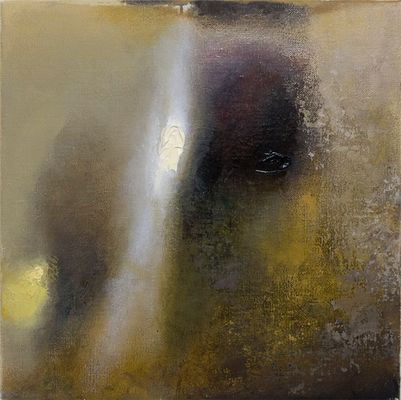
To return to Buckley’s fragment, the first two lines very much evoke how I paint nowadays. As you age, detail diminishes and patches of light become more luminous and float. I feel the most honest way of dealing with this is by smearing the oil paint on the canvas with the fingers and working close-up, blind. Only if the patches coalesce into an approaching image can the work gain a life.
-
Jonathan Walker was born in Melbourne, Australia and brought up on a dairy farm in Gippsland. In the 1970’s he studied painting at RMIT and won the Harold Wright Scholarship to the British Museum, London. During the 1980’s he exhibited at Pinacotheca Gallery, Richmond and had work shown at the NGV and Heidi City Art Gallery. Over the same period he designed the cover for the “Epigenesi” LP by Giancarlo Toniutti, Italy and conducted a mail exchange work with Achim Wollscheid, Germany. The work with artists through the post resulted in an article published in the bicentenary issue of Art and Australia 1988. He showed in artist run spaces such as WestSpace in the 90’s and 2000’s, and until 2012, taught painting at Victoria University, which is where we (Colleen Ahern and Lisa Radford) as organisers of the exhibition, among many others, had the privilege of being his student.
Walker’s knowledge was imparted to students through the careful selection of music, literature, and artists found in books that he himself had ordered for the library. Walker’s strategy was the generosity of sharing his vast knowledge with references specific to each student and their context.
Walker’s paintings share a similar focus and intimacy.
This exhibition presents a small selection of recent paintings alongside a publication that includes Walker’s writing. Observational and analytical, Walker’s work is a type of material notation — the time of day, colour and how it is blended, the both specific and fleeting location of a reflection on lino or the question of whether a chair leg should be included in a painting.
Please join us on Friday August 21 between 6-8pm to celebrate the opening of the exhibition.
Curated by Colleen Ahern and Lisa Radford.
B. Wurtz
Curated by Nic Tammens
March 26 - April 4, 2015
B.Wurtz works from a basement studio in his home on Manhattan’s Lower East Side.
This local fact is attested to by the plastic shopping bags and newsprint circulars that appear in his work. As formal objects, they don’t make loud claims about their origins but nonetheless transmit street addresses and places of business from the bottom of this long thin island. Like plenty of artists, Wurtz is affected by what is local and what is consumed. His work is underpinned by this ethic. It often speaks from a neighborhood or reads like the contents of a hamper:
“BLACK PLUMS $1.29 lb.”
“Food Bazaar”
“USDA Whole Pork Shoulder Picnic 99c lb.”
“RITE AID Pharmacy, with us it’s personal.”
“H. Brickman & Sons.”
“Sweet Yams 59c lb."
Most of the work in this exhibition was made while the artist was in residence at Dieu Donne, a workshop dedicated to paper craft in Midtown. Here Wurtz fabricated assemblages with paper and objects that are relatively lightweight, with the intention that they would be easily transportable to Australia. This consideration isn’t absolute in Wurtz’s work, but was prescriptive for making the current exhibition light and cheap. Packed in two boxes, these works were sent from a USPS post office on the Lower East Side and delivered to North Melbourne by Australia Post.
Wurtz appears courtesy of Metro Pictures, New York.
Thanks to Rob Halverson, Joshua Petherick, Sari de Mallory, Matt Hinkley, Helen Johnson, Fayen d'Evie, Ask Kilmartin, Lisa Radon, Ellena Savage, Yale Union, and "Elizabeth".
John Nixon
"Archive"
December 15 - January 20, 2014
The presentation of John Nixon's archive offered a rare showcase of this extensive collection of the artist's own publications, catalogues, posters, ephemera, editions and more, from the mid 1980s onwards, alongside a selection of his artworks.
Organized by John Nixon, Joshua Petherick and Matt Hinkley.
<a href=http://wfb.public-office.info/artist/john-nixon>All titles by John Nixon
"Habitat"
at Minerva, Sydney (organised by Joshua Petherick and Matt Hinkley)
November 15 - December 20, 2014
Lupo Borgonovo, Janet Burchill & Jennifer McCamley,
Lewis Fidock, HR Giger, Piero Gilardi, Veit Laurent Kurz,
Cinzia Ruggeri, Michael E. Smith, Lucie Stahl, Daniel Weil, Wols
Press Release:
“...It contained seven objects. The slender fluted bone, surely formed for flight, surely from the wing of some large bird. Three archaic circuitboards, faced with mazes of gold. A smooth white sphere of baked clay. An age-blackened fragment of lace. A fingerlength segment of what she assumed was bone from a human wrist, grayish white, inset smoothly with the silicon shaft of a small instrument that must once have ridden flush with the surface of the skin - but the thing’s face was seared and blackened.”
William Gibson, “Count Zero”, 1986
"Autumn Projects Archive"
Curated by Liza Vasiliou
March 6 - March 15, 2014
World Food Books, in conjunction with the Virgin Australia Melbourne Fashion Festival 2014, presented the Autumn Projects archive, consisting of a selection of early examples in Australian fashion with a particular interest in collecting designers and labels from the period beginning in the 1980’s, who significantly influenced the discourse of Australian Fashion.
Curated by Liza Vasiliou, the exhibition provided a unique opportunity to view pieces by designers Anthea Crawford, Barbara Vandenberg, Geoff Liddell and labels CR Australia, Covers, Jag along with early experimental collage pieces by Prue Acton and Sally Browne’s ‘Fragments’ collection, suspended throughout the functioning World Food Books shop in Melbourne.
H.B. Peace
presented by CENTRE FOR STYLE
November 14, 2013
"Hey Blinky, you say chic, I say same"
Anon 2013
H.B. Peace is a clothing collaboration between great friends Blake Barns and Hugh Egan Westland. Their pieces explore the divergences between 'character’ and ‘personality’ in garments....etc
Special Thanks to Joshua Petherick and Matt Hinkley of WFB and Gillian Mears
and a Very Special Thank you to Audrey Thomas Hayes for her shoe collaboration.
Janet Burchill & Jennifer McCamley
"Aesthetic Suicide"
May 10 - June 8, 2013
The first of our occasional exhibitions in the World Food Books office/shop space in Melbourne, "Aesthetic Suicide" presented a body of new and older works together by artists Janet Burchill & Jennifer McCamley, including videos, prints, a wall work, and publications.
During shop open hours videos played every hour, on the hour.
c. 1989, English
Softcover (spiral bound), unpaginated, 28 x 23 cm
1st Edition, Out of print title / used / very good
Published by
David Dunn / California
$120.00 - Out of stock
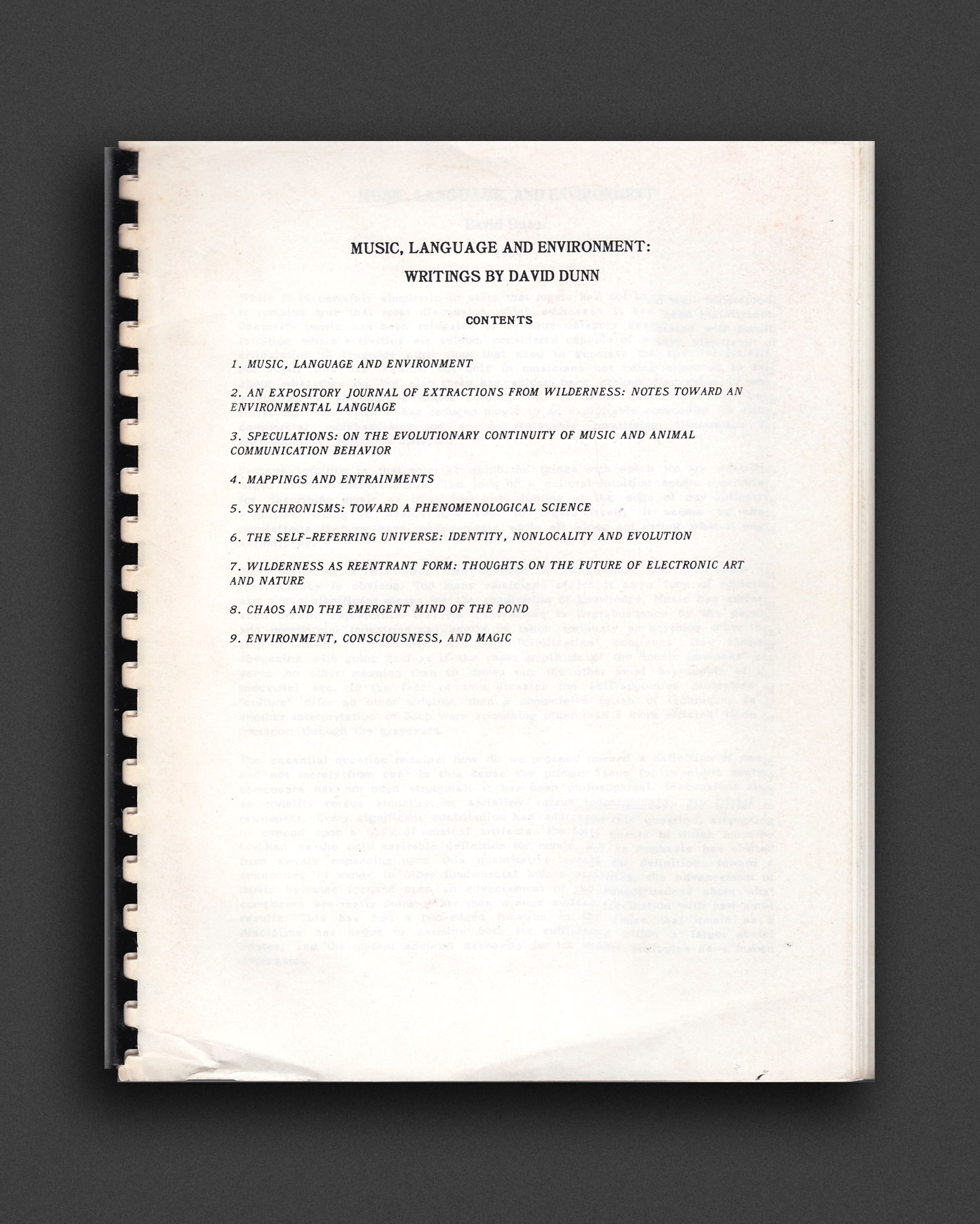
Very rare, privately issued anthology of writings by pioneering experimental/environmental composer and researcher, Harry Partch's assistant, and Harry Partch Ensemble member, David Dunn. Around this time Dunn privately issued a series of 4 staple-bound publications that documented his pioneering work of electronic and acoustic, collected and reflected in his own words. This much larger anthology brings together a most vital compilation of his major technical and philosophical writings and sound research around human and non–human language, music, composition, and bio–acoustics that shaped his work and philosophy, opening with his 1984 essay Music, Language and Environment, followed by An Expository Journal of Extractions from Wilderness: Notes Toward an Environmental Language (1981), Speculations: On the Evolutionary Continuity of Music and Animal Communication Behavior (1983), Mappings and Entrainments (1984), Synchronisms: Toward a Phenomenological Science (1986), The Self-Referring Universe: Identity, Nonlocality and Evolution (Allyn B. Brodsky and David Dunn), Wilderness as Reentrant Form: Thoughts on the Future of Electronic Art and Nature, Chaos and the Emergent Mind of the Pond, Environment, Consciousness, and Magic (An Interview with David Dunn, 1988).
Composer David Dunn was born in 1953 in San Diego, California. He was an assistant to the American composer Harry Partch and remained active as a performer in the Harry Partch Ensemble for over a decade. He has worked in a wide variety of audio media inclusive of traditional and experimental music, installations for public exhibitions, video and film soundtracks, radio broadcasts, and bioacoustic research. His compositions and soundscape recordings have appeared in many international forums, concerts, broadcasts, and exhibitions. In addition to his multiple books, recordings and soundtracks, he has been anthologized in over 50 books and journals. Much of his current work is focused upon the development of listening strategies and technologies for environmental sound monitoring in both aesthetic and scientific contexts. He lives in Santa Fe, New Mexico.
Good–Very Good copy, light wear to cover pages.
c. 1980s, English
Softcover (spiral–bound), unpaginated, 28 x 22.5 cm
1st Edition, Out of print title / used / very good
Published by
Self-Published
$65.00 - In stock -
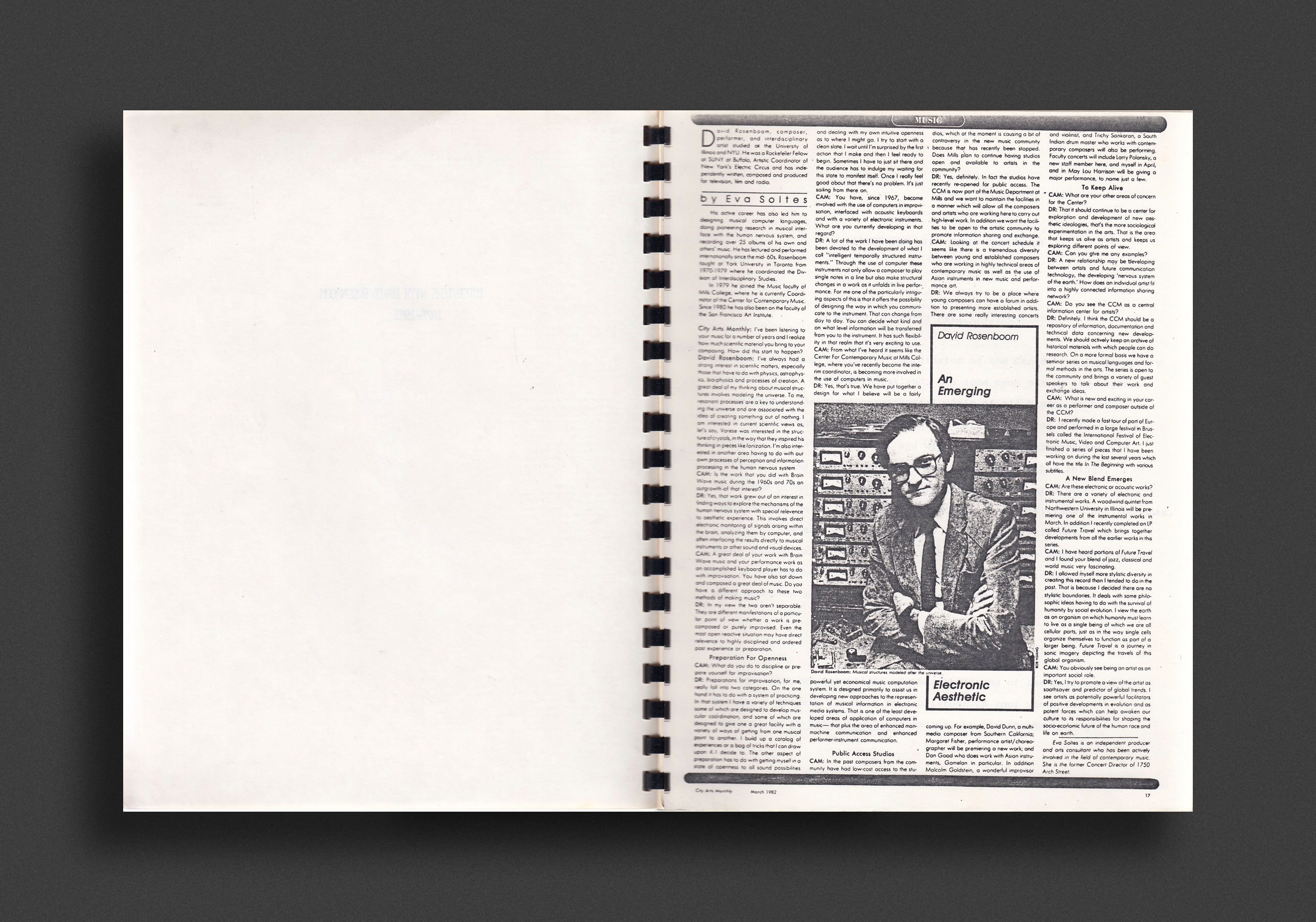
A privately–published, spiral–bound compilation of interviews with American experimental music pioneer, David Rosenboom, spanning 1976–1983. Includes extensive interviews by Larry Polansky, Eva Soltes, Richard Teitelbaum, Walter Zimmermann, Symposium on Computer Music Composition (questions from C. Roads), Recent Cybernetic Insights from Synapse magazine, and more. Compiled around the time Rosenboom toured Europe with Anthony Braxton Quartet and was teaching at Mills College, Oakland.
David Rosenboom (b. Fairfield, Iowa, in 1947) is an American composer and a pioneer in the use of neurofeedback: in the 1970s he built systems in which the brainwaves of performers shaped the music, documented on Brainwave Music (1976) and in his book Biofeedback and the Arts. He has also worked with cross-cultural collaborations and compositional algorithms, and has performed with the mridangam master Trichy Sankaran. He studied composition, performance and electronic music at the University of Illinois with Salvatore Martirano, Lejaren Hiller and Kenneth Gaburo among others, taught at Mills College and for three decades was dean of music at CalArts, where his students have included several generations of experimental composers.
VG with only very light age/wear.
1989–1993, English
Softcover (staple–bound), various formats, unpaginated
1st Edition, Out of print title / used / good
Published by
Mark Nowak / Minnesota
$90.00 - In stock -
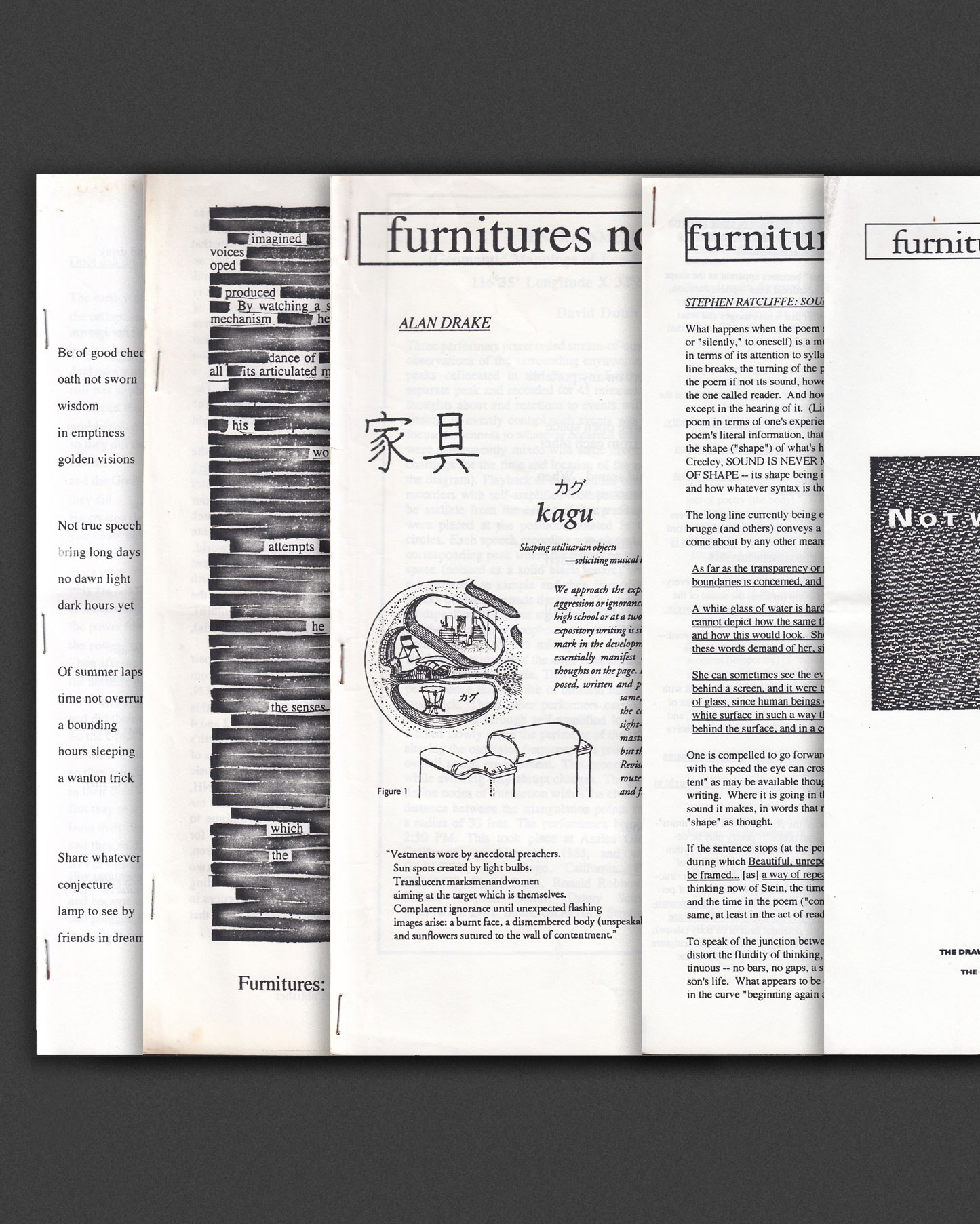
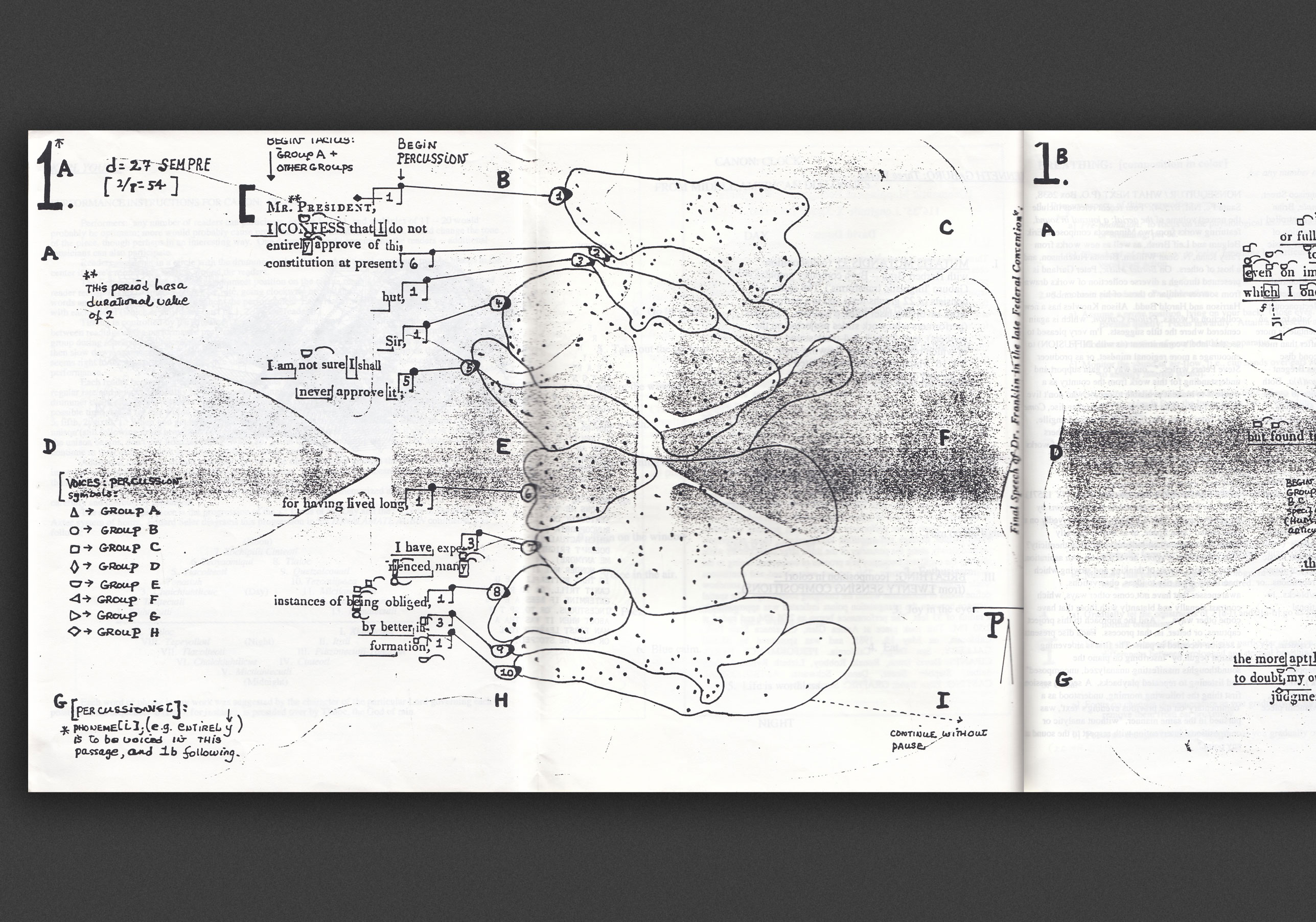
Rare, virtually undocumented issues of Mark Nowak's sound-art / poetry zine, Furnitures: The Magazine of North American Ideophonics, self-published in the late 1980's into the early 1990's. Issues 7, 8, 9, 11, & 12, c. 1989–1993. Photocopied and stapled, the issues feature visual scores, experimental/concrete/visual poetry, essays, mappings, performance pieces, reflections, reviews and research by experimental American poets, composers, artists, environmentalists, and anthropologists, bound in various formats and laid out to correspond with the contributors' work. A wonder of a publication from the world of American environmental sound and poetics.
No. 7: Stephen Ratcliffe, Pauline Oliveros, Ralph Knowles, Hugh Brody.
No. 8: Alan Drake, Philip Blackburn, David Dunn, Karl Young, Kenneth Gaburo.
No. 9: Rod Lohin.
No. 11: Joe Catalano, Elaine Equi, John Bradley, Lisa Jarnot, Maurice Kenny, Michelle Perez, Karl Kempton, Jim Barnes, George Albon, Kenneth Gaburo, Katie Yates, Dick Higgins, N. Sean Williams.
No. 12: Theodore Enslin, Diane Glancy, Elaine Barkin, R. Murray Schafer.
Mark Nowak is an American poet, as well as cultural critic, playwright and essayist, from Buffalo, New York.
All G-VG copies with light wear/age to extremities, neat previous postage folds to some, some marking. Not post–marked.
1989, English
Softcover (staple–bound), 28 pages, 29.5 x 21 cm
1st Edition, Out of print title / used / very good
Published by
Fellowship of Australian Composers / Sydney
$70.00 - Out of stock
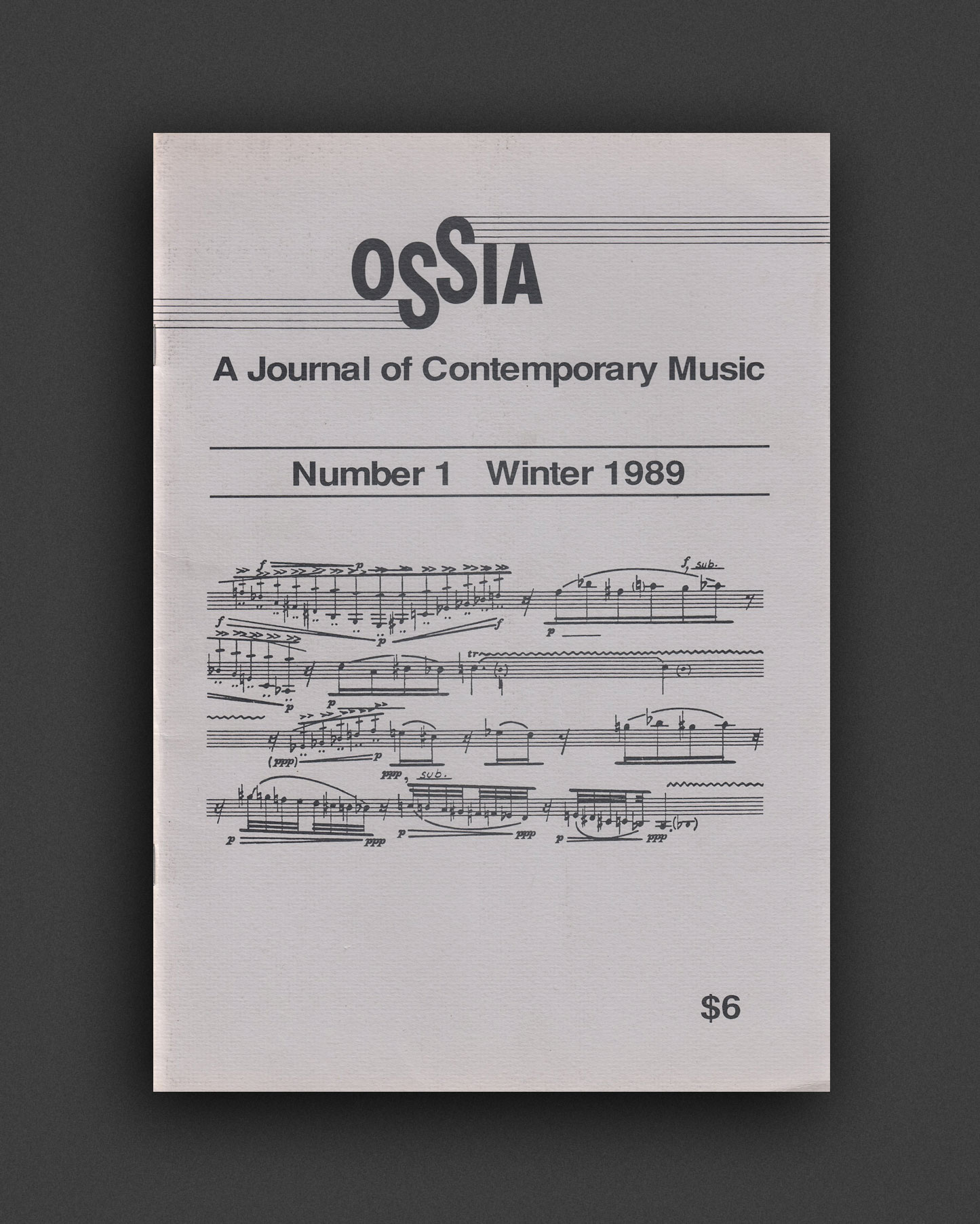
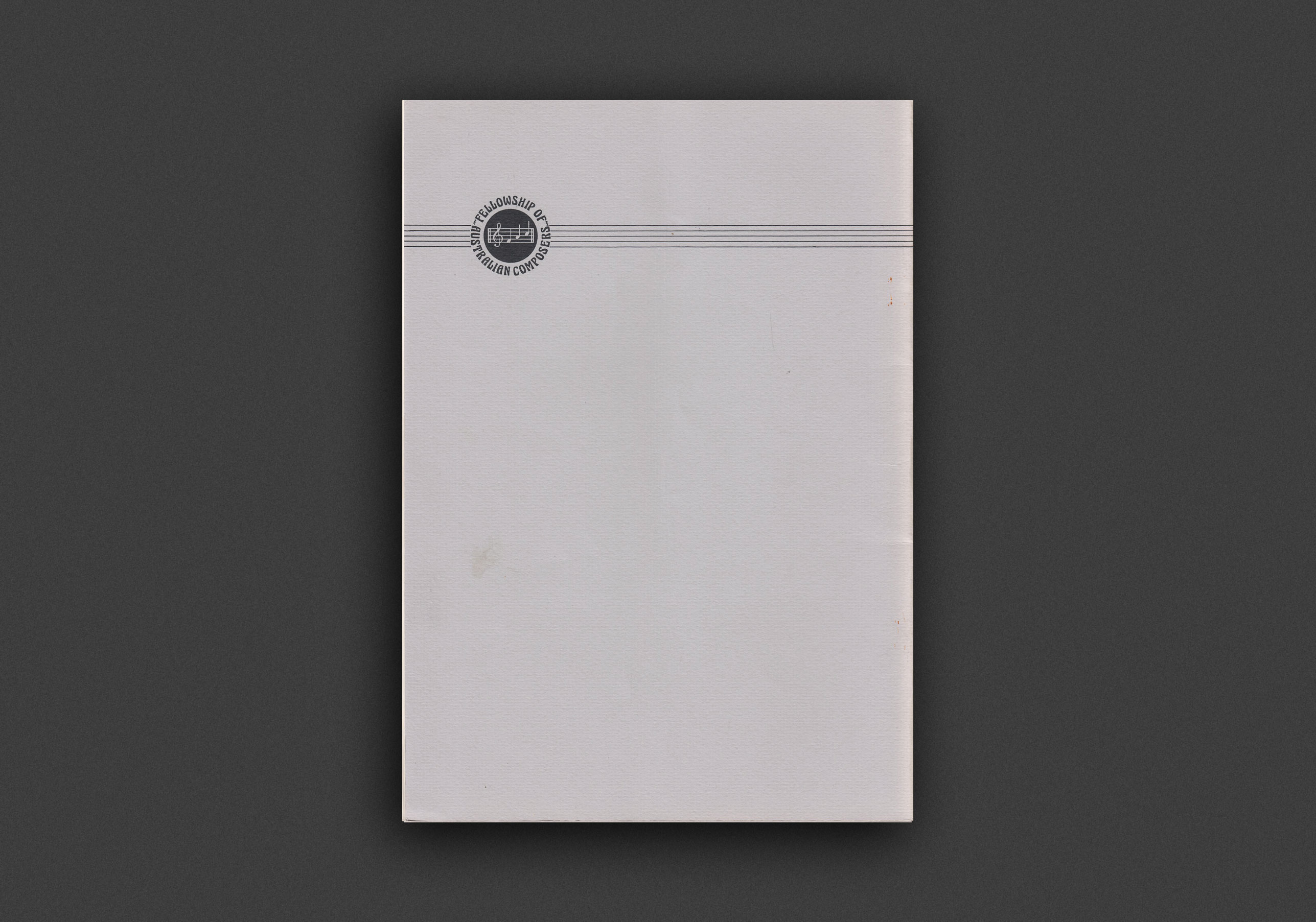
Extremely rare first 1989 issue of Ossia: A Journal of Contemporary Music, published in Sydney by the Fellowship of Australian Composers. Led by the Sydney–based Australian composer, pure mathematician, and chess problemist/chess composer, Ian Shanahan (1962–2021) with an editorial panel including fellow composers Paul Brown, Michael Whiticker and Justine Wilkinson, Ossia was an independent musical periodical founded in 1989 to serve as a forum for avant-garde music theory, compositional analysis, interviews with living composers, and aesthetic debates during the late 20th century in Australia. In musical terminology, "ossia" refers to an alternative passage of music that can be played instead of the original text—reflecting the publication's mission to highlight alternative, contemporary voices in classical music.
This inaugural issue's contents: Editorial, Paul Brown - After the Party: Australian Music in the Bicentennial Year, Michael Whiticker - Morton Feldman: Conversation without Cage, Justine Wilkinson - Ricardo Formosa's Domino, lan Shanahan - The Theory of Bitones, Liza Lim - ISCM World Music Days Festival 1988, Richard Toop - New Music on CD: Recent Releases, The Inaugural Fellowship of Australian Composers Award, and more.
VG copy with light wear. Includes hand written "with compliments" note from editor and president of the Fellowship of Australian Composers, lan Shanahan, to Australian avant–garde composer Warren Burt, whose work inspired his article on Bitones, plus a membership application to the Fellowship of Australian Composers.
1978, English
Softcover (staple-bound), 64 pages, 29.5 x 22 cm
1st Edition, Out of print title / used / very good
Published by
ANU Arts Centre / Canberra
$200.00 - In stock -
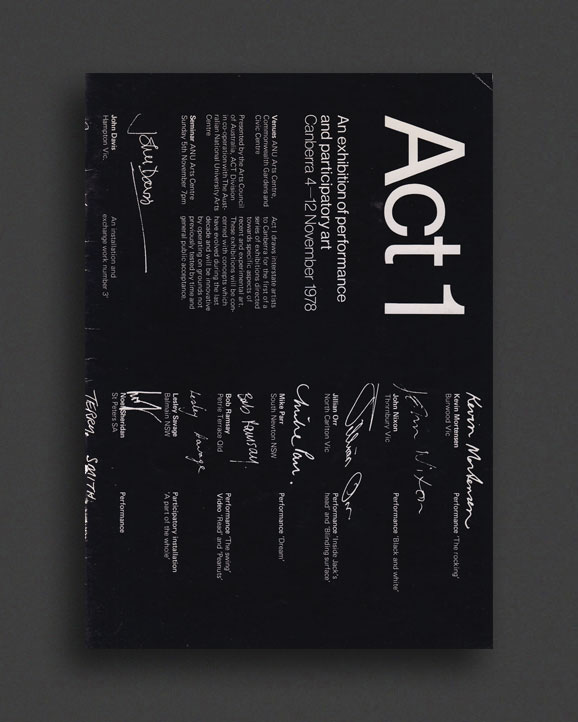
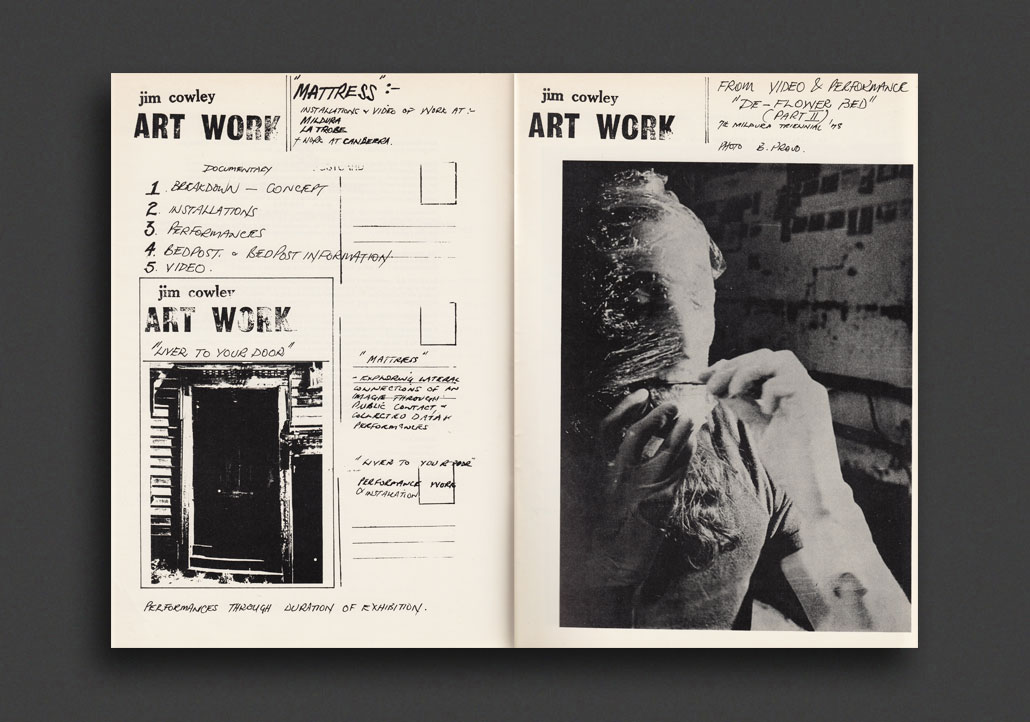
Rare catalogue published on the occasion of Act 1: an exhibition of performance and participatory art, 4—12 November 1978, spanning the ANU Arts Centre, Commonwealth Gardens and Civic Centre, Canberra. Organised by the ANU Arts Centre, Act I drew Australian artists to Canberra for the "first of a series of exhibitions directed towards specific aspects of recent and experimental art". Profusely illustrated artist pages throughout with photo documentation, collage, drawings, and artist's texts. Artists include Mike Parr, Ian Hamilton, Terry Smith and Media Action Group (Ian Burn, Nigel Lendon, Terry Smith, Michael Dolk, Kieren Finnane, Mary Kinney, Ian Milliss, Anne Sutherland...), Leigh Hobba, Kevin Mortensen, John Nixon, John Davis, Marr Grounds, Ken Unsworth, John Fisher, Liz Honybun, David Kerr, Richard and Pat Larter, Tony Twigg, Lesley Savage, Terry Smith, Tony Twigg, Bob Ramsay, Noel Sheridan, Arthur Wicks, Jillian Orr, Richard Tipping, Jim Cowley, Donald Walters... Includes critical essays by Paul McGillick and Terry Smith on performance art and private and public work, plus further texts by organisers Ingo Kleinert, Diana Ashcroft Johnson, Mildred Kirk. The catalogue also operates in as a document of the exchanges between the organisers and the artists, laying bare the operations and budget, reproducing the open letter to the invited artists along with a selection of the signed responses outlining the artistic concepts, all reproduced in full facsimile. Signatures and transcribed concept responses of contributing artists also make up the wrap-around cover design. Also of particular interest for the contribution by Terry Smith and Media Action Group, who formed in 1977 at Sydney University around the Australian members of the Art & Language group, who had recently returned to Australia. The group produced slide shows on the ideological bias in media treatment of advertising, uranium mining, new technology and the history of May Day. This work is stamped "withdrawn because titled 'performance'" in the contents.
Very Good copy with light wear to cover extremities/light spine pinching. Toned pages from age.
1995, Japanese
Softcover, 110 pages, 25.5 x 18 cm
1st Edition, Out of print title / used / very good
Published by
G-Modern / Tokyo
$90.00 - Out of stock
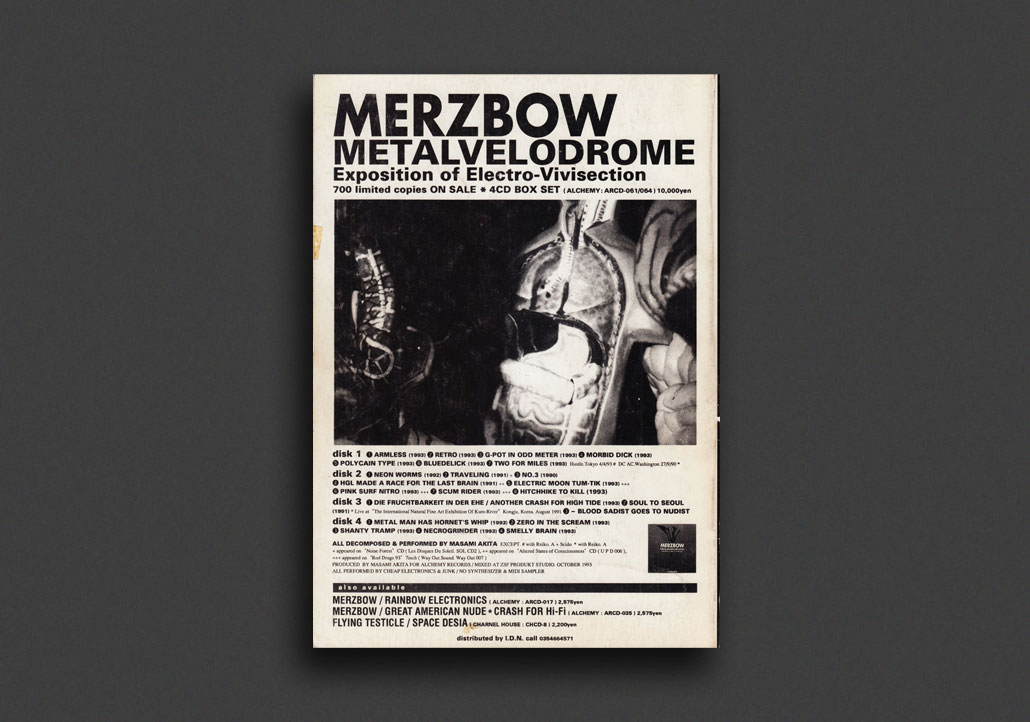
Vol. 8 issue of G-Modern, the scarcely seen cult underground music magazine published by the late Hideo Ikeezumi, founder of the legendary P.S.F. label and Modern Music record store, Tokyo’s home for underground, avant-garde and obscure musics. Published in Spring 1995, this early issue features Albert Ayler, Kenji Endo, AMM, Nihilist Spasm Band, Can / Holger Czukay, Stever Beresford, LAFMS, Miles Davis, Hawkwind, Butch Morris, The Pop Group, Television, Hiroshi Mikami, Q-65, unknown masterpieces, record reviews, and much more.
"The text is all in Japanese, but each issue is crammed with great photographs, weird artwork and ads, and lots of album reviews (the Japanese tradition of always reproducing every cover is helpful here). There's a big emphasis on older, ultra obscure stuff, so there's always a few repros of covers you'll definitely never see for the rest of your life. The accent is not only on the Tokyo underground as documented by PSF, but the entire history of worldwide psychedelic, avant-garde and underground music. Each issue is printed on nice book stock paper, in the 100 page range." - (Forced Exposure)
Very Good, cover wear.
1997, Japanese
Softcover, 112 pages, 25.5 x 18 cm
1st Edition, Out of print title / used / fine
Published by
G-Modern / Tokyo
$70.00 - In stock -
Vol. 17 issue of G-Modern, the scarcely seen cult underground music magazine published by the late Hideo Ikeezumi, founder of the legendary P.S.F. label and Modern Music record store, Tokyo’s home for underground, avant-garde and obscure musics. Published in Winter '97-'98, this early issue features Jutok Kaneko, Congregation, Current 93, Arthur Doyle, Klaus Dinger, Kikuchi Kōji, Barre Phillips, Chu Ishikawa, Nelly Pouget, Screamin' Mee-Mees, Solmania, Mike Whilhelm, Sumegma, unknown psychedelia, record reviews, and much more.
"The text is all in Japanese, but each issue is crammed with great photographs, weird artwork and ads, and lots of album reviews (the Japanese tradition of always reproducing every cover is helpful here). There's a big emphasis on older, ultra obscure stuff, so there's always a few repros of covers you'll definitely never see for the rest of your life. The accent is not only on the Tokyo underground as documented by PSF, but the entire history of worldwide psychedelic, avant-garde and underground music. Each issue is printed on nice book stock paper, in the 100 page range." - (Forced Exposure)
Fine copy.
1994, Japanese
Softcover, 108 pages, 25.5 x 18 cm
1st Edition, Out of print title / used / good
Published by
G-Modern / Tokyo
$90.00 - In stock -
Vol. 5 issue of G-Modern, the scarcely seen cult underground music magazine published by the late Hideo Ikeezumi, founder of the legendary P.S.F. label and Modern Music record store, Tokyo’s home for underground, avant-garde and obscure musics. Published in Winter 1994, this early issue features Derek Bailey, Motoharu Yoshizawa, Captain Beefheart, George A. Romero, Keiji Haino, Smegma, Patti Smith, Jean-Luc Godard, Hawkwind, Pierre Henry, Shinro Ohtake, Shoichi Ozawa, Alvin Lucier, Frank Zappa, history/discography of Akifumi Nakajima's (Aube) G.R.O.S.S. label, articles on extremely obscure psych from around the world, record reviews, and much more.
"The text is all in Japanese, but each issue is crammed with great photographs, weird artwork and ads, and lots of album reviews (the Japanese tradition of always reproducing every cover is helpful here). There's a big emphasis on older, ultra obscure stuff, so there's always a few repros of covers you'll definitely never see for the rest of your life. The accent is not only on the Tokyo underground as documented by PSF, but the entire history of worldwide psychedelic, avant-garde and underground music. Each issue is printed on nice book stock paper, in the 100 page range." - (Forced Exposure)
Very Good, light cover wear.
1987, English
Softcover (staple–bound), 24 pages + inserts, 30 x 21 cm
1st Edition, Out of print title / used / good
Published by
Australian Music Centre / Melbourne
$35.00 - In stock -
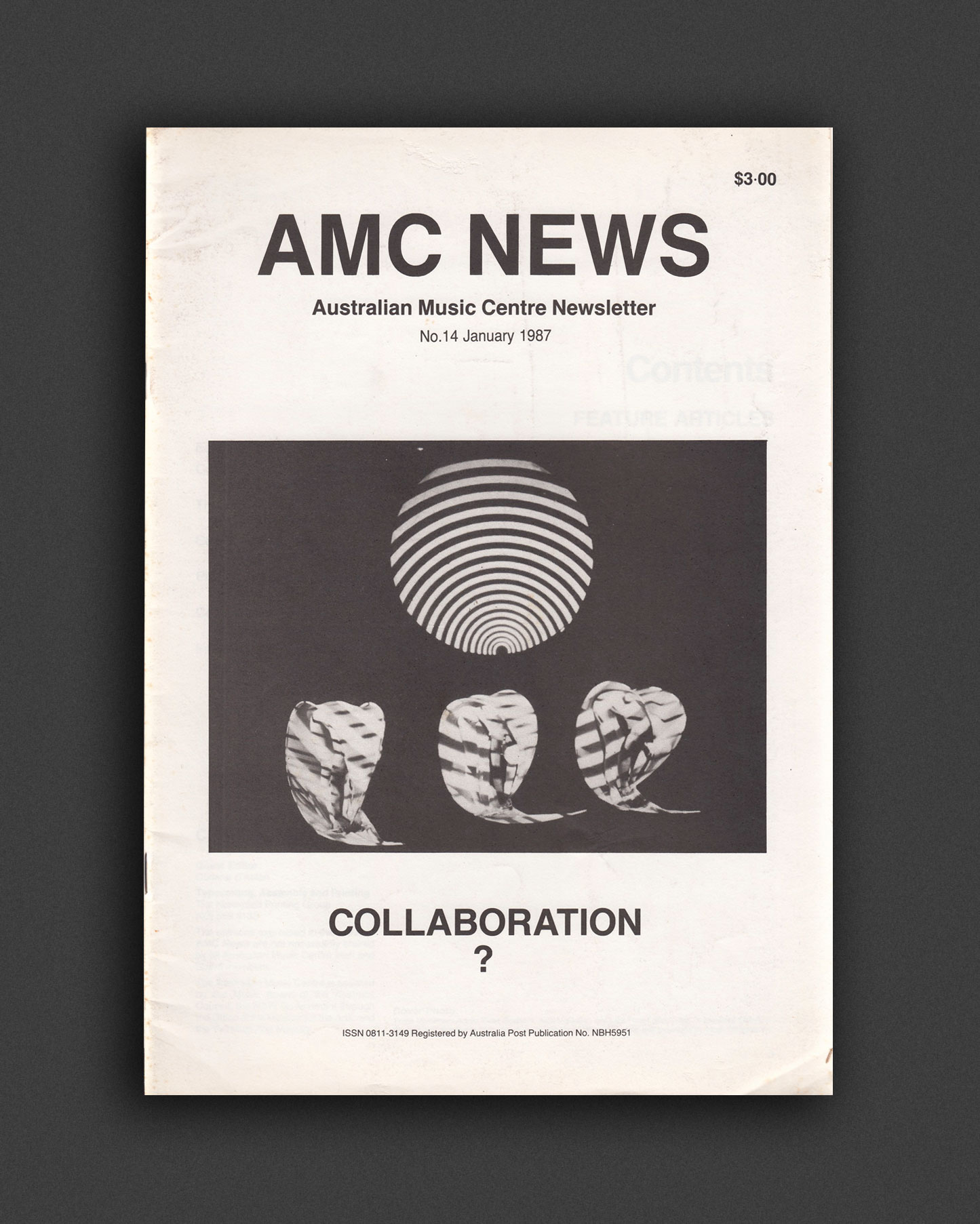
January 1987 edition of the AMC NEWS (Australian Music Centre Newsletter), "Collaboration ?," guest edited by Corinne d'Aston. An important newsletter on the happenings around the AMC and Australian sound art in general, mailed out to members. Contents: Collaboration? – A Discussion Between Four Theatre Artists and Sarah de Jong; The Doll – Music Theatre Workshop, Caroline Wilkins; Creative Collaboration – Martin Wesley-Smith; Playing Around in Open Spaces – David Chesworth; Collaboration in Dance – Stephen Leek; Interdisciplinary Artistic Collaboration – A Survivor’s Account – Bruce Harper. Illustrated throughout.
Includes an inserted membership form and a listing of the scores received at the centre from December 1986 to January 1987.
Founded in 1974, the Australian Music Centre (AMC) is the national service organisation and archive dedicated to promoting and supporting Australian art music and its creators. Born out of the Whitlam era's cultural expansion, the centre champions a vast spectrum of creative expressions, including contemporary classical, jazz, experimental music, and sound art. It houses a living digital repository of tens of thousands of scores, recordings, and educational tools, while simultaneously facilitating professional development, distributing published music, and co-hosting the prestigious annual Art Music Awards.
G–VG copy with light wear to extremities.
1973, Japanese
Softcover, 114 pages, 26 x 18.5 cm
1st Edition, Out of print title / used / very good
Published by
Jazz People Sha / Tokyo
$120.00 - In stock -
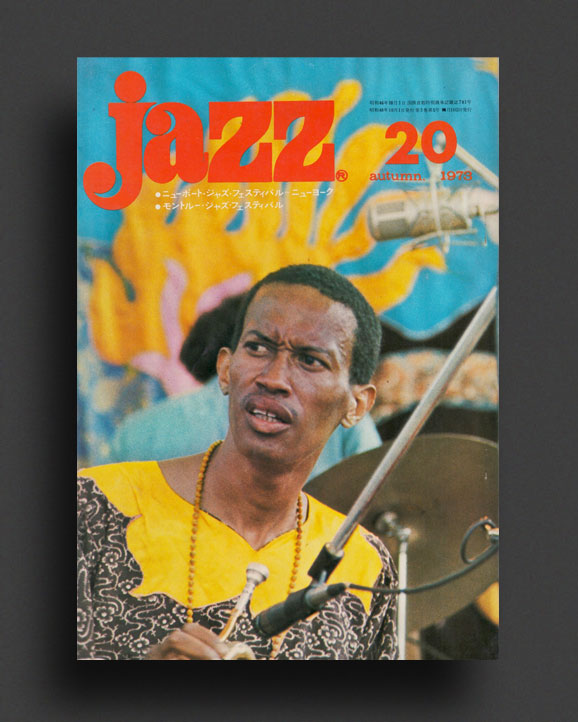
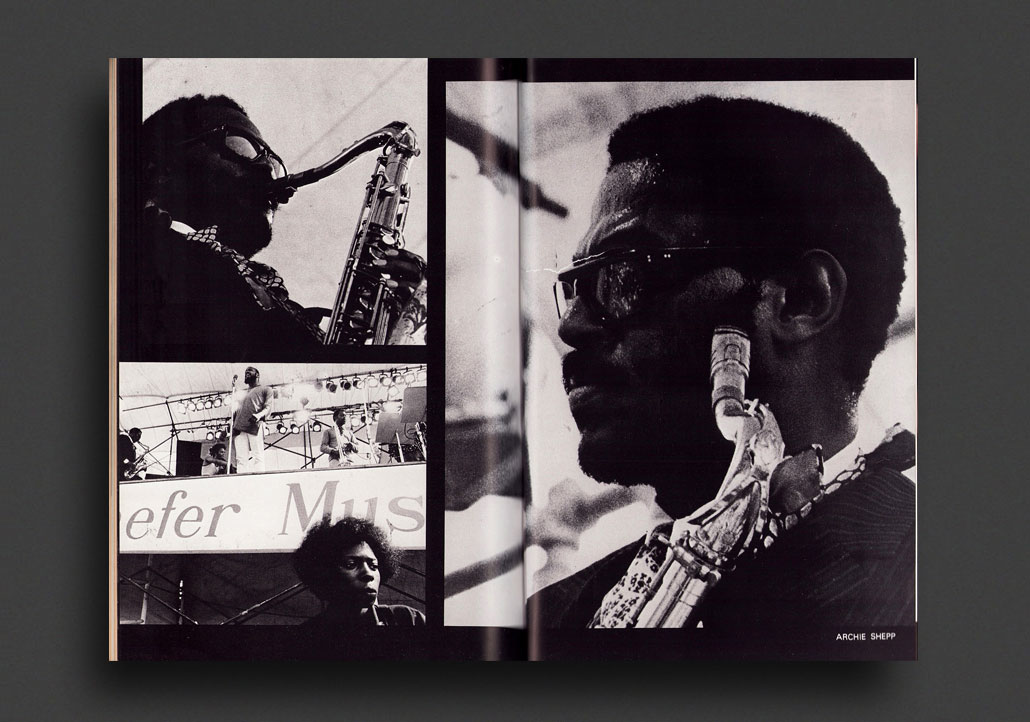
Very rare copy of Tokyo's Jazz magazine, No. 20, Autumn 1973, with Don Cherry cover. At the forefront of the Jazz scene, edited by Japanese photojournalist and famous jazz critic Seiichi Sugita, Jazz is packed with rare gravure photography, interviews, scene reports, reviews, articles by leading artists, authors and critics, record labels and jazz coffee shop advertisements, this issue including special features on Sonny Rollins at the Village Vangaurd (photography by Seiichi Sugita), the Newport Jazz Festival New York — Archie Shepp, Milford Graves, Don Cherry, Lester Bowie, Joseph Jarman, Roscoe Mitchell, Ella Fitzgerald, Keith Jarrett, etc. (photography by Seiichi Sugita), Montreux Jazz Festival Summer 1973 (photography by Aoki), a message to Japanese music friends from Chick Corea (about Scientology!), articles on narcotics, improvisation, natural foods, extensive illustrated live and record reviews, and much more...
Very Good copy.
1974, Japanese
Softcover, 130 pages, 26 x 18.5 cm
1st Edition, Out of print title / used / very good
Published by
Jazz People Sha / Tokyo
$120.00 - In stock -
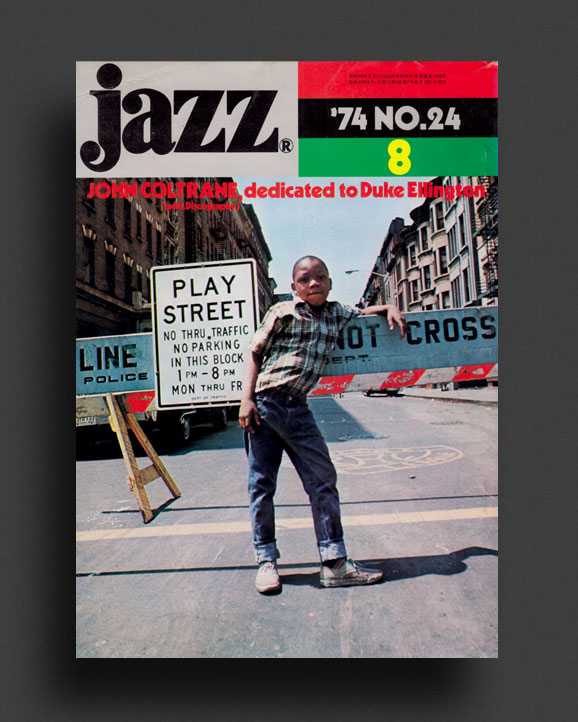
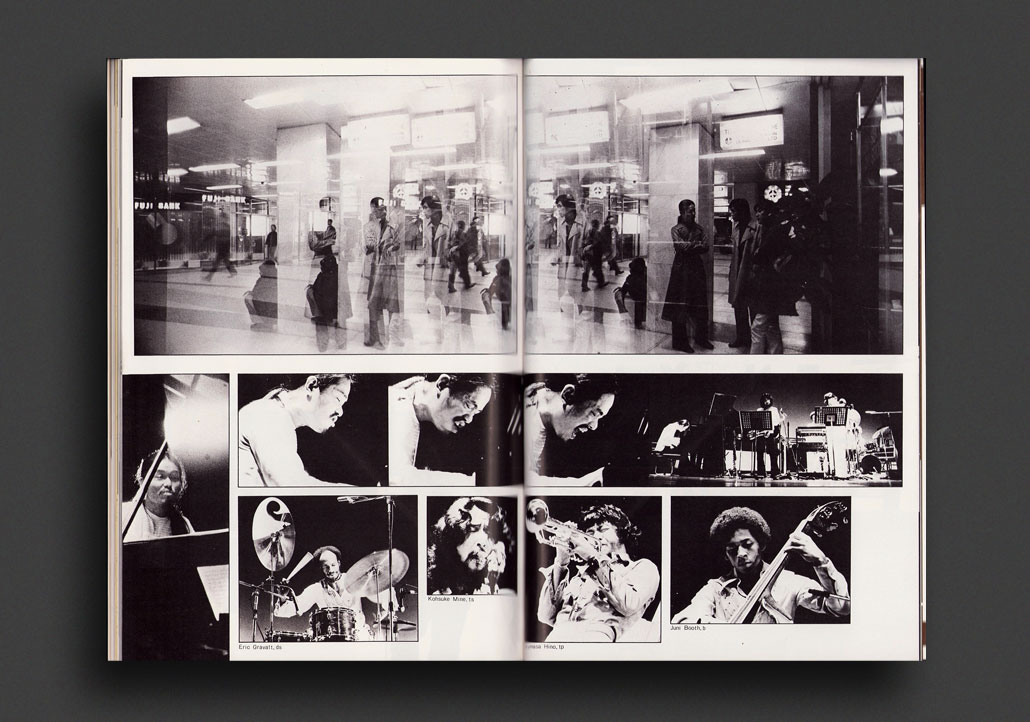
Very rare copy of Tokyo's Jazz magazine, No. 24, August 1974, a special John Coltrane issue. At the forefront of the Jazz scene, edited by Japanese photojournalist and famous jazz critic Seiichi Sugita, Jazz is packed with rare gravure photography, interviews, scene reports, reviews, articles by leading artists, authors and critics, record labels and jazz coffee shop advertisements, this issue including special feature and homage to John Coltrane with a huge Coltrane interview, rare photographs, articles, a complete illustrated discography, a photo-report and interview with Japanese saxophonist Kosuke Mine in New York (photography by Seiichi Sugita), Duke Ellington, Eric Dolphy, Celestial Music, extensive illustrated live and record reviews, and much more...
Very Good copy.
1974, Japanese
Softcover, 130 pages, 26 x 18.5 cm
1st Edition, Out of print title / used / very good
Published by
Jazz People Sha / Tokyo
$60.00 - Out of stock
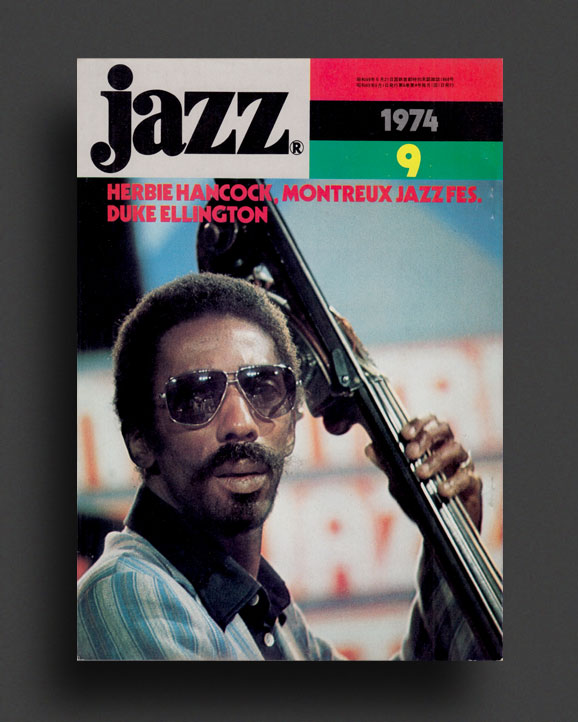
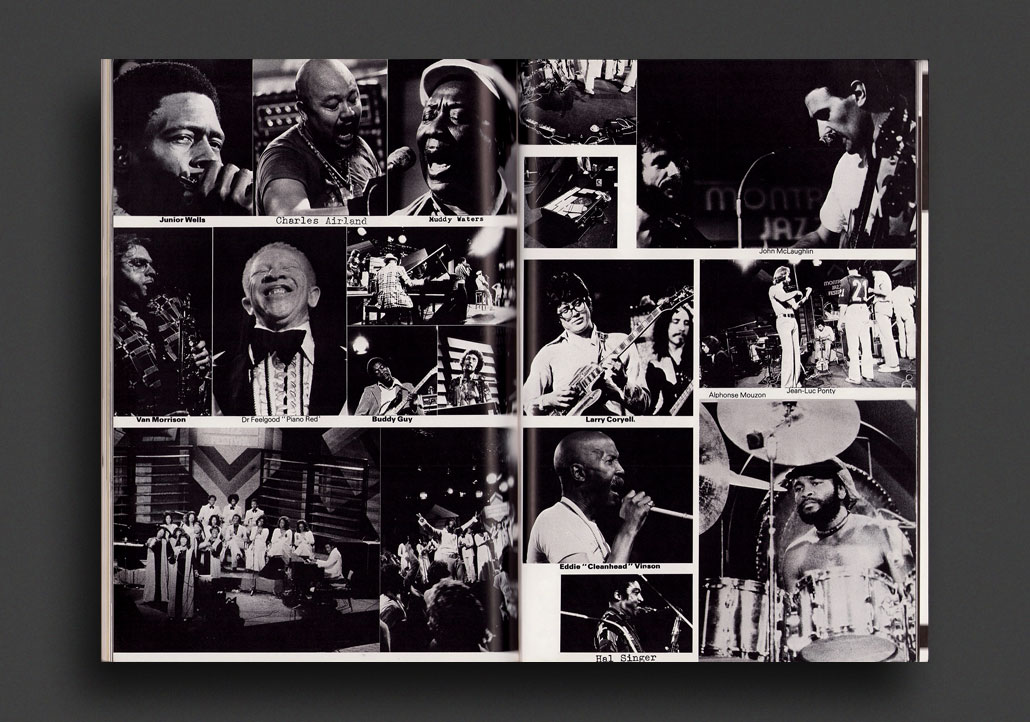
Very rare copy of Tokyo's Jazz magazine, September 1974. At the forefront of the Jazz scene, edited by Japanese photojournalist and famous jazz critic Seiichi Sugita, Jazz is packed with rare gravure photography, interviews, scene reports, reviews, articles by leading artists, authors and critics, record labels and jazz coffee shop advertisements, this issue including special features on Herbie Hancock with a full chronology and discography, Montreux Jazz Festival 1974 w. Sonny Rollins, Johm McLaughlin, Gil Evans, Lester Bowie, Joseph Jarman, Roscoe Mitchell, Jean-Luc Ponty, Rufus Harley, Don Moyer, Alphonse Mouzon, etc. (photography by Seiichi Sugita), interview with jazz pianist Mikio Masuda, Duke Ellington, Eric Dolphy, Celestial Music, extensive illustrated live and record reviews, and much more...
Very Good copy.
1975, Japanese
Softcover, 120 pages, 26 x 18.5 cm
1st Edition, Out of print title / used / very good
Published by
Jazz People Sha / Tokyo
$140.00 - In stock -
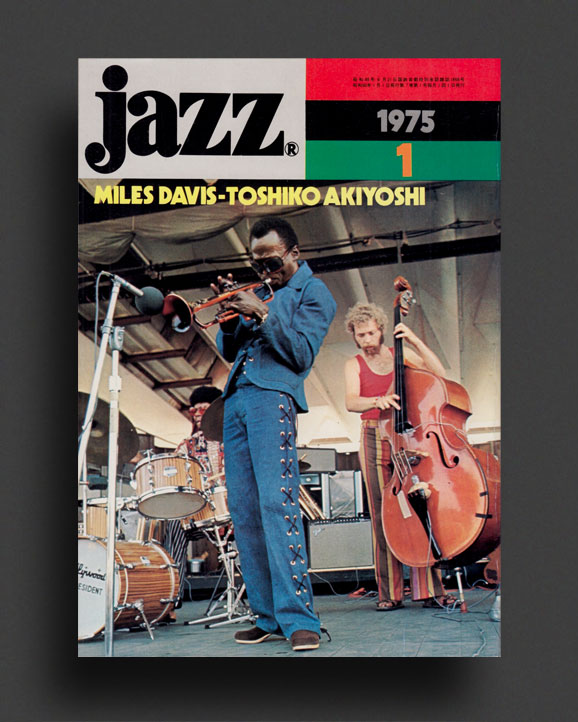
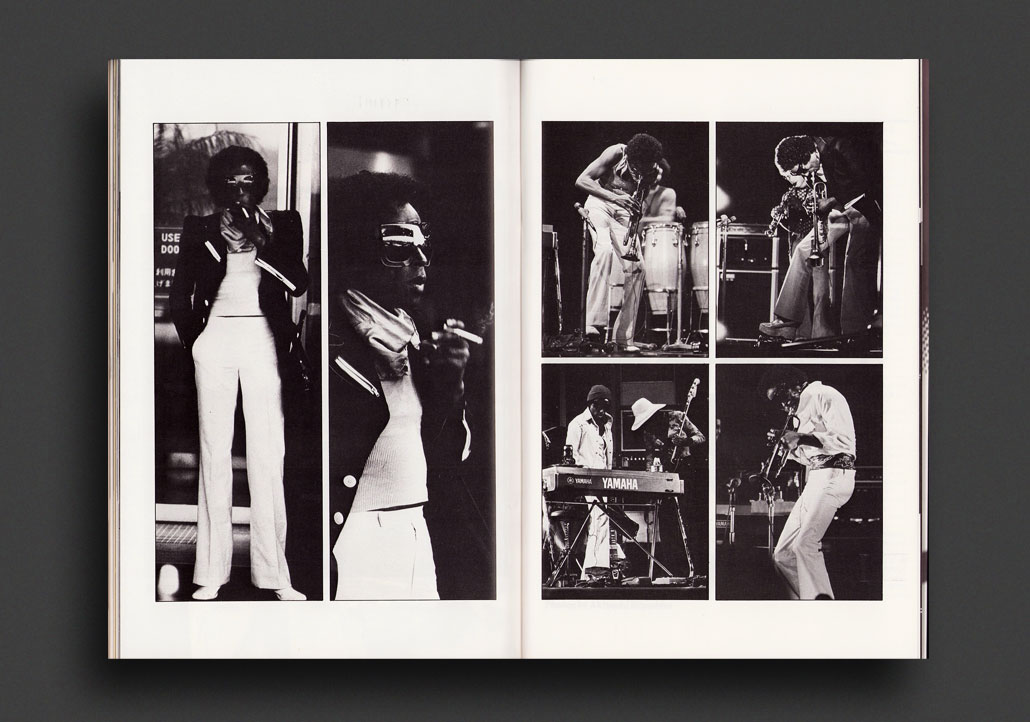
Very rare copy of Tokyo's Jazz magazine, January 1975. At the forefront of the Jazz scene, edited by Japanese photojournalist and famous jazz critic Seiichi Sugita, Jazz is packed with rare gravure photography, interviews, scene reports, reviews, articles by leading artists, authors and critics, record labels and jazz coffee shop advertisements, this issue including special features on Miles Davis with loads of rare photographs (inc. Miles Davis at the Newport Festival 1969 shot by Seiichi Sugita), article on Miles, complete Mile Davis discography, Japanese jazz pianist Toshiko Akiyoshi in New York (photography by Seiichi Sugita), European Jazz report, Eric Dolphy, Celestial Music, extensive illustrated live and record reviews, and much more...
Very Good copy.
1998, English
Softcover, 408 pages, 31 x 22 cm
1st Edition, Out of print title / used / very good
Published by
Thames and Hudson / London
$55.00 - Out of stock
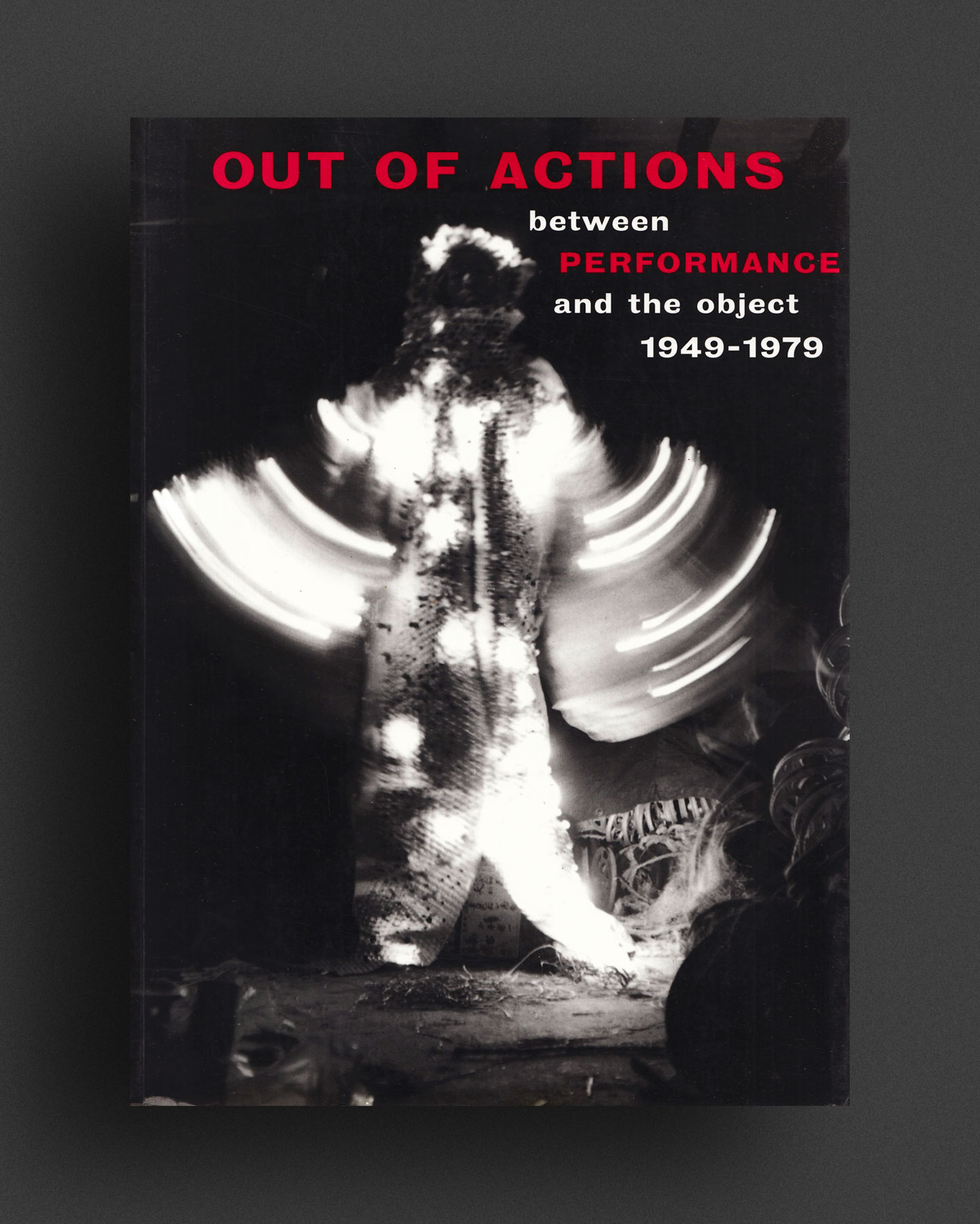
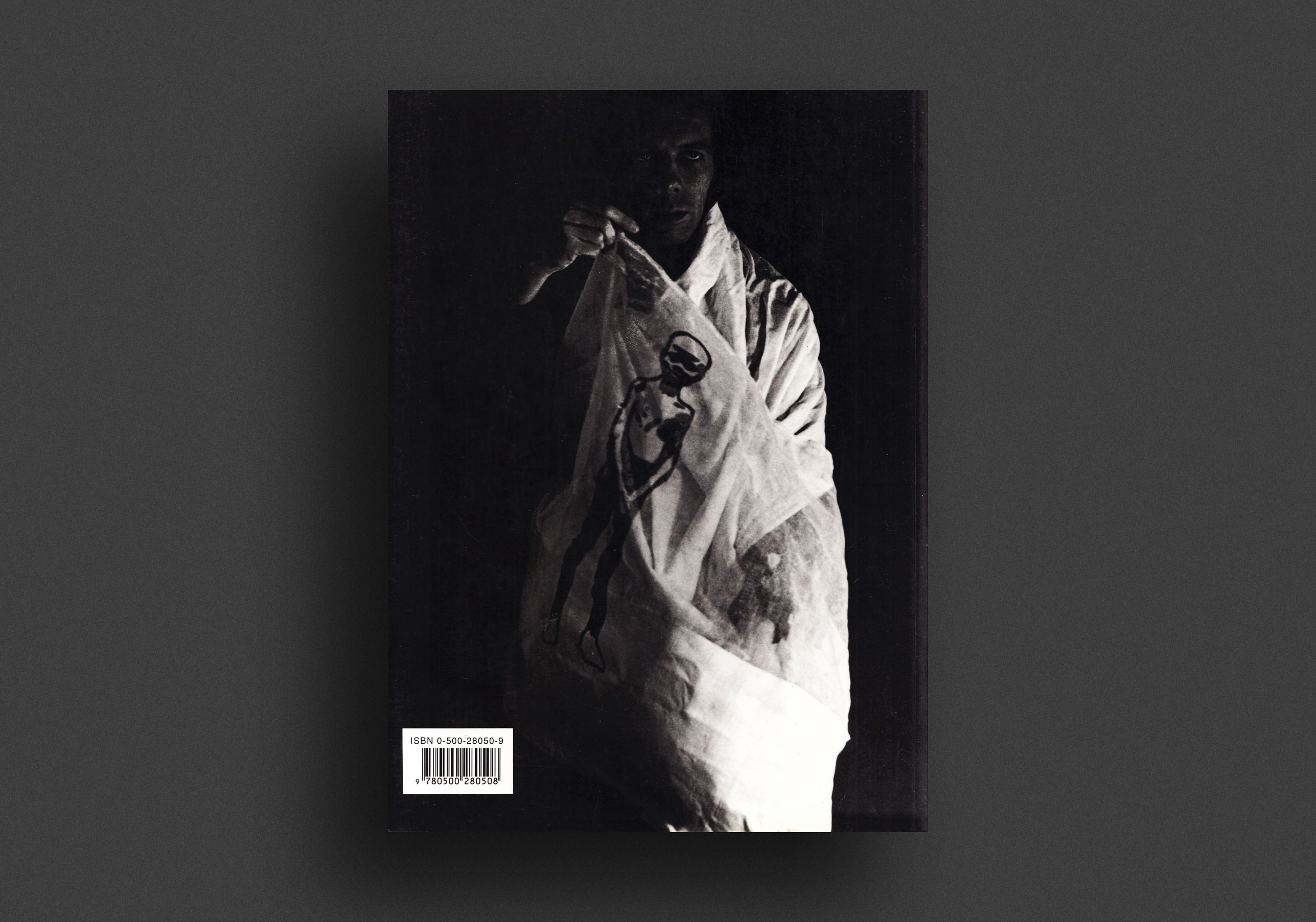
First edition of Out of Actions: Between Performance and the Object, 1949-1979, edited by Paul Schimmel, published in 1998. with essays by Kristine Stiles, Guy Brett, Hubert Klocker, Shinichiro Osaki, and Paul Schimmel.
Published to coincide with the first major museum exhibition to examine the complex relationship linking the creative process, action or performance, and works of art in the postwar period. Featuring nearly one hundred and fifty artists and collaboratives from approximately twenty countries in Eastern and Western Europe, the Middle East, Asia, Japan, and North and South America—including figures associated with the New York School, Nouveaux Realistes, Fluxus, Viennese Actionists, Hi Red Center, Arte Povera, the Gutai group, happenings, process art, and performance art—the exhibition centered on how the possibilities and implications of using time and process as elements of art were realized by a number of international movements during this influential thirty-year period.
Covering three decades of significant and original art, this lavishly illustrated book features work by more than one hundred artists from across the world who have had a profound impact on the relationship between visual and performance art in the postwar era.
Includes the work of: Marina Abramović, Vito Acconci, Genpei Akasegawa, Laurie Anderson, Eleanor Antin, Rasheed Araeen, Mowry Baden, Artur Barrio, Jerzy Beres, Joseph Beuys, Mark Boyle & Joan Hills, George Brecht, Stuart Brisley, Robert Delford Brown, Rhett Delford Brown, Günter Brus, Chris Burden, James Lee Byars, John Cage, Marc Camille Chaimowicz, Lygia Clark, Pinchas Cohen Gan, Collective Action Group, Houston Conwill, Paul Cotton, COUM Transmissions, Guy de Cointet, Jim Dine, John Duncan, Felipe Ehrenberg, Roberto Evangelista, VALIE EXPORT, Robert Filliou, Rose Finn-Kelcey, Sherman Fleming, Lucio Fontana, Terry Fox, Howard Fried, Gideon Gechtman, Jochen Gerz, Gilbert & George, Alberto Greco, Ion Grigorescu, Victor Grippo, Red Grooms, Guerrilla Art Action Group, David Hammons, Al Hansen, Maren Hassinger, Lynn Hershman Leeson, Dick Higgins, Tatsumi Hijikata, Susan Hiller, Hi Red Center, Rebecca Horn, Tehching Hsieh, Joan Jonas, Kim Jones, Michel Journiac, Akira Kanayama, Tadeusz Kantor, Allan Kaprow, Mike Kelley, Jürgen Klauke, Yves Klein, Milan Knížák, Alison Knowles, Komar & Melamid, Jannis Kounellis, Shigeko Kubota, Tetsumi Kudo, Yayoi Kusama, Leslie Labowitz, Suzanne Lacy, John Latham, Jean-Jacques Lebel, Lea Lublin, George Maciunas, Leopoldo Maler, Piero Manzoni, Tom Marioni, Cusi Masuda, Georges Mathieu, Gordon Matta-Clark, Paul McCarthy, Bruce McLean, David Medalla, Cildo Meireles, Ana Mendieta, Gustav Metzger, Marta Minujín, Jan Mlčoch, Linda Montano, Charlotte Moorman, Robert Morris, Otto Muehl, Saburo Murakami, Natsuyuki Nakanishi, Bruce Nauman, Paul Neagu, Senga Nengudi, Joshua Neustein, Hermann Nitsch, Hélio Oiticica, Claes Oldenburg, Yoko Ono, Orlan, Raphael Montañez Ortiz, Lorenzo Pace, Nam June Paik, Gina Pane, Lygia Pape, Giuseppe Pinot Gallizio, Adrian Piper, Michelangelo Pistoletto, Jackson Pollock, William Pope.L, Robert Rauschenberg, Carlyle Reedy, Klaus Rinke, Ulrike Rosenbach, Dieter Roth, Zorka Ságlová, Niki de Saint Phalle, Alfons Schilling, Tomas Schmit, Carolee Schneemann, Rudolf Schwarzkogler, Bonnie Ora Sherk, Shōzō Shimamoto, Ushio Shinohara, Kazuo Shiraga, Barbara T. Smith, Daniel Spoerri, Petr Štembera, Wolfgang Stöerchle, Jirō Takamatsu, Atsuko Tanaka, Mark Thompson, Jean Tinguely, Rasa Todosijević, Kerry Trengove, Ulay, Ben Vautier, Wolf Vostell, Franz Erhard Walther, Peter Weibel, Franz West, Hannah Wilke, Emmett Williams, Zaj.
Their work encompasses sculpture, artists' publications, drawings, photographs, and the ephemera that arises from the performance, as well as documentary film and video stills.
Published in conjunction with a major touring exhibition organized by The Museum of Contemporary Art, Los Angeles, Out of Actions illuminates the unique relationship between action, destruction, performance, and the creative process, in essays by acclaimed art historians. Covering an unprecedented range of material, the book offers the first critical comparisons of work that has previously been viewed as distinctly regional and unrelated.
With 450 illustrations, 200 in colour.
VG copy with light wear and "The Grid" written in red marker on the block side (?).
2020, English
Hardcover (w. dust jacket), 672 pages, 29 x 24 cm
Published by
Prestel / Munich
$125.00 - Out of stock
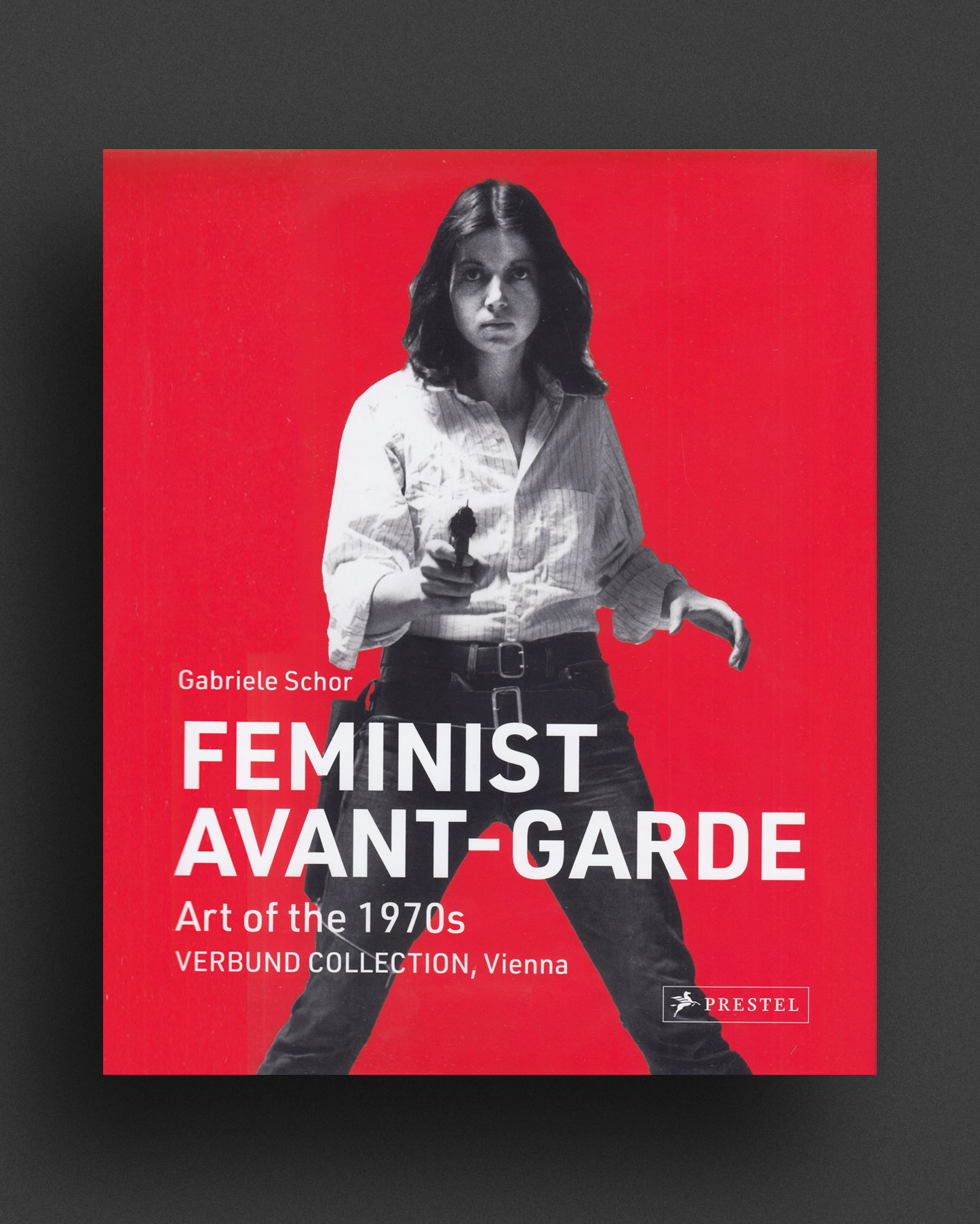
Now available again in an expanded edition and featuring a variety of work from artists both well-known and under the radar, this volume explores the pioneering achievements of the Feminist Avant-Garde.
For art history, the 1970s represent the beginning of women subverting culturally and socially established constructions and traditional norms. Second-wave feminism, with its slogan "The personal is political", challenged the one-dimensional roles assigned to women--mother, housewife, and spouse. During this period, women artists radically questioned their duties and created a plurality of self-determined representations of themselves. Rejecting traditional male-dominated techniques, such as painting, these artists made use of new media, such as photography, film, video, and performance. The outcome was artwork which was radical, poetic, ironic, bitter, cynical, and heartfelt. This book features more than seventy international female artists, including works by Martha Rosler, Mary Beth Edelson, Ana Mendieta, Nil Yalter, and Ulrike Rosenbach. Editor Gabriele Schor used the term Feminist Avant-Garde in order to emphasize the role that these artists played in the last four decades. This new edition has been enriched with twenty-five new artists–Emma Amos, Dara Birnbaum, Rose English, Natalia LL, among others–as well as up-to-date research on feminist exhibitions, catalogues, and periodicals. Each artist is introduced by an essay and the book also includes fascinating texts by leading scholars.
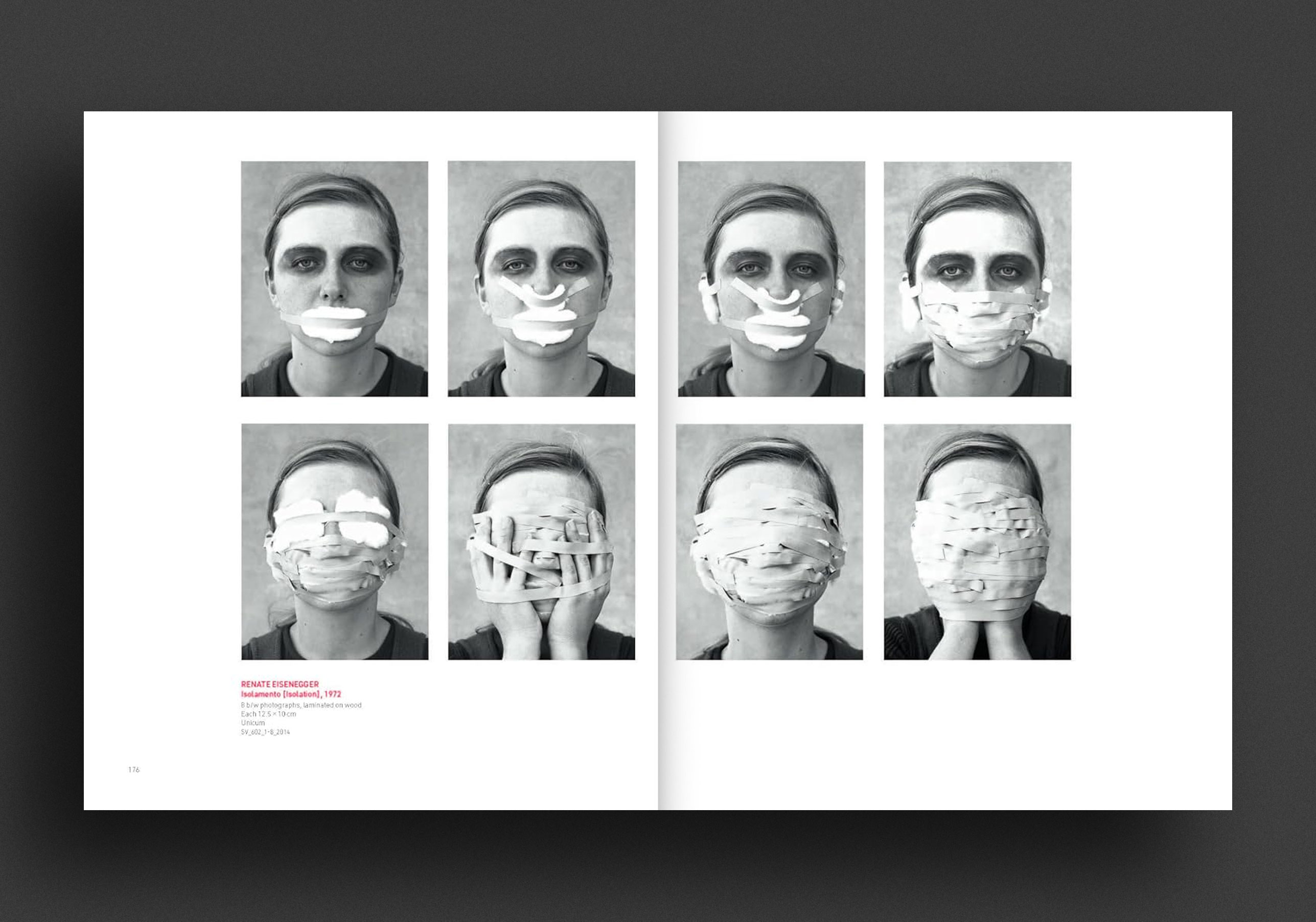
Features the work of: Helena Almeida, Eleanor Antin, Annekke Barger, Lynda Benglis, Judith Bernstein, Renate Bertlmann, Teresa Burga, Marcella Campagnano, Judy Chicago, Linda Christanell, Lili Dujourie, Mary Beth Edelson, Renate Eisenegger, Valie Export, Esther Ferrer, Lynn Hershman Leeson, Alexis Hunter, Sanja Iveković, Birgit Jürgenssen, Kirsten Justesen, Ketty La Rocca, Leslie Labowitz, Katalin Ladik, Brigitte Lang, Suzanne Lacy, Suzy Lake, Karin Mack, Ana Mendieta, Rita Myers, Lorraine O’Grady, Orlan, Gina Pane, Letítia Parente, Ewa Partum, Friederike Pezold, Margot Pilz, Ulrike Rosenbach, Martha Rosler, Suzanne Santoro, Carolee Schneemann, Lydia Schouten, Cindy Sherman, Penny Slinger, Annegret Soltau, Hannah Wilke, Martha Wilson, Francesca Woodman, Nil Yalter...
2021, English
Softcover, 202 pages, 21.6 x 14 cm
Published by
Nine-Banded Books / West Virginia
$38.00 - Out of stock
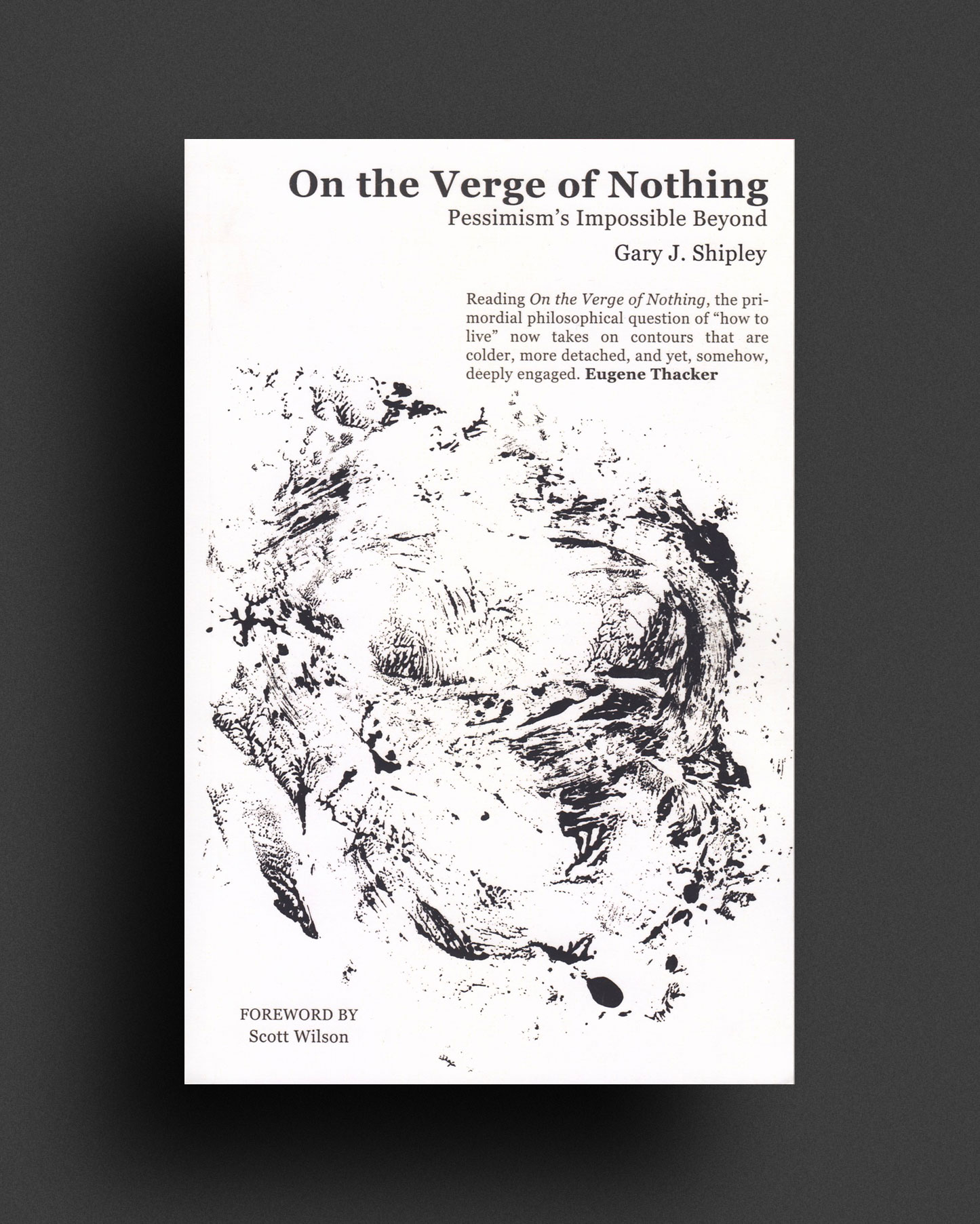
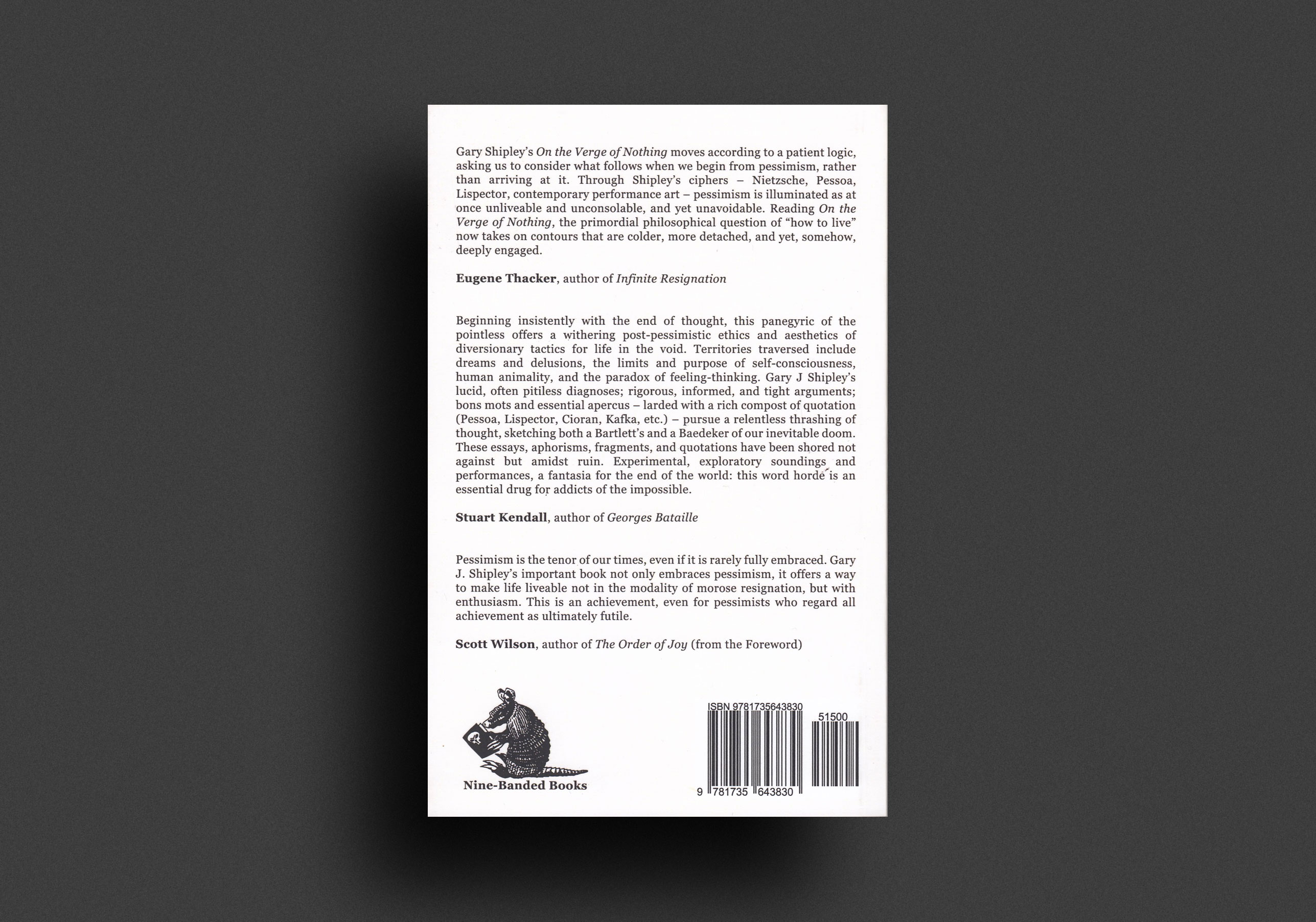
"Gary Shipley’s On the Verge of Nothing moves according to a patient logic, asking us to consider what follows when we begin from pessimism, rather than arriving at it. Through Shipley’s ciphers – Nietzsche, Pessoa, Lispector, contemporary performance art – pessimism is illuminated as at once unliveable and unconsolable, and yet unavoidable. Reading On the Verge of Nothing, the primordial philosophical question of “how to live” now takes on contours that are colder, more detached, and yet, somehow, deeply engaged."– Eugene Thacker, author of Infinite Resignation
"Beginning insistently with the end of thought, this panegyric of the pointless offers a withering post-pessimistic ethics and aesthetics of diversionary tactics for life in the void. Territories traversed include dreams and delusions, the limits and purpose of self-consciousness, human animality, and the paradox of feeling-thinking. Gary J Shipley’s lucid, often pitiless diagnoses; rigorous, informed, and tight arguments; bons mots and essential apercus – larded with a rich compost of quotation (Pessoa, Lispector, Cioran, Kafka, etc.) – pursue a relentless thrashing of thought, sketching both a Bartlett’s and a Baedeker of our inevitable doom. These essays, aphorisms, fragments, and quotations have been shored not against but amidst ruin. Experimental, exploratory soundings and performances, a fantasia for the end of the world: this word horde is an essential drug for addicts of the impossible."–Stuart Kendall, author of Georges Bataille
"Pessimism is the tenor of our times, even if it is rarely fully embraced. Gary J. Shipley’s important book not only embraces pessimism, it offers a way to make life liveable not in the modality of morose resignation, but with enthusiasm. This is an achievement, even for pessimists who regard all achievement as ultimately futile."–Scott Wilson, author of The Order of Joy (from the Foreword)
2006, English
Softcover, 128 pages, 23 x 15.5 cm
1st Edition, Out of print title / used / fine
Published by
Rhode Island (Rhode Island School of Design) / Providence
$20.00 - In stock -
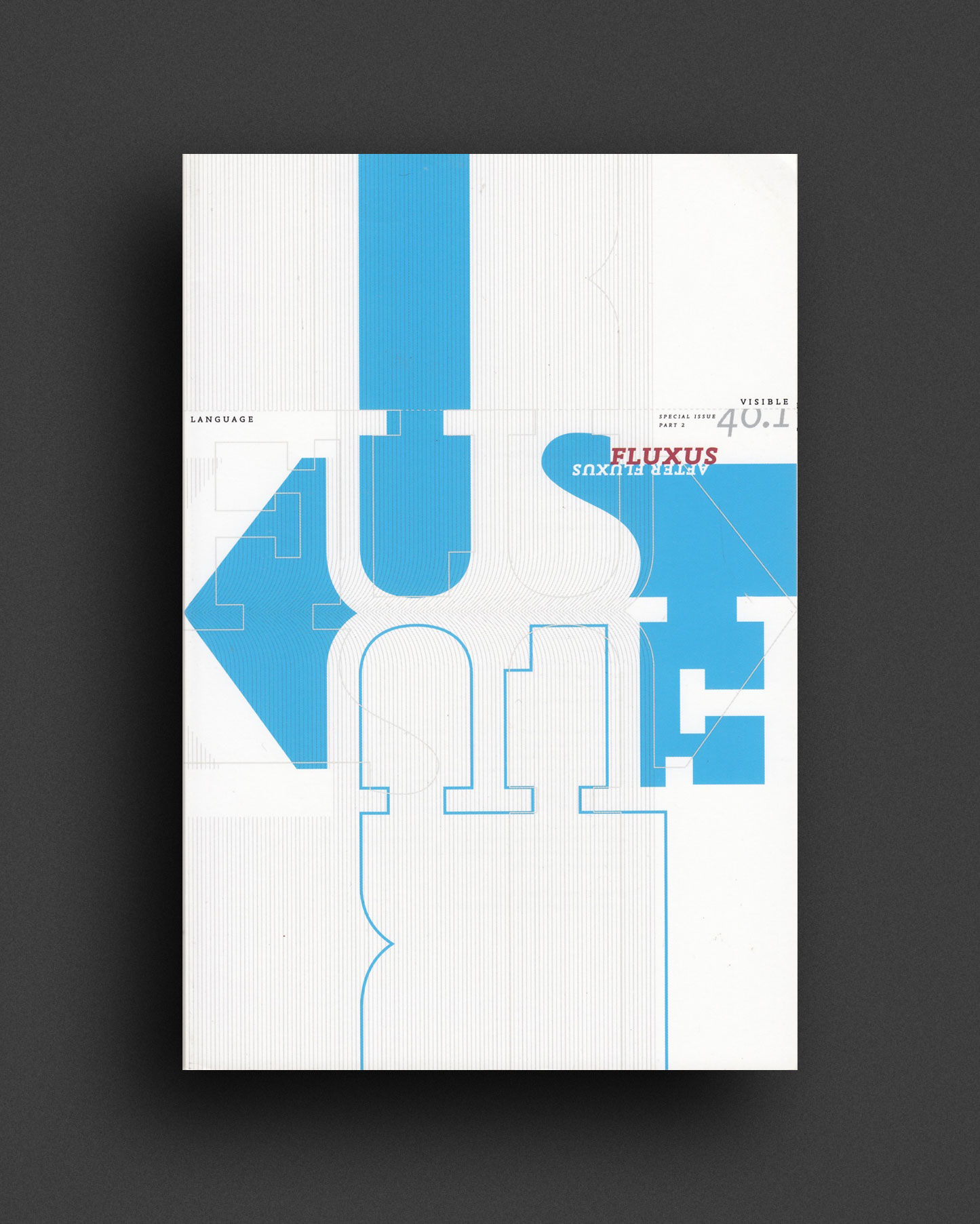
Fluxus After Fluxus is a special 2006 issue (Volume 40, Number 1) of the peer-reviewed design and visual communication journal Visible Language, edited by notable Fluxus scholars Ken Friedman and Owen F. Smith.
Contents:
The Dialectics of Legacy - Ken Friedman and Owen Smith, What Has Fluxus Created? - Ann Klefstad, Introduction: Signatures, Music, Computers, Paranoia, Smells, Danger & the Sky - Lisa Moren, Artists’ Statements: Space, Process & Shakers... - David Cologgiovani, Fluxus & the far end of the Freeformfreakout Organization - Alan Bowman, A False History of Fluxus - Eryk Salvaggio, Networking Interaction - Ruud Janssen, Evolving Fluxus - Bibiana Padilla Maltos, Openness & Interaction - Litsa Spathi, Philosophical Poetics - Sol Nte, Thirty Years of Fluxing Around - Cecil Touchon, Invisible Fluxus - mIEKAL aND, (MY) FLUXUS EXPERIENCE (2005) - Walter Cianciusi, Technology Ephemera & Zen Forevers - David-Baptiste Chirot, Wink - MTAA, Games as Art: The Aesthetics of Play - Celia Pearce, The Literature of Fluxus - Ken Friedman, A Fluxus Bibliography - Ken Friedman and Owen Smith.
Near Fine copy.
1999, English
Softcover, unpaginated, 18.5 x 18.5 cm
Out of print title / used / very good
Published by
Charta / Milan
$100.00 - Out of stock
The great Propo artist's book by Paul McCarthy, published by Charta in 1999. Comprised entirely of photos of everyday objects, soiled, dirtied and ruined, shot against colourful backdrops that contrast with the mysterious nature of the decontextualized objects. Children's toys, condiment bottles, latex masks, dolls ... these objects are in fact props from McCarthy's legendary performances, and their visual inventory here reads like a book of modernity's detritus. A photo book document of residual sculptural objects of performance. One of his best books, like no other!
Born in Salt Lake City in 1945, Paul McCarthy has lived and worked in the Los Angeles area since 1970. Originally formally trained as a painter, McCarthy's main interest lies in everyday activities and the mess created by them. Much of his work in the late 1960s, such as Mountain Bowling (1969) and Hold an Apple in Your Armpit (1970), are similar to the work of Happenings founder Allan Kaprow, with whom McCarthy had a professional relationship. From 1982 to 2002 he taught performance, video, installation, and performance art history at the University of California, Los Angeles. McCarthy currently works mainly in video and sculpture. His work has been widely exhibited throughout Europe and the U.S. including the Museum of Contemporary Art, Los Angeles; the Whitney Museum of American Art and The Museum of Modern Art; and the Centre Georges Pompidou, Paris.
Very Good copy with only light wear.
2009, English
Hardcover, 550 pages, 22 x 28 cm
1st Edition, Out of print title / used / good
Published by
The MIT Press / Massachusetts
$400.00 - Out of stock
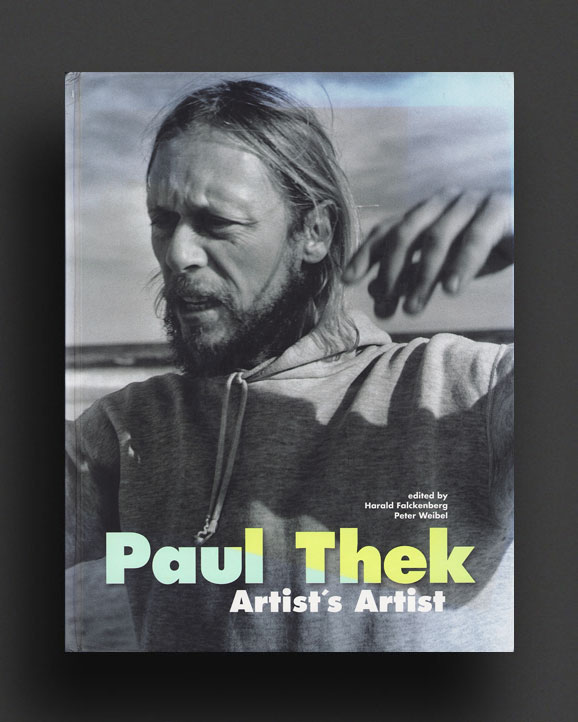
First edition of the scarce, highly sought after, and most comprehensive book ever published on American artist Paul Thek, published in 2009 by MIT Press. Edited by Harald Falckenberg and Peter Weibel, this enormous 550 page monograph contains more than 300 works by this groundbreaking artist, documenting his journey from legendary outsider to central figure in many contemporary art movements.
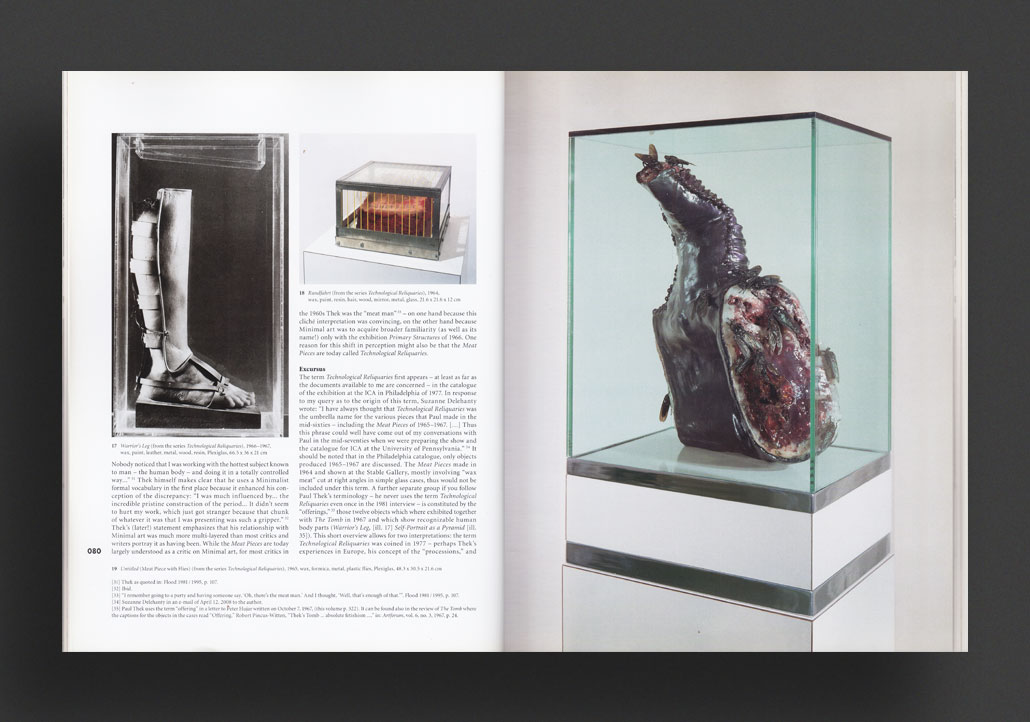
Paul Thek occupied a place between high art and low art, between the epic and the everyday. During his brief life (1933-1988), he went against the grain of art world trends, humanizing the institutional spaces of art with the force of his humor, spirituality, and character. Twenty years after Thek's death from AIDS, we can now recognize his influence on contemporary artists ranging from Vito Acconci and Bruce Nauman to Matthew Barney, Mike Kelley, and Paul McCarthy, as well as Kai Althoff, Jonathan Meese, and Thomas Hirschhorn. This book brings together more than 300 of Thek's works—many of which are published here for the first time—to offer the most comprehensive display of his work yet seen. The book, which accompanies an exhibition at ZKM ? Museum of Contemporary Art presenting Thek's work in dialogue with contemporary art by young artists, includes painting, sculpture, drawing, and installation work, as well as photographs documenting the room-size environments into which Thek incorporated elements from art, literature, theater, and religion. These works chart Thek's journey from legendary outsider to foundational figure in contemporary art. In their antiheroic diversity, Thek's works embody the art revolution of the 1960s; indeed, Susan Sontag dedicated her classic Against Interpretation to him. Thek's treatment of the body in such works as “Technological Reliquaries,” with their castings and replicas of human body parts, tissue, and bones, both evoke the aura of Christian relics and anticipate the work of Damien Hirst. The book, with more than 500 images (300 in colour) and nineteen essays by art historians, curators, collectors, and artists, investigates Thek's work on its own terms, and as a starting point for understanding the work of the many younger artists Thek has influenced.
Essays by Jean-Christophe Ammann, Margrit Brehm, Bazon Brock, Suzanne Delehanty, Harald Falckenberg, Marietta Franke, Stefan Germer, Kim Gordon, Roland Groenenboom, Axel Heil, Gregor Jansen, Mike Kelley, John Miller, Susanne Neubauer, Kenny Schachter, Harald Szeemann, Annette Tietenberg, Peter Weibel, Ann Wilson.
Good copy with heavy tanning to spine and covers (esp. fluro spot colour), some bumping to cover corners, light page edge tanning. Internally Very Good, clean throughout.
1995, English
Softcover, 398 pages, 23 x 15.5 cm
1st Edition, Out of print title / used / very good
Published by
Routledge / London
$40.00 - In stock -
First 1995 edition.
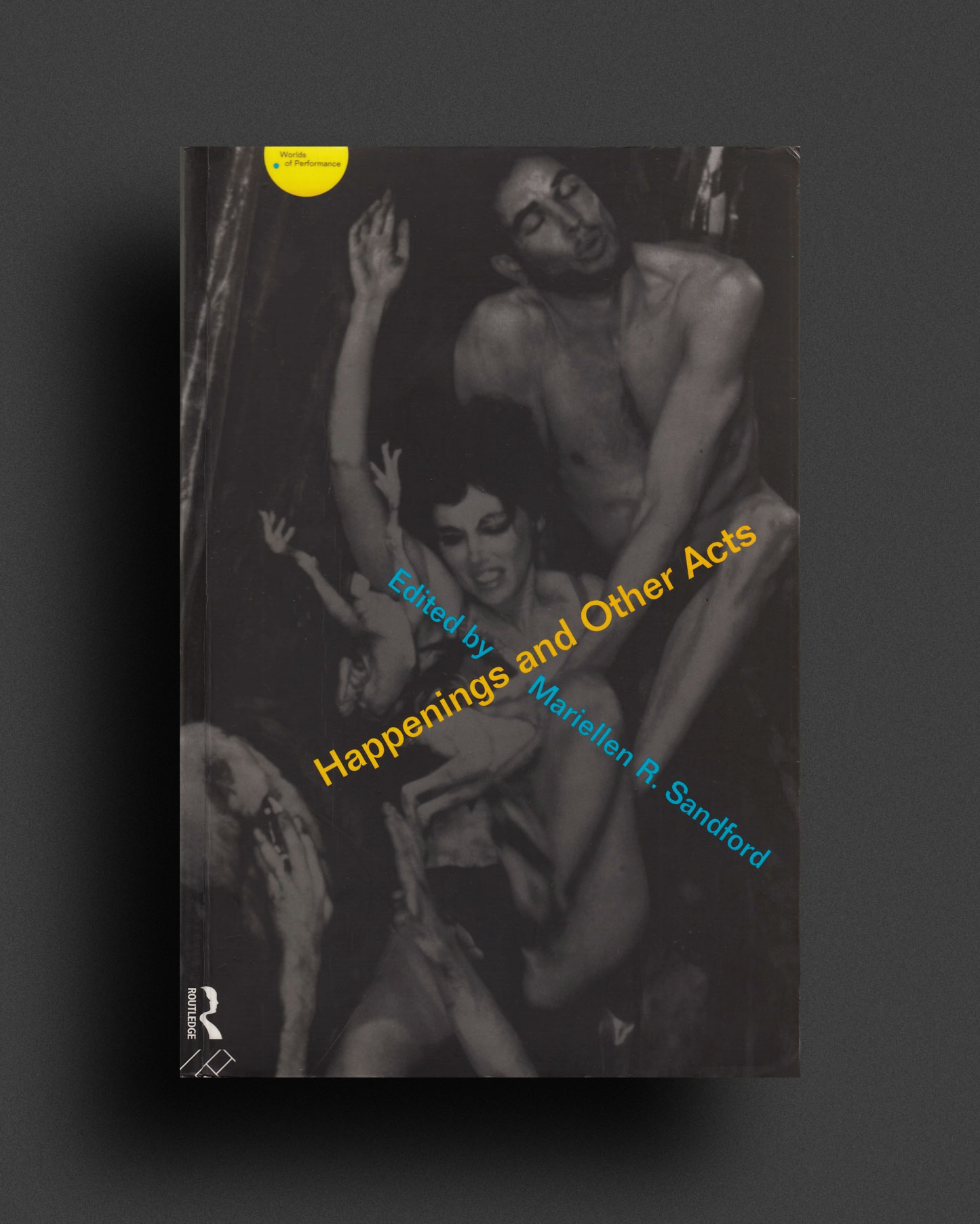
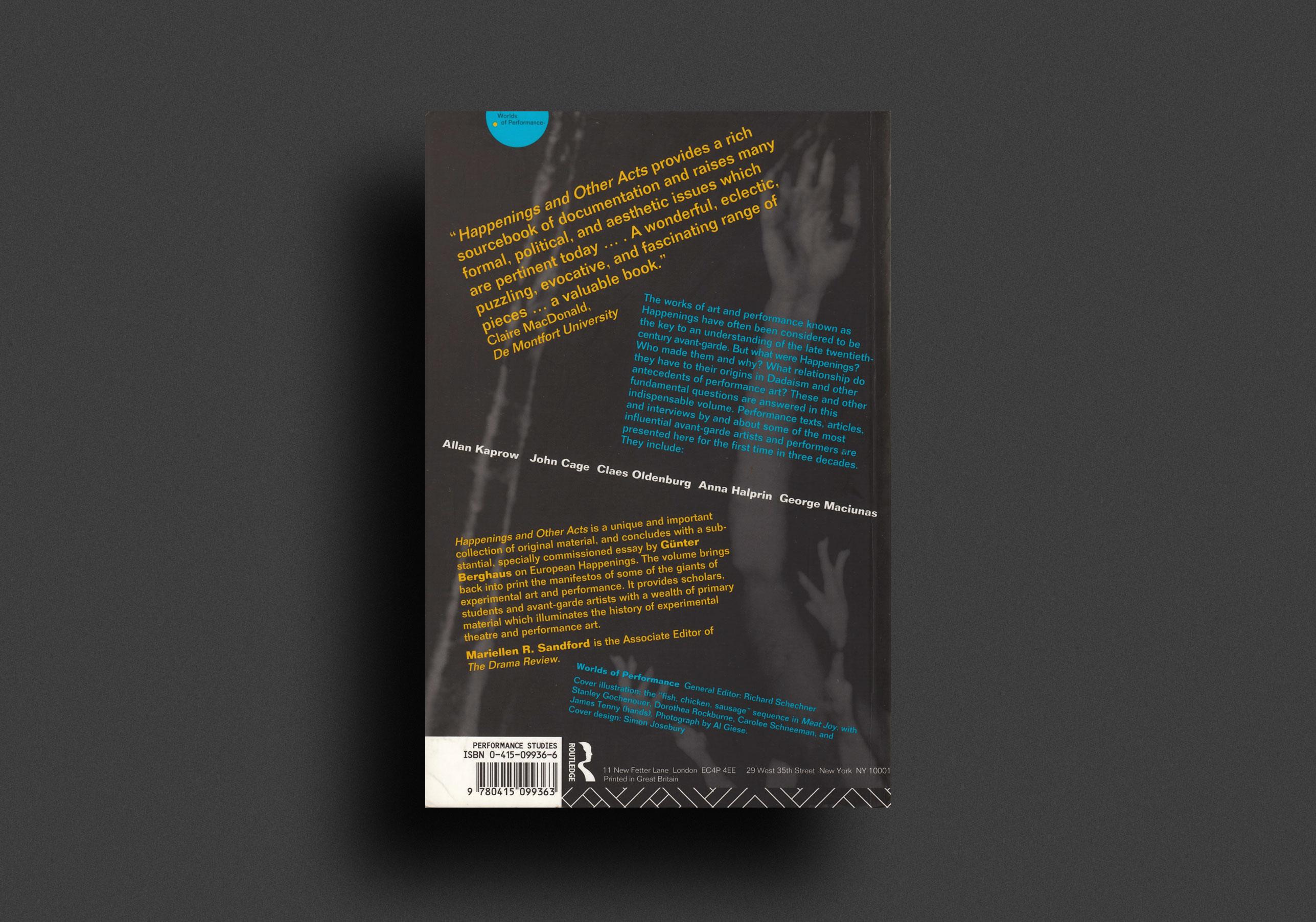
Happenings and Other Acts collects seminal essays, interviews, and performance texts by and about Happenings and Fluxus artists. The anthology reprints, in its entirety, the 1965 Happenings issue of The Drama Review (TDR), which was co-edited by Michael Kirby and Richard Schechner, supplemented by articles from subsequent TDR numbers; Kirby's introduction to his own Happenings anthology; excerpts from Allan Kaprow's Assemblages, Environments & Happenings; sections from Carolee Schneemann's More Than Meat Joy; and the concluding essay, written for this volume by Günter Berghaus, which offers the first overview of European Happenings written in English.
Published at the height of the Happenings and Fluxus movements, these are invaluable documents from a period that radically changed our perception of the function of the artist, the role of the observer, and the relation between art and everyday life. All boundaries of conventional art genres were broken by artists such as John Cage, Allan Kaprow, Claes Oldenburg, Anna Halprin, Ken Dewey, George Maciunas, Alison Knowles, Jackson Mac Low, La Monte Young, Yvonne Rainer, Dick Higgins, Jean-Jacques Lebel, and Carolee Schneemann.
Mariellen R.Sandford has been Associate Editor of TDR since 1985.
VG copy with some wear to board extremities.
2014, English
Hardcover (w. dust jacket), 448 pages, 24 x 19 cm
1st Edition, Out of print title / used / fine
Published by
The MIT Press / Massachusetts
$45.00 - In stock -
First 2014 hardcover edition.
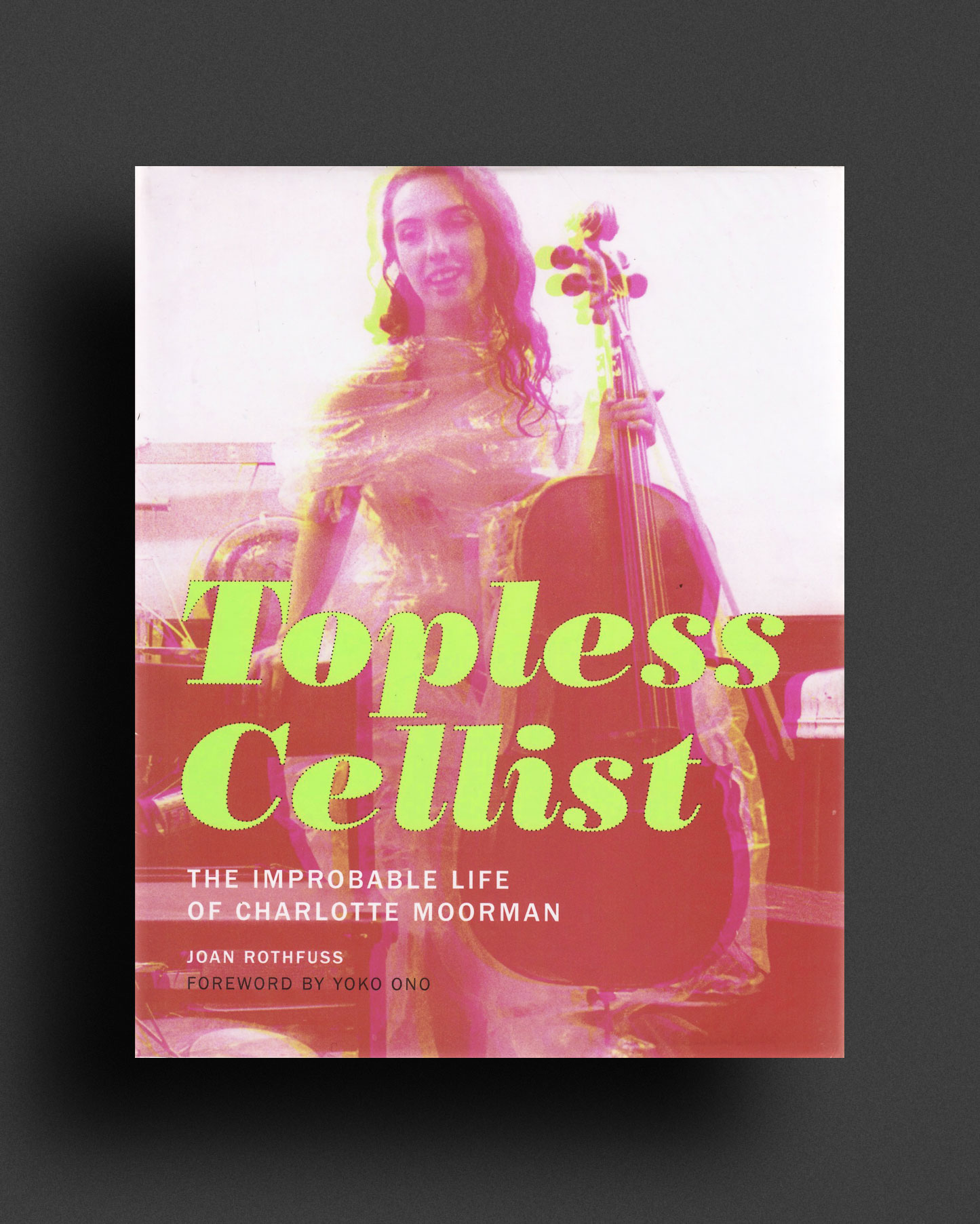
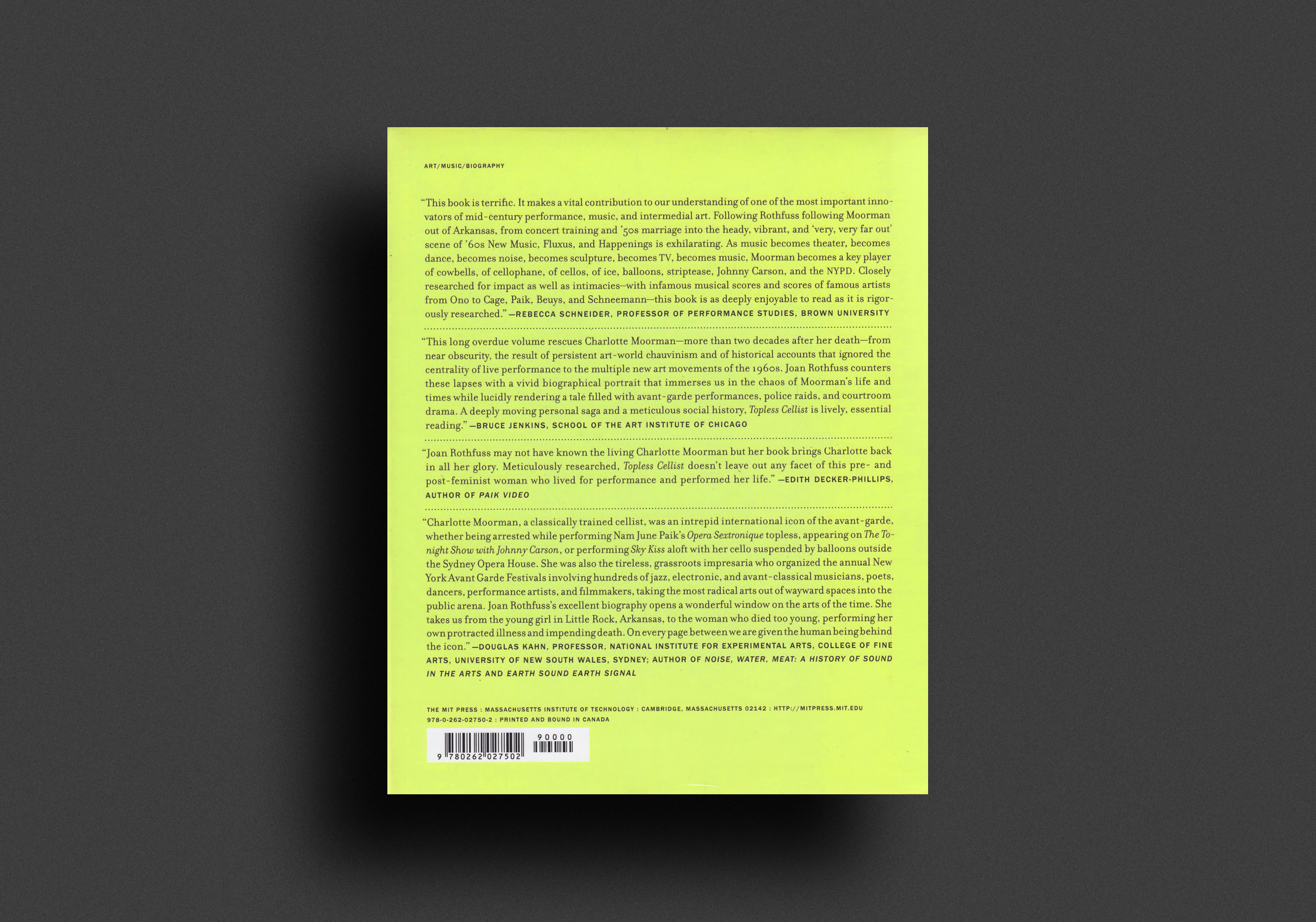
The first book to explore the extraordinary career of musician and performance artist Charlotte Moorman, whose work combined classical rigor, avant-garde experiment, and madcap daring.
The Juilliard-trained cellist Charlotte Moorman sat nude behind a cello of carved ice, performed while dangling from helium-filled balloons, and deployed an array of instruments on The Mike Douglas Show that included her cello, a whistle, a cap gun, a gong, and a belch. She did a striptease while playing Bach in Nam June Paik's Sonata for Adults Only. In the 1960s, Moorman (1933–1991) became famous for her madcap (and often unclothed) performance antics; less famous but more significant is Moorman's transformative influence on contemporary performance practice—and her dedication to the idea that avant-garde art should reach the widest possible audience. In Topless Cellist, the first book to explore Moorman's life and work, Joan Rothfuss rediscovers, and recovers, the legacy of an extraordinary American artist.
Moorman's arrest in 1967 for performing topless made her a water-cooler conversation-starter, but before her tabloid fame she was a star of the avant-garde performance circuit, with a repertoire of pieces by, among others, Yoko Ono, Joseph Beuys, John Cage, and Paik, her main artistic partner. Moorman invented a new mode of performance that combined classical rigor, jazz improvisation, and avant-garde experiment—informed by intuition, daring, and love of spectacle. Moorman's annual festival of the avant-garde offered the public a lively sampler of contemporary art in performance, music, dance, poetry, film, and other media.
Rothfuss chronicles Moorman's life from her youth in Little Rock, Arkansas (where she was “Miss City Beautiful” of 1952) through her career in New York's avant-garde to her death from breast cancer in 1991. (Typically, she approached her treatment as if it were a performance.) Deeply researched and profusely illustrated, Topless Cellist offers a fascinating, sometimes heartbreaking, often hilarious story of an artist whose importance was more than the sum of her performances.
Fine in Fine dust jacket.
2003, Japanese
Softcover, 160 pages, 24 x 18 cm
1st Edition, Out of print title / used / fine
Published by
Atelier Peyotl / Tokyo
$60.00 - Out of stock
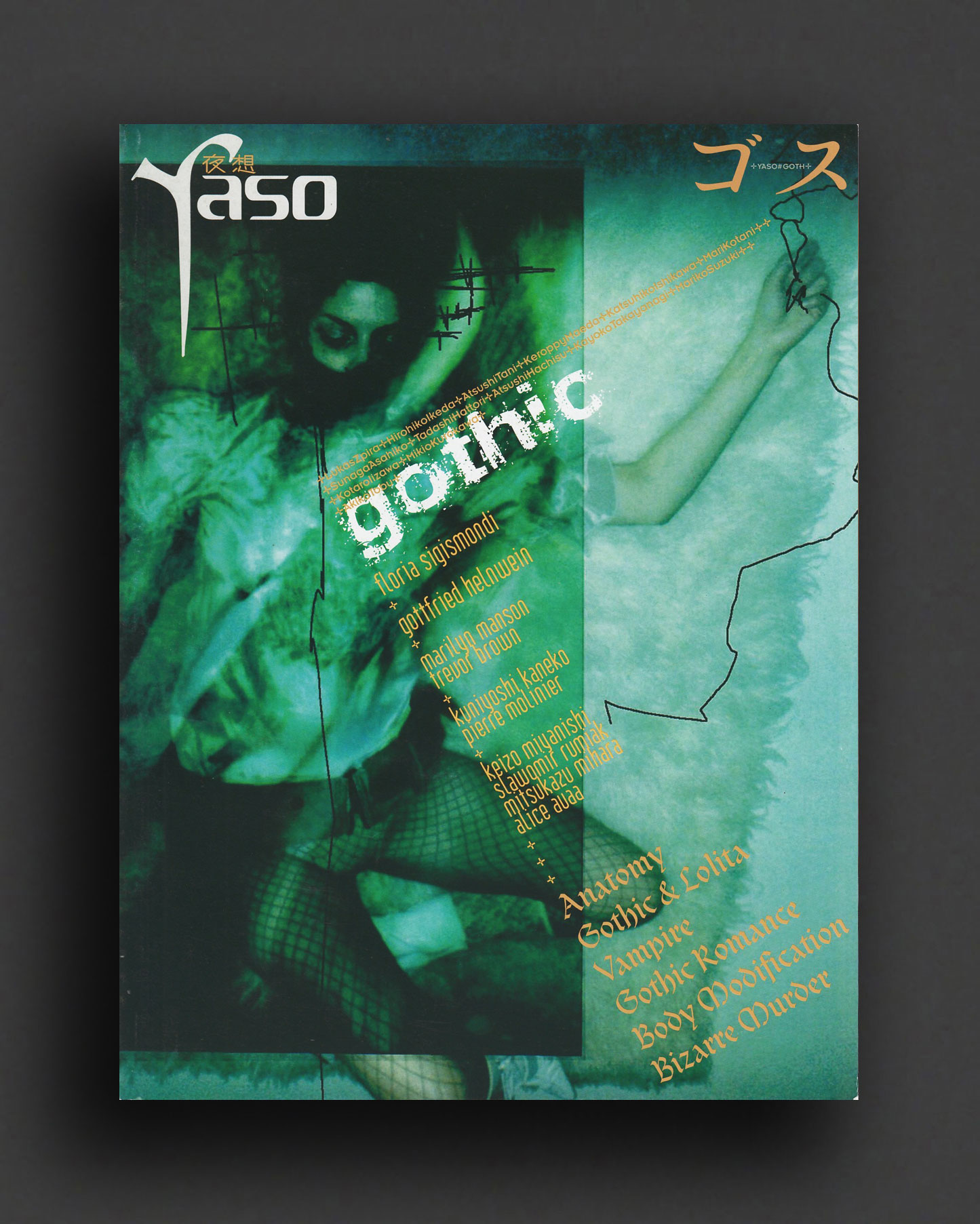
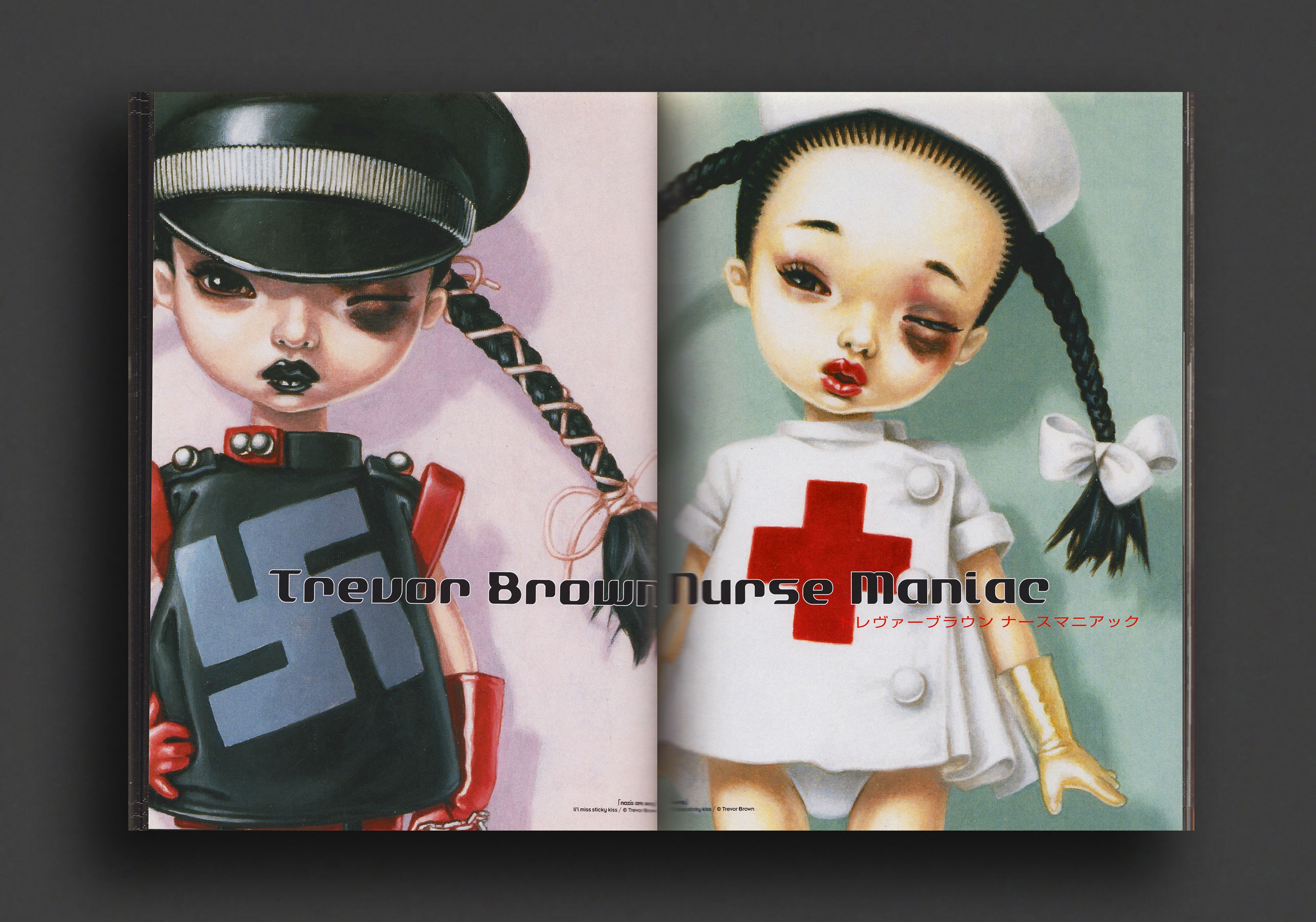
"Gothic" Special Feature Issue of cult Japanese underground magazine Yaso, published in 2003, edited by Yuichi Konno and Atelier Peyotl (publishers of Night Vision/Yaso/Peyotl/Wave/Silvester Club...). Heavily illustrated with texts in Japanese with in-depth profiles, interviews with and essays on Trevor Brown, Gottfried Helnwein, Kuniyoshi Kaneko, ero-manga master Keizo Miyanishi, influential Gothic Lolita illustrator Mitsukazu Mihara, Floria Sigismondi, Marilyn Manson, Alice Auaa, loads of "Modern Primitive" material (piercing, body modification, body performance, etc.), and much more...
Near Fine copy.
1997, English
Softcover, 510 pages, 20 x 13 cm
1st Edition, Out of print title / used / very good
Published by
Vintage / UK
$50.00 - In stock -
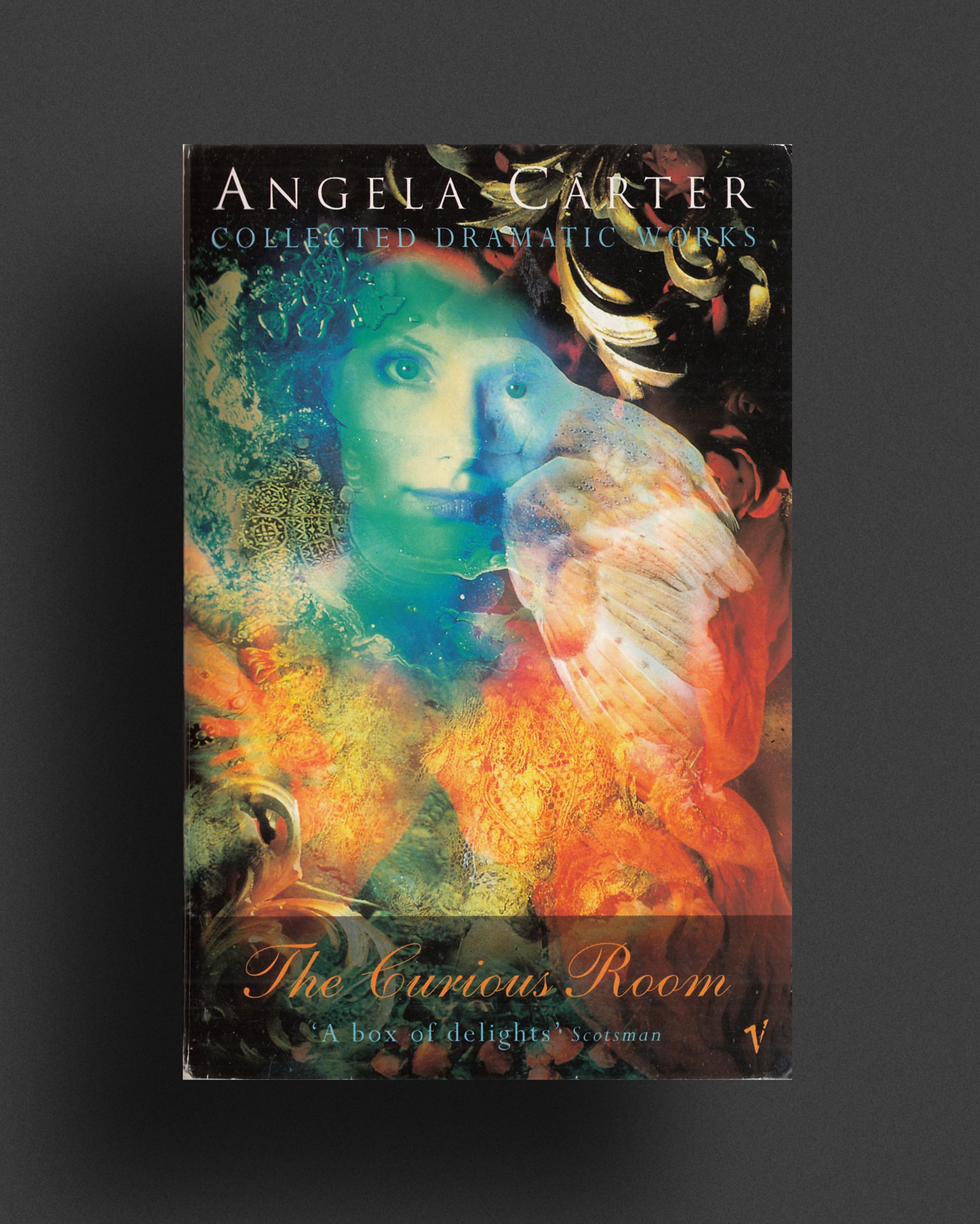
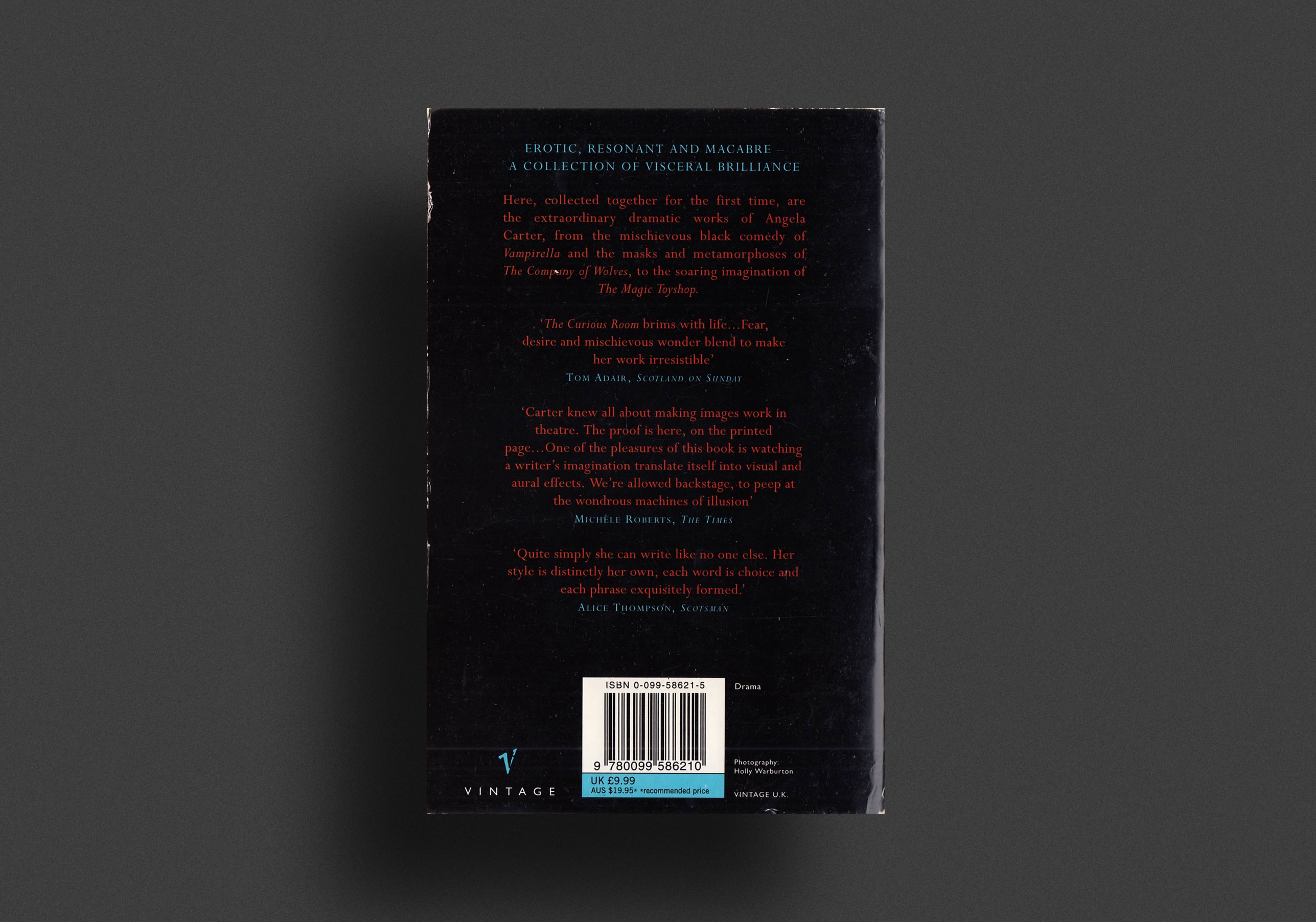
Scarce first 1997 paperback edition of The Curious Room by Angela Carter, the Vintage collected dramatic writings, including several previously unpublished plays and screenplays. THE CURIOUS ROOM includes a radio play about the demented Victorian painter and parricide Richard Dadd; reworkings of Puss in Boots and the Dracula story; a draft for an opera of Virginia Woolf's ORLANDO, as well as the film scripts of THE MAGIC TOYSHOP and THE COMPANY OF WOLVES. Revealing many of the enthusiasms and concerns which ignited Carter's fiction. THE CURIOUS ROOM is full of magnificent and startling new material, charged with the range and power of Carter's imagination and inventiveness.
Very Good copy with light spine creases/board edge wear/tanning.
1972, English
Softcover, 228 pages, 20 x 14 cm
1st Edition, Out of print title / used / average
Published by
E P Dutton / New York
$30.00 - Out of stock
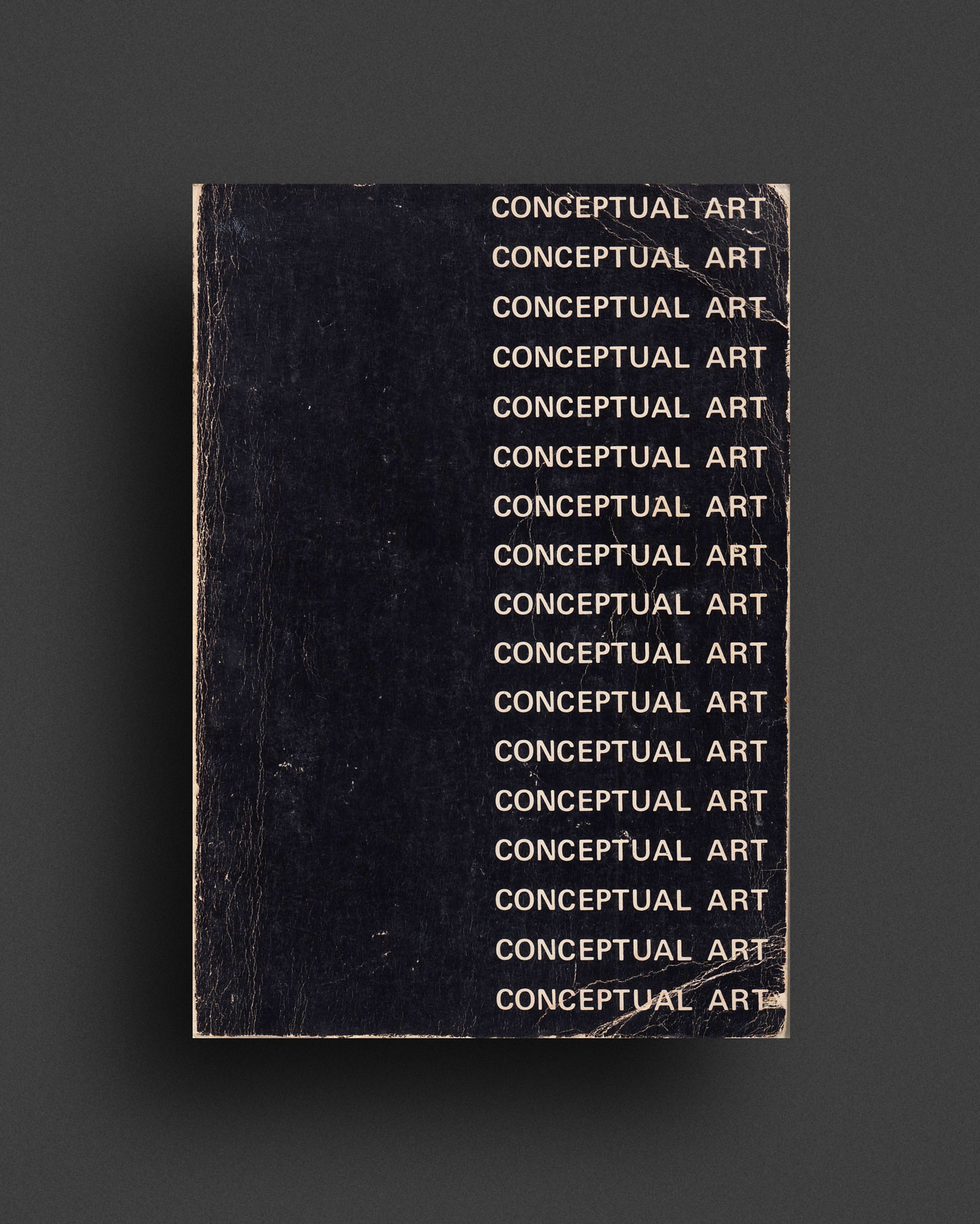
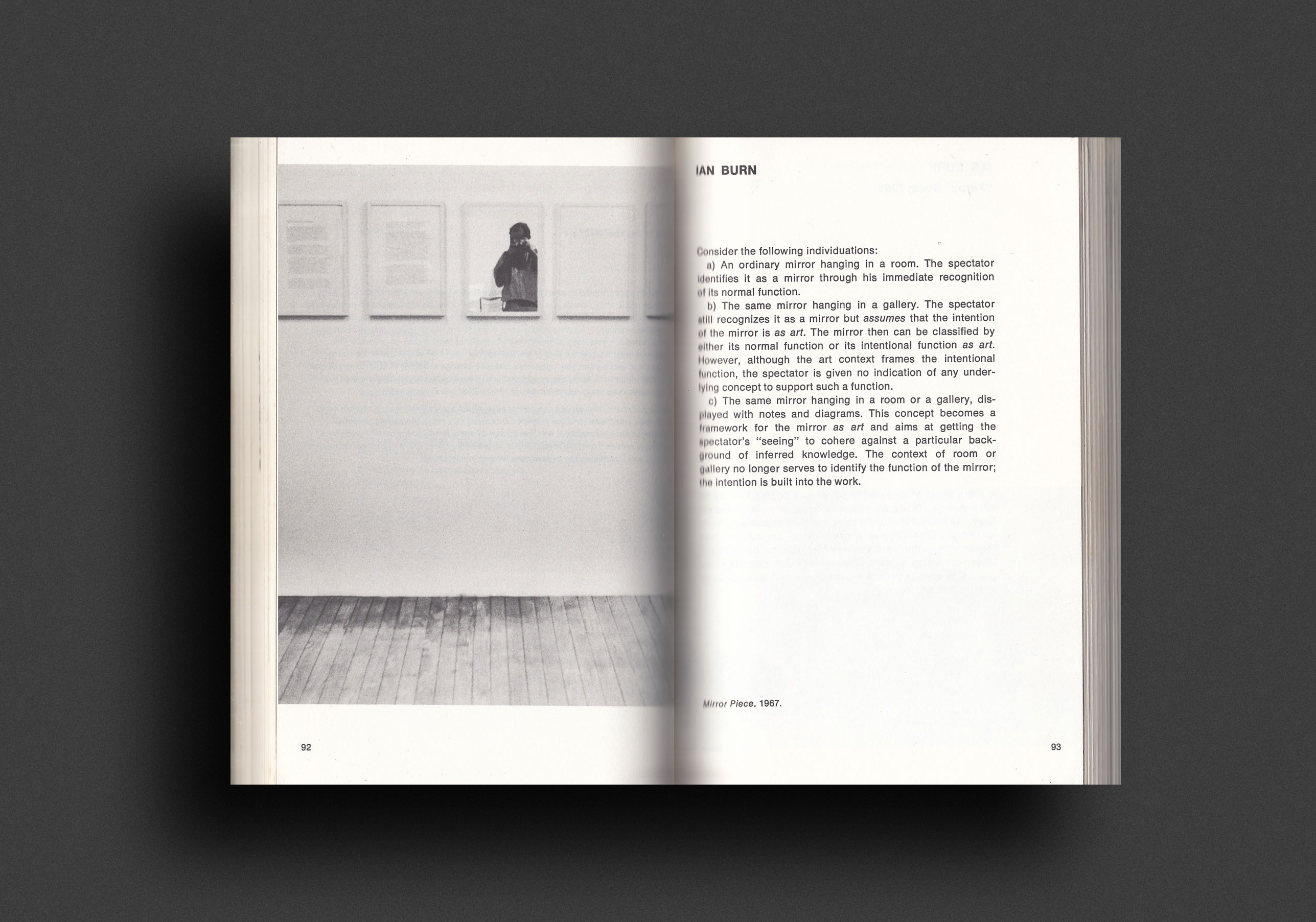
"The function of the critic and the function of the artist have been traditionally divided; the artist's concern was the production of the work and the critic's was its evaluation and interpretation. During the past several years a group of young artists evolved the idiom of Conceptual Art, which eliminated this division. Conceptual artists take over the role of the critic in terms of framing their own propositions, ideas, and concepts.
An essential aspect of Conceptual Art is its self-reference; often the artists define the intentions of their work as part of their art. Thus, many Conceptual artists advance propositions or investigations. It is in keeping, then, with Conceptual Art that it is best explained through itself, i.e., through the examination of Conceptual Art, rather than through any assumptions outside of itself. In this sense, this book is not a 'critical anthology' by a documentation of Conceptual Art and Statements."
Includes : Douglas Huebler, Stephen Kaltenbach, On Kawara, Alain Kirili, Joseph Kosuth, Christine Kozlov, Sol LeWitt, Mario Merz, Robert Morris, Bruce Nauman, Iain Baxter, Dennis Oppenheim, John Perreault, Adrian Piper, Mel Ramsden, Edward Ruscha, Bernar Venet, Lawrence Weiner, Ian Wilson, Vito Acconci, Terry Atkinson, David Bainbridge, Michael Baldwin, Harold Hurrell, John Baldessari, Robert Barry, Frederick Barthelme, Gregory Battcock, Bernd and Hilla Becher, Mel Bochner, Daniel Buren, Victor Burgin, Donald Burgy, Ian Burn, Rosemarie Castoro, Roger Cutforth, Jan Dibbets, Carl Fernbach-Flarsheim, Dan Graham, Hans Haacke.
Ex–libris copy from the personal collection of Australian artist, educator, historian, writer, art critic, environmentalist, plumber, Noel Hutchinson (1940-2020), name penned to reverse front cover. Average–Good copy, Wear/light creasing to extremities.