World Food Books' programme is largely produced on Kulin Nation land. We acknowledge the Wurundjeri people of the Kulin Nation as the first and continuing custodians of this land, and pay respect to their Elders past, present, and emerging.
World Food Books is an arts and special interests bookshop in Naarm / Melbourne. Founded in 2010, World Food Books is devoted to the presentation of a rotating, hand-selection of international art, design, literary and counterculture publications with an emphasis on the anti-traditional, the experimental, the avant-garde, the heretic, the marginal.
Presenting new titles alongside rare and out-of-print books, catalogues and journals spanning the fields of modern and contemporary art, design, photography, illustration, film, literature, poetry, cultural theory, philosophy, sexuality, popular and underground culture in its many radical forms, World Food Books wishes to encourage adventurous, thoughtful and open-minded reading, looking, writing, and exchange of publishing and ideas, both current and historical.
As well as our bookshop, located in Melbourne's historical Nicholas Building, all of our inventory is available internationally via our online mail-order service.
World Food Books semi-regularly co-ordinates "Occasions", a programme of exhibits and events at the bookshop and in partnership with other hosts (such as museums and art galleries) that develop out of the activities, relationships and content of the bookshop itself.
World Food Books
The Nicholas Building
37 Swanston Street
Room 5, Level 6
Melbourne 3000
Australia
SHOP HOURS:
Thu–Fri 12–6
WEB-SHOP OPEN 24/7
World Food Books
Postal Address:
37 Swanston Street
Room 5, Level 6
Melbourne 3000
Australia
Art
Theory / Essay
Architecture / Interior
Graphic Design / Typography
Photography
Fashion
Eros
LGBTQ+
Fiction / Poetry
Weird / Speculative / Science Fiction / Horror
Transgressive / Visceral / Abject
Symbolism / Decadence / Fin de siècle
Film / Video
Painting
Sculpture / Installation
Performance / Dance / Theater
Drawing
Sound / Music
Curatorial
Group Shows / Collections
Periodicals
Out-of-print / Rare
Posters / Ephemera / Discs
Signed Books
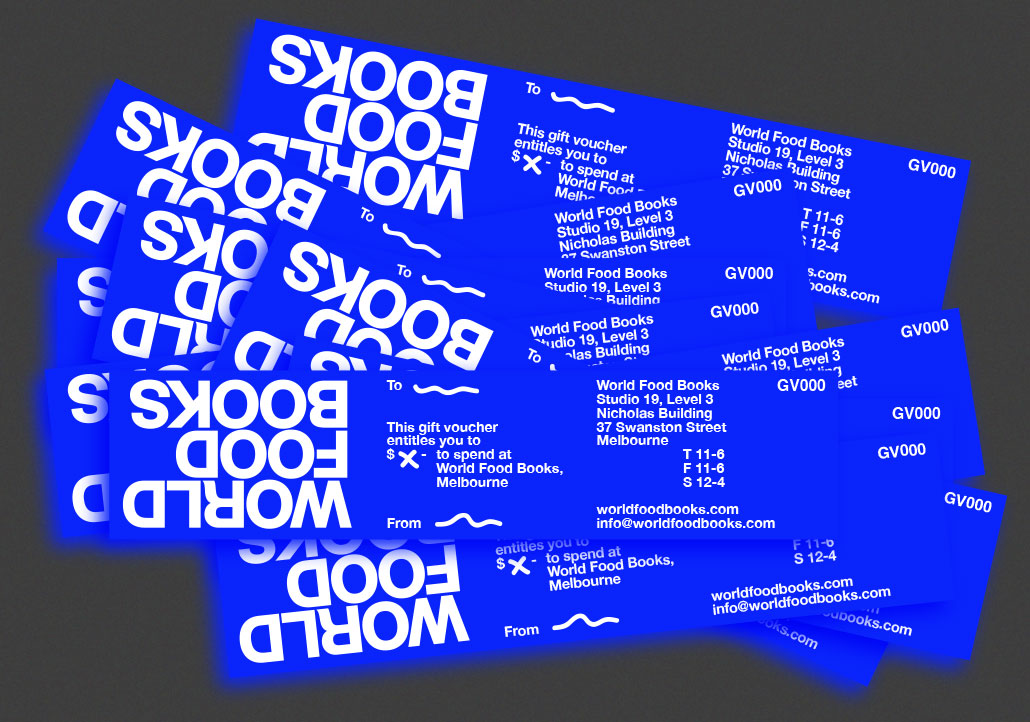
World Food Books Gift Voucher
World Food Book Bag
Australian Art
Australian Fiction
Australian Science Fiction / Speculative Fiction
Australian Poetry
Australian Photography
Japanese Photography
Conceptual Art
Minimal Art
Dada
'Pataphysics / Oulipo
Fluxus
Concrete Poetry
Pop Art
Surrealism
Arte Povera
Arte Informale / Haute Pâte / Tachism
Nouveau Réalisme / Zero / Kinetic
Situationism / Lettrism
Collage / Mail Art / Xerox Art
Art Brut / Folk / Visionary / Fantastic
Illustration / Graphic Art / Bandes Dessinées
Furniture
Italian Radical Design / Postmodernism
Textiles
Ceramics / Glass
Counterculture
Protest / Revolt
Philosophy
Psychoanalysis
Anthropology
Anarchism
Socialism / Anarchism / Communism / Capitalism
Literary Theory / Semiotics / Language
Feminism / Women's Studies
Gender Studies / Sexuality
Anthropology
Fetishism / BDSM
Drugs / Psychedelia
Crime / Violence
Animal Rights / Veganism
Occult / Esoterica
Ecology / Earth / Alternative Living
Whole Earth / Crafts
All prices in AUD (Australian dollars)
Pick-Ups
Pick-up orders can be collected in our bookshop during opening hours after order date. Please collect any Pick-up orders within 2 weeks of ordering as we have limited storage space. Orders will be released back into stock if not collected within this time. No refunds can be made for pick-ups left un-collected. If you cannot make it in to the bookshop in this time-frame, please choose postage option.
Return Policy
All sales are final. We do accept returns (for refund or exchange) for items received in error. All our orders are packed with special care using heavy-duty padding and cardboard book-mailers or bubble mailers (for smaller books), using reinforcement where required. We cannot take responsibility for any lost, stolen or damaged parcels.
Insurance
Should you wish to insure your package, please email us directly after placing your order and we can organise this at a small extra expense. Although all standard/express tracked packages are very safe and dependable, we cannot take responsibility for any lost, stolen or damaged parcels. We recommend insurance on valuable orders.
Interested in selling your old books, catalogues, journals, magazines, comics, fanzines, ephemera? We are always looking for interesting, unusual and out-of-print books to buy. We only buy books in our fields of interest and specialty, and that we feel we can resell.
We base these prices on desirability, market value, in-print prices, condition and our current stock levels. We offer cash, store credit, and can take stock on consignment. All
about 25% of the price we expect to get when we sell them, or 30% in store credit. We base these prices on desirability, market value, in-print prices, condition and our current stock levels.
Sell your books any day of the week. You can drop them off and return later. If you have a lot of books, we can visit your Sydney home.
We buy books that we feel we can resell. We offer about 25 % of the price we expect to get when we sell them, or 30% in store credit. We base these prices on desirability, market value, in-print prices, condition and our current stock levels.
Philadelphia Wireman
03 August - 01 September, 2018
World Food Books is proud to announce our next Occasion, the first presentation of sculptures by Philadelphia Wireman in Australia.
The Philadelphia Wireman sculptures were found abandoned in an alley off Philadelphia’s South Street on trash night in 1982. Their discovery in a rapidly-changing neighbourhood undergoing extensive renovation, compounded with the failure of all attempts to locate the artist, suggests that the works may have been discarded after the maker’s death. Dubbed the "Philadelphia Wireman" during the first exhibition of this work, in 1985, the maker’s name, age, ethnicity, and even gender remain uncertain. The entire collection totals approximately 1200 pieces, all intricately bound together with tightly-wound heavy-gauge wire (along with a few small, abstract marker drawings, reminiscent both of Mark Tobey and J.B. Murry). The dense construction of the work, despite a modest range of scale and materials, is singularly obsessive and disciplined in design: a wire armature or exoskeleton firmly binds a bricolage of found objects including plastic, glass, food packaging, umbrella parts, tape, rubber, batteries, pens, leather, reflectors, nuts and bolts, nails, foil, coins, toys, watches, eyeglasses, tools, and jewellery.
Heavy with associations—anthropomorphic, zoomorphic, and socio-cultural responses to wrapped detritus—the totemic sculptures by Philadelphia Wireman have been discussed in the context of work created to fulfil the shamanistic needs of alternative religions in American culture. Curators, collectors, and critics have variously compared certain pieces to sculpture from Classical antiquity, Native American medicine bundles, African-American memory jugs, and African fetish objects. Reflecting the artist’s prolific and incredibly focused scavenging impulse, and despite—or perhaps enhanced by—their anonymity, these enigmatic objects function as urban artefacts and arbiters of power, though their origin and purpose is unknown. Philadelphia Wireman, whatever their identity, possessed an astonishing ability to isolate and communicate the concepts of power and energy through the selection and transformation of ordinary materials. Over the course of the past two decades, this collection has come to be regarded as an important discovery in the field of self-taught art and vernacular art.
Presented in collaboration with Fleisher-Ollman Gallery, Philadelphia, and Robert Heald, Wellington.
Susan Te Kahurangi King
02 February - 10 March, 2018
Susan Te Kahurangi King (24 February 1951 - ) has been a confident and prolific artist since she was a young child, drawing with readily available materials - pencils, ballpoint pens and felt-tip markers, on whatever paper is at hand. Between the ages of four and six Susan slowly ceased verbal communication. Her grandparents William and Myrtle Murphy had developed a special bond with Susan so they took on caring responsibilities for extended periods. Myrtle began informally archiving her work, carefully collecting and storing the drawings and compiling scrapbooks. No drawing was insignificant; every scrap of paper was kept. The King family are now the custodians of a vast collection containing over 7000 individual works, from tiny scraps of paper through to 5 meter long rolls.
The scrapbooks and diaries reveal Myrtle to be a woman of great patience and compassion, seeking to understand a child who was not always behaving as expected. She encouraged Susan to be observant, to explore her environment and absorb all the sights and sounds. Myrtle would show Susan’s drawings to friends and people in her community that she had dealings with, such as shopkeepers and postal workers, but this was not simply a case of a grandmother’s bias. She recognised that Susan had developed a sophisticated and unique visual language and sincerely believed that her art deserved serious attention.
This was an unorthodox attitude for the time. To provide some context, Jean Dubuffet coined the term Art Brut in 1945 to describe work created by self-taught artists – specifically residents of psychiatric institutions and those he considered to be visionaries or eccentrics. In 1972 Roger Cardinal extended this concept by adopting the term Outsider Art to describe work made by non-academically trained artists operating outside of mainstream art networks through choice or circumstance. Susan was born in Te Aroha, New Zealand in 1951, far from the artistic hubs of Paris and London that Dubuffet and Cardinal operated in. That Myrtle fêted Susan as a self-taught artist who deserved to be taken seriously shows how progressive her attitudes were.
Susan’s parents Doug and Dawn were also progressive. Over the years they had consulted numerous health practitioners about Susan’s condition, as the medical establishment could not provide an explanation as to why she had lapsed into silence. Dawn educated herself in the field of homeopathy and went on to treat all twelve of her children using these principles – basing prescriptions on her observations of their physical, mental and emotional state.
Doug was a linguist with an interest in philosophy who devoted what little spare time he had to studying Maori language and culture. To some extent their willingness to explore the fringes of the mainstream made them outsiders too but it was their commitment to living with integrity and their respect for individuality that ensured Susan’s creativity was always encouraged.
Even though Susan’s family supported her artistic pursuits, some staff in schools and hospitals saw it as an impediment to her assimilation into the community and discouraged it in a variety of ways. Her family was not always aware of this and therefore did not fully understand why Susan stopped drawing in the early 1990s. However, rather than dwell on the challenges that Susan faced in pursuit of her artistic practice, they prefer to highlight her achievements. In 2008 Susan began drawing again in earnest, after an almost 20 year interruption, and her work is now shown in galleries around the world.
Susan grew up without television and has been heavily influenced by the comics she read as a child. She is absolutely fearless in the appropriation of recognizable characters, such as Donald Duck and Mickey Mouse, in her work. She twists their limbs, contorts their faces, compresses them together, blends them into complex patterned backgrounds - always imbuing them with an incredible energy. Although Susan often used pop culture characters in her work they are not naive or childlike. These are drawings by a brilliant self-taught artist who has been creating exceptional work for decades without an audience in mind.
Mladen Stilinović
"Various Works 1986 - 1999"
02 February 16 - September 10, 2016
Various works 1986 - 1999, from two houses, from the collections of John Nixon, Sue Cramer, Kerrie Poliness, Peter Haffenden and Phoebe Haffenden.
Including: Geometry of Cakes (various shelves), 1993; Poor People’s Law (black and white plate), 1993; White Absence (glasses, ruler, set square, silver spoon, silver ladel with skin photograph and wooden cubes), 1990-1996; Exploitation of the Dead (grey and red star painting, wooden painting, black spoon with red table, red plate), 1984-1990; Money and Zeros (zero tie, paintings made for friends in Australia (Sue, John, Kerrie), numbers painting), 1991-1992; Words - Slogans (various t-shirts) - “they talk about the death of art...help! someone is trying to kill me”, “my sweet little lamb”, “work is a disease - Karl Marx”; Various artist books, catalogues, monographs, videos; Poster from exhibition Insulting Anarchy; "Circular" Croatian - Australian edition; Artist book by Vlado Martek (Dostoyevsky); more.
Thanks to Mladen Stilinović and Branka Stipančić.
Jonathan Walker
Always Will Need To Wear Winter Shirt Blue + Ochre Small Check Pattern
21 August - 21 September, 2015
Untitled
I am not a great reader of poetry but I always return to the work of Melbourne poet, Vincent Buckley (1925- 1988). Perhaps I find his most tantalising piece to be not a finished poem but a fragment left on a scrap of paper discovered on his desk after the poet’s death.
The poetry gathers like oil
In the word-core, and spreads
It has its music meet,
Its music is in movement.
This fragment is more the shell left behind from a volatile thought than a finished poem. I find the last two lines honest but awkward whereas the first two lines work like an arrow. Most likely he could not find a resolution so it was left. Still, in its present form, it remains an eloquent testimony to the ultimate failure of a medium to express mobile thought and sensation, in Buckley’s case, through verbal language. It’s an important matter because this is something all artists have to deal with regardless of the medium.
I have never written a poem, however, I am forever copying fragments from books on paper scraps in a vain effort to fix certain notions in my head. At first, they function as bookmarks that are sometimes returned to when I open the book. But before long, as they accumulate, they fall out littering the table interspersed with A4 photocopies, bills, books and medications.
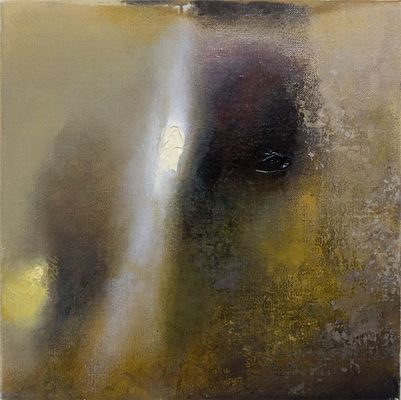
To return to Buckley’s fragment, the first two lines very much evoke how I paint nowadays. As you age, detail diminishes and patches of light become more luminous and float. I feel the most honest way of dealing with this is by smearing the oil paint on the canvas with the fingers and working close-up, blind. Only if the patches coalesce into an approaching image can the work gain a life.
-
Jonathan Walker was born in Melbourne, Australia and brought up on a dairy farm in Gippsland. In the 1970’s he studied painting at RMIT and won the Harold Wright Scholarship to the British Museum, London. During the 1980’s he exhibited at Pinacotheca Gallery, Richmond and had work shown at the NGV and Heidi City Art Gallery. Over the same period he designed the cover for the “Epigenesi” LP by Giancarlo Toniutti, Italy and conducted a mail exchange work with Achim Wollscheid, Germany. The work with artists through the post resulted in an article published in the bicentenary issue of Art and Australia 1988. He showed in artist run spaces such as WestSpace in the 90’s and 2000’s, and until 2012, taught painting at Victoria University, which is where we (Colleen Ahern and Lisa Radford) as organisers of the exhibition, among many others, had the privilege of being his student.
Walker’s knowledge was imparted to students through the careful selection of music, literature, and artists found in books that he himself had ordered for the library. Walker’s strategy was the generosity of sharing his vast knowledge with references specific to each student and their context.
Walker’s paintings share a similar focus and intimacy.
This exhibition presents a small selection of recent paintings alongside a publication that includes Walker’s writing. Observational and analytical, Walker’s work is a type of material notation — the time of day, colour and how it is blended, the both specific and fleeting location of a reflection on lino or the question of whether a chair leg should be included in a painting.
Please join us on Friday August 21 between 6-8pm to celebrate the opening of the exhibition.
Curated by Colleen Ahern and Lisa Radford.
B. Wurtz
Curated by Nic Tammens
March 26 - April 4, 2015
B.Wurtz works from a basement studio in his home on Manhattan’s Lower East Side.
This local fact is attested to by the plastic shopping bags and newsprint circulars that appear in his work. As formal objects, they don’t make loud claims about their origins but nonetheless transmit street addresses and places of business from the bottom of this long thin island. Like plenty of artists, Wurtz is affected by what is local and what is consumed. His work is underpinned by this ethic. It often speaks from a neighborhood or reads like the contents of a hamper:
“BLACK PLUMS $1.29 lb.”
“Food Bazaar”
“USDA Whole Pork Shoulder Picnic 99c lb.”
“RITE AID Pharmacy, with us it’s personal.”
“H. Brickman & Sons.”
“Sweet Yams 59c lb."
Most of the work in this exhibition was made while the artist was in residence at Dieu Donne, a workshop dedicated to paper craft in Midtown. Here Wurtz fabricated assemblages with paper and objects that are relatively lightweight, with the intention that they would be easily transportable to Australia. This consideration isn’t absolute in Wurtz’s work, but was prescriptive for making the current exhibition light and cheap. Packed in two boxes, these works were sent from a USPS post office on the Lower East Side and delivered to North Melbourne by Australia Post.
Wurtz appears courtesy of Metro Pictures, New York.
Thanks to Rob Halverson, Joshua Petherick, Sari de Mallory, Matt Hinkley, Helen Johnson, Fayen d'Evie, Ask Kilmartin, Lisa Radon, Ellena Savage, Yale Union, and "Elizabeth".
John Nixon
"Archive"
December 15 - January 20, 2014
The presentation of John Nixon's archive offered a rare showcase of this extensive collection of the artist's own publications, catalogues, posters, ephemera, editions and more, from the mid 1980s onwards, alongside a selection of his artworks.
Organized by John Nixon, Joshua Petherick and Matt Hinkley.
<a href=http://wfb.public-office.info/artist/john-nixon>All titles by John Nixon
"Habitat"
at Minerva, Sydney (organised by Joshua Petherick and Matt Hinkley)
November 15 - December 20, 2014
Lupo Borgonovo, Janet Burchill & Jennifer McCamley,
Lewis Fidock, HR Giger, Piero Gilardi, Veit Laurent Kurz,
Cinzia Ruggeri, Michael E. Smith, Lucie Stahl, Daniel Weil, Wols
Press Release:
“...It contained seven objects. The slender fluted bone, surely formed for flight, surely from the wing of some large bird. Three archaic circuitboards, faced with mazes of gold. A smooth white sphere of baked clay. An age-blackened fragment of lace. A fingerlength segment of what she assumed was bone from a human wrist, grayish white, inset smoothly with the silicon shaft of a small instrument that must once have ridden flush with the surface of the skin - but the thing’s face was seared and blackened.”
William Gibson, “Count Zero”, 1986
"Autumn Projects Archive"
Curated by Liza Vasiliou
March 6 - March 15, 2014
World Food Books, in conjunction with the Virgin Australia Melbourne Fashion Festival 2014, presented the Autumn Projects archive, consisting of a selection of early examples in Australian fashion with a particular interest in collecting designers and labels from the period beginning in the 1980’s, who significantly influenced the discourse of Australian Fashion.
Curated by Liza Vasiliou, the exhibition provided a unique opportunity to view pieces by designers Anthea Crawford, Barbara Vandenberg, Geoff Liddell and labels CR Australia, Covers, Jag along with early experimental collage pieces by Prue Acton and Sally Browne’s ‘Fragments’ collection, suspended throughout the functioning World Food Books shop in Melbourne.
H.B. Peace
presented by CENTRE FOR STYLE
November 14, 2013
"Hey Blinky, you say chic, I say same"
Anon 2013
H.B. Peace is a clothing collaboration between great friends Blake Barns and Hugh Egan Westland. Their pieces explore the divergences between 'character’ and ‘personality’ in garments....etc
Special Thanks to Joshua Petherick and Matt Hinkley of WFB and Gillian Mears
and a Very Special Thank you to Audrey Thomas Hayes for her shoe collaboration.
Janet Burchill & Jennifer McCamley
"Aesthetic Suicide"
May 10 - June 8, 2013
The first of our occasional exhibitions in the World Food Books office/shop space in Melbourne, "Aesthetic Suicide" presented a body of new and older works together by artists Janet Burchill & Jennifer McCamley, including videos, prints, a wall work, and publications.
During shop open hours videos played every hour, on the hour.
Published by World Food Books / Melbourne
$20.00 - In stock -
A World Food Books gift voucher is redeemable in our Melbourne bookshop or via our webshop (here). An e-voucher (printable pdf) will be sent to your purchase email address (please notify us if you wish to have the voucher sent to an alternate address and wish us to fill in the receiver's details on the card).
Gift vouchers can be purchased in increments of $20 (Australian Dollars) and the total amount can simply be added to by increasing the quantity in your shopping cart. eg. A quantity of 5 gift vouchers will result in an item total of $100 - a $100 gift voucher. Simply click "ADD TO CART" 5 times, or update your quantity in the shopping cart.
If you wish to purchase multiple, separate gift vouchers in one go, please just email us and we can personally prepare and email you a payment request.
Please note: Please select Pick-Up on gift voucher purchse to avoid any postage charges. Accidental postage charges will be refunded right away!
Thank you.
For any questions, please don't hesitate to email: [email protected]
1976, Japanese
Hardcover (w. dust jacket), unpaginated, 19.6 x 12.3 cm
1st Edition, Out of print title / used / good
Published by
Sanrio / Tokyo
$220.00 - In stock -
Very rare copy of Rosemary Doll, an enchanting 1976 photo-storybook from Sanrio’s legendary early publishing era. This exquisite pocket-sized volume weaves a dreamy, melancholic tapestry around the delicate bond between a girl named Rose and her doll, Marie. Brought to life through the hauntingly beautiful doll artistry of Rune Naito (iconic illustrator, doll designer and important contributor to Barazoku, the first commercially circulated gay magazine in Japan), the atmospheric, soft-focus photography of Osamu Nishikawa, and the avant-garde, evocative poetry of the modernist, outsider, "VOU"–poet Kazuko Shiraishi ("the Allen Ginsberg of Japan"–Kenneth Rexroth), the book stands as a masterpiece of Japanese Mid-Showa aestheticism. Long out of print and highly sought after by collectors, it remains a mesmerizing artifact of pure nostalgia, capturing the fleeting, surreal innocence of girlhood and doll-centric fantasy.
Bound in hardcovers, this copy have a couple of pages with marker scribbles, one prominently, oddly, over the doll. Otherwise Very Good copy.
1981, English
Softcover, 96 pages, 28 x 22 cm
1st Edition, Out of print title / used / very good
Published by
Delilah Books / New York
$140.00 - In stock -
First 1981 edition of Rear View, Nick Tosches’s superb photo-essay homage to the bottom in all it's splendor, lavishly illustrated with photography by Jeff Dunas, Bob Guccione, Geoff Howes, Stan Malinowski, Donald Milne, Siwer Ohlsson, Peter Vann, Carl Wachter, Harvey Wang, Jacky Winter, Zox. "In light of the designer jeans phenomenon, America's fascination with and exploitation of the derriere is examined in text and photographs". Features designer jeans by Jordache, Zena, Calvin Klein, Jesse Jeans, Sergio Valente. Art direction by Horst Weber. A now cult classic of the era.
Good—Very Good copy with some geenral light wear to boards/extremities.
1981, German
Softcover (+ compliments card), 217 pages, 30 x 21 cm
1st Edition, Out of print title / used / good
Published by
GAK / Bremen
$120.00 - In stock -
Rare and very comprehensive catalogue published on the occasion of Gianni Piacentino's exhibition at GAK (Gesellschaft für Aktuelle Kunst), Bremen, 1981, a comprehensive survey marking his return to Europe from living in New York between 1980–81. With accompanying texts in bi–lingual English/German by esteemed collectors Marcello Levi and Reinhard Onnasch (the first German art dealer to open a gallery in New York City following World War II), the catalogue traces the entire career of Italian artist Gianni Piacentino (b. 1945). A sidecar champion, model airplane and car builder, industrial painter (for work) and philosophy student, a young Piacentino was one of the first artists involved in the Arte Povera movement at its infancy, exhibiting with Pistoletto and Gilardi at Galleria Sperone, Turin in 1966 and then in Milan the following year. During the late 1960s, his meticulously crafted, highly finished minimal sculptures and canvases had more in common with West Coast American Minimalists and solidified his differences with other Arte Povera artists, and by 1969 Piacentino began his "Vehicles" and "Wings" series that would become some of his most enduring and captivating works, spanning the 1970s. His refined minimal surfaces would take on engineered form and the language of mass–production in a highly personalised manner that predated the developments of American minimalists such as Robert Grosvenor, and the later post–minimal pop–assemblages of Ashley Bickerton. Piacentino's work would appear at DOCUMENTA (6) in Kassel (1977), the XLV Venice Biennale (1993) and the Quadrennial in Rome (1973 and 2005).
In the words of Germano Celant: "It is in this historical climate of oscillation between art and design, handcrafts and industry, the useful and the useless, the one-off piece and the mass-produced object, and between the autonomy and heteronomy of pure creation, that we can place the contribution of Piacentino, whose otherness and uniqueness lie precisely in the dialectic between the two poles, Pop and Minimal. Since 1966 his sculptures have been aiming for a result that transcends the functional object, even though the latter remains recognizable as a possible industrial product with decorative characteristics, as it is derived from a culture steeped in applied science, handicrafts and the precision of mechanics and sophisticated engineering processes."
This copy with Berlin–based gallerist and contributing collector Reinhard Onnasch's with compliments card pasted to the first blank.
Good copy with some wear to boards, light knocking to spine ends, light tanning.
1968, French
Softcover, 162 pages, 20 x 17.8 cm
1st Edition, Out of print title / used / very good
Published by
Planète / Paris
$55.00 - In stock -
Issue 17 of Plexus, an avant-garde French magazine published in Paris from 1966-1970, created as the companion publication to fantastical realist magazine Planète by prominent figures French journalist and author Louis Pauwels and fantastique fiction author Jacques Sternberg. Born from the ashes of surrealism into it's cultivated counterculture and subtitled "the uninhibited magazine", Plexus blended a psychedelic mix of erotica, fantasy, philosophy, psychedelia, literature, esoterica, filmmaking, science fiction, satirical cartoons and more. Only 37 issues total were published during its short four year run, but it made a big splash, even being prohibited to minors in 1967 after just one year of publication for its “pornographic content.” Each issue featured striking cover artwork by some of the most prominent artists of the period, along with galleries of erotic artworks, historical and contemporary – often seen only in the pages of Plexus.
Plexus, issue 17, October 1968. Cover by Gilles Rimbault. Features a gallery of art by Gilles Rimbault, Didier Moreau, Georges Wolinski, photography by Emil Cadoo, actress Geneviève Grad, Anton LaVey, Emmanuelle Arsan, Yves de Saint-Agnes, Jacques Sternberg, and so much more.
VG copy, light wear/age.
1969, French
Softcover, 130 pages, 20 x 17.8 cm
1st Edition, Out of print title / used / very good
Published by
Planète / Paris
$55.00 - In stock -
Issue 29 of Plexus, an avant-garde French magazine published in Paris from 1966-1970, created as the companion publication to fantastical realist magazine Planète by prominent figures French journalist and author Louis Pauwels and fantastique fiction author Jacques Sternberg. Born from the ashes of surrealism into it's cultivated counterculture and subtitled "the uninhibited magazine", Plexus blended a psychedelic mix of erotica, fantasy, philosophy, psychedelia, literature, esoterica, filmmaking, science fiction, satirical cartoons and more. Only 37 issues total were published during its short four year run, but it made a big splash, even being prohibited to minors in 1967 after just one year of publication for its “pornographic content.” Each issue featured striking cover artwork by some of the most prominent artists of the period, along with galleries of erotic artworks, historical and contemporary – often seen only in the pages of Plexus.
Plexus, issue 28, November 1969. Cover by Jean Coulot. Features a gallery of art by Jean Coulot, Raymond Bertrand, Tiger Tateishi, actress/model Elsa Martinelli, Pieyre de Mandiargues, Emmanuelle Arsan, André Guillois, and article on Hitler illustrated by Gérard Gachet, and so much more.
VG copy, light wear/age.
1969, French
Softcover, 144 pages, 20 x 17.8 cm
1st Edition, Out of print title / used / very good
Published by
Planète / Paris
$45.00 - In stock -
Issue 26 of Plexus, an avant-garde French magazine published in Paris from 1966-1970, created as the companion publication to fantastical realist magazine Planète by prominent figures French journalist and author Louis Pauwels and fantastique fiction author Jacques Sternberg. Born from the ashes of surrealism into it's cultivated counterculture and subtitled "the uninhibited magazine", Plexus blended a psychedelic mix of erotica, fantasy, philosophy, psychedelia, literature, esoterica, filmmaking, science fiction, satirical cartoons and more. Only 37 issues total were published during its short four year run, but it made a big splash, even being prohibited to minors in 1967 after just one year of publication for its “pornographic content.” Each issue featured striking cover artwork by some of the most prominent artists of the period, along with galleries of erotic artworks, historical and contemporary – often seen only in the pages of Plexus.
Plexus, issue 26, July 1969. Cover by Roman Cieślewicz. Features a gallery of art by Claudine Wick, Georges Wolinski, an "unprecedented document on homosexuality" an investigation by Pierre Hahn featuring contributions by Roger Peyrefitte and Michel Butor (writers), Claude Dumezil (psychoanalyst), Daniel Guérin (sociologist), Marc Oraison (priest), Roger Bastide (ethno-sociologist), André Baudry (director of "Arcadie"), Daniel Guérin, Jacques Sternberg, Hair, and so much more.
VG copy, light wear/age.
1969, French
Softcover, 162 pages, 20 x 17.8 cm
Published by
Planète / Paris
$55.00 - In stock -
Issue 25 of Plexus, an avant-garde French magazine published in Paris from 1966-1970, created as the companion publication to fantastical realist magazine Planète by prominent figures French journalist and author Louis Pauwels and fantastique fiction author Jacques Sternberg. Born from the ashes of surrealism into it's cultivated counterculture and subtitled "the uninhibited magazine", Plexus blended a psychedelic mix of erotica, fantasy, philosophy, psychedelia, literature, esoterica, filmmaking, science fiction, satirical cartoons and more. Only 37 issues total were published during its short four year run, but it made a big splash, even being prohibited to minors in 1967 after just one year of publication for its “pornographic content.” Each issue featured striking cover artwork by some of the most prominent artists of the period, along with galleries of erotic artworks, historical and contemporary – often seen only in the pages of Plexus.
Plexus, issue 25, June 1969. Cover by Michel Plaisir. Features a gallery of art by Hans Bellmer, Yves Chaix, Jacques-Armand Cardon, Pierre Bonnard by Pierre Cabanne, erotic photography by Ica Vilander, manifestations of POSSESSION (from voodoo, Macumba, sorcery, to Surrealism, Happenings, Yoga and L.S.D.), Pieyre de Mandiargues, Jacques Sternberg, Michel Bernard, Henri Guillemin, and so much more.
VG copy, light wear/age.
1969, French
Softcover, 162 pages, 20 x 17.8 cm
Published by
Planète / Paris
$35.00 - In stock -
Issue 24 of Plexus, an avant-garde French magazine published in Paris from 1966-1970, created as the companion publication to fantastical realist magazine Planète by prominent figures French journalist and author Louis Pauwels and fantastique fiction author Jacques Sternberg. Born from the ashes of surrealism into it's cultivated counterculture and subtitled "the uninhibited magazine", Plexus blended a psychedelic mix of erotica, fantasy, philosophy, psychedelia, literature, esoterica, filmmaking, science fiction, satirical cartoons and more. Only 37 issues total were published during its short four year run, but it made a big splash, even being prohibited to minors in 1967 after just one year of publication for its “pornographic content.” Each issue featured striking cover artwork by some of the most prominent artists of the period, along with galleries of erotic artworks, historical and contemporary – often seen only in the pages of Plexus.
Plexus, issue 24, May 1969. Cover by Pierre Le Colas. Features a gallery of art by Pierre Le Colas, Modesto Roldan, Ivan Steiger, photography by Jean Clemmer, Piero Fornasetti, Roger Caillois, Robert Sheckley,
and so much more.
VG copy, light wear/age.
1967, French
Softcover, 168 pages (w. Leonor Fini pin–up), 20 x 17.8 cm
1st Edition, Out of print title / used / very good
Published by
Planète / Paris
$65.00 - In stock -
Issue 11 of Plexus, an avant-garde French magazine published in Paris from 1966-1970, created as the companion publication to fantastical realist magazine Planète by prominent figures French journalist and author Louis Pauwels and fantastique fiction author Jacques Sternberg. Born from the ashes of surrealism into it's cultivated counterculture and subtitled "the uninhibited magazine", Plexus blended a psychedelic mix of erotica, fantasy, philosophy, psychedelia, literature, esoterica, filmmaking, science fiction, satirical cartoons and more. Only 37 issues total were published during its short four year run, but it made a big splash, even being prohibited to minors in 1967 after just one year of publication for its “pornographic content.” Each issue featured striking cover artwork by some of the most prominent artists of the period, along with galleries of erotic artworks, historical and contemporary – often seen only in the pages of Plexus.
Plexus, issue 24, May 1969. Cover by Leonor Fini. Features a gallery of art by Leonor Fini (with beautiful colour fold–out pin–up), Maurice Henry, Christiane Sabatier, erotic photography by Sam Haskins, Japanese tattoos, interview with Paul Gebhard (American anthropologist and sexologist,) Pol Quentin, Pierre Restany, photos of French actress Dany Carrel, James Thurber, Jean Tardieu, Jean Clemmer, and so much more.
VG copy, light wear/age.
1969, French
Softcover, 132 pages, 20 x 17.8 cm
1st Edition, Out of print title / used / very good
Published by
Planète / Paris
$30.00 - In stock -
Issue 27 of Plexus, an avant-garde French magazine published in Paris from 1966-1970, created as the companion publication to fantastical realist magazine Planète by prominent figures French journalist and author Louis Pauwels and fantastique fiction author Jacques Sternberg. Born from the ashes of surrealism into it's cultivated counterculture and subtitled "the uninhibited magazine", Plexus blended a psychedelic mix of erotica, fantasy, philosophy, psychedelia, literature, esoterica, filmmaking, science fiction, satirical cartoons and more. Only 37 issues total were published during its short four year run, but it made a big splash, even being prohibited to minors in 1967 after just one year of publication for its “pornographic content.” Each issue featured striking cover artwork by some of the most prominent artists of the period, along with galleries of erotic artworks, historical and contemporary – often seen only in the pages of Plexus.
Plexus, issue 27, September 1969. Cover by Julie Leblanc. Features a gallery of art by Julie Leblanc, actress Sylvie D'Haetze, Mao, Michel Lancelot, Jean Gourmelin, Bernard Le Roy, Jean Clemmer, Denis Manceaux and so much more.
VG copy, light wear/age.
1970, French
Softcover, 130 pages, 20 x 17.8 cm
1st Edition, Out of print title / used / very good
Published by
Planète / Paris
$45.00 - In stock -
Issue 31 of Plexus, an avant-garde French magazine published in Paris from 1966-1970, created as the companion publication to fantastical realist magazine Planète by prominent figures French journalist and author Louis Pauwels and fantastique fiction author Jacques Sternberg. Born from the ashes of surrealism into it's cultivated counterculture and subtitled "the uninhibited magazine", Plexus blended a psychedelic mix of erotica, fantasy, philosophy, psychedelia, literature, esoterica, filmmaking, science fiction, satirical cartoons and more. Only 37 issues total were published during its short four year run, but it made a big splash, even being prohibited to minors in 1967 after just one year of publication for its “pornographic content.” Each issue featured striking cover artwork by some of the most prominent artists of the period, along with galleries of erotic artworks, historical and contemporary – often seen only in the pages of Plexus.
Plexus, issue 31, January 1970. Cover by Felix Labisse. Features a gallery of art by Christian Lepère, actor Jean-Marie Rivière, de Sade in cinema, "Female Homosexuality" an investigation by Pierre Hahn featuring contributions by Jean Monod (ethnologist), Violette Morin (sociologist), Joyce Mc Dougall (psychoanalyst), Françoise d'Eaubonne (writer), Father Albert Plé (dominican), Sister M.-L. of the Child Jesus (Orthodox abbess) and photography by Kishin Shinoyama, Baron Wolman, Eikoh Hosoe, and others,
actress Sylvie D'Haetze, Mao, Michel Lancelot, Jean Gourmelin, Bernard Le Roy, Jean Clemmer, Violette Morin, Friedrich Nietzsche, and so much more.
VG copy, light wear/age.
2008, English
Softcover (w. poster dust jacket), 176 pages, 21 x 29.7 cm
1st Edition, Out of print title / used / fine
Published by
Migros Museum für Gegenwartskunst / Zürich
JRP Ringier / Zürich
$400.00 - In stock -
The "Mnemosyne" of sexual identity.
Rare, first (and only) edition of this wonderful book centred around one of Olesen's master works, published by JRP-Ringier and Migros Museum für Gegenwartskunst, Zürich, and awarded for the “Most Beautiful Swiss Books 2008”. Edited by Heike Munder, with texts by Heike Munder and Henrik Olesen.
Since the mid-1990s, Henrik Olesen (*1967 Denmark, lives and works in Berlin) has used media such as collage, sculpture, and minimalistic spatial intervention to investigate the social construction of identity andits historiography. Through the appropriation of source images and contextual shifts not dissimilar to the method invented by Aby Warburg for his "Mnemosyne Atlas," Olesen probes the associations between
homosexuality and its criminalization in the past, as well as in the present. His archival work sheds light on the enduring existence of spaces for Others, and inscribes homosexual subculture once more into the history of art and culture.
Near Fine copy complete with fold-out poster dust jacket, only light wear to edge folds.
2009, English
Softcover, 60 pages, 27 x 19.8 cm
1st Edition, Out of print title / used / very good
Published by
JMc & GHB Editions / New York
$110.00 - In stock -
First 2009 edition.
Reproducing vintage photographs made by Levinthal in the early 70s, the images in this book are arranged in a loose narrative sequence and feature a sexually liberated blonde Barbie enjoying intimate encounters with her steady boyfriend Ken, and exploring further pleasures with a black G.I. Joe doll. At once a charged work of artistic investigation and a light-weight celebration of popular culture, Levinthal's very early work is shown as an apt precursor to the path he would later take towards celebrated, but controversial projects like Hitler Moves East, Modern Romance, American Beauty, Blackface, and XXX.
Text included features an introduction by Richard Prince, and a racy narrative fiction by John McWhinnie.
Very Good copy.
1970, English
Softcover, 374 pages, 21 x 13 cm
1st Edition, Out of print title / used / good
Published by
The MIT Press / Massachusetts
$50.00 - In stock -
Scarce first 1970 edition of Kropotkin's Selected Writings on Anarchism and Revolution, published by the MIT Press, edited with an introduction by Martin A. Miller.
The selection of this anthology is designed to reveal such fundamental conceptions as Kropotkin's interpretation of the role of anarchism in modern history, his criticism of capitalism, his theory of revolution, and his views of the ideals to be realized in the postrevolutionary society of the future.
The editor of this anthology writes that anarchism in the late nineteenth century combined within itself the extremes of intellectuals such as Kropotkin and Tolstoy surrounded by an aura of unimpeachable moral conduct, together with assassins and bandit-outlaws such as Ravachol and Sazonov. What these widely disparate individuals shared was a common attitude toward society and the state. It was an attitude of profound alienation cutting across all social class lines from urban aristocrat to rural peasant.
This anthology contains selected essays and correspondence of Peter Alekseevich Kropotkin, who was, after Bakunin's death in 1876, unquestionably the most widely read and respected theorist of anarchism. The selection is designed to reveal such fundamental conceptions as Kropotkin's interpretation of the role of anarchism in modern history, his criticism of capitalism, his theory of revolution, and his views of the ideals to be realized in the postrevolutionary society of the future. The theoretical writings are supplemented by more concrete articles dealing specifically with conditions in nineteenth-century Russia--a society confronted by an authentic revolutionary opposition. Kropotkin's analysis of the revolution itself is implicit in the report of his meeting with Lenin and in his letters to the Bolshevik leader. The letters to Nettlau, Steffen, and Brandes present additional concerns which are closely related to the large themes of anarchism and revolution described in the essays.
Martin Miller's introduction surveys and analyzes the most significant aspects of Kropotkin's life and thought: Kropotkin's formative years in Russia, 1842-1876, and the origins of his anarchist thinking (military service in eastern Siberia, the influence of the works of Proudhon and Bakunin, his role in the Chaikovskii Circle); his years as an emigre in western Europe, 1976-1917, and the ripening of his political thought (editor of Le Révolté, his views on propaganda by the deed and on Marxist socialism); and his last years in the Soviet Union, 1917-1921 (the revolution and civil war, his meeting and correspondence with Lenin).
Good copy with general age wear. Previous owners name.
1971, English
Softcover, 465 pages, 20.5 x 13.5 cm
1st Edition, Out of print title / used / good
Published by
Schocken Books / New York
$50.00 - In stock -
"In the famous eleventh edition of the Encyclopaedia Britannica, "anarchism" is defined as "the name given to the principle or theory of life and conduct under which society is conceived without government." To write the article on this subject, which customarily evoked lurid images of chaos in the public mind, the editors wisely chose. Peter Alexeivich Kropotkin, the noblest and best of all the anarchists that ever were.
Born in 1842 into an ancient military family of Russian princes, Peter Kropotkin was selected as a child for the elite Corps of Pages by Tsar Nicholas I himself. Shortly before his death in 1921, he had moved so far from his aristocratic beginnings and attained such stature as a libertarian leader that he could write with impunity to Lenin, "Vladimir Ilyich, your concrete actions are completely unworthy of the ideas you pretend to hold."
THE ANARCHIST PRINCE details the life that flowed between these two points in time-Kropotkin's rejection of an army career, his awakening to anarchist principles, his arrest and daring escape from Russia to the West, his impressive scientific achievements, his exile in England, and, most of all, his unfailing devotion to humanity.
The recent works of George Woodcock, a well-known Canadian author, include Anarchism, The British in the Far East, and biographies of Godwin and Proudhon. Ivan Avakumovic is Professor of History at the University of British Columbia and the author of History of the Communist Party of Yugoslavia (Vol. I, 1964)."
Good copy, general wear covers, spine, page toning.
2026, English
Softcover, 176 pages, 17.7 x 11.6 cm
Published by
Semiotext(e) / Los Angeles
$35.00 - In stock -
A call to imagine a less deadly future, written in the shadow of genocide and "ferocious optimism."
After Gaza, it is time to recognize that the attempt to humanize history has failed, and that there will not be a second try. It is time to recognize that the experiment called "civilization" has failed... The abyss is wide open and we cannot help but see it. We must gaze into the abyss, we must gauge the breadth and depth of the abyss. We must draw a map of the abyss, while precipitously falling into it.
"Thinking after Gaza" means recognizing the collapse of universal reason and democracy, the humanistic values that were the famed—and fragile—promise of modernity. But it also means searching for ways to escape the grim future awaiting those born in this disenchanted century: this century that promises to be the last, in which thought has lost all political power and the survival instinct struggles to withstand the ferocity of techno-military extermination machines. To the generation born in the twilight of Western civilization, we owe this last act of thinking, so as to imagine the desertion of our barbaric present, along pathways that have yet to be illuminated.
The latest essay by renowned Italian autonomist theorist Franco "Bifo" Berardi, Thinking After Gaza is a reflection on the multivalent consequences—political, philosophical, civilizational—of the current genocide in Gaza and the West Bank. Bearing sober witness to the conditions on the ground in the Occupied Territories, while tracking the "ferocious optimism" that has replaced Enlightenment ideals, this book is addressed not only to activists but also to pacifist philosophers, historians, and theologians.
1972, German
Softcover (w. die–cut cover), 76 pages, 22 x 16 cm
1st Edition, Out of print title / used / very good
Published by
Kunsthalle Bremen / Bremen
$45.00 - In stock -
Lovely 1972 catalogue of Dutch artist Jaap Wagemaker (1906–1972), edited by Jürgen Schultze and Annamarie Winther on the occasion of the retrospective survey exhibition at Kunsthalle Bremen, 6 Feb–19 March, 1972. Large b/w gallery of works, drawings, photographs, chronology, and accompany texts in German. Jaap Wagemaker is the Netherlands' foremost representative of the international movement known in the 1950s–60s as Informal Art and more specifically by its technical classification: 'matter painting'. The origins of this movement lie in the artistic developments in Paris after 1945. A free art form originates here, a lyrical abstraction that expressly breaks away from pre-war realism. In the Netherlands the CoBrA group was part of this movement of artists painting in a lyrical-abstract manner. In the 1950s an alternate movement emerged out of this free and often colourful abstraction, which became known as 'Informal Art'. Any semblance of recognisably figurative forms and elements disappear from the painting and the material, the matter, becomes a crucial means of expression for a small number of like-minded artists in Europe such as Alberto Burri in Italy, Antonio Tapiès in Spain, Emil Schuhmacher and Karl-Fred Dahmen in Germany, Jean Fautrier and Jean Dubuffet in France and Wim de Haan, Bram Bogart and Jaap Wagemaker in the Netherlands.
In 1960 Jaap Wagemaker wins the 'Premio Marzotto' a famous Italian award of the time. The prize and exhibition contribute enormously to his international reputation. Wagemaker takes part in the exhibition 'The Art of Assemblage' in the New York Museum of Modern Art in 1961. In addition the MoMA buys one of his works. He is awarded the prestigious Talens Prize in the Netherlands in 1962. Major Dutch and international museums acquire his work. In 1962 he participates in the Venice Biennale. In 1965 he receives the "Association internationale des critiques d'art", the "Prix de la Critique" and in 1966 the inaugural 'Staatsprijs voor Beeldende, Kunsten en Architectuur'.
VG copy.
1969, French
Softcover, 130 pages, 20 x 17.8 cm
1st Edition, Out of print title / used / very good
Published by
Planète / Paris
$40.00 - In stock -
Issue 30 of Plexus, an avant-garde French magazine published in Paris from 1966-1970, created as the companion publication to fantastical realist magazine Planète by prominent figures French journalist and author Louis Pauwels and fantastique fiction author Jacques Sternberg. Born from the ashes of surrealism into it's cultivated counterculture and subtitled "the uninhibited magazine", Plexus blended a psychedelic mix of erotica, fantasy, philosophy, psychedelia, literature, esoterica, filmmaking, science fiction, satirical cartoons and more. Only 37 issues total were published during its short four year run, but it made a big splash, even being prohibited to minors in 1967 after just one year of publication for its “pornographic content.” Each issue featured striking cover artwork by some of the most prominent artists of the period, along with galleries of erotic artworks, historical and contemporary – often seen only in the pages of Plexus.
Plexus, issue 30, December 1969. Cover by Bonneville. Features a gallery of art by Max Savy, the first ever pornography fair in Copenhagen, Contemporary art and the sexual revolution (Niki de Saint Phalle, Mel Ramos, Alina Szapocznikow, Martial Raysse, Roy Lichtenstein, Christo, Tom Wesselmann, Yves Klein, David Hockney, Richard Lindner, Bernard Rancillac, James Rosenquist, Larry Rivers, etc. by Pierre Restany, French author Catherine de Prémonville, Edgar Morin, and so much more.
VG copy, light wear/age.
2010, Japanese
Softcover (w. dust jacket), 144 pages, 21 x 15 cm
1st Edition, Out of print title / used / fine
Published by
Tokyo Kirara / Tokyo
$85.00 - In stock -
First edition of this collection of vintage French erotica, published in 2010 and now out-of-print.
Japanese editor and art director Makoto Orui (of Fiction Inc., SALE2, Purple fame) has devoted himself to collecting photographs once published in France’s numerous independent erotic magazines of the 1950s and ’60s. Assembled here in all their subtle and titillating power, these images of pin-up girls still hold an alluring aura in their natural, imperfect beauty and retro charm. Plucked from the pages of nude and glamour magazines, the often amateurish nudes posed in all kinds of indoor and outdoor settings can be seen as precursors to the shifting societal norms, more open sexual expression, and women’s empowerment that would develop in later decades. Beautifully compiled in the way Makoto Orui always did so perfectly.
Near Fine—As New copy.
1995, Japanese
Softcover, 100 pages, 30 x 23 cm
1st Edition, Out of print title / used / good
Published by
Rockin' On / Tokyo
$45.00 - In stock -
H Magazine September 1995, the culture magazine published by Tokyo publishing house Rockin' On. Each issue packed to the brim with 1990's fashion, photography, film, music, and more, this issue "X-GIRL" with a 54-page photo feature that covers the fashion of pop idols since the breakthrough of X-GIRL, all with interviews - Kahimi Karie, Ranran Suzuki, Yoshimi (Boredoms), Liv Tyler, Maiko Yamada, all the latest from X-GIRL, "GUNS & GIRLS" photo gallery and interview with Richard Kern, WORLD TECHNO NOW! with Takkyu Ishino and Ken Ishii featuring Love Parade '95, and much more.
Good copy with some light wear to extremities.
1996, Japanese
Softcover, 100 pages, 30 x 23 cm
1st Edition, Out of print title / used / very good
Published by
Rockin' On / Tokyo
$25.00 - In stock -
H Magazine March 1996, the culture magazine published by Tokyo publishing house Rockin' On. Each issue packed to the brim with 1990's fashion, photography, film, music, and more, this issue "Japan Import" the explosion of Japanese subcultures into the world from Hello Kitty to Hysteric Glamour to anime into London and Paris, with photo tour diaries, interviews and feature fashion shoots featuring Japanese X-GIRL Kahimi Karie photographed by Sofia Coppola, X-GIRL founder Kim Gordon (Sonic Youth) and Yoshimi (Boredoms), London girls photographed in anime fashions, Araki, Romain Slocombe, manga from Junko Mizuno, Cibo Matto, Ben Lee in Tokyo, and much more.
Good-Very Good copy with some light wear.
1997, Japanese
Softcover, 100 pages, 30 x 23 cm
1st Edition, Out of print title / used / very good
Published by
Rockin' On / Tokyo
$30.00 - In stock -
H Magazine March 1997, the culture magazine published by Tokyo publishing house Rockin' On. Each issue packed to the brim with 1990's fashion, photography, film, music, and more, this issue "Fashion" featuring Undercover, Kosuke Tsumura, photography by Takashi Homma, Hiromix, director Hal Hartley, manga from Junko Mizuno, and much more.
Good copy with some wear to back cover, otherwise VG.
1998, English
Softcover, 176 pages, 23 x 14 cm
1st Edition, Out of print title / used / good
Published by
Main St. Books / New York
$70.00 - In stock -
First edition.
"There is no place for plot, linear narrative, character development, or scene setting in Harmony Korine's audacious and original first novel, A Crackup at the Race Riots. The twenty-three-year-old filmmaker has created a bold work of fiction, a montage that takes literary convention and explodes it in a sequence of half-remembered scenes, suicide notes, dialogue fragments, movie ideas, rumors, and jokes. Korine's eye and ear are exquisitely tuned to the absurd, to the hypocrisy and hilarity that comprise our national obsessions with death, dirt, poverty, celebrity, religion, and gossip. He captures the fragmented moments of a life observed through the demented lens of media, TV, and teen obsession. The reinvented wheel of Korine's darkly bizarre imagination, A Crackup at the Race Riots is the ultimate postmodern novel-funny, offensive, depraved, and sad."
"The new heir, the man, the sweet edge of the future."—Jim Carroll, author of The Basketball Diaries
"I was struck from the very beginning that there is a totally independent & new voice in writing. I believe that [he] is a great talent as a writer."—Werner Herzog
HARMONY KORINE is the self-educated twenty-three-year-old who wrote the screenplay for the controversial film Kids. His directorial debut, Gummo, received the 1997 Venice Film Critics' Award and the Rotterdam Film Festival Critics' Award. Korine was raised in the carnival and currently resides in West Virginia.
Good copy with wear to extremities, Tightly bound, no spine creases.