World Food Books' programme is largely produced on Kulin Nation land. We acknowledge the Wurundjeri people of the Kulin Nation as the first and continuing custodians of this land, and pay respect to their Elders past, present, and emerging.
World Food Books is an arts and special interests bookshop in Naarm / Melbourne. Founded in 2010, World Food Books is devoted to the presentation of a rotating, hand-selection of international art, design, literary and counterculture publications with an emphasis on the anti-traditional, the experimental, the avant-garde, the heretic, the marginal.
Presenting new titles alongside rare and out-of-print books, catalogues and journals spanning the fields of modern and contemporary art, design, photography, illustration, film, literature, poetry, cultural theory, philosophy, sexuality, popular and underground culture in its many radical forms, World Food Books wishes to encourage adventurous, thoughtful and open-minded reading, looking, writing, and exchange of publishing and ideas, both current and historical.
As well as our bookshop, located in Melbourne's historical Nicholas Building, all of our inventory is available internationally via our online mail-order service.
World Food Books semi-regularly co-ordinates "Occasions", a programme of exhibits and events at the bookshop and in partnership with other hosts (such as museums and art galleries) that develop out of the activities, relationships and content of the bookshop itself.
World Food Books
The Nicholas Building
37 Swanston Street
Room 5, Level 6
Melbourne 3000
Australia
SHOP HOURS:
Thu–Fri 12–6, Sat 12–5
WEB-SHOP OPEN 24/7
World Food Books
Postal Address:
PO Box 435
Flinders Lane
Victoria 8009
Australia
Art
Theory / Essay
Architecture / Interior
Graphic Design / Typography
Photography
Fashion
Eros
LGBTQ+
Fiction / Poetry
Weird / Speculative / Science Fiction / Horror
Transgressive / Visceral / Abject
Symbolism / Decadence / Fin de siècle
Film / Video
Painting
Sculpture / Installation
Performance / Dance / Theater
Drawing
Sound / Music
Curatorial
Group Shows / Collections
Periodicals
Out-of-print / Rare
Posters / Ephemera / Discs
Signed Books
World Food Books Gift Voucher
World Food Book Bag
Australian Art
Australian Fiction
Australian Science Fiction / Speculative Fiction
Australian Poetry
Australian Photography
Japanese Photography
Conceptual Art
Minimal Art
Dada
'Pataphysics / Oulipo
Fluxus
Concrete Poetry
Pop Art
Surrealism
Arte Povera
Arte Informale / Haute Pâte / Tachism
Nouveau Réalisme / Zero / Kinetic
Situationism / Lettrism
Collage / Mail Art / Xerox Art
Art Brut / Folk / Visionary / Fantastic
Illustration / Graphic Art / Bandes Dessinées
Furniture
Italian Radical Design / Postmodernism
Textiles
Ceramics / Glass
Counterculture
Protest / Revolt
Philosophy
Psychoanalysis
Anthropology
Anarchism
Socialism / Anarchism / Communism / Capitalism
Literary Theory / Semiotics / Language
Feminism / Women's Studies
Gender Studies / Sexuality
Anthropology
Fetishism / BDSM
Drugs / Psychedelia
Crime / Violence
Animal Rights / Veganism
Occult / Esoterica
Ecology / Earth / Alternative Living
Whole Earth / Crafts
All prices in AUD (Australian dollars)
Pick-Ups
Pick-up orders can be collected in our bookshop during opening hours after order date. Please collect any Pick-up orders within 2 weeks of ordering as we have limited storage space. Orders will be released back into stock if not collected within this time. No refunds can be made for pick-ups left un-collected. If you cannot make it in to the bookshop in this time-frame, please choose postage option.
Return Policy
All sales are final. We do accept returns (for refund or exchange) for items received in error. All our orders are packed with special care using heavy-duty padding and cardboard book-mailers or bubble mailers (for smaller books), using reinforcement where required. We cannot take responsibility for any lost, stolen or damaged parcels.
Insurance
Should you wish to insure your package, please email us directly after placing your order and we can organise this at a small extra expense. Although all standard/express tracked packages are very safe and dependable, we cannot take responsibility for any lost, stolen or damaged parcels. We recommend insurance on valuable orders.
Interested in selling your old books, catalogues, journals, magazines, comics, fanzines, ephemera? We are always looking for interesting, unusual and out-of-print books to buy. We only buy books in our fields of interest and specialty, and that we feel we can resell.
We base these prices on desirability, market value, in-print prices, condition and our current stock levels. We offer cash, store credit, and can take stock on consignment. All
about 25% of the price we expect to get when we sell them, or 30% in store credit. We base these prices on desirability, market value, in-print prices, condition and our current stock levels.
Sell your books any day of the week. You can drop them off and return later. If you have a lot of books, we can visit your Sydney home.
We buy books that we feel we can resell. We offer about 25 % of the price we expect to get when we sell them, or 30% in store credit. We base these prices on desirability, market value, in-print prices, condition and our current stock levels.
Philadelphia Wireman
03 August - 01 September, 2018
World Food Books is proud to announce our next Occasion, the first presentation of sculptures by Philadelphia Wireman in Australia.
The Philadelphia Wireman sculptures were found abandoned in an alley off Philadelphia’s South Street on trash night in 1982. Their discovery in a rapidly-changing neighbourhood undergoing extensive renovation, compounded with the failure of all attempts to locate the artist, suggests that the works may have been discarded after the maker’s death. Dubbed the "Philadelphia Wireman" during the first exhibition of this work, in 1985, the maker’s name, age, ethnicity, and even gender remain uncertain. The entire collection totals approximately 1200 pieces, all intricately bound together with tightly-wound heavy-gauge wire (along with a few small, abstract marker drawings, reminiscent both of Mark Tobey and J.B. Murry). The dense construction of the work, despite a modest range of scale and materials, is singularly obsessive and disciplined in design: a wire armature or exoskeleton firmly binds a bricolage of found objects including plastic, glass, food packaging, umbrella parts, tape, rubber, batteries, pens, leather, reflectors, nuts and bolts, nails, foil, coins, toys, watches, eyeglasses, tools, and jewellery.
Heavy with associations—anthropomorphic, zoomorphic, and socio-cultural responses to wrapped detritus—the totemic sculptures by Philadelphia Wireman have been discussed in the context of work created to fulfil the shamanistic needs of alternative religions in American culture. Curators, collectors, and critics have variously compared certain pieces to sculpture from Classical antiquity, Native American medicine bundles, African-American memory jugs, and African fetish objects. Reflecting the artist’s prolific and incredibly focused scavenging impulse, and despite—or perhaps enhanced by—their anonymity, these enigmatic objects function as urban artefacts and arbiters of power, though their origin and purpose is unknown. Philadelphia Wireman, whatever their identity, possessed an astonishing ability to isolate and communicate the concepts of power and energy through the selection and transformation of ordinary materials. Over the course of the past two decades, this collection has come to be regarded as an important discovery in the field of self-taught art and vernacular art.
Presented in collaboration with Fleisher-Ollman Gallery, Philadelphia, and Robert Heald, Wellington.
Susan Te Kahurangi King
02 February - 10 March, 2018
Susan Te Kahurangi King (24 February 1951 - ) has been a confident and prolific artist since she was a young child, drawing with readily available materials - pencils, ballpoint pens and felt-tip markers, on whatever paper is at hand. Between the ages of four and six Susan slowly ceased verbal communication. Her grandparents William and Myrtle Murphy had developed a special bond with Susan so they took on caring responsibilities for extended periods. Myrtle began informally archiving her work, carefully collecting and storing the drawings and compiling scrapbooks. No drawing was insignificant; every scrap of paper was kept. The King family are now the custodians of a vast collection containing over 7000 individual works, from tiny scraps of paper through to 5 meter long rolls.
The scrapbooks and diaries reveal Myrtle to be a woman of great patience and compassion, seeking to understand a child who was not always behaving as expected. She encouraged Susan to be observant, to explore her environment and absorb all the sights and sounds. Myrtle would show Susan’s drawings to friends and people in her community that she had dealings with, such as shopkeepers and postal workers, but this was not simply a case of a grandmother’s bias. She recognised that Susan had developed a sophisticated and unique visual language and sincerely believed that her art deserved serious attention.
This was an unorthodox attitude for the time. To provide some context, Jean Dubuffet coined the term Art Brut in 1945 to describe work created by self-taught artists – specifically residents of psychiatric institutions and those he considered to be visionaries or eccentrics. In 1972 Roger Cardinal extended this concept by adopting the term Outsider Art to describe work made by non-academically trained artists operating outside of mainstream art networks through choice or circumstance. Susan was born in Te Aroha, New Zealand in 1951, far from the artistic hubs of Paris and London that Dubuffet and Cardinal operated in. That Myrtle fêted Susan as a self-taught artist who deserved to be taken seriously shows how progressive her attitudes were.
Susan’s parents Doug and Dawn were also progressive. Over the years they had consulted numerous health practitioners about Susan’s condition, as the medical establishment could not provide an explanation as to why she had lapsed into silence. Dawn educated herself in the field of homeopathy and went on to treat all twelve of her children using these principles – basing prescriptions on her observations of their physical, mental and emotional state.
Doug was a linguist with an interest in philosophy who devoted what little spare time he had to studying Maori language and culture. To some extent their willingness to explore the fringes of the mainstream made them outsiders too but it was their commitment to living with integrity and their respect for individuality that ensured Susan’s creativity was always encouraged.
Even though Susan’s family supported her artistic pursuits, some staff in schools and hospitals saw it as an impediment to her assimilation into the community and discouraged it in a variety of ways. Her family was not always aware of this and therefore did not fully understand why Susan stopped drawing in the early 1990s. However, rather than dwell on the challenges that Susan faced in pursuit of her artistic practice, they prefer to highlight her achievements. In 2008 Susan began drawing again in earnest, after an almost 20 year interruption, and her work is now shown in galleries around the world.
Susan grew up without television and has been heavily influenced by the comics she read as a child. She is absolutely fearless in the appropriation of recognizable characters, such as Donald Duck and Mickey Mouse, in her work. She twists their limbs, contorts their faces, compresses them together, blends them into complex patterned backgrounds - always imbuing them with an incredible energy. Although Susan often used pop culture characters in her work they are not naive or childlike. These are drawings by a brilliant self-taught artist who has been creating exceptional work for decades without an audience in mind.
Mladen Stilinović
"Various Works 1986 - 1999"
02 February 16 - September 10, 2016
Various works 1986 - 1999, from two houses, from the collections of John Nixon, Sue Cramer, Kerrie Poliness, Peter Haffenden and Phoebe Haffenden.
Including: Geometry of Cakes (various shelves), 1993; Poor People’s Law (black and white plate), 1993; White Absence (glasses, ruler, set square, silver spoon, silver ladel with skin photograph and wooden cubes), 1990-1996; Exploitation of the Dead (grey and red star painting, wooden painting, black spoon with red table, red plate), 1984-1990; Money and Zeros (zero tie, paintings made for friends in Australia (Sue, John, Kerrie), numbers painting), 1991-1992; Words - Slogans (various t-shirts) - “they talk about the death of art...help! someone is trying to kill me”, “my sweet little lamb”, “work is a disease - Karl Marx”; Various artist books, catalogues, monographs, videos; Poster from exhibition Insulting Anarchy; "Circular" Croatian - Australian edition; Artist book by Vlado Martek (Dostoyevsky); more.
Thanks to Mladen Stilinović and Branka Stipančić.
Jonathan Walker
Always Will Need To Wear Winter Shirt Blue + Ochre Small Check Pattern
21 August - 21 September, 2015
Untitled
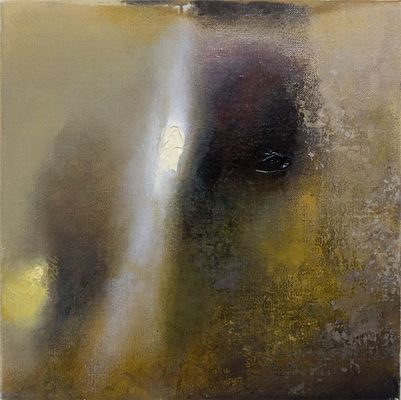
I am not a great reader of poetry but I always return to the work of Melbourne poet, Vincent Buckley (1925- 1988). Perhaps I find his most tantalising piece to be not a finished poem but a fragment left on a scrap of paper discovered on his desk after the poet’s death.
The poetry gathers like oil
In the word-core, and spreads
It has its music meet,
Its music is in movement.
This fragment is more the shell left behind from a volatile thought than a finished poem. I find the last two lines honest but awkward whereas the first two lines work like an arrow. Most likely he could not find a resolution so it was left. Still, in its present form, it remains an eloquent testimony to the ultimate failure of a medium to express mobile thought and sensation, in Buckley’s case, through verbal language. It’s an important matter because this is something all artists have to deal with regardless of the medium.
I have never written a poem, however, I am forever copying fragments from books on paper scraps in a vain effort to fix certain notions in my head. At first, they function as bookmarks that are sometimes returned to when I open the book. But before long, as they accumulate, they fall out littering the table interspersed with A4 photocopies, bills, books and medications.
To return to Buckley’s fragment, the first two lines very much evoke how I paint nowadays. As you age, detail diminishes and patches of light become more luminous and float. I feel the most honest way of dealing with this is by smearing the oil paint on the canvas with the fingers and working close-up, blind. Only if the patches coalesce into an approaching image can the work gain a life.
-
Jonathan Walker was born in Melbourne, Australia and brought up on a dairy farm in Gippsland. In the 1970’s he studied painting at RMIT and won the Harold Wright Scholarship to the British Museum, London. During the 1980’s he exhibited at Pinacotheca Gallery, Richmond and had work shown at the NGV and Heidi City Art Gallery. Over the same period he designed the cover for the “Epigenesi” LP by Giancarlo Toniutti, Italy and conducted a mail exchange work with Achim Wollscheid, Germany. The work with artists through the post resulted in an article published in the bicentenary issue of Art and Australia 1988. He showed in artist run spaces such as WestSpace in the 90’s and 2000’s, and until 2012, taught painting at Victoria University, which is where we (Colleen Ahern and Lisa Radford) as organisers of the exhibition, among many others, had the privilege of being his student.
Walker’s knowledge was imparted to students through the careful selection of music, literature, and artists found in books that he himself had ordered for the library. Walker’s strategy was the generosity of sharing his vast knowledge with references specific to each student and their context.
Walker’s paintings share a similar focus and intimacy.
This exhibition presents a small selection of recent paintings alongside a publication that includes Walker’s writing. Observational and analytical, Walker’s work is a type of material notation — the time of day, colour and how it is blended, the both specific and fleeting location of a reflection on lino or the question of whether a chair leg should be included in a painting.
Please join us on Friday August 21 between 6-8pm to celebrate the opening of the exhibition.
Curated by Colleen Ahern and Lisa Radford.
B. Wurtz
Curated by Nic Tammens
March 26 - April 4, 2015
B.Wurtz works from a basement studio in his home on Manhattan’s Lower East Side.
This local fact is attested to by the plastic shopping bags and newsprint circulars that appear in his work. As formal objects, they don’t make loud claims about their origins but nonetheless transmit street addresses and places of business from the bottom of this long thin island. Like plenty of artists, Wurtz is affected by what is local and what is consumed. His work is underpinned by this ethic. It often speaks from a neighborhood or reads like the contents of a hamper:
“BLACK PLUMS $1.29 lb.”
“Food Bazaar”
“USDA Whole Pork Shoulder Picnic 99c lb.”
“RITE AID Pharmacy, with us it’s personal.”
“H. Brickman & Sons.”
“Sweet Yams 59c lb."
Most of the work in this exhibition was made while the artist was in residence at Dieu Donne, a workshop dedicated to paper craft in Midtown. Here Wurtz fabricated assemblages with paper and objects that are relatively lightweight, with the intention that they would be easily transportable to Australia. This consideration isn’t absolute in Wurtz’s work, but was prescriptive for making the current exhibition light and cheap. Packed in two boxes, these works were sent from a USPS post office on the Lower East Side and delivered to North Melbourne by Australia Post.
Wurtz appears courtesy of Metro Pictures, New York.
Thanks to Rob Halverson, Joshua Petherick, Sari de Mallory, Matt Hinkley, Helen Johnson, Fayen d'Evie, Ask Kilmartin, Lisa Radon, Ellena Savage, Yale Union, and "Elizabeth".
John Nixon
"Archive"
December 15 - January 20, 2014
The presentation of John Nixon's archive offered a rare showcase of this extensive collection of the artist's own publications, catalogues, posters, ephemera, editions and more, from the mid 1980s onwards, alongside a selection of his artworks.
Organized by John Nixon, Joshua Petherick and Matt Hinkley.
<a href=http://wfb.public-office.info/artist/john-nixon>All titles by John Nixon
"Habitat"
at Minerva, Sydney (organised by Joshua Petherick and Matt Hinkley)
November 15 - December 20, 2014
Lupo Borgonovo, Janet Burchill & Jennifer McCamley,
Lewis Fidock, HR Giger, Piero Gilardi, Veit Laurent Kurz,
Cinzia Ruggeri, Michael E. Smith, Lucie Stahl, Daniel Weil, Wols
Press Release:
“...It contained seven objects. The slender fluted bone, surely formed for flight, surely from the wing of some large bird. Three archaic circuitboards, faced with mazes of gold. A smooth white sphere of baked clay. An age-blackened fragment of lace. A fingerlength segment of what she assumed was bone from a human wrist, grayish white, inset smoothly with the silicon shaft of a small instrument that must once have ridden flush with the surface of the skin - but the thing’s face was seared and blackened.”
William Gibson, “Count Zero”, 1986
"Autumn Projects Archive"
Curated by Liza Vasiliou
March 6 - March 15, 2014
World Food Books, in conjunction with the Virgin Australia Melbourne Fashion Festival 2014, presented the Autumn Projects archive, consisting of a selection of early examples in Australian fashion with a particular interest in collecting designers and labels from the period beginning in the 1980’s, who significantly influenced the discourse of Australian Fashion.
Curated by Liza Vasiliou, the exhibition provided a unique opportunity to view pieces by designers Anthea Crawford, Barbara Vandenberg, Geoff Liddell and labels CR Australia, Covers, Jag along with early experimental collage pieces by Prue Acton and Sally Browne’s ‘Fragments’ collection, suspended throughout the functioning World Food Books shop in Melbourne.
H.B. Peace
presented by CENTRE FOR STYLE
November 14, 2013
"Hey Blinky, you say chic, I say same"
Anon 2013
H.B. Peace is a clothing collaboration between great friends Blake Barns and Hugh Egan Westland. Their pieces explore the divergences between 'character’ and ‘personality’ in garments....etc
Special Thanks to Joshua Petherick and Matt Hinkley of WFB and Gillian Mears
and a Very Special Thank you to Audrey Thomas Hayes for her shoe collaboration.
Janet Burchill & Jennifer McCamley
"Aesthetic Suicide"
May 10 - June 8, 2013
The first of our occasional exhibitions in the World Food Books office/shop space in Melbourne, "Aesthetic Suicide" presented a body of new and older works together by artists Janet Burchill & Jennifer McCamley, including videos, prints, a wall work, and publications.
During shop open hours videos played every hour, on the hour.
1970, German
Softcover (w. dust jacket), 118 pages, 21 x 17 cm
Out of print title / used / very good
Published by
Studio 69 / Cologne
$100.00 - In stock -
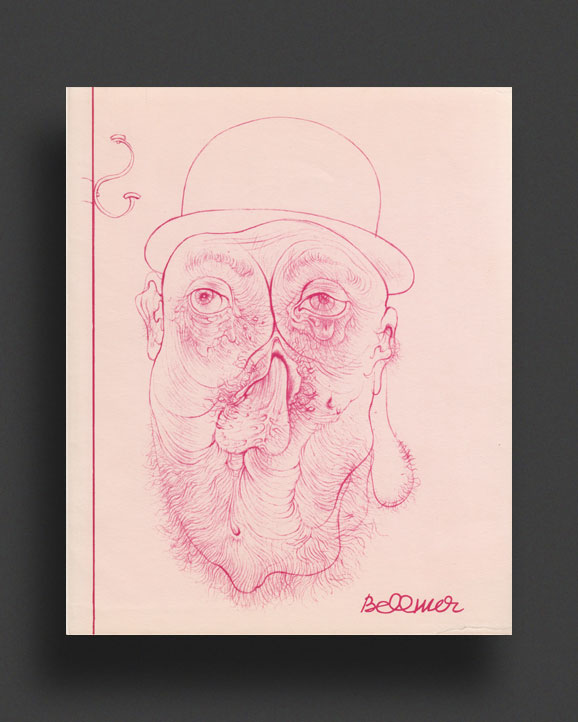
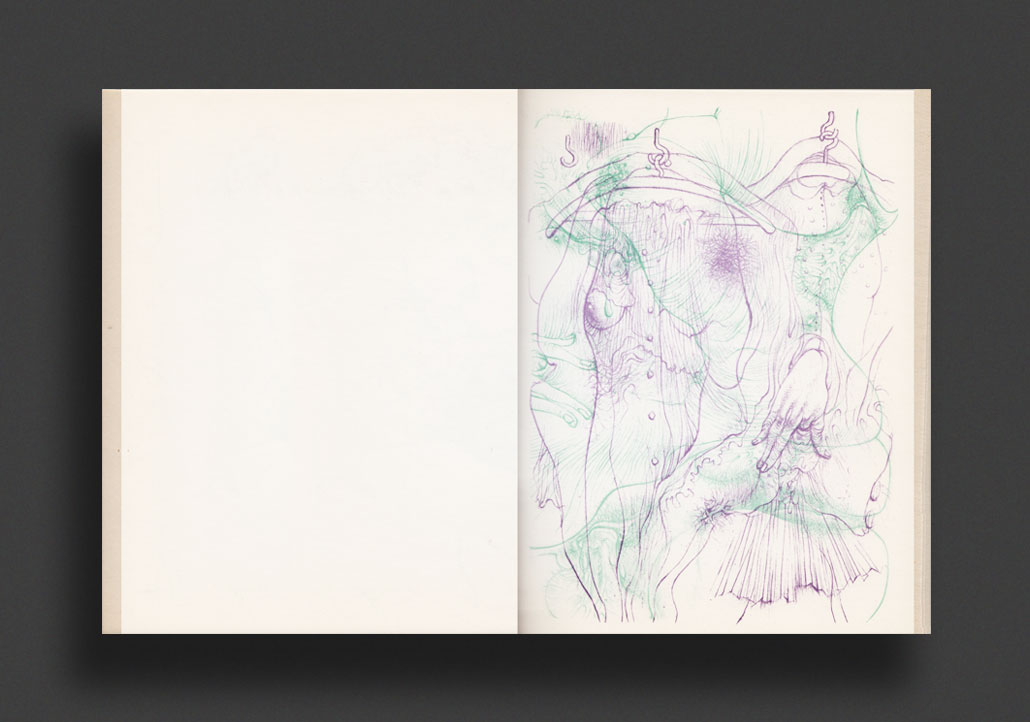
First edition, edited and designed by Galerie Sydow's Heinrich Sydow-Zirkwitz, this beautiful book of Hans Bellmer's graphic works was published as a special project between Studio 69 in Cologne and Galerie Sydow in Frankfurt to accompany the exhibition "Ars Erotica" in 1970. Handsomely printed with spot-colour over-printing and illustrated throughout with Bellmer's graphic famous graphic series' "Bellmer à Sade" (1961), "Petite Traité de Morale" (1965) and illustrations for Georges Bataille's "Madame Edwarda" (1965). Includes text by Horst Albert Glaser. A very handsome collection and one of the nicest Bellmer books.
Very Good copy in Good dust jacket with light tanning to spine/edges, dustiness.
1971, French
Softcover (w. glassine obi-strip), 96 pages, 23 x 18 cm
1st Edition, Out of print title / used / very good
Published by
L'Arc / Marseille
$55.00 - In stock -
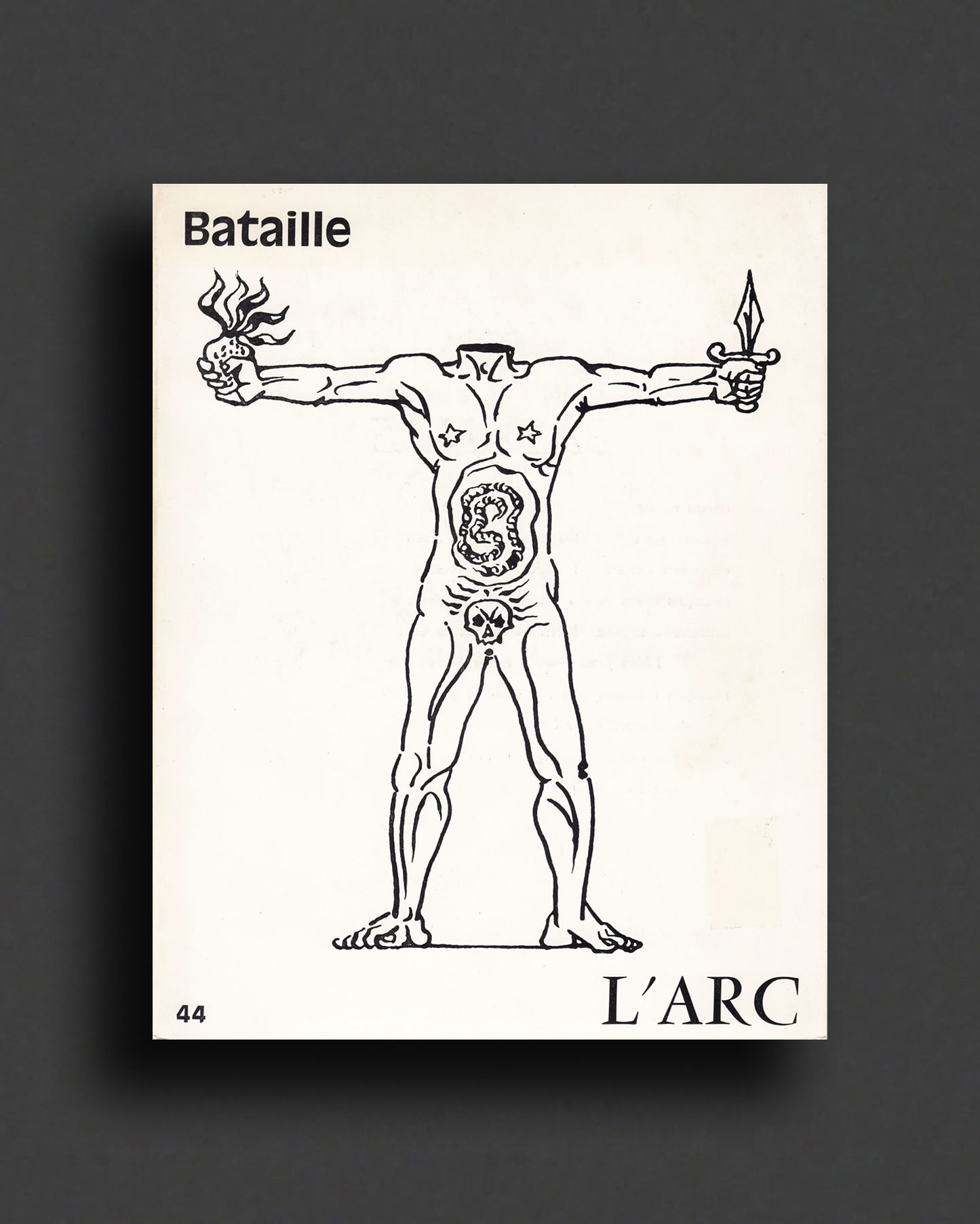
Special 1971 volume of French literary/arts journal L'Arc devoted entirely to the work of French philosopher and author Georges Bataille (1897—1962) whose influential works spanning philosophy, literature, sociology, anthropology, and history of art, which included essays, novels, and poetry, exploring such subjects as eroticism, mysticism, surrealism, and transgression. Featuring contributions by André Masson, Henri Ronse, Michel Leiris, Rodolphe Gasché, François Cuzin, Alexandre Kojève, François Perroux, Jean-Michel Rey, Jean Pfeiffer, Gilbert Lascault, Denis Hollier.
Very Good copy complete with publisher's original glassine obi-strip that prints the contributors in red.
1976, English
Softcover, 134 pages, 21.5 x 15 cm
1st Edition, Out of print title / used / very good
Published by
Semiotext(e) / Los Angeles
$190.00 - Out of stock
Rare copy of the Georges Bataille issue of the original Semiotext(e) journal, published and edited by Sylvère Lotringer between 1974—1985, with later book-length issues appearing in the 1990s. Devoted entirely to the work of French philosopher and author Georges Bataille (1897—1962) whose influential works spanning philosophy, literature, sociology, anthropology, and history of art, which included essays, novels, and poetry, exploring such subjects as eroticism, mysticism, surrealism, and transgression. Edited by Lotringer and John Rajchman, featuring texts by Bataille, Jacques Derrida, Denis Hollier, Ann Smock and Phyllis Zuckerman, Charles Larmore, Peter B. Kussel, Lee Hildreth...
Founded in 1974, Semiotext(e) began as a journal that emerged from a semiotics reading group led by Sylvère Lotringer at the Columbia University philosophy department. Initially, the magazine was devoted to readings of thinkers like Nietzsche and Saussure. In 1978, Lotringer and his collaborators published a special issue, Schizo-Culture, in the wake of a conference of the same name he had organized two years before at Columbia University. The magazine brought together artists and thinkers such as Gilles Deleuze, Kathy Acker, John Cage, Michel Foucault, Jack Smith, Martine Barrat and Lee Breuer. Schizo-Culture brought out connections between high theory and underground culture that had not yet been made, and forged the "high/low" aesthetic that remains central to the Semiotext(e) project.
Very Good copy with light tanning/wear to raw stocks.
1992, English
Softcover, 200 pages, 22 x 14 cm
1st UK Edition, Out of print title / used / fine
Published by
The MIT Press / Massachusetts
October Books / New York
$45.00 - In stock -
"Hollier has not only written a series of interlocking essays which manage to roam representatively over and under the six thousand pages of Bataille, a polygraphic author of the most bewildering complexity, but he has taken the master's method to heart and has written not a book about Bataille
but a book through him: he has turned Bataille on and even against Bataille. The result is a superb, even a supreme critical work."—Richard Howard, Professor of Creative Writing, University of Houston
Over the past 30 years the writings of Georges Bataille have had a profound influence on French intellectual thought, informing the work of Foucault, Derrida, and Barthes, among others. Against Architecture offers the first serious interpretation of this challenging thinker, spelling out the profoundly original and radical nature of Bataille's work.
Denis Hollier is Professor of French at Yale University.
An OCTOBER Book.
Very Good—NF copy. First 1992 ed. 2nd print. Not a digital reprint.
1990, English
Softcover, 220 pages, 20 x 14 cm
1st Edition, Out of print title / used / very good
Published by
City Lights Books / San Francisco
$40.00 - In stock -
First 1990 edition.
The literary adventure of D.A.F. (1740-1814) is unique and paradoxical. He was widely read in the nineteenth century, but his books disappeared almost completely from circulation in the century. Meanwhile the exegesis of Sade poured from the presses of the Western world in a flood of words in which the writer, the novelist, and the exceptional poet disappeared.
In France today, J. J. Pauvert, who considers Sade "the greatest French writer," is publishing a new edition of the complete works with a new introduction by Annie Le Brun. Sade: A Sudden Abyss is the translation of this introduction, which shows Sade as the inventor of an entirely new language through which he fathoms human nature, desire, and relationships of power.
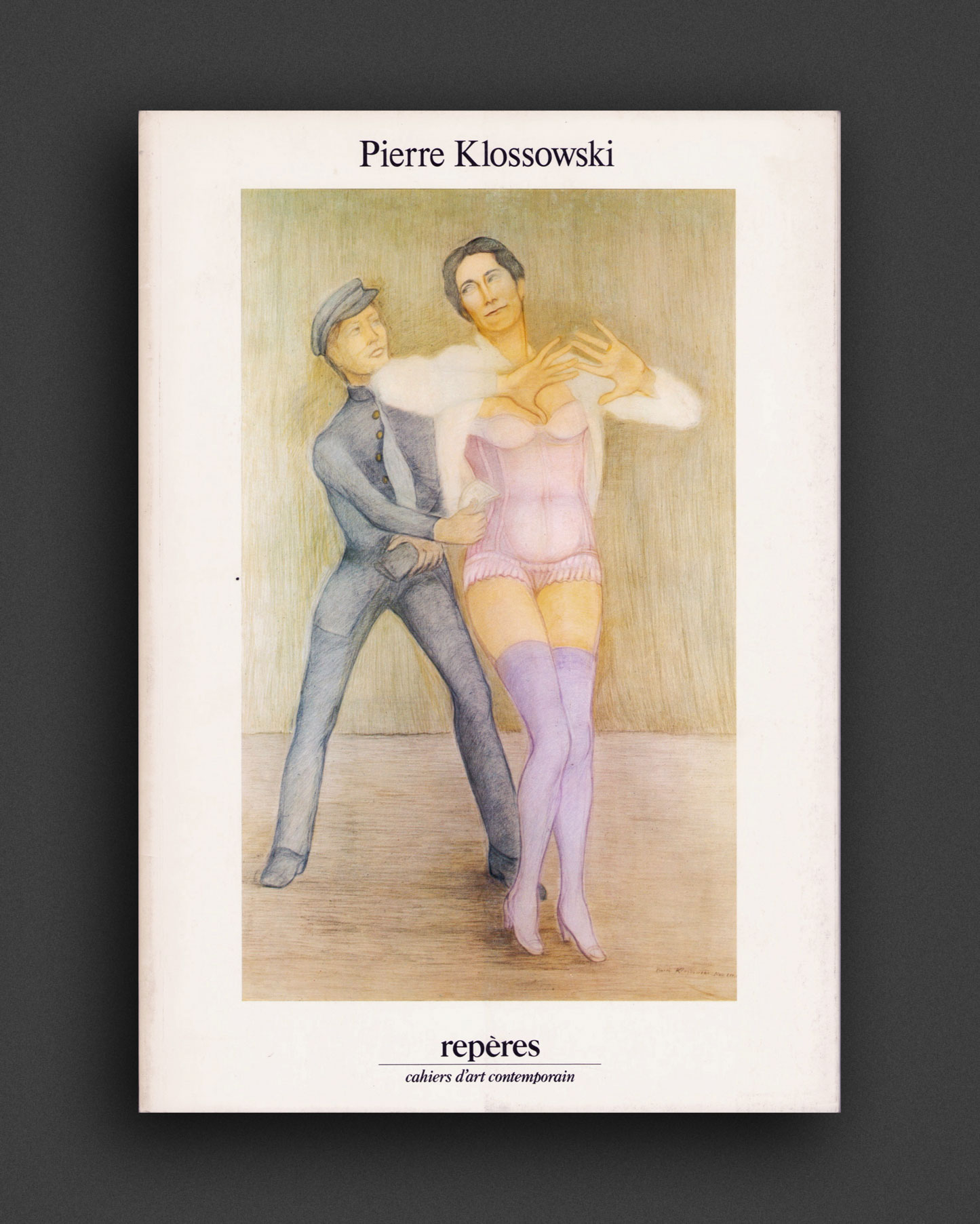
In this fresh and authoritative survey of Sade's work as a whole, Le Brun frees it from such critics as Bataille, Blanchot, Klossowski, and Barthes (who see Sade's language as a metaphor for history, society, or writing itself). She asks, Where is Sade himself in these texts? What exactly does Sade tell us? What is obscured when Sade's writing is placed in a "universe of discourse" rather than understood as a manifestation of a life spent in eleven prisons over twenty-seven years? Like a powerful laser beam, her reflections cut through two centuries of intellectual hide-and-seek and let Sade for the first time be seen and read in his own light.
Annie Le Brun is a French poet and literary theorist who participated in the final years of the Surrealist movement. Her books include Lachez tout, a critique of the French neofeminist movement; A distance; and Les chateaux de la subversion, a study of the Gothic tradition.
VG copy.
1990, English
Hardcover (w. dust jacket), 232 pages, 24 x 16.5 cm
1st Edition, Out of print title / used / good
Published by
Harvard University Press / Cambridge
$65.00 - In stock -
First 1990 hardcover edition.
"In a world where literary criticism is subject to the grossest forms of overproduction and where critical books that matter, and have something of general importance to say to our culture, are extremely rare, Bersani's will stand out as one of the half dozen or so by which its decade will be remembered."—MALCOLM BOWIE, University of London
In this frankly polemical book, Leo Bersani does battle with a pervasive view in modern culture: the idea that art can save us from the catastrophes of history and sexuality. Bersani questions this assumption. The art that thinks it can redeem life-make it whole, correct its errors, sublimate its passions - trivializes both life and, paradoxically, art. It is deceptive and dangerous.
Bersani ranges widely through modern literature (and its theorists), with fascinating comparisons:
Melanie Klein and Marcel Proust; the enigmatic and more unresolved works of Freud; Walter Benjamin, Baudelaire, and Nietzsche; André Malraux and Georges Bataille; Flaubert, Melville, Joyce, and Thomas Pynchon. If he has much to say against the intellectual gymnastics of Ulysses and much to say in favor of the metaphysical extravagances of Moby Dick, he writes about both major works with the same kind of brio: Bersani's criticism is never reduc-tionist, even with its clearly stated preference for the kind of literature that does not pretend to be superior to life, and does not mind being troubled.
Bersani is not telling us to put down Freud or Eliot or Proust or Joyce. But he is urging us to make new evaluations and to be aware of the enervating concealed morality of high modern culture. This is literary criticism of the first order - a defense of "the absolute singularity of human experience" - and deserves the widest readership among those who are devoted to literature but are suspicious of the redemptive role that has been assigned to it.
"With an interpretive mastery unexcelled in contemporary criticism, Leo Bersani's brilliant new book loosens the grip of a redemptive aesthetic which literature often accepts as its own, and puts us in touch with the more vital and mysterious powers of writing. This is a major innovative work by one of the most astute critics of our time."—RICHARD POIRIER, Editor, Raritan Quarterly
"There is wit, imagination, and a subtle and complex sensibility at work in this new study. I like the personal style, the many happy formula-tions, the elegant struggles with difficult concepts, and the great self-awareness that is the awareness of his own critical thrust."—VICTOR BROMBERT, Princeton University
"The Culture of Redemption is Leo Bersani's best book. With a Baudelairian mix of analytical sharpness and ethical commitment, Bersani expresses a pungent impatience with the modern consensus about art's edifying value and the collective bad faith on which this ceremonious self-congratulation relies."—DENIS HOLLIER, Yale University
VG copy in Average—Good dust jacket with closed tears and wear to edges.
2001, English
Softcover, 158 pages, 21.5 x 13.5 cm
Out of print title / used / very good
Published by
Marion Boyars / London
$25.00 - Out of stock
2001 English language edition of Bataille's L'ABBÉ C, translated by Philip A. Facey and published by Marion Boyars.
Told in a series of first person accounts, L'ABBÉ C is a startling narrative of the intense and terrifying relationship between twin brothers, Charles and Robert. Charles is a modern libertine dedicated to vice and depravity; Robert is a priest so devout that he is nicknamed 'L'Abbé'. As the story progresses, the suffocating atmosphere becomes increasingly permeated with illness, breakdown and eventual death. As in Blue of Noon and Story of the Eye, Bataille has succeeded in portraying the darkest and most profound aspects of human experience with amazing strength and dispassionate objectivity.
"Bataille speaks about man's condition, not his nature. Bataille has survived the death of God. In him, reality is conflict."—Jean-Paul Sartre
"Bataille is now recognized in France as one of the most challenging and original writers of our century. English translations of his work are long overdue, and one can only welcome the opportunity for English speaking readers to discover this major modern thinker."—Leo Bersani
"Essentially a psychological novel in which the emotions of the characters determine the movement of the story from beginning to end; explicit sex is absent. The style is crisp and this translation is quite remarkable... always faithful to the spirit."—New York Times Book Review
"The psychological intricacies display a graceful crisscrossing intensity."—Chicago Tribune
Georges Bataille was born in 1897 and died in 1962. He was a philosopher, novelist and critic whose startling and original ideas have influenced much modern literature and thought.
VG copy with previous owner sticker to inside front cover.
1991 / 1994, English
Softcover, 156 pages, 21.5 x 13.5 cm
1st Edition, Out of print title / used / good
Published by
Marion Boyars / London
$28.00 - Out of stock
First 1991, 1994 reprint English edition.
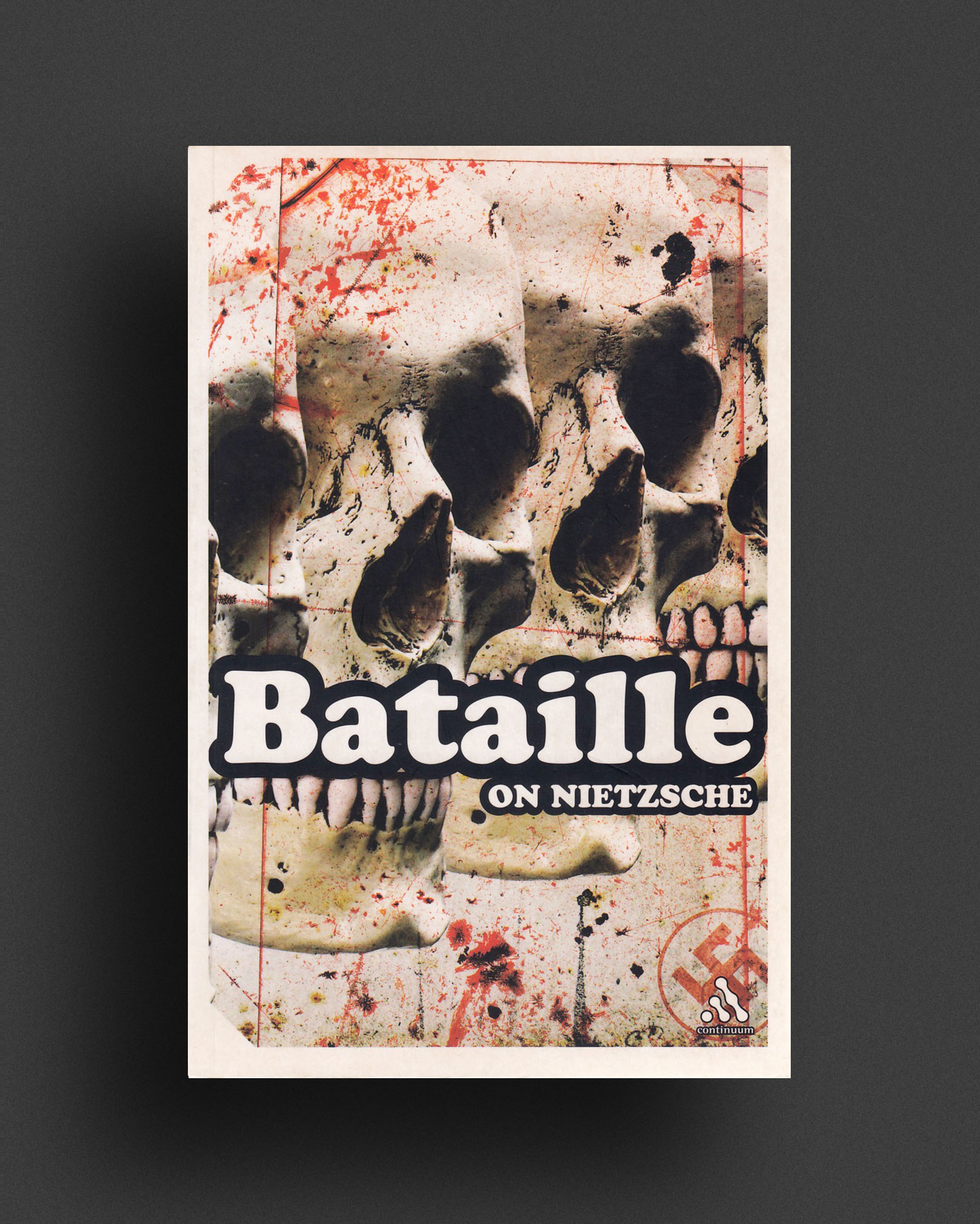
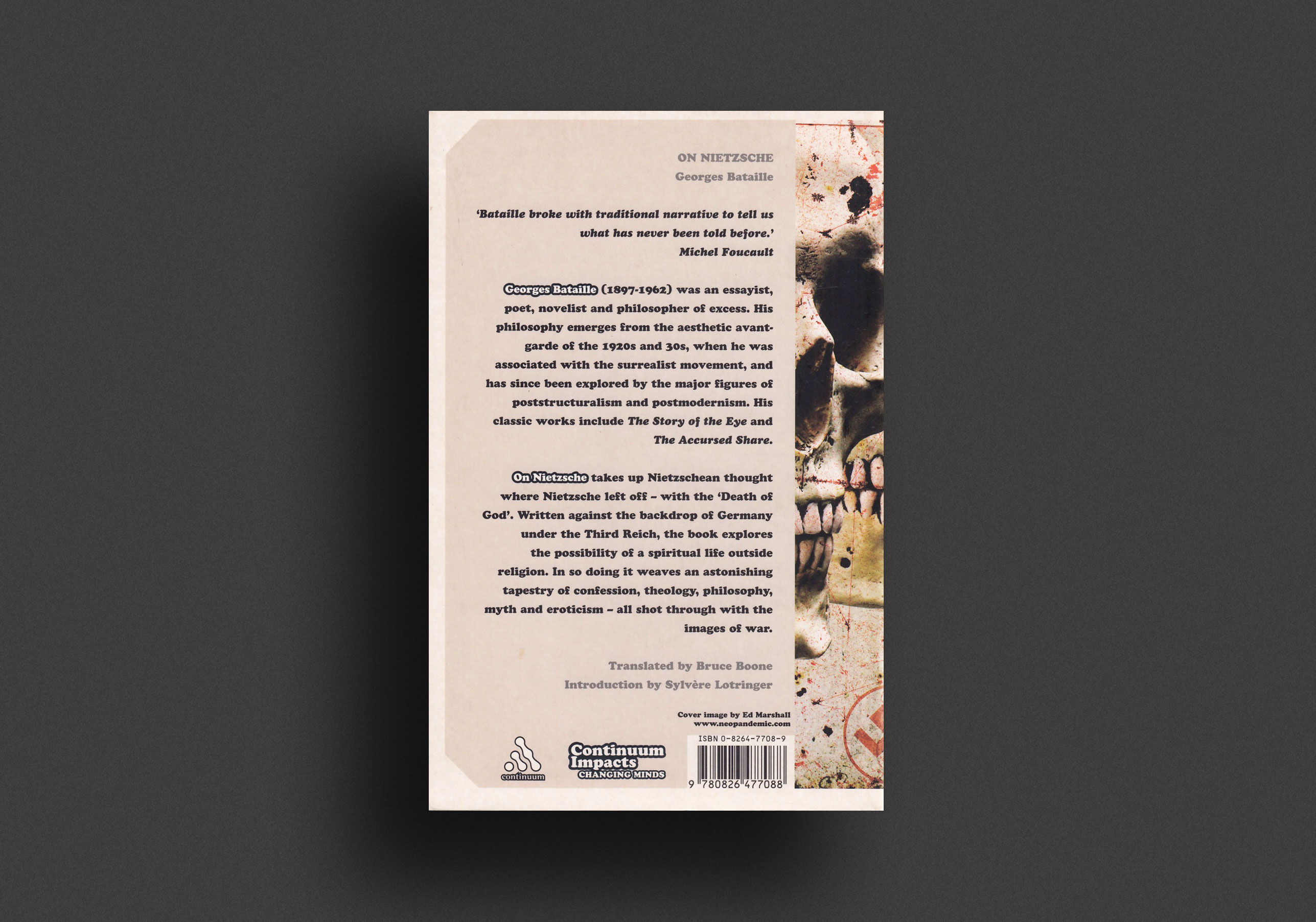
Set against the backdrop of Europe's slide into Fascism, Blue of Noon is one of Bataille's most overtly political works, exploring the ambiguity of sex as a subversive force and synthesizing the fetishes of violence, power and death that mesmerized an age. In this classic of twentieth century eroticism, the reader is taken on a dark journey through the psyche of the prewar French intel- ligentsia, torn between identification with the victims of history and the glamour of its victors.
"The writing is superlative... daringly imaginative, intended only for those awake and aware of the possibilities of excess in literature and life. Along with Céline and Breton, Bataille writes as if he were dropping a bomb; in a fore-flash he creates a world of demented funereal sexuality."—Detroit Free Press
"Bataille is one of the most important writers of this century. He broke with traditional narrative to tell us what has never been told before."—Michel Foucault
"Bataille denudes himself, exposes himself, his exhibitionism aims at destroying all literature. He has a holocaust of words. Bataille speaks about man's condition, not his nature. His tone recalls the scornful aggressiveness of the surrealist. Bataille has survived the death of God. In him reality is conflict."—Jean-Paul Sartre
Good—Very Good copy with some dark spotting to block edges. (sample image)
2018, English
Hardcover, 480 pages, 17.4 x 23.2 cm
Published by
Atlas Press / London
$74.00 - In stock -
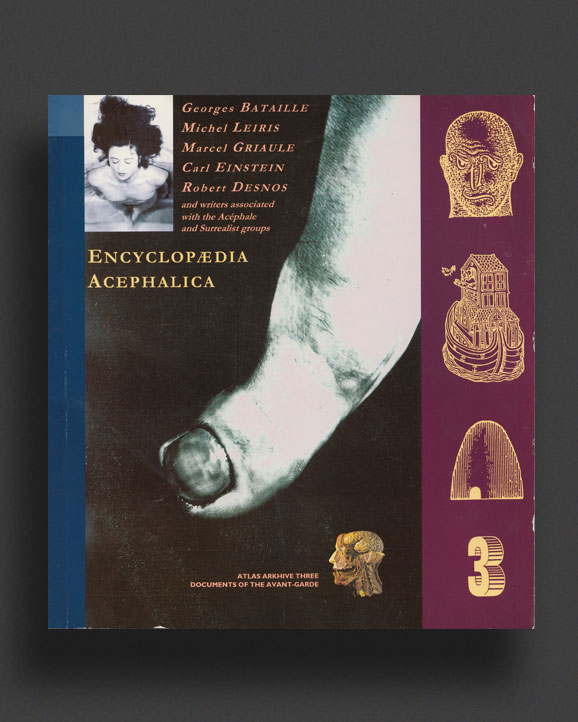
Georges Bataille's secret society, long the stuff of legend, is now revealed in its texts, meditations, rules and prohibitions.
This book recounts what must be one of the most unusual intellectual journeys of modern times, in which the influential philosopher, cultural theorist and occasional pornographer Georges Bataille (1897-1962), having spent the early 1930s in far-left groups opposing the rise of fascism, abandoned that approach in order to transfer the struggle onto "the mythological plane."
In 1937, Bataille founded two groups in order to explore the combinations of power and the "sacred" at work in society. The first group, the College of Sociology, gave lectures that were intended to reveal the hidden undercurrents within a society on the verge of catastrophe. The second group was Acéphale, a genuine secret society and anti-religion whose emblem was a headless figure that, in part, represented the death of God. Until the discovery a few years ago of the group's internal papers (which include theoretical texts, meditations, minutes of meetings, rules and prohibitions and even a membership list), almost nothing was known of its activities.
This book is the first to collect a representative selection of the writings of Bataille, and of those close to him, in the years leading up to World War II. The texts published here comprise lectures given to the College of Sociology by Bataille, Roger Caillois and Michel Leiris, essays from the Acéphale journal and a large cache of the internal papers from the secret society. A desperate narrative unfolds, wherein Bataille risked all in a wholly unreasonable quest--with a few fellow travelers, he undertook what he later described as a "journey out of this world."
Additional texts by Roger Caillois, Pierre Klossowski, Michel Leiris, and by Georges Ambrosino, Pierre Andler, Michel Carrouges, Jacques Chavy, Jean Dautry, Henri Dobier, Henri Dussat, Imre Kelemen, Jean Rollin, Patrick Waldberg.
And with drawings by André Masson
Highest recommendation!
1991, English
Softcover, 155 pages, 21.5 x 13.5 cm
1st Edition, Out of print title / used / very good
Published by
Marion Boyars / London
$50.00 - In stock -
First 1991 English edition.
Set against the backdrop of Europe's slide into Fascism, Blue of Noon is one of Bataille's most overtly political works, exploring the ambiguity of sex as a subversive force and synthesizing the fetishes of violence, power and death that mesmerized an age. In this classic of twentieth century eroticism, the reader is taken on a dark journey through the psyche of the prewar French intel- ligentsia, torn between identification with the victims of history and the glamour of its victors.
"The writing is superlative... daringly imaginative, intended only for those awake and aware of the possibilities of excess in literature and life. Along with Céline and Breton, Bataille writes as if he were dropping a bomb; in a fore-flash he creates a world of demented funereal sexuality."—Detroit Free Press
"Bataille is one of the most important writers of this century. He broke with traditional narrative to tell us what has never been told before."—Michel Foucault
"Bataille denudes himself, exposes himself, his exhibitionism aims at destroying all literature. He has a holocaust of words. Bataille speaks about man's condition, not his nature. His tone recalls the scornful aggressiveness of the surrealist. Bataille has survived the death of God. In him reality is conflict."—Jean-Paul Sartre
Very Good copy with light wear. Sample images.
1969, French
Hardcover (cloth bound), 106 pages, 21 x 21 cm
1st Edition, Out of print title / used / good
Published by
Éditions Denoël / Paris
$120.00 - Out of stock
First Edition of the catalogue raisonné of the engraved work of German Surrealist Hans Bellmer, published in 1969 by Éditions Denoël, Paris. Wrapped in the publisher's debossed black covers featuring Bellmer's Céphalopode of 1965, this handsome volume opens with "Morale of Engraving", a four page introduction by author Andre Pieyre De Mandiargues (in French). The rest of the book is made up of 141 reproduced engraved works of Bellmer, including his exquisite works complimenting Georges Bataille, Marquis de Sade, Joyce Mansour, Louis Aragon, Charles Baudelaire, and others, followed by a 7 page catalogue raisonné index, including work title, date, process and technique, dimensions, printing justifications, editors and other details. An essential title in any Bellmer collection and important reference.
Very Good copy, tanning and some marks to board/page edges with age.
1979, English
Hardcover (w. dust jacket), 127 pages, 13.5 x 22 cm
1st UK Edition, Out of print title / used / good
Published by
Marion Boyars / London
$190.00 - In stock -
Wonderful first English hardcover edition of George Bataille's Story of the Eye, published by Marion Boyars, London, in 1979. Translated by Joachim Neugroschal with accompanying essays by Susan Sontag and Roland Barthes.
"The caress of the eye over the skin is so utterly, so extraordinarily gentle, and the sensation is so bizarre that it has something of a rooster's horrible crowing." - G.B.
A masterpiece of transgressive, surrealist erotica, Bataille's first novel, published under the pseudonym 'Lord Auch', is still his most notorious work. Called a "metaphysician of evil, Bataille wrote the 1928 novella "Story of the Eye (French: L'histoire de l'œil) as a psychoanalytical task. In this explicit erotic fantasy, the young male narrator and his lovers Simone and Marcelle embark on a sexual quest involving sadism, torture, orgies, madness and defilement, culminating in a final act of transgression. Shocking and sacrilegious, Story of the Eye is the fullest expression of Bataille's obsession with the closeness of sex, violence and death. Yet it is also hallucinogenic in its power, and is one of the erotic classics of the twentieth century.
This edition also includes Susan Sontag's superb study of pornography as art, 'The Pornographic Imagination', as well as Roland Barthes' essay 'The Metaphor of the Eye', which was first published in Bataille's own journal Critique, shortly after Bataille's death in 1962. Barthes' analysis focuses on the centrality of the eye to this series of vignettes, and notices that it is interchangeable with eggs, bulls' testicles and other ovular objects within the narrative. He also traces a second series of liquid metaphors within the text, which flow through tears, cat's milk, egg yolks, frequent urination scenes, blood and semen.
Georges Bataille (1897-1962), French essayist and novelist, was born in Billom, France. He converted to Catholicism, then later to Marxism, and was interested in psychoanalysis and mysticism, forming a secret society dedicated to glorifying human sacrifice. Leading a simple life as the curator of a municipal library, Bataille was involved on the fringes of Surrealism, founding the Surrealist magazine Documents in 1929, and editing the literary review Critique from 1946 until his death.
Good—VG ex-libris copy with light library wear to end blanks, small stamp to colophon in original G—VG dust jacket, no library markings, preserved under mylar wrap. Scarce in this edition with dust jacket present. General reading wear and tanning with age. There is a fierce feminist critique of Susan Sontag's essay in the margins that is an isolated attack Sontag. The rest is left unscathed.
1983, English
Softcover, 166 pages, 23 x 16 cm
1st Edition, Out of print title / used / good
Published by
State University of New York Press / New York
$120.00 - In stock -
Very rare first 1983 edition.
"Excesses is a very successful attempt to break out of the closets in which we conceptualize our identity and our eros. Lingis has travelled to, and participated in, some of the last remaining oases of “primitive” cultures. He combines an obvious poet’s eye with a not-so-obvious philosophical ability to discriminate systematically and to generalize. We are helped to see the shape―and limitations―of one of our own cultural identity through the amazing contrasts which Lingis sets up like screens for our inspection. You can count on this book being controversial."
Alphonso Lingis (November 23, 1933 – May 8, 2025) was an American philosopher, writer, and translator, known especially for his work in continental philosophy, phenomenology, existentialism, and ethics. He was professor emeritus of philosophy at Pennsylvania State University. Lingis was active as a translator of important French philosophical texts, including the work of Pierre Klossowski, Emmanuel Levinas, and Maurice Merleau‑Ponty. His own books are often a unique hybrid of philosophy, travel narrative, cultural anthropology, and personal reflection, incorporating his own photography, used to deepen or illustrate conceptual themes.
G—VG copy with general moderate cover wear/age.
1985, Japanese
Softcover, 290 pages, 21 x 15 cm
1st Edition, Out of print title / used / fine
Published by
Sanwa / Tokyo
$450.00 - Out of stock
"People often talk about humanity and humanism, but what makes humans decisively different from animals is that they betray, deceive, and destroy others. Humanity means being cruel."—Masaaki Aoyama
Super rare, first and only issue of cult magazine of erotic obscenity, Witches' Sabbath ("Super Pervert, End of the Century, Abuse History"), published in 1985 by Sanwa Publications as a special edition of SM Mania and edited by Masaaki Aoyama (1960-2001), a legendary cult writer, editor and pioneer in the genre of "Kichiku" (cruel) publishing who had a major influence on Japanese subculture in the 1980s and 1990s.
In 1995, after a prolific career in underground publishing, Aoyama edited the first issue of the "brutal" subculture magazine "Dangerous No. 1," which sparked a huge craze for bad taste culture in Japan, with the opening introduction declaring "There are no taboos when it comes to fantasies!". Ten years earlier, at 25 years old, he edited Witches' Sabbath, a call to "Destroy All Orders", a magazine devoted to "Decadence, Ultra-Abnormality, and Maltreatment"; Aoyama's unique, devilish manifestation of a particular convergence of subcultural 1980s Tokyo — punk and industrial music, splatter horror films, underground manga, SM publishing, and occultism. "The Worst Truth of the 20th Century".
Aoyama was deeply attracted to the culture of monsters, the world of the abnormal, the cruel and dark impulses of human-kind. His publishing ventures centred around his fascination with destructive and socially maladjusted people, perversions, social taboos, "freaks" and subjects turned against public order and morality. Profusely illustrated throughout with colour photo galleries, Aoyama, with contributors including Merzbow's Masami Akita, horror manga artists Suehiro Maruo and Hideshi (Guinea Pig) Hino, manga critic and activist Shinichiro Kurimoto, Hisao Nakano, Mongoose Nagayama, Dan Takasugi, Ken Hirukogami, and others, present features on all manner of heterodox culture, everything from an illustrated guide to corpse photography, splatter horror movies, scatology, how-to seppuku/harakiri (Japanese ritualistic suicide by disembowelment), horror manga (new artworks by Maruo, Hino, comic by Jimmie Morita, and others), infant mania, drugs, necrophilia, Industrial Records (Throbbing Gristle, Monte Cazazza, SPK, etc,), Zeitlich Vergelter, Ron Geesin, sadistic crime history, deformities, Georges Bataille, devil pregnancy kinbaku, sorcery, bestiality, witch hunting, SM readers confessions, the latest in fetish publishing, D-Cup extravaganza (big breast video and magazine publishing), and much more. A special Nazi issue was planned for the next issue, but the magazine was discontinued after this first issue.
An important publication in the history of Japan's "Kichiku" (cruel) publishing. Cover artwork by Ran Akiyoshi.
Not for the faint of heart. Strictly mature audiences only.
From the Editor's notes: "[...] That's because my original path was escapist fairy tales, and whether it was manga, photography, or bookmaking, what I wanted to depict was the world of children. There's no doubt that the purest things and madness are side by side... What is abnormal and what is normal? In this day and age when everything man has created is being torn down and all boundaries are being removed, humans are being led astray by the enormous concepts they have created. Is Witches' Sabbath just a pornographic book? Is Masaaki Aoyama just crazy? It has only just begun."
Masaaki Aoyama (1960-2001) was pioneer of the Japanese underground publishing scene. When he was in the third grade of elementary school, his father bought him a copy of Hiroshi Minamiyama's book "Supernatural Mysteries," which sparked his interest in the supernatural and the occult. Although he never studied, he displayed his prodigy qualities from an early age whilst simultaneously becoming addicted to masturbation. His intense quest for knowledge and perversion continued into his adult life. A self-proclaimed hedonist, Aoyama was hailed as a rare genius editor that had a profound, almost traumatic impact on people. Aoyama openly discussed and pursued a wide range of specialised topics, from drugs, lolicon, scat, and freaks to cult movies, progressive rock, punk, techno, the occult, heretical thought, and the spiritual world. He worked prolifically, editing and writing articles for mini-comics, books and magazines such as Hentai, Hey! Buddy, Billy, Witches' Sabbath, Philiac, Eccentric, amongst a seemingly endless list of fringe "pervert" publications that proliferated after the emergence of vending machine books in the 1970s. In 1992, Aoyama wrote Japan's first practical drug manual, "Dangerous Drugs," a "bible for junkies" which sold over 100,000 copies. In 1995, he edited the first issue of the "brutal" subculture magazine "Dangerous No. 1," which quoted the words of cult guru Hassan I-Sabah: "There is no truth. Everything is permitted." The magazine, which was packed with an exhaustive range of deviant, perverted, and bad taste content, became a huge hit, selling over 250,000 copies in total, sparking a craze for "Kichiku" (cruel) publishing in Japan in the late 19th century.
"No taboos in delusions"—Dangerous No. 1 introduction.
The trend of consuming things that are generally viewed as objects of loathing or pity from a mondo perspective was accelerated all over the world during the nihilist 1990's, but it was particularly popularised in Japan. From V-Zone video culture to comic books like Garo and the works of Kei (Takashi) Nemoto, Suehiro Maruo and Hideshi Hino, to subculture magazines that stimulated spectacle-based curiosity, crime and voyeurism, such as GON!, BUBKA, Sekimatsu Club, TOO NEGATIVE, End of the Century, Weekly Murder Casebook, Bessatsu Takarajima. Around the same time, Aoyama was diagnosed with multifocal posterior pigment epitheliopathy (MPPE), an extremely rare eye disease affecting around 50 people nationwide in Japan, which later became one of the factors that led him to become interested in spiritual matters. Aoyama, the mastermind behind this new genre of "Kichiku" (cruel), bad taste publishing, became disillusioned with the vulgar taste that was being mass-produced as a result of the boom. Aoyama felt the genre lost its substance as a counterculture or literary movement and had been absorbed into popular culture, the historical lineage of erotic underground publishing had become dissolved with the boom of extreme content on the internet. Without moralising, he had stared directly into the abyss. The dark truths he sought fed his own deviancy and addictions. Aoyama became depressed and reclusive. In 1997, Sakakibara Seito, an avid reader of Danger No. 1, committed the Kobe child murders. This led to bookstores removing all bad taste subculture books from their shelves. In 1999, "The Complete Works of Aoyama Masaaki” was published, marking the end of "Kichiku" publishing. Aoyama sought the light and pursued a new theory of happiness related to the spiritual world based on psychoneuroimmunology, molecular biology, and Buddhist resignation. In an interview with the magazine BURST, he declared, "the brutal genre is no longer fresh. From now on, I'll go for the soothing genre." He hanged himself at his home in Yokosuka, Kanagawa Prefecture on June 17, 2001, at the age of 40.
Near Fine collector's copy!
1989, English
Softcover, 213 pages, 20.5 x 18 cm
1st Edition, Out of print title / used / very good
Published by
City Lights Books / San Francisco
$120.00 - In stock -
First 1989 City Lights English translation, long out-of-print.
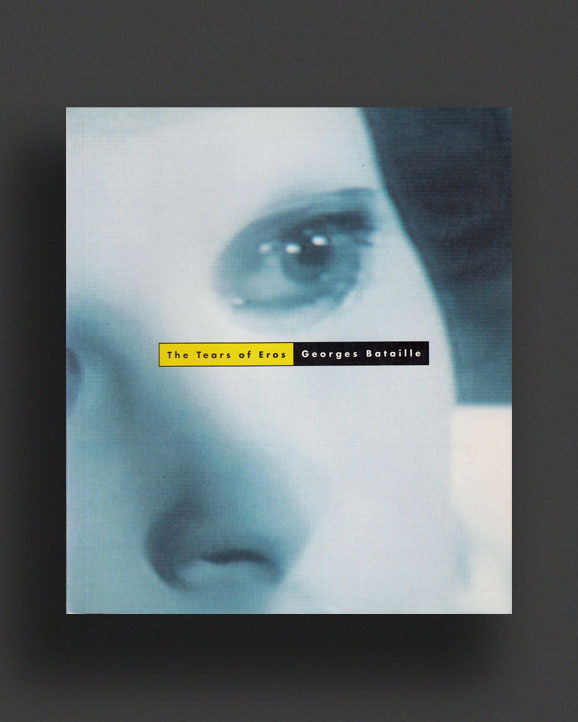
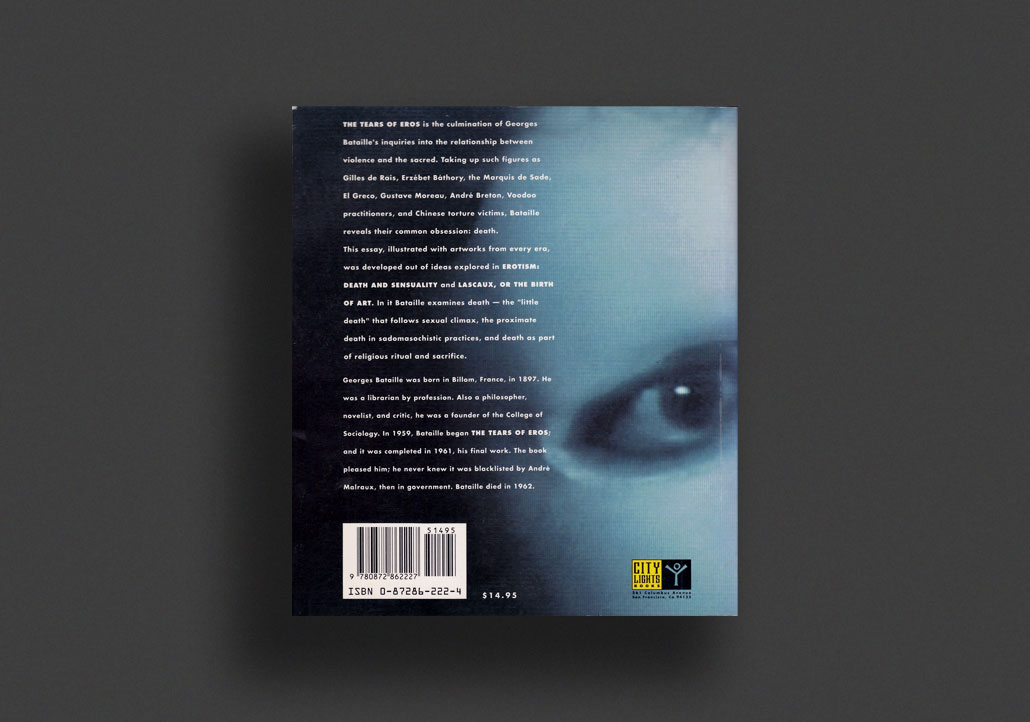
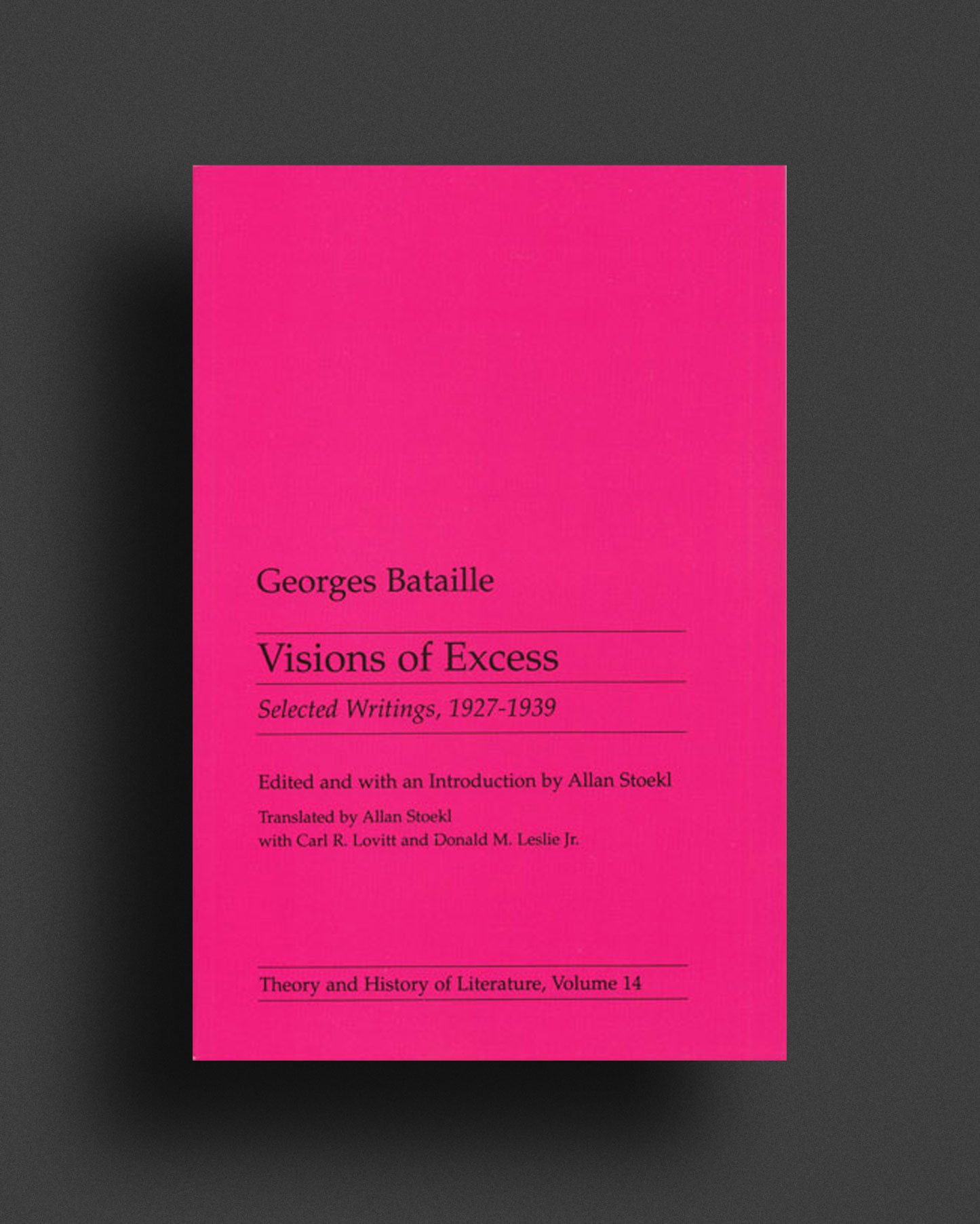
Tears of Eros is the culmination of Georges Bataille's inquiries into the relationship between violence and the sacred. Taking up such figures as Giles de Rais, Erzebet Bathory, the Marquis de Sade, El Greco, Gustave Moreau, Andre Breton, Voodoo practitioners, and Chinese torture victims, Bataille reveals their common death. This essay, illustrated with artwork from every era, was developed out of ideas explored in Death and Sexuality and Prehistoric Lascaux or the Birth of Art . In it Bataille examines death—the "little death" that follows sexual climax, the proximate death in sadomasochistic practices, and death as part of religious ritual and sacrifice. "Bataille is one of the most important writers of the century."— Michel Foucault Georges Bataille was born in Billom, France, in 1897. He was a librarian by profession. Also a philosopher, novelist, and critic he was founder of the College of Sociology. In 1959, Bataille began Tears of Eros , and it was completed in 1961, his final work. City Lights published two of his other Story of the Eye and The Impossible . Bataille died in 1962.
French essayist, philosophical theorist, and novelist, often called the "metaphysician of evil." Bataille was interested in sex, death, degradation, and the power and potential of the obscene. He rejected traditional literature and considered that the ultimate aim of all intellectual, artistic, or religious activity should be the annihilation of the rational individual in a violent, transcendental act of communion. Roland Barthes, Julia Kristeva, and Philippe Sollers have all written enthusiastically about his work.
Very Good copy, light wear to extremities/corners.
2005, English
Softcover, 304 pages, 23 x 15.5 cm
1st Edition, Out of print title / used / very good
Published by
Creation Books / London
$60.00 - Out of stock
Scarce 2005 edition published by Creation Books.
The spectre of Gilles de Rais, satanist and child-killer, eclipses French history like a dark star. A fallen general, once the champion of Jeanne d'Arc, de Rais' riches and experimentations led him to the very gates of Hell.
With quotations, essays and fiction, as well as a complete chronology and register of people and places in de Rais' brief but cataclysmic existence, "Dark Star is a rich evocation of the satanic allure of the most intriguing figure in the annals of mass murder.
Features the writings of Georges Bataille, Blaise Cendrars, J-K Huysmans, Valentine Penrose, Angela Carter, Jean Genet, Marquis de Sade, André Breton, Arthur Rimbaud, Gustave Flaubert, Richard Thoma, James Havoc, Charles Perrault, and many others
"Gilles de Rais - one of the most glorious, sinister, enigmatie figures in all European history"—Henry Miller
Very Good copy with some age rippling to the cover laminate. Some foxing to block top.
2000 / 2003, English
Softcover, 224 pages, 22. 5 x 14.5 cm
Out of print title / used / good
Published by
Marion Boyars / London
$30.00 - Out of stock
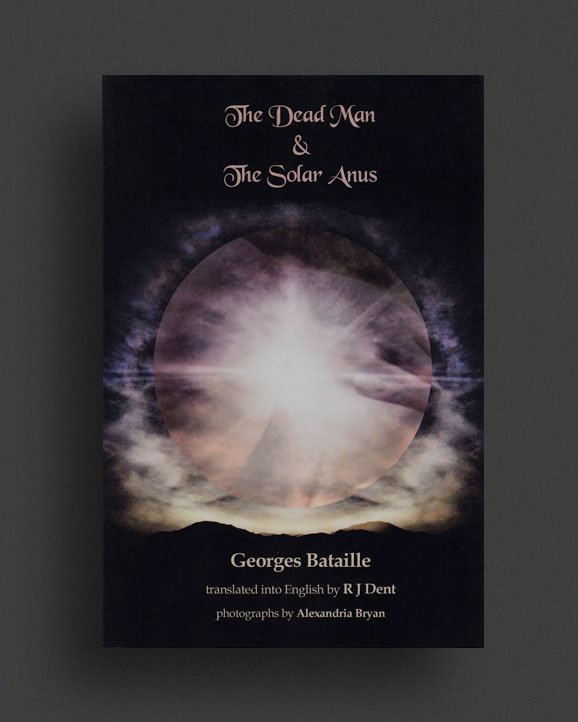
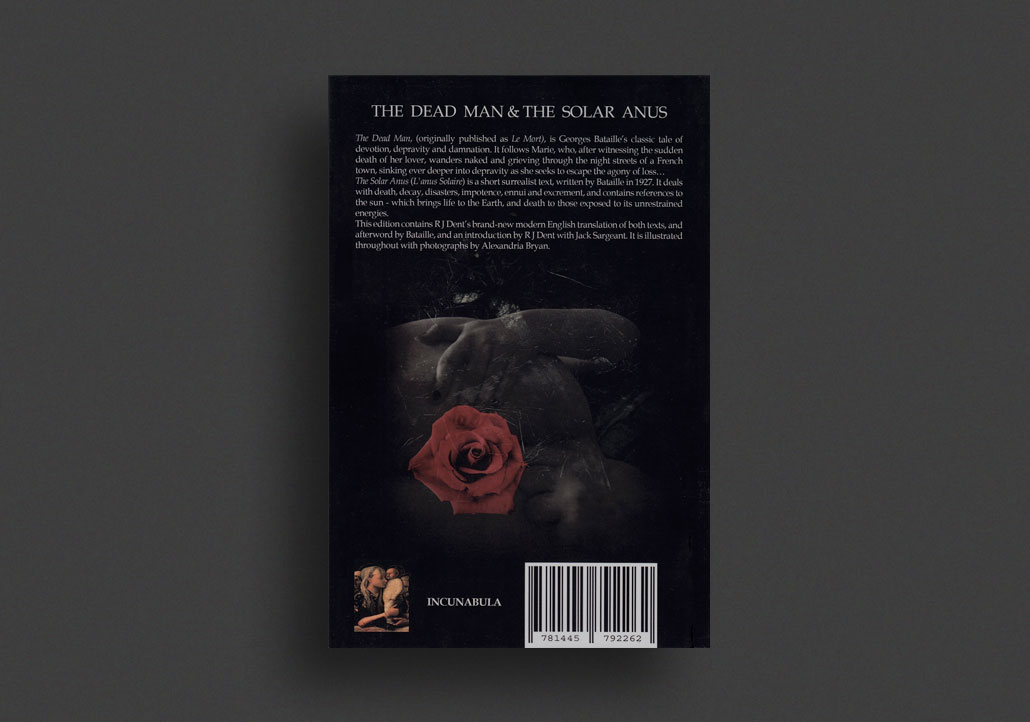
2000 English softcover edition of the Marion Boyars Bataille collection of My Mother / Madame Edwarda / The Dead Man, translated by Austryn Wainhouse, with an introductory essay by Yukio Mishima. These three short pieces of erotic prose by Bataille fuse elements of sex and spirituality in a highly personal vision of the flesh. They present a world of sensation in which the holy horrors of sex and the anguish of heightened awareness struggle against a stultifying world of reason and social order. This volume also contains Bataille's own introductions to the texts as well as an essay by Ken Hollings examining Bataille's philosophy on the nature of sexual experience.
Novelist and critic Georges Bataille's startling and original ideas not only had a vital influence on French literature and thought, but also prefigures much later work on the politics of sexuality and desire.
'My Mother is a unique Bildungsroman of a young man's sexual initiation and corruption by his mother.'—Publishers Weekly
'Heaves with necrophiliac undercurrents.'—The Observer
'One of the most challenging and original writers of this century?'—Leo Bersani
'Bataille speaks about man's condition, not his nature. Bataille has survived the death of God. In him, reality is conflict.'—Jean-Paul Sartre
'Bataille is one of the most important writers of the century. He broke with traditional narrative to tell us what has never been told before.'—Michel Foucault
2003 printing. Good copy, with some corner bumping, toning, wear to covers.
1989, English
Softcover, 158 pages, 21.5 x 13.5 cm
1st Edition, Out of print title / used / very good
Published by
Marion Boyars / London
$40.00 - Out of stock
1989 English language edition of Bataille's L'ABBÉ C, translated by Philip A. Facey and published by Marion Boyars.
Told in a series of first person accounts, L'ABBÉ C is a startling narrative of the intense and terrifying relationship between twin brothers, Charles and Robert. Charles is a modern libertine dedicated to vice and depravity; Robert is a priest so devout that he is nicknamed 'L'Abbé'. As the story progresses, the suffocating atmosphere becomes increasingly permeated with illness, breakdown and eventual death. As in Blue of Noon and Story of the Eye, Bataille has succeeded in portraying the darkest and most profound aspects of human experience with amazing strength and dispassionate objectivity.
"Bataille speaks about man's condition, not his nature. Bataille has survived the death of God. In him, reality is conflict."—Jean-Paul Sartre
"Bataille is now recognized in France as one of the most challenging and original writers of our century. English translations of his work are long overdue, and one can only welcome the opportunity for English speaking readers to discover this major modern thinker."—Leo Bersani
"Essentially a psychological novel in which the emotions of the characters determine the movement of the story from beginning to end; explicit sex is absent. The style is crisp and this translation is quite remarkable... always faithful to the spirit."—New York Times Book Review
"The psychological intricacies display a graceful crisscrossing intensity."—Chicago Tribune
Georges Bataille was born in 1897 and died in 1962. He was a philosopher, novelist and critic whose startling and original ideas have influenced much modern literature and thought.
Cover design by Susi Mawani.
VG copy with light wear/light creasing to cover boards.
1995, English
Softcover, 224 pages, 21.5 x 13.5 cm
1st Edition, Out of print title / used / fine
Published by
Marion Boyars / London
$60.00 - Out of stock
1995 first English softcover edition of the Marion Boyars Bataille collection of My Mother / Madame Edwarda / The Dead Man, translated by Austryn Wainhouse, with an introductory essay by Yukio Mishima. These three short pieces of erotic prose by Bataille fuse elements of sex and spirituality in a highly personal vision of the flesh. They present a world of sensation in which the holy horrors of sex and the anguish of heightened awareness struggle against a stultifying world of reason and social order. This volume also contains Bataille's own introductions to the texts as well as an essay by Ken Hollings examining Bataille's philosophy on the nature of sexual experience.
Novelist and critic Georges Bataille's startling and original ideas not only had a vital influence on French literature and thought, but also prefigures much later work on the politics of sexuality and desire.
'My Mother is a unique Bildungsroman of a young man's sexual initiation and corruption by his mother.'—Publishers Weekly
'Heaves with necrophiliac undercurrents.'—The Observer
'One of the most challenging and original writers of this century?'—Leo Bersani
'Bataille speaks about man's condition, not his nature. Bataille has survived the death of God. In him, reality is conflict.'—Jean-Paul Sartre
'Bataille is one of the most important writers of the century. He broke with traditional narrative to tell us what has never been told before.'—Michel Foucault
Near Fine copy.
1985, Japanese
Softcover (w. dust jacket), 60 pages, 26 x 17 cm
1st Edition, Out of print title / used / very good
Published by
Gakutokan / Japan
$180.00 - In stock -
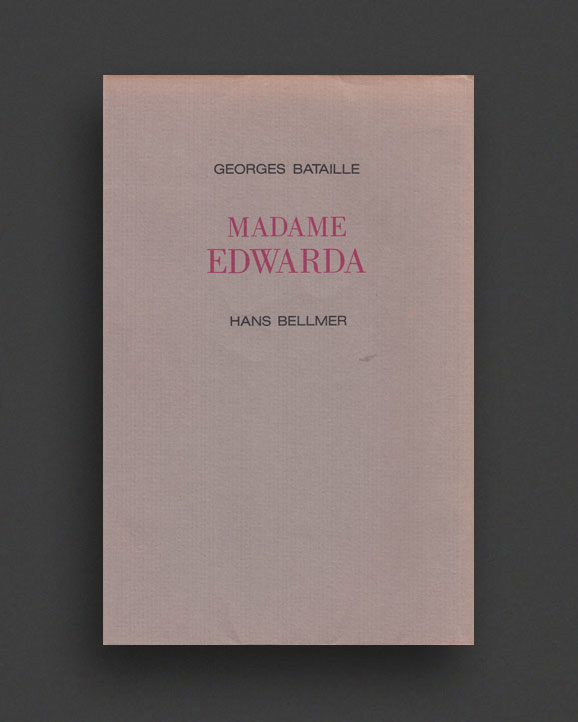
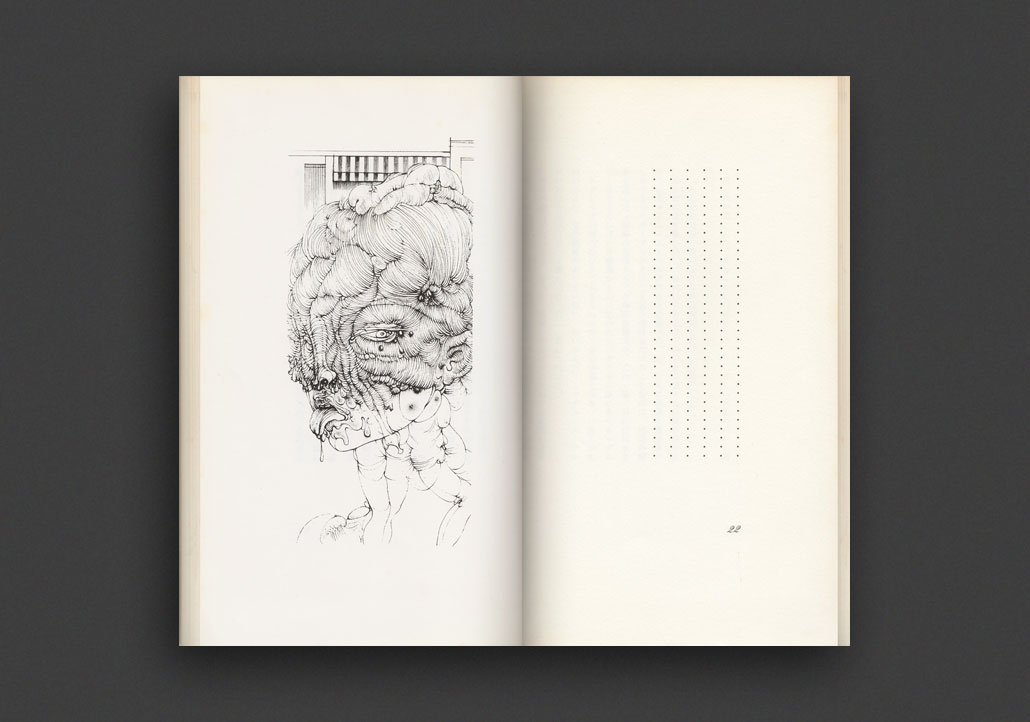
Beautiful 1985 Japanese edition of Georges Bataille's Madame Edwarda, illustrated throughout with all the original illustrations by Hans Bellmer. Madame Edwarda first appeared in Paris under Georges Bataille's pseudonym Pierre Angelique in two small underground editions in 1941 and 1945. It was finally published under Bataille's own name by the publishing house of Jacques Pauvert in 1956. Translated here by Kosaku Ikuta, all illustrations by German artist Hans Bellmer, complete with inserted preface booklet by Georges Bataille and additional insert of publisher's catalogue.
In Madame Edwarda, a man becomes erotically obsessed with an old whore who turns out to be God. Bataille's erotic prose fuses elements of sex and spirituality in a highly personal vision of the flesh. A world of sensation in which only the vaulting demands of disruptive excess and the anguish of heightened awareness can combat the stultifying world of reason and social order. Intoxication and insanity are so carefully delineated by the author that it seems to infect the reader.
"Madame Edwarda's truth consists in confronting us with an obvious scandal that we wouldn't even know where to place. We could incriminate her words: there have never been such rigorous ones; or the circumstances, the fact that Madame Edwarda is a brothel whore, but this, indeed, it could be reassuring; or even that certain details, which must be said to be obscene, are so with a necessity that ennobles them and makes them inevitable, not so much in the name of art, but for a perhaps moral, perhaps fundamental need. (...) That the most incongruous of books, as Georges Bataille defines it in his preface, is also the most beautiful book, and perhaps the most tender, is above all scandalous."—Maurice Blanchot
Very Good copy throughout, only light cover wear/tanning.
1972, English
Hardcover (w. dust jacket), 138 pages, 20.5 x 13.5 cm
1st Edition, Out of print title / used / very good
Published by
Jonathan Cape / London
$120.00 - Out of stock
Rare 1972 hardcover first edition of Georges Bataille's My Mother, published by Jonathan Cape, London, translated to English from the French by Austryn Wainhouse. Ma Mère was the first of Bataille's novels to appear in Britain. My Mother is a frank and intense depiction of a young man's sexual initiation and corruption by his mother, where the profane becomes sacred, and intense experience is shown as the only way to transcend the boundaries of society and morality. Georges Bataille was obsessed by the paradox contained in passion, the presence of joy in terror, pleasure in suffering and compulsion in repulsion. His dark and anguished study is a minor erotic masterpiece.
Georges Bataille (1897—1962) was a French philosopher, essayist and novelist, often called the "metaphysician of evil." Born in Billom, France, he converted to Catholicism, then later to Marxism. Bataille was involved on the fringes of Surrealism, f1972ounding the Surrealist magazine Documents in 1929, and editing the literary review Critique from 1946 until his death. Leading a simple life as the curator of a municipal library, Bataille wrote some of France's most famous forbidden books, and has become known as a forefather the "literature of transgression". Interested in sex, death, degradation, mysticism and the power and potential of the obscene, he rejected traditional literature and considered that the ultimate aim of all intellectual, artistic, or religious activity should be the annihilation of the rational individual in a violent, transcendental act of communion. Fascinated by human sacrifice, he founded a secret society, Acéphale, alongside André Masson, Pierre Klossowski, Roger Caillois, and others. Roland Barthes, Julia Kristeva, and Philippe Sollers have all written enthusiastically about Bataille's work.
Very Good copy in VG dust jacket with minor wear and tear.
2001, English
Softcover, 208 pages, 22 x 13.5 cm
Out of print title / used / very good
Published by
Marion Boyars / London
$25.00 - Out of stock
'Bataille intellectualizes the erotic, as he eroticizes the intellect . . . reading him can be a disturbing kind of game'—The New York Times
'Literature is not innocent,' stated Georges Bataille in this extraordinary 1957 collection of essays, arguing that only by acknowledging its complicity with the knowledge of evil can literature communicate fully and intensely. These literary profiles of eight authors and their work, including Emily Brontë's Wuthering Heights, Baudelaire's Les Fleurs du Mal and the writings of De Sade, Kafka, Blake, Genet, Michelet, Proust and Sartre, explore subjects such as violence, eroticism, childhood, myth and transgression, in a work of rich allusion and powerful argument.
Translated by Alastair Hamilton.
'Bataille is one of the most important writers of the twentieth century'—Michel Foucault
VG copy.
2006, English
Softcover, 272 pages, 27.1 x 21.4 cm
Published by
Hayward Gallery Publishing / London
$75.00 - In stock -
An exploration of the unsettling collisions of art and culture in Georges Bataille's revolutionary journal and a new consideration of twentieth-century masterpieces by Picasso, Miro, Dali, and others against the canvas of their renegade times.
In the Paris art world of the 1920s, Georges Bataille and his journal DOCUMENTS represented a dissident branch of surrealism. Bataille—poet, philosopher, writer, and self-styled "enemy within" surrealism—used DOCUMENTS to put art into violent confrontation with popular culture, ethnography, film, and archaeology. Undercover Surrealism, taking the visual richness of DOCUMENTS as its starting point, recovers the explosive and vital intellectual context of works by Picasso, Miro, Dali, Giacometti, and others in 1920s Paris.
Profusely illustrated (featuring 180 colour images) and filled with valuable English translations of original French texts from DOCUMENTS accompanied by essays and shorter descriptive texts, Undercover Surrealism recreates and recontextualizes Bataille's still unsettling approach to culture. Putting Picasso's Three Dancers back into its original context of sex, sacrifice, and violence, for example, then juxtaposing it with images of gang wars, tribal masks, voodoo ritual, Hollywood musicals, and jazz, makes the urgency and excitement of Bataille's radical ideas startlingly vivid to a twenty-first-century reader.
2024, English
Softcover, 328 pages, 21 x 28 cm
Published by
Spector Books / Leipzig
$110.00 - In stock -
The book Archive of Dreams is published in conjunction with the exhibition of the same name that will open the Archiv der Avantgarden. Marking the hundredth anniversary of the first surrealist manifesto and the founding of the Bureau of Surrealist Research in Paris in 1924, the volume is dedicated to the surrealist movement as well as the networks it engendered and the artistic stimuli it provided in the twentieth century. The idea was for the Bureau to collect dream testimonies in whatever form, not only to preserve and analyse them but also to give active expression to them in artistic processes. The publication shows how the practices of the avantgardes blurred the boundaries between dream and reality, between the traditional, passive notion of the archive and the idea of active, innovative artistic experiment — and thus ultimately also between the past, the present, and possible futures.
Works and documents from the period before, during, and after the Second World War shed light on the working methods of international artists and the global network they were involved in. They are complemented by diverse reflections on global protest movements and the traumas of war, thus connecting, too, to everyday experiences in a Europe beset by warfare.