World Food Books' programme is largely produced on Kulin Nation land. We acknowledge the Wurundjeri people of the Kulin Nation as the first and continuing custodians of this land, and pay respect to their Elders past, present, and emerging.
World Food Books is an arts and special interests bookshop in Naarm / Melbourne. Founded in 2010, World Food Books is devoted to the presentation of a rotating, hand-selection of international art, design, literary and counterculture publications with an emphasis on the anti-traditional, the experimental, the avant-garde, the heretic, the marginal.
Presenting new titles alongside rare and out-of-print books, catalogues and journals spanning the fields of modern and contemporary art, design, photography, illustration, film, literature, poetry, cultural theory, philosophy, sexuality, popular and underground culture in its many radical forms, World Food Books wishes to encourage adventurous, thoughtful and open-minded reading, looking, writing, and exchange of publishing and ideas, both current and historical.
As well as our bookshop, located in Melbourne's historical Nicholas Building, all of our inventory is available internationally via our online mail-order service.
World Food Books semi-regularly co-ordinates "Occasions", a programme of exhibits and events at the bookshop and in partnership with other hosts (such as museums and art galleries) that develop out of the activities, relationships and content of the bookshop itself.
World Food Books
The Nicholas Building
37 Swanston Street
Room 5, Level 6
Melbourne 3000
Australia
SHOP HOURS:
THU–SAT 12–6
WEB-SHOP OPEN 24/7
World Food Books
Postal Address:
PO Box 435
Flinders Lane
Victoria 8009
Australia
Art
Theory / Essay
Architecture / Interior
Graphic Design / Typography
Photography
Fashion
Eros
LGBTQ+
Fiction / Poetry
Weird / Speculative / Science Fiction / Horror
Transgressive / Visceral / Abject
Symbolism / Decadence / Fin de siècle
Film / Video
Painting
Sculpture / Installation
Performance / Dance / Theater
Drawing
Sound / Music
Curatorial
Group Shows / Collections
Periodicals
Out-of-print / Rare
Posters / Ephemera / Discs
Signed Books
World Food Books Gift Voucher
World Food Book Bag
Australian Art
Australian Fiction
Australian Science Fiction / Speculative Fiction
Australian Poetry
Australian Photography
Japanese Photography
Conceptual Art
Minimal Art
Dada
'Pataphysics / Oulipo
Fluxus
Concrete Poetry
Pop Art
Surrealism
Arte Povera
Arte Informale / Haute Pâte / Tachism
Nouveau Réalisme / Zero / Kinetic
Situationism / Lettrism
Collage / Mail Art / Xerox Art
Art Brut / Folk / Visionary / Fantastic
Illustration / Graphic Art / Bandes Dessinées
Furniture
Italian Radical Design / Postmodernism
Textiles
Ceramics / Glass
Counterculture
Protest / Revolt
Philosophy
Psychoanalysis
Anthropology
Anarchism
Socialism / Anarchism / Communism / Capitalism
Literary Theory / Semiotics / Language
Feminism / Women's Studies
Gender Studies / Sexuality
Anthropology
Fetishism / BDSM
Drugs / Psychedelia
Crime / Violence
Animal Rights / Veganism
Occult / Esoterica
Ecology / Earth / Alternative Living
Whole Earth / Crafts
All prices in AUD (Australian dollars)
Pick-Ups
Pick-up orders can be collected in our bookshop during opening hours after order date. Please collect any Pick-up orders within 2 weeks of ordering as we have limited storage space. Orders will be released back into stock if not collected within this time. No refunds can be made for pick-ups left un-collected. If you cannot make it in to the bookshop in this time-frame, please choose postage option.
Return Policy
All sales are final. We do accept returns (for refund or exchange) for items received in error. All our orders are packed with special care using heavy-duty padding and cardboard book-mailers or bubble mailers (for smaller books), using reinforcement where required. We cannot take responsibility for any lost, stolen or damaged parcels.
Insurance
Should you wish to insure your package, please email us directly after placing your order and we can organise this at a small extra expense. Although all standard/express tracked packages are very safe and dependable, we cannot take responsibility for any lost, stolen or damaged parcels. We recommend insurance on valuable orders.
Interested in selling your old books, catalogues, journals, magazines, comics, fanzines, ephemera? We are always looking for interesting, unusual and out-of-print books to buy. We only buy books in our fields of interest and specialty, and that we feel we can resell.
We base these prices on desirability, market value, in-print prices, condition and our current stock levels. We offer cash, store credit, and can take stock on consignment. All
about 25% of the price we expect to get when we sell them, or 30% in store credit. We base these prices on desirability, market value, in-print prices, condition and our current stock levels.
Sell your books any day of the week. You can drop them off and return later. If you have a lot of books, we can visit your Sydney home.
We buy books that we feel we can resell. We offer about 25 % of the price we expect to get when we sell them, or 30% in store credit. We base these prices on desirability, market value, in-print prices, condition and our current stock levels.
Philadelphia Wireman
03 August - 01 September, 2018
World Food Books is proud to announce our next Occasion, the first presentation of sculptures by Philadelphia Wireman in Australia.
The Philadelphia Wireman sculptures were found abandoned in an alley off Philadelphia’s South Street on trash night in 1982. Their discovery in a rapidly-changing neighbourhood undergoing extensive renovation, compounded with the failure of all attempts to locate the artist, suggests that the works may have been discarded after the maker’s death. Dubbed the "Philadelphia Wireman" during the first exhibition of this work, in 1985, the maker’s name, age, ethnicity, and even gender remain uncertain. The entire collection totals approximately 1200 pieces, all intricately bound together with tightly-wound heavy-gauge wire (along with a few small, abstract marker drawings, reminiscent both of Mark Tobey and J.B. Murry). The dense construction of the work, despite a modest range of scale and materials, is singularly obsessive and disciplined in design: a wire armature or exoskeleton firmly binds a bricolage of found objects including plastic, glass, food packaging, umbrella parts, tape, rubber, batteries, pens, leather, reflectors, nuts and bolts, nails, foil, coins, toys, watches, eyeglasses, tools, and jewellery.
Heavy with associations—anthropomorphic, zoomorphic, and socio-cultural responses to wrapped detritus—the totemic sculptures by Philadelphia Wireman have been discussed in the context of work created to fulfil the shamanistic needs of alternative religions in American culture. Curators, collectors, and critics have variously compared certain pieces to sculpture from Classical antiquity, Native American medicine bundles, African-American memory jugs, and African fetish objects. Reflecting the artist’s prolific and incredibly focused scavenging impulse, and despite—or perhaps enhanced by—their anonymity, these enigmatic objects function as urban artefacts and arbiters of power, though their origin and purpose is unknown. Philadelphia Wireman, whatever their identity, possessed an astonishing ability to isolate and communicate the concepts of power and energy through the selection and transformation of ordinary materials. Over the course of the past two decades, this collection has come to be regarded as an important discovery in the field of self-taught art and vernacular art.
Presented in collaboration with Fleisher-Ollman Gallery, Philadelphia, and Robert Heald, Wellington.
Susan Te Kahurangi King
02 February - 10 March, 2018
Susan Te Kahurangi King (24 February 1951 - ) has been a confident and prolific artist since she was a young child, drawing with readily available materials - pencils, ballpoint pens and felt-tip markers, on whatever paper is at hand. Between the ages of four and six Susan slowly ceased verbal communication. Her grandparents William and Myrtle Murphy had developed a special bond with Susan so they took on caring responsibilities for extended periods. Myrtle began informally archiving her work, carefully collecting and storing the drawings and compiling scrapbooks. No drawing was insignificant; every scrap of paper was kept. The King family are now the custodians of a vast collection containing over 7000 individual works, from tiny scraps of paper through to 5 meter long rolls.
The scrapbooks and diaries reveal Myrtle to be a woman of great patience and compassion, seeking to understand a child who was not always behaving as expected. She encouraged Susan to be observant, to explore her environment and absorb all the sights and sounds. Myrtle would show Susan’s drawings to friends and people in her community that she had dealings with, such as shopkeepers and postal workers, but this was not simply a case of a grandmother’s bias. She recognised that Susan had developed a sophisticated and unique visual language and sincerely believed that her art deserved serious attention.
This was an unorthodox attitude for the time. To provide some context, Jean Dubuffet coined the term Art Brut in 1945 to describe work created by self-taught artists – specifically residents of psychiatric institutions and those he considered to be visionaries or eccentrics. In 1972 Roger Cardinal extended this concept by adopting the term Outsider Art to describe work made by non-academically trained artists operating outside of mainstream art networks through choice or circumstance. Susan was born in Te Aroha, New Zealand in 1951, far from the artistic hubs of Paris and London that Dubuffet and Cardinal operated in. That Myrtle fêted Susan as a self-taught artist who deserved to be taken seriously shows how progressive her attitudes were.
Susan’s parents Doug and Dawn were also progressive. Over the years they had consulted numerous health practitioners about Susan’s condition, as the medical establishment could not provide an explanation as to why she had lapsed into silence. Dawn educated herself in the field of homeopathy and went on to treat all twelve of her children using these principles – basing prescriptions on her observations of their physical, mental and emotional state.
Doug was a linguist with an interest in philosophy who devoted what little spare time he had to studying Maori language and culture. To some extent their willingness to explore the fringes of the mainstream made them outsiders too but it was their commitment to living with integrity and their respect for individuality that ensured Susan’s creativity was always encouraged.
Even though Susan’s family supported her artistic pursuits, some staff in schools and hospitals saw it as an impediment to her assimilation into the community and discouraged it in a variety of ways. Her family was not always aware of this and therefore did not fully understand why Susan stopped drawing in the early 1990s. However, rather than dwell on the challenges that Susan faced in pursuit of her artistic practice, they prefer to highlight her achievements. In 2008 Susan began drawing again in earnest, after an almost 20 year interruption, and her work is now shown in galleries around the world.
Susan grew up without television and has been heavily influenced by the comics she read as a child. She is absolutely fearless in the appropriation of recognizable characters, such as Donald Duck and Mickey Mouse, in her work. She twists their limbs, contorts their faces, compresses them together, blends them into complex patterned backgrounds - always imbuing them with an incredible energy. Although Susan often used pop culture characters in her work they are not naive or childlike. These are drawings by a brilliant self-taught artist who has been creating exceptional work for decades without an audience in mind.
Mladen Stilinović
"Various Works 1986 - 1999"
02 February 16 - September 10, 2016
Various works 1986 - 1999, from two houses, from the collections of John Nixon, Sue Cramer, Kerrie Poliness, Peter Haffenden and Phoebe Haffenden.
Including: Geometry of Cakes (various shelves), 1993; Poor People’s Law (black and white plate), 1993; White Absence (glasses, ruler, set square, silver spoon, silver ladel with skin photograph and wooden cubes), 1990-1996; Exploitation of the Dead (grey and red star painting, wooden painting, black spoon with red table, red plate), 1984-1990; Money and Zeros (zero tie, paintings made for friends in Australia (Sue, John, Kerrie), numbers painting), 1991-1992; Words - Slogans (various t-shirts) - “they talk about the death of art...help! someone is trying to kill me”, “my sweet little lamb”, “work is a disease - Karl Marx”; Various artist books, catalogues, monographs, videos; Poster from exhibition Insulting Anarchy; "Circular" Croatian - Australian edition; Artist book by Vlado Martek (Dostoyevsky); more.
Thanks to Mladen Stilinović and Branka Stipančić.
Jonathan Walker
Always Will Need To Wear Winter Shirt Blue + Ochre Small Check Pattern
21 August - 21 September, 2015
Untitled
I am not a great reader of poetry but I always return to the work of Melbourne poet, Vincent Buckley (1925- 1988). Perhaps I find his most tantalising piece to be not a finished poem but a fragment left on a scrap of paper discovered on his desk after the poet’s death.
The poetry gathers like oil
In the word-core, and spreads
It has its music meet,
Its music is in movement.
This fragment is more the shell left behind from a volatile thought than a finished poem. I find the last two lines honest but awkward whereas the first two lines work like an arrow. Most likely he could not find a resolution so it was left. Still, in its present form, it remains an eloquent testimony to the ultimate failure of a medium to express mobile thought and sensation, in Buckley’s case, through verbal language. It’s an important matter because this is something all artists have to deal with regardless of the medium.
I have never written a poem, however, I am forever copying fragments from books on paper scraps in a vain effort to fix certain notions in my head. At first, they function as bookmarks that are sometimes returned to when I open the book. But before long, as they accumulate, they fall out littering the table interspersed with A4 photocopies, bills, books and medications.
To return to Buckley’s fragment, the first two lines very much evoke how I paint nowadays. As you age, detail diminishes and patches of light become more luminous and float. I feel the most honest way of dealing with this is by smearing the oil paint on the canvas with the fingers and working close-up, blind. Only if the patches coalesce into an approaching image can the work gain a life.
-
Jonathan Walker was born in Melbourne, Australia and brought up on a dairy farm in Gippsland. In the 1970’s he studied painting at RMIT and won the Harold Wright Scholarship to the British Museum, London. During the 1980’s he exhibited at Pinacotheca Gallery, Richmond and had work shown at the NGV and Heidi City Art Gallery. Over the same period he designed the cover for the “Epigenesi” LP by Giancarlo Toniutti, Italy and conducted a mail exchange work with Achim Wollscheid, Germany. The work with artists through the post resulted in an article published in the bicentenary issue of Art and Australia 1988. He showed in artist run spaces such as WestSpace in the 90’s and 2000’s, and until 2012, taught painting at Victoria University, which is where we (Colleen Ahern and Lisa Radford) as organisers of the exhibition, among many others, had the privilege of being his student.
Walker’s knowledge was imparted to students through the careful selection of music, literature, and artists found in books that he himself had ordered for the library. Walker’s strategy was the generosity of sharing his vast knowledge with references specific to each student and their context.
Walker’s paintings share a similar focus and intimacy.
This exhibition presents a small selection of recent paintings alongside a publication that includes Walker’s writing. Observational and analytical, Walker’s work is a type of material notation — the time of day, colour and how it is blended, the both specific and fleeting location of a reflection on lino or the question of whether a chair leg should be included in a painting.
Please join us on Friday August 21 between 6-8pm to celebrate the opening of the exhibition.
Curated by Colleen Ahern and Lisa Radford.
B. Wurtz
Curated by Nic Tammens
March 26 - April 4, 2015
B.Wurtz works from a basement studio in his home on Manhattan’s Lower East Side.
This local fact is attested to by the plastic shopping bags and newsprint circulars that appear in his work. As formal objects, they don’t make loud claims about their origins but nonetheless transmit street addresses and places of business from the bottom of this long thin island. Like plenty of artists, Wurtz is affected by what is local and what is consumed. His work is underpinned by this ethic. It often speaks from a neighborhood or reads like the contents of a hamper:
“BLACK PLUMS $1.29 lb.”
“Food Bazaar”
“USDA Whole Pork Shoulder Picnic 99c lb.”
“RITE AID Pharmacy, with us it’s personal.”
“H. Brickman & Sons.”
“Sweet Yams 59c lb."
Most of the work in this exhibition was made while the artist was in residence at Dieu Donne, a workshop dedicated to paper craft in Midtown. Here Wurtz fabricated assemblages with paper and objects that are relatively lightweight, with the intention that they would be easily transportable to Australia. This consideration isn’t absolute in Wurtz’s work, but was prescriptive for making the current exhibition light and cheap. Packed in two boxes, these works were sent from a USPS post office on the Lower East Side and delivered to North Melbourne by Australia Post.
Wurtz appears courtesy of Metro Pictures, New York.
Thanks to Rob Halverson, Joshua Petherick, Sari de Mallory, Matt Hinkley, Helen Johnson, Fayen d'Evie, Ask Kilmartin, Lisa Radon, Ellena Savage, Yale Union, and "Elizabeth".
John Nixon
"Archive"
December 15 - January 20, 2014
The presentation of John Nixon's archive offered a rare showcase of this extensive collection of the artist's own publications, catalogues, posters, ephemera, editions and more, from the mid 1980s onwards, alongside a selection of his artworks.
Organized by John Nixon, Joshua Petherick and Matt Hinkley.
"Habitat"
at Minerva, Sydney (organised by Joshua Petherick and Matt Hinkley)
November 15 - December 20, 2014
Lupo Borgonovo, Janet Burchill & Jennifer McCamley,
Lewis Fidock, HR Giger, Piero Gilardi, Veit Laurent Kurz,
Cinzia Ruggeri, Michael E. Smith, Lucie Stahl, Daniel Weil, Wols
Press Release:
“...It contained seven objects. The slender fluted bone, surely formed for flight, surely from the wing of some large bird. Three archaic circuitboards, faced with mazes of gold. A smooth white sphere of baked clay. An age-blackened fragment of lace. A fingerlength segment of what she assumed was bone from a human wrist, grayish white, inset smoothly with the silicon shaft of a small instrument that must once have ridden flush with the surface of the skin - but the thing’s face was seared and blackened.”
William Gibson, “Count Zero”, 1986
"Autumn Projects Archive"
Curated by Liza Vasiliou
March 6 - March 15, 2014
World Food Books, in conjunction with the Virgin Australia Melbourne Fashion Festival 2014, presented the Autumn Projects archive, consisting of a selection of early examples in Australian fashion with a particular interest in collecting designers and labels from the period beginning in the 1980’s, who significantly influenced the discourse of Australian Fashion.
Curated by Liza Vasiliou, the exhibition provided a unique opportunity to view pieces by designers Anthea Crawford, Barbara Vandenberg, Geoff Liddell and labels CR Australia, Covers, Jag along with early experimental collage pieces by Prue Acton and Sally Browne’s ‘Fragments’ collection, suspended throughout the functioning World Food Books shop in Melbourne.
H.B. Peace
presented by CENTRE FOR STYLE
November 14, 2013
"Hey Blinky, you say chic, I say same"
Anon 2013
H.B. Peace is a clothing collaboration between great friends Blake Barns and Hugh Egan Westland. Their pieces explore the divergences between 'character’ and ‘personality’ in garments....etc
Special Thanks to Joshua Petherick and Matt Hinkley of WFB and Gillian Mears
and a Very Special Thank you to Audrey Thomas Hayes for her shoe collaboration.
Janet Burchill & Jennifer McCamley
"Aesthetic Suicide"
May 10 - June 8, 2013
The first of our occasional exhibitions in the World Food Books office/shop space in Melbourne, "Aesthetic Suicide" presented a body of new and older works together by artists Janet Burchill & Jennifer McCamley, including videos, prints, a wall work, and publications.
During shop open hours videos played every hour, on the hour.
1990, English
Hardcover, 258 pages, 23.5 x 16 cm
1st Edition, Out of print title / used / very good
Published by
University of California Press / Berkley
$45.00 - Out of stock
First 1990 hardcover edition of Epistemology of the Closet by Eve Kosofsky Sedgwick. Since the late 1980s, queer studies and theory have become vital to the intellectual and political life of the United States. This has been due, in no small degree, to the influence of Eve Kosofsky Sedgwick's critically acclaimed Epistemology of the Closet. Working from classic texts of European and American writers-including Melville, James, Nietzsche, Proust, and Wilde-Sedgwick analyzes a turn-of-the-century historical moment in which sexual orientation became as important a demarcation of personhood as gender had been for centuries.
"Brilliant as a work of literary criticism, a cultural study, a political analysis, and as a landmark in the development of lesbian and gay studies."—Women's Review of Books
Eve Kosofsky Sedgwick (May 2, 1950 – April 12, 2009) was a poet, artist, literary critic and teacher. She is perhaps best known as one of the originators of Queer Theory. Her work and her example continue to have a significant effect in shaping the lives and thought of many people.
Very Good copy, lacking dust jacket.
1989, English
Hardcover (w. both dust jackets), 236 pages, 25 x 31.3 cm
1st Edition, Out of print title / used / very good
Published by
Schirmer & Mosel / Munich
$240.00 - Out of stock
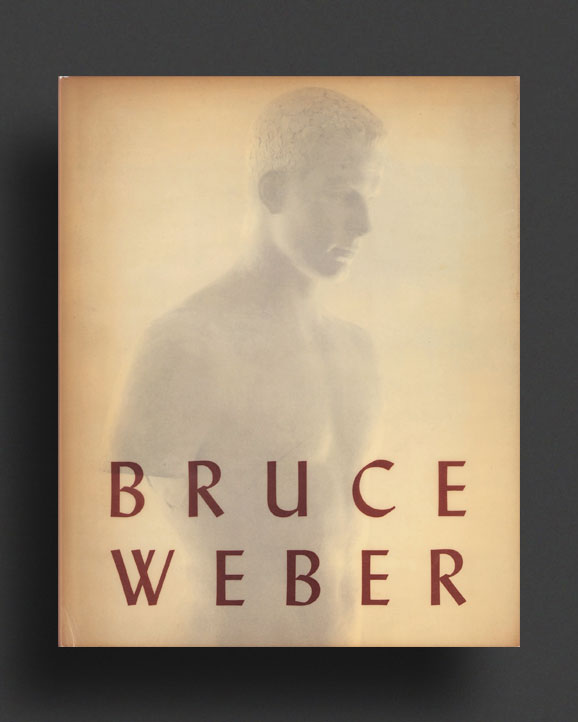
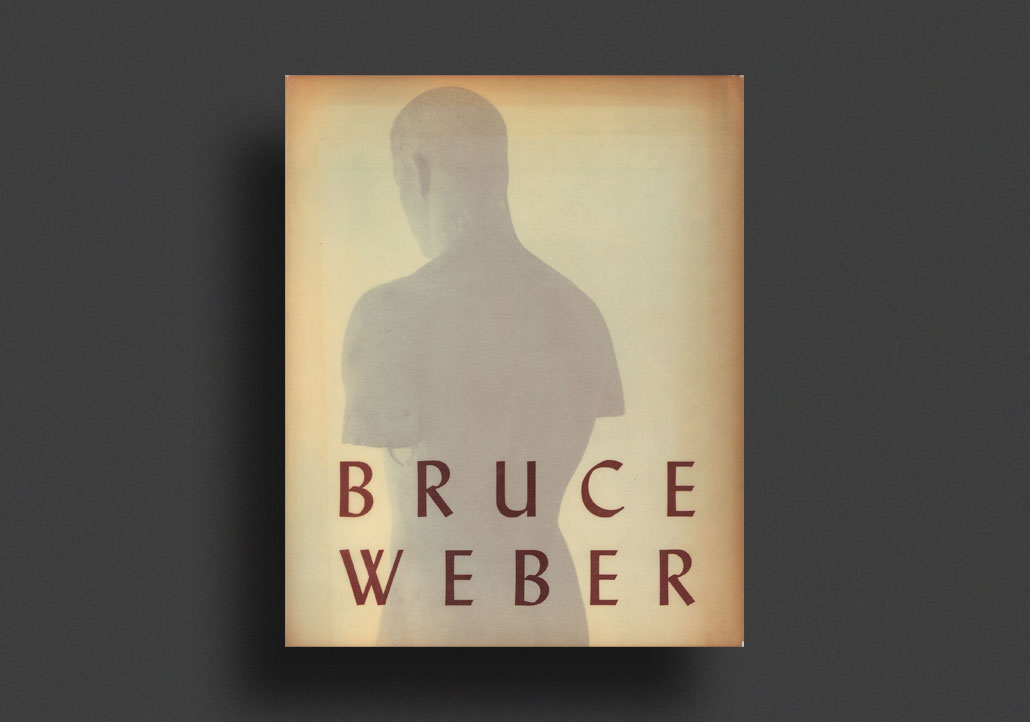
First 1989 hardcover edition of what is still one of the finest books on the work of American fashion photographer Bruce Weber (b. 1946). Edited and designed by John Cheim, this collection of 140 photographs is testimony to the breadth of Weber's photographic talent, from his male nudes charged with nostalgia and classicalism; his humanist portraits of artists, actors and athletes; his glorious homages to his beloved golden retrievers; his lyrical tributes to eroticism or his arcadian vision of the American landscape, it is all here, all beautifully reproduced. Working for Calvin Klein, Karl Lagerfeld, Comme des Garçons, Gianni Versace, Ralph Lauren, and Abercrombie & Fitch, Weber pioneered a nostalgic, aspirational style that redefined the industry. He is widely considered to have introduced a new level of artistry to commercial photography.
First hardcover edition in dust jacket, wrapped within printed translucent dust jacket.
Very Good copy with tanning/minor chips to translucent jacket spine and edges, light spotting to block edges, general age.
1993—2000, Japanese
Softcover, 300—400 pages ea., 21 x 15 cm
1st Edition, Out of print title / used / very good
Published by
Sun Publishing / Japan
$300.00 $240.00 - In stock -
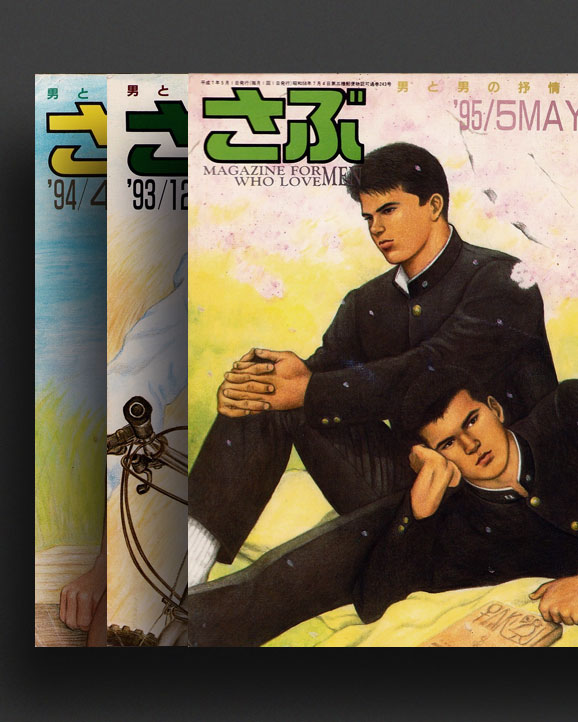
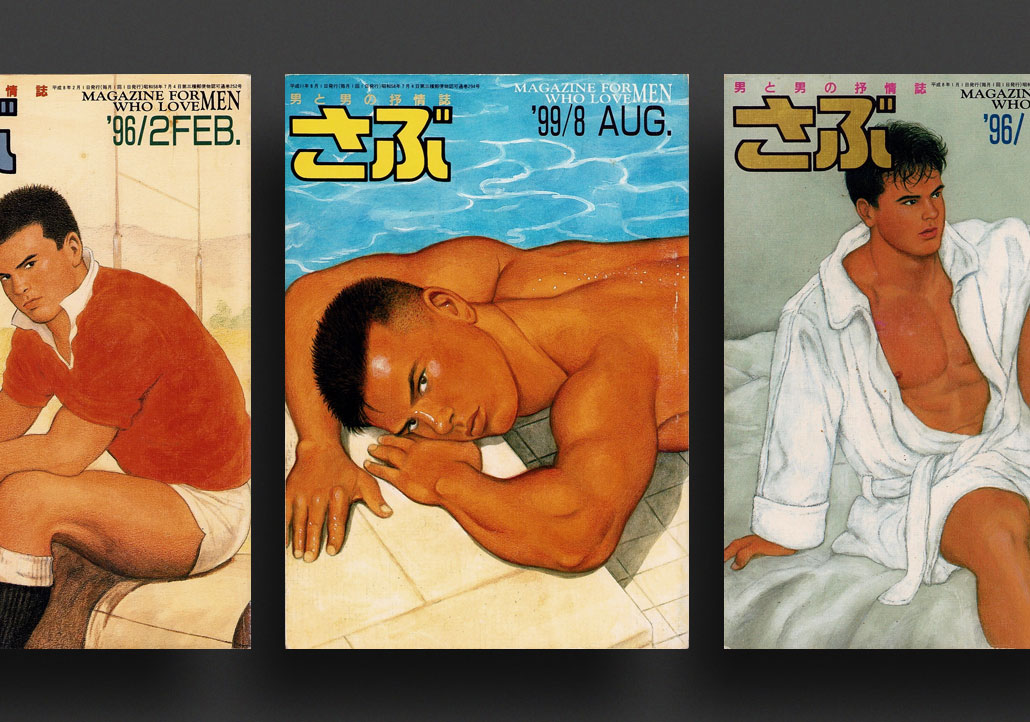
Huge lot of 11 issues of Sabu, "Magazine For Men Who Love Men", the trailblazing gay erotic magazine from Japan, founded in 1974. All issues from the 1990s, with one issue from 2000 thrown in, 1993—2000, all featuring the gorgeous wrap-around (front and back) cover artwork by legendary gay erotic illustrator Ben Kimura (1947—2003). Packed with illustrations by Gengoroh Tagame, Gekko Hayashi, Go Mishima, Ben Kimura, and many other artists, at roughly 350—400 pages in each issue, Sabu is more of a book (a "mook" as it were). Filled to the brim with gay erotic art galleries, glossy hardcore erotic photography, loads of fetish and bondage materials, wild "bara" manga, classifieds/letters/sexmate messageboards, articles, ads for Japanese gay bars, clubs, saunas, dungeons, gyms, mail-order toys, publications, media, news and reports on international scenes, and much more.
Each issue Very Good—Good, with light wear and tear. Specific shipping costs may apply.
2023, English / Japanese
Hardcover (w. slipcase and postcard), 176 pages, 31 x 21.5 cm
Edition of 1000,
1st Edition, Out of print title / as new
Published by
Gallery Naruyama / Tokyo
$240.00 - Out of stock
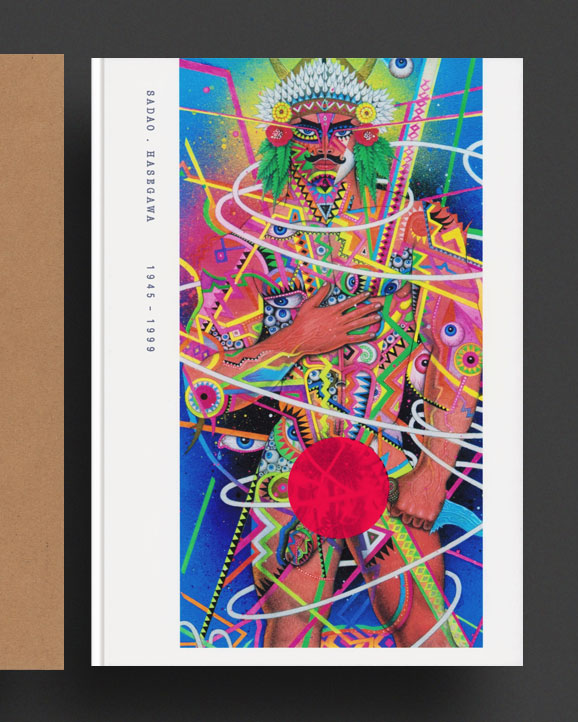
Remarkable, comprehensive new book published on the occasion of the retrospective exhibition of Sadao Hasegawa (1945—1999) at Gallery Naruyama, Tokyo, in 2023, divided into two periods for a span of six months. This lavishly produced and limited edition hardcover book (housed in gallery slipcase with removable cover sticker — a temporary censor for distribution purposes), reproduces all of his amazing homo-erotic artwork works in this extensive exhibition, making it the most comprehensive book on the artist yet. From his early romantic works drawn under the influence of psychedelic drugs, to works that interweave Hasegawa’s longing for foreign and exotic lands, erotic images of men created for magazines and manga, this book covers his vast array of styles, revealing many never before published sketches, preparatory drawings and graphic works. All works completely uncensored in their full glory — Hasegawa's unique blend of fantasy, Asian folklore, sado-masochism, and the homoeroticism of Yukio Mishima. Beautifully presented across many different paper stocks, with accompanying essay in English/Japanese. A must for any fan. This copy with illustrated exhibition invite laid in.
Inspired by Nobel Prize nominee Yukio Mishima, beauty, eroticism and death are recurring themes in the self-taught Hasegawa’s work. His unique vision incorporates Japanese, Indian, South-East Asian and African mythology, combined with homo-erotic depictions of men in acts of sado-masochism, juxtaposed with lush tropical flowers, strings of pearls, birds and animals that float through the margins of dreamy, ecstatic scenes. After Hasegawa’s suicide in Bangkok, Thailand, in 1999, his family was going to dispose of the artists archive but discovered a portrait of Mishima painted on a stone, accompanied by a note requesting that the works be bequeathed to Gallery Naruyama, Tokyo, where the artist’s estate is today.
"When I was a child, I was alone with kūsō (daydreams and wild imagination). Always I went to the fields and the woods. I liked talking to animals and plants. In my imagination, I changed into birds and insects and flowers... These childhood experiences are the basis for my pictures." Sadao Hasegawa (In Touch for Men)
As New copy.
1982, Japanese
Softcover, 300 pages, 21 x 15 cm
1st Edition, Out of print title / used / very good
Published by
Daini Shobo / Tokyo
$60.00 - Out of stock
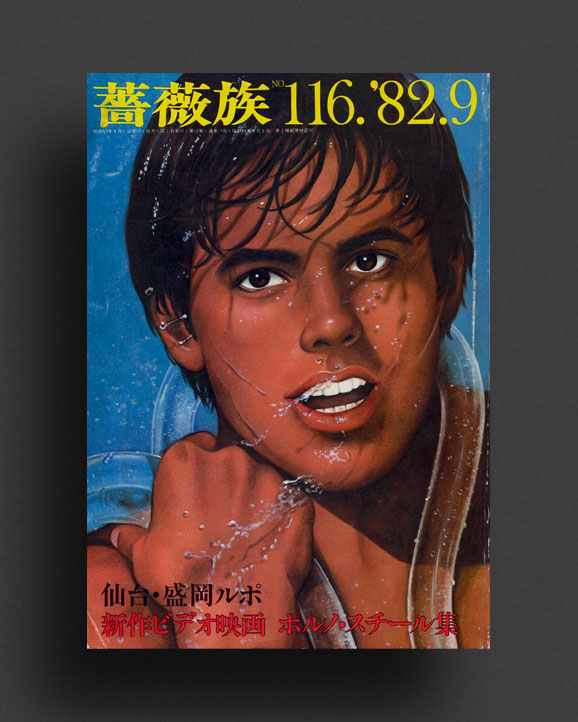
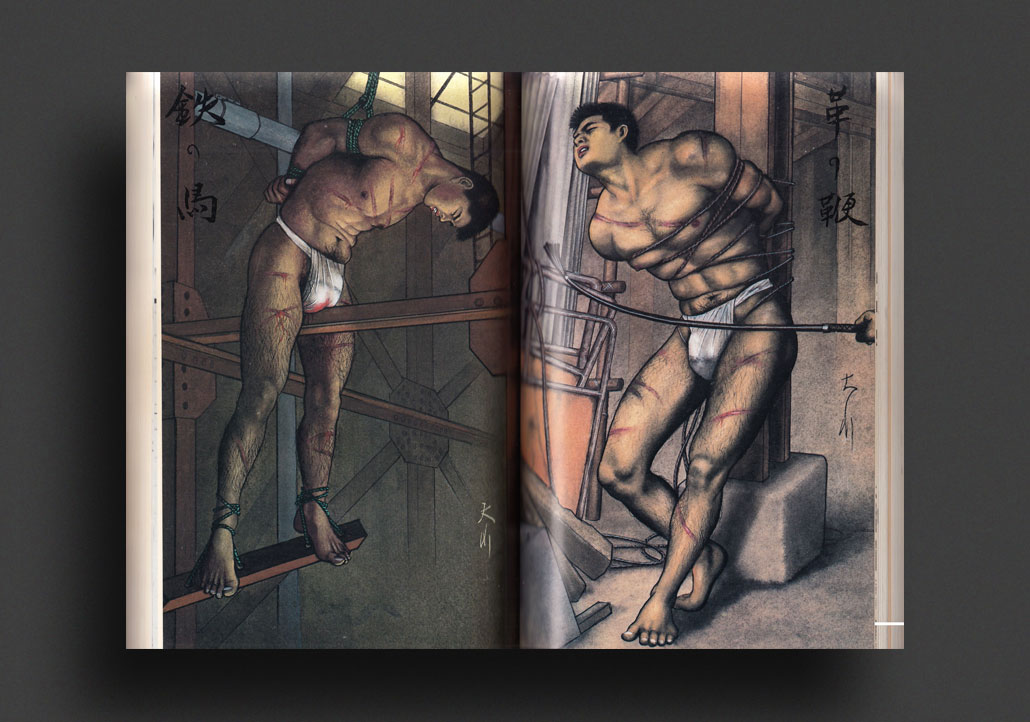
Rare early September 1982 issue of the trailblazing Barazoku, “The Rose Tribe”, Japan's first commercially circulated gay men's magazine, founded in 1971 by Bungaku Itō. Features cover artwork by Ben Kimura, colour gallery by Go Mishima, and many illustrations by Sadao Hasegawa, just to get started! A leader in Japanese gay culture, Barazoku was the longest running magazine of its kind, surviving 33 years, and despite mainstream disapproval and legal injunctions it became such a cultural phenomenon that its title, the term "bara", has entered the mainstream language as a synonym for "gay" and gay manga. Barazoku published an interview with Japan's first known AIDS sufferer at a time when the mainstream media refused to address the issue. The magazine was also instrumental in introducing seminal Japanese gay erotic artists such as Ben Kimura, Go Mishima, Rune Naito, and Sadao Hasegawa, amongst others. Each issue was packed with gay erotica art galleries, manga, colour and b/w glossy erotic photography, classifieds/letters/personal ads, articles, ads for Japanese gay bars, clubs, saunas, dungeons, gyms, mail-order toys, publications, media, news and reports on international scenes, and much more.
VG—Good copy. Wear.
1989, English
Softcover, 192 pages, 22 x 28 cm
Out of print title / used / very good
Published by
The Gay Men's Press (GMP) / London
Tom of Finland Foundation / Los Angeles
$190.00 - Out of stock
1989 printing of one of the finest collections of the great Tom of Finland, published by the Tom of Finland Foundation, Los Angeles, and The Gay Men's Press (GMP), London.
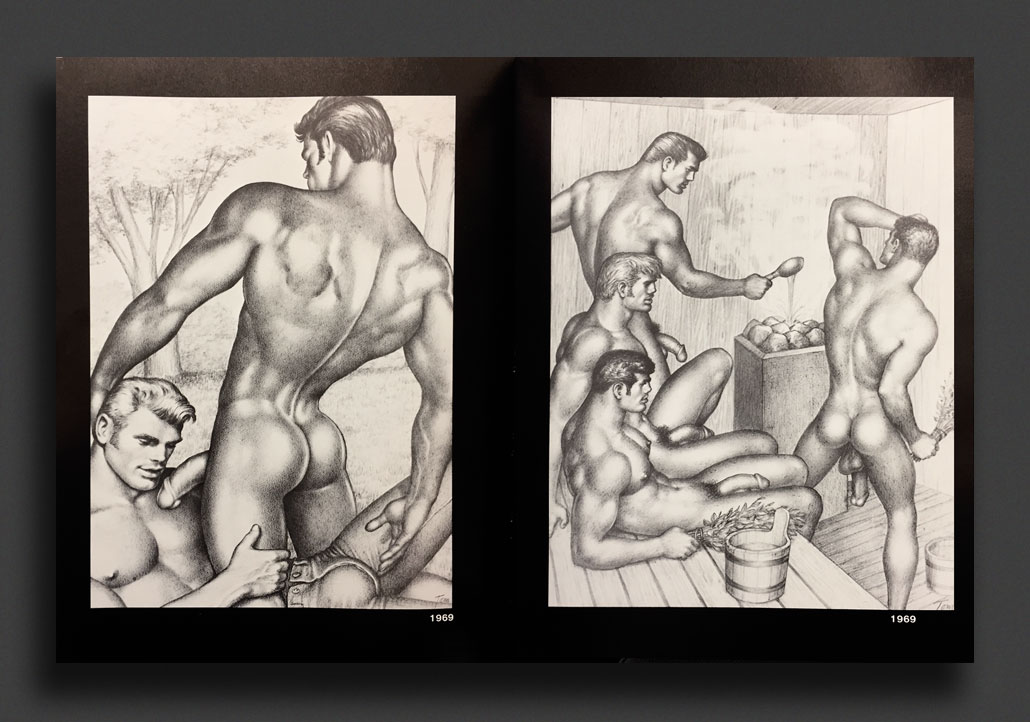
Preface by Tom of Finland with appreciation by Dennis Forbes and Fred Bisonnes. This book covers Tom of Finland's work from 1946 to 1987, depicting page by page throughout his iconic and impeccable erotic graphite drawings of macho leathermen, bikers, cowboys, cops, lumberjacks, hardhats, soldiers and sailors, all in all their glory.
Touko Valio Laaksonen (8 May 1920 – 7 November 1991), best known by his pseudonym Tom of Finland, was a Finnish artist known for his stylized highly masculine homoerotic fetish art, and his influence on late twentieth century gay culture. He has been called the "most influential creator of gay pornographic images" by cultural historian Joseph W. Slade. Over the course of four decades, he produced some 3500 illustrations.
Very Good copy with light cover/edge wear.
1991, English
Softcover, 192 pages, 22 x 28 cm
1st Edition, Out of print title / used / very good
Published by
Tom of Finland Foundation / Los Angeles
$150.00 - Out of stock
First printing of Retrospective II, another of the finest collections of work from the great Tom of Finland, published in 1991 by the Tom of Finland Foundation, Los Angeles.
Preface by Tom of Finland. This book covers Tom of Finland's work dating back to 1944, depicting page by page throughout his iconic and impeccable erotic graphite drawings of macho leathermen, bikers, cowboys, cops, lumberjacks, hardhats, soldiers and sailors, all in all their glory.
Touko Valio Laaksonen (8 May 1920 – 7 November 1991), best known by his pseudonym Tom of Finland, was a Finnish artist known for his stylized highly masculine homoerotic fetish art, and his influence on late twentieth century gay culture. He has been called the "most influential creator of gay pornographic images" by cultural historian Joseph W. Slade. Over the course of four decades, he produced some 3500 illustrations.
Very Good copy with light cover/edge wear.
1995, English / German
Softcover (staple-bound), 62 pages, 28 x 21.5 cm
1st Edition, Out of print title / used / very good
Published by
Tom of Finland Foundation / Los Angeles
$140.00 - In stock -
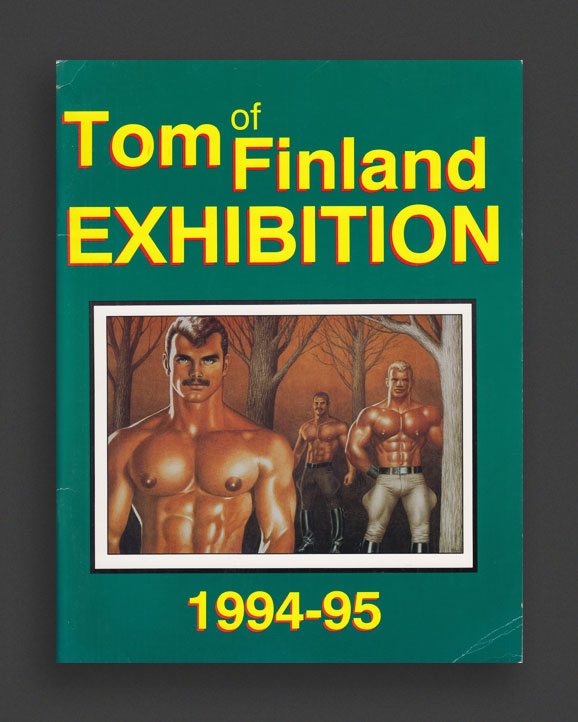
Rare copy of Tom of Finland Exhibition 1994-95, published in 1995 by the Tom of Finland Foundation, Los Angeles, on the occasion of the retrospective exhibition held in 1994 and the Schwules Museum, Berlin, Germany. Profusely illustrated with many unseen works, as well as photographs and documents tracing the life and work of Touko Valio Laaksonen (1920—1991), best known by his pseudonym Tom of Finland, the "most influential creator of gay pornographic images"(—Joseph W. Slade). Every period accounted for, from Tom's early commercial work to his most hardcore gay erotica, his sketch-books, his prints to his very last work. An incredible insight into this prolific artist of enduring influence. Texts throughout in English and German by president of Tom of Finland Foundation Durk Dehner and German art critic Wolfgang Max Faust, amongst others, plus chronology,
“Sometimes the attraction of the uniform is so powerful in me that I get the feeling that I am making love to the clothes and the man inside is just there to hold them up and give them shape, sort of like an animated department store dummy.”
Very Good, well preserved copy with light bump top of spine, crease to bottom front cover.
1968, Japanese
Hardcover in hard slipcase, unpaginated, 19 x 13.5 cm
1st Edition, Out of print title / used / very good
Published by
Futami Shobo / Japan
$160.00 - In stock -
Scarce hardcover, slipcased volume on the "Art of Eroticism", published only in Japan in 1968. An amazing history of humanity that collects erotic masterpieces from around the world. With illustrated slipcase by Japanese artist Kuniyoshi Kaneko, this book functions as a separate visual volume to Ove Brussendorf and Poul Henningsen's celebrated History of Eroticism, depicting sexual customs from ancient times to the present day with 700 illustrations reproduced on glossy stock.
Very Good copy with general age and some wear to slipcase. Book well-preserved!
2024, English
Softcover, 96 pages, 20 x 14 cm
Published by
Semiotext(e) / Los Angeles
$34.00 - In stock -
Wild new adventures in word-infatuated flânerie from a celebrated literary provocateur.
This book of thirty-six poetic bulletins by the humiliation-advice-giver Wayne Koestenbaum will teach you how to cruise, how to dream, how to decode a crowded consciousness, how to find nuggets of satisfaction in unaccustomed corners, and how to sew a language glove roomy enough to contain materials gathered while meandering. Koestenbaum wrote many of these poems while walking around New York City. He'd jot down phrases in a notebook or dictate them into his phone. At home, he'd incorporate these fragmented gleanings into overflowing quasi sonnets. Therefore each poem functions as a coded diary entry, including specific references to sidewalk events and peripatetic perceptions. Flirting, remembering, eavesdropping, gazing, squeezing, sequestering: Koestenbaum invents a novel way to cram dirty liberty into the tight yet commodious space of the sonnet, a fourteen-lined cruise ship that contains ample suites for behavior modification, libidinal experiment, aura-filled memory orgies, psychedelic Bildungsromane, lap dissolves, archival plunges, and other mental saunterings that conjure the unlikely marriage of Kenneth Anger and Marianne Moore. Carnal pudding, anyone? These engorged lyrics don't rhyme; and though each builds on a carapace of fourteen lines, many of the lines spawn additional, indented tributaries, like hoop earrings dangling from the stanzas' lobes. Koestenbaum's poems are comic, ribald, compressed, symphonic. They take liberties with ordinary language, and open up new pockets for sensation in the sorrowing overcoat of the “now.” Imagine: the training wheels have been removed from poetry's bicycle, and the wheeling flâneur is finally allowed a word pie equal to fantasy's appetite. Stubble—a libidinal detail—matters when you're stranded on the archipelago of your most unsanctioned yet tenaciously harbored impulses.
2023, English
Hardcover, 106 pages, 21 x 14.5 cm
Published by
Amphetamine Sulphate / Austin
$46.00 - Out of stock
The long-awaited new novel from a major literary talent. With cover design by Michael Salerno (KIDDIEPUNK).
“I’m so close to falling apart. Fuck it. Who isn’t?”
Thomas Moore’s latest novel Your Dreams, the follow-up to 2021’s devastating Forever, is a visceral yet contained inquiry into the endless need to be understood. Eavesdropping on a debate about cancelled bands, listening to a close friend’s explanation of his disturbing desires, facilitating a conversation about kinks at a party until it goes wrong, Moore’s narrator is less of a character than a witness of desperate disconnection. Your Dreams, despite its impulse to hide, faces the reader head-on in an intimate unmasking, still grasping for closeness in a world of limits.
“Simple words. Deep emotions … beyond prose to another plane. Openness that pours through you.”
Jack Skelley, The Los Angeles Review of Books
“Thomas Moore is one of the best writers the world has in stock.”
Dennis Cooper
2021, English
Softcover, 140 pages, 21.5 x 13.5 cm
Published by
Amphetamine Sulphate / Austin
$34.00 - Out of stock
SADNESS ALWAYS FINDS PEOPLE
"I'm writing this instead of killing myself" states the narrator of Forever, Thomas Moore's most compelling novel yet. A young man travels alone to Paris, to see out his days in painful reflection and sexual abandon until the money inevitably runs out.
By turns hauntingly elegiac and viscerally brutal, Moore charts with forensic precision the topographies of violence and self-harm that flourish within the dehumanised environment of predatory global capitalism.
Unflinchingly crafted in exquisite prose, Forever is a vividly political and intensely personal vision of life and language pushed to the very limits.
"We are always told that things should be more, everything should be bigger, better, owned, ownable. Things should be forever even though nothing is."
"Thomas Moore is one of the best writers the world has in stock."—Dennis Cooper
Thomas Moore's previous work include In Their Arms, When People Die, Small Talk at the Clinic (with Steven Purtill), and most recently the novel Alone, also published by Amphetamine Sulphate.
Cover art by Micahel Salerno
2020, English
Softcover, 166 pages, 20.5 x 14 cm
Published by
Amphetamine Sulphate / Austin
$44.00 - Out of stock
Has Grindr killed psychic gay powers?
For Halloween I’m dressing as a YouTube video of Corey Haim, when he was still alive and talking about kissing girls, feeling like dolphins were swimming through his blood. And I’d dress as the helpline 1-800-C-O-R-E-Y that he set up when he was seventeen, when he was high and giving advice to young fans about how to stay off drugs.
The pièce de résistance of my costume would be the contrast that the viewer makes in their mind between the image of Corey Haim in The Lost Boys with a beautiful smile and skin that looks healthier than you’ve ever seen and the TMZ report of pneumonia and the enlarged heart that killed him and the question about whether the reader would carry through the metaphor and make the link between the dolphins he said were in his blood and what they would look like now.
"Thomas Moore is one of the best writers the world has in stock, and I always expect a ton from what he writes, but, even so, ALONE is beyond the pale — immaculate, febrile, deadly, a complete stunner."—Dennis Cooper
2002, English
Softcover, 312 pages, 23.5 x 15.6 cm
Published by
Duke University Press / North Carolina
$49.00 - In stock -
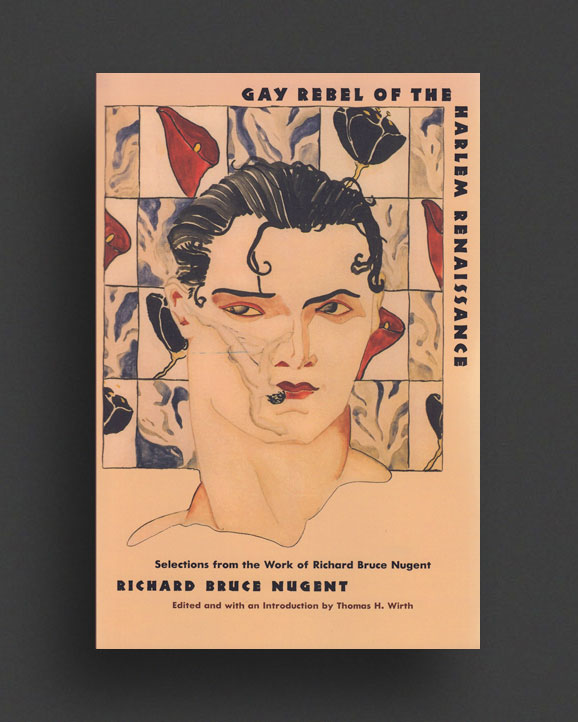
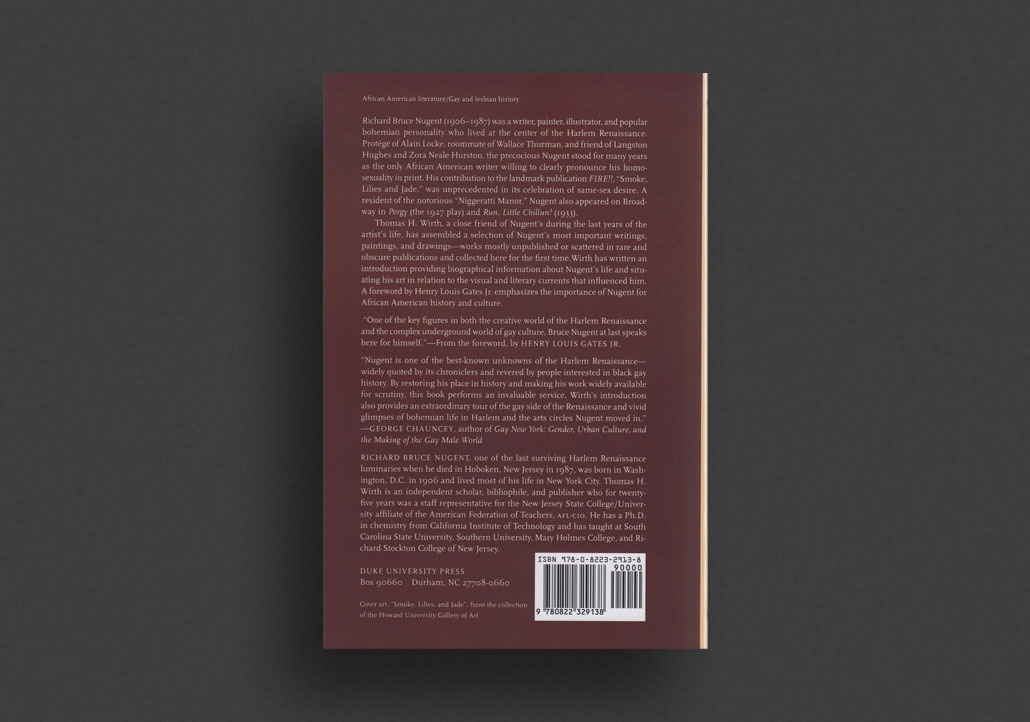
Richard Bruce Nugent (1906—1987) was a writer, painter, illustrator, and popular bohemian personality who lived at the centre of the Harlem Renaissance. Protege of Alain Locke, roommate of Wallace Thurman, and friend of Langston Hughes and Zora Neale Hurston, the precocious Nugent stood for many years as the only African-American writer willing to clearly pronounce his homosexuality in print. Selections from his writings, paintings, and erotic art-deco drawings-mostly unpublished or scattered in rare and obscure publications-are collected here for the first time. A contributor to the landmark publication FIRE!! and resident of the notorious Niggeratti Manor, Nugent drew heavily upon his own experiences in his art. Nugent also appeared on Broadway in Porgy (the 1927 play) and Run, Little Chillun (1933).
Thomas H. Wirth, a close friend of Nugent's during the last years of the artist's life, has assembled a selection of Nugent's writings, including his best-known piece, "Smoke, Lilies, and Jade," and some of his poems and short non-fiction. The visual art selections include many of Nugent's sketches, as well as a number of his paintings. Wirth has written an introduction providing biographical information about Nugent's life and situating his art in relation to the visual and literary currents that influenced him. A foreword by Henry Louis Gates Jr. emphasises the importance of Nugent for African American history and culture. Outliving virtually all other Harlem Renaissance figures, Nugent became a valuable resource to historians during his later years and is quoted in many works about the Harlem Renaissance era. This book offers a trove of hitherto unavailable primary source material and original art.
"The list of gay and lesbian African Americans is impressive and long, but it is surely headed by Bruce Nugent...[Wirth] does us an immeasurable favor by bringing together this collection of Nugent's poems, stories, essays, and visual art, along with a biographical sketch and a thoughtful interpretation. One of the key figures in both the creative world of the Harlem Renaissance and the complex underground world of gay culture, Bruce Nugent at last speaks here for himself."-from the Foreword, by Henry Louis Gates Jr. "Nugent is one of the best-known unknowns of the Harlem Renaissance - widely quoted by its chroniclers and revered by people interested in black gay history. By restoring his place in history and making his work widely available for scrutiny, this book performs an invaluable service. Wirth's introduction also provides an extraordinary tour of the gay side of the Renaissance and vivid glimpses of bohemian life in Harlem and the arts circles Nugent moved in." - George Chauncey, author of Gay New York: Gender, Urban Culture, and the Making of the Gay Male World
2023, English
Softcover, 80 pages, 21.5 x 13.9 cm
Published by
Nightboat Books / New York
$33.00 - In stock -
A textual and historigraphical odyssey imbued with queer intergenerational yearning and loss.
Don’t Leave Me This Way blends archival research with sexual fantasy to produce a series of sonnets inspired by Gaétan Dugas, named by Randy Shilts as “Patient Zero” of the AIDS epidemic in North America. Committed to the utopian possibilities of elegy and pornography, Don’t Leave Me This Way exploits the absurdist beauty of the cut-up technique to voice a chorus of lost spirits: poignant, vengeful, and ready to ball.
"Ever a lover eager for experience, Eric Sneathen queers the sonnet by placing a different kind of impossible love at its center: the dead of the AIDS era, whose archives so infuse these lines that our shared history comes alive. With the poet's 'promise to tell of thee like flesh forever,' this book of sticky blisses slips its readers the key to a room in literature's bathhouse, where the voices of gay lives past and present commingle."—Brian Teare
2015, English
Hardcover (w. dust jacket), 240 pages, 22.23 x 15.24 cm
Published by
Rizzoli / New York
$44.00 - Out of stock
The long-awaited memoir from one of the most acclaimed radical writers in American literature.
Described by the London Review of Books as one of "the most brilliant critics writing in America today," Gary Indiana is a true radical whose caustic voice has by turns haunted and influenced the literary and artistic establishments.
With I Can Give You Anything but Love, Gary Indiana has composed a literary, unabashedly wicked, and revealing montage of excursions into his life and work-from his early days growing up gay in rural New Hampshire to his escape to Haight-Ashbury in the post-summer-of-love era, the sweltering 1970s in Los Angeles, and ultimately his existence in New York in the 1980s as a bona fide downtown personality. Interspersed throughout his vivid recollections are present-day chapters set against the louche culture and raw sexuality of Cuba, where he has lived and worked occasionally for the past fifteen years. Connoisseurs will recognize in this—his most personal book yet—the same mixture of humor and realism, philosophy and immediacy, that have long confused the definitions of genre applied to his writing.
Vivid, atmospheric, revealing, and entertaining, this is an engrossing read and a serious contribution to the genres of gay and literary memoir.
Gary Indiana is a writer, playwright, filmmaker, and artist. He is the author of seven novels, including Do Everything in the Dark and The Shanghai Gesture, as well as several plays, collections of poetry and nonfiction, and essays in publications from Art in America to Vice. His visual art appeared in the 2014 Whitney Biennial.
2024, English
Softcover (staple-bound), 16 pages, 10.5 x 7 cm
Published by
Primary Information / New York
$22.00 - Out of stock
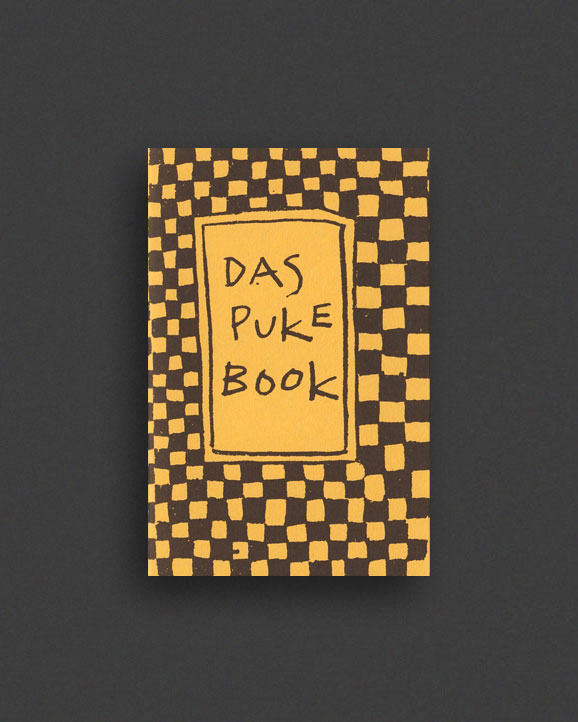
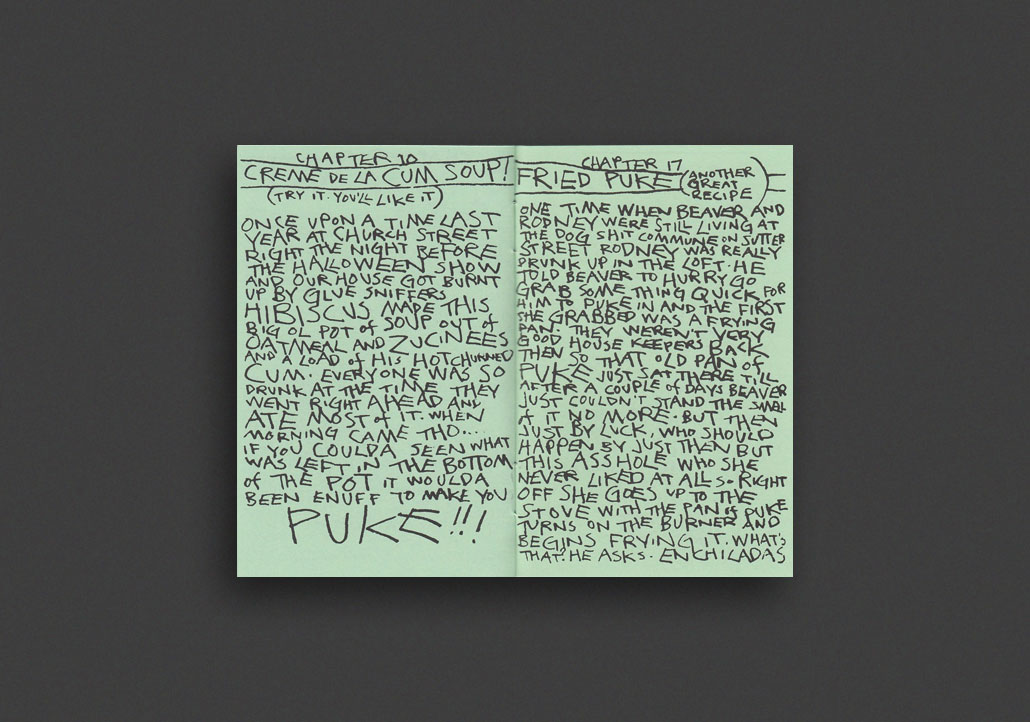
Das Puke Book is a small chapbook self-published by Martin Wong in 1977. Written in the early 1970s, the publication contains thirteen chapters of handwritten micro-fictions filled with cringeworthy stories unfolding in San Francisco and beyond.
Subtitled Da Otto Biography of Otto Peach Fuzz, the publication is populated with a cadre of colorful characters, some of who are obscure underground figures such as George “Hibiscus” Harris from the Cockettes and Angels of Light and Rodney Price and Debra “Beaver” Bauer from Angels of Light, while others such as Paul Gauguin, Vincent van Gogh, and God, are more well known. Although lighthearted, Wong paints unforgettably vivid scenes, such as Van Gogh attacking Gauguin with a razor, Beaver eating so many hot dogs she explodes, and God coming to San Francisco only to find a notebook that makes him so sick to his stomach that he vomits endlessly until the world ends. Written during his days working on the flyers and theatrical backdrops for the Angels of Light Free Theater and published just before his move to New York, these stories capture Wong’s playfulness and the absurdist, kaleidoscopic milieu of the moment in which they were written.
Many of these stories appeared before the book’s publication in Wong’s now-iconic calligraphic scrolls. Possessing a lifelong fascination with language and its representation, Wong began writing in a flickering, calligraphic style in the sixties that found a natural home in the psychedelic movement. During the period that Das Puke Book was written, the artist traveled to Nepal, India, and Afghanistan (which makes an appearance in chapter twelve) to take a mosaic workshop in Herat and study calligraphy and tantric painting. Upon his return, he referred to himself as a tantric set designer until concluding his work with the Angels of Light in 1973–the same year that he finished the work in this book.
Martin Wong (1946-1999) was born in Portland, Oregon and raised in San Francisco, California. He studied ceramics at Humboldt State University, graduating in 1968. Wong was active in the performance art groups The Cockettes and Angels of Light Free Theater before moving to New York in 1978. He exhibited for two decades at notable downtown galleries including EXIT ART, Semaphore, and P·P·O·W, among others, before his passing in San Francisco from an AIDS related illness. His work is represented in the collections of The Metropolitan Museum of Art, New York, NY; Museum of Modern Art, New York, NY; The Bronx Museum of the Arts, New York, NY; Whitney Museum of American Art, New York, NY; Cleveland Museum of Art, Cleveland, OH; Art Institute of Chicago, Chicago, IL; and the San Francisco Museum of Modern Art, San Francisco, CA, among others. Human Instamatic, a comprehensive retrospective, opened at the Bronx Museum of The Arts in November 2015, before traveling to the Wexner Center for the Arts in 2016 and the UC Berkeley Art Museum and Pacific Film Archive in 2017. In 2022, the first extensive, touring exhibition of Wong’s work in Europe, Martin Wong: Malicious Mischief, opened at Museo Centro de Arte Dos de Mayo in Madrid before traveling to KW Institute of Contemporary Art (Berlin), Camden Art Centre (London), and Stedelijk Museum (Amsterdam).
Managing Editor (2024): James Hoff
Managing Designer (2024): Rick Myers
2015, English
Softcover, 336 pages, 21 x 14 cm
Published by
Other Press / US
$40.00 - In stock -
The Guilt Project examines the way in which the law has failed to anticipate the contemporary culture that creates, defines, and punishes rape.
"Rape is culture. There is no separate "rape culture" bubbling beneath our otherwise sunny American society, just as there is no rape culture that is not Indian culture, or British culture, or Mexican culture, at least not at this point. Fraternity culture is rape culture, celebrity culture is rape culture, sports culture is rape culture, university culture is rape culture, military culture is rape culture - even literary culture is rape culture."—from the author's new preface
"A sophisticated, brave look at a topic that too often provokes merely panic, prejudice, and posturing."—Kirkus Reviews
An English court in 1736 described rape as an accusation “easily to be made and hard to be proved, and harder to be defended by the party accused, though never so innocent.” To prove the crime, the law required a woman to physically resist, to put up a “hue and cry,” as evidence of her unwillingness. Beginning in the 1970s, however, feminist and victim-advocacy groups began changing attitudes toward rape so the crime is now seen as violent in itself: the legal definition of rape now includes everything from the sadistic serial rapist to the eighteen-year-old who has consensual sex with a fourteen-year-old.
This inclusiveness means there are now more rapists among us. And more of rape’s camp followers: the prison-makers, the community watchdogs, law-and-order politicians, and the real-crime/real-time entertainment industry. Vanessa Place examines the ambiguity of rape law by presenting cases where guilt lies, but lies uneasily, and leads into larger ethical questions of what defines guilt, what is justice, and what is considered just punishment. Assuming a society can and must be judged by the way it treats its most despicable members, The Guilt Project looks at the way the American legal system defines, prosecutes, and punishes sex offenders, how this Dateline NBC justice has transformed our conception of who is guilty and how they ought to be treated, and how this has come to undo our deeper humanity.
Vanessa Place is an artist, poet, author and criminal appellate attorney practicing in Los Angeles. She has worked on the appeals of more than one thousand indigent felons, specializing in sex offenders and sexually violent predators. She is also a cofounder of Les Figues Press, an independent, nonprofit literary press. Vanessa Place was the first poet to perform in the Whitney Biennial, and has published numerous books of poetry and prose. She is the author of Dies: A Sentence, La Medusa, Exposé des Faits, Statement of Facts, and, with coauthor Robert Fitterman, Notes on Conceptualisms. Her performance venues include the Getty Villa (Los Angeles); Museum of Modern Art (New York); Museum of Contemporary Art (Los Angeles); Detroit Museum of Contemporary Art; Mestno Musej (Ljubljana, Slovenia); New Holland (Saint Petersburg, Russia); Garage Museum (Moscow); Kunstverein, (Köln, Germany); Swiss Institute (New York); Silencio (Paris); and Whitechapel Gallery (London). Her art work has been exhibited at MAK Center/Schindler House (Los Angeles); Denver Museum of Contemporary Art; the Broad Museum (East Lansing, MI); the Kitchen (New York), Cage Gallery (New York), and Various Small Fires (Los Angeles).
2023, English
Softcover, 284 pages, 23.5 x 15.7 cm
Published by
Routledge / London
$90.00 - Out of stock
This is a timely update of a seminal text which re-interprets key films of the horror genre, including Carrie, The Exorcist, The Brood and Psycho.
In the first edition, Creed draws on Julia Kristeva’s theory of abjection to challenge the popular view that women in horror are almost always victims, and argues that patriarchal ideology constructs women as monstrous in relation to her sexuality and reproductive body to justify her subjugation. Although a projection of male fears and paranoid fantasies, the monstrous-feminine is nonetheless a terrifying figure. Creed’s argument contests Freudian and Lacanian theories of sexual difference to offer a provocative rereading of classical and contemporary horror.
This updated edition includes a new section examining contemporary feminist horror films in relation to nonhuman theory. Creed proposes a new concept of radical abjection to reinterpret the monstrous-feminine as a figure who embraces abjection by reclaiming her body and re-defining her otherness as nonhuman – while questioning patriarchy, anthropocentrism, misogyny and the meaning of the human. Films discussed include Ginger Snaps, Teeth, Atlantics, The Girl with All the Gifts, Border and Titane.
Barbara Creed’s classic remains as relevant as ever and this edition will be of interest to academics and students of feminist theory, nonhuman theory, critical animal studies, race, and queer theory.
Barbara Creed is Redmond Barry Distinguished Professor Emeritus at the University of Melbourne. She is the author of seven books, including Darwin’s Screens: Evolutionary Aesthetics, Time and Sexual Display in the Cinema (2009); and Stray: Human- Animal Ethics in the Anthropocene (2017). She is the director of the Human Rights and Animal Ethics Research Network (HRAE). She has been on the boards of Writers Week, the Melbourne International Film Festival and the Melbourne Queer Film Festival.
2023, English
Softcover, 196 pages, 19 x 14 cm
Published by
Pilot Press / London
$40.00 - Out of stock
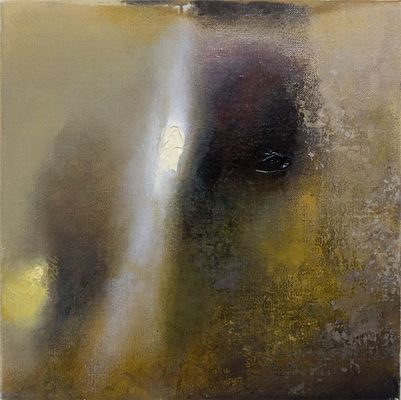
For this volume of Pilot Press' Responses series, responses were sought to the painting Untitled (eye with comet) by Paul Thek. The work was found in his storage after his death from AIDS in 1988.
Contributors: E.R. De Siqueira, Ben Estes, João Motta Guedes, Lucy Swan, Jon Rainford, Louis Shankar, Amy Evans Bauer, Hattie Morrison, Sammy Paloma, AN Grace, James Horton, Nick Wood, Sophie Paul, Jae Vail, Elizabeth Zvonar, Lars Meijer, Clay AD, Michel Kessler, Pablo Miguel Martínez, Emma Harris, Dylan McNulty-Holmes, Kitya Mark, Katherine Franco, Ainslie Templeton, Alistair McCartney, John Brooks, Jesse Howarth, jimmy cooper, Felix Pilgrim, Nicholas Chittenden Morgan, Murphy O’Neir, Rachel Cattle, Isabel Nolan, Susan Finlay, Ted Simonds, Brooke Palmieri, Kate Morgan, Ashleigh A. Allen, Diogo Gama, JP Seabright, Hugo Hagger, Amanda Kraley, Brendan Cook, Matt Bailey, Charlotte Flint, Rodney Schreiner, Lucy Price, Morgan Melhuish, Jordan Weitzman, Jaakko Pallasvuo, Alex Fiorentino, Harald Smart, Marguerite Carson, loll jung, Richard Porter. Nicholas Kalinoski, Hedi El Kholti, Edmund Francis English, Ted Bonin
2023, English
Softcover, 184 pages, 29.5 x 22 cm
Published by
Perimeter Editions / Melbourne
MUMA / Victoria
UNSW Press / Sydney
$55.00 - Out of stock
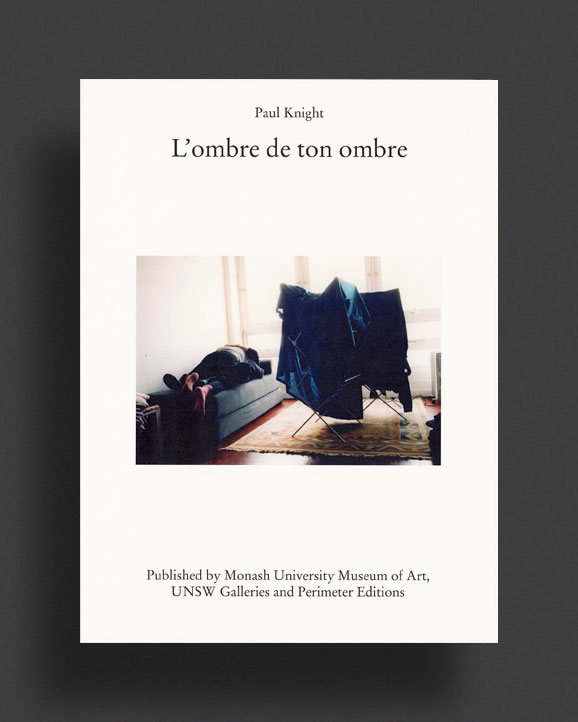
Many species, besides us humans, have developed a notion of love; that absolute beast of biology – love – has filled our brains with delight and sorrow and it has become our most inspirational addition to the line of consciousness. Love is so diverse, complex and complicated to us that it functions more like the air in the array of a storm than a simplistic cause-and-effect response. – Paul Knight
Paul Knight: L’ombre de ton ombre is the first monograph dedicated to Australian-born and Berlin-based artist Paul Knight, co-published by Monash University Museum of Art | MUMA, Melbourne, UNSW Galleries, Sydney, and Perimeter Editions. The publication accompanies his first survey exhibition, co-commissioned by MUMA and UNSW Galleries.
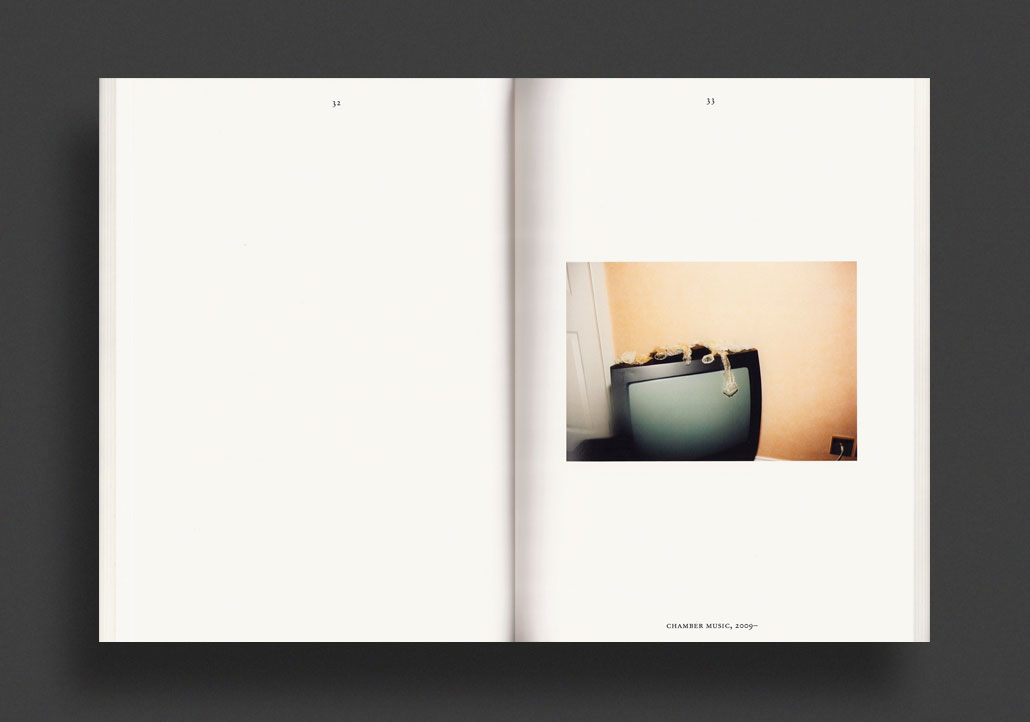
For more than two decades, Knight has taken intimacy as his subject, considering its relationship to representation and the social designs that underpin its expression. This has led him, via an interest in science, to the potential role that intimacy plays in consciousness as an evolutionary line. Knight’s ongoing photographic project, Chamber Music, records the life he shares with his partner Peter. Since their meeting in 2009, the series has accumulated hundreds of glimpses into the domestic space of their relationship, with its images created through varying degrees of pre-meditation and chance; often the camera timer is set so that it simply captures what it sees. The photographs test the ability of this machine – the camera – and the prints it produces to capture and contain intimacy. The images hold human love, which Knight proposes might be our only positive legacy in a future in which machine intelligence carries on, bearing the mark of its creators, beyond humanity itself.
Paul Knight: L’ombre de ton ombre features an extensive selection of photographs from Chamber Music and details the algorithmic working methods of the textile and machine learning works that Knight has developed for the exhibition. It brings artistic and scientific perspectives into conversation with his evolving practice, inviting contributions from: Professor of Contemporary Art History at the Ruskin School of Art, University of Oxford, Anthony Gardner, who situates Knight’s practice within histories of contemporary art and of queer visibility; theoretical astrophysicist and Hawking Chair in Cosmology and Science Communication at the Perimeter Institute for Theoretical Physics, Ontario, Dr Katie Mack, who responds with a poetic evocation of the cosmic timescales that underpin Knight’s thinking; and philosopher Oxana Timofeeva, who reflects on machine learning in the context of human consciousness. The publication will be launched at the exhibition opening at MUMA on 7 October 2023.
MUMA (Melbourne) x UNSW Galleries (Sydney) x Perimeter Editions (Melbourne).
2023, English
Softcover, 592 pages, 21.6 x 28 cm
Published by
Printed Matter Inc. / New York
$95.00 - Out of stock
Dear Jean Pierre collects David Wojnarowicz’s transatlantic correspondence to his Parisian lover Jean Pierre Delage between 1979 and 1982. Capturing a truly foundational moment for Wojnarowicz’s artistic and literary practice, these letters not only reveal his captivating personality – and its concomitant tenderness, compassion, and neuroses – but also index the development of the visual language that would go on to define him as one of the preeminent artists of his generation.
Through this collection, readers are introduced to Wojnarowicz’s Rimbaud series, the band 3 Teens Kill 4, the publication of his first photographs, his early friendship with Peter Hujar, his participation in the then-emerging East Village art and music scenes, and the preparations for the publication of his first book. Included with these writings are postcards, drawings, xeroxes, photographs, collages, flyers, ephemera, and contact sheets that showcase some of the artist’s iconic images and work, such as the Burning House motif and Untitled (Genet, after Brassai).
Beyond these milestones, the book offers a striking portrayal of Wojnarowicz as a twenty-something, detailing his day-to-day life with the type of unbridled earnestness that comes with that age and the softness of love and longing. This disarming tenderness provides a picture of a young man just beginning to find his voice in the world and the love he has found in it.
Although the two exchanged letters in equal measure, Delage’s correspondences have largely been lost, leaving us with only a revelatory glimpse into the internal world of Wojnarowicz during what turned out to be his formative years.
2021, English
Softcover, 144 pages, 21 x 13.5 cm
Published by
Soho Press / New York
$32.00 - Out of stock
“I started writing books about and for my friend George Miles because whenever I would speak about him honestly like I am doing now I felt a complicated agony beneath my words that talking openly can’t handle.”
For most of his life, Dennis Cooper believed the person he had loved the most and would always love above all others was George Miles. In his first novel in ten years, Dennis Cooper writes about George Miles, love, loss, addiction, suicide, and how fiction can capture these things, and how it fails to capture them. Candid and powerful, I Wished is a radical work of shifting forms. It includes appearances by Santa Claus, land artist James Turrell, sentient prairie dogs, John Wayne Gacy, Nick Drake, and George, the muse for Cooper’s acclaimed novels Closer, Frisk, Try, Guide, and Period, collectively known as “The George Miles Cycle.” In revisiting the inspiration for the Cycle, Dennis has written a masterwork: the most raw, personal, and haunted book of his career.
Dennis Cooper (born 1953) is an American novelist, poet, critic, editor and performance artist who grew up in the Southern California. In 1976, he founded Little Caesar Magazine and Press, which he ran until 1982. In 1985, he moved to Amsterdam for two and a half years, where he began his ten year long project, The George Miles Cycle, an interconnected sequence of five novels that includes Closer, Frisk, Try, Guide, and Period. His post-George Miles Cycle novels include My Loose Thread, The Sluts and God, Jr. Other works include the short-story collections Wrong and Ugly Man, poetry collections The Dream Police and The Weaklings, as well as the recent Smothered in Hugs: Essays, Interviews, Feedback, and Obituaries. Dennis Cooper currently spends his time between Los Angeles and Paris.
First paperback edition.
2024, English
Softcover, 240 pages, 21.5 x 15.2 cm
Published by
Nightboat Books / New York
$46.00 - In stock -
Collected for the first time, four landmark works of queer experimental poetry by reclusive cult poet David Melnick, known for his prowess with invented language and sound poetry.
David Melnick's Nice: Collected Poems spans twenty crucial years of gay life and experimentation with poetic form, bringing together four masterworks of American literature: Eclogs (1967-70), ten episodes in the urban afterlife of pastoral; PCOET (1972), written in an unknown tongue, verse for a world that's yet to be; Men in Aida (1983-85), Melnick's masterpiece, a giddy epic of queer community; and A Pin's Fee (1988), a backward glance and elegy, a cry of pain, howl of anger.
"An autobiographical narrative of indefinite description but definite emotional scope sits behind the surface of the text, a surface...magically moved in and out of focus."—Tom Mandel
"It isn't just that this book queers the ways in which meaning is understood.... It also sites the reader in a homographical relation to language, one of having to parse what looks, or sounds, or seems 'like,' something we're familiar with, while also abandoning previous assumptions about what this process might entail."—Colin Herd
"Melnick's twist of "gay ethic" in poetic language makes for a brief but unforgettable oeuvre. Nice: Collected Poems proves that David Melnick is an exemplary figure of unreadability in American poetics, one who continues to teach us of unreadability's pleasures, politics, and pains. . . [T]he posthumous volume brings the once-hermetic Melnick out into the light of new audiences."—Gabriel Ojeda-Sague, Harriet
"A gem of consciousness through which facets dream of their kinfolk radiance."—Aaron Shurin