World Food Books' programme is largely produced on Kulin Nation land. We acknowledge the Wurundjeri people of the Kulin Nation as the first and continuing custodians of this land, and pay respect to their Elders past, present, and emerging.
World Food Books is an arts and special interests bookshop in Naarm / Melbourne. Founded in 2010, World Food Books is devoted to the presentation of a rotating, hand-selection of international art, design, literary and counterculture publications with an emphasis on the anti-traditional, the experimental, the avant-garde, the heretic, the marginal.
Presenting new titles alongside rare and out-of-print books, catalogues and journals spanning the fields of modern and contemporary art, design, photography, illustration, film, literature, poetry, cultural theory, philosophy, sexuality, popular and underground culture in its many radical forms, World Food Books wishes to encourage adventurous, thoughtful and open-minded reading, looking, writing, and exchange of publishing and ideas, both current and historical.
As well as our bookshop, located in Melbourne's historical Nicholas Building, all of our inventory is available internationally via our online mail-order service.
World Food Books semi-regularly co-ordinates "Occasions", a programme of exhibits and events at the bookshop and in partnership with other hosts (such as museums and art galleries) that develop out of the activities, relationships and content of the bookshop itself.
World Food Books
The Nicholas Building
37 Swanston Street
Room 5, Level 6
Melbourne 3000
Australia
SHOP HOURS:
THU–SAT 12–6
WEB-SHOP OPEN 24/7
World Food Books
Postal Address:
PO Box 435
Flinders Lane
Victoria 8009
Australia
Art
Theory / Essay
Architecture / Interior
Graphic Design / Typography
Photography
Fashion
Eros
LGBTQ+
Fiction / Poetry
Weird / Speculative / Science Fiction / Horror
Transgressive / Visceral / Abject
Symbolism / Decadence / Fin de siècle
Film / Video
Painting
Sculpture / Installation
Performance / Dance / Theater
Drawing
Sound / Music
Curatorial
Group Shows / Collections
Periodicals
Out-of-print / Rare
Posters / Ephemera / Discs
Signed Books
World Food Books Gift Voucher
World Food Book Bag
Australian Art
Australian Fiction
Australian Science Fiction / Speculative Fiction
Australian Poetry
Australian Photography
Japanese Photography
Conceptual Art
Minimal Art
Dada
'Pataphysics / Oulipo
Fluxus
Concrete Poetry
Pop Art
Surrealism
Arte Povera
Arte Informale / Haute Pâte / Tachism
Nouveau Réalisme / Zero / Kinetic
Situationism / Lettrism
Collage / Mail Art / Xerox Art
Art Brut / Folk / Visionary / Fantastic
Illustration / Graphic Art / Bandes Dessinées
Furniture
Italian Radical Design / Postmodernism
Textiles
Ceramics / Glass
Counterculture
Protest / Revolt
Philosophy
Psychoanalysis
Anthropology
Anarchism
Socialism / Anarchism / Communism / Capitalism
Literary Theory / Semiotics / Language
Feminism / Women's Studies
Gender Studies / Sexuality
Anthropology
Fetishism / BDSM
Drugs / Psychedelia
Crime / Violence
Animal Rights / Veganism
Occult / Esoterica
Ecology / Earth / Alternative Living
Whole Earth / Crafts
All prices in AUD (Australian dollars)
Pick-Ups
Pick-up orders can be collected in our bookshop during opening hours after order date. Please collect any Pick-up orders within 2 weeks of ordering as we have limited storage space. Orders will be released back into stock if not collected within this time. No refunds can be made for pick-ups left un-collected. If you cannot make it in to the bookshop in this time-frame, please choose postage option.
Return Policy
All sales are final. We do accept returns (for refund or exchange) for items received in error. All our orders are packed with special care using heavy-duty padding and cardboard book-mailers or bubble mailers (for smaller books), using reinforcement where required. We cannot take responsibility for any lost, stolen or damaged parcels.
Insurance
Should you wish to insure your package, please email us directly after placing your order and we can organise this at a small extra expense. Although all standard/express tracked packages are very safe and dependable, we cannot take responsibility for any lost, stolen or damaged parcels. We recommend insurance on valuable orders.
Interested in selling your old books, catalogues, journals, magazines, comics, fanzines, ephemera? We are always looking for interesting, unusual and out-of-print books to buy. We only buy books in our fields of interest and specialty, and that we feel we can resell.
We base these prices on desirability, market value, in-print prices, condition and our current stock levels. We offer cash, store credit, and can take stock on consignment. All
about 25% of the price we expect to get when we sell them, or 30% in store credit. We base these prices on desirability, market value, in-print prices, condition and our current stock levels.
Sell your books any day of the week. You can drop them off and return later. If you have a lot of books, we can visit your Sydney home.
We buy books that we feel we can resell. We offer about 25 % of the price we expect to get when we sell them, or 30% in store credit. We base these prices on desirability, market value, in-print prices, condition and our current stock levels.
Philadelphia Wireman
03 August - 01 September, 2018
World Food Books is proud to announce our next Occasion, the first presentation of sculptures by Philadelphia Wireman in Australia.
The Philadelphia Wireman sculptures were found abandoned in an alley off Philadelphia’s South Street on trash night in 1982. Their discovery in a rapidly-changing neighbourhood undergoing extensive renovation, compounded with the failure of all attempts to locate the artist, suggests that the works may have been discarded after the maker’s death. Dubbed the "Philadelphia Wireman" during the first exhibition of this work, in 1985, the maker’s name, age, ethnicity, and even gender remain uncertain. The entire collection totals approximately 1200 pieces, all intricately bound together with tightly-wound heavy-gauge wire (along with a few small, abstract marker drawings, reminiscent both of Mark Tobey and J.B. Murry). The dense construction of the work, despite a modest range of scale and materials, is singularly obsessive and disciplined in design: a wire armature or exoskeleton firmly binds a bricolage of found objects including plastic, glass, food packaging, umbrella parts, tape, rubber, batteries, pens, leather, reflectors, nuts and bolts, nails, foil, coins, toys, watches, eyeglasses, tools, and jewellery.
Heavy with associations—anthropomorphic, zoomorphic, and socio-cultural responses to wrapped detritus—the totemic sculptures by Philadelphia Wireman have been discussed in the context of work created to fulfil the shamanistic needs of alternative religions in American culture. Curators, collectors, and critics have variously compared certain pieces to sculpture from Classical antiquity, Native American medicine bundles, African-American memory jugs, and African fetish objects. Reflecting the artist’s prolific and incredibly focused scavenging impulse, and despite—or perhaps enhanced by—their anonymity, these enigmatic objects function as urban artefacts and arbiters of power, though their origin and purpose is unknown. Philadelphia Wireman, whatever their identity, possessed an astonishing ability to isolate and communicate the concepts of power and energy through the selection and transformation of ordinary materials. Over the course of the past two decades, this collection has come to be regarded as an important discovery in the field of self-taught art and vernacular art.
Presented in collaboration with Fleisher-Ollman Gallery, Philadelphia, and Robert Heald, Wellington.
Susan Te Kahurangi King
02 February - 10 March, 2018
Susan Te Kahurangi King (24 February 1951 - ) has been a confident and prolific artist since she was a young child, drawing with readily available materials - pencils, ballpoint pens and felt-tip markers, on whatever paper is at hand. Between the ages of four and six Susan slowly ceased verbal communication. Her grandparents William and Myrtle Murphy had developed a special bond with Susan so they took on caring responsibilities for extended periods. Myrtle began informally archiving her work, carefully collecting and storing the drawings and compiling scrapbooks. No drawing was insignificant; every scrap of paper was kept. The King family are now the custodians of a vast collection containing over 7000 individual works, from tiny scraps of paper through to 5 meter long rolls.
The scrapbooks and diaries reveal Myrtle to be a woman of great patience and compassion, seeking to understand a child who was not always behaving as expected. She encouraged Susan to be observant, to explore her environment and absorb all the sights and sounds. Myrtle would show Susan’s drawings to friends and people in her community that she had dealings with, such as shopkeepers and postal workers, but this was not simply a case of a grandmother’s bias. She recognised that Susan had developed a sophisticated and unique visual language and sincerely believed that her art deserved serious attention.
This was an unorthodox attitude for the time. To provide some context, Jean Dubuffet coined the term Art Brut in 1945 to describe work created by self-taught artists – specifically residents of psychiatric institutions and those he considered to be visionaries or eccentrics. In 1972 Roger Cardinal extended this concept by adopting the term Outsider Art to describe work made by non-academically trained artists operating outside of mainstream art networks through choice or circumstance. Susan was born in Te Aroha, New Zealand in 1951, far from the artistic hubs of Paris and London that Dubuffet and Cardinal operated in. That Myrtle fêted Susan as a self-taught artist who deserved to be taken seriously shows how progressive her attitudes were.
Susan’s parents Doug and Dawn were also progressive. Over the years they had consulted numerous health practitioners about Susan’s condition, as the medical establishment could not provide an explanation as to why she had lapsed into silence. Dawn educated herself in the field of homeopathy and went on to treat all twelve of her children using these principles – basing prescriptions on her observations of their physical, mental and emotional state.
Doug was a linguist with an interest in philosophy who devoted what little spare time he had to studying Maori language and culture. To some extent their willingness to explore the fringes of the mainstream made them outsiders too but it was their commitment to living with integrity and their respect for individuality that ensured Susan’s creativity was always encouraged.
Even though Susan’s family supported her artistic pursuits, some staff in schools and hospitals saw it as an impediment to her assimilation into the community and discouraged it in a variety of ways. Her family was not always aware of this and therefore did not fully understand why Susan stopped drawing in the early 1990s. However, rather than dwell on the challenges that Susan faced in pursuit of her artistic practice, they prefer to highlight her achievements. In 2008 Susan began drawing again in earnest, after an almost 20 year interruption, and her work is now shown in galleries around the world.
Susan grew up without television and has been heavily influenced by the comics she read as a child. She is absolutely fearless in the appropriation of recognizable characters, such as Donald Duck and Mickey Mouse, in her work. She twists their limbs, contorts their faces, compresses them together, blends them into complex patterned backgrounds - always imbuing them with an incredible energy. Although Susan often used pop culture characters in her work they are not naive or childlike. These are drawings by a brilliant self-taught artist who has been creating exceptional work for decades without an audience in mind.
Mladen Stilinović
"Various Works 1986 - 1999"
02 February 16 - September 10, 2016
Various works 1986 - 1999, from two houses, from the collections of John Nixon, Sue Cramer, Kerrie Poliness, Peter Haffenden and Phoebe Haffenden.
Including: Geometry of Cakes (various shelves), 1993; Poor People’s Law (black and white plate), 1993; White Absence (glasses, ruler, set square, silver spoon, silver ladel with skin photograph and wooden cubes), 1990-1996; Exploitation of the Dead (grey and red star painting, wooden painting, black spoon with red table, red plate), 1984-1990; Money and Zeros (zero tie, paintings made for friends in Australia (Sue, John, Kerrie), numbers painting), 1991-1992; Words - Slogans (various t-shirts) - “they talk about the death of art...help! someone is trying to kill me”, “my sweet little lamb”, “work is a disease - Karl Marx”; Various artist books, catalogues, monographs, videos; Poster from exhibition Insulting Anarchy; "Circular" Croatian - Australian edition; Artist book by Vlado Martek (Dostoyevsky); more.
Thanks to Mladen Stilinović and Branka Stipančić.
Jonathan Walker
Always Will Need To Wear Winter Shirt Blue + Ochre Small Check Pattern
21 August - 21 September, 2015
Untitled
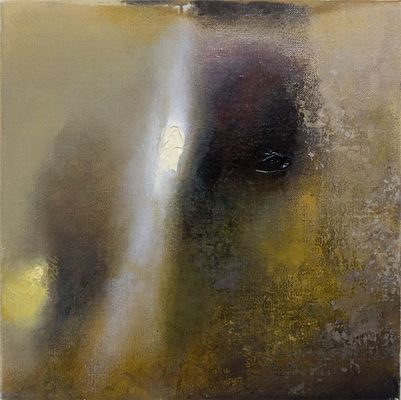
I am not a great reader of poetry but I always return to the work of Melbourne poet, Vincent Buckley (1925- 1988). Perhaps I find his most tantalising piece to be not a finished poem but a fragment left on a scrap of paper discovered on his desk after the poet’s death.
The poetry gathers like oil
In the word-core, and spreads
It has its music meet,
Its music is in movement.
This fragment is more the shell left behind from a volatile thought than a finished poem. I find the last two lines honest but awkward whereas the first two lines work like an arrow. Most likely he could not find a resolution so it was left. Still, in its present form, it remains an eloquent testimony to the ultimate failure of a medium to express mobile thought and sensation, in Buckley’s case, through verbal language. It’s an important matter because this is something all artists have to deal with regardless of the medium.
I have never written a poem, however, I am forever copying fragments from books on paper scraps in a vain effort to fix certain notions in my head. At first, they function as bookmarks that are sometimes returned to when I open the book. But before long, as they accumulate, they fall out littering the table interspersed with A4 photocopies, bills, books and medications.
To return to Buckley’s fragment, the first two lines very much evoke how I paint nowadays. As you age, detail diminishes and patches of light become more luminous and float. I feel the most honest way of dealing with this is by smearing the oil paint on the canvas with the fingers and working close-up, blind. Only if the patches coalesce into an approaching image can the work gain a life.
-
Jonathan Walker was born in Melbourne, Australia and brought up on a dairy farm in Gippsland. In the 1970’s he studied painting at RMIT and won the Harold Wright Scholarship to the British Museum, London. During the 1980’s he exhibited at Pinacotheca Gallery, Richmond and had work shown at the NGV and Heidi City Art Gallery. Over the same period he designed the cover for the “Epigenesi” LP by Giancarlo Toniutti, Italy and conducted a mail exchange work with Achim Wollscheid, Germany. The work with artists through the post resulted in an article published in the bicentenary issue of Art and Australia 1988. He showed in artist run spaces such as WestSpace in the 90’s and 2000’s, and until 2012, taught painting at Victoria University, which is where we (Colleen Ahern and Lisa Radford) as organisers of the exhibition, among many others, had the privilege of being his student.
Walker’s knowledge was imparted to students through the careful selection of music, literature, and artists found in books that he himself had ordered for the library. Walker’s strategy was the generosity of sharing his vast knowledge with references specific to each student and their context.
Walker’s paintings share a similar focus and intimacy.
This exhibition presents a small selection of recent paintings alongside a publication that includes Walker’s writing. Observational and analytical, Walker’s work is a type of material notation — the time of day, colour and how it is blended, the both specific and fleeting location of a reflection on lino or the question of whether a chair leg should be included in a painting.
Please join us on Friday August 21 between 6-8pm to celebrate the opening of the exhibition.
Curated by Colleen Ahern and Lisa Radford.
B. Wurtz
Curated by Nic Tammens
March 26 - April 4, 2015
B.Wurtz works from a basement studio in his home on Manhattan’s Lower East Side.
This local fact is attested to by the plastic shopping bags and newsprint circulars that appear in his work. As formal objects, they don’t make loud claims about their origins but nonetheless transmit street addresses and places of business from the bottom of this long thin island. Like plenty of artists, Wurtz is affected by what is local and what is consumed. His work is underpinned by this ethic. It often speaks from a neighborhood or reads like the contents of a hamper:
“BLACK PLUMS $1.29 lb.”
“Food Bazaar”
“USDA Whole Pork Shoulder Picnic 99c lb.”
“RITE AID Pharmacy, with us it’s personal.”
“H. Brickman & Sons.”
“Sweet Yams 59c lb."
Most of the work in this exhibition was made while the artist was in residence at Dieu Donne, a workshop dedicated to paper craft in Midtown. Here Wurtz fabricated assemblages with paper and objects that are relatively lightweight, with the intention that they would be easily transportable to Australia. This consideration isn’t absolute in Wurtz’s work, but was prescriptive for making the current exhibition light and cheap. Packed in two boxes, these works were sent from a USPS post office on the Lower East Side and delivered to North Melbourne by Australia Post.
Wurtz appears courtesy of Metro Pictures, New York.
Thanks to Rob Halverson, Joshua Petherick, Sari de Mallory, Matt Hinkley, Helen Johnson, Fayen d'Evie, Ask Kilmartin, Lisa Radon, Ellena Savage, Yale Union, and "Elizabeth".
John Nixon
"Archive"
December 15 - January 20, 2014
The presentation of John Nixon's archive offered a rare showcase of this extensive collection of the artist's own publications, catalogues, posters, ephemera, editions and more, from the mid 1980s onwards, alongside a selection of his artworks.
Organized by John Nixon, Joshua Petherick and Matt Hinkley.
"Habitat"
at Minerva, Sydney (organised by Joshua Petherick and Matt Hinkley)
November 15 - December 20, 2014
Lupo Borgonovo, Janet Burchill & Jennifer McCamley,
Lewis Fidock, HR Giger, Piero Gilardi, Veit Laurent Kurz,
Cinzia Ruggeri, Michael E. Smith, Lucie Stahl, Daniel Weil, Wols
Press Release:
“...It contained seven objects. The slender fluted bone, surely formed for flight, surely from the wing of some large bird. Three archaic circuitboards, faced with mazes of gold. A smooth white sphere of baked clay. An age-blackened fragment of lace. A fingerlength segment of what she assumed was bone from a human wrist, grayish white, inset smoothly with the silicon shaft of a small instrument that must once have ridden flush with the surface of the skin - but the thing’s face was seared and blackened.”
William Gibson, “Count Zero”, 1986
"Autumn Projects Archive"
Curated by Liza Vasiliou
March 6 - March 15, 2014
World Food Books, in conjunction with the Virgin Australia Melbourne Fashion Festival 2014, presented the Autumn Projects archive, consisting of a selection of early examples in Australian fashion with a particular interest in collecting designers and labels from the period beginning in the 1980’s, who significantly influenced the discourse of Australian Fashion.
Curated by Liza Vasiliou, the exhibition provided a unique opportunity to view pieces by designers Anthea Crawford, Barbara Vandenberg, Geoff Liddell and labels CR Australia, Covers, Jag along with early experimental collage pieces by Prue Acton and Sally Browne’s ‘Fragments’ collection, suspended throughout the functioning World Food Books shop in Melbourne.
H.B. Peace
presented by CENTRE FOR STYLE
November 14, 2013
"Hey Blinky, you say chic, I say same"
Anon 2013
H.B. Peace is a clothing collaboration between great friends Blake Barns and Hugh Egan Westland. Their pieces explore the divergences between 'character’ and ‘personality’ in garments....etc
Special Thanks to Joshua Petherick and Matt Hinkley of WFB and Gillian Mears
and a Very Special Thank you to Audrey Thomas Hayes for her shoe collaboration.
Janet Burchill & Jennifer McCamley
"Aesthetic Suicide"
May 10 - June 8, 2013
The first of our occasional exhibitions in the World Food Books office/shop space in Melbourne, "Aesthetic Suicide" presented a body of new and older works together by artists Janet Burchill & Jennifer McCamley, including videos, prints, a wall work, and publications.
During shop open hours videos played every hour, on the hour.
1974, Japanese
Softcover, 210 pages, 21 x 15 cm
1st Edition, Out of print title / used / good
Published by
Bunken Shiryo Kankokai / Tokyo
$55.00 $35.00 - Out of stock
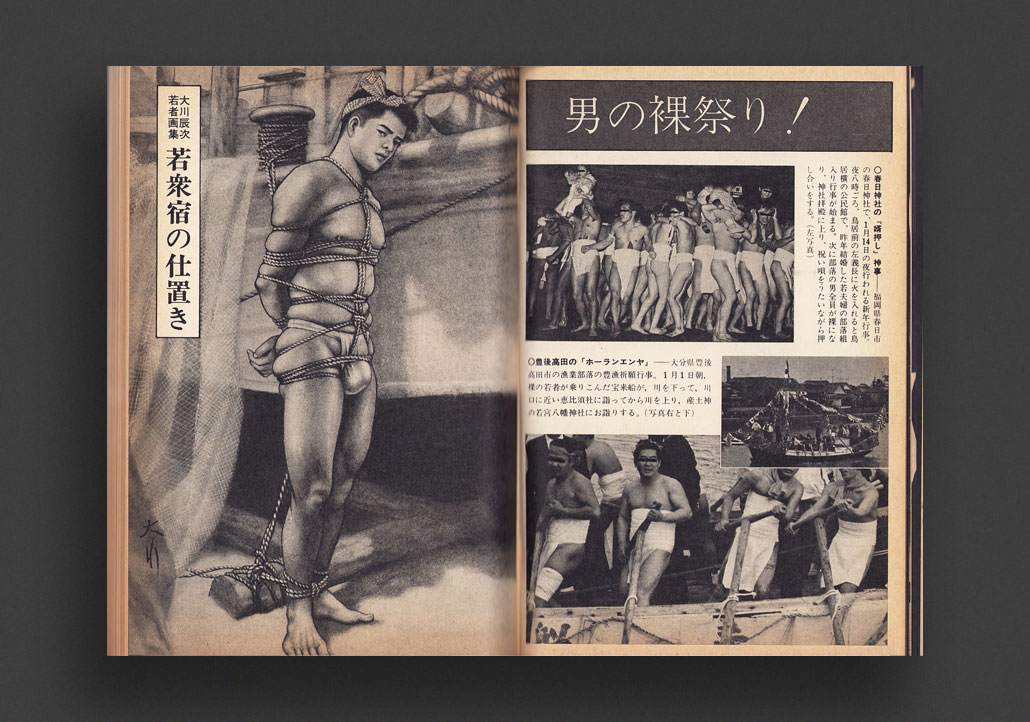
April 1974 issue of Fuzoku Kitan, an important Japanese SM magazine was published between 1960—1974, and edited by Hajime Takakura. Filled with SM stories and illustrations, along with colour and b/w gravure photographic kitan and fetish photoshoots and art galleries, the magazine published a wild array of subjects on sexual customs, especially a significant amount of queer and transgender sexuality, lots of cross-dressing, masochism, torture, sodomy, sadophelia and fem-dom material. Includes artwork by Tatsuji Okawa, Men's Naked Festival, artwork by Gene Bilbrew, Flowers In Full Bloom (Western SM photography and play), kinbaku photo gallery, fem-fem Western spanking photography, lots of stories from Japanese cross-dressers, readers confessions, a treasure-trove of illustrated transgressive fiction, almost all articles under nom de plumes! Also, excellent ads.
VG—Good copy, with light wear, tanning.
1962, Japanese
Softcover, 190 pages, 21 x 15 cm
1st Edition, Out of print title / used / good
Published by
Bunken Shiryo Kankokai / Tokyo
$100.00 $80.00 - Out of stock
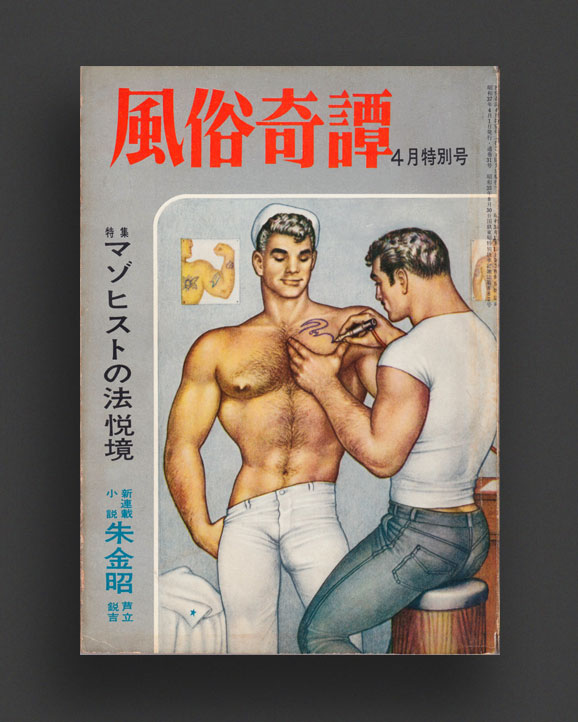
Very rare early special "Masochist Ecstasy" issue of Fuzoku Kitan, an important Japanese SM magazine was published between 1960-1974, and edited by Hajime Takakura. Filled with SM stories and illustrations, along with colour and b/w gravure photographic kitan and fetish photoshoots and art galleries, the magazine published a wild array of subjects on sexual customs, especially a significant amount of western SM artists and material introduced to Japanese audiences and a great deal of queer sexuality. This issue from 1962 is probably one of the finest examples of this, featuring photographic spreads of Japanese and western male physique models, Japanese cross-dressers, Japanese and western female kinbaku/bondage photography, the "man, man, man, man's world!" feature of queer western romanesque illustration from George Quaintance, Tom of Finland, and others, illustrated cover article on Masochism, stories from Japanese cross-dressers, illustrated fiction of gay and lesbian SM stories, as well as lots of fem-dom, sodomy and sadophelia. Almost all articles under nom de plumes! Cover art by Tom of Finland.
Good copy, with edge wear and tanning from age. Binding great.
1969, Japanese
Softcover, 242 pages, 21 x 15 cm
1st Edition, Out of print title / used / good
Published by
Bunken Shiryo Kankokai / Tokyo
$45.00 - Out of stock
March 1969 issue of Fuzoku Kitan, an important Japanese SM magazine was published between 1960—1974, and edited by Hajime Takakura. Filled with SM stories and illustrations, along with colour and b/w gravure photographic kitan and fetish photoshoots and art galleries, the magazine published a wild array of subjects on sexual customs, especially a significant amount of queer and transgender sexuality, lots of cross-dressing, masochism, torture, sodomy, sadophelia and fem-dom material. Includes documentation of performance of author Isamu Kurita's "Aikyo" (Tadanori Yokoo, Akira Uno collaborator), fetish artworks by Gene Bilbrew and Eric Stanton, female equestrianism photography, fem-fem Western spanking photography, lots of stories from Japanese cross-dressers, readers confessions, a treasure-trove of illustrated transgressive fiction, almost all articles under nom de plumes! Also, excellent ads.
VG—Good copy, with light wear, tanning.
1972, Japanese
Softcover, 190 pages, 21 x 15 cm
1st Edition, Out of print title / used / good
Published by
Bunken Shiryo Kankokai / Tokyo
$45.00 $25.00 - Out of stock
March 1972 issue of Fuzoku Kitan, an important Japanese SM magazine was published between 1960—1974, and edited by Hajime Takakura. Filled with SM stories and illustrations, along with colour and b/w gravure photographic kitan and fetish photoshoots and art galleries, the magazine published a wild array of subjects on sexual customs, especially a significant amount of queer and transgender sexuality, lots of cross-dressing, masochism, torture, sodomy, sadophelia and fem-dom material. Art gallery by master of kinbaku illustration Yoko Ozuma, equestrianism photography, lots of stories from Japanese cross-dressers, readers confessions, a treasure-trove of illustrated transgressive fiction, almost all articles under nom de plumes! Also, excellent ads.
VG—Good copy, with light cover/spine wear, tanning.
2023, English
Softcover, 136 pages, 20.1 x 13.6 cm
Published by
Semiotext(e) / Los Angeles
$35.00 - Out of stock
The first complete edition of this notorious novel which maps the 1980s anarchic underground of Los Angeles.
Published in excerpts over almost four decades, Jack Skelley's "secretly legendary" novel is at once an homage to the thrillingly inventive spirit of Kathy Acker's cut-up novels and a definitive history of LA's underground culture of the mid-1980s.
Composed in bursts, Fear of Kathy Acker depicts Los Angeles through the eyes of a self-mocking narrator. Shifting styles and personae as he moves between Venice and Torrance, punk clubs and shopping malls, Disneyland and Dodger Stadium, Jack Skelley pushes the limits of language and identity while pursuing-like Kathy Acker-a quixotic literary mix of discipline and anarchy. In this adrenalized, cosmic, and comic chronicle of Los Angeles, Skelley's "real life" friends make cameo appearances alongside pop archetypes from Madonna to Billy Idol.
This first-ever complete edition of the book includes new essays, playlists, and a map of the 1980s Los Angeles in which its manic protagonist lives and loves.
"Fear of Kathy Acker is one of the great lost masterpieces of '80s experimental fiction. That it's no longer an inaccessible legend is huge."—Dennis Cooper
"Jack Skelley pours it on like sometimes blam blam blam like the riff in "Death Valley '69" but mostly with a surfer's rhythm like the cool throb of his guitar, his writing the poetics of pink love and punk pool splash action, the sound I adore."—Thurston Moore
"Despite the dislike of seeing my own name, you're really a good writer—never what's expected."—Kathy Acker
"Deft, deadpan, dreadful, deliberate, delirious. Perfect adult bedtime reading."—Jane Rankin-Reid, White Hot Magazine
1982, English / Japanese
1st Edition, Out of print title / used / very good
Published by
Genko-sha / Tokyo
$100.00 - In stock -
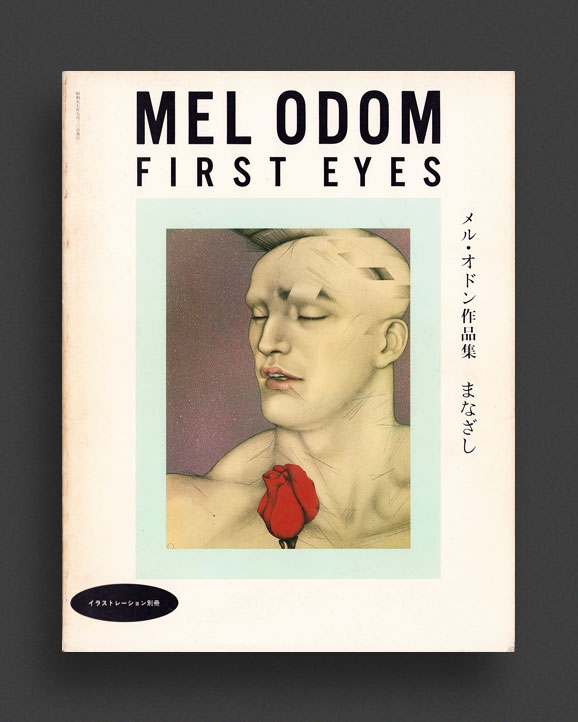
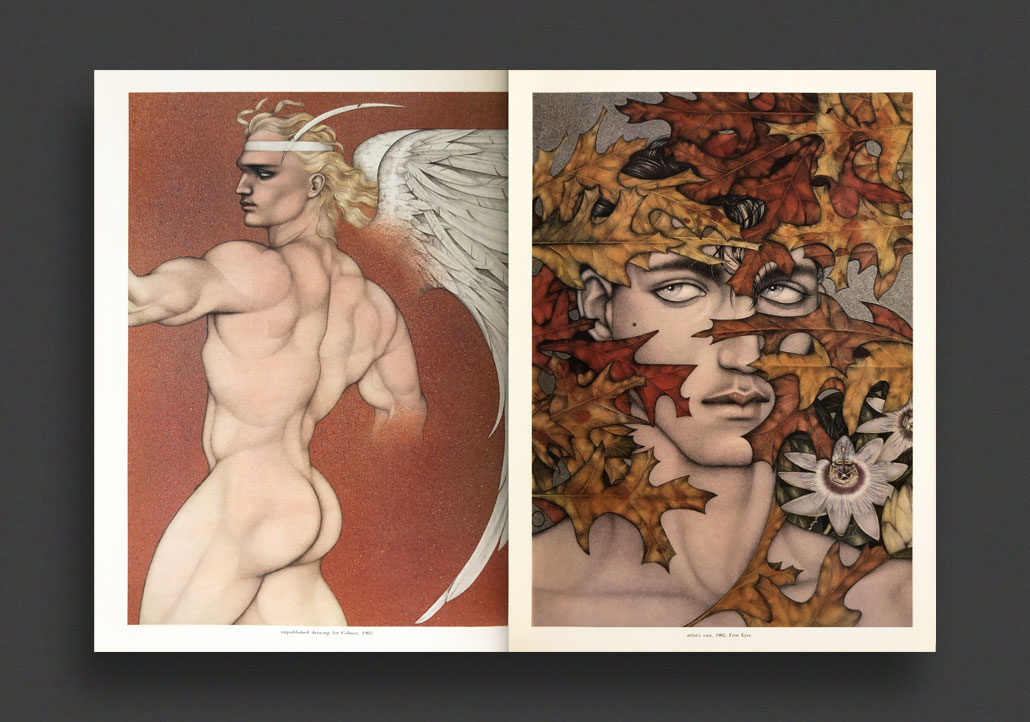
First printing of the first ever book on the work of queer American illustrator Mel Odom (b. 1950), published in Japan in 1982. Profusely illustrated throughout with Odom's dreamy, highly-stylised, erotically-charged fantasy illustrations, made famous adorning the paperback covers of novels by Patrick White and in the pages of Blue Boy and through Odom's award-winning and still lauded tenure at Playboy. Odom's delicate and dreamy men struck a chord with the viewing public. They were finally seeing male figures of lust depicted lovingly, softly, in the sea of aggressive hyper-masculinity that dominated gay aesthetics of the time. Alongside his many masterful works (that owe much to art deco, the silver screen, and pre-Raphaelite sensuality) reproduced together for the first time, First Eyes also includes Odom's childhood drawings, photographic portraits, his sculptural painted masks, and much more. All texts in English and Japanese.
Very Good copy with light tan/wear.
1992, English
Softcover, 288 pages, 14.6 x 22.3 cm
1st Edition, Out of print title / used / very good
Published by
Gay Men's Press / London
$160.00 - In stock -
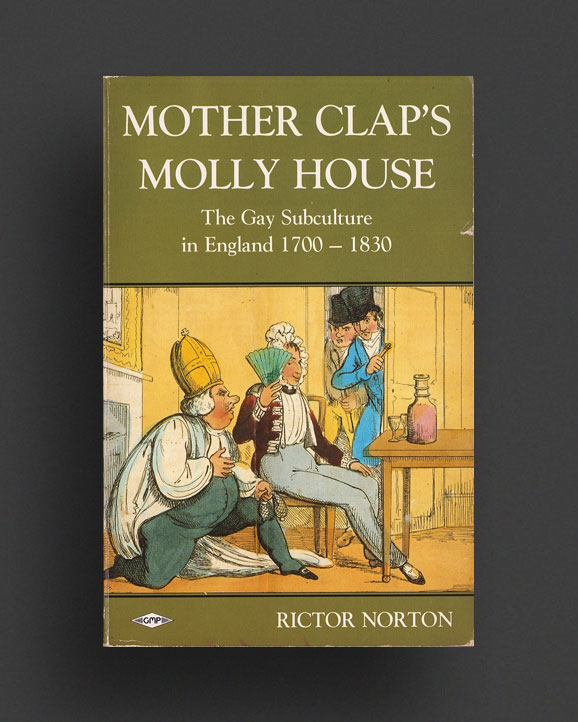
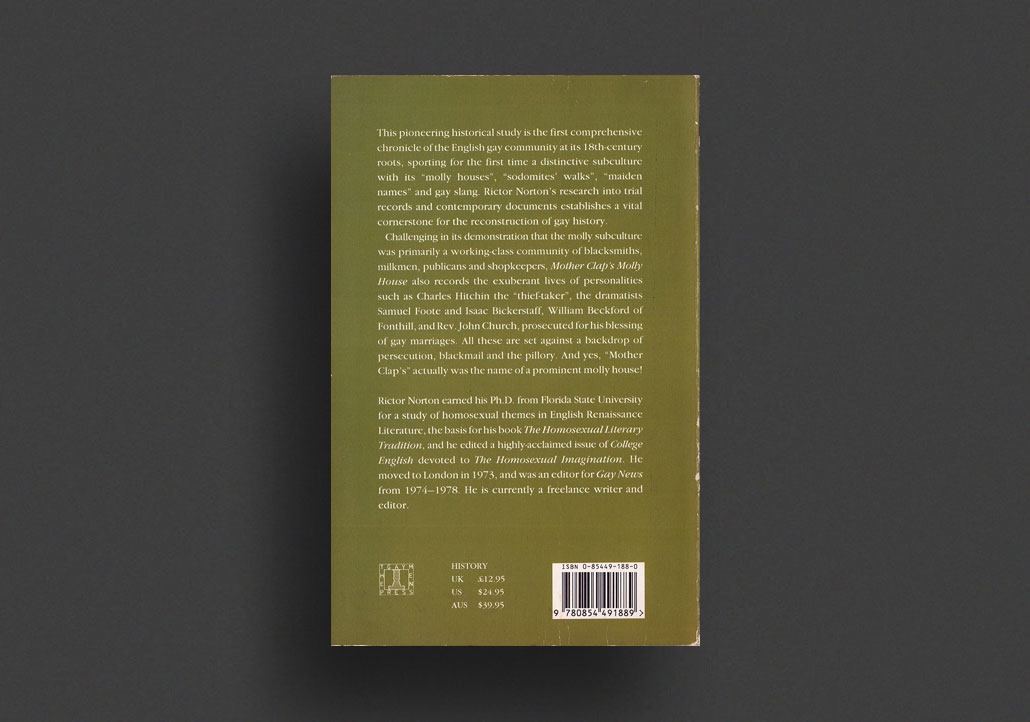
Very rare 1992 Gay Men's Press first printing of this pioneering historical study — the first comprehensive chronicle of the English gay community at its 18th-century roots, sporting for the first time a distinctive subculture with its "molly houses", "sodomites' walks", "maiden names" and gay slang. Rictor Norton's research into trial records and contemporary documents establishes a vital cornerstone for the reconstruction of gay history. Challenging in its demonstration that the molly subculture was primarily a working-class community of blacksmiths, milkmen, publicans and shopkeepers, Mother Clap's Molly House also records the exuberant lives of personalities such as Charles Hitchin the "thief-taker", the dramatists Samuel Foote and Isaac Bickerstaff, William Beckford of Fonthill, and Rev. John Church, prosecuted for his blessing of gay marriages. All these are set against a backdrop of persecution, blackmail and the pillory. And yes, "Mother Clap's" actually was the name of a prominent molly house!
Rictor Norton earned his Ph.D. from Florida State University for a study of homosexual themes in English Renaissance Literature, the basis for his book The Homosexual Literary Tradition, and he edited a highly-acclaimed issue of College English devoted to The Homosexual Imagination. He moved to London in 1973, and was an editor for Gay News from 1974-1978.
VG—Good copy with some light wear, tiny closed tear to cover right edge, foxing to endpapers and block edge, otherwise Very Good copy throughout, uncreased spine.
1992, English
Softcover, 410 pages, 23.17 x 16.66 cm
1st Edition, Out of print title / used / very good
Published by
University of Chicago Press / Chicago
$45.00 - Out of stock
From incest to infanticide, from breast-feeding and women's sexuality to female prostitution, from pornography to reproductive politics, and from the first homosexual rights movement to AIDS—this anthology addresses these and other crucial questions concerning the regulation of sexuality: How have society's values and attitudes toward sexuality and morality changed over the centuries? Why and how has the state sought to criminalize certain forms of sexual behavior and to control reproduction? How have churches tried to influence the state in its regulation of sexuality?
Contributions from a diverse group of prominent scholars representing a variety of disciplines are included in this anthology that spans European history. Essays by Randolph Trumbach on "Sex, Gender, and Identity in Modern Culture: Male Sodomy and Female Prostitution in Enlightenment London"; Ruth Perry on "Colonizing the Breast: Sexuality and Maternity in Eighteenth Century England"; Theo van der Meer on "Female Same-Sex Offenders in Late Eighteenth Century Amsterdam"; Robin Ann Sheets on "Pornography, Fairy Tales, and Feminism: Angela Carter's 'The Bloody Chamber'"; and James W. Jones on "Discourses on and of AIDS in West Germany, 1986-1990." Offering the most up-to-date scholarship from a significant and growing field, this collection is essential for both students and faculty in social history, family history, women's and gender studies, gay studies, sociology and literature. These essays were originally published in the Journal of the History of Sexuality.
John C. Fout is professor of history at Bard College. He is the founding editor of the Journal of the History of Sexuality, and general editor of The Chicago Series on Sexuality, History, and Society, a book series published by the University of Chicago Press.
Very Good copy.
2023, English
Softcover, 194 pages, 14.6 x 22.23 cm
Published by
Roof Books / New York
$48.00 - Out of stock
Robert Glück's new book I, Boombox is a long poem fashioned from the author's misreadings. In that sense, it's a queer autobiography in which Glück dreams on the page. Winner of the Gertrude Stein Award for Innovative Poetry in English.
"Rimbaud infamously claimed that I is an other, but for Bob I is a flicker of error, or a wandering ear that invents. He has made a home for several decades of errant listening in this sinuous long poem, which light heartedly teases the modernist tradition it also subverts. In true mock-heroic manner, Bob reveals from his gay marble desk how God's laughter glides in and out of garden festival, action film, and sublet alike. I have been waiting for this book for years and it sweetly exceeds all of my hopes."—Lisa Robertson
"In I, Boombox, Robert Glück makes it clear that dreams are as real as the spurts of sentences we use to discover them. Scoring the 'umbilical/indescribabilia' that accompanies unconscious feeling into a thin strip of thickly montaged verse, the 'invisible speakers' that populate Glück's poem--their misreadings and cant half-truths, their headlines and lies--turn dream's content into poetic foam. In this mind's eye--the 'suburb' is blithely rendered into a thing 'superb, ' and 'loneliness' roars with the face of a 'lioness /and intimacy.' I, Boombox is a poem of frothy divinations tempered by the slapstick of speech. It suggests that desire without sense is desire nevertheless--and this is a delight to understand."—Shiv Kotecha
Robert Glück served as director of San Francisco State University's The Poetry Center, co-director of Small Press Traffic Literary Center, and associate editor at Lapis Press. His books include two novels, Jack the Modernist and Margery Kempe, two books of stories, ELEMENTS OF A COFFEE SERVICE and Denny Smith, a book of poems, Reader, and with Kathleen Fraser, a book of prose poems, In Commemoration of the Visit. With Bruce Boone, Glück translated La Fontaine for a book of that name. With Camille Roy, Mary Berger, and Gail Scott, he edited Biting the Error: Writers on Narrative. Glück prefaced Between Life and Death, a volume of Frank Moore's paintings, and, with artist Dean Smith, made the film Aliengnosis, based on readings from I, Boombox. Other books include Communal Nude: Collected Essays, and Parables, an editioned artist book with Cuban artists José Angel Toirac and Meira Marrero D'az. Margery Kempe was republished by NYRB Classics in 2020 and his novel About Ed by NYRB in 2023.
2007, English
Softcover, 216 pages, 15.5 x 23 cm
Published by
Semiotext(e) / Los Angeles
$35.00 - In stock -
Translated with introduction by Bruce Benderson
A scathing view of sex manuals for children and society's hypocrisy of over sex that argues for the rights of children to their own bodies and their own sexuality.
Why is pleasure "doubled" when it's "shared"?... Do you really have to cut pleasure in two so that it'll exist? I mean, if it's doubled when there are two of you, then it must be tripled when there are three, quadrupled when there are four, centupled when there are a hundred, right? Is it O.K. for a hundred to share? And if I get used to trying it all alone, why is it that I'll never love anyone again? Is it that good alone and that awful with others? ; from Good Sex Illustrated First published in France in 1973, Good Sex Illustrated gleefully deciphers the subtext of a popular sex education manual for children produced during that period. In so doing, Duvert mounts a scabrous and scathing critique of how deftly the "sex-positive" ethos was harnessed to promote the ideal of the nuclear family. Like Michel Houllebecq, Duvert is highly attuned to all the hypocrisies of late twentieth century western "sexual liberation" mass movements. As Bruce Benderson notes in his introduction, Good Sex Illustrated shows that, "in our sexual order, orgasm follows the patterns of any other kind of capital... 'good sex' is a voracious profit machine." But unlike Houllebecq, Duvert writes from a passionate belief in the integrity of unpoliced sex and of pleasure. Even more controversially now than when the book was first published, Duvert asserts the child's right to his or her own playful, unproductive sexuality. Bruce Benderson's translation will belatedly introduce English-speaking audiences to the most infamous gay French writer since Jean Gênet.
Tony Duvert (1945–2008) earned a reputation as the “enfant terrible” of the generation of French authors known for defining the postwar Nouveau Roman. Expelled from school at the age of 12 for homosexuality (and then put through a psychoanalytic “cure” for his condition), Duvert declared war on family life and societal norms through a controversial series of novels and essays (whose frequent controversial depictions of child sexuality and pedophilia often lead his publisher to sell his works by subscription only). He won the Prix Medicis in 1973 for his novel Strange Landscape. His reputation faded in the 1980s, however, and he withdrew from society. He died in isolation in July 2008 in the commune of Thoré-la-Rochette in central France.
1991, English
Hardcover (w. dust jacket), 110 pages, 20.3 x 28.3 cm
1st Edition, Out of print title / used / very good
Published by
Peter Owen Ltd. / London
$160.00 - In stock -
First hardcover edition of this splendid collection of Jean Cocteau's Erotica Drawings, published by Peter Owen Ltd., London, published in 1991.
Although better known for his poetry, films and novels, Jean Cocteau experimented with drawing from childhood, and his caricatures have become iconic of his unique vision of people and life. This beautiful book collects four decades of his erotic drawings, many of which could not be published in the artist's lifetime. With images of some of Cocteau's famous lovers, including author Raymond Radiguet and actor Jean Marais.
Jean Maurice Eugène Clément Cocteau (1889—1963) was a French poet, playwright, novelist, designer, filmmaker, visual artist and critic. He was one of the foremost creatives of the surrealist, avant-garde, and Dadaist movements; and one of the most influential figures in early 20th-century art as a whole.
Very Good copy with VG dust jacket.
1968, Japanese / French
Softcover, 228 pages, 23 x 18 cm
1st Edition, Out of print title / used / very good
Published by
Tensei Shuppan / Tokyo
$110.00 - Out of stock
Revue de Érotologie, Homosexualité, Sadisme, Masochisme, Fétischisme, Narcissime, Infantilisme, Magie, Occultisme, Humour Noir, Complexe Psychisme. What more could you ask for? Le Sang Et La Rose is a masterpiece of the Japanese underground. A groundbreaking, powerful, yet short-lived Japanese arts and literary journal published in Tokyo from late 1968—mid 1969, published in a total of four luxurious, now collectible, volumes. The first three issues were edited by Tatsuhiko Shibusawa (1928—1987), a legendary, controversial Japanese novelist, art critic, translator of French writers such as Jean Cocteau, Georges Bataille and Marquis de Sade, and specialist in medieval demonology. The importance of this magazine to the Japanese avant-garde and radical culture cannot be overstated.
Born from a period of political, social and economical turmoil in Japan, Le Sang Et La Rose may be understood as a emblematic distillation and product of the late ‘60s student rebellion and anti-authoritarian underground culture. Wilfully politically subversive, the publication drew upon a vast range of perspectives - from criticism, literature, obscure esoteric sciences, art, eroticism, radical avant-garde and a historical-rooted Japanese counterculture; featuring literature, theory, art, photography, illustration and graphic design from the most innovative and subversive Japanese and international (predominately French) artists, authors and critics, spanning the themes above. As instigator, Tatsuhiko Shibusawa in effect formulated the magazine’s design to be a spiritual and political operative that would weaponize its readers minds. This stance was made clear in the 1969 manifesto text — "My 1969" — in which Shibusawa discuss' how he perceived the ‘60s as being the age of ideas, ideas as weapons, and outlined a distain towards systems of power, moralism, State oppression, sanitised and harmless liberalism, dogmatic academic sciences and an outright distrust for ideological, progressive literary scholars who advocate "freedom of expression", but have never caused friction with the judicial power. The magazine sketched out an aim to push towards a new kind of personal freedom, intellect, autonomy and moral compass. Here, the concept of ‘erotism’ — as discussed by Georges Bataille in his highly influential 1957 book "Erotism: Death and Sensuality" — acts as a critical force.
Issue no. 1 (1968) sets the scene perfectly, opening with Japanese author Yukio Mishima depicted as Saint Sebastian by photographer Kishin Shinoyama in a pictorial feature "Les Morts Masculines", a photographic homage to Georges Bataille that also features the photography of Eikoh Hosoe, Ikkō Narahara, Masahisa Fukase, and Osamu Hayasaki, with models including Butoh founder Tatsumi Hijikata, actor Akira Mita, author Tatsuhiko Shibusawa, actor Jin Nakayama, playwright Jūrō Kara, and others. Other features include " All Japanese are Perverse" — stories by Japanese writers including Yukio Mishima, Taruho Inagaki, Yutaka Haniya, Shinji Sōya; Henry Miller's letters to Anais Nin; a colour gallery of artwork by Belgian painter Paul Delvaux; articles on Vampire fantasy in the arts (including many original illustrations; Witches (illustrated by James Ensor); Oriental Eros, Ancient Indian poetry; Kama Sutra; female bi-sexuality; the history of gay (Danshoku) theatre in Japan; the full-colour art gallery "Masturbation Machine", featuring avant-garde artists Natsuyuki Nakanishi, Masuo Ikeda, Setsu Nagasawa, Carlos Marchioli, Kuniyoshi Kaneko, Masakazu Horiuchi, Tadanori Yokoo, Koji Suzuki, Tommy Ungerer; the fully illustrated museum supplement "Pain and Pleasure : On Torture" by Tatsuhiko Shibusawa with artworks throughout history; pornographic stories by Guillaume Apollinaire and Nicolas Restif de la Bretonne (who coined the term "Pornographer"); fiction by Pierre Morion (pseudo. André Pieyre de Mandiargues); critic Jin'ichi Uekusa on the controversial writings of Roger Peyrefitte, illustrations by Ernst, Bellmer, Labisse, Fini, Lam, and much more.
Tatsuhiko Shibusawa (1928—1987), was a well-known and controversial Japanese novelist, art critic, and translator of French writers such as Jean Cocteau, Georges Bataille and Marquis de Sade. In 1960 he and his publisher, Kyōji Ishii, were trialled for public obscenity over the publishing of Shibusawa's translation of de Sade's Juliette into the Japanese language. What was to be known as the "Sade Trial" took 9 years and although many of Japan's leading authors testified for the defense, in 1969 the Japanese Supreme Court ruled them guilty and charged. This did not deter Shibusawa, whose essays on black magic, demonology and eroticism were popular reading in Japan, and in 1981 he was awarded the 9th Izumi Kyoka Literature Prize.
Good copy with some spine damage and tanning/wear.
1994, English
Softcover, 388 pages, 24 x 16.5 cm
1st Edition, Out of print title / used / very good
Published by
Duke University Press / North Carolina
$55.00 - In stock -
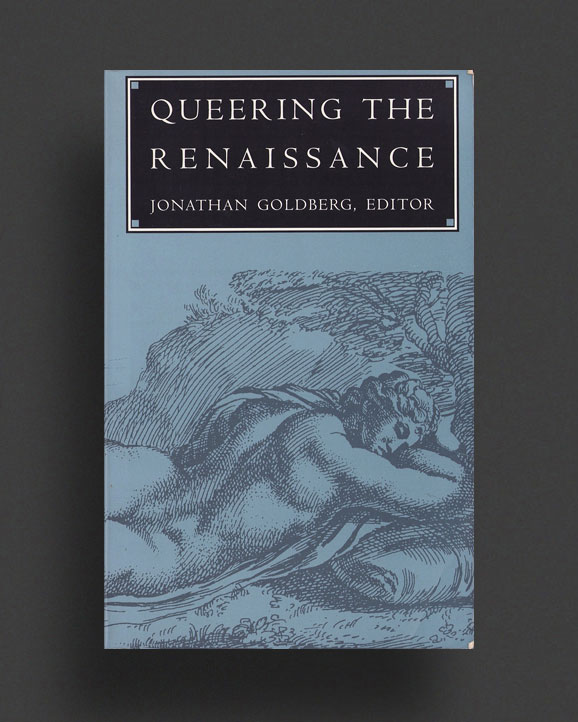
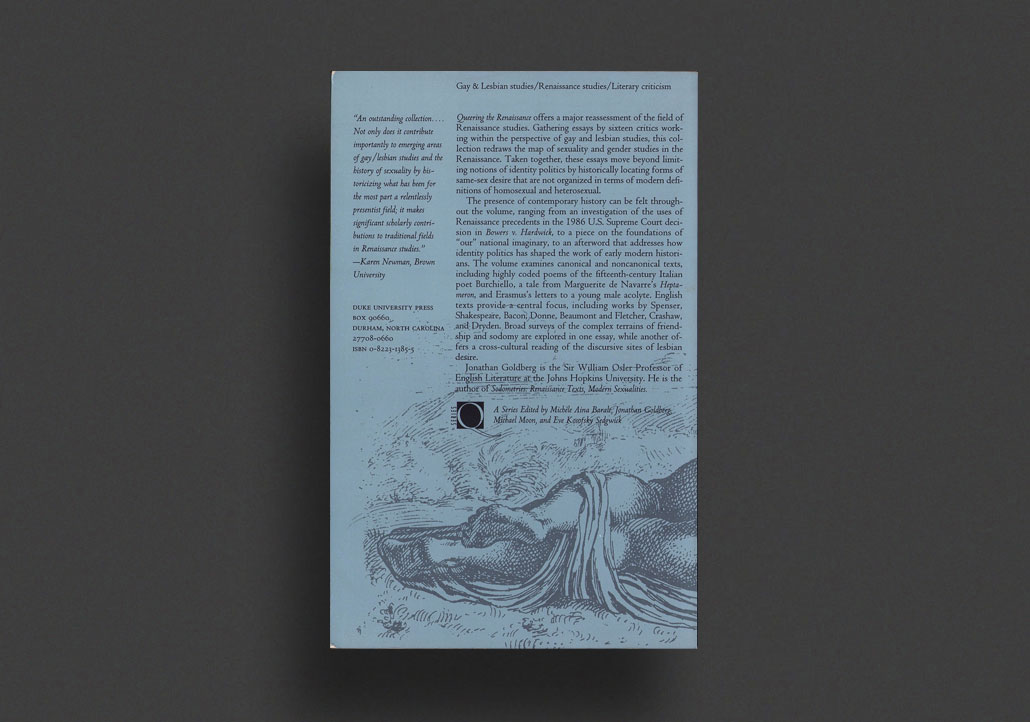
Queering the Renaissance offers a major reassessment of the field of Renaissance studies. Gathering essays by sixteen critics working within the perspective of gay and lesbian studies, this collection redraws the map of sexuality and gender studies in the Renaissance. Taken together, these essays move beyond limiting notions of identity politics by locating historically forms of same-sex desire that are not organized in terms of modern definitions of homosexual and heterosexual.
The presence of contemporary history can be felt throughout the volume, beginning with an investigation of the uses of Renaissance precedents in the 1986 U.S. Supreme Court decision Bowers v. Hardwick, to a piece on the foundations of 'our' national imaginary, and an afterword that addresses how identity politics has shaped the work of early modern historians. The volume examines canonical and noncanonical texts, including highly coded poems of the fifteenth-century Italian poet Burchiello, a tale from Marguerite de Navarre's Heptameron, and Erasmus's letters to a young male acolyte. English texts provide a central focus, including works by Spenser, Shakespeare, Bacon, Donne, Beaumont and Fletcher, Crashaw, and Dryden. Broad suveys of the complex terrains of friendship and sodomy are explored in one essay, while another offers a cross-cultural reading of the discursive sites of lesbian desire.
Accessibly written, boldly interdisciplinary, Queering the Renaissance will be indispensable for literary critics, historians, and theorists seeking to understand the representation of same-sex desire in the early modern period.
Contributors. Alan Bray, Marcie Frank, Carla Freccero, Jonathan Goldberg, Janet Halley, Graham Hammill, Margaret Hunt, Donald N. Mager, Jeff Masten, Elizabeth Pittenger, Richard Rambuss, Alan K. Smith, Dorothy Stephens, Forrest Tyler Stevens, Valerie Traub, Michael Warner
Industry Reviews
"An outstanding collection . . . Not only does it contribute importantly to emerging areas of gay/lesbian studies and the history of sexuality by historicizing what has been for the most part a relentlessly presentist field; it makes significant scholarly contributions to traditional fields in Renaissance studies."-Karen Newman, Brown University
1980, Japanese
Softcover (w. dust jacket and obi strip), 114 pages, 26 x 21 cm
1st Edition, Out of print title / used / very good
Published by
Seven Sha / Tokyo
$900.00 - Out of stock
Stunning first edition of Kohei Yoshiyuki's cult classic photo book, Document: The Park (Document Park), published in 1980 by Seven Sha, Tokyo. Yoshiyuki's voyeuristic masterpiece, The Park is like no other photo book. A controversial volume of 74 photographs taken by the photographer using a 35mm camera, infrared film, and flash, Yoshiyuki documented a secret community of lovers and voyeurs who gathered in Shinjuku Park and Yoyogi Park between 1971 and 1973. His pictures document the people who gathered in these parks for clandestine trysts under the cloak of darkness, as well as the many spectators lurking in the bushes who watched—and sometimes participated in—these couplings. With their raw, snapshot-like quality, these images not only uncover the hidden illicit sexual encounters of their subjects, both homosexual and heterosexual, but they also serve as a chronicle of a Japan we rarely see. As Martin Parr writes in The Photobook: A History, Volume II, The Park is "a brilliant piece of social documentation, capturing perfectly the loneliness, sadness and desperation that so often accompany sexual or human relationships in a big, hard metropolis like Tokyo."
A beautifully printed book, complete with original dust-jacket and obi-strip. Includes two conversations with Kohei Yoshiyuki with Kenichi Matsumoto and Nobuyoshi Araki.
Kohei Yoshiyuki (b. 1946—2022) came to recognition in 1972 when material from his photo project “The Park” was featured in magazine Shukan Shincho, and a year later, in respected photo journal Camera Mainichi. However, it was the 1979 photo exhibition “The Park” at Komai Gallery and 1980 photo book “Document: The Park” that established him within the contemporary photographic landscape. Since then, Yoshiyuki was a recurrent fixture in Japan debauchery journal Super Photo Magazine along photographers: Nobuyoshi Araki, Daido Moriyama, Keizo Kitajima and Seiji Kurata.
Very Good copy with tanning to front-right edge of dust jacket. Light edge wear/age to jacket and obi. A lovely copy, well preserved.
1978, Japanese
Softcover (staple-bound), 25.5 x 18 cm
1st Edition, Out of print title / used / very good
Published by
Queer Kids / Tokyo
$90.00 - In stock -
Super rare glam rock issue of the super rare PANSY fanzine, published by Queer Kids in Tokyo in the 1970s. Never seen another issue ever before (apparently 12 were produced), PANSY applies the queer gaze to the world of glam rock, post punk, new romantic... T-Rex/Marc Bolan, New York Dolls, David Bowie, Japan, Slade, Roxy Music, Raped, Brats ... photographing, interviewing, and profiling the princes of the new androgynous wave with school diary visual sensibility and DIY hand-collage aesthetic throughout. Includes a New York Dolls family tree, loads of magazine clipped pictures, and hand-written Japanese texts. Very obscure, very charming, very Japanese.
Very Good copy with small previous sticker damage to top of spine (front/back), otherwise only light edge wear and age.
2023, English
Softcover, 416 pages
Published by
Primary Information / New York
$84.00 - Out of stock
Published by Steve Lawrence and edited with Peter Hujar and Andrew Ullrick, Newspaper was published in New York City between 1968 and 1971.
Newspaper was a wordless, picture-only periodical that ran for fourteen issues and featured the disparate practices of over forty artists. With an editorial focus on placing appropriated material alongside new works, the periodical sought to codify a visual language of high and low culture that represented contemporary society in the late 1960s. While largely overlooked in art-historical discourse, Newspaper showcased many of the most revered artists working in the United States at the time, as well as an emerging coterie of queer artists.
The mid to late sixties was a flourishing period for artists experimenting with new media formats such as books, records, and magazines to create or distribute their work. Newspaper was one of the first artist-published tabloids of its era, preceding Andy Warhol’s Interview and Les Levine’s Culture Hero, both of which debuted in 1969. However, in contrast to other tabloids, Newspaper focused strictly on images.
At a time when photography was not being exhibited regularly in galleries, Newspaper provided an alternative exhibition space for the medium and some of the era’s greatest photographers. The publication’s large size and unbound format encouraged readers to take it apart and hang its pages, which was how Newspaper was installed at the Museum of Modern Art’s influential Information show in 1970.
This is not to say that Newspaper only existed within the narrow confines of the art world, far from it. It lived within (and shared contributors with) a robust network of underground and queer periodicals like The New York Review of Sex, Rags, and Gay Power, among others. Yet, unlike many of these tabloids, Newspaper has largely disappeared from the discourse around underground magazines, queer publishing, and artists’ periodicals.
All fourteen issues of Newspaper are compiled in this volume for the first time.
Featured artists include: Diane Arbus, Art Workers Coalition, Richard Avedon, Clyde Baines, Sheyla Baykal, Peter Beard, Brigid Berlin, Richard Bernstein, Ann Douglas, Paul Fisher, Maurice Hogenboom, Peter Hujar, Scott Hyde, Christo and Jeanne-Claude Javacheff, Ray Johnson, Edwin Klein, Yayoi Kusama, Gerald Laing, Dorothea Lange, Steve Lawrence, Jeff Lew, Roy Lichtenstein, Frank Mercado, Duane Michals, Jack Mitchell, Forrest “Frosty” Myers, Billy Name, Stephen Paley, Warner Pearson, Jurgen Warner Piepke, Charles Pratt, Joseph Raffael, Mel Ramos, Lilo Raymond, Ruspoli-Rodriguez, Lucas Samaras, Alan Saret, Bill Schwedler, Leni Sinclair, Norman Snyder, Elizabeth Staal, Stanley Stellar, Terry Stevenson, Paul Thek, Andrew Ullrick, Andy Warhol, William T. Wiley, and May Wilson.
Editor: Marcelo Gabriel Yáñez
Managing Editor: James Hoff
Designer: Rick Myers
Copy editor: Allison Dubinsky
2023, English
Softcover, 288 pages, 20.32 x 12.7 cm
Published by
We Heard You Like Books / Los Angeles
$32.00 - In stock -
I Didn't See It Coming is the dark and exciting culmination of William E. Jones's trilogy of novels set in Los Angeles. The new book begins several years after the end of the second novel. I Should Have Known Better's former art school students and their companions face decisions about whether they should continue their frivolous adventures or begin to lead more conventional lives. As these bright young things approach middle age--and gentrification swallows up affordable neighborhoods--they find themselves dealing with real life in all its unpleasantness against a background of news about the war in Iraq. Due to stubbornness or inertia, the narrator sticks to his bohemian ways, finding work in the porn industry, while his friends settle down, flourish as artists, leave town, or destroy themselves.
I Didn't See It Coming continues the stories of all of the major characters in the trilogy, including Moira, the idealistic leftist who emigrates to Mexico; Bernie, the brilliant but wildly impractical teacher and book collector; Paul, the promiscuous and acidly witty fop; and Winston, the Balkan immigrant who returns to Europe and is catapulted to art stardom. The novel also reveals the fate of Temo, the love of the narrator's life, who disappears under mysterious circumstances at the conclusion of I Should Have Known Better. I Didn't See It Coming is a page turner bristling with energy and brimming with the kind of explicit sex scenes that readers have come to expect from the author of I'm Open to Anything and True Homosexual Experiences.
1995, Japanese
Softcover, 210 pages, 21 x 15 cm
1st Edition, Out of print title / used / very good
Published by
Tom Shobo / Japan
$140.00 - Out of stock
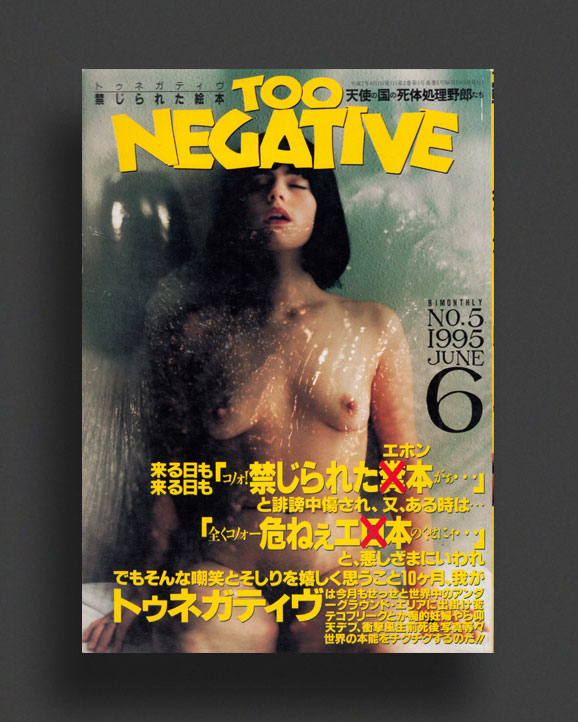
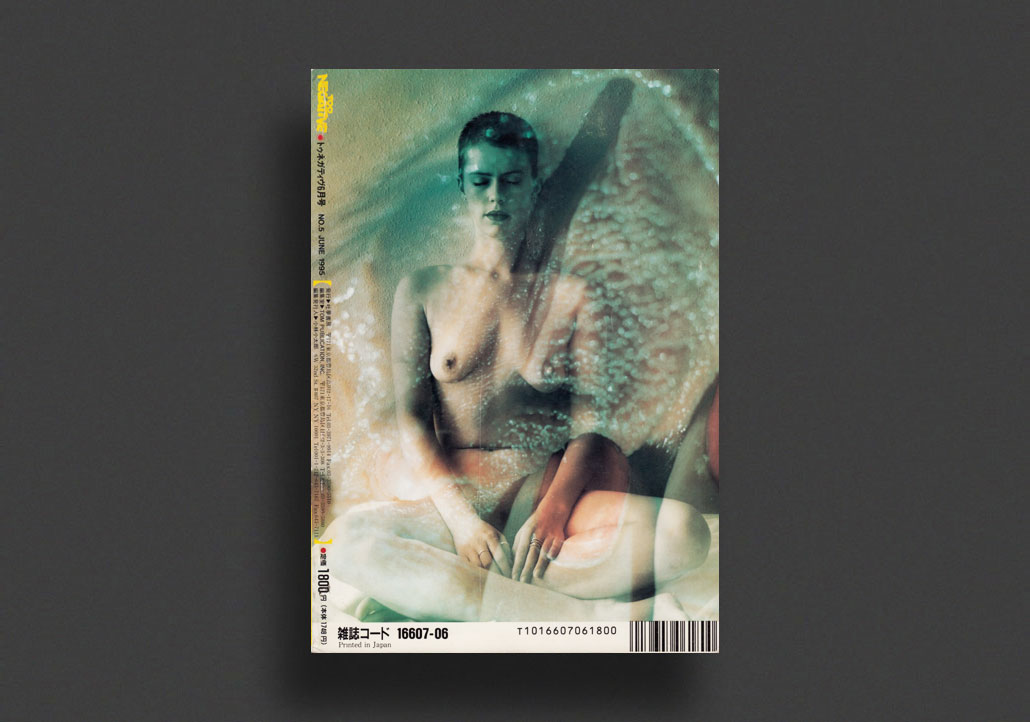
Too Negative No. 5 July 1995. Now rare and highly collectible, Too Negative, the "Forbidden Picture Book", was a visceral and visually explosive glossy cult arts magazine that reflected the gory-depraved-beyond salvation-bad taste expressions visible in international subculture at the height of 1990s underground publishing, a time when art was pushing the limits of taste and morality. Edited solely by legendary Japanese publisher and gallery owner Kotaro Kobayashi and published by Tom Publication Inc. between 1994—2000, each thick, glossy volume takes on the aesthetics of a vibrant fashion magazine in the great Japanese "mook" format (the magazine book) packed cover to cover with themes of Eros and Thanatos, such as fetishism, erotica, medical/autopsy photography, death journalism, Japanese bondage, grotesque and neo-surrealist art, crime scene photography, tattooing/irezumi, piercing, and all things of the mondo, macabre, bizarro realm. Frequent collaborators and featured artists were Kiyotaka Tsurisaki, Joel-Peter Witkin, Trevor Brown, Kiyoshi Ikejiri, to name a few. With a Japanese publishing lineage that may be found in earlier bounding-pushing periodicals such as the 1920s erotic grotesque magazine Hentai Shiriou (Pervert Documents), Tasuhiko Shibusawa’s incredible 1960s avant-garde journal Le Sang Et La Rose, or Fiction Inc’s SALE2 journal published from 1980—mid 1990s, Too Negative, and affiliated periodicals such as ORG, Spiral, Schizo, etc. took their subjects to another level of extremism, even by Japanese standards.
Not for the faint hearted.
This issue, Too Negative No. 6 August 1995, features Thailand corpse/death photography by Kiyotaka Tsurisaki, Trevor Brown artwork, Crime Museum photography, Chokudo Shibuya, Kiyoshi Ikejiri, western hardcore porn, asshole photography by Goro Asawa, Kotaro Kobayashi, x-ray porn, western obesity porn / adipophilia, Berlin sex, death art by noise artist Raita Ishikawa, Lisa Palac's Future Sex, piercing fetish, bizarre sex, medical photography, plus much more.
Very Good copy.
1995, Japanese
Softcover, 210 pages, 15 cm x 21 cm
1st Edition, Out of print title / used / very good
Published by
Tom Shobo / Japan
$140.00 - Out of stock
Too Negative No. 6 August 1995. Now rare and highly collectible, Too Negative, the "Forbidden Picture Book", was a visceral and visually explosive glossy cult arts magazine that reflected the gory-depraved-beyond salvation-bad taste expressions visible in international subculture at the height of 1990s underground publishing, a time when art was pushing the limits of taste and morality. Edited solely by legendary Japanese publisher and gallery owner Kotaro Kobayashi and published by Tom Publication Inc. between 1994—2000, each thick, glossy volume takes on the aesthetics of a vibrant fashion magazine in the great Japanese "mook" format (the magazine book) packed cover to cover with themes of Eros and Thanatos, such as fetishism, erotica, medical/autopsy photography, death journalism, Japanese bondage, grotesque and neo-surrealist art, crime scene photography, tattooing/irezumi, piercing, and all things of the mondo, macabre, bizarro realm. Frequent collaborators and featured artists were Kiyotaka Tsurisaki, Joel-Peter Witkin, Trevor Brown, Kiyoshi Ikejiri, to name a few. With a Japanese publishing lineage that may be found in earlier bounding-pushing periodicals such as the 1920s erotic grotesque magazine Hentai Shiriou (Pervert Documents), Tasuhiko Shibusawa’s incredible 1960s avant-garde journal Le Sang Et La Rose, or Fiction Inc’s SALE2 journal published from 1980—mid 1990s, Too Negative, and affiliated periodicals such as ORG, Spiral, Schizo, etc. took their subjects to another level of extremism, even by Japanese standards.
Not for the faint hearted.
This issue, Too Negative No. 6 August 1995, features corpse/death photography by Kotaro Kobayashi, fetish photography by Kiyoshi Ikejiri, Japanese neo-surrealist Sakuba Tomomi, upclose genital "non-retouching" collage/photography by Goro Asawa and Yoshiki Tsutsumi, death art by noise artist Raita Ishikawa, formaldehyde fetus photography by Kiyotaka Tsurisaki, genital piercing and modification, demented collage and collected imagery/medical/freak photography/illustration/porn, extreme anatomy imagery, lactating, pissing, western obesity porn / adipophilia, 'Bild Des Verbrechens In Ela Granti' crime scene photography from legend early 20th Century Japanese book, porn star John Holmes, artwork by Trevor Brown, plus much more.
Very Good copy.
1993, Japanese
Softcover, 300 pages, 21.2 x 15.1 cm
1st Edition, Out of print title / used / very good
Published by
Kasakura / Tokyo
$60.00 - In stock -
Published in Winter 1993, issue 12 of L&M (Lesbian & Masochism), published by Kasakura Publishing, originally as a special edition of Video X magazine, then onward as its own publication from the late 1980s until 1994. The title says it all, vivid colour photo features and content centring around lesbian and masochism fetish Queen themes, with regular photography by Norio Sugiura ( SM Fan, SM Select, etc.), Koji Yuhara, Shiko Shima ( Specialty S&M, Yume Club, Speculum, etc.), and models such as Mori Miki, Izumi Kawakami, Sachiko Sugiura, Tomomi Harada, Ayumu Hibino Mai Ito, Reika Mizuki, Queen Serina, Queen Mizuki, Ayaka Shiki, and many others.
Very Good copy.
2023, English
Softcover (in sealed cardboard case), 110 pages, 30 x 22 mm
Ed. of 300,
Published by
Guzzler / Rosanna
$50.00 - In stock -
On Display and Questioned : Two exhibitions by Alex Vivian; two interviews with Alex Vivian, 2022, published in a limited edition of 300 copies, each sealed in cardboard mailer. Illustrated throughout with colour plates cataloguing the Victorian exhibitions FIEND? 5–20.12.2020, Guzzler, Rosanna and Porn: squared, hung, drawn, quartered. 11.3–2.4.22, Centre D’editions Melbourne, each accompanied by interviews with artist Alex Vivian by editor and art historian David Homewood. Designed by Alexandra Margetic; photographed by Luke Sands.
Keywords: aid; amyl nitrate; Arial; average gay male (AGM); baseball; bathhouse; condom; cricket; Futura; Genet, Jean; Gerry, Cheesemouth; Golub, Leon; Haring, Keith; Kentucky Fried Chicken (KFC); Kruger, Barbara; Lingard, Grant; Melbourne Wankers Club (MWC); Pettibon, Raymond; pornography; rugby; smegma; Treasury Gardens.
2019, English
Softcover, 92 pages, 27 x 18 cm
Published by
Worms / London
$33.00 $10.00 - Out of stock
Worms is a bi-annual literary style magazine that celebrates female/non-binary writer culture.
This inaugural issue, offers a fresh perspective on the accessibility of literature, writers and style. Here, you will find features with Chris Kraus and Ariana Reines about online writing, an exploration into Kathy Acker’s books and influence on contemporary culture, interviews with young upcoming authors and more.
2020, English
Softcover, 92 pages, 27 x 18 cm
Published by
Worms / London
$33.00 - Out of stock
Worms is a bi-annual literary style magazine that celebrates female/non-binary writer culture.
Worms 2 the ‘Revolting Women’ issue looks at women who are literally disgusting, figuratively revolting. With a focus on writers who operate on the fringes of literature, ‘revolt' in a Worms context is vast-ranging. This issue includes features with Maggie Nelson, Tilly Lawless, Sarah Schulman, Amelia Abraham, Juliana Huxtable, Juliet Jacques, Olivia Sudjic and more.
2021, English
Softcover, 92 pgs, 27 x 18 cm
Published by
Worms / London
$33.00 $10.00 - Out of stock
Worms is a bi-annual literary style magazine that celebrates female/non-binary writer culture.
Worms 3, the ‘biomythography’ issue, looks at personal myth-making and the stories that shape us.
Featuring Michelle Tea, Moyra Davey, Lynne Tillman, Johanna Hedva, Jenny Hval, Ellen van Neervan, Caroline Calloway, Julie Enszerl and more.