World Food Books' programme is largely produced on Kulin Nation land. We acknowledge the Wurundjeri people of the Kulin Nation as the first and continuing custodians of this land, and pay respect to their Elders past, present, and emerging.
World Food Books is an arts and special interests bookshop in Naarm / Melbourne. Founded in 2010, World Food Books is devoted to the presentation of a rotating, hand-selection of international art, design, literary and counterculture publications with an emphasis on the anti-traditional, the experimental, the avant-garde, the heretic, the marginal.
Presenting new titles alongside rare and out-of-print books, catalogues and journals spanning the fields of modern and contemporary art, design, photography, illustration, film, literature, poetry, cultural theory, philosophy, sexuality, popular and underground culture in its many radical forms, World Food Books wishes to encourage adventurous, thoughtful and open-minded reading, looking, writing, and exchange of publishing and ideas, both current and historical.
As well as our bookshop, located in Melbourne's historical Nicholas Building, all of our inventory is available internationally via our online mail-order service.
World Food Books semi-regularly co-ordinates "Occasions", a programme of exhibits and events at the bookshop and in partnership with other hosts (such as museums and art galleries) that develop out of the activities, relationships and content of the bookshop itself.
World Food Books
The Nicholas Building
37 Swanston Street
Room 5, Level 6
Melbourne 3000
Australia
SHOP HOURS:
THU–SAT 12–6
WEB-SHOP OPEN 24/7
World Food Books
Postal Address:
PO Box 435
Flinders Lane
Victoria 8009
Australia
Art
Theory / Essay
Architecture / Interior
Graphic Design / Typography
Photography
Fashion
Eros
LGBTQ+
Fiction / Poetry
Weird / Speculative / Science Fiction / Horror
Transgressive / Visceral / Abject
Symbolism / Decadence / Fin de siècle
Film / Video
Painting
Sculpture / Installation
Performance / Dance / Theater
Drawing
Sound / Music
Curatorial
Group Shows / Collections
Periodicals
Out-of-print / Rare
Posters / Ephemera / Discs
Signed Books
World Food Books Gift Voucher
World Food Book Bag
Australian Art
Australian Fiction
Australian Science Fiction / Speculative Fiction
Australian Poetry
Australian Photography
Japanese Photography
Conceptual Art
Minimal Art
Dada
'Pataphysics / Oulipo
Fluxus
Concrete Poetry
Pop Art
Surrealism
Arte Povera
Arte Informale / Haute Pâte / Tachism
Nouveau Réalisme / Zero / Kinetic
Situationism / Lettrism
Collage / Mail Art / Xerox Art
Art Brut / Folk / Visionary / Fantastic
Illustration / Graphic Art / Bandes Dessinées
Furniture
Italian Radical Design / Postmodernism
Textiles
Ceramics / Glass
Counterculture
Protest / Revolt
Philosophy
Psychoanalysis
Anthropology
Anarchism
Socialism / Anarchism / Communism / Capitalism
Literary Theory / Semiotics / Language
Feminism / Women's Studies
Gender Studies / Sexuality
Anthropology
Fetishism / BDSM
Drugs / Psychedelia
Crime / Violence
Animal Rights / Veganism
Occult / Esoterica
Ecology / Earth / Alternative Living
Whole Earth / Crafts
All prices in AUD (Australian dollars)
Pick-Ups
Pick-up orders can be collected in our bookshop during opening hours after order date. Please collect any Pick-up orders within 2 weeks of ordering as we have limited storage space. Orders will be released back into stock if not collected within this time. No refunds can be made for pick-ups left un-collected. If you cannot make it in to the bookshop in this time-frame, please choose postage option.
Return Policy
All sales are final. We do accept returns (for refund or exchange) for items received in error. All our orders are packed with special care using heavy-duty padding and cardboard book-mailers or bubble mailers (for smaller books), using reinforcement where required. We cannot take responsibility for any lost, stolen or damaged parcels.
Insurance
Should you wish to insure your package, please email us directly after placing your order and we can organise this at a small extra expense. Although all standard/express tracked packages are very safe and dependable, we cannot take responsibility for any lost, stolen or damaged parcels. We recommend insurance on valuable orders.
Interested in selling your old books, catalogues, journals, magazines, comics, fanzines, ephemera? We are always looking for interesting, unusual and out-of-print books to buy. We only buy books in our fields of interest and specialty, and that we feel we can resell.
We base these prices on desirability, market value, in-print prices, condition and our current stock levels. We offer cash, store credit, and can take stock on consignment. All
about 25% of the price we expect to get when we sell them, or 30% in store credit. We base these prices on desirability, market value, in-print prices, condition and our current stock levels.
Sell your books any day of the week. You can drop them off and return later. If you have a lot of books, we can visit your Sydney home.
We buy books that we feel we can resell. We offer about 25 % of the price we expect to get when we sell them, or 30% in store credit. We base these prices on desirability, market value, in-print prices, condition and our current stock levels.
Philadelphia Wireman
03 August - 01 September, 2018
World Food Books is proud to announce our next Occasion, the first presentation of sculptures by Philadelphia Wireman in Australia.
The Philadelphia Wireman sculptures were found abandoned in an alley off Philadelphia’s South Street on trash night in 1982. Their discovery in a rapidly-changing neighbourhood undergoing extensive renovation, compounded with the failure of all attempts to locate the artist, suggests that the works may have been discarded after the maker’s death. Dubbed the "Philadelphia Wireman" during the first exhibition of this work, in 1985, the maker’s name, age, ethnicity, and even gender remain uncertain. The entire collection totals approximately 1200 pieces, all intricately bound together with tightly-wound heavy-gauge wire (along with a few small, abstract marker drawings, reminiscent both of Mark Tobey and J.B. Murry). The dense construction of the work, despite a modest range of scale and materials, is singularly obsessive and disciplined in design: a wire armature or exoskeleton firmly binds a bricolage of found objects including plastic, glass, food packaging, umbrella parts, tape, rubber, batteries, pens, leather, reflectors, nuts and bolts, nails, foil, coins, toys, watches, eyeglasses, tools, and jewellery.
Heavy with associations—anthropomorphic, zoomorphic, and socio-cultural responses to wrapped detritus—the totemic sculptures by Philadelphia Wireman have been discussed in the context of work created to fulfil the shamanistic needs of alternative religions in American culture. Curators, collectors, and critics have variously compared certain pieces to sculpture from Classical antiquity, Native American medicine bundles, African-American memory jugs, and African fetish objects. Reflecting the artist’s prolific and incredibly focused scavenging impulse, and despite—or perhaps enhanced by—their anonymity, these enigmatic objects function as urban artefacts and arbiters of power, though their origin and purpose is unknown. Philadelphia Wireman, whatever their identity, possessed an astonishing ability to isolate and communicate the concepts of power and energy through the selection and transformation of ordinary materials. Over the course of the past two decades, this collection has come to be regarded as an important discovery in the field of self-taught art and vernacular art.
Presented in collaboration with Fleisher-Ollman Gallery, Philadelphia, and Robert Heald, Wellington.
Susan Te Kahurangi King
02 February - 10 March, 2018
Susan Te Kahurangi King (24 February 1951 - ) has been a confident and prolific artist since she was a young child, drawing with readily available materials - pencils, ballpoint pens and felt-tip markers, on whatever paper is at hand. Between the ages of four and six Susan slowly ceased verbal communication. Her grandparents William and Myrtle Murphy had developed a special bond with Susan so they took on caring responsibilities for extended periods. Myrtle began informally archiving her work, carefully collecting and storing the drawings and compiling scrapbooks. No drawing was insignificant; every scrap of paper was kept. The King family are now the custodians of a vast collection containing over 7000 individual works, from tiny scraps of paper through to 5 meter long rolls.
The scrapbooks and diaries reveal Myrtle to be a woman of great patience and compassion, seeking to understand a child who was not always behaving as expected. She encouraged Susan to be observant, to explore her environment and absorb all the sights and sounds. Myrtle would show Susan’s drawings to friends and people in her community that she had dealings with, such as shopkeepers and postal workers, but this was not simply a case of a grandmother’s bias. She recognised that Susan had developed a sophisticated and unique visual language and sincerely believed that her art deserved serious attention.
This was an unorthodox attitude for the time. To provide some context, Jean Dubuffet coined the term Art Brut in 1945 to describe work created by self-taught artists – specifically residents of psychiatric institutions and those he considered to be visionaries or eccentrics. In 1972 Roger Cardinal extended this concept by adopting the term Outsider Art to describe work made by non-academically trained artists operating outside of mainstream art networks through choice or circumstance. Susan was born in Te Aroha, New Zealand in 1951, far from the artistic hubs of Paris and London that Dubuffet and Cardinal operated in. That Myrtle fêted Susan as a self-taught artist who deserved to be taken seriously shows how progressive her attitudes were.
Susan’s parents Doug and Dawn were also progressive. Over the years they had consulted numerous health practitioners about Susan’s condition, as the medical establishment could not provide an explanation as to why she had lapsed into silence. Dawn educated herself in the field of homeopathy and went on to treat all twelve of her children using these principles – basing prescriptions on her observations of their physical, mental and emotional state.
Doug was a linguist with an interest in philosophy who devoted what little spare time he had to studying Maori language and culture. To some extent their willingness to explore the fringes of the mainstream made them outsiders too but it was their commitment to living with integrity and their respect for individuality that ensured Susan’s creativity was always encouraged.
Even though Susan’s family supported her artistic pursuits, some staff in schools and hospitals saw it as an impediment to her assimilation into the community and discouraged it in a variety of ways. Her family was not always aware of this and therefore did not fully understand why Susan stopped drawing in the early 1990s. However, rather than dwell on the challenges that Susan faced in pursuit of her artistic practice, they prefer to highlight her achievements. In 2008 Susan began drawing again in earnest, after an almost 20 year interruption, and her work is now shown in galleries around the world.
Susan grew up without television and has been heavily influenced by the comics she read as a child. She is absolutely fearless in the appropriation of recognizable characters, such as Donald Duck and Mickey Mouse, in her work. She twists their limbs, contorts their faces, compresses them together, blends them into complex patterned backgrounds - always imbuing them with an incredible energy. Although Susan often used pop culture characters in her work they are not naive or childlike. These are drawings by a brilliant self-taught artist who has been creating exceptional work for decades without an audience in mind.
Mladen Stilinović
"Various Works 1986 - 1999"
02 February 16 - September 10, 2016
Various works 1986 - 1999, from two houses, from the collections of John Nixon, Sue Cramer, Kerrie Poliness, Peter Haffenden and Phoebe Haffenden.
Including: Geometry of Cakes (various shelves), 1993; Poor People’s Law (black and white plate), 1993; White Absence (glasses, ruler, set square, silver spoon, silver ladel with skin photograph and wooden cubes), 1990-1996; Exploitation of the Dead (grey and red star painting, wooden painting, black spoon with red table, red plate), 1984-1990; Money and Zeros (zero tie, paintings made for friends in Australia (Sue, John, Kerrie), numbers painting), 1991-1992; Words - Slogans (various t-shirts) - “they talk about the death of art...help! someone is trying to kill me”, “my sweet little lamb”, “work is a disease - Karl Marx”; Various artist books, catalogues, monographs, videos; Poster from exhibition Insulting Anarchy; "Circular" Croatian - Australian edition; Artist book by Vlado Martek (Dostoyevsky); more.
Thanks to Mladen Stilinović and Branka Stipančić.
Jonathan Walker
Always Will Need To Wear Winter Shirt Blue + Ochre Small Check Pattern
21 August - 21 September, 2015
Untitled
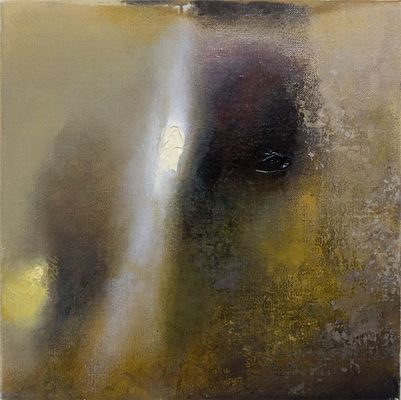
I am not a great reader of poetry but I always return to the work of Melbourne poet, Vincent Buckley (1925- 1988). Perhaps I find his most tantalising piece to be not a finished poem but a fragment left on a scrap of paper discovered on his desk after the poet’s death.
The poetry gathers like oil
In the word-core, and spreads
It has its music meet,
Its music is in movement.
This fragment is more the shell left behind from a volatile thought than a finished poem. I find the last two lines honest but awkward whereas the first two lines work like an arrow. Most likely he could not find a resolution so it was left. Still, in its present form, it remains an eloquent testimony to the ultimate failure of a medium to express mobile thought and sensation, in Buckley’s case, through verbal language. It’s an important matter because this is something all artists have to deal with regardless of the medium.
I have never written a poem, however, I am forever copying fragments from books on paper scraps in a vain effort to fix certain notions in my head. At first, they function as bookmarks that are sometimes returned to when I open the book. But before long, as they accumulate, they fall out littering the table interspersed with A4 photocopies, bills, books and medications.
To return to Buckley’s fragment, the first two lines very much evoke how I paint nowadays. As you age, detail diminishes and patches of light become more luminous and float. I feel the most honest way of dealing with this is by smearing the oil paint on the canvas with the fingers and working close-up, blind. Only if the patches coalesce into an approaching image can the work gain a life.
-
Jonathan Walker was born in Melbourne, Australia and brought up on a dairy farm in Gippsland. In the 1970’s he studied painting at RMIT and won the Harold Wright Scholarship to the British Museum, London. During the 1980’s he exhibited at Pinacotheca Gallery, Richmond and had work shown at the NGV and Heidi City Art Gallery. Over the same period he designed the cover for the “Epigenesi” LP by Giancarlo Toniutti, Italy and conducted a mail exchange work with Achim Wollscheid, Germany. The work with artists through the post resulted in an article published in the bicentenary issue of Art and Australia 1988. He showed in artist run spaces such as WestSpace in the 90’s and 2000’s, and until 2012, taught painting at Victoria University, which is where we (Colleen Ahern and Lisa Radford) as organisers of the exhibition, among many others, had the privilege of being his student.
Walker’s knowledge was imparted to students through the careful selection of music, literature, and artists found in books that he himself had ordered for the library. Walker’s strategy was the generosity of sharing his vast knowledge with references specific to each student and their context.
Walker’s paintings share a similar focus and intimacy.
This exhibition presents a small selection of recent paintings alongside a publication that includes Walker’s writing. Observational and analytical, Walker’s work is a type of material notation — the time of day, colour and how it is blended, the both specific and fleeting location of a reflection on lino or the question of whether a chair leg should be included in a painting.
Please join us on Friday August 21 between 6-8pm to celebrate the opening of the exhibition.
Curated by Colleen Ahern and Lisa Radford.
B. Wurtz
Curated by Nic Tammens
March 26 - April 4, 2015
B.Wurtz works from a basement studio in his home on Manhattan’s Lower East Side.
This local fact is attested to by the plastic shopping bags and newsprint circulars that appear in his work. As formal objects, they don’t make loud claims about their origins but nonetheless transmit street addresses and places of business from the bottom of this long thin island. Like plenty of artists, Wurtz is affected by what is local and what is consumed. His work is underpinned by this ethic. It often speaks from a neighborhood or reads like the contents of a hamper:
“BLACK PLUMS $1.29 lb.”
“Food Bazaar”
“USDA Whole Pork Shoulder Picnic 99c lb.”
“RITE AID Pharmacy, with us it’s personal.”
“H. Brickman & Sons.”
“Sweet Yams 59c lb."
Most of the work in this exhibition was made while the artist was in residence at Dieu Donne, a workshop dedicated to paper craft in Midtown. Here Wurtz fabricated assemblages with paper and objects that are relatively lightweight, with the intention that they would be easily transportable to Australia. This consideration isn’t absolute in Wurtz’s work, but was prescriptive for making the current exhibition light and cheap. Packed in two boxes, these works were sent from a USPS post office on the Lower East Side and delivered to North Melbourne by Australia Post.
Wurtz appears courtesy of Metro Pictures, New York.
Thanks to Rob Halverson, Joshua Petherick, Sari de Mallory, Matt Hinkley, Helen Johnson, Fayen d'Evie, Ask Kilmartin, Lisa Radon, Ellena Savage, Yale Union, and "Elizabeth".
John Nixon
"Archive"
December 15 - January 20, 2014
The presentation of John Nixon's archive offered a rare showcase of this extensive collection of the artist's own publications, catalogues, posters, ephemera, editions and more, from the mid 1980s onwards, alongside a selection of his artworks.
Organized by John Nixon, Joshua Petherick and Matt Hinkley.
"Habitat"
at Minerva, Sydney (organised by Joshua Petherick and Matt Hinkley)
November 15 - December 20, 2014
Lupo Borgonovo, Janet Burchill & Jennifer McCamley,
Lewis Fidock, HR Giger, Piero Gilardi, Veit Laurent Kurz,
Cinzia Ruggeri, Michael E. Smith, Lucie Stahl, Daniel Weil, Wols
Press Release:
“...It contained seven objects. The slender fluted bone, surely formed for flight, surely from the wing of some large bird. Three archaic circuitboards, faced with mazes of gold. A smooth white sphere of baked clay. An age-blackened fragment of lace. A fingerlength segment of what she assumed was bone from a human wrist, grayish white, inset smoothly with the silicon shaft of a small instrument that must once have ridden flush with the surface of the skin - but the thing’s face was seared and blackened.”
William Gibson, “Count Zero”, 1986
"Autumn Projects Archive"
Curated by Liza Vasiliou
March 6 - March 15, 2014
World Food Books, in conjunction with the Virgin Australia Melbourne Fashion Festival 2014, presented the Autumn Projects archive, consisting of a selection of early examples in Australian fashion with a particular interest in collecting designers and labels from the period beginning in the 1980’s, who significantly influenced the discourse of Australian Fashion.
Curated by Liza Vasiliou, the exhibition provided a unique opportunity to view pieces by designers Anthea Crawford, Barbara Vandenberg, Geoff Liddell and labels CR Australia, Covers, Jag along with early experimental collage pieces by Prue Acton and Sally Browne’s ‘Fragments’ collection, suspended throughout the functioning World Food Books shop in Melbourne.
H.B. Peace
presented by CENTRE FOR STYLE
November 14, 2013
"Hey Blinky, you say chic, I say same"
Anon 2013
H.B. Peace is a clothing collaboration between great friends Blake Barns and Hugh Egan Westland. Their pieces explore the divergences between 'character’ and ‘personality’ in garments....etc
Special Thanks to Joshua Petherick and Matt Hinkley of WFB and Gillian Mears
and a Very Special Thank you to Audrey Thomas Hayes for her shoe collaboration.
Janet Burchill & Jennifer McCamley
"Aesthetic Suicide"
May 10 - June 8, 2013
The first of our occasional exhibitions in the World Food Books office/shop space in Melbourne, "Aesthetic Suicide" presented a body of new and older works together by artists Janet Burchill & Jennifer McCamley, including videos, prints, a wall work, and publications.
During shop open hours videos played every hour, on the hour.
1980, German
Hardcover (w. dust jacket), 384 pages, 22 x 21 cm
1st Edition, Out of print title / used / very good
Published by
Rogner & Bernhard / Münich
$30.00 - Out of stock
First 1980 German language hardcover edition of 'Man Ray - The Rigour of Imagination', a wonderful monographic study on Man Ray by Italian art historian, writer, curator and friend of Man Ray, Arturo Schwarz. This book, an intimate survey of Man Ray's life and works first issued in 1977, was made in close collaboration with Man Ray until his death in 1976 and was the first to reveal Man Ray's real name, Emmanuel Radnitzky. Profusely illustrated in colour and monochrome with Man Ray's diverse breadth of paintings, drawings, photography, film, sculptural objects, publications, editions, exhibition and studio documentation, as well as personal photography.
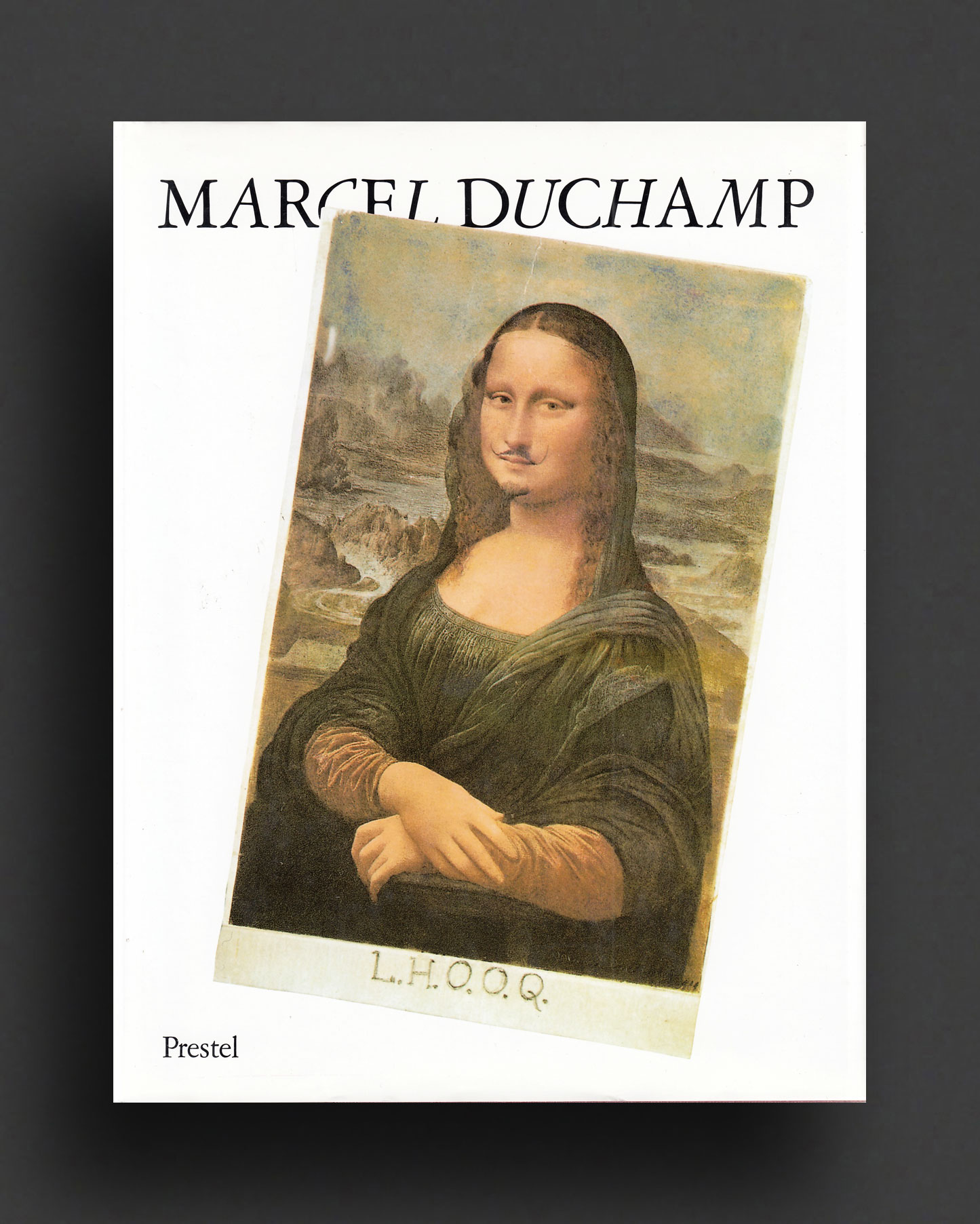
Arturo Schwarz (1924 – 2021) was an Italian scholar, art historian, poet, writer, lecturer, art consultant and curator of international art exhibitions. He lived in Milan, where he amassed a large collection of Dada and Surrealist art, including many works by personal friends such as Marcel Duchamp, André Breton, Man Ray, and Jean Arp.
"Painter, creator of poetic objects, photographer, writer, filmmaker: Man Ray, born in Philadelphia in 1890, decisively shaped the cultural history of the 20th century with his genius. For the first time, this book, on which the artist actively collaborated until his death in 1976, presents and documents all aspects of his life and work.
Throughout his life, Man Ray performed pioneering work in all media; in all areas of the visual arts, photography, and film, he tirelessly searched for new means of expression that questioned everything established, usual, and taken for granted. His childlike curiosity, creative desire, and wit, which persisted well into old age, allowed him to take the most surprising paths and perform the most bewildering twists and turns. He transformed photography into art and placed it on a par with painting by "painting" his rayographs, photographs taken without a camera, or, in 1917, by being the first to create "paintings" with an airbrush, whose soft shading transferred the effects of photography to the canvas. He translated word games into optical puzzles and vice versa; he used objects and assemblages to develop highly idiosyncratic photographs; he set his inventions or rediscoveries in the field of photography in motion in the most fascinating examples of Dadaist and Surrealist film. Many of his works anticipate modern developments in art by decades.
Exhibitions of the European avant-garde around 1910 (Armory Show, Gallery 291 by Alfred Stieglitz, among others) had torn the young Man Ray from the academic waters of American art. As early as 1915/16, he placed himself at the forefront of the American avant-garde with Marcel Duchamp and Francis Picabia, who had fled into exile in America before the World War, and was present at the birth of New York Dada. The European Dadaists and Surrealists in Paris welcomed him into their midst with open arms in 1921 [...]"—from the jacket blurb
Very Good copy in VG dust jacket.
2023, English
Softcover, 128 pages, 10.5 x 8 cm
Published by
Hanuman Editions / US
$36.00 - In stock -
Compiled and edited by George Scrivani for Hanuman Books in 1988, On My Painting collects six texts from the pioneering German artist Max Beckmann, who fled Nazi Germany after his paintings—increasingly moody and reflective of the existential terror of the time—were labeled "degenerate". In addition to the titular essay, this volume contains short pieces "Creative Credo" and "The New Program", extracts from his Diaries, three "Letters to a Woman Painter", and the text of a speech given to the philosophy faculty at Washington University in St. Louis, shortly before his death in 1950.
Max Beckmann (1884-1950) was a German artist whose body of work includes painting and sculpture. A rising star during the Weimar era, Beckmann left Germany following the ascent of Adolf Hitler, living in self-imposed exile in Amsterdam before finally being granted a teaching position in the United States in 1947. He died of a heart attack in 1950. Though he eschewed the label of "Expressionism", he is often associated with the movement, and was heavily influential on the American offshoots that followed.
From the first series redux of Hanuman Books, the legendary and cult series of chapbooks that were printed in southern India and published out of the storied Chelsea Hotel in New York City between 1986 and 1993. Founded by American curator Raymond Foye and artist Francesco Celemente, Hanuman Books was dedicated mainly to the extreme deconstructive edge of the countercultural poetic, musical, and artistic currents of the 1960s and 1970s, spanning the era of the Cold War, the AIDS crisis, the Harlem Ballroom scene, the Beats, Warhol's Factory etc. Hanuman Books sought to marry the folk-minimal-artisanal with the cutting edge, playfully marketing their books as ‘secret’ documents of an avant-garde subculture, meant to be passed on covertly at street corners just as millenarian chapbooks of medieval times were supposed to have been. Printed in India, the small format is meant to mimic the chapbook form of the Hanuman Chalisa (a folk compendium of chants to the Hindu god Hanuman, sold very cheaply in the bazaars of India) that made them perfect for slipping illicitly into any pocket. Redux editions edited by Shruti Belliappa and Joshua Rothes.
1964, German
Hardcover (w. dust jacket), 124 pages, 28 x 21.5 cm
1st Edition, Out of print title / used / very good
Published by
Forum Verlag / Vienna
$50.00 - In stock -
1964 first hardcover edition of this monographic study on the Viennese School of Fantastic Realist Painting and the work of Erich Brauer, Ernst Fuchs, Rudolf Hausner, Wolfgang Hutter, and Anton Lehmden. Illustrated with colour plates throughout and a large gallery of monochrome reproductions of many paintings by each artist. Texts in German by AP Gütersloh, W. Schmied, H. Hakel, and Kurt Eigl.
"René Gustav Hocke calls the group of artists to whom this volume is dedicated "one of the greatest surprises in contemporary intellectual Europe." Five painters are grouped together under the term "Vienna School": Brauer, Fuchs, Hausner, Hutter, and Lehmden. As diverse as the individual, expressive artists' personalities are, they all share a commitment to objective, figurative art; they all paint beautiful, precious pictures with technical perfection, high-quality works full of interesting ideas. In Erich Brauer's pure, luminous colors, an oriental, fairytale world emerges; Ernst Fuchs's painting, trained by the old masters, revolves around religious themes and problems in a sensitive, highly individual way; Anton Lehmden paints, in the words of his teacher, "cities and landscapes that need not be on earth." Rudolf Hausner is, to quote Gütersloh again, "the tragedian and tragedian of this group", the only true representative of international surrealism. Wolfgang Hutter is assigned the cheerful subject, "his botanical drum contains more beautiful flowers than grow in forests and gardens." Thus, each of the five painters represents fantastic realism in their own unique way, an art movement that is gaining increasing attention around the world and deserves to be honored in book form by renowned experts in the field."—from the introduction
VG-NF copy in VG dust jacket, page toning, some dj toning and wear to edges.
1998, English
Softcover (staple-bound), 32 pages, 30 x 21 cm
1st Edition, Out of print title / used / very good
Published by
Australia Post / Melbounre
Australia Post / Melbourne
$20.00 - In stock -
Rare exhibition catalogue published on the occasion of Designing Australia : Modernity And The Stamp 1936-1998, Postmaster Gallery Australian Philatelic Centre Melbourne, 25 April—6 July 1998, curated by Sally Gray.
In 1997 independent curator, author and scholar in art, design and urban studies, Sally Gray proposed an exhibition concept to Australia Post focusing on Australian modernism as expressed in the graphic design of Australian stamps. She researched and selected examples of proto-modern, modernist and post-modern graphic design for Australian stamps. The preliminary designs and finished printed stamp designs were shown in the Postmaster Gallery at the Australian Philatelic Centre in Melbourne. The catalogue included commissioned essays on styles of representation on stamps, Australian graphic design history and changing perceptions about national visual identity.
Illustrated throughout in colour and b/w with works by Gert Sellheim, Sydney Ball, Eric Thake, Erica McGilchrist, Brian Sadgrove, Garry Emery, John Coburn, Mimmo Cozzolino, Phil Ellett, Alex Stitt, and many others.
VG copy.
1996, English
Softcover, 116 pages, 21 x 15 cm
Ed. of 300,
1st Edition, Out of print title / used / good
Published by
ACCA / Melbourne
$45.00 - In stock -
Very rare copy of Transgression And The Culture Industry — Critical Media: Perspectives On New Technologies, the book document of The Gordon Darling Foundation Seminars 1995, with guest convenors Denise Robinson and Julianne Pierce (VNS Matrix), presenting the papers from seminars held at the Australian Centre For Contemporary Art, Melbourne, 8 April—7 October 1995.
Contents:
"Introduction" – Denise Robinson, "Duchamp's Queer Signature" – Rex Butler, "Transgression And The Culture Industry (Australia/1995)" – Lesley Stern, "The Art Curator, Our Cultural Transponder" – Juan Davila, "Normalizing Transgression" – David M. Halperin, "Introduction" – Julianne Pierce, "The Indifference Engine – 1990s Culture And The Corporate Imagination" – David Cox, "Observations" – Linda Wallace, "The Amazing Mcscent™ Machine" – Bridget Mcgraw, "Rehearsal Of Memory" – Graham Harwood.
"This one day symposium is a response to the sliding formations of the concept of 'transgression', as it is appropriated, mobilised or mutated by our contemporary cultural institutions. The event comprised two elements. A two hour film screening of short films included a selection from 1964 by New York underground film maker, Kenneth Anger and a selection of recent contemporary films from Australia by Christopher Ryan and Leone Knight. A second element involved a presentation of papers published here by Rex Butler, Juan Davila, David Halperin and Lesley Stern. The papers were not intended to act as a commentary of the films or the films to reflect the papers, rather the co-existence of these elements were to function more like a folding of the languages of cinema and visual art: as one possible means of illuminating the effects of the historicisation of 'transgressive strategies in relation to the Culture Industry."—DENISE ROBINSON, Introduction
Good copy with sunned spine edge, crease to back cover corner.
1974, English
Hardcover (w. dust jacket), 172 pages, 30.5 x 21.5 cm
1st Edition, Out of print title / used / very good
Published by
The Tate Gallery / London
$50.00 - Out of stock
First 1974 hardcover edition of The Late Richard Dadd, by Patricia Allderidge, published by the Tate Gallery to accompany a major exhibition of Dadd's work that same year. Illustrated with b/w and colour reproductions, this is the first catalogue raisonné of all Dadd's recorded work and includes entries on many items now lost.
Richard Dadd was one of the most strikingly original and technically accomplished painters of the Victorian era. His enormous, almost virtuosic, talents were obvious from an early age, but the brilliant career which seemed inevitably his was cut short, brutally and abruptly, when, as a young man, he lapsed into violent insanity. Dadd’s affliction culminated in the gruesome murder of his father and led to life-long confinement in a criminal lunatic asylum. But even here he continued to paint, fulfilling his early promise of compositional ingenuity, albeit in a mode totally at variance with the conventions of Victorian salon art. Deprived of external influence and stimuli alike, Dadd’s style, especially in his early fairy pictures, combined a singular purity and beauty with a world of tapestry-like detail, rich fantasy and obsessional allegory.
Patricia Allderidge, Archivist of the Bethlem Royal and Maudsley Hospitals, where the artist passed much of his imprisonment, is uniquely equipped to be Richard Dadd’s biographer. She has undertaken extensive research, sifting through secondary and little known primary sources, to construct a carefully documented narrative of Dadd’s career, one which corrects many misconceptions and brings new material to light. In addition to tracing the artist’s life from his childhood and seminal travels to the Middle East to his madness and confinement at Bethlem and Broadmoor, Miss Allderidge also provides a detailed and sensitive analysis of Dadd’s work, fully documented with 115 illustrations, fifteen of which are in colour. She has, in short, produced a complete picture, in words and images, of Richard Dadd as both a man and as an artist, and her study will long serve as a vitally informative and attractive introduction to the vision of this extraordinary Victorian painter.
Very Good copy in VG dust jacket.
1974, English
Softcover, 108 pages, 29 x 21.5 cm
1st Edition, Out of print title / used / very good
Published by
Academy Editions / London
$30.00 - Out of stock
First 1974 softcover edition of this monograph on Richard Dadd, by Patricia Allderidge, published by Academy Editions in London. Profusely illustrated with b/w and colour reproductions tracing Dadd's life and work, with texts by Allderidge and notes on all works presented.
Richard Dadd was one of the most strikingly original and technically accomplished painters of the Victorian era. His enormous, almost virtuosic, talents were obvious from an early age, but the brilliant career which seemed inevitably his was cut short, brutally and abruptly, when, as a young man, he lapsed into violent insanity. Dadd’s affliction culminated in the gruesome murder of his father and led to life-long confinement in a criminal lunatic asylum. But even here he continued to paint, fulfilling his early promise of compositional ingenuity, albeit in a mode totally at variance with the conventions of Victorian salon art. Deprived of external influence and stimuli alike, Dadd’s style, especially in his early fairy pictures, combined a singular purity and beauty with a world of tapestry-like detail, rich fantasy and obsessional allegory.
Patricia Allderidge, Archivist of the Bethlem Royal and Maudsley Hospitals, where the artist passed much of his imprisonment, is uniquely equipped to be Richard Dadd’s biographer. She has undertaken extensive research, sifting through secondary and little known primary sources, to construct a carefully documented narrative of Dadd’s career, one which corrects many misconceptions and brings new material to light. In addition to tracing the artist’s life from his childhood and seminal travels to the Middle East to his madness and confinement at Bethlem and Broadmoor, Miss Allderidge also provides a detailed and sensitive analysis of Dadd’s work, fully documented with 115 illustrations, fifteen of which are in colour. She has, in short, produced a complete picture, in words and images, of Richard Dadd as both a man and as an artist, and her study will long serve as a vitally informative and attractive introduction to the vision of this extraordinary Victorian painter.
Very Good copy with light bumping/wear to extremities.
1980, English
Hardcover (w. dust jacket), 224 pages, 30 x 23 cm
1st Edition, Out of print title / used / very good
Published by
Fleetbooks / New York
$30.00 - Out of stock
"Unblushing color, is the sexual world around us painted by outstanding artists of the twentieth century. In this extraordinary book, the modern world, the flesh, and the devil are captured as never before."
Foreword by Henry Miller.
Within it are 163 newly photographed works of art, each one faithfully reproduced, unretouched, in four color lithography. On these oversized pages is reflected the erotic life of our times from never before published Picasso watercolors of 1901-02 to the initial publication of recent works by George Segal, Andy Warhol, Larry Rivers, R.B. Kitaj, Tom Wesselman and many others.
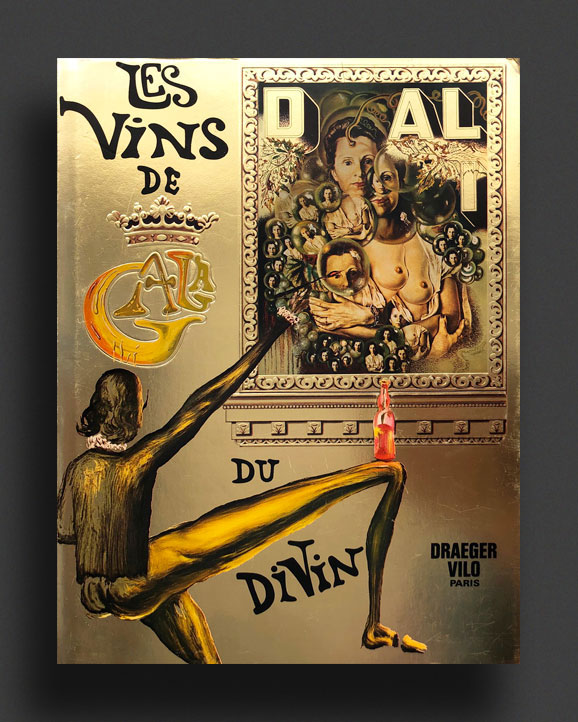
1980 hardcover survey by Bradley Smith, '20th Century Masters of Erotic Art' is a lavishly illustrated (colour and b/w) collection of erotic works from private and public collections and museums. "Within it are 163 newly photographed works of art, each one faithfully reproduced, unretouched, in four-color lithography. On these oversized pages is reflected the erotic life of our times from never before published Picasso watercolors of 1901-02 to the initial publication of recent works by George Segal, Andy Warhol, Larry Rivers, R.B. Kitaj, Tom Wesselman and many others." Featuring further works by Leonor Fini, Otto Dix, Ernst Fuchs, Fernando Botero, Hans Bellmer, André Masson, Mel Ramos, Friedrich Schröder Sonnenstern, Paul Wunderlich, Richard Lindner, Elias Friedensohn, Roberto Matta, Graham Ovenden, Francisco Toledo, Carlos Revilla, Egon Schiele, Leonard Foujita, Henk Pander, Pablo Picasso, Alexander Calder, Max Ernst, Félix Labisse, Paul Delvaux, Salvador Dalí, and many other painters and illustrators who have conveyed human sexuality through fantasy, romance, symbolism, and super realism, contributing to the development of diverse erotic themes in art becoming more prominent and accepted in the modern era. We've since regressed.
Good copy in Good DJ, wear to dj extremities.
2025, English
Softcover, 188 pages, 29.5 x 20.5 cm
Published by
AdminAdmin / Melbourne
$45.00 - In stock -
Containing original contributions; artwork, art-historofiction, hagiofiction, critical essays, poetry and prose, some loosely centred around instinct and the mind.
This with contributions by Erik van Lieshout, Peles Duo x Rob Crosse, CAConrad, Robert McKenzie, Mark Beasley, Hany Armanious, Patrick Hartigan, Elizabeth Pulie, Anthea Behm, Luke Stettner, Skyler Brickley, Tommy Miller, Rebecca Holborn, Penelope Latté, Guy Benfield, Jason Vorhees.....and more
2009, English
Softcover, 156 pages, 24 x 16.8 cm
Published by
Walther König / Köln
$78.00 - Out of stock
There are some artists who are never forgotten simply because other artists will constantly cite them as examples. Paul Thek (1933-1988) is one such artist. Revered for his disarming humor and irreverent handling of artworld proprieties, and much lamented for his premature death from AIDS at the age of 55, the likes of Vito Acconci, Bruce Nauman, Mike Kelley, John Miller, Paul McCarthy, Kim Gordon and Matthew Barney have all sung his praises. Tales the Tortoise Told Us is a three-part Thek compendium, composed of writing by Margit Brehm, Axel Heil and Roberto Ort (who discuss the artist's ambivalent relationship with his homeland, and Thek's odd place in the Beat and Hippie generation), a large spread of reproductions of Thek works and a chronologically-arranged survey of works from 1963 up to the artist's death in 1988.
1981, English
Hardcover (w. dust jacket), 96 pages, 28.5 x 22.5 cm
1st Edition, Out of print title / used / very good
Published by
Liber / Fribourg
Crescent Books / New York
$35.00 - In stock -
Hardcover volume published in 1981, profusely illustrated throughout. Text by Marc de Smedt exploring the customs and traditions of human sexuality in Eastern Asian art.
The people of ancient China were fond of making love. They saw it as a way of harmonizing the energies of heaven and earth, and thus of continuing nature's cycle of creation. So love became an art, the art of living, the art of untying the body's knots. It was also an integral part of religion. Thus to the great indignation of their enemies, the Taoists combined sexual practices with their techniques of meditation. [...]
VG—VG dust jacket.
1975, English
Hardcover (w. dust jacket), 208 pages, 24 x 16 cm
1st Edition, Out of print title / used / very good
Published by
New York Graphic Society / Boston
$30.00 - Out of stock
First hardcover edition of the first major English-language monographic study on the brilliant Man Ray, by close friend Roland Penrose, published by the New York Graphic Society in Boston, 1975.
Since before World War I, Man Ray has stood at the center of European and American modernismas a painter, conjurer of magical and poetic objects, inventor, and photographer. Few contemporary artists have played such a vital role in the creation of imaginative visual realities.
Although Man Ray was born in America, he has lived most of his adult life in France, and as a result, he is generally thought of as a European artist, especially since he was a central figure in the Surrealist movement. He is, however, an essential precursor of contemporary American art.
Man Ray has always been a pioneering artist: in combining photography and painting, something later taken up by such artists as Rauschenberg and Warhol; in his creation of enigmatic and mysterious, humorous and unpretentious surrealist objects; in anticipating Abstract Expressionism with his "drip" paintings; in manipulating scale, echoed today in the work of Oldenburg; in his "wrapped objects," done a half century before Christo's works.
The influence of Man Ray continues to increase. Its most important aspects transcend individual paintings, objects, or photographs. Its virtue lies not only in the new techniques he has mastered but also in his subtle and disturbing probes into the very nature of life and in the directness and surprise of his inventions. His genius is a kind of liberating poetry he instills into the heart of artistic activity.
Roland Penrose has been a close friend of the artist for almost fifty years. This is the first major monograph ever published on Man Ray, and for it Penrose has created an absorbing narrative about the life of his friend, about his work and about his steady presence at the flash point of twentieth-century contemporary art. As the organizer of the International Surrealist Exhibition in London, in 1936, where Man Ray's work was shown in England for the first time, and as a Surrealist painter himself, Roland Penrose writes from a unique vantage point of the work and life of a modern genius.
Good—VG copy, with Good—VG dust jacket.
1973, German
Hardcover (w. dust jacket + slipcase), 475 pages, 28 x 23.5 cm
1st Edition, Out of print title / used / fine
Published by
Rembrandt Verlag / Berlin
$110.00 - In stock -
Exceptional 1973 hardcover, slipcased first edition volume dedicated the history of Fantastic Painting in all its mutations, compiled by Austrian art historian and critic, curator, literary scholar and writer, Wieland Schmied (1929 – 2014).
"The fantastic and connected with it the remote, the strange, the absurd, the unreal, the irrational and illusionary, the visionary, the hallucinatory and dreamlike belong to the constant undercurrents and countercurrents of all art. Such images remind us that the world is more diverse, richer and more unmistakeable than we sometimes want to admit, that the night pages with their secrets of the dark belong to it in essence like the day with its magic of light. The fantastic art articulates powers and instincts that have a very intense influence on our lives, on our consciousness. It always shakes the questionlessness of the world, it always frightens us: from the abysses within ourselves and from the mysteries of a world that we have not created.
Wieland Schmied, who, as director of the Kestner Society, highlighted the topicality of fantastic and surrealist thoughts in the work of numerous contemporary artists in much-discussed exhibitions, examines in this book the different definitions of the fantastic and tries to distinguish between similar and related phenomena - the poetic, the grotesque, the absurd, the literary - but also to distinguish the fantastic art from the historical currents of Mannerism, Romanticism, Symbolism and Surrealism, which contain all elements of the Fantastic."
At 475 pages, and profusely illustrated with over 200 plates in colour and b/w, featuring the art of Henry Fuseli, Odilon Redon, James Ensor, Alfred Kubin, Giovanni Battista Piranesi, William Blake, Francisco Goya, Friedrich Schröder Sonnenstern, Rodolphe Bresdin, Félix Labisse, Meret Oppenheim, Horst Janssen, Edward Burra, Jindřich Štyrský, Victor Hugo, Gustave Moreau, Henri Rousseau, Roland Topor, Giorgio de Chirico, Jane Graverol, Unica Zürn, Max Ernst, Pierre Roy, Yves Tanguy, Joan Miró, Salvador Dali, Victor Brauner, Hans Bellmer, Richard Oelze, Wifredo Lam, René Magritte, Ivan Albright, Man Ray, Fred Deux, Morris Graves, Joseph Cornell, Max Klinger, Gustave Doré, Max Walter Svanberg, Toyen, Marc Chagall, Paul Klee, André Masson, Max Beckmann, Emil Nolde, Friedensreich Hundertwasser, Kurt Seligmann, Miodrag Đurić (Dado), Karel Teige, Paul Wunderlich, Roland Penrose, Josef Šíma, Paul Delvaux, Óscar Domínguez, Fernando Botero, Leonor Fini, Uwe Bremer, Bernard Schultze, František Janoušek, Josef Vyleťal, František Muzika, Domenico Gnoli, Wols, Heinz Trökes, Otto Tschumi, Jindřich Heisler, Václav Tikal, Gisela Breitling, Pit Morell, Graham Sutherland, Ernst Fuchs, Wolfgang Hutter, Erich Brauer, Anton Lehmden, Ursula, Konrad Klapheck, and so many more....
Fine copy in Fine dust jacket, perfectly preserved in Near Fine-Very Good original-issue publisher's box with some light discolouration.
2019, English
Softcover, 160 pages, 19.6 x 12.6 cm
1st Edition, Out of print title / used / very good
Published by
Virago / London
$30.00 - Out of stock
"Tanning's fictional debut unquestionably deserves to be recognised as a complete artistic success...
Tanning has assembled all the ingredients necessary for an extraordinary drama of love and betrayal, jealousy and regret... told in confident, fluid prose highlighted by passages of hallucinatory beauty"—GUARDIAN
In the stark beauty of the desert, a mansion built by a madman rears its impudent architecture like an insult.
The estate is called Windcote, 'its very name a masquerade', and its master, the odious Raoul Meridian, has invited a group of guests to spend a weekend, during the course of which they will find themselves driven by obsessions and confusions unlike any they've experienced before.
Untouched by the fevers and failures around her is the indomitable child Destina, who will lead them into the heart of a mysterious canyon, where desire and cruelty forge an implacable truth.
"It seems hardly fair that Dorothea Tanning, in a long, passionately inventive career as a painter, should have acquired as well the other harmony of prose, and that her passionate inventions as a writer should be so lovingly, so wisely resolved"—RICHARD HOWARD
VG copy.
1981, English
Fold-out booklet, 20.4 x 22.6 cm (folded), 72 x 22.6 cm (unfolded)
1st Edition, Out of print title / used / fine
Published by
The Tate Gallery / London
$50.00 - In stock -
Rare 1981 fold-out booklet published to accompany Marc Camille Chaimowicz's performance of Partial Eclipse… at the Tate Gallery, London in September, 1981.
Born in 1947, Paris, Marc Camille Chaimowicz is a London-based artist whose cross-disciplinary work in painting, drawing, collage, sculpture, installation, furniture, lighting, ceramics, textiles, and wallpaper challenges the categorical divisions between fine and applied arts, masculine and feminine, public and private, past and present.
Fine copy.
1981, English
Die cut folded exhibition card, 18 x 14.7 cm
1st Edition, Out of print title / used / fine
Published by
Nigel Greenwood Inc. / London
$90.00 - In stock -
Rare die-cut folded exhibition card produced by Marc Camille Chaimowicz on the occasion of the exhibition Macquettes… at Nigel Greenwood Inc, London, 10 December, 1981—30 January, 1982.
Born in 1947, Paris, Marc Camille Chaimowicz is a London-based artist whose cross-disciplinary work in painting, drawing, collage, sculpture, installation, furniture, lighting, ceramics, textiles, and wallpaper challenges the categorical divisions between fine and applied arts, masculine and feminine, public and private, past and present.
Fine copy.
1997, Japanese
Softcover (w. dust jacket), 104 pages, 21 x 29.5 cm
1st Edition, Out of print title / used / good
Published by
Treville / Tokyo
$120.00 - Out of stock
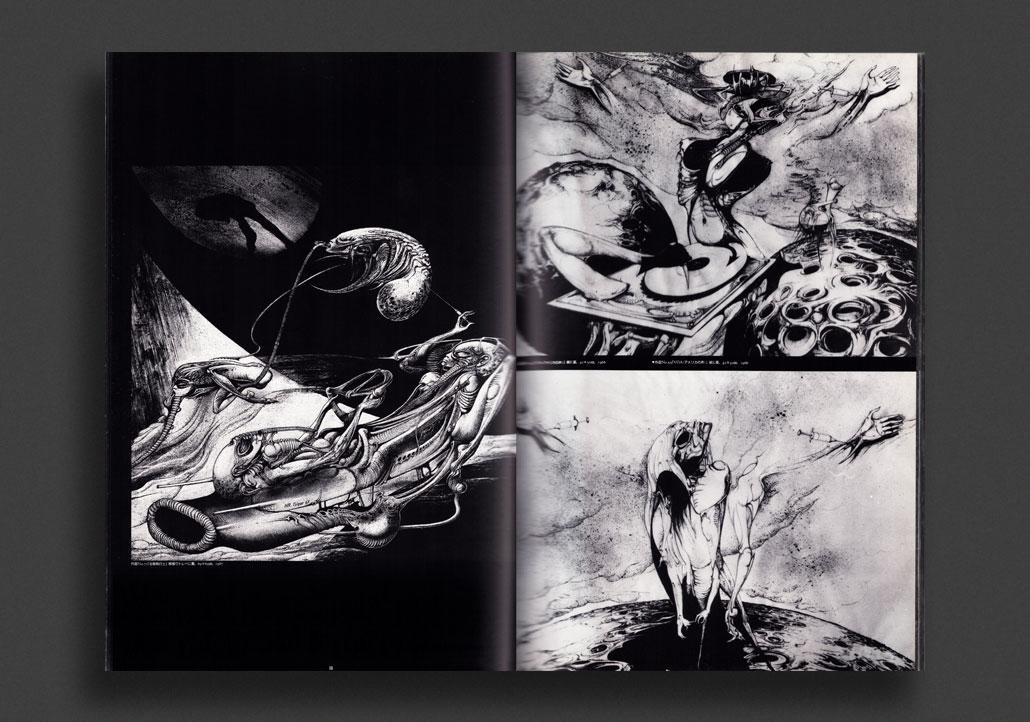
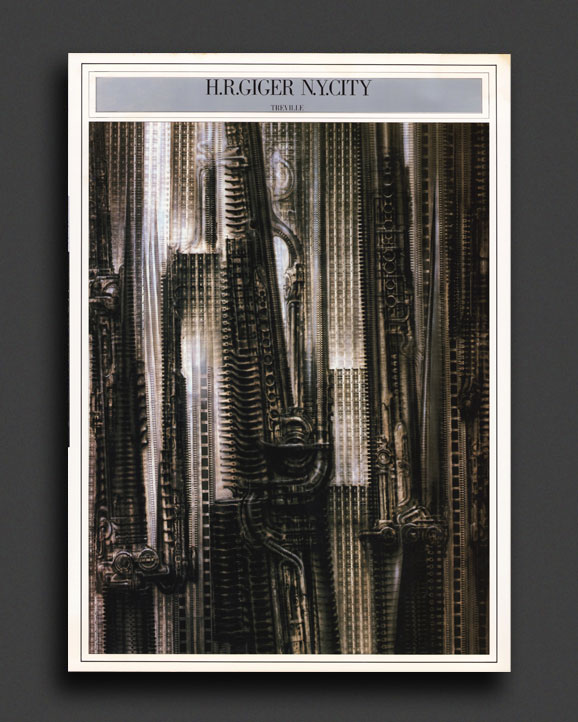
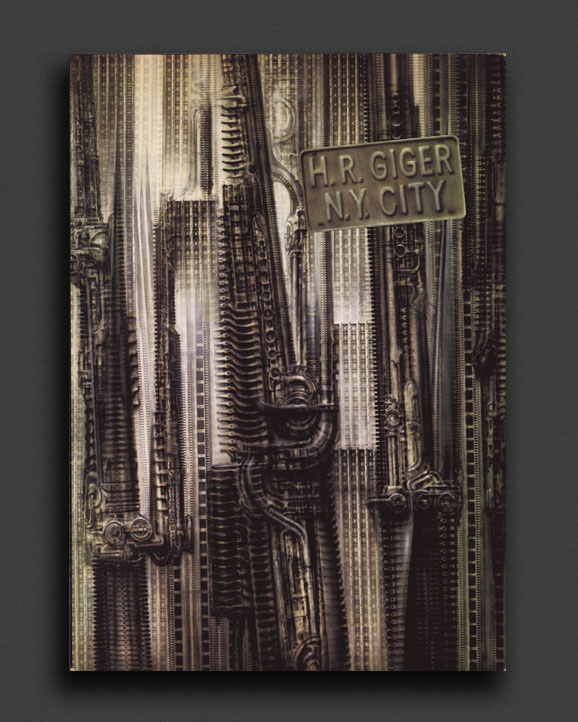
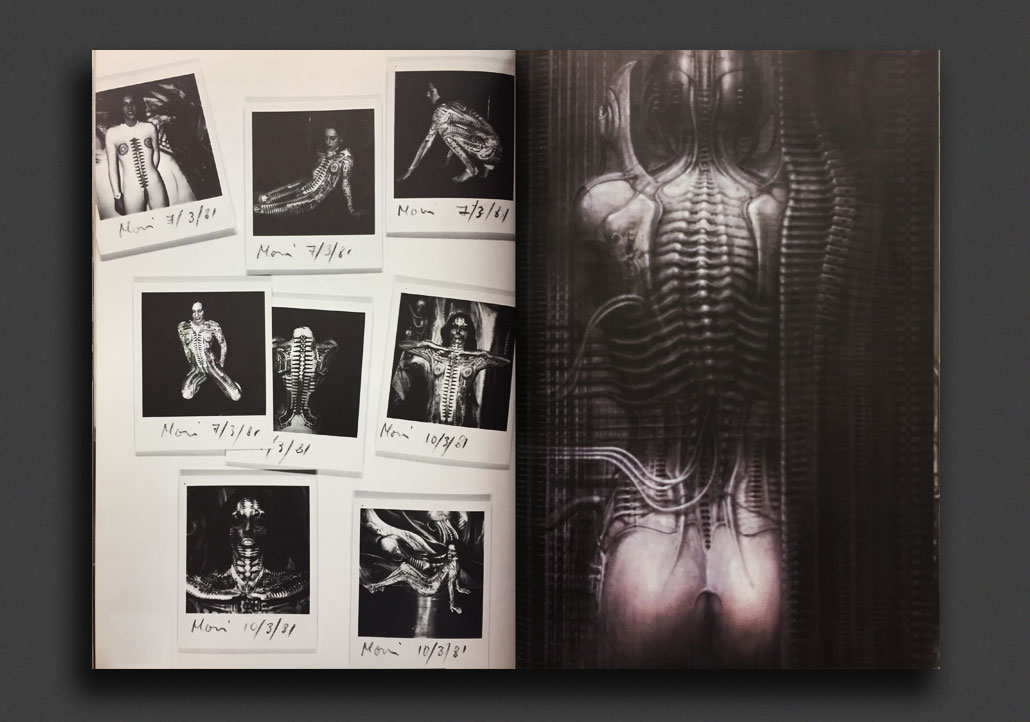
Scarce copy of the now out-of-print Biomannerism book, first edition, published in Japan by Treville in 1997. An incredible selection of international artists linked through their exploration of new aesthetics of erotic metamorphosis between the organic and synthetic compiled with texts by Stéphan Lévy Kuentz. Features lavishly illustrated chapters dedicated to the works of artists Daniel Ouellette, Michel Henricot, Sibylle Ruppert, Joe Hackbarth, Tsutomu Otsuka, Beksinski, Yoshifumi Hayashi, Jean-Marie Poumeyrol, H. R. Giger.
"The erotic Biomannerism movement is a creature of the cyberage, an expression of technophobia and fear of mutation. The artists represented here come from the U.S., France, Germany, Japan, and Switzerland, but they share a Kafkaesque view of the human condition, which they express in twisting, writhing, bulging, disintegrating images of the human form. Inspiration flows from Michelangelo, Dali, da Vinci, Rubens, and Duchamp, as well as Blade Runner, Frankenstein, and Intel."
Good copy due to a small knock/closed tear to a few pages, otherwise Very Good in VG dust jacket with only light general wear.
1992, English / French
Softcover (staple-bound), 64 pages, 24.5 x 19 cm
1st Edition, Out of print title / used / very good
Published by
Purple Institute / Paris
$580.00 - In stock -
The true beginning of Purple — the very rare first issue of Elein Fleiss and Olivier Zahm's Purple Prose, published in 1992. Founded as a reaction against the superficial glamour of the 1980’s, Purple Prose embraced the immediate fanzine aesthetics of what became referred to as 1990's anti-fashion, a far cry from what we now identify with Purple Fashion with.
Purple Prose 1, Automne 1992, features contributions by Dike Blair, Andrea Zittel, Joshua Decter, Henry Bond, Daniel Lemer, Jutta Koether, Andrea Zittel, Roddy Bogawa, Jon Moritsugu, Jacques Boyreau, Jan Avgikos, Martin Kippenberger, Patrick Van Caeckenbergh, Edgar Heap of Birds, David Robbins, Jean-Christophe Menu, Vitaly Glabel, Kitten (pre—Free Kitten: Kim Gordon of Sonic Youth and Pussy Galore's Julia Cafritz), Patrick Bouchitey, Jean-Luc Vilmouth, François Roche, and many more.
Soon after the birth of Purple Prose, Zahm created spin-off publications like Purple Sexe, Purple Fiction and what we now know and love, Purple Fashion. Zahm aimed at fusing together his two worlds, fashion and art, in creating Purple Fashion.
Before entering the world of fashion, Zahm worked as an art critic with widespread recognition for his work as a curator as well as his participation in over 150 exhibitions featuring international contemporary art. In 1994, Zahm and Fleiss curated “The Winter of Love,” a hit show for the Museum of Modern Art in Paris that they later took to P.S.1 in New York. In responding to the superficial glamour of the 1980s, Zahm co-founded Purple Prose magazine. In the introduction of Purple Anthology, Zahm shares why he chose to create Purple Prose:
"We launched Purple Prose in the early 1990s without any means, and without any experience, because we wanted to make a magazine that was radically different. We wanted to support the artists around us that no one else supported, much less talked about. [..] It would be a form of opposition of our own".
Very Good—Near Fine copy, light wear.
1997, Japanese / English
Hardcover (w. dust jacket), 70 pages, 26 x 21 cm
1st Edition, Out of print title / used / very good
Published by
Rockin' On / Tokyo
$120.00 - Out of stock
The incredible first monograph that doubles as an artist's book of work by Hungarian New York-based artist Rita Ackerman spanning the years 1993—1996, edited and designed by Makoto Ohrui from Fiction Inc., published by Rockin' On in 1997 and only available in Japan. Long out-of-print, this numbered hardcover volume, with illustrated vellum dust jacket, is illustrated profusely with seventy of Ackerman's drawings, paintings and collages throughout in colour and b/w with many fold-outs and notebook scans, accompanied by essays.
New York City based artist Rita Ackerman was born in Budapest in 1968. She studied at the University of Fine Arts in Budapest and The New York Studio School of Drawing, Painting and Sculpture from the years of 1989 to 1992. Ackermann invented images that became instant sensations, perturbing young girls that are now part of the universe of global imagery. Her drawings and paintings between 1993-95 depict compositions of adolescent female figures of clonelike multiples engaging in various self-destructive and hazardous activities. Her early works with their ambiguous presence serve as bridges between high and low culture, just as the myths and folk tales which often serve as merits to Ackermann's compositions. Later, Ackerman would abandon the figure, erasing the very matter of her own work, in a complex layering of visual language oscillating between abstraction and figuration into a subconscious unfolding of form—concealed deeply in the abstraction of the omnipresence.
First edition, VG copy in VG dust jacket.
1996, Japanese
Softcover, 84 pages, 24 x 18.5 cm
1st Edition, Out of print title / as new
Published by
Kochi Studio / Japan
$380.00 - In stock -
First edition of the incredible and exceptionally rare and collectible book on Japanese artist Sadao Hasegawa's (1945—1999) amazing male nude erotic artwork — a blend of fantasy, Asian folklore, and the homoeroticism of Yukio Mishima. Beautifully designed and printed, fully illustrated from cover to cover on heavy stock paper with metallic detailing, this long out-of-print monographic volume was the only book collection to be published only years before Hasegawa’s suicide in 1999, and has become a treasure to collector's ever since. Inspired by Nobel Prize nominee Yukio Mishima, beauty, eroticism and death are recurring themes in Hasegawa’s work, his unique vision incorporating Japanese, Indian, South-East Asian and African mythology, combined with homo-erotic depictions of hyper-masculine men, in acts of BDSM, juxtaposed with lush tropical flowers, strings of pearls, birds and animals that float through the margins of dreamy, ecstatic scenes. Hasegawa cited Tom of Finland, photographer Tamotsu Yato and his travels to Bali and Thailand as influences on his work.
Perfect As New copy, beautifully preserved.
1999, English
Softcover, 272 pages, 23 x 21.6 cm
1st Edition, Out of print title / used / very good
Published by
Atlas Press / London
$200.00 - In stock -
First 1999 edition of the long collectible English-language anthology of Writings of the Vienna Actionists, published by the legendary Atlas Press.
Günter Brus, Otto Mühl, Hermann Nitsch, and Rudolf Schwarzkogler. These four artists from the sixties created a form of performance art which has become legendary for the extreme violence of its expression. Fined, gaoled, forced into exile, they were ignored by the art establishment of the day only to now be hailed as one of Europe's most outstanding contributions to post-war art. This anthology of their writings and documentation, brought together with the collaboration of the artists, Brus, Nitsch and Muehl, illustrates their intentions for the first time and shows how they established and explored a new territory for art.
Günter Brus, Otto Mühl, Hermann Nitsch, and Rudolf Schwarzkogler. "Four artists who, during the Sixties, became notorious for pushing the definition of art to an extreme which has yet to be surpassed.
Variously fined, gaoled, and forced into exile, they were ignored by the art establishment of the day, only to be hailed in recent years as one of the most outstanding and unique contributions to post-war art in Europe. Exaggeration and myth still obscure their activities, however, and their actual motives for an art centred on the examination of taboos, the "hidden" secrets of the body, the aesthetics of destruction and the possibilities of regeneration have remained elusive. Subsequent generations of artists have claimed them as their forefathers or unscrupulously borrowed their ideas (but without approaching the intensity of their actions), and while international exhibitions have reclaimed their work for the visual arts, their writings have remained largely unpublished since they first appeared in small mimeographed editions, or are long since out of print.
This anthology of photo-documentation and writings - which includes manifestos, theoretical texts, action scores, even police and psychiatric reports - has been assembled in collaboration with the three surviving artists. It provides the first comprehensive survey of their work, and for the first time illuminates their differing intentions. These texts employ humour and vitriol to elaborate a position in total opposition to contemporary social, political and aesthetic mores. A lucid narrative emerges of a determined exploration of these conditioning factors, by means of an art that used life itself as its material.
The Vienna Actionists were indeed unique - at the very outset of post-war performance art they trod a path very different from the "Happenings" in the USA or the belated neo-Dada pranks of many of their contemporaries. They not only established a new territory for art but they explored it so thoroughly as to make most subsequent "body art" simply irrelevant.
Very Good—Near Fine copy.
2025, English
Hardcover, 320 pages, 30 x 24 cm
Published by
Fulgur Press / UK
$165.00 - In stock -
Breton's late treatise on magic and art appears for the first time in English, complete with citations, commentaries and a bibliography.
What is “Magic Art”? In 1953, André Breton, founder of the Surrealist movement, was invited by a prestigious French publisher to explore answers to this question. His resulting analysis is wide-ranging and evocative. Beginning with a literary review of magic and art, Breton draws upon Novalis and Baudelaire before considering the prehistoric rock art of Spain and France, the native art of the Pacific Northwest, the magical grimoires and alchemical symbolism of the Middle Ages, and the work of Hieronymus Bosch, Antoine Caron, Paolo Uccello, Gustav Moreau, Paul Gauguin and the Surrealists. Through these and other diverse sources, Breton traces a mystery that lies at the heart of our timeless fascination with otherness and seeks to place Surrealism as a successor to a magical sensibility that began with art itself.
First published in 1957 as L’Art magique, this important text is offered here as an English translation for the first time. Working from manuscript notes for the original project, this edition presents the iconographic content as Breton intended, together with more than 300 new citations and a comprehensive bibliography that emphasizes sources found in Breton’s own library.
André Breton (1896–1966) was one of the founders and most controversial exponents of Surrealism, defining the movement in his first Surrealist Manifesto as “pure psychic automatism.” Fleeing from Europe during World War II, Breton traveled throughout North America staging Surrealist exhibitions and lending his voice to several political movements.
With contributions by Gérard Legrand, Robert Shehu-Ansell, Merlin Cox, Krzysztof Fijalkowski, Dawn Ades, Anne Egger, Kristoffer Noheden.
2002, Japanese
Hardcover in slipcase w. illustrated paste-on, unpaginated, 21.5 x 15 cm
1st Edition, Out of print title / used / fine
Published by
Seirin Kogeisha / Tokyo
$250.00 - In stock -
First, limited number-stamped edition of "The Earliest Works of Toshio Saeki" by the Japanese master of Ero guro, published by Seirin-Kogei-Sha in 2002 and long out-of-print. Before Saeki worked in his later palette of bright flat colours, he expressed the darker and more chaotic aspects of unbridled eroticism in stark black and white, with the occasional and dramatic splash of a single primary colour. In this lavishly illustrated book, Saeki's disturbing iconography reveals links to the past and simultaneously indicates the even more bizarre twists his work would take in the future. The Earliest Works also shows the early inspirations of Toshio Saeki, Tomi Ungerer's effect being a most clear one. Broken into three chapters: Earliest Works, Uncollected Works, and Unpublished Studies from 1969, the book also includes a chronological record and notes by Yuji Yamashita. An incredible book!
Toshio Saeki (1945—2019) was an illusive Japanese illustrator and painter, and icon of 1970s Tokyo counterculture, known for combining Japanese folklore, Yōkai spirits and elements of Western art with his own sophisticated aesthetics to create a unique, sensational world of eros, dark humour, and horror. Given the title “Erotic Engineer” by Timothy Leary, Saeki's provocative art broke all sexual taboos, questioned Japanese ideology and traditional views on love, desire and gender roles. Saeki’s surgically-precise graphic work is closely related to the Japanese cultural phenomenon ‘Erotic, Grotesque, Nonsense’ (ero, guro, nansensu).
“Toshio Saeki conjures death with a pen”—Shūji Terayama, 1969.
Perfect fine hardcover copy housed in fine slipcase, beautifully preserved.
1968, German
Softcover (staple-bound), 16 pages, 19 x 19 cm
1st Edition, Out of print title / used / very good
Published by
Kärntner Landesgalerie Klagenfurt / Austria
$30.00 - In stock -
Rare early catalogue published in April 1968 on the occasion of an extensive exhibition at the Kärntner Landesgalerie Klagenfurt in Austria of the graphic works by leading representative of the "Vienna School of Fantastic Realism", the artist, poet, and philosopher Ernst Fuchs (1930 – 2015). Along with biography, this reference catalogue lists 87 llithographs, etchings, and aquatints, including all his major bodies of graphic work, a field in which the master excelled in. Please note: internally this is a text catalogue.
Ernst Fuchs (1930 – 2015) was an Austrian artist and draughtsman of Jewish descent, engraver and sculptor, architect and stage designer, master of visionary painting and book illustration, as well as a composer and poet. At the Academy of Fine Arts in Vienna (1945), he met Arik Brauer, Rudolf Hausner, Fritz Janschka, Wolfgang Hutter, and Anton Lehmden, together with whom he later founded what has become known as the Vienna School of Fantastic Realism. He was also a founding member of the Art-Club (1946), as well as the Hundsgruppe, together with Friedensreich Hundertwasser and Arnulf Rainer. Between 1950 and 1961, Fuchs lived mostly in Paris, and made a number of journeys to the United States and Israel, his work informed by the sermons of Meister Eckehart, the symbolism of the alchemists and Jung's Psychology of Alchemy, along with the paintings of the Symbolists and the Old Masters. In 1958 he founded the Galerie Fuchs-Fischoff in Vienna to promote and support the younger painters of the Fantastic Realism school. Fuchs was a important influence on younger generations of artists including his student in Paris, Australian artist Vali Myers. Painters Mati Klarwein and H.R. Giger were also devoted followers of his work, Giger once saying "If I had not seen his work when I was young, I would never have begun to paint myself."
Very Good copy with light wear. Staples un-rusted.