World Food Books' programme is largely produced on Kulin Nation land. We acknowledge the Wurundjeri people of the Kulin Nation as the first and continuing custodians of this land, and pay respect to their Elders past, present, and emerging.
World Food Books is an arts and special interests bookshop in Naarm / Melbourne. Founded in 2010, World Food Books is devoted to the presentation of a rotating, hand-selection of international art, design, literary and counterculture publications with an emphasis on the anti-traditional, the experimental, the avant-garde, the heretic, the marginal.
Presenting new titles alongside rare and out-of-print books, catalogues and journals spanning the fields of modern and contemporary art, design, photography, illustration, film, literature, poetry, cultural theory, philosophy, sexuality, popular and underground culture in its many radical forms, World Food Books wishes to encourage adventurous, thoughtful and open-minded reading, looking, writing, and exchange of publishing and ideas, both current and historical.
As well as our bookshop, located in Melbourne's historical Nicholas Building, all of our inventory is available internationally via our online mail-order service.
World Food Books semi-regularly co-ordinates "Occasions", a programme of exhibits and events at the bookshop and in partnership with other hosts (such as museums and art galleries) that develop out of the activities, relationships and content of the bookshop itself.
World Food Books
The Nicholas Building
37 Swanston Street
Room 5, Level 6
Melbourne 3000
Australia
SHOP HOURS:
Thu–Sat 11–5
WEB-SHOP OPEN 24/7
World Food Books
Postal Address:
PO Box 435
Flinders Lane
Victoria 8009
Australia
Art
Theory / Essay
Architecture / Interior
Graphic Design / Typography
Photography
Fashion
Eros
LGBTQ+
Fiction / Poetry
Weird / Speculative / Science Fiction / Horror
Transgressive / Visceral / Abject
Symbolism / Decadence / Fin de siècle
Film / Video
Painting
Sculpture / Installation
Performance / Dance / Theater
Drawing
Sound / Music
Curatorial
Group Shows / Collections
Periodicals
Out-of-print / Rare
Posters / Ephemera / Discs
Signed Books
World Food Books Gift Voucher
World Food Book Bag
Australian Art
Australian Fiction
Australian Science Fiction / Speculative Fiction
Australian Poetry
Australian Photography
Japanese Photography
Conceptual Art
Minimal Art
Dada
'Pataphysics / Oulipo
Fluxus
Concrete Poetry
Pop Art
Surrealism
Arte Povera
Arte Informale / Haute Pâte / Tachism
Nouveau Réalisme / Zero / Kinetic
Situationism / Lettrism
Collage / Mail Art / Xerox Art
Art Brut / Folk / Visionary / Fantastic
Illustration / Graphic Art / Bandes Dessinées
Furniture
Italian Radical Design / Postmodernism
Textiles
Ceramics / Glass
Counterculture
Protest / Revolt
Philosophy
Psychoanalysis
Anthropology
Anarchism
Socialism / Anarchism / Communism / Capitalism
Literary Theory / Semiotics / Language
Feminism / Women's Studies
Gender Studies / Sexuality
Anthropology
Fetishism / BDSM
Drugs / Psychedelia
Crime / Violence
Animal Rights / Veganism
Occult / Esoterica
Ecology / Earth / Alternative Living
Whole Earth / Crafts
All prices in AUD (Australian dollars)
Pick-Ups
Pick-up orders can be collected in our bookshop during opening hours after order date. Please collect any Pick-up orders within 2 weeks of ordering as we have limited storage space. Orders will be released back into stock if not collected within this time. No refunds can be made for pick-ups left un-collected. If you cannot make it in to the bookshop in this time-frame, please choose postage option.
Return Policy
All sales are final. We do accept returns (for refund or exchange) for items received in error. All our orders are packed with special care using heavy-duty padding and cardboard book-mailers or bubble mailers (for smaller books), using reinforcement where required. We cannot take responsibility for any lost, stolen or damaged parcels.
Insurance
Should you wish to insure your package, please email us directly after placing your order and we can organise this at a small extra expense. Although all standard/express tracked packages are very safe and dependable, we cannot take responsibility for any lost, stolen or damaged parcels. We recommend insurance on valuable orders.
Interested in selling your old books, catalogues, journals, magazines, comics, fanzines, ephemera? We are always looking for interesting, unusual and out-of-print books to buy. We only buy books in our fields of interest and specialty, and that we feel we can resell.
We base these prices on desirability, market value, in-print prices, condition and our current stock levels. We offer cash, store credit, and can take stock on consignment. All
about 25% of the price we expect to get when we sell them, or 30% in store credit. We base these prices on desirability, market value, in-print prices, condition and our current stock levels.
Sell your books any day of the week. You can drop them off and return later. If you have a lot of books, we can visit your Sydney home.
We buy books that we feel we can resell. We offer about 25 % of the price we expect to get when we sell them, or 30% in store credit. We base these prices on desirability, market value, in-print prices, condition and our current stock levels.
Philadelphia Wireman
03 August - 01 September, 2018
World Food Books is proud to announce our next Occasion, the first presentation of sculptures by Philadelphia Wireman in Australia.
The Philadelphia Wireman sculptures were found abandoned in an alley off Philadelphia’s South Street on trash night in 1982. Their discovery in a rapidly-changing neighbourhood undergoing extensive renovation, compounded with the failure of all attempts to locate the artist, suggests that the works may have been discarded after the maker’s death. Dubbed the "Philadelphia Wireman" during the first exhibition of this work, in 1985, the maker’s name, age, ethnicity, and even gender remain uncertain. The entire collection totals approximately 1200 pieces, all intricately bound together with tightly-wound heavy-gauge wire (along with a few small, abstract marker drawings, reminiscent both of Mark Tobey and J.B. Murry). The dense construction of the work, despite a modest range of scale and materials, is singularly obsessive and disciplined in design: a wire armature or exoskeleton firmly binds a bricolage of found objects including plastic, glass, food packaging, umbrella parts, tape, rubber, batteries, pens, leather, reflectors, nuts and bolts, nails, foil, coins, toys, watches, eyeglasses, tools, and jewellery.
Heavy with associations—anthropomorphic, zoomorphic, and socio-cultural responses to wrapped detritus—the totemic sculptures by Philadelphia Wireman have been discussed in the context of work created to fulfil the shamanistic needs of alternative religions in American culture. Curators, collectors, and critics have variously compared certain pieces to sculpture from Classical antiquity, Native American medicine bundles, African-American memory jugs, and African fetish objects. Reflecting the artist’s prolific and incredibly focused scavenging impulse, and despite—or perhaps enhanced by—their anonymity, these enigmatic objects function as urban artefacts and arbiters of power, though their origin and purpose is unknown. Philadelphia Wireman, whatever their identity, possessed an astonishing ability to isolate and communicate the concepts of power and energy through the selection and transformation of ordinary materials. Over the course of the past two decades, this collection has come to be regarded as an important discovery in the field of self-taught art and vernacular art.
Presented in collaboration with Fleisher-Ollman Gallery, Philadelphia, and Robert Heald, Wellington.
Susan Te Kahurangi King
02 February - 10 March, 2018
Susan Te Kahurangi King (24 February 1951 - ) has been a confident and prolific artist since she was a young child, drawing with readily available materials - pencils, ballpoint pens and felt-tip markers, on whatever paper is at hand. Between the ages of four and six Susan slowly ceased verbal communication. Her grandparents William and Myrtle Murphy had developed a special bond with Susan so they took on caring responsibilities for extended periods. Myrtle began informally archiving her work, carefully collecting and storing the drawings and compiling scrapbooks. No drawing was insignificant; every scrap of paper was kept. The King family are now the custodians of a vast collection containing over 7000 individual works, from tiny scraps of paper through to 5 meter long rolls.
The scrapbooks and diaries reveal Myrtle to be a woman of great patience and compassion, seeking to understand a child who was not always behaving as expected. She encouraged Susan to be observant, to explore her environment and absorb all the sights and sounds. Myrtle would show Susan’s drawings to friends and people in her community that she had dealings with, such as shopkeepers and postal workers, but this was not simply a case of a grandmother’s bias. She recognised that Susan had developed a sophisticated and unique visual language and sincerely believed that her art deserved serious attention.
This was an unorthodox attitude for the time. To provide some context, Jean Dubuffet coined the term Art Brut in 1945 to describe work created by self-taught artists – specifically residents of psychiatric institutions and those he considered to be visionaries or eccentrics. In 1972 Roger Cardinal extended this concept by adopting the term Outsider Art to describe work made by non-academically trained artists operating outside of mainstream art networks through choice or circumstance. Susan was born in Te Aroha, New Zealand in 1951, far from the artistic hubs of Paris and London that Dubuffet and Cardinal operated in. That Myrtle fêted Susan as a self-taught artist who deserved to be taken seriously shows how progressive her attitudes were.
Susan’s parents Doug and Dawn were also progressive. Over the years they had consulted numerous health practitioners about Susan’s condition, as the medical establishment could not provide an explanation as to why she had lapsed into silence. Dawn educated herself in the field of homeopathy and went on to treat all twelve of her children using these principles – basing prescriptions on her observations of their physical, mental and emotional state.
Doug was a linguist with an interest in philosophy who devoted what little spare time he had to studying Maori language and culture. To some extent their willingness to explore the fringes of the mainstream made them outsiders too but it was their commitment to living with integrity and their respect for individuality that ensured Susan’s creativity was always encouraged.
Even though Susan’s family supported her artistic pursuits, some staff in schools and hospitals saw it as an impediment to her assimilation into the community and discouraged it in a variety of ways. Her family was not always aware of this and therefore did not fully understand why Susan stopped drawing in the early 1990s. However, rather than dwell on the challenges that Susan faced in pursuit of her artistic practice, they prefer to highlight her achievements. In 2008 Susan began drawing again in earnest, after an almost 20 year interruption, and her work is now shown in galleries around the world.
Susan grew up without television and has been heavily influenced by the comics she read as a child. She is absolutely fearless in the appropriation of recognizable characters, such as Donald Duck and Mickey Mouse, in her work. She twists their limbs, contorts their faces, compresses them together, blends them into complex patterned backgrounds - always imbuing them with an incredible energy. Although Susan often used pop culture characters in her work they are not naive or childlike. These are drawings by a brilliant self-taught artist who has been creating exceptional work for decades without an audience in mind.
Mladen Stilinović
"Various Works 1986 - 1999"
02 February 16 - September 10, 2016
Various works 1986 - 1999, from two houses, from the collections of John Nixon, Sue Cramer, Kerrie Poliness, Peter Haffenden and Phoebe Haffenden.
Including: Geometry of Cakes (various shelves), 1993; Poor People’s Law (black and white plate), 1993; White Absence (glasses, ruler, set square, silver spoon, silver ladel with skin photograph and wooden cubes), 1990-1996; Exploitation of the Dead (grey and red star painting, wooden painting, black spoon with red table, red plate), 1984-1990; Money and Zeros (zero tie, paintings made for friends in Australia (Sue, John, Kerrie), numbers painting), 1991-1992; Words - Slogans (various t-shirts) - “they talk about the death of art...help! someone is trying to kill me”, “my sweet little lamb”, “work is a disease - Karl Marx”; Various artist books, catalogues, monographs, videos; Poster from exhibition Insulting Anarchy; "Circular" Croatian - Australian edition; Artist book by Vlado Martek (Dostoyevsky); more.
Thanks to Mladen Stilinović and Branka Stipančić.
Jonathan Walker
Always Will Need To Wear Winter Shirt Blue + Ochre Small Check Pattern
21 August - 21 September, 2015
Untitled
I am not a great reader of poetry but I always return to the work of Melbourne poet, Vincent Buckley (1925- 1988). Perhaps I find his most tantalising piece to be not a finished poem but a fragment left on a scrap of paper discovered on his desk after the poet’s death.
The poetry gathers like oil
In the word-core, and spreads
It has its music meet,
Its music is in movement.
This fragment is more the shell left behind from a volatile thought than a finished poem. I find the last two lines honest but awkward whereas the first two lines work like an arrow. Most likely he could not find a resolution so it was left. Still, in its present form, it remains an eloquent testimony to the ultimate failure of a medium to express mobile thought and sensation, in Buckley’s case, through verbal language. It’s an important matter because this is something all artists have to deal with regardless of the medium.
I have never written a poem, however, I am forever copying fragments from books on paper scraps in a vain effort to fix certain notions in my head. At first, they function as bookmarks that are sometimes returned to when I open the book. But before long, as they accumulate, they fall out littering the table interspersed with A4 photocopies, bills, books and medications.
To return to Buckley’s fragment, the first two lines very much evoke how I paint nowadays. As you age, detail diminishes and patches of light become more luminous and float. I feel the most honest way of dealing with this is by smearing the oil paint on the canvas with the fingers and working close-up, blind. Only if the patches coalesce into an approaching image can the work gain a life.
-
Jonathan Walker was born in Melbourne, Australia and brought up on a dairy farm in Gippsland. In the 1970’s he studied painting at RMIT and won the Harold Wright Scholarship to the British Museum, London. During the 1980’s he exhibited at Pinacotheca Gallery, Richmond and had work shown at the NGV and Heidi City Art Gallery. Over the same period he designed the cover for the “Epigenesi” LP by Giancarlo Toniutti, Italy and conducted a mail exchange work with Achim Wollscheid, Germany. The work with artists through the post resulted in an article published in the bicentenary issue of Art and Australia 1988. He showed in artist run spaces such as WestSpace in the 90’s and 2000’s, and until 2012, taught painting at Victoria University, which is where we (Colleen Ahern and Lisa Radford) as organisers of the exhibition, among many others, had the privilege of being his student.
Walker’s knowledge was imparted to students through the careful selection of music, literature, and artists found in books that he himself had ordered for the library. Walker’s strategy was the generosity of sharing his vast knowledge with references specific to each student and their context.
Walker’s paintings share a similar focus and intimacy.
This exhibition presents a small selection of recent paintings alongside a publication that includes Walker’s writing. Observational and analytical, Walker’s work is a type of material notation — the time of day, colour and how it is blended, the both specific and fleeting location of a reflection on lino or the question of whether a chair leg should be included in a painting.
Please join us on Friday August 21 between 6-8pm to celebrate the opening of the exhibition.
Curated by Colleen Ahern and Lisa Radford.
B. Wurtz
Curated by Nic Tammens
March 26 - April 4, 2015
B.Wurtz works from a basement studio in his home on Manhattan’s Lower East Side.
This local fact is attested to by the plastic shopping bags and newsprint circulars that appear in his work. As formal objects, they don’t make loud claims about their origins but nonetheless transmit street addresses and places of business from the bottom of this long thin island. Like plenty of artists, Wurtz is affected by what is local and what is consumed. His work is underpinned by this ethic. It often speaks from a neighborhood or reads like the contents of a hamper:
“BLACK PLUMS $1.29 lb.”
“Food Bazaar”
“USDA Whole Pork Shoulder Picnic 99c lb.”
“RITE AID Pharmacy, with us it’s personal.”
“H. Brickman & Sons.”
“Sweet Yams 59c lb."
Most of the work in this exhibition was made while the artist was in residence at Dieu Donne, a workshop dedicated to paper craft in Midtown. Here Wurtz fabricated assemblages with paper and objects that are relatively lightweight, with the intention that they would be easily transportable to Australia. This consideration isn’t absolute in Wurtz’s work, but was prescriptive for making the current exhibition light and cheap. Packed in two boxes, these works were sent from a USPS post office on the Lower East Side and delivered to North Melbourne by Australia Post.
Wurtz appears courtesy of Metro Pictures, New York.
Thanks to Rob Halverson, Joshua Petherick, Sari de Mallory, Matt Hinkley, Helen Johnson, Fayen d'Evie, Ask Kilmartin, Lisa Radon, Ellena Savage, Yale Union, and "Elizabeth".
John Nixon
"Archive"
December 15 - January 20, 2014
The presentation of John Nixon's archive offered a rare showcase of this extensive collection of the artist's own publications, catalogues, posters, ephemera, editions and more, from the mid 1980s onwards, alongside a selection of his artworks.
Organized by John Nixon, Joshua Petherick and Matt Hinkley.
"Habitat"
at Minerva, Sydney (organised by Joshua Petherick and Matt Hinkley)
November 15 - December 20, 2014
Lupo Borgonovo, Janet Burchill & Jennifer McCamley,
Lewis Fidock, HR Giger, Piero Gilardi, Veit Laurent Kurz,
Cinzia Ruggeri, Michael E. Smith, Lucie Stahl, Daniel Weil, Wols
Press Release:
“...It contained seven objects. The slender fluted bone, surely formed for flight, surely from the wing of some large bird. Three archaic circuitboards, faced with mazes of gold. A smooth white sphere of baked clay. An age-blackened fragment of lace. A fingerlength segment of what she assumed was bone from a human wrist, grayish white, inset smoothly with the silicon shaft of a small instrument that must once have ridden flush with the surface of the skin - but the thing’s face was seared and blackened.”
William Gibson, “Count Zero”, 1986
"Autumn Projects Archive"
Curated by Liza Vasiliou
March 6 - March 15, 2014
World Food Books, in conjunction with the Virgin Australia Melbourne Fashion Festival 2014, presented the Autumn Projects archive, consisting of a selection of early examples in Australian fashion with a particular interest in collecting designers and labels from the period beginning in the 1980’s, who significantly influenced the discourse of Australian Fashion.
Curated by Liza Vasiliou, the exhibition provided a unique opportunity to view pieces by designers Anthea Crawford, Barbara Vandenberg, Geoff Liddell and labels CR Australia, Covers, Jag along with early experimental collage pieces by Prue Acton and Sally Browne’s ‘Fragments’ collection, suspended throughout the functioning World Food Books shop in Melbourne.
H.B. Peace
presented by CENTRE FOR STYLE
November 14, 2013
"Hey Blinky, you say chic, I say same"
Anon 2013
H.B. Peace is a clothing collaboration between great friends Blake Barns and Hugh Egan Westland. Their pieces explore the divergences between 'character’ and ‘personality’ in garments....etc
Special Thanks to Joshua Petherick and Matt Hinkley of WFB and Gillian Mears
and a Very Special Thank you to Audrey Thomas Hayes for her shoe collaboration.
Janet Burchill & Jennifer McCamley
"Aesthetic Suicide"
May 10 - June 8, 2013
The first of our occasional exhibitions in the World Food Books office/shop space in Melbourne, "Aesthetic Suicide" presented a body of new and older works together by artists Janet Burchill & Jennifer McCamley, including videos, prints, a wall work, and publications.
During shop open hours videos played every hour, on the hour.
1988, Italian
Softcover (staple-bound), 32 pages, 29 x 21 cm
1st Edition, Out of print title / used / very good
Published by
Maelzel / Poirino
$90.00 - Out of stock
Third issue of this rare, wonderful experimental / industrial music fanzine, Maelzel, published in Italy in 1988 by artist, journalist and founder of later fanzine Chain D.L.K., Maurizio Pustianaz (aka Gerstein). In navy printed wraps packed with artwork and texts by/features on/interviews with Giancarlo Toniutti, Ramleh, Tito Turbina Tastierista Futurista (Luca Faraci), Amok (Enrico Piva), LSD (Gianfranco Santoro), Maurizio's own Infektion Prod., NUN, Regina, and more. Giancarlo Toniutti interview particularly substantial, with photography and discography. All postal contacts for artists throughout. Texts in Italian.
Very Good copy, with only light wear/age to covers.
2019, English
Softcover, 264 pages, 27 x 19.5 cm
Published by
Nero / Rome
$65.00 - Out of stock
Global Tools 1973–1975 documents and narrates the story of the eponymous experience of Radical Design and its multidisciplinary school program “without students or teachers.” The Global Tools journey began with its foundation in 1973 by groups and figures drawn from Italian Radical Architecture, Arte Povera, and Conceptual Art, and ended in 1975 after three years of intense experimentation. This book is both a commentary and an impressive visual archive that brings together essays by international authors and reproductions of many original documents—including the Global Tools bulletins, entirely republished here for the first time. This unique and definitive book marks a fundamental stage in the rediscovery of one of the most fascinating European cultural experiences of the late twentieth century.
Edited by Valerio Borgonuovo and Silvia Franceschini.
With texts by Manola Antonioli and Alessandro Vicari, Valerio Borgonuovo and Silvia Franceschini, Alison J. Clarke, Beatriz Colomina, Maurizio Lazzarato, Franco Raggi, Simon Sadler.
Published by Nero in collaboration with SALT, Istanbul.
1993, Japanese
Hardcover (w. dust jacket and obi-strip), 230 pages, 13.6 cm x 19.4 cm
1st Edition, Out of print title / used / very good
Published by
Seikyūsha / Tokyo
$90.00 - In stock -
First hardcover edition of "Body Exotica : Sexual Atrocity", written by Merzbow's Masami Akita and published only in Japan in 1993. Covering subjects such as body manipulation and decoration, Japanese genital museums, German anarcho-pacifist Ernst Friedrich's Anti-War imagery, Daisy and Violet Hilton, amputee love, clothing and deformity, "freaks", fetishism, abnormal sex customs, corpse and medical photography, and much more, all with b/w illustrations, "Body Exotica : Sexual Atrocity" could be considered the sister book to Akita's "Terminal Body Play", issued the same year. Merzbow is a noise project created in Tokyo, Japan in 1979 under the direction of noise technician Masami Akita. As well as a legendary underground noise artist, Akita is a prolific writer in Japan and frequently writes on the arts, music, erotica, esoterica, modern architecture, and animal rights, with articles on emerging subcultures and underground extreme cultures appearing in publications like SM Sniper, Studio Voice and Fool's Mate. His development of the Merzbow aesthetic ran parallel with a series of investigative books in which he catalogued and introduced a vast amount of hermetic types of music, sexual practices and autonomous creativity to a fairly conservative (but not close-minded) Japanese audience. "Body Exotica" is one of these very books.
First edition, Japanese text, VG copy with VG "textured" and illustrated dust jacket and original publisher's obi-strip inserted (not-pictured).
2023, English
Hardcover (w. dust jacket), 288 pages, 25.4 x 19 cm
Published by
Princeton University Press / New York
$89.00 - Out of stock
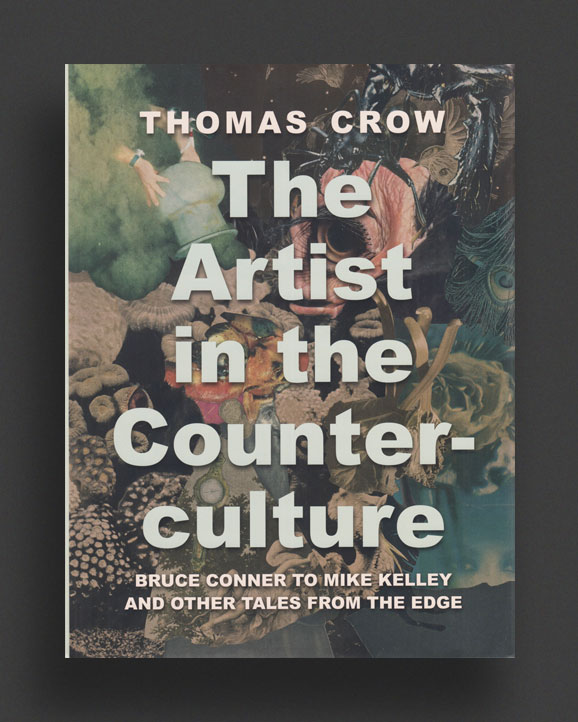
How California's counterculture of the 1960s to 1980s profoundly shaped—and was shaped by—West Coast artists.
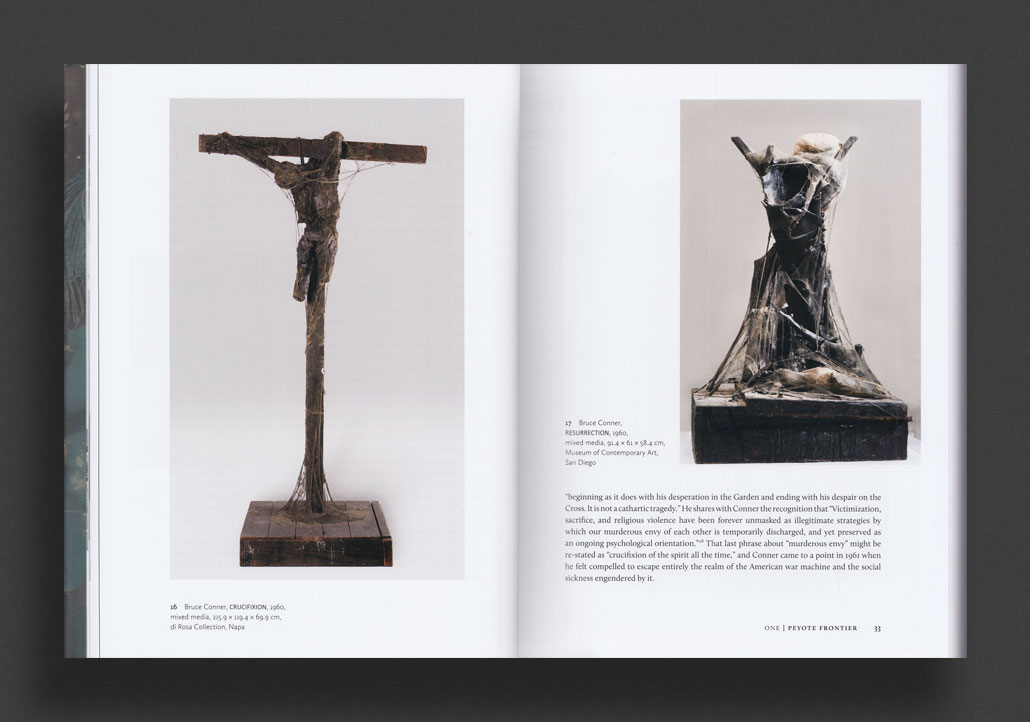
The 1960s exert a special fascination in modern art. But most accounts miss the defining impact of the period's youth culture, largely incubated in California, on artists who came of age in that decade. As their prime exemplar, Bruce Conner, reminisced, "I did everything that everybody did in 1967 in the Haight-Ashbury. . . . I would take peyote and walk out in the streets." And he vividly channeled those experiences into his art, while making his mark on every facet of the psychedelic movement—from the mountains of Mexico with Timothy Leary to the rock ballrooms of San Francisco to the gilded excesses of the New Hollywood. In The Artist in the Counterculture, Thomas Crow tells the story of California art from the 1960s to the 1980s—some of the strongest being made anywhere at the time—and why it cannot be understood apart from the new possibilities of thinking and feeling unleashed by the rebels of the counterculture.
Crow reevaluates Conner and other key figures—from Catholic activist Corita Kent to Black Panther Emory Douglas to ecological witness Bonnie Ora Sherk—as part of a generational cohort galvanized by resistance to war, racial oppression, and environmental degradation. Younger practitioners of performance and installation carried the mindset of rebellion into the 1970s and 1980s, as previously excluded artists of color moved to the forefront in Los Angeles. Mike Kelley, their contemporary, remained unwaveringly true to the late countercultural flowering he had witnessed at the dawn of his career.
The result is a major new account of the counterculture's enduring influence on modern art.
1998, English
Softcover, 385 pages, 15.24 x 22.86 cm
1st Edition, Out of print title / used / average
Published by
Feral House / Los Angeles
$35.00 - Out of stock
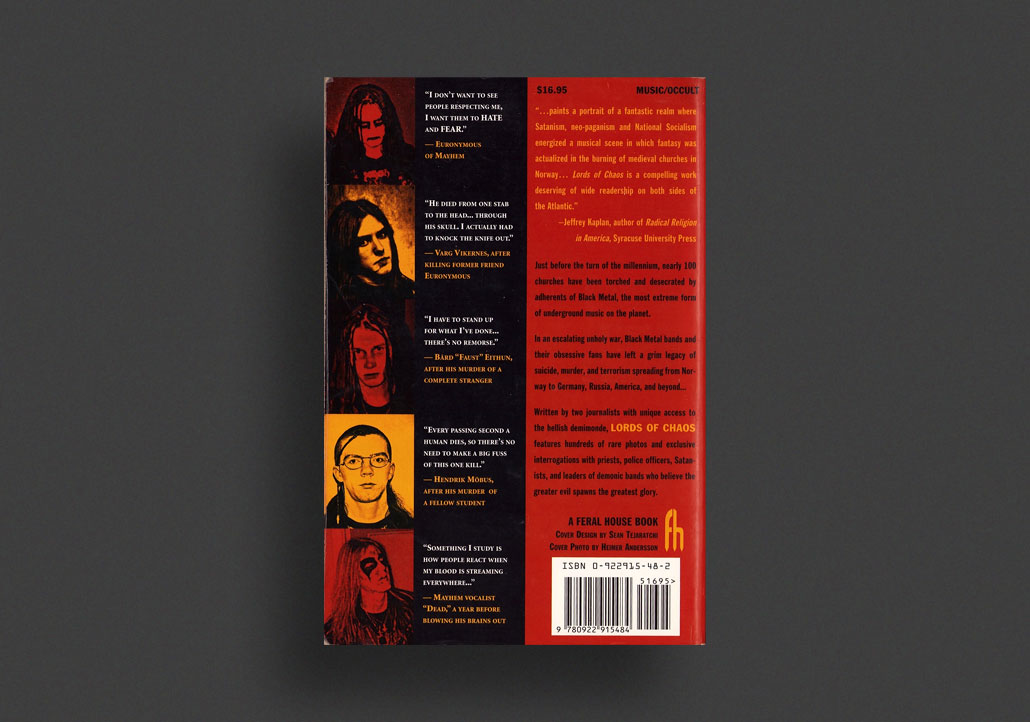
First edition of the definitive published account of Black Metal, published by Feral House in 1998. The Bloody Rise of the Black Metal Mafia Murder, suicide, occult sacrifices, church-burnings and fascism terrorism preoccupy the musicians and followers of Black Metal: a dark and psychotic version of heavy metal music. This extraordinary book penetrates the inner circle of the Black Metal leaders, reveals the truth behind the stories, and includes an interview with Varg Vikerness of the group Burzum, currently imprisoned for the murder of another Black Metal musician.
"With Lords of Chaos Michael Moynihan and Didrik Soderlind paint a portrait of a fantastic realm where Satanism, neo-paganism and National Socialism energized a musical scene in which fantasy was actualized in the burning of medieval churches in Norway ...a uniquely valuable history of Black Metal music in general and of the Norwegian scene in particular as it is viewed by the participants themselves. Lords of Chaos is a compelling work deserving of a wide readership on both sides of the Atlantic." -- Dr. Jeffrey Kaplan, author of Radical Religion in America.
Average—Good copy with considerable wear, creasing.
2004, English
Softcover, 285 pages, 15.24 x 22.86 cm
1st Edition, Out of print title / used / average
Published by
Feral House / Los Angeles
$35.00 - In stock -
First 2004 edition. In 1986, the idea that death metal and grindcore would ever impact popular culture was unimaginable. Initially circulated through a scattered tape-trading network of underground thrill-seekers, bands rose from every corner of the globe and death metal and grindcore spread faster than a pandemic plague of undead flesh-eaters. By 1994, the genre's most prominent labels had sold millions of albums. This exciting history, featuring an introduction by famed DJ John Peel, tells the two-decade-long history of grindcore and death metal through the eyes and ringing ears of the artists, producers, and label owners who propelled them. Includes essential discography and "Life After Death" biography updates on the lives of those featured. Autopsy, Napalm Death, Carcass, Fear of God, S.O.B., Morbid Angel, Obituary, Terrorizer, Doom, Extreme Noise Terror, Decide, Entombed, Grave, Bolt Thrower, Brutal Truth, Morbid Angel, Suffocation, Siege, Cannibal Corpse, Discordance Axis, Decapitated, Exhumed, Vader, and so many more...
Average—Good copy with considerable wear, creasing.
2021, English
Softcover, 144 pages, 12 x 19 cm
Published by
Rab-Rab Press / Helsinki
$38.00 - Out of stock
Punk Suprematism includes the first English translation of theoretical writings on punk, art, socialism, bureaucracy, and nationalism by Slavoj Žižek, Rastko Močnik, and Zoja Skušek.
Written in the first half of the eighties, these texts are a unique mixture of punk attitude with theoretical concepts borrowed from Althusser, Lacan, and avant-garde art. Written in a turbulent period of Yugoslav socialism, these texts were trying to understand the political importance of punk as a mass movement of impoverished youth. The conclusions of these interventions had a lasting effect on the theoretical formation of Yugoslav post-Marxism, as well to the organizational forms of the socialist alternative. The book also includes a foreword on the historical context of the eighties and the extensive narrative bibliography of punk related publications in the Socialist Republic of Slovenia written by Sezgin Boynik. In addition to this, it also includes translations of the two editorials to Punk Problemi written by renowned Slovenian theoreticians.
The book is the first in an upcoming series on punk research by Rab-Rab press. The series starts from the idea that punk is a break, and focuses on punk as something completely separated from bourgeois culture.
1996, English
Softcover, 286 pages, 23.5 x 15 cm
1st Edition, Out of print title / as new
Published by
Inanout Press / New York
$120.00 - Out of stock
First, long-out-of-print 1996 edition of the first major in-depth and intimate book to explore the experimental filmmaker, music anthologist, and enigmatic polymath Harry Smith’s work and the people who knew him. Published by Inanout Press in New York, this wonderful, heavily illustrated, deeply researched volume includes interviews with Allen Ginsberg, Robert Frank, Jonas Mekas and many others, extensive collection Smith's catalogues, reproduced artworks and writings, photographs... A unique collage of materials and now very rare in this lovely original edition.
Best known during his lifetime as an experimental filmmaker and Folkways Records music anthologist, Harry Smith (1923-1991) was a spiritual outsider and one of the most original, influential artists of the mid-century American avant-garde. An avid, inspired collector of old blues and hillbilly recordings during his youth, he became a fan of such bebop jazz as Charlie Parker and Dizzy Gillespie, and began making avant-garde film animations featuring patterns painted directly onto the negatives as visual accompaniments to jazz performances. Smith crossed paths with nearly everyone central to the cultural avant-garde; he lived for art and gnosis with little thought for practical consequences. In 1991, he received a Lifetime Achievement Award at the Grammy Awards in New York.
Five years after Smith's death, the poet Paola Igliori began conducting intimate interviews with the filmmakers, musicians, poets, and artists who knew him best. The result, American Magus — Harry Smith, offers a privileged look not only into Smith's life and artistic practice, but also into his era and the informal economy of influence that operated during that time. It provides invaluable insight into the mind of one of the twentieth century's most enigmatic polymaths.
Fine—As New copy of this collectible first edition.
2022, English
Hardcover (w. dust jacket), 224 pages, 26.3 x 18.8 cm
Published by
Semiotext(e) / Los Angeles
$56.00 - Out of stock
The life, times, and mysteries of Fred Halsted, gay porn's first film auteur, in a new, updated, and expanded edition.
Fred Halsted’s L.A. Plays Itself (1972) was gay porn’s first masterpiece: a sexually explicit, autobiographical, experimental film whose New York screening left even Salvador Dalí repeatedly muttering “new information for me.” Halsted, a self-taught filmmaker, shot the film over a period of three years in a now-vanished Los Angeles, a city at once rural and sleazy. Although his cultural notoriety at one point equaled that of Kenneth Anger or Jack Smith, Halsted’s star waned in the 1980s with the emergence of a more commercial gay porn industry. After the death from AIDS of his long-time partner, lover, spouse (and tormentor) Joey Yale in 1986, Halsted committed suicide in 1989. In Halsted Plays Himself, acclaimed artist and filmmaker William E. Jones documents his quest to capture the elusive public and private personas of Halsted—to zero in on an identity riddled with contradictions. Jones assembles a narrative of a long-gone gay lifestyle and an extinct Hollywood underground, when independent films were still possible, and the boundary between experimental and pornographic was not yet established. The book also depicts what sexual liberation looked like at a volatile point in time—and what it looked like when it collapsed.
The revised and expanded edition of Halsted Plays Himself includes material that came to light since the book’s first publication, including details about the restoration of Halsted’s films by the Museum of Modern Art, the true identities of several key figures in his life, new testimony from family members, and the rediscovery of his feature film Truck It (1973), previously considered lost.
1978, German
Softcover, 96 pages (with many fold-outs), 23 x 30 cm
1st Edition, Out of print title / used / very good
Published by
Rogner & Bernhard / Münich
$90.00 - Out of stock
First German edition of Christopher Makos' "Schicker Schund" (or "White Trash") from 1978. Born in Massachusetts in 1948, Makos spent his boyhood in California and before moving to Paris to study architecture and, eventually, to apprentice with artist, Man Ray. Since 1966 he has worked at developing a unique style of boldly graphic photo—journalism. In "Schicker Schund", Makos displays his seeming dis-regard for human and social values, describing a strange (and often sordid) terrain, inhabited by the prophets of an ambisexual generation tolling a future of catatonia. Makos himself has said, regarding the nature of his art, that “the camera is a knife. And photography is an act of violence.” Amongst his victims are William Burroughs, Richard Hell, Devine, David Bowie, Debbie Harry, Alice Cooper, David Johansen, Zandra Rhodes, Mick Jagger, Man Ray, Patti Smith, Andy Warhol, Tennessee Williams and many others.
Very Good copy.
2022, English
Hardcover, 176 pages, 30.5 x 23 cm
Published by
DelMonico Books / US
Brooklyn Museum / Brooklyn
$120.00 - In stock -
The first comprehensive book on the surreal, queer and humorous photographic art of Jimmy DeSana, a central figure in New York's art and music scenes of the 1970s and '80s.
This is the first overview of the work of Jimmy DeSana, a pioneering yet underrecognized figure in New York's downtown art, music and film scenes during the 1970s and 1980s. The book situates DeSana's work and life within the countercultural and queer contexts in the American South as well as New York, through his involvement in mail art, punk and No Wave music and film, and artist collectives and publications.
DeSana's first major project was 101 Nudes, made in Atlanta during the city's gay liberation movement. After moving to New York in 1973, DeSana became immersed in queer networks, collaborating with General Idea and Ray Johnson on zines and mail art, and documenting the genderqueer street performances of Stephen Varble.
By the mid-1970s, DeSana was a fixture in New York's No Wave music and film scenes, serving as portraitist for much of the period's central figures and producing album covers for Talking Heads, James Chance and others. His book Submission, made with William S. Burroughs, humorously staged scenes out of a S&M manual that explored the body as object and the performance of desire. DeSana was also an early adopter of color photography, creating his best-known series, Suburban, in the late 1970s and early 1980s. This body of work explores relationships between gender, sexuality and consumer capitalism in often humorous, surreal ways. After DeSana became sick as a result of contracting HIV, he turned to abstraction, using experimental photographic techniques to continue to push against photographic norms.
Edited by Drew Sawyer.
Preface by Anne Pasternak.
Epilogue by Laurie Simmons.
2005, English
Softcover, 272 pages, 20.3 x 14 cm
Published by
Soft Skull Press / New York
$35.00 - Out of stock
In this eye-opening memoir, Lisa Crystal Carver recalls her extraordinary youth and charts the late-80s, early-90s punk subculture that she helped shape. She recounts how her band Suckdog was born in 1987 and the wild events that followed: leaving small-town New Hampshire to tour Europe at 18, becoming a teen publisher of fanzines, a teen bride, and a teen prostitute. Spin has called Suckdog's album Drugs Are Nice one of the best of the '90s, and the book includes photos of infamous European shows. Yet the book also tells of how Lisa saw the need for change in 1994, when her baby was born with a chromosomal deletion and his father—industrial music maven and rumoured Nazi Boyd Rice—became violent. With lasting lightness and surprising gravity, Drugs Are Nice is a definitive account of the generation that wanted to break every rule, but also a story of an artist and a mother becoming an adult on her own terms.
1972, Japanese
Softcover, 214 pages, 20.8 x 14.7 cm
1st Edition, Out of print title / used / good
Published by
Tokyo Sanseisha / Tokyo
$120.00 - Out of stock
"Sadistic Play of Bondage"
Very rare 1972 special photobook edition of legendary cult kinbaku magazine SM Select. A beautiful volume, packed cover to cover with full-bleed bondage photography in saturated 1970s colour and b/w, printed on textured stocks, showcasing the talents of famous Japanese actresses and models such as Reiko Ike, Yuri Izumi, Naomi Tani, Junko Miyashita, Nana Minami, and many more. Barely any text, just photos!
First published in 1970, SM Select fast become the leading magazine that sparked the SM magazine boom in the 70's and 80's in Japan. Nobuyuki Miyasaka, Hiroshi Senda, Toshiyuki Suma (Uramado, Kitan Club), etc. and others were all founding members of the magazine, but with the growing popularity of SM culture and magazines during this period, many contributors went on to establish other SM publishing ventures — Shin Miyasaka and Toshiyuki Suma established Sun Publishing and launched SM Collector, while Seiko Ishikawa and three others from Tokyo Sanseisha moved to Shishobo and launched SM Fan. SM Select run for 20 years, ending in 1990.
Building from the foundations of its predecessors Kitan Club and Uramado, SM Select contained a harder, non-conformist and fanatic edge, featuring writings with more lavish visual SM content — photographs and artworks in colour and black and white. The high quality of photography and artwork ushered in a new era of SM publishing, with SM Select featuring many now legendary artists, including Haruo Shinozaki, Jun Yoshida, Toshio Saeki, Kazuyuki Minori, Minoru Nagao, Ruyo Yo, Yasuharu Maeda, Mino Mura Akira, Hiro Kato, Nishimura Haruhi, Kozumi Yuko, Kito Akatsuki, Oshima Yukio, Kirigaoka Hiroyuki, Lin Moonlight, Maeda Yasunari, Yuya Nohira, Nakao Kaoru, etc. Major contributors were Dan Oniroku and Aotaro Aki. The principal rope master was Toshiyuki Suma. Rope master and writer Chimuo Nureki had several guest appearances in the magazine and took over as principal master when Mr. Suma fell ill. Photographer Norio Sugiura was the main photographer in the magazine from the 1980s.
Average—Good copy with some cover creases and spine crease, light wear, old fragile binding.
1974, Japanese
Softcover, 202 pages, 21 x 15 cm
1st Edition, Out of print title / used / very good
Published by
Kubo Shoten / Japan
$70.00 - Out of stock
February 1974, rare early issue of Suspense Magazine, the cult Japanese kinbaku magazine founded in 1965 and running for 15 years, edited by Haruo Shimamoto and Chimuo Nureki, packed with illustrated SM stories, lavish colour and b/w fetish artwork, sadistic cartoons, and gorgeous bondage photo spreads and vivid colour photographic fold-outs. This issue features bondage master Haruo Shimamoto, art feature by the legendary kinbaku/tattooed lady illustrator Kaname Ozuma, Akira Kito, Kazumu Kohinata, Toshiro Tama, stories by Aotaro Aki, Kaoru Fujimi, Higashiho Mitsuya, and many others.
Good—VG copy with light wear.
1998, Japanese
Softcover, 310 pages, 21 x 15 cm
1st Edition, Out of print title / used / very good
Published by
Million Publishing / Tokyo
$80.00 - Out of stock
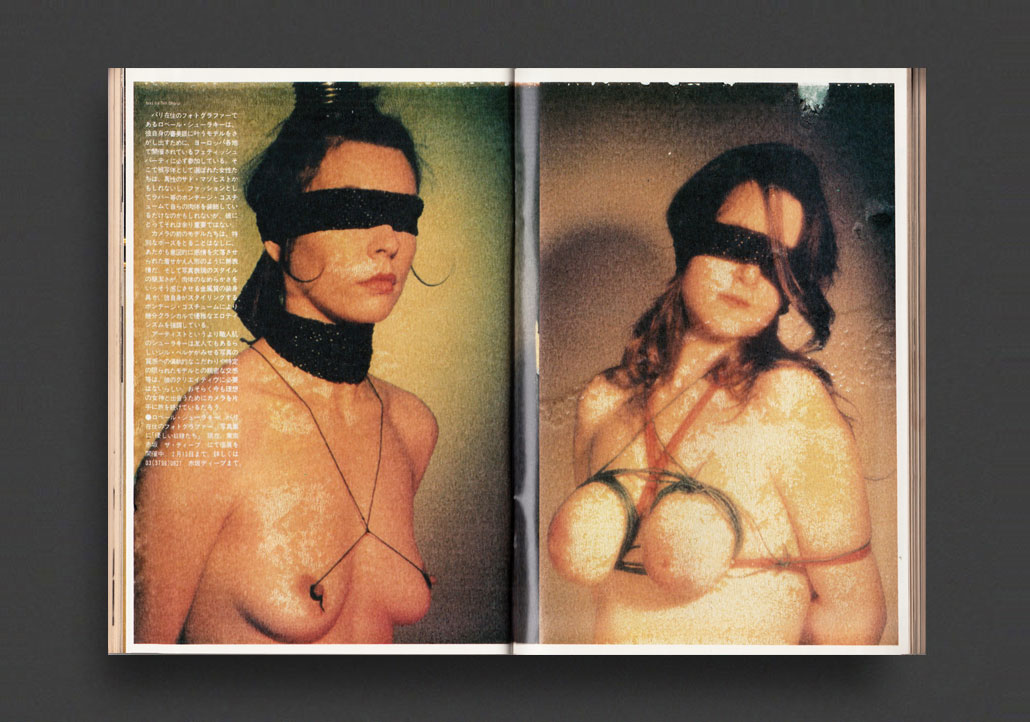
January 1998 issue of S&M Sniper, the cult glossy fetish magazine published in Japan between 1979 - 2009 that, unlike previous SM magazines, didn't centre so much around professional kinbakushi, favouring instead the exploration of new innovations of fetish and underground sex culture and emphasising the work of the models, stylists, make-up artists, and fashions designers, as much as the writers or photographers. The "new wave" of SM culture, embedded in 1980s underground music, fashion and visual art culture in Japan. Explicitly and profusely illustrated, issues are packed from cover-to-cover with all manner of SM and fetish photoshoots, illustrations, comics, essays, diaries, reports, exhibitions, reviews, interviews, and included regular contributors such as Masami Akita (Merzbow), Kazuo Kamimura, Domu Kitahara, Makoto Orui, Kinichi Tanaka, Nobuhiko Ansai, Masaaki Toyoura... Each issue is also brimming with amazing Japanese advertisements and classifieds for the latest bondage clubs, boutiques, fashion, toys, video and publication catalogues, hook-ups, phone sex, and much more. This issue includes Nobuyoshi Araki, Takashi Homma, Ken-ichi Murata, Masami Akita, Toyoura Masaaki, Aki Tanaka, Koji Nakano, Junko Takahashi, Tetsuo Amano, Domu Kitahara, Mayumi Oda, Gaijin Tokuno, all the usual and more... Not for the faint of heart.
Very Good copy.
1993, Japanese
Softcover, 300 pages, 21 x 15 cm
1st Edition, Out of print title / used / very good
Published by
Million Publishing / Tokyo
$80.00 - Out of stock
March 1993 issue of S&M Sniper, the cutting-edge cult glossy fetish magazine published in Japan between 1979—2009 that, unlike previous SM magazines, didn't centre so much around professional kinbakushi, favouring instead the exploration of new innovations of fetish and underground sex culture and emphasising the work of the models, stylists, make-up artists, and fashions designers, as much as the writers or photographers. The "new wave" of SM counterculture, embedded in 1980s underground music, fashion and visual art culture in Japan. Explicitly and profusely illustrated, each issue came wrapped in the iconic hyper-stylized airbrushed front covers of artist Yosuke Onishi, veiling the core content of non-fiction realist degradation and an eclectic, expressive editorial of kinbaku and all manner of SM, and extreme fetish photoshoots, illustrations, comics, essays, diaries, reports, exhibitions, reviews, interviews, and included regular contributors such as SM archivist and noise musician Masami Akita (Merzbow), legendary SM writer and editor Dan Oniroku ("the most celebrated writer of popular SM novels in Japan"), features by legendary SM and seppuku performer, actress, and author Hiromi Saotome, features by contributing photographers Nobuyoshi Araki, Masaaki Toyoura, Kenichi Murata, Nobuhiko Ansai, Kinichi Tanaka, Domu Kitahara, sadistic BDSM trainer Shima Shikou, and regular writings by convicted murderer and cannibal Issei Sagawa!! Including his translations of Guido Crepax comics from Italian to Japanese. This was not a magazine like the others. Each issue is also brimming with amazing Japanese advertisements and classifieds for the latest bondage clubs, boutiques, dungeons, fashion, toys, video and publication catalogues, hook-ups, phone sex, and much more. This issue includes Nobuyoshi Araki, Kiyoshi Ikejiri, Yosuke Onishi, Domu Kitahara, Tadao Chigusa, Kenichi Yamakawa, Shima Shikou, Aki Ryo, Kinichi Tanaka, Wakao Takahashi, Chihiro Abe, Robert Mapplethorpe, Takashi Ishii, Hiroyuki Tanino, all the usual and more... Not for the faint of heart.
Very Good copy.
1989, Japanese
Softcover, 310 pages, 21 x 15 cm
1st Edition, Out of print title / used / very good
Published by
Million Publishing / Tokyo
$80.00 - Out of stock
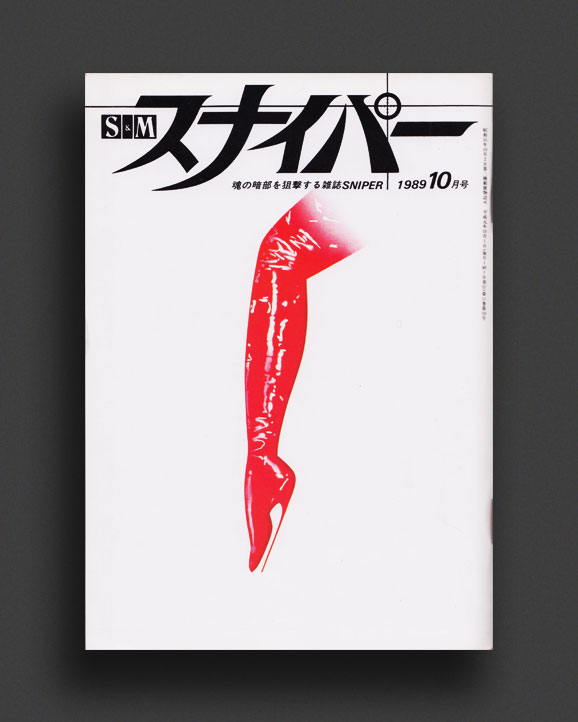
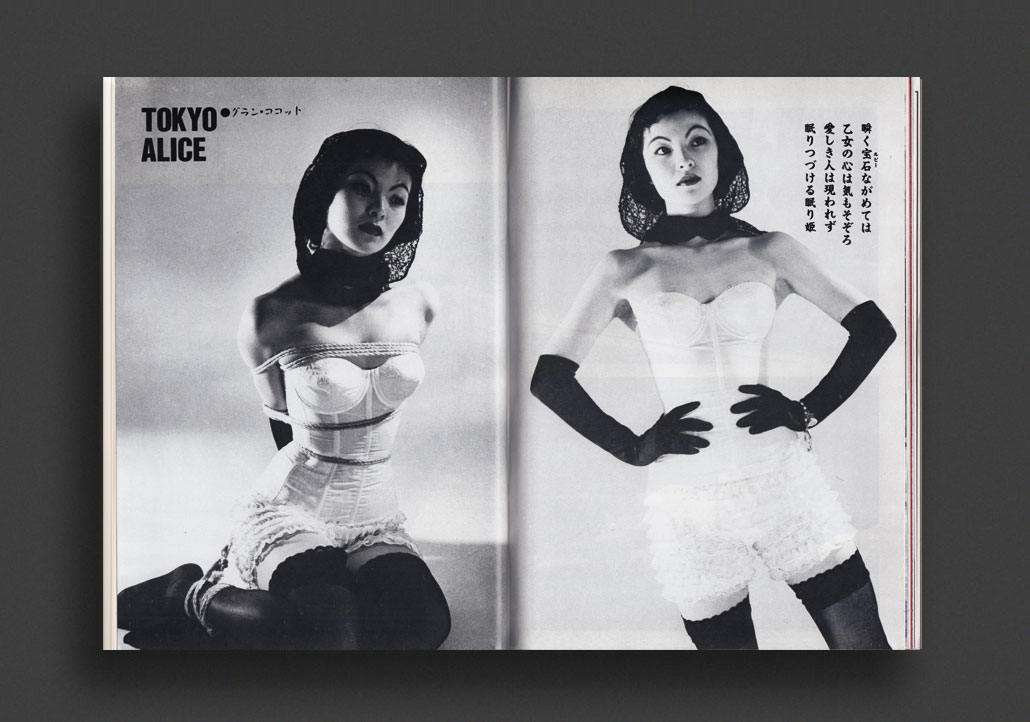
October 1989 issue of S&M Sniper, the cult glossy fetish magazine published in Japan between 1979 - 2009 that, unlike previous SM magazines, didn't centre so much around professional kinbakushi, favouring instead the exploration of new innovations of fetish and underground sex culture and emphasising the work of the models, stylists, make-up artists, and fashions designers, as much as the writers or photographers. The "new wave" of SM culture, embedded in 1980s underground music, fashion and visual art culture in Japan. Explicitly and profusely illustrated, issues are packed from cover-to-cover with all manner of SM and fetish photoshoots, illustrations, comics, essays, diaries, reports, exhibitions, reviews, interviews, and included regular contributors such as Masami Akita (Merzbow), Kazuo Kamimura, Domu Kitahara, Makoto Orui, Kinichi Tanaka, Nobuhiko Ansai, Masaaki Toyoura... Each issue is also brimming with amazing Japanese advertisements and classifieds for the latest bondage clubs, boutiques, fashion, toys, video and publication catalogues, hook-ups, phone sex, and much more. This issue includes Tadao Chigusa, Nobuyoshi Araki, Tsuguya Inoue, Joel Peter-Witkin, Robert Mapplethorpe, Wilhelm von Gloeden, Keizo Miyanishi, Sayoko Nakajima, all the usual and more... Not for the faint of heart.
Very Good copy.
1983, Japanese
Softcover, 250 pages, 21 x 15 cm
1st Edition, Out of print title / used / very good
Published by
Million Publishing / Tokyo
$80.00 - Out of stock
November 1983 issue of S&M Sniper, the cult glossy fetish magazine published in Japan between 1979 - 2009 that, unlike previous SM magazines, didn't centre so much around professional kinbakushi, favouring instead the exploration of new innovations of fetish and underground sex culture and emphasising the work of the models, stylists, make-up artists, and fashions designers, as much as the writers or photographers. The "new wave" of SM culture, embedded in 1980s underground music, fashion and visual art culture in Japan. Explicitly and profusely illustrated, issues are packed from cover-to-cover with all manner of SM and fetish photoshoots, illustrations, comics, essays, diaries, reports, exhibitions, reviews, interviews, and included regular contributors such as Masami Akita (Merzbow), Kazuo Kamimura, Domu Kitahara, Makoto Orui, Kinichi Tanaka, Nobuhiko Ansai, Masaaki Toyoura... Each issue is also brimming with amazing Japanese advertisements and classifieds for the latest bondage clubs, boutiques, fashion, toys, video and publication catalogues, hook-ups, phone sex, and much more. This issue includes Nobuyoshi Araki, Oniroku Dan, Aki Uchiyama, Fumika Kitahara, all the usual and more... Not for the faint of heart.
Very Good copy.
2018, Japanese / English / Chinese
Softcover, 3 volumes plus supplement, printed plastic bag
1st Edition, Out of print title / as new
Published by
NITESHA / Tokyo
$280.00 - In stock -
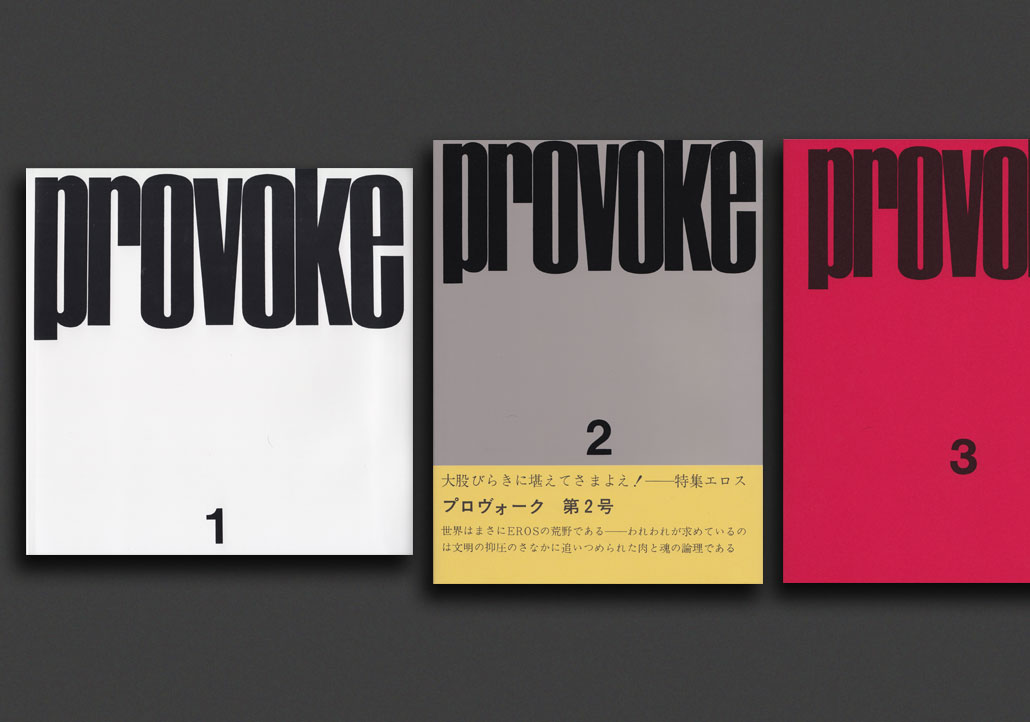
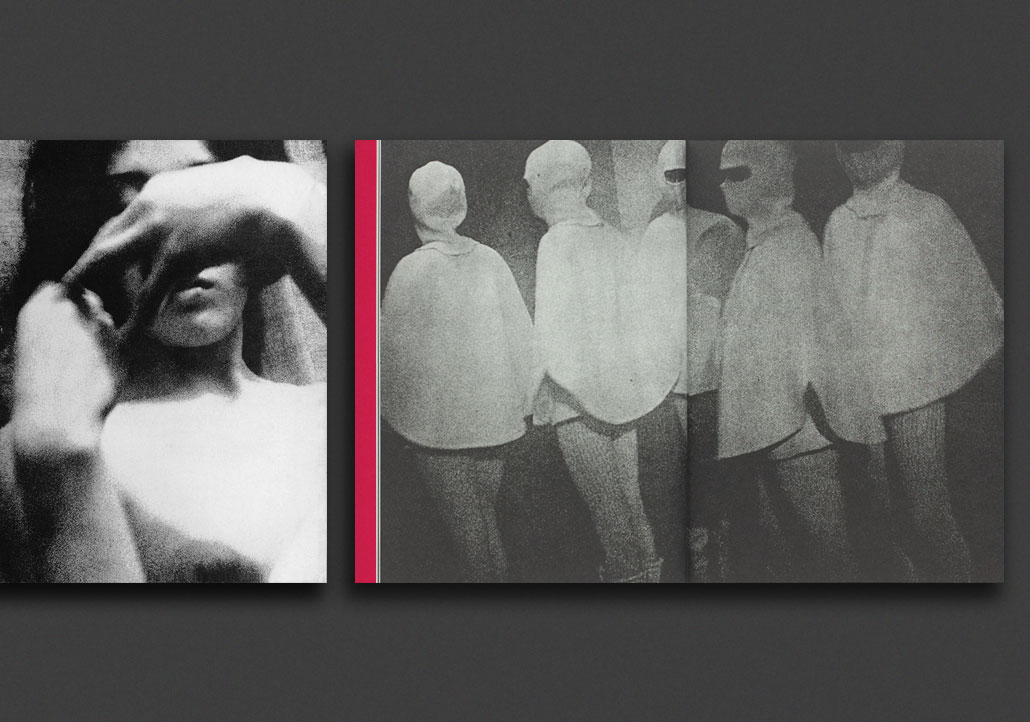
First, quickly out-of-print, complete limited-edition facsimile of all three issues the ground-breaking Japanese photography magazine Provoke. The short-lived Provoke, founded in 1968 by art critic Koji Taki (1928-2011), photographer Takuma Nakahira (1938-2015), poet Takahiko Okada (1939-1997), photographer Yutaka Takanashi, and later joined by Daido Moriyama, is nowadays recognized as a major contribution to postwar photography in Japan, featuring the country's finest representatives of protest photography, vanguard fine art and critical theory in only three issues ever published.
In 2018, marking the 50th year since Provoke had first appeared, this special edition was published by NITESHA, a secondhand bookshop in Tokyo who were fortunate to be able to purchase all three volumes of the original prints. Rather than merely putting them back on the market again for profit, they decided to make a reprint of these extremely rare and inaccessible issues that are currently only owned by a limited number of connoisseurs. Striving to stay as close to the original publications as possible, all three issues are accompanied by a supplementary volume containing all the original Japanese texts (essays, poetry, etc.) translated into both English and Chinese, including those by Takahiko Okada (excluded from Steidl's “The Japanese Box” reissue due to copyright issues). This facsimile reprint also maintains the original size of all of the images (unlike the cropped Steidl “The Japanese Box” reissue), making it the closest thing to the seldom seen originals.
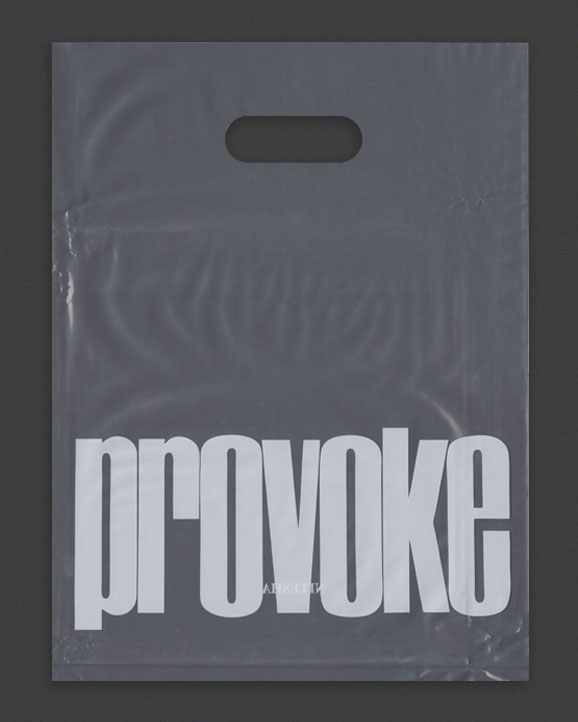
Comes housed in the publisher's limited edition "Provoke" printed plastic bag, as first issued, making it a most complete copy of this book-set.
Provoke's goal was to mirror the complexities of Japanese society and its art world of the 1960s, a decade shaped by the country's first large-scale student protests. The subtitle for the magazine was “Provocative Materials for Thought,” and each self-published issue was composed of photographs, essays and poems. The movement yielded a wave of new books featuring innovative graphic design combined with photography: serialized imagery, gripping text-image combinations, dynamic cropping and the use of provocatively "poor" materials. The writings and images by Provoke's members - Taki, Nakahira, Okada, Takanashi and Moriyama - were suffused with the tactics developed by Japanese protest photographers such as Nobuyoshi Araki, Eikoh Hosoe and Shomei Tomatsu, who pointed at and criticized the mythologies of modern life. Provoke’s grainy, blurry, and out-of-focus photographs were initially ridiculed as are-bure-boke (a Japanese term meaning, literally, “rough, blurred and out-of-focus”) and stirred a great deal of controversy, yet it had created a strong impact inside and outside of the photography world during that time and its influence cannot be overstated.
PROVOKE 1: Softcover, 68 pages, 21 x 21 cm
PROVOKE 2: Softcover (w. printed wrap-around obi strip), 110 pages, 24.2 x 18 cm
PROVOKE 3: Softcover, 110 pages, 24 x 18.4 cm.
PROVOKE Textbook (English and Chinese translations), 24 x 18.4 cm
As New. This edition is now out-of-print, further re-prints have been made.
2022, English
Softcover, 184 pages, 27 x 22 cm
Published by
Blank Forms / New York
$69.00 - In stock -
A rare document of the 1960s Black Arts Movement featuring Albert Ayler, Amiri Baraka, Milford Graves, Sun Ra, Cecil Taylor, and many more, The Cricket fostered critical and political dialogue for Black musicians and writers. Edited by poets and writers Amiri Baraka, A.B. Spellman, and Larry Neal between 1968 and 1969 and published by Baraka’s New Jersey–based Jihad productions shortly after the time of the Newark Riots, this experimental music magazine ran poetry, position papers, and gossip alongside concert and record reviews and essays on music and politics. Over four mimeographed issues, The Cricket laid out an anticommercial ideology and took aim at the conservative jazz press, providing a space for critics, poets, and journalists (including Stanley Crouch, Haki Madhubuti, Ishmael Reed, Sonia Sanchez and Keorapetse Kgositsile) and a range of musicians, from Mtume to Black Unity Trio, to devise new styles of music writing. The publication emerged from the heart of a political movement—“a proto-ideology, akin to but younger than the Garveyite movement and the separatism of Elijah Mohammed,” as Spellman writes in the book’s preface—and aimed to reunite advanced art with its community, “to provide Black Music with a powerful historical and critical tool” and to enable avant-garde Black musicians and writers “to finally make a way for themselves.” This publication gathers all issues of the magazine with an introduction by poet and scholar David Grundy, who argues that The Cricket “attempted something that was in many ways entirely new: creating a form of music writing which united politics, poetry, and aesthetics as part of a broader movement for change; resisting the entire apparatus through which music is produced, received, appreciated, distributed, and written about in the Western world; going well beyond the tried-and-tested journalistic route of description, evaluation, and narration.”
Contributors include: A.B. Spellman, Imamu Baraka (LeRoi Jones), Larry Neal, Cecil Taylor, Milford Graves, Sun Ra, Ben Caldwell, Clyde Halisi, Don L. Lee (Haki R. Madhubuti), Duncan Barber, Gaston Neal, Hilary Broadus, James Stewart, Norman Jordan, Roger Riggins, Ronnie Gross, Stanley Crouch, Albert Ayler, Askia Muhammed Toure, Donald Stone, E. Hill, Haasan Oqwiendha Fum al Hut, Ibn Pori 'det, Ishmael Reed, Joe Goncalves, Larry A. Miller (Katibu), Sonia Sanchez, Willie Kgositsile, Billy (Fundi) Abernathy, Dan Dawson and Black Unity Trio.
David Grundy is the author of A Black Arts Poetry Machine: Amiri Baraka and the Umbra Poets (Bloomsbury Academic, 2019) and coeditor, with Lauri Scheyer, of Selected Poems of Calvin C. Hernton (Wesleyan University Press, forthcoming). He is currently a British Academy Fellow at the University of Warwick, United Kingdom, where he is working on two manuscripts, Survival Music: Free Jazz Then and Now and Never by Itself Alone: Queer Poetry in Boston and San Francisco, 1943–Present (Oxford University Press, forthcoming), and a further edited collection on Umbra.
A.B. Spellman is a poet, music critic, and former director of the Arts in Education Study Project for the National Endowment of the Arts.
2003, English / Japanese / French
Softcover (w. dust jacket), 68 pages, 22 x 20 cm
1st Edition, Out of print title / used / fine
Published by
Amus Arts Press / Japan
$100.00 - Out of stock
First edition of Kyoichi Tsuzuki's "Image Club" photo book, published in Japan in 2003. Image Club is a one-of-a-kind photographic glimpse at the constructed environments of a secret Tokyo bordello phenomenon called "ikemura" or "imeji kurabu" (image club). The Imekura-Image Club is a Japanese sexual role playing service in which fantasy sets of remarkably mundane environments (a commuter train, an office kitchen, a consulting room, a girl's bedroom...) are created for a customer to encounter an imekura girl of his dreams. Tsuzuki describes the strange phenomenon as "the far north of simulation art." The customer may want to molest a female commuter on the train, commit sexual harassment at the office or enter a young college student's room. It is a "temporary space that embodies delusions" and "a representation of the dynamism of an extremely Japanese imagination". Printed in full-page colour images, the rooms only pictured here devoid of human interaction, shot as empty interiors with an almost sterile gaze. Accompanying text by Kyoichi Tsuzuki in English, Japanese and French.
Kyoichi Tsuzuki (1956—) is a Japanese editor and photographer. After working as an editor and writer for the magazines "Popeye" and "BRUTUS", and whilst interviewing and compiling the "Art Random" series, Tsuzuki started taking photographs of unique environments specific to life in contemporary Japan. These photo collections have formed the cult, award-winning photo-books "ROADSIDE JAPAN", "TOKYO STYLE" and "Image Club", amongst others.
Fine copy with Fine Dust Jacket.
1994, Japanese
Softcover, 224 pages, 15 cm x 21 cm
1st Edition, Out of print title / used / very good
Published by
Tom Shobo / Japan
$80.00 - Out of stock
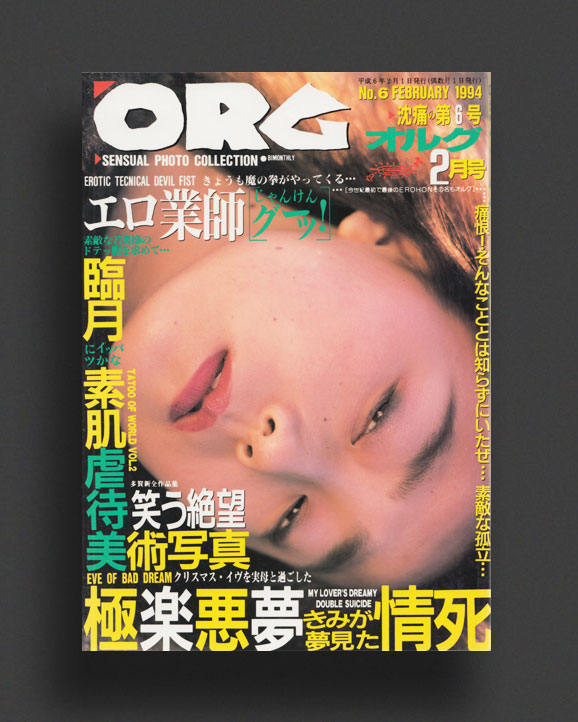
ORG No. 6, February 1994. Now rare and highly collectible, ORG was a visceral and visually explosive cult Japanese erotic photo journal series initiated and edited legendary Japanese publisher (Too Negative, etc.) and gallery owner Kotaro Kobayashi and published by Tom Publication Inc. between 1993 to 1997. After working in NYC in the early-mid 1990s, Kobayashi wanted to re-ignite the dense air that had evaporated from the erotic book market in Japan. Together with a team of creatives, including his close collaborator photographer Kiyoshi Ikejiri, ORG hit the shelves in 1993. In the same thick, glossy book format of Kobayashi's Too Negative, ORG shared very similar arresting and provocative themes, yet ORG focused it's densely-packed pages on erotica, less bloodlust. ORG features all manner of SM and bondage photography, underground scene reports, an abundance of tattoo/irezumi features, fetish, queer, dom/slave, she-male, mistress, alongside more traditional sensual nude female model photography and Japanese (and Euro) hardcore porn scenes. Considering it is by the same radical publishers as Too Negative, some bizarre/sado/exploitation/death/freak/medical/etc. content for good measure, always pushing the limits of taste and morality in the name of cultural freedom.
Not for the faint hearted.
This issue features photography stories by Yosimi Hara, Kiko Kunikuni, Hirowareta Kisai, Kiyoshi Ikejiri, "She-males on Parade", loads of tattoos, bondage, and the fantasy erotic illustration of Shin Taga.
Very Good copy.
2009, English
Softcover, 192 pages, 27 x 22 cm
1st Edition, Out of print title / used / very good
Published by
Black Dog Publishing Ltd / London
$190.00 - Out of stock
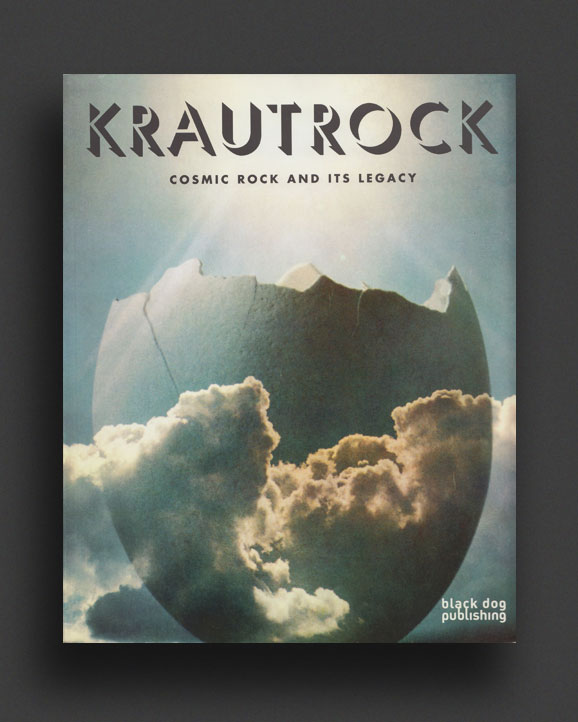
First edition of the quickly out-of-print, now rarely seen Krautrock : Cosmic Rock and Its Legacy. One of the greatest books on the subject.
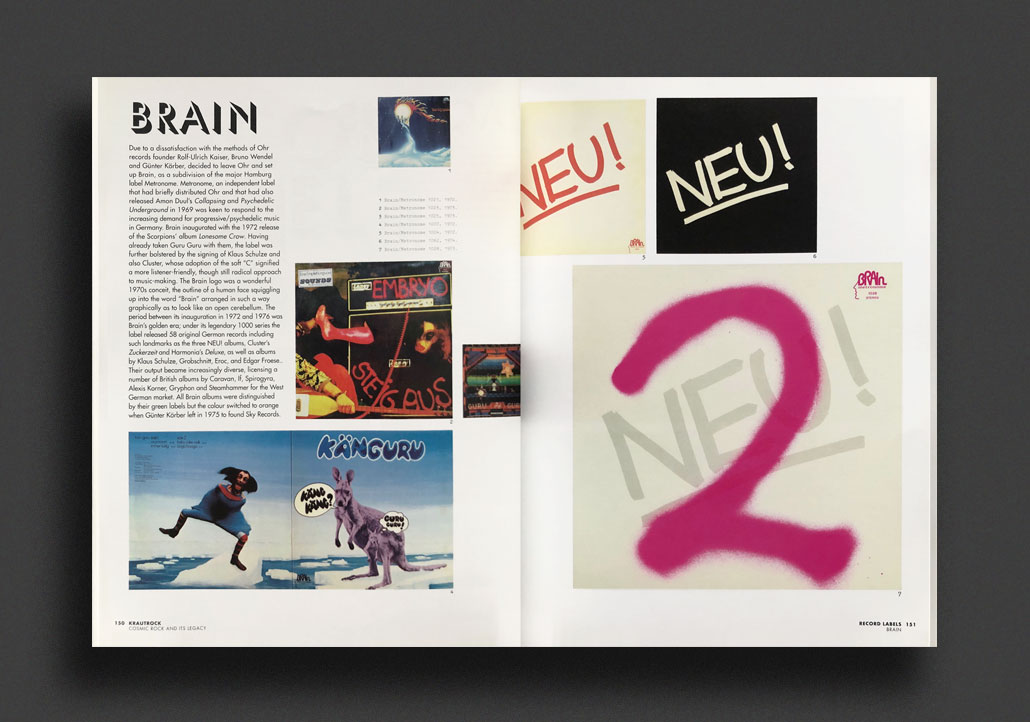
The late 1960s in West Germany was a period of profound breakthroughs, upheavals and reversals. Communes were spreading, protests organised throughout the entire country, the desire to begin everything anew permeating the young. Out of this climate, a music scene exploded that would forever change the face of western rock; at times anarchic, at others mystical, magickal, or utopian, it pushed rock beyond any known limits. Never a genre or a movement per se, Krautrock encompassed a very wild and diverse range of sounds, attitudes, and past musics, from free jazz to Karlheinz Stockhausen, from dada to Fluxus, from German Romanticism to the Mothers of Invention. The musicians operated outside any known categories, breaking new ground and turning their backs to both their country's past and the conventions of Anglo-American rock. Their vision fired the imaginations of generations of musicians after them: Cabaret Voltaire, Brian Eno, Nurse with Wound, PiL, DAF, Einsturzende Neubauten, to only name a few, have all acknowledged their deb to Krautrock's uncompromising ethics and innovative sounds. Profiling diverse key musical groups of the period, including Amon Düül (I & II), Can, Faust, Ash Ra Temple, Gila, Limbus, Walter Wegmüller, Cluster, Popol Vuh, Xhol, Between/Hamel, Guru Guru, Anima, Et Cetera/Wolfgang Dauner, Agitation Free, Harmonia, Embryo, Tangerine Dream, and many more, alongside the key producers (Plank, Dirks, Augustin, Kaiser) and records labels (Brain, Pilz, OHR, Kuckuck, etc.), and also a timeline of the period, this book quickly became a valuable resource. Profusely illustrated with with concert, studio and press photos, posters, record cover art and other rare visual material. Texts by Archie Patterson, Michel Faber, Erik Davis, David Stubbs, David Keenan, Ken Hollings, Brian Morton, Steve Krakow, Mark Pilkington, Gavin Russom, Stephen Thrower, and Ann Shenton make this is an essential compendium to a music whose spirit and ideas still vibrate through contemporary culture today. Quite a must, now rarely seen.
Edited by Nikolaos Kotsopoulos.
Very Good copy.
2022, English
Softcover, 256 pages, 14 x 19.8 cm
Published by
Blank Forms / New York
$40.00 - Out of stock
A vivid account of life on the margins and Tokyo's 1970s underground culture from a Japanese folk legend.
Tokyo in the 1970s was a magnet for young musicians, poets and painters. Among them was Kazuki Tomokawa, a prolific singer-songwriter from Japan's northern provinces, whose guttural vocals and incisive lyrics earned him the unofficial title of "screaming philosopher."
The stories in this memoir—originally published in 2015 in Japan and now appearing as the first English translation of Tomokawa's writing—are told with a rambler's wit and wisdom, bringing together his memorable reflections on six decades of day labor, drinking, gambling, acting, singing and writing. Figures such as Kan Mikami, Nobuyoshi Araki and Shūji Terayama drift through this down-and-out vagabond's memoir, which observes the turbulence of postwar countercultures and the explosion of Tokyo's underground film and music scenes.
Translated by Daniel Joseph, Introduction by Damon Krukowski
Kazuki Tomokawa (born 1950) is a prolific singer-songwriter from Hachiryū Village (now the town of Mitane) in the Akita Prefecture area of northern Japan. Since his debut in 1974, he has released more than 30 albums. He is additionally known as a poet, painter, keirin enthusiast and inimitable drinker. The 2010 documentary about his life, La Faute des Fleurs, won the Sound & Vision award at the Copenhagen International Documentary Film Festival, and that same year saw the Japanese release of the book Dreams Die Vigorously Day by Day, a collection of his lyrics spanning 40 years. His most recent albums are Vengeance Bourbon (2014) and Gleaming Crayon (2016), both on the Modest Launch label.
Damon Krukowski is a musician and writer based in Cambridge, MA. His most recent book is Ways of Hearing (MIT Press, 2019) and his latest album is Damon & Naomi's A Sky Record (202020, 2021).
Daniel Joseph is a translator, editor and musician. He holds a master's degree from Harvard University in medieval Japanese literature, and recently contributed translations to Terminal Boredom (Verso, 2021), a collection of stories by science fiction pioneer Izumi Suzuki.