World Food Books' programme is largely produced on Kulin Nation land. We acknowledge the Wurundjeri people of the Kulin Nation as the first and continuing custodians of this land, and pay respect to their Elders past, present, and emerging.
World Food Books is an arts and special interests bookshop in Naarm / Melbourne. Founded in 2010, World Food Books is devoted to the presentation of a rotating, hand-selection of international art, design, literary and counterculture publications with an emphasis on the anti-traditional, the experimental, the avant-garde, the heretic, the marginal.
Presenting new titles alongside rare and out-of-print books, catalogues and journals spanning the fields of modern and contemporary art, design, photography, illustration, film, literature, poetry, cultural theory, philosophy, sexuality, popular and underground culture in its many radical forms, World Food Books wishes to encourage adventurous, thoughtful and open-minded reading, looking, writing, and exchange of publishing and ideas, both current and historical.
As well as our bookshop, located in Melbourne's historical Nicholas Building, all of our inventory is available internationally via our online mail-order service.
World Food Books semi-regularly co-ordinates "Occasions", a programme of exhibits and events at the bookshop and in partnership with other hosts (such as museums and art galleries) that develop out of the activities, relationships and content of the bookshop itself.
World Food Books
The Nicholas Building
37 Swanston Street
Room 5, Level 6
Melbourne 3000
Australia
SHOP HOURS:
SHOP CLOSED FOR SUMMER
RE—OPEN JAN 2
WEB-SHOP OPEN 24/7
World Food Books
Postal Address:
PO Box 435
Flinders Lane
Victoria 8009
Australia
Art
Theory / Essay
Architecture / Interior
Graphic Design / Typography
Photography
Fashion
Eros
LGBTQ+
Fiction / Poetry
Weird / Speculative / Science Fiction / Horror
Transgressive / Visceral / Abject
Symbolism / Decadence / Fin de siècle
Film / Video
Painting
Sculpture / Installation
Performance / Dance / Theater
Drawing
Sound / Music
Curatorial
Group Shows / Collections
Periodicals
Out-of-print / Rare
Posters / Ephemera / Discs
Signed Books
World Food Books Gift Voucher
World Food Book Bag
Australian Art
Australian Fiction
Australian Science Fiction / Speculative Fiction
Australian Poetry
Australian Photography
Japanese Photography
Conceptual Art
Minimal Art
Dada
'Pataphysics / Oulipo
Fluxus
Concrete Poetry
Pop Art
Surrealism
Arte Povera
Arte Informale / Haute Pâte / Tachism
Nouveau Réalisme / Zero / Kinetic
Situationism / Lettrism
Collage / Mail Art / Xerox Art
Art Brut / Folk / Visionary / Fantastic
Illustration / Graphic Art / Bandes Dessinées
Furniture
Italian Radical Design / Postmodernism
Textiles
Ceramics / Glass
Counterculture
Protest / Revolt
Philosophy
Psychoanalysis
Anthropology
Anarchism
Socialism / Anarchism / Communism / Capitalism
Literary Theory / Semiotics / Language
Feminism / Women's Studies
Gender Studies / Sexuality
Anthropology
Fetishism / BDSM
Drugs / Psychedelia
Crime / Violence
Animal Rights / Veganism
Occult / Esoterica
Ecology / Earth / Alternative Living
Whole Earth / Crafts
All prices in AUD (Australian dollars)
Pick-Ups
Pick-up orders can be collected in our bookshop during opening hours after order date. Please collect any Pick-up orders within 2 weeks of ordering as we have limited storage space. Orders will be released back into stock if not collected within this time. No refunds can be made for pick-ups left un-collected. If you cannot make it in to the bookshop in this time-frame, please choose postage option.
Return Policy
All sales are final. We do accept returns (for refund or exchange) for items received in error. All our orders are packed with special care using heavy-duty padding and cardboard book-mailers or bubble mailers (for smaller books), using reinforcement where required. We cannot take responsibility for any lost, stolen or damaged parcels.
Insurance
Should you wish to insure your package, please email us directly after placing your order and we can organise this at a small extra expense. Although all standard/express tracked packages are very safe and dependable, we cannot take responsibility for any lost, stolen or damaged parcels. We recommend insurance on valuable orders.
Interested in selling your old books, catalogues, journals, magazines, comics, fanzines, ephemera? We are always looking for interesting, unusual and out-of-print books to buy. We only buy books in our fields of interest and specialty, and that we feel we can resell.
We base these prices on desirability, market value, in-print prices, condition and our current stock levels. We offer cash, store credit, and can take stock on consignment. All
about 25% of the price we expect to get when we sell them, or 30% in store credit. We base these prices on desirability, market value, in-print prices, condition and our current stock levels.
Sell your books any day of the week. You can drop them off and return later. If you have a lot of books, we can visit your Sydney home.
We buy books that we feel we can resell. We offer about 25 % of the price we expect to get when we sell them, or 30% in store credit. We base these prices on desirability, market value, in-print prices, condition and our current stock levels.
Philadelphia Wireman
03 August - 01 September, 2018
World Food Books is proud to announce our next Occasion, the first presentation of sculptures by Philadelphia Wireman in Australia.
The Philadelphia Wireman sculptures were found abandoned in an alley off Philadelphia’s South Street on trash night in 1982. Their discovery in a rapidly-changing neighbourhood undergoing extensive renovation, compounded with the failure of all attempts to locate the artist, suggests that the works may have been discarded after the maker’s death. Dubbed the "Philadelphia Wireman" during the first exhibition of this work, in 1985, the maker’s name, age, ethnicity, and even gender remain uncertain. The entire collection totals approximately 1200 pieces, all intricately bound together with tightly-wound heavy-gauge wire (along with a few small, abstract marker drawings, reminiscent both of Mark Tobey and J.B. Murry). The dense construction of the work, despite a modest range of scale and materials, is singularly obsessive and disciplined in design: a wire armature or exoskeleton firmly binds a bricolage of found objects including plastic, glass, food packaging, umbrella parts, tape, rubber, batteries, pens, leather, reflectors, nuts and bolts, nails, foil, coins, toys, watches, eyeglasses, tools, and jewellery.
Heavy with associations—anthropomorphic, zoomorphic, and socio-cultural responses to wrapped detritus—the totemic sculptures by Philadelphia Wireman have been discussed in the context of work created to fulfil the shamanistic needs of alternative religions in American culture. Curators, collectors, and critics have variously compared certain pieces to sculpture from Classical antiquity, Native American medicine bundles, African-American memory jugs, and African fetish objects. Reflecting the artist’s prolific and incredibly focused scavenging impulse, and despite—or perhaps enhanced by—their anonymity, these enigmatic objects function as urban artefacts and arbiters of power, though their origin and purpose is unknown. Philadelphia Wireman, whatever their identity, possessed an astonishing ability to isolate and communicate the concepts of power and energy through the selection and transformation of ordinary materials. Over the course of the past two decades, this collection has come to be regarded as an important discovery in the field of self-taught art and vernacular art.
Presented in collaboration with Fleisher-Ollman Gallery, Philadelphia, and Robert Heald, Wellington.
Susan Te Kahurangi King
02 February - 10 March, 2018
Susan Te Kahurangi King (24 February 1951 - ) has been a confident and prolific artist since she was a young child, drawing with readily available materials - pencils, ballpoint pens and felt-tip markers, on whatever paper is at hand. Between the ages of four and six Susan slowly ceased verbal communication. Her grandparents William and Myrtle Murphy had developed a special bond with Susan so they took on caring responsibilities for extended periods. Myrtle began informally archiving her work, carefully collecting and storing the drawings and compiling scrapbooks. No drawing was insignificant; every scrap of paper was kept. The King family are now the custodians of a vast collection containing over 7000 individual works, from tiny scraps of paper through to 5 meter long rolls.
The scrapbooks and diaries reveal Myrtle to be a woman of great patience and compassion, seeking to understand a child who was not always behaving as expected. She encouraged Susan to be observant, to explore her environment and absorb all the sights and sounds. Myrtle would show Susan’s drawings to friends and people in her community that she had dealings with, such as shopkeepers and postal workers, but this was not simply a case of a grandmother’s bias. She recognised that Susan had developed a sophisticated and unique visual language and sincerely believed that her art deserved serious attention.
This was an unorthodox attitude for the time. To provide some context, Jean Dubuffet coined the term Art Brut in 1945 to describe work created by self-taught artists – specifically residents of psychiatric institutions and those he considered to be visionaries or eccentrics. In 1972 Roger Cardinal extended this concept by adopting the term Outsider Art to describe work made by non-academically trained artists operating outside of mainstream art networks through choice or circumstance. Susan was born in Te Aroha, New Zealand in 1951, far from the artistic hubs of Paris and London that Dubuffet and Cardinal operated in. That Myrtle fêted Susan as a self-taught artist who deserved to be taken seriously shows how progressive her attitudes were.
Susan’s parents Doug and Dawn were also progressive. Over the years they had consulted numerous health practitioners about Susan’s condition, as the medical establishment could not provide an explanation as to why she had lapsed into silence. Dawn educated herself in the field of homeopathy and went on to treat all twelve of her children using these principles – basing prescriptions on her observations of their physical, mental and emotional state.
Doug was a linguist with an interest in philosophy who devoted what little spare time he had to studying Maori language and culture. To some extent their willingness to explore the fringes of the mainstream made them outsiders too but it was their commitment to living with integrity and their respect for individuality that ensured Susan’s creativity was always encouraged.
Even though Susan’s family supported her artistic pursuits, some staff in schools and hospitals saw it as an impediment to her assimilation into the community and discouraged it in a variety of ways. Her family was not always aware of this and therefore did not fully understand why Susan stopped drawing in the early 1990s. However, rather than dwell on the challenges that Susan faced in pursuit of her artistic practice, they prefer to highlight her achievements. In 2008 Susan began drawing again in earnest, after an almost 20 year interruption, and her work is now shown in galleries around the world.
Susan grew up without television and has been heavily influenced by the comics she read as a child. She is absolutely fearless in the appropriation of recognizable characters, such as Donald Duck and Mickey Mouse, in her work. She twists their limbs, contorts their faces, compresses them together, blends them into complex patterned backgrounds - always imbuing them with an incredible energy. Although Susan often used pop culture characters in her work they are not naive or childlike. These are drawings by a brilliant self-taught artist who has been creating exceptional work for decades without an audience in mind.
Mladen Stilinović
"Various Works 1986 - 1999"
02 February 16 - September 10, 2016
Various works 1986 - 1999, from two houses, from the collections of John Nixon, Sue Cramer, Kerrie Poliness, Peter Haffenden and Phoebe Haffenden.
Including: Geometry of Cakes (various shelves), 1993; Poor People’s Law (black and white plate), 1993; White Absence (glasses, ruler, set square, silver spoon, silver ladel with skin photograph and wooden cubes), 1990-1996; Exploitation of the Dead (grey and red star painting, wooden painting, black spoon with red table, red plate), 1984-1990; Money and Zeros (zero tie, paintings made for friends in Australia (Sue, John, Kerrie), numbers painting), 1991-1992; Words - Slogans (various t-shirts) - “they talk about the death of art...help! someone is trying to kill me”, “my sweet little lamb”, “work is a disease - Karl Marx”; Various artist books, catalogues, monographs, videos; Poster from exhibition Insulting Anarchy; "Circular" Croatian - Australian edition; Artist book by Vlado Martek (Dostoyevsky); more.
Thanks to Mladen Stilinović and Branka Stipančić.
Jonathan Walker
Always Will Need To Wear Winter Shirt Blue + Ochre Small Check Pattern
21 August - 21 September, 2015
Untitled
I am not a great reader of poetry but I always return to the work of Melbourne poet, Vincent Buckley (1925- 1988). Perhaps I find his most tantalising piece to be not a finished poem but a fragment left on a scrap of paper discovered on his desk after the poet’s death.
The poetry gathers like oil
In the word-core, and spreads
It has its music meet,
Its music is in movement.
This fragment is more the shell left behind from a volatile thought than a finished poem. I find the last two lines honest but awkward whereas the first two lines work like an arrow. Most likely he could not find a resolution so it was left. Still, in its present form, it remains an eloquent testimony to the ultimate failure of a medium to express mobile thought and sensation, in Buckley’s case, through verbal language. It’s an important matter because this is something all artists have to deal with regardless of the medium.
I have never written a poem, however, I am forever copying fragments from books on paper scraps in a vain effort to fix certain notions in my head. At first, they function as bookmarks that are sometimes returned to when I open the book. But before long, as they accumulate, they fall out littering the table interspersed with A4 photocopies, bills, books and medications.
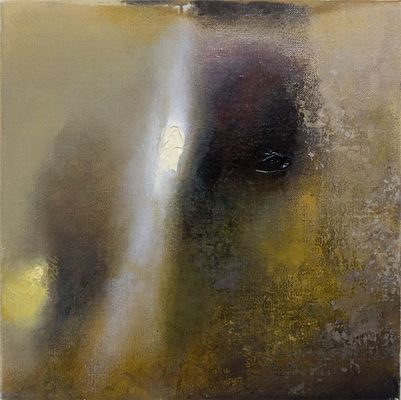
To return to Buckley’s fragment, the first two lines very much evoke how I paint nowadays. As you age, detail diminishes and patches of light become more luminous and float. I feel the most honest way of dealing with this is by smearing the oil paint on the canvas with the fingers and working close-up, blind. Only if the patches coalesce into an approaching image can the work gain a life.
-
Jonathan Walker was born in Melbourne, Australia and brought up on a dairy farm in Gippsland. In the 1970’s he studied painting at RMIT and won the Harold Wright Scholarship to the British Museum, London. During the 1980’s he exhibited at Pinacotheca Gallery, Richmond and had work shown at the NGV and Heidi City Art Gallery. Over the same period he designed the cover for the “Epigenesi” LP by Giancarlo Toniutti, Italy and conducted a mail exchange work with Achim Wollscheid, Germany. The work with artists through the post resulted in an article published in the bicentenary issue of Art and Australia 1988. He showed in artist run spaces such as WestSpace in the 90’s and 2000’s, and until 2012, taught painting at Victoria University, which is where we (Colleen Ahern and Lisa Radford) as organisers of the exhibition, among many others, had the privilege of being his student.
Walker’s knowledge was imparted to students through the careful selection of music, literature, and artists found in books that he himself had ordered for the library. Walker’s strategy was the generosity of sharing his vast knowledge with references specific to each student and their context.
Walker’s paintings share a similar focus and intimacy.
This exhibition presents a small selection of recent paintings alongside a publication that includes Walker’s writing. Observational and analytical, Walker’s work is a type of material notation — the time of day, colour and how it is blended, the both specific and fleeting location of a reflection on lino or the question of whether a chair leg should be included in a painting.
Please join us on Friday August 21 between 6-8pm to celebrate the opening of the exhibition.
Curated by Colleen Ahern and Lisa Radford.
B. Wurtz
Curated by Nic Tammens
March 26 - April 4, 2015
B.Wurtz works from a basement studio in his home on Manhattan’s Lower East Side.
This local fact is attested to by the plastic shopping bags and newsprint circulars that appear in his work. As formal objects, they don’t make loud claims about their origins but nonetheless transmit street addresses and places of business from the bottom of this long thin island. Like plenty of artists, Wurtz is affected by what is local and what is consumed. His work is underpinned by this ethic. It often speaks from a neighborhood or reads like the contents of a hamper:
“BLACK PLUMS $1.29 lb.”
“Food Bazaar”
“USDA Whole Pork Shoulder Picnic 99c lb.”
“RITE AID Pharmacy, with us it’s personal.”
“H. Brickman & Sons.”
“Sweet Yams 59c lb."
Most of the work in this exhibition was made while the artist was in residence at Dieu Donne, a workshop dedicated to paper craft in Midtown. Here Wurtz fabricated assemblages with paper and objects that are relatively lightweight, with the intention that they would be easily transportable to Australia. This consideration isn’t absolute in Wurtz’s work, but was prescriptive for making the current exhibition light and cheap. Packed in two boxes, these works were sent from a USPS post office on the Lower East Side and delivered to North Melbourne by Australia Post.
Wurtz appears courtesy of Metro Pictures, New York.
Thanks to Rob Halverson, Joshua Petherick, Sari de Mallory, Matt Hinkley, Helen Johnson, Fayen d'Evie, Ask Kilmartin, Lisa Radon, Ellena Savage, Yale Union, and "Elizabeth".
John Nixon
"Archive"
December 15 - January 20, 2014
The presentation of John Nixon's archive offered a rare showcase of this extensive collection of the artist's own publications, catalogues, posters, ephemera, editions and more, from the mid 1980s onwards, alongside a selection of his artworks.
Organized by John Nixon, Joshua Petherick and Matt Hinkley.
"Habitat"
at Minerva, Sydney (organised by Joshua Petherick and Matt Hinkley)
November 15 - December 20, 2014
Lupo Borgonovo, Janet Burchill & Jennifer McCamley,
Lewis Fidock, HR Giger, Piero Gilardi, Veit Laurent Kurz,
Cinzia Ruggeri, Michael E. Smith, Lucie Stahl, Daniel Weil, Wols
Press Release:
“...It contained seven objects. The slender fluted bone, surely formed for flight, surely from the wing of some large bird. Three archaic circuitboards, faced with mazes of gold. A smooth white sphere of baked clay. An age-blackened fragment of lace. A fingerlength segment of what she assumed was bone from a human wrist, grayish white, inset smoothly with the silicon shaft of a small instrument that must once have ridden flush with the surface of the skin - but the thing’s face was seared and blackened.”
William Gibson, “Count Zero”, 1986
"Autumn Projects Archive"
Curated by Liza Vasiliou
March 6 - March 15, 2014
World Food Books, in conjunction with the Virgin Australia Melbourne Fashion Festival 2014, presented the Autumn Projects archive, consisting of a selection of early examples in Australian fashion with a particular interest in collecting designers and labels from the period beginning in the 1980’s, who significantly influenced the discourse of Australian Fashion.
Curated by Liza Vasiliou, the exhibition provided a unique opportunity to view pieces by designers Anthea Crawford, Barbara Vandenberg, Geoff Liddell and labels CR Australia, Covers, Jag along with early experimental collage pieces by Prue Acton and Sally Browne’s ‘Fragments’ collection, suspended throughout the functioning World Food Books shop in Melbourne.
H.B. Peace
presented by CENTRE FOR STYLE
November 14, 2013
"Hey Blinky, you say chic, I say same"
Anon 2013
H.B. Peace is a clothing collaboration between great friends Blake Barns and Hugh Egan Westland. Their pieces explore the divergences between 'character’ and ‘personality’ in garments....etc
Special Thanks to Joshua Petherick and Matt Hinkley of WFB and Gillian Mears
and a Very Special Thank you to Audrey Thomas Hayes for her shoe collaboration.
Janet Burchill & Jennifer McCamley
"Aesthetic Suicide"
May 10 - June 8, 2013
The first of our occasional exhibitions in the World Food Books office/shop space in Melbourne, "Aesthetic Suicide" presented a body of new and older works together by artists Janet Burchill & Jennifer McCamley, including videos, prints, a wall work, and publications.
During shop open hours videos played every hour, on the hour.
$.00 - Out of stock
The eternal clean out! New items weekly.
https://worldfoodbooks.com/category/sale
Published by World Food Books / Melbourne
$20.00 - In stock -
A World Food Books gift voucher is redeemable in our Melbourne bookshop or via our webshop (here). An e-voucher (printable pdf) will be sent to your purchase email address (please notify us if you wish to have the voucher sent to an alternate address and wish us to fill in the receiver's details on the card).
Gift vouchers can be purchased in increments of $20 (Australian Dollars) and the total amount can simply be added to by increasing the quantity in your shopping cart. eg. A quantity of 5 gift vouchers will result in an item total of $100 - a $100 gift voucher. Simply click "ADD TO CART" 5 times, or update your quantity in the shopping cart.
If you wish to purchase multiple, separate gift vouchers in one go, please just email us and we can personally prepare and email you a payment request.
Please note: Please select Pick-Up on gift voucher purchse to avoid any postage charges. Accidental postage charges will be refunded right away!
Thank you.
For any questions, please don't hesitate to email: [email protected]
2025, English / German
Softcover (w. foam board insert), 216 pages, 29.7 x 21 cm
Published by
Walther König / Köln
Museum Abteiberg / Mönchengladbach
Mumok / Vienna
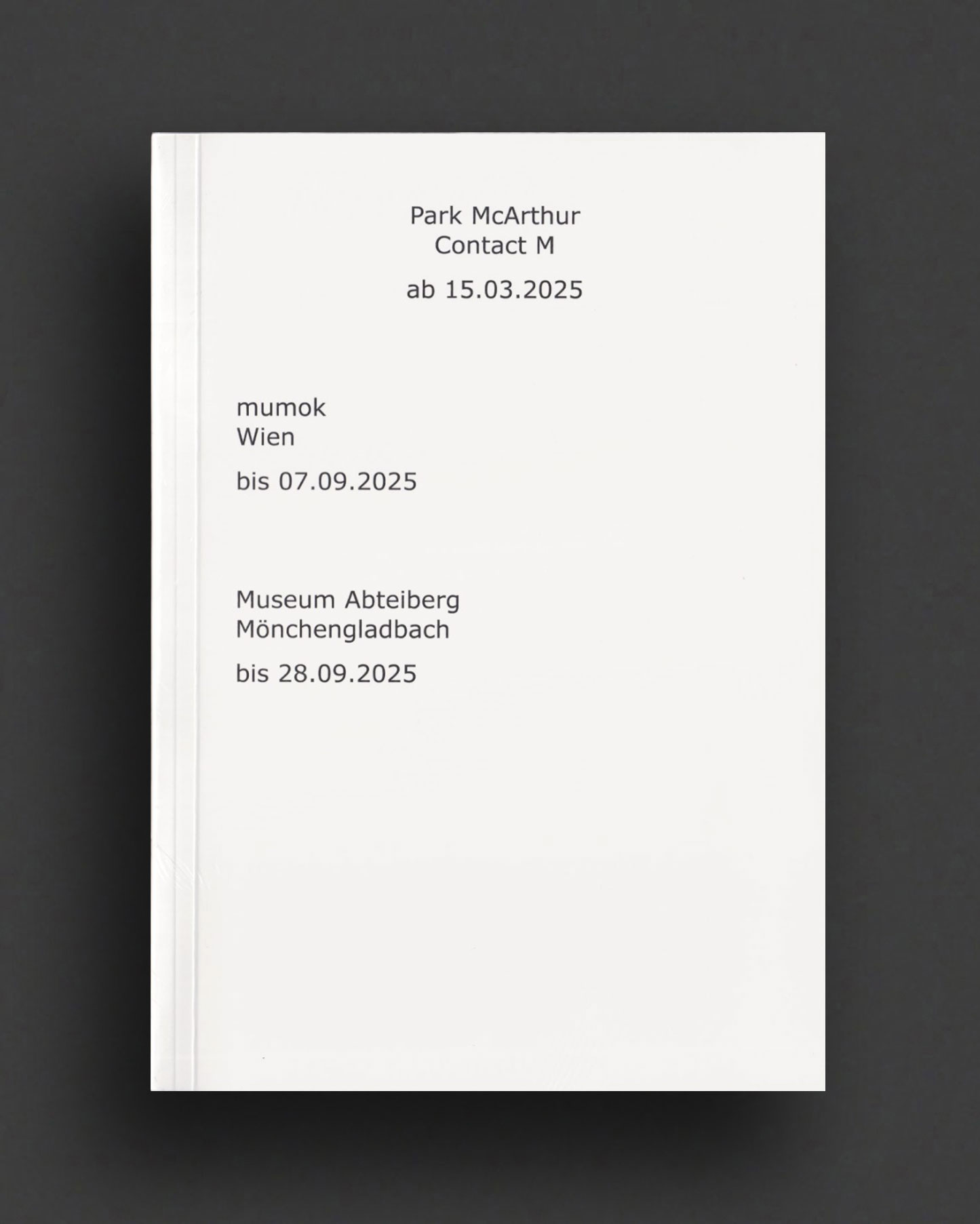
$89.00 - In stock -
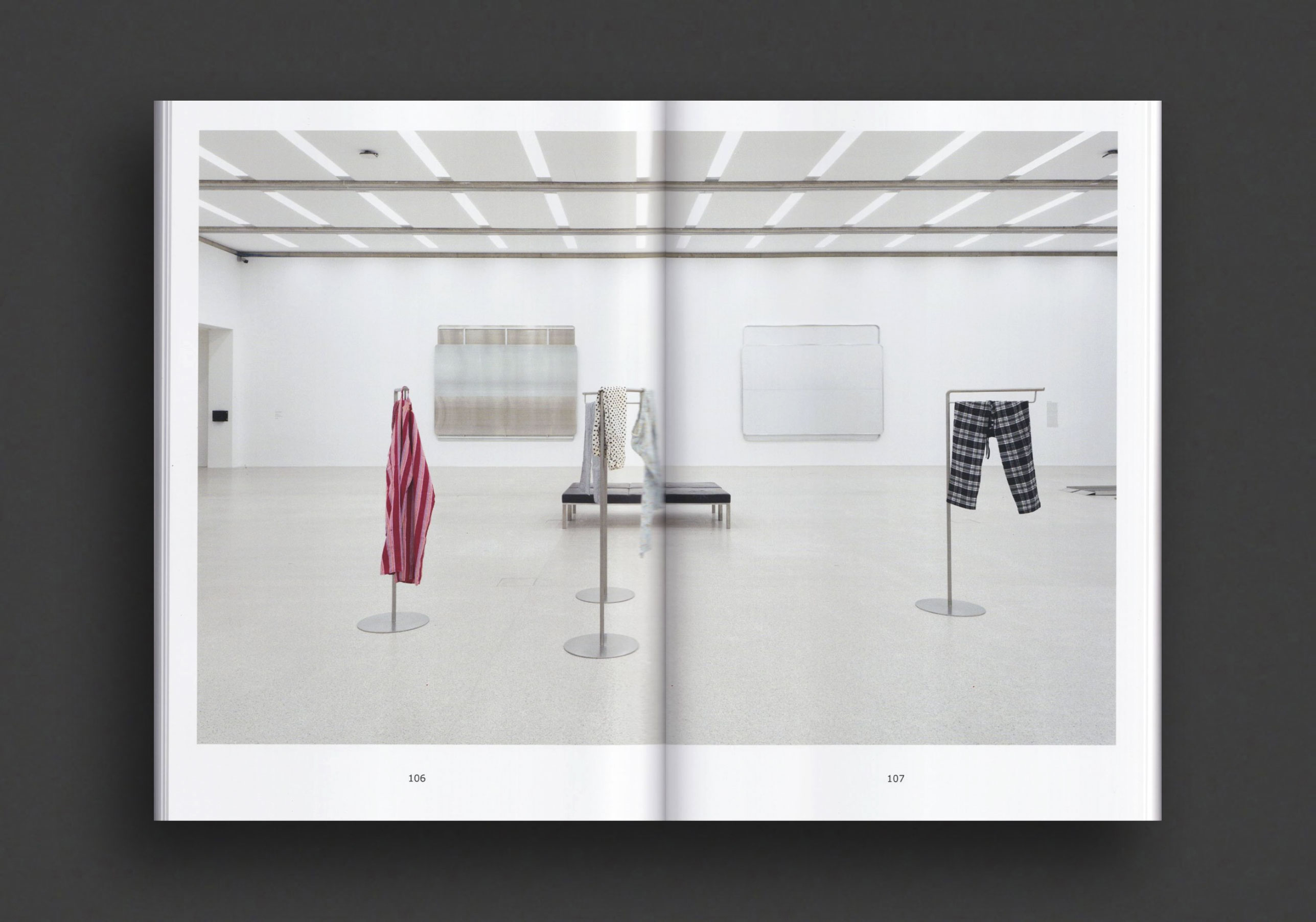
Produced on the occasion of the exhibition Park McArthur: Contact M bringing together, for the first time, artworks made between the 2010s and 2020s. These artworks and the forms they take are guided by personal and social meanings of disability, delay, and dependency.
Co-organized by Museum Abteiberg, Mönchengladbach and mumok in Vienna, the exhibition is a collaboration between both institutions and will be presented simultaneously at both locations. Questions of simultaneous experience and access to art and culture shape this project’s format and purpose.
2025, English
Softcover, 192 pages, 30.5 x 23 cm
Published by
Primary Information / New York
$68.00 - In stock -
Stay away from nothing shines a spotlight on the deep relationship between Paul Thek and Peter Hujar through the artists’ letters and photographs. Beginning in 1956 and spanning two decades, the publication opens a window into their intimate, complex, and beautiful lives, starting with a sequence of images by Hujar that showcases the two of them in innocent moments of pensive and haunting play in Coral Gables and beyond.
These early portraits of their budding relationship are followed by Thek’s first letter to Hujar in 1962, written while the artist is in the Philadelphia harbor aboard a containership bound for Europe. In the letter, Thek is brimming with joy and new discoveries and exclaims that the world “seems bigger and more gloriously strange than ever before in my entire life.” The two eventually meet in Rome, where they both begin to evolve into the icons we know them as today, and the remaining letters trace Thek’s travels and adventures, romantic dalliances, work, and financial ups and downs through 1975. More than fifty letters and postcards, along with drawings and other ephemera, are reproduced in Stay away from nothing and their poetic, quotidian, and melancholic tone provide a rare glimpse into Thek and Hujar’s relationship as it waivers with seduction, glamor, tumult, and mischievousness.
Throughout this period, Hujar was photographing Thek in his now iconic style, capturing him in Italy, in various studios, and on the beaches of Fire Island. Included are the artist’s now-classic images of Thek in the catacombs in Palermo, as well as his studio portraits of the artist creating The Tomb. Among these well-known works are dozens of other photographs, many unpublished until now, including candid portraits of Thek, as well as images of the two artists goofing around or posing for passport photos. Collectively, these images demonstrate not only the complex emotional interiority of Thek but the tender, dark, and hopeful connection between the two artists, lovers, and friends.
An afterword is provided by Andrew Durbin, author of A Wonderful World that Almost Was, a biography of Peter Hujar and Paul Thek.
2025, English / German
Softcover, 288 pages, 28 x 23 cm
Published by
Walther König / Köln
$130.00 - In stock -
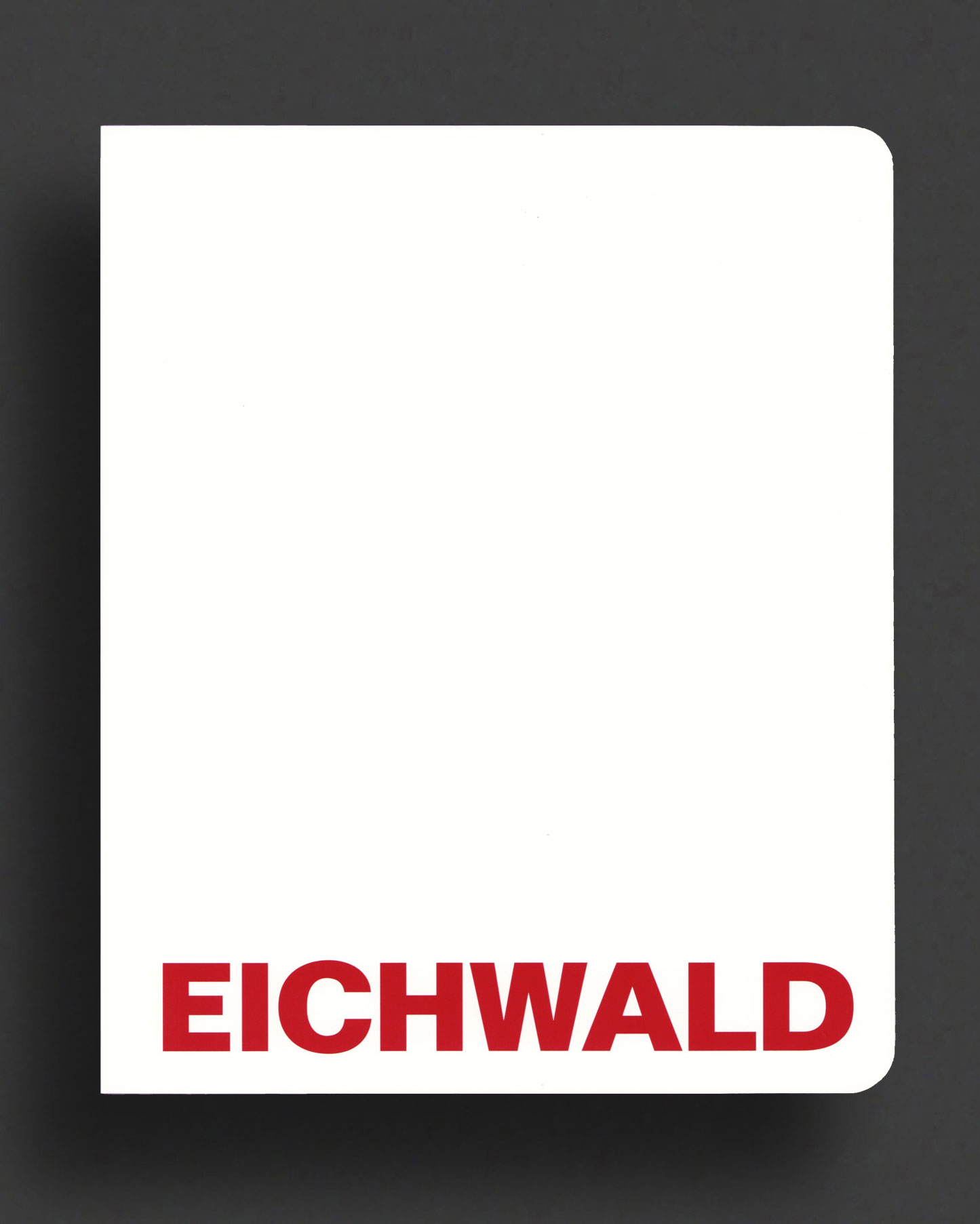
The first monograph on an German artist Michaela Eichwald (b. 1967) who consistently explores the "fundamental and inexhaustible problems of art" in her work, engaging with the interplay between material and form.
The publication charts more than three decades of Michaela Eichwald’s singular and shapeshifting practice that spans painting, sculpture, writing, and more elusive forms, creating idiosyncratic visions and (visual) worlds. Eichwald shifts expertly between the disciplines, drawing her unconventional work titles from sources that range from Medieval mysticism to bureaucratic solecisms. Alongside rich reproductions of her works, the publication delves deep into her creative universe – featuring rare archival material and selections from her long-running, legendary blog, uhutrust.com, active since 2006.
Contributions by Michaela Eichwald, Elena Filipovic & Renate Wagner, John Kelsey, Matthias Mühling, Monika Rinck & Stephanie Weber.
2025, English
Softcover, 224 pages, 29.7 x 21 cm
Published by
Galerie Eva Presenhuber / Zürich
Walther König / Köln
$70.00 - In stock -
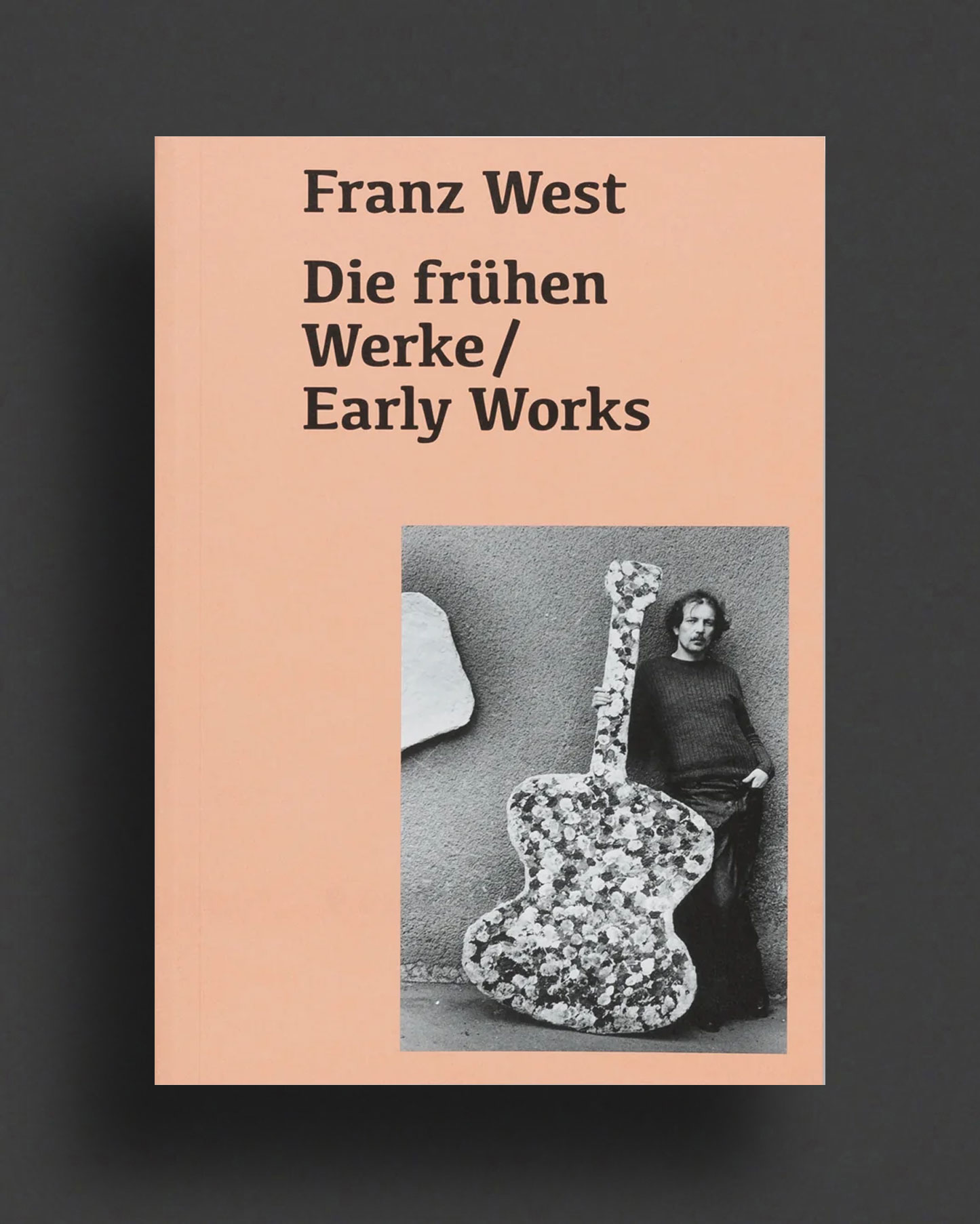
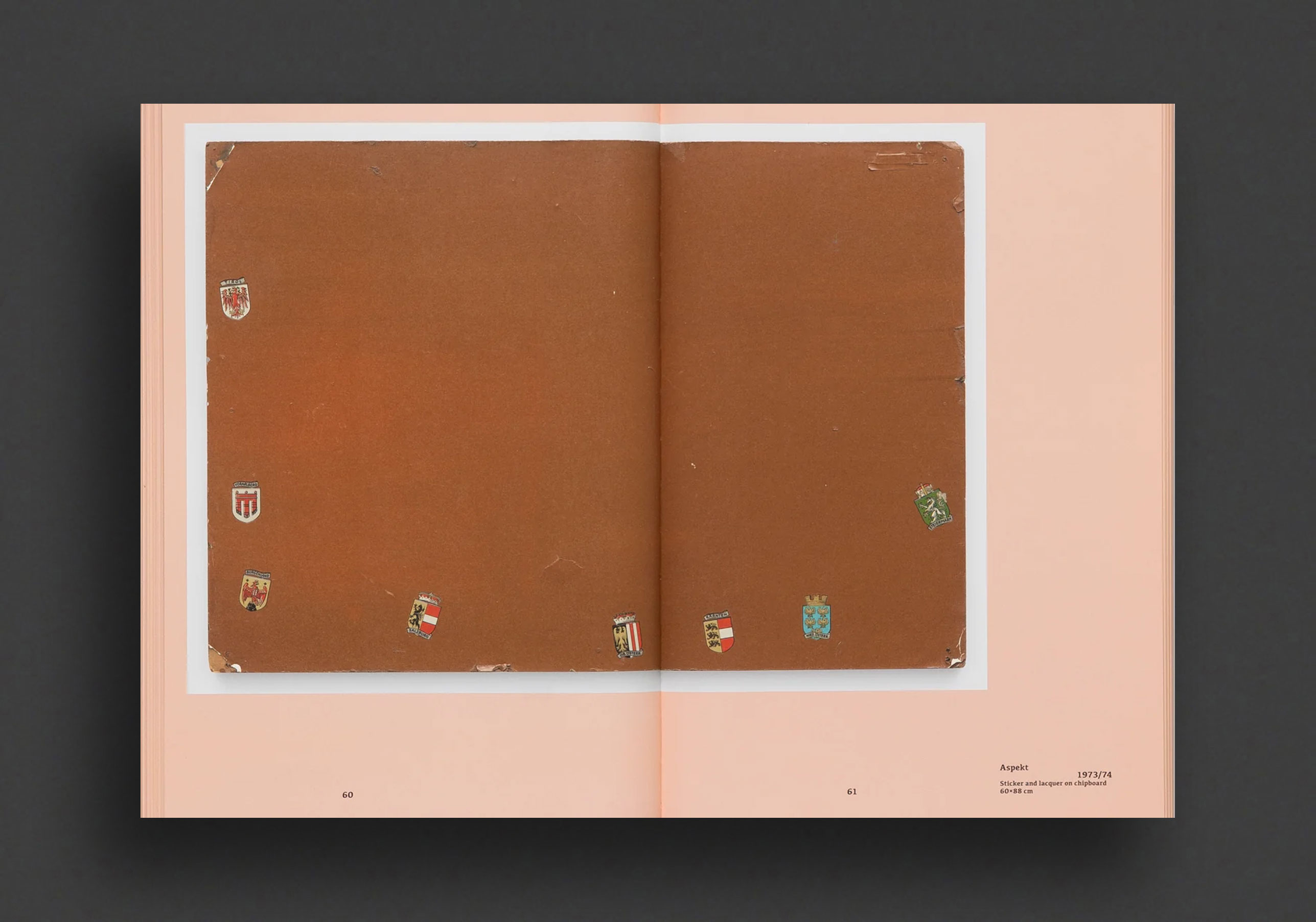
This profusely illustrated catalogue focuses on early sculptures and objects by Austrian artist Franz West (1947—2012), created between 1975 and 1990. Many of the works are drawn from important private collections, including those belonging to West’s longtime mentor, former gallerist and curator Peter Pakesch, and to Galerie Eva Presenhuber.
2025, English / German
Softcover, 92 pages, 28 x 23.2 cm
Published by
Walther König / Köln
Haus am Waldsee / Berlin
$55.00 - In stock -
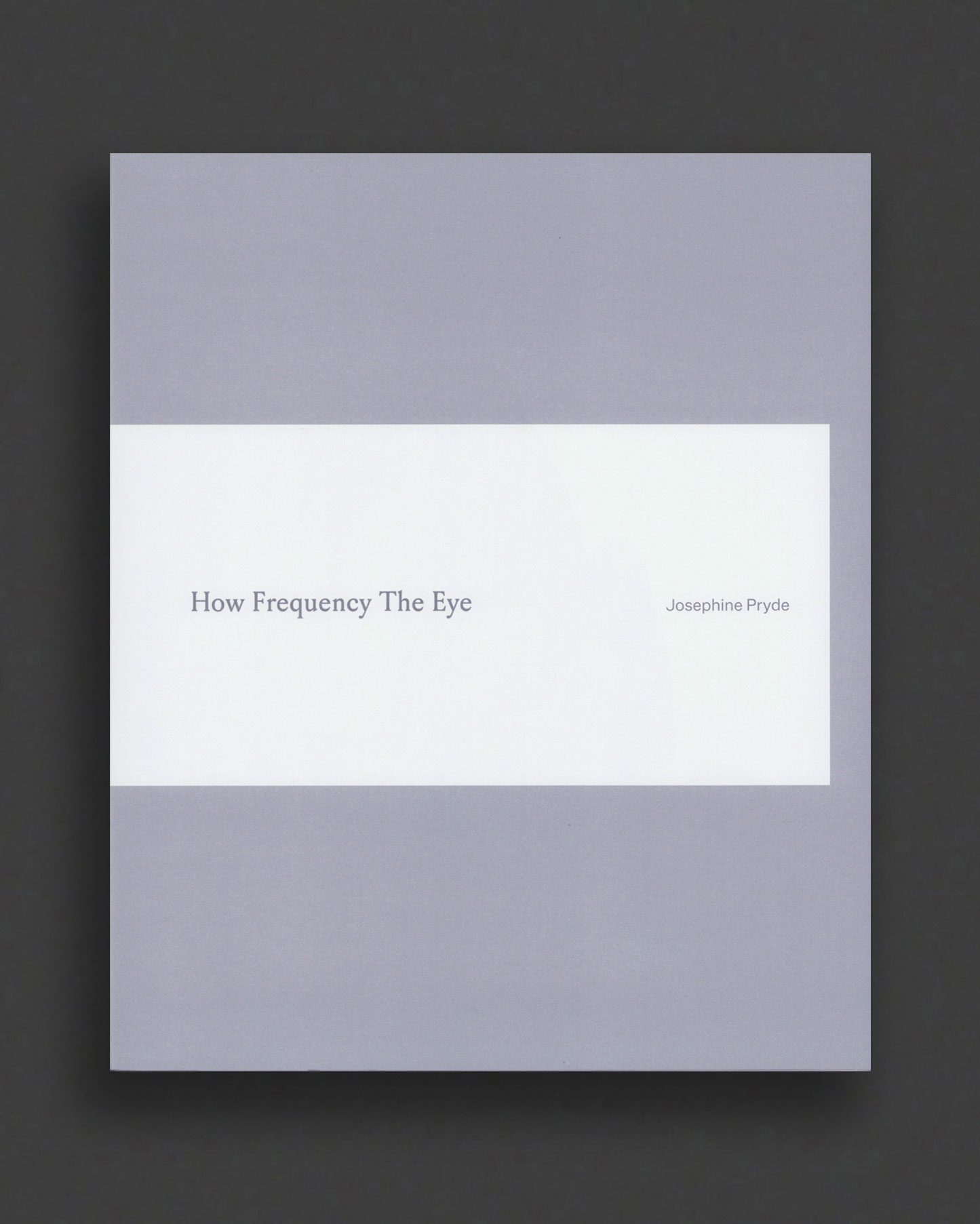
In her practice, Josephine Pryde explores modes of creation, consumption, and production of images, most often through photography. Employing a wide range of technical means, she takes up ideas conveyed through camera-generated images, in order to challenge and re-examine established modes of reception and expectation as to how the visible may be rendered.
How Frequency The Eye continues Pryde’s recent reflections on perception, cognition, and language, and her questions as to how an exhibition of artworks may articulate such concerns. In conjunction with prior works and a short film, the exhibition features a new series of photographs in which the artist interrogates interplays between the eye and consciousness.
This book is published in the aftermath of the eponymous exhibition of the artist at Haus am Waldsee, Berlin, in 2024.
With texts by the artist and by curator Beatrice Hilke.
Design by Clemens Jahn.
2025, English / German
Softcover, 240 pages, 30 × 24.5 cm
Published by
Distanz / Berlin
Fondation Vincent van Gogh Arles / Arles
$98.00 - In stock -
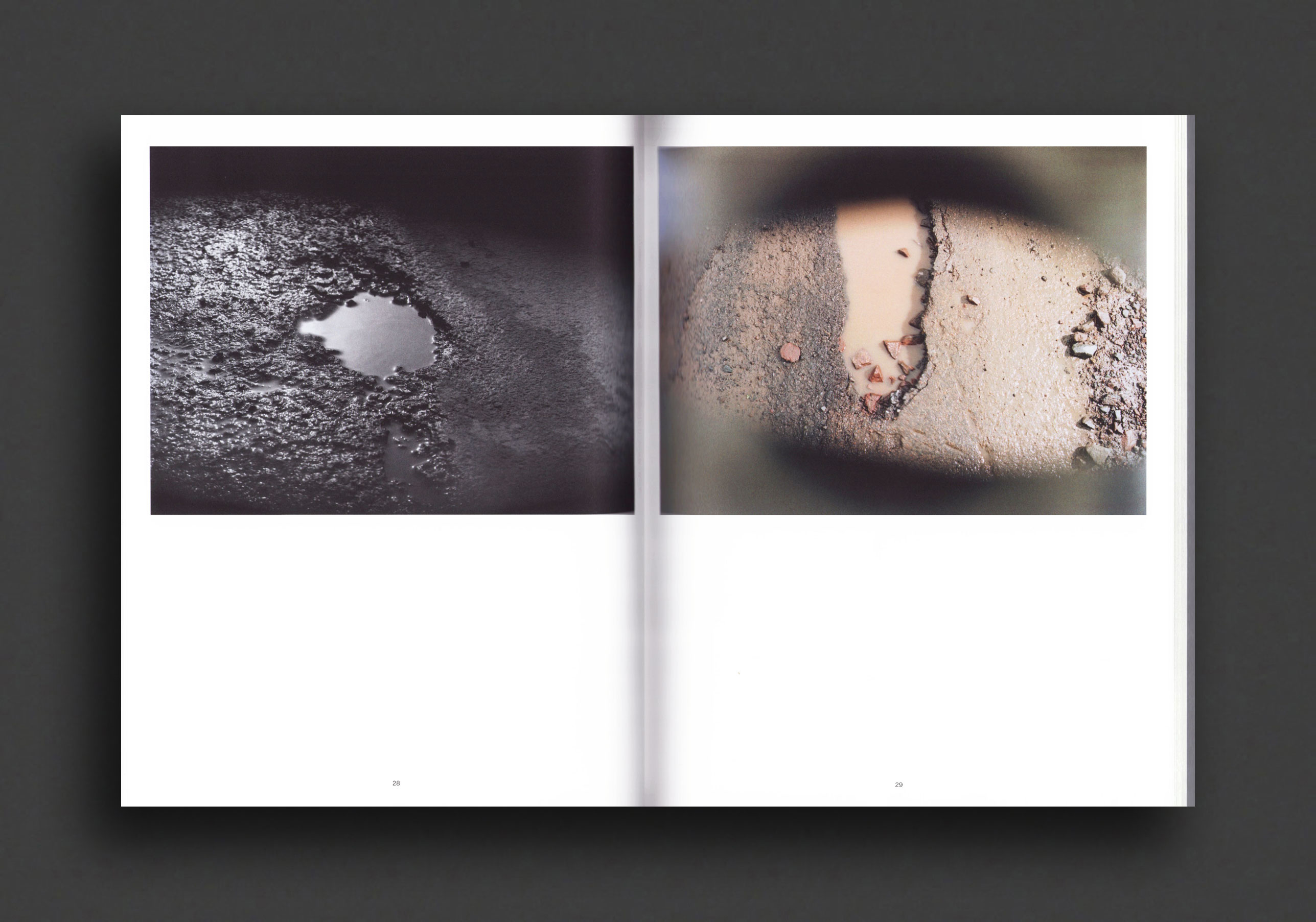
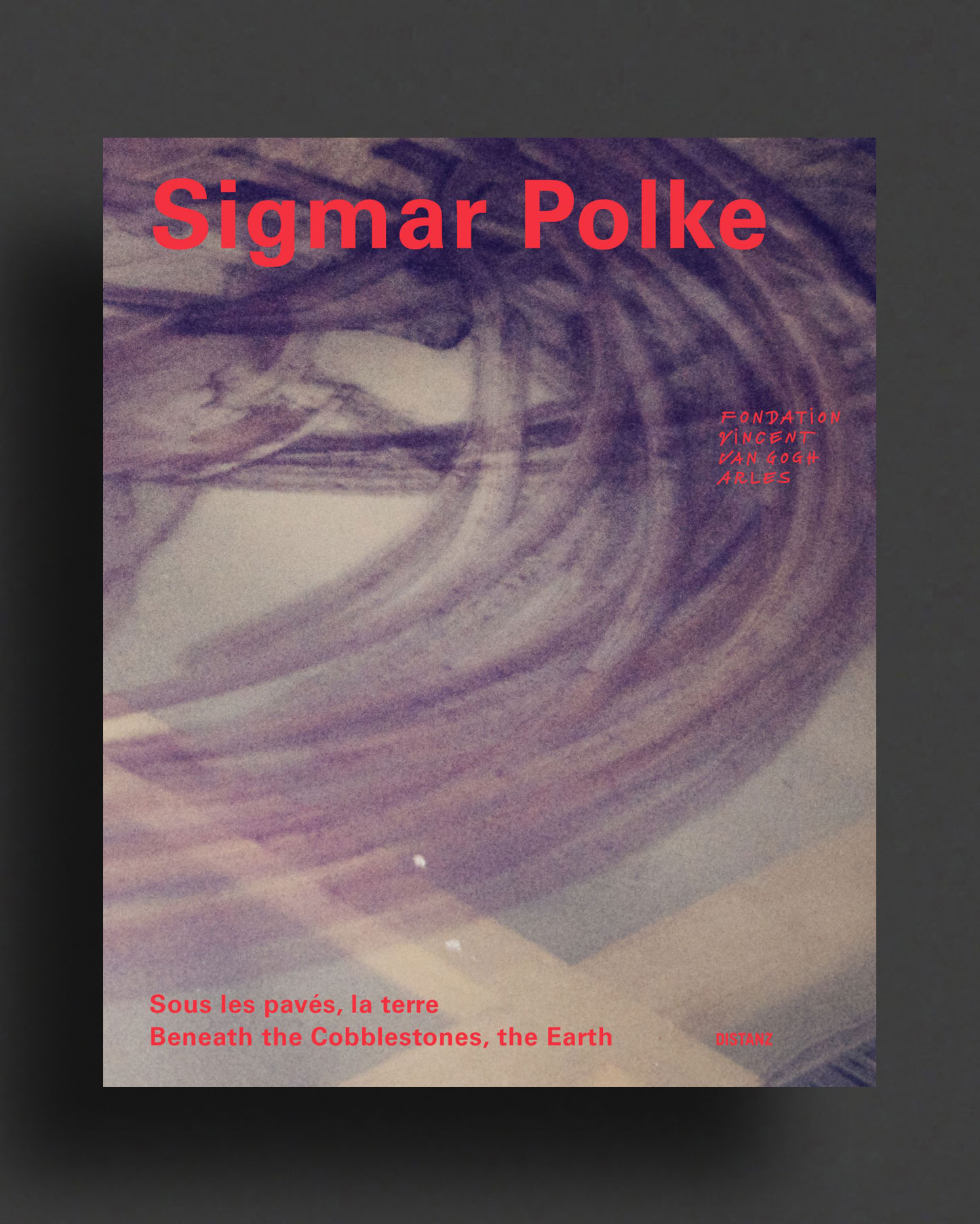
Sigmar Polke (1941–2010) has been hailed as one of the world’s preeminent artists of the twentieth century. In his oeuvre, Polke worked through experiences of war, militarization and forced migration, and reflected on the image and the mass media in which it circulated. Taking an interest early on in the visual information contained in pictures and their agency, Polke set standards that younger generations of artists continue to emulate, and his work remains as relevant as ever—what might seem its historic dimension in fact turns out to speak directly to present-day concerns.
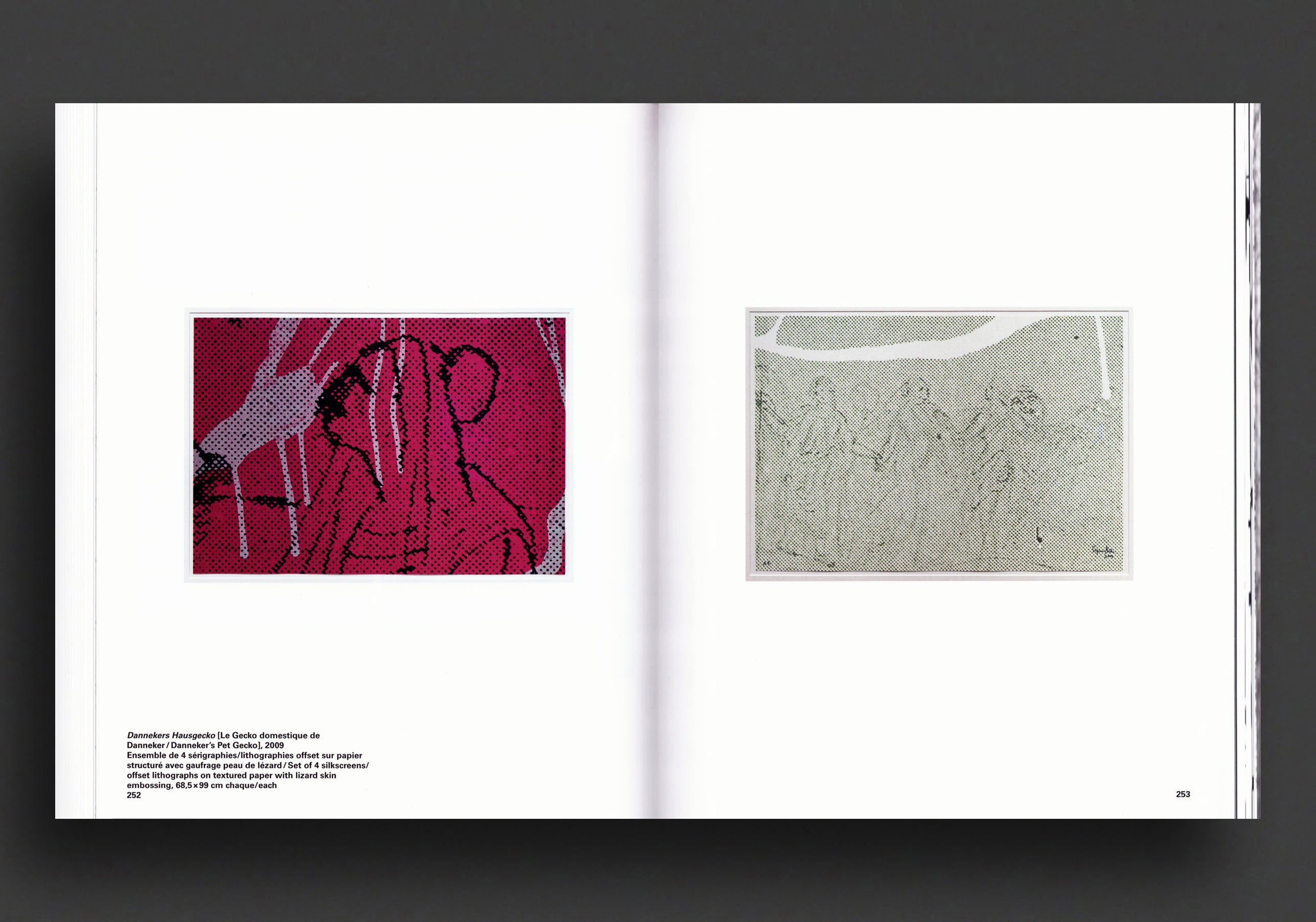
Beneath the Cobblestones, the Earth is the catalogue for the exhibition devoted to Sigmar Polke at the Fondation Vincent van Gogh Arles. Bice Curiger, curator of the exhibition and a specialist in Polke’s work, is editing the book. It gathers paintings, photographs, and films plus graphic art from 1960 to 2009 to illustrate the multifaceted quality of the artist’s output, which is informed by astute observations and powerful creative choices that reflect the artist’s sense of irony and love of experimentation. One focus of the selection of works is on the political dimension of Polke’s oeuvre; he was an exacting analyst of the world around him and commented critically on politics, art, and history.
The extensive essay section includes the main contribution by Bice Curiger, and texts by Ulf Erdmann Ziegler, Nina Pohl, Kathy Halbreich, Friedrich W. Heubach, Maria Stavrinaki, Petra Lange-Berndt and Dietmar Rübel. Poems by Thomas Kling and statements by artists Anne Imhof, Alvaro Barrington, Michael Krebber, Helen Marten, Trajal Harrell, and Laura Owens provide further insight into Polke’s work.
2025, English
Hardcover (clothbound), 376 pages, 28 x 20 cm
Published by
Walther König / Köln
Fridericianum / Kassel
$89.00 - In stock -
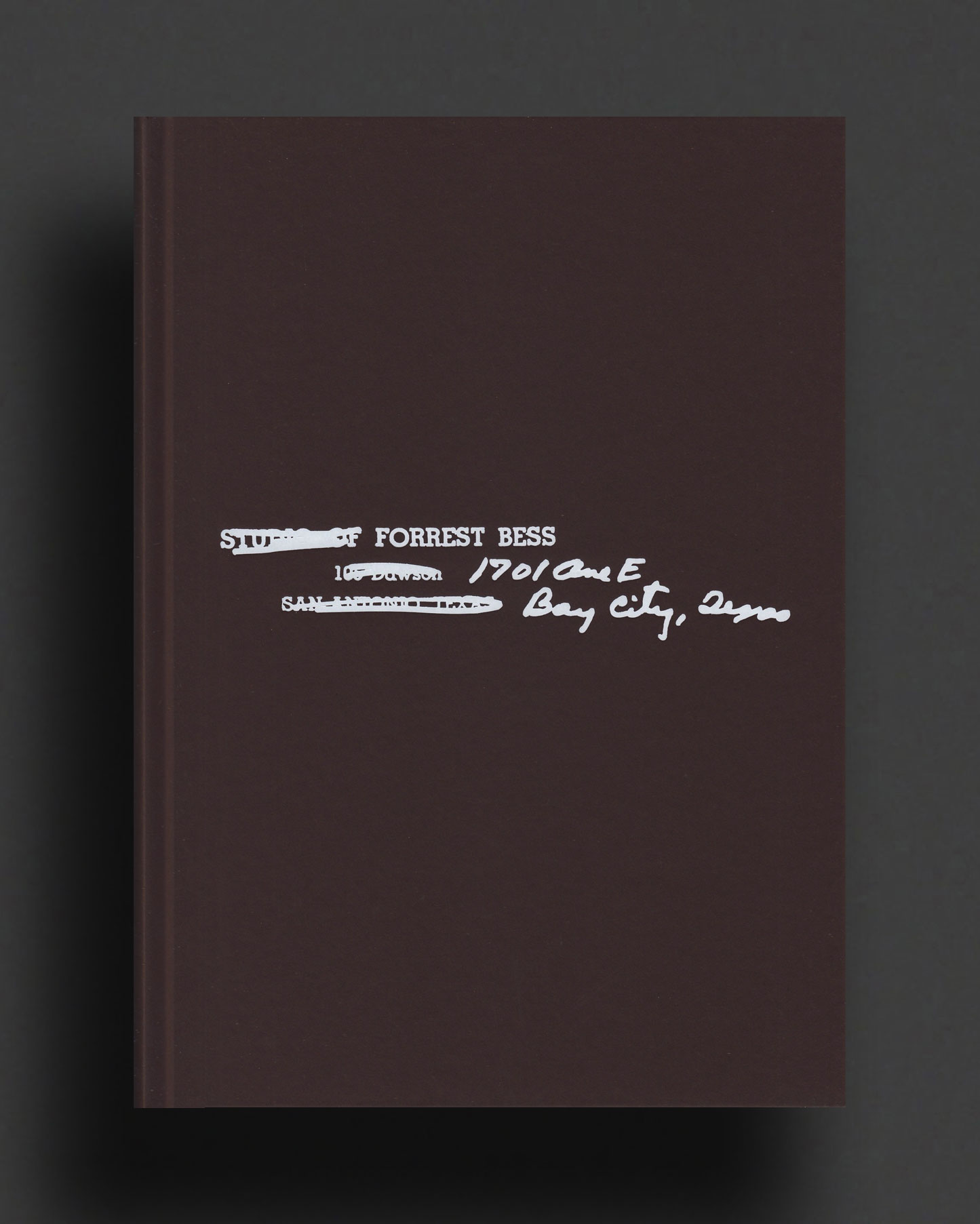
This is the most comprehensive book ever published on one of the most extraordinary figures in post-war American art: Forrest Bess, who described himself as a painter and fisherman and whose biomorphic abstractions cannot be assigned to any movement. Starting in the 1940s, he lived in isolation in Texas and created small paintings that reflect his visionary experiences between wakefulness and sleep. Bess combined his art with an intense exploration of mythology, psychology, and sexology. Believing that immortality could be achieved through the union of the masculine and feminine, he underwent medical procedures. His unconventional works received posthumous recognition in international exhibitions and influenced many contemporary artists such as Amy Sillman, Richard Hawkins or James Benning.
Lavishly illustrated throughout, the work of Forrest Bess is accompanied by texts (in English and German) by Tomma Abts, Dieter Schwarz, Amy Sillman and Moritz Wesseler.
Forrest Bess, born in 1911 in Bay City, Texas, where he also died in 1977, led an extremely secluded existence in the first half of the 1940s on the Gulf of Mexico, where alongside catching and selling fishing bait he dedicated himself to painting. During this time, Bess began to systematically encapsulate in painting “visions” that appeared to him on the threshold between wakefulness and sleep. For Bess, subconscious human experiences manifested themselves in these abstract and highly symbolic images. He pursed their exploration like a piece of obsessive research that he articulated in countless records and intensive correspondence without ever unravelling the mystery of his creativity.
2021, English
Softcover (2 volumes), 596 pages, 28 x 21.6 cm
Published by
Daniel Buchholz Galerie / Köln
$190.00 - In stock -
THE (double volume) book on Cady Noland, published in 2021 by Cady Noland, Rhea Anastas, and Robert Snowden and first only available through Galerie Buchholz directly. Now available to those who had missed it, through fine booksellers! Not to be missed!!
The two volumes of ‘Cady Noland: THE CLIP-ON METHOD’ can be picked up and read in any order: back to front, front to back, start in the middle. Both books commence their page numbering (their pagination) with the cover. ‘THE CLIP-ON METHOD’ is a book made from photographs of Noland’s artworks, often shown within their first installations. Noland’s primary materials are on display throughout the book (fencing, pipes, poles and rails; aluminium walkers, crates, and metal baskets; newspaper clippings, flags and beer cans) and are seen aggregated, arranged and assembled, equally menacing and left akimbo. Additionally, the publication contains writing by Noland, sociological essays selected by the artist, and a considerable amount of exhibition photography from the 1980s to the present.
Launched with the exhibition ‘THE CLIP-ON METHOD: Cady Noland’, 17 Jun – 18 Sep 2021, Galerie Buchholz, New York.
2025, English / Japanese
Softcover (w. obi), 488 pages, 21 x 14.8 cm
Published by
Lock Books / UK
$95.00 - In stock -
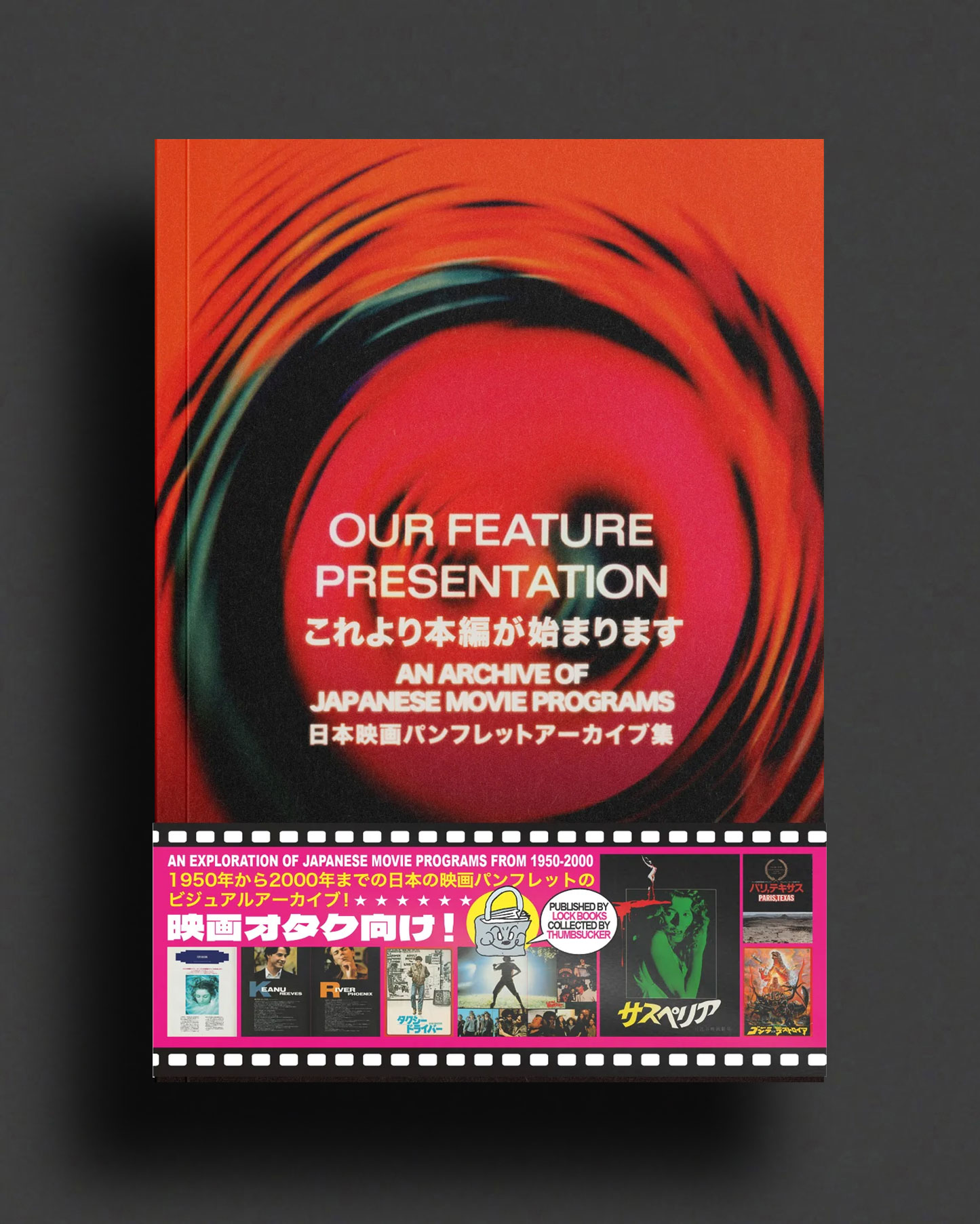
Our Feature Presentation curates an assortment of pages scanned from over 70 vintage Japanese cinema pamphlets, known as 映画パンフレット (Eiga panfuretto) ranging from 1950-2000.
Sold during a film’s run, these pamphlets typically included interviews with the cast and director, production notes, behind-the-scenes details and film stills. During the boom of Japanese cinema and imported Hollywood films in the 1950s, such programs became standard for most major releases and collectible items among cinephiles.
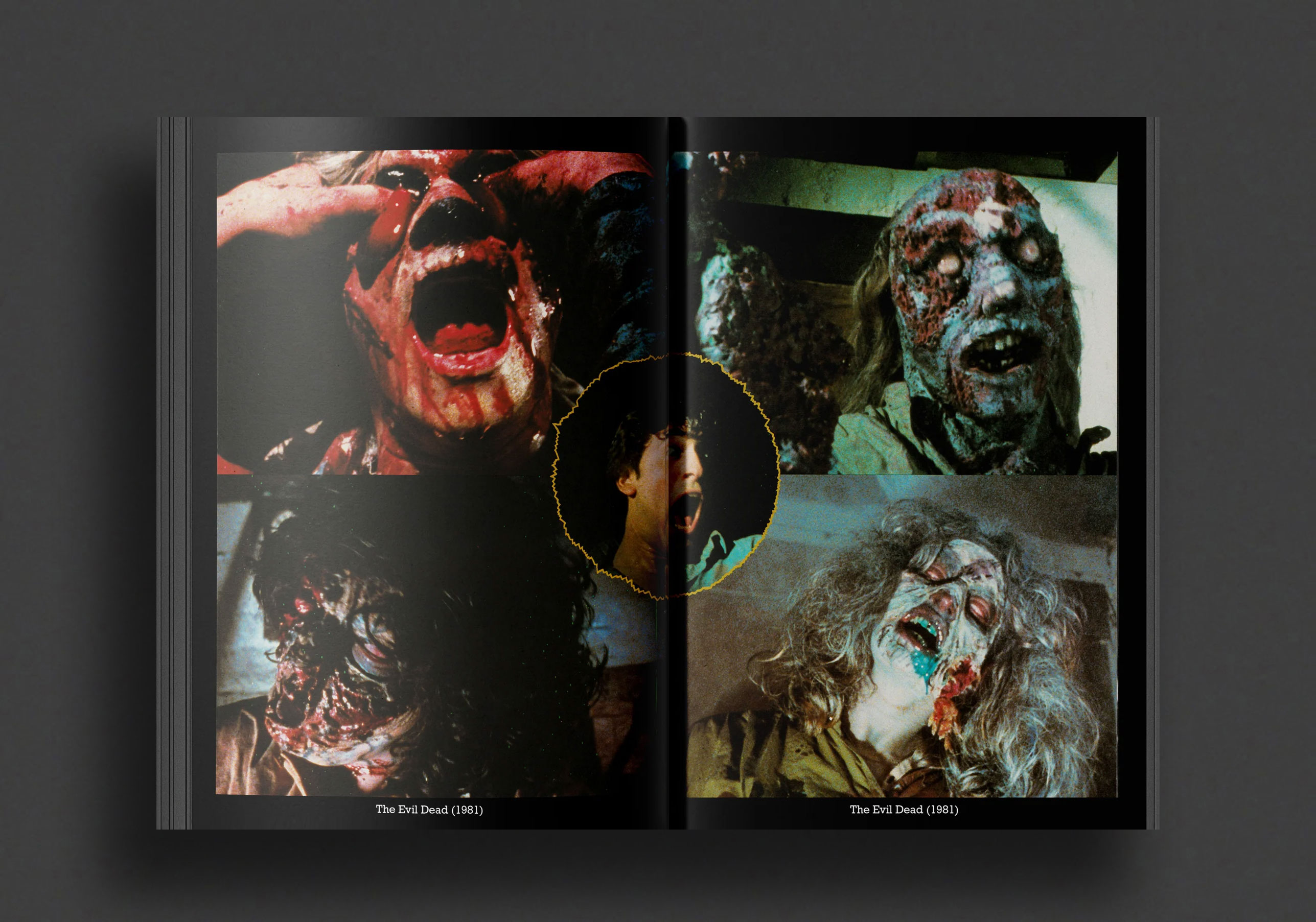
Ranging from Bresson to Fulci, The Evil Dead to The Virgin Suicides, each page highlights the unique and vibrant design of these pamphlets, showcasing rare film stills and production imagery.
2007, English
Softcover, 112 pages, 20.4 x 12.8 cm
1st Edition, Out of print title / used / fine
Published by
Free Association / Los Angeles
$90.00 - In stock -
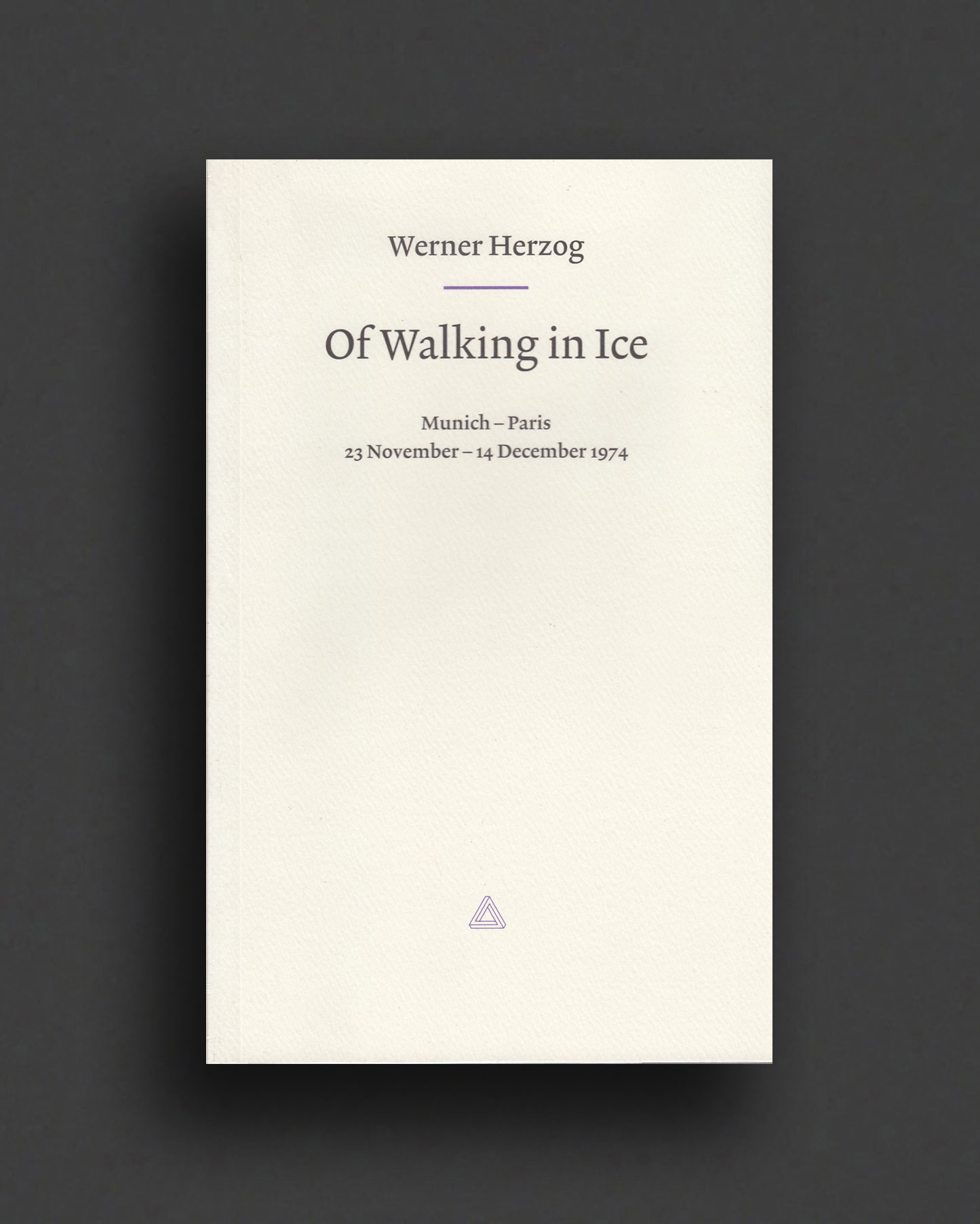
In the winter of 1974, filmmaker Werner Herzog made a three week solo journey from Munich to Paris on foot. He believed it was the only way his close friend, film historian Lotte Eisner, would survive a horrible sickness that had overtaken her. During this monumental odyssey through a seemingly endless blizzard, Herzog documented everything he saw and felt with intense sincerity. This diary is dotted with a pastiche of rants about the extreme cold and utter loneliness, notes on Herzog's films and travels, poetic descriptions of the snowy countryside, and personal philosophizing. What is most remarkable is that the reading of the book is in continuity with the experience of watching his films; it's as if, through this walk, we witness the process in which images are born. Although he received a literary award for it, this introspective masterpiece has lingered out of print since 1979.
Beautifully designed and emotionally impressive, Of Walking in Ice is the first in a color-coded series of remarkable yet long-forgotten titles being republished by Free Association, Los Angeles.
This beautiful limited run (2500 copies) edition now also long out-of-print. Fine copy.
1974, Dutch
Softcover (screen-printed + 2 lithographs), 120 pages, 30 x 21 cm
Ed. of 750 copies,
1st Edition, Out of print title / used / very good
Published by
De Bange Duivel / Leiden
$140.00 - In stock -
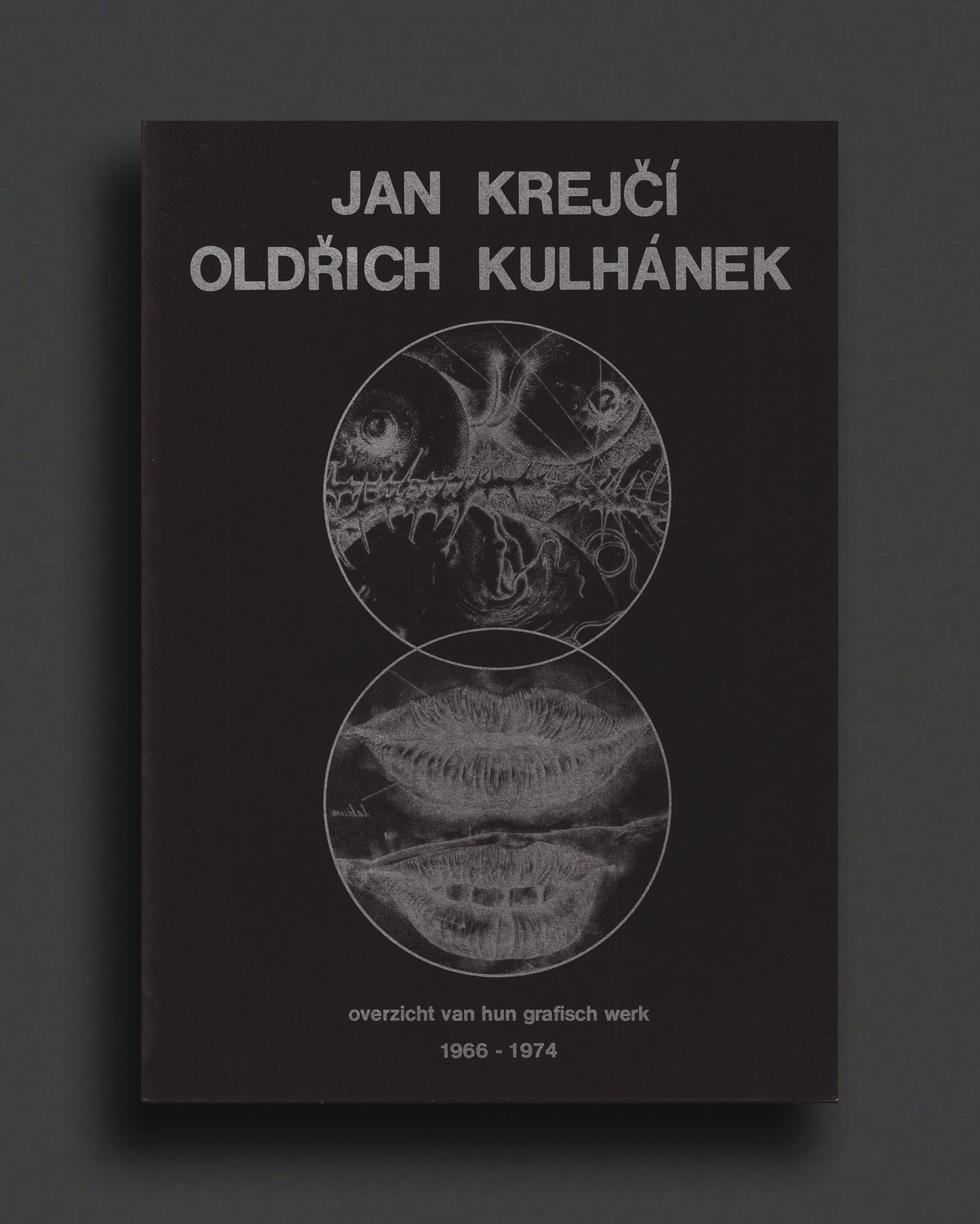
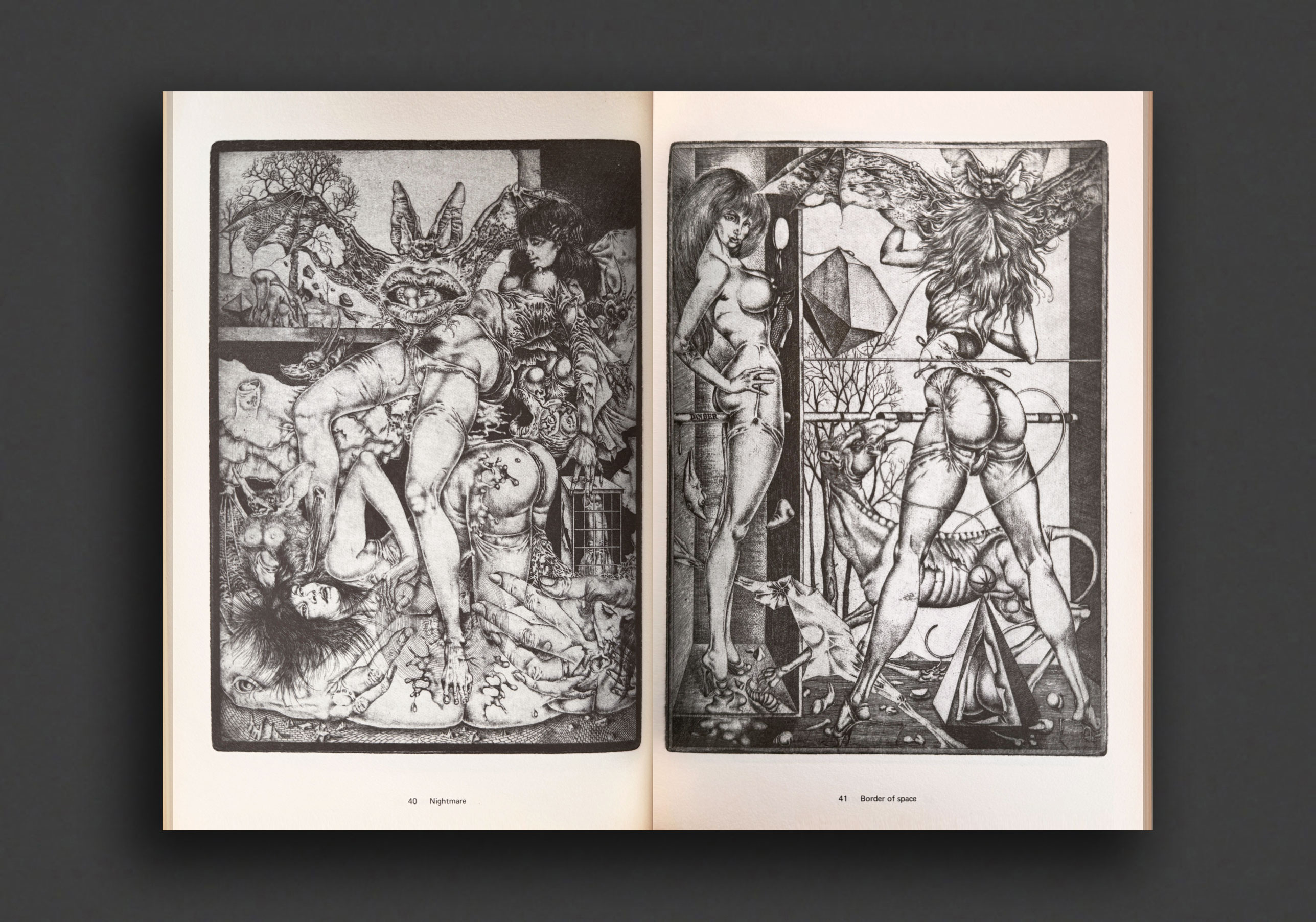
Rare copy of this incredible artbook compiling the works of two Czech graphic artists, Jan Krejčí (1942—2001) and Oldřich Kulhánek (1940—2013), complete with two beautiful lithographs still bound within (one from each artist), published during the retrospective exhibition of the two artists in Leiden's academic art centre in 1974 in a numbered edition of only 750 copies (this copy stamped no. "588"). With screen-printed metallic silver on raw black board cover, this perfectly executed book reproduces the highly-detailed phantasmagorical early graphic works of both illustrators created between 1966 - 1974 on warm paper stock, bookmarked by two fine original lithographs created specifically for this volume. Edited by Leo van Maris and Frans Montens, these commanding lithographic works reflect the influence of the psychedelic 1960's from which they came, rich with symbolism, explicit eroticism, and political anguish, with reference to popular culture and fellow artists, all rendered meticulously via a distinctively Czech surrealist sensitivity. This is one of the only, and certainly best, published examples of the work of Jan Krejčí, and one o the finest collections of the seldom seen earlier, darker an more erotic works of the acclaimed Oldřich Kulhánek. Though little known outside the Czech Republic, Kulhánek is well-known painter, graphic designer, illustrator, stage designer and pedagogue who created the design for the current Czech banknotes and postage stamps.
Highly recommended.
Very Good—Near Fine copy with only light wear.
2025, English
Softcover, 122 pages, 20.5 x 13.5 cm
Published by
Wakefield Press / Cambridge
$40.00 - In stock -
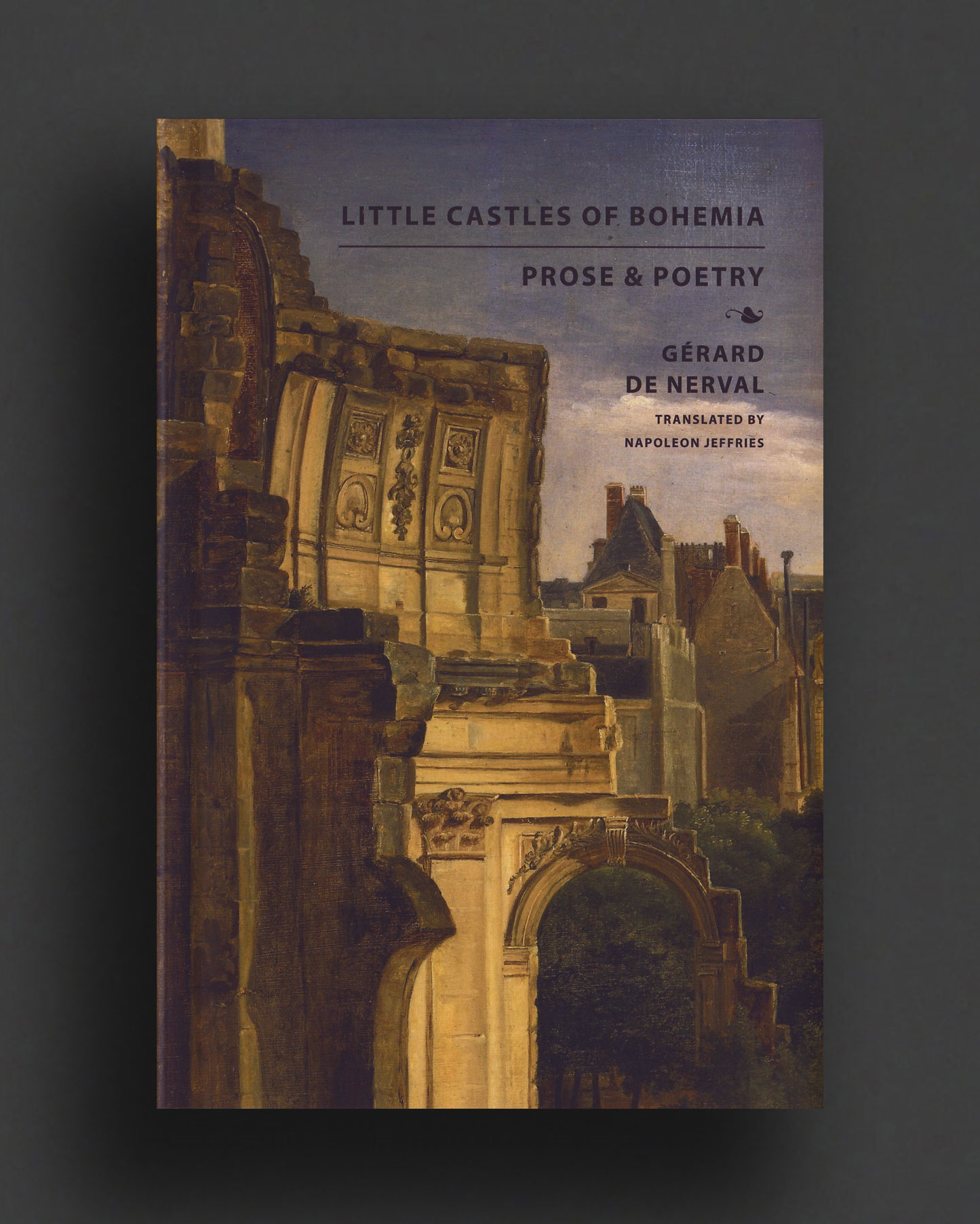
Translated, with an introduction by Napoleon Jeffries
Illustrations by Alfred Prunaire
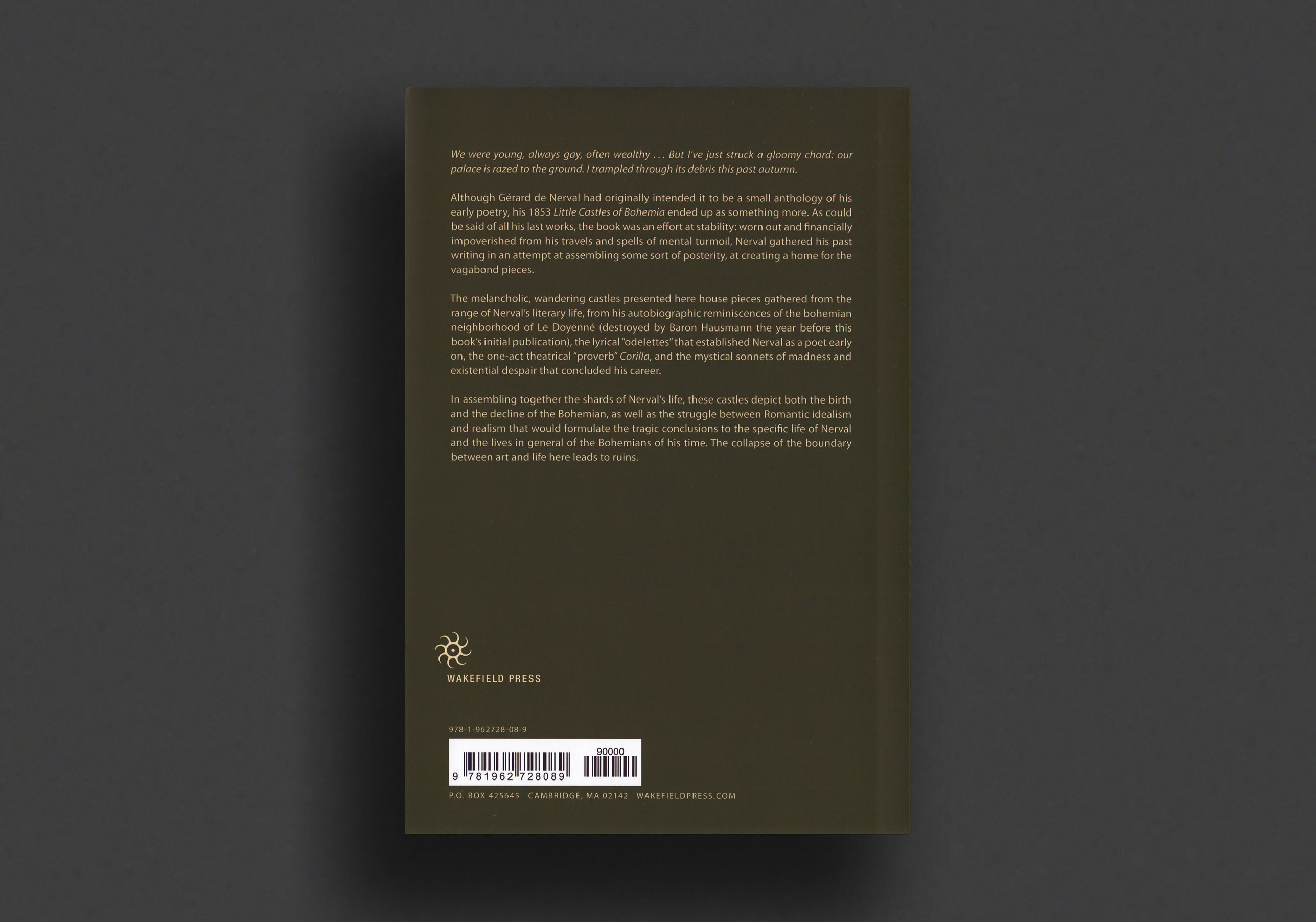
We were young, always gay, often wealthy . . . But I’ve just struck a gloomy chord: our palace is razed to the ground. I trampled through its debris this past autumn.
Although Gérard de Nerval had originally intended it to be a small anthology of his early poetry, his 1853 Little Castles of Bohemia ended up as something more. As could be said of all his last works, the book was an effort at stability: worn out and financially impoverished from his travels and spells of mental turmoil, Nerval gathered his past writing in an attempt at assembling some sort of posterity, at creating a home for the vagabond pieces.
The melancholic, wandering castles presented here house pieces gathered from the range of Nerval’s literary life, from his autobiographic reminiscences of the bohemian neighborhood of Le Doyenné (destroyed by Baron Hausmann the year before this book’s initial publication), the lyrical “odelettes” that established Nerval as a poet early on, the one-act theatrical “proverb” Corilla, and the mystical sonnets of madness and existential despair that concluded his career.
In assembling together the shards of Nerval’s life, these castles depict both the birth and the decline of the Bohemian, as well as the struggle between Romantic idealism and realism that would formulate the tragic conclusions to the specific life of Nerval and the lives in general of the Bohemians of his time. The collapse of the boundary between art and life here leads to ruins.
Gérard de Nerval (1808–1855) was a writer, poet, and translator who wedded French and German romanticism and transformed his research into mystic thought and his bouts of mental illness into such visionary works as the posthumously published Aurélia, or Dream and Life. After his suicide, his work would grow in stature and go on to influence Marcel Proust, André Breton, Antonin Artaud, Michel Leiris, and countless others.
2009, English
Softcover, 196 pages, 13.9 x 20.9 cm
Published by
Graywolf Press / Minneapolis
$34.00 - In stock -
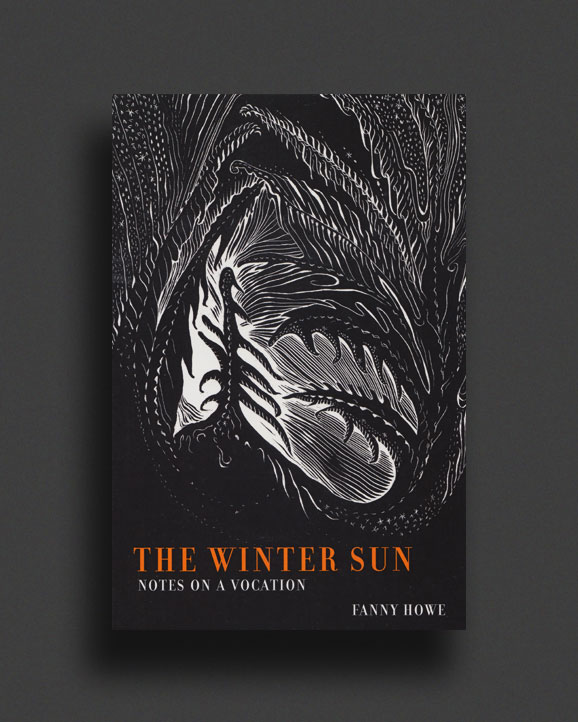
Fanny Howe’s richly contemplative Winter Sun is a memoir of unusual depth and insight by one of America’s most original contemporary poets. In it, Howe offers a rigorous exploration of her fascinating journey of intellectual, spiritual, and artistic development. Through a collage of reflections on people, places and times that have been part of her life, she shows the origins and requirements of a vocation that has no name.
Fanny Howe is the author of more than twenty books of poetry and prose. She has taught literature and writing for many years. She is currently Professor Emerita in Literature at the University of California at San Diego. She has mentored a generation of American poets, activists and scholars working at the intersection of experimental and metaphysical forms of thinking.
2005, English
Softcover, 304 pages, 15 x 21.1 cm
Published by
Grove Press / New York
$40.00 - In stock -
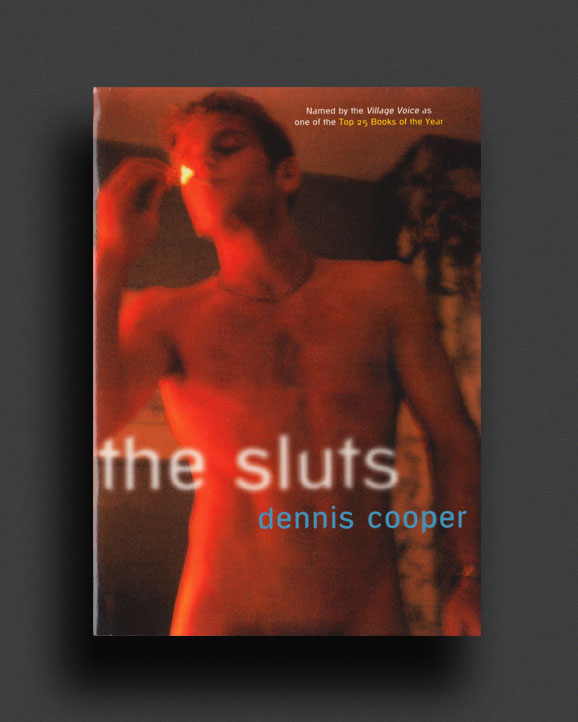
Set largely on the pages of a website where gay male escorts are reviewed by their clients, and told through the postings, emails, and conversations of several dozen unreliable narrators, The Sluts chronicles the evolution of one young escort's date with a satisfied client into a metafiction of pornography, lies, half-truths, and myth. Explicit, shocking, comical, and displaying the author's signature flair for blending structural complexity with direct, stylish, accessible language, The Sluts is Cooper's most transgressive novel since Frisk, and one of his most innovative works of fiction to date.
Dennis Cooper (born 1953) is an American novelist, poet, critic, editor and performance artist who grew up in the Southern California. In 1976, he founded Little Caesar Magazine and Press, which he ran until 1982. In 1985, he moved to Amsterdam for two and a half years, where he began his ten year long project, The George Miles Cycle, an interconnected sequence of five novels that includes Closer, Frisk, Try, Guide, and Period. His post-George Miles Cycle novels include My Loose Thread, The Sluts and God, Jr. Other works include the short-story collections Wrong and Ugly Man, poetry collections The Dream Police and The Weaklings, as well as the recent Smothered in Hugs: Essays, Interviews, Feedback, and Obituaries.
Dennis Cooper currently spends his time between Los Angeles and Paris.
"Dennis Cooper, God help him, is a born writer"—William Burroughs
"Cooper’s language is at first intense, nearly minimal, then suddenly, it ascends into vision"—Kathy Acker
2025, English
Hardcover (w. dust jacket), 408 pages, 23.5 x 15.9 cm
Published by
Zone Books / New York
$65.00 - In stock -
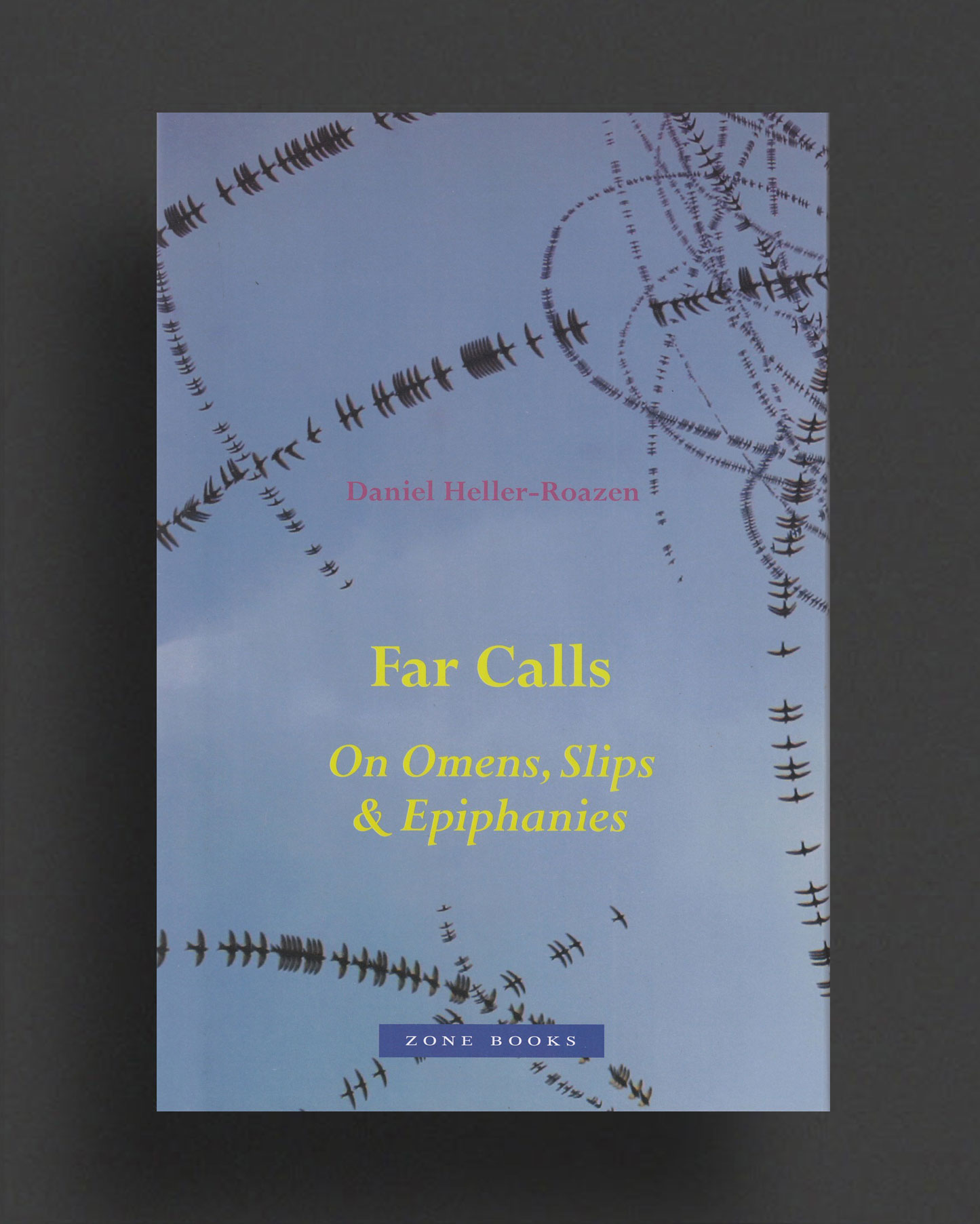
When words are not heard but overheard, when phrases are perceived in bits and pieces, and when speakers, failing to do as they intend, state things that they never meant to say, the saying, in its unsteady relation to understanding, becomes an event. That event has long been studied by a disparate company of interpreters: prophets, priests, and rabbis, poets and philosophers, linguists, psychiatrists and psychoanalysts, novelists and filmmakers. All have suggested that in the contingencies of discourse, there are precious indications to be gleaned, for which special techniques are required. In Far Calls, Daniel Heller-Roazen reconstructs such arts of detection, interweaving ancient, medieval, and modern examples. From the rituals of the ancient Greeks, Jews, and Romans to Freud and Lacan, from Augustine’s catching of a salvific scrap of speech to the inspiration that Breton and Yeats, Proust and Joyce, drew from profane cries and transmissions, Far Calls explores the powers of sonorous coincidence and the varieties of reading that it incites.
“A captivating journey through centuries of Western culture and beyond, with the help of extraordinary erudition.”—Maurizio Bettini
“Far Calls culls a remarkable trove of glints and inklings, omens and names, echoes, auguries, and fleeting indications of a powerfully resonant counter-sublime. Daniel Heller-Roazen is a masterful interpreter of literary interstices, openings in language that take us into an endangered place of wisdom’s alternative beginnings. This is a steeply beautiful book, stunning for its insight, erudition, and range, and—above all—for its powers of vision and audition.”— Peter Cole, author of Draw Me After: Poems
“The brilliance of this book is that it brings to the surface one of those mysterious properties of utterance that we can’t quite locate. It’s the enigmatic communication that emerges from chance, from darkness, from inadvertence, from a child’s babble, from the gods, where more is meant than was said or known. We travel through Mesopotamia, catch our breath as Scipio and Napoleon portentously stumble, and linger with Joyce’s epiphanies and Heidegger’s ‘call of conscience’, all the while observing our human inability to control the way the heavens speak to us and indulging our unstoppable desire to keep overhearing their fragmentary messages in the hope that we will.”— Ardis Butterfield, Marie Borroff Professor of English and Professor of French and Music, Yale University
“Far Calls weaves a fascinating thread of thought from antiquity up to modernity. What a wonderful surprise to discover that Augustine, Alfonso el Sabio, Leibniz, Poe, Breton, Freud, Proust, even Heidegger attributed the power to communicate important ‘truths’ to what ancient divinatory wisdom called kledōn or omen: that is, the hidden meaning of words uttered with a completely different communicative intention. A captivating journey through centuries of Western culture and beyond, with the help of extraordinary erudition put in the service of a lucid and compact construction.”— Maurizio Bettini, Professor Emeritus of Classical Philology, Director of the Center for Anthropology and the Classics, University of Siena
Daniel Heller-Roazen is the Arthur W. Marks 1919 Professor of Comparative Literature at Princeton University. His is the author, most recently, of Absentees: On Variously Missing Persons; No One's Ways: An Essay on Infinite Naming, Dark Tongues: The Art of Rogues and Riddlers, and The Fifth Hammer: Pythagoras and the Disharmony of the World.
2018, English
Hardcover, 480 pages, 17.4 x 23.2 cm
Published by
Atlas Press / London
$74.00 - In stock -
Georges Bataille's secret society, long the stuff of legend, is now revealed in its texts, meditations, rules and prohibitions.
This book recounts what must be one of the most unusual intellectual journeys of modern times, in which the influential philosopher, cultural theorist and occasional pornographer Georges Bataille (1897-1962), having spent the early 1930s in far-left groups opposing the rise of fascism, abandoned that approach in order to transfer the struggle onto "the mythological plane."
In 1937, Bataille founded two groups in order to explore the combinations of power and the "sacred" at work in society. The first group, the College of Sociology, gave lectures that were intended to reveal the hidden undercurrents within a society on the verge of catastrophe. The second group was Acéphale, a genuine secret society and anti-religion whose emblem was a headless figure that, in part, represented the death of God. Until the discovery a few years ago of the group's internal papers (which include theoretical texts, meditations, minutes of meetings, rules and prohibitions and even a membership list), almost nothing was known of its activities.
This book is the first to collect a representative selection of the writings of Bataille, and of those close to him, in the years leading up to World War II. The texts published here comprise lectures given to the College of Sociology by Bataille, Roger Caillois and Michel Leiris, essays from the Acéphale journal and a large cache of the internal papers from the secret society. A desperate narrative unfolds, wherein Bataille risked all in a wholly unreasonable quest--with a few fellow travelers, he undertook what he later described as a "journey out of this world."
Additional texts by Roger Caillois, Pierre Klossowski, Michel Leiris, and by Georges Ambrosino, Pierre Andler, Michel Carrouges, Jacques Chavy, Jean Dautry, Henri Dobier, Henri Dussat, Imre Kelemen, Jean Rollin, Patrick Waldberg.
And with drawings by André Masson
Highest recommendation!
2012, English
Softcover, 200 pages, 21 x 14 cm
Published by
Arcade Publishing / New York
$38.00 - In stock -
E. M. Cioran confronts the place of today's world in the context of human history—focusing on such major issues of the twentieth century as human progress, fanaticism, and science—in this nihilistic and witty collection of aphoristic essays concerning the nature of civilization in mid-twentieth-century Europe. Touching upon Man's need to worship, the feebleness of God, the downfall of the Ancient Greeks and the melancholy baseness of all existence, Cioran's pieces are pessimistic in the extreme, but also display a beautiful certainty that renders them delicate, vivid, and memorable. Illuminating and brutally honest, A Short History of Decay dissects Man's decadence in a remarkable series of moving and beautiful pieces.
"When A Short History of Decay was published, it tended to polarize readers. Many dismissed it as overly morose and pessimistic, completely out of tune with the obligatory optimism of postwar European culture. Others praised it for precisely these reasons (in his review of the book, Maurice Nadeau proclaimed Cioran 'the one whose arrival has been prepared by all the philosophers of the void and of the absurd, harbinger of bad news par excellence'). The original impact of Cioran's book can still be felt in reading A Short History of Decay today."—Eugene Thacker, from his Foreword
Translated by Richard Howard, Foreword by Eugene Thacker
Emil Mihai Cioran (1911—1995) was a Romanian-born French philosopher and essayist, and author of some two dozen books of savage, unsettling beauty. His works frequently engaged with issues of suffering, decay, and nihilism. For some, he was one of the most subversive thinkers of his time — a 20th-century Nietzsche, only darker and with a better sense of humor. His work has been noted for its pervasive philosophical pessimism, and whimsical, unsystematic, fragmentary style; he is celebrated as one of the great masters of aphorism. He called himself “un homme de fragment.” From the age of 20, Cioran began to suffer from insomnia, a condition which he suffered from for the rest of his life, and permeated his writings. In 1937, Cioran moved to the Latin Quarter of Paris, which became his permanent residence, wherein he lived in seclusion with his partner, Simone Boué, avoiding the public, but still maintained contact with numerous friends, including Mircea Eliade, Eugène Ionesco, Paul Celan, Samuel Beckett, Henri Michaux and Fernando Savater.
William H. Gass called Cioran’s work “a philosophical romance on the modern themes of alienation, absurdity, boredom, futility, decay, the tyranny of history, the vulgarities of change, awareness as agony, reason as disease”.
“one of the most delicate minds of real power writing today” — Susan Sontag
2013, English
Softcover, 224 pages, 21 x 14 cm
Published by
Arcade Publishing / New York
$35.00 - In stock -
"Not to be born is undoubtedly the best plan of all. Unfortunately it is within no one's reach."
"A love of Cioran creates an urge to press his writing into someone's hand, and is followed by an equal urge to pull it away as poison." — The New Yorker
In this volume, which reaffirms the uncompromising brilliance of his mind, Cioran strips the human condition down to its most basic components, birth and death, suggesting that disaster lies not in the prospect of death but in the fact of birth, that laughable accident. In the lucid, aphoristic style that characterizes his work, Cioran writes of time and death, God and religion, suicide and suffering, and the temptation to silence. Through sharp observation and patient contemplation, Cioran cuts to the heart of the human experience.
"In the company of Nietzsche and Kierkegaard." — Publishers Weekly
"No modern writer twists the knife with Cioran's dexterity .... His writing .... is informed with the bitterness of genuine compassion." — Boston Phoenix
Translated by Richard Howard, Foreword by Eugene Thacker
Emil Mihai Cioran (1911—1995) was a Romanian-born French philosopher and essayist, and author of some two dozen books of savage, unsettling beauty. His works frequently engaged with issues of suffering, decay, and nihilism. For some, he was one of the most subversive thinkers of his time — a 20th-century Nietzsche, only darker and with a better sense of humor. His work has been noted for its pervasive philosophical pessimism, and whimsical, unsystematic, fragmentary style; he is celebrated as one of the great masters of aphorism. He called himself “un homme de fragment.” From the age of 20, Cioran began to suffer from insomnia, a condition which he suffered from for the rest of his life, and permeated his writings. In 1937, Cioran moved to the Latin Quarter of Paris, which became his permanent residence, wherein he lived in seclusion with his partner, Simone Boué, avoiding the public, but still maintained contact with numerous friends, including Mircea Eliade, Eugène Ionesco, Paul Celan, Samuel Beckett, Henri Michaux and Fernando Savater.
William H. Gass called Cioran’s work “a philosophical romance on the modern themes of alienation, absurdity, boredom, futility, decay, the tyranny of history, the vulgarities of change, awareness as agony, reason as disease”.
“one of the most delicate minds of real power writing today” — Susan Sontag
2019, English
Softcover, 168 pages, 13.97 x 20.96 cm
Published by
Arcade Publishing / New York
$35.00 - In stock -
"An antidote to a world gone mad for bedside affirmation"—Washington Post.
E. M. Cioran has been called the last worthy disciple of Nietzsche and a sort of final philosopher of the Western world who combines the compassion of poetry and the audacity of cosmic clowning (Washington Post).
All Gall Is Divided is the second book Cioran published in French after moving from his native Romania and establishing himself in Paris. It revealed him as an aphorist in a long tradition descending from the ancient Greeks through La Rochefoucault but with a gift for lacerating, subversively off-kilter insights, a twentieth-century nose for the absurdities of the human condition, and what Baudelaire called spleen.
The aphorisms collected here address themes from the atrophy of utterance and the condition of the West to the abyss, solitude, time, religion, music, the vitality of love, history, and the void. The award-winning poet and translator Richard Howard has characterized them as manic humor, howls of pain, and a vestige of tears, but, as he notes too, in these expressions of the philosopher's existential estrangement, there glows a certain sweetness for all of what Cioran calls 'amertume.'
1985, German
Hardcover, 84 pages, 26 x 21 cm
1st Edition, Out of print title / used / very good
Published by
Oberösterreichisches Landesmuseum / Austria
$85.00 - In stock -
Wonderful hardcover catalogue on the great Austrian draftsman, illustrator and author Alfred Kubin (1877–1959), by the Oberösterreichisches Landesmuseum in Austria in 1985. Aptly titled and translated to "Life, An Abyss", the book is profusely illustrated throughout with the works of Kubin, accompanied by an introduction by Klaus Albrecht Schröder, biography with photographic portraits, and an exhibition catalogue.
The work of Bohemian printmaker, illustrator and occasional writer Alfred Kubin (1877–1959) appears more current today than ever before: for it was violence, wartime destruction, pandemics, natural disasters, the manipulation of the masses and other abysses of human existence that pervaded his highly narrational works. Kubin became an important figure of both the Symbolist and Expressionist movements. The oeuvre of this fantastical creator confronts us with pessimistic visions which – to quote Schopenhauer – delineate “the worst of all possible worlds”. Kubin’s nightmarish oeuvre extends Symbolism and the fantastical art of the 19th century and may be considered a precursor to French Surrealism, with its syntheses of actual and imaginary reality, its bleak realms that Kubin often seasoned with humor, irony and exaggeration. Well known for illustrating the German editions of books by Edgar Allan Poe and Fyodor Dostoevsky, amongst others, during rise of Nazism in Germany his work was considered degenerate; he retreated into solitude and lived in a castle in Zwickledt, Upper Austria. He was awarded the City of Vienna Prize for Visual Arts in 1950, and died at his home on August 20, 1959.
Very Good copy.
2002, English / German
Softcover, 144 pages, 29 x 22.5 cm
1st Edition, Out of print title / used / very good
Published by
Hatje Cantz / Berlin
$70.00 - In stock -
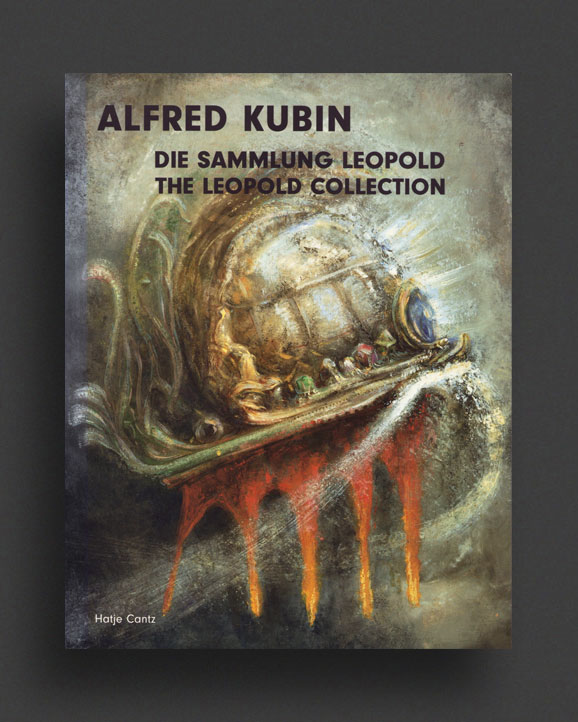
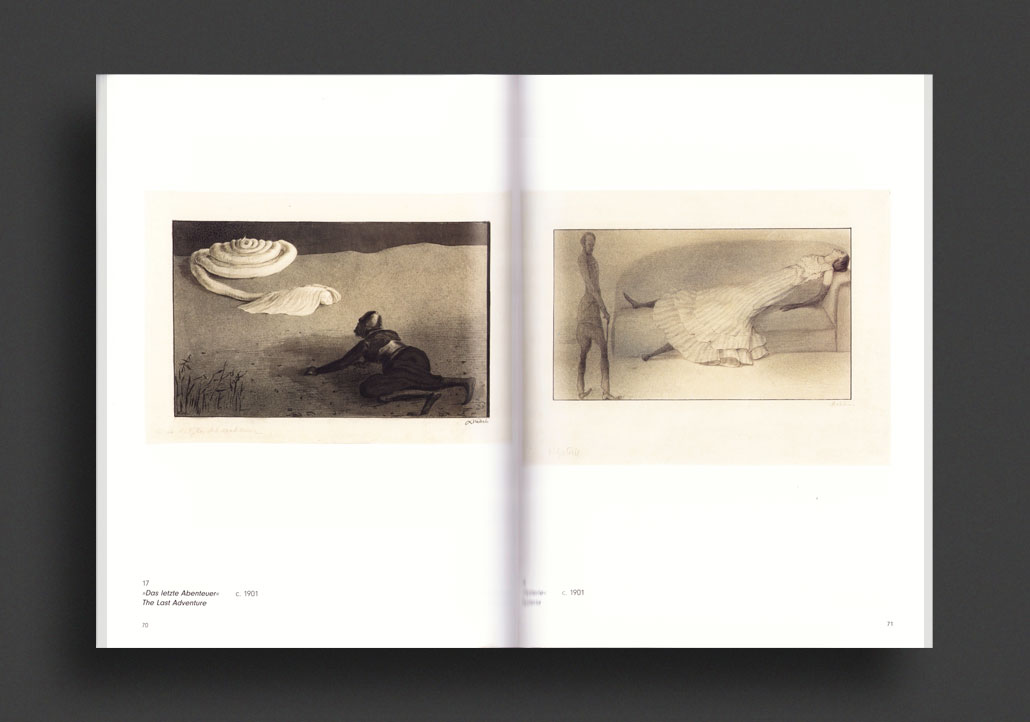
First edition of this major survey catalogue of the great Austrian draftsman, illustrator and author Alfred Kubin (1877–1959) from The Leopold Collection, Vienna, published by Hatje Cantz in 2002. Long out-of-print and one of the best catalogues on the master of the macabre.
Alfred Kubin, an accomplished draughtsman, was inspired by his fascination with the philosophies of Schopenhauer and Nietzsche; and influenced by the artists Goya, Klinger, Ensor, Redon, Rops and Munch. Kubin called his dreamlike imagery a vital "escape into the unreal": ghostly figures, hybrid creatures, variants of torture and self-torture, dream, vampirism, spiritualism, decadence, sex, death and birth. His extraordinary oeuvre comprises more than 20,000 drawings, a large part of it consist of pen drawings, portfolio pieces and illustrations from more than 70 books. This book features a representative selection of master sheets by the bizarre multi-talented artist.
Very Good copy with light wear.
2014, Japanese / English
Hardcover (w. postcard), 96 pages, 15 x 21 cm
1st Edition, Out of print title / used / very good
Published by
Atelier Third / Tokyo
$65.00 - In stock -
First hardcover edition of 'Le Principe de la Constitution' by Yoshifumi Hayashi, published in 2014 and now out-of-print. ‘Eroticism is to establish order, or in other words the principle of constitution, and not to destroy’ Yoshifumi Hayashi says. This latest collection of self-taught Hayashi's masterfully rendered obsessive visions of grotesque, disembodied eroticism continue his unique and highly original exploration of graphic art. Profusely illustrated throughout, this book follows-on from the comprehensive "La Jeune Marieè d'un Materialiste Enceinte de Cerveaux" monograph (mid 1970s-mid 1990s) illustrating Hayashi's pencil work throughout the 2000s. Includes a very rare essay by Hayashi, who first studied philosophy, discussing his theories about science and eros, tracing his childhood interest in astronomy through to his understanding of eroticism through dynamics.
Contemporary Japanese erotic artist Yoshifumi Hayashi (b. 1948, Fukuoka, Japan) dropped out of Chuo University Department of Philosophy in 1972, moving to Paris in 1974, where he began to produce pencil drawings through self study. At first his main influence was the metaphysical world of De Chirico, but soon his focus shifted to the lower half of the female anatomy. Exhibiting and publishing his drawings in France in the late 1970's, Hayashi gained a cult following for his dark explorations of fetishized female physiology and mutating genitalia, rendered masterfully in pencil. Often mentioned in relation to the likes of Hans Bellmer, H.R. Giger, and even David Cronenberg, Hayashi's drawings were featured in specialist fetish magazines, and director Walerian Borowczyk even made a film in 1980 of the artist at work, yet still little is known about Hayashi, who continues to work and exhibit internationally.
As New copy including Hayashi promotional postcard.