World Food Books' programme is largely produced on Kulin Nation land. We acknowledge the Wurundjeri people of the Kulin Nation as the first and continuing custodians of this land, and pay respect to their Elders past, present, and emerging.
World Food Books is an arts and special interests bookshop in Naarm / Melbourne. Founded in 2010, World Food Books is devoted to the presentation of a rotating, hand-selection of international art, design, literary and counterculture publications with an emphasis on the anti-traditional, the experimental, the avant-garde, the heretic, the marginal.
Presenting new titles alongside rare and out-of-print books, catalogues and journals spanning the fields of modern and contemporary art, design, photography, illustration, film, literature, poetry, cultural theory, philosophy, sexuality, popular and underground culture in its many radical forms, World Food Books wishes to encourage adventurous, thoughtful and open-minded reading, looking, writing, and exchange of publishing and ideas, both current and historical.
As well as our bookshop, located in Melbourne's historical Nicholas Building, all of our inventory is available internationally via our online mail-order service.
World Food Books semi-regularly co-ordinates "Occasions", a programme of exhibits and events at the bookshop and in partnership with other hosts (such as museums and art galleries) that develop out of the activities, relationships and content of the bookshop itself.
World Food Books
The Nicholas Building
37 Swanston Street
Room 5, Level 6
Melbourne 3000
Australia
SHOP HOURS:
Thu–Fri 12–6, Sat 12–5
WEB-SHOP OPEN 24/7
World Food Books
Postal Address:
37 Swanston Street
Room 5, Level 6
Melbourne 3000
Australia
Art
Theory / Essay
Architecture / Interior
Graphic Design / Typography
Photography
Fashion
Eros
LGBTQ+
Fiction / Poetry
Weird / Speculative / Science Fiction / Horror
Transgressive / Visceral / Abject
Symbolism / Decadence / Fin de siècle
Film / Video
Painting
Sculpture / Installation
Performance / Dance / Theater
Drawing
Sound / Music
Curatorial
Group Shows / Collections
Periodicals
Out-of-print / Rare
Posters / Ephemera / Discs
Signed Books
World Food Books Gift Voucher
World Food Book Bag
Australian Art
Australian Fiction
Australian Science Fiction / Speculative Fiction
Australian Poetry
Australian Photography
Japanese Photography
Conceptual Art
Minimal Art
Dada
'Pataphysics / Oulipo
Fluxus
Concrete Poetry
Pop Art
Surrealism
Arte Povera
Arte Informale / Haute Pâte / Tachism
Nouveau Réalisme / Zero / Kinetic
Situationism / Lettrism
Collage / Mail Art / Xerox Art
Art Brut / Folk / Visionary / Fantastic
Illustration / Graphic Art / Bandes Dessinées
Furniture
Italian Radical Design / Postmodernism
Textiles
Ceramics / Glass
Counterculture
Protest / Revolt
Philosophy
Psychoanalysis
Anthropology
Anarchism
Socialism / Anarchism / Communism / Capitalism
Literary Theory / Semiotics / Language
Feminism / Women's Studies
Gender Studies / Sexuality
Anthropology
Fetishism / BDSM
Drugs / Psychedelia
Crime / Violence
Animal Rights / Veganism
Occult / Esoterica
Ecology / Earth / Alternative Living
Whole Earth / Crafts
All prices in AUD (Australian dollars)
Pick-Ups
Pick-up orders can be collected in our bookshop during opening hours after order date. Please collect any Pick-up orders within 2 weeks of ordering as we have limited storage space. Orders will be released back into stock if not collected within this time. No refunds can be made for pick-ups left un-collected. If you cannot make it in to the bookshop in this time-frame, please choose postage option.
Return Policy
All sales are final. We do accept returns (for refund or exchange) for items received in error. All our orders are packed with special care using heavy-duty padding and cardboard book-mailers or bubble mailers (for smaller books), using reinforcement where required. We cannot take responsibility for any lost, stolen or damaged parcels.
Insurance
Should you wish to insure your package, please email us directly after placing your order and we can organise this at a small extra expense. Although all standard/express tracked packages are very safe and dependable, we cannot take responsibility for any lost, stolen or damaged parcels. We recommend insurance on valuable orders.
Interested in selling your old books, catalogues, journals, magazines, comics, fanzines, ephemera? We are always looking for interesting, unusual and out-of-print books to buy. We only buy books in our fields of interest and specialty, and that we feel we can resell.
We base these prices on desirability, market value, in-print prices, condition and our current stock levels. We offer cash, store credit, and can take stock on consignment. All
about 25% of the price we expect to get when we sell them, or 30% in store credit. We base these prices on desirability, market value, in-print prices, condition and our current stock levels.
Sell your books any day of the week. You can drop them off and return later. If you have a lot of books, we can visit your Sydney home.
We buy books that we feel we can resell. We offer about 25 % of the price we expect to get when we sell them, or 30% in store credit. We base these prices on desirability, market value, in-print prices, condition and our current stock levels.
Philadelphia Wireman
03 August - 01 September, 2018
World Food Books is proud to announce our next Occasion, the first presentation of sculptures by Philadelphia Wireman in Australia.
The Philadelphia Wireman sculptures were found abandoned in an alley off Philadelphia’s South Street on trash night in 1982. Their discovery in a rapidly-changing neighbourhood undergoing extensive renovation, compounded with the failure of all attempts to locate the artist, suggests that the works may have been discarded after the maker’s death. Dubbed the "Philadelphia Wireman" during the first exhibition of this work, in 1985, the maker’s name, age, ethnicity, and even gender remain uncertain. The entire collection totals approximately 1200 pieces, all intricately bound together with tightly-wound heavy-gauge wire (along with a few small, abstract marker drawings, reminiscent both of Mark Tobey and J.B. Murry). The dense construction of the work, despite a modest range of scale and materials, is singularly obsessive and disciplined in design: a wire armature or exoskeleton firmly binds a bricolage of found objects including plastic, glass, food packaging, umbrella parts, tape, rubber, batteries, pens, leather, reflectors, nuts and bolts, nails, foil, coins, toys, watches, eyeglasses, tools, and jewellery.
Heavy with associations—anthropomorphic, zoomorphic, and socio-cultural responses to wrapped detritus—the totemic sculptures by Philadelphia Wireman have been discussed in the context of work created to fulfil the shamanistic needs of alternative religions in American culture. Curators, collectors, and critics have variously compared certain pieces to sculpture from Classical antiquity, Native American medicine bundles, African-American memory jugs, and African fetish objects. Reflecting the artist’s prolific and incredibly focused scavenging impulse, and despite—or perhaps enhanced by—their anonymity, these enigmatic objects function as urban artefacts and arbiters of power, though their origin and purpose is unknown. Philadelphia Wireman, whatever their identity, possessed an astonishing ability to isolate and communicate the concepts of power and energy through the selection and transformation of ordinary materials. Over the course of the past two decades, this collection has come to be regarded as an important discovery in the field of self-taught art and vernacular art.
Presented in collaboration with Fleisher-Ollman Gallery, Philadelphia, and Robert Heald, Wellington.
Susan Te Kahurangi King
02 February - 10 March, 2018
Susan Te Kahurangi King (24 February 1951 - ) has been a confident and prolific artist since she was a young child, drawing with readily available materials - pencils, ballpoint pens and felt-tip markers, on whatever paper is at hand. Between the ages of four and six Susan slowly ceased verbal communication. Her grandparents William and Myrtle Murphy had developed a special bond with Susan so they took on caring responsibilities for extended periods. Myrtle began informally archiving her work, carefully collecting and storing the drawings and compiling scrapbooks. No drawing was insignificant; every scrap of paper was kept. The King family are now the custodians of a vast collection containing over 7000 individual works, from tiny scraps of paper through to 5 meter long rolls.
The scrapbooks and diaries reveal Myrtle to be a woman of great patience and compassion, seeking to understand a child who was not always behaving as expected. She encouraged Susan to be observant, to explore her environment and absorb all the sights and sounds. Myrtle would show Susan’s drawings to friends and people in her community that she had dealings with, such as shopkeepers and postal workers, but this was not simply a case of a grandmother’s bias. She recognised that Susan had developed a sophisticated and unique visual language and sincerely believed that her art deserved serious attention.
This was an unorthodox attitude for the time. To provide some context, Jean Dubuffet coined the term Art Brut in 1945 to describe work created by self-taught artists – specifically residents of psychiatric institutions and those he considered to be visionaries or eccentrics. In 1972 Roger Cardinal extended this concept by adopting the term Outsider Art to describe work made by non-academically trained artists operating outside of mainstream art networks through choice or circumstance. Susan was born in Te Aroha, New Zealand in 1951, far from the artistic hubs of Paris and London that Dubuffet and Cardinal operated in. That Myrtle fêted Susan as a self-taught artist who deserved to be taken seriously shows how progressive her attitudes were.
Susan’s parents Doug and Dawn were also progressive. Over the years they had consulted numerous health practitioners about Susan’s condition, as the medical establishment could not provide an explanation as to why she had lapsed into silence. Dawn educated herself in the field of homeopathy and went on to treat all twelve of her children using these principles – basing prescriptions on her observations of their physical, mental and emotional state.
Doug was a linguist with an interest in philosophy who devoted what little spare time he had to studying Maori language and culture. To some extent their willingness to explore the fringes of the mainstream made them outsiders too but it was their commitment to living with integrity and their respect for individuality that ensured Susan’s creativity was always encouraged.
Even though Susan’s family supported her artistic pursuits, some staff in schools and hospitals saw it as an impediment to her assimilation into the community and discouraged it in a variety of ways. Her family was not always aware of this and therefore did not fully understand why Susan stopped drawing in the early 1990s. However, rather than dwell on the challenges that Susan faced in pursuit of her artistic practice, they prefer to highlight her achievements. In 2008 Susan began drawing again in earnest, after an almost 20 year interruption, and her work is now shown in galleries around the world.
Susan grew up without television and has been heavily influenced by the comics she read as a child. She is absolutely fearless in the appropriation of recognizable characters, such as Donald Duck and Mickey Mouse, in her work. She twists their limbs, contorts their faces, compresses them together, blends them into complex patterned backgrounds - always imbuing them with an incredible energy. Although Susan often used pop culture characters in her work they are not naive or childlike. These are drawings by a brilliant self-taught artist who has been creating exceptional work for decades without an audience in mind.
Mladen Stilinović
"Various Works 1986 - 1999"
02 February 16 - September 10, 2016
Various works 1986 - 1999, from two houses, from the collections of John Nixon, Sue Cramer, Kerrie Poliness, Peter Haffenden and Phoebe Haffenden.
Including: Geometry of Cakes (various shelves), 1993; Poor People’s Law (black and white plate), 1993; White Absence (glasses, ruler, set square, silver spoon, silver ladel with skin photograph and wooden cubes), 1990-1996; Exploitation of the Dead (grey and red star painting, wooden painting, black spoon with red table, red plate), 1984-1990; Money and Zeros (zero tie, paintings made for friends in Australia (Sue, John, Kerrie), numbers painting), 1991-1992; Words - Slogans (various t-shirts) - “they talk about the death of art...help! someone is trying to kill me”, “my sweet little lamb”, “work is a disease - Karl Marx”; Various artist books, catalogues, monographs, videos; Poster from exhibition Insulting Anarchy; "Circular" Croatian - Australian edition; Artist book by Vlado Martek (Dostoyevsky); more.
Thanks to Mladen Stilinović and Branka Stipančić.
Jonathan Walker
Always Will Need To Wear Winter Shirt Blue + Ochre Small Check Pattern
21 August - 21 September, 2015
Untitled
I am not a great reader of poetry but I always return to the work of Melbourne poet, Vincent Buckley (1925- 1988). Perhaps I find his most tantalising piece to be not a finished poem but a fragment left on a scrap of paper discovered on his desk after the poet’s death.
The poetry gathers like oil
In the word-core, and spreads
It has its music meet,
Its music is in movement.
This fragment is more the shell left behind from a volatile thought than a finished poem. I find the last two lines honest but awkward whereas the first two lines work like an arrow. Most likely he could not find a resolution so it was left. Still, in its present form, it remains an eloquent testimony to the ultimate failure of a medium to express mobile thought and sensation, in Buckley’s case, through verbal language. It’s an important matter because this is something all artists have to deal with regardless of the medium.
I have never written a poem, however, I am forever copying fragments from books on paper scraps in a vain effort to fix certain notions in my head. At first, they function as bookmarks that are sometimes returned to when I open the book. But before long, as they accumulate, they fall out littering the table interspersed with A4 photocopies, bills, books and medications.
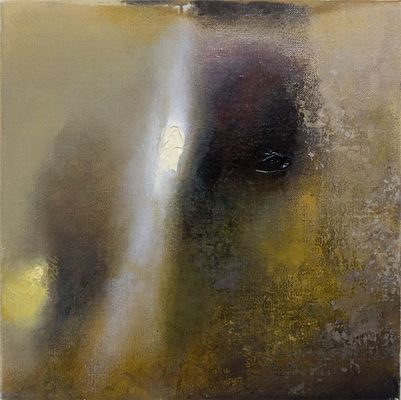
To return to Buckley’s fragment, the first two lines very much evoke how I paint nowadays. As you age, detail diminishes and patches of light become more luminous and float. I feel the most honest way of dealing with this is by smearing the oil paint on the canvas with the fingers and working close-up, blind. Only if the patches coalesce into an approaching image can the work gain a life.
-
Jonathan Walker was born in Melbourne, Australia and brought up on a dairy farm in Gippsland. In the 1970’s he studied painting at RMIT and won the Harold Wright Scholarship to the British Museum, London. During the 1980’s he exhibited at Pinacotheca Gallery, Richmond and had work shown at the NGV and Heidi City Art Gallery. Over the same period he designed the cover for the “Epigenesi” LP by Giancarlo Toniutti, Italy and conducted a mail exchange work with Achim Wollscheid, Germany. The work with artists through the post resulted in an article published in the bicentenary issue of Art and Australia 1988. He showed in artist run spaces such as WestSpace in the 90’s and 2000’s, and until 2012, taught painting at Victoria University, which is where we (Colleen Ahern and Lisa Radford) as organisers of the exhibition, among many others, had the privilege of being his student.
Walker’s knowledge was imparted to students through the careful selection of music, literature, and artists found in books that he himself had ordered for the library. Walker’s strategy was the generosity of sharing his vast knowledge with references specific to each student and their context.
Walker’s paintings share a similar focus and intimacy.
This exhibition presents a small selection of recent paintings alongside a publication that includes Walker’s writing. Observational and analytical, Walker’s work is a type of material notation — the time of day, colour and how it is blended, the both specific and fleeting location of a reflection on lino or the question of whether a chair leg should be included in a painting.
Please join us on Friday August 21 between 6-8pm to celebrate the opening of the exhibition.
Curated by Colleen Ahern and Lisa Radford.
B. Wurtz
Curated by Nic Tammens
March 26 - April 4, 2015
B.Wurtz works from a basement studio in his home on Manhattan’s Lower East Side.
This local fact is attested to by the plastic shopping bags and newsprint circulars that appear in his work. As formal objects, they don’t make loud claims about their origins but nonetheless transmit street addresses and places of business from the bottom of this long thin island. Like plenty of artists, Wurtz is affected by what is local and what is consumed. His work is underpinned by this ethic. It often speaks from a neighborhood or reads like the contents of a hamper:
“BLACK PLUMS $1.29 lb.”
“Food Bazaar”
“USDA Whole Pork Shoulder Picnic 99c lb.”
“RITE AID Pharmacy, with us it’s personal.”
“H. Brickman & Sons.”
“Sweet Yams 59c lb."
Most of the work in this exhibition was made while the artist was in residence at Dieu Donne, a workshop dedicated to paper craft in Midtown. Here Wurtz fabricated assemblages with paper and objects that are relatively lightweight, with the intention that they would be easily transportable to Australia. This consideration isn’t absolute in Wurtz’s work, but was prescriptive for making the current exhibition light and cheap. Packed in two boxes, these works were sent from a USPS post office on the Lower East Side and delivered to North Melbourne by Australia Post.
Wurtz appears courtesy of Metro Pictures, New York.
Thanks to Rob Halverson, Joshua Petherick, Sari de Mallory, Matt Hinkley, Helen Johnson, Fayen d'Evie, Ask Kilmartin, Lisa Radon, Ellena Savage, Yale Union, and "Elizabeth".
John Nixon
"Archive"
December 15 - January 20, 2014
The presentation of John Nixon's archive offered a rare showcase of this extensive collection of the artist's own publications, catalogues, posters, ephemera, editions and more, from the mid 1980s onwards, alongside a selection of his artworks.
Organized by John Nixon, Joshua Petherick and Matt Hinkley.
<a href=http://wfb.public-office.info/artist/john-nixon>All titles by John Nixon
"Habitat"
at Minerva, Sydney (organised by Joshua Petherick and Matt Hinkley)
November 15 - December 20, 2014
Lupo Borgonovo, Janet Burchill & Jennifer McCamley,
Lewis Fidock, HR Giger, Piero Gilardi, Veit Laurent Kurz,
Cinzia Ruggeri, Michael E. Smith, Lucie Stahl, Daniel Weil, Wols
Press Release:
“...It contained seven objects. The slender fluted bone, surely formed for flight, surely from the wing of some large bird. Three archaic circuitboards, faced with mazes of gold. A smooth white sphere of baked clay. An age-blackened fragment of lace. A fingerlength segment of what she assumed was bone from a human wrist, grayish white, inset smoothly with the silicon shaft of a small instrument that must once have ridden flush with the surface of the skin - but the thing’s face was seared and blackened.”
William Gibson, “Count Zero”, 1986
"Autumn Projects Archive"
Curated by Liza Vasiliou
March 6 - March 15, 2014
World Food Books, in conjunction with the Virgin Australia Melbourne Fashion Festival 2014, presented the Autumn Projects archive, consisting of a selection of early examples in Australian fashion with a particular interest in collecting designers and labels from the period beginning in the 1980’s, who significantly influenced the discourse of Australian Fashion.
Curated by Liza Vasiliou, the exhibition provided a unique opportunity to view pieces by designers Anthea Crawford, Barbara Vandenberg, Geoff Liddell and labels CR Australia, Covers, Jag along with early experimental collage pieces by Prue Acton and Sally Browne’s ‘Fragments’ collection, suspended throughout the functioning World Food Books shop in Melbourne.
H.B. Peace
presented by CENTRE FOR STYLE
November 14, 2013
"Hey Blinky, you say chic, I say same"
Anon 2013
H.B. Peace is a clothing collaboration between great friends Blake Barns and Hugh Egan Westland. Their pieces explore the divergences between 'character’ and ‘personality’ in garments....etc
Special Thanks to Joshua Petherick and Matt Hinkley of WFB and Gillian Mears
and a Very Special Thank you to Audrey Thomas Hayes for her shoe collaboration.
Janet Burchill & Jennifer McCamley
"Aesthetic Suicide"
May 10 - June 8, 2013
The first of our occasional exhibitions in the World Food Books office/shop space in Melbourne, "Aesthetic Suicide" presented a body of new and older works together by artists Janet Burchill & Jennifer McCamley, including videos, prints, a wall work, and publications.
During shop open hours videos played every hour, on the hour.
$.00 - Out of stock
The eternal clean out! New items weekly.
https://worldfoodbooks.com/category/sale
Published by World Food Books / Melbourne
$20.00 - In stock -
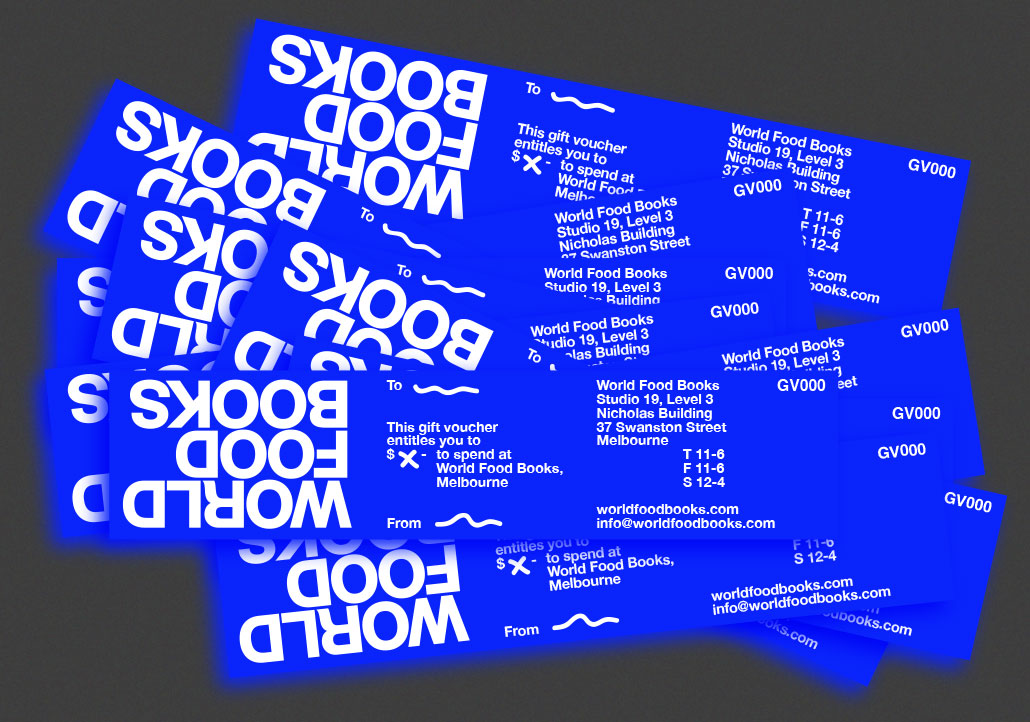
A World Food Books gift voucher is redeemable in our Melbourne bookshop or via our webshop (here). An e-voucher (printable pdf) will be sent to your purchase email address (please notify us if you wish to have the voucher sent to an alternate address and wish us to fill in the receiver's details on the card).
Gift vouchers can be purchased in increments of $20 (Australian Dollars) and the total amount can simply be added to by increasing the quantity in your shopping cart. eg. A quantity of 5 gift vouchers will result in an item total of $100 - a $100 gift voucher. Simply click "ADD TO CART" 5 times, or update your quantity in the shopping cart.
If you wish to purchase multiple, separate gift vouchers in one go, please just email us and we can personally prepare and email you a payment request.
Please note: Please select Pick-Up on gift voucher purchse to avoid any postage charges. Accidental postage charges will be refunded right away!
Thank you.
For any questions, please don't hesitate to email: [email protected]
2019, English
Softcover, 108 pages, 21.6 x 27.9 cm
Published by
WarCry / US
$25.00 - In stock -
Together in one professionally-bound book, for the first time.
The Militant Vegan was a low-production-value, limited-circulation, photocopied publication that ran from 1993 to 1995, and never enjoyed a wide audience. This is the complete collection of the animal liberation zine covering direct action, animal rights activism, and the Animal Liberation Front (ALF).
To understand The Militant Vegan is to understand the historical context from which it arose: By 1993, the Animal Liberation Front had carried out its most strategic campaign to date, targeting weak points in the fur industry in a multi-state liberation and arson spree called Operation Bite Back. The media was all but silent. There was no internet, so activists outside the small media markets where these raids happened were unaware this campaign was underway, and many of the raids weren’t reported by the media at all. The Animal Liberation Front (again, pre-internet) had little-to-no platforms to which they could disseminate their communiques, rally the movement to join them in taking action, or let the world know of their victories.
It was from this void The Militant Vegan emerged. To quote issue #1, “The Militant Vegan is being released because there has been a media blackout on direct action on behalf of enslaved animals.” Before the internet, animal liberation news could only be spread through photocopied documents like The Militant Vegan, distributed person-to-person, and seen by few. While dominated by re-purposed material (such as ALF primers and newspaper clippings), there is also notable content, ALF history, and other direct-action themed rarities contained in these pages. Some of it never to be found elsewhere. The Militant Vegan published some of the first publicized fur farm addresses - several of which would go on to be raided by activists. A communiqué for the Malecky Mink Farm arson (also part of Operation Bite Back) is a rare piece of ALF history. And even the grainy newspaper article reprints can’t be downplayed, in a time when to not live in an area where an ALF action had occurred was to never know it happened at all - were it not for The Militant Vegan.
In the mid-1990s, reading The Militant Vegan was like a window to a secret history you watched unfold in its pages.
2026, English
Softcover, 480 pages, 21.2 x 14 cm
Published by
Penguin Putnam / New York
$35.00 - In stock -
WINNER OF 2026 EDGAR AWARD FOR BEST FACT CRIME
SHORTLISTED FOR CWA'S ALCS GOLD DAGGER FOR NON-FICTION
'Murderland reads like a true crime thriller' SUNDAY TIMES
'Haunting, elegant and fiercely intelligent' OBSERVER
'A great writer can make art of the most grotesque material, and Fraser does'—WALL STREET JOURNAL
'Lyrically luminescent'—NEW YORK TIMES
From the Pulitzer Prize-winning author of Prairie Fires comes a terrifying true-crime history of serial killers in the Pacific Northwest and beyond - a gripping investigation of how a new strain of psychopath emerged out of a toxic landscape of deadly industrial violence.
Caroline Fraser grew up in the shadow of Ted Bundy, the most notorious serial murderer of women in American history, surrounded by his hunting grounds and mountain body dumps, in the brooding landscape of the Pacific Northwest. But in the 1970s and ’80s, Bundy was just one perpetrator amid an uncanny explosion of serial rape and murder across the region. Why so many? Why so weirdly and nightmarishly gruesome? Why the senseless rise and then sudden fall of an epidemic of serial killing?
As Murderland indelibly maps the lives and careers of Bundy and his infamous peers in mayhem—the Green River Killer, the I-5 Killer, the Night Stalker, the Hillside Strangler, even Charles Manson—Fraser’s Northwestern death trip begins to uncover a deeper mystery and an overlapping pattern of environmental destruction. At ground zero in Ted Bundy’s Tacoma stood one of the most poisonous lead, copper, and arsenic smelters in the world, but it was hardly unique in the West. As Fraser’s investigation inexorably proceeds, evidence mounts that the plumes of these smelters not only sickened and blighted millions of lives but also warped young minds, including some who grew up to become serial killers.
A propulsive nonfiction thriller, Murderland transcends true-crime voyeurism and noir mythology, taking readers on a profound quest into the dark heart of the real American berserk.
'Breathlessly propulsive . . . Fraser's prose is lyrical, elegiac'—JOYCE CAROL OATES, NEW YORK REVIEW OF BOOKS
'Extraordinarily well-written and genre-defying . . . a moody masterpiece'—NEW YORKER
'Murderland reads like a true crime thriller'—SUNDAY TIMES
2026, English
Hardcover (w. dust jacket), 480 pages, 24 x 16 cm
Published by
Farrar Straus & Giroux / New York
$62.00 - In stock -
US hardcover edition.
"As official narratives everywhere strain and crack, Peter and Paul—and Durbin—offer a desperately needed alternative way of seeing and being."—Benjamin Moser, author of Susan Sontag: Her Life and Work, winner of the Pulitzer Prize
"A deeply original book, saturated with melancholy longing for a historical moment (past and future) when art and love could come together with a synchronized, quicksilver suddenness. Andrew Durbin creates a spellbinding sense of wistful cinematic duration in his twinned account of these two incandescent iconoclasts."—Wayne Koestenbaum
"[Andrew Durbin] has made of these lives and these times a jam-packed poem in prose. It's like a trip with these guys, without pulling tight at the ending, just death."—Eileen Myles, author of A "Working Life"
The cinematic, never-before-told story of two intimately entangled artists who redefined queer art.
When Paul Thek met Peter Hujar in the winter of 1956 in Coral Gables, Florida, a slow-simmering connection began to burn. Thek, twenty-three and living in Miami, was handsome and itching to make it as a painter; in the twenty-two-year-old Hujar, a shy, sensual photographer, he'd found a kindred spirit. By 1960, they were dating and living in New York, beginning decades of sex, love, competition, and reconciliation—an entanglement that changed American art forever.
Surrounded by a robust creative scene populated by Susan Sontag, Andy Warhol, Fran Lebowitz, John Waters, and David Wojnarowicz, Thek and Hujar's profoundly influential careers, from the early 1960s through the late 1980s, differed as much as the men themselves. The unpredictable and often overlooked Thek crafted visceral installations and sculptures, while Hujar, celebrated and sociable, took penetrating portraits of his world, queer and otherwise. Yet even at their most estranged, and even after their deaths from AIDS, both men were united by a pursuit of liberation—from artistic and sexual limits, from anything short of changing the world.
Andrew Durbin's The Wonderful World That Almost Was unravels, for the first time, the intertwined stories and work of two boundaryburning, paradigm-tilting, never more relevant American artists. Weaving together deft art criticism with moving portraits of both men's inner lives, and assembled with exhaustive research, Durbin's book is an ode to a lost but still-living world—and two men who defined it.
2026, English
Softcover, 456 pages, 23.2 x 16 cm
Published by
Bloomsbury Academic / London
$85.00 - In stock -
What are the most radical transformations on the horizon of our world? And how are they irreversibly altering our experience of time, movement, language, mind, body, virtuality, power, and nature?
Cloaked in relative obscurity, future eras compel the invention of new techniques of visionary speculation. Future's Theory provides many, shining a light on the infinity of possible futurities from multiple astonishing perspectives. Exploring how we imagine new ages in the 21st century, the book examines how alternate future dimensions will affect everything from our culture to our politics, our bodies to our minds.
Filled with original work from over 20 prominent thinkers in the domains of literature, philosophy, visual art, architecture, design, media studies, ecology, anthropology, it features immersive entries on phenomena including artificial intelligence, virtual reality, mass migration, speed, climate, geo-engineering, and automation. Contemplating the variables that will expand and distort these fields, Future's Theory opens up a new atmosphere for thought itself in the epochs to come.
Contributors include Jason Bahbak Mohaghegh, Nora Khan, Amy Ireland, Edward Keller, Carla Leitao, Dan Mellamphy, Nandita Biswas Mellamphy, Arshin Adib-Moghaddam, Anna Longo, Dejan Lukic, Laura Tripaldi, Michael Marder, and Reza Negarestani.
Jason Bahbak Mohaghegh is a philosopher, literary theorist, and professor of comparative literature at Babson College. His work tracks movements of radical thought across the so-called East and the West, with particular attention to concepts of chaos, violence, illusion, silence, extremism, mania, disappearance, night, evil, secrecy, and apocalyptic writing. He has published nine books to date, including two volumes titled Omnicide I and Omnicide II on madness, and two volumes on night titled Night: A Philosophy of the After-Dark and Night II: A Philosophy of the Last World. He is also the founding director of the Future Studies Program, Programmer of Transdisciplinary Studies for The New Centre for Research & Practice, and co-editor of the Future's Theory and Suspensions book series for Bloomsbury Press.
2019, English
Softcover, 600 pages, 11.4 x 17.8 cm
Published by
Urbanomic / Cornwall
Sequence Press / New York
$55.00 - In stock -
A fragmentary catalogue of poetic derangements that reveals the ways in which mania communicates with an extreme will to annihilation
What kind of circumstances provoke an obsessive focus on the most minute object or activity? And what causes such mania to blossom into the lethal conviction that everything must be annihilated? There is no turning away from the imperative to study this riddle in all its mystifying complexity and its disturbing contemporary resonance-to trace the obscure passage between a lone state of delirium and the will to world-erasure..
A fragmentary catalogue of the thousand-and-one varieties of manic disposition (augomania, dromomania, catoptromania, colossomania...), Omnicide enters the chaotic imaginations of the most significant poetic talents of the Middle East in order to instigate a new discourse on obsession, entrancement, excess, and delirium. Placing these voices into direct conversation, Jason Bahbak Mohaghegh excavates an elaborate network of subterranean ideas and interpretive chambers, byways, and burrows by which mania communicates with fatality. Like secret passages leading from one of the multitudinous details of a bustling Persian miniature to the blank burning immanence of the desert, each is a contorted yet effective channel connecting some attractive universe (of adoration, worship, or astonishment) to the instinct for all-engulfing oblivion (through hatred, envy, indifference, rage, or forgetting).
A captivating fractal of conceptual prisms in half-storytelling, half-theoretical prose, a rhythmic, poetic, insidious work that commands submission, Omnicide absorbs the reader into unfamiliar and estranging landscapes whose every subtle euphoric aspect threatens to become an irresistible invitation to the end of all things.
2023, English
Softcover, 570 pages, 11.4 x 17.8 cm
Published by
Urbanomic / Cornwall
$55.00 - In stock -
An infernal catalogue of manic visionaries, inspired by the poetry of the Middle East.
In a new work in which conceptual elaboration, storytelling, and poetics are fused in the infernal heat of the desert, the cycle of Omnicide is closed with a philosophy of doom, deception, and the game, plunging headlong into the inevitable, the fatal, and the infinite.
A series of controlled combustions fuelled by fragments drawn from the poetry and literature of the Middle-East, Omnicide II introduces us to a new cast of manic visionaries, from the Selemaniac to the Crystallomaniac, the Bibliomaniac to the Aeromaniac. In his relentless cataloguing of the myriad figures and portents of omnicidal doom, Jason Bahbak Mohaghegh resumes the offensive of those writers, artists, and thinkers for whom the fiercest creative incandescence is only kindled in the shadow of certain doom.
Amid war cries and lullabies, mages, wolves and pelicans, sabres and crystals, drones and soul-stealers, in settings ranging from the opium den to the Qatari luxury hotels, with his unique style and methodology, his dizzying breadth of references, and his implacable will to follow the most deranging lines of thought and evoke the most startling images, Mohaghegh draws the reader into territories disturbing and unfamiliar, atmospheres delicate and grotesque, moods morbid yet life-affirming, in a book that evokes fever and exudes dead calm.
The utterly absorbing music of this writing both lulls and disquiets-a contemporary Necronomicon, an inexhaustible treasury of recipes for disaster, catastrophe, ruination and destruction, all in the name of the most intense creation.
Jason Bahbak Mohaghegh is Associate Professor of Comparative Literature at Babson College. His focus is on tracking experimental thought in the so-called Middle East and the West, with particular attention to exploring concepts of chaos, violence, illusion, silence, sectarianism, madness, disappearance, and apocalyptic writing. He is the author of The Chaotic Imagination (2010); Inflictions (2012); The Radical Unspoken (2013); Insurgent, Poet, Mystic, Sectarian (2015); Omnicide- Mania, Fatality, and the Future-In-Delirium (Urbanomic/Sequence Press, 2019); and Night- A Philosophy of the After-Dark (2020).
1979, English
Softcover, 164 pages, 20.5 x 13.5 cm
Reprint,
Published by
Vintage Books / New York
$38.00 - In stock -
The timeless spiritual classic on overcoming anxiety, embracing uncertainty and learning to live in the present, from the acclaimed philosopher and author of The Way of Zen.
‘What we have forgotten is that thoughts and words are conventions, and that it is fatal to take conventions too seriously’
In uncertain times, it’s easy to feel anxious about the future while burdened by the past. In the midst of this negative loop, we often forget how to live in the now.
In The Wisdom of Insecurity, pioneering philosopher and Zen scholar Alan Watts offers a profound yet practical guide to psychological freedom. Blending Eastern philosophy with Western thought, Watts shows us how, in an age of unprecedented anxiety, we must embrace the present in order to live a fulfilling life.
A beloved modern classic, The Wisdom of Insecurity is the empowering and uplifting guide to help provide calm and allow you to live fully in the here and now.
Alan Wilson Watts (1915–973) was a British-born American philosopher, writer, and speaker, best known as an interpreter and populariser of Eastern philosophy for a Western audience. Born in Chislehurst, England, he moved to the United States in 1938 and began Zen training in New York. Pursuing a career, he attended Seabury-Western Theological Seminary, where he received a master's degree in theology. Watts became an Episcopal priest in 1945, then left the ministry in 1950 and moved to California, where he joined the faculty of the American Academy of Asian Studies In San Francisco. In 1953 he began his groundbreaking public radio series, first as The Great Books of Asia and later Way Beyond the West, which began airing in Los Angeles in 1959. The radio series, along with his bestselling book, The Way of Zen, launched him into a career as a talented philosophical interpreter and a prolific public speaker, and in the 1960's he was adopted by the Counterculture movement as a spiritual figurehead. He and his peers, including Aldous Huxley, Joseph Campbell, and Gregory Bateson, helped establish the Esalen Institute, which become the epicenter for the Human Potential Movement in the late sixties and seventies. Watts travelled widely between 1965 and his passing in 1973, and his works include 25 books, 250 lectures and interviews, and over 100 workshops and television appearances. His legacy continues with the Alan Watts Org directed by his son, Mark Watts.
1989, English
Softcover, 164 pages, 20.5 x 13.5 cm
Reprint,
Published by
Vintage Books / New York
$33.00 - In stock -
A witty attack on the illusion that the self is a separate ego that confronts a universe of alien physical objects.
A revelatory primer on what it means to be human and a mind-opening manual of initiation into the central mystery of existence, by "perhaps the foremost interpreter of Eastern disciplines for the contemporary West" (Los Angeles Times).
At the root of human conflict is our fundamental misunderstanding of who we are. The illusion that we are isolated beings, unconnected to the rest of the universe, has led us to view the "outside" world with hostility, and has fueled our misuse of technology and our violent and hostile subjugation of the natural world. To help us understand that the self is in fact the root and ground of the universe, Alan Watts provides us with a much-needed answer to the problem of personal identity, distilling and adapting the Hindu philosophy of Vedanta.
Alan Wilson Watts (1915–973) was a British-born American philosopher, writer, and speaker, best known as an interpreter and populariser of Eastern philosophy for a Western audience. Born in Chislehurst, England, he moved to the United States in 1938 and began Zen training in New York. Pursuing a career, he attended Seabury-Western Theological Seminary, where he received a master's degree in theology. Watts became an Episcopal priest in 1945, then left the ministry in 1950 and moved to California, where he joined the faculty of the American Academy of Asian Studies In San Francisco. In 1953 he began his groundbreaking public radio series, first as The Great Books of Asia and later Way Beyond the West, which began airing in Los Angeles in 1959. The radio series, along with his bestselling book, The Way of Zen, launched him into a career as a talented philosophical interpreter and a prolific public speaker, and in the 1960's he was adopted by the Counterculture movement as a spiritual figurehead. He and his peers, including Aldous Huxley, Joseph Campbell, and Gregory Bateson, helped establish the Esalen Institute, which become the epicenter for the Human Potential Movement in the late sixties and seventies. Watts travelled widely between 1965 and his passing in 1973, and his works include 25 books, 250 lectures and interviews, and over 100 workshops and television appearances. His legacy continues with the Alan Watts Org directed by his son, Mark Watts.
1986 / 2005, English / Italian
Softcover, 96 pages, 12.2 x 16.1 cm
Published by
City Lights Books / San Francisco
$34.00 - In stock -
The Italian film-maker Pier Paolo Pasolini was first and always a poet—the most important civil poet, according to Alberto Moravia, in Italy in the second half of this century. His poems were at once deeply personal and passionately engaged in the political turmoil of his country. In 1949, after his homosexuality led the Italian Communist Party to expel him on charges of "moral and political unworthiness," Pasolini fled to Rome. This selection of poems from his early impoverished days on the outskirts of Rome to his last (with a backward longing glance at his native Friuli) is at the center of his poetic and filmic vision of modern Italian life as an Inferno.
"From all these refusals, we know what Pasolini stood against—political ideologies of all kinds, the complacency inherent in the established social order, the corruption of the institutions of church and state. If Pasolini could be said to have stood for anything it was for the struggles of Italy's working class—both the rural peasants and those barracked in the urban slums at the edges of Italian cities—whose humanity he evoked with great eloquence and nuance. But it is his refusals that animate his legacy with an incandescent rage, a passionate and profound fury that did not, as Zigaina suggests, cry out for death—but for just the opposite." —Nathaniel Rich, The New York Review of Books
2025, English
Softcover, 240 pages, 20 x 13 cm
Published by
Verso / London
$46.00 - In stock -
Presented here for the first time in English is a remarkable screenplay about the apostle Paul by Pier Paolo Pasolini, legendary filmmaker, novelist, poet, and radical intellectual activist. Written between the appearance of his renowned film Teorema and the shocking, controversial Salò, or the 120 Days of Sodom, St Paul was deemed too risky for investors. At once a political intervention and cinematic breakthrough, the script forces a revolutionary transformation on the contemporary legacy of Paul. In Pasolini's kaleidoscope, we encounter fascistic movements, resistance fighters, and faltering revolutions, each of which reflects on aspects of the Pauline teachings. From Jerusalem to Wall Street and Greenwich Village, from the rise of SS troops to the death of Martin Luther King, Jr, here— as Alain Badiou writes in the foreword—"Paul's text crosses all these circumstances intact, as if it had foreseen them all."
This is a key addition to the growing debate around St Paul and to the proliferation of literature centred on the current turn to religion in philosophy and critical theory, which embraces contemporary figures such as Alain Badiou, Slavoj Žižek and Giorgio Agamben.
Translated by Elizabeth A. Castelli
Preface by Alain Badiou
Introduction by Ward Blanton
1983, English
Softcover, 176 pages, 18 x 11.4 cm
Published by
Semiotext(e) / Los Angeles
$29.00 - In stock -
Baudrillard's bewildering thesis, a bold extrapolation on Ferdinand de Saussure's general theory of general linguistics, is in fact a clinical vision of contemporary consumer societies where signs don't refer anymore to anything except themselves. They all are generated by the matrix.
Simulations never existed as a book before it was "translated" into English. Actually it came from two different bookCovers written at different times by Jean Baudrillard. The first part of Simulations, and most provocative because it made a fiction of theory, was "The Procession of Simulacra." It had first been published in Simulacre et Simulations (1981). The second part, written much earlier and in a more academic mode, came from L'Echange Symbolique et la Mort (1977). It was a half-earnest, half-parodical attempt to "historicize" his own conceit by providing it with some kind of genealogy of the three orders of appearance: the Counterfeit attached to the classical period; Production for the industrial era; and Simulation, controlled by the code. It was Baudrillard's version of Foucault's Order of Things and his ironical commentary of the history of truth. The book opens on a quote from Ecclesiastes asserting flatly that "the simulacrum is true." It was certainly true in Baudrillard's book, but otherwise apocryphal.One of the most influential essays of the 20th century, Simulations was put together in 1983 in order to be published as the first little black book of Semiotext(e)'s new Foreign Agents Series. Baudrillard's bewildering thesis, a bold extrapolation on Ferdinand de Saussure's general theory of general linguistics, was in fact a clinical vision of contemporary consumer societies where signs don't refer anymore to anything except themselves. They all are generated by the matrix.In effect Baudrillard's essay (it quickly became a must to read both in the art world and in academe) was upholding the only reality there was in a world that keeps hiding the fact that it has none. Simulacrum is its own pure simulacrum and the simulacrum is true. In his celebrated analysis of Disneyland, Baudrillard demonstrates that its childish imaginary is neither true nor false, it is there to make us believe that the rest of America is real, when in fact America is a Disneyland. It is of the order of the hyper-real and of simulation. Few people at the time realized that Baudrillard's simulacrum itself wasn't a thing, but a "deterrence machine," just like Disneyland, meant to reveal the fact that the real is no longer real and illusion no longer possible. But the more impossible the illusion of reality becomes, the more impossible it is to separate true from false and the real from its artificial resurrection, the more panic-stricken the production of the real is.
Jean Baudrillard (1929–2007) was a philosopher, sociologist, cultural critic, and theorist of postmodernity who challenged all existing theories of contemporary society with humor and precision. An outsider in the French intellectual establishment, he was internationally renowned as a twenty-first century visionary, reporter, and provocateur.
Translated by Phil Beitchman, Paul Foss and Paul Patton.
2005, English
Softcover, 176 pages, 13.2 x 22.6 cm
Published by
University of Michigan Press / Michigan
$50.00 - In stock -
The first full-length translation in English of an essential work of postmodernism. The publication of Simulacra et Simulation in 1981 marked Jean Baudrillard's first important step toward theorizing the postmodern. Moving away from the Marxist/Freudian approaches that had concerned him earlier, Baudrillard developed in this book a theory of contemporary culture that relies on displacing economic notions of cultural production with notions of cultural expenditure. Baudrillard uses the concepts of the simulacra - the copy without an original - and simulation. These terms are crucial to an understanding of the postmodern, to the extent that they address the concept of mass reproduction and reproduceability that characterizes our electronic media culture. Baudrillard's book represents a unique and original effort to rethink cultural theory from the perspective of a new concept of cultural materialism, one that radically redefines postmodern formulations of the body.
Jean Baudrillard (1929–2007) was a philosopher, sociologist, cultural critic, and theorist of postmodernity who challenged all existing theories of contemporary society with humor and precision. An outsider in the French intellectual establishment, he was internationally renowned as a twenty-first century visionary, reporter, and provocateur.
Translated by Sheila Faria Glase.
2002, English
Softcover, 430 pages, 15.2 x 23 cm
Published by
Semiotext(e) / Los Angeles
$45.00 - In stock -
Jean Baudrillard meets Cookie Mueller in this gathering of French theory and new American fiction.
Compiled in 2001 to commemorate the passing of an era, Hatred of Capitalism brings together highlights of Semiotext(e)’s most beloved and prescient works. Semiotext(e)’s three-decade history mirrors the history of American thought. Founded by French theorist and critic Sylvere Lotringer as a scholarly journal in 1974, Semiotext(e) quickly took on the mission of melding French theory with the American art world and punk underground. Its Foreign Agents, Native Agents, Active Agents and Double Agents imprints have brought together thinkers and writers as diverse as Gilles Deleuze, Assata Shakur, Bob Flanagan, Paul Virillio, Kate Millet, Jean Baudrillard, Michelle Tea, William S. Burroughs, Eileen Myles, Ulrike Meinhof, and Fanny Howe. In Hatred of Capitalism, editors Kraus and Lotringer bring these people together in the same volume for the first time.
Chris Kraus is a filmmaker and the author of I Love Dick and Aliens & Anorexia, and coeditor of Hatred of Capitalism: A Semiotext(e) Reader. Index called her “one of the most subversive voices in American fiction.” Her work has been praised for its damning intelligence, vulnerability and dazzling speed.
Sylvère Lotringer, general editor of Semiotext(e), lives in New York and Baja, California. He is the author of Overexposed: Perverting Perversions (Semiotext(e), 2007).
1993, English / Japanese
Hardcover, 74 pages, 19.5 x 13 cm
1st Edition, Out of print title / used / very good
Published by
Treville / Tokyo
$90.00 - In stock -
Scarce first 1993 hardcover edition, first printing of emmurée, a stunning photo book by Japanese doll artist Yuriko Yamayoshi, whose hauntingly beautiful ball-jointed dolls are photographed by Masaaki Toyoura with an afterword by the dollmaker herself (in Japanese). Beautifully designed and brilliantly shot in sepia and melancholic muted tones, Toyoura depicts Yamayoshi's distressed, angelic dolls in macabre scenarios and poses — forlorn fantasies in shadow. The finest book of Yamayoshi's gothic creations.
Very Good copy, light corner wear to covers, otherwise Near Fine.
1998, Japanese
Hardcover (w. glassine dust jacket + obi), 80 pages, 23 x 16 cm
Signed by artist,
1st Edition, Out of print title / used / fine
Published by
Shogakukan / Tokyo
$90.00 - In stock -
First hardcover edition of this lavish 1998 photo book collecting the delicate ball-jointed bisque doll works of renowned Japanese doll artist Koizukihime (b. 1955, often spelled Koitsukihime), published by Shogakukan, Tokyo. Elegantly signed by the artist to the first blank page, with illustrated moon motif. Koizukihime's ethereal gothic dolls exude a quiet, timeless beauty, imbued with the softness of eternal youth. Shot intimately by Japanese photographer Sakichi Kataoka, her nymphish girl creations—whether coffined, stigmatic, in slumber, or in erotic undress—are set in macabre, dreamlike, sometimes burlesque scenarios of ritual, eros and death, summoning fairytale and myth. Koizukihime began creating ball-jointed dolls in 1980 – the entire body is divided into parts, each connected by a sphere at the joints, allowing the joints to move freely. An artistic method radicalised by Hans Bellmer. By 1996, Koizukihime was creating all-bisque ball-jointed dolls, introducing high-end antique doll methods of late 19th century France, making all of the doll's parts out of fired porcelain and joining them with strong elastic bands. Commentary notes by Japanese author and critic Hiroshi Aramata.
Fine copy, some storage rippling to thick printed glassine dust jacket, light wear to glassine obi.
2000, Japanese
Hardcover (w. dust jacket), 80 pages, 27 x 19.2 cm
1st Edition, Out of print title / used / very good
Published by
Kadokawa Shoten / Tokyo
$70.00 - Out of stock
First 2000 hardcover edition of this lavish photo book, Derrière les paupières (Behind the Eyelids), collecting the delicate ball-jointed bisque doll works of renowned Japanese doll artist Koizukihime (b. 1955). Koizukihime's ethereal gothic dolls exude a quiet, timeless beauty, imbued with the softness of enternal youth. Shot intimately by Japanese photographer Sakichi Kataoka, her nymphish girl creations—whether coffined, stigmatic, in slumber, or in erotic undress—are set in macabre, dreamlike scenarios of ritual, eros and death. Koizukihime began creating ball-jointed dolls in 1980 – the entire body is divided into parts, each connected by a sphere at the joints, allowing the joints to move freely. An artistic method radicalised by Hans Bellmer. By 1996, Koizukihime was creating all-bisque ball-jointed dolls, introducing high-end antique doll methods of late 19th century France, making all of the doll's parts out of fired porcelain and joining them with strong elastic bands.
VG copy in VG dust jacket.
1980, English
Softcover, 48 pages, 24.5 x 17 cm
1st Edition, Out of print title / used / very good
Published by
Grupo CAyC Centro de Arte y Comunicación / Buenos Aires
$30.00 - In stock -
1980 catalogue published to accompany the presentation of the CAYC Group (Grupo CAyC) a pioneering Argentine avant-garde collective established in 1971 out of the Centro de Arte y Comunicación (CAyC) in Buenos Aires by art critic Jorge Glusberg, at Rosc in Ireland, the most influential series of contemporary art exhibitions to take place in Ireland during the twentieth century. Conceived by Ireland’s leading modernist architect, Michael Scott, Ireland was to play host to a major international art exhibition, approximately every four years, from 1967 to 1988, which brought the Irish public and Irish artists into contact with developments in international contemporary art. Rosc helped to combat the conservative and dying academicism of Irish art education of the sixties, which had rejected avant-garde developments. The Rosc project was rooted in idealism, but quickly – and consistently – sparked mass controversy.
Features the work of Jacques Bedel, Luis Benedit, Jorge Glusberg, J. González Mir, Víctor Grippo, Leopoldo Maler, Vicente Marotta, Alfredo Portillos y Clorindo Testa. Heavily illustrated with accompanying texts in English.
Grupo CAyC were famous for systemic and conceptual art, they won the prestigious Itamaraty Grand Prize at the 1977 São Paulo Biennial.
VG copy, light board wear.
1994, Japanese
Softcover, 178 pages, 21 x 15 cm
1st Edition, Out of print title / used / very good
Published by
Tom Shobo / Japan
$120.00 - In stock -
A rare, special issue ORG photo book by Japanese fetish photographer Kiyoshi Ikejiri, published in 1994 by Too Negative's Kotaro Kobayashi. Ikejiri was a leading photographic contributor to all of Kobayashi's Eros and Thanatos-themed underground periodicals, and this might be his only exclusive photo book. Cover to cover with vivid reproductions of Ikejiri's experimental SM fetish photography of young Japanese and Western female models. Heavy with sadistic industrial, medical bondage themes.
ORG was a Japanese erotic fetish photo journal initiated and edited by Kotaro Kobayashi of affiliated periodicals such as Too Negative, Spiral, Schizo, etc. ORG was published between 1993 to 1997 by Tom Publication Inc. The magazine came into being while Kobayashi was working in N.Y.C. during the early to mid-nineties. Kobayashi wanted to re-ignite the dense air that had evaporated from the erotic book market in Japan. The first issue hit the streets April 1993 with Kotaro as editor-in-chief and photographer Kiyoshi Ikejiri by his side. Kotaro Kobayashi’s ORG editorial template was also utilized for his cult mondo art gallery in photo magazine format, Too Negative. The most universal fact in life is “PAIN”. There are several kinships between the two prints, the only significant difference is the lack of concept ‘Thanatos’ - death - in ORG as seen in the aforementioned magazine’s printing of cadavers and bloodlust violence. Other than that, the two prints are of equal arresting power and manipulative corrupting sadism.
Very Good copy.
1998, Japanese
2 volumes (hardcover/softcover w. dust jackets) in slipcase + obi, unpaginated, 27 x 19.5 cm
1st Edition, Out of print title / used / fine
Published by
Shoshi Yamada & Sano Gallery / Tokyo
$70.00 - In stock -
Scarce copy of the first 1998 edition 2–volume, slipcased artist publication "Narcissisme", a collaborative work by Kishin Shinoyama, one of Japan's leading post-war photographers, and Simon Yotsuya, an acclaimed doll artist who also worked as an actor. Published to commemorate the seven–year in the making doll work of the same name, completed in 1998. "I spent 7 years for making this work. Its theme is the narcissism, so I made it to have much resemblance with me intentionally. I think the body of a work must be broken in some parts to make funny effect. In the case of this work, I disturbed the balance of the wood-frame and the body like a puzzle. And I like a little tired and depressed face of this doll. I exhibited this work in Paris and in Poland." The book beautifully documents the artist's studio throughout the making of the work in monochrome photographic detail shot by Kishin Shinoyama, with colour plates of the complete work. The other book is an illustrated biographical book about Yotsuya's artistic career and methodology, an appendix to the photobook.
Near Fine copy, beautifully preserved in a most complete copy with dust jackets, all inserts, obi, wax protector wraps and slipcase all present and NF.
Simon Yotsuya (b. 1944, Tokyo) started making dolls as a child, visiting exhibitions of dolls, and reads all the books he can find on the subject. In his mid-teens he visited Puppe Kawasaki, a doll maker and animator he greaty admired, devoting himself to the craft and becoming a poor high school student. In the early '60s, while working at a jazz coffee shop in Shinjuku, Yotsuya earned the nickname "Simon" (pronounced “Simone”), after his love for singer Nina Simone. He befriends Kuniyoshi Kaneko (painter) and Junko Koshino (fashion designer) and joins in the arts and literary scene. In 1965, he discovers the work of German Surrealist Hans Bellmer through an article authored by Tatsuhiko Shibusawa in the magazine “Shinfujin”, promptly abandoning his previous methods of doll-making to find his way as an artist, incorporating ball-joints into his dolls. Thereafter he becomes an admirer of Surrealism and immerses himself in the controversial Shibusawa's litterary works. In 1965, he also goes to see Tatsumi Hijikata's Butoh Performance for the first time. In the late 60s—early 70s Yotsuya pursued a parallel career to his doll-making as an actor and member of Juro Kara's legendary underground theater company Jokyo Gekijo, Situation Theater, regularly portraying a female doll. He appears in the movie "Diary of a Shinjuku Thief" directed by Nagisa Oshima with the actors of the Situation Theater, but by 1971 he leaves the stage to concentrate on his own work. Simon exhibited at Expo 1970 in Osaka, the Tokyo Biennale in 1974 and by the end of the decade had opened his own doll-making school in Harajuku.
Good—Very Good copy with general wear to book and publisher's jacket shrinkage with age, some light foxing.
1983, English
Softcover, unpaginated, 29.5 x 21.5 cm
1st Edition, Out of print title / used / good
Published by
Sphere / UK
$40.00 - In stock -
"Private Viewing presents a collection of 150 superbly reproduced erotic images by 35 of the world's leading creative photographers. Some are internationally renowned for their erotic photography: others have contributed personal work drawn from private portfolios. All of them reflect the very best in modern erotica - sometimes aggressive, sometimes irreverent, but always highly personal and strikingly contemporary."
Features the work of Nobuyoshi Araki, Shirley Beljon, Chico Bialas, Andrea Blanch, Bob Carlos Clarke, Roberto Carra, Alex Chatelain, Attilio Concari, James Cotier, Thomas Degen, Patrick Demarchelier, Fabrizio Ferri, Jean-Paul Goude, Jean-Francois Jonvelle, Gilles Larrain, Cheyco Leidmann, Robert Mapplethorpe, Duane Michals, Michel Momy, Shizuki Obuchi, Occhiomagico, Chikako Oyama, Pierre & Gilles, Poivre, Marcia Resnick, Barry Ryan, Laurence Sackman, Jeanloup Sieff, Jeffrey Silverthorne, Christian Vogt, Albert Watson, James Wedge, Claus Wickrath, Larry Williams, Norito Yoshimura.
G–VG copy light wear to boards/spine, foxing to block edge.
1993, Italian
Softcover, 282 pages, 32 x 23.5 cm
1st Edition, Out of print title / used / good
Published by
Editrice Progresso / Milan
$30.00 - In stock -
1993 volume of ZOOM Collection (Vol. 33) gathering three issues of the French photography magazine ZOOM, "the International Image Magazine", No. 122, 123, 124. These issues features the work of Joyce Tenneson, Helmut Newton, Gilles Berquet, Bettina Rheims, Will McBride, Arthur Tress, Annie Leibovitz, Raymond Pettibon, Irving Penn, Michael Kenna, Curtis Knapp, and many more. Italian edition. Founded in Paris in 1970, ZOOM eventually moved editorial operations to Italy, Milan. It was one of the most acclaimed fine–art photography magazines in Europe.
Good copy with wear to edges/boards, foxing to block edge, light rippling to boards.
1980, English
Stamped envelope/tri-fold card screen-print/20 die-cut prints/2 folded sheets, 42 x 22 cm
1st Edition, Out of print title / used / very good
Published by
Pinacotheca / Melbourne
$100.00 - In stock -
Very rare artist print edition published on the occasion of Tony Trembath's exhibition "Sculpture" at Pinacotheca, Melbourne, 1980. An incredibly intricate edition that reflects Trembath's humorous and conceptually rigorous practice, masterfully printed by Larry Rawling in his legendary Mal Studios printmaking workshop in Melbourne, 1980. Tri-fold 2-colour screen-printed card housing three silver envelopes containing folded exhibition invitation, folded work-list surveying three major sculptural installation/conceptual photography works spanning 1978-1980, and 20 die-cut architectural print works by the artist, all housed in stamped/hand-titled envelope.
Tony Trembath (b.1946 Sale, Victoria) is an Australian cross disciplinary artist whose work ranges from immersive installation, screen printing, sculpture and artists books. He has exhibited extensively across Australia and Internationally.
Pinacotheca was a gallery in Melbourne, Australia. Established in 1967 by Bruce Pollard, it was ideologically committed to the avant-garde and represented a new generation of artists interested in post-object, conceptual and other non-traditional art forms.
Very Good copy with pocket contents like-new, light card edge wear and some wear to envelope opening/corners.