World Food Books' programme is largely produced on Kulin Nation land. We acknowledge the Wurundjeri people of the Kulin Nation as the first and continuing custodians of this land, and pay respect to their Elders past, present, and emerging.
World Food Books is an arts and special interests bookshop in Naarm / Melbourne. Founded in 2010, World Food Books is devoted to the presentation of a rotating, hand-selection of international art, design, literary and counterculture publications with an emphasis on the anti-traditional, the experimental, the avant-garde, the heretic, the marginal.
Presenting new titles alongside rare and out-of-print books, catalogues and journals spanning the fields of modern and contemporary art, design, photography, illustration, film, literature, poetry, cultural theory, philosophy, sexuality, popular and underground culture in its many radical forms, World Food Books wishes to encourage adventurous, thoughtful and open-minded reading, looking, writing, and exchange of publishing and ideas, both current and historical.
As well as our bookshop, located in Melbourne's historical Nicholas Building, all of our inventory is available internationally via our online mail-order service.
World Food Books semi-regularly co-ordinates "Occasions", a programme of exhibits and events at the bookshop and in partnership with other hosts (such as museums and art galleries) that develop out of the activities, relationships and content of the bookshop itself.
World Food Books
The Nicholas Building
37 Swanston Street
Room 5, Level 6
Melbourne 3000
Australia
SHOP HOURS:
Thu–Sat 11–5
WEB-SHOP OPEN 24/7
World Food Books
Postal Address:
PO Box 435
Flinders Lane
Victoria 8009
Australia
Art
Theory / Essay
Architecture / Interior
Graphic Design / Typography
Photography
Fashion
Eros
LGBTQ+
Fiction / Poetry
Weird / Speculative / Science Fiction / Horror
Transgressive / Visceral / Abject
Symbolism / Decadence / Fin de siècle
Film / Video
Painting
Sculpture / Installation
Performance / Dance / Theater
Drawing
Sound / Music
Curatorial
Group Shows / Collections
Periodicals
Out-of-print / Rare
Posters / Ephemera / Discs
Signed Books
World Food Books Gift Voucher
World Food Book Bag
Australian Art
Australian Fiction
Australian Science Fiction / Speculative Fiction
Australian Poetry
Australian Photography
Japanese Photography
Conceptual Art
Minimal Art
Dada
'Pataphysics / Oulipo
Fluxus
Concrete Poetry
Pop Art
Surrealism
Arte Povera
Arte Informale / Haute Pâte / Tachism
Nouveau Réalisme / Zero / Kinetic
Situationism / Lettrism
Collage / Mail Art / Xerox Art
Art Brut / Folk / Visionary / Fantastic
Illustration / Graphic Art / Bandes Dessinées
Furniture
Italian Radical Design / Postmodernism
Textiles
Ceramics / Glass
Counterculture
Protest / Revolt
Philosophy
Psychoanalysis
Anthropology
Anarchism
Socialism / Anarchism / Communism / Capitalism
Literary Theory / Semiotics / Language
Feminism / Women's Studies
Gender Studies / Sexuality
Anthropology
Fetishism / BDSM
Drugs / Psychedelia
Crime / Violence
Animal Rights / Veganism
Occult / Esoterica
Ecology / Earth / Alternative Living
Whole Earth / Crafts
All prices in AUD (Australian dollars)
Pick-Ups
Pick-up orders can be collected in our bookshop during opening hours after order date. Please collect any Pick-up orders within 2 weeks of ordering as we have limited storage space. Orders will be released back into stock if not collected within this time. No refunds can be made for pick-ups left un-collected. If you cannot make it in to the bookshop in this time-frame, please choose postage option.
Return Policy
All sales are final. We do accept returns (for refund or exchange) for items received in error. All our orders are packed with special care using heavy-duty padding and cardboard book-mailers or bubble mailers (for smaller books), using reinforcement where required. We cannot take responsibility for any lost, stolen or damaged parcels.
Insurance
Should you wish to insure your package, please email us directly after placing your order and we can organise this at a small extra expense. Although all standard/express tracked packages are very safe and dependable, we cannot take responsibility for any lost, stolen or damaged parcels. We recommend insurance on valuable orders.
Interested in selling your old books, catalogues, journals, magazines, comics, fanzines, ephemera? We are always looking for interesting, unusual and out-of-print books to buy. We only buy books in our fields of interest and specialty, and that we feel we can resell.
We base these prices on desirability, market value, in-print prices, condition and our current stock levels. We offer cash, store credit, and can take stock on consignment. All
about 25% of the price we expect to get when we sell them, or 30% in store credit. We base these prices on desirability, market value, in-print prices, condition and our current stock levels.
Sell your books any day of the week. You can drop them off and return later. If you have a lot of books, we can visit your Sydney home.
We buy books that we feel we can resell. We offer about 25 % of the price we expect to get when we sell them, or 30% in store credit. We base these prices on desirability, market value, in-print prices, condition and our current stock levels.
Philadelphia Wireman
03 August - 01 September, 2018
World Food Books is proud to announce our next Occasion, the first presentation of sculptures by Philadelphia Wireman in Australia.
The Philadelphia Wireman sculptures were found abandoned in an alley off Philadelphia’s South Street on trash night in 1982. Their discovery in a rapidly-changing neighbourhood undergoing extensive renovation, compounded with the failure of all attempts to locate the artist, suggests that the works may have been discarded after the maker’s death. Dubbed the "Philadelphia Wireman" during the first exhibition of this work, in 1985, the maker’s name, age, ethnicity, and even gender remain uncertain. The entire collection totals approximately 1200 pieces, all intricately bound together with tightly-wound heavy-gauge wire (along with a few small, abstract marker drawings, reminiscent both of Mark Tobey and J.B. Murry). The dense construction of the work, despite a modest range of scale and materials, is singularly obsessive and disciplined in design: a wire armature or exoskeleton firmly binds a bricolage of found objects including plastic, glass, food packaging, umbrella parts, tape, rubber, batteries, pens, leather, reflectors, nuts and bolts, nails, foil, coins, toys, watches, eyeglasses, tools, and jewellery.
Heavy with associations—anthropomorphic, zoomorphic, and socio-cultural responses to wrapped detritus—the totemic sculptures by Philadelphia Wireman have been discussed in the context of work created to fulfil the shamanistic needs of alternative religions in American culture. Curators, collectors, and critics have variously compared certain pieces to sculpture from Classical antiquity, Native American medicine bundles, African-American memory jugs, and African fetish objects. Reflecting the artist’s prolific and incredibly focused scavenging impulse, and despite—or perhaps enhanced by—their anonymity, these enigmatic objects function as urban artefacts and arbiters of power, though their origin and purpose is unknown. Philadelphia Wireman, whatever their identity, possessed an astonishing ability to isolate and communicate the concepts of power and energy through the selection and transformation of ordinary materials. Over the course of the past two decades, this collection has come to be regarded as an important discovery in the field of self-taught art and vernacular art.
Presented in collaboration with Fleisher-Ollman Gallery, Philadelphia, and Robert Heald, Wellington.
Susan Te Kahurangi King
02 February - 10 March, 2018
Susan Te Kahurangi King (24 February 1951 - ) has been a confident and prolific artist since she was a young child, drawing with readily available materials - pencils, ballpoint pens and felt-tip markers, on whatever paper is at hand. Between the ages of four and six Susan slowly ceased verbal communication. Her grandparents William and Myrtle Murphy had developed a special bond with Susan so they took on caring responsibilities for extended periods. Myrtle began informally archiving her work, carefully collecting and storing the drawings and compiling scrapbooks. No drawing was insignificant; every scrap of paper was kept. The King family are now the custodians of a vast collection containing over 7000 individual works, from tiny scraps of paper through to 5 meter long rolls.
The scrapbooks and diaries reveal Myrtle to be a woman of great patience and compassion, seeking to understand a child who was not always behaving as expected. She encouraged Susan to be observant, to explore her environment and absorb all the sights and sounds. Myrtle would show Susan’s drawings to friends and people in her community that she had dealings with, such as shopkeepers and postal workers, but this was not simply a case of a grandmother’s bias. She recognised that Susan had developed a sophisticated and unique visual language and sincerely believed that her art deserved serious attention.
This was an unorthodox attitude for the time. To provide some context, Jean Dubuffet coined the term Art Brut in 1945 to describe work created by self-taught artists – specifically residents of psychiatric institutions and those he considered to be visionaries or eccentrics. In 1972 Roger Cardinal extended this concept by adopting the term Outsider Art to describe work made by non-academically trained artists operating outside of mainstream art networks through choice or circumstance. Susan was born in Te Aroha, New Zealand in 1951, far from the artistic hubs of Paris and London that Dubuffet and Cardinal operated in. That Myrtle fêted Susan as a self-taught artist who deserved to be taken seriously shows how progressive her attitudes were.
Susan’s parents Doug and Dawn were also progressive. Over the years they had consulted numerous health practitioners about Susan’s condition, as the medical establishment could not provide an explanation as to why she had lapsed into silence. Dawn educated herself in the field of homeopathy and went on to treat all twelve of her children using these principles – basing prescriptions on her observations of their physical, mental and emotional state.
Doug was a linguist with an interest in philosophy who devoted what little spare time he had to studying Maori language and culture. To some extent their willingness to explore the fringes of the mainstream made them outsiders too but it was their commitment to living with integrity and their respect for individuality that ensured Susan’s creativity was always encouraged.
Even though Susan’s family supported her artistic pursuits, some staff in schools and hospitals saw it as an impediment to her assimilation into the community and discouraged it in a variety of ways. Her family was not always aware of this and therefore did not fully understand why Susan stopped drawing in the early 1990s. However, rather than dwell on the challenges that Susan faced in pursuit of her artistic practice, they prefer to highlight her achievements. In 2008 Susan began drawing again in earnest, after an almost 20 year interruption, and her work is now shown in galleries around the world.
Susan grew up without television and has been heavily influenced by the comics she read as a child. She is absolutely fearless in the appropriation of recognizable characters, such as Donald Duck and Mickey Mouse, in her work. She twists their limbs, contorts their faces, compresses them together, blends them into complex patterned backgrounds - always imbuing them with an incredible energy. Although Susan often used pop culture characters in her work they are not naive or childlike. These are drawings by a brilliant self-taught artist who has been creating exceptional work for decades without an audience in mind.
Mladen Stilinović
"Various Works 1986 - 1999"
02 February 16 - September 10, 2016
Various works 1986 - 1999, from two houses, from the collections of John Nixon, Sue Cramer, Kerrie Poliness, Peter Haffenden and Phoebe Haffenden.
Including: Geometry of Cakes (various shelves), 1993; Poor People’s Law (black and white plate), 1993; White Absence (glasses, ruler, set square, silver spoon, silver ladel with skin photograph and wooden cubes), 1990-1996; Exploitation of the Dead (grey and red star painting, wooden painting, black spoon with red table, red plate), 1984-1990; Money and Zeros (zero tie, paintings made for friends in Australia (Sue, John, Kerrie), numbers painting), 1991-1992; Words - Slogans (various t-shirts) - “they talk about the death of art...help! someone is trying to kill me”, “my sweet little lamb”, “work is a disease - Karl Marx”; Various artist books, catalogues, monographs, videos; Poster from exhibition Insulting Anarchy; "Circular" Croatian - Australian edition; Artist book by Vlado Martek (Dostoyevsky); more.
Thanks to Mladen Stilinović and Branka Stipančić.
Jonathan Walker
Always Will Need To Wear Winter Shirt Blue + Ochre Small Check Pattern
21 August - 21 September, 2015
Untitled
I am not a great reader of poetry but I always return to the work of Melbourne poet, Vincent Buckley (1925- 1988). Perhaps I find his most tantalising piece to be not a finished poem but a fragment left on a scrap of paper discovered on his desk after the poet’s death.
The poetry gathers like oil
In the word-core, and spreads
It has its music meet,
Its music is in movement.
This fragment is more the shell left behind from a volatile thought than a finished poem. I find the last two lines honest but awkward whereas the first two lines work like an arrow. Most likely he could not find a resolution so it was left. Still, in its present form, it remains an eloquent testimony to the ultimate failure of a medium to express mobile thought and sensation, in Buckley’s case, through verbal language. It’s an important matter because this is something all artists have to deal with regardless of the medium.
I have never written a poem, however, I am forever copying fragments from books on paper scraps in a vain effort to fix certain notions in my head. At first, they function as bookmarks that are sometimes returned to when I open the book. But before long, as they accumulate, they fall out littering the table interspersed with A4 photocopies, bills, books and medications.
To return to Buckley’s fragment, the first two lines very much evoke how I paint nowadays. As you age, detail diminishes and patches of light become more luminous and float. I feel the most honest way of dealing with this is by smearing the oil paint on the canvas with the fingers and working close-up, blind. Only if the patches coalesce into an approaching image can the work gain a life.
-
Jonathan Walker was born in Melbourne, Australia and brought up on a dairy farm in Gippsland. In the 1970’s he studied painting at RMIT and won the Harold Wright Scholarship to the British Museum, London. During the 1980’s he exhibited at Pinacotheca Gallery, Richmond and had work shown at the NGV and Heidi City Art Gallery. Over the same period he designed the cover for the “Epigenesi” LP by Giancarlo Toniutti, Italy and conducted a mail exchange work with Achim Wollscheid, Germany. The work with artists through the post resulted in an article published in the bicentenary issue of Art and Australia 1988. He showed in artist run spaces such as WestSpace in the 90’s and 2000’s, and until 2012, taught painting at Victoria University, which is where we (Colleen Ahern and Lisa Radford) as organisers of the exhibition, among many others, had the privilege of being his student.
Walker’s knowledge was imparted to students through the careful selection of music, literature, and artists found in books that he himself had ordered for the library. Walker’s strategy was the generosity of sharing his vast knowledge with references specific to each student and their context.
Walker’s paintings share a similar focus and intimacy.
This exhibition presents a small selection of recent paintings alongside a publication that includes Walker’s writing. Observational and analytical, Walker’s work is a type of material notation — the time of day, colour and how it is blended, the both specific and fleeting location of a reflection on lino or the question of whether a chair leg should be included in a painting.
Please join us on Friday August 21 between 6-8pm to celebrate the opening of the exhibition.
Curated by Colleen Ahern and Lisa Radford.
B. Wurtz
Curated by Nic Tammens
March 26 - April 4, 2015
B.Wurtz works from a basement studio in his home on Manhattan’s Lower East Side.
This local fact is attested to by the plastic shopping bags and newsprint circulars that appear in his work. As formal objects, they don’t make loud claims about their origins but nonetheless transmit street addresses and places of business from the bottom of this long thin island. Like plenty of artists, Wurtz is affected by what is local and what is consumed. His work is underpinned by this ethic. It often speaks from a neighborhood or reads like the contents of a hamper:
“BLACK PLUMS $1.29 lb.”
“Food Bazaar”
“USDA Whole Pork Shoulder Picnic 99c lb.”
“RITE AID Pharmacy, with us it’s personal.”
“H. Brickman & Sons.”
“Sweet Yams 59c lb."
Most of the work in this exhibition was made while the artist was in residence at Dieu Donne, a workshop dedicated to paper craft in Midtown. Here Wurtz fabricated assemblages with paper and objects that are relatively lightweight, with the intention that they would be easily transportable to Australia. This consideration isn’t absolute in Wurtz’s work, but was prescriptive for making the current exhibition light and cheap. Packed in two boxes, these works were sent from a USPS post office on the Lower East Side and delivered to North Melbourne by Australia Post.
Wurtz appears courtesy of Metro Pictures, New York.
Thanks to Rob Halverson, Joshua Petherick, Sari de Mallory, Matt Hinkley, Helen Johnson, Fayen d'Evie, Ask Kilmartin, Lisa Radon, Ellena Savage, Yale Union, and "Elizabeth".
John Nixon
"Archive"
December 15 - January 20, 2014
The presentation of John Nixon's archive offered a rare showcase of this extensive collection of the artist's own publications, catalogues, posters, ephemera, editions and more, from the mid 1980s onwards, alongside a selection of his artworks.
Organized by John Nixon, Joshua Petherick and Matt Hinkley.
"Habitat"
at Minerva, Sydney (organised by Joshua Petherick and Matt Hinkley)
November 15 - December 20, 2014
Lupo Borgonovo, Janet Burchill & Jennifer McCamley,
Lewis Fidock, HR Giger, Piero Gilardi, Veit Laurent Kurz,
Cinzia Ruggeri, Michael E. Smith, Lucie Stahl, Daniel Weil, Wols
Press Release:
“...It contained seven objects. The slender fluted bone, surely formed for flight, surely from the wing of some large bird. Three archaic circuitboards, faced with mazes of gold. A smooth white sphere of baked clay. An age-blackened fragment of lace. A fingerlength segment of what she assumed was bone from a human wrist, grayish white, inset smoothly with the silicon shaft of a small instrument that must once have ridden flush with the surface of the skin - but the thing’s face was seared and blackened.”
William Gibson, “Count Zero”, 1986
"Autumn Projects Archive"
Curated by Liza Vasiliou
March 6 - March 15, 2014
World Food Books, in conjunction with the Virgin Australia Melbourne Fashion Festival 2014, presented the Autumn Projects archive, consisting of a selection of early examples in Australian fashion with a particular interest in collecting designers and labels from the period beginning in the 1980’s, who significantly influenced the discourse of Australian Fashion.
Curated by Liza Vasiliou, the exhibition provided a unique opportunity to view pieces by designers Anthea Crawford, Barbara Vandenberg, Geoff Liddell and labels CR Australia, Covers, Jag along with early experimental collage pieces by Prue Acton and Sally Browne’s ‘Fragments’ collection, suspended throughout the functioning World Food Books shop in Melbourne.
H.B. Peace
presented by CENTRE FOR STYLE
November 14, 2013
"Hey Blinky, you say chic, I say same"
Anon 2013
H.B. Peace is a clothing collaboration between great friends Blake Barns and Hugh Egan Westland. Their pieces explore the divergences between 'character’ and ‘personality’ in garments....etc
Special Thanks to Joshua Petherick and Matt Hinkley of WFB and Gillian Mears
and a Very Special Thank you to Audrey Thomas Hayes for her shoe collaboration.
Janet Burchill & Jennifer McCamley
"Aesthetic Suicide"
May 10 - June 8, 2013
The first of our occasional exhibitions in the World Food Books office/shop space in Melbourne, "Aesthetic Suicide" presented a body of new and older works together by artists Janet Burchill & Jennifer McCamley, including videos, prints, a wall work, and publications.
During shop open hours videos played every hour, on the hour.
1985, English
Softcover (staple-bound), 64 pages, 40 x 26 cm
1st Edition, Out of print title / used / very good
Published by
Monika Sprüth / Cologne
$800.00 - Out of stock
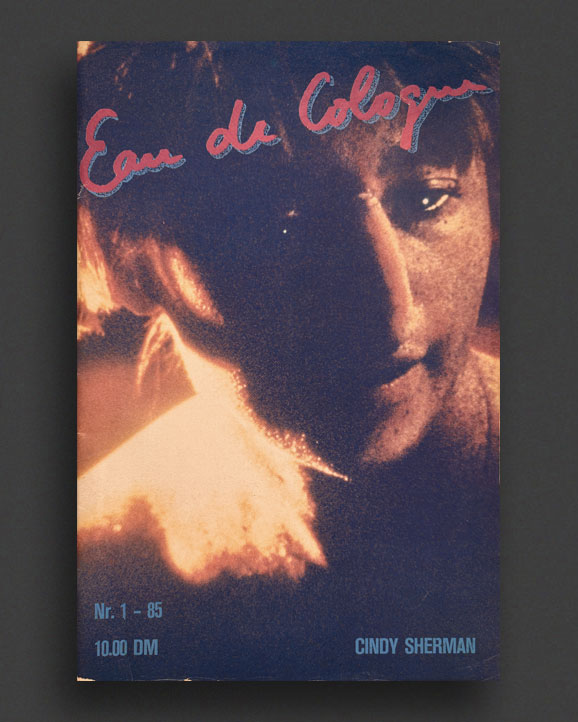
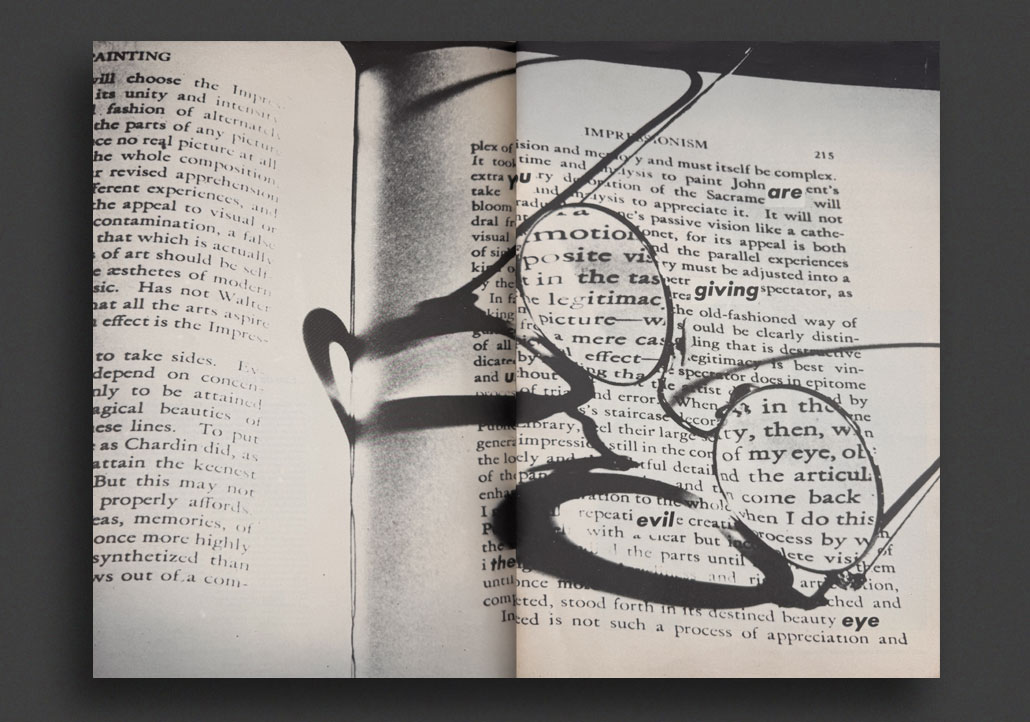
Very rare, inaugural issue of the iconic and enormously influential magazine published and edited by Cologne-based gallery owner Monika Sprüth, who opened her first gallery in 1983 with a focus on female artists. Emblematic of this perspective, Sprüth launched Eau de Cologne, an “effervescent, shape-shifting magazine, featuring almost exclusively women artists and art practitioners.” Three issues were published between 1985 and 1989, along with accompanying exhibitions, representing an international female discourse on art. With early cover artwork by Cindy Sherman, this first issue was published on the occasion of an all-female exhibition presentation of the same name, held by Monika Sprüth Galerie in Cologne in 1985, featuring the work of Ina Barfuss, Jenny Holzer, Barbara Kruger, Cindy Sherman, Rosemarie Trockel, and Anne Loch. Combining theoretical discourse with visual practice, the large-format magazine was created in collaboration with the artists Jenny Holzer, Barbara Kruger, Louise Lawler, Cindy Sherman, and Rosemarie Trockel, featuring artist pages, essays, interviews, texts, quotes, portraits by an incredible list of contributors including Louise Bourgeois, Hanne Darboven, Cady Noland, Dominique Gonzalez Foerster, Ileana Sonnabend, Annette Messager, Susan Hiller, Ulrike Rosenbach, Elaine Sturtevant, Kathe Burkhart, Marian Goodman, Mary Boone, Georgia O'Keefe, Marisa Merz, Astrid Klein, Jutta Koether, Jenny Holzer, Maria Lassnig, Holly Solomon, Nancy Spero, Jo-Anna Isaak, Hilary Lloyd, Holly Solomon, Bärbel Grässlin, Annina Nosei, Tanja Grunert, Pat Hearn, Bice Curiger, Edit DeAk, Rosalind Krauss, Isabelle Graw, Linda Nochlin, Ingrid Oppenheim, Barbara Gladstone, and many more. Texts in German and English. It really doesn't get much better!
“The exhibition and the catalogue “Eau de Cologne” fulfil the claim of my gallery to show the most interesting aspects of contemporaneous art. This exhibition presents five female artists: Ina Barfuss, Jenny Holzer, Barbara Kruger, Cindy Sherman and Rosemarie Trockel, and the catalogue which includes many more young and older female artists, writers, critics and art-dealers want to show art in its social context. I see this exhibition as an example. According to my subjective observation and based on the experiences and contacts of almost three years work as art-dealer I have made a selection. The time of working on this catalogue was limited, too, and it is for these reasons that some artists, curators and art-critics are not mentioned. I approve of realizing this “idea” now, 1985.”—from introduction by Monika Sprüth
Very Good copy with light wear and age to extremities, small chip to back-cover edge.
1996, English
Softcover, 98 pages, 30 x 23 cm
1st Edition, Out of print title / used / very good
Published by
i-D / London
$160.00 - Out of stock
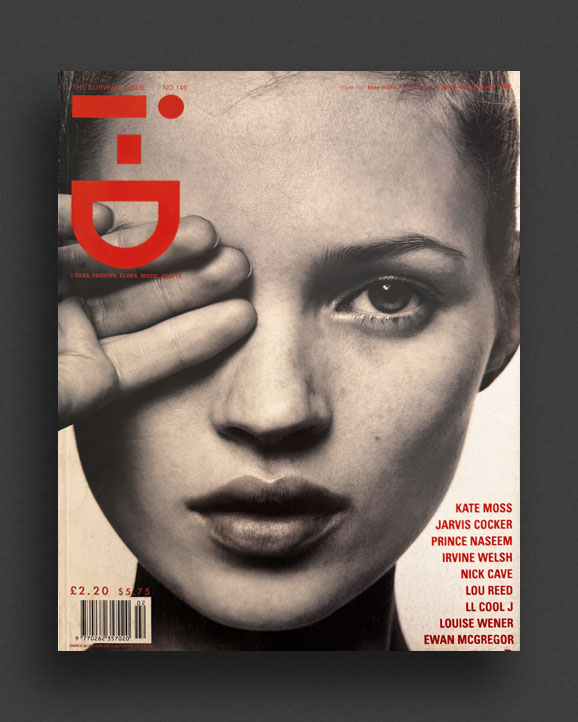
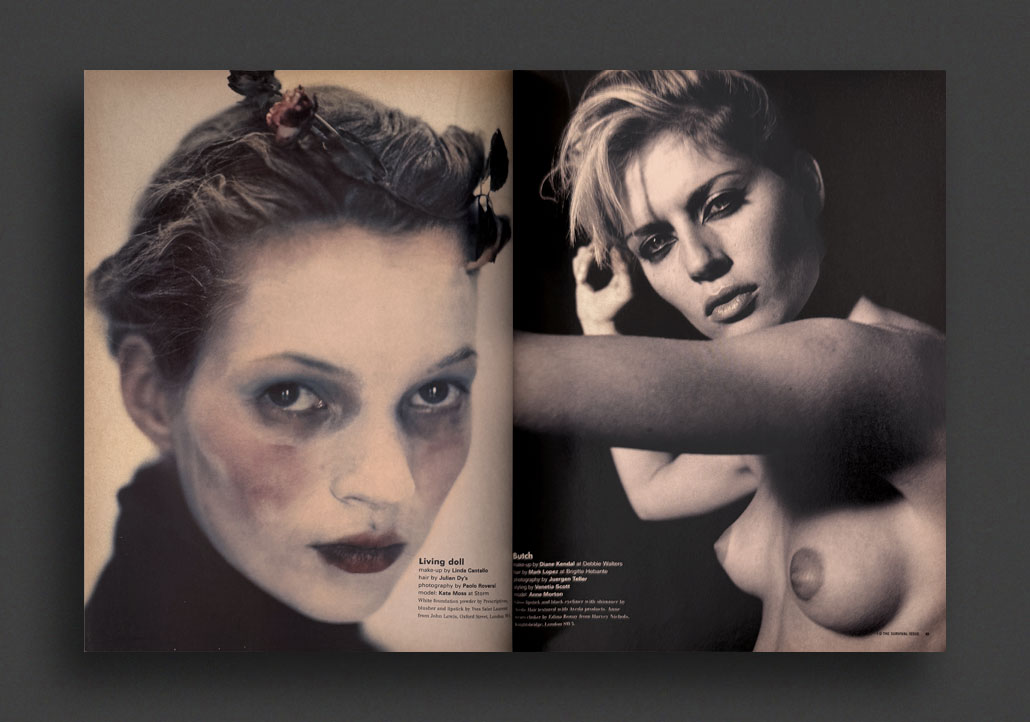
i.D. No. 149 from February 1996, with iconic early Kate Moss cover shot by David Sims. The now very collectible "Survival" issue, this issue is quite a perfect encapsulation of i.D. at its 90's peak, featuring further photoshoots with Kate Moss inside, by David Sims (styled by Anna Cockburn) and Paolo Roversi, Lou Reed shot by Terry Richardson (w. interview), Carolyn Murphy shot by Ellen von Unwerth, Annie Morton styled by Venetia Scott and shot by Juergen Teller, Chandra North shot by Terry Richardson, Kirsten Owen shot by Craig McDean, Milla Jovovich shot by Mario Sorrenti, there the very rare Q&A with "badboy" Alexander McQueen (w. portrait), i-D's Essential Guide to Clubwear — models in the latest club looks by W<, Moschino and Anna Sui etc., Trainspotting, Brit Pop, Post Rock (Tortoise, etc.), retro fashion, Jarvis Cocker, Nick Cave, Mark Borthwick, and much more. And a (just as iconic) back cover — Miu Miu ad with Chloë Sevigny shot by Juergen Teller (styled by Joe Mckenna).
Founded in 1980 by former Vogue art director Terry Jones as an alternative to traditional fashion magazines. In the 1990's i.D. really hit its stride, documenting the latest youth culture shifts and, alongside Purple and Self Service, showcased the best new fashion/anti-fashion photographers such as Juergen Teller, Wolfgang Tillmans, David Sims, Mario Sorrenti, Collier Schorr, Craig McDean, and Terry Richardson.
Very Good copy, with light wear to cover extremities and spine. Tiny chip to cover bottom right.
2024, English
Softcover, 200 pages 21 x 14.7 cm
Ed. of 350,
1st Edition, Out of print title / as new
Published by
SMUT Press / London
$65.00 - Out of stock
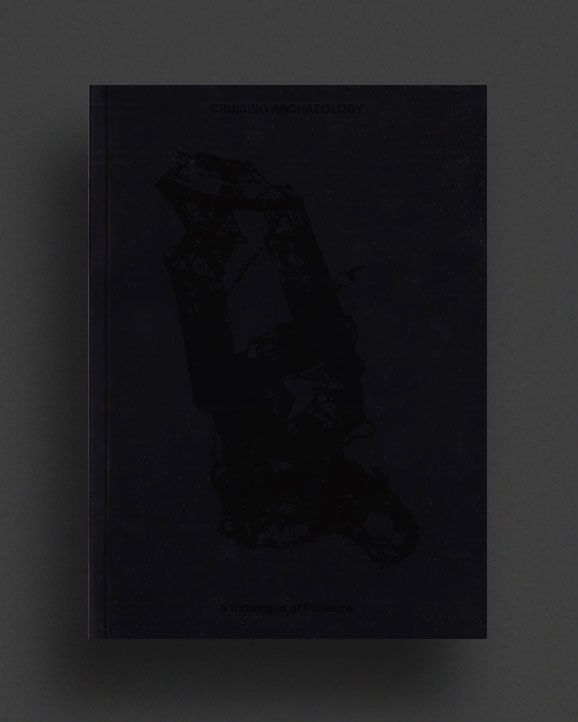
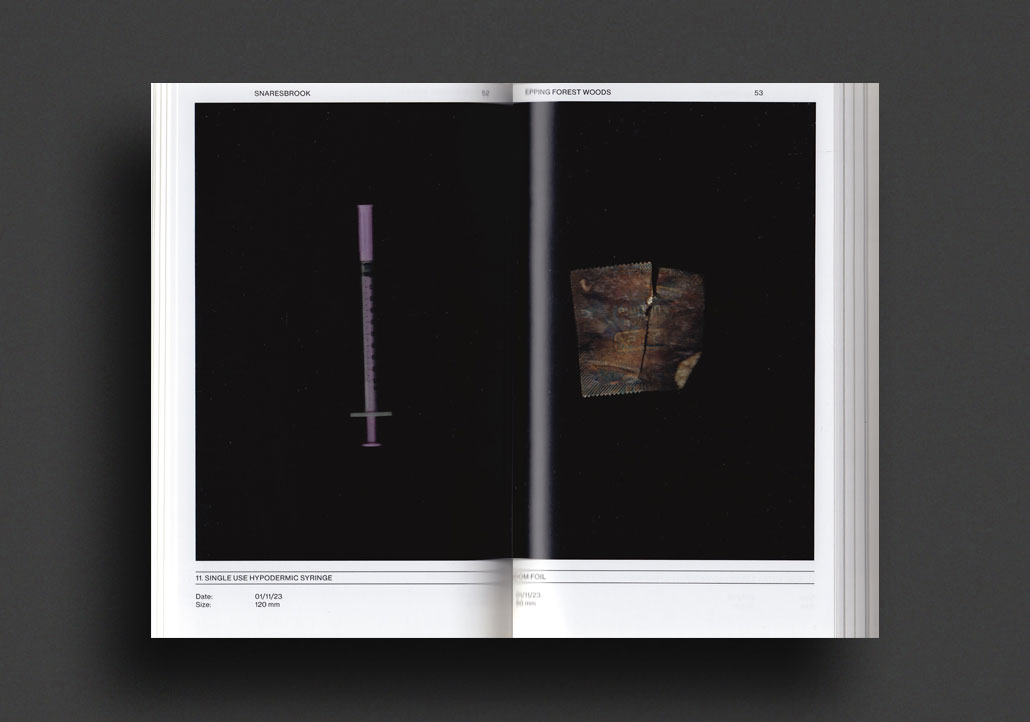
Initially born from an Instagram account bearing the same name, this project is a careful process of selection and curation that sees the anonymous artist reconstitute detritus and debris discarded in over half a dozen renowned cruising locations around London into cultural artefacts. Positioning archaeology as its point of departure, over 100 unique relics not only uncover and investigate the types of sex and pleasure that happen in cruising areas through a material culture lens, but also serve as a testimonial to the often invisible sexual practice.
Accompanying the series of scanned objects is a foreword by Marcus McCann, author of ‘Park Cruising: What Happens When We Wander Off Path’ (2023) as well as an interview with OWL, a volunteer litter-picking group in one of the cruising sites and a report on ‘Jurassic’ a renowned local cruising site in Medellín by academic David Edgar.
The soft-cover 200 page publication is purposely pocket sized, intended to be utilised as a nu-hunter’s-guide for those who cruise. The book’s design has been thoughtfully researched and assembled by London based designer Marco Cacioni.
Edition of 350
1999 + 2000, English / Japanese
2 Vols. (softcover + hardcover), unpaginated, 15.5 x 11.5 cm / 18.5 x 13.5 cm
1st Edition, Out of print title / used / fine
Published by
Little More / Tokyo
$300.00 - Out of stock
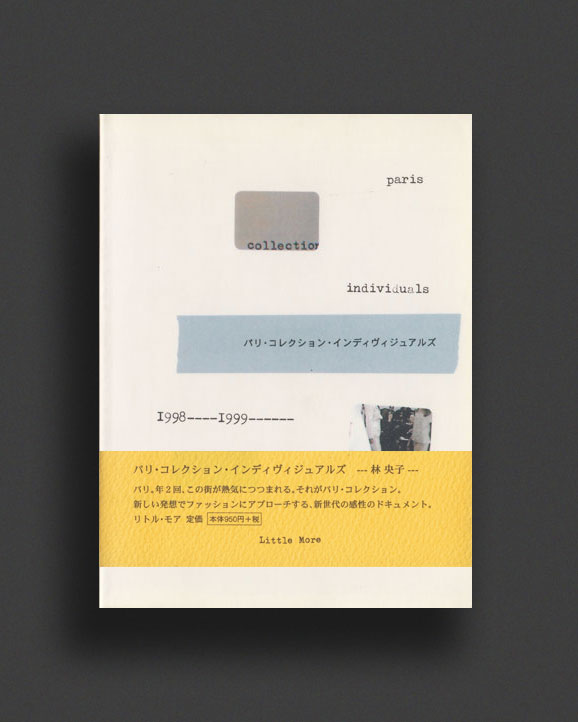
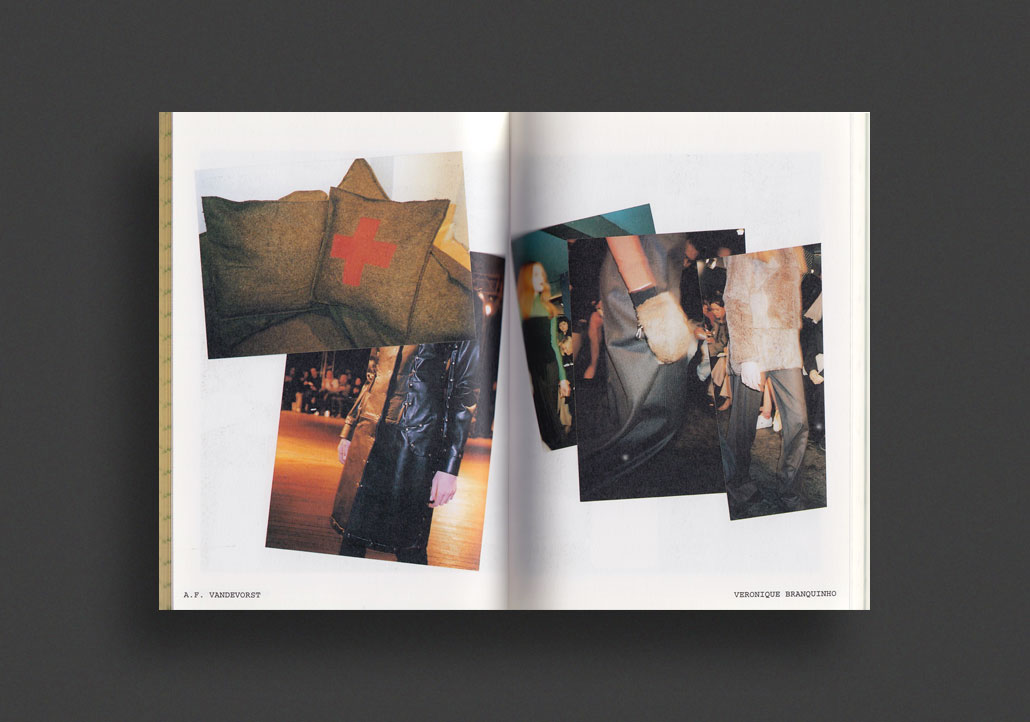
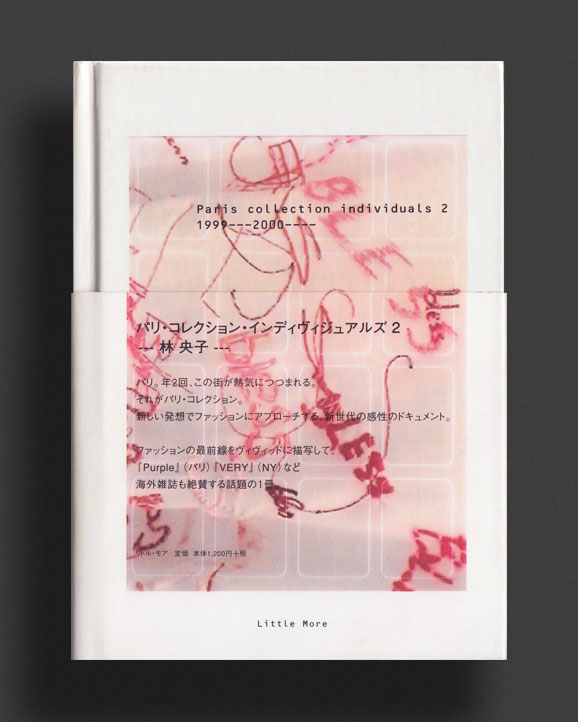
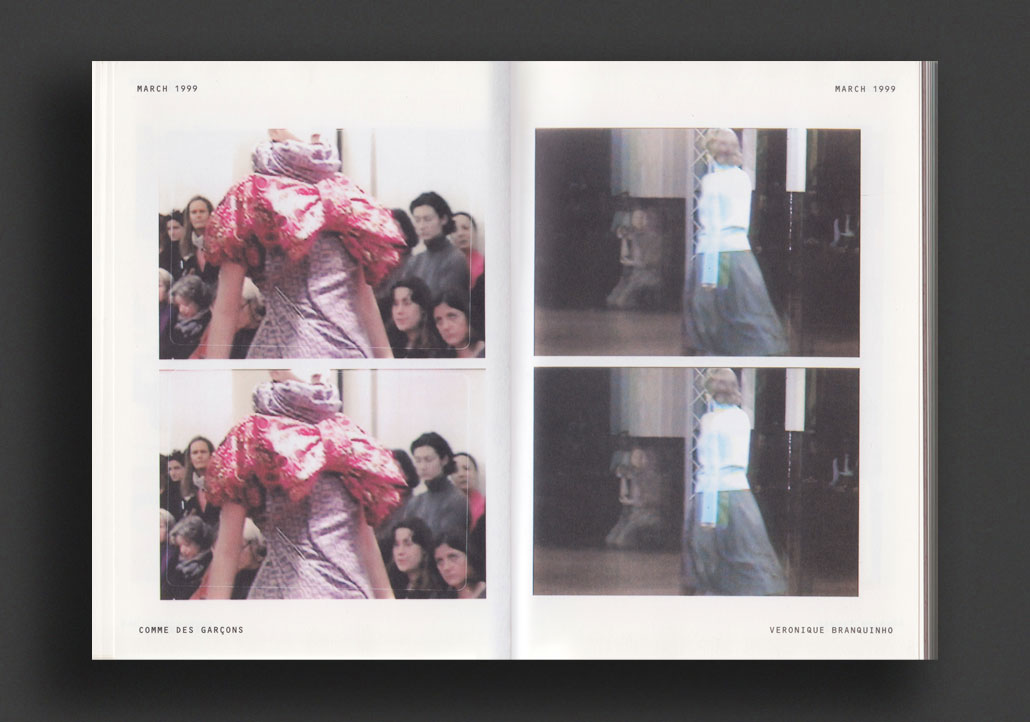
Complete set of the 2 volumes of this wonderful pocket fashion journal/photo book published in 1999 and 2000, respectively, by Tokyo's Little More, documenting the 1998—1999 and 1999—2000 Paris fashion weeks through the travels and relationships of Nakako Hayashi, artist and editor of the great Here and There journal and fashion and art contributor to Purple, Hanatsubaki, Ryu-ko-tsu-shin, and more. Naturally, this publication has all the feeling of Here and There and early issues of Purple, and includes intimate collaborations with most of the key contributors to those magazines, all friends of Hayashi's, plus documentation of the long lost galleries and hot-spots of Paris, London, New York, and Tokyo — Colette, Purple Institute, The Pineal Eye, The Deep Gallery, Purple Cafe, Alleged Galleries... rare photo documentation of fashion graduate catwalks in Arnhem and Antwerp, artist ads and pages... An excellent time-capsule of 1990's anti-fashion world at its peak. Volume 1 includes a sticker sheet of Susan Cianciolo's Run7 collection!
Contributions and documentation of work by Susan Cianciolo, Mark Borthwick, BLESS, Elein Fleiss, Comme des Garçons, Maison Martin Margiela, A.F. Vandevorst, Veronique Branquinho, Jerome Dreyfuss, Gaspard Yurkievich, Junya Watanabe, Martine Sitbon, Colette, Purple, Takashi Homma, Mike Mills, Olivier Theyskens, Andre Walker, Jeremy Scott, Niels Klavers, Dick Page, Bernadette Van-Huy, Dorothee Perret, Carol Christian Poell, Keupr/van Bentum, Patrick van Ommeslaeghe, Wendy & Jim, Anne Daems, Fergadelic, Walter Pfeiffer, Bernadette Corporation, Mark Gonzales, Sofia Coppola, Jurgi Persoons, Walter Van Beirendonck, Melanie Rozema & Jeroen Teunissen, Benoit Meleard, Marcha Hüskes, Oscar Süleyman, and many more.
Texts in English and Japanese.
Near Fine, most complete copies both, with NF obi strips and dust jacket.
1981, Italian
Hardcover (w. dust jacket), 565 pages, 23 x 23 cm
1st Edition, Out of print title / used / very good
Published by
Theorema Edizioni / Roma
$220.00 - In stock -
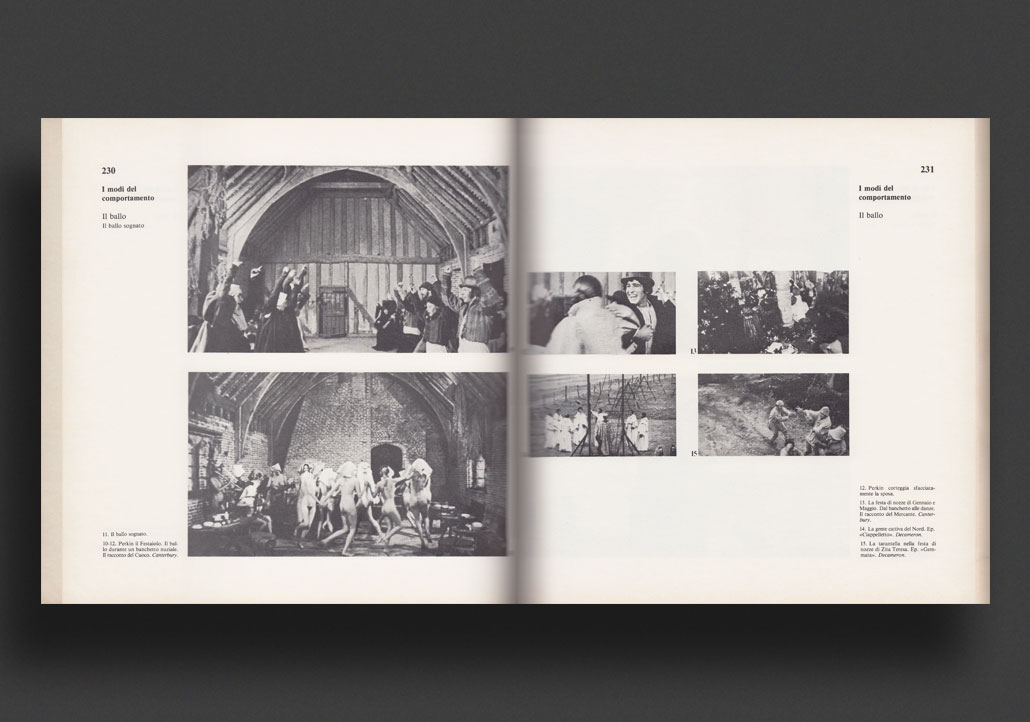
Rare first edition of the colossal hardcover volume on Pasolini's cinematographic oeuvre; the legendary Corpi e Luoghi (Bodies and Places), published in Rome in 1981, starting from hypotheses expressed by Pier Paolo Pasolini in his archive of unpublished writings (1968-73) published here alongside the editors Michele Mancini and Giuseppe Perella's comprehensive atlas/analysis of 1734 reproductions of stills from his films. A book like no other.
For Pasolini, cinema was the art of discovering, indeed rediscovering, the sacred of bodies and places, their mythical content, lost in the desert of modernity.
Around 1980 in Rome, a small cooperative around film critics Michele Mancini and Giuseppe Perrella produced a mysterious, elaborate and yet effortless looking 565-page book of black-and-white photographs entitled Pier Paolo Pasolini: Corpi e Luoghi (Theorema 1981). According to some reviews of the time this is the most Pasolinian publication to date (Alberto Farrasino), an indispensable tool for future research (Tullio Kezich), not just an illustrated book but a unique model of critique (Adriano Aprà).
With its relentless and yet playful classification of some 2,000 film stills ranged under the categories of “bodies” and “places”, whatever page we turn to, Mancini and Perrella stage an ever-shifting space. With a hidden reference to Walter Benjamin and a correspondingly revolutionary attitude, quotation here is understood as a form of “appropriation”, as a practical use of an archive.
In keeping with the great filmmaker’s credo, Pier Paolo Pasolini: Corpi e Luoghi is a colossal attempt to take this enormous amount of material, in book form, where it wants to go. In the introduction, Mancini and Perrella describe their approach similar to the «analytic field» that they see in the film set: «Through film Pasolini is able to elicit out that sort of unconscious, never talked about code through which in daily life we operate and relate to the world. He makes visible a miscellany of aphasic and hidden practices, a ‹primitive› realm normally concealed from our ‹enlightened› societies.» Mancini and Perrella introduce their compilation of quoted images with a compilation of texts by Pasolini where he describes his own research of bodies and places for his films. These text were unpublished prior to Corpi e Luoghi.
All texts in Italian.
A Very Good copy of this historical book - a must for any fan of Pasolini. In Very Good original dust jacket.
1977, English
Softcover (staple-bound), 47 pages, 27.7 x 20.5 cm
1st Edition, Out of print title / used / average
Published by
Art Metropole / Toronto
$180.00 - In stock -
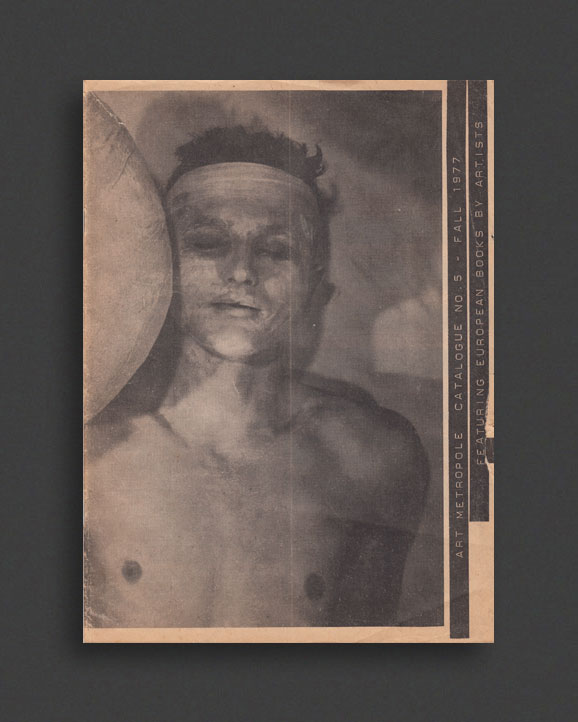
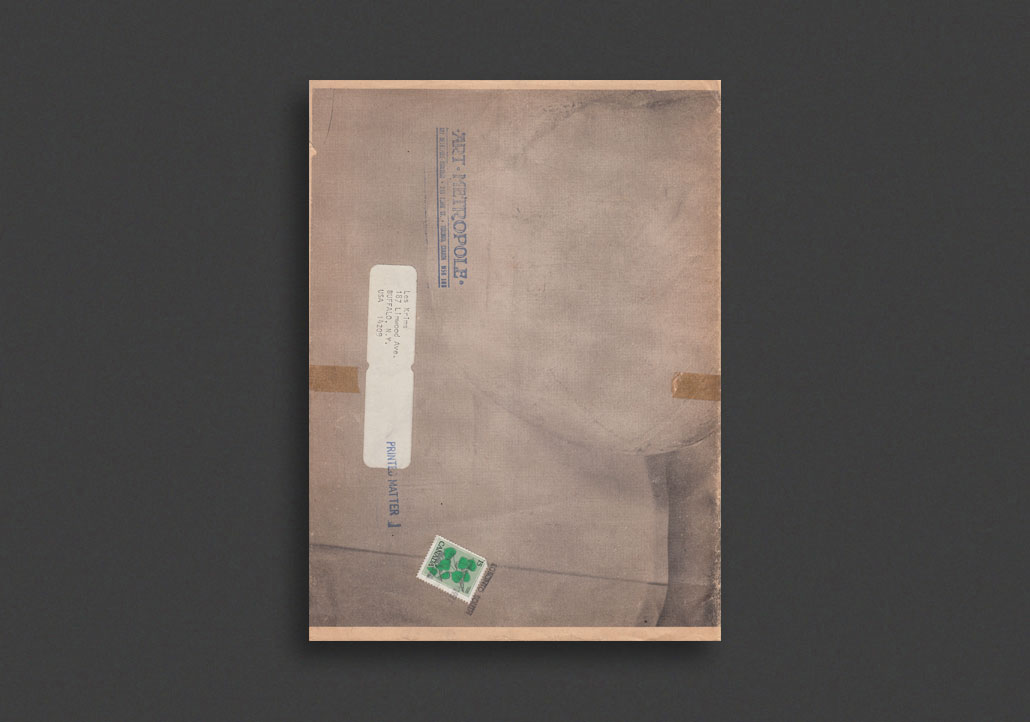
Exceptionally rare, excellent reference work on artists' publications issued in 1977 by Art Metropole in Toronto, the first large-scale distributor of artists' books and publications in North America. This valuable catalogue, featuring "European titles, publications, periodicals, records, special editions, videos and films", offers works by European and American artists such as Beuys, Rainer, Polke, Art & Language, Hans Haacke, Terry Riley, Lamonte Young, Marian Zazeela, Douglas Huebler, Broodthaers, Kaprow, Piper, Buren, Reich, Cage, Snow, Darboven, Matta-Clark, Dibbets, Brion Gysin, Simone Forti, General Idea, Claes Oldenburg, Jimmy De Sana, Vito Acconci, Gilbert & George, Robert Filliou, Sol Lewitt, Ehrenberg, Filliou, Fulton, Graham, Rebecca Horn, Mel Bochner, William Burroughs, Ugo La Pietra, Urs Luthi, Hansjörg Mayer, Merz, Robert Cumming, Willats, Al Hansen, Richard Long, Philip Glass, George Brecht, Image Bank, Robert Barry, Nannucci, Donald Judd, Maria Reiche, Dennis Oppenheim, Dieter Rot, Kurt Schwitters, Giorgio Ciam, Daniel Spoerri, Ed Ruscha, Ray Johnson, Philip Corner, Bob Cobbing, Lawrence Weiner, Klaus Rinke, Les Levine, Lea Vergine, Baldessari, Ant Farm, Emmett Williams, Robert Wilson, UFO Group, Vostell, etc. with each item concisely described, and for the books, essential bibliographical information is provided. Publications from Art Metropole, periodicals, records, and videos are also listed for sale, with prices. Cover artwork features Viennese actionist Rudolf Schwarzkogler's Portfolio of the 3rd Action, which is among the selections of European artists' books. Selected b/w illustrations throughout of items listed, and full-page ads for Art Metropole's "FETISH" t-shirt and General Idea's FILE magazine.
Issued privately as a mail-out catalogue, this copy includes the AM ink stamp and Canadian postage stamp on the verso, posted in 1977 to American conceptualist photographer Les Krim, in Buffalo, New York.
Average—Good copy, some chipping to extremities, small closed tear to top-left corner of cover, generally tanned/aged newsprint.
1989, English
Softcover (loose-leaf tabloid), 40 pages, 40 x 29 cm
1st Edition, Out of print title / used / very good
Published by
Agenda / Parkville
$70.00 - In stock -
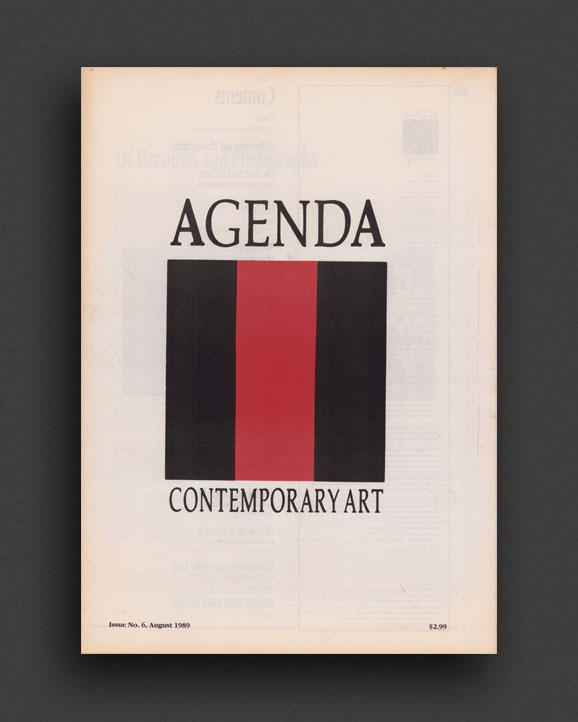
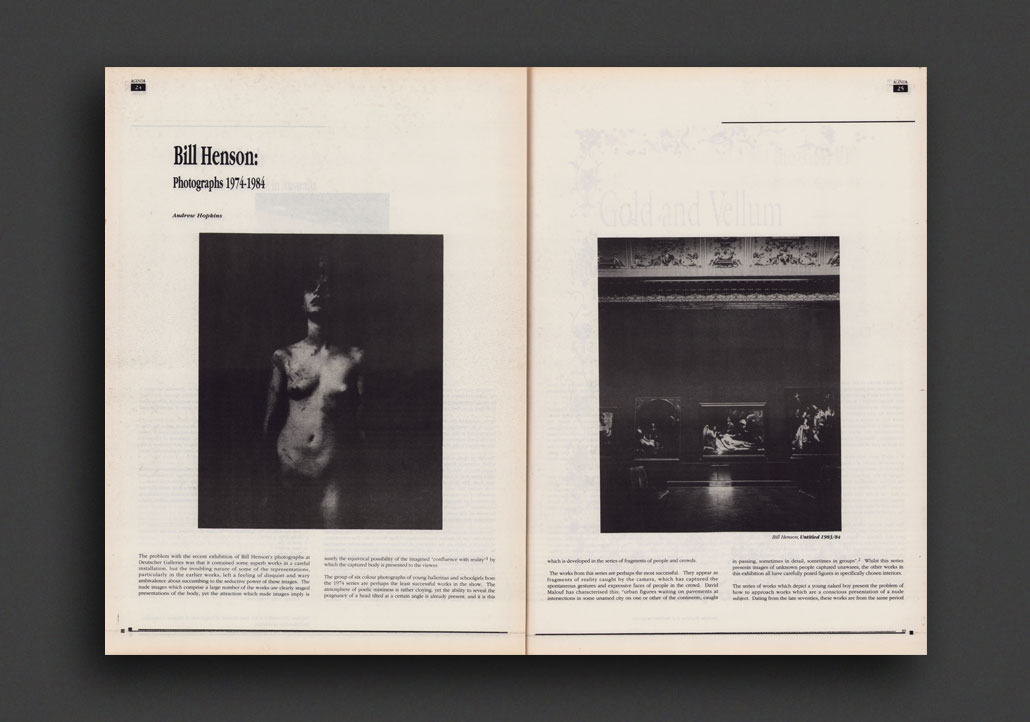
Issue No. 6, August 1989 of Melbourne's contemporary arts newspaper, Agenda, edited by the great artistic director, curator and writer, Juliana Engberg. An incredible issue with cover artwork by John Nixon, with heavily illustrated articles by contributors McKenzie Wark, Deb Ely, Jacqueline Riva, May Lam, Juliana Engberg, Nicholas Baume, Harriet Edquist, Virginia Trioli, Leon van Schaik, Stuart Koop, Stephen O'Connell, Andrew Hopkins, Alex Selenitsch, Anna Clabburn, James Hurley, covering Bill Henson, Chantal Akerman, Robin Boyd, Melbourne gallery Store 5, Wes Placek, Jon Campbell, the Andy Warhol Collection, Graeme Hare, Tolarno Gallery, Lisa Lewis, Australian Perspecta 1989, and much more. Published with the assistance of the great George Paton Gallery, Melbourne House, Melbourne University.
Very Good copy with light aging.
1991, English
Softcover (loose-leaf tabloid), 32 pages, 43 x 29 cm
1st Edition, Out of print title / used / very good
Published by
Broadsheet / Adelaide
$50.00 - Out of stock
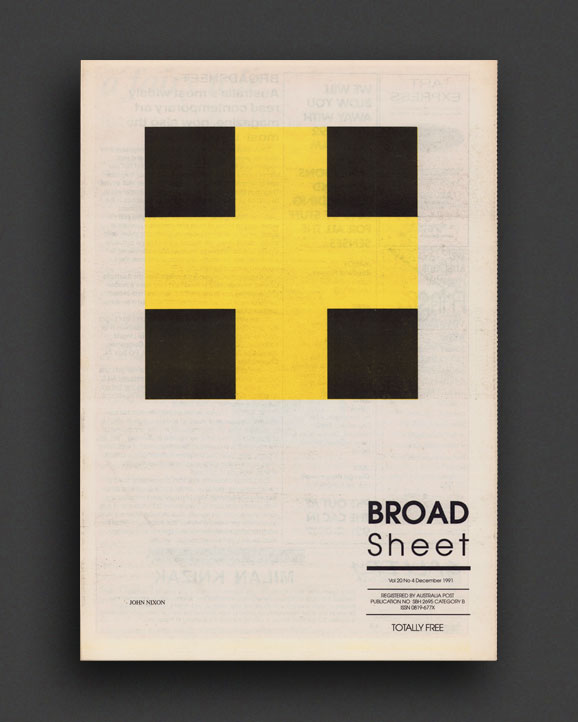
Vol. 20 No. 4, December 1991, of Broadsheet. Not the crappy Melbourne yuppy consumer guide, the 90's Adelaide arts newspaper, founded in the late 1980's to run throughout the 1990's. With cover artwork by John Nixon and centre-spread collage artwork by Bronia Iwanczak. Heavily illustrated (and uncensored) articles and reviews throughout, this issue features contributors Catherine Lumby, Kevin Murray, Shane McNeill, Leon Marvel, Leonie Neilson, Manne Schulze, John McConchie, Michelle Prak, Carolyn Barnes, Louise Dauth, and others covering Juan Davila, the exhibition history of Melbourne's Store 5, Georges Bataille, Archeology of Gnostic cinema, Gareth Samson, Jeff Koons' collaborations with Cicciolina (Ilona Staller), Australia's first Museum of Modern Art, the new Mitsubishi Magna, Australian film maker Ross Gibson, Adelaide's Critical City Project, and much more.
Very Good copy with light aging.
1993/1994, English
Softcover (looseleaf tabloid), 24 + 20 pages, 42 x 29 cm
1st Edition, Out of print title / used / good
Published by
Untitled / London
$25.00 - In stock -
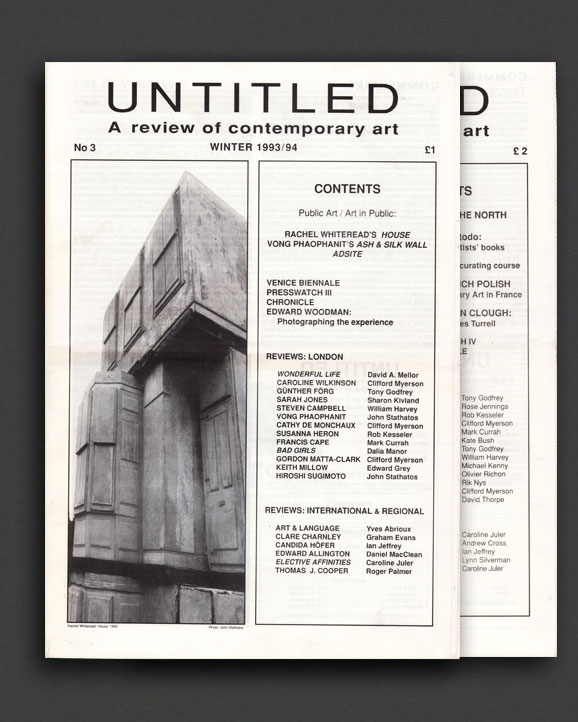
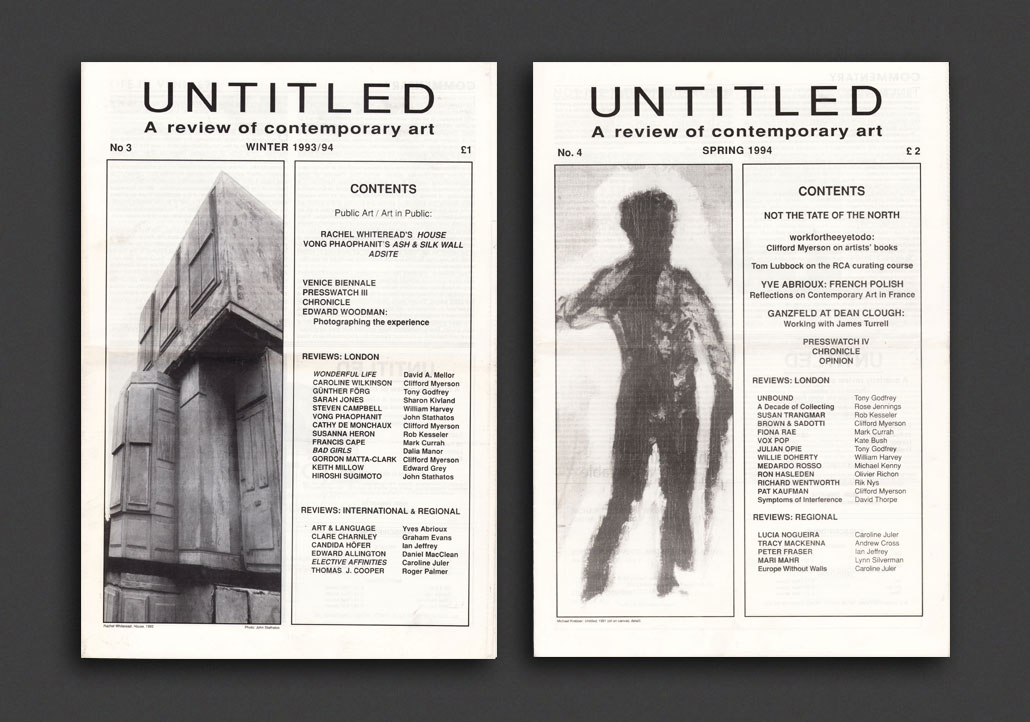
Rare lot of two issues of Untitled: A Review of Contemporary Art, No. 3 (Winter 1993/94) and No. 4 (Spring 1994). Untitled was the independent British tabloid newspaper of articles, reviews and opinions published and founded by John Stathatos and Mario Flecha following the demise of Artscribe in 1992. Contributors included Yves Abrioux, Tony Godfrey, David Alan Mellor, et al. Illustrated in b/w throughout, featuring Gordon Matta-Clark, Günther Förg, Rachel Whiteread, Art & Language, Candida Höfer, Hiroshi Sugimoto, Vong Phaophanit, Artists' Books, Medardo Rosso, Julian Opie, and much more.
Very Good copies, folded.
1991, English / Dutch
Softcover, 104 pages, 32 x 24 cm
1st Edition, Out of print title / used / very good
Published by
Stedelijk Museum / Amsterdam
$65.00 - Out of stock
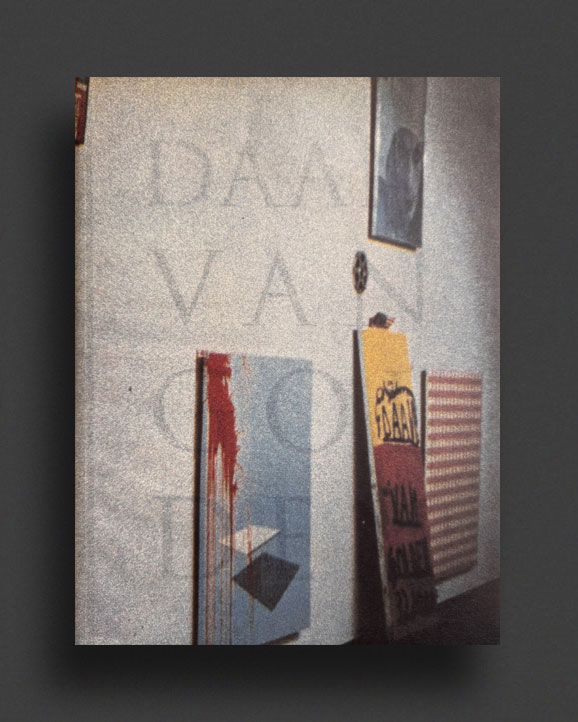
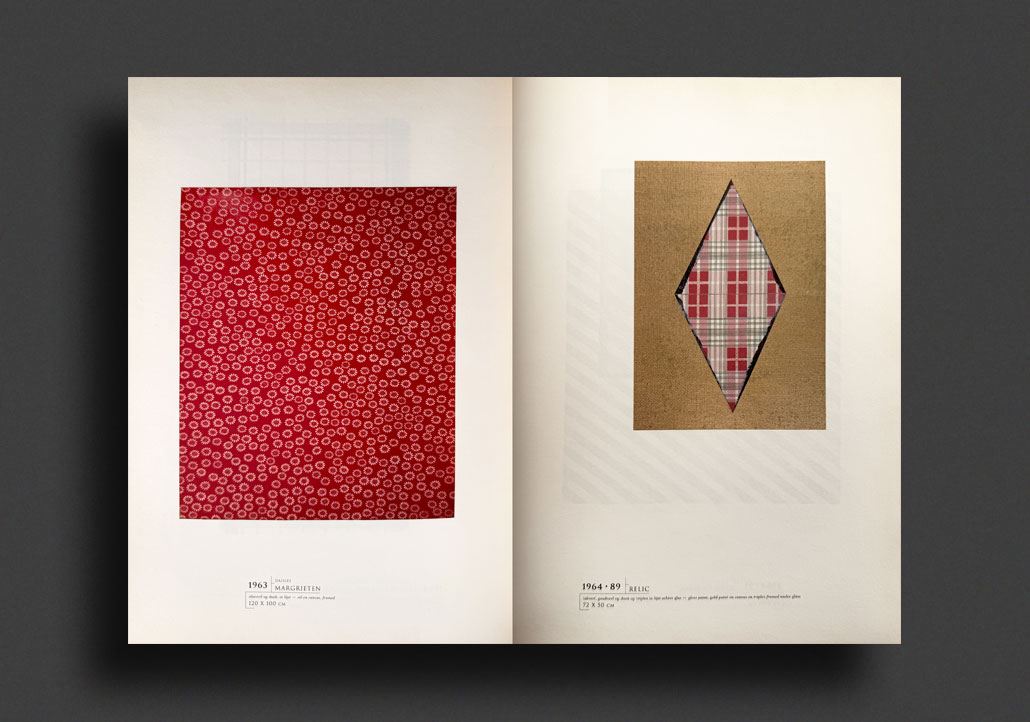
Beautifully designed, scarce 1991 catalogue published to accompany the solo survey exhibition, Daan van Golden, Works 1962-1991, at Stedelijk Museum, Amsterdam. Profusely illustrated throughout in colour and b/w with Daan van Golden's works, with accompanying texts by Wim Beeren, Rini Dippel, Camiel van Winkel, Daan van Golden, Henny Hagenaars, Hans Ebbink, illustrated biography and list of exhibitions, bibliography, etc.
Daniël (Daan) van Golden (1936-2017) was a Dutch artist, who has been active as a painter, photographer, collagist, installation artist, wall painter and graphic artist. He is known for his meticulous paintings of motives and details of everyday life and every day images. Daan van Golden developed his style in Japan in 1963. Having previously painted abstract-expressionistic works, between 1963 and 1965 in Japan he refined a technique that involved Japanese enamel paints and enabled him to give his works an unimagined colourfulness and presence. He began painting textile and paper patterns with extreme precision and at an almost meditative speed. His models included tablecloths, fabrics and packaging. He generally focussed on everyday items which he experienced in his surroundings, transferring them to an artistic context in his unique way and thereby unifying life and art. Van Golden is often linked with Pop Art or Minimal Art, but in fact his art hovered between all these tendencies and positions. It was frequently exhibited in the same context, to which he was considered to be formally suited. But at the same time, he clearly pointed up the limits of the respective stylistic trend.
1982, Dutch
Softcover, 56 pages, 30 x 22 cm
1st Edition, Out of print title / used / very good
Published by
Museum Boymans-van Beuningen / Rotterdam
$120.00 - In stock -
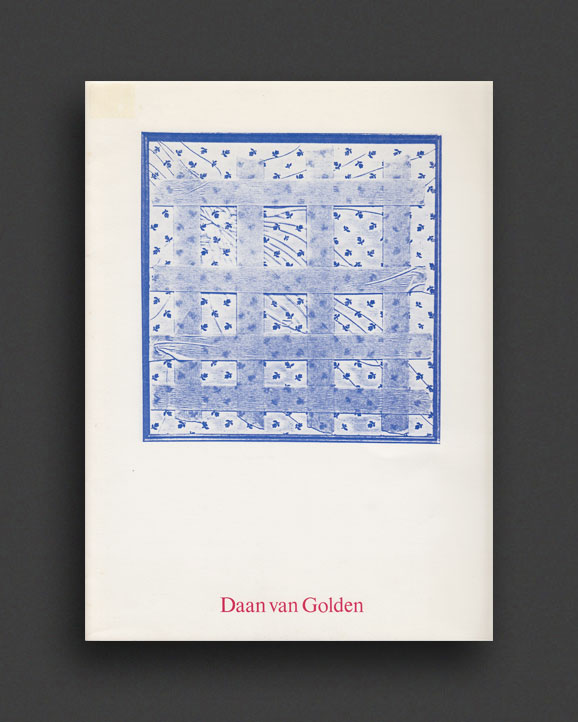
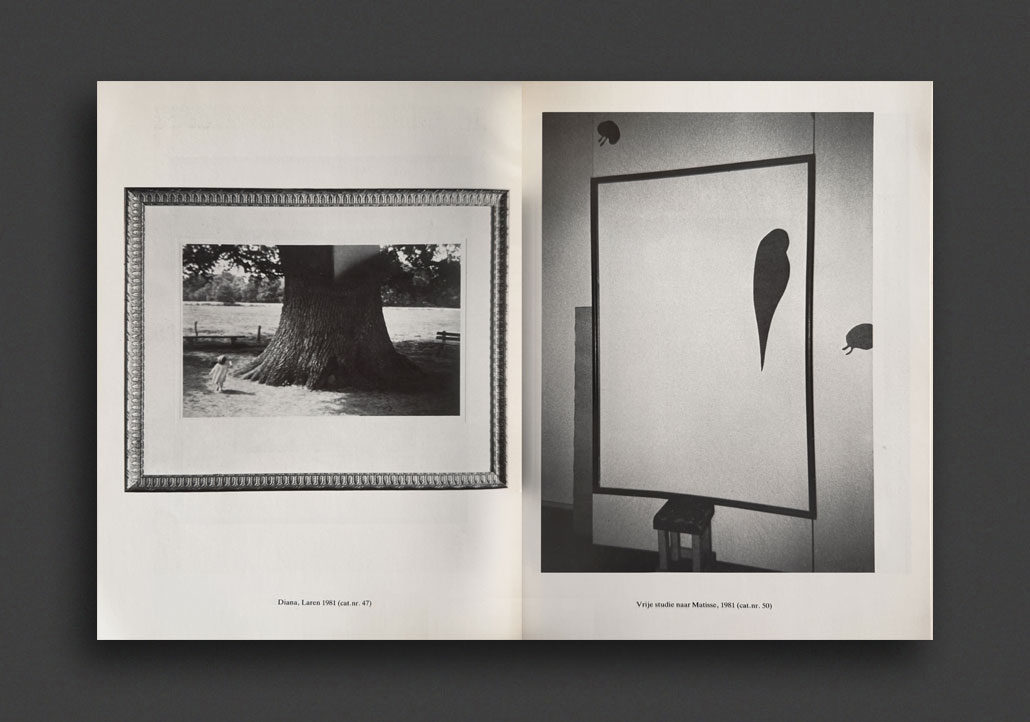
Rare 1982 catalogue published to accompany the solo survey exhibition, Daan van Golden, Overzichtstentoonstelling 1963-1982, at Boymans-van Beuningen, Rotterdam. Profusely illustrated throughout with Daan van Golden's works, accompanied by texts in Dutch and biography.
Daniël (Daan) van Golden (1936-2017) was a Dutch artist, who has been active as a painter, photographer, collagist, installation artist, wall painter and graphic artist. He is known for his meticulous paintings of motives and details of everyday life and every day images. Daan van Golden developed his style in Japan in 1963. Having previously painted abstract-expressionistic works, between 1963 and 1965 in Japan he refined a technique that involved Japanese enamel paints and enabled him to give his works an unimagined colourfulness and presence. He began painting textile and paper patterns with extreme precision and at an almost meditative speed. His models included tablecloths, fabrics and packaging. He generally focussed on everyday items which he experienced in his surroundings, transferring them to an artistic context in his unique way and thereby unifying life and art. Van Golden is often linked with Pop Art or Minimal Art, but in fact his art hovered between all these tendencies and positions. It was frequently exhibited in the same context, to which he was considered to be formally suited. But at the same time, he clearly pointed up the limits of the respective stylistic trend.
Very Good copy, light wear.
2012, English
Softcover, 222 pages, 24 x 29 cm
Published by
Roma / Amsterdam
WIELS / Brussels
$88.00 - Out of stock
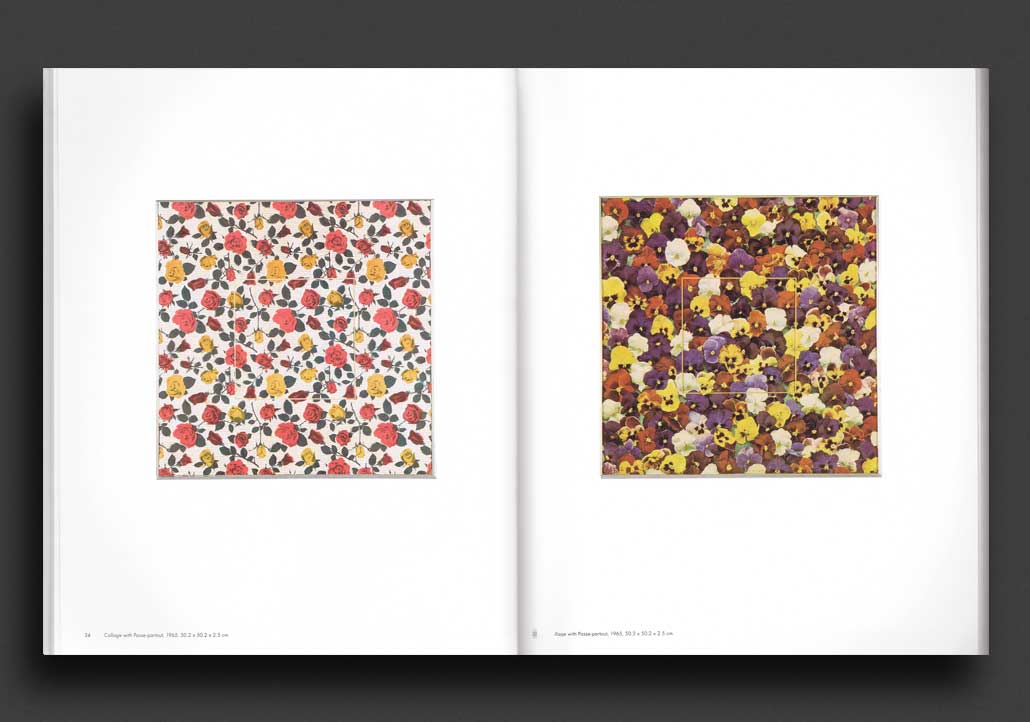
From the early diametric abstraction to the recent series of silhouette paintings, passing through photographic works and ephemera never printed before, this book offers the most comprehensive gathering of Daan van Golden's work to date. It includes, moreover, a complete list of work, arranged by medium and chronologically, and the collections that hold them. Essays by Devrim Bayar, Sven Lütticken and Erik Thys. Published in collaboration with WIELS, Brussels.
Daniël (Daan) van Golden (1936-2017) was a Dutch artist, who has been active as a painter, photographer, collagist, installation artist, wall painter and graphic artist. He is known for his meticulous paintings of motives and details of everyday life and every day images. Daan van Golden developed his style in Japan in 1963. Having previously painted abstract-expressionistic works, between 1963 and 1965 in Japan he refined a technique that involved Japanese enamel paints and enabled him to give his works an unimagined colourfulness and presence. He began painting textile and paper patterns with extreme precision and at an almost meditative speed. His models included tablecloths, fabrics and packaging. He generally focussed on everyday items which he experienced in his surroundings, transferring them to an artistic context in his unique way and thereby unifying life and art. Van Golden is often linked with Pop Art or Minimal Art, but in fact his art hovered between all these tendencies and positions. It was frequently exhibited in the same context, to which he was considered to be formally suited. But at the same time, he clearly pointed up the limits of the respective stylistic trend.
2013, English
Softcover, 416 pages, 32 x 24 cm
Ed. of 800,
Published by
Koenig Books / London
$98.00 - Out of stock
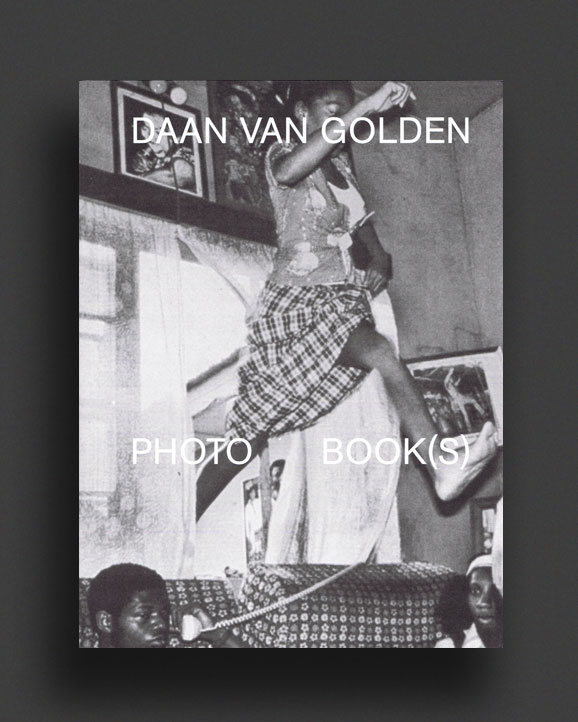
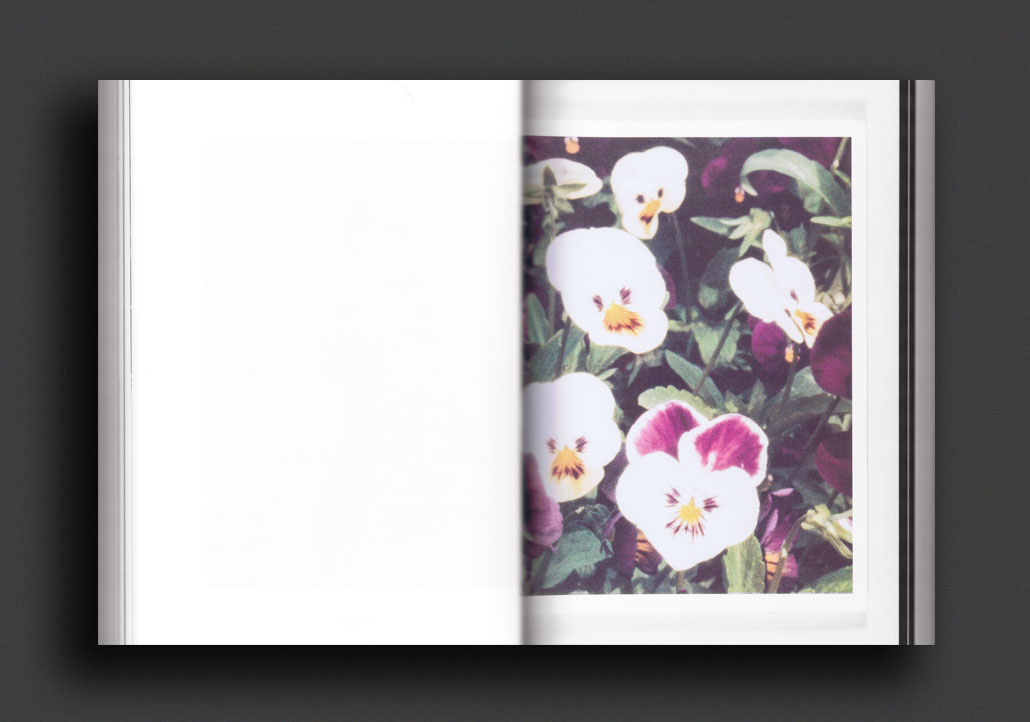
Daan van Golden: Photo Book(s) is a book composed of other books: it reproduces the photo pages of Van Golden’s earlier books (most of which have long been out of print), as well as two little known photo essays, in their entirety.
The reproduction of pre-existing material, the insistent adherence to a set of core elements, gestures and images, the conviction that creating different juxtapositions and interactions between those same elements will yield new readings and meaning: these are the hallmark of Van Golden’s work, and here for the first time they serve as the organising principle for a book, one whose patient rhythm creates the space for the logic of a practice to establish its sensible presence.
More than just the images, the book documents the way in which the images were used over the years and the aesthetic and conceptual world they inhabit. It is common to see Van Golden’s photography in light of his painting, as an extension of it.
Edited by Daan van Golden and Emiliano Battista.
Daniël (Daan) van Golden (1936-2017) was a Dutch artist, who has been active as a painter, photographer, collagist, installation artist, wall painter and graphic artist. He is known for his meticulous paintings of motives and details of everyday life and every day images. Daan van Golden developed his style in Japan in 1963. Having previously painted abstract-expressionistic works, between 1963 and 1965 in Japan he refined a technique that involved Japanese enamel paints and enabled him to give his works an unimagined colourfulness and presence. He began painting textile and paper patterns with extreme precision and at an almost meditative speed. His models included tablecloths, fabrics and packaging. He generally focussed on everyday items which he experienced in his surroundings, transferring them to an artistic context in his unique way and thereby unifying life and art. Van Golden is often linked with Pop Art or Minimal Art, but in fact his art hovered between all these tendencies and positions. It was frequently exhibited in the same context, to which he was considered to be formally suited. But at the same time, he clearly pointed up the limits of the respective stylistic trend.
2020, English
Softcover, 316 pages, 18 x 23 cm
Out of print title / used / very good
Published by
Primary Information / New York
Light Industry / New York
$140.00 - In stock -
For years an out-of-print rarity, and now this edition also out-of-print, Michael Snow’s classic artist book Cover to Cover published in limited facsimile edition in 2020 by Light Industry and Primary Information. Never bound by discipline, Snow has remarked that his sculptures were made by a musician, his films by a painter. Flipping through Cover to Cover, which is composed entirely of photographs in narrative sequence, one might describe it as a book made by a filmmaker. Snow himself has called the piece “a quasi-movie,” structured around a precise recto-verso montage.
Each page features a distinct moment, seen from one perspective on the front, and from a diametrically opposed angle on the back, occasionally pivoting, for instance, between interior and exterior spaces. This organizing principle is complicated by the fact that a given image might be a depiction of the physical environment surrounding the camera or, at other times, a photograph of a photograph. Midway through, the scene is inverted such that the volume must be turned upside-down to be looked at right-side up. The result is an elegant, disorienting study in simultaneity that allows the viewer to enter the work from either end.
Cover to Cover was originally released by the Press of the Nova Scotia College of Art and Design in 1975. It was part of a now-legendary series of publications, overseen by Kasper König and later Benjamin H.D. Buchloh, that included titles by Michael Asher, Dara Birnbaum, Jenny Holzer, Donald Judd, Claes Oldenburg, Martha Rosler, and Yvonne Rainer, among others. Snow departed from the format of many of the press’ projects, however, producing not a collection of writings, but rather a book that constitutes an artwork in itself.
Michael Snow (b. 1928) is a Canadian artist whose multidisciplinary oeuvre includes painting, sculpture, video, film, sound, photography, drawing, writing, and music. His art explores the nature of perception, consciousness, language, and temporality and has been the subject of solo exhibitions at the Art Gallery of Ontario (Toronto), the Centre Pompidou (Paris), the Hara Museum of Art (Tokyo), the Museum of Modern Art (New York), and the Palais des Beaux Arts (Brussels). Snow’s key works include experimental films such as Wavelength (1967), Back and Forth (1969), and La Région Centrale (1971), as well as the large-scale public sculptures Flightstop (1979) and The Audience (1988-89). He is the recipient of the Gershon Iskowitz Prize (2011), the Guggenheim Fellowship (1972), the Order of Canada (1982), and the Chevalier de l’ordre des arts et des lettres, France (1995, 2011).
Out-of-print, As New with some very light storage wear.
1999, English
Softcover (staple-bound), 28 pages, 22.5 x 16 cm
1st Edition, Out of print title / used / very good
Published by
Contemporary Art Centre of South Australia / Adelaide
$35.00 - Out of stock
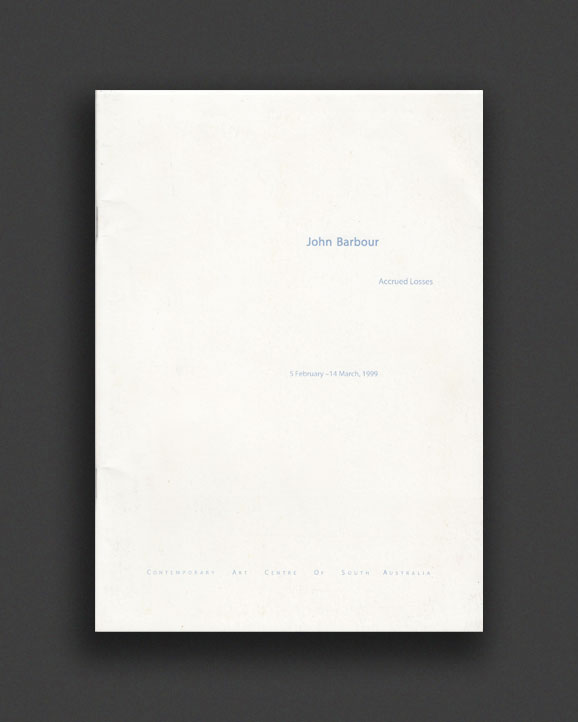
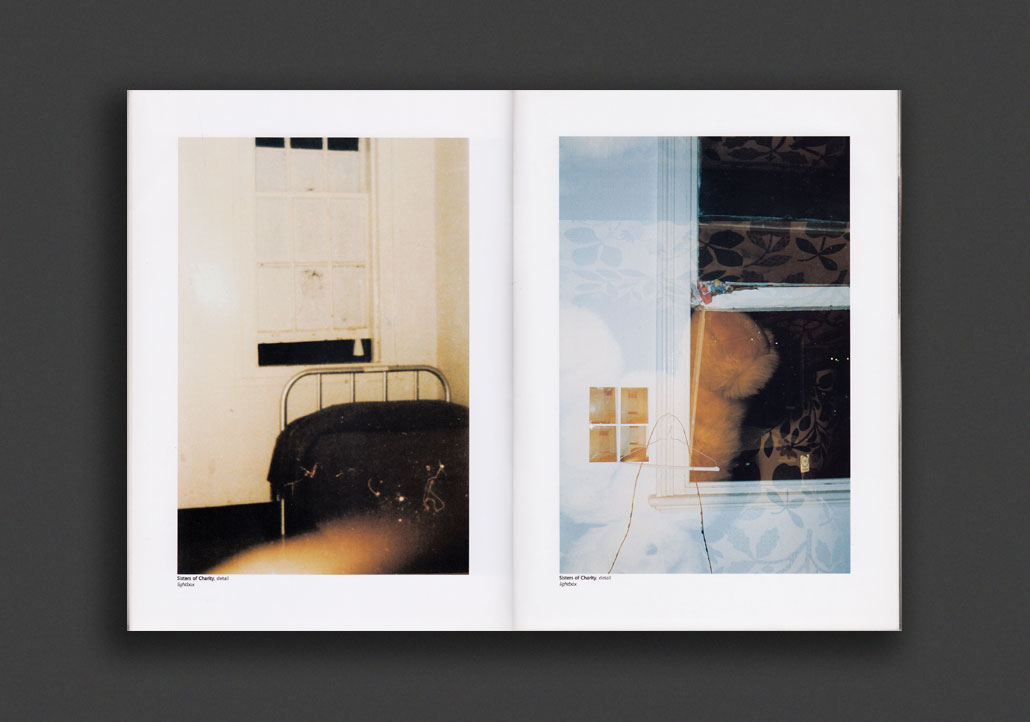
Rare catalogue published on Australian artist John Barbour on the occasion of the solo exhibition Accursed Losses at the Contemporary Art Centre of South Australia, Adelaide, in 1999. Fully illustrated in colour and b/w surveying Barbour's exhibitions throughout the 1990s, with a accompanying texts by Linda Marie Walker, Christopher Chapman, and John Barbour, biography, bibliography.
John Barbour (b. 1954, The Hague, Netherlands. Lived and worked Adelaide, South Australia. Died 2011). John Barbour’s experimental and interdisciplinary practice comprises works on paper and cloth, sometimes incorporating deliberate stains, tears and child-like hand-embroidered text. Influenced by conceptual art and minimalism, Barbour’s work engages with ideas of human frailty and fallibility through the use of lowly and humble materials like cardboard, torn paper, Styrofoam and stained cloth. His works declare themselves not as ‘well-made’ in the tradition of fine crafts and art, or as ‘ready-mades’ in the sculptural tradition of anti-art, but as ‘un-made’: brought into existence through chance, accident and carelessness rather than accomplished as a demonstration of skill. In electing to pursue the transient, the accidental, the torn and unravelled, Barbour brings to our attention the fallibility and precariousness of existence in works of thought-provoking ambiguity and ambivalence.
Very Good copy, light wear.
1974, English
Softcover, unpaginated, 17.5 x 11 cm
1st Edition, Out of print title / used / very good
Published by
Weproductions / London
$75.00 - In stock -
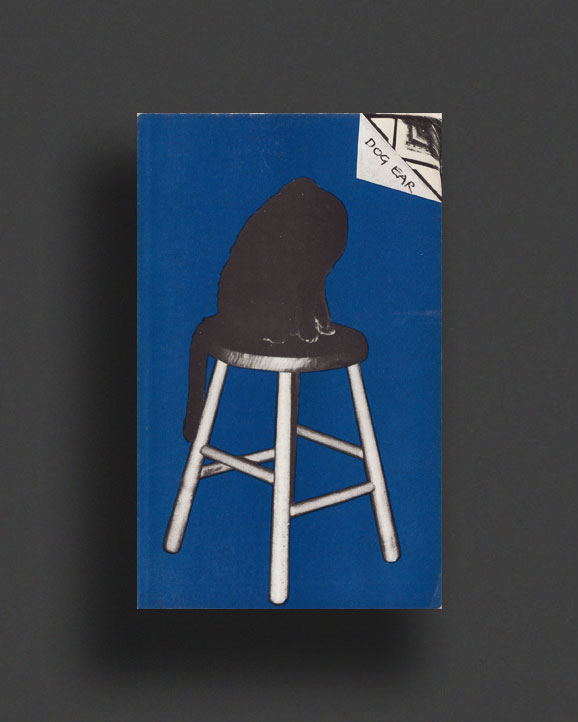
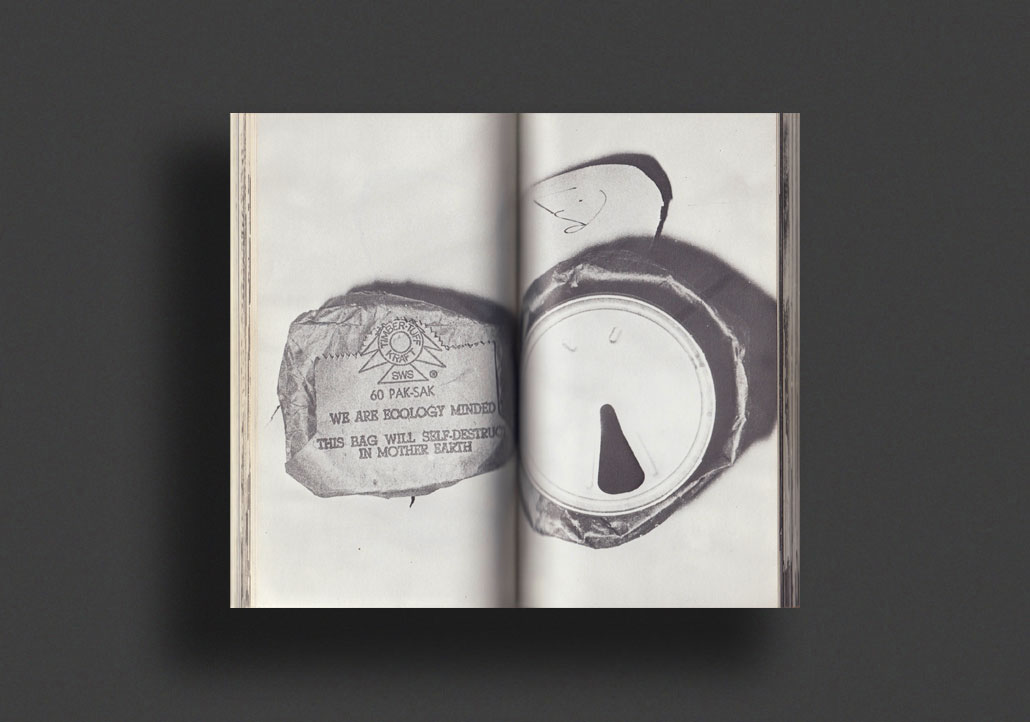
London: Weproductions, 1974. First Edition. Octavo. An artist's photo-book published in 1974 by Scottish artist and publisher, Telfer Stokes (b. 1940) in collaboration with Weproductions in London. What a joy of the page! Entirely comprised of full-page black-and-white images, Spaces starts off as a series of seemingly straightforward presentations of photographic facts: the flatiron building, a studio interior, another city building. These are interspersed with various kinds of typewriter paper identified only by name in their upper right hand corners that are suspiciously hard to tell apart. The images proceed to get more confusing and unreliable as the book progresses. Pictures that seem to be fixed illustrations of newspaper articles take on a life of their own while the text around them remains stable. The scale of everything shifts radically when the camera pulls out to reveal the newspaper as part of a much larger collage propped up against a big arched doorway – but just for a moment. It zooms back in to lead the reader down a rabbit hole and into an ocean of shifting perspectives. If you can surrender to the disorienting pleasure of this photographic text you will be rewarded with insight into the radical narrative possibilities of artists books.
Very Good copy. Intentionally artist-clipped "dog ear" cover corner. Some rubbing to spine and covers.
2001, English
Hardcover (w. dust jacket), 144 pages, 28.6 x 27.5 cm
1st Edition, Out of print title / used / fine
Published by
Bullfinch Press / New York
$250.00 - Out of stock
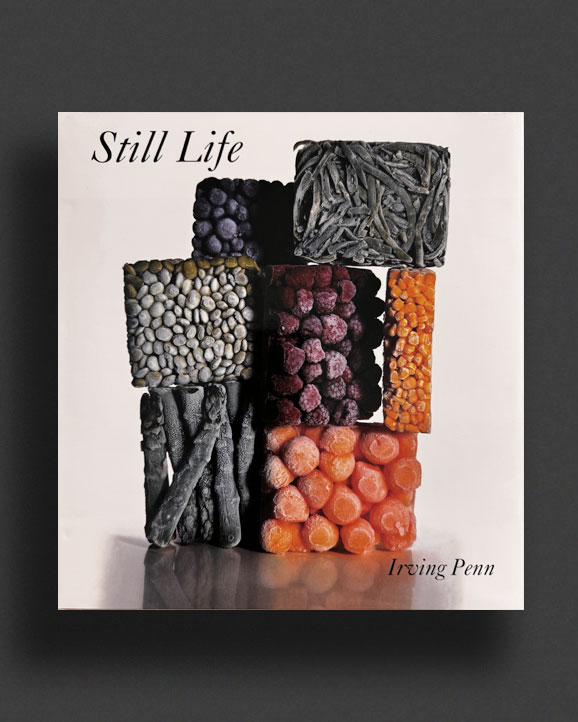
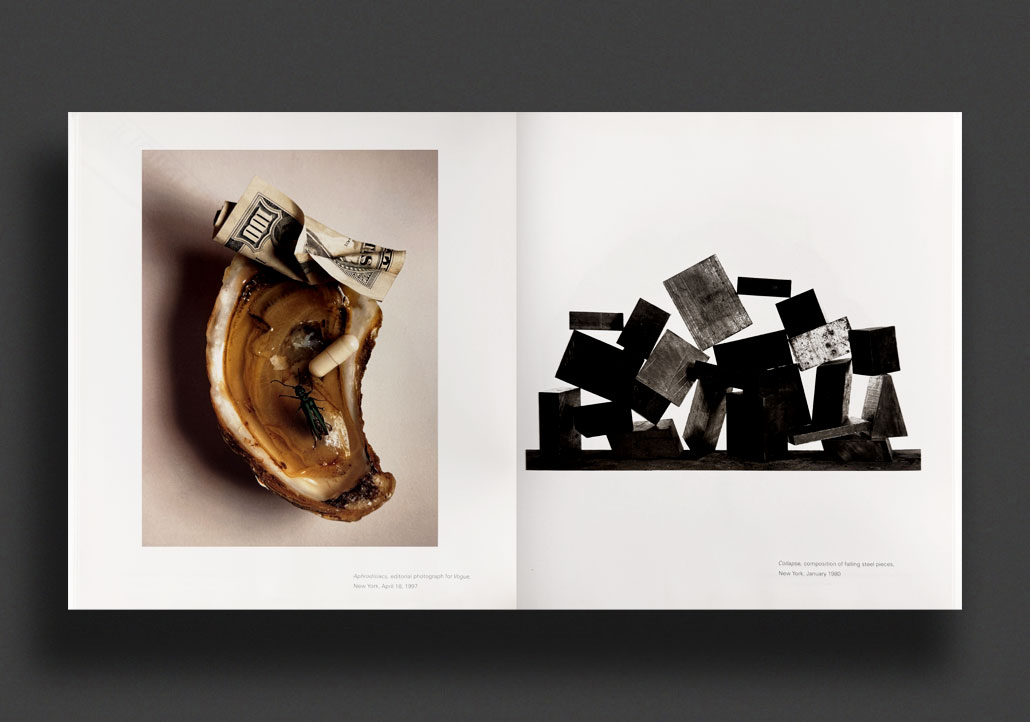
First hardcover edition of this landmark monograph of Irving Penn's striking still life photography spanning 1938—2000, personally supervised by the artist. Penn is one of the leading photographers of the 20th century. Former curator of The Museum of Modern Art in New York, John Szarkowski once commented, “Penn has been one of photography’s conspicuous innovators and distinguished performers in at least two of the medium’s oldest and most successful genres: still life and portraiture.” Although he was best known for his fashion photography, Penn created more than one hundred still lifes over the course of his career and these are still some of the most coveted of his pictures. This beautifully printed and now very collectible volume collects 98 of his greatest still life images, reflecting his initial training as a painter as well as his studies with Russian-American photographer and designer Alexey Brodovitch. Underpinning all of Penn's work as a photographer is his special talent in the still life genre, to which he applied his signature resolve to prune away anything that did not contribute to the picture. From his earliest work at Vogue to his latest series of personal work, this resulted in powerful images that invite contemplation of Penn’s acute awareness of objects and their placement. Penn frequently included elements of memento mori and selected subject matter that could, at first glance, seem unworthy of close examination, which give his images a "bite" that lingers.
Fine copy in Fine dust jacket.
1989, Japanese
Softcover (w. dust jacket), 52 pages, 26 x 18.5 cm
1st Edition, Out of print title / used / fine
Published by
Village Press / Tokyo
$80.00 - Out of stock
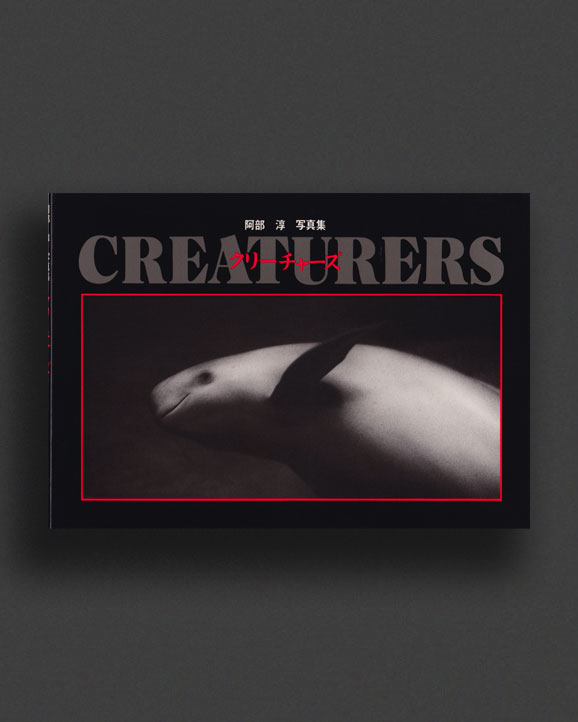
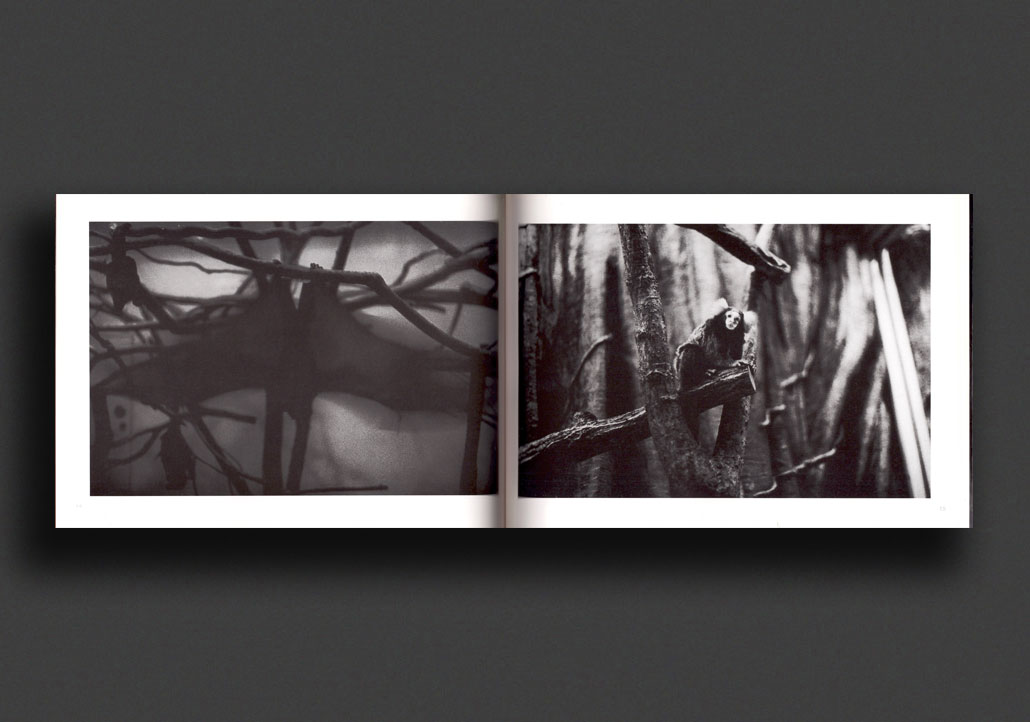
First 1989 edition of Japanese photographer Jun Abe's first photo book, Creaturers [sic], an incredibly melancholic masterpiece of ghostly black and white images of animals "captured" in artificial environments — zoos, aquariums, arboretums, lab cages, the urban street, exhibited at Picture Photo Space in Osaka in 1989. Abe's haunting, spectral images are an unsettling reminder of the cold alienating reality of man's interference with mother nature. During the time he produced these images of animals, Jun Abe (b. 1955) was the official photographer of the butoh dance group Byakko-sha. Unlike the lazy comparisons to Winogrand's The Animals, Abe depicts no humorous animal/human interactions, because Abe depicts no humans. He does not need to. In depicting his creatures he reflects man's cruelty directly back at him. This death dance of captivity is far more attuned to the concerns of butoh's "body on the edge of crisis". Abe's dark, cold, dreamlike imagery of animals and plants here are both quietly beautiful and desperately sorrowful, abstract and emotionally direct. An outstanding documentary photographer, Abe went on to become well known for his street photography of people, including Citizens: 1979–1983, which won the Society of Photography Award. He has an almost uncanny ability to seek out – and capture – those moments in the chaos of everyday life which can tell entire stories in the frame of a photograph. Creaturers is no different in this regard, yet here there is a pervasive presence of a second aperture beyond the lens that frames the subject in every image, that of man's built-world to dominate the natural one. A very under-rated Japanese photo book. At times even slightly foreshadowing Jochen Lempert's work to come.
"In Abe-chan's photographs ... a feeling of endless suspension ripples, as if something created by God were changing within a man-made landscape created by urban humans — a zoo — and continuing its journey between the extremes of God and man, like a circus tightrope walker on a taut steel rod, on a precarious tightrope where you never know when you might fall."—Isamu Osuga (rough translation from book essay)
Fine copy.
1998, English / French
Softcover, 21.5 x 15.5 cm
1st Edition, Out of print title / used / very good
Published by
Purple Institute / Paris
$280.00 - Out of stock
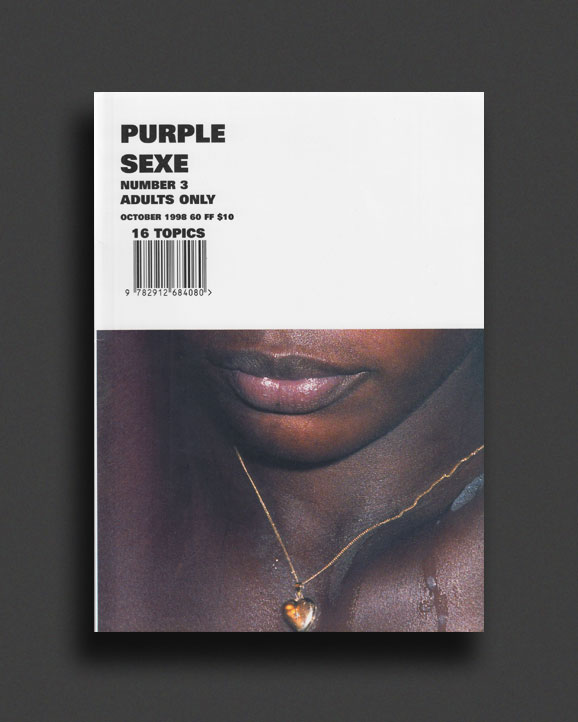
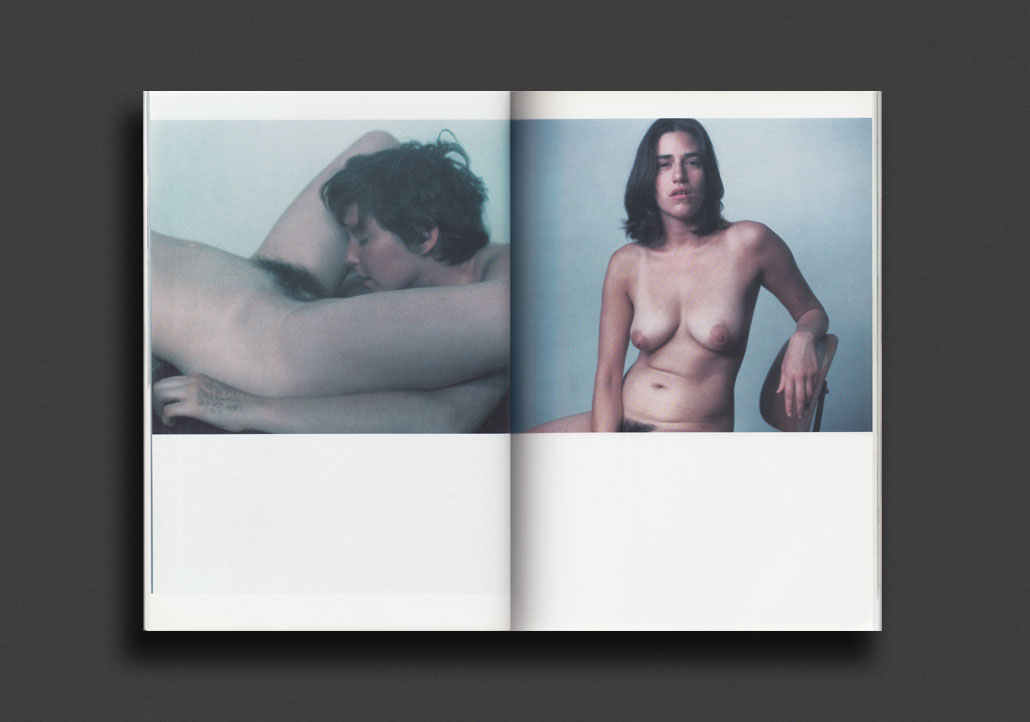
The scarce third issue (of eight total, published between 1998-2001) of Olivier Zahm's short-lived, erotically charged photography journal "Purple Sexe". This issue profusely illustrated throughout, containing portfolios by Anette Aurell, Vanessa Beecroft, Ben Cho, Claude Closky, Yasmine Eslami, Jason Farrer, Carolina Gonzales, Jamil Gs, Noritoshi Hirakawa, Bernadette Van-Huy, Richard Kern's photoshoot of Lucy McKenzie, Chris Moor, Justine Parsons, Jack Pierson, Terry Richardson, Katja Rahlwes, Francois Rotger, Gilles Tonelado, and more. Art Direction by Christophe Brunnquell.
In 1992 Olivier Zahm and his partner Elein Fleiss printed the first issue of Purple Prose, a Parisian literary art zine that over the years has evolved into Purple Fashion Magazine. Soon after the birth of Purple Prose, Zahm created spin-off publications like Purple Sexe, Purple Fiction and what we now know and love, Purple Fashion. Zahm aimed at fusing together his two worlds, fashion and art, in creating Purple and Purple Fashion. Purple Sexe remains one of the scarcest of the early Purple series', published in the same format as Purple Prose and Purple Fiction in late 1990s. A magazine devoted to sexuality, only 8 issues of Purple Sexe were ever published between 1998 - 2001, edited by Olivier Zahm and commencing the same year as Purple, which was a fusion of Purple Prose, Fiction, Fashion, and Sexe.
Very Good copy.
1978, English
Hardcover (w. dust jacket), 60 pages, 23 x 29 cm
1st Edition, Out of print title / used / very good
Published by
Sackett & Marshall / London
$160.00 - In stock -
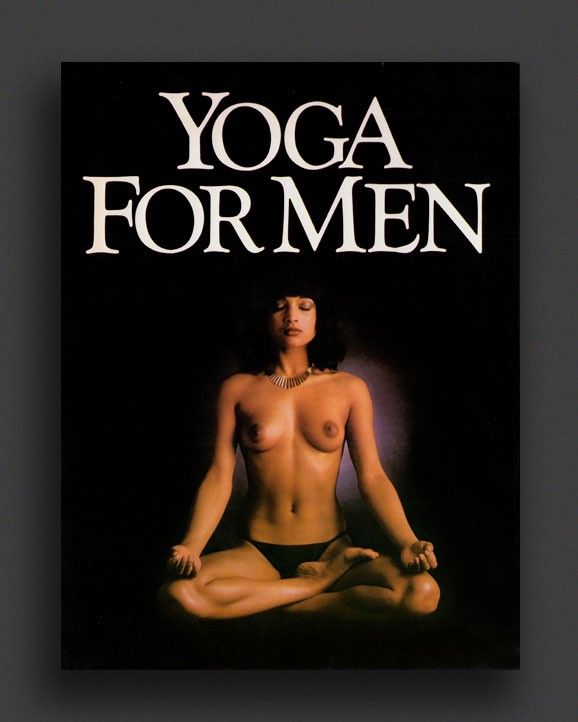
First hardcover edition of the one and only Yoga For Men from 1978, a book that really couldn't be from another year. John Champ, an advertising art director and Hatha Yoga practitioner, teamed up with yoga expert Pauline Donovan and photographer John Russell to re-invigorate the instructional yoga book. The result is a lively, handsomely designed, over-sized glossy nude/semi-nude photo book of female models executing basic yoga postures to "persuade more people to take up what is a rewarding way of life". A special book, and now very collectible!
Good copy w. Very Good dust jacket. Some light foxing/spotting to first and final pages and board bowing, otherwise a VG copy all-round.
2012, English
Hardcover (embossed cloth), 206 pages, 25 x 28.5 cm
Out of print title / used / fine
Published by
MACK / London
$150.00 - In stock -
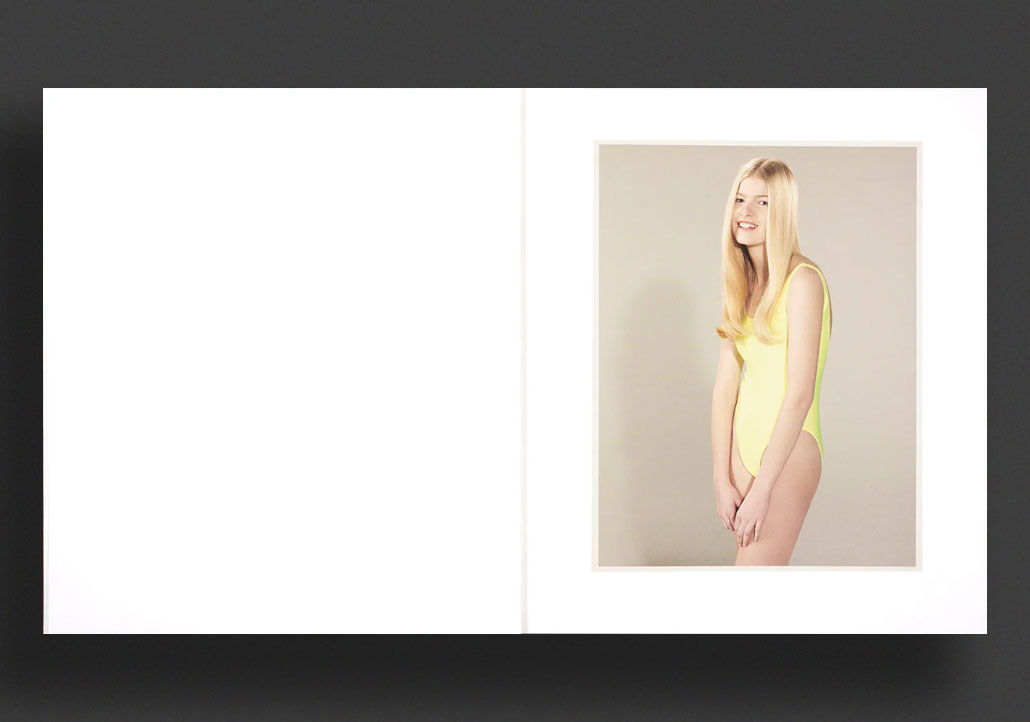
American artist Roe Ethridge's latest book takes its title from the French "C'est pas du luxe", an ironic phrase which alludes to the superfluous nature of luxury whilst proclaiming how essential it is to existence. Such paradoxes are fluently woven through Ethridge's oeuvre and Le Luxe encompasses his practice from the past decade, without ever slipping into the moribund gravitas of a retrospective.
Plumbing his diverse image inventories, from personal images and magazine commissions to an archive of online screen shots, the book continues his exploration of picture-making that disavows the potential for creating a finished work. Ethridge para-phrases Eggleston when he states that he is "at war with the finished" in an era of digital photography straining towards idealisation. The pristine conditions of photography are undermined in the book's design and riff on Henri Matisse's apposite aphorism "exactitude is not truth" (Matisse titled two of his paintings Le Luxe).
Composed in three parts, Le Luxe contains an unusual backdrop, the everyday of the artist, who worked from November 2005 to January 2010 on one commission documenting a building in downtown Manhattan on a site adjacent to the World Trade Centre. This narrative offers an uneasy balance to the fissures between analogue and digital and Ethridge's consistent undermining of his own certainties.
Roe Ethridge was born in 1969 in Miami and received a BFA in Photography at The College of Art in Atlanta, GA. Ethridge's images emanate from his direct experience of the world. His focus is multiple and restless as he works to capture the vivid and intimate details of his various locales. In doing so, he moves freely among the classic genres of the photographic medium - portrait, landscape, and still life.
Very Good—Near Fine copy of the 2nd (red) edition. Long out-of-print.
1998, English / Japanese
Softcover (w. obi inserted), 210 pages, 21 x 27.8 cm
1st Edition, Out of print title / used / very good
Published by
Synergy Inc. / Tokyo
$590.00 - Out of stock
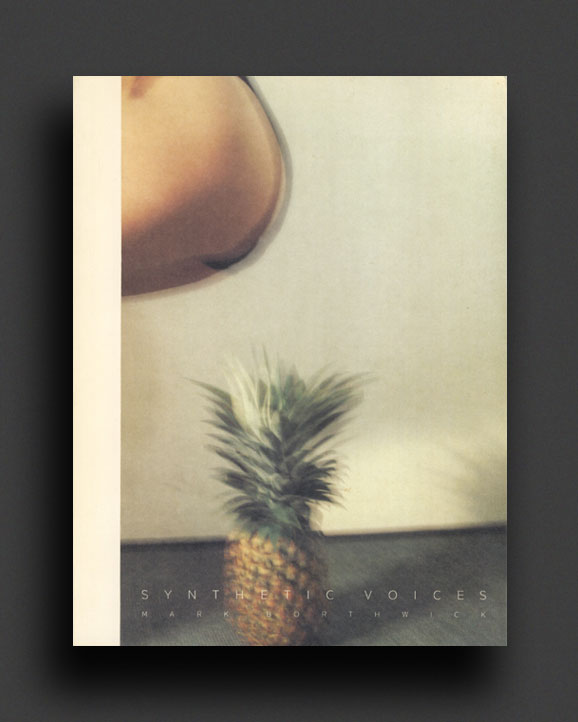
"Synthetic Voices", the great, long out-of-print photo-book of Mark Borthwick, published in Japan in 1998. The heart of 1990s fashion photography, "Synthetic Voices" was conceived more as an artists photo scrapbook and the most perfect collection of Mark's iconic work throughout the 1990's for Margiela, Purple, Self Service, Interview, Vogue Italia, etc., alongside his personal photography work, and texts. Chloë Sevigny, Hélène Fillières, Maison Martin Margiela, Hussein Chalayan, Comme des Garçons, Paul McCarthy, Patti Smith, Kate Moss, Chloe Sevigny, Rita Ackerman, Kim Gordon, Sinead O'connor, and more, all here. An amazing photographer who captured and inspired an important period in (un)fashion photography with his playful and poetic, now iconic, images.
Designed by Mark Borthwock and Hideki Nakajima
Introduction by Jeff Rian and Olivier Zahm
Guest edited by Elein Fleiss and Olivier Zahm (Purple prose)
Published by Synergy Inc., Tokyo.
Very Good copy. Includes obi.
2000, English
Hardcover, 280 pages, 24 x 17.5 cm
2nd printing (2001),
1st Edition, Out of print title / used / very good
Published by
Rockin' On / Tokyo
$120.00 - Out of stock
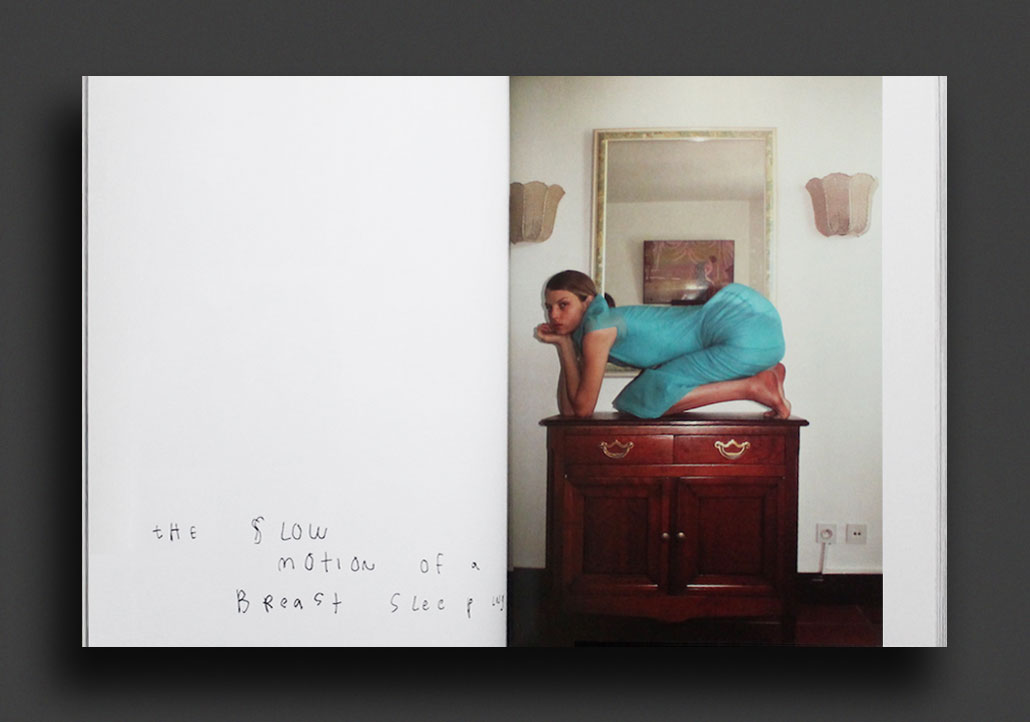
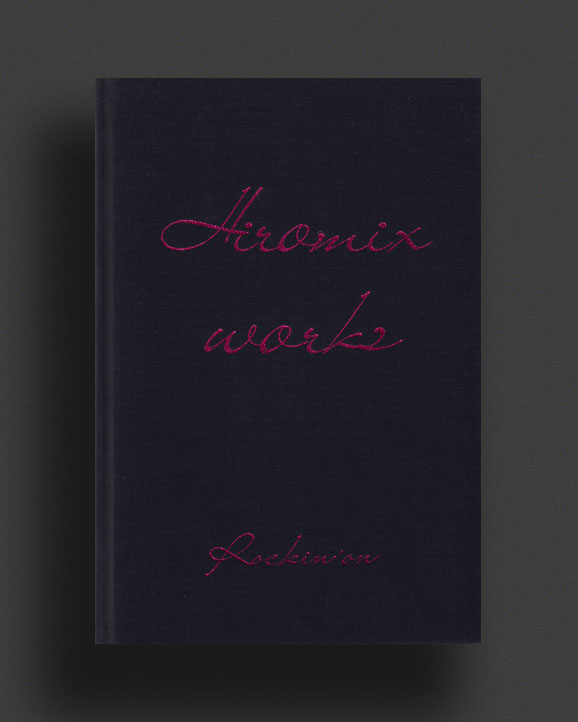
First 2000 edition and second 2001 printing. Hiromix Works is iconic Tokyo photographer Hiromix's selection of her best photographs spanning 1995—2000. Born Tokyo in 1976, Hiromix (Hiromi Toshikawa) is a Tokyo photographer who, along with Yurie Nagashima and Mika Ninagawa, is considered the main instigator of the girly photo boom in the 1990s, a photographic movement in which Japanese teenagers, and especially, teenage Japanese women from the early 90's, took center stage in a new visual language. Championed by photographers Takashi Homma and Nobuyoshi Araki, to whom he dedicated this book, Hiromix was selected by Araki to win the 11th New Cosmos of Photography award in 1995 with a series of photographs depicting high school life from a teenager's perspective — images of her half-eaten breakfast, blurred portraits of her friends, stuffed toys, flowers, musicians, images that helped to build a world of the intimately feminine, personal and unknown to a nation accustomed to overly sexualized representations of women, created, of course, by men. In 2001, Hiromix was the youngest person ever to win the 26th Kimura Ihei Photography Award. Hiromix Works is a heavy hardcover compilation of her best 1990's photographs, during the time where she was also working as a photographer for ‘Rockin' On’, a Japanese bi-monthly music magazine, and publisher of this prized first book. Issued only in Japan, includes many works shot for Studio Voice, Purple, Rockin' On, Self Service, Purple Sexe, Visionaire...
VG—Near Fine copy.
1995, Japanese
Softcover (w. dust jacket), 150 pages, 27 x 21 cm
1st Edition, Out of print title / used / very good
Published by
Shogakukan / Tokyo
$60.00 - In stock -
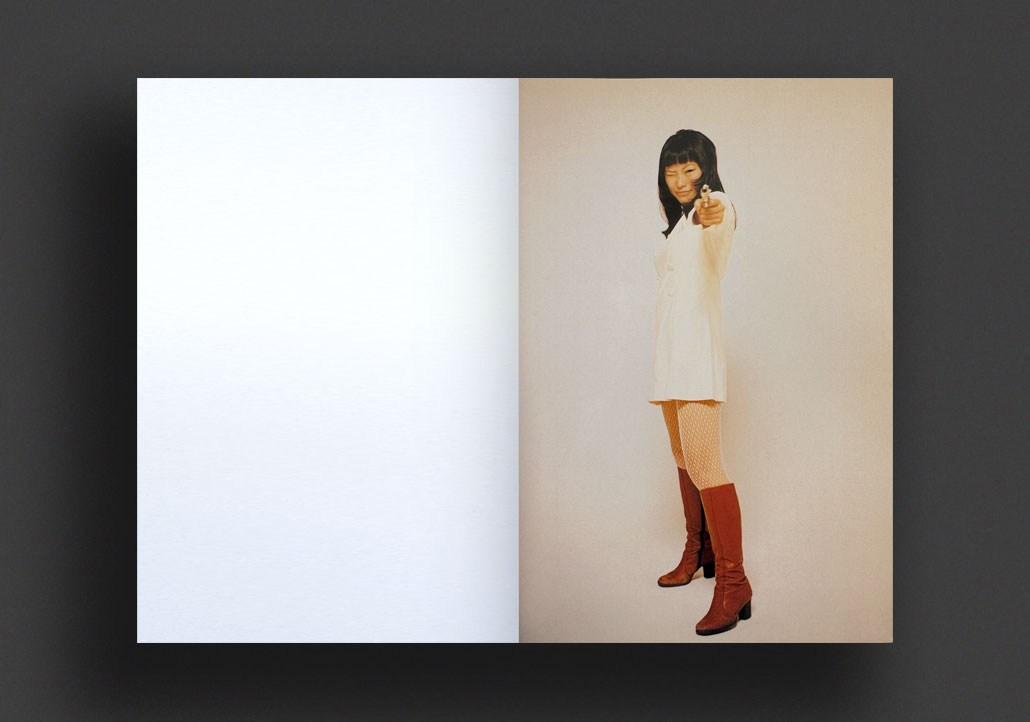
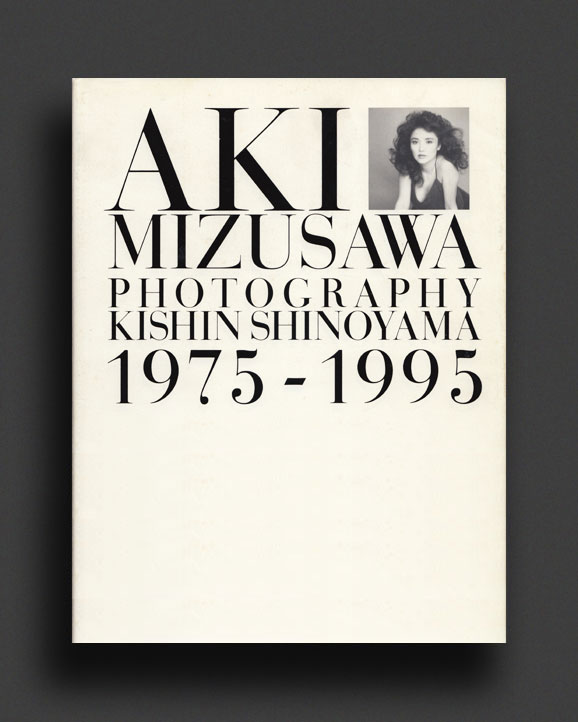
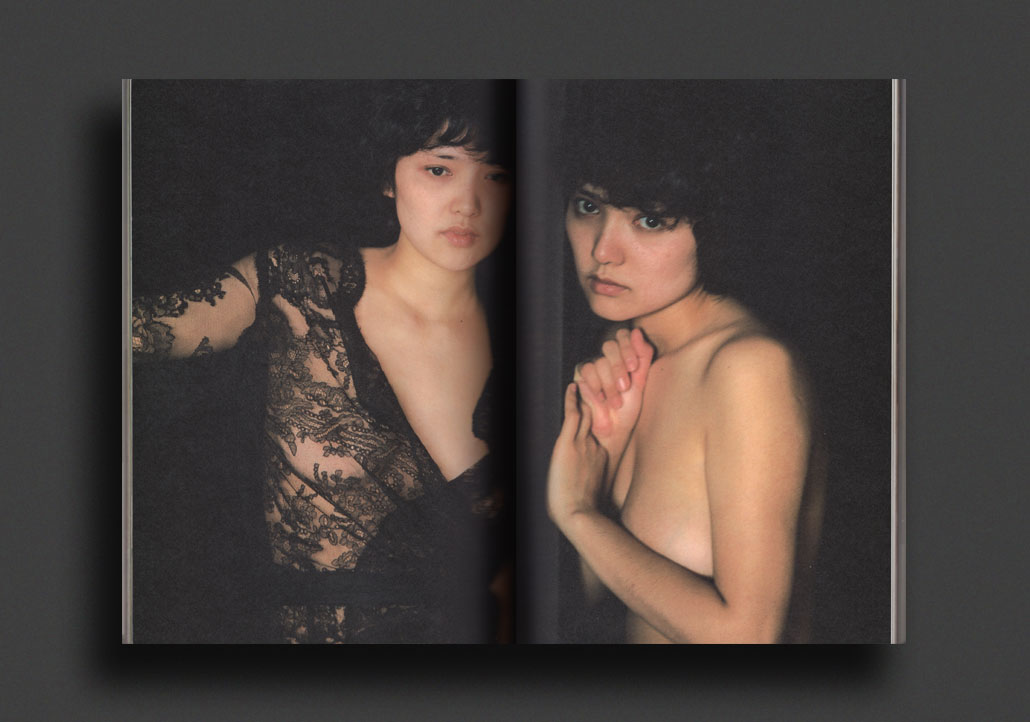
Beautiful Japanese photobook by famed Japanese photographer Kishin Shinoyama, published in 1995. This entire photographic collection is dedicated to Shinoyama's photographs of his friend, Japanese actress and model Aki Mizusawa (1954-) spanning 1975‐1995.
“It is extremely rare for a photographer to be able to shoot a single subject; one woman continuously for twenty years. Now, seeing all those images - as fleeting and instantaneous then as the magazines that carried them - revived and bound together gives that particular history a closure that weighs like marble. This book captures the twenty year photogenic evolution of a wonderful friend and subject, Aki Mizusawa."—Kishin Shinoyama
Kishin Shinoyama was born in 1940, in Tokyo, Japan. He embarked on his career while studying in the Department of Photography at Nippon University, and was awarded the Advertising Photographer’s Association prize, among others. After being employed at the Light Publicity advertising company, he started to work as a freelance photographer in 1968. His work is acclaimed for the portraits of the most famous celebrities of our day and age, such as John Lennon and Yoko Ono, Rie Miyazawa, and other major personalities. In his “Gekisha” and “Shinorama” series, he carries on capturing the times using new forms of expression and new technologies. He is also an exponent of solarization and has used it to challenge preconceived ideas of beauty and the nude.
Very Good copy in original dust jacket.