World Food Books' programme is largely produced on Kulin Nation land. We acknowledge the Wurundjeri people of the Kulin Nation as the first and continuing custodians of this land, and pay respect to their Elders past, present, and emerging.
World Food Books is an arts and special interests bookshop in Naarm / Melbourne. Founded in 2010, World Food Books is devoted to the presentation of a rotating, hand-selection of international art, design, literary and counterculture publications with an emphasis on the anti-traditional, the experimental, the avant-garde, the heretic, the marginal.
Presenting new titles alongside rare and out-of-print books, catalogues and journals spanning the fields of modern and contemporary art, design, photography, illustration, film, literature, poetry, cultural theory, philosophy, sexuality, popular and underground culture in its many radical forms, World Food Books wishes to encourage adventurous, thoughtful and open-minded reading, looking, writing, and exchange of publishing and ideas, both current and historical.
As well as our bookshop, located in Melbourne's historical Nicholas Building, all of our inventory is available internationally via our online mail-order service.
World Food Books semi-regularly co-ordinates "Occasions", a programme of exhibits and events at the bookshop and in partnership with other hosts (such as museums and art galleries) that develop out of the activities, relationships and content of the bookshop itself.
World Food Books
The Nicholas Building
37 Swanston Street
Room 5, Level 6
Melbourne 3000
Australia
SHOP HOURS:
Thu–Sat 11–5
WEB-SHOP OPEN 24/7
World Food Books
Postal Address:
PO Box 435
Flinders Lane
Victoria 8009
Australia
Art
Theory / Essay
Architecture / Interior
Graphic Design / Typography
Photography
Fashion
Eros
LGBTQ+
Fiction / Poetry
Weird / Speculative / Science Fiction / Horror
Transgressive / Visceral / Abject
Symbolism / Decadence / Fin de siècle
Film / Video
Painting
Sculpture / Installation
Performance / Dance / Theater
Drawing
Sound / Music
Curatorial
Group Shows / Collections
Periodicals
Out-of-print / Rare
Posters / Ephemera / Discs
Signed Books
World Food Books Gift Voucher
World Food Book Bag
Australian Art
Australian Fiction
Australian Science Fiction / Speculative Fiction
Australian Poetry
Australian Photography
Japanese Photography
Conceptual Art
Minimal Art
Dada
'Pataphysics / Oulipo
Fluxus
Concrete Poetry
Pop Art
Surrealism
Arte Povera
Arte Informale / Haute Pâte / Tachism
Nouveau Réalisme / Zero / Kinetic
Situationism / Lettrism
Collage / Mail Art / Xerox Art
Art Brut / Folk / Visionary / Fantastic
Illustration / Graphic Art / Bandes Dessinées
Furniture
Italian Radical Design / Postmodernism
Textiles
Ceramics / Glass
Counterculture
Protest / Revolt
Philosophy
Psychoanalysis
Anthropology
Anarchism
Socialism / Anarchism / Communism / Capitalism
Literary Theory / Semiotics / Language
Feminism / Women's Studies
Gender Studies / Sexuality
Anthropology
Fetishism / BDSM
Drugs / Psychedelia
Crime / Violence
Animal Rights / Veganism
Occult / Esoterica
Ecology / Earth / Alternative Living
Whole Earth / Crafts
All prices in AUD (Australian dollars)
Pick-Ups
Pick-up orders can be collected in our bookshop during opening hours after order date. Please collect any Pick-up orders within 2 weeks of ordering as we have limited storage space. Orders will be released back into stock if not collected within this time. No refunds can be made for pick-ups left un-collected. If you cannot make it in to the bookshop in this time-frame, please choose postage option.
Return Policy
All sales are final. We do accept returns (for refund or exchange) for items received in error. All our orders are packed with special care using heavy-duty padding and cardboard book-mailers or bubble mailers (for smaller books), using reinforcement where required. We cannot take responsibility for any lost, stolen or damaged parcels.
Insurance
Should you wish to insure your package, please email us directly after placing your order and we can organise this at a small extra expense. Although all standard/express tracked packages are very safe and dependable, we cannot take responsibility for any lost, stolen or damaged parcels. We recommend insurance on valuable orders.
Interested in selling your old books, catalogues, journals, magazines, comics, fanzines, ephemera? We are always looking for interesting, unusual and out-of-print books to buy. We only buy books in our fields of interest and specialty, and that we feel we can resell.
We base these prices on desirability, market value, in-print prices, condition and our current stock levels. We offer cash, store credit, and can take stock on consignment. All
about 25% of the price we expect to get when we sell them, or 30% in store credit. We base these prices on desirability, market value, in-print prices, condition and our current stock levels.
Sell your books any day of the week. You can drop them off and return later. If you have a lot of books, we can visit your Sydney home.
We buy books that we feel we can resell. We offer about 25 % of the price we expect to get when we sell them, or 30% in store credit. We base these prices on desirability, market value, in-print prices, condition and our current stock levels.
Philadelphia Wireman
03 August - 01 September, 2018
World Food Books is proud to announce our next Occasion, the first presentation of sculptures by Philadelphia Wireman in Australia.
The Philadelphia Wireman sculptures were found abandoned in an alley off Philadelphia’s South Street on trash night in 1982. Their discovery in a rapidly-changing neighbourhood undergoing extensive renovation, compounded with the failure of all attempts to locate the artist, suggests that the works may have been discarded after the maker’s death. Dubbed the "Philadelphia Wireman" during the first exhibition of this work, in 1985, the maker’s name, age, ethnicity, and even gender remain uncertain. The entire collection totals approximately 1200 pieces, all intricately bound together with tightly-wound heavy-gauge wire (along with a few small, abstract marker drawings, reminiscent both of Mark Tobey and J.B. Murry). The dense construction of the work, despite a modest range of scale and materials, is singularly obsessive and disciplined in design: a wire armature or exoskeleton firmly binds a bricolage of found objects including plastic, glass, food packaging, umbrella parts, tape, rubber, batteries, pens, leather, reflectors, nuts and bolts, nails, foil, coins, toys, watches, eyeglasses, tools, and jewellery.
Heavy with associations—anthropomorphic, zoomorphic, and socio-cultural responses to wrapped detritus—the totemic sculptures by Philadelphia Wireman have been discussed in the context of work created to fulfil the shamanistic needs of alternative religions in American culture. Curators, collectors, and critics have variously compared certain pieces to sculpture from Classical antiquity, Native American medicine bundles, African-American memory jugs, and African fetish objects. Reflecting the artist’s prolific and incredibly focused scavenging impulse, and despite—or perhaps enhanced by—their anonymity, these enigmatic objects function as urban artefacts and arbiters of power, though their origin and purpose is unknown. Philadelphia Wireman, whatever their identity, possessed an astonishing ability to isolate and communicate the concepts of power and energy through the selection and transformation of ordinary materials. Over the course of the past two decades, this collection has come to be regarded as an important discovery in the field of self-taught art and vernacular art.
Presented in collaboration with Fleisher-Ollman Gallery, Philadelphia, and Robert Heald, Wellington.
Susan Te Kahurangi King
02 February - 10 March, 2018
Susan Te Kahurangi King (24 February 1951 - ) has been a confident and prolific artist since she was a young child, drawing with readily available materials - pencils, ballpoint pens and felt-tip markers, on whatever paper is at hand. Between the ages of four and six Susan slowly ceased verbal communication. Her grandparents William and Myrtle Murphy had developed a special bond with Susan so they took on caring responsibilities for extended periods. Myrtle began informally archiving her work, carefully collecting and storing the drawings and compiling scrapbooks. No drawing was insignificant; every scrap of paper was kept. The King family are now the custodians of a vast collection containing over 7000 individual works, from tiny scraps of paper through to 5 meter long rolls.
The scrapbooks and diaries reveal Myrtle to be a woman of great patience and compassion, seeking to understand a child who was not always behaving as expected. She encouraged Susan to be observant, to explore her environment and absorb all the sights and sounds. Myrtle would show Susan’s drawings to friends and people in her community that she had dealings with, such as shopkeepers and postal workers, but this was not simply a case of a grandmother’s bias. She recognised that Susan had developed a sophisticated and unique visual language and sincerely believed that her art deserved serious attention.
This was an unorthodox attitude for the time. To provide some context, Jean Dubuffet coined the term Art Brut in 1945 to describe work created by self-taught artists – specifically residents of psychiatric institutions and those he considered to be visionaries or eccentrics. In 1972 Roger Cardinal extended this concept by adopting the term Outsider Art to describe work made by non-academically trained artists operating outside of mainstream art networks through choice or circumstance. Susan was born in Te Aroha, New Zealand in 1951, far from the artistic hubs of Paris and London that Dubuffet and Cardinal operated in. That Myrtle fêted Susan as a self-taught artist who deserved to be taken seriously shows how progressive her attitudes were.
Susan’s parents Doug and Dawn were also progressive. Over the years they had consulted numerous health practitioners about Susan’s condition, as the medical establishment could not provide an explanation as to why she had lapsed into silence. Dawn educated herself in the field of homeopathy and went on to treat all twelve of her children using these principles – basing prescriptions on her observations of their physical, mental and emotional state.
Doug was a linguist with an interest in philosophy who devoted what little spare time he had to studying Maori language and culture. To some extent their willingness to explore the fringes of the mainstream made them outsiders too but it was their commitment to living with integrity and their respect for individuality that ensured Susan’s creativity was always encouraged.
Even though Susan’s family supported her artistic pursuits, some staff in schools and hospitals saw it as an impediment to her assimilation into the community and discouraged it in a variety of ways. Her family was not always aware of this and therefore did not fully understand why Susan stopped drawing in the early 1990s. However, rather than dwell on the challenges that Susan faced in pursuit of her artistic practice, they prefer to highlight her achievements. In 2008 Susan began drawing again in earnest, after an almost 20 year interruption, and her work is now shown in galleries around the world.
Susan grew up without television and has been heavily influenced by the comics she read as a child. She is absolutely fearless in the appropriation of recognizable characters, such as Donald Duck and Mickey Mouse, in her work. She twists their limbs, contorts their faces, compresses them together, blends them into complex patterned backgrounds - always imbuing them with an incredible energy. Although Susan often used pop culture characters in her work they are not naive or childlike. These are drawings by a brilliant self-taught artist who has been creating exceptional work for decades without an audience in mind.
Mladen Stilinović
"Various Works 1986 - 1999"
02 February 16 - September 10, 2016
Various works 1986 - 1999, from two houses, from the collections of John Nixon, Sue Cramer, Kerrie Poliness, Peter Haffenden and Phoebe Haffenden.
Including: Geometry of Cakes (various shelves), 1993; Poor People’s Law (black and white plate), 1993; White Absence (glasses, ruler, set square, silver spoon, silver ladel with skin photograph and wooden cubes), 1990-1996; Exploitation of the Dead (grey and red star painting, wooden painting, black spoon with red table, red plate), 1984-1990; Money and Zeros (zero tie, paintings made for friends in Australia (Sue, John, Kerrie), numbers painting), 1991-1992; Words - Slogans (various t-shirts) - “they talk about the death of art...help! someone is trying to kill me”, “my sweet little lamb”, “work is a disease - Karl Marx”; Various artist books, catalogues, monographs, videos; Poster from exhibition Insulting Anarchy; "Circular" Croatian - Australian edition; Artist book by Vlado Martek (Dostoyevsky); more.
Thanks to Mladen Stilinović and Branka Stipančić.
Jonathan Walker
Always Will Need To Wear Winter Shirt Blue + Ochre Small Check Pattern
21 August - 21 September, 2015
Untitled
I am not a great reader of poetry but I always return to the work of Melbourne poet, Vincent Buckley (1925- 1988). Perhaps I find his most tantalising piece to be not a finished poem but a fragment left on a scrap of paper discovered on his desk after the poet’s death.
The poetry gathers like oil
In the word-core, and spreads
It has its music meet,
Its music is in movement.
This fragment is more the shell left behind from a volatile thought than a finished poem. I find the last two lines honest but awkward whereas the first two lines work like an arrow. Most likely he could not find a resolution so it was left. Still, in its present form, it remains an eloquent testimony to the ultimate failure of a medium to express mobile thought and sensation, in Buckley’s case, through verbal language. It’s an important matter because this is something all artists have to deal with regardless of the medium.
I have never written a poem, however, I am forever copying fragments from books on paper scraps in a vain effort to fix certain notions in my head. At first, they function as bookmarks that are sometimes returned to when I open the book. But before long, as they accumulate, they fall out littering the table interspersed with A4 photocopies, bills, books and medications.
To return to Buckley’s fragment, the first two lines very much evoke how I paint nowadays. As you age, detail diminishes and patches of light become more luminous and float. I feel the most honest way of dealing with this is by smearing the oil paint on the canvas with the fingers and working close-up, blind. Only if the patches coalesce into an approaching image can the work gain a life.
-
Jonathan Walker was born in Melbourne, Australia and brought up on a dairy farm in Gippsland. In the 1970’s he studied painting at RMIT and won the Harold Wright Scholarship to the British Museum, London. During the 1980’s he exhibited at Pinacotheca Gallery, Richmond and had work shown at the NGV and Heidi City Art Gallery. Over the same period he designed the cover for the “Epigenesi” LP by Giancarlo Toniutti, Italy and conducted a mail exchange work with Achim Wollscheid, Germany. The work with artists through the post resulted in an article published in the bicentenary issue of Art and Australia 1988. He showed in artist run spaces such as WestSpace in the 90’s and 2000’s, and until 2012, taught painting at Victoria University, which is where we (Colleen Ahern and Lisa Radford) as organisers of the exhibition, among many others, had the privilege of being his student.
Walker’s knowledge was imparted to students through the careful selection of music, literature, and artists found in books that he himself had ordered for the library. Walker’s strategy was the generosity of sharing his vast knowledge with references specific to each student and their context.
Walker’s paintings share a similar focus and intimacy.
This exhibition presents a small selection of recent paintings alongside a publication that includes Walker’s writing. Observational and analytical, Walker’s work is a type of material notation — the time of day, colour and how it is blended, the both specific and fleeting location of a reflection on lino or the question of whether a chair leg should be included in a painting.
Please join us on Friday August 21 between 6-8pm to celebrate the opening of the exhibition.
Curated by Colleen Ahern and Lisa Radford.
B. Wurtz
Curated by Nic Tammens
March 26 - April 4, 2015
B.Wurtz works from a basement studio in his home on Manhattan’s Lower East Side.
This local fact is attested to by the plastic shopping bags and newsprint circulars that appear in his work. As formal objects, they don’t make loud claims about their origins but nonetheless transmit street addresses and places of business from the bottom of this long thin island. Like plenty of artists, Wurtz is affected by what is local and what is consumed. His work is underpinned by this ethic. It often speaks from a neighborhood or reads like the contents of a hamper:
“BLACK PLUMS $1.29 lb.”
“Food Bazaar”
“USDA Whole Pork Shoulder Picnic 99c lb.”
“RITE AID Pharmacy, with us it’s personal.”
“H. Brickman & Sons.”
“Sweet Yams 59c lb."
Most of the work in this exhibition was made while the artist was in residence at Dieu Donne, a workshop dedicated to paper craft in Midtown. Here Wurtz fabricated assemblages with paper and objects that are relatively lightweight, with the intention that they would be easily transportable to Australia. This consideration isn’t absolute in Wurtz’s work, but was prescriptive for making the current exhibition light and cheap. Packed in two boxes, these works were sent from a USPS post office on the Lower East Side and delivered to North Melbourne by Australia Post.
Wurtz appears courtesy of Metro Pictures, New York.
Thanks to Rob Halverson, Joshua Petherick, Sari de Mallory, Matt Hinkley, Helen Johnson, Fayen d'Evie, Ask Kilmartin, Lisa Radon, Ellena Savage, Yale Union, and "Elizabeth".
John Nixon
"Archive"
December 15 - January 20, 2014
The presentation of John Nixon's archive offered a rare showcase of this extensive collection of the artist's own publications, catalogues, posters, ephemera, editions and more, from the mid 1980s onwards, alongside a selection of his artworks.
Organized by John Nixon, Joshua Petherick and Matt Hinkley.
<a href=http://wfb.public-office.info/artist/john-nixon>All titles by John Nixon
"Habitat"
at Minerva, Sydney (organised by Joshua Petherick and Matt Hinkley)
November 15 - December 20, 2014
Lupo Borgonovo, Janet Burchill & Jennifer McCamley,
Lewis Fidock, HR Giger, Piero Gilardi, Veit Laurent Kurz,
Cinzia Ruggeri, Michael E. Smith, Lucie Stahl, Daniel Weil, Wols
Press Release:
“...It contained seven objects. The slender fluted bone, surely formed for flight, surely from the wing of some large bird. Three archaic circuitboards, faced with mazes of gold. A smooth white sphere of baked clay. An age-blackened fragment of lace. A fingerlength segment of what she assumed was bone from a human wrist, grayish white, inset smoothly with the silicon shaft of a small instrument that must once have ridden flush with the surface of the skin - but the thing’s face was seared and blackened.”
William Gibson, “Count Zero”, 1986
"Autumn Projects Archive"
Curated by Liza Vasiliou
March 6 - March 15, 2014
World Food Books, in conjunction with the Virgin Australia Melbourne Fashion Festival 2014, presented the Autumn Projects archive, consisting of a selection of early examples in Australian fashion with a particular interest in collecting designers and labels from the period beginning in the 1980’s, who significantly influenced the discourse of Australian Fashion.
Curated by Liza Vasiliou, the exhibition provided a unique opportunity to view pieces by designers Anthea Crawford, Barbara Vandenberg, Geoff Liddell and labels CR Australia, Covers, Jag along with early experimental collage pieces by Prue Acton and Sally Browne’s ‘Fragments’ collection, suspended throughout the functioning World Food Books shop in Melbourne.
H.B. Peace
presented by CENTRE FOR STYLE
November 14, 2013
"Hey Blinky, you say chic, I say same"
Anon 2013
H.B. Peace is a clothing collaboration between great friends Blake Barns and Hugh Egan Westland. Their pieces explore the divergences between 'character’ and ‘personality’ in garments....etc
Special Thanks to Joshua Petherick and Matt Hinkley of WFB and Gillian Mears
and a Very Special Thank you to Audrey Thomas Hayes for her shoe collaboration.
Janet Burchill & Jennifer McCamley
"Aesthetic Suicide"
May 10 - June 8, 2013
The first of our occasional exhibitions in the World Food Books office/shop space in Melbourne, "Aesthetic Suicide" presented a body of new and older works together by artists Janet Burchill & Jennifer McCamley, including videos, prints, a wall work, and publications.
During shop open hours videos played every hour, on the hour.
2018, English
Softcover, 352 pages, 20.5 x 13 cm
Published by
The New York Review of Books / New York
$38.00 - Out of stock
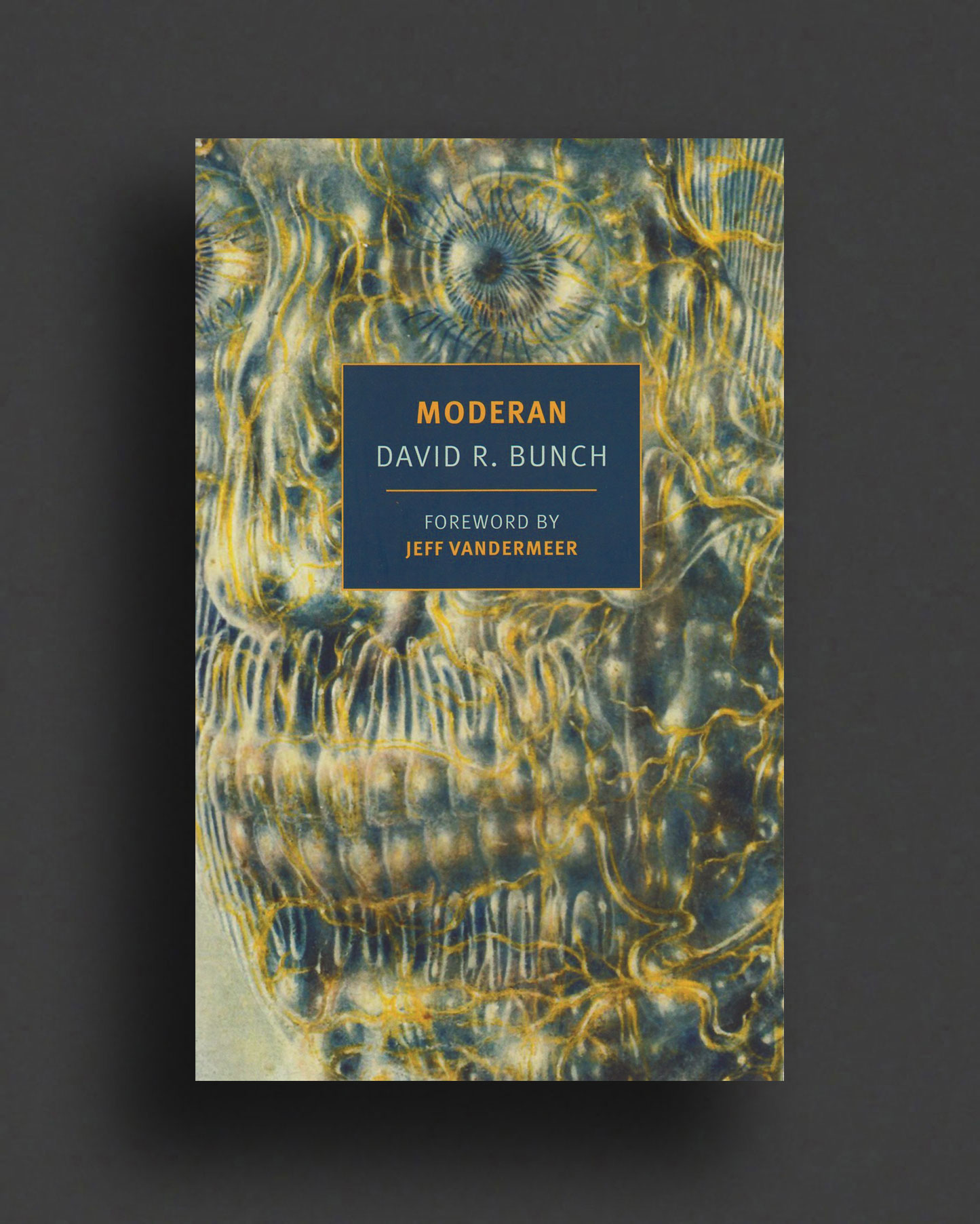
A collection of chilling and prescient stories about ecological apocalypse and the merging of human and machine.
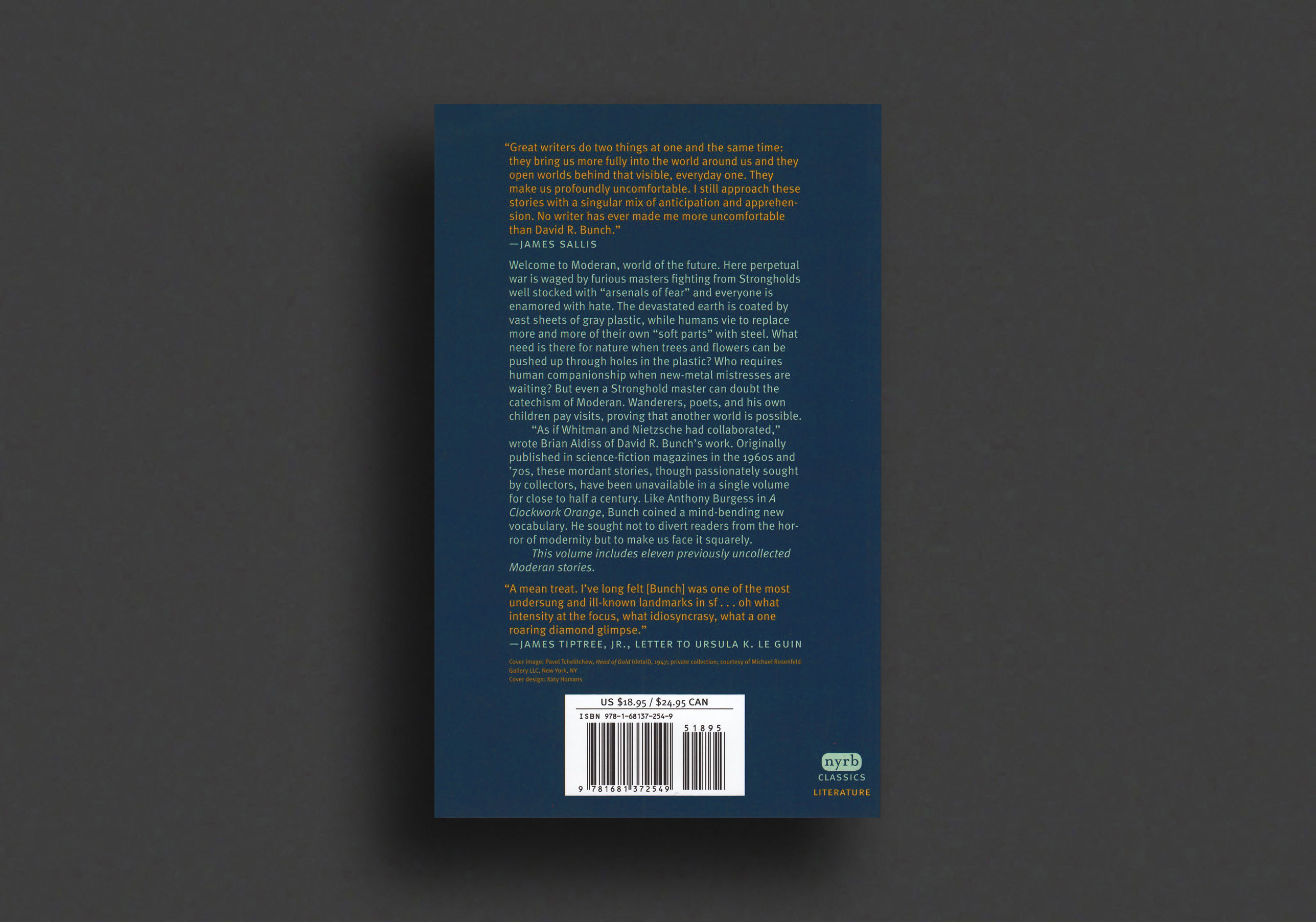
Welcome to Moderan, world of the future. Here perpetual war is waged by furious masters fighting from Strongholds well stocked with “arsenals of fear” and everyone is enamored with hate. The devastated earth is coated by vast sheets of gray plastic, while humans vie to replace more and more of their own “soft parts” with steel. What need is there for nature when trees and flowers can be pushed up through holes in the plastic? Who requires human companionship when new-metal mistresses are waiting? But even a Stronghold master can doubt the catechism of Moderan. Wanderers, poets, and his own children pay visits, proving that another world is possible.
“As if Whitman and Nietzsche had collaborated,” wrote Brian Aldiss of David R. Bunch’s work. Originally published in science-fiction magazines in the 1960s and ’70s, these mordant stories, though passionately sought by collectors, have been unavailable in a single volume for close to half a century. Like Anthony Burgess in A Clockwork Orange, Bunch coined a mind-bending new vocabulary. He sought not to divert readers from the horror of modernity but to make us face it squarely.
David Roosevelt Bunch (1920–2000) was born in rural western Missouri. After serving as an army corporal during World War II, he worked toward a PhD in English literature at Washington University in St. Louis and then transferred to the Iowa Writers’ Workshop, where he studied for two years before dropping out. He married Phyllis Flette in 1951 and they had two daughters, Phyllis and Velma. While working as a cartographer for the Defense Mapping Agency in St. Louis, he began publishing stories in sciencefiction magazines, two of which were included in Harlan Ellison’s landmark 1967 sci-fi anthology, Dangerous Visions. In 1971, Bunch published Moderan, a collection of stories set on a future earth devastated by war and environmental exploitation. In 1973, he retired from cartography to pursue writing full-time. A poetry chapbook, We Have a Nervous Job, followed in 1983, and Bunch! (1993), another book of short stories, was nominated for the Philip K. Dick Award. Bunch’s last book, the poetry collection The Heartacher and the Warehouseman, came out in April 2000. He died of a heart attack the following month. In 1965 he told Amazing Stories, “I’m not in this business primarily to describe or explain or entertain. I’m here to make the reader think, even if I have to bash his teeth out, break his legs, grind him up, beat him down, and totally chastise him for the terrible and tinsel and almost wholly bad world we allow.”
2025, English
Softcover, 448 pages, 22.5 x 19.2 cm
Published by
FAB Press / UK
$80.00 - In stock -
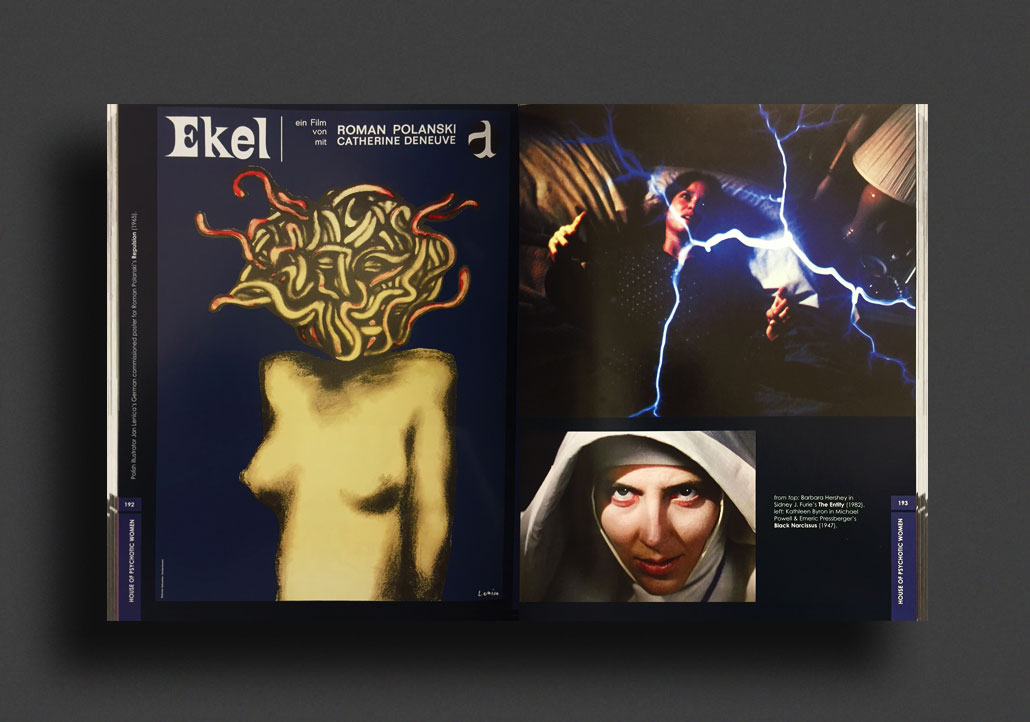
In 2012, a book debuted that would go on to canonical status and usher in a new way of writing about film. Kier-La Janisse's HOUSE OF PSYCHOTIC WOMEN is an autobiographical exploration of female neurosis in horror and exploitation films that examines hundreds of films through a daringly personal lens. In this pioneering work, anecdotes and memories interweave with film history, criticism, trivia and confrontational imagery to create a reflective personal history and a consideration of female madness, both onscreen and off.
To mark its 10th anniversary, Kier-La Janisse and FAB Press have reteamed to produce an expanded edition the book, featuring new writing on 100 more films - many of which were inspired in part by the book itself - and hundreds of new images. This hardcover expanded edition is now available in softcover.
Cinema is full of neurotic personalities, but few things are more transfixing than a woman losing her mind onscreen. Horror as a genre provides the most welcoming platform for these histrionics: crippling paranoia, desperate loneliness, masochistic death-wishes, dangerous obsessiveness, apocalyptic hysteria. Unlike her male counterpart - 'the eccentric' - the female neurotic lives a shamed existence, making these films those rare places where her destructive emotions get to play.
This sharply-designed book, including a 48-page full-colour section, is packed with 680 rare stills, posters, pressbooks and artwork throughout, that combine with family photos and artifacts to form a titillating sensory overload, with a filmography that traverses the acclaimed and the obscure in equal measure. Films covered include The Entity, The Corruption of Chris Miller, Singapore Sling, 3 Women, Toys Are Not for Children, Repulsion, Let's Scare Jessica to Death, The Haunting of Julia, Secret Ceremony, Cutting Moments, Out of the Blue, Mademoiselle, The Piano Teacher, Possession, Antichrist and hundreds more!
Compendium of Female Neurosis. A cross-section of horror and violent exploitation films that feature disturbed or neurotic women as primary or pivotal characters.
Alice, Sweet Alice; All the Colors of the Dark; Alucarda; Anima persa; Antichrist; Asylum; The Attic; Audition; Autopsy; The Baby; Bad Dreams; Bad Guy; Bas-fonds; Bedevilled; The Beguiled; La Belle Bête; The Bird with the Crystal Plumage; Black Narcissus; Black Swan; The Blood Spattered Bride; The Blue Eyes of the Broken Doll; Born Innocent; Boy Meets Girl; The Brave One; The Bride; The Brood; Burnt Offerings; Butcher, Baker, Nightmare Maker; Can Go Through Skin; A Candle for the Devil; Carrie; La casa muda; Cat People; La cérémonie; Children Shouldn't Play with Dead Things; Christiane F.; The Collector; The Corruption of Chris Miller; Les cousines; "Criminally Insane"; The Curse of the Cat People; Cutting Moments; Daddy; Dead Creatures; Defenceless: A Blood Symphony; Dementia; Descent; The Devil's Widow; The Devils; Diabel; Die! Die! My Darling!; The Dinner Party; Dirty Weekend; Dr. Jekyll and His Women; Don't Deliver Us from Evil; Don't Look Now; Don't Torture a Duckling; Doppelganger; Dracula's Daughter; Dream Home; The Entity; The Escapees; Eyes of a Stranger; Fatal Attraction; Feed; Five Across the Eyes; Footprints; Forbidden Photos of a Lady Above Suspicion; Four Flies on Grey Velvet; Freeze Me; The Frightened Woman; Frightmare; Funeral Home; Gently Before She Dies; The Geography of Fear; The Girl Next Door; The Glass Ceiling; Goodbye Gemini; A Gun for Jennifer; Handgun; Happy Birthday to Me; Hard Candy; The Haunting (1963); The Haunting (2009); The Haunting of Julia; Haute tension; Heavenly Creatures; The Honeymoon Killers; A Horrible Way to Die; I Never Promised You a Rose Garden; Images; In My Skin; The Innocents; Inside; The Isle; Julie Darling; Kichiku; The Killer Nun; Kissed; Knife of Ice; The Ladies Club; The Last Exorcism; The Legend of Lylah Clare; The Legend of the Wolf Woman; Let's Scare Jessica to Death; A Lizard in a Woman's Skin; Love Me Deadly; The Loved Ones; Macabre; The Mad Room; Mademoiselle; Madhouse (1974); Madhouse (1981); Madness; The Mafu Cage; Man, Woman and Beast; Marnie; Martyrs; Masks; May; Misery; Morris County; Morvern Callar; Mother's Day; Ms.45; Mumsy, Nanny, Sonny & Girly; Nabi: The Butterfly; Neighbor; Neither the Sea Nor the Sand; Nekromantik; Nekromantik 2; Next of Kin; The Night Porter; A Night to Dismember; Nightbirds; Nightmares; La nuit des traquées; The Other Hell; The Other Side of the Underneath; Out of the Blue; Paranoia; Paranormal Activity; The Perfume of the Lady in Black; Persona; Phenomena; The Piano Teacher; Pigs; Play Misty for Me; Possession; Pretty Poison; Prey; Psycho Girls; The Rapture; The Rats Are Coming! The Werewolves Are Here!; Rebecca; Red Desert; Red Sun; Red White & Blue; The Reincarnation of Peter Proud; Repulsion; Road to Salina; Roman's Bride; Santa Sangre; Schizo; Scissors; Scream 4; Séance on a Wet Afternoon; Secret Ceremony; The Secret Life of Sarah Sheldon; Shock; Singapore Sling; Sinner; Sisters (1973); Sisters (2006); Slaughter Hotel; The Snake Pit; Sombre; Spider Baby; The Stendhal Syndrome; Straight On Till Morning; Strait-Jacket; The Strange Possession of Mrs. Oliver; The Strange Vengeance of Rosalie; Symptoms; Szamanka; That Cold Day in the Park; They Call Her One Eye; 3 Women; To Let; Toys Are Not for Children; Trance; Trilogy of Terror; Trouble Every Day; Twin Peaks: Fire Walk with Me; The Uninvited; Venom; Venus Drowning; The Washing Machine; What Ever Happened to Baby Jane?; The Whip and the Body; Whoever Slew Auntie Roo?; Windows; The Witch Who Came from the Sea; The Woman; Woman Transformation; Wound PLUS MORE THAN 100 EXTRA FILM REVIEWS EXCLUSIVE TO THIS NEW EDITION
Kier-La Janisse is a film writer, programmer, producer and founder of The Miskatonic Institute of Horror Studies. She is the author of A Violent Professional: The Films of Luciano Rossi (2007) and has been an editor on numerous books including Warped & Faded: Weird Wednesday and the Birth of the American Genre Film Archive (2021), Yuletide Terror: Christmas Horror on Film and Television (2017) and Satanic Panic: Pop-Cultural Paranoia in the 1980s (2015). She was a producer on David Gregory’s Tales of the Uncanny (2020) and wrote, directed and produced the award-winning documentary Woodlands Dark and Days Bewitched: A History of Folk Horror (2021) for Severin Films, where she is a producer and editor of supplemental features. She is currently at work on several books including a monograph about Monte Hellman’s Cockfighter.
2025, English
Softcover, 224 pages, 21 x 14 cm
Published by
Liveright / US
$38.00 - In stock -
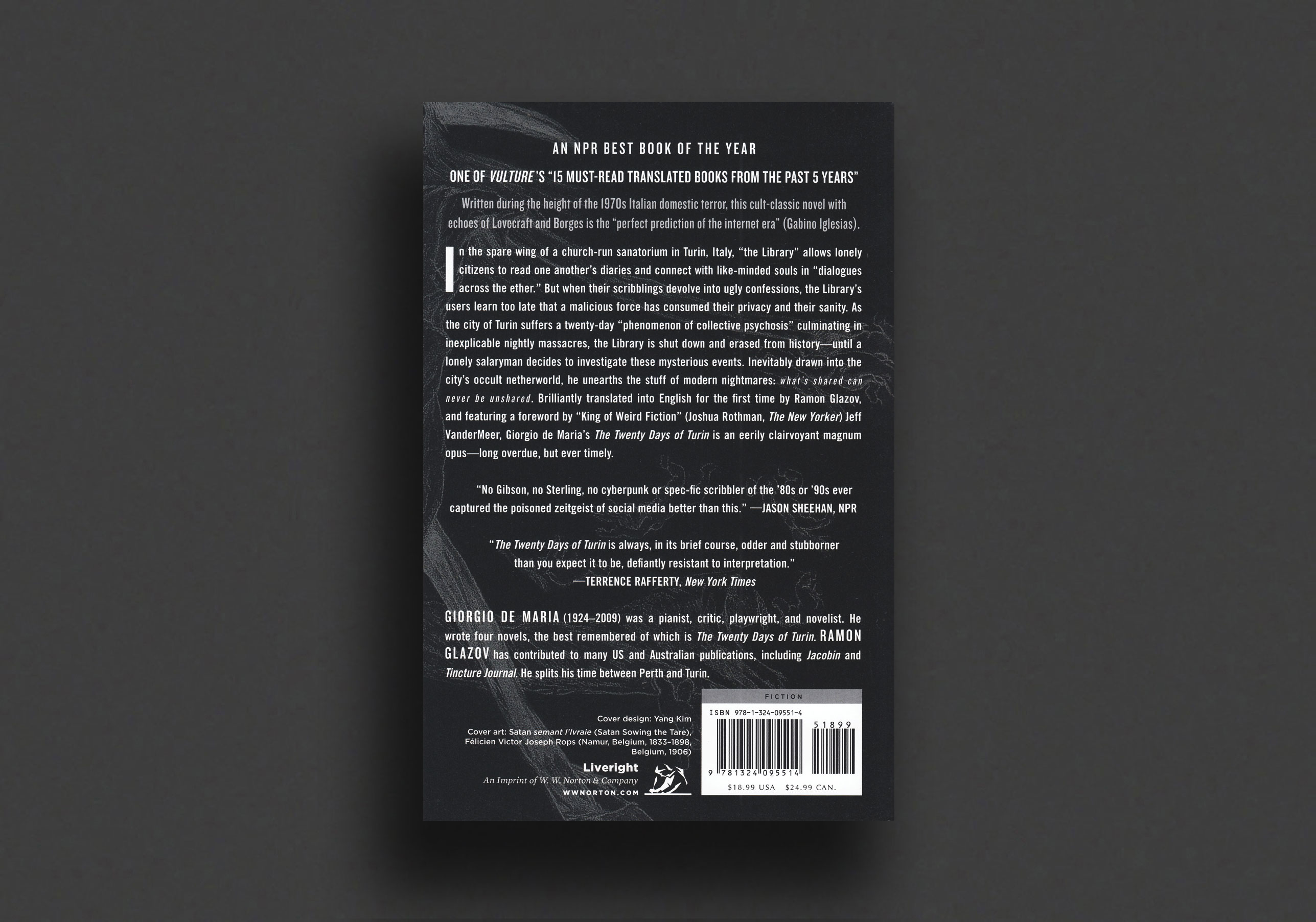
In the spare wing of a church-run sanatorium, some zealous youths create "the Library," a space where lonely citizens can read one another's personal diaries and connect with like-minded souls in "dialogues across the ether." But when their scribblings devolve into the ugliest confessions of the macabre, the Library's users learn too late that a malicious force has consumed their privacy and their sanity. As the city of Turin suffers a twenty-day "phenomenon of collective psychosis" culminating in nightly massacres that hundreds of witnesses cannot explain, the Library is shut down and erased from history. That is, until a lonely salaryman decides to investigate these mysterious events, which the citizenry of Turin fear to mention. Inevitably drawn into the city's occult netherworld, he unearths the stuff of modern nightmares: what's shared can never be unshared.
An allegory inspired by the grisly neo-fascist campaigns of its day, The Twenty Days of Turin has enjoyed a fervent cult following in Italy for forty years. Now, in a fretful new age of "lone-wolf" terrorism fueled by social media, we can find uncanny resonances in Giorgio De Maria's vision of mass fear: a mute, palpitating dread that seeps into every moment of daily existence. With its stunning anticipation of the Internet—and the apocalyptic repercussions of oversharing—this bleak, prescient story is more disturbingly pertinent than ever.
Brilliantly translated into English for the first time by Ramon Glazov, The Twenty Days of Turin establishes De Maria's place among the literary ranks of Italo Calvino and beside classic horror masters such as Edgar Allan Poe and H. P. Lovecraft. Hauntingly imaginative, with visceral prose that chills to the marrow, the novel is an eerily clairvoyant magnum opus, long overdue but ever timely.
First 2025 paperback edition!
1973, English
Softcover, 300 pages, 18 x 11 cm
1st Edition, Out of print title / used / good
Published by
Panther / London
$35.00 - Out of stock
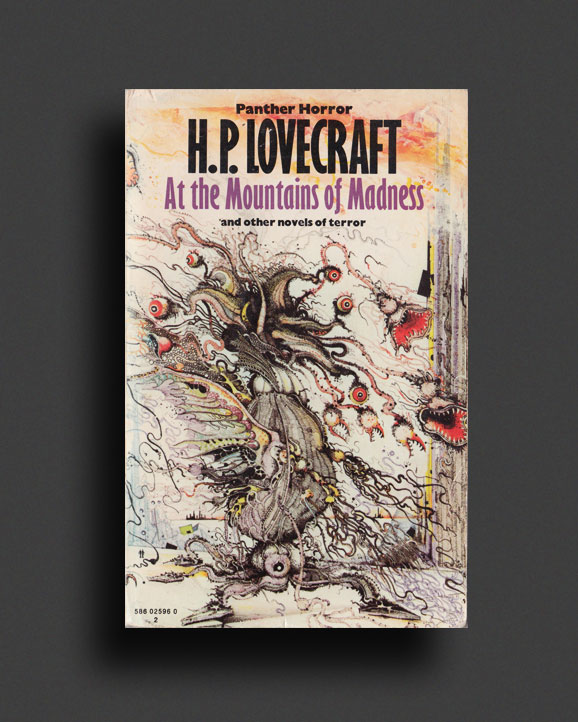
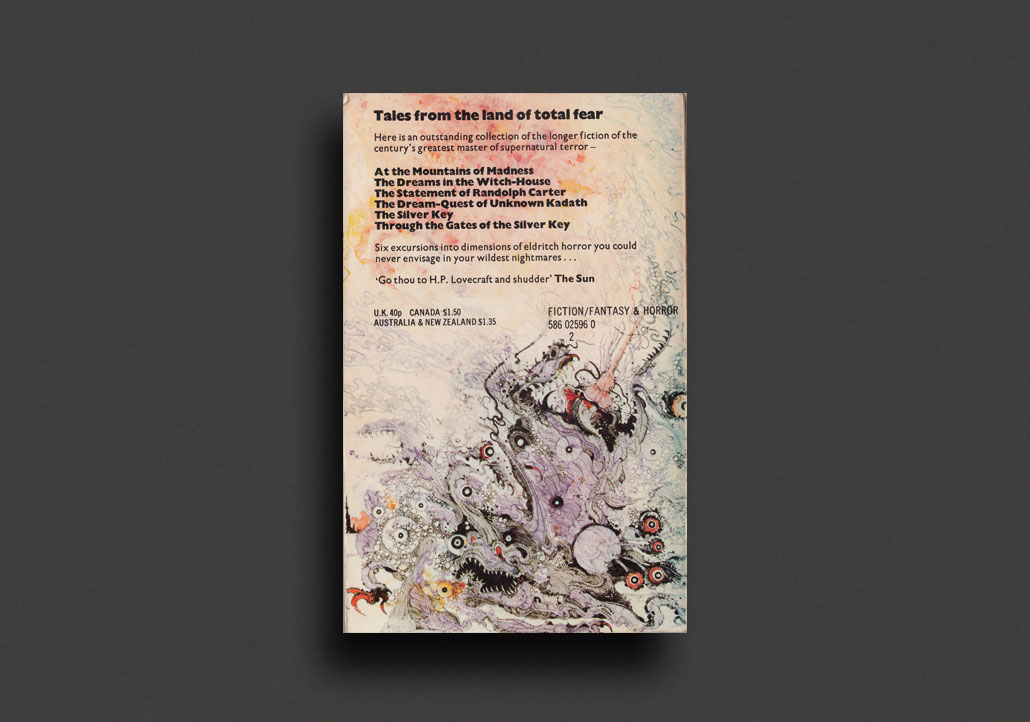
Panther's scarcer 1973 edition of H.P. Lovecraft's "At the Mountains of Madness", an outstanding collection of Lovecraft's longer supernatural terror. Includes : At the Mountains of Madness, The Dreams in the Witch-House, The Dream Quest of Unknown Kadath, The Statement of Randolph Carter, The Silver Key, Through the Gates of the Silver Key. Cover art by the great Ian Miller.
Howard Phillips Lovecraft (August 20, 1890 – March 15, 1937) was an American writer, who achieved posthumous fame through his influential works of horror fiction. He was virtually unknown and published only in pulp magazines before he died in poverty, but he is now regarded as one of the most significant 20th-century authors of horror and weird fiction.
Lovecraft was born in Providence, Rhode Island, where he spent most of his life. Among his most celebrated tales are "The Rats in the Walls", "The Call of Cthulhu", At the Mountains of Madness, The Shadow over Innsmouth, and The Shadow Out of Time, all canonical to the Cthulhu Mythos. Lovecraft was never able to support himself from earnings as an author and editor. He saw commercial success increasingly elude him in this latter period, partly because he lacked the confidence and drive to promote himself. He subsisted in progressively strained circumstances in his last years; an inheritance was completely spent by the time he died, at age 46.
In 1962 Colin Wilson, in his survey of anti-realist trends in fiction The Strength to Dream, cited Lovecraft as one of the pioneers of the "assault on rationality" and included him with M. R. James, H. G. Wells, Aldous Huxley, Tolkien and others as one of the builders of mythicised realities over against the failing project of literary realism. Subsequently, Lovecraft began to acquire the status of a cult writer in the counterculture of the 1960s, and reprints of his work proliferated. Philosopher Graham Harman, seeing Lovecraft as having a unique—though implicit—anti-reductionalist ontology, writes: "No other writer is so perplexed by the gap between objects and the power of language to describe them, or between objects and the qualities they possess." Harman said of leading figures at the initial speculative realism conference (which included philosophers Quentin Meillassoux, Ray Brassier, and Iain Hamilton Grant) that, though they shared no philosophical heroes, all were enthusiastic readers of Lovecraft. Speculative realists, Mark Fisher and other contemporary philosophers, took Lovecraft seriously, mainly because Lovecraft's weird reality as presented in his novels, had nothing to do with the Gothic's insistence in the supernatural, but presented another reality incomprehensible to the human mind, but nonetheless real. According to scholar S. T. Joshi: "There is never an entity in Lovecraft that is not in some fashion material".
Good copy, with tanning to spine and foxing to block edges, otherwise a nice, tightly bound copy.
2024, English
Softcover, 128 pages, 20 x 13 cm
Published by
Silver Press / London
$37.00 - Out of stock
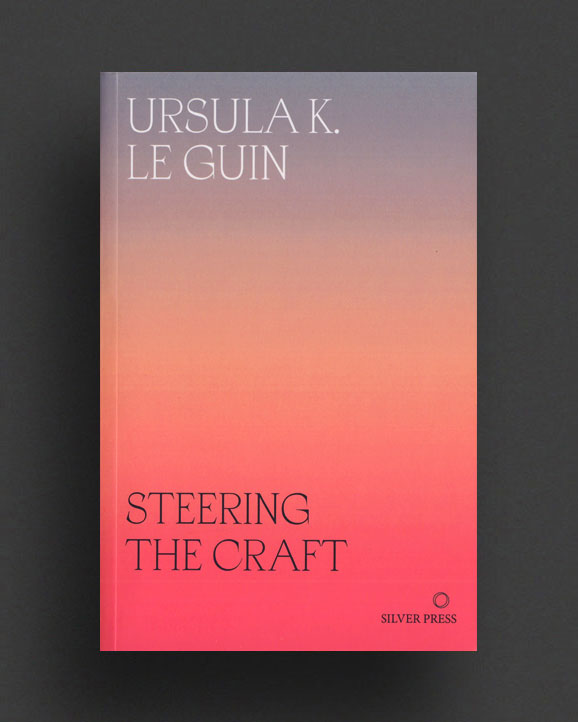
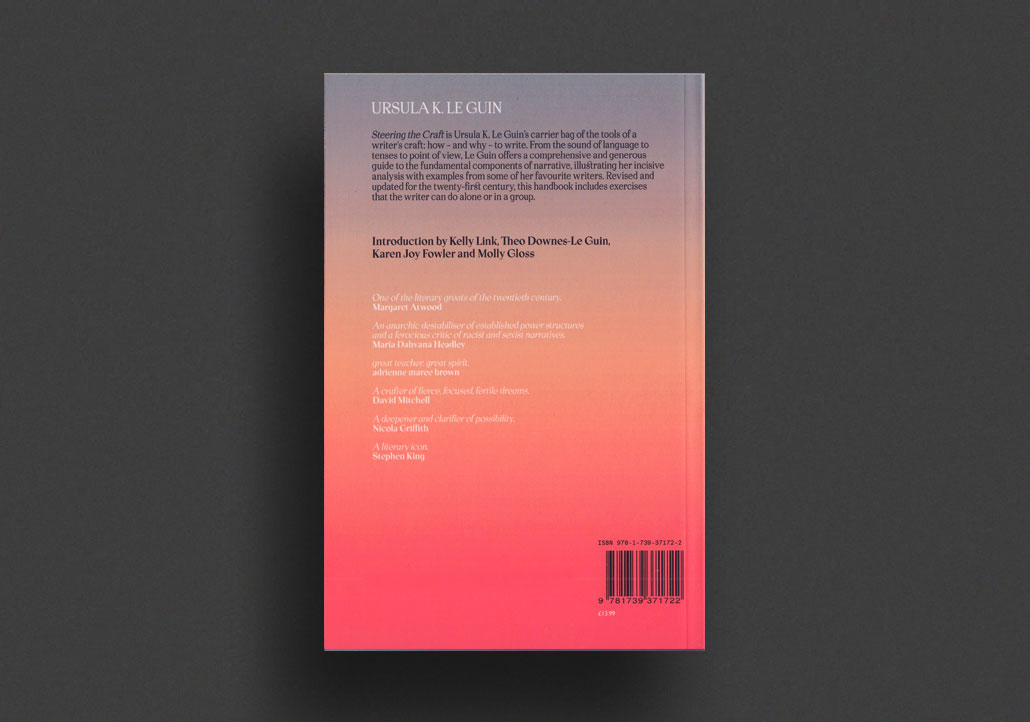
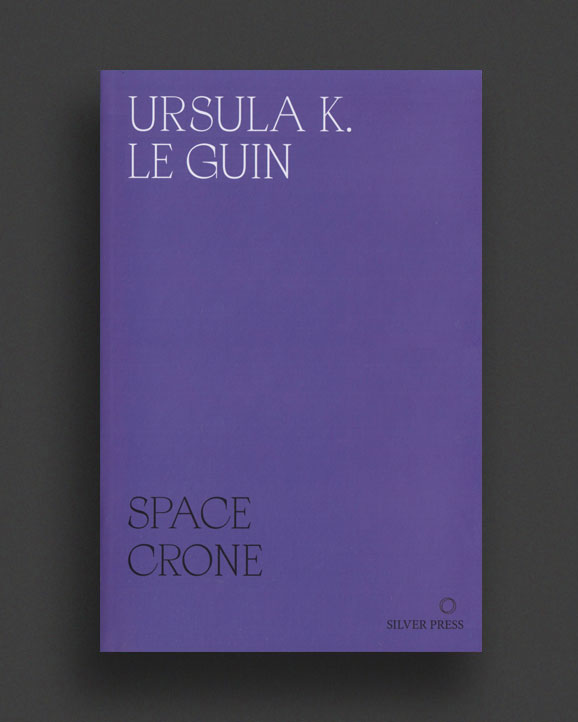
Revised and updated for the twenty-first century, 'Steering the Craft' is Ursula K. Le Guin’s carrier bag of the essentials of a writer’s craft, a generous gift from one of the great thinkers about how – and why – to write. An accessible and profound guide to the craft of writing and editing, in this handbook Le Guin lays out ten chapters that address the most fundamental components of narrative, from the sound of language to sentence construction to point of view. Drawing on the global canon, Le Guin offers her inimitably witty commentary and incisive dissection, developing into an exercise that the writer can do solo or in a group. No other writing guide offers such a comprehensive, experienced and kind approach to “steering the craft” as a writing crew.
2023, English
Softcover, 212 pages, 19.8 x 12.9 cm
Published by
Silver Press / London
$37.00 - In stock -
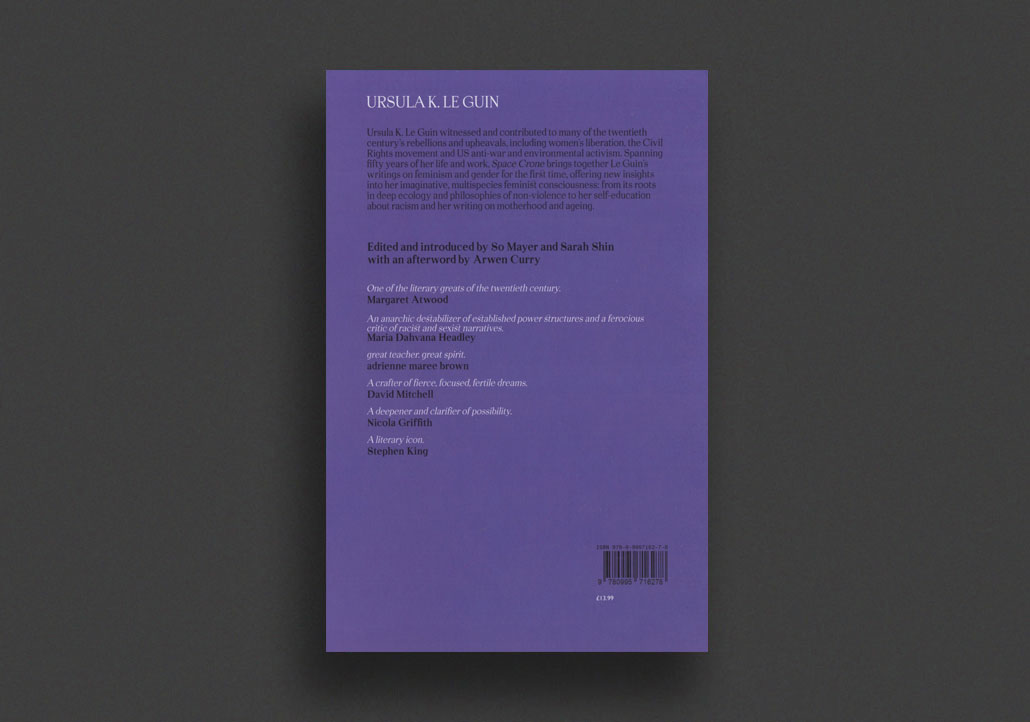
This title brings together for the first time celebrated author Ursula K. Le Guin’s writings on feminism and gender. Witness to the twentieth century’s rebellions and upheavals, including women’s liberation, the civil rights movement and anti-war and environmental activism, Le Guin continued to fight for social and environmental justice throughout her life. The book shows the development of Le Guin’s expansive, multilayered and deeply radical feminist consciousness.
Famous for her experiments in imagining society where gender is irrelevant in novels such as The Left Hand of Darkness, Le Guin’s feminism kept ahead of the times to reimagine gender in a non-essentialising way. Her feminism developed from its roots in her ecological, anti-war and anti-nuclear activism, to her self-education about racism and her writing about ageing.
2025, English
Softcover, 320 pages, 20.3 x 13.3 cm
Published by
Wakefield Press / Cambridge
$42.00 - In stock -
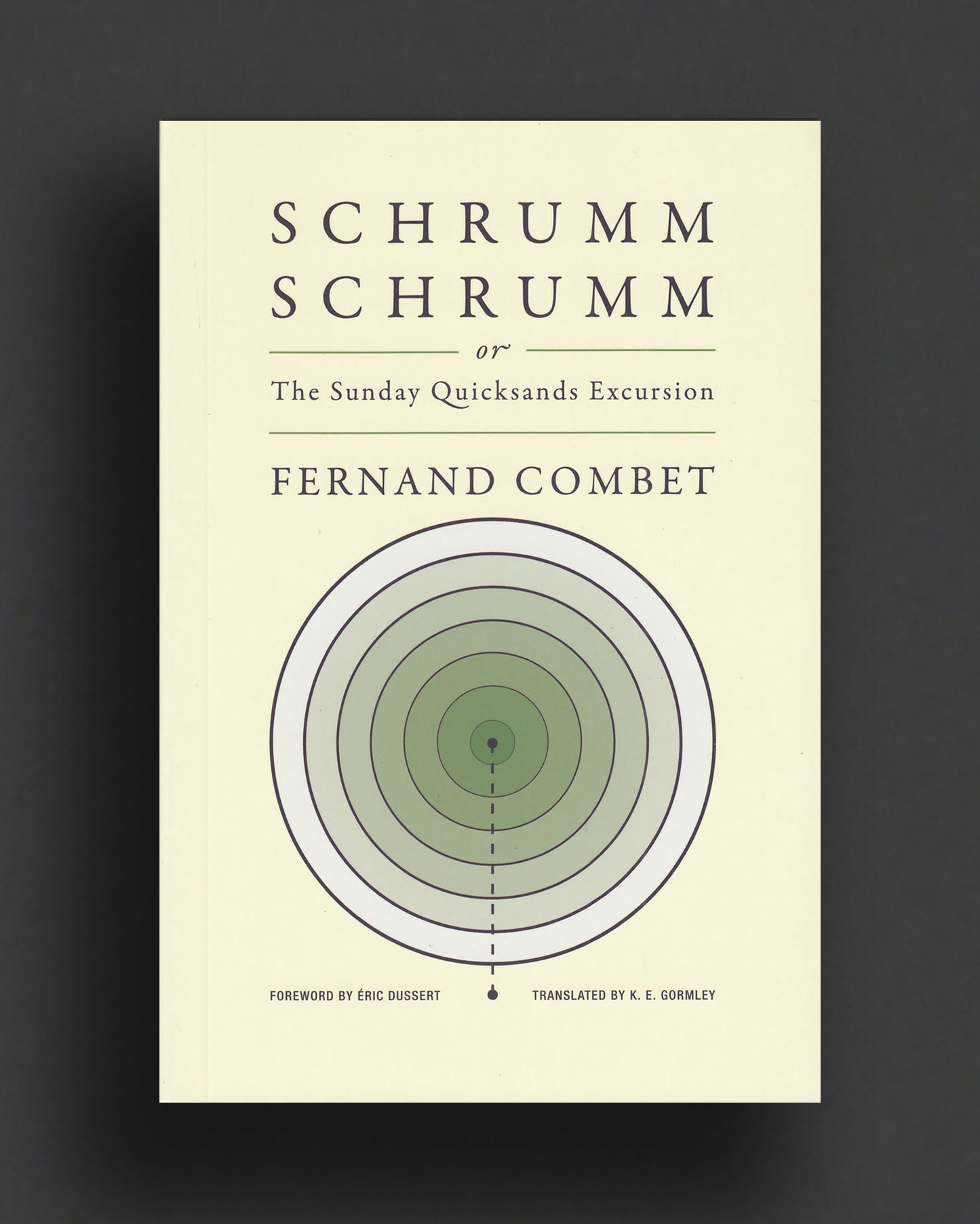
This novel by French writer Fernand Combet is at long last available in English — a delightfully delirious novel in which absurdity gives way to nightmare.
Introduction by Éric Dussert. Translation by K.E. Gormley.
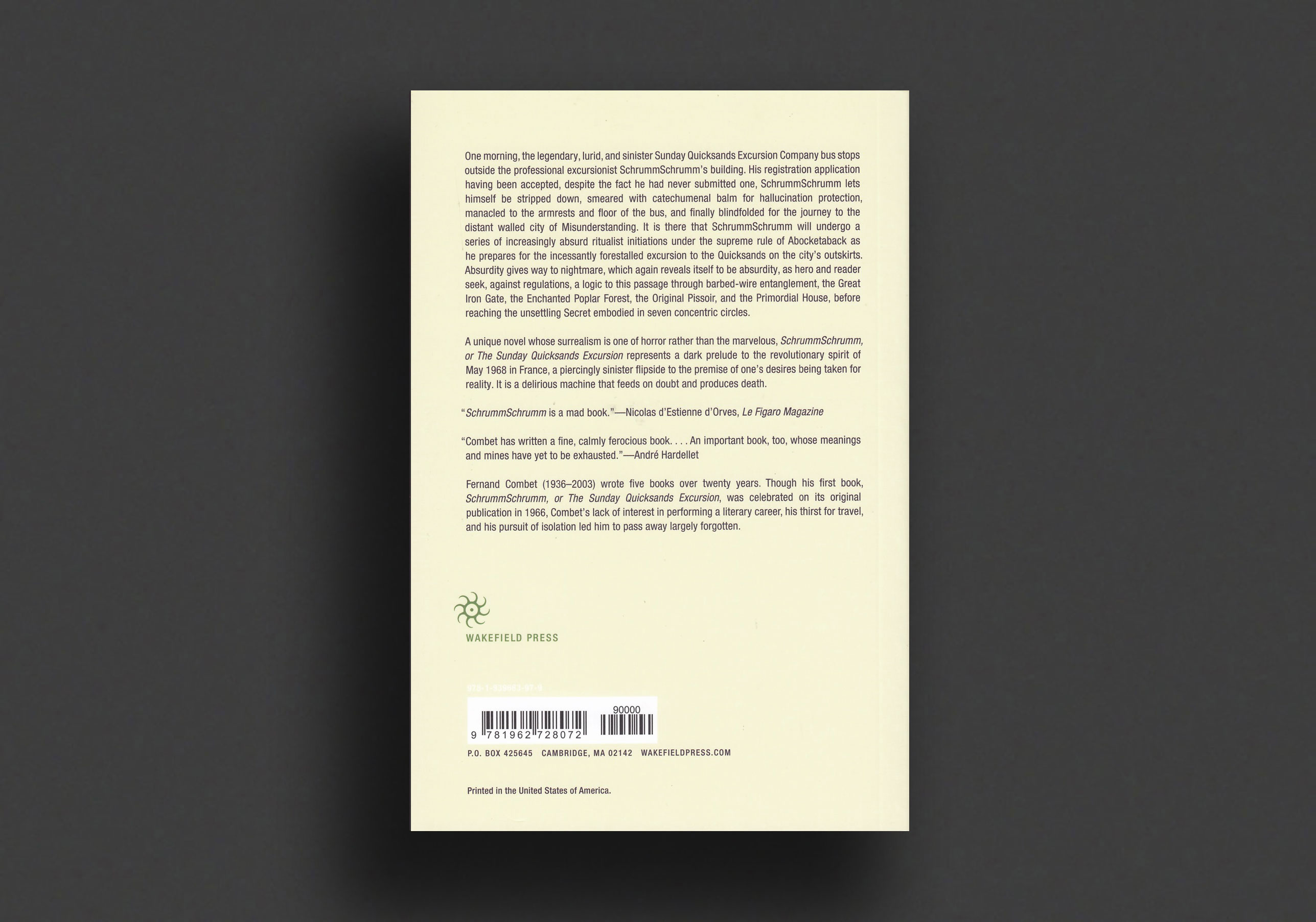
A unique novel whose surrealism is one of horror rather than the marvelous, SchrummSchrumm, or The Sunday Quicksands Excursion represents a dark prelude to the revolutionary spirit of May 1968 in France, a piercingly sinister flipside to the premise of one’s desires being taken for reality. It is a delirious machine that feeds on doubt and produces death. One morning, the legendary, lurid, and sinister Sunday Quicksands Excursion Company bus stops outside the professional excursionist SchrummSchrumm’s building. His registration application having been accepted, despite the fact he had never submitted one, SchrummSchrumm lets himself be stripped down, smeared with catechumenal balm for hallucination protection, manacled to the armrests and floor of the bus, and finally blindfolded for the journey to the distant walled city of Misunderstanding. It is there that SchrummSchrumm will undergo a series of increasingly absurd ritualist initiations under the supreme rule of Abocketaback as he prepares for the incessantly forestalled excursion to the Quicksands on the city’s outskirts. Absurdity gives way to nightmare, which again reveals itself to be absurdity, as hero and reader seek, against regulations, a logic to this passage through barbed-wire entanglement, the Great Iron Gate, the Enchanted Poplar Forest, the Original Pissoir, and the Primordial House, before reaching the unsettling Secret embedded in seven concentric circles.
“SchrummSchrumm is a mad book.”—Nicolas d’Estienne d’Orves, Le Figaro Magazine
“SchrummSchrumm is without a doubt one of the great novels of the twentieth century, one of those books that will never cease to astound us.”—Éric Dussert
“Combet has written a fine, calmly ferocious book. . . . An important book, too, whose meanings and mines have yet to be exhausted.”—André Hardellet
Fernand Combet (1936–2003) wrote five books over twenty years. Though his first book, SchrummSchrumm, or The Sunday Quicksands Excursion, was celebrated on its original publication in 1966, Combet’s lack of interest in performing a literary career, his thirst for travel, and his pursuit of isolation led him to pass away largely forgotten.
Éric Dussert is a writer, editor, and literary critic specializing in forgotten literary texts.
2017, English
Softcover, 168 pages, 20 x 12.5 cm
Published by
Silver Press / London
$35.00 - In stock -
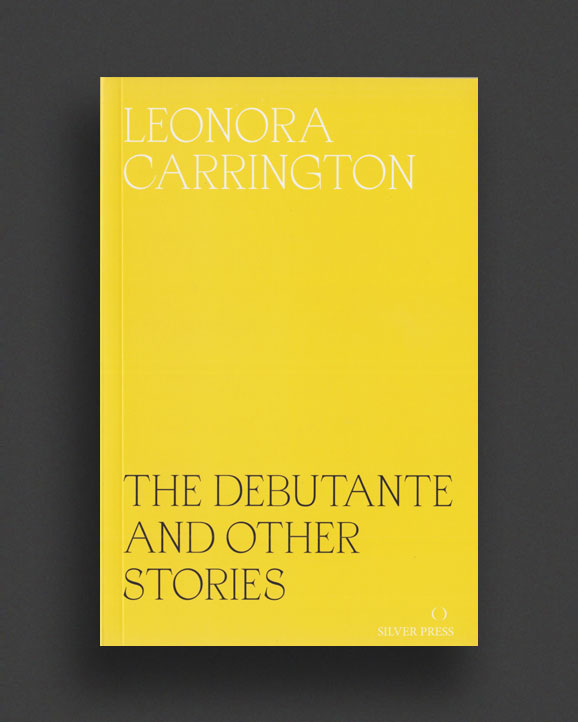
With an Introduction by Sheila Heti and an Afterword by Marina Warner
A debutante frees a hyena from the zoo so that it might take her place at her coming-out ball; an artist paints a portrait of a man’s dead wife, but finds she has painted herself instead; a psychoanalyst must decide what to do with the gift of a team of Russian rats trained to operate on humans. In this first complete edition of Leonora Carrington’s short stories, written throughout her life from her early years in Surrealist Paris to her late period in Dirty War-era Mexico City, the world is by turns subversive, funny, sly, wise and disarming.
1984, Japanese
Softcover (w. dust jacket), 98 pages (w. fold-outs), 42 x 30 cm
1st Edition, Out of print title / used / very good
Published by
Treville / Tokyo
$220.00 - Out of stock
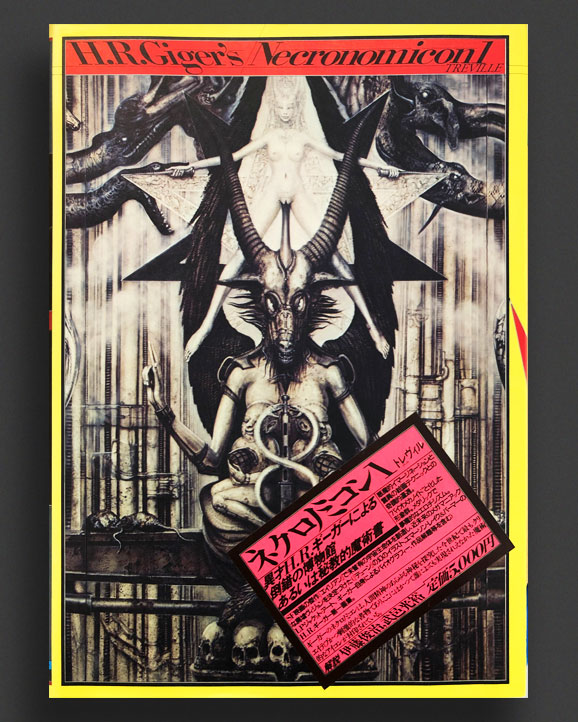
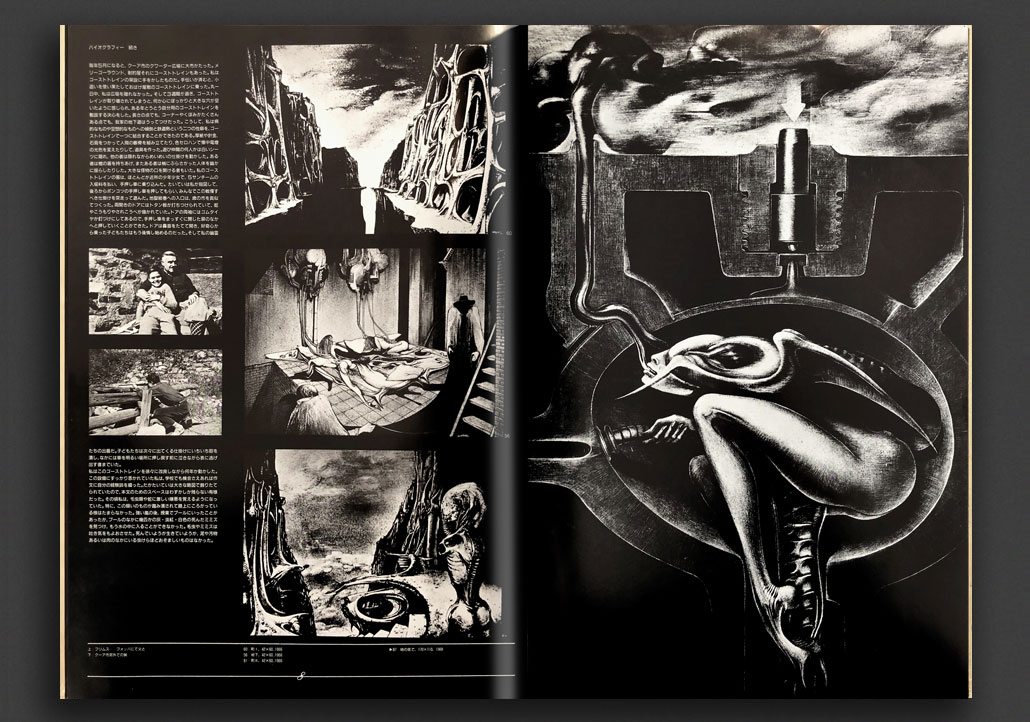
First Japanese edition of H.R. Giger's Necronomicon from 1984. Beginning with a hommage from Salvador Dali and introduction by Clive Baker, the first in this series of oversized and visually overwhelming Giger-designed volumes takes us through the early history of one of the most brilliant fantasy artists of the century. From his "Passegen" series, his work for theatre, posters, album artwork, environments, personal works, is designs for Alejandro Jodorowsky's DUNE, and much more, all beautifully reproduced in full-colour and black and white, full-bleed spreads, including fold-out pages. These Giger folio books have become very desirable, collectable editions in their various printings around the world, the series encompassing the work of one of the world's most unique and influential visionaries of the macabre. This is volume 1 of 2 of "HR Giger's Necronomicon" where Al Azred's legendary magical book of the most wonderful abominations and perversions, "Necronomicon" (made infamous in the pages of HP Lovecraft's "Cthulhu" mythology), becomes a visual reality!
With an introduction by Clive Baker and numerous texts by HR Giger as well as texts by Fritz Billeter and Simon Vinkenoog and a tribute from Salvador Dali. Note: Japanese language edition.
First Japanese edition, published by Treville, Tokyo, in 1984. Very good copy throughout with Very Good dust jacket. Some edge wear with fragile, oversized edition.
1987, Japanese
Softcover (w. dust jacket), 98 pages (w. fold-outs), 42 x 30 cm
1st Edition, Out of print title / used / very good
Published by
Treville / Tokyo
$180.00 - Out of stock
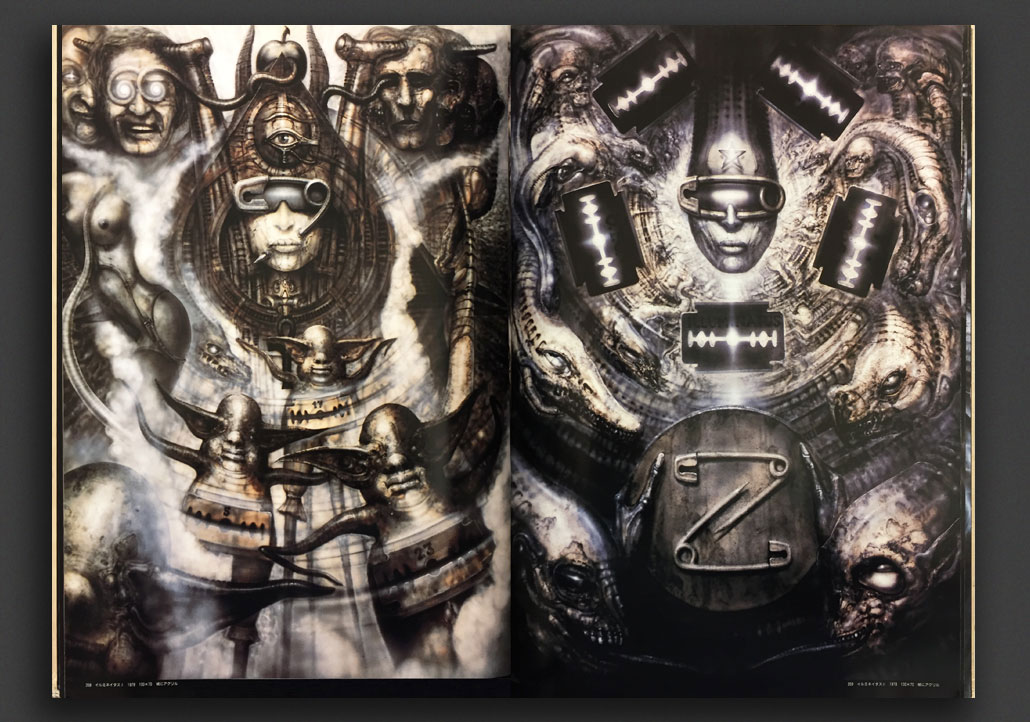
First Japanese edition of H.R. Giger's Necronomicon II, the second oversized and visually overwhelming Giger-designed collection that takes us further through the incredible history of one of the most brilliant fantasy artists of the century. Reproducing Giger's award-winning work for the film ALIEN, his paintings, environments, sculptural works, his work for never shot film "The Tourist", collaborations with Blondie's Debbie Harry, his "New York City" series from the late 1970's and much more, all beautifully reproduced in full-colour and black and white, full-bleed spreads, including fold-out pages. Also includes interviews, texts, biography. These Giger folio books have become very desirable, collectable editions in their various printings around the world, the series encompassing the work of one of the world's most unique and influential visionaries of the macabre. This is volume 2 of 2 of "HR Giger's Necronomicon" where Al Azred's legendary magical book of the most wonderful abominations and perversions, "Necronomicon" (made infamous in the pages of HP Lovecraft's "Cthulhu" mythology), becomes a visual reality!
First Japanese edition, published by Treville, Tokyo, in 1987. Very good copy throughout with Very Good dust jacket. Some light wear to over-sized book.
2003, English
Softcover, 378 pages, 19.6 x 12.6 cm
1st Edition, Out of print title / used / very good
Published by
Dedalus / Cambs
$40.00 - In stock -
First 2003 edition of Gary Lachman's The Dedalus Book of the Occult, a celebration of the influence of occult thought and sensibility on some of the central poets and writers of the last two centuries, beginning with the Enlightenment obsession with occult politics, through the Romantic explosion, the paradoxically decadent and futuristic occultism of the fin de siècle, and the deep occult roots of the modernist movement. Swedenborg, Baudelaire, Huysmans and Strindberg are only some of the names to feature in this hidden history of western thought.
Very Good copy with some light wear to boards, rubbing.
1991, English
Softcover, 416 pages, 20 x 12.5 cm
1st Edition, Out of print title / used / very good
Published by
Dedalus / Cambs
$20.00 - In stock -
First 1991 edition of The Dedalus Book of British Fantasy : The 19th Century, compiled with introduction and notes by Brian Stableford.
Beginning in 1804 with Nathan Drake's 'Henry Fitzowen', The Dedalus Book of British Fantasy traces the development of the genre through the stories and poems of Coleridge, Keats, Dickens, Disraeli, William Morris, Christina Rossetti, Tennyson and Vernon Lee, until the end of the century and Richard Garnett's 'Alexander the Ratcatcher'.
Each text has been chosen to illustrate the development of the various aspects of fantasy in British Literature - the comic,the sentimental. the erotic and the allegorical - and the contribution that these authors made to the emergence of the genre.
G—VG copy with foxing to block edges, some light wear.
1973, English
Softcover, 244 pages, 17.5 x 10.7 cm
Out of print title / used / very good
Published by
Sphere / UK
$35.00 - Out of stock
"What you hold in your hands is more than a book. If we are lucky, it is a revolution"—Harlan Ellison
Anthologies seldom make history, but Dangerous Visions is a grand exception. Harlan Ellison's 1967 collection of science fiction stories set an almost impossibly high standard.
First 1973 Sphere volume of DANGEROUS VISIONS, a landmark science fiction short story anthology, edited by American author Harlan Ellison and illustrated by Leo and Diane Dillon. It was first published in 1967 and contained 33 stories, none of which had been previously published. A path-breaking collection, Dangerous Visions helped define the New Wave science fiction movement, particularly in its depiction of sex in science fiction. Writer/editor Al Sarrantonio wrote that Dangerous Visions "almost single-handedly [...] changed the way readers thought about science fiction." Contributors to the volume included 20 authors who had won, or would win, a Hugo, Nebula, World Fantasy, or BSFA award, and 16 with multiple such awards. Ellison introduced the anthology both collectively and individually while authors provided afterwords to their own stories.
Features the stories of Isaac Asimov, Harlan Ellison, Lester del Rey, Robert Silverberg, Frederik Pohl, Philip José Farmer, Miriam Allen de Ford, Robert Bloch, Brian W. Aldiss.
G—VG with foxing to block edge, toning to pages/spine.
1973, English
Softcover, 232 pages, 17.5 x 10.7 cm
Out of print title / used / very good
Published by
Sphere / UK
$35.00 - Out of stock
"What you hold in your hands is more than a book. If we are lucky, it is a revolution"—Harlan Ellison
Anthologies seldom make history, but Dangerous Visions is a grand exception. Harlan Ellison's 1967 collection of science fiction stories set an almost impossibly high standard.
Second 1973 Sphere volume of DANGEROUS VISIONS, a landmark science fiction short story anthology, edited by American author Harlan Ellison and illustrated by Leo and Diane Dillon. It was first published in 1967 and contained 33 stories, none of which had been previously published. A path-breaking collection, Dangerous Visions helped define the New Wave science fiction movement, particularly in its depiction of sex in science fiction. Writer/editor Al Sarrantonio wrote that Dangerous Visions "almost single-handedly [...] changed the way readers thought about science fiction." Contributors to the volume included 20 authors who had won, or would win, a Hugo, Nebula, World Fantasy, or BSFA award, and 16 with multiple such awards. Ellison introduced the anthology both collectively and individually while authors provided afterwords to their own stories.
Features the stories of Harlan Ellison, Howard Rodman, Philip K. Dick, Larry Niven, Fritz Leiber, Foe L. Hensley, Poul Anderson, David R. Bunch, James Cross, Carol Emshwiller, Damon Knight.
G—VG with foxing to block edge, toning to pages/spine.
1977, English
Softcover, 450 pages, 18 x 11.2 cm
Out of print title / used / very good
Published by
Pan / London
$30.00 - In stock -
1977 Pan paperback edition of 'Again, Dangerous Visions' a science fiction short story anthology, edited by American author Harlan Ellison first published in 1972. It is the follow-up to the ;landmark Dangerous Visions (1967), also edited by Ellison.
"There has never been anything quite like this book"—Theodore Sturgeon
"'The chief prophet of the New Wave in science fiction"—New Yorker
Features the stories of Harlan Ellison, John Heidenry, Ross Rocklynne, Ursula K. Le Guin, Andrew J. Offutt, Gene Wolfe, Ray Nelson, Ray Bradbury, Chad Oliver, Edward Bryant, Kate Wilhelm, James B. Hemesath, Joanna Russ, Kurt Vonnegut, T. L. Sherred, Barry N. Malzberg, H. H. Hollis, Bernard Wolfe, David Gerrold, Piers Anthony.
Like its predecessor, Again, Dangerous Visions, and many of the collected stories, have received awards recognition. "The Word for World is Forest", by Ursula K. Le Guin, won the 1973 Hugo for Best Novella. "When It Changed", by Joanna Russ, won a 1972 Nebula Award for Best Short Story. Harlan Ellison was recognized with a special Hugo Award for anthologizing, his second special award, in 1972. The collection as a whole won the 1973 Locus Award for Best Original Anthology.
VG copy with some light cover wear, light page toning.
2024, English
Hardcover, 224 pages, 24.5 x 24.5 cm
Published by
Hatje Cantz / Berlin
Albertina Modern / Vienna
$90.00 - In stock -
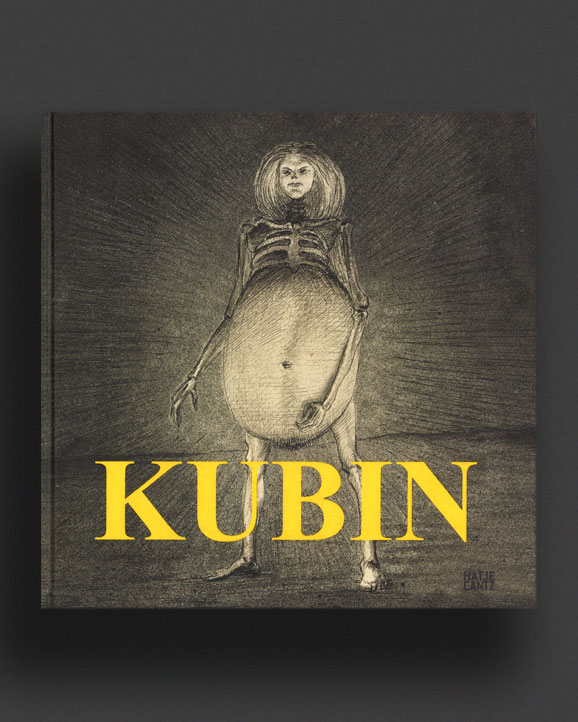
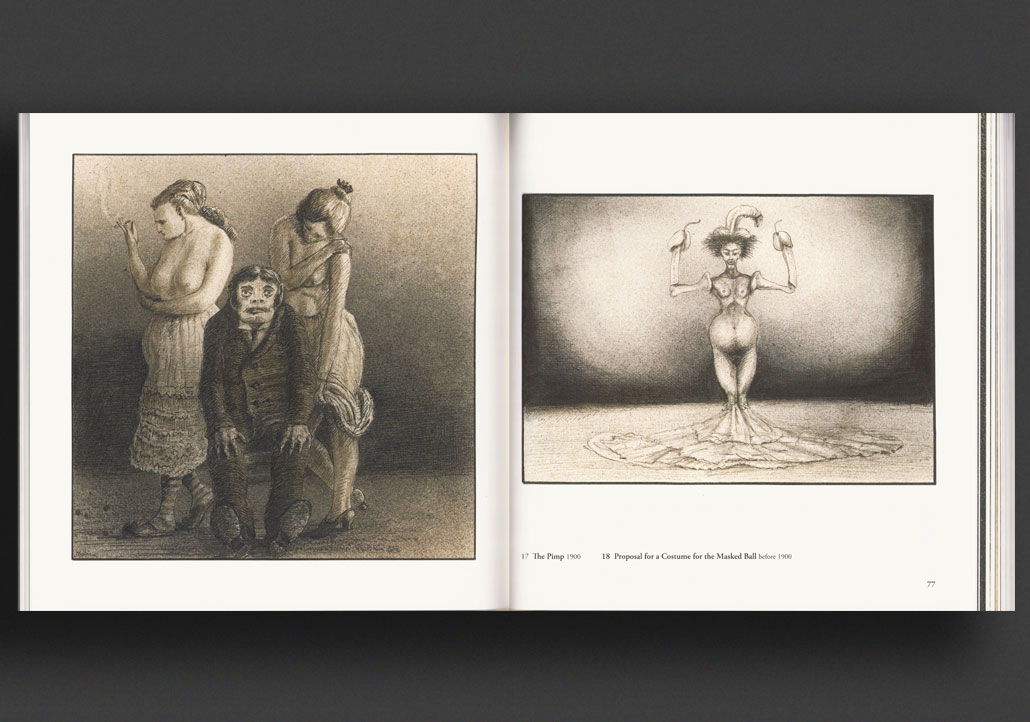
Kubin's eerie, unsettling illustrations reveal his preoccupation with the world's evils
For Austrian artist Alfred Kubin (1877-1959), evil was intrinsic to his life and work. After a traumatic childhood growing up in Zell am See and subsequent mental crises, he began his artistic training in Munich in 1898. He processed his nightmares and obsessions in a large number of fantastical drawings. His subjects, perpetually pessimistic, remain relevant a century later: war, famine, pestilence, death and every horror in between. Kubin had a pronounced fear of the feminine, sexuality, night time and of being at the mercy of fate, all of which visited him in uncanny dreams. For Kubin, the aesthetic of evil proved to be the antithesis of the idyll: the deliberate suppression of a hideous reality.
Drawn from the Albertina Museum's collection of over 1,800 drawings by the artist, The Aesthetic of Evil displays Kubin's grotesque vision as well as his superb draftsmanship. Amid the violent, haunting atmosphere of his graphic works it is easy to see how Kubin became trapped in his dark visions, to the point where the inexhaustible, intangible specter of evil consumed his life. Essays by Elisabeth Dutz, Natalie Lettner and Brigitte Holzinger explore Kubin's cosmos of the sinister: his personal iconography of evil fueled by his nightmares and obsessions.
Highest recommendation.
1989, English
Softcover (staple-bound), 20 pages, 30 x 21 cm
1st Edition, Out of print title / used / very good
Published by
Eyeball / London
$20.00 - Out of stock
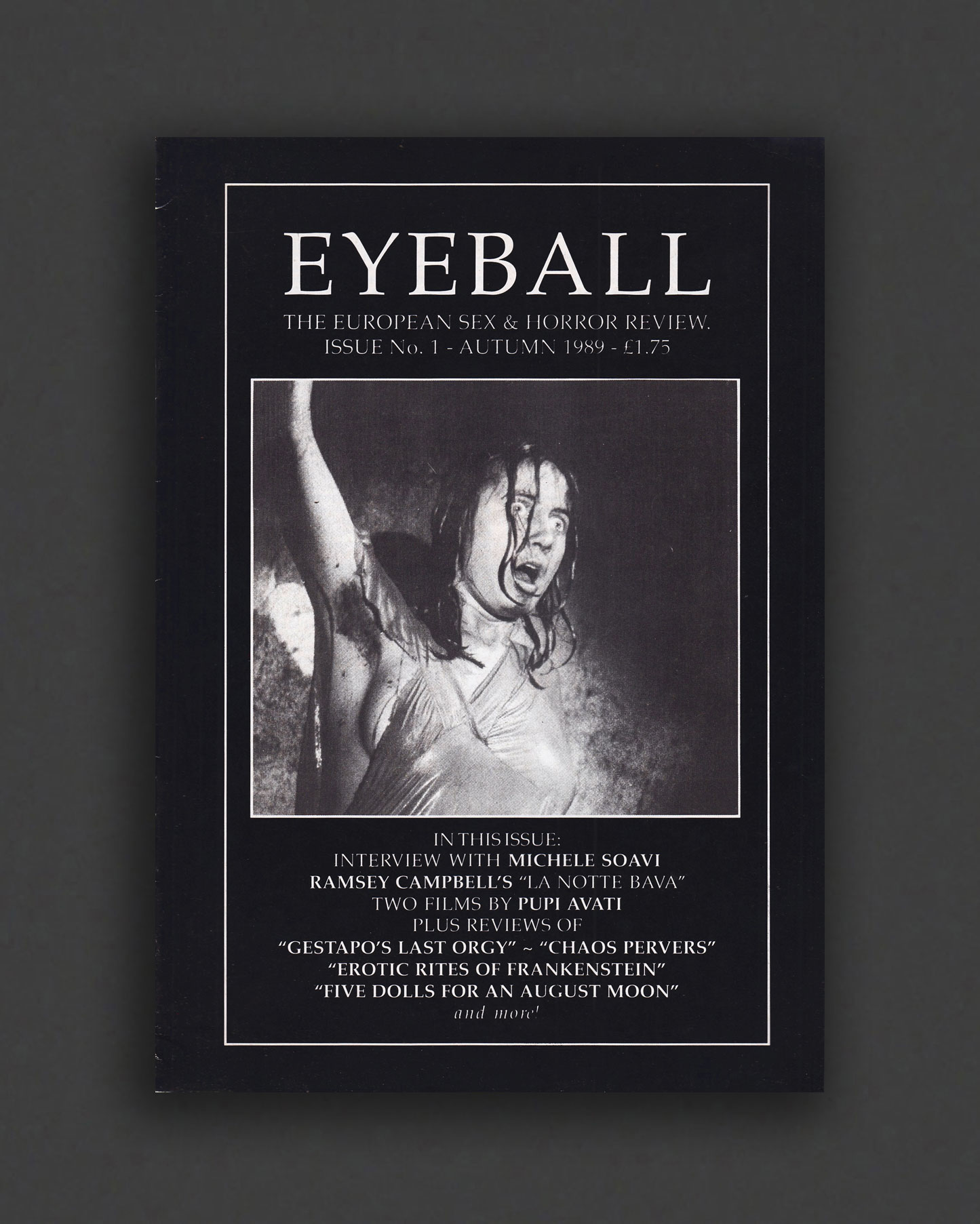
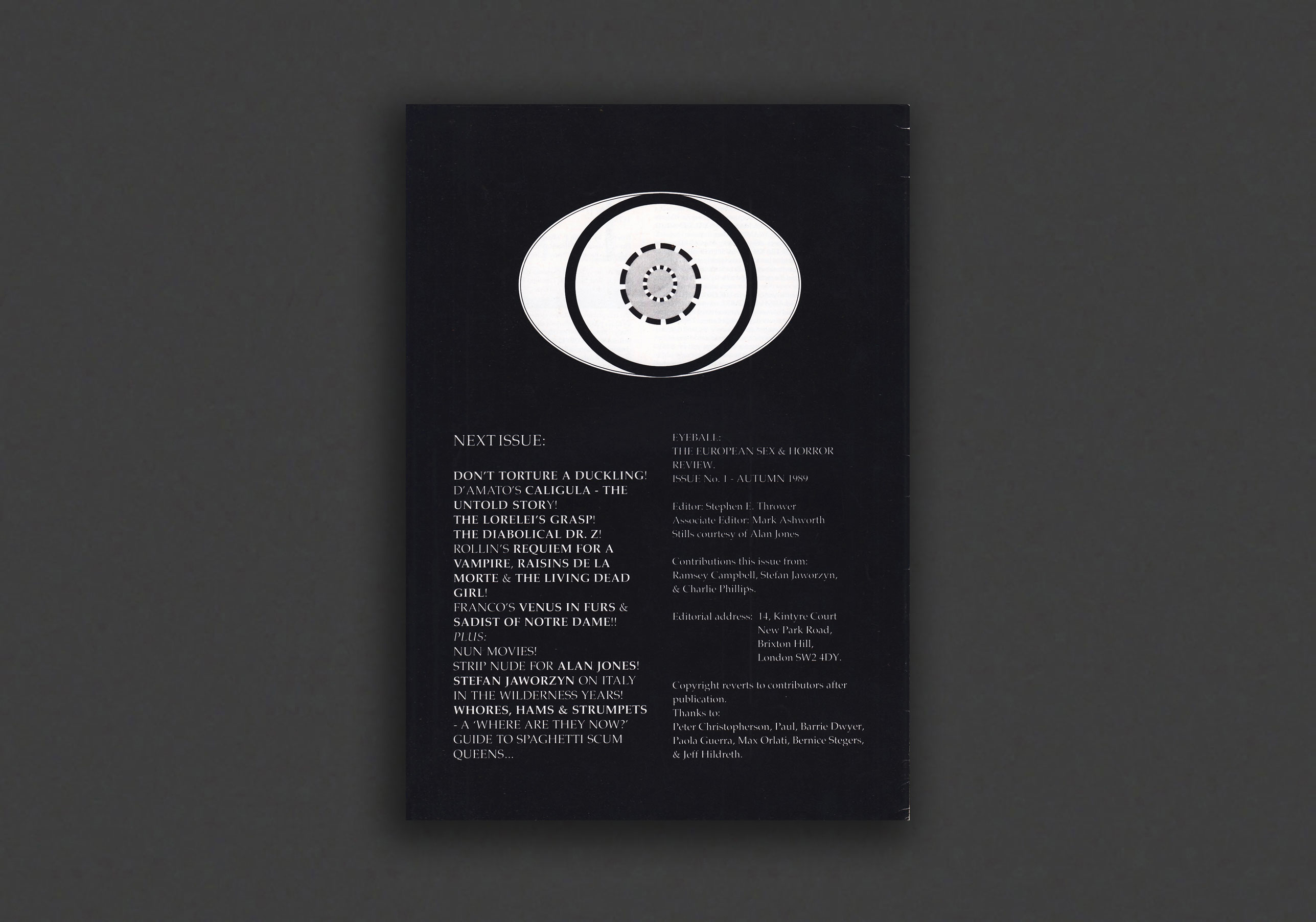
Inaugural Autumn 1989 issue of Eyeball fanzine, "The European Sex & Horror Review", edited by Stephen Thrower with contributions from by Shock Xpress editor and Skullflower/Ascension guitarist Stefan Jaworzyn, Ramsey Campbell, Mark Ashworth, and Charlie Phillips. Features interview with Italian horror director Michele Soavi (Stage Fright, The Church, Cemetery Man, etc.), legendary horror author Ramsey Campbell's "La Notte Bava", Two Films By Pupi Avati (giallo masterpieces, The House with Laughing Windows and Zeder), plus reviews of "Gestapo's Last Orgy", "Chaos Pervers", "Erotic Rites Of Frankenstein", "Five Dolls For An August Moon" and more!
A must for European cult cinema and Giallo film fans!
VG copy, light wear.
1993, English
Softcover, 50 pages, 28 x 21 cm
1st Edition, Out of print title / used / good
Published by
Draculina Publishing / Illinois
$20.00 - Out of stock
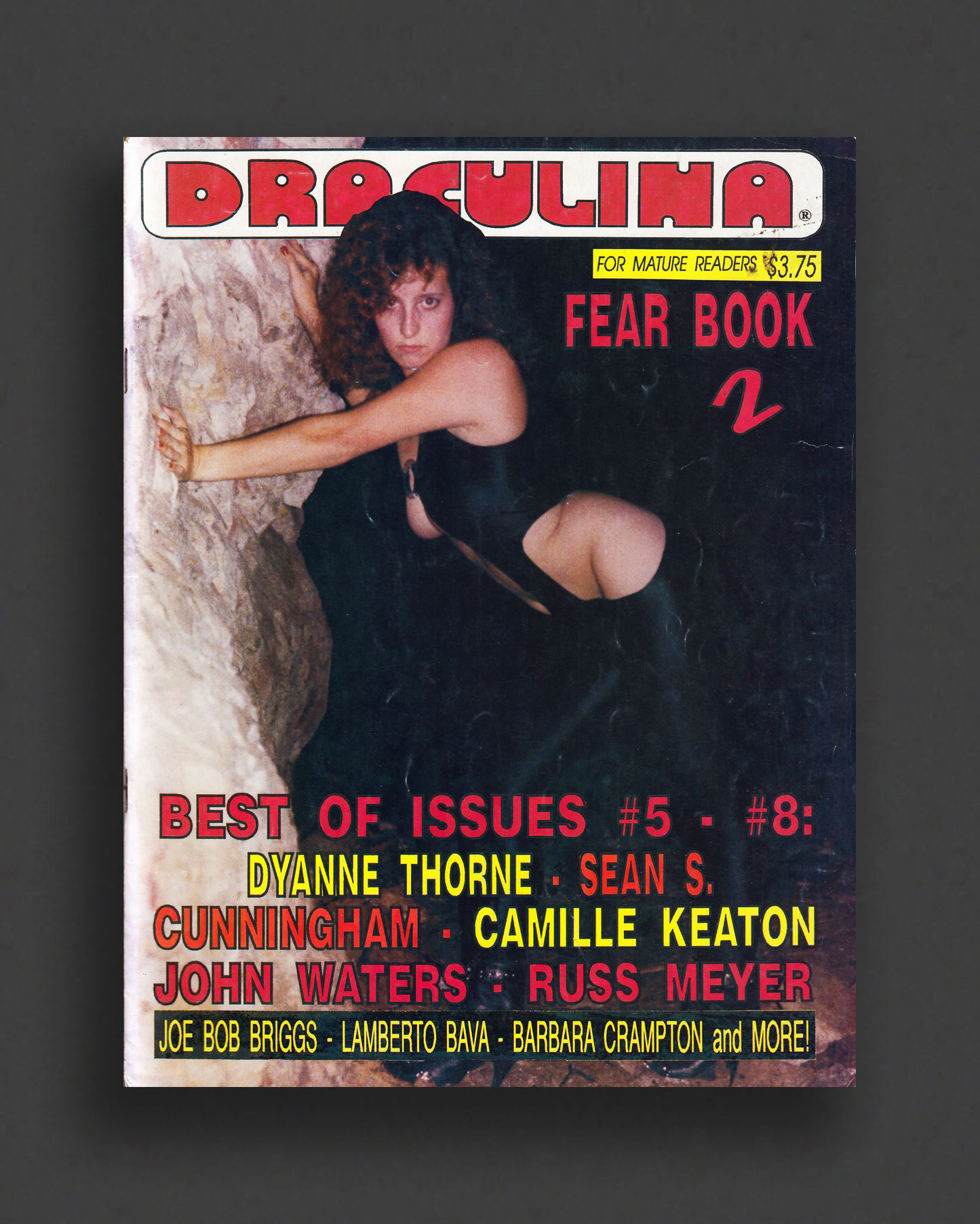
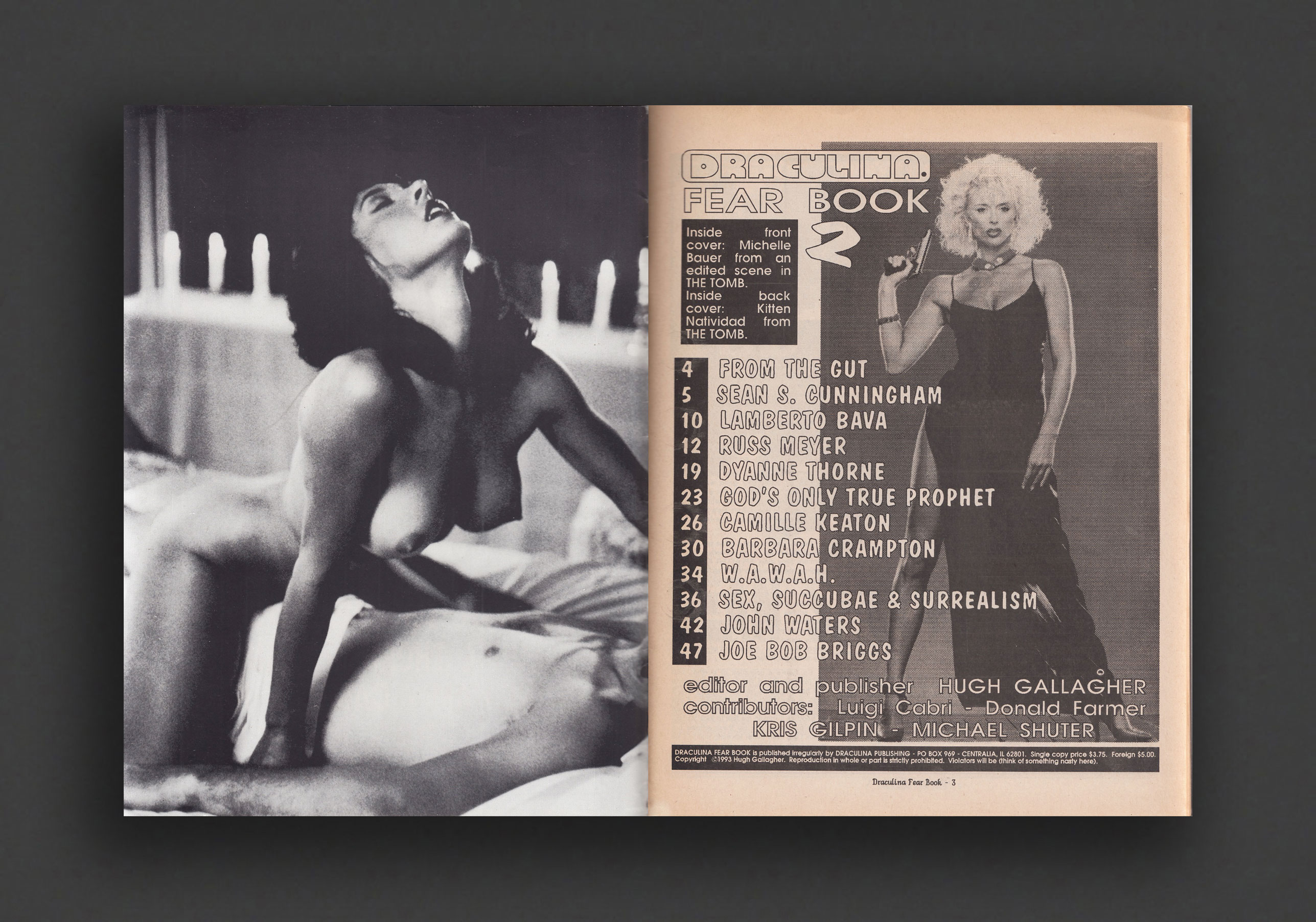
Second 1993 issue of Draculina Fear Book, edited and published by Hugh Gallagher of Draculina Publishing, an independent publishing company that, inspired by Hammer horror movies, produced hundreds of magazines, comics and books devoted to the intersection of smut and gore, the beautiful women of horror, and the cinematic world of schlock/gore/trash/exploitation/transgression. Beyond the abundance of photographs of vixens, vampiresses, she-wolves, scream-queens and she-devils, is a goldmine of interviews with and features on Lamberto Bava (Demons, Inferno, A Blade in The Dark, Tenebre, etc) , Russ Meyer (Faster, Pussycat! Kill! Kill! Vixen!, Beyond the Valley of the Dolls, etc.), John Waters (Pink Flamingos, Polyester, etc.), Sean S. Cunningham (The Last House on the Left, Friday the 13th, House, etc.), Dyanne Thorne (Ilsa, She Wolf of the SS), Camille Keaton (I Spit on Your Grave), Barbara Crampton (From Beyond, The Reanimator, Chopping Mall, etc.), articles on "Sex, Succubae, and Surrealism" (Rollin, etc.), girl-on-girl cat fight entertainment, and much more.
Good copy with a couple of loose pages, general magazine reading wear.
2009, English
Softcover, 912 pages, 13.84 x 20.96 cm
Published by
Picador / USA
$49.00 - In stock -
The posthumous masterwork from "one of the greatest and most influential modern writers”—James Wood, The New York Times Book Review
Composed in the last years of Roberto Bolaño's life, 2666 was greeted across Europe and Latin America as his highest achievement, surpassing even his previous work in its strangeness, beauty, and scope. Its throng of unforgettable characters includes academics and convicts, an American sportswriter, an elusive German novelist, and a teenage student and her widowed, mentally unstable father. Their lives intersect in the urban sprawl of SantaTeresa—a fictional Juárez—on the U.S.-Mexico border, where hundreds of young factory workers, in the novel as in life, have disappeared.
Translated from the Spanish by Natasha Wimmer.
2008, English
Softcover, 656 pages, 13.84 x 20.96 cm
Published by
Picador / USA
$46.00 - Out of stock
The Savage Detectives is an exuberant, raunchy, wildly inventive, and ambitious novel from one of the greatest Latin American authors of our age.
New Year's Eve, 1975: Arturo Belano and Ulises Lima, founders of the visceral realist movement in poetry, leave Mexico City in a borrowed white Impala. Their quest: to track down the obscure, vanished poet Cesárea Tinajero. A violent showdown in the Sonora desert turns search to flight; twenty years later Belano and Lima are still on the run.
The explosive first long work by "the most exciting writer to come from south of the Rio Grande in a long time" (Ilan Stavans, Los Angeles Times), The Savage Detectives follows Belano and Lima through the eyes of the people whose paths they cross in Central America, Europe, Israel, and West Africa. This chorus includes the muses of visceral realism, the beautiful Font sisters; their father, an architect interned in a Mexico City asylum; a sensitive young follower of Octavio Paz; a foul-mouthed American graduate student; a French girl with a taste for the Marquis de Sade; the great-granddaughter of Leon Trotsky; a Chilean stowaway with a mystical gift for numbers; the anorexic heiress to a Mexican underwear empire; an Argentinian photojournalist in Angola; and assorted hangers-on, detractors, critics, lovers, employers, vagabonds, real-life literary figures, and random acquaintances.
A polymathic descendant of Borges and Pynchon, Roberto Bolaño traces the hidden connection between literature and violence in a world where national boundaries are fluid and death lurks in the shadow of the avant-garde. The Savage Detectives is a dazzling original, the first great Latin American novel of the twenty-first century.
Translated by Natasha Wimmer.
1981, English
Softcover, 48 pages, 40 x 28 cm
1st Edition, Out of print title / used / very good
Published by
Charles E. Tuttle / Tokyo
$140.00 - Out of stock
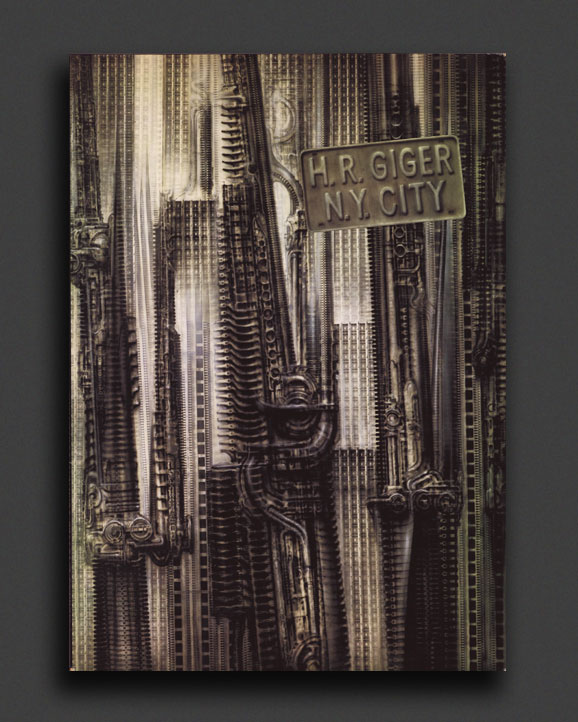
Scarce first Japanese edition (entirely in English language), published in Tokyo by Charles Tuttle, of this beautifully produced over-sized 1981 book by H. R. Giger. Foreword by Timothy Leary.
In 1981, a year after being awarded the Oscar for Best Achievement for Visual Effects for Alien, the book H.R. GIGER N.Y. CITY was published. This series of post Alien works, the result of an intense period of non-stop painting, literally day and night, were inspired by Giger's trip to New York City and a template which his colleague Cornelius de Fries, brought back from one of his excursions into the electronic industry. The stencil was actually a sheet of scrap metal from which electrical components had been punched out. Alongside these incredible works are drawings, articles, press clippings, posters and polaroids from Giger's time in New York City.
Fantastic Swiss surrealist painter, sculptor and set designer Hans Rudolf “Ruedi” Giger was born in 1940, the son of a chemist. He spoke of a father who viewed art as a "breadless profession", and strongly encouraged his son to enter into pharmaceutics. Despite this, in 1962, he moved to Zürich, where he studied Architecture and industrial design at the School of Applied Arts until 1970. Giger's style and thematic execution have been hugely influential. His design for the Alien was inspired by his painting Necronom IV and earned him an Oscar in 1980. His books of paintings, particularly Necronomicon and Necronomicon II (1985) and the frequent appearance of his art in Omni magazine continued his rise to international prominence. Giger is also well known for artwork on several music recording albums. His most distinctive stylistic innovation is that of a representation of human bodies and machines in a cold, interconnected relationship, he described as "biomechanical". His paintings often display fetishistic sexual imagery. His main influences were painters Ernst Fuchs and Salvador Dalí. He was also a personal friend of Timothy Leary. Giger suffered from night terrors and his paintings are all to some extent inspired by his experiences with that particular sleep disorder, making his first paintings as a means of art therapy. In 1998 Giger acquired the Château St. Germain in Gruyères, Switzerland, and it now houses the H. R. Giger Museum, a permanent repository of his work.
Good—Very Good copy, tight binding with some cover wear and corner wear, some sunning to edges.
1997, English
Softcover (staple-bound), 40 pages, 21 x 15 cm
1st Edition, Out of print title / used / fine
Published by
Midnight Media / UK
$50.00 - In stock -
Rare English film digest / filmography by Lucas Balbo and Laurent Aknin on one of cinema's most fascinating and complicated human beings, Klaus Kinski. Kinski was a German actor. Equally renowned for his intense performance style and notorious for his volatile personality, he appeared in over 130 film roles in a career that spanned 40 years, from 1948 to 1988. Published in this one edition in 1997 by Published by Midnight Media, Disorder & Genius is an excellent introduction and concise synopsis of Kinski's acting career, and an indispensable reference tracing his complete filmography chronologically, each listing with film details and short overview, profusely illustrated with film stills, poster artwork, vhs covers, and publicity images in colour and b/w.
"Klaus Kinski died in 1991 amid almost general indifference. Nikolaus Gunther Nakszynski—his real name—was born in Zoppot, Poland on 18 October 1926; in his autobiography, "Dying to Live" (released in the USA as "All I Need Is Love" and subsequently withdrawn and banned — then in 1996 was re- issued, in both the UK and USA, as “Kinski Uncut", with extra text but with 'minor' alterations to avoid possible lawsuits!), he went into great detail about his childhood, a nightmare of poverty, promiscuity and incest... After the war, he went on the German stage where he came in contact with some of the greatest directors of the period. He achieved a certain notoriety with his recitals of poems by Rimbaud and above all the Medieval French bawdy poet Villon. Later he appeared in some of Cocteau's plays such as "The Typewriter" and "The Human Voice", this last being a long monologue by a woman on a telephone. Kinski played the woman and provoked a scandal. But, he earned Cocteau's admiration. He ended his theatrical career with an "adaptation" of the New Testament which provoked a riot.
From the end of the 1940s, Kinski was offered many parts in films which he took up sporadically, believing, as he said himself, that all that was merely shit..."—from the introduction
Near Fine copy.
1994, English
Softcover, 352 pages, 20.5 x 15 cm
Published by
Exact Change / Boston
$38.00 - Out of stock
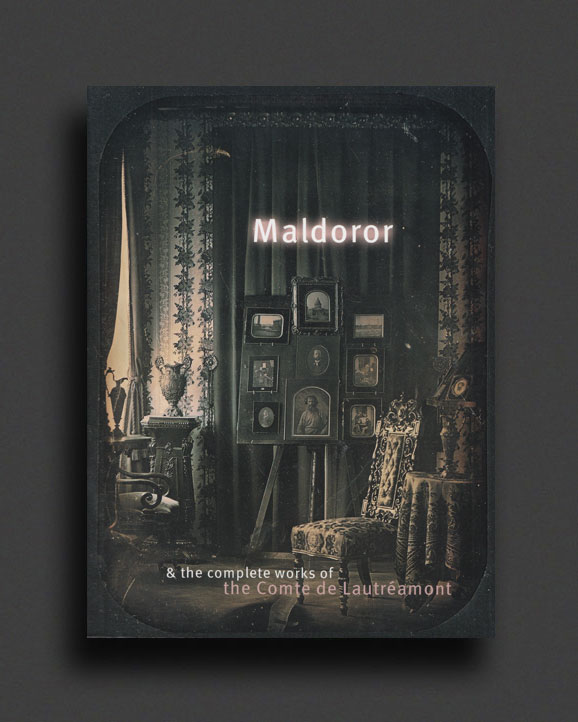
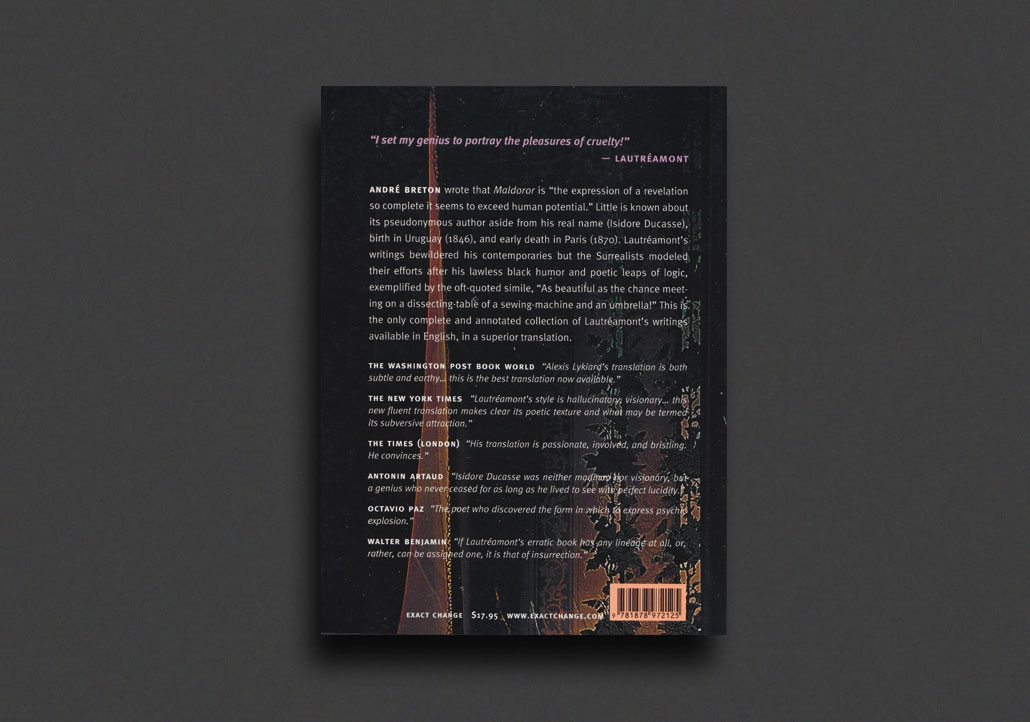
Andre Breton described Maldoror as "the expression of a revelation so complete it seems to exceed human potential." Little is known about its pseudonymous author, aside from his real name (Isidore Ducasse), birth in Uruguay (1846) and early death in Paris (1870). Lautreamont bewildered his contemporaries, but the Surrealists modeled their efforts after his black humor and poetic leaps of logic, exemplified by the oft-quoted line, "As beautiful as the chance meeting on a dissecting table of a sewing machine and an umbrella." Maldoror's shocked first publisher refused to bind the sheets of the original edition--and perhaps no better invitation exists to this book, which warns the reader, "Only the few may relish this bitter fruit without danger."
This is the only complete annotated collection of Lautreamont's writings available in English, in Alexis Lykiard's superior translation. For this latest edition, Lykiard updates his introduction to include recent scholarship.
2011, English
Softcover, 670 pages, 11.5 x 17.5 cm
Published by
Urbanomic / Cornwall
Sequence Press / New York
$55.00 - In stock -
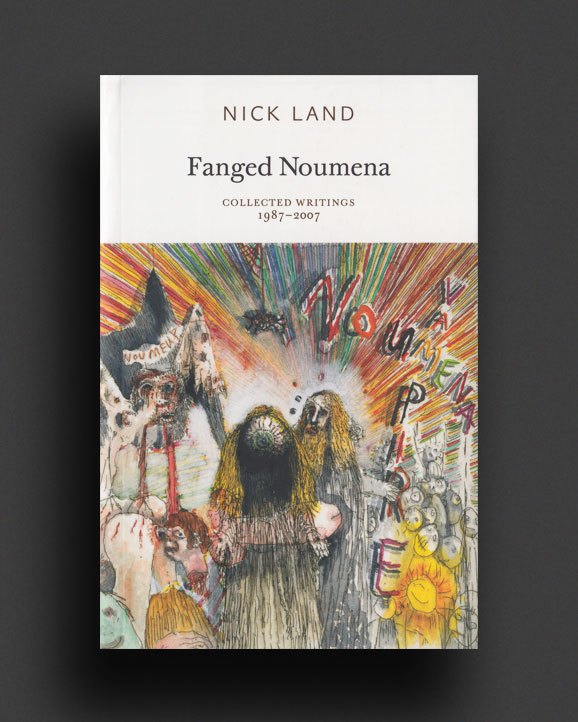
Fanged Noumena assembles for the first time the writings of Nick Land, variously described as ‘rabid nihilism’, ‘mad black Deleuzianism’, ‘accelerationism’, and ‘cybergothic’.Wielding weaponized, machinically-recombined versions of Deleuze and Guattari, Reich and Freud, in the company of fellow ‘werewolves’ such as Nietzsche, Bataille, Artaud, Trakl and Cioran, to a cutup soundtrack of Bladerunner, Terminator and Apocalypse Now, Land plotted a rigorously schizophrenic escape route out of academic philosophy, and declared all-out war on the Human Security System. Despite his ‘disappearance’, Land’s output has been a crucial underground influence both on recent Speculative Realist thought, and on artists, writers, musicians and filmmakers invigorated by his uncompromising and abrasive philosophical vision.Long the subject of rumor and vague legend, Land’s turbulent post-genre theory-fictions of cybercapitalist meltdown smear cyberpunk, philosophy, arithmetic, poetics, cryptography, anthropology, grammatology and the occult into unrecognizable and gripping hybrids. Beginning with Land’s radical rereadings of Heidegger, Nietzsche and Kant, Fanged Noumena terminates in Professor Barker’s cosmic theory of geo-trauma and neo-qabbalistic attempts to formulate a numerical anti-language.Fanged Noumena is a dizzying trip through land’s rigorous, incisive and provocative work, establishing it as an indispensable resource for radically inhuman thought in the twenty-first century.
Edited and with an Introduction by Ray Brassier and Robin Mackay
Contents: Editors' Introduction / Kant, Capital and the Prohibition of Incest / Narcissism and Dispersion in Heidegger's 1953 Trakl Interpretation / Delighted to Death / Art as Insurrection / Spirit and Teeth / After the Law / Making it with Death / Shamanic Nietzsche / Circuitries / Machinic Desire / Cybergothic / Cyberrevolution / Hypervirus / No Future / Cyberspace Anarchitecture as Jungle-War / Meat (or How to Kill Oedipus in Cyberspace) / Meltdown / A ZiiGothic X-Coda (Cooking Lobsters with Jake and Dinos) / KatasoniX / Barker Speaks / Mechanomics / Cryptolith / Non-Standard Numeracies: Nomad Cultures / Occultures / Origins of the Cthulhu Club / Introduction to Qwernomics / Tic-Talk / Qabbala 101 / Critique of Transcendental Miserablism----
Land had the most brilliantly seductive and meteoric mind, endlessly imaginative and capable of adopting, inhabiting and discarding any philosophical position. With him - and rightly so - philosophy infected every area of life, and sheer vitality of life reverberated in his thinking.
I see Fanged Noumena as a kind of righteous revenge. Nick was dismissed by professional philosophers because they simply didn't want to think and preferred their turgid academic complacency. I always admired him for his unwavering desire to take thought to its absolute limit and then see how much harder one could push. - Simon Critchley
These extraordinary texts, superheated compounds of severe abstraction and scabrous wit, testify to a uniquely penetrating intelligence, fusing transcendental philosophy, number theory, geophysics, biology, cryptography and occultism into startlingly cohesive but increasingly delirious theory-fictions. - Ray Brassier
This is theory as cyberpunk fiction: Deleuze-Guattari's concept of capitalism as the virtual unnameable Thing that haunts all previous formations pulp-welded to the timebending of the Terminator films. Land's machinic theory-poetry parallelled the digital intensities of 90s jungle, techno and doomcore, anticipating 'impending human extinction becoming accessible as a dance-floor'. - Mark Fisher (K-Punk)
In the last half of the twentieth century, academics talked endlessly about the outside, but no-one went there. Land, by exemplary contrast, made experiments in the unknown unavoidable for a philosophy caught in the abstractive howl of post-political cybernetics. Fanged Noumena demonstrates how Land ruined a generation of intellectuals for merely academic philosophy, by opening a speculative singularity where the future used to be. - Iain Hamilton Grant