World Food Books' programme is largely produced on Kulin Nation land. We acknowledge the Wurundjeri people of the Kulin Nation as the first and continuing custodians of this land, and pay respect to their Elders past, present, and emerging.
World Food Books is an arts and special interests bookshop in Naarm / Melbourne. Founded in 2010, World Food Books is devoted to the presentation of a rotating, hand-selection of international art, design, literary and counterculture publications with an emphasis on the anti-traditional, the experimental, the avant-garde, the heretic, the marginal.
Presenting new titles alongside rare and out-of-print books, catalogues and journals spanning the fields of modern and contemporary art, design, photography, illustration, film, literature, poetry, cultural theory, philosophy, sexuality, popular and underground culture in its many radical forms, World Food Books wishes to encourage adventurous, thoughtful and open-minded reading, looking, writing, and exchange of publishing and ideas, both current and historical.
As well as our bookshop, located in Melbourne's historical Nicholas Building, all of our inventory is available internationally via our online mail-order service.
World Food Books semi-regularly co-ordinates "Occasions", a programme of exhibits and events at the bookshop and in partnership with other hosts (such as museums and art galleries) that develop out of the activities, relationships and content of the bookshop itself.
World Food Books
The Nicholas Building
37 Swanston Street
Room 5, Level 6
Melbourne 3000
Australia
SHOP HOURS:
Thu–Sat 11–5
WEB-SHOP OPEN 24/7
World Food Books
Postal Address:
PO Box 435
Flinders Lane
Victoria 8009
Australia
Art
Theory / Essay
Architecture / Interior
Graphic Design / Typography
Photography
Fashion
Eros
LGBTQ+
Fiction / Poetry
Weird / Speculative / Science Fiction / Horror
Transgressive / Visceral / Abject
Symbolism / Decadence / Fin de siècle
Film / Video
Painting
Sculpture / Installation
Performance / Dance / Theater
Drawing
Sound / Music
Curatorial
Group Shows / Collections
Periodicals
Out-of-print / Rare
Posters / Ephemera / Discs
Signed Books
World Food Books Gift Voucher
World Food Book Bag
Australian Art
Australian Fiction
Australian Science Fiction / Speculative Fiction
Australian Poetry
Australian Photography
Japanese Photography
Conceptual Art
Minimal Art
Dada
'Pataphysics / Oulipo
Fluxus
Concrete Poetry
Pop Art
Surrealism
Arte Povera
Arte Informale / Haute Pâte / Tachism
Nouveau Réalisme / Zero / Kinetic
Situationism / Lettrism
Collage / Mail Art / Xerox Art
Art Brut / Folk / Visionary / Fantastic
Illustration / Graphic Art / Bandes Dessinées
Furniture
Italian Radical Design / Postmodernism
Textiles
Ceramics / Glass
Counterculture
Protest / Revolt
Philosophy
Psychoanalysis
Anthropology
Anarchism
Socialism / Anarchism / Communism / Capitalism
Literary Theory / Semiotics / Language
Feminism / Women's Studies
Gender Studies / Sexuality
Anthropology
Fetishism / BDSM
Drugs / Psychedelia
Crime / Violence
Animal Rights / Veganism
Occult / Esoterica
Ecology / Earth / Alternative Living
Whole Earth / Crafts
All prices in AUD (Australian dollars)
Pick-Ups
Pick-up orders can be collected in our bookshop during opening hours after order date. Please collect any Pick-up orders within 2 weeks of ordering as we have limited storage space. Orders will be released back into stock if not collected within this time. No refunds can be made for pick-ups left un-collected. If you cannot make it in to the bookshop in this time-frame, please choose postage option.
Return Policy
All sales are final. We do accept returns (for refund or exchange) for items received in error. All our orders are packed with special care using heavy-duty padding and cardboard book-mailers or bubble mailers (for smaller books), using reinforcement where required. We cannot take responsibility for any lost, stolen or damaged parcels.
Insurance
Should you wish to insure your package, please email us directly after placing your order and we can organise this at a small extra expense. Although all standard/express tracked packages are very safe and dependable, we cannot take responsibility for any lost, stolen or damaged parcels. We recommend insurance on valuable orders.
Interested in selling your old books, catalogues, journals, magazines, comics, fanzines, ephemera? We are always looking for interesting, unusual and out-of-print books to buy. We only buy books in our fields of interest and specialty, and that we feel we can resell.
We base these prices on desirability, market value, in-print prices, condition and our current stock levels. We offer cash, store credit, and can take stock on consignment. All
about 25% of the price we expect to get when we sell them, or 30% in store credit. We base these prices on desirability, market value, in-print prices, condition and our current stock levels.
Sell your books any day of the week. You can drop them off and return later. If you have a lot of books, we can visit your Sydney home.
We buy books that we feel we can resell. We offer about 25 % of the price we expect to get when we sell them, or 30% in store credit. We base these prices on desirability, market value, in-print prices, condition and our current stock levels.
Philadelphia Wireman
03 August - 01 September, 2018
World Food Books is proud to announce our next Occasion, the first presentation of sculptures by Philadelphia Wireman in Australia.
The Philadelphia Wireman sculptures were found abandoned in an alley off Philadelphia’s South Street on trash night in 1982. Their discovery in a rapidly-changing neighbourhood undergoing extensive renovation, compounded with the failure of all attempts to locate the artist, suggests that the works may have been discarded after the maker’s death. Dubbed the "Philadelphia Wireman" during the first exhibition of this work, in 1985, the maker’s name, age, ethnicity, and even gender remain uncertain. The entire collection totals approximately 1200 pieces, all intricately bound together with tightly-wound heavy-gauge wire (along with a few small, abstract marker drawings, reminiscent both of Mark Tobey and J.B. Murry). The dense construction of the work, despite a modest range of scale and materials, is singularly obsessive and disciplined in design: a wire armature or exoskeleton firmly binds a bricolage of found objects including plastic, glass, food packaging, umbrella parts, tape, rubber, batteries, pens, leather, reflectors, nuts and bolts, nails, foil, coins, toys, watches, eyeglasses, tools, and jewellery.
Heavy with associations—anthropomorphic, zoomorphic, and socio-cultural responses to wrapped detritus—the totemic sculptures by Philadelphia Wireman have been discussed in the context of work created to fulfil the shamanistic needs of alternative religions in American culture. Curators, collectors, and critics have variously compared certain pieces to sculpture from Classical antiquity, Native American medicine bundles, African-American memory jugs, and African fetish objects. Reflecting the artist’s prolific and incredibly focused scavenging impulse, and despite—or perhaps enhanced by—their anonymity, these enigmatic objects function as urban artefacts and arbiters of power, though their origin and purpose is unknown. Philadelphia Wireman, whatever their identity, possessed an astonishing ability to isolate and communicate the concepts of power and energy through the selection and transformation of ordinary materials. Over the course of the past two decades, this collection has come to be regarded as an important discovery in the field of self-taught art and vernacular art.
Presented in collaboration with Fleisher-Ollman Gallery, Philadelphia, and Robert Heald, Wellington.
Susan Te Kahurangi King
02 February - 10 March, 2018
Susan Te Kahurangi King (24 February 1951 - ) has been a confident and prolific artist since she was a young child, drawing with readily available materials - pencils, ballpoint pens and felt-tip markers, on whatever paper is at hand. Between the ages of four and six Susan slowly ceased verbal communication. Her grandparents William and Myrtle Murphy had developed a special bond with Susan so they took on caring responsibilities for extended periods. Myrtle began informally archiving her work, carefully collecting and storing the drawings and compiling scrapbooks. No drawing was insignificant; every scrap of paper was kept. The King family are now the custodians of a vast collection containing over 7000 individual works, from tiny scraps of paper through to 5 meter long rolls.
The scrapbooks and diaries reveal Myrtle to be a woman of great patience and compassion, seeking to understand a child who was not always behaving as expected. She encouraged Susan to be observant, to explore her environment and absorb all the sights and sounds. Myrtle would show Susan’s drawings to friends and people in her community that she had dealings with, such as shopkeepers and postal workers, but this was not simply a case of a grandmother’s bias. She recognised that Susan had developed a sophisticated and unique visual language and sincerely believed that her art deserved serious attention.
This was an unorthodox attitude for the time. To provide some context, Jean Dubuffet coined the term Art Brut in 1945 to describe work created by self-taught artists – specifically residents of psychiatric institutions and those he considered to be visionaries or eccentrics. In 1972 Roger Cardinal extended this concept by adopting the term Outsider Art to describe work made by non-academically trained artists operating outside of mainstream art networks through choice or circumstance. Susan was born in Te Aroha, New Zealand in 1951, far from the artistic hubs of Paris and London that Dubuffet and Cardinal operated in. That Myrtle fêted Susan as a self-taught artist who deserved to be taken seriously shows how progressive her attitudes were.
Susan’s parents Doug and Dawn were also progressive. Over the years they had consulted numerous health practitioners about Susan’s condition, as the medical establishment could not provide an explanation as to why she had lapsed into silence. Dawn educated herself in the field of homeopathy and went on to treat all twelve of her children using these principles – basing prescriptions on her observations of their physical, mental and emotional state.
Doug was a linguist with an interest in philosophy who devoted what little spare time he had to studying Maori language and culture. To some extent their willingness to explore the fringes of the mainstream made them outsiders too but it was their commitment to living with integrity and their respect for individuality that ensured Susan’s creativity was always encouraged.
Even though Susan’s family supported her artistic pursuits, some staff in schools and hospitals saw it as an impediment to her assimilation into the community and discouraged it in a variety of ways. Her family was not always aware of this and therefore did not fully understand why Susan stopped drawing in the early 1990s. However, rather than dwell on the challenges that Susan faced in pursuit of her artistic practice, they prefer to highlight her achievements. In 2008 Susan began drawing again in earnest, after an almost 20 year interruption, and her work is now shown in galleries around the world.
Susan grew up without television and has been heavily influenced by the comics she read as a child. She is absolutely fearless in the appropriation of recognizable characters, such as Donald Duck and Mickey Mouse, in her work. She twists their limbs, contorts their faces, compresses them together, blends them into complex patterned backgrounds - always imbuing them with an incredible energy. Although Susan often used pop culture characters in her work they are not naive or childlike. These are drawings by a brilliant self-taught artist who has been creating exceptional work for decades without an audience in mind.
Mladen Stilinović
"Various Works 1986 - 1999"
02 February 16 - September 10, 2016
Various works 1986 - 1999, from two houses, from the collections of John Nixon, Sue Cramer, Kerrie Poliness, Peter Haffenden and Phoebe Haffenden.
Including: Geometry of Cakes (various shelves), 1993; Poor People’s Law (black and white plate), 1993; White Absence (glasses, ruler, set square, silver spoon, silver ladel with skin photograph and wooden cubes), 1990-1996; Exploitation of the Dead (grey and red star painting, wooden painting, black spoon with red table, red plate), 1984-1990; Money and Zeros (zero tie, paintings made for friends in Australia (Sue, John, Kerrie), numbers painting), 1991-1992; Words - Slogans (various t-shirts) - “they talk about the death of art...help! someone is trying to kill me”, “my sweet little lamb”, “work is a disease - Karl Marx”; Various artist books, catalogues, monographs, videos; Poster from exhibition Insulting Anarchy; "Circular" Croatian - Australian edition; Artist book by Vlado Martek (Dostoyevsky); more.
Thanks to Mladen Stilinović and Branka Stipančić.
Jonathan Walker
Always Will Need To Wear Winter Shirt Blue + Ochre Small Check Pattern
21 August - 21 September, 2015
Untitled
I am not a great reader of poetry but I always return to the work of Melbourne poet, Vincent Buckley (1925- 1988). Perhaps I find his most tantalising piece to be not a finished poem but a fragment left on a scrap of paper discovered on his desk after the poet’s death.
The poetry gathers like oil
In the word-core, and spreads
It has its music meet,
Its music is in movement.
This fragment is more the shell left behind from a volatile thought than a finished poem. I find the last two lines honest but awkward whereas the first two lines work like an arrow. Most likely he could not find a resolution so it was left. Still, in its present form, it remains an eloquent testimony to the ultimate failure of a medium to express mobile thought and sensation, in Buckley’s case, through verbal language. It’s an important matter because this is something all artists have to deal with regardless of the medium.
I have never written a poem, however, I am forever copying fragments from books on paper scraps in a vain effort to fix certain notions in my head. At first, they function as bookmarks that are sometimes returned to when I open the book. But before long, as they accumulate, they fall out littering the table interspersed with A4 photocopies, bills, books and medications.
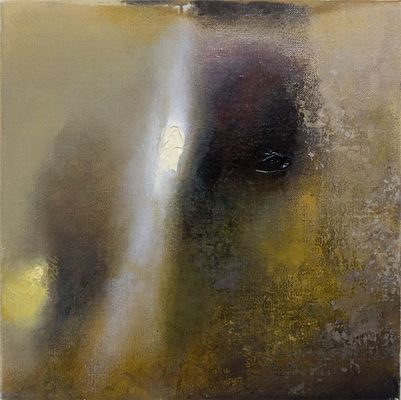
To return to Buckley’s fragment, the first two lines very much evoke how I paint nowadays. As you age, detail diminishes and patches of light become more luminous and float. I feel the most honest way of dealing with this is by smearing the oil paint on the canvas with the fingers and working close-up, blind. Only if the patches coalesce into an approaching image can the work gain a life.
-
Jonathan Walker was born in Melbourne, Australia and brought up on a dairy farm in Gippsland. In the 1970’s he studied painting at RMIT and won the Harold Wright Scholarship to the British Museum, London. During the 1980’s he exhibited at Pinacotheca Gallery, Richmond and had work shown at the NGV and Heidi City Art Gallery. Over the same period he designed the cover for the “Epigenesi” LP by Giancarlo Toniutti, Italy and conducted a mail exchange work with Achim Wollscheid, Germany. The work with artists through the post resulted in an article published in the bicentenary issue of Art and Australia 1988. He showed in artist run spaces such as WestSpace in the 90’s and 2000’s, and until 2012, taught painting at Victoria University, which is where we (Colleen Ahern and Lisa Radford) as organisers of the exhibition, among many others, had the privilege of being his student.
Walker’s knowledge was imparted to students through the careful selection of music, literature, and artists found in books that he himself had ordered for the library. Walker’s strategy was the generosity of sharing his vast knowledge with references specific to each student and their context.
Walker’s paintings share a similar focus and intimacy.
This exhibition presents a small selection of recent paintings alongside a publication that includes Walker’s writing. Observational and analytical, Walker’s work is a type of material notation — the time of day, colour and how it is blended, the both specific and fleeting location of a reflection on lino or the question of whether a chair leg should be included in a painting.
Please join us on Friday August 21 between 6-8pm to celebrate the opening of the exhibition.
Curated by Colleen Ahern and Lisa Radford.
B. Wurtz
Curated by Nic Tammens
March 26 - April 4, 2015
B.Wurtz works from a basement studio in his home on Manhattan’s Lower East Side.
This local fact is attested to by the plastic shopping bags and newsprint circulars that appear in his work. As formal objects, they don’t make loud claims about their origins but nonetheless transmit street addresses and places of business from the bottom of this long thin island. Like plenty of artists, Wurtz is affected by what is local and what is consumed. His work is underpinned by this ethic. It often speaks from a neighborhood or reads like the contents of a hamper:
“BLACK PLUMS $1.29 lb.”
“Food Bazaar”
“USDA Whole Pork Shoulder Picnic 99c lb.”
“RITE AID Pharmacy, with us it’s personal.”
“H. Brickman & Sons.”
“Sweet Yams 59c lb."
Most of the work in this exhibition was made while the artist was in residence at Dieu Donne, a workshop dedicated to paper craft in Midtown. Here Wurtz fabricated assemblages with paper and objects that are relatively lightweight, with the intention that they would be easily transportable to Australia. This consideration isn’t absolute in Wurtz’s work, but was prescriptive for making the current exhibition light and cheap. Packed in two boxes, these works were sent from a USPS post office on the Lower East Side and delivered to North Melbourne by Australia Post.
Wurtz appears courtesy of Metro Pictures, New York.
Thanks to Rob Halverson, Joshua Petherick, Sari de Mallory, Matt Hinkley, Helen Johnson, Fayen d'Evie, Ask Kilmartin, Lisa Radon, Ellena Savage, Yale Union, and "Elizabeth".
John Nixon
"Archive"
December 15 - January 20, 2014
The presentation of John Nixon's archive offered a rare showcase of this extensive collection of the artist's own publications, catalogues, posters, ephemera, editions and more, from the mid 1980s onwards, alongside a selection of his artworks.
Organized by John Nixon, Joshua Petherick and Matt Hinkley.
"Habitat"
at Minerva, Sydney (organised by Joshua Petherick and Matt Hinkley)
November 15 - December 20, 2014
Lupo Borgonovo, Janet Burchill & Jennifer McCamley,
Lewis Fidock, HR Giger, Piero Gilardi, Veit Laurent Kurz,
Cinzia Ruggeri, Michael E. Smith, Lucie Stahl, Daniel Weil, Wols
Press Release:
“...It contained seven objects. The slender fluted bone, surely formed for flight, surely from the wing of some large bird. Three archaic circuitboards, faced with mazes of gold. A smooth white sphere of baked clay. An age-blackened fragment of lace. A fingerlength segment of what she assumed was bone from a human wrist, grayish white, inset smoothly with the silicon shaft of a small instrument that must once have ridden flush with the surface of the skin - but the thing’s face was seared and blackened.”
William Gibson, “Count Zero”, 1986
"Autumn Projects Archive"
Curated by Liza Vasiliou
March 6 - March 15, 2014
World Food Books, in conjunction with the Virgin Australia Melbourne Fashion Festival 2014, presented the Autumn Projects archive, consisting of a selection of early examples in Australian fashion with a particular interest in collecting designers and labels from the period beginning in the 1980’s, who significantly influenced the discourse of Australian Fashion.
Curated by Liza Vasiliou, the exhibition provided a unique opportunity to view pieces by designers Anthea Crawford, Barbara Vandenberg, Geoff Liddell and labels CR Australia, Covers, Jag along with early experimental collage pieces by Prue Acton and Sally Browne’s ‘Fragments’ collection, suspended throughout the functioning World Food Books shop in Melbourne.
H.B. Peace
presented by CENTRE FOR STYLE
November 14, 2013
"Hey Blinky, you say chic, I say same"
Anon 2013
H.B. Peace is a clothing collaboration between great friends Blake Barns and Hugh Egan Westland. Their pieces explore the divergences between 'character’ and ‘personality’ in garments....etc
Special Thanks to Joshua Petherick and Matt Hinkley of WFB and Gillian Mears
and a Very Special Thank you to Audrey Thomas Hayes for her shoe collaboration.
Janet Burchill & Jennifer McCamley
"Aesthetic Suicide"
May 10 - June 8, 2013
The first of our occasional exhibitions in the World Food Books office/shop space in Melbourne, "Aesthetic Suicide" presented a body of new and older works together by artists Janet Burchill & Jennifer McCamley, including videos, prints, a wall work, and publications.
During shop open hours videos played every hour, on the hour.
1971, English
Hardcover (w. dust jacket), 342 pages, 24 x 15.5 cm
1st Edition, Out of print title / used / fine
Published by
Allen Lane / UK
$50.00 - Out of stock
First 1971 English hardcover edition of Magic, Supernaturalism and Religion, the classic illustrated study by Swiss-American Surrealist painter, engraver, and occultist Kurt Seligmann (1900—1962).
In this fascinating study the late Kurt Seligmann, the surrealist painter, gives a history of magical ideas and manifestations in the Western world to reveal the aesthetic value of magic and its influence on creative imagination. He brings forth a vivid picture of the religio-magical beliefs of ancient, medieval and modern times. He shows the growth and development of the magical world-view in its successive stages, beginning with Mesopotamian and Persian magic, assimilating Hebrew thought, Greek philosophy and Christian theology, through the mystical concept of a unified universe with its manifold correspondences and interrelations, which finds expression in pictorial motifs and symbols, in the magical arts of astrology, divination, physiognomy, chiromancy, fortune cards and other branches of 'occult science'. Along the way he presents some colourful personalities: Nostradamus, Dr Faustus, Pico della Mirandola, Agrippa, Trimethius, Gebelin, Mesmer, Cagliostro, Saint- Germain and others.
Fine copy in Near Fine—Very Good dust jacket.
1991, English
Softcover (2 vols. both staple-bound), 40 pages, 20 x 14 cm
1st Edition, Out of print title / used / very good
Published by
Tom of Finland / ?
$200.00 - Out of stock
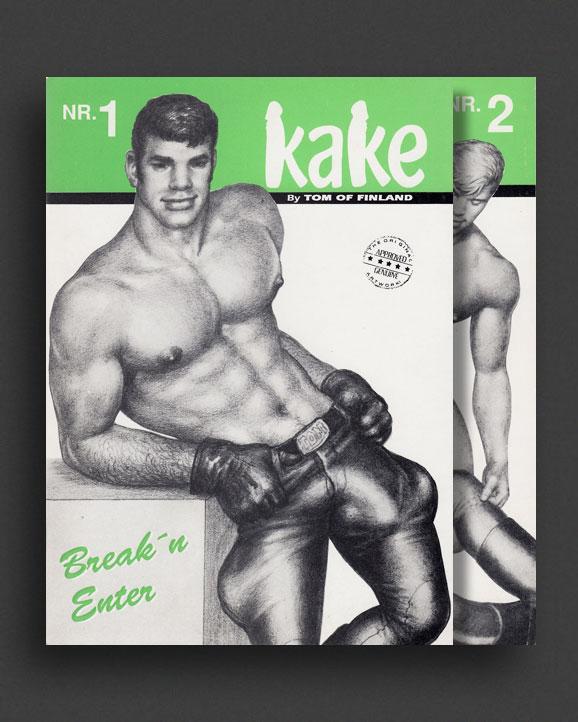
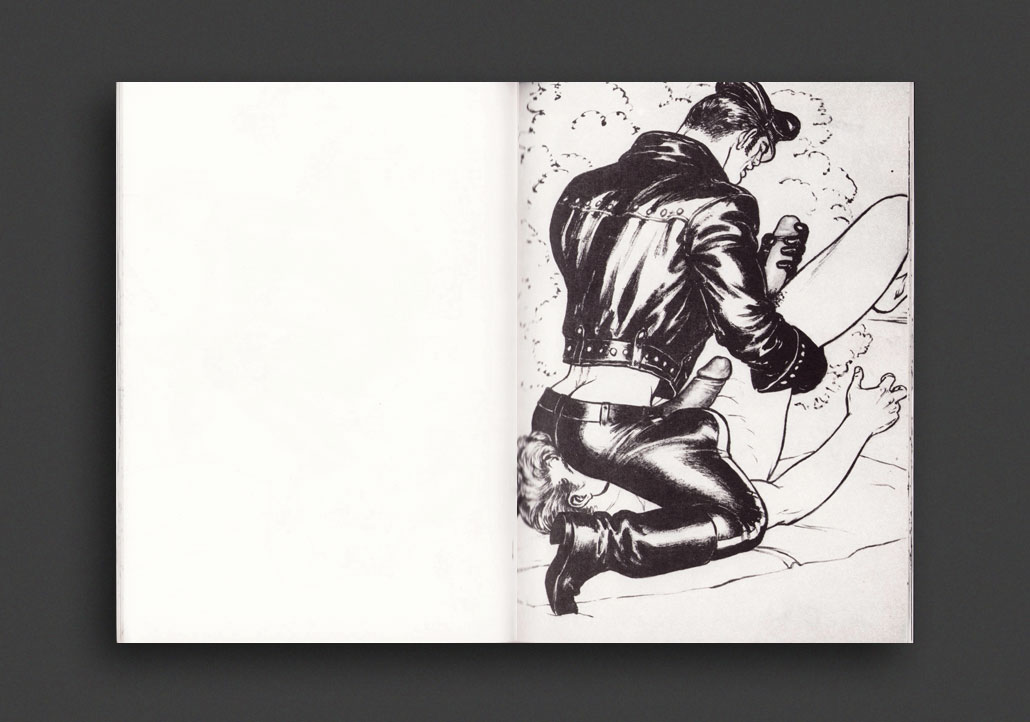
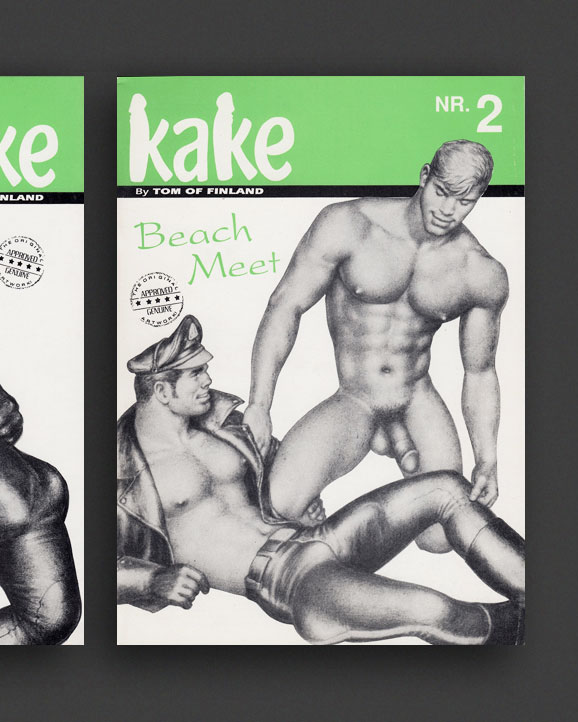
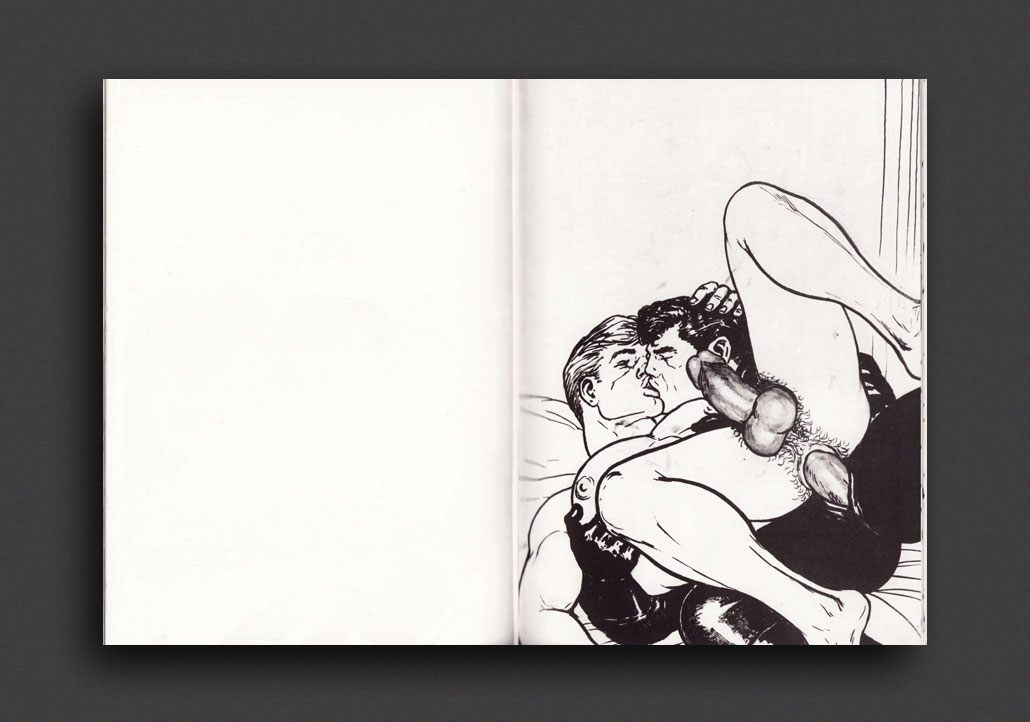
Rare first two issues of the original, explicit, Tom of Finland Kake comics, self-published by Tom of Finland in the green 1991 textured cover editions. Erotic comic stories "Break-n-Enter" and "Beach Meet".
Touko Valio Laaksonen (8 May 1920 – 7 November 1991), best known by his pseudonym Tom of Finland, was a Finnish artist known for his stylized highly masculine homoerotic fetish art, and his influence on late twentieth century gay culture. He has been called the "most influential creator of gay pornographic images" by cultural historian Joseph W. Slade. Over the course of four decades, he produced some 3500 illustrations.
Very Good copies, almost As New with light wear.
1951 & 1955, English
Softcovers, 388 + 420 pages, 20.5 x 13.5 cm
1st Edition, Out of print title / used / very good
Published by
Dover / New York
$45.00 - In stock -
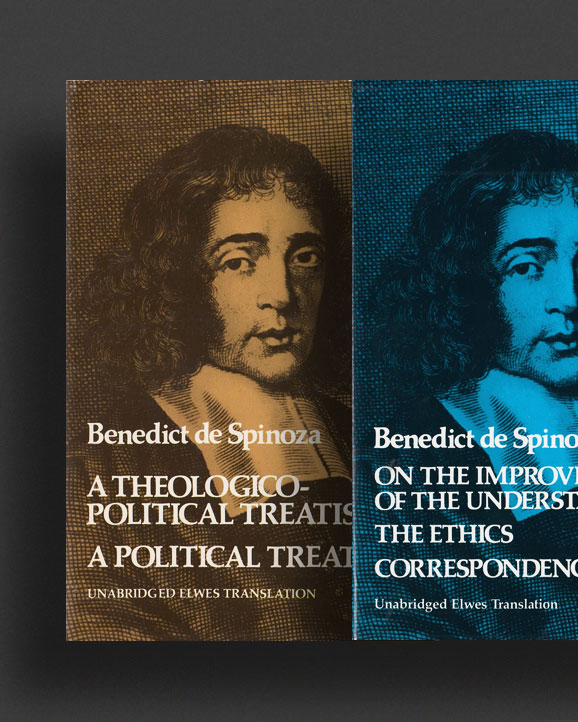
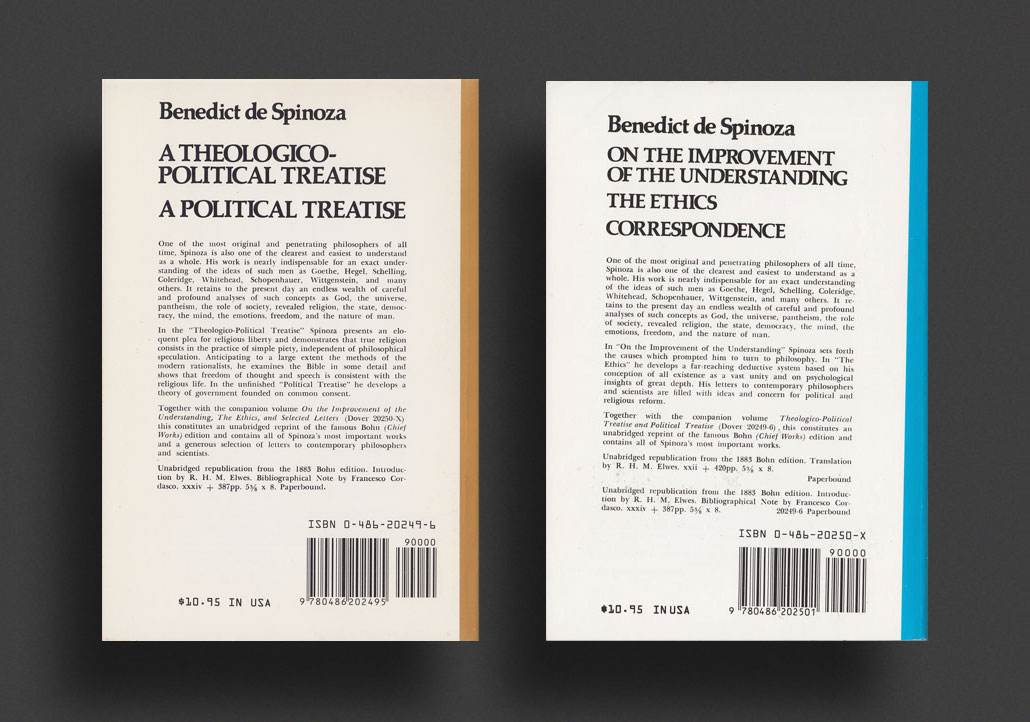
1951 and 1955 English Dover editions of two important Spinoza companion volumes as lot — Theologico-Political Treatise and Political Treatise and On the Improvement of the Understanding - The Ethics Correspondence, together an unabridged reprint of the famous 1883 Bohn (Chief Works) edition, containing all of Spinoza's most important works and a generous selection of letters to contemporary philosophers and scientists. Translations and introductions by R. H. M. Elwes. Bibliographical notes by Francesco Cordasco.
One of the most original and penetrating philosophers of all time, Spinoza is also one of the clearest and easiest to understand as a whole. His work is nearly indispensable for an exact understanding of the ideas of such men as Goethe, Hegel, Schelling, Coleridge, Whitehead, Schopenhauer, Wittgenstein, and many others. It retains to the present day an endless wealth of careful and profound analyses of such concepts as God, the universe, pantheism, the role of society, revealed religion, the state, democracy, the mind, the emotions, freedom, and the stature of man.
In the "Theologico-Political Treatise" Spinoza presents an eloquent plea for religious liberty and demonstrates that true religion consists in the practice of simple piety, independent of philosophical speculation. Anticipating to a large extent the methods of the modern rationalists, he examines the Bible in some detail and shows that freedom of thought and speech is consistent with the religious life. In the unfinished "Political Treatise" he develops a theory of government founded on common consent.
In "On the Improvement of the Understanding" Spinoza sets forth the causes which prompted him to turn to philosophy. In "The Ethics" he develops a far-reaching deductive system based on his conception of all existence as a vast unity and on psychological insights of great depth. His letters to contemporary philosophers and scientists are filled with ideas and concern for political and religious reform.
Very Good copy. No idea what print, 1951 and 1955 editions, respectively.
1995, English
Softcover, Paperback : 188 pages, 24 x 15.5 cm
1st Edition, Out of print title / used / fine
Published by
Indiana University Press / Indiana
$20.00 - In stock -
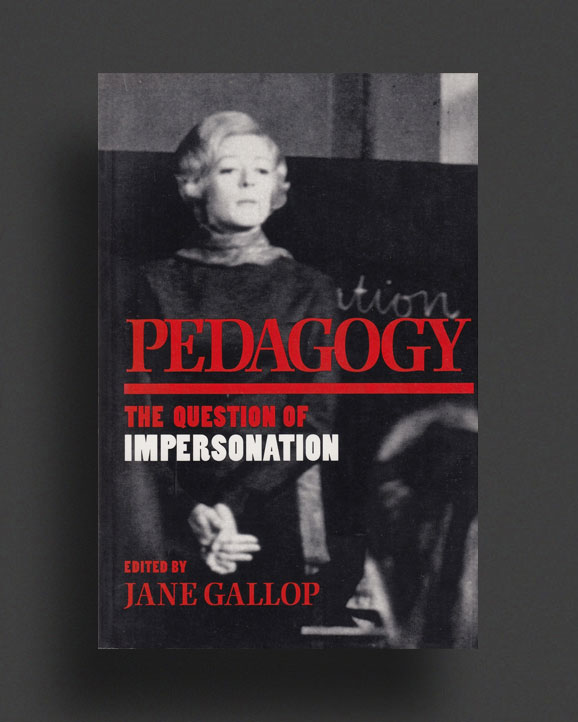
First 1995 edition.
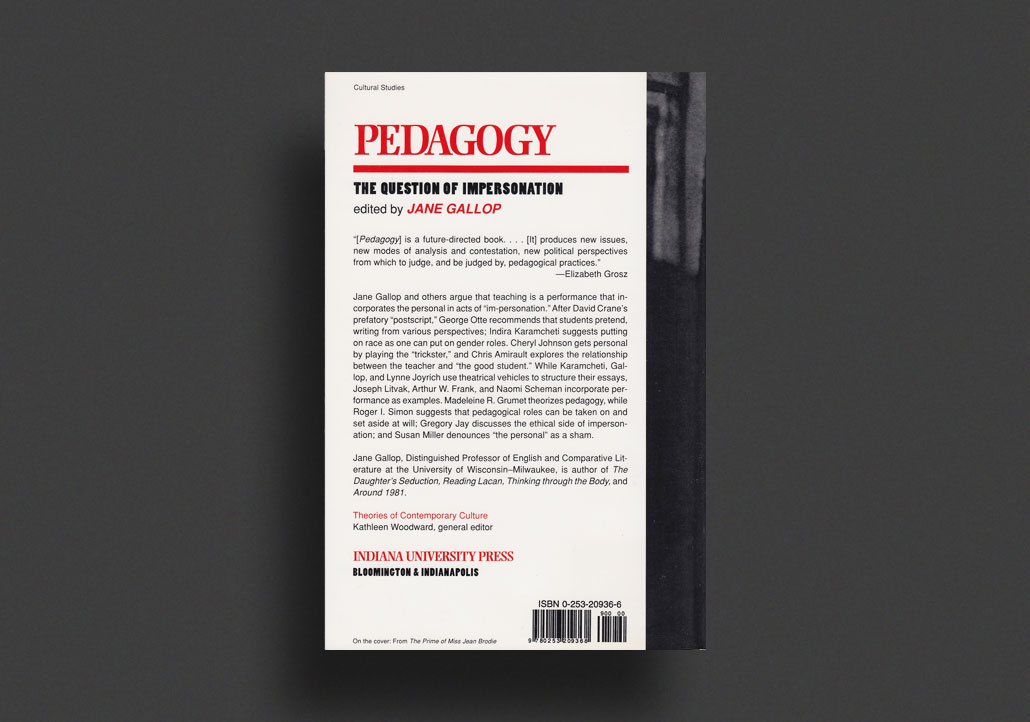
In Pedagogy: The Question of Impersonation, authors argue that teaching is a performance that incorporates the personal in acts of "im-personation." After David Crane's prefatory "postscript," George Otte recommends that students pretend, writing from various perspectives; Indira Karamcheti suggests putting on race as one can put on gender roles. Cheryl Johnson gets personal by playing the "trickster," and Chris Amirault explores the relationship between the teacher and "the good student." While Karamcheti, Gallop, and Lynne Joyrich use theatrical vehicles to structure their essays, Joseph Litvak, Arthur W. Frank, and Naomi Scheman incorporate performance as examples. Madeleine R. Grumet theorizes pedagogy, while Roger I. Simon suggests that pedagogical roles can be taken on and off at will; Gregory Jay discusses the ethical side of impersonation; and Susan Miller denounces "the personal" as a sham.
Near Fine copy.
2024, English
Softcover, 200 pages. 23 x 16.6 cm
Published by
Memo Review / Naarm
$35.00 - Out of stock
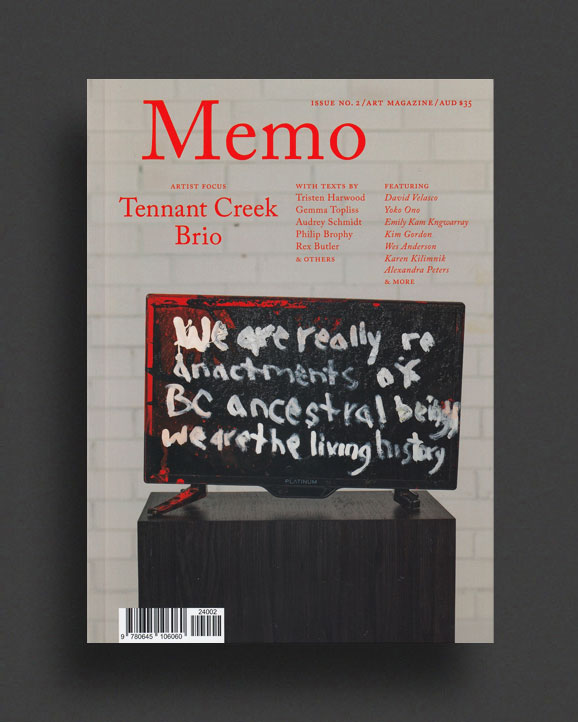
Memo is Australia’s premier source for critical writing on contemporary art and culture. A theme of institutionalism emerges in this second issue of Memo, its shadow seeming to lurk throughout the pages. Perhaps it’s because the Tennant Creek Brio, this issue’s artist focus, is about to cross an institutional threshold. Its artists are currently gearing up for the first major survey of the collective’s work at the Australian Centre for Contemporary Art.
Maurice O’Riordan draws on the late, great conservative art critic Robert Hughes to speak of the shock waves that the Brio continue to produce even as they achieve growing recognition. Jessyca Hutchens also rides one of those waves, reflecting on the 2023 exhibition of the Brio’s work Black Sky that she co-curated. But it is Tristen Harwood, in the most wide-reaching history of the collective published to date, who circles in on the Brio’s breakout. He refers to an “imprisoned energy” whose unleashed force the artists stage rather than proselytise about.
There is plenty more in this issue too. Kate Sutton and David Velasco, editor-in-chief of Artforum from 2017 to 2023, discuss the situation surrounding Velasco’s firing by Penske Media, owner of Artforum, following publication of a collective ceasefire letter in October 2023. Vincent Lê writes on the “hipster death cult” of Wes Anderson’s twee aesthetic; Declan Fry on language’s amoral violence; Philip Brophy on Yoko Ono’s Cut Piece; and Audrey Schmidt on the “Kool” Kim Gordon and Amelia Winata on the “uncool” hyperrealism of Edie Duffie. Elsewhere, you will find Carmen-Sibha Keiso on Alexandra Peters (a 2024 Macfarlane Commission artist) and Rex Butler on Emily Kam Kngwarray, a major exhibition of the eminent artist’s work recently held at the National Gallery of Australia (and set to travel to the Tate Modern).
With Gemma Topliss, Audrey Schmidt, Philip Brophy, Rex Butler, David Velasco, Carmen-Sibha Keiso, Vincent Lê, Lévi McLean, Paul Boyé, Declan Fry, and others.
Featuring Yoko Ono, Emily Kam Kngwarray, Kim Gordon, Wes Anderson, Karen Kilimnik, Alexandra Peters, and many more.
1997, Japanese
Softcover (w. dust jacket), 160 pages, 21 x 16 cm
1st Edition, Out of print title / used / very good
Published by
Tatsumi / Tokyo
$85.00 - Out of stock
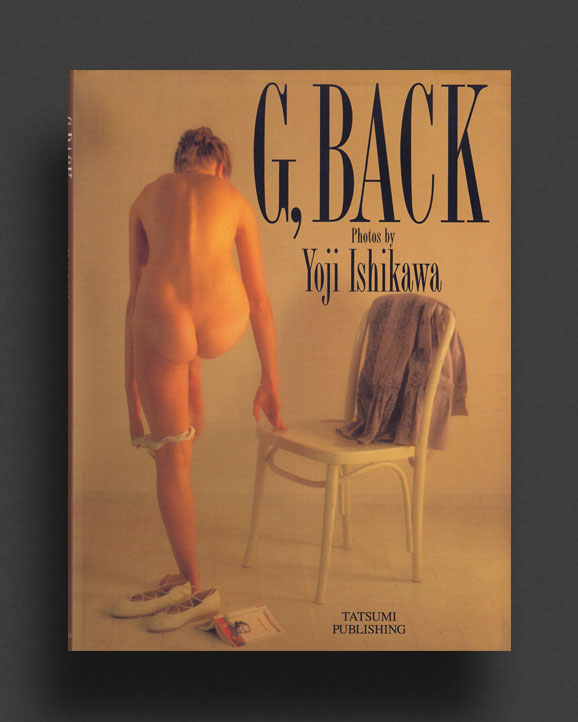
Rare first 1997 edition of renowned Japanese erotic photographer Yoji Ishikawa's G, BACK — "Eroticism Temptation of the Back View" — a book of Ishikawa's that is obsessively focused on a specific attribute of the female nude, much like Hiroshi Maruyama's "Backs", Lyu Hanabusa's "Back", and Jeanloup Sieff's "Derrieres". Entirely comprised of Ishikawa's nude photographs of young European women, Ishikawa's stylistic approach is sometimes romantically soft-focus, sometimes formalistic, sometimes almost as simplistic as a snapshot, at times reminiscent of the work of Sturges, Alterio, Bourboulon or Hamilton. Never available outside Japan, Ishikawa's books gained a cult following and collector prices in the West, and he was recently featured in the Japanese chapter of Bertolotti's acclaimed photo book reference "Books of Nudes" (2007).
Very Good copy in VG dust jacket. Obi present but in poor shape.
1984, English
Softcover (staple-bound), 96 pages, 28 x 20 cm
1st Edition, Out of print title / used / average
Published by
HM Communications / New York
$15.00 - Out of stock
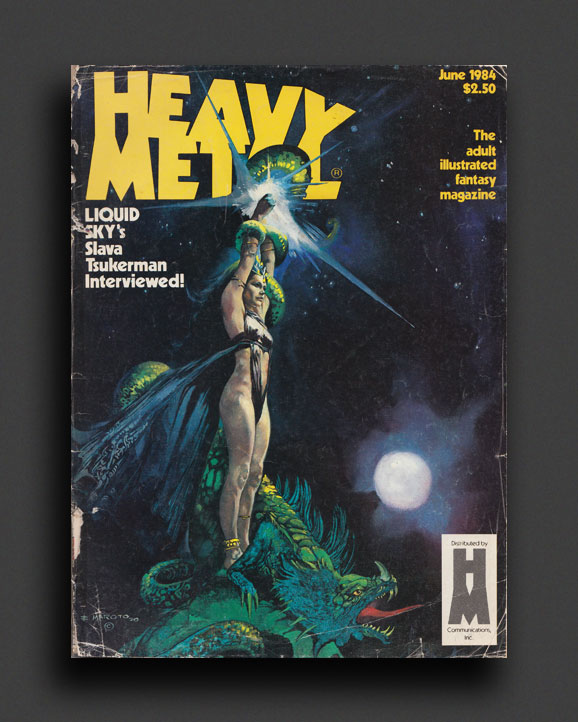
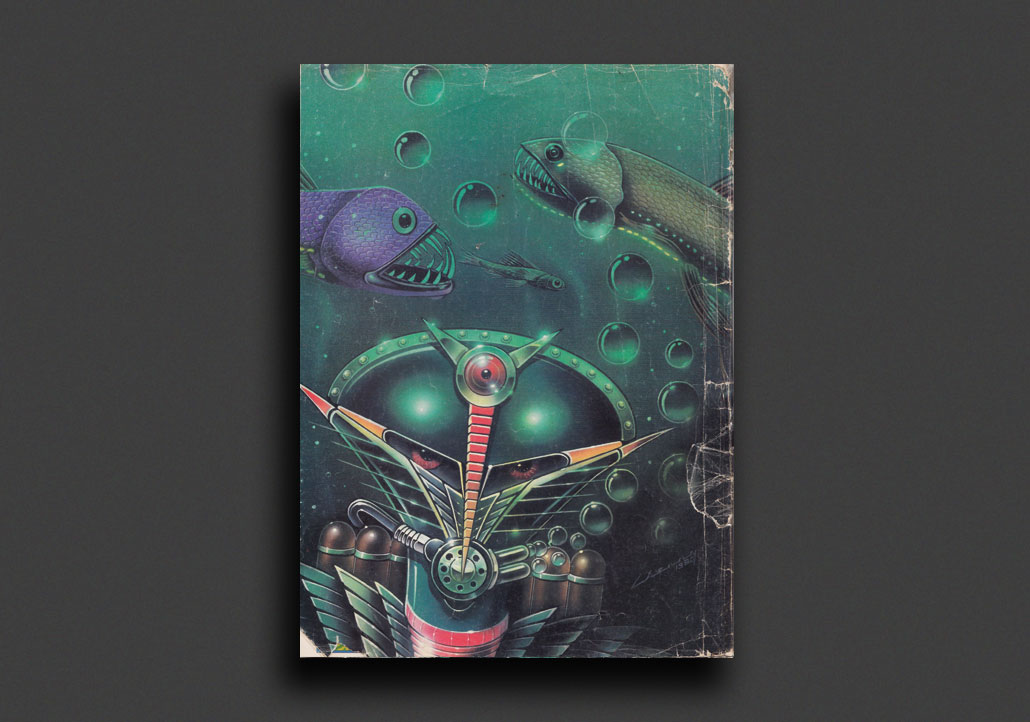
Heavy Metal June 1984 issue, featuring Liquid Sky director Slava Tsukerman, and comic stories/art by Juan Giménez, Philippe Druillet, Herikberto, Moebius, Enki Bilal, Jeff Jones, Charles Burns, John Findley, François Schuiten, Claude Renard, Frank Thorne, and many more, plus the usual fare of sci-fi, movies, music... Cover art by Esteban Maroto. Back cover by James Cherry.
Heavy Metal is an American science fiction and fantasy comics magazine that exploded onto the publishing scene in 1977 and shaped a generation with its blend of dark fantasy/science fiction and erotica. Unlike the traditional American comic books of that time bound by the restrictive Comics Code Authority, Heavy Metal featured explicit content. The magazine started out as a licensed translation of the French science-fantasy magazine Métal Hurlant, including work by Enki Bilal, Philippe Caza, Guido Crepax, Philippe Druillet, Jean-Claude Forest, Jean Giraud (a.k.a. Moebius), Chantal Montellier, and Milo Manara. The magazine later ran Stefano Tamburini and Tanino Liberatore's ultra-violent RanXerox. Heavy Metal gradually evolved into a publication featuring North American contributors like Richard Corben, Matt Howarth, Stephen R. Bissette, Alex Ebel, John Holmstrom, Paul Kirchner, Terrance Lindall, Gray Morrow, Walt Simonson, Dan Steffan, Jim Steranko, John Shirley, Arthur Suydam, Bernie Wrightson, and Olivia De Berardinis.
Average copy, retaped detacjed cover, wear to covers.
1995, Japanese
Softcover, 116 pages, 27.5 x 21 cm
1st Edition, Out of print title / used / very good
Published by
Take Shobo / Tokyo
$80.00 - In stock -
"Mr. Araki and the Six Women"
Scarce copy of this lesser known Araki title — Nobuyoshi Araki's "Obscene Photo Magazine" La-Chat Vol. 2 from 1995, packed cover-to-cover with glossy nude photography in colour and b/w. A gorgeous photo journal of 6 women with Araki's hand-written diary entries throughout.
Very Good copy with light wear.
1989, Czech
Hardcover, 94 pages, 23.5 x 22.5 cm
Out of print title / used / very good
Published by
Albatros / Prague
$45.00 - In stock -
1989 edition of the Wonderful hardcover childrens book by Czech composer and essayist Ilja Hurník (1922 – 2013) and illustrated by the great Czech artist Květa Pacovská. Jak Se Hraje Na Dvere a Jine Muzikantske Pohadky (roughly: How to Play Doors and Other Musical Fairy Tales) was published in Prague in 1973, and has sadly never been issued in English. A collection of humorous fairy tales about music making, explaining to children the relationship between music, fantasy and emotion, assisted by Pacovská's gloriously psychedelic illustrations. A stunning book, and one of our favourites from Pacovská!
Květa Pacovská (b. Prague 1928) is Czech artist and illustrator. She received the international Hans Christian Andersen Medal in 1992 for her "lasting contribution to children's literature". Pacovská was born in Prague and studied at its School of Applied Arts, where she mainly worked in graphic art, arts, conceptual art and artist book fields. For many years she developed a career as a graphic designer and participated in more than 50 exhibitions. In 1961 she started drawing picture books for her own children. Her work is characterised by the use of geometric forms and vibrant, saturated colours, mainly red.
Very Good copy.
2010, Japanese
Softcover (w. dust jacket), 144 pages, 21 x 15 cm
1st Edition, Out of print title / used / fine
Published by
Tokyo Kirara / Tokyo
$85.00 - In stock -
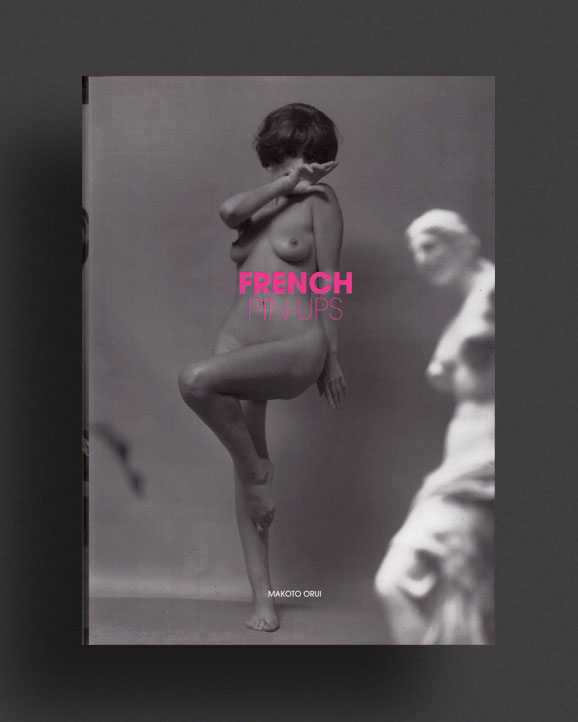
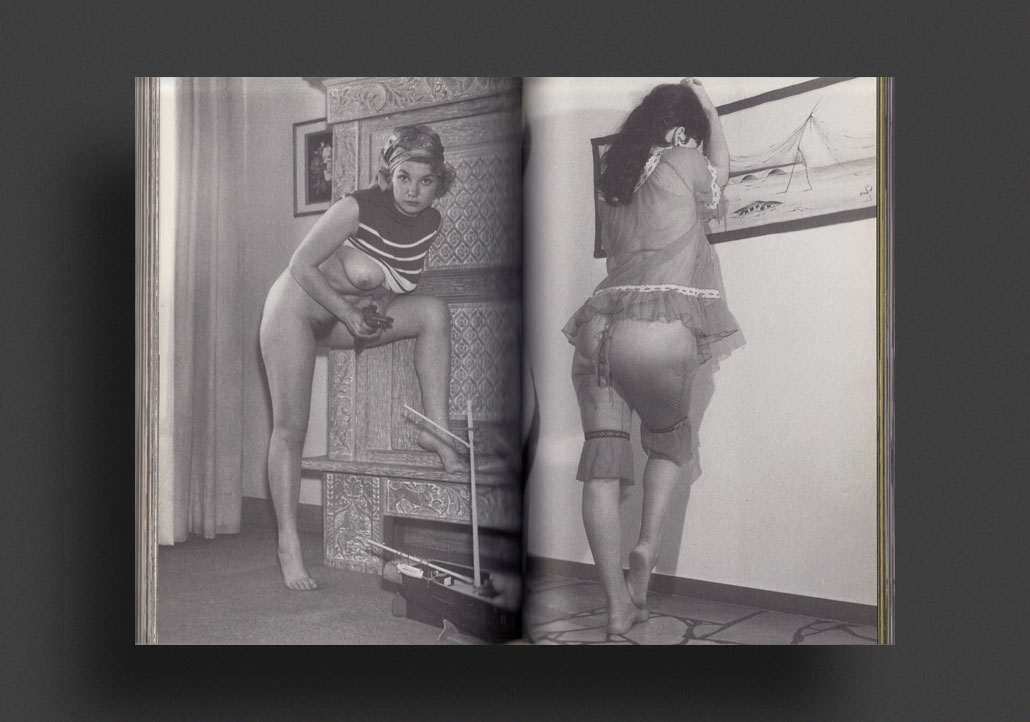
First edition of this collection of vintage French erotica, published in 2010 and now out-of-print.
Japanese editor and art director Makoto Orui (of Fiction Inc., SALE2, Purple fame) has devoted himself to collecting photographs once published in France’s numerous independent erotic magazines of the 1950s and ’60s. Assembled here in all their subtle and titillating power, these images of pin-up girls still hold an alluring aura in their natural, imperfect beauty and retro charm. Plucked from the pages of nude and glamour magazines, the often amateurish nudes posed in all kinds of indoor and outdoor settings can be seen as precursors to the shifting societal norms, more open sexual expression, and women’s empowerment that would develop in later decades. Beautifully compiled in the way Makoto Orui always did so perfectly.
Near Fine—As New copy.
1982, English
Hardcover (w. dust jacket), 246 pages,
1st Edition, Out of print title / used / very good
Published by
Allison & Busby / London
$35.00 - Out of stock
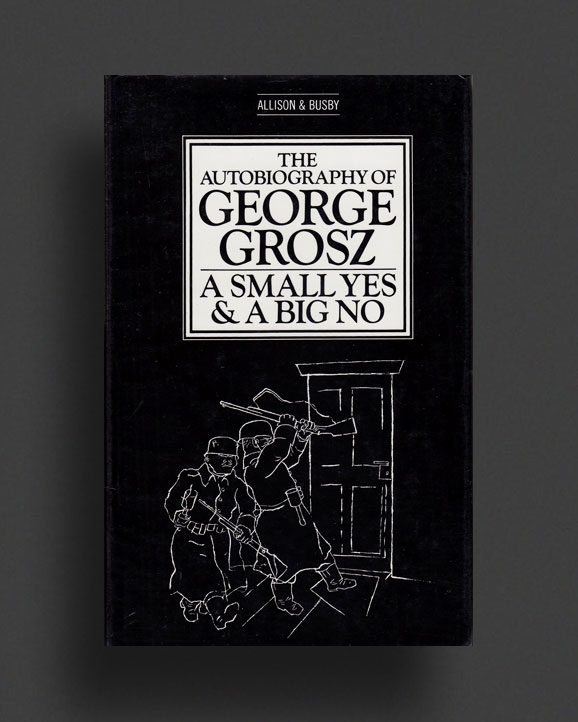
1982 English hardcover edition of The Autobiography of George Grosz: A Small Yes and a Big No, first published by Dial Press in New York City, translated by Lola Sachs Dorin. In 1982, this new translation by Arnold Pomerans of the 1955 German edition was published by Allison and Busby in London.
The autobiography of George Grosz (1893—1959), the great German artist and satirist, is crammed with unique anecdotes and reminiscences. More than just a chronicle of his own life, it becomes in effect a history of the modern movement and is, says the Stuttgarter Zeitung, "a glorious, exciting book".
Grosz recalls his Pomeranian childhood, army life during the First World War, revolution and hunger in its aftermath, the frenzied, disjointed world of Dadaism and Nazism in the Weimar Republic. He describes the cafés, beer-cellars and studios of Paris and Berlin, a dangerous but optimistic journey to Soviet Russia and final emigration to the United States — less than a month before the Nazis came to power.
He conjures up an exciting period and the central figures, the intellectual outsiders, who were responsible for shaping it — a colourful and unforgettable crowd, the artists and writers and film people and political activists, Dali, de Chirico, Rosa Luxemburg, Thomas Mann, Lenin, Brecht, Dos Passos, Joseph von Sternberg, Trotsky, and many others.
Grosz was the most rebellious and explosive of artists, the scourge of militarism, capitalism and the bourgeoisie in the 1920s, whose lines "tore like barbed wire" and whose life and work became a legend. His autobiography is a rich, enjoyable book, here fully available in English for the first time.
Very Good copy, VG dust jacket.
1991, English
Softcover, 304 pages, 23 x 15.5 cm
1st Edition, Out of print title / used / very good
Published by
John Hopkins University Press / Baltimore
$45.00 - Out of stock
First 1991 John Hopkins edition.
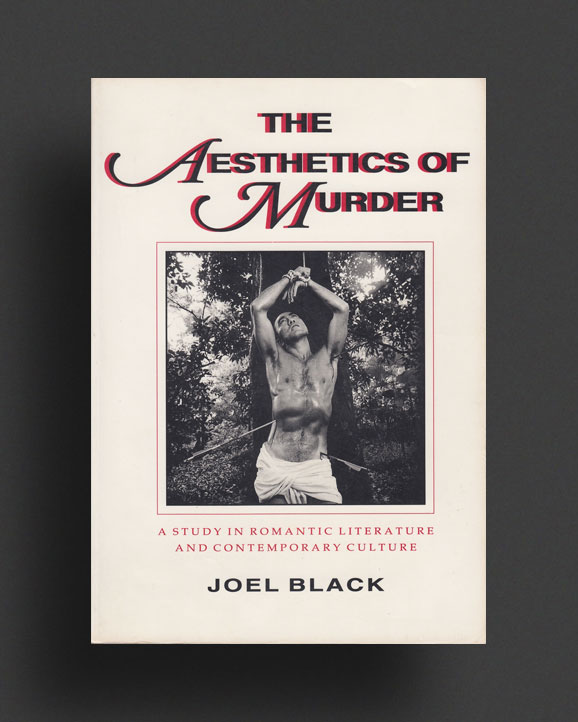
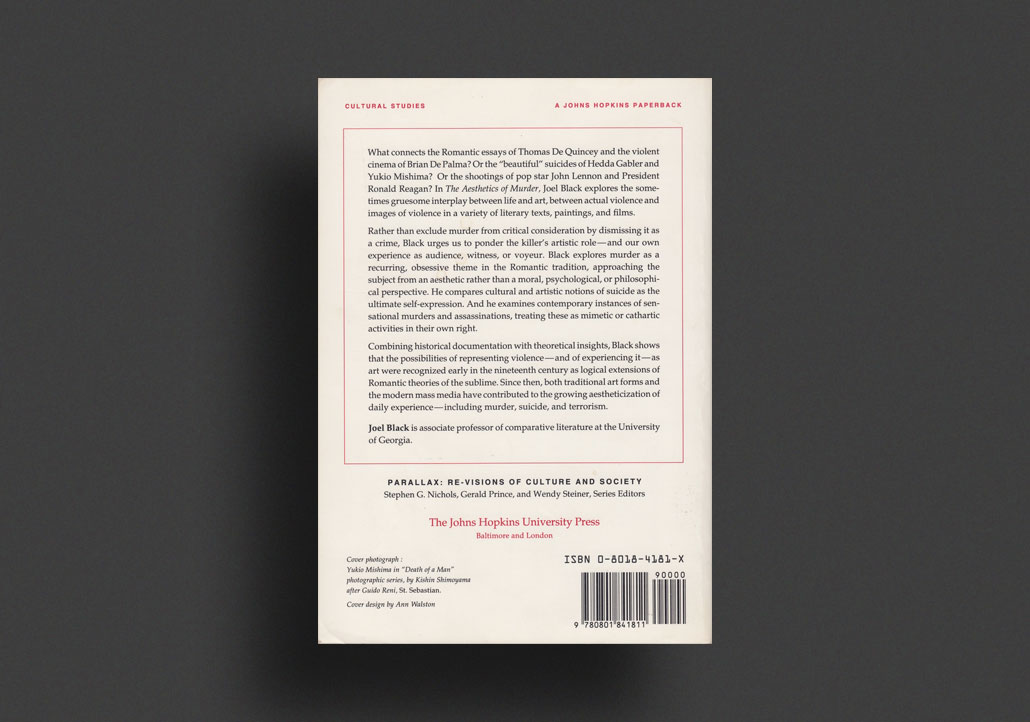
What connects the Romantic essays of Thomas De Quincey and the violent cinema of Brian De Palma? Or the "beautiful" suicides of Hedda Gabler and Yukio Mishima? Or the shootings of John Lennon and Ronald Reagan? In The Aesthetics of Murder, Joel Black explores the sometimes gruesome interplay between life and art, between actual violence and images of violence in a variety of literary texts, paintings, and films.
Rather than exclude murder from critical consideration by dismissing it as a crime, Black urges us to ponder the killer's artistic role—and our own experience as audience, witness, or voyeur. Black examines murder as a recurring, obsessive theme in the Romantic tradition, approaching the subject from an aesthetic rather than a moral, psychological, or philosophical perspective. And he brings into his discussion contemporary instances of sensational murders and assassinations, treating these as mimetic or cathartic activities in their own right.
Combining historical documentation with theoretical insights, Black shows that the possibilities of representing violence—and of experiencing it—as art were recognized early in the nineteenth century as logical extensions of Romantic theories of the sublime. Since then, both traditional art forms and the modern mass media have contributed to the growing aestheticization of violence.
Very Good copy, light wear.
2024, English
Softcover, 368 pages, 20.1 x 12.7 cm
Published by
The New York Review of Books / New York
$39.00 - Out of stock
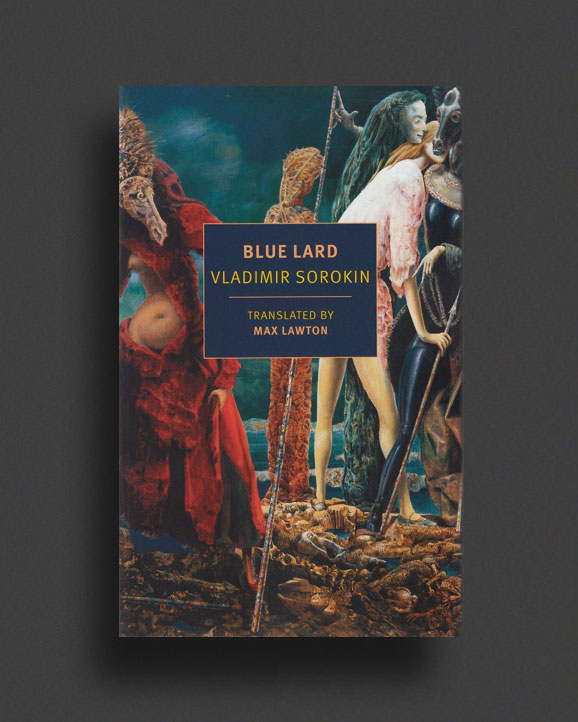
Vladimir Sorokin's Blue Lard is the most iconic and iconoclastic Russian novel of the last forty years. Thanks in part to its depiction of Stalin and Khrushchev having sex, which inspired a Putinist youth group to throw shredded copies of the author's books into an enormous toilet erected in front of Moscow's Bolshoi Theater, Blue Lard is the novel that tore Sorokin out of the Moscow Conceptualist underground and into the headlines.
The book begins in a futuristic laboratory where genetic scientists speak in a Joycean dialect of Russian mixed with Chinese-peppered with ample neologisms-and work to clone famous Russian writers, who are then made to produce texts in the style of their forebears. The goal of this "script-process" is not the texts themselves, but the blue lard that collects in the small of their backs as they write.
This substance is to be used to power reactors on the moon-that is, until a sect of devout nationalists breaks in to steal the blue lard, planning to send it back in time to an alternate version of the Soviet Union, one that exists on the margins of a Europe conquered by a long-haired Hitler with the ability to shoot electricity from his hands. What will come of this blue lard? Who will finally make use of its mysterious powers?
Blue Lard is a stylistically acrobatic book, translated by Max Lawton into an English idiom just as bizarre as the Russian original. Evoking both Pulp Fiction and the masterpieces of the Marquis de Sade, Sorokin's novel is a brutal, heady trip that annihilates all of its twentieth- (and twenty-first-) century competition in the Russian canon-and that annihilates Russia itself in a resounding act of heavy-metal dissidence.
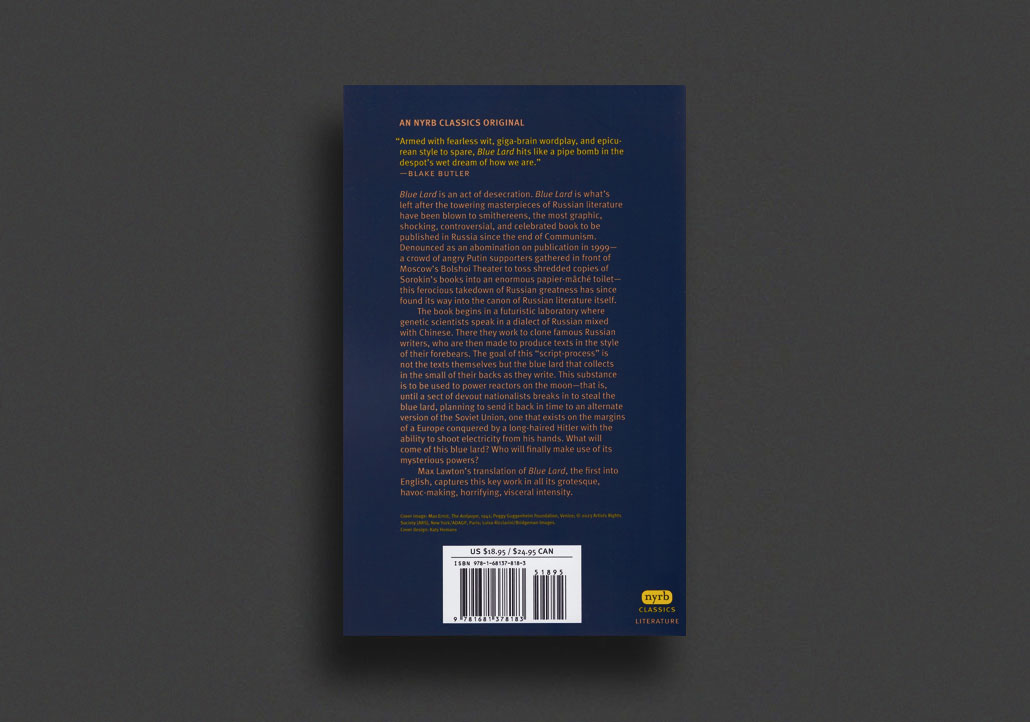
Blue Lard is an act of desecration. Blue Lard is what's left after the towering masterpieces of Russian literature have been blown to smithereens, the most graphic, shocking, controversial, and celebrated book to be published in Russia since the end of Communism. Denounced as an abomination on publication in 1999-a crowd of angry Putin supporters gathered in front of Moscow's Bolshoi Theater to toss shredded copies of Sorokin's books into an enormous papier-m che toilet-this ferocious takedown of Russian greatness has since found its way into the canon of Russian literature itself.
The book begins in a futuristic laboratory where genetic scientists speak in a dialect of Russian mixed with Chinese. There they work to clone famous Russian writers, who are then made to produce texts in the style of their forebears. The goal of this "script-process" is not the texts themselves but the blue lard that collects in the small of their backs as they write. This substance is to be used to power reactors on the moon-that is, until a sect of devout nationalists breaks in to steal the blue lard, planning to send it back in time to an alternate version of the Soviet Union, one that exists on the margins of a Europe conquered by a long-haired Hitler with the ability to shoot electricity from his hands. What will come of this blue lard? Who will finally make use of its mysterious powers?
Max Lawton's translation of Blue Lard, the first into English, captures this key work in all its grotesque, havoc-making, horrifying, visceral intensity.
2022, English
Softcover, 672 pages, 28.9 x 17.5 cm
Published by
Deep Vellum / Texas
$46.00 - In stock -
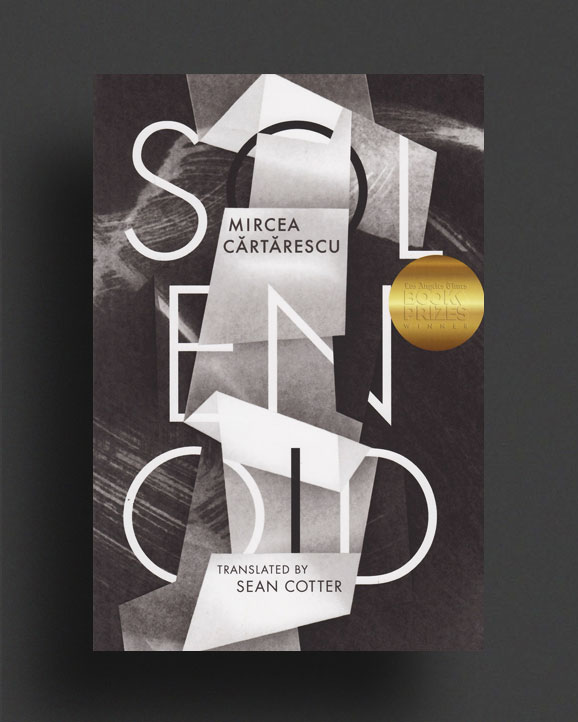
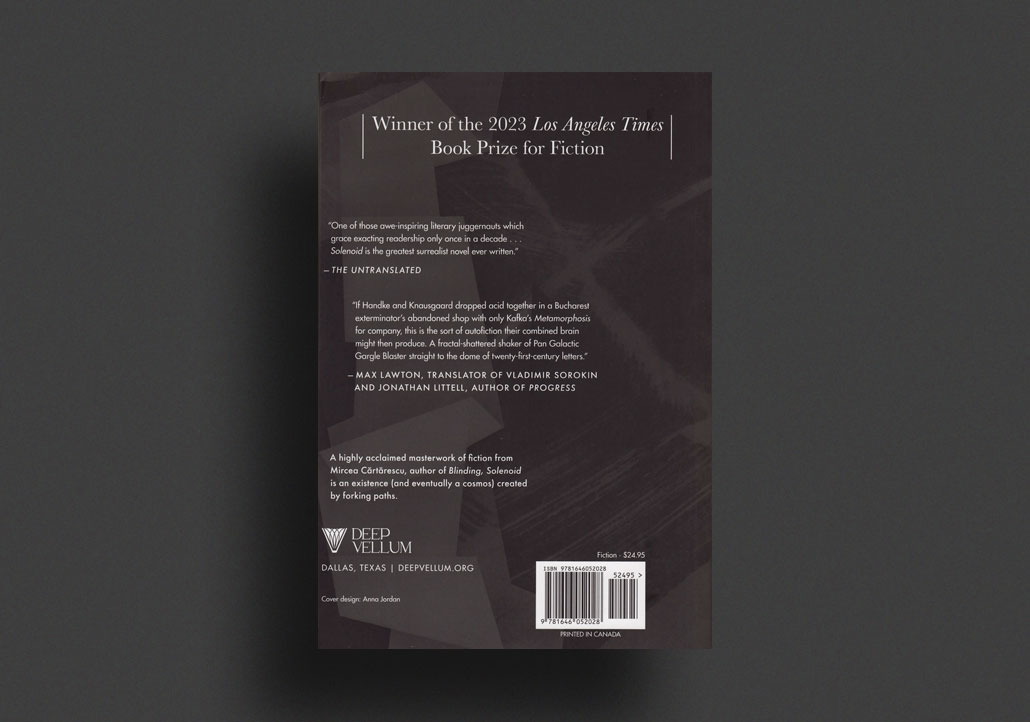
A highly-acclaimed master work of fiction from Mircea Cărtărescu, author of Blinding, Solenoid is an existence (and eventually a cosmos) created by forking paths. WINNER of the Dublin Literary Award 2024 and the Los Angeles Times Book Prize 2022. NAMED ONE OF THE BEST BOOKS OF 2022 by the New Yorker, Publishers Weekly, The Financial Times, Words Without Borders
Based on Cărtărescu's own experience as a high school teacher, Solenoid begins with the mundane details of a diarist's life and quickly spirals into a philosophical account of life, history, philosophy, and mathematics. The novel is grounded in the reality of Romania in the late 1970s and early 1980s, including frightening health care, the absurdities of the education system, and the misery of family life, while on a broad scale Solenoid's investigations of other universes, dimensions, and timelines attempt to reconcile the realms of life and art. The text includes sequences in a tuberculosis preventorium, encounters with an anti-death protest movement, a society of dream investigators, and an extended visit to the miniscule world of dust mites living on a microscope slide. One character asks another: When you rush into the burning building, will you save the newborn or the artwork?
Combining fiction with autobiography and history—Nikola Tesla and Charles Hinton, for example, appear alongside the Voynich manuscript—Solenoid searches for escape routes through the alternate dimensions of life and art, as various monstrous realities erupt within the present.
Mircea Cărtărescu is a writer, professor, and journalist who has published more than twenty-five books. His work has received the Formentor Prize (2018), the Thomas Mann Prize (2018), the Austrian State Prize for Literature (2015), and the Vilenica Prize (2011), among many others. His work has been translated in twenty-three languages. His novel Blinding was published by Archipelago in Sean Cotter's English translation.
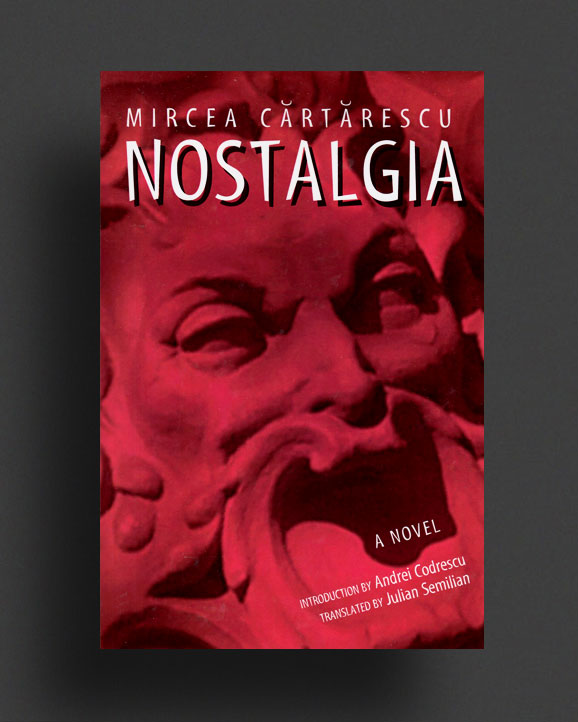
2005, Enlish
Softcover, 362 pages, 23 x 15.5 cm
Published by
New Directions / New York
$46.00 - Out of stock
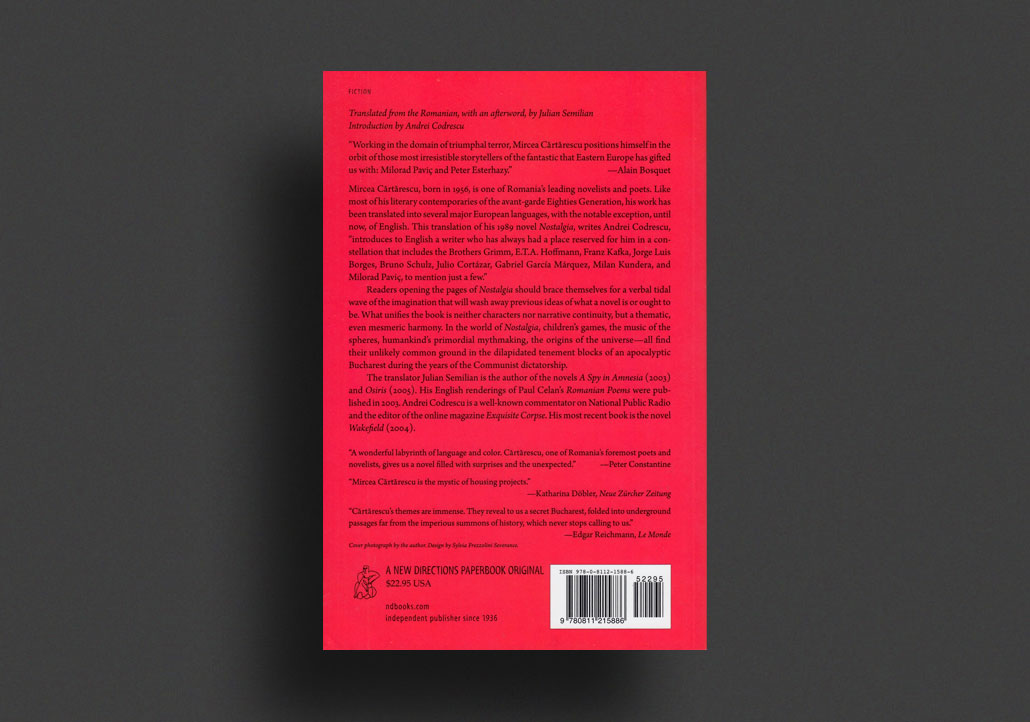
"Cărtărescu’s themes are immense. They reveal to us a secret Bucharest, folded into underground passages far from the imperious summons of history, which never stops calling to us."—Edgar Reichmann, Le Monde
Translated from Romanian by Julian Semilian
Mircea Cărtărescu, born in 1956, is one of Romania’s leading novelists and poets. This translation of his 1989 novel Nostalgia, writes Andrei Codrescu, “introduces to English a writer who has always had a place reserved for him in a constellation that includes the Brothers Grimm, Franz Kafka, Jorge Luis Borges, Bruno Schulz, Julio Cortázar, Gabriel García Márquez, Milan Kundera, and Milorad Pavic, to mention just a few.” Like most of his literary contemporaries of the avant-garde Eighties Generation, his major work has been translated into several European languages, with the notable exception, until now, of English. Readers opening the pages of Nostalgia should brace themselves for a verbal tidal wave of the imagination that will wash away previous ideas of what a novel is or ought to be. Although each of its five chapters is separate and stands alone, a thematic, even mesmeric harmony finds itself in children’s games, the music of the spheres, humankind’s primordial myth-making, the origins of the universe, and in the dilapidated tenement blocks of an apocalyptic Bucharest during the years of communist dictatorship.
Mircea Cărtărescu is a writer, professor, and journalist who has published more than twenty-five books. His work has received the Formentor Prize (2018), the Thomas Mann Prize (2018), the Austrian State Prize for Literature (2015), and the Vilenica Prize (2011), among many others. His work has been translated in twenty-three languages. His novel Blinding was published by Archipelago in Sean Cotter's English translation.
?, English
Softcover, 58 pages, 23 x 15.5 cm
Out of print title / used / fine
Published by
Unknown / Earth
$20.00 - Out of stock
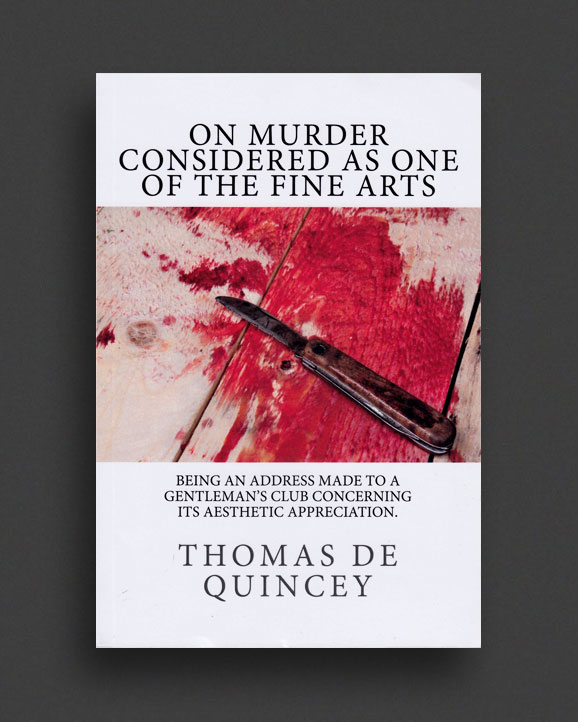
"People begin to see that something more goes to the composition of a fine murder than two blockheads to kill and be killed - a knife - a purse - and a dark lane..."
"On Murder Considered as one of the Fine Arts" is an essay first published in 1827 in Blackwood's Magazine by English writer, essayist, and literary critic, best known for his Confessions of an English Opium-Eater, Thomas De Quincey (1785—1859). The essay is a fictional, satirical account of an address made to a gentleman's club concerning the aesthetic appreciation of murder.
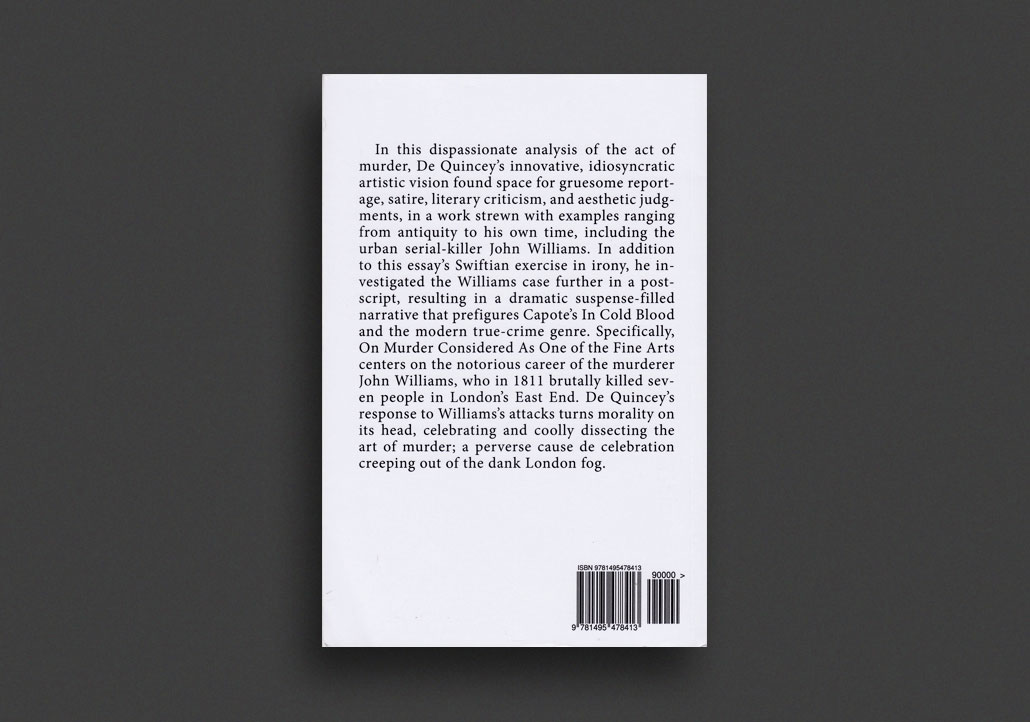
In this provocative and blackly funny essay, Thomas de Quincey considers murder in a purely aesthetic light and explains how practically every philosopher over the past two hundred years has been murdered - 'insomuch, that if a man calls himself a philosopher, and never had his life attempted, rest assured there is nothing in him'. De Quincey's innovative, idiosyncratic artistic vision found space for gruesome reportage, satire, literary criticism, and aesthetic judgments, in a work strewn with examples ranging from antiquity to his own time, including the urban serial-killer John Williams. In addition to this essay's Swiftian exercise in irony, he investigated the Williams case further in a post-script, resulting in a dramatic suspense-filled narrative that prefigures Capote's In Cold Blood and the modern true-crime genre. Specifically, "On Murder Considered as one of the Fine Arts" centers on the notorious career of the murderer John Williams, who in 1811 brutally killed seven people in London's East End. De Quincey's response to Williams's attacks turns morality on its head, celebrating and coolly dissecting the art of murder; a perverse cause de celebration creeping out of the dank London fog.
De Quincey's seminal 1827 work was greatly influential on such writers as Poe, Baudelaire and Borges, lauded by such critics as G. K. Chesterton, Wyndham Lewis and George Orwell, and the trace of its impact can still be found today in modern satire, black humour and crime and detective fiction.
Near Fine, light wear.
1954 / ?, English
Softcover, 500 pages, 20 x 13 cm
Out of print title / used / good
Published by
Penguin Books / London
$10.00 - In stock -
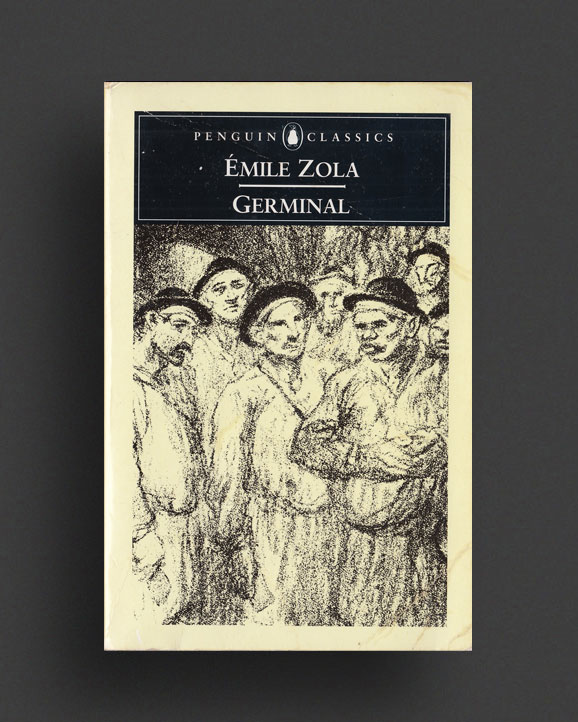
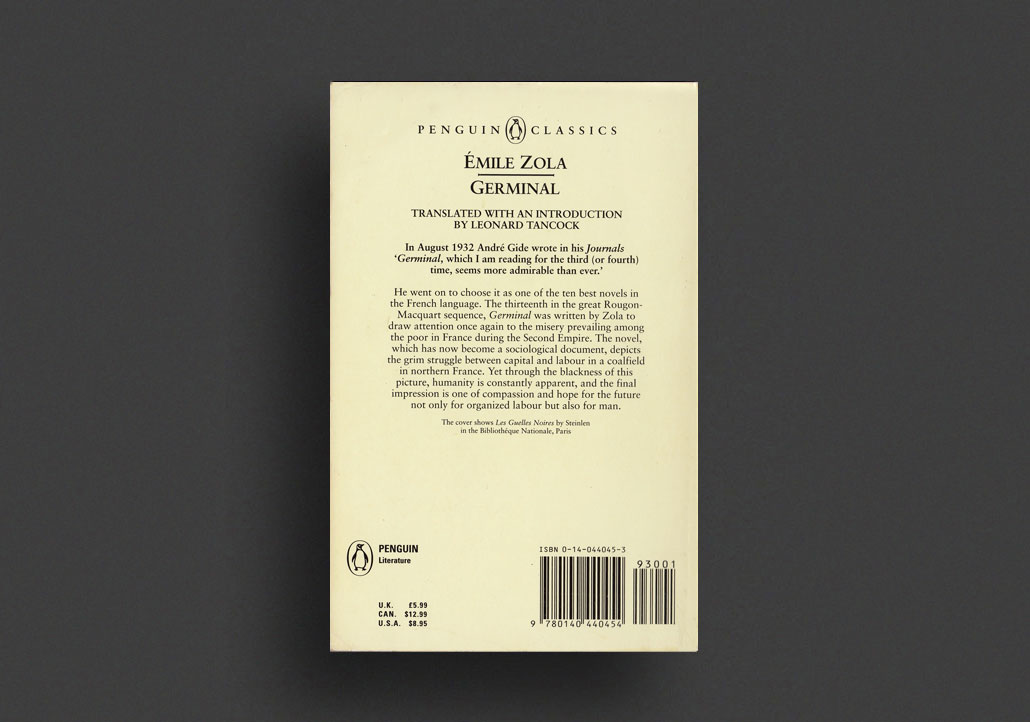
In August 1932 Andre Gide wrote in his Journals "Germinal, which I am reading for the third (or fourth) time, seems more admirable than ever." He went on to choose it as one of the ten best novels in the French language.
Germinal is the thirteenth novel in Émile Zola's twenty-volume series Les Rougon-Macquart. Often considered Zola's masterpiece and one of the most significant novels in the French tradition, the novel – an uncompromisingly harsh and realistic story of a coalminers' strike in northern France in the 1860s – has been published and translated in over one hundred countries. It has also inspired five film adaptations and two television productions.
"Written by Zola to draw attention once again to the misery prevailing among the poor in France during the Second Empire. The novel, which has now become a sociological document, depicts the grim struggle between capital and labour in a coalfield in northern France. Yet through the blackness of this picture, humanity is constantly apparent, and the final impression is one of compassion and hope for the future not only for organized labour but also for man."—publisher's blurb
Good—VG copy with general wear, age and creasing.
1990, English
Softcover, 80 pages, 30 x 23 cm
1st Edition, Out of print title / used / very good
Published by
Janssen Verlag / Berlin
$200.00 - Out of stock
First 1990 edition of The Art of George Quaintance, the first comprehensive art book survey of George Quaintance's work. Profusely illustrated throughout with beautiful reproductions of Quaintance's stunning homo-erotic artworks and book illustrations, alongside many press clippings, magazine articles, advertisements for Studio Quaintance, texts in English and German by George Quaintance, Volker Janssen, and Tora Lillstrom. George Quaintance (1902—1957) was an important Arizonan American artist, famous for his "idealized, strongly homoerotic" depictions of men in mid-20th-century physique magazines, such as the influential Physique Pictorial. Using historical settings and folklore such as the Wild West, or the mythology of ancient Greece and Rome, George Quaintance distanced his subjects from modern society, his world of legends made glorious with muscular, semi-nude or nude male figures, helping establish the stereotype of the homosexual "macho stud". A pioneer of a gay aesthetic, George Quaintance's work would influence many later homoerotic artists, including, most notably Tom of Finland.
Very Good copy.
2014, English
Softcover, 200 pages, 15 x 10.5 cm
1st Edition, Out of print title / used / very good
Published by
Editions Hazan / Paris
$50.00 - In stock -
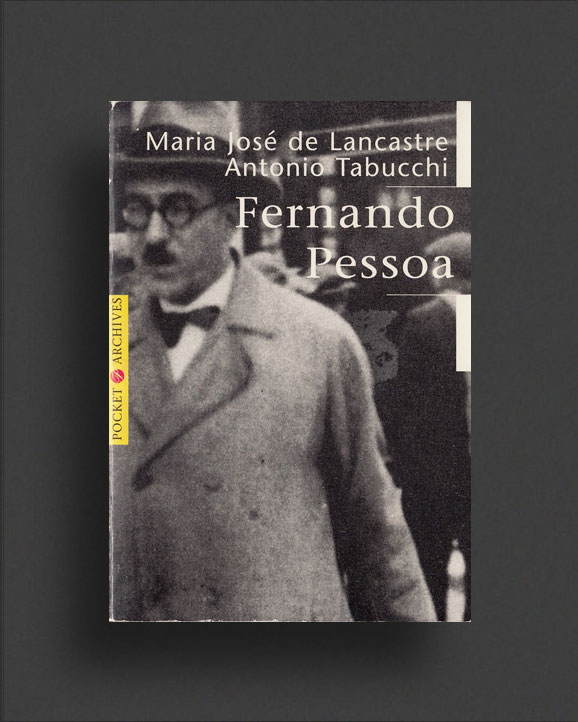
First 1997 edition of this illuminating, long overdue English language biography on one of the most enigmatic, singular writers of the twentieth century, the great Fernando Pessoa (1888—1935).
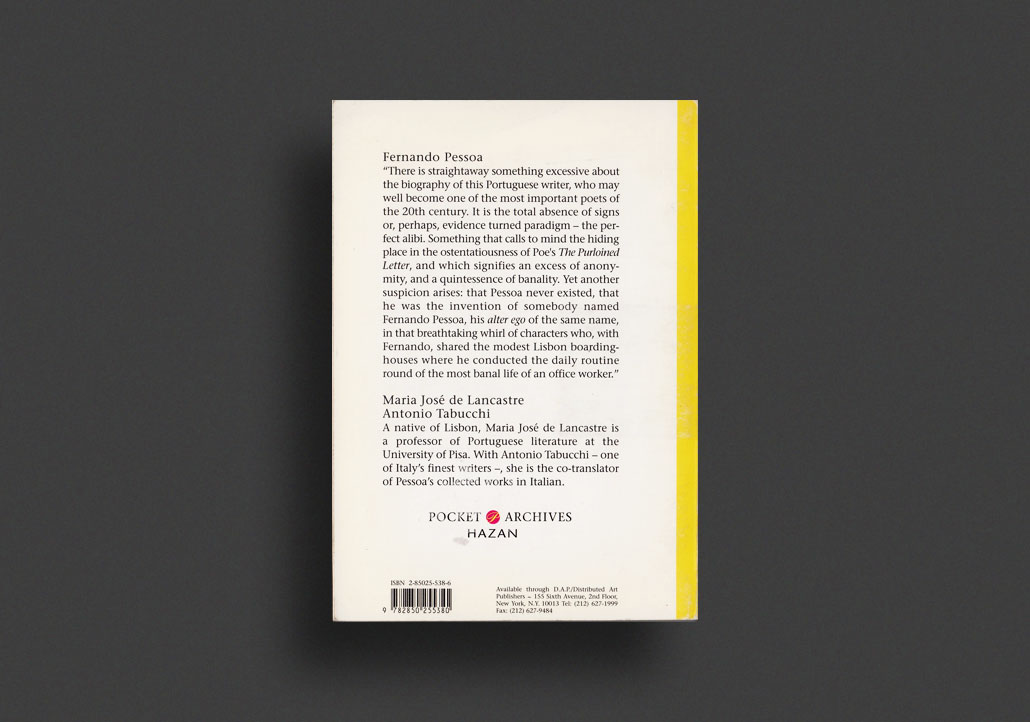
"There is straightaway something excessive about the biography of this Portuguese writer, who may well become one of the most important poets of the 20th century. It is the total absence of signs or, perhaps, evidence turned paradigm — the perfect alibi. Something that calls to mind the hiding place in the ostentatiousness of Poe's The Purloined Letter, and which signifies an excess of anonymity, and a quintessence of banality. Yet another suspicion arises: that Pessoa never existed, that he was the invention of somebody named Fernando Pessoa, his alter ego of the same name, in that breathtaking whirl of characters who, with Fernando, shared the modest Lisbon boarding-houses where he conducted the daily routine round of the most banal life of an office worker."
This compact volume by Portuguese editor Maria José de Lancastre is a visual exploration of Pessoa's life and writings, spanning the forty-seven years from his birth to his passing in 1935, providing rare photographs and captions in English of the poet, his family, his Lisbon-based career, facsimiles of letters, publications and other documents... accompanied by an illuminating introductory essay by author Italian—Portuguese author Antonio Tabucchi.
An indispensable reference for those intrigued by the Pessoan mystique.
Very Good copy with light edge wear to covers.
2019, English / French
Softcover (in slipcase), 20 pages, 54.6 x 35.5 cm
Published by
Lucia | Marquand / Washington
$120.00 $80.00 - Out of stock
Stéphane Mallarmé (1842-98) claimed to have learned English in order to read Poe, an American poet greatly admired by the French Symbolists. This volume reproduces at full size (!) the first-edition bilingual publication of "Le Corbeau / The Raven" (Richard Lesclide, Paris, 1875), Mallarme's prose translation of Poe's melancholy poem, including six commissioned illustrations by Edouard Manet. In addition, a new retranslation back into English of Mallarme's text, which was both praised and criticised for its literalism, reveals the particular tenor and subtleties of his reading of Poe's verse and his feel, as a fellow poet, for the emotive and evocative power of language. The result is a circular exploration of the poem and its translation. The volume also reflects Mallarme's specifications for layout, typeface and paper. This is the second in a series exploring Mallarme in translation.
2024, English
Hardcover (w. dust jacket), 496 pages, 19.05 x 16.51 cm
Published by
Yale University Press / New Haven
$62.00 - Out of stock
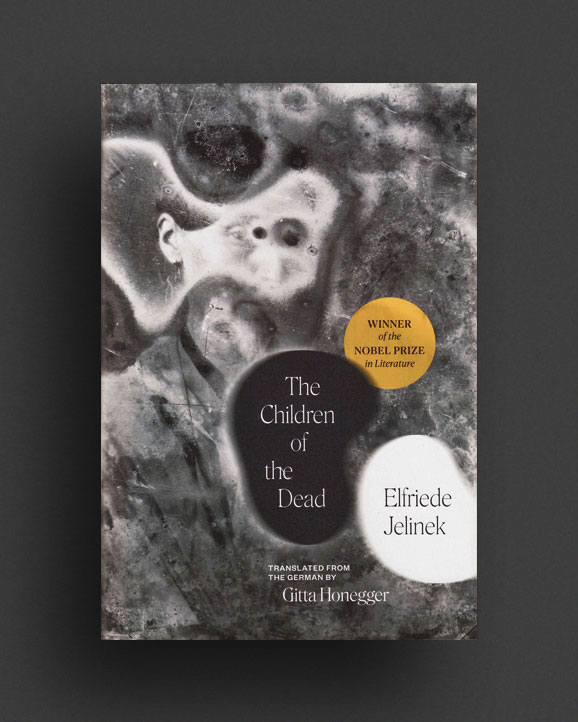
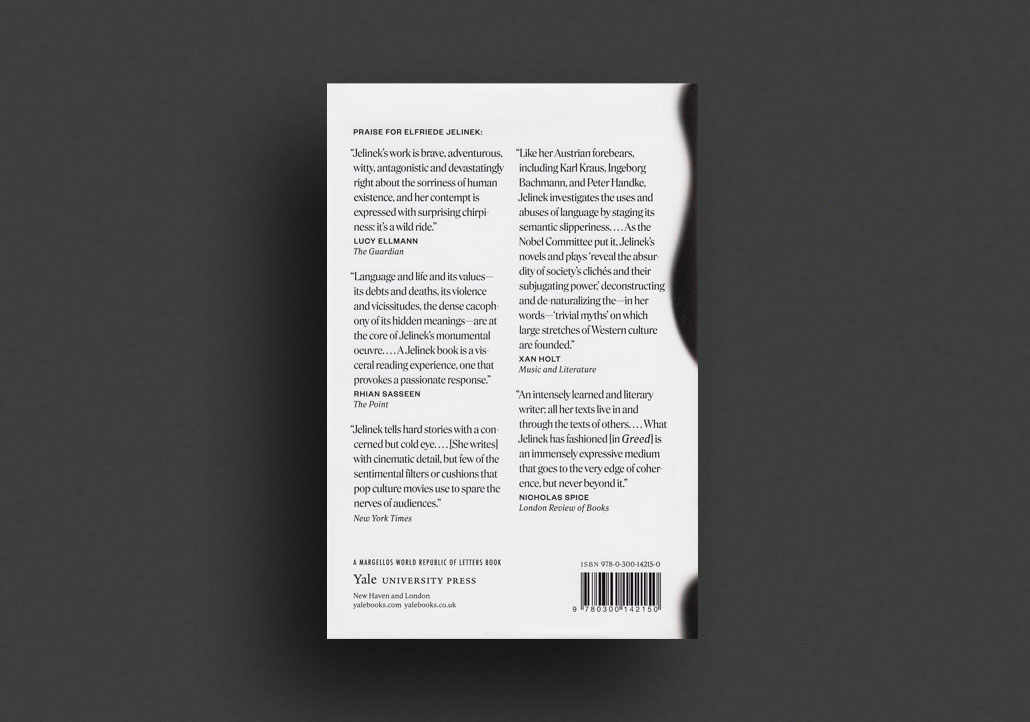
The magnum opus of 2004 Nobel laureate Elfriede Jelinek—a spectral journey through the catastrophic history embedded in the landscape of Austria
"The surface of Jelinek's prose cracks and bursts . . . fissured by phantasmagorical description, gallows humor, multilingual puns, and scouring sarcasm. . . . Jelinek's novel is finally . . . a furious accumulation of lost moments and possible outcomes, an enormous, spectral kaleidoscope erected before the unfathomable."—Dustin Illingworth, Washington Post
The Alpenrose is a mountain resort nestled in Austria's scenic landscape among historic churches and castles. It is a vacation idyll that attracts tourists from all over Europe. It is also a mass burial site.
Amid the snow-topped peaks and panoramic vistas, ghosts haunt the forest: Edgar Gstranz, a young skier who died in a car crash; Gudrun Bichler, a philosophy student who committed suicide in her bathtub; and Karin Frenzel, a widow who (perhaps) died in a bus accident. As the three slip in and out of the hotel, engaging unsuspecting tourists and seeking a way to return to life, the soil begins to crack under their feet as the dead of the Holocaust awaken: zombies determined to exact their revenge.
Scrupulously rendered for the first time in English by Gitta Honegger, The Children of the Dead takes readers on a mind-bending ride through time, space, and memory. Concocted from experimental theater, splatter film, Gothic literature, philosophy, religion, and more, Jelinek's phantasmagorical masterwork is a fierce confrontation with our fraught legacies in the name of the innocent dead.
2001, English
Softcover, 188 pages, 20.4 x 13.97 cm
Published by
City Lights Books / San Francisco
$36.00 - Out of stock
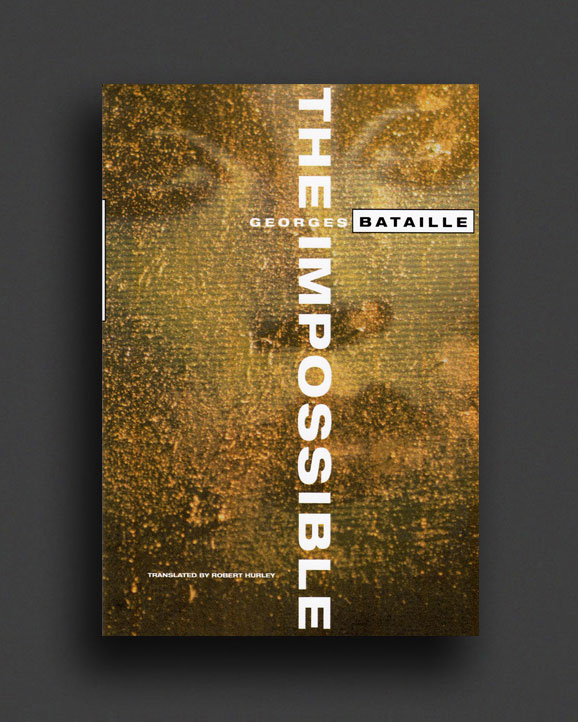
Translations by Robert Hurley.
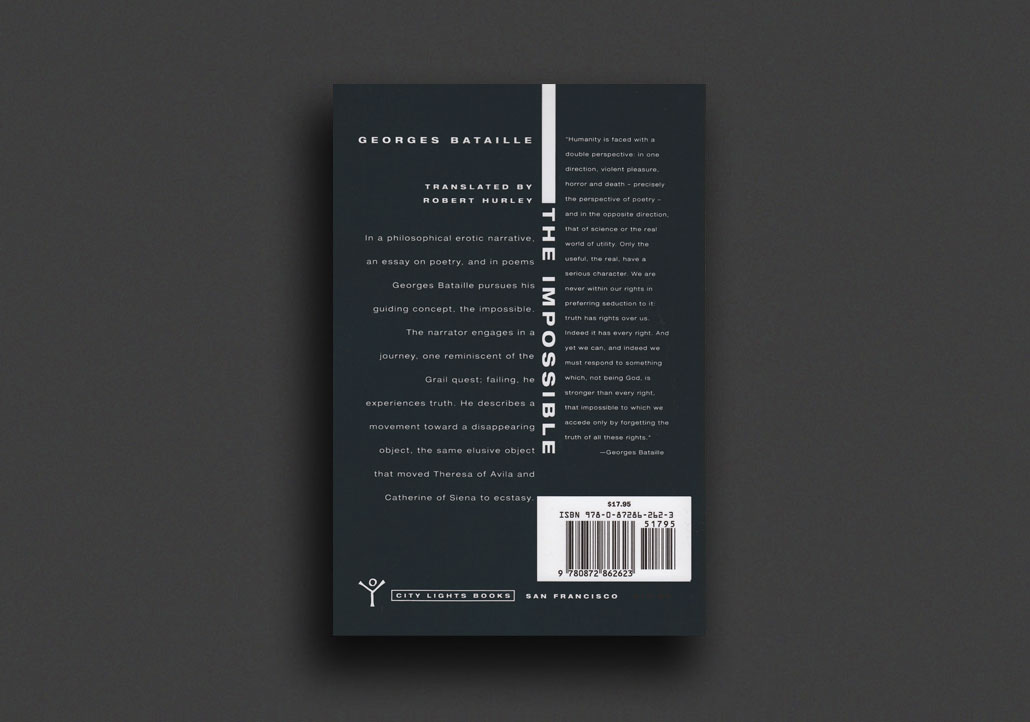
In a philosophical erotic narrative, an essay on poetry, and in poems Georges Bataille pursues his guiding concept, the impossible. The narrator engages in a journey, one reminiscent of the Grail quest; failing, he experiences truth. He describes a movement toward a disappearing object, the same elusive object that moved Theresa of Avila and Catherine of Siena to ecstasy.
"Humanity is faced with a double perspective: in one direction, violent pleasure, horror and death – precisely the perspective of poetry – and in the opposite direction, that of science or the real world of utility. Only the useful, the real, have a serious character. We are never within our rights in preferring seduction to it: truth has rights over us. Indeed it has every right. And yet we can, and indeed we must respond to something which, not being God, is stronger than every right, that impossible to which we accede only by forgetting the truth of all these rights." —Georges Bataille
Georges Bataille (1897-1962) was a French intellectual and literary icon who wrote essays, novels, and poems exploring philosophical and sociological subjects such as eroticism and surrealism. City Lights published more of Bataille's works including Erotism, The Tears of Eros, and Story of the Eye.
2024, English
Softcover, 152 pages, 18 x 12 cm
Published by
Mudam / Luxembourg
Sternberg Press / Berlin
$42.00 - Out of stock
Edited by Bettina Steinbrügge. Contributions By Cory Arcangel, Karen Archey, Motoko Ishibashi, Ingrid Luquet-Gad, Clémentine Proby, Fabian Schöneich, Stephanie Seidel, Bettina Steinbrügge, Sarah Johanna Theurer
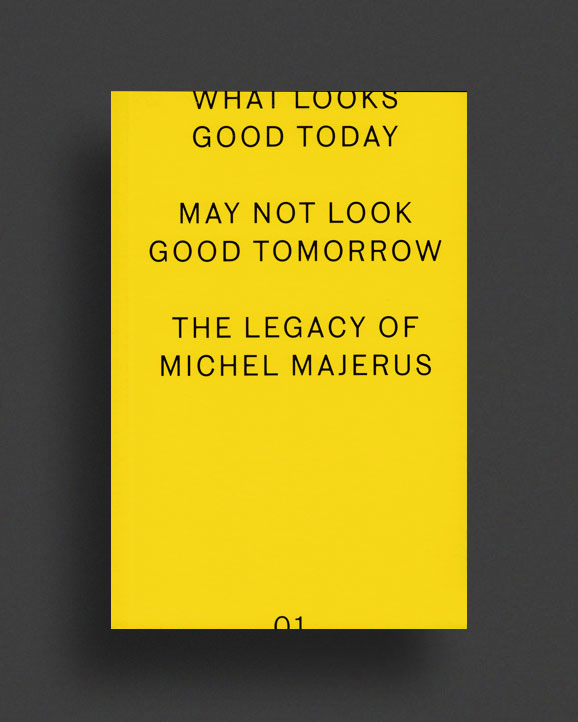
In the span of a short yet exceptionally prolific career, Luxembourgish artist Michel Majerus (1967–2002) transgressed the well-worn rules of painting to capture the influence of digital media and pop culture during the 1990s and early 2000s.
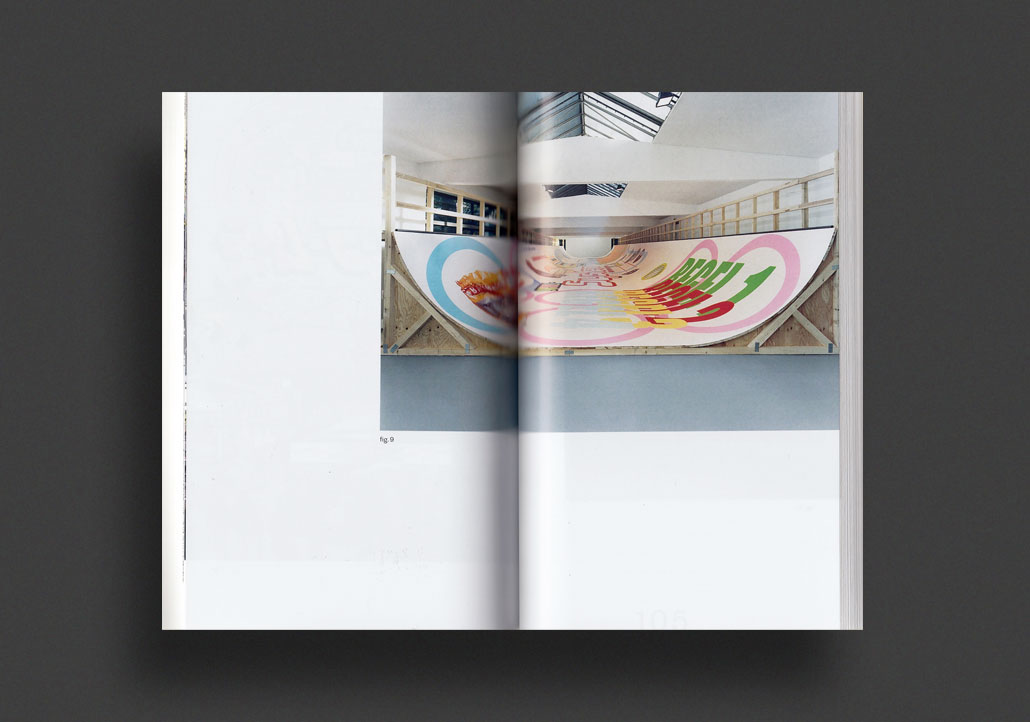
Majerus’s large-scale paintings and installations—characterized by the artist’s ‘sampling’ and collaging of an eclectic repertoire of imagery and text borrowed from art history, video games, commercials, and electronic music—resonate with the rapid expansion of globalized consumer culture and digital technology.
This book collects and preserves the talks and lecture-performances held during a symposium on Majerus at Mudam, the contemporary art museum in Luxembourg. The convening considered the relevance of Majerus’s reflections today and discussed the dimensions of his legacy—investigating his influence on the practices of the digitally native artists, curators, and researchers who came after him.
The symposium was the first chapter of a program dedicated to Majerus’s work at the museum and was followed by the exhibition SINNMASCHINE, curated by Bettina Steinbrügge. Rather than a retrospective, the exhibition examined Majerus’s working methods by displaying never-before-exhibited archival material, including Majerus’s drawings and writings from his expansive collection of notebooks. This publication bridges the exhibition and the symposium’s reflections, featuring images of Majerus’s work and notebooks alongside contributions by Cory Arcangel, Karen Archey, Motoko Ishibashi, Ingrid Luquet-Gad, Clémentine Proby, Fabian Schöneich, Stephanie Seidel, Bettina Steinbrügge, and Sarah Johanna Theurer.
what looks good today may not look good tomorrow: The Legacy of Michel Majerus is the first book in the Mudam Series. This series is an edited collection of interventions, symposiums, and lectures by artists, critics, writers, curators, art historians, and thinkers that have taken place at Mudam, the contemporary art museum in Luxembourg. Each volume is dedicated to a specific artist or theme, following the museum’s exhibition program. The series is meant as a collection of working documents that open up a dialogue beyond institutional walls—a gentle nod to books still being the greatest of meeting places. Mudam Series is conceived and edited by Bettina Steinbrügge and Mudam’s editorial team.
1984 / 1991, English
Softcover, 172 pages, 28 x 21.5 cm
Out of print title / used / very good
Published by
RE/SEARCH / San Francisco
$70.00 - Out of stock
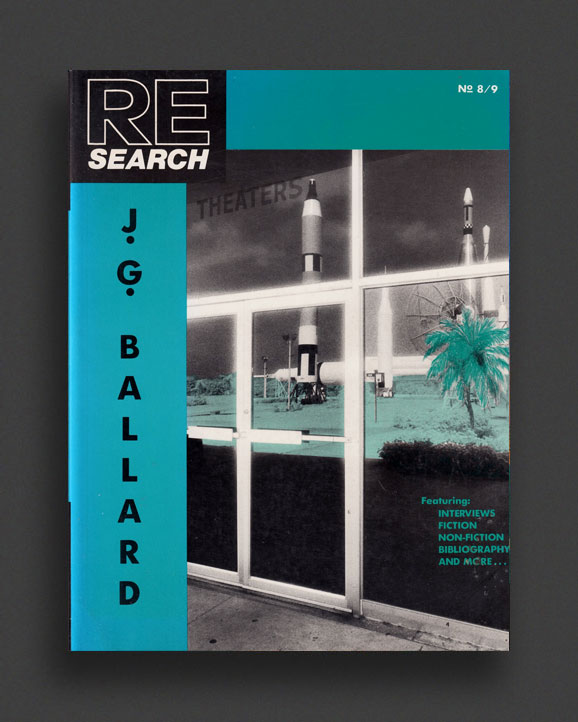
"The definitive guide to Ballard to date"—The Face
1991 edition of RE/Search's classic 1984 issue on J.G. Ballard, a volume packed with interviews with Ballard, fiction, non-fiction pieces, art by Ballard, bibliography, and much more! The nonpareil introduction to the visionary prophet of the 21st century; a comprehensive special on this supremely relevant writer, now famous for Empire of the Sun and Crash, with some of the best interviews ever recorded, PLUS! his rarely-seen collages. This strikingly illustrated volume contains interviews and a wealth of rare selections from every aspect of Ballard’s career, plus bibliography and more. Essays include "Time, Memory and Inner Space," "Why I Want to Fuck Ronald Reagan," an article about William Burroughs entitled "Mythmaker of the 20th Century," and "Coming of the unconscious."
Very Good copy, light wear.