World Food Books' programme is largely produced on Kulin Nation land. We acknowledge the Wurundjeri people of the Kulin Nation as the first and continuing custodians of this land, and pay respect to their Elders past, present, and emerging.
World Food Books is an arts and special interests bookshop in Naarm / Melbourne. Founded in 2010, World Food Books is devoted to the presentation of a rotating, hand-selection of international art, design, literary and counterculture publications with an emphasis on the anti-traditional, the experimental, the avant-garde, the heretic, the marginal.
Presenting new titles alongside rare and out-of-print books, catalogues and journals spanning the fields of modern and contemporary art, design, photography, illustration, film, literature, poetry, cultural theory, philosophy, sexuality, popular and underground culture in its many radical forms, World Food Books wishes to encourage adventurous, thoughtful and open-minded reading, looking, writing, and exchange of publishing and ideas, both current and historical.
As well as our bookshop, located in Melbourne's historical Nicholas Building, all of our inventory is available internationally via our online mail-order service.
World Food Books semi-regularly co-ordinates "Occasions", a programme of exhibits and events at the bookshop and in partnership with other hosts (such as museums and art galleries) that develop out of the activities, relationships and content of the bookshop itself.
World Food Books
The Nicholas Building
37 Swanston Street
Room 5, Level 6
Melbourne 3000
Australia
SHOP HOURS:
SHOP CLOSED FOR SUMMER
RE—OPEN JAN 2
WEB-SHOP OPEN 24/7
World Food Books
Postal Address:
PO Box 435
Flinders Lane
Victoria 8009
Australia
Art
Theory / Essay
Architecture / Interior
Graphic Design / Typography
Photography
Fashion
Eros
LGBTQ+
Fiction / Poetry
Weird / Speculative / Science Fiction / Horror
Transgressive / Visceral / Abject
Symbolism / Decadence / Fin de siècle
Film / Video
Painting
Sculpture / Installation
Performance / Dance / Theater
Drawing
Sound / Music
Curatorial
Group Shows / Collections
Periodicals
Out-of-print / Rare
Posters / Ephemera / Discs
Signed Books
World Food Books Gift Voucher
World Food Book Bag
Australian Art
Australian Fiction
Australian Science Fiction / Speculative Fiction
Australian Poetry
Australian Photography
Japanese Photography
Conceptual Art
Minimal Art
Dada
'Pataphysics / Oulipo
Fluxus
Concrete Poetry
Pop Art
Surrealism
Arte Povera
Arte Informale / Haute Pâte / Tachism
Nouveau Réalisme / Zero / Kinetic
Situationism / Lettrism
Collage / Mail Art / Xerox Art
Art Brut / Folk / Visionary / Fantastic
Illustration / Graphic Art / Bandes Dessinées
Furniture
Italian Radical Design / Postmodernism
Textiles
Ceramics / Glass
Counterculture
Protest / Revolt
Philosophy
Psychoanalysis
Anthropology
Anarchism
Socialism / Anarchism / Communism / Capitalism
Literary Theory / Semiotics / Language
Feminism / Women's Studies
Gender Studies / Sexuality
Anthropology
Fetishism / BDSM
Drugs / Psychedelia
Crime / Violence
Animal Rights / Veganism
Occult / Esoterica
Ecology / Earth / Alternative Living
Whole Earth / Crafts
All prices in AUD (Australian dollars)
Pick-Ups
Pick-up orders can be collected in our bookshop during opening hours after order date. Please collect any Pick-up orders within 2 weeks of ordering as we have limited storage space. Orders will be released back into stock if not collected within this time. No refunds can be made for pick-ups left un-collected. If you cannot make it in to the bookshop in this time-frame, please choose postage option.
Return Policy
All sales are final. We do accept returns (for refund or exchange) for items received in error. All our orders are packed with special care using heavy-duty padding and cardboard book-mailers or bubble mailers (for smaller books), using reinforcement where required. We cannot take responsibility for any lost, stolen or damaged parcels.
Insurance
Should you wish to insure your package, please email us directly after placing your order and we can organise this at a small extra expense. Although all standard/express tracked packages are very safe and dependable, we cannot take responsibility for any lost, stolen or damaged parcels. We recommend insurance on valuable orders.
Interested in selling your old books, catalogues, journals, magazines, comics, fanzines, ephemera? We are always looking for interesting, unusual and out-of-print books to buy. We only buy books in our fields of interest and specialty, and that we feel we can resell.
We base these prices on desirability, market value, in-print prices, condition and our current stock levels. We offer cash, store credit, and can take stock on consignment. All
about 25% of the price we expect to get when we sell them, or 30% in store credit. We base these prices on desirability, market value, in-print prices, condition and our current stock levels.
Sell your books any day of the week. You can drop them off and return later. If you have a lot of books, we can visit your Sydney home.
We buy books that we feel we can resell. We offer about 25 % of the price we expect to get when we sell them, or 30% in store credit. We base these prices on desirability, market value, in-print prices, condition and our current stock levels.
Philadelphia Wireman
03 August - 01 September, 2018
World Food Books is proud to announce our next Occasion, the first presentation of sculptures by Philadelphia Wireman in Australia.
The Philadelphia Wireman sculptures were found abandoned in an alley off Philadelphia’s South Street on trash night in 1982. Their discovery in a rapidly-changing neighbourhood undergoing extensive renovation, compounded with the failure of all attempts to locate the artist, suggests that the works may have been discarded after the maker’s death. Dubbed the "Philadelphia Wireman" during the first exhibition of this work, in 1985, the maker’s name, age, ethnicity, and even gender remain uncertain. The entire collection totals approximately 1200 pieces, all intricately bound together with tightly-wound heavy-gauge wire (along with a few small, abstract marker drawings, reminiscent both of Mark Tobey and J.B. Murry). The dense construction of the work, despite a modest range of scale and materials, is singularly obsessive and disciplined in design: a wire armature or exoskeleton firmly binds a bricolage of found objects including plastic, glass, food packaging, umbrella parts, tape, rubber, batteries, pens, leather, reflectors, nuts and bolts, nails, foil, coins, toys, watches, eyeglasses, tools, and jewellery.
Heavy with associations—anthropomorphic, zoomorphic, and socio-cultural responses to wrapped detritus—the totemic sculptures by Philadelphia Wireman have been discussed in the context of work created to fulfil the shamanistic needs of alternative religions in American culture. Curators, collectors, and critics have variously compared certain pieces to sculpture from Classical antiquity, Native American medicine bundles, African-American memory jugs, and African fetish objects. Reflecting the artist’s prolific and incredibly focused scavenging impulse, and despite—or perhaps enhanced by—their anonymity, these enigmatic objects function as urban artefacts and arbiters of power, though their origin and purpose is unknown. Philadelphia Wireman, whatever their identity, possessed an astonishing ability to isolate and communicate the concepts of power and energy through the selection and transformation of ordinary materials. Over the course of the past two decades, this collection has come to be regarded as an important discovery in the field of self-taught art and vernacular art.
Presented in collaboration with Fleisher-Ollman Gallery, Philadelphia, and Robert Heald, Wellington.
Susan Te Kahurangi King
02 February - 10 March, 2018
Susan Te Kahurangi King (24 February 1951 - ) has been a confident and prolific artist since she was a young child, drawing with readily available materials - pencils, ballpoint pens and felt-tip markers, on whatever paper is at hand. Between the ages of four and six Susan slowly ceased verbal communication. Her grandparents William and Myrtle Murphy had developed a special bond with Susan so they took on caring responsibilities for extended periods. Myrtle began informally archiving her work, carefully collecting and storing the drawings and compiling scrapbooks. No drawing was insignificant; every scrap of paper was kept. The King family are now the custodians of a vast collection containing over 7000 individual works, from tiny scraps of paper through to 5 meter long rolls.
The scrapbooks and diaries reveal Myrtle to be a woman of great patience and compassion, seeking to understand a child who was not always behaving as expected. She encouraged Susan to be observant, to explore her environment and absorb all the sights and sounds. Myrtle would show Susan’s drawings to friends and people in her community that she had dealings with, such as shopkeepers and postal workers, but this was not simply a case of a grandmother’s bias. She recognised that Susan had developed a sophisticated and unique visual language and sincerely believed that her art deserved serious attention.
This was an unorthodox attitude for the time. To provide some context, Jean Dubuffet coined the term Art Brut in 1945 to describe work created by self-taught artists – specifically residents of psychiatric institutions and those he considered to be visionaries or eccentrics. In 1972 Roger Cardinal extended this concept by adopting the term Outsider Art to describe work made by non-academically trained artists operating outside of mainstream art networks through choice or circumstance. Susan was born in Te Aroha, New Zealand in 1951, far from the artistic hubs of Paris and London that Dubuffet and Cardinal operated in. That Myrtle fêted Susan as a self-taught artist who deserved to be taken seriously shows how progressive her attitudes were.
Susan’s parents Doug and Dawn were also progressive. Over the years they had consulted numerous health practitioners about Susan’s condition, as the medical establishment could not provide an explanation as to why she had lapsed into silence. Dawn educated herself in the field of homeopathy and went on to treat all twelve of her children using these principles – basing prescriptions on her observations of their physical, mental and emotional state.
Doug was a linguist with an interest in philosophy who devoted what little spare time he had to studying Maori language and culture. To some extent their willingness to explore the fringes of the mainstream made them outsiders too but it was their commitment to living with integrity and their respect for individuality that ensured Susan’s creativity was always encouraged.
Even though Susan’s family supported her artistic pursuits, some staff in schools and hospitals saw it as an impediment to her assimilation into the community and discouraged it in a variety of ways. Her family was not always aware of this and therefore did not fully understand why Susan stopped drawing in the early 1990s. However, rather than dwell on the challenges that Susan faced in pursuit of her artistic practice, they prefer to highlight her achievements. In 2008 Susan began drawing again in earnest, after an almost 20 year interruption, and her work is now shown in galleries around the world.
Susan grew up without television and has been heavily influenced by the comics she read as a child. She is absolutely fearless in the appropriation of recognizable characters, such as Donald Duck and Mickey Mouse, in her work. She twists their limbs, contorts their faces, compresses them together, blends them into complex patterned backgrounds - always imbuing them with an incredible energy. Although Susan often used pop culture characters in her work they are not naive or childlike. These are drawings by a brilliant self-taught artist who has been creating exceptional work for decades without an audience in mind.
Mladen Stilinović
"Various Works 1986 - 1999"
02 February 16 - September 10, 2016
Various works 1986 - 1999, from two houses, from the collections of John Nixon, Sue Cramer, Kerrie Poliness, Peter Haffenden and Phoebe Haffenden.
Including: Geometry of Cakes (various shelves), 1993; Poor People’s Law (black and white plate), 1993; White Absence (glasses, ruler, set square, silver spoon, silver ladel with skin photograph and wooden cubes), 1990-1996; Exploitation of the Dead (grey and red star painting, wooden painting, black spoon with red table, red plate), 1984-1990; Money and Zeros (zero tie, paintings made for friends in Australia (Sue, John, Kerrie), numbers painting), 1991-1992; Words - Slogans (various t-shirts) - “they talk about the death of art...help! someone is trying to kill me”, “my sweet little lamb”, “work is a disease - Karl Marx”; Various artist books, catalogues, monographs, videos; Poster from exhibition Insulting Anarchy; "Circular" Croatian - Australian edition; Artist book by Vlado Martek (Dostoyevsky); more.
Thanks to Mladen Stilinović and Branka Stipančić.
Jonathan Walker
Always Will Need To Wear Winter Shirt Blue + Ochre Small Check Pattern
21 August - 21 September, 2015
Untitled
I am not a great reader of poetry but I always return to the work of Melbourne poet, Vincent Buckley (1925- 1988). Perhaps I find his most tantalising piece to be not a finished poem but a fragment left on a scrap of paper discovered on his desk after the poet’s death.
The poetry gathers like oil
In the word-core, and spreads
It has its music meet,
Its music is in movement.
This fragment is more the shell left behind from a volatile thought than a finished poem. I find the last two lines honest but awkward whereas the first two lines work like an arrow. Most likely he could not find a resolution so it was left. Still, in its present form, it remains an eloquent testimony to the ultimate failure of a medium to express mobile thought and sensation, in Buckley’s case, through verbal language. It’s an important matter because this is something all artists have to deal with regardless of the medium.
I have never written a poem, however, I am forever copying fragments from books on paper scraps in a vain effort to fix certain notions in my head. At first, they function as bookmarks that are sometimes returned to when I open the book. But before long, as they accumulate, they fall out littering the table interspersed with A4 photocopies, bills, books and medications.
To return to Buckley’s fragment, the first two lines very much evoke how I paint nowadays. As you age, detail diminishes and patches of light become more luminous and float. I feel the most honest way of dealing with this is by smearing the oil paint on the canvas with the fingers and working close-up, blind. Only if the patches coalesce into an approaching image can the work gain a life.
-
Jonathan Walker was born in Melbourne, Australia and brought up on a dairy farm in Gippsland. In the 1970’s he studied painting at RMIT and won the Harold Wright Scholarship to the British Museum, London. During the 1980’s he exhibited at Pinacotheca Gallery, Richmond and had work shown at the NGV and Heidi City Art Gallery. Over the same period he designed the cover for the “Epigenesi” LP by Giancarlo Toniutti, Italy and conducted a mail exchange work with Achim Wollscheid, Germany. The work with artists through the post resulted in an article published in the bicentenary issue of Art and Australia 1988. He showed in artist run spaces such as WestSpace in the 90’s and 2000’s, and until 2012, taught painting at Victoria University, which is where we (Colleen Ahern and Lisa Radford) as organisers of the exhibition, among many others, had the privilege of being his student.
Walker’s knowledge was imparted to students through the careful selection of music, literature, and artists found in books that he himself had ordered for the library. Walker’s strategy was the generosity of sharing his vast knowledge with references specific to each student and their context.
Walker’s paintings share a similar focus and intimacy.
This exhibition presents a small selection of recent paintings alongside a publication that includes Walker’s writing. Observational and analytical, Walker’s work is a type of material notation — the time of day, colour and how it is blended, the both specific and fleeting location of a reflection on lino or the question of whether a chair leg should be included in a painting.
Please join us on Friday August 21 between 6-8pm to celebrate the opening of the exhibition.
Curated by Colleen Ahern and Lisa Radford.
B. Wurtz
Curated by Nic Tammens
March 26 - April 4, 2015
B.Wurtz works from a basement studio in his home on Manhattan’s Lower East Side.
This local fact is attested to by the plastic shopping bags and newsprint circulars that appear in his work. As formal objects, they don’t make loud claims about their origins but nonetheless transmit street addresses and places of business from the bottom of this long thin island. Like plenty of artists, Wurtz is affected by what is local and what is consumed. His work is underpinned by this ethic. It often speaks from a neighborhood or reads like the contents of a hamper:
“BLACK PLUMS $1.29 lb.”
“Food Bazaar”
“USDA Whole Pork Shoulder Picnic 99c lb.”
“RITE AID Pharmacy, with us it’s personal.”
“H. Brickman & Sons.”
“Sweet Yams 59c lb."
Most of the work in this exhibition was made while the artist was in residence at Dieu Donne, a workshop dedicated to paper craft in Midtown. Here Wurtz fabricated assemblages with paper and objects that are relatively lightweight, with the intention that they would be easily transportable to Australia. This consideration isn’t absolute in Wurtz’s work, but was prescriptive for making the current exhibition light and cheap. Packed in two boxes, these works were sent from a USPS post office on the Lower East Side and delivered to North Melbourne by Australia Post.
Wurtz appears courtesy of Metro Pictures, New York.
Thanks to Rob Halverson, Joshua Petherick, Sari de Mallory, Matt Hinkley, Helen Johnson, Fayen d'Evie, Ask Kilmartin, Lisa Radon, Ellena Savage, Yale Union, and "Elizabeth".
John Nixon
"Archive"
December 15 - January 20, 2014
The presentation of John Nixon's archive offered a rare showcase of this extensive collection of the artist's own publications, catalogues, posters, ephemera, editions and more, from the mid 1980s onwards, alongside a selection of his artworks.
Organized by John Nixon, Joshua Petherick and Matt Hinkley.
"Habitat"
at Minerva, Sydney (organised by Joshua Petherick and Matt Hinkley)
November 15 - December 20, 2014
Lupo Borgonovo, Janet Burchill & Jennifer McCamley,
Lewis Fidock, HR Giger, Piero Gilardi, Veit Laurent Kurz,
Cinzia Ruggeri, Michael E. Smith, Lucie Stahl, Daniel Weil, Wols
Press Release:
“...It contained seven objects. The slender fluted bone, surely formed for flight, surely from the wing of some large bird. Three archaic circuitboards, faced with mazes of gold. A smooth white sphere of baked clay. An age-blackened fragment of lace. A fingerlength segment of what she assumed was bone from a human wrist, grayish white, inset smoothly with the silicon shaft of a small instrument that must once have ridden flush with the surface of the skin - but the thing’s face was seared and blackened.”
William Gibson, “Count Zero”, 1986
"Autumn Projects Archive"
Curated by Liza Vasiliou
March 6 - March 15, 2014
World Food Books, in conjunction with the Virgin Australia Melbourne Fashion Festival 2014, presented the Autumn Projects archive, consisting of a selection of early examples in Australian fashion with a particular interest in collecting designers and labels from the period beginning in the 1980’s, who significantly influenced the discourse of Australian Fashion.
Curated by Liza Vasiliou, the exhibition provided a unique opportunity to view pieces by designers Anthea Crawford, Barbara Vandenberg, Geoff Liddell and labels CR Australia, Covers, Jag along with early experimental collage pieces by Prue Acton and Sally Browne’s ‘Fragments’ collection, suspended throughout the functioning World Food Books shop in Melbourne.
H.B. Peace
presented by CENTRE FOR STYLE
November 14, 2013
"Hey Blinky, you say chic, I say same"
Anon 2013
H.B. Peace is a clothing collaboration between great friends Blake Barns and Hugh Egan Westland. Their pieces explore the divergences between 'character’ and ‘personality’ in garments....etc
Special Thanks to Joshua Petherick and Matt Hinkley of WFB and Gillian Mears
and a Very Special Thank you to Audrey Thomas Hayes for her shoe collaboration.
Janet Burchill & Jennifer McCamley
"Aesthetic Suicide"
May 10 - June 8, 2013
The first of our occasional exhibitions in the World Food Books office/shop space in Melbourne, "Aesthetic Suicide" presented a body of new and older works together by artists Janet Burchill & Jennifer McCamley, including videos, prints, a wall work, and publications.
During shop open hours videos played every hour, on the hour.
1992, English / French
Softcover (staple-bound), 64 pages, 24.5 x 19 cm
1st Edition, Out of print title / used / very good
Published by
Purple Institute / Paris
$580.00 - In stock -
The true beginning of Purple — the very rare first issue of Elein Fleiss and Olivier Zahm's Purple Prose, published in 1992. Founded as a reaction against the superficial glamour of the 1980’s, Purple Prose embraced the immediate fanzine aesthetics of what became referred to as 1990's anti-fashion, a far cry from what we now identify with Purple Fashion with.
Purple Prose 1, Automne 1992, features contributions by Dike Blair, Andrea Zittel, Joshua Decter, Henry Bond, Daniel Lemer, Jutta Koether, Andrea Zittel, Roddy Bogawa, Jon Moritsugu, Jacques Boyreau, Jan Avgikos, Martin Kippenberger, Patrick Van Caeckenbergh, Edgar Heap of Birds, David Robbins, Jean-Christophe Menu, Vitaly Glabel, Kitten (pre—Free Kitten: Kim Gordon of Sonic Youth and Pussy Galore's Julia Cafritz), Patrick Bouchitey, Jean-Luc Vilmouth, François Roche, and many more.
Soon after the birth of Purple Prose, Zahm created spin-off publications like Purple Sexe, Purple Fiction and what we now know and love, Purple Fashion. Zahm aimed at fusing together his two worlds, fashion and art, in creating Purple Fashion.
Before entering the world of fashion, Zahm worked as an art critic with widespread recognition for his work as a curator as well as his participation in over 150 exhibitions featuring international contemporary art. In 1994, Zahm and Fleiss curated “The Winter of Love,” a hit show for the Museum of Modern Art in Paris that they later took to P.S.1 in New York. In responding to the superficial glamour of the 1980s, Zahm co-founded Purple Prose magazine. In the introduction of Purple Anthology, Zahm shares why he chose to create Purple Prose:
"We launched Purple Prose in the early 1990s without any means, and without any experience, because we wanted to make a magazine that was radically different. We wanted to support the artists around us that no one else supported, much less talked about. [..] It would be a form of opposition of our own".
Very Good—Near Fine copy, light wear.
1999, English/German
Softcover, 64 pages, 20.5 x 15.5 cm
1st Edition, Out of print title / used / fine
Published by
Oktagon Verlagsgesellschaft mbH / Cologne
Walther König / Köln
$180.00 - In stock -
Rare copy of British artist Stephen Willats' fabulous Multiple Clothing: Designs 1965-1999, published by Walther König in 2000, long out-of-print. Filled with extensive documentation of Willat's conceptual text based clothing designs and accompanied by his texts, with photographic documentation of performances, exhibitions and all original garment designs reproduced in full-colour.
"Since the early 1960s, Stephen Willats has devoted himself to the dialogue between the artwork and the viewer. His models from the series Multiple Clothing are specially made mix-and-match PVC garments. Each design is produced as an assemblage of clothing sections that contain either single words, or a range of letters. These can be built up within the framework of each design, indicating the state of mind of the wearer. This artist's book contains diagrams, drawings and photographs of the work alongside comment and text written by Willats himself."
‘I consider clothing as an important area of strategy in art, as a territory of expression that takes the artist right into the realm of reality that is very much a parameter to people’s experience of society. So the works I have developed as clothing are made to be worn, though there is a clear difference for the wearer with the clothes they might normally wear, so that the act of wearing my clothes differentiates the experience from normality in the surrounding world. My intention is that in wearing one of these clothes you yourself become an integral manifestation of the work, and your internalization of the meaning of the work is through that act of wearing it, and subsequently what happens to you as a result. The works alter your interpersonal relationship with the other people you come into contact with, and alter their relationship with you…..’—Multiple Clothing, Designs 1965 – 1999, Stephen Willats, Walther König, Cologne, 2000
Fine copy.
1993, English
Hardcover (w. dust jacket), 74 pages, 26.7 x 19 cm
1st Edition, Out of print title / used / very good
Published by
Grassfield Press / Florida
$220.00 - In stock -
Rare first edition of Ana Mendieta's posthumous artist's book, A Book of Works, beautifully produced in an edition of 2,400 copies, edited by Bonnie Clearwater, and long out-of-print.
Cuban American artist Ana Mendieta was working on many important projects that were left incomplete at the time of her tragic death in 1985 at age 36. Among these was a beautiful book of photo etchings of her carvings of female figures in remote caves on the outskirts of Havana, Cuba. These sculptures were inspired by the myths and beliefs of the Tainos, pre-Columbian inhabitants of the West Indies. This publication reproduces in facsimile Mendieta's unfinished book of photo etchings and related works and publishes, for the first time, her notes and writings for this important project.
Mencdieta's work crosses the categories of earth art, body art, performance and conceptual photography. As her works generally were site specific and ephemeral, they became know primarily through the photographic documentation she exhibited in galleries and museums. She intended her intimate book of photo etchings to capture the experience of viewing her elusive life-size sculptures in the close quarters of the caves.
Illustrated with many never-before published photographs, this book is an important contribution to the understanding of his extraordinary artist.
"...the authors have honored (Mendieta's) desires by crating a book that speaks softly an genuinely in the artist's voice."
by Alexandra Tager --Art & Auction magazine
"When Ana Mendieta died in 1983, she was working on a book similar to this one, a slim volume of photo etchings of the life-size figures she carved into the stone walls of caves in Cuba's Jaruco State Park. The artist, a "Pedro Pan" child who was sent out of Cuba in the early days of Castro's reign, spent her short art life seeking expression for her personal exile. Inspired by Taino mythology, these pre-Columbian islanders believed the first humans emerged from a cave-Mendieta identified the Cuban caves with birth,including her own. Her entire body of work, largely a collection of photographs documenting such ephemeral art forms as earth works, performance pieces and body art, was spun on this theme of self-identity, a return to her roots, to mother earth. Unlike her other photographic artifacts, however, these photo etchings were destined for a book, of which this is a facsimile. Her montes on the Taino myths appear as if in her own hand on these pages, along with her thoughts about how the book should be arranged. The result is an intimate experience with the artist's hand and mind and a unique act of closure for a career that ended in a still-unexplained fall from a New york high-rise."—Helen L. Kohen—Miami Herald (1993)
Bonnie Clearwater is the Director and Chief Curator of the Museum of Contemporary Art, North Miami, and the former curator of the Mark Rothko Foundation, New York. Among her publications are "Frank Stella at 2000: Changing the Rules"; "Defining the Nineties: New York,Los Angeles,Miami"; "Mark Rothko: Works on Paper"; "Edward Ruscha: Words Without Thoughts Never to Heaven Go"; and "David Smith: Stop/Action".
Fine copy in VG—NF dust jacket with sunning to spine.
1967, English
Hardcover, 342 pages, 23.5 x 15.5 cm
1st Edition, Out of print title / used / very good
Published by
edition hansjörg meyer / Düsseldorf
$190.00 - Out of stock
Rare first 1967 European hardcover edition of An Anthology of Concrete Poetry, published by the legendary edition hansjörg meyer. The book's editor, Emmett Williams, "as one of the original practitioners of concrete poetry, has been in a unique position to observe the development of the movement since its beginnings, and the selection in this volume therefore reflects a view of this evolution from within the movement rather than from a distance." An Anthology of Concrete Poetry was the first anthology on the international movement of Concrete poetry, published subsequently by the legendary Something Else Press in 1967 in America. The movement itself began in the early 1950s, in Germany–through Eugen Gomringer, who borrowed the term “concrete” from the art of his mentor, Max Bill–and in Brazil, through the Noigandres group, which included the de Campos brothers and Decio Pignatari. Over the course of the 1960s it exploded across Europe, America and Japan, as other protagonists of the movement emerged, such as Dieter Roth, Öyvind Fahlström, Ernst Jandl, bpNichol, Mary Ellen Solt, Jackson Mac Low, Ian Hamilton Finlay, Bob Cobbing, Dom Sylvester Houédard, Pierre Garnier, Henri Chopin, Brion Gysin and Kitasono Katue. By the late 1960s, poet Jonathan Williams could proclaim: “If there is such a thing as a worldwide movement in the art of poetry, Concrete is it.” The work of the 77 writers collected in this anthology varies greatly in its aims and forms, but all can be said to emphasize the visual dimension of language, manipulating individual letters and minimal semantic units to produce poems that are for contemplating as much as for reading. Emmett Williams, the book’s editor, added explanatory commentary for the poems and biographies of their authors, making this volume–long out of print–the definitive anthology of this movement, which has so influenced artists and writers of subsequent generations.
Writers and artists included: Friedrich Achleitner, Alain Arias-Misson, H. C. Artmann, Ronaldo Azeredo, Stephen Bann, Carlo Belloli, Max Bense, Edgard Braga, Claus Bremer, Augusto de Campos, Haroldo de Campos, Henri Chopin, Carl Friedrich Claus, Bob Cobbing, Paul de Vree, Reinhard Döhl, Torsten Ekbom, Öyvind Fahlström, Carl Fernbach-Flarsheim, Ian Hamilton Finlay, Larry Freifeld, John Furnival, Heinz Gappmayr, Ilse and Pierre Garnier, Matthias Goeritz, Eugen Gomringer, Ludwig Gosewitz, Bohumila Grögerova and Josef Hiršal, José Lino Grünewald, Brion Gysin, Al Hansen, Václav Havel, Helmut Heissenbüttel, Åke Hodell, Dom Sylvester Houédard, Ernst Jandl, Bengt Emil Johnson, Ronald Johnson, Hiro Kamimura, Kitasono Katue, Jiri Kolar, Ferdinand Kriwet, Arrigo Lora-Totino, Jackson Mac Low, Hansjörg Mayer, Cavan McCarthy, Franz Mon, Edwin Morgan, Maurizio Nannucci, bp Nichol, Hans-Jørgen Nielsen, Seiichi Niikuni, Ladislav Novák, Yuksel Pazarkaya, Décio Pignatari, Vlademir Dias Pino, Luiz Angelo Pinto, Carl Fredrik Reuterswärd, Diter Rot, Gerhard Rühm, Aram Saroyan, John J. Sharkey, Edward Lucie Smith, Mary Ellen Solt, Adriano Spatola, Daniel Spoerri, Vagn Steen, Andre Thomkins, Enrique Uribe Valdivielso, Franz Van Der Linde, Franco Verdi, Emmett Williams, Jonathan Williams, Pedro Xisto and Fujitomi Yasuo.
"Emmett Williams, as one of the original practitioners of concrete poetry, has been in a unique position to observe the development of the movement since its beginnings, and the selection in this volume therefore reflects a view of this evolution from within the movement rather than from a distance. However it is far too soon to regard any anthology of Concrete Poetry as being definitive since the movement is extremely active and major new works have yet to appear in this most interesting of current poetry movements." -- from interior flap. Printed in black-and-white.
Very Good copy with some light edge wear to thick covers, general light age/tanning.
2025, English
Softcover, 200 pages. 23 x 16.6 cm
Published by
Memo Review / Naarm
$35.00 - In stock -
Issue 4 of Memo Review focuses on Frankfurt-based artist Hana Earles, a defining figure in the recent history of Melbourne’s backyard gallery scene. Other pieces include renowned French philosopher Catherine Malabou on Cyril Schäublin’s 'Unrest', Chris Kraus on her literary evolution, Micaela Sahhar on media and institutional censorship of Palestine, and features on Caveh Zahedi, Carol Jerrems, Rosemarie Trockel, Hany Armanious, Nora Turato, Robert Rooney and more. Also featured: eminent art historian T. J. Clark’s Marxist-inflected commitment to modernity comes under review by Francis Plagne, and Keith Broadfoot restages Imants Tiller’s canonical von Guérard copy, Mount Analogue, as repetition and resurrection of Australian art through the colonial sublime.
"Across this issue, a recurring tension emerges between what can be said, what must be withheld, and who controls the threshold between the two. In conversation with Declan Fry, Chris Kraus reflects on her new novel’s blend of small-town crime and Trump-era “cancellation,” asking how a writer can depict other people’s lives when social media, true crime, and activist vocabularies are all busy turning them into types, or erasing them altogether. Micaela Sahhar turns to Anna Akhmatova, the poet who defied Stalin’s censors, to trace how media and cultural institutions now treat Palestine as a zone of censorship, suppression, and risk management. That climate finds an echo in Berlin, where Tania Bruguera’s hundred-hour Hannah Arendt reading at the Hamburger Bahnhof was overtaken first by pro-Palestine activists, then by the institution’s own fear. As Hilary Thurlow argues, what played out was not a clash of opposing camps but a sign of the Left’s deeper fractures under the pressure of moral absolutism. And is this not close to Nicolas Hausdorf ’s claim that the West’s moral language, forged in the crucible of the twentieth century’s horrors, has been worn thin by empty repetitions and meme-like escalation, until it can no longer bear its original meaning?
Meanwhile, the old question of “effective political art” persists. Rex Butler reads 65,000 Years: A Short History of Australian Art as a kind of visual plebiscite, a wall of works in which every artist gets a vote and every vote counts the same — a quasi-“Voice” in exhibition form — while there are revisitations of the weary Marxist art historian T. J. Clark, whose new collected essays are reviewed by Francis Plagne.
Elsewhere, the veil is not political but ontological. For Susie Anderson and Hannah Presley, the veil marks a space of partial revelation in which artists choose what to show and what to keep, set in stark contrast to the radical transparency of Caveh Zahedi’s life-as-art practice, with all its personal collateral, as explored by Chelsea Hopper.
Questions of exposure return again in Biz Sherbert’s interview with Hana Earles, where scribbled text, titles, and even Jo Malone perfume bottles act as “secret doorways” between diary-like interiority and the messy surface of painting. Seen this way, Earles’s work, steeped in psyops, Manson girls, anime adolescence, Addison Rae, mumblecore, and spiritual acceleration, offers an oblique map of Melbourne’s outwardly impoverished backyard-gallery ecology over the past decade — the Meows, Guzzlers, Asbestoses, and Punk Cafés at the fringes of the city’s institutional officialdom. Call it, with Gemma Topliss, façadism." — Paris Lettau
Contributors:
1970/1971, French
Softcover, 2 volumes, unpaginated, 28.5 x 19 cm
1st Edition, Out of print title / used / very good
Published by
Marie Concorde / Paris
$320.00 - In stock -
Both of the only volumes ever produced of this wonderful French avant-garde journal, published in Paris at the beginning of the 1970s. A visual manifesto against the prudishness of the times, KITSCH presented hundreds of illustrations of mostly erotic, fetish and fantastic/grotesque artwork by artists from all over the world, and spanning generations, with both issues wrapped in the most striking Tom Wesselmann covers. KITSCH 1 includes Toshio Saeki, Guido Crepax, Richard Linder, Robert Crumb, Guy Bourdin, Petr Herel, Hannes Jahn, Roman Cieślewicz, Ben Vautier, Christian Bour, Jacques Sternberg, Roland Topor, Jim, Allen Jones, Thomas Weir, alongside photo essays on upskirt polaroids, Satanik, Diabolik, fashion and more. KITSCH 2 includes Aslan, Roy Lichtenstein, Virgil Finlay, Jim Osborne, Ronald Lipking, Greg Irons, George Grosz, Egon Schiele, Mel Ramos, alongside photo essays on subjects such as "Pop Art", "Human Concern" and Paris' "Pigalle" district, further featuring work by H.C.Westermann, Paul Thek, Edward Keinholz, William Tunberg, Christian Schad, William Weegee, James Rosenquist, Frank Gallo, Tom Wesselmann, and many more.
Very good copies both, light wear.
1979, English
Softcover, 366 pages, 30 x 24 cm
1st Edition, Out of print title / used / very good
Published by
Frauenliteratur Verlag Hermine Fees / Germany
$500.00 - In stock -
Very rare first 1979 English edition of one the finest artist's books and photographic projects of the 1970's, Let's Take Back Our Space (“Female” and “Male” Body Language as a Result of Patriarchal Structures / with 2037 photographs / In the second part of the book: Man's stuggle against womanpower and the effects upon body language throughout the course of history.)
The German artist Marianne Wex started out as a painter before producing her encyclopaedic photographic project "Let’s Take Back Our Space", one of the great unsung works of 1970s feminist history and cultural analysis. Marianne Wex bases her work on the assumption that body language is a result of sex-based, patriarchal socialization, affecting all of our other "feminine" and "masculine" role behavior. Born in Hamburg in 1937, Wex studied at the city’s University of Fine Arts, where she later taught for seventeen years. In 1979, she published Let’s Take Back Our Space as a book in both a German and English edition, to accompany an exhibition in the Neue Gesellschaft fair Bildende Kiinste in Berlin, in connection with the show Women Artists International, 1877 to 1977. It is an in-depth visual survey comprised of 5,000 to 6,000 photographs of body postures, taken between 1974 and 1977, assembled into dozens of thematic grids: Seated persons—leg and feet; arm and hand positions; standing persons—leg and feet; arm and hand positions; people sitting and laying on the ground; arm and leg positions; and so on. The images were culled from a huge range of sources—re-photographed advertisements, reportage, fashion magazines, pornography, studio portraits, the history of art—and many were taken on the streets of Hamburg by Wex, who proposes that our smallest, most unconscious gestures speak volumes about the power relations of gender in daily life. The work was expanded to include an extensive historical section for the book, where Marianne Wex investigates the body language shown in sculptures of the last 3,000 to 4,000 years, and comes to the conclusion that the ideals of body language and body forms have never been so different between the sexes as they are today.
Very Good copy. General light wear/ageing, tanning to cover, but a most lovely copy of the rare first edition from 1979. A more common reprint edition was published in 1984.
1974, English / Italian
Softcover, 40 pages, 20.5 x 15.5 cm
1st Edition, Out of print title / used / good
Published by
Rivolta Femminile / Rome
$380.00 - In stock -
First, extremely rare edition of Suzanne Santoro's artist's book "Per una espressione nuova / Towards a New Expression", published in a small run in Rome 1974 by Santaro and The Rivolta Femminile ("Women's Revolt") publishing house, founded in 1970 by Carla Lonzi. In the 1960s, Suzanne Santoro (b. 1946, Brooklyn New York), after training at the School of Visual Arts in New York and NYU and being affiliated with the minimalist and conceptual New York context of the 1960s, moved to Rome where she studied classical sculpture. Here her artistic path crossed with the experience of feminist militancy, through her connection to Rivolta Femminile and Carla Lonzi and co-founded the Beato Angelico Cooperative (CBA) and exhibition space. Her research immediately focused on restoring those characteristics of the female image that had been intentionally hidden or transformed by the patriarchal tradition of visual arts, culminating in this artist’s libretto. Mysterious, beautiful and fiercely feminist, Towards a New Expression articulates, through a photographic collection of images, a critical stance towards the "subordinate and unclarified" portrayal of women's genitalia in art from classical to contemporary times. Santoro's book generated some controversy when it was censored by The Institute of Contemporary Arts in London.
Very rare, especially in this first edition. Good copy, only with notable but attractive ex-libris "Moon Books" rubber stamp mark on back cover and another to the front end page. The title is written on the blank spine for filing into the collection. It is believed this was from a community library in Berkley. General light corner and edge wear/marking.
2010, English
Softcover, 128 pages, 30.5 x 22.5 cm
1st Edition, Out of print title / used / very good
Published by
Richardson / New York
$220.00 - In stock -
Incredible fourth issue ("The Female Gaze Issue") of Richardson magazine, the cult magazine that navigates the murky boundaries between art and obscenity, edited by Andrew Richardson (of Richardson label, fashion stylist w. Supreme, CK, Valentino, etc.) and art direction by Laura Genninger of STUDIO 191 (designer of AnOther Magazine, etc.). This fourth issue (The Female Gaze Issue) features the Sasha Grey cover photographed by Glen Luchford (w. continued photo feature inside), and featuring work by Carolee Schneemann, Valie Export, Genesis P-Orridge, GB Jones, Alex Needham, Amy Kellner, Kira Jolliffe, Bunny Yeager, Tristan Taormino, Michelle Maccarone, Mila Djordjevic, Gunter Rambow, V. Vale/ Re/Search, Simon Ford, Clara Herve & Eugene Krafft, Carol Bove, Sue Williams, Tracy Emin, Carolin Kunst & Sunje Todt, Kotaro Iizawa, and much more. Riddled with bans and confiscations due to explicit un-censored imagery by Japanese censorship standards.
Very Good copy.
2024, English
Hardcover (w. dust jacket), 88 pages, 26 x 28.6 cm
Published by
Letter16 Press / Miami
$90.00 - In stock -
New documentation of Joseph Beuys’ controversial performance piece.
Edited with foreword by Brett Sokol
May 2024 marks the 50th anniversary of Joseph Beuys’ infamous piece of performance art staged in New York City: I Like America and America Likes Me. The premise—a man and a wild coyote locked together inside a room—helped build a cult following for Beuys that has made him alternately revered and reviled throughout the contemporary art world. Stephen Aiken’s (born 1948) photographs of this May 1974 "action" by Beuys—recently unearthed and previously unpublished—offer a fresh look at this seminal art happening. These striking images are supplemented with a set of previously unseen color photos taken by Aiken of Beuys at Greenwich Village’s New School in January 1974: verbally sparring onstage with fellow artist Hannah Wilke and jousting with a raucous audience that threatened to turn his lecture into a brawl.
1976 / 1984, German
Softcover, 24 x 19.5 cm
Out of print title / used / fine
Published by
Achberger Verlag / Achberg
$28.00 - In stock -
1984 print of the 1976 Joseph Beuys book "Soziale Plastik". "The three authors of this book engage with one of the most dazzling and controversial figures in contemporary cultural life. Joseph Beuys is among the most prominent figures in the modern art scene, and one cannot claim to have grasped the essential characteristics of this scene without also considering Beuys's contribution. This contribution is multifaceted, and the individual parts of his work are often judged very differently. The authors demonstrate how the various works and pronouncements of Joseph Beuys, often described as contradictory, can be considered together to form a unified, coherent, and consistent whole. Drawings, sculptures, performances, and lectures appear as logical stages in the development of an artist who, in recent times, has attracted particular attention by publicly presenting social concepts and advocating for political goals.
Beuys' political engagement can be understood as an integral part of his work, as a necessary consequence of the image of humanity presented throughout his oeuvre and the resulting image of society.
A large number of drawings, sculptures, and action photographs, some previously unpublished, help those unfamiliar with Beuys's work to gain an understanding. For those already acquainted with the work of Joseph Beuys, this book provides new material."
NF—Fine copy. German language.
2025, English
Softcover, 220 pages, 32 x 24.5 cm
Published by
Hatje Cantz / Berlin
$85.00 - Out of stock
Edited by Vanessa Joan Müller, Bettina Steinbrügge.
Text by Lisa E. Bloom, Andrea Bowers, Haden Guest, Ingrid Luquet-Gad, Jason McBride, Christiane Meyer-Stoll, Olaf Nicolai, Letizia Ragaglia, Alexandro Segade, Bettina Steinbrügge.
Previously unpublished ephemera, poems and photographs accompany this sharp retrospective volume of Antin's 50 years of conceptual, feminist art, the most comprehensive publication on the artist to date, published to accompany the first survey on the artist in more than two decades.
For more than 50 years, Eleanor Antin (born 1935) has been a distinctive voice in postmodernism, traversing conceptual art and feminist movements. Her projects, often photographic series or performances, scrutinize the historic and contemporary roles of women, darkened by consumerist commentary on the ideal feminine. Crash dieting, Schick razors, mascara and pill bottles all play starring roles in her most famous works. This most comprehensive monograph to date accompanies Antin's first retrospective in 25 years and her first ever in Europe. Each commissioned text dives into a different facet of her work: her life in New York and San Diego; her Jewish identity; her feminist activism; her unfailing humor; her performances and films; and the impact of her art on younger generations of artists. It also features a complete exhibition history, a comprehensive list of works and a timeline of her life.
Eleanor Antin is a key figure emerging from the Conceptual art movements of the 1970s. Today as an octogenarian artist, she remains one of the world's leading Feminist artists. Her ground-breaking practice spans five decades and has covered themes surrounding identity, gender, autobiography, class and social structures. Antin's multi-disciplinary approach includes installation, painting, drawing, writing and most notably photography and performance. Over the last 50 years Antin has performed and exhibited her work internationally.
1989, English
Softcover 138 pages, 28.6 x 19.5 cm
1st Edition, Out of print title / used / very good
Published by
Aperture / New York
Institute of Modern Art / Valencia
$440.00 - In stock -
Very rare first 1989 edition of one of Richard Prince’s best and most influential books. Spiritual America is a catalogue cum artist's book published by Aperture in conjunction with the artist’s landmark 1989 exhibition at the Institute of Modern Art in Valencia, Spain, and Guggenheim Museum, New York. Lavishly illustrated and stylishly designed closely with Prince by Bethany Johns, Spiritual America “retains a dual role as a retrospective survey of Prince’s work and a fascinating re-integration of his repertoire of images into the format from which they mostly originated - the magazine”(—Greg Hilty, Frieze Magazine). With over 200 colour images of Prince's work (the jokes, the bikers, the cowboys, the glamour girls, the hoods...), Spiritual America marked the first comprehensive publication on the artist and his work, featuring Prince's own texts as well as an incredible transcribed "interview" with author J.G. Ballard, and a preface by Corinne Diserens and Vincent Todoli.
"What would it be if I had the eyes of a fly?"
Artist's book entry 13 in "Bibliotheque d'un Amateur: Richard Prince's Publications 1981-2012"
VG—Near Fine, seemingly unread, tightly bound copy, no sunning. A light remainder stamp to top of book-block is the only detraction from a remarkable copy.
2006, English / German
Softcover, 88 pages, 21 x 27 cm
1st Edition, Out of print title / as new
Published by
Kunstverein Braunschweig / Germany
Sternberg Press / Berlin
$280.00 - In stock -
Edited by Karola Grässlin
Text by Helmut Draxler
Christopher Williams’ work operates within the conventions of advertising, the superficiality of surface, and, ultimately the history of Modernism. In photography, film, performance, sculpture, graphic design, and video, the process of reproduction is the artist’s point of entry; from there he exposes the flaws in a near-perfect, carefully constructed reality. Each image, whether architectural or figurative, natural or manufactured, is subject to the conditions of production and the inevitable boundaries of the pictorial surface.
By systematically building such provocative moments into his work, Christopher Williams to an extent kick-starts the process of perception and reception and at least points it in a certain direction. This approach, which oscillates between the work itself and the process of producing it, can now also be related to the genealogy of his own artistic methods, both in relation to and in contradistinction from Rephotography and Conceptual Art.
—Helmut Draxler
Accompanying the same-titled exhibition at the Kunstverein Braunschweig, this fully illustrated catalogue documents the show and contains a theoretical essay by Helmut Draxler.
As New copy. Out-of-print.
2010, English / Norwegian
Softcover, 80 pages, 20.3 x 25.4 cm
1st Edition, Out of print title / as new
Published by
Bergen Kunsthall / Norway
$140.00 - Out of stock
For over 20 years Christopher Williams has worked in the field between photography as art and the application of the photographic medium to documentation, advertising, and journalism. The works involve volumes of such subtexts and themes, which are rarely fully apparent, but are concealed behind layer upon layer of circumstances and references, connotations, and background stories. Williams is a decided storyteller, and builds up his narratives by way of an almost essayistic juxtaposition of photographs that stand in relation – not directly obvious – with one another.
The exhibition in Bergen Kunsthall was the first solo presentation of Williams's work in Scandinavia and the title hints at a specific angle of approach to the complex network of connections. For Example: Dix-Huit Leçons Sur La Société Industrielle suggests a course of lessons that covers the industrial preconditions of the spread of photography, and which can in turn be applied to society in a larger perspective. The accumulation of loosely related events in European culture (decolonization, industrialization, the revolution of ‘68) is paralleled with inventions from the same era which have influenced photographic technology. The same title has been used for several exhibitions in recent years, but often with an addition that indicates that each new exhibition is a new experiment: a new revision. The way the titles begin with “For Example” also indicates the same experimental attitude.
The exhibition in Bergen Kunsthall was not a retrospective in the traditional sense, but brought out various aspects of the artistic oeuvre through a selection of both recent photographs and older works. The exhibition itself thus constituted a new revision of Williams’s ongoing project.
The exhibition catalogue collects, for the first time, a selection of Williams’s own writing in the form of press releases for recent exhibitions, each containing only minor changes from one exhibition to the next. The book also presents two new essays on the work of Christopher Williams by John Kelsey and Diedrich Diederichsen.
Designed by Christopher Williams and Petra Hollenbach.
In the 1970s, Christopher Williams studied at the California Institute of the Arts under the first wave of West Coast conceptual artists, including John Baldessari and Douglas Huebler, only to become one of his generation’s leading conceptualists. Williams’s work is a critical investigation of the medium of photography and more broadly the vicissitudes of industrial culture, in particular its structures of representation and classification. Using the process of reproduction as a point of entry, the artist manipulates the conventions of advertising, the superficiality of surface, and ultimately the history of Modernism. Deeply political, historical, and sometimes personal, the photographs are meant to evoke a subtle shift in our perception by questioning the communication mechanisms and aesthetic conventions that influence our understanding of reality.
Now out-of-print.
2025, English
Hardcover, 392 pages, 29.5 x 25 cm
$150.00 - In stock -
Marcel Duchamp’s first retrospective in 1963, curated by the youthful and energetic curator Walter Hopps, was a singular moment in twentieth-century art history. This chronicle of its conception and execution reveals an ascendant cultural history of Los Angeles in the early 1960s. A reawakening to Duchamp’s impact on contemporary thought was on full display first in California—accompanied by a remarkable cast of artists, curators, critics, gallerists, and collectors, including Larry Bell, Billy Al Bengston, Ed Bereal, Wallace Berman, George Brecht, William N. Copley, Sam Francis, Joe Goode, Richard Hamilton, Dennis Hopper, Robert Irwin, Ed Kienholz, Alison Knowles, Gerard Malanga, Marisol, Patty Mucha, Claes Oldenburg, Richard Pettibone, Ed Ruscha, Andy Warhol, and Robert Watts. With detailed installation diagrams and reproductions of every art object displayed published here for the first time, Duchamp in California shows why the exhibition is revered as an exemplar of curatorial practice for its compelling design and critical acclaim.
By Don Quaintance
1986, English
Softcover, 319 pages, 175 x 229 mm
1st Edition, Out of print title / used / very good
Published by
The MIT Press / Massachusetts
$45.00 - Out of stock
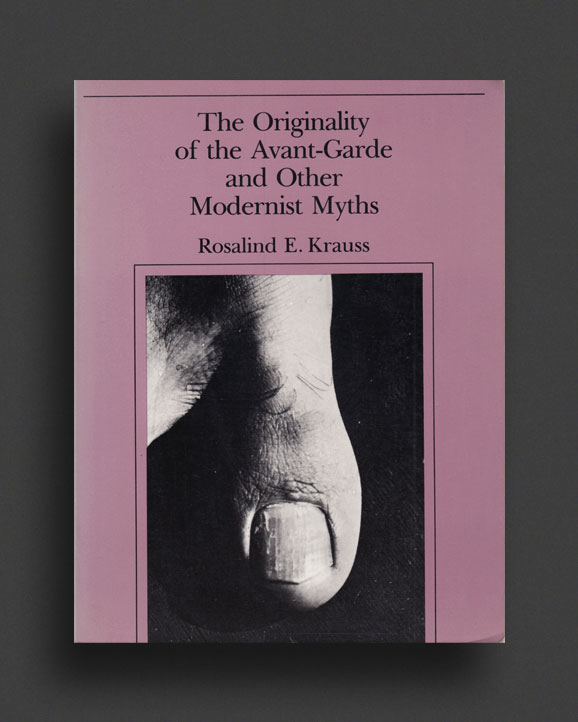
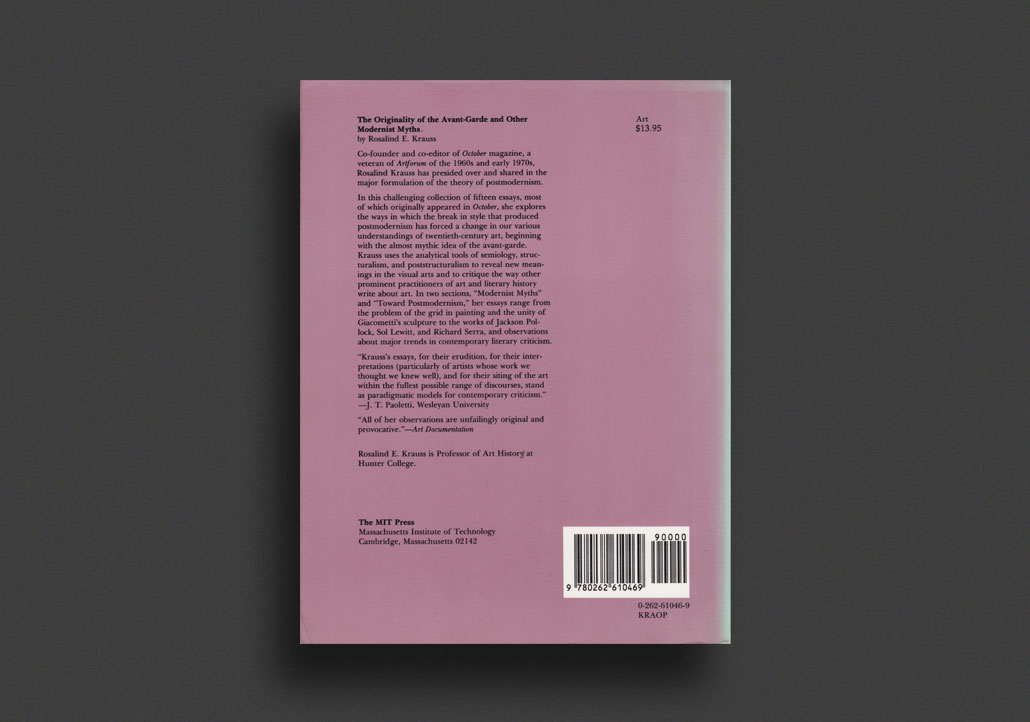
Co-founder and co-editor of October magazine, a veteran of Artforum of the 1960s and early 1970s, Rosalind Krauss has presided over and shared in the major formulation of the theory of postmodernism. In this challenging collection of fifteen essays, most of which originally appeared in October, she explores the ways in which the break in style that produced postmodernism has forced a change in our various understandings of twentieth-century art, beginning with the almost mythic idea of the avant-garde. Krauss uses the analytical tools of semiology, structuralism, and poststructuralism to reveal new meanings in the visual arts and to critique the way other prominent practitioners of art and literary history write about art. In two sections, "Modernist Myths" and "Toward Postmodernism," her essays range from the problem of the grid in painting and the unity of Giacometti's sculpture to the works of Jackson Pollock, Sol Lewitt, and Richard Serra, and observations about major trends in contemporary literary criticism.
Rosalind E. Krauss, University Professor at Columbia University and an editor and cofounder of October magazine, is the author of The Originality of the Avant-Garde and Other Modernist Myths (1985), The Optical Unconscious (1993), The Picasso Papers (1999), and Bachelors (1999), all published by the MIT Press, and coauthor (with Yve-Alain Bois) of Formless: A User's Guide (Zone Books, 1997).
"All of her observations are unfailingly original and provocative."—Art Documentation
Very Good copy of original 1986 edition, 1993 printing.
1999, English
Softcover, 218 pages, 30.5 x 23 cm
1st Edition, Out of print title / used / very good
Published by
Fine Arts Gallery - University of Maryland / Baltimore
$110.00 - In stock -
Scarce first extensive monographic catalogue published in conjunction with Adrian Piper's major survey exhibition held at the Fine Arts Gallery, University of Maryland, Baltimore, October 14, 1999 - January 15, 2000. Traveled to the New Museum of Contemporary Art, New York, October 4, 2001 - January 13, 2002. Profusely illustrated in black-and-white and colour, alongside accompanying texts by Piper, Maurice Berger, Jean Fisher, Kobena Mercer, Laura Cottingham, and Dara Meyers-Kingsley. With illustrated checklist and bibliography. Cover features her "Self-Portrait Exaggerating My Negroid Features" (1981) work.
Adrian Margaret Smith Piper (b. 1948) is an American conceptual artist and philosopher. Her work addresses ostracism, otherness, racial passing and racism by using various traditional and non-traditional media. The only African American in the early conceptual art movement of the 1960s, she has profoundly influenced the language and form of Conceptual art in America and is widely recognised today through her equally important writings.
Very Good copy. Light tanning to edges and light bump to top-right corner.
1999, English
Softcover (w. dust jacket), 304 pages, 29.2 x 25.5 cm
1st Edition, Out of print title / used / good
Published by
Phaidon / London
$120.00 - In stock -
First 1999 edition of Arte Povera, the most complete overview of this movement ever published, edited by one of the world's foremost authorities on the subject.
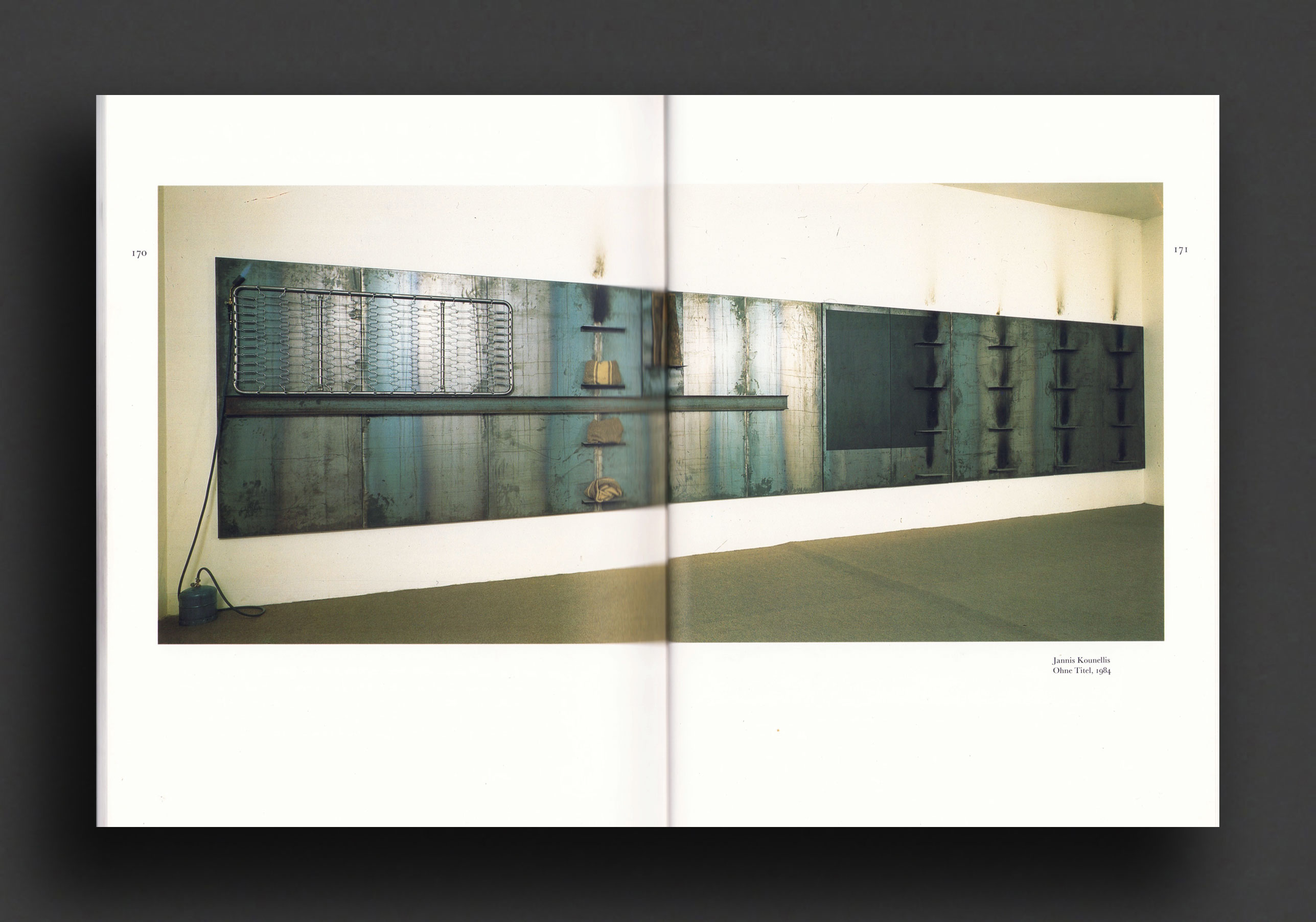
Arte Povera is Italy's most important and influential post-war art movement. Originally championed by the leading art critic Germano Celant, it included internationally recognized artists such as Alighiero Boetti, Jannis Kounellis, Mario and Marisa Merz and Michelangelo Pistoletto. Edited by one of the world's foremost authorities on the subject, this book is the most complete overview of the artworks and writings associated with Arte Povera, an art movement that explored the relation between art and life, made manifest through natural materials and human artifacts, and experienced through the body.
"This is now the definitive English-language sourcebook on Merz, Pistoletto, Paolini and company, thanks to its rich selection of images and texts."―Bookforum
"Get hold of Arte Povera... It is both compendium and critique, with artists' statements, a chronology and commentary. It contextualizes the work, and the pictures are great."―Adrian Searle, Guardian
Carolyn Christov-Bakargiev is a writer and curator living in Rome, who has become an internationally recognized scholar of late twentieth-century Italian art. She has written extensively on the Arte Povera movement and published interviews and texts on artists such as Boetti, Pistoletto, Merz, Fabro and Kounellis. Bakargiev is also a noted curator of contemporary art internationally: her exhibitions include 'Molteplici Culture', Rome, 1992 and a homage to John Cage which she co-curated with Alanna Heiss for the 1993 Venice Biennale.
She was part of the curatorial team for the 'Antwerp 93 European Capital of Culture', devising the major international survey, 'On Taking a Normal Situation and Re-translating it into Overlapping and Multiple Readings of Conditions Past and Present'. In 1996 Bakargiev curated a large-scale survey on Italian post-war artist Alberto Burri in Rome, Brussels and Munich. In 1997, she curated 'Citta-Natura': a city-wide exhibition of international artists including Anselmo, Mario Merz, Marisa Merz, Pascali and Kounellis, held in Rome.
She is Chief Curator at the Castello di Rivoli, Turin, and was formerly Senior Curator at P.S.1 Contemporary Art Center, New York. She was co-curator, with Iwona Blazwick, of Faces in the Crowd: Picturing Modern Life from Manet to Today , Whitechapel Art Gallery, London, and Castello di Rivoli, Turin, 2004 5.
Good copy with some corner knocking, small tear to top of spine dust jacket, otherwise very good throughout.
1974, English
Hardcover (w. dust jacket), 216 pages, 21 x 16 cm
1st Edition, Out of print title / used / very good
Published by
Thames and Hudson / London
$30.00 - Out of stock
First HC Edition.
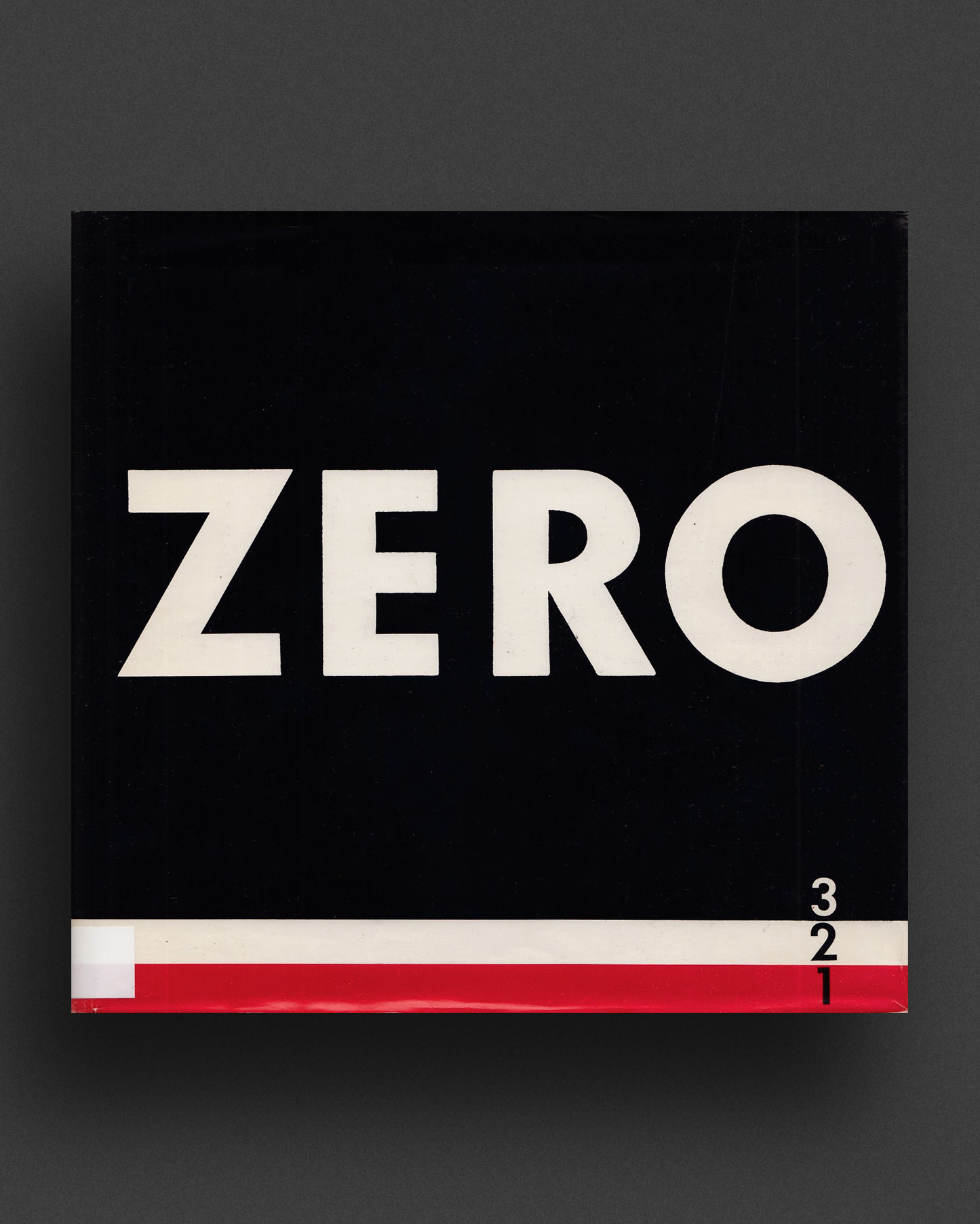
Environments and Happenings by painter and poet Adrian Henri, published by Thames & Hudson in 1974, forms one of the first mainstream book surveys to trace the phenomenon of environmental/performative/total living artworks that became prevalent in the 1960s/70s. This historical study is profusely illustrated in colour and b/w with many international works from Fluxus to Zero to Dolle Mina to Nouveau Réalisme to Provo to Gutai to The Situationists and much more. Includes the works of Joseph Beuys, Clarence Schmidt, Ray Johnson, Öyvind Fahlström, Paul Thek, Yves Klein, Allan Kaprow, Hans Haacke, Kurt Schwitters, Marcel Duchamp, Guerllia Art Action Group, Daniel Spoerri, Wolf Vostell, Gustav Metzger, Peter Kuttner, Jackson Pollock, Alison Knowles, Dick Higgins, Robert Morris, Situationist International, Ferdinand Kriwet, Klaus Rinke, Duane Hanson, A-Yo, Meret Oppenheim, Space Structure Workshop, Ferdinand Cheval, Dolle Mina (Mad Mina), Robert Smithson, Jeff Nuttall, Stefan Wewerka, Christo, Dennis Oppenheim, Vladimir Tatlin, Provo, Barry Flanagan, Andy Warhol, Meredith Monk, Atsuko Tanaka, Kazuo Shiraga, Ed Keinholz, Yayoi Kusama, Piero Gilardi, Niki de Saint-Phalle, Jean Tinguely, Claes Oldenburg, Les Levine, James Rosenquist, Red Grooms, Tom Wesselmann, George Segal, Eduardo Paolozzi, and many many more. Includes reproductions of performance scripts, partial chronology, etc.
Very Good copy in Good DJ some light wear, price-clipping to inner.
1975, English
Softcover, 64 pages, 18 x 11.5 cm
1st Edition, Out of print title / used / good
Published by
Thames and Hudson / London
$15.00 - In stock -
1975, profusely illustrated pocket-book survey of the many strands of contemporary art which have emerged since the appearance of Pop culture.
"Art after Pop, if not exactly uncharted territory, is only now beginning to turn into art history. This book sets out to disentangle the many strands which have appeared since Pop started the cult of cool in art. The Pop artists proved that figuration was not dead; and their Photo-Realist successors have carried the icy gloss finish to its limits. The Abstract Expressionists, too, have had successors, who proved that abstraction was not dead either; these were the Hard Edge artists, whose rejection of illusion was part of the trend towards the reduction of form and content to a minimum. With Minimal Art many people expected painting and sculpture to disappear altogether; this has not happened, but they have been joined by a number of would-be successors: Environments, Actions, Land art, photographic records, printed definitions, Conceptual art. The contact with popular culture, with the Rock underground, even with cybernetics and academic philosophy, has changed the physical appearance of art without changing the art world - and without diminishing the resources of creativity which mankind still puts into art."
John A. Walker is a critic of contemporary art and the author of a glossary of twentieth-century art terms.
Good—VG copy, general light wear/tanning/marking, previous owner's name to title page.
1990, English
Softcover, 230 pages, 26.5 x 23 cm
Signed by Christo,
1st Edition, Out of print title / used / good
Published by
Art Gallery of New South Wales / Sydney
$160.00 - In stock -
Artist signed copy of this wonderful, profusely illustrated 1990 monographic survey of Christo's work, published on the occasion of the John Kaldor Art Project 1990 by Art Gallery of New South Wales, Sydney. Edited by Nicholas Baume with Jeanne-Claud Christo, the book reproduces all the sculptural works, drawings, and photo documentation of the large-scale site-specific works of Christo throughout the early 1960s—late 1980s. A wonderful retrospective, the works are accompanied by texts from Edmund Capon, John Kaldor, Anothony Bond, Daniel Thomas, and Baume, complete with chronology, bibliography and history of exhibitions.
Signed in large, bold red to first blank "Christo 1990,"
Good—Very Good copy with some tanning to spine, spine creasing, light edge wear and smell of mothballs to stock.
2021, Japanese / English
Hardcover (with obi), 368 pages, 20 x 30 cm
Published by
Toyota Municipal Museum of Art / Aichi
$130.00 - Out of stock
Beautiful hardcover catalogue published in Japan to the exhibition Beuys + Palermo touring three venues across Japan in 2021.
Joseph Beuys and Blinky Palermo were from different generations, but both experienced WWII and the postwar reconstruction, as teacher and pupil. One of the most important artists since World War II, Joseph Beuys (1921–1986) asserted that true capital lies in the creativity of human beings, and viewing the whole of society as sculpture, set out to change it. Beuys is also known for his role in nurturing numerous artists in his capacity as an educator. One such pupil was Blinky Palermo (1943–1977). The modest abstract works that form the legacy of this painter active for just a short few years from the mid-1960s up to his early demise, were an attempt to quietly overturn our perceptions, and social systems, via the visceral experience of color and form, all the while reconstructing the compositional elements of painting. The works of these two superficially contrasting German artists were alike in that both Beuys and Palermo endeavored to restore art to the status of a raw, live endeavor, Beuys indeed later acknowledging his former student to be the artist closest to himself. Composed primarily of works from the 1960s and ‘70s, documentation from the period and detailed texts, “Beuys + Palermo” explores the features of each of these two artists, while simultaneously searching for the latent power of their praxis in their involvement and overlap with each other.
1994, English
Hardcover, 294 pages, 23 x 31 cm
1st Edition, Out of print title / used / very good
Published by
Dia Art Foundation / New York
$90.00 - In stock -
First 1994 hardcover edition, long out-of-print.
Edited by Lynne Cooke and Karen Kelly.
Arena is a major but rarely exhibited Beuys work that consists of 100 framed aluminum and glass panels each approximately 55 x 32 inches, spanning the artist's career from the late 40s to 1972. This vast work is among the most ambitious of Beuys' career and is in many ways autobiographical. An assembly of 264 photographs, the panels in part document Beuys' life including key "actions," concerts, sculptures, objects, and more personal events. Realized in 1973, "Arena" attains a monumental scale and the sort of grand design appropriate to an artistic summa; as such, the project amounts to a broad portrait of Beuys' artistic persona. It is documented in this book for the first time.
Features a preface by Charles Wright, essays by Lynne Cooke, Pamela Kort, and Christopher Phillips. Includes numerous illustrations, a glossary, biography, and bibliography.
Good—Very Good copy with light wear to hardcover edges and some board scratching.