World Food Books' programme is largely produced on Kulin Nation land. We acknowledge the Wurundjeri people of the Kulin Nation as the first and continuing custodians of this land, and pay respect to their Elders past, present, and emerging.
World Food Books is an arts and special interests bookshop in Naarm / Melbourne. Founded in 2010, World Food Books is devoted to the presentation of a rotating, hand-selection of international art, design, literary and counterculture publications with an emphasis on the anti-traditional, the experimental, the avant-garde, the heretic, the marginal.
Presenting new titles alongside rare and out-of-print books, catalogues and journals spanning the fields of modern and contemporary art, design, photography, illustration, film, literature, poetry, cultural theory, philosophy, sexuality, popular and underground culture in its many radical forms, World Food Books wishes to encourage adventurous, thoughtful and open-minded reading, looking, writing, and exchange of publishing and ideas, both current and historical.
As well as our bookshop, located in Melbourne's historical Nicholas Building, all of our inventory is available internationally via our online mail-order service.
World Food Books semi-regularly co-ordinates "Occasions", a programme of exhibits and events at the bookshop and in partnership with other hosts (such as museums and art galleries) that develop out of the activities, relationships and content of the bookshop itself.
World Food Books
The Nicholas Building
37 Swanston Street
Room 5, Level 6
Melbourne 3000
Australia
SHOP HOURS:
Thu–Sat 11–5
WEB-SHOP OPEN 24/7
World Food Books
Postal Address:
PO Box 435
Flinders Lane
Victoria 8009
Australia
Art
Theory / Essay
Architecture / Interior
Graphic Design / Typography
Photography
Fashion
Eros
LGBTQ+
Fiction / Poetry
Weird / Speculative / Science Fiction / Horror
Transgressive / Visceral / Abject
Symbolism / Decadence / Fin de siècle
Film / Video
Painting
Sculpture / Installation
Performance / Dance / Theater
Drawing
Sound / Music
Curatorial
Group Shows / Collections
Periodicals
Out-of-print / Rare
Posters / Ephemera / Discs
Signed Books
World Food Books Gift Voucher
World Food Book Bag
Australian Art
Australian Fiction
Australian Science Fiction / Speculative Fiction
Australian Poetry
Australian Photography
Japanese Photography
Conceptual Art
Minimal Art
Dada
'Pataphysics / Oulipo
Fluxus
Concrete Poetry
Pop Art
Surrealism
Arte Povera
Arte Informale / Haute Pâte / Tachism
Nouveau Réalisme / Zero / Kinetic
Situationism / Lettrism
Collage / Mail Art / Xerox Art
Art Brut / Folk / Visionary / Fantastic
Illustration / Graphic Art / Bandes Dessinées
Furniture
Italian Radical Design / Postmodernism
Textiles
Ceramics / Glass
Counterculture
Protest / Revolt
Philosophy
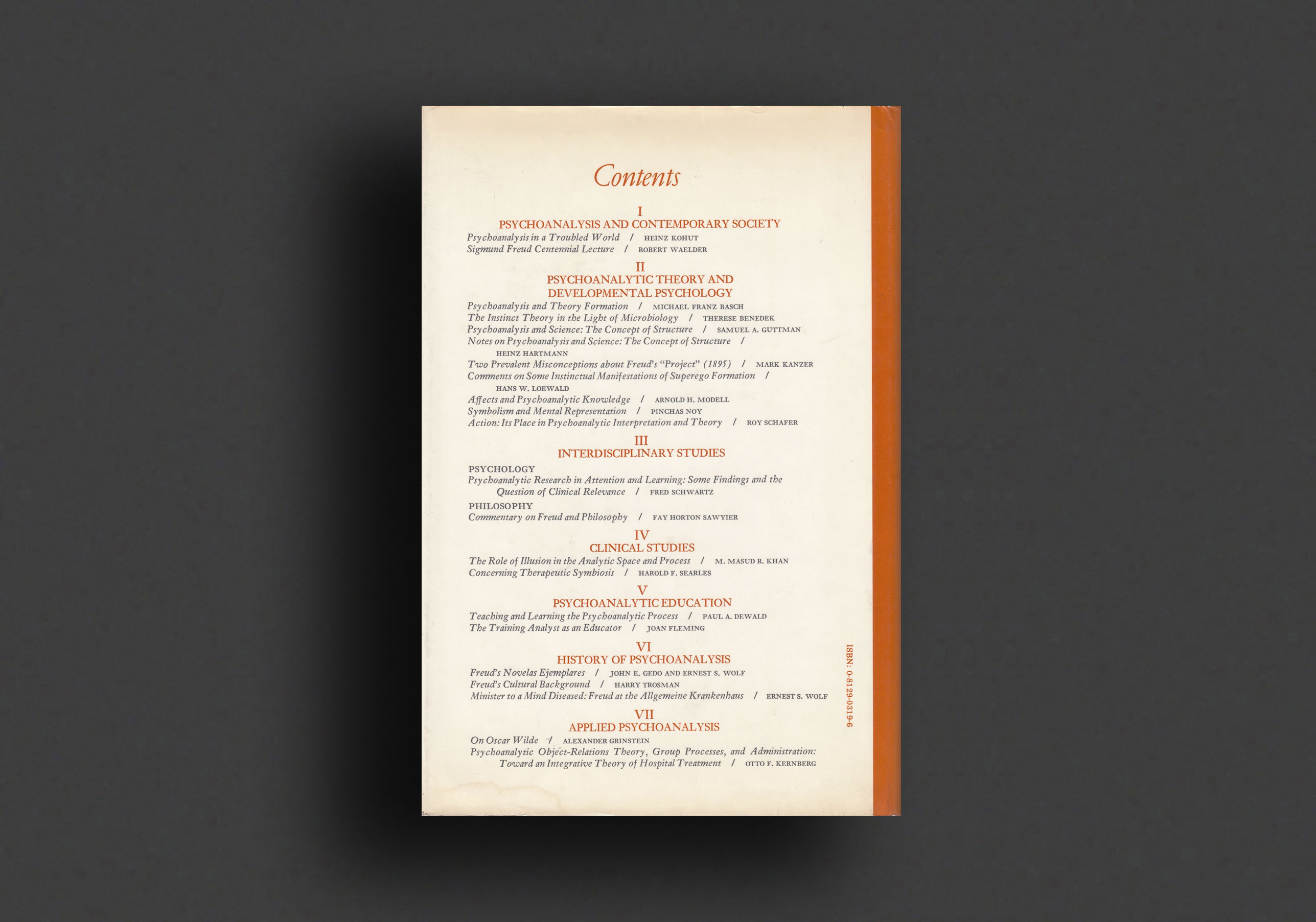
Psychoanalysis
Anthropology
Anarchism
Socialism / Anarchism / Communism / Capitalism
Literary Theory / Semiotics / Language
Feminism / Women's Studies
Gender Studies / Sexuality
Anthropology
Fetishism / BDSM
Drugs / Psychedelia
Crime / Violence
Animal Rights / Veganism
Occult / Esoterica
Ecology / Earth / Alternative Living
Whole Earth / Crafts
All prices in AUD (Australian dollars)
Pick-Ups
Pick-up orders can be collected in our bookshop during opening hours after order date. Please collect any Pick-up orders within 2 weeks of ordering as we have limited storage space. Orders will be released back into stock if not collected within this time. No refunds can be made for pick-ups left un-collected. If you cannot make it in to the bookshop in this time-frame, please choose postage option.
Return Policy
All sales are final. We do accept returns (for refund or exchange) for items received in error. All our orders are packed with special care using heavy-duty padding and cardboard book-mailers or bubble mailers (for smaller books), using reinforcement where required. We cannot take responsibility for any lost, stolen or damaged parcels.
Insurance
Should you wish to insure your package, please email us directly after placing your order and we can organise this at a small extra expense. Although all standard/express tracked packages are very safe and dependable, we cannot take responsibility for any lost, stolen or damaged parcels. We recommend insurance on valuable orders.
Interested in selling your old books, catalogues, journals, magazines, comics, fanzines, ephemera? We are always looking for interesting, unusual and out-of-print books to buy. We only buy books in our fields of interest and specialty, and that we feel we can resell.
We base these prices on desirability, market value, in-print prices, condition and our current stock levels. We offer cash, store credit, and can take stock on consignment. All
about 25% of the price we expect to get when we sell them, or 30% in store credit. We base these prices on desirability, market value, in-print prices, condition and our current stock levels.
Sell your books any day of the week. You can drop them off and return later. If you have a lot of books, we can visit your Sydney home.
We buy books that we feel we can resell. We offer about 25 % of the price we expect to get when we sell them, or 30% in store credit. We base these prices on desirability, market value, in-print prices, condition and our current stock levels.
Philadelphia Wireman
03 August - 01 September, 2018
World Food Books is proud to announce our next Occasion, the first presentation of sculptures by Philadelphia Wireman in Australia.
The Philadelphia Wireman sculptures were found abandoned in an alley off Philadelphia’s South Street on trash night in 1982. Their discovery in a rapidly-changing neighbourhood undergoing extensive renovation, compounded with the failure of all attempts to locate the artist, suggests that the works may have been discarded after the maker’s death. Dubbed the "Philadelphia Wireman" during the first exhibition of this work, in 1985, the maker’s name, age, ethnicity, and even gender remain uncertain. The entire collection totals approximately 1200 pieces, all intricately bound together with tightly-wound heavy-gauge wire (along with a few small, abstract marker drawings, reminiscent both of Mark Tobey and J.B. Murry). The dense construction of the work, despite a modest range of scale and materials, is singularly obsessive and disciplined in design: a wire armature or exoskeleton firmly binds a bricolage of found objects including plastic, glass, food packaging, umbrella parts, tape, rubber, batteries, pens, leather, reflectors, nuts and bolts, nails, foil, coins, toys, watches, eyeglasses, tools, and jewellery.
Heavy with associations—anthropomorphic, zoomorphic, and socio-cultural responses to wrapped detritus—the totemic sculptures by Philadelphia Wireman have been discussed in the context of work created to fulfil the shamanistic needs of alternative religions in American culture. Curators, collectors, and critics have variously compared certain pieces to sculpture from Classical antiquity, Native American medicine bundles, African-American memory jugs, and African fetish objects. Reflecting the artist’s prolific and incredibly focused scavenging impulse, and despite—or perhaps enhanced by—their anonymity, these enigmatic objects function as urban artefacts and arbiters of power, though their origin and purpose is unknown. Philadelphia Wireman, whatever their identity, possessed an astonishing ability to isolate and communicate the concepts of power and energy through the selection and transformation of ordinary materials. Over the course of the past two decades, this collection has come to be regarded as an important discovery in the field of self-taught art and vernacular art.
Presented in collaboration with Fleisher-Ollman Gallery, Philadelphia, and Robert Heald, Wellington.
Susan Te Kahurangi King
02 February - 10 March, 2018
Susan Te Kahurangi King (24 February 1951 - ) has been a confident and prolific artist since she was a young child, drawing with readily available materials - pencils, ballpoint pens and felt-tip markers, on whatever paper is at hand. Between the ages of four and six Susan slowly ceased verbal communication. Her grandparents William and Myrtle Murphy had developed a special bond with Susan so they took on caring responsibilities for extended periods. Myrtle began informally archiving her work, carefully collecting and storing the drawings and compiling scrapbooks. No drawing was insignificant; every scrap of paper was kept. The King family are now the custodians of a vast collection containing over 7000 individual works, from tiny scraps of paper through to 5 meter long rolls.
The scrapbooks and diaries reveal Myrtle to be a woman of great patience and compassion, seeking to understand a child who was not always behaving as expected. She encouraged Susan to be observant, to explore her environment and absorb all the sights and sounds. Myrtle would show Susan’s drawings to friends and people in her community that she had dealings with, such as shopkeepers and postal workers, but this was not simply a case of a grandmother’s bias. She recognised that Susan had developed a sophisticated and unique visual language and sincerely believed that her art deserved serious attention.
This was an unorthodox attitude for the time. To provide some context, Jean Dubuffet coined the term Art Brut in 1945 to describe work created by self-taught artists – specifically residents of psychiatric institutions and those he considered to be visionaries or eccentrics. In 1972 Roger Cardinal extended this concept by adopting the term Outsider Art to describe work made by non-academically trained artists operating outside of mainstream art networks through choice or circumstance. Susan was born in Te Aroha, New Zealand in 1951, far from the artistic hubs of Paris and London that Dubuffet and Cardinal operated in. That Myrtle fêted Susan as a self-taught artist who deserved to be taken seriously shows how progressive her attitudes were.
Susan’s parents Doug and Dawn were also progressive. Over the years they had consulted numerous health practitioners about Susan’s condition, as the medical establishment could not provide an explanation as to why she had lapsed into silence. Dawn educated herself in the field of homeopathy and went on to treat all twelve of her children using these principles – basing prescriptions on her observations of their physical, mental and emotional state.
Doug was a linguist with an interest in philosophy who devoted what little spare time he had to studying Maori language and culture. To some extent their willingness to explore the fringes of the mainstream made them outsiders too but it was their commitment to living with integrity and their respect for individuality that ensured Susan’s creativity was always encouraged.
Even though Susan’s family supported her artistic pursuits, some staff in schools and hospitals saw it as an impediment to her assimilation into the community and discouraged it in a variety of ways. Her family was not always aware of this and therefore did not fully understand why Susan stopped drawing in the early 1990s. However, rather than dwell on the challenges that Susan faced in pursuit of her artistic practice, they prefer to highlight her achievements. In 2008 Susan began drawing again in earnest, after an almost 20 year interruption, and her work is now shown in galleries around the world.
Susan grew up without television and has been heavily influenced by the comics she read as a child. She is absolutely fearless in the appropriation of recognizable characters, such as Donald Duck and Mickey Mouse, in her work. She twists their limbs, contorts their faces, compresses them together, blends them into complex patterned backgrounds - always imbuing them with an incredible energy. Although Susan often used pop culture characters in her work they are not naive or childlike. These are drawings by a brilliant self-taught artist who has been creating exceptional work for decades without an audience in mind.
Mladen Stilinović
"Various Works 1986 - 1999"
02 February 16 - September 10, 2016
Various works 1986 - 1999, from two houses, from the collections of John Nixon, Sue Cramer, Kerrie Poliness, Peter Haffenden and Phoebe Haffenden.
Including: Geometry of Cakes (various shelves), 1993; Poor People’s Law (black and white plate), 1993; White Absence (glasses, ruler, set square, silver spoon, silver ladel with skin photograph and wooden cubes), 1990-1996; Exploitation of the Dead (grey and red star painting, wooden painting, black spoon with red table, red plate), 1984-1990; Money and Zeros (zero tie, paintings made for friends in Australia (Sue, John, Kerrie), numbers painting), 1991-1992; Words - Slogans (various t-shirts) - “they talk about the death of art...help! someone is trying to kill me”, “my sweet little lamb”, “work is a disease - Karl Marx”; Various artist books, catalogues, monographs, videos; Poster from exhibition Insulting Anarchy; "Circular" Croatian - Australian edition; Artist book by Vlado Martek (Dostoyevsky); more.
Thanks to Mladen Stilinović and Branka Stipančić.
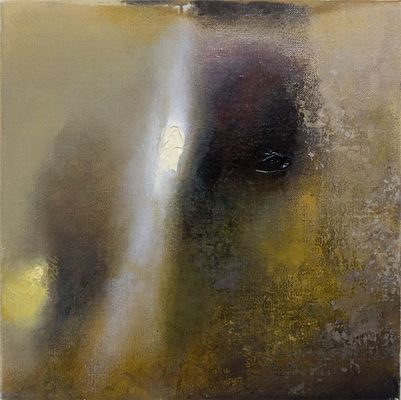
Jonathan Walker
Always Will Need To Wear Winter Shirt Blue + Ochre Small Check Pattern
21 August - 21 September, 2015
Untitled
I am not a great reader of poetry but I always return to the work of Melbourne poet, Vincent Buckley (1925- 1988). Perhaps I find his most tantalising piece to be not a finished poem but a fragment left on a scrap of paper discovered on his desk after the poet’s death.
The poetry gathers like oil
In the word-core, and spreads
It has its music meet,
Its music is in movement.
This fragment is more the shell left behind from a volatile thought than a finished poem. I find the last two lines honest but awkward whereas the first two lines work like an arrow. Most likely he could not find a resolution so it was left. Still, in its present form, it remains an eloquent testimony to the ultimate failure of a medium to express mobile thought and sensation, in Buckley’s case, through verbal language. It’s an important matter because this is something all artists have to deal with regardless of the medium.
I have never written a poem, however, I am forever copying fragments from books on paper scraps in a vain effort to fix certain notions in my head. At first, they function as bookmarks that are sometimes returned to when I open the book. But before long, as they accumulate, they fall out littering the table interspersed with A4 photocopies, bills, books and medications.
To return to Buckley’s fragment, the first two lines very much evoke how I paint nowadays. As you age, detail diminishes and patches of light become more luminous and float. I feel the most honest way of dealing with this is by smearing the oil paint on the canvas with the fingers and working close-up, blind. Only if the patches coalesce into an approaching image can the work gain a life.
-
Jonathan Walker was born in Melbourne, Australia and brought up on a dairy farm in Gippsland. In the 1970’s he studied painting at RMIT and won the Harold Wright Scholarship to the British Museum, London. During the 1980’s he exhibited at Pinacotheca Gallery, Richmond and had work shown at the NGV and Heidi City Art Gallery. Over the same period he designed the cover for the “Epigenesi” LP by Giancarlo Toniutti, Italy and conducted a mail exchange work with Achim Wollscheid, Germany. The work with artists through the post resulted in an article published in the bicentenary issue of Art and Australia 1988. He showed in artist run spaces such as WestSpace in the 90’s and 2000’s, and until 2012, taught painting at Victoria University, which is where we (Colleen Ahern and Lisa Radford) as organisers of the exhibition, among many others, had the privilege of being his student.
Walker’s knowledge was imparted to students through the careful selection of music, literature, and artists found in books that he himself had ordered for the library. Walker’s strategy was the generosity of sharing his vast knowledge with references specific to each student and their context.
Walker’s paintings share a similar focus and intimacy.
This exhibition presents a small selection of recent paintings alongside a publication that includes Walker’s writing. Observational and analytical, Walker’s work is a type of material notation — the time of day, colour and how it is blended, the both specific and fleeting location of a reflection on lino or the question of whether a chair leg should be included in a painting.
Please join us on Friday August 21 between 6-8pm to celebrate the opening of the exhibition.
Curated by Colleen Ahern and Lisa Radford.
B. Wurtz
Curated by Nic Tammens
March 26 - April 4, 2015
B.Wurtz works from a basement studio in his home on Manhattan’s Lower East Side.
This local fact is attested to by the plastic shopping bags and newsprint circulars that appear in his work. As formal objects, they don’t make loud claims about their origins but nonetheless transmit street addresses and places of business from the bottom of this long thin island. Like plenty of artists, Wurtz is affected by what is local and what is consumed. His work is underpinned by this ethic. It often speaks from a neighborhood or reads like the contents of a hamper:
“BLACK PLUMS $1.29 lb.”
“Food Bazaar”
“USDA Whole Pork Shoulder Picnic 99c lb.”
“RITE AID Pharmacy, with us it’s personal.”
“H. Brickman & Sons.”
“Sweet Yams 59c lb."
Most of the work in this exhibition was made while the artist was in residence at Dieu Donne, a workshop dedicated to paper craft in Midtown. Here Wurtz fabricated assemblages with paper and objects that are relatively lightweight, with the intention that they would be easily transportable to Australia. This consideration isn’t absolute in Wurtz’s work, but was prescriptive for making the current exhibition light and cheap. Packed in two boxes, these works were sent from a USPS post office on the Lower East Side and delivered to North Melbourne by Australia Post.
Wurtz appears courtesy of Metro Pictures, New York.
Thanks to Rob Halverson, Joshua Petherick, Sari de Mallory, Matt Hinkley, Helen Johnson, Fayen d'Evie, Ask Kilmartin, Lisa Radon, Ellena Savage, Yale Union, and "Elizabeth".
John Nixon
"Archive"
December 15 - January 20, 2014
The presentation of John Nixon's archive offered a rare showcase of this extensive collection of the artist's own publications, catalogues, posters, ephemera, editions and more, from the mid 1980s onwards, alongside a selection of his artworks.
Organized by John Nixon, Joshua Petherick and Matt Hinkley.
<a href=http://wfb.public-office.info/artist/john-nixon>All titles by John Nixon
"Habitat"
at Minerva, Sydney (organised by Joshua Petherick and Matt Hinkley)
November 15 - December 20, 2014
Lupo Borgonovo, Janet Burchill & Jennifer McCamley,
Lewis Fidock, HR Giger, Piero Gilardi, Veit Laurent Kurz,
Cinzia Ruggeri, Michael E. Smith, Lucie Stahl, Daniel Weil, Wols
Press Release:
“...It contained seven objects. The slender fluted bone, surely formed for flight, surely from the wing of some large bird. Three archaic circuitboards, faced with mazes of gold. A smooth white sphere of baked clay. An age-blackened fragment of lace. A fingerlength segment of what she assumed was bone from a human wrist, grayish white, inset smoothly with the silicon shaft of a small instrument that must once have ridden flush with the surface of the skin - but the thing’s face was seared and blackened.”
William Gibson, “Count Zero”, 1986
"Autumn Projects Archive"
Curated by Liza Vasiliou
March 6 - March 15, 2014
World Food Books, in conjunction with the Virgin Australia Melbourne Fashion Festival 2014, presented the Autumn Projects archive, consisting of a selection of early examples in Australian fashion with a particular interest in collecting designers and labels from the period beginning in the 1980’s, who significantly influenced the discourse of Australian Fashion.
Curated by Liza Vasiliou, the exhibition provided a unique opportunity to view pieces by designers Anthea Crawford, Barbara Vandenberg, Geoff Liddell and labels CR Australia, Covers, Jag along with early experimental collage pieces by Prue Acton and Sally Browne’s ‘Fragments’ collection, suspended throughout the functioning World Food Books shop in Melbourne.
H.B. Peace
presented by CENTRE FOR STYLE
November 14, 2013
"Hey Blinky, you say chic, I say same"
Anon 2013
H.B. Peace is a clothing collaboration between great friends Blake Barns and Hugh Egan Westland. Their pieces explore the divergences between 'character’ and ‘personality’ in garments....etc
Special Thanks to Joshua Petherick and Matt Hinkley of WFB and Gillian Mears
and a Very Special Thank you to Audrey Thomas Hayes for her shoe collaboration.
Janet Burchill & Jennifer McCamley
"Aesthetic Suicide"
May 10 - June 8, 2013
The first of our occasional exhibitions in the World Food Books office/shop space in Melbourne, "Aesthetic Suicide" presented a body of new and older works together by artists Janet Burchill & Jennifer McCamley, including videos, prints, a wall work, and publications.
During shop open hours videos played every hour, on the hour.
1995, English
Softcover, 234 pages, 23 x 15 cm
1st Edition, Out of print title / used / very good
Published by
State University of New York Press / New York
$35.00 - In stock -
Translated by Michael Gendre
Janicaud clarifies the project of "overcoming" metaphysics, a project that Heidegger himself recognized as open to innumerable misunderstandings, and Mattei inquires into the major Heideggerian texts produced between 1935 and 1969 to detect the cosmic figure of the Geviert, the initial Fourfold where "earth and sky, the divine ones and the mortals" gather.
"Philosophy has come to an end" claimed Heidegger in the final posthumously published interview he granted to Der Spiegel. The goal of Janicaud's chapters ("Overcoming Metaphysics?," "Heideggeriana," "Metamorphosis of the Undecidable," and the dialogue "Heidegger in New York") first of all is to clarify the project of "overcoming" metaphysics, a project that Heidegger himself recognized as open to innumerable misunderstandings. Is it really possible to surmount metaphysics, not by transgressing it, but by means of a patient elucidation of its key concepts? In the effort to underscore the originality of his own enterprise, doesn't Heidegger tend to project too harsh a dichotomy between the forgetfulness of Being and its authentic recollection? By raising these questions, Janicaud suggests that Heidegger himself does not elude the objections that he directs toward the great metaphysical thinkers.
The final recourse to dialogue in the midst of twentieth-century New York—a landscape intentionally "different" from one expectedly Heideggerian—intends to hint at another possibility than the indefinite deconstruction of metaphysical texts. It suggests new ways for thoughtful meditation and a new cast for action.
At the center of the book, Mattei evokes the "Heideggerian Chiasmus or the Setting-apart of Philosophy." Through an inquiry into the major Heideggerian texts produced between 1935 and 1969 and inspired by Holderlin's poetry, Mattei gradually detects the cosmic figure of the Geviert, the initial Fourfold where "earth and sky, the divine ones and the mortals" gather. Such a community, whose meaning Heidegger is the only one to decipher in our times, silently conforms to an archaic philosophy. The cosmic game of the Geviert also evokes, for Heidegger, the path of the Tao in the Chinese tradition. In this epoch characterized by the destruction of ontology, the two paths in which East and West meet may grant us moderns the hope one day of "dwelling" in the world.
Dominique Janicaud is Professor of Philosophy and directs the Doctoral Studies Program at the Universite de Nice. He is also the Director for the Centre de Recherche d'Histoire des Idees. Jean-Francois Mattei is Professor of Philosophy at the Universite de Nice and the Institut d'Etudes Politiques. He was the General Editor and Director of Volume III of the Encyclopedie Philosophique Universelle (1992) and is currently the Advisor with Ambassadorial Representation to the Minister of Education of France. Professors Janicaud and Mattei each have published a number of other books.
VG copy of 1995 print, light wear, single mark to block edge.
1991, English
Softcover, 234 pages, 23 x 15 cm
1st Edition, Out of print title / used / very good
Published by
State University of New York Press / New York
$45.00 - In stock -
"It is by all means a dubious thing to depend and rest on what an author himself has brought to the forefront. The important thing is rather to give attention to those things he left shrouded in silence."
Such was the methodological advice, given in 1924 by Heidegger himself, that is rigorously followed in this book, Heidegger and the Project of Fundamental Ontology. The project involves the vast complex of problems that emerged around Being and Time (1927) and then continued from the time of the Marburg lecture courses (1923-1928) up to the Freiburg lectures (1928-1935), today available in the Gesamtausgabe.
Heidegger's silence concerning some of his foundational sources is a fact fully recognized by those who have carefully read him. This book systematically explores and critically assesses the silences concerning Husserl, the Aristotle of Book VI of the Nicomachean Ethics, the Hegel of Phenomenology, Nietzsche, and even Descartes.
What emerges is a systematic and original reinterpretation of 'fundamental ontology' focused on the self-understanding of the human Dasein as the key for understanding the various meanings of Being and the entire deconstructed history of ontology. The project culminated in the pretensions to absoluteness rampant in modern metaphysics, with its peak and paroxysm to be found in The Introduction to Metaphysics (1935).
In regard to the 'Heidegger affair', this book, which was begun well before the present turmoil, shows both the ambiguity and coherence of Heidegger's involvement with the Nazis, and, for the first time, exposes the work of the young Heidegger to a rigorous and wholesome internal criticism. By delineating the origins, the shifts, and the final outcome from within his own field, phenomenology, it allows us to reflect on this difficult question at its depth and origin.
Very Good copy.
1992 / 1999, English
Softcover, 330 pages, 23.5 x 15.5 cm
1st Edition, Out of print title / used / fine
Published by
Indiana University Press / Indiana
$35.00 - In stock -
Parmenides, a lecture course delivered by Martin Heidegger at the University of Freiburg in 1942-1943, presents a highly original interpretation of ancient Greek philosophy. A major contribution to Heidegger's provocative dialogue with the pre-Socratics, the book attacks some of the most firmly established conceptions of Greek thinking and of the Greek world. The central theme is the question of truth and the primordial understanding of truth to be found in Parmenides' "didactic poem." Heidegger highlights the contrast between Greek and Roman thought and the reflection of that contrast in language. He analyzes the decline in the primordial understanding of truth--and, just as importantly, of untruth--that began in later Greek philosophy and that continues, by virtue of the Latinization of the West, down to the present day. Beyond an interpretation of Greek philosophy, Parmenides (volume 54 of Heidegger's Collected Works) offers a strident critique of the contemporary world, delivered during a time that Heidegger described as "out of joint."
NF copy.
1988 / 1999, English
Softcover, 330 pages, 23.5 x 15.5 cm
1st Edition, Out of print title / used / fine
Published by
Indiana University Press / Indiana
$35.00 - In stock -
The text of Martin Heidegger's 1930-1931 lecture course on Hegel's Phenomenology of Spirit contains some of Heidegger's most crucial statements about temporality, ontological difference and dialectic, and being and time in Hegel. Within the context of Heidegger's project of reinterpreting Western thought through its central figures, Heidegger takes up a fundamental concern of Being and Time, "a dismantling of the history of ontology with the problematic of temporality as a clue." He shows that temporality is centrally involved in the movement of thinking called phenomenology of spirit.
NF copy.
1985 / 1999, English
Softcover, 330 pages, 23.5 x 15.5 cm
1st Edition, Out of print title / used / fine
Published by
Indiana University Press / Indiana
$50.00 - In stock -
Heidegger's lecture course at the University of Marburg in the summer of 1925, an early version of Being and Time (1927), offers a unique glimpse into the motivations that prompted the writing of this great philosopher's master work and the presuppositions that gave shape to it. The book embarks upon a provisional description of what Heidegger calls "Dasein," the field in which both being and time become manifest. Heidegger analyzes Dasein in its everydayness in a deepening sequence of terms: being-in-the-world, worldhood, and care as the being of Dasein. The course ends by sketching the themes of death and conscience and their relevance to an ontology that makes the phenomenon of time central. Theodore Kisiel's outstanding translation premits English-speaking readers to appreciate the central importance of this text in the development of Heidegger's thought.
NF copy.
1966 / 1969, English
Softcover (2 volumes), 534 + 688 pages, 21.5 x 13.8 cm
Out of print title / used / good
Published by
Dover / New York
$60.00 - Out of stock
Arthur Schopenhauer's Die Welt als Wille und Vorstellung is one of the most important philosophical works of the 19th century, the basic statement of one important stream of post-Kantian thought.
It is without question Schopenhauer's greatest work, and, conceived and published before the philosopher was 30 and expanded 25 years later, it is the summation of a lifetime of thought.
For 70 years, the only unabridged English translation of this work was the Haldane-Kemp collaboration. In 1958, a new translation by E. F. J. Payne appeared which decisively supplanted the older one.
Payne's translation is superior because it corrects nearly 1,000 errors and omissions in the Haldane-Kemp translation, and it is based on the definitive 1937 German edition of Schopenhauer's work prepared by Dr. Arthur Hübscher. Payne's edition is the first to translate into English the text's many quotations in half a dozen languages, and Mr. Payne has provided a comprehensive index of 2,500 items.
It is thus the most useful edition for the student or teacher.
Unabridged, slightly corrected republication of Ist (1958) English edition, translated by E. F. J. Payne. Translator's introduction. Author's prefaces to 1st, 2nd, and 3rd editions.
G—VG copies both, with light general wear and age.
1990, English
Hardcover (w. dust jacket), 232 pages, 24 x 16.5 cm
1st Edition, Out of print title / used / good
Published by
Harvard University Press / Cambridge
$65.00 - In stock -
First 1990 hardcover edition.
"In a world where literary criticism is subject to the grossest forms of overproduction and where critical books that matter, and have something of general importance to say to our culture, are extremely rare, Bersani's will stand out as one of the half dozen or so by which its decade will be remembered."—MALCOLM BOWIE, University of London
In this frankly polemical book, Leo Bersani does battle with a pervasive view in modern culture: the idea that art can save us from the catastrophes of history and sexuality. Bersani questions this assumption. The art that thinks it can redeem life-make it whole, correct its errors, sublimate its passions - trivializes both life and, paradoxically, art. It is deceptive and dangerous.
Bersani ranges widely through modern literature (and its theorists), with fascinating comparisons:
Melanie Klein and Marcel Proust; the enigmatic and more unresolved works of Freud; Walter Benjamin, Baudelaire, and Nietzsche; André Malraux and Georges Bataille; Flaubert, Melville, Joyce, and Thomas Pynchon. If he has much to say against the intellectual gymnastics of Ulysses and much to say in favor of the metaphysical extravagances of Moby Dick, he writes about both major works with the same kind of brio: Bersani's criticism is never reduc-tionist, even with its clearly stated preference for the kind of literature that does not pretend to be superior to life, and does not mind being troubled.
Bersani is not telling us to put down Freud or Eliot or Proust or Joyce. But he is urging us to make new evaluations and to be aware of the enervating concealed morality of high modern culture. This is literary criticism of the first order - a defense of "the absolute singularity of human experience" - and deserves the widest readership among those who are devoted to literature but are suspicious of the redemptive role that has been assigned to it.
"With an interpretive mastery unexcelled in contemporary criticism, Leo Bersani's brilliant new book loosens the grip of a redemptive aesthetic which literature often accepts as its own, and puts us in touch with the more vital and mysterious powers of writing. This is a major innovative work by one of the most astute critics of our time."—RICHARD POIRIER, Editor, Raritan Quarterly
"There is wit, imagination, and a subtle and complex sensibility at work in this new study. I like the personal style, the many happy formula-tions, the elegant struggles with difficult concepts, and the great self-awareness that is the awareness of his own critical thrust."—VICTOR BROMBERT, Princeton University
"The Culture of Redemption is Leo Bersani's best book. With a Baudelairian mix of analytical sharpness and ethical commitment, Bersani expresses a pungent impatience with the modern consensus about art's edifying value and the collective bad faith on which this ceremonious self-congratulation relies."—DENIS HOLLIER, Yale University
VG copy in Average—Good dust jacket with closed tears and wear to edges.
1964, English
Softcover, 128 pages, 18 x 11 cm
1st Edition, Out of print title / used / very good
Published by
Pelican / London
$15.00 - In stock -
1964 Penguin (Pelican) edition of An Introduction to Jung's Psychology by Frieda Fordham, with foreword by Jung.
This classic introduction to the psychology of Carl Gustav Jung is important because it is the only English original text he sanctioned in his lifetime. In his personal foreword, he wrote: 'Mrs Frieda Fordham has undertaken the by no means easy task of producing a readable resumé of all my various attempts at a better and more comprehensive understanding of the human psyche. She has delivered a fair and simple account of the main aspects of my psychological work. I am indebted to her for this admirable piece of work.'
Originally issued in 1953, this Introduction immediately became the standard first step for those eager to understand the varied work and thought of this remarkable man. Mrs Fordham explains her reason for attempting the work. She wrote: 'Most people have heard of the late C. G. Jung, often linking him vaguely with Sigmund Freud; and although the terms 'complex', 'introvert', and 'extravert' are often used in everyday speech, few realise they were coined by him. Jung’s influence has been far-reaching, touching many of the human sciences, and his ideas have proved of value in such widely differing fields as biology and theology. Many of his writings are technical, and even those of a general nature often appear somewhat obscure, but they contain a core of significance for everyone. This book aims at revealing this core to the reading public in language which is easily comprehensive and yet does not do violence to the subtlety and creative genius of one of the greatest modern psychologists.'
Good copy with tight binding, some wear to spine edges, tanning to book block.
1993, English
Softcover, 172 pages, 20.7 x 13.7 cm
Out of print title / used / good
Published by
Prentice Hall / New Jersey
$18.00 - In stock -
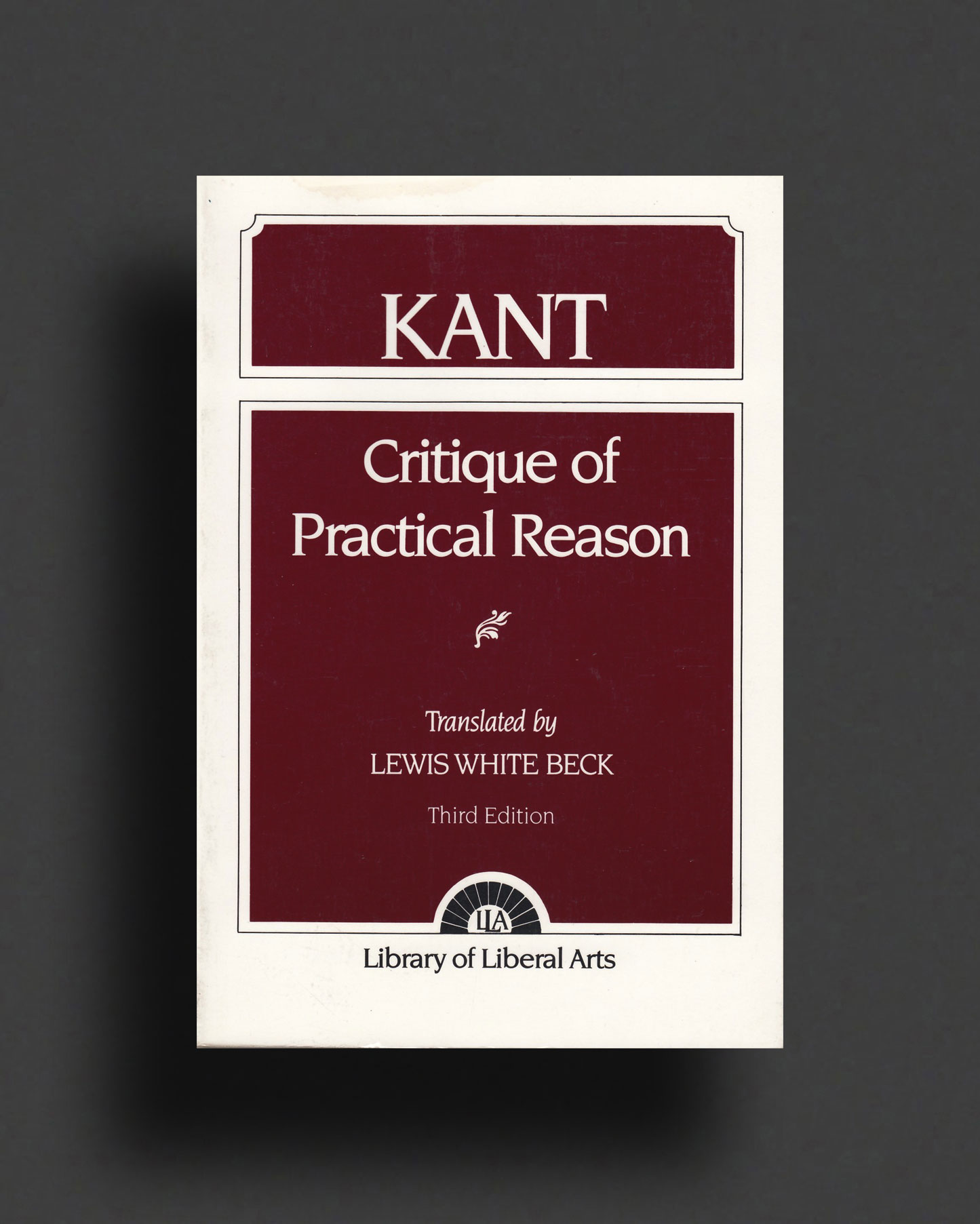
Third edition. Edited and translated, with notes and introductions by Lewis White Beck.
Critique of Practical Reason by Immanuel Kant stands as a seminal text in moral philosophy. First published in 1788, it serves as the second of Kant’s three critiques and continues the examination of reason introduced in the first. This work primarily discusses the capacity of pure reason to determine the will independently of sensory input or desire, introducing the categorical imperative as the fundamental principle governing moral actions. Kant explores how reason alone can and should be the basis of moral legislation, emphasizing the autonomy of the will as the essence of ethical behavior.
Good copy. Some moisture rippling to top of block, otherwise VG.
1974 / 2000, English
Softcover, 606 pages, 23 x 15 cm
Out of print title / used / very good
Published by
Northwestern University Press / Evanston
$45.00 - Out of stock
2000 edition published as part of Studies in Phenomenology and Existential Philosophy series. Originally published in 1974.
Jean Hyppolite produced the first French translation of Hegel's Phenomenology of Spirit. His major works-the translation, his commentary, and Logique et existence (1953)-coincided with an upsurge of interest in Hegel following World War II. Yet Hyppolite's influence was as much due to his role as a teacher as it was to his translation or commentary: Foucault and Deleuze were introduced to Hegel in Hyppolite's classes, and Derrida studied under him. More than fifty years after its original publication, Hyppolite's analysis of Hegel continues to offer fresh insights to the reader. As John Heckman writes in the introduction, "Hyppolite's Genesis and Structure, which represents an effort at a commentary on the entire Phenomenology, should not only help make Hegel more available, but should, in the continuing process of rereading Hegel, serve as a guide against which to measure and evaluate the adequacy of successive 'rediscoveries' of the Phenomenology."
"Still the best commentary on the Phenomenology by the dean of French Hegelians."—Social Theory and Practice
Jean Hyppolite (1907-1968) taught at the University of Strasbourg and the Sorbonne. He was the director of the Ecole Normale Supérieure for ten years and was appointed to the Collège de France in 1963.
VG—NF copy, faint marks to block edge.
1998, English
Softcover, 418 pages, 23 x 15 cm
1st Edition, Out of print title / used / very good
Published by
Northwestern University Press / Evanston
$45.00 - In stock -
Part of Studies in Phenomenology and Existential Philosophy series.
The word most commonly used in Plato's dialogues to name philosophical inquiry and distinguish it from other types of activity is "dialectic." Dialectic and Dialogue seeks to define the method and the aims of Plato's dialectic in both the "inconclusive" dialogues and the dialogues that describe and practice a method of hypothesis.
Gonzalez not only discusses Plato's few explicit descriptions of the dialectical method but also relates these descriptions to how the method is actually practiced, examining the contrast between dialectic and the opposite poles of ordinary discourse and sophistic discourse.
In a radical departure from most other treatments of Plato, Gonzalez argues that the philosophical knowledge at which dialectic aims is nonpropositional, practical, and reflexive. The result is a radical reassessment of how Plato understood the nature of phi-Losophy, one that is highly relevant to our contemporary struggles with the nature, pur-pose, and value of the philosophical enter-prise.
Francisco J. Gonzalez is associate professor of philosophy at Skidmore College. He
is the editor of The Third Way: New Directions in Platonic Studies (Rowman & Littlefield, 1995).
VG—NF copy, light wear.
1996, English
Softcover, 594 pages, 22.5 x 15 cm
Out of print title / used / very good
Published by
Continuum / London
$60.00 - In stock -
Second 1996 Revised Edition
Truth and Method is a landmark work of 20th century thought which established Hans Georg-Gadamer as one of the most important philosophical voices of the 20th Century. In this book, Gadamer established the field of 'philosophical hermeneutics': exploring the nature of knowledge, the book rejected traditional quasi-scientific approaches to establishing cultural meaning that were prevalent after the war. In arguing the 'truth' and 'method' acted in opposition to each other, Gadamer examined the ways in which historical and cultural circumstance fundamentally influenced human understanding. It was an approach that would become hugely influential in the humanities and social sciences and remains so to this day in the work of Jurgen Habermas and many others.
"No one interested in hermeneutics and historical understanding can justify neglecting Wahheit und Methode. Gadamer not only reinterprets the history of modern hermeneutics, but he offers his own phenomenology of understanding.... His is our century's most creative and ambitious attempt to exorcise the demon of historicism."—Journal of the American Academy of Religion
"As a contribution to our understanding of understanding it ranks with the work of Pierce, Husserl, Cassirer, Wittgenstein, Polanyi, and Lonergan as a highpoint of twentieth century reflection upon the constitutive conditions of knowing.... It is impossible to praise the work too highly."—The Thomist
"...one of the major contributions to literary theory of the last few decades.... It is a defense of the truth value of texts that seeks to accommodate both the process of historical consciousness and the contingency of the individual subject."—ACLA Newsletter
"...the most ambitious theoretical justification of knowledge in the human sciences to appear in recent years. The book's impact as a thoroughgoing discussion of modern historicism has already been felt in the disciplines of aesthetics, law, theology, and philosophy." -Choice :..the single most important study of the origin, devel-opment, and nature of the concept and meaning of 'hermeneutical consciousness' extant."—Review of Metaphysics
VG copy, light wear.
1986, English
Softcover, 294 pages, 16.5 x 10.5 cm
1st Edition, Out of print title / used / very good
Published by
Vintage Books / New York
$35.00 - In stock -
First Vintage 1986 edition. Translated by Robert Hurley.
In this, the sequel to The History of Sexuality, Volume I: An Introduction, the brilliantly original French thinker who died in 1984 gives an analysis of how the ancient Greeks perceived sexuality. Forthcoming
are volumes Ill and IV of The History of Sexuality, concerned, respectively, with the later Greeks and Romans and with the early Christians.
Throughout The Use of Pleasure Foucault analyzes an irresistible array of ancient Greek texts on eroticism as he tries to answer basic questions: How in the West did sexual experience become a moral issue? And why were other appetites of the body, such as hunger, and collective concerns, such as civic duty, not subjected to the numberless rules and regulations and judgments that have defined, if not confined, sexual behavior?
"Required reading for those who cling to stereotyped ideas about our difference from the Greeks in terms of pagan license versus Christian austerity or their hedonism versus our anxiety!"
—Los Angeles Times Book Review
VG copy with some light edgewear/crease to b cover/ tanning.
1976, English
Softcover, 155 pages, 21 x 14 cm
Out of print title / used / good
Published by
Yale University Press / New Haven
$18.00 - In stock -
"Hans-Georg Gadamer is among the best known of German academic philosophers.... Hegel's Dialectic contains five of his recent studies, selected as examples of the author's 'hermeneutical' method... Gadamer is learned, wide-ranging, provocative, [and] deep."—W. H. Walsh, The Times Literary Supplement
"Gadamer is a penetrating thinker and in the short compass of these essays contributes something original to our understanding of Hegel. "—Choice
"Tracing the development of the notion of the dialectic from the classical Greek thinkers to the modern thinkers, Gadamer demonstrates that Hegel 'worked out his own dialectical method by extending the dialectic of the Ancients.' Specific topics covered in the text are the doctrine of the inverted world, the dialectic of self-consciousness, the idea of Hegel's logic, and the relationship of Hegel's thought to that of Martin Heidegger. ... Excellently translated, this book is a valuable if demanding addition to Gadamer's philosophical work now available in English."—Library Journal
"P. Christopher Smith in Hegel's Dialectic has translated five essays on Hegel which Gadamer composed in the 1960s, and which have been published together in German only recently. These are virtuoso show-pieces."—Alan M. Sica, Telos
Hans-Georg Gadamer is professor of philosophy at Heidelberg Univer-sity. P. Christopher Smith is professor of philosophy at the University of Lowell.
Good copy, light wear with erasable lead pencil marginalia.
1986, English
Hardcover (dust jacket), 384 pages, 24 x 15.5 cm
1st Edition, Out of print title / used / very good
Published by
Picador / USA
$40.00 - Out of stock
First 1986 hardcover edition.
Dreams are traditionally seen as the key to our unconscious, where the unspoken speaks and the unthinkable is thought. But once we wake up, there is no such thing as a dream; what remains is like the summary of a novel from memory. Those who speak arrogantly of the meaning and interpretation of dreams are like critics who would extrapolate an aesthetic judgement on one of the Pictures From an Exhibition from Mussorgsky's musical commentary. In a sense, dreams do not exist because the only witness, the dreamer, cannot speak when he is isolated in the privacy of his dream. Literature adds yet another distorting mirror to the warped reproduction of the mute private world of the dreamer in the common language of the waking.
Almost every writer since the beginning of recorded history has invented or transcribed dreams. Thus Guido Almansi and Claude Béguin were confronted with an embarras de richesses. In the end they confined themselves to Western Europe and North America, with a few excursions towards Russia and more exotic places, choosing a wide range of texts- from the Bible to Kurt Vonnegut - for their representativeness, their psychological interest, their aesthetic value, their stylistic exuberance - but most of all for their capacity to titillate our curiosity and stimulate our reflections in this area.
The provocative introduction explores the nature of literary dreams and sets the background to this anthology. The material is divided into four categories: instinctive dreams, which seem to emerge from deep sources within us; real dreams, which are in close relation with the day world; symbolic dreams, where reality is transformed into what might be the metaphor for something else; and fantastic dreams, with a prevalence of the unreal element.
Bringing together a wide selection of dreams drawn from the literature of all ages and many cultures, some of which are translated into English for the first time, with every piece put in its literary and historical context, this is a hugely entertaining work of some of the most bizarre, imaginative and perplexing passages ever written.
GUIDO ALMANSI, Italian, is Professor of English and Comparative Literature at the University of East Anglia. He is interested in the dishonesty of literature, in the subterfuges used by language and its wily accomplice, the writer, in order not to say what they mean and not to mean. what they say. His favourite author is Shakespeare.
CLAUDE BÉGUIN, Swiss, teaches French at the University of Siena, Italy. She likes squarers of circles, writers who, though conscious of the devious nature of language, attempt to be straight. Her favourite author is Diderot.
When the wind changes, the descriptions of their interests can be reversed. Literary dreams were an area of possible collaboration since at night there is not enough light to distinguish between honesty and dishonesty.
Guido Almansi and Claude Béguin are husband and wife.
Very Good copy in NF dust jacket preserved under mylar wrap. Sticker to back cover. Tanning to paper stock.
1994, English
Softcover, 250 pages, 23.5 x 15.5 cm
1st Edition, Out of print title / used / very good
$25.00 - In stock -
Martin Heidegger's impact on contemporary thought is important and controversial. However in France, the influence of this German philosopher is such that contemporary French thought cannot be properly understood without reference to Heidegger and his extraordinary influence.
Tom Rockmore examines the reception of Heidegger's thought in France. He argues that in the period after the Second World War, due to the peculiar nature of the humanist French Philosophical tradition, Heidegger became the master thinker of French philosophy. Perhaps most importantly, he contends that this reception - first as philosophical anthropology and later as postmetaphysical humanism - is systematically mistaken.
VG—NF copy. First ed.
1995, English
Softcover, 336 pages, 23 x 15.5 cm
1st Edition, Out of print title / used / fine
Published by
Northwestern University Press / Evanston
$25.00 - In stock -
At a time in which many philosophers have concluded that Husserl's philosophy is exhausted, but when the alternatives to Husserl appear to be exhausted as well, Anthony J. Steinbock presents an innovative approach to Husserlian phenomenol-ogy. Steinbock implicitly attacks the most fundamental criticism aimed at Husserl: that his philosophy is intrinsically formalistic, unable in principle to deal with concrete matters of life and how to live it. The "generation" which Steinbock traces through Husserl's writings-from static through genetic and finally to generative phenomena—is in part the generation of the lifeworld in and through various kinds of domesticity and alienness. Steinbock's systematic study of the problems and themes of a generative phenomenology, normality and abnor-mality, and the sociohistorical concepts of home-world and alienworld, and the steps he takes toward developing such a generative phenomenology, open new doors for a phenomenology of the social world while casting new light on work done by Husserl himself and by many philosophers working more or less in a Husserlian vein. Both critique and an appropriation of a large and diverse body of work, Home and Beyond: Generative Phenomenology after Husserl is a major contribution to contemporary Husserl scholarship.
"This is the most important and original piece of Husserl scholarship and of Husserl-inspired phenomenology to have appeared in many years."—Claude Evans, Washington University
Fine copy, first ed.
1996, English
Softcover, 262 pages, 23 x 15 cm
1st Edition, Out of print title / used / fine
Published by
Cornell Paperbacks / London
$35.00 - In stock -
An advance on recent revisionist thinking about Hegelian philosophy, this book interprets Hegel's achievement as part of a revolutionary modernization of ancient philosophical thought initiated by Kant. In particular, Paul Redding argues that Hegel's use of hermeneutics, an emerging way of thinking objectively about intentional human subjects, overcame the major obstacle encountered by Kant in his attempt to modernize philosophy. The result was the first genuinely modern, hermeneutic, and "nonmetaphysical" philosophy.
Redding describes Hegel's accomplishment in terms of a development of Kant's revolution in philosophy, a "Copernican" revolution analogous to that which initiated modern science. He shows how the heterodox pantheistic views and hermeneutic social thought that merged at the end of the eighteenth century provided a fruitful environment for the transformation that Kantian idealism underwent within the work of Schelling and the early Hegel. He argues that Hegel overcame Schelling's pantheistic metaphysics with the Phenomenology of Spirit and developed a postmetaphysical hermeneutic mode of philosophy.
Redding goes on to show how the social theory of Hegel's Philosophy of Right and the conceptual structures of his allegedly most metaphysical work, the Science of Logic, are systematically linked to the hermeneutic insights of the Phenomenology. Against this background, Hegel's works are freed from traditional misunderstandings. Redding demonstrates that Hegel's analyses of modernity and the modern state surpass the one-sided views of Adam Smith and Jean-Jacques Rousseau, providing a coherent framework for modern social and political thought.
"A significant contribution to Hegel scholarship. ... Well written, clear ... all in all, an impressive achievement."—Terry Pinkard, Georgetown University
"Paul Redding makes a major contribution to contemporary Hegel studies and to the plausibility of a quite general nonmetaphysical approach to the world."—Peter J. McCormick, University of Ottawa
PAUL REDDING is Senior Lecturer in the School of Philosophy at the University of Sydney.
NF copy of first 1996 ed.
2019, English
Softcover, 258 pages, 23 x 15.5 cm
1st Edition, Out of print title / used / fine
Published by
Fordham University Press / New York
$40.00 - In stock -
This book draws the work of Slavoj Žižek into conversation with the Christian mystical theological tradition in order to propose a materialist account of Christian identity as constituted by failure.
Everyone agrees that theology has failed, but the question of how to understand and respond to this failure is complex and contested. Against both the radical orthodox attempt to return to a time before theology's failure and the deconstructive theological attempt to open theology up to the hope of a future beyond failure, Rose proposes an account of Christian identity as constituted by, not despite, failure. Understanding failure as central to theology opens up new possibilities for confronting Christianity's violent and kyriarchal history and abandoning the attempt to discover a pure Christ outside of the grotesque materiality of the Church.
The Christian mystical tradition begins with Dionysius the Areopagite's uncomfortable but productive conjunction of Christian theology and Neoplatonism.
The tensions generated by this are central to Dionysius's legacy, visible not only in subsequent theological thought but also in much twentieth-century continental philosophy as it seeks to disentangle itself from its Christian ancestry. A Theology of Failure shows how the work of Slavoj Žižek represents an attempt to repeat the original move of Christian mystical theology, bringing together the themes of language, desire, and transcendence not with Neoplatonism but with a materialist account of the world. Tracing these themes through the work of Dionysius and Derrida and through contemporary debates about the gift, violence, and revolution, this book offers a critical theological engagement with Žižek's account of social and political transformation, showing how Zižek's work makes possible a materialist reading of apophatic theology and Christian identity.
MARIKA ROSE is Lecturer in Philosophical Theology at the University of Winchester.
An ambitious and significant project in continental philosophy and theology. Engaging Dionysius beyond the usual texts and reading that corpus through Zizek, Rose offers way of linking ontology, language, and theology--through failure--that is theologically productive.—Ellen Armour, Vanderbilt University
This is the best work I have ever read on Zizek in relation to theology, maybe the best such work possible. Rose's prose style is clear and engaging, and her project significantly advances our understanding of Christian apophaticism, of Zizek's project, and of the potential future stakes of theology for a secular world.—Adam Kotsko, author of Neoliberalism's Demons: On the Political Theology of Late Capital
Marika Rose is Lecturer in Philosophical Theology at the University of Winchester.
NF copy of first edition.
1984, English
Softcover, 296 pages, 21.5 x 14 cm
1st Edition, Out of print title / used / average
Published by
University of Minnesota Press / Minnesota
$45.00 - In stock -
First 1984 edition.
Lukács's Theory of the Novel has long been a key work in the philosophy but not the sociology of literature. J. M. Bernstein shows that Theory of the Novel must be seen in conjunction with History and Class Consciousness as a major contribution to a Marxist hermeneutics. He ties the philosophy of Lukács to Kant, Hegel, and Marx and contends that the categories structuring the novel are the central concepts of Kant's philosophy and that, therefore, the novel is marked by the same antinomies that infect Kant's system.
Bernstein offers a concise account of dialectical theory and a telling analysis of Western (Hegelian) Marxism. He concludes with a critique of contemporary literary and critical practices, practices which only reinforce the antinomies already present in the novel.
The Philosophy of the Novel is "a very significant contribution to three fields: first, Lukács and in general critical Marxist studies; second, Marxist aesthetics, and third, post-modernist literary criticism (struc-turalism, semiotics, and deconstruction).
In clear, elegant, and precise terms, the author revives an earlier text of Lukács to illuminate Lukács's subsequent development, show what relevance The Theory of the Novel may have for contemporary debates on the autonomy of literature, and intimate what a Marxist aesthetic ought to look like today." Seyla Benhabib, Boston University.
J. M. Bernstein holds a Ph.D. in Philosophy from Edinburgh Univer-sity. He is Lecturer in Philosophy at the University of Essex.
Average—Good copy, some wear to covers, scratches to back cover, light fading to spine.
1984, English
Softcover, 128 pages, 11.5 x 17.8 cm
1st Edition, Out of print title / used / fine
Published by
Semiotext(e) / Los Angeles
The MIT Press / Massachusetts
$25.00 - Out of stock
"Here is a course of action: harden, worsen, accelerate decadence. Adopt the perspective of active nihilism, exceed the mere recognition-be it depressive or admiring–of the destruction of all values. Become more and more incredulous. Push decadence further still and accept, for instance, to destroy the belief in truth under all its forms."
In this collection of essays and interviews from 1970-72, Jean-Francois Lyotard explores and drifts, as we drift, between art and politics, the "figural" and representation, silence and libidinal energy. Art becomes a deconstructing force that deals not with the signified of things but their form or plastic organization; and politics is the overturning of a mystified or alienated reality. The artists' reaction to capitalism, and their function, isn't anymore to create new good forms, but to deconstruct and accelerate their obsolescence. It is necessarily a critical activity.
In his essays dealing with Freud, Lyotard develops his thought on the figural and the unconscious as a topological space. Contrasting image-figure, form-figure, and matrix-figure, Lyotard establishes links between the order of desire and the figural through the category of transgression: transgression of the object, transgression of form, transgression of space. For him, the important thing is not to produce a consistent discourse but rather to produce "figures" within reality. For there is no point in changing social reality if all it does is set up the same form. Dealing with issues of depth and appearance, the body becomes a surface of inscription for flows of libidinal energy. We need to pay more attention to the silence of bodily organs which creates a tremendous dissonance: it is this silence that must be heard as the libido wanders through our bodies. What we enjoy in art is its ability to displace us, to make us drift.
Jean-François Lyotard (10 August 1924 – 21 April 1998) was a French philosopher, sociologist, and literary theorist. His interdisciplinary discourse spans such topics as epistemology and communication, the human body, modern art and postmodern art, literature and critical theory, music, film, time and memory, space, the city and landscape, the sublime, and the relation between aesthetics and politics. He is best known for his articulation of postmodernism after the late 1970s and the analysis of the impact of postmodernity on the human condition. He was a director of the International College of Philosophy which was founded by Jacques Derrida, François Châtelet, Jean-Pierre Faye and Dominique Lecourt.
Fine copy of reprint of first ed.
1990 / 2003, English
Softcover, 346 pages, 32.5 x 16 cm
Out of print title / used / very good
Published by
Manchester University Press / Manchester
$30.00 - In stock -
This new, completely revised and re-written edition of Aestbetics and Subjectivity brings up-to-date the original book's account of the path of German philosophy from Kant, via Fichte and Hölderlin, the early Romantics, Schelling, Hegel, Schleiermacher, to Nietzsche, in the light of recent historical research and of contemporary arguments in philosophy and theory in the humanities.
The original book helped make the relationships between subjectivity, aesthetics, music and language a significant part of debate in the humanities. Bowie now explores these relationships with regard to new theoretical developments which bridge the divide between the continental and analytical traditions of philosophy.
The huge growth of interest in German philosophy as a resource for re-thinking both literary and cultural theory, and contemporary philosophy, will make Aesthetics and subjectivity indispensable reading for students and teachers in all humanities subjects, from literature, to philosophy, to music and beyond.
ANDREW BOWIE is Chair of German and Director of the Humanities and Arts Research Centre at Royal Holloway, University of London
VG—NF 2003 second revised edition (first 1990).
1975 / 1999, English
Softcover, 580 pages, 23 x 15 cm
Out of print title / used / very good
Published by
Cambridge University Press / Cambridge
$45.00 - In stock -
A major and comprehensive study of the philosophy of Hegel, his place in the history of ideas, and his continuing relevance and importance.
Professor Taylor relates Hegel to the earlier history of philosophy and, more particularly, to the central intellectual and spiritual issues of his own time. He sees these in terms of a pervasive tension between the evolving ideals of individuality and self-realization on the one hand, and on the other a deeply-felt need to find significance in a wider-community. He considers the present for of these issues and the significance of Hegel's enterprise for the development of philosophy in this century.
Hegel's basic ideas are characterized against this background, followed by an extensive exposition of his philosophy, as it is developed in the Phenomenolo-8y, the Logic and the works on history, politics, art, religion and the history of philosophy. Professor Taylor engages with Hegel sympathetically, on Hegel's own terms and, as the subject demands, in detail. We are made to grasp the interconnections of the system without being overwhelmed or overawed by its technicality. We are shown its importance and its limitations, and are enabled to stand back from it.
"Professor Taylor is a stimulating and lucid guide...His book is to be strongly recommended to anyone who wants to understand the origins and style and content of modern ideologies."—The Economist
"This exposition of Hegel admirably combines detailed criticism and intimacy with the subject."—Stuart Hampshire in The Observer
"...it represents an important and imaginative contribution to the interpretation of a philosopher of extraordinary richness and range."—Patrick Gardiner in The Guardian
Very Good copy of 1999 edition with some light splash marks to block edge.
1991, English
Softcover, 274 pages, 23 x 15 cm
1st Edition, Out of print title / used / very good
Published by
University of Georgia Press / Georgia
$35.00 - In stock -
The post-Freudian psychoanalyst Jacques Lacan remains one of the most influential and controversial figures of modern criticism.
Commentary on his work, however, has tended either to sanctify or to dismiss his ideas.
Seeking to promote a clear understanding of Lacan and his place in modern thought, this volume brings together sixteen essays that offer a broad spectrum of views. Some are written by followers, some by non-Lacanians, but all are seriously engaged with Lacan's ideas in the interest of critical exchange.
Included are discussions of the basic concepts of Lacan's theories (his notions of the Symbolic, the Imaginary, and the Real); pieces that criticize Lacan from the perspectives of feminism and non-Lacanian psychology; an interview with psychoanalyst Roy Schafer, who talks about his own work in relation to Lacan's; and several essays dealing with applications of Lacanian theory to specific texts, such as the Bible, Theodor Fontane's novel Effi Briest, and the plays of Shakespeare.
The issues Lacan repeatedly addressed—issues of psyche and society, of language, structure, and the unconscious—are of central importance in the intellectual culture of the twentieth century. The aim of Criticism and Lacan is not to "convert" readers to any given position on Lacan's thought but to clarify the complex questions he raised and to encourage a productive dialogue that has previously been muffled by the din of controversy.
Patrick Colm Hogan is an assistant professor of English at the University of Connecticut. Lalita Pandit is an assistant professor of English at the University of Wisconsin, LaCrosse.
Contributors: Randolph Badler, Jane Flax, Ken Frieden, Northrop Frye, James Glogowski, James E. Gorney, Patrick Colm Hogan, Norman N. Holland, Donna Bentolila Lopez, Lalita Pandit, Ellie Ragland-Sullivan, Herman Rapaport, Stuart Schneiderman, Henry Sullivan, Michael Walsh.
VG copy of the first 1991 ed. Some tanning to cover.