World Food Books' programme is largely produced on Kulin Nation land. We acknowledge the Wurundjeri people of the Kulin Nation as the first and continuing custodians of this land, and pay respect to their Elders past, present, and emerging.
World Food Books is an arts and special interests bookshop in Naarm / Melbourne. Founded in 2010, World Food Books is devoted to the presentation of a rotating, hand-selection of international art, design, literary and counterculture publications with an emphasis on the anti-traditional, the experimental, the avant-garde, the heretic, the marginal.
Presenting new titles alongside rare and out-of-print books, catalogues and journals spanning the fields of modern and contemporary art, design, photography, illustration, film, literature, poetry, cultural theory, philosophy, sexuality, popular and underground culture in its many radical forms, World Food Books wishes to encourage adventurous, thoughtful and open-minded reading, looking, writing, and exchange of publishing and ideas, both current and historical.
As well as our bookshop, located in Melbourne's historical Nicholas Building, all of our inventory is available internationally via our online mail-order service.
World Food Books semi-regularly co-ordinates "Occasions", a programme of exhibits and events at the bookshop and in partnership with other hosts (such as museums and art galleries) that develop out of the activities, relationships and content of the bookshop itself.
World Food Books
The Nicholas Building
37 Swanston Street
Room 5, Level 6
Melbourne 3000
Australia
SHOP HOURS:
Thu–Sat 11–5
WEB-SHOP OPEN 24/7
World Food Books
Postal Address:
PO Box 435
Flinders Lane
Victoria 8009
Australia
Art
Theory / Essay
Architecture / Interior
Graphic Design / Typography
Photography
Fashion
Eros
LGBTQ+
Fiction / Poetry
Weird / Speculative / Science Fiction / Horror
Transgressive / Visceral / Abject
Symbolism / Decadence / Fin de siècle
Film / Video
Painting
Sculpture / Installation
Performance / Dance / Theater
Drawing
Sound / Music
Curatorial
Group Shows / Collections
Periodicals
Out-of-print / Rare
Posters / Ephemera / Discs
Signed Books
World Food Books Gift Voucher
World Food Book Bag
Australian Art
Australian Fiction
Australian Science Fiction / Speculative Fiction
Australian Poetry
Australian Photography
Japanese Photography
Conceptual Art
Minimal Art
Dada
'Pataphysics / Oulipo
Fluxus
Concrete Poetry
Pop Art
Surrealism
Arte Povera
Arte Informale / Haute Pâte / Tachism
Nouveau Réalisme / Zero / Kinetic
Situationism / Lettrism
Collage / Mail Art / Xerox Art
Art Brut / Folk / Visionary / Fantastic
Illustration / Graphic Art / Bandes Dessinées
Furniture
Italian Radical Design / Postmodernism
Textiles
Ceramics / Glass
Counterculture
Protest / Revolt
Philosophy
Psychoanalysis
Anthropology
Anarchism
Socialism / Anarchism / Communism / Capitalism
Literary Theory / Semiotics / Language
Feminism / Women's Studies
Gender Studies / Sexuality
Anthropology
Fetishism / BDSM
Drugs / Psychedelia
Crime / Violence
Animal Rights / Veganism
Occult / Esoterica
Ecology / Earth / Alternative Living
Whole Earth / Crafts
All prices in AUD (Australian dollars)
Pick-Ups
Pick-up orders can be collected in our bookshop during opening hours after order date. Please collect any Pick-up orders within 2 weeks of ordering as we have limited storage space. Orders will be released back into stock if not collected within this time. No refunds can be made for pick-ups left un-collected. If you cannot make it in to the bookshop in this time-frame, please choose postage option.
Return Policy
All sales are final. We do accept returns (for refund or exchange) for items received in error. All our orders are packed with special care using heavy-duty padding and cardboard book-mailers or bubble mailers (for smaller books), using reinforcement where required. We cannot take responsibility for any lost, stolen or damaged parcels.
Insurance
Should you wish to insure your package, please email us directly after placing your order and we can organise this at a small extra expense. Although all standard/express tracked packages are very safe and dependable, we cannot take responsibility for any lost, stolen or damaged parcels. We recommend insurance on valuable orders.
Interested in selling your old books, catalogues, journals, magazines, comics, fanzines, ephemera? We are always looking for interesting, unusual and out-of-print books to buy. We only buy books in our fields of interest and specialty, and that we feel we can resell.
We base these prices on desirability, market value, in-print prices, condition and our current stock levels. We offer cash, store credit, and can take stock on consignment. All
about 25% of the price we expect to get when we sell them, or 30% in store credit. We base these prices on desirability, market value, in-print prices, condition and our current stock levels.
Sell your books any day of the week. You can drop them off and return later. If you have a lot of books, we can visit your Sydney home.
We buy books that we feel we can resell. We offer about 25 % of the price we expect to get when we sell them, or 30% in store credit. We base these prices on desirability, market value, in-print prices, condition and our current stock levels.
Philadelphia Wireman
03 August - 01 September, 2018
World Food Books is proud to announce our next Occasion, the first presentation of sculptures by Philadelphia Wireman in Australia.
The Philadelphia Wireman sculptures were found abandoned in an alley off Philadelphia’s South Street on trash night in 1982. Their discovery in a rapidly-changing neighbourhood undergoing extensive renovation, compounded with the failure of all attempts to locate the artist, suggests that the works may have been discarded after the maker’s death. Dubbed the "Philadelphia Wireman" during the first exhibition of this work, in 1985, the maker’s name, age, ethnicity, and even gender remain uncertain. The entire collection totals approximately 1200 pieces, all intricately bound together with tightly-wound heavy-gauge wire (along with a few small, abstract marker drawings, reminiscent both of Mark Tobey and J.B. Murry). The dense construction of the work, despite a modest range of scale and materials, is singularly obsessive and disciplined in design: a wire armature or exoskeleton firmly binds a bricolage of found objects including plastic, glass, food packaging, umbrella parts, tape, rubber, batteries, pens, leather, reflectors, nuts and bolts, nails, foil, coins, toys, watches, eyeglasses, tools, and jewellery.
Heavy with associations—anthropomorphic, zoomorphic, and socio-cultural responses to wrapped detritus—the totemic sculptures by Philadelphia Wireman have been discussed in the context of work created to fulfil the shamanistic needs of alternative religions in American culture. Curators, collectors, and critics have variously compared certain pieces to sculpture from Classical antiquity, Native American medicine bundles, African-American memory jugs, and African fetish objects. Reflecting the artist’s prolific and incredibly focused scavenging impulse, and despite—or perhaps enhanced by—their anonymity, these enigmatic objects function as urban artefacts and arbiters of power, though their origin and purpose is unknown. Philadelphia Wireman, whatever their identity, possessed an astonishing ability to isolate and communicate the concepts of power and energy through the selection and transformation of ordinary materials. Over the course of the past two decades, this collection has come to be regarded as an important discovery in the field of self-taught art and vernacular art.
Presented in collaboration with Fleisher-Ollman Gallery, Philadelphia, and Robert Heald, Wellington.
Susan Te Kahurangi King
02 February - 10 March, 2018
Susan Te Kahurangi King (24 February 1951 - ) has been a confident and prolific artist since she was a young child, drawing with readily available materials - pencils, ballpoint pens and felt-tip markers, on whatever paper is at hand. Between the ages of four and six Susan slowly ceased verbal communication. Her grandparents William and Myrtle Murphy had developed a special bond with Susan so they took on caring responsibilities for extended periods. Myrtle began informally archiving her work, carefully collecting and storing the drawings and compiling scrapbooks. No drawing was insignificant; every scrap of paper was kept. The King family are now the custodians of a vast collection containing over 7000 individual works, from tiny scraps of paper through to 5 meter long rolls.
The scrapbooks and diaries reveal Myrtle to be a woman of great patience and compassion, seeking to understand a child who was not always behaving as expected. She encouraged Susan to be observant, to explore her environment and absorb all the sights and sounds. Myrtle would show Susan’s drawings to friends and people in her community that she had dealings with, such as shopkeepers and postal workers, but this was not simply a case of a grandmother’s bias. She recognised that Susan had developed a sophisticated and unique visual language and sincerely believed that her art deserved serious attention.
This was an unorthodox attitude for the time. To provide some context, Jean Dubuffet coined the term Art Brut in 1945 to describe work created by self-taught artists – specifically residents of psychiatric institutions and those he considered to be visionaries or eccentrics. In 1972 Roger Cardinal extended this concept by adopting the term Outsider Art to describe work made by non-academically trained artists operating outside of mainstream art networks through choice or circumstance. Susan was born in Te Aroha, New Zealand in 1951, far from the artistic hubs of Paris and London that Dubuffet and Cardinal operated in. That Myrtle fêted Susan as a self-taught artist who deserved to be taken seriously shows how progressive her attitudes were.
Susan’s parents Doug and Dawn were also progressive. Over the years they had consulted numerous health practitioners about Susan’s condition, as the medical establishment could not provide an explanation as to why she had lapsed into silence. Dawn educated herself in the field of homeopathy and went on to treat all twelve of her children using these principles – basing prescriptions on her observations of their physical, mental and emotional state.
Doug was a linguist with an interest in philosophy who devoted what little spare time he had to studying Maori language and culture. To some extent their willingness to explore the fringes of the mainstream made them outsiders too but it was their commitment to living with integrity and their respect for individuality that ensured Susan’s creativity was always encouraged.
Even though Susan’s family supported her artistic pursuits, some staff in schools and hospitals saw it as an impediment to her assimilation into the community and discouraged it in a variety of ways. Her family was not always aware of this and therefore did not fully understand why Susan stopped drawing in the early 1990s. However, rather than dwell on the challenges that Susan faced in pursuit of her artistic practice, they prefer to highlight her achievements. In 2008 Susan began drawing again in earnest, after an almost 20 year interruption, and her work is now shown in galleries around the world.
Susan grew up without television and has been heavily influenced by the comics she read as a child. She is absolutely fearless in the appropriation of recognizable characters, such as Donald Duck and Mickey Mouse, in her work. She twists their limbs, contorts their faces, compresses them together, blends them into complex patterned backgrounds - always imbuing them with an incredible energy. Although Susan often used pop culture characters in her work they are not naive or childlike. These are drawings by a brilliant self-taught artist who has been creating exceptional work for decades without an audience in mind.
Mladen Stilinović
"Various Works 1986 - 1999"
02 February 16 - September 10, 2016
Various works 1986 - 1999, from two houses, from the collections of John Nixon, Sue Cramer, Kerrie Poliness, Peter Haffenden and Phoebe Haffenden.
Including: Geometry of Cakes (various shelves), 1993; Poor People’s Law (black and white plate), 1993; White Absence (glasses, ruler, set square, silver spoon, silver ladel with skin photograph and wooden cubes), 1990-1996; Exploitation of the Dead (grey and red star painting, wooden painting, black spoon with red table, red plate), 1984-1990; Money and Zeros (zero tie, paintings made for friends in Australia (Sue, John, Kerrie), numbers painting), 1991-1992; Words - Slogans (various t-shirts) - “they talk about the death of art...help! someone is trying to kill me”, “my sweet little lamb”, “work is a disease - Karl Marx”; Various artist books, catalogues, monographs, videos; Poster from exhibition Insulting Anarchy; "Circular" Croatian - Australian edition; Artist book by Vlado Martek (Dostoyevsky); more.
Thanks to Mladen Stilinović and Branka Stipančić.
Jonathan Walker
Always Will Need To Wear Winter Shirt Blue + Ochre Small Check Pattern
21 August - 21 September, 2015
Untitled
I am not a great reader of poetry but I always return to the work of Melbourne poet, Vincent Buckley (1925- 1988). Perhaps I find his most tantalising piece to be not a finished poem but a fragment left on a scrap of paper discovered on his desk after the poet’s death.
The poetry gathers like oil
In the word-core, and spreads
It has its music meet,
Its music is in movement.
This fragment is more the shell left behind from a volatile thought than a finished poem. I find the last two lines honest but awkward whereas the first two lines work like an arrow. Most likely he could not find a resolution so it was left. Still, in its present form, it remains an eloquent testimony to the ultimate failure of a medium to express mobile thought and sensation, in Buckley’s case, through verbal language. It’s an important matter because this is something all artists have to deal with regardless of the medium.
I have never written a poem, however, I am forever copying fragments from books on paper scraps in a vain effort to fix certain notions in my head. At first, they function as bookmarks that are sometimes returned to when I open the book. But before long, as they accumulate, they fall out littering the table interspersed with A4 photocopies, bills, books and medications.
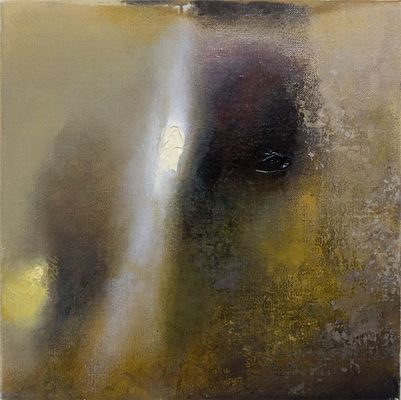
To return to Buckley’s fragment, the first two lines very much evoke how I paint nowadays. As you age, detail diminishes and patches of light become more luminous and float. I feel the most honest way of dealing with this is by smearing the oil paint on the canvas with the fingers and working close-up, blind. Only if the patches coalesce into an approaching image can the work gain a life.
-
Jonathan Walker was born in Melbourne, Australia and brought up on a dairy farm in Gippsland. In the 1970’s he studied painting at RMIT and won the Harold Wright Scholarship to the British Museum, London. During the 1980’s he exhibited at Pinacotheca Gallery, Richmond and had work shown at the NGV and Heidi City Art Gallery. Over the same period he designed the cover for the “Epigenesi” LP by Giancarlo Toniutti, Italy and conducted a mail exchange work with Achim Wollscheid, Germany. The work with artists through the post resulted in an article published in the bicentenary issue of Art and Australia 1988. He showed in artist run spaces such as WestSpace in the 90’s and 2000’s, and until 2012, taught painting at Victoria University, which is where we (Colleen Ahern and Lisa Radford) as organisers of the exhibition, among many others, had the privilege of being his student.
Walker’s knowledge was imparted to students through the careful selection of music, literature, and artists found in books that he himself had ordered for the library. Walker’s strategy was the generosity of sharing his vast knowledge with references specific to each student and their context.
Walker’s paintings share a similar focus and intimacy.
This exhibition presents a small selection of recent paintings alongside a publication that includes Walker’s writing. Observational and analytical, Walker’s work is a type of material notation — the time of day, colour and how it is blended, the both specific and fleeting location of a reflection on lino or the question of whether a chair leg should be included in a painting.
Please join us on Friday August 21 between 6-8pm to celebrate the opening of the exhibition.
Curated by Colleen Ahern and Lisa Radford.
B. Wurtz
Curated by Nic Tammens
March 26 - April 4, 2015
B.Wurtz works from a basement studio in his home on Manhattan’s Lower East Side.
This local fact is attested to by the plastic shopping bags and newsprint circulars that appear in his work. As formal objects, they don’t make loud claims about their origins but nonetheless transmit street addresses and places of business from the bottom of this long thin island. Like plenty of artists, Wurtz is affected by what is local and what is consumed. His work is underpinned by this ethic. It often speaks from a neighborhood or reads like the contents of a hamper:
“BLACK PLUMS $1.29 lb.”
“Food Bazaar”
“USDA Whole Pork Shoulder Picnic 99c lb.”
“RITE AID Pharmacy, with us it’s personal.”
“H. Brickman & Sons.”
“Sweet Yams 59c lb."
Most of the work in this exhibition was made while the artist was in residence at Dieu Donne, a workshop dedicated to paper craft in Midtown. Here Wurtz fabricated assemblages with paper and objects that are relatively lightweight, with the intention that they would be easily transportable to Australia. This consideration isn’t absolute in Wurtz’s work, but was prescriptive for making the current exhibition light and cheap. Packed in two boxes, these works were sent from a USPS post office on the Lower East Side and delivered to North Melbourne by Australia Post.
Wurtz appears courtesy of Metro Pictures, New York.
Thanks to Rob Halverson, Joshua Petherick, Sari de Mallory, Matt Hinkley, Helen Johnson, Fayen d'Evie, Ask Kilmartin, Lisa Radon, Ellena Savage, Yale Union, and "Elizabeth".
John Nixon
"Archive"
December 15 - January 20, 2014
The presentation of John Nixon's archive offered a rare showcase of this extensive collection of the artist's own publications, catalogues, posters, ephemera, editions and more, from the mid 1980s onwards, alongside a selection of his artworks.
Organized by John Nixon, Joshua Petherick and Matt Hinkley.
<a href=http://wfb.public-office.info/artist/john-nixon>All titles by John Nixon
"Habitat"
at Minerva, Sydney (organised by Joshua Petherick and Matt Hinkley)
November 15 - December 20, 2014
Lupo Borgonovo, Janet Burchill & Jennifer McCamley,
Lewis Fidock, HR Giger, Piero Gilardi, Veit Laurent Kurz,
Cinzia Ruggeri, Michael E. Smith, Lucie Stahl, Daniel Weil, Wols
Press Release:
“...It contained seven objects. The slender fluted bone, surely formed for flight, surely from the wing of some large bird. Three archaic circuitboards, faced with mazes of gold. A smooth white sphere of baked clay. An age-blackened fragment of lace. A fingerlength segment of what she assumed was bone from a human wrist, grayish white, inset smoothly with the silicon shaft of a small instrument that must once have ridden flush with the surface of the skin - but the thing’s face was seared and blackened.”
William Gibson, “Count Zero”, 1986
"Autumn Projects Archive"
Curated by Liza Vasiliou
March 6 - March 15, 2014
World Food Books, in conjunction with the Virgin Australia Melbourne Fashion Festival 2014, presented the Autumn Projects archive, consisting of a selection of early examples in Australian fashion with a particular interest in collecting designers and labels from the period beginning in the 1980’s, who significantly influenced the discourse of Australian Fashion.
Curated by Liza Vasiliou, the exhibition provided a unique opportunity to view pieces by designers Anthea Crawford, Barbara Vandenberg, Geoff Liddell and labels CR Australia, Covers, Jag along with early experimental collage pieces by Prue Acton and Sally Browne’s ‘Fragments’ collection, suspended throughout the functioning World Food Books shop in Melbourne.
H.B. Peace
presented by CENTRE FOR STYLE
November 14, 2013
"Hey Blinky, you say chic, I say same"
Anon 2013
H.B. Peace is a clothing collaboration between great friends Blake Barns and Hugh Egan Westland. Their pieces explore the divergences between 'character’ and ‘personality’ in garments....etc
Special Thanks to Joshua Petherick and Matt Hinkley of WFB and Gillian Mears
and a Very Special Thank you to Audrey Thomas Hayes for her shoe collaboration.
Janet Burchill & Jennifer McCamley
"Aesthetic Suicide"
May 10 - June 8, 2013
The first of our occasional exhibitions in the World Food Books office/shop space in Melbourne, "Aesthetic Suicide" presented a body of new and older works together by artists Janet Burchill & Jennifer McCamley, including videos, prints, a wall work, and publications.
During shop open hours videos played every hour, on the hour.
1977, German
Heavy card slipcase (4 vols.), 323 pages; 357 pages; 378 pages; 40 pages; 21 x 29.5 cm
1st Edition, Out of print title / used / good
Published by
Paul Dierich / Kassel
$100.00 - Out of stock
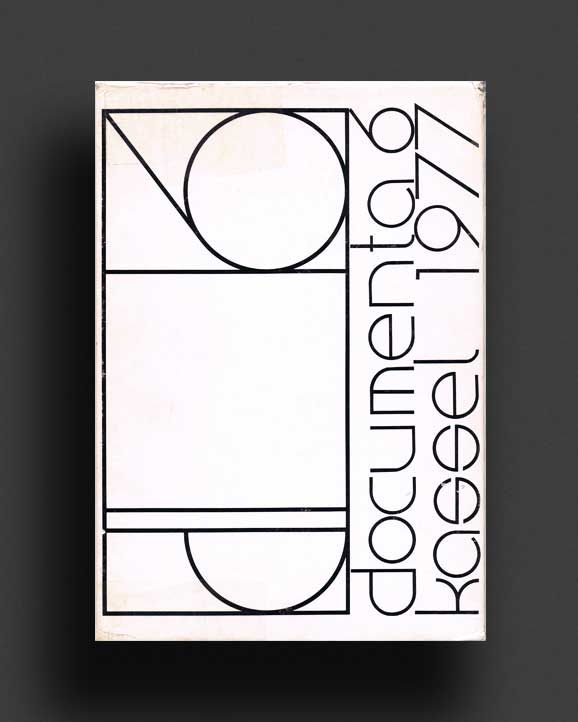
Complete 3 volume boxset exhibition catalogue published in conjunction with Documenta 6, the sixth edition of documenta, a quinquennial contemporary art exhibition. It was held between 24 June and 2 October 1977 in Kassel, Germany, and the artistic director was Manfred Schneckenburger. The title of the exhibition was: Internationale Ausstellung – international exhibition.
Box contains volume 1: painting - sculpture - performance (320 pages) / volume 2: photography - film - video (357 pages) / volume 3: drawings - utopian design - books (376 pages + show) / special edition of exhibition information booklet (40 pages + show); essays by Lothar Romain, Bazon Brock, Karl Oskar Blase, Klaus Honnef, Evelyn Weiss, Manfred Schneckenburger, Arnold Bode, Wieland Schmied, and Lothar Lang.
Artists featured throughout include Francis Bacon, Jennifer Bartlett, Georg Baselitz, Gerd Baukhage, Enzo Cacciola, Louis Cane, Chuck Close, Ulrich Erben, Winfred Gaul, Raimund Girke, Kuno Gonschior, Camille Graeser, Gotthard Graubner, Nancy Graves, Alan Green, Richard Hamilton, Heijo Hangen, Bernhard Heisig, Michael Heizer, Edgar Hofschen, Jasper Johns, Willem de Kooning, Attila Kovács, László Lakner, Roy Lichtenstein, Markus Lüpertz, Wolfgang Mattheuer, Gerhard Merz, Rune Mields, Carmengloria Morales, Malcolm Morley, Claudio Olivieri, Roman Opalka, Palermo, A.R. Penck, Lucio Pozzi, Hans-Peter Reuter, Gerhard Richter, Claude Rutault, Willi Sitte, Frank Stella, Werner Tübke, Bernar Venet, Andy Warhol, Reindert Wepko van de Wint, Gianfranco Zappetini, Jerry Zeniuk, Bernhard and Hilla Becher, Bernhard Johannes Blume, Christian Boltanski, Bettina Brand, Heinz Breloh, James Collins, Zdenek Felix, Reinhold Hohl, Gabrielle Honnef-Harling, Erich Kuby, Werner Lippert, Bernd Lohse, Felix H. Mann, Hilmar Pabel, Georg Reinhardt, Liselotte Strelow, Ann Wilde, Jürgen Wilde, Peter Ackermann, Michael von Biel, Fernando Botero, Miguel Condé, Renato Guttoso, Horst Janssen, Giacomo Manzù, Pablo Picasso, Wolfgang Schmitz, Rudolf Schoofs, André Thomkins, Bodo Baumgarten, Blythe Bohnen, Pinchas Cohen Gan, Rupprecht Geiger, Hetum Gruber, Eva Hesse, Sol LeWitt, Nino Malfatti, Bob Ryman, Jan Schoonhoven, Lee U-Fan, Rainer Werner Fassbinder, Martin Scorsese, Stanley Kubrick.
Texts in German.
Also includes an exhibition guide booklet in the same format as the 3 main catalogue volumes.
Good copy throughout with general tanning and age wear to box and books, some knocking and tape-mended cracking to the box binding corners and edging.
1971, German
Softcover, 464 pages, 29.7 x 21 cm
1st Edition, Out of print title / used / very good
Published by
DuMont / Köln
$85.00 - Out of stock
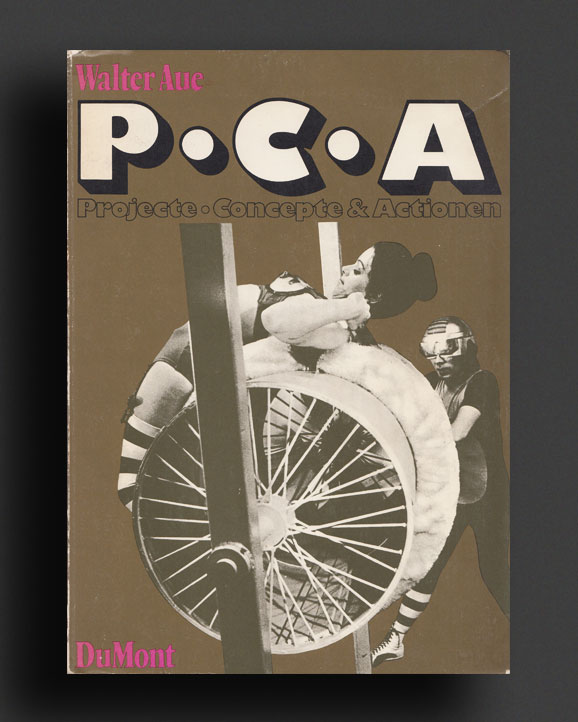
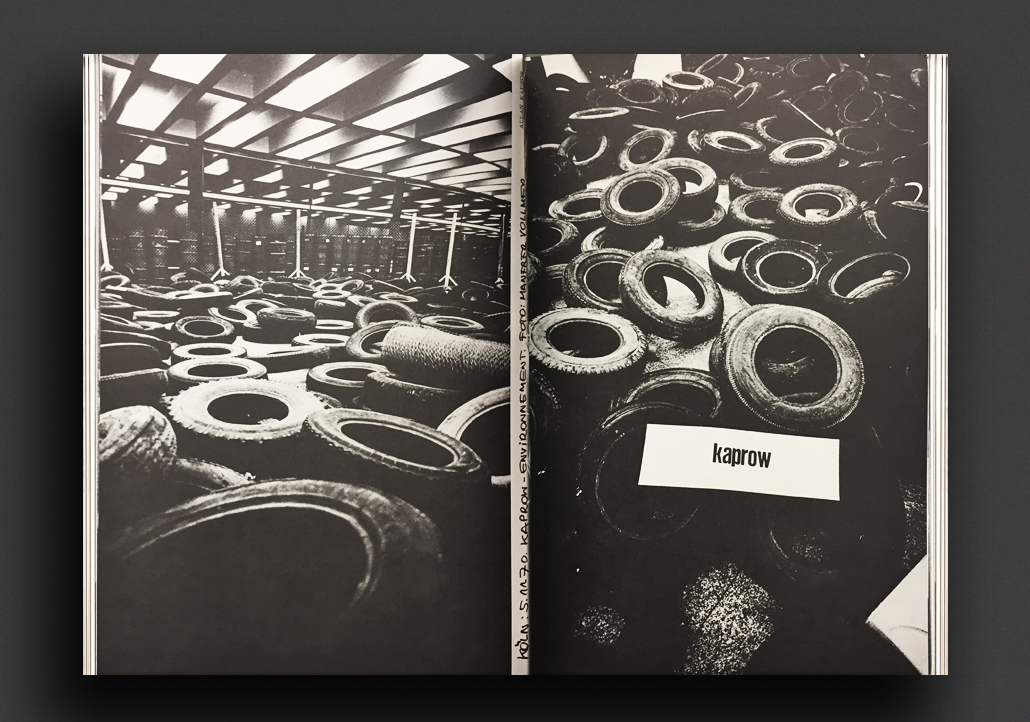
Huge, densely-illustrated volume compiled by German publisher/editor/essayist/curator Walter Aue, who worked closely with conceptual and performance artists in the 1960s-1970s. Laid-out by Aue himself, the book feels like a very natural scrap-book compendium of artist contributions, reproducing artworks, documentation of happenings, texts, photographs, diagrams, collages, news-clippings, instructions, etc. across over 450 pages, with Aue's type-written opening essay and cataloguing throughout. Features the most notable conceptual, actionist and performance artists of the period, spanning Fluxus, Arte Povera, radical architecture, Nouveau Realisme, etc. including Dieter Rot, Joseph Beuys, Robert Smithson, Pino Pascali, Stanley Brouwn, Jannis Kounellis, Klaus Rinke, Ben Vautier, Al Hansen, Walter Pichler, Hilla and Bernhard Becher, Giuseppe Penone, Ettore Sottsass, Gilbert and George, Walter De Maria, Wolf Vostell, Hans Hollein, Imi Knoebel, Barry Flanagan, Allan Kaprow, Carolee Schneemann, Hamish Fulton, Christo, Elfriede Jelinek, Dennis Oppenheim, Urs Lüthi, Sigmar Polke, Gerhard Rühm, Blink Palermo, Lawrence Weiner, Ed Ruscha, HA Schult, Hermann Nitsch, James Lee Byars, Jan Dibbets, Jochen Gerz, Mauricio Kagel, Nam June Paik, Otto Mühl, Arnulf Rainer, Jan Voss, George Brecht, Robert Filliou, Franz Erhard Walther, Timm Ulrichs, Daniel Spoerri, Erich Reusch, Paul Pechter, Rainer Giese, Jörg Immendorff, Henning Christiansen, Gilberto Zorio, Panamarenko, Joseph Kosuth, Dan Graham, Dick Higgins, Ian Baxter, Mel Bochner, Haus-Rucker-Co, Markus Raetz, Sottsass, Nam June Paik, Hans Haacke, Tetsumi Kudo, Bruce Mclean, On Kawara, and so many more.
Depending on the artist, texts are in English, German, Dutch, etc. Opening essay in German.
Very Good, light wear/tear to top spine.
1969, English
Softcover (stapled), 20 pages, 20.5 x 26.5 cm
1st Edition, Out of print title / used / good
Published by
NGV (National Gallery of Victoria) / Victoria
$20.00 - In stock -
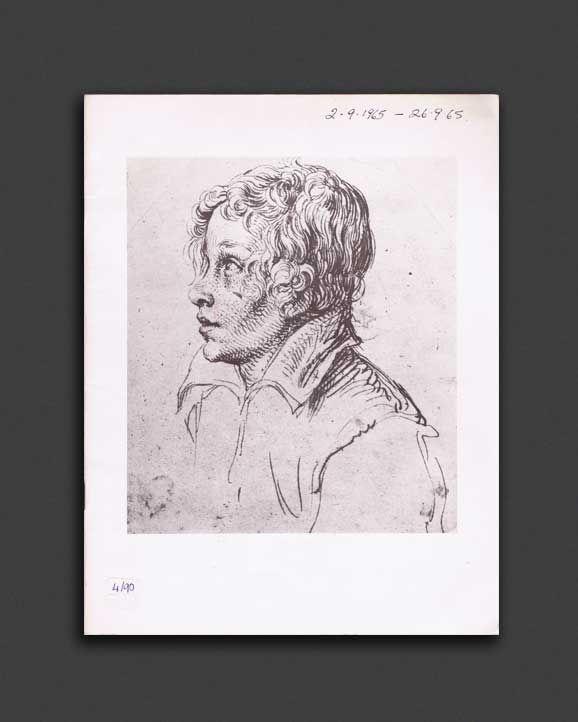
Wonderful and scarce catalogue for the exhibition "The Art of Drawing", a major survey of drawing through the centuries, held in 1969 at the National Gallery of Victoria.
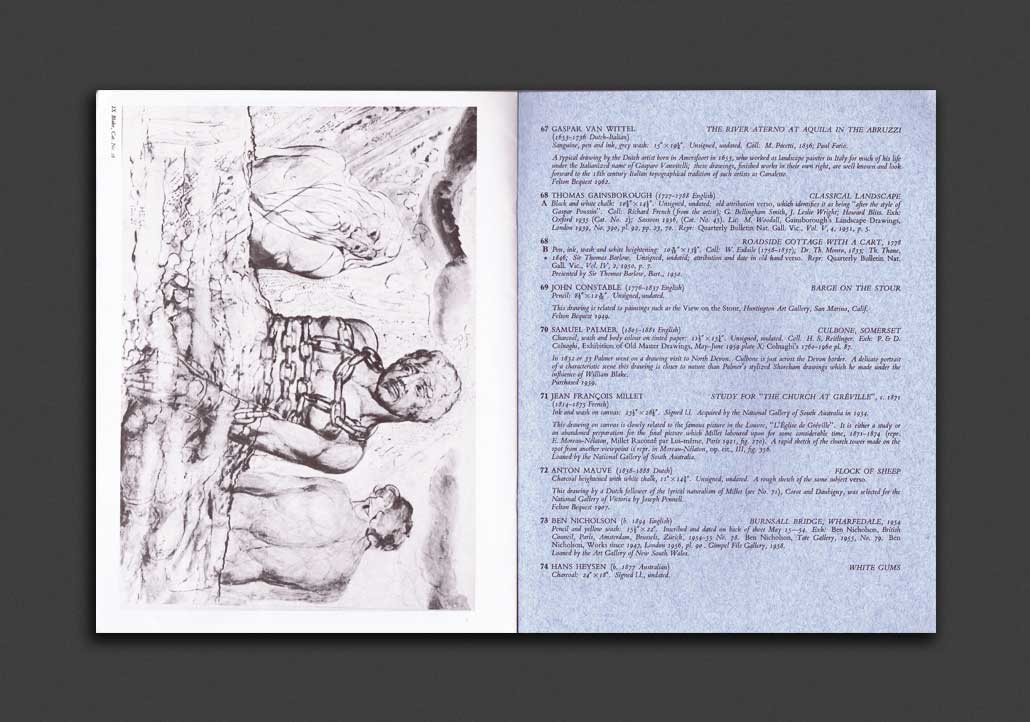
Introduction by Ursula Hoff with full exhibition check-list across blue textured paperstock. Illustrated pages featuring works by William Blake, Andreas del Sarto, Parmigianino, Jacques de Gheyn, Giovanni Benedetto Castiglione, Annibale Carracci, Aert de Gelder, Rembrandt, Thomas Gainsborough, François Boucher, Pablo Picasso, William Dobell. Exhibition also included Eric Thake, Henri Matisse, Arthur Boyd, Carlo Maratta, Annibale Carracci, Russell Drysdale, Jacob Epstein, Rupert Bunny, Eduardo Paolozzi, John Brack, Percy Wyndham Lewis, Jan Brueghel The Elder, Jean Francois Millet, Hans Heysen, Ben Nicholson, Auguste Rodin, Robert Klippel, Inge King, Henry Moore, Albert Dürer, Léon Bakst, Margaret Stones, and many others.
Ursula Hoff (1909-2005) was an Australian scholar, academic, curator, writer, critic, and lecturer. She was Deputy Director of the National Gallery of Victoria, Melbourne (1968–1973).
Good-Very Good ex-Australian National Gallery reference copy.
2018, English
Hardcover, 92 pages, 23 x 27.5 cm
Published by
Sternberg Press / Berlin
Eykyn Maclean / New York-London
$79.00 $35.00 - Out of stock
Contributions by Carl Andre, Meg O’Rourke, Caroline Weber, Lynn Zelevansky, Thea Westreich
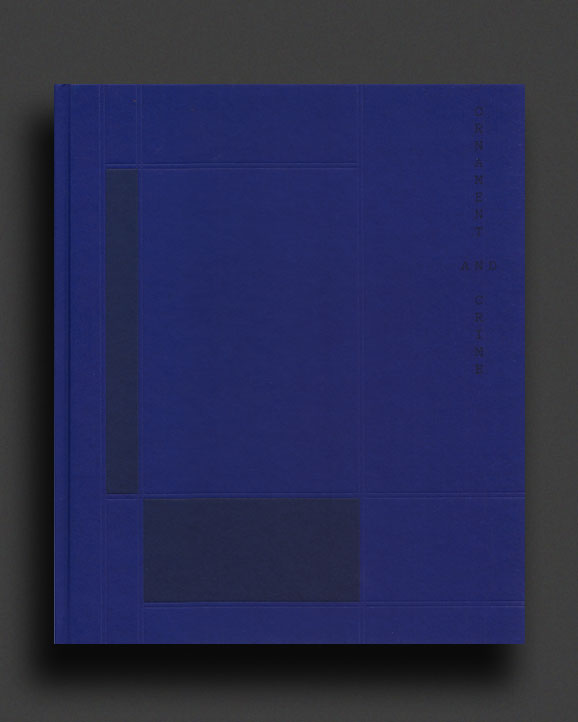
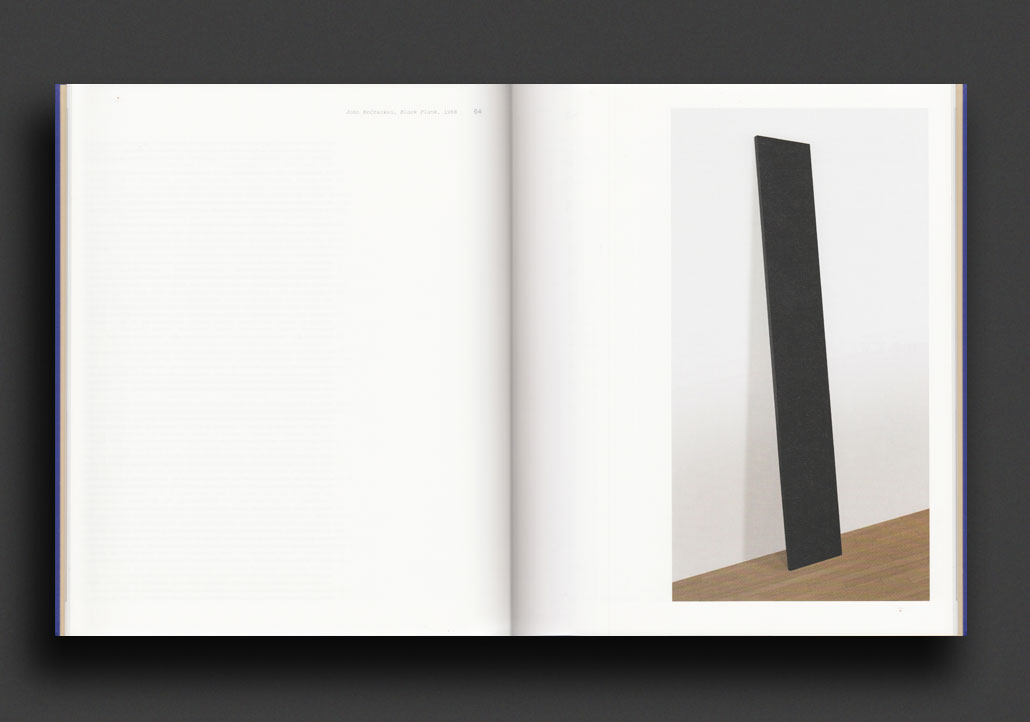
The catalogue Ornament and Crime accompanies the group exhibition curated by Meg O’Rourke at Eykyn Maclean in New York (May 2–June 15, 2018). With Adolf Loos’s eponymous 1908 diatribe against excessive ornamentation as its guide, the exhibition draws on the tenets set forth by Loos—simplicity, purity, freedom—with particular attention to their philosophical implications and their persistence into the latter twentieth century. The catalogue traces a genealogy of form from the dogmatism of Loos and Piet Mondrian; to the experimental systems of Yves Klein, the Zero group, and Ad Reinhardt; and finally, to the austere formalism of Minimalism and Arte Povera. When superficial surfaces and superfluous decorations are stripped away, the unknown is opened up—into the void, that is, what lies beyond the surface; down to the elemental, a deeper engagement with material that exceeds mere abstraction; and toward the eternal, where aesthetic asceticism points toward spiritual and psychic transcendance. The texts comprise an introduction by Meg O’Rourke, an historical essay by Lynn Zelevansky, a creative abecedarium by Caroline Weber, and an interview with Carl Andre conducted by O’Rourke and Thea Westreich. They offer historical context and draw out the resonances between the artworks represented, which are included here in full-color standalone and installation views.
Features Agnes Martin, Donald Judd, Ellsworth Kelly, Carl Andre, Piet Mondrian, Yves Klein, Otto Piene, Ad Reinhardt, John McCracken, Lucio Fontana, Frank Stella, and more.
Copublished with Eykyn Maclean, New York / London
Design by A Practice for Everyday Life
2018, English / German
Softcover, 502 pages, 29.6 x 22.2 cm
Published by
Koenig Books / London
$75.00 - Out of stock
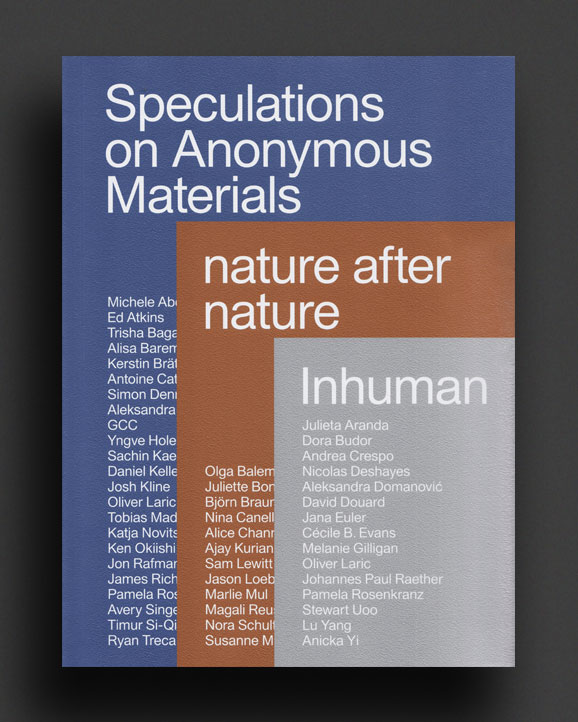
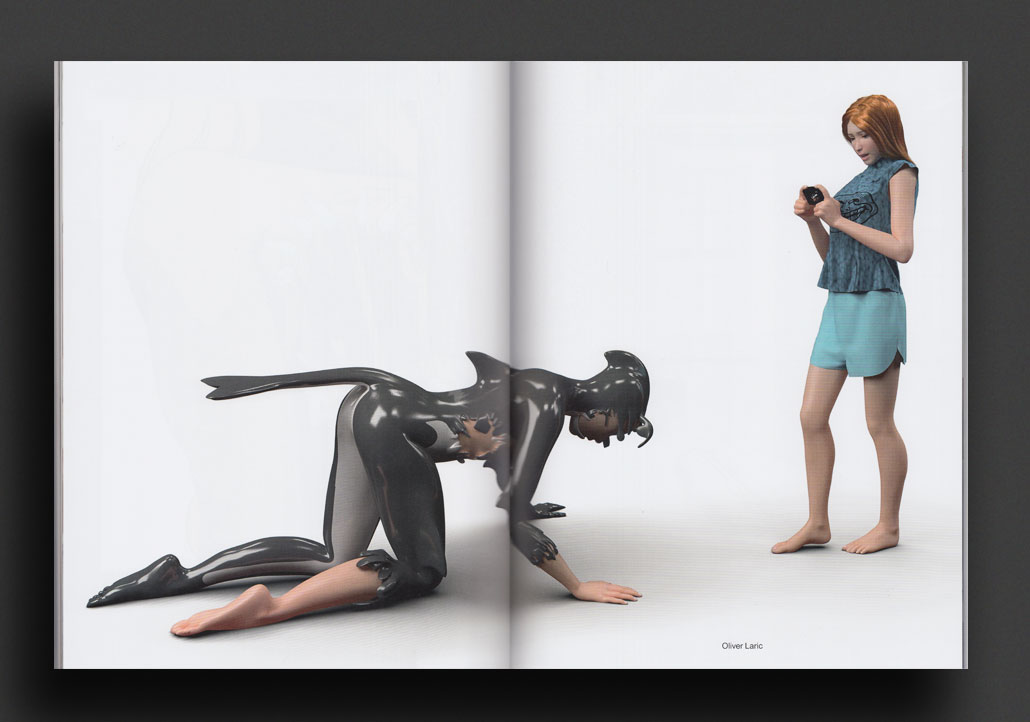
Speculations on Anonymous Materials for the first time worldwide brings together approaches in international art that reinterpret the anonymous materials created by rapid and incisive technological change.
Art’s brief is no longer to generate unique, original images, but to seek reflection in a desubjectivized approach to the existing stocks of objects, images and spaces nature after nature presents artistic works using materials that surround us and constitute nature.
Differentiations between synthetic and organic, manmade and natural are rejected. The exhibition demonstrates a nature after nature that, in its complex, global transformations, can only be grasped in fragments.
A nature that disassociates itself from an idealized and ideologized term and must be considered anew. Inhuman offers visions of the human being as a socially trained yet resistant body, transcending biologically or socially determined gender classifications, as a digitally immortal entity, or as a constantly evolving self. They visualize the constructs that define what is human and shift existing perspectives on them.
Published retrospectively after the exhibition, Speculations on Anonymous Material at Fridericianum, Kassel, 29 September 2013 – 26 January 2014.
English and German text.
Artists:
Michele Abeles, Ed Atkins, Alisa Baremboym, Juliette Bonneviot, Björn Braun, Dora Budor, Nina Canell, Alice Channer, Simon Denny, Nicolas Deshayes, Aleksandra Domanović, David Douard, Kerstin Brätsch & Debo Eilers, Jana Euler, Cécile B Evans, GCC, Melanie Gilligan, Sachin Kaeley, Josh Kline, Oliver Laric, Sam Lewitt, Jason Loebs, Tobias Madison, Marlie Mul, Katja Novitskova, Ken Okiishi, Johannes Paul Raether, Jon Rafman, Magali Reus, Pamela Rosenkranz, Nora Schultz, Timur Si-Qin, Avery Singer, Trisha Baga, & Jessie Stead Ryan Trecartin Anicka Yi
Authors:
Stacy Alaimo, Kirsty Bell, Franco “Bifo” Berardi, Antoine Catala, Andrew Durbin, Yuk Hui, David Joselit, Josh Kline, Jean-François Lyotard, Flora Lysen, Tobias Madison, Katja Novitskova, Jussi Parikka, Susanne Pfeffer, Gregor Quack, Pamela Rosenkranz, Susanne M. Winterling
1968, German
Hardcover (w. dust jacket), 370 pages, 22 x 22 cm
Out of print title / used / good
Published by
Württembergischer Kunstverein / Stuttgart
$120.00 - Out of stock
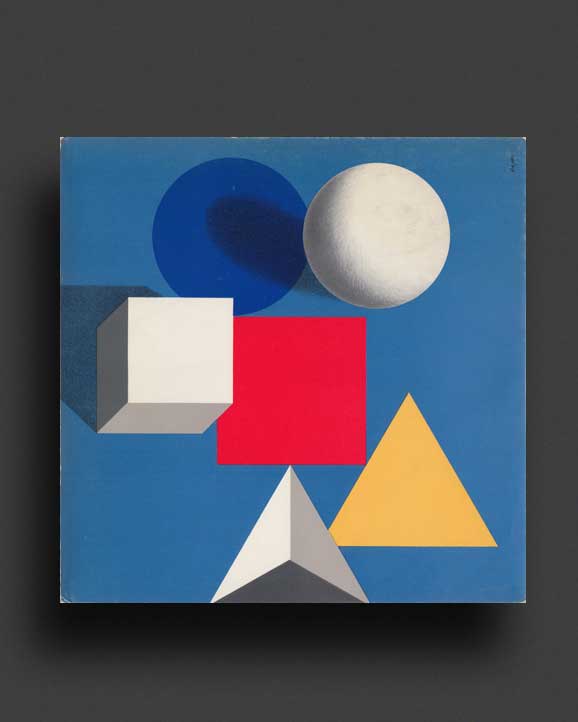
The amazing Bauhaus book, published in 1968 and designed and typeset to abolish all Upper Case letters by Herbert Bayer (one of the most influential members of the Bauhaus) for the first major Bauhaus survey exhibition after the Second World War, curated by Prof. Ludwig Grote, dr. Dieter Honisch, Herbert Bayer and Hans Maria Wingler, at Württembergischer Kunstverein Stuttgart.
This is the hard cover edition of what is without a doubt one of the most comprehensive and characteristic Bauhaus reference books ever published.
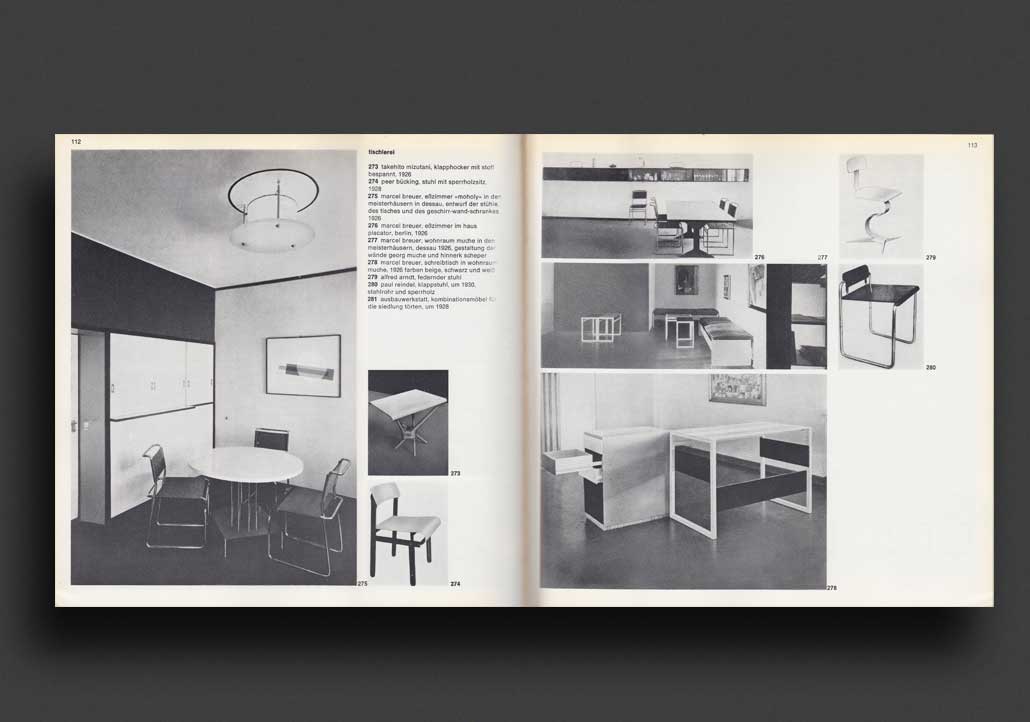
370 pages (with multiple paper stocks) contain no less than 650 colour and black and white illustrations selected from the Bauhaus Archiv, documenting the output of the Bauhaus from Weimar to Dessau to Berlin. This heavy, exhaustive volume is split into the following sections : preliminary course and teaching (includes Iteen, Moholy-Nagy, Albers, Schlemmer, Hirschfield-Mack, Klee and Schmidt); workshops (includes Teaching on Architecture, Sculpture, Stage, Stained Glass, Photography, Metal, Carpentry, Pottery, Typography, Mural Painting and Weaving); architecture and design (includes Gropius, Hannes Meyer, Mies van der Rohe, Hilberseimer, Brenner, Heiberg, A. Mayer, Stam Wittwer, Arndt, Bayer and Breuer); painting, sculpture, graphics (includes Josef Albers, Arndt, Bayer, Feininger, Itten, Kandinsky, Klee, Marcks, Moholy-Nagy, Muche, Schlemmer, Wols, etc.); life at the bauhaus; continuation of the teaching; biographies; bibliographies; index.
Includes introductory essays by Ludwig Grote, Walter Gropius, Heinz Winfried Sabais, Otto Stelzer, Hans Eckstein, Nikolaus Pevsner, Jurgen Joedicke, Will Grohmann and Hans M. Wingler.
Artists included: Walter Gropius, Marcel Breuer, Ludwig Mies Van Der Rohe, Gunta Stolzl, Joost Schmidt, Oskar Schlemmer, Walter Peterhans, Georg Muche, Lilly Reich, Laszlo Moholy-Nagy, Hannes Meyer, Gerhard Marcks, Johannes Itten, Ludwig Hilberseimer, Max Bill, Wassily Kandinsky, Lyonel Feininger, Alfred Arndt, Josef Albers, Marianne Brandt, Herbert Bayer, Paul Klee, Josef Hartwig, Wilhelm Wagenfeld, Christian Dell, Otto Lindig, Theodor Bogler, Wols, and so many others.
Includes references to all aspects of the Bauhaus, including: Itten's Preliminary Course, Klee's Course, Kandinsky's Course, Color Experiments, Carpentry Workshop, Stained Glass Workshop, Pottery Workshop, Metal Workshop, Weaving Workshop, Stage Workshop, Wall Painting Workshop, Display Design, Architecture, Typography and Layout; the Bauhaus Press, the Weimar Exhibition, 1923, Moholy-Nagy's Preliminary Course, Albers' Preliminary Course, Bauhaus Building, The Masters' Houses, Other Buildings in Dessau, Architecture Department, Weaving Workshop, Typography Workshop: Printing, layout, posters, Photography, Exhibition Technique, Wall Painting Workshop: Wall paper, Sculpture Workshop, Stage Workshop, Extracurricular Activities, Spread of the Bauhaus Idea, Bauhaus Teaching in the United States and much more.
All texts in German.
Of all the artists to pass through the Bauhaus, none lived the Bauhaus ideal of total integration of the arts into life like Herbert Bayer (1900 - 1985). He was a graphic designer, typographer, photographer, painter, environmental designer, sculptor and exhibition designer. Between 1925 and 1928, Bayer was head of the printing workshop at the Bauhaus and produced many designs that became standards of a Bauhaus "style." Bayer was instrumental in moving the Bauhaus to purely sans serif usage in all its work, and is especially known is his lowercase, which continues in this 1968 catalogue.
Hardcover 2nd edition w. illustrated dust jacket (protected under plastic wrap) - good copy throughout, with the common bind-splitting at some intervals due to old glue and paper weight (seems to have been previously repaired). All pages still bound and present. Heavy spotting to outer top block edge, tanning to pages edges, otherwise bright and very clean throughout. Good jacket, only light wear.
1970, German
Softcover, 92 pages, 11 x 17 cm
1st edition, Out of print title / used*,
Published by
Galerie Rudolph Zwirner / Köln
$55.00 - Out of stock
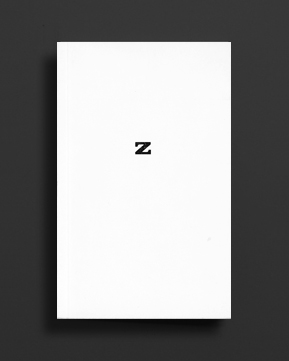
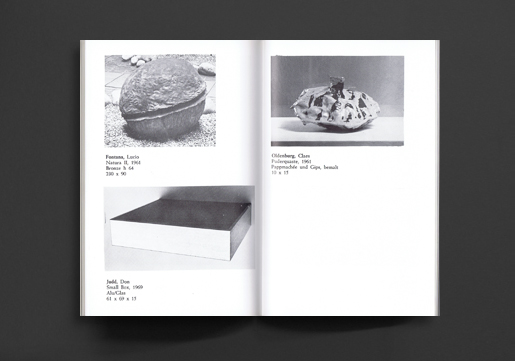
"Z" is a great, unsuspecting pocketbook from Galerie Rudolph Zwirner in 1970, collecting together a wonderful group of works by 78 artists (Yves Klein, Richard Tuttle, Donald Judd, Cy Twombly, René Magritte, Laszlo Moholy-Nagy, Kenneth Noland, Daniel Spoerri, Frank Stella, Jean Tinguely, Roy Lichtenstein, Richard Linder, Jasper Johns, Martial Raysse, Dieter Rot, Franz Erhart Walther, Bruno Goller, Morris Louis, Jim Dine, Otto Dix, Jean Dubuffet, Max Ernst, Salvador Dali, Konrad Klapheck, Lucio Fontana, Blinky Palermo, Hundertwasser, Gerhard Richter, Antoni Tapies, Andy Warhol, George Grosz, Robert Graham, Allen Jones, Henri Michaux, Claes Oldenburg, Robert Rauschenberg, Oskar Schlemmer, Yves Tanguy, Louis Soutter, Tom Wesselmann, Toyen, Wols, Larry Bell, Dan Flavin, Panamarenko, Sol Lewitt, etc.) across painting, sculpture, drawings, collage and multiples, all reproduced in black and white across this almost entirely visual volume.
2018, English / German
Softcover, 182 pages,
Published by
Sternberg Press / Berlin
Künstlerhaus Halle für Kunst & Medien / Graz
$69.00 $40.00 - Out of stock
Edited by Sandro Droschl, Künstlerhaus, Halle für Kunst & Medien
Texts by Christian Egger, Sabine Weier, Tanja Widmann
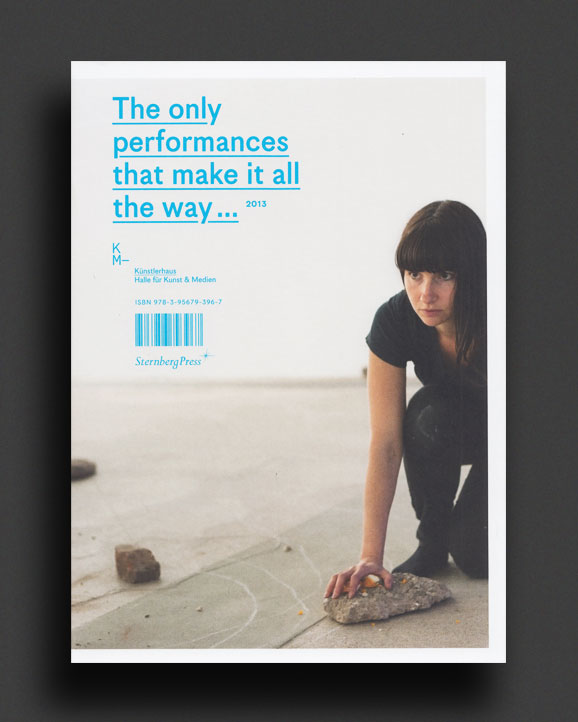
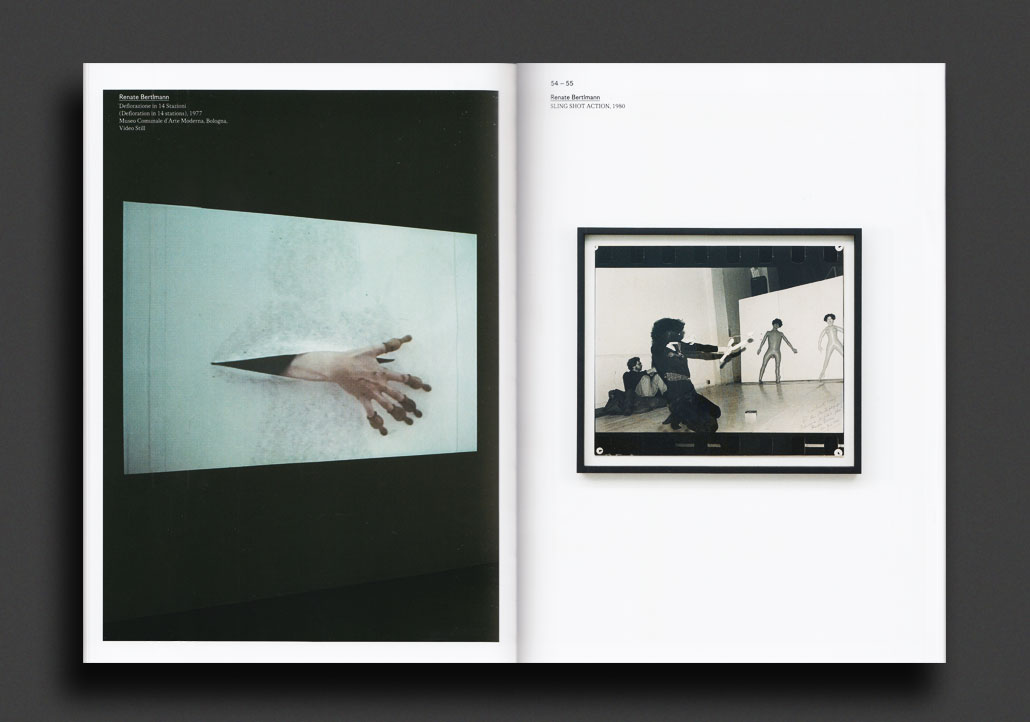
This catalogue is published on the occasion of the two group exhibitions “The only performances that make it all the way...“ and “Yes, but is it performable? Investigations on the Performative Paradox“ which were shown at Künstlerhaus, Halle für Kunst & Medien in 2013 and 2016.
Both exhibitions are united by an activating dialogical confrontation of recent, performative practices and performances dealing with the main works of historical forerunners. Throughout the respective exhibition, two to three works were added, while also parts and objects of the performances remained in the exhibition space, thus the exhibition set-up presented itself as transparent and could be experienced by the audience.
Artists included : Pauline Boudry / Renate Lorenz, Michael Clark + The Fall, Guy de Cointet, Carola Dertnig, Cosey Fanni Tutti, Liz Glynn, Jakob Lena Knebl + das_em, Thomas Kratz, Adam Linder, Michele di Menna, Gina Pane, Claus Richter, Barbara T. Smith
Design by Nik Thoenen and Maia Gusberti
1972, German
Hardcover, 216 pages, 24.5 x 21.5 cm
1st Edition, Out of print title / used / very good
Published by
Georg Wenderoth Verlag / Kassel
$60.00 $40.00 - Out of stock
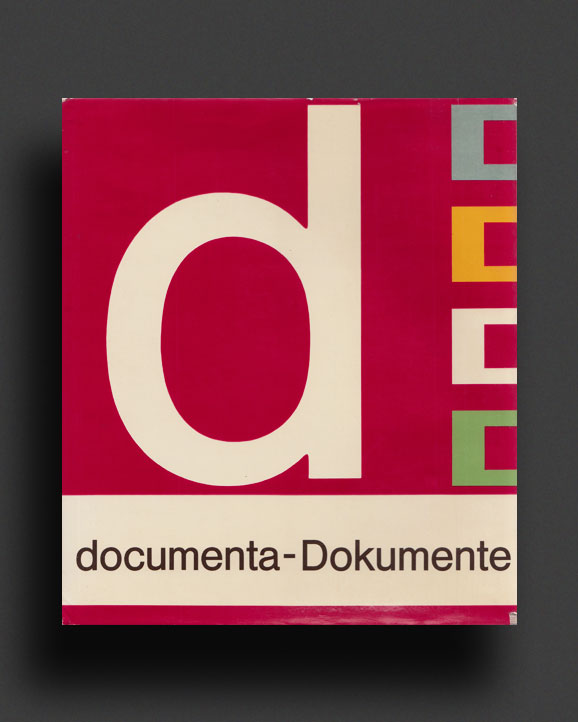
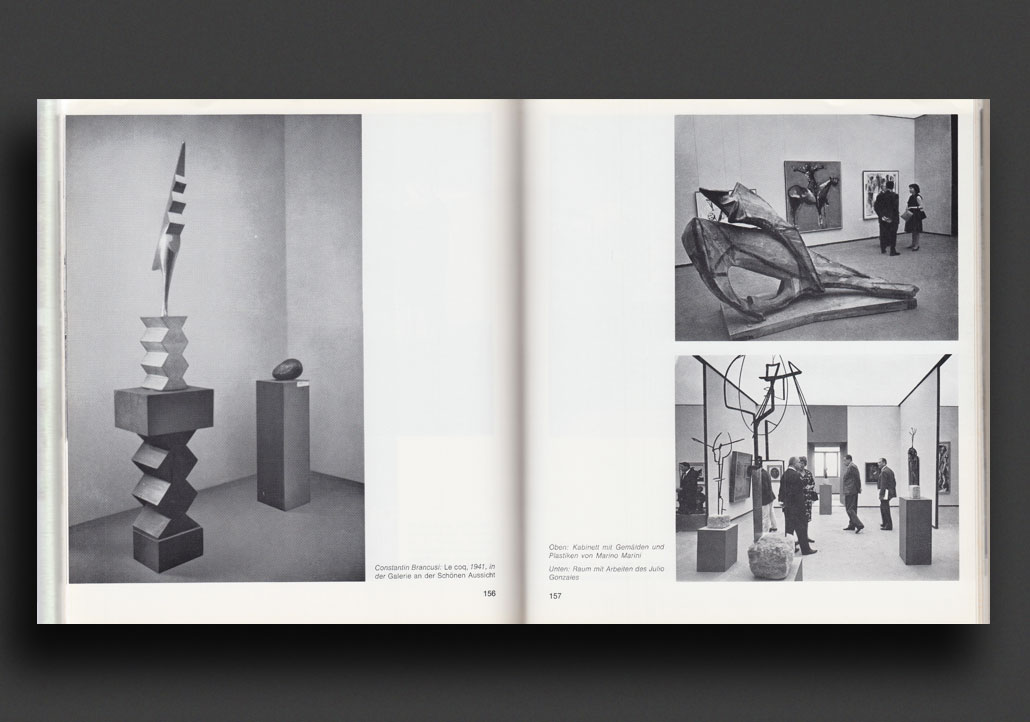
documenta - Dokumente 1955 - 1968 (Four International Exhibitions of Modern Art), was published by Georg Wenderoth Verlag, Kassel in 1972. This clothbound hardcover book of texts (by Dieter Westecker, Carl Eberth, Werner Lengemann, Erich Müller) and photographs of the first four documenta exhibitions, is quite a unique publication. Written at the suggestion of former students and collaborators of Documenta initiator Arnold Bode, it does not replace a documenta chronicle or a scientific study of individual facts. On the contrary, the textual and pictorial material is selected from a technical point of view, processed and presented in a comprehensible form to stimulate detailed investigations into the exhibition-presentations. The bulk of the photographic documentation is of visitor reception and interaction with the installations of artworks, including those of Hans Arp, Constantin Brancusi, Lee Bontecou, Victor Pasmore, Marino Marini, Jean Dubuffet, Konrad Klapheck, George Segal, Robert Indiana, Claes Oldenburg, Walter de Maria, Eduardo Paolozzi, Phillip King, Erich Hauser, Ernest Trova, Michelangelo Pistoletto, Carl Andre, William Tucker, Peter Brüning, David Smith, Edward Keinholz, Dan Flavin, Morris Louis, Sol Lewitt, Robert Morris, Frank Stella, Tom Wesselmann, James RosenquisThomas Lenck, Francis Bacon, Horst Antes, Shinkichi Tajiri, Christo, Jackson Pollock, Karel Appel, Bernard Schultze, Otto Herbert Hajek, Jacques Lipchitz, Lynn Chadwick, Paul Delvaux, Helen Frankenthaler, Wassily Kandinsky, Fernand Leger, Max Bill, Joan Miro, Henry Moore, Pablo Picasso, Robert Rauschenberg, Giogio de Chirico, Victor Vasarley, Zoran Music, Giuseppe Capogrossi, and many others.
Texts in German. First and only edition.
Vert Good copy with original dust jacket.
1984, English
Softcover, 342 pages, 270 x 280 cm
1st Edition, Out of print title / used / average
Published by
U.M.I. Research Press / Michigan
$50.00 - Out of stock
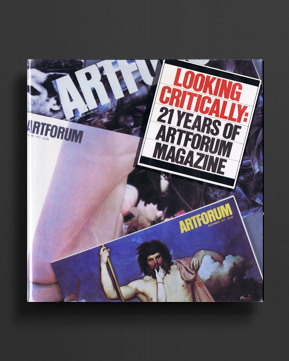
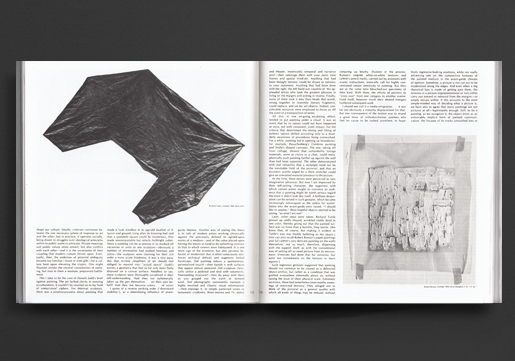
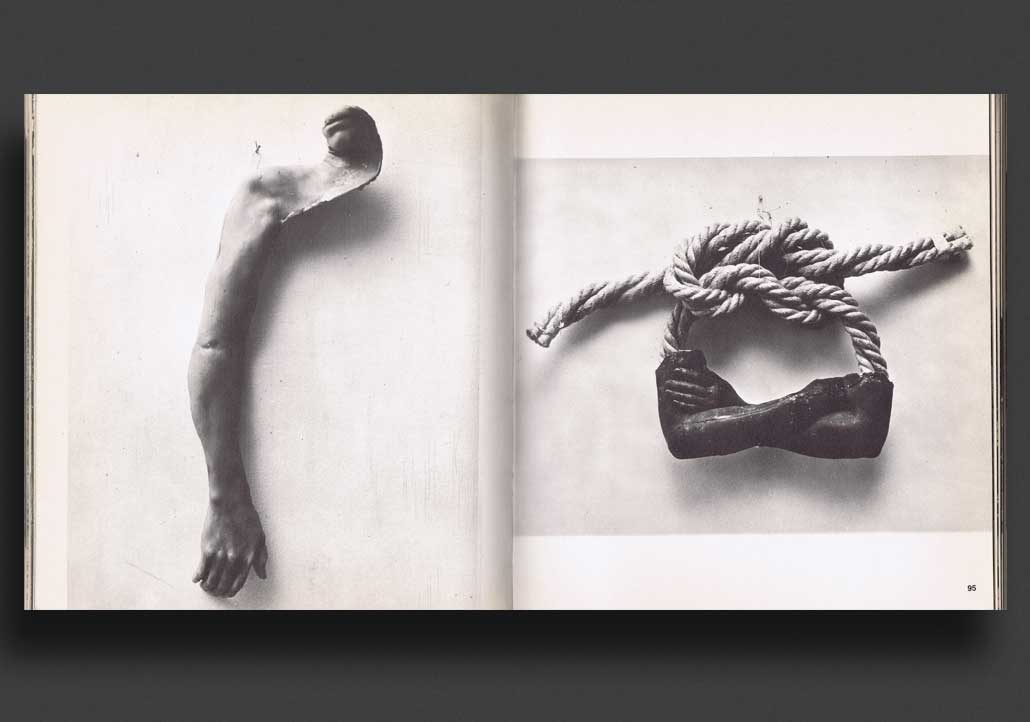
Softcover edition of "LOOKING CRITICALLY: 21 YEARS OF ARTFORUM MAGAZINE", the heavy 342 page volume anthology of the first 21 years of the world's most important modern and art journal. An incredibly valuable collection of art theory.
Edited by Amy Baker Sandback, designed by Roger Gorman and Mary Beath and published in 1984 by U.M.I. Research Press, this dense volume, bound in hardcover to the dimensions of a copy of ARTFORUM, begins with an Ed Kienholz review at the Ferus Gallery from ARTFORUM's June 1962 inaugural issue, and ends with Barbara Kruger reviewing the film "TRON" for the November 1982 issue. An amazing compendium of articles and reviews from the magazine's important first 21 years, featuring contributions by the likes of John Cage, Robert Morris, Kate Steinitz, Henry T. Hopkins, Don Factor, Robert Pincus-Witten, Dennis Adrian, John Coplans, Hilton Kramer, Harold Rosenberg, Henry Geldzahler, John Cage, Walter Hopps, Ed Ruscha, Allan Kaprow, Robert Rosenblum, Dan Flavin, Boris Groys, Sam Wagstaff, Billy Kluver, Lucy R. Lippard, Robert Rosenblum, Roger Shattuck, Ad Reinhardt, Mel Bochner, Andy Warhol, Roy Lichtenstein, Claes Oldenburg, Barbara Rose, Manny Farber, Michael Fried, Robert Morris, Philip Leider, Hollis Frampton, Carl Andre, Richard Serra, Lawrence Alloway, Barbara Kruger, Jane Livingston, Lizzie Borden, Kenneth Baker, Laurie Anderson, Agnes Martin, Cindy Nemser, Sidney Tillim, Annette Michelson, Rosalind Krauss, Jeremy Gilbert-Rolfe, Roberta Smith, Peter Plagens, Peter Schjeldahl, J. Hoberman, Hal Foster, Richard Flood, Carter Ratcliff, Stuart Morgan, Max Kozloff, Donald Kuspit, Dan Graham, Walter De Maria, Komar & Melamid, Edit De Ak, Lawrence Weiner, Kathy Acker, Robert Mapplethorpe, Anselm Kiefer, Thomas McEvilley, Louise Bourgeois, Ingrid Sischy, and too many more to list. Artists featured include: Josef Albers, Richard Tuttle, Jo Baer, Carl Andre, Ant Farm, Hans Arp, Max Bill, Mel Bochner, Alighiero Boetti, Lee Bontecou, Constantin Brancusi, Bertholt Brecht, Richard Avedon, Francis Bacon, Diane Arbus, Michaelangelo Antonioni, Lynda Beglis, Larry Bell, Terry Fox, James Byers, Rober Barry, Marcel Breuer, AA Bronson, Luis Buñel, Daniel Buren, Chris Burden, Joseph Beuys, Anthony Caro, Marcel Broodthaers, John Chamberlain, Paul Cézanne, Marc Chagall, Jean Cocteau, Merce Cunningham, Sonia Delauney, Walter de Maria, Bruce Connor, Jean Dubuffet, Max Ernst, Walker Evans, Dan Flavin, Marcel Duchamp, Albrecht Dürer, Lucio Fontana, Hollis Frampton, Alberto Giacometti, Eva Hesse, Gilbert & George, Philip Glass, John Cage, Nancy Graves, Dan Graham, Robert Grosvenor, Nancy Grossman, Walter Gropius, Hans Haacke, Hairy Who, David Hockney, Douglas Huebler, Jorg Immendorff, Donald Judd, Jasper Johns, Joan Jonas, Allan Kaprow, On Kawara, Ellsworth Kelly, Edward Keinholz, Paul Klee, Alison Knowles, Joseph Kosuth, Brice Marden, Agnes Martin, André Masson, Henri Matisse, Roberto Matta, Sol Lewitt, Roy Lichtenstein, Barbara Kruger, Jannis Kounellis, Markus Lüpertz, El Lissitzky, Rene Magritte, Robert Mapplethorpe, John McCracken, Mario Merz, Robert Morris, Robert Motherwell, Ree Morton, Louise Nevelson, Barnett Newman, Kenneth Noland, Claes Oldenburg, Eduardo Paolozzio, A. R. Penck, Irving Penn, Francis Picabia, Pablo Picasso, Larry Poons, Ken Price, Yvonne Rainer, Robert Rauschenberg, Martial Raysse, Roman Polanski, Jackson Pollock, Steve Reich, Gerrit Rietveld, Alain Robbe-Grillet, Dorothae Rockburne, James Rosenquist, Mark Rothko, Robert Ryman, Lucas Samaras, Kurt Schwitters, Oscar Schlemmer, Richard Serra, Cindy Sherman, David Smith, Robert Smithson, Michael Snow, Robert Venturi, Wolf Vostell, Andy Warhol, Frank Stella, Saul Steinberg, Karlheinz Stockhausen, Bruno Taut, Jean Tinguely, Anne Truitt, Paul Wunderlich, Lawrence Weiner, Louise Bourgeois, Alfred Hitchcock, and so many more.
A Good copy throughout, with cover rubbing and corner bumping. Tightly bound and clean copy internally.
1969, English
Hardcover (clothbound), 240 pages, 21 x 22 cm
1st US Edition, Out of print title / used / good
Published by
Praeger Publishers Inc. / New York
$140.00 - Out of stock
First hardcover US printing of "Art Povera", the now legendary critical/photographic book by Germano Celant (Italian art historian, critic and curator) documenting the so-called "Art Povera /Arte Povera" movement (meaning "poor art", coined by Celant in 1967) and published by Studio Vista, London in 1969 and Praeger, New York, the same year.
Includes profiles of major artists of the movement, including a short text followed by pages of full-page photographs for each artist.
Artists featured: Walter de Maria, Michelangelo Pisteletto, Stephen Kaltenbach, Richard Long, Mario Merz, Douglas Huebler, Joseph Beuys, Eva Hesse, Michael Heizer, Ger van Elk, Lawrence Weiner, Luciano Fabro, Bruce Nauman, Joseph Kosuth, Jan Dibbets, Giovanni Anselmo, Robert Barry, Pier Paolo Calzolari, Dennis Oppenheim, Barry Flanagan, Robert Smithson, Giulio Paolini, Reiner Ruthenbeck, Alighiero Boetti, Giuseppe Penone, Franz Erhard Walther, Hans Haacke, Gilberto Zorio, Robert Morris, Marinus Boezem, Carl Andre, Emilio Prini, Richard Serra.
"This book does not aim at being an objective and general analysis of the phenomenon of art or life, but is rather an attempt to flank (both art and life) as accomplices of the changes and attitudes in the development of their daily becoming. This book does not attempt to be objective since the awareness of objectivity is false consciousness. The book, made up of photographs and written documents, bases its critical and editorial assumptions on the knowledge that criticism and iconographic documents give limited vision and partial perception of artistic work. The book, when it reproduces the documents of artistic work, refutes the linguistic mediation of photography. The book, even though it wants to avoid the logic of consumption, is a consumer's item. ... This book produces a collection of already old material. ... In this book there is no need to reflect in order to seek a unitary and reassuring value, immediately refuted by the the authors themselves, rather there is the necessity to look into it for the changes, limits, precariousness and instability of artistic work." -- text from Celant's introduction "Stating That.
Good ex-library copy with light associated markings, without dust jacket. Otherwise clean, tightly bound Very Good copy throughout (never loaned).
2018, English / German
Softcover, 176 pages, 21.5 x 27 cm
Published by
Mumok / Vienna
Walther König / Köln
$49.00 - Out of stock
Gaby and Wilhelm Schürmann do not see their collection as just private property or a prestige object, but rather as an item of cultural value that needs exchange with the public. Their collection has been constantly growing since the late 1970s, and it provides an incomparable view of the development of contemporary art from the 1980s onward. This is a progressive statement on behalf of contemporary art that is anchored in social issues and sees itself as a form of communication. The rationale behind the collection, which is held in Herzogenrath near Aachen and in Berlin, is both creative and productive, and the two collectors’ practice can be described as a particularly free-spirited form of cultural production. The act of collecting is realized less in the processes of keeping and completing artworks and is instead understood mainly as an invitation to participate in the public production of connections. This very pragmatic and hands-on approach is manifested in sensual and unconventional gestures of presenting, including the principle of “comparative seeing.” In this sense, the Class Reunion exhibition, the title of which refers to a 2008 installation of the same name by Berlin artist Nairy Baghramian, will unravel an exciting, humorous, and surprising dialogue between the diverse artistic positions in the collection, establishing unexpected points of contact. One focus in this is on Viennese influences on this international collection and its networks.
This book has been published to document the collection on the occasion of an exhibition curated by Wilhelm Schürmann at Mumok, Vienna, June 23, 2018 - November 11, 2018.
Edited by Karola Kraus and illustrated throughout in colour, with accompanying texts and full collection catalogue.
Participating artists:
Nairy Baghramian, Silvia Bächli, Monika Baer, John Baldessari/Meg Cranston, Francesco Barocco, Jennifer Bornstein, Nicola Brunnhuber, Ernst Caramelle, Kate Davis, Heinrich Dunst, Marina Faust, Morgan Fisher, Jef Geys, Ralph Gibson, Julian Göthe, Trixi Groiss, Gerhard Gronefeld, Julia Haller, Rachel Harrison, Lone Haugaard Madsen, Georg Herold, Nicolas Jasmin, Raimer Jochims, Mike Kelley, , Martin Kippenberger, Silke Otto Knapp, Alwin Lay, Brandon Lattu, Michael Light, Sonia Leimer, Anita Leisz, Jochen Lempert, Zoe Leonard, Chris Martin, Park McArthur, Paul McCarthy, Meuser, Lisette Model, Oswald Oberhuber, Albert Oehlen, Anna Oppermann, Anna Ostoya, Jens Preusse, Rebecca Quaytman, Susanne Paesler, Laurie Parsons, Stephen Prina, Deborah Remington, Lin May Saeed, Pentti Sammallahti, Stefan Sandner, Arlene Shechet, Sigune Siévi, Michael Simpson, Michael E. Smith, Lewis Stein, Jana Sterbark, Esther Stocker, Walter Swennen, Alice Tippit, Joëlle Tuerlinckx, Nora Turato, Anne-Mie Van Kerckhoven, Miriam Visaczki, Franz West, Tristan Wilczek, Christopher Williams, Heimo Zobernig
2018, English
Hardcover, 432 pages, 25x 31 cm
Published by
Getty Publications / Los Angeles
$126.00 - Out of stock
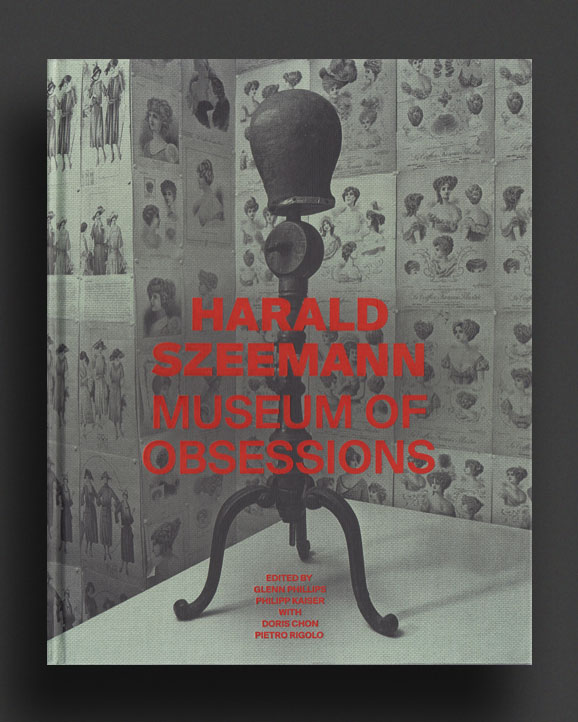
Texts by Glenn Phillips, Doris Chon, Pietro Rigolo, Philipp Kaiser
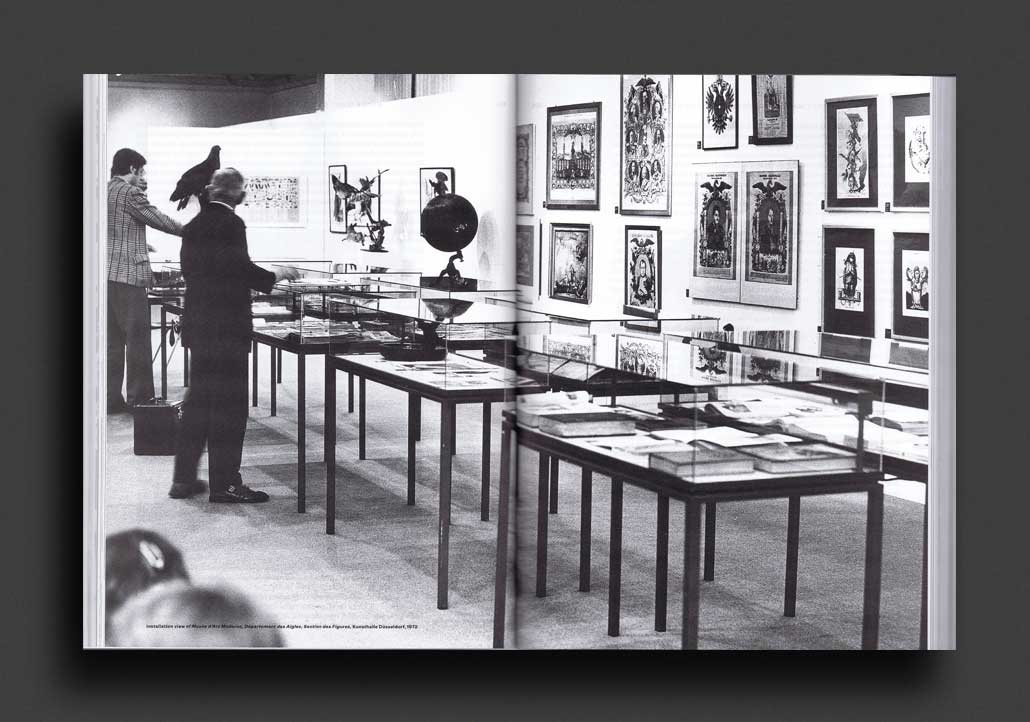
Harald Szeemann is associated with some of the most important artistic developments of the postwar era. A passionate advocate of avant-garde movements like conceptualism and post minimalism, he collaborated with artists such as Joseph Beuys, Bruce Nauman, Richard Serra, and Cy Twombly, developing new ways of presenting art that reflected his sweeping vision of contemporary culture.
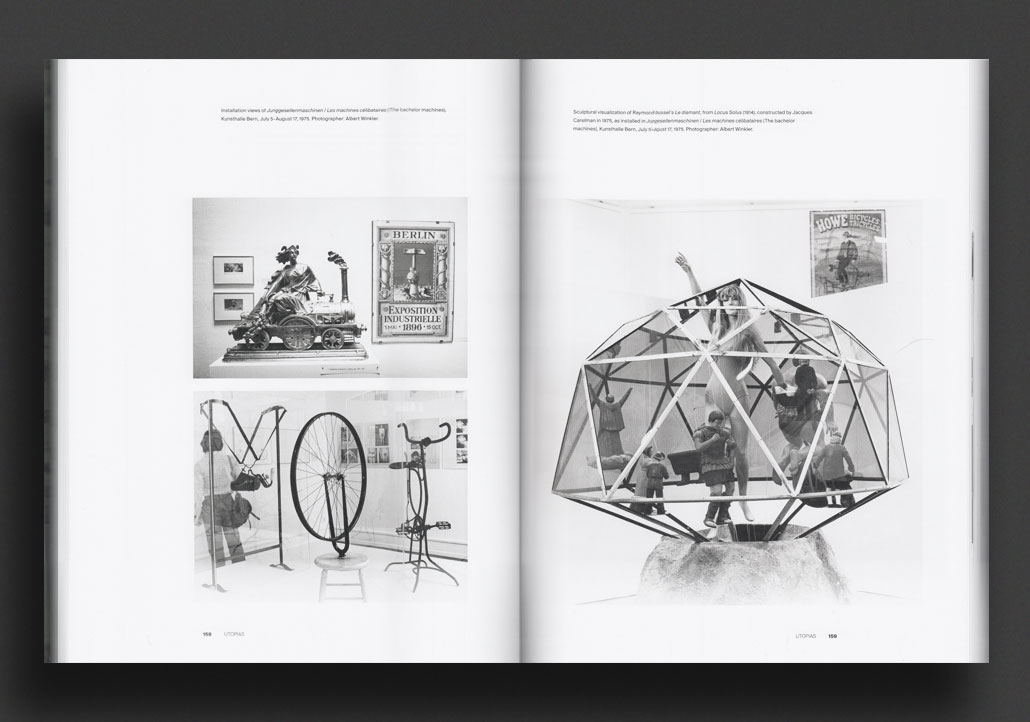
Szeemann once stated that his goal as an exhibition maker was to create a "Museum of Obsessions." This richly illustrated volume is a virtual collection catalogue for that imaginary institution, tracing the evolution of his curatorial method through the materials he collected and produced while researching and organising his exhibitions, including letters, drawings, personal datebooks, installation plans, artists' books, posters, photographs, and handwritten notes.
This book documents all phases of Szeemann's career, from his early stint as director of the Kunsthalle Bern, where he organized the seminal Live in Your Head: When Attitudes Become Form (1969); to documenta 5 (1972) and the intensely personal exhibition he staged in his own apartment using the belongings of his hairdresser grandfather (1974); to his reinvention as a freelance curator who realised projects on wide-ranging themes until his death in 2005.
The book contains essays exploring Szeemann's curatorial approach as well as interviews with collaborators. Its more than 350 illustrations include previously unpublished installation photographs and exhibition documents as well as many other materials from the curator's archive.
1983, English
Softcover, 56 pages, 23 x 30 cm
1st edition, Out of print title / used*,
Published by
NGV (National Gallery of Victoria) / Victoria
$40.00 - Out of stock
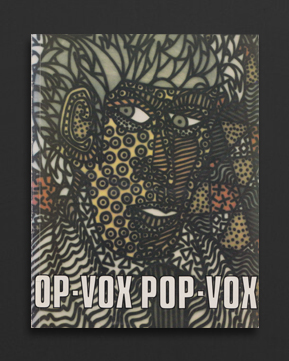
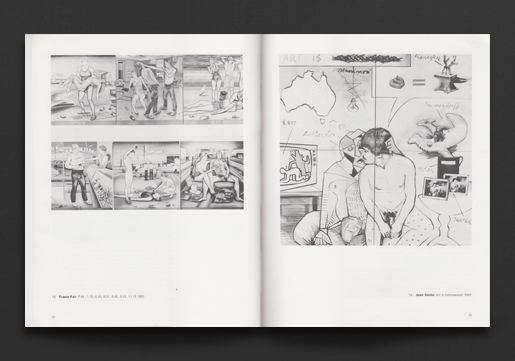
Published on the occasion of "VOX POP: Into the Eighties" an exhibition of contemporary Australian (figurative) art in the early 1980's at the National Gallery of Victoria, featuring the work of Howard Arkley, Juan Davila, Imants Tillers, Frank, Maria Kozic, Peter Tyndall, David Larwill, Mandy Martin, Linda Marrinon, Maris Kozic, Victor Rubin, Lutz Presser, Jan Murray, Jenny Watson, Peter Taylor, Fraser Fair, Dale Frank, Davida Allen, Peter Booth, John Bursill, Gunter Christmann, Paul Boston and Gareth Sansom. Text by Robert Lindsay and reproductions of works by all artists, plus biographies.
Good copy.
1947, French
Softcover, 142 pages, 24 x 20.5 cm
1st Edition, Out of print title / used / good
Published by
Maeght Editeur / Paris
$480.00 - Out of stock
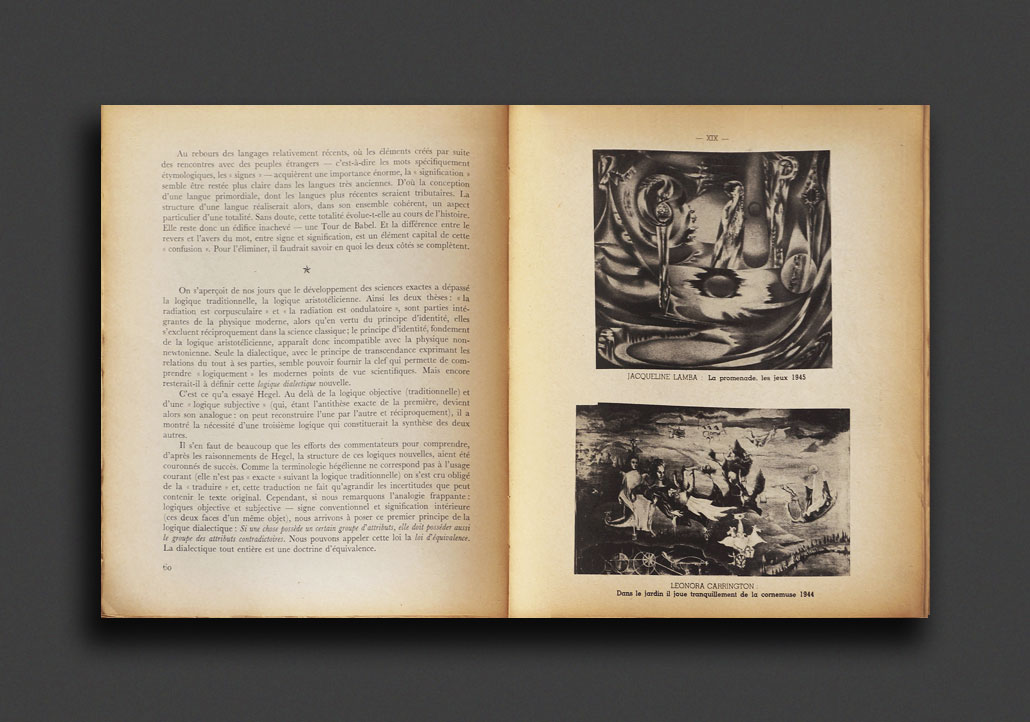
Very scarce copy of the legendary "Le Surréalisme en 1947 : Exposition Internationale de Surréalisme présentée par André Breton et Marcel Duchamp", published by Maeght Editeur, Paris, in conjunction with an important exhibition of Surrealist artists in 1947. Features the cover design by Marcel Duchamp - a photographic reproduction by Rémy Duval of "Prière de toucher (Please touch)", the famous Duchamp rubber breast edition, created with Italian-born painter Enrico Donati, that adorned the first 999 copies of the catalogue. This gorgeous catalogue features the work of artists from 24 countries including Victor Brauner, Max Ernst, Leonora Carrington, Jacqueline Lamba, Jacques Hérold, Wilfredo Lam, Joan Miró, Hans Bellmer, Marcel Jean, Maria Martins, Yves Tanguy, Dorothea Tanning, Hans Arp, Hector Hyppolite, Serge Brignoni, Alexander Calder, Bruno Capacci, Elizabeth van Damme, Jacques Halpern, Julio de Diego, Enrico Donati, Francis Bouvet , David Hare, Iaroslav Serpan, Jacqueline Lamba, Taro Okamoto, Roberto Matta, Kay Sage, Toyen, Vilhelm Bjerke-Petersen, Leonard Baskin, Jindrich Heisler, Jeanne Reynal, Roger Brielle, Jindrich Styrsky, Bruno Capacci, Jean Guerin, Isamu Noguchi, Gerome Kamrowski, Eugenio Granell, Francis Picabia, Remedios Varo, Hans Richter, Arshile Gorky, and many more,, along with the folding sheet catalogue loosely inserted.
Good copy considering age. Very tanned edges and wear to corners, edges and spine.
1975, English
Softcover, 100 pages, 24 x 30.5 cm
1st Edition, Out of print title / Used*,
Published by
The Craft Association of Victoria / Victoria
$35.00 - Out of stock
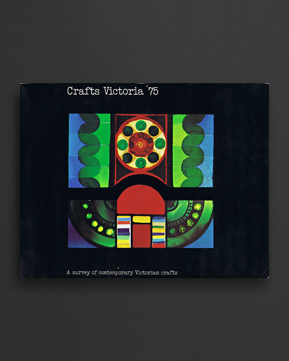
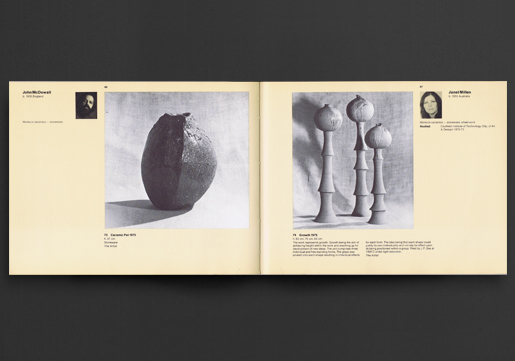
A survey of contemporary Victorian crafts, published on the occasion of a large travelling group exhibition held in 1975-1976 (including the National Gallery of Victoria), organised by The Craft Association of Australia.
Landscape in format, each page of this book profiles a Victorian Craftsperson (almost 100 artists included) working across ceramic, jewellery, tapestry, textile, flatware, furniture, glass, leather, paper and much more. Each featuring an example of their work along with bio information and a profile photo.
Designed by David Sampietro.
2017, English
Softcover (w. dust jacket), 130 pages, 21.6 x 28 cm
Published by
Sternberg Press / Berlin
$48.00 $25.00 - Out of stock
Edited by Dr. Daniel S. Berger, John Neff
Texts by Daniel Berger, Debra Levine, Ray Navarro, John Neff, Hunter Reynolds, David Wojnarowicz
This book is the first survey of the art and practice of Art+Positive, a significant affinity group of ACT UP New York during the early years of the AIDS epidemic. Staging self-initiated actions, and also participating in larger demonstrations organized by ACT UP, Art+Positive practiced an improvisational approach to activism at the intersection of the AIDS crisis and the culture wars of the late 1980s and early 1990s. Their multiplatform projects were especially focused on fighting AIDS phobia, censorship, homophobia, misogyny, and racism within the art world. Members, collaborators, and contributors to Art+Positive included artists Lola Flash, Nan Goldin, Aldo Hernández, Zoe Leonard, Ray Navarro, Hunter Reynolds, Catherine (Saalfield) Gunn, Julie Tolentino, and David Wojnarowicz.
The Art+Positive archives, assembled by Hunter Reynolds in the mid-1990s, were out of public view for more than twenty years. Art collector and HIV/AIDS researcher Dr. Daniel Berger acquired the group’s archives in early 2015. Shortly thereafter, he and artist John Neff presented an exhibition of the archives at Iceberg Projects, Chicago. Militant Eroticism: The ART+Positive Archives documents that exhibition and is extensively illustrated with artworks, documents, protest ephemera, and meeting notes from the Art+Positive archives. Also included are essays by Berger, Neff, and former ACT UP member and scholar Debra Levine. These essays are presented alongside previously unpublished writings by Ray Navarro, Hunter Reynolds, and David Wojnarowicz.
Design by Alex Kostiw
2018, English
Softcover, 240 pages, 20 x 11 cm
Published by
Koenig Books / London
$30.00 - Out of stock
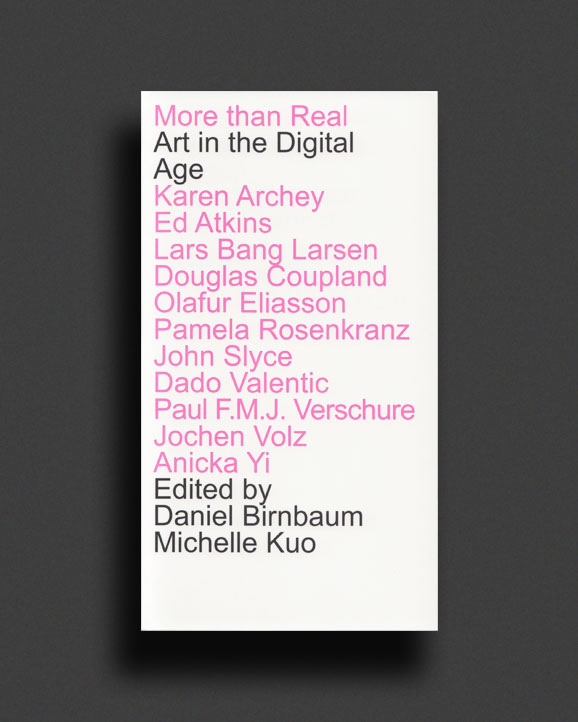
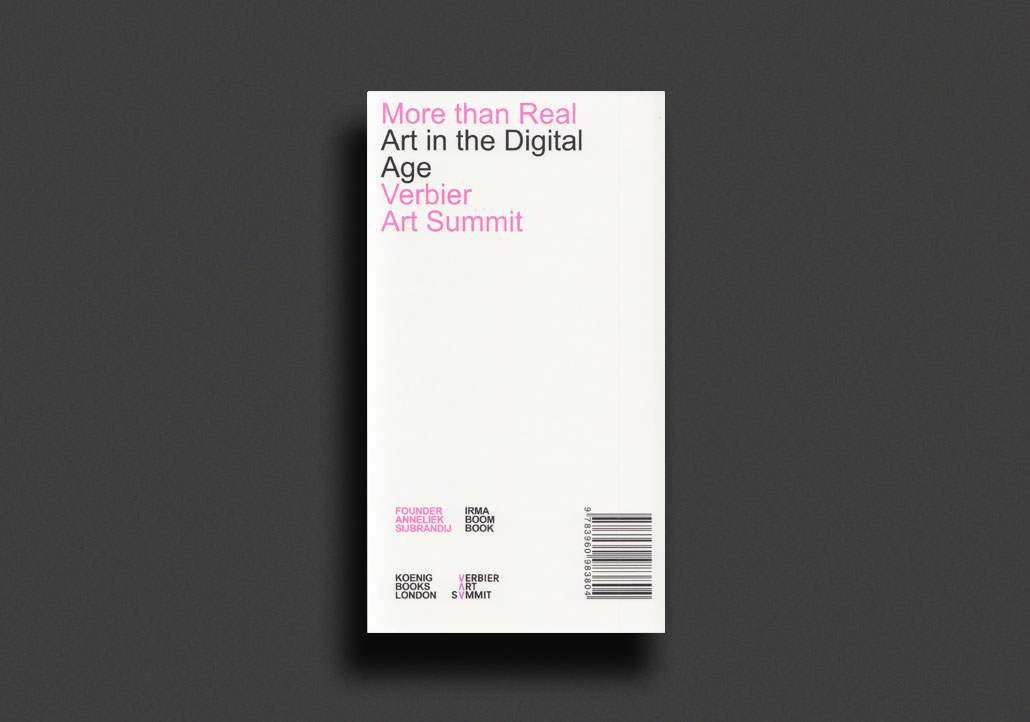
This is the second in the Summit publication series, disseminating key insights of the 2018 Summit and extending a global dialogue on an important social issue: art in the digital age. The multidisciplinary perspectives come together through the inspirational book design of Irma Boom.
Acting as a cultural incubator for innovative ideas and change, the Verbier Art Summit is an international platform erected to optimise the role of art in a global society. Their mission is to connect thought leaders to key figures in the art world and thus position the Summit as a catalyst for innovation and change. Their vision is to create an influential platform in a non-transactional context for artists, curators, museum directors, private and corporate collectors, art critics, gallerists, art historians and art consultants – Verbier Art Summit 2018
Contributors : Karen Archey, Ed Atkins, Douglas Coupland, Olafur Eliasson, Lars Bang Larsen, Pamela Rosenkranz, John Slyce, Dado Valentic, Paul F.M.J Verschure, Jochen Volz, Anicka Yi
Edited by Daniel Birnbaum and Michelle Kuo
2017, English
Softcover, 416 pages, 21 x 28 cm
Published by
Mousse / Milan
Walther König / Köln
$49.00 - Out of stock
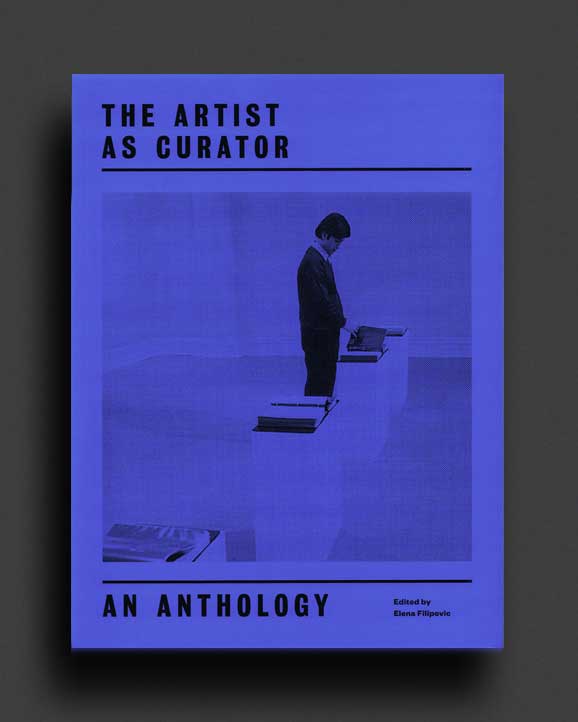
With texts by Alexander Alberro, Monica Amor and Carlos Basualdo, Biljana Ciric, Ekaterina Degot, Elena Filipovic, Claire Grace, Anthony Huberman, Dean Inkster, Alhena Katsof, William Krieger, Elisabeth Lebovici, Ana Longoni, James Meyer, Isabelle Moffat, Nina Möntmann, Natalie Musteata, Sandra Skurvida, Dirk Snauwaert, Lucy Steeds, Monika Szewczyk, and Kaelen Wilson-Goldie
Edited by Elena Filipovic.
Taking that ontologically ambiguous thing we call “the exhibition” as a critical medium, artists have often radically rethought conventional forms of exhibition making. This anthology surveys seminal examples of such exhibitions from the postwar to the present, including rare documents and illustrations. It includes an introduction and the twenty essays that first appeared in Mousse, a newly commissioned afterword by Hans Ulrich Obrist, and two additional essays that appear here for the first time.
The publication focuses on the following artists: Avant-Garde, the Argentinean artist group - Mel Bochner - Marcel Broodthaers - Hank Bull, Shen Fan, Zhou Tiehai, Shi Yong, and Ding Yi - John Cage - Judy Chicago, Miriam Schapiro, and the CalArt's Feminist Art Program - Collaborative Projects Inc. (Colab) - Alice Creischer, Andreas Siekmann, and Max Jorge Hinderer - Liam Gillick and Philippe Parreno - Group Material - Richard Hamilton and Victor Pasmore - David Hammons - Martin Kippenberger - Mark Leckey - Goshka Macuga - Lucy McKenzie and Paulina Olowska - Hélio Oiticica - Walid Raad and Akram Zaatari - Martha Rosler - Avdey Ter-Oganyan - Philippe Thomas - Andy Warhol.
1989, German
Softcover, 289 pages, 32 x 24 cm
1st Edition, Out of print title / used / good
Published by
Christians / Hamburg
$48.00 - Out of stock
Large catalogue published on the occasion of the exhibition "Einleuchten: Will, Vorstel und Simul in HH." curated by Harald Szeemann, 11 November 1989 to 18 February 1990, Hamburg.
Profusely illustrated in full-colour and b&w with biographies on all exhibiting artists, alongside texts by Harald Szeemann, Heinz Liesbrock, Christoph Schenker, and Stephan Schmidt-Wulffen
Artists include : Carl Andre, Giovanni Anselme, Donald Baechler, Georg Baselitz, Joseph Beuys, Christian Botanski, Daniel Buren, Lawrence Carroll, Hanne Darboven, Thierry De Gordier, David Deutsch, Martin Disler, Jiri Georg Dokoupil, Etienne-Martin, Dan Flavin, Günther Förg, Isa Genzken, Robert Gober, Thomas Grünleid, Tishan Hsu, Donald Judd, On Kawara, Ellsworth Kelly, Harald Klingelhöller, Wollgang Laib, Cary S. Leibowitz, Sol LeWitt, Richard Long, Ingeborg Lüscher, Gerhard Merz, Mario Merz, Marisa Merz, Reinhard Mucha, Bruce Nauman, Max Neuhaus, Cady Noland, Holt Quentel, David Rabinowitch, Royden Rabinowitch, Ulrich Rückriem, Robert Ryman, Richard Serra, Keith Sonnier, Serge Spitzer, Niele Toroni, Rosemarie Trockel, Richard Tuttle, Cy Twombly, Jan Vercruysse, Michel Verjux, Didier Vermeiren, Bill Viola, Mark Wallinger, Lawrence Weiner, Franz West, Rachel Whiteread, Jerry Zeniuk, Otto Zitko
Very good copy with some bumping to top right corner.
1992, German / English
Hardcover (in original slipcase), Vol. 1 : 255 pages; Vol. 2 : 310 pages; Vol. 3 : 619 pages, 18.5 x 27 cm
1st Edition, Out of print title / used / good
Published by
Hatje Cantz / Berlin
$120.00 - Out of stock
Hardcover edition, three volume exhibition catalogue published in conjunction with Documenta IX, Kassel, Germany, June 13 - September 9, 1992.
Documenta 9 is remembered as one of the most popular of all documenta exhibitions, thanks not least of all to the influence of its artistic director, the charismatic Belgian curator Jan Hoet. Hoet wanted to make the human being and our sensual, perceptual, agonized corporeality, which had been progressively displaced by the digitized, virtual world, the focus of attention at his exhibition. “From body to body to bodies” was the meaningful, poetic motto of documenta 9. Hoet described his curatorial mission in the following words: “At a time in which the human race is confronted more than ever with such dangers as AIDS and multinational wars, nuclear catastrophes, and global climate disasters, at a time in which threats are growing increasingly abstract and the fears more and more diffuse, I see reflection on the physical conditions of life as an appropriate answer.”
Texts by Jan Hoet, Denys Zacharopoulos, Bart de Baere, Pier Luigi Tazzi, Claudia Herstatt, Joyce Carol Oates, Jacques Roubaud, Cornelius Castoriadis, Heiner Müller, Paul Robbrecht, Hilde Daem.
Artists include Marina Abramovic, Absalon, Richard Artschwager, Francis Bacon, Marco Bagnoli, Nicos Baikas, Miroslaw Balka, Matthew Barney, Jerry Barr, Lothar Baumgarten, Jean-Pierre Bertrand, Joseph Beuys, Michael Biberstein, Guillaume Bijl, Dara Birnbaum, Jonathan Borofsky, Louise Bourgeois, Herbert Brandl, Ricardo Brey, Tony Brown, Marie José Burki, Jean-Marc Bustamante, Michael Buthe, Pedro Cabrita Reis, Waltercio Caldas, Pier Paolo Calzolari, Ernst Caramelle, Lawrence Carroll, Saint Clair Cemin, Tomasz Ciecierski, Tony Clark, James Coleman, Tony Conrad, Patrick Corillon, Damian, Richard Deacon, Thierry De Cordier, Silvie Defraoui & Chérif Defraoui, Raoul De Keyser, Wim Delvoye, Braco Dimitrijevic, Eugenio Dittborn, Helmut Dorner, Stan Douglas, Marlene Dumas, Jimmie Durham, Mo Edoga, Jan Fabre, Luciano Fabro, Belu-Simion Fainaru, Peter Fend, Rose Finn-Kelcey, FLATZ, Fortuyn/O'Brien, Günther Förg, Erik A.Frandsen, Michel François, Vera Frenkel, Katsura Funakoshi, Isa Genzken, Gaylen Gerber, Robert Gober, Dan Graham, Rodney Graham, Angela Grauerholz, Michael Gross, George Hadjimichalis, David Hammons, Georg Herold, Gary Hill, Peter Hopkins, Rebecca Horn, Geoffrey James, Olav Christopher Jenssen, Tim Johnson, Andrej N. Joukov, Ilya Kabakov, Anish Kapoor, Kazuo Katase, Tadashi Kawamata, Mike Kelley, Ellsworth Kelly, Bhupen Khakhar, Per Kirkeby, Harald Klingelhöller, Kurt Kocherscheidt, Peter Kogler, Vladimir Kokolia, Joseph Kosuth, Mariusz Kruk, Guillermo Kuitca, Suzanne Lafont, Jonathan Lasker, Jac Leirner, Zoe Leonard, Eugène Leroy, Via Lewandowsky, Bernd Lohaus, Ingeborg Lüscher, Attila Richard Lukacs, James Lutes, Marcel Maeyer, Brice Marden, Cildo Meireles, Ulrich Meister, Thom Merrick, Gerhard Merz, Mario Merz, Marisa Merz, Meuser, Jürgen Meyer, Liliana Moro, Reinhard Mucha, Matt Mullican, Juan Muñoz, Christa Näher, Hidetoshi Nagasawa, Bruce Nauman, Max Neuhaus, Pekka Nevalainen, Nic Nicosia, Moshe Ninio, Jussi Niva, Cady Noland, Manuel Ocampo, Jean-Michel Othoniel, Tony Oursler, Panamarenko, Giulio Paolini, A. R. Penck, Michelangelo Pistoletto, Hermann Pitz, Stephen Prina, Richard Prince, Martin Puryear, Royden Rabinowitch, Rober Racine, Philip Rantzer, Charles Ray, Martial Raysse, readymades belong to everyone, José Resende, Gerhard Richter, Ulf Rollof, Erika Rothenberg, Susan Rothenberg, Ulrich Rückriem, Thomas Ruff, Stephan Runge, Edward Ruscha, Reiner Ruthenbeck, Remo Salvadori, Joe Scanlan, Eran Schaerf, Adrian Schiess, Thomas Schütte, Helmut Schweizer, Maria Serebriakova, Mariella Simoni, Susana Solano, Ousmane Sow, Ettore Spalletti, Haim Steinbach, Pat Steir, Wolfgang Strack, Thomas Struth, János Sugár, Yuji Takeoka, Robert Therrien, Frederic Matys Thursz, Niele Toroni, Thanassis Totsikas, Addo Lodovico Trinci, Mitja Tušek, Luc Tuymans, Micha Ullman, Juan Uslé, Bill Viola, Henk Visch, James Welling, Franz West, Rachel Whiteread, Christopher Wool, KeunByung Yook, Heimo Zobernig, Gilberto Zorio, and Constantin Zvezdochotov.
Very Good condition volumes in hardcover (much less common edition than usual softcover), preserved in their original illustrated slipcase (with common repaired splitting and bumping damage).
2018, English / German
Hardcover, 222 pages, 22 x 31 cm
Published by
Hatje Cantz / Berlin
Staatliche Kunsthalle / Baden Baden
$97.00 - Out of stock
Exhibiting the Exhibition investigates the history of exhibiting up to the present day. The show at the Staatliche Kunsthalle Baden-Baden begins with predecessors to the modern museum and early art collections, then moves on to twentieth-century exhibition methods and the curatorial positions of today. The catalogue expands upon the exhibition concept: instead of photographing the exhibits for publication, various illustrators were hired to draw them, so that the book itself becomes an entirely independent instrument of “display.”
Besides the essays and interviews, the volume features works by John Bock, Mariana Castillo Deball, Andrea Fraser, Jeppe Hein, Julian Irlinger, Friedrich Kiesler, Louise Lawler, El Lissitzky, Karin Sander, Sebastian Thewes, Kaari Upson, Pae White, Fred Wilson, and many others.
With a conversation between Bénédicte Savoy and Johan Holten.
Texts by Beatrice von Bismarck, Regine Ehleiter, Stefanie Heraeus, Johan Holten, Moritz Scheper.
1969, English
Hardcover (w. dust jacket), 25.5 x 21.5 cm
1st Edition, Out of print title / used / very good
Published by
Galerije Grada Zagreba / Zagreb
$35.00 - Out of stock
Published by Galerije Grada Zagreba, Zabreb, in 1969, this handsome hardcover forms a comprehensive study of Yugoslav Niave Painting by author Boris Kelemen, profiling the work of Emerik Feješ, Franjo Filipović, Dragan Gaži, Ivan Generalić, Josip Generalić, Bosilj Ilija (Ilija Bašičević), Mijo Kovačić, Franjo Mraz, Vangel Naumovski, Ivan Rubazin, Matija Skurjeni, Ivan Večenaj, Stjepan Vecenaj, and Mirko Virius through full-colour tipped-in plates.
Naïve, or primitive art is a distinct segment of the art of the 20th century. In Croatia, naïve art was at first connected with the works of peasants and working people, ordinary men and women, self-taught, of whom the most successful, over the course of time, became professional artists. An identifiably individual style and poetic nature distinguishes the Naïve from other "amateur" painters and sculptors, often displaying unusual proportions and perspective, and certain illogicalities of form and space. Such characteristics are the expression of a free creative imagination, in a similar way to other 20th-century art movements such as Symbolism, Expressionism, Cubism, and Surrealism. Naïve art first appeared in Croatia at the beginning of the 1930s when the Zagreb Art Pavilion showcased an exhibition of the artists' association entitled Country (Zemlja) on 13 September 1931. The artists sought to show that talent does not only reside in certain social classes or privilege and started the association with naïve art and paintings of villages or by artists from the countryside rather than cities.
Very Good condition in original dust jacket (small dj corner chipping now preserved under plastic wrap).
1980, English
Softcover (stapled), 38 pages, 21.5 x 21.5 cm
1st Edition, Out of print title / used / good
Published by
State Jewish Museum / Prague
$25.00 - Out of stock
Booklet publishing the short history of the experiences of the Czech children imprisoned by the Nazis in the garrison town of Terezín during World War II. The book presents written and illustrated samples of the magazine Vedem, published secretly by young boys, that contained childrens prose and poetry. The book presents paintings, drawings and collages by children from Terezín, depicting the reality of concentration camp life.
Vedem (In the Lead) was a Czech-language literary magazine that existed from 1942 to 1944 in the Terezín concentration camp, during the Holocaust. It was hand-produced by a group of boys living in the Home One barracks, among them editor-in-chief Petr Ginz and Hanuš Hachenburg. Altogether, some 700 pages of Vedem survived World War II. The magazine was written, edited, and illustrated entirely by young boys, aged twelve to fifteen, who lived in Barracks L417, or Home One, which the boys referred to as the Republic of Shkid. Each boy took a nickname to sign his articles. The content of Vedem included poems, essays, jokes, dialogues, literary reviews, stories, and drawings. The boys tried as much as possible to create a real magazine, even jokingly adding a price on the cover. The issues were then copied manually and read around the barracks on Friday night. For some time, it was also posted on the barracks bulletin board, however, it was decided to discontinue this practice because it was deemed dangerous in case of SS inspections. By 1944, most of the inhabitants of Barracks L417 had been deported to the gas chambers of Auschwitz, and no more issues were produced. Of the one hundred boys who participated in the effort to produce Vedem, only about fifteen survived. Only one of them, Zdeněk Taussig, remained in Terezín until its liberation in May 1945. He had hidden it in a blacksmith shop where his father had worked, and brought it back with him to Prague after he was liberated.
Good copy of the only edition.