World Food Books' programme is largely produced on Kulin Nation land. We acknowledge the Wurundjeri people of the Kulin Nation as the first and continuing custodians of this land, and pay respect to their Elders past, present, and emerging.
World Food Books is an arts and special interests bookshop in Naarm / Melbourne. Founded in 2010, World Food Books is devoted to the presentation of a rotating, hand-selection of international art, design, literary and counterculture publications with an emphasis on the anti-traditional, the experimental, the avant-garde, the heretic, the marginal.
Presenting new titles alongside rare and out-of-print books, catalogues and journals spanning the fields of modern and contemporary art, design, photography, illustration, film, literature, poetry, cultural theory, philosophy, sexuality, popular and underground culture in its many radical forms, World Food Books wishes to encourage adventurous, thoughtful and open-minded reading, looking, writing, and exchange of publishing and ideas, both current and historical.
As well as our bookshop, located in Melbourne's historical Nicholas Building, all of our inventory is available internationally via our online mail-order service.
World Food Books semi-regularly co-ordinates "Occasions", a programme of exhibits and events at the bookshop and in partnership with other hosts (such as museums and art galleries) that develop out of the activities, relationships and content of the bookshop itself.
World Food Books
The Nicholas Building
37 Swanston Street
Room 5, Level 6
Melbourne 3000
Australia
SHOP HOURS:
Thu–Sat 11–5
WEB-SHOP OPEN 24/7
World Food Books
Postal Address:
PO Box 435
Flinders Lane
Victoria 8009
Australia
Art
Theory / Essay
Architecture / Interior
Graphic Design / Typography
Photography
Fashion
Eros
LGBTQ+
Fiction / Poetry
Weird / Speculative / Science Fiction / Horror
Transgressive / Visceral / Abject
Symbolism / Decadence / Fin de siècle
Film / Video
Painting
Sculpture / Installation
Performance / Dance / Theater
Drawing
Sound / Music
Curatorial
Group Shows / Collections
Periodicals
Out-of-print / Rare
Posters / Ephemera / Discs
Signed Books
World Food Books Gift Voucher
World Food Book Bag
Australian Art
Australian Fiction
Australian Science Fiction / Speculative Fiction
Australian Poetry
Australian Photography
Japanese Photography
Conceptual Art
Minimal Art
Dada
'Pataphysics / Oulipo
Fluxus
Concrete Poetry
Pop Art
Surrealism
Arte Povera
Arte Informale / Haute Pâte / Tachism
Nouveau Réalisme / Zero / Kinetic
Situationism / Lettrism
Collage / Mail Art / Xerox Art
Art Brut / Folk / Visionary / Fantastic
Illustration / Graphic Art / Bandes Dessinées
Furniture
Italian Radical Design / Postmodernism
Textiles
Ceramics / Glass
Counterculture
Protest / Revolt
Philosophy
Psychoanalysis
Anthropology
Anarchism
Socialism / Anarchism / Communism / Capitalism
Literary Theory / Semiotics / Language
Feminism / Women's Studies
Gender Studies / Sexuality
Anthropology
Fetishism / BDSM
Drugs / Psychedelia
Crime / Violence
Animal Rights / Veganism
Occult / Esoterica
Ecology / Earth / Alternative Living
Whole Earth / Crafts
All prices in AUD (Australian dollars)
Pick-Ups
Pick-up orders can be collected in our bookshop during opening hours after order date. Please collect any Pick-up orders within 2 weeks of ordering as we have limited storage space. Orders will be released back into stock if not collected within this time. No refunds can be made for pick-ups left un-collected. If you cannot make it in to the bookshop in this time-frame, please choose postage option.
Return Policy
All sales are final. We do accept returns (for refund or exchange) for items received in error. All our orders are packed with special care using heavy-duty padding and cardboard book-mailers or bubble mailers (for smaller books), using reinforcement where required. We cannot take responsibility for any lost, stolen or damaged parcels.
Insurance
Should you wish to insure your package, please email us directly after placing your order and we can organise this at a small extra expense. Although all standard/express tracked packages are very safe and dependable, we cannot take responsibility for any lost, stolen or damaged parcels. We recommend insurance on valuable orders.
Interested in selling your old books, catalogues, journals, magazines, comics, fanzines, ephemera? We are always looking for interesting, unusual and out-of-print books to buy. We only buy books in our fields of interest and specialty, and that we feel we can resell.
We base these prices on desirability, market value, in-print prices, condition and our current stock levels. We offer cash, store credit, and can take stock on consignment. All
about 25% of the price we expect to get when we sell them, or 30% in store credit. We base these prices on desirability, market value, in-print prices, condition and our current stock levels.
Sell your books any day of the week. You can drop them off and return later. If you have a lot of books, we can visit your Sydney home.
We buy books that we feel we can resell. We offer about 25 % of the price we expect to get when we sell them, or 30% in store credit. We base these prices on desirability, market value, in-print prices, condition and our current stock levels.
Philadelphia Wireman
03 August - 01 September, 2018
World Food Books is proud to announce our next Occasion, the first presentation of sculptures by Philadelphia Wireman in Australia.
The Philadelphia Wireman sculptures were found abandoned in an alley off Philadelphia’s South Street on trash night in 1982. Their discovery in a rapidly-changing neighbourhood undergoing extensive renovation, compounded with the failure of all attempts to locate the artist, suggests that the works may have been discarded after the maker’s death. Dubbed the "Philadelphia Wireman" during the first exhibition of this work, in 1985, the maker’s name, age, ethnicity, and even gender remain uncertain. The entire collection totals approximately 1200 pieces, all intricately bound together with tightly-wound heavy-gauge wire (along with a few small, abstract marker drawings, reminiscent both of Mark Tobey and J.B. Murry). The dense construction of the work, despite a modest range of scale and materials, is singularly obsessive and disciplined in design: a wire armature or exoskeleton firmly binds a bricolage of found objects including plastic, glass, food packaging, umbrella parts, tape, rubber, batteries, pens, leather, reflectors, nuts and bolts, nails, foil, coins, toys, watches, eyeglasses, tools, and jewellery.
Heavy with associations—anthropomorphic, zoomorphic, and socio-cultural responses to wrapped detritus—the totemic sculptures by Philadelphia Wireman have been discussed in the context of work created to fulfil the shamanistic needs of alternative religions in American culture. Curators, collectors, and critics have variously compared certain pieces to sculpture from Classical antiquity, Native American medicine bundles, African-American memory jugs, and African fetish objects. Reflecting the artist’s prolific and incredibly focused scavenging impulse, and despite—or perhaps enhanced by—their anonymity, these enigmatic objects function as urban artefacts and arbiters of power, though their origin and purpose is unknown. Philadelphia Wireman, whatever their identity, possessed an astonishing ability to isolate and communicate the concepts of power and energy through the selection and transformation of ordinary materials. Over the course of the past two decades, this collection has come to be regarded as an important discovery in the field of self-taught art and vernacular art.
Presented in collaboration with Fleisher-Ollman Gallery, Philadelphia, and Robert Heald, Wellington.
Susan Te Kahurangi King
02 February - 10 March, 2018
Susan Te Kahurangi King (24 February 1951 - ) has been a confident and prolific artist since she was a young child, drawing with readily available materials - pencils, ballpoint pens and felt-tip markers, on whatever paper is at hand. Between the ages of four and six Susan slowly ceased verbal communication. Her grandparents William and Myrtle Murphy had developed a special bond with Susan so they took on caring responsibilities for extended periods. Myrtle began informally archiving her work, carefully collecting and storing the drawings and compiling scrapbooks. No drawing was insignificant; every scrap of paper was kept. The King family are now the custodians of a vast collection containing over 7000 individual works, from tiny scraps of paper through to 5 meter long rolls.
The scrapbooks and diaries reveal Myrtle to be a woman of great patience and compassion, seeking to understand a child who was not always behaving as expected. She encouraged Susan to be observant, to explore her environment and absorb all the sights and sounds. Myrtle would show Susan’s drawings to friends and people in her community that she had dealings with, such as shopkeepers and postal workers, but this was not simply a case of a grandmother’s bias. She recognised that Susan had developed a sophisticated and unique visual language and sincerely believed that her art deserved serious attention.
This was an unorthodox attitude for the time. To provide some context, Jean Dubuffet coined the term Art Brut in 1945 to describe work created by self-taught artists – specifically residents of psychiatric institutions and those he considered to be visionaries or eccentrics. In 1972 Roger Cardinal extended this concept by adopting the term Outsider Art to describe work made by non-academically trained artists operating outside of mainstream art networks through choice or circumstance. Susan was born in Te Aroha, New Zealand in 1951, far from the artistic hubs of Paris and London that Dubuffet and Cardinal operated in. That Myrtle fêted Susan as a self-taught artist who deserved to be taken seriously shows how progressive her attitudes were.
Susan’s parents Doug and Dawn were also progressive. Over the years they had consulted numerous health practitioners about Susan’s condition, as the medical establishment could not provide an explanation as to why she had lapsed into silence. Dawn educated herself in the field of homeopathy and went on to treat all twelve of her children using these principles – basing prescriptions on her observations of their physical, mental and emotional state.
Doug was a linguist with an interest in philosophy who devoted what little spare time he had to studying Maori language and culture. To some extent their willingness to explore the fringes of the mainstream made them outsiders too but it was their commitment to living with integrity and their respect for individuality that ensured Susan’s creativity was always encouraged.
Even though Susan’s family supported her artistic pursuits, some staff in schools and hospitals saw it as an impediment to her assimilation into the community and discouraged it in a variety of ways. Her family was not always aware of this and therefore did not fully understand why Susan stopped drawing in the early 1990s. However, rather than dwell on the challenges that Susan faced in pursuit of her artistic practice, they prefer to highlight her achievements. In 2008 Susan began drawing again in earnest, after an almost 20 year interruption, and her work is now shown in galleries around the world.
Susan grew up without television and has been heavily influenced by the comics she read as a child. She is absolutely fearless in the appropriation of recognizable characters, such as Donald Duck and Mickey Mouse, in her work. She twists their limbs, contorts their faces, compresses them together, blends them into complex patterned backgrounds - always imbuing them with an incredible energy. Although Susan often used pop culture characters in her work they are not naive or childlike. These are drawings by a brilliant self-taught artist who has been creating exceptional work for decades without an audience in mind.
Mladen Stilinović
"Various Works 1986 - 1999"
02 February 16 - September 10, 2016
Various works 1986 - 1999, from two houses, from the collections of John Nixon, Sue Cramer, Kerrie Poliness, Peter Haffenden and Phoebe Haffenden.
Including: Geometry of Cakes (various shelves), 1993; Poor People’s Law (black and white plate), 1993; White Absence (glasses, ruler, set square, silver spoon, silver ladel with skin photograph and wooden cubes), 1990-1996; Exploitation of the Dead (grey and red star painting, wooden painting, black spoon with red table, red plate), 1984-1990; Money and Zeros (zero tie, paintings made for friends in Australia (Sue, John, Kerrie), numbers painting), 1991-1992; Words - Slogans (various t-shirts) - “they talk about the death of art...help! someone is trying to kill me”, “my sweet little lamb”, “work is a disease - Karl Marx”; Various artist books, catalogues, monographs, videos; Poster from exhibition Insulting Anarchy; "Circular" Croatian - Australian edition; Artist book by Vlado Martek (Dostoyevsky); more.
Thanks to Mladen Stilinović and Branka Stipančić.
Jonathan Walker
Always Will Need To Wear Winter Shirt Blue + Ochre Small Check Pattern
21 August - 21 September, 2015
Untitled
I am not a great reader of poetry but I always return to the work of Melbourne poet, Vincent Buckley (1925- 1988). Perhaps I find his most tantalising piece to be not a finished poem but a fragment left on a scrap of paper discovered on his desk after the poet’s death.
The poetry gathers like oil
In the word-core, and spreads
It has its music meet,
Its music is in movement.
This fragment is more the shell left behind from a volatile thought than a finished poem. I find the last two lines honest but awkward whereas the first two lines work like an arrow. Most likely he could not find a resolution so it was left. Still, in its present form, it remains an eloquent testimony to the ultimate failure of a medium to express mobile thought and sensation, in Buckley’s case, through verbal language. It’s an important matter because this is something all artists have to deal with regardless of the medium.
I have never written a poem, however, I am forever copying fragments from books on paper scraps in a vain effort to fix certain notions in my head. At first, they function as bookmarks that are sometimes returned to when I open the book. But before long, as they accumulate, they fall out littering the table interspersed with A4 photocopies, bills, books and medications.
To return to Buckley’s fragment, the first two lines very much evoke how I paint nowadays. As you age, detail diminishes and patches of light become more luminous and float. I feel the most honest way of dealing with this is by smearing the oil paint on the canvas with the fingers and working close-up, blind. Only if the patches coalesce into an approaching image can the work gain a life.
-
Jonathan Walker was born in Melbourne, Australia and brought up on a dairy farm in Gippsland. In the 1970’s he studied painting at RMIT and won the Harold Wright Scholarship to the British Museum, London. During the 1980’s he exhibited at Pinacotheca Gallery, Richmond and had work shown at the NGV and Heidi City Art Gallery. Over the same period he designed the cover for the “Epigenesi” LP by Giancarlo Toniutti, Italy and conducted a mail exchange work with Achim Wollscheid, Germany. The work with artists through the post resulted in an article published in the bicentenary issue of Art and Australia 1988. He showed in artist run spaces such as WestSpace in the 90’s and 2000’s, and until 2012, taught painting at Victoria University, which is where we (Colleen Ahern and Lisa Radford) as organisers of the exhibition, among many others, had the privilege of being his student.
Walker’s knowledge was imparted to students through the careful selection of music, literature, and artists found in books that he himself had ordered for the library. Walker’s strategy was the generosity of sharing his vast knowledge with references specific to each student and their context.
Walker’s paintings share a similar focus and intimacy.
This exhibition presents a small selection of recent paintings alongside a publication that includes Walker’s writing. Observational and analytical, Walker’s work is a type of material notation — the time of day, colour and how it is blended, the both specific and fleeting location of a reflection on lino or the question of whether a chair leg should be included in a painting.
Please join us on Friday August 21 between 6-8pm to celebrate the opening of the exhibition.
Curated by Colleen Ahern and Lisa Radford.
B. Wurtz
Curated by Nic Tammens
March 26 - April 4, 2015
B.Wurtz works from a basement studio in his home on Manhattan’s Lower East Side.
This local fact is attested to by the plastic shopping bags and newsprint circulars that appear in his work. As formal objects, they don’t make loud claims about their origins but nonetheless transmit street addresses and places of business from the bottom of this long thin island. Like plenty of artists, Wurtz is affected by what is local and what is consumed. His work is underpinned by this ethic. It often speaks from a neighborhood or reads like the contents of a hamper:
“BLACK PLUMS $1.29 lb.”
“Food Bazaar”
“USDA Whole Pork Shoulder Picnic 99c lb.”
“RITE AID Pharmacy, with us it’s personal.”
“H. Brickman & Sons.”
“Sweet Yams 59c lb."
Most of the work in this exhibition was made while the artist was in residence at Dieu Donne, a workshop dedicated to paper craft in Midtown. Here Wurtz fabricated assemblages with paper and objects that are relatively lightweight, with the intention that they would be easily transportable to Australia. This consideration isn’t absolute in Wurtz’s work, but was prescriptive for making the current exhibition light and cheap. Packed in two boxes, these works were sent from a USPS post office on the Lower East Side and delivered to North Melbourne by Australia Post.
Wurtz appears courtesy of Metro Pictures, New York.
Thanks to Rob Halverson, Joshua Petherick, Sari de Mallory, Matt Hinkley, Helen Johnson, Fayen d'Evie, Ask Kilmartin, Lisa Radon, Ellena Savage, Yale Union, and "Elizabeth".
John Nixon
"Archive"
December 15 - January 20, 2014
The presentation of John Nixon's archive offered a rare showcase of this extensive collection of the artist's own publications, catalogues, posters, ephemera, editions and more, from the mid 1980s onwards, alongside a selection of his artworks.
Organized by John Nixon, Joshua Petherick and Matt Hinkley.
"Habitat"
at Minerva, Sydney (organised by Joshua Petherick and Matt Hinkley)
November 15 - December 20, 2014
Lupo Borgonovo, Janet Burchill & Jennifer McCamley,
Lewis Fidock, HR Giger, Piero Gilardi, Veit Laurent Kurz,
Cinzia Ruggeri, Michael E. Smith, Lucie Stahl, Daniel Weil, Wols
Press Release:
“...It contained seven objects. The slender fluted bone, surely formed for flight, surely from the wing of some large bird. Three archaic circuitboards, faced with mazes of gold. A smooth white sphere of baked clay. An age-blackened fragment of lace. A fingerlength segment of what she assumed was bone from a human wrist, grayish white, inset smoothly with the silicon shaft of a small instrument that must once have ridden flush with the surface of the skin - but the thing’s face was seared and blackened.”
William Gibson, “Count Zero”, 1986
"Autumn Projects Archive"
Curated by Liza Vasiliou
March 6 - March 15, 2014
World Food Books, in conjunction with the Virgin Australia Melbourne Fashion Festival 2014, presented the Autumn Projects archive, consisting of a selection of early examples in Australian fashion with a particular interest in collecting designers and labels from the period beginning in the 1980’s, who significantly influenced the discourse of Australian Fashion.
Curated by Liza Vasiliou, the exhibition provided a unique opportunity to view pieces by designers Anthea Crawford, Barbara Vandenberg, Geoff Liddell and labels CR Australia, Covers, Jag along with early experimental collage pieces by Prue Acton and Sally Browne’s ‘Fragments’ collection, suspended throughout the functioning World Food Books shop in Melbourne.
H.B. Peace
presented by CENTRE FOR STYLE
November 14, 2013
"Hey Blinky, you say chic, I say same"
Anon 2013
H.B. Peace is a clothing collaboration between great friends Blake Barns and Hugh Egan Westland. Their pieces explore the divergences between 'character’ and ‘personality’ in garments....etc
Special Thanks to Joshua Petherick and Matt Hinkley of WFB and Gillian Mears
and a Very Special Thank you to Audrey Thomas Hayes for her shoe collaboration.
Janet Burchill & Jennifer McCamley
"Aesthetic Suicide"
May 10 - June 8, 2013
The first of our occasional exhibitions in the World Food Books office/shop space in Melbourne, "Aesthetic Suicide" presented a body of new and older works together by artists Janet Burchill & Jennifer McCamley, including videos, prints, a wall work, and publications.
During shop open hours videos played every hour, on the hour.
2000, English
Softcover, 500 pages, 21.5 x 15.7 cm
1st Edition, Out of print title / used / very good
Published by
Purple Institute / Paris
$160.00 - Out of stock
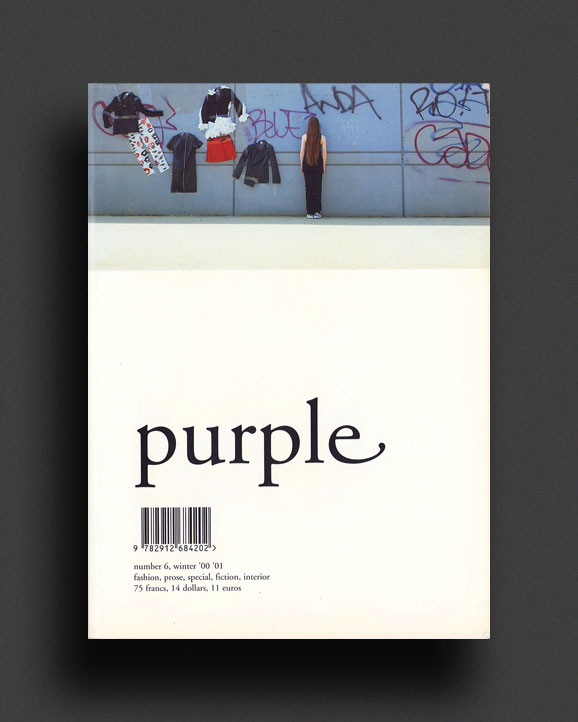
Purple 6 Winter '00 '01 : fashion, prose, special fiction, interior
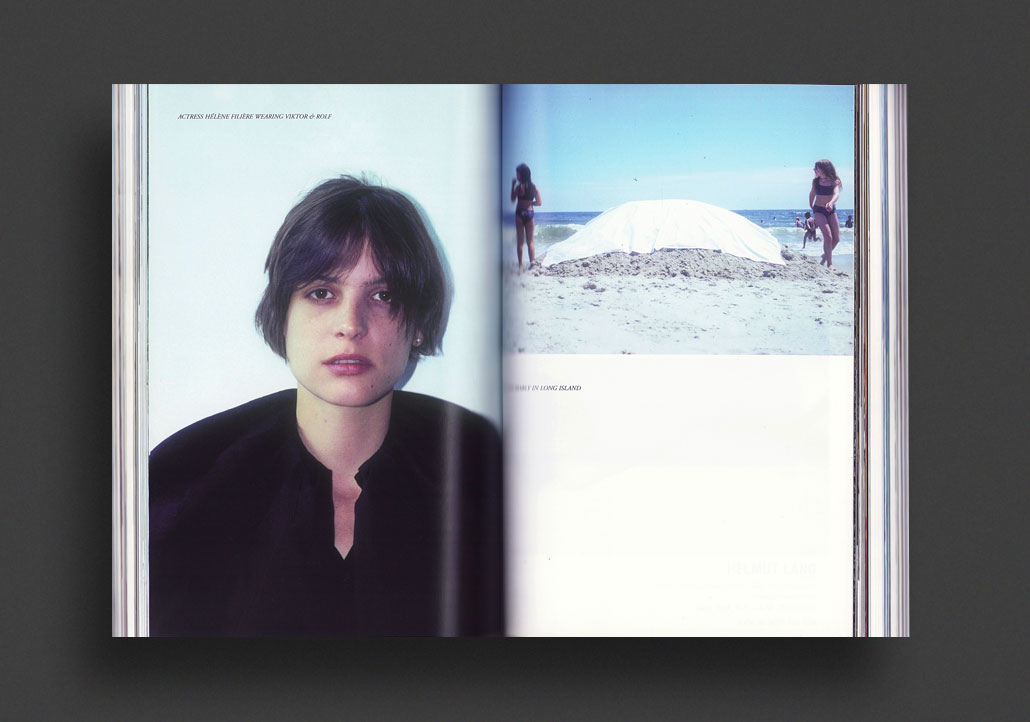
A rare early issue of the iconic Purple magazine, edited by Elein Fleiss and Olivier Zahm, this wonderful early edition features work by: Richard Prince, Susan Cianciolo, Bless, Cris Moor, Lutz, Maison Martin Margiela, Hermés, Giasco Bertoli, Junya Watanabe, Comme des Garçons, Lars Botten, Bernhard Willhelm, Hussein Chalayan, Camille Vivier, Cosmic Wonder, Fendi, Terry Richardson, Anders Edstrom, Balenciaga, Vanina Sorrenti, Helmut Lang, Banu Cennetoglu, Veronique Branquinho, Chikashi Suzuki, Marc Jacobs, Ann-Sofie Back, Lodge Kerrigan, Mark Borthwick, Olivier Zahm, Jeff Rian, Bernard Joisten, Bruce Benderson, Andy Stillpass, Bennett Simspon, Dominique Gonzalez-Foerster, Pete Taylor, Jason Simon, Pablo Leon De La Barra, Panu Aree, Tim Griffin, Dayton Taylor, Dike Blair, Gareth James, Michael Drake, Antek Walczak, Guillaume Nez, Tom Betterton, John Kelsey, Cheryl Donegan, Mark Fishman, Ole Scheeren, Sarah Gavlak, Alix Lambert, Tan Lin, Sharon Mesmer, Sharon Mesmer, Peter Josephs, Benjamin Weismann, Jordan Davis, Fred El Bekkay, Michael Danner, Giasco Bertoli, Andreas Larsson, James Gooding, Alex Antitch, Elein Fleiss, Henry Roy, Rami Maymon, Torbjorn Rodland, Marcello Simeoni, Delphine Roque, Michael Danner, Stefan Ruiz, and many many more. Art directed by Christophe Brunnquell.
In 1992 Olivier Zahm and his partner Elein Fleiss printed the first issue of Purple Prose, a Parisian literary art zine that over the years has evolved into Purple Fashion Magazine and Purple. Soon after the birth of Purple Prose, Zahm and Fleiss created spin-off publications like les cahiers purple, Purple Sexe, Purple Fiction, and of course, Purple Fashion. Zahm aimed at fusing together his two worlds, fashion and art, in creating Purple.
Very Good copy.
1993, English
Softcover, 120 pages, 20 x 13 cm
1st Edition, Out of print title / used / very good
Published by
Vintage / UK
$20.00 - Out of stock
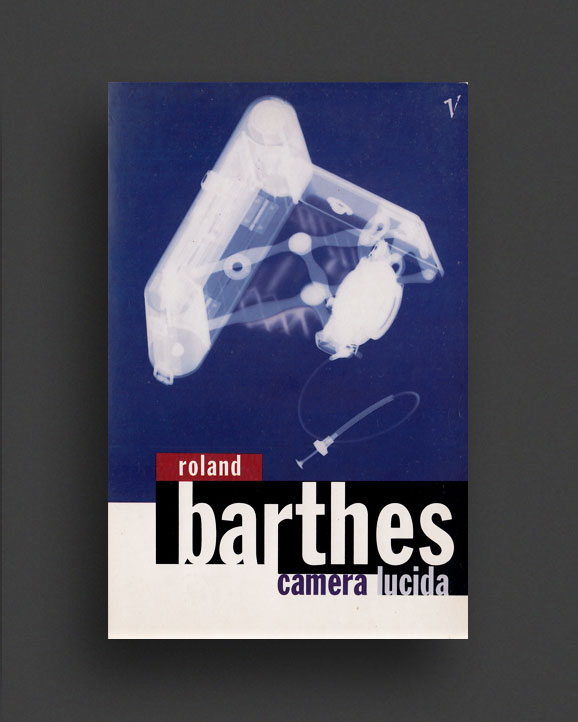
1993 Vintage edition. Barthes personal investigation into the meaning of photographs is a seminal work of critical theory of the twentieth century. Illustrated throughout.
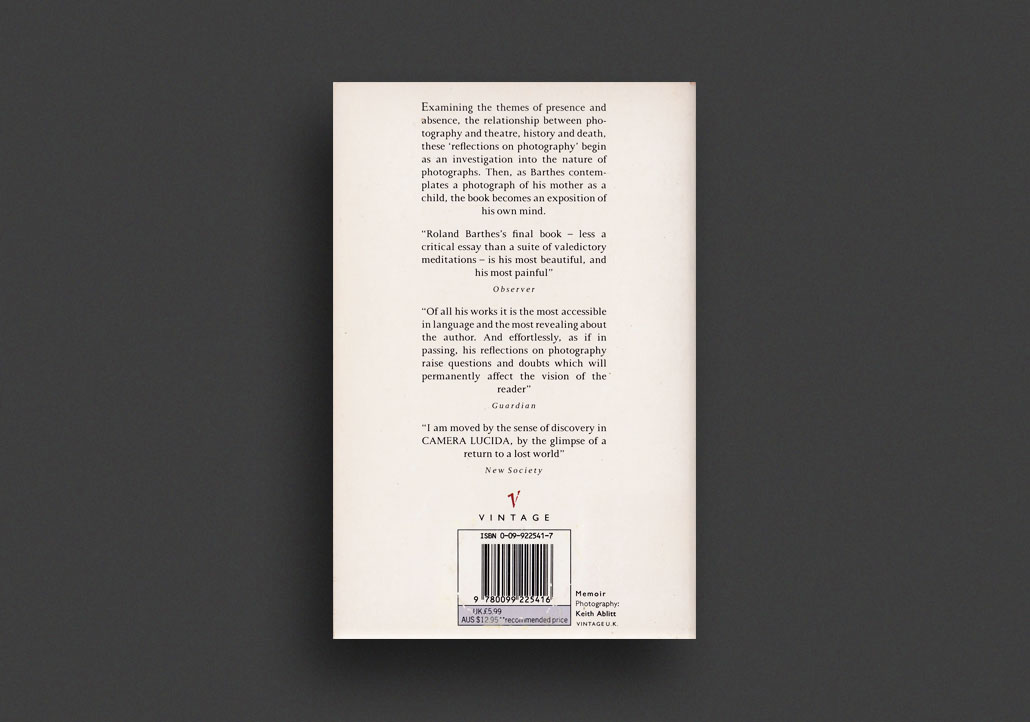
Examining themes of presence and absence, these reflections on photography begin as an investigation into the nature of photographs – their content, their pull on the viewer, their intimacy. Then, as Barthes contemplates a photograph of his mother as a child, the book becomes an exposition of his own mind. He was grieving for his mother at the time of writing. Strikingly personal, yet one of the most important early academic works on photography, Camera Lucida remains essential reading for anyone interested in the power of images.
‘Effortlessly, as if in passing, his reflections on photography raise questions and doubts which will permanently affect the vision of the reader’—Guardian
Very Good copy light wear and tanning to paperstock.
1986, English
Softcover, 138 pages, 27 x 21.5 cm
1st Edition, Out of print title / used / very good
Published by
Thames and Hudson / London
$55.00 - Out of stock
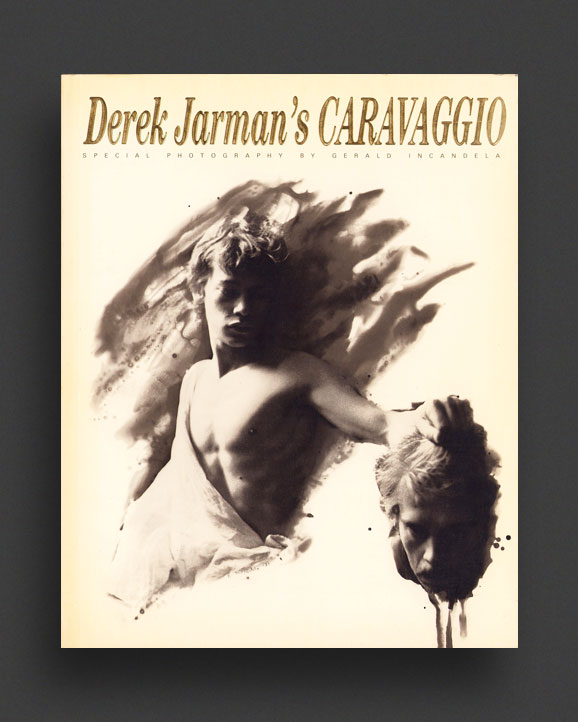
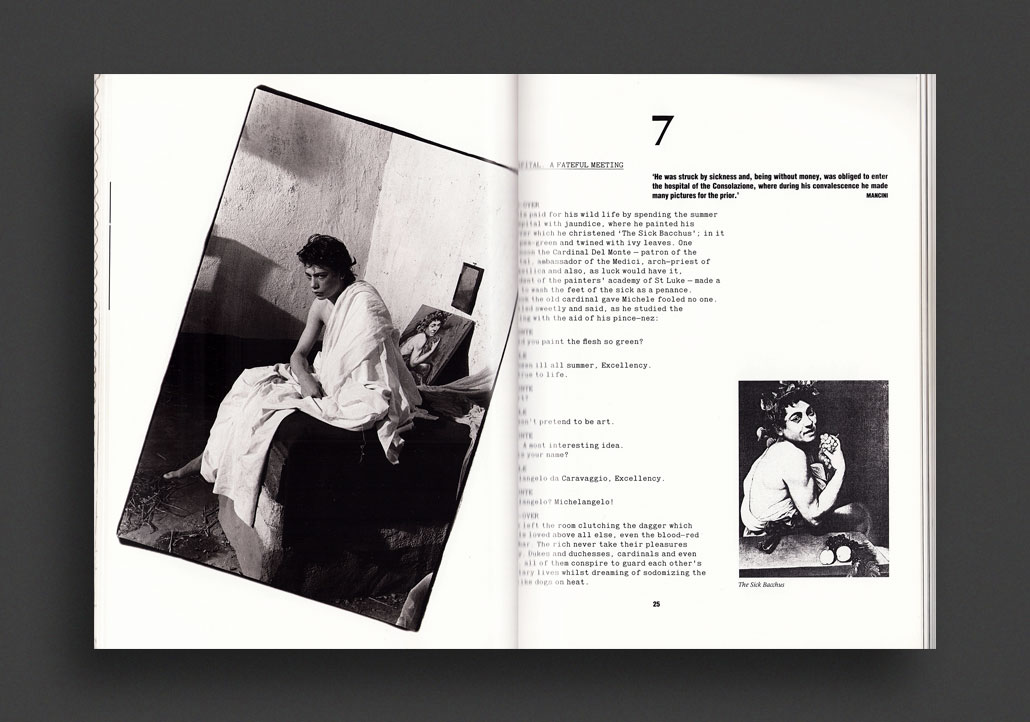
First 1986 edition of Derek Jarman's Caravaggio. This film photo book documents the complete Caravaggio script by Derek Jarman with his commentaries throughout, accompanied by over 100 photographs by Gerald Incandela, as well as reference imagery. Caravaggio is a 1986 British drama film directed by Jarman, a fictionalized re-telling of the life of Baroque painter, Michelangelo Merisi da Caravaggio. "Funded by the British Film Institute and produced by film theorist Colin MacCabe, Caravaggio became Jarman's most famous film to date, and marked the beginning of a new phase in his filmmaking career: from then onwards, all his films would be partly funded by television companies. Caravaggio also saw Jarman work with actress Tilda Swinton for the first time. Overt depictions of homosexual love, narrative ambiguity, and the live representations of Caravaggio's most famous paintings are all prominent features in the film.
Very Good copy.
1996, Japanese
Softcover (w. dust jacket and obi-strip), 256 pages, 21 x 14.8 cm
1st Edition, Out of print title / used / very good
Published by
Core Magazine / Tokyo
$120.00 - Out of stock
Don't judge a book by it's cover — you've been warned! Straight out of the young nihilist 90s, the second volume of the very short-lived and absolutely demented Seikimatsu Club (End of the Century Club), published in Tokyo between 1996—2000 for a total of only five volumes. This second volume, "Deathtpia in Suburbia", has the feature theme of Horror! Bizarre! Bizarre! Cruelty! and is packed to the absolute brim with "corpses, freaks, spectacles, murders, suicides, autopsies, rapes, sickness, pain, accident, war, religious rituals, violence, forensics, foetuses. A shocking document that eliminates all fiction (all genuine)!"
With contributors to this issue including Masami Akita (Merzbow), Masaaki Aoyama (author), Kiyotaka Tsurisaki (corpse photographer), Suehiro Maruo (ero guro manga artist), Teruo Ishii (ero guro film director), Kotaro Kobayashi (Too Negative editor-in-chief), Trevor Brown (artist), you should know what you are getting yourself into.
Following the trajection of fellow Japanese abnormal subculture magazines such as Kotaro Kobayashi's notorious Too Negative, Ultra Negative, ORG, etc., and in the spirit of a new wave of 90's nihilist publishing around the world (Answer Me!, Killing Times, Fuck!, AMOK, Feral House, etc.) End of the Century Club stares directly into the dark recesses of humanity and presents its viewers with the uncompromising extremes of our global culture. The real stuff. Where Too Negative presents itself as a glossy colour photo/art magazine, End of the Century Club is almost like a Whole Earth Catalog to the authentic macabre. With articles, interviews, reports, catalogues and hundreds of images spanning all manner of medical/autopsy/corpse photography, death journalism, serial killers, formalihide babies, war/shock accident/crime scenes, hara-kiri, murder, rape, slaughterhouse, forensic books, international underground magazines, Photobook of World Diseases, City of Sodom, corpses on the internet, Underground Baby Contest, Atlas of Dermatology, complete guide to Freaks movies, the Garbage Pail Kids, religious ceremonies, animal deformities, Interview with "The King of Cult" ero guro film director Teruo Ishii, bizarro sex, acrotomophila, artist Joel Peter Witkin's world, interview with Masaaki Aoyama, interview with corpse photographer Kotaro Kobayashi (Death, Hardcore Works, Too Negative, Billy, etc.), photography of George Dureau, interview with fetish film director and producer Kaoru Adachi, interview with experimental film director Shozin Fukui (Metal Days, Gerorisuto, Caterpillar, 964 Pinocchio, Rubber's Lover...), article on "Serial Killers & Record Junkies" by Toshihiko Hironaka (of Boris, Balzac, Hellbent fame), and all sorts of other curios from the mondo, bizarro realm.
Includes "gorgeous" 24-page high-quality corpse photo booklet feature and cover art by Trevor Brown.
Not for the fain-hearted. You'll feel like a shower after.
Very Good copy with dust jacket and obi.
1997, Japanese
Softcover (w. dust jacket and obi-strip), 256 pages, 21 x 14.8 cm
1st Edition, Out of print title / used / very good
Published by
Core Magazine / Tokyo
$120.00 - Out of stock
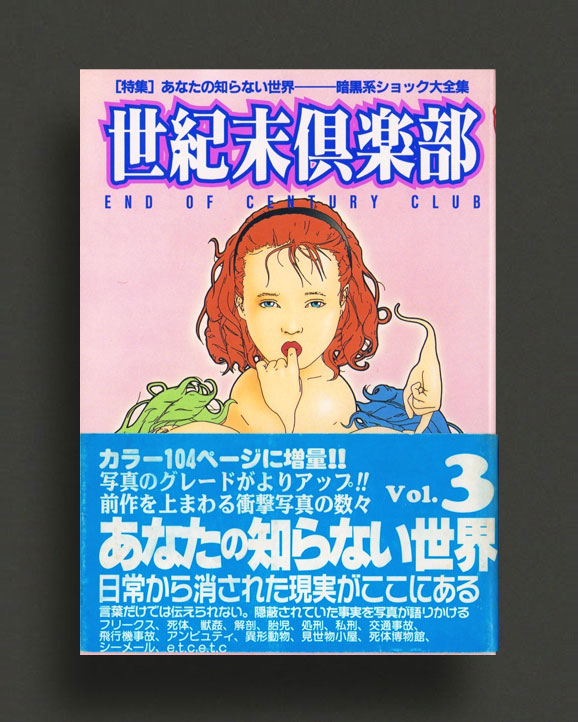
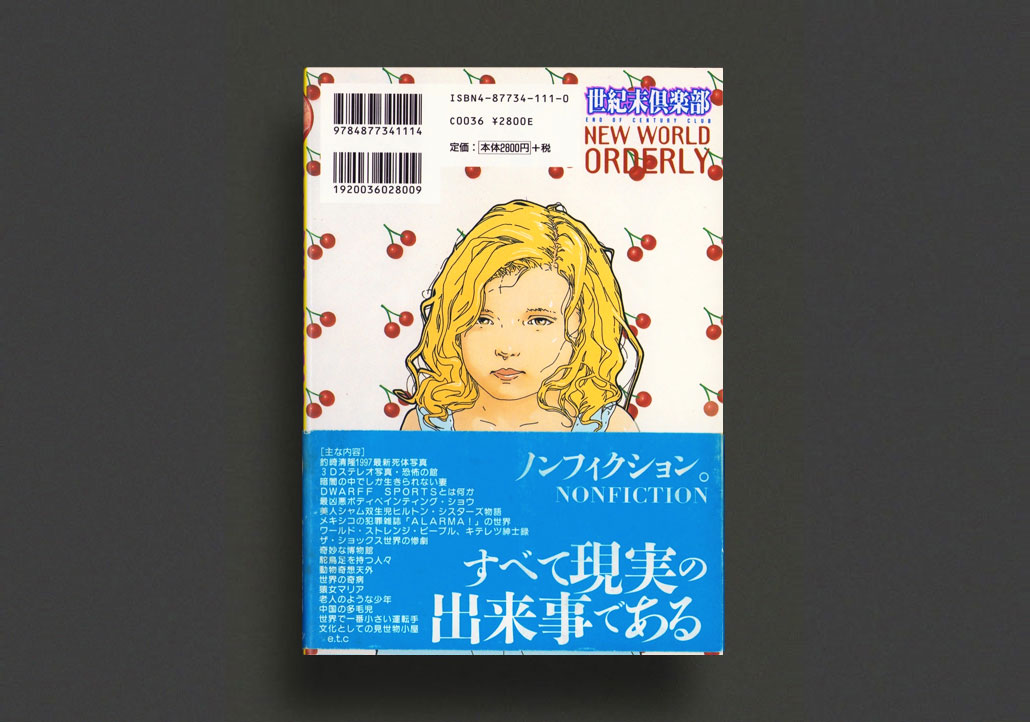
Don't judge a book by it's cover — you've been warned! Straight out of the young nihilist 90s, the third volume of the very short-lived and absolutely demented Seikimatsu Club (End of the Century Club), published in Tokyo between 1996—2000 for a total of only five volumes. This third volume, "The World You Don't Know", has the feature theme of exposing "a reality erased from everyday life", which sums it up... packed to the absolute brim with "freaks, corpses, bestiality, autopsies, fetal executions, lynchings, traffic accidents, plane crashes, amputee, heteromorphic animals, freak shows, corpse museums, shemales, etc. A shocking document that eliminates all fiction (all genuine)!"
With contributors to this issue including Masami Akita (Merzbow), Masaaki Aoyama (author), Kiyotaka Tsurisaki (corpse photographer), Hideshi Hino (horror manga artist / Guinea Pig director), Kotaro Kobayashi (Too Negative editor-in-chief), Trevor Brown (artist), you should know what you are getting yourself into.
Following the trajection of fellow Japanese abnormal subculture magazines such as Kotaro Kobayashi's notorious Too Negative, Ultra Negative, ORG, etc., and in the spirit of a new wave of 90's nihilist publishing around the world (Answer Me!, Killing Times, Fuck!, AMOK, Feral House, etc.) End of the Century Club stares directly into the dark recesses of humanity and presents its viewers with the uncompromising extremes of our global culture. The real stuff. Where Too Negative presents itself as a glossy colour photo/art magazine, End of the Century Club is almost like a Whole Earth Catalog to the authentic macabre. With articles, interviews, reports, catalogues and hundreds of images spanning all manner of medical/autopsy/corpse photography, death journalism, serial killers, formalihide babies, war/shock accident/crime scenes, human intersection, murder art show, lobster boy, 3D stereo photography hall of horrors, donkey fucker (please no!), strange diseases of the world, amputee lovers, siamese twins, deformed children, amazing Photo Press historical stories, animal deformities, huge Hideshi Hino art gallery, book guide and interview, ALARMA! photo gallery, Trevor Brown art gallery, corpse photography, columns and features on and by Kiyotaka Tsurisaki (Death, Hardcore Works, Too Negative, Ultra Negative, Billy, etc.), Father Yod (YaHoWha 13) record guide, Medical Atlas by Naruhiko Tanaka, lots of noise record reviews by Masami Akita (Merzbow) inc. Smell & Quim, M.B., Lustmord, Ramleh, Genocide Organ, Richard Ramirez, Agoraphobic Nosebleed, Whitehouse, Extreme Hair Stench, Genital Masticator, Traci Lords Loves Noise, Morder, etc., interview with artist Wes Benscoter (heavy metal illustrator for Slayer, Mortician, Kreator, Deceased, Cattle Decapitation, etc) on the occasion of his NG Gallery body painting show, complete Freak book library, and all sorts of other curios from the mondo, bizarro realm. Lots of full colour gore.
Not for the fain-hearted. You'll feel like a shower after.
Very Good copy with dust jacket and obi.
1965, English
Softcover, 246 pages, 20.5 x 15 cm
1st Edition, Out of print title / used / very good
Published by
Harry N. Abrams / New York
$30.00 - Out of stock
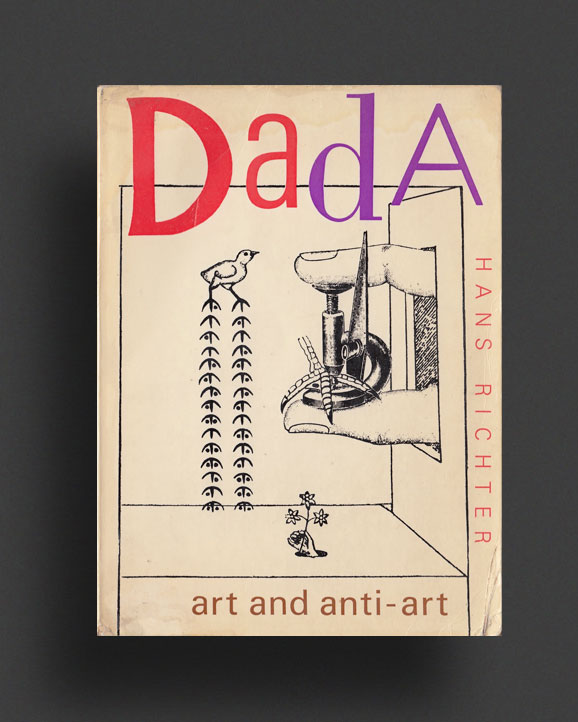
First 1965 English edition of German Dada painter, graphic artist, avant-garde film producer, and art historian, Hans Richter's important book of the Dada movement. "Where and how Dada began is almost as difficult to determine as Homer's birthplace" writes Hans Richter, who was associated with Dada from its early days. The noted artist and film-maker records here the history of that boisterous and fantastic movement, from its beginnings in wartime Zurich to its collapse in the Paris of the 1920s Dada invited the world to misunderstand it and fostered all kinds of confusion; nearly fifty years later its contradictions still intrigue us.
By skilful quotation from manifestoes and other documents of the time Professor Richter re-creates the events of those turbulent days. Looked at in retrospect Dada's role in the development of modern art seems inevitable, and the creative force of its planned outbursts can now be perceived: Dada led on from Expressionism, Cubism, and Futurism, and in its turn prepared the way for Surrealism. Dada was enlivened by extravagant, bizarre personalities: Tristan Tzara, Francis Picabia, Hans Arp, Kurt Schwitters, Marcel Duchamp, Max Ernst, Man Ray. Today the wheel has turned again; the gestures and provocations of the original movement reappear, hardly changed, in such forms as Pop art. The final section discusses this phenomenon.
"Mr.Richter, one of the original adherents of Dada, describes their attitude in a first-rate history, as objective and sober as the laughter was once derisive."—THE TIMES OF LONDON
Very Good copy, light wear to extremities, tanning to covers.
1993, English / Japanese
Hardcover, 94 pages, 21.5 x 15 cm
1st Edition, Out of print title / used / fine
Published by
Treville / Tokyo
$55.00 - Out of stock
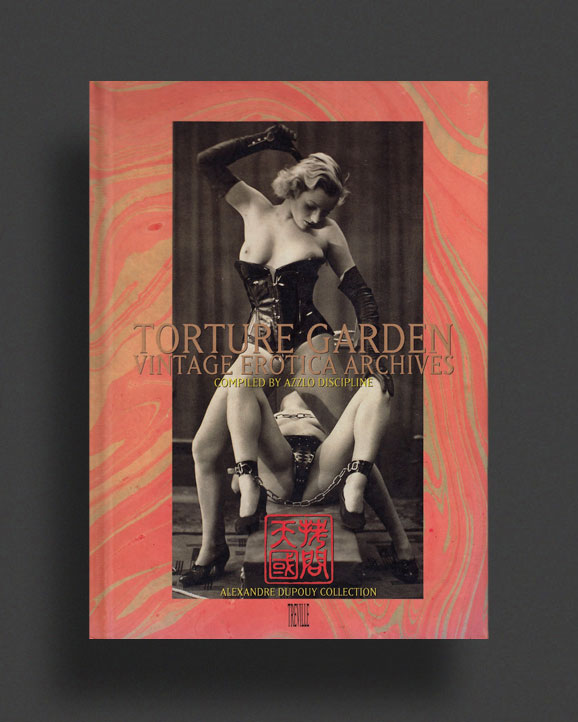
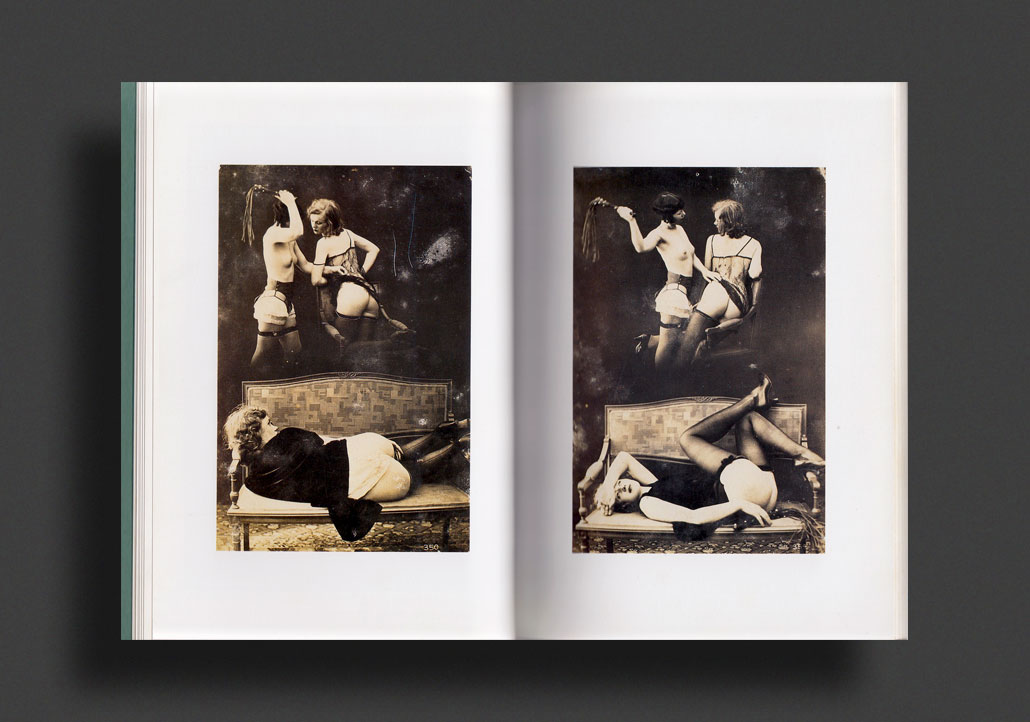
First 1993 hardcover edition of Torture Garden: Vintage Erotica Archives, an anthology of vintage bondage and fetish photographs drawn from the private collection of noted erotic bookseller and collector, Alexandre Dupouy. Published by Treville Editions in Japan, compiled by Azzlo Discipline. English and Japanese texts. Introduction by Dupouy.
Alexandre Dupouy is a bookseller and collector who has been a leading authority on under-the-counter culture for almost 50 years, and has written and contributed to numerous books in his native France. He is the proud owner of the Parisian emporium Larmes d'Éros, named after a book by French author Georges Bataille.
Fine copy with all original catalogues inserted.
1990, English
Softcover (staple bound), 86 pages, 21 x 14 cm
1st Edition, Out of print title / used / very good
Published by
Black Cat Books / New York
$45.00 - Out of stock
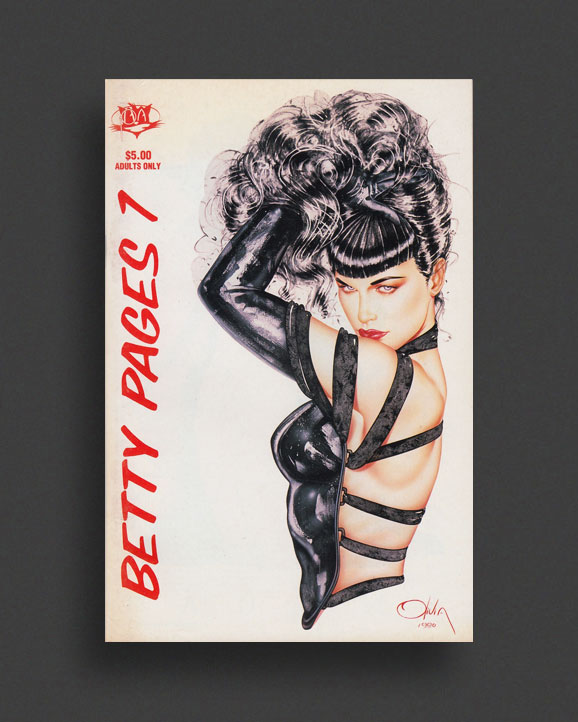
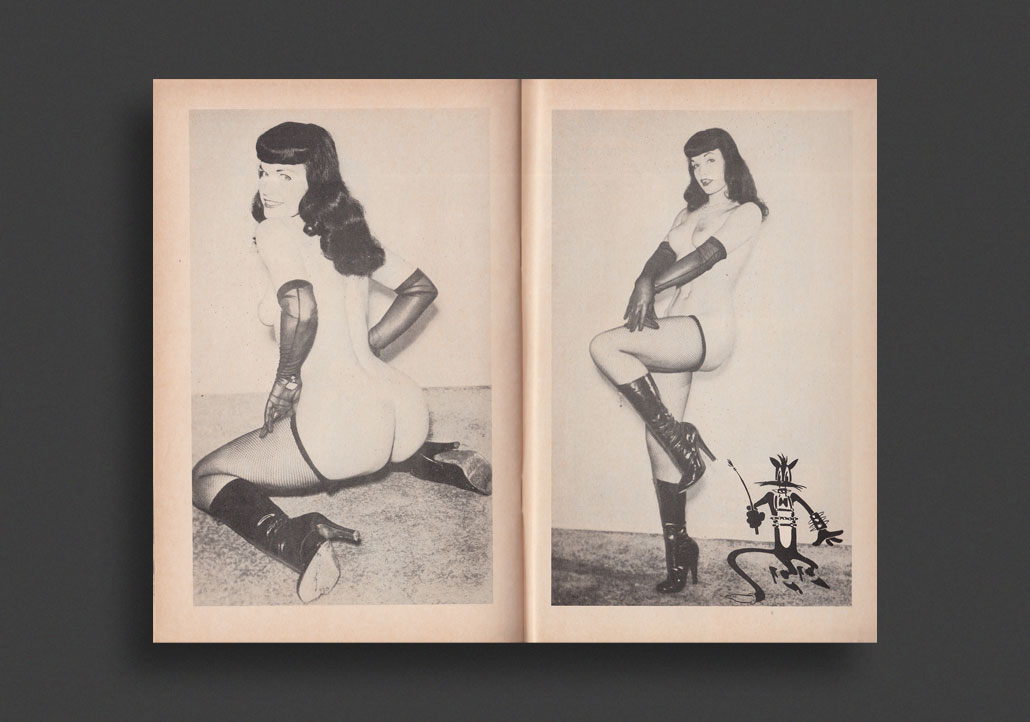
Seventh issue of the definitive guide to all things Bettie Page, The Betty Pages, published by Pure Imagination / Black Cat, New York, in 1992, with cover artwork by Olivia. Founded in 1987 during the huge 1980's resurgence in the popularity of the magnificent "Queen of Pinups", Bettie Page, "Miss January 1955". The Betty Pages was a digest-sized fanzine devoted entirely to stories, pictures, artwork, columns, collectibles, ads, and other items associated with American Pin-Up Icon Bettie Page, published and edited by Greg Theakston and co-edited by Joe Anderko, re-printed by Black Cat Books. Significant writing and illustrating contributors included: Glenn Barr, Dave Stevens, Chris Gore and Jim Steranko, amongst others. Profusely illustrated throughout in b/w and colour photographs of Page, including the excellent 1961 portfolio "Kitten With A Whip", an interview with pin-up Olivia, Olivia De Berardinis, and much more.
Bettie Mae Page (1923—2008) was an American model who gained notoriety in the 1950s for her pin-up photos. She was often referred to as the "Queen of Pinups": her long jet-black hair, blue eyes, and trademark bangs have influenced artists for generations. After her death, Playboy founder Hugh Hefner called her "a remarkable lady, an iconic figure in pop culture who influenced sexuality, taste in fashion, someone who had a tremendous impact on our society".
Very Good—NF copy.
1991, English / Japanese
Softcover (w. original silk-screened plastic sleeve), 36 pages, 39.5 x 30 cm
1st Edition, Out of print title / used / very good
Published by
Comme des Garçons / Tokyo
$300.00 - Out of stock
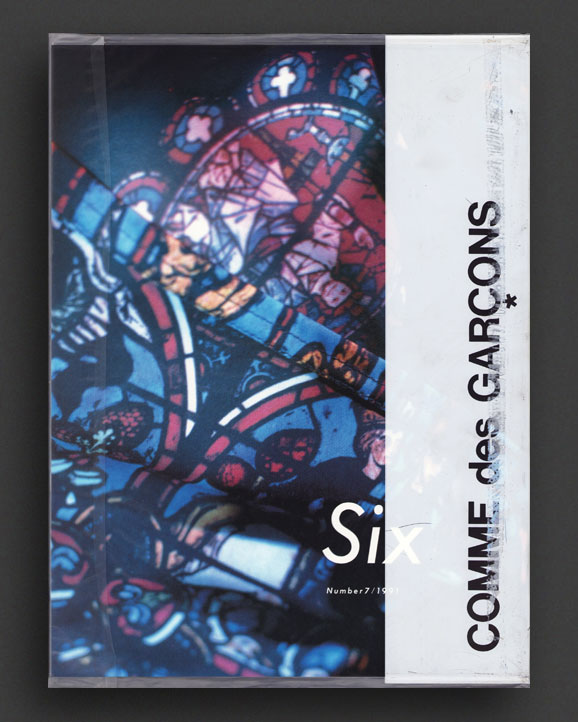
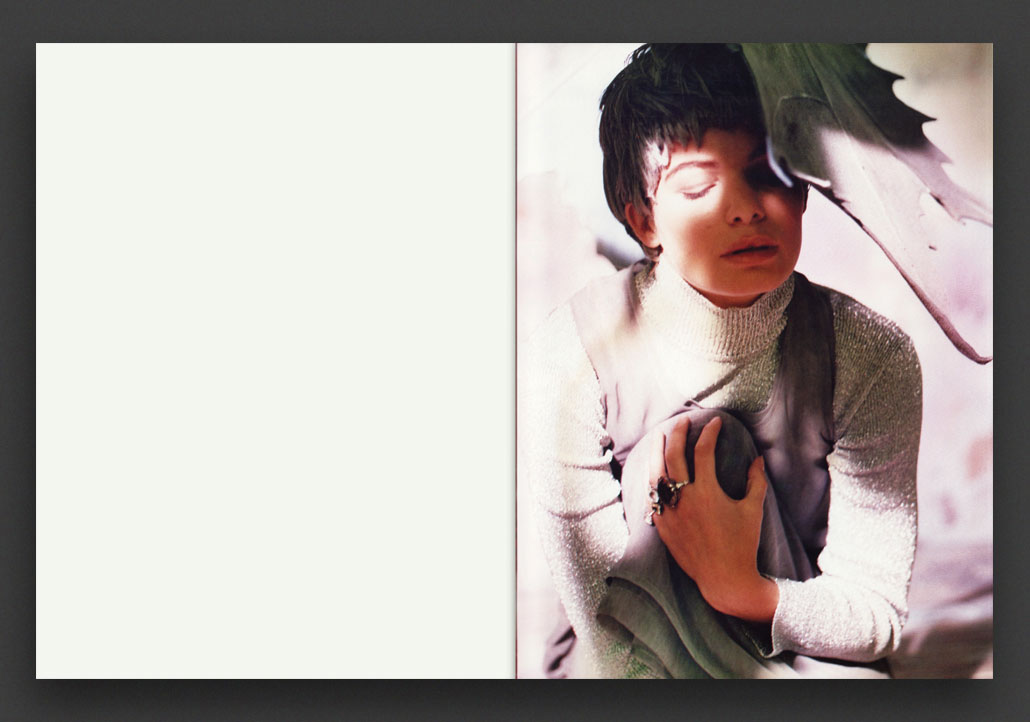
The seventh issue of Comme des Garçons 'Six' magazine (1991) featuring avant-garde photography exploring the idea of the 'Sixth Sense' while reflecting the Spring 1991 collection, including conceptual works by acclaimed photographers Christian Moser, David Seidner, Madame Yevonde, Brian Griffin, Jeurgen Teller, Javier Vallhonrat. Cover story and photo series featuring Comme des Garçons photographed by Christian Moser.
Between 1988 and 1991, Comme des Garçons explored the theme of the sixth sense via eight special biannual oversized, unstapled magazines titled 'Six'. These magazines were launched to coincide with Comme des Garçons fashion collections and were privately distributed at the time. The magazine visually represented the brand in a way that no other fashion company had before. Rei Kawakubo invited Tsuguya Inoue to art direct and Atsuko Kozasu to edit the issues, whilst contributions came from different designers and artists.
Issues of Comme des Garçons 'Six' have become very sought after collectors items.
Very Good—Near Fine copy in original silkscreened Comme des Garçons plastic sleeve (general wear to protective sleeve, magazine is bright and clean)
1979, English / French
Softcover (french folds), 78 pages, 27 x 21.2 cm
1st Edition, Out of print title / used / very good
Published by
Bernard Letu Editeur / Geneva
$55.00 - Out of stock
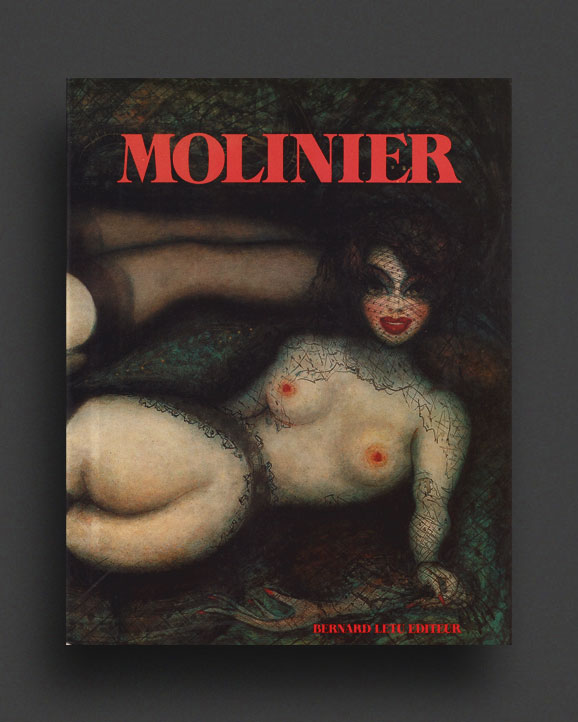
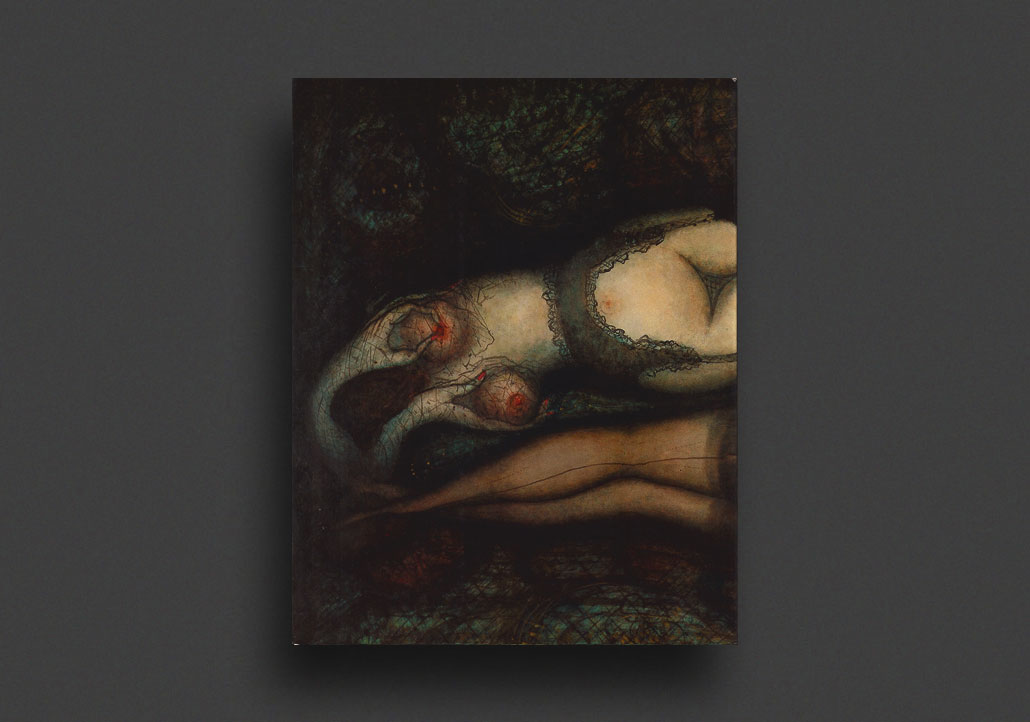
First 1979 edition of this monograph on French painter, photographer and a forerunner of gender performance art and Body Art (Art corporel), Pierre Molinier (1900—1976), published by Bernard Letu Editeur in Geneva. With accompanying text by Egyptian-French Surrealist author Joyce Mansour, this book is a retrospective survey of Molinier's provocative gender-bending paintings and drawings, illustrated throughout in colour and b/w. Texts in English and French.
Pierre Molinier (1900—1976) was a French painter, photographer and a forerunner of gender performance art and Body Art (Art corporel). Molinier spent much of his artistic life working in isolation in Bordeaux, exiled from local and national art scenes. Born in Agen, nothing had predestined Molinier to a life as an artist. Self-taught, from a working-class background, he followed in his father’s footsteps and started out as a house painter. He got married and had two children. Tired of his infidelities and provocative behaviour, his wife left their marital home an in 1950 and Molinier begun photographing himself seriously, staging his own death and erecting a fake gravestone proudly declaring himself ‘a man without morals’. He was thrown out of the Bordeaux Salon des Indépendants as early as 1951 amidst controversy over his orgiastic painting of the same year, Le Grand Combat. Stirring up an obsessive correspondence with the anarchic poet-founder of Surrealism, André Breton, Molinier was soon integrated into the Surrealist group with a solo exhibition at Breton’s Paris gallery in 1956. Molinier’s anti-moral project appealed to the group’s interest in repressed desires, fetishism, and the transgression of bourgeois morals. In 1959, he exhibited at the Exposition International du Surrealism in Paris. From the mid-1960s Molinier chronicled the exploration of his subconscious transsexual desires in "Cent Photographies Erotiques": graphically detailed images of pain and pleasure. Cut-up, reassembled, and manipulated, Molinier painstakingly created elaborate and sensual photomontages in which he assumed the roles of dominatrix and succuba previously taken by the women of his paintings. Either alone with doll-like mannequins or with female models such as German sadomasochist Hanel Koeck, Molinier, who considered himself fundamentally androgynous, appears as a transvestite, employing his body and that of his acquaintances to create visions of hybrid identity, where stockinged multi-limbed, multi-sexed beings imitate pagan figures, Hindu gods, and Masonic symbols, in a rejection of a Christian tradition which he argued, had repressed androgyny. Designed to shock, Molinier’s artwork represented a very intimate disclosure about his own sexual ambiguity, inviting the viewer to bring to the images his or her own response of excitement or disgust. The degree of his artistic perversity and blasphemous tendencies was deemed too much for the French cultural elite, and the man Breton dubbed the “magician of erotic art” was shunned from the art world. Molinier did not participate in the 1965 International Surrealist Exhibition. For the last 11 years of his life Molinier played out his own most profound moments in the 'theatre' of his Bordeaux 'boudoir – atelier'. He committed suicide in 1976, shooting himself with a pistol, something he had foreshadowed in his artwork, time and again. Essentially a leg fetishist, but also considering himself as a shaman, facetious and provocative, anti-bourgeois and anti-religious, Molinier enjoyed transgressing gender identification : his outstanding photographs greatly influenced the European and North American Body Art in the 1970s and continue to fascinate artists today.
Very Good copy.
1969, Japanese
Hardcover (clothbound w. plastic dust jacket in slipcase), 168 pages, 22 x 16 cm
1st Edition, Out of print title / used / very good
Published by
Shoshi Soubikan / Tokyo
$180.00 - Out of stock
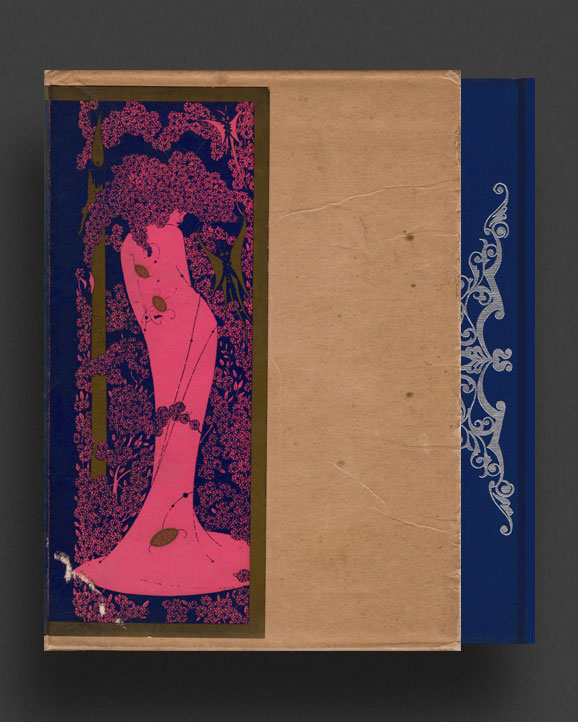
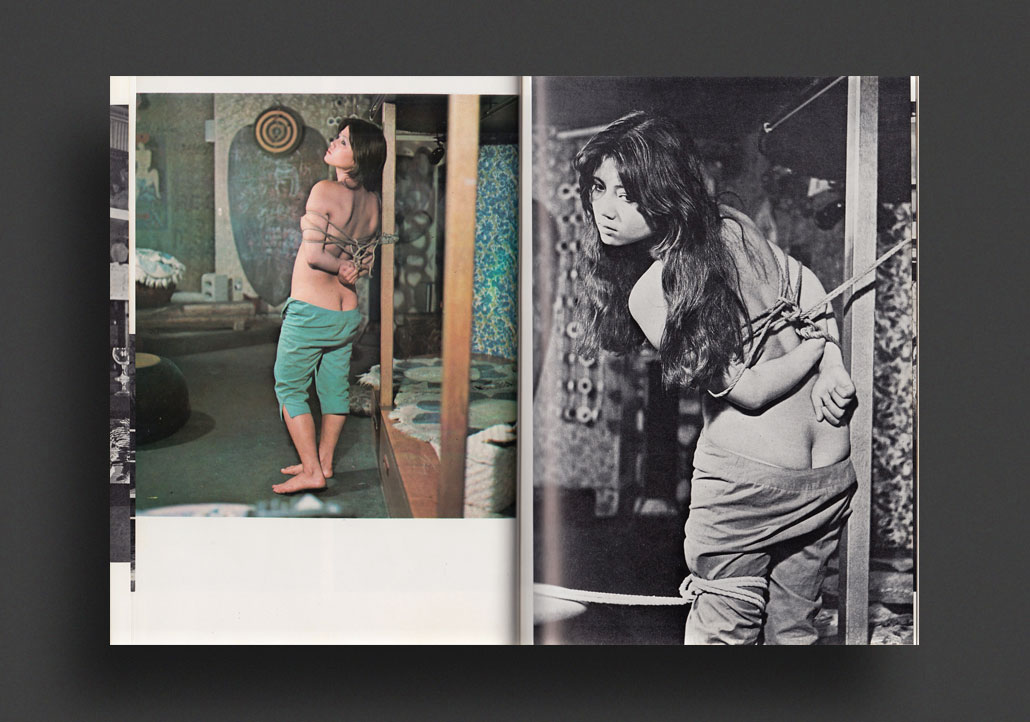
Very rare copy of SM Photo Collection Rose Mirror, an exquisite early 1969 hardcover collection of bondage photographic works housed in heavy cardboard slipcase adorned with Beardsley illustration. The photographic works follow in the decadent tradition, with beautiful b/w gravure photo reproductions and lush colour plates with colour fold-out spreads, each of the eight kinbaku/shibari scenarios shot by photographer Yoshimi Sunaji in response to fictional stories, the chapters titled: "`The Mirror of the Rose," "The Lesson of the Cat," "The Queen Angel," "The Ballad of the Pearl Shell," "The Trapped Agarwood," "The Play of the Twigs," "The Sacrifice of the Spider," and "The Mermaid's Bond," performed by eight women. The book concludes with the texts "Rope Arakaruto" by Arata Beppu, "Flowers of Heresy" by Akira Shiokawa, and "SM Yomoyama Story" by Oniroku Dan, "the most celebrated writer of popular SM novels in Japan."
Very Good copy with some general age and wear in gilded cloth bound hardcover and original publisher's plastic jacket (VG), housed in illustrated cardboard slipcase in Good—VG condition (light wear, age, marking). Very well preserved.
2006, English
Softcover, 336 pages, 26 x 21.5 cm
1st Edition, Out of print title / used / very good
Published by
Center for Curatorial Studies Bard College / New York
$290.00 - In stock -
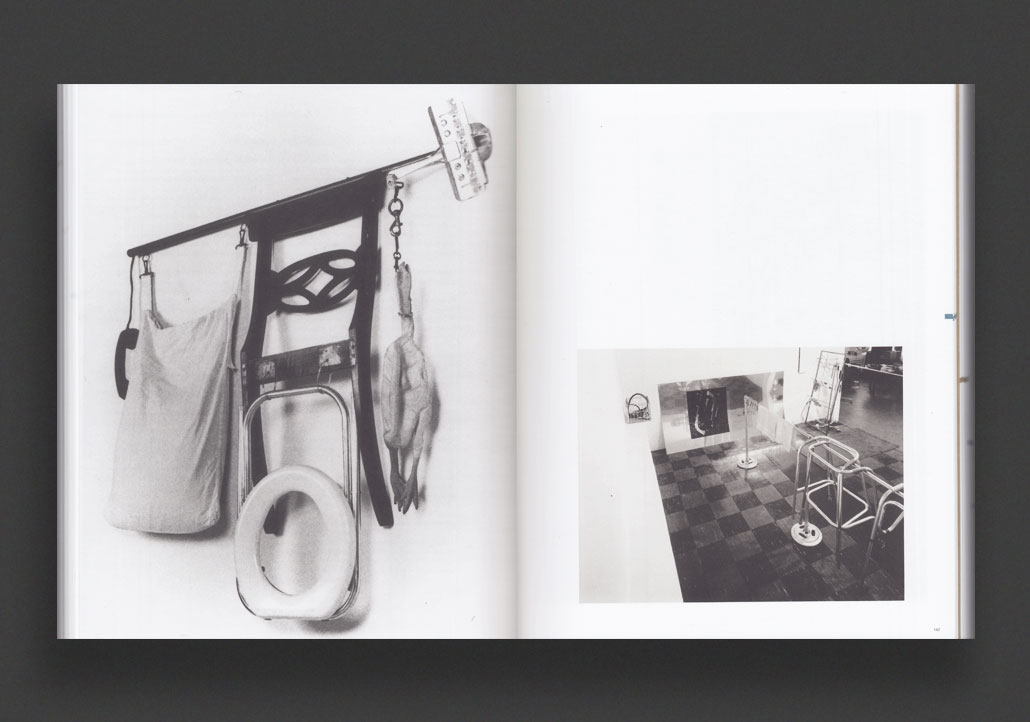
First edition of this very special, now very rare catalogue published in 2006 on the occasion of the major survey exhibition Witness To Her Art, featuring the work of Adrian Piper, Mona Hatoum, Cady Noland, Jenny Holzer, Kara Walker, Daniela Rossell and the seminal magazine Eau de Cologne, published by gallerist Monika Sprüth between 1985 and 1989. Profusely illustrated throughout with artworks by all artists, reproductions of important artist publications, installation views, and many works by other related artists, alongside texts by Adrian Piper, Kara Walker, Daniela Rossell, Mona Hatoum, Cady Noland, Jenny Holzer, Monika Sprüth, Rhea Anastas, Michael Brenson, Norton Batkin, Johanna Burton, Aruna D’Souza, Pamela Franks, Janet Kraynak, David Levi Strauss, Cuauhtémoc Medina, Ann Reynolds, Hamza Walker, and many more.
Publisher's blurb:
"This radical new study aims to change the way that some of the most influential artists of the past 40 years are seen—all of them women. Emphasizing questions of autonomy, critical intelligence and artistic intention, "Witness to Her Art" presents works by Adrian Piper, Mona Hatoum, Cady Noland, Jenny Holzer, Kara Walker, Daniela Rossell and "Eau de Cologne," a magazine published by gallerist Monika Sprüth. The artworks are accompanied by original writings by the artists, contemporaneous criticism and newly commissioned essays by Pamela Franks, Aruna D'Souza, Johanna Burton, David Levi Strauss, Hamza Walker and Cuauhtémoc Medina. The ambitious works presented and interpreted herein invite us to consider the impact of the feminist revolution across generations while rendering obsolete any stigma associated with shows or catalogues limited to women artists. Taking its lead from Conceptualism, feminism, and from its included artists, "Witness to Her Art" reaches for art history's capacity as a medium of world-making."
Highly recommended. Very Good copy with light edge wear/rounding to stiff overlay boards.
1984, English
Softcover, 62 pages, 21.5 x 21.5 cm
1st Edition, Out of print title / used / good
Published by
Kunsthalle Basel / Basel
$90.00 - Out of stock
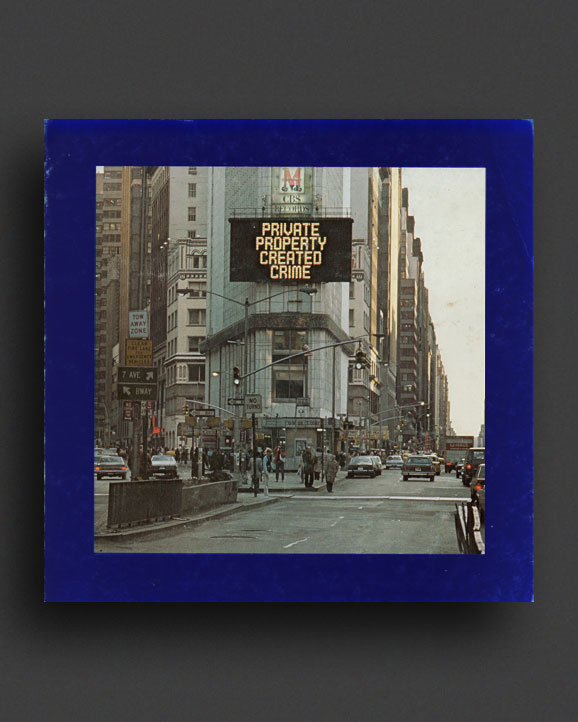
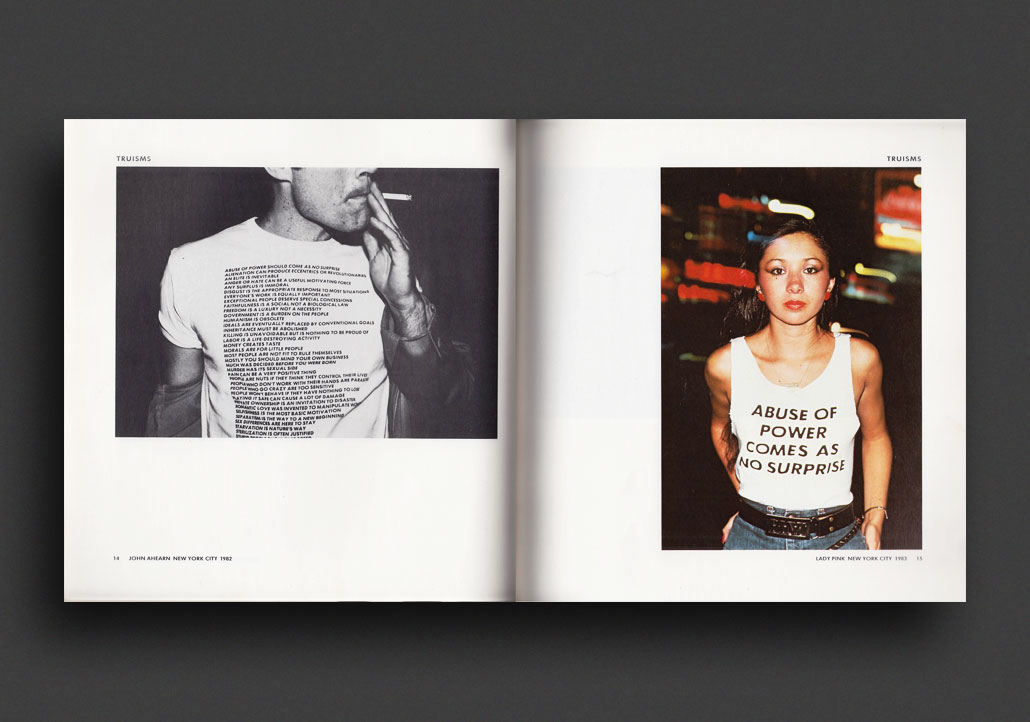
Wonderful 1984 catalogue, Private Property Created Crime, surveying the work of American conceptual artist Jenny Holzer (b. 1950), published on the occasion of a major European exhibition at Kunsthalle Basel and Le Nouveau Musée.
"THIS IS A BOOK OF STREET WORK AND INSTALLATIONS; POSTERS, T-SHIRTS, PLAQUES, STICKERS AND ELECTRONIC SIGNS. THE PHOTOGRAPHS ARE ARRANGED IN SERIES: TRUISMS, 1977–1983; ESSAYS, 1979–1983; LIVING, 1981–1983; AND SURVIVAL, 1983-1984. THE BOOK ACCOMPANIES EXHIBITIONS AT THE KUNSTHALLE, BASEL AND LE NOUVEAU MUSÉE, VILLEURBANNE."
Profusely illustrated in b/w and colour. Introduction by Jean-Christophe Ammann, plus biography and bibliography. All in English.
Jenny Holzer (b. 1950) is an American conceptual artist best known for her text-based works, which are constructed from "truisms" such as "abuse of power comes as no surprise"and "protect me from what I want." By experimenting with the use of words visually displayed in public spaces, Holzer is able to stimulate public discussions about violence, sexuality, oppression, human rights, feminism, power, war, and death. Starting with street posters, Holzer's practice has come to incorporate LED screens that run with stock-ticker-like texts, painted signs, plaques, photographs, sound, video, and the Internet.
Until 1993, Holzer wrote her own texts, after which she began to appropriate texts by Polish Nobel laureate Wislawa Szymborska and other champions of human rights, including Elfriede Jelinek, Fadhil Al-Azawi, Yehuda Amichai, and Mahmoud Darwish. Recent works include I Was in Baghdad Ochre Fade (2007), a series of oil on linen transcriptions of torture documents from the Iraq War; Redaction Paintings (2009), which were created using recently released classified memos with texts blacked out by censors; and an installation in the lobby of 7 World Trade Center. In 1990, she was the first woman to represent the United States at the Venice Biennale, where she won the Golden Lion for the best artist.
Good—VG copy with cover wear.
1997, English
Hardcover (w. dust jacket), 286 pages, 23 x 19.2 cm
1st Edition, Out of print title / used / very good
Published by
The MIT Press / Massachusetts
$55.00 - Out of stock
First 1997 hardcover edition.
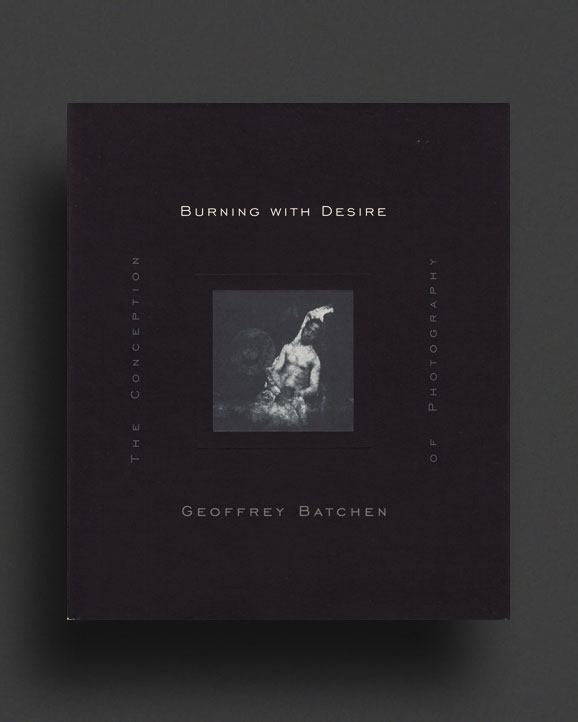
In an 1828 letter to his partner, Nicéphore Niépce, Louis Daguerre wrote, "I am burning with desire to see your experiments from nature." In this book, Geoffrey Batchen analyzes the desire to photograph as it emerged within the philosophical and scientific milieus that preceded the actual invention of photography. Recent accounts of photography's identity tend to divide between the postmodern view that all identity is determined by context and a formalist effort to define the fundamental characteristics of photography as a medium. Batchen critiques both approaches by way of a detailed discussion of photography's conception in the late eighteenth and early nineteenth centuries. He examines the output of the various nominees for "first photographer," then incorporates this information into a mode of historical criticism informed by the work of Michel Foucault and Jacques Derrida. The result is a way of thinking about photography that persuasively accords with the medium's undeniable conceptual, political, and historical complexity.
"Given its ambitious and groundbreaking scope, "Burning with Desire" is bound to become the touchstone for any further consideration of the topic of photography's invention."—Douglas R. Nickel, Assistant Curator of Photography, the San Francisco Museum of Modern Art
Very Good copy in VG dust jacket.
1994, English
Softcover, 236 pages, 23 x 15 cm
1st Edition, Out of print title / used / fine
Published by
Routledge / London
$80.00 - Out of stock
Scarce first 1994 edition of The Female Grotesque by Mary Russo, published by Routledge and long out-of-print.
The cultural associations surrounding the grotesque are deeply embedded in Western consciousness. But what happens when we consider the grotesque from the perspective of gender? Mary Russo explores the idea of the "female grotesque" by embracing a wide array of theoretical, visual, literary, auto-biographical, and performance texts. The "female grotesque" can be found everywhere around-and even above- us, from the "aerial" sublime of Amelia Earhart to the provocative films of Ulrike Ottinger. Emphasizing the relationship between gender and the grotesque, Russo argues that the "female grotesque" is less a category than an operation through which genders and identities are both constituted and de- constituted, excluded or not. Drawing upon Bakhtin and Kristeva, Freud and Žižek, Russo traces the salient connection between abjection, the uncannny, and the grotesque. Exploring the double logic of the grotesque in the works of Angela Carter, David Cronenberg, and Georges du Maurier's Trilby, Mary Russo illuminates the grotesque as a process through which differently gendered bodies are deployed in provocative, new, and possibly transformative ways. The Female Grotesque proposes a new understanding of excess and transgres- sion in the gendered world of Western culture.
Near Fine copy.
1991, English
Softcover (staple-bound), 12 pages, 29 x 21 cm
1st Edition, Out of print title / used / good
Published by
Australian National Gallery / Canberra
$25.00 $10.00 - Out of stock
Scarce brochure catalogue published on the occasion of the exhibition The Life and Work of Wolfgang Sievers, Australian National Gallery, Canberra, 1991. This exhibition of Sievers photographs travelled Victoria and New South Wales between 1991—1992. "The Life and Work of Wolfgang Sievers is the first retrospective of Sievers's work; it surveys Sievers's long and productive career and includes photographs taken in Italy, Germany, Portugal and Australia. Since he settled in Australia in 1938 Sievers has made an extremely significant—but still largely unacknowledged—contribution to Australian cultural life." Illustrated throughout, the photographs are accompanied by stories written by the artist.
Wolfgang Georg Sievers, AO (1913–2007) was a well-known modernist photographer who specialised in architectural and industrial photography over a career spanning almost 60 years. Sievers grew up in Germany during a period known as the Weimar Republic, studied photography at the Contempora School for Applied Arts in Berlin, a successor to the Bauhaus, and in 1938, fearing increasing persecution in Nazi Germany, the Sievers family fled and migrated to Australia. Sievers served in the Australia Army from 1942 to 1946. After the war, Sievers concentrated on a career as a photographer, bringing a new vision of crisp and uniform images, showcasing how the modern world was aiming for economy through efficiency. After the Second World War, Australia had been particularly driven to streamlining processes and techniques in the postwar era, sometimes called the ‘golden age’. After the war, Sievers concentrated on a career as a photographer. He worked with other famous modernist photographers in Melbourne, including Axel Poignant and Athol Shmith. In Australia, Sievers took to industrial photography, bringing a new vision of crisp and uniform images, showcasing how the modern world was aiming for economy through efficiency. Sievers documented a postwar Australia, sometimes called the ‘golden age’. In describing his artistic method, Sievers once said: ‘The fundamental Bauhaus idea is purity of line and simplicity of design, both in architecture and industry. To this I added the dignity of man as a worker.’ Many of Sievers works contain images of humans as connected to the machines they work with. These photographs show humans as an important ‘part’ of the technology they are using.
Good copy with storage wear to covers.
2024, English
Softcover, 232 pages, 29.8 x 24.8 cm
Published by
Silvana / Milan
Palais Lumière / Évian-les-Bains
$85.00 - Out of stock
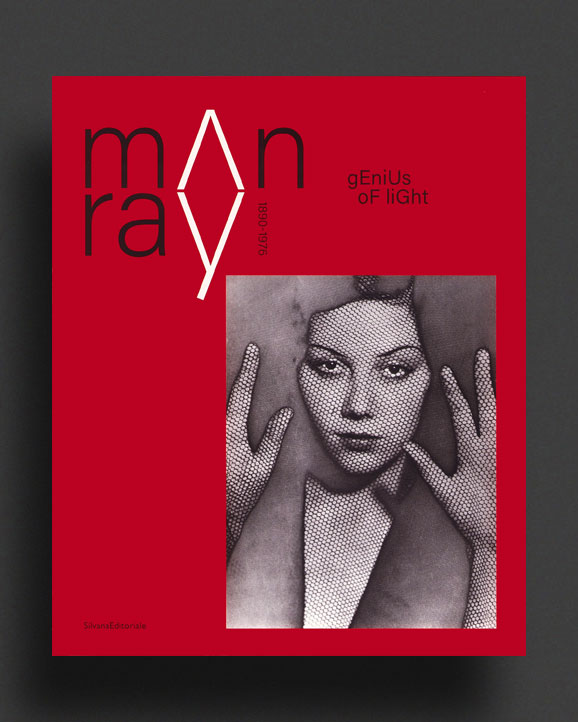
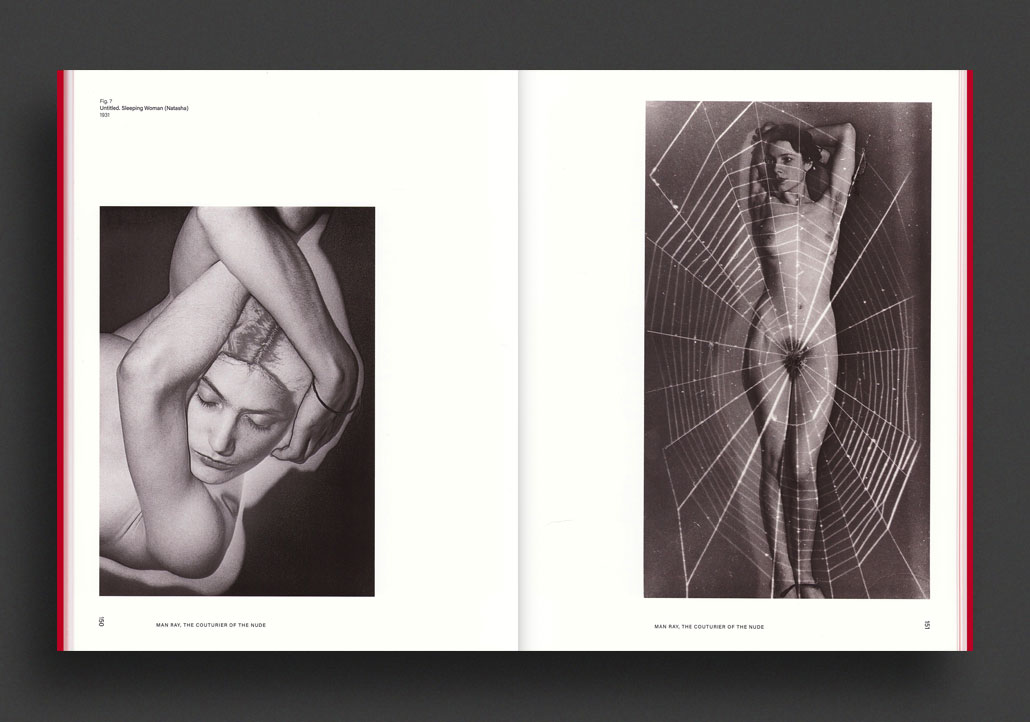
Man Ray occupies a prominent place in the history of 20th-century art. A versatile artist, who lived mainly in Paris, he is best known as a photographer. Indeed, he was one of the first to use photography, not as a simple means of reproduction, but as a genuine creative medium, turning the technique into an art form. Some of his photographs, such as Le Violon d’Ingres (1924) and Noire et blanche (1926), have achieved iconic status.
Born in Philadelphia (Pennsylvania) on 27 August 1890, Emmanuel Radnitsky, known as Man Ray (as in a ray of light), actively participated in the intellectual and artistic circles of New York. He discovered the European avant-gardes and befriended Marcel Duchamp who opened the doors of Dadaism to him and welcomed him to Paris in July 1921.
At the heart of Parisian artistic life, he participated in the innovative experiments of the Dadaists and Surrealists, met with painters, poets and intellectuals, and became famous for his portraits. He developed a career as a fashion photographer, notably for designers Paul Poiret and Elsa Schiaparelli. A tireless experimenter, he rediscovered the technique of “photograms” (abstract silhouettes of objects) that Tristan Tzara named “rayographs” and in 1929, with his new partner Lee Miller, developed the “solarization” technique. In 1940, after the fall of France, Man Ray left for the United States and met Juliet Browner, who became his wife and muse. He returned to Paris in 1951 and lived there until his death in 1976.
Man Ray is renowned for having revolutionized the art of photography, but he was also a painter, draughtsman, assembler of objects, sculptor, writer and filmmaker. It is this protean artist that we seek to discover or re-discover, through a true panorama of his works, which will enable us to comprehend Man Ray’s creative process and the importance of his art.
Edited by Robert Rocca, Pierre-Yves Butzbach.
Texts by Robert Rocca, Pierre-Yves Butzbach, Serge Sanchez, Man Ray, Sylvie Gonzalez, Laurence Benaïm, Marie-Pierre Ribère, Jean-Michel Bouhours.
2016, English
Hardcover, 232 pages, 23.1 x 17.5 cm
Published by
Walther König / Köln
Moderna Museet / Malmö
$75.00 - Out of stock
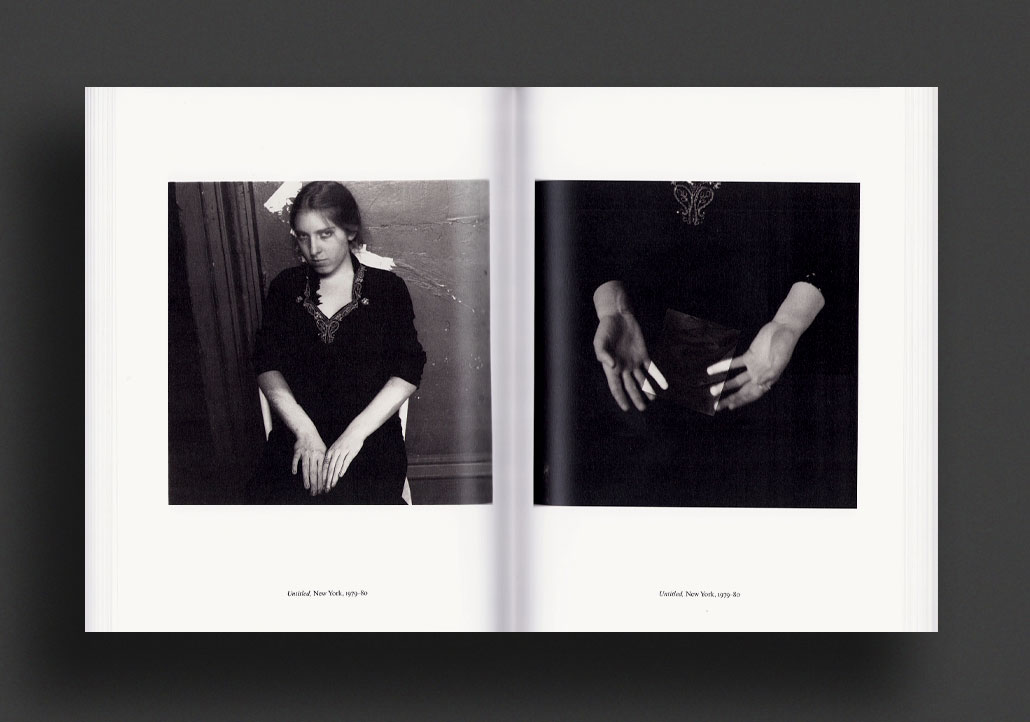
On Being an Angel takes its title from a caption the artist inscribed on two of her photographs—self-portraits with her head thrust back and her chest thrust forward. Typical of Woodman’s work in the way they cast the female body as simultaneously physical and immaterial, these photographs and the evocative title they share are apt choices to encapsulate the work of an artist whose legacy has been unavoidably colored by her tragic personal biography and her death, at age 22, by suicide. In less than a decade, Woodman produced a fascinating body of work—in black and white and in color—exploring gender, representation, sexuality and the body through the photographing of her own body and those of her friends. Since her death, Woodman’s influence continues to grow: her work has been the subject of numerous in-depth studies and exhibitions in recent years, and her photographs have inspired artists all over the world. Published to accompany a travelling exhibition of Woodman’s work, Francesca Woodman: On Being an Angel offers a comprehensive overview of Woodman’s oeuvre, organized chronologically, with texts by Anna Tellgren, Anna-Karin Palm and the artist’s father, George Woodman.
Francesca Woodman (1958–81) was born in Denver, Colorado, to an artistic family and began experimenting with photography as a teenager. In 1975 she attended the Rhode Island School of Design, and in 1979 she moved to New York to attempt to build a career in photography. Woodman’s working career was intense but brief, cut short by her death in 1981.
1995, Japanese
Hardcover (w. dust jacket), 32 x 27 cm
1st Edition, Out of print title / used / good
Published by
Bunkasha / Japan
$100.00 - Out of stock
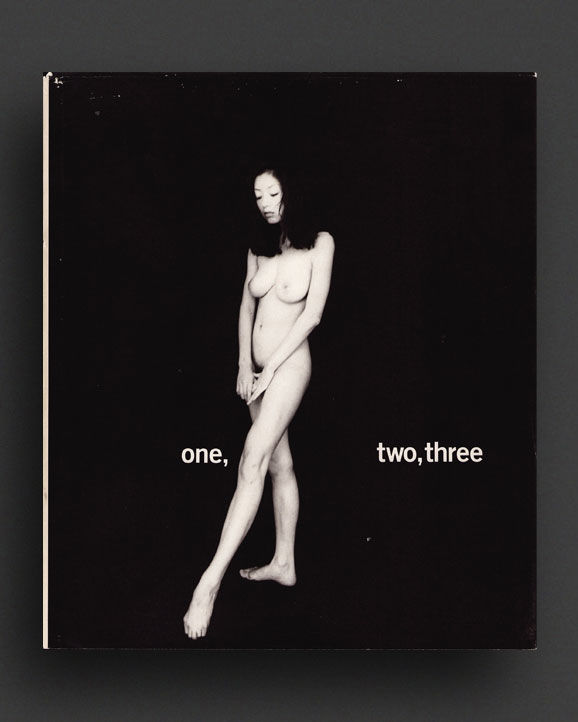
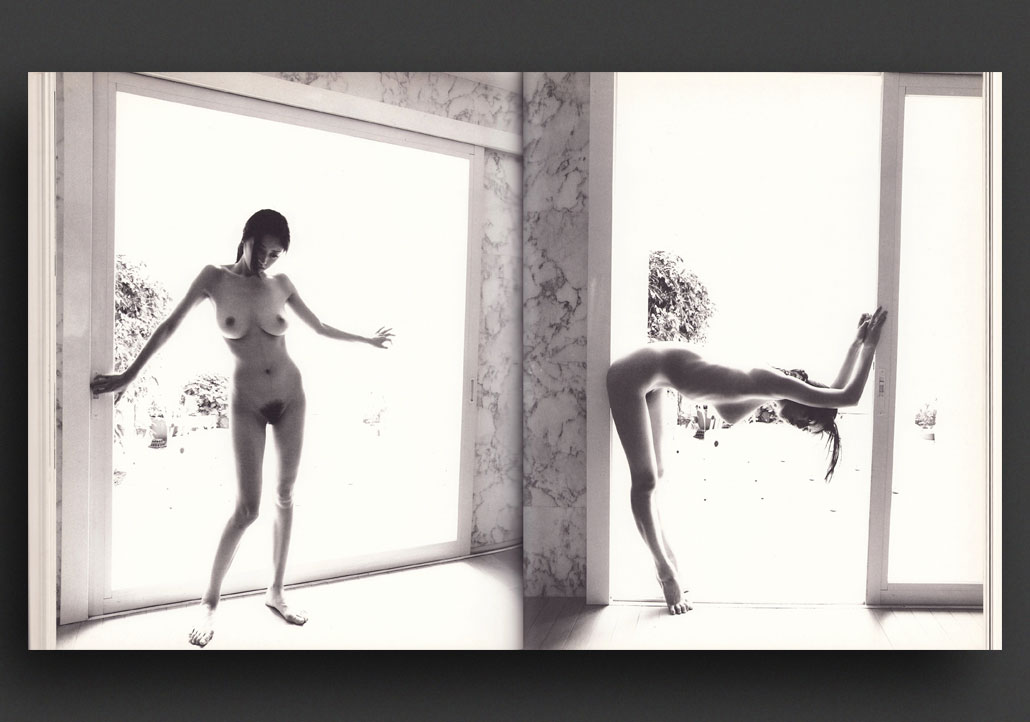
First 1995 hardcover edition of "one, two, three", a gorgeous oversized hardcover collection of nude photography by master Japanese photographer Kishin Shinoyama of award-winning actress Saki Takaoka. Takaoka was born in Kanagawa in 1972 and has appeared in many films, TV dramas, commercials, and musicals. Composed of black-and-white and colour works, this book became a hot topic in society at the time of its publication and recorded an astounding circulation of approximately 470,000 copies, which is unthinkable today. The number of sales and topicality are certainly very high, but the beauty of the photographs, and above all, the beauty of Saki Takaoka, who does not wear a single thread, can be said to be a work of art from head to toe. The atmosphere of monochrome printing is also very wonderful. A stunning book with beautiful, modern, pared back typographic design.
Very Good copy of clothbound 1st edition with Good dust jacket with wear and some chipping to spine/extremities.
1988, Japanese / English
Softcover (w. dust jacket), 98 pages, 30 x 30.5 cm
Signed.,
1st Edition, Out of print title / used / very good
Published by
Bundgeishunju / Tokyo
$240.00 - In stock -
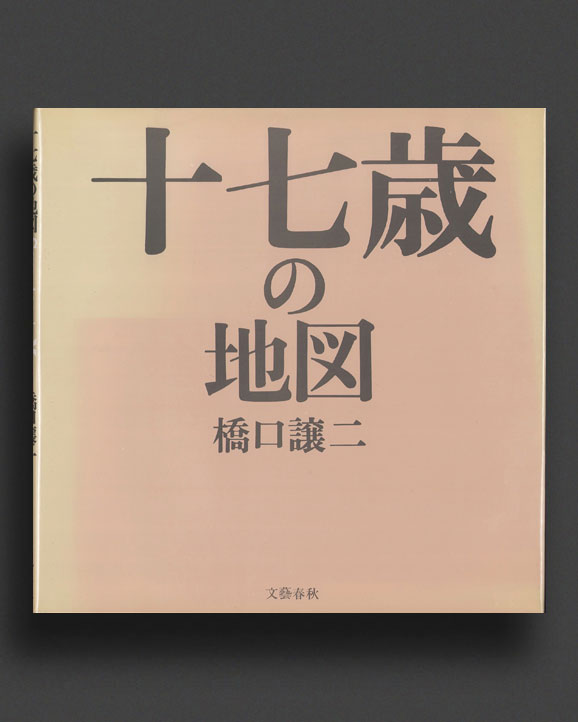
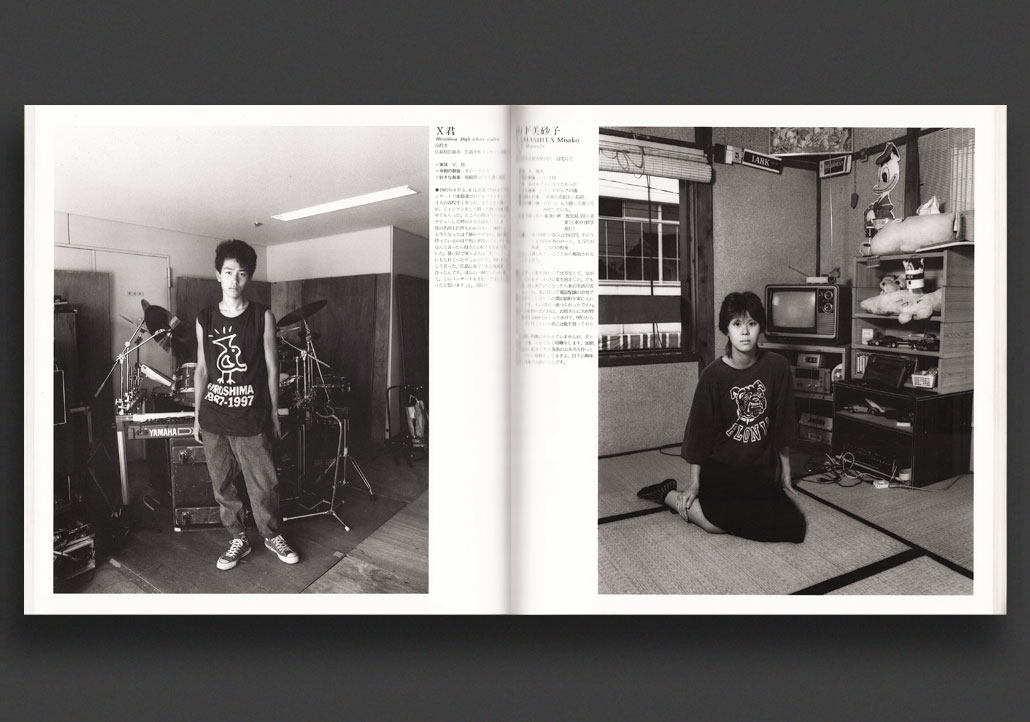
Beautiful, rare, signed first edition of this great photobook by Japanese photographer Joji "Geroge" Hashiguchi (b. born in Kagoshima in 1949), the first in his acclaimed collections that also includes Father (1990) and Couples (1992) following Hashiguchi’s same method of portraiture. "Seventeen's Map" is an intelligent sociological typology consisting of documentary black and white portraits of Japanese seventeen-year-olds in the late 1980s. Introductory text in Japanese and English by the photographer.
"From March 1987 to January 1988, I travelled almost the whole of Japan, up north to the Rebun Island in Hokkaido, and down south to the Yona- kuni Island in Okinawa. This is a collection of the pictures of the 17-year olds I met during my travels. As long as they were 17-year olds at the moment when I met them and pressed the shutter of my camera, I did not care who my models were. In return for letting me photograph them, I decided not to pick and choose, but to put them all into this book."—Joji "Geroge" Hashiguchi
In addition to its value as an archaeological record, Hashiguchi's point of view always captures the social landscape behind it. Working as a sociological ethnographer with a survey approach, Hashiguchi produces a unique overview of Japanese society with a sense of considerable sociocultural diversity in light of stereotypic reductions of Japan as a homogeneous entity.
This special copy boldly signed by the photographer and dated (1988) on loose-leaf endpaper stock in silver metallic marker.
Texts in English and Japanese. Cited in Parr / Badger Volume 2.
Very Good copy with tanning to otherwise VG dust jacket.
1996/1997, Japanese / English
Softcover (w. dust jacket + obi), 224 pages, 30 x 30 cm
Out of print title / used / very good
Published by
Media Factory / Tokyo
$120.00 - In stock -
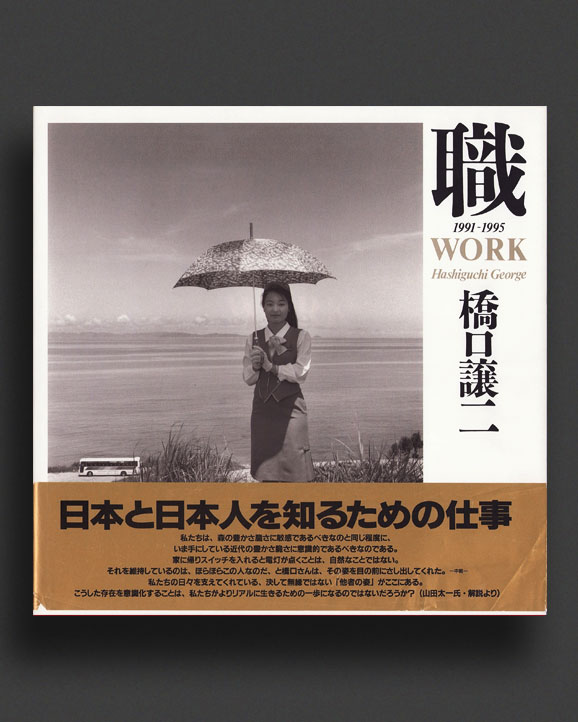
First edition, 1997 (2nd) printing of this wonderful photo book by Japanese photographer Joji "Geroge" Hashiguchi (b. born in Kagoshima in 1949), another in his acclaimed collections that also includes Seventeen's Map (1988), Father (1990) and Couples (1992) following Hashiguchi’s striking method of portraiture. "Work" is an extensive sociological typology consisting of documentary black and white portraits of Japanese people in their working environments across Japan spanning 1991—1995, from bartenders to pyrotechnicians, deep sea divers to mortuary cosmetologists, mostly shot as full-length portraits, paired with sociological data and interviews. Hashiguchi often choses two subjects from the same workplace based on age — one being older and the other younger — and the questions asked to each subject range from the length of career, current/starting salary to what the subject had for breakfast and dreams for from the future. Texts in both Japanese and English. Working as a sociological ethnographer with a survey approach, Hashiguchi produces a unique overview of Japanese society with a sense of considerable sociocultural diversity in light of stereotypic reductions of Japan as a homogeneous entity. One of his finest.
Very Good copy with VG dust jacket and average obi (creases and tears).
1997, Japanes / English
Hardcover (w. dust jacket + obi), 107 pages, 30.7 x 30.7 cm cm
1st Edition, Out of print title / used / very good
Published by
Media Factory / Tokyo
$120.00 - In stock -
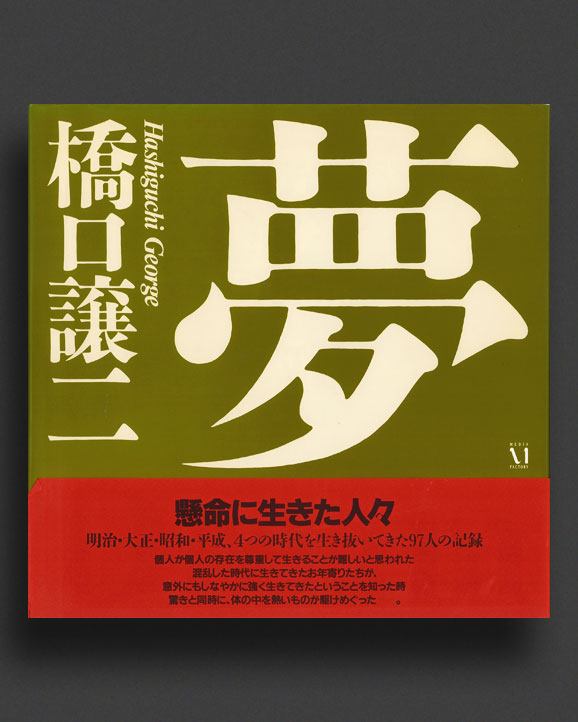
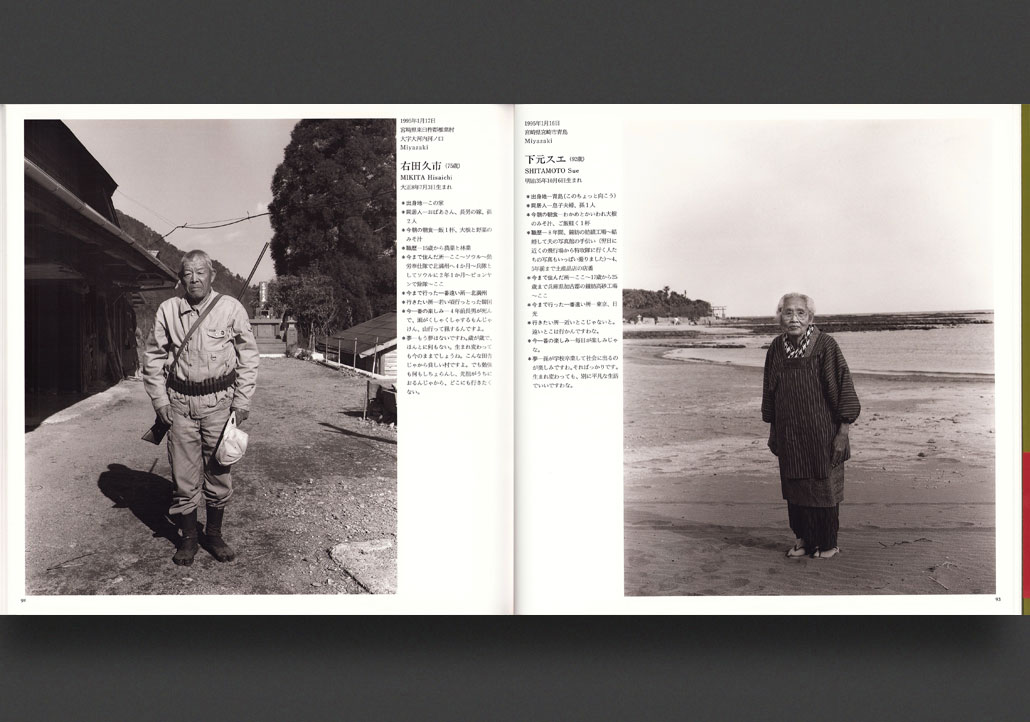
First 1997 edition of this wonderful photo book by Japanese photographer Joji "Geroge" Hashiguchi (b. born in Kagoshima in 1949), another in his acclaimed collections that also includes Seventeen's Map (1988), Father (1990) and Couples (1992) following Hashiguchi’s striking method of portraiture. "Dream" is a moving sociological typology consisting of documentary black and white portraits of Japanese people in their older years across Japan, mostly shot as full-length portraits, paired with sociological data and interviews. Texts in both Japanese and English. Working as a sociological ethnographer with a survey approach, Hashiguchi produces a unique overview of Japanese society with a sense of considerable sociocultural diversity in light of stereotypic reductions of Japan as a homogeneous entity.
This volume represents the most recent in a continuing series of photographic collections which I began with the purpose of coming to a better knowledge of Japan and the Japanese people. Previous collections included Seventeen's Map in 1988, followed by Father in 1990, Couple in 1992, and Work 1991-1995 in 1996. To compile each of these volumes, I traveled throughout Japan, making a record of the broad spectrum of people living in each region, while also recording the times I myself live in, and its scenes. This fifth volume in that series I have called Dream (Yume). When I was a child, I thought that when I reached twenty I would be an adult, and when that happened, something would change making life a bit easier to live. When I actually turned twenty, however, my body and consciousness seemed to be ruled by some heaviness that was yet different from that of my teens, and once again I thought: things will somehow work out when I become thirty. Somewhere past my mid-thirties, I finally realized something, namely, that the process of life is actually unending. When I had that realization, I began to think of the meaning and weight of those increasing years. Becoming older is generally voiced in negative terms within Japanese society, and each time I heard that, I would shake my head, thinking, "it just can't be true."—Joji "Geroge" Hashiguchi
Very Good copy with VG dust jacket and good obi (creases and tears).
1971, German
Hardcover, 92 pages, 20.5 x 16 cm
1st Edition, Out of print title / used / good
Published by
Softpress / Frankfurt
$70.00 - Out of stock
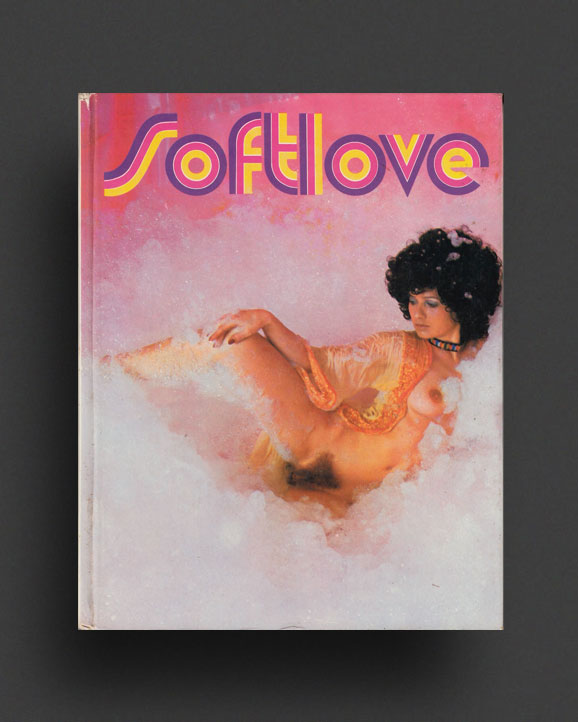
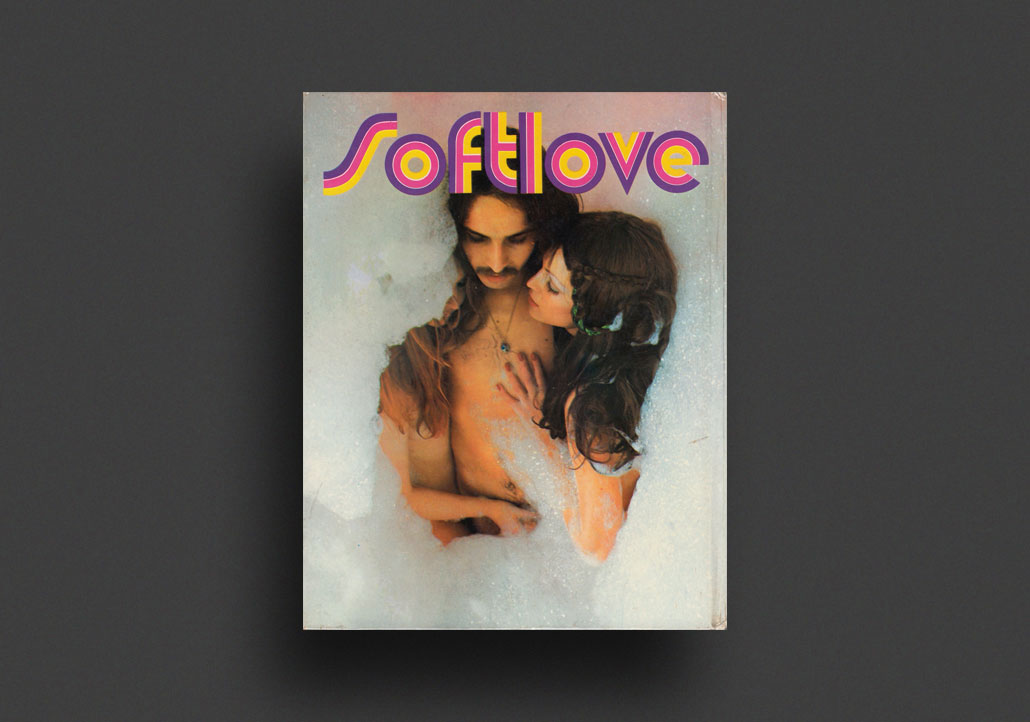
"Alle reden vom Sex – Wir zeigen ihn" ("Everyone talks about Sex — We show it")
First edition of this 1971 photo book of hippie sex from the German underground press. Housed in illustrated gloss hardcover, Softlove is filled with full-bleed lush explicit colour photography, from couple to orgy, in a bubble room to a mirrored infinity room, all printed on thick paper stock in saturated 1970's colour.
Good copy with light edge wear to printed boards.
1970, German
Hardcover, 104 pages, 20.5 x 16 cm
1st Edition, Out of print title / used / good
Published by
Softpress / Frankfurt
$50.00 - Out of stock
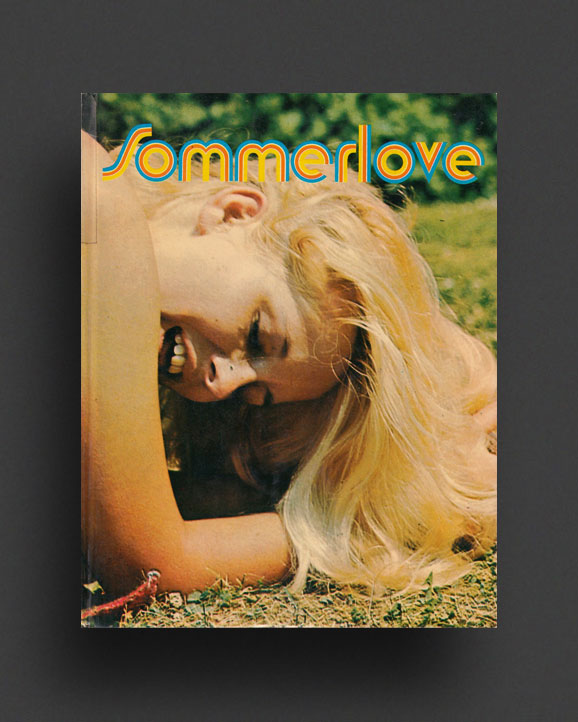
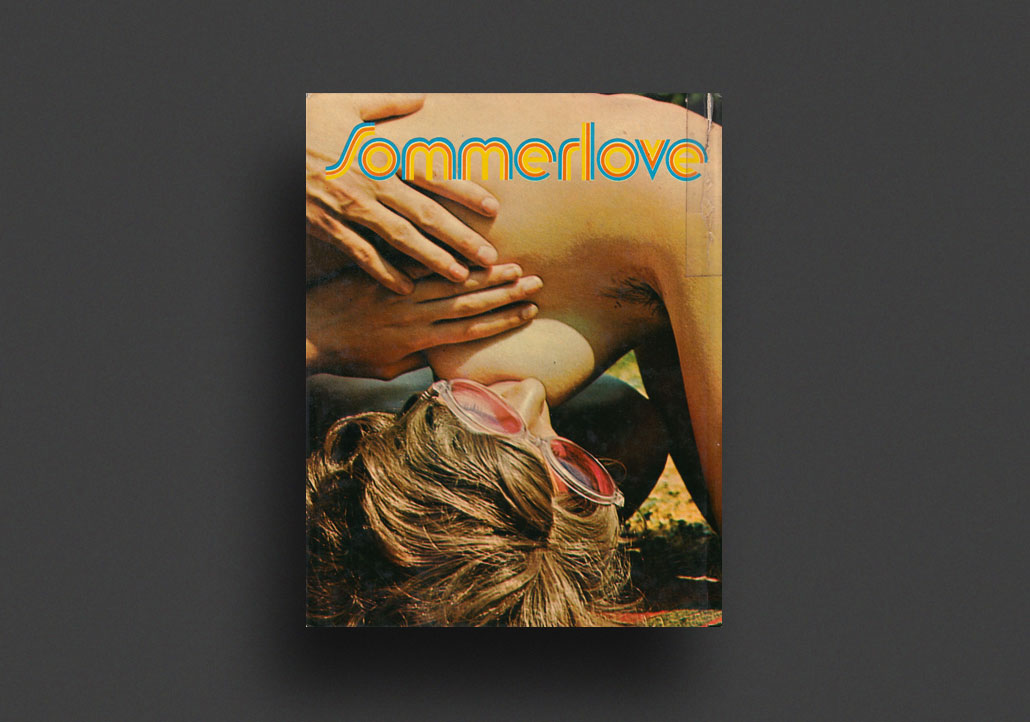
First edition of this 1970 photo book of hippie sex from the German underground press. Housed in illustrated gloss hardcover, Sommerlove is filled with full-bleed lush explicit colour photography of an outdoor gathering without inhibition, all printed on thick paper stock in saturated 1970's colour. Sex in the sun!
Good copy with light edge wear to printed boards and a tape repaired split to the top of spine.