World Food Books' programme is largely produced on Kulin Nation land. We acknowledge the Wurundjeri people of the Kulin Nation as the first and continuing custodians of this land, and pay respect to their Elders past, present, and emerging.
World Food Books is an arts and special interests bookshop in Naarm / Melbourne. Founded in 2010, World Food Books is devoted to the presentation of a rotating, hand-selection of international art, design, literary and counterculture publications with an emphasis on the anti-traditional, the experimental, the avant-garde, the heretic, the marginal.
Presenting new titles alongside rare and out-of-print books, catalogues and journals spanning the fields of modern and contemporary art, design, photography, illustration, film, literature, poetry, cultural theory, philosophy, sexuality, popular and underground culture in its many radical forms, World Food Books wishes to encourage adventurous, thoughtful and open-minded reading, looking, writing, and exchange of publishing and ideas, both current and historical.
As well as our bookshop, located in Melbourne's historical Nicholas Building, all of our inventory is available internationally via our online mail-order service.
World Food Books semi-regularly co-ordinates "Occasions", a programme of exhibits and events at the bookshop and in partnership with other hosts (such as museums and art galleries) that develop out of the activities, relationships and content of the bookshop itself.
World Food Books
The Nicholas Building
37 Swanston Street
Room 5, Level 6
Melbourne 3000
Australia
SHOP HOURS:
Thu–Sat 11–5
WEB-SHOP OPEN 24/7
World Food Books
Postal Address:
PO Box 435
Flinders Lane
Victoria 8009
Australia
Art
Theory / Essay
Architecture / Interior
Graphic Design / Typography
Photography
Fashion
Eros
LGBTQ+
Fiction / Poetry
Weird / Speculative / Science Fiction / Horror
Transgressive / Visceral / Abject
Symbolism / Decadence / Fin de siècle
Film / Video
Painting
Sculpture / Installation
Performance / Dance / Theater
Drawing
Sound / Music
Curatorial
Group Shows / Collections
Periodicals
Out-of-print / Rare
Posters / Ephemera / Discs
Signed Books
World Food Books Gift Voucher
World Food Book Bag
Australian Art
Australian Fiction
Australian Science Fiction / Speculative Fiction
Australian Poetry
Australian Photography
Japanese Photography
Conceptual Art
Minimal Art
Dada
'Pataphysics / Oulipo
Fluxus
Concrete Poetry
Pop Art
Surrealism
Arte Povera
Arte Informale / Haute Pâte / Tachism
Nouveau Réalisme / Zero / Kinetic
Situationism / Lettrism
Collage / Mail Art / Xerox Art
Art Brut / Folk / Visionary / Fantastic
Illustration / Graphic Art / Bandes Dessinées
Furniture
Italian Radical Design / Postmodernism
Textiles
Ceramics / Glass
Counterculture
Protest / Revolt
Philosophy
Psychoanalysis
Anthropology
Anarchism
Socialism / Anarchism / Communism / Capitalism
Literary Theory / Semiotics / Language
Feminism / Women's Studies
Gender Studies / Sexuality
Anthropology
Fetishism / BDSM
Drugs / Psychedelia
Crime / Violence
Animal Rights / Veganism
Occult / Esoterica
Ecology / Earth / Alternative Living
Whole Earth / Crafts
All prices in AUD (Australian dollars)
Pick-Ups
Pick-up orders can be collected in our bookshop during opening hours after order date. Please collect any Pick-up orders within 2 weeks of ordering as we have limited storage space. Orders will be released back into stock if not collected within this time. No refunds can be made for pick-ups left un-collected. If you cannot make it in to the bookshop in this time-frame, please choose postage option.
Return Policy
All sales are final. We do accept returns (for refund or exchange) for items received in error. All our orders are packed with special care using heavy-duty padding and cardboard book-mailers or bubble mailers (for smaller books), using reinforcement where required. We cannot take responsibility for any lost, stolen or damaged parcels.
Insurance
Should you wish to insure your package, please email us directly after placing your order and we can organise this at a small extra expense. Although all standard/express tracked packages are very safe and dependable, we cannot take responsibility for any lost, stolen or damaged parcels. We recommend insurance on valuable orders.
Interested in selling your old books, catalogues, journals, magazines, comics, fanzines, ephemera? We are always looking for interesting, unusual and out-of-print books to buy. We only buy books in our fields of interest and specialty, and that we feel we can resell.
We base these prices on desirability, market value, in-print prices, condition and our current stock levels. We offer cash, store credit, and can take stock on consignment. All
about 25% of the price we expect to get when we sell them, or 30% in store credit. We base these prices on desirability, market value, in-print prices, condition and our current stock levels.
Sell your books any day of the week. You can drop them off and return later. If you have a lot of books, we can visit your Sydney home.
We buy books that we feel we can resell. We offer about 25 % of the price we expect to get when we sell them, or 30% in store credit. We base these prices on desirability, market value, in-print prices, condition and our current stock levels.
Philadelphia Wireman
03 August - 01 September, 2018
World Food Books is proud to announce our next Occasion, the first presentation of sculptures by Philadelphia Wireman in Australia.
The Philadelphia Wireman sculptures were found abandoned in an alley off Philadelphia’s South Street on trash night in 1982. Their discovery in a rapidly-changing neighbourhood undergoing extensive renovation, compounded with the failure of all attempts to locate the artist, suggests that the works may have been discarded after the maker’s death. Dubbed the "Philadelphia Wireman" during the first exhibition of this work, in 1985, the maker’s name, age, ethnicity, and even gender remain uncertain. The entire collection totals approximately 1200 pieces, all intricately bound together with tightly-wound heavy-gauge wire (along with a few small, abstract marker drawings, reminiscent both of Mark Tobey and J.B. Murry). The dense construction of the work, despite a modest range of scale and materials, is singularly obsessive and disciplined in design: a wire armature or exoskeleton firmly binds a bricolage of found objects including plastic, glass, food packaging, umbrella parts, tape, rubber, batteries, pens, leather, reflectors, nuts and bolts, nails, foil, coins, toys, watches, eyeglasses, tools, and jewellery.
Heavy with associations—anthropomorphic, zoomorphic, and socio-cultural responses to wrapped detritus—the totemic sculptures by Philadelphia Wireman have been discussed in the context of work created to fulfil the shamanistic needs of alternative religions in American culture. Curators, collectors, and critics have variously compared certain pieces to sculpture from Classical antiquity, Native American medicine bundles, African-American memory jugs, and African fetish objects. Reflecting the artist’s prolific and incredibly focused scavenging impulse, and despite—or perhaps enhanced by—their anonymity, these enigmatic objects function as urban artefacts and arbiters of power, though their origin and purpose is unknown. Philadelphia Wireman, whatever their identity, possessed an astonishing ability to isolate and communicate the concepts of power and energy through the selection and transformation of ordinary materials. Over the course of the past two decades, this collection has come to be regarded as an important discovery in the field of self-taught art and vernacular art.
Presented in collaboration with Fleisher-Ollman Gallery, Philadelphia, and Robert Heald, Wellington.
Susan Te Kahurangi King
02 February - 10 March, 2018
Susan Te Kahurangi King (24 February 1951 - ) has been a confident and prolific artist since she was a young child, drawing with readily available materials - pencils, ballpoint pens and felt-tip markers, on whatever paper is at hand. Between the ages of four and six Susan slowly ceased verbal communication. Her grandparents William and Myrtle Murphy had developed a special bond with Susan so they took on caring responsibilities for extended periods. Myrtle began informally archiving her work, carefully collecting and storing the drawings and compiling scrapbooks. No drawing was insignificant; every scrap of paper was kept. The King family are now the custodians of a vast collection containing over 7000 individual works, from tiny scraps of paper through to 5 meter long rolls.
The scrapbooks and diaries reveal Myrtle to be a woman of great patience and compassion, seeking to understand a child who was not always behaving as expected. She encouraged Susan to be observant, to explore her environment and absorb all the sights and sounds. Myrtle would show Susan’s drawings to friends and people in her community that she had dealings with, such as shopkeepers and postal workers, but this was not simply a case of a grandmother’s bias. She recognised that Susan had developed a sophisticated and unique visual language and sincerely believed that her art deserved serious attention.
This was an unorthodox attitude for the time. To provide some context, Jean Dubuffet coined the term Art Brut in 1945 to describe work created by self-taught artists – specifically residents of psychiatric institutions and those he considered to be visionaries or eccentrics. In 1972 Roger Cardinal extended this concept by adopting the term Outsider Art to describe work made by non-academically trained artists operating outside of mainstream art networks through choice or circumstance. Susan was born in Te Aroha, New Zealand in 1951, far from the artistic hubs of Paris and London that Dubuffet and Cardinal operated in. That Myrtle fêted Susan as a self-taught artist who deserved to be taken seriously shows how progressive her attitudes were.
Susan’s parents Doug and Dawn were also progressive. Over the years they had consulted numerous health practitioners about Susan’s condition, as the medical establishment could not provide an explanation as to why she had lapsed into silence. Dawn educated herself in the field of homeopathy and went on to treat all twelve of her children using these principles – basing prescriptions on her observations of their physical, mental and emotional state.
Doug was a linguist with an interest in philosophy who devoted what little spare time he had to studying Maori language and culture. To some extent their willingness to explore the fringes of the mainstream made them outsiders too but it was their commitment to living with integrity and their respect for individuality that ensured Susan’s creativity was always encouraged.
Even though Susan’s family supported her artistic pursuits, some staff in schools and hospitals saw it as an impediment to her assimilation into the community and discouraged it in a variety of ways. Her family was not always aware of this and therefore did not fully understand why Susan stopped drawing in the early 1990s. However, rather than dwell on the challenges that Susan faced in pursuit of her artistic practice, they prefer to highlight her achievements. In 2008 Susan began drawing again in earnest, after an almost 20 year interruption, and her work is now shown in galleries around the world.
Susan grew up without television and has been heavily influenced by the comics she read as a child. She is absolutely fearless in the appropriation of recognizable characters, such as Donald Duck and Mickey Mouse, in her work. She twists their limbs, contorts their faces, compresses them together, blends them into complex patterned backgrounds - always imbuing them with an incredible energy. Although Susan often used pop culture characters in her work they are not naive or childlike. These are drawings by a brilliant self-taught artist who has been creating exceptional work for decades without an audience in mind.
Mladen Stilinović
"Various Works 1986 - 1999"
02 February 16 - September 10, 2016
Various works 1986 - 1999, from two houses, from the collections of John Nixon, Sue Cramer, Kerrie Poliness, Peter Haffenden and Phoebe Haffenden.
Including: Geometry of Cakes (various shelves), 1993; Poor People’s Law (black and white plate), 1993; White Absence (glasses, ruler, set square, silver spoon, silver ladel with skin photograph and wooden cubes), 1990-1996; Exploitation of the Dead (grey and red star painting, wooden painting, black spoon with red table, red plate), 1984-1990; Money and Zeros (zero tie, paintings made for friends in Australia (Sue, John, Kerrie), numbers painting), 1991-1992; Words - Slogans (various t-shirts) - “they talk about the death of art...help! someone is trying to kill me”, “my sweet little lamb”, “work is a disease - Karl Marx”; Various artist books, catalogues, monographs, videos; Poster from exhibition Insulting Anarchy; "Circular" Croatian - Australian edition; Artist book by Vlado Martek (Dostoyevsky); more.
Thanks to Mladen Stilinović and Branka Stipančić.
Jonathan Walker
Always Will Need To Wear Winter Shirt Blue + Ochre Small Check Pattern
21 August - 21 September, 2015
Untitled
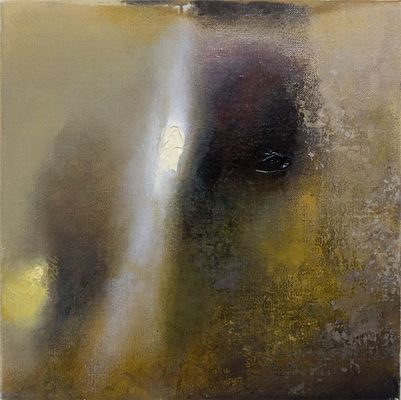
I am not a great reader of poetry but I always return to the work of Melbourne poet, Vincent Buckley (1925- 1988). Perhaps I find his most tantalising piece to be not a finished poem but a fragment left on a scrap of paper discovered on his desk after the poet’s death.
The poetry gathers like oil
In the word-core, and spreads
It has its music meet,
Its music is in movement.
This fragment is more the shell left behind from a volatile thought than a finished poem. I find the last two lines honest but awkward whereas the first two lines work like an arrow. Most likely he could not find a resolution so it was left. Still, in its present form, it remains an eloquent testimony to the ultimate failure of a medium to express mobile thought and sensation, in Buckley’s case, through verbal language. It’s an important matter because this is something all artists have to deal with regardless of the medium.
I have never written a poem, however, I am forever copying fragments from books on paper scraps in a vain effort to fix certain notions in my head. At first, they function as bookmarks that are sometimes returned to when I open the book. But before long, as they accumulate, they fall out littering the table interspersed with A4 photocopies, bills, books and medications.
To return to Buckley’s fragment, the first two lines very much evoke how I paint nowadays. As you age, detail diminishes and patches of light become more luminous and float. I feel the most honest way of dealing with this is by smearing the oil paint on the canvas with the fingers and working close-up, blind. Only if the patches coalesce into an approaching image can the work gain a life.
-
Jonathan Walker was born in Melbourne, Australia and brought up on a dairy farm in Gippsland. In the 1970’s he studied painting at RMIT and won the Harold Wright Scholarship to the British Museum, London. During the 1980’s he exhibited at Pinacotheca Gallery, Richmond and had work shown at the NGV and Heidi City Art Gallery. Over the same period he designed the cover for the “Epigenesi” LP by Giancarlo Toniutti, Italy and conducted a mail exchange work with Achim Wollscheid, Germany. The work with artists through the post resulted in an article published in the bicentenary issue of Art and Australia 1988. He showed in artist run spaces such as WestSpace in the 90’s and 2000’s, and until 2012, taught painting at Victoria University, which is where we (Colleen Ahern and Lisa Radford) as organisers of the exhibition, among many others, had the privilege of being his student.
Walker’s knowledge was imparted to students through the careful selection of music, literature, and artists found in books that he himself had ordered for the library. Walker’s strategy was the generosity of sharing his vast knowledge with references specific to each student and their context.
Walker’s paintings share a similar focus and intimacy.
This exhibition presents a small selection of recent paintings alongside a publication that includes Walker’s writing. Observational and analytical, Walker’s work is a type of material notation — the time of day, colour and how it is blended, the both specific and fleeting location of a reflection on lino or the question of whether a chair leg should be included in a painting.
Please join us on Friday August 21 between 6-8pm to celebrate the opening of the exhibition.
Curated by Colleen Ahern and Lisa Radford.
B. Wurtz
Curated by Nic Tammens
March 26 - April 4, 2015
B.Wurtz works from a basement studio in his home on Manhattan’s Lower East Side.
This local fact is attested to by the plastic shopping bags and newsprint circulars that appear in his work. As formal objects, they don’t make loud claims about their origins but nonetheless transmit street addresses and places of business from the bottom of this long thin island. Like plenty of artists, Wurtz is affected by what is local and what is consumed. His work is underpinned by this ethic. It often speaks from a neighborhood or reads like the contents of a hamper:
“BLACK PLUMS $1.29 lb.”
“Food Bazaar”
“USDA Whole Pork Shoulder Picnic 99c lb.”
“RITE AID Pharmacy, with us it’s personal.”
“H. Brickman & Sons.”
“Sweet Yams 59c lb."
Most of the work in this exhibition was made while the artist was in residence at Dieu Donne, a workshop dedicated to paper craft in Midtown. Here Wurtz fabricated assemblages with paper and objects that are relatively lightweight, with the intention that they would be easily transportable to Australia. This consideration isn’t absolute in Wurtz’s work, but was prescriptive for making the current exhibition light and cheap. Packed in two boxes, these works were sent from a USPS post office on the Lower East Side and delivered to North Melbourne by Australia Post.
Wurtz appears courtesy of Metro Pictures, New York.
Thanks to Rob Halverson, Joshua Petherick, Sari de Mallory, Matt Hinkley, Helen Johnson, Fayen d'Evie, Ask Kilmartin, Lisa Radon, Ellena Savage, Yale Union, and "Elizabeth".
John Nixon
"Archive"
December 15 - January 20, 2014
The presentation of John Nixon's archive offered a rare showcase of this extensive collection of the artist's own publications, catalogues, posters, ephemera, editions and more, from the mid 1980s onwards, alongside a selection of his artworks.
Organized by John Nixon, Joshua Petherick and Matt Hinkley.
"Habitat"
at Minerva, Sydney (organised by Joshua Petherick and Matt Hinkley)
November 15 - December 20, 2014
Lupo Borgonovo, Janet Burchill & Jennifer McCamley,
Lewis Fidock, HR Giger, Piero Gilardi, Veit Laurent Kurz,
Cinzia Ruggeri, Michael E. Smith, Lucie Stahl, Daniel Weil, Wols
Press Release:
“...It contained seven objects. The slender fluted bone, surely formed for flight, surely from the wing of some large bird. Three archaic circuitboards, faced with mazes of gold. A smooth white sphere of baked clay. An age-blackened fragment of lace. A fingerlength segment of what she assumed was bone from a human wrist, grayish white, inset smoothly with the silicon shaft of a small instrument that must once have ridden flush with the surface of the skin - but the thing’s face was seared and blackened.”
William Gibson, “Count Zero”, 1986
"Autumn Projects Archive"
Curated by Liza Vasiliou
March 6 - March 15, 2014
World Food Books, in conjunction with the Virgin Australia Melbourne Fashion Festival 2014, presented the Autumn Projects archive, consisting of a selection of early examples in Australian fashion with a particular interest in collecting designers and labels from the period beginning in the 1980’s, who significantly influenced the discourse of Australian Fashion.
Curated by Liza Vasiliou, the exhibition provided a unique opportunity to view pieces by designers Anthea Crawford, Barbara Vandenberg, Geoff Liddell and labels CR Australia, Covers, Jag along with early experimental collage pieces by Prue Acton and Sally Browne’s ‘Fragments’ collection, suspended throughout the functioning World Food Books shop in Melbourne.
H.B. Peace
presented by CENTRE FOR STYLE
November 14, 2013
"Hey Blinky, you say chic, I say same"
Anon 2013
H.B. Peace is a clothing collaboration between great friends Blake Barns and Hugh Egan Westland. Their pieces explore the divergences between 'character’ and ‘personality’ in garments....etc
Special Thanks to Joshua Petherick and Matt Hinkley of WFB and Gillian Mears
and a Very Special Thank you to Audrey Thomas Hayes for her shoe collaboration.
Janet Burchill & Jennifer McCamley
"Aesthetic Suicide"
May 10 - June 8, 2013
The first of our occasional exhibitions in the World Food Books office/shop space in Melbourne, "Aesthetic Suicide" presented a body of new and older works together by artists Janet Burchill & Jennifer McCamley, including videos, prints, a wall work, and publications.
During shop open hours videos played every hour, on the hour.
2013, English
Hardcover, 240 pages, 23.2 x 30 cm
1st Edition, Out of print title / used / very good
Published by
Prestel / Munich
$500.00 - In stock -
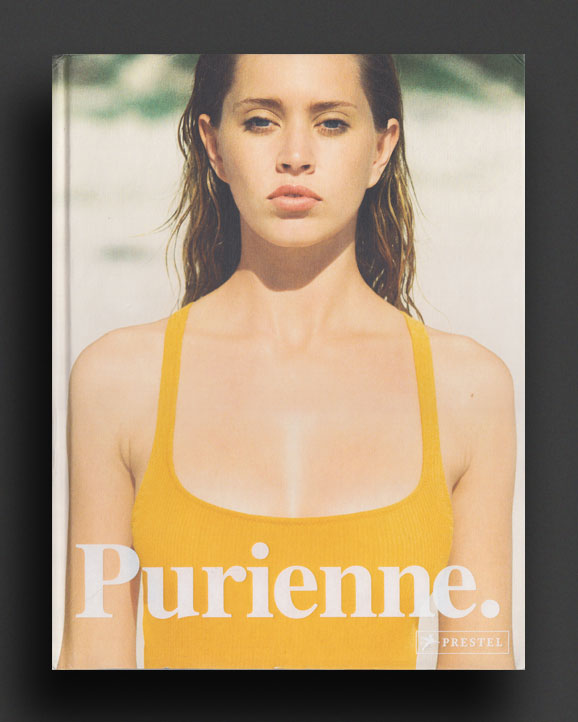
Very collectible first hardcover edition of the first book of photography by Henrik Purienne, published in 2013 and immediately out-of-print.
"Voyeuristic, sun-drenched, and natural, the photographs of fashion photographer Henrik Purienne convey a sexuality that's as nostalgic as it is au courant, at once tender and sultry." Fronted by friend and model Sonja van den Heever, his first book presents a hand-selection of over 200 pages of photographs. Shot mostly in his trademark grainy 35mm film, Purienne's soft-hued and ingeniously lit images often include scratches and other imperfections that belie the sophistication of his technique, evoking the joys of life and the natural beauty of his subject "[...] with unmade faces, hair unruly and clothing, if any, unfussy [...]" in her truest form. Featured across the pages of Lui, Purple, Playboy, and Vogue, and in campaigns for Maison Margiela and Louis Vuitton, "Purienne's images afford us immeasurable scope for desire. [...] We can see and feel the heat through his images."—Tess Martin, Krass Journal No.1
Very Good copy, interior As New, cover with bumping to top of spine and light bump to top corner, none affecting interior pages as heavy boards are overhung.
2006, English
Hardcover (debossed faux leather bound + 7"), 26 x 23 cm
600 numbered copies,
1st Edition, Out of print title / used / fine
Published by
Hysteric Glamour / Tokyo
$120.00 - In stock -
Published in 2006 by fashion brand Hysteric Glamor in a numbered edition of 600 copies, bound in padded debossed faux leather hardcover with a 7" record, "the book is a monograph of my late 1970s photographs of my friends, the avant-garde rock group Destroy All Monsters."—Sue Rynski, Detroit photographer. Described by legendary critic Lester Bangs as "anti-rock", Destroy All Monsters was an influential Detroit rock band formed in 1973 by University of Michigan art students Mike Kelley, Jim Shaw, legendary femme fatale Niagara, and filmmaker Cary Loren, existing to 1985 with shifting personnel and sporadic performances since. Performing their first concert at a comic book convention in Ann Arbor, Michigan, on New Year's Eve of 1973, the group combined elements of punk, psych, metal and noise rock with a heavy dose of experimentation and performance art, influenced as much by ESP-Disk, Sun Ra and The Velvets, as monster movies and Futurism. The cult group earned a measure of notoriety through their coveted DAM Magazine, also due to members of The Stooges and MC5 joining the band, and Sonic Youth singer/guitarist Thurston Moore compiling a three compact disc set of the group's music in 1994.
"Born in 1954, year of the birth of rock and roll, I grew up immersed in the high energy music of my hometown Detroit. This loud, physical, emotional music took hold and became a part of me."—Sue Rynski
A stunning book published by Hysteric Glamor director Nobuhiko Kitamura, with editorial direction by : Osamu Wataya, Michitaka Ota (Sokyusha), and Koichi Hara. 7" includes the tracks "Rocking the Cradle" and "Little Boyfriend" by Destroy All Monsters.
Near Fine copy.
1985, Japanese
Softcover, 260 pages, 19 x 13 cm
1st Edition, Out of print title / used / fine
Published by
Data House / Tokyo
$200.00 - Out of stock
Possibly the most fun you can cram into 260-odd pages! A now very collectible volume edited by none other than Japanese master of erotic superrealism, Hajime Sorayama, Pink Department Store is a wild book digest of visual sex — straight out of 1985! A compendium of remarkable erotic imagery packed into this one-stop look-book of kink compiled by Sorayama, all reproduced in full-colour on beautiful warm raw paper stock, designed by Hisao Iguchi. From the Tokyo sex clubs, phone-booths and toilet stalls, Shibari photography to pink film posters, x-rated manga to wildlife fornication, leather daddys to dominatrixes, Pink Department Store is a safari through graphic perversion and joyous visual innuendo. Alongside archival material and international works the book generously features an abundance of works by over 100 contemporary Japanese illustrators and photographers, including Aimei Ozaki, Harumi Yamaguchi, Takashi Nemoto, Yosuke Onishi, Suehiro Maruo, Hajime Sorayama, Mizumaru Anzai, Yokoyama Akira, Keiichi Ota, Akira Ishigaki, Kaoru Ueda, Teruhiko Yumura, Yoshiharu Ebisu, Arata Taga, to name but a few. There is also a directory list to contact them all!
Very Good—NF copy in VG original dust jacket and rarely preserved publisher's obi-strip.
1984, English
Hardcover (w. dust jacket), 142 pages, 26 x 36 cm
1st Edition, Out of print title / used / very good
Published by
James Fraser / Sydney
$250.00 - In stock -
Rare first 1984 hardcover edition of one of the greatest Australian photo-books, William Yang's "Sydney Diary."
Absolutely stunning large-format book of Yang's photography from the late 1970s-early 1980s, documenting the Sydney party scene, gay community, and general Australian cultural atmosphere of the period, from the beach to the runway to the disco via the further reaches of sex, drugs (including the incredible "poppers" spread), celebrity and political demonstration. It is a collection of "friendships lost and found, fragile landscapes, modern icons, images of the incessant pursuit of pleasure, of innocence and experience, ecstasy and desire. In the many ways of looking at this work some will find only sensation, a lurid catalogue from a provincial paparazzi. Certainly it has an appeal to the sensations, a visceral power. But to me this book represents much more. It is a unique exploration of the human spirit, a confession from a guilty romantic, a solitary journey through the land of the dispossessed." - Jim Sharman (Introduction)
William Yang (b. 1943, Mareeba, Queensland. Lives and works Sydney, New South Wales) is principally known as a photographer exploring issues of cultural and sexual identity, integrating this practice with writing, performance and film. Starting out as a playwright, Yang turned to photographing parties and social events as a way of making money. His 1977 exhibition, Sydneyphiles, and 1984 book Sydney Diary, recorded the emergent gay community and Sydney party scene of the 1970s and 1980s. In the 1980s, Yang began to explore his Chinese heritage, and his photographic themes expanded to include landscapes and the Chinese in Australia. Yang began performing monologues with slide projections in theatres in 1989, integrating his skills as a writer and a visual artist. These slide shows were recognised as a unique form of performance theatre and have since become his preferred way of showing his work. Yang has toured Australia and the world with shows such as Sadness, Friends of Dorothy, The North, Blood Links and Shadows.
Very Good copy of the now very rare Australian photo-book, in original illustrated dust jacket (VG, with some tanning).
2023, English
Hardcover (debossed boards w. buckrum spine with cover photo-plate), 160 pages, 20 x 16 cm
2nd Ed.,
Out of print title / as new
Published by
IDEA / London
$140.00 - Out of stock
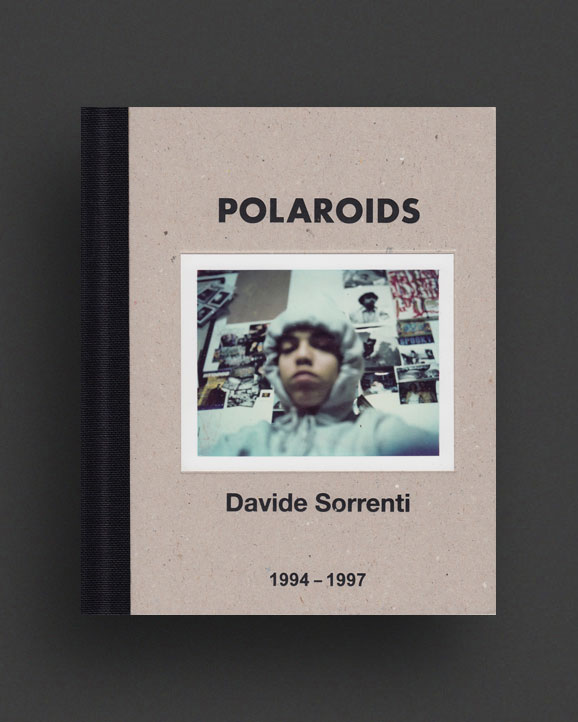
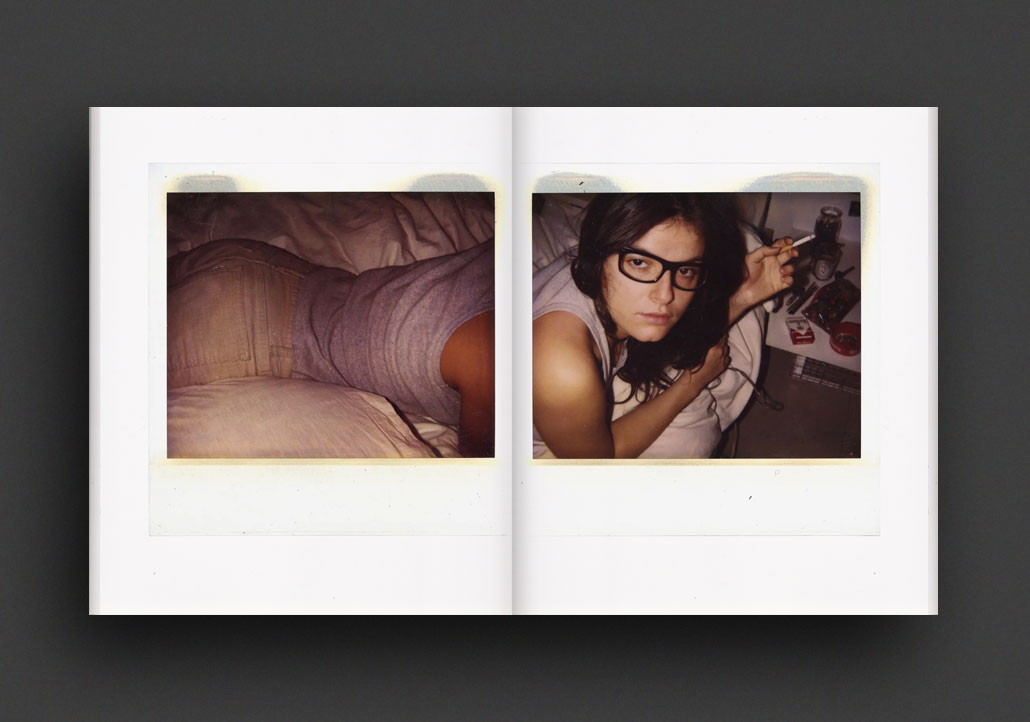
Talented and influential photographer Davide Sorrenti tragically died in 1997 at the age of just twenty leaving behind him a rich archive documenting nineties downtown New York through his extraordinary photographs, scrapbooks, graffiti drawings, tear sheets and contact sheets. Polaroids 1994-1997 is a book of instantly unforgettable Polaroid photographs taken by Davide Sorrenti between the years of 1994–1997, designed and edited by Francesca Sorrenti.
"Almost 25 years have gone by since his passing and still the love for his persona and his work lives on. While locked down this year, I was looking at his Polaroids and reminiscing about a lifetime gone. I realized that a collection of these moments should be the next book. The second book to uncover the archive of this young man, my son, who produced all these Polaroids, photographs – and the diaries and fashion work – in such a short period of time." (Francesca Sorrenti).
Raw-cut Eskaboard hardback with black buckram spine and debossed print.
As New copy of 2nd edition (1000 copies). All editions out-of-print.
2023, English / German
Hardcover, 240 pages, 35 x 26 cm
Published by
Scheidegger und Spiess / Zürich
$190.00 - Out of stock
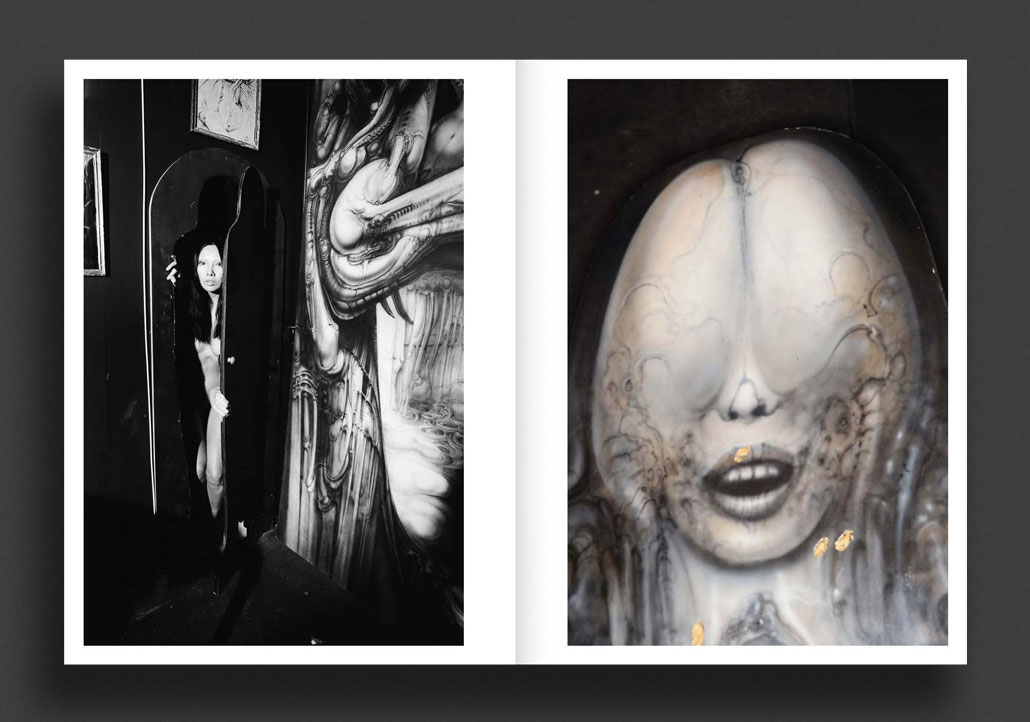
A unique visual foray into the fantastic worlds of artist H.R. Giger.
The art of H.R. Giger (1940-2014), Swiss-born creator of the legendary monster in Ridley Scott's movie Alien, is currently experiencing a renaissance and is featured in exhibitions as well as in magazines around the globe. This lavish large-format volume offers never-before-seen insights into Giger's private house and garden, both of which are populated by biomechanical sculptures, airbrush paintings, Alien furniture, objects, prints, and self-portraits. French photographer Camille Vivier—best known for her work for Stella McCartney and Cartier—enjoyed exclusive access to the artist's Zurich home and studio for this book, where she worked on her own as well as with models in a series of photo sessions.
Vivier's around 200 photographs form an atmospheric tribute to the arguably most distinguished representative of Fantastic Realism. In addition to images of Giger's studio and his life-size sculptures, Vivier has also documented some hundred objects and artworks, as well as his famous Alien-style garden railroad.
An essay by French publicist Farbrice Paineu places H.R. Giger's art in the wider context of pop culture and the genre of horror movies.
Edited by Beda Achermann.
Text in English and German.
1956, German
Hardcover (clothbound), 126 pages, 28.5 x 21 cm
1st Edition, Out of print title / used / average
Published by
Bertelsmann / Stuttgart
$15.00 - In stock -
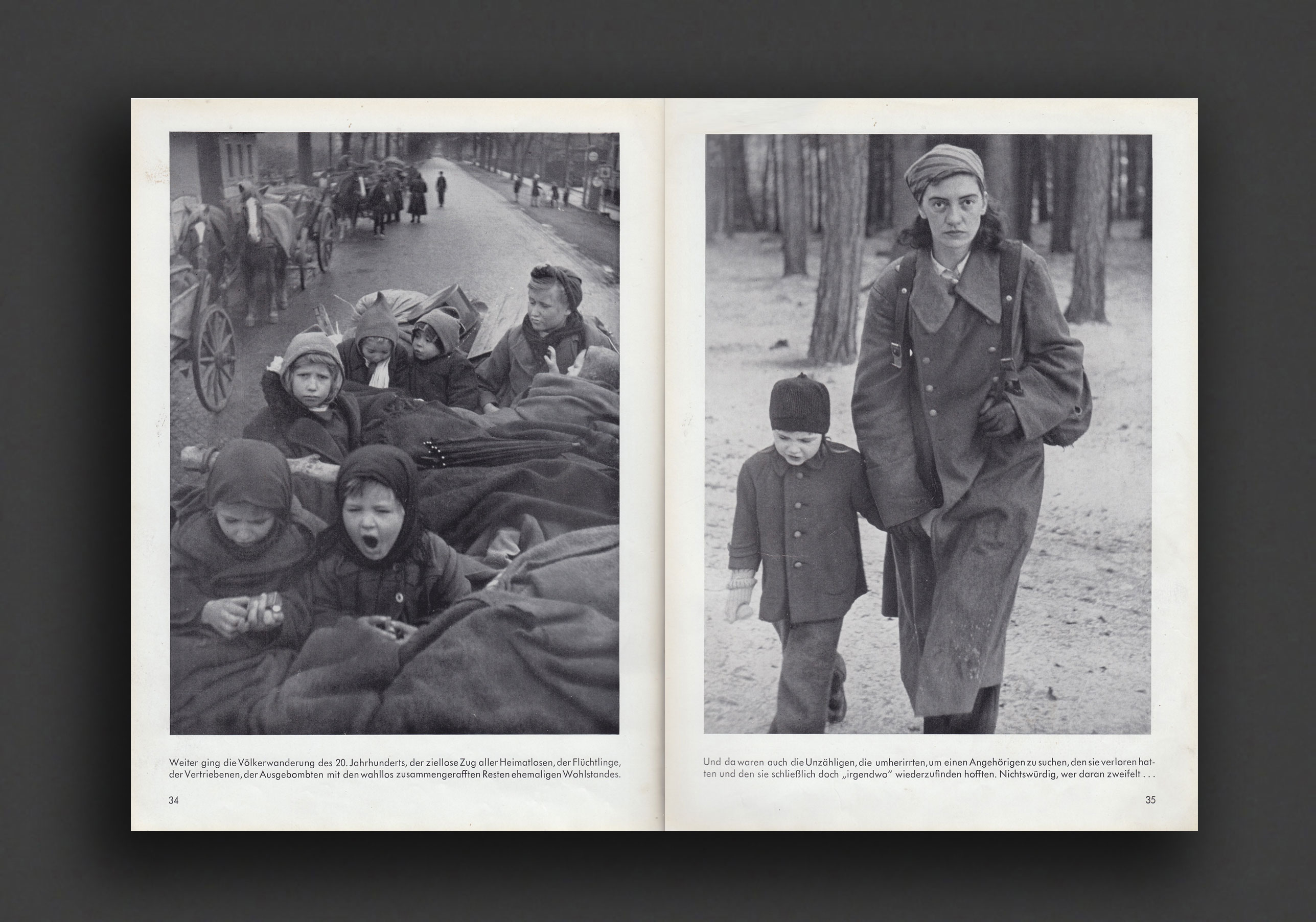
First 1956 hardcover edition of this photo book by German journalist, photographer and initiator of the Red Cross child search operation after the Second World War, Hilmar Pabel (1910-2000). Photos and text of the Second World War and the devastation from the German point of view, with German refugees after the War and returning soldiers and images from the Nazi regime. Despite his involvement in the propaganda of the National Socialist movement, Pabel can be considered one of the most important German representatives of humanistic and enlightened press photography.
Average copy lacking dust jacket, dusty/lightly marked cloth, some creasing, wear to book.
1999, English
Softcover, unpaginated, 28 x 21 cm
1st Edition, Out of print title / used / very good
Published by
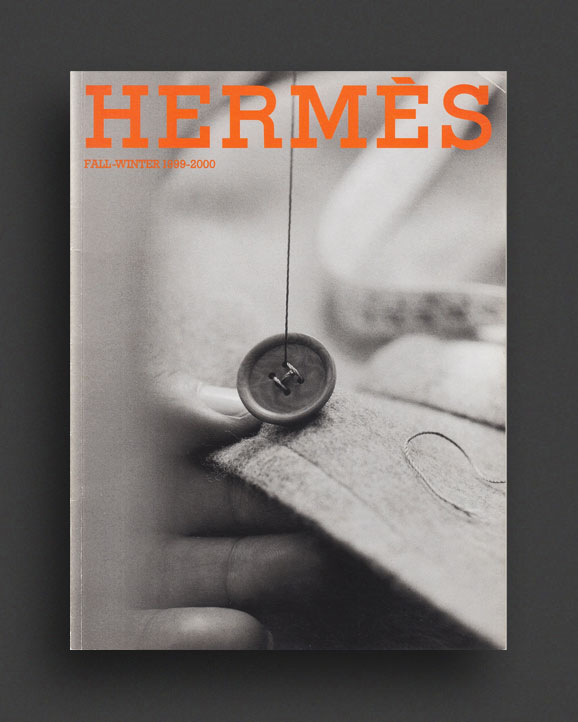
Hermès / Paris
$150.00 - Out of stock
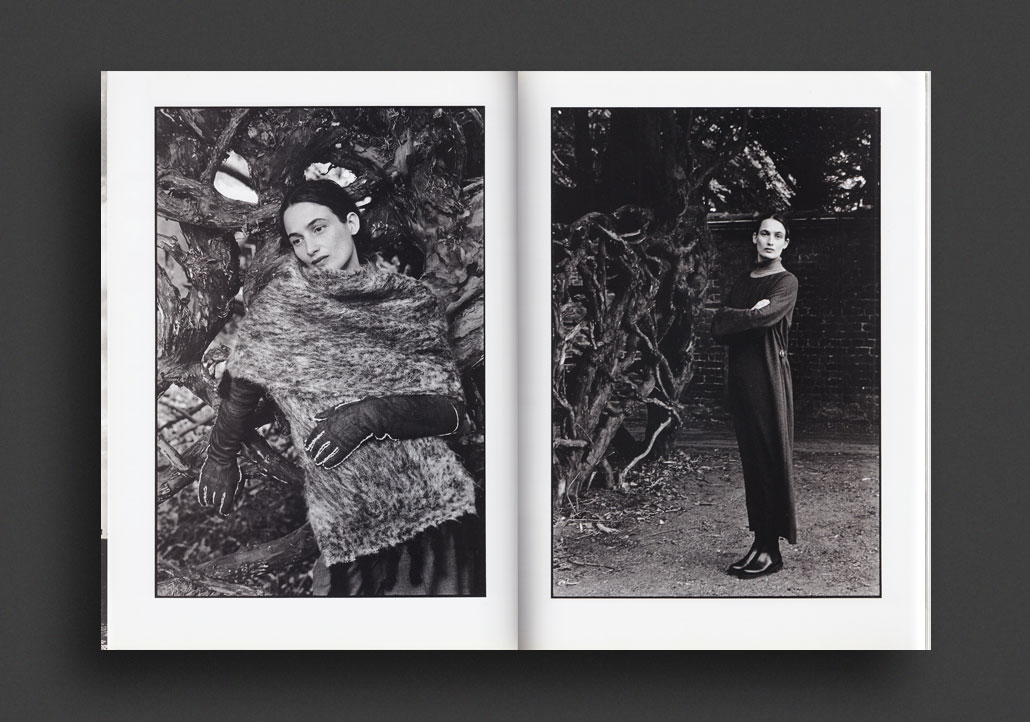
Very rare English edition of the iconic in-house magazine of the French fashion house, Hermès, highlighting the Fall-Winter 1999-2000 collection designed by Martin Margiela. This very special early MM/Hermès photo collection is comprised of portraits of women in Hermès photographed by Mark Borthwick, Joanna Van Mulder, Tim Richmond, Luc Perenom, and others.
Very Good copy with light corner creases.
1998, Japanese
Softcover (staple bound), 80 pages, 26 x 18.5 cm
1st Edition, Out of print title / used / good
Published by
Street Editorial Office / Tokyo
$90.00 - Out of stock
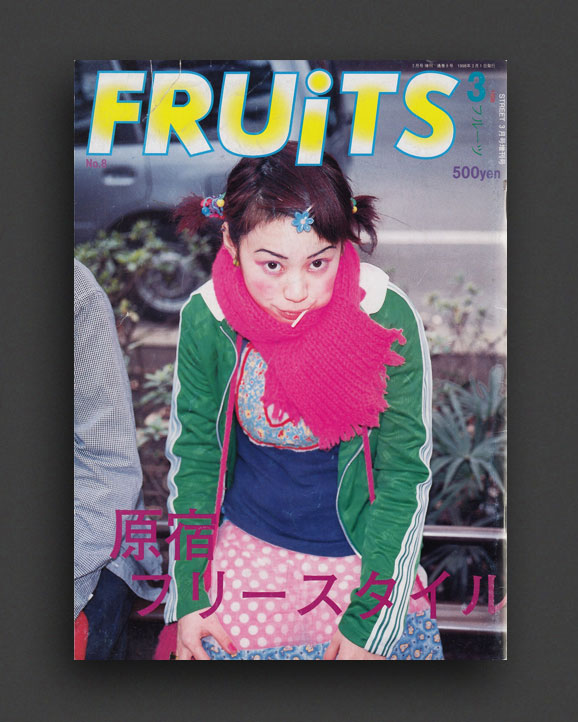
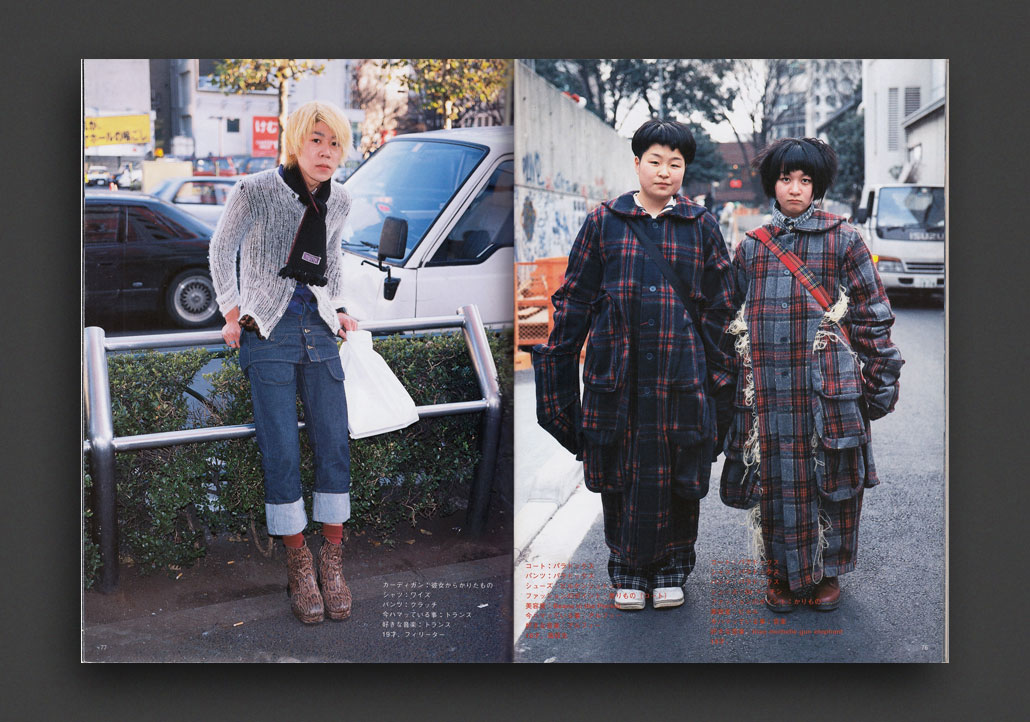
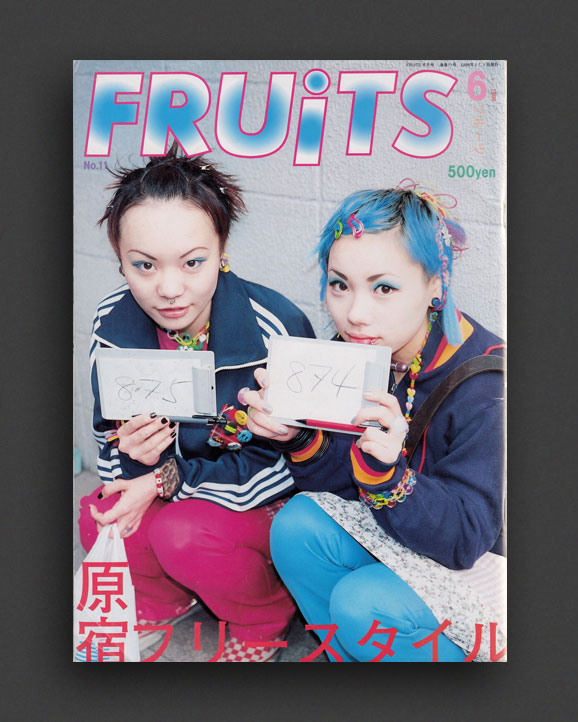
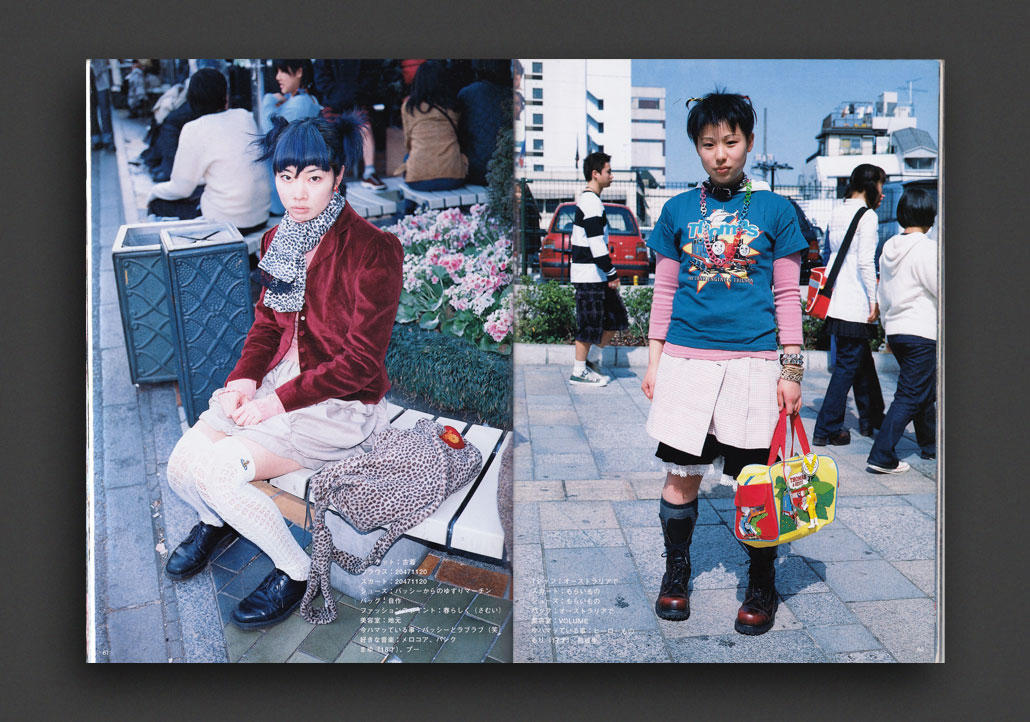
Rare very early issue of FRUiTS, the Legendary Japanese Street Style Magazine. Founded in 1997 by photographer and publisher of STREET magazine, Shoichi Aoki, the photographer spent two decades documenting Tokyo’s cool kids and the constantly evolving experimental styles that blossomed on the curbs of the youthful Harajuku district, until after 20 years and 233 issues Aoki ceased publication, declaring there were “no more fashionable kids to photograph”. Harajuku is now a moribund, globalised shadow of the parade of self-expression it once was, and FRUiTS has become an even more essential time-capsule of a cultural phenomenon like no other. Made up entirely of full-bleed photographs by Aoki exclusively documenting the kaleidoscope of playful and devoted fashions of the Harajuku girls, and guys, each issue of FRUiTS was the antithesis of high fashion luxury. The magazine primarily focused on individual styles found outside the fashion-industry mainstream, as well as subcultures specific to Japan, such as lolita and ganguro, and local interpretations of larger subcultures like punk, rave and goth. Made for the local market only, FRUiTS became a treasure in the West and an enormous influence on alternative culture the world over. Like Aoki's STREET, FRUiTS has become an essential style goldmine, creating a immensely valuable photographic document of the times like no other magazine of our times.
Good copy with some edge wear and a closed tear to cover/masthead.
1998, Japanese
Softcover (staple bound), 80 pages, 26 x 18.5 cm
1st Edition, Out of print title / used / good
Published by
Street Editorial Office / Tokyo
$90.00 - Out of stock
Rare very early issue of FRUiTS, the Legendary Japanese Street Style Magazine. Founded in 1997 by photographer and publisher of STREET magazine, Shoichi Aoki, the photographer spent two decades documenting Tokyo’s cool kids and the constantly evolving experimental styles that blossomed on the curbs of the youthful Harajuku district, until after 20 years and 233 issues Aoki ceased publication, declaring there were “no more fashionable kids to photograph”. Harajuku is now a moribund, globalised shadow of the parade of self-expression it once was, and FRUiTS has become an even more essential time-capsule of a cultural phenomenon like no other. Made up entirely of full-bleed photographs by Aoki exclusively documenting the kaleidoscope of playful and devoted fashions of the Harajuku girls, and guys, each issue of FRUiTS was the antithesis of high fashion luxury. The magazine primarily focused on individual styles found outside the fashion-industry mainstream, as well as subcultures specific to Japan, such as lolita and ganguro, and local interpretations of larger subcultures like punk, rave and goth. Made for the local market only, FRUiTS became a treasure in the West and an enormous influence on alternative culture the world over. Like Aoki's STREET, FRUiTS has become an essential style goldmine, creating a immensely valuable photographic document of the times like no other magazine of our times.
Good copy with some edge wear.
1994, English
Hardcover, 72 page,s 20.5 x 16.5 cm
1st Edition, Out of print title / used / very good
Published by
Art Gallery of New South Wales / Sydney
$18.00 - In stock -
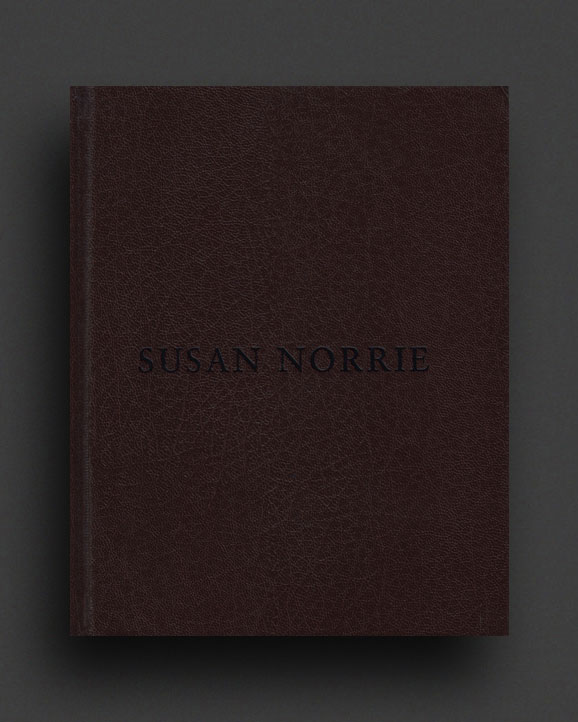
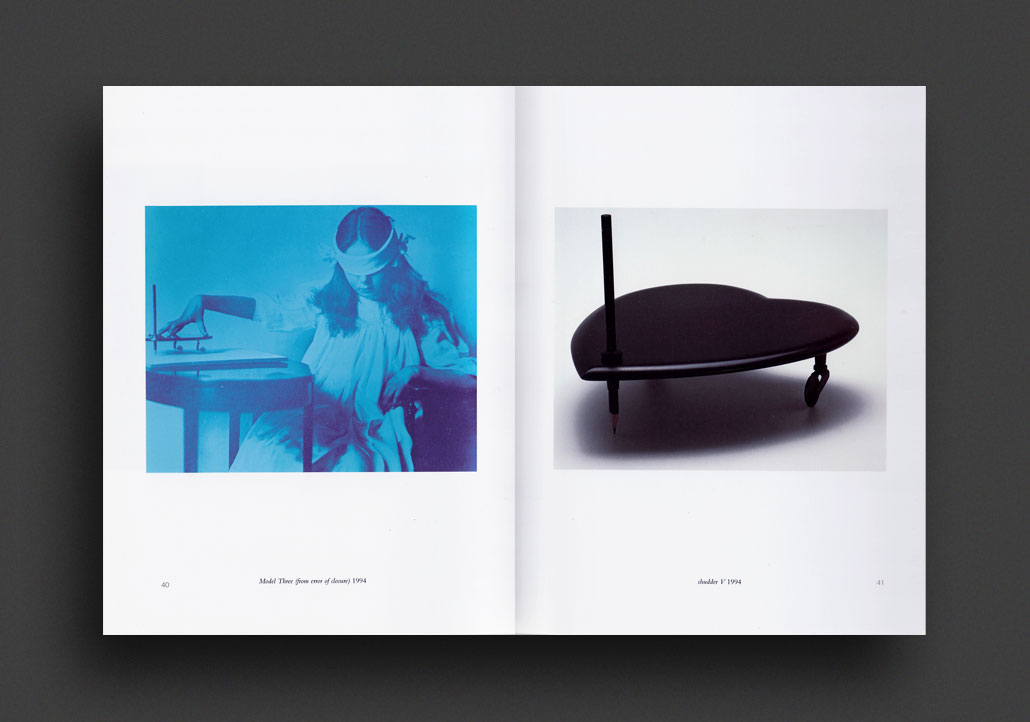
Hardcover catalogue published on the occasion of the exhibition of Susan Norrie at the Art Gallery of New South Wales, 1994, profusely illustrated with accompanying texts by Victoria Lynn, Gregory Burke, Ingrid Periz. Includes chronology, catalogue.
Susan Norrie (b. 1953) is Sydney-based artist who has developed a practice which utilises art, documentary and film genres. Her projects are concerned with the environment, human rights and survival. In 2007 she represented Australia at the 52nd Venice Biennale.
Very Good copy, light cover wear.
1980, Japanese
Softcover (staple-bound), 36.5 x 25.5 cm
1st Edition, Out of print title / used / very good
Published by
Ryuko Tsushin / Japan
$80.00 - Out of stock
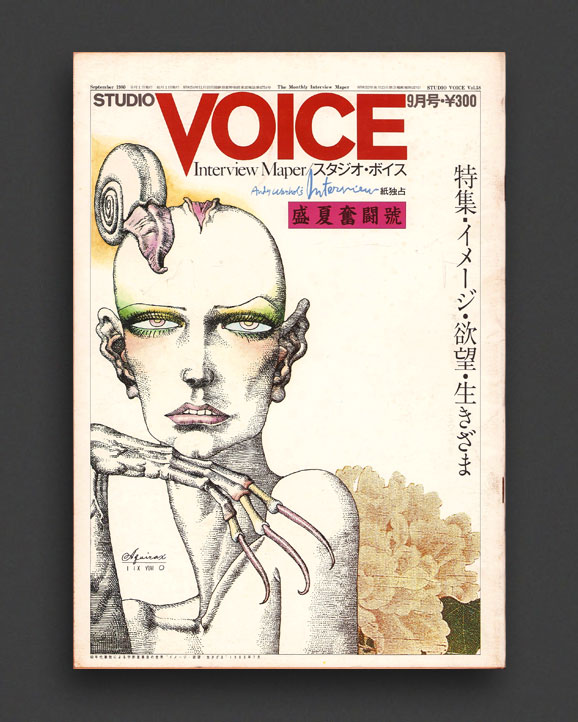
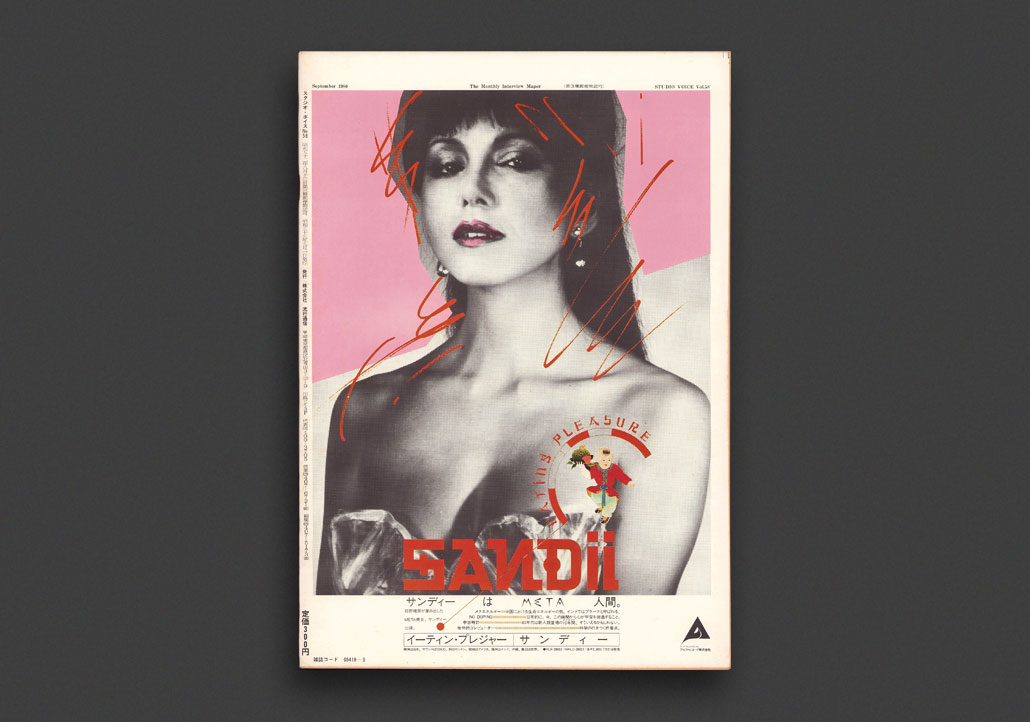
Wonderful early issue of Japan's Studio Voice magazine, with original cover artwork by Aquirax Uno, published in 1980 in the early over-sized, tabloid format established by Andy Warhol's Interview magazine. When it was first launched in 1976, Studio Voice was the Japanese edition of Warhol's Interview, bridging New York and Tokyo culture. The arts, music, fashion, photography, film, literature, model news, style news, reviews... The Japanese Interview, say no more!
Very Good copy, some cover/spine wear.
1970, French
Softcover, 166 pages, 14 x 21 cm
1st Edition, Out of print title / used / very good
Published by
André Balland / Paris
$180.00 - Out of stock
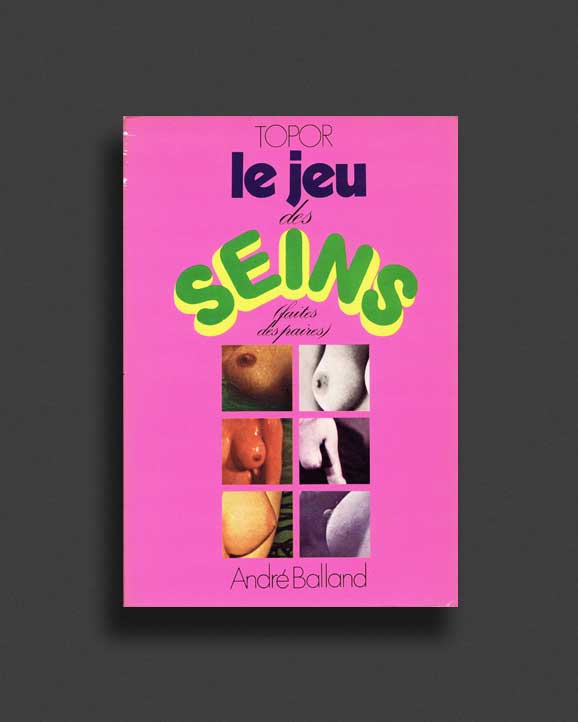
"One and one make two, but two breasts, side by side, do not necessarily make a chest.
The game consists of reuniting the 480 twins Topor has sadistically scattered throughout this book, and then, in each small square below the printed figure, enter the number of the breast that you believe to be its companion, then ... to go check at the end of the volume the correctness of your solution.
If you have friends, it's better to write with a pencil. You can erase.
But, how do we know if we have friends?"
First edition of this scarce artist book by Roland Topor, published in Paris in 1970 by André Balland. Topor's titillating absurdist conceptual photo-book/game is a fine and curiously unusual example of his perverse humour and more absurdist Fluxus leanings. A fantastic book only ever printed in this one edition. 480 colour illustrations.
Roland Topor was one of the most unique and versatile French artists of the second half of the 20th century, working prolifically as a provocative and spirited illustrator, author, humorist, satirist, play-write, actor, poet, painter, performer, sculptor, and much more. Son of a Parisian painter and sculptor of Polish-Jewish descent, in 1941, Topor's father was arrested and sent to camp Pithiviers. Two years later, the family moved to Savoy, where they baptised their son to hide his real identity. After the war, he studied art at the Institute of Beaux-Arts in Paris. He discovered surrealism, Hieronymus Bosch and the scatological plays of Alfred Jarry, which would influence his work and his attitude to life in general.
In 1958, he published his first work in magazines such as Bizarre and later Elle. Three years later, he joined the anarchic group of artists who created the controversial magazine Hara-Kiri, publishing his surreal juxtapositions of people, animals, plants and objects. Topor seldom used words in his illustrations, leaving all power to the visual. In February 1962, Topor, Alejandro Jodorowsky, Olivier O. Olivier, Jacques Sternberg, Christian Zeimert, Abel Ogier and Fernando Arrabal founded the "Mouvement Panique" ("Panic Movement"). This collective focused on creating absurd and bewildering performances to reject the commercialization of surrealism. The founders created many provocative and surreal works in the next decade before Jodorowsky dissolved the movement in 1973. However, Topor continued making scandalous plays afterwards, including 'Le Bébé de Monsieur Laurent' (1975) and 'Vinci avait raison' (1976).
In print, Topor's history is legendary. In 1964 Topor published his debut novel 'Le Locataire Chimérique' ('The Tenant', 1964), a psychological horror story about a man moving in an apartment where he is gradually pestered into madness by the other inhabitants. The work was adapted to film in 1976 by Roman Polanski and both the book as well as the picture are cult classics to this day. His 1980s pamphlet '100 Bonnes Raisons Pour Me Suicider' ('100 Good Reasons To Commit Suicide') is another example of his taste for black comedy. The most unique and unusual book in Topor's oeuvre must be 'Souvenir' (1972), a kind-of Fluxus obscurity featuring a text with all the sentences scratched out to the point of being unreadable. When the artist was interviewed on Dutch television by Adriaan van Dis to read some extracts from it Topor accepted the request by holding his hand in front of his mouth and mumble through it. In 1966 Topor illustrated 'Topographie Anécdotée du Hasard' (Anecdoted Topography of Chance) by Swiss assemblage artist Daniel Spoerri. Following a rambling conversation with his friend Robert Filliou in 1961, Daniel Spoerri one day mapped the objects lying at random on the table in his room, adding a rigorously scientific description of each. These objects subsequently evoked associations, memories and anecdotes from both the original author and his friends Filliou, Emmett Williams, Dieter Roth and Roland Topor. Considered a "quasi-autobiographical tour de force", incredible book was published in 1966 by the Something Else Press in New York City. Topor added sketches of each object. Acknowledged as one of the most important and entertaining artists’ books of the postwar period, An Anecdoted Topography of Chance is a unique collaborative work by four artists associated with the Fluxus and Nouveau Réalisme movements.
Topor also had an interest in film. He designed the posters of movies such as 'L'Ibis Rouge' (1975), 'Ai no borei' ('The Empire of Passion', 1978) and 'Die Blechtrommel' ('The Tin Drum', 1979). His drawings can also be seen during the opening titles of Fernando Arrabal's experimental film 'Viva La Muerte' (1971) and during the magic lantern sequence in Federico Fellini's 'Il Casanova di Fellini' (1976). He also worked as an actor, appearing in Dusan Makavejev's 'Sweet Movie' (1974) and as Dracula's assistant Renfield in Werner Herzog's horror remake of 'Nosferatu' (1979). The latter film has also immortalized his notorious hysterical and chilling laugh.
Together with René Laloux, he created the animated shorts 'Les Temps Morts' (1964) and 'Les Escargots' ('The Snails', 1965) and the full length animated feature 'La Planète Sauvage' ('Fantastic Planet', 1973). The latter work was based on Stefan Wul's science fiction novel 'Oms en Série' and takes place on a surreal planet where gigantic blue aliens treat humans as pets. 'La Planète Sauvage' won the special jury prize at the Festival of Cannes and has achieved cult status over the years.
Topor was a frequent guest in the philosophical radio show 'Des Papous dans la tête' (1984) at France Culture. Together with his good friend and playwright Jean-Michel Ribes, he wrote scripts for the satirical TV sketch series 'Merci Bernard' (1982-1984) on France 3 and 'Palace' (1988-1989) on Canal +. They wrote the theatrical play 'Batailles' (1983) about people of different social classes stranded on a raft, which was a satirical allegory of capitalism. Another collaborative project was the comedy film 'La Galette du Roi' (1985). In 1975 he recorded an album with his Belgian friend Freddy De Vree called 'Panic (The Golden Years)'. It features Topor being interviewed by De Vree on the Flemish public radio channel BRT 3. Apart from talking he also recites some nonsensical songs, including the Dutch nursery rhyme 'Iene miene mutte' and the tongue twister 'De kat krabt de krullen van de trap.' Topor also wrote two songs, 'Je m'aime' and 'Monte dans mon ambulance', which were set to music by François d'Aime and recorded by Japanese singer Megumi Satsu in 1980.
In the 1980s, Topor published in Le Petit Psikopat Illustré, an alternative review, and also teamed up with Belgian film director Henri Xhonneux to create the cult children's series 'Téléchat', a news show featuring anthropomorphic animals and objects and marionets presenting news. The program received various awards, including the 1984 award for best French broadcast for children and adolescents at the Festival of Cannes. It was also nominated for an Emmy in 1985.
Topor and Xhonneux joined forces again in 1989 to create the film 'Marquis', which was loosely based on the life and work of the notorious Marquis de Sade. The actors performed in animal masks and De Sade's penis was made into a separate puppet with a human face and the ability to talk. Due to the unusualness of its execution it became a cult favorite.
Very good copy of first edition.
2019, English
Softcover, 144 pages, 29 x 20 cm
1st Edition, Out of print title / as new
Published by
MACK / London
$480.00 - Out of stock
Sealed copy of the first edition of the highly sought-after Showcaller, the first photo book exploring the work of emerging artist Talia Chetrit. It brings together a broad range of her work made between 1994 and 2018 and is linked to a retrospective museum exhibition at the Kölnischer Kunstverein in early 2018. The title Showcaller is a theatrical term which references the performative aspects of Chetrit’s work, the power dynamic between subject and photographer, and, ultimately, between the photographer and her audience.
The earliest works included were made when Chetrit was a teenager and she adroitly collapses and shuffles images from across 24 years and neutralises the space between family portraits, teenage friends, intimate sex pictures, self-portraits, staged murder pictures, still-lives, and street photographs, to name just a few of the subjects and genres her work adopts. Her focus lies on researching and unveiling the basic social, conceptual and technical conditions of the genre of photography. Her work is imbued with a desire to control the physical and historical limitations of the camera, to trace its manipulative potential, and to question the relationship between photographer and subject.
Now out-of-print. As New, sealed copy.
1995, English
Hardcover (w. dust jacket), 176 pages, 28.5 x 24 cm
1st Edition, Out of print title / used / very good
Published by
Scalo Publishers / Zürich
$340.00 - Out of stock
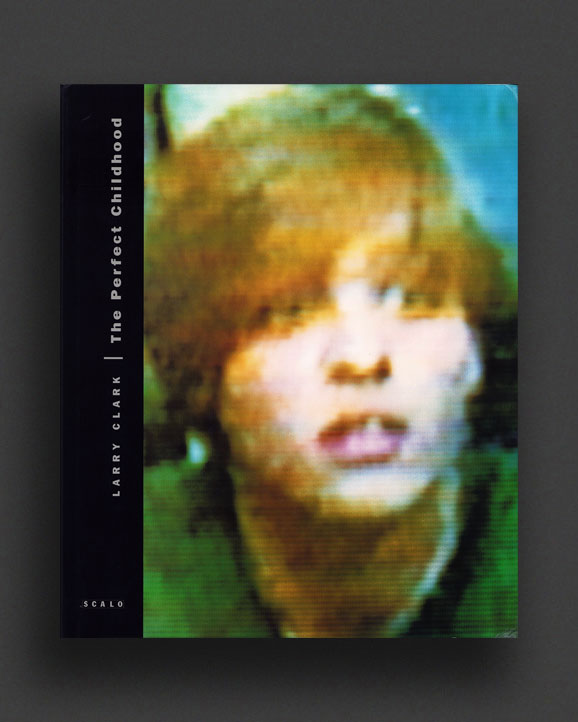
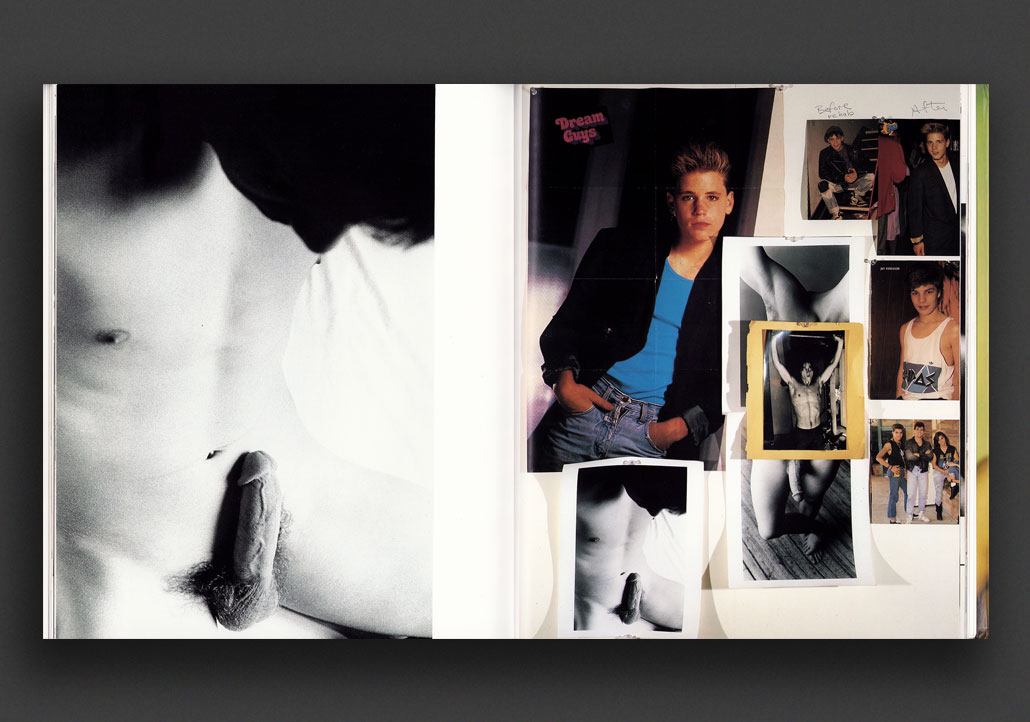
First 1995 Scalo hardcover edition of the infamous Larry Clark photo book, The Perfect Childhood, banned for import and distribution in the United States for years. Includes Clark's controversial black and white photographs from the "Tulsa" and Teenage Lust" work, as well as previously unpublished colour and black and white images.
From the publisher: "Larry Clark's work has always obsessively circled around adolescent boys, their awakening sexual drives, the enormous energies they have to harness. Clark offers the viewer a cultural anthropology of this transitory period that oscillates between painful pleasure and exuberant self-destruction. Clark is spellbound with the vital, unruly, and destructive force teen boys exude. Clark confronts us with lucid images of male sexuality and its equally creative and destructive impulses. He combines pop-culture imagery with his own photographs to evoke a myth ingrained in the heart of our culture.
The Perfect Childhood combines an overview of Clark's work-ranging from collages and found images to photographs from his native Oklahoma in the late 1960's-with a new series of tender and erotic portraits of a skater boy-the latest incarnation of the mythical eternal youth Clark investigates and idolizes in his work. Material from the past 30 years is combined to create one new work of art-overwhelming proof of the consistency of Clark's artistic vision. The book is as raunchy and brutally straightforward as it is melancholy and affectionate. Its attitude will confound all those thinking in comfortable and complacent opposites-gay and straight, creative and destructive, tenderness and violence, good and evil. Clark's work is a mirror for those strong enough to face the truth about growing up as a boy."
Very Good copy in VG dust jacket.
2013, English / Japanese
Softcover (w. obi-strip), 230 pages, 21 x 30 cm
1st Edition, Out of print title / as new
Published by
Street Editorial Office / Tokyo
$200.00 - Out of stock
Maison Martin Margiela was founded in Paris by Martin Margiela and Jenny Meirens in 1988. The first Martin Margiela collection of ready-to-wear for women was presented in October 1988 for Spring/Summer 1989. Since then Maison Martin Margiela has presented two collections a year and has taken part in many exhibitions on its work around the world. STREET magazine was founded in Tokyo by Shoichi Aoki and Noriko Kojima in 1985. It has been published monthly ever since. Each issue features photographs of people, chosen for what they are wearing, by Shoichi Aoki, taken in the streets of the world's fashion capitals. In 1995 STREET approached Maison Martin Margiela inviting it to publish a special edition of STREET dedicated to its work. Maison Martin Margiela was solely responsible for the choice of images and layout and used mostly unpublished photographs from its archives to explore and illuminate its past collections and presentations. The Maison Martin Margiela STREET special, Volume 1 first appeared on news stands in japan in October 1995 and covered every Martin Margiela collection from Spring/Summer 1989 up to Autumn/Winter 1995-1996. The success of volume 1 sparked the continuation of the story with the publication of volume 2 in February 1999. Volume 2 covers all Martin Margiela collections for women up to Spring/Summer 1999 as well as the first presentation of 10, a wardrobe for men and 6, basic garments for women for Summer 1999 and Maison Martin Margiela's participation in three exhibitions held in Brussels, Florence and Rotterdam. Both volumes now long out-of-print and collectible, this 2013 book edition (also long out-of-print) combines volumes 1 & 2, beautifully reprinting the entirety of their contents.
The first and still the best behind-the-scenes visual document of the world of Maison Martin Margiela, including the first 20 collections, events, exhibitions, studios, ephemera, garment details, and much more - very page magnificent. Profusely illustrated throughout in colour and black and white with photographs by Martin Margiela, Paolo Roversi, Anders Edstrom, Mark Borthwick, Raf Coolen, Tatsuya Kitayama, Ronald Stoops, Barbara Katz, Roman Singer, Marina Faust, and many others.
Pristine copy, As New. Out-of-print.
2024, English
Softcover (staple bound w. obi), 24 pages, 17.5 x 13.7 cm
Ed. of 50,
Published by
World Food Books / Melbourne
$15.00 - Out of stock
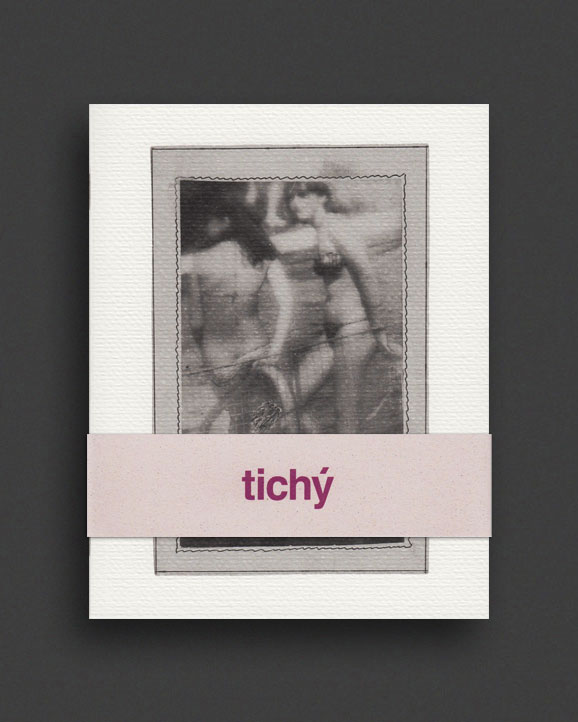
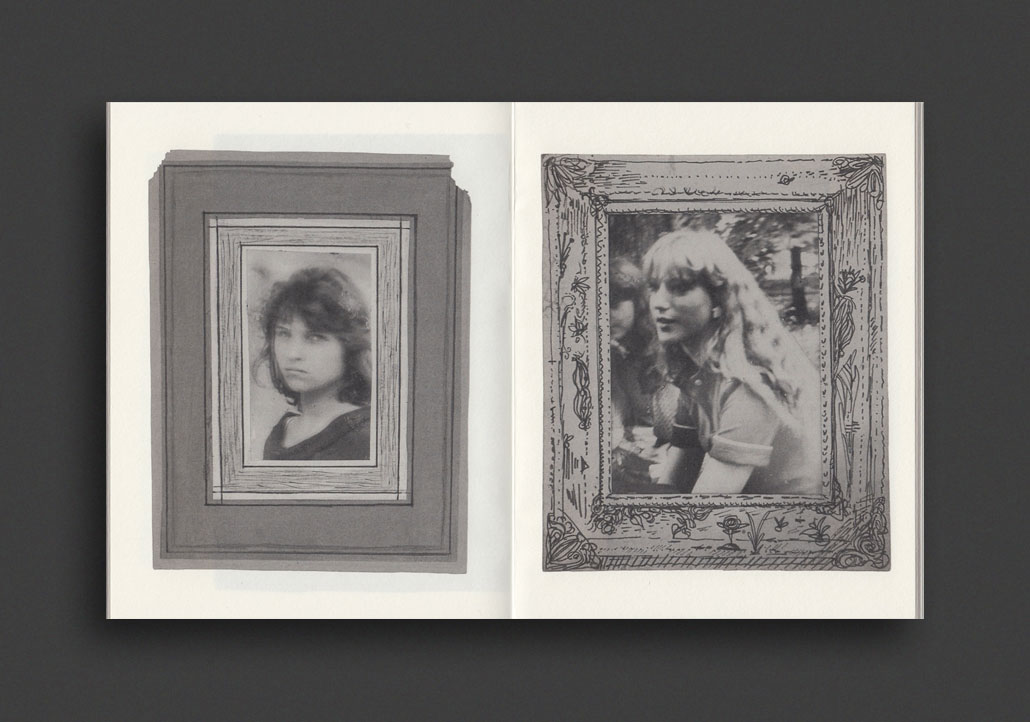
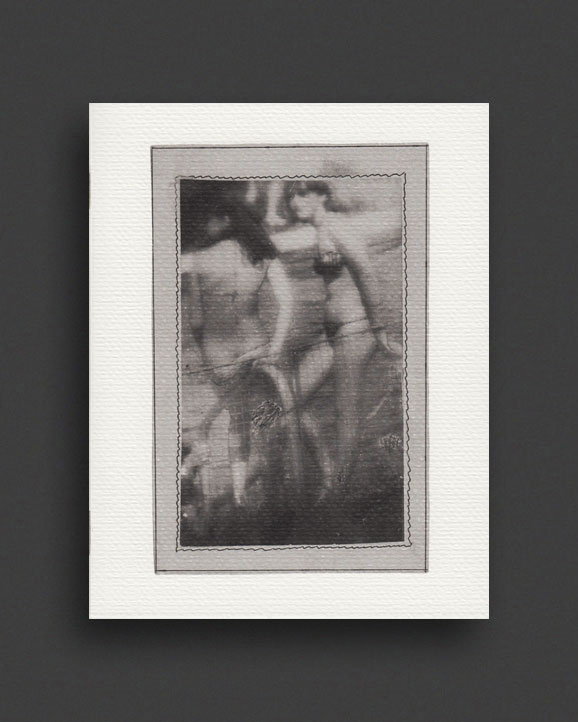
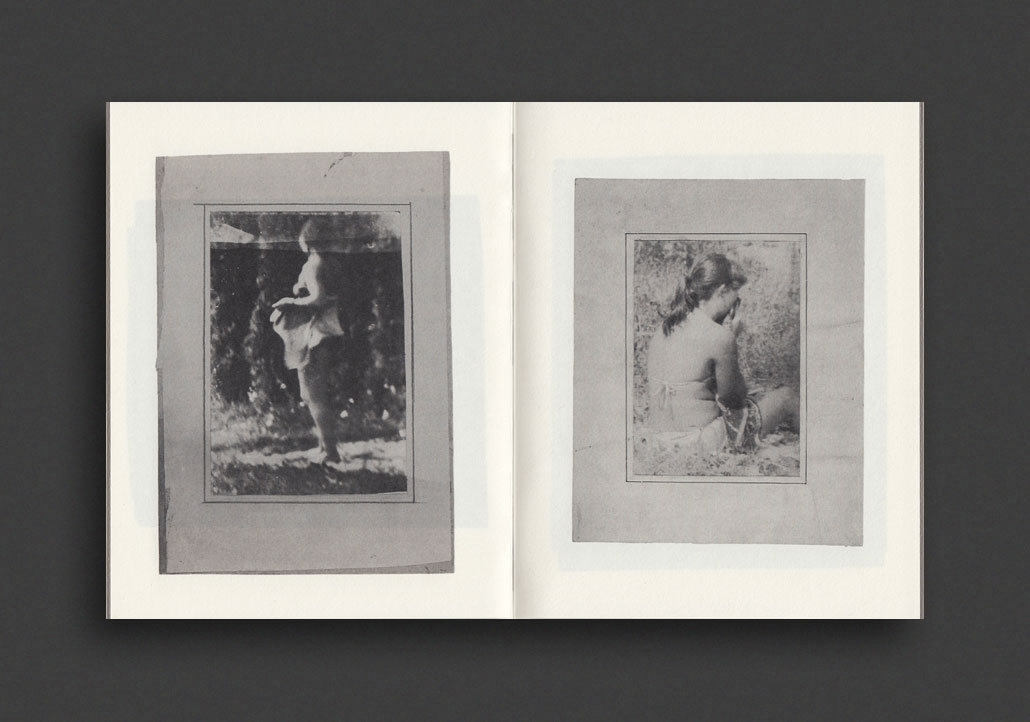
Limited edition catalogue published on the occasion of the exhibition Miroslav Tichý, World Food Books, 16.5.24—13.6.24. Illustrated throughout with a selection of Tichý's photographs and drawings of women reproduced in b/w. Published in an edition of 50 copies, with obi-strip.
After studying at the Academy of Arts in Prague (1945-48), Miroslav Tichý (1926-2011) withdrew to a life in isolation in his hometown of Kyjov, Moravia, Czech Republic. In the late 1950s he quit painting and became a distinctive Diogenes-like figure. From the end of the 1960s he began to take take thousands of surreptitious photographs mainly of local women, in part with cameras he made by hand. He later mounted them on hand-made frames, added finishing touches with pencil, and thus moved them from photography in the direction of drawing. The result are works of strikingly unusual formal qualities, which disregard the rules of conventional photography. They constitute a large oeuvre of poetic, dreamlike views of feminine beauty in a small town under the Czechoslovak Communist regime.
2010, English
Hardcover (clothbound), 328 pages, 33 x 22 cm
1st Edition, Out of print title / used / very good
Published by
Steidl / Göttingen
$220.00 - Out of stock
Beautiful first edition of this long out-of-print over-sized hardcover catalogue on the work of Miroslav Tichý. Few stories in the history of photography are as astonishing and as compelling as that of the octogenarian Czech photographer Miroslav Tichý. With crude homemade cameras fashioned out of cardboard and duct tape, Tichý took several thousand pictures of the women of his Moravian hometown of Kyjov throughout the 1960s and '70s. These pictures of women going about their daily business are at once banal and extraordinary, transforming the ordinary moments of work and leisure into small epiphanies. Blurred and off-kilter, his photographs have a striking contemporaneity, resembling the early paintings of Gerhard Richter or the photographs of Sigmar Polke. Printed imperfectly and deliberately battered, they evince a surprising retrograde or even anti-modernist feeling, which, in the context of the Cold War atmosphere of provincial Czechoslovakia, just before and after the liberalizing moment of the Prague Spring (1968), undoubtedly constituted a kind of oblique political provocation, a nose-thumbing response to the progressive realist perfectionism of official Soviet culture.
This major catalogue accompanies an exhibition of the same title at the International Center of Photography organized by Chief Curator Brian Wallis. Critical evaluations by Brian Wallis, Roman Buxbaum, Carolyn Christov-Bakargiev, and Richard Prince introduce more than 250 plates and illustrations.
Very Good copy.
2002/2004, English/Japanese/French
Softcover, unpaginated, 25 x 19.5 cm
Out of print title / used / very good
Published by
Taschen / Cologne
$70.00 - Out of stock
Japanese 2004 edition of Taschen's 2-in-1 2002 re-issue of two out-of-print photo books by German photographer Wolfgang Tillmans — his self titled masterpiece from 1995 and Burg from 1998. Both classic Tillmans books are combined into one, with introductions in English/Japanese/French by Simon Watney and David Deitcher. Warning: select Japanese censorship on a few photos.
Wolfgang Tillmans (b. 1968) is a German photographer. His diverse body of work is distinguished by observation of his surroundings and an ongoing investigation of the photographic medium’s foundations. Tillmans was initially known for his seemingly casual, sometimes snapshot-like portraits of friends (most notably, fashion designer Lutz Huelle and fellow artist Alexandra Bircken) and other youth in his immediate surroundings and scene. His photos – from the Europride in London (1992) or the Love Parade in Berlin (1992), for example – appeared in magazines such as i-D, Spex, Interview, SZ Magazin and Butt, and established his reputation as a prominent witness of a contemporary social movement. He was made co-editor of Spex in 1997, and was a prominent contributor to Purple magazine in Paris, his photographs central to what has come to be known as the '90s anti-fashion moment. Tillmans was the first photographer, and first non-British person, to be awarded the Turner Prize in 2000.
Good—Very Good copy, light cover handling wear.
2021, English
Softcover, 128 pages, 24 x 29 cm
Published by
Lenz Press / Milan
$95.00 - In stock -
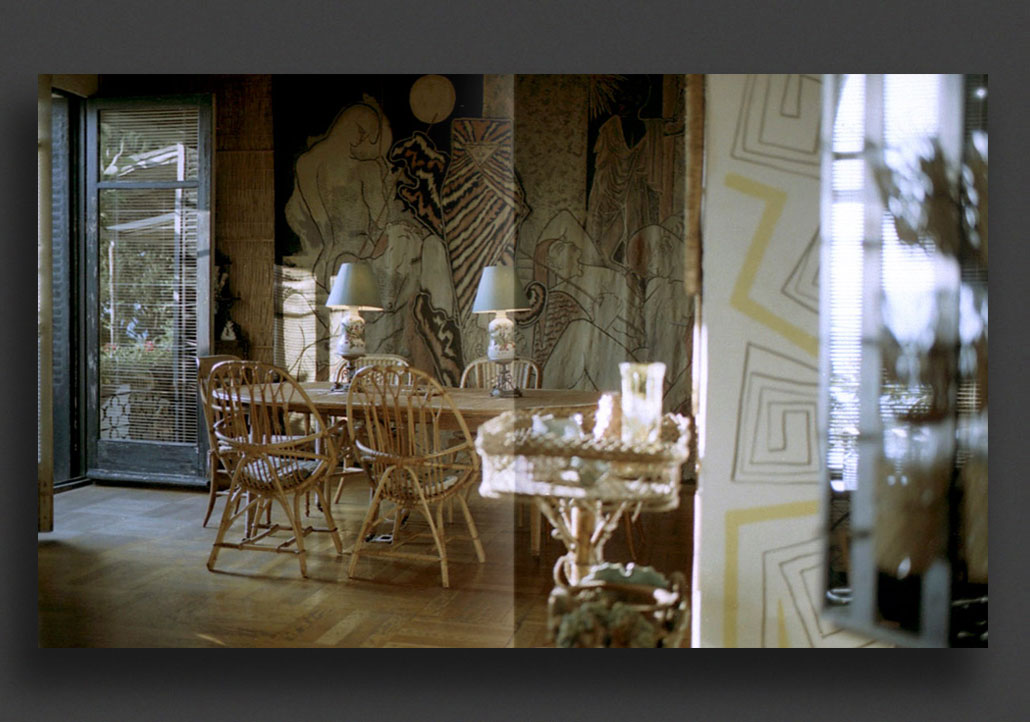
A series of images of Villa Santo Sospir in Saint-Jean-Cap-Ferrat, the "Tattooed Villa" transformed into an artwork by Jean Cocteau, whose Brazilian photographer Mauro Restiffe reveals the hidden details during a residency.
The Villa Santo Sospir in Saint-Jean Cap-Ferrat is not a Gesamtkunstwerk, and stands out in particular from the now-mythical realizations by Eileen Gray and Le Corbusier at Cap-Martin, just a stone's throw away. Far from a manifesto, Cocteau invests a pre-existing and rather unremarkable architecture, then conceives his intervention in the villa through a process of accumulation, mixing souvenirs and objects belonging to Francine Weisweiller or himself with the furniture of their friend Madeleine Castaing. Inspired by Greek mythology and the Mediterranean landscapes that surrounded the Villa, this late pictorial work, resolutely anti-modern, has long been ignored or vilified by historians. While Cocteau's entire literary, theatrical and cinematographic work deals with the representation of self, it always takes place in a particular setting. The interiors imagined by Cocteau provide accurate portraits of their occupants. In the 1950s, Jean Cocteau split his time between Paris, Milly la Forêt, and Saint-Jean Cap-Ferrat. It is at Santo Sospir that most of his TV interviews were made. It is above all the only house he filmed in his last two cinematographic opuses: La Villa Santo Sospir (filmée et commentée par Jean Cocteau) and Le Testament d'Orphée (Ne me demandez pas pourquoi). Santo Sospir can thus be viewed from the angle of a movie set, which allows him to introduce the world to the other Jean Cocteau—the Mediterranean poet, the craftsman.
Architecture, and Modernism in particular, has always been a source of inspiration for Brazilian photographer Mauro Restiffe. In his photographs, Restiffe has been exploring how every side of the built environment is imbued with life, all the more so in the unobserved details and even when no one is framed. In 2018, at the beginning of a multi-year restoration, he was invited to reside at the villa.
Mauro Restiffe (born 1970, lives and works in São Paulo) captures large format photographs of landscapes, modernist interiors, iconic architectures, and urban life, as well as exploring issues of representation in images that reproduce existing works of art. His work, exhibited internationally, is part is in the collections of the Museum of Modern Art (New York), SFMOMA (San Francisco), Tate Modern (London), MASP (São Paulo), among others.
2024, English
Softcover, 320 pages, 16 x 22 cm
Published by
Roma / Amsterdam
$63.00 - In stock -
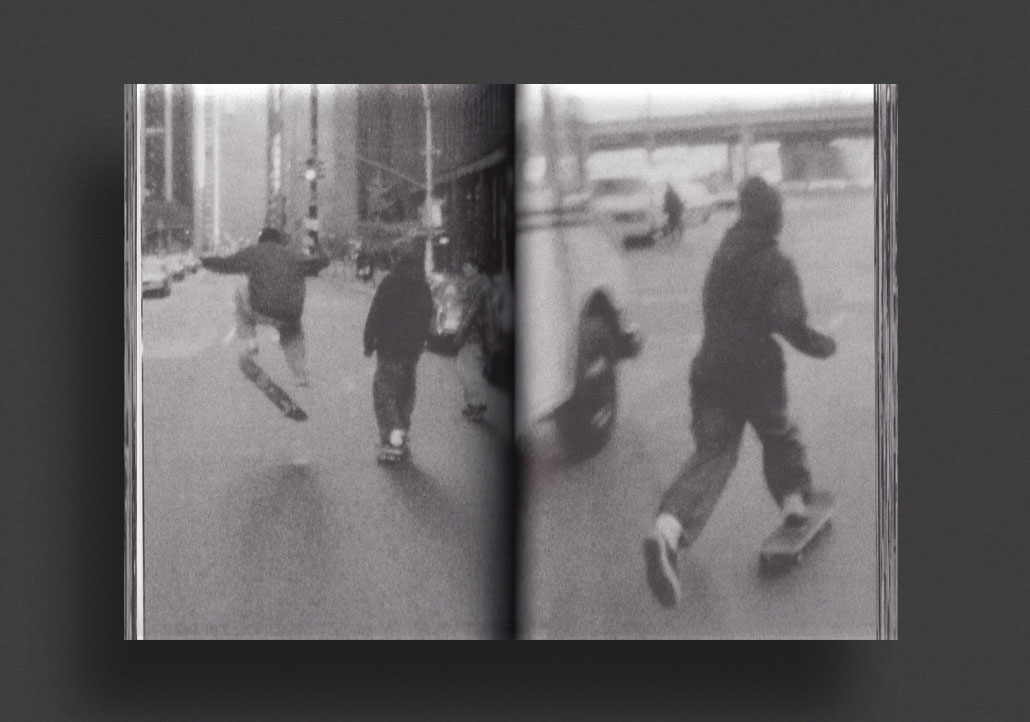
When the Musée d’Art Moderne de Paris asked Ari Marcopoulos to curate an exhibition around their acquisition ‘Brown Bag’, a short film on skateboarders in New York that he made in 1993, he was given access to the museum’s collection of over 15,000 works. He looked for themes related to the body, injuries, and architecture, along with what he perceived as challenging and puzzling works. Some of the artists were already familiar, while others were new to him. The process was not so different from his process as a filmmaker and photographer: so much of his work is about finding things. This book is a new look at photographs from around the time Marcopoulos shot ‘Brown Bag’.
1980, French
Softcover, unpaginated, 29.5 x 21 cm
1st Edition, Out of print title / used / good
Published by
Chez l'auteur / Paris
$200.00 - In stock -
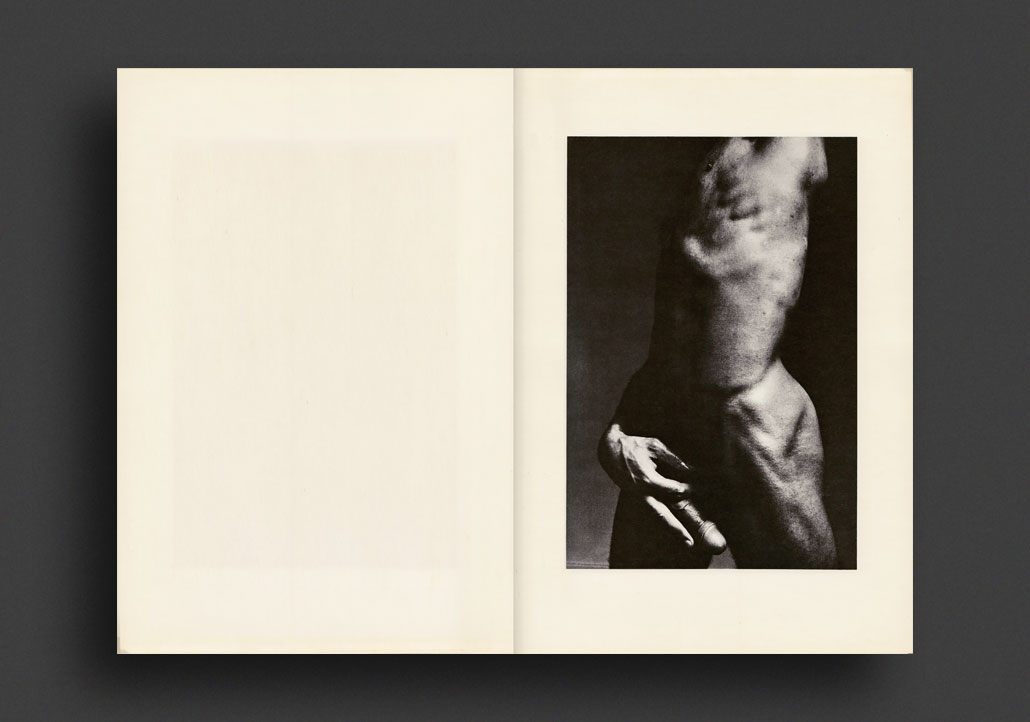
Extremely rare first edition of Herman Puig's Yang, the prized first photo book collection by the Cuban pioneer of male nude photography, published in 1980 by Chez l'auteur, Paris. Cover-to-cover stunning artistic males nudes shot in stark b/w. No texts. Herman Puig (1928—2021) was the founder of the first Cinemateca de Cuba and a ground-breaking photographer of the male nude. Born in Havana, Cuba, where he began his early work, his ascendance comes from Catalonia. It was in Madrid that he first started experimenting with male nudes but was arrested and charged as a pornographer under the climate of the socialist government. It was at this point that he moved to Paris in an attempt to prove to Spain and the world that he was not a pornographer but an artist and was accepted with almost universal acclaim. It was in France that Puig rose to fame, before settling in Barcelona for the remainder of his life.
Good—VG copy, light tanning and wear to extremities of cover laminate and light foxing to inside of covers.
1989, English / German
Softcover, 200 pages, 25.5 x 21 cm
1st Edition, Out of print title / used / very good
Published by
Parkett / Zürich
$100.00 - In stock -
1989 issue of Parkett (Vol. 19), deluxe issue created in collaboration with artists Martin Kippenberger and Jeff Koons, lavishly illustrated with both artist's works alongside texts by with texts by Klaus Kertess, Burke & Hare, Jean-Christophe Ammann, Glenn O’Brien, Diedrich Diederichsen, Patrick Frey, Martin Prinzhorn, Bice Curiger. Anselm Stalder designed the insert. Also in this issue: exclusive Gerhard Richter interview, Annemarie Hürlimann “In Between,” Hanna Humeltenberg “The Magic of Reality,” on Thomas Ruff, Felix Philipp Ingold “The Speaking Image in Rémy Zaugg’s work.” Iwona Blazwick and Robert Gober are the authors of the Cumulus from Europe and America, in the Balkon Parkett celebrates its fifth anniversary.
Founded in the early 1980s in Zurich, with an office also in New York City, , Parkett was international art magazine that aimed to foster an open dialogue between the artistic communities of Europe and America, with the goal to actively and directly collaborate with important international artists whose oeuvre was explored in several essays by leading writers and critics in both German and English. By 2017, Parkett had published 100 volumes with some 180 monographs and over 1500 in-depth texts making it one of the most comprehensive libraries on contemporary art worldwide. Critics, curators, art historians, and other commentators join in the conversation contained within its pages. Many write on the collaborating artists; some write opinions under a variety of topic headings that recur issue to issue; others write on additional artists and ideas. The result is more of a curated event-between-covers than a typical art magazine with reviews and news items.
Average—Good copy with some marking and wear.
1992, English / German
Softcover, 200 pages, 25.5 x 21 cm
1st Edition, Out of print title / used / good
Published by
Parkett / Zürich
$80.00 - Out of stock
1992 issue of Parkett (Vol. 31), deluxe issue created in collaboration with artists David Hammons and Mike Kelley, lavishly illustrated with both artist's works alongside texts by with texts by Robert Farris Thompson, Iwona Blazwick & Emma Dexter, John Ffarris, Lynne Cooke, Louise Neri in conversation with David Hammons, Diedrich Diederichsen, Lane Relyea, Bernard Marcadé, Mike Kelley & Julie Sylvester talking about “Failure.” The Insert artist is Candida Höfer and the spine artist is Niele Toroni. Also in this issue: Vija Celmins by Sheena Wagstaff, Larry Clark, What is This? by Jim Lewis, Jean-Pierre Bordaz “Imi Knoebel, Isa Genzken, Gerhard Merz,” Claude Ritschard “Rémy Zaugg.” Imi Knoebel: Working With Success – Working With Unsucces by Rudolf Bumiller, Imi Knoebel and Grace Kelly, The High by Rainer Crone & David Moos, Imi Knoebel First Impressions by Lisa Liebmann, Sherrie Levine: The Transgressions of Sherrie Levine by Daniela Salvioni, Presence Withdrawn by Erich Franz, Looking After Sherrie Levine by Howard Singerman, Damien Hirst — Insert, Making Work and Turning Your Back on it : Bethan Huws by Liam Gillick, The Work of Art as the Ideal Center for Human Beings, Walter de Maria’s The 2000 Sculpture by Thomas Kellein, International Time Capsule Society, Les Infos du Paradis, Inside the White Cube, Cumulus from America by Ralph Rugoff, Cumulus from Europe by Robert Fleck, Talk o’ the Town by Jeanne Sliverthorn.
Founded in the early 1980s in Zurich, with an office also in New York City, Parkett was international art magazine that aimed to foster an open dialogue between the artistic communities of Europe and America, with the goal to actively and directly collaborate with important international artists whose oeuvre was explored in several essays by leading writers and critics in both German and English. By 2017, Parkett had published 100 volumes with some 180 monographs and over 1500 in-depth texts making it one of the most comprehensive libraries on contemporary art worldwide. Critics, curators, art historians, and other commentators join in the conversation contained within its pages. Many write on the collaborating artists; some write opinions under a variety of topic headings that recur issue to issue; others write on additional artists and ideas. The result is more of a curated event-between-covers than a typical art magazine with reviews and news items.
Average—Good copy with some marking and wear. Ex-sticker resudue to cover.