World Food Books' programme is largely produced on Kulin Nation land. We acknowledge the Wurundjeri people of the Kulin Nation as the first and continuing custodians of this land, and pay respect to their Elders past, present, and emerging.
World Food Books is an arts and special interests bookshop in Naarm / Melbourne. Founded in 2010, World Food Books is devoted to the presentation of a rotating, hand-selection of international art, design, literary and counterculture publications with an emphasis on the anti-traditional, the experimental, the avant-garde, the heretic, the marginal.
Presenting new titles alongside rare and out-of-print books, catalogues and journals spanning the fields of modern and contemporary art, design, photography, illustration, film, literature, poetry, cultural theory, philosophy, sexuality, popular and underground culture in its many radical forms, World Food Books wishes to encourage adventurous, thoughtful and open-minded reading, looking, writing, and exchange of publishing and ideas, both current and historical.
As well as our bookshop, located in Melbourne's historical Nicholas Building, all of our inventory is available internationally via our online mail-order service.
World Food Books semi-regularly co-ordinates "Occasions", a programme of exhibits and events at the bookshop and in partnership with other hosts (such as museums and art galleries) that develop out of the activities, relationships and content of the bookshop itself.
World Food Books
The Nicholas Building
37 Swanston Street
Room 5, Level 6
Melbourne 3000
Australia
SHOP HOURS:
Thu–Sat 11–5
WEB-SHOP OPEN 24/7
World Food Books
Postal Address:
PO Box 435
Flinders Lane
Victoria 8009
Australia
Art
Theory / Essay
Architecture / Interior
Graphic Design / Typography
Photography
Fashion
Eros
LGBTQ+
Fiction / Poetry
Weird / Speculative / Science Fiction / Horror
Transgressive / Visceral / Abject
Symbolism / Decadence / Fin de siècle
Film / Video
Painting
Sculpture / Installation
Performance / Dance / Theater
Drawing
Sound / Music
Curatorial
Group Shows / Collections
Periodicals
Out-of-print / Rare
Posters / Ephemera / Discs
Signed Books
World Food Books Gift Voucher
World Food Book Bag
Australian Art
Australian Fiction
Australian Science Fiction / Speculative Fiction
Australian Poetry
Australian Photography
Japanese Photography
Conceptual Art
Minimal Art
Dada
'Pataphysics / Oulipo
Fluxus
Concrete Poetry
Pop Art
Surrealism
Arte Povera
Arte Informale / Haute Pâte / Tachism
Nouveau Réalisme / Zero / Kinetic
Situationism / Lettrism
Collage / Mail Art / Xerox Art
Art Brut / Folk / Visionary / Fantastic
Illustration / Graphic Art / Bandes Dessinées
Furniture
Italian Radical Design / Postmodernism
Textiles
Ceramics / Glass
Counterculture
Protest / Revolt
Philosophy
Psychoanalysis
Anthropology
Anarchism
Socialism / Anarchism / Communism / Capitalism
Literary Theory / Semiotics / Language
Feminism / Women's Studies
Gender Studies / Sexuality
Anthropology
Fetishism / BDSM
Drugs / Psychedelia
Crime / Violence
Animal Rights / Veganism
Occult / Esoterica
Ecology / Earth / Alternative Living
Whole Earth / Crafts
All prices in AUD (Australian dollars)
Pick-Ups
Pick-up orders can be collected in our bookshop during opening hours after order date. Please collect any Pick-up orders within 2 weeks of ordering as we have limited storage space. Orders will be released back into stock if not collected within this time. No refunds can be made for pick-ups left un-collected. If you cannot make it in to the bookshop in this time-frame, please choose postage option.
Return Policy
All sales are final. We do accept returns (for refund or exchange) for items received in error. All our orders are packed with special care using heavy-duty padding and cardboard book-mailers or bubble mailers (for smaller books), using reinforcement where required. We cannot take responsibility for any lost, stolen or damaged parcels.
Insurance
Should you wish to insure your package, please email us directly after placing your order and we can organise this at a small extra expense. Although all standard/express tracked packages are very safe and dependable, we cannot take responsibility for any lost, stolen or damaged parcels. We recommend insurance on valuable orders.
Interested in selling your old books, catalogues, journals, magazines, comics, fanzines, ephemera? We are always looking for interesting, unusual and out-of-print books to buy. We only buy books in our fields of interest and specialty, and that we feel we can resell.
We base these prices on desirability, market value, in-print prices, condition and our current stock levels. We offer cash, store credit, and can take stock on consignment. All
about 25% of the price we expect to get when we sell them, or 30% in store credit. We base these prices on desirability, market value, in-print prices, condition and our current stock levels.
Sell your books any day of the week. You can drop them off and return later. If you have a lot of books, we can visit your Sydney home.
We buy books that we feel we can resell. We offer about 25 % of the price we expect to get when we sell them, or 30% in store credit. We base these prices on desirability, market value, in-print prices, condition and our current stock levels.
Philadelphia Wireman
03 August - 01 September, 2018
World Food Books is proud to announce our next Occasion, the first presentation of sculptures by Philadelphia Wireman in Australia.
The Philadelphia Wireman sculptures were found abandoned in an alley off Philadelphia’s South Street on trash night in 1982. Their discovery in a rapidly-changing neighbourhood undergoing extensive renovation, compounded with the failure of all attempts to locate the artist, suggests that the works may have been discarded after the maker’s death. Dubbed the "Philadelphia Wireman" during the first exhibition of this work, in 1985, the maker’s name, age, ethnicity, and even gender remain uncertain. The entire collection totals approximately 1200 pieces, all intricately bound together with tightly-wound heavy-gauge wire (along with a few small, abstract marker drawings, reminiscent both of Mark Tobey and J.B. Murry). The dense construction of the work, despite a modest range of scale and materials, is singularly obsessive and disciplined in design: a wire armature or exoskeleton firmly binds a bricolage of found objects including plastic, glass, food packaging, umbrella parts, tape, rubber, batteries, pens, leather, reflectors, nuts and bolts, nails, foil, coins, toys, watches, eyeglasses, tools, and jewellery.
Heavy with associations—anthropomorphic, zoomorphic, and socio-cultural responses to wrapped detritus—the totemic sculptures by Philadelphia Wireman have been discussed in the context of work created to fulfil the shamanistic needs of alternative religions in American culture. Curators, collectors, and critics have variously compared certain pieces to sculpture from Classical antiquity, Native American medicine bundles, African-American memory jugs, and African fetish objects. Reflecting the artist’s prolific and incredibly focused scavenging impulse, and despite—or perhaps enhanced by—their anonymity, these enigmatic objects function as urban artefacts and arbiters of power, though their origin and purpose is unknown. Philadelphia Wireman, whatever their identity, possessed an astonishing ability to isolate and communicate the concepts of power and energy through the selection and transformation of ordinary materials. Over the course of the past two decades, this collection has come to be regarded as an important discovery in the field of self-taught art and vernacular art.
Presented in collaboration with Fleisher-Ollman Gallery, Philadelphia, and Robert Heald, Wellington.
Susan Te Kahurangi King
02 February - 10 March, 2018
Susan Te Kahurangi King (24 February 1951 - ) has been a confident and prolific artist since she was a young child, drawing with readily available materials - pencils, ballpoint pens and felt-tip markers, on whatever paper is at hand. Between the ages of four and six Susan slowly ceased verbal communication. Her grandparents William and Myrtle Murphy had developed a special bond with Susan so they took on caring responsibilities for extended periods. Myrtle began informally archiving her work, carefully collecting and storing the drawings and compiling scrapbooks. No drawing was insignificant; every scrap of paper was kept. The King family are now the custodians of a vast collection containing over 7000 individual works, from tiny scraps of paper through to 5 meter long rolls.
The scrapbooks and diaries reveal Myrtle to be a woman of great patience and compassion, seeking to understand a child who was not always behaving as expected. She encouraged Susan to be observant, to explore her environment and absorb all the sights and sounds. Myrtle would show Susan’s drawings to friends and people in her community that she had dealings with, such as shopkeepers and postal workers, but this was not simply a case of a grandmother’s bias. She recognised that Susan had developed a sophisticated and unique visual language and sincerely believed that her art deserved serious attention.
This was an unorthodox attitude for the time. To provide some context, Jean Dubuffet coined the term Art Brut in 1945 to describe work created by self-taught artists – specifically residents of psychiatric institutions and those he considered to be visionaries or eccentrics. In 1972 Roger Cardinal extended this concept by adopting the term Outsider Art to describe work made by non-academically trained artists operating outside of mainstream art networks through choice or circumstance. Susan was born in Te Aroha, New Zealand in 1951, far from the artistic hubs of Paris and London that Dubuffet and Cardinal operated in. That Myrtle fêted Susan as a self-taught artist who deserved to be taken seriously shows how progressive her attitudes were.
Susan’s parents Doug and Dawn were also progressive. Over the years they had consulted numerous health practitioners about Susan’s condition, as the medical establishment could not provide an explanation as to why she had lapsed into silence. Dawn educated herself in the field of homeopathy and went on to treat all twelve of her children using these principles – basing prescriptions on her observations of their physical, mental and emotional state.
Doug was a linguist with an interest in philosophy who devoted what little spare time he had to studying Maori language and culture. To some extent their willingness to explore the fringes of the mainstream made them outsiders too but it was their commitment to living with integrity and their respect for individuality that ensured Susan’s creativity was always encouraged.
Even though Susan’s family supported her artistic pursuits, some staff in schools and hospitals saw it as an impediment to her assimilation into the community and discouraged it in a variety of ways. Her family was not always aware of this and therefore did not fully understand why Susan stopped drawing in the early 1990s. However, rather than dwell on the challenges that Susan faced in pursuit of her artistic practice, they prefer to highlight her achievements. In 2008 Susan began drawing again in earnest, after an almost 20 year interruption, and her work is now shown in galleries around the world.
Susan grew up without television and has been heavily influenced by the comics she read as a child. She is absolutely fearless in the appropriation of recognizable characters, such as Donald Duck and Mickey Mouse, in her work. She twists their limbs, contorts their faces, compresses them together, blends them into complex patterned backgrounds - always imbuing them with an incredible energy. Although Susan often used pop culture characters in her work they are not naive or childlike. These are drawings by a brilliant self-taught artist who has been creating exceptional work for decades without an audience in mind.
Mladen Stilinović
"Various Works 1986 - 1999"
02 February 16 - September 10, 2016
Various works 1986 - 1999, from two houses, from the collections of John Nixon, Sue Cramer, Kerrie Poliness, Peter Haffenden and Phoebe Haffenden.
Including: Geometry of Cakes (various shelves), 1993; Poor People’s Law (black and white plate), 1993; White Absence (glasses, ruler, set square, silver spoon, silver ladel with skin photograph and wooden cubes), 1990-1996; Exploitation of the Dead (grey and red star painting, wooden painting, black spoon with red table, red plate), 1984-1990; Money and Zeros (zero tie, paintings made for friends in Australia (Sue, John, Kerrie), numbers painting), 1991-1992; Words - Slogans (various t-shirts) - “they talk about the death of art...help! someone is trying to kill me”, “my sweet little lamb”, “work is a disease - Karl Marx”; Various artist books, catalogues, monographs, videos; Poster from exhibition Insulting Anarchy; "Circular" Croatian - Australian edition; Artist book by Vlado Martek (Dostoyevsky); more.
Thanks to Mladen Stilinović and Branka Stipančić.
Jonathan Walker
Always Will Need To Wear Winter Shirt Blue + Ochre Small Check Pattern
21 August - 21 September, 2015
Untitled
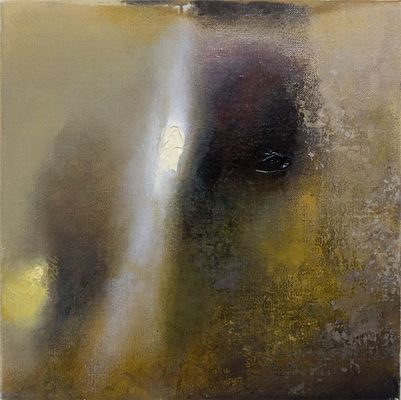
I am not a great reader of poetry but I always return to the work of Melbourne poet, Vincent Buckley (1925- 1988). Perhaps I find his most tantalising piece to be not a finished poem but a fragment left on a scrap of paper discovered on his desk after the poet’s death.
The poetry gathers like oil
In the word-core, and spreads
It has its music meet,
Its music is in movement.
This fragment is more the shell left behind from a volatile thought than a finished poem. I find the last two lines honest but awkward whereas the first two lines work like an arrow. Most likely he could not find a resolution so it was left. Still, in its present form, it remains an eloquent testimony to the ultimate failure of a medium to express mobile thought and sensation, in Buckley’s case, through verbal language. It’s an important matter because this is something all artists have to deal with regardless of the medium.
I have never written a poem, however, I am forever copying fragments from books on paper scraps in a vain effort to fix certain notions in my head. At first, they function as bookmarks that are sometimes returned to when I open the book. But before long, as they accumulate, they fall out littering the table interspersed with A4 photocopies, bills, books and medications.
To return to Buckley’s fragment, the first two lines very much evoke how I paint nowadays. As you age, detail diminishes and patches of light become more luminous and float. I feel the most honest way of dealing with this is by smearing the oil paint on the canvas with the fingers and working close-up, blind. Only if the patches coalesce into an approaching image can the work gain a life.
-
Jonathan Walker was born in Melbourne, Australia and brought up on a dairy farm in Gippsland. In the 1970’s he studied painting at RMIT and won the Harold Wright Scholarship to the British Museum, London. During the 1980’s he exhibited at Pinacotheca Gallery, Richmond and had work shown at the NGV and Heidi City Art Gallery. Over the same period he designed the cover for the “Epigenesi” LP by Giancarlo Toniutti, Italy and conducted a mail exchange work with Achim Wollscheid, Germany. The work with artists through the post resulted in an article published in the bicentenary issue of Art and Australia 1988. He showed in artist run spaces such as WestSpace in the 90’s and 2000’s, and until 2012, taught painting at Victoria University, which is where we (Colleen Ahern and Lisa Radford) as organisers of the exhibition, among many others, had the privilege of being his student.
Walker’s knowledge was imparted to students through the careful selection of music, literature, and artists found in books that he himself had ordered for the library. Walker’s strategy was the generosity of sharing his vast knowledge with references specific to each student and their context.
Walker’s paintings share a similar focus and intimacy.
This exhibition presents a small selection of recent paintings alongside a publication that includes Walker’s writing. Observational and analytical, Walker’s work is a type of material notation — the time of day, colour and how it is blended, the both specific and fleeting location of a reflection on lino or the question of whether a chair leg should be included in a painting.
Please join us on Friday August 21 between 6-8pm to celebrate the opening of the exhibition.
Curated by Colleen Ahern and Lisa Radford.
B. Wurtz
Curated by Nic Tammens
March 26 - April 4, 2015
B.Wurtz works from a basement studio in his home on Manhattan’s Lower East Side.
This local fact is attested to by the plastic shopping bags and newsprint circulars that appear in his work. As formal objects, they don’t make loud claims about their origins but nonetheless transmit street addresses and places of business from the bottom of this long thin island. Like plenty of artists, Wurtz is affected by what is local and what is consumed. His work is underpinned by this ethic. It often speaks from a neighborhood or reads like the contents of a hamper:
“BLACK PLUMS $1.29 lb.”
“Food Bazaar”
“USDA Whole Pork Shoulder Picnic 99c lb.”
“RITE AID Pharmacy, with us it’s personal.”
“H. Brickman & Sons.”
“Sweet Yams 59c lb."
Most of the work in this exhibition was made while the artist was in residence at Dieu Donne, a workshop dedicated to paper craft in Midtown. Here Wurtz fabricated assemblages with paper and objects that are relatively lightweight, with the intention that they would be easily transportable to Australia. This consideration isn’t absolute in Wurtz’s work, but was prescriptive for making the current exhibition light and cheap. Packed in two boxes, these works were sent from a USPS post office on the Lower East Side and delivered to North Melbourne by Australia Post.
Wurtz appears courtesy of Metro Pictures, New York.
Thanks to Rob Halverson, Joshua Petherick, Sari de Mallory, Matt Hinkley, Helen Johnson, Fayen d'Evie, Ask Kilmartin, Lisa Radon, Ellena Savage, Yale Union, and "Elizabeth".
John Nixon
"Archive"
December 15 - January 20, 2014
The presentation of John Nixon's archive offered a rare showcase of this extensive collection of the artist's own publications, catalogues, posters, ephemera, editions and more, from the mid 1980s onwards, alongside a selection of his artworks.
Organized by John Nixon, Joshua Petherick and Matt Hinkley.
"Habitat"
at Minerva, Sydney (organised by Joshua Petherick and Matt Hinkley)
November 15 - December 20, 2014
Lupo Borgonovo, Janet Burchill & Jennifer McCamley,
Lewis Fidock, HR Giger, Piero Gilardi, Veit Laurent Kurz,
Cinzia Ruggeri, Michael E. Smith, Lucie Stahl, Daniel Weil, Wols
Press Release:
“...It contained seven objects. The slender fluted bone, surely formed for flight, surely from the wing of some large bird. Three archaic circuitboards, faced with mazes of gold. A smooth white sphere of baked clay. An age-blackened fragment of lace. A fingerlength segment of what she assumed was bone from a human wrist, grayish white, inset smoothly with the silicon shaft of a small instrument that must once have ridden flush with the surface of the skin - but the thing’s face was seared and blackened.”
William Gibson, “Count Zero”, 1986
"Autumn Projects Archive"
Curated by Liza Vasiliou
March 6 - March 15, 2014
World Food Books, in conjunction with the Virgin Australia Melbourne Fashion Festival 2014, presented the Autumn Projects archive, consisting of a selection of early examples in Australian fashion with a particular interest in collecting designers and labels from the period beginning in the 1980’s, who significantly influenced the discourse of Australian Fashion.
Curated by Liza Vasiliou, the exhibition provided a unique opportunity to view pieces by designers Anthea Crawford, Barbara Vandenberg, Geoff Liddell and labels CR Australia, Covers, Jag along with early experimental collage pieces by Prue Acton and Sally Browne’s ‘Fragments’ collection, suspended throughout the functioning World Food Books shop in Melbourne.
H.B. Peace
presented by CENTRE FOR STYLE
November 14, 2013
"Hey Blinky, you say chic, I say same"
Anon 2013
H.B. Peace is a clothing collaboration between great friends Blake Barns and Hugh Egan Westland. Their pieces explore the divergences between 'character’ and ‘personality’ in garments....etc
Special Thanks to Joshua Petherick and Matt Hinkley of WFB and Gillian Mears
and a Very Special Thank you to Audrey Thomas Hayes for her shoe collaboration.
Janet Burchill & Jennifer McCamley
"Aesthetic Suicide"
May 10 - June 8, 2013
The first of our occasional exhibitions in the World Food Books office/shop space in Melbourne, "Aesthetic Suicide" presented a body of new and older works together by artists Janet Burchill & Jennifer McCamley, including videos, prints, a wall work, and publications.
During shop open hours videos played every hour, on the hour.
1994, English / German
Softcover, 200 pages, 25.5 x 21 cm
1st Edition, Out of print title / used / good
$60.00 $40.00 - Out of stock
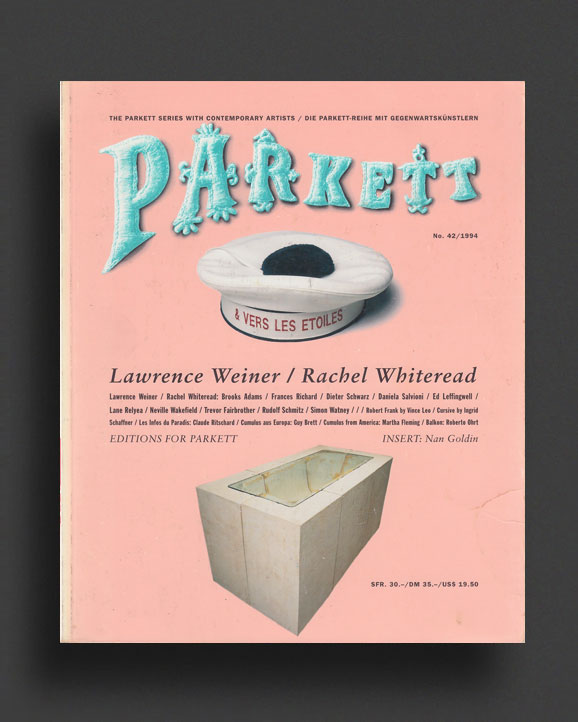
1994 issue of Parkett (Vol. 42), deluxe issue created in collaboration with artists Lawrence Weiner and Rachel Whiteread, lavishly illustrated with both artist's works alongside texts by Brooks Adams, Frances Richard, Dieter Schwarz, Daniela Salvioni, Lane Relya, Edward Leffingwell, Neville Wakefield, Rudolf Schmitz, Trevor Fairbrother, Simon Watney. Amazing colour insert by Nan Goldin, Robert Frank: From Compromise to Collaboration by Vince Leo, Cursive by Ingrid Schaffner, Recent Sculptures of Markus Raetz – On the Subject of Metamorphoses, Les Infos du Paradis by Claude Ritschard, New Measures, Cumulus from Europe by Guy Brett, The Spirit & The Letter & The Evil Eye, Cumulus from America by Martha Fleming, Intriguing Artists by Roberto Ohrt, and more...
Founded in the early 1980s in Zurich, with an office also in New York City, Parkett was international art magazine that aimed to foster an open dialogue between the artistic communities of Europe and America, with the goal to actively and directly collaborate with important international artists whose oeuvre was explored in several essays by leading writers and critics in both German and English. By 2017, Parkett had published 100 volumes with some 180 monographs and over 1500 in-depth texts making it one of the most comprehensive libraries on contemporary art worldwide. Critics, curators, art historians, and other commentators join in the conversation contained within its pages. Many write on the collaborating artists; some write opinions under a variety of topic headings that recur issue to issue; others write on additional artists and ideas. The result is more of a curated event-between-covers than a typical art magazine with reviews and news items.
Good copy with some marking and wear.
1995, English / German
Softcover, 200 pages, 25.5 x 21 cm
1st Edition, Out of print title / used / very good
Published by
Parkett / Zürich
$30.00 $15.00 - Out of stock
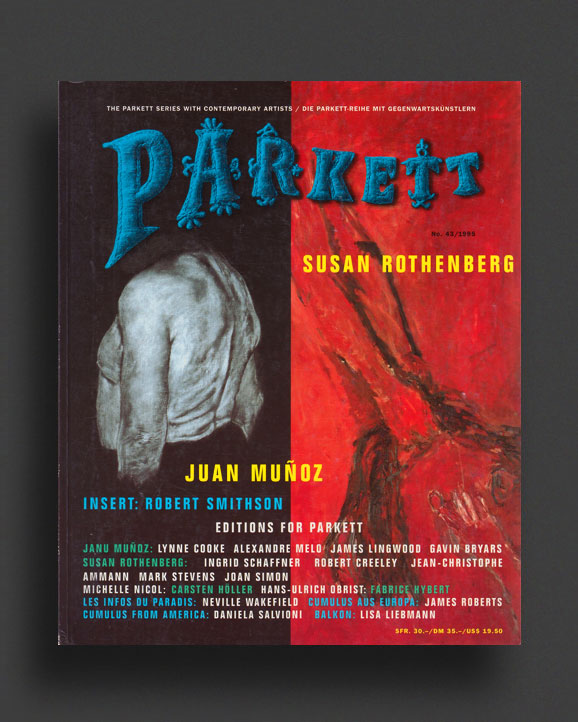
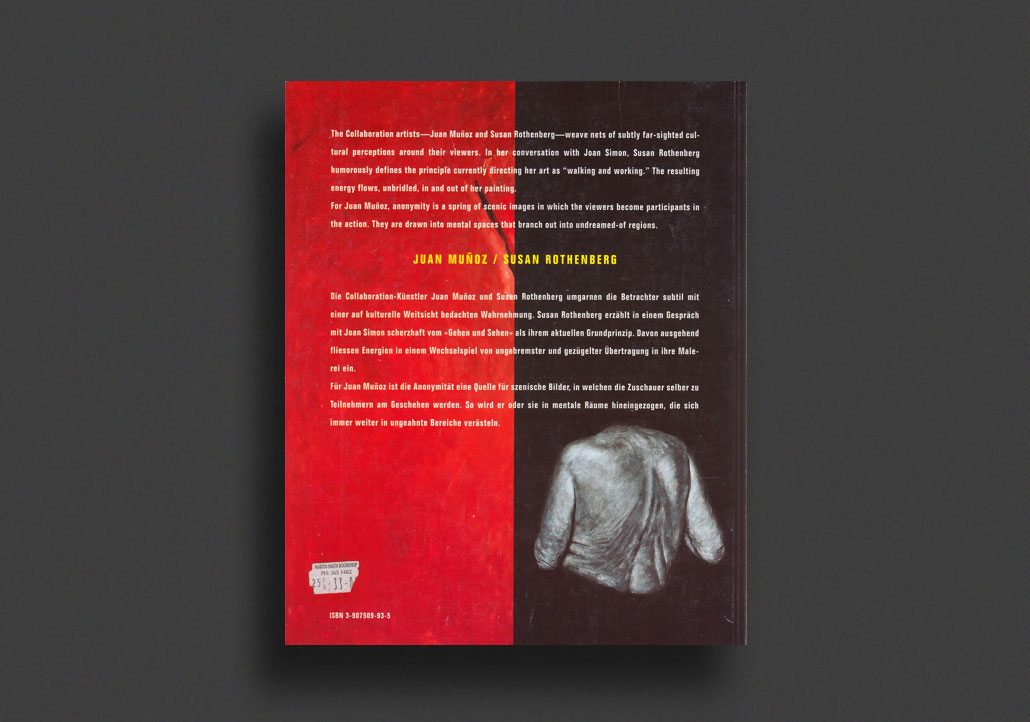
1995 issue of Parkett (Vol. 43), deluxe issue created in collaboration with artists Juan Muñoz and Susan Rothenberg, lavishly illustrated with both artist's works alongside texts by with texts by (on Juan Muñoz) Lynne Cooke, Alexandre Melo, Juna Muñoz & James Lingwood in conversation, A Man in a Room by Gavin Bryars, (on Susann Rothenberg) Robert Creeley, Ingrid Schaffner, Jean-Christoph Ammann, Joan Simon & Susan Rothenberg. Interview by Hans Ulrich Obrist & Fabrice Hybert, Carsten Höller – Getting Real by Michelle Nicol,
Carsten Höller – Getting Real by Michelle Nicol, Yucatan is Elsewhere, On Robert Smithson’s Hotel Palenque, Les Infos du Paradis by Neville Wakefield, Whirling Dervishes by Lisa Liebmann, Celebrating the opening of the new SFMOMA by Daniela Salvioni, On the lack of British public institution interested in contemporary art by James Roberts, and more...
Founded in the early 1980s in Zurich, with an office also in New York City, Parkett was international art magazine that aimed to foster an open dialogue between the artistic communities of Europe and America, with the goal to actively and directly collaborate with important international artists whose oeuvre was explored in several essays by leading writers and critics in both German and English. By 2017, Parkett had published 100 volumes with some 180 monographs and over 1500 in-depth texts making it one of the most comprehensive libraries on contemporary art worldwide. Critics, curators, art historians, and other commentators join in the conversation contained within its pages. Many write on the collaborating artists; some write opinions under a variety of topic headings that recur issue to issue; others write on additional artists and ideas. The result is more of a curated event-between-covers than a typical art magazine with reviews and news items.
Good copy with some marking and wear. Ex-shop sticker on back cover.
1991, English / German
Softcover, 200 pages, 25.5 x 21 cm
1st Edition, Out of print title / used / good
Published by
Parkett / Zürich
$50.00 - Out of stock
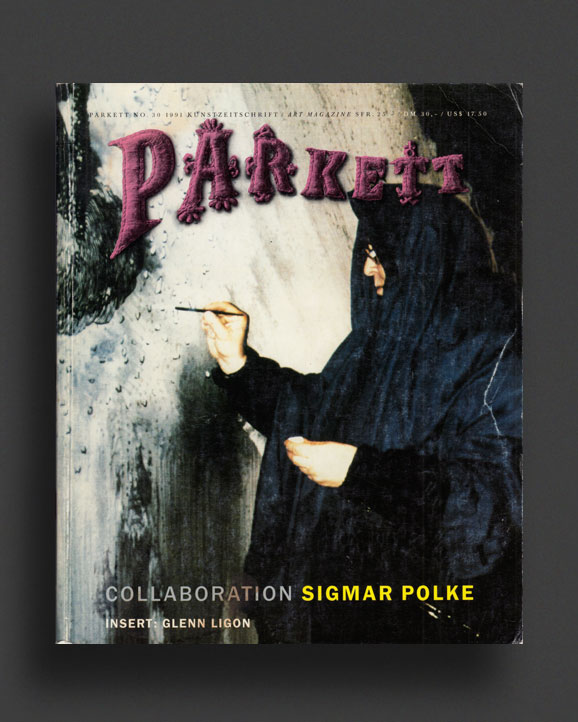
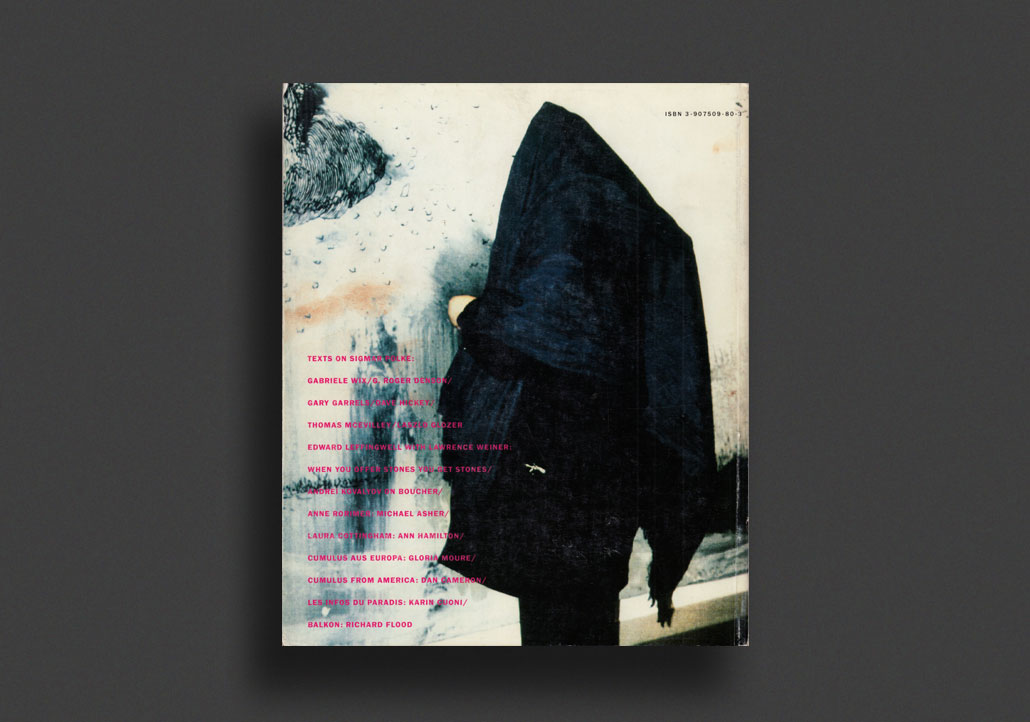
1991 issue of Parkett (Vol. 30), deluxe issue created in collaboration with Sigmar Polke, lavishly illustrated with Polke's works alongside texts by Bice Curiger, Thomas McEvilley, Gary Garrels, Laszlo Glozer, Dave Hickey, Gabriele Wix, G. Roger Denson, Anne Rorimer, Laura Cottingham. And an Insert by Glenn Ligon. Spine by Niele Toroni. Additional texts are by Edward Leffingwell and Lawrence Weiner “When You Offer Stones You Get Stones,” Andrei Kowaljow “François Boucher.” Also feature articles: When You Offer Stones You Get Stones by Edward Leffingwell & Lawrence Weiner; François Boucher by Andrei Kowaljow; On curating exhibitions of site-specific public sculpture by Dan Cameron; Reflections on a space for creation by Gloria Moure; Michael Asher by Anne Rorimer; Overstepping, Les Infos du Paradis by Carin Kuoni; December, 1989: After the Fact by Richard Flood; and more.
Founded in the early 1980s in Zurich, with an office also in New York City, , Parkett was international art magazine that aimed to foster an open dialogue between the artistic communities of Europe and America, with the goal to actively and directly collaborate with important international artists whose oeuvre was explored in several essays by leading writers and critics in both German and English. By 2017, Parkett had published 100 volumes with some 180 monographs and over 1500 in-depth texts making it one of the most comprehensive libraries on contemporary art worldwide. Critics, curators, art historians, and other commentators join in the conversation contained within its pages. Many write on the collaborating artists; some write opinions under a variety of topic headings that recur issue to issue; others write on additional artists and ideas. The result is more of a curated event-between-covers than a typical art magazine with reviews and news items.
Average—Good copy with marking and wear.
1999, English
Softcover, 21.5 x 15.5 cm
1st Edition, Out of print title / used / very good
Published by
Purple Institute / Paris
$220.00 - Out of stock
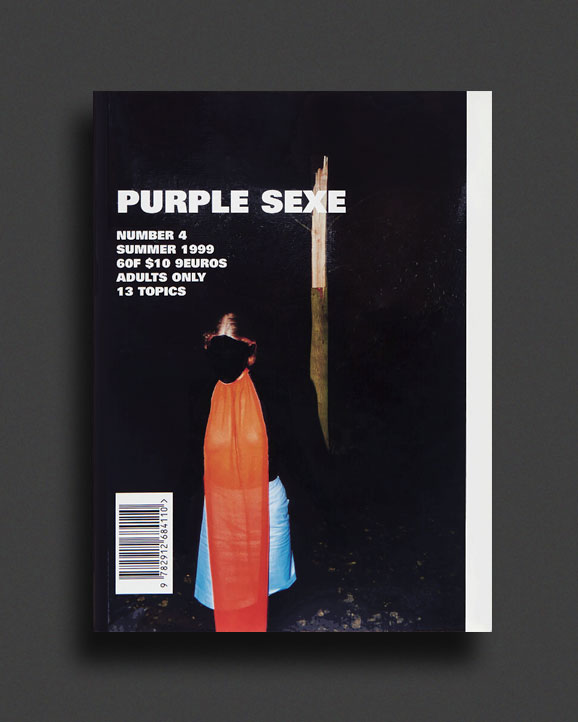
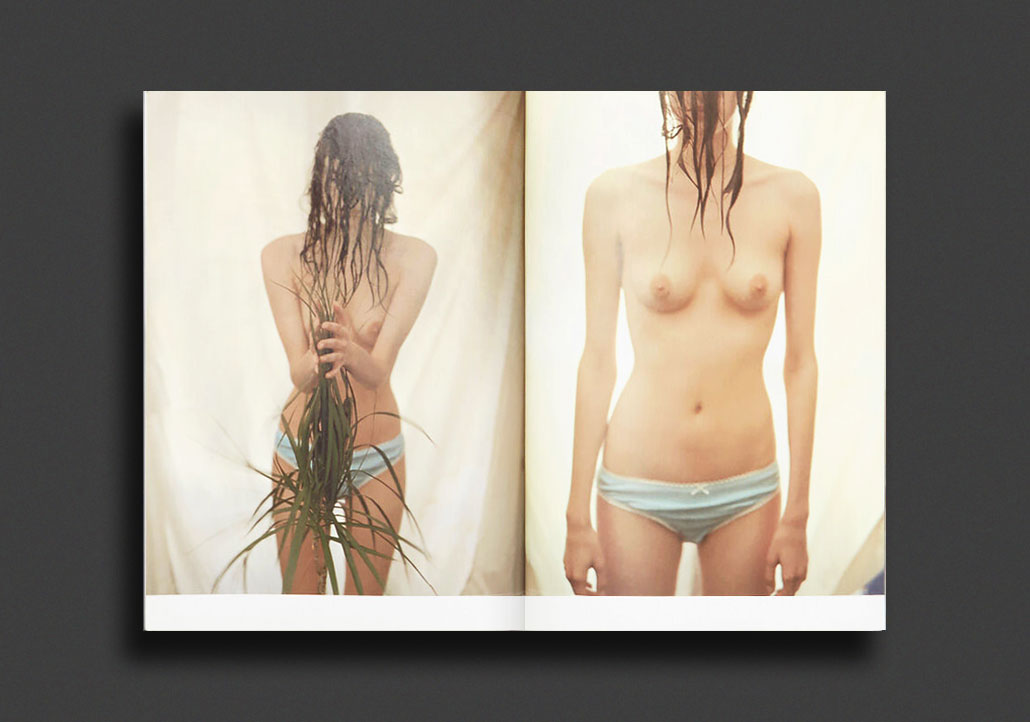
The scarce fourth issue (of eight total, published between 1998-2001) of Olivier Zahm's short-lived, erotically charged photography journal "Purple Sexe". This issue profusely illustrated throughout, containing portfolios by Donald Christie, Mark Borthwick, Johnny Gembitsky, Terry Richardson, Katja Rahlwes, Marcelo Krasilcic, Martin Laporte, Jack Pierson, Thomas Schenk, Dike Blair, Richard Kern, and Viviane Sassen.
In 1992 Olivier Zahm and his partner Elein Fleiss printed the first issue of Purple Prose, a Parisian literary art zine that over the years has evolved into Purple Fashion Magazine. Soon after the birth of Purple Prose, Zahm created spin-off publications like Purple Sexe, Purple Fiction and what we now know and love, Purple Fashion. Zahm aimed at fusing together his two worlds, fashion and art, in creating Purple and Purple Fashion. Purple Sexe remains one of the scarcest of the early Purple series', published in the same format as Purple Prose and Purple Fiction in late 1990s. A magazine devoted to sexuality, only 8 issues of Purple Sexe were ever published between 1998 - 2001, edited by Olivier Zahm and commencing the same year as Purple, which was a fusion of Purple Prose, Fiction, Fashion, and Sexe.
Very Good copy.
1970
Hardcover, 80 pages, 30 x 30 cm
1st Edition, Out of print title / used / very good
Published by
Heinz Peter / Berlin
$100.00 - Out of stock
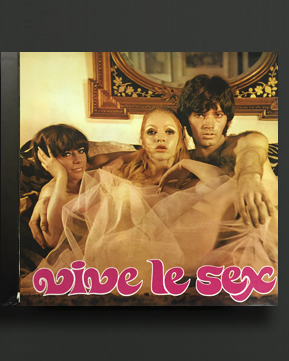
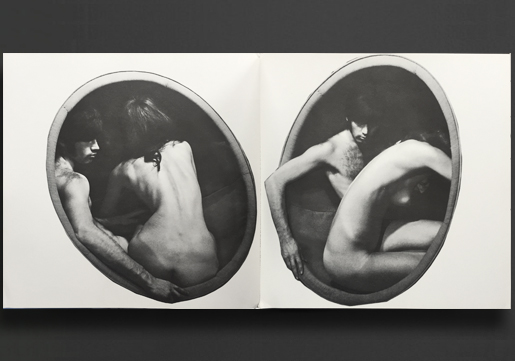
The wonderful, cult 1970 "Vive Le Sex" photobook from Czech photographer, Ica Vilander, who is noted for being one of the few women to shoot nudes in the 1960s.
Vilander was born in 1921 in Brux, Czechoslovakia and later moved to Berlin in 1944, where she studied graphics and experimental photography. Working for the legendary Willy Fleckhaus designed Twen magazine, Vilander garnered a lot of attention internationally with her nude portraits and dynamic, graphic approach to photography, yet by 1980 she disappeared into photo history obscurity as she almost completely retired from public life. Her originals are very rare, as most were destroyed, but her wonderful published collections have become some of the more prized and elusive nude photobooks of the 1960s/1970s.
"Vive Le Sex", in its large square format and hardcover, is a perfect example of Vilander's joyous approach to photographing the nude male and female; mixing elements of collage with photography, dynamic cropping, and a free-spirited use of styling and props that reflected the hippie lifestyle that surrounded her family and friends, who were all regular subjects of her photos, alongside actors, musicians, artists.
First, only edition.
1972, English
Softcover (staple-bound w. card covers), 72 pages, 38.5 x 27.5 cm
1st Edition, Out of print title / used / very good
Published by
Uitgeverij Bert Bakker / The Hague
$280.00 - Out of stock
The Virgin Sperm Dancer : An ecstatic journey of a boy transformed into a girl for one day only, and her erotic adventures in Amsterdam, magic centrum. This is the photographic story of Joop, a modern boy who wakes up one morning as Joopie, a succulent young lady who only has a day to enjoy the benefits of her new body before the metamorphosis is reversed. Joopie wastes no time and embarks on her erotic adventures, every step of which is documented in explicit detail. A rare, cult classic of the European sexual liberation movement of the early 1970's, conceived by the photographer Anna Beeke as an anti-pornographic statement and published as a special issue of Willem de Ridder's notorious and glorious "Suck" magazine.
"The makers of the Virgin Sperm Dancer cannot be held responsible for word burns and image jitters up to and including the first degree."
"The Virgin Sperm Dancer" features text by American expatriate and editor of Suck (as well as The Insect Trust Gazette, International Times, and The Fanatic) William Levy - known as the "Talmudic Wizard of Amsterdam", design by one of Holland's most innovative, risk taking designers, Beeke's husband Anthon Beeke, and wonderful black and white photographs Anna Beeke herself - credited as "Ginger Gordon". This joyous and provocative, uncensored and over-sized book is a tour of gender-bending counter-culture sex in and adjacent to Amsterdam's famed Vondelpark in 1972, complete with public sex and auto-eroticism, orgies and trans-sexual baked bread! "This charmingly liberated fairy story is gleefully hardcore - the point of the exercise, after all." — Martin Parr and Gerry Badger's "The Photobook: A History, volume III" (Phaidon Press, London, 2014). Also cited in Alessandro Bertelotti's "Books of Nudes" (Abrahams, New York, 2007).
Final instructions : "This is not a work of fiction or of one man. Keep your eye on it's bi-unity. I am smiling now. But if you don't think my story marvellous and you should happen to meet me, kindly pass as though we don't know each other."
"But for those readers with delicate lusts and whose curiosity reaches greater detail... When you finish this book roll the pages into thin tubes. Insert carefully into your rectal opening where this specially treated paper will dissolve and act as a chemical re-agent to push each and every word image into your blood-stream and finally into the deep memory of your brain... "
Very Good with light tanning and cover wear (some very small edge nicks and light creasing, pinching)
1998, English / Japanese
2 vols. 106 pages/16 pages, 28 x 23 cm
1st Edition, Out of print title / used / very good
Published by
Synergy Inc. / Tokyo
$140.00 - Out of stock
First edition of this photographic survey of Daido Moriyama, published on the occasion of the 1998 retrospective exhibition at Tokyo's Parco Gallery. Long out-of-print, this evocative collection of photographic works by Moriyama spanning his entire career, 106 pages of almost entirely b/w photographs, with the exception of one colour plate, with an accompanying 16 page booklet essay in Japanese and English by art critic Sawaragi Noi, all housed in silver cardboard slipcase with embossed metal design, art directed and designed by Hideki Nakajima.
Very good copy with light wear.
1969, Japanese
Softcover, 218 pages, 21 x 14.8 cm
1st Edition, Out of print title / used / good
Published by
Misaki Shobo / Tokyo
$45.00 - Out of stock
Erotica September 1969, Japan's erotic magazine for bibliophiles, published in the 1960s—1970s by Misaki Bookstore. Each issue densely packed with illustrations, articles, news, and feature stories around the universe of Eros from around the world during a time of great sexual revolution. Covering all manner of sexual customs and subject matter from the arts and literature, film and manga, philosophy and radical politics, Erotica was Japan's leading erotic academic journal, featuring, amongst it's heavy historical and contemporary papers, the cutting-edge of Japanese and international erotic artists, from Hans Bellmer to Toshio Saeki.
Erotica September 1969 is themed "The Situation of Eros".
Good copy, wear/age.
1970, Japanese
Softcover, 250 pages, 21 x 14.8 cm
1st Edition, Out of print title / used / good
Published by
Misaki Shobo / Tokyo
$30.00 - Out of stock
Erotica December 1970, Japan's erotic magazine for bibliophiles, published in the 1960s—1970s by Misaki Bookstore. Each issue densely packed with illustrations, articles, news, and feature stories around the universe of Eros from around the world during a time of great sexual revolution. Covering all manner of sexual customs and subject matter from the arts and literature, film and manga, philosophy and radical politics, Erotica was Japan's leading erotic academic journal, featuring, amongst it's heavy historical and contemporary papers, the cutting-edge of Japanese and international erotic artists, from Hans Bellmer to Toshio Saeki.
Erotica December 1970 is themed "The Eros of Theatre: The Aesthetics of Voluptuousness".
Good copy, light wear/age.
2005, Japanese
Softcover (w. dust jacket), 160 pages, 21.5 x 15.5 cm
1st Edition, Out of print title / used / fine
Published by
Futami Shobo / Japan
$140.00 - Out of stock
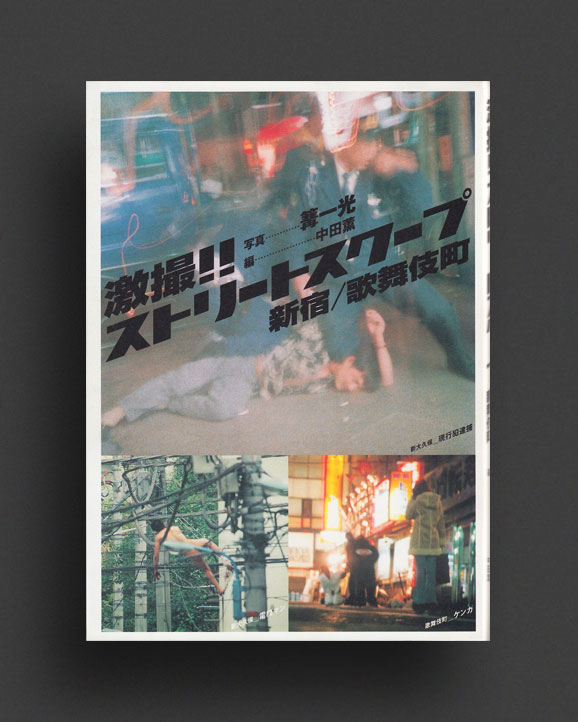
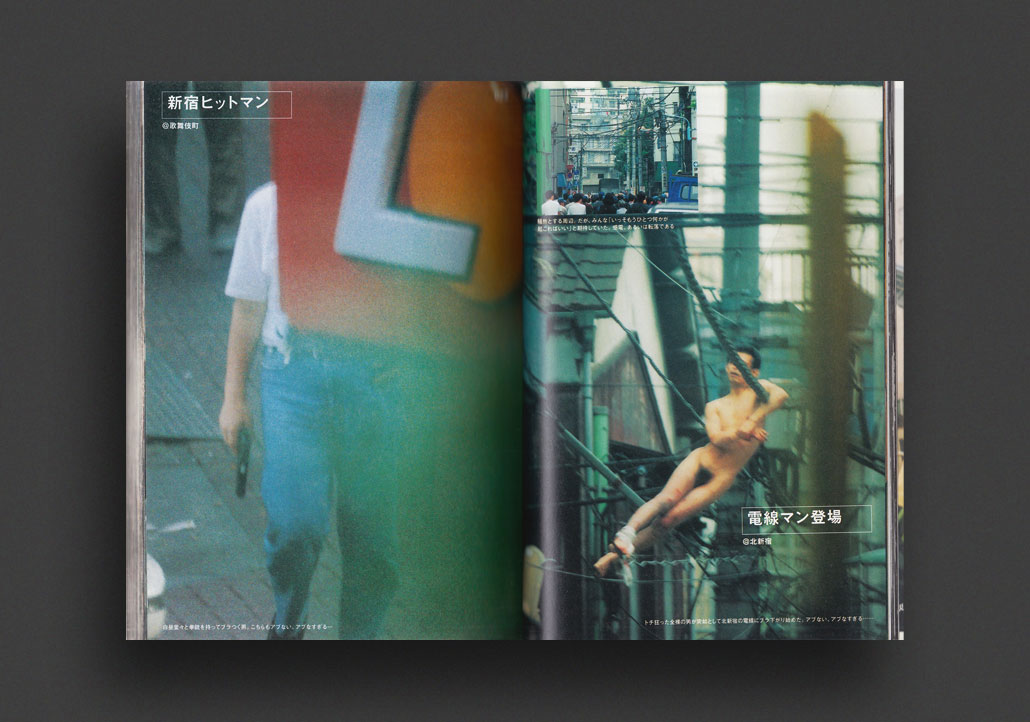
Rare, controversial photo book of Ikko Kagari, publisher of a number of these extraordinary, extremely questionable, surreptitious infrared photography collections in the 1980's—1990's, including the controversial coveted classic "Molester Rush" and "Document Commuter Train". This 2005 collection was published by Futami Shobo, collecting his colour and b/w photography from the streets of Shinjuku and Kabuki-cho areas of Tokyo. Candid and voyeuristic, this is the side of Tokyo usually hidden from view — violence, despair, gluttony and perversion — street photography behind the veil. While many are sexual in nature, in the same vein as his earlier photo books documenting clandestine sexual activities in public places, others show various human dramas unfolding on the street, like unauthorised photo journalism capturing the violent and desperate side of Tokyo. Homicide, suicide, gang violence, overdoses and intoxication, homelessness... Human behaviour seldom published. File alongside the works of Kohei Yoshiyuki, Kiyotaka Tsurisaki, and ¡Alarma!.
Very Good—Near Fine copy.
1994 / 1995, Japanese / English
2 Vol. set, hardcovers (w. corflute envelope slipcases) in box, 196 + 182 pages, 32.5 x 23.5 cm
1st Edition, Out of print title / used / very good
Published by
Sequoia / Tokyo
$500.00 - Out of stock
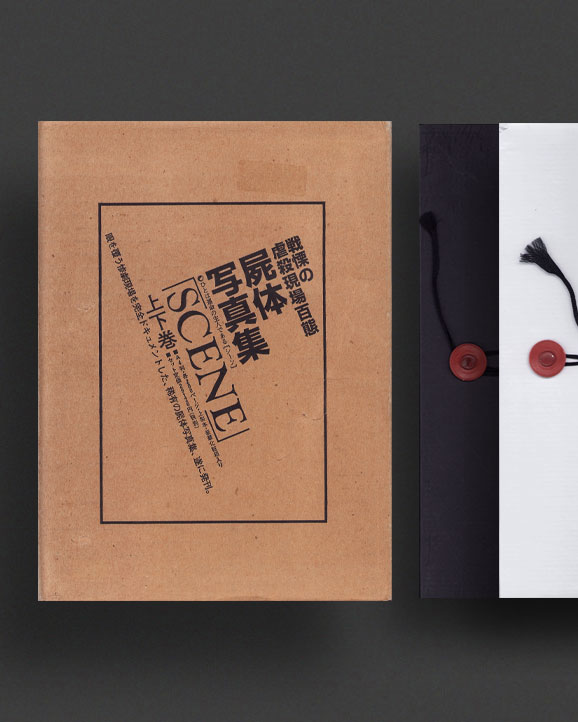
"I dedicate this book to all lives"
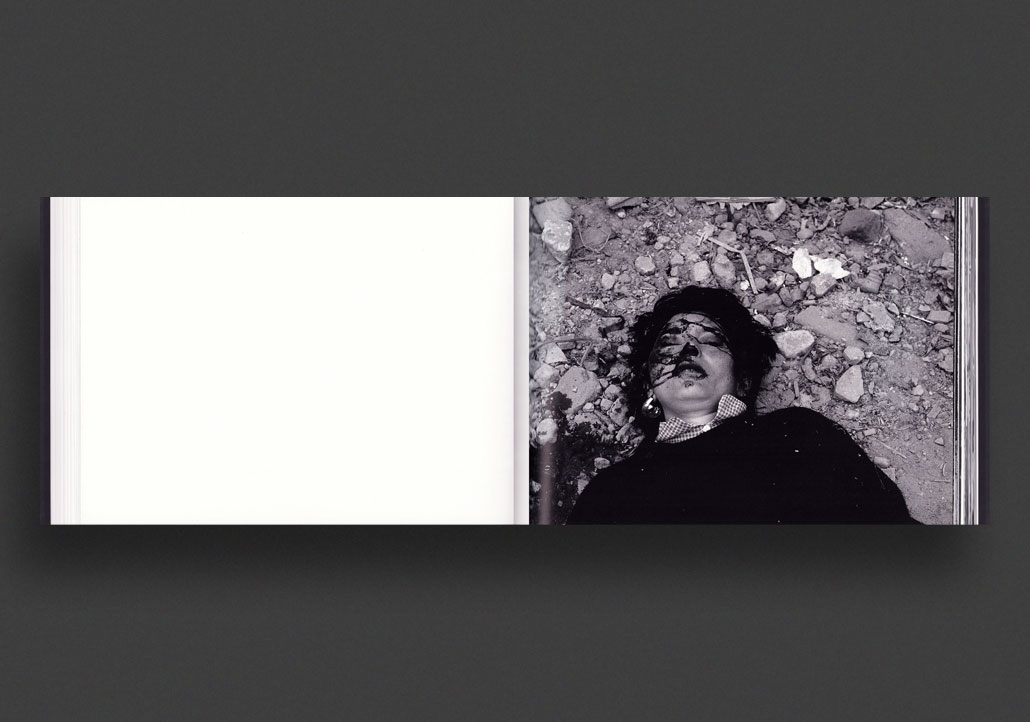
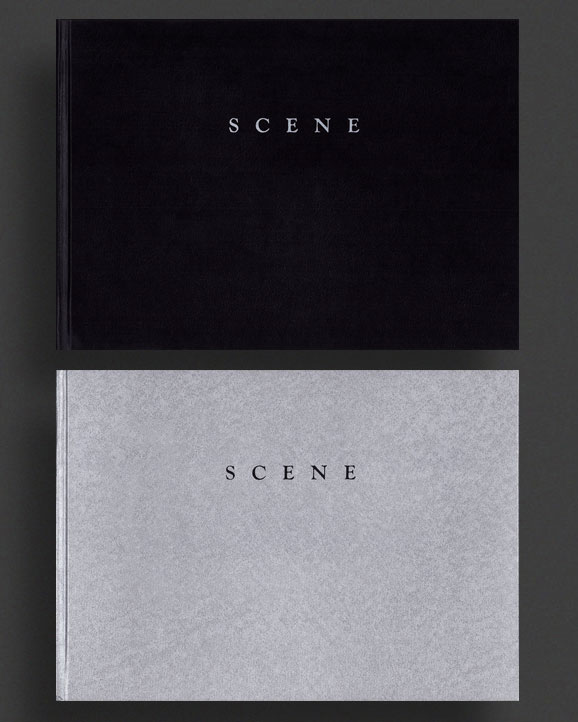
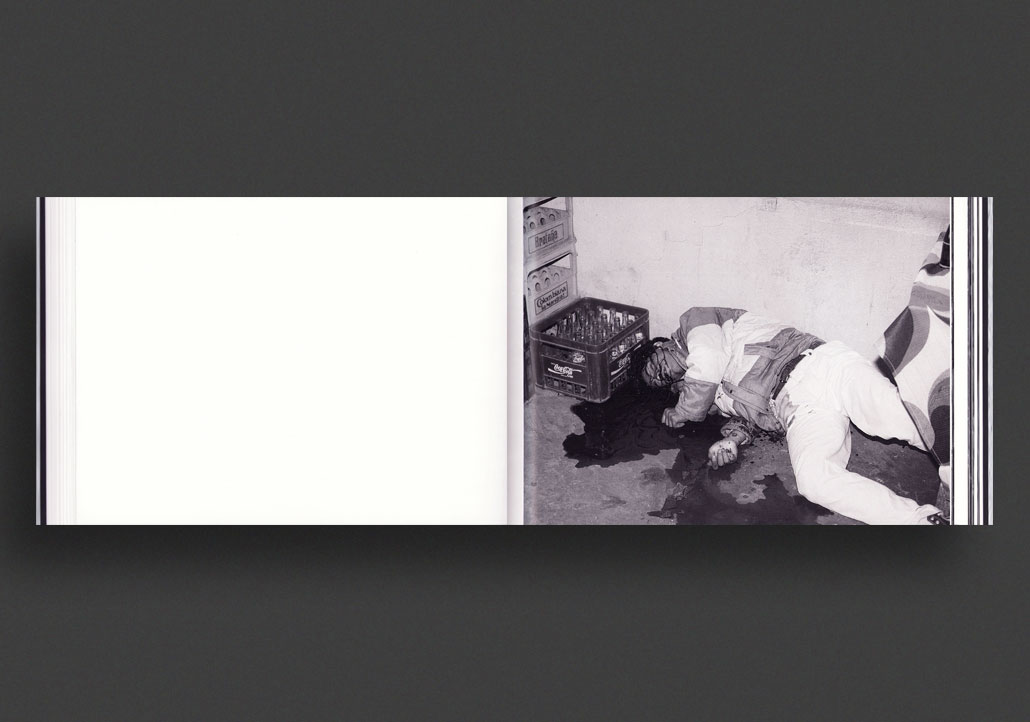
Very rare, highly collectible cult classic two-volume death photo book series, SCENE Vol. 1 and Vol. 2, published in 1994 and 1995 in Japan only. A lavish production, with both heavy books printed in hardcover filled with high-quality reproductions of anonymous, uncredited corpse photography, seemingly sociopolitical photo-journalism of human massacre stripped of text/language as a confronting stream of graphic images in conceptual photo book form. SCENE presents an unwavering, unapologetic exploration of a world usually hidden from view — the dead and death. Not for the faint of heart. Compiled by Kunio Shimizu and Yoichi Shibata for publisher Hirofumi Nagashima, each book is housed in elaborate button-and-tie-bound corflute envelopes, Vol. 1 in black, Vol. 2 in silver. Select plates have been featured in the pages of Kotaro Kobayshi’s underground publications TOO NEGATIVE and ULTRA NEGATIVE from the same period.
This extra special copy was issued as both volumes together in publisher's printed box with seldom seen single promo sheet included for each book (inserted into each book). The ultimate complete edition of this underground photo classic. HEAVY in every sense.
Both books 1990's dead stock with only standard storage wear from button-bind pressure to envelopes/wear to button metal, box with yellowed tape seal (opened) and general storage wear/age.
1990, Japanese / French / English
2 volumes in cardboard slipcase (w. exhibition flyer); volume 1 68 pages (colour ill.) volume 2 196 pages (b/w ill.), 22.5 x 29.5 cm
1st Edition, Out of print title / used / good
Published by
Sezon Museum of Art / Tokyo
$100.00 - Out of stock
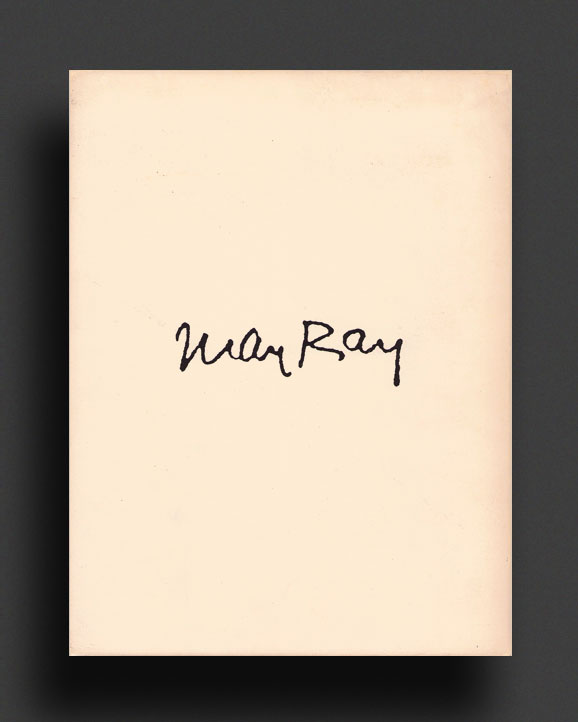
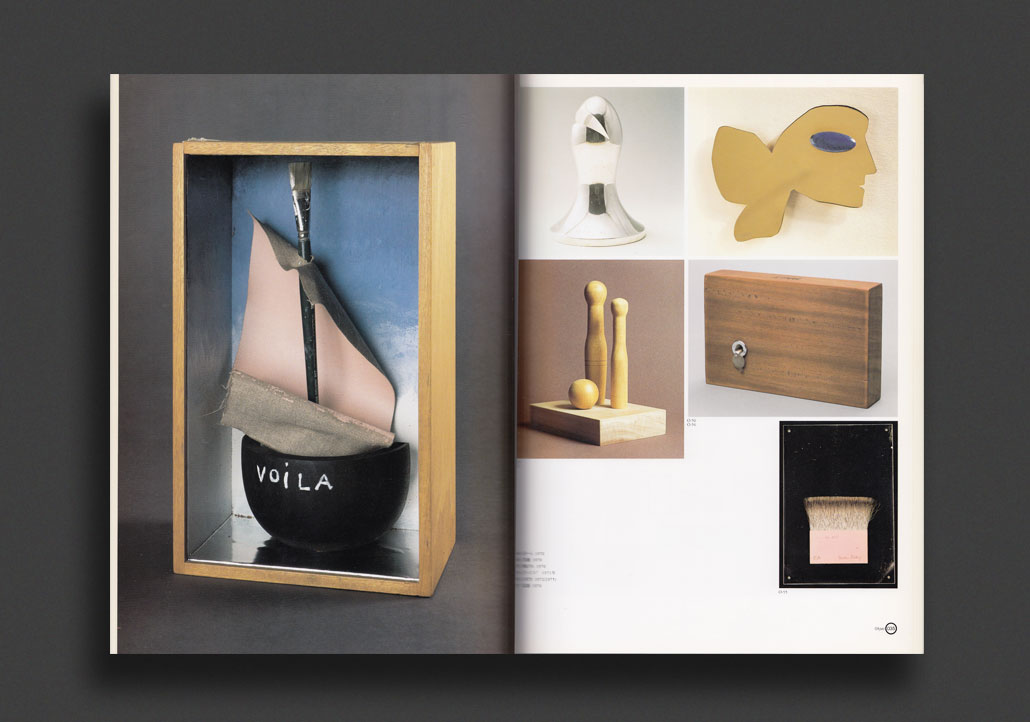
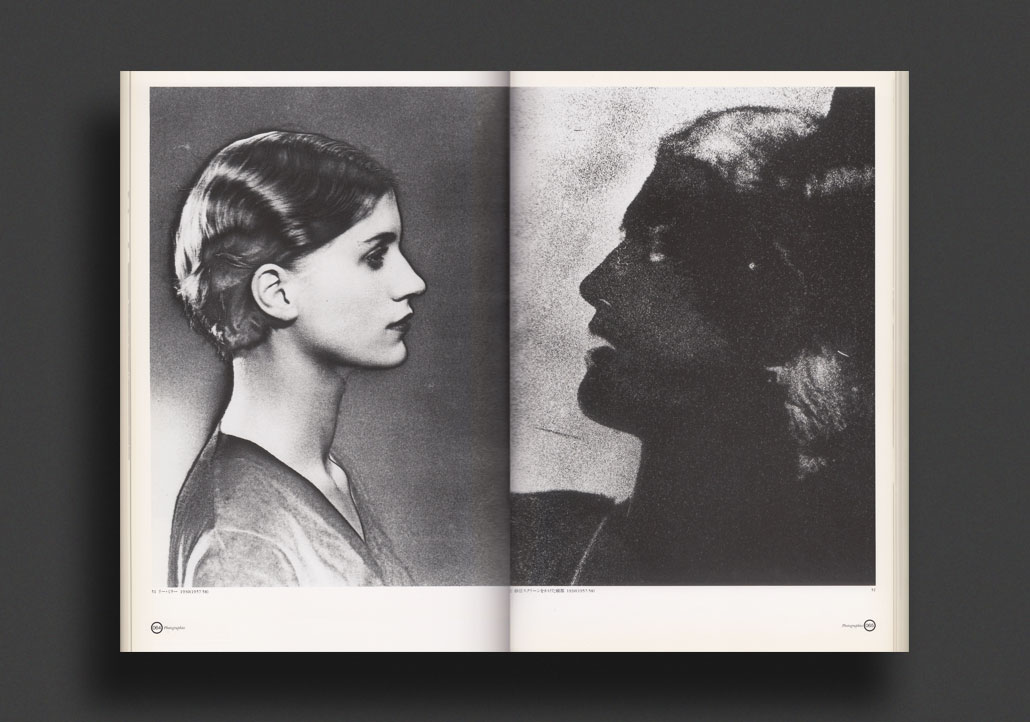
Wonderful, visually exhaustive two-volume boxset catalogue for the traveling exhibition in Japan in 1990—1991, held on the centenary of Man Ray's birth.
Each volume of this Japanese publication on the American artist Man Ray serves as a wonderful index of his incredible lifetime of work. Born Emmanuel Radnitzky in 1890 in Philadelphia, Pennsylvania, Man Ray was a renowned representative of avant-garde photography in the 20th century and is considered as the pioneer of Surrealist photography. A major contributor to the Dada and Surrealist movements, although his ties to each were informal, Man Ray produced major works in a variety of media including drawings, objects and films, but considered himself a painter above all. Volume One compiles many examples of his diverse non-photographic works, reproducing his many paintings, drawings, objects, prints and book editions in full colour. Volume Two (the heavier of the two volumes) focuses on his prolific photographic work, copiously illustrated with a huge catalogue of beautifully reproduced monochromatic works throughout his entire career — Paris, America, Dada, Surrealism and beyond — showcasing his significant contribution to the evaluation of photography as a form of modern art.
Accompanying texts by Merry Foresta, Lucien Treillard, Toshiharu Ito in Japanese, French and English. Primarily in Japanese language. Includes full biography, bibliography and catalogue of all works.
Good—VG copy. Light wear/age/foxing to slipcase and covers otherwise Very Good in general.
1991 exhibition flyer at Seibu laid in.
1970, English
Softcover (folio w. 37 loose leaf prints), 25.5 x 17.5 cm
1st Edition, Out of print title / used / very good
Published by
State University of New York Press / New York
The Art Gallery / Albany
$30.00 - Out of stock
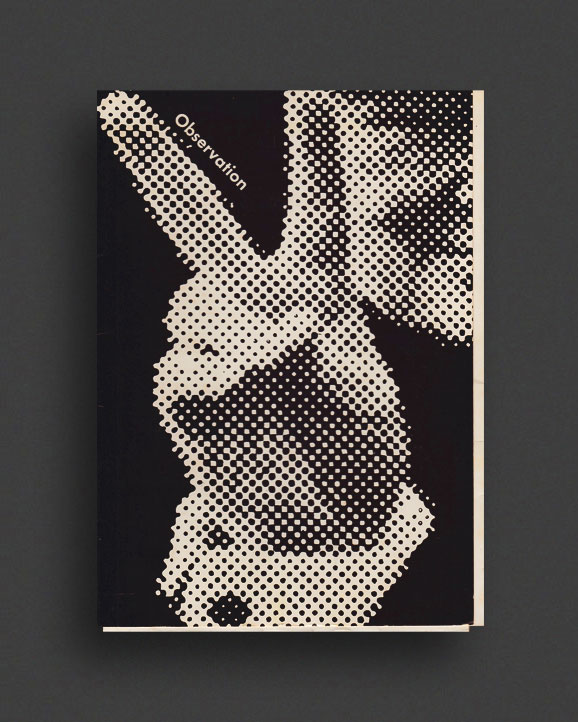
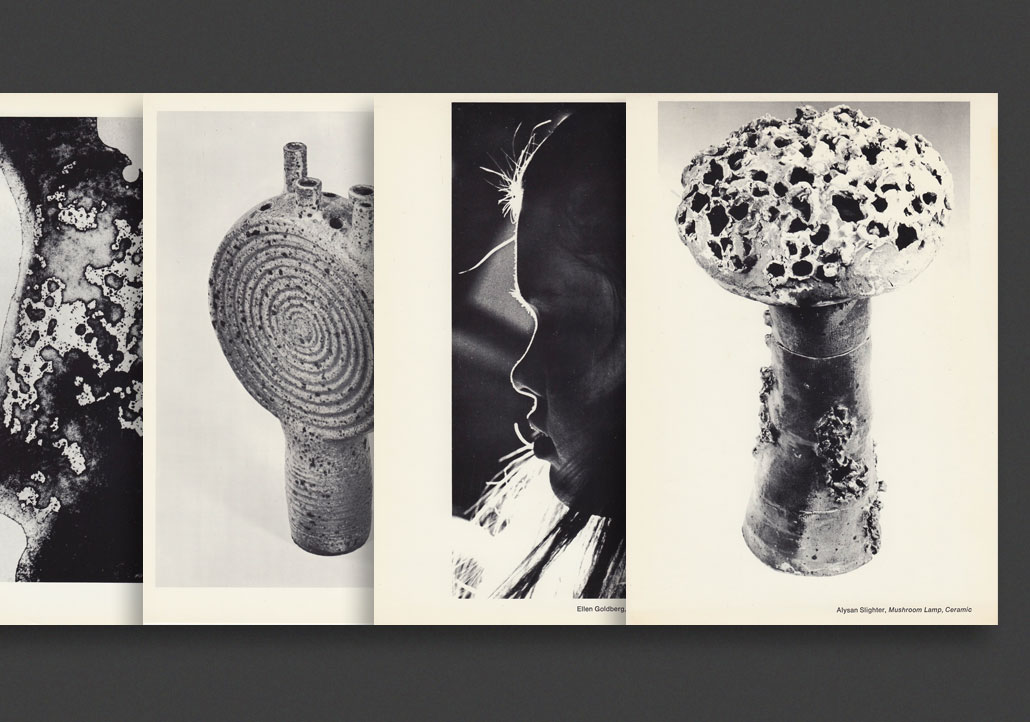
Observation, a Magazine of the Visual Arts, Spring 1970, edited by Betsy Morris and Norah Wylie and published by SUNY at Albany/ The Art Gallery, Albany, New York. Observation is a visual survey of 37 (b/w w. one colour) prints of students and faculty at The State University of New York at Albany in 1970. Photography, ceramics, painting and print making, featuring the artworks of Shirley Penman, Helen Broc, Steven Lobel, et al.
Very Good copy with light general wear.
2024, English / French
Softcover, 296 pages, 13 x 19.6 cm
Published by
Éditions 1989 / Paris
$49.00 - In stock -
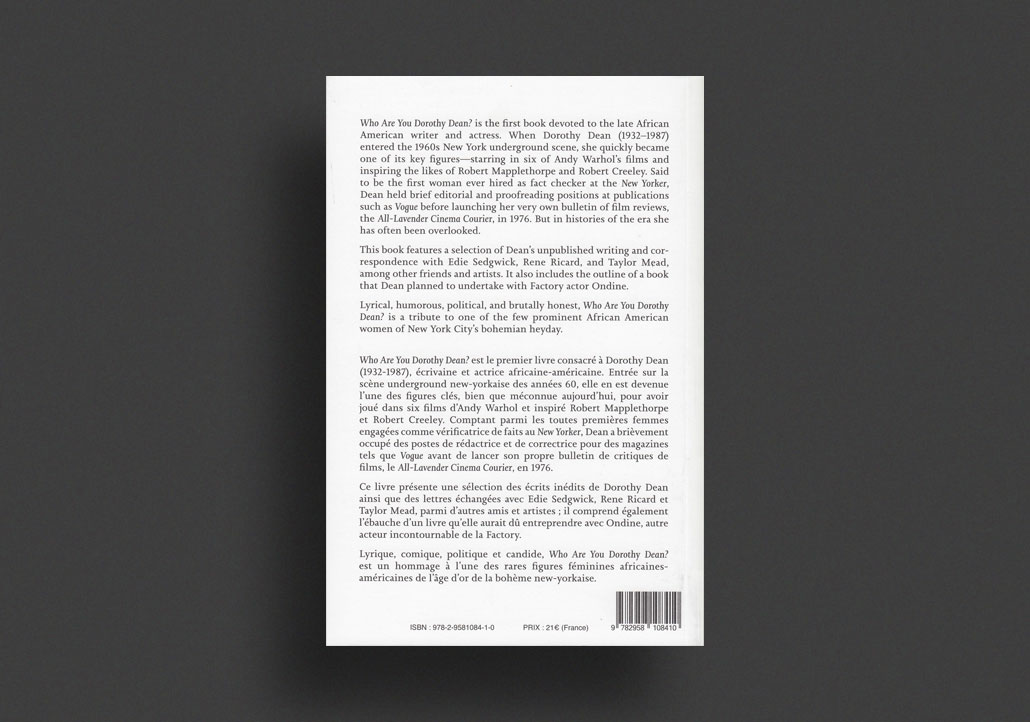
The first book devoted to the late African American writer and actress, Dorothy Dean, one of the few prominent African American women of New York City's bohemian heyday, close to Andy Warhol and Robert Mapplethorpe.
Edited by Anaïs Ngbanzo, this second release from Éditions 1989 features Dorothy Dean's unpublished writing and selected correspondence with Edie Sedgwick, Rene Ricard, and Taylor Mead, among other friends and artists. This volume also includes Dean's transcendent script of an unrealized film starring Factory actor, Ondine.
Lyrical, humorous, political, and brutally honest, Who Are You Dorothy Dean? is a tribute to one of the few prominent African American women of New York City's bohemian heyday.
Dorothy Dean (1932-1987) was an African American writer and actress. She entered the 1960s New York underground scene and quickly became one of its key, if overlooked, figures, starring in six of Andy Warhol's films and inspiring the likes of Robert Mapplethorpe and Robert Creeley. Presumably the first woman ever hired as fact-checker at The New Yorker, Dean held brief editorial and proofreading positions at publications such as Vogue before launching her very own bulletin of film reviews, the All-Lavender Cinema Courier, in 1976.
Texts by Dorothy Dean, Edie Sedgwick, Robert Creeley, Gerard Malanga, Rene Ricard, Taylor Mead, et al. Translated from the English (American) by Rachel Valinsky. Graphic design: Rick Myers.
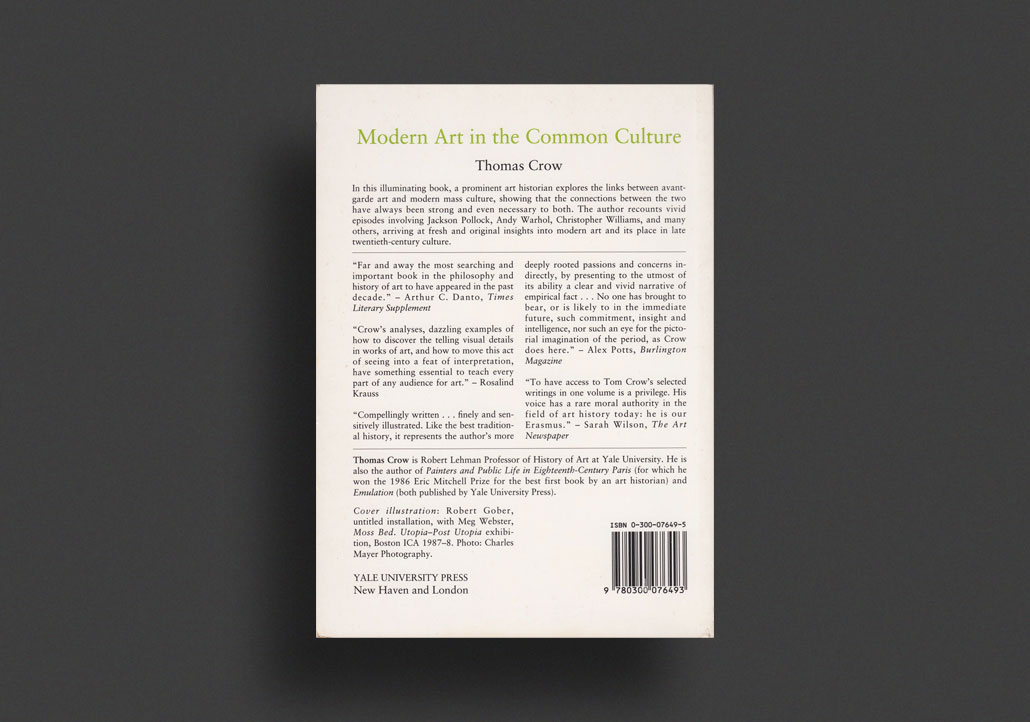
1996, English
Softcover, 274 pages, 21 x 15 cm
1st Edition, Out of print title / used / very good
Published by
Yale University Press / New Haven
$25.00 - Out of stock
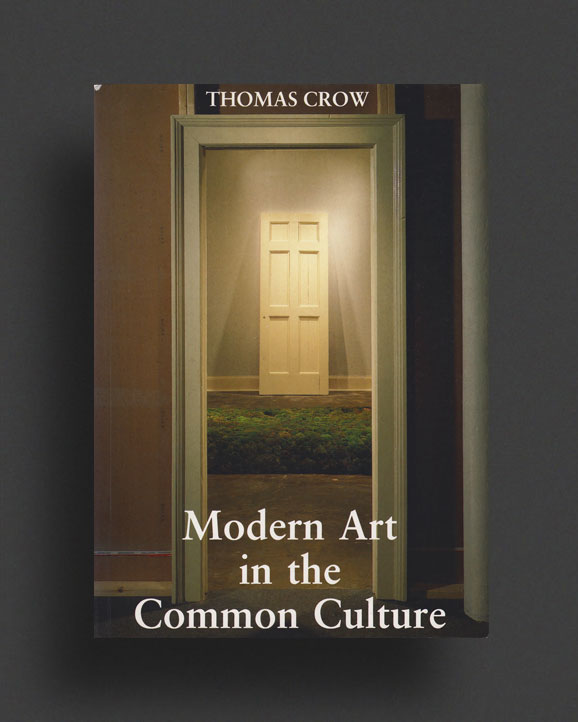
First 1996 edition, second print. In this illuminating book, a prominent art historian explores the links between avant-garde art and modern mass culture, showing that the connections between the two have always been strong, and even necessary to both. The author recounts vivid episodes involving Jackson Pollock, Andy Warhol, Christopher Williams, and many others, arriving at fresh and original insights into modern art and its place in late twentieth-century culture.
Thomas E. Crow is an American art historian and art critic who is best known for his influential writing on the role of art in modern society and culture. Since 2007, Crow has served as the Rosalie Solow Professor of Modern Art at the Institute of Fine Arts, NYU.
Very Good copy, light wear.
1989, English
Hardcover (w. both dust jackets), 236 pages, 25 x 31.3 cm
1st Edition, Out of print title / used / very good
Published by
Schirmer & Mosel / Munich
$240.00 - Out of stock
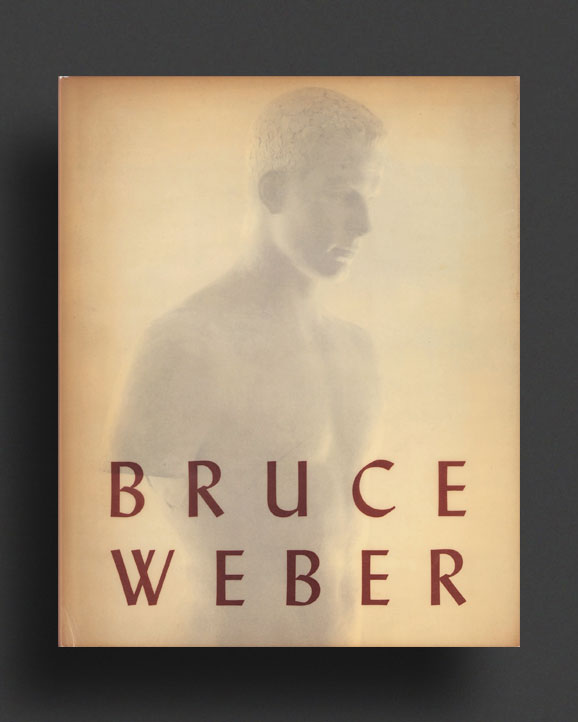
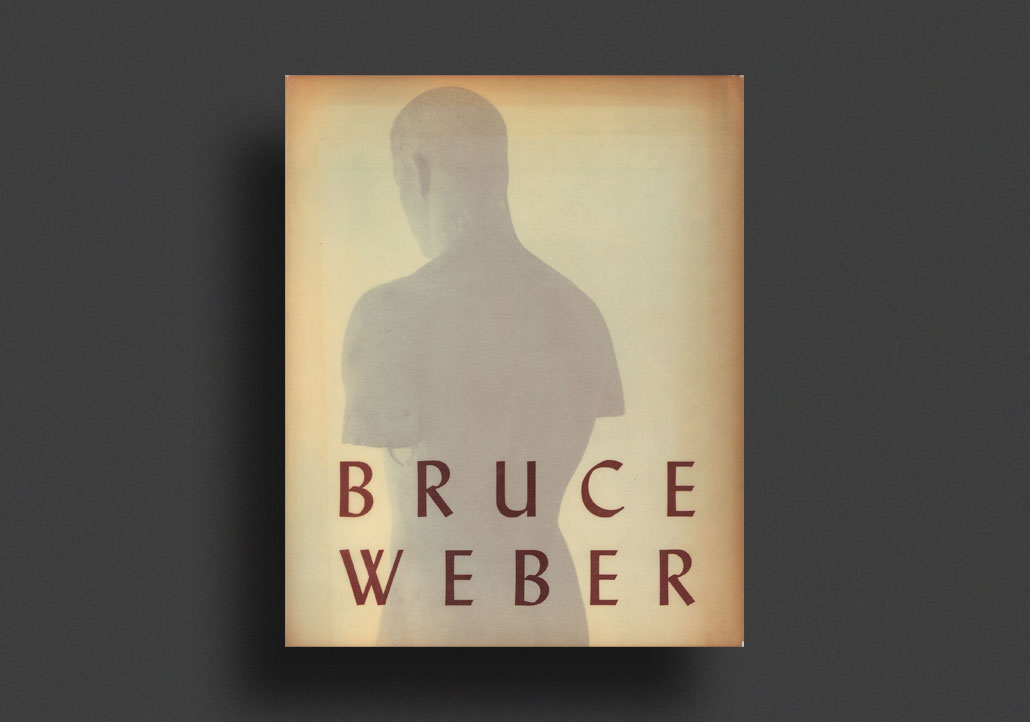
First 1989 hardcover edition of what is still one of the finest books on the work of American fashion photographer Bruce Weber (b. 1946). Edited and designed by John Cheim, this collection of 140 photographs is testimony to the breadth of Weber's photographic talent, from his male nudes charged with nostalgia and classicalism; his humanist portraits of artists, actors and athletes; his glorious homages to his beloved golden retrievers; his lyrical tributes to eroticism or his arcadian vision of the American landscape, it is all here, all beautifully reproduced. Working for Calvin Klein, Karl Lagerfeld, Comme des Garçons, Gianni Versace, Ralph Lauren, and Abercrombie & Fitch, Weber pioneered a nostalgic, aspirational style that redefined the industry. He is widely considered to have introduced a new level of artistry to commercial photography.
First hardcover edition in dust jacket, wrapped within printed translucent dust jacket.
Very Good copy with tanning/minor chips to translucent jacket spine and edges, light spotting to block edges, general age.
1985, English / Japanese
Softcover (w. dust jacket), 28 x 23 cm
1st Edition, Out of print title / used / very good
Published by
Ryuko Tsushin / Japan
$160.00 - Out of stock
First 1985 edition of "London after the Dream" by Japanese photographer Herbie Yamaguchi (b. 1950, Tokyo). A wonderful, lesser-known Japanese photo book of Yamaguchi's images of London in a time of great turmoil, under the control of Thatcher, the 'Iron Lady'. Yamaguchi, who came from the experimental performance arts scene in Tokyo, immersed himself in the punk rock scene in London. Being penniless and without a studio, Yamaguchi shot the people around him, from his flatmate Boy George to Joe Strummer to The Slits, the hair-dressers to the squat kids, intimately capturing an radical musical moment in the city against the backdrop of class tension. London after the Dream collects the best of these photographs, chaptered through Yamaguchi's images of the city's youth, his young adult peers (including a spread featuring Johnny Rotten vis-à-vis Lady Diana), and Britain's older generation. The changing of the guard.
Very Good copy in VG dust jacket.
2021, English
Hardcover, 320 pages, 23 x 16 cm
Published by
Blum & Poe / Los Angeles
$75.00 - Out of stock
Released on the 50th anniversary of the publication of Penny Slinger's iconic artists’ book 50% The Visible Woman, this 2021 edition presents Slinger’s series of surrealist photomontage works and poetry unabridged for the first time, following the hand-constructed snakeskin-bound book from 1969, and the out-of-print abridged edition from 1971. With a new conversation transcribed between Slinger and fellow artist and friend Linder.
1985, Italian
Softcover (stiff card boards), 80 pages, 31 x 23.5 cm
1st Edition, Out of print title / used / very good
Published by
Visualbooks / Milan
$200.00 - Out of stock
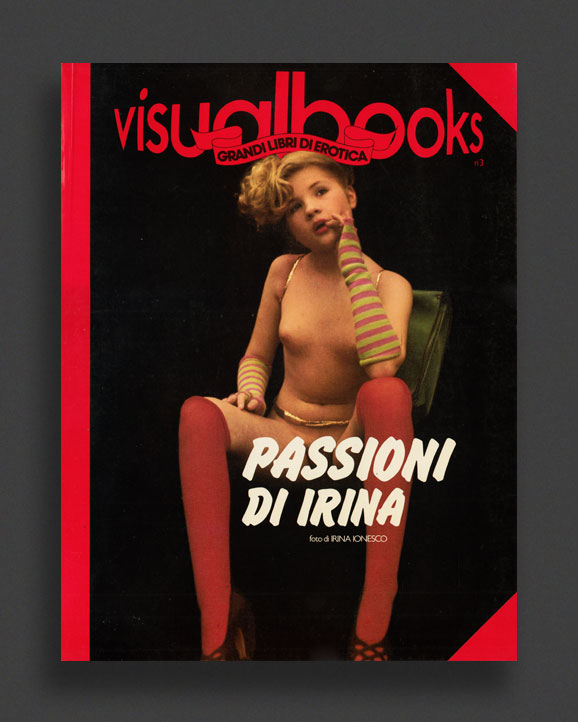
Very rare copy of the first, only edition of "Passioni Di Irina", one of the most sought after and best known books of French photographer Irina Ionesco. Published in 1985 in Milan as part of Visualbooks "Grandi Libri di Erotica", this large-format glossy book collects a beautiful selection of Ionesco's works in full-colour reproductions, uncensored. Published in a limited edition and very collectible.
Irina Ionesco (1935—2022) is a French photographer famous for her unique style of dramatically lit, baroque, erotic female portraits, influenced by the Decadent movement and the dream-like psycho-erotic imagery of Surrealism. At a young age she was sent to Romania where she was raised by her family who were circus performers. From the ages of 15 to 22 she performed as a contortionist. She traveled and painted for several years before discovering photography and gained wide attention when she exhibited her work at the Nikon Gallery in Paris in 1974, leading to her work being published in magazines, books, and exhibited at galleries across the globe. Working primarily as a fashion photographer, Ionesco stirred controversy with her nude portraits—much like Garry Gross would later cause with his sexualized photographs of a young Brooke Shields. Ionesco’s work often features women in elaborate dress, bejewelled, gloved, and in other finery, but also adorning themselves with symbolic pieces such as chokers and other fetishistic props, posing provocatively, partially disrobed as objects of sexual possession. Irina Ionesco is most famous for her photographs using her young daughter, Eva, as her model and muse, a decision that remains controversial to this day.
Very Good copy.
1973, English
20 posters in illustrated folio, 25.7 x 36.5 cm
1st Edition, Out of print title / used / very good
Published by
Edition Nobel / Tokyo
$240.00 - In stock -
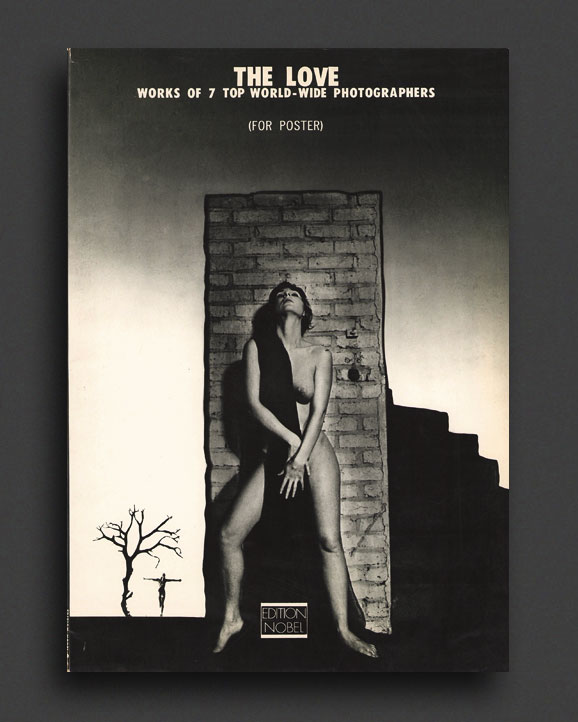
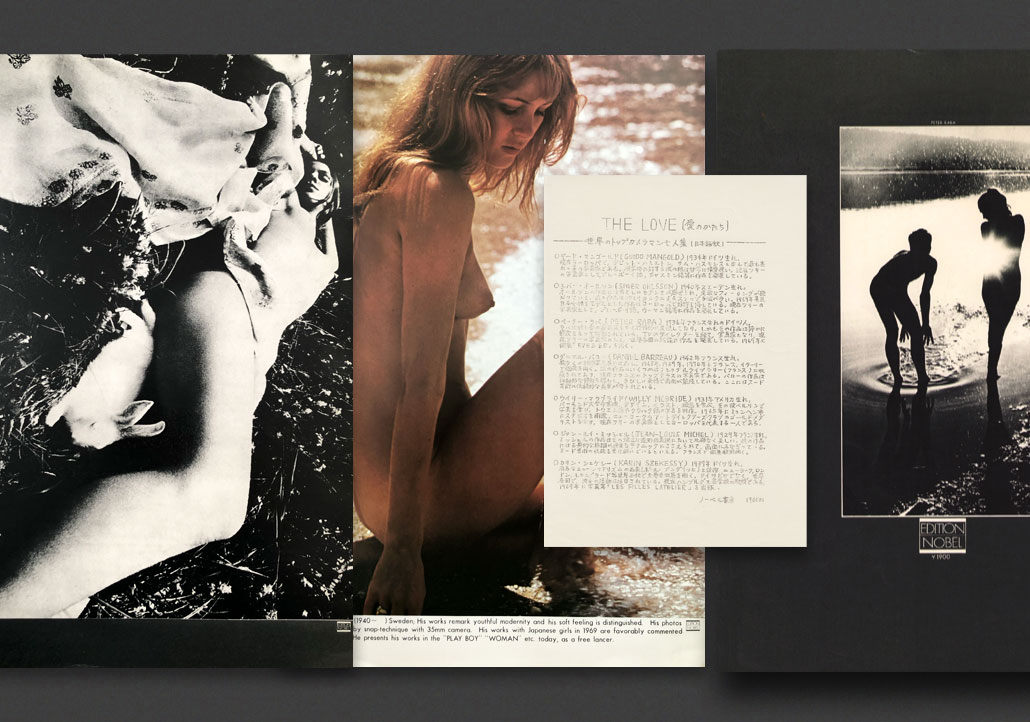
Rare 1973 erotic photo poster edition, collecting full-colour and b/w photographic works by 7 photographers in the form of 20 glossy posters presented in an illustrated portfolio, published only in Japan for the Japanese market. Photographers include Siwer Ohlsson, Guido Mangold, Peter Raba, Daniel Barreau, Will McBride, Jean-Louis Michel, Karin Szekessy.
First, only edition. Complete with all posters still bound together in folio with publisher's hand-written Japanese translations from the English bios, mimeographed and inserted. General handling wear to folio due to size and thin nature, small closed tear/pinching to folio spine.
1977, German
Softcover, 128 pages, 33 x 24 cm
Out of print title / used / good
Published by
Belser Verlag / Stuttgart
$68.00 - Out of stock
Softcover edition of this wonderful over-sized publication on the unique collaboration between German artist Paul Wunderlich and photographer Karin Székessy, one of Germany's most important female photographers, who were married to each other. Published in Switzerland in 1977, this volumes collects an abundance of these iconic 'transpositions,' evocative, experimental nude photographs by Szekessy juxtaposed with Wunderlich's versions, or replies, in the form of paintings and prints. Profusely illustrated throughout in colour and b/w, the result is a fascinating dialogue of unconventional nude form. German literary critic Fritz J. Raddatz's illustrated introduction gives contextual and art historical references and background, accompanied by a full listing of works and exhibition history.
Good—VG copy with only light cover/edge wear.
1988, English / Japanese
Softcover, oversized, loose-leaf pages, 42 x 29.7 cm
1st Edition, Out of print title / used / very good
Published by
Comme des Garçons / Tokyo
$440.00 - Out of stock
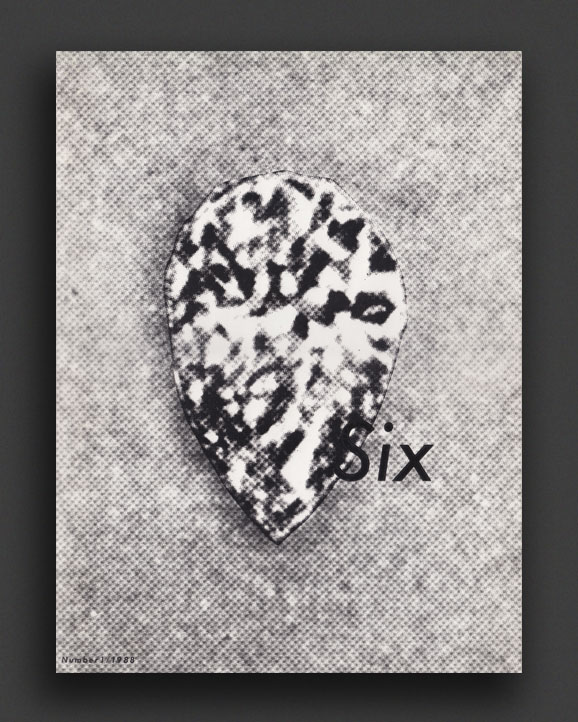
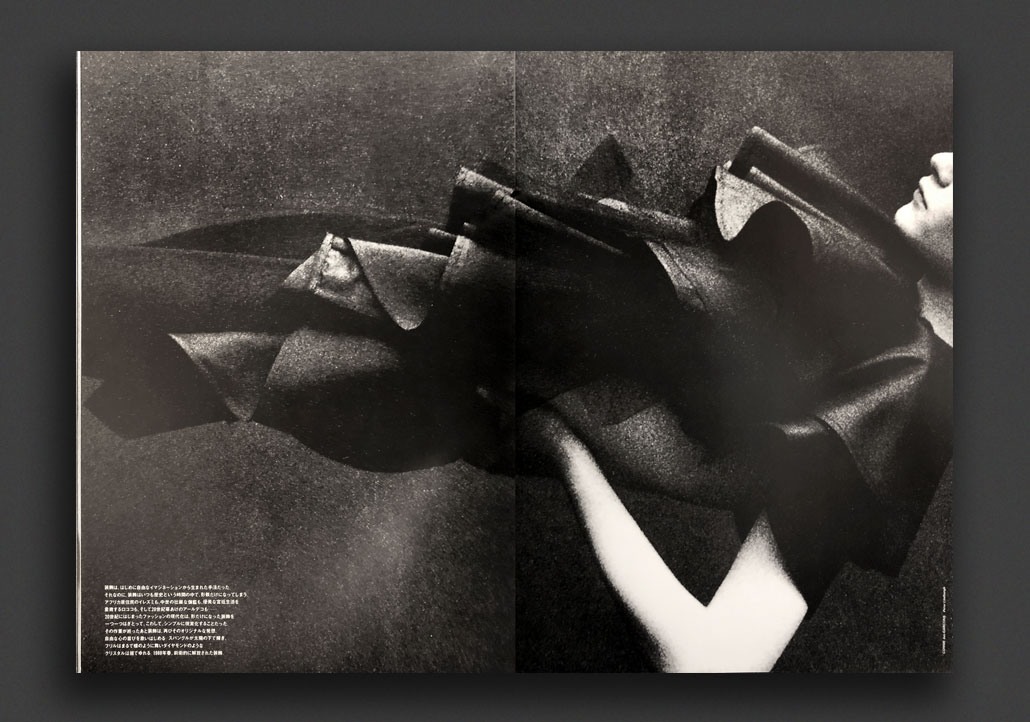
First 1988 edition, first printing of the inaugural issue of the cult, privately distributed Comme des Garçons publication. The incredible first issue of Comme des Garçons' 'Six' magazine (1988) features the work of Hungarian photographer André Kertész, Comme des Garçons by photographer Peter Lindbergh, photography by Sachiko Kuru, features on artist Jean Cocteau, architect Eileen Gray, artist Michel Sauer, and an interview with fashion designer Yohji Yamamoto, plus additional photography by Timothy Greenfield-Sanders, Arthur Elgort, Tony Mendoza, Sachiko Kuru, Shinji Mori, Serge Lido and Gisele Freund. Beautiful first-edition printing of this over-sized magazine vision of Rei Kawakubo, including die-cut features throughout and de-bossed cover title.
Between 1988 and 1991, Comme des Garçons explored the theme of the sixth sense via eight special biannual oversized, unstapled magazines titled 'Six'. These magazines were launched to coincide with Comme des Garçons fashion collections and were privately printed and distributed by Comme. The magazine visually represented the brand in a way that no other fashion company had before. Rei Kawakubo invited Tsuguya Inoue to art direct and Atsuko Kozasu to edit the issues, whilst contributions came from a diverse array of leading designers and artists. Issues of Comme des Garçons 'Six' have become very sought after collectors items.
Very Good / Near Fine copy.
2017, English
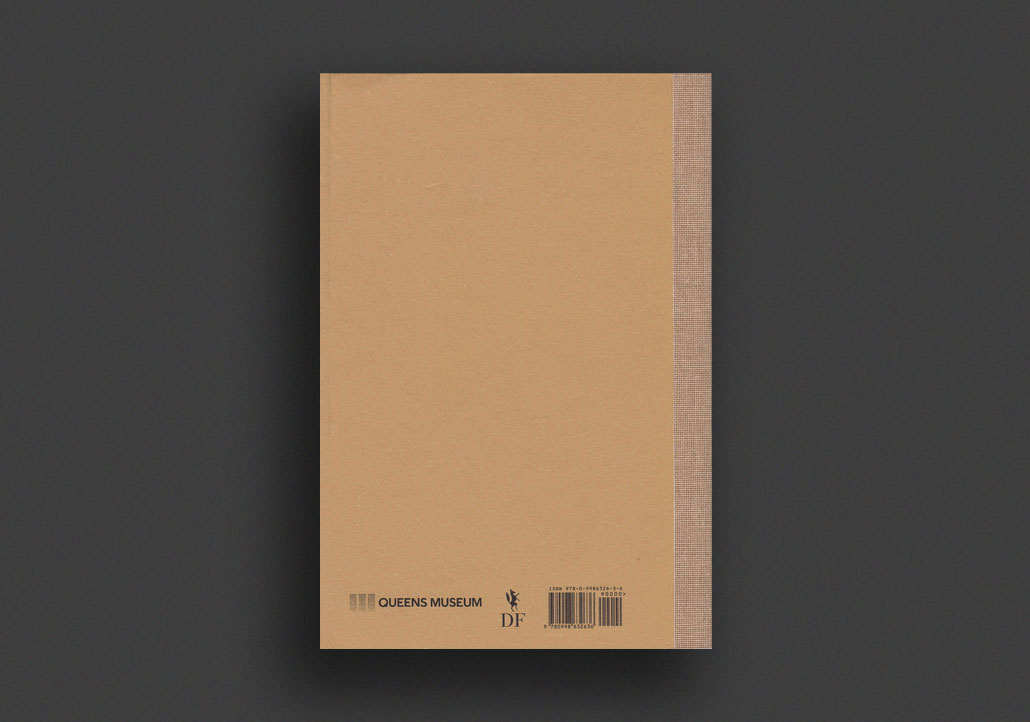
Softcover, 124 pages, 24 x 16.5 cm
Published by
Dancing Foxes Press / Brooklyn
Queens Museum / Queens
$50.00 $30.00 - In stock -
Integrating video, photography, sculpture, writing, and performance into one expansive body of work, Los Angeles–based artist Patty Chang examines the complex way stories develop through geography, history, cultural mythology, fiction, and personal experience. Accompanying her project A Wandering Lake that was in part inspired by turn-of-the-century colonial explorer Sven Hedin’s book Wandering Lake (1938)—which tells the story of a migrating body of water in the Chinese desert—this artist’s book, combining Chang’s writings and travel photographs with historic and theoretical text excerpts as well as photographs of her sculptures and watercolors, is a personal, associative, narrative meditation on mourning, caregiving, and landscape.
Copublished with the Queens Museum in 2017
Edited by Karen Kelly and Barbara Schroeder
With an afterword by Hitomi Iwasaki
Design by Leftloft
This is a guide to mourning; but Chang widens the scope to include political conflict and environmental degradation, and argues that, despite the losses we’ve incurred, we are still collaborators in the making of our worlds.”—Erin Schwartz, The New York Review of Books
1977, Japanese
Softcover (staple-bound), 28 pages, 36.5 x 26 cm
1st Edition, Out of print title / used / very good
Published by
Nisshindo Optical Shop / Nagoya
$140.00 - In stock -
Extremely rare calendar issue from acclaimed Japanese photographer and representative of the Provoke movement, Hitomi Watanabe. Issued privately by a small eyeglasses shop in Nagoya, Nisshindo Optical Shop, this 1977 "LOOK" Calendar presents the rarely seen personal 1970s work of Watanabe. Watanabe began her career photographing in the Tokyo neighbourhood of Shinjuku, home to Japan’s 1960s counter culture. She came to prominence during the Zenkyoto student movement in the late 1960s, occupied the University of Tokyo campus in 1968-69 and participated in the 10.21 International Anti-War Day protests and 1970 Anpo protests against the renewal of the Japan-US Mutual Security Treaty. Her candid photographs of the everyday lives of the protesters, the state violence, and the aftermath of rioting from her insider’s vantage on this tumultuous moment afforded her work an undeniable, enduring power. Her famed "Kaihoku '68 / Liberated Area '68" a testament to this. When the Japan-US Mutual security treaty was renewed in 1970, Watanabe, heartbroken that they had not been able to prevent it, began her long travels through Asia, particularly India and Nepal, from which these beautiful, atmospheric colour photographs are taken. Reproduced in large format across the 12 months of 1977.
Very Good copy with some light wear and light cover tanning. Has been previously hung.