World Food Books' programme is largely produced on Kulin Nation land. We acknowledge the Wurundjeri people of the Kulin Nation as the first and continuing custodians of this land, and pay respect to their Elders past, present, and emerging.
World Food Books is an arts and special interests bookshop in Naarm / Melbourne. Founded in 2010, World Food Books is devoted to the presentation of a rotating, hand-selection of international art, design, literary and counterculture publications with an emphasis on the anti-traditional, the experimental, the avant-garde, the heretic, the marginal.
Presenting new titles alongside rare and out-of-print books, catalogues and journals spanning the fields of modern and contemporary art, design, photography, illustration, film, literature, poetry, cultural theory, philosophy, sexuality, popular and underground culture in its many radical forms, World Food Books wishes to encourage adventurous, thoughtful and open-minded reading, looking, writing, and exchange of publishing and ideas, both current and historical.
As well as our bookshop, located in Melbourne's historical Nicholas Building, all of our inventory is available internationally via our online mail-order service.
World Food Books semi-regularly co-ordinates "Occasions", a programme of exhibits and events at the bookshop and in partnership with other hosts (such as museums and art galleries) that develop out of the activities, relationships and content of the bookshop itself.
World Food Books
The Nicholas Building
37 Swanston Street
Room 5, Level 6
Melbourne 3000
Australia
SHOP HOURS:
Thu–Sat 11–5
WEB-SHOP OPEN 24/7
World Food Books
Postal Address:
PO Box 435
Flinders Lane
Victoria 8009
Australia
Art
Theory / Essay
Architecture / Interior
Graphic Design / Typography
Photography
Fashion
Eros
LGBTQ+
Fiction / Poetry
Weird / Speculative / Science Fiction / Horror
Transgressive / Visceral / Abject
Symbolism / Decadence / Fin de siècle
Film / Video
Painting
Sculpture / Installation
Performance / Dance / Theater
Drawing
Sound / Music
Curatorial
Group Shows / Collections
Periodicals
Out-of-print / Rare
Posters / Ephemera / Discs
Signed Books
World Food Books Gift Voucher
World Food Book Bag
Australian Art
Australian Fiction
Australian Science Fiction / Speculative Fiction
Australian Poetry
Australian Photography
Japanese Photography
Conceptual Art
Minimal Art
Dada
'Pataphysics / Oulipo
Fluxus
Concrete Poetry
Pop Art
Surrealism
Arte Povera
Arte Informale / Haute Pâte / Tachism
Nouveau Réalisme / Zero / Kinetic
Situationism / Lettrism
Collage / Mail Art / Xerox Art
Art Brut / Folk / Visionary / Fantastic
Illustration / Graphic Art / Bandes Dessinées
Furniture
Italian Radical Design / Postmodernism
Textiles
Ceramics / Glass
Counterculture
Protest / Revolt
Philosophy
Psychoanalysis
Anthropology
Anarchism
Socialism / Anarchism / Communism / Capitalism
Literary Theory / Semiotics / Language
Feminism / Women's Studies
Gender Studies / Sexuality
Anthropology
Fetishism / BDSM
Drugs / Psychedelia
Crime / Violence
Animal Rights / Veganism
Occult / Esoterica
Ecology / Earth / Alternative Living
Whole Earth / Crafts
All prices in AUD (Australian dollars)
Pick-Ups
Pick-up orders can be collected in our bookshop during opening hours after order date. Please collect any Pick-up orders within 2 weeks of ordering as we have limited storage space. Orders will be released back into stock if not collected within this time. No refunds can be made for pick-ups left un-collected. If you cannot make it in to the bookshop in this time-frame, please choose postage option.
Return Policy
All sales are final. We do accept returns (for refund or exchange) for items received in error. All our orders are packed with special care using heavy-duty padding and cardboard book-mailers or bubble mailers (for smaller books), using reinforcement where required. We cannot take responsibility for any lost, stolen or damaged parcels.
Insurance
Should you wish to insure your package, please email us directly after placing your order and we can organise this at a small extra expense. Although all standard/express tracked packages are very safe and dependable, we cannot take responsibility for any lost, stolen or damaged parcels. We recommend insurance on valuable orders.
Interested in selling your old books, catalogues, journals, magazines, comics, fanzines, ephemera? We are always looking for interesting, unusual and out-of-print books to buy. We only buy books in our fields of interest and specialty, and that we feel we can resell.
We base these prices on desirability, market value, in-print prices, condition and our current stock levels. We offer cash, store credit, and can take stock on consignment. All
about 25% of the price we expect to get when we sell them, or 30% in store credit. We base these prices on desirability, market value, in-print prices, condition and our current stock levels.
Sell your books any day of the week. You can drop them off and return later. If you have a lot of books, we can visit your Sydney home.
We buy books that we feel we can resell. We offer about 25 % of the price we expect to get when we sell them, or 30% in store credit. We base these prices on desirability, market value, in-print prices, condition and our current stock levels.
Philadelphia Wireman
03 August - 01 September, 2018
World Food Books is proud to announce our next Occasion, the first presentation of sculptures by Philadelphia Wireman in Australia.
The Philadelphia Wireman sculptures were found abandoned in an alley off Philadelphia’s South Street on trash night in 1982. Their discovery in a rapidly-changing neighbourhood undergoing extensive renovation, compounded with the failure of all attempts to locate the artist, suggests that the works may have been discarded after the maker’s death. Dubbed the "Philadelphia Wireman" during the first exhibition of this work, in 1985, the maker’s name, age, ethnicity, and even gender remain uncertain. The entire collection totals approximately 1200 pieces, all intricately bound together with tightly-wound heavy-gauge wire (along with a few small, abstract marker drawings, reminiscent both of Mark Tobey and J.B. Murry). The dense construction of the work, despite a modest range of scale and materials, is singularly obsessive and disciplined in design: a wire armature or exoskeleton firmly binds a bricolage of found objects including plastic, glass, food packaging, umbrella parts, tape, rubber, batteries, pens, leather, reflectors, nuts and bolts, nails, foil, coins, toys, watches, eyeglasses, tools, and jewellery.
Heavy with associations—anthropomorphic, zoomorphic, and socio-cultural responses to wrapped detritus—the totemic sculptures by Philadelphia Wireman have been discussed in the context of work created to fulfil the shamanistic needs of alternative religions in American culture. Curators, collectors, and critics have variously compared certain pieces to sculpture from Classical antiquity, Native American medicine bundles, African-American memory jugs, and African fetish objects. Reflecting the artist’s prolific and incredibly focused scavenging impulse, and despite—or perhaps enhanced by—their anonymity, these enigmatic objects function as urban artefacts and arbiters of power, though their origin and purpose is unknown. Philadelphia Wireman, whatever their identity, possessed an astonishing ability to isolate and communicate the concepts of power and energy through the selection and transformation of ordinary materials. Over the course of the past two decades, this collection has come to be regarded as an important discovery in the field of self-taught art and vernacular art.
Presented in collaboration with Fleisher-Ollman Gallery, Philadelphia, and Robert Heald, Wellington.
Susan Te Kahurangi King
02 February - 10 March, 2018
Susan Te Kahurangi King (24 February 1951 - ) has been a confident and prolific artist since she was a young child, drawing with readily available materials - pencils, ballpoint pens and felt-tip markers, on whatever paper is at hand. Between the ages of four and six Susan slowly ceased verbal communication. Her grandparents William and Myrtle Murphy had developed a special bond with Susan so they took on caring responsibilities for extended periods. Myrtle began informally archiving her work, carefully collecting and storing the drawings and compiling scrapbooks. No drawing was insignificant; every scrap of paper was kept. The King family are now the custodians of a vast collection containing over 7000 individual works, from tiny scraps of paper through to 5 meter long rolls.
The scrapbooks and diaries reveal Myrtle to be a woman of great patience and compassion, seeking to understand a child who was not always behaving as expected. She encouraged Susan to be observant, to explore her environment and absorb all the sights and sounds. Myrtle would show Susan’s drawings to friends and people in her community that she had dealings with, such as shopkeepers and postal workers, but this was not simply a case of a grandmother’s bias. She recognised that Susan had developed a sophisticated and unique visual language and sincerely believed that her art deserved serious attention.
This was an unorthodox attitude for the time. To provide some context, Jean Dubuffet coined the term Art Brut in 1945 to describe work created by self-taught artists – specifically residents of psychiatric institutions and those he considered to be visionaries or eccentrics. In 1972 Roger Cardinal extended this concept by adopting the term Outsider Art to describe work made by non-academically trained artists operating outside of mainstream art networks through choice or circumstance. Susan was born in Te Aroha, New Zealand in 1951, far from the artistic hubs of Paris and London that Dubuffet and Cardinal operated in. That Myrtle fêted Susan as a self-taught artist who deserved to be taken seriously shows how progressive her attitudes were.
Susan’s parents Doug and Dawn were also progressive. Over the years they had consulted numerous health practitioners about Susan’s condition, as the medical establishment could not provide an explanation as to why she had lapsed into silence. Dawn educated herself in the field of homeopathy and went on to treat all twelve of her children using these principles – basing prescriptions on her observations of their physical, mental and emotional state.
Doug was a linguist with an interest in philosophy who devoted what little spare time he had to studying Maori language and culture. To some extent their willingness to explore the fringes of the mainstream made them outsiders too but it was their commitment to living with integrity and their respect for individuality that ensured Susan’s creativity was always encouraged.
Even though Susan’s family supported her artistic pursuits, some staff in schools and hospitals saw it as an impediment to her assimilation into the community and discouraged it in a variety of ways. Her family was not always aware of this and therefore did not fully understand why Susan stopped drawing in the early 1990s. However, rather than dwell on the challenges that Susan faced in pursuit of her artistic practice, they prefer to highlight her achievements. In 2008 Susan began drawing again in earnest, after an almost 20 year interruption, and her work is now shown in galleries around the world.
Susan grew up without television and has been heavily influenced by the comics she read as a child. She is absolutely fearless in the appropriation of recognizable characters, such as Donald Duck and Mickey Mouse, in her work. She twists their limbs, contorts their faces, compresses them together, blends them into complex patterned backgrounds - always imbuing them with an incredible energy. Although Susan often used pop culture characters in her work they are not naive or childlike. These are drawings by a brilliant self-taught artist who has been creating exceptional work for decades without an audience in mind.
Mladen Stilinović
"Various Works 1986 - 1999"
02 February 16 - September 10, 2016
Various works 1986 - 1999, from two houses, from the collections of John Nixon, Sue Cramer, Kerrie Poliness, Peter Haffenden and Phoebe Haffenden.
Including: Geometry of Cakes (various shelves), 1993; Poor People’s Law (black and white plate), 1993; White Absence (glasses, ruler, set square, silver spoon, silver ladel with skin photograph and wooden cubes), 1990-1996; Exploitation of the Dead (grey and red star painting, wooden painting, black spoon with red table, red plate), 1984-1990; Money and Zeros (zero tie, paintings made for friends in Australia (Sue, John, Kerrie), numbers painting), 1991-1992; Words - Slogans (various t-shirts) - “they talk about the death of art...help! someone is trying to kill me”, “my sweet little lamb”, “work is a disease - Karl Marx”; Various artist books, catalogues, monographs, videos; Poster from exhibition Insulting Anarchy; "Circular" Croatian - Australian edition; Artist book by Vlado Martek (Dostoyevsky); more.
Thanks to Mladen Stilinović and Branka Stipančić.
Jonathan Walker
Always Will Need To Wear Winter Shirt Blue + Ochre Small Check Pattern
21 August - 21 September, 2015
Untitled
I am not a great reader of poetry but I always return to the work of Melbourne poet, Vincent Buckley (1925- 1988). Perhaps I find his most tantalising piece to be not a finished poem but a fragment left on a scrap of paper discovered on his desk after the poet’s death.
The poetry gathers like oil
In the word-core, and spreads
It has its music meet,
Its music is in movement.
This fragment is more the shell left behind from a volatile thought than a finished poem. I find the last two lines honest but awkward whereas the first two lines work like an arrow. Most likely he could not find a resolution so it was left. Still, in its present form, it remains an eloquent testimony to the ultimate failure of a medium to express mobile thought and sensation, in Buckley’s case, through verbal language. It’s an important matter because this is something all artists have to deal with regardless of the medium.
I have never written a poem, however, I am forever copying fragments from books on paper scraps in a vain effort to fix certain notions in my head. At first, they function as bookmarks that are sometimes returned to when I open the book. But before long, as they accumulate, they fall out littering the table interspersed with A4 photocopies, bills, books and medications.
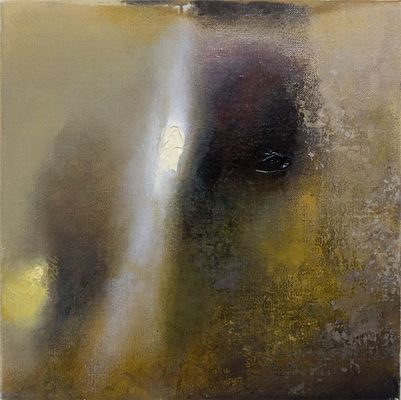
To return to Buckley’s fragment, the first two lines very much evoke how I paint nowadays. As you age, detail diminishes and patches of light become more luminous and float. I feel the most honest way of dealing with this is by smearing the oil paint on the canvas with the fingers and working close-up, blind. Only if the patches coalesce into an approaching image can the work gain a life.
-
Jonathan Walker was born in Melbourne, Australia and brought up on a dairy farm in Gippsland. In the 1970’s he studied painting at RMIT and won the Harold Wright Scholarship to the British Museum, London. During the 1980’s he exhibited at Pinacotheca Gallery, Richmond and had work shown at the NGV and Heidi City Art Gallery. Over the same period he designed the cover for the “Epigenesi” LP by Giancarlo Toniutti, Italy and conducted a mail exchange work with Achim Wollscheid, Germany. The work with artists through the post resulted in an article published in the bicentenary issue of Art and Australia 1988. He showed in artist run spaces such as WestSpace in the 90’s and 2000’s, and until 2012, taught painting at Victoria University, which is where we (Colleen Ahern and Lisa Radford) as organisers of the exhibition, among many others, had the privilege of being his student.
Walker’s knowledge was imparted to students through the careful selection of music, literature, and artists found in books that he himself had ordered for the library. Walker’s strategy was the generosity of sharing his vast knowledge with references specific to each student and their context.
Walker’s paintings share a similar focus and intimacy.
This exhibition presents a small selection of recent paintings alongside a publication that includes Walker’s writing. Observational and analytical, Walker’s work is a type of material notation — the time of day, colour and how it is blended, the both specific and fleeting location of a reflection on lino or the question of whether a chair leg should be included in a painting.
Please join us on Friday August 21 between 6-8pm to celebrate the opening of the exhibition.
Curated by Colleen Ahern and Lisa Radford.
B. Wurtz
Curated by Nic Tammens
March 26 - April 4, 2015
B.Wurtz works from a basement studio in his home on Manhattan’s Lower East Side.
This local fact is attested to by the plastic shopping bags and newsprint circulars that appear in his work. As formal objects, they don’t make loud claims about their origins but nonetheless transmit street addresses and places of business from the bottom of this long thin island. Like plenty of artists, Wurtz is affected by what is local and what is consumed. His work is underpinned by this ethic. It often speaks from a neighborhood or reads like the contents of a hamper:
“BLACK PLUMS $1.29 lb.”
“Food Bazaar”
“USDA Whole Pork Shoulder Picnic 99c lb.”
“RITE AID Pharmacy, with us it’s personal.”
“H. Brickman & Sons.”
“Sweet Yams 59c lb."
Most of the work in this exhibition was made while the artist was in residence at Dieu Donne, a workshop dedicated to paper craft in Midtown. Here Wurtz fabricated assemblages with paper and objects that are relatively lightweight, with the intention that they would be easily transportable to Australia. This consideration isn’t absolute in Wurtz’s work, but was prescriptive for making the current exhibition light and cheap. Packed in two boxes, these works were sent from a USPS post office on the Lower East Side and delivered to North Melbourne by Australia Post.
Wurtz appears courtesy of Metro Pictures, New York.
Thanks to Rob Halverson, Joshua Petherick, Sari de Mallory, Matt Hinkley, Helen Johnson, Fayen d'Evie, Ask Kilmartin, Lisa Radon, Ellena Savage, Yale Union, and "Elizabeth".
John Nixon
"Archive"
December 15 - January 20, 2014
The presentation of John Nixon's archive offered a rare showcase of this extensive collection of the artist's own publications, catalogues, posters, ephemera, editions and more, from the mid 1980s onwards, alongside a selection of his artworks.
Organized by John Nixon, Joshua Petherick and Matt Hinkley.
<a href=http://wfb.public-office.info/artist/john-nixon>All titles by John Nixon
"Habitat"
at Minerva, Sydney (organised by Joshua Petherick and Matt Hinkley)
November 15 - December 20, 2014
Lupo Borgonovo, Janet Burchill & Jennifer McCamley,
Lewis Fidock, HR Giger, Piero Gilardi, Veit Laurent Kurz,
Cinzia Ruggeri, Michael E. Smith, Lucie Stahl, Daniel Weil, Wols
Press Release:
“...It contained seven objects. The slender fluted bone, surely formed for flight, surely from the wing of some large bird. Three archaic circuitboards, faced with mazes of gold. A smooth white sphere of baked clay. An age-blackened fragment of lace. A fingerlength segment of what she assumed was bone from a human wrist, grayish white, inset smoothly with the silicon shaft of a small instrument that must once have ridden flush with the surface of the skin - but the thing’s face was seared and blackened.”
William Gibson, “Count Zero”, 1986
"Autumn Projects Archive"
Curated by Liza Vasiliou
March 6 - March 15, 2014
World Food Books, in conjunction with the Virgin Australia Melbourne Fashion Festival 2014, presented the Autumn Projects archive, consisting of a selection of early examples in Australian fashion with a particular interest in collecting designers and labels from the period beginning in the 1980’s, who significantly influenced the discourse of Australian Fashion.
Curated by Liza Vasiliou, the exhibition provided a unique opportunity to view pieces by designers Anthea Crawford, Barbara Vandenberg, Geoff Liddell and labels CR Australia, Covers, Jag along with early experimental collage pieces by Prue Acton and Sally Browne’s ‘Fragments’ collection, suspended throughout the functioning World Food Books shop in Melbourne.
H.B. Peace
presented by CENTRE FOR STYLE
November 14, 2013
"Hey Blinky, you say chic, I say same"
Anon 2013
H.B. Peace is a clothing collaboration between great friends Blake Barns and Hugh Egan Westland. Their pieces explore the divergences between 'character’ and ‘personality’ in garments....etc
Special Thanks to Joshua Petherick and Matt Hinkley of WFB and Gillian Mears
and a Very Special Thank you to Audrey Thomas Hayes for her shoe collaboration.
Janet Burchill & Jennifer McCamley
"Aesthetic Suicide"
May 10 - June 8, 2013
The first of our occasional exhibitions in the World Food Books office/shop space in Melbourne, "Aesthetic Suicide" presented a body of new and older works together by artists Janet Burchill & Jennifer McCamley, including videos, prints, a wall work, and publications.
During shop open hours videos played every hour, on the hour.
$.00 - Out of stock
The eternal clean out! New items weekly.
https://worldfoodbooks.com/category/sale
Published by World Food Books / Melbourne
$20.00 - In stock -
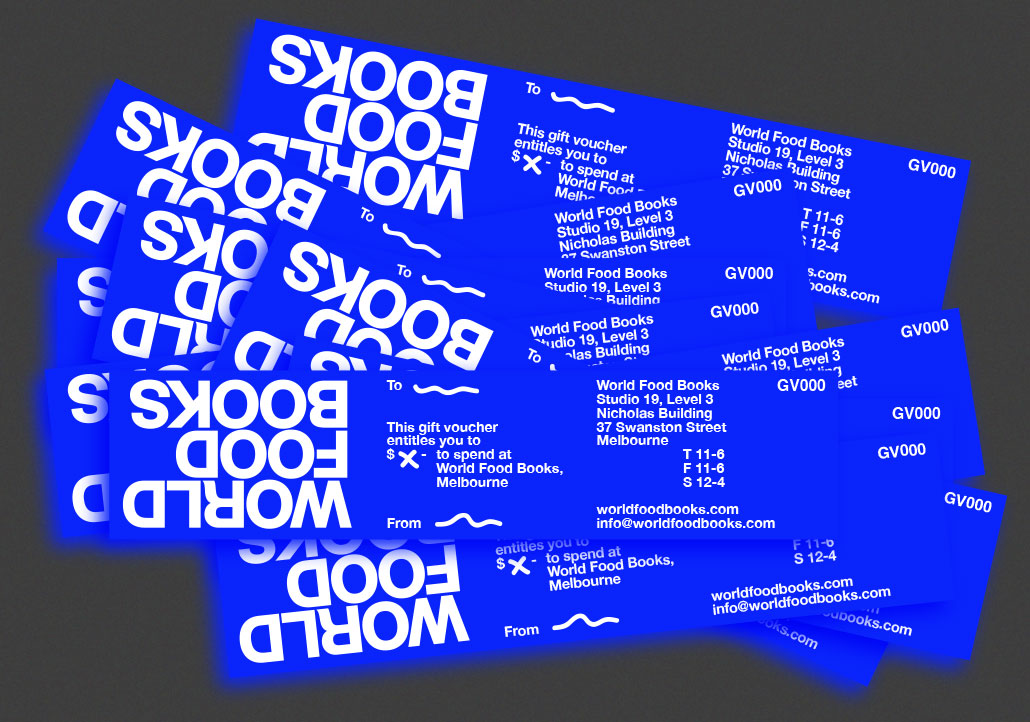
A World Food Books gift voucher is redeemable in our Melbourne bookshop or via our webshop (here). An e-voucher (printable pdf) will be sent to your purchase email address (please notify us if you wish to have the voucher sent to an alternate address and wish us to fill in the receiver's details on the card).
Gift vouchers can be purchased in increments of $20 (Australian Dollars) and the total amount can simply be added to by increasing the quantity in your shopping cart. eg. A quantity of 5 gift vouchers will result in an item total of $100 - a $100 gift voucher. Simply click "ADD TO CART" 5 times, or update your quantity in the shopping cart.
If you wish to purchase multiple, separate gift vouchers in one go, please just email us and we can personally prepare and email you a payment request.
Please note: Please select Pick-Up on gift voucher purchse to avoid any postage charges. Accidental postage charges will be refunded right away!
Thank you.
For any questions, please don't hesitate to email: [email protected]
2013, English
Hardcover, 224 pages, 29 x 21.8 cm
Published by
University of Chicago Press / Chicago
$140.00 - In stock -
Mike Kelley, Paul McCarthy, and Raymond Pettibon—these Southern California artists formed a “bad boy” trifecta. Early purveyors of abject art, the trio produced work ranging from sculptures of feces to copulating stuffed animals, and gained notoriety from being perverse. Showing how their work rethinks transgressive art practices in the wake of the 1960s, Pay for Your Pleasures argues that their collaborations as well as their individual enterprises make them among the most compelling artists in the Los Angeles area in recent years.
Cary Levine focuses on Kelley’s, McCarthy’s, and Pettibon’s work from the 1970s through the 1990s, plotting the circuitous routes they took in their artistic development. Drawing on extensive interviews with each artist, he identifies the diverse forces that had a crucial bearing on their development—such as McCarthy’s experiences at the University of Utah, Kelley’s interest in the Detroit-based White Panther movement, Pettibon’s study of economics, and how all three participated in burgeoning subcultural music scenes. Levine discovers a common political strategy underlying their art that critiques both nostalgia for the 1960s counterculture and Reagan-era conservatism. He shows how this strategy led each artist to create strange and unseemly images that test the limits of not only art but also gender roles, sex, acceptable behavior, poor taste, and even the gag reflex that separates pleasure from disgust. As a result, their work places viewers in uncomfortable situations that challenge them to reassess their own values.
The first substantial analysis of Kelley, McCarthy, and Pettibon, Pay for Your Pleasures shines new light on three artists whose work continues to resonate in the world of art and politics.
"This is an extremely important and long-overdue analysis of the work of three key American artists. Cary Levine sets up a seductive context - his discussion of the alternative music scene of the 1970s is nothing if not a compelling form of music journalism - so that he can then drag us through the literal and metaphorical gore and excrescences of the artists' actual output. The latter is both a harrowing and a pleasurable experience - we learn to 'pay for our pleasures' willingly and with gratitude."—Colin Gardner, University of California, Santa Barbara
1990 / 2003, English
Softcover, 346 pages, 32.5 x 16 cm
Out of print title / used / very good
Published by
Manchester University Press / Manchester
$30.00 - In stock -
This new, completely revised and re-written edition of Aestbetics and Subjectivity brings up-to-date the original book's account of the path of German philosophy from Kant, via Fichte and Hölderlin, the early Romantics, Schelling, Hegel, Schleiermacher, to Nietzsche, in the light of recent historical research and of contemporary arguments in philosophy and theory in the humanities.
The original book helped make the relationships between subjectivity, aesthetics, music and language a significant part of debate in the humanities. Bowie now explores these relationships with regard to new theoretical developments which bridge the divide between the continental and analytical traditions of philosophy.
The huge growth of interest in German philosophy as a resource for re-thinking both literary and cultural theory, and contemporary philosophy, will make Aesthetics and subjectivity indispensable reading for students and teachers in all humanities subjects, from literature, to philosophy, to music and beyond.
ANDREW BOWIE is Chair of German and Director of the Humanities and Arts Research Centre at Royal Holloway, University of London
VG—NF 2003 second revised edition (first 1990).
1975 / 1999, English
Softcover, 580 pages, 23 x 15 cm
Out of print title / used / very good
Published by
Cambridge University Press / Cambridge
$45.00 - In stock -
A major and comprehensive study of the philosophy of Hegel, his place in the history of ideas, and his continuing relevance and importance.
Professor Taylor relates Hegel to the earlier history of philosophy and, more particularly, to the central intellectual and spiritual issues of his own time. He sees these in terms of a pervasive tension between the evolving ideals of individuality and self-realization on the one hand, and on the other a deeply-felt need to find significance in a wider-community. He considers the present for of these issues and the significance of Hegel's enterprise for the development of philosophy in this century.
Hegel's basic ideas are characterized against this background, followed by an extensive exposition of his philosophy, as it is developed in the Phenomenolo-8y, the Logic and the works on history, politics, art, religion and the history of philosophy. Professor Taylor engages with Hegel sympathetically, on Hegel's own terms and, as the subject demands, in detail. We are made to grasp the interconnections of the system without being overwhelmed or overawed by its technicality. We are shown its importance and its limitations, and are enabled to stand back from it.
"Professor Taylor is a stimulating and lucid guide...His book is to be strongly recommended to anyone who wants to understand the origins and style and content of modern ideologies."—The Economist
"This exposition of Hegel admirably combines detailed criticism and intimacy with the subject."—Stuart Hampshire in The Observer
"...it represents an important and imaginative contribution to the interpretation of a philosopher of extraordinary richness and range."—Patrick Gardiner in The Guardian
Very Good copy of 1999 edition with some light splash marks to block edge.
1999, English
Softcover, 596 pages, 16.3 x 24.1 cm
1st UK Edition, Out of print title / used / very good
Published by
Polity / US
$65.00 - In stock -
Roudinesco follows the development of Lacan's career from his early clinical practice and conflicts with the establishment, as he constantly pushed the boundaries of psychoanalysis from its roots in biology and neurology to a powerful critical tool that resonated in fields ranging from literary theory to feminist politics.
"A riveting and illuminating account of the life and thought of Freud's most controversial posthumous rival. An accessible introduction to a demanding thinker."—Denis Hollier, Yale University
"For anyone seeking to understand what is distinctive about the French psychoanalytic tradition this book is simply indispensable."—Malcolm Bowie, Oxford University
"[This book] is a wonderful success: clear and detailed, it will be read with interest by everyone - including those who do not worship the Master."—Luc Ferry, L'Express
"Elisabeth Roudinesco takes us on a fascinating journey ... fascinating like Lacan himself."—Michael Kajman, Le Monde
"[An] extraordinary book about the most flamboyant French neo-Freudian of the 20th century."—The Times
Jacques Lacan, one of the foremost intellectuals of the century - and one of the most controversial - fought to remake psychoanalysis. Throughout a brilliant, unorthodox career, he reshaped many areas of modern thought and culture in ways that still resonate today, fifteen years after his death. Often outrageous and bizarre in his public and personal life, Lacan provoked extreme reactions and has been as widely condemned and denounced as he has been worshipped.
Historian, psychoanalyst, and a close member of Lacan's inner circle, Elisabeth Roudinesco is perfectly positioned to tell the story of so complicated an intellect and so contentious a personality. Balsacian in its sweep, this book tells of the young man from the provinces determined to leave his family's fortune and oldfashioned values behind, and of the young doctor in Paris who set out to reinvent psychoanalysis. Roudinesco follows Lacan's career from his early clinical practice to his many conflicts with the psychoanalytic establishment as he strove to reclaim Freud, waged intense ideological battles, opened and then closed centres for training and therapy.
This monumental work is much more than a fascinating portrait of an extraordinary life: it is also an illuminating explication of Lacan's unorthodox, often perplexing ideas and theoretical concepts and a uniquely informative chronicle of one of the most influential French intellectuals of the twentieth century.
Elisabeth Roudinesco teaches at the École des Hautes Études en Sciences Sociales in Paris.
She is the author of many books, including Jacques Lacan & Co.: A History of Psychoanalysis in France, 1925-1985 and Madness and Revolution: The Lives and Legends of Theroigne de Mericourt.
Cover photo: Jacques Lacan vers 1936, courtesy of Sibylle Lacan Cover design by Maria T. Giuliani Printed in Great Britain
Very Good copy of first UK edition, 1999.
1996, English
Softcover, 342 pages, 21 x 14 cm
1st Edition, Out of print title / used / fine
Published by
State University of New York Press / New York
$50.00 - In stock -
An anthology of psychoanalytic criticism applied to the wider field of cultural studies including class, gender, representation, ideology, and law. First 1996 Edition.
"What I like most about this book is its demonstration of the importance and breadth of Lacan's thought. These papers take up Lacan's invitation to engage his texts as he did Freud's, not out of passive discipleship but out of a shared conviction of the consequences of the work of psychoanalysis, that after Freud nothing is quite the same."—Michael Payne
"The collection demonstrates the relevance and potential of Lacanian theory beyond specifically psychoanalytic concerns to the wider field of cultural studies. The essays dealing with ideology break ground in their approach to political issues. The collection, taken together, stimulates thought."—Janet Thormann Mackintosh
In this volume, psychoanalysts, cultural theorists, and literary critics demonstrate the relevance of the unconscious economy to the field of cultural studies, applying psychoanalytic criticism to political and aesthetic issues related to the legal and ideological superstructure of contemporary society. These writers have adopted a variety of rhetorical positions when engaging cultural issues that deal with representation, ideology, class, and gender.
Contributors include Willy Apollon, Richard Feldstein, Slavoj Zizek, Juliet Flower MacCannell, Judith Roof, Ellie Ragland, Elizabeth J. Bellamy, Bruce Fink, Maire Jaanus, Elizabeth Bronfen, Hanjo Berressem, Peter Widmer, Danielle Bergeron, Lucie Cantin, and Catherine Portuges.
Willy Apollon is a psychoanalyst at GIFRIC in Quebec.
Richard Feldstein is Professor of English at Rhode Island College. He is co-editor of Reading Seminar XI: Lacan's Four Fundamental Concepts of Psychoanalysis: The Paris Seminars in English, also published by SUNY Press.
Near Fine copy.
1991, English
Softcover, 274 pages, 23 x 15 cm
1st Edition, Out of print title / used / very good
Published by
University of Georgia Press / Georgia
$35.00 - In stock -
The post-Freudian psychoanalyst Jacques Lacan remains one of the most influential and controversial figures of modern criticism.
Commentary on his work, however, has tended either to sanctify or to dismiss his ideas.
Seeking to promote a clear understanding of Lacan and his place in modern thought, this volume brings together sixteen essays that offer a broad spectrum of views. Some are written by followers, some by non-Lacanians, but all are seriously engaged with Lacan's ideas in the interest of critical exchange.
Included are discussions of the basic concepts of Lacan's theories (his notions of the Symbolic, the Imaginary, and the Real); pieces that criticize Lacan from the perspectives of feminism and non-Lacanian psychology; an interview with psychoanalyst Roy Schafer, who talks about his own work in relation to Lacan's; and several essays dealing with applications of Lacanian theory to specific texts, such as the Bible, Theodor Fontane's novel Effi Briest, and the plays of Shakespeare.
The issues Lacan repeatedly addressed—issues of psyche and society, of language, structure, and the unconscious—are of central importance in the intellectual culture of the twentieth century. The aim of Criticism and Lacan is not to "convert" readers to any given position on Lacan's thought but to clarify the complex questions he raised and to encourage a productive dialogue that has previously been muffled by the din of controversy.
Patrick Colm Hogan is an assistant professor of English at the University of Connecticut. Lalita Pandit is an assistant professor of English at the University of Wisconsin, LaCrosse.
Contributors: Randolph Badler, Jane Flax, Ken Frieden, Northrop Frye, James Glogowski, James E. Gorney, Patrick Colm Hogan, Norman N. Holland, Donna Bentolila Lopez, Lalita Pandit, Ellie Ragland-Sullivan, Herman Rapaport, Stuart Schneiderman, Henry Sullivan, Michael Walsh.
VG copy of the first 1991 ed. Some tanning to cover.
1991, English
Softcover, 242 pages, 20.5 x 14 cm
1st Edition, Out of print title / used / very good
Published by
City Lights Books / San Francisco
$40.00 - In stock -
First 1991 City Lights edition of Top Top Stories. "TOP STORIES, a journal published by Anne Turyn, has forecast some of the most progressive writers and artists of the '80s and '90s. Here is a retrospective of Top Stories' innovative fiction, art, photography, and graphics. Urban, feminist, funny, and dramatic—these original writers are underhandedly shaping American culture with wit, and with a vengeance."
Features the works of Linda Neaman, Gail Vachon, Jenny Holzer, Kathy Acker, Lynne Tillman & Jane Dickson, Constance Dejong, Janet Stein, Ursule Molinaro, Ascher/Straus, Cookie Mueller, Donna Wyszomierski, Glenn O'brien, Susan Daitch, Richard Prince, Gary Indiana, Lou Robinson, Mary Kelly.
ANNE TURN Is a photographer and author of a book of color photographs, Missives. Her photographs have been exhibited widely at museums and galleries, including The Museum of Modern Art (New York City, The Metropolitan Museum of Art (New York City), San Francisco Museum of Modern Art, Walker Art Center (Minneapolis). Her fiction has appeared in Wild History and Blasted Allegories. She has been publishing Top Stories since 1979.
VG copy, light wear/tanning.
1995, English
Softcover (w. foldout map), 240 pages, 23 x 120.8 cm
1st Edition, Out of print title / used / good
Published by
Atlas Press / London
$65.00 - Out of stock
Scarce first 1995 Atlas Press edition of "An Anecdoted Topography of Chance", arguably the most important and entertaining "Artist's Book" of the post-war period. A unique collaborative work by four artists associated with the FLUXUS and Nouveau Realisme movements, Daniel Spoerri, Robert Filliou, Emmett Williams, and Roland Topor. In Atlas Arkhive anti-tradition, this edition is substantially larger than the three previous versions published in France, the USA and Germany. German translation by Malcolm Green, introduced by Alastair Brotchie and Malcolm Green.
What is the Topography? Hard to explain an idea so simple yet so brilliantly executed. Following a rambling conversation with his dear friend Robert Filliou, Daniel Spoerri one day mapped the objects lying at random on the table in his room, adding a rigorously scientific description of each. These objects subsequently evoked associations, memories, anecdotes; not only from the original author, but from his friends as well: a beguiling creation was born.
Many of the principal participants of FLUXUS make an appearance (and texts by Higgins, Jouffroy, Kaprow, Restany, and Tinguely are included, among others). It is a novel of digressions in the manner of Tristram Shandy or Robbe-Grillet; it's a game, a poem, an encyclopaedia, a cabinet of wonders: a celebration of friendship and creativity.
The Topography personifies (and pre-dates) the whole FLUXUS spirit and constitutes one of the strangest and most compelling insights into the artist's life. From out of the banal detritus of the everyday a virtual autobiography emerges: of four perceptive, witty and eloquent members of the human species.
Good—VG copy with sticker to the back cover and some wear to the extremities of the boards, otherwise Near Fine throughout.
1995, ISBN: 0-947757-88-0, 240pp, paperback with foldout map.
1993 / 1998, English
Softcover, 176 pages, 23 x 21.6 cm
1st Edition, Out of print title / used / very good
Published by
Atlas Press / London
$50.00 - In stock -
First 1993 English edition from the legendary Atlas Press, London, 1998 printing.
"DADA MEANS NOTHING!" So proclaimed Tristan Tzara, the movement's tireless publicist. Yet this did not prevent the most fanatical and talented artists and writers across Europe from rushing to join its ranks. Anti-war, anti-art, anti-dada, from its beginnings in Zurich during the first World War the dadas swept aside the cultural, philosophical and political norms of their time. Utter disgust with a society that had created the war (and then expected to survive the peace) spurred them to ever greater demonstrations of revulsion and derision. Yet it was not all nihilism: many factions worked within the Dada Movement and it was Huelsenbeck's intention to embody most of them in the Dada Almanac. The largest collection of Dadaist texts ever assembled by the movement, it was originally published in 1920 in a mixture of French and German.
The Dada Almanac was truly international in scope, with substantial sections from the Swiss and French sections of the movement, it embodies Dada's failings as well as its successes, its excesses, its seriousness, its idiocy, but above all the anarchic vitality which made it such a vital precondition for so much that followed in the fields of art, literature and general cultural terrorism.
The editors of this first English translation have added dozens of other relevant texts, documents, portraits etc, as well as explaining contemporary references and events and providing biographies of the numerous personalities involved.
Very Good copy, only light wear/age but with some marginalia/underlining.
1965, English
Softcover, 252 pages, 20 x 13.5 cm
1st Edition, Out of print title / used / average
Published by
City Lights Books / San Francisco
$55.00 - In stock -
First 1965 edition of the first anthology of writings by Artaud in English, published by City Lights Books, edited and translated by Jack Hirschman.
"I am the man," wrote Artaud, "who has best charted his inmost self." Antonin Artaud was a great poet who, like Poe, Holderlin, and Nerval, wanted to live in the infinite and asked that the human spirit burn in absolute freedom.
To society, he was a madman. Artaud, however, was not insane, but in luciferian pursuit of what society keeps hidden. The man who wrote Van Gogh the Man Suicided by Society raged against the insanity of social institutions with insight that proves more prescient with every passing year. Today, as Artaud's vatic thunder still crashes above the "larval confusion" he despised, what is most striking in his writings is an extravagant lucidity.
This collection gives us quintessential Artaud on the occult, magic, the theater, mind and body, the cosmos, rebellion, and revolution in its deepest sense.
Antoine Marie Joseph Artaud, better known as Antonin Artaud (1896 – 1948), was a French dramatist, poet, essayist, actor, and theatre director, widely recognized as one of the major figures of twentieth-century theatre and the European avant-garde.
Jack Hirschman (b. December 13, 1933, in New York, NY) is a poet and social activist who has written more than 50 volumes of poetry. Dismissed from teaching at UCLA for anti-war activities in 1966, he moved to San Francisco in 1973, and was the city's present poet laureate. Hirschman translates nine languages and edited The Artaud Anthology.
Average—Good copy of fragile first edition. Some old water staining to the bottom edge towards the back of the book, some marking/tanning to block edges, covers, crease to spine.
2024, English
Softcover (w. dust jacket), 256 pages, 22 x 17 cm
Published by
Thin Man Press / London
$74.00 - Out of stock
Cancelled Confessions reveals Claude Cahun to be a major surrealist writer and pioneering queer theorist almost a century ahead of her time.
"The re-appearance of this glittering and dissenting semi-lost epic is a gift… Cahun’s writing is stylish, playful and prescient, peopled with angel slang, flowering disavowals, God’s lipstick and an infinite layering of masks."—Daisy Lafarge, author.
In 1930, Claude Cahun (born Lucy Schwob) and her partner, artist Marcel Moore (born Suzanne Malherbe) published their surrealist masterpiece, Aveux non Avenus, translated here as Cancelled Confessions and available in English for the first time in twenty years. Susan de Muth’s revised translation of Cancelled Confessions has a new introduction by art historian Amelia Groom which contextualizes it within contemporary queer discourse.
"It’s a surrealist, trans, queer, autofiction, (anti)memoir, and also none of those things. It’s a text, and a life, felt as connection and at the same time completely singular."—McKenzie Wark, author.
'The kaleidoscopic text is pieced together from diverse fragments… there are philosophical and subversive theological musings, aphorisms and fables, letters and dialogues, dreams and hymns, nightmares and jokes,' writes Groom. The book’s nine sections are prefaced by dreamlike photomontages (reproduced in high definition here) which reflect, illuminate and converse with the verbal content. Upon publication, Aveux non Avenus simply baffled all but a few of Cahun’s friends and admirers, leading Cahun to describe herself as, ‘An unwanted Cassandra’. Now, however, is the time of the remarkably prescient Cahun and Moore.
"Cahun was a pioneer of gender-bending role-playing…eerily ahead of her time she has attracted an almost cult-like following."—The late David Bowie
Cahun and Moore’s appeal is wide and universal. They were adventurers in life as in art. Cahun famously terrified Andre Breton in the 1920s when she appeared in a Paris café with her head shaved and painted gold. Having moved to Jersey in 1938, Cahun and Moore waged a mischievous two-person resistance campaign against the occupying Nazi forces from 1940. Finally caught and imprisoned in 1944, they were sentenced to death in 1945, saved at the very last moment by the armistice.
1992, English
Hardcover (w. dust jacket), 208 pages, 24 x 16 cm
1st Edition, Out of print title / used / fine
Published by
Johns Hopkins University Press / Baltimore
$25.00 - In stock -
"Derwin's 'Ambivalence of Form' is an important book illustrating in a compelling way the stakes of the continuing debates on representation and the modern subject."—Ewa Ziarek, Comparative Literature Studies.
By bringing together the work of Lukacs and Freud, Susan Derwin reveals how the creation of subjectivity is a common concern of both aesthetics and psychoanalysis.
VG—NF/VG—NF preserved in mylar wrap.
1980 / 1997, English
Softcover, 240 pages, 23 x 15 cm
1st Edition, Out of print title / as new
Published by
John Hopkins University Press / Baltimore
$20.00 - In stock -
By defining what happens during the act of reading, that is, how aesthetic experience is initiated, develops, and functions, Iser's book provides the first systematic framework for assessing the communicatory function of a literary text within the context from which it arises. It is an important work that will appeal to those interested in the reading process, aesthetic theory, literary criticism, and basic theoretical aspects of the novel.
"A splendid theoretical companion to Iser's The Implied Reader. The earlier book drew much attention for its reader-centered practical criticism of narrative fiction from Bunyan on. The new volume explains Iser's phenomenological technique... This book belongs in every serious, up-to-date literature collection."
As New print of the 1980 edition.
1991, English
Softcover, 564 pages, 21.6 x 14 cm
Out of print title / used / good
Published by
Princeton University Press / New York
$25.00 - In stock -
The classic book that has taught generations how to read Western literature.
More than half a century after its translation into English, Erich Auerbach’s Mimesis remains a masterpiece of literary criticism. A brilliant display of erudition, wit, and wisdom, his exploration of how great European writers from Homer to Virginia Woolf depict reality has taught generations how to read Western literature.
A German Jew who was forced out of his professorship at the University of Marburg in 1935, Auerbach left for Turkey, where he taught in Istanbul. There he wrote Mimesis, publishing it in German after the war. Displaced as he was, Auerbach produced a work of great erudition that contains no footnotes, basing his arguments instead on searching, illuminating readings of key passages from his primary texts. His aim was to show how, from antiquity to modernity, literature progresses toward ever more naturalistic and democratic forms of representation. Ranging over works in Greek, Latin, Spanish, French, Italian, German, and English, Auerbach uses his remarkable skills in philology and comparative literature to present an optimistic view of Western history and culture and to refute any narrow form of nationalism or chauvinism.
"Written with the authority that comes from deep learning and full of information worth knowing.—Guy Davenport, Los Angeles Times Book Review
Good copy with remainder strip to top block edge and some light moisture buckling to back corner block.
1994, English
Softcover, 288 pages, 23 x 15 cm
1st Edition, Out of print title / used / very good
Published by
Stanford University Press / Palo Alto
$25.00 - In stock -
Edited by Juliet Flower MacCannell and Laura Zakarin
Contributors: Peter Brunette, Peter Canning, Frieda Ekotto, Mira Kamdar, Jeffrey Librett, Juliet Flower MacCannell, Jean-Luc Nancy, Dorothea Olkowski, Avital Ronell, Benigno Sánchez-Eppler, Greg Sarris, Peter Schwenger, Gary Shapiro, Gayatri Chakravorty Spivak, Anne Tomiche, Laura Zakarin, and Slavoj Žižek.
"There has never been any body in philosophy"—so Jean-Luc Nancy tells us in his contribution to this pathbreaking volume. But change is in the wind, and these 17 essays attest to the phenomenal growth of interest in how bodies think, how thought is embodied. The contributors are a diverse group of practicing philosophers and literary critics, but all cross in some way the lines of division traditionally drawn between art and philosophy, high and low, first and third cultures, and they do so using the body as common ground for their passage. They embrace the body as a postmodern surface on which the letters of our collective destiny are being marked and are to be read.
The current interest in the body has its roots in Freudian psychoanalysis, the cultural poetics of Mikhail Bakhtin, and the radical re-evaluation of the private sphere that most clearly stems from the feminist movement. Perhaps this volume's most notable achievement lies in bringing together so many important statements on the issue from an impressive variety of approaches: deconstruction, Lacanian psychoanalysis, feminist theory, postmodernism, cultural and media studies, literary criticism, and the revisionist study of oppressed peoples.
Thinking Bodies is a much-needed overview of the extraordinary scope of the questions raised by these analyses, which share a common approach— a view of the body as that which necessarily remains omitted, excluded, or repressed, as that which is an insuperable limit to discourses of knowledge (indeed, to language and thought) and yet is the founding condition of those very discourses to the extent that its speakers or enunciators must at some point and some place be "embodied." The question of the body touches upon the politics of race, class, and ethnic and national identity, as well as upon the very forms of selfhood (including subjectivity and authorship) that are the cornerstones of Western humanist thinking.
Juliet Flower MacCannell is Professor of Comparative Literature at the University of California, Irvine. Laura Zakarin is completing her doctorate at the University of California, Irvine.
VG copy.
1996, English
Softcover, 428 pages, 23 x 15 cm
1st Edition, Out of print title / used / very good
Published by
State University of New York Press / New York
$30.00 - In stock -
"This is a remarkably comprehensive and original treatment of crucial concerns for historians and theorists of rhetoric. I am, of course, struck by Vitanza's 'style, which ranges from excursive to the expository to the exclamatory, as a strong demonstration of his theoretical historical sophistry. The book's variety and energy make it constantly engaging."—Wiliam A. Covino, University of Illinois at Chicago
"I'm most impressed by its range. Vitanza brings together theorists from the classical, modern, and postmodern eras; also, he interweaves rhetoric, philosophy, and literary theory. His ability to make all these connections is dazzling. I can't think of another book on the history of rhetoric that blends so many perspectives and puts the topic in such a broad context."—John Schilb, University of Maryland at College Park
Vitanza introduces his book with the questions: "What Do I Want, Wanting to Write This (our Book? What Do I Want, Wanting You to Read This ('our) Book? "Thereafter, in a series of chapters and excursions and as schizographer of rhetorics (erotics), he interrogates three recent, influential historians of Sophists (Edward Schiappa, John Poulakos, and Susan Jarratt), and how these historians as well as others represent Sophists and, in particular, Isocrates and Gorgias under the sign of the negative. Vitanza concludes-rather rebegins in a sophistic-performative excursus with a prelude to future (anterior) histories of rhetorics. Vitanza asks: "What will have been anti-Oedipalizedized (de-negated) hysteries of rhetorics? What will have they looked like, sounded, read like? Or to ask affirmatively, what, then, will have libidinalized-hysteries of rhetorics looked, sounded, read like?"
"The book is interesting to read for three reasons. First, it is playful throughout and often irreverent. Second, it makes the familiar unfamilia in unexpected ways. And third, it anticipates and accommodates most questions, objections, and counterarguments of would-be readers.
"I am confident that this book will prompt sustained discussions and debates among many readers and for a long time. The autho's manner and arguments will ik some and delight others. It will provoke, excite, and irritate as much as it will please, charm, and cheer. It will leave no reader indifferent or apathetic."—John Poulakos, University of Pittsburgh
Victor J. Vitanza is Associate Professor of English at the University of Texas at Arlington. He is the editor of two books, PRE/TEXT: The First Decade and Writing Histories of Rhetoric.
VG copy.
1974 / 1978, English
Softcover, 304 pages, 23 x 15 cm
Out of print title / as new
Published by
John Hopkins University Press / Baltimore
$20.00 - In stock -
Like no other art form, the novel confronts its readers with circumstances arising from their own environment of social and historical norms and stimulates them to assess and criticize their surroundings. By Analyzing major works of English fiction ranging from Bunyan, Fielding, Scott, and Thackery to Joyce and Beckett, renowned critic Wolfgang Iser here provides a framework for a theory of such literary effects and aesthetic responses.
Iser's focus is on the theme of discovery, whereby the reader is given the chance to recognize the deficiencies of his own existence and the suggested solutions to counterbalance them. The content and form of this discovery is the calculated response of the reader—the implied reader. In discovering the expectations and presuppositions that underlie all the perceptions, the reader learns to "read" himself as he does the text.
As New print of the 1978 edition, probably from the 1990s/2000s.
1980, English
Softcover, 442 pages, 22 x 14 cm
1st Edition, Out of print title / used / very good
Published by
Princeton University Press / New York
$20.00 - In stock -
First 1980 edition, long out-of-print.
A reader may be "in" a text as a character is in a novel, but also as one is in a train of thought-both possessing and being possessed by it.
This paradox suggests the ambiguities inherent in the concept of audience. In these original essays, a group of international scholars raises fundamental questions about the status—be it rhetorical, semiotic and structuralist, phenomenological, subjective and psychoanalytic, sociological and historical, or hermeneutic—of the audience in relation to a literary or artistic text.
Susan Suleiman's introduction shows how the nature and function of the audience have come to the forefront of American and Continental criticism in recent years. On the one hand is a belief in the text as an organic, autonomous, and identifiable entity; on the other are various attempts to deconstruct the notion of textual unity and authority. Inge Crosman's annotated bibliography of works from America and Europe underscores the importance of audience-oriented criticism.
Other contributors are: Jonathan Culler, Tzvetan Todorov, Karlheinz Stierle, Wolfgang Iser, Christine Brooke-Rose, Robert Crosman, Naomi Schor, Pierre Maranda, Jacques Leenhardt, Gerald Prince, Peter Rabinowitz, Cathleen Bauschatz, Louis Marin, Michel Beaujour, Norman Holland, and Vicki Mistacco.
Very Good copy, light wear only.
1991, English
Softcover, 266 pages, 22 x 15 cm
1st Edition, Out of print title / used / very good
Published by
Routledge / London
$70.00 - Out of stock
Rare first 1991 softcover Routledge edition.
"This is a much needed work which will introduce philosophical readers to a way of reading Lacan that will doubtless enhance the dialogue between psychoanalysis and philosophy."—Judith Butler, Johns Hopkins University
"Not only is this book uncommonly lucid in discussing the subtleties of Freud and especially Lacan, but it is insightfully innovative in interpreting the inner link between narcissism and aggression, the imaginary and the symbolic- and death and desire, those twin epicenters of psychoanalytic theory and practice."—Edward S. Casey, State University of New York, Stony Brook
"Boothby's book not only provides us with an excellent introduction to the ideas of Jacques Lacan, but it also does an outstanding job of elucidating Freud's notion of the death drive, and makes clear what one misses in Freud if one does not pay attention to it."—John Muller, Four Winds Hospital
The immensely influential work of Jacques Lacan challenges readers both for the difficulty of its style and for the wide range of intellectual references that frame its innovations. Lacan's work is challenging too, for the way it recentres psychoanalysis on one of the most controversial points of Freudâs theory — the concept of a self-destructive drive or 'death instinct'.
Originally published in 1991, Death and Desire presents in Lacanian terms a new integration of psychoanalytic theory in which the battery of key Freudian concepts — from the dynamics of the Oedipus complex to the topography of ego, id, and superego — are seen to intersect in Freud's most far-reaching and speculative formulation of a drive toward death. Boothby argues that Lacan repositioned the theme of death in psychoanalysis in relation to Freud's main concern — the nature and fate of desire. In doing so, Lacan rediscovered Freud's essential insights in a manner so nuanced and penetrating that prevailing assessments of the death instinct may well have to be re-examined.
Although the death instinct is usually regarded as the most obscure concept in Freud's metapsychology, and Lacan to be the most perplexing psychoanalytic theorist, Richard Boothby's straightforward style makes both accessible. He illustrates the coherence of Lacanian thought and shows how Lacan's work comprises a 'return to Freud' along new and different angles of approach. Written with an eye to the conceptual structure of psychoanalytic theory, Death and Desire will appeal to psychoanalysts and philosophers alike.
Very Good copy.
1986, English
Hardcover (w. dust jacket), 300 pages, 24 x 16 cm
1st Edition, Out of print title / used / very good
Published by
Jason Aronson Inc. / New Jersey
$40.00 - In stock -
"This comprehensive volume provides the clinical background necessary for effective treatment of hysteric psychopathology. Psychotherapy with the hysterical personality is difficult. Too often therapists respond to the undesirable surface traits and treat these individuals with the same shallowness for which they are faulted. Undue attention to character traits and defenses has overshadowed the dynamic considerations that lead to amelioration and change.
The authors explore the hysterical personality disorders from four perspectives: the developmental patterns that set the conflicts into motion; the adult interpersonal relationships that result; the ways in which these relationships are expressed in the therapeutic dyad; and the dynamics of change through psychotherapeutic intervention.
A central and continuing theme in the psychotherapy is insubstantiality—the hysteric's feelings of helplessness and emptiness, and an absence of a sense of mastery over the environment and of personal identity. The therapist must counter this insubstantive self.
The authors show that a sensitive understanding of the turmoil of the hysteric's youth allows the therapist to tolerate the turmoil that occurs inevitably during sessions if change is to take place.
[...]
Replete with case material, this book is a clinical document that adds enormously to our knowledge about hysterical disorders and their treatment.
VG—NF/VG—NF 1986 edition preserved in mylar wrap.
1993, English
Hardcover (w. dust jacket), 478 pages, 24 x 16 cm
1st Edition, Out of print title / used / fine
Published by
University of California Press / Berkley
$60.00 - In stock -
First 1993 hardcover edition.
"She's hysterical." For centuries, the term "hysteria" has been used by physicians and laymen alike to diagnose and dismiss the extreme emotionality and mysterious physical disorders presumed to bedevil others―especially women. How has this medical concept assumed its power? What cultural purposes does it serve? Why do different centuries and different circumstances produce different kinds of hysteria?
These are among the questions pursued in this absorbing, erudite reevaluation of the history of hysteria. The widely respected authors draw upon the insights of the new social and cultural history, rather than Freudian psychoanalysis, to examine the ways in which hysteria has been conceived by doctors and patients, writers and artists, in Europe and North America, from antiquity to the early years of the twentieth century. In so doing, they show that a history of hysteria is a history of how we understand the mind.
Near Fine/Near Fine. DJ preserved in mylar wrap.
1958, English
Hardcover (clothbound), 594 pages, 22 x 15 cm
1st Edition, Out of print title / used / good
Published by
Longmans
Green & Company / New York
$15.00 - In stock -
First 1958 hardcover edition of English & English's "A Comprehensive Dictionary of Psychological and Psychoanalytical Terms: A Guide to Usage", published by Longmans, Green & Company, New York.
“The meanings of terms used in psychological sciences have undergone appreciable change in recent years—old terms have shifted in meaning, and new terms have sprung up as a result of experimentation and increased knowledge and closer correlation of related facts and theories. It is now possible to achieve greater precision in exact shades of meaning. A Comprehensive Dictionary of Psychological and Psychoanalytical Terms serves as an invaluable guide to usage for every reader and writer, every graduate student and research worker, in the fields of psychology, psychoanalysis, psychiatry, social work, guidance, and education.”—Publisher
Good copy w/o dust jacket. Light tanning, previous owner's name to first blank.