World Food Books' programme is largely produced on Kulin Nation land. We acknowledge the Wurundjeri people of the Kulin Nation as the first and continuing custodians of this land, and pay respect to their Elders past, present, and emerging.
World Food Books is an arts and special interests bookshop in Naarm / Melbourne. Founded in 2010, World Food Books is devoted to the presentation of a rotating, hand-selection of international art, design, literary and counterculture publications with an emphasis on the anti-traditional, the experimental, the avant-garde, the heretic, the marginal.
Presenting new titles alongside rare and out-of-print books, catalogues and journals spanning the fields of modern and contemporary art, design, photography, illustration, film, literature, poetry, cultural theory, philosophy, sexuality, popular and underground culture in its many radical forms, World Food Books wishes to encourage adventurous, thoughtful and open-minded reading, looking, writing, and exchange of publishing and ideas, both current and historical.
As well as our bookshop, located in Melbourne's historical Nicholas Building, all of our inventory is available internationally via our online mail-order service.
World Food Books semi-regularly co-ordinates "Occasions", a programme of exhibits and events at the bookshop and in partnership with other hosts (such as museums and art galleries) that develop out of the activities, relationships and content of the bookshop itself.
World Food Books
The Nicholas Building
37 Swanston Street
Room 5, Level 6
Melbourne 3000
Australia
SHOP HOURS:
THU–SAT 12–6
WEB-SHOP OPEN 24/7
World Food Books
Postal Address:
PO Box 435
Flinders Lane
Victoria 8009
Australia
Art
Theory / Essay
Architecture / Interior
Graphic Design / Typography
Photography
Fashion
Eros
LGBTQ+
Fiction / Poetry
Weird / Speculative / Science Fiction / Horror
Transgressive / Visceral / Abject
Symbolism / Decadence / Fin de siècle
Film / Video
Painting
Sculpture / Installation
Performance / Dance / Theater
Drawing
Sound / Music
Curatorial
Group Shows / Collections
Periodicals
Out-of-print / Rare
Posters / Ephemera / Discs
Signed Books
World Food Books Gift Voucher
World Food Book Bag
Australian Art
Australian Fiction
Australian Science Fiction / Speculative Fiction
Australian Poetry
Australian Photography
Japanese Photography
Conceptual Art
Minimal Art
Dada
'Pataphysics / Oulipo
Fluxus
Concrete Poetry
Pop Art
Surrealism
Arte Povera
Arte Informale / Haute Pâte / Tachism
Nouveau Réalisme / Zero / Kinetic
Situationism / Lettrism
Collage / Mail Art / Xerox Art
Art Brut / Folk / Visionary / Fantastic
Illustration / Graphic Art / Bandes Dessinées
Furniture
Italian Radical Design / Postmodernism
Textiles
Ceramics / Glass
Counterculture
Protest / Revolt
Philosophy
Psychoanalysis
Anthropology
Anarchism
Socialism / Anarchism / Communism / Capitalism
Literary Theory / Semiotics / Language
Feminism / Women's Studies
Gender Studies / Sexuality
Anthropology
Fetishism / BDSM
Drugs / Psychedelia
Crime / Violence
Animal Rights / Veganism
Occult / Esoterica
Ecology / Earth / Alternative Living
Whole Earth / Crafts
All prices in AUD (Australian dollars)
Pick-Ups
Pick-up orders can be collected in our bookshop during opening hours after order date. Please collect any Pick-up orders within 2 weeks of ordering as we have limited storage space. Orders will be released back into stock if not collected within this time. No refunds can be made for pick-ups left un-collected. If you cannot make it in to the bookshop in this time-frame, please choose postage option.
Return Policy
All sales are final. We do accept returns (for refund or exchange) for items received in error. All our orders are packed with special care using heavy-duty padding and cardboard book-mailers or bubble mailers (for smaller books), using reinforcement where required. We cannot take responsibility for any lost, stolen or damaged parcels.
Insurance
Should you wish to insure your package, please email us directly after placing your order and we can organise this at a small extra expense. Although all standard/express tracked packages are very safe and dependable, we cannot take responsibility for any lost, stolen or damaged parcels. We recommend insurance on valuable orders.
Interested in selling your old books, catalogues, journals, magazines, comics, fanzines, ephemera? We are always looking for interesting, unusual and out-of-print books to buy. We only buy books in our fields of interest and specialty, and that we feel we can resell.
We base these prices on desirability, market value, in-print prices, condition and our current stock levels. We offer cash, store credit, and can take stock on consignment. All
about 25% of the price we expect to get when we sell them, or 30% in store credit. We base these prices on desirability, market value, in-print prices, condition and our current stock levels.
Sell your books any day of the week. You can drop them off and return later. If you have a lot of books, we can visit your Sydney home.
We buy books that we feel we can resell. We offer about 25 % of the price we expect to get when we sell them, or 30% in store credit. We base these prices on desirability, market value, in-print prices, condition and our current stock levels.
Philadelphia Wireman
03 August - 01 September, 2018
World Food Books is proud to announce our next Occasion, the first presentation of sculptures by Philadelphia Wireman in Australia.
The Philadelphia Wireman sculptures were found abandoned in an alley off Philadelphia’s South Street on trash night in 1982. Their discovery in a rapidly-changing neighbourhood undergoing extensive renovation, compounded with the failure of all attempts to locate the artist, suggests that the works may have been discarded after the maker’s death. Dubbed the "Philadelphia Wireman" during the first exhibition of this work, in 1985, the maker’s name, age, ethnicity, and even gender remain uncertain. The entire collection totals approximately 1200 pieces, all intricately bound together with tightly-wound heavy-gauge wire (along with a few small, abstract marker drawings, reminiscent both of Mark Tobey and J.B. Murry). The dense construction of the work, despite a modest range of scale and materials, is singularly obsessive and disciplined in design: a wire armature or exoskeleton firmly binds a bricolage of found objects including plastic, glass, food packaging, umbrella parts, tape, rubber, batteries, pens, leather, reflectors, nuts and bolts, nails, foil, coins, toys, watches, eyeglasses, tools, and jewellery.
Heavy with associations—anthropomorphic, zoomorphic, and socio-cultural responses to wrapped detritus—the totemic sculptures by Philadelphia Wireman have been discussed in the context of work created to fulfil the shamanistic needs of alternative religions in American culture. Curators, collectors, and critics have variously compared certain pieces to sculpture from Classical antiquity, Native American medicine bundles, African-American memory jugs, and African fetish objects. Reflecting the artist’s prolific and incredibly focused scavenging impulse, and despite—or perhaps enhanced by—their anonymity, these enigmatic objects function as urban artefacts and arbiters of power, though their origin and purpose is unknown. Philadelphia Wireman, whatever their identity, possessed an astonishing ability to isolate and communicate the concepts of power and energy through the selection and transformation of ordinary materials. Over the course of the past two decades, this collection has come to be regarded as an important discovery in the field of self-taught art and vernacular art.
Presented in collaboration with Fleisher-Ollman Gallery, Philadelphia, and Robert Heald, Wellington.
Susan Te Kahurangi King
02 February - 10 March, 2018
Susan Te Kahurangi King (24 February 1951 - ) has been a confident and prolific artist since she was a young child, drawing with readily available materials - pencils, ballpoint pens and felt-tip markers, on whatever paper is at hand. Between the ages of four and six Susan slowly ceased verbal communication. Her grandparents William and Myrtle Murphy had developed a special bond with Susan so they took on caring responsibilities for extended periods. Myrtle began informally archiving her work, carefully collecting and storing the drawings and compiling scrapbooks. No drawing was insignificant; every scrap of paper was kept. The King family are now the custodians of a vast collection containing over 7000 individual works, from tiny scraps of paper through to 5 meter long rolls.
The scrapbooks and diaries reveal Myrtle to be a woman of great patience and compassion, seeking to understand a child who was not always behaving as expected. She encouraged Susan to be observant, to explore her environment and absorb all the sights and sounds. Myrtle would show Susan’s drawings to friends and people in her community that she had dealings with, such as shopkeepers and postal workers, but this was not simply a case of a grandmother’s bias. She recognised that Susan had developed a sophisticated and unique visual language and sincerely believed that her art deserved serious attention.
This was an unorthodox attitude for the time. To provide some context, Jean Dubuffet coined the term Art Brut in 1945 to describe work created by self-taught artists – specifically residents of psychiatric institutions and those he considered to be visionaries or eccentrics. In 1972 Roger Cardinal extended this concept by adopting the term Outsider Art to describe work made by non-academically trained artists operating outside of mainstream art networks through choice or circumstance. Susan was born in Te Aroha, New Zealand in 1951, far from the artistic hubs of Paris and London that Dubuffet and Cardinal operated in. That Myrtle fêted Susan as a self-taught artist who deserved to be taken seriously shows how progressive her attitudes were.
Susan’s parents Doug and Dawn were also progressive. Over the years they had consulted numerous health practitioners about Susan’s condition, as the medical establishment could not provide an explanation as to why she had lapsed into silence. Dawn educated herself in the field of homeopathy and went on to treat all twelve of her children using these principles – basing prescriptions on her observations of their physical, mental and emotional state.
Doug was a linguist with an interest in philosophy who devoted what little spare time he had to studying Maori language and culture. To some extent their willingness to explore the fringes of the mainstream made them outsiders too but it was their commitment to living with integrity and their respect for individuality that ensured Susan’s creativity was always encouraged.
Even though Susan’s family supported her artistic pursuits, some staff in schools and hospitals saw it as an impediment to her assimilation into the community and discouraged it in a variety of ways. Her family was not always aware of this and therefore did not fully understand why Susan stopped drawing in the early 1990s. However, rather than dwell on the challenges that Susan faced in pursuit of her artistic practice, they prefer to highlight her achievements. In 2008 Susan began drawing again in earnest, after an almost 20 year interruption, and her work is now shown in galleries around the world.
Susan grew up without television and has been heavily influenced by the comics she read as a child. She is absolutely fearless in the appropriation of recognizable characters, such as Donald Duck and Mickey Mouse, in her work. She twists their limbs, contorts their faces, compresses them together, blends them into complex patterned backgrounds - always imbuing them with an incredible energy. Although Susan often used pop culture characters in her work they are not naive or childlike. These are drawings by a brilliant self-taught artist who has been creating exceptional work for decades without an audience in mind.
Mladen Stilinović
"Various Works 1986 - 1999"
02 February 16 - September 10, 2016
Various works 1986 - 1999, from two houses, from the collections of John Nixon, Sue Cramer, Kerrie Poliness, Peter Haffenden and Phoebe Haffenden.
Including: Geometry of Cakes (various shelves), 1993; Poor People’s Law (black and white plate), 1993; White Absence (glasses, ruler, set square, silver spoon, silver ladel with skin photograph and wooden cubes), 1990-1996; Exploitation of the Dead (grey and red star painting, wooden painting, black spoon with red table, red plate), 1984-1990; Money and Zeros (zero tie, paintings made for friends in Australia (Sue, John, Kerrie), numbers painting), 1991-1992; Words - Slogans (various t-shirts) - “they talk about the death of art...help! someone is trying to kill me”, “my sweet little lamb”, “work is a disease - Karl Marx”; Various artist books, catalogues, monographs, videos; Poster from exhibition Insulting Anarchy; "Circular" Croatian - Australian edition; Artist book by Vlado Martek (Dostoyevsky); more.
Thanks to Mladen Stilinović and Branka Stipančić.
Jonathan Walker
Always Will Need To Wear Winter Shirt Blue + Ochre Small Check Pattern
21 August - 21 September, 2015
Untitled
I am not a great reader of poetry but I always return to the work of Melbourne poet, Vincent Buckley (1925- 1988). Perhaps I find his most tantalising piece to be not a finished poem but a fragment left on a scrap of paper discovered on his desk after the poet’s death.
The poetry gathers like oil
In the word-core, and spreads
It has its music meet,
Its music is in movement.
This fragment is more the shell left behind from a volatile thought than a finished poem. I find the last two lines honest but awkward whereas the first two lines work like an arrow. Most likely he could not find a resolution so it was left. Still, in its present form, it remains an eloquent testimony to the ultimate failure of a medium to express mobile thought and sensation, in Buckley’s case, through verbal language. It’s an important matter because this is something all artists have to deal with regardless of the medium.
I have never written a poem, however, I am forever copying fragments from books on paper scraps in a vain effort to fix certain notions in my head. At first, they function as bookmarks that are sometimes returned to when I open the book. But before long, as they accumulate, they fall out littering the table interspersed with A4 photocopies, bills, books and medications.
To return to Buckley’s fragment, the first two lines very much evoke how I paint nowadays. As you age, detail diminishes and patches of light become more luminous and float. I feel the most honest way of dealing with this is by smearing the oil paint on the canvas with the fingers and working close-up, blind. Only if the patches coalesce into an approaching image can the work gain a life.
-
Jonathan Walker was born in Melbourne, Australia and brought up on a dairy farm in Gippsland. In the 1970’s he studied painting at RMIT and won the Harold Wright Scholarship to the British Museum, London. During the 1980’s he exhibited at Pinacotheca Gallery, Richmond and had work shown at the NGV and Heidi City Art Gallery. Over the same period he designed the cover for the “Epigenesi” LP by Giancarlo Toniutti, Italy and conducted a mail exchange work with Achim Wollscheid, Germany. The work with artists through the post resulted in an article published in the bicentenary issue of Art and Australia 1988. He showed in artist run spaces such as WestSpace in the 90’s and 2000’s, and until 2012, taught painting at Victoria University, which is where we (Colleen Ahern and Lisa Radford) as organisers of the exhibition, among many others, had the privilege of being his student.
Walker’s knowledge was imparted to students through the careful selection of music, literature, and artists found in books that he himself had ordered for the library. Walker’s strategy was the generosity of sharing his vast knowledge with references specific to each student and their context.
Walker’s paintings share a similar focus and intimacy.
This exhibition presents a small selection of recent paintings alongside a publication that includes Walker’s writing. Observational and analytical, Walker’s work is a type of material notation — the time of day, colour and how it is blended, the both specific and fleeting location of a reflection on lino or the question of whether a chair leg should be included in a painting.
Please join us on Friday August 21 between 6-8pm to celebrate the opening of the exhibition.
Curated by Colleen Ahern and Lisa Radford.
B. Wurtz
Curated by Nic Tammens
March 26 - April 4, 2015
B.Wurtz works from a basement studio in his home on Manhattan’s Lower East Side.
This local fact is attested to by the plastic shopping bags and newsprint circulars that appear in his work. As formal objects, they don’t make loud claims about their origins but nonetheless transmit street addresses and places of business from the bottom of this long thin island. Like plenty of artists, Wurtz is affected by what is local and what is consumed. His work is underpinned by this ethic. It often speaks from a neighborhood or reads like the contents of a hamper:
“BLACK PLUMS $1.29 lb.”
“Food Bazaar”
“USDA Whole Pork Shoulder Picnic 99c lb.”
“RITE AID Pharmacy, with us it’s personal.”
“H. Brickman & Sons.”
“Sweet Yams 59c lb."
Most of the work in this exhibition was made while the artist was in residence at Dieu Donne, a workshop dedicated to paper craft in Midtown. Here Wurtz fabricated assemblages with paper and objects that are relatively lightweight, with the intention that they would be easily transportable to Australia. This consideration isn’t absolute in Wurtz’s work, but was prescriptive for making the current exhibition light and cheap. Packed in two boxes, these works were sent from a USPS post office on the Lower East Side and delivered to North Melbourne by Australia Post.
Wurtz appears courtesy of Metro Pictures, New York.
Thanks to Rob Halverson, Joshua Petherick, Sari de Mallory, Matt Hinkley, Helen Johnson, Fayen d'Evie, Ask Kilmartin, Lisa Radon, Ellena Savage, Yale Union, and "Elizabeth".
John Nixon
"Archive"
December 15 - January 20, 2014
The presentation of John Nixon's archive offered a rare showcase of this extensive collection of the artist's own publications, catalogues, posters, ephemera, editions and more, from the mid 1980s onwards, alongside a selection of his artworks.
Organized by John Nixon, Joshua Petherick and Matt Hinkley.
"Habitat"
at Minerva, Sydney (organised by Joshua Petherick and Matt Hinkley)
November 15 - December 20, 2014
Lupo Borgonovo, Janet Burchill & Jennifer McCamley,
Lewis Fidock, HR Giger, Piero Gilardi, Veit Laurent Kurz,
Cinzia Ruggeri, Michael E. Smith, Lucie Stahl, Daniel Weil, Wols
Press Release:
“...It contained seven objects. The slender fluted bone, surely formed for flight, surely from the wing of some large bird. Three archaic circuitboards, faced with mazes of gold. A smooth white sphere of baked clay. An age-blackened fragment of lace. A fingerlength segment of what she assumed was bone from a human wrist, grayish white, inset smoothly with the silicon shaft of a small instrument that must once have ridden flush with the surface of the skin - but the thing’s face was seared and blackened.”
William Gibson, “Count Zero”, 1986
"Autumn Projects Archive"
Curated by Liza Vasiliou
March 6 - March 15, 2014
World Food Books, in conjunction with the Virgin Australia Melbourne Fashion Festival 2014, presented the Autumn Projects archive, consisting of a selection of early examples in Australian fashion with a particular interest in collecting designers and labels from the period beginning in the 1980’s, who significantly influenced the discourse of Australian Fashion.
Curated by Liza Vasiliou, the exhibition provided a unique opportunity to view pieces by designers Anthea Crawford, Barbara Vandenberg, Geoff Liddell and labels CR Australia, Covers, Jag along with early experimental collage pieces by Prue Acton and Sally Browne’s ‘Fragments’ collection, suspended throughout the functioning World Food Books shop in Melbourne.
H.B. Peace
presented by CENTRE FOR STYLE
November 14, 2013
"Hey Blinky, you say chic, I say same"
Anon 2013
H.B. Peace is a clothing collaboration between great friends Blake Barns and Hugh Egan Westland. Their pieces explore the divergences between 'character’ and ‘personality’ in garments....etc
Special Thanks to Joshua Petherick and Matt Hinkley of WFB and Gillian Mears
and a Very Special Thank you to Audrey Thomas Hayes for her shoe collaboration.
Janet Burchill & Jennifer McCamley
"Aesthetic Suicide"
May 10 - June 8, 2013
The first of our occasional exhibitions in the World Food Books office/shop space in Melbourne, "Aesthetic Suicide" presented a body of new and older works together by artists Janet Burchill & Jennifer McCamley, including videos, prints, a wall work, and publications.
During shop open hours videos played every hour, on the hour.
1969, English
Hardcover, 186 page, 32 x 24.5 cm
1st US Edition, Out of print title / used / good
Published by
Reynal & Company / New York
$100.00 - In stock -
First English edition of this wonderful hardcover volume of European interiors from the 1960s, edited by L'ŒIL creators Georges and Rosamond Bernier. Profusely illustrated throughout, all the material in this volume was selected from the pages of France's L'ŒIL magazine. "This book leads the reader into some of the most distinguished and original homes of Europe. Here are glimpses into the lives of gifted, glamorous people whose taste sets style around the globe. Whether Lombard palazzo or Paris roof-top, highly diversified interiors are the source of stimulating ideas that can often be translated into American terms."
L'ŒIL (French: The Eye) is a French magazine created by Rosamond Bernier (née Rosenbaum) and her second husband, Georges Bernier, in 1955 to celebrate and reflect contemporary art creation. It was one of the finest documents of interior design, architecture, fine and applied arts and design in the 1950s-1970s, marrying the historical with the modern and profiling many artists and designers in France for the first time.
Includes large chapters on each of the following: the Villar Perosa villa of Signor & Signora Giovanni (Marella) Agnelli; London apartment of Mr & Mrs Stanley Rubin designed by Jon Bannenberg; a Milanese apartment designed by Marcello Pietrantoni & Carla Venosta; architect J. Anthony Cloughley's London apartment, designed with help from Rubin de C. Albrizzi; Karl Lagerfeld's Paris apartment; a one-story modern country house designed by Martine Dufour and Caumont & Collard for Monsieur & Madame Claude Labouret; The Villa Montecchia; decorator Isabelle Hebey's Marais apartment; Palazzo Brandolini in Venice (Renzo Mongiardino); Saint-Tropez apartment designed by Andree Putman; the Parisian apartment of Marc Bohan (of Christian Dior); The house of David Hicks in the South of France; Prince Bao-Long's Isabelle Hebey-designed apartment; Hugh Chisolm's Paris apartment (designed by Charles Sevigny); the Villa Fiorentina at St-Jean-Cap-Ferrat, belonging to Lady Kenmare & her son Roderick Cameron; Leonard Goulandris's London apartment designed by Jon Bannenberg; Van Day Truex's Vaucuse home; Philippe Guibourge's Paris apartment; Eugene Berman's Rome apartment; the Villa La Tana; Jacques Chazot's Paris apartment; Jacques & Andree Putman's Saint-Tropez home.
Good copy with foxing and wear to hardcover edges/corners.
1986, English
Softcover, 319 pages, 175 x 229 mm
1st Edition, Out of print title / used / very good
Published by
The MIT Press / Massachusetts
$45.00 - Out of stock
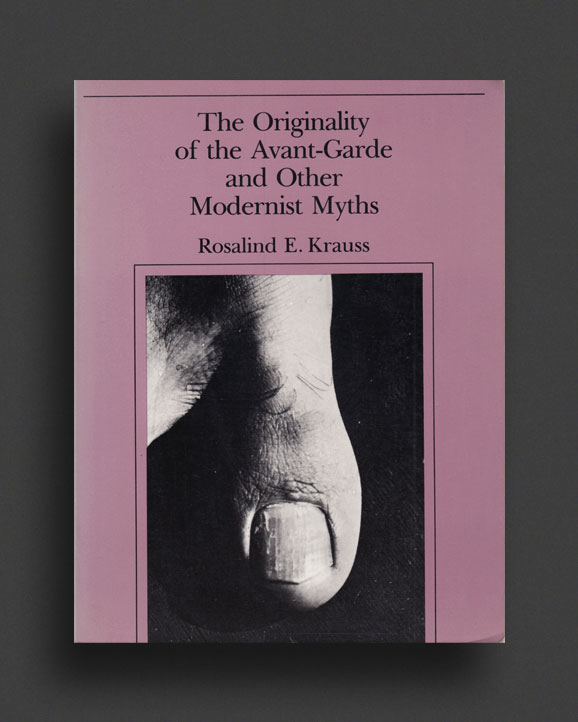
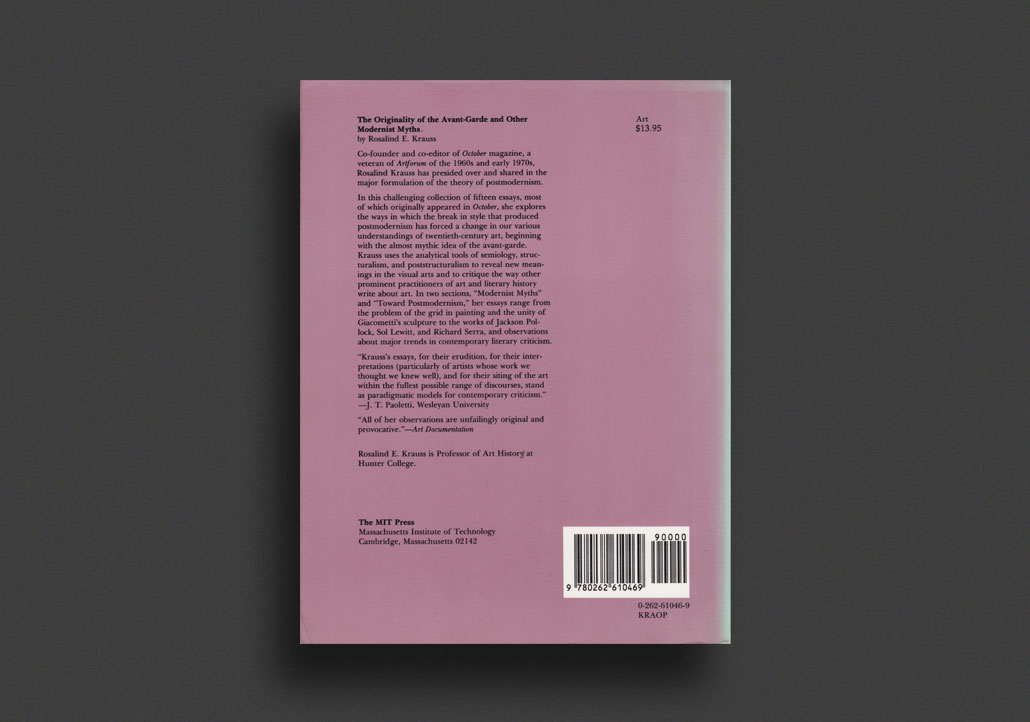
Co-founder and co-editor of October magazine, a veteran of Artforum of the 1960s and early 1970s, Rosalind Krauss has presided over and shared in the major formulation of the theory of postmodernism. In this challenging collection of fifteen essays, most of which originally appeared in October, she explores the ways in which the break in style that produced postmodernism has forced a change in our various understandings of twentieth-century art, beginning with the almost mythic idea of the avant-garde. Krauss uses the analytical tools of semiology, structuralism, and poststructuralism to reveal new meanings in the visual arts and to critique the way other prominent practitioners of art and literary history write about art. In two sections, "Modernist Myths" and "Toward Postmodernism," her essays range from the problem of the grid in painting and the unity of Giacometti's sculpture to the works of Jackson Pollock, Sol Lewitt, and Richard Serra, and observations about major trends in contemporary literary criticism.
Rosalind E. Krauss, University Professor at Columbia University and an editor and cofounder of October magazine, is the author of The Originality of the Avant-Garde and Other Modernist Myths (1985), The Optical Unconscious (1993), The Picasso Papers (1999), and Bachelors (1999), all published by the MIT Press, and coauthor (with Yve-Alain Bois) of Formless: A User's Guide (Zone Books, 1997).
"All of her observations are unfailingly original and provocative."—Art Documentation
Very Good copy of original 1986 edition, 1993 printing.
1993, Czech
Hardcover, 214 pages, 30.5 x 21.5 cm
1st Edition, Out of print title / used / very good
Published by
Odeon / Prague
$70.00 - In stock -
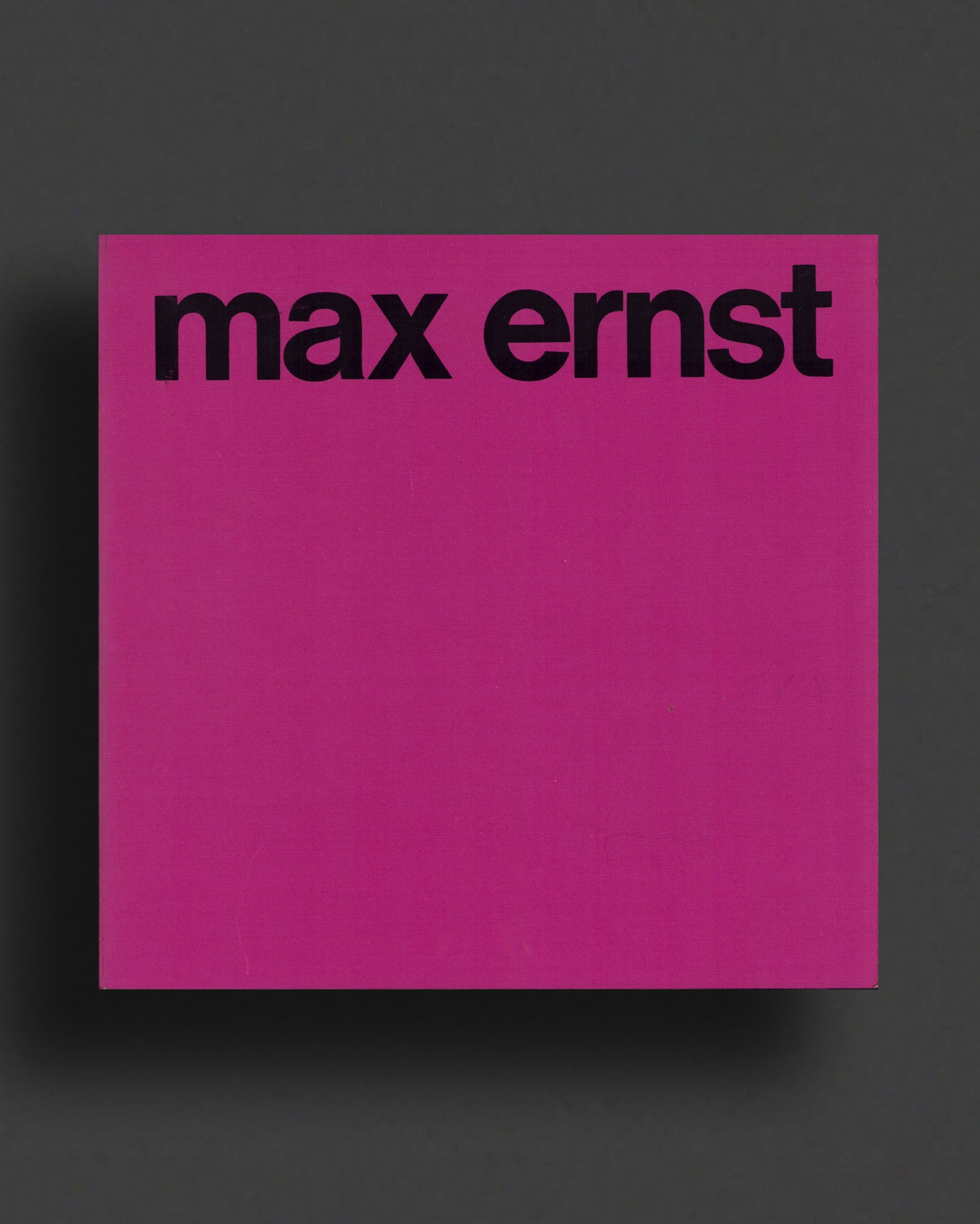
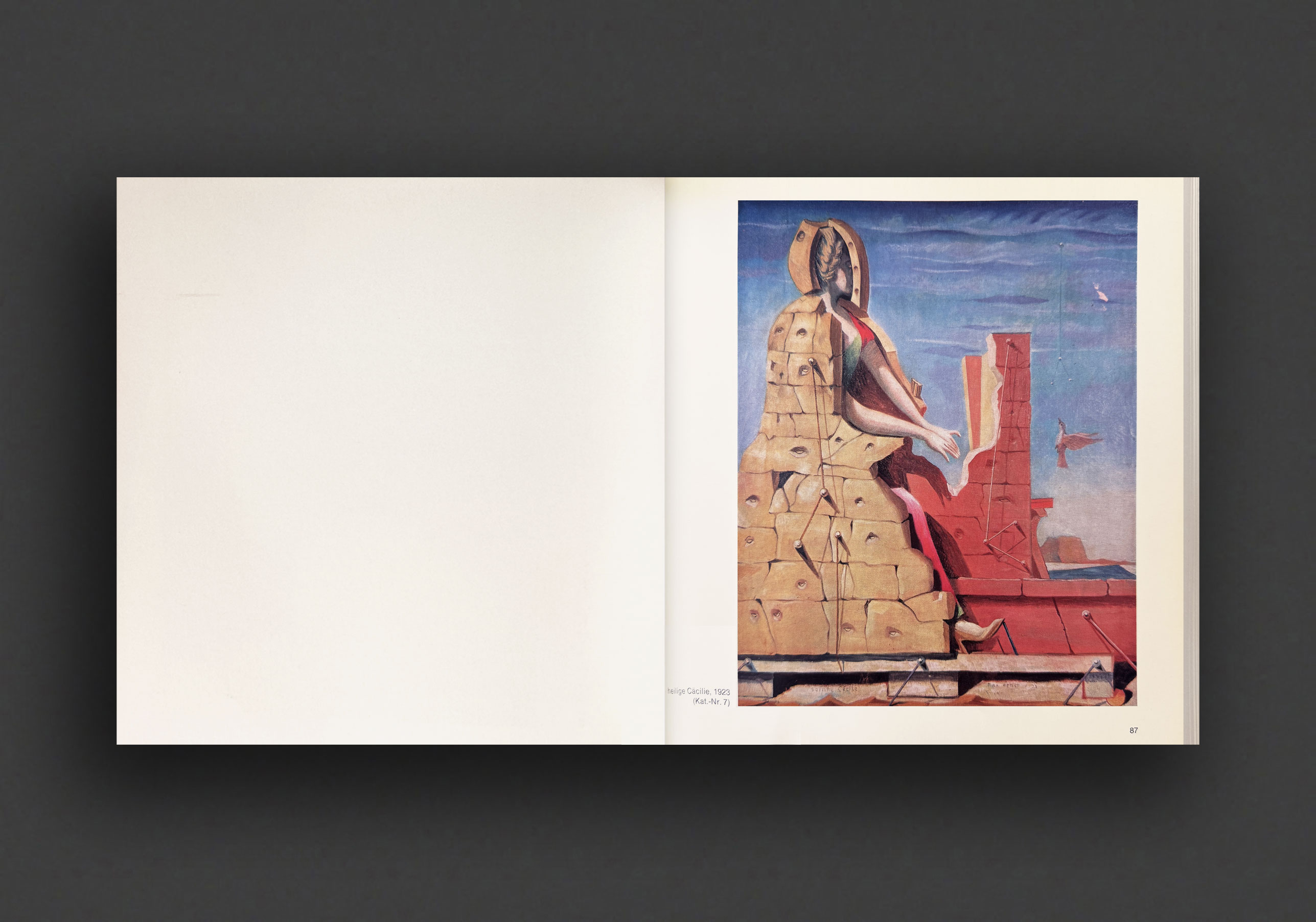
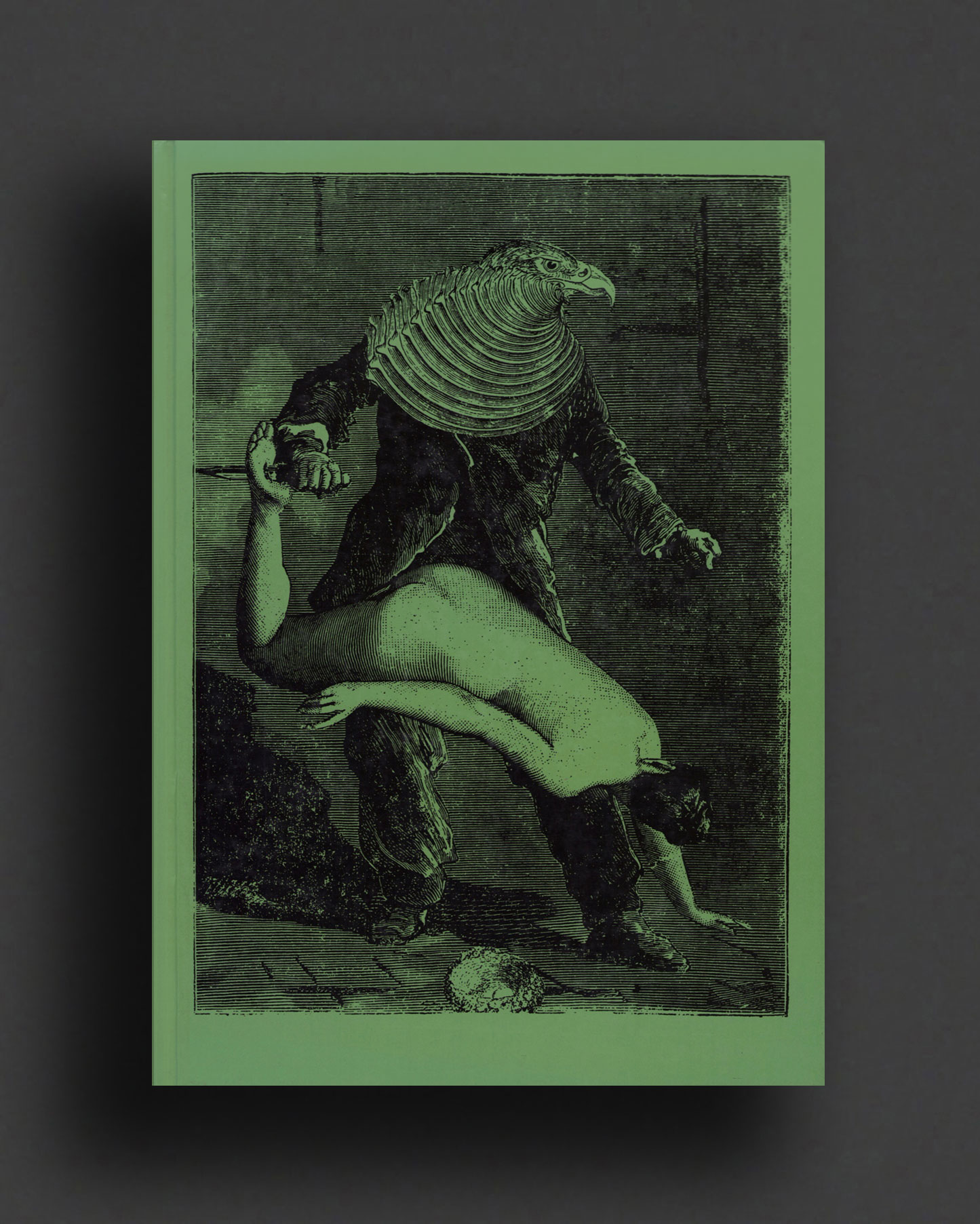
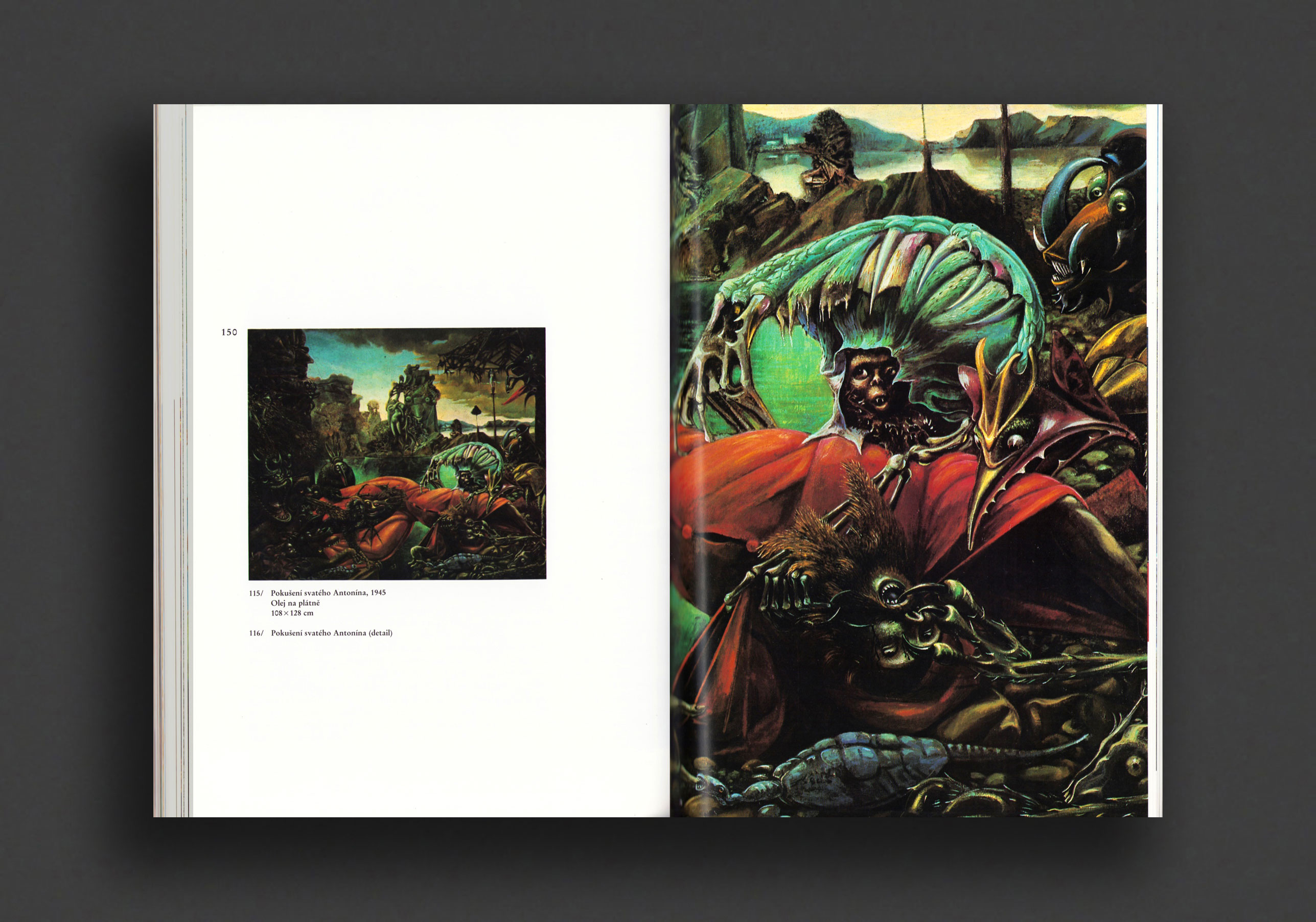
Rare, Czech language hardcover edition of Czech art historian Eva Petrová's study on Max Ernst (1891—1976), 'The Stohláva Identity of Max Ernst', with introductory text, 'Max Ernst or the Dissolution of Identity', by Per Gimferrer. This major study traces the sources of inspiration of the German-born painter, sculptor, printmaker, graphic artist, and poet, a most prolific, experimental artist and pioneer of the Dada movement and surrealism in Europe. Profusely illustrated with 184 mostly coloured reproductions.
Eva Petrová was a Czech art critic, curator, theorist and art historian, graphic artist, writer and poet.
Pere Gimferrer Torrens is a Spanish poet, novelist, literary critic and translator. He has been a member of the Real Academia Española since 1985.
Very Good copy.
1997, English
Softcover, 220 pages, 20.4 x 14.6 cm
1st Edition, Out of print title / used / very good
Published by
Atlas Press / London
$80.00 - In stock -
Rare first 1988 edition of this definitive collection of Benjamin Peret's writings translated to English, published by the legendary Atlas Press. Illustrated by Picabia, Ernst, Matta, and Toyen. Edited and introduced by Rachel Stella.
BENJAMIN PÉRET was one of the founders of the Surrealist movement in France. Within the group he was the writer they most admired, yet until now little of his work has been translated. This collection is definitive, it contains his novel "Death to the Pigs and the Field of Battle", a selection of stories, his own bizarre creation myth "Natural History", love poems, political poems, letters from the Spanish civil war, polemical and critical essays, and other, unclassifiable texts such as the "Calendar of Tolerable Inventions from Around the World".
The biographical introduction recounts his political affiliations.
Péret's works are wildly unrestrained, his imagination is unleashed in every direction at once, "logic is sent back into its kennel," only humour maintains some sort of order. There is nothing else like it.
"Péret's oeuvre: the most original and savage of our era."—Octavio Paz
"The greatest living poet."—Paul Eluard
Marcel Noll: What is Benjamin Péret?
Raymond Queneau: A menagerie in revolt, a jungle, liberty.
"... the poetic principle itself, pared down to its quintessential imaginary nerve."—Charles Simic
"Benjamin Péret is, for me, the Surrealist poet par excellence: a totally liberating and lucid inspiration which flows effortlessly and directly from its source and straight away re-creates a whole other world. - Luis Bunuel.
Humour gushes here as if from its very source."—André Breton.
VG copy with some light buckling, faint foxing to edges.
1934, Czech
Softcover (staple-bound), 30 pages, 29.5 x 21.5 cm
1st Edition, Out of print title / used / very good
Published by
Mánes Association of Fine Artists / Prague
$65.00 - In stock -
Rare 1934 issue of important modern Czech arts and literary magazine, Volné směry (Free Directions), Vol XXX, edited by Emil Filla with Jindřich Štyrský, Karel Honzík, Václav Špála. Published following the landmark 'Poesie 1932' exhibition, one of the first exhibitions of international Surrealism, and issued the year poet Vítězslav Nezval founded the Czech Surrealist group, the content of this issue holds particular significance. This copy includes the inserted announcement of the inaugural revue of the Czech Surrealist group, Surrealismus v ČSR, edited by Nezval with collaborators Konstantin Biebl, Jindřich Štyrský, Toyen, Bohuslav Brouk, Imre Forbath, Jindrich Honzl, Jaroslav Ježek, Katy King, Josef Kunstadt, Vincenc Makovský. The magazine itself features writing by Nezval, Konstantin Biebl and Adolf Hoffmeister, and artworks by Toyen, Jindřich Štyrský, Alfréd Justitz, Rodin, Picasso, Max Ernst, Corbusier-Jeanneret, Edvard Munch, and many more.
Volné směry (Free Directions) was an important monthly arts and literary journal published in Prague between 1896–1948 by the Mánes Association of Fine Artists in Prague. It was one of the longest-running art magazines of the 20th century (1897–1949) and also the most influential platform for modernism and openness of Czech art towards European artistic developments. Editors included Stanislav Sucharda, Josef Čapek, Miloš Jiránek, Karel Vítězslav Mašek, Jan Preisler, František Xaver Šalda, Martin Jiránek, Jan Štursa, Jaroslav Fragner, Jan Kotěra, Emil Filla, and others. After the cubism of Filla's generation, the magazine devoted itself to the art of the 'Poesie 1932' exhibition, one of the first exhibitions of international Surrealism, held at the Mánes Building itself, including the works of Czech artists such as Josef Šíma, Jindřich Štyrský, and Toyen, alongside Hans Arp, Max Ernst, Alberto Giacometti, Paul Klee, Joan Miró, and Yves Tanguy, to name a few. The Mánes Association and Volné Směry became an important outlet of Czech Surrealism, avant-garde art and poetry, with further exhibitions by Štyrský, Toyen and Vincenc Makovský, the trio all members of both the Mánes Association and the Czech Surrealist Group, founded in 1934. After the war, it still captured the spirit of the association and the work of its youngest members (Zdeněk Sklenář, Václav Zykmund, Toyen, Vaclav Tikal, Jindřich Štyrský, etc.), but the Nazi occupation of Czechoslovakia in late 1938 had a major impact on the Mánes Association, Volné směry, and a generation of artists deemed "degenerate". Volné Směry was stopped altogether as part of the post-February changes and Communist takeover of Czechoslovakia. During the Stalinist period, the Mánes Association was dissolved as a private society. The gallery remained, however, and today still stands at its location on the Vltava.
Very Good copy with only light general wear/age.
1980, English
Hardcover (w. dust jacket), 224 pages, 30 x 23 cm
1st Edition, Out of print title / used / very good
Published by
Fleetbooks / New York
$30.00 - Out of stock
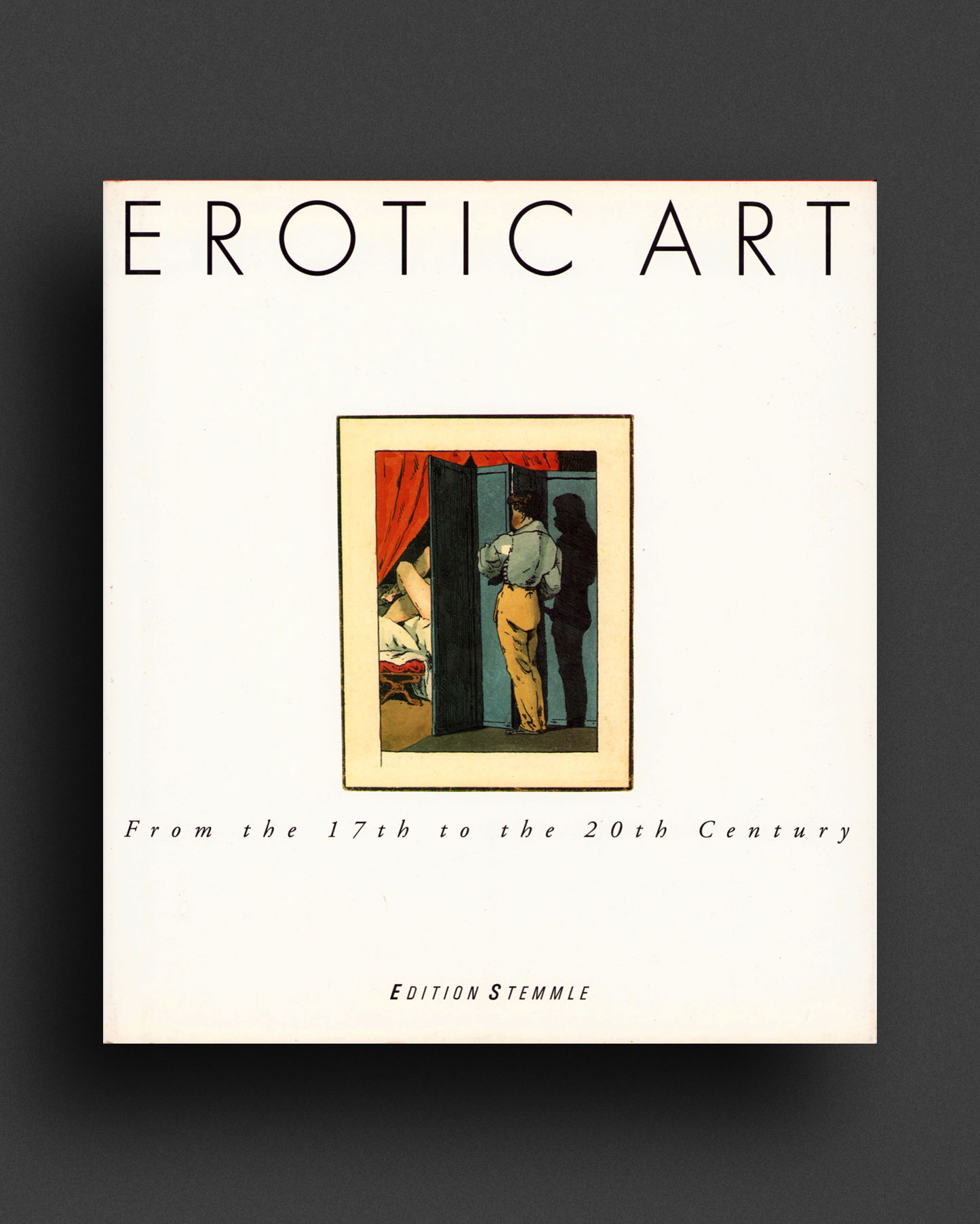
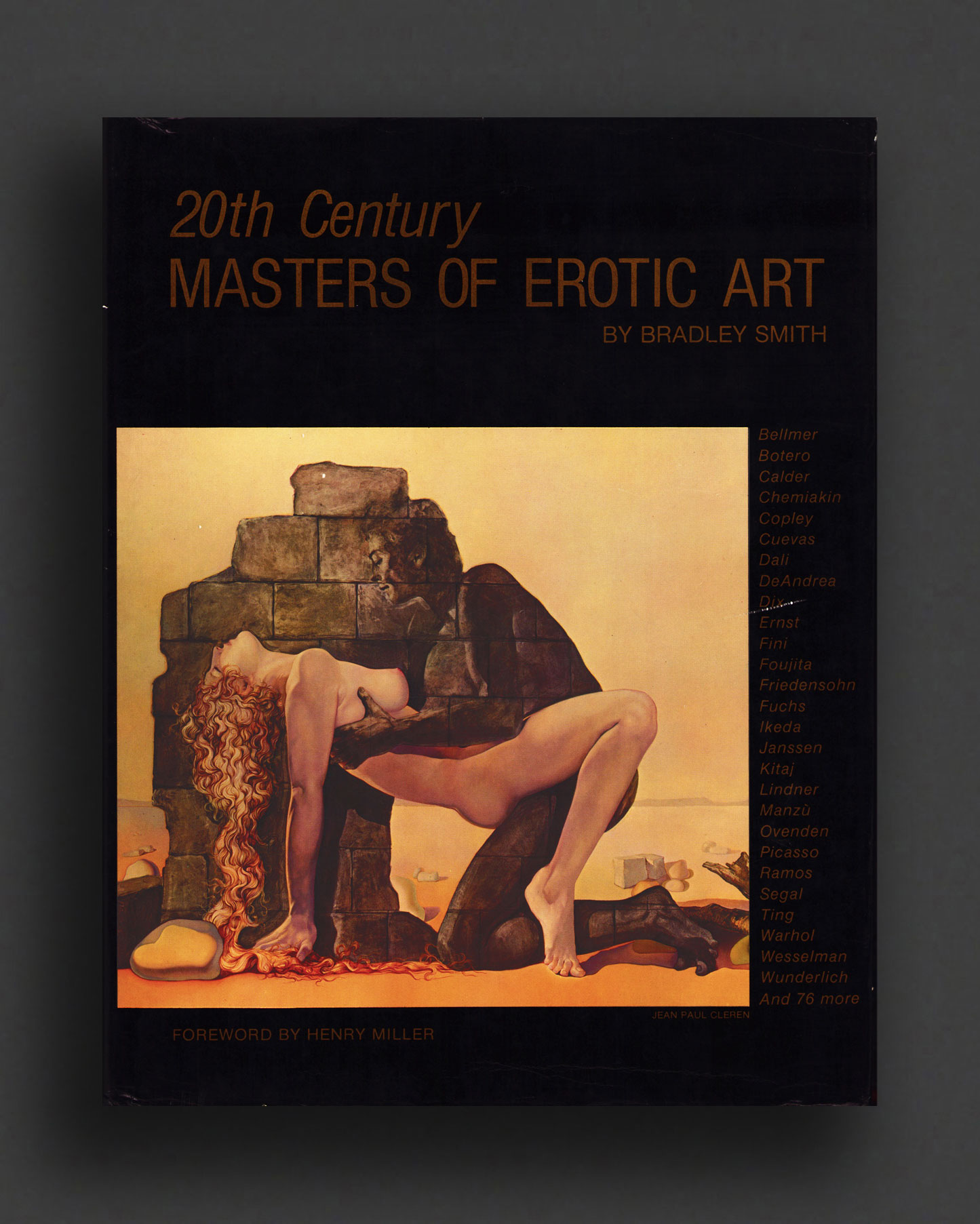
"Unblushing color, is the sexual world around us painted by outstanding artists of the twentieth century. In this extraordinary book, the modern world, the flesh, and the devil are captured as never before."
Foreword by Henry Miller.
Within it are 163 newly photographed works of art, each one faithfully reproduced, unretouched, in four color lithography. On these oversized pages is reflected the erotic life of our times from never before published Picasso watercolors of 1901-02 to the initial publication of recent works by George Segal, Andy Warhol, Larry Rivers, R.B. Kitaj, Tom Wesselman and many others.
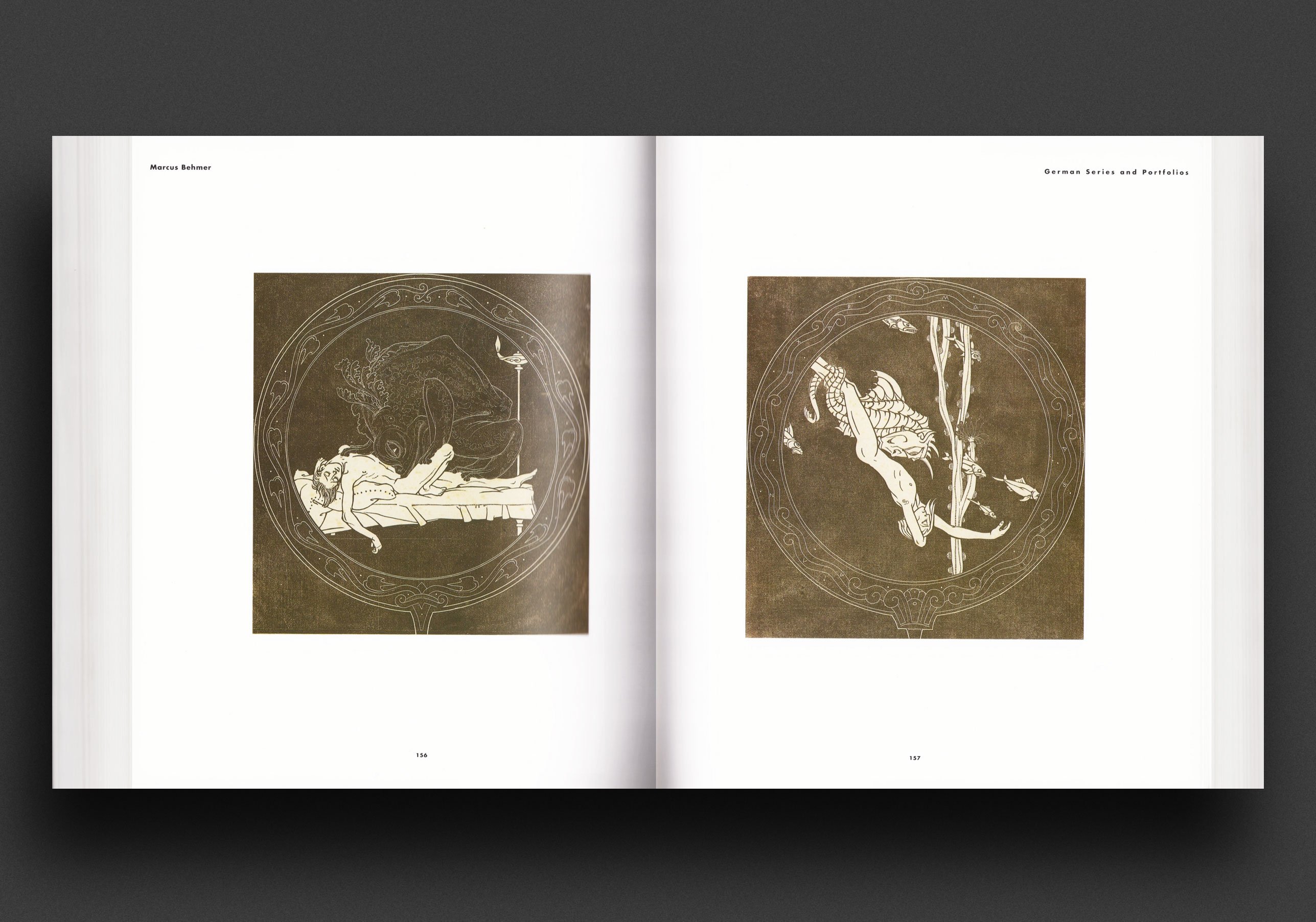
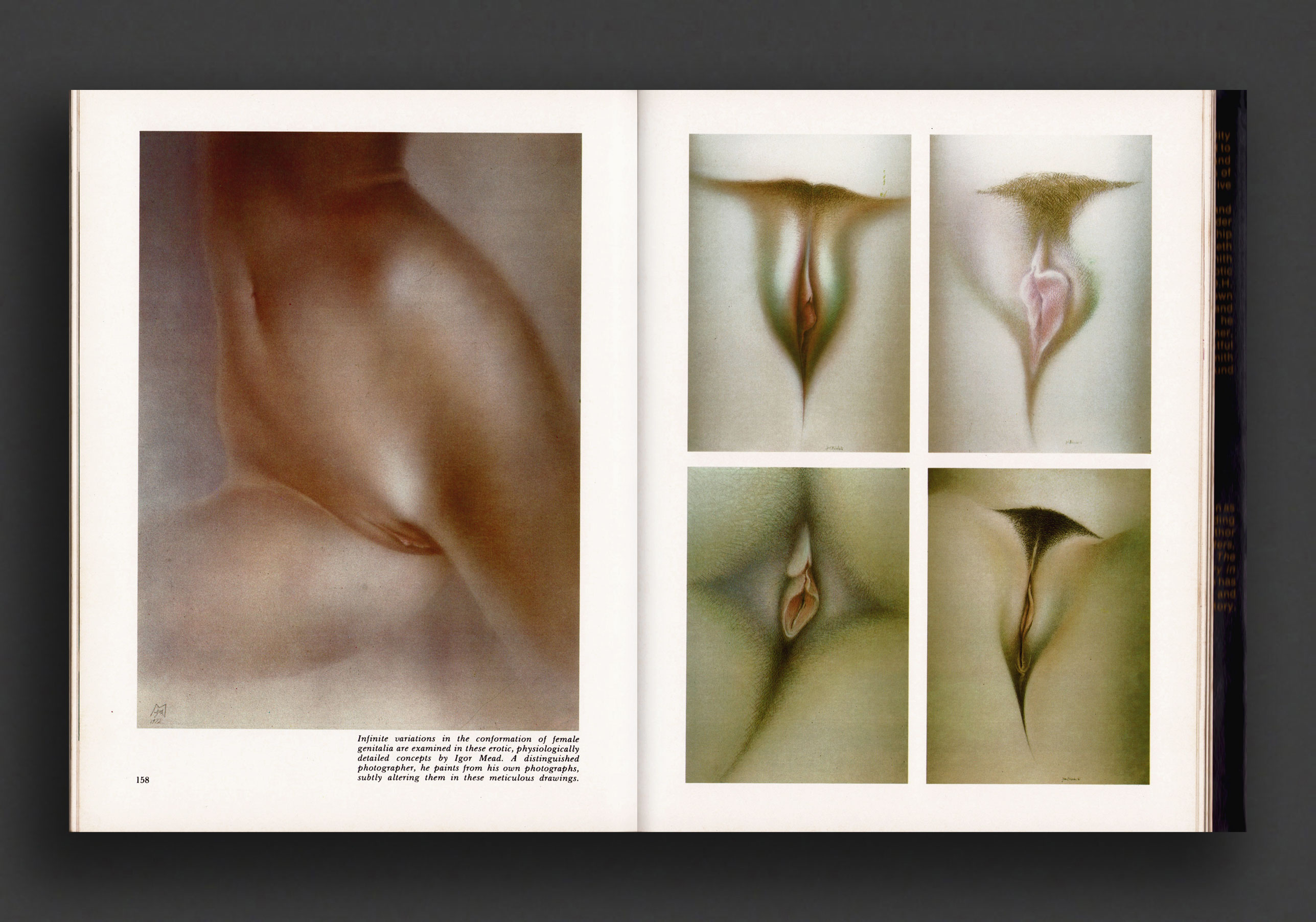
1980 hardcover survey by Bradley Smith, '20th Century Masters of Erotic Art' is a lavishly illustrated (colour and b/w) collection of erotic works from private and public collections and museums. "Within it are 163 newly photographed works of art, each one faithfully reproduced, unretouched, in four-color lithography. On these oversized pages is reflected the erotic life of our times from never before published Picasso watercolors of 1901-02 to the initial publication of recent works by George Segal, Andy Warhol, Larry Rivers, R.B. Kitaj, Tom Wesselman and many others." Featuring further works by Leonor Fini, Otto Dix, Ernst Fuchs, Fernando Botero, Hans Bellmer, André Masson, Mel Ramos, Friedrich Schröder Sonnenstern, Paul Wunderlich, Richard Lindner, Elias Friedensohn, Roberto Matta, Graham Ovenden, Francisco Toledo, Carlos Revilla, Egon Schiele, Leonard Foujita, Henk Pander, Pablo Picasso, Alexander Calder, Max Ernst, Félix Labisse, Paul Delvaux, Salvador Dalí, and many other painters and illustrators who have conveyed human sexuality through fantasy, romance, symbolism, and super realism, contributing to the development of diverse erotic themes in art becoming more prominent and accepted in the modern era. We've since regressed.
Good copy in Good DJ, wear to dj extremities.
1973, German
Hardcover (w. dust jacket + slipcase), 475 pages, 28 x 23.5 cm
1st Edition, Out of print title / used / fine
Published by
Rembrandt Verlag / Berlin
$110.00 - In stock -
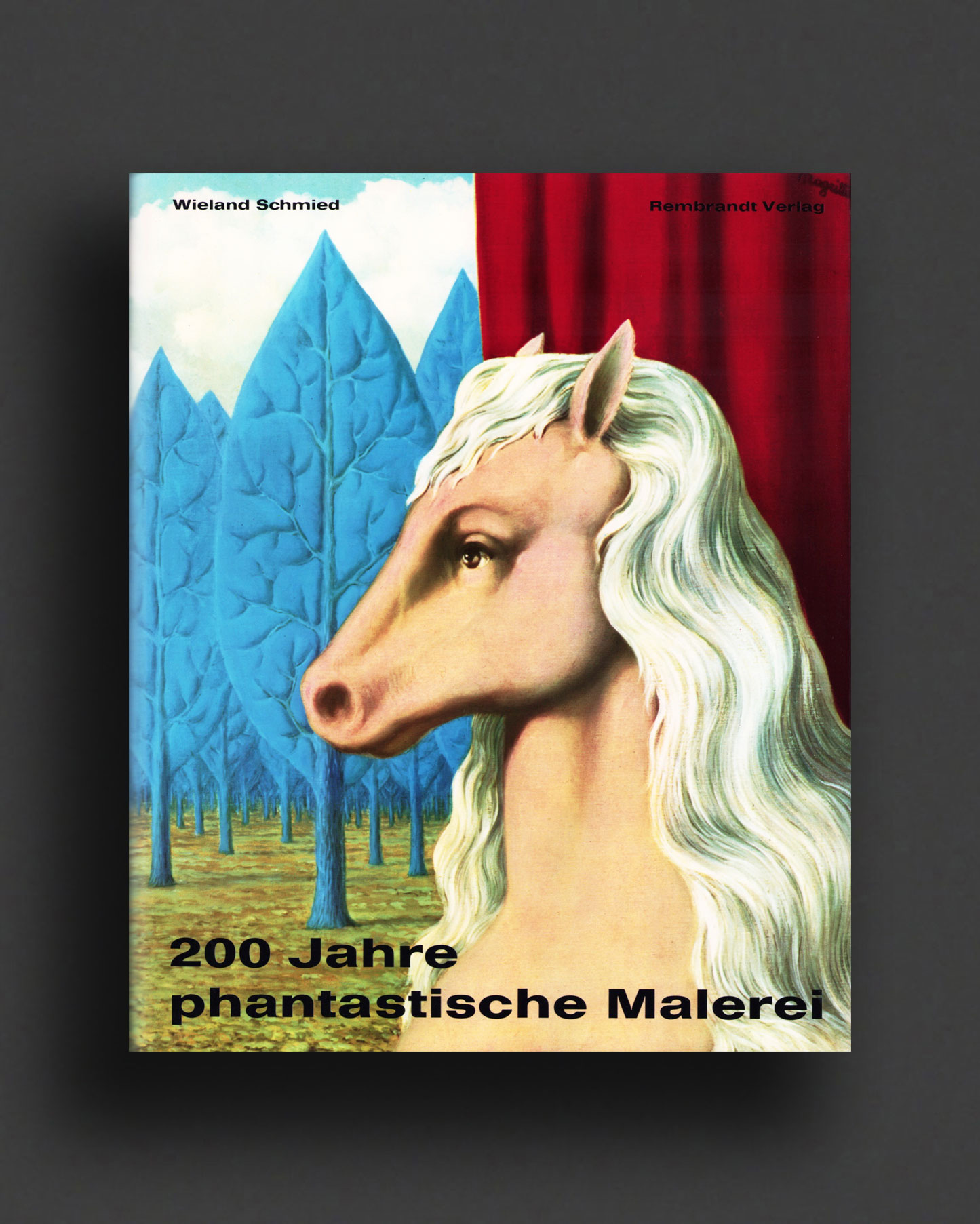
Exceptional 1973 hardcover, slipcased first edition volume dedicated the history of Fantastic Painting in all its mutations, compiled by Austrian art historian and critic, curator, literary scholar and writer, Wieland Schmied (1929 – 2014).
"The fantastic and connected with it the remote, the strange, the absurd, the unreal, the irrational and illusionary, the visionary, the hallucinatory and dreamlike belong to the constant undercurrents and countercurrents of all art. Such images remind us that the world is more diverse, richer and more unmistakeable than we sometimes want to admit, that the night pages with their secrets of the dark belong to it in essence like the day with its magic of light. The fantastic art articulates powers and instincts that have a very intense influence on our lives, on our consciousness. It always shakes the questionlessness of the world, it always frightens us: from the abysses within ourselves and from the mysteries of a world that we have not created.
Wieland Schmied, who, as director of the Kestner Society, highlighted the topicality of fantastic and surrealist thoughts in the work of numerous contemporary artists in much-discussed exhibitions, examines in this book the different definitions of the fantastic and tries to distinguish between similar and related phenomena - the poetic, the grotesque, the absurd, the literary - but also to distinguish the fantastic art from the historical currents of Mannerism, Romanticism, Symbolism and Surrealism, which contain all elements of the Fantastic."
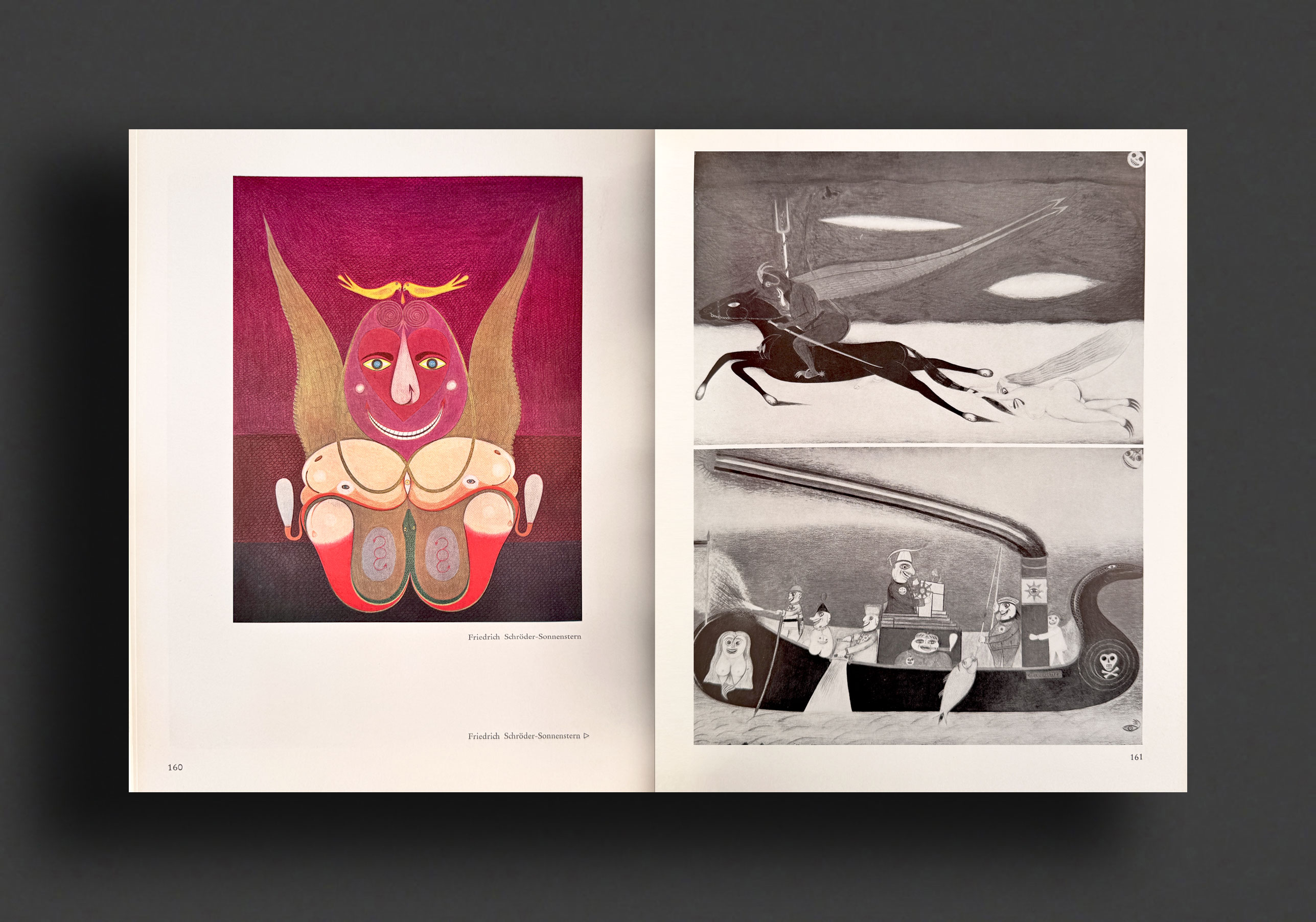
At 475 pages, and profusely illustrated with over 200 plates in colour and b/w, featuring the art of Henry Fuseli, Odilon Redon, James Ensor, Alfred Kubin, Giovanni Battista Piranesi, William Blake, Francisco Goya, Friedrich Schröder Sonnenstern, Rodolphe Bresdin, Félix Labisse, Meret Oppenheim, Horst Janssen, Edward Burra, Jindřich Štyrský, Victor Hugo, Gustave Moreau, Henri Rousseau, Roland Topor, Giorgio de Chirico, Jane Graverol, Unica Zürn, Max Ernst, Pierre Roy, Yves Tanguy, Joan Miró, Salvador Dali, Victor Brauner, Hans Bellmer, Richard Oelze, Wifredo Lam, René Magritte, Ivan Albright, Man Ray, Fred Deux, Morris Graves, Joseph Cornell, Max Klinger, Gustave Doré, Max Walter Svanberg, Toyen, Marc Chagall, Paul Klee, André Masson, Max Beckmann, Emil Nolde, Friedensreich Hundertwasser, Kurt Seligmann, Miodrag Đurić (Dado), Karel Teige, Paul Wunderlich, Roland Penrose, Josef Šíma, Paul Delvaux, Óscar Domínguez, Fernando Botero, Leonor Fini, Uwe Bremer, Bernard Schultze, František Janoušek, Josef Vyleťal, František Muzika, Domenico Gnoli, Wols, Heinz Trökes, Otto Tschumi, Jindřich Heisler, Václav Tikal, Gisela Breitling, Pit Morell, Graham Sutherland, Ernst Fuchs, Wolfgang Hutter, Erich Brauer, Anton Lehmden, Ursula, Konrad Klapheck, and so many more....
Fine copy in Fine dust jacket, perfectly preserved in Near Fine-Very Good original-issue publisher's box with some light discolouration.
2013, English / German
Softcover, 214 pages, 30 x 24 cm
1st Edition, Out of print title / used / very good
Published by
Staatliche Kunstsammlungen Dresden / Dresden
$35.00 - Out of stock
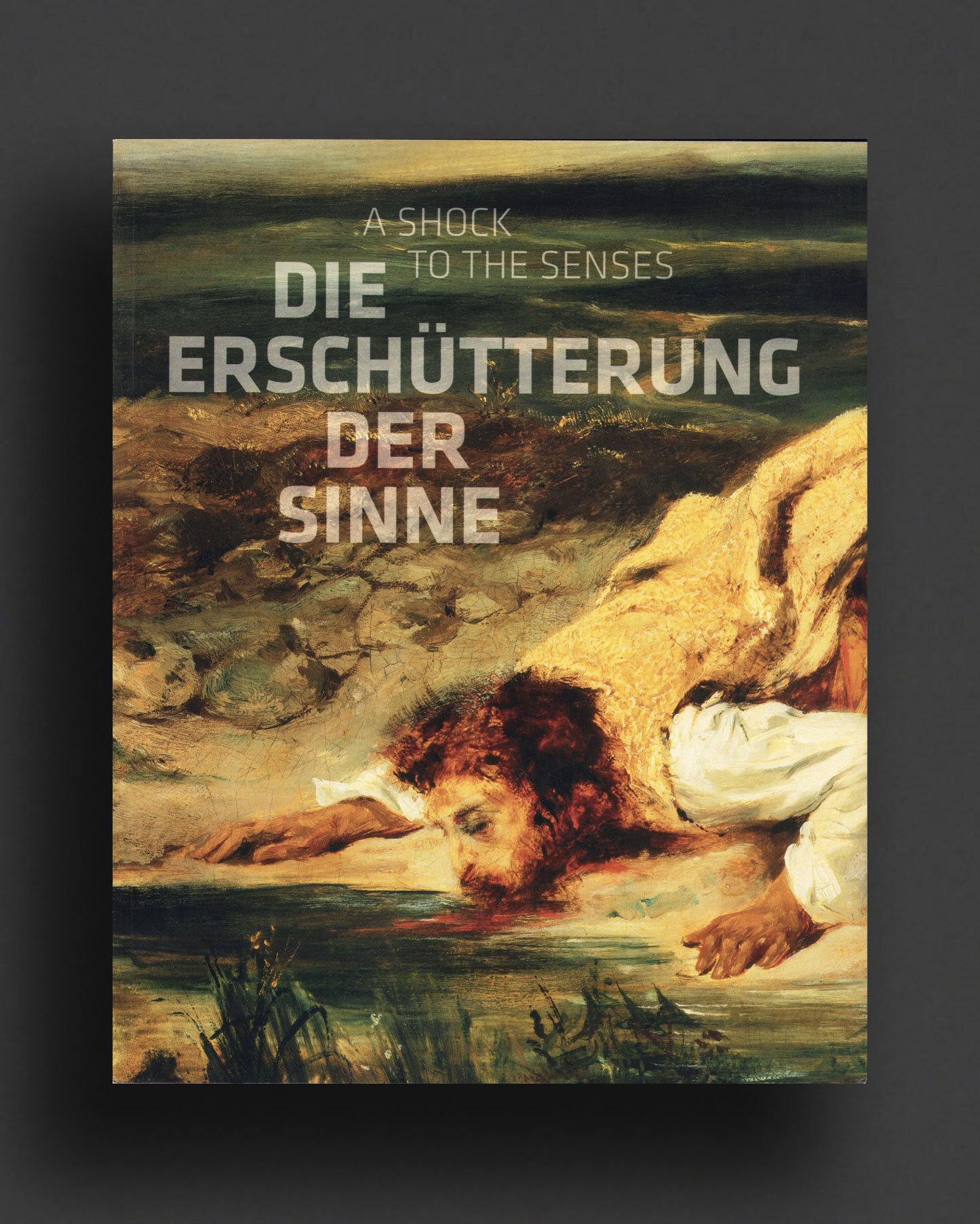
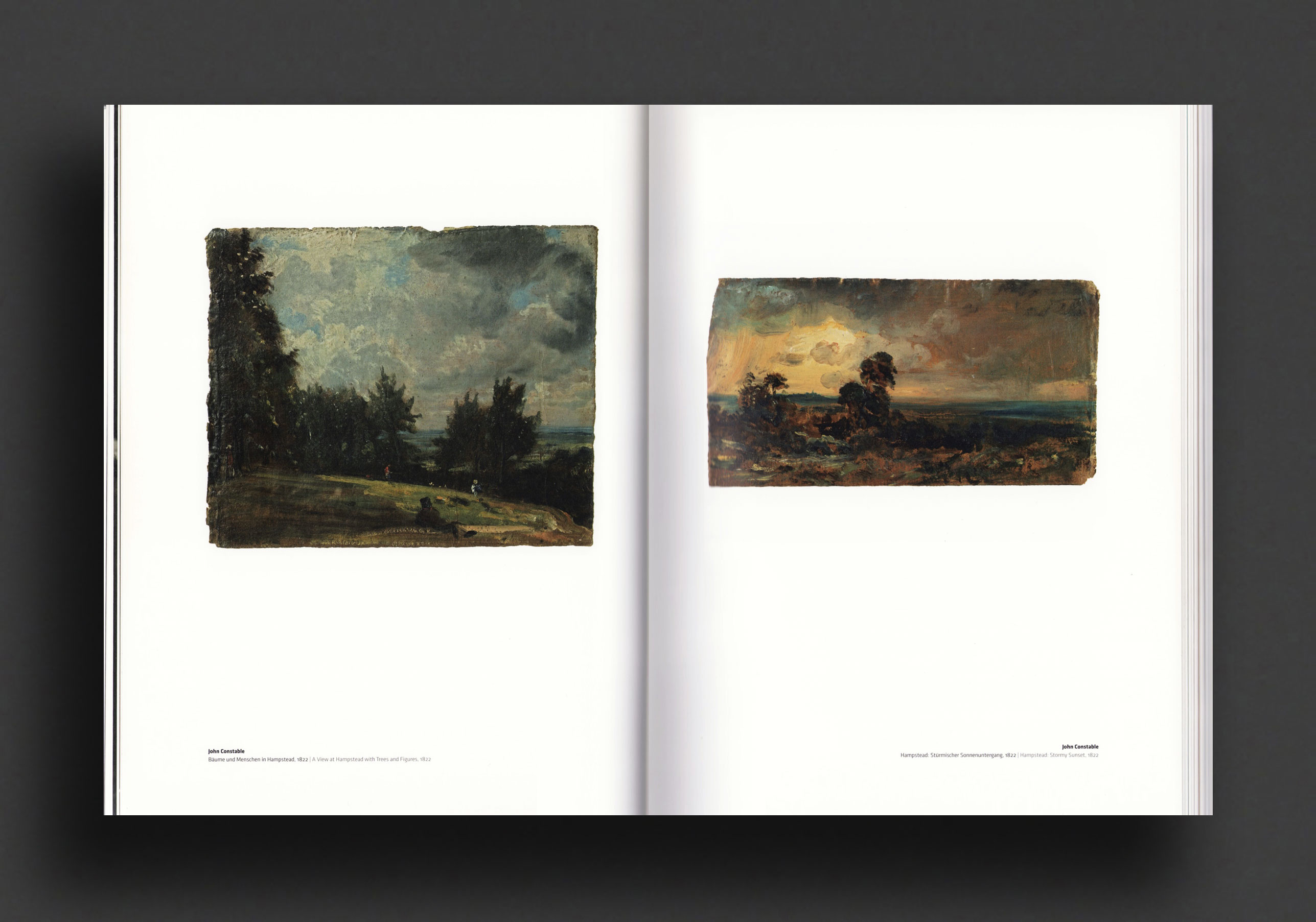
First bi-lingual English/German edition of this lavish exhibition catalogue.
John Constable (1776–1837), Eugène Delacroix (1798–1863), Caspar David Friedrich (1774–1840) and Francisco de Goya (1746–1828) were vital in shaping modern art at the threshold of the 18th to the 19th century and they had a formative influence on the age of Romanticism in Europe. Their outstanding paintings continue to serve as sources of inspiration and visual instruction for the generations of artists that have followed in their wake. In this special exhibition, Luc Tuymans, one of the most influential contemporary painters, and Prof. Dr. Ulrich Bischoff trace the influence of these four exceptional artists by presenting paintings by Paul Cézanne (1839-1906), Adolph Menzel (1815-1905), Édouard Manet (1832-1883), Mark Rothko (1903-1970) and Gerhard Richter (* 1932) alongside masterpieces of the Romantic period. Works by 16 artists will be presented in sometimes surprising combinations, thus enabling historical references and contexts spanning some 200 years of art history to be explored from new perspectives. The idea at the core of the exhibition is to present the museum as both an artistic workshop and a source of inspiration. The curators demonstrate that art does not come into being solely as the result of a creative act in the artist’s studio, but can often be traced back to the artist’s direct engagement with freely chosen models from art history.
Very Good copy.
1976, English
Softcover, 112 pages, 28 x 20.5 cm
Out of print title / used / good
Published by
Thames and Hudson / London
$25.00 - Out of stock
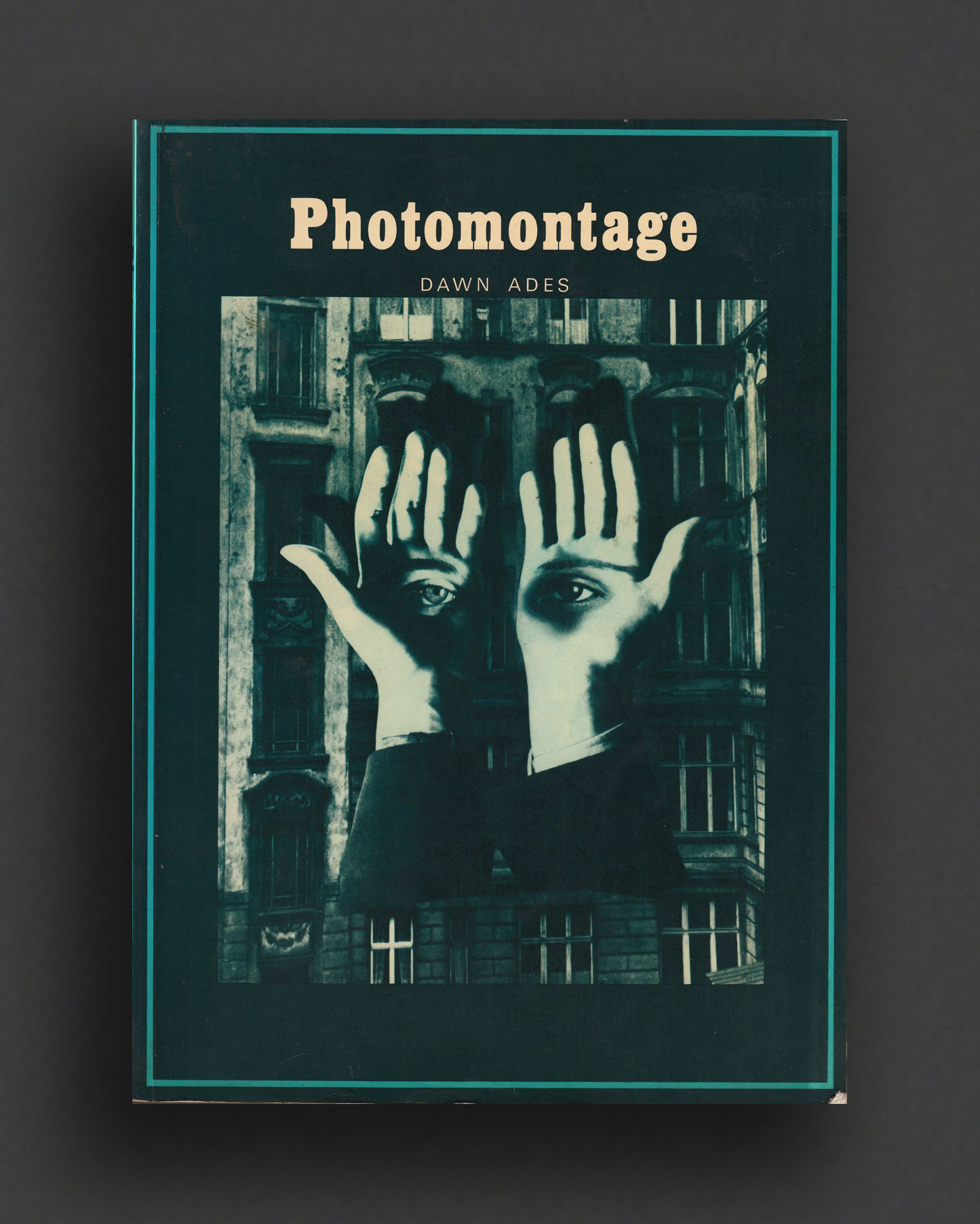
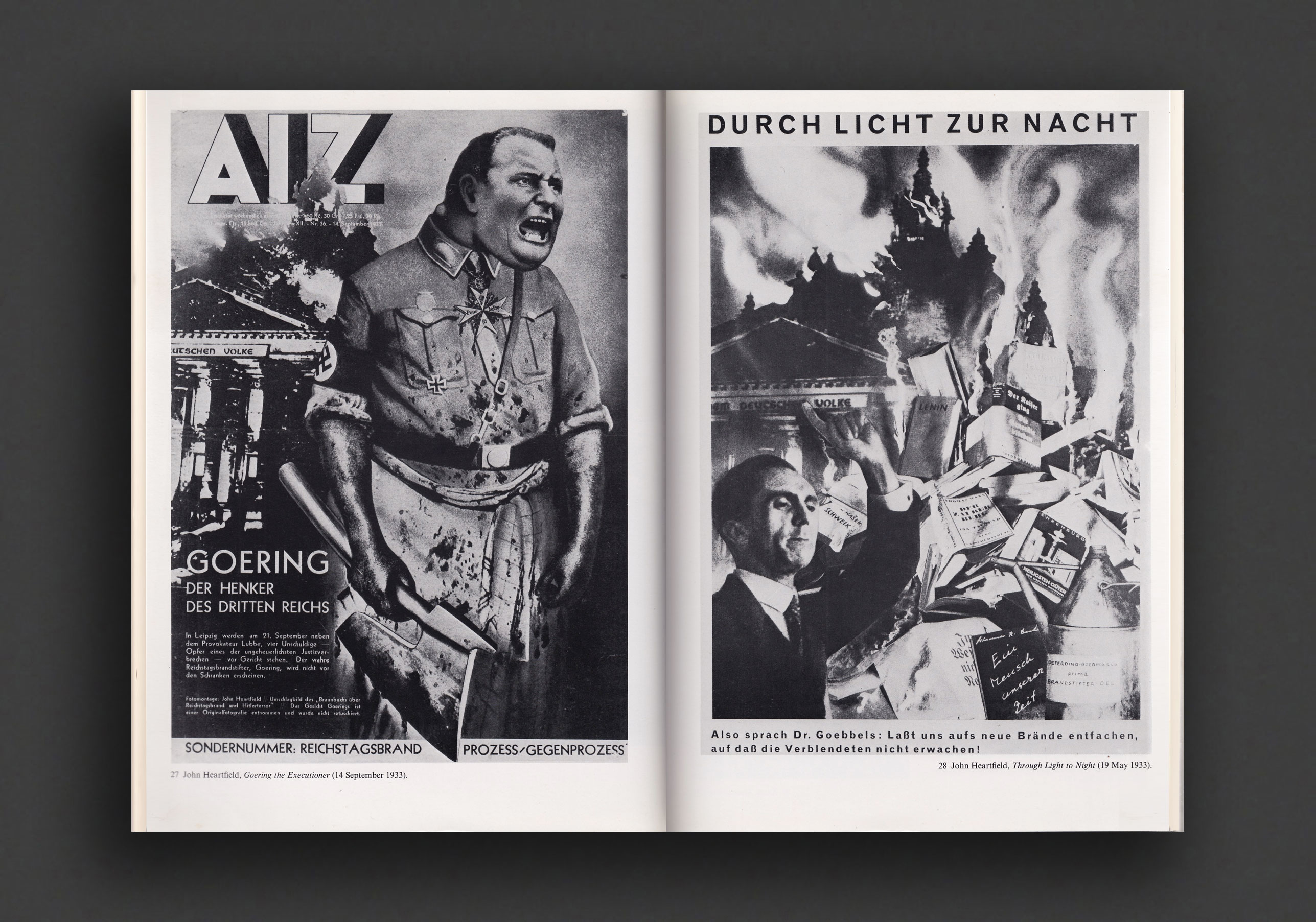
Photomontage—the manipulated photograph—is as old as photography itself. Yet it was only with the chaotic, explosive impact of World War I that photomontage became an art form. The term was coined by the anti-art, anti-bourgeois Berlin Dadaists, whose members included John Heartfield, Hannah Hoch, Raoul Hausmann, and George Grosz. By breaking up images and using odd juxtapositions of fragmented photographs and other materialsthe stuff of today's and yesterday's news-they created a bold new art of agitation for posters, book jackets, magazine covers, and stage sets. The idea of photomontage was as revolutionary as its it emphasized the links between politics and the technological age to expose the disorder of bourgeois society.What started as an inflammatory political joke soon became a conscious artistic technique. The use of bizarre images to render reality enigmatic was seized upon by the successors of Dadaism, the Surrealists. Artists such as Max Ernst, Moholy-Nagy, and Man Ray combined images of poetic power to form hallucinatory landscapes, pursuing a systematic derangement of the senses to express the internal chaos of the individual as well as the external chaos of the world.
Patterned with 174 visually startling and intellectually exciting monochromes, Dawn Ades's book follows the fascinating evolution of photomontage, revealing different realities that disrupt our perceptions of the traditional world.
Average-Good copy. Ex-owner's name to title page. Overall Very Good copy but with some markings to block edge and on a couple of pages from a past studio life.
1972, German
Softcover, 96 pages, 28 x 205 cm
1st Edition, Out of print title / used / good
Published by
Heyne Verlag / Münich
$35.00 - Out of stock
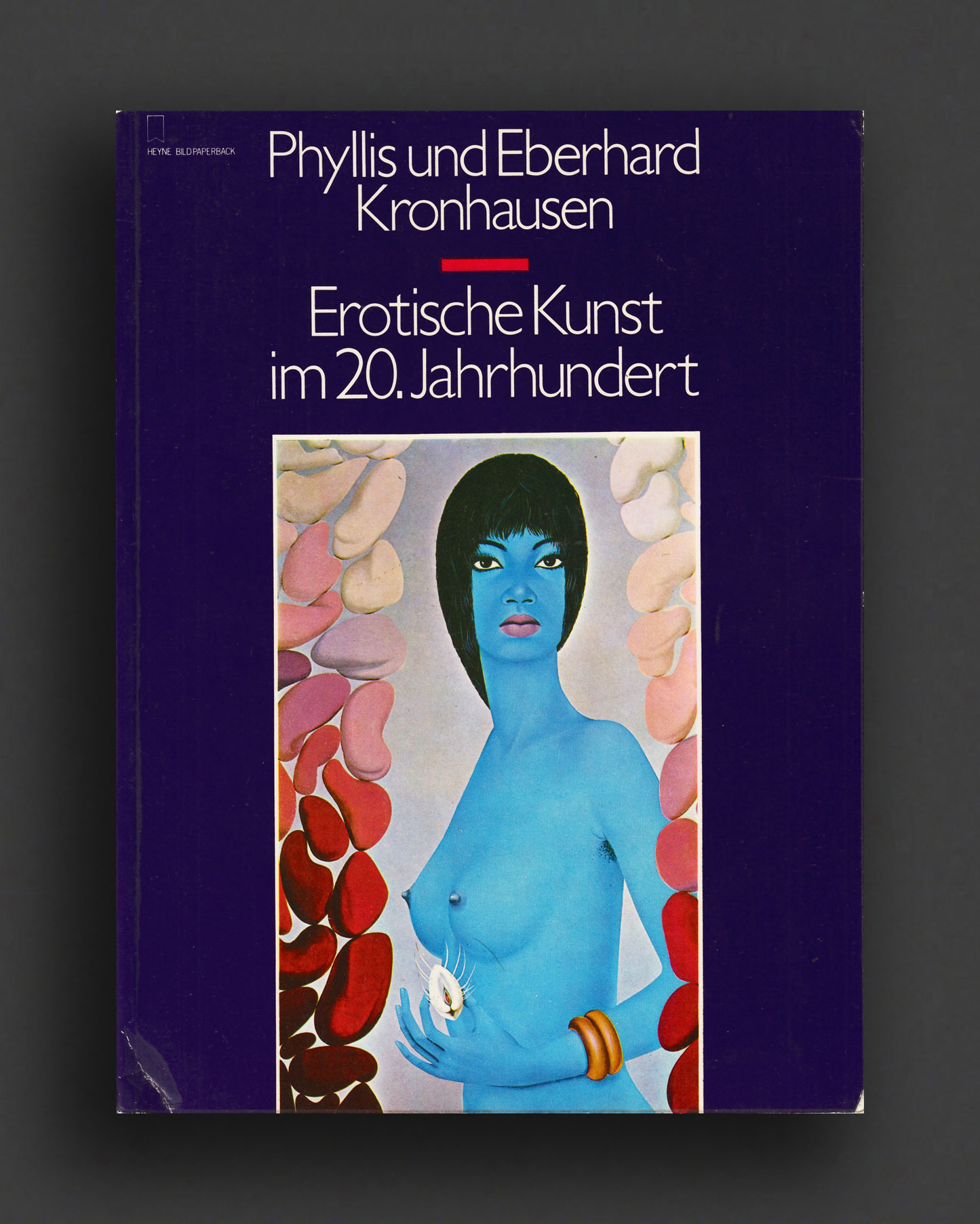
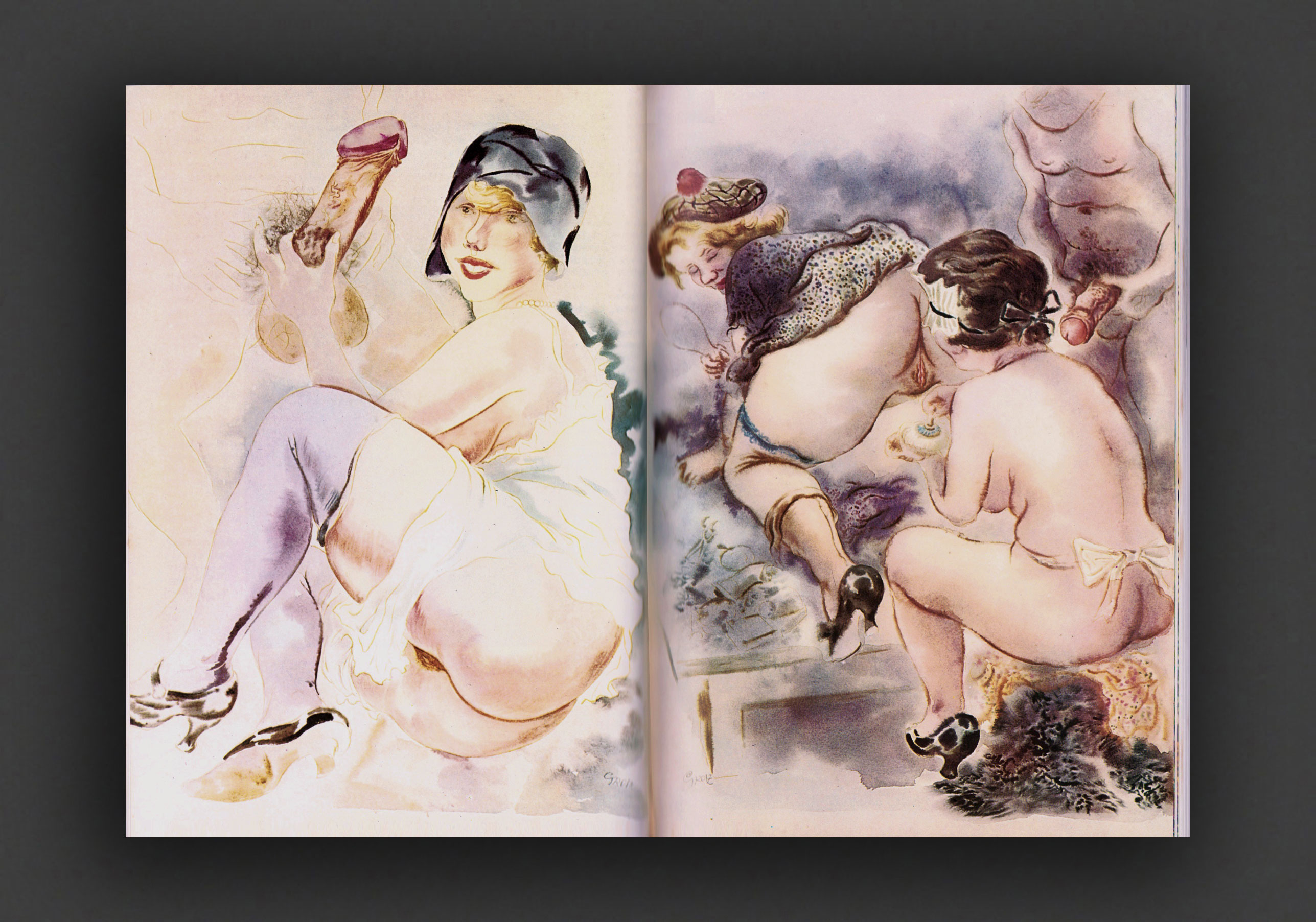
Wonderful 1972 German book of erotic art selected by Phyllis and Dr. Eberhard Kronhausen, rightly considered international experts in the field. "Their exhibition "Erotic Art," which has been shown in many countries around the world, formed the basis for this illustrated volume. Because this exhibition included loans from museums and galleries, as well as works from the Kronhausen couple's collection and other private collections, it was possible to present images that had previously been inaccessible to the public. In selecting works for this volume, care was taken, on the one hand, to depict these unknown works, and, on the other, to provide a reliable overview of the erotic work of the leading artists (painting, graphic art, and sculpture) of our century. Thus, this book is a fortunate exception; it is a precious document, but also a demonstration of the sexual and cultural revolution of our century."
Features the work of Franz von Bayros, Hans Bellmer, Marc Chagall, Lovis Corinth, Salvador Dali, Paul Delvaux, Otto Dix, J. Dubuffet, Max Ernst, Ernst Fuchs, Willi Geiger, George Grosz, Horst Janssen, Allen Jones, Gustav Klimt, Felix Labisse, Jan Lebenstein, Edward Munch, Claes Oldenburg, Pablo Picasso, Herbert Rauschenberg, George Segal, Max Walter Swanberg, Tomi Ungerer, Andy Warhol, Tom Wesselmann.
Good—VG copy with some laminate seperation to cover extremities and slight corner bump.
1960, Japanese
Hardcover (w. dust jacket), 106 pages, 26.5 x 18.5 cm
1st Edition, Out of print title / used / very good
Published by
Misuzu Shobo / Tokyo
$100.00 $70.00 - Out of stock
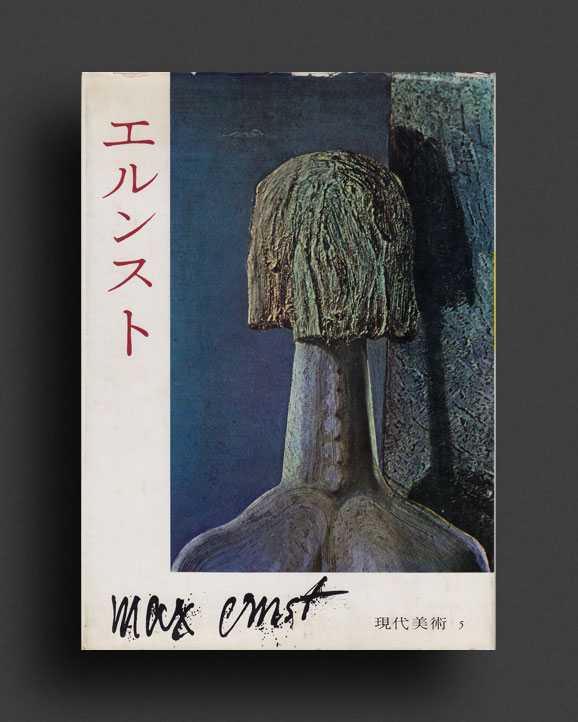
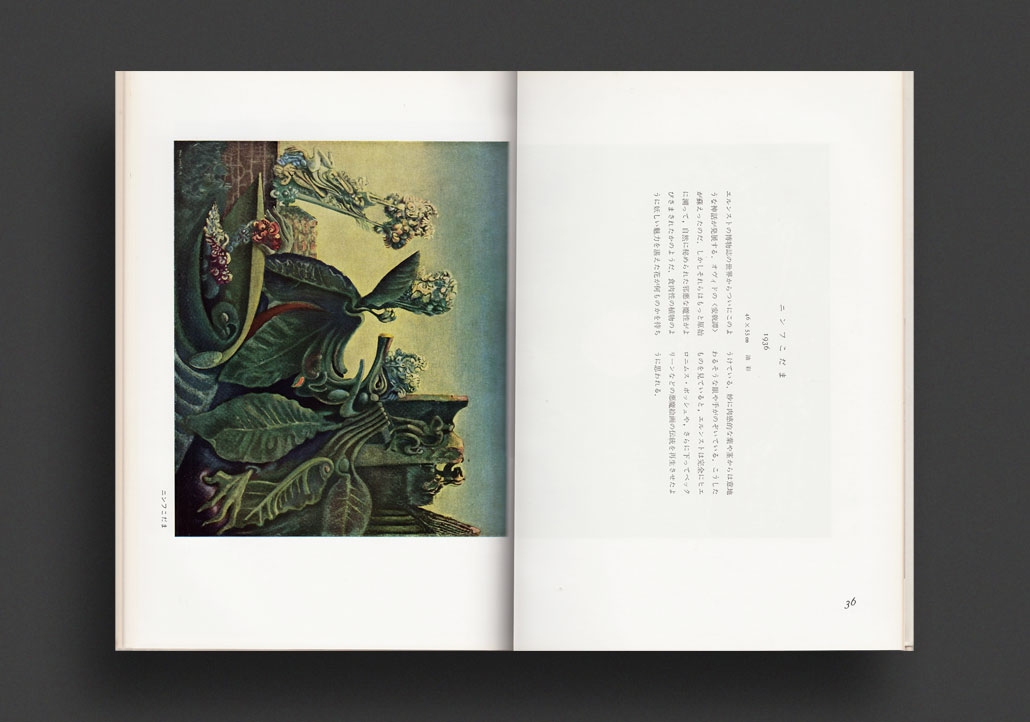
First edition of this lovely 1960 hardcover monograph published in Tokyo on the German Surrealist Max Ernst (1891—1976), as part of a Misuzu Shobo series on Modern European and American artists issued for Japanese readers. With accompanying text by Japanese poet, critic and fellow Surrealist artist Shūzō Takiguchi. A prolific and highly original painter, sculptor, graphic artist, and poet, Ernst's various works are surveyed (paintings, collages, and frottages dating upto the late 1950s) herein generously in colour and b/w reproductions. Ernst was a primary pioneer of the Dada and Surrealism movements.
Very Good copy with some internal blank stock paper tanning. Dust Jacket with some wear and tear to extremities, all preserved in mylar wrap. A lovely copy of this uncommon title.
1971, French
Softcover, 48 pages, 22 x 23 cm
1st Edition, Out of print title / used / good
Published by
Orangerie des Tuileries / Paris
$35.00 - Out of stock
First edition of this lovely, simple catalogue published in 1971 on the occasion of Max Ernst's 80th anniversary exhibition at Orangerie des Tuileries, Paris. 40 works illustrated in b/w with some colour. Full catalogue of exhibited works.
Good copy. Some age spotting to both covers, otherwise very good throughout.
2024, English
Softcover, 328 pages, 21 x 28 cm
Published by
Spector Books / Leipzig
$110.00 - In stock -
The book Archive of Dreams is published in conjunction with the exhibition of the same name that will open the Archiv der Avantgarden. Marking the hundredth anniversary of the first surrealist manifesto and the founding of the Bureau of Surrealist Research in Paris in 1924, the volume is dedicated to the surrealist movement as well as the networks it engendered and the artistic stimuli it provided in the twentieth century. The idea was for the Bureau to collect dream testimonies in whatever form, not only to preserve and analyse them but also to give active expression to them in artistic processes. The publication shows how the practices of the avantgardes blurred the boundaries between dream and reality, between the traditional, passive notion of the archive and the idea of active, innovative artistic experiment — and thus ultimately also between the past, the present, and possible futures.
Works and documents from the period before, during, and after the Second World War shed light on the working methods of international artists and the global network they were involved in. They are complemented by diverse reflections on global protest movements and the traumas of war, thus connecting, too, to everyday experiences in a Europe beset by warfare.
1979, German
Softcover, 419 pages, 28 x 22 cm
1st Edition, Out of print title / used / very good
Published by
Kunsthaus Zürich / Zürich
Bentelli Verlag / Bern
$90.00 $60.00 - In stock -
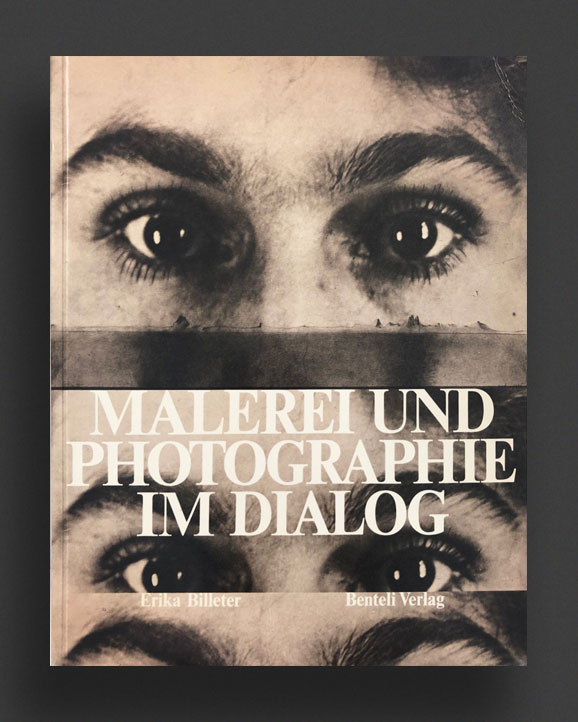
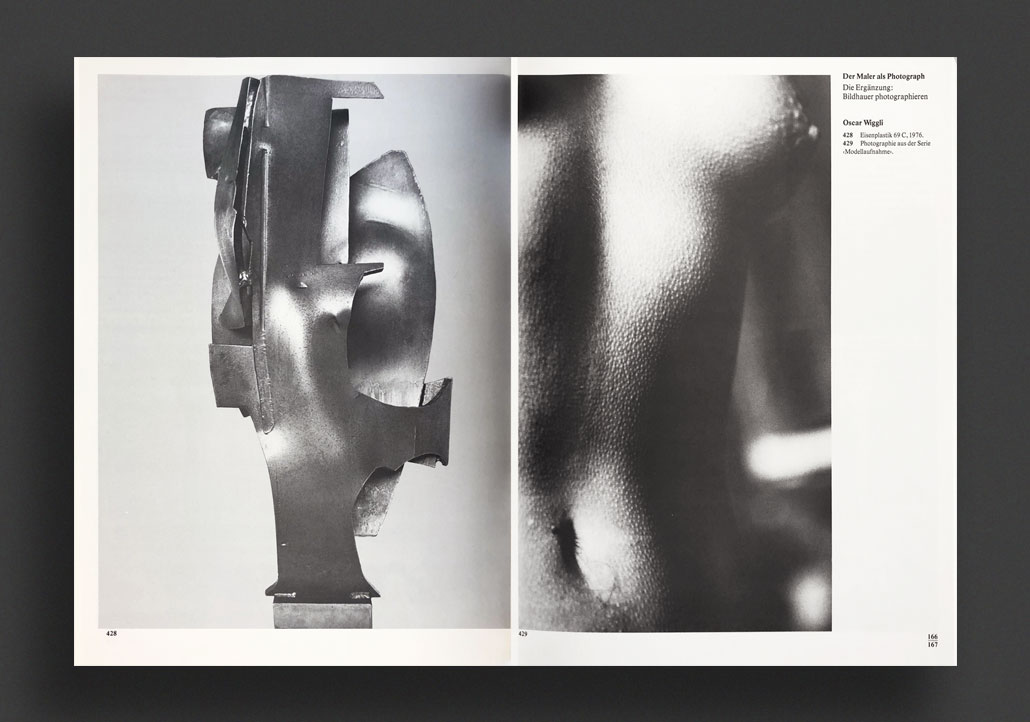
Wonderful over-sized catalogue published on the occasion of the exhibition Malerei und Photographie im Dialog / Painting and Photography in Dialogue, Kunsthaus Zürich, May 13 to July 24, 1977. Profusely illustrated, this heavy volume documents this historical survey of the relationship between photography and painting from 1840 to the present (late 1970s); with a full catalogue of works, artists' biographies, bibliography. Edited by Erika Billeter with texts throughout by art historian Josef A. Schmoll. Includes the work of Edvard Munch, Urs Lüthi, Wols, Vito Acconci, John Baldessari, Eadweard Muybridge, Hannah Höch, Raoul Hausmann, Hans-Peter Feldmann, Oskar Schlemmer, Francis Bacon, Hilla and Bernd Becher, Les Levine, Constant Puyo, Clarence Hudson White, Jan Groover, Jochen Gerz, Duane Michels, Mario Merz, Giulio Paolini, Ruth Francken, Theo Von Doesburg, Kurt Schwitters, Ferdinand Hodler, Herbert Bayer, Marcel Duchamp, Gertrude Käsebier, Edward Steichen, Alighiero Boetti, Klaus Rinke, Giuseppe Penone, Pierre Bonnard, Paul Klee, Gerhard Richter, Monika Baumgartl, Yves Klein, Wolf Vostell, Heinrich Kühn, Georges Mathieu, Peter Roehr, Sarkis, Jiro Takamatsu, Michael Heizer, Umberto Boccioni, Hans Bellmer, William Wegman, Raoul Ubac, Margrit Jäggli, André Kertész, Jiri Kolar, Kasimir Malevich, Henri de Toulouse-Lautrec, Dennis Oppenheim, Christian Boltanski, Dan Graham, Jan Dibbets, Jürgen Klauke, Bruce Nauman, Jean Tinguely, Vettor Pisani, Max Ernst, Joseph Cornell, Allen Kaprow, Arnulf Rainer, Mieczyslaw Berman, Jim Dine, George Brecht, Man Ray, Paul Wunderlich, Karin Székessy, Tom Wesselmann, Chuck Close, Eugène Delacroix, Duane Hanson, Heinrich Zille, Félix Vallotton, Carl Durheim, Gilbert and George, Joseph Beuys, Thomas Eakins, Robert Rauschenberg, Édouard Vuillard, Carlo Carrà, Alphonse Mucha, Les Krims, Albert Steiner, Giorgio de Chirico, Keiji Uematsu, Ernst Ludwig Kirchner, Heinrich Zille, Franco Fontana, Richard Long, Ben Shahn, Edmund Kesting, László Moholy-Nagy, Anton Stankowski, Paul Nash, Rene Magritte, Paul T. Frankl, John Heartfield, El Lissitzky, Georges Hugnet, Gordon Matta-Clark....
Very Good copy, crease to top cover corner.
1974, Japanese
Hardcover (cloth-bound w. original illustrated card box and dust jacket) 160 pages, 21 x 21.6
1st Edition, Out of print title / used / very good
$140.00 - In stock -
Stunning boxed first printing of the Japanese edition of "Surrealist Drawings" by František Šmejkal, printed and bound in cloth-covers in Japan in 1973. A beautiful clothbound hardcover folio of drawings by artists affiliated with Surrealism. What makes this lovely collection special is the inclusion of many of the Czech Surrealists, and a generally broad European scope of artists. Czech art historian František Šmejkal has collated a wonderful selection of works on paper by Toyen, Jindřich Štyrský, Wolfgang Paalen, Giorgio de Chirico, Hans Bellmer, Alfred Kubin, Francis Picabia, Jacques Hérold, Yves Tanguy, Man Ray, Josef Istler, Max Ernst, André Breton, František Muzika, Paul Delvaux, Wilfredo Lam, Richard Oelze, Mikuláš Medek, Joan Miró, Josef Sima, Kurt Seligmann, Odilon Redon, Andre Masson, Max Walter Svanberg, Salvador Dali, Arshile Gorky, Victor Brauner, Rene Magritte, and many more.
Very Good copy in original slipcase and plastic jacket over cloth. Almost Fine, but with corner bumping to top.
2015, English
Softcover (french-folds), 608 pages, 24 x 17 cm
Published by
Ridinghouse / London
$65.00 - In stock -
Art historian and curator Dawn Ades is a leading voice on Dada, Surrealism, abstraction and art from Latin America. Ades addresses themes fundamental to the history of modern art and the avant-garde, across time periods and art movements, from Europe to the Americas. She offers alternative readings and investigates the particular dynamics that affect the ways images and objects are produced, presented and received.
With topics ranging from close-up photography to the female subject in Mexico, and from automatism to photomontage, as well as monographic essays on artists such as Francis Bacon, Salvador Dali, Marcel Duchamp and Hannah Hoch, this collection explores major figures of the twentieth century as well as art beyond the canon. The selected writings are divided into sections that correspond to the overarching concerns of gender, identity, the impact of new mediums and the enduring significance of the materials of art.
1964 , French
Hardcover, 192 pages, 30.5 x 24.5 cm
1st Edition, Out of print title / used / very good
Published by
Pont Royal Del Duca - Laffont
Paris
$100.00 - Out of stock
First 1964 hardcover edition of Histoire de l'insolite (History of the Unusual) by Romi. Preface by Philippe Soupault, artistic design by Pierre Chapelot. An incredible visual survey of the weird and wonderful from the history of occultism to the absurd, the cabinet of curiosities to the voyages of science fiction, demonology to psychosis, the Fin de siècle, Futurists, Surrealists, Dadaists, Pataphysicians, the visionaries, the mediums, the curios, the macabre, the bizarre. Profusely illustrated in mono and duotone with many pasted-in lush colour plates, this is a beautiful visual reference of the fantastic throughout history. Chapters include (translated from French): The Sources of the Unusual - A Legendary Bestiary - Fantastic Voyages - The Design to Surprise - Unusual Enterprises, featuring Alfred Jarry, Giuseppe Arcimbaldo, P.T. Barnum, Edward Lear, Hélène Smith, Raymond Roussel, Alessandro Cagliostro, Stanislao Lepri, Hieronymus Bosch, Ferdinand Cheval, and hundreds of other artists, poets, mystics and unknowns. With a preface by none other than Surrealist founder, Dadaist, writer, poet, novelist, critic, political activist, Philippe Soupault (1897-1990).
Very Good copy, highly recommended.
1947, French
Softcover, 142 pages, 24 x 20.5 cm
1st Edition, Out of print title / used / good
Published by
Maeght Editeur / Paris
$650.00 - Out of stock
Very scarce copy of the legendary "Le Surréalisme en 1947 : Exposition Internationale de Surréalisme présentée par André Breton et Marcel Duchamp", published by Maeght Editeur, Paris, in conjunction with an important exhibition of Surrealist artists in 1947. Features the cover design by Marcel Duchamp - a photographic reproduction by Rémy Duval of "Prière de toucher (Please touch)", the famous Duchamp rubber breast edition, created with Italian-born painter Enrico Donati, that adorned the first 999 copies of the catalogue. This gorgeous catalogue features the work of artists from 24 countries including Victor Brauner, Max Ernst, Leonora Carrington, Jacqueline Lamba, Jacques Hérold, Wilfredo Lam, Joan Miró, Hans Bellmer, Marcel Jean, Maria Martins, Yves Tanguy, Dorothea Tanning, Hans Arp, Frederick Kiesler, Alberto Giacometti, Hector Hyppolite, Serge Brignoni, Alexander Calder, Bruno Capacci, Elizabeth van Damme, Jacques Halpern, Julio de Diego, Enrico Donati, Francis Bouvet, David Hare, Iaroslav Serpan, Jacqueline Lamba, Taro Okamoto, Roberto Matta, Kay Sage, Toyen, Vilhelm Bjerke-Petersen, Leonard Baskin, Jindrich Heisler, Jeanne Reynal, Isabelle Waldberg, Roger Brielle, Jindrich Styrsky, Bruno Capacci, Jean Guerin, Isamu Noguchi, Gerome Kamrowski, Frédéric Delanglade, Eugenio Granell, Francis Picabia, Remedios Varo, Hans Richter, Arshile Gorky, and many more, along with the folding sheet catalogue, and newspaper clipping about the show inserted.
Good copy considering age. Tanned edges and wear to corners, edges and spine. Some spine chipping.
1980, English
Hardcover (w. dust jacket), 159 pages, 28 x 23 cm
1st Edition, Out of print title / used / very good
Published by
Academy Editions / London
$90.00 - Out of stock
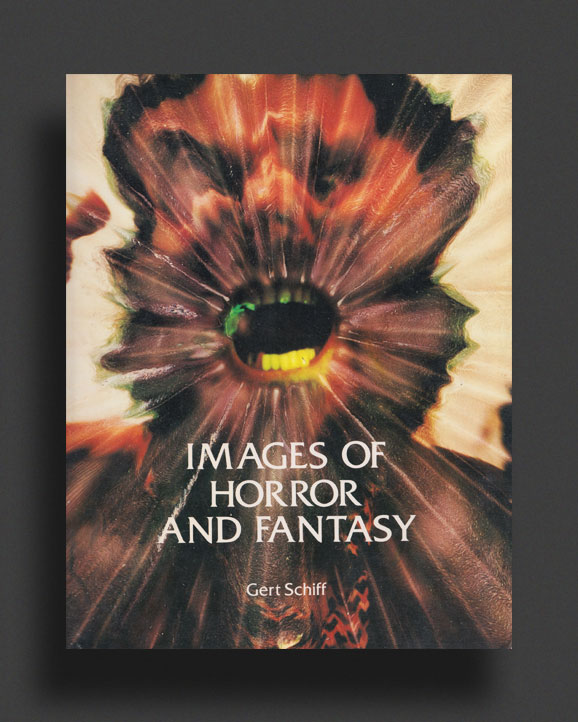
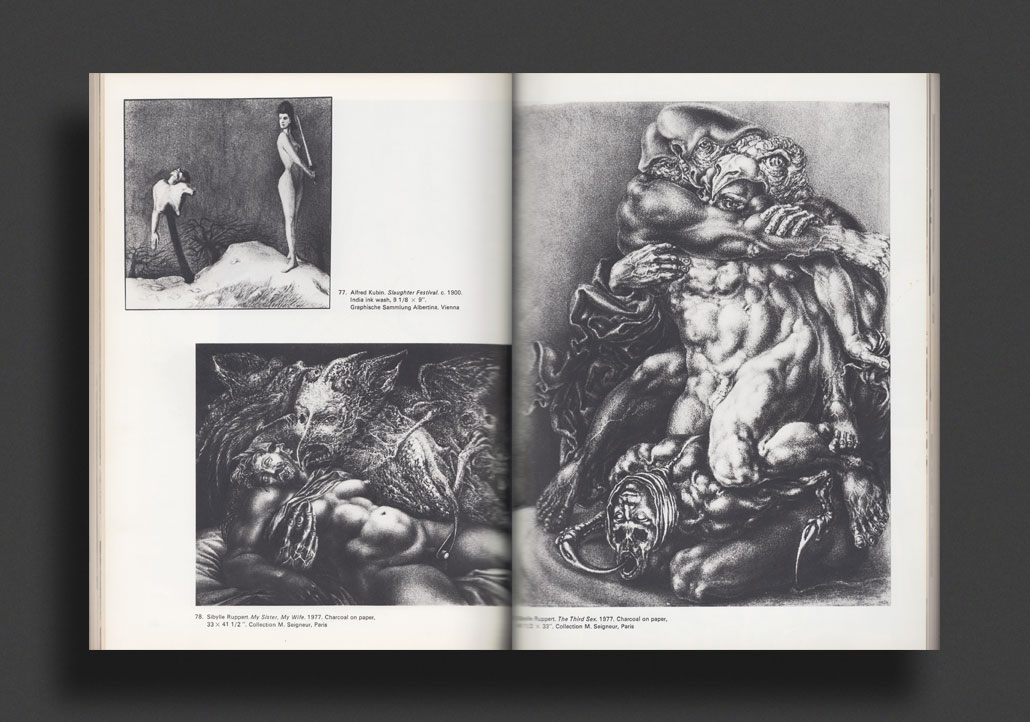
First UK hardcover edition published by Academy Editions in 1980, Images of Horror and Fantasy by art historian Gert Schiff expanded on a major group exhibition guest curated by Schiff at the Bronx Museum in 1977. The resulting publication is a perceptive critical and psychological analyses of a variety of nineteenth-and twentieth-century art that "unfolds simultaneously on the level of historical and social reality and on the level of dreams. Its purpose is to expose some of the principal anxieties of modern man and their resolution in utopian reveries and escapist fantasies."
Profusely illustrated in colour and b/w throughout with the works of Alfred Kubin, James Ensor, George Grosz, Paul Thek, Sibylle Ruppert, Henry Fuseli, Paul Delvaux, Nancy Grossman, Käthe Kollwitz, Max Beckmann, Fernand Khnopff, Rudolph von Ripper, Max Klinger, H. R. Giger, Jonah Kinigstein, Edward Keinholz, Jean Delville, Lucas Samaras, Miriam Beerman, Willem de Kooning, Man Ray, Oskar Kokoschka, Salvador Dali, Paolo Soleri, Jean Auguste Dominique Ingres, Georges Rouault, Otto Dix, Pablo Picasso, Philip Evergood, William Blake, Giorgio de Chirico, Ivan Albright, Yves Tanguy, Paul Klee, Jasper Johns, Germaine Richier, Francisco de Goya, Henri de Toulouse-Lautrec, Henri Matisse, Max Ernst, Francis Bacon, Rene Magritte, Illya Repin, Antoine Wiertz, Odilon Redon, Edward Burra, Larry Rivers, George Segal, Thomas Cole, Léon Frédéric, Matthias Grünewald, Rico Lebrun, Bruce Connor, Edvard Munch, and many more.
Gert Schiff (1926 — 1990, b. Oldenburg, Germany) was an art historian, critic, lecturer and professor at the Institute of Fine Arts of New York University. A specialist in the Romantic movement, particularly the work of Henry Fuseli and William Blake, Mr. Schiff was also very much involved with 20th-century art, organising many major exhibitions around his interests whilst authoring important studies on the arts from his dwellings at the Chelsea Hotel.
Very Good copy in VG dust jacket.
1967, Japanese
Softcover, 6 page card fold-out w. insert, 23.8 x 23.8 cm
1st Edition, Out of print title / used / very good
Published by
Tokyo Gallery / Tokyo
$100.00 - In stock -
Incredibly scarce catalogue published on the occasion of the 1967 exhibition "19 Surrealists" held at Tokyo Gallery, Japan. Fold-out catalogue with insert, illustrated with the exhibited works (along with biographies in Japanese) by Enrico Baj, Hans Bellmer, Victor Brauner, Salvador Dali, Paul Delvaux, Max Ernst, Wifredo Lam, Felix Labisse, René Magritte, Man Ray, Andre Masson, Roberto Matta, Joan Miro, Taro Okamoto, Francis Picabia, Kurt Schwitters, Max-Walter Svanberg, Yves Tanguy, Wols.
Very Good with light wear and mild spotting and a couple of pencil notations in Japanese. Preserved in sleeve.
1988, Japanese
Softcover, 208 pages, 13 x 18 cm
1st Edition, Out of print title / used / very good
Published by
Fiction Inc. / Tokyo
$70.00 - Out of stock
Issue No.35 of the great SALE2 periodical from Tokyo Japan, founded in 1984 by Makoto Orui, who later became art director for Purple magazine in France and Rockin’on magazine in Japan. SALE2 was active for about 14 years during the 1980s—1990s, published regularly as a sort-of fanzine/journal/catalogue/pocket-book by Fiction, Inc., a specialty shop and publisher of fetish and erotica in Tokyo in the 1980-90s. With Orui's distinct design SALE2 developed an exclusive curated editorial set on ‘erotisism and its spiritual philosophy’, with each issue exploring different themes and features, heavy on fetishism and erotic art.
Issue No.35, the "EROTIK!!" issue features erotic writings and artwork throughout by Hans Bellmer, Dorothea Tanning, André Berg, Pierre Molinier, Max Ernst, Armando Calvelli, articles on vintage stag films, nude French postcards, interspersed with lots of mysterious vintage erotic imagery, bondage illustration, and catalogue/advertisments/clippings of Eric Stanton, Irving Klaw, Jim, John Willie, Bizarre Comix, and much more...
Very heavily illustrated throughout with erotic photography and artwork, all texts in Japanese.
Very Good copy, tanning to pages.
1989, English / German / French
Softcover (w. flexi-disc), 280 pages, 26 x 21 cm
1st Edition, Out of print title / used / very good
Published by
Daadgalerie / Berlin
Gelbe Musik / Berlin
$280.00 - In stock -
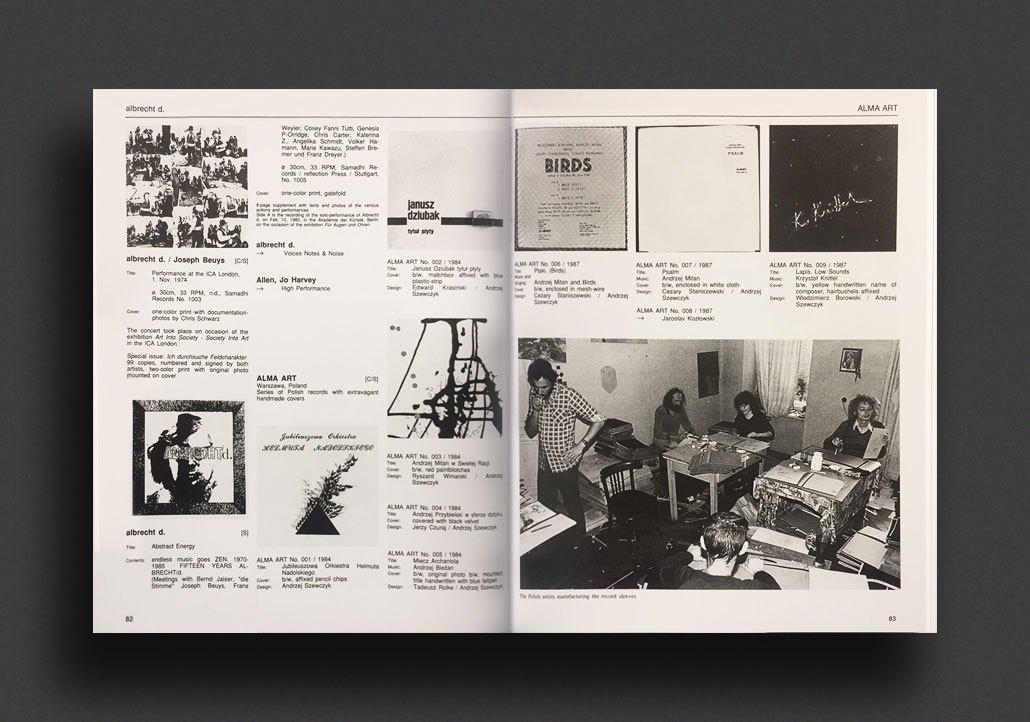
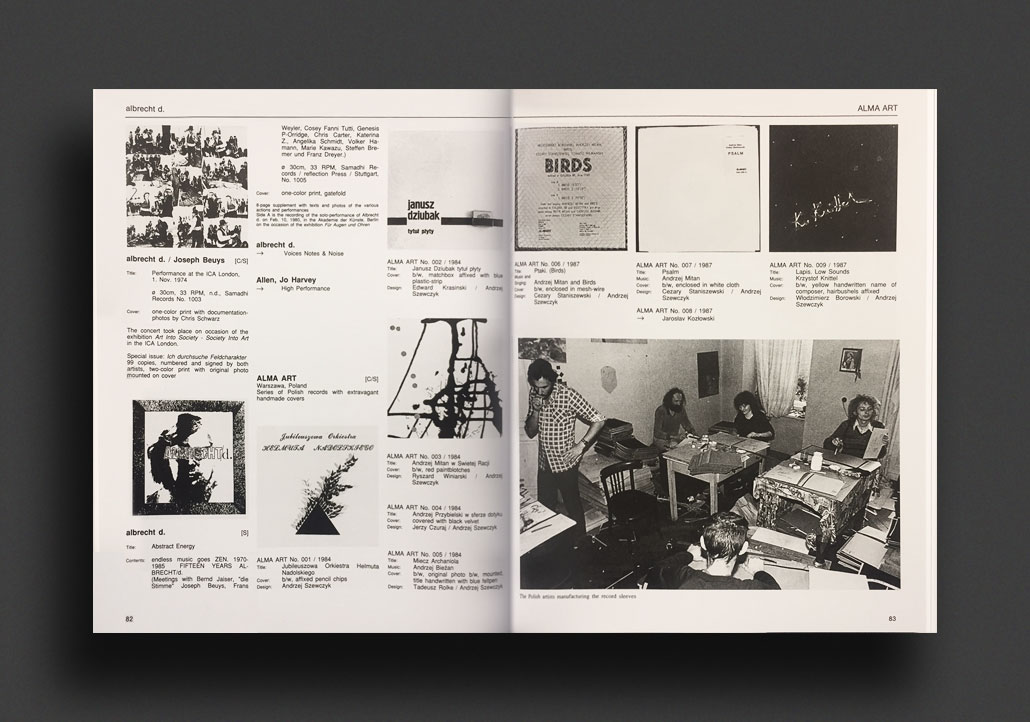
Rare first 1989 edition of Broken Music, an essential compendium for records created by visual artists. Complete with original flexi-disc. The publication was edited by Ursula Block and Michael Glasmeier and published in 1989 by DAAD and Gelbe Musik, Berlin. Broken Music focuses on recordings, record-objects, artwork for records, and record installations made by thousands of artists between WWII and 1989.
It also includes essays by both editors as well as Theodor W. Adorno, René Block, Jean Dubuffet, Milan Knizak, László Moholy-Nagy, Christiane Seiffert, and Hans Rudolf Zeller, as well as a flexi disc of the Arditti Quartet performing Knizak’s “Broken Music.” The centerpiece of the publication is a nearly 200-page bibliography of artists’ records.
Works chosen for the publication revolved around four criteria: (1) record covers created as original work by visual artists; (2) record or sound-producing objects (multiples/editions/sculptures); (3) books and publications that contain a record or recorded-media object; and (4) records or recorded media that have sound by visual artists.
Artists documented in the volume include Vito Acconci, albrecht/d., Laurie Anderson, Guillaume Apollinaire, Karel Appel, Arman, Hans Arp, Antonin Artaud, John Baldessari, Hugo Ball, Claus van Bebber, John Bender, Harry Bertoia, Jean-Pierre Bertrand, Joseph Beuys, Mel Bochner, Claus Böhmler, Christian Boltanski, KP Brehmer, William Burroughs, John Cage, Henri Chopin, Henning Christiansen, Jean Cocteau, William Copley, Philip Corner, Merce Cunningham, Hanne Darboven, Jim Dine, Marcel Duchamp, Max Ernst, Lawrence Ferlinghetti, Fischli and Weiss, R. Buckminster Fuller, Allen Ginsberg, Philip Glass, Jack Goldstein, Peter Gordon, Hans Haacke, Richard Hamilton, Bernard Heidsieck, Holger Hiller, Richard Huelsenbeck, Isidore Isou, Marcel Janco, Servie Janssen, Jasper Johns, Joe Jones, Thomas Kapielski, Allan Kaprow, Martin Kippenberger, Per Kirkeby, Cheri Knight, Milan Knizak, Richard Kriesche, Christina Kubisch, Laibach, John Lennon, Sol Lewitt, Roy Lichtenstein, Annea Lockwood, Paul McCarthy, Meredith Monk, Josef Felix Müller, Piotr Nathan, Hermann Nitsch, Albert Oehlen, Frank O’Hara, Claes Oldenburg, Yoko Ono, Dennis Oppenheim, Nam June Paik, Charlemagne Palestine, A.R. Penck, Tom Phillips, Robert Rauschenberg, The Red Crayola, Ursula Reuter Christiansen, Gerhard Richter, Jim Rosenquist, Dieter Roth, Gerhard Rühm, Robert Rutman, Sarkis, Thomas Schmit, Conrad Schnitzler, Kurt Schwitters, Selten Gehörte Musik, Richard Serra, Robert Smithson, Michael Snow, Keith Sonnier, Strafe für Rebellion, Jean Tinguely, Moniek Toebosch, Tristan Tzara, Ben Vautier, Yoshi Wada, Emmett Walsh, Andy Warhol, William Wegman, and Lawrence Weiner.
Ursula Block is a curator living in Berlin, Germany. From 1981 until 2014, she ran gelbe Musik, a gallery and record shop in Berlin that featured work by artists at the crossroads between music and art. She was married to curator René Block.
Michael Glasmeier is a professor, writer, and editor living in Berlin, Germany. Since the early 1980s, he has curated dozens of shows that explore the intersection between the visual arts, music, film, and language.
Very Good copy all-round, light cover/corner wear.
1965, English
Softcover, 246 pages, 20.5 x 15 cm
1st Edition, Out of print title / used / very good
Published by
Harry N. Abrams / New York
$30.00 - Out of stock
First 1965 English edition of German Dada painter, graphic artist, avant-garde film producer, and art historian, Hans Richter's important book of the Dada movement. "Where and how Dada began is almost as difficult to determine as Homer's birthplace" writes Hans Richter, who was associated with Dada from its early days. The noted artist and film-maker records here the history of that boisterous and fantastic movement, from its beginnings in wartime Zurich to its collapse in the Paris of the 1920s Dada invited the world to misunderstand it and fostered all kinds of confusion; nearly fifty years later its contradictions still intrigue us.
By skilful quotation from manifestoes and other documents of the time Professor Richter re-creates the events of those turbulent days. Looked at in retrospect Dada's role in the development of modern art seems inevitable, and the creative force of its planned outbursts can now be perceived: Dada led on from Expressionism, Cubism, and Futurism, and in its turn prepared the way for Surrealism. Dada was enlivened by extravagant, bizarre personalities: Tristan Tzara, Francis Picabia, Hans Arp, Kurt Schwitters, Marcel Duchamp, Max Ernst, Man Ray. Today the wheel has turned again; the gestures and provocations of the original movement reappear, hardly changed, in such forms as Pop art. The final section discusses this phenomenon.
"Mr.Richter, one of the original adherents of Dada, describes their attitude in a first-rate history, as objective and sober as the laughter was once derisive."—THE TIMES OF LONDON
Very Good copy, light wear to extremities, tanning to covers.
1983, Japanese / German / English
Softcover, 164 pages, 24 x 25 cm
1st Edition, Out of print title / used / good
Published by
Yomiuri Shimbun / Tokyo
$60.00 - In stock -
Scarce Japanese catalogue on the work of German artist Max Ernst, published to accompany the major retrospective exhibition that travelled Japan 1983—1984.
With an introduction by German art historian Werner Spies, in German and Japanese, this profusely illustrated book is quite a valuable volume on Ernst as it concentrates its pages on a huge collection of his lithography, frottage, collage, etching, and other graphic works, rather than his more well-known works in painting and sculpture, bringing to the surface many lesser-seen works of the artist. Over 300 colour and black and white reproductions, including biography and bibliography. Texts in Japanese and German, with titles and introduction in English.
Max Ernst (1891—1976) was a German painter, sculptor, graphic artist, and poet. A prolific artist, Ernst was a primary pioneer of the Dada movement and Surrealism.
Good copy with wear and creasing to corners, general wear and tear to cover extremities. Spine uncreased and tightly bound.