World Food Books' programme is largely produced on Kulin Nation land. We acknowledge the Wurundjeri people of the Kulin Nation as the first and continuing custodians of this land, and pay respect to their Elders past, present, and emerging.
World Food Books is an arts and special interests bookshop in Naarm / Melbourne. Founded in 2010, World Food Books is devoted to the presentation of a rotating, hand-selection of international art, design, literary and counterculture publications with an emphasis on the anti-traditional, the experimental, the avant-garde, the heretic, the marginal.
Presenting new titles alongside rare and out-of-print books, catalogues and journals spanning the fields of modern and contemporary art, design, photography, illustration, film, literature, poetry, cultural theory, philosophy, sexuality, popular and underground culture in its many radical forms, World Food Books wishes to encourage adventurous, thoughtful and open-minded reading, looking, writing, and exchange of publishing and ideas, both current and historical.
As well as our bookshop, located in Melbourne's historical Nicholas Building, all of our inventory is available internationally via our online mail-order service.
World Food Books semi-regularly co-ordinates "Occasions", a programme of exhibits and events at the bookshop and in partnership with other hosts (such as museums and art galleries) that develop out of the activities, relationships and content of the bookshop itself.
World Food Books
The Nicholas Building
37 Swanston Street
Room 5, Level 6
Melbourne 3000
Australia
SHOP HOURS:
THU–SAT 12–6
WEB-SHOP OPEN 24/7
World Food Books
Postal Address:
PO Box 435
Flinders Lane
Victoria 8009
Australia
Art
Theory / Essay
Architecture / Interior
Graphic Design / Typography
Photography
Fashion
Eros
LGBTQ+
Fiction / Poetry
Weird / Speculative / Science Fiction / Horror
Transgressive / Visceral / Abject
Symbolism / Decadence / Fin de siècle
Film / Video
Painting
Sculpture / Installation
Performance / Dance / Theater
Drawing
Sound / Music
Curatorial
Group Shows / Collections
Periodicals
Out-of-print / Rare
Posters / Ephemera / Discs
Signed Books
World Food Books Gift Voucher
World Food Book Bag
Australian Art
Australian Fiction
Australian Science Fiction / Speculative Fiction
Australian Poetry
Australian Photography
Japanese Photography
Conceptual Art
Minimal Art
Dada
'Pataphysics / Oulipo
Fluxus
Concrete Poetry
Pop Art
Surrealism
Arte Povera
Arte Informale / Haute Pâte / Tachism
Nouveau Réalisme / Zero / Kinetic
Situationism / Lettrism
Collage / Mail Art / Xerox Art
Art Brut / Folk / Visionary / Fantastic
Illustration / Graphic Art / Bandes Dessinées
Furniture
Italian Radical Design / Postmodernism
Textiles
Ceramics / Glass
Counterculture
Protest / Revolt
Philosophy
Psychoanalysis
Anthropology
Anarchism
Socialism / Anarchism / Communism / Capitalism
Literary Theory / Semiotics / Language
Feminism / Women's Studies
Gender Studies / Sexuality
Anthropology
Fetishism / BDSM
Drugs / Psychedelia
Crime / Violence
Animal Rights / Veganism
Occult / Esoterica
Ecology / Earth / Alternative Living
Whole Earth / Crafts
All prices in AUD (Australian dollars)
Pick-Ups
Pick-up orders can be collected in our bookshop during opening hours after order date. Please collect any Pick-up orders within 2 weeks of ordering as we have limited storage space. Orders will be released back into stock if not collected within this time. No refunds can be made for pick-ups left un-collected. If you cannot make it in to the bookshop in this time-frame, please choose postage option.
Return Policy
All sales are final. We do accept returns (for refund or exchange) for items received in error. All our orders are packed with special care using heavy-duty padding and cardboard book-mailers or bubble mailers (for smaller books), using reinforcement where required. We cannot take responsibility for any lost, stolen or damaged parcels.
Insurance
Should you wish to insure your package, please email us directly after placing your order and we can organise this at a small extra expense. Although all standard/express tracked packages are very safe and dependable, we cannot take responsibility for any lost, stolen or damaged parcels. We recommend insurance on valuable orders.
Interested in selling your old books, catalogues, journals, magazines, comics, fanzines, ephemera? We are always looking for interesting, unusual and out-of-print books to buy. We only buy books in our fields of interest and specialty, and that we feel we can resell.
We base these prices on desirability, market value, in-print prices, condition and our current stock levels. We offer cash, store credit, and can take stock on consignment. All
about 25% of the price we expect to get when we sell them, or 30% in store credit. We base these prices on desirability, market value, in-print prices, condition and our current stock levels.
Sell your books any day of the week. You can drop them off and return later. If you have a lot of books, we can visit your Sydney home.
We buy books that we feel we can resell. We offer about 25 % of the price we expect to get when we sell them, or 30% in store credit. We base these prices on desirability, market value, in-print prices, condition and our current stock levels.
Philadelphia Wireman
03 August - 01 September, 2018
World Food Books is proud to announce our next Occasion, the first presentation of sculptures by Philadelphia Wireman in Australia.
The Philadelphia Wireman sculptures were found abandoned in an alley off Philadelphia’s South Street on trash night in 1982. Their discovery in a rapidly-changing neighbourhood undergoing extensive renovation, compounded with the failure of all attempts to locate the artist, suggests that the works may have been discarded after the maker’s death. Dubbed the "Philadelphia Wireman" during the first exhibition of this work, in 1985, the maker’s name, age, ethnicity, and even gender remain uncertain. The entire collection totals approximately 1200 pieces, all intricately bound together with tightly-wound heavy-gauge wire (along with a few small, abstract marker drawings, reminiscent both of Mark Tobey and J.B. Murry). The dense construction of the work, despite a modest range of scale and materials, is singularly obsessive and disciplined in design: a wire armature or exoskeleton firmly binds a bricolage of found objects including plastic, glass, food packaging, umbrella parts, tape, rubber, batteries, pens, leather, reflectors, nuts and bolts, nails, foil, coins, toys, watches, eyeglasses, tools, and jewellery.
Heavy with associations—anthropomorphic, zoomorphic, and socio-cultural responses to wrapped detritus—the totemic sculptures by Philadelphia Wireman have been discussed in the context of work created to fulfil the shamanistic needs of alternative religions in American culture. Curators, collectors, and critics have variously compared certain pieces to sculpture from Classical antiquity, Native American medicine bundles, African-American memory jugs, and African fetish objects. Reflecting the artist’s prolific and incredibly focused scavenging impulse, and despite—or perhaps enhanced by—their anonymity, these enigmatic objects function as urban artefacts and arbiters of power, though their origin and purpose is unknown. Philadelphia Wireman, whatever their identity, possessed an astonishing ability to isolate and communicate the concepts of power and energy through the selection and transformation of ordinary materials. Over the course of the past two decades, this collection has come to be regarded as an important discovery in the field of self-taught art and vernacular art.
Presented in collaboration with Fleisher-Ollman Gallery, Philadelphia, and Robert Heald, Wellington.
Susan Te Kahurangi King
02 February - 10 March, 2018
Susan Te Kahurangi King (24 February 1951 - ) has been a confident and prolific artist since she was a young child, drawing with readily available materials - pencils, ballpoint pens and felt-tip markers, on whatever paper is at hand. Between the ages of four and six Susan slowly ceased verbal communication. Her grandparents William and Myrtle Murphy had developed a special bond with Susan so they took on caring responsibilities for extended periods. Myrtle began informally archiving her work, carefully collecting and storing the drawings and compiling scrapbooks. No drawing was insignificant; every scrap of paper was kept. The King family are now the custodians of a vast collection containing over 7000 individual works, from tiny scraps of paper through to 5 meter long rolls.
The scrapbooks and diaries reveal Myrtle to be a woman of great patience and compassion, seeking to understand a child who was not always behaving as expected. She encouraged Susan to be observant, to explore her environment and absorb all the sights and sounds. Myrtle would show Susan’s drawings to friends and people in her community that she had dealings with, such as shopkeepers and postal workers, but this was not simply a case of a grandmother’s bias. She recognised that Susan had developed a sophisticated and unique visual language and sincerely believed that her art deserved serious attention.
This was an unorthodox attitude for the time. To provide some context, Jean Dubuffet coined the term Art Brut in 1945 to describe work created by self-taught artists – specifically residents of psychiatric institutions and those he considered to be visionaries or eccentrics. In 1972 Roger Cardinal extended this concept by adopting the term Outsider Art to describe work made by non-academically trained artists operating outside of mainstream art networks through choice or circumstance. Susan was born in Te Aroha, New Zealand in 1951, far from the artistic hubs of Paris and London that Dubuffet and Cardinal operated in. That Myrtle fêted Susan as a self-taught artist who deserved to be taken seriously shows how progressive her attitudes were.
Susan’s parents Doug and Dawn were also progressive. Over the years they had consulted numerous health practitioners about Susan’s condition, as the medical establishment could not provide an explanation as to why she had lapsed into silence. Dawn educated herself in the field of homeopathy and went on to treat all twelve of her children using these principles – basing prescriptions on her observations of their physical, mental and emotional state.
Doug was a linguist with an interest in philosophy who devoted what little spare time he had to studying Maori language and culture. To some extent their willingness to explore the fringes of the mainstream made them outsiders too but it was their commitment to living with integrity and their respect for individuality that ensured Susan’s creativity was always encouraged.
Even though Susan’s family supported her artistic pursuits, some staff in schools and hospitals saw it as an impediment to her assimilation into the community and discouraged it in a variety of ways. Her family was not always aware of this and therefore did not fully understand why Susan stopped drawing in the early 1990s. However, rather than dwell on the challenges that Susan faced in pursuit of her artistic practice, they prefer to highlight her achievements. In 2008 Susan began drawing again in earnest, after an almost 20 year interruption, and her work is now shown in galleries around the world.
Susan grew up without television and has been heavily influenced by the comics she read as a child. She is absolutely fearless in the appropriation of recognizable characters, such as Donald Duck and Mickey Mouse, in her work. She twists their limbs, contorts their faces, compresses them together, blends them into complex patterned backgrounds - always imbuing them with an incredible energy. Although Susan often used pop culture characters in her work they are not naive or childlike. These are drawings by a brilliant self-taught artist who has been creating exceptional work for decades without an audience in mind.
Mladen Stilinović
"Various Works 1986 - 1999"
02 February 16 - September 10, 2016
Various works 1986 - 1999, from two houses, from the collections of John Nixon, Sue Cramer, Kerrie Poliness, Peter Haffenden and Phoebe Haffenden.
Including: Geometry of Cakes (various shelves), 1993; Poor People’s Law (black and white plate), 1993; White Absence (glasses, ruler, set square, silver spoon, silver ladel with skin photograph and wooden cubes), 1990-1996; Exploitation of the Dead (grey and red star painting, wooden painting, black spoon with red table, red plate), 1984-1990; Money and Zeros (zero tie, paintings made for friends in Australia (Sue, John, Kerrie), numbers painting), 1991-1992; Words - Slogans (various t-shirts) - “they talk about the death of art...help! someone is trying to kill me”, “my sweet little lamb”, “work is a disease - Karl Marx”; Various artist books, catalogues, monographs, videos; Poster from exhibition Insulting Anarchy; "Circular" Croatian - Australian edition; Artist book by Vlado Martek (Dostoyevsky); more.
Thanks to Mladen Stilinović and Branka Stipančić.
Jonathan Walker
Always Will Need To Wear Winter Shirt Blue + Ochre Small Check Pattern
21 August - 21 September, 2015
Untitled
I am not a great reader of poetry but I always return to the work of Melbourne poet, Vincent Buckley (1925- 1988). Perhaps I find his most tantalising piece to be not a finished poem but a fragment left on a scrap of paper discovered on his desk after the poet’s death.
The poetry gathers like oil
In the word-core, and spreads
It has its music meet,
Its music is in movement.
This fragment is more the shell left behind from a volatile thought than a finished poem. I find the last two lines honest but awkward whereas the first two lines work like an arrow. Most likely he could not find a resolution so it was left. Still, in its present form, it remains an eloquent testimony to the ultimate failure of a medium to express mobile thought and sensation, in Buckley’s case, through verbal language. It’s an important matter because this is something all artists have to deal with regardless of the medium.
I have never written a poem, however, I am forever copying fragments from books on paper scraps in a vain effort to fix certain notions in my head. At first, they function as bookmarks that are sometimes returned to when I open the book. But before long, as they accumulate, they fall out littering the table interspersed with A4 photocopies, bills, books and medications.
To return to Buckley’s fragment, the first two lines very much evoke how I paint nowadays. As you age, detail diminishes and patches of light become more luminous and float. I feel the most honest way of dealing with this is by smearing the oil paint on the canvas with the fingers and working close-up, blind. Only if the patches coalesce into an approaching image can the work gain a life.
-
Jonathan Walker was born in Melbourne, Australia and brought up on a dairy farm in Gippsland. In the 1970’s he studied painting at RMIT and won the Harold Wright Scholarship to the British Museum, London. During the 1980’s he exhibited at Pinacotheca Gallery, Richmond and had work shown at the NGV and Heidi City Art Gallery. Over the same period he designed the cover for the “Epigenesi” LP by Giancarlo Toniutti, Italy and conducted a mail exchange work with Achim Wollscheid, Germany. The work with artists through the post resulted in an article published in the bicentenary issue of Art and Australia 1988. He showed in artist run spaces such as WestSpace in the 90’s and 2000’s, and until 2012, taught painting at Victoria University, which is where we (Colleen Ahern and Lisa Radford) as organisers of the exhibition, among many others, had the privilege of being his student.
Walker’s knowledge was imparted to students through the careful selection of music, literature, and artists found in books that he himself had ordered for the library. Walker’s strategy was the generosity of sharing his vast knowledge with references specific to each student and their context.
Walker’s paintings share a similar focus and intimacy.
This exhibition presents a small selection of recent paintings alongside a publication that includes Walker’s writing. Observational and analytical, Walker’s work is a type of material notation — the time of day, colour and how it is blended, the both specific and fleeting location of a reflection on lino or the question of whether a chair leg should be included in a painting.
Please join us on Friday August 21 between 6-8pm to celebrate the opening of the exhibition.
Curated by Colleen Ahern and Lisa Radford.
B. Wurtz
Curated by Nic Tammens
March 26 - April 4, 2015
B.Wurtz works from a basement studio in his home on Manhattan’s Lower East Side.
This local fact is attested to by the plastic shopping bags and newsprint circulars that appear in his work. As formal objects, they don’t make loud claims about their origins but nonetheless transmit street addresses and places of business from the bottom of this long thin island. Like plenty of artists, Wurtz is affected by what is local and what is consumed. His work is underpinned by this ethic. It often speaks from a neighborhood or reads like the contents of a hamper:
“BLACK PLUMS $1.29 lb.”
“Food Bazaar”
“USDA Whole Pork Shoulder Picnic 99c lb.”
“RITE AID Pharmacy, with us it’s personal.”
“H. Brickman & Sons.”
“Sweet Yams 59c lb."
Most of the work in this exhibition was made while the artist was in residence at Dieu Donne, a workshop dedicated to paper craft in Midtown. Here Wurtz fabricated assemblages with paper and objects that are relatively lightweight, with the intention that they would be easily transportable to Australia. This consideration isn’t absolute in Wurtz’s work, but was prescriptive for making the current exhibition light and cheap. Packed in two boxes, these works were sent from a USPS post office on the Lower East Side and delivered to North Melbourne by Australia Post.
Wurtz appears courtesy of Metro Pictures, New York.
Thanks to Rob Halverson, Joshua Petherick, Sari de Mallory, Matt Hinkley, Helen Johnson, Fayen d'Evie, Ask Kilmartin, Lisa Radon, Ellena Savage, Yale Union, and "Elizabeth".
John Nixon
"Archive"
December 15 - January 20, 2014
The presentation of John Nixon's archive offered a rare showcase of this extensive collection of the artist's own publications, catalogues, posters, ephemera, editions and more, from the mid 1980s onwards, alongside a selection of his artworks.
Organized by John Nixon, Joshua Petherick and Matt Hinkley.
"Habitat"
at Minerva, Sydney (organised by Joshua Petherick and Matt Hinkley)
November 15 - December 20, 2014
Lupo Borgonovo, Janet Burchill & Jennifer McCamley,
Lewis Fidock, HR Giger, Piero Gilardi, Veit Laurent Kurz,
Cinzia Ruggeri, Michael E. Smith, Lucie Stahl, Daniel Weil, Wols
Press Release:
“...It contained seven objects. The slender fluted bone, surely formed for flight, surely from the wing of some large bird. Three archaic circuitboards, faced with mazes of gold. A smooth white sphere of baked clay. An age-blackened fragment of lace. A fingerlength segment of what she assumed was bone from a human wrist, grayish white, inset smoothly with the silicon shaft of a small instrument that must once have ridden flush with the surface of the skin - but the thing’s face was seared and blackened.”
William Gibson, “Count Zero”, 1986
"Autumn Projects Archive"
Curated by Liza Vasiliou
March 6 - March 15, 2014
World Food Books, in conjunction with the Virgin Australia Melbourne Fashion Festival 2014, presented the Autumn Projects archive, consisting of a selection of early examples in Australian fashion with a particular interest in collecting designers and labels from the period beginning in the 1980’s, who significantly influenced the discourse of Australian Fashion.
Curated by Liza Vasiliou, the exhibition provided a unique opportunity to view pieces by designers Anthea Crawford, Barbara Vandenberg, Geoff Liddell and labels CR Australia, Covers, Jag along with early experimental collage pieces by Prue Acton and Sally Browne’s ‘Fragments’ collection, suspended throughout the functioning World Food Books shop in Melbourne.
H.B. Peace
presented by CENTRE FOR STYLE
November 14, 2013
"Hey Blinky, you say chic, I say same"
Anon 2013
H.B. Peace is a clothing collaboration between great friends Blake Barns and Hugh Egan Westland. Their pieces explore the divergences between 'character’ and ‘personality’ in garments....etc
Special Thanks to Joshua Petherick and Matt Hinkley of WFB and Gillian Mears
and a Very Special Thank you to Audrey Thomas Hayes for her shoe collaboration.
Janet Burchill & Jennifer McCamley
"Aesthetic Suicide"
May 10 - June 8, 2013
The first of our occasional exhibitions in the World Food Books office/shop space in Melbourne, "Aesthetic Suicide" presented a body of new and older works together by artists Janet Burchill & Jennifer McCamley, including videos, prints, a wall work, and publications.
During shop open hours videos played every hour, on the hour.
$.00 - Out of stock
The eternal clean out! New items weekly.
https://worldfoodbooks.com/category/sale
Published by World Food Books / Melbourne
$20.00 - In stock -
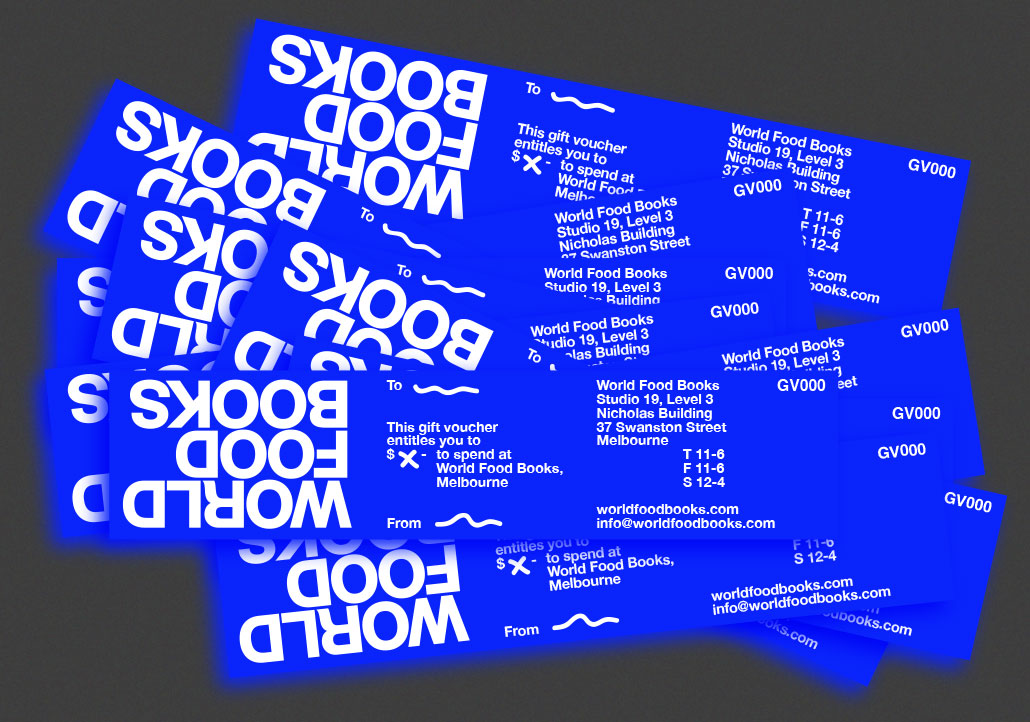
A World Food Books gift voucher is redeemable in our Melbourne bookshop or via our webshop (here). An e-voucher (printable pdf) will be sent to your purchase email address (please notify us if you wish to have the voucher sent to an alternate address and wish us to fill in the receiver's details on the card).
Gift vouchers can be purchased in increments of $20 (Australian Dollars) and the total amount can simply be added to by increasing the quantity in your shopping cart. eg. A quantity of 5 gift vouchers will result in an item total of $100 - a $100 gift voucher. Simply click "ADD TO CART" 5 times, or update your quantity in the shopping cart.
If you wish to purchase multiple, separate gift vouchers in one go, please just email us and we can personally prepare and email you a payment request.
Please note: Please select Pick-Up on gift voucher purchse to avoid any postage charges. Accidental postage charges will be refunded right away!
Thank you.
For any questions, please don't hesitate to email: [email protected]
2006, English / French
Softcover (french folds), 208 pages, 24 x 20 cm
1st Edition, Out of print title / used / very good
Published by
Halle Saint-Pierre / Paris
$200.00 - In stock -
First edition of this wonderful Unica Zürn monograph, published by Publisher Éditions du Panama to accompany a major survey exhibition in Paris in 2006—2007 at the Halle Saint Pierre, curated by Martine Lusardy and Sepp Hiekisch-Picard. Lavishly illustrated, this important catalogue, now long out-of-print, includes a large number of illuminating texts by scholars in bi-lingual English/French, including: "Unica Zürn: designs so dense" by Roger Cardinal; “Du wirst dein Geheimnis sagen (“You will tell your secret”). The anagram in the work of Unica Zürn" by Victoria Appelbe; "The magical encounter between writing and image" by Barbara Safarova; "The work of Unica Zürn, genesis and reception" by Sepp Hiekisch-Picard; "Read Unica Zürn: the contagion of the void" by Jean-Louis Lanoux; "Unica Zürn (July 6, 1916 – October 19, 1970): biographical references" by Rike Felka and Erich Brinkmann. An important, heavily illustrated reference of Zürn's life and work.
The German artist and writer Unica Zürn (1916-1970) joined the ranks of Surrealism in the 1950s, after moving to Paris and taking up residence with fellow German-born Surrealist Hans Bellmer. Already an accomplished author, Zürn was drawn to the Surrealist movement's espousal of automatic drawing and writing, Zürn pursued Henri Michaux's declaration that "the hand dreams," making a vocation of these techniques with her dense, otherworldly drawings and paintings that are labyrinthine in detail, as one form sprouts out of another. Also with her experimental anagrams, natural extensions of her established interest in hidden meanings and coincidences. Zürn produced most of her oeuvre during this intensive period in the 1950s and 60s, though one marked by her deteriorating mental health. Many of her works were made during periods of hospitalisation. In 1970, Zürn leapt to her death from the balcony of the Paris apartment she had shared with Bellmer. Upon his death in 1975, Bellmer was buried, at his request, next to Zürn in Paris’s Père-Lachaise Cemetery. Their grave is marked with the words Bellmer wrote for Zürn’s funeral wreath nearly five years before: “My love will follow you into Eternity.”
Zürn has left us an account of the sensation of automatic drawing: "After an initial moment when the pen 'swims' hesitantly on the paper, she discovers the place assigned to the first eye. It is only when she is being watched from the depths of the paper that she begins to get her bearings and, effortlessly, one motif is added to another."
Very Good copy with light wear.
2025, English
Hardcover, 272 pages, 28 x 23 cm
Published by
Prestel / Munich
$99.00 - In stock -
English edition of this wonderful tribute to one of the fathers of international modernism, James Ensor.
James Ensor’s visionary spirit takes us on a journey through his manifold universe of still lifes, self-portraits, savage visions, carnival and satire. In the course of his career, Ensor grew into an unruly gamechanger who personally reset the rules of art. As he did so, he resolutely distanced himself from the classical European ideal of beauty and from the Impressionism that had initially fascinated him.
Ensor did not limit himself to painting – he also unleashed his passion for experiment in detailed drawings, huge collages and potent etchings. His love for the fanciful resulted in characteristically grotesque representations of countless wild dreams.
The pulse of a thrilling late nineteenth century beats through the more than two hundred works reproduced in this book. Ensor constantly surprises us with his contrasts between the comical and the macabre, the refined and the wanton, atmospheric bourgeois interiors and morbid skeletons.
Drawing on their wide-ranging expertise, fifteen authors each highlight specific facets of the Ostend artist’s developing practice to paint a fresh and comprehensive picture of Ensor’s life and work.
This publication accompanies the exhibition In Your Wildest Dreams – Ensor Beyond Impressionism from 28 September 2024 until 19 January 2025 at the Royal Museum of Fine Arts Antwerp (KMSKA).
2025, English
Softcover, 272 pages, 20.8 x 14.9 cm
Published by
Urbanomic / Cornwall
$55.00 - In stock -
An interdisciplinary, cross-cultural collection that decenters familiar narratives to provide a fresh perspective on what artificial intelligence is today, and what it might become.
Historians, media theorists, science-fiction writers, philosophers, and artists from China and elsewhere reexamine the nation's intense engagement with AI, moving beyond the clichés that still dominate contemporary debate.
Today, visions of the contested future of AI veer between common planetary goals and a new Cold War, as culturally-specific models of intelligence, speculative traditions, and thought experiments come up against the emergence of novel forms of cognition that cannot be reduced to any historical cultural tradition.
This uniquely positioned volume provides expert insight into this tension, using China as a touchstone for rethinking "artificiality" and "intelligence" as sites of difference in a way that is already present in the difficulty of precisely translating the Chinese term 人工智能. Tracking the history of Chinese AI from the pre-Cultural Revolution to the post-Deng Xiaoping eras right up to contemporary debates surrounding facial recognition, the writers in this collection draw on a mixture of speculative thought experiments and cutting-edge use cases to offer singular views on topics including AI and Chinese philosophy, AI ethics and policymaking, the development of computational models in early Chinese cybernetics, and the aesthetics of Sinofuturism.
Spanning borders between different worlds, histories, futures, and foundational models, Machine Decision is Not Final is not only a timely reappraisal of the stakes of AI development, but a tool for constructing more global imaginaries for the future of AI.
Contributors
Blaise Aguera y Arcas, Bo An, Benjamin Bratton, Shuang Frost, Vince Garton, Steve Goodman, Yvette Granata, Anna Greenspan, Amy Ireland, Xia Jia, Bogna Konior, Vincent Le, Lawrence Lek, Lukas Likavcan, Suzanne Livingston, Iris Long, Bingchun Meng, Reza Negarestani, Chen Quifan, Gabriele de Seta, Hongzhe Wang, Wang Xin, Mi You
2025, English
Softcover, 264 pages, 20.2 x 13.7 cm
Published by
Semiotext(e) / Los Angeles
$36.00 - In stock -
A new novel from the celebrated author of Surveys, set in the Michigan suburbs of the early 2000s.
Installed alongside the Grand River in downtown Grand Rapids, Michigan, Alexander Calder's public sculpture La Grande Vitesse has come to symbolize the city. Tess moves there from Ypsilanti, Michigan in 2001-the same year that her mother dies, when everything begins to move, for her, in slow motion. Thrust into adolescence nearly rudderless, fifteen-year-old Tess is intoxicated, angsty, and sexually awake. A decade later, inspired by diary entries and TV reruns, she remembers this summer in the suburbs as the one that redefined her. Its echoes of death are frozen in time like the waves represented in the Calder sculpture or the concrete steps leading down to the churning river. She comes to see Grand Rapids as a collection of architecture and emblems, another home to which she cannot return.
2025, English
Softcover, 240 pages, 20 x 13 cm
Published by
Verso / London
$46.00 - In stock -
Presented here for the first time in English is a remarkable screenplay about the apostle Paul by Pier Paolo Pasolini, legendary filmmaker, novelist, poet, and radical intellectual activist. Written between the appearance of his renowned film Teorema and the shocking, controversial Salò, or the 120 Days of Sodom, St Paul was deemed too risky for investors. At once a political intervention and cinematic breakthrough, the script forces a revolutionary transformation on the contemporary legacy of Paul. In Pasolini's kaleidoscope, we encounter fascistic movements, resistance fighters, and faltering revolutions, each of which reflects on aspects of the Pauline teachings. From Jerusalem to Wall Street and Greenwich Village, from the rise of SS troops to the death of Martin Luther King, Jr, here— as Alain Badiou writes in the foreword—"Paul's text crosses all these circumstances intact, as if it had foreseen them all."
This is a key addition to the growing debate around St Paul and to the proliferation of literature centred on the current turn to religion in philosophy and critical theory, which embraces contemporary figures such as Alain Badiou, Slavoj Žižek and Giorgio Agamben.
Translated by Elizabeth A. Castelli
Preface by Alain Badiou
Introduction by Ward Blanton
2025, English
Softcover, 460 pages, 17.8 x 11 cm
Published by
Verdurin / London
$48.00 - In stock -
"Be a bad gay. Be a very bad gay! Read Inversion! This pugnacious book seeks to undermine the new identitarian hegemony of 'queer,' with its alphabet soup nomenclature. The essayists in Inversion survey a culture-war-torn, dystopian landscape wrecked by mindless conformity, rampant atomization, politically correct cancel culture gone mad, sexual puritanism (I never thought I'd see the day!), circular firing squads, victim Olympics, micro-aggression regression, anti-class-consciousness, and yes, even the (arguably) inherent misogyny of drag!" If you're a faggot who is mad as hell and not going to take it anymore, this is the book for you! Guaranteed to trigger, or your money back!"—Bruce LaBruce, director of The Raspberry Reich
With contributions by Blake Smith, Roger Lancaster, David Moulton, Stephen Adubato, Amir Naaman, Ran Heilbrunn, Pierre d'Alancaisez, Travis Jeppesen, Oliver Davis, Yotam Feldman, and Marcas Lancaster.
Today’s world of PrEP, Pride parades, and gay marriage eclipses the wildest dreams of the sexual revolution. While it was formerly deviant to promote gay lifestyles, it is now ‘problematic’ to suggest that not all departures from the norm are in the homosexual’s best interest. Amidst this excess, a new wave of discontent rises among the once-keenest proponents of sexual progress: gay men.
What happened in the transition from inversion to homosexuality, gayness, and queerness? Why do some gay men lament the freedoms afforded to them by sexual and social acceptance? Bold and daring, the essays in Inversion reflect on the vicious cycle of debasement, acceptance, sacrifice, and liberation that homosexuality has been stuck in for longer than it wishes to acknowledge.
As gay culture fails to confront its history, it adopts hollow narratives of struggle. Some gay men fear losing their freedoms, some advocate for sexual restraint, while others, lost in the ever-expanding LGBTQIA+ ‘community,’ continue to make maximalist ideological demands of those outside. These responses mark a fracture in gay life. If there is some essence to homosexual desire, how is it being served by today’s gay culture and queer politics? Has the gay man — homosexual, queer, or inverted — rendered himself obsolete?
Bringing together contributions by eleven leading thinkers, theorists, and critics who examine the consequences of pink-washing history, denial of sexual realities, and the memetic nature of desire, Inversion reclaims homosexuality’s lost depth in an era of profound discontent.
Fearless in its critique and challenging in its proposals, Inversion considers the cultural and political aspects of gay life after homosexuality as it battles with queerness and the allure of a reactionary return, pharmacologically fueled sexual degeneration, and existential dread.
2025, English
Softcover, 200 pages, 20.3 x 12.7 cm
Published by
Semiotext(e) / Los Angeles
$38.00 - In stock -
A masterful study of the elusive French composer, on the centenary of his death.
Composer, pianist, and writer Erik Satie was one of the great figures of Belle Époque Paris. Known for his unvarying image of bowler hat, three-piece suit, and umbrella, Satie was a surrealist before surrealism and a conceptual artist before conceptual art. Friend of Cocteau and Debussy, Picabia and Picasso, Satie was always a few steps ahead of his peers at the apex of modernism. There's scarcely a turn in postwar music, both classical and popular, that Satie doesn't anticipate. Moving from the variety shows of Montmartre's Le Chat Noir to suburban Arcueil, from the Parisian demimonde to the artistic avant-garde, cult critic Ian Penman's masterful Erik Satie Three Piece Suite is an exhilarating and playful three-part study of this elusive and endlessly fascinating figure, published to mark the centenary of Satie's death.
2025, English
Softcover, 224 pages, 20 x 13.67 cm
Published by
Semiotext(e) / Los Angeles
$39.00 - Out of stock
A long-form dialogue—on cinema and survival—with the visionary French filmmaker.
"The virtuous always engage in a pseudoreligious morality. But there’s one thing they never say: the desire for pleasure is thought in motion. It’s what makes you transfigure a dull and repetitive sexual act into something that can bring you to ecstasy and an idea of eternity..."—Catherine Breillat to Murielle Joudet
Catherine Breillat has always told just one story: her own, the story of a young girl whose existence was forbidden, who was, from childhood, cut in half, split between her mind and her sexuality, marked by the shame of being born female. She became a filmmaker at a time when choosing that vocation meant disobeying the world.
During six months between September 2022 and March 2023, the film critic Murielle Joudet interviewed Catherine Breillat for thirty hours, often following up with further discussion over the phone. Joudet and Breillat discuss each of her films in chronological order, moving freely between Breillat’s cinematic vision, her life, and the situations, artworks, and thought that have inspired her films.
From A Real Young Girl (1975) to Last Summer (2023), Breillat has made films in an attempt to recover what she believes was stolen from her— the “unfilmable,” inexhaustible grey area of the feminine where shame, transgression, sensuality, disgust, and the search for oneself intertwine until they become indistinguishable. Her work proposes a haunting imperative to know oneself... and for her heroines, this spiritual search plays out as an open war with the opposite sex.
A conversation with Catherine Breillat is as much a cinema master class as it is a lesson in survival.
Catherine Breillat is a filmmaker and writer based in Paris. She is known not only for her films focusing on themes of sexuality but also for her bestselling novels.
Murielle Joudet is a film critic for Le Monde, as well as for TV and radio. She is the author of Isabelle Huppert- Vivre ne nous regarde pas (2018), Gena Rowlands- On aurait d dormir (2020), and La Seconde Femme- Ce que les actrices font la vieillesse (2022).
2005, English
Softcover, 304 pages, 15 x 21.1 cm
Published by
Grove Press / New York
$40.00 - In stock -
Set largely on the pages of a website where gay male escorts are reviewed by their clients, and told through the postings, emails, and conversations of several dozen unreliable narrators, The Sluts chronicles the evolution of one young escort's date with a satisfied client into a metafiction of pornography, lies, half-truths, and myth. Explicit, shocking, comical, and displaying the author's signature flair for blending structural complexity with direct, stylish, accessible language, The Sluts is Cooper's most transgressive novel since Frisk, and one of his most innovative works of fiction to date.
Dennis Cooper (born 1953) is an American novelist, poet, critic, editor and performance artist who grew up in the Southern California. In 1976, he founded Little Caesar Magazine and Press, which he ran until 1982. In 1985, he moved to Amsterdam for two and a half years, where he began his ten year long project, The George Miles Cycle, an interconnected sequence of five novels that includes Closer, Frisk, Try, Guide, and Period. His post-George Miles Cycle novels include My Loose Thread, The Sluts and God, Jr. Other works include the short-story collections Wrong and Ugly Man, poetry collections The Dream Police and The Weaklings, as well as the recent Smothered in Hugs: Essays, Interviews, Feedback, and Obituaries.
Dennis Cooper currently spends his time between Los Angeles and Paris.
"Dennis Cooper, God help him, is a born writer"—William Burroughs
"Cooper’s language is at first intense, nearly minimal, then suddenly, it ascends into vision"—Kathy Acker
1994, English
Softcover, 144 pages , 14 x 21 cm
Published by
Grove Press / New York
$34.00 - In stock -
First published in 1994.
Physically beautiful and strangely passive, George Miles attracts his fellow students with a mysterious promise, like a wallet lying on the street. One after another, his teenage friends rifle through George, ransacking him for love or anything else they could trust in the mindlessness of middle America. What they find is a vision of nightmare intensity, in a novel that assaults the senses as it engages the mind.
Closer follows the links of desire and value that drag George into the arms of men like John, an artist who drains his portraits of humanity in order to find what lies beneath; Alex, fascinated by splatter films and pornography; and Steve, an underground entrepreneur who turns his parents’ garage into a nightclub. These and others pass George from hand to hand, hoping to feel even one emotion clear and uncorrupted by society, but George remains a blurry ghost until he is picked up by two men in their forties. Tom and Philippe think they can find reality in the sharp outlines of bones and the bright red of blood; obsessed with the beauty of death, they find in George the perfect object for their passion.
In brutally frank prose that exposes euphemism, cliché, and evasion, Dennis Cooper stares unflinchingly at the horror of a society without values, and his vision makes its enormity all too real. It is a world in which pain is an undeniable reality, the inevitable companion of truth, and a test of our commitment to life. Dennis Cooper explores the limits of experience, and while he sharpens our understanding of the life around us, he leaves no escape from what he finds.
“Closer translates the moments and feelings for which we don’t really have a vocabulary. Cooper taps the ineffable, the murky underside of sexual and human relations.” –Lynne Tillman
“An incredibly beautiful and daring book. Cooper’s language is at first intense, nearly minimal, then suddenly, it ascends into vision.” –Kathy Acker
Dennis Cooper (born 1953) is an American novelist, poet, critic, editor and performance artist who grew up in the Southern California. In 1976, he founded Little Caesar Magazine and Press, which he ran until 1982. In 1985, he moved to Amsterdam for two and a half years, where he began his ten year long project, The George Miles Cycle, an interconnected sequence of five novels that includes Closer, Frisk, Try, Guide, and Period. His post-George Miles Cycle novels include My Loose Thread, The Sluts and God, Jr. Other works include the short-story collections Wrong and Ugly Man, poetry collections The Dream Police and The Weaklings, as well as the recent Smothered in Hugs: Essays, Interviews, Feedback, and Obituaries. Dennis Cooper currently spends his time between Los Angeles and Paris.
"Dennis Cooper, God help him, is a born writer" - William Burroughs
1995, English
Softcover, 199 pages, 14 x 21 cm
Published by
Grove Press / New York
$34.00 - In stock -
“Written in Mr. Cooper’s taut, chillingly ironic prose. . . Try is about a world under severe emotional repression–a fascistic world of pure sadistic power. . . . As improbable as it may seem, Dennis Cooper has written a love story, all the more poignant because it is so brutally crushed.” –The New York Times Book Review
Simultaneously deadpan and queasily raw, Try is the story of Ziggy, the adopted teenaged son of two sexually abusive fathers whose failed experiment at nuclear-family domesticity has left him stranded with one and increasingly present in the fantasies of the other. He turns from both of these men to his uncle, who sells pornographic videos on the black market, and to his best friend, a junkie whose own vulnerability inspires in Ziggy a fierce and awkward devotion.
Terminally insecure and yet inured to sexual brutality, Ziggy questions his two fathers, his uncle, his drug dealer, his friends, and himself in an attempt to isolate and define the vagaries and boundaries of sexuality, attraction, and abuse, compiling their responses into a magazine that he calls I Apologize.
In prose that is taut, rhythmic, charged, chillingly precise, and beautifully controlled, Cooper examines his characters’ motivations not as the product of cultural coercion but as the emanations of something hungry and amoral and essentially human. Try explores “that buried need to go all the way and really possess someone,” that place where desire disintegrates into the irrational. He illuminates with utter clarity the need to claim the desirable, to possess wholly something that will fulfill the profound emptiness of the human soul.
With Try, Cooper has produced a novel even more complex than his previous books, dangerously innovative and with the startling familiarity of truth in its examination of love, obsession, devotion, and the depths of human need.
Dennis Cooper (born 1953) is an American novelist, poet, critic, editor and performance artist who grew up in the Southern California. In 1976, he founded Little Caesar Magazine and Press, which he ran until 1982. In 1985, he moved to Amsterdam for two and a half years, where he began his ten year long project, The George Miles Cycle, an interconnected sequence of five novels that includes Closer, Frisk, Try, Guide, and Period. His post-George Miles Cycle novels include My Loose Thread, The Sluts and God, Jr. Other works include the short-story collections Wrong and Ugly Man, poetry collections The Dream Police and The Weaklings, as well as the recent Smothered in Hugs: Essays, Interviews, Feedback, and Obituaries.
Dennis Cooper currently spends his time between Los Angeles and Paris.
"Dennis Cooper, God help him, is a born writer" - William Burroughs
"Cooper’s language is at first intense, nearly minimal, then suddenly, it ascends into vision" - Kathy Acker
2001, English
Softcover, 128 pages, 14 x 20.9 cm
Published by
Grove Press / New York
$34.00 - In stock -
The stunning conclusion to Dennis Cooper's five-book cycle, Period earned its author the accolade "a disquieting genius" by Vanity Fair and praise for his "elegant prose and literary lawlessness" by The New York Times.
The culmination of Cooper's explorations into sex and death, youth culture, and the search for the ineffable object of desire, Period is a breathtaking, mesmerizing final statement to the five-book cycle it completes. Cooper has taken his familiar themes - strangely irresistible and interchangeable young men, passion that crosses into murder, the lure of drugs, the culpabilities of authorship, and the inexact, haunting communication of feeling - and melded them into a novel of flawless form and immense power. Set in a spare, smoke-and-mirror-filled world of secret Web sites, Goth bands, Satanism, pornography, and outsider art, Period is a literary disappearing act as mysterious as it is logical. Obsessive, beautiful, and darkly comic, Period is a stunning achievement from one of America's finest writers.
Dennis Cooper (born 1953) is an American novelist, poet, critic, editor and performance artist who grew up in the Southern California. In 1976, he founded Little Caesar Magazine and Press, which he ran until 1982. In 1985, he moved to Amsterdam for two and a half years, where he began his ten year long project, The George Miles Cycle, an interconnected sequence of five novels that includes Closer, Frisk, Try, Guide, and Period. His post-George Miles Cycle novels include My Loose Thread, The Sluts and God, Jr. Other works include the short-story collections Wrong and Ugly Man, poetry collections The Dream Police and The Weaklings, as well as the recent Smothered in Hugs: Essays, Interviews, Feedback, and Obituaries.
Dennis Cooper currently spends his time between Los Angeles and Paris.
"Dennis Cooper, God help him, is a born writer" - William Burroughs
"Cooper’s language is at first intense, nearly minimal, then suddenly, it ascends into vision" - Kathy Acker
1998, English
Softcover, 176 pages, 14.6 x 21 cm
Published by
Avalon Travel Publishing / Chicago
$34.00 - In stock -
This title explores the psyches of four young gay men who are trying to alter their existence with drugs, violent erotic experiences, and love.
Dennis Cooper (born 1953) is an American novelist, poet, critic, editor and performance artist who grew up in the Southern California. In 1976, he founded Little Caesar Magazine and Press, which he ran until 1982. In 1985, he moved to Amsterdam for two and a half years, where he began his ten year long project, The George Miles Cycle, an interconnected sequence of five novels that includes Closer, Frisk, Try, Guide, and Period. His post-George Miles Cycle novels include My Loose Thread, The Sluts and God, Jr. Other works include the short-story collections Wrong and Ugly Man, poetry collections The Dream Police and The Weaklings, as well as the recent Smothered in Hugs: Essays, Interviews, Feedback, and Obituaries.
Dennis Cooper currently spends his time between Los Angeles and Paris.
2025, English
Softcover, 122 pages, 20.5 x 13.5 cm
Published by
Wakefield Press / Cambridge
$40.00 - In stock -
Translated, with an introduction by Napoleon Jeffries
Illustrations by Alfred Prunaire
We were young, always gay, often wealthy . . . But I’ve just struck a gloomy chord: our palace is razed to the ground. I trampled through its debris this past autumn.
Although Gérard de Nerval had originally intended it to be a small anthology of his early poetry, his 1853 Little Castles of Bohemia ended up as something more. As could be said of all his last works, the book was an effort at stability: worn out and financially impoverished from his travels and spells of mental turmoil, Nerval gathered his past writing in an attempt at assembling some sort of posterity, at creating a home for the vagabond pieces.
The melancholic, wandering castles presented here house pieces gathered from the range of Nerval’s literary life, from his autobiographic reminiscences of the bohemian neighborhood of Le Doyenné (destroyed by Baron Hausmann the year before this book’s initial publication), the lyrical “odelettes” that established Nerval as a poet early on, the one-act theatrical “proverb” Corilla, and the mystical sonnets of madness and existential despair that concluded his career.
In assembling together the shards of Nerval’s life, these castles depict both the birth and the decline of the Bohemian, as well as the struggle between Romantic idealism and realism that would formulate the tragic conclusions to the specific life of Nerval and the lives in general of the Bohemians of his time. The collapse of the boundary between art and life here leads to ruins.
Gérard de Nerval (1808–1855) was a writer, poet, and translator who wedded French and German romanticism and transformed his research into mystic thought and his bouts of mental illness into such visionary works as the posthumously published Aurélia, or Dream and Life. After his suicide, his work would grow in stature and go on to influence Marcel Proust, André Breton, Antonin Artaud, Michel Leiris, and countless others.
2025, English
Softcover, 202 pages, 20.4 x 12.7 cm
Published by
Contra Mundum Press / New York
$48.00 - In stock -
WORLD PREMIERE ENGLISH TRANSLATION
Rilke’s Testament opens with the outbreak of WWI, a devastating world event that prevents the poet from returning to the “incomparable city of Paris,” and which is entwined with his own debilitating crises.
In this decisive period, before which recovery or death waits, Rilke undergoes a kind of auto-da-fé and gives us a record of his failure and achievement. With insights into what he called his peculiar fate, the poet forges a will and testament, which he says “will remain his last, even if his heart still faced many years of challenges ahead.” Is this the final word on his struggle between love in life and love transformed into the mosaic of art?
Written while suffering an impasse with the Duino Elegies and just before he and Merline Klossowska discover the Chateau de Muzot, which would become a fertile sanctuary for the nomadic poet, Rilke turns to translation as a pontifex to carry him through the muteness of his crises. Having at last opened some free associative realm, he begins sketching terse reflections, lyrical draft letters, and dense, wistful prose, fragmentary writings that speak to the powers of destruction and creation.
Long secret, this enigmatic and charged series of experimental texts is the record of the close of a remarkable winter, wherein the work of poetry, the artist’s struggle with life, is tested in the crucible of solitude and the sinister expanse of blank pages. An illuminating ars poetica, Rilke’s Testament constitutes the mortal risk of not going beyond love, and the risk of the potential death of the artist, where the silencing of the logos puts creative potency under threat.
This world premiere English translation also includes essays on politics, poetry, sound, the sacred and sexuality, and the complete poem sequence “From the Literary Estate of Count C.W.," all works dating from the 'testament years.' The Testament (& Other Texts) documents a creative interregnum and is the dark passageway between the Duino Elegies and The Sonnets to Orpheus.
Edited by Rainer J. Hanshe
Translated with an introduction by Mark Kanak
1990, Japanese
Softcover (w. dust jacket), 196 pages, 21 x 15 cm
1st Edition, Out of print title / used / fine
Published by
Sanwa / Tokyo
$60.00 - In stock -
"Packed with embarrassing photos submitted by masochistic women!"
1990 Issue 41 of Mania Club, a Japanese SM/Kinbaku glossy magazine published by Sanwa Publishing, edited by Akira Matsuyama and accomplished rope artist (Kinbakushi) Masato Marai, who was once assistant to Chimuo Nureki and also edited SM Mania, SM Hisyousetsu, SM Sniper, and contributed to SM Select and SM Fan. Profusely illustrated throughout with bondage and fetish photo galleries in colour and b/w by professionals and amateurs alike, this issue with a central gallery by master of kinbaku photography Norio Sugiura. Originally published as a special edition of SM Mania, Mania Club became a regular publication that took a unique approach. Alongside commissioned professional shoots, Mania Club proudly declares that it is the only fully-fledged SM Magazine in Japan that is based on submissions, and is created together with its readers, much in the tradition of long-lost SM pioneers Kitan Club and Fuzoku Kitan.
This special first "Women's Gold" issue with "Shameplay" feature is lead entirely by submissions from masochistic women all over Japan who enjoy public exposure, humiliation, embarrassment, obscene behaviour, and the pleasure of exhibitionism in all imaginable forms (urophilia, scatophilia, punishment, flashing, pet play...). Abundantly illustrated with colour and b/w photographs of their private and not-so-private sexual proclivities.
"The contributors who send photos and notes to Mania Club are all people who have dedicated their lives to the pursuit of sex. It has a different impact than the average SM magazine. Outdoor training maniacs, anus lovers, uniform fetishists, pee lovers, masturbation maniacs, etc. Countless practitioners show us the profound world of eroticism. These genuine photographs and notes from people who have experienced it are a deeply moving record of love and sex. A must-see for anyone interested in "sex.""—Mania Club afterword
Fine copy in Fine dust jacket.
1968, Japanese
Softcover (lenticular cover w. illustrated slipcase), 244 pages, 18.5 x 12.5 cm
1st Edition, Out of print title / used / very good
Published by
Bijyutsu Shuppan / Tokyo
$200.00 - In stock -
Rare first 1968 slipcase edition of legendary Japanese Neo-Dadaist Ushio Shinohara's autobiography art-book, published right before he left Japan for New York City. With endorsement on the slipcase from Japanese artist and theorist Tarō Okamoto, the book is as explosively designed as an iconic Shinohara boxing performance. Wrapped in a lenticular cover and spanning many different paper stocks and fold-out plates, "The Way of the Avant-Garde" is profusely illustrated with bold graphics, exhibition and performance photographs, cartoons and collages accompanying Shinohara's texts that document his post-war avant-garde work in Tokyo — a violent blend of Japanese unrest, Action Art and American Pop.
Ushio Shinohara (b. 1932), nicknamed “Gyu-chan” (Little Cow) for his iconic Mohawk haircut, was a pivotal member of the Neo-Dada movement (or Neo-Dada Organizers) in Japan along with artists Genpei Akasegawa, Masunobu Yoshimura, Shūsaku Arakawa, Sayako Kishimoto, Tetsumi Kudō, Natsuyuki Nakanishi, etc. The book focuses on his struggling years as a young artist in Japan, the early radical performances, actions, and exhibitions staged by himself and his peers in the avant-garde — impulsive spectacles, often involving physical destruction of objects, that the art critic Ichirō Hariu deemed "savagely meaningless," and that inspired another art critic, Yoshiaki Tōno, to coin the term "anti-art" (han-geijutsu). The term group member Genpei Akasegawa would later use was "creative destruction" whereby the group sought to create a space for new types of art to emerge by systematically seeking out and destroying all existing artistic norms and conventions. Examples included filling galleries with piles of garbage, smashing furniture to the beat of jazz music, and prancing the streets of Tokyo in various states of dress and undress. Using the human body as their medium of art, their violent performances reflected both their dissatisfaction with the restrictive environment of the Japanese art world at the time, as well as contemporary social developments, most notably the massive 1960 Anpo protests against the U.S.-Japan Security Treaty.
In June 1960, Akasegawa read out the group's "manifesto" (written by Ushio Shinohara) to a group of reporters:
"No matter how much we fantasize about procreation in the year 1960, a single atomic explosion will casually solve everything for us, so Picasso’s fighting bulls no longer move us any more than the spray of blood from a run-over stray cat. As we enter the blood-soaked ring in this 20th century—a century which has trampled on sincere works of art—the only way to avoid being butchered is to become butchers ourselves."
This statement conveyed a sense of hopeless desperation that, at a time when attempts to create new forms of art were being suffocated by oppressive ideologies and hide-bound institutions, the only way to save art was to kill it.
Shinohara embraced Pop Art as early as 1963. In 1964, Shinohara was inspired to creatively “copy” Robert Rauschenberg’s “Coca-Cola Plan” (1958), having seen the work pictured in an article by the iconic Japanese critic Yoshiaki Tono in “Mizue” magazine. Shinohara explained: “As I was looking closely at how it was made, I noticed the use of three empty Coca-Cola bottles and realized there were tons of empty Coca-Cola bottles in my backyard.” Because the original work by Rauschenberg had been reproduced in the magazine in black-and-white, Shinohara invented the colors for his own duplicative assemblage (of which he made ten), incorporating bright white and accents of yellow and red. When Rauschenberg visited Shinohara’s studio with Tono while visiting Tokyo in the same year, he was surprised to see Shinohara’s reimagining of his work, joyfully exclaiming, “My son!”
The book features Robert's creative friendship with Shinohara and documents their events and discussions together in Tokyo, illustrated with wonderful visual spreads of the “Coca-Cola Plan(s)", which contributed to an important artistic questioning of authorship and consumer culture that pre-occupied both artists.
Ushio has lived and worked in New York since 1969, his work has been exhibited internationally at institutions including the Hara Museum of Contemporary Art, Centre Georges Pompidou, the Guggenheim Museum SoHo, National Museum of Modern Art, Tokyo, Leo Castelli Gallery, New York, Museum of Contemporary Art, Los Angeles and The Metropolitan Museum of Art, Seoul, and others. Shinohara and his wife, Noriko, are the subjects of a documentary film by Zachary Heinzerling called Cutie and the Boxer.
Very Good copy in Good—VG slipcase (slipcase has some light marking an old damp-stains/toning, mostly to the back) otherwise well preserved.
1979, English
Hardcover (w. dust jacket), 127 pages, 13.5 x 22 cm
1st UK Edition, Out of print title / used / good
Published by
Marion Boyars / London
$190.00 - In stock -
Wonderful first English hardcover edition of George Bataille's Story of the Eye, published by Marion Boyars, London, in 1979. Translated by Joachim Neugroschal with accompanying essays by Susan Sontag and Roland Barthes.
"The caress of the eye over the skin is so utterly, so extraordinarily gentle, and the sensation is so bizarre that it has something of a rooster's horrible crowing." - G.B.
A masterpiece of transgressive, surrealist erotica, Bataille's first novel, published under the pseudonym 'Lord Auch', is still his most notorious work. Called a "metaphysician of evil, Bataille wrote the 1928 novella "Story of the Eye (French: L'histoire de l'œil) as a psychoanalytical task. In this explicit erotic fantasy, the young male narrator and his lovers Simone and Marcelle embark on a sexual quest involving sadism, torture, orgies, madness and defilement, culminating in a final act of transgression. Shocking and sacrilegious, Story of the Eye is the fullest expression of Bataille's obsession with the closeness of sex, violence and death. Yet it is also hallucinogenic in its power, and is one of the erotic classics of the twentieth century.
This edition also includes Susan Sontag's superb study of pornography as art, 'The Pornographic Imagination', as well as Roland Barthes' essay 'The Metaphor of the Eye', which was first published in Bataille's own journal Critique, shortly after Bataille's death in 1962. Barthes' analysis focuses on the centrality of the eye to this series of vignettes, and notices that it is interchangeable with eggs, bulls' testicles and other ovular objects within the narrative. He also traces a second series of liquid metaphors within the text, which flow through tears, cat's milk, egg yolks, frequent urination scenes, blood and semen.
Georges Bataille (1897-1962), French essayist and novelist, was born in Billom, France. He converted to Catholicism, then later to Marxism, and was interested in psychoanalysis and mysticism, forming a secret society dedicated to glorifying human sacrifice. Leading a simple life as the curator of a municipal library, Bataille was involved on the fringes of Surrealism, founding the Surrealist magazine Documents in 1929, and editing the literary review Critique from 1946 until his death.
Good—VG ex-libris copy with light library wear to end blanks, small stamp to colophon in original G—VG dust jacket, no library markings, preserved under mylar wrap. Scarce in this edition with dust jacket present. General reading wear and tanning with age. There is a fierce feminist critique of Susan Sontag's essay in the margins that is an isolated attack Sontag. The rest is left unscathed.
1995, English
Hardcover (w. dust jacket), 240 pages, 20 x 29.5 cm
1st Edition, Out of print title / used / very good
Published by
Scalo Publishers / Zürich
$300.00 - In stock -
First 1995 hardcover edition of Richard Prince's photo/artist's book, Adult Comedy Action Drama, a splendid, rare and controversial volume on the subject of photography, American consumerism and voyeurism.
“An autobiography through words and pictures… Adult Comedy Action Drama links together Prince’s drawings, aphorisms, original photographs and photographs of other peoples’ photographs. Lighthearted and funny, it describes and theatricalizes the visual ‘stage set’ of an artist’s life, enacting all the comedies, actions and dramas with pictures alone. Prince’s is a postmodern landscape, where one becomes what one beholds” (Roth, 30). “Prince updates the old Modernist flirtation between the intellectual and the supposedly primitive… borrowing conceptual and aesthetic strategies from Duchamp, Jasper Johns, Minimalism and the photography-as-painting movement” (New York Times). Open Book, 366. Roth, 274.
Very Good copy with very minor ex-libris markings to top of book block and initial endpaper and title page only, otherwise a gorgeous copy throughout w. VG dust jacket preserved in mylar wrap.
1989, English
Softcover 138 pages, 28.6 x 19.5 cm
1st Edition, Out of print title / used / very good
Published by
Aperture / New York
Institute of Modern Art / Valencia
$440.00 - In stock -
Very rare first 1989 edition of one of Richard Prince’s best and most influential books. Spiritual America is a catalogue cum artist's book published by Aperture in conjunction with the artist’s landmark 1989 exhibition at the Institute of Modern Art in Valencia, Spain, and Guggenheim Museum, New York. Lavishly illustrated and stylishly designed closely with Prince by Bethany Johns, Spiritual America “retains a dual role as a retrospective survey of Prince’s work and a fascinating re-integration of his repertoire of images into the format from which they mostly originated - the magazine”(—Greg Hilty, Frieze Magazine). With over 200 colour images of Prince's work (the jokes, the bikers, the cowboys, the glamour girls, the hoods...), Spiritual America marked the first comprehensive publication on the artist and his work, featuring Prince's own texts as well as an incredible transcribed "interview" with author J.G. Ballard, and a preface by Corinne Diserens and Vincent Todoli.
"What would it be if I had the eyes of a fly?"
Artist's book entry 13 in "Bibliotheque d'un Amateur: Richard Prince's Publications 1981-2012"
VG—Near Fine, seemingly unread, tightly bound copy, no sunning. A light remainder stamp to top of book-block is the only detraction from a remarkable copy.
2022, English
Hardcover, 180 pages, 23.39 x 28.4 cm
Published by
Fulton Ryder / New York
$135.00 - Out of stock
“With the hoods, I wanted to paint something that was already painted.”―Richard Prince
Published to coincide with a major exhibition at Gagosian, New York, “Hoods, 1988–2013” documents Richard Prince’ 25-year body of work of the “Hoods” series.
Created by the artist Richard Prince (born 1949) in parallel to a major survey show, Hoods is both a monograph and an artist's book focused on a celebrated collection of painted sculptures made from 1988 through 2013. Archival photographs in the book document the evolution of the Hoods, cataloging both the artworks and Richard Prince's mythical "Body Shop" and the destroyed "Second House" in Upstate New York.
In an interview with photographer Larry Clark, Prince stated that "With the Hoods, I wanted to paint something that was already painted." From this simple act of conceptual appropriation, Prince evolved a massive body of work that engages deeply with the vernacular design tradition of the customized American muscle car. Taken all together, the sculptures, the upstate Body Shop and Prince's own photo-documentation evoke both ambiguous nostalgia as well as feelings of absence and loss, perhaps best expressed in a sampling of the artwork titles: Almost Grown; American Place; Folksongs; Vanishing Point.
1991, English
Softcover, 118 pages, 21 x 14.5 cm
Out of print title / used / very good
Published by
AK Press / Edinburgh
$50.00 - Out of stock
First AK Press 1991 edition of Stewart Home's THE ASSAULT ON CULTURE: UTOPIAN CURRENTS FROM LETTRISM TO CLASS WAR, first published in 1988 by Aporia Press and Unpopular Books. Chapters: Cobra, The Lettriste Movement, The Lettriste International (1952-57), The College Of Pataphysics, Nuclear Art and the International Movement for an Imaginist Bauhaus, From the "First World Congress of Liberated Artists" to the foundation of the Situationist International, The Situationist International in its heroic phase (1957-62)., On the theoretical poverty of the Specto-Situationists and the legitimate status of the Second International, The decline and fall of the Specto-Situationist critique, The origins of Fluxus and the movement in its 'heroic' period, The rise of the depoliticized Fluxus aesthetic, Gustav Metzger and Auto-Destructive Art, Dutch Provos, Kommune 1, Motherfuckers, Yippies and White Panthers, Mail Art, Beyond Mail Art, Punk, Neoism, Class War, plus bibliography.
*A straightforward account of the vanguards that followed Surrealism: Lettrisme, Fluxus, Neoism and others even more obscure"—Village Voice
"Home's book is the first that I know of to chart this particular 'tradition' and to treat it seriously.
It is a healthy corrective to the overly aestheti-cised view of 20th century avant-garde art that now prevails."—City Limits
"Much of the information is taken from obscure sources and the book is essential reading for anyone interested in the subject. It demystifies the political and artistic practices of opponents to the dominant culture and serves as a basic reference for a field largely undocumented in English. It is also engagingly honest, unpreten-tious, questioning and immediate in its impact"—Artists Newsletter
"Reflecting the uncategorisable aspect of art that hurls itself into visionary politics, the book will engage political scientists, performance artists and activists"—Art and Text
"Apocalyptic in the literal sense of the word: an uncovering, revelation, a vision"—New Statesman
"A concise introduction to a whole mess of troublemakers through the ages... well written, incisive and colourful"—NME
"Informative and provocative"—Art Forum
Very Good copy.