World Food Books' programme is largely produced on Kulin Nation land. We acknowledge the Wurundjeri people of the Kulin Nation as the first and continuing custodians of this land, and pay respect to their Elders past, present, and emerging.
World Food Books is an arts and special interests bookshop in Naarm / Melbourne. Founded in 2010, World Food Books is devoted to the presentation of a rotating, hand-selection of international art, design, literary and counterculture publications with an emphasis on the anti-traditional, the experimental, the avant-garde, the heretic, the marginal.
Presenting new titles alongside rare and out-of-print books, catalogues and journals spanning the fields of modern and contemporary art, design, photography, illustration, film, literature, poetry, cultural theory, philosophy, sexuality, popular and underground culture in its many radical forms, World Food Books wishes to encourage adventurous, thoughtful and open-minded reading, looking, writing, and exchange of publishing and ideas, both current and historical.
As well as our bookshop, located in Melbourne's historical Nicholas Building, all of our inventory is available internationally via our online mail-order service.
World Food Books semi-regularly co-ordinates "Occasions", a programme of exhibits and events at the bookshop and in partnership with other hosts (such as museums and art galleries) that develop out of the activities, relationships and content of the bookshop itself.
World Food Books
The Nicholas Building
37 Swanston Street
Room 5, Level 6
Melbourne 3000
Australia
SHOP HOURS:
CLOSED FOR BREAK UNTIL NOV 10
WEB-SHOP OPEN 24/7
(ORDER SHIPPING RESUMES NOV 10)
World Food Books
Postal Address:
PO Box 435
Flinders Lane
Victoria 8009
Australia
Art
Theory / Essay
Architecture / Interior
Graphic Design / Typography
Photography
Fashion
Eros
LGBTQ+
Fiction / Poetry
Weird / Speculative / Science Fiction / Horror
Transgressive / Visceral / Abject
Symbolism / Decadence / Fin de siècle
Film / Video
Painting
Sculpture / Installation
Performance / Dance / Theater
Drawing
Sound / Music
Curatorial
Group Shows / Collections
Periodicals
Out-of-print / Rare
Posters / Ephemera / Discs
Signed Books
World Food Books Gift Voucher
World Food Book Bag
Australian Art
Australian Fiction
Australian Science Fiction / Speculative Fiction
Australian Poetry
Australian Photography
Japanese Photography
Conceptual Art
Minimal Art
Dada
'Pataphysics / Oulipo
Fluxus
Concrete Poetry
Pop Art
Surrealism
Arte Povera
Arte Informale / Haute Pâte / Tachism
Nouveau Réalisme / Zero / Kinetic
Situationism / Lettrism
Collage / Mail Art / Xerox Art
Art Brut / Folk / Visionary / Fantastic
Illustration / Graphic Art / Bandes Dessinées
Furniture
Italian Radical Design / Postmodernism
Textiles
Ceramics / Glass
Counterculture
Protest / Revolt
Philosophy
Psychoanalysis
Anthropology
Anarchism
Socialism / Anarchism / Communism / Capitalism
Literary Theory / Semiotics / Language
Feminism / Women's Studies
Gender Studies / Sexuality
Anthropology
Fetishism / BDSM
Drugs / Psychedelia
Crime / Violence
Animal Rights / Veganism
Occult / Esoterica
Ecology / Earth / Alternative Living
Whole Earth / Crafts
All prices in AUD (Australian dollars)
Pick-Ups
Pick-up orders can be collected in our bookshop during opening hours after order date. Please collect any Pick-up orders within 2 weeks of ordering as we have limited storage space. Orders will be released back into stock if not collected within this time. No refunds can be made for pick-ups left un-collected. If you cannot make it in to the bookshop in this time-frame, please choose postage option.
Return Policy
All sales are final. We do accept returns (for refund or exchange) for items received in error. All our orders are packed with special care using heavy-duty padding and cardboard book-mailers or bubble mailers (for smaller books), using reinforcement where required. We cannot take responsibility for any lost, stolen or damaged parcels.
Insurance
Should you wish to insure your package, please email us directly after placing your order and we can organise this at a small extra expense. Although all standard/express tracked packages are very safe and dependable, we cannot take responsibility for any lost, stolen or damaged parcels. We recommend insurance on valuable orders.
Interested in selling your old books, catalogues, journals, magazines, comics, fanzines, ephemera? We are always looking for interesting, unusual and out-of-print books to buy. We only buy books in our fields of interest and specialty, and that we feel we can resell.
We base these prices on desirability, market value, in-print prices, condition and our current stock levels. We offer cash, store credit, and can take stock on consignment. All
about 25% of the price we expect to get when we sell them, or 30% in store credit. We base these prices on desirability, market value, in-print prices, condition and our current stock levels.
Sell your books any day of the week. You can drop them off and return later. If you have a lot of books, we can visit your Sydney home.
We buy books that we feel we can resell. We offer about 25 % of the price we expect to get when we sell them, or 30% in store credit. We base these prices on desirability, market value, in-print prices, condition and our current stock levels.
Philadelphia Wireman
03 August - 01 September, 2018
World Food Books is proud to announce our next Occasion, the first presentation of sculptures by Philadelphia Wireman in Australia.
The Philadelphia Wireman sculptures were found abandoned in an alley off Philadelphia’s South Street on trash night in 1982. Their discovery in a rapidly-changing neighbourhood undergoing extensive renovation, compounded with the failure of all attempts to locate the artist, suggests that the works may have been discarded after the maker’s death. Dubbed the "Philadelphia Wireman" during the first exhibition of this work, in 1985, the maker’s name, age, ethnicity, and even gender remain uncertain. The entire collection totals approximately 1200 pieces, all intricately bound together with tightly-wound heavy-gauge wire (along with a few small, abstract marker drawings, reminiscent both of Mark Tobey and J.B. Murry). The dense construction of the work, despite a modest range of scale and materials, is singularly obsessive and disciplined in design: a wire armature or exoskeleton firmly binds a bricolage of found objects including plastic, glass, food packaging, umbrella parts, tape, rubber, batteries, pens, leather, reflectors, nuts and bolts, nails, foil, coins, toys, watches, eyeglasses, tools, and jewellery.
Heavy with associations—anthropomorphic, zoomorphic, and socio-cultural responses to wrapped detritus—the totemic sculptures by Philadelphia Wireman have been discussed in the context of work created to fulfil the shamanistic needs of alternative religions in American culture. Curators, collectors, and critics have variously compared certain pieces to sculpture from Classical antiquity, Native American medicine bundles, African-American memory jugs, and African fetish objects. Reflecting the artist’s prolific and incredibly focused scavenging impulse, and despite—or perhaps enhanced by—their anonymity, these enigmatic objects function as urban artefacts and arbiters of power, though their origin and purpose is unknown. Philadelphia Wireman, whatever their identity, possessed an astonishing ability to isolate and communicate the concepts of power and energy through the selection and transformation of ordinary materials. Over the course of the past two decades, this collection has come to be regarded as an important discovery in the field of self-taught art and vernacular art.
Presented in collaboration with Fleisher-Ollman Gallery, Philadelphia, and Robert Heald, Wellington.
Susan Te Kahurangi King
02 February - 10 March, 2018
Susan Te Kahurangi King (24 February 1951 - ) has been a confident and prolific artist since she was a young child, drawing with readily available materials - pencils, ballpoint pens and felt-tip markers, on whatever paper is at hand. Between the ages of four and six Susan slowly ceased verbal communication. Her grandparents William and Myrtle Murphy had developed a special bond with Susan so they took on caring responsibilities for extended periods. Myrtle began informally archiving her work, carefully collecting and storing the drawings and compiling scrapbooks. No drawing was insignificant; every scrap of paper was kept. The King family are now the custodians of a vast collection containing over 7000 individual works, from tiny scraps of paper through to 5 meter long rolls.
The scrapbooks and diaries reveal Myrtle to be a woman of great patience and compassion, seeking to understand a child who was not always behaving as expected. She encouraged Susan to be observant, to explore her environment and absorb all the sights and sounds. Myrtle would show Susan’s drawings to friends and people in her community that she had dealings with, such as shopkeepers and postal workers, but this was not simply a case of a grandmother’s bias. She recognised that Susan had developed a sophisticated and unique visual language and sincerely believed that her art deserved serious attention.
This was an unorthodox attitude for the time. To provide some context, Jean Dubuffet coined the term Art Brut in 1945 to describe work created by self-taught artists – specifically residents of psychiatric institutions and those he considered to be visionaries or eccentrics. In 1972 Roger Cardinal extended this concept by adopting the term Outsider Art to describe work made by non-academically trained artists operating outside of mainstream art networks through choice or circumstance. Susan was born in Te Aroha, New Zealand in 1951, far from the artistic hubs of Paris and London that Dubuffet and Cardinal operated in. That Myrtle fêted Susan as a self-taught artist who deserved to be taken seriously shows how progressive her attitudes were.
Susan’s parents Doug and Dawn were also progressive. Over the years they had consulted numerous health practitioners about Susan’s condition, as the medical establishment could not provide an explanation as to why she had lapsed into silence. Dawn educated herself in the field of homeopathy and went on to treat all twelve of her children using these principles – basing prescriptions on her observations of their physical, mental and emotional state.
Doug was a linguist with an interest in philosophy who devoted what little spare time he had to studying Maori language and culture. To some extent their willingness to explore the fringes of the mainstream made them outsiders too but it was their commitment to living with integrity and their respect for individuality that ensured Susan’s creativity was always encouraged.
Even though Susan’s family supported her artistic pursuits, some staff in schools and hospitals saw it as an impediment to her assimilation into the community and discouraged it in a variety of ways. Her family was not always aware of this and therefore did not fully understand why Susan stopped drawing in the early 1990s. However, rather than dwell on the challenges that Susan faced in pursuit of her artistic practice, they prefer to highlight her achievements. In 2008 Susan began drawing again in earnest, after an almost 20 year interruption, and her work is now shown in galleries around the world.
Susan grew up without television and has been heavily influenced by the comics she read as a child. She is absolutely fearless in the appropriation of recognizable characters, such as Donald Duck and Mickey Mouse, in her work. She twists their limbs, contorts their faces, compresses them together, blends them into complex patterned backgrounds - always imbuing them with an incredible energy. Although Susan often used pop culture characters in her work they are not naive or childlike. These are drawings by a brilliant self-taught artist who has been creating exceptional work for decades without an audience in mind.
Mladen Stilinović
"Various Works 1986 - 1999"
02 February 16 - September 10, 2016
Various works 1986 - 1999, from two houses, from the collections of John Nixon, Sue Cramer, Kerrie Poliness, Peter Haffenden and Phoebe Haffenden.
Including: Geometry of Cakes (various shelves), 1993; Poor People’s Law (black and white plate), 1993; White Absence (glasses, ruler, set square, silver spoon, silver ladel with skin photograph and wooden cubes), 1990-1996; Exploitation of the Dead (grey and red star painting, wooden painting, black spoon with red table, red plate), 1984-1990; Money and Zeros (zero tie, paintings made for friends in Australia (Sue, John, Kerrie), numbers painting), 1991-1992; Words - Slogans (various t-shirts) - “they talk about the death of art...help! someone is trying to kill me”, “my sweet little lamb”, “work is a disease - Karl Marx”; Various artist books, catalogues, monographs, videos; Poster from exhibition Insulting Anarchy; "Circular" Croatian - Australian edition; Artist book by Vlado Martek (Dostoyevsky); more.
Thanks to Mladen Stilinović and Branka Stipančić.
Jonathan Walker
Always Will Need To Wear Winter Shirt Blue + Ochre Small Check Pattern
21 August - 21 September, 2015
Untitled
I am not a great reader of poetry but I always return to the work of Melbourne poet, Vincent Buckley (1925- 1988). Perhaps I find his most tantalising piece to be not a finished poem but a fragment left on a scrap of paper discovered on his desk after the poet’s death.
The poetry gathers like oil
In the word-core, and spreads
It has its music meet,
Its music is in movement.
This fragment is more the shell left behind from a volatile thought than a finished poem. I find the last two lines honest but awkward whereas the first two lines work like an arrow. Most likely he could not find a resolution so it was left. Still, in its present form, it remains an eloquent testimony to the ultimate failure of a medium to express mobile thought and sensation, in Buckley’s case, through verbal language. It’s an important matter because this is something all artists have to deal with regardless of the medium.
I have never written a poem, however, I am forever copying fragments from books on paper scraps in a vain effort to fix certain notions in my head. At first, they function as bookmarks that are sometimes returned to when I open the book. But before long, as they accumulate, they fall out littering the table interspersed with A4 photocopies, bills, books and medications.
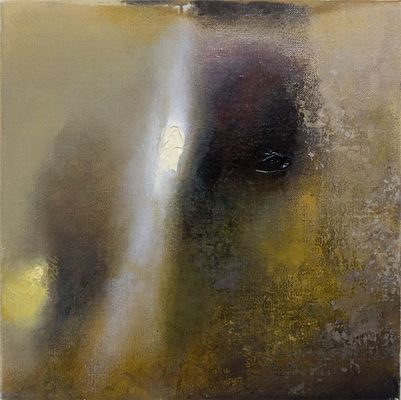
To return to Buckley’s fragment, the first two lines very much evoke how I paint nowadays. As you age, detail diminishes and patches of light become more luminous and float. I feel the most honest way of dealing with this is by smearing the oil paint on the canvas with the fingers and working close-up, blind. Only if the patches coalesce into an approaching image can the work gain a life.
-
Jonathan Walker was born in Melbourne, Australia and brought up on a dairy farm in Gippsland. In the 1970’s he studied painting at RMIT and won the Harold Wright Scholarship to the British Museum, London. During the 1980’s he exhibited at Pinacotheca Gallery, Richmond and had work shown at the NGV and Heidi City Art Gallery. Over the same period he designed the cover for the “Epigenesi” LP by Giancarlo Toniutti, Italy and conducted a mail exchange work with Achim Wollscheid, Germany. The work with artists through the post resulted in an article published in the bicentenary issue of Art and Australia 1988. He showed in artist run spaces such as WestSpace in the 90’s and 2000’s, and until 2012, taught painting at Victoria University, which is where we (Colleen Ahern and Lisa Radford) as organisers of the exhibition, among many others, had the privilege of being his student.
Walker’s knowledge was imparted to students through the careful selection of music, literature, and artists found in books that he himself had ordered for the library. Walker’s strategy was the generosity of sharing his vast knowledge with references specific to each student and their context.
Walker’s paintings share a similar focus and intimacy.
This exhibition presents a small selection of recent paintings alongside a publication that includes Walker’s writing. Observational and analytical, Walker’s work is a type of material notation — the time of day, colour and how it is blended, the both specific and fleeting location of a reflection on lino or the question of whether a chair leg should be included in a painting.
Please join us on Friday August 21 between 6-8pm to celebrate the opening of the exhibition.
Curated by Colleen Ahern and Lisa Radford.
B. Wurtz
Curated by Nic Tammens
March 26 - April 4, 2015
B.Wurtz works from a basement studio in his home on Manhattan’s Lower East Side.
This local fact is attested to by the plastic shopping bags and newsprint circulars that appear in his work. As formal objects, they don’t make loud claims about their origins but nonetheless transmit street addresses and places of business from the bottom of this long thin island. Like plenty of artists, Wurtz is affected by what is local and what is consumed. His work is underpinned by this ethic. It often speaks from a neighborhood or reads like the contents of a hamper:
“BLACK PLUMS $1.29 lb.”
“Food Bazaar”
“USDA Whole Pork Shoulder Picnic 99c lb.”
“RITE AID Pharmacy, with us it’s personal.”
“H. Brickman & Sons.”
“Sweet Yams 59c lb."
Most of the work in this exhibition was made while the artist was in residence at Dieu Donne, a workshop dedicated to paper craft in Midtown. Here Wurtz fabricated assemblages with paper and objects that are relatively lightweight, with the intention that they would be easily transportable to Australia. This consideration isn’t absolute in Wurtz’s work, but was prescriptive for making the current exhibition light and cheap. Packed in two boxes, these works were sent from a USPS post office on the Lower East Side and delivered to North Melbourne by Australia Post.
Wurtz appears courtesy of Metro Pictures, New York.
Thanks to Rob Halverson, Joshua Petherick, Sari de Mallory, Matt Hinkley, Helen Johnson, Fayen d'Evie, Ask Kilmartin, Lisa Radon, Ellena Savage, Yale Union, and "Elizabeth".
John Nixon
"Archive"
December 15 - January 20, 2014
The presentation of John Nixon's archive offered a rare showcase of this extensive collection of the artist's own publications, catalogues, posters, ephemera, editions and more, from the mid 1980s onwards, alongside a selection of his artworks.
Organized by John Nixon, Joshua Petherick and Matt Hinkley.
"Habitat"
at Minerva, Sydney (organised by Joshua Petherick and Matt Hinkley)
November 15 - December 20, 2014
Lupo Borgonovo, Janet Burchill & Jennifer McCamley,
Lewis Fidock, HR Giger, Piero Gilardi, Veit Laurent Kurz,
Cinzia Ruggeri, Michael E. Smith, Lucie Stahl, Daniel Weil, Wols
Press Release:
“...It contained seven objects. The slender fluted bone, surely formed for flight, surely from the wing of some large bird. Three archaic circuitboards, faced with mazes of gold. A smooth white sphere of baked clay. An age-blackened fragment of lace. A fingerlength segment of what she assumed was bone from a human wrist, grayish white, inset smoothly with the silicon shaft of a small instrument that must once have ridden flush with the surface of the skin - but the thing’s face was seared and blackened.”
William Gibson, “Count Zero”, 1986
"Autumn Projects Archive"
Curated by Liza Vasiliou
March 6 - March 15, 2014
World Food Books, in conjunction with the Virgin Australia Melbourne Fashion Festival 2014, presented the Autumn Projects archive, consisting of a selection of early examples in Australian fashion with a particular interest in collecting designers and labels from the period beginning in the 1980’s, who significantly influenced the discourse of Australian Fashion.
Curated by Liza Vasiliou, the exhibition provided a unique opportunity to view pieces by designers Anthea Crawford, Barbara Vandenberg, Geoff Liddell and labels CR Australia, Covers, Jag along with early experimental collage pieces by Prue Acton and Sally Browne’s ‘Fragments’ collection, suspended throughout the functioning World Food Books shop in Melbourne.
H.B. Peace
presented by CENTRE FOR STYLE
November 14, 2013
"Hey Blinky, you say chic, I say same"
Anon 2013
H.B. Peace is a clothing collaboration between great friends Blake Barns and Hugh Egan Westland. Their pieces explore the divergences between 'character’ and ‘personality’ in garments....etc
Special Thanks to Joshua Petherick and Matt Hinkley of WFB and Gillian Mears
and a Very Special Thank you to Audrey Thomas Hayes for her shoe collaboration.
Janet Burchill & Jennifer McCamley
"Aesthetic Suicide"
May 10 - June 8, 2013
The first of our occasional exhibitions in the World Food Books office/shop space in Melbourne, "Aesthetic Suicide" presented a body of new and older works together by artists Janet Burchill & Jennifer McCamley, including videos, prints, a wall work, and publications.
During shop open hours videos played every hour, on the hour.
1997, English
Softcover, 216 pages, 23 x 16 cm
1st Edition, Out of print title / used / very good
Published by
Routledge / London
$60.00 - In stock -
Rare first edition of Critchley's Very Little ... Almost Nothing, published in 1997. This remarkable book puts the question of the meaning of life back at the centre of intellectual debate. Its central concern is how we can find a meaning to human finitude without recourse to anything that transcends that finitude. A profound but secular meditation on the theme of death, Critchley traces the idea of nihilism through Blanchot, Levinas, Jena Romanticism and Cavell, culminating in a reading of Beckett, in many ways the hero of the book.
"This is a very brave book ...it makes philosophical conversation possible again after two decades of pragmatist intolerance."—Roger Poole, Parallax
"This is an often beautifully written philosophical act of mourning ... It also commands respect because it obliges one to examine the fictions one employs to avoid really doing philosophy. Critchley's steadfastly post-Kantian rejection of theological answers to the questions he asks is very welcome."—Andrew Bowie, Radical Philosophy
"Very Little ... Almost Nothing manages with some aplomb, to pull off the extraordinarily difficult task of saying something new and interesting about Beckett and Blanchot."—Martin McQuillan, New Formations
Very Good copy with some wear to extremities.
1995, English / Spanish / German
Softcover, 80 pages, 30 x 23 cm
1st Edition, Out of print title / used / fine
Published by
Norma Editorial / Barcelona
$50.00 - In stock -
"In the adventure of her breasts, there are vines which extend themselves tangling lustfully, with powerfully cold hips. There is a dagger, iron, blood, fury... penetrating into the most hidden recesses of her flesh. Magic."
First 1995 edition of Spanish fantasy artist Luis Royo's (b. 1954) full-colour volume of artworks dedicated to "Women", published by Norma Norma Editorial in Barcelona. Packed full of his remarkable airbrush paintings and drawings of women who famously featured in the pages of Heavy Metal magazine and adorned the covers of many sci-fi paperback throughout the 1980's. From Cyber-punk to Sword and Sorcery, Royo's most iconic heroines and femme fatales are all here, alongside commentary in Spanish, English and German, biography and many unseen personal works.
Very Good—NF copy.
1991, English / Japanese
Softcover (w. acetate dust jacket), 56 pages, 30 x 20.5 cm
1st Edition, Out of print title / used / very good
Published by
Fiction Inc. / Tokyo
$160.00 - In stock -
One of the best and earliest publications dedicated entirely to the "decadent and hermetic" erotic photography of Italian designer Carlo Mollino, this wonderful book was published by Fiction Inc. in Tokyo in 1991. Very scarce, this volume comes wrapped in printed acetate dust jacket, and is illustrated in colour throughout with Mollino's private erotic glamour photos accompanied by the essay "Body Furniture" by photography critic and founder of Déjà-vu magazine Kohtaro Iizawa. This special over-sized glossy format benefits viewing the minute details of Mollino's paint-brush edits to the photographs rarely so easily seen in other books by enlarging them dramatically from the original polaroids. Selected from the roughly 1200 surviving Polaroids, never exhibited during his life, which were found following his death in 1973, all re-touched and/or partially coloured by hand by Mollino. Also includes interior photographs.
Carlo Mollino (1905–73) was an architect, designer, photographer, writer, skier, racing driver and stunt pilot. In a career that spanned more than four decades, Mollino designed buildings, homes, furniture, cars and aircraft. One of the most dashing figures of mid-century Italy, Mollino was famed for his design finesse and his elegant organicism. In 1949 he published an important book on photography: Message from the Darkroom. Sometime around 1960, he began to seek out women - mostly dancers - in his native Turin, inviting them to his villa for late-night modeling sessions. The models would pose against extraordinary backdrops, designed by Mollino, in clothing, wigs and accessories that he had carefully selected. Finally, having printed the Polaroids, Mollino would painstakingly amend them with an extremely fine brush, to attain his idealized vision of the female form. The pictures, which totalled around 1,200, remained a secret until after his death, in 1973. Only a few were ever publicly shown, until this acclaimed first edition was published by James Crump in 2002. Reviewing this book, The New Yorker declared, "This lavish selection of several hundred Polaroids preserves the essential mystery of a project both decadent and hermetic. Though clearly the product of a deep obsession, the photographs are deliberately impersonal, each baroque detail an invitation for the viewer to imagine Mollino's encounters with the women."
Very Good copy with only light wear to plastic jacket.
1994, English
Hardcover, 96 pages, 22 x 18 cm
1st Edition, Out of print title / used / very good
Published by
Taschen / Cologne
$100.00 - In stock -
First English edition of the early hardcover monograph dedicated entirely to the "decadent and hermetic" erotic photography of Italian designer Carlo Mollino, published by Taschen in 1994 and long out-of-print. Profusely illustrated throughout in colour and b/w, with accompanying quotes and texts from the designer, illustrated essay by Falvio Ferrari, plus illustrated biography of Mollino.
Carlo Mollino (1905–73) was an architect, designer, photographer, writer, skier, racing driver and stunt pilot. In a career that spanned more than four decades, Mollino designed buildings, homes, furniture, cars and aircraft. One of the most dashing figures of mid-century Italy, Mollino was famed for his design finesse and his elegant organicism. In 1949 he published an important book on photography: Message from the Darkroom. Sometime around 1960, he began to seek out women - mostly dancers - in his native Turin, inviting them to his villa for late-night modeling sessions. The models would pose against extraordinary backdrops, designed by Mollino, in clothing, wigs and accessories that he had carefully selected. Finally, having printed the Polaroids, Mollino would painstakingly amend them with an extremely fine brush, to attain his idealized vision of the female form. The pictures, which totalled around 1,200, remained a secret until after his death, in 1973. Only a few were ever publicly shown, until this acclaimed first edition was published by James Crump in 2002. Reviewing this book, The New Yorker declared, "This lavish selection of several hundred Polaroids preserves the essential mystery of a project both decadent and hermetic. Though clearly the product of a deep obsession, the photographs are deliberately impersonal, each baroque detail an invitation for the viewer to imagine Mollino's encounters with the women."
Very Good copy
1984, English
Hardcover (w. dust jacket), 364 pages, 24 x 16 cm
1st Edition, Out of print title / used / very good
Published by
Leicester University Press / Leicester
$45.00 - Out of stock
First 1984 hardcover edition.
This comprehensive study of Jarry's work examines in detail all of his writings from the early schoolboy farces and the Ubu plays, through his poetry, novels, critical writings and journalism, to the musical comedies of his later years. Jarry emerges as a figure of considerable importance on the European cultural scene, not just as playwright and poet, but also as novelist, critic and pataphysician with insights into the nature of literature and language which make him a forerunner of much of the literature and critical theory of recent years. English translations of the extensive quotes from Jarry's writings are provided alongside the French text throughout.
Keith Beaumont was born in Melbourne, Australia, in 1944, and educated there, graduating from the University of Melbourne in 1966 in French with German. He was awarded the degree of Ph.D. by the University of Warwick in 1971 for a thesis on Nihilism in French Literature, 1880-1900. Since 1970 he has been Lecturer in French at the University of Leicester.
Dr. Beaumont's interest in Jarry dates from his undergraduate days. He has written a number of articles on Jarry and on pataphysics. He is a member of the Collège de Pataphysique and the Société des Amis d'Alfred Jarry.
VG in VG dust jacket.
2024, English
Hardcover (w. dust jacket), 100 pages, 26.42 x 28.96 cm
Published by
Liveright / US
$120.00 - Out of stock
Foreword by Benjamin Moser, With an Introduction by Susan Sontag
A new edition of the cult classic photography book by the legendary Peter Hujar, featuring a foreword by Pulitzer Prize winner Benjamin Moser
The 1976 publication of Peter Hujar’s Portraits in Life and Death, with an introduction by Susan Sontag, “was and remains one of the most somberly beautiful and influential photography collections of its era” (Holland Cotter, senior art critic of The New York Times). When Hujar passed away in 1987, his work was relatively unknown except for a small following. The importance and artistic mastery of Hujar’s photography, its tender gravity and intimacy, became recognised and canonical only after his death. The republication of this collection is composed of the original introduction by Susan Sontag and preceded by a new foreword by Benjamin Moser, with photographs presented in two sequences. A stirring ode to the flourishing downtown scene of the 1970s, this collection remains a deeply moving artefact of post-Stonewall New York City.
"As his posthumous fame only increases, this tightly curated collection of photographs of Hujar’s friends and peers (Paul Thek, Anne Waldman, John Waters and Robert Wilson among them), paired with a haunting series of 1963 photographs of the dead in the Capuchin Catacombs of Palermo, will remind fans of what makes him such a singular and original American artist."—Andrew Durbin, Frieze
"[A] stunning new edition… Sensuous and sensitive, this is a real masterwork."—Olivia Laing, The Observer
1999, English / German
Softcover, 64 pages, 27 x 21.6 cm
1st Edition, Out of print title / as new
Published by
Walther König / Köln
Kunstverein Braunschweig / Germany
$65.00 - Out of stock
Published in 1999, this catalogue is the first book to document two of Mike Kelley's central works, Sublevel (1998) and Deodorized Central Mass with Satellites (1991-1999), and includes deluxe large-format installation shots of these two pieces, as well as an interview and an essay by the artist.
1974, English
Hardcover (w. dust jacket), 125 pages, 22 x 14 cm
1st Edition, Out of print title / used / very good
Published by
Latimer / London
$300.00 - In stock -
Rare first 1974 hardcover edition of Stockhausen Serves Imperialism by Cornelius Cardew, published by Latimer, London.
The American composer and writer John Cage, born 1912, and the German composer Karlheinz Stockhausen, born 1928, have emerged as the leading figures of the bourgeois musical avant-garde. They are ripe for criticism. The grounds for launching an attack against them are twofold: first to isolate them from their respective schools and thus release a number of younger composers from their domination and encourage these to turn their attention to the problems of serving the working people, and second, to puncture the illusion that the bourgeoisie is still capable of producing “geniuses.” —Cornelius Cardew
Originally published in 1974, Stockhausen Serves Imperialism is a collection of essays by the English composer Cornelius Cardew that provides a Marxist critique of two of the more revered avant-garde composers of the post-war era: Karlheinz Stockhausen and John Cage.
A former assistant to Stockhausen and a champion of Cage in England, Cardew provides a cutting rebuke of the composers’ works and ideological positions, which he saw as reinforcing an imperialist order rather than spotlighting and serving the struggles of the working class. The author also provides constructive criticism of his contemporaries Christian Wolff and Frederic Rzewski for utilizing politically progressive content, yet failing to work in a musical form that would appeal to the proletariat. Cardew’s music does not escape his own scrutiny: the book contains critiques and repudiations of his canonical compositions from the 1960s and early 1970s, Treatise and The Great Learning. After abandoning the avant-garde, Cardew devoted his work to the people’s struggle, creating music in service of his radical politics until his mysterious death in 1981.
Very Good copy in VG dust jacket. Light tanning to jacket, internally tanned due to paper type. Beautifully preserved unread copy.
2003, English
Softcover, 458 pages, 22.8 x 15.2 cm
1st Edition, Out of print title / as new
Published by
University of Chicago Press / Chicago
$45.00 - Out of stock
While many acknowledge that Friedrich Nietzsche and Michel Foucault have redefined our notions of time and history, few recognize the crucial role that “the infinite relation” between seeing and saying (as Foucault put it) plays in their work. Gary Shapiro reveals, for the first time, the full extent of Nietzsche and Foucault’s concern with the visual.
Shapiro explores the whole range of Foucault’s writings on visual art, including the theory of visual resistance, the concept of the phantasm or simulacrum, and his interrogation of the relation of painting, language, and power in artists from Bosch to Warhol. Shapiro also shows through an excavation of little-known writings that the visual is a major theme in Nietzsche’s thought. In addition to explaining the significance of Nietzsche’s analysis of Raphael, Dürer, and Claude Lorrain, he examines the philosopher’s understanding of the visual dimension of Greek theater and Wagnerian opera and offers a powerful new reading of Thus Spoke Zarathustra.
Archaeologies of Vision will be a landmark work for all scholars of visual culture as well as for those engaged with continental philosophy.
Fine copy.
1990, English
Softcover, 126 pages, 23 x 15 cm
1st Edition, Out of print title / used / very good
Published by
University of Minnesota Press / Minnesota
$15.00 - In stock -
First 1990 edition.
In Modernism and Hegemony, first published in 1990, Neil Larsen exposes the underlying political narratives of modernist aesthetic theory and practice. Unlike earlier Marxist critics, Larsen insists that modernist ideology be approached as a "displaced politics" and not simply as an aesthetic phenomenon. In this view, modernism is broadly ideological project comprising not only the literary-artist canon but also a wide array of theoretical discourses from aesthetics to philosophy, culture, and politics. Larsen gives postmodernism some credit for the apparent breakup of modernism, and for exposing the philosophical and political nature of its aesthetic stance. But he parts company with its ideological and epistemological notions, proposing to change the terms, and thus the framework, of the debate.For Larsen, modernism is intimately linked to a crisis of representation that affected all aspects of life in the late nineteenth century - a period when capitalism itself was undergoing transformation from its "classical" free market phase into a more abstract, monopolistic and imperialistic stage. Larsen finds the resultant loosening of ties between individuals and society - the breakdown of social and historical agency - behind the growth of modernism. He employs speculative cross-readings of key texts by Marx and Adorno, an examination of Manet's "The Execution of Maximilian," and an analysis of modernism in a Third World setting to explain why modernism made special claims upon the aesthetic, and how it ultimately ascribed historical agency to "works of art."
VG copy.
1992, English
Softcover, 148 pages, 23 x 15 cm
Out of print title / used / very good
Published by
Humanities Press International / London
$15.00 - In stock -
"The book represents an original attempt at drawing together postmodernist theory and film.'—Journal of Aesthetics and Art Criticism
Filming and Judgment advances an unprecedented reading of judgment as filming. No longer simply descriptive of the cinematographic, "filming" is the name for a site of thinking at the end of philosophy. As such, this interdisciplinary work provides the conditions for the possibility of rethinking the foundations of hermeneutics in relation to postmodern concerns regarding the political and the aesthetic, and makes a major contribution to a new philosophy of film and post-Heideggerian thought.
Filming and Judgment develops and reinscribes the thinking of Heidegger, Adorno, Derrida, and Foucault. By reading these thinkers through and against one another, Professor Wurzer is able to address the problem of the distinction between the modern and the postmodern and to offer a specific treatment of mimesis, which makes this an important work for those concerned with literary theory. More unusual, however, is the philosophical orientation of this approach to filming, an approach that distinguishes this work as one of the very few "postmodern theory" books addressed to the film theorist-indeed, the text may be read, in its movement toward the final chapter on New German Cinema, as establishing the conditions for the possibility of a contemporary continental philosophy of film and filming. But, equally important to these aesthetic considerations, the radical reappraisal of capital, the thinking of filming outside the dialectic, and the critique of the contemporary "politics of the imagination" all make this work relevant to political theory.
Wilhelm Wurzer received his Ph.D. from the University of Freiburg, Germany. He is now Professor of Philosophy at Duquesne University.
Filming and Judgment is part of Philosophy and Literary Theory, a multidisciplinary series edited by Hugh J. Silverman.
VG copy light edge wear.
1966, English
Softcover, 252 pages, 20.5 x 13 cm
1st Edition, Out of print title / used / good
Published by
Cambridge University Press / Cambridge
$15.00 - In stock -
First 1966 softcover edition of Kant's Analytic by New Zealand born philosopher Jonathan Bennett.
"This book is a critical exposition and evaluation of the ideas contained in the first half of Kant's "Critique of Pure Reason". The author believes that we understand Kant only in proportion as we can say, clearly and in contemporary terms, what his problems were, which of them are still problems and what contribution Kant makes to their solution. Many commentaries and expositions of Kant's philosophy adopt a rigidly anti- or pro-Kantian approach, which make it difficult for the student to command a clear view of his theories. Mr Bennett tries to avoid partisan disputes and to present an unbiased assessment of !Cant based on modern analytical technique. Kant's Analytic, though intended primarily as an 'introduction' for students who have read little by or about Kant, also seeks to recon-struct, assess and criticise his work, and devotes much space to independent discussion of philosophical issues."
"And so Bennett does argue, continuously, fiercely, and fruitfully; and summons to join in the argument, at appropriate moments, those older contemporaries, Locke, Leibniz, Berkeley, and Hume, and those younger contemporaries, Wittgenstein, Ryle, Ayler, Quine, Quinton, Warnock, and others. This is splendid, and a necessary corrective to that extraordinary isolation in which Kant tends to be islanded, partly indeed, by his own unique qualities, but partly by oceans of the wrong kind of respect. Bennett, continuously engaging his great antagonist, shows the right kind."
Jonathan Bennett (b. 1930) is a New Zealand born philosopher of language and metaphysics, specialist of Kant's philosophy and a historian of early modern philosophy.
Good copy with general wear/marking/age.
1999, English
Softcover, 708 pages, 23 x 15.4 cm
1st Edition, Out of print title / used / good
Published by
Cambridge University Press / Cambridge
$50.00 - In stock -
This 1997 (first published in paperback in 1999) book was the first English translation of all of Kant's writings on moral and political philosophy collected in a single volume. No other collection competes with the comprehensiveness of this one. As well as Kant's most famous moral and political writings, the Groundwork of the Metaphysics of Morals, the Critique of Practical Reason, the Metaphysics of Morals, and Toward Perpetual Peace, the volume includes shorter essays and reviews, some of which have never been translated before. The volume has been furnished with a substantial editorial apparatus including translator's introductions and explanatory notes to each text by Mary Gregor, and a general introduction to Kant's moral and political philosophy by Allen Wood. There is also an English-German and German-English glossary of key terms.
Edited by Mary J. Gregor
Introduction by Allen W. Wood
Good copy due to bumping to top right corner, otherwise VG—NF.
1955 / 1984, English
Softcover, 230 pages, 20 x 13 cm
1st Edition, Out of print title / used / average
Published by
Penguin Books / London
Pelican / London
$15.00 - In stock -
1984 printing of 1955 Pelican imprint (Penguin) edition.
A lucid and informative introduction to one of the greatest philosophers of the modern Western world.
Immanuel Kant was born in 1724 and died in 1804. He succeeded in combining the rare gifts of analytical acumen and constructive imagination with the still rarer gift of maintaining a balance between the two. Perhaps no thinker ever influenced his successors more: even the writings of those who oppose him, or who have never properly studied his work, abound in thoughts which he was the first to formulate.
This book offers an outline of Kant's system, one of its chief aims being to show that his problems and solutions are not merely of historical interest, but often directly relevant to contemporary philosophical issues. For all readers it provides an entry into some of the most important writings of our times.
"It provides what has long been needed, a clear and reliable guide to the convolutions of the Critical Philosophy in its main outlines"—Mind
Stephan Körner, FBA was a British philosopher, who specialised in the work of Kant, the study of concepts, and in the philosophy of mathematics.
Average copy with some loose pages, edgewear.
1952 / reprint, English
Softcover, 180 pages, 18.5 x 12 cm
1st Edition, Out of print title / used / fine
Published by
Oxford University Press / New York
$35.00 - In stock -
Reprint from ? of the 1952 Oxford edition. This volume contains the late Judge J. C. Meredith's translation of Kant's Critique of Aesthetic Judgement and Critique of Teleological Judgement together with an Analytical Index to each. The Introductions and notes that accompanied the translations in the original two volumes have been dropped in order to make the translations available in a single volume.
The Critique of Judgment (German: Kritik der Urteilskraft), also translated as the Critique of the Power of Judgment, is a 1790 book by the German philosopher Immanuel Kant. Sometimes referred to as the "third critique", the Critique of Judgment follows the Critique of Pure Reason (1781) and the Critique of Practical Reason (1788). The "Critique of Judgment" is a major philosophical work exploring the principles underlying the faculty of judgment, specifically in the realms of aesthetics and teleology.
Near Fine copy.
1995, English
Softcover, 274 pages, 23 x 15 cm
1st Edition, Out of print title / used / fine
Published by
Duke University Press / North Carolina
$25.00 - In stock -
IMAGINE FREDRIC JAMESON—the world's foremost Marxist critic-kidnapped and taken on a joyride through the cultural ephemera, generational hype, and Cold War fallout of our post-post-contemporary landscape. In The Jamesonian Unconscious, a book as joyful as it is critical and insightful, Clint Burnham devises unexpected encounters between jameson and alternative rock groups, new movies, and subcultures. At the same time, Burnham offers an extraordinary analysis of Jameson's work and career that refines and extends his most important themes.
In an unusual biographical move, Burnham negotiates Jameson's major works— including Marxism and Form, The Political Unconscious, and Postmodernism, or, The Cultural Logic of Late Capitalism-by way of his own working-class, queer-ish, Gen-X background and sensibility. Thus Burnham's study draws upon an immense range of references familiar to the MTV generation, including Reservoir Dogs, theorists Slavoj Zizek and Pierre Bourdieu, The Satanic Verses, Language poetry, the collapse of state communism in Eastern Europe, and the indie band Killdozer. In the process, Burnham addresses such Jamesonian questions as how to imagine the future, the role of utopianism in capitalist culture, and the continuing relevance of Marxist theory. Through its redefinition of Jameson's work and compelling reading of the political present, The Jamesonian Unconscious defines the leading edge of Marxist theory.
"Burnham's smart, loud, and hedonistic tour of Fredric Jameson's writings is full of surprises and new perspectives—not just on Jameson's work but on theory, politics, and culture more generally. Self-described 'brutalist,' Burnham's almost breathless way of approaching his topics is entertainingly origi-nal. He ends with a challenging 'synoptic' version of Jameson's work that will affect not only readers of Jameson's work, but anyone interested in the politics of cultural forms in the era of 'late capitalism.'"—PAUL SMITH, Carnegie Mellon University
"Clint Burnham gives Jameson's career a fantastic and impious and appealing new life. The Jamesonian Unconscious is a young, lively, street-wise, culturally cool reappropriation of a tradition of thought often associated with graying white male modernists. It has something of that elusive style I've heard personified, wistfully, as 'Camille Paglia of the left.' People will remember it when nine-tenths of the scholarly books published are just titles in a library catalog."—BRUCE ROBBINS, Rutgers University
Clint Burnham is an independent writer living in Toronto.
Post-Contemporary Interventions
A Series Edited by Stanley Fish & Fredric Jameson
VG copy
1994, English
Softcover, 298 pages, 21.5 x 14 cm
1st Edition, Out of print title / used / very good
Published by
Routledge / London
$30.00 - In stock -
First 1994 printing.
This collection explores, in Adorno's description, "philosophy directed against philosophy". The essays cover all aspects of Benjamin's writings, from his early work in the philosophy of art and language, through to the concept of history. The experience of time and the destruction of false continuity are identified as the key themes in Benjamin's understanding of history.
Edited by Andrew Benjamin and Peter Osborne
The Contributors: Howard Caygill, Alexander Garcia Düttman, Peter Osborne, Werner Hamacher, John Kraniauskas, Irving Wohlfarth, Rodolphe Gasché, Gertrud Koch, Andrew Benjamin, Rebecca Comay.
VG some mild edge wear to covers.
2013, English / Portugese
Softcover, 224 pages, 23 x 18.5 cm
1st Edition, Out of print title / as new
Published by
Bom Dia Boa Tarde Boa Noite / Berlin
$150.00 - In stock -
The first in-depth survey of Brazilian designer, poet, musician, artist and author, Rogério Duarte's practice, and the first time that a selection of his poems and texts have been translated into English. Now long out-of-print and collectible resource.
Arguably, Rogério Duarte (* 1939, Ubaíra) is “the genius behind the geniuses” (Narlan Mattos) of Brazil's 1960–70s counter-cultural and avant-garde efforts. Thus, it comes as no surprise that key figures in the fields of design, music, art, and cinema, such as Glauber Rocha, Hélio Oiticica, Gilberto Gil, and Caetano Veloso, have provided the posterity with a vast catalogue of testimonies that leave no doubt as to the crucial role that Rogério played in the emergence of what is known today as the Tropicália movement, or Tropicalism. Yet, despite the growing interest that the Brazilian counter-culture of that time encountered on the international stage during the past two decades, Rogério's work has remained almost unknown to a broader public.
Marginália 1 was developed by the designer Manuel Raeder and the artist Mariana Castillo Deball over a period of four years and published by BOM DIA BOA TARDE BOA NOITE. Profusely illustrated in colour and b/w with texts by Rogério Duarte, Narlan Matos Teixeira, Max Jorge Hinderer Cruz, Mariana Castillo Deball, Manuel Raeder. Published in both English and Portuguese.
As New copy, still sealed.
1982, English
Hardcover (w. dust jacket), 154 pages, 23.5 x 16 cm
1st Edition, Out of print title / used / very good
Published by
Syracuse University Press / New York
$50.00 - Out of stock
First hardcover edition.
"In this groundbreaking, original study, J. H. Matthews, "clearly the chief scholarly explicator of surrealism today," according to Contemporary Literature, shows how the surrealists' goals and the imaginative freedom of mind are fused and diffused in the poet's creative world. Hallucination, game-playing, experimental research, and the irrational which nurtures new ways of poetical expression are all interwoven.
Out of their eagerness to share the benefits they ascribed to mental disturbance surrealists developed an approach to poetic technique which capitalized on the free association of the unconscious mind without undermining the sanity of the poets themselves.
Matthews discusses early surrealist interest in psychosis, hysteria, and insanity. This interest underlies such major works as André Breton's Nadja and Breton's and Paul Eluard's The Immaculate Conception. It is in the latter text that the issue of insanity and its relationship to poetic activity is most clearly revealed as essential to the surrealist enterprise. Also included here are chapters on insanity's poetic simulation and possession.
Matthews' work is important to anyone interested in poetry, the unconscious, and the history of twentieth-century ideas, as well as to scholars of surrealism.
Karol Baron, a Czech surrealist artist, has provided six original drawings especially for this book."—Dust jacket.
J. H. Matthews is a member of the committee appointed by the French government's Centre National de la Recherche scientifique to establish a center in Paris for documenting world-wide surrealism. He is American correspondent for Edda and Gradiva (Brussels), Phases (Paris), and Sud (Marseilles), magazines devoted to vanguard poetry and art. In 1977 the University of Wales conferred upon him its D. Litt., in recognition of his work on surrealism.
Born in Swansea, Wales, J. H. Matthews has been Professor of French at Syracuse University and editor of Symposium: A Quarterly Journal in Modern Foreign Literatures since 1965. He has edited a selection of stories by Guy de Maupassant (1959) as well as two special issues of La Revue des Lettres Modernes, and is the author of Les deux Zola (1957) and The Inner Dream: Céline as Novelist (1978) and numerous articles on nineteenth-and twentieth-century French literature.
His interest in surrealism has led him to write Péret's Score/Vingt Poèmes de Benjamin Péret
(1965); An Introduction to Surrealism (1965); An Anthology of French Surrealist Poetry (1966); Surrealism and the Novel (1966); André Breton (1967); Surrealist Poetry in France (1969); Surrealism and Film (1971); Theatre in Dada and Surrealism (1974); Benjamin Péret (1975); and The Custom-House of Desire: A Half-Century of Surrealist Short Stories (1975). He is also the author of Toward the Poetics of Surrealism (1976); Le thé-âtre de Raymond Roussel: une énigme (1977); The Imagery of Surrealism (1977); and Surrealism and American Feature Films (1979).
VG copy in VG dust jacket with light tanning/age.
2024, English
Softcover, 134 pages, 24 x 17.5 cm
Published by
ACCA / Melbourne
$25.00 - Out of stock
Fusing First Nations cultural traditions, the industrial materiality of the mining industry, and regional and global art influences, this title and its accompanying exhibition asserts and re-imagines the artists’ cross-cultural identities, drawing upon the haunting wounds of post-contact histories, the renewal and remaking of cultural practices, and the collaborative resilience and audaciously punk attitude of a frontier community.Encompassing contemporary artists from Northern Central Australia and Melbourne, Tennant Creek Brio includes key members Fabian Brown Japaljarri, Lindsay Nelson Jakamarra, Rupert Betheras, Joseph Williams Jungarayi, Clifford Thompson Japaljarri, Jimmy Frank Jupurrula, Fabian Rankine Jampijinpa, Marcus Camphoo Kemarre, and collaborators including Eleanor Jawurlngali Dixon, Lévi McLean, and Gary Sullibhaine. The group first converged in 2016 when the artists initiated an outreach program at the local men’s centre, Anyinginyi Health Aboriginal Corporation.
Edited by Max Delany and Elyse Goldfinch
2004, English
Hardcover (w. dust jacket), 116 pages, 19.5 x 14 cm
1st Edition, Out of print title / used / very good
Published by
Continuum / London
$25.00 - Out of stock
First hardcover edition.
Art and Fear is compulsory reading for anyone still wondering where art has gone and where science is taking us. Paul Virilio traces the twin development of art and science over the 20th Century, a development that emerges as a nightmare dance of death. In Virilio's scorching vision, art and science vie with each other for the destruction of the human form as we know it. At the start of the 21st Century science has finally left art behind as genetic engineers prepare to turn themselves into the worst of expressionists, the Human Genome Project their godless manifesto, the human being, the raw material for new and monstrous forms of life. A brutal logic rules this shattering of representation: our ways of seeing are now fatally shaped by unprecedented 'scientific' modes of destruction.
VG in VG dust jacket.
1997, Japanese
Softcover (w. dust jacket), 154 pages, 29.7 x 21 cm
1st Edition, Out of print title / used / very good
Published by
Treville / Tokyo
$220.00 - Out of stock
First 1997 edition collection of "The Early Works" by the Japanese master of Ero guro Toshio Saeki, published by Treville in 1997 and long out-of-print. An extensive collection of incredible works gathered from his first major book in 1970, his acclaimed 1971 Red Book, the panel-by-panel replication of an early Saeki manga story, and much more. Texts by Akira Uno, Alain Robbe-Grillet and Timothy Leary.
Toshio Saeki (1945—2019) was an illusive Japanese illustrator and painter, and icon of 1970s Tokyo counterculture, known for combining Japanese folklore, Yōkai spirits and elements of Western art with his own sophisticated aesthetics to create a unique, sensational world of eros, dark humour, and horror. Given the title “Erotic Engineer” by Timothy Leary, Saeki's provocative art broke all sexual taboos, questioned Japanese ideology and traditional views on love, desire and gender roles. Saeki’s surgically-precise graphic work is closely related to the Japanese cultural phenomenon ‘Erotic, Grotesque, Nonsense’ (ero, guro, nansensu).
“Toshio Saeki conjures death with a pen”—Shūji Terayama, 1969.
Very Good copy in VG dust jacket, light wear.
2025, English
Hardcover (clothbound), 124 pages, 23 x 23 cm
Published by
Drill Hall Gallery / Canberra
$45.00 - In stock -
This title brings the collection of Canberra couple Susan Taylor and Peter Jones into focus on the advent of its 25th anniversary. Seeded from an initial interest in mid-century modern design and early twentieth century avant-gardes, the collection blossomed into an embrace of non-objective and abstract art. Artists featured include General Idea, Maria Kozic, Peter Maloneyi, Elizabeth Newman, John Nixon, Robert Rooney, Janet Burchill, Jennifer McCamley and many more.It has grown to revel in the intersections between conceptual art, geometric abstraction, seriality, non-objective painting, photography, contemporary jewellery and poetics to develop conjunctions across time, place and materiality.
The publication accompanies the exhibition curated by Peter Jones at the Drill Hall Gallery, Australian National University, 19 April – 15 June 2025.
Eye to Eye delves into several of the collection’s multi-faceted and revelatory cross-sections. In his essay Peter Jones explores how the couple’s interests have been refined and extended by the art they love and the people that surround that art. In an interview with Drill Hall Gallery director Tony Oates, Susan Taylor discusses the correlations between sustainable fashion and conceptual art with a focus on jewellery. National Gallery of Australia’s curator of photography, Shaune Lakin, traces developments in local conceptual photography from the 1960s as they play out across the Taylor Jones collection. Acclaimed writer Quentin Sprague offers illuminating insight into the work of Robert Rooney and John Nixon, two stalwarts in the Taylor Jones collection. The publication touches on a vast array of local and international art historically significant developments, revealing the power of the private collection to expose perspectives that may go unnoticed in larger, public collections.
2025, English
Softcover, 96 pages. 27 x 21 cm
Published by
Drill Hall Gallery / Canberra
$35.00 - In stock -
This title surveys the paintings, prints, and experimental films by Australian artist Jonas Balsaitis (b. 1948, Germany), re-examining the artist’s use of ‘imaging systems’ in the context of contemporary developments in technology. This thoroughly researched and sympathetically designed catalogue includes full colour reproductions of Balsaitis’s paintings from 1968 to 2001, as well as digitised stills of the newly restored 16mm films, as well as accompanying scholarly essays.
The publication accompanies the exhibition Jonas Balsaitis: Analogue, curated by Oscar Capezio at the Drill Hall Gallery, Australian National University, Canberra, 14 February – 13 April 2025. Scholarly essays by curator Oscar Capezio and writer and researcher of film and media histories at the University of Melbourne, Giles Fielke, provide a rich context for the work of one of Australia’s most profound, yet underrepresented, experimental artists.