World Food Books' programme is largely produced on Kulin Nation land. We acknowledge the Wurundjeri people of the Kulin Nation as the first and continuing custodians of this land, and pay respect to their Elders past, present, and emerging.
World Food Books is an arts and special interests bookshop in Naarm / Melbourne. Founded in 2010, World Food Books is devoted to the presentation of a rotating, hand-selection of international art, design, literary and counterculture publications with an emphasis on the anti-traditional, the experimental, the avant-garde, the heretic, the marginal.
Presenting new titles alongside rare and out-of-print books, catalogues and journals spanning the fields of modern and contemporary art, design, photography, illustration, film, literature, poetry, cultural theory, philosophy, sexuality, popular and underground culture in its many radical forms, World Food Books wishes to encourage adventurous, thoughtful and open-minded reading, looking, writing, and exchange of publishing and ideas, both current and historical.
As well as our bookshop, located in Melbourne's historical Nicholas Building, all of our inventory is available internationally via our online mail-order service.
World Food Books semi-regularly co-ordinates "Occasions", a programme of exhibits and events at the bookshop and in partnership with other hosts (such as museums and art galleries) that develop out of the activities, relationships and content of the bookshop itself.
World Food Books
The Nicholas Building
37 Swanston Street
Room 5, Level 6
Melbourne 3000
Australia
SHOP HOURS:
Thu–Fri 12–6, Sat 12–5
WEB-SHOP OPEN 24/7
World Food Books
Postal Address:
PO Box 435
Flinders Lane
Victoria 8009
Australia
Art
Theory / Essay
Architecture / Interior
Graphic Design / Typography
Photography
Fashion
Eros
LGBTQ+
Fiction / Poetry
Weird / Speculative / Science Fiction / Horror
Transgressive / Visceral / Abject
Symbolism / Decadence / Fin de siècle
Film / Video
Painting
Sculpture / Installation
Performance / Dance / Theater
Drawing
Sound / Music
Curatorial
Group Shows / Collections
Periodicals
Out-of-print / Rare
Posters / Ephemera / Discs
Signed Books
World Food Books Gift Voucher
World Food Book Bag
Australian Art
Australian Fiction
Australian Science Fiction / Speculative Fiction
Australian Poetry
Australian Photography
Japanese Photography
Conceptual Art
Minimal Art
Dada
'Pataphysics / Oulipo
Fluxus
Concrete Poetry
Pop Art
Surrealism
Arte Povera
Arte Informale / Haute Pâte / Tachism
Nouveau Réalisme / Zero / Kinetic
Situationism / Lettrism
Collage / Mail Art / Xerox Art
Art Brut / Folk / Visionary / Fantastic
Illustration / Graphic Art / Bandes Dessinées
Furniture
Italian Radical Design / Postmodernism
Textiles
Ceramics / Glass
Counterculture
Protest / Revolt
Philosophy
Psychoanalysis
Anthropology
Anarchism
Socialism / Anarchism / Communism / Capitalism
Literary Theory / Semiotics / Language
Feminism / Women's Studies
Gender Studies / Sexuality
Anthropology
Fetishism / BDSM
Drugs / Psychedelia
Crime / Violence
Animal Rights / Veganism
Occult / Esoterica
Ecology / Earth / Alternative Living
Whole Earth / Crafts
All prices in AUD (Australian dollars)
Pick-Ups
Pick-up orders can be collected in our bookshop during opening hours after order date. Please collect any Pick-up orders within 2 weeks of ordering as we have limited storage space. Orders will be released back into stock if not collected within this time. No refunds can be made for pick-ups left un-collected. If you cannot make it in to the bookshop in this time-frame, please choose postage option.
Return Policy
All sales are final. We do accept returns (for refund or exchange) for items received in error. All our orders are packed with special care using heavy-duty padding and cardboard book-mailers or bubble mailers (for smaller books), using reinforcement where required. We cannot take responsibility for any lost, stolen or damaged parcels.
Insurance
Should you wish to insure your package, please email us directly after placing your order and we can organise this at a small extra expense. Although all standard/express tracked packages are very safe and dependable, we cannot take responsibility for any lost, stolen or damaged parcels. We recommend insurance on valuable orders.
Interested in selling your old books, catalogues, journals, magazines, comics, fanzines, ephemera? We are always looking for interesting, unusual and out-of-print books to buy. We only buy books in our fields of interest and specialty, and that we feel we can resell.
We base these prices on desirability, market value, in-print prices, condition and our current stock levels. We offer cash, store credit, and can take stock on consignment. All
about 25% of the price we expect to get when we sell them, or 30% in store credit. We base these prices on desirability, market value, in-print prices, condition and our current stock levels.
Sell your books any day of the week. You can drop them off and return later. If you have a lot of books, we can visit your Sydney home.
We buy books that we feel we can resell. We offer about 25 % of the price we expect to get when we sell them, or 30% in store credit. We base these prices on desirability, market value, in-print prices, condition and our current stock levels.
Philadelphia Wireman
03 August - 01 September, 2018
World Food Books is proud to announce our next Occasion, the first presentation of sculptures by Philadelphia Wireman in Australia.
The Philadelphia Wireman sculptures were found abandoned in an alley off Philadelphia’s South Street on trash night in 1982. Their discovery in a rapidly-changing neighbourhood undergoing extensive renovation, compounded with the failure of all attempts to locate the artist, suggests that the works may have been discarded after the maker’s death. Dubbed the "Philadelphia Wireman" during the first exhibition of this work, in 1985, the maker’s name, age, ethnicity, and even gender remain uncertain. The entire collection totals approximately 1200 pieces, all intricately bound together with tightly-wound heavy-gauge wire (along with a few small, abstract marker drawings, reminiscent both of Mark Tobey and J.B. Murry). The dense construction of the work, despite a modest range of scale and materials, is singularly obsessive and disciplined in design: a wire armature or exoskeleton firmly binds a bricolage of found objects including plastic, glass, food packaging, umbrella parts, tape, rubber, batteries, pens, leather, reflectors, nuts and bolts, nails, foil, coins, toys, watches, eyeglasses, tools, and jewellery.
Heavy with associations—anthropomorphic, zoomorphic, and socio-cultural responses to wrapped detritus—the totemic sculptures by Philadelphia Wireman have been discussed in the context of work created to fulfil the shamanistic needs of alternative religions in American culture. Curators, collectors, and critics have variously compared certain pieces to sculpture from Classical antiquity, Native American medicine bundles, African-American memory jugs, and African fetish objects. Reflecting the artist’s prolific and incredibly focused scavenging impulse, and despite—or perhaps enhanced by—their anonymity, these enigmatic objects function as urban artefacts and arbiters of power, though their origin and purpose is unknown. Philadelphia Wireman, whatever their identity, possessed an astonishing ability to isolate and communicate the concepts of power and energy through the selection and transformation of ordinary materials. Over the course of the past two decades, this collection has come to be regarded as an important discovery in the field of self-taught art and vernacular art.
Presented in collaboration with Fleisher-Ollman Gallery, Philadelphia, and Robert Heald, Wellington.
Susan Te Kahurangi King
02 February - 10 March, 2018
Susan Te Kahurangi King (24 February 1951 - ) has been a confident and prolific artist since she was a young child, drawing with readily available materials - pencils, ballpoint pens and felt-tip markers, on whatever paper is at hand. Between the ages of four and six Susan slowly ceased verbal communication. Her grandparents William and Myrtle Murphy had developed a special bond with Susan so they took on caring responsibilities for extended periods. Myrtle began informally archiving her work, carefully collecting and storing the drawings and compiling scrapbooks. No drawing was insignificant; every scrap of paper was kept. The King family are now the custodians of a vast collection containing over 7000 individual works, from tiny scraps of paper through to 5 meter long rolls.
The scrapbooks and diaries reveal Myrtle to be a woman of great patience and compassion, seeking to understand a child who was not always behaving as expected. She encouraged Susan to be observant, to explore her environment and absorb all the sights and sounds. Myrtle would show Susan’s drawings to friends and people in her community that she had dealings with, such as shopkeepers and postal workers, but this was not simply a case of a grandmother’s bias. She recognised that Susan had developed a sophisticated and unique visual language and sincerely believed that her art deserved serious attention.
This was an unorthodox attitude for the time. To provide some context, Jean Dubuffet coined the term Art Brut in 1945 to describe work created by self-taught artists – specifically residents of psychiatric institutions and those he considered to be visionaries or eccentrics. In 1972 Roger Cardinal extended this concept by adopting the term Outsider Art to describe work made by non-academically trained artists operating outside of mainstream art networks through choice or circumstance. Susan was born in Te Aroha, New Zealand in 1951, far from the artistic hubs of Paris and London that Dubuffet and Cardinal operated in. That Myrtle fêted Susan as a self-taught artist who deserved to be taken seriously shows how progressive her attitudes were.
Susan’s parents Doug and Dawn were also progressive. Over the years they had consulted numerous health practitioners about Susan’s condition, as the medical establishment could not provide an explanation as to why she had lapsed into silence. Dawn educated herself in the field of homeopathy and went on to treat all twelve of her children using these principles – basing prescriptions on her observations of their physical, mental and emotional state.
Doug was a linguist with an interest in philosophy who devoted what little spare time he had to studying Maori language and culture. To some extent their willingness to explore the fringes of the mainstream made them outsiders too but it was their commitment to living with integrity and their respect for individuality that ensured Susan’s creativity was always encouraged.
Even though Susan’s family supported her artistic pursuits, some staff in schools and hospitals saw it as an impediment to her assimilation into the community and discouraged it in a variety of ways. Her family was not always aware of this and therefore did not fully understand why Susan stopped drawing in the early 1990s. However, rather than dwell on the challenges that Susan faced in pursuit of her artistic practice, they prefer to highlight her achievements. In 2008 Susan began drawing again in earnest, after an almost 20 year interruption, and her work is now shown in galleries around the world.
Susan grew up without television and has been heavily influenced by the comics she read as a child. She is absolutely fearless in the appropriation of recognizable characters, such as Donald Duck and Mickey Mouse, in her work. She twists their limbs, contorts their faces, compresses them together, blends them into complex patterned backgrounds - always imbuing them with an incredible energy. Although Susan often used pop culture characters in her work they are not naive or childlike. These are drawings by a brilliant self-taught artist who has been creating exceptional work for decades without an audience in mind.
Mladen Stilinović
"Various Works 1986 - 1999"
02 February 16 - September 10, 2016
Various works 1986 - 1999, from two houses, from the collections of John Nixon, Sue Cramer, Kerrie Poliness, Peter Haffenden and Phoebe Haffenden.
Including: Geometry of Cakes (various shelves), 1993; Poor People’s Law (black and white plate), 1993; White Absence (glasses, ruler, set square, silver spoon, silver ladel with skin photograph and wooden cubes), 1990-1996; Exploitation of the Dead (grey and red star painting, wooden painting, black spoon with red table, red plate), 1984-1990; Money and Zeros (zero tie, paintings made for friends in Australia (Sue, John, Kerrie), numbers painting), 1991-1992; Words - Slogans (various t-shirts) - “they talk about the death of art...help! someone is trying to kill me”, “my sweet little lamb”, “work is a disease - Karl Marx”; Various artist books, catalogues, monographs, videos; Poster from exhibition Insulting Anarchy; "Circular" Croatian - Australian edition; Artist book by Vlado Martek (Dostoyevsky); more.
Thanks to Mladen Stilinović and Branka Stipančić.
Jonathan Walker
Always Will Need To Wear Winter Shirt Blue + Ochre Small Check Pattern
21 August - 21 September, 2015
Untitled
I am not a great reader of poetry but I always return to the work of Melbourne poet, Vincent Buckley (1925- 1988). Perhaps I find his most tantalising piece to be not a finished poem but a fragment left on a scrap of paper discovered on his desk after the poet’s death.
The poetry gathers like oil
In the word-core, and spreads
It has its music meet,
Its music is in movement.
This fragment is more the shell left behind from a volatile thought than a finished poem. I find the last two lines honest but awkward whereas the first two lines work like an arrow. Most likely he could not find a resolution so it was left. Still, in its present form, it remains an eloquent testimony to the ultimate failure of a medium to express mobile thought and sensation, in Buckley’s case, through verbal language. It’s an important matter because this is something all artists have to deal with regardless of the medium.
I have never written a poem, however, I am forever copying fragments from books on paper scraps in a vain effort to fix certain notions in my head. At first, they function as bookmarks that are sometimes returned to when I open the book. But before long, as they accumulate, they fall out littering the table interspersed with A4 photocopies, bills, books and medications.
To return to Buckley’s fragment, the first two lines very much evoke how I paint nowadays. As you age, detail diminishes and patches of light become more luminous and float. I feel the most honest way of dealing with this is by smearing the oil paint on the canvas with the fingers and working close-up, blind. Only if the patches coalesce into an approaching image can the work gain a life.
-
Jonathan Walker was born in Melbourne, Australia and brought up on a dairy farm in Gippsland. In the 1970’s he studied painting at RMIT and won the Harold Wright Scholarship to the British Museum, London. During the 1980’s he exhibited at Pinacotheca Gallery, Richmond and had work shown at the NGV and Heidi City Art Gallery. Over the same period he designed the cover for the “Epigenesi” LP by Giancarlo Toniutti, Italy and conducted a mail exchange work with Achim Wollscheid, Germany. The work with artists through the post resulted in an article published in the bicentenary issue of Art and Australia 1988. He showed in artist run spaces such as WestSpace in the 90’s and 2000’s, and until 2012, taught painting at Victoria University, which is where we (Colleen Ahern and Lisa Radford) as organisers of the exhibition, among many others, had the privilege of being his student.
Walker’s knowledge was imparted to students through the careful selection of music, literature, and artists found in books that he himself had ordered for the library. Walker’s strategy was the generosity of sharing his vast knowledge with references specific to each student and their context.
Walker’s paintings share a similar focus and intimacy.
This exhibition presents a small selection of recent paintings alongside a publication that includes Walker’s writing. Observational and analytical, Walker’s work is a type of material notation — the time of day, colour and how it is blended, the both specific and fleeting location of a reflection on lino or the question of whether a chair leg should be included in a painting.
Please join us on Friday August 21 between 6-8pm to celebrate the opening of the exhibition.
Curated by Colleen Ahern and Lisa Radford.
B. Wurtz
Curated by Nic Tammens
March 26 - April 4, 2015
B.Wurtz works from a basement studio in his home on Manhattan’s Lower East Side.
This local fact is attested to by the plastic shopping bags and newsprint circulars that appear in his work. As formal objects, they don’t make loud claims about their origins but nonetheless transmit street addresses and places of business from the bottom of this long thin island. Like plenty of artists, Wurtz is affected by what is local and what is consumed. His work is underpinned by this ethic. It often speaks from a neighborhood or reads like the contents of a hamper:
“BLACK PLUMS $1.29 lb.”
“Food Bazaar”
“USDA Whole Pork Shoulder Picnic 99c lb.”
“RITE AID Pharmacy, with us it’s personal.”
“H. Brickman & Sons.”
“Sweet Yams 59c lb."
Most of the work in this exhibition was made while the artist was in residence at Dieu Donne, a workshop dedicated to paper craft in Midtown. Here Wurtz fabricated assemblages with paper and objects that are relatively lightweight, with the intention that they would be easily transportable to Australia. This consideration isn’t absolute in Wurtz’s work, but was prescriptive for making the current exhibition light and cheap. Packed in two boxes, these works were sent from a USPS post office on the Lower East Side and delivered to North Melbourne by Australia Post.
Wurtz appears courtesy of Metro Pictures, New York.
Thanks to Rob Halverson, Joshua Petherick, Sari de Mallory, Matt Hinkley, Helen Johnson, Fayen d'Evie, Ask Kilmartin, Lisa Radon, Ellena Savage, Yale Union, and "Elizabeth".
John Nixon
"Archive"
December 15 - January 20, 2014
The presentation of John Nixon's archive offered a rare showcase of this extensive collection of the artist's own publications, catalogues, posters, ephemera, editions and more, from the mid 1980s onwards, alongside a selection of his artworks.
Organized by John Nixon, Joshua Petherick and Matt Hinkley.
<a href=http://wfb.public-office.info/artist/john-nixon>All titles by John Nixon
"Habitat"
at Minerva, Sydney (organised by Joshua Petherick and Matt Hinkley)
November 15 - December 20, 2014
Lupo Borgonovo, Janet Burchill & Jennifer McCamley,
Lewis Fidock, HR Giger, Piero Gilardi, Veit Laurent Kurz,
Cinzia Ruggeri, Michael E. Smith, Lucie Stahl, Daniel Weil, Wols
Press Release:
“...It contained seven objects. The slender fluted bone, surely formed for flight, surely from the wing of some large bird. Three archaic circuitboards, faced with mazes of gold. A smooth white sphere of baked clay. An age-blackened fragment of lace. A fingerlength segment of what she assumed was bone from a human wrist, grayish white, inset smoothly with the silicon shaft of a small instrument that must once have ridden flush with the surface of the skin - but the thing’s face was seared and blackened.”
William Gibson, “Count Zero”, 1986
"Autumn Projects Archive"
Curated by Liza Vasiliou
March 6 - March 15, 2014
World Food Books, in conjunction with the Virgin Australia Melbourne Fashion Festival 2014, presented the Autumn Projects archive, consisting of a selection of early examples in Australian fashion with a particular interest in collecting designers and labels from the period beginning in the 1980’s, who significantly influenced the discourse of Australian Fashion.
Curated by Liza Vasiliou, the exhibition provided a unique opportunity to view pieces by designers Anthea Crawford, Barbara Vandenberg, Geoff Liddell and labels CR Australia, Covers, Jag along with early experimental collage pieces by Prue Acton and Sally Browne’s ‘Fragments’ collection, suspended throughout the functioning World Food Books shop in Melbourne.
H.B. Peace
presented by CENTRE FOR STYLE
November 14, 2013
"Hey Blinky, you say chic, I say same"
Anon 2013
H.B. Peace is a clothing collaboration between great friends Blake Barns and Hugh Egan Westland. Their pieces explore the divergences between 'character’ and ‘personality’ in garments....etc
Special Thanks to Joshua Petherick and Matt Hinkley of WFB and Gillian Mears
and a Very Special Thank you to Audrey Thomas Hayes for her shoe collaboration.
Janet Burchill & Jennifer McCamley
"Aesthetic Suicide"
May 10 - June 8, 2013
The first of our occasional exhibitions in the World Food Books office/shop space in Melbourne, "Aesthetic Suicide" presented a body of new and older works together by artists Janet Burchill & Jennifer McCamley, including videos, prints, a wall work, and publications.
During shop open hours videos played every hour, on the hour.
2005, English / Croatian
Softcover, 120 pages, 16.5 x 23.5 cm
$35.00 - Out of stock
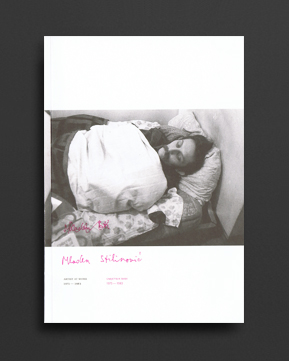
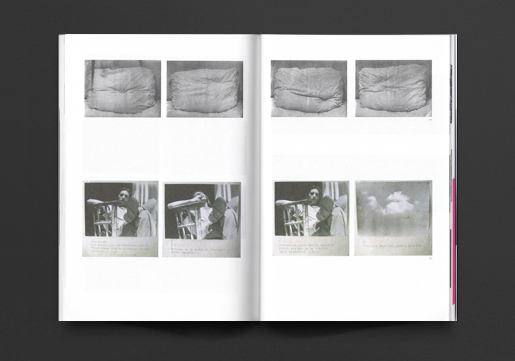
Edited by Branka Stipančić and Alenka Gregorič, Mladen Stilinović - Artist at Work 1973-1983, published in 2005 looks in depth this period of works exhibited in the artists work rooms, including texts about the exhibits, all the works reproduced in colour throughout the bulk of the book (paintings, collages, text works, sculptures, photographs), a worklist, interview and biography.
Mladen Stilinović (April 10, 1947 - July 18, 2016) was one of the leading figures of the so-called "New Art Practice" in Croatia and a founding member of the informal neo-avantgarde, Group of Six Artists (1975-1979), together with Vladimir Martek, Boris Demur, Željko Jerman, Sven Stilinović and Fedomir Vučemilović. He lived and worked in Zagreb, Croatia.
2011, English / Croatian
Softcover, 72 pages, 16.2 x 23.5 cm
$16.00 - Out of stock
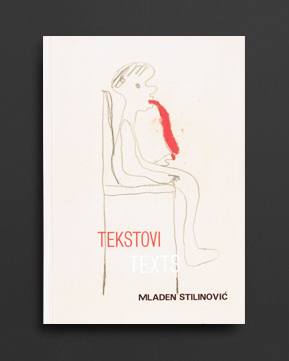
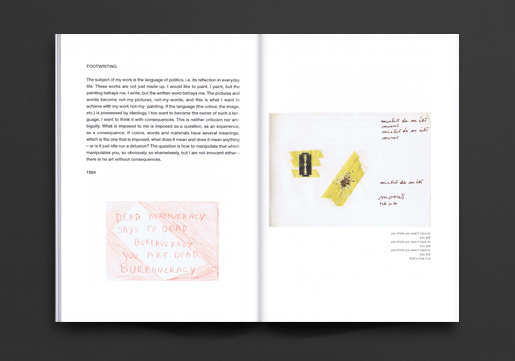
Compiled in 2011 in Zegreb by Croatian conceptual artist Mladen Stilinović, Tekstovi / Texts, this collection contains texts written between 1978-2008, "which explain some of my works and standpoints regarding art, laziness, power, etc." - M.S. Some previously published, some never before, all texts are here in Croatian and also translated to English, alongside reproductions of text works, drawings, etc.
Mladen Stilinović (April 10, 1947 - July 18, 2016) was one of the leading figures of the so-called "New Art Practice" in Croatia and a founding member of the informal neo-avantgarde, Group of Six Artists (1975-1979), together with Vladimir Martek, Boris Demur, Željko Jerman, Sven Stilinović and Fedomir Vučemilović. He lived and worked in Zagreb, Croatia.
2001, English / Croatian
Softcover, 96 pages, 16.5 x 23.5 cm
Published by
Museum of Contemporary Art / Zagreb
$28.00 - Out of stock
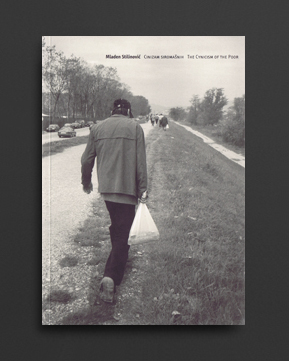
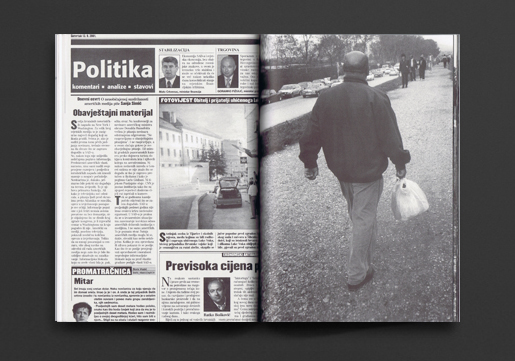
Published to accompany the exhibition Mladen Stilinović "Cinizam siromašnih / The Cynicism of The Poor" at Museum of Contemporary Art, Zagreb, in 2001, this catalogue features texts by Nada Beroš, Tihomir Milovac, Danijel Dragojević, alongside newspaper clippings and photographs from the works Ljudi s vrećicama (Bag-People) (2001), and Pokapanje boli (Buried Pain) (2000), that present pain connected with themes from economy.
Mladen Stilinović (April 10, 1947 - July 18, 2016) was one of the leading figures of the so-called "New Art Practice" in Croatia and a founding member of the informal neo-avantgarde, Group of Six Artists (1975-1979), together with Vladimir Martek, Boris Demur, Željko Jerman, Sven Stilinović and Fedomir Vučemilović. He lived and worked in Zagreb, Croatia.
1984, English
Hardcover (w. dust jacket), 342 pages, 270 x 280 cm
1st Edition, Out of print title / Used*,
Published by
U.M.I. Research Press / Michigan
$150.00 - Out of stock
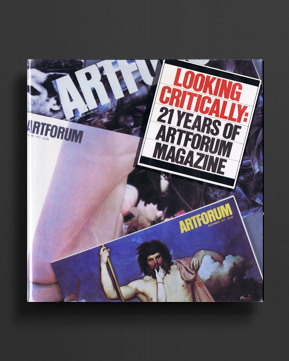
First, hardcover edition of "LOOKING CRITICALLY: 21 YEARS OF ARTFORUM MAGAZINE", the heavy 342 page volume anthology of the first 21 years of the world's most important modern and art journal. An incredibly valuable collection of art theory.
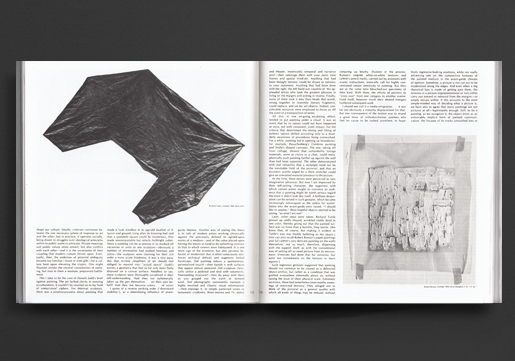
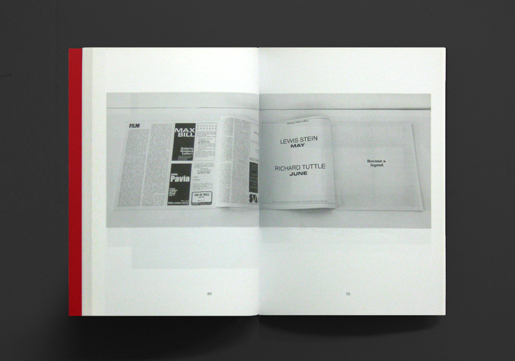
Edited by Amy Baker Sandback, designed by Roger Gorman and Mary Beath and published in 1984 by U.M.I. Research Press, this dense volume, bound in hardcover to the dimensions of a copy of ARTFORUM, begins with an Ed Kienholz review at the Ferus Gallery from ARTFORUM's June 1962 inaugural issue, and ends with Barbara Kruger reviewing the film "TRON" for the November 1982 issue. An amazing compendium of articles and reviews from the magazine's important first 21 years, featuring contributions by the likes of John Cage, Robert Morris, Kate Steinitz, Henry T. Hopkins, Don Factor, Robert Pincus-Witten, Dennis Adrian, John Coplans, Hilton Kramer, Harold Rosenberg, Henry Geldzahler, John Cage, Walter Hopps, Ed Ruscha, Allan Kaprow, Robert Rosenblum, Dan Flavin, Boris Groys, Sam Wagstaff, Billy Kluver, Lucy R. Lippard, Robert Rosenblum, Roger Shattuck, Ad Reinhardt, Mel Bochner, Andy Warhol, Roy Lichtenstein, Claes Oldenburg, Barbara Rose, Manny Farber, Michael Fried, Robert Morris, Philip Leider, Hollis Frampton, Carl Andre, Richard Serra, Lawrence Alloway, Barbara Kruger, Jane Livingston, Lizzie Borden, Kenneth Baker, Laurie Anderson, Agnes Martin, Cindy Nemser, Sidney Tillim, Annette Michelson, Rosalind Krauss, Jeremy Gilbert-Rolfe, Roberta Smith, Peter Plagens, Peter Schjeldahl, J. Hoberman, Hal Foster, Richard Flood, Carter Ratcliff, Stuart Morgan, Max Kozloff, Donald Kuspit, Dan Graham, Walter De Maria, Komar & Melamid, Edit De Ak, Lawrence Weiner, Kathy Acker, Robert Mapplethorpe, Anselm Kiefer, Thomas McEvilley, Louise Bourgeois, Ingrid Sischy, and too many more to list. Artists featured include: Josef Albers, Richard Tuttle, Jo Baer, Carl Andre, Ant Farm, Hans Arp, Max Bill, Mel Bochner, Alighiero Boetti, Lee Bontecou, Constantin Brancusi, Bertholt Brecht, Richard Avedon, Francis Bacon, Diane Arbus, Michaelangelo Antonioni, Lynda Beglis, Larry Bell, Terry Fox, James Byers, Rober Barry, Marcel Breuer, AA Bronson, Luis Buñel, Daniel Buren, Chris Burden, Joseph Beuys, Anthony Caro, Marcel Broodthaers, John Chamberlain, Paul Cézanne, Marc Chagall, Jean Cocteau, Merce Cunningham, Sonia Delauney, Walter de Maria, Bruce Connor, Jean Dubuffet, Max Ernst, Walker Evans, Dan Flavin, Marcel Duchamp, Albrecht Dürer, Lucio Fontana, Hollis Frampton, Alberto Giacometti, Eva Hesse, Gilbert & George, Philip Glass, John Cage, Nancy Graves, Dan Graham, Robert Grosvenor, Nancy Grossman, Walter Gropius, Hans Haacke, Hairy Who, David Hockney, Douglas Huebler, Jorg Immendorff, Donald Judd, Jasper Johns, Joan Jonas, Allan Kaprow, On Kawara, Ellsworth Kelly, Edward Keinholz, Paul Klee, Alison Knowles, Joseph Kosuth, Brice Marden, Agnes Martin, André Masson, Henri Matisse, Roberto Matta, Sol Lewitt, Roy Lichtenstein, Barbara Kruger, Jannis Kounellis, Markus Lüpertz, El Lissitzky, Rene Magritte, Robert Mapplethorpe, John McCracken, Mario Merz, Robert Morris, Robert Motherwell, Ree Morton, Louise Nevelson, Barnett Newman, Kenneth Noland, Claes Oldenburg, Eduardo Paolozzio, A. R. Penck, Irving Penn, Francis Picabia, Pablo Picasso, Larry Poons, Ken Price, Yvonne Rainer, Robert Rauschenberg, Martial Raysse, Roman Polanski, Jackson Pollock, Steve Reich, Gerrit Rietveld, Alain Robbe-Grillet, Dorothae Rockburne, James Rosenquist, Mark Rothko, Robert Ryman, Lucas Samaras, Kurt Schwitters, Oscar Schlemmer, Richard Serra, Cindy Sherman, David Smith, Robert Smithson, Michael Snow, Robert Venturi, Wolf Vostell, Andy Warhol, Frank Stella, Saul Steinberg, Karlheinz Stockhausen, Bruno Taut, Jean Tinguely, Anne Truitt, Paul Wunderlich, Lawrence Weiner, Louise Bourgeois, Alfred Hitchcock, and so many more.
Very uncommon hardcover edition, with dust jacket.
2012, English
Softcover, 304 pages, 15 x 23 cm
Published by
Valiz / Amsterdam
$50.00 - Out of stock
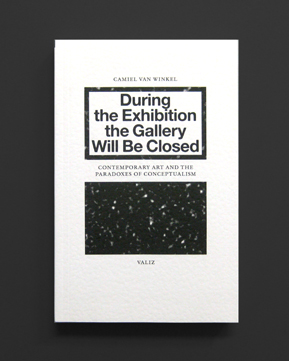
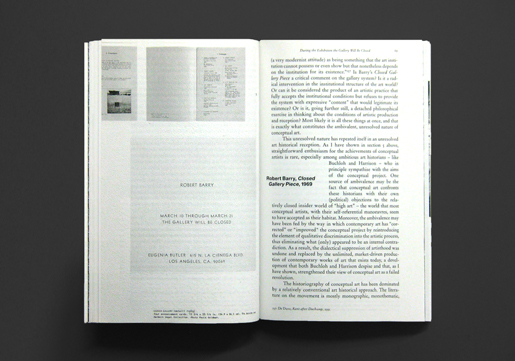
In this compilation of essays Camiel van Winkel uncovers the conceptual roots of contemporary art. He shows that the art of today as a whole is essentially ‘post-conceptual’. The production and reception of art are determined by circumstances and factors that conceptual artists in the years 1965-75 were the first to announce: the cultural dominance of information, the professionalisation of artistic practices, and the applicability of the criteria of ‘good design’.This post-conceptual perspective offers a new and revealing insight into the systematics of contemporary art and artisthood, in particular with regard to the relation between conceptual and visual aspects, the meaning of theoretical discourse, and the role of institutions and mediators.
Camiel van Winkel writes on contemporary art and occasionally curates exhibitions. Based in Amsterdam, he teaches art theory and art philosophy at Sint-Lukas University College of Art and Design in Brussels. He is advisor at the Rijksakademie, Amsterdam. He is the author of Moderne leegte. Over kunst en openbaarheid (1999), The Regime of Visibility (2005) and De mythe van het kunstenaarschap (2007). His latest book, based on his PhD dissertation, is titled During the Exhibition the Gallery Will Be Closed. Contemporary Art and the Paradoxes of Conceptualism (Valiz, 2012).Graphic Design: Sam de Groot
2013, English
Hardcover, 456 pages, 30.5 x 22.5 cm
Ed. of 500,
Published by
Motto / Berlin
Wroclaw Contemporary Museum / Poland
$48.00 - Out of stock
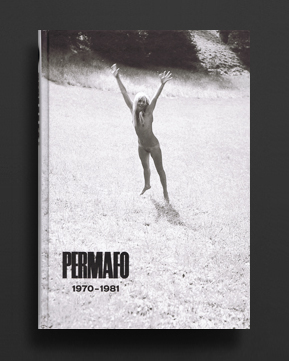
First published in Polish in 2012 on the occasion of the exhibition Where is PERMAFO? at Wroclaw Contemporary Museum (30 November 2012- 4 February 2013). Shortly after this 2013 English edition was published in an edition of only 500 copies.
Young, vivid and unpretentious art of Wrocław of the 70s has resisted both musealization and academic discourses of art history. The artists of PERMAFO – as other Wrocław galleries of the 70s – didn’t think about making history, but about changing their lives and enjoying life. The PERMAFO gallery was founded after the famous symposium Wrocław ’70 considered to be a founding demonstration of conceptual art. After years a famous Poznań based critic has meanly said, that it is the inertia of Wrocław infrastructure what become a quantum leap of popularising conceptualism. Because almost none of the symposium projects has been realized.
That’s why the history of modern art in Wrocław is yet to be written.
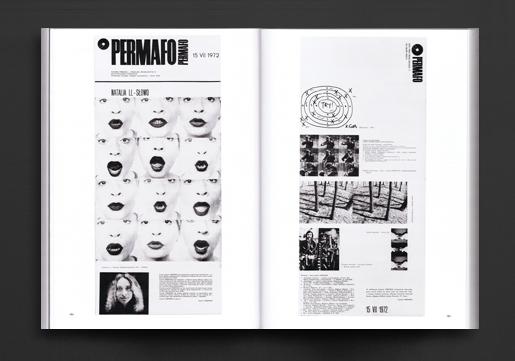
An exhibition Where is PERMAFO? is the Wrocław Contemporary Museum’s attempt to tell the founders’ myth of the young, open city, through the figures of two artists Natalia LL and Andrzej Lachowicz. A beautiful and deeply in love couple makes a space and atmosphere and creates art anew – a surprising, even impossible combination of conceptual art with pop-art. In the splice of art and joie de vivre, tiny revelations appear that change the confines imposed by The People’s Republic of Poland into absurd usurpation. Soon, people appear in PERMAFO, without divisions into artists, scientists, dilettantes and devotees, discussions till dawn and certainty that all “begun in Wrocław” – modernity, art and life in a fresh context and mutual relation. The PERMAFO artists chose democratic means like photo cameras. One of the main ideas of PERMAFO – permanent registration – was completely transparent towards life. It’s life attitude that was becoming a form. Participation in art, with the preference of participating, not the work itself, caused the work become a trace of real experience and that (an not the aesthetic form) protected against ideology.
This generous monograph serves as the first and only major book to document PERMAFO.
1980, English
Softcover, 128 pages, 28 x 21.5 cm
Out of print title / used*,
Published by
Cornell Paperbacks / London
Phaidon / London
$38.00 $15.00 - Out of stock
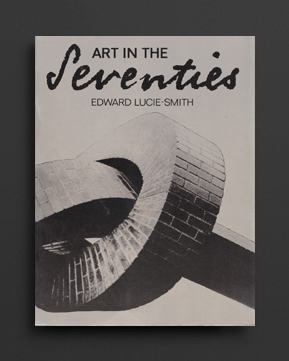
"Edward Lucie-Smith, a critic and historian of art who is deeply immersed in the works and trends of the seventies here provides the first general survey of the decade. In a volume alive with visual images that are often surprising and sometimes disturbing, he analyzes the development both of old forms and of new ones, and provides a coherent framework for the general reader."
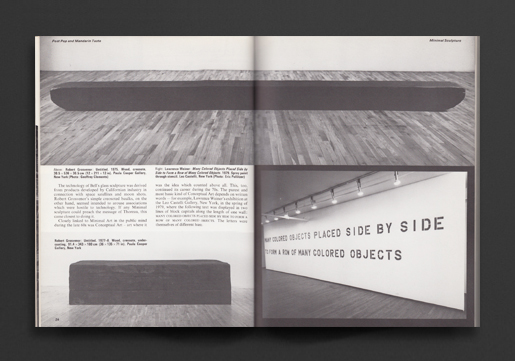
Contents: The Popular Arts; Post Pop and Mandarin Taste; Abstract Painting; Illusionary Art; Figurative Painting; Fetish Art and Happenings; Political Art; Art as Environment and Architecture; High-Tech and the Third World, plus a biographical list of the artists featured and a "further reading" list.
Includes the work of: Stephen Willats, Lawrence Weiner, Brice Marden, Robert Mapplethorpe, Vito Acconci, Jo Baer, Joseph Beuys, Lynda Benglis, Bob Law, Philip King, Alan Kessler, On Kawara, Douglas Huebler, John Kacere, Richard Long, Robert Mangold, Philip Guston, Hans Haacke, Nancy Grossman, Robert Grosvenor, Nancy Graves, Walter de Maria, U-Fan, Claude Viallet, Nancy Spero, Peter Saul, Robert Ryman, James Rosenquist, Joel Shapiro, Sylvia Sleigh, Robert Stackhouse, Paul Thek, Giulio Paolini, Nam June Paik, Bruce Nauman, Roman Opalka, Dennis Oppenheim, Tony Cragg, Judy Chicago, Larry Bell, Daniel Buren, Chuck Close, and many more.
2016, English
Softcover, 104 pages, 15 x 21.6 cm
Published by
Afterall / London
The MIT Press / Massachusetts
$34.00 - Out of stock
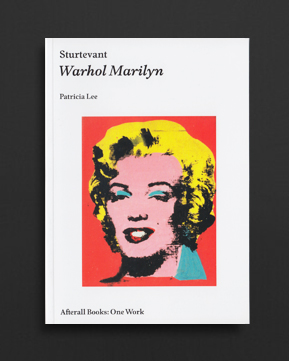
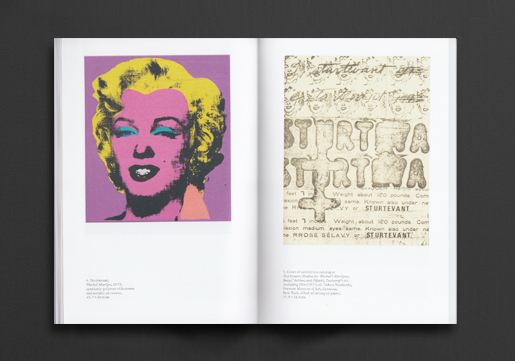
Warhol Marilyn (1965) is not a work by Andy Warhol but by the artist Elaine Sturtevant (1930--2014). Throughout her career, Sturtevant (as she preferred to be called) remade and exhibited works by other contemporary artists, among them Jasper Johns, Roy Lichtenstein, and Robert Rauschenberg. For Warhol Marilyn, Sturtevant used one of Warhol's own silkscreens from his series of Marilyn printed multiples. (When asked how he made his silkscreened work, Warhol famously answered, "I don't know. Ask Elaine.")
In this book, Patricia Lee examines Warhol Marilyn as representing a shift in thinking about artistic authorship and originality, highlighting a decisive moment in the rethinking of the contemporary artwork. Lee describes the cognitive dissonance a viewer might feel on learning the identity of Warhol Marilyn's author, and explains that mistaken identity is part of Sturtevant's intention for the operation of the work. She discusses the ways that Sturtevant's methodology went against the grain of a certain interpretation of modernism, and addresses the cultural significance of both Warhol and Monroe as celebrity figures. She considers Dorothy Podber's shooting a bullet through a stack of Warhol's Marilyns (thereafter known as The Shot Marilyns) at the Factory in 1964 and its possible influence on Sturtevant's decision to remake the work. Lee writes that Sturtevant's critical reception has been informed by some fictional forebears: the made-up artist Hank Herron (whose nonexistent work duplicating paintings by Frank Stella was reviewed by a fictional critic), and (suggested by Sturtevant herself) Pierre Menard, the title character of Jorge Luis Borges's "Pierre Menard, Author of the Quixote," who recreates a section of Cervantes's masterpiece line by line. And finally, she explores installation contexts and display strategies for Sturtevant's work as illuminating her broader artistic aims and principles.
2005, English / German
Softcover, 376 pages, 21 x 27 cm
1st Edition, Out of print title / Used*,
Published by
Hatje Cantz / Berlin
$180.00 - Out of stock
Volume one of the two-part major publication on the artist Sturtevant, both long out of print.
Sturtevant's investigations into the duality of original and copy, object and image, similarity and difference are contributions of outstanding importance to contemporary art.
Elaine Sturtevant (1930--2014), has been concerned since the mid-1960s with one of the most important themes in Western art - the aspect of originality. Her works are reproductions of existing works by such artists as Marcel Duchamp, Roy Lichtenstein, Andy Warhol, Jasper Johns, and Frank Stella, to name only a few. Often indistinguishable from the originals, they call attention to the crucial issues of origin and difference. Designed and produced in close collaboration with the artist, this opulently illustrated publication (produced and published consecutively with another catalogue rainsonné volume) offers an unprecedented overview of the unique and unparalleled work of this American artist. This special book functions somewhat like an artist's scrapbook, reproducing rarely seen photographs of Sturtevant in her studio producing the above-mentioned works, alongside promotional imagery, exhibitions views, and sketches, drawings, plans, notes, and photos from her work production throughout her entire career. An incredible insight into her working. Edited by Udo Kittelmann, Mario Kramer and Lena Maculan, this particular book also features a great interview between Sturtevant and the great artist/film director John Waters!
Published on the largest exhibition of the artists work at the Museum für Moderne Kunst, Frankfurt/Main, September 25, 2004-January 30, 2005
2012, English
Softcover, 304 pages (140 b&w ill.), 215 x 156mm
Published by
Afterall / London
Van Abbemuseum / Eindhoven
Walther König / Köln
$28.00 - Out of stock
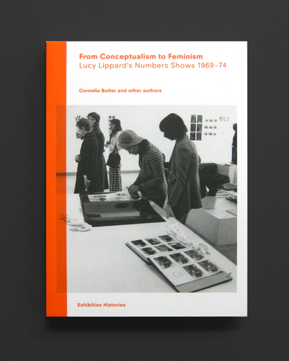
Four exhibitions of contemporary art curated by Lucy Lippard have become renowned as her 'numbers shows'. Each took the population of the city in which it was shown as its title: 557,087 in Seattle, 955,000 in Vancouver, 2,972,453 in Buenos Aires and c.7,500 opening in Valencia, California, before touring the US and to London.
This book follows Lippard's curatorial trajectory, analysing her transition from a writer about art to a maker of exhibitions, and tracing her growing political engagement and involvement with feminism.
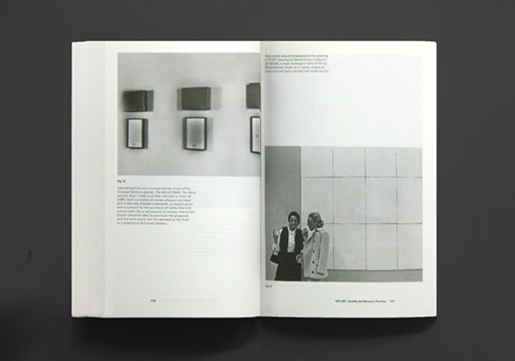
Extensive photographic material is complemented by a major new essay by Cornelia Butler and interviews with Seth Siegelaub and artists Agnes Denes, Alice Aycock, Eleanor Antin and Mierle Laderman Ukeles.
The volume also includes critical responses written at the time by Peter Plagens and Griselda Pollock, and an analysis of artists initiatives in Argentina that give a context for Lippard's emerging political consciousness by Pip Day.
This is the third publication in the Exhibitions Histories series, co-published with Afterall Books, London.
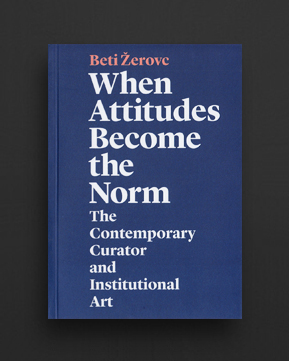
2015, English
Softcover, 280 pages 14.8 x 21 cm
Published by
Archive Books / Berlin
$46.00 - Out of stock
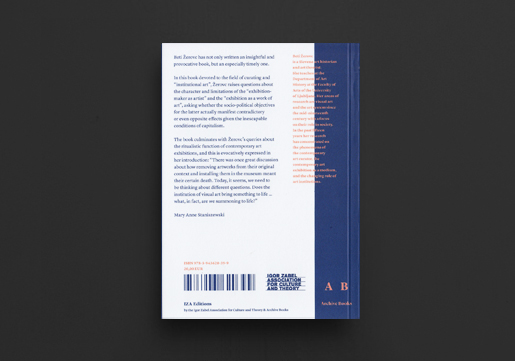
In this book devoted to the field of curating and “institutional art”, Žerovc raises questions about the character and limitations of the “exhibition-maker as artist” and the “exhibition as a work of art”, asking whether the socio-political objectives for the latter actually manifest contradictory or even opposite effects given the inescapable conditions of capitalism. The book culminates with Žerovc’s queries about the ritualistic function of contemporary art exhibitions, and this is evocatively expressed in her introduction: “There was once great discussion about how removing artworks from their original context and installing them in the museum meant their certain death. Today, it seems, we need to be thinking about different questions. Does the institution of visual art bring something to life … what, in fact, are we summoning to life?” (Mary Anne Staniszewski)
Pierre Restany, Zoran Kržišnik, Harald Szeemann, Daniel Buren, Charles Esche, Beautiful Freedom, Walter Benjamin, Mary Anne Staniszewski
2016, English
Softcover (w. printed plastic jacket), 124 pages, 10.5 x 16 cm
Published by
Mousse Publishing / Milan
$50.00 $10.00 - Out of stock
Stefano Cernuschi and Abaseh Mirvali, eds.
Texts by Simon Starling and Maja McLaughlin
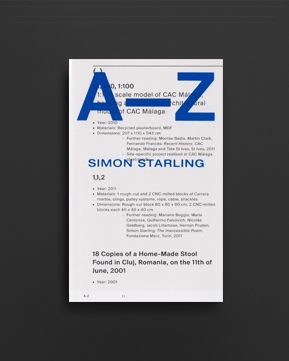
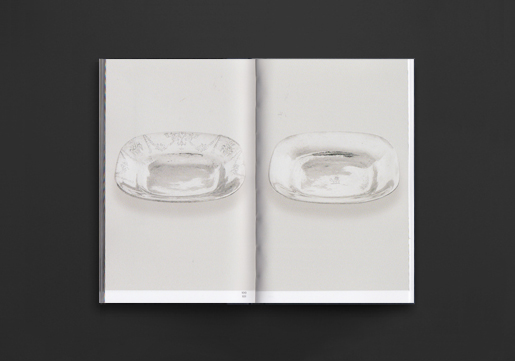
Simon Starling: A–Z is a pocket, non illustrated mid-career catalogue raisonné of a practice now spanning over two decades. Every work ever realized by Starling (Epsom, UK, 1967) is listed in alphabetical order and referenced in this compact guide, which also provides a bibliography and connections to other related projects. Halfway through the text flow, three photo inserts and texts by the artist and Maja McLaughlin document the exhibition projects El Eco and Bowl, Plates realized in Mexico City, at the Museo Experimental El Eco and the Luis Barragán House and Studio, in 2015.
2015, English
Softcover, 264 pages, 15.2 x 23 cm
Published by
October Books / New York
The MIT Press / Massachusetts
$42.00 - Out of stock
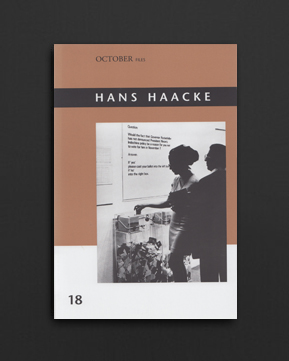
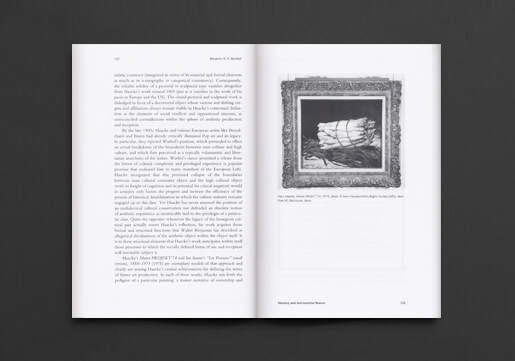
For five decades, the artist Hans Haacke (b. 1936) has created works that explore the social, political, and economic underpinnings of the production of art. His works make plain the hidden and not-so-hidden agendas of those -- from Cartier to David Koch -- who support art in the service of industry; they expose such inconvenient social and economic truths as the real estate holdings of Manhattan slumlords, and the attempts to whitewash support for the Nazi regime, apartheid, or the war on terror through museum donations. This book gathers interviews, difficult-to-find essays, cornerstones of institutional critique, and new critical approaches by writers that include Benjamin H. D. Buchloh, Jack Burnham, Rosalyn Deutsche, and Leo Steinberg. Haacke's 1971 Guggenheim exhibition was famously canceled when the artist refused to withdraw several proposed works, including one exposing the business dealings of a Manhattan real estate company. This volume includes Edward Fry's catalog text for that show, as well as Walter Grasskamp's "An Unpublished Text for an Unpainted Picture," redacted from an exhibition catalog in 1984 because of statements about the German collector Peter Ludwig. Other essays consider such topics as Haacke's controversial commission for the Reichstag; the activation of the spectator, from Condensation Cube to the Polls; the conceptual continuity of his practice with regard to General Systems Theory; and his delayed and problematic reception in both the United States and Europe. With contemporary essays and scholarly reassessments, this collection serves as an essential guide to critical thinking on Haacke's artistic practice, from the works of the 1960s that engage with physical and biological systems to his later interrogations of the social and economic underpinnings of art.
Contributors: Yve-Alain Bois, Benjamin H. D. Buchloh, Jack Burnham, Douglas Crimp, Rosalyn Deutsche, Sam Durant, Edward F. Fry, Walter Grasskamp, Rosalind Krauss, Jack McGrath, Luke Skrebowski, Leo Steinberg
2015, English
Softcover, 208 pages, 22.5 x 15 cm
Published by
Koenig Books / London
Raven Row / London
$49.00 - Out of stock
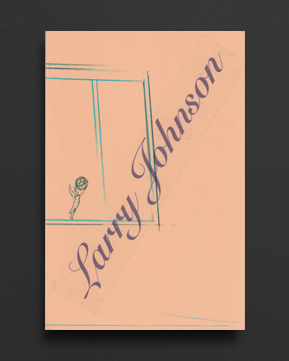
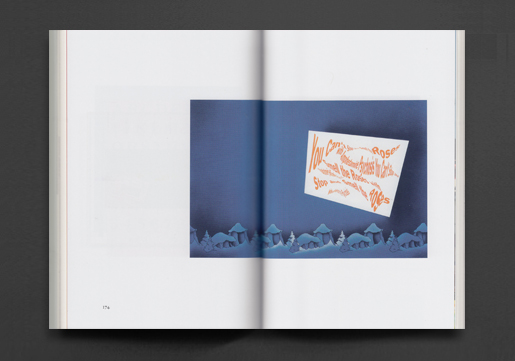
As part of a generation of artists that emerged in the US in the early 1980s, Johnson is the 'artist's artist' par excellence, highly respected by fellow practitioners and students but little known outside of these circles. Edited by Bruce Hainley, this volume addresses the glaring bibliographic gap by offering an accessible overview of Johnson's work through analyses of some of his main preoccupations: queer politics and the urban landscape of LA and Hollywood mythologies. Featuring newly commissioned essays by Morgan Fisher, Bruce Hainley, Antony Hudek, Wayne Koestenbaum and Lisa Lapinski alongside other writings, this volume spans the artist's career from the early 80s to the present, heavily illustrated with text-based imagery and later cartoon-esque pieces. The glossy surfaces of Johnson's works are often combined with penetrating references to celebrity or gay culture, their look echoing the worlds of advertising and graphic design while evoking a variety of artistic traditions.
Published on the occasion of the exhibition Larry Johnson: On Location at Raven Row, London, 11 June – 9 August.
2000, Japanese
Softcover, 200 pages, 29.8 x 23.5 cm
1st edition, Out of print title / Used*,
Published by
Museum of Contemporary Art / Tokyo
$90.00 - Out of stock
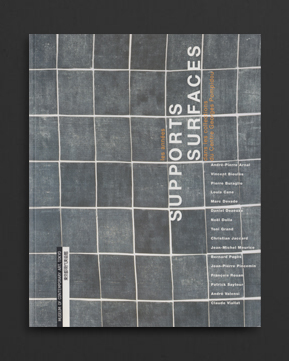
Supports/Surfaces developed away from Paris, in the south of France, with the first major exhibition held in 1969 at the Musée d'Art Moderne de la Ville de Paris. In June 1969, during an exhibition at the Havre Museum entitled "La peinture en question", Vincent Bioulès, Louis Cane, Marc Devade, Daniel Dezeuze, Noël Dolla, Jean-Pierre Pincemin, Patrick Saytour, André Valensi, Bernard Pagès and Claude Viallat write in the catalog: "The subject of the painting is the painting itself and paintings on display refer only to themselves. They make no appeal to an "elsewhere" (the personality of the artist, his biography, history of art, for example). Early exhibtions took place in towns like Coaraze, Montpellier, Nimes and Nice in the mid-1960s. After the student revolts of 1968, the movement ratcheted up its activities, exploding in such exhibitions as "Supports/Surfaces," which took place at ARC in Paris in September 1970. These shows occurred at or around the same time as those of other French artist groups like GRAV and BMPT (Daniel Buren, Olivier Mosset, Michel Parmentier and Niele Toroni). Like them, Supports/Surfaces questioned the role of painting as both an art object and a social one.
As its name suggests, Supports/Surfaces was interested in articulating what its artists felt were all too readily ignored aspects of painting: basic concepts like 'support' and 'surface,' for example, and the presence of painting as a product of individual labor. At the same time, these artists were very much interested in painting and its own peculiar history. Daniel Dezeuze points out that he was looking for a means of “revolting against the art world and the world in general without having to make anti-art.” (Raphael Rubinstein, Polychrome Profusion: Selected Art Criticism: 1990 – 2002.) In fact, those involved with Supports/Surfaces, as Rubinstein also notes, were some of the few French artists of the period to engage directly with American Painting from Abstract Expressionism to Color Field, albeit doing so within the context of their Maoist discourse.
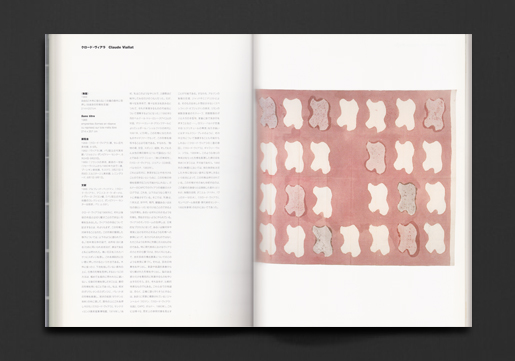
This scarce, Museum of Contemporary Art Tokyo catalogue gives a generous overview of the many works of the artists of Supports/Surfaces, through colour and black and white photographs across 200 pages. It also provides texts (in Japanese), interviews, historical photos of the group and their installations, work list, a chronology and a biography. This catalogue was produced to accompany a major travelling exhibition of Supports/Surfaces in Tokyo in 2000, which presented the vast collection of work from the Centre Georges Pompidou, Paris. The exhibition was also staged in Paris in 1998, for which a French edition of this book exists.
*Condition: Very Good/Fine – All care is taken to provide accurate condition details of used books, photos available on request.
2015, English / Spanish
Softcover w. dustjacket, 144 pages (colour & b/w ill.), 16 x 23 cm
Published by
Mousse Publishing / Milan
$23.00 - Out of stock
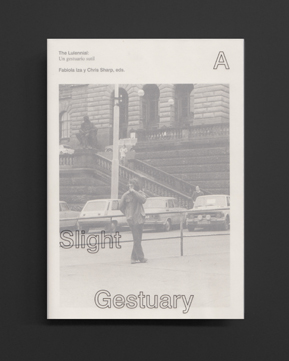
Fabiola Iza, Chris Sharp, eds.
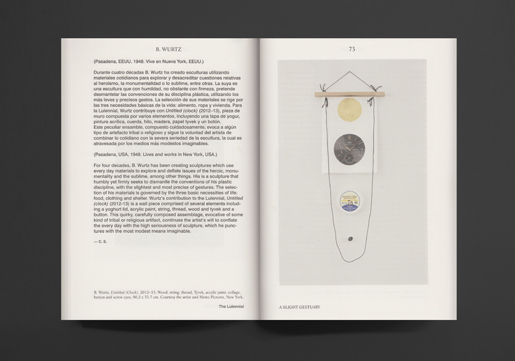
Economy, “in the sense of doing a lot with a little or sometimes nothing at all,” is one of the founding principles of the Lulennial, a biennial organized by Fabiola Iza and Chris Sharp at Lulu, a 9-square meter independent space in Mexico City. The diminutive space is not necessarily a constraint if the works exhibited (and featured in this accompanying publication) are the startling outcome of slight gestures, like those created by Jirí Kovanda, Roman Ondák, Kirsten Pieroth, Wilfredo Prieto, and Martín Soto Climent, just to name some of the more than 25 participants in the exhibition. Other instigators of this peculiar attitude, the purpose of which is to achieve the maximum effect through the smallest of means, range from Billy Apple to Graciela Carnevale to Mierle Laderman Ukeles and La Monte Young, among others.
2014, English
Softcover, 372 pages (colour & b/w ill.), 27 x 21 cm
Published by
Walther König / Köln
$100.00 - Out of stock
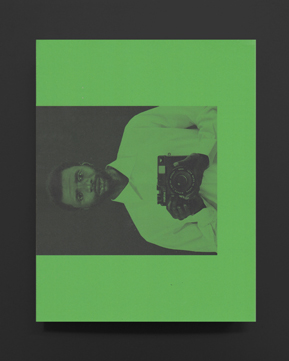
In the 1970s, Christopher Williams emerged as a key figure in the first wave of American West Coast conceptual artists, which included John Baldessari and Douglas Huebler.
Williams' work is a critical investigation of the medium of photography and more broadly the vicissitudes of industrial culture, in particular its structures of representation and classification. Using the process of reproduction as a point of entry, he manipulates the conventions of advertising, the superficiality of surface, and ultimately the history of Modernism.
This unique artist’s book is available in three editions, each with different ISBNs and different colour covers: red, yellow and green. It reproduces a carefully curated selection of the artist’s painstakingly constructed photographs and features striking graphic design in the near-complete absence of language, with no essay, captions, or even a title page. With the exception of differing cover photographs, the content of each edition is identical.
Published to coincide with Williams’ first major survey exhibition, The Production Line of Happiness at The Art Institute of Chicago, and then at The Museum of Modern Art, New York – both in 2014. The exhibition travels to Whitechapel Gallery, London in 2015.
GREEN edition.
Due to the weight of this volume, your order will likely incur additional postage costs. We will contact you with the best shipping advice upon your order, or alternatively, please email us in advance. Thank you for understanding.
2014, English / Italian
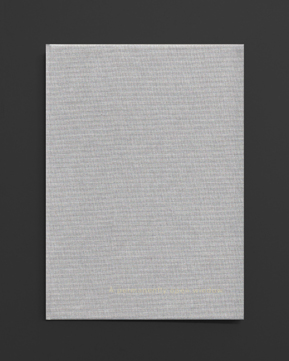
Hardcover (cloth bound), 96 pages, 16 x 23 cm
Published by
Mousse Publishing / Milan
$35.00 - Out of stock
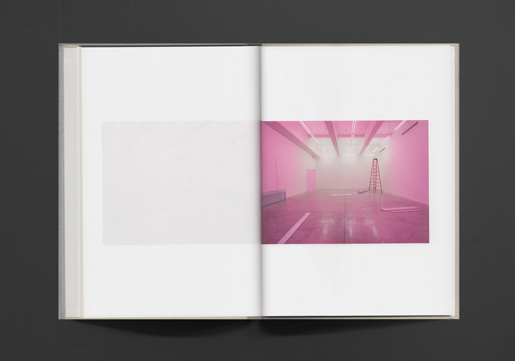
Jason Dodge's practice attempts to give new life to objects, exploring their potential and provoking the viewer's cognitive ability to imagine a corresponding narrative. Focusing on specific aspects of two works, A permanently open window and Changing the lights – From rose light to white light, from white light to rose light, by hand, over and over, Jason Dodge's artist book is not merely a documentation of his works but, in the artist's words, “a record of light changing over a day, in one case naturally and in one case manually”.
The publication was conceived and designed to accompany Jason Dodge's permanent installation realized for the Maramotti Collection, in Reggio Emilia – a permanently open window located in what was once the tower of a factory's electrical power plant, an abandoned industrial space, now transformed into a commercial outlet – and contains selected images from both projects, as well as a text.
2009, English
Softcover, 116 pages, 21.5 x 17 cm
Published by
IMA / Brisbane
Whale & Star Press / Florida
$15.00 - Out of stock
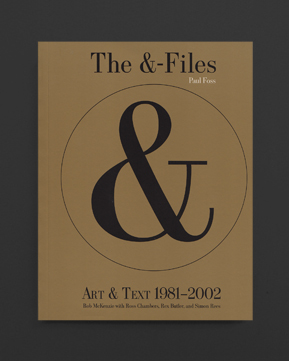
Modeled after the famed TV sci-fi series The X-Files, The &-Files gathers together a covert body of documents following the long and often controversial career of Art & Text, one of the landmark contemporary art magazines of the 1980s and 1990s. Founded in Melbourne, Australia, in 1981 by Paul Taylor (1957–92), who soon moved to New York City to make his mark as an art critic, the magazine went on to become one of a handful of international art magazines that succeeded in capturing the turmoil and passing brilliance of that period of postmodernism.
Perceived through the eyes and ears of its longtime publisher and editor Paul Foss, The &-Files is comprised of an open letter, a lengthy interview, two questionnaires, and other commentaries and bibliographies, offering a unique insider account of the extraordinary advantages and pitfalls of publishing an art magazine.
Paul Foss is the publishing editor of the art magazines Art & Text (Melbourne, Sydney, Los Angeles, 1981–2002) and artUS (Los Angeles, 2003-ongoing). He is a renowned translator, anthologist, and author, whose publications include Island in the Stream: Myths of Place in Australian Culture.
Robert McKenzie is an Australian artist currently based in New York.
Rex Butler teaches art history at the University of Queensland, Brisbane. His published work includes Jean Baudrillard: The Defense of the Real.
Ross Chambers is Distinguished University Professor Emeritus of French and Comparative Literature at the University of Michigan. His many books include Facing It: AIDS Diaries and the Death of the Author.
Simon Rees is a former curator at the Govett-Brewster Art Gallery, New Plymouth, New Zealand, and is currently curator at the Contemporary Art Center in Vilnius, Lithuania.
2013, English
460 individual cards in wrapper, 15.25 × 10.15 cm
Published by
New Documents / New York
$38.00 - Out of stock
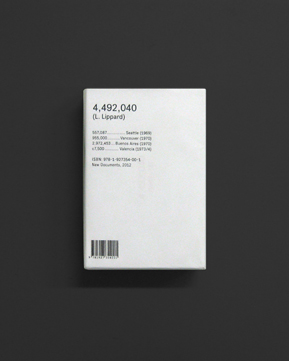
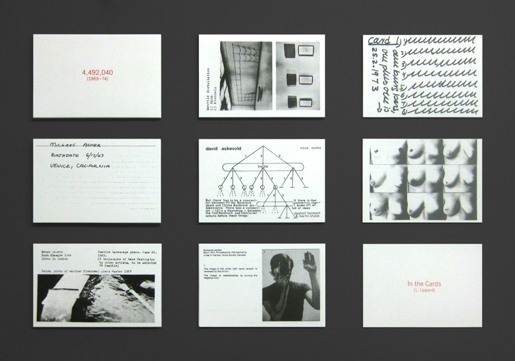
Between 1969 and 1974, the influential curator Lucy Lippard (born 1937) curated four decisive Conceptual art exhibitions, and in doing so reinvented the exhibition catalogue. 4,492,040 is a facsimile reprint of the extremely scarce and hugely important catalogues produced for these hugely important “numbers shows” - 557,087 (the Seattle Art Museum), 955,000 (the Vancouver Art Gallery), 7,500 (the California Institute of Art) and 2,972,453 (the Centro de Arte y Comunicación). Titled after the populations of the cities in which the shows were held, each catalogue was an envelope of loose note cards containing statements, documentation and conceptual works by each artist, to be rearranged, filed or discarded at will. If Lippard described Conceptual art as the dematerialization of the art object, these catalogues effectively announced the dematerialization of the art exhibition. (One reviewer claimed Lippard had been the artist, and that her medium had been other artists.) 4,492,040 includes such iconic figures as Vito Acconci, Carl Andre, Siah Armajani, Terry Atkinson, John Baldessari, Michael Baldwin, Robert Barry, Rick Barthelme, Daniel Buren, Rosemarie Castoro, Hanne Darboven, Walter de Maria, Jan Dibbets, Christos Dikeakos, Eleanor Antin, Dan Graham, Hans Haacke, Eva Hesse, Douglas Huebler, On Kawara, Edward Kienholz Sol LeWitt, Roelof Louw, Duane Lundon, Bruce McLean, Robert Morris, N.E. Thing Co., Bruce Nauman, Adrian Piper, Allen Ruppersberg, Ed Ruscha, Richard Serra, Robert Smithson, Jeff Wall and Lawrence Weiner.
2013, English
Softcover, 128 pages, 17 x 21 cm
Published by
MUMA / Victoria
$20.00 - Out of stock
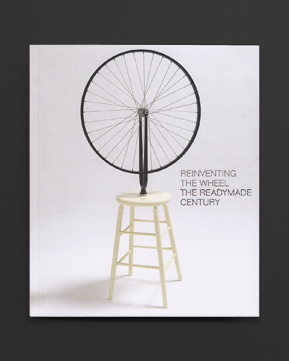
Publication to accompany the exhibition "Reinventing The Wheel: The Readymade Century", 3 October – 14 December 2013, Monash University Museum of Art, Victoria, Australia.
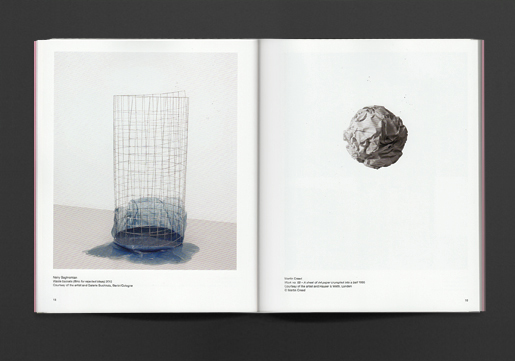
Arguably the most influential development in art of the twentieth century, the use of the readymade was set in motion 100 years ago with Marcel Duchamp’s Bicycle Wheel. Giving birth to an entire artistic language, Duchamp’s conversion of an unadorned, everyday object into a figure of high art completely inverted how people considered artistic practice. Suddenly, art was capable of being everywhere and in everything. It was a revolutionary moment in modern art, and the ripples from this epochal shift still resonate today.
Reinventing the Wheel: the Readymade Century pays tribute to this seminal work and traces the subsequent elaboration of neo-dada practices, with a particular focus upon everyday and vernacular contexts; the mysterious and libidinous potential of sculptural objects; institutional critique and nominal modes of artistic value; pop, minimalism and industrial manufacture. These discursive contexts will also provide a foundation to explore more recent tendencies related to unmonumental and social sculpture, post-fordism and other concerns, particularly among contemporary Australian artists.
Bringing together works by over 50 artists – from Duchamp and Man Ray to Andy Warhol and Martin Creed, along with some of Australia’s leading practitioners – this is a one-of-a-kind salute to an idea that continues to define the very nature of contemporary art.
Artists:
Carl Andre, Hany Armanious, Nairy Baghramian, Ian Burn, John Cage, Christo & Jeanne-Claude, Tony Cragg, Michael Craig-Martin, Martin Creed, Aleks Danko, Julian Dashper, Simon Denny, Marcel Duchamp, Sylvie Fleury, Ceal Floyer, Claire Fontaine, Gilbert & George, Félix González-Torres, Agatha Gothe-Snape, Greatest Hits, Matthew Griffin, Richard Hamilton, David Hammons, Matt Hinkley, Lou Hubbard, Barry Humphries, Jeff Koons, Joseph Kosuth, Louise Lawler, Klara Lidén, Andrew Liversidge, James Lynch, Robert MacPherson, Rob McKenzie, Callum Morton, John Nixon, Meret Oppenheim, Joshua Petherick, Kain Picken, Rosslynd Piggott, Man Ray, Scott Redford, Stuart Ringholt, Peter Saville, Charlie Sofo, Haim Steinbach, Ricky Swallow, Masato Takasaka, Peter Tyndall, Alex Vivian, Danh Vo, Andy Warhol, and Heimo Zobernig.
Curatorial team:
Max Delany (former MUMA director), Charlotte Day, Francis E. Parker, and Patrice Sharkey.With texts by Rex Butler, Charlotte Day, Francis Parker, Patrice Sharkey, and a never before published text by Thierry de Duve.
2010, English
Softcover, 132 pp. (b&w ill.), 21.7 x 16.5 cm.
Published by
Overduin and Kite / Los Angeles
$20.00 - Out of stock
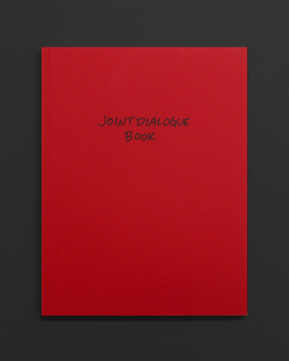
Catalogue produced on the occasion of "Joint Dialogue - Lozano/Graham/Kaltenbach" curated by Sarah Lehrer-Graiwer at Overduin and Kite, Los Angeles, January 31st-March 13th, 2010.
“Joint Dialogue” investigates the intersecting material histories of Lozano, Graham and Kaltenbach at the end of the 1960s in New York. It’s about close personal relationships between artists and the way ideas are traded down forking paths of influence to become variously manifest, suppressed, and rerouted in art. It’s about three related but divergent models of how being an artist dictates an extreme experience of consciousness, one in which the self is constantly lost and refound, or, as Lozano put it, a total revolution simultaneously personal and public. It’s about a transformative time in these artists’ overlapping practices that is reflective of the explosive historical period of rapid experimentation in conceptual art. It’s about real stakes- and the profundity of humor. It’s about trying to process the still astounding after-effects of Lozano’s absent body through the presence of Graham’s and Kaltenbach’s.
Motivated by Lozano’s Dialogue Piece (1969), in which stoned socializing and conversations about ideas were prioritized over art making, the structure of “Joint Dialogue” is split into two dialogues linked by Lozano, the joint. In one room, the juxtaposition of eight related and contemporaneous works establishes a conversation about drugs, sex, and money between Graham and Lozano, who were intimate friends during the time these works were made. A dialogue between Lozano and Kaltenbach, another close friend, takes place in a second room where several related works from the late 60s are joined by two never before seen time capsules by Kaltenbach and two previously unknown pieces by Lozano, remembered here by Kaltenbach.
“Joint Dialogue” is an ongoing project of personal investigation and investment for the curator who privately documents the many discoveries made throughout. The project continues to feed back great quantities of info.
Lee Lozano, Dan Graham and Stephen Kaltenbach lived and worked near each other in New York City during the late 1960s. Kaltenbach left for California in 1970. Lozano dropped out of the scene around 1972. Graham continues to live and work in New York.
Sarah Lehrer-Graiwer is a writer and curator who lives and works in Los Angeles. She is the publisher of the journal Pep-Talk.
Catalogue features texts by Sarah Lehrer-Graiwer, Dan Graham, and Stephen Kaltenbach.
2011, French
Softcover, 160 pages, 15 x 21 cm
Published by
Les Presses Du Reel / Paris
$30.00 - In stock -
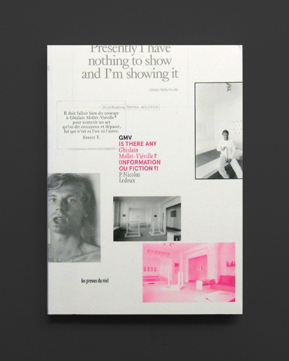
A unique project, between the artist's book and the book on art history, juxtaposing, through a succession of personal documents, the history of different art movements (minimal, conceptual, relational...) and Ghislain Mollet-Viéville's own history.
Features the work of André Cadere, Carl Andre, Daniel Buren, Donald Judd, Joseph Kosuth, Lawrence Weiner, On Kawara, Robert Barry, Sol Lewitt, Olivier Mosset, and many more.
2013, English
Softcover, 172 pages (colour and b&w ill. throughout), 297 x 210mm
Published by
Walther König / Köln
$43.00 - Out of stock
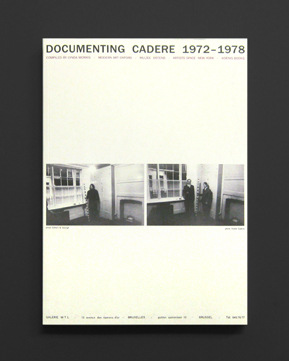
Compiled and edited by curator and art historian Lynda Morris, this title offers an original and highly personal perspective on Cadere’s place in the Conceptual Art world of the 1970s, and the continuing relevance of his ideas around ‘space and politics’.
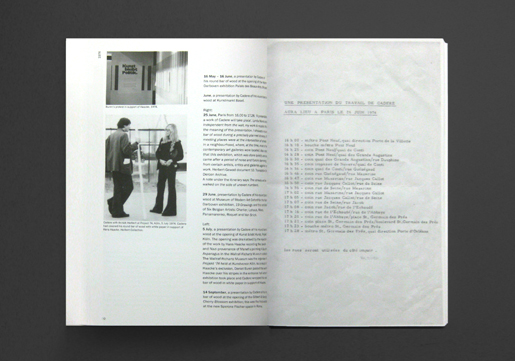
At the centre of the publication is Morris’ chronology of Cadere’s exhibitions, appearances, walks and lectures during the last six years of his life.
This major piece of research shifts the focus away from the ‘round bars of wood’ as objects, and instead focuses on the meaning contained in the printed documents (gallery invitations, notices of lectures, debates and mailings) that record Cadere’s actions, movements and social relationships.
These archival documents come predominantly from two sources – the archive of Lynda Morris and the Herbert Collection, Ghent.
The publication contains new translations of lectures given by Cadere (Leuven, 1974), as well as reproducing an interview with the artist.
Published on the occasion of the exhibition Documenting Cadere, 1972–1978 at Modern Art Oxford; Mu.ZEE, Ostend, and Artists Space, New York, in 2012–13.