World Food Books' programme is largely produced on Kulin Nation land. We acknowledge the Wurundjeri people of the Kulin Nation as the first and continuing custodians of this land, and pay respect to their Elders past, present, and emerging.
World Food Books is an arts and special interests bookshop in Naarm / Melbourne. Founded in 2010, World Food Books is devoted to the presentation of a rotating, hand-selection of international art, design, literary and counterculture publications with an emphasis on the anti-traditional, the experimental, the avant-garde, the heretic, the marginal.
Presenting new titles alongside rare and out-of-print books, catalogues and journals spanning the fields of modern and contemporary art, design, photography, illustration, film, literature, poetry, cultural theory, philosophy, sexuality, popular and underground culture in its many radical forms, World Food Books wishes to encourage adventurous, thoughtful and open-minded reading, looking, writing, and exchange of publishing and ideas, both current and historical.
As well as our bookshop, located in Melbourne's historical Nicholas Building, all of our inventory is available internationally via our online mail-order service.
World Food Books semi-regularly co-ordinates "Occasions", a programme of exhibits and events at the bookshop and in partnership with other hosts (such as museums and art galleries) that develop out of the activities, relationships and content of the bookshop itself.
World Food Books
The Nicholas Building
37 Swanston Street
Room 5, Level 6
Melbourne 3000
Australia
SHOP HOURS:
Thu–Fri 12–6, Sat 12–5
WEB-SHOP OPEN 24/7
World Food Books
Postal Address:
PO Box 435
Flinders Lane
Victoria 8009
Australia
Art
Theory / Essay
Architecture / Interior
Graphic Design / Typography
Photography
Fashion
Eros
LGBTQ+
Fiction / Poetry
Weird / Speculative / Science Fiction / Horror
Transgressive / Visceral / Abject
Symbolism / Decadence / Fin de siècle
Film / Video
Painting
Sculpture / Installation
Performance / Dance / Theater
Drawing
Sound / Music
Curatorial
Group Shows / Collections
Periodicals
Out-of-print / Rare
Posters / Ephemera / Discs
Signed Books
World Food Books Gift Voucher
World Food Book Bag
Australian Art
Australian Fiction
Australian Science Fiction / Speculative Fiction
Australian Poetry
Australian Photography
Japanese Photography
Conceptual Art
Minimal Art
Dada
'Pataphysics / Oulipo
Fluxus
Concrete Poetry
Pop Art
Surrealism
Arte Povera
Arte Informale / Haute Pâte / Tachism
Nouveau Réalisme / Zero / Kinetic
Situationism / Lettrism
Collage / Mail Art / Xerox Art
Art Brut / Folk / Visionary / Fantastic
Illustration / Graphic Art / Bandes Dessinées
Furniture
Italian Radical Design / Postmodernism
Textiles
Ceramics / Glass
Counterculture
Protest / Revolt
Philosophy
Psychoanalysis
Anthropology
Anarchism
Socialism / Anarchism / Communism / Capitalism
Literary Theory / Semiotics / Language
Feminism / Women's Studies
Gender Studies / Sexuality
Anthropology
Fetishism / BDSM
Drugs / Psychedelia
Crime / Violence
Animal Rights / Veganism
Occult / Esoterica
Ecology / Earth / Alternative Living
Whole Earth / Crafts
All prices in AUD (Australian dollars)
Pick-Ups
Pick-up orders can be collected in our bookshop during opening hours after order date. Please collect any Pick-up orders within 2 weeks of ordering as we have limited storage space. Orders will be released back into stock if not collected within this time. No refunds can be made for pick-ups left un-collected. If you cannot make it in to the bookshop in this time-frame, please choose postage option.
Return Policy
All sales are final. We do accept returns (for refund or exchange) for items received in error. All our orders are packed with special care using heavy-duty padding and cardboard book-mailers or bubble mailers (for smaller books), using reinforcement where required. We cannot take responsibility for any lost, stolen or damaged parcels.
Insurance
Should you wish to insure your package, please email us directly after placing your order and we can organise this at a small extra expense. Although all standard/express tracked packages are very safe and dependable, we cannot take responsibility for any lost, stolen or damaged parcels. We recommend insurance on valuable orders.
Interested in selling your old books, catalogues, journals, magazines, comics, fanzines, ephemera? We are always looking for interesting, unusual and out-of-print books to buy. We only buy books in our fields of interest and specialty, and that we feel we can resell.
We base these prices on desirability, market value, in-print prices, condition and our current stock levels. We offer cash, store credit, and can take stock on consignment. All
about 25% of the price we expect to get when we sell them, or 30% in store credit. We base these prices on desirability, market value, in-print prices, condition and our current stock levels.
Sell your books any day of the week. You can drop them off and return later. If you have a lot of books, we can visit your Sydney home.
We buy books that we feel we can resell. We offer about 25 % of the price we expect to get when we sell them, or 30% in store credit. We base these prices on desirability, market value, in-print prices, condition and our current stock levels.
Philadelphia Wireman
03 August - 01 September, 2018
World Food Books is proud to announce our next Occasion, the first presentation of sculptures by Philadelphia Wireman in Australia.
The Philadelphia Wireman sculptures were found abandoned in an alley off Philadelphia’s South Street on trash night in 1982. Their discovery in a rapidly-changing neighbourhood undergoing extensive renovation, compounded with the failure of all attempts to locate the artist, suggests that the works may have been discarded after the maker’s death. Dubbed the "Philadelphia Wireman" during the first exhibition of this work, in 1985, the maker’s name, age, ethnicity, and even gender remain uncertain. The entire collection totals approximately 1200 pieces, all intricately bound together with tightly-wound heavy-gauge wire (along with a few small, abstract marker drawings, reminiscent both of Mark Tobey and J.B. Murry). The dense construction of the work, despite a modest range of scale and materials, is singularly obsessive and disciplined in design: a wire armature or exoskeleton firmly binds a bricolage of found objects including plastic, glass, food packaging, umbrella parts, tape, rubber, batteries, pens, leather, reflectors, nuts and bolts, nails, foil, coins, toys, watches, eyeglasses, tools, and jewellery.
Heavy with associations—anthropomorphic, zoomorphic, and socio-cultural responses to wrapped detritus—the totemic sculptures by Philadelphia Wireman have been discussed in the context of work created to fulfil the shamanistic needs of alternative religions in American culture. Curators, collectors, and critics have variously compared certain pieces to sculpture from Classical antiquity, Native American medicine bundles, African-American memory jugs, and African fetish objects. Reflecting the artist’s prolific and incredibly focused scavenging impulse, and despite—or perhaps enhanced by—their anonymity, these enigmatic objects function as urban artefacts and arbiters of power, though their origin and purpose is unknown. Philadelphia Wireman, whatever their identity, possessed an astonishing ability to isolate and communicate the concepts of power and energy through the selection and transformation of ordinary materials. Over the course of the past two decades, this collection has come to be regarded as an important discovery in the field of self-taught art and vernacular art.
Presented in collaboration with Fleisher-Ollman Gallery, Philadelphia, and Robert Heald, Wellington.
Susan Te Kahurangi King
02 February - 10 March, 2018
Susan Te Kahurangi King (24 February 1951 - ) has been a confident and prolific artist since she was a young child, drawing with readily available materials - pencils, ballpoint pens and felt-tip markers, on whatever paper is at hand. Between the ages of four and six Susan slowly ceased verbal communication. Her grandparents William and Myrtle Murphy had developed a special bond with Susan so they took on caring responsibilities for extended periods. Myrtle began informally archiving her work, carefully collecting and storing the drawings and compiling scrapbooks. No drawing was insignificant; every scrap of paper was kept. The King family are now the custodians of a vast collection containing over 7000 individual works, from tiny scraps of paper through to 5 meter long rolls.
The scrapbooks and diaries reveal Myrtle to be a woman of great patience and compassion, seeking to understand a child who was not always behaving as expected. She encouraged Susan to be observant, to explore her environment and absorb all the sights and sounds. Myrtle would show Susan’s drawings to friends and people in her community that she had dealings with, such as shopkeepers and postal workers, but this was not simply a case of a grandmother’s bias. She recognised that Susan had developed a sophisticated and unique visual language and sincerely believed that her art deserved serious attention.
This was an unorthodox attitude for the time. To provide some context, Jean Dubuffet coined the term Art Brut in 1945 to describe work created by self-taught artists – specifically residents of psychiatric institutions and those he considered to be visionaries or eccentrics. In 1972 Roger Cardinal extended this concept by adopting the term Outsider Art to describe work made by non-academically trained artists operating outside of mainstream art networks through choice or circumstance. Susan was born in Te Aroha, New Zealand in 1951, far from the artistic hubs of Paris and London that Dubuffet and Cardinal operated in. That Myrtle fêted Susan as a self-taught artist who deserved to be taken seriously shows how progressive her attitudes were.
Susan’s parents Doug and Dawn were also progressive. Over the years they had consulted numerous health practitioners about Susan’s condition, as the medical establishment could not provide an explanation as to why she had lapsed into silence. Dawn educated herself in the field of homeopathy and went on to treat all twelve of her children using these principles – basing prescriptions on her observations of their physical, mental and emotional state.
Doug was a linguist with an interest in philosophy who devoted what little spare time he had to studying Maori language and culture. To some extent their willingness to explore the fringes of the mainstream made them outsiders too but it was their commitment to living with integrity and their respect for individuality that ensured Susan’s creativity was always encouraged.
Even though Susan’s family supported her artistic pursuits, some staff in schools and hospitals saw it as an impediment to her assimilation into the community and discouraged it in a variety of ways. Her family was not always aware of this and therefore did not fully understand why Susan stopped drawing in the early 1990s. However, rather than dwell on the challenges that Susan faced in pursuit of her artistic practice, they prefer to highlight her achievements. In 2008 Susan began drawing again in earnest, after an almost 20 year interruption, and her work is now shown in galleries around the world.
Susan grew up without television and has been heavily influenced by the comics she read as a child. She is absolutely fearless in the appropriation of recognizable characters, such as Donald Duck and Mickey Mouse, in her work. She twists their limbs, contorts their faces, compresses them together, blends them into complex patterned backgrounds - always imbuing them with an incredible energy. Although Susan often used pop culture characters in her work they are not naive or childlike. These are drawings by a brilliant self-taught artist who has been creating exceptional work for decades without an audience in mind.
Mladen Stilinović
"Various Works 1986 - 1999"
02 February 16 - September 10, 2016
Various works 1986 - 1999, from two houses, from the collections of John Nixon, Sue Cramer, Kerrie Poliness, Peter Haffenden and Phoebe Haffenden.
Including: Geometry of Cakes (various shelves), 1993; Poor People’s Law (black and white plate), 1993; White Absence (glasses, ruler, set square, silver spoon, silver ladel with skin photograph and wooden cubes), 1990-1996; Exploitation of the Dead (grey and red star painting, wooden painting, black spoon with red table, red plate), 1984-1990; Money and Zeros (zero tie, paintings made for friends in Australia (Sue, John, Kerrie), numbers painting), 1991-1992; Words - Slogans (various t-shirts) - “they talk about the death of art...help! someone is trying to kill me”, “my sweet little lamb”, “work is a disease - Karl Marx”; Various artist books, catalogues, monographs, videos; Poster from exhibition Insulting Anarchy; "Circular" Croatian - Australian edition; Artist book by Vlado Martek (Dostoyevsky); more.
Thanks to Mladen Stilinović and Branka Stipančić.
Jonathan Walker
Always Will Need To Wear Winter Shirt Blue + Ochre Small Check Pattern
21 August - 21 September, 2015
Untitled
I am not a great reader of poetry but I always return to the work of Melbourne poet, Vincent Buckley (1925- 1988). Perhaps I find his most tantalising piece to be not a finished poem but a fragment left on a scrap of paper discovered on his desk after the poet’s death.
The poetry gathers like oil
In the word-core, and spreads
It has its music meet,
Its music is in movement.
This fragment is more the shell left behind from a volatile thought than a finished poem. I find the last two lines honest but awkward whereas the first two lines work like an arrow. Most likely he could not find a resolution so it was left. Still, in its present form, it remains an eloquent testimony to the ultimate failure of a medium to express mobile thought and sensation, in Buckley’s case, through verbal language. It’s an important matter because this is something all artists have to deal with regardless of the medium.
I have never written a poem, however, I am forever copying fragments from books on paper scraps in a vain effort to fix certain notions in my head. At first, they function as bookmarks that are sometimes returned to when I open the book. But before long, as they accumulate, they fall out littering the table interspersed with A4 photocopies, bills, books and medications.
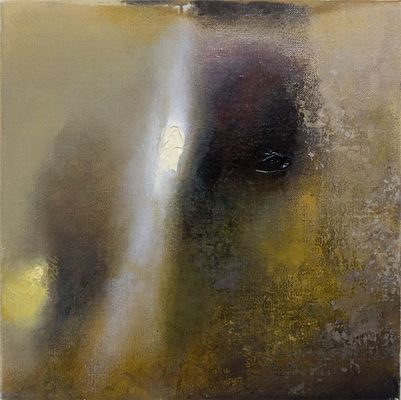
To return to Buckley’s fragment, the first two lines very much evoke how I paint nowadays. As you age, detail diminishes and patches of light become more luminous and float. I feel the most honest way of dealing with this is by smearing the oil paint on the canvas with the fingers and working close-up, blind. Only if the patches coalesce into an approaching image can the work gain a life.
-
Jonathan Walker was born in Melbourne, Australia and brought up on a dairy farm in Gippsland. In the 1970’s he studied painting at RMIT and won the Harold Wright Scholarship to the British Museum, London. During the 1980’s he exhibited at Pinacotheca Gallery, Richmond and had work shown at the NGV and Heidi City Art Gallery. Over the same period he designed the cover for the “Epigenesi” LP by Giancarlo Toniutti, Italy and conducted a mail exchange work with Achim Wollscheid, Germany. The work with artists through the post resulted in an article published in the bicentenary issue of Art and Australia 1988. He showed in artist run spaces such as WestSpace in the 90’s and 2000’s, and until 2012, taught painting at Victoria University, which is where we (Colleen Ahern and Lisa Radford) as organisers of the exhibition, among many others, had the privilege of being his student.
Walker’s knowledge was imparted to students through the careful selection of music, literature, and artists found in books that he himself had ordered for the library. Walker’s strategy was the generosity of sharing his vast knowledge with references specific to each student and their context.
Walker’s paintings share a similar focus and intimacy.
This exhibition presents a small selection of recent paintings alongside a publication that includes Walker’s writing. Observational and analytical, Walker’s work is a type of material notation — the time of day, colour and how it is blended, the both specific and fleeting location of a reflection on lino or the question of whether a chair leg should be included in a painting.
Please join us on Friday August 21 between 6-8pm to celebrate the opening of the exhibition.
Curated by Colleen Ahern and Lisa Radford.
B. Wurtz
Curated by Nic Tammens
March 26 - April 4, 2015
B.Wurtz works from a basement studio in his home on Manhattan’s Lower East Side.
This local fact is attested to by the plastic shopping bags and newsprint circulars that appear in his work. As formal objects, they don’t make loud claims about their origins but nonetheless transmit street addresses and places of business from the bottom of this long thin island. Like plenty of artists, Wurtz is affected by what is local and what is consumed. His work is underpinned by this ethic. It often speaks from a neighborhood or reads like the contents of a hamper:
“BLACK PLUMS $1.29 lb.”
“Food Bazaar”
“USDA Whole Pork Shoulder Picnic 99c lb.”
“RITE AID Pharmacy, with us it’s personal.”
“H. Brickman & Sons.”
“Sweet Yams 59c lb."
Most of the work in this exhibition was made while the artist was in residence at Dieu Donne, a workshop dedicated to paper craft in Midtown. Here Wurtz fabricated assemblages with paper and objects that are relatively lightweight, with the intention that they would be easily transportable to Australia. This consideration isn’t absolute in Wurtz’s work, but was prescriptive for making the current exhibition light and cheap. Packed in two boxes, these works were sent from a USPS post office on the Lower East Side and delivered to North Melbourne by Australia Post.
Wurtz appears courtesy of Metro Pictures, New York.
Thanks to Rob Halverson, Joshua Petherick, Sari de Mallory, Matt Hinkley, Helen Johnson, Fayen d'Evie, Ask Kilmartin, Lisa Radon, Ellena Savage, Yale Union, and "Elizabeth".
John Nixon
"Archive"
December 15 - January 20, 2014
The presentation of John Nixon's archive offered a rare showcase of this extensive collection of the artist's own publications, catalogues, posters, ephemera, editions and more, from the mid 1980s onwards, alongside a selection of his artworks.
Organized by John Nixon, Joshua Petherick and Matt Hinkley.
<a href=http://wfb.public-office.info/artist/john-nixon>All titles by John Nixon
"Habitat"
at Minerva, Sydney (organised by Joshua Petherick and Matt Hinkley)
November 15 - December 20, 2014
Lupo Borgonovo, Janet Burchill & Jennifer McCamley,
Lewis Fidock, HR Giger, Piero Gilardi, Veit Laurent Kurz,
Cinzia Ruggeri, Michael E. Smith, Lucie Stahl, Daniel Weil, Wols
Press Release:
“...It contained seven objects. The slender fluted bone, surely formed for flight, surely from the wing of some large bird. Three archaic circuitboards, faced with mazes of gold. A smooth white sphere of baked clay. An age-blackened fragment of lace. A fingerlength segment of what she assumed was bone from a human wrist, grayish white, inset smoothly with the silicon shaft of a small instrument that must once have ridden flush with the surface of the skin - but the thing’s face was seared and blackened.”
William Gibson, “Count Zero”, 1986
"Autumn Projects Archive"
Curated by Liza Vasiliou
March 6 - March 15, 2014
World Food Books, in conjunction with the Virgin Australia Melbourne Fashion Festival 2014, presented the Autumn Projects archive, consisting of a selection of early examples in Australian fashion with a particular interest in collecting designers and labels from the period beginning in the 1980’s, who significantly influenced the discourse of Australian Fashion.
Curated by Liza Vasiliou, the exhibition provided a unique opportunity to view pieces by designers Anthea Crawford, Barbara Vandenberg, Geoff Liddell and labels CR Australia, Covers, Jag along with early experimental collage pieces by Prue Acton and Sally Browne’s ‘Fragments’ collection, suspended throughout the functioning World Food Books shop in Melbourne.
H.B. Peace
presented by CENTRE FOR STYLE
November 14, 2013
"Hey Blinky, you say chic, I say same"
Anon 2013
H.B. Peace is a clothing collaboration between great friends Blake Barns and Hugh Egan Westland. Their pieces explore the divergences between 'character’ and ‘personality’ in garments....etc
Special Thanks to Joshua Petherick and Matt Hinkley of WFB and Gillian Mears
and a Very Special Thank you to Audrey Thomas Hayes for her shoe collaboration.
Janet Burchill & Jennifer McCamley
"Aesthetic Suicide"
May 10 - June 8, 2013
The first of our occasional exhibitions in the World Food Books office/shop space in Melbourne, "Aesthetic Suicide" presented a body of new and older works together by artists Janet Burchill & Jennifer McCamley, including videos, prints, a wall work, and publications.
During shop open hours videos played every hour, on the hour.
1981, Spanish
Softcover, 104 pages, 17 x 12 cm
1st Edition, Out of print title / used / very good
Published by
Editorial Garsi / Madrid
$70.00 - In stock -
Very rare copy of UNA MUSICA PARA LOS 80 by Spanish experimental composer, poet and art critic Javier Maderuelo (b. 1950), published in 1981 in Madrid by Editorial Garsi. This essential compact chronicle was written by Maderuelo to introduce the phenomenon of so-called contemporary music in Spain (electroacoustic, musique concrète, experimental, ambient, sound art, et al.) and analyse the varied positions of its leading protagonists, such as the Zaj group, Suso Sáiz, Eduardo Polonio, Llorenç Balsach, Amadeu Marin, Llorenç Barber, Carles Santos, José Iges, Antoni Caimari, Pedro Estevan, Josep Lluís Berenguer Moreno, Javier Maderuelo (himself a member of studio Alea between 1973-1977 and the musical movement Elenfante), amongst others. With critical overviews, profiles, discographies, bibliographies, chronologies of exhibitions and concerts, this is indeed a vital document on Spanish avant-garde sound c. 1970—1981.
Javier Maderuelo (Madrid, 1950) became interested in experimental poetry and art in 1972 under the influence of Fernando Millán, José Luis Castillejo and Felipe Boso, as well as artists like Elena Asins, Juan Hidalgo and Javier Aguirre, with whom he collaborated. He began producing typewritten poems and collages with texts extracted from newspapers, which converge in the unpublished book Arte Cisoria (1981). Felipe Boso introduced him to the world of phonetic poetry and with Pedro Estevan and María Villa he cofounded the Glotis Group (1979), dedicated to disseminating both the work of avant-garde poets, as well as neo-avant-garde works, some of them expressly written for Glotis. As a composer, he worked at the electronic music studio Alea (1973-1977) and was part of the musical movement Elenfante. He was a member of the Seminar of Analysis and Automatic Generation of Musical Forms, run by Florentino Briones, collaborating on the SIMO concerts. At the end of the eighties he abandoned poetic and musical creation to devote himself to an academic career.
Very Good copy with cover wrap cleanly disconnected from book block (old glue), tanned spine, otherwise VG throughout.
1969, Japanese
Hardcover (clothbound w. plastic dust jacket in slipcase), 168 pages, 22 x 16 cm
1st Edition, Out of print title / used / very good
Published by
Shoshi Soubikan / Tokyo
$180.00 - Out of stock
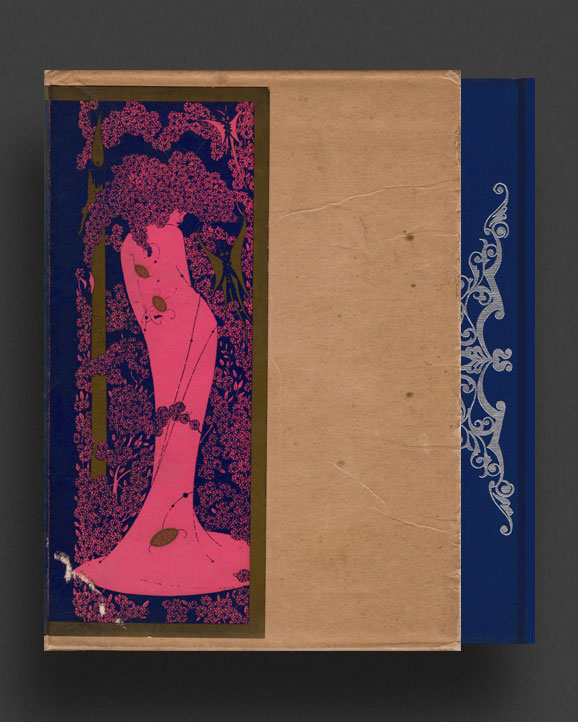
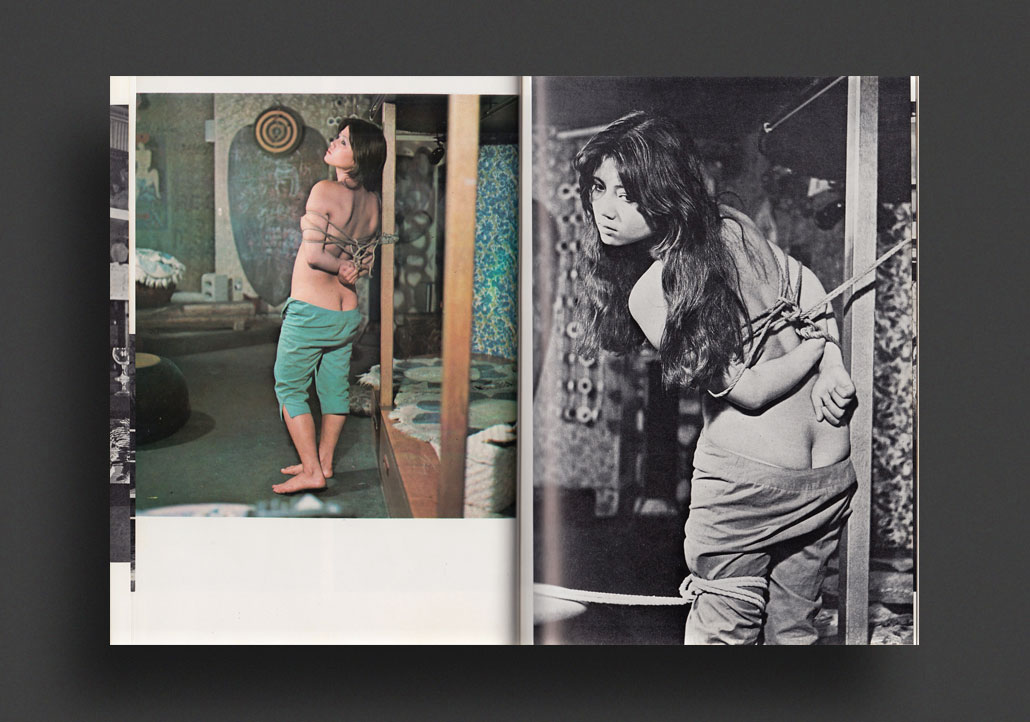
Very rare copy of SM Photo Collection Rose Mirror, an exquisite early 1969 hardcover collection of bondage photographic works housed in heavy cardboard slipcase adorned with Beardsley illustration. The photographic works follow in the decadent tradition, with beautiful b/w gravure photo reproductions and lush colour plates with colour fold-out spreads, each of the eight kinbaku/shibari scenarios shot by photographer Yoshimi Sunaji in response to fictional stories, the chapters titled: "`The Mirror of the Rose," "The Lesson of the Cat," "The Queen Angel," "The Ballad of the Pearl Shell," "The Trapped Agarwood," "The Play of the Twigs," "The Sacrifice of the Spider," and "The Mermaid's Bond," performed by eight women. The book concludes with the texts "Rope Arakaruto" by Arata Beppu, "Flowers of Heresy" by Akira Shiokawa, and "SM Yomoyama Story" by Oniroku Dan, "the most celebrated writer of popular SM novels in Japan."
Very Good copy with some general age and wear in gilded cloth bound hardcover and original publisher's plastic jacket (VG), housed in illustrated cardboard slipcase in Good—VG condition (light wear, age, marking). Very well preserved.
1986, Japanese
Softcover, 106 pages, 30 x 21 cm
1st Edition, Out of print title / used / very good
Published by
V-Zone / Japan
$100.00 - Out of stock
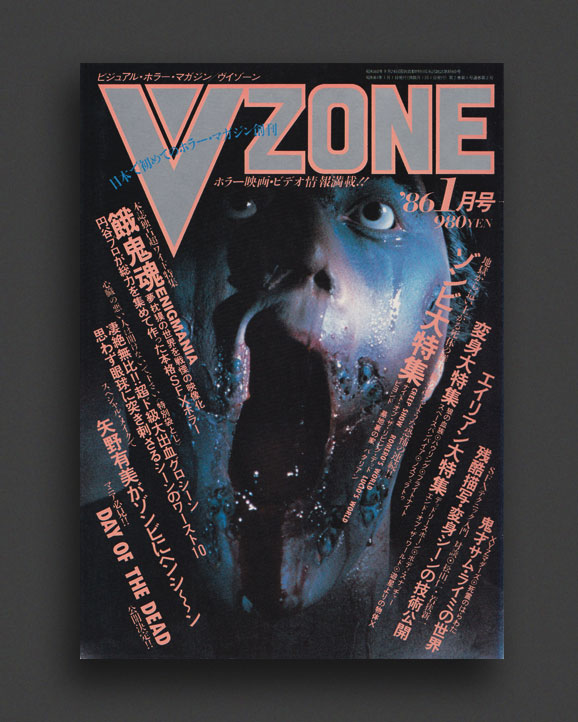
Rare 1986 collectible second issue of V-Zone, the wild, short-lived cult horror/sci-fi/fantasy movie magazine from Japan, published between 1985—1987. This issue is particularly sought after for the rare special feature on the controversial Guinea Pig 2: Flower of Flesh and Blood, a film written and directed by horror magna master Hideshi Hino, that was withdrawn from the US and Japanese video market for it's realistic gruesome special effects. The film achieved further notoriety after incident in which American actor Charlie Sheen is said to have watched the film and believed that it depicted the actual killing and dismemberment of a real woman, prompting him to report it to authorities. The feature herein includes the sealed shut pages that readers had to cut it open to see the gruesome images of various shock films. This copy is still sealed!
At the height of the home video revolution of the 1980s, V-Zone committed it's graphic-saturated pages to the explosion of horror, fantasy, and science fiction films that came with it. V-Zone's coverage of American horror is unparalleled in the world of Japanese magazines, but they also focused attention on historical and underground western science fiction and cult cinema, whilst also playing an important role in fostering the new wave of Japanese gore and V-Cinema (direct-to-video splatter films). Heavy with film features, interviews, stills, ads and reviews, each issue has amazing behind-the-scenes reportage from industry conventions and sfx fan parties, content you would not find anywhere but Japan, including a regular column by legendary Godzilla special effects artist Shinichi Wakasa on how to make your own SFX makeup, gore, and even craft realistic squibs with dimestore prophylactics.
Needless to say, V-Zone is a must for any 1980s video collector or lover of gore.
Very Good copy.
2019, English
Softcover, 312 pages, 14.8 x 19 cm
1st Edition, Out of print title / as new
Published by
Rokas Sutkaitis / Lithuania
$190.00 - Out of stock
The immediately out-of-print first and only edition of Soviet Logos.
Even if thousands of logos were created in the USSR only a very small part of them managed to survive until our days. Designed by professionals of various specialties, these fine graphic creations quickly became forgotten because of the turbulent fall of the Soviet Union. This monograph aims to rediscover the unrighteously forgotten logos and to introduce them into the global design context.
The book not only comprises of a collection of more than 360 carefully redrawn marks, but also provides a thorough analysis of the ambiguous functions of Soviet logos. With the help of social, economic and cultural discourse of the times, the functions of Soviet logos are analyzed in order to reveal their utopian nature.
Printed in Lithuania
Text by Rokas Sutkaitis
Designed by Acid
As New copy.
1995, English / Japanese
Softcover (w. Frenchfolds), 156 pages, 23 x 16 cm
1st Edition, Out of print title / used / very good
Published by
Sezon Museum of Art / Tokyo
$160.00 - Out of stock
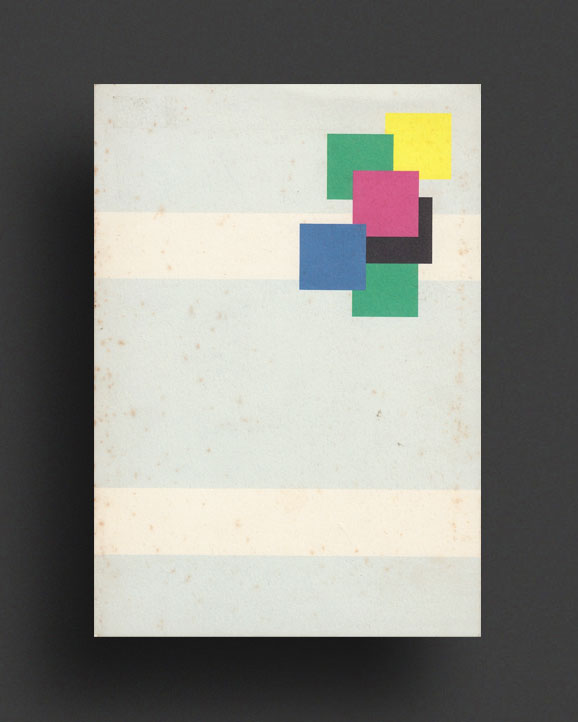
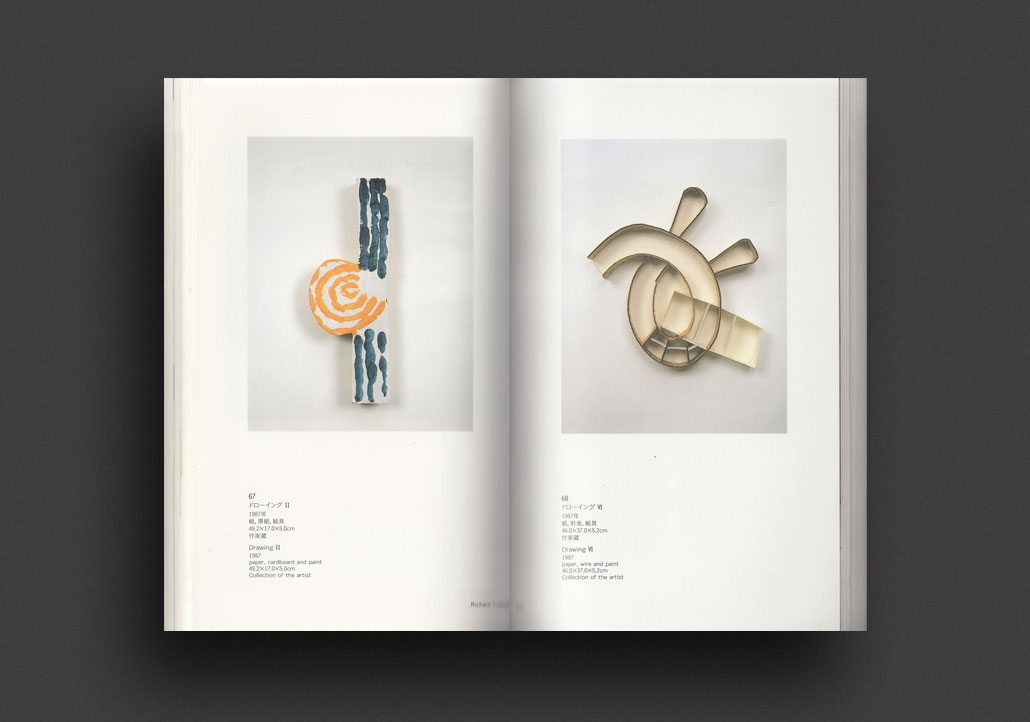
First edition of this fantastic, and very scarce Richard Tuttle catalogue. Published on the occasion of the solo exhibition of Richard Tuttle, September 7—October 10, 1995 at Sezon Museum of Art, Tokyo, this densely-packed and profusely illustrated book, surveys Tuttles career to date, reproducing many great sculptural works with fabric, on paper, reliefs and paintings, made by Tuttle between 1964 and 1994. Features an essay by Richard Tuttle alongside texts by Gerhard Mack and Shigemi Oka, the exhibition curator. All texts in both Japanese and English.
A great and rare Japanese book on the work of American artist, Richard Tuttle.
Good copy. Foxing/age spots to cover, otherwise a Very Good copy in all other aspects.
1973, Japanese
Softcover, 182 pages, 25.5 x 18.5 cm
1st Edition, Out of print title / used / good
Published by
The Geijutsu Seikatsu / Tokyo
$70.00 - Out of stock
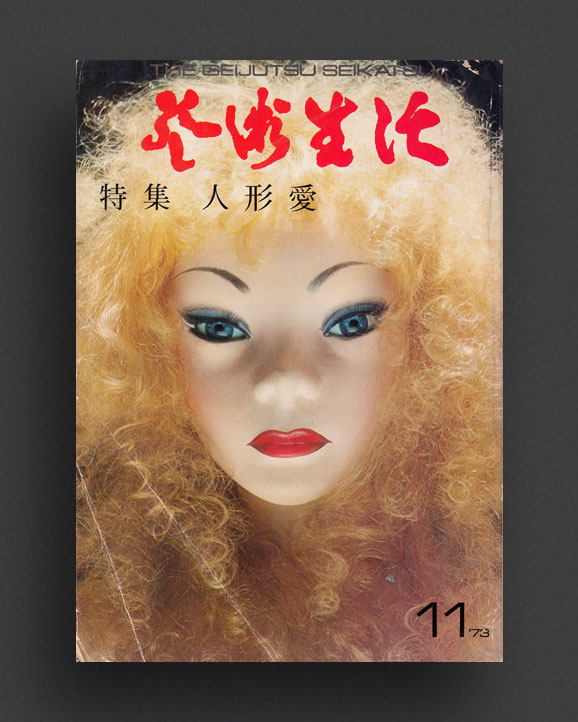
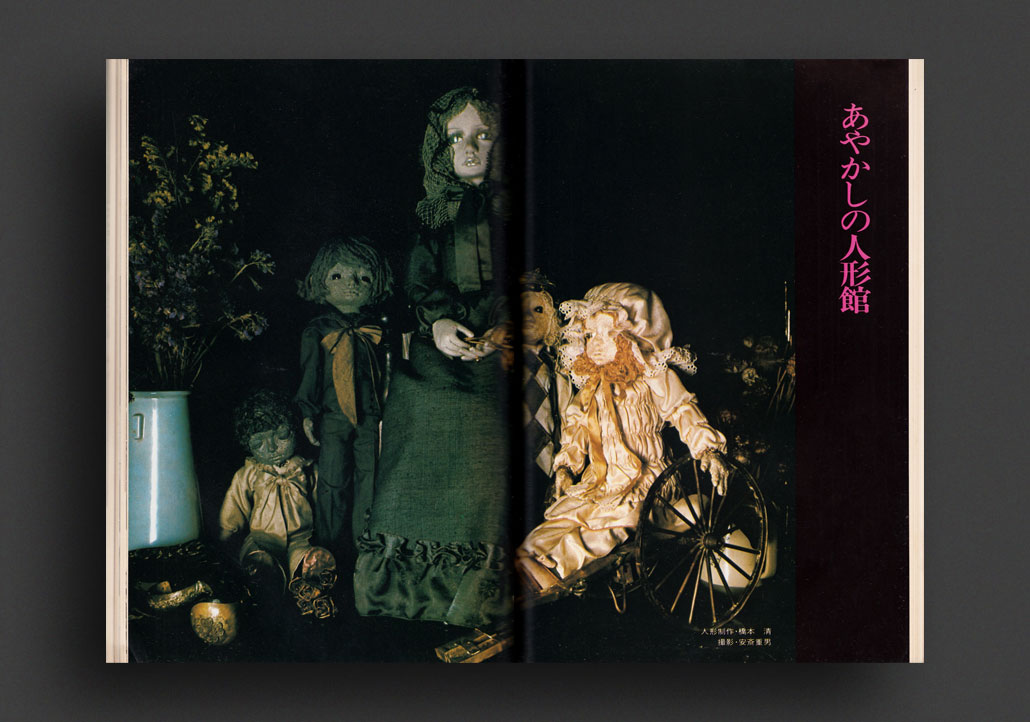
Magnificent "Doll Love" Special Feature issue of The Geijutsu Seikatsu, one of the leading arts magazines in post-war Japan, with a cover feature shot by Kishin Shinoyama on Japanese doll master Simon Yotsuya. From Hans Bellmer to Hajime Sawatari's doll photography to the Ayakashi Doll Museum shot by Shigeo Anzaï to the metaphysics of "Doll Love" written by the great Tatsuhiko Shibusawa, this issue is filled with photographic features and articles on doll artists, doll museums, western automatons, karakuri dolls... plus a photo feature on Nakamura Utaemon, considered the greatest onnagata (male actors who play female roles in kabuki theatre) of the post-War period ("a divine messenger given to kabuki from heaven"), performing the legendary Japanese ghost story "Yotsuya Kaida", and much much more (Kobayashi Kiyochika, Tadanori Yokoo, Hisako Nishino, Yasufumi Konishi, Yosuke Inoue...). Always a treasure-trove!
Good copy with some wear and creases to covers.
1984, English
Softcover, 62 pages, 21.5 x 21.5 cm
1st Edition, Out of print title / used / good
Published by
Kunsthalle Basel / Basel
$90.00 - Out of stock
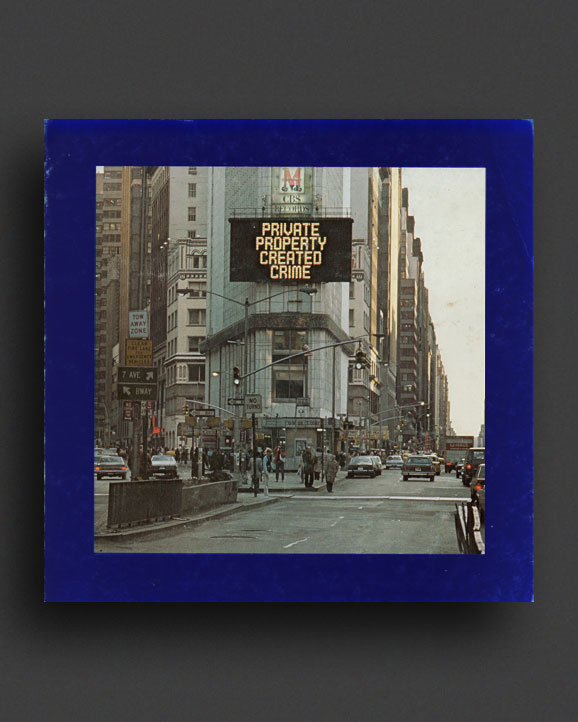
Wonderful 1984 catalogue, Private Property Created Crime, surveying the work of American conceptual artist Jenny Holzer (b. 1950), published on the occasion of a major European exhibition at Kunsthalle Basel and Le Nouveau Musée.
"THIS IS A BOOK OF STREET WORK AND INSTALLATIONS; POSTERS, T-SHIRTS, PLAQUES, STICKERS AND ELECTRONIC SIGNS. THE PHOTOGRAPHS ARE ARRANGED IN SERIES: TRUISMS, 1977–1983; ESSAYS, 1979–1983; LIVING, 1981–1983; AND SURVIVAL, 1983-1984. THE BOOK ACCOMPANIES EXHIBITIONS AT THE KUNSTHALLE, BASEL AND LE NOUVEAU MUSÉE, VILLEURBANNE."
Profusely illustrated in b/w and colour. Introduction by Jean-Christophe Ammann, plus biography and bibliography. All in English.
Jenny Holzer (b. 1950) is an American conceptual artist best known for her text-based works, which are constructed from "truisms" such as "abuse of power comes as no surprise"and "protect me from what I want." By experimenting with the use of words visually displayed in public spaces, Holzer is able to stimulate public discussions about violence, sexuality, oppression, human rights, feminism, power, war, and death. Starting with street posters, Holzer's practice has come to incorporate LED screens that run with stock-ticker-like texts, painted signs, plaques, photographs, sound, video, and the Internet.
Until 1993, Holzer wrote her own texts, after which she began to appropriate texts by Polish Nobel laureate Wislawa Szymborska and other champions of human rights, including Elfriede Jelinek, Fadhil Al-Azawi, Yehuda Amichai, and Mahmoud Darwish. Recent works include I Was in Baghdad Ochre Fade (2007), a series of oil on linen transcriptions of torture documents from the Iraq War; Redaction Paintings (2009), which were created using recently released classified memos with texts blacked out by censors; and an installation in the lobby of 7 World Trade Center. In 1990, she was the first woman to represent the United States at the Venice Biennale, where she won the Golden Lion for the best artist.
Good—VG copy with cover wear.
1990, English
Softcover, 582 pages, 20 x 13 cm
1st UK Edition, Out of print title / used / very good
Published by
Paladin / London
$100.00 - Out of stock
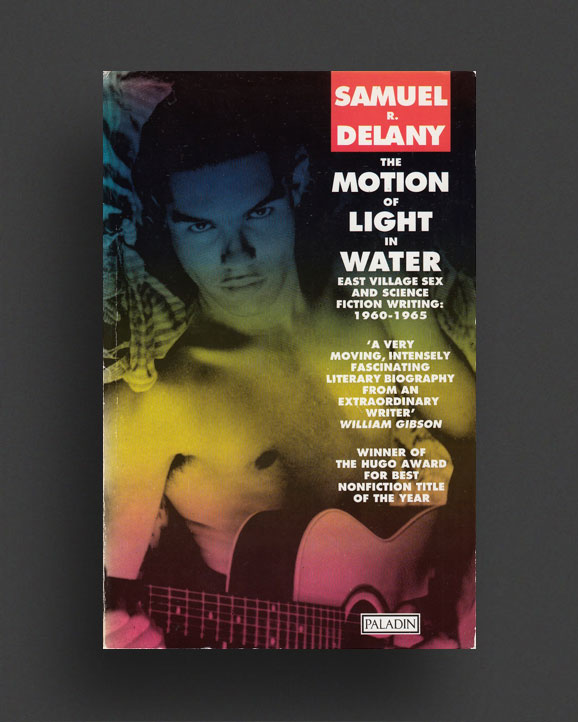
"A very moving, intensely fascinating literary biography from an extraordinary writer"—William Gibson
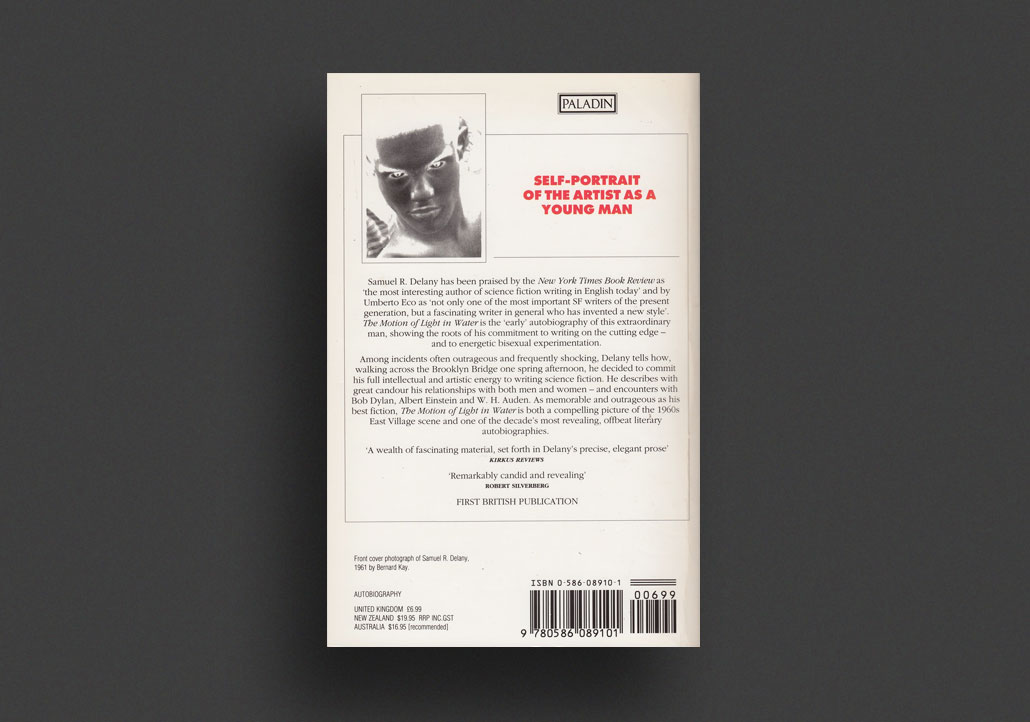
First 1990 UK edition of the incredible 'early' autobiography of science fiction author Samuel R. Delany. Winner of the 1989 Hugo Award for Non-fiction, 'The Motion of Light in Water: East Village Sex and Science Fiction Writing: 1960—1965' is the self-portrait of the artist as a young African American man, an extraordinary man, showing the roots of his commitment to writing on the cutting edge — and to energetic bisexual experimentation. This first English edition contains material not found in the American edition, featuring cover photograph of Samuel R. Delany, 1961 by Bernard Kay.
Born in New York City's black ghetto Harlem at the start of World War II, Samuel R. Delany married white poet Marilyn Hacker right out of high school. The interracial couple moved into the city's new bohemian quarter, the Lower East Side, in summer 1961. Through the decade's opening years, new art, new sexual practices, new music, and new political awareness burgeoned among the crowded streets and cheap railroad apartments. Beautifully, vividly, insightfully, Delany calls up this era of exploration and adventure as he details his development as a black gay writer in an open marriage, with tertiary walk-ons by Bob Dylan, Stokely Carmichael, W. H. Auden, and James Baldwin, and a panoply of brilliantly drawn secondary characters. Among incidents often outrageous and frequently shocking, Delany tells how, walking across the Brooklyn Bridge one spring afternoon, he decided to commit his full intellectual and artistic energy to writing science fiction. He describes with great candour his relationships with both men and women. As memorable and outrageous as his best fiction, The Motion of Light in Water is both a compelling picture of the 1960s East Village scene and one of the decade's most revealing, offbeat literary autobiographies.
In the chapter, "The Future Is in the Present" of the book Cruising Utopia by José Esteban Munoz, Delany's The Motion of Light in the Water serves to explain how the future, as a form of utopia, can be "glimpsed" in the present through what Delany employed as "the massed bodies" of sexual dissidence.
Samuel R. Delany has been praised by the New York Times Book Review as 'the most interesting author of science fiction writing in English today' and by Umberto Eco as 'not only one of the most important SF writers of the present generation, but a fascinating writer in general who has invented a new style'.
Very Good copy with light creasing and tanning to spine.
1977, English
Softcover, 256 pages, 18 x 11 cm
Out of print title / used / very good
Published by
Pan / London
$30.00 - Out of stock
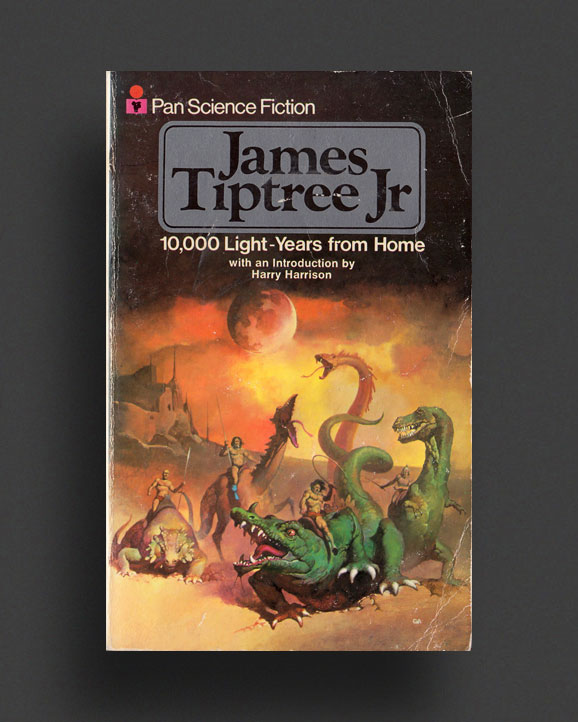
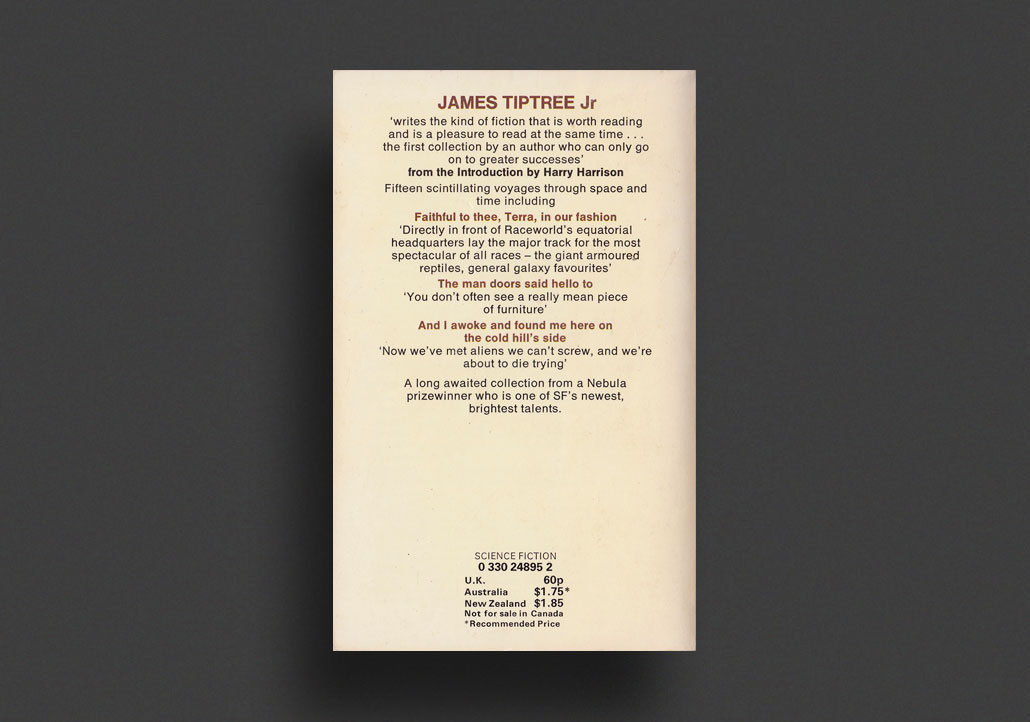
1977 Pan edition of the first short story collection by Alice Sheldon (under the pen name James Tiptree, Jr.). Introduced by fellow SF writer Harry Harrison.
"A long awaited collection from a Nebula prizewinner who is one of SF's newest, brightest talents"
Fifteen scintillating voyages through space and time including:
Faithful to thee, Terra, in our fashion — "Directly in front of Raceworld's equatorial headquarters lay the major track for the most spectacular of all races- the giant armoured reptiles, general galaxy favourites"
The man doors said hello to — "You don't often see a really mean piece of furniture"
And I awoke and found me here on the cold hill's side —"Now we've met aliens we can't screw, and we're about to die trying"
Alice Bradley Sheldon (195—1987) was an American science fiction and fantasy author better known as James Tiptree Jr., a pen name she used from 1967 until her death. It was not publicly known until 1977 that James Tiptree Jr. was a woman. Tiptree's debut story collection, Ten Thousand Light-Years from Home, was published in 1973 and her first novel, Up the Walls of the World, was published in 1978. From 1974 to 1985 she also occasionally used the pen name Raccoona Sheldon. Tiptree was inducted into the Science Fiction Hall of Fame in 2012.
Good—Very Good copy with some light general wear/age, still tightly bound.
1979, English
Softcover, 312 pages, 17.5 x 11 cm
Out of print title / used / very good
Published by
Berkley Medallion / Berkley
$25.00 - Out of stock
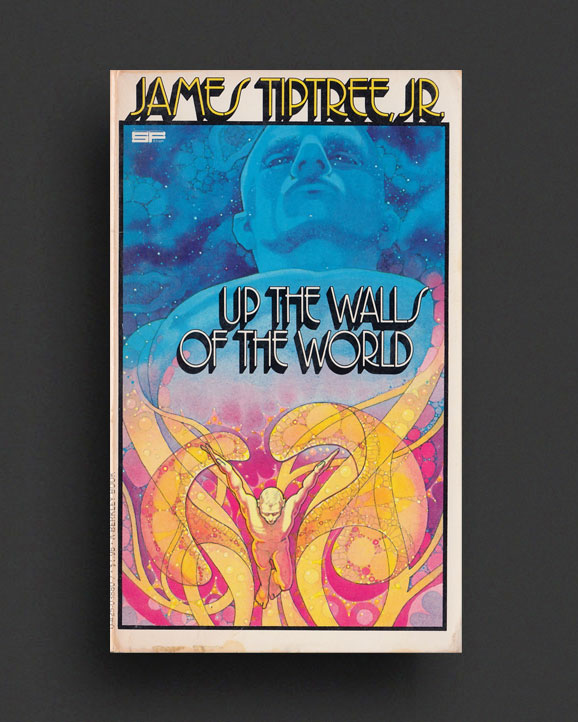
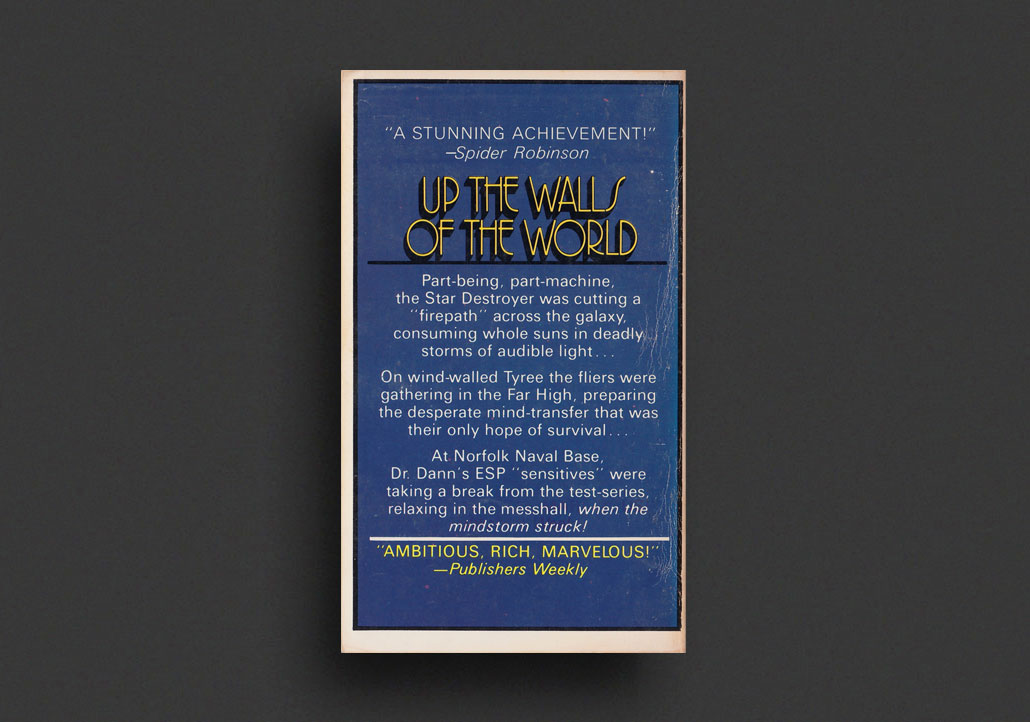
1979 edition of the debut novel by Alice Sheldon (under the pen name James Tiptree, Jr.), Up The Walls of The World. First published in 1978, the book explores the possibility that telepathy and other psychic phenomena are real.
"Part-being, part-machine, the Star Destroyer was cutting a "firepath" across the galaxy, consuming whole suns in deadly storms of audible light..."
"On wind-walled Tyree the fliers were gathering in the Far High, preparing the desperate mind-transfer that was their only hope of survival"
"At Norfolk Naval Base, Dr. Dann's ESP "sensitives" were taking a break from the test-series, relaxing in the messhall, when the mindstorm struck!"
Alice Bradley Sheldon (195—1987) was an American science fiction and fantasy author better known as James Tiptree Jr., a pen name she used from 1967 until her death. It was not publicly known until 1977 that James Tiptree Jr. was a woman. Tiptree's debut story collection, Ten Thousand Light-Years from Home, was published in 1973 and her first novel, Up the Walls of the World, was published in 1978. From 1974 to 1985 she also occasionally used the pen name Raccoona Sheldon. Tiptree was inducted into the Science Fiction Hall of Fame in 2012.
Very Good copy with some light general wear/age, still tightly bound.
1978, English
Softcover, 270 pages, 17.5 x 10.5 cm
1st Edition, Out of print title / used / very good
Published by
Del Rey SF / New York
$30.00 - Out of stock
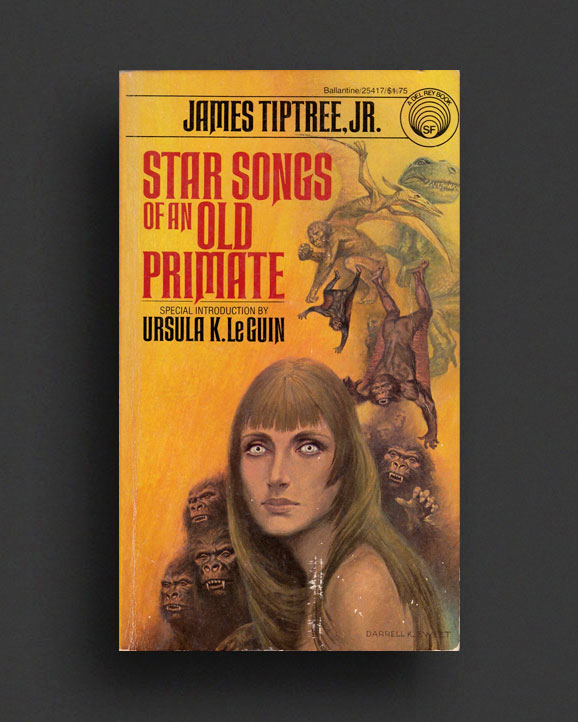
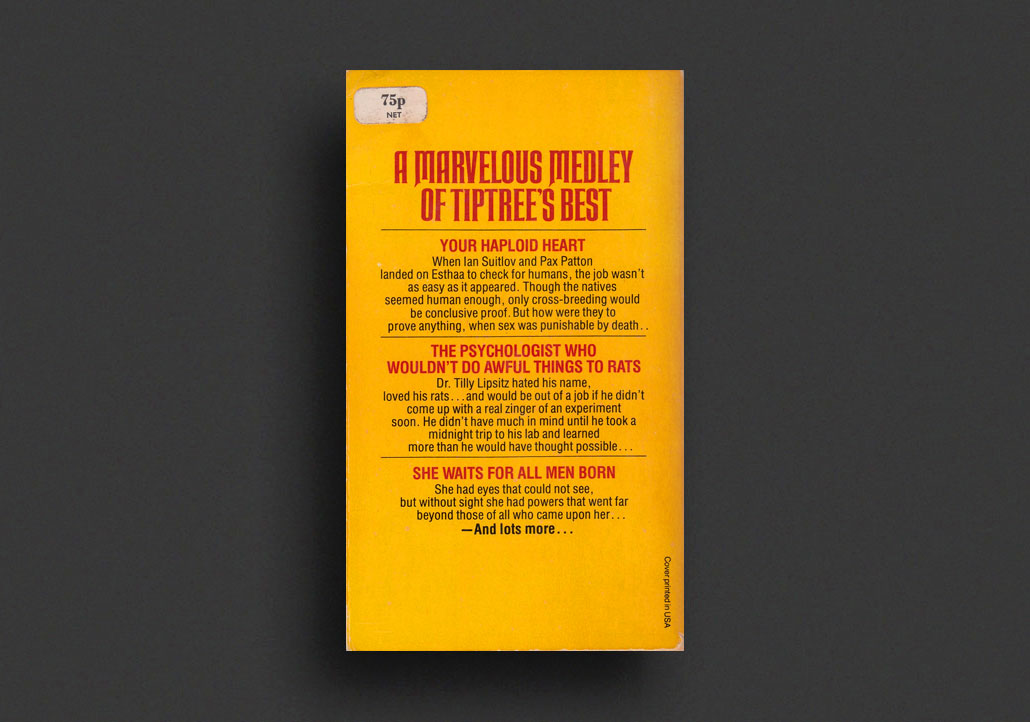
First 1978 edition of the third short story collection by Alice Sheldon (under the pen name James Tiptree, Jr.), and the first of Tiptree's books published after the revelation that Tiptree was a female, rather than male, writer. Introduced by fellow SF writer Ursula K. Le Guin, and published by Del Rey Books (a specialized SF and Fantasy imprint of Ballantine Books).
"A marvelous medley of Tiptree's best"
including:
"YOUR HAPLOID HEART" — When Ian Suitlov and Pax Patton landed on Esthaa to check for humans, the job wasn't as easy as it appeared. Though the natives seemed human enough, only cross breeding would be conclusive proof. But how were they to prove anything, when sex was punishable by death?
"THE PSYCHOLOGIST WHO WOULDN'T DO AWFUL THINGS TO RATS" — Dr Tilly Lipsitz hated his name, loved his rats... and would be out of a job if he didn't come up with a real zinger of an experiment soon. He didn't have much in mind until he took a midnight trip to his lab and learned more than he would have thought possible.
"SHE WAITS FOR ALL MEN BORN" — She had eyes that could not see, but without sight she had powers that went far beyond those of all who came upon her.
Contents:
Ursula K. Le Guin Introduction
Your Haploid Heart (1969)
And So On, and So On (1971)
Her Smoke Rose Up Forever (1974)
A Momentary Taste of Being (1975)
Houston, Houston, Do You Read? (1976)
The Psychologist Who Wouldn't Do Awful Things to Rats (1976)
She Waits for All Men Born (1976)
Alice Bradley Sheldon (195—1987) was an American science fiction and fantasy author better known as James Tiptree Jr., a pen name she used from 1967 until her death. It was not publicly known until 1977 that James Tiptree Jr. was a woman. Tiptree's debut story collection, Ten Thousand Light-Years from Home, was published in 1973 and her first novel, Up the Walls of the World, was published in 1978. From 1974 to 1985 she also occasionally used the pen name Raccoona Sheldon. Tiptree was inducted into the Science Fiction Hall of Fame in 2012.
Very Good copy with some light general wear/age, still tightly bound.
1996, English
Softcover, 246 pages, 21.5 x 14 cm
1st Edition, Out of print title / used / good
Published by
Serpent's Tail / London
$40.00 - Out of stock
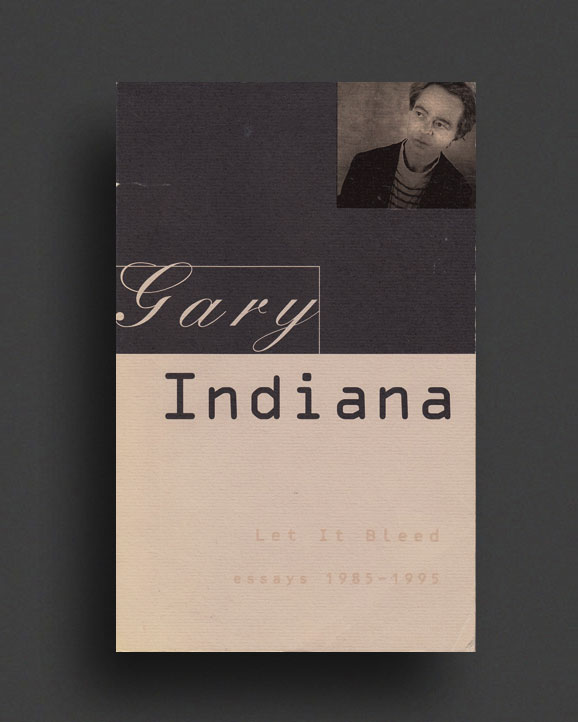
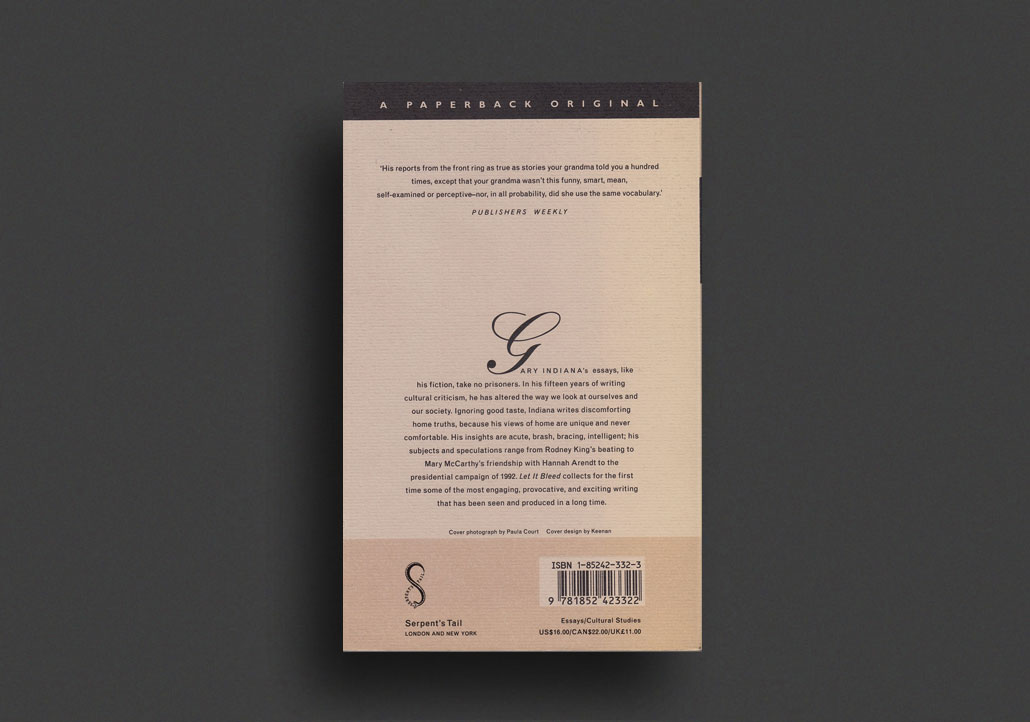
First 1996 edition of this long out-of-print collection of essays by Gary Indiana, "One of the most important chroniclers of the modern psyche."—The Guardian
Gary Indiana's essays, like his fiction, take no prisoners. In his fifteen years of writing cultural criticism, he has altered the way we look at ourselves and our society. Ignoring good taste, Indiana writes discomforting home truths, because his views of home are unique and never comfortable. His insights are acute, brash, bracing, intelligent; his subjects and speculations range from Rodney King's beating to Mary McCarthy's friendship with Hannah Arendt to the presidential campaign of 1992. Let It Bleed collects for the first time some of the most engaging, provocative, and exciting writing that has been seen and produced in a long time.
Good—VG with light wear/creasing to covers.
1983, Japanese / German / English
Softcover, 164 pages, 24 x 25 cm
1st Edition, Out of print title / used / good
Published by
Yomiuri Shimbun / Tokyo
$60.00 - In stock -
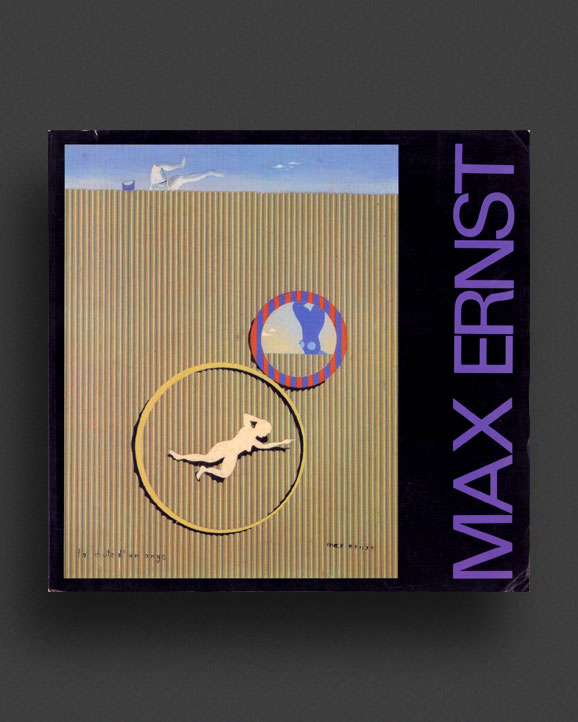
Scarce Japanese catalogue on the work of German artist Max Ernst, published to accompany the major retrospective exhibition that travelled Japan 1983—1984.
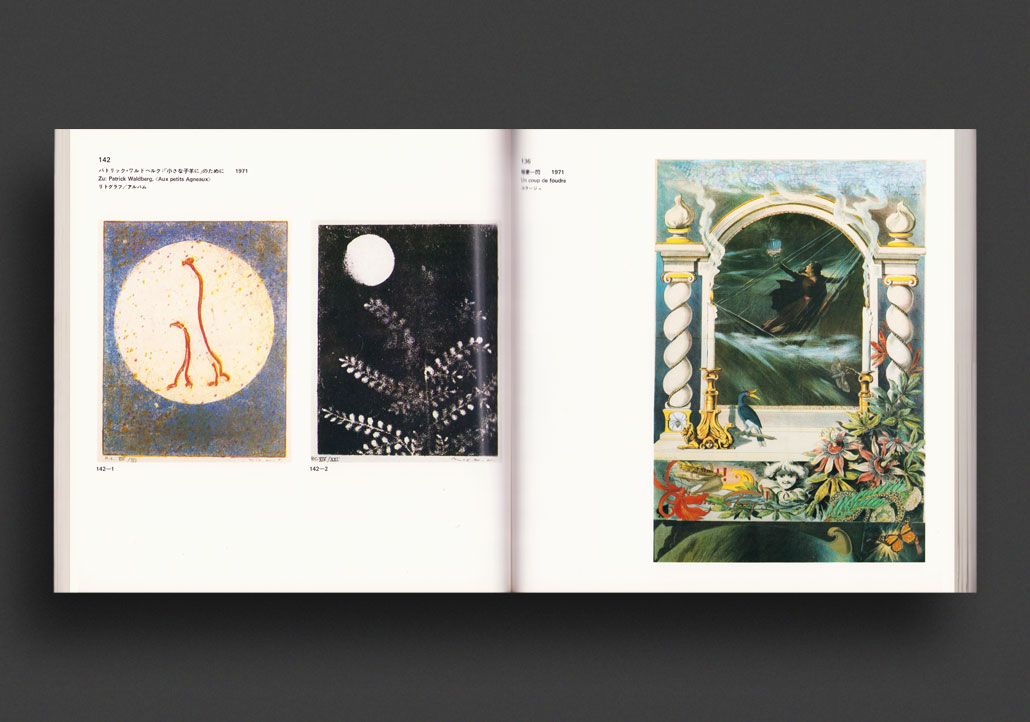
With an introduction by German art historian Werner Spies, in German and Japanese, this profusely illustrated book is quite a valuable volume on Ernst as it concentrates its pages on a huge collection of his lithography, frottage, collage, etching, and other graphic works, rather than his more well-known works in painting and sculpture, bringing to the surface many lesser-seen works of the artist. Over 300 colour and black and white reproductions, including biography and bibliography. Texts in Japanese and German, with titles and introduction in English.
Max Ernst (1891—1976) was a German painter, sculptor, graphic artist, and poet. A prolific artist, Ernst was a primary pioneer of the Dada movement and Surrealism.
Good copy with wear and creasing to corners, general wear and tear to cover extremities. Spine uncreased and tightly bound.
1975, Italian / French
Hardcover (linen bound), 277 pages, 30 x 30 cm
1st Edition, Out of print title / used / very good
Published by
Nuova Prearo Editore / Milan
$190.00 - Out of stock
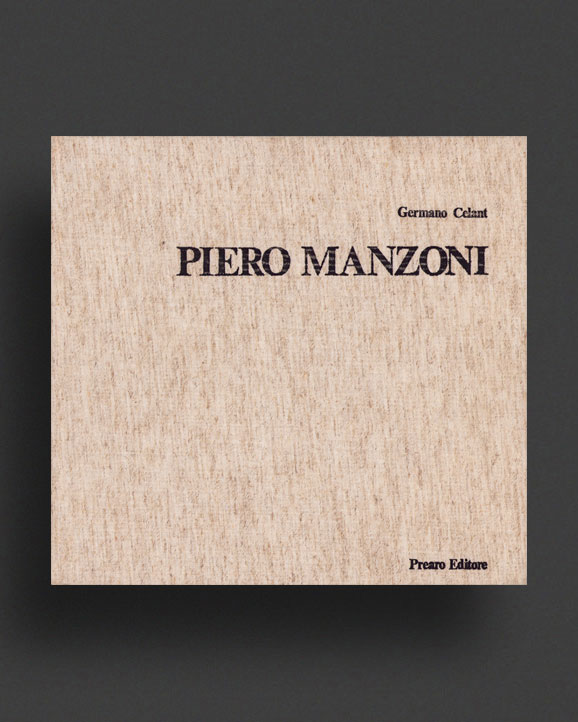
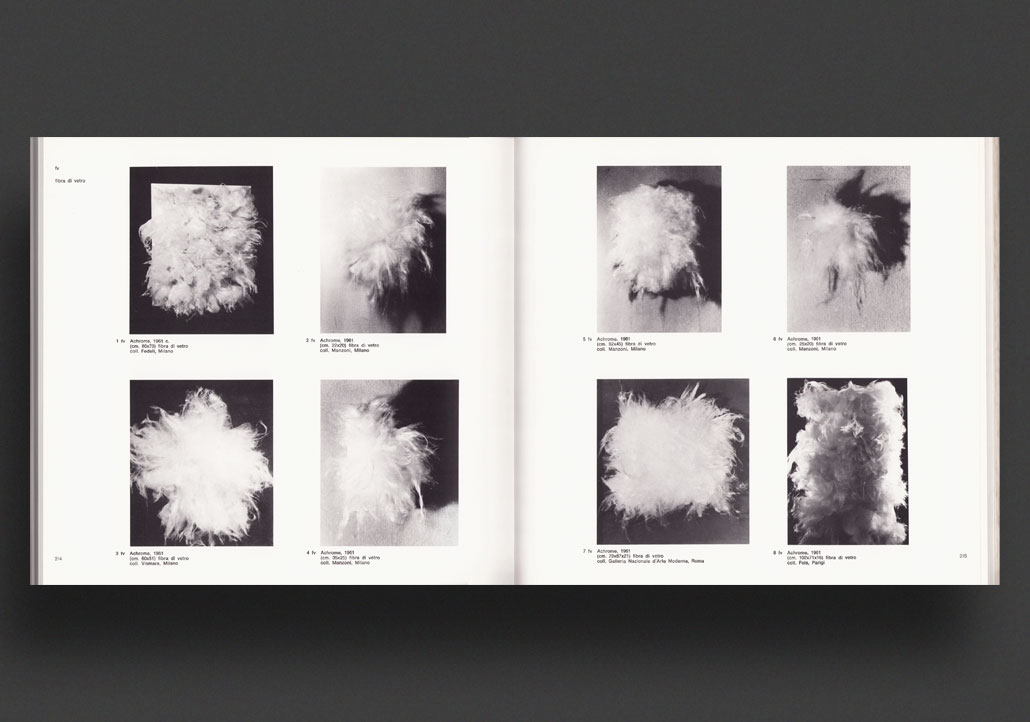
First edition of the wonderful (in progress) catalogue raisonné of Piero Manzoni — General Catalogue — edited by Germano Celant and published by Nuova Prearo Editore, Milan, 1975. This heavy, richly illustrated book provided the first overview of Piero Manzoni’s oeuvre. Illustrated exclusively with black and white photographs, the book featured an extensive text by Germano Celant, divided into chapters, a selection of writings by the artist and the register of works “ordered chronologically by groups, determined by type” and the appendices with exhibitions and bibliography. It was later re-printed and expanded in 1989. Texts in Italian and French.
Piero Manzoni (1933—1963) was an Italian artist best known for his ironic approach to avant-garde art. Often compared to the work of Yves Klein, his own work anticipated, and directly influenced, the work of a generation of younger Italian artists brought together by the critic Germano Celant in the first Arte Povera exhibition held in Genoa, 1967. Manzoni is most famous for a series of artworks that call into question the nature of the art object, directly prefiguring Conceptual Art. His work eschews normal artist's materials, instead using everything from rabbit fur to human excrement in order to "tap mythological sources and to realize authentic and universal values". His work is widely seen as a critique of the mass production and consumerism that was changing Italian society (the Italian economic miracle) after World War II. Italian artists such as Manzoni had to negotiate the new economic and material order of post-war Europe through inventive artistic practices which crossed geographic, artistic, and cultural borders.
Very Good copy. Book is Near Fine in every way, yet missing dust jacket, therefore VG.
1978, English
Hardcover (w. dust jacket), 192 pages, 22 x 15 cm
1st Edition, Out of print title / used / very good
Published by
Vision / London
$25.00 - In stock -
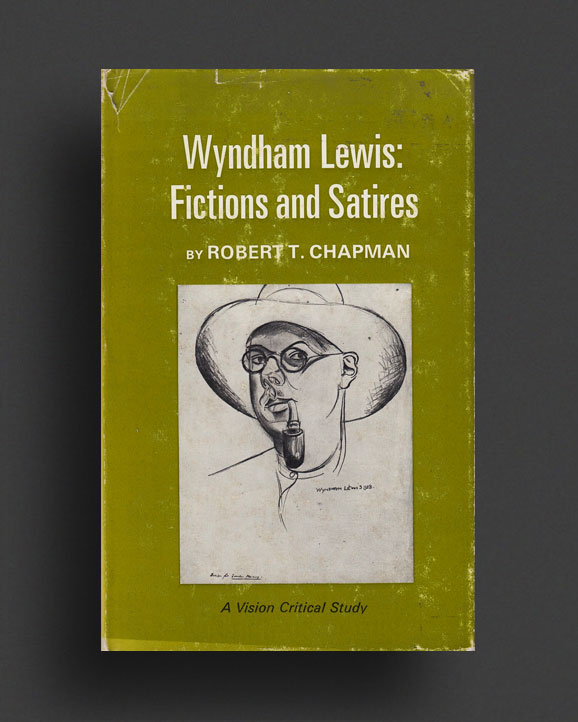
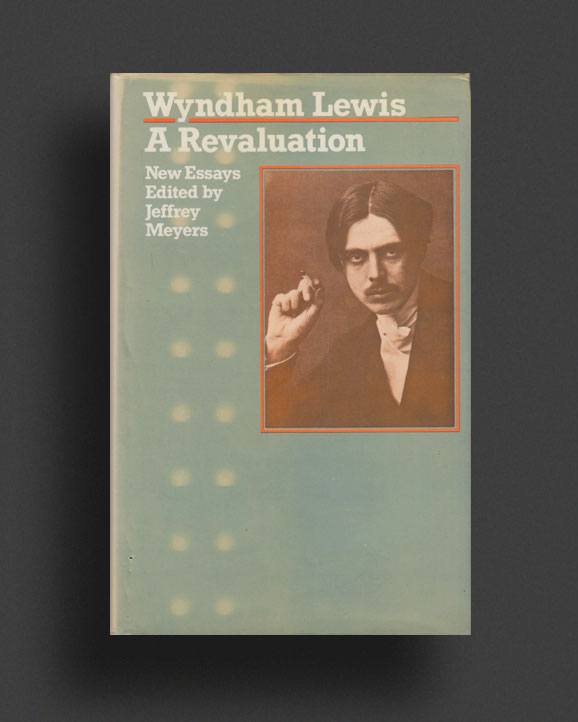
First 1973 hardcover edition of WYNDHAM LEWIS : FICTIONS AND SATIRES by Robert T. Chapman.
Wyndham Lewis played a leading part in the cultural life of England at the beginning of this century. Setting himself up as 'The Enemy', he vociferously opposed Establishment art and received opinion, and for fifty years iconoclastically attacked modish dilettantism and falsity. Novelist, painter, editor, poet, dramatist, critic, philosopher — Lewis was the most versatile of the 'men of 1914', yet his reputation has long been overshadowed by Pound, Eliot and Joyce, and he is only just beginning to be accepted as one of the major figures in twentieth-century literature.
This study concentrates on Lewis as an imaginative writer, and, whilst his philosophy, polemics and paint ing are considered whenever relevant, the major novels are given central importance. The approach is chronological and aims to reveal the development of Lewis's art from the Bergsonian physical comedy of the early stories, through the Vorticist period, the social satires of the Thirties, to the late non-fiction stories and the new mythology of
The Human Age. Formerly a post-graduate assistant in the Department of English at the New University of Ulster, Robert Chapman is at present completing his doctoral thesis on aesthetics in the modern novel and working for the Open University.
VG copy in G dust jacket with closed tears and rubbing wear.
1980, English
Hardcover (w. dust jacket), 276 pages, 23 x 15.5 cm
1st Edition, Out of print title / used / very good
Published by
The Athlone Press / UK
$10.00 - In stock -
Though T. S. Eliot called Wyndham Lewis "the most fascinating personality of our time" and "the only one among my contemporaries to create a new, an original, prose style", Lewis is perhaps the most neglected and under-rated major author of this century. But a strong revival of interest in his prose writings and art is under way and much new material has become available on which to base a fresh assessment of his work.
This volume contains eighteen specially commissioned essays which consider Lewis as novelist, philosopher, poet, critic and editor, and, more briefly, in his complementary role as artist. It aims to stimulate critical appreciation of the depth and diversity of Lewis's fifty years of creative activity and of his role as a major intellectual force in modern English literature.
Jeffrey Meyers is a Professor of English at the University of Colorado.
Very Good copy w. Good dust jacket with tanning.
1999, English
Softcover (staple bound), 17.7 x 13 cm
1st Edition, Out of print title / as new
Published by
Omni Press / Millbrae
$35.00 - In stock -
Scarce copy of Sun Ra Research issue no. 37, 1999, an exceptional fanzine project edited by Sun Ra devotee Peter Hinds, founded in 1995 to publish extensive, illuminating interviews and conversations with Sun Ra and members of his Arkestra, spanning the 1970's to Sun Ra’s passing in 1993. With each issue featuring exclusive insights from Sun Ra and the Arkestra themselves, plus transcriptions of rehearsals, radio shows, articles, Sun Ra declarations and poetry, and rare, unpublished Arkestra images by many photographers, all risographed on different paper stocks, hand-bound, and independently published by Omni Press in Millbrae, California, Sun Ra Research forms a valuable "product of a lunatic obsession and deranged scholarship" in homage to the cosmic jazz philosopher.
As New copy.
1978, English
Softcover, 158 pages, 21 x 29.5 cm
1st Edition, Out of print title / used / very good
Published by
Dragon's Dream / Paris
$220.00 - Out of stock
First printing of this cult classic of magmatic erotic collage from 1978 by artist Penny Slinger and poet Nik Douglas, published by Dragon's Dream of Paris. Seized and burnt by British customs, Mountain Ecstasy is an explicit, kaleidoscopic work that melds the sacred with the profane — an ecstatic and cosmic journey to tantric utopia by way of Penny’s wild collages created from found images – many from Slinger’s own collection of erotica, saturated in colour and volcanic sensuality.
"'Mountain Ecstasy' was my celebration of Tantric alchemy, freed from any restrictions, out of the confines of the house ('An Exorcism') and into the wide-open Technicolor landscapes of the high Himalayas. I never really thought of the collages as being material for a book - as they were rather outrageous - but Dragon's Dream wanted to publish. Whereas 'An Exorcism' had been mostly my own photographs, the images for 'Mountain Ecstasy' were nearly all 'objects trouves'. I had traveled for the first time in exotic parts (India, Nepal, Thailand) and the work reflects this input. Thousands of copies of 'Mountain Ecstasy' were subsequently seized and burnt by British customs, my comment at the time was, "They thought it was pornography, they didn't realize it was its antidote"—Penny Slinger
"Magnificant erotic assemblages of nudes, flowers, masks and rocks against landscapes, they tease, they excite and they dazzle the eye and in the end the sheer voluptuous beauty of these erotic montages finally exist in their own right as works of art and nary a bullet or a bomb in them."—Arthur Moyse, Freedom Anarchist Review
Very Good copy, beautifully preserved with light cover wear/crease, tightly bound/unsunned — rare for this title.
1955, English
Hardcover (w. dust jacket), 208 pages, 22 x 15 cm
1st UK Edition, Out of print title / used / very good
Published by
Routledge & Kegan Paul / London
$500.00 - In stock -
Rare first 1955 hardcover edition of Wittgenstein's Tractatus Logico-Philosophicus, with introduction by Bertrand Russell, published by Routledge & Keegan Paul, London. The sixth impression of the first edition, which includes the index. Published for The International Library of Psychology, Philosophy and Scientific Method. English translation by C. K. Ogden. Blue cloth covers with gilt lettering on spine.
The Tractatus Logico-Philosophicus first appeared in 1921 and was the only philosophical work that Ludwig Wittgenstein (1889-1951) published during his lifetime. Written in short, carefully-numbered paragraphs of extreme compression and brilliance it immediately convinced many of its readers and captured the imagination of all. Its chief influence, at first, was on the Logical Positivists of the 1920's and 30's, but many other philosophers were stimulated by its philosophy of language, finding attractive, even if ultimately unsatisfactory, its view that propositions were pictures of reality. Perhaps most of all, its own author, after his return to philosophy in the late 1920's, was fascinated by its vision of an inexpressible, crystalline world of logical relationships. The posthumous publication of other writings of his has, therefore, only served to reawaken interest in the Tractatus and to illuminate its more neglected aspects.
Very Good—Near Fine copy in Very Good dust jacket. Light age marking/wear to dust jacket extremities with clip to blank inner flap. Small pleasant bookseller sticker to lower first blank page — purchased at F. W. Cheshire Pty. Ltd, Little Collins Street in Melbourne. Frank Cheshire (1896–1987) was an Australian bookseller and publisher. His bookshop in Little Collins Street, Melbourne was described as a "gathering place for all interested in books and literature" in the mid-twentieth century. His publishing firm published Robin Boyd's The Australian Ugliness and Joan Lindsay's Picnic at Hanging Rock and "gave many Australian writers their first start". An incredible, tightly bound well preserved copy of this rare first edition, dust jacket now protected in archival mylar.
1997, English
Hardcover (w. dust jacket), 286 pages, 23 x 19.2 cm
1st Edition, Out of print title / used / very good
Published by
The MIT Press / Massachusetts
$55.00 - Out of stock
First 1997 hardcover edition.
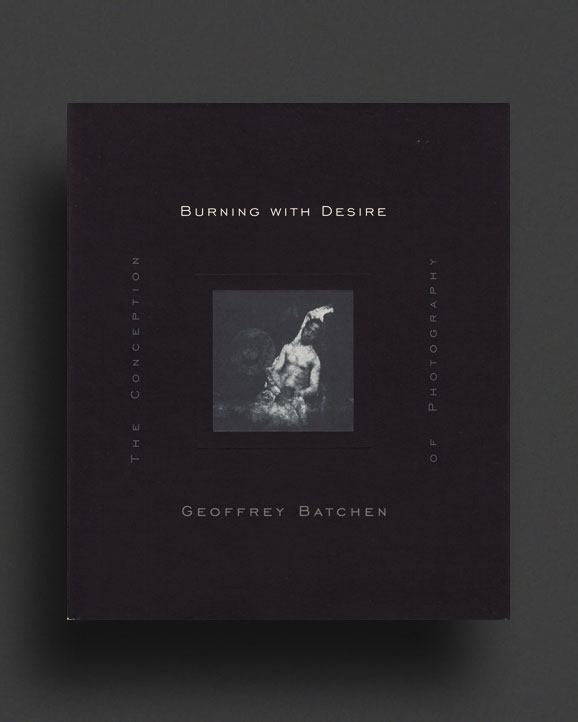
In an 1828 letter to his partner, Nicéphore Niépce, Louis Daguerre wrote, "I am burning with desire to see your experiments from nature." In this book, Geoffrey Batchen analyzes the desire to photograph as it emerged within the philosophical and scientific milieus that preceded the actual invention of photography. Recent accounts of photography's identity tend to divide between the postmodern view that all identity is determined by context and a formalist effort to define the fundamental characteristics of photography as a medium. Batchen critiques both approaches by way of a detailed discussion of photography's conception in the late eighteenth and early nineteenth centuries. He examines the output of the various nominees for "first photographer," then incorporates this information into a mode of historical criticism informed by the work of Michel Foucault and Jacques Derrida. The result is a way of thinking about photography that persuasively accords with the medium's undeniable conceptual, political, and historical complexity.
"Given its ambitious and groundbreaking scope, "Burning with Desire" is bound to become the touchstone for any further consideration of the topic of photography's invention."—Douglas R. Nickel, Assistant Curator of Photography, the San Francisco Museum of Modern Art
Very Good copy in VG dust jacket.
1975, —
Softcover (staple-bound), 16 pages, 10.5 x 14.5 cm
1st Edition, Out of print title / used / very good
Published by
De Harmonie / Amsterdam
$100.00 - Out of stock
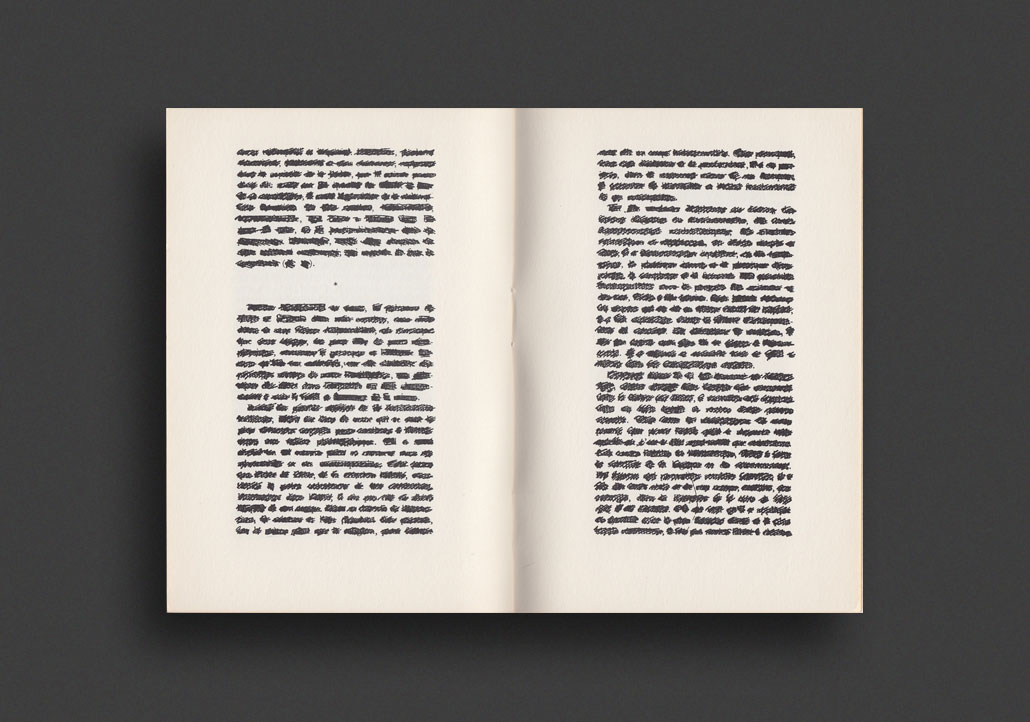
Rare 1975 edition of the mysterious artist's book and "Fluxus" classic conceived in 1971 by Roland Topor. All sentences were scratched, making this "Fluxus" book unreadable and therefore "unsaleable".
In 1971, the artist was talking with publisher Jaco Groot in a Paris cafe. The conversation was about illegible books. "I made a book like that," said Topor, "tomorrow, same time, same cafe, I'll bring it." When Groot saw the book the next day, he said to Topor's stupid astonishment: "We'll publish it!"
Three years after, Topor was interviewed by Adriaan van Dis in his book program. Van Dis handed Topor the illegible book and asked him to read a piece. Topor, unprepared for this, spontaneously put a hand to his mouth and began to read, muttering and incomprehensible.
Roland Topor (1938—1997) was one of the most unique and versatile French artists of the second half of the 20th century, working prolifically as a provocative and spirited illustrator, author, humorist, satirist, poet, painter, performer, sculptor, playwright, film and TV writer, filmmaker and actor, and much more. A founder of the Panic Movement, an art collective formed by Fernando Arrabal, Alejandro Jodorowsky, and Roland Topor in Paris in 1962, Topor was known for the surreal and absurdist nature of his work.
Very Good copy with edge tanning.
1978, French
Softcover, 80 pages, 9.5 x 14.5 cm
1st Edition, Out of print title / used / fine
Published by
Chez Yves Rivière / Paris
$150.00 - Out of stock
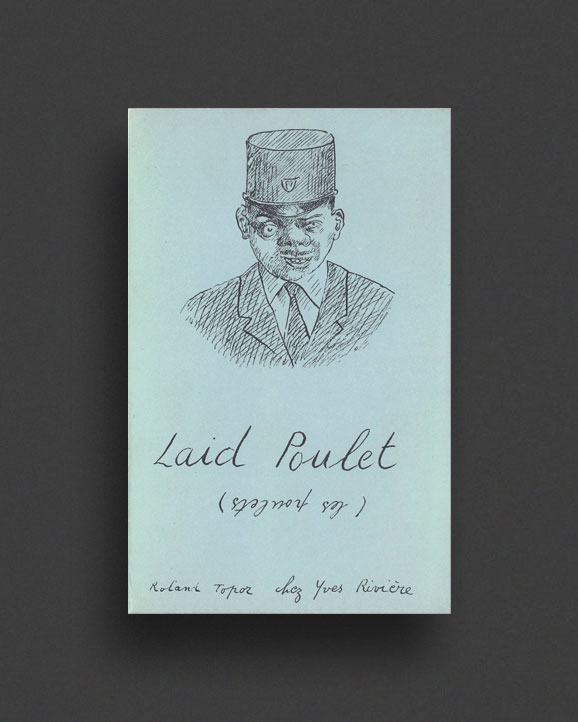
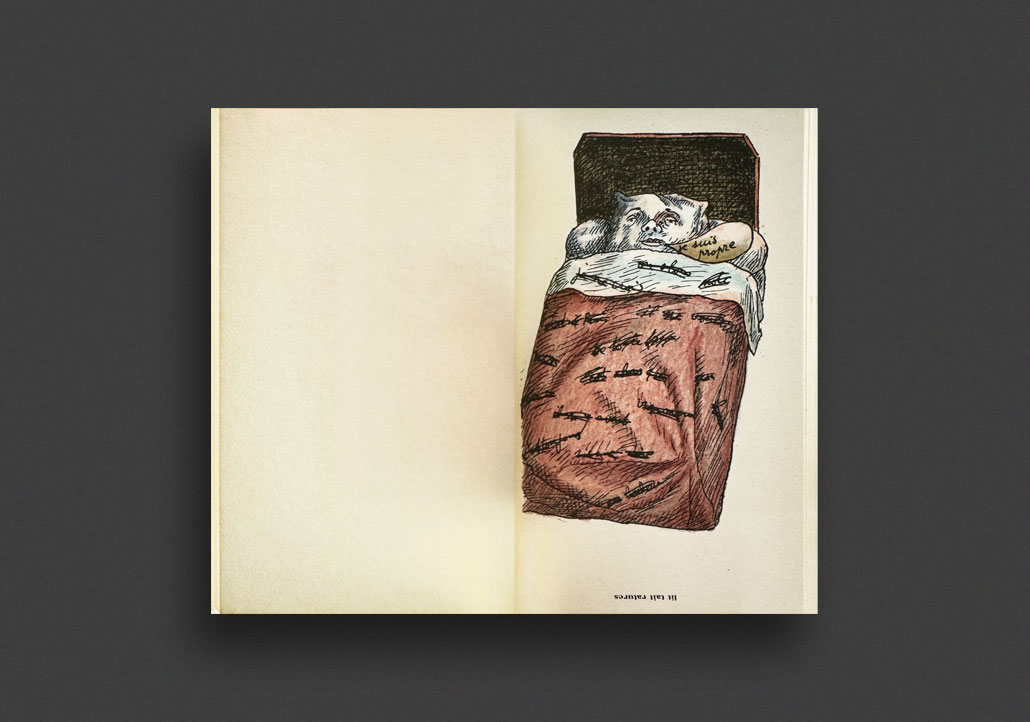
Very rare first (only) 1978 edition of Roland Topor's artist book, Laid Poulet, a unique book of illustrated oblique absurdist rebuses, beautifully lithograph printed on the presses of the Arte printing company (Adrien Maeght) with the legendary Yves Riviere and filled with Topor's colourful illustrations made specifically for this publication. Published by Chez Yves Rivière, Paris. Edition of 1950 copies, after an initial 50 numbered and signed.
Roland Topor (1938—1997) was one of the most unique and versatile French artists of the second half of the 20th century, working prolifically as a provocative and spirited illustrator, author, humorist, satirist, poet, painter, performer, sculptor, playwright, film and TV writer, filmmaker and actor, and much more. A founder of the Panic Movement, an art collective formed by Fernando Arrabal, Alejandro Jodorowsky, and Roland Topor in Paris in 1962, Topor was known for the surreal and absurdist nature of his work.
Fine copy with light tanning.
1996, English
Softcover, 176 pages, 23 x 21 cm
1st Edition, Out of print title / used / good
Published by
Atlas Press / London
$90.00 - Out of stock
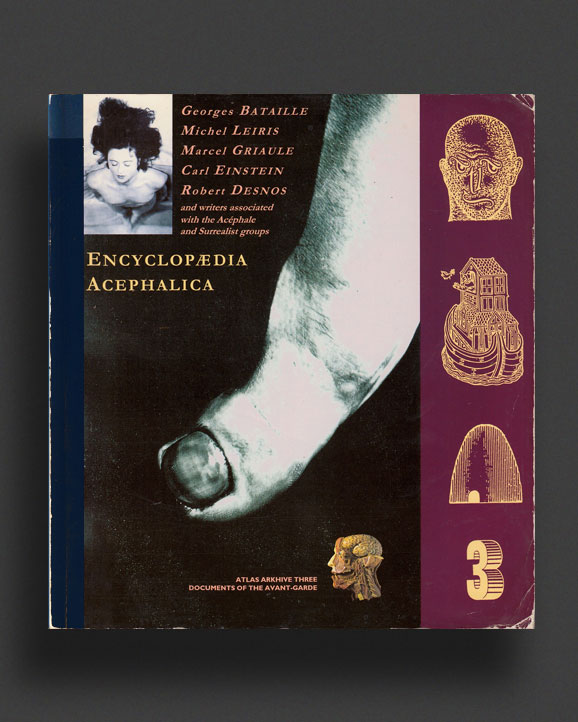
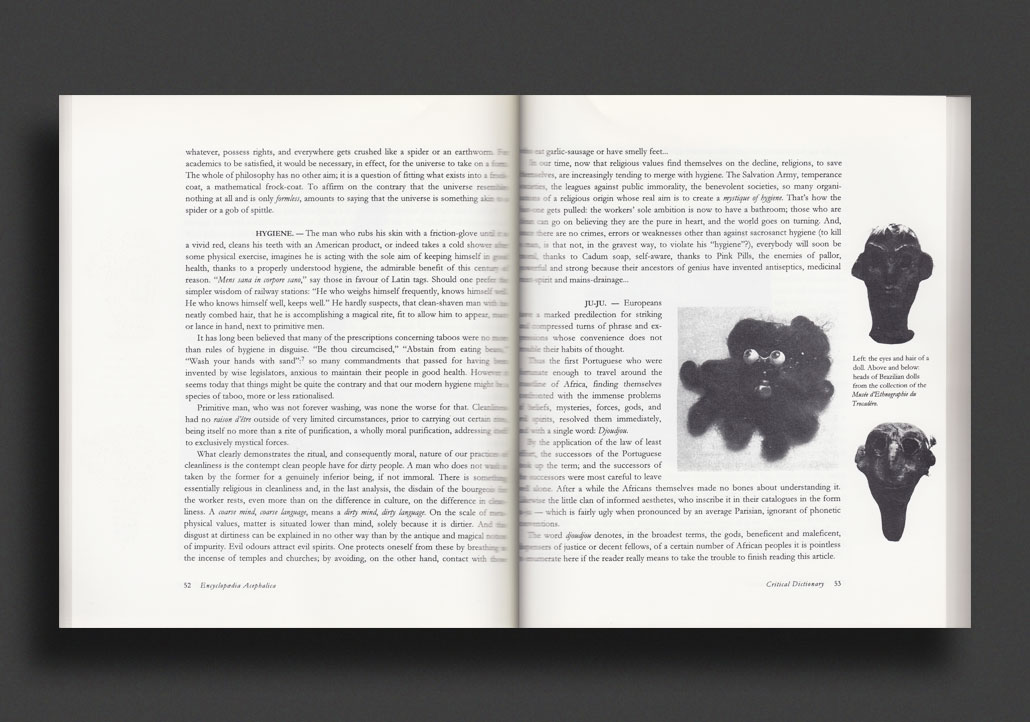
First edition of the incredible and sadly long out-of-print Encyclopedia Acephalica, published by Atlas Press in 1996 as part of their mighty Atlas Arkhive : Documents of the Avant Garde series.
Bataille’s thought is complex, and his books make few concessions to the reader. The first series of texts here, however, were written for a wider audience by Bataille and his friends, in the form of a Critical Dictionary, and they provide a witty, poetic and concise introduction to his ideas. The Dictionary appeared in the magazine edited by Bataille, Documents, in the early 1930s, and includes entries from prominent ethnologists and cultural commentators of the day. The second series of texts here, the Da Costa Encyclopédique was published anonymously after the liberation of Paris in 1947 by members of the Acéphale group and writers associated with the Surrealists. Both cover the essential concepts of Bataille and his associates: sacred sociology; scatology, death and the erotic; base materialism; the aesthetics of the formless; sacrifice, the festival and the politics of the tumult etc: a new description of the limits of being human. Humour, albeit, sardonic, is not absent from these remarkable redefinitions of the most heterogeneous objects or ideas: Camel, Church, Dust, Museum, Spittle, Skyscraper, Threshold, Work – to name but a few.
While the Documents group was celebrated for joining together artists, authors, sociologists and ethnologists (among the most important of their time) in a literary and philosophical project, the Acéphale group was more mysterious. Until recently even its membership was only vaguely known, and its activities remained secret (these are explored in detail for the first time in English in The Sacred Conspiracy, published by Atlas Press, also available at World Food Books). The origins of the Da Costa only became known in 1993, the present volume revealed for the first time its principal compilers: Robert Lebel, Isabelle Waldberg and Marcel Duchamp, but the identity of the authors of a large part of it is still unknown.
Texts by Georges Bataille, Michel Leiris, Marcel Griaule, Carl Einstein, Robert Desnos and writers associated with the Acéphale and Surrealist groups.
Introduced by Alastair Brotchie. Translated by Iain White, Dominic Faccini, Annette Michelson, John Harman, Alexis Lykiard.
Good—Very Good copy, with edge wear to covers and corners, otherwise VG throughout. No spine creasing.
1994, English
Softcover, 236 pages, 23 x 15 cm
1st Edition, Out of print title / used / fine
Published by
Routledge / London
$80.00 - Out of stock
Scarce first 1994 edition of The Female Grotesque by Mary Russo, published by Routledge and long out-of-print.
The cultural associations surrounding the grotesque are deeply embedded in Western consciousness. But what happens when we consider the grotesque from the perspective of gender? Mary Russo explores the idea of the "female grotesque" by embracing a wide array of theoretical, visual, literary, auto-biographical, and performance texts. The "female grotesque" can be found everywhere around-and even above- us, from the "aerial" sublime of Amelia Earhart to the provocative films of Ulrike Ottinger. Emphasizing the relationship between gender and the grotesque, Russo argues that the "female grotesque" is less a category than an operation through which genders and identities are both constituted and de- constituted, excluded or not. Drawing upon Bakhtin and Kristeva, Freud and Žižek, Russo traces the salient connection between abjection, the uncannny, and the grotesque. Exploring the double logic of the grotesque in the works of Angela Carter, David Cronenberg, and Georges du Maurier's Trilby, Mary Russo illuminates the grotesque as a process through which differently gendered bodies are deployed in provocative, new, and possibly transformative ways. The Female Grotesque proposes a new understanding of excess and transgres- sion in the gendered world of Western culture.
Near Fine copy.