World Food Books' programme is largely produced on Kulin Nation land. We acknowledge the Wurundjeri people of the Kulin Nation as the first and continuing custodians of this land, and pay respect to their Elders past, present, and emerging.
World Food Books is an arts and special interests bookshop in Naarm / Melbourne. Founded in 2010, World Food Books is devoted to the presentation of a rotating, hand-selection of international art, design, literary and counterculture publications with an emphasis on the anti-traditional, the experimental, the avant-garde, the heretic, the marginal.
Presenting new titles alongside rare and out-of-print books, catalogues and journals spanning the fields of modern and contemporary art, design, photography, illustration, film, literature, poetry, cultural theory, philosophy, sexuality, popular and underground culture in its many radical forms, World Food Books wishes to encourage adventurous, thoughtful and open-minded reading, looking, writing, and exchange of publishing and ideas, both current and historical.
As well as our bookshop, located in Melbourne's historical Nicholas Building, all of our inventory is available internationally via our online mail-order service.
World Food Books semi-regularly co-ordinates "Occasions", a programme of exhibits and events at the bookshop and in partnership with other hosts (such as museums and art galleries) that develop out of the activities, relationships and content of the bookshop itself.
World Food Books
The Nicholas Building
37 Swanston Street
Room 5, Level 6
Melbourne 3000
Australia
SHOP HOURS:
Thu–Fri 12–6, Sat 12–5
WEB-SHOP OPEN 24/7
World Food Books
Postal Address:
PO Box 435
Flinders Lane
Victoria 8009
Australia
Art
Theory / Essay
Architecture / Interior
Graphic Design / Typography
Photography
Fashion
Eros
LGBTQ+
Fiction / Poetry
Weird / Speculative / Science Fiction / Horror
Transgressive / Visceral / Abject
Symbolism / Decadence / Fin de siècle
Film / Video
Painting
Sculpture / Installation
Performance / Dance / Theater
Drawing
Sound / Music
Curatorial
Group Shows / Collections
Periodicals
Out-of-print / Rare
Posters / Ephemera / Discs
Signed Books
World Food Books Gift Voucher
World Food Book Bag
Australian Art
Australian Fiction
Australian Science Fiction / Speculative Fiction
Australian Poetry
Australian Photography
Japanese Photography
Conceptual Art
Minimal Art
Dada
'Pataphysics / Oulipo
Fluxus
Concrete Poetry
Pop Art
Surrealism
Arte Povera
Arte Informale / Haute Pâte / Tachism
Nouveau Réalisme / Zero / Kinetic
Situationism / Lettrism
Collage / Mail Art / Xerox Art
Art Brut / Folk / Visionary / Fantastic
Illustration / Graphic Art / Bandes Dessinées
Furniture
Italian Radical Design / Postmodernism
Textiles
Ceramics / Glass
Counterculture
Protest / Revolt
Philosophy
Psychoanalysis
Anthropology
Anarchism
Socialism / Anarchism / Communism / Capitalism
Literary Theory / Semiotics / Language
Feminism / Women's Studies
Gender Studies / Sexuality
Anthropology
Fetishism / BDSM
Drugs / Psychedelia
Crime / Violence
Animal Rights / Veganism
Occult / Esoterica
Ecology / Earth / Alternative Living
Whole Earth / Crafts
All prices in AUD (Australian dollars)
Pick-Ups
Pick-up orders can be collected in our bookshop during opening hours after order date. Please collect any Pick-up orders within 2 weeks of ordering as we have limited storage space. Orders will be released back into stock if not collected within this time. No refunds can be made for pick-ups left un-collected. If you cannot make it in to the bookshop in this time-frame, please choose postage option.
Return Policy
All sales are final. We do accept returns (for refund or exchange) for items received in error. All our orders are packed with special care using heavy-duty padding and cardboard book-mailers or bubble mailers (for smaller books), using reinforcement where required. We cannot take responsibility for any lost, stolen or damaged parcels.
Insurance
Should you wish to insure your package, please email us directly after placing your order and we can organise this at a small extra expense. Although all standard/express tracked packages are very safe and dependable, we cannot take responsibility for any lost, stolen or damaged parcels. We recommend insurance on valuable orders.
Interested in selling your old books, catalogues, journals, magazines, comics, fanzines, ephemera? We are always looking for interesting, unusual and out-of-print books to buy. We only buy books in our fields of interest and specialty, and that we feel we can resell.
We base these prices on desirability, market value, in-print prices, condition and our current stock levels. We offer cash, store credit, and can take stock on consignment. All
about 25% of the price we expect to get when we sell them, or 30% in store credit. We base these prices on desirability, market value, in-print prices, condition and our current stock levels.
Sell your books any day of the week. You can drop them off and return later. If you have a lot of books, we can visit your Sydney home.
We buy books that we feel we can resell. We offer about 25 % of the price we expect to get when we sell them, or 30% in store credit. We base these prices on desirability, market value, in-print prices, condition and our current stock levels.
Philadelphia Wireman
03 August - 01 September, 2018
World Food Books is proud to announce our next Occasion, the first presentation of sculptures by Philadelphia Wireman in Australia.
The Philadelphia Wireman sculptures were found abandoned in an alley off Philadelphia’s South Street on trash night in 1982. Their discovery in a rapidly-changing neighbourhood undergoing extensive renovation, compounded with the failure of all attempts to locate the artist, suggests that the works may have been discarded after the maker’s death. Dubbed the "Philadelphia Wireman" during the first exhibition of this work, in 1985, the maker’s name, age, ethnicity, and even gender remain uncertain. The entire collection totals approximately 1200 pieces, all intricately bound together with tightly-wound heavy-gauge wire (along with a few small, abstract marker drawings, reminiscent both of Mark Tobey and J.B. Murry). The dense construction of the work, despite a modest range of scale and materials, is singularly obsessive and disciplined in design: a wire armature or exoskeleton firmly binds a bricolage of found objects including plastic, glass, food packaging, umbrella parts, tape, rubber, batteries, pens, leather, reflectors, nuts and bolts, nails, foil, coins, toys, watches, eyeglasses, tools, and jewellery.
Heavy with associations—anthropomorphic, zoomorphic, and socio-cultural responses to wrapped detritus—the totemic sculptures by Philadelphia Wireman have been discussed in the context of work created to fulfil the shamanistic needs of alternative religions in American culture. Curators, collectors, and critics have variously compared certain pieces to sculpture from Classical antiquity, Native American medicine bundles, African-American memory jugs, and African fetish objects. Reflecting the artist’s prolific and incredibly focused scavenging impulse, and despite—or perhaps enhanced by—their anonymity, these enigmatic objects function as urban artefacts and arbiters of power, though their origin and purpose is unknown. Philadelphia Wireman, whatever their identity, possessed an astonishing ability to isolate and communicate the concepts of power and energy through the selection and transformation of ordinary materials. Over the course of the past two decades, this collection has come to be regarded as an important discovery in the field of self-taught art and vernacular art.
Presented in collaboration with Fleisher-Ollman Gallery, Philadelphia, and Robert Heald, Wellington.
Susan Te Kahurangi King
02 February - 10 March, 2018
Susan Te Kahurangi King (24 February 1951 - ) has been a confident and prolific artist since she was a young child, drawing with readily available materials - pencils, ballpoint pens and felt-tip markers, on whatever paper is at hand. Between the ages of four and six Susan slowly ceased verbal communication. Her grandparents William and Myrtle Murphy had developed a special bond with Susan so they took on caring responsibilities for extended periods. Myrtle began informally archiving her work, carefully collecting and storing the drawings and compiling scrapbooks. No drawing was insignificant; every scrap of paper was kept. The King family are now the custodians of a vast collection containing over 7000 individual works, from tiny scraps of paper through to 5 meter long rolls.
The scrapbooks and diaries reveal Myrtle to be a woman of great patience and compassion, seeking to understand a child who was not always behaving as expected. She encouraged Susan to be observant, to explore her environment and absorb all the sights and sounds. Myrtle would show Susan’s drawings to friends and people in her community that she had dealings with, such as shopkeepers and postal workers, but this was not simply a case of a grandmother’s bias. She recognised that Susan had developed a sophisticated and unique visual language and sincerely believed that her art deserved serious attention.
This was an unorthodox attitude for the time. To provide some context, Jean Dubuffet coined the term Art Brut in 1945 to describe work created by self-taught artists – specifically residents of psychiatric institutions and those he considered to be visionaries or eccentrics. In 1972 Roger Cardinal extended this concept by adopting the term Outsider Art to describe work made by non-academically trained artists operating outside of mainstream art networks through choice or circumstance. Susan was born in Te Aroha, New Zealand in 1951, far from the artistic hubs of Paris and London that Dubuffet and Cardinal operated in. That Myrtle fêted Susan as a self-taught artist who deserved to be taken seriously shows how progressive her attitudes were.
Susan’s parents Doug and Dawn were also progressive. Over the years they had consulted numerous health practitioners about Susan’s condition, as the medical establishment could not provide an explanation as to why she had lapsed into silence. Dawn educated herself in the field of homeopathy and went on to treat all twelve of her children using these principles – basing prescriptions on her observations of their physical, mental and emotional state.
Doug was a linguist with an interest in philosophy who devoted what little spare time he had to studying Maori language and culture. To some extent their willingness to explore the fringes of the mainstream made them outsiders too but it was their commitment to living with integrity and their respect for individuality that ensured Susan’s creativity was always encouraged.
Even though Susan’s family supported her artistic pursuits, some staff in schools and hospitals saw it as an impediment to her assimilation into the community and discouraged it in a variety of ways. Her family was not always aware of this and therefore did not fully understand why Susan stopped drawing in the early 1990s. However, rather than dwell on the challenges that Susan faced in pursuit of her artistic practice, they prefer to highlight her achievements. In 2008 Susan began drawing again in earnest, after an almost 20 year interruption, and her work is now shown in galleries around the world.
Susan grew up without television and has been heavily influenced by the comics she read as a child. She is absolutely fearless in the appropriation of recognizable characters, such as Donald Duck and Mickey Mouse, in her work. She twists their limbs, contorts their faces, compresses them together, blends them into complex patterned backgrounds - always imbuing them with an incredible energy. Although Susan often used pop culture characters in her work they are not naive or childlike. These are drawings by a brilliant self-taught artist who has been creating exceptional work for decades without an audience in mind.
Mladen Stilinović
"Various Works 1986 - 1999"
02 February 16 - September 10, 2016
Various works 1986 - 1999, from two houses, from the collections of John Nixon, Sue Cramer, Kerrie Poliness, Peter Haffenden and Phoebe Haffenden.
Including: Geometry of Cakes (various shelves), 1993; Poor People’s Law (black and white plate), 1993; White Absence (glasses, ruler, set square, silver spoon, silver ladel with skin photograph and wooden cubes), 1990-1996; Exploitation of the Dead (grey and red star painting, wooden painting, black spoon with red table, red plate), 1984-1990; Money and Zeros (zero tie, paintings made for friends in Australia (Sue, John, Kerrie), numbers painting), 1991-1992; Words - Slogans (various t-shirts) - “they talk about the death of art...help! someone is trying to kill me”, “my sweet little lamb”, “work is a disease - Karl Marx”; Various artist books, catalogues, monographs, videos; Poster from exhibition Insulting Anarchy; "Circular" Croatian - Australian edition; Artist book by Vlado Martek (Dostoyevsky); more.
Thanks to Mladen Stilinović and Branka Stipančić.
Jonathan Walker
Always Will Need To Wear Winter Shirt Blue + Ochre Small Check Pattern
21 August - 21 September, 2015
Untitled
I am not a great reader of poetry but I always return to the work of Melbourne poet, Vincent Buckley (1925- 1988). Perhaps I find his most tantalising piece to be not a finished poem but a fragment left on a scrap of paper discovered on his desk after the poet’s death.
The poetry gathers like oil
In the word-core, and spreads
It has its music meet,
Its music is in movement.
This fragment is more the shell left behind from a volatile thought than a finished poem. I find the last two lines honest but awkward whereas the first two lines work like an arrow. Most likely he could not find a resolution so it was left. Still, in its present form, it remains an eloquent testimony to the ultimate failure of a medium to express mobile thought and sensation, in Buckley’s case, through verbal language. It’s an important matter because this is something all artists have to deal with regardless of the medium.
I have never written a poem, however, I am forever copying fragments from books on paper scraps in a vain effort to fix certain notions in my head. At first, they function as bookmarks that are sometimes returned to when I open the book. But before long, as they accumulate, they fall out littering the table interspersed with A4 photocopies, bills, books and medications.
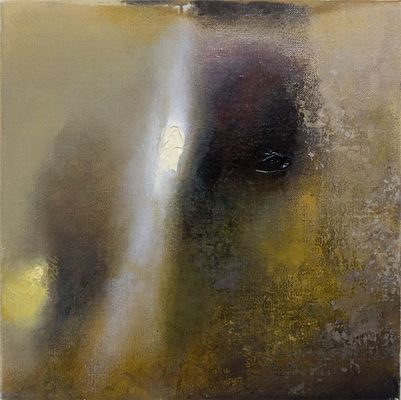
To return to Buckley’s fragment, the first two lines very much evoke how I paint nowadays. As you age, detail diminishes and patches of light become more luminous and float. I feel the most honest way of dealing with this is by smearing the oil paint on the canvas with the fingers and working close-up, blind. Only if the patches coalesce into an approaching image can the work gain a life.
-
Jonathan Walker was born in Melbourne, Australia and brought up on a dairy farm in Gippsland. In the 1970’s he studied painting at RMIT and won the Harold Wright Scholarship to the British Museum, London. During the 1980’s he exhibited at Pinacotheca Gallery, Richmond and had work shown at the NGV and Heidi City Art Gallery. Over the same period he designed the cover for the “Epigenesi” LP by Giancarlo Toniutti, Italy and conducted a mail exchange work with Achim Wollscheid, Germany. The work with artists through the post resulted in an article published in the bicentenary issue of Art and Australia 1988. He showed in artist run spaces such as WestSpace in the 90’s and 2000’s, and until 2012, taught painting at Victoria University, which is where we (Colleen Ahern and Lisa Radford) as organisers of the exhibition, among many others, had the privilege of being his student.
Walker’s knowledge was imparted to students through the careful selection of music, literature, and artists found in books that he himself had ordered for the library. Walker’s strategy was the generosity of sharing his vast knowledge with references specific to each student and their context.
Walker’s paintings share a similar focus and intimacy.
This exhibition presents a small selection of recent paintings alongside a publication that includes Walker’s writing. Observational and analytical, Walker’s work is a type of material notation — the time of day, colour and how it is blended, the both specific and fleeting location of a reflection on lino or the question of whether a chair leg should be included in a painting.
Please join us on Friday August 21 between 6-8pm to celebrate the opening of the exhibition.
Curated by Colleen Ahern and Lisa Radford.
B. Wurtz
Curated by Nic Tammens
March 26 - April 4, 2015
B.Wurtz works from a basement studio in his home on Manhattan’s Lower East Side.
This local fact is attested to by the plastic shopping bags and newsprint circulars that appear in his work. As formal objects, they don’t make loud claims about their origins but nonetheless transmit street addresses and places of business from the bottom of this long thin island. Like plenty of artists, Wurtz is affected by what is local and what is consumed. His work is underpinned by this ethic. It often speaks from a neighborhood or reads like the contents of a hamper:
“BLACK PLUMS $1.29 lb.”
“Food Bazaar”
“USDA Whole Pork Shoulder Picnic 99c lb.”
“RITE AID Pharmacy, with us it’s personal.”
“H. Brickman & Sons.”
“Sweet Yams 59c lb."
Most of the work in this exhibition was made while the artist was in residence at Dieu Donne, a workshop dedicated to paper craft in Midtown. Here Wurtz fabricated assemblages with paper and objects that are relatively lightweight, with the intention that they would be easily transportable to Australia. This consideration isn’t absolute in Wurtz’s work, but was prescriptive for making the current exhibition light and cheap. Packed in two boxes, these works were sent from a USPS post office on the Lower East Side and delivered to North Melbourne by Australia Post.
Wurtz appears courtesy of Metro Pictures, New York.
Thanks to Rob Halverson, Joshua Petherick, Sari de Mallory, Matt Hinkley, Helen Johnson, Fayen d'Evie, Ask Kilmartin, Lisa Radon, Ellena Savage, Yale Union, and "Elizabeth".
John Nixon
"Archive"
December 15 - January 20, 2014
The presentation of John Nixon's archive offered a rare showcase of this extensive collection of the artist's own publications, catalogues, posters, ephemera, editions and more, from the mid 1980s onwards, alongside a selection of his artworks.
Organized by John Nixon, Joshua Petherick and Matt Hinkley.
<a href=http://wfb.public-office.info/artist/john-nixon>All titles by John Nixon
"Habitat"
at Minerva, Sydney (organised by Joshua Petherick and Matt Hinkley)
November 15 - December 20, 2014
Lupo Borgonovo, Janet Burchill & Jennifer McCamley,
Lewis Fidock, HR Giger, Piero Gilardi, Veit Laurent Kurz,
Cinzia Ruggeri, Michael E. Smith, Lucie Stahl, Daniel Weil, Wols
Press Release:
“...It contained seven objects. The slender fluted bone, surely formed for flight, surely from the wing of some large bird. Three archaic circuitboards, faced with mazes of gold. A smooth white sphere of baked clay. An age-blackened fragment of lace. A fingerlength segment of what she assumed was bone from a human wrist, grayish white, inset smoothly with the silicon shaft of a small instrument that must once have ridden flush with the surface of the skin - but the thing’s face was seared and blackened.”
William Gibson, “Count Zero”, 1986
"Autumn Projects Archive"
Curated by Liza Vasiliou
March 6 - March 15, 2014
World Food Books, in conjunction with the Virgin Australia Melbourne Fashion Festival 2014, presented the Autumn Projects archive, consisting of a selection of early examples in Australian fashion with a particular interest in collecting designers and labels from the period beginning in the 1980’s, who significantly influenced the discourse of Australian Fashion.
Curated by Liza Vasiliou, the exhibition provided a unique opportunity to view pieces by designers Anthea Crawford, Barbara Vandenberg, Geoff Liddell and labels CR Australia, Covers, Jag along with early experimental collage pieces by Prue Acton and Sally Browne’s ‘Fragments’ collection, suspended throughout the functioning World Food Books shop in Melbourne.
H.B. Peace
presented by CENTRE FOR STYLE
November 14, 2013
"Hey Blinky, you say chic, I say same"
Anon 2013
H.B. Peace is a clothing collaboration between great friends Blake Barns and Hugh Egan Westland. Their pieces explore the divergences between 'character’ and ‘personality’ in garments....etc
Special Thanks to Joshua Petherick and Matt Hinkley of WFB and Gillian Mears
and a Very Special Thank you to Audrey Thomas Hayes for her shoe collaboration.
Janet Burchill & Jennifer McCamley
"Aesthetic Suicide"
May 10 - June 8, 2013
The first of our occasional exhibitions in the World Food Books office/shop space in Melbourne, "Aesthetic Suicide" presented a body of new and older works together by artists Janet Burchill & Jennifer McCamley, including videos, prints, a wall work, and publications.
During shop open hours videos played every hour, on the hour.
2022, English
Hardcover (clothbound), 500 pages, 23.5 x 32 cm
1st Edition, Out of print title / as new
Published by
Lenz Press / Milan
$400.00 - In stock -
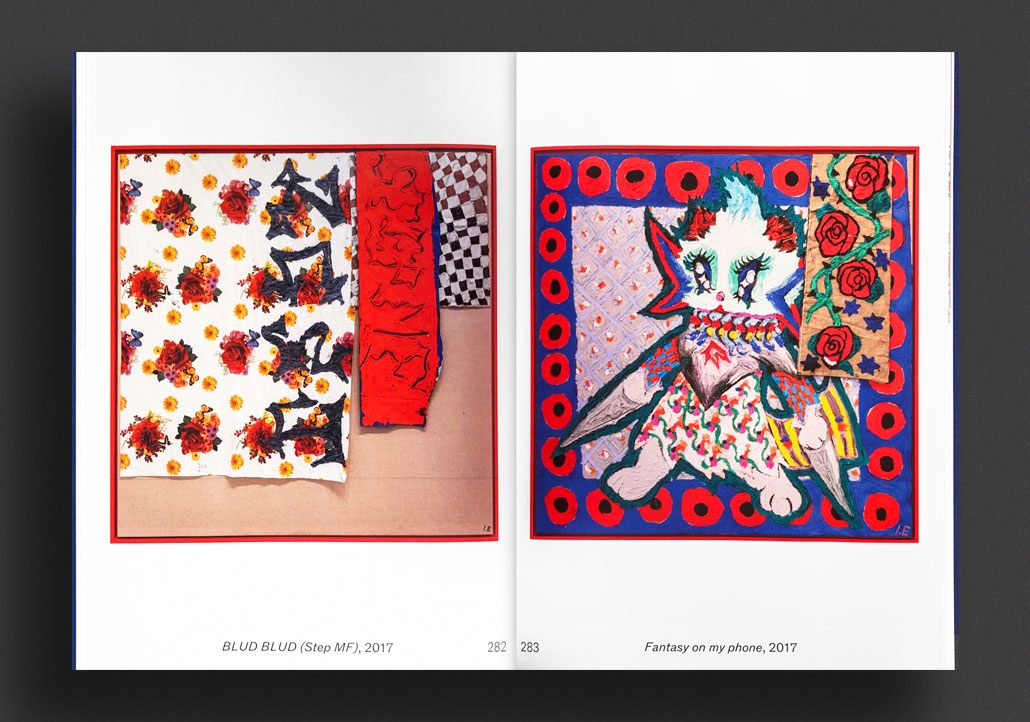
Sealed As New copy of the immediately out-of-print lavish and monumental 500 page collection of works and exhibitions of Norwegian artist Ida Ekblad from 2007–2021, accompanied by newly commissioned texts and a conversation between Ida Ekblad and Agnes Moraux. The most comprehensive book ever published on the artist.
In 500 pages with 398 illustrations, three essays and a conversation with the artist, this long-awaited first monograph on the work of Norwegian artist Ida Ekblad introduces her extensive oeuvre and documents her career from 2007 to 2021, focusing on her art and how she continually challenges it through her own exhibitions. With contributions by Daniel Baumann, Stian Grøgaard, Martha Kirszenbaum and Agnes Moraux.
Published following Ida Ekblad's exhibition FRA ÅRE TIL OVN at Kunsthalle Zürich in 2019.
Ida Ekblad (born 1980) is a Norwegian painter, sculptor, publisher, music producer, curator, and designer. She also writes. Her sources of inspiration include folk art, fashion, garbage, Samuel Beckett, youth culture, the natural forces of the elements, Gena Rowlands, traditional crafts, and so on. Everyday life is central to her work—as an imposition, but also conveying grace; as a voracious monster and a source of happiness; as a disaster and a glimmer of hope—for in Ekblad's view, everything is full of promise, including art.
Ida Ekblad studied at Central Saints Martins in London, the National Academy of Art in Oslo, and at the Mountain School of Arts in Los Angeles. She participated in the Venice Biennale (2011, 2017) as well as in numerous international group exhibitions. Ekblad has presented solo exhibitions at Kunstnernes Hus, Oslo (2021); Kunsthalle Zürich (2019); Museo Tamayo, Mexico City (2019); Kunstverein Braunschweig (2018); Kunsthaus Hamburg (2017); Bonniers Konsthall, Stockholm (2010); and Bergen Kunsthall (2010), among others.
Edited by Daniel Baumann.
Texts by Daniel Baumann, Stian Grøgaard, Martha Kirszeunbaum, Agnes Moraux.
Graphic design: Dan Solbach.
1990, Japanese
Softcover (w. dust jakcet), 114 pages, 19 x 13 cm
1st Edition, Out of print title / used / very good
Published by
Cutie / Tokyo
$150.00 - Out of stock
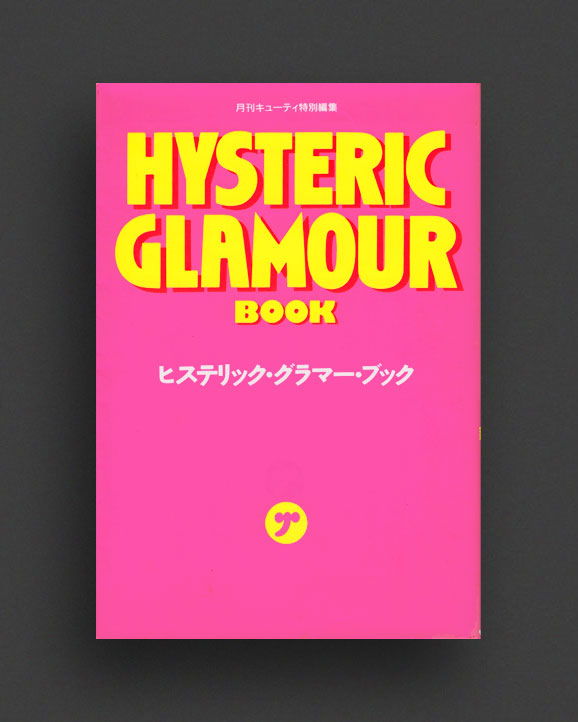
Very rare 1990 Japanese pocket bible to Hysteric Glamour! This, the original HG book, adorned with the Hysterics original "banana" logo and published by Cutie magazine in Tokyo, documents the iconic Tokyo label's history of garments and accessories, season by season from the very beginning, FW 1984 — SS 1990, alongside "Hysterical & Historical Photographs" from their archive, new 1990 photoshoots (shot by Kiyoshi Tatsukawa, Shoichi Aoki, styled by Nobuhiko Kitamura, Osamu Wataya...), "Hysteric Mini" overview, "We Love Hysteric", a Hysteric guide to Japanese shops, interviews with collaborators, behind-the-scenes, etc. 1990s Harajuku flashback at it's finest.
Hysteric Glamour is a cult Japanese fashion label created by artist Nobuhiko Kitamura in 1984. With a suggestive Warhol-esque logo of a banana and two oranges, it is not surprising that the Hysterics aesthetic was heavy with themes around 1960s mass media mod and pop culture, as well as comic books, pornography, psychedelia, bondage, acid, glam... Like 1970s Fiorucci for 1990s Harajuku. They regularly featured the work of pop artists, illustrators, music icons and photographers with visuals adorning T-shirts, denim, jackets, accessories... They also published highly acclaimed photography books, staged exhibitions, and have become synonymous with Tokyo street wear.
Near Fine copy in NF dust jacket.
1995, Japanese
Hardcover (w. dust jacket), 32 x 27 cm
1st Edition, Out of print title / used / good
Published by
Bunkasha / Japan
$100.00 - Out of stock
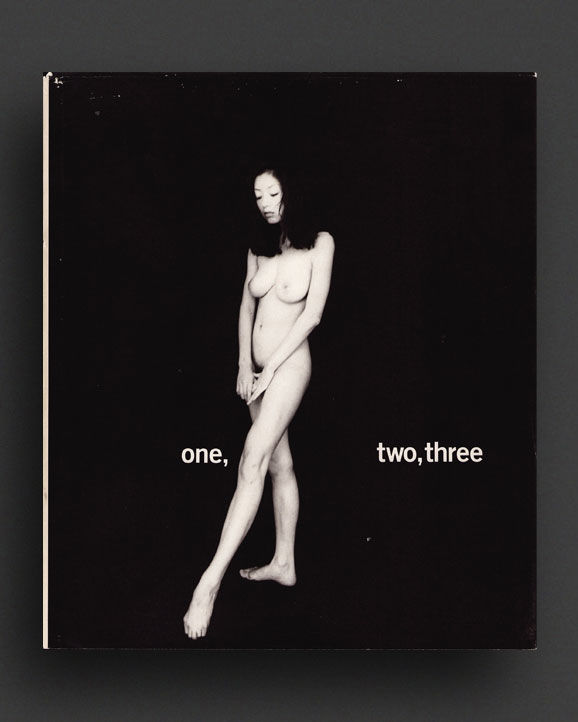
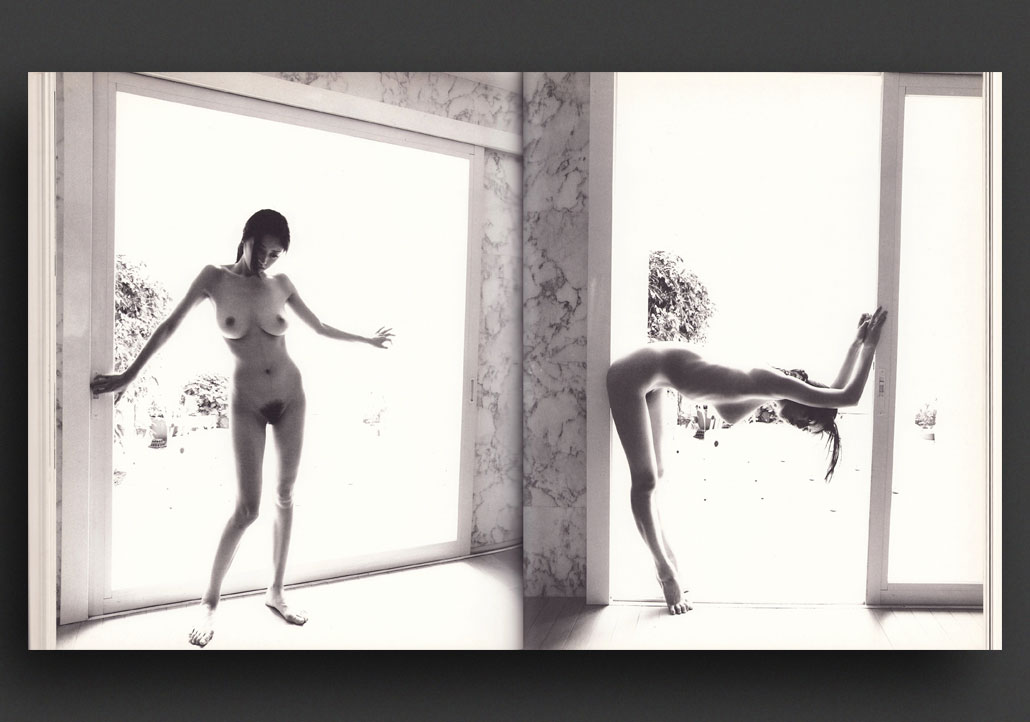
First 1995 hardcover edition of "one, two, three", a gorgeous oversized hardcover collection of nude photography by master Japanese photographer Kishin Shinoyama of award-winning actress Saki Takaoka. Takaoka was born in Kanagawa in 1972 and has appeared in many films, TV dramas, commercials, and musicals. Composed of black-and-white and colour works, this book became a hot topic in society at the time of its publication and recorded an astounding circulation of approximately 470,000 copies, which is unthinkable today. The number of sales and topicality are certainly very high, but the beauty of the photographs, and above all, the beauty of Saki Takaoka, who does not wear a single thread, can be said to be a work of art from head to toe. The atmosphere of monochrome printing is also very wonderful. A stunning book with beautiful, modern, pared back typographic design.
Very Good copy of clothbound 1st edition with Good dust jacket with wear and some chipping to spine/extremities.
1996/1997, Japanese / English
Softcover (w. dust jacket + obi), 224 pages, 30 x 30 cm
Out of print title / used / very good
Published by
Media Factory / Tokyo
$100.00 - In stock -
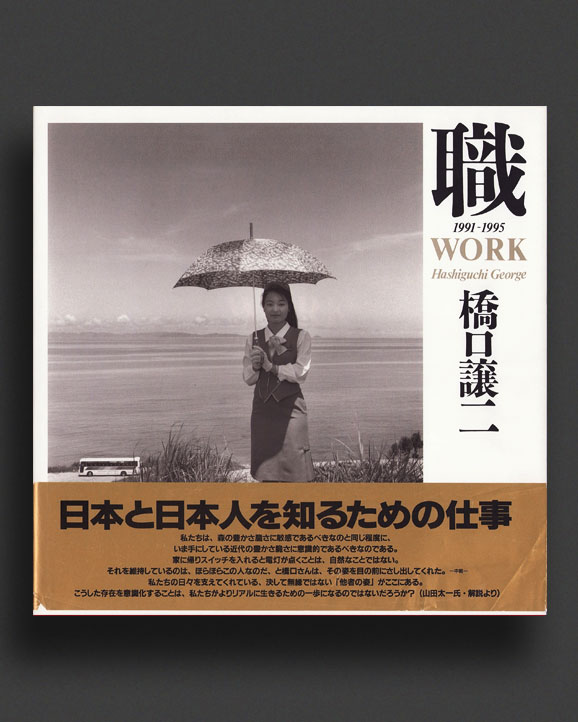
First edition, 1997 (2nd) printing of this wonderful photo book by Japanese photographer Joji "Geroge" Hashiguchi (b. born in Kagoshima in 1949), another in his acclaimed collections that also includes Seventeen's Map (1988), Father (1990) and Couples (1992) following Hashiguchi’s striking method of portraiture. "Work" is an extensive sociological typology consisting of documentary black and white portraits of Japanese people in their working environments across Japan spanning 1991—1995, from bartenders to pyrotechnicians, deep sea divers to mortuary cosmetologists, mostly shot as full-length portraits, paired with sociological data and interviews. Hashiguchi often choses two subjects from the same workplace based on age — one being older and the other younger — and the questions asked to each subject range from the length of career, current/starting salary to what the subject had for breakfast and dreams for from the future. Texts in both Japanese and English. Working as a sociological ethnographer with a survey approach, Hashiguchi produces a unique overview of Japanese society with a sense of considerable sociocultural diversity in light of stereotypic reductions of Japan as a homogeneous entity. One of his finest.
Very Good copy with VG dust jacket and average obi (creases and tears).
1997, Japanes / English
Hardcover (w. dust jacket + obi), 107 pages, 30.7 x 30.7 cm cm
1st Edition, Out of print title / used / very good
Published by
Media Factory / Tokyo
$100.00 - In stock -
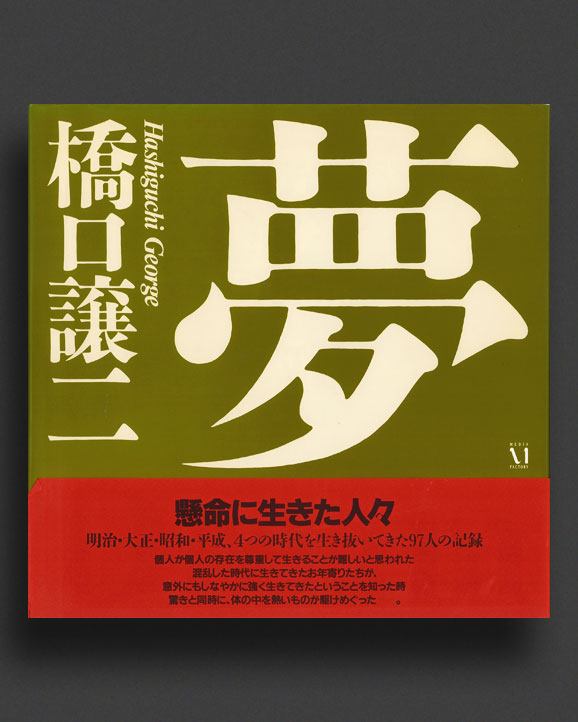
First 1997 edition of this wonderful photo book by Japanese photographer Joji "Geroge" Hashiguchi (b. born in Kagoshima in 1949), another in his acclaimed collections that also includes Seventeen's Map (1988), Father (1990) and Couples (1992) following Hashiguchi’s striking method of portraiture. "Dream" is a moving sociological typology consisting of documentary black and white portraits of Japanese people in their older years across Japan, mostly shot as full-length portraits, paired with sociological data and interviews. Texts in both Japanese and English. Working as a sociological ethnographer with a survey approach, Hashiguchi produces a unique overview of Japanese society with a sense of considerable sociocultural diversity in light of stereotypic reductions of Japan as a homogeneous entity.
This volume represents the most recent in a continuing series of photographic collections which I began with the purpose of coming to a better knowledge of Japan and the Japanese people. Previous collections included Seventeen's Map in 1988, followed by Father in 1990, Couple in 1992, and Work 1991-1995 in 1996. To compile each of these volumes, I traveled throughout Japan, making a record of the broad spectrum of people living in each region, while also recording the times I myself live in, and its scenes. This fifth volume in that series I have called Dream (Yume). When I was a child, I thought that when I reached twenty I would be an adult, and when that happened, something would change making life a bit easier to live. When I actually turned twenty, however, my body and consciousness seemed to be ruled by some heaviness that was yet different from that of my teens, and once again I thought: things will somehow work out when I become thirty. Somewhere past my mid-thirties, I finally realized something, namely, that the process of life is actually unending. When I had that realization, I began to think of the meaning and weight of those increasing years. Becoming older is generally voiced in negative terms within Japanese society, and each time I heard that, I would shake my head, thinking, "it just can't be true."—Joji "Geroge" Hashiguchi
Very Good copy with VG dust jacket and good obi (creases and tears).
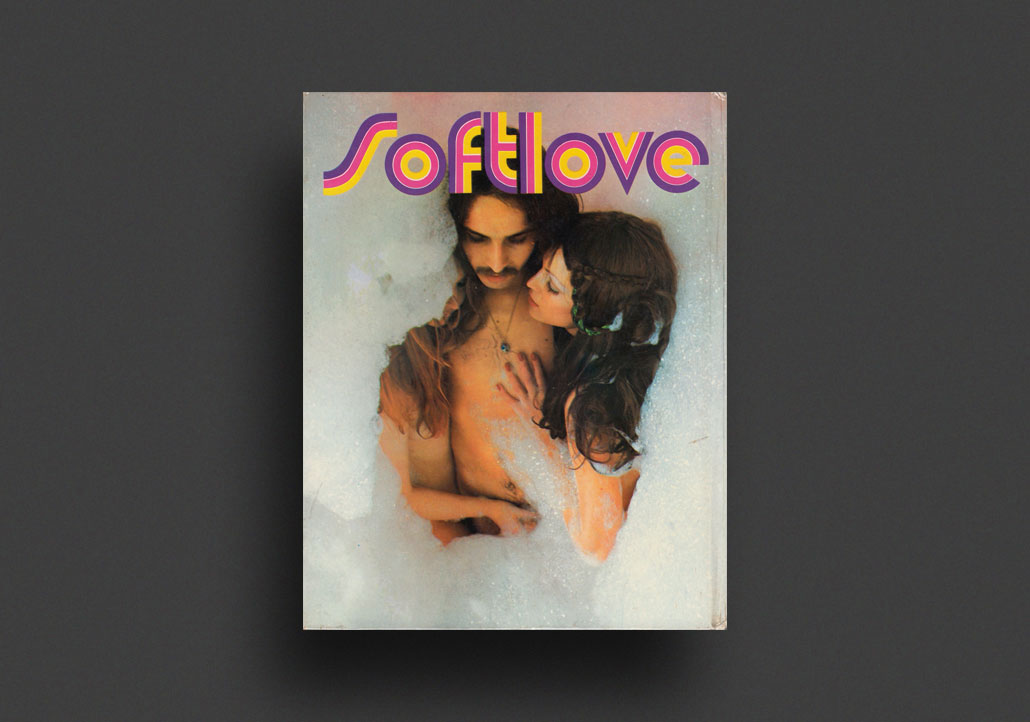
1971, German
Hardcover, 92 pages, 20.5 x 16 cm
1st Edition, Out of print title / used / good
Published by
Softpress / Frankfurt
$70.00 - Out of stock
"Alle reden vom Sex – Wir zeigen ihn" ("Everyone talks about Sex — We show it")
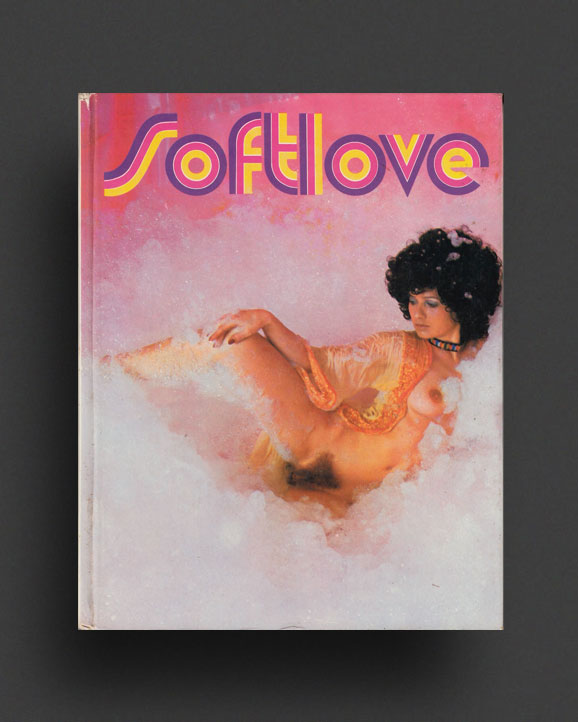
First edition of this 1971 photo book of hippie sex from the German underground press. Housed in illustrated gloss hardcover, Softlove is filled with full-bleed lush explicit colour photography, from couple to orgy, in a bubble room to a mirrored infinity room, all printed on thick paper stock in saturated 1970's colour.
Good copy with light edge wear to printed boards.
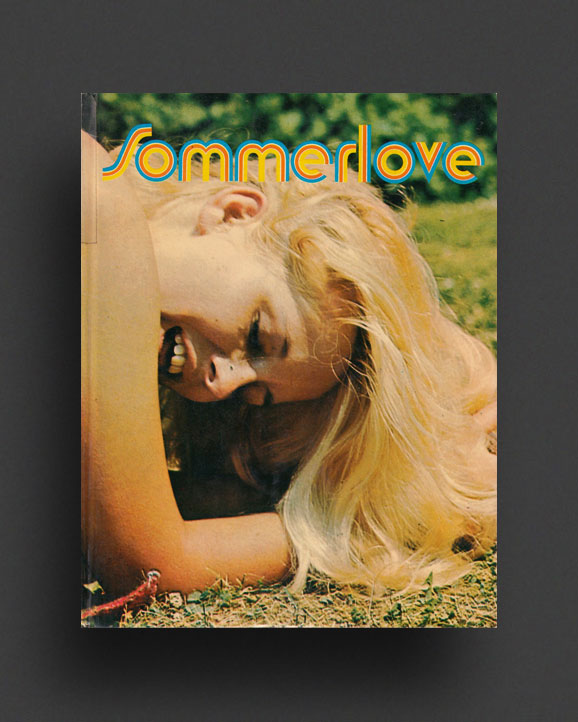
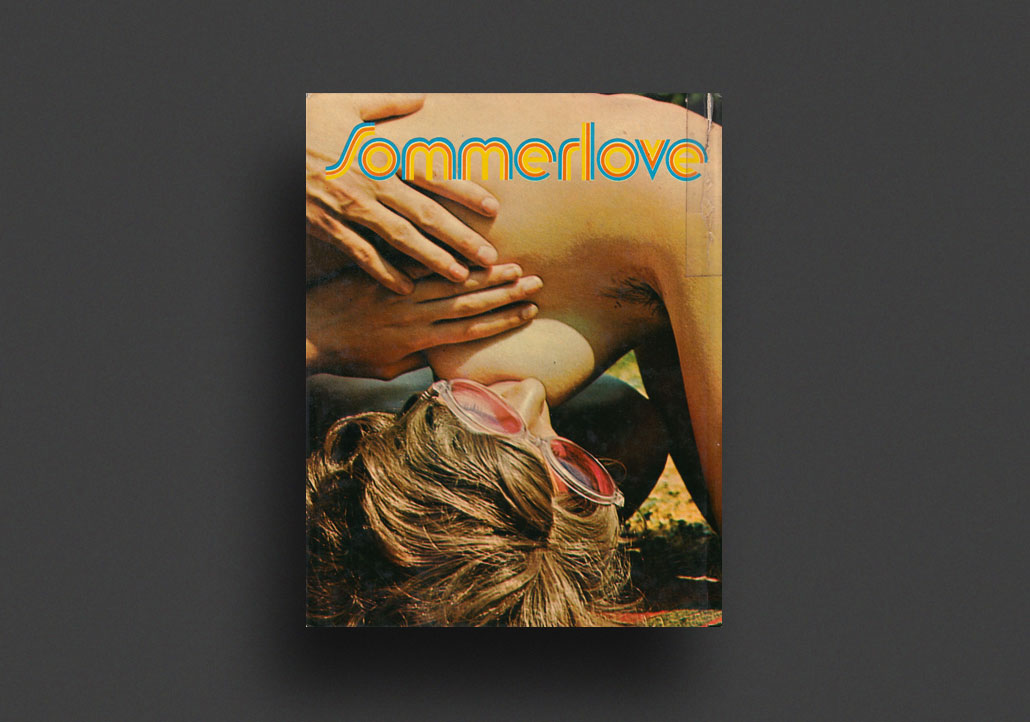
1970, German
Hardcover, 104 pages, 20.5 x 16 cm
1st Edition, Out of print title / used / good
Published by
Softpress / Frankfurt
$50.00 - Out of stock
First edition of this 1970 photo book of hippie sex from the German underground press. Housed in illustrated gloss hardcover, Sommerlove is filled with full-bleed lush explicit colour photography of an outdoor gathering without inhibition, all printed on thick paper stock in saturated 1970's colour. Sex in the sun!
Good copy with light edge wear to printed boards and a tape repaired split to the top of spine.
2013, English
Hardcover, 240 pages, 23.2 x 30 cm
1st Edition, Out of print title / used / very good
Published by
Prestel / Munich
$500.00 - In stock -
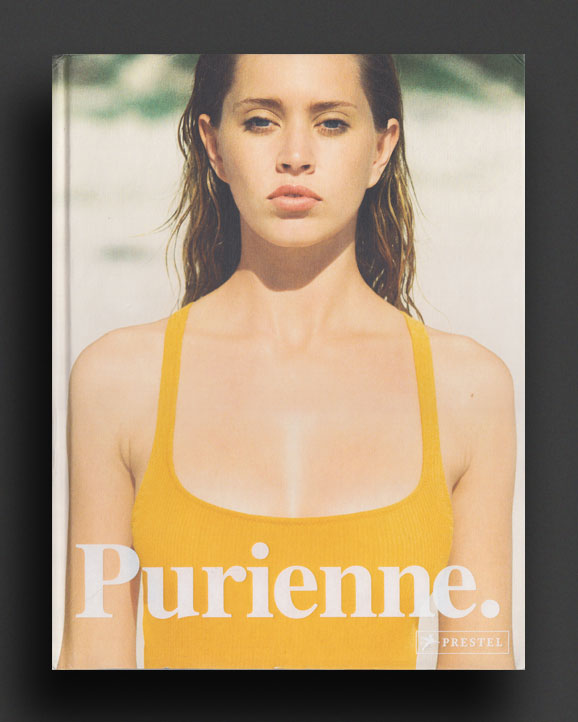
Very collectible first hardcover edition of the first book of photography by Henrik Purienne, published in 2013 and immediately out-of-print.
"Voyeuristic, sun-drenched, and natural, the photographs of fashion photographer Henrik Purienne convey a sexuality that's as nostalgic as it is au courant, at once tender and sultry." Fronted by friend and model Sonja van den Heever, his first book presents a hand-selection of over 200 pages of photographs. Shot mostly in his trademark grainy 35mm film, Purienne's soft-hued and ingeniously lit images often include scratches and other imperfections that belie the sophistication of his technique, evoking the joys of life and the natural beauty of his subject "[...] with unmade faces, hair unruly and clothing, if any, unfussy [...]" in her truest form. Featured across the pages of Lui, Purple, Playboy, and Vogue, and in campaigns for Maison Margiela and Louis Vuitton, "Purienne's images afford us immeasurable scope for desire. [...] We can see and feel the heat through his images."—Tess Martin, Krass Journal No.1
Very Good copy, interior As New, cover with bumping to top of spine and light bump to top corner, none affecting interior pages as heavy boards are overhung.
2012, English
Hardcover (w. dust jacket), 287 pages, 24 x 31.5 cm
1st Edition, Out of print title / used / very good
Published by
Skira / Milan
Rizzoli / New York
MOCA / Los Angeles
Museum of Contemporary Art / Chicago
$180.00 - In stock -
First and only edition of this incredible out-of-print book, Destroy the Picture: Painting the Void, 1949–1962 is the first book (and exhibition) to focus on one of the most significant transnational developments in contemporary abstract painting: the artist’s literal assault on the picture plane. Responding to the physical and psychological destruction wrought by World War II—especially the existential crisis resulting from the atomic bomb—artists ripped, cut, burned, and affixed objects to the canvas in lieu of paint. Destroy the Picture emphasizes this internationally shared artistic sensibility in the context of devastating global change and dynamic artistic dialogues, offering an innovative and expansive view of art making in the postwar period.
As artists from war-torn countries like Italy and Japan—including Lucio Fontana, Alberto Burri, Kazuo Shiraga, and Shozo Shimamoto—channeled their ruined surroundings into artistic form; artists throughout the world—such as Yves Klein and Niki de Saint Phalle in France, John Latham in the United Kingdom, Robert Rauschenberg and Lee Bontecou in the United States, Otto Müehl in Austria, and Manolo Millares in Spain, among others—pursued similar approaches and strategies. Destroy the Picture presents an opportunity to reconsider the profound repercussions of this remarkably coherent approach in painting, from artists’ early experiments with translating gestures into materials to their emphasis on a rupture between two and three dimensions, as well as the expansion of the painting medium to incorporate performance, assemblage, and time-based strategies. In many cases, the exhibition places the work of now-established artists back into the radical context in which it originally emerged.
Organised by Paul Schimmel, former Chief Curator of The Museum of Contemporary Art, Los Angeles, in association with the Museum of Contemporary Art Chicago, the exhibition and this remarkable accompanying hardcover catalogue mark the first time that these strategies have been considered together as a coherent mode of artistic production, expanding the scholarship on this critical moment in history. Alongside major essays by Paul Schimmel, Nicholas Cullinan, Astrid Handa-Gagnard, Shoichi Hirai, Sarah-Neel Smith, and Robert Storr, Destroy the Picture is heavily illustrated throughout with works dating 1949 and 1962 by artists from eight countries, including Lee Bontecou, Alberto Burri, Lucio Fontana, Salvatore Scarpitta, Kazuo Shiraga, Gérard Deschamps, François Dufrêne, Jean Fautrier, Adolf Frohner, Raymond Hains, Yves Klein, John Latham, Gustav Metzger, Otto Müehl, Manolo Millares, Saburo Murakami, Robert Rauschenberg, Niki de Saint Phalle, Shozo Shimamoto, Antoni Tàpies, Chiyu Uemae, Jacques Villeglé, Wolf Vostell, and Michio Yoshihara.
Very Good—Near Fine copy in Very Good—Near Fine dust-jacket.
1995, English
Softcover + 7" Flexi Disc (Sonosheet), unpaginated, 21 x 28 cm
1st Edition, Out of print title / used / very good
Published by
Primary Information / New York
$400.00 - In stock -
Rare very first (black and gold) 1995 edition, hand-assembled and limited to 800 copies!
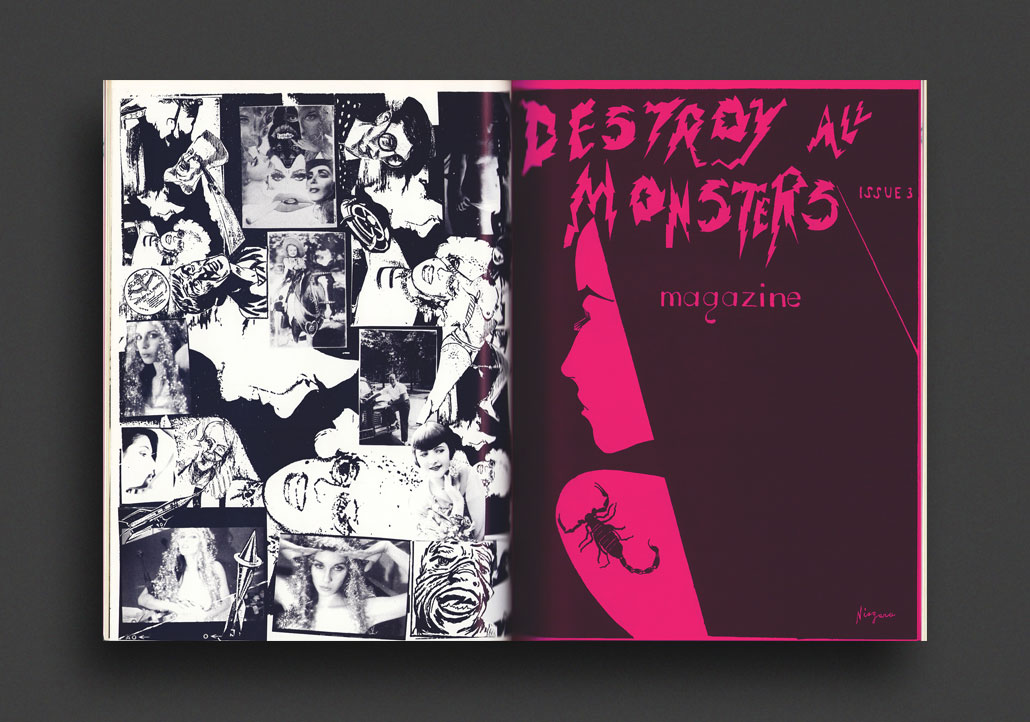
Destroy All Monsters started out as an anti-rock band: four midwestern art students — Jim Shaw, Mike Kelley, Cary Loren, and Niagara — with a mission to subvert the airwaves. Between 1975 and 1979, they produced six issues of DAM Magazine, a barrage of Kelley's perverse cartoons, Shaw and Loren's wild Xeroxed collages, and shots of the band; Niagara did a lot of the cover designs, and everything was crudely printed on cheap paper. "The images that drove us were the strange combinations of film noir, monster movies, psychedelia, thrift-shop values, and the relentless anarchy of an over-stimulated pop culture", recalls Cary Loren. This compilation is the definitive DAM document: hundreds of drawings, photos, Xeroxed artwork, collages, reviews, profiles, and personal manifestos, many works unpublished and unseen before — plus a flexi-record bound into the book (first printing and first pressing of this 1975 recording).
A total of three editions of “Geisha This” were produced and all are out-of-print. Each version was printed in different colours, with a different metallic cover and hand collated in a different sequence, containing new and different contents.
This version (the very first edition), has a cover design by Niagara printed in GOLD metallic ink on BLACK cardboard cover stock. The entire first printing was 800 copies, strikingly printed with dozen’s of multicoloured inks (fluros, metallics), silk-screened and spray-painted pages, with many paper stocks, all hand-assembled, printed, designed and edited by Cary Loren, with artwork and texts by Mike Kelley, Jim Shaw, Loren and Niagara.
Very Good copy of the first edition in black, a stunning document, complete with the brand new Flexi Disc (Sonosheet) in its first pressing.
1993, English
Softcover, 150 pages, 24 x 17 cm
1st UK Edition, Out of print title / used / very good
Published by
Sonsbeek / Arnhem
$550.00 - Out of stock
First 1993 edition of one of the great art books, by one of the great artists. This provocative, copiously illustrated catalogue by renowned American artist Mike Kelley is a meditation on Sigmund Freud's "Uncanny", and its relation to the grotesque in art and everyday life. Published to accompany the exhibition curated by Kelley as part of the "Sonsbeek 93" exhibition in Arnhem, The Netherlands, June 5 - September 26, 1993, Kelley presents (like a photo scrapbook) an arresting mix of modern and contemporary artists alongside bizarre figurative, prosthesis, animatronic, and mannequin-related imagery throughout history. Artists included : Hans Bellmer, Robert Gober, Tetsumi Kudo, Zoe Leonard, Paul McCarthy, Nayland Blake, John Miller, Bruce Nauman, Tony Oursler, Cindy Sherman, Kiki Smith, Duane Hanson, Man Ray, Guillaume Bijl, Dennis Oppenheim, Edgar Degas, Piero Manzoni, Marcel Broodthaers, Goya, Nam June Paik, Andy Warhol, Marcel Duchamp, Dorothea Lange, Thom Puckey, Charles Ray, Edward Kienholz, Martin Kippenberger, Laurie Simmons, Jeff Koons, Yayoi Kusama, Paul Thek, Mike Kelley himself, and many more. Includes Kelley's accompanying essay, "Playing with Dead Things". The exhibition took on mythical status and was re-staged in Liverpool in 2004. The Uncanny has become one of the most desired of Kelley's books.
Very Good copy with only light cover wear.
2006, English
Hardcover (debossed faux leather bound + 7"), 26 x 23 cm
600 numbered copies,
1st Edition, Out of print title / used / fine
Published by
Hysteric Glamour / Tokyo
$120.00 - In stock -
Published in 2006 by fashion brand Hysteric Glamor in a numbered edition of 600 copies, bound in padded debossed faux leather hardcover with a 7" record, "the book is a monograph of my late 1970s photographs of my friends, the avant-garde rock group Destroy All Monsters."—Sue Rynski, Detroit photographer. Described by legendary critic Lester Bangs as "anti-rock", Destroy All Monsters was an influential Detroit rock band formed in 1973 by University of Michigan art students Mike Kelley, Jim Shaw, legendary femme fatale Niagara, and filmmaker Cary Loren, existing to 1985 with shifting personnel and sporadic performances since. Performing their first concert at a comic book convention in Ann Arbor, Michigan, on New Year's Eve of 1973, the group combined elements of punk, psych, metal and noise rock with a heavy dose of experimentation and performance art, influenced as much by ESP-Disk, Sun Ra and The Velvets, as monster movies and Futurism. The cult group earned a measure of notoriety through their coveted DAM Magazine, also due to members of The Stooges and MC5 joining the band, and Sonic Youth singer/guitarist Thurston Moore compiling a three compact disc set of the group's music in 1994.
"Born in 1954, year of the birth of rock and roll, I grew up immersed in the high energy music of my hometown Detroit. This loud, physical, emotional music took hold and became a part of me."—Sue Rynski
A stunning book published by Hysteric Glamor director Nobuhiko Kitamura, with editorial direction by : Osamu Wataya, Michitaka Ota (Sokyusha), and Koichi Hara. 7" includes the tracks "Rocking the Cradle" and "Little Boyfriend" by Destroy All Monsters.
Near Fine copy.
1985, Japanese
Softcover, 260 pages, 19 x 13 cm
1st Edition, Out of print title / used / fine
Published by
Data House / Tokyo
$200.00 - Out of stock
Possibly the most fun you can cram into 260-odd pages! A now very collectible volume edited by none other than Japanese master of erotic superrealism, Hajime Sorayama, Pink Department Store is a wild book digest of visual sex — straight out of 1985! A compendium of remarkable erotic imagery packed into this one-stop look-book of kink compiled by Sorayama, all reproduced in full-colour on beautiful warm raw paper stock, designed by Hisao Iguchi. From the Tokyo sex clubs, phone-booths and toilet stalls, Shibari photography to pink film posters, x-rated manga to wildlife fornication, leather daddys to dominatrixes, Pink Department Store is a safari through graphic perversion and joyous visual innuendo. Alongside archival material and international works the book generously features an abundance of works by over 100 contemporary Japanese illustrators and photographers, including Aimei Ozaki, Harumi Yamaguchi, Takashi Nemoto, Yosuke Onishi, Suehiro Maruo, Hajime Sorayama, Mizumaru Anzai, Yokoyama Akira, Keiichi Ota, Akira Ishigaki, Kaoru Ueda, Teruhiko Yumura, Yoshiharu Ebisu, Arata Taga, to name but a few. There is also a directory list to contact them all!
Very Good—NF copy in VG original dust jacket and rarely preserved publisher's obi-strip.
1985 / 1993, Japanese
Softcover (w. acetate dust jacket and obi), 128 pages, 33 x 25 cm
1st Edition, Out of print title / used / very good
Published by
Bijutsu Shuppan-sha / Japan
$170.00 - Out of stock
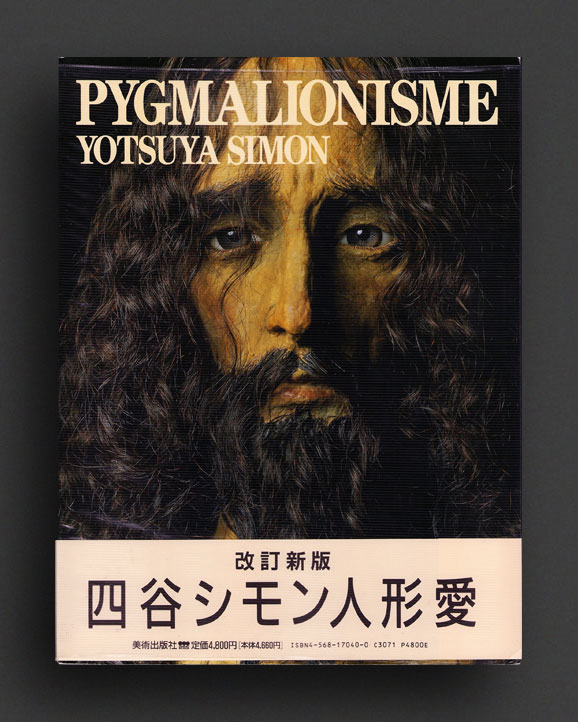
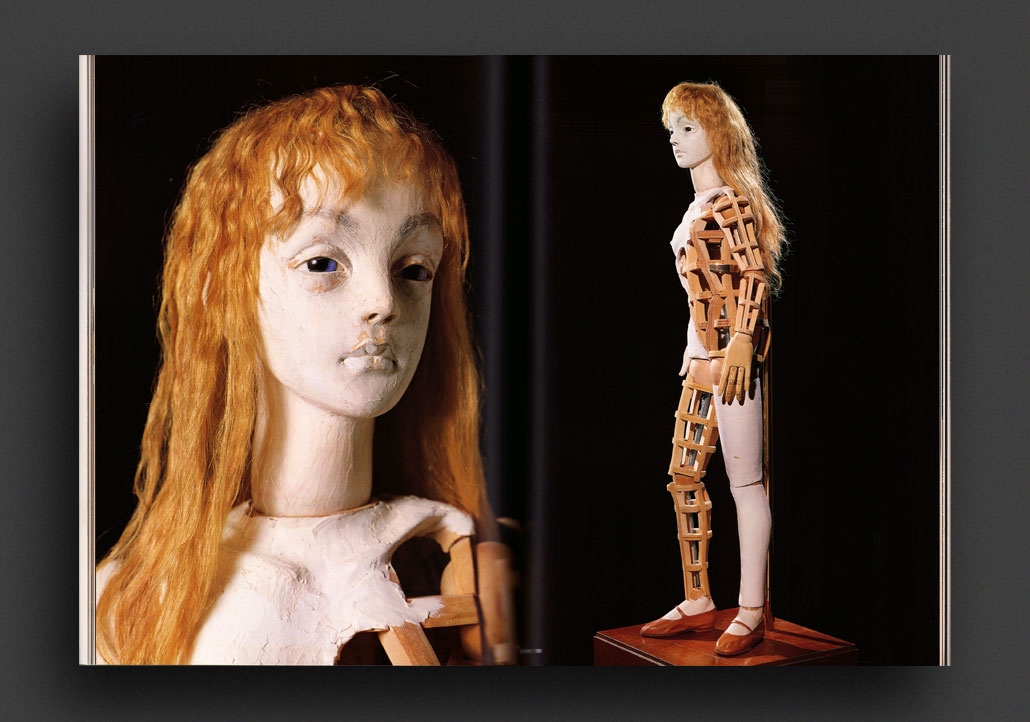
Revised 1993 edition of the incredible book of Japanese doll artist Simon Yotsuya, Doll Love / L'amour des Poupées, shot by Kishin Shinoyama, first published in 1985 by Bijutsu Shuppan-sha, Tokyo. This stunning over-sized book is the finest photographic document of Simon's dolls created throughout his career, all dramatically shot by legendary Japanese photographer, and close friend of Yotsuya, Kishin Shinoyama, profusely illustrated in full colour gloss with each doll, including various angles, details, and display cases, accompanied by a section of Japanese texts by Tatsuhiko Shibusawa, Yoshiaki Tono, Minoruyoshioka, Shuzotakiguchi, and Kunio Iwaya, illustrated in b/w with portraits of Simon Yotsuya in his studio, his drawings and graphic works. Our favourite book on this magical artist.
Simon Yotsuya (b. 1944, Tokyo) started making dolls as a child, visiting exhibitions of dolls, and reads all the books he can find on the subject. In his mid-teens he visited Puppe Kawasaki, a doll maker and animator he greaty admired, devoting himself to the craft and becoming a poor high school student. In the early '60s, while working at a jazz coffee shop in Shinjuku, Yotsuya earned the nickname "Simon" (pronounced “Simone”), after his love for singer Nina Simone. He befriends Kuniyoshi Kaneko (painter) and Junko Koshino (fashion designer) and joins in the arts and literary scene. In 1965, he discovers the work of German Surrealist Hans Bellmer through an article authored by Tatsuhiko Shibusawa in the magazine “Shinfujin”, promptly abandoning his previous methods of doll-making to find his way as an artist, incorporating ball-joints into his dolls. Thereafter he becomes an admirer of Surrealism and immerses himself in the controversial Shibusawa's litterary works. In 1965, he also goes to see Tatsumi Hijikata's Butoh Performance for the first time. In the late 60s—early 70s Yotsuya pursued a parallel career to his doll-making as an actor and member of Juro Kara's legendary underground theater company Jokyo Gekijo, Situation Theater, regularly portraying a female doll. He appears in the movie "Diary of a Shinjuku Thief" directed by Nagisa Oshima with the actors of the Situation Theater, but by 1971 he leaves the stage to concentrate on his own work. Simon exhibited at Expo 1970 in Osaka, the Tokyo Biennale in 1974 and by the end of the decade had opened his own doll-making school in Harajuku.
Tatsuhiko Shibusawa (1928—1987), the author of the influential Bellmer article (and novelist, editor, art critic, and translator of Bataille and Marquis de Sade), become a life-long friend of Yotsuya's and his most important advocate, editing the first major book of Yotsuya's work, entitled Pygmalionisme, in 1985. Devastated by Shibusawa's death in 1987, Yotsuya found it impossible to work for nearly two years. He eventually found solace in the Eastern Orthodox Church and was inspired to make a series of angels, which he dedicated to Shibusawa, and straightforward images of Christ. Having carved out his own masterful and unique form of expression, today Yotsuya enjoys international renown as the first ball-jointed doll maker in Japan.
Very Good copy with light edge wear to cover and publisher's jacket.
2023, English
Hardcover (debossed boards w. buckrum spine with cover photo-plate), 160 pages, 20 x 16 cm
2nd Ed.,
Out of print title / as new
Published by
IDEA / London
$140.00 - Out of stock
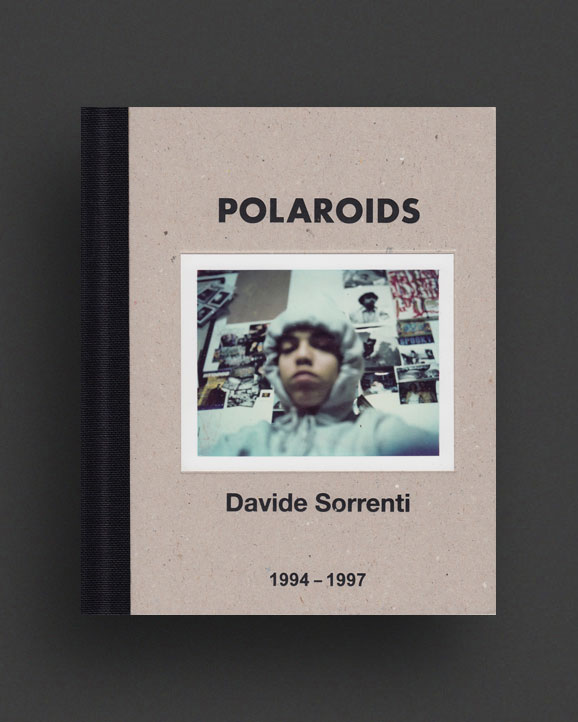
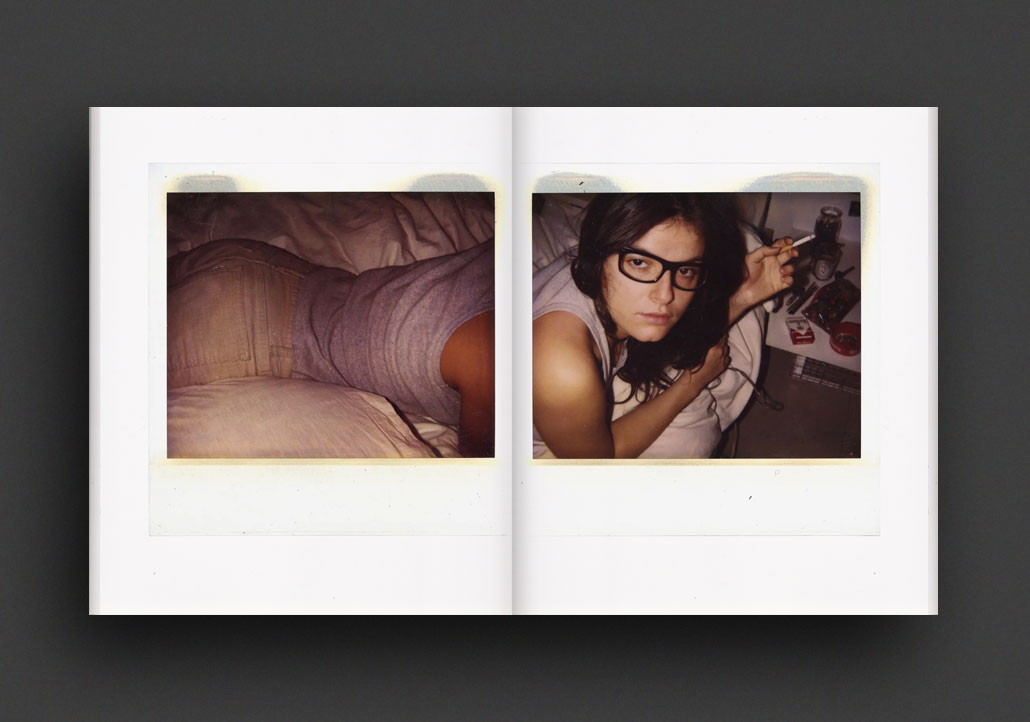
Talented and influential photographer Davide Sorrenti tragically died in 1997 at the age of just twenty leaving behind him a rich archive documenting nineties downtown New York through his extraordinary photographs, scrapbooks, graffiti drawings, tear sheets and contact sheets. Polaroids 1994-1997 is a book of instantly unforgettable Polaroid photographs taken by Davide Sorrenti between the years of 1994–1997, designed and edited by Francesca Sorrenti.
"Almost 25 years have gone by since his passing and still the love for his persona and his work lives on. While locked down this year, I was looking at his Polaroids and reminiscing about a lifetime gone. I realized that a collection of these moments should be the next book. The second book to uncover the archive of this young man, my son, who produced all these Polaroids, photographs – and the diaries and fashion work – in such a short period of time." (Francesca Sorrenti).
Raw-cut Eskaboard hardback with black buckram spine and debossed print.
As New copy of 2nd edition (1000 copies). All editions out-of-print.
1983, English
Softcover, 204 pages, 22.5 x 15 cm
1st Edition, Out of print title / used / very good
Published by
Blackwell / Cambridge
Blackwell / Oxford
$25.00 - In stock -
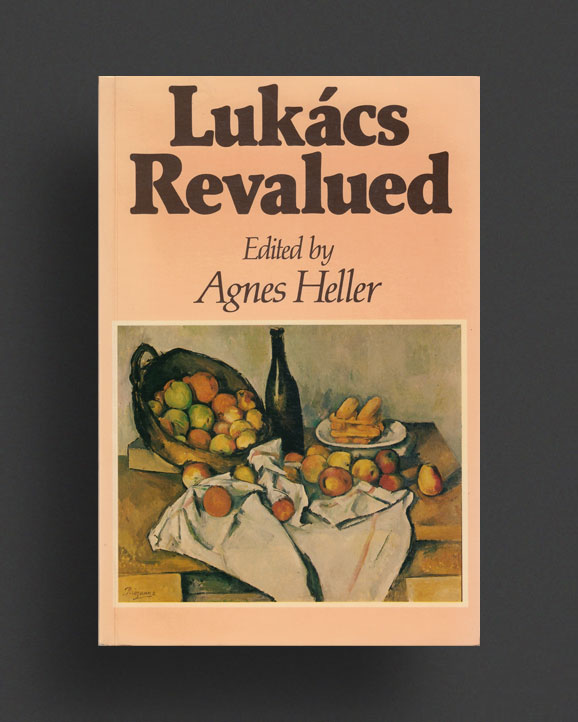
First 1983 edition.
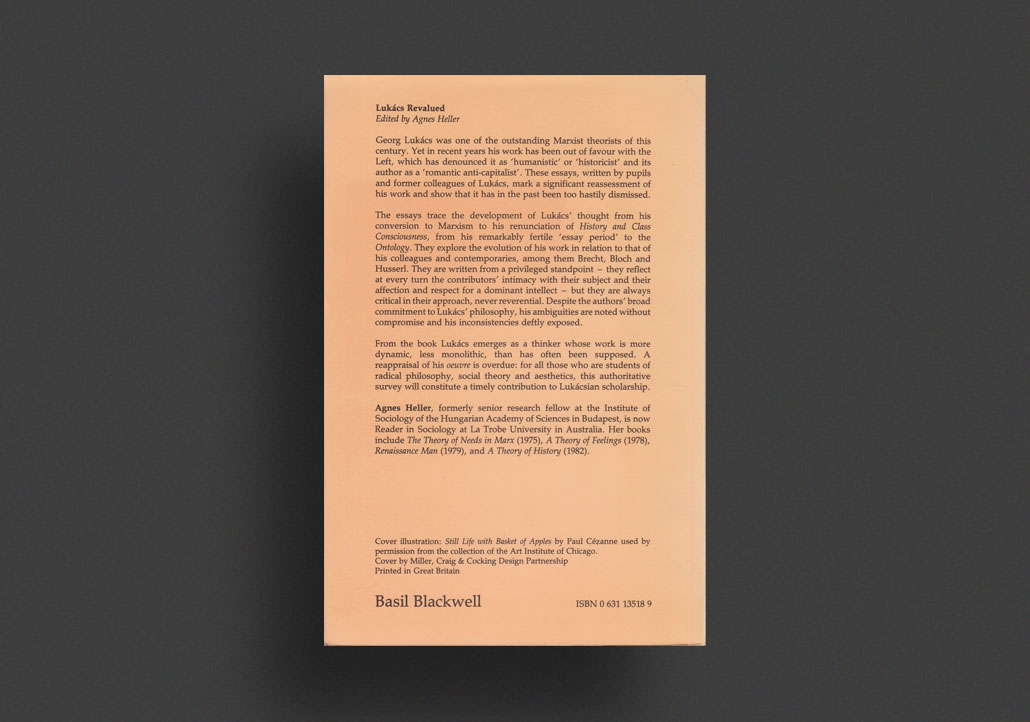
Georg Lukacs was one of the outstanding Marxist theorists of this century. Yet in recent years his work has been out of favour with the Left, which has denounced it as 'humanistic' or 'historicist' and its author as a 'romantic anti-capitalist'.
These essays, written by pupils and former colleagues of Lukacs, mark a significant reassessment of his work and show that it has in the past been too hastily dismissed.
The essays trace the development of Lukacs' thought from his conversion to Marxism to his renunciation of History and Class Consciousness, from his remarkably fertile 'essay period' to the Ontology. They explore the evolution of his work in relation to that of his colleagues and contemporaries, among them Brecht, Bloch and Husserl. They are written from a privileged standpoint — they reflect at every turn the contributors' intimacy with their subject and their affection and respect for a dominant intellect — but they are always critical in their approach, never reverential. Despite the authors' broad commitment to Lukacs' philosophy, his ambiguities are noted without compromise and his inconsistencies deftly exposed.
From the book Lukacs emerges as a thinker whose work is more dynamic, less monolithic, than has often been supposed. A reappraisal of his oeuvre is overdue: for all those who are students of radical philosophy, social theory and aesthetics, this authoritative survey will constitute a timely contribution to Lukacsian scholarship.
Agnes Heller, formerly senior research fellow at the Institute of Sociology of the Hungarian Academy of Sciences in Budapest, is now Reader in Sociology at La Trobe University in Australia. Her books include The Theory of Needs in Marx (1975), A Theory of Feelings (1978), Renaissance Man (1979), and A Theory of History (1982).
VG copy.
1988, English
Softcover, 260 pages, 23.5 x 15 cm
Out of print title / used / very good
Published by
John Hopkins University Press / Baltimore
$35.00 - In stock -
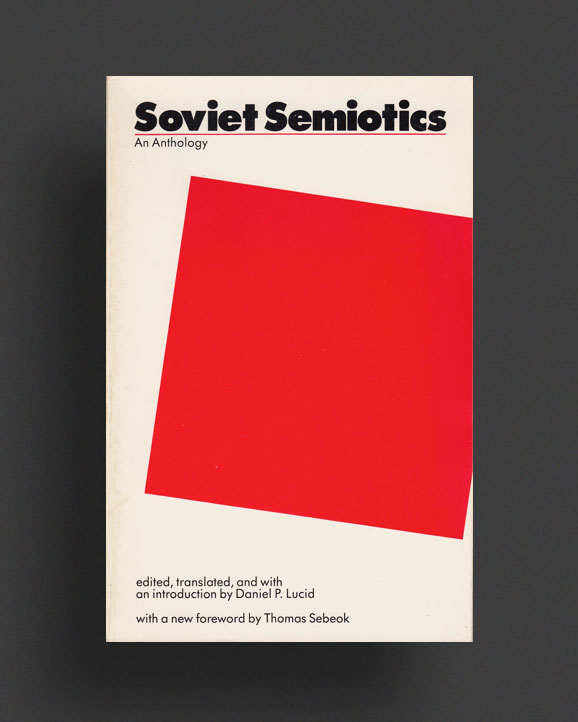
1988 edition of Soviet Semiotics : An Anthology, edited, translated, and with an introduction by Daniel P. Lucid.
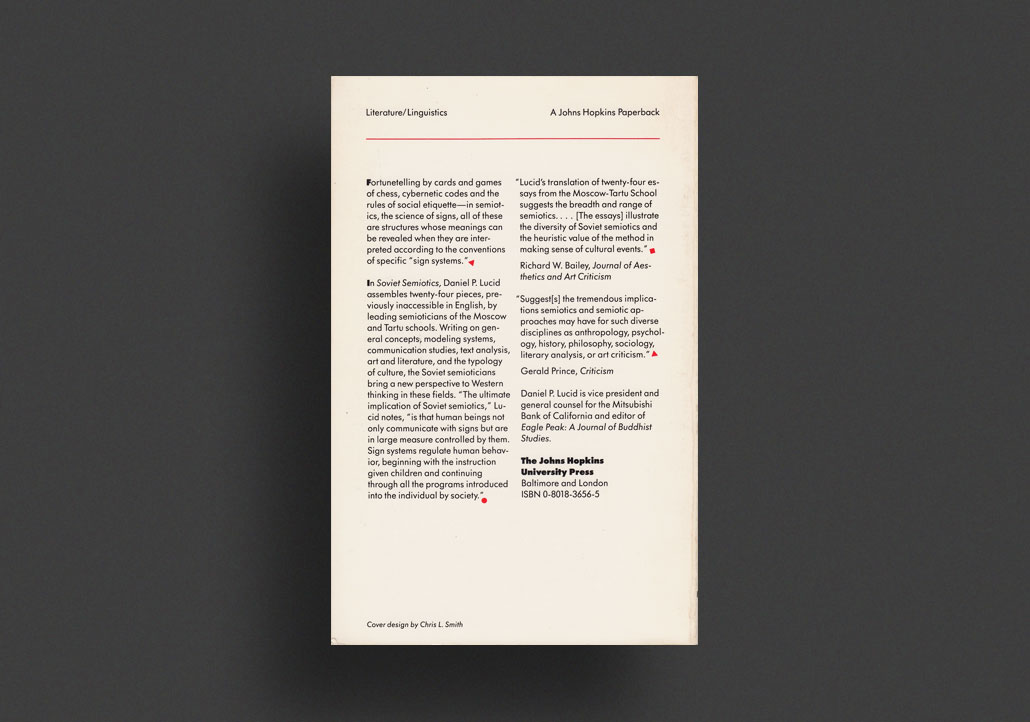
Fortunetelling by cards and games of chess, cybernetic codes and the rules of social etiquette—in semiotics, the science of signs, all of these are structures whose meanings can be revealed when they are inter-preted according to the conventions of specific "sign systems."
In Soviet Semiotics, Daniel P. Lucid assembles twenty-four pieces, previously inaccessible in English, by leading semioticians of the Moscow and Tartu schools. Writing on general concepts, modeling systems, communication studies, text analysis, art and literature, and the typology of culture, the Soviet semioticians bring a new perspective to Western thinking in these fields. "The ultimate implication of Soviet semiotics," Lucid notes, "is that human beings not only communicate with signs but are in large measure controlled by them. Sign systems regulate human behavior, beginning with the instruction given children and continuing through all the programs introduced into the individual by society."
"Lucid's translation of twenty-four es-says from the Moscow-Tartu School suggests the breadth and range of semiotics.. . . [The essays] illustrate the diversity of Soviet semiotics and the heuristic value of the method in making sense of cultural events."—Richard W. Bailey, Journal of Aesthetics and Art Criticism
"Suggest[s] the tremendous implications semiotics and semiotic approaches may have for such diverse disciplines as anthropology, psychology, history, philosophy, sociology, literary analysis, or art criticism."—Gerald Prince
VG copy.
1995/1996, English
Hardcover, 64 pages with pop-up installation spread, 32 x 23.5 cm
1st Edition, Out of print title / used / fine
Published by
Dia Art Foundation / New York
$50.00 - Out of stock
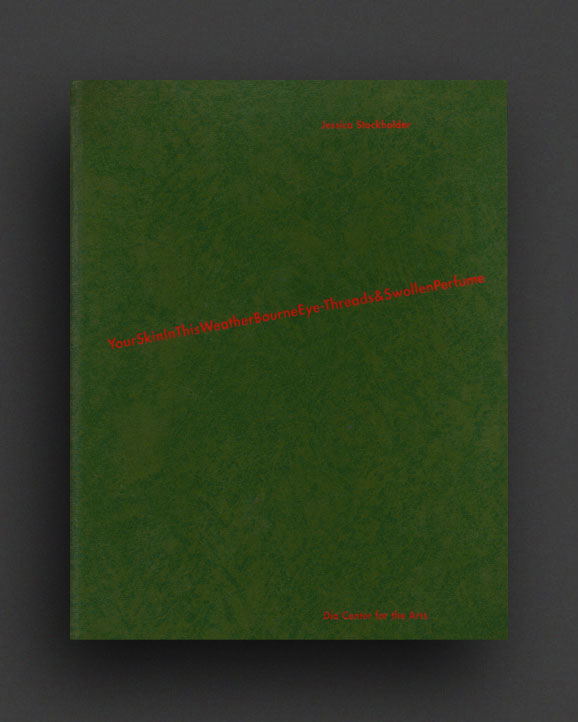
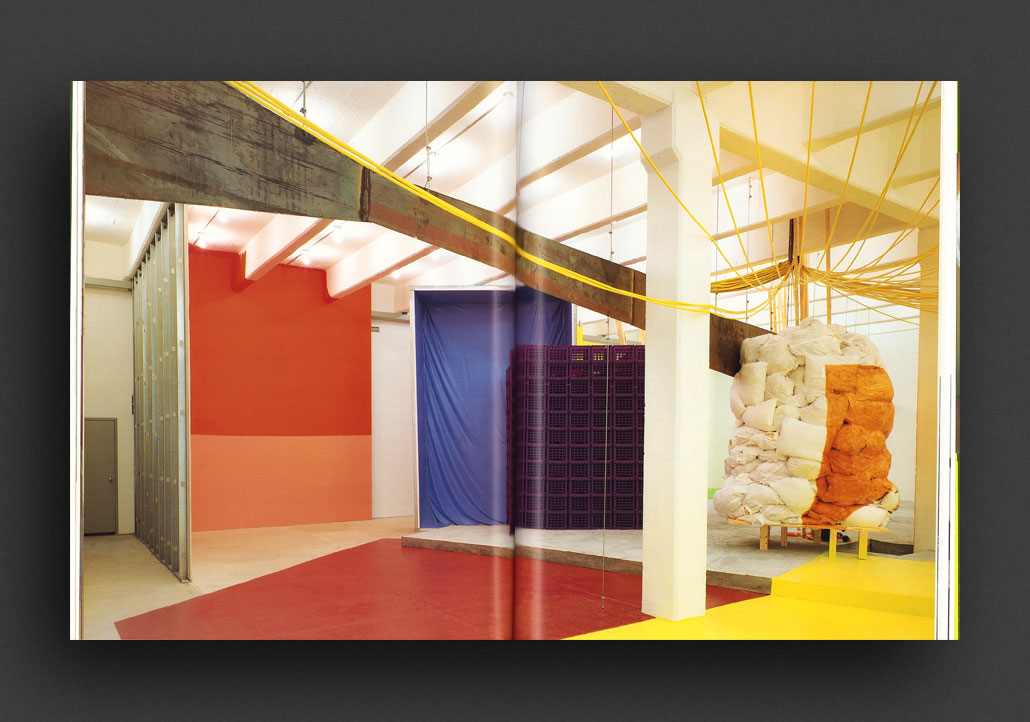
First 1995/6 edition of Jessica Stockholder's catalogue/artist's book "Your Skin in This Weather Bourne-Eye Threads", published on the occasion of the exhibition Jessica Stockholder: Your Skin in this Weather Bourne Eye-Threads and Swollen PerfumeOctober 5, 1995—June 23, 1996, Dia Chelsea, New York. Documenting an installation by Jessica Stockholder, with essays by Lynne Cooke and Jessica Stockholder, a story by Lynne Tillman, and a poem by Ann Lauterbach. Richly illustrated, including a pop-up collage by Stockholder.
Edited by Lynne Cooke and Karen Kelly. Contributions by Jessica Stockholder, Lynne Cooke, Lynne Tillman, and Ann Lauterbach.
1981, English
Hardcover (w. dust jacket), 194 pages, 21 x 15 cm
1st UK Edition, Out of print title / used / very good
Published by
John Hopkins University Press / Baltimore
$20.00 - Out of stock
First 1981 hardcover edition.
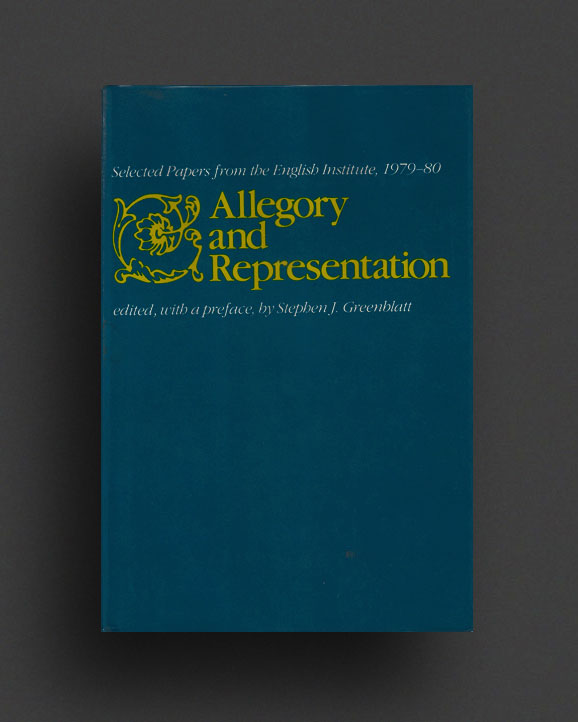
The problem of representation is at the heart of the intellectual ferment experienced in recent years by many different fields of inquiry. The essays in Allegory and Representation confront head on the erosion of the ground rules for representation—the principles upon which a set of stable correspondences are posited between image and object, symbol and reality, sign and referent.
The contributors to this volume reflect an unusual diversity of disciplines, from English, French, American, Slavic, and Italian literature to the history of art. Yet they all confront, through their local and particularized studies, a common problem. Paul de Man and Joel Fineman characterize allegory (and, more generally, representation) as a paradox built upon its own undoing. Robert M. Durling and Michael Fried both discuss the use of the artist's own body within a work of art to achieve a fusion of representation with that which is represented. Hugh Kenner and Leo Bersani each contrast opposing modes of representation—for Kenner, a "poetics of sunlight" and a "poetics of the cave"; for Bersani, an art that drives violently toward narrative closure and an art that remains open and unfinished. Michael Holquist redefines the problem in political terms and explores representation in the writings and career of Mikhail Bakhtin.
Taken together, these essays reveal what may be called the cunning of representation: the resiliency, brilliance, resourcefulness with which artistic prac tice has responded to the artist's perennial craving to reveal truth and reality and to the nagging dread that they lie just barely out of reach.
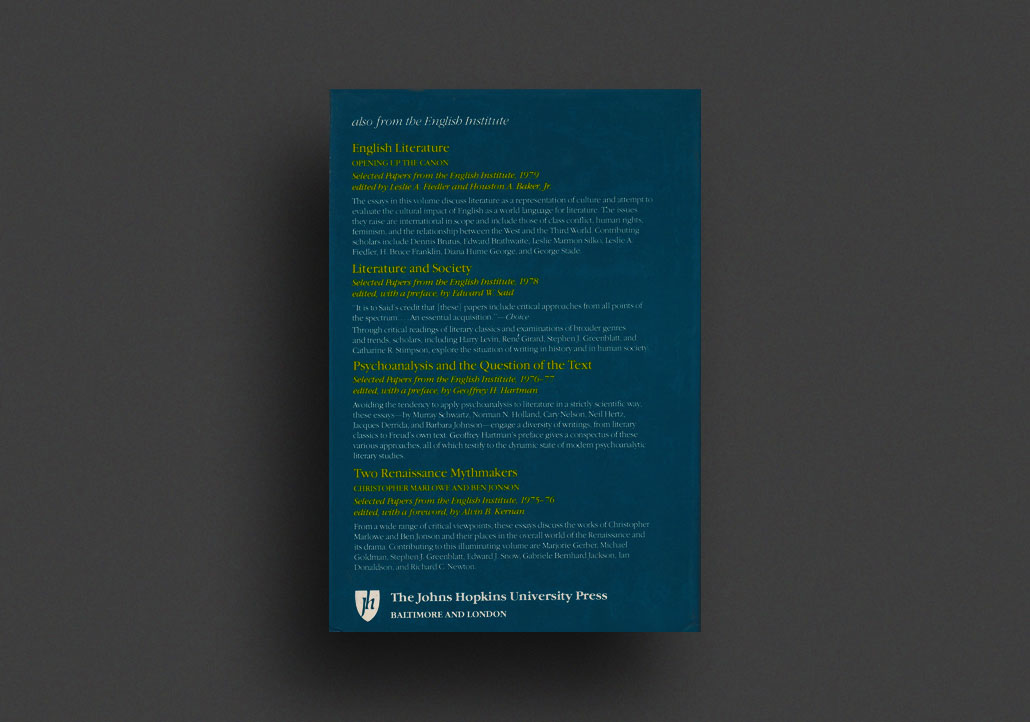
Allegory and Representation, the fifth collection of papers from the English Institute to be published by Johns Hopkins, con tinues the Institute's tradition of pioneer ing fresh approaches to the study of litera ture. It will be of interest to both students ind scholars working in the field, as well as to anyone concerned with the theory and dynamics of art.
Stephen J. Greenblatt is professor of English at the University of California, Berkeley, His most recent book is Renaissance Self Fashioning From More to Shakespeare
Very Good copy in VG dust jacket.
1980, English
Softcover, 304 pages, 21.5 x 14 cm
1st Edition, Out of print title / used / very good
Published by
Cornell University Press / New York
$35.00 - Out of stock
First English edition published in 1980 by Cornell.
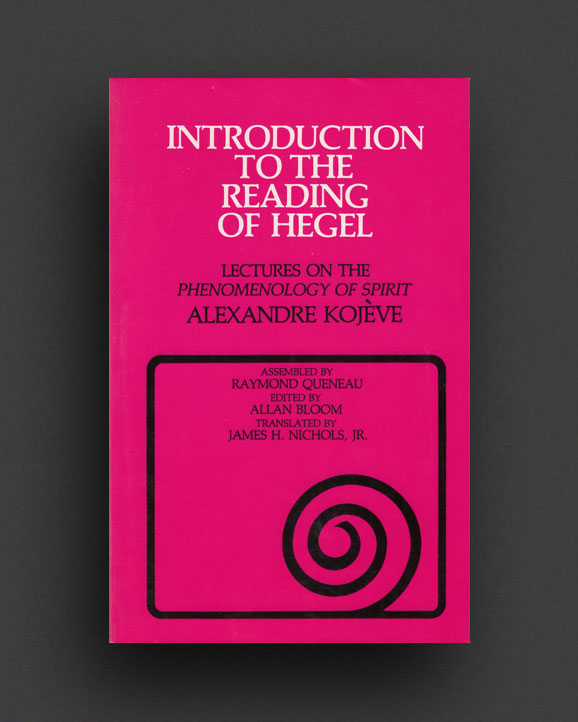
"This collection of Kojeve's thoughts about Hegel constitutes one of the few important philosophical books of the twentieth century-a book, knowledge of which is requisite to the full awareness of our situation and to the grasp of the most modern perspective on the eternal questions of philosophy."—Allan Bloom (from the Introduction)
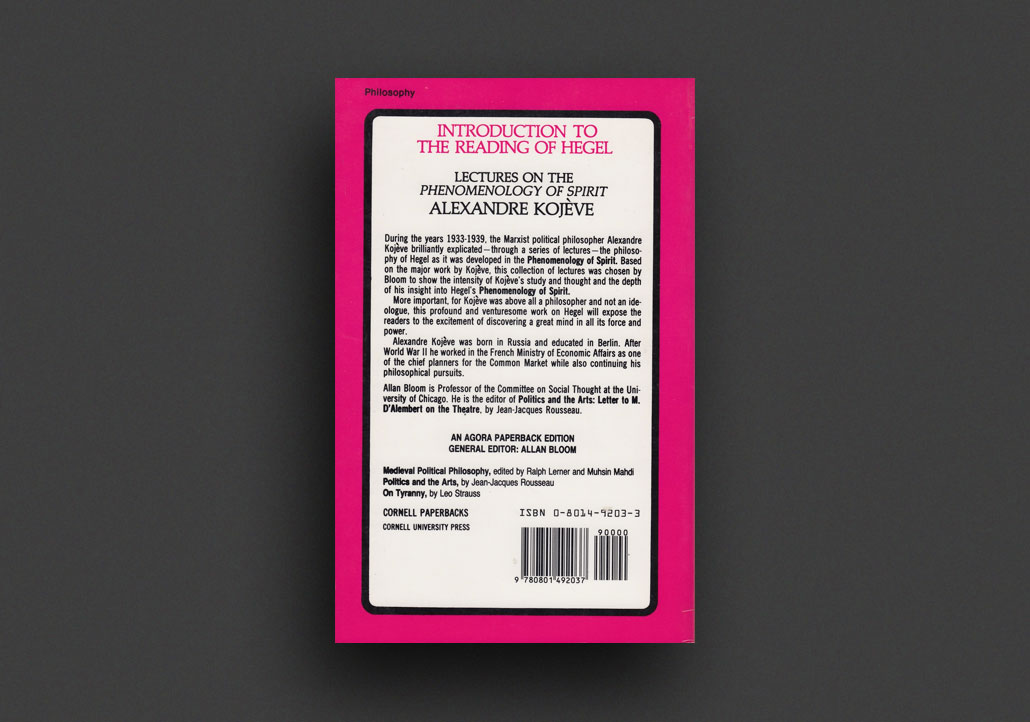
During the years 1933—1939, the Russian-born and German-educated Marxist political philosopher Alexandre Kojève (1902—1968) brilliantly explicated—through a series of lectures—the philosophy of Hegel as it was developed in the Phenomenology of Spirit. This collection of lectures—originally compiled by Raymond Queneau and edited for its English-language translation by Allan Bloom—shows the intensity of Kojeve's study and thought and the depth of his insight into Hegel's Phenomenology. More important—for Kojeve was above all a philosopher and not an ideologue—this profound and venturesome work on Hegel will expose the readers to the excitement of discovering a great mind in all its force and power.
Very Good copy.
1991, English
Hardcover (w. dust jacket), 214 pages, 22 x 15 cm
1st Edition, Out of print title / used / very good
Published by
Harvard University Press / Cambridge
$45.00 - Out of stock
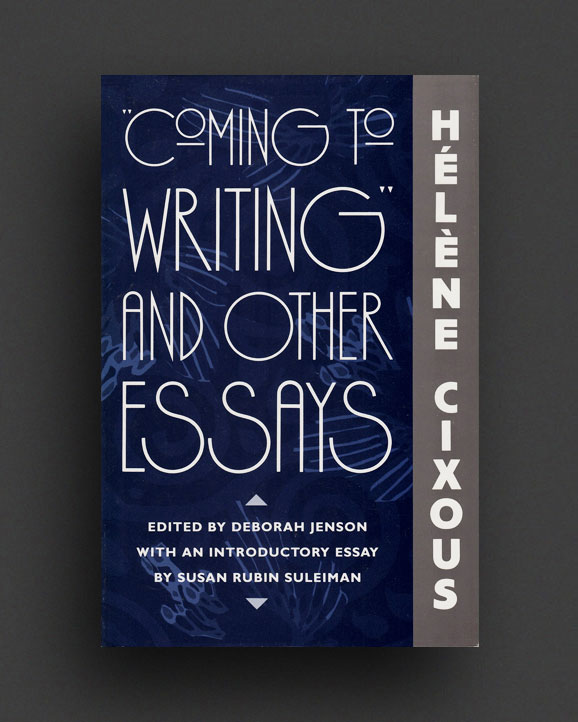
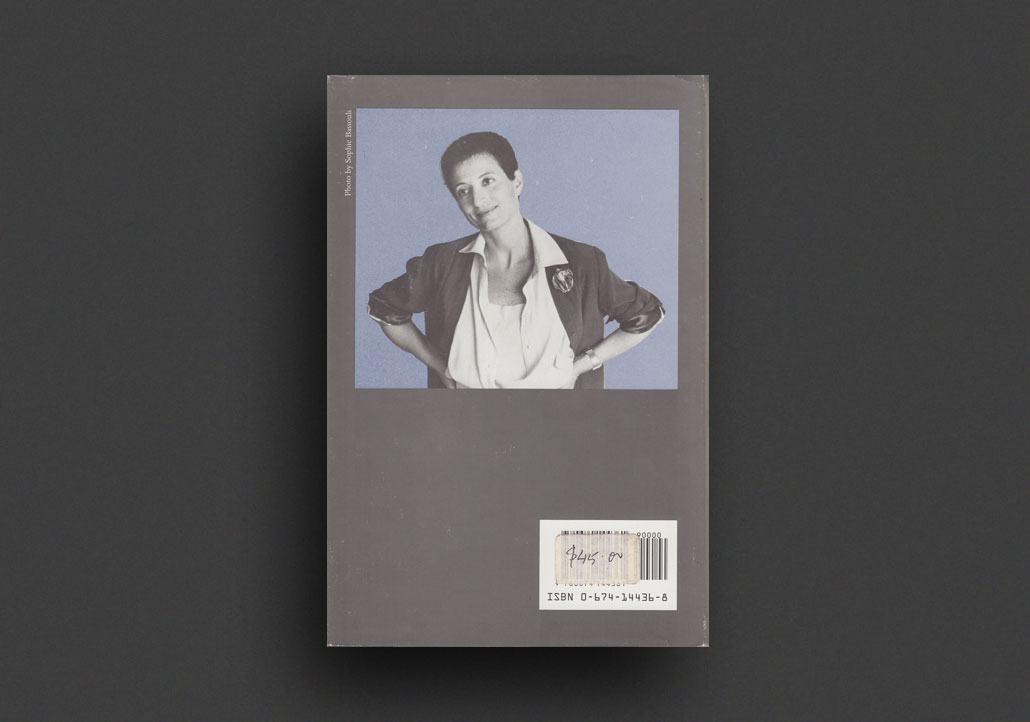
Scarce first 1991 hardcover English edition of "Coming to Writing" and Other Essays by Hélène Cixous, published by Harvard.
"Hélène Cixous is today, in my view, the greatest writer in what I will call my language, the French language if you like. And I am weighing my words as I say that. For a great writer must be a poet-thinker, very much a poet and a very thinking poet."—Jacques Derrida
This collection presents six essays by one of France’s most remarkable contemporary authors. A notoriously playful stylist, here Hélène Cixous explores how the problematics of the sexes—viewed as a paradigm for all difference, which is the organizing principle behind identity and meaning—manifest themselves, write themselves, in texts. These superb translations do full justice to Cixous’s prose, to its songlike flow and allusive brilliance.
Translated by Sarah Cornell, Ann Liddle, and Susan Sellers. Edited and translated by Deborah Jenson.
Very Good copy.
1992, English
Softcover, 300 pages, 21.5 x 14 cm
1st Edition, Out of print title / used / very good
Published by
Indiana University Press / Indiana
$25.00 - Out of stock
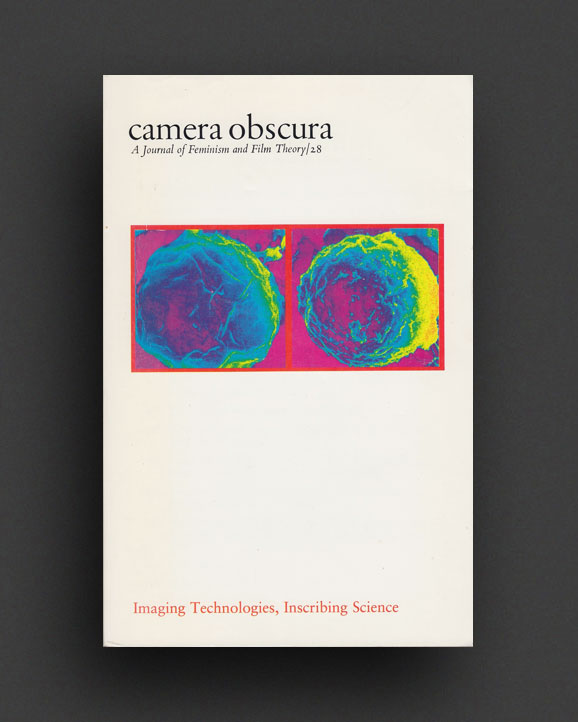
January 1992 issue of Camera Obscura (No. 28), the Journal of Feminism and Film Theory published by Indiana University Press. This issue with the theme of "Imaging Technologies, Inscribing Science", with special issue editors Paula A. Treichler and Lisa Cartwright.
Edited by Elisabeth Lyon, Constance Penley, Lynn Spigel, Sharon Willis, with advisory editors Bertrand Augst, Elizabeth Cowie, Mary Ann Doane, Laura Mulvey, Linda Orr, Susan Suleiman, and managing editor Gary Laderman.
camera obscura
A Journal of Feminism and Film Theory/28
Imaging Technologies, Inscribing Science
Special Issue Editors: Paula A. Treichler and Lisa Cartwright
5 Introduction by Paula A. Treichler and Lisa Cartwright
Beyond Cosmo: AIDS, Identity, and Inscriptions of Gender by Paula A. Treichler; Local and Global: AIDS Activism and Feminist Theory by Katie King; Gallo, Montagnier, and the Debate Over HIV: A Narrative Analysis by Jamie Feldman; WAVE in the Media Environment: Camcorder Activism and the Making of HIV TV by Alexandra Juhasz; WAVE in the Media Environment: Camcorder Activism in AIDS; Education by Juanita Mohammed; The Politics of Breast Cancer by Alisa Solomon; Shooting the Mother: Fetal Photography and the Politics of Disappearance by Carol Stabile; On the Cutting Edge: Cosmetic Surgery and the Technological Production of the Gendered Body by Anne Balsamo; Spectatorial Embodiments: Anatomies of the Visible and the Female Bodyscape by Giuliana Bruno; Those Who Squat and Those Who Sit: The Iconography of Race in the 1895 Films of Félix-Louis Regnault by Fatimah Tobing Rony; plus reviews and much more.
Very Good copy.
2007, English / French
Softcover (leporello fold)
1st Edition, Out of print title / used / very good
Published by
Maison Martin Margiela / Paris
$100.00 - In stock -
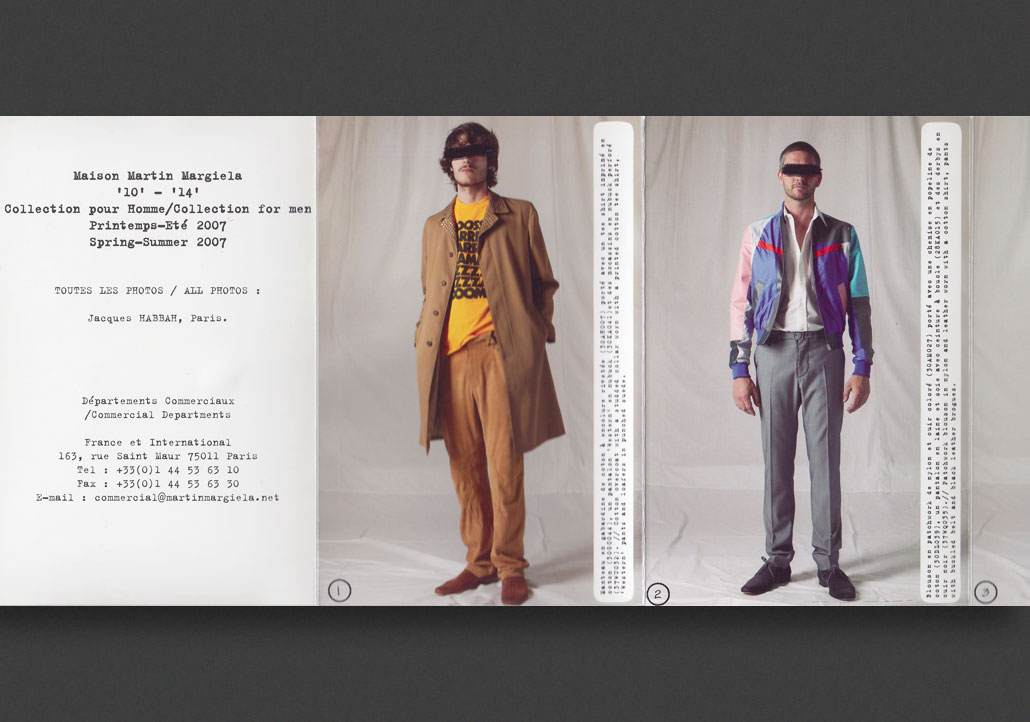
Rare canvas covered leporello lookbook for Maison Martin Margiela '10' — '14' Spring/Summer 2007 Menswear Collection. The book features 24 photos by photographer Jacques Habbah. Each one of these lookbooks were handmade in the Parisian press office. The photos are printed and glued on a piece of white cotton cloth. They served both as an important communication tool and as an aid for wholesale clients to show perspective buyers the most representative looks of the collection.
Very Good copy.
2009, English
Softcover (leporello fold), 15.5 x 97 cm
Artist's Ed. of 200,
Published by
Index / Stockholm
$25.00 - In stock -
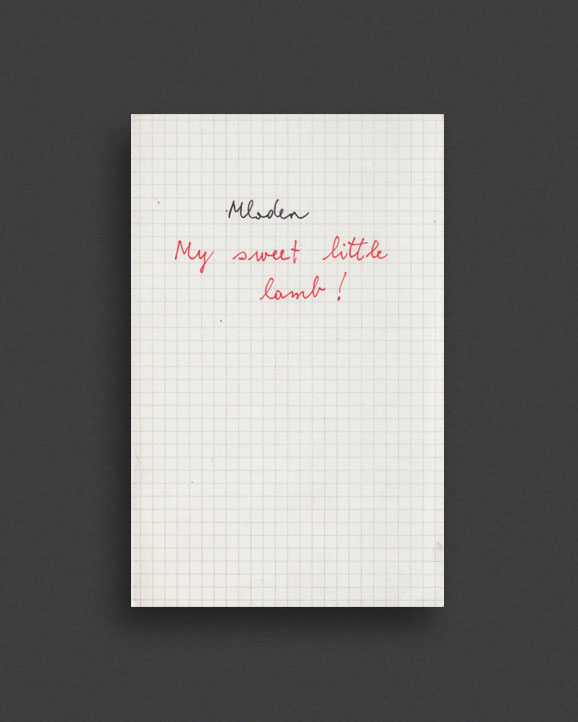
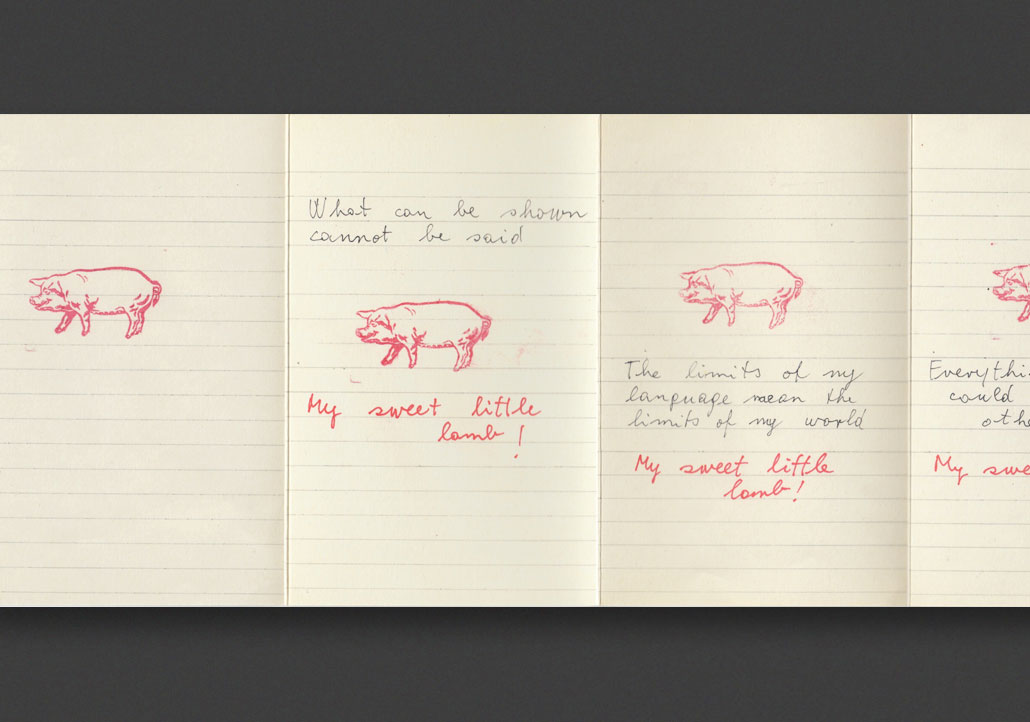
Mladen Stilinović's "My Sweet Little Lamb" was first published as an artist's book in 1993. Produced with pen and rubber seal on printed paper, it is one of the many important published edition works of the late Croatian conceptual artist, and this recent Artist's edition was published in 2009 by Index, Stockholm, on the occasion of a major exhibition of the artist's books.
This Artist's edition was published by Stilinović in leporello format in an edition of 200 copies.
Mladen Stilinović (1947—2016) was one of the most significant representatives of neo-avant-garde art in Central and Eastern Europe. Stilinović was one of the leading figures of the so-called "New Art Practice" in Croatia and a founding member of the informal neo-avantgarde, Group of Six Artists (1975-1979), together with Vladimir Martek, Boris Demur, Željko Jerman, Sven Stilinović and Fedomir Vučemilović. His polymorphic approach finds varied manifestations from collages, installations, photographs, books, performances, actions in public space as well as participations in collective actions. Through his works, Stilinović explores ideological signs and their social aspects. Using devices such as irony, paradox, and manipulation, the artist criticizes the language of politics, institutional hierarchy within art, and the role of money and labor in society. Language is central to his aesthetics; he associates it with graphic signs and other visual references to historical movement, such as geometric abstraction. His work is deeply rooted in the rites that reveal the interdependence of private and public spheres. He is particularly interested in the interaction between visual and linguistic signs as well as in the mechanisms of deconstruction in language. Stilinović also ran the Extended Media Gallery from 1981-1991. He lived and worked in Zagreb, Croatia.
As New.