World Food Books' programme is largely produced on Kulin Nation land. We acknowledge the Wurundjeri people of the Kulin Nation as the first and continuing custodians of this land, and pay respect to their Elders past, present, and emerging.
World Food Books is an arts and special interests bookshop in Naarm / Melbourne. Founded in 2010, World Food Books is devoted to the presentation of a rotating, hand-selection of international art, design, literary and counterculture publications with an emphasis on the anti-traditional, the experimental, the avant-garde, the heretic, the marginal.
Presenting new titles alongside rare and out-of-print books, catalogues and journals spanning the fields of modern and contemporary art, design, photography, illustration, film, literature, poetry, cultural theory, philosophy, sexuality, popular and underground culture in its many radical forms, World Food Books wishes to encourage adventurous, thoughtful and open-minded reading, looking, writing, and exchange of publishing and ideas, both current and historical.
As well as our bookshop, located in Melbourne's historical Nicholas Building, all of our inventory is available internationally via our online mail-order service.
World Food Books semi-regularly co-ordinates "Occasions", a programme of exhibits and events at the bookshop and in partnership with other hosts (such as museums and art galleries) that develop out of the activities, relationships and content of the bookshop itself.
World Food Books
The Nicholas Building
37 Swanston Street
Room 5, Level 6
Melbourne 3000
Australia
SHOP HOURS:
Thu–Fri 12–6, Sat 12–5
WEB-SHOP OPEN 24/7
World Food Books
Postal Address:
PO Box 435
Flinders Lane
Victoria 8009
Australia
Art
Theory / Essay
Architecture / Interior
Graphic Design / Typography
Photography
Fashion
Eros
LGBTQ+
Fiction / Poetry
Weird / Speculative / Science Fiction / Horror
Transgressive / Visceral / Abject
Symbolism / Decadence / Fin de siècle
Film / Video
Painting
Sculpture / Installation
Performance / Dance / Theater
Drawing
Sound / Music
Curatorial
Group Shows / Collections
Periodicals
Out-of-print / Rare
Posters / Ephemera / Discs
Signed Books
World Food Books Gift Voucher
World Food Book Bag
Australian Art
Australian Fiction
Australian Science Fiction / Speculative Fiction
Australian Poetry
Australian Photography
Japanese Photography
Conceptual Art
Minimal Art
Dada
'Pataphysics / Oulipo
Fluxus
Concrete Poetry
Pop Art
Surrealism
Arte Povera
Arte Informale / Haute Pâte / Tachism
Nouveau Réalisme / Zero / Kinetic
Situationism / Lettrism
Collage / Mail Art / Xerox Art
Art Brut / Folk / Visionary / Fantastic
Illustration / Graphic Art / Bandes Dessinées
Furniture
Italian Radical Design / Postmodernism
Textiles
Ceramics / Glass
Counterculture
Protest / Revolt
Philosophy
Psychoanalysis
Anthropology
Anarchism
Socialism / Anarchism / Communism / Capitalism
Literary Theory / Semiotics / Language
Feminism / Women's Studies
Gender Studies / Sexuality
Anthropology
Fetishism / BDSM
Drugs / Psychedelia
Crime / Violence
Animal Rights / Veganism
Occult / Esoterica
Ecology / Earth / Alternative Living
Whole Earth / Crafts
All prices in AUD (Australian dollars)
Pick-Ups
Pick-up orders can be collected in our bookshop during opening hours after order date. Please collect any Pick-up orders within 2 weeks of ordering as we have limited storage space. Orders will be released back into stock if not collected within this time. No refunds can be made for pick-ups left un-collected. If you cannot make it in to the bookshop in this time-frame, please choose postage option.
Return Policy
All sales are final. We do accept returns (for refund or exchange) for items received in error. All our orders are packed with special care using heavy-duty padding and cardboard book-mailers or bubble mailers (for smaller books), using reinforcement where required. We cannot take responsibility for any lost, stolen or damaged parcels.
Insurance
Should you wish to insure your package, please email us directly after placing your order and we can organise this at a small extra expense. Although all standard/express tracked packages are very safe and dependable, we cannot take responsibility for any lost, stolen or damaged parcels. We recommend insurance on valuable orders.
Interested in selling your old books, catalogues, journals, magazines, comics, fanzines, ephemera? We are always looking for interesting, unusual and out-of-print books to buy. We only buy books in our fields of interest and specialty, and that we feel we can resell.
We base these prices on desirability, market value, in-print prices, condition and our current stock levels. We offer cash, store credit, and can take stock on consignment. All
about 25% of the price we expect to get when we sell them, or 30% in store credit. We base these prices on desirability, market value, in-print prices, condition and our current stock levels.
Sell your books any day of the week. You can drop them off and return later. If you have a lot of books, we can visit your Sydney home.
We buy books that we feel we can resell. We offer about 25 % of the price we expect to get when we sell them, or 30% in store credit. We base these prices on desirability, market value, in-print prices, condition and our current stock levels.
Philadelphia Wireman
03 August - 01 September, 2018
World Food Books is proud to announce our next Occasion, the first presentation of sculptures by Philadelphia Wireman in Australia.
The Philadelphia Wireman sculptures were found abandoned in an alley off Philadelphia’s South Street on trash night in 1982. Their discovery in a rapidly-changing neighbourhood undergoing extensive renovation, compounded with the failure of all attempts to locate the artist, suggests that the works may have been discarded after the maker’s death. Dubbed the "Philadelphia Wireman" during the first exhibition of this work, in 1985, the maker’s name, age, ethnicity, and even gender remain uncertain. The entire collection totals approximately 1200 pieces, all intricately bound together with tightly-wound heavy-gauge wire (along with a few small, abstract marker drawings, reminiscent both of Mark Tobey and J.B. Murry). The dense construction of the work, despite a modest range of scale and materials, is singularly obsessive and disciplined in design: a wire armature or exoskeleton firmly binds a bricolage of found objects including plastic, glass, food packaging, umbrella parts, tape, rubber, batteries, pens, leather, reflectors, nuts and bolts, nails, foil, coins, toys, watches, eyeglasses, tools, and jewellery.
Heavy with associations—anthropomorphic, zoomorphic, and socio-cultural responses to wrapped detritus—the totemic sculptures by Philadelphia Wireman have been discussed in the context of work created to fulfil the shamanistic needs of alternative religions in American culture. Curators, collectors, and critics have variously compared certain pieces to sculpture from Classical antiquity, Native American medicine bundles, African-American memory jugs, and African fetish objects. Reflecting the artist’s prolific and incredibly focused scavenging impulse, and despite—or perhaps enhanced by—their anonymity, these enigmatic objects function as urban artefacts and arbiters of power, though their origin and purpose is unknown. Philadelphia Wireman, whatever their identity, possessed an astonishing ability to isolate and communicate the concepts of power and energy through the selection and transformation of ordinary materials. Over the course of the past two decades, this collection has come to be regarded as an important discovery in the field of self-taught art and vernacular art.
Presented in collaboration with Fleisher-Ollman Gallery, Philadelphia, and Robert Heald, Wellington.
Susan Te Kahurangi King
02 February - 10 March, 2018
Susan Te Kahurangi King (24 February 1951 - ) has been a confident and prolific artist since she was a young child, drawing with readily available materials - pencils, ballpoint pens and felt-tip markers, on whatever paper is at hand. Between the ages of four and six Susan slowly ceased verbal communication. Her grandparents William and Myrtle Murphy had developed a special bond with Susan so they took on caring responsibilities for extended periods. Myrtle began informally archiving her work, carefully collecting and storing the drawings and compiling scrapbooks. No drawing was insignificant; every scrap of paper was kept. The King family are now the custodians of a vast collection containing over 7000 individual works, from tiny scraps of paper through to 5 meter long rolls.
The scrapbooks and diaries reveal Myrtle to be a woman of great patience and compassion, seeking to understand a child who was not always behaving as expected. She encouraged Susan to be observant, to explore her environment and absorb all the sights and sounds. Myrtle would show Susan’s drawings to friends and people in her community that she had dealings with, such as shopkeepers and postal workers, but this was not simply a case of a grandmother’s bias. She recognised that Susan had developed a sophisticated and unique visual language and sincerely believed that her art deserved serious attention.
This was an unorthodox attitude for the time. To provide some context, Jean Dubuffet coined the term Art Brut in 1945 to describe work created by self-taught artists – specifically residents of psychiatric institutions and those he considered to be visionaries or eccentrics. In 1972 Roger Cardinal extended this concept by adopting the term Outsider Art to describe work made by non-academically trained artists operating outside of mainstream art networks through choice or circumstance. Susan was born in Te Aroha, New Zealand in 1951, far from the artistic hubs of Paris and London that Dubuffet and Cardinal operated in. That Myrtle fêted Susan as a self-taught artist who deserved to be taken seriously shows how progressive her attitudes were.
Susan’s parents Doug and Dawn were also progressive. Over the years they had consulted numerous health practitioners about Susan’s condition, as the medical establishment could not provide an explanation as to why she had lapsed into silence. Dawn educated herself in the field of homeopathy and went on to treat all twelve of her children using these principles – basing prescriptions on her observations of their physical, mental and emotional state.
Doug was a linguist with an interest in philosophy who devoted what little spare time he had to studying Maori language and culture. To some extent their willingness to explore the fringes of the mainstream made them outsiders too but it was their commitment to living with integrity and their respect for individuality that ensured Susan’s creativity was always encouraged.
Even though Susan’s family supported her artistic pursuits, some staff in schools and hospitals saw it as an impediment to her assimilation into the community and discouraged it in a variety of ways. Her family was not always aware of this and therefore did not fully understand why Susan stopped drawing in the early 1990s. However, rather than dwell on the challenges that Susan faced in pursuit of her artistic practice, they prefer to highlight her achievements. In 2008 Susan began drawing again in earnest, after an almost 20 year interruption, and her work is now shown in galleries around the world.
Susan grew up without television and has been heavily influenced by the comics she read as a child. She is absolutely fearless in the appropriation of recognizable characters, such as Donald Duck and Mickey Mouse, in her work. She twists their limbs, contorts their faces, compresses them together, blends them into complex patterned backgrounds - always imbuing them with an incredible energy. Although Susan often used pop culture characters in her work they are not naive or childlike. These are drawings by a brilliant self-taught artist who has been creating exceptional work for decades without an audience in mind.
Mladen Stilinović
"Various Works 1986 - 1999"
02 February 16 - September 10, 2016
Various works 1986 - 1999, from two houses, from the collections of John Nixon, Sue Cramer, Kerrie Poliness, Peter Haffenden and Phoebe Haffenden.
Including: Geometry of Cakes (various shelves), 1993; Poor People’s Law (black and white plate), 1993; White Absence (glasses, ruler, set square, silver spoon, silver ladel with skin photograph and wooden cubes), 1990-1996; Exploitation of the Dead (grey and red star painting, wooden painting, black spoon with red table, red plate), 1984-1990; Money and Zeros (zero tie, paintings made for friends in Australia (Sue, John, Kerrie), numbers painting), 1991-1992; Words - Slogans (various t-shirts) - “they talk about the death of art...help! someone is trying to kill me”, “my sweet little lamb”, “work is a disease - Karl Marx”; Various artist books, catalogues, monographs, videos; Poster from exhibition Insulting Anarchy; "Circular" Croatian - Australian edition; Artist book by Vlado Martek (Dostoyevsky); more.
Thanks to Mladen Stilinović and Branka Stipančić.
Jonathan Walker
Always Will Need To Wear Winter Shirt Blue + Ochre Small Check Pattern
21 August - 21 September, 2015
Untitled
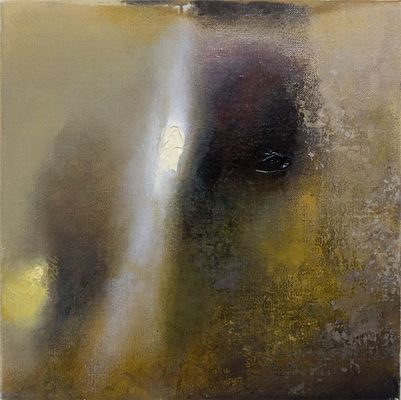
I am not a great reader of poetry but I always return to the work of Melbourne poet, Vincent Buckley (1925- 1988). Perhaps I find his most tantalising piece to be not a finished poem but a fragment left on a scrap of paper discovered on his desk after the poet’s death.
The poetry gathers like oil
In the word-core, and spreads
It has its music meet,
Its music is in movement.
This fragment is more the shell left behind from a volatile thought than a finished poem. I find the last two lines honest but awkward whereas the first two lines work like an arrow. Most likely he could not find a resolution so it was left. Still, in its present form, it remains an eloquent testimony to the ultimate failure of a medium to express mobile thought and sensation, in Buckley’s case, through verbal language. It’s an important matter because this is something all artists have to deal with regardless of the medium.
I have never written a poem, however, I am forever copying fragments from books on paper scraps in a vain effort to fix certain notions in my head. At first, they function as bookmarks that are sometimes returned to when I open the book. But before long, as they accumulate, they fall out littering the table interspersed with A4 photocopies, bills, books and medications.
To return to Buckley’s fragment, the first two lines very much evoke how I paint nowadays. As you age, detail diminishes and patches of light become more luminous and float. I feel the most honest way of dealing with this is by smearing the oil paint on the canvas with the fingers and working close-up, blind. Only if the patches coalesce into an approaching image can the work gain a life.
-
Jonathan Walker was born in Melbourne, Australia and brought up on a dairy farm in Gippsland. In the 1970’s he studied painting at RMIT and won the Harold Wright Scholarship to the British Museum, London. During the 1980’s he exhibited at Pinacotheca Gallery, Richmond and had work shown at the NGV and Heidi City Art Gallery. Over the same period he designed the cover for the “Epigenesi” LP by Giancarlo Toniutti, Italy and conducted a mail exchange work with Achim Wollscheid, Germany. The work with artists through the post resulted in an article published in the bicentenary issue of Art and Australia 1988. He showed in artist run spaces such as WestSpace in the 90’s and 2000’s, and until 2012, taught painting at Victoria University, which is where we (Colleen Ahern and Lisa Radford) as organisers of the exhibition, among many others, had the privilege of being his student.
Walker’s knowledge was imparted to students through the careful selection of music, literature, and artists found in books that he himself had ordered for the library. Walker’s strategy was the generosity of sharing his vast knowledge with references specific to each student and their context.
Walker’s paintings share a similar focus and intimacy.
This exhibition presents a small selection of recent paintings alongside a publication that includes Walker’s writing. Observational and analytical, Walker’s work is a type of material notation — the time of day, colour and how it is blended, the both specific and fleeting location of a reflection on lino or the question of whether a chair leg should be included in a painting.
Please join us on Friday August 21 between 6-8pm to celebrate the opening of the exhibition.
Curated by Colleen Ahern and Lisa Radford.
B. Wurtz
Curated by Nic Tammens
March 26 - April 4, 2015
B.Wurtz works from a basement studio in his home on Manhattan’s Lower East Side.
This local fact is attested to by the plastic shopping bags and newsprint circulars that appear in his work. As formal objects, they don’t make loud claims about their origins but nonetheless transmit street addresses and places of business from the bottom of this long thin island. Like plenty of artists, Wurtz is affected by what is local and what is consumed. His work is underpinned by this ethic. It often speaks from a neighborhood or reads like the contents of a hamper:
“BLACK PLUMS $1.29 lb.”
“Food Bazaar”
“USDA Whole Pork Shoulder Picnic 99c lb.”
“RITE AID Pharmacy, with us it’s personal.”
“H. Brickman & Sons.”
“Sweet Yams 59c lb."
Most of the work in this exhibition was made while the artist was in residence at Dieu Donne, a workshop dedicated to paper craft in Midtown. Here Wurtz fabricated assemblages with paper and objects that are relatively lightweight, with the intention that they would be easily transportable to Australia. This consideration isn’t absolute in Wurtz’s work, but was prescriptive for making the current exhibition light and cheap. Packed in two boxes, these works were sent from a USPS post office on the Lower East Side and delivered to North Melbourne by Australia Post.
Wurtz appears courtesy of Metro Pictures, New York.
Thanks to Rob Halverson, Joshua Petherick, Sari de Mallory, Matt Hinkley, Helen Johnson, Fayen d'Evie, Ask Kilmartin, Lisa Radon, Ellena Savage, Yale Union, and "Elizabeth".
John Nixon
"Archive"
December 15 - January 20, 2014
The presentation of John Nixon's archive offered a rare showcase of this extensive collection of the artist's own publications, catalogues, posters, ephemera, editions and more, from the mid 1980s onwards, alongside a selection of his artworks.
Organized by John Nixon, Joshua Petherick and Matt Hinkley.
<a href=http://wfb.public-office.info/artist/john-nixon>All titles by John Nixon
"Habitat"
at Minerva, Sydney (organised by Joshua Petherick and Matt Hinkley)
November 15 - December 20, 2014
Lupo Borgonovo, Janet Burchill & Jennifer McCamley,
Lewis Fidock, HR Giger, Piero Gilardi, Veit Laurent Kurz,
Cinzia Ruggeri, Michael E. Smith, Lucie Stahl, Daniel Weil, Wols
Press Release:
“...It contained seven objects. The slender fluted bone, surely formed for flight, surely from the wing of some large bird. Three archaic circuitboards, faced with mazes of gold. A smooth white sphere of baked clay. An age-blackened fragment of lace. A fingerlength segment of what she assumed was bone from a human wrist, grayish white, inset smoothly with the silicon shaft of a small instrument that must once have ridden flush with the surface of the skin - but the thing’s face was seared and blackened.”
William Gibson, “Count Zero”, 1986
"Autumn Projects Archive"
Curated by Liza Vasiliou
March 6 - March 15, 2014
World Food Books, in conjunction with the Virgin Australia Melbourne Fashion Festival 2014, presented the Autumn Projects archive, consisting of a selection of early examples in Australian fashion with a particular interest in collecting designers and labels from the period beginning in the 1980’s, who significantly influenced the discourse of Australian Fashion.
Curated by Liza Vasiliou, the exhibition provided a unique opportunity to view pieces by designers Anthea Crawford, Barbara Vandenberg, Geoff Liddell and labels CR Australia, Covers, Jag along with early experimental collage pieces by Prue Acton and Sally Browne’s ‘Fragments’ collection, suspended throughout the functioning World Food Books shop in Melbourne.
H.B. Peace
presented by CENTRE FOR STYLE
November 14, 2013
"Hey Blinky, you say chic, I say same"
Anon 2013
H.B. Peace is a clothing collaboration between great friends Blake Barns and Hugh Egan Westland. Their pieces explore the divergences between 'character’ and ‘personality’ in garments....etc
Special Thanks to Joshua Petherick and Matt Hinkley of WFB and Gillian Mears
and a Very Special Thank you to Audrey Thomas Hayes for her shoe collaboration.
Janet Burchill & Jennifer McCamley
"Aesthetic Suicide"
May 10 - June 8, 2013
The first of our occasional exhibitions in the World Food Books office/shop space in Melbourne, "Aesthetic Suicide" presented a body of new and older works together by artists Janet Burchill & Jennifer McCamley, including videos, prints, a wall work, and publications.
During shop open hours videos played every hour, on the hour.
1970, German
Softcover (staple-bound), 12 pages, 21 x 21 cm
1st Edition, Out of print title / used / very good
Published by
Editions Bischoffberger / Zürich
$35.00 - Out of stock
1970 catalogue published on the occasion of the exhibition of Swiss artist Willy Müller-Brittnau (1938—2003) at the Galerie d'art Moderne, Basel; Editions Bischoffberger, Zürich; Galerie Riehentor, Basel, exhibiting the striking hard-edge/colour field works of Müller-Brittnau spanning 1964—1970, boldly illustrated throughout in full-colour. Like many Swiss artists of the period, Willy Müller-Brittnau started out as a graphic designer. First influenced by American action painting in 1958, he went on to develop a geometric pictorial language and made outstanding contributions to colour field painting and signal art in the 1960s and 1970s. In addition to painting, drawing and prints, he created numerous site-specific, sculptural works and developed colour schemes for buildings. Includes portraits of the artist and biography.
Good—Very Good copy with light pinching to spine/light cover/corner wear.
1958, Dutch
Softcover (staple-bound), 26 pages, 26 x 19 cm
1st Edition, Out of print title / used / good
Published by
Stedelijk Museum / Amsterdam
$25.00 - In stock -
Rare early Jackson Pollock catalogue published by Stedelijk Museum Amsterdam (SM Catalogue nr 189) in 1958, designed by the legendary Willem Sandberg. Profusely illustrated in b/w with Pollock's artworks, including a colour centrefold, printed across various paper stocks, accompanied by biography, exhibition history, catalogue and text by Sam Hunter (translated into Dutch).
Very Good copy but ex-National Gallery of Victoria library copy, therefore two stamps to cover, plus staple holes to top right of cover, otherwise VG throughout.
1983 + 1985, English / Japanese
Softcover (staple-bound), 18 + 28 pages (w. fold-out), 25 x 19 cm
1st Edition, Out of print title / used / very good
Published by
Gatodo Gallery / Japan
$150.00 - Out of stock
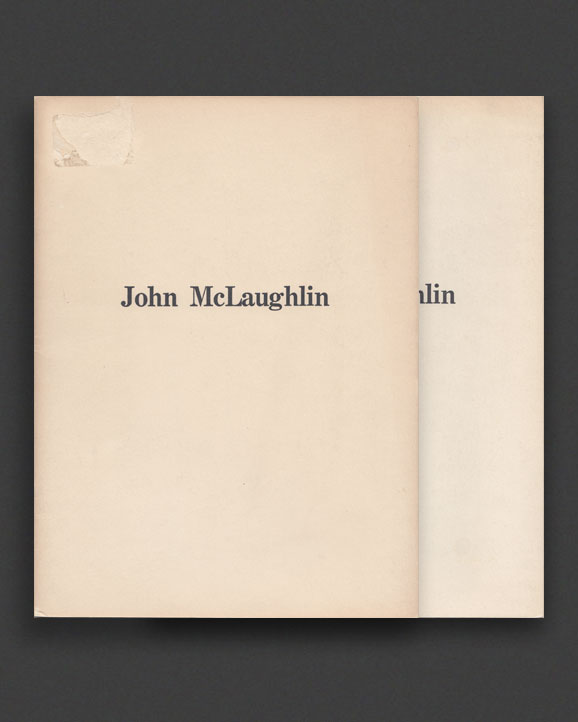
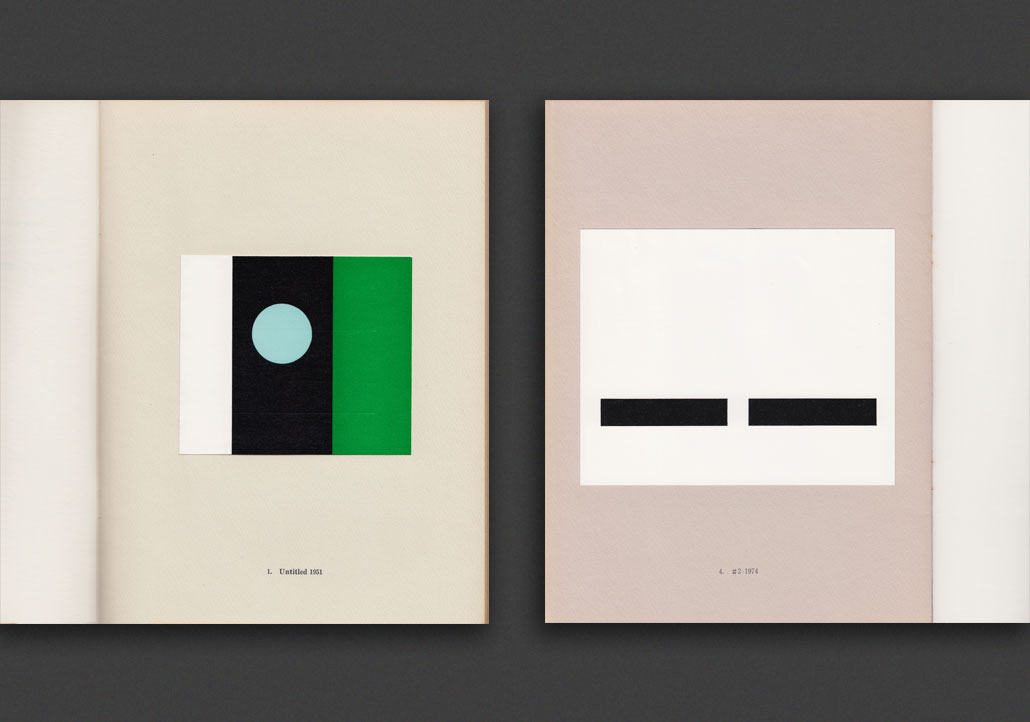
Very rare set of two handsome Japanese catalogues on the work of American artist John McLaughlin, published in 1983 and 1985. The first volume is "John McLaughlin: Paintings 1951-1966", documenting an exhibition at Gatodo Gallery in Japan in 1983. It includes texts by the artist, portrait, biography, bibliography, a checklist of works exhibited, and 8 superb tipped-in colour plates. The second is "John McLaughlin : Late Work", documenting an exhibition at Gatodo Gallery in Japan in 1985. It includes texts by the artist, portrait, biography, bibliography, a checklist of works exhibited, and 5 superb tipped-in colour plates, including fold-out panel and exhibition view. Text in both Japanese and English.
John Dwyer McLaughlin (1898 – 1976) was a highly pivotal and significant American abstract painter. Based primarily in California, he was a pioneer in minimalism and hard-edge painting.
Good—Very Good condition, both volumes clean and very good throughout internally, only with small sticker peel to cover of vol. I, and some small markings to covers of vol. II.
1977, German
Softcover, 128 pages, 33 x 24 cm
Out of print title / used / good
Published by
Belser Verlag / Stuttgart
$68.00 - Out of stock
Softcover edition of this wonderful over-sized publication on the unique collaboration between German artist Paul Wunderlich and photographer Karin Székessy, one of Germany's most important female photographers, who were married to each other. Published in Switzerland in 1977, this volumes collects an abundance of these iconic 'transpositions,' evocative, experimental nude photographs by Szekessy juxtaposed with Wunderlich's versions, or replies, in the form of paintings and prints. Profusely illustrated throughout in colour and b/w, the result is a fascinating dialogue of unconventional nude form. German literary critic Fritz J. Raddatz's illustrated introduction gives contextual and art historical references and background, accompanied by a full listing of works and exhibition history.
Good—VG copy with only light cover/edge wear.
2005, English / Japanese
Softcover (w. printed acetate dust jacket), 270 pages, 20 x 22.5 cm
1st Edition, Out of print title / used / very good
Published by
Heibonsha / Tokyo
$160.00 - Out of stock
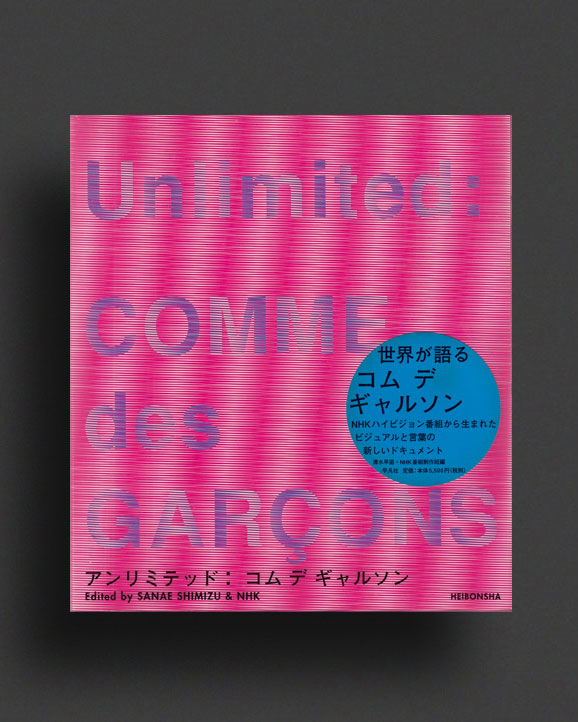
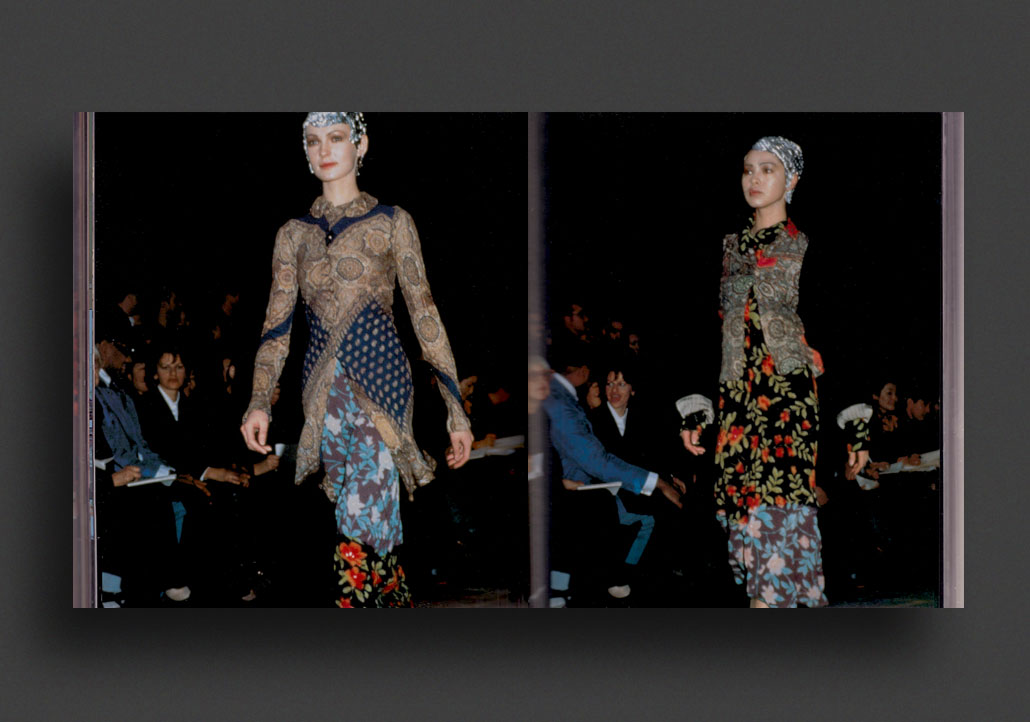
First edition of Unlimited: Comme des Garçons, a unique and lavish compilation book about Comme des Garçons and designer Rei Kawakubo, published in Japan in 2005 and edited by Sanae Shimizu and NHK. Shimizu explains in the afterword: "the present book is a compilation based on reporting for two television programs, the NHK Special, "What the World Values in Her Fashion: REI KAWAKUBO and Comme des Garçons," and the Hi-Vision Special, "Fashion Revolutinonary: REI KAWAKUBO and the World of Comme des Garçons." Single frames of video filmed with a Hi-Vision camera were captured, and transformed into static images, after which the images were digitally printed". The book combines rare collection, store interior, and Comme workshop imagery with interviews, reflections, and commentary from a range of people, including fashion designers (Alexander McQueen, Junya Watanabe, Azzedine Alaïa, Jean Paul Gaultier, Paul Smith, Walter van Beirendonck, etc.), Comme des Garçons production staff, choreographers (Merce Cunningham, etc.), photographers (Paolo Roversi, etc.), fashion journalists and editors (Vogue, Dazed, Purple, etc.) and many from Rei Kawakubo herself. One of the most insightful books on Comme and Rei, The images of Comme des Garçons workspaces and insight into the production and pattern-making process provided by staff make this an invaluable book for any fan.
Very Good copy with light wear and usual bind issue (tightly stitch bound in perfect shape and working order, but glue of no use)
1988, English / Japanese
Softcover, oversized, loose-leaf pages, 42 x 29.7 cm
1st Edition, Out of print title / used / very good
Published by
Comme des Garçons / Tokyo
$440.00 - Out of stock
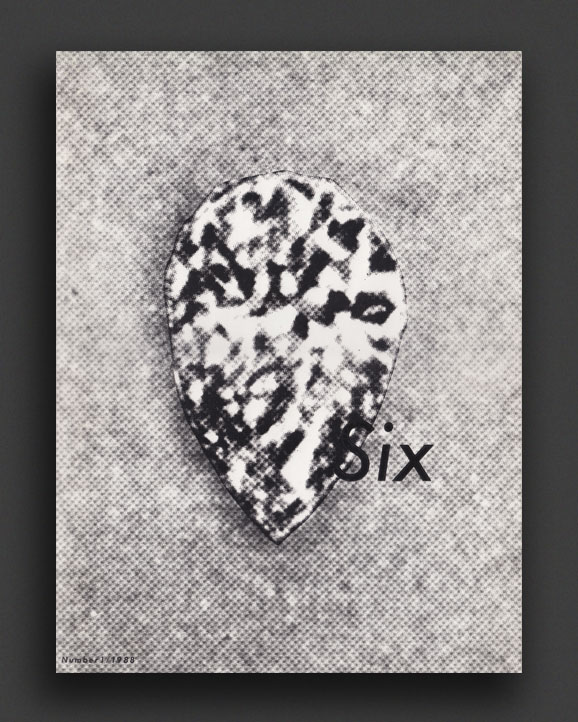
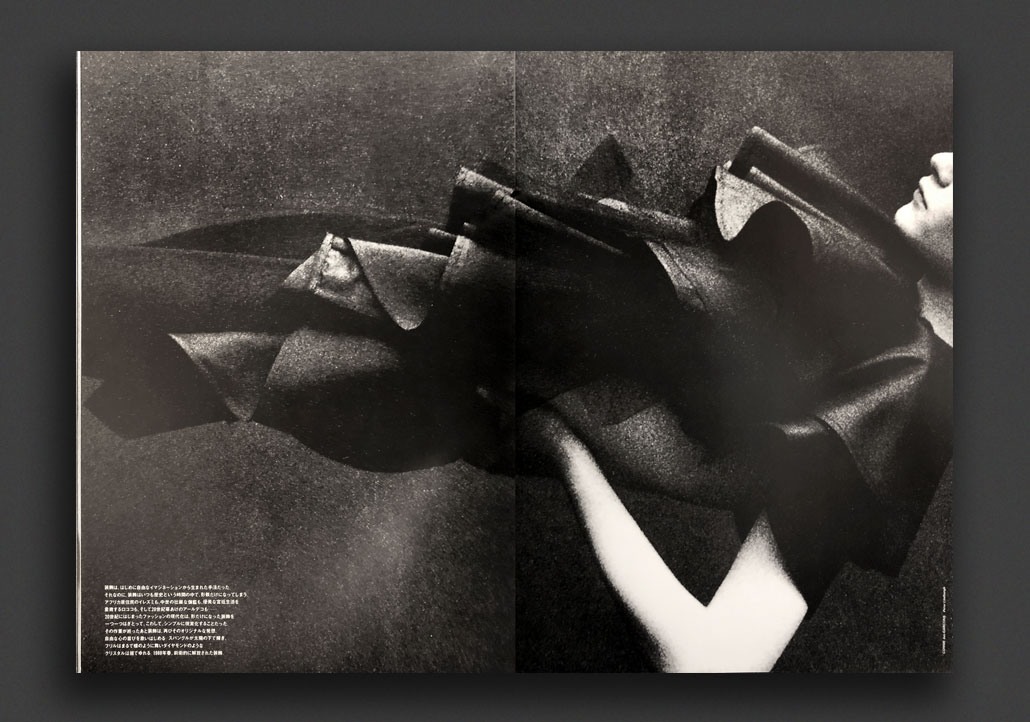
First 1988 edition, first printing of the inaugural issue of the cult, privately distributed Comme des Garçons publication. The incredible first issue of Comme des Garçons' 'Six' magazine (1988) features the work of Hungarian photographer André Kertész, Comme des Garçons by photographer Peter Lindbergh, photography by Sachiko Kuru, features on artist Jean Cocteau, architect Eileen Gray, artist Michel Sauer, and an interview with fashion designer Yohji Yamamoto, plus additional photography by Timothy Greenfield-Sanders, Arthur Elgort, Tony Mendoza, Sachiko Kuru, Shinji Mori, Serge Lido and Gisele Freund. Beautiful first-edition printing of this over-sized magazine vision of Rei Kawakubo, including die-cut features throughout and de-bossed cover title.
Between 1988 and 1991, Comme des Garçons explored the theme of the sixth sense via eight special biannual oversized, unstapled magazines titled 'Six'. These magazines were launched to coincide with Comme des Garçons fashion collections and were privately printed and distributed by Comme. The magazine visually represented the brand in a way that no other fashion company had before. Rei Kawakubo invited Tsuguya Inoue to art direct and Atsuko Kozasu to edit the issues, whilst contributions came from a diverse array of leading designers and artists. Issues of Comme des Garçons 'Six' have become very sought after collectors items.
Very Good / Near Fine copy.
1967, German
Offset poster (double-sided), 83.5 x 59 cm
1st Edition, Out of print title / used / very good
$600.00 - Out of stock
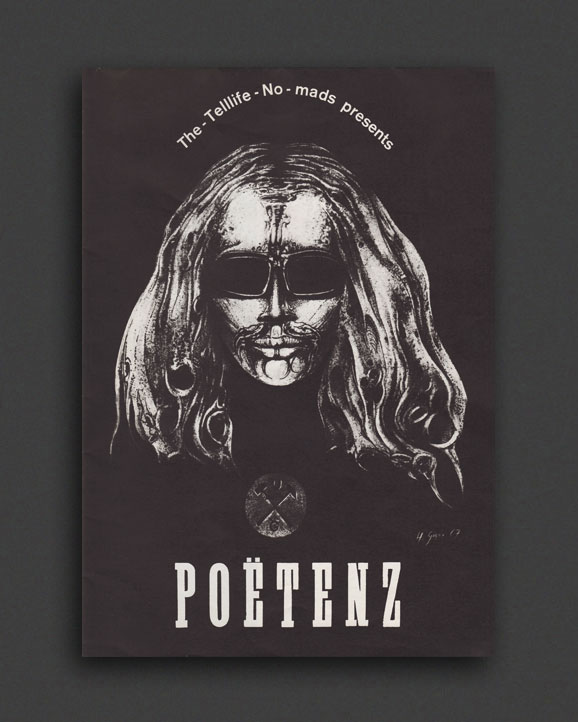
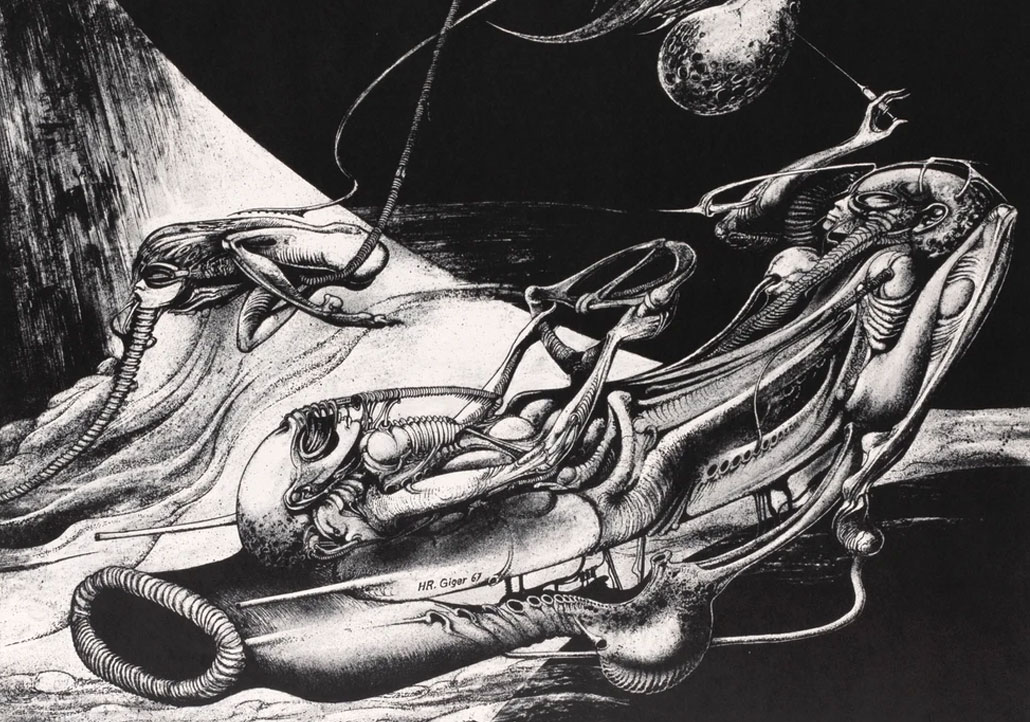
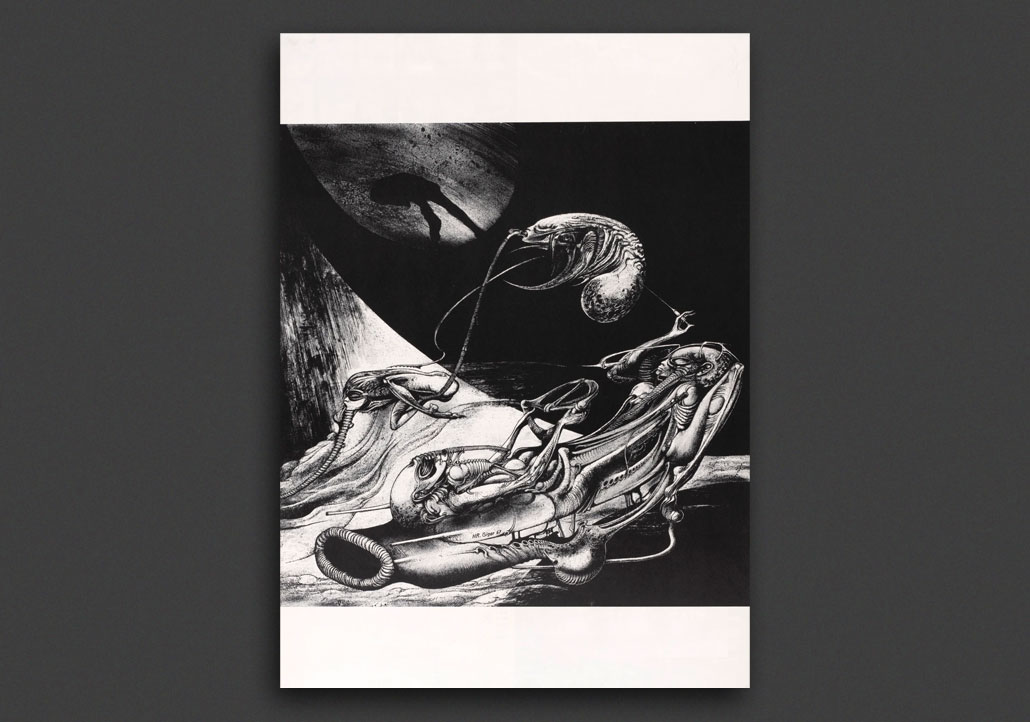
Where it all started.... H.R. Giger's first ever poster! Rare vintage original and never reprinted.
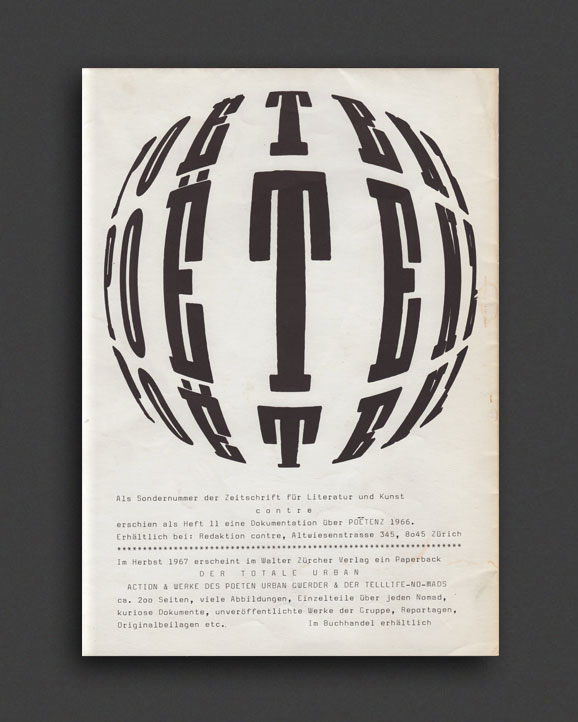
Published in a limited edition to accompany the The-Telllife-No-mads-presents: Poëtenz happening/exhibition, organized by young Giger's friend and collaborator, Swiss writer, artist and publisher Urban Gwerders. Gwerders was the publisher of Swiss underground counterculture magazine Hotcha (1968—1971), to which Giger was also a contributor. The poster folds-down into a catalogue/program for the event with original cover artwork by Giger and collage contents, poems, photographs (including pics of Giger, Li, et al) and Poëtenz information, all designed in the montage style of Hotcha, and the "poster" side entirely reproducing Giger's incredible early "Astreunuchen" masterpiece, pre-dating ALIEN by over ten years.
A stunning collector's item and piece of Giger history, ready to frame.
Dimensions : 83.5 x 59 cm
Very Good condition, never mounted/pinned, well preserved in folded state as issued.
1977, Japanese
Softcover (staple-bound), 28 pages, 36.5 x 26 cm
1st Edition, Out of print title / used / very good
Published by
Nisshindo Optical Shop / Nagoya
$140.00 - In stock -
Extremely rare calendar issue from acclaimed Japanese photographer and representative of the Provoke movement, Hitomi Watanabe. Issued privately by a small eyeglasses shop in Nagoya, Nisshindo Optical Shop, this 1977 "LOOK" Calendar presents the rarely seen personal 1970s work of Watanabe. Watanabe began her career photographing in the Tokyo neighbourhood of Shinjuku, home to Japan’s 1960s counter culture. She came to prominence during the Zenkyoto student movement in the late 1960s, occupied the University of Tokyo campus in 1968-69 and participated in the 10.21 International Anti-War Day protests and 1970 Anpo protests against the renewal of the Japan-US Mutual Security Treaty. Her candid photographs of the everyday lives of the protesters, the state violence, and the aftermath of rioting from her insider’s vantage on this tumultuous moment afforded her work an undeniable, enduring power. Her famed "Kaihoku '68 / Liberated Area '68" a testament to this. When the Japan-US Mutual security treaty was renewed in 1970, Watanabe, heartbroken that they had not been able to prevent it, began her long travels through Asia, particularly India and Nepal, from which these beautiful, atmospheric colour photographs are taken. Reproduced in large format across the 12 months of 1977.
Very Good copy with some light wear and light cover tanning. Has been previously hung.
1971, English
Hardcover (w. dust jacket), 214 pages, 20 x 13.5 cm
1st Edition, Out of print title / used / very good
Published by
Calder and Boyars / London
$45.00 - Out of stock
First 1971 hardcover edition of the first English edition of Roberte Ce Soir and The Revocation of the Edict of Nantes, published in London by Calder and Boyars. Together these two novels comprise the most fascinating, obsessive, and erotic works of contemporary French fiction. Like the works of Georges Bataille, and those of the Marquis de Sade before him, Klossowski's fiction explores the connections between the mind and the body through a lens of sexuality. Both of these novels feature Octave, an elderly cleric; his striking young wife Roberte; and their nephew, Antoine in a series of sexual situations. But Klossowski's books are about theology as well, and this merging of the sexual with the religious makes this book one of the most painstakingly baroque and intellectual novels of our time.
Pierre Klossowski (August 9, 1905, Paris – August 12, 2001, Paris) was a French writer, translator and artist. He was the eldest son of the artists Erich Klossowski and Baladine Klossowska, and his younger brother was the painter Balthus.
As a writer, Pierre Klossowski wrote full length volumes on the Marquis de Sade and Friedrich Nietzsche, a number of essays on literary and philosophical figures, and five novels. Roberte Ce Soir (Roberte in the Evening) provoked controversy due to its graphic depiction of sexuality.[1] He translated several important texts (by Virgil, Ludwig Wittgenstein, Martin Heidegger, Friedrich Hölderlin, Franz Kafka, Nietzsche, and Walter Benjamin) into French, worked on films and was also an artist, illustrating many of the scenes from his novels. Klossowski participated in most issues of George Bataille's review, Acéphale, in the late 1930s.
His 1969 book, Nietzsche and the Vicious Circle, greatly influenced French philosophers such as Michel Foucault, Gilles Deleuze, and Jean-François Lyotard.
Very Good copy in VG dust jacket, preserved under mylar wrap.
2009, English
Hardcover, 550 pages, 22 x 28 cm
1st Edition, Out of print title / used / good
Published by
The MIT Press / Massachusetts
$400.00 - Out of stock
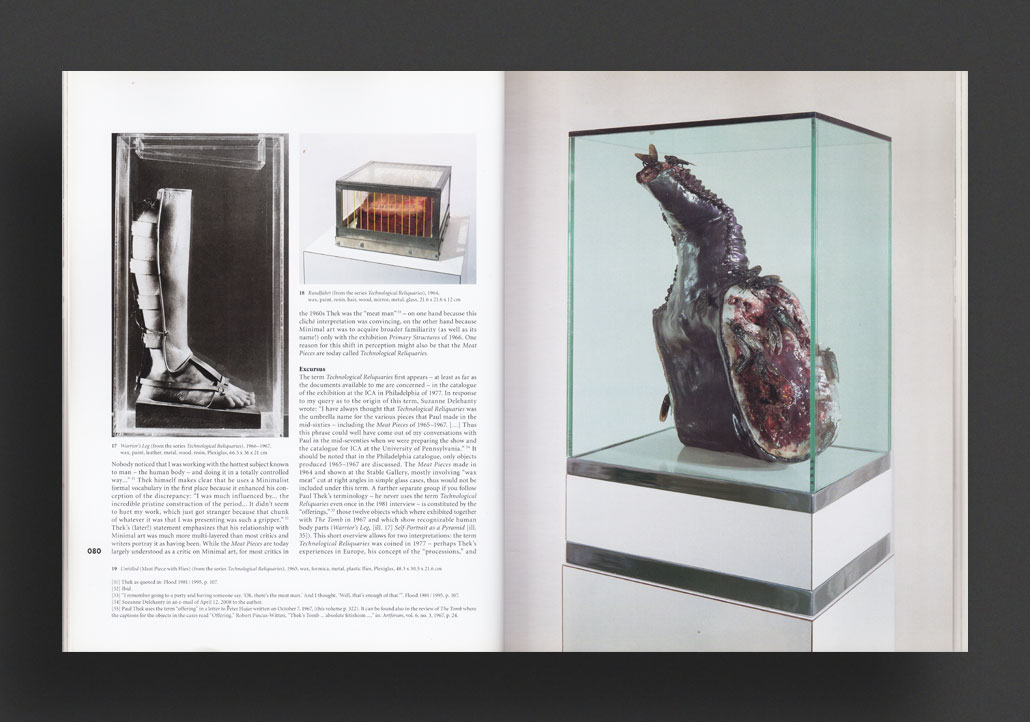
First edition of the scarce, highly sought after, and most comprehensive book ever published on American artist Paul Thek, published in 2009 by MIT Press. Edited by Harald Falckenberg and Peter Weibel, this enormous 550 page monograph contains more than 300 works by this groundbreaking artist, documenting his journey from legendary outsider to central figure in many contemporary art movements.
Paul Thek occupied a place between high art and low art, between the epic and the everyday. During his brief life (1933-1988), he went against the grain of art world trends, humanizing the institutional spaces of art with the force of his humor, spirituality, and character. Twenty years after Thek's death from AIDS, we can now recognize his influence on contemporary artists ranging from Vito Acconci and Bruce Nauman to Matthew Barney, Mike Kelley, and Paul McCarthy, as well as Kai Althoff, Jonathan Meese, and Thomas Hirschhorn. This book brings together more than 300 of Thek's works—many of which are published here for the first time—to offer the most comprehensive display of his work yet seen. The book, which accompanies an exhibition at ZKM ? Museum of Contemporary Art presenting Thek's work in dialogue with contemporary art by young artists, includes painting, sculpture, drawing, and installation work, as well as photographs documenting the room-size environments into which Thek incorporated elements from art, literature, theater, and religion. These works chart Thek's journey from legendary outsider to foundational figure in contemporary art. In their antiheroic diversity, Thek's works embody the art revolution of the 1960s; indeed, Susan Sontag dedicated her classic Against Interpretation to him. Thek's treatment of the body in such works as “Technological Reliquaries,” with their castings and replicas of human body parts, tissue, and bones, both evoke the aura of Christian relics and anticipate the work of Damien Hirst. The book, with more than 500 images (300 in colour) and nineteen essays by art historians, curators, collectors, and artists, investigates Thek's work on its own terms, and as a starting point for understanding the work of the many younger artists Thek has influenced.
Essays by Jean-Christophe Ammann, Margrit Brehm, Bazon Brock, Suzanne Delehanty, Harald Falckenberg, Marietta Franke, Stefan Germer, Kim Gordon, Roland Groenenboom, Axel Heil, Gregor Jansen, Mike Kelley, John Miller, Susanne Neubauer, Kenny Schachter, Harald Szeemann, Annette Tietenberg, Peter Weibel, Ann Wilson.
Good copy with heavy tanning to spine and covers (esp. fluro spot colour), some bumping to cover corners, light page edge tanning. Internally Very Good, clean throughout.
2012, English / Japanese
Hardcover, unpaginated, 26.5 x 18.5 cm
1st Edition, Out of print title / used / very good
Published by
Presspop Gallery / Tokyo
$200.00 - Out of stock
First edition of this fast out-of-print and collectible hardcover volume collecting the artwork of legendary and prolific Japanese horror master Hideshi Hino, including three never-before-seen short manga stories, all in full-colour, published in 2012 by Presspop, Tokyo. Cover-to-cover artworks with only one exceptionally appropriate text, "Pseudo Amida Sutra of a Dreaming Embryo", by fellow horror manga artist Suehiro Maruo. Also includes valuable visual bibliography of all his illustrated books printed as the book's endpapers.
Hideshi Hino (b. 1946) is a Japanese manga artist who specializes in horror stories. His comics include Hell Baby, Hino Horrors, and Panorama of Hell. He also wrote and directed two entries in the Guinea Pig series of horror films: Flower of Flesh and Blood (1985), and Mermaid in a Manhole (1988).
"Mother, breasts, conception, last month of pregnancy, praying for easy delivery, painful delivery, stillbirth, hemorrhage, filth, midwife, pitiless hag, cropping, selling of own child, convention, superstition, Dog Spirit, curse, whisper, lie, paranoia, auditory hallucination, neurosis, insanity, isolation, confinement, basement, cell, prison, reformatory, orphanage, abandoned child, abandoned old men and women, missing woman, old legend of Toono, loner, hermit, bum, beggar, solitary death, prairie fire, will-o'-the-wisp, graveyard, cluster-amaryllis, offering, cake, ant, lizard, viper, hornet, poisonous sting, syringe needle, drugs, morphine, strychnine, promin, opium, drug addiction, sanatorium, tuberculosis, nurse, white robe, hygiene, unsanitary, filthy, stench, body odor, heat rash, scabies, ringworm, pus, eye mucus, trachoma, cataract, eyepatch, bandage, mummy, offering, human sacrifice, regrettable death, grudge, ghost, evil spirit, malice, secession, echtoplasma, spiritualistic medium, shrine maiden, Japanese voodoo doll, little boy, big boy, nostalgia, loss of homeland, childhood, old age, afterlife, pilgrim's hymn, the invocation Namu Amida Butsu, the special practice of one million nenbutsu, death, lotus flower, transmigration, near death experience, immortality of the soul, funeral, black and white striped bunting for funeral, mourning dress, hearse, crematory, smoke, whirlpool, labyrinth, dizziness, acrophobia, claustrophobia, socialphobia, stuttering, deafness, blindness, night-blindness, malnutrition, hypoplasia, poliomyelitis, crutches, crippled legs, bound feet, freak angel, peculiar disease, genetic inheritance, lineage, ancestor, clan, blood relative, incest, necrophilia, maggot, gutbucket, defecation, excreta, drainage, cave, stalagmite, darkness, moonless night, eclipse of the moon, crowd under the moon, Dogra Magra, Pseudo Amida Sutra."
Near Fine—Very Good copy.
1978, German
Softcover (w. dust jacket), 220 pages, 20 x 20 cm
1st Edition, Out of print title / used / very good
Published by
Schirmer & Mosel / Munich
Ludwig Museum / Cologne
Schirmer Mosel
$80.00 - Out of stock
First 1978 edition of this gorgeous German book dedicated entirely to the magnificent photographic work of Wols. Lavishly illustrated throughout in b/w with a comprehensive collection of over 100 pages of his accomplished photography of still life object assemblages, portraits, the streets of Paris, interiors, and more, including an additional 120 pages of heavily illustrated in-depth biographical text on the artist, featuring many of his paintings, drawings, photographs and private photo-documents.
Wols was the pseudonym of Alfred Otto Wolfgang Schulze (27 May 1913, Berlin – 1 September 1951, Paris), a German painter, photographer, engraver, and graphic designer. Though broadly unrecognized in his lifetime, Wols was close to Surrealism, and is considered a pioneer of Lyrical Abstraction, one of the most influential artists of the Tachisme movement, and of Informal art in Europe. He moved to France when he fled the Hitlerian regime, with a recommendation from the artist-teacher Moholy-Nagy. Illegal immigrant, he was considered as a deserter and a stateless person, arrested many times by the French police. In 1936, Wols received, with Léger and Rivière's help, a limited resident permit, working as a photographer — his unusual fashion and interiors photographs were sold as postcards and printed in many international fashion magazines. Immediately after the beginning of the Second World War, Wols was enprisoned with many Germans in different French internment camps, where Wols realized many surrealist drawings and watercolours that he is now well-known for. He spent most of the war trying to emigrate to the United States, an unsuccessful and costly enterprise that may have driven him to alcoholism. After the hype from the war had died down, he had his first exhibition of watercolors in December 1945 at the Galerie René Drouin, Paris, where despite the lack of commercial success he made an impression. His paintings represented a rejection of figuration and abstraction, and a projection into a metaphysical plane. In the years following the war, Schulze concentrated on painting and etching. His health declined severely towards the end of the 1940s; in 1951 he died of food poisoning at the Hotel Montalembert in Paris, after releasing himself from hospital against medical advice. After his death his works were shown at the Kassel documenta (1955), documenta II (1959) and documenta III (1964).
Very Good with some cover wear/rubbing.
1959, French
Softcover (french-folds), 46 pages, 22 x 16 cm
1st Edition, Out of print title / used / very good
Published by
Gallery Europe / Paris
$70.00 - Out of stock
Beautifully designed catalogue published on the occasion of the exhibition Wols - Decembre 1959 - Fevrier 1960, Gallery Europe, Paris. Illustrated throughout with the paintings and drawings of German painter and photographer Alfred Otto Wolfgang Schulze, known as Wols, mounted as plates in colour and b/w on raw black boards with accompanying texts/lyrics of Will Grohmann, Henri Miller and Wols in French printed on blue machine paper throughout. Closes with Oevres exposées. On of the loveliest Wols catalogues.
Wols was the pseudonym of Alfred Otto Wolfgang Schulze (27 May 1913, Berlin – 1 September 1951, Paris), a German painter and photographer predominantly active in France. Though broadly unrecognized in his lifetime, he is considered a pioneer of Lyrical Abstraction, one of the most influential artists of the Tachisme movement. He is the author of a book on art theory entitled Aphorismes de Wols.
Very Good copy with some tanning to cover edges.
1998, German
Hardcover, 224 pages, 23 x 30 cm
1st Edition, Out of print title / used / very good
Published by
Brinkmann & Bose / Berlin
Neue Gesellschaft fur Bildende Kunst / Berlin
$280.00 - Out of stock
First limited edition hardcover edition of this wonderful Unica Zürn monograph. Published to accompany a major survey exhibition in Berlin in 1998, this beautifully produced catalogue, now long out-of-print, is still one of the most cherished and comprehensive collections of Zürn's artwork ever published.
The German artist and writer Unica Zürn (1916-1970) joined the ranks of Surrealism in the 1950s, after moving to Paris and taking up residence with fellow German-born Surrealist Hans Bellmer. Already an accomplished author, Zürn was drawn to the Surrealist movement's espousal of automatic drawing and writing, Zürn pursued Henri Michaux's declaration that "the hand dreams," making a vocation of these techniques with her dense, otherworldly drawings and paintings that are labyrinthine in detail, as one form sprouts out of another. Also with her experimental anagrams, natural extensions of her established interest in hidden meanings and coincidences. Zürn produced most of her oeuvre during this intensive period in the 1950s and 60s, though one marked by her deteriorating mental health. Many of her works were made during periods of hospitalisation. In 1970, Zürn leapt to her death from the balcony of the Paris apartment she had shared with Bellmer. Upon his death in 1975, Bellmer was buried, at his request, next to Zürn in Paris’s Père-Lachaise Cemetery. Their grave is marked with the words Bellmer wrote for Zürn’s funeral wreath nearly five years before: “My love will follow you into Eternity.”
Zürn has left us an account of the sensation of automatic drawing: "After an initial moment when the pen 'swims' hesitantly on the paper, she discovers the place assigned to the first eye. It is only when she is being watched from the depths of the paper that she begins to get her bearings and, effortlessly, one motif is added to another."
Very Good copy, light wear.
2014, English
Variable (w. 10 insert colour plates and a thermo printed index)
1st Edition, Out of print title / as new
Published by
Motto / Berlin
Supportico Lopez / Berlin
$80.00 - Out of stock
Artist book by sculptor Michael Dean, published in an edition of 500 by Supportico Lopez. Each original edition is bound in a found paperback, each one different, with 10 inserted colour plates of Dean's work, and a thermo printed index.
Out-of-print.
2001, English
Softcover, 368 pages, 27 x 24 cm
1st Edition, Out of print title / used / good
Published by
MACBA / Barcelona
$100.00 - Out of stock
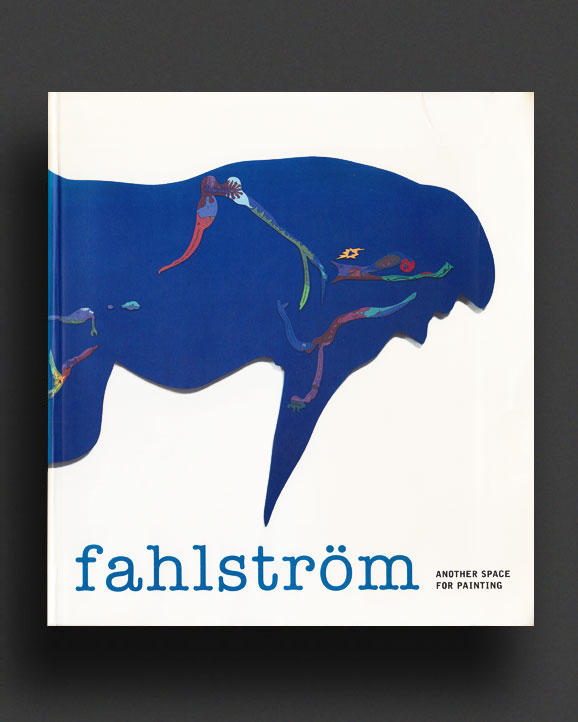
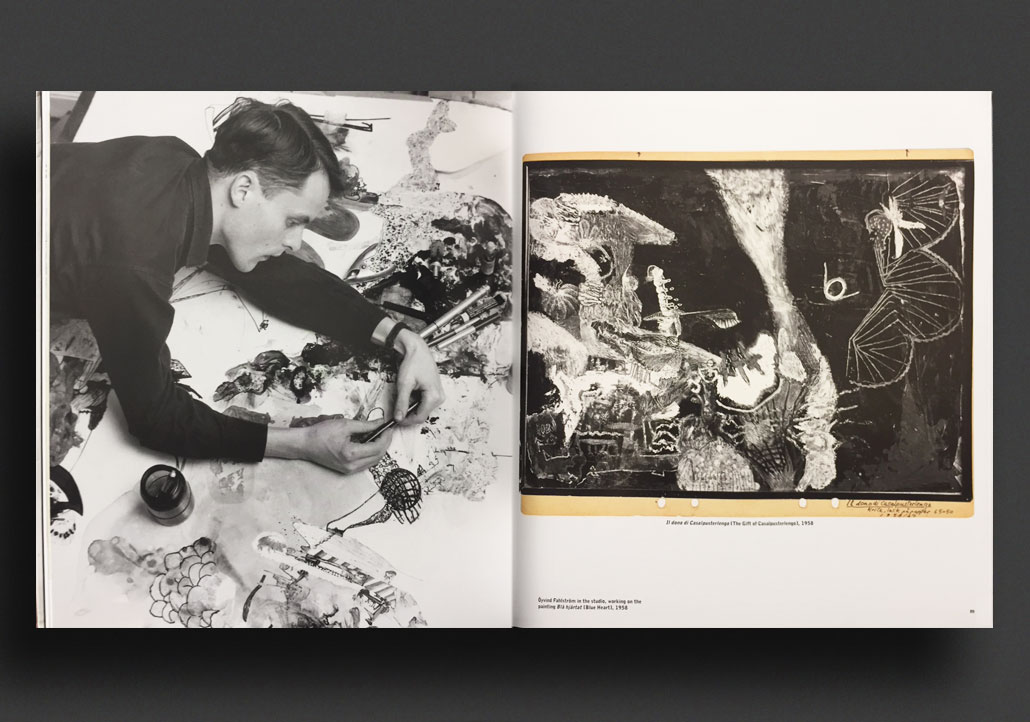
The most comprehensive, long out-of-print, English-language publication on the Brazilian-born Swedish artist Öyvind Fahlström (1928-1976) known for his esoteric approach to exploring semiotics through visual systems. Published by Museu d'Art Contemporani de Barcelona in 2001 on the occasion of the largest retrospective of Fahlström's work, this heavy catalogue is profusely illustrated throughout with 400 illustrations in colour and b/w. Include texts by Manuel J. Borja-Villel, Jean-François Chevrier, Immanuel Wallerstein, Octavi Rofes, Suely Rolnik, plus biography; exhibition history; bibliography.
Often employing mysterious symbols and text, popular culture, comic books, politics, and cartography, Fahlström created works meant to suggest epic narratives, seeking to “create a world of situations and actions in a contradictory and discontinuing time-space.” As a young man he began writing for Swedish publications, and produced poetry, plays, translations, and art. In 1961, the artist moved to New York, which was his primary place of residence for the rest of his life. Living in the same building as Jasper Johns, Fahlström’s artistic production increased with his associating with American avant-garde artists, participating in Happenings, becoming associated with the Fluxus movement, exhibiting his work at the 1964 and 1966 Venice Biennales, and continuing to write plays. He was featured in the celebrated 1962 New Realists exhibition at Sidney Janis Gallery and had numerous solo exhibitions with Janis throughout his life. Today, his works are held in the collections of The Museum of Modern Art in New York, the Moderna Museet in Stockholm, and the Art Institute of Chicago, among others.
Good copy.
Spine tanning some bumping to corners.
1981, Italian
Softcover, 67 pages, 29.5 × 21 cm
1st Edition, Out of print title / used / very good
Published by
Electa / Milan
$290.00 - Out of stock
Here it is - the very rare FIRST ever Memphis book, published by Electa in Italy in 1981!
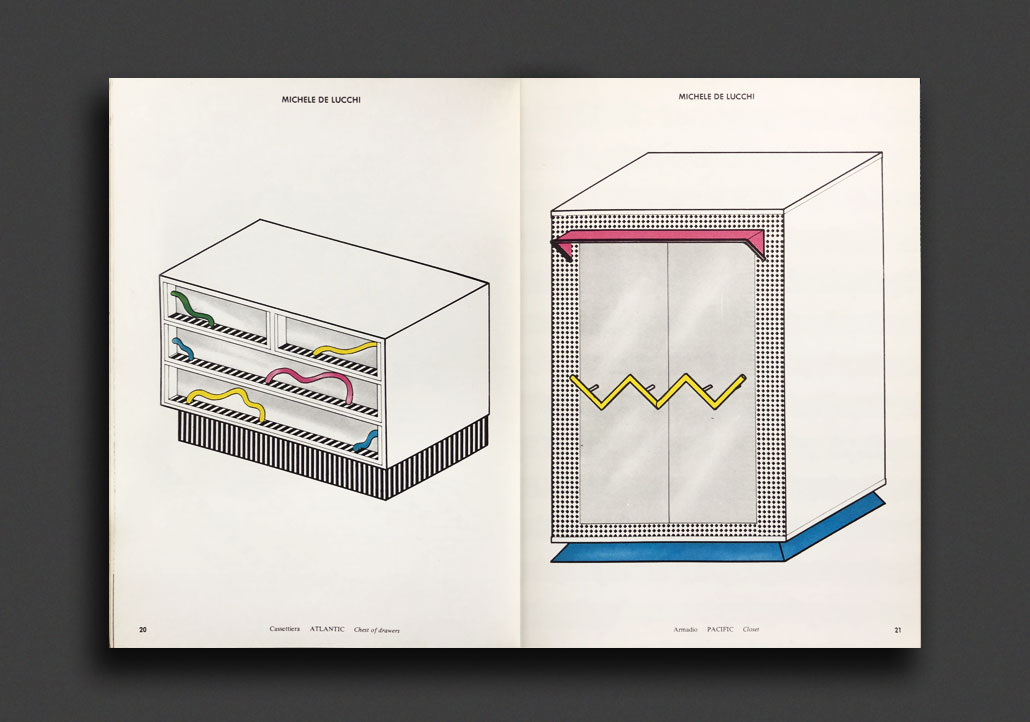
First edition. Wrapped in a fold-out front and back cover design by Marco Zanini, this very early document of Memphis is almost entirely a visual folio of reproductions of the original drawings by Martine Bedin, Andrea Branzi, Aldo Cibic, Michele De Lucchi, Nathalie du Pasquier, Michael Graves, Hans Hollein, Arata Isozaki, Shiro Kuramata, Alessandro Mendini, Paola Navone, Peter Shire, Ettore Sottsass, George Sowden, Matteo Thun, Masanori Umeda and Marco Zanini. Along with an early essay by Barbara Radice (in both Italian and English), this catalogue tells the very beginning of the Memphis story through the original drawings of furniture, objects, lighting and patterns compiled from international architects, artists and designers. The story goes that Ettore Sottsass and his core group encouraged international architects and designers to send their concepts and drawings for new designs for domestic furnishings. In viewing their results through this selection of the drawings, it is clear there was a global design revolution happening and Memphis was about to produce prototypes of these designs that would shock and change the world forever.
A rare opportunity to own this important publication of design history.
Note: This book was briefly re-issued in 2009 in a limited edition - this is however the first printing from 1981.
Very Good copy.
1991, English
Hardcover, 60 pages, 28 x 21.5 cm
1st Edition, Out of print title / used / fine
Published by
Sotheby's / Monaco
$340.00 - In stock -
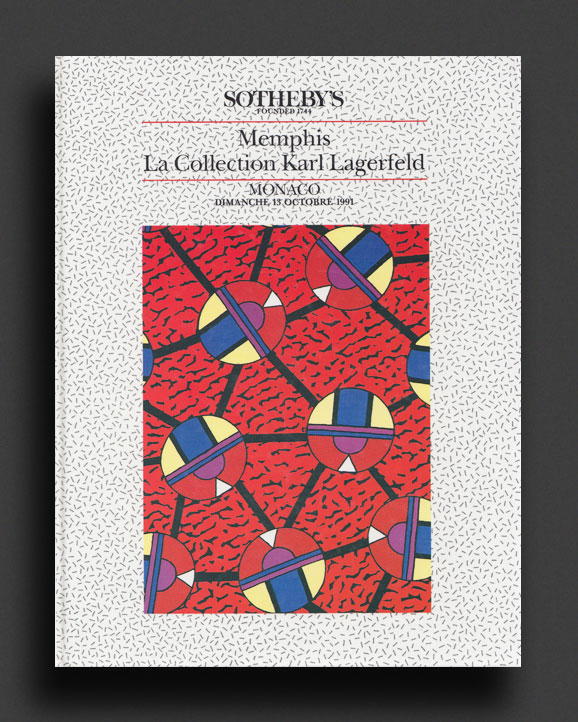
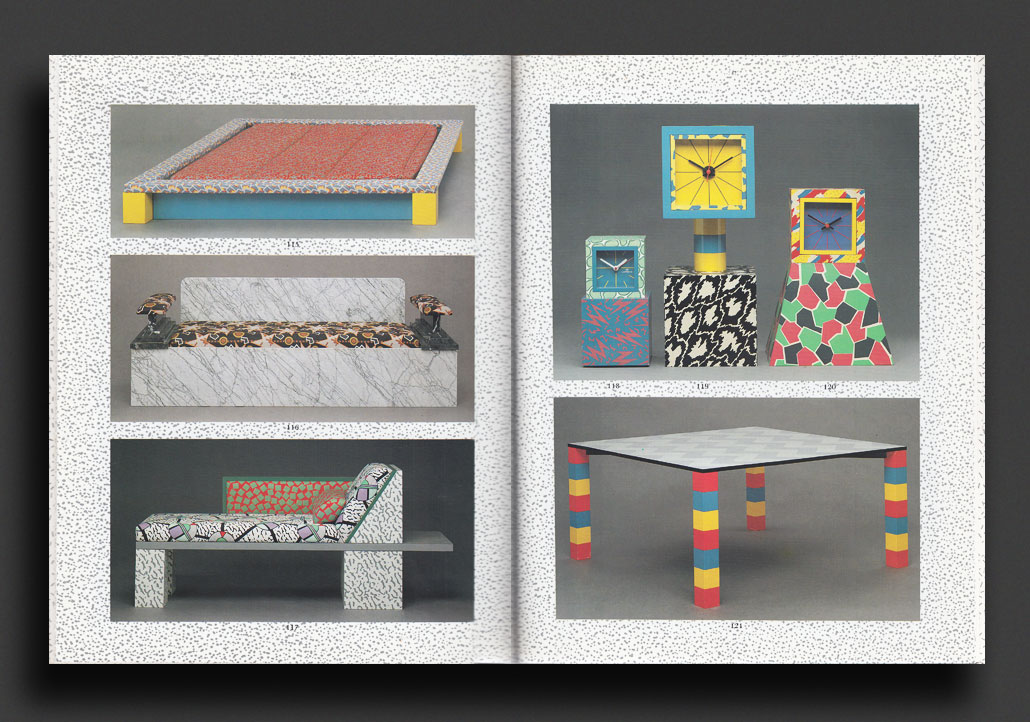
The incredible and now very collectable hardcover catalogue for the important sale of Karl Lagerfeld's collection of Memphis furniture and objects in 1991. Lagerfeld had built one of the most extensive collections of this extraordinary design group during the early 1980s in order to furnish his new modern apartment in Monte Carlo. In his catalogue introduction where he declares his love at first sight for the Memphis group in 1981, he goes on to call Memphis the "Art Deco of the '80s". When he sold the apartment he decided to sell the collection that furnished it from floor to ceiling. Lavishly illustrated in full-colour with 133 lots, all the main Memphis designers are included - Ettore Sottsass, Michele De Lucchi, Martine Bedin, Matteo Thun, Marco Zanini, Masanori Umeda, George James Sowden, Peter Shire, Aldo Cibic. The pieces include chairs, tables, cabinets, shelves, lights, teapots, clocks, televisions, etc. Includes texts and quotes from Lagerfeld, Barbara Radice, Ettore Sottsass and Frederique Huygen, and a bibliography. Still one of the most unique, impressive and informative books on Memphis ever published.
Fine, beautifully preserved copy complete with inserted invitation sheet to the Monaco auction with schedule and hotel booking information (in French). Texts in the book are in French, with some English.
1972, German / English / French
Vinyl ring-binder (screen printed w. design by E. Ruscha), 650 pages +, 32 x 27 cm
1st Edition, Out of print title / used / very good
Published by
documenta / Kassel
$500.00 - Out of stock
Scarce copy of the only edition of the most elaborately designed, and lowest circulated Documenta catalogue, conceived by curator Harald Szeemann to accompany the fifth edition of Documenta, a quinquennial contemporary art exhibition held in Kassel, Germany.
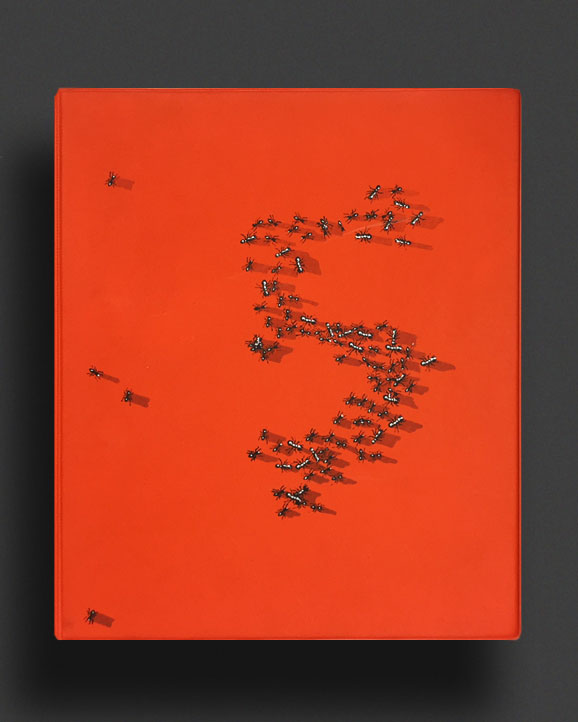
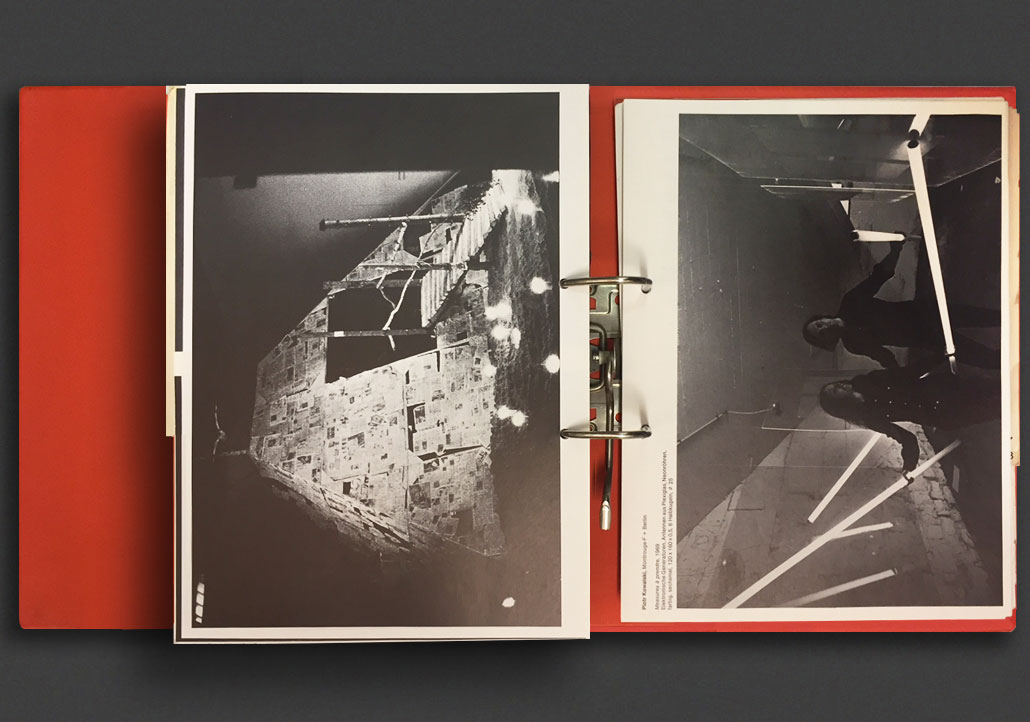
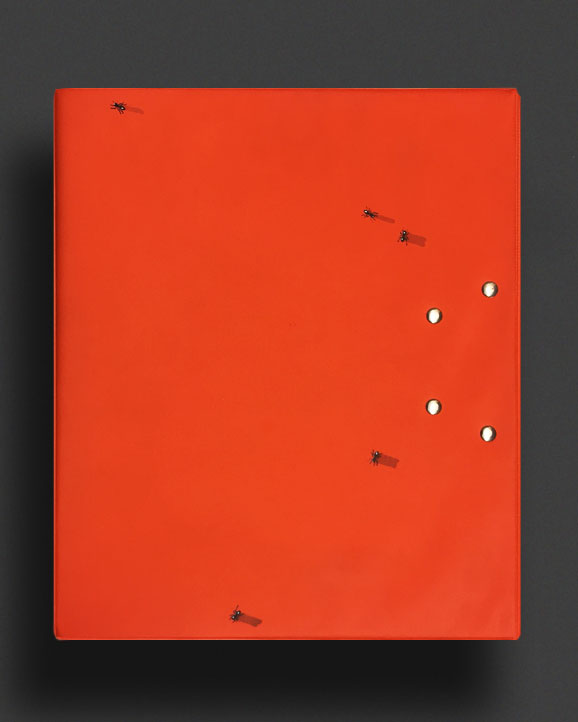
Subtitled "100 Days of Inquiry into Reality -- Today's Imagery," curated by the team of Harald Szeemann, Jean-Christophe Ammann and Arnold Bode, Documenta 5 followed a lineage of comprehensive shows documenting conceptually and minimally charged artworks curated by Szeemann including Live in Your Head (Kunsthalle Bern, 1969), and Happenings and Fluxus (Kunstverein, Köln), 1970. The largest, most expensive and most diverse of any exhibition anywhere, Documenta 5 was criticized in 1972 as being “bizarre…vulgar…sadistic” by art critic and essayist Hilton Kramer and “monstrous… overtly deranged” by art historian and art critic Barbara Rose, yet it still resonates today as one of the most important exhibitions in history. Featuring the works of over 170 artists and an equally expansive variety of materials and subjects drawn from popular cultural materials, architecture, science fiction, kitsch objects, film, advertising, children's art, etc. in addition to the more anticipated international survey of new painting and sculpture - Documenta 5 valiantly attempted to bridge the gap between art, culture, science and the broader society. This massive tome is housed in the iconic orange vinyl-covered, two-ring binder screen printed with the famous ant design by Edward Ruscha. The binder holds a tabbed index of illustrated artist's pages and associated texts and material, largely in German, but also many in English. All registers are present apart from the usual missing 19-25 which were not directly integrated into the catalogue and had to be ordered by the visitor separately to become their own contribution. This very complete copy also includes the additional 80 page, hole-punched Documenta 5 guide book, with floor plans, complete listing of exhibited artworks, list of exhibitions, bibliography, and many gallery, museum and other related advertisements. More than a catalogue, this publication is a piece of art history in itself.
Includes artists: Vito Acconci, Vincenzo Agnetti, Peter Alexander, John de Andrea, Giovanni Anselmo, Arbeitszeit, Archigram, Chuck Arnoldi, Art & Language, Richard Artschwager, Michael Ashkin, John Baldessari, Robert Barry, Georg Baselitz, Lothar Baumgarten, Robert Bechtle, Gottfried Bechtold, Bernd & Hilla Becher, Joseph Beuys, Karl Oskar Blase, Mel Bochner, Alighiero Boetti, Christian Boltanski, Claudio Bravo, George Brecht, K.P. Brehmer, Marcel Broodthaers, Stanley Brouwn, Günter Brus, Daniel Buren, Victor Burgin, Michael Buthe, James Lee Byars, Pier Paolo Calzolari, Luciano Castelli, Christo and Jeanne-Claude, Chuck Close, Tony Conrad, Ron Cooper, Bill Copley, Joseph Cornell, Robert Cottingham, Paul Cotton, Hanne Darboven, Walter De Maria, David Deutsch, Jan Dibbets, Herbert Distel, Gino de Dominicis, Marcel Duchamp, John Dugger, Don Eddy, Franz Eggenschwiler, Ger van Elk, Richard Estes, Luciano Fabro, John C. Fernie, Robert Filliou, Jud Fine, Joel Fisher, Terry Fox, Howard Fried, Hamish Fulton, Franz Gertsch, Gilbert & George, Ralph Goings, Hubert Gojowczyk, Dan Graham, Walter Grasskamp, Nancy Graves, Hans Haacke, Duane Hanson, Guy Harloff, Michael Harvey, Haus-Rucker-Co, Auguste Herbin, Eva Hesse, Rebecca Horn, Jean Olivier Hucleux, Douglas Huebler, Jörg Immendorff, Will Insley, Rolf Iseli, Ken Jacobs, Neil Jenney, Alfred Jensen, Jasper Johns, Joan Jonas, Max G. Kaminski, Howard Kanovitz, Edward Kienholz, Imi Knoebel, Christof Kohlhofer, Jannis Kounellis, Tom Kovachevich, Piotr Kowalski, David Lamelas, Barry Le Va, Jean LeGac, Alfred Leslie, Sol LeWitt, Richard Long, Ingeborg Luscher, Inge Mahn, Robert Mangold, Brice Marden, Agnes Martin, Etienne Martin, Richard McLean, David Medalla, Fernando Melani, Jim Melchert, Mario Merz, Gustav Metzger, Bernd Minnich, Malcolm Morley, Ed Moses, Bruce Nauman, Hermann Nitsch, Claes Oldenburg, Yoko Ono, Dennis Oppenheim, Blinky Palermo, Panamarenko, Giulio Paolini, A.R. Penck, Giuseppe Penone, Vettor Pisani, Sigmar Polke, Stephen Posen, Markus Raetz, Arnulf Rainer, Gerhard Richter, Klaus Rinke, Dorothea Rockburne, Peter Roehr, Allen Ruppersberg, Edward Ruscha, Reiner Ruthenbeck, Ulrich Ruckriem, Robert Ryman, John Salt, Salvo, Lucas Samaras, Paul Sarkisian, Jean-Frederic Schnyder, Ben Schonzeit, Werner Schroeter, HA Schult, Rudolf Schwarzkogler, Fritz Schwegler, Richard Serra, Paul Sharits, Allan Shields, Katharina Sieverding, Robert Smithson, Michael Snow, Keith Sonnier, Klaus Staeck, Paul Staiger, Jorge Stever, Robert Strubin, Paul Thek, Wayne Thiebaud, Andre Thomkins, David Tremlett, Richard Tuttle, Ben Vautier, W + B Hein, Franz Erhard Walther, Robert Watts, William Wegman, Lawrence Weiner, John Wesley, H.C. Westermann, William Wiley, Rolf Winnewisser, Tom Wudl, Klaus Wyborny, La Monte Young, Peter Young, Gilberto Zorio.
Catalogue also includes Bob Projansky and Seth Siegelaub's "The Artist's Reserved Rights Transfer and Sale Agreement." This "Agreement form has been drafted by Bob Projansky, a New York lawyer, after my [Siegelaub] extensive discussions and correspondence with over 500 artists, dealers, lawyers, collectors, museum people, critics and other concerned people involved in the day-to-day workings of the international art world. The Agreement has been designed to remedy some generally acknowledged inequities in the art world, particularly artists' lack of control over the use of their work and participation in its economics after they no longer own it. The Agreement for has been written with special awareness of the current ordinary practices and economic realitites of the art world, particularly its private, cash and informal nature, with careful regard for the interests and motives of all concerned. It is expected to be the standard form for the transfer and sale of all contemporary art, and has been made as fair, simple and useful as possible. It can be used either as presented here or slightly altered to fit your specific situation. If the following information does not answer all your questions consult your attorney." -- from Agreement's cover. Copies of the contract are individually included in English, Germany, and French editions.
Very Good, complete (as issued) copy. Very minor wear.
1971, English
Softcover, 192 pages, 17.5 x 10.5 cm
1st Edition, Out of print title / used / good
Published by
Berkley Medallion Books / Berkley
$45.00 - In stock -
Very first 1971 edition of Vermilion Sands by J.G. Ballard, published by Berkley in this paperback edition 2 years before the Jonathan Cape hardcover. Vermilion Sands is a collection of surreal science fiction short stories by Ballard, one of his finest, all set in an imaginary vacation resort called Vermilion Sands which suggests, among other places, a latter-day Palm Springs. Vermillion Sands is a fully automated desert resort designed to fulfill the most exotic whims of the idle rich. But now it languishes in uneasy decay, populated only by forgotten movie stars, solitary impresarios, parasites, and artistic and literary failures, a place where love and lust pall before the stronger pull of evil.
Vermilion Sands embodies the languid decay of a tawdry dream. A desert resort designed to fulfill the most exotic whims of the sated rich, it now moulders in sleazy dilapidation, a haven for the remittance men of the artistic and literary world, and for the human lampreys that prey upon them. It is a lair for malice and hate and envy — and the more cancerous forms of madness; a place where sensitive pigments paint portraits for their masters in a grotesque parody of art; where poets press the buttons of mechanical versifiers; where sculptures grow like funguses, and plants respond to music; where psychosensitive houses are driven mad by their owners' neuroses; where love and affection, and even lust, are effete madrigals played in a minor and discordant key.
From the dark recesses of a superb imagination, J. G. Ballard has conjured up an elegant nightmare of decadence, a portrait of a future Gomorrah where a Nero might play an automated violin.
"Ballard is one of the brightest stars in post-war science fiction."—Kingsley Amis
Very Good copy with some wear, tanning to pages, small sticker damage to cover.
1970, English
Softcover, 142 pages, 17.5 x 10.5 cm
Out of print title / used / good
Published by
Berkley Medallion / Berkley
$18.00 - Out of stock
Set in a remote fishing village in Japan, The Sound of Waves is a timeless story of first love. It tells of Shinji, a young fisherman and Hatsue, the beautiful daughter of the wealthiest man in the village. Shinji is entranced at the sight of Hatsue in the twilight on the beach and they fall in love. When the villagers' gossip threatens to divide them, Shinji must risk his life to prove his worth.
Yukio Mishima (1925—1970), one of the most spectacularly gifted writers in modern Japan, was born into a samurai family in 1925. Yukio Mishima was a Japanese author, poet, playwright, actor, model, Shintoist, nationalist, and founder of the Tatenokai ("Shield Society"), an unarmed civilian militia. Mishima is considered one of the most important Japanese authors of the 20th century. He was considered for the Nobel Prize in Literature in 1968. His works include the novels Confessions of a Mask and The Temple of the Golden Pavilion. Mishima's work is characterized by "its luxurious vocabulary and decadent metaphors, its fusion of traditional Japanese and modern Western literary styles, and its obsessive assertions of the unity of beauty, eroticism and death", according to author Andrew Rankin. In November 1970 he and his Tatenokai forced their way into a Self-Defense Force headquarters in Tokyo, where Mishima, after reading out a proclamation, committed ritual suicide with a young follower in the commanding officer's room. On the morning of his death, the last volume of Mishima's tetralogy, The Sea of Fertility (The Spring Snow, Runaway Horses, The Temple of Dawn, The Decay of the Angel) was delivered to his publisher.
Good—Very Good copy with page/edge tanning.
1965, English
Softcover, 252 pages, 20 x 13.5 cm
Out of print title / used / very good
Published by
City Lights Books / San Francisco
$55.00 - Out of stock
First 1965 edition of the first anthology of writings by Artaud in English, published by City Lights Books, edited and translated by Jack Hirschman.
"I am the man," wrote Artaud, "who has best charted his inmost self." Antonin Artaud was a great poet who, like Poe, Holderlin, and Nerval, wanted to live in the infinite and asked that the human spirit burn in absolute freedom.
To society, he was a madman. Artaud, however, was not insane, but in luciferian pursuit of what society keeps hidden. The man who wrote Van Gogh the Man Suicided by Society raged against the insanity of social institutions with insight that proves more prescient with every passing year. Today, as Artaud's vatic thunder still crashes above the "larval confusion" he despised, what is most striking in his writings is an extravagant lucidity.
This collection gives us quintessential Artaud on the occult, magic, the theater, mind and body, the cosmos, rebellion, and revolution in its deepest sense.
Antoine Marie Joseph Artaud, better known as Antonin Artaud (1896 – 1948), was a French dramatist, poet, essayist, actor, and theatre director, widely recognized as one of the major figures of twentieth-century theatre and the European avant-garde.
Jack Hirschman (b. December 13, 1933, in New York, NY) is a poet and social activist who has written more than 50 volumes of poetry. Dismissed from teaching at UCLA for anti-war activities in 1966, he moved to San Francisco in 1973, and was the city's present poet laureate. Hirschman translates nine languages and edited The Artaud Anthology.
Good copy, general light wear and tanning.
2017—2018, English
Softcover (staple-bound) pamphlets, various pagination, 42 x 20.4 cm
1st Edition, Out of print title / used / very good
Published by
Comme des Garçons / Tokyo
$320.00 - Out of stock
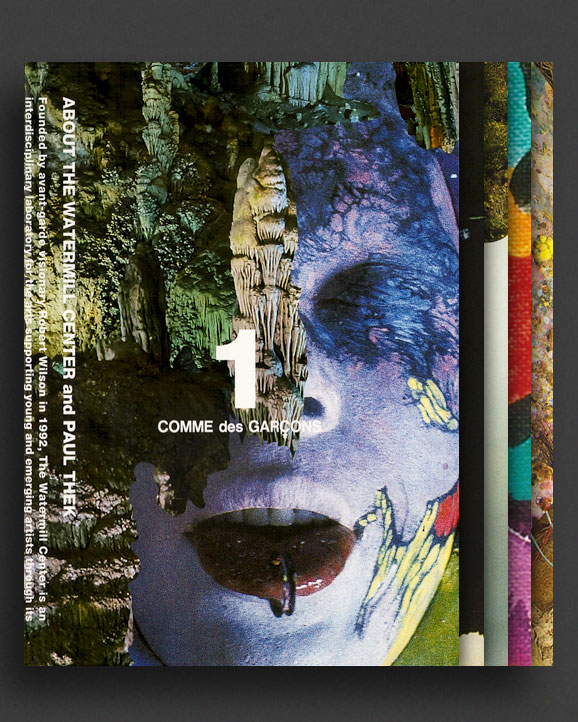
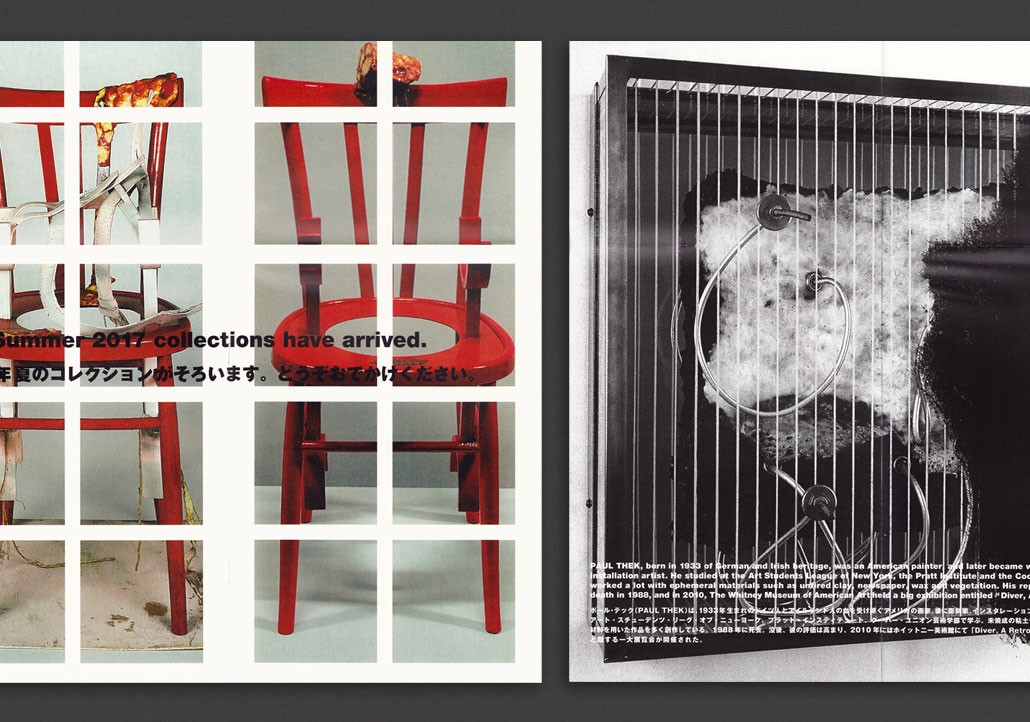
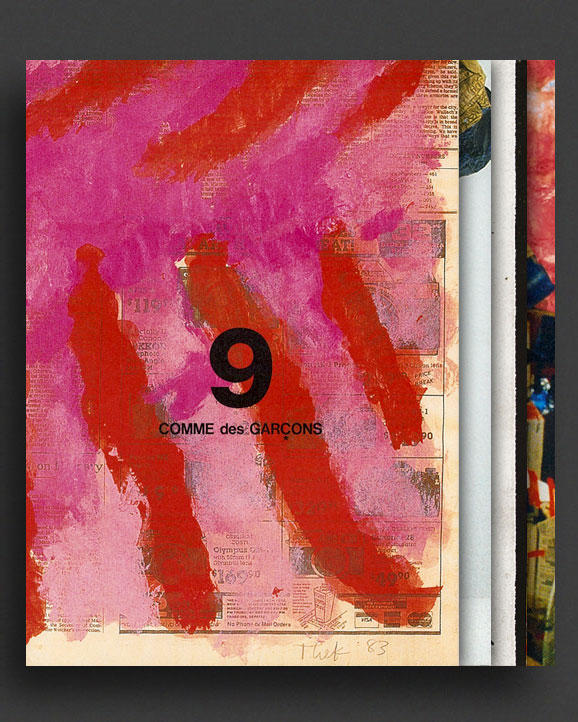
Large lot of the printed collaboration between Rei Kawakubo's Comme des Garçons and the estate of American artist Paul Thek. Issued as mail-outs privately by Comme to announce the arrival of each of their 2017—18 collections, and not commercially available, these gorgeous, over-sized, elaborate fold-out leaflets designed by CDG showcase Thek's artworks (paintings, installations, drawings, sculptures, photography, etc) in a series of graphic collaged publications, made possible by Robert Wilson's Watermill Centre and Alexander and Bonin. Very Good, preserved copies, issued and collected individually, now very scarce. A couple with original b/w CDG mailers/envelopes included (not pictured). Included are the publications/posters numbered #1, #2, #5, #9, #10, #12, #16, #21, #23.
American artist Paul Thek (1933-1988) was an elusive sculptor, painter, and one of the first artists to create environments or installations, who came to recognition showing his sculpture in New York galleries in the 1960s. The first works exhibited, which he began making in 1964 and called “meat pieces” as they were meant to resemble flesh, were encased in Plexiglas boxes that recall Minimal sculptures. At the end of the sixties, Thek left for Europe, where he created extraordinary environments, incorporating elements from art, literature, theater, and religion, often employing fragile and ephemeral substances, including wax and latex. His work was presented at documenta 4 and 5 in Kassel (1968, 1972), the Stedelijk Museum in Amsterdam (1969), the Moderna Museet in Stockholm (1971), and the Kunstmuseum in Lucerne (1973). He was supported in particular by Harald Szeemann and Jean-Christophe Ammann. In 1977, Suzanne Delehanty curated Processions at the Institute of Contemporary Art in Philadelphia, marking the first solo exhibition of Paul Thek's work in an American institution. At the close of the 1970's Thek changed direction, moved back to New York, and turned to the making of small, sketch-like paintings on canvas, although he continued to create environments in key international exhibitions. With his frequent use of highly perishable materials, Thek accepted the ephemeral nature of his art works—and was aware, as writer Gary Indiana has noted, of “a sense of our own transience and that of everything around us.” Following his death in 1988, his work was mainly shown in Europe (Castello di Rivara, Witte de With, etc). In 2008, the ZKM in Karlsruhe programmed Paul Thek Artist's Artist, which also explored how Thek's work has resonated in the contemporary scene. On the other side of the Atlantic, it wasn't until 2010 that the Whitney Museum in New York dedicated a remarkable retrospective to Thek, whose title, Paul Thek: Diver, emphasized the artist's passion for the sea.
Very Good copies each.
2014, English / Japanese
Softcover (staple-bound), various pagination, 28.5 x 20.5 cm
1st Edition, Out of print title / used / fine
Published by
Comme des Garçons / Tokyo
$70.00 - Out of stock
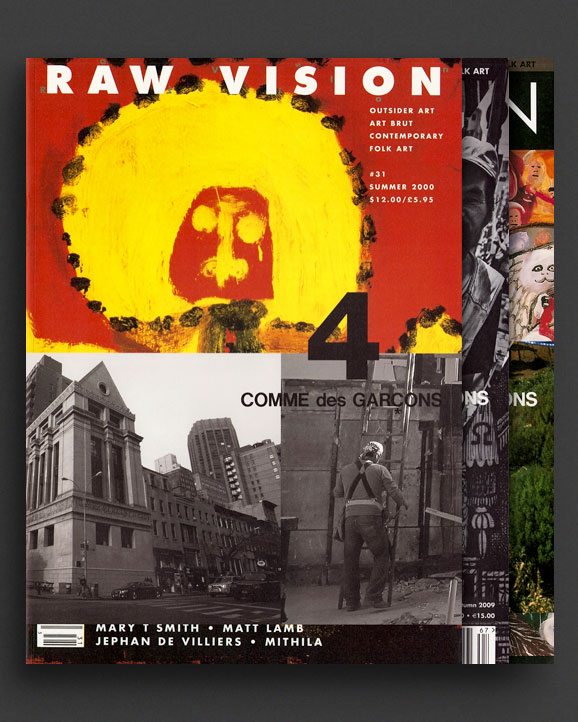
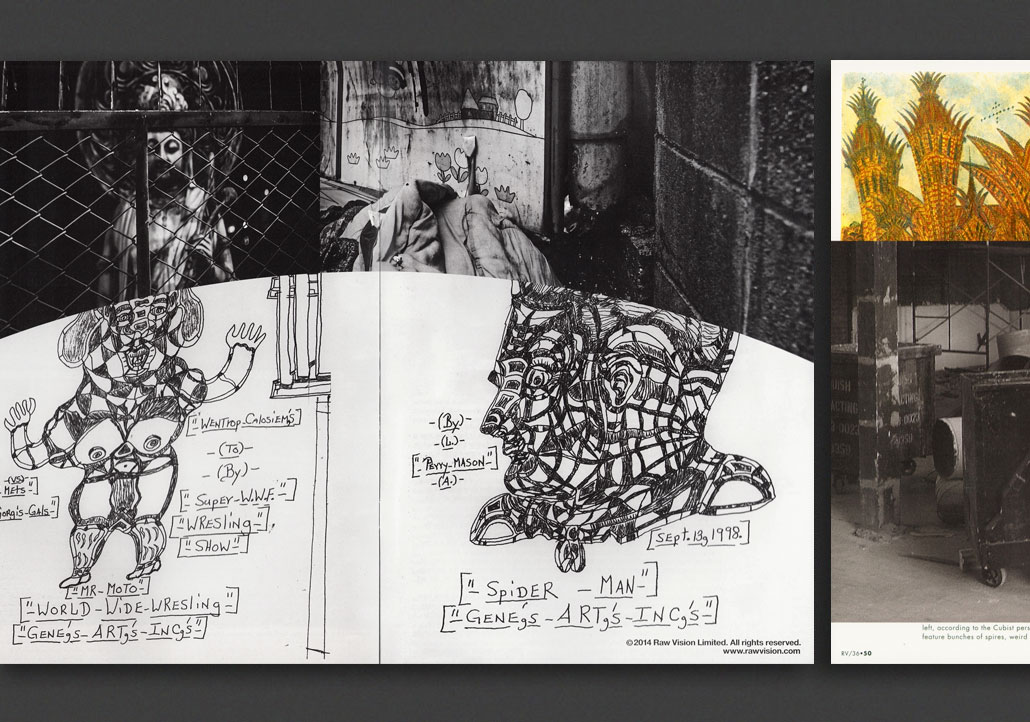
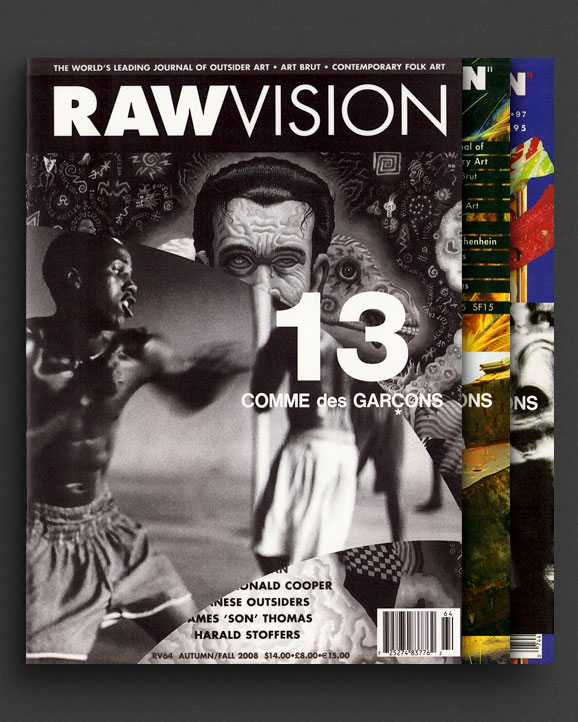
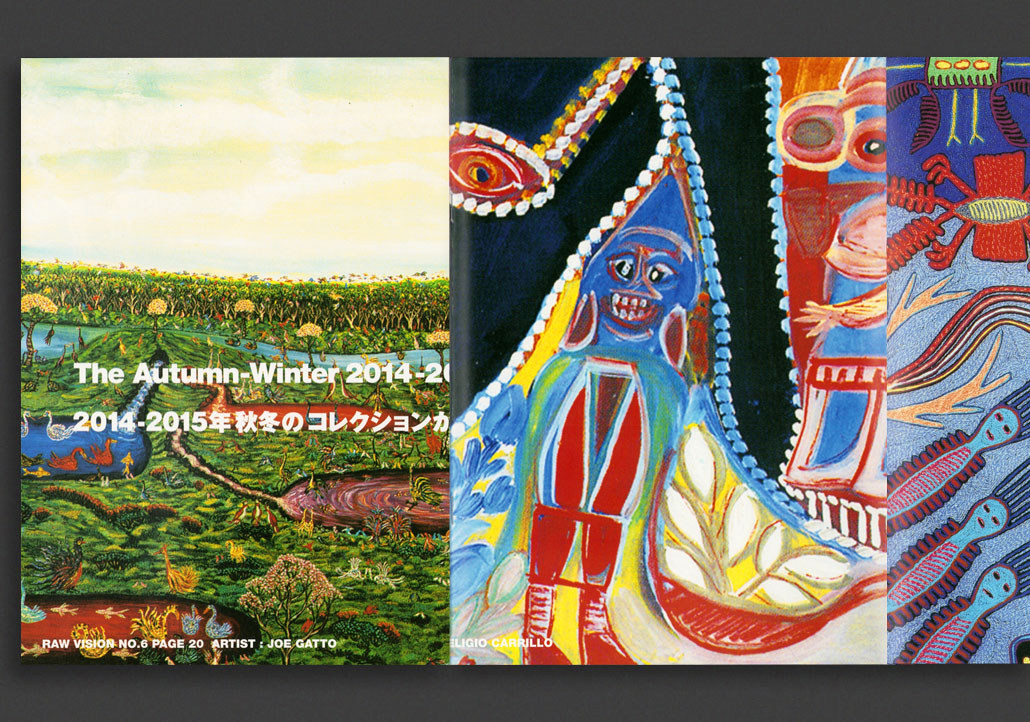
Lot of six copies of the amazing printed collaboration between Rei Kawakubo's Comme des Garçons and Raw Vision, the world's foremost magazine on Outsider Art, Art Brut, and Contemporary Folk Art, founded by John Maizels in 1989. Issued as mail-outs privately by Comme to announce the arrival of their 2014 Spring—Summer and 2014—2015 Autumn—Winter collection, and not commercially available, these gorgeous, elaborate leaflets designed by CDG showcase the diverse array of artists featured in Raw Vision magazine alongside Comme photographs by Kosuke Okahara commissioned by Rei Kawakubo to document the 2013 Paris Fashion Week, Fall / Winter collection, photographs by Hiromi Nagakura, Daisuke ITO, and Andrew Houston in a series of graphic collages, with many fold-out spreads. Near Fine, preserved copies of six volumes (issued separately), now very scarce. Artists throughout include Pavel Leonov, Daniel Johnston, Maura Holden, Joe Gatta, Malcolm McKesson, William Hawkins, Joe Coleman, Renaldo Kuhler, Freddie Brice, Anne Grgich, Ken Grimes, and many more.
Near Fine all.