World Food Books' programme is largely produced on Kulin Nation land. We acknowledge the Wurundjeri people of the Kulin Nation as the first and continuing custodians of this land, and pay respect to their Elders past, present, and emerging.
World Food Books is an arts and special interests bookshop in Naarm / Melbourne. Founded in 2010, World Food Books is devoted to the presentation of a rotating, hand-selection of international art, design, literary and counterculture publications with an emphasis on the anti-traditional, the experimental, the avant-garde, the heretic, the marginal.
Presenting new titles alongside rare and out-of-print books, catalogues and journals spanning the fields of modern and contemporary art, design, photography, illustration, film, literature, poetry, cultural theory, philosophy, sexuality, popular and underground culture in its many radical forms, World Food Books wishes to encourage adventurous, thoughtful and open-minded reading, looking, writing, and exchange of publishing and ideas, both current and historical.
As well as our bookshop, located in Melbourne's historical Nicholas Building, all of our inventory is available internationally via our online mail-order service.
World Food Books semi-regularly co-ordinates "Occasions", a programme of exhibits and events at the bookshop and in partnership with other hosts (such as museums and art galleries) that develop out of the activities, relationships and content of the bookshop itself.
World Food Books
The Nicholas Building
37 Swanston Street
Room 5, Level 6
Melbourne 3000
Australia
SHOP HOURS:
Thu–Fri 12–6, Sat 12–5
WEB-SHOP OPEN 24/7
World Food Books
Postal Address:
PO Box 435
Flinders Lane
Victoria 8009
Australia
Art
Theory / Essay
Architecture / Interior
Graphic Design / Typography
Photography
Fashion
Eros
LGBTQ+
Fiction / Poetry
Weird / Speculative / Science Fiction / Horror
Transgressive / Visceral / Abject
Symbolism / Decadence / Fin de siècle
Film / Video
Painting
Sculpture / Installation
Performance / Dance / Theater
Drawing
Sound / Music
Curatorial
Group Shows / Collections
Periodicals
Out-of-print / Rare
Posters / Ephemera / Discs
Signed Books
World Food Books Gift Voucher
World Food Book Bag
Australian Art
Australian Fiction
Australian Science Fiction / Speculative Fiction
Australian Poetry
Australian Photography
Japanese Photography
Conceptual Art
Minimal Art
Dada
'Pataphysics / Oulipo
Fluxus
Concrete Poetry
Pop Art
Surrealism
Arte Povera
Arte Informale / Haute Pâte / Tachism
Nouveau Réalisme / Zero / Kinetic
Situationism / Lettrism
Collage / Mail Art / Xerox Art
Art Brut / Folk / Visionary / Fantastic
Illustration / Graphic Art / Bandes Dessinées
Furniture
Italian Radical Design / Postmodernism
Textiles
Ceramics / Glass
Counterculture
Protest / Revolt
Philosophy
Psychoanalysis
Anthropology
Anarchism
Socialism / Anarchism / Communism / Capitalism
Literary Theory / Semiotics / Language
Feminism / Women's Studies
Gender Studies / Sexuality
Anthropology
Fetishism / BDSM
Drugs / Psychedelia
Crime / Violence
Animal Rights / Veganism
Occult / Esoterica
Ecology / Earth / Alternative Living
Whole Earth / Crafts
All prices in AUD (Australian dollars)
Pick-Ups
Pick-up orders can be collected in our bookshop during opening hours after order date. Please collect any Pick-up orders within 2 weeks of ordering as we have limited storage space. Orders will be released back into stock if not collected within this time. No refunds can be made for pick-ups left un-collected. If you cannot make it in to the bookshop in this time-frame, please choose postage option.
Return Policy
All sales are final. We do accept returns (for refund or exchange) for items received in error. All our orders are packed with special care using heavy-duty padding and cardboard book-mailers or bubble mailers (for smaller books), using reinforcement where required. We cannot take responsibility for any lost, stolen or damaged parcels.
Insurance
Should you wish to insure your package, please email us directly after placing your order and we can organise this at a small extra expense. Although all standard/express tracked packages are very safe and dependable, we cannot take responsibility for any lost, stolen or damaged parcels. We recommend insurance on valuable orders.
Interested in selling your old books, catalogues, journals, magazines, comics, fanzines, ephemera? We are always looking for interesting, unusual and out-of-print books to buy. We only buy books in our fields of interest and specialty, and that we feel we can resell.
We base these prices on desirability, market value, in-print prices, condition and our current stock levels. We offer cash, store credit, and can take stock on consignment. All
about 25% of the price we expect to get when we sell them, or 30% in store credit. We base these prices on desirability, market value, in-print prices, condition and our current stock levels.
Sell your books any day of the week. You can drop them off and return later. If you have a lot of books, we can visit your Sydney home.
We buy books that we feel we can resell. We offer about 25 % of the price we expect to get when we sell them, or 30% in store credit. We base these prices on desirability, market value, in-print prices, condition and our current stock levels.
Philadelphia Wireman
03 August - 01 September, 2018
World Food Books is proud to announce our next Occasion, the first presentation of sculptures by Philadelphia Wireman in Australia.
The Philadelphia Wireman sculptures were found abandoned in an alley off Philadelphia’s South Street on trash night in 1982. Their discovery in a rapidly-changing neighbourhood undergoing extensive renovation, compounded with the failure of all attempts to locate the artist, suggests that the works may have been discarded after the maker’s death. Dubbed the "Philadelphia Wireman" during the first exhibition of this work, in 1985, the maker’s name, age, ethnicity, and even gender remain uncertain. The entire collection totals approximately 1200 pieces, all intricately bound together with tightly-wound heavy-gauge wire (along with a few small, abstract marker drawings, reminiscent both of Mark Tobey and J.B. Murry). The dense construction of the work, despite a modest range of scale and materials, is singularly obsessive and disciplined in design: a wire armature or exoskeleton firmly binds a bricolage of found objects including plastic, glass, food packaging, umbrella parts, tape, rubber, batteries, pens, leather, reflectors, nuts and bolts, nails, foil, coins, toys, watches, eyeglasses, tools, and jewellery.
Heavy with associations—anthropomorphic, zoomorphic, and socio-cultural responses to wrapped detritus—the totemic sculptures by Philadelphia Wireman have been discussed in the context of work created to fulfil the shamanistic needs of alternative religions in American culture. Curators, collectors, and critics have variously compared certain pieces to sculpture from Classical antiquity, Native American medicine bundles, African-American memory jugs, and African fetish objects. Reflecting the artist’s prolific and incredibly focused scavenging impulse, and despite—or perhaps enhanced by—their anonymity, these enigmatic objects function as urban artefacts and arbiters of power, though their origin and purpose is unknown. Philadelphia Wireman, whatever their identity, possessed an astonishing ability to isolate and communicate the concepts of power and energy through the selection and transformation of ordinary materials. Over the course of the past two decades, this collection has come to be regarded as an important discovery in the field of self-taught art and vernacular art.
Presented in collaboration with Fleisher-Ollman Gallery, Philadelphia, and Robert Heald, Wellington.
Susan Te Kahurangi King
02 February - 10 March, 2018
Susan Te Kahurangi King (24 February 1951 - ) has been a confident and prolific artist since she was a young child, drawing with readily available materials - pencils, ballpoint pens and felt-tip markers, on whatever paper is at hand. Between the ages of four and six Susan slowly ceased verbal communication. Her grandparents William and Myrtle Murphy had developed a special bond with Susan so they took on caring responsibilities for extended periods. Myrtle began informally archiving her work, carefully collecting and storing the drawings and compiling scrapbooks. No drawing was insignificant; every scrap of paper was kept. The King family are now the custodians of a vast collection containing over 7000 individual works, from tiny scraps of paper through to 5 meter long rolls.
The scrapbooks and diaries reveal Myrtle to be a woman of great patience and compassion, seeking to understand a child who was not always behaving as expected. She encouraged Susan to be observant, to explore her environment and absorb all the sights and sounds. Myrtle would show Susan’s drawings to friends and people in her community that she had dealings with, such as shopkeepers and postal workers, but this was not simply a case of a grandmother’s bias. She recognised that Susan had developed a sophisticated and unique visual language and sincerely believed that her art deserved serious attention.
This was an unorthodox attitude for the time. To provide some context, Jean Dubuffet coined the term Art Brut in 1945 to describe work created by self-taught artists – specifically residents of psychiatric institutions and those he considered to be visionaries or eccentrics. In 1972 Roger Cardinal extended this concept by adopting the term Outsider Art to describe work made by non-academically trained artists operating outside of mainstream art networks through choice or circumstance. Susan was born in Te Aroha, New Zealand in 1951, far from the artistic hubs of Paris and London that Dubuffet and Cardinal operated in. That Myrtle fêted Susan as a self-taught artist who deserved to be taken seriously shows how progressive her attitudes were.
Susan’s parents Doug and Dawn were also progressive. Over the years they had consulted numerous health practitioners about Susan’s condition, as the medical establishment could not provide an explanation as to why she had lapsed into silence. Dawn educated herself in the field of homeopathy and went on to treat all twelve of her children using these principles – basing prescriptions on her observations of their physical, mental and emotional state.
Doug was a linguist with an interest in philosophy who devoted what little spare time he had to studying Maori language and culture. To some extent their willingness to explore the fringes of the mainstream made them outsiders too but it was their commitment to living with integrity and their respect for individuality that ensured Susan’s creativity was always encouraged.
Even though Susan’s family supported her artistic pursuits, some staff in schools and hospitals saw it as an impediment to her assimilation into the community and discouraged it in a variety of ways. Her family was not always aware of this and therefore did not fully understand why Susan stopped drawing in the early 1990s. However, rather than dwell on the challenges that Susan faced in pursuit of her artistic practice, they prefer to highlight her achievements. In 2008 Susan began drawing again in earnest, after an almost 20 year interruption, and her work is now shown in galleries around the world.
Susan grew up without television and has been heavily influenced by the comics she read as a child. She is absolutely fearless in the appropriation of recognizable characters, such as Donald Duck and Mickey Mouse, in her work. She twists their limbs, contorts their faces, compresses them together, blends them into complex patterned backgrounds - always imbuing them with an incredible energy. Although Susan often used pop culture characters in her work they are not naive or childlike. These are drawings by a brilliant self-taught artist who has been creating exceptional work for decades without an audience in mind.
Mladen Stilinović
"Various Works 1986 - 1999"
02 February 16 - September 10, 2016
Various works 1986 - 1999, from two houses, from the collections of John Nixon, Sue Cramer, Kerrie Poliness, Peter Haffenden and Phoebe Haffenden.
Including: Geometry of Cakes (various shelves), 1993; Poor People’s Law (black and white plate), 1993; White Absence (glasses, ruler, set square, silver spoon, silver ladel with skin photograph and wooden cubes), 1990-1996; Exploitation of the Dead (grey and red star painting, wooden painting, black spoon with red table, red plate), 1984-1990; Money and Zeros (zero tie, paintings made for friends in Australia (Sue, John, Kerrie), numbers painting), 1991-1992; Words - Slogans (various t-shirts) - “they talk about the death of art...help! someone is trying to kill me”, “my sweet little lamb”, “work is a disease - Karl Marx”; Various artist books, catalogues, monographs, videos; Poster from exhibition Insulting Anarchy; "Circular" Croatian - Australian edition; Artist book by Vlado Martek (Dostoyevsky); more.
Thanks to Mladen Stilinović and Branka Stipančić.
Jonathan Walker
Always Will Need To Wear Winter Shirt Blue + Ochre Small Check Pattern
21 August - 21 September, 2015
Untitled
I am not a great reader of poetry but I always return to the work of Melbourne poet, Vincent Buckley (1925- 1988). Perhaps I find his most tantalising piece to be not a finished poem but a fragment left on a scrap of paper discovered on his desk after the poet’s death.
The poetry gathers like oil
In the word-core, and spreads
It has its music meet,
Its music is in movement.
This fragment is more the shell left behind from a volatile thought than a finished poem. I find the last two lines honest but awkward whereas the first two lines work like an arrow. Most likely he could not find a resolution so it was left. Still, in its present form, it remains an eloquent testimony to the ultimate failure of a medium to express mobile thought and sensation, in Buckley’s case, through verbal language. It’s an important matter because this is something all artists have to deal with regardless of the medium.
I have never written a poem, however, I am forever copying fragments from books on paper scraps in a vain effort to fix certain notions in my head. At first, they function as bookmarks that are sometimes returned to when I open the book. But before long, as they accumulate, they fall out littering the table interspersed with A4 photocopies, bills, books and medications.
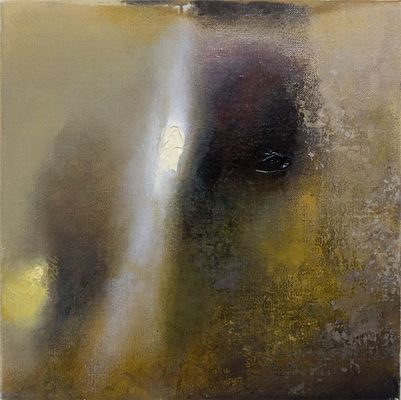
To return to Buckley’s fragment, the first two lines very much evoke how I paint nowadays. As you age, detail diminishes and patches of light become more luminous and float. I feel the most honest way of dealing with this is by smearing the oil paint on the canvas with the fingers and working close-up, blind. Only if the patches coalesce into an approaching image can the work gain a life.
-
Jonathan Walker was born in Melbourne, Australia and brought up on a dairy farm in Gippsland. In the 1970’s he studied painting at RMIT and won the Harold Wright Scholarship to the British Museum, London. During the 1980’s he exhibited at Pinacotheca Gallery, Richmond and had work shown at the NGV and Heidi City Art Gallery. Over the same period he designed the cover for the “Epigenesi” LP by Giancarlo Toniutti, Italy and conducted a mail exchange work with Achim Wollscheid, Germany. The work with artists through the post resulted in an article published in the bicentenary issue of Art and Australia 1988. He showed in artist run spaces such as WestSpace in the 90’s and 2000’s, and until 2012, taught painting at Victoria University, which is where we (Colleen Ahern and Lisa Radford) as organisers of the exhibition, among many others, had the privilege of being his student.
Walker’s knowledge was imparted to students through the careful selection of music, literature, and artists found in books that he himself had ordered for the library. Walker’s strategy was the generosity of sharing his vast knowledge with references specific to each student and their context.
Walker’s paintings share a similar focus and intimacy.
This exhibition presents a small selection of recent paintings alongside a publication that includes Walker’s writing. Observational and analytical, Walker’s work is a type of material notation — the time of day, colour and how it is blended, the both specific and fleeting location of a reflection on lino or the question of whether a chair leg should be included in a painting.
Please join us on Friday August 21 between 6-8pm to celebrate the opening of the exhibition.
Curated by Colleen Ahern and Lisa Radford.
B. Wurtz
Curated by Nic Tammens
March 26 - April 4, 2015
B.Wurtz works from a basement studio in his home on Manhattan’s Lower East Side.
This local fact is attested to by the plastic shopping bags and newsprint circulars that appear in his work. As formal objects, they don’t make loud claims about their origins but nonetheless transmit street addresses and places of business from the bottom of this long thin island. Like plenty of artists, Wurtz is affected by what is local and what is consumed. His work is underpinned by this ethic. It often speaks from a neighborhood or reads like the contents of a hamper:
“BLACK PLUMS $1.29 lb.”
“Food Bazaar”
“USDA Whole Pork Shoulder Picnic 99c lb.”
“RITE AID Pharmacy, with us it’s personal.”
“H. Brickman & Sons.”
“Sweet Yams 59c lb."
Most of the work in this exhibition was made while the artist was in residence at Dieu Donne, a workshop dedicated to paper craft in Midtown. Here Wurtz fabricated assemblages with paper and objects that are relatively lightweight, with the intention that they would be easily transportable to Australia. This consideration isn’t absolute in Wurtz’s work, but was prescriptive for making the current exhibition light and cheap. Packed in two boxes, these works were sent from a USPS post office on the Lower East Side and delivered to North Melbourne by Australia Post.
Wurtz appears courtesy of Metro Pictures, New York.
Thanks to Rob Halverson, Joshua Petherick, Sari de Mallory, Matt Hinkley, Helen Johnson, Fayen d'Evie, Ask Kilmartin, Lisa Radon, Ellena Savage, Yale Union, and "Elizabeth".
John Nixon
"Archive"
December 15 - January 20, 2014
The presentation of John Nixon's archive offered a rare showcase of this extensive collection of the artist's own publications, catalogues, posters, ephemera, editions and more, from the mid 1980s onwards, alongside a selection of his artworks.
Organized by John Nixon, Joshua Petherick and Matt Hinkley.
<a href=http://wfb.public-office.info/artist/john-nixon>All titles by John Nixon
"Habitat"
at Minerva, Sydney (organised by Joshua Petherick and Matt Hinkley)
November 15 - December 20, 2014
Lupo Borgonovo, Janet Burchill & Jennifer McCamley,
Lewis Fidock, HR Giger, Piero Gilardi, Veit Laurent Kurz,
Cinzia Ruggeri, Michael E. Smith, Lucie Stahl, Daniel Weil, Wols
Press Release:
“...It contained seven objects. The slender fluted bone, surely formed for flight, surely from the wing of some large bird. Three archaic circuitboards, faced with mazes of gold. A smooth white sphere of baked clay. An age-blackened fragment of lace. A fingerlength segment of what she assumed was bone from a human wrist, grayish white, inset smoothly with the silicon shaft of a small instrument that must once have ridden flush with the surface of the skin - but the thing’s face was seared and blackened.”
William Gibson, “Count Zero”, 1986
"Autumn Projects Archive"
Curated by Liza Vasiliou
March 6 - March 15, 2014
World Food Books, in conjunction with the Virgin Australia Melbourne Fashion Festival 2014, presented the Autumn Projects archive, consisting of a selection of early examples in Australian fashion with a particular interest in collecting designers and labels from the period beginning in the 1980’s, who significantly influenced the discourse of Australian Fashion.
Curated by Liza Vasiliou, the exhibition provided a unique opportunity to view pieces by designers Anthea Crawford, Barbara Vandenberg, Geoff Liddell and labels CR Australia, Covers, Jag along with early experimental collage pieces by Prue Acton and Sally Browne’s ‘Fragments’ collection, suspended throughout the functioning World Food Books shop in Melbourne.
H.B. Peace
presented by CENTRE FOR STYLE
November 14, 2013
"Hey Blinky, you say chic, I say same"
Anon 2013
H.B. Peace is a clothing collaboration between great friends Blake Barns and Hugh Egan Westland. Their pieces explore the divergences between 'character’ and ‘personality’ in garments....etc
Special Thanks to Joshua Petherick and Matt Hinkley of WFB and Gillian Mears
and a Very Special Thank you to Audrey Thomas Hayes for her shoe collaboration.
Janet Burchill & Jennifer McCamley
"Aesthetic Suicide"
May 10 - June 8, 2013
The first of our occasional exhibitions in the World Food Books office/shop space in Melbourne, "Aesthetic Suicide" presented a body of new and older works together by artists Janet Burchill & Jennifer McCamley, including videos, prints, a wall work, and publications.
During shop open hours videos played every hour, on the hour.
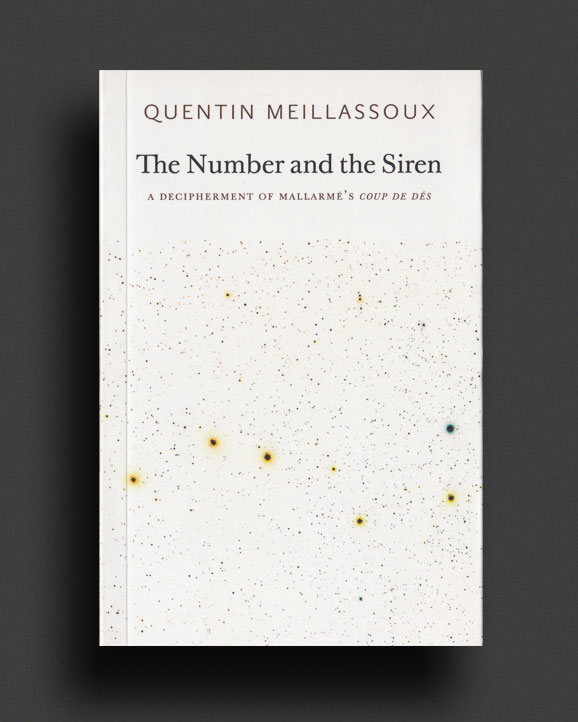
2012, English
Softcover, 306 pages, 115 x 175mm
Published by
Sequence Press / New York
Urbanomic / Cornwall
$40.00 - Out of stock
“Thus, modernity triumphed and we did not know it.”
Quentin Meillassoux
A meticulous literary study, a detective story à la Edgar Allan Poe, a treasure hunt worthy of an adventure novel – such are the registers in which will be deciphered the hidden secrets of a poem like no other. Quentin Meillassoux continues his innovative philosophical interrogation of the concepts of chance, contingency, infinity and eternity through a concentrated study of Stéphane Mallarmé’s poem Un Coup de Dés jamais n’abolira le Hasard, patiently deciphering its enigmatic meaning on the basis of a dazzlingly simple and lucid insight with regard to ‘the unique Number that cannot be another’.
The Coup de dés constitutes perhaps the most radical break in the history of modern poetry: the fractured lines spanning the double page; the typographical play borrowed from the poster form; the multiple interpolations disrupting reading. But the intrigue of this poem is still stranger and has always resisted full elucidation. We encounter a shipwreck, and a Master, himself almost submerged, who clasps in his hand the dice that, confronted by the furious waves, he hesitates to throw. The hero expects this throw, if it takes place, to be extraordinarily important: a Number said to be ‘unique’ and which ‘cannot be any other’.
The decisive point of the investigation proposed by Meillassoux comes with a discovery, unsettling and yet as simple as a child’s game: All the dimensions of the Number, understood progressively, articulate between them but a sole condition – that this Number should ultimately be delivered to us by a secret code, hidden in the Coup de dés, like a key that finally unlocks every one of its poetic devices. Thus is also unveiled the meaning of the siren that emerges for a lightning flash among the debris of the shipwreck: as the living heart of a drama that is still unfolding.
With this bold new interpretation of Mallarmé’s work, The Number and the Siren offers provocative insights into modernity, poetics, secularism and religion, and opens a new chapter in Meillassoux’s philosophy of radical contingency.
Translated by Robin Mackay
Quentin Meillassoux teaches philosophy at the École Normale Supérieur in Paris. He is the author of After Finitude: An Essay on the Necessity of Contingency.
What to say about this book? But then, what was there or is there still to say about Mallarmé’s Coup de dés? Such a famously “undecipherable book” is here deciphered by a philosopher who writes on finitude, contingency, and chance – and the throw of the dice is surely also about chance, so the fit is fine. You may or may not be convinced of the secret code Quentin Meillassoux claims to have discovered in the poem, but be assured that this is a brave new interpretation of that throw and that chance. - Mary Ann Caws, Distinguished Professor of English, French, and Comparative Literature
Graduate Center, City University of New York
Contents
Introduction
Part One: Encrypting the Number
The Poem; The Unique Number; The Aporia of Igitur; The Incomparable
Meter; The Vortex of the Code; 707; In Sum; Cosmopolis; Provisional
Conclusion
Part Two: Fixing the Infinite
An Idle Chance?; Presentation, Representation, Diffusion; Message in a
Bottle; To Be Chance; A Quavering Number?; Clues; The Veiled Letter;
The Siren; At a Stroke; Final Remarks
Conclusion
Appendix 1: The Poems
A Throw of Dice; Toast/Salvation; ‘Beneath the Oppressive Cloud Stilled...’;
Sonnet in -x
Appendix 2: The Count
Translator's Note
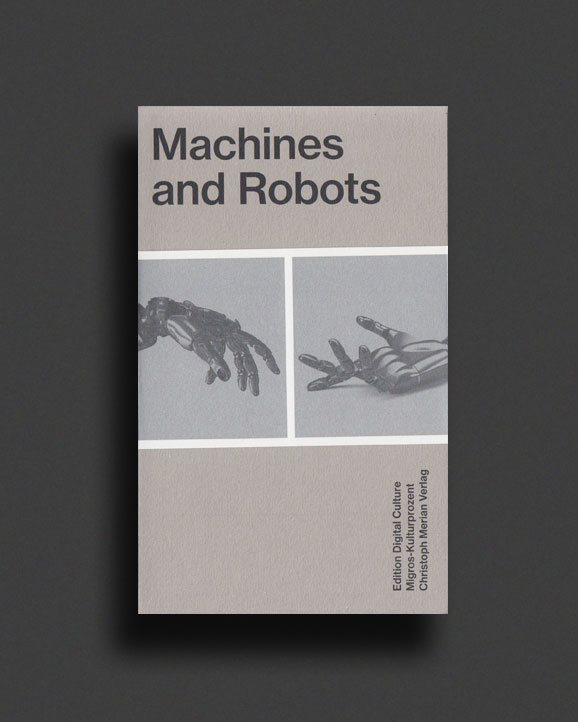
2018, English / German
288 pages, 11 x 18 cm
Published by
Christoph Merian / Basel
$42.00 - Out of stock
Machines, automats, and robots have always exerted a special fascination on artists. Yet computers, digitisation, and the Internet have given this attraction entirely new impulses. Moreover, developments in artificial intelligence and robotics are of critical importance today. The fifth volume of this series provides insights into current research topics and investigates their artistic potential and possible issues. It contains illustrations and a detailed glossary of significant terms, in addition to contributions by Raffaello D’Andrea, Andreas Broeckmann, Roland Fischer, Martina Kammermann, Bruno Spoerri, Philipp Theisohn, Mads Pankow, and Roland Wetzel.
2018, English
Softcover, 48 pages, 12 x 19 cm
Published by
Sternberg Press / Berlin
$28.00 $15.00 - In stock -
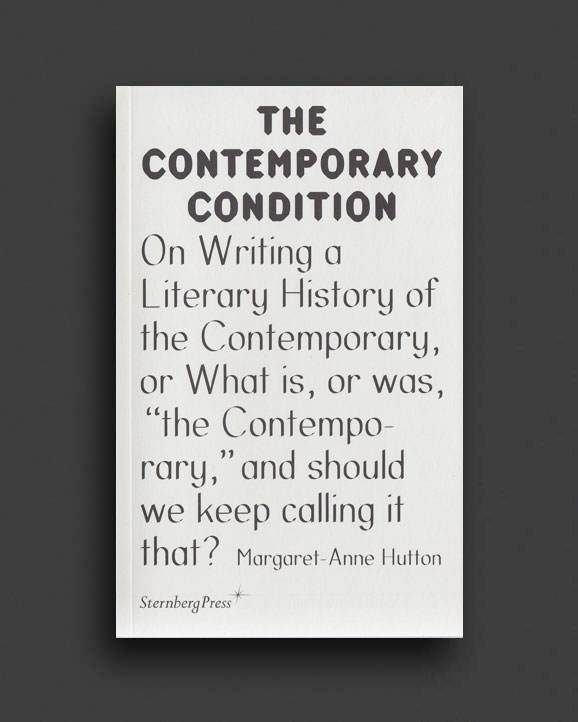
“The contemporary” is an established term in a range of scholarly and disciplinary discourses, but what does it mean? Interweaving sections drawn from an (apparently) hypothetical and oxymoronic project—the writing of a literary history of “the contemporary”—with a critical analysis of the term(s) “the contemporary” and “contemporary” in the work of a range of theorists, Margaret-Anne Hutton sets out to expose the inconsistencies and ambiguities in its terminological usage, and to unpick some of the knots which bind the substantive and adjective. How can “(the) contemporary” function as a critical term, and how might we map its history?
The Contemporary Condition series edited by Geoff Cox and Jacob Lund, Volume 08
Copublished with Aarhus University and ARoS Art Museum
Design by Dexter Sinister
2014, English
Softcover, 30 pages, 15.2 x 20.3 cm
Published by
Sequence Press / New York
$18.00 - Out of stock
Reza Negarestani’s essay is published in conjunction with Jean-Luc Moulène’s exhibition, Torture Concrete, September 7 – October 26, 2014 at Miguel Abreu Gallery, New York. The text emerged out of a number of conversations between the writer and artist around the theme of abstraction both as a multi-faceted project in the general domain of thought and as a specific process of artistic experimentation. Negarestani sharply asserts abstraction’s origins as the dialectic between form (mathematics) and sensible matter (physics) and its otherwise flat interpretation in art history, and presents us with the redemptive possibilities for its enrichment and diversification through the lens of artistic practice.
Negarestani calls into question the “self-reflexive history of art” as having embezzled this singular definition of abstraction, so that one can no longer link it to its constitutive gesture or procedural coherence, and locates Moulène’s work safely at the outer-edges of this “impoverished” history. He asserts that for Moulène, “the task of art is rediscovered not in its ostensible autonomy but in its singular power to rearrange and destabilize the configurational relations between parameters of thought, parameters of imagination and material constraints which parameterize the cognitive edifice.”
Moulène seeks to define new objectives for art and to further revise its task using his own working paradigm of topology and dynamic systems. Within the artist's work—the work of systematization of experimentation and producing tools for thinking—Negarestani finds a reassuring pursuit in practice, that of the unearthing of a buried dialectic, and a worthy response to his problematic: “We’ve all heard of abstraction, but no one has ever seen one.”
Both men work in search of a means of emancipation from a tortured position (as writer, artist, human). For Moulène, making a change to the body, a change from within, works alongside the notion of thought making a difference in the world. But in order for thought to do this, as Negarestani suggests, “first it must make a difference in itself—this is where abstraction finds its true vocation.”
Reza Negarestani is a philosopher. He has contributed extensively to journals and anthologies and lectured at numerous international universities and institutes. His current philosophical project is focused on rationalist universalism beginning with the evolution of the modern system of knowledge and advancing toward contemporary philosophies of rationalism, their procedures as well as their demands for special forms of human conduct.
2012, English
Softcover, 376 pages, 11.5 x 17.5 cm
Published by
Sequence Press / New York
Urbanomic / Cornwall
$42.00 - Out of stock
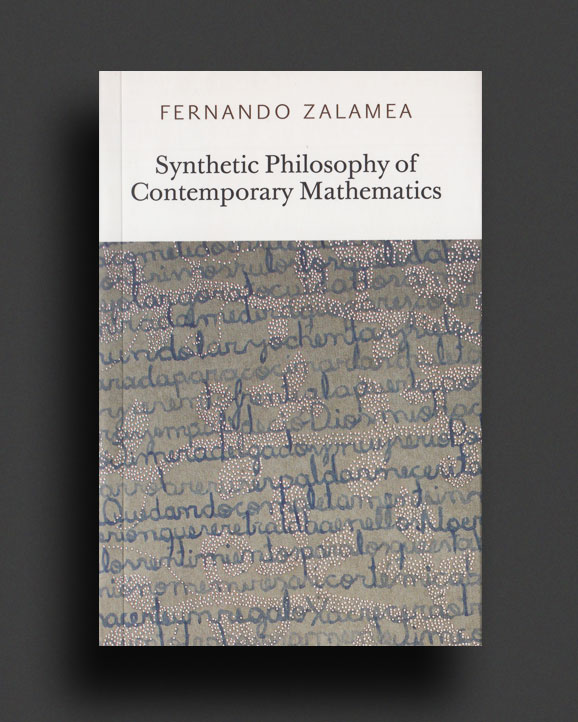
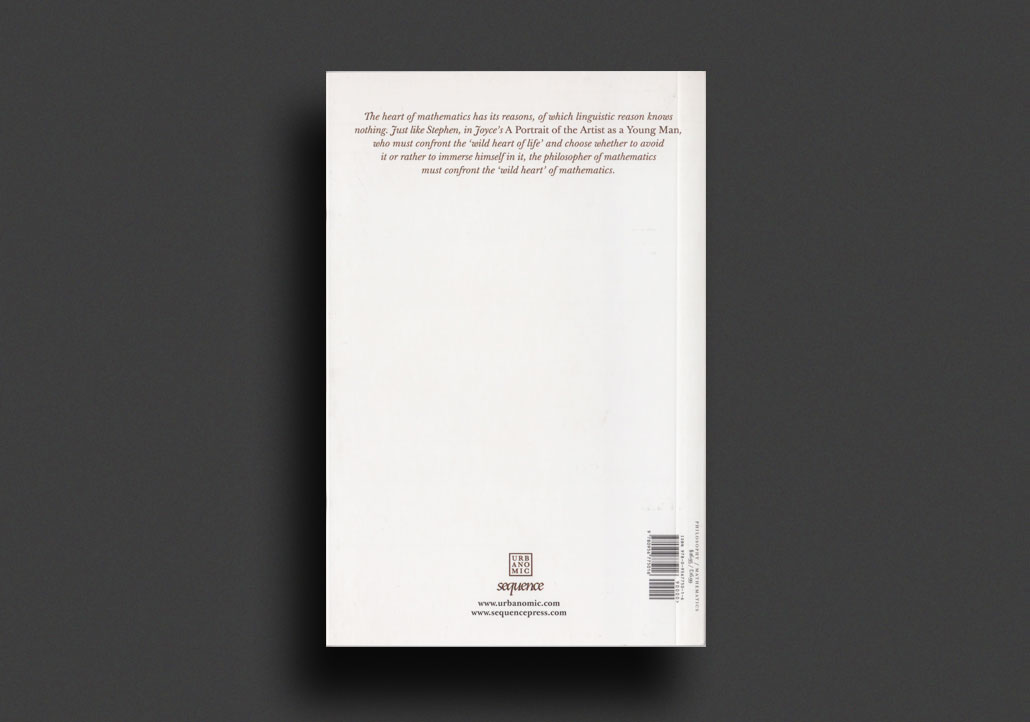
Synthetic Philosophy of Contemporary Mathematics is a unique and unprecedented book, and a much needed one. Fernando Zalamea (Professor of Mathematics at the Universidad Nacional de Colombia) offers a synthetic perspective on the vast spectrum of contemporary mathematics, together with an analysis of the new philosophical problems originating therein. The book makes available to the inquisitive non-specialist the conceptual transformations and intellectual orientations of modern and contemporary mathematics, and their significance for speculative philosophical thought.
The first part of the text discusses the specificity of modern (1830-1950) and contemporary (1950 to the present) mathematics, and offers an extensive review of how philosophy of mathematics addressed it (or failed to). In the second part, thirteen detailed case studies examine the greatest creators in the field, compiling a map of the central advances accomplished in mathematics over the last half-century. Drawing on these concrete examples, the third part proposes some generic outlines for synthesis.
Zalamea's book serves as a conceptual introduction to mathematical themes rarely discussed outside specialist circles, and as a critical lens by means of which today's mathematics may aid us in the configuration of new cultural perspectives.
If analytic philosophy was forged in the fires of set theory and classical logic at the beginning of the twentieth century, then today, at the dawn of the twenty-first, and around the scaffolding of category theory and the logic of sheaves, it is time for a complementary, synthetic philosophy to be built.
Translated by Zachary Luke Fraser
This is a weighty and daring book. It proposes a new philosophy of mathematics, based on a detailed knowledge of the most recent work in advanced mathematics, and constructed in explicit contrast with the traditional analytical approach…this new synthetic and open-minded approach is no doubt worthy of attention, and philosophers who dare to make an effort will surely reap the reward. - Paloma Pérez-Ilzarbe. American Mathematical Society’s MathSciNet
Zalamea is clearly on the cutting edge of theorizing potential intersections between networks, math, and philosophy. Few thinkers are able to bring together insights from as diverse fields in such as exciting manner as Zalamea. - Christopher Vitale. Assistant Professor, Media Studies, Pratt Institute, NY
With high professional competence in mathematics and philosophy and written in masterful prose, Zalamea opens up a breathtaking insight into advanced contemporary mathematics by enlightening its magical power with the powerful paradigm of gestural dynamics as developed by Valéry, Merleau-Ponty and Châtelet. - Guerino Mazzola, Professor of Mathematical Music Theory and Creativity, School of Music, University of Minnesota
Contents
Introduction: Traditional Options for the Philosophy of Mathematics and Prospectus for this Essay
Part One: The General Environment of Contemporary Mathematics
Specificity of Modern and Contemporary Mathematics
Advanced Mathematics in Treatises on Mathematical Philosophy: A Bibliographical Report
Towards a Synthetic Philosophy of Contemporary Mathematics
Part Two: Case Studies
Grothendieck: Forms of High Mathematical Creativity
Eidal Mathematics: Serres, Langlands, Lawvere, Shelah
Quiddital Mathematics: Atiyah, Lax, Connes, Kontsevich
Archeal Mathematics: Freyd, Simpson, Zilber, Gromov
Part Three: Sketches of Synthesis
Fragments of a Transitory Ontology
Comparative Epistemology and Sheaving
Phenomenology of Mathematical Creativity
Mathematics and Cultural Circulation
2017, English
Softcover, 384 pages, 12.5 x 20 cm
Published by
Sternberg Press / Berlin
$40.00 - Out of stock
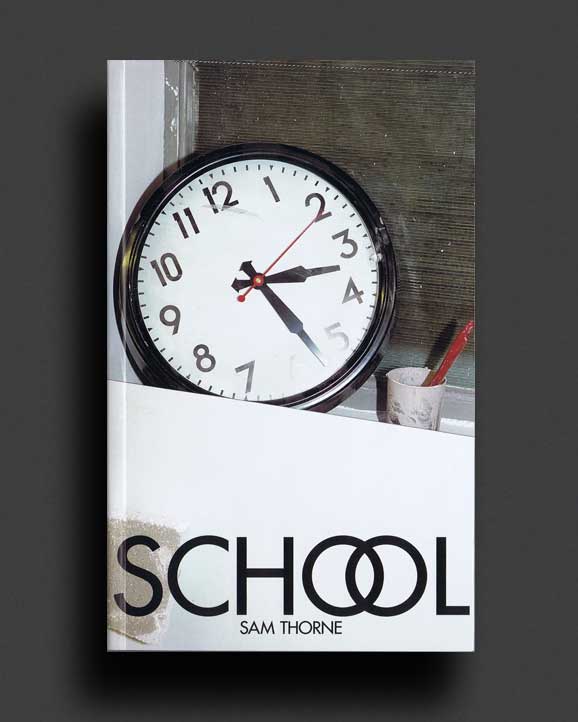
Contributions by Bik Van der Pol, Bruce High Quality Foundation University, Tania Bruguera, Chto Delat?, Sean Dockray, Olafur Eliasson, Ryan Gander, Piero Golia, Fritz Haeg, Pablo Helguera, Jakob Jakobsen, Ahmet Öğüt, Yoshua Okón, Open School East, Rupert, Wael Shawky, Tina Sherwell, Bisi Silva, Christine Tohme, Anton Vidokle
Sam Thorne’s School: A Recent History of Self-Organized Art Education is a chronicle of self-organized art schools and artist-run education platforms that have emerged since 2000. Comprising a series of twenty conversations conducted by Thorne with the artists, curators, and educators behind these schools, the book maps a territory at once fertile and contested. Spanning projects in London, Lagos, Los Angeles, Mexico City, Ramallah, Berlin, and Saint Petersburg, among other locations, these critical dialogues respond to spiraling student debt, the MFA system, and the “pedagogical turn,” while offering proposals for the future of art education.
Design by John Morgan studio
2018, English / German
Softcover, 112 pages, 11.5 x 18 cm
Published by
Kunsthalle Bern / Bern
Sternberg Press / Berlin
$18.00 - Out of stock
With an introduction by Hanna Magauer
In the artistic activities of Philippe Thomas (1951–1995), there was a determination to disappear: it was his procedure to transfer his title of author onto his collectors. This was the case when selling an artwork, or whenever the author’s credit was needed for a commissioned text, and in the institutional co-operations that Thomas was a participant of. With this strategy Thomas worked against his own historicization, erasing his name from the reigning European and North American art fields and with prescience Thomas “put up obstacles to block his future ‘googleability’” (Hanna Magauer). In recent years, the works and writings of the artist, who also acted on behalf of the semi-fictional agency readymades belong to everyone®, again gained greater visibility and as of current are being assigned a place in art history.
With this book, Elisabeth Lebovici elaborates on Thomas’s strategy to cede and fictionalize authorship and suggests a reading of his work that incorporates questions of gender and reproduction, the multiplicity of the subjects involved, and the unbearable disappearance of Thomas (who died of AIDS-related complications), into the process of enunciation. It is Lebovici’s suggestion that the performativity of Thomas’s work requires two versions at once: “the one where one enters into the fiction and the one where one observes the beauty of the arrangement and the plot at work. The one where one is inside and the one where one contemplates it.”
Schriftenreihe by Kunsthalle Bern, ed. by Valérie Knoll and Hannes Loichinger
Design by HIT
2018, English
Hardcover (w. dust jacket), 224 pages, 22.9 x 15.2 cm
Published by
Goldsmiths Press / London
$58.00 - Out of stock
A timely exploration of whether sound and listening can be the basis of political change.
In a world dominated by the visual, could contemporary resistances be auditory? This timely and important book from Goldsmiths Press highlights sound's invisible, disruptive, and affective qualities and asks whether the unseen nature of sound can support a political transformation. In Sonic Agency, Brandon LaBelle sets out to engage contemporary social and political crises by way of sonic thought and imagination. He divides sound's functions into four figures of resistance—the invisible, the overheard, the itinerant, and the weak—and argues for their role in creating alternative “unlikely publics” in which to foster mutuality and dissent. He highlights existing sonic cultures and social initiatives that utilize or deploy sound and listening to address conflict, and points to their work as models for a wider movement. He considers issues of disappearance and hidden culture, nonviolence and noise, creole poetics, and networked life, aiming to unsettle traditional notions of the “space of appearance” as the condition for political action and survival.
By examining the experience of listening and being heard, LaBelle illuminates a path from the fringes toward hope, citizenship, and vibrancy. In a current climate that has left many feeling they have lost their voices, it may be sound itself that restores it to them.
Brandon LaBelle is Professor in New Media in the Faculty of Fine Art, Music and Design at the University of Bergen. He is the author of Lexicon of the Mouth: Poetics and Politics of Voice and the Oral Imaginary, Diary of an Imaginary Egyptian, Acoustic Territories: Sound Culture and Everyday Life, and Background Noise: Perspectives on Sound Art.
2015, English
Softcover, 224 Pages, 15 x 25 cm
Published by
GSAPP Transcripts / New York
$54.00 - Out of stock
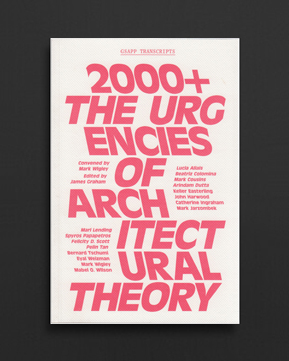
Has architectural theory become a historical phenomenon to be anthologized and studied as another passing phase in the history of the discipline? Do the current commonplace watchwords of "practice" and "research" mark the end of theory's place in architectural discourse? This edited volume posits the contrary--that theory remains urgent and even unavoidable, so ingrained in architectural practice and pedagogy that it remains a vital if sometimes latent influence.
Architectural theory is not confined to its supposed heyday in the decades leading up to the year 2000; it has persisted and expanded as the stakes of theoretical discussions have transformed. 2000+: The Urgencies of Architectural Theory collects new essays from a range of the most compelling architectural historians and theorists of the moment, including Lucia Allais, Beatriz Colomina, Mark Cousins, Arindam Dutta, John Harwood, Catherine Ingraham, Mark Jarzombek, Mari Lending, Spyros Papapetros, Felicity Scott, Pelin Tan, Bernard Tschumi, Eyal Weizman, Mark Wigley, and Mabel Wilson. Brought together for a conference marking the end of Wigley's tenure as dean of Columbia University's Graduate School of Architecture, Planning and Preservation, these thinkers chart new directions and points of critical importance for theory in architecture.
ABOUT THE AUTHOR
James Graham is the director of Print Publications at the Columbia University Graduate School of Architecture, Planning and Preservation, where he also teaches and pursues his Ph.D.
2014, English
Softcover, 88 pages, 13.7 x 20.3 cm
Published by
Semiotext(e) / Los Angeles
The MIT Press / Massachusetts
$28.00 - Out of stock
An incantatory catalog of cultural artifacts either lost to time or never realized.
• A boarder for two years following a national funeral, Mirabeau is removed from the Pantheon and transferred to the cemetery of Clamart when his pornographic novels are discovered • A photograph taken by Hessling on Christmas night, 1943, of a young woman nailed alive to the village gate of Novimgorod; Hessling asks his friend Wolfgang Borchert to develop the film, look at the photograph, and destroy it • The Beautiful Gardener, a picture by Max Ernst, burned by the Nazis—from The Missing Pieces
The Missing Pieces is an incantatory text, a catalog of what has been lost over time and what in some cases never existed. Through a lengthy chain of brief, laconic citations, Henri Lefebvre evokes the history of what is no more and what never was: the artworks, films, screenplays, negatives, poems, symphonies, buildings, letters, concepts, and lives that cannot be seen, heard, read, inhabited, or known about. It is a literary vanitas of sorts, but one that confers an almost mythical quality on the enigmatic creations it recounts—rather than reminding us of the death that inhabits everything humans create.
Lefebvre's list includes Marcel Duchamp's (accdidentally destroyed) film of Man Ray shaving off the Baroness Elsa von Freytag-Loringhoven's pubic hair; the page written by Balzac on his deathbed (lost); Spinoza's Treatise on the Rainbow (thrown into a fire); the final seven meters of Kerouac's original typescript for On the Road (eaten by a dog); the chalk drawings of Francis Picabia (erased before an audience); and the one moment in André Malraux's life in which he exclaimed “I believe, for a minute, I was thinking nothing.” The Missing Pieces offers a treasure trove of cultural and artistic detail and will entertain even those readers not enamored of the void.
Translated by David L. Sweet
2017, English
Softcover, 368 pages, 13 x 20 cm
Published by
Sternberg Press / Berlin
$42.00 - Out of stock
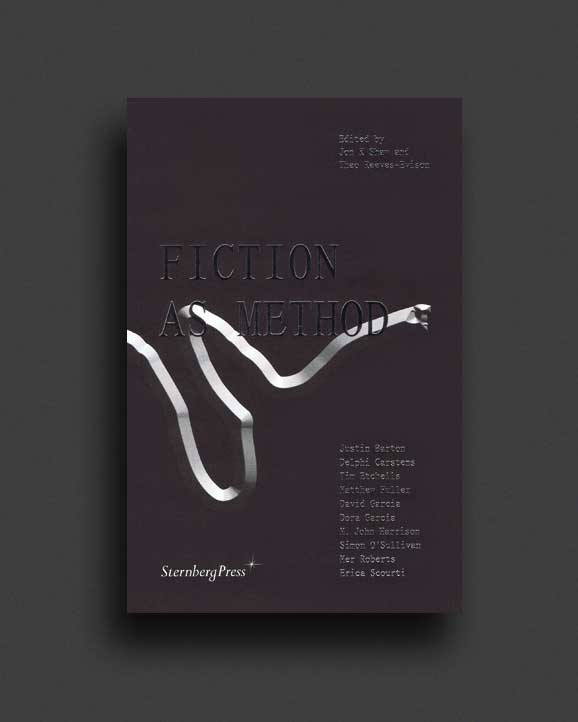
Texts by Justin Barton, Delphi Carstens & Mer Roberts, Tim Etchells, Matthew Fuller, David Garcia, Dora García, M. John Harrison, Simon O’Sullivan, Erica Scourti, Jon K Shaw and Theo Reeves-Evison
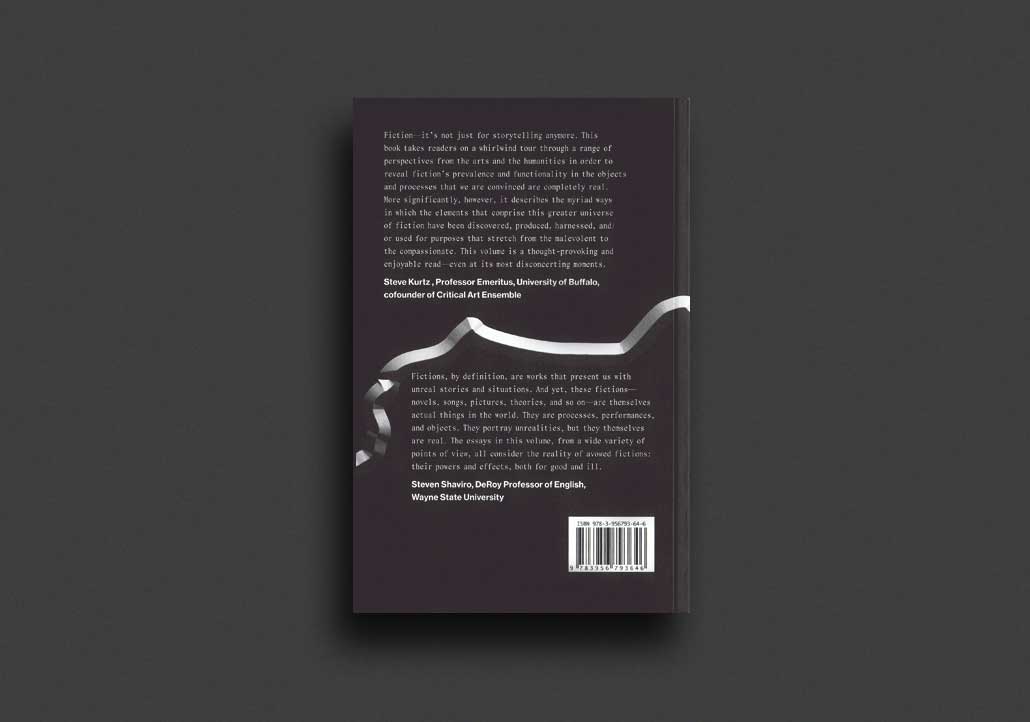
See the world through the eyes of a search engine, if only for a millisecond; throw the workings of power into sharper relief by any media necessary; reveal access points to other worlds within our own. In the anthology Fiction as Method, a mixture of new and established names in the fields of contemporary art, media theory, philosophy, and speculative fiction explore the diverse ways fiction manifests, and provide insights into subjects ranging from the hive mind of the art collective 0rphan Drift to the protocols of online self-presentation. With an extended introduction by the editors, the book invites reflection on how fictions proliferate, take on flesh, and are carried by a wide variety of mediums—including, but not limited to, the written word. In each case, fiction is bound up with the production and modulation of desire, the enfolding of matter and meaning, and the blending of practices that cast the existing world in a new light with those that participate in the creation of new openings of the possible.
“Fiction—it’s not just for storytelling anymore. This book takes readers on a whirlwind tour through a range of perspectives from the arts and the humanities in order to reveal fiction’s prevalence and functionality in the objects and processes that we are convinced are completely real. More significantly, however, it describes the myriad ways in which the elements that comprise this greater universe of fiction have been discovered, produced, harnessed, and/or used for purposes that stretch from the malevolent to the compassionate. This volume is a thought-provoking and enjoyable read—even at its most disconcerting moments.”
—Steve Kurtz, Professor Emeritus, University of Buffalo, cofounder of Critical Art Ensemble
“Fictions, by definition, are works that present us with unreal stories and situations. And yet, these fictions—novels, songs, pictures, theories, and so on—are themselves actual things in the world. They are processes, performances, and objects. They portray unrealities, but they themselves are real. The essays in this volume, from a wide variety of points of view, all consider the reality of avowed fictions: their powers and effects, both for good and ill.”
—Steven Shaviro, DeRoy Professor of English, Wayne State University
Design by Keith Dodds
2009, English
Softcover, 438 pages, 14.8 x 21 cm
2nd Edition,
Published by
Sternberg Press / Berlin
$60.00 - Out of stock
2015 re-print of this fantastic and hugely popular book from 2009.
Essays by Bart De Baere, Céline Condorelli, Mark Cousins, Wouter Davidts, Jean-Claude Lebensztejn, Andrea Phillips, Jaime Stapleton, Jan Verwoert, Eyal Weizman & Rony Brauman
With works by Michael Asher, Artist Placement Group, Can Altay, Conrad Atkinson, Adam Broomberg & Oliver Chanarin, Lonnie van Brummelen & Siebren de Haan, Banu Cennetoglu, Christopher D’Arcangelo, Martin Beck, Cevdet Erek, Andrea Fraser, Buckminster Fuller, Ryan Gander, Ella Gibbs, Frederick Kiesler, Lucy Kimbell, James Langdon, El Lissitzky, Peter Nadin, The offices of Peter Fend, Coleen Fitzgibbon, Jenny Holzer, Peter Nadin, Richard Prince & Robin Winters,” Gordon Matta-Clark, Antoni Muntadas, Lilly Reich, Support Structure, Rirkrit Tiravanija, Lawrence Weiner, Christopher Williams, Carey Young, a.o.
Support Structures is a manual for what bears, sustains, and props, for those things that encourage, care for, and assist; for that which advocates, articulates; for what stands behind, frames, and maintains: it is a manual for those things that give support. While the work of supporting might traditionally appear as subsequent, unessential, and lacking value in itself, this manual is an attempt to restore attention to one of the neglected, yet crucial modes through which we apprehend and shape the world.
Support Structures is a critical enquiry into what constitutes “support,” and documents the collaborative project “Support Structure” by Céline Condorelli and Gavin Wade. While registering and collecting reference projects in a new archive of support structures alongside its ten-phase project, different writers, thinkers, and practitioners were invited from various fields to elaborate on frameworks and work on texts , which form the theoretical backbone of the publication. The collection of contributions offers different possibilities for engaging in this unchartered territory, from propositions to projects, existing systems to ones invented for specific creative processes.
Support Structures offers support through potential methodologies, inspirations and activations for practice, and addresses important questions for art and architecture practices on forms of display, organization, articulation, appropriation, autonomy, and temporariness, and the manifestations of blindness towards them.
Produced in co-production with Support Structure:
Celine Condorelli and Gavin Wade with James Langdon
www.supportstructures.org
Design by James Langdon
2018, English
Softcover, 240 pages, 17 x 24 cm
Published by
Pioneer Works Press / New York
$59.00 - Out of stock
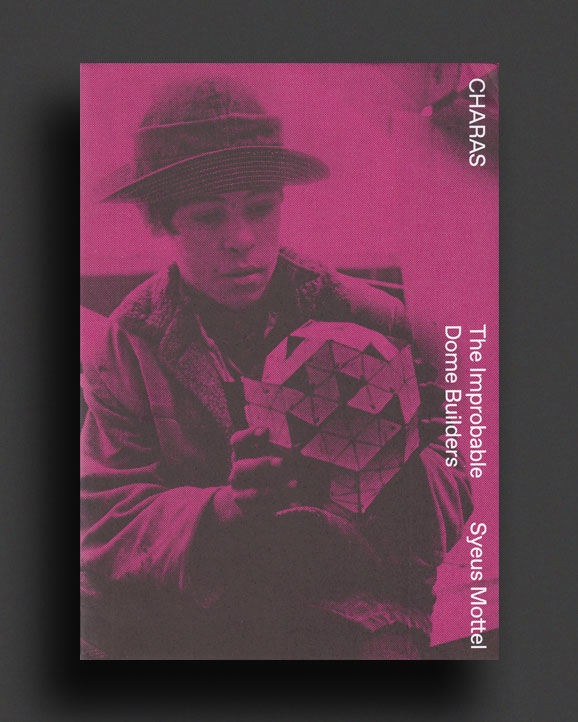
Introduction by Buckminster Fuller. Text by Syeus Mottel. Interview by Ben Estes.
In 1970 a meeting took place in an empty loft on the Lower East Side of Manhattan between R. Buckminster Fuller, the revolutionary architect and inventor of the geodesic dome, and six ex-gang members who called themselves “CHARAS.” After a few hours, they found themselves having an earnest and important conversation, and the young men of CHARAS decided to begin implementing Bucky’s ideas. They wanted to create a program that would develop a sense of community autonomy, reclaim public space and give their lives a newfound sense of purpose. Following a period of intensive study of solid geometry, spherical trigonometry and principles of dome building, all led by Michael Ben-Eli, CHARAS constructed a geodesic dome on a vacant lot in the shadow of the Manhattan Bridge.
Originally published in 1973 and now published in an expanded edition, Charas: The Improbable Dome Builders is an intimate portrait in pictures and words of these dynamic young men and their community. The first half chronicles the trials and tribulations of building the dome, their intensive training, search for funding, accidental fires, holiday potlucks and Bucky visiting to see their incredible work. The second half contains interviews with the members of CHARAS and their friends, sharing personal stories of their time on the streets, as gang leaders, drug addicts, serving time in prison and finding a new sense of self and community through the applied philosophies of Buckminster Fuller. This richly-illustrated edition also includes a new interview with Michael Ben-Eli looking back on the project four decades later.
1984, English
Softcover, 342 pages, 270 x 280 cm
1st Edition, Out of print title / used / average
Published by
U.M.I. Research Press / Michigan
$50.00 - Out of stock
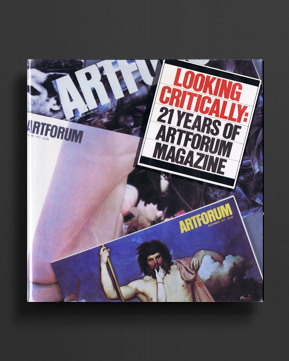
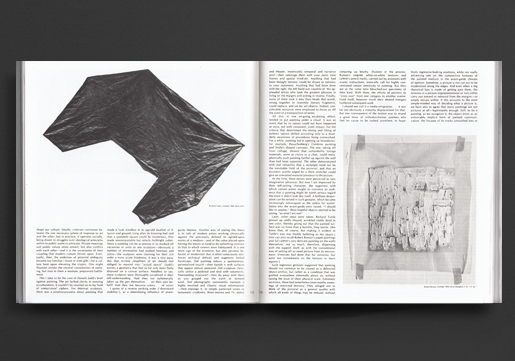
Softcover edition of "LOOKING CRITICALLY: 21 YEARS OF ARTFORUM MAGAZINE", the heavy 342 page volume anthology of the first 21 years of the world's most important modern and art journal. An incredibly valuable collection of art theory.
Edited by Amy Baker Sandback, designed by Roger Gorman and Mary Beath and published in 1984 by U.M.I. Research Press, this dense volume, bound in hardcover to the dimensions of a copy of ARTFORUM, begins with an Ed Kienholz review at the Ferus Gallery from ARTFORUM's June 1962 inaugural issue, and ends with Barbara Kruger reviewing the film "TRON" for the November 1982 issue. An amazing compendium of articles and reviews from the magazine's important first 21 years, featuring contributions by the likes of John Cage, Robert Morris, Kate Steinitz, Henry T. Hopkins, Don Factor, Robert Pincus-Witten, Dennis Adrian, John Coplans, Hilton Kramer, Harold Rosenberg, Henry Geldzahler, John Cage, Walter Hopps, Ed Ruscha, Allan Kaprow, Robert Rosenblum, Dan Flavin, Boris Groys, Sam Wagstaff, Billy Kluver, Lucy R. Lippard, Robert Rosenblum, Roger Shattuck, Ad Reinhardt, Mel Bochner, Andy Warhol, Roy Lichtenstein, Claes Oldenburg, Barbara Rose, Manny Farber, Michael Fried, Robert Morris, Philip Leider, Hollis Frampton, Carl Andre, Richard Serra, Lawrence Alloway, Barbara Kruger, Jane Livingston, Lizzie Borden, Kenneth Baker, Laurie Anderson, Agnes Martin, Cindy Nemser, Sidney Tillim, Annette Michelson, Rosalind Krauss, Jeremy Gilbert-Rolfe, Roberta Smith, Peter Plagens, Peter Schjeldahl, J. Hoberman, Hal Foster, Richard Flood, Carter Ratcliff, Stuart Morgan, Max Kozloff, Donald Kuspit, Dan Graham, Walter De Maria, Komar & Melamid, Edit De Ak, Lawrence Weiner, Kathy Acker, Robert Mapplethorpe, Anselm Kiefer, Thomas McEvilley, Louise Bourgeois, Ingrid Sischy, and too many more to list. Artists featured include: Josef Albers, Richard Tuttle, Jo Baer, Carl Andre, Ant Farm, Hans Arp, Max Bill, Mel Bochner, Alighiero Boetti, Lee Bontecou, Constantin Brancusi, Bertholt Brecht, Richard Avedon, Francis Bacon, Diane Arbus, Michaelangelo Antonioni, Lynda Beglis, Larry Bell, Terry Fox, James Byers, Rober Barry, Marcel Breuer, AA Bronson, Luis Buñel, Daniel Buren, Chris Burden, Joseph Beuys, Anthony Caro, Marcel Broodthaers, John Chamberlain, Paul Cézanne, Marc Chagall, Jean Cocteau, Merce Cunningham, Sonia Delauney, Walter de Maria, Bruce Connor, Jean Dubuffet, Max Ernst, Walker Evans, Dan Flavin, Marcel Duchamp, Albrecht Dürer, Lucio Fontana, Hollis Frampton, Alberto Giacometti, Eva Hesse, Gilbert & George, Philip Glass, John Cage, Nancy Graves, Dan Graham, Robert Grosvenor, Nancy Grossman, Walter Gropius, Hans Haacke, Hairy Who, David Hockney, Douglas Huebler, Jorg Immendorff, Donald Judd, Jasper Johns, Joan Jonas, Allan Kaprow, On Kawara, Ellsworth Kelly, Edward Keinholz, Paul Klee, Alison Knowles, Joseph Kosuth, Brice Marden, Agnes Martin, André Masson, Henri Matisse, Roberto Matta, Sol Lewitt, Roy Lichtenstein, Barbara Kruger, Jannis Kounellis, Markus Lüpertz, El Lissitzky, Rene Magritte, Robert Mapplethorpe, John McCracken, Mario Merz, Robert Morris, Robert Motherwell, Ree Morton, Louise Nevelson, Barnett Newman, Kenneth Noland, Claes Oldenburg, Eduardo Paolozzio, A. R. Penck, Irving Penn, Francis Picabia, Pablo Picasso, Larry Poons, Ken Price, Yvonne Rainer, Robert Rauschenberg, Martial Raysse, Roman Polanski, Jackson Pollock, Steve Reich, Gerrit Rietveld, Alain Robbe-Grillet, Dorothae Rockburne, James Rosenquist, Mark Rothko, Robert Ryman, Lucas Samaras, Kurt Schwitters, Oscar Schlemmer, Richard Serra, Cindy Sherman, David Smith, Robert Smithson, Michael Snow, Robert Venturi, Wolf Vostell, Andy Warhol, Frank Stella, Saul Steinberg, Karlheinz Stockhausen, Bruno Taut, Jean Tinguely, Anne Truitt, Paul Wunderlich, Lawrence Weiner, Louise Bourgeois, Alfred Hitchcock, and so many more.
A Good copy throughout, with cover rubbing and corner bumping. Tightly bound and clean copy internally.
1990, English / German / Italian
Softcover, 88 pages, 24 x 29 cm
Signed copy,
1st Edition, Out of print title / used / very good
Published by
Ikon Galerie / Frankfurt am Main
$600.00 - In stock -
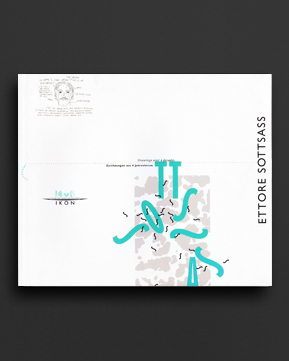
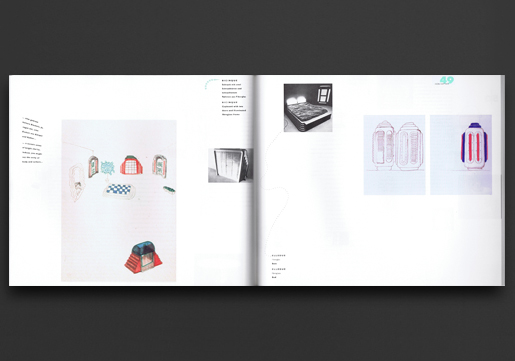
Ettore Sottsass signed copy of this scarce publication from 1990. "Ettore Sottsass : Drawings over 4 decades / Zeichnungen aus 4 Jahrzehnten" was published by Ikon Galerie fur Design-Zeichnungen (Frankfurt am Main), reproducing sketches for furniture, glass, ceramic, jewellery, lighting, interior and architectural projects by influential Italian architect and designer Ettore Sottsass (1917– 2007), which are interspersed throughout the text design of this catalogue, which includes a lively interview by Rainer Krause with the artist (a founder of the Memphis group and Sottsass Associati, as well as designer with Alchimia, Alessi, Olivetti, Arredoluce, Poltronova, Fiorucci, Esprit, Knoll, and many others), text by fellow collaborator and architect/designer/artist Andrea Branzi, and Sottsass's lengthy informal essay presenting his personal view of the sociological significance of the chair.
All texts are in both English and German, with interview also in Italian.
This special copy has been signed by the designer with a large "Sottsass" across the title page in black pen. Not a personalised dedication. A super collectable copy of this already scarce and special book on one of the world's most influential designers and visionaries, who rarely signed a book!
Very Good copy.
2013, English
Hardcover (w. dust jacket), 128 pages, 12 x 19 cm
Published by
Metroverlag / Vienna
$33.00 - Out of stock
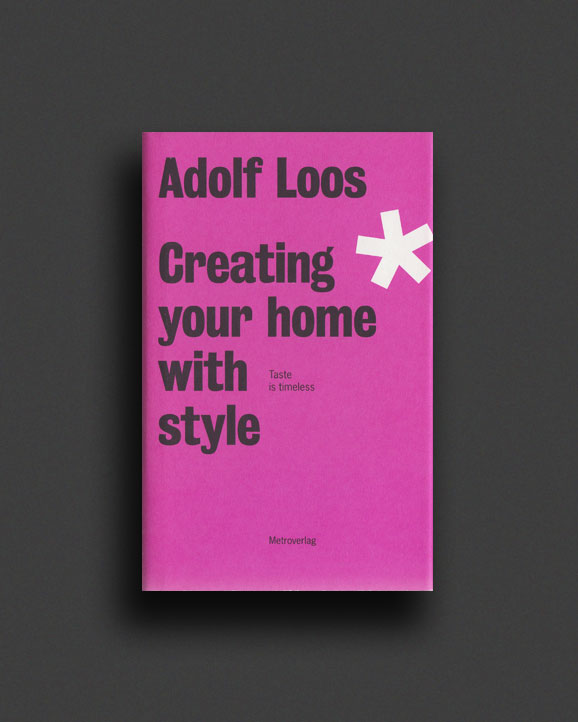
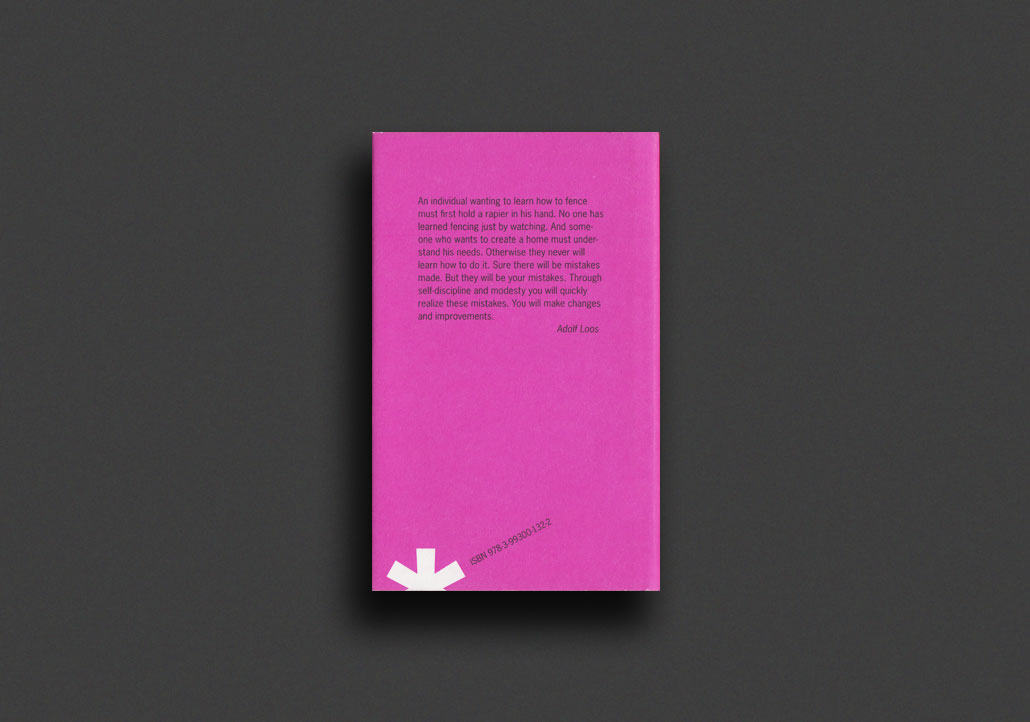
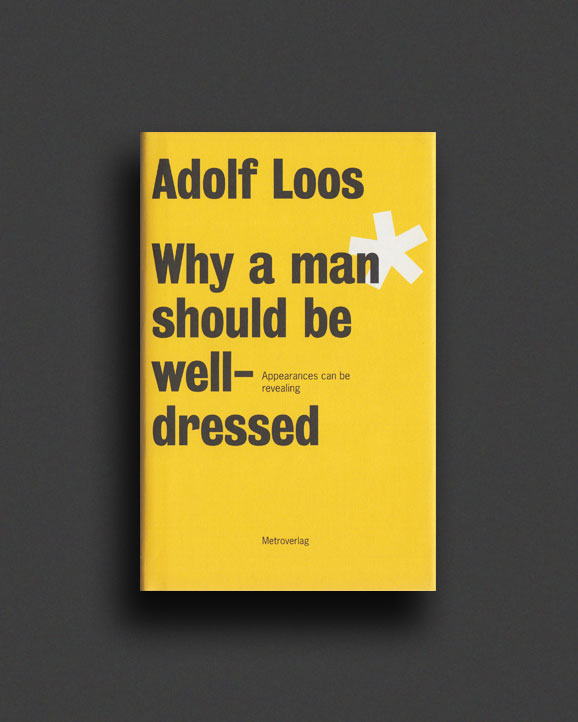
Adolf Loos was an eloquent voice against the squandering of fine materials, ornamentation and unnecessary embellishments. The rational underpinnings of his later assertion that “ornament is crime” first appear in these polemical thrusts at the stylized work of the Viennese secessionists. Few are acquainted with his amusing, incisive, critical and philosophical literary works on applied design and the essence of style in fin de siecle Vienna. Loos often had a radical, yet innovative outlook on life that made him such a nuisance for many of his contemporaries. His provocative musings on an assortment of subjects portray him as a man of many interests, and possessing a keen feel for elegant design still valued today. This publication is now available in English for the first time.
2011, English
Hardcover (w. dust jacket), 128 pages, 12 x 19 cm
Published by
Metroverlag / Vienna
$33.00 - Out of stock
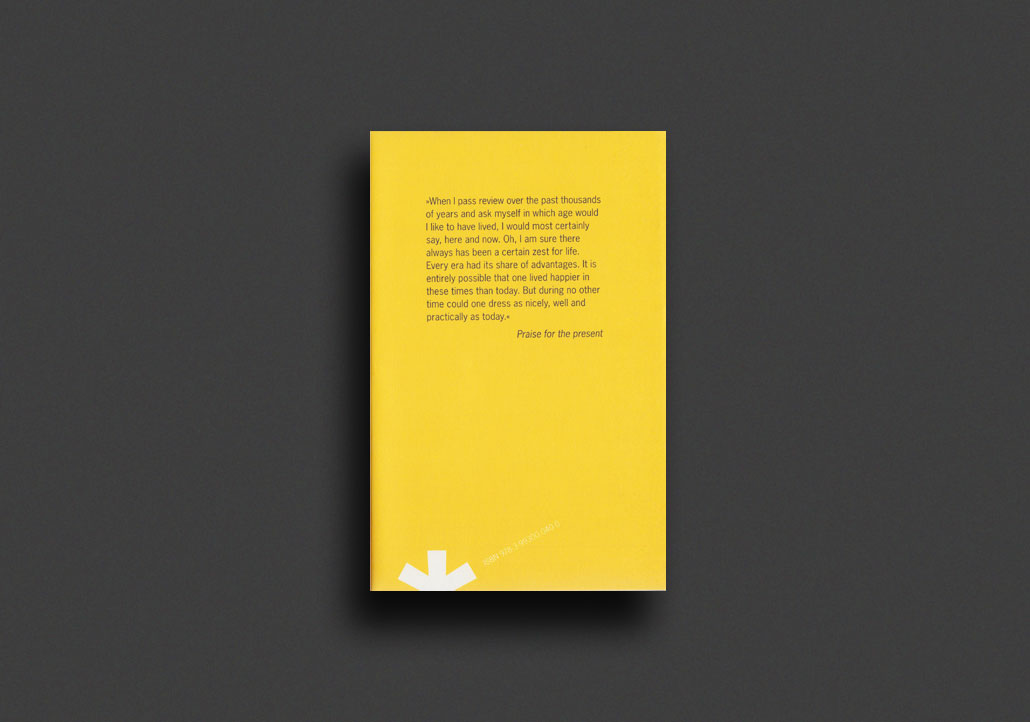
Throughout his life Adolf Loos raised his eloquent voice against the squandering of fine materials, frivolous ornamentation and unnecessary embellishments. His admirers consider him to be the inspiration for all modern architecture. Yet, few are acquainted with his amusing, incisive, critical and philosophical literary work reflecting on applied design and the essence of clothing in fin de siècle Vienna. Adolf Loos often had a radical, yet innovative outlook on life that made him such a nuisance for many of his contemporaries. His provocative musings on many subjects portray him as a man of varied interests and intellectual refinement as well as possessing a keen sense of style, which still has value today. For the first time the ‘Loos Dress Code’ is available in English. Included is a short social/historical look as the birth of Modernism in Adolf Loos’ Vienna.
2015, English
Softcover, 456 pages, 13 x 21 cm
Published by
Mousse Publishing / Milan
$62.00 - Out of stock
With contributions by Haseeb Ahmed, Ignacio Chapela, Justin Clemens, Georges Didi-Huberman, Jonathan Dronsfield, Christopher Fynsk, Vincent W.J. van Gerven Oei, Natasha Ginwala & Vivian Ziherl, Adam Staley Groves, Sean Gurd, Adam Jasper, Susanne Kriemann, Brenda Machosky, Mihnea Mircan, Alexander Nagel, Rosalind Nashashibi, Tom Nicholson, Jack Pettigrew, Raphaël Pirenne, Susan Schuppli, Lucy Steeds, Jonas Leonard Tinius, Marina Vishmidt, Christopher Witmore, and Khadija von Zinnenburg Carroll
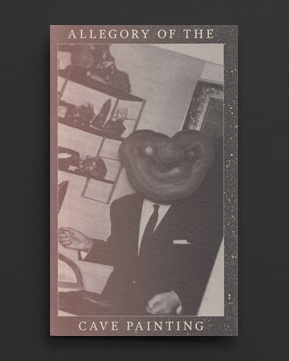
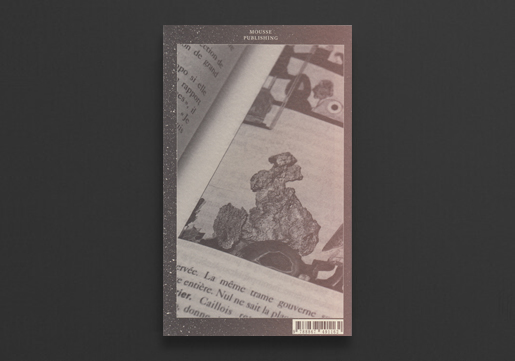
A 2010 archeological study found that the prehistoric Gwion Gwion paintings in Australia, whose chromatic vividness contrasts with their age and their exposure to sun and rain, are inhabited by “living pigments.” A symbiotic biofilm of red cyanobacteria and black fungi sustains a process of permanent self-painting, while also etching the pictures deeper into the quartz wall. The texts commissioned for the reader respond, from a variety of disciplinary perspectives, to an idiosyncratic temporality and economy—or ecology—of signification. Descending from an inscrutable past to the same extent that they are made now, in a radical contemporaneity, the Gwion Gwion are examined as an allegorical metabolism that generates new articulations of “art” and “life,” contamination and purity, prehistory and modernity, bacterial and human colonies, lost knowledge and scientific advancement—collaborative relations between antonyms, altered schemas of “origin” and “identity.”
Now out-of-print - last copies.
2013, English
Softcover, 192 pages, 21 x 15 cm
Published by
Kunstverein / Amsterdam
Macmillan / Melbourne
$45.00 - Out of stock
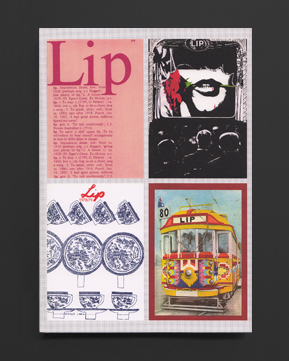
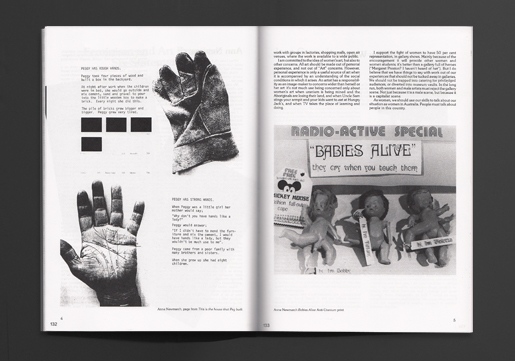
By reviewing the adventurous projects and artworks of a significant group of women involved with the LIP Collective based in Melbourne in the 1970s and 80s, this exciting anthology co-published by Kunstverein Publishing Amsterdam and Macmillan Art Publishing: Melbourne discloses for the first time the scope of the movement. It published Lip: A Feminist Arts Journal; the Earthworks Poster Collective; The Women’s Theatre Group; The Women’s Film Group and a host of exhibitions and critical writings connecting Australian women artists with the activities of their counterparts overseas.
Among the many contributors are Janine Burke, Annette Blonski, Suzanne Davies, Helen Grace, Ponch Hawkes, Sue Johnston, Laleen Jayamanne, Suzanne Spunner and Ann Stephen.
As editor Vivian Ziherl writes:
“Lip magazine was self-published by women in Melbourne from 1976 to 1984 and stood as a lightning rod for Australian feminist artistic practice over the ‘Women Liberation’ era. The art and ideas expressed over Lip’s lifetime track, with ground-breaking moves into performance, ecology, social-engagement and labor politics, stood at an intersection with local realities. The Lip Anthology seeks a figuration of Lip as a composite feminist entity produced with relation to the situational conditions of its production.
The anthology selection is not proposed as a ‘best of’, but rather as cumulative array of materials indicating the range and dynamism of the Lip project. The diversity of the periodical is privileged across multiple disciplinary vantages, as well as among the varied feminist positions brought together through the discursive space afforded by Lip. Collecting and presenting the materials of Lip for the first time since their original appearance, the anthology seeks (re/de)construction and routes of (re)circulation towards points of (re)commencement.
Vivian Ziherl is a curator at If I Can’t Dance, I Don’t Want to Be Part Of Your Revolution, Amsterdam, as well as undertaking independent projects, research and writing. Recent projects include Landings (2013-14) – a research project co-curated with Natasha Ginwala that seeks cross-over readings of land history, geomorphology, rurality and corporeality; and StageIt! (2012-13), a performance series co-curated with Hendrik Folkerts at the Stedelijk Museum Amsterdam. Ziherl will be the seventh guest curator invited to the David Roberts Art Foundation ‘Curator Series’ for 2014.
‘The Lip Anthology’ is published by Kunstverein Publishing and Macmillan Art Publishing, co-produced with Grazer Kunstverein and with the support of the Australia Council for the Arts and the TEWRR.
2018, English
Hardcover, 432 pages, 25x 31 cm
Published by
Getty Publications / Los Angeles
$126.00 - Out of stock
Texts by Glenn Phillips, Doris Chon, Pietro Rigolo, Philipp Kaiser
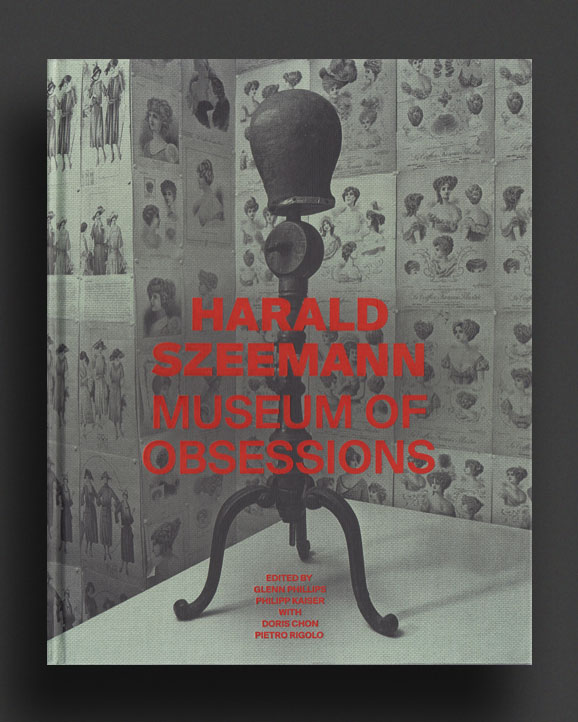
Harald Szeemann is associated with some of the most important artistic developments of the postwar era. A passionate advocate of avant-garde movements like conceptualism and post minimalism, he collaborated with artists such as Joseph Beuys, Bruce Nauman, Richard Serra, and Cy Twombly, developing new ways of presenting art that reflected his sweeping vision of contemporary culture.
Szeemann once stated that his goal as an exhibition maker was to create a "Museum of Obsessions." This richly illustrated volume is a virtual collection catalogue for that imaginary institution, tracing the evolution of his curatorial method through the materials he collected and produced while researching and organising his exhibitions, including letters, drawings, personal datebooks, installation plans, artists' books, posters, photographs, and handwritten notes.
This book documents all phases of Szeemann's career, from his early stint as director of the Kunsthalle Bern, where he organized the seminal Live in Your Head: When Attitudes Become Form (1969); to documenta 5 (1972) and the intensely personal exhibition he staged in his own apartment using the belongings of his hairdresser grandfather (1974); to his reinvention as a freelance curator who realised projects on wide-ranging themes until his death in 2005.
The book contains essays exploring Szeemann's curatorial approach as well as interviews with collaborators. Its more than 350 illustrations include previously unpublished installation photographs and exhibition documents as well as many other materials from the curator's archive.
2018, English
Softcover, 240 pages, 210 x 145 mm
Published by
Whitechapel / London
The MIT Press / Massachusetts
$50.00 - Out of stock
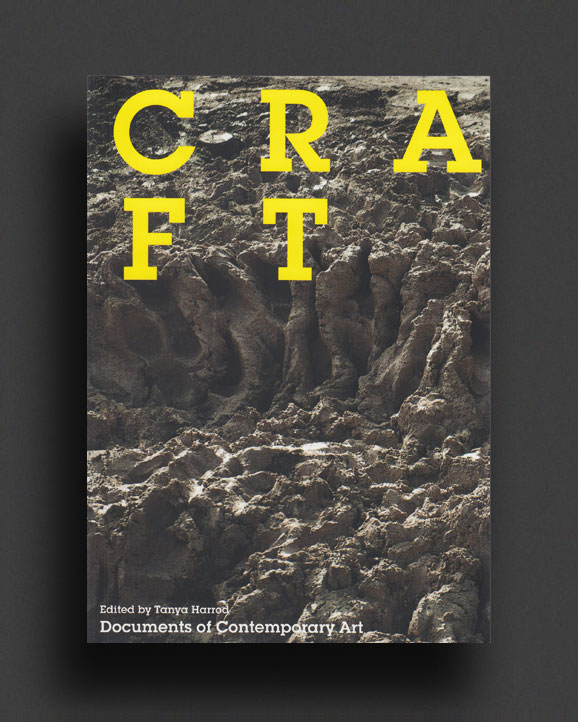
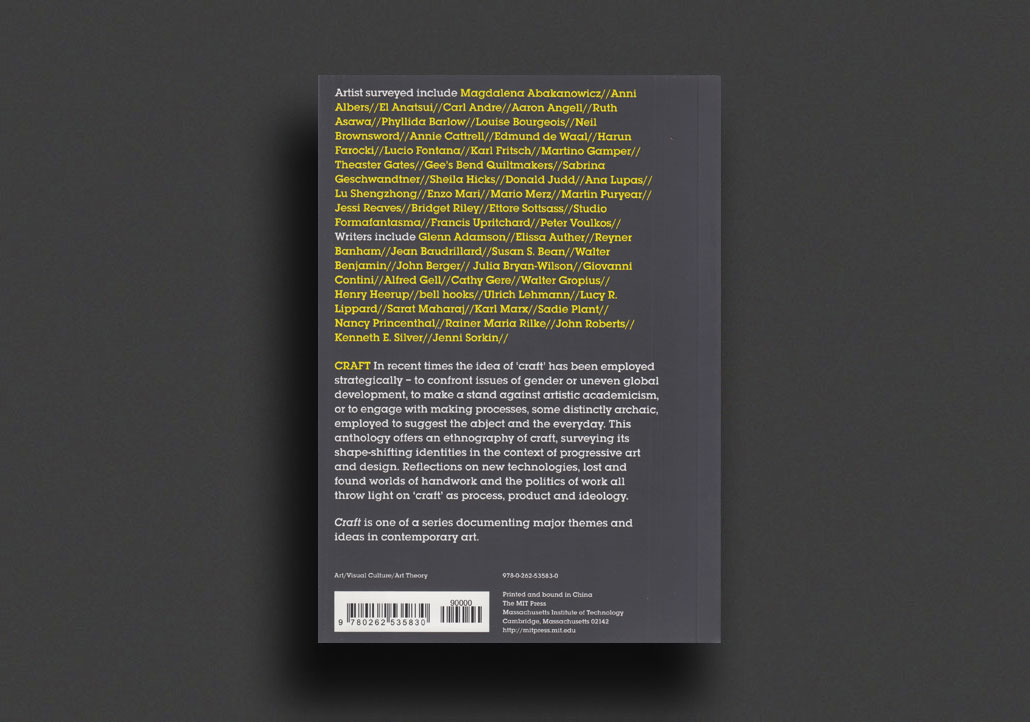
Part of the acclaimed Documents of Contemporary Art series of anthologies which collect writing on major themes and ideas in contemporary art.
"Tanya Harrod is our leading scholarly voice on craft. [This] invaluable anthology...is an ideal introduction to the intellectual landscape of craft, and an essential tool for those already invested in the topic." - Glenn Adamson, Senior Scholar at the Yale Center for British Art
Craft is a contested concept in art history and a vital category through which to understand contemporary art. Through ‘craft’, materials, techniques and tools are investigated and their histories explored in order to reflect on the politics of labour and on the extraordinary complexity of the made world around us. This anthology offers an ethnography of craft, surveying its shape-shifting identities in the context of progressive art and design through writings by artists and makers, and drawing on poetry, fiction, anthropology and sociology. Reflections on new technologies and materials, lost and found worlds of handwork and the politics of work all throw light on ‘craft’ as process, product and ideology.
Artists surveyed include Anni Albers, El Anatsui, Aaron Angell, Ruth Asawa, Phyllida Barlow, Louise Bourgeois, Annie Cattrell, Edmund de Waal, Harun Farocki, Lucio Fontana, Theaster Gates, Gee’s Bend Quiltmakers, Sabrina Gschwandtner, Sheila Hicks, Ana Lupas, Lu Shengzhong, Enzo Mari, Martin Puryear, Jessi Reaves, Bridget Riley, Ettore Sottsass, Studio Formafantasma, Peter Voulkos.
Writers include Glenn Adamson, Elissa Auther, Reyner Banham, Jean Baudrillard, John Berger, Walter Benjamin, Julia Bryan-Wilson, Joan Key, Ulrich Lehmann, Sarat Maharaj, Karl Marx, Sadie Plant, Rainer Maria Rilke, John Roberts, Jenni Sorkin.
Tanya Harrod is an independent design historian who lives in London and who writes widely on craft, art and design. She is co-editor of The Journal of Modern Craft and is author of The Crafts in Britain in the Twentieth Century (1999), The Last Sane Man: Michael Cardew (2012) which won the 2013 James Tait Black Memorial Prize for biography, and The Real Thing: Essays on Making in the Modern World (2015).
2018, English
Softcover, 296 pages, 22.9 x 15.2 cm
Published by
Semiotext(e) / Los Angeles
The MIT Press / Massachusetts
$40.00 - Out of stock
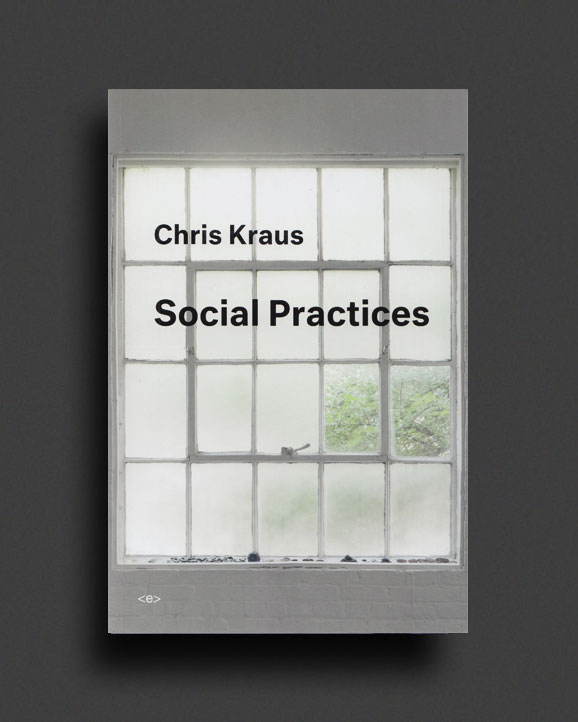
Essays on and around art and art practices by the author of I Love Dick.
A border isn't a metaphor. Knowing each other for over a decade makes us witnesses to each other's lives. My escape is his prison. We meet in a bar and smoke Marlboros.—from Social Practices
Mixing biography, autobiography, fiction, criticism, and conversations among friends, with Social Practices Chris Kraus continues the anthropological exploration of artistic lives and the art world begun in 2004 with Video Green: Los Angeles Art and the Triumph of Nothingness. Social Practices includes writings from and around the legendary “Chance Event—Three Days in the Desert with Jean Baudrillard” (1996), and “Radical Localism,” an exhibition of art and media from Puerto Nuevo's Mexicali Rose that Kraus co-organized with Marco Vera and Richard Birkett in 2012. Attuned to the odd and the anomalous, Kraus profiles Elias Fontes, an Imperial Valley hay merchant who has become an important collector of contemporary Mexican art, and chronicles the demise of a rural convenience store in northern Minnesota. She considers the work of such major contemporary artists as Jason Rhoades, Channa Horowitz, Simon Denny, Yayoi Kusama, Henry Taylor, Julie Becker, Ryan McGinley, and Leigh Ledare. Although Kraus casts a skeptical eye at the genre that's come to be known as “social practice,” her book is less a critique than a proposition as to how art might be read through desire and circumstance, delirium, gossip, coincidence, and revenge. All art, she implies, is a social practice.
2018, English
Softcover, 56 pages, 19.8 x 13 cm
Published by
Koenig Books / London
$28.00 - Out of stock
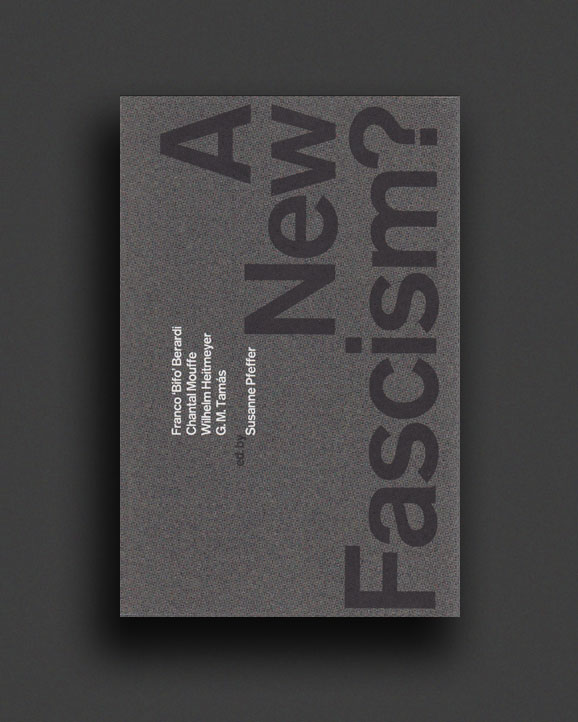
Contributions: Franco “Bifo” Berardi, Wilhelm Heitmeyer, Chantal Mouffe, G. M. Tamás
Edited by Susanne Pfeffer
The contributions in this book are based on, A New Fascism – a symposium held at Fridericianum, Kassel (2016), in conjunction with the exhibition, Two A.M. by Loretta Fahrenholz. The texts follow the questions: Is there a new fascism emerging? And how can we form a counter-acting power?
In her novel entitled Nach Mitternacht (After Midnight, 1937), Irmgard Keun describes everyday life in Nazi Germany in the late 1930s under the dominant influences of fear, government control and despotism. In her exhibition at the Fridericianum, artist Loretta Fahrenholz called attention to similar contemporary phenomena. Based loosely on Keun’s exile novel, her Two A.M. was a socio-fiction film in which she presents frightening analogies to present-day surveillance, capitalism and re-emerging fascism.
One of the essential characteristics of representatives of the new Right, from the Hungarian Prime Minister to Marine Le Pen, is that they all regard themselves as democrats. And when we listen to them, they seem to become more democratic every day. Without blushing, the AfD compares itself to the Third Reich resistance group known as the Weiße Rose. And the French Front National proudly points out that it was the only party in France whose members voted in a democratic referendum on the European constitution.
Thus the obscurity of European institutions can surely be cited as one of the reasons for the emergence of new right-wing movements in all European countries. And the increasing popularity of the new right-wing and nationalist parties can also be attributed at least in part to the movements of migrants and refugees, which are certain to continue unabated in the foreseeable future.
Fascism has reinvented itself, as Alain Badiou pointed out 10 years ago. It has assumed new forms which must be analyzed. And the old theories regarding fascism are no longer adequate for that purpose.
2018, English / German
Softcover, 240 pages, 23 x 16.5 cm
Published by
Texte Zur Kunst / Berlin
$32.00 - Out of stock
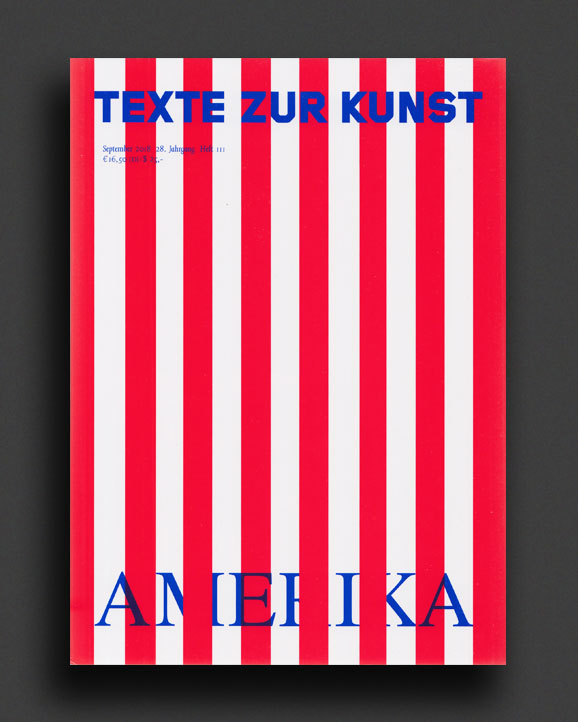
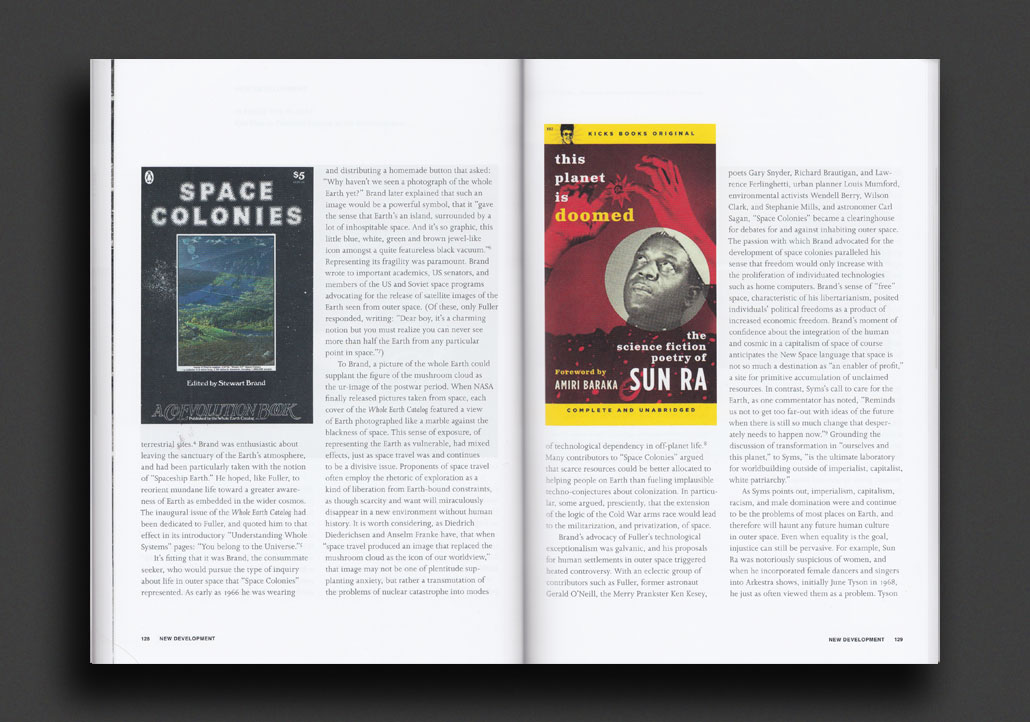
The September issue of Texte zur Kunst focuses on Amerika (U.S. America principally): the land, the idea, and all that seems to come with it. What is Amerika today other than a contradiction between brute political reality and a largely fictional self-image, where fiction says as much about fact as “alternative facts” say about the truth? Within this contradiction, this issue tries to imagine modes of engaging with the current political machinery without opting for the one-dimensional dive into micropolitics that has plagued much recent activist discourse. The Trump regime has introduced a new form of politics whose tactics are closer to artistic practice—inventing parallel truths and questioning facts—than anything like traditional governance. As such, those familiar with art are in a unique position to offer an analysis of the specific forms that define contemporary politics in Amerika. We have thus commissioned artists and critics to come up with new strategies for analyzing the rampant barbarism, resisting the urge to sink into paralysis and defeat in the face of the endless onslaught.
Issue No. 111 / September 2018 "America"
Table Of Contents :
Foreword
Prefaces
Colin Lang
- The Horror, Vacui
Ken Okiishi -
Liberty and Justice For All, Not Us
Aria Dean -
Trauma And Virtuality
Letter To A Friend In New York / By Isabelle Graw
The Golden Hoard / Conversation With Andrea Fraser
Sina Najaf - i
The American Dream State
Robert F. Reid-Pharr -
What We Dare Not Remember
New Development
Is Space The Place? / Eva Díaz On Feminist Futures In The Anthropocene
Love Work Cinema
Between Bildersturm And Artistic Research / Rainer Bellenbaum About Films From The Years Around 1968 In The Historical Program Of The Kurzfilmtage Oberhausen
Reviews
Decolonialized Narrative In The National Art Temple / Susanne Von Falkenhausen On "Hello World" At Hamburger Bahnhof, Berlin
That Fluctuating Moment / Jesi Khadivi At The 10Th Berlin Biennale
The Silent Ship / Övül Ö. Durmusoglu On Manifesta 12 In Palermo
Love And Salt / Adrienne Rooney On Adrian Piper At The Museum Of Modern Art, New York
Tracks Of Disappearance / Tobi Maier About Bruce Nauman In The Schaulager, Basel
Man In The Mirror / Dan Kidner On "Picasso 1932 - Love, Fame, Tragedy" At Tate Modern, London
In The Bure Of The Circle / Marietta Kesting About Raster-Noton In The Kunstbau Lenbachhaus, Munich
Looking But Not Seeing? / Darla Migan On Faith Ring Gold At Weiss Berlin
Mad / Ame / Jenny Nachtigall About Jutta Koether At The Museum Brandhorst, Munich
If You Are Once Big / Nadja Abt About Philip Wiegard At Between Bridges, Berlin
Marked By Trade / Sven Lütticken On "Trade Markings" At The Van Abbemuseum, Eindhoven
Amazone Retired / Tina Schulz On Astrid Klein In The Falckenberg Collection, Hamburg
Born To Die / Colin Lang On Jeanette Mundt At Société, Berlin
Limitations Of Utopia / Christina Irrgang On Cyril Lachauer In The Berlinische Galerie, Berlin
Hereditary Peers / Saim Demircan On Luke Willis Thompson At Kunsthalle Basel
Zoology Of The Falls / Niklas Lichti On Peter Wächtler With Lars Friedrich, Berlin
Below The Surf / Steven Warwick On Georgie Nettell At The Kunstbunker Forum For Contemporary Art, Nuremberg
The Hour Of The Historics / Ariane Müller About Valie Export At The Neuer Berliner Kunstverein
Foreign Powers / Johanna Burton On Zoe Leonard At The Whitney Museum Of American Art
Committee Criteria / Kerstin Stakemeier On Henrike Naumann At The Museum Abteiberg, Mönchengladbach
Related Practices / Sandra Neugärtner On Anni Albers In The Kunstsammlung Nordrhein-Westfalen, Düsseldorf
Term (s) Of Endearment / Kathi Hofer On "Milieu" At After The Butcher, Berlin
Obituary
Claude Lanzmann (1925-2018)
Edition
Cecily Brown
Mark Leckey