World Food Books' programme is largely produced on Kulin Nation land. We acknowledge the Wurundjeri people of the Kulin Nation as the first and continuing custodians of this land, and pay respect to their Elders past, present, and emerging.
World Food Books is an arts and special interests bookshop in Naarm / Melbourne. Founded in 2010, World Food Books is devoted to the presentation of a rotating, hand-selection of international art, design, literary and counterculture publications with an emphasis on the anti-traditional, the experimental, the avant-garde, the heretic, the marginal.
Presenting new titles alongside rare and out-of-print books, catalogues and journals spanning the fields of modern and contemporary art, design, photography, illustration, film, literature, poetry, cultural theory, philosophy, sexuality, popular and underground culture in its many radical forms, World Food Books wishes to encourage adventurous, thoughtful and open-minded reading, looking, writing, and exchange of publishing and ideas, both current and historical.
As well as our bookshop, located in Melbourne's historical Nicholas Building, all of our inventory is available internationally via our online mail-order service.
World Food Books semi-regularly co-ordinates "Occasions", a programme of exhibits and events at the bookshop and in partnership with other hosts (such as museums and art galleries) that develop out of the activities, relationships and content of the bookshop itself.
World Food Books
The Nicholas Building
37 Swanston Street
Room 5, Level 6
Melbourne 3000
Australia
SHOP HOURS:
Thu–Fri 12–6, Sat 12–5
WEB-SHOP OPEN 24/7
World Food Books
Postal Address:
PO Box 435
Flinders Lane
Victoria 8009
Australia
Art
Theory / Essay
Architecture / Interior
Graphic Design / Typography
Photography
Fashion
Eros
LGBTQ+
Fiction / Poetry
Weird / Speculative / Science Fiction / Horror
Transgressive / Visceral / Abject
Symbolism / Decadence / Fin de siècle
Film / Video
Painting
Sculpture / Installation
Performance / Dance / Theater
Drawing
Sound / Music
Curatorial
Group Shows / Collections
Periodicals
Out-of-print / Rare
Posters / Ephemera / Discs
Signed Books
World Food Books Gift Voucher
World Food Book Bag
Australian Art
Australian Fiction
Australian Science Fiction / Speculative Fiction
Australian Poetry
Australian Photography
Japanese Photography
Conceptual Art
Minimal Art
Dada
'Pataphysics / Oulipo
Fluxus
Concrete Poetry
Pop Art
Surrealism
Arte Povera
Arte Informale / Haute Pâte / Tachism
Nouveau Réalisme / Zero / Kinetic
Situationism / Lettrism
Collage / Mail Art / Xerox Art
Art Brut / Folk / Visionary / Fantastic
Illustration / Graphic Art / Bandes Dessinées
Furniture
Italian Radical Design / Postmodernism
Textiles
Ceramics / Glass
Counterculture
Protest / Revolt
Philosophy
Psychoanalysis
Anthropology
Anarchism
Socialism / Anarchism / Communism / Capitalism
Literary Theory / Semiotics / Language
Feminism / Women's Studies
Gender Studies / Sexuality
Anthropology
Fetishism / BDSM
Drugs / Psychedelia
Crime / Violence
Animal Rights / Veganism
Occult / Esoterica
Ecology / Earth / Alternative Living
Whole Earth / Crafts
All prices in AUD (Australian dollars)
Pick-Ups
Pick-up orders can be collected in our bookshop during opening hours after order date. Please collect any Pick-up orders within 2 weeks of ordering as we have limited storage space. Orders will be released back into stock if not collected within this time. No refunds can be made for pick-ups left un-collected. If you cannot make it in to the bookshop in this time-frame, please choose postage option.
Return Policy
All sales are final. We do accept returns (for refund or exchange) for items received in error. All our orders are packed with special care using heavy-duty padding and cardboard book-mailers or bubble mailers (for smaller books), using reinforcement where required. We cannot take responsibility for any lost, stolen or damaged parcels.
Insurance
Should you wish to insure your package, please email us directly after placing your order and we can organise this at a small extra expense. Although all standard/express tracked packages are very safe and dependable, we cannot take responsibility for any lost, stolen or damaged parcels. We recommend insurance on valuable orders.
Interested in selling your old books, catalogues, journals, magazines, comics, fanzines, ephemera? We are always looking for interesting, unusual and out-of-print books to buy. We only buy books in our fields of interest and specialty, and that we feel we can resell.
We base these prices on desirability, market value, in-print prices, condition and our current stock levels. We offer cash, store credit, and can take stock on consignment. All
about 25% of the price we expect to get when we sell them, or 30% in store credit. We base these prices on desirability, market value, in-print prices, condition and our current stock levels.
Sell your books any day of the week. You can drop them off and return later. If you have a lot of books, we can visit your Sydney home.
We buy books that we feel we can resell. We offer about 25 % of the price we expect to get when we sell them, or 30% in store credit. We base these prices on desirability, market value, in-print prices, condition and our current stock levels.
Philadelphia Wireman
03 August - 01 September, 2018
World Food Books is proud to announce our next Occasion, the first presentation of sculptures by Philadelphia Wireman in Australia.
The Philadelphia Wireman sculptures were found abandoned in an alley off Philadelphia’s South Street on trash night in 1982. Their discovery in a rapidly-changing neighbourhood undergoing extensive renovation, compounded with the failure of all attempts to locate the artist, suggests that the works may have been discarded after the maker’s death. Dubbed the "Philadelphia Wireman" during the first exhibition of this work, in 1985, the maker’s name, age, ethnicity, and even gender remain uncertain. The entire collection totals approximately 1200 pieces, all intricately bound together with tightly-wound heavy-gauge wire (along with a few small, abstract marker drawings, reminiscent both of Mark Tobey and J.B. Murry). The dense construction of the work, despite a modest range of scale and materials, is singularly obsessive and disciplined in design: a wire armature or exoskeleton firmly binds a bricolage of found objects including plastic, glass, food packaging, umbrella parts, tape, rubber, batteries, pens, leather, reflectors, nuts and bolts, nails, foil, coins, toys, watches, eyeglasses, tools, and jewellery.
Heavy with associations—anthropomorphic, zoomorphic, and socio-cultural responses to wrapped detritus—the totemic sculptures by Philadelphia Wireman have been discussed in the context of work created to fulfil the shamanistic needs of alternative religions in American culture. Curators, collectors, and critics have variously compared certain pieces to sculpture from Classical antiquity, Native American medicine bundles, African-American memory jugs, and African fetish objects. Reflecting the artist’s prolific and incredibly focused scavenging impulse, and despite—or perhaps enhanced by—their anonymity, these enigmatic objects function as urban artefacts and arbiters of power, though their origin and purpose is unknown. Philadelphia Wireman, whatever their identity, possessed an astonishing ability to isolate and communicate the concepts of power and energy through the selection and transformation of ordinary materials. Over the course of the past two decades, this collection has come to be regarded as an important discovery in the field of self-taught art and vernacular art.
Presented in collaboration with Fleisher-Ollman Gallery, Philadelphia, and Robert Heald, Wellington.
Susan Te Kahurangi King
02 February - 10 March, 2018
Susan Te Kahurangi King (24 February 1951 - ) has been a confident and prolific artist since she was a young child, drawing with readily available materials - pencils, ballpoint pens and felt-tip markers, on whatever paper is at hand. Between the ages of four and six Susan slowly ceased verbal communication. Her grandparents William and Myrtle Murphy had developed a special bond with Susan so they took on caring responsibilities for extended periods. Myrtle began informally archiving her work, carefully collecting and storing the drawings and compiling scrapbooks. No drawing was insignificant; every scrap of paper was kept. The King family are now the custodians of a vast collection containing over 7000 individual works, from tiny scraps of paper through to 5 meter long rolls.
The scrapbooks and diaries reveal Myrtle to be a woman of great patience and compassion, seeking to understand a child who was not always behaving as expected. She encouraged Susan to be observant, to explore her environment and absorb all the sights and sounds. Myrtle would show Susan’s drawings to friends and people in her community that she had dealings with, such as shopkeepers and postal workers, but this was not simply a case of a grandmother’s bias. She recognised that Susan had developed a sophisticated and unique visual language and sincerely believed that her art deserved serious attention.
This was an unorthodox attitude for the time. To provide some context, Jean Dubuffet coined the term Art Brut in 1945 to describe work created by self-taught artists – specifically residents of psychiatric institutions and those he considered to be visionaries or eccentrics. In 1972 Roger Cardinal extended this concept by adopting the term Outsider Art to describe work made by non-academically trained artists operating outside of mainstream art networks through choice or circumstance. Susan was born in Te Aroha, New Zealand in 1951, far from the artistic hubs of Paris and London that Dubuffet and Cardinal operated in. That Myrtle fêted Susan as a self-taught artist who deserved to be taken seriously shows how progressive her attitudes were.
Susan’s parents Doug and Dawn were also progressive. Over the years they had consulted numerous health practitioners about Susan’s condition, as the medical establishment could not provide an explanation as to why she had lapsed into silence. Dawn educated herself in the field of homeopathy and went on to treat all twelve of her children using these principles – basing prescriptions on her observations of their physical, mental and emotional state.
Doug was a linguist with an interest in philosophy who devoted what little spare time he had to studying Maori language and culture. To some extent their willingness to explore the fringes of the mainstream made them outsiders too but it was their commitment to living with integrity and their respect for individuality that ensured Susan’s creativity was always encouraged.
Even though Susan’s family supported her artistic pursuits, some staff in schools and hospitals saw it as an impediment to her assimilation into the community and discouraged it in a variety of ways. Her family was not always aware of this and therefore did not fully understand why Susan stopped drawing in the early 1990s. However, rather than dwell on the challenges that Susan faced in pursuit of her artistic practice, they prefer to highlight her achievements. In 2008 Susan began drawing again in earnest, after an almost 20 year interruption, and her work is now shown in galleries around the world.
Susan grew up without television and has been heavily influenced by the comics she read as a child. She is absolutely fearless in the appropriation of recognizable characters, such as Donald Duck and Mickey Mouse, in her work. She twists their limbs, contorts their faces, compresses them together, blends them into complex patterned backgrounds - always imbuing them with an incredible energy. Although Susan often used pop culture characters in her work they are not naive or childlike. These are drawings by a brilliant self-taught artist who has been creating exceptional work for decades without an audience in mind.
Mladen Stilinović
"Various Works 1986 - 1999"
02 February 16 - September 10, 2016
Various works 1986 - 1999, from two houses, from the collections of John Nixon, Sue Cramer, Kerrie Poliness, Peter Haffenden and Phoebe Haffenden.
Including: Geometry of Cakes (various shelves), 1993; Poor People’s Law (black and white plate), 1993; White Absence (glasses, ruler, set square, silver spoon, silver ladel with skin photograph and wooden cubes), 1990-1996; Exploitation of the Dead (grey and red star painting, wooden painting, black spoon with red table, red plate), 1984-1990; Money and Zeros (zero tie, paintings made for friends in Australia (Sue, John, Kerrie), numbers painting), 1991-1992; Words - Slogans (various t-shirts) - “they talk about the death of art...help! someone is trying to kill me”, “my sweet little lamb”, “work is a disease - Karl Marx”; Various artist books, catalogues, monographs, videos; Poster from exhibition Insulting Anarchy; "Circular" Croatian - Australian edition; Artist book by Vlado Martek (Dostoyevsky); more.
Thanks to Mladen Stilinović and Branka Stipančić.
Jonathan Walker
Always Will Need To Wear Winter Shirt Blue + Ochre Small Check Pattern
21 August - 21 September, 2015
Untitled
I am not a great reader of poetry but I always return to the work of Melbourne poet, Vincent Buckley (1925- 1988). Perhaps I find his most tantalising piece to be not a finished poem but a fragment left on a scrap of paper discovered on his desk after the poet’s death.
The poetry gathers like oil
In the word-core, and spreads
It has its music meet,
Its music is in movement.
This fragment is more the shell left behind from a volatile thought than a finished poem. I find the last two lines honest but awkward whereas the first two lines work like an arrow. Most likely he could not find a resolution so it was left. Still, in its present form, it remains an eloquent testimony to the ultimate failure of a medium to express mobile thought and sensation, in Buckley’s case, through verbal language. It’s an important matter because this is something all artists have to deal with regardless of the medium.
I have never written a poem, however, I am forever copying fragments from books on paper scraps in a vain effort to fix certain notions in my head. At first, they function as bookmarks that are sometimes returned to when I open the book. But before long, as they accumulate, they fall out littering the table interspersed with A4 photocopies, bills, books and medications.
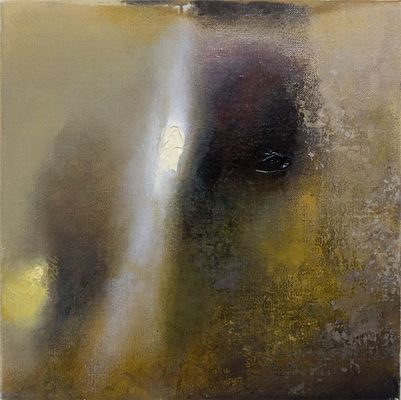
To return to Buckley’s fragment, the first two lines very much evoke how I paint nowadays. As you age, detail diminishes and patches of light become more luminous and float. I feel the most honest way of dealing with this is by smearing the oil paint on the canvas with the fingers and working close-up, blind. Only if the patches coalesce into an approaching image can the work gain a life.
-
Jonathan Walker was born in Melbourne, Australia and brought up on a dairy farm in Gippsland. In the 1970’s he studied painting at RMIT and won the Harold Wright Scholarship to the British Museum, London. During the 1980’s he exhibited at Pinacotheca Gallery, Richmond and had work shown at the NGV and Heidi City Art Gallery. Over the same period he designed the cover for the “Epigenesi” LP by Giancarlo Toniutti, Italy and conducted a mail exchange work with Achim Wollscheid, Germany. The work with artists through the post resulted in an article published in the bicentenary issue of Art and Australia 1988. He showed in artist run spaces such as WestSpace in the 90’s and 2000’s, and until 2012, taught painting at Victoria University, which is where we (Colleen Ahern and Lisa Radford) as organisers of the exhibition, among many others, had the privilege of being his student.
Walker’s knowledge was imparted to students through the careful selection of music, literature, and artists found in books that he himself had ordered for the library. Walker’s strategy was the generosity of sharing his vast knowledge with references specific to each student and their context.
Walker’s paintings share a similar focus and intimacy.
This exhibition presents a small selection of recent paintings alongside a publication that includes Walker’s writing. Observational and analytical, Walker’s work is a type of material notation — the time of day, colour and how it is blended, the both specific and fleeting location of a reflection on lino or the question of whether a chair leg should be included in a painting.
Please join us on Friday August 21 between 6-8pm to celebrate the opening of the exhibition.
Curated by Colleen Ahern and Lisa Radford.
B. Wurtz
Curated by Nic Tammens
March 26 - April 4, 2015
B.Wurtz works from a basement studio in his home on Manhattan’s Lower East Side.
This local fact is attested to by the plastic shopping bags and newsprint circulars that appear in his work. As formal objects, they don’t make loud claims about their origins but nonetheless transmit street addresses and places of business from the bottom of this long thin island. Like plenty of artists, Wurtz is affected by what is local and what is consumed. His work is underpinned by this ethic. It often speaks from a neighborhood or reads like the contents of a hamper:
“BLACK PLUMS $1.29 lb.”
“Food Bazaar”
“USDA Whole Pork Shoulder Picnic 99c lb.”
“RITE AID Pharmacy, with us it’s personal.”
“H. Brickman & Sons.”
“Sweet Yams 59c lb."
Most of the work in this exhibition was made while the artist was in residence at Dieu Donne, a workshop dedicated to paper craft in Midtown. Here Wurtz fabricated assemblages with paper and objects that are relatively lightweight, with the intention that they would be easily transportable to Australia. This consideration isn’t absolute in Wurtz’s work, but was prescriptive for making the current exhibition light and cheap. Packed in two boxes, these works were sent from a USPS post office on the Lower East Side and delivered to North Melbourne by Australia Post.
Wurtz appears courtesy of Metro Pictures, New York.
Thanks to Rob Halverson, Joshua Petherick, Sari de Mallory, Matt Hinkley, Helen Johnson, Fayen d'Evie, Ask Kilmartin, Lisa Radon, Ellena Savage, Yale Union, and "Elizabeth".
John Nixon
"Archive"
December 15 - January 20, 2014
The presentation of John Nixon's archive offered a rare showcase of this extensive collection of the artist's own publications, catalogues, posters, ephemera, editions and more, from the mid 1980s onwards, alongside a selection of his artworks.
Organized by John Nixon, Joshua Petherick and Matt Hinkley.
<a href=http://wfb.public-office.info/artist/john-nixon>All titles by John Nixon
"Habitat"
at Minerva, Sydney (organised by Joshua Petherick and Matt Hinkley)
November 15 - December 20, 2014
Lupo Borgonovo, Janet Burchill & Jennifer McCamley,
Lewis Fidock, HR Giger, Piero Gilardi, Veit Laurent Kurz,
Cinzia Ruggeri, Michael E. Smith, Lucie Stahl, Daniel Weil, Wols
Press Release:
“...It contained seven objects. The slender fluted bone, surely formed for flight, surely from the wing of some large bird. Three archaic circuitboards, faced with mazes of gold. A smooth white sphere of baked clay. An age-blackened fragment of lace. A fingerlength segment of what she assumed was bone from a human wrist, grayish white, inset smoothly with the silicon shaft of a small instrument that must once have ridden flush with the surface of the skin - but the thing’s face was seared and blackened.”
William Gibson, “Count Zero”, 1986
"Autumn Projects Archive"
Curated by Liza Vasiliou
March 6 - March 15, 2014
World Food Books, in conjunction with the Virgin Australia Melbourne Fashion Festival 2014, presented the Autumn Projects archive, consisting of a selection of early examples in Australian fashion with a particular interest in collecting designers and labels from the period beginning in the 1980’s, who significantly influenced the discourse of Australian Fashion.
Curated by Liza Vasiliou, the exhibition provided a unique opportunity to view pieces by designers Anthea Crawford, Barbara Vandenberg, Geoff Liddell and labels CR Australia, Covers, Jag along with early experimental collage pieces by Prue Acton and Sally Browne’s ‘Fragments’ collection, suspended throughout the functioning World Food Books shop in Melbourne.
H.B. Peace
presented by CENTRE FOR STYLE
November 14, 2013
"Hey Blinky, you say chic, I say same"
Anon 2013
H.B. Peace is a clothing collaboration between great friends Blake Barns and Hugh Egan Westland. Their pieces explore the divergences between 'character’ and ‘personality’ in garments....etc
Special Thanks to Joshua Petherick and Matt Hinkley of WFB and Gillian Mears
and a Very Special Thank you to Audrey Thomas Hayes for her shoe collaboration.
Janet Burchill & Jennifer McCamley
"Aesthetic Suicide"
May 10 - June 8, 2013
The first of our occasional exhibitions in the World Food Books office/shop space in Melbourne, "Aesthetic Suicide" presented a body of new and older works together by artists Janet Burchill & Jennifer McCamley, including videos, prints, a wall work, and publications.
During shop open hours videos played every hour, on the hour.
2007, English
Softcover, 112 pages, 15.2 x 21.6 cm
Published by
Afterall / London
The MIT Press / Massachusetts
$35.00 - Out of stock
A richly illustrated study of Marc Chaimowicz's groundbreaking 1972 post-Pop installation-performance piece Celebration? Realife written by art historian Tom Holert.
Marc Camille Chaimowicz (born in 1947) was one of the first artists to merge the realms of performance and installation art. Chaimowicz distinguished himself in an era of stark minimalism by his unabashed pursuit of the beautiful, establishing himself in the 1970s with art that was playful and subtly seductive. Chaimowicz's post-Pop scatter environments owed as much to glam rock as to art practice and were informed by modern French literature (Gide, Cocteau, Proust, and Gênet) as well as by art theory. His important 1972 installation Celebration? Realife featured masks, mirrors, various small objects (including a pair of orange knickers and a white bra), a glitter ball, music by the Rolling Stones, David Bowie, and others—and the artist, serving tea and engaging visitors in conversation in an adjacent room. It raised questions about public/private dichotomies, art/design boundaries, and identifications based on gender, and recast the artist as a kind of art director and stage designer. This work's recent reinstallation (as Celebration? Realife Revisited 1972/2000) and the critical acclaim it inspired confirms Chaimowicz's importance and points to his relationships with artists as different and as difficult as Cerith Wyn Evans, Jutta Koether, Kai Althoff, and others. This richly illustrated study of Celebration? Realife, with many color images, uses Chaimowicz's installation to reconstruct that cultural moment in the 1970s when the role of the artist and the relationships of art, design, popular culture, and performance changed.
Performance artist Marc Camille Chaimowicz, born in Paris in 1947, teaches in the M.F.A. course at the University of Reading and is visiting consultant at L'Ecole Nationale des Beaux-Arts, Dijon. He is the author of Café du Réve.
Tom Holert is an art historian, independent scholar, and critic who has published widely in magazines including Artforum and Bookforum.
1996, English
Softcover, 371 pages, 25.5 x 20 cm
1st Edition, Out of print title / as new
Published by
The MIT Press / Massachusetts
$65.00 - Out of stock
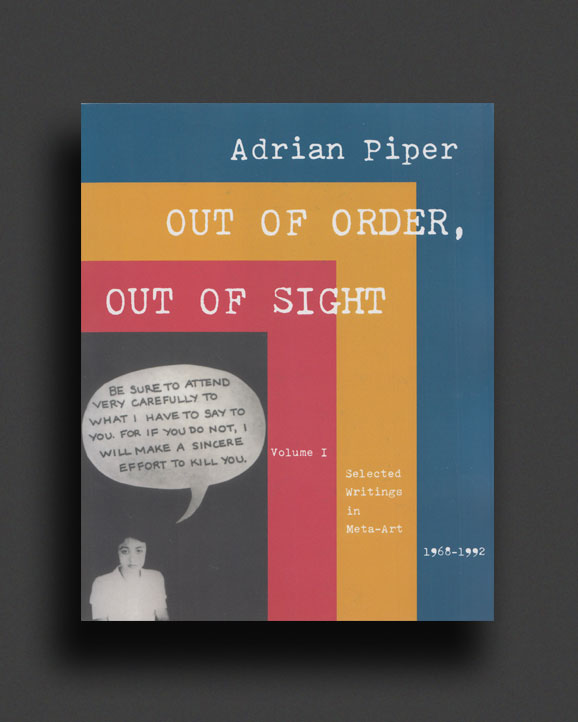
Adrian Piper joins the ranks of writer-artists who have provided much of the basic and most reliable literature on modern and contemporary art. Out of Order, Out of Sight is an artistic and intellectual autobiography and an (occasionally scathing) commentary on mainstream art, art criticism, and American culture of the last twenty-five years. Piper is an internationally recognized conceptual artist and the only African American in the early conceptual art movement of the 1960s. The writings in Out of Order, Out of Sight trace the development of her thinking about her artwork and the art world, and her evolving awareness of herself as a creative, racial, and gendered subject situated in an often limiting and always absurd cultural and social context. The meta-art essays in Volume I document and examine her artistic practice – often humorous, frequently disturbing.
This publication is now out-of-print.
2017, English / Portuguese
Paperback, 264 pages, 17 x 26 cm
Published by
Mousse Publishing / Milan
$48.00 - Out of stock
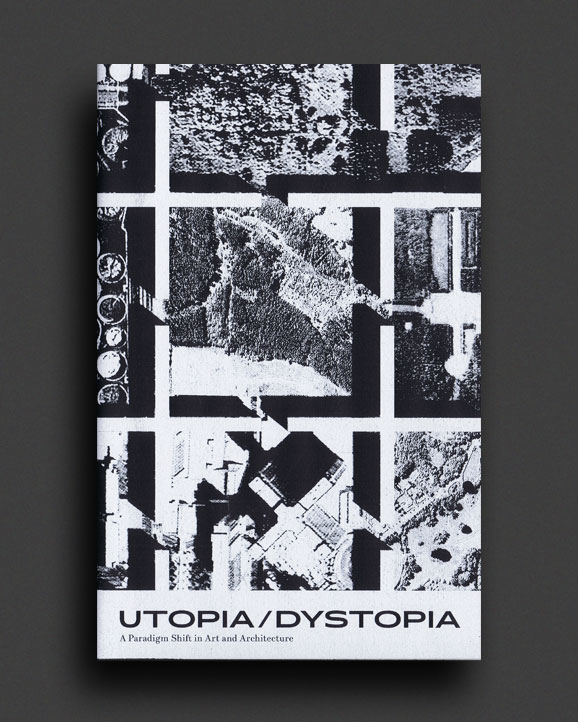
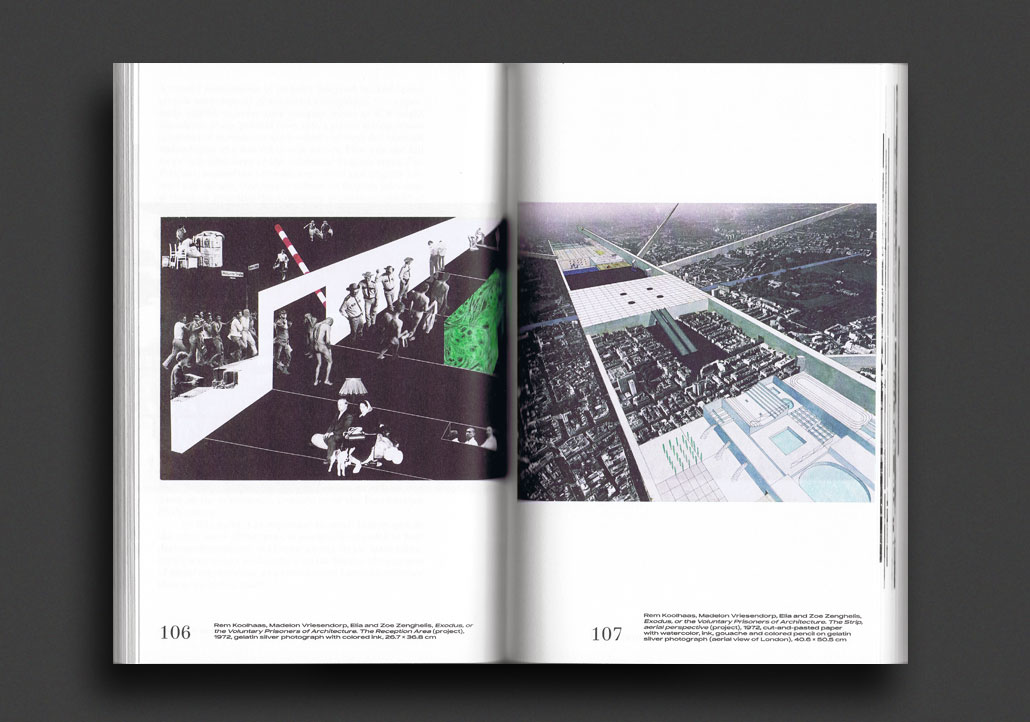
Released as a companion to an eponymous exhibition at MAAT, Lisbon, this book features previously unpublished essays on the ongoing transition from the notion of utopia towards its opposite image of dystopia. It acts as a reader for the curatorial project in which each author reflects on the unsurprising demise of utopian ideals. Yet, as humans, we need positive and idealistic impulses that help us overcome feelings of permanent crisis and disbelief. The dystopia that has come to be accepted and absorbed in human existence can only be combated with a “utopian impulse”. With contributions by Pedro Gadanho, Susana Ventura, Keller Easterling, Franco Berardi, and more.
2017, English
Softcover, 240 pages, 145 x 210 mm
Published by
Whitechapel / London
The MIT Press / Massachusetts
$49.00 - Out of stock
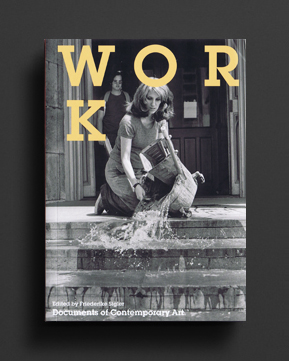
Warhol’s Factory of the 1960s, Minimalism’s assembly-line aesthetics, conceptual and feminist concern with workers’ conditions in the 1970s—these are among the antecedents of a renewed focus on the work of art: labor as artistic activity, as artistic method and as object of artistic engagement. In 2002, the “Work Ethic” exhibition curated by Helen Molesworth at the Baltimore Museum of Art took its cue from recent art to spotlight this earlier era of artistic practice in which activity became as valid as, and often dispensed with, object-production. Revealed through this prism was “dematerialized” art’s close and critical relation to the emergent information age’s criteria of management, production and skill.
By 2015, the Venice Biennale reflected artists’ wider concern with global economic and social crises, centered on exploitative and precarious worlds of employment. Yet while art increasingly engages with human travail, work’s significance in itself is seldom addressed by critics. This anthology explicitly investigates work in relation to contemporary art, surveying artistic strategies that grapple with the complexities of being an art worker in the new economy, a postproducer, a collaborator, a fabricator, a striker, an ethical campaigner, or would-be transformer of labor from oppression to liberation.
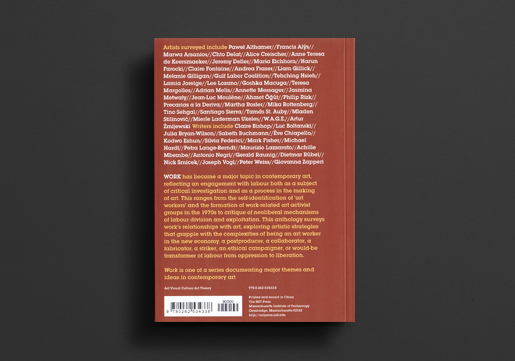
Artists surveyed include
Pawel Althamer, Francis Alÿs, Marwa Arsanios, Chto Delat, Alice Creischer, Ana de la Cueva, Anne Teresa De Keersmaeker, Jeremy Deller, Maria Eichhorn, Harun Farocki, Claire Fontaine, Andrea Fraser, Liam Gillick, Melanie Gilligan, Gulf Labour Coalition, Tehching Hsieh, Lamia Joreige, Lee Lozano, Goshka Macuga, Teresa Margolles, Adrian Melis, Annette Messager, Gustav Metzger, Jean-Luc Moulène, Ahmet Ögüt, Philip Rizk, Martha Rosler, Tino Sehgal, Santiago Sierra, Tamas St. Auby, Mladen Stilinovic, W.A.G.E., Artur Zmijewski
Writers include
Claire Bishop, Luc Boltanski, Julia Bryan-Wilson, Sabeth Buchmann, Ève Chiapello, Kodwo Eshun, Silvia Federici, Isabelle Graw, Maurizio Lazzarato, Achille Mbembe, Antonio Negri, Jacques Rancière, Gerald Raunig, Dietmar Rübel, Paolo Virno, Joseph Vogl
About the Editor
Friederike Sigler is a researcher and lecturer at the Hochschule für Bildende Künste, Dresden. She is the author of Work/Strike.
2017, English
Softcover, 256 pages, 210 x 298 cm
Published by
The MIT Press / Massachusetts
Center for Curatorial Studies Bard College / New York
$65.00 $30.00 - Out of stock
Contemporary art and curatorial work, and the institutions that house them, have often been centers of power, hierarchy, control, value, and discipline. Even the most progressive among them face the dilemma of existing as institutionalized anti-institutions. This anthology–taking its title from Mary Douglas’s 1986 book, How Institutions Think–reconsiders the practices, habits, models, and rhetoric of the institution and the anti-institution in contemporary art and curating. Contributors reflect upon how institutions inform art, curatorial, educational, and research practices as much as they shape the world around us. They consider the institution as an object ofienquiry across many disciplines, including political theory, organizational science, and sociology.
Bringing together an international and multidisciplinary group of writers, How Institutions Think addresses such questions as whether institution building is still possible, feasible, or desirable; if there are emergent institutional models for progressive art and curatorial research practices; and how we can establish ethical principles and build our institutions accordingly. The first part, “Thinking via Institution,” moves from the particular to the general; the second part, “Thinking about Institution,” considers broader questions about the nature of institutional frameworks.
Contributors include
Nataša Petrešin Bachelez, Dave Beech, Mélanie Bouteloup, Nikita Yingqian Cai, Binna Choi and Annette Kraus, Pip Day, Clémentine Deliss, Keller Easterling and Andrea Phillips, Bassam El Baroni, Charles Esche, Patricia Falguières, Patrick D. Flores, Marina Gržinić, Stefano Harney, Alhena Katsof, Emily Pethick, Sarah Pierce, Zahia Rahmani, Moses Serubiri, Simon Sheikh, Mick Wilson
About the Editors
Paul O’Neill is an artist, curator, educator, and writer, and has cocurated more than fifty exhibition projects around the world. The author of The Culture of Curating and the Curating of Culture (MIT Press) and coeditor of The Curatorial Conundrum: What to Study? What to Research? What to Practice? (MIT Press), he is Artistic Director of Publics, Helsinki.
Lucy Steeds is Pathway Leader in Exhibition Studies at Central Saint Martins, University of the Arts, London, and editor of Exhibition (MIT Press/Whitechapel Gallery London). She is coeditor of The Curatorial Conundrum: What to Study? What to Research? What to Practice? (MIT Press).
Mick Wilson is an artist, educator, and writer based in Sweden and Ireland, and the first Head of the Valand Academy of Art, University of Gothenburg. He is coeditor of The Curatorial Conundrum: What to Study? What to Research? What to Practice? (MIT Press).
2018, English
Softcover, 302 pages, 17 x 23 cm
Published by
Valiz / Amsterdam
$55.00 - Out of stock
This volume assembles different perspectives on Brian O’Doherty’s/Patrick Ireland’s seminal work: his visual art practice, art criticism, institutional leadership and critique, media work and literary writing. The contributing authors provide fresh perspectives on his versatile oeuvre. O’Doherty’s role in and for conceptual art and minimalism in New York is as much a theme as his seminal critique of the Modernist white cube gallery (also expressed in his influential book Inside the White Cube: Ideologies of the Gallery Space, 1976), his art-historical ventures and Irish origins.
Edited by Christa-maria Lerm Hayes
2018, English
Hardcover, 240 pages, 22 x 28 cm
Published by
Sternberg Press / Berlin
Para Site / Hong Kong
$110.00 $50.00 - Out of stock
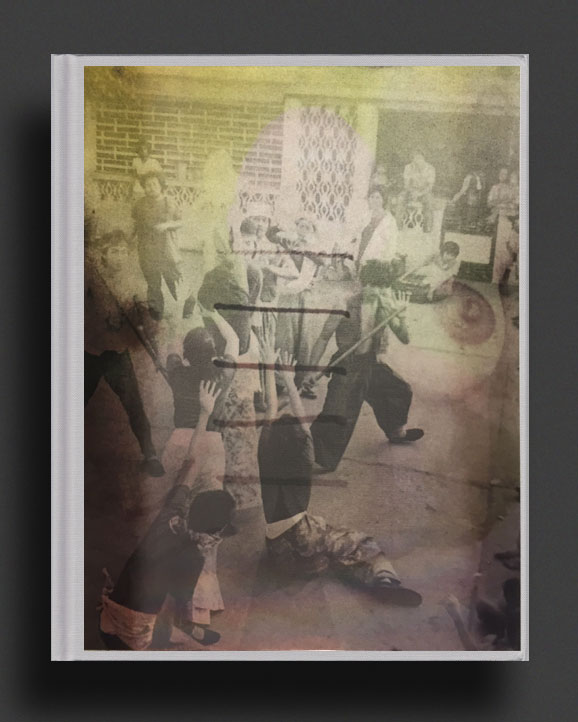
Contributions by Belkis Ayón, Claire Bishop, Boris Buden, Amy Cheng, Bojana Cvejić, Adrienne Edwards, Patrick D. Flores, Gauri Gill, Simryn Gill, Inti Guerrero, Tetsuya Ishida, Eisa Jocson, Firenze Lai, André Lepecki, Xavier Le Roy, Miguel A. López, Carol Yinghua Lu, Rabih Mroué, Ruth Noack, Fernanda Nogueira, Manuel Pelmuș, Goran Sergej Pristaš, Nelly Richard, David Riff, Emily Roysdon, Simon Soon, Mårten Spångberg, Catherine Wood, Yangjiang Group, Anthony Yung
The choreographic turn in the visual arts from 1958 to 1965 can be identified by the sudden emergence of works created by very different visual artists in very different places—artists such as Allan Kaprow, Robert Morris, Carolee Schneeman, and Robert Rauschenberg in the United States; Lygia Pape and Hélio Oiticica in Brazil; the Gutai group in Japan; and Yves Klein in France. Each explicitly or implicitly used dance or choreographic procedures to reinvent, reimagine, and reimage how the visual arts produced and conceived its images and objects—and therefore conceived itself both as practice and as discourse. Dedicated to the renewed encounter between dance and performance and the institutions of global contemporary art, Is the Living Body the Last Thing Left Alive? proposes that a “new performance turn” has emerged in the second decade of the century, and looks at its correlations with other shifts in practices, discourses, and broader society.
The new performance turn is closely related to, on one hand, the increasing tendency to bring contemporary dance into the museum, with more artists working in and around dance, and more museums, art centers, and biennials striving to deepen their commitment to performance in order to develop new aesthetic forms and new modes of production; on the other hand, this “turn” is also related to specific developments in dance and choreography that took place in the mid-1990s. This publication tries to think about performance as more than a medium, beyond its liveness and ephemerality, and rather as a series of questions and reflections about how art mediates social relations among people.
Is the Living Body the Last Thing Left Alive? is expanded from the eponymous 2014 conference organized by Para Site.
Design by Wkshps, New York
2018, English
Hardcover, 172 pages, 21.5 x 27 cm
Published by
Sternberg Press / Berlin
Muzeum Sztuki / Łódź
$125.00 $60.00 - Out of stock
The Museum of Rhythm is a speculative institution that engages rhythm as a tool for interrogating the foundations of modernity and the sensual complex of time in daily experience. When entering a larger cultural infrastructure such as the art museum, it juxtaposes modern and contemporary art with ethnographic research, cinema, music, and scientific instruments to set in resonance a critical apparatus and conduct exercises in Rhythmanalysis.
This book, and the exhibition upon which it is based, is an outcome of durational research that sees art as one of the means by which the ideologies of rhythm are implemented. Hence alongside artworks it, by necessity, includes objects, films, and documents connected with the history of the development of time measurement, labor monitoring devices, choreography, and music practice, which enable the human being to experience more complex rhythms.
The book includes visual documentation of the exhibition as well as essays and texts by Lawrence Abu Hamdan, Erick Beltrán, Robert Brain, Francisco Camacho Herrera, Natasha Ginwala, Robert Horvitz, Ken Jacobs, Elisabeth Lebovici, Ernst Mach, Angela Melitopoulos, Daniel Muzyczuk, Nana Oforiatta-Ayim, Jean Painlevé, Forrestine Paulay, Kathleen Rivera, Simon Schaffer, Georg Simmel, Wadada Leo Smith, Stephen Willats, and Jason Young.
Design by Ryszard Bienert
2017, English / German
Softcover, 96 pages, 11.5 x 18 cm
Published by
Sternberg Press / Berlin
Kunsthalle Bern / Bern
$18.00 - Out of stock
“The idea behind Donnerstag was to insist on the difference between good art and bad art. I am aware of how anachronistic that sounds and how quickly it evokes the image of an old critic-pontiff wagging his authoritarian pointer finger. But even that image is founded in a misunderstanding: the caricaturesque exaggeration of the critic’s voice as dictatorial. But it’s really nothing more than that very voice. And it pronounces a judgment that is not juridical, but ideally worth nothing more than the argument at its core. It’s far more authoritarian and antidemocratic to deny a public voice the act of judgment and concede to a postheroically styled art writer nothing more than the task of pointing at something. […] Whoever just leaves it at that has also parted ways with any hope of open rivalry between arguments.” —Annika Bender
This book is an adaptation of Annika Bender’s lecture “Jump! You Fuckers!” which was presented at Kunsthalle Bern in the context of a series on overproduction and ambivalence in contemporary art. Annika Bender was one of the pseudonyms of artists Dominic Osterried and Steffen Zillig, who wrote the blog Donnerstag (now discontinued) under her name. To make the criticism she proposed possible, and make public its conditions and inherent contradictions—as well as articulate the reasons for her disappearance—it proved necessary to confer Bender to the archive.
Afterword by Hannes Loichinger
Schriftenreihe by Kunsthalle Bern
Edited by Valérie Knoll and Hannes Loichinger
Design by HIT
2017, English / German
Softcover, 64 pages, 11.5 x 18 cm
Published by
Sternberg Press / Berlin
Kunsthalle Bern / Bern
$18.00 - Out of stock
The “economization of art” began to take shape in the wake of the crisis of capital in 2009. The shifts that occurred in the art field during this time were accompanied by explicit critique and academic analysis that aimed to make the genesis of these transformations comprehensible. In this book, first delivered as a lecture at Kunsthalle Bern in April 2016, Diedrich Diederichsen follows Marx’s labor theory of value and counters the symbolic economies dominating the art field, as well as economic exceptionalism or calculation, with systems of recording and reading out. Expanded to include the sphere of individual aesthetic experience, these systems are not formulated as solipsism, or in terms of purposefulness, but as a means to compare relations within the productivity of open and incalculable connectivity, relations that allow aesthetic experience to be read out as the liquefied labor and lifetime of concrete others.
(Over)production and Value takes up considerations that connect Diederichsen’s previous writings, from On (Surplus) Value in Art (Sternberg Press, 2008) to Körpertreffer: Zur Ästhetik der nachpopulären Künste (Suhrkamp, 2017).
Publication series by Kunsthalle Bern, edited by Valérie Knoll and Hannes Loichinger
Design by HIT
2016, English
Softcover, 128 pages, 12.8 x 19.7 cm
Published by
Sternberg Press / Berlin
$46.00 - Out of stock
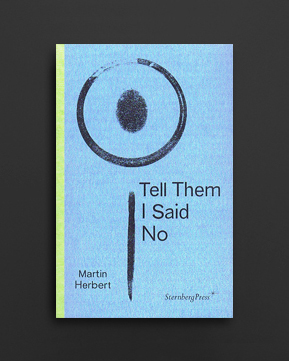
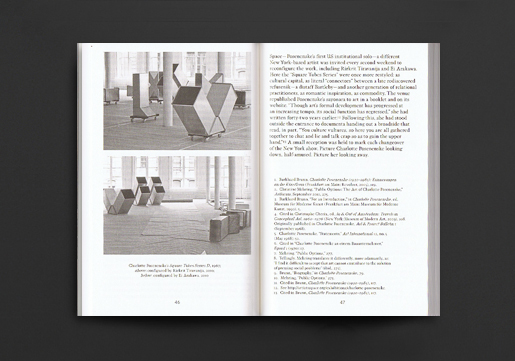
This collection of essays by Martin Herbert considers various artists who have withdrawn from the art world or adopted an antagonistic position toward its mechanisms. A large part of the artist’s role in today’s professionalized art system is being present. Providing a counterargument to this concept of self-marketing, Herbert examines the nature of retreat, whether in protest, as a deliberate conceptual act, or out of necessity. By illuminating these motives, Tell Them I Said No offers a unique perspective on where and how the needs of the artist and the needs of the art world diverge. Essays on Lutz Bacher, Stanley Brouwn, Christopher D’Arcangelo, Trisha Donnelly, David Hammons, Agnes Martin, Cady Noland, Laurie Parsons, Charlotte Posenenske, and Albert York.
Martin Herbert is a writer and critic living in Berlin. He is associate editor of ArtReview and writes for international art journals. Previous books include The Uncertainty Principle (2014) and Mark Wallinger (2011).
Design by Fraser Muggeridge studio
2017, English
Softcover, 204 pages, 14 x 20.5 cm
Published by
Sandberg Instituut / Amsterdam
Sternberg Press / Berlin
$29.00 - Out of stock
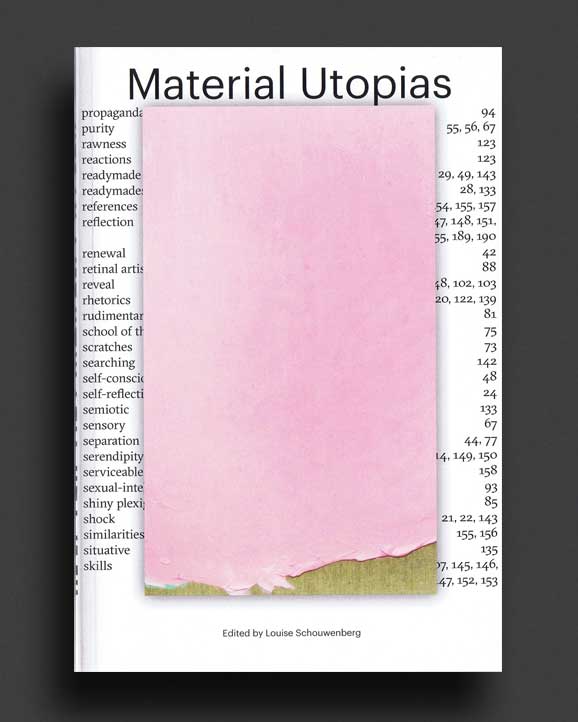
Texts by Max Bruinsma, Amanda du Preez, Domeniek Ruyters, Louise Schouwenberg, Aaron Schuster, Tamar Shafrir
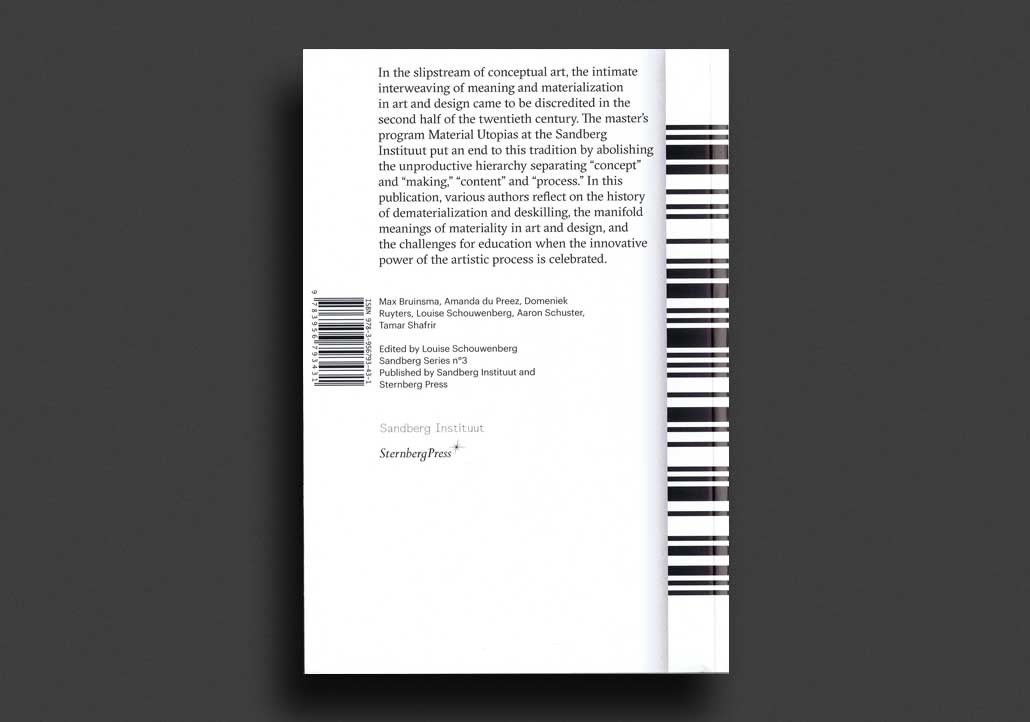
In the slipstream of conceptual art, the intimate interweaving of meaning and materialization in art and design came to be discredited in the second half of the twentieth century. The master’s program Material Utopias at the Sandberg Instituut put an end to this tradition by abolishing the unproductive hierarchy separating “concept” and “making,” “content” and “process.” In this publication, various authors reflect on the history of dematerialization and deskilling, the manifold meanings of materials in art and design, and the challenges for education when the innovative power of the artistic process is celebrated.
Sandberg Series n°3
Copublished with Sandberg Instituut
Design by Anja Groten
2017, English
Softcover, 292 pages, 14 x 20.5 cm
Published by
Sternberg Press / Berlin
Sandberg Instituut / Amsterdam
$29.00 - Out of stock
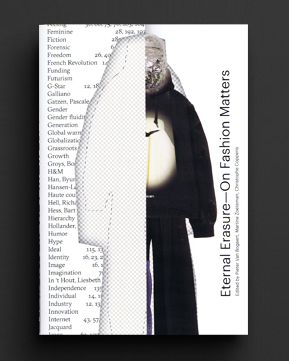
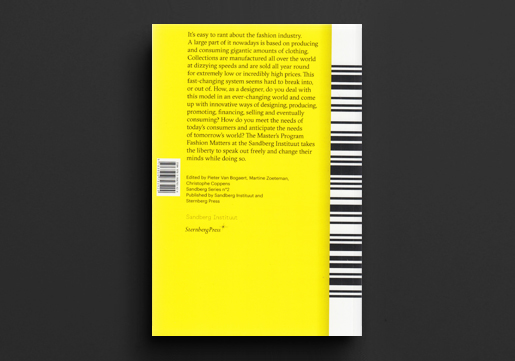
Contributions by Madeline Schwartzman, Javier Barcala, Christina Binkley, Raïsa Verhaegen, Timo Rissanen, Bradley Quinn, José Teunissen, Pauline van Dongen, Elisa Van Joolen, Liesbeth in ‘t Hout, Jurgen Bey, and the students of Fashion Matters at Sandberg Instituut
It’s easy to rant about the fashion industry. Nowadays, a large part of it is based on producing and consuming gigantic amounts of clothing. Collections are manufactured all over the world at dizzying speeds and are sold all year round for extremely low or incredibly high prices. This fast-changing system seems hard to break into, or out of. How, as a designer, do you deal with this model in an ever-changing world and come up with innovative ways of designing, producing, promoting, financing, selling, and eventually consuming? How do you meet the needs of today’s consumers and anticipate the needs of tomorrow’s world? The masters program Fashion Matters at the Sandberg Instituut takes the liberty of addressing these issues.
Sandberg Series n°2
Copublished between Sternberg Press and Sandberg Instituut, Amsterdam
Design by Anja Groten
2017, English
Softcover, 204 pages, 14 x 20.5 cm
Published by
Sandberg Instituut / Amsterdam
Sternberg Press / Berlin
$29.00 - Out of stock
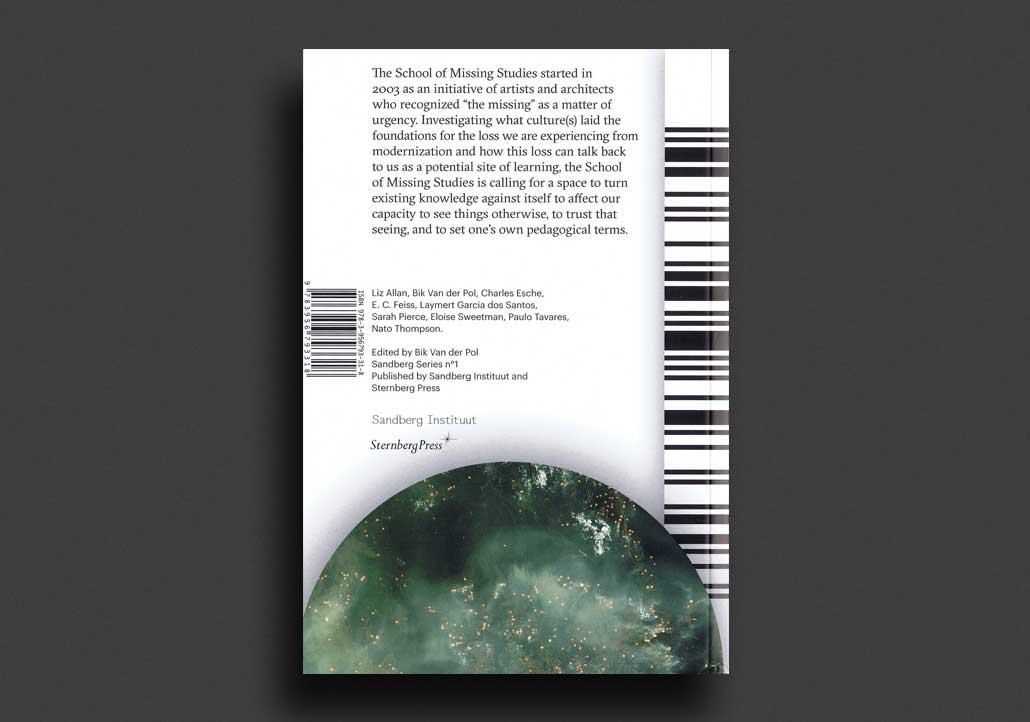
Contributions by Liz Allan, Bik Van der Pol, Charles Esche, E. C. Feiss, Laymert Garcia dos Santos, Sarah Pierce, Eloise Sweetman, Paulo Tavares, Nato Thompson
The School of Missing Studies started in 2003 as an initiative of artists and architects who recognized “the missing” as a matter of urgency. Investigating what culture(s) laid the foundations for the loss we are experiencing from modernization and how this loss can talk back to us as a potential site of learning, the School of Missing Studies is calling for a space to turn existing knowledge against itself to affect our capacity to see things otherwise, to trust that seeing, and to set one’s own pedagogical terms.
Sandberg Series n°1
Copublished with Sandberg Instituut, Amsterdam
Design by Anja Groten
2018, English
Softcover, 210 pages, 12 x 19 cm
Published by
Uh Books / Amsterdam
KW Institute for Contemporary Art / Berlin
$22.00 - Out of stock
According to editor Will Holder, ‘Flurry’ came about after being asked to propose ten books for acquisition by the Gerrit Rietveld Academie library in Amsterdam. He gave a talk about that selection, for which he preferred reproducing original material over commentary, and wanted to allow others to speak. The outcome was a reading back and forth between the ten books. It soon became clear that this reading would readily lend itself to an issue of ‘F.R. David’. Associated material came up in the process of transcription. Included are writings by Emmie McLuskey, Krist Gruijthuijsen, Bitsy Knox, Maurin Dietrich, Camille Pageard, Frances Stark, Eileen Myles, and more.
2018, English / German
Softcover, 88 pages, 14 x 24 cm
Ed. of 500,
Published by
Mode and Mode / Melbourne
$8.00 - In stock -
Mode and Mode 5 ‘Helen Hessel’ features translations of writing by German fashion journalist Helen Hessel (1886-1982), letter correspondence between Hessel and Henri-Pierre Roché, and an interview with Professor Mila Ganeva.
Contributors: Helen Hessel, Mila Ganeva, Sean Ryan and Jeanne Hendrey.
Mode and Mode is a periodical that addresses printed matter in fashion practice. Each issue explores experimental publishing in fashion with an interview around a print-based project — one that has critical effects to fashion as a discourse. In doing so, we reflect on the role of print and its potency to disrupt, or propel, fashion narratives.
1988 / 2012, English
Softcover, 88 pages, 15.2 x 22.9 cm
Published by
The MIT Press / Massachusetts
Semiotext(e) / Los Angeles
$30.00 - Out of stock
“The need to speak, even if one has nothing to say, becomes more pressing when one has nothing to say, just as the will to live becomes more urgent when life has lost its meaning.”
--from The Ecstasy of Communication
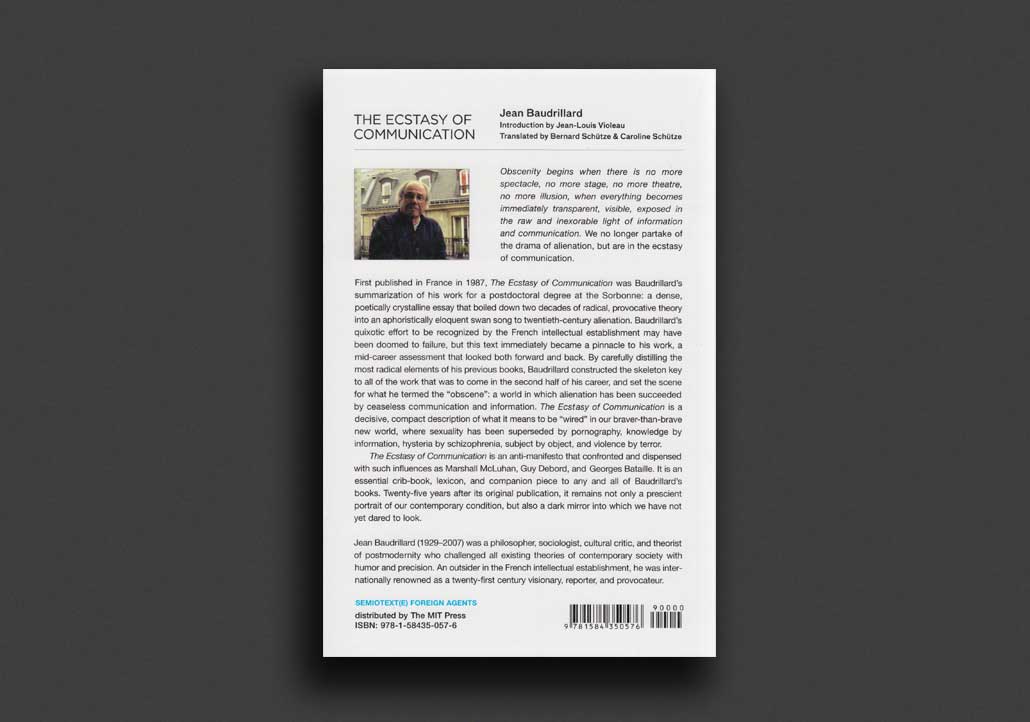
First published in France in 1987, The Ecstasy of Communication was Baudrillard’s summarization of his work for a postdoctoral degree at the Sorbonne: a dense, poetically crystalline essay that boiled down two decades of radical, provocative theory into an aphoristically eloquent swan song to twentieth-century alienation. Baudrillard’s quixotic effort to be recognized by the French intellectual establishment may have been doomed to failure, but this text immediately became a pinnacle to his work, a mid-career assessment that looked both forward and back. By carefully distilling the most radical elements of his previous books, Baudrillard constructed the skeleton key to all of the work that was to come in the second half of his career, and set the scene for what he termed the “obscene”: a world in which alienation has been succeeded by ceaseless communication and information. The Ecstasy of Communication is a decisive, compact description of what it means to be “wired” in our braver-than-brave new world, where sexuality has been superseded by pornography, knowledge by information, hysteria by schizophrenia, subject by object, and violence by terror.
The Ecstasy of Communication is an anti-manifesto that confronted and dispensed with such influences as Marshall McLuhan, Guy Debord, and Georges Bataille. It is an essential crib-book, lexicon, and companion piece to any and all of Baudrillard’s books. Twenty-five years after its original publication, it remains not only a prescient portrait of our contemporary condition, but also a dark mirror into which we have not yet dared to look.
Introduction by Jean-Louis Violeau
Translated by Bernard Schütze and Caroline Schütze
About the Author
Jean Baudrillard (1929–2007) was a philosopher, sociologist, cultural critic, and theorist of postmodernity who challenged all existing theories of contemporary society with humor and precision. An outsider in the French intellectual establishment, he was internationally renowned as a twenty-first century visionary, reporter, and provocateur.
2018, English
Paperback, 120 pages, 13 x 20 cm
Published by
Badlands Unlimited / New York
$35.00 - Out of stock
Preface by Kate Horsfield. Introduction by Lynne Tillman. Interview by Lyn Blumenthal.
In 1984, the art critic, theorist and gay activist Craig Owens (1950–90) gave a wide-ranging interview with Lyn Blumenthal and Kate Horsfield for their extraordinary video series On Art and Artists. At once personal, political and forward-thinking, Owens recounts his experiences with Rosalind Krauss and the founding of the journal October, the "Pictures Generation" artists and critics, and his evolving understanding of the art market, and how it impacts the thinking around art itself.
Along the way, he talks about his journey from a small town in Western Pennsylvania to the Off-Broadway theater world of New York in the '70s, and offers insights into his struggles grappling with the aesthetic and political contradictions haunting contemporary art then—as much as now. The interview, newly edited and updated, is published here for the first time and tells the intimate story of one of the most compelling minds in art theory and criticism. Novelist Lynne Tillman provides an introduction.
2017, English
Softcover, 296 pages, 22.9 x 22 cm
Published by
Semiotext(e) / Los Angeles
The MIT Press / Massachusetts
$39.00 - Out of stock
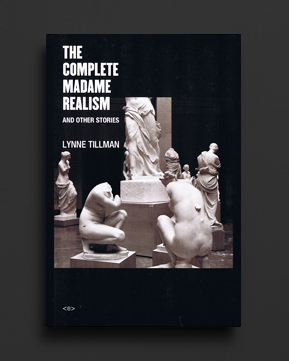
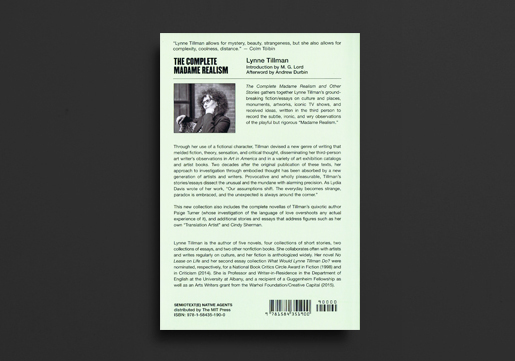
The Complete Madame Realism and Other Stories gathers together Lynne Tillman’s groundbreaking fiction/essays on culture and places, monuments, artworks, iconic TV shows, and received ideas, written in the third person to record the subtle, ironic, and wry observations of the playful but stern “Madame Realism.”
Through her use of a fictional character, Tillman devised a new genre of writing that melded fiction and theory, sensation, and critical thought, disseminating her third-person art writer’s observations in such magazines as Art in America and in a variety of art exhibition catalogs and artist books. Two decades after the original publication of these texts, her approach to investigation through embodied thought has been wholly absorbed by a new generation of artists and writers. Provocative and wholly pleasurable, Tillman’s stories/essays dissect the mundane with alarming precision. As Lydia Davis wrote of her work, “Our assumptions shift. The every day becomes strange, paradox is embraced, and the unexpected is always around the corner.”
This new collection also includes the complete stories of Tillman’s other persona, the quixotic author Paige Turner (whose investigation of the language of love overshoots any actual experience of it), and additional stories and essays that address figures such as the “Translation Artist” and Cindy Sherman.
About the Author
Lynne Tillman is the author of five novels, four collections of short stories, two collection of essays and two other nonfiction books. She collaborates often with artists and writes regularly on culture, and her fiction is anthologized widely. Her novel No Lease on Life and her second essay collection What Would Lynne Tillman Do? were nominated, respectively, for a National Book Critics Circle Award in Fiction (1998) and in Criticism (2014). She is Professor and Writer-in-Residence in the Department of English at the University at Albany, a recipient of a Guggenheim Fellowship as well as an Arts Writers grant from the Warhol Foundation/Creative Capital (2015).
1985, English
Softcover, 96 pages, 30 x 21 cm
1st Edition, Out of print title / used / very good
Published by
Art Gallery of New South Wales / Sydney
$100.00 - Out of stock
Very scarce catalogue and unique valuable resource published to accompany the exhibition "Working Art: A Survey of Art in The Australian Labour Movement in The 1980's", curated by Australian conceptual artist, curator and writer Ian Burn for the Art Gallery of New South Wales in 1985. Designed by Michael Davies of the Art Workers Union (AWU), this heavily illustrated (in colour and black and white) catalogue surveys the Banners, Posters, Graphics, Photographs, and Media of the Australian Labour movement during the 1980's, as well as a detailed "Historical Sketch" written and compiled by Ian Burn and Sandy Kirby that illustrates the rich history of the Arts in Australian unionism and communities. Alongside the many exhibited prints and textiles, there is photo documentation throughout of marches, performances, artist's at work, historical exhibitions, plus reproductions of newsletters, newspapers, cartoons, announcements, along with further accompanying introductory texts and a bibliography.
Includes inserted Trade Union Information Kit "Art and Working Life : The Victorian Trades Hall Council Arts Workshop" booklet that takes an illustrated look at the activities of the VTHC Workshop in the 1980s. A perfect accompaniment to this catalogue. Also, errata slip enclosed from the NSW catalogue.
Ian Burn (1939-1993) was an Australian conceptual artist, curator and writer who spent the first part of his career working in London and New York. It was here that he began working with Art & Language, a collaborative group who produced the publication Art-Language and whose members included artists Roger Cutforth, Joseph Kosuth and Mel Ramsden. Returning to Australia in 1977 Burn became involved in the Art Workers Union (AWU), a political and social platform that championed artists’ rights and helped change the landscape and expectations under which artists worked in Australia. From 1980 onwards, together with artist and social activist Ian Millis, he worked on a number of initiatives to further the cause of the labour movement, including Union Media Services and the Art and Working Life program. Burn died by accidental drowning in 1993.
A great copy of an important resource on Australia's cultural, industrial and political history, and also an important publication by Ian Burn.
Light general reading/handling creasing to oblong pages, otherwise tight and clean throughout. Previous owner's name penned to title page.
2017, English
Softcover, 312 pages, 21 x 15.5 cm
Published by
Mousse / Milan
LOOP / Barcelona
$58.00 - Out of stock
Edited by Eugeni Bonet
With texts by Stephen Beck, AA Bronson, Peter Campus, Peter d’Agostino, Douglas Davis, Jon Dovey, Juan Downey, Jean-Paul Fargier, Hermine Freed, Frank Gillette, David Hall, Takahiko Iimura, Les Levine, Mary Lucier, Muntadas, Nam June Paik, Ulrike Rosenbach, Martha Rosler, Paul Ryan, Francesc Torres, Woody Vasulka & Scott Nygren, Bill Viola, and Peter Weibel
Writings by artists have always played a crucial role in art theory. For the practitioners, they are a way to illustrate and explain their own ideas around their trajectory and working methods, identify trends they feel close to, articulate a broader reflection on a given medium, and perhaps challenge preconceived ideas. Just as film theory has incorporated essays, manifestos, and other written thoughts by filmmakers into a body of work that also includes the voices of critics studying the “new cinematic object,” this publication gathers together a number of artists’ writings—which were previously scattered in different publications—in order to revisit and reevaluate the early days of video art (up to 1990, a not entirely arbitrary time span). It adds a critical layer to LOOP Barcelona’s 15th edition, Winding the Clock Back: A Contemporary Archaeology of Video.
This title is now out of print.
2017, English / German
Softcover, 232 pages, 22 x 14 cm
Published by
KW Institute for Contemporary Art / Berlin
Koenig Books / London
$32.00 - In stock -
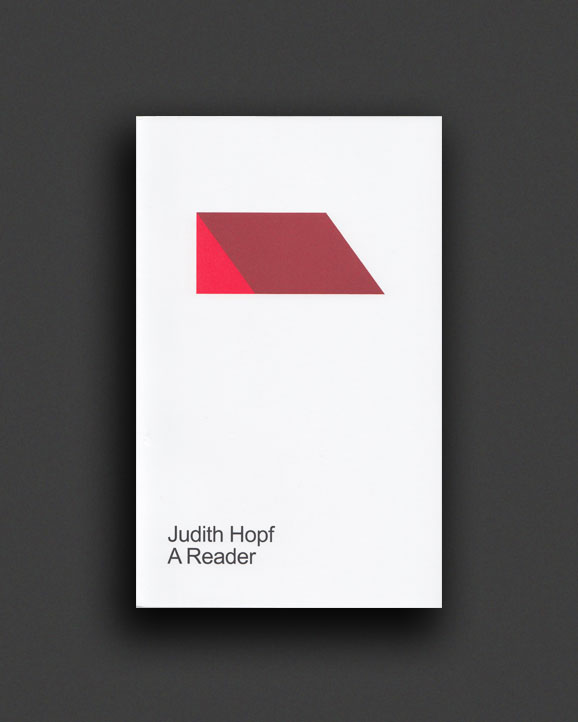
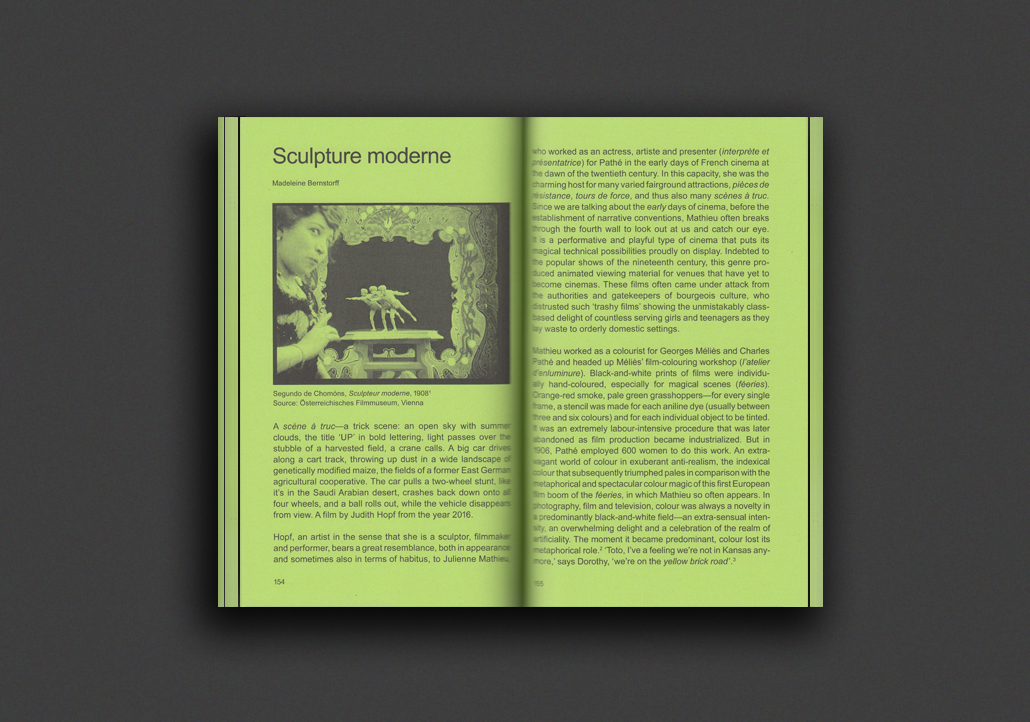
I think it can only be because of memory-of-knowing-how that we made it through the grey days in cities in general–and through the greyness of Berlin in particular–that we made it through again and again. Because the streets switched directions too, rushing towards us a whole lot faster. Bicycles became utterly useless. Just looking at them knocked the air out of their tyres. What's more, ticket prices increased and coins no longer fit in the slots of vending machines. [Judith Hopf, Stepping Stairs]
With texts by Kathy Acker, Madeleine Bernstorff, Sabeth Buchmann, Maurin Dietrich, Anna Gritz, John Hejduk, Judith Hopf, Monika Rinck, Avital Ronell, Annette Wehrmann
2007, English
Softcover, 224 pages, 20 x 13 cm
Published by
Manchester University Press / Manchester
$36.00 - Out of stock
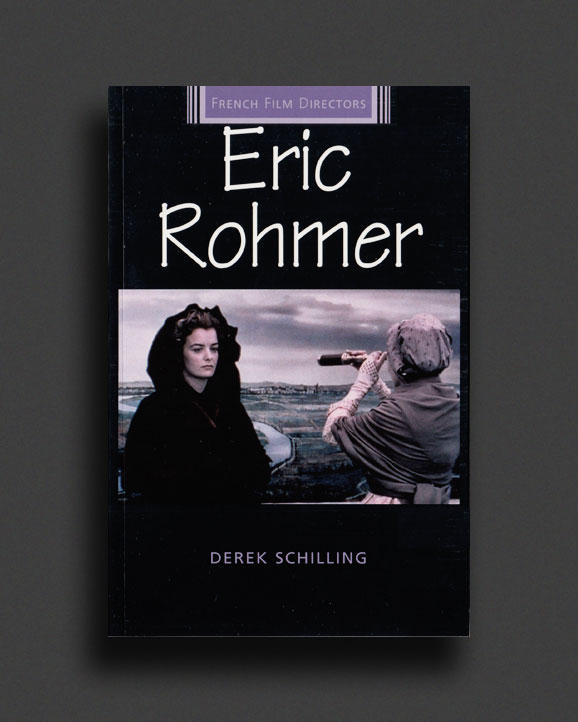
By Derek Schilling
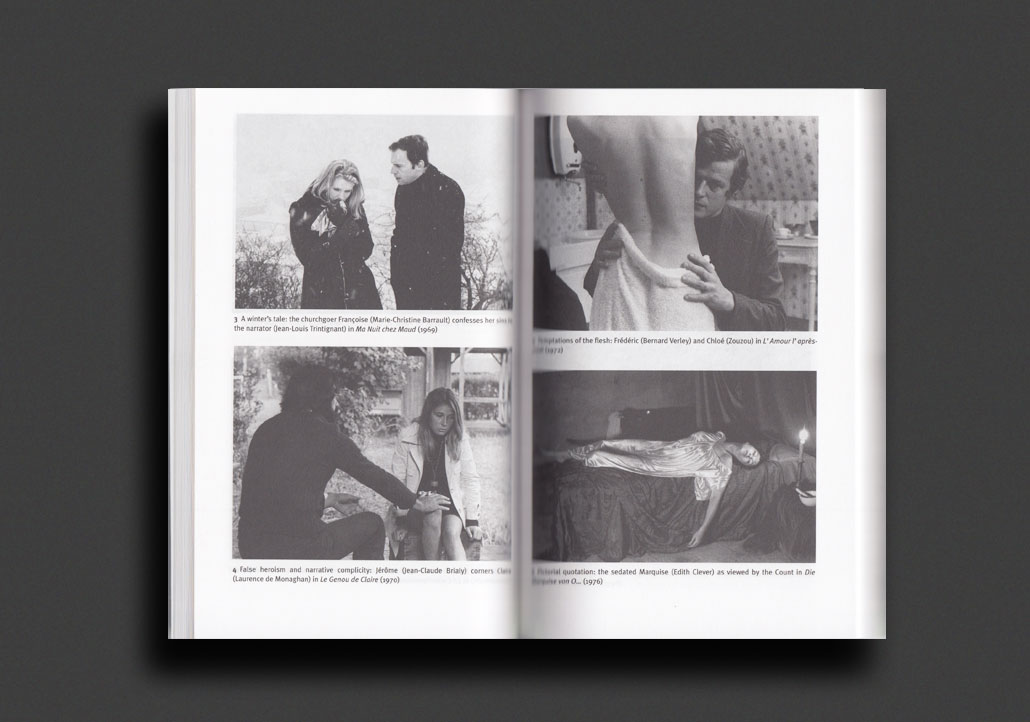
Few filmmakers have taken the principle of the 'talking picture' so far as Eric Rohmer, the internationally reknowned director of the Moral Tales, Comedies and Proverbs, and Tales of the Four Seasons cycles. Occasionally dismissed as precious or overly literary, Rohmer's features may leave the impression that there is more to listen to than to look at. Yet as the secretive director (b. Maurice Schérer in 1920) points out, dialogue is no less engaging than the best gunfights, and if his characters prefer discussing love to making it, they are no less the 'heroes' of the stories they tell.
Charges of political conservatism aside, the author of My Night at Maud's, Summer and such period films as Perceval and the all-digital The Lady and the Duke emerges - like Hitchcock before him - as a singular inventor of cinematic forms. This critical overview, which contains an extensive bibliography and a filmography, will appeal to students of Film Studies, French Studies, and enthusiasts.
From Manchester University Press' French Film Directors series, edited by Diana Holmes and Robert Ingram.
2009, English
Hardcover, 512 pages (60 b&w ills), 178 x 229 mm
Published by
The MIT Press / Massachusetts
$105.00 $80.00 - Out of stock
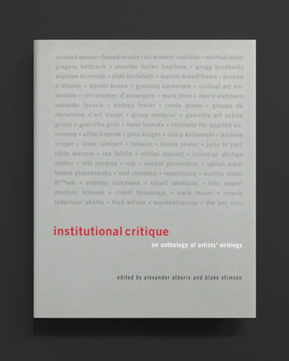
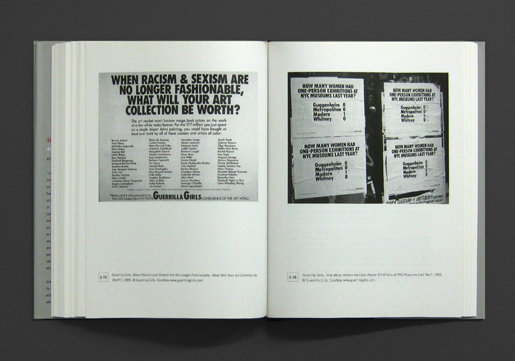
"Institutional critique" is an artistic practice that reflects critically on its own housing in galleries and museums and on the concept and social function of art itself. Such concerns have always been a part of modern art but took on new urgency at the end of the 1960s, when--driven by the social upheaval of the time and enabled by the tools and techniques of conceptual art--institutional critique emerged as a genre. This anthology traces the development of institutional critique as an artistic concern from the 1960s to the present by gathering writings and representative art projects of artists from across Europe and throughout the Americas who developed and extended the genre. The texts and artworks included are notable for the range of perspectives and positions they reflect and for their influence in pushing the boundaries of what is meant by institutional critique. Like Alberro and Stimson's Conceptual Art: A Critical Anthology this volume will shed new light on its subject through its critical and historical framing. Even readers already familiar with institutional critique will come away from this book with a greater and often redirected understanding of its significance.Artists represented include Wieslaw Borowski, Daniel Buren, Marcel Broodthaers, Groupe de Recherche d'Art Visuel, Hans Haacke, Robert Smithson, John Knight, Graciela Carnevale, Osvaldo Mateo Boglione, Guerilla Art Action Group, Art Workers' Coalition, Mierle Laderman Ukeles, Michael Asher, Mel Ramsden, Adrian Piper, The Guerrilla Girls, Laibach, Silvia Kolbowski, Andrea Fraser, Fred Wilson, Mark Dion, Maria Eichhorn, Critical Art Ensemble, Bureau d'Etudes, WochenKlausur, The Yes Men, Hito Steyerl, Andreas Siekmann.