World Food Books' programme is largely produced on Kulin Nation land. We acknowledge the Wurundjeri people of the Kulin Nation as the first and continuing custodians of this land, and pay respect to their Elders past, present, and emerging.
World Food Books is an arts and special interests bookshop in Naarm / Melbourne. Founded in 2010, World Food Books is devoted to the presentation of a rotating, hand-selection of international art, design, literary and counterculture publications with an emphasis on the anti-traditional, the experimental, the avant-garde, the heretic, the marginal.
Presenting new titles alongside rare and out-of-print books, catalogues and journals spanning the fields of modern and contemporary art, design, photography, illustration, film, literature, poetry, cultural theory, philosophy, sexuality, popular and underground culture in its many radical forms, World Food Books wishes to encourage adventurous, thoughtful and open-minded reading, looking, writing, and exchange of publishing and ideas, both current and historical.
As well as our bookshop, located in Melbourne's historical Nicholas Building, all of our inventory is available internationally via our online mail-order service.
World Food Books semi-regularly co-ordinates "Occasions", a programme of exhibits and events at the bookshop and in partnership with other hosts (such as museums and art galleries) that develop out of the activities, relationships and content of the bookshop itself.
World Food Books
The Nicholas Building
37 Swanston Street
Room 5, Level 6
Melbourne 3000
Australia
SHOP HOURS:
Thu–Fri 12–6, Sat 12–5
WEB-SHOP OPEN 24/7
World Food Books
Postal Address:
PO Box 435
Flinders Lane
Victoria 8009
Australia
Art
Theory / Essay
Architecture / Interior
Graphic Design / Typography
Photography
Fashion
Eros
LGBTQ+
Fiction / Poetry
Weird / Speculative / Science Fiction / Horror
Transgressive / Visceral / Abject
Symbolism / Decadence / Fin de siècle
Film / Video
Painting
Sculpture / Installation
Performance / Dance / Theater
Drawing
Sound / Music
Curatorial
Group Shows / Collections
Periodicals
Out-of-print / Rare
Posters / Ephemera / Discs
Signed Books
World Food Books Gift Voucher
World Food Book Bag
Australian Art
Australian Fiction
Australian Science Fiction / Speculative Fiction
Australian Poetry
Australian Photography
Japanese Photography
Conceptual Art
Minimal Art
Dada
'Pataphysics / Oulipo
Fluxus
Concrete Poetry
Pop Art
Surrealism
Arte Povera
Arte Informale / Haute Pâte / Tachism
Nouveau Réalisme / Zero / Kinetic
Situationism / Lettrism
Collage / Mail Art / Xerox Art
Art Brut / Folk / Visionary / Fantastic
Illustration / Graphic Art / Bandes Dessinées
Furniture
Italian Radical Design / Postmodernism
Textiles
Ceramics / Glass
Counterculture
Protest / Revolt
Philosophy
Psychoanalysis
Anthropology
Anarchism
Socialism / Anarchism / Communism / Capitalism
Literary Theory / Semiotics / Language
Feminism / Women's Studies
Gender Studies / Sexuality
Anthropology
Fetishism / BDSM
Drugs / Psychedelia
Crime / Violence
Animal Rights / Veganism
Occult / Esoterica
Ecology / Earth / Alternative Living
Whole Earth / Crafts
All prices in AUD (Australian dollars)
Pick-Ups
Pick-up orders can be collected in our bookshop during opening hours after order date. Please collect any Pick-up orders within 2 weeks of ordering as we have limited storage space. Orders will be released back into stock if not collected within this time. No refunds can be made for pick-ups left un-collected. If you cannot make it in to the bookshop in this time-frame, please choose postage option.
Return Policy
All sales are final. We do accept returns (for refund or exchange) for items received in error. All our orders are packed with special care using heavy-duty padding and cardboard book-mailers or bubble mailers (for smaller books), using reinforcement where required. We cannot take responsibility for any lost, stolen or damaged parcels.
Insurance
Should you wish to insure your package, please email us directly after placing your order and we can organise this at a small extra expense. Although all standard/express tracked packages are very safe and dependable, we cannot take responsibility for any lost, stolen or damaged parcels. We recommend insurance on valuable orders.
Interested in selling your old books, catalogues, journals, magazines, comics, fanzines, ephemera? We are always looking for interesting, unusual and out-of-print books to buy. We only buy books in our fields of interest and specialty, and that we feel we can resell.
We base these prices on desirability, market value, in-print prices, condition and our current stock levels. We offer cash, store credit, and can take stock on consignment. All
about 25% of the price we expect to get when we sell them, or 30% in store credit. We base these prices on desirability, market value, in-print prices, condition and our current stock levels.
Sell your books any day of the week. You can drop them off and return later. If you have a lot of books, we can visit your Sydney home.
We buy books that we feel we can resell. We offer about 25 % of the price we expect to get when we sell them, or 30% in store credit. We base these prices on desirability, market value, in-print prices, condition and our current stock levels.
Philadelphia Wireman
03 August - 01 September, 2018
World Food Books is proud to announce our next Occasion, the first presentation of sculptures by Philadelphia Wireman in Australia.
The Philadelphia Wireman sculptures were found abandoned in an alley off Philadelphia’s South Street on trash night in 1982. Their discovery in a rapidly-changing neighbourhood undergoing extensive renovation, compounded with the failure of all attempts to locate the artist, suggests that the works may have been discarded after the maker’s death. Dubbed the "Philadelphia Wireman" during the first exhibition of this work, in 1985, the maker’s name, age, ethnicity, and even gender remain uncertain. The entire collection totals approximately 1200 pieces, all intricately bound together with tightly-wound heavy-gauge wire (along with a few small, abstract marker drawings, reminiscent both of Mark Tobey and J.B. Murry). The dense construction of the work, despite a modest range of scale and materials, is singularly obsessive and disciplined in design: a wire armature or exoskeleton firmly binds a bricolage of found objects including plastic, glass, food packaging, umbrella parts, tape, rubber, batteries, pens, leather, reflectors, nuts and bolts, nails, foil, coins, toys, watches, eyeglasses, tools, and jewellery.
Heavy with associations—anthropomorphic, zoomorphic, and socio-cultural responses to wrapped detritus—the totemic sculptures by Philadelphia Wireman have been discussed in the context of work created to fulfil the shamanistic needs of alternative religions in American culture. Curators, collectors, and critics have variously compared certain pieces to sculpture from Classical antiquity, Native American medicine bundles, African-American memory jugs, and African fetish objects. Reflecting the artist’s prolific and incredibly focused scavenging impulse, and despite—or perhaps enhanced by—their anonymity, these enigmatic objects function as urban artefacts and arbiters of power, though their origin and purpose is unknown. Philadelphia Wireman, whatever their identity, possessed an astonishing ability to isolate and communicate the concepts of power and energy through the selection and transformation of ordinary materials. Over the course of the past two decades, this collection has come to be regarded as an important discovery in the field of self-taught art and vernacular art.
Presented in collaboration with Fleisher-Ollman Gallery, Philadelphia, and Robert Heald, Wellington.
Susan Te Kahurangi King
02 February - 10 March, 2018
Susan Te Kahurangi King (24 February 1951 - ) has been a confident and prolific artist since she was a young child, drawing with readily available materials - pencils, ballpoint pens and felt-tip markers, on whatever paper is at hand. Between the ages of four and six Susan slowly ceased verbal communication. Her grandparents William and Myrtle Murphy had developed a special bond with Susan so they took on caring responsibilities for extended periods. Myrtle began informally archiving her work, carefully collecting and storing the drawings and compiling scrapbooks. No drawing was insignificant; every scrap of paper was kept. The King family are now the custodians of a vast collection containing over 7000 individual works, from tiny scraps of paper through to 5 meter long rolls.
The scrapbooks and diaries reveal Myrtle to be a woman of great patience and compassion, seeking to understand a child who was not always behaving as expected. She encouraged Susan to be observant, to explore her environment and absorb all the sights and sounds. Myrtle would show Susan’s drawings to friends and people in her community that she had dealings with, such as shopkeepers and postal workers, but this was not simply a case of a grandmother’s bias. She recognised that Susan had developed a sophisticated and unique visual language and sincerely believed that her art deserved serious attention.
This was an unorthodox attitude for the time. To provide some context, Jean Dubuffet coined the term Art Brut in 1945 to describe work created by self-taught artists – specifically residents of psychiatric institutions and those he considered to be visionaries or eccentrics. In 1972 Roger Cardinal extended this concept by adopting the term Outsider Art to describe work made by non-academically trained artists operating outside of mainstream art networks through choice or circumstance. Susan was born in Te Aroha, New Zealand in 1951, far from the artistic hubs of Paris and London that Dubuffet and Cardinal operated in. That Myrtle fêted Susan as a self-taught artist who deserved to be taken seriously shows how progressive her attitudes were.
Susan’s parents Doug and Dawn were also progressive. Over the years they had consulted numerous health practitioners about Susan’s condition, as the medical establishment could not provide an explanation as to why she had lapsed into silence. Dawn educated herself in the field of homeopathy and went on to treat all twelve of her children using these principles – basing prescriptions on her observations of their physical, mental and emotional state.
Doug was a linguist with an interest in philosophy who devoted what little spare time he had to studying Maori language and culture. To some extent their willingness to explore the fringes of the mainstream made them outsiders too but it was their commitment to living with integrity and their respect for individuality that ensured Susan’s creativity was always encouraged.
Even though Susan’s family supported her artistic pursuits, some staff in schools and hospitals saw it as an impediment to her assimilation into the community and discouraged it in a variety of ways. Her family was not always aware of this and therefore did not fully understand why Susan stopped drawing in the early 1990s. However, rather than dwell on the challenges that Susan faced in pursuit of her artistic practice, they prefer to highlight her achievements. In 2008 Susan began drawing again in earnest, after an almost 20 year interruption, and her work is now shown in galleries around the world.
Susan grew up without television and has been heavily influenced by the comics she read as a child. She is absolutely fearless in the appropriation of recognizable characters, such as Donald Duck and Mickey Mouse, in her work. She twists their limbs, contorts their faces, compresses them together, blends them into complex patterned backgrounds - always imbuing them with an incredible energy. Although Susan often used pop culture characters in her work they are not naive or childlike. These are drawings by a brilliant self-taught artist who has been creating exceptional work for decades without an audience in mind.
Mladen Stilinović
"Various Works 1986 - 1999"
02 February 16 - September 10, 2016
Various works 1986 - 1999, from two houses, from the collections of John Nixon, Sue Cramer, Kerrie Poliness, Peter Haffenden and Phoebe Haffenden.
Including: Geometry of Cakes (various shelves), 1993; Poor People’s Law (black and white plate), 1993; White Absence (glasses, ruler, set square, silver spoon, silver ladel with skin photograph and wooden cubes), 1990-1996; Exploitation of the Dead (grey and red star painting, wooden painting, black spoon with red table, red plate), 1984-1990; Money and Zeros (zero tie, paintings made for friends in Australia (Sue, John, Kerrie), numbers painting), 1991-1992; Words - Slogans (various t-shirts) - “they talk about the death of art...help! someone is trying to kill me”, “my sweet little lamb”, “work is a disease - Karl Marx”; Various artist books, catalogues, monographs, videos; Poster from exhibition Insulting Anarchy; "Circular" Croatian - Australian edition; Artist book by Vlado Martek (Dostoyevsky); more.
Thanks to Mladen Stilinović and Branka Stipančić.
Jonathan Walker
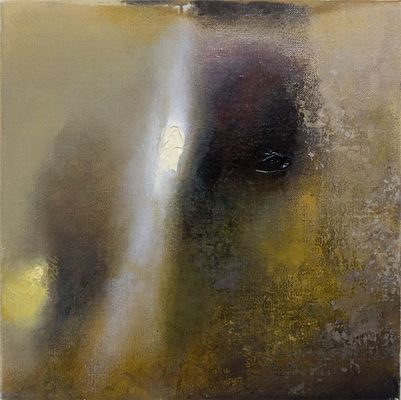
Always Will Need To Wear Winter Shirt Blue + Ochre Small Check Pattern
21 August - 21 September, 2015
Untitled
I am not a great reader of poetry but I always return to the work of Melbourne poet, Vincent Buckley (1925- 1988). Perhaps I find his most tantalising piece to be not a finished poem but a fragment left on a scrap of paper discovered on his desk after the poet’s death.
The poetry gathers like oil
In the word-core, and spreads
It has its music meet,
Its music is in movement.
This fragment is more the shell left behind from a volatile thought than a finished poem. I find the last two lines honest but awkward whereas the first two lines work like an arrow. Most likely he could not find a resolution so it was left. Still, in its present form, it remains an eloquent testimony to the ultimate failure of a medium to express mobile thought and sensation, in Buckley’s case, through verbal language. It’s an important matter because this is something all artists have to deal with regardless of the medium.
I have never written a poem, however, I am forever copying fragments from books on paper scraps in a vain effort to fix certain notions in my head. At first, they function as bookmarks that are sometimes returned to when I open the book. But before long, as they accumulate, they fall out littering the table interspersed with A4 photocopies, bills, books and medications.
To return to Buckley’s fragment, the first two lines very much evoke how I paint nowadays. As you age, detail diminishes and patches of light become more luminous and float. I feel the most honest way of dealing with this is by smearing the oil paint on the canvas with the fingers and working close-up, blind. Only if the patches coalesce into an approaching image can the work gain a life.
-
Jonathan Walker was born in Melbourne, Australia and brought up on a dairy farm in Gippsland. In the 1970’s he studied painting at RMIT and won the Harold Wright Scholarship to the British Museum, London. During the 1980’s he exhibited at Pinacotheca Gallery, Richmond and had work shown at the NGV and Heidi City Art Gallery. Over the same period he designed the cover for the “Epigenesi” LP by Giancarlo Toniutti, Italy and conducted a mail exchange work with Achim Wollscheid, Germany. The work with artists through the post resulted in an article published in the bicentenary issue of Art and Australia 1988. He showed in artist run spaces such as WestSpace in the 90’s and 2000’s, and until 2012, taught painting at Victoria University, which is where we (Colleen Ahern and Lisa Radford) as organisers of the exhibition, among many others, had the privilege of being his student.
Walker’s knowledge was imparted to students through the careful selection of music, literature, and artists found in books that he himself had ordered for the library. Walker’s strategy was the generosity of sharing his vast knowledge with references specific to each student and their context.
Walker’s paintings share a similar focus and intimacy.
This exhibition presents a small selection of recent paintings alongside a publication that includes Walker’s writing. Observational and analytical, Walker’s work is a type of material notation — the time of day, colour and how it is blended, the both specific and fleeting location of a reflection on lino or the question of whether a chair leg should be included in a painting.
Please join us on Friday August 21 between 6-8pm to celebrate the opening of the exhibition.
Curated by Colleen Ahern and Lisa Radford.
B. Wurtz
Curated by Nic Tammens
March 26 - April 4, 2015
B.Wurtz works from a basement studio in his home on Manhattan’s Lower East Side.
This local fact is attested to by the plastic shopping bags and newsprint circulars that appear in his work. As formal objects, they don’t make loud claims about their origins but nonetheless transmit street addresses and places of business from the bottom of this long thin island. Like plenty of artists, Wurtz is affected by what is local and what is consumed. His work is underpinned by this ethic. It often speaks from a neighborhood or reads like the contents of a hamper:
“BLACK PLUMS $1.29 lb.”
“Food Bazaar”
“USDA Whole Pork Shoulder Picnic 99c lb.”
“RITE AID Pharmacy, with us it’s personal.”
“H. Brickman & Sons.”
“Sweet Yams 59c lb."
Most of the work in this exhibition was made while the artist was in residence at Dieu Donne, a workshop dedicated to paper craft in Midtown. Here Wurtz fabricated assemblages with paper and objects that are relatively lightweight, with the intention that they would be easily transportable to Australia. This consideration isn’t absolute in Wurtz’s work, but was prescriptive for making the current exhibition light and cheap. Packed in two boxes, these works were sent from a USPS post office on the Lower East Side and delivered to North Melbourne by Australia Post.
Wurtz appears courtesy of Metro Pictures, New York.
Thanks to Rob Halverson, Joshua Petherick, Sari de Mallory, Matt Hinkley, Helen Johnson, Fayen d'Evie, Ask Kilmartin, Lisa Radon, Ellena Savage, Yale Union, and "Elizabeth".
John Nixon
"Archive"
December 15 - January 20, 2014
The presentation of John Nixon's archive offered a rare showcase of this extensive collection of the artist's own publications, catalogues, posters, ephemera, editions and more, from the mid 1980s onwards, alongside a selection of his artworks.
Organized by John Nixon, Joshua Petherick and Matt Hinkley.
<a href=http://wfb.public-office.info/artist/john-nixon>All titles by John Nixon
"Habitat"
at Minerva, Sydney (organised by Joshua Petherick and Matt Hinkley)
November 15 - December 20, 2014
Lupo Borgonovo, Janet Burchill & Jennifer McCamley,
Lewis Fidock, HR Giger, Piero Gilardi, Veit Laurent Kurz,
Cinzia Ruggeri, Michael E. Smith, Lucie Stahl, Daniel Weil, Wols
Press Release:
“...It contained seven objects. The slender fluted bone, surely formed for flight, surely from the wing of some large bird. Three archaic circuitboards, faced with mazes of gold. A smooth white sphere of baked clay. An age-blackened fragment of lace. A fingerlength segment of what she assumed was bone from a human wrist, grayish white, inset smoothly with the silicon shaft of a small instrument that must once have ridden flush with the surface of the skin - but the thing’s face was seared and blackened.”
William Gibson, “Count Zero”, 1986
"Autumn Projects Archive"
Curated by Liza Vasiliou
March 6 - March 15, 2014
World Food Books, in conjunction with the Virgin Australia Melbourne Fashion Festival 2014, presented the Autumn Projects archive, consisting of a selection of early examples in Australian fashion with a particular interest in collecting designers and labels from the period beginning in the 1980’s, who significantly influenced the discourse of Australian Fashion.
Curated by Liza Vasiliou, the exhibition provided a unique opportunity to view pieces by designers Anthea Crawford, Barbara Vandenberg, Geoff Liddell and labels CR Australia, Covers, Jag along with early experimental collage pieces by Prue Acton and Sally Browne’s ‘Fragments’ collection, suspended throughout the functioning World Food Books shop in Melbourne.
H.B. Peace
presented by CENTRE FOR STYLE
November 14, 2013
"Hey Blinky, you say chic, I say same"
Anon 2013
H.B. Peace is a clothing collaboration between great friends Blake Barns and Hugh Egan Westland. Their pieces explore the divergences between 'character’ and ‘personality’ in garments....etc
Special Thanks to Joshua Petherick and Matt Hinkley of WFB and Gillian Mears
and a Very Special Thank you to Audrey Thomas Hayes for her shoe collaboration.
Janet Burchill & Jennifer McCamley
"Aesthetic Suicide"
May 10 - June 8, 2013
The first of our occasional exhibitions in the World Food Books office/shop space in Melbourne, "Aesthetic Suicide" presented a body of new and older works together by artists Janet Burchill & Jennifer McCamley, including videos, prints, a wall work, and publications.
During shop open hours videos played every hour, on the hour.
2015, English
Softcover, 272 pages, 13 x 21 cm
Published by
Valiz / Amsterdam
$44.00 - Out of stock
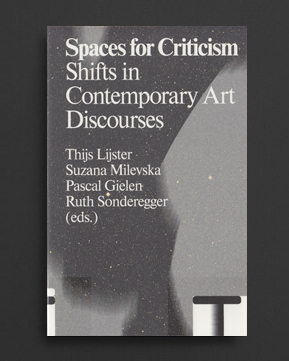
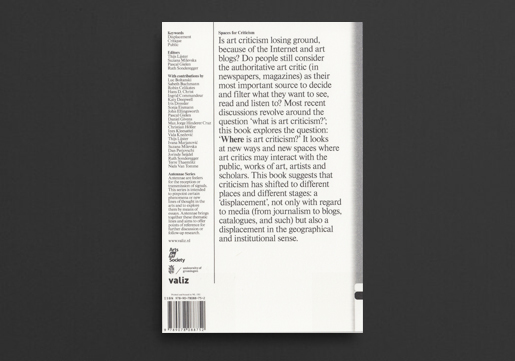
Is art criticism losing ground, because of the internet and art blogs? Do people consider the authoritative art critics as their most important source to assess and filter what they want to see, read, etc.? Most recent discussions have evolved around the question "What is art criticism?", this book wants to explore the question "Where is art criticism?". It delves into new ways and spaces where art critics might interact with publics, works of art, artists and scholars.
Contributions by Luc Boltanski, Sabeth Buchmann, Robin Celikates and more...
Designed by Metahaven
2015, English
Softcover, 430 pages, 14 x 21 cm
Published by
Valiz / Amsterdam
$42.00 - Out of stock
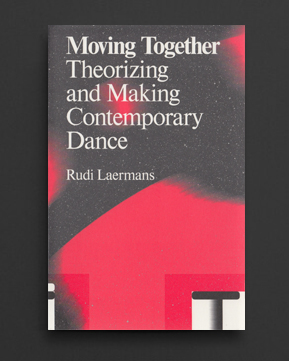
‘Moving Together’ by Rudi Laermans examines contemporary dance from both a practical and a theoretical perspective, with interactions between the two. The author analyses three important tendencies in contemporary dance: pure dance, dance theatre, and (self-)reflexive dance. He proposes a (theoretical) conceptual framework and through extensive dialogues with choreographers he investigates how artistic cooperation results in dance.
Designed by Metahaven
2015, English
Softcover, 256 pages, 14 x 21 cm
Published by
Valiz / Amsterdam
$42.00 - Out of stock
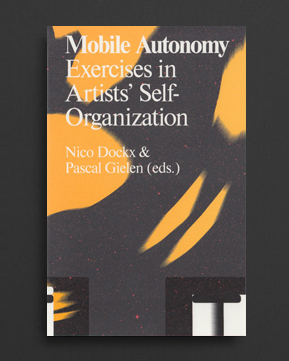
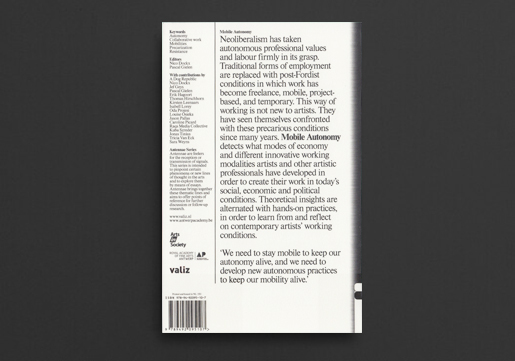
Neoliberalism has taken autonomous professional values and labour firmly in its grasp. Work has become freelance, flexible, mobile, project-based, hybrid and temporary. This way of working is not new to artists. They have seen themselves confronted with these precarious conditions since many years. 'Mobile Autonomy' detects what modes of economy and different innovative working modalities artists and other artistic professionals have developed in order to create their work in today’s social, economic and political conditions.
Contributions by : A Dog Republic, Nico Dockx, Jef Geys, Pascal Gielen, Erik Hagoort, Thomas Hirschhorn, Kirsten Leenaars, Isabell Lorey, Oda Projesi, Louise Osieka, Jason Pallas, Caroline Picard, Raqs Media Collective, Kuba Szreder, Jonas Tinius, Tricia Van Eck, Sara Weyns
Designed by Metahaven
2014, English
Softcover, 342 pages, 14 x 21 cm
Published by
Valiz / Amsterdam
$42.00 - Out of stock
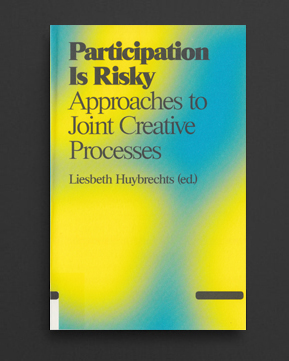
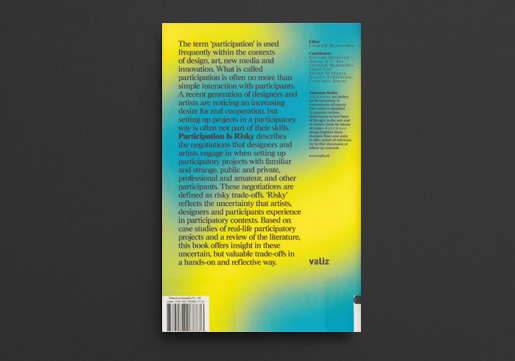
The term “participation” is often loosely used, especially within the contexts of new media and innovative research, and is often equated with interaction. Among the recent generation of artists and designers, there is a naturally growing need to work together, across the boundaries of disciplines, in ways that enable end users to contribute to content, form, or structure. New parameters are evolving. This book studies how makers who engage in participative practices must risk abandoning their traditional roles. It demonstrates interesting participative practices, methods and results, typically characterised by ‘risky’ confrontation between disciplines and perspectives.
Contributions from Katrien Dreessen, Denny K.L. Ho, Liesbeth Huybrechts, Yanki Lee, Selina Schepers, Jessica Schoffelen, Cristiano Storni.
2014, English
Softcover, 320 pages, 13 x 21 cm
Published by
Valiz / Amsterdam
$44.00 - Out of stock
In this publication, sociologist Pascal Gielen and curator Niels Van Tomme invite a variety of artists and critical thinkers to reflect on new futures for the notion and practice of justice. Launching the proposition of ‘aesthetic justice’, the book offers thought-provoking views on the ways in which works of art may confront, and potentially redirect social and political imaginaries. Using analyses of contemporary art works that challenge the social, political or economic status quo, as well as interviews with artists and theoretical reflections, the book suggests alternatives for a more just future. It does so by considering the liberating potential of specific aesthetic frameworks used in a wide variety of artistic contexts, ranging from the visual arts to cinema, from music to theatre, and by exploring novel modes that can shape the emotionally charged concept of justice, and eventually transform it.
Contributors: Zoe Beloff, Arne De Boever, Mark Fisher, Matt Fraser, Pascal Gielen, Tessa Overbeek, Kerry James Marshall, Viktor Missiano, Carlos Motta, Nat Muller, Julie Atlas Muz, Gerald Raunig, Dieter Roelstraete, Hito Steyerl, Julia Svetlichnaja, Hakan TopalNiels Van Tomme, Samuel Vriezen, Christian Wolff
2015, English
Softcover, 288 pages, 13 x 21 cm
3rd Revised Ed.,
Published by
Valiz / Amsterdam
$42.00 - Out of stock
Here, art sociologist Pascal Gielen examines the notion that the global art economy—with its ever-renewable youth quota, its gender imbalance, flexible working hours and short-term contracts (or lack of contracts)—is wholly congruent with the worst aspirations of late capitalism, and is ripe for economic exploitation. Conscious that art also offers real liberties, Gielen also proposes alternative models and argues for a recognition of the values implied by the creative process, rather than by the subtle coercions of post-Fordist production imperatives to which we are all subject.
Designed by Metahaven
2014, English
Softcover, 350 pages, 14 x 21 cm
Published by
Valiz / Amsterdam
$42.00 - Out of stock
In today’s art world there is a growing sense of ethics in relation to social, political and economic challenges, entailing a critical rethinking of production and distribution mechanisms. This book shows how the artistic perspective might generate new situations based on the potentials and limitations of the body. Featuring eleven exemplary North American practitioners, part one deals with eco-artistic practices and how these can lead to a greater sensibility towards our environment, while part two uses dance to explore the renewed concern for caring for the body. With contributions by Sidi Larbi Cherkaoui, Jeroen Peeters, Sara Wookey, Mala Kline and others.
Design by Metahaven
2013, English
Softcover, 240 pages, 14 x 21 cm
Published by
Valiz / Amsterdam
$43.00 - In stock -
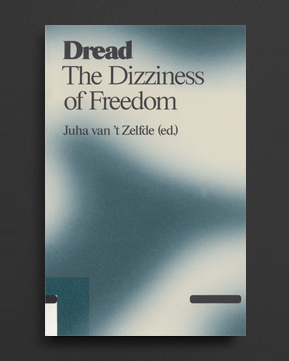
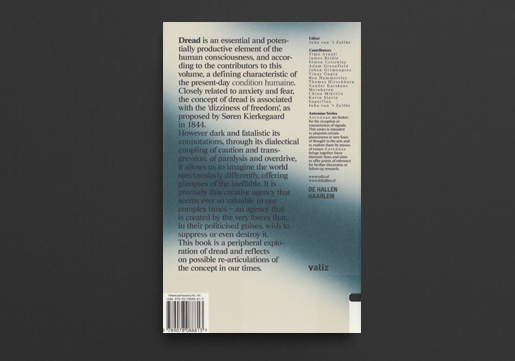
Constantly changing technology and growing communication networks give us ever more choices and options. However, every technological innovation has its counterpart: catastrophe looms. Dread is an essential, potentially productive element of our consciousness, and a defining characteristic of the present-day human condition. However dark and fatalistic its connotations, through its dialectical coupling of caution and transgression, paralysis and overdrive, it allows imagining the world differently, offering glimpses of the ineffable. This book is a peripheral exploration of dread wherein contributors reflect upon the concept’s potentialities from a contemporary viewpoint.
Contributions by Timo Arnall, James Bridle, Simon Critchley, Adam Greenfield, Johan Grimonprez, Vinay Gupta, Ben Hammersley, Thomas Hirschhorn, Xander Karskens, Metahaven, China Miéville, Kevin Slavin, Superflux, Juha van ’t Zelfde
Designed by Metahaven
2013, English
Softcover, 262 pages, 14 x 21 cm
Published by
Valiz / Amsterdam
$42.00 - Out of stock
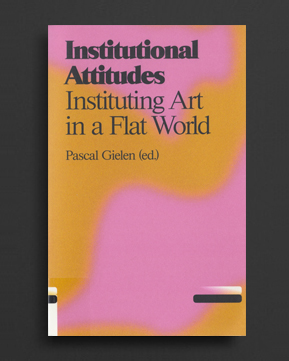
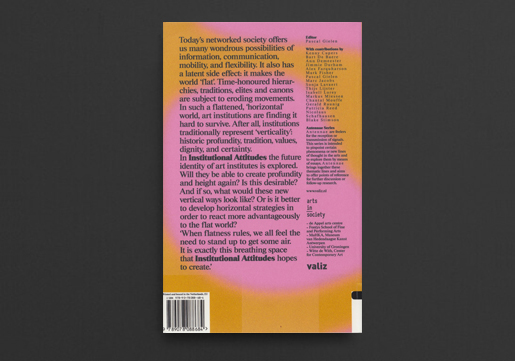
Today’s networked society offers us many wondrous possibilities of information, communication, mobility, and flexibility. It also has a latent side effect: it makes the world “flat”. Time-honoured hierarchies, traditions, elites and canons are subject to erosive movements. In such a flattened, “horizontal” world, art institutions are finding it difficult to survive. After all, institutions such as these traditionally represent “verticality” – historic profundity, tradition, values, dignity, and certainty.
Contributions by: Kenny Cupers, Bart De Baere, Ann Demeester, Jimmie Durham, Alex Farquharson, Mark Fisher, Pascal Gielen, Marc Jacobs, Sonja Lavaert, Thijs Lijster, Isabell Lorey, Markus Miessen, Chantal Mouffe, Gerald Raunig, Patricia Reed, Nicolaus Schafhausen, Blake Stimson
Designed by Metahaven
2015, English
Softcover, 96 pages, 17 x 23 cm
Published by
MUMA / Victoria
$20.00 - Out of stock
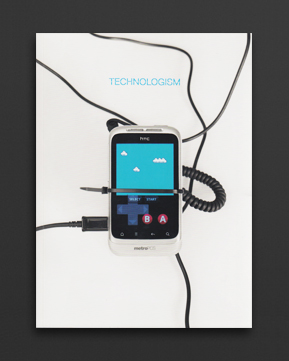
Catalogue published to accompany the exhibition Technologism, at Monash University Museum of Art (MUMA) in Melbourne, 3 Oct - 12 Dec 2015, curated by Charlotte Day.
Artists: Cory Arcangel (US), Dara Birnbaum (US), Chris Burden (US), Ian Burn (AU), Antoinette J. Citizen (AU), Simon Denny (NZ), Jan Dibbets (NL), Aleksandra Domanović (SI/DE), Harun Farocki (DE), Benjamin Forster (AU), Isa Genzken (DE), Greatest Hits (AU), Martijn Hendriks (NL), Lynn Hershman Leeson (US), Matt Hinkley (AU), Jenny Holzer (US), Edward Kienholz & Nancy Reddin Kienholz (US), Oliver Laric (AT), Mark Leckey (UK), Scott Mitchell (AU), Rabih Mroué (LB), Henrik Olesen (DK), Nam June Paik (KR/US), Nam June Paik & John Godfrey (US), Joshua Petherick (AU), Matte Rochford (AU), Jill Scott (AU), Richard Serra (US), John F. Simon Jr. (US), Brian Springer (US), Hito Steyerl (DE), Ricky Swallow (AU), Jeff Thompson (US), Pia van Gelder (AU), Ulla Wiggen (US) and Dennis Wilcox (AU)
MUMA concludes its three-part series on watershed moments in art history — Reinventing the Wheel: the readymade century and Art as a Verb — with Technologism, a major group exhibition bringing together forty-three historical and contemporary artworks, including several new commissions from Australian practitioners. Technologism wrestles with the profound cultural, social and political impact technology has made on art since the 1960s.
Conservative cul-de-sac's of the community are often sceptical of technology and its ever increasing presence in our lives. However many artists — with a natural propensity for constant upheaval — have whole-heartedly embraced radical changes in technology over the last sixty years. Featuring artworks that engage both physically and conceptually with electronic systems — television, computers, the internet, smartphones — Technologism focuses on the ways artists critique and disrupt official uses of the media, or construct their own machines and data systems.
Riffing off both the aesthetic and conceptual characteristics of technology, artists in Technologism document technology's advancement in a plethora of ways: Ulla Wiggen's intricate paintings of circuit boards from the mid 1960s, see the development of an aesthetic inspired by the complex intersection of electrical wires, connectors and components, working to manipulate and rewire the physicality of technology; some thirty years later, John F. Simon's Art Appliances series of the 1990s uses the circuitry of small LCD screens to disrupt pictures and patterns, recreating them over; in Matte Rochford's video Progressively Degrading Test Pattern 2013, humble VHS tapes are copied and recopied, in a process of metaphysical reduction; while in Joshua Petherick's new work, one technology is employed to record another soon to be superseded, revealing new visual dimensions and the 'ghosts in the machine'.
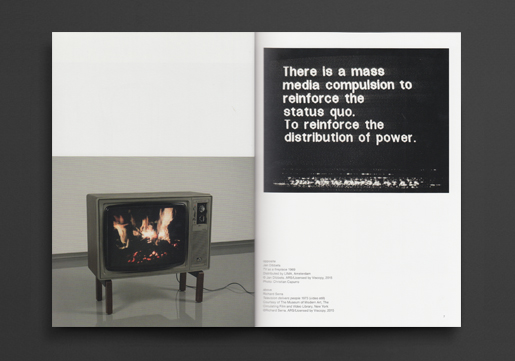
A story of advancement inevitably turns into obsolescence, and Technologism seeks to document the early use of broadcast technology as a way of bridging the gap (and finding a space) between the image on the screen, the physical presence of the viewer, and the broader community. Jan Dibbet's TV as a Fireplace 1968, documents television as a collective experience — even if viewers were separated physically, they were united through time and space like pre-historic cave-dwellers by a communal broadcast. However with the advent of the internet, personal computer devices and streaming services, technology has again changed the relationship we have with the world around us to a more singular yet proliferating existence.
A history of DIY jamming and hacking presents the way artists have continued to subvert conventional uses of technology and challenge the status-quo, from the internet as militarily-designed, to corporately-exploited, civilian-employed, artistically-manipulated, and back again. For instance, Lynn Hershman Leeson's work investigates how media is used as a tool for censorship and political repression, while Simon Denny's work co-opts the aesthetic and rhetoric of language of multinational corporations in order to question their power. In presenting these works and others, Technologism seeks to consider what is the value of such subversion, or is it merely a perpetuation of the problem?
Artist Hito Steyerl asks, 'is the internet dead?' Although, hyperbolic in its prognosis, Technologism recognises that sceptical questions such as this are an important part of how artistic practice negotiates technological advancement. Technologism proceeds from the idea that technology in all its forms, physical and immaterial, needs to be interrogated in order to be perpetually remade.
Technologism considers changes in infrastructure, such as telecommunication networks and the internet, and the cultural implications of technological innovation and considers from the position of the developers of these technologies as well as from the end user. Technologism asks 'how does technology effect artistic practice?' As well as, 'how can artistic practice effect technology?'
Fully illustrated catalogue features texts by Charlotte Day, Philip Brophy, Bridget Crone and Sean Dockray. Designed by Yanni Florence.
2016, English
Softcover, 64 pages, 18.7 X 26 cm
Published by
Archive Books / Berlin
$20.00 - Out of stock
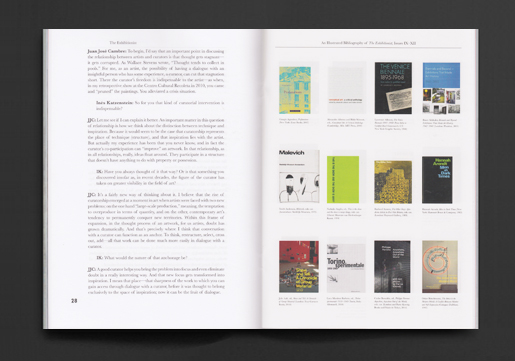
The Exhibitionist #12
Journal on Exhibition Making
Reflection
Jens Hoffmann, Julian Myers-Szupinska, and Liz Glass
Exhibitions are a social and collective form. Whether the products of a single artist or of a group, they gather together artworks (or objects, projects, residues) and construct from them an image of a social field. Just as understanding an exhibition involves thinking about the relations that exist among, and engender the possibility of imagining, that field, no less are exhibitions produced by a group. Beyond the artists and the exhibition maker(s) involved, an exhibition radiates from an expansive network: conservators, shippers, installers, writers, editors, designers, administrative types of all sorts, interns, guards, funders, promoters, and so on. Exhibitions are, furthermore, perceived by an audience or a public—another group—who are themselves internally divided and classed, cohesive or cacophonous....
contents
Response I: Artists and curators
Fia Backström and Anthony Huberman
Re: family dynamics
Anne Ellegood and Kerry Tribe
Long Term Relationship
Claire Fontaine and Jens Hoffmann
Artistic Bitches and Curatorial Bastards
Inés Katzenstein and Juan José Cambre
Agreement
Response II: Archival
Introduced by Liz Glass
Dear King Harry
James Lee Byars: Correspondence with Harald Szeemann (1988)
La critique
Triple Candie: Let the Artists Die
Emiliano Valdés: Who Has the Power?
Nontobeko Ntombela: Remastered
Daniel Birnbaum: Hijacking the Situationists
Slavs and Tatars: The Splits of the Mind, If Not the Legs
Rachel Rose: Artist, Curator, Meaning
+
An Illustrated Bibliography of the exhibitionist, Issues IX–XII
2016, English
Softcover, 272 pages, 22 x 29.3 cm
Published by
Kaleidoscope Press / Milan
$20.00 - Out of stock
Kaleidoscope #27 (Summer 2016) is issue is a key to enter the world of Los Angeles-based artist Sterling Ruby, exclusively playing the double role of subject and guest editor. Conceived as a viral, aggressive takeover of the magazine’s architecture, content and design, this hyper-vertical survey is the result of an intense dialogue with the artist and his studio, comprised of 160+ pages on his exuberant work and vision.
Ruby’s cover portrait is drawn from an extensive series shot by photographer Max Farago at the artist’s massive industrial studio space in LA. Inside, the Sterling Ruby Takeover decodes the artist's grammar through an intimate conversation with artist Piero Golia and newly commissioned writings by Alex Gartenfeld, Donatien Grau, Aram Moshayedi, Ross Simonini, Paul Schimmel and Catherine Taft; while his network of influences is explored through a series of guest features dedicated to his peers, heroes and collaborators, including Huma Bhabha (by Massimiliano Gioni), Cassils (by Francesca Gavin), Mike Davis (by Sterling Ruby), John Divola (by Alexander Shulan), Cyprien Gaillard (by Natalia Valencia Arango), Ron Nagle (by Sterling Ruby), Nancy Rubins (by Sterling Ruby), Raf Simons (by Alessio Ascari) and Melanie Schiff (by Sarah Workneh). All of this content is punctuated by stunning visual contributions especially created by Ruby for the magazine’s pages, comprising an unseen presentation of his Work Wear modeled by the entire studio team.
Born in 1972 on an American air force base in Germany, raised in rural Pennsylvania, trained in Chicago, Ruby moved to LA to finish his education, became Mike Kelley’s teaching assistant and quickly one of the city’s quintessential artists. Now 44, he runs a megastudio with a staff of over twenty under the big black sun. Complex to label in his unapologetic combination of compulsion and strategy, bigness and poetry, handcraft and seriality, darkness and psychedelia, hard and soft, Ruby is one of the most unique and controversial voices on the art scene, working incessantly across the most diverse media and platforms and stretching the limits of visual language. This hybrid editorial experiment coincides with the artist's major show at the Belvedere/Winterpalais in Vienna and participation in the “Made in LA“ biennial at Hammer Museum, Los Angeles.
Running independent from the takeover, the opening section of HIGHLIGHTS and the closing section of REGULARS complete the issue with a rich and varied selection of the best of the summer season and insightful contributions from our columnists and correspondents around the globe.
HIGHLIGHTS features profiles on Sean Raspet (by Franklin Melendez), Kienholz (by Gianni Jetzer), Marguerite Humeau (by Nadim Samman), Eckhaus Latta (by Chloe Wilcox), Sol Calero (by George Vasey), Renaud Jerez (by Tina Kukielski), Christopher Y. Lew (by Julia Trotta), Yngve Holen (by Cristina Travaglini), Home Economics (by Attilia Fattori Franchini), Valerie Keane (by Allison Bulger), Cao Fei (by Xin Wang) and Megan Rooney (by Harry Burke).
In the REGULARS section, “Producers” features Carson Chan in conversation with New York-based collective DIS; in “Futura 89+,” Hans Ulrich Obrist and Simon Castets (with Katherine Dionysius) interview young Portuguese artist Bruno Zhu; Fiona Duncan reflects on the figure of the go-go dancer in contemporary art and culture as part of her “Pro/Creative” column; in “Renaissance Man,” Jeffrey Deitch discusses the collaboration between artist Alex Israel and writer Bret Easton Ellis; Maria Lind's “Centerstage” presents Danish artist Marie Kölbaek-Iversen; Gean Moreno unveils Cuba’s new normal for “Panorama”; in “Pioneers,” Fredi Fischli and Niels Olsen talk to Heimo Zobernig; and lastly, as part of the “What's Next” series, we look forward to the season with collector and curator Tiffany Zabludowicz.
Softcover, 230 pages, 20.5 x 27 cm
Published by
Cura Books / Rome
$20.00 - Out of stock
cura. is a quarterly magazine, a publishing house, an exhibition space and a platform for editorial and curatorial activities, based in Rome, Italy.
CURA. NO.22
COVER BY SOL CALERO
INSIDE THE COVER
Sol Calero
text by Adam Carr
PORTRAITS IN THE EXHIBITION SPACE
Johannes Cladders’ anti-museum
by Lorenzo Benedetti
EXHIBITION LITERATURE
Expanded Literature.
Dominique Gonzalez-Foerster
by Jean-Max Colard
SPOTLIGHT
James Bridle.
Seeing Like a Network
in conversation with Ben Vickers
Self-Portrait as a City.
Alex Israel in conversation
with Gigiotto Del Vecchio
ABOUT
Anicka Yi’s Allegorical Bouquets
by Chris Sharp
ABOUT
Kevin Beasley.
Energy Accumulates
by Rose Bouthillier
ARTIST’S PROJECT
by Amy Yao
SPOTLIGHT
Philipp Timischl
in conversation with
Pierre-Alexandre Mateos
and Charles Teyssou
A VISIT TO
Rodrigo Hernández
in conversation with
Joao Mourao & Luis Silva
SPOTLIGHT
ÅYR
in conversation with Philipp Ekardt
SPOTLIGHT
Caroline Mesquita
in conversation with
Martha Kirszenbaum
HOT!
Debora Delmar Corp.
by Judith Vrancken
Juliana Huxtable
by Whitney Mallett
Sophie Jung
by Frances Loeffler
Nancy Lupo
by Sarah Lehrer-Graiwer
2016, English
Softcover (w. french-folds), 240 pages, 14 cm x 22.8 cm
Published by
MACK / London
$49.00 - Out of stock
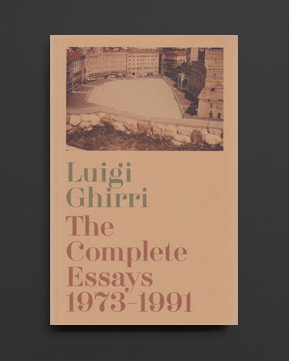
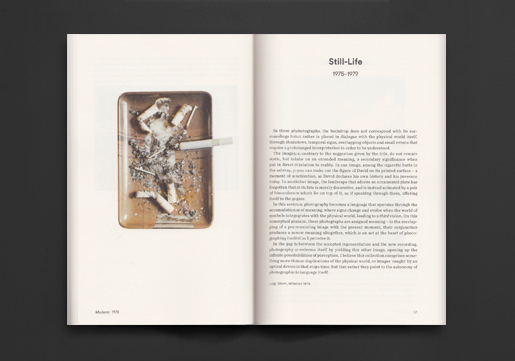
Luigi Ghirri (1943–1992) started writing about photography from the moment he became a photographer: for his own publications, for Italian magazines and newspapers, as well as private reflections committed to paper, where his thoughts would settle and then often depart in new directions.
Published for the first time in English, The Complete Essays 1973–1991 comprises sixty-eight texts in which Ghirri explores the same subjects at the core of his photographs – the themes of identity, time, memory, vision, representation, and sense of place. As a voracious reader with a particular taste for the eclectic, Ghirri also reaches outwards from his own practice to explore the history of photography as he considers the work of Walker Evans, William Eggleston, Robert Adams and John Gossage, weaving in references to musicians, writers and painters alike. As themes and ideas overlap, the compilation of texts create a sort of dialectic chamber of curiosities that includes Gulliver, Van Gogh’s yellow house, Cézanne, Morandi’s studio, Mallarmé, the fireworks above Trani Cathedral, neo-realist films, lots of music, Francis Bacon, McLuhan’s global village, Pessoa, poetry. Together, the essays offer an unintentional yet comprehensive treatise on the history and theory of photography, and above all, they constitute a special form of autobiography.
Accompanied by 50 colour plates.
Born in Scandiano in 1943, Luigi Ghirri spent his working life in the Emilia Romagna region, where he produced one of the most open and layered bodies of work in the history of photography. He was published and exhibited extensively both in Italy and internationally and was at the height of his career at the time of his death in 1992. His first book, Kodachrome (1978), an avant-garde manifesto for the medium of photography and a landmark in his own remarkable oeuvre, was re-published by MACK in 2012.
2016, English / Albanian
12“ vinyl LP and catalogue in gatefold cover,24 pages, 31 x 31 cm
Published by
Sternberg Press / Berlin
$30.00 $10.00 - In stock -
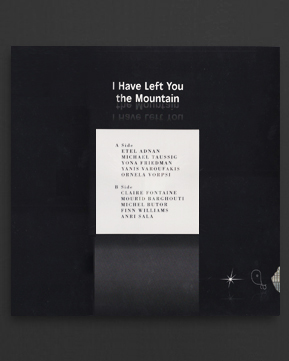
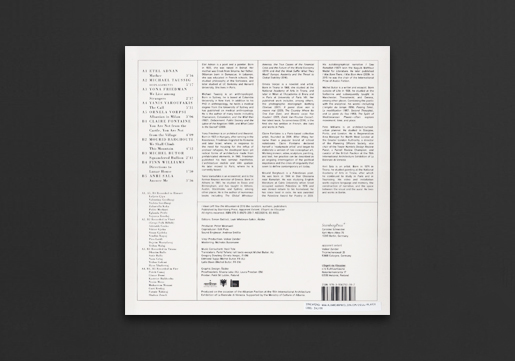
I Have Left You the Mountain
Edited by Simon Battisti, Leah Whitman-Salkin, Åbäke
With contributions by Etel Adnan, Mourid Barghouti, Michel Butor, Claire Fontaine, Yona Friedman, Anri Sala, Michael Taussig, Yanis Varoufakis, Ornela Vorpsi, Finn Williams; the singers of Fier, Vlorë, Himarë, and Tirana
“I Have Left You the Mountain,” published on the occasion of the Albanian Pavilion at the 15th International Architecture Exhibition of La Biennale di Venezia, presents ten new texts written by contemporary writers and thinkers on the architecture of displacement. These texts have been set to music and sung by some of the last remaining groups of Albanian iso-polyphonic singers, an art form now protected as “intangible cultural heritage” by UNESCO.
A living art form in step with the generations of migration and transition, “singing migration” has been a core part of processing departure, longing, and return. The Albanian Pavilion is a space of collective listening; of “individuals in company.”
“I Have Left You The Mountain” initiates a conversation about the urbanism of displacement, projecting the Albanian case onto an international stage, with the express intention to transmit that dialogue and its speculations back into Albania.
The singers of Fier: Petrit Canaj, Llazar Dumi, Kastriot Halihoxha, Nesim Meno, Muharrem Mezani, Guri Rrokaj, Fatmir Tahiraj, Shaban Zeneli; the singers of Vlorë: Adriatik Cenko, Viktor Gjoka, Sinan Gjoleka, Vendim Kapaj, Piro Latifaj, Dejrim Mustafaraj, Trifon Malaj; the singers of Himarë: Luljeta Çipa, Valentina Gerdhuqi, Violeta Gerdhuqi, Zaharulla Koka, Polite Merkuri, Eglanda Prifti, Vojsava Zenelaj; the singers of Tirana: Dhurim Ballo, Sotir Ballo, Nazo Celaj, Trifon Golemi, Hyso Xhaferraj
Published on the occasion of the Albanian Pavilion at the15th International Architecture Exhibition of La Biennale di Venezia.
Design by Åbäke
2016, English
Hardcover (cloth-bound), 272 pages, 17.5 x 24 cm
Published by
Sternberg Press / Berlin
$50.00 - Out of stock
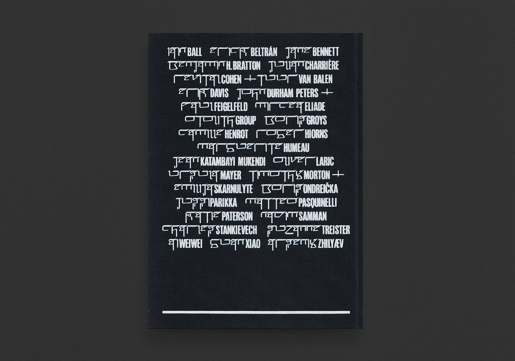
Texts by Iain Ball, Erick Beltrán, Jane Bennett, Benjamin H. Bratton, Revital Cohen & Tuur Van Balen, Erik Davis, John Durham Peters & Paul Feigelfeld, Mircea Eliade, Boris Groys, Marguerite Humeau, Timothy Morton & Emilija Skarnulyte, Boris Ondreička, The Otolith Group, Jussi Parikka, Matteo Pasquinelli, Nadim Samman, Charles Stankievech
Rare Earth is an attempt to define the spirit of an age. Exploring how today’s myths, identities, and cosmologies relate to current advances in technology—through reference to the material basis to our most developed weapons and tools; a class of seventeen rare earth elements from the periodic table—Rare Earth challenges the rhetoric of immateriality associated with our hypermodern condition.
Rare earth elements are the game-changing foundation of our most powerful innovations, are fundamental to contemporary accoutrements such as mobile phones, iPods and iPads, liquid crystal displays, LEDs, light bulbs, CDs and DVDs. Often described as conflict materials due to the limited number of easily accessible mines, they are also integral to weapon systems used for cyber-warfare, medical technologies (including MRI scanning equipment), hybrid vehicles, wind turbines, and other green energy applications. Consequently, rare earth elements play an increasing role in global affairs and power inventions that facilitate our changing self-image—giving birth to today’s emergent myths and identities.
Rare Earth grounds our strange, seemingly weightless cultural moment. While we may design our technologies, these tools and weapons shape us in turn. It may seem that we dream the contemporary into existence, but perhaps rare earth elements are dreaming through us. After the Stone Age, the Bronze Age and the Iron Age, this is the age of Rare Earth.
Copublished with Thyssen-Bornemisza Art Contemporary, Vienna on the occasion of the exhibition “Rare Earth,” February 19–May 31, 2015, with works by Iain Ball, Erick Beltrán, Julian Charriere, Revital Cohen & Tuur Van Balen, Camille Henrot, Roger Hiorns, Marguerite Humeau, Jean Katambayi Mukendi, Oliver Laric, Ursula Mayer, The Otolith Group, Katie Paterson, Charles Stankievech, Suzanne Treister, Ai Weiwei, Guan Xiao, Arseniy Zhilyaev
Design by David Rudnick and Raf Rennie
2016, English
Softcover, 244 pages, 16 x 23 cm
Published by
Sternberg Press / Berlin
$38.00 - Out of stock
In this innovative take on early video art, Ina Blom considers the widespread notion that analog video was endowed with lifelike memory and agency. Reversing standard accounts of artistic uses of video, she follows the reflexive unfolding of a technology that seemed to deploy artists and artistic frameworks in the creation of new technical and social realities. She documents, among other things, video’s emergence through the framework of painting, its identification with biological life, its exploration of the outer limits of technical and mental time control, and its construction of new realms of labor and collaboration. Enlisting a distinctly media-archaeological approach, Blom’s new book—her second from Sternberg Press—is a brilliant look at the relationship between video memory and social ontology.
Ina Blom is a professor at the Department of Philosophy, Classics, History of Art and Ideas, University of Oslo, as well as visiting professor at the Department of Art History, University of Chicago.
This is a phosphorescently brilliant exploration of the birth and life of video. In the times when electronic media meant the flow of televisual signals, video became a uniquely glimmering force of idiosyncratic memory and the ordination of time. Blom’s focused beam of histories and ideas superlatively traces the crackling and flickering scanlines of this new reality as it came into being in art.
—Matthew Fuller, author and professor at the Centre for Cultural Studies, Goldsmiths, University of London
With this extraordinary study, early video has finally found its chronicler. Invaluable not only for its perspicacious genealogy of media-art practice, but for its inspired historiographic gambit, wherein both art and history are reimagined in light of contemporary media archaeology.
—Andrew V. Uroskie, author of Between the Black Box and the White Cube: Expanded Cinema and Postwar Art
Design by Surface
2016, English
Softcover, 176 pages, 12.7 x 19.5 cm
Published by
Fitzcarraldo Editions / London
$30.00 - Out of stock
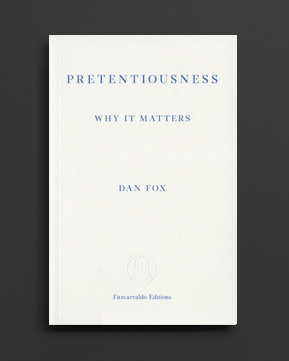
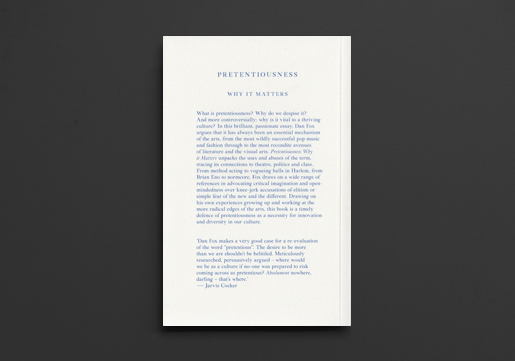
What is pretentiousness? Why do we despise it? And more controversially: why is it vital to a thriving culture? In this brilliant, passionate essay, Dan Fox argues that it has always been an essential mechanism of the arts, from the most wildly successful pop music and fashion through to the most recondite avenues of literature and the visual arts. Pretentiousness: Why it Matters unpacks the uses and abuses of the term, tracing its connections to theatre, politics and class. From method acting to vogueing balls in Harlem, from Brian Eno to normcore, Fox draws on a wide range of references in advocating critical imagination and open-mindedness over knee-jerk accusations of elitism or simple fear of the new and the different. Drawing on his own experiences growing up and working at the more radical edges of the arts, this book is a timely defence of pretentiousness as a necessity for innovation and diversity in our culture.
'Pretentiousness: Why it Matters is more than a smartly counterintuitive encomium: it's a lucid and impassioned defence of thinking, creating and, ultimately, living in a world increasingly dominated by the massed forces of social and intellectual conservatism.' - Tom McCarthy, author of Satin Island
Dan Fox is a writer, musician, and co-editor of frieze magazine, Europe's foremost magazine of art and culture. He is based in New York.
2011, English
Softcover, 113 pages, 140 x 215 mm
Edition of 100, hand-numbered.,
Published by
Pep Talk / Los Angeles
$32.00 - Out of stock
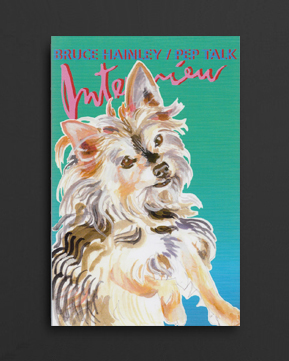
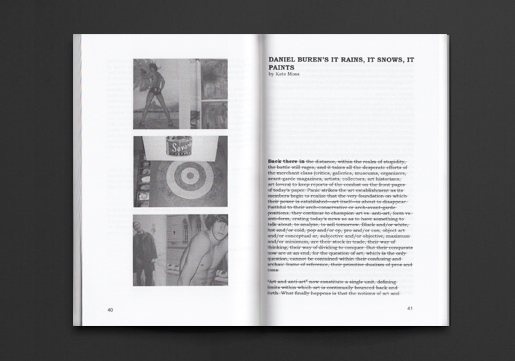
Bruce Hainley PEP TALK is the first collection of the author's writing, bringing together an amazing selection of republished and unpublished interviews, critical essays, and poems. Every single text in this collection is guaranteed to light your fire, if you have any wick at all. As writer, critic, poet, teacher, mentor and more, Hainley is incomparable and irreplaceable to us in Los Angeles and those engaged with contemporary art anywhere. This monographic issue also includes contributions from artists Richard Hawkins and Dianna Molzan. - PEP TALK
Very highly recommended.
2016, English / German
Softcover, 240 pages, 23 x 16.5 cm
Published by
Texte Zur Kunst / Berlin
$32.00 - Out of stock
Art and fashion have always been interrelated. And it’s due to fashion’s ability to quickly capture social shifts that the art world has repeatedly turned to it. But as Texte zur Kunst No. 102 proposes, it is fashion’s protagonists, recently, that have been markedly drawing on art conceptual practices (e.g., parasitism, collective authorship, détournement, and forms of institutional critique) as they push back against the pressures of a hyper-accelerated fashion market. In this issue, TzK examines, also, how the industry’s current volume is a product of its late-'00s promise of online democratization; the changing function of such long-held value designations as “luxury,” “discount,” and “underground,” and the role of “real”-er bodies in a climate wherein models are preferably “nodels” or “othered” bodies, hyper-individualised to stand out in the stream.
TABLE OF CONTENTS
PREFACE
ROBERT KULISEK & DAVID LIESKE
FASHION PROFILES OF:
69 WORLDWIDE / NASIR MAZHAR / KYLE LUU / BERNADETTE VAN-HUY / LIAM HODGES / TELFAR / NIK KOSMAS & JEANNE-SALOMÉ ROCHAT / MARTINE ROSE / JULIANA HUXTABLE / ECKHAUS LATTA / DIS / NHU DUONG /
with texts by Harry Burke, Tess Edmonson, Jack Gross, and Bianca Heuser
INGEBORG HARMS "CRYSTAL MESH / Existential imagery in current fashion"
COLLECTIVE SOUL / Jessica Gysel in conversation with Lotta Volkova Adam and Atelier E.B. (Beca Lipscombe & Lucy McKenzie)
CAROLINE BUSTA "NEO-BODIES"
NATASHA STAGG "ACCESS CODING"
PHILIPP EKARDT "DRESSING AFTER THE GREAT DIVIDE / The emancipation of Jonathan Anderson"
CALLA HENKEL & MAX PITEGOFF "LAST NIGHT"
ROTATION
IN DER FRÜHE / Peter Geimer über Friedrich Kittlers „Baggersee“
RETURNS OF THE STONE AGE / Sven Lütticken on the exhibition publications for “Kunst der Vorzeit” and “Allegory of the Cave Painting”
ZUR KULTURPOLITISCHEN BEKÄMPFUNG DER MODERNEN KUNST / Otto Karl Werckmeister über die neue Ausgabe von Hitlers „Mein Kampf“
LIEBE ARBEIT KINO
DURATIONAL FASHION / Sara Marcus on K8 Hardy’s “Outfitumentary”
KLANG KÖRPER
HAVE YOU EVER BEEN TO ELECTRIC LADYLAND / Barbara Vinken über Michaela Melián im Lenbachhaus, München
EINE KULTURGESCHICHTE DER ENTGRENZUNGEN / Daniel Martin Feige über „I Got Rhythm. Kunst und Jazz seit 1920“ im Kunstmuseum Stuttgart
SHORT WAVES
Jens Hoffmann on “Unfinished: Thoughts Left Visible” at the Met Breuer, New York / Magdalena Nieslony über Agnes Martin im K20, Düsseldorf / Dena Yago on Ei Arakawa, Gela Patashuri, and Sergei Tcherepnin at Midway Contemporary, Minneapolis / Eva Wilson on Das Institut at the Serpentine Sackler Gallery, London / Julia Moritz on Tobias Madison at Kestnergesellschaft, Hannover
REVIEWS
MARIUS UND DIE INFORMATION / Hans-Christian Dany über „Nervöse Systeme. Quantifiziertes Leben und die soziale Frage“ im Haus der Kulturen der Welt, Berlin
DIE KUNST VERACHTEN, DEN REST DER WELT ANKLAGEN /Susanne von Falkenhausen über Boris Lurie im Jüdischen Museum Berlin
DEUTSCHES VITRINENGLAS / Steffen Zillig über Dierk Schmidt bei KOW, Berlin
NOTHING BUT KINDNESS / Verena Dengler über Lili Reynaud-Dewar in der Galerie Emanuel Layr, Wien
EARLY SYSTEMS ESTHETICS / Craig Buckley on Les Levine at Buell Hall, GSAPP, Columbia University, New York
WHAT A BODY CAN’T DO / Sophie Goltz über Regina José Galindo im Frankfurter Kunstverein und Maria José Arjona in der Kunsthalle Osnabrück
NACHRUFE / OBITUARIES
PIERRE BOULEZ (1925–2016)
by Björn Gottstein
ZAHA HADID (1950–2016)
by Than Hussein Clark
EDITION
JOHN MILLER
TORBJØRN RØDLAND
2016, English
Softcover, 164 pages, 16 x 21 cm
Published by
Open Editions / London
$59.00 - In stock -
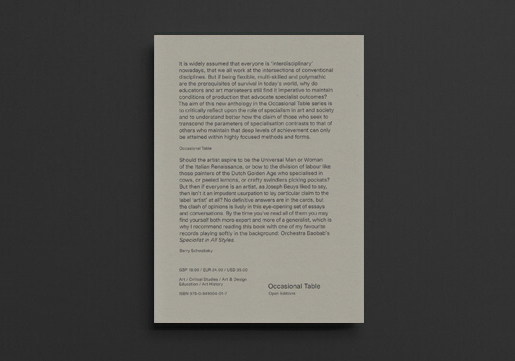
It is widely assumed that everyone is ‘interdisciplinary’ nowadays, that we all work in the intersections of specialised disciplines. But if being flexible, multi-skilled and polymathic are the prerequisites to survival in today’s world, why do educators and art marketeers still find it imperative to maintain conditions of production that advocate specialist forms? The aim of this new anthology in the Occasional Table series is to critically reflect upon the role of specialism in art and society and to understand better how the claim of those who seek to transcend the parameters of specialisation contrasts to others who maintain that deep levels of achievement can only be attained within highly focused methods and forms.
Edited by David Blamey, Specialism includes texts by Matthew Cornford, Neil Cummings, Dan Fox, Anouchka Grose, Mingyuan Hu, Stephen Knott, Frances Loeffler, Nina Power, Rick Poynor, Alistair Rider, Andrew Robinson, Irit Rogoff and Ruth Sonderegger, Chris Watson, Jon Wozencroft and Ian Whittlesea.
2013, English
Softcover, 400 pages, 13.4 x 20 cm
Edition of 1000,
Published by
Monash University Museum of Art / Melbourne
Surpllus / Melbourne
$30.00 - Out of stock
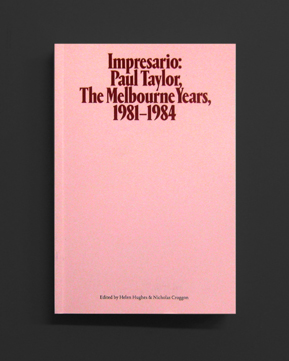
Impresario: Paul Taylor, The Melbourne Years, 1981–1984 brings together a diverse body of texts focused on Paul Taylor, the Australian editor, writer, curator and impresario, and in particular his important and influential early years in Melbourne between 1981 and 1984. The dates of the texts included span some thirty years and take a variety of different forms — critical essays, reviews, short reflective texts, interviews, transcriptions of lectures — the combination of which seeks to analyse Taylor’s impact on Australian art history in the early 1980s, when he founded Art & Text and curated the landmark exhibition ‘POPISM’ at the National Gallery of Victoria, and the subsequent ripples that continue to encircle us in his wake, thirty years on.
Edited and introduced by Helen Hughes and Nicholas Croggon, and featuring contributions by Ashley Crawford, Adrian Martin, Charles Green & Heather Barker, Chris McAuliffe, David Chesworth & Jon Dale, David Pestorius, Graham Willett, Ian McLean, Judy Annear, Janine Burke, Juan Davila, Jonathan Holmes, John Nixon & David Homewood, Jenny Watson & Kelly Fliedner, Lyndal Jones, Merryn Gates, Maria Kozic, Philip Brophy, Paul Foss, Patrick McCaughey, Peter Tyndall, Rex Butler & Susan Rothnie, Ralph Traviati, Imants Tillers, Edward Colless, Russell Walsh, Sue Cramer, Denise Robinson and Vivienne Shark LeWitt.
Editors: Helen Hughes and Nicholas Croggon
Design: Brad Haylock
2015, English / German
Softcover, 300 pages, 11 x 18 cm
Published by
Christoph Merian / Basel
$36.00 - Out of stock
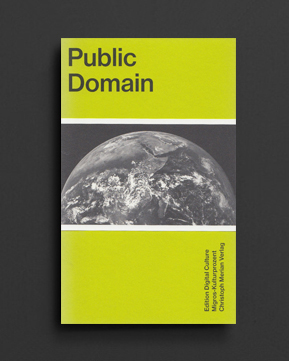
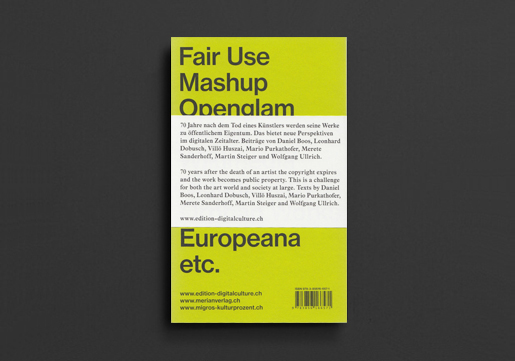
Seventy years after the death of the originator, his or her works become public intellectual property; they are in the public domain and so belong to the public. This effects not just medieval texts, but also 20th century books and works. Thanks to digitization the treatment of these works has taken on a whole new dynamism. For museums, libraries, archives and galleries, the public domain is a challenge, but also an opportunity for the whole cultural sector.
This book explains the copyright fundamentals of the public domain and discusses the difficulties involved in implementing it in the everyday functioning of cultural institutions. Particular attention is given to the theme remix, which is presented from a theoretical and a practical viewpoint. The publication has an extensive glossary.
With essays by Leonhard Dobusch, Merete Sanderhoff, Martin Steiger, Wolfgang Ullrich, and others.
2016, English / Portuguese
Softcover, 168 pages, 15,5 x 22 cm
Published by
Mousse Publishing / Milan
$45.00 $10.00 - Out of stock
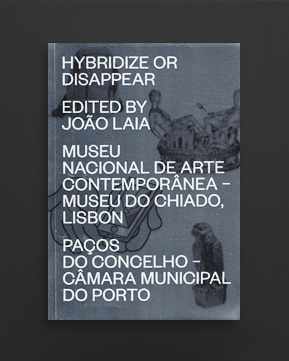
João Laia, ed.
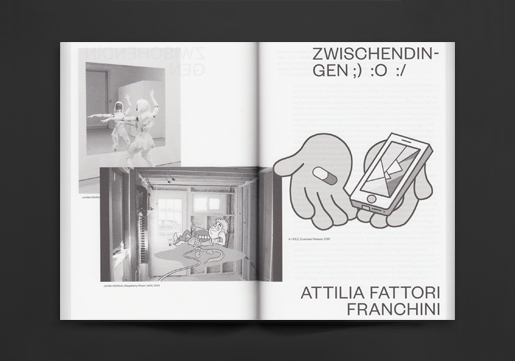
Texts by Stephanie Bailey, Paulo Cunha E Silva, Attilia Fattori Franchini, João Laia, João Ribas, Alex Ross, David Santos, Andrey Shental, Eleanor Ivory Weber, Rósza Zita Farkas
This publication has been produced in the framework of “Hybridize or Disappear”, a group exhibition with works by Cécile B. Evans, Neïl Beloufa, Antoine Catala, Diogo Evangelista, Oliver Laric, Shana Moulton, Katja Novitskova, Laure Prouvost and Magali Reus at the Museu Nacional de Arte Contemporânea – Museu do Chiado, Lisbon, and at the Paços do Concelho, Câmara Municipal do Porto. Edited by João Laia, this book aims to expand on the universe of the show, posing a wide set of questions that shape contemporary visual culture, rather than serving as a document or an archive. Through the lens of the “hybrid”, the commissioned texts look at different dimensions of our current condition, addressing ideas related to the circulation of identity and meaning in our mediated environments.