World Food Books' programme is largely produced on Kulin Nation land. We acknowledge the Wurundjeri people of the Kulin Nation as the first and continuing custodians of this land, and pay respect to their Elders past, present, and emerging.
World Food Books is an arts and special interests bookshop in Naarm / Melbourne. Founded in 2010, World Food Books is devoted to the presentation of a rotating, hand-selection of international art, design, literary and counterculture publications with an emphasis on the anti-traditional, the experimental, the avant-garde, the heretic, the marginal.
Presenting new titles alongside rare and out-of-print books, catalogues and journals spanning the fields of modern and contemporary art, design, photography, illustration, film, literature, poetry, cultural theory, philosophy, sexuality, popular and underground culture in its many radical forms, World Food Books wishes to encourage adventurous, thoughtful and open-minded reading, looking, writing, and exchange of publishing and ideas, both current and historical.
As well as our bookshop, located in Melbourne's historical Nicholas Building, all of our inventory is available internationally via our online mail-order service.
World Food Books semi-regularly co-ordinates "Occasions", a programme of exhibits and events at the bookshop and in partnership with other hosts (such as museums and art galleries) that develop out of the activities, relationships and content of the bookshop itself.
World Food Books
The Nicholas Building
37 Swanston Street
Room 5, Level 6
Melbourne 3000
Australia
SHOP HOURS:
Thu–Fri 12–6, Sat 12–5
WEB-SHOP OPEN 24/7
World Food Books
Postal Address:
PO Box 435
Flinders Lane
Victoria 8009
Australia
Art
Theory / Essay
Architecture / Interior
Graphic Design / Typography
Photography
Fashion
Eros
LGBTQ+
Fiction / Poetry
Weird / Speculative / Science Fiction / Horror
Transgressive / Visceral / Abject
Symbolism / Decadence / Fin de siècle
Film / Video
Painting
Sculpture / Installation
Performance / Dance / Theater
Drawing
Sound / Music
Curatorial
Group Shows / Collections
Periodicals
Out-of-print / Rare
Posters / Ephemera / Discs
Signed Books
World Food Books Gift Voucher
World Food Book Bag
Australian Art
Australian Fiction
Australian Science Fiction / Speculative Fiction
Australian Poetry
Australian Photography
Japanese Photography
Conceptual Art
Minimal Art
Dada
'Pataphysics / Oulipo
Fluxus
Concrete Poetry
Pop Art
Surrealism
Arte Povera
Arte Informale / Haute Pâte / Tachism
Nouveau Réalisme / Zero / Kinetic
Situationism / Lettrism
Collage / Mail Art / Xerox Art
Art Brut / Folk / Visionary / Fantastic
Illustration / Graphic Art / Bandes Dessinées
Furniture
Italian Radical Design / Postmodernism
Textiles
Ceramics / Glass
Counterculture
Protest / Revolt
Philosophy
Psychoanalysis
Anthropology
Anarchism
Socialism / Anarchism / Communism / Capitalism
Literary Theory / Semiotics / Language
Feminism / Women's Studies
Gender Studies / Sexuality
Anthropology
Fetishism / BDSM
Drugs / Psychedelia
Crime / Violence
Animal Rights / Veganism
Occult / Esoterica
Ecology / Earth / Alternative Living
Whole Earth / Crafts
All prices in AUD (Australian dollars)
Pick-Ups
Pick-up orders can be collected in our bookshop during opening hours after order date. Please collect any Pick-up orders within 2 weeks of ordering as we have limited storage space. Orders will be released back into stock if not collected within this time. No refunds can be made for pick-ups left un-collected. If you cannot make it in to the bookshop in this time-frame, please choose postage option.
Return Policy
All sales are final. We do accept returns (for refund or exchange) for items received in error. All our orders are packed with special care using heavy-duty padding and cardboard book-mailers or bubble mailers (for smaller books), using reinforcement where required. We cannot take responsibility for any lost, stolen or damaged parcels.
Insurance
Should you wish to insure your package, please email us directly after placing your order and we can organise this at a small extra expense. Although all standard/express tracked packages are very safe and dependable, we cannot take responsibility for any lost, stolen or damaged parcels. We recommend insurance on valuable orders.
Interested in selling your old books, catalogues, journals, magazines, comics, fanzines, ephemera? We are always looking for interesting, unusual and out-of-print books to buy. We only buy books in our fields of interest and specialty, and that we feel we can resell.
We base these prices on desirability, market value, in-print prices, condition and our current stock levels. We offer cash, store credit, and can take stock on consignment. All
about 25% of the price we expect to get when we sell them, or 30% in store credit. We base these prices on desirability, market value, in-print prices, condition and our current stock levels.
Sell your books any day of the week. You can drop them off and return later. If you have a lot of books, we can visit your Sydney home.
We buy books that we feel we can resell. We offer about 25 % of the price we expect to get when we sell them, or 30% in store credit. We base these prices on desirability, market value, in-print prices, condition and our current stock levels.
Philadelphia Wireman
03 August - 01 September, 2018
World Food Books is proud to announce our next Occasion, the first presentation of sculptures by Philadelphia Wireman in Australia.
The Philadelphia Wireman sculptures were found abandoned in an alley off Philadelphia’s South Street on trash night in 1982. Their discovery in a rapidly-changing neighbourhood undergoing extensive renovation, compounded with the failure of all attempts to locate the artist, suggests that the works may have been discarded after the maker’s death. Dubbed the "Philadelphia Wireman" during the first exhibition of this work, in 1985, the maker’s name, age, ethnicity, and even gender remain uncertain. The entire collection totals approximately 1200 pieces, all intricately bound together with tightly-wound heavy-gauge wire (along with a few small, abstract marker drawings, reminiscent both of Mark Tobey and J.B. Murry). The dense construction of the work, despite a modest range of scale and materials, is singularly obsessive and disciplined in design: a wire armature or exoskeleton firmly binds a bricolage of found objects including plastic, glass, food packaging, umbrella parts, tape, rubber, batteries, pens, leather, reflectors, nuts and bolts, nails, foil, coins, toys, watches, eyeglasses, tools, and jewellery.
Heavy with associations—anthropomorphic, zoomorphic, and socio-cultural responses to wrapped detritus—the totemic sculptures by Philadelphia Wireman have been discussed in the context of work created to fulfil the shamanistic needs of alternative religions in American culture. Curators, collectors, and critics have variously compared certain pieces to sculpture from Classical antiquity, Native American medicine bundles, African-American memory jugs, and African fetish objects. Reflecting the artist’s prolific and incredibly focused scavenging impulse, and despite—or perhaps enhanced by—their anonymity, these enigmatic objects function as urban artefacts and arbiters of power, though their origin and purpose is unknown. Philadelphia Wireman, whatever their identity, possessed an astonishing ability to isolate and communicate the concepts of power and energy through the selection and transformation of ordinary materials. Over the course of the past two decades, this collection has come to be regarded as an important discovery in the field of self-taught art and vernacular art.
Presented in collaboration with Fleisher-Ollman Gallery, Philadelphia, and Robert Heald, Wellington.
Susan Te Kahurangi King
02 February - 10 March, 2018
Susan Te Kahurangi King (24 February 1951 - ) has been a confident and prolific artist since she was a young child, drawing with readily available materials - pencils, ballpoint pens and felt-tip markers, on whatever paper is at hand. Between the ages of four and six Susan slowly ceased verbal communication. Her grandparents William and Myrtle Murphy had developed a special bond with Susan so they took on caring responsibilities for extended periods. Myrtle began informally archiving her work, carefully collecting and storing the drawings and compiling scrapbooks. No drawing was insignificant; every scrap of paper was kept. The King family are now the custodians of a vast collection containing over 7000 individual works, from tiny scraps of paper through to 5 meter long rolls.
The scrapbooks and diaries reveal Myrtle to be a woman of great patience and compassion, seeking to understand a child who was not always behaving as expected. She encouraged Susan to be observant, to explore her environment and absorb all the sights and sounds. Myrtle would show Susan’s drawings to friends and people in her community that she had dealings with, such as shopkeepers and postal workers, but this was not simply a case of a grandmother’s bias. She recognised that Susan had developed a sophisticated and unique visual language and sincerely believed that her art deserved serious attention.
This was an unorthodox attitude for the time. To provide some context, Jean Dubuffet coined the term Art Brut in 1945 to describe work created by self-taught artists – specifically residents of psychiatric institutions and those he considered to be visionaries or eccentrics. In 1972 Roger Cardinal extended this concept by adopting the term Outsider Art to describe work made by non-academically trained artists operating outside of mainstream art networks through choice or circumstance. Susan was born in Te Aroha, New Zealand in 1951, far from the artistic hubs of Paris and London that Dubuffet and Cardinal operated in. That Myrtle fêted Susan as a self-taught artist who deserved to be taken seriously shows how progressive her attitudes were.
Susan’s parents Doug and Dawn were also progressive. Over the years they had consulted numerous health practitioners about Susan’s condition, as the medical establishment could not provide an explanation as to why she had lapsed into silence. Dawn educated herself in the field of homeopathy and went on to treat all twelve of her children using these principles – basing prescriptions on her observations of their physical, mental and emotional state.
Doug was a linguist with an interest in philosophy who devoted what little spare time he had to studying Maori language and culture. To some extent their willingness to explore the fringes of the mainstream made them outsiders too but it was their commitment to living with integrity and their respect for individuality that ensured Susan’s creativity was always encouraged.
Even though Susan’s family supported her artistic pursuits, some staff in schools and hospitals saw it as an impediment to her assimilation into the community and discouraged it in a variety of ways. Her family was not always aware of this and therefore did not fully understand why Susan stopped drawing in the early 1990s. However, rather than dwell on the challenges that Susan faced in pursuit of her artistic practice, they prefer to highlight her achievements. In 2008 Susan began drawing again in earnest, after an almost 20 year interruption, and her work is now shown in galleries around the world.
Susan grew up without television and has been heavily influenced by the comics she read as a child. She is absolutely fearless in the appropriation of recognizable characters, such as Donald Duck and Mickey Mouse, in her work. She twists their limbs, contorts their faces, compresses them together, blends them into complex patterned backgrounds - always imbuing them with an incredible energy. Although Susan often used pop culture characters in her work they are not naive or childlike. These are drawings by a brilliant self-taught artist who has been creating exceptional work for decades without an audience in mind.
Mladen Stilinović
"Various Works 1986 - 1999"
02 February 16 - September 10, 2016
Various works 1986 - 1999, from two houses, from the collections of John Nixon, Sue Cramer, Kerrie Poliness, Peter Haffenden and Phoebe Haffenden.
Including: Geometry of Cakes (various shelves), 1993; Poor People’s Law (black and white plate), 1993; White Absence (glasses, ruler, set square, silver spoon, silver ladel with skin photograph and wooden cubes), 1990-1996; Exploitation of the Dead (grey and red star painting, wooden painting, black spoon with red table, red plate), 1984-1990; Money and Zeros (zero tie, paintings made for friends in Australia (Sue, John, Kerrie), numbers painting), 1991-1992; Words - Slogans (various t-shirts) - “they talk about the death of art...help! someone is trying to kill me”, “my sweet little lamb”, “work is a disease - Karl Marx”; Various artist books, catalogues, monographs, videos; Poster from exhibition Insulting Anarchy; "Circular" Croatian - Australian edition; Artist book by Vlado Martek (Dostoyevsky); more.
Thanks to Mladen Stilinović and Branka Stipančić.
Jonathan Walker
Always Will Need To Wear Winter Shirt Blue + Ochre Small Check Pattern
21 August - 21 September, 2015
Untitled
I am not a great reader of poetry but I always return to the work of Melbourne poet, Vincent Buckley (1925- 1988). Perhaps I find his most tantalising piece to be not a finished poem but a fragment left on a scrap of paper discovered on his desk after the poet’s death.
The poetry gathers like oil
In the word-core, and spreads
It has its music meet,
Its music is in movement.
This fragment is more the shell left behind from a volatile thought than a finished poem. I find the last two lines honest but awkward whereas the first two lines work like an arrow. Most likely he could not find a resolution so it was left. Still, in its present form, it remains an eloquent testimony to the ultimate failure of a medium to express mobile thought and sensation, in Buckley’s case, through verbal language. It’s an important matter because this is something all artists have to deal with regardless of the medium.
I have never written a poem, however, I am forever copying fragments from books on paper scraps in a vain effort to fix certain notions in my head. At first, they function as bookmarks that are sometimes returned to when I open the book. But before long, as they accumulate, they fall out littering the table interspersed with A4 photocopies, bills, books and medications.
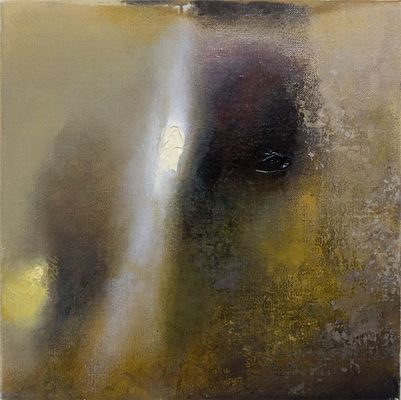
To return to Buckley’s fragment, the first two lines very much evoke how I paint nowadays. As you age, detail diminishes and patches of light become more luminous and float. I feel the most honest way of dealing with this is by smearing the oil paint on the canvas with the fingers and working close-up, blind. Only if the patches coalesce into an approaching image can the work gain a life.
-
Jonathan Walker was born in Melbourne, Australia and brought up on a dairy farm in Gippsland. In the 1970’s he studied painting at RMIT and won the Harold Wright Scholarship to the British Museum, London. During the 1980’s he exhibited at Pinacotheca Gallery, Richmond and had work shown at the NGV and Heidi City Art Gallery. Over the same period he designed the cover for the “Epigenesi” LP by Giancarlo Toniutti, Italy and conducted a mail exchange work with Achim Wollscheid, Germany. The work with artists through the post resulted in an article published in the bicentenary issue of Art and Australia 1988. He showed in artist run spaces such as WestSpace in the 90’s and 2000’s, and until 2012, taught painting at Victoria University, which is where we (Colleen Ahern and Lisa Radford) as organisers of the exhibition, among many others, had the privilege of being his student.
Walker’s knowledge was imparted to students through the careful selection of music, literature, and artists found in books that he himself had ordered for the library. Walker’s strategy was the generosity of sharing his vast knowledge with references specific to each student and their context.
Walker’s paintings share a similar focus and intimacy.
This exhibition presents a small selection of recent paintings alongside a publication that includes Walker’s writing. Observational and analytical, Walker’s work is a type of material notation — the time of day, colour and how it is blended, the both specific and fleeting location of a reflection on lino or the question of whether a chair leg should be included in a painting.
Please join us on Friday August 21 between 6-8pm to celebrate the opening of the exhibition.
Curated by Colleen Ahern and Lisa Radford.
B. Wurtz
Curated by Nic Tammens
March 26 - April 4, 2015
B.Wurtz works from a basement studio in his home on Manhattan’s Lower East Side.
This local fact is attested to by the plastic shopping bags and newsprint circulars that appear in his work. As formal objects, they don’t make loud claims about their origins but nonetheless transmit street addresses and places of business from the bottom of this long thin island. Like plenty of artists, Wurtz is affected by what is local and what is consumed. His work is underpinned by this ethic. It often speaks from a neighborhood or reads like the contents of a hamper:
“BLACK PLUMS $1.29 lb.”
“Food Bazaar”
“USDA Whole Pork Shoulder Picnic 99c lb.”
“RITE AID Pharmacy, with us it’s personal.”
“H. Brickman & Sons.”
“Sweet Yams 59c lb."
Most of the work in this exhibition was made while the artist was in residence at Dieu Donne, a workshop dedicated to paper craft in Midtown. Here Wurtz fabricated assemblages with paper and objects that are relatively lightweight, with the intention that they would be easily transportable to Australia. This consideration isn’t absolute in Wurtz’s work, but was prescriptive for making the current exhibition light and cheap. Packed in two boxes, these works were sent from a USPS post office on the Lower East Side and delivered to North Melbourne by Australia Post.
Wurtz appears courtesy of Metro Pictures, New York.
Thanks to Rob Halverson, Joshua Petherick, Sari de Mallory, Matt Hinkley, Helen Johnson, Fayen d'Evie, Ask Kilmartin, Lisa Radon, Ellena Savage, Yale Union, and "Elizabeth".
John Nixon
"Archive"
December 15 - January 20, 2014
The presentation of John Nixon's archive offered a rare showcase of this extensive collection of the artist's own publications, catalogues, posters, ephemera, editions and more, from the mid 1980s onwards, alongside a selection of his artworks.
Organized by John Nixon, Joshua Petherick and Matt Hinkley.
<a href=http://wfb.public-office.info/artist/john-nixon>All titles by John Nixon
"Habitat"
at Minerva, Sydney (organised by Joshua Petherick and Matt Hinkley)
November 15 - December 20, 2014
Lupo Borgonovo, Janet Burchill & Jennifer McCamley,
Lewis Fidock, HR Giger, Piero Gilardi, Veit Laurent Kurz,
Cinzia Ruggeri, Michael E. Smith, Lucie Stahl, Daniel Weil, Wols
Press Release:
“...It contained seven objects. The slender fluted bone, surely formed for flight, surely from the wing of some large bird. Three archaic circuitboards, faced with mazes of gold. A smooth white sphere of baked clay. An age-blackened fragment of lace. A fingerlength segment of what she assumed was bone from a human wrist, grayish white, inset smoothly with the silicon shaft of a small instrument that must once have ridden flush with the surface of the skin - but the thing’s face was seared and blackened.”
William Gibson, “Count Zero”, 1986
"Autumn Projects Archive"
Curated by Liza Vasiliou
March 6 - March 15, 2014
World Food Books, in conjunction with the Virgin Australia Melbourne Fashion Festival 2014, presented the Autumn Projects archive, consisting of a selection of early examples in Australian fashion with a particular interest in collecting designers and labels from the period beginning in the 1980’s, who significantly influenced the discourse of Australian Fashion.
Curated by Liza Vasiliou, the exhibition provided a unique opportunity to view pieces by designers Anthea Crawford, Barbara Vandenberg, Geoff Liddell and labels CR Australia, Covers, Jag along with early experimental collage pieces by Prue Acton and Sally Browne’s ‘Fragments’ collection, suspended throughout the functioning World Food Books shop in Melbourne.
H.B. Peace
presented by CENTRE FOR STYLE
November 14, 2013
"Hey Blinky, you say chic, I say same"
Anon 2013
H.B. Peace is a clothing collaboration between great friends Blake Barns and Hugh Egan Westland. Their pieces explore the divergences between 'character’ and ‘personality’ in garments....etc
Special Thanks to Joshua Petherick and Matt Hinkley of WFB and Gillian Mears
and a Very Special Thank you to Audrey Thomas Hayes for her shoe collaboration.
Janet Burchill & Jennifer McCamley
"Aesthetic Suicide"
May 10 - June 8, 2013
The first of our occasional exhibitions in the World Food Books office/shop space in Melbourne, "Aesthetic Suicide" presented a body of new and older works together by artists Janet Burchill & Jennifer McCamley, including videos, prints, a wall work, and publications.
During shop open hours videos played every hour, on the hour.
2011, English
Softcover, 112 pages (32 colour ill.), 152 x 215 mm
Published by
Afterall / London
$26.00 - Out of stock
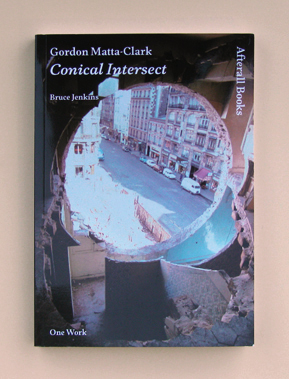
Gordon Matta-Clark's Conical Intersect (1975) was a torqued, spiralling 'cut' into two derelict seventeenth-century Paris buildings adjacent to the construction site of the Centre Pompidou. With this landmark work of 'anarchitecture', Matta-Clark opened up these venerable residences to light and air, and began a dialogue about the nature of urban development and the public role of art. Considered today, Conical Intersect reveals the multivalent nature of the artist's practice and his prescient focus on sustainability and creative reuse of the built environment.
In this book, Bruce Jenkins examines Matta-Clark's 'non-u-ment', looking closely at the artist's proposals, working process, various forms of documentation, and the dialogue begun by Matta-Clark's decision to transform two abandoned buildings into an 'act of communication'. The text is accompanied by rarely seen photographs of the construction process taken by French artist Marc Petitjean.
2011, English / French
Softcover, 94 pp, 202 x 296 mm
Published by
Petunia / Paris
$11.00 - In stock -
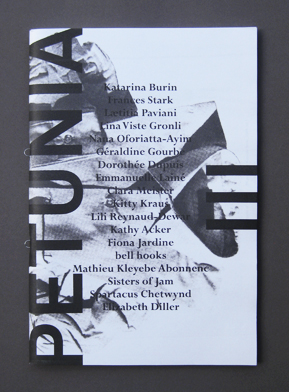
Pétunia presents artists’ proposals and texts in French or English. Pétunia’s issues are organised around subjective emergencies. Pétunia avoids using author’s texts as illustrations of a main topic chosen by the chief editors. There is no editorial or publisher’s statement. Each issue will be autonomous, and does not connect with territorial issues and current matters or trends. There are no chapters or sections, but diverse textual forms, from theoretical texts to diary entries to pure fiction or comics, mostly concerning contemporary art.
The layout of Pétunia will be an important part of each issue; its graphic design will be very present and proclaimed. Pétunia wants to bean unclassified object that paradoxically affirms a strong identity in focusing foremost on the work of women critics, curators, artists…
From this perspective, Pétunia is a feminist publication playing the game of affirmative action, as a response to the constant imbalance of the role and place of women in the art world. Pétunia also reactivates — hopefully with nostalgia and humour — the forms of ideological engagement of women regarding art and critical production, while enriching its view of three decades of “women studies”, “black studies”, post – colonial studies and, of course, post – feminist studies.
Contributors in #3: Katarina Burin, Frances Stark, Laetitia Paviani, Lina Viste Gronli, Nana Oforiatta Ayim, Géraldine Gourbe, Dorothée Dupuis, Emmanuelle Lainé, Clara Meister, Kitty Kraus, Lili Reynaud Dewar, Kathy Acker, Fiona Jardine, bell hooks, Mathieu Kleyebe Abonnenc, Sisters of Jam, Spartacus Chetwynd, Elizabeth Diller.
Design: Change is Good
2010, English
Softcover, 15.6 x 24 cm, 256 pages (256 color ill.)
Published by
Sternberg Press / Berlin
$38.00 - Out of stock
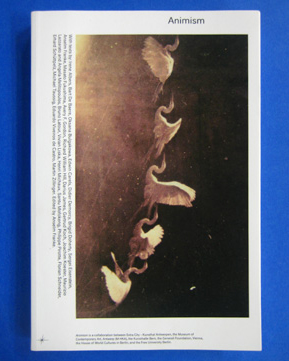
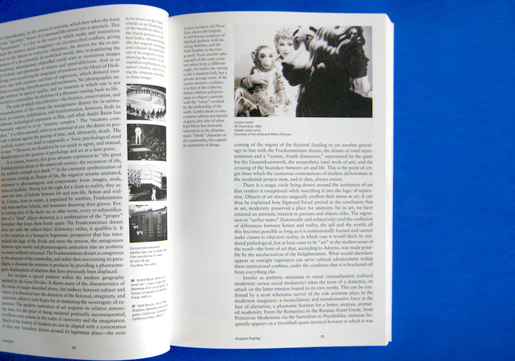
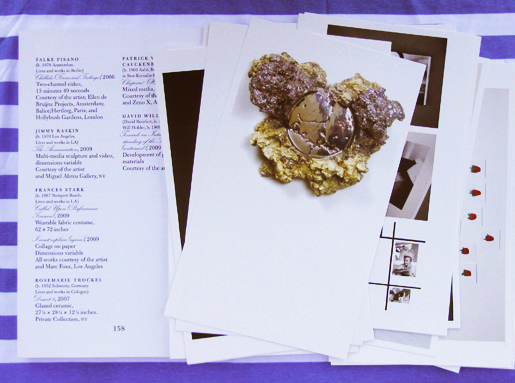
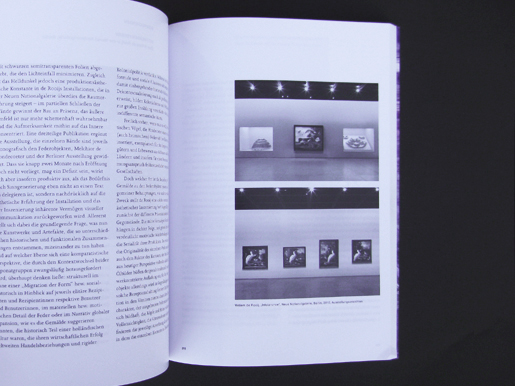
With contributions by Agency, Irene Albers, Oksana Bulgakowa, Edwin Carels, Bart De Baere, Didier Demorcy, Brigid Doherty, Sergei Eisenstein, Anselm Franke, Masato Fukushima, Avery F. Gordon, Richard William Hill, Darius James, Gertrud Koch, Joachim Koester, Bruno Latour, Maurizio Lazzarato and Angela Melitopoulos, Vivian Liska, Henri Michaux, Santu Mofokeng, Philippe Pirotte, Florian Schneider, Erhard Schüttpelz, Michael Taussig, Eduardo Viveiros de Castro, Martin Zillinger What is the role of aesthetic processes in the drawing of the boundaries between nature and culture, humans and things, the animate and inanimate? Structured around the aesthetic processes and effects of animation and mummification, Animism—a companion publication to the long-term exhibition of the same title, which premiered at Extra City Kunsthal Antwerpen in January 2010—brings together artistic and theoretical perspectives that reflect on the boundary between subjects and objects, and the modern anxiety that accompanies the relation between “persons” and “things.” With works by Agency, Art & Language, Christian W. Braune & Otto Fischer, Marcel Broodthaers, Paul Chan, Tony Conrad, Didier Demorcy, Walt Disney, Lili Dujourie, Jimmie Durham, Eric Duvivier, Harun Farocki, León Ferrari, Christopher Glembotzky, Victor Grippo, Brion Gysin, Luis Jacob, Ken Jacobs, Darius James, Joachim Koester, Zacharias Kunuk, Louise Lawler, Len Lye, Étienne-Jules Marey, Daria Martin, Angela Melitopoulos & Maurizio Lazzarato, Wesley Meuris, Henri Michaux, Santu Mofokeng, Vincent Monnikendam, Tom Nicholson, Otobong Nkanga, Reto Pulfer, Félix-Louis Regnault, Józef Robakowski, Natascha Sadr Haghighian, Paul Sharits, Yutaka Sone, Jan Švankmajer, David G. Tretiakoff, Rosemarie Trockel, Anne-Mie Van Kerckhoven, Dziga Vertov, Klaus Weber, Apichatpong Weerasethakul Co-published with Extra City – Kunsthal Antwerpen and M HKA – Museum of Contemporary Art, Antwerp Design by NODE Berlin Oslo
2008, English
Softcover, 304 pages (129 color and 40 b/w ill.), 155 x 210 mm
Published by
Sternberg Press / Berlin
$40.00 - Out of stock
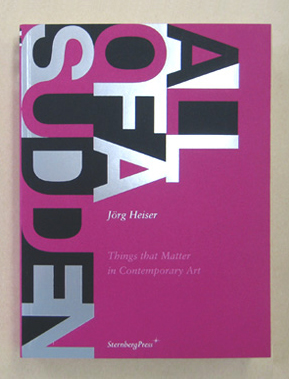
In All of a Sudden. Things that Matter in Contemporary Art, Jörg Heiser provides a sharp summary of contemporary art since Marcel Duchamp. Using many artworks as example, the author shows that art is more than just a randomly chosen cultural field of activity in which to acquire a little specialist knowledge to show off with. “When it’s good,” he claims, “art hits where it hurts, striking at the heart of an ossified status quo by which it itself was brought forth. Perhaps this is something art since Modernism has in common with slapstick. Instead of just aiming to shock and outrage, it shows authority losing its grip. Instead of inflating itself, it deflates the pompous in the name of art.”
The Frankfurter Allgemeine Zeitung finds the book “astonishingly enlightening.” The Frankfurter Rundschau praises Heiser for finally opening the eyes of his readers—something many of his colleagues have been unable to do.
Jörg Heiser (*1968) lives in Berlin. He is co-editor of frieze magazine, writes for the national daily Süddeutsche Zeitung, and is a frequent contributor to art catalogues and publications. He curated the exhibitions “Romantic Conceptualism” (2007, Kunsthalle Nürnberg, BAWAG Foundation Vienna) and “Funky Lessons” (2004/2005, BüroFriedrich Berlin, BAWAG Foundation Vienna).
Design by Surface, Frankfurt am Main/Berlin
June 2010, German/English
Softcover Journal, 262 pages (colour/bw ill.), offset, 230 x 165 mm
Published by
Texte Zur Kunst / Berlin
$38.00 - Out of stock
"FASHION"
Includes : Frédéric Monneyron - The Significance of Couturiers and fashion Magazines, fashion is Fun / An interview with Stefano Pilati by Merlin Carpenter, Isabelle Graw - Fashion and Vitality / A note on "Brigitte" without models, Elegant Discipline / An interview with Rick Owens by Monica Titton, Kim Gordon "Fossil Collections / On Rodarte", Monica Titton "Fashion in the City / Street-Style-Blogs and the Limits of Fashion's Democratization", "Global Fashion - Local Tradition. On the Globalization of Fashion" by Gurtrud Lehnert, Mahret Kupka "Uniform of the Slim / On the Persistence of a Silhouette", Heimo Zobernig, Rudolf Stingel, Andreas Fogarasi, Daniel Buren, Ed Ruscha, "Skin Fruit: Selections from the Dakis Joannou Collection", Allen Ruppersberg,Danica Dakic, Willem de Rooij, Michela Meise, "Crash Site/My_Never_Ending_Burial_Plot" by Juli Carson, "Donna - Avanguardia femminista negli anni '70 dalla Sammlung Verbund di Vienna", Diedrich Diederichsen - "Changing Channels. Kunst und Fernsehen 1963-1987", "2010 Whitney Biennial","Yves Saint Laurent. Rétrospective", much more.
One of the finest art journals, period. TEXTE ZUR KUNST stands for controversial discussions and contributions by internationally leading writers on contemporary art and culture. Alongside ground-breaking essays the quarterly magazine, founded in Cologne in 1990 by Stefan Germer (†) and Isabelle Graw and published in Berlin since 2000, offers interviews, roundtable discussions and extensive reviews on art, film, music, market and fashion as well as on art history, theory and cultural politics. Since 2006 the comprehensive main section section, each time devoted to a different topic, and selected reviews are published in both German and English.
Spring/Summer 2009, English
Softcover magazine, 96 pages, 31 x 23 cm
Published by
Provence / Nice
$18.00 - Out of stock
Provence is one of our favourite publications.
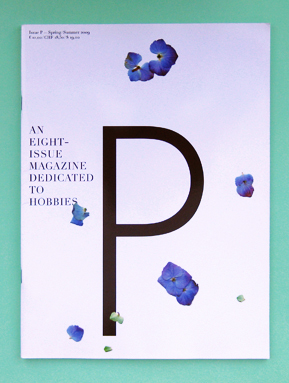
"An Eight Issue Magazine Dedicated to Hobbies", edited by Daiga Grantina, Tobias Kaspar, and Hannes Loichinger. From Nice, France.
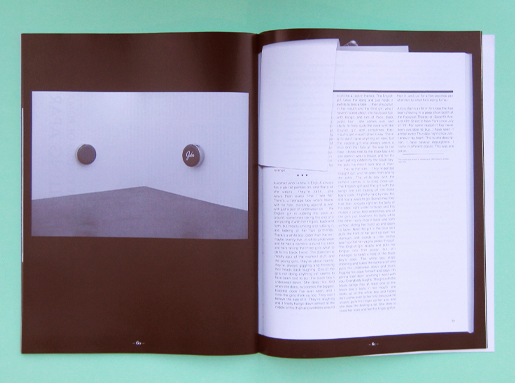
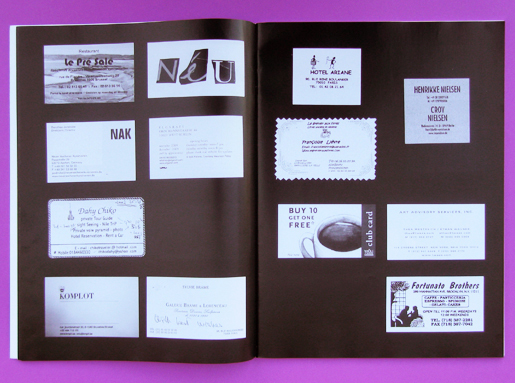
Issue P : FOOD, Ben Kinmont, Merlin Carpenter, business cards, Edgars Gluhovs, Folkways Records, Kaspar Müller, Living as Exhibition, "How to Cook a Wolf", painted leaves, Cerith Wyn Evans, Free Class Frankfurt, Richard Prince, American Gigolo 1980, Hinrich Sachs, I Can't Feel My Face, scans, re-prints, etc.
Highly recommended!
Summer 2010, English
Softcover magazine, 96 pages, 23 x 31 cm
Published by
Provence / Nice
$18.00 - Out of stock
"An Eight Issue Magazine Dedicated to Hobbies"
Issue O :Published in conjunction with an exhibition at Halle für Kunst Lüneburg eV, Lüneburg, Germany in April/June, 2010, and edited by Daiga Grantina, Tobias Kaspar and Hannes Loichinger.
Features: Special "The Screens / The Islands" dust-jacket by Gerry Bibby, Nick Mauss & Ken Okiishi (via Victor Hugo and Halston), Velours et guipure, Mallarmé et La Dernière Mode, Fumi Yosano, Artful Lodgers, Fia Backström, The Artists and the Dealer. The Roles of Gustave Caillebotte, Mary Cassat and Paul Durand-Ruel in 19th Century Revolutionary Art by Ulf Wuggenig, Jay Chung and Q Takeki Maeda examine Flaubert’s Bouvard and Pécuchet , Edgars Gluhovs, Ei Arakawa asks Malik Gaines and learns about W.E.B. Du Bois, the American civil rights activist, and the first African American Ph.D. recipient from Harvard University in 1895, Les Journalistes by Chantal Georgel, more, etc.
Highly recommended!
2009, English/German
Softcover, 15.5 x 23 cm, 164 pages (40 color ill.)
Published by
Sternberg Press / Berlin
$25.00 - Out of stock
Edited by Nicolaus Schafhausen
Text by Liam Gillick
This book documents Gillick’s project for the German Pavilion at the Venice Biennale 2009. It contains an introduction by the curator, a text by Liam Gillick about his work as well as the text spoken by the kitchen cat present in the show: “She speaks from the present and fights against the echoes of building’s interior. Its history is one of misrepresentation, misunderstanding and desires. Thus, the pavilion becomes a location for endless self-circulating histories that—in the end—represents our history as well.”
2010, English
Softcover, 64 pages, 195 x 295 mm
Published by
Archive Books / Berlin
$18.00 - Out of stock
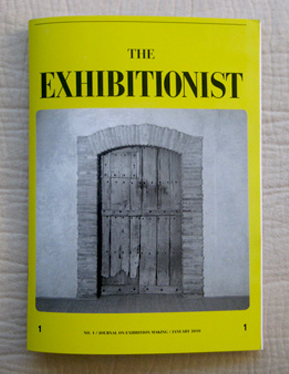
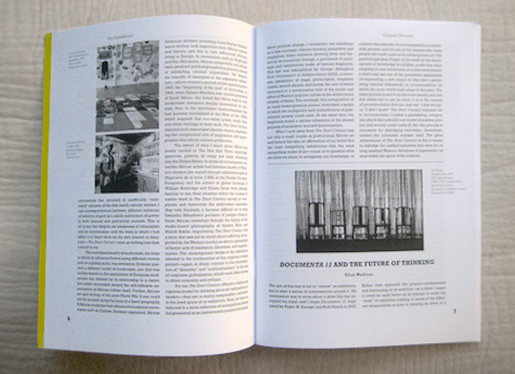
The Exhibitionist, a new journal made by curators, for curators, focusing solely on the practice of exhibition making.
The objective is to create a wider platform for the discussion of curatorial concerns – encourage a diversification of curatorial models, and actively contribute to the formation of a theory of curating.
The Exhibitionist will be published twice a year and will follow a strict editorial structure. In each issue, the Curators’ Favorites section will present three texts in which three curators write a personal essay about an exhibition, contemporary or historic, that has particularly impacted their thinking, followed by Back in the Day – an in-depth look at a historically important exhibition. In Assessments, the core of the journal, four curators will review a significant contemporary exhibition, each from his or her individual point of view. Typologies debates specific exhibition formats. Attitude features a text by a member of the editorial board reflecting on the current state of exhibition making. In Rear Mirror, two curators reflect upon exhibitions they have recently curated. And, finally, Endnote, a brief remark on a notable aspect of curatorial practice. Every fourth issue will include a conversation between some of the contributors about past issues; in this way the journal offers a forum for self-reflexivity.
Contributors this issue: Tara McDowell, Matthew Drutt, Juan A. Gaitan, Aurélie Voltz, Constance Lewallen, Eva Díaz, Robert Storr, Jenelle Porter, Jane Simon, Mary Jane Jacob, Nato Thompson, Joshua Decter, Okwui Enwezor, Jack Bankowsky, Peter Eleey, Jens Hoffmann.
Editor: Jens Hoffmann
Senior Editor: Tara McDowell
Editorial Board: Carolyn Christov-Bakargiev, Okwui Enwezor, Mary Jane Jacob, Constance Lewallen, Maria Lind, Chus Martínez, Jessica Morgan, Julian Myers, Paul O’Neill, Hans Ulrich Obrist, Adriano Pedrosa, Dorothea von Hantelmann
Editorial Founders: Jens Hoffmann and Chiara Figone
Published by Archive Books / Berlin
$18.00 - Out of stock
The Exhibitionist, a journal made by curators, for curators, focusing solely on the practice of exhibition making.
The objective is to create a wider platform for the discussion of curatorial concerns – encourage a diversification of curatorial models, and actively contribute to the formation of a theory of curating.
In this issue: Jens Hoffmann, Jill Dawsey, Chus Martínez, Jean-Hubert Martin, Julian Myers, Jessica Morgan, Ulrike Groos, Jill Winder, Yilmaz Dziewior, Rob Bowman, Beatrix Ruf, Eungie Joo, Adriano Pedrosa, Massimiliano Gioni, Nancy Spector and Tara McDowell.
Paperback (w. plastic wrap cover and full-colour artist card set), 176 pages, 21.6 x 34.5 cm
Published by
CAM / St. Louis
$55.00 - Out of stock
This title is now out of print.
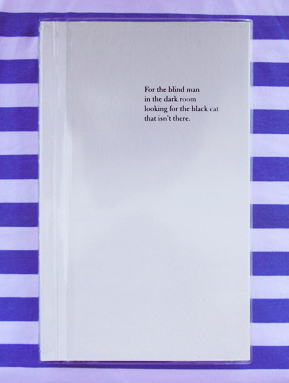
Curated by Anthony Huberman at the Contemporary Art Museum St. Louis, the group exhibition and catalogue For the Blind Man in the Dark Room Looking for the Black Cat That Isn't There explores the speculative nature of knowledge and insists on the importance of curiosity and the things we don't understand. Arranged around the premise that the world--and art--is not a code that needs cracking, the works in the exhibition center on the fruitfulness of not-knowing, un-learning, and productive confusion. David Hullfish Bailey, Marcel Broodthaers, Hans-Peter Feldmann, Fischli & Weiss, Rachel Harrison, Giorgio Morandi, Matt Mullican, Rosalind Nashashibi & Lucy Skaer, Frances Stark, Rosemarie Trockel and others present explanations that playfully don't explain. Dedicated to the inquisitive mind, For The Blind Man celebrates our ability to get lost and the stories we use to find our way in the dark. The book is edited, arranged and designed by London-based writer Will Holder and includes a new essay by curator Anthony Huberman.
2007, English
Softcover, 160 pages, offset, 215 x 280 mm
Published by
Christoph Keller Editions
JRP Ringier / Zürich
$50.00 - Out of stock
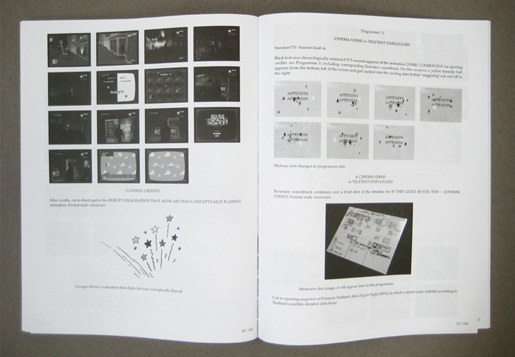
While he was working on Appendix Appendix, Ryan Gander described it to Artforum as "a shooting script for a 13-part television series about television" and "a cross between John Berger's…Ways of Seeing and Monty Python." His collaborator and typographer Stuart Bailey, on the other hand, describes it as a sequel to their first book, Appendix, which compiled back stories for Gander's conceptual work. Bailey says, "The problem (a good problem) is to work out how the second [collaboration] is affected by the first, how it swallows it. I always relate these things to music, so it's like thinking what's the second album going to be after the rough debut; more studio time, more pressure, bigger egos, drinking problems, etcetera." Bailey has created books with Paulina Olowska, Lucy McKenzie and Frances Stark; Gander recently won the Baloise Prize at Art Basel and appeared in the 2006 Tate Triennial.
Edited by Christoph Keller.
December 2010, English / German
Softcover, 296 pages (colour/bw ill.), offset, 230 x 165 mm
Published by
Texte Zur Kunst / Berlin
$38.00 - Out of stock
"Political Art ?"
With this 80th issue, Texte zur Kunst celebrates its 20th anniversary. However, the correspondingly “grand” topic of our anniversary issue is not immediately revealed on the cover. Only gradually do the words “Politische Kunst?” (“Political Art?”) emerge from the golden stripes. Already this visual effect, but even more so the question mark in the title, highlights the innumerable layers of meaning in this pair of concepts. Which can hardly be reduced to a common denominator, for political art seems to be omnipresent today. In addition to the Kunstvereine, biennales and other large-scale events have meanwhile established themselves as venues predominantly presenting political art. Yet it cannot be grasped as a fixed category. What does apply, though, is that a certain form of commitment and a fixed positioning of political art must by all means be considered in the framework of their differentiation. But what is the political of political art in the first place, and in what relation do art and politics stand? How do the claims, modes of reception and the effects of political art relate to each other (cf. the statements of Claire Bishop, Tania Bruguera, Diedrich Diederichsen, Hans Haacke, Tom Holert, Clemens Krümmel, and Otto Karl Werckmeister)?
.........
Includes : Helmut Draxler - The Curse of the Good Deed / The Claim to Autonomy and the Suspicion of Ideology in Political Art; Roundtable - When Art Meets Politics / A Roundtable Conversation about Political Art with Alice Creischer, Hans-Christian Dany, Tim Eitel, Constanze Ruhm, moderated by Sven Beckstette; Simon Sheikh - The Politics of Art and the Process of Biennialization; Maria Muhle - Political Art as Aesthetic Realism or Passion of the Real?; Clemens Krümmel - Poltical Art; Hans Haacke responds to questions from „Texte zur Kunst"; Diedrich Diederichsen - Speaking of Political Art; Claire Bishop - Art and Politics; Tom Holert- Critique or Gesture: Is that the Alternative?; Otto Karl Werckmeister - Marx´s Theorie does not prescribe an Art of the Left; Tania Bruguera - Political Art Transforms the Audience into Citizens....
etc.
Plus reviews from Berlin, Madrid, Basel, Antwerp, London, Graz, Paris, Rotterdam, New York, Wien, Kassel, Cologne, etc....
One of the finest art journals, period. TEXTE ZUR KUNST stands for controversial discussions and contributions by internationally leading writers on contemporary art and culture. Alongside ground-breaking essays the quarterly magazine, founded in Cologne in 1990 by Stefan Germer (†) and Isabelle Graw and published in Berlin since 2000, offers interviews, roundtable discussions and extensive reviews on art, film, music, market and fashion as well as on art history, theory and cultural politics. Since 2006 the comprehensive main section section, each time devoted to a different topic, and selected reviews are published in both German and English.
2008, English
Softcover, 144 pages, offset, 130 x 200 mm
Published by
Sternberg Press / Berlin
$32.00 - Out of stock
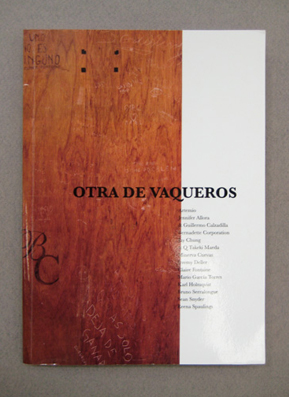
With Jennifer Allora & Guillermo Calzadilla, Artemio, Bernadette Corporation, Jay Chung & Q Takeki Maeda, Minerva Cuevas, Jeremy Deller, Claire Fontaine, Mario Garcia-Torres, Karl Holmqvist, Bruno Serralongue, Sean Snyder, Reena Spaulings, the Backroom, and Konst2
Otra de vaqueros—the book is the negative space and a souvenir of an eponymous residency and exhibition project that took place in Mexico City in 2007. Featuring stories, statements, tales, questionnaires, jokes, instructions, letters and notes by the participating artists and guest projects, the book might even provide a few hints about the mechanisms and the relational and conceptual spaces that preempted the production of the exhibition’s works, and the Otra de vaqueros project as a whole.
Edited by Perros Negros, Toasting Agency
Design by Aline Girard
June 2010, English/French
Softcover, 210 pages,175 x 240 mm
Published by
May Revue / Paris
$18.00 - Out of stock
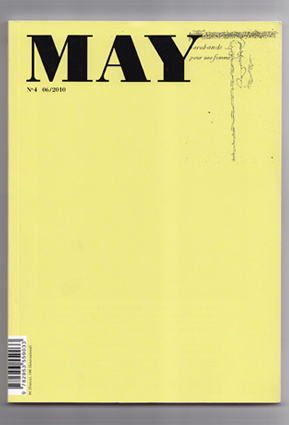
May Revue is a wonderful quarterly arts journal from Paris, edited by Catherine Chevalier and Eva Svennung.
Conceived as a collective space in which to develop thoughts and confront positions on artistic production, May magazine examines, quarterly, contemporary art practice and theory in direct engagement with the issues, contexts and strategies that construct these two fields. An approach that could be summed up as critique at work – or as critique actively performed in text and art forms alike.
Featuring essays, interviews, art works and reviews by artists, writers and diverse practitioners of the arts, the magazine also intends to address the economy of the production of knowledge – the starting point of this reflection being the space of indistinction between information and advertisment typical of our time. This implies a dialogue with forms of critique produced in other fields.
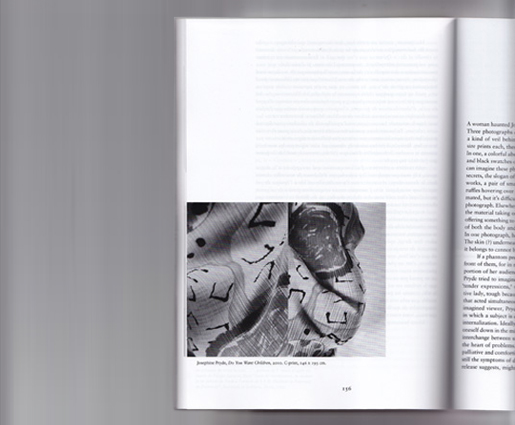
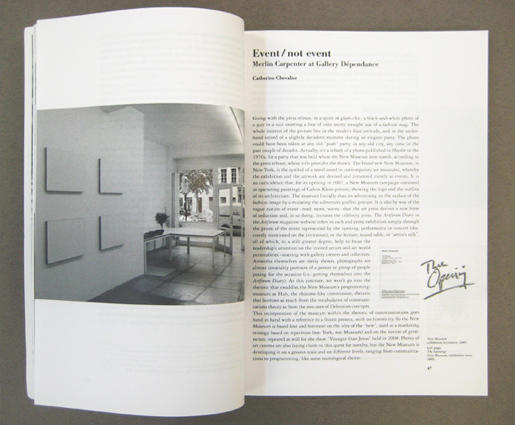
May #4 features "Entrée en matière" - Fulvia Carnevale; Sexual Difference: A Theory of Social Symbolic Practice (Chapter One) - The Milan Women’s Bookstore Collective; Nudity - La Nudité - Antonella Nappi; Autonomy and the Need for Love, Carla Lonzi, Vai Pure; Autonomie et besoin d’ amour : Carla Lonzi, Tu peux y aller, Lea Melandri; "The Ongoing Practice" - La pratique amorcée : le « groupe analyse » et le « groupe de l’inconscient » Lea Melandri; "Let’s Spit on Hegel" (Nous crachons sur Hegel) - Carla Lonzi; Sturtevant, “The Razzle Dazzle of Thinking” - David Lewis; "Why working together with an inner Voice" - Josef Strau; "Improvisation, Power, Cultural History-bending" - Tony Conrad; "In Fashion. On Josephine Pryde" - Alex Kitnick; Conversation avec Mathieu K.Abonnenc - Thomas Boutoux, François Piron et Benjamin Thorel; « Nothing rings a bell? », Brice Dellsperger, Body Double 22 - Clara Schulmann; D5 and the Gesture of Withdrawal - Jay Chung; "the spherical space of James Benning" - Leonor Antunes; and more!
2010, English/French
Softcover, 176 pages, 175 x 240 mm
Published by
May Revue / Paris
$18.00 - In stock -
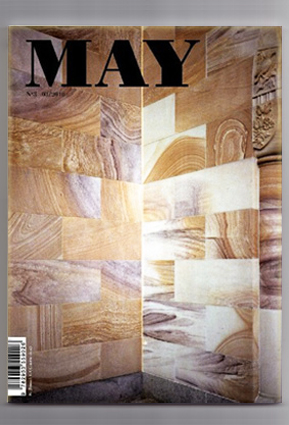
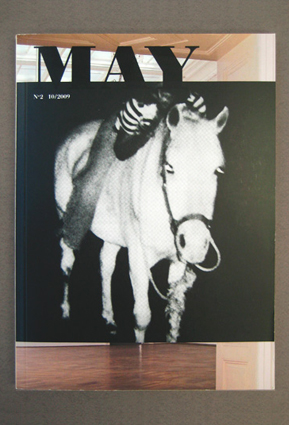
May Revue is a wonderful arts journal from Paris, edited by Catherine Chevalier and Eva Svennung.
Conceived as a collective space in which to develop thoughts and confront positions on artistic production, May magazine examines, quarterly, contemporary art practice and theory in direct engagement with the issues, contexts and strategies that construct these two fields. An approach that could be summed up as critique at work – or as critique actively performed in text and art forms alike.
Featuring essays, interviews, art works and reviews by artists, writers and diverse practitioners of the arts, the magazine also intends to address the economy of the production of knowledge – the starting point of this reflection being the space of indistinction between information and advertisment typical of our time. This implies a dialogue with forms of critique produced in other fields.
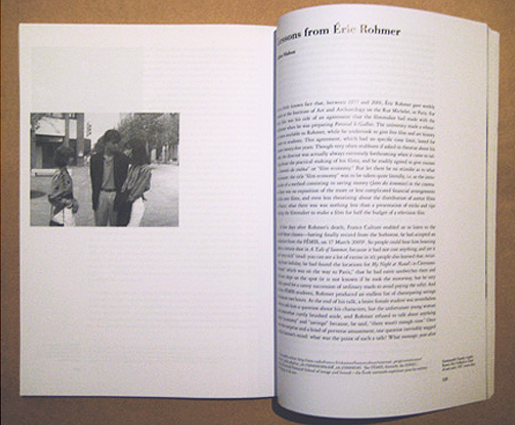
May #3 features "Grève humaine (interrompue)" Fulvia Carnevale and John Kelsey in conversation, "Lessons from Éric Rohmer" by Julien Mahon, "La Grande Parade" by Dork Zabunyan, "What Is a Bad Exhibition?" by Paul Sztulman, "The Complete Poem" by Chris Kraus, “Besides, With, Against, and Yet: Abstraction and The Ready-Made Gesture” by Caroline Busta, "CityCat, deflected in response to a system built up from under-examined details. 2 December, 2006 and 9 May, 2009, Brisbane River" by Dave Hullfish Bailey, "Shaping, Structuring, and Editing the Past" Interview with Richard Hertz by Catherine Chevalier and more!!!
2009, English/French
Softcover, 176 pages, 175 x 240 mm
Published by
May Revue / Paris
$18.00 - In stock -
May Revue is a wonderful arts journal from Paris, edited by Catherine Chevalier and Eva Svennung.
Conceived as a collective space in which to develop thoughts and confront positions on artistic production, May magazine examines, quaterly, contemporary art practice and theory in direct engagement with the issues, contexts and strategies that construct these two fields. An approach that could be summed up as critique at work – or as critique actively performed in text and art forms alike.
Featuring essays, interviews, art works and reviews by artists, writers and diverse practitioners of the arts, the magazine also intends to address the economy of the production of knowledge – the starting point of this reflection being the space of indistinction between information and advertisment typical of our time. This implies a dialogue with forms of critique produced in other fields.
May #2 features texts and contributions by/on artists and critics, including Dahn Vo, Heimo Zobernig, Anthony Elms, Jay Chung, Elvan Zabunyan, Thomas Boutoux, Catherine Chevalier, Benjamin Thorel et Patricia Falguières, Elisabeth Lebovici, Natasa Petresin-Bachelez, Gallien Dejean, Bruno Serralongue, Seth Price, Lili Reynaud Dewar, Karl Holmqvist, Juliane Rebentisch, Hegel, Dork Zabunyan, Chicago, Merlin Carpenter, and more!!!
2009, English/French
Softcover, 176 pages, 175 x 240 mm
Published by
May Revue / Paris
$18.00 - Out of stock
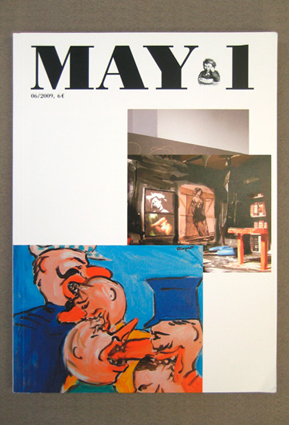
May Revue is a wonderful arts journal from Paris, edited by Catherine Chevalier and Eva Svennung.
Conceived as a collective space in which to develop thoughts and confront positions on artistic production, May magazine examines, quaterly, contemporary art practice and theory in direct engagement with the issues, contexts and strategies that construct these two fields. An approach that could be summed up as critique at work – or as critique actively performed in text and art forms alike.
Featuring essays, interviews, art works and reviews by artists, writers and diverse practitioners of the arts, the magazine also intends to address the economy of the production of knowledge – the starting point of this reflection being the space of indistinction between information and advertisment typical of our time. This implies a dialogue with forms of critique produced in other fields.May #1 features texts and contributions by/on artists and critics, including Michael Krebber, Fulvia Carnevale, Catherine Chevalier, Jay Chung, Josef Strau, Grand Openings, Stefan Germer, Karl Holmqvist, Anne Marquez, René Magritte, Jean Pierre Rehm, Clément Rodzielski, Vincent Romagny, Benjamin Thorel, Oscar Tuazon, Antek Walczak, Haacke, Broodthaers, Beuys, and more!!!
2010, English / Italian
Softcover, 312 pages, 120 × 200 cm
Published by
Archive Books / Berlin
$35.00 - Out of stock
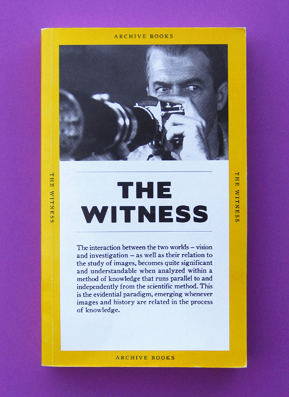
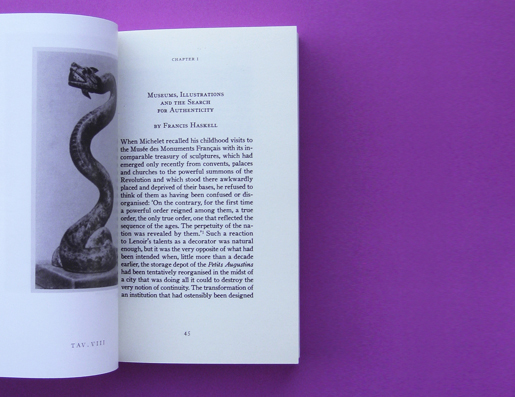
The Witness is a new book by The GAM Underground Project, Torino.
A publication to accompany the exhibition All the Memory of the World at the Gallery of Modern and Contemporary Art in Turin (The GAM). It aims to introduce the public to a selection of texts investigating the relationship between different historical methods, art and images. The book focuses on three main themes, which are divided into three different sections, each bringing forth a memory that has been ‘buried’ by a general aesthetic over-production. Images from the world’s history are observed through a ‘privileged moment in time’ in which the artist is identified as the only possible witness to our present.
Contributors include: Haris Epaminonda, Simon Fujiwara, Arnaldo Momigliano, Rossella Biscotti, Carlo Ginzburg, Patrizio di Massimo, Sean Snyder, Hito Steyerl, Clemens Von Wedemeyer, Elizabeth Edwards, Elena Volpato, Marnie Hughes-Warrington, Giorgio Agamben, Frederick N. Bohrer, Frances Haskell ...
Published by Archive Books.
2010, English
Softcover, 144 pages, offset/newsprint, 165 x 235 mm
Published by
Dexter Sinister / New York
$27.5.00 - Out of stock
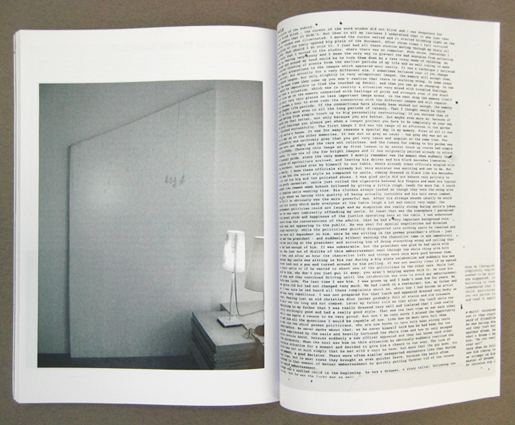
Issue 20, in which Dot Dot Dot tries—finally—to be as direct as possible about what it’s come to stand for and what it thinks it’s gonna do about it.
Includes:
2010, English
Softcover, 438 pages (16 full-color & many b/w ill.), 148 x 210 mm
Published by
Sternberg Press / Berlin
$40.00 - Out of stock
This title is now out of print.
Essays by Céline Condorelli, Mark Cousins, Jaime Stapleton, Andrea Phillips, Bart de Baere, Wouter Davidts, Eyal Weizman & Rony Brauman, Jean-Claude Lebensztejn, Jan Verwoert
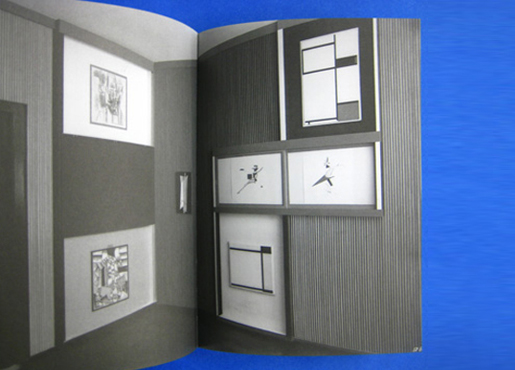
With works by Michael Asher, Artist Placement Group, Can Altay, Conrad Atkinson, Adam Broomberg & Oliver Chanarin, Lonnie van Brummelen & Siebren de Haan, Banu Cennetoglu, Christopher D’Arcangelo, Martin Beck, Cevdet Erek, Andrea Fraser, Buckminster Fuller, Ryan Gander, Ella Gibbs, Frederick Kiesler, Lucy Kimbell, James Langdon, El Lissitzky, Peter Nadin, “The offices of Peter Fend", Coleen Fitzgibbon, Jenny Holzer, Peter Nadin, Richard Prince & Robin Winters,” Gordon Matta-Clark, Antoni Muntadas, Lilly Reich, Support Structure, Rirkrit Tiravanija, Lawrence Weiner, Christopher Williams, Carey Young, a.o.
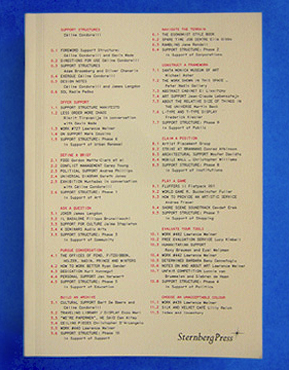
Support Structures is a manual for what bears, sustains, and props, for those things that encourage, care for, and assist; for that which advocates, articulates; for what stands behind, frames, and maintains: it is a manual for those things that give support. While the work of supporting might traditionally appear as subsequent, unessential, and lacking value in itself, this manual is an attempt to restore attention to one of the neglected, yet crucial modes through which we apprehend and shape the world.
Support Structures is a critical enquiry into what constitutes “support,” and documents the collaborative project “Support Structure” by Céline Condorelli and Gavin Wade. While registering and collecting reference projects in a new archive of support structures alongside its ten-phase project, different writers, thinkers, and practitioners were invited from various fields to elaborate on frameworks and work on texts , which form the theoretical backbone of the publication. The collection of contributions offers different possibilities for engaging in this unchartered territory, from propositions to projects, existing systems to ones invented for specific creative processes.
Support Structures offers support through potential methodologies, inspirations and activations for practice, and addresses important questions for art and architecture practices on forms of display, organization, articulation, appropriation, autonomy, and temporariness, and the manifestations of blindness towards them.
Produced in co-production with Support Structure:
Celine Condorelli and Gavin Wade with James Langdon
www.supportstructures.org
September 2010, German/English
Softcover Journal, 280 pages (colour/bw ill.), offset, 230 x 165 mm
Published by
Texte Zur Kunst / Berlin
$38.00 - Out of stock
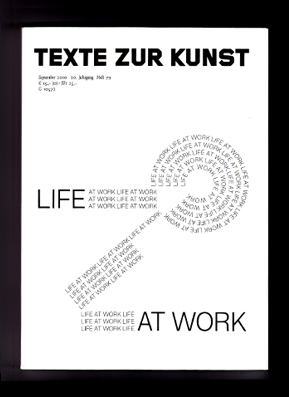
"LIFE AT WORK"
This issue of "Texte zur Kunst" bears the programmatic title "Life at Work". Admittedly, this means to take up quite a bit, for at issue is nothing less than revaluating a theoretical and historical relation that has determined the history of modern and contemporary art like almost no other: Since "around 1800", the forms of art have been ascribed a quasi-organic life of their own. An important trend in modern aesthetics sought to evoke liveliness, with the aim of offering resistance to the commodified world of capitalism itself. But how does this problematic pose itself today? Is a critical reference to "life" in art and beyond at all possible after theories of biopolitics have insistently argued that capitalism has permeated all areas of life?
Plus reviews from Berlin, Madrid, Zurich, Basel, Tel Aviv, Vienna, Barcelona, Munich, Cologne, Frankfurt am Main, Leverkusen, and Kraichtal
Includes : SVEN LÜTTICKEN - ACTS IN THE AGE OF VIRTUOSO PERFORMANCE, BRANDEN W. JOSEPH - LEE LOZANO'S DREAM OF LIFE, ERIC C. H. DE BRUYN - INTERMITTENT CONVERSATIONS ON LEAVING THE FACTORY, PATENTED IDEALISM - A Conversation between Sven Lütticken and Hito Steyerl, SABETH BUCHMANN - LIFE AS ALLEGORY On Joseph Beuys's "La revoluzione siamo Noi", RACHEL HAIDU - PERFORMANCE LIFE, PAUL CHAN - MIRACLES, FORCES, ATTRACTIONS, RECONSIDERED, ALEXANDER ALBERRO - THE SILVER LINING OF GLOBALIZATION
(On "The Potosí Principle" at the Museo Nacional Centro de Arte Reina Sofia, Madrid), MICHAEL SANCHEZ - A DOSE OF FEELING (On Michael Krebber at Galerie Daniel Buchholz, Berlin)
etc.
One of the finest art journals, period. TEXTE ZUR KUNST stands for controversial discussions and contributions by internationally leading writers on contemporary art and culture. Alongside ground-breaking essays the quarterly magazine, founded in Cologne in 1990 by Stefan Germer (†) and Isabelle Graw and published in Berlin since 2000, offers interviews, roundtable discussions and extensive reviews on art, film, music, market and fashion as well as on art history, theory and cultural politics. Since 2006 the comprehensive main section section, each time devoted to a different topic, and selected reviews are published in both German and English.