World Food Books' programme is largely produced on Kulin Nation land. We acknowledge the Wurundjeri people of the Kulin Nation as the first and continuing custodians of this land, and pay respect to their Elders past, present, and emerging.
World Food Books is an arts and special interests bookshop in Naarm / Melbourne. Founded in 2010, World Food Books is devoted to the presentation of a rotating, hand-selection of international art, design, literary and counterculture publications with an emphasis on the anti-traditional, the experimental, the avant-garde, the heretic, the marginal.
Presenting new titles alongside rare and out-of-print books, catalogues and journals spanning the fields of modern and contemporary art, design, photography, illustration, film, literature, poetry, cultural theory, philosophy, sexuality, popular and underground culture in its many radical forms, World Food Books wishes to encourage adventurous, thoughtful and open-minded reading, looking, writing, and exchange of publishing and ideas, both current and historical.
As well as our bookshop, located in Melbourne's historical Nicholas Building, all of our inventory is available internationally via our online mail-order service.
World Food Books semi-regularly co-ordinates "Occasions", a programme of exhibits and events at the bookshop and in partnership with other hosts (such as museums and art galleries) that develop out of the activities, relationships and content of the bookshop itself.
World Food Books
The Nicholas Building
37 Swanston Street
Room 5, Level 6
Melbourne 3000
Australia
SHOP HOURS:
Thu–Sat 11–5
WEB-SHOP OPEN 24/7
World Food Books
Postal Address:
PO Box 435
Flinders Lane
Victoria 8009
Australia
Art
Theory / Essay
Architecture / Interior
Graphic Design / Typography
Photography
Fashion
Eros
LGBTQ+
Fiction / Poetry
Weird / Speculative / Science Fiction / Horror
Transgressive / Visceral / Abject
Symbolism / Decadence / Fin de siècle
Film / Video
Painting
Sculpture / Installation
Performance / Dance / Theater
Drawing
Sound / Music
Curatorial
Group Shows / Collections
Periodicals
Out-of-print / Rare
Posters / Ephemera / Discs
Signed Books
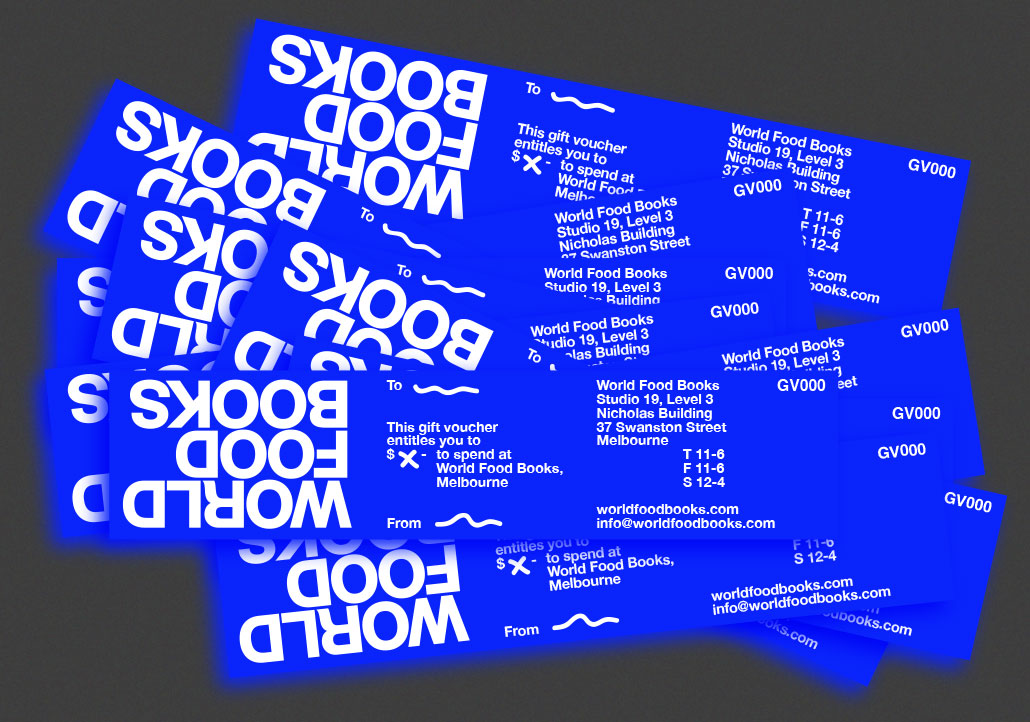
World Food Books Gift Voucher
World Food Book Bag
Australian Art
Australian Fiction
Australian Science Fiction / Speculative Fiction
Australian Poetry
Australian Photography
Japanese Photography
Conceptual Art
Minimal Art
Dada
'Pataphysics / Oulipo
Fluxus
Concrete Poetry
Pop Art
Surrealism
Arte Povera
Arte Informale / Haute Pâte / Tachism
Nouveau Réalisme / Zero / Kinetic
Situationism / Lettrism
Collage / Mail Art / Xerox Art
Art Brut / Folk / Visionary / Fantastic
Illustration / Graphic Art / Bandes Dessinées
Furniture
Italian Radical Design / Postmodernism
Textiles
Ceramics / Glass
Counterculture
Protest / Revolt
Philosophy
Psychoanalysis
Anthropology
Anarchism
Socialism / Anarchism / Communism / Capitalism
Literary Theory / Semiotics / Language
Feminism / Women's Studies
Gender Studies / Sexuality
Anthropology
Fetishism / BDSM
Drugs / Psychedelia
Crime / Violence
Animal Rights / Veganism
Occult / Esoterica
Ecology / Earth / Alternative Living
Whole Earth / Crafts
All prices in AUD (Australian dollars)
Pick-Ups
Pick-up orders can be collected in our bookshop during opening hours after order date. Please collect any Pick-up orders within 2 weeks of ordering as we have limited storage space. Orders will be released back into stock if not collected within this time. No refunds can be made for pick-ups left un-collected. If you cannot make it in to the bookshop in this time-frame, please choose postage option.
Return Policy
All sales are final. We do accept returns (for refund or exchange) for items received in error. All our orders are packed with special care using heavy-duty padding and cardboard book-mailers or bubble mailers (for smaller books), using reinforcement where required. We cannot take responsibility for any lost, stolen or damaged parcels.
Insurance
Should you wish to insure your package, please email us directly after placing your order and we can organise this at a small extra expense. Although all standard/express tracked packages are very safe and dependable, we cannot take responsibility for any lost, stolen or damaged parcels. We recommend insurance on valuable orders.
Interested in selling your old books, catalogues, journals, magazines, comics, fanzines, ephemera? We are always looking for interesting, unusual and out-of-print books to buy. We only buy books in our fields of interest and specialty, and that we feel we can resell.
We base these prices on desirability, market value, in-print prices, condition and our current stock levels. We offer cash, store credit, and can take stock on consignment. All
about 25% of the price we expect to get when we sell them, or 30% in store credit. We base these prices on desirability, market value, in-print prices, condition and our current stock levels.
Sell your books any day of the week. You can drop them off and return later. If you have a lot of books, we can visit your Sydney home.
We buy books that we feel we can resell. We offer about 25 % of the price we expect to get when we sell them, or 30% in store credit. We base these prices on desirability, market value, in-print prices, condition and our current stock levels.
Philadelphia Wireman
03 August - 01 September, 2018
World Food Books is proud to announce our next Occasion, the first presentation of sculptures by Philadelphia Wireman in Australia.
The Philadelphia Wireman sculptures were found abandoned in an alley off Philadelphia’s South Street on trash night in 1982. Their discovery in a rapidly-changing neighbourhood undergoing extensive renovation, compounded with the failure of all attempts to locate the artist, suggests that the works may have been discarded after the maker’s death. Dubbed the "Philadelphia Wireman" during the first exhibition of this work, in 1985, the maker’s name, age, ethnicity, and even gender remain uncertain. The entire collection totals approximately 1200 pieces, all intricately bound together with tightly-wound heavy-gauge wire (along with a few small, abstract marker drawings, reminiscent both of Mark Tobey and J.B. Murry). The dense construction of the work, despite a modest range of scale and materials, is singularly obsessive and disciplined in design: a wire armature or exoskeleton firmly binds a bricolage of found objects including plastic, glass, food packaging, umbrella parts, tape, rubber, batteries, pens, leather, reflectors, nuts and bolts, nails, foil, coins, toys, watches, eyeglasses, tools, and jewellery.
Heavy with associations—anthropomorphic, zoomorphic, and socio-cultural responses to wrapped detritus—the totemic sculptures by Philadelphia Wireman have been discussed in the context of work created to fulfil the shamanistic needs of alternative religions in American culture. Curators, collectors, and critics have variously compared certain pieces to sculpture from Classical antiquity, Native American medicine bundles, African-American memory jugs, and African fetish objects. Reflecting the artist’s prolific and incredibly focused scavenging impulse, and despite—or perhaps enhanced by—their anonymity, these enigmatic objects function as urban artefacts and arbiters of power, though their origin and purpose is unknown. Philadelphia Wireman, whatever their identity, possessed an astonishing ability to isolate and communicate the concepts of power and energy through the selection and transformation of ordinary materials. Over the course of the past two decades, this collection has come to be regarded as an important discovery in the field of self-taught art and vernacular art.
Presented in collaboration with Fleisher-Ollman Gallery, Philadelphia, and Robert Heald, Wellington.
Susan Te Kahurangi King
02 February - 10 March, 2018
Susan Te Kahurangi King (24 February 1951 - ) has been a confident and prolific artist since she was a young child, drawing with readily available materials - pencils, ballpoint pens and felt-tip markers, on whatever paper is at hand. Between the ages of four and six Susan slowly ceased verbal communication. Her grandparents William and Myrtle Murphy had developed a special bond with Susan so they took on caring responsibilities for extended periods. Myrtle began informally archiving her work, carefully collecting and storing the drawings and compiling scrapbooks. No drawing was insignificant; every scrap of paper was kept. The King family are now the custodians of a vast collection containing over 7000 individual works, from tiny scraps of paper through to 5 meter long rolls.
The scrapbooks and diaries reveal Myrtle to be a woman of great patience and compassion, seeking to understand a child who was not always behaving as expected. She encouraged Susan to be observant, to explore her environment and absorb all the sights and sounds. Myrtle would show Susan’s drawings to friends and people in her community that she had dealings with, such as shopkeepers and postal workers, but this was not simply a case of a grandmother’s bias. She recognised that Susan had developed a sophisticated and unique visual language and sincerely believed that her art deserved serious attention.
This was an unorthodox attitude for the time. To provide some context, Jean Dubuffet coined the term Art Brut in 1945 to describe work created by self-taught artists – specifically residents of psychiatric institutions and those he considered to be visionaries or eccentrics. In 1972 Roger Cardinal extended this concept by adopting the term Outsider Art to describe work made by non-academically trained artists operating outside of mainstream art networks through choice or circumstance. Susan was born in Te Aroha, New Zealand in 1951, far from the artistic hubs of Paris and London that Dubuffet and Cardinal operated in. That Myrtle fêted Susan as a self-taught artist who deserved to be taken seriously shows how progressive her attitudes were.
Susan’s parents Doug and Dawn were also progressive. Over the years they had consulted numerous health practitioners about Susan’s condition, as the medical establishment could not provide an explanation as to why she had lapsed into silence. Dawn educated herself in the field of homeopathy and went on to treat all twelve of her children using these principles – basing prescriptions on her observations of their physical, mental and emotional state.
Doug was a linguist with an interest in philosophy who devoted what little spare time he had to studying Maori language and culture. To some extent their willingness to explore the fringes of the mainstream made them outsiders too but it was their commitment to living with integrity and their respect for individuality that ensured Susan’s creativity was always encouraged.
Even though Susan’s family supported her artistic pursuits, some staff in schools and hospitals saw it as an impediment to her assimilation into the community and discouraged it in a variety of ways. Her family was not always aware of this and therefore did not fully understand why Susan stopped drawing in the early 1990s. However, rather than dwell on the challenges that Susan faced in pursuit of her artistic practice, they prefer to highlight her achievements. In 2008 Susan began drawing again in earnest, after an almost 20 year interruption, and her work is now shown in galleries around the world.
Susan grew up without television and has been heavily influenced by the comics she read as a child. She is absolutely fearless in the appropriation of recognizable characters, such as Donald Duck and Mickey Mouse, in her work. She twists their limbs, contorts their faces, compresses them together, blends them into complex patterned backgrounds - always imbuing them with an incredible energy. Although Susan often used pop culture characters in her work they are not naive or childlike. These are drawings by a brilliant self-taught artist who has been creating exceptional work for decades without an audience in mind.
Mladen Stilinović
"Various Works 1986 - 1999"
02 February 16 - September 10, 2016
Various works 1986 - 1999, from two houses, from the collections of John Nixon, Sue Cramer, Kerrie Poliness, Peter Haffenden and Phoebe Haffenden.
Including: Geometry of Cakes (various shelves), 1993; Poor People’s Law (black and white plate), 1993; White Absence (glasses, ruler, set square, silver spoon, silver ladel with skin photograph and wooden cubes), 1990-1996; Exploitation of the Dead (grey and red star painting, wooden painting, black spoon with red table, red plate), 1984-1990; Money and Zeros (zero tie, paintings made for friends in Australia (Sue, John, Kerrie), numbers painting), 1991-1992; Words - Slogans (various t-shirts) - “they talk about the death of art...help! someone is trying to kill me”, “my sweet little lamb”, “work is a disease - Karl Marx”; Various artist books, catalogues, monographs, videos; Poster from exhibition Insulting Anarchy; "Circular" Croatian - Australian edition; Artist book by Vlado Martek (Dostoyevsky); more.
Thanks to Mladen Stilinović and Branka Stipančić.
Jonathan Walker
Always Will Need To Wear Winter Shirt Blue + Ochre Small Check Pattern
21 August - 21 September, 2015
Untitled
I am not a great reader of poetry but I always return to the work of Melbourne poet, Vincent Buckley (1925- 1988). Perhaps I find his most tantalising piece to be not a finished poem but a fragment left on a scrap of paper discovered on his desk after the poet’s death.
The poetry gathers like oil
In the word-core, and spreads
It has its music meet,
Its music is in movement.
This fragment is more the shell left behind from a volatile thought than a finished poem. I find the last two lines honest but awkward whereas the first two lines work like an arrow. Most likely he could not find a resolution so it was left. Still, in its present form, it remains an eloquent testimony to the ultimate failure of a medium to express mobile thought and sensation, in Buckley’s case, through verbal language. It’s an important matter because this is something all artists have to deal with regardless of the medium.
I have never written a poem, however, I am forever copying fragments from books on paper scraps in a vain effort to fix certain notions in my head. At first, they function as bookmarks that are sometimes returned to when I open the book. But before long, as they accumulate, they fall out littering the table interspersed with A4 photocopies, bills, books and medications.
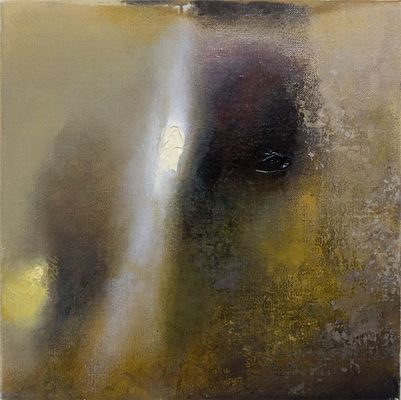
To return to Buckley’s fragment, the first two lines very much evoke how I paint nowadays. As you age, detail diminishes and patches of light become more luminous and float. I feel the most honest way of dealing with this is by smearing the oil paint on the canvas with the fingers and working close-up, blind. Only if the patches coalesce into an approaching image can the work gain a life.
-
Jonathan Walker was born in Melbourne, Australia and brought up on a dairy farm in Gippsland. In the 1970’s he studied painting at RMIT and won the Harold Wright Scholarship to the British Museum, London. During the 1980’s he exhibited at Pinacotheca Gallery, Richmond and had work shown at the NGV and Heidi City Art Gallery. Over the same period he designed the cover for the “Epigenesi” LP by Giancarlo Toniutti, Italy and conducted a mail exchange work with Achim Wollscheid, Germany. The work with artists through the post resulted in an article published in the bicentenary issue of Art and Australia 1988. He showed in artist run spaces such as WestSpace in the 90’s and 2000’s, and until 2012, taught painting at Victoria University, which is where we (Colleen Ahern and Lisa Radford) as organisers of the exhibition, among many others, had the privilege of being his student.
Walker’s knowledge was imparted to students through the careful selection of music, literature, and artists found in books that he himself had ordered for the library. Walker’s strategy was the generosity of sharing his vast knowledge with references specific to each student and their context.
Walker’s paintings share a similar focus and intimacy.
This exhibition presents a small selection of recent paintings alongside a publication that includes Walker’s writing. Observational and analytical, Walker’s work is a type of material notation — the time of day, colour and how it is blended, the both specific and fleeting location of a reflection on lino or the question of whether a chair leg should be included in a painting.
Please join us on Friday August 21 between 6-8pm to celebrate the opening of the exhibition.
Curated by Colleen Ahern and Lisa Radford.
B. Wurtz
Curated by Nic Tammens
March 26 - April 4, 2015
B.Wurtz works from a basement studio in his home on Manhattan’s Lower East Side.
This local fact is attested to by the plastic shopping bags and newsprint circulars that appear in his work. As formal objects, they don’t make loud claims about their origins but nonetheless transmit street addresses and places of business from the bottom of this long thin island. Like plenty of artists, Wurtz is affected by what is local and what is consumed. His work is underpinned by this ethic. It often speaks from a neighborhood or reads like the contents of a hamper:
“BLACK PLUMS $1.29 lb.”
“Food Bazaar”
“USDA Whole Pork Shoulder Picnic 99c lb.”
“RITE AID Pharmacy, with us it’s personal.”
“H. Brickman & Sons.”
“Sweet Yams 59c lb."
Most of the work in this exhibition was made while the artist was in residence at Dieu Donne, a workshop dedicated to paper craft in Midtown. Here Wurtz fabricated assemblages with paper and objects that are relatively lightweight, with the intention that they would be easily transportable to Australia. This consideration isn’t absolute in Wurtz’s work, but was prescriptive for making the current exhibition light and cheap. Packed in two boxes, these works were sent from a USPS post office on the Lower East Side and delivered to North Melbourne by Australia Post.
Wurtz appears courtesy of Metro Pictures, New York.
Thanks to Rob Halverson, Joshua Petherick, Sari de Mallory, Matt Hinkley, Helen Johnson, Fayen d'Evie, Ask Kilmartin, Lisa Radon, Ellena Savage, Yale Union, and "Elizabeth".
John Nixon
"Archive"
December 15 - January 20, 2014
The presentation of John Nixon's archive offered a rare showcase of this extensive collection of the artist's own publications, catalogues, posters, ephemera, editions and more, from the mid 1980s onwards, alongside a selection of his artworks.
Organized by John Nixon, Joshua Petherick and Matt Hinkley.
"Habitat"
at Minerva, Sydney (organised by Joshua Petherick and Matt Hinkley)
November 15 - December 20, 2014
Lupo Borgonovo, Janet Burchill & Jennifer McCamley,
Lewis Fidock, HR Giger, Piero Gilardi, Veit Laurent Kurz,
Cinzia Ruggeri, Michael E. Smith, Lucie Stahl, Daniel Weil, Wols
Press Release:
“...It contained seven objects. The slender fluted bone, surely formed for flight, surely from the wing of some large bird. Three archaic circuitboards, faced with mazes of gold. A smooth white sphere of baked clay. An age-blackened fragment of lace. A fingerlength segment of what she assumed was bone from a human wrist, grayish white, inset smoothly with the silicon shaft of a small instrument that must once have ridden flush with the surface of the skin - but the thing’s face was seared and blackened.”
William Gibson, “Count Zero”, 1986
"Autumn Projects Archive"
Curated by Liza Vasiliou
March 6 - March 15, 2014
World Food Books, in conjunction with the Virgin Australia Melbourne Fashion Festival 2014, presented the Autumn Projects archive, consisting of a selection of early examples in Australian fashion with a particular interest in collecting designers and labels from the period beginning in the 1980’s, who significantly influenced the discourse of Australian Fashion.
Curated by Liza Vasiliou, the exhibition provided a unique opportunity to view pieces by designers Anthea Crawford, Barbara Vandenberg, Geoff Liddell and labels CR Australia, Covers, Jag along with early experimental collage pieces by Prue Acton and Sally Browne’s ‘Fragments’ collection, suspended throughout the functioning World Food Books shop in Melbourne.
H.B. Peace
presented by CENTRE FOR STYLE
November 14, 2013
"Hey Blinky, you say chic, I say same"
Anon 2013
H.B. Peace is a clothing collaboration between great friends Blake Barns and Hugh Egan Westland. Their pieces explore the divergences between 'character’ and ‘personality’ in garments....etc
Special Thanks to Joshua Petherick and Matt Hinkley of WFB and Gillian Mears
and a Very Special Thank you to Audrey Thomas Hayes for her shoe collaboration.
Janet Burchill & Jennifer McCamley
"Aesthetic Suicide"
May 10 - June 8, 2013
The first of our occasional exhibitions in the World Food Books office/shop space in Melbourne, "Aesthetic Suicide" presented a body of new and older works together by artists Janet Burchill & Jennifer McCamley, including videos, prints, a wall work, and publications.
During shop open hours videos played every hour, on the hour.
$.00 - Out of stock
The eternal clean out! New items weekly.
https://worldfoodbooks.com/category/sale
Published by World Food Books / Melbourne
$20.00 - In stock -
A World Food Books gift voucher is redeemable in our Melbourne bookshop or via our webshop (here). An e-voucher (printable pdf) will be sent to your purchase email address (please notify us if you wish to have the voucher sent to an alternate address and wish us to fill in the receiver's details on the card).
Gift vouchers can be purchased in increments of $20 (Australian Dollars) and the total amount can simply be added to by increasing the quantity in your shopping cart. eg. A quantity of 5 gift vouchers will result in an item total of $100 - a $100 gift voucher. Simply click "ADD TO CART" 5 times, or update your quantity in the shopping cart.
If you wish to purchase multiple, separate gift vouchers in one go, please just email us and we can personally prepare and email you a payment request.
Please note: Please select Pick-Up on gift voucher purchse to avoid any postage charges. Accidental postage charges will be refunded right away!
Thank you.
For any questions, please don't hesitate to email: [email protected]
2025, English
Softcover, 360 pages, 21.5 x 14 cm
Published by
University of Minnesota Press / Minnesota
Univocal Publishing / Minneapolis
$62.00 - In stock -
From 1970 until 1987, Gilles Deleuze held a weekly seminar at the Experimental University of Vincennes and, starting in 1980, at Saint-Denis. In the spring of 1981, he began a series of eight seminars on painting and its intersections with philosophy. The recorded sessions, newly transcribed and translated into English, are now available in their entirety for the first time. Extensively annotated by philosopher David Lapoujade, On Painting illuminates Deleuze's thinking on artistic creation, significantly extending the lines of thought in his book Francis Bacon.
Through paintings and writing by Rembrandt, Delacroix, Turner, Cezanne, Van Gogh, Klee, Pollock, and Bacon, Deleuze explores the creative process, from chaos to the pictorial fact. The introduction and use of color feature prominently as Deleuze elaborates on artistic and philosophical concepts such as the diagram, modulation, code, and the digital and the analogical. Through this scrutiny, he raises a series of profound and stimulating questions for his students: How does a painter ward off greyness and attain color? What is a line without contour? Why paint at all?
Written and thought in a rhizomatic manner that is thoroughly Deleuzian-strange, powerful, and novel-On Painting traverses both the conception of art history and the possibility of color as a philosophical concept.
Edited by David Lapoujade, translated by Charles J. Stivale.
1988, English
Softcover, 130 pages, 20.5 x 14 cm
1st Edition, Out of print title / used / fine
Published by
City Lights Books / San Francisco
$30.00 - Out of stock
First 1988 edition.
Spinoza’s theoretical philosophy is one of the most radical attempts to construct a pure ontology, with a single infinite substance, and all beings as the modes of being of this substance.
This book, which presents Spinoza’s main ideas in dictionary form, has as its subject the opposition between ethics and morality, and the link between ethical propositions and ontological propositions. His ethics is an ethology, rather than a moral science. Recent attention has been drawn to Spinoza by deep ecologists such as Arne Naess, the Norwegian philosopher; and this new reading of Spinoza by Deleuze lends itself to a radical ecological ethic. As Robert Hurley says in his introduction, Deleuze opens us to the idea that the elements of the different individuals we compose may be nonhuman within us. One wonders, finally, whether Man might be defined as a territory, a set of boundaries, a limit on existence.
VG—NF.
1978, Japanese
Softcover (staple-bound), 25.5 x 18 cm
1st Edition, Out of print title / used / very good
Published by
Queer Kids / Tokyo
$90.00 - In stock -
Super rare glam rock issue of the super rare PANSY fanzine, published by Queer Kids in Tokyo in the 1970s. Never seen another issue ever before (apparently 12 were produced), PANSY applies the queer gaze to the world of glam rock, post punk, new romantic... T-Rex/Marc Bolan, New York Dolls, David Bowie, Japan, Slade, Roxy Music, Raped, Brats ... photographing, interviewing, and profiling the princes of the new androgynous wave with school diary visual sensibility and DIY hand-collage aesthetic throughout. Includes a New York Dolls family tree, loads of magazine clipped pictures, and hand-written Japanese texts. Very obscure, very charming, very Japanese.
Very Good copy with small previous sticker damage to top of spine (front/back), otherwise only light edge wear and age.
1980?, English
Softcover (staple-bound), 16 pages, 29.5 x 20.8 cm
1st Edition, Out of print title / used / good
Published by
BOY / London
$150.00 - In stock -
Very rare original BOY London Blackmail catalogue circa early—mid 1980s, featuring all the classic BOY range from one of London’s most iconic original punk shops/fashion labels, founded in 1976 by Stephane Raynor. Likely designed by Peter "Sleazy" Christopherson (Throbbing Gristle/Psychic TV/Coil/Hipgnosis) who designed the BOY logo and much of their visual collateral, his photo catalogue, featuring models from around the London punk scene, was originally privately issued by BOY London to be used for mail-order and wholesale orders. It features all the original Vivienne Westwood and Malcolm McLaren Seditionaries designs, from the t-shirts (Sex Pistols' God Save The Queen, Destroy, Tom of Finland, etc.) to footwear, parachute shirts, bondage trousers and mohair jumpers, which were all sold in BOY after Seditionaries closed in September 1980. It also features BOY's own (equally iconic) designs and wild styling, with amazing hair and make-up by Jalle. Extremely rare piece of London's punk fashion history.
Good copy with light general handling wear/spine pinching.
2016, English
Softcover, 464 pages, 19.7 x 13 cm
Published by
Penguin Books / London
$28.00 - In stock -
A new translation of Sade's most notorious, shocking, and influential novel
This distressing but hugely important text, which the Marquis de Sade himself called "the most impure tale that has ever been written since the world exists," has influenced countless major artists and thinkers throughout history. Flaubert and Baudelaire both read Sade, the surrealists were obsessed with him, filmmakers like Pasolini saw parallels with twentieth-century history in his writings, and feminists such as Simone de Beauvoir and Angela Carter fought over him. This new translation brings Sade's provocative novel into Penguin Classics for the first time, and will reignite the debate around this most controversial of writers.
For more than seventy years, Penguin has been the leading publisher of classic literature in the English-speaking world. With more than 1,700 titles, Penguin Classics represents a global bookshelf of the best works throughout history and across genres and disciplines. Readers trust the series to provide authoritative texts enhanced by introductions and notes by distinguished scholars and contemporary authors, as well as up-to-date translations by award-winning translators.
1988, Japanese
Softcover (staple-bound), 98 pages, 27 x 21 cm
1st Edition, Out of print title / used / very good
Published by
Sun Publishing / Japan
$45.00 - In stock -
April 1988 issue of Sun Publishing's Sexy Look magazine, a highly collected glossy photo magazine from Tokyo that is made up entirely of colour and b/w spreads throughout that take a single word or phrase, like an accumulative gentlemen's magazine cum encyclopedia of the bizarre, to introduce the reader to titillating thrills, perversions, weird crimes, unusual customs, anthropological oddities, and the 1980s Japanese sex industry from all angles each month. The most prominent angle was a low one, as primarily the magazine was an excuse for the many contributing photographers to take "close-up" peeper/FLASH photography of women (ala Kohei Yoshiyuki and Ikko Kagari). Lots of Tokyo sex club material, with spreads punctuated by ads for pink videos and sex toys.
Very Good copy, light wear.
1972, English
Hardcover (clothbound), unpaginated, 28.5 x 22 cm
1st Edition, Out of print title / used / average
Published by
A S Barnes / New York
$250.00 - In stock -
Rare copy of “The Face Of Love”, a seldom seen classic erotic photo book from the 1960s by the remarkable and misunderstood Dutch photographer Sanne Sannes, one of the archetypal visionaries of sixties Amsterdam, who was tragically killed in 1967 in an automobile accident at the age of thirty. A beautiful book of Sannes' experimental heavy grain b/w nude photography, effectively employing blur, bokeh, close-ups, etc. to express the emotional nature of his subjects hidden from view. In the strong contrast between light and darkness, life and death, Sannes' outstanding camera work reveals the fascinating beauty of women with an intimate honesty seldom seen. "The Face of Love" was posthumously published in 1972 and contains about 200 full-page illustrations with accompanying essays by Jim Hughes and Louwrien Wijers.
"Sanne Sannes was the enfant terrible in photography, doing things which are not done; neither sharpness, nor clearness, not one technical axiom in photography meant anything to him. He was an artist at work.
A painter, at first only using black and white, later mixing the colors of his film in an imaginative way. His main subject was the full range of emotions connected with love: the sexy and erotic as well as the desireous and paralyzing love-emotions. His work showed a warm heart for the way women love. He was eager to know their inmost feelings and constantly he tried to hit the source of their emotions."—Louwrien Wijers
"Sanne Sannes did not make easy photographs. Certainly, he did not make pretty photographs. I'm not even sure he made photographs. He made explorations of people, of their outsides and their insides, and sent back picture postcards of their psyches. If you looked hard at some of these, you could make out a scribbled message: "Having a great time. Glad you're here."—Jim Hughes
"Suddenly the subject he often talked about was there. Death obsessed him. Life enthralled him. He played the game of life with insatiable enthusiasm. Laughing defiantly, speaking satirically, moving firmly and working energetically, he proved himself indomitable every moment and in every situation. He was the jolly joker in this game of his. He made all the tricks. Then all of a sudden the winner lost. Sanne Sannes' brilliant mind, moving mastership and inspiring personality were destroyed in a fatal car crash Thursday March 23, 1967, three days after his thirtieth birthday."—Louwrien Wijers
The Dutch photographer Sanne Sannes (Groningen, 1937-1967) is known for his experimental black and white photographs with large film grains and fast shutter speeds. His work is full of erotic and mysterious portraits of women. Sannes, referred to by some as the Marquis de Sade of Holland, was an elusive personality, just like his works, and died at the young age of 30.
Average—Good copy without dust jacket. Some tanning to edges and creasing to some pages, heavy "fan" creasing on one spread with some resultant damage. Otherwise generally Good throughout.
1969, Dutch
Hardcover, 118 pages, 17 x 28 cm
1st Edition, Out of print title / used / very good
Published by
De Bezige Bij / Amsterdam
$300.00 - Out of stock
Rare first hardcover edition of Sanne Sannes' wild Sex A GoGo published in 1969 by De Bezige Bij, Amsterdam. When Sex a Gogo was published in 1969 Sanne Sannes, the remarkable and misunderstood Dutch photographer Sanne Sannes, one of the archetypal visionaries of sixties Amsterdam, had recently been killed in a car accident at the age of 30. His wonderful Sex a Gogo book featured his signature heavy grain erotica in a unique kind of erotic-pop-sex-manual form, complete with fantastic psychedelic collaging and graphic cartoon elements. The book's montages were devised by designer Walter Steevensz who took over the project when Sannes died and it is his vision as much as the photographer's that is evidenced in this typically 1960s comedy of sexual mores. Yet however comical Sex a Gogo never allows us to forget about its erotic intentions.
The Dutch photographer Sanne Sannes (Groningen, 1937-1967) is known for his experimental black and white photographs with large film grains and fast shutter speeds. His work is full of erotic and mysterious portraits of women. Sannes, referred to by some as the Marquis de Sade of Holland, was an elusive personality, just like his works, and died at the young age of 30.
Good—Very copy with some wear to cover extremities.
1979, English
Softcover, 144 pages, 28 x 21.5 cm
1st Edition, Out of print title / used / good
Published by
F & S / New York
$45.00 - In stock -
First 1979 popular edition of VELVET EDEN: The Richard Merkin Collection of Erotic Photography, a book of playful and now classic sepia-toned erotic photography from the first half of the 20th century, published by F & S, produced and edited by Harris Lewine, with commentary by Richard Merkin and Bruce McCall, designed with Louise Fili. The seed for this now classic, very playful volume of erotica was planted when an art director (Harris Lewine) required a photograph the book jacket design of Anaïs Nin's Delta of Venus. Where did this photograph come from?
Average—Good copy, general wear/age, light cover creasing, previous owner's name to first page.
1986, French
Softcover, 30 pages, 15 x 10.5 cm
1st Edition, Out of print title / used / very good
Published by
Carton Éditions / Lyon
$55.00 - In stock -
Early 1986 pocket book of medical fetish illustration by Romain Slocombe, "Sad Vacations". Fifteen full colour works by Slocombe are accompanied by texts (in French) by François Landon and descriptions of each work by Jacques Peeters.
A French cartoonist, illustrator, book author, translator, photographer and filmmaker, Romain Slocombe, born in Paris in 1953, began his career as an illustrator working on comics and counter-culture magazines such as Métal Hurlant in the late 1970s and early 1980s. As an artist, he was closely involved with the punk Bazooka collective, with Kiki Picasso, Bernard Vidal, Natsuko, Yoshi Ichimura, Fred Chalmer, Loulou Picasso, and others, having studied alongside many of its members at the École des Beaux-Arts in Paris. He became known as a comic strip author and published his first bondage album, Prisoner of the Red Army, which caused a scandal. While bandaging women, the artist develops an aesthetics of upheaval, of which J.G. Ballard became the cult writer. Seizing the dark side of Japanese fetishism to invent a new genre of artistic SM — "surgical bondage", Slocombe's medical fetishised "broken dolls" would enter into subcultural history forever through the 1996 publication City of Broken Dolls. Slocombe's distinctive paintings, drawings and photographs of women in medical bondage — tied, injured, bandaged, imprisoned and hospitalised, often combining a re-working of historical political revolution, WW2, noir fiction, and Japanese photographic SM imagery with the graphic language of bande dessinée comic-roman and new wave expressionism, became some of the most strikingly original and influential erotic art of the subcultural 1990s.
Very Good copy, light wear/age.
2022, English
Softcover, 192 pages, 21 x 13.5 cm
Signed by the author,
Published by
Black Inc / Melbourne
$28.00 - In stock -
A dark and compelling work by a new voice in Australian – and world – literary fiction.
A nomad swallows poison and drowns himself. Resuscitated by a paramilitary bandit named Aslan, Figure is nursed back into a world of violence, sexuality and dementia. Together, Figure and Aslan traverse a coastline erupting in conflict. When the nearest city is ethnically cleansed, Figure escapes on the last ship evacuating to the other isle of the sea. Crossing village to village largely on foot, a slew of outcasts and ghosts guide him as he navigates states of cultural and metaphysical crisis.
Scott McCulloch’s debut novel, Basin, explores the axis of landscape and consciousness. Echoing the modernist tradition, and written in an incendiary yet elliptical prose style, Basin maps the phenomenon of a civilisation being reborn – a hallucinatory elegy to the inter-zones of self and place.
Born in Melbourne, based between Ukraine and the Caucasus since 2014, and currently dividing his time between Lebanon and Georgia, Scott McCulloch works with prose, essay and sound. His writings have appeared in various magazines and journals worldwide. Basin is his debut novel.
1998, German
Hardover (w. dust jacket), 140 pages, 30 x 23 cm
1st Edition, Out of print title / used / good
Published by
Prestel / Munich
$70.00 - In stock -
First edition of this excellent first German monograph on Swiss artist Daniel Spoerri, published by Prestel in 1998. Profusely illustrated with Spoerri's incredible artistic history of installations, performances, studio photos, editions, and other activities across important associations with Fluxus, Nouveau réalisme and Eat Art; works across sculpture, assemblage, action, and relief, including a great number of his iconic "snare works". Includes an exhibition history, bibliography and extensive text in German by Heidi E. Violand-Hobi.
Daniel Spoerri (b. 1930) is a Swiss artist and writer born in Romania. Spoerri is best known for his "snare-pictures". In 1960, Spoerri made his first "snare-picture": "objects found in chance positions, in order or disorder (on tables, in boxes, drawers, etc.) are fixed (‘snared’) as they are. Only the plane is changed: since the result is called a picture, what was horizontal becomes vertical. Example: remains of a meal are fixed to the table at which the meal was consumed and the table hung on the wall." His first "snare-picture", Kichka's Breakfast was created from his girlfriend's leftover breakfast. The piece is now in the collection in the Museum of Modern Art in New York. One snare-picture, made in 1964, consists of the remains of a meal eaten by Marcel Duchamp. He also is widely acclaimed for his book, Topographie Anécdotée* du Hasard (An Anecdoted Topography of Chance), a literary analog to his snare-pictures, in which he mapped all the objects located on his table at a particular moment, describing each with his personal recollections evoked by the object, with illustrations by the great Roland Topor. In the 1950s he was active in dance, studying classical dance with Olga Preobrajenska and in 1954 becoming the lead dancer at the State Opera of Bern, Switzerland. He later staged several avant-garde plays including Ionesco's The Bald Soprano and Picasso's surrealist Desire Trapped by the Tail. During that period he met a number of Surrealist artists, including Meret Oppenheim, Jean Tinguely, Marcel Duchamp and Man Ray, and also a number of artists subsequently associated with the Fluxus movement, including Robert Filliou, Dieter Roth and Emmett Williams. Closely associated with the Fluxus art movement, a movement "characterized by a strongly Dadaist attitude, [whose] participants were a divergent group of individualists whose most common theme was their delight in spontaneity and humor." It has been said that his Anecdoted Topography of Chance "seems perfectly to embody aspects of its spirit." Spoerri was also one of the original signers of the manifesto creating the Nouveau réalisme (New Realism) art movement, which involved artists such as Yves Klein, Arman, Martial Raysse, Pierre Restany, Niki de Saint Phalle, César, Jean Tinguely, Mimmo Rotella, Gérard Deschamps, and the Ultra-Lettrists, Francois Dufrêne, Raymond Hains, Jacques de la Villeglé, an avant garde endeavor begun in 1960. His use of everyday life as the main subject-matter of his art reflects his involvement in the New Realism movement. A major theme of Spoerri's artwork is food, and he has called this aspect of his work "Eat Art." This is seen not only in his snare-pictures of eaten meals, but in restaurant performance pieces, for which he cooks for guests and art-critics take on the role of waiters, playing on the idea of the critic bringing the art to the consumers and giving them an understanding of the work.
Good—Very Good copy with light wear and light fading to dust jacket edges.
1982, English
Hardcover (w. dust jacket), 246 pages,
1st Edition, Out of print title / used / very good
Published by
Allison & Busby / London
$35.00 - In stock -
1982 English hardcover edition of The Autobiography of George Grosz: A Small Yes and a Big No, first published by Dial Press in New York City, translated by Lola Sachs Dorin. In 1982, this new translation by Arnold Pomerans of the 1955 German edition was published by Allison and Busby in London.
The autobiography of George Grosz (1893—1959), the great German artist and satirist, is crammed with unique anecdotes and reminiscences. More than just a chronicle of his own life, it becomes in effect a history of the modern movement and is, says the Stuttgarter Zeitung, "a glorious, exciting book".
Grosz recalls his Pomeranian childhood, army life during the First World War, revolution and hunger in its aftermath, the frenzied, disjointed world of Dadaism and Nazism in the Weimar Republic. He describes the cafés, beer-cellars and studios of Paris and Berlin, a dangerous but optimistic journey to Soviet Russia and final emigration to the United States — less than a month before the Nazis came to power.
He conjures up an exciting period and the central figures, the intellectual outsiders, who were responsible for shaping it — a colourful and unforgettable crowd, the artists and writers and film people and political activists, Dali, de Chirico, Rosa Luxemburg, Thomas Mann, Lenin, Brecht, Dos Passos, Joseph von Sternberg, Trotsky, and many others.
Grosz was the most rebellious and explosive of artists, the scourge of militarism, capitalism and the bourgeoisie in the 1920s, whose lines "tore like barbed wire" and whose life and work became a legend. His autobiography is a rich, enjoyable book, here fully available in English for the first time.
Very Good copy, VG dust jacket.
1977, German
Hardcover (clothbound w. dust jacket), 422 pages, 27.5 x 21 cm
Out of print title / used / very good
Published by
VEB / Dresden
$65.00 - In stock -
1977 printing of this definitive monographic study of German painter and printmaker, Otto Dix (1891—1969). Written by Fritz Löffler in the original German language, the books presents a large plate section of reproduced paintings and drawings in colour and b/w, including fold-out panels, spanning his entire career. One of the most important artists of the Neue Sachlichkeit (New Objectivity), which also attracted George Grosz and Max Beckmann in the mid 1920s. Dix was noted for his ruthless and harshly realistic depictions of German society during the Weimar Republic and the brutality of war. A veteran haunted by his experiences of WWI, his first great subjects were crippled soldiers, but during the height of his career he also painted nudes, prostitutes, and often savagely satirical portraits of celebrities from Germany's intellectual circles. His work became even darker and more allegorical in the early 1930s, and he became a target of the Nazis, defining Dix as one of Germany's most 'degenerate' artists. Through his art, he had committed a 'violation of the moral sensibilities' of the nation and forced to promise to paint only inoffensive landscapes. His paintings that were considered "degenerate" were discovered in 2012 among the 1500+ paintings hidden away by the son of Hitler's looted-art dealer Hildebrand Gurlitt.
Very Good copy in VG dust jacket, light wear to extremities (preserved under mylar wrap).
2020, English
Softcover, 408 pages 21.6 x 15.5 cm
1st Edition, Out of print title / used / very good
Published by
Amphetamine Sulphate / Austin
$90.00 - Out of stock
First (out-of-print) Amphetamine Sulphate edition.
“Andrea’s gore was dark red, nearly brown, and smelled of meat and piss. She must have wet herself on account of all the drugs…”
California brings out the fucking worst in people. Makes them junkies, whores, killers - failed saints, predatory sinners. Must be something in the land or maybe the water. Something old and evil. Waiting. The Magician is an incantatory trip to this cursed heart of darkness. A modern horror tale of sexual violence and deep psychological harm. Unflinchingly narrated in spare, economic prose climaxing in hallucinatory brutality, Christopher Zeischegg has conjured a dark fable of the American dream as it slides into unending nightmare.
Christopher Zeischegg is a writer, musician, and filmmaker who spent eight years working in the adult industry as performer Danny Wylde. His other books include The Wolves That Live in Skin and Space and Body to Job. He lives in Los Angeles.
Very Good copy with light wear to extremities.
2010, English
Softcover, 160 pages, 28 x 21 cm
1st Edition, Out of print title / used / very good
Published by
As Loud As Possible / UK
$110.00 - In stock -
Quickly out-of-print, inaugural and solitary volume of the UK noise music magazine, As Loud As Possible, published in 2010 and edited by Chris Sienko and Steve Underwood (Harbinger Sound). Not surprisingly an instant collector's item, this first ambitious issue (named after the Incapacitants 1995 album) is packed with articles, interviews and reviews with both "seminal and newly emerging sound artists that specialize in atonal sonic brutality." Runzelstirn & Gurgelstock, Broken Flag (Maurizio Bianchi, Unkommuniti, Mauthausen Orchestra, Satori, Controlled Bleeding, Irritant, JFK, Mauro Teho Teardo (M.T.T.), Con-Dom Sigillum S, Agog, Giancarlo Toniutti, Vortex Campaign, Le Syndicat, Krang....), No Fun, Putrefier, Sewer Election, The Haters, The Rita / Sam McKinlay, Zone Nord / Jean-Luc Angles (Blowhole, Prick Decay, Small Cruel Party), Cheapmachines, Climax Denial, Interchange fanzine, Alien Brains / Storm Bugs / Anti-Messthetics, and much more...
Contents: “Runzelstirn & Gurgelstock: “Artaud, Aktionkunst, Abreaction and Eb.er” : texts by Alice Kemp, accompanied by new drawings from Rudolf Eb.er, and a detailed “Aktiongraphy”; The Broken Flag Story: An extensive indepth interview with Gary Mundy, covering the career of Ramleh, the complete output of his legendary Broken Flag record label, and also featuring new interviews with the artists responsible for those releases, including: Maurizio Bianchi, Unkommuniti, Mauthausen Orchestra, Satori, Controlled Bleeding, Irritant, JFK, Mauro Teho Teardo (M.T.T.), Con-Dom Sigillum S, Agog, Giancarlo Toniutti, Vortex Campaign, Le Syndicat, Krang and many more, plus unseen artwork and photographs; No Fun: Festival curator Carlos Giffoni talk about the New York festival's past, present and future, and covers his work with the No Fun Productions label. The Politics of HNW: The Rita’s Sam McKinlay talks about the obsessive nature of the harsh-head. Includes a list of Sam's essential Wall Noise picks spanning the past two decades. An excellent introduction to wall-riding; 30 Years of The Haters: G.X. Jupitter - Larsen provides a personal history, as well as a delineation of his ideas, methods, and tricks accrued over three decades. The inside story from the man who has made entropy his life's work. Putrefier: An interview with Mark Durgan, covering his twenty years in the UK's wilderness, from Birthbiter's heyday to the present-day. Includes reminiscences from Andy Bolus about their infamous duo project, Olympic Shit Man! Sewer Election: Sweden's loudest, Dan Johansson talks about his music, ideas, art and running a tape label. Interview by Mikko Aspa of Grunt; Zone Nord: An album -by- album look at the discography of this retired French noise legend, including brief commentary from Mr Zone Nord himself, Jean-Luc Angles; Apraxia: An interview with Patrick Barber, the man behind the label. Covers the output of this legendary label who released Blowhole, Prick Decay, Small Cruel Party and others in the early '90s; Cheapmachines: An interview with London sound-sculpter and all-'round sonic chameleon Phil Julian.
Climax Denial: An interview with this Milwaukee-based Power Electronics lecher, including an album-by-album analysis; Alien Brains, Storm Bugs and Anti-Messthetics: A study of the non-careers of two early eighties UK outfits that were very much connected. Includes input from some of the key players, plus lots of vintage artwork; Interchange: A look at this influential UK fanzine from the mid-80s, plus an interview with its creator, John Smith. Tunnel Canary: G. X. Jupitter - Larsen tells us about his first memories in Vancouver of this volatile bunch. IDES: An overview of the primary output of this American tape label, and an interview with its owner, Nicole Chambers; Classic Albums: A regular feature dedicated to both in-depth analysis and memories of overlooked but not forgotten gems from yesteryear. Issue #1 features articles on The Lemon Kittens (We Buy A Hammer For Daddy), XX Committee (Network) and RJF (Greater Success In Apprehensions & Convictions). A collection of thoughts and interviews, including an exclusive interview with ex- XX front-man, Scott Foust. Opinion Columns: A regular feature from a rotating pool of participatory players with the music they ponder. Includes John Olson (Wolf Eyes), Andy Ortmann (Panicsville), Mikko Aspa (Grunt), Steve Underwood (Harbinger Sound), Hicham Chadly (Nashazphone), Jonas Kellagher (Segerhuva), C. Spencer Yeh (Burning Star Core) and Mark Wharton (Idwal Fisher) amongst others. Covering artists including Masonna, Vomir, and The Black Phelgm, and ranging from Bizarre Uproar all the way to Christian bluegrass bluegrass music! Extensive reviews section. Back cover artwork by Richard Rupenus (The New Blockaders).
Very Good copy with light wear.
1973, Japanese
Softcover (w. poster), 318 pages, 28 x 21 cm
1st Edition, Out of print title / used / very good
Published by
Swing Journal / Tokyo
$180.00 - In stock -
Super rare, MILES DAVIS special Autumn 1973 issue of ADLIB, Japan's magazine for jazz / fusion fans, published by Swing Journal. Heavy volume packed with Miles from all periods, loads of Electric Miles, Miles at home, Miles in the studio, Miles on tour, Miles live, an illustrated history of Miles' fashion styles by Yasuhiko Kobayashi, loads of rare photographs from around the world, a pull-out colour Miles Davis poster, interviews, in-depth articles, extensive discographies, history of collaborations, chronology, biography, records reviews, news, wild illustrations, and excellent Japanese home stereo and instrument advertising, many featuring Miles endoresments, naturally. A must for any fan!
Very Good copy.
2010, English
Softcover, 448 pages, 26 x 18.5 x 26 cm
1st Edition, Out of print title / used / fine
Published by
Lars Müller / Zürich
$300.00 - In stock -
Very rare copy of the first edition of Windfall Light: The Visual Language, edited by Lars Müller and published in 2010.
ECM Since its founding in 1969, ECM has been dedicated primarily to jazz and contemporary classical music and is a leading international label in both these fields. ECM has also received acclaim for its unique cover designs, which have always been an integral part of its productions. Over the years, the collaboration between Manfred Eicher, the label's founder and producer, and designers including Barbara Wojirsch, Dieter Rehm and Sascha Kleis has produced an aesthetic of the cover that initiates a dialogue between the photographic image and the music. After the highly acclaimed “Sleeves of Desire” of 1996, which offered an overview of ECM cover art, this volume presents the covers that have been created since then. These covers are arranged here in the form of a visual score that invites personal interpretations and individual discoveries. The entire collection of ECM cover art chronicles a program that has written modern music history — it is also a manifesto declaring the congruence of the visible and the audible in the form of the CD.
A veritable art book, beautifully designed and printed, “Windfall Light” is an insightful exploration of ECM’s visual aesthetics. This 448 page soft-cover book includes approximately 1300 colour and black and white illustrations, as well as penetrating essays by leading writers.
The volume includes a fully-illustrated catalogue of all of ECM's releases to date, incorporating all of the artwork featured in “Sleeves of Desire”, and offering an invaluable resource to collector's and enthusiasts of one of the world's most significant record labels.
Near Fine copy.
2019, English
Softcover, 146 pages, 20.5 x 20.5 cm
1st Edition, Out of print title / used / good
Published by
Amphetamine Sulphate / Austin
$150.00 - In stock -
First 2019 edition of New Juche's fast out-of-print Amphetamine Sulphate book of The Devils.
"Adieu all you Judges. New Juche returns with his book of ‘The Devils.’
An unsparing look into the dark rotten heart of Midlothian. Part true-crime narrative, part explicit memoir, ‘The Devils’ charts strange topographies and bloody histories.
‘Ever a fish out of water, ever a cunt,’ this is a vital occult dispatch from one of the most challenging and unnerving writers at work today."
Good—Very Good copy with storage curl to cover edge, light cover wear otherwise As New.
2025, English
Hardcover, 1008 pages, 23 x 18 cm
Published by
OM Books / New York
$165.00 - In stock -
From 1972 to 1973, Gordon Matta-Clark took over fifteen hundred photographs of graffiti in New York City. These pictures are some of the earliest documentation of an emerging art form, and are an under-recognized body of work from Matta-Clark—an artist who used the city’s crumbling infrastructure to reveal the social and political implications of architecture and urban design. This publication features every frame from every roll of film Matta-Clark shot, organized according to the sequence of contact sheets in the artist’s archive. Taken together, these pictures demonstrate Matta-Clark’s obsession with the graffiti that had exploded across the city’s walls, subways, and buses, and show him growing bolder as he moved from photographing on the streets and subway platforms, to trespassing in outer borough train yards. While he was out on these documentary missions, Matta-Clark also photographed abandoned architecture, infrastructure, and the social life of the city. Those pictures are included as well, as they show the relationship between graffiti and themes that are more commonly associated with the artist’s work.
The title of this publication comes from a text he wrote in a notebook a few years before he started taking these photographs. He could be describing his own artistic process, or the experience of a kid sneaking into a subway tunnel late at night with a can of paint:
PASSING THROUGH THE BOUNDARIES
PASSING AWAY WITH A PIECE TO GO
CHOOSING AND CLEARING OUT. A CRITICAL POINT IN
STRESS AND WORKING BETWEEN FAILURE
AND MINIMALISM REDUCTION AND
COLLAPSE. KEEPING EYES OPEN FOR
A NEW HIT
THE JOY OF GETTING AWAY WITH IT
A COMPLETE DEVOTION TO GETTING
AWAY WITH IT.
PASSING THROUGH MOVING IN
AND GETTING AWAY WITH IT
An essay by Antonio Sergio Bessa and a text by Jonathan Lethem accompany the photographs.
2025, English
Hardcover (w. dust jacket), 336 pages, 29.3 x 25.4 cm
Published by
Barnes Foundation / Philadelphia
$100.00 - In stock -
Two of the greatest collections of Rousseau’s work come together in a new exhibition that offers fresh insights into the painter’s art and life
The Barnes Foundation is home to the world’s largest collection of works by the self-taught artist Henri Rousseau (1844–1910). Many of them were bought by Dr. Albert C. Barnes from the Paris art dealer Paul Guillaume, also an avid collector of Rousseau’s works. This publication offers a comprehensive study of the eighteen works at the Barnes and places them in dialogue with works from around the globe, including those from Guillaume’s collection (now housed at the Musée de l’Orangerie in Paris). This unprecedented overview of the artist’s work reunites paintings that have been apart for more than one hundred years, marking the first time that works from the Foundation’s galleries will form part of an exhibition devoted to Rousseau.
Working closely with Barnes Foundation conservation staff, Christopher Green and Nancy Ireson consider Rousseau’s novel artistic practice and explore his process of adapting works to new purposes. They also examine how Rousseau navigated the art world, driven by the need to market his works in the hope of furthering his career. Richly illustrated with Rousseau’s idiosyncratic jungle scenes, landscapes, portraits, and still lifes, this volume presents new findings and includes essays that discuss the market for the artist in the 1920s and the veiled eroticism of the painter’s jungle scenes
Christopher Green is professor emeritus at the Courtauld Institute of Art, London. Nancy Ireson is deputy director for collections and exhibitions and Gund Family Chief Curator at the Barnes Foundation.
2021, English
Hardcover (w. dust jacket), 324 pages, 23.5 x 16 cm
Published by
Reaktion books / London
$60.00 - In stock -
A vibrant account of both the sensuous cultural scene of postwar Paris and the life of an alluring icon of modern art.
Isidore Isou was a young Jew in war-time Bucharest, and barely survived the Romanian Holocaust. He made his way to Paris where in 1945 he founded the avant-garde movement Lettrism, described as the missing link between Dada, Surrealism, Situationism and May '68.
In Speaking East Andrew Hussey presents a colourful picture of the post-war Left Bank, where Lettrist fists flew in avant-garde punch-ups in Jazz clubs and cafes and Isou, as sexy and as charismatic as the young Elvis, gathered around him a group of hooligan disciples who argued, drank and had sex with the Parisian intellectual elite.
This is a vibrant account of the life and times of a pivotal figure in the history of the avant-garde.
"A sympathetic account of an extraordinary life. Hussey has the depth of historical understanding necessary to do justice both to Isidore Isou's glamorous, sometimes absurd, life as a hero of the Left Bank and to the horrors of the Romanian Holocaust he had escaped. This is an expertly told story about Paris, Europe, and the interplay of private passion and public trauma."—Sebastian Faulks, author of "Birdsong"
"Isou's life is at once tragic and farcical: a whirling reprise of all of the twentieth century's artistic avantgardes played out against the backdrop of Paris's Left Bank in its heyday. Hussey is the ideal chronicler, and his biography, with its exuberant prose, both channels Isou's restless creativity and positions it within the main currents of postwar French thought. Essential reading."—Will Self, author of "The Quantity Theory of Insanity" and "Umbrella"
"Like Antonin Artaud before him, Isou lived his art. He also paid the price for it. In Hussey's account he emerges as a man always on the brink. As his disciples betrayed him and his movement disintegrated, so too did his mind... Hussey writes kindly about this chapter of Isou's life, without romanticising Isou's illness or naively criticising psychiatry..."—London Review of Books