World Food Books' programme is largely produced on Kulin Nation land. We acknowledge the Wurundjeri people of the Kulin Nation as the first and continuing custodians of this land, and pay respect to their Elders past, present, and emerging.
World Food Books is an arts and special interests bookshop in Naarm / Melbourne. Founded in 2010, World Food Books is devoted to the presentation of a rotating, hand-selection of international art, design, literary and counterculture publications with an emphasis on the anti-traditional, the experimental, the avant-garde, the heretic, the marginal.
Presenting new titles alongside rare and out-of-print books, catalogues and journals spanning the fields of modern and contemporary art, design, photography, illustration, film, literature, poetry, cultural theory, philosophy, sexuality, popular and underground culture in its many radical forms, World Food Books wishes to encourage adventurous, thoughtful and open-minded reading, looking, writing, and exchange of publishing and ideas, both current and historical.
As well as our bookshop, located in Melbourne's historical Nicholas Building, all of our inventory is available internationally via our online mail-order service.
World Food Books semi-regularly co-ordinates "Occasions", a programme of exhibits and events at the bookshop and in partnership with other hosts (such as museums and art galleries) that develop out of the activities, relationships and content of the bookshop itself.
World Food Books
The Nicholas Building
37 Swanston Street
Room 5, Level 6
Melbourne 3000
Australia
SHOP HOURS:
Thu–Fri 12–6, Sat 12–5
WEB-SHOP OPEN 24/7
World Food Books
Postal Address:
PO Box 435
Flinders Lane
Victoria 8009
Australia
Art
Theory / Essay
Architecture / Interior
Graphic Design / Typography
Photography
Fashion
Eros
LGBTQ+
Fiction / Poetry
Weird / Speculative / Science Fiction / Horror
Transgressive / Visceral / Abject
Symbolism / Decadence / Fin de siècle
Film / Video
Painting
Sculpture / Installation
Performance / Dance / Theater
Drawing
Sound / Music
Curatorial
Group Shows / Collections
Periodicals
Out-of-print / Rare
Posters / Ephemera / Discs
Signed Books
World Food Books Gift Voucher
World Food Book Bag
Australian Art
Australian Fiction
Australian Science Fiction / Speculative Fiction
Australian Poetry
Australian Photography
Japanese Photography
Conceptual Art
Minimal Art
Dada
'Pataphysics / Oulipo
Fluxus
Concrete Poetry
Pop Art
Surrealism
Arte Povera
Arte Informale / Haute Pâte / Tachism
Nouveau Réalisme / Zero / Kinetic
Situationism / Lettrism
Collage / Mail Art / Xerox Art
Art Brut / Folk / Visionary / Fantastic
Illustration / Graphic Art / Bandes Dessinées
Furniture
Italian Radical Design / Postmodernism
Textiles
Ceramics / Glass
Counterculture
Protest / Revolt
Philosophy
Psychoanalysis
Anthropology
Anarchism
Socialism / Anarchism / Communism / Capitalism
Literary Theory / Semiotics / Language
Feminism / Women's Studies
Gender Studies / Sexuality
Anthropology
Fetishism / BDSM
Drugs / Psychedelia
Crime / Violence
Animal Rights / Veganism
Occult / Esoterica
Ecology / Earth / Alternative Living
Whole Earth / Crafts
All prices in AUD (Australian dollars)
Pick-Ups
Pick-up orders can be collected in our bookshop during opening hours after order date. Please collect any Pick-up orders within 2 weeks of ordering as we have limited storage space. Orders will be released back into stock if not collected within this time. No refunds can be made for pick-ups left un-collected. If you cannot make it in to the bookshop in this time-frame, please choose postage option.
Return Policy
All sales are final. We do accept returns (for refund or exchange) for items received in error. All our orders are packed with special care using heavy-duty padding and cardboard book-mailers or bubble mailers (for smaller books), using reinforcement where required. We cannot take responsibility for any lost, stolen or damaged parcels.
Insurance
Should you wish to insure your package, please email us directly after placing your order and we can organise this at a small extra expense. Although all standard/express tracked packages are very safe and dependable, we cannot take responsibility for any lost, stolen or damaged parcels. We recommend insurance on valuable orders.
Interested in selling your old books, catalogues, journals, magazines, comics, fanzines, ephemera? We are always looking for interesting, unusual and out-of-print books to buy. We only buy books in our fields of interest and specialty, and that we feel we can resell.
We base these prices on desirability, market value, in-print prices, condition and our current stock levels. We offer cash, store credit, and can take stock on consignment. All
about 25% of the price we expect to get when we sell them, or 30% in store credit. We base these prices on desirability, market value, in-print prices, condition and our current stock levels.
Sell your books any day of the week. You can drop them off and return later. If you have a lot of books, we can visit your Sydney home.
We buy books that we feel we can resell. We offer about 25 % of the price we expect to get when we sell them, or 30% in store credit. We base these prices on desirability, market value, in-print prices, condition and our current stock levels.
Philadelphia Wireman
03 August - 01 September, 2018
World Food Books is proud to announce our next Occasion, the first presentation of sculptures by Philadelphia Wireman in Australia.
The Philadelphia Wireman sculptures were found abandoned in an alley off Philadelphia’s South Street on trash night in 1982. Their discovery in a rapidly-changing neighbourhood undergoing extensive renovation, compounded with the failure of all attempts to locate the artist, suggests that the works may have been discarded after the maker’s death. Dubbed the "Philadelphia Wireman" during the first exhibition of this work, in 1985, the maker’s name, age, ethnicity, and even gender remain uncertain. The entire collection totals approximately 1200 pieces, all intricately bound together with tightly-wound heavy-gauge wire (along with a few small, abstract marker drawings, reminiscent both of Mark Tobey and J.B. Murry). The dense construction of the work, despite a modest range of scale and materials, is singularly obsessive and disciplined in design: a wire armature or exoskeleton firmly binds a bricolage of found objects including plastic, glass, food packaging, umbrella parts, tape, rubber, batteries, pens, leather, reflectors, nuts and bolts, nails, foil, coins, toys, watches, eyeglasses, tools, and jewellery.
Heavy with associations—anthropomorphic, zoomorphic, and socio-cultural responses to wrapped detritus—the totemic sculptures by Philadelphia Wireman have been discussed in the context of work created to fulfil the shamanistic needs of alternative religions in American culture. Curators, collectors, and critics have variously compared certain pieces to sculpture from Classical antiquity, Native American medicine bundles, African-American memory jugs, and African fetish objects. Reflecting the artist’s prolific and incredibly focused scavenging impulse, and despite—or perhaps enhanced by—their anonymity, these enigmatic objects function as urban artefacts and arbiters of power, though their origin and purpose is unknown. Philadelphia Wireman, whatever their identity, possessed an astonishing ability to isolate and communicate the concepts of power and energy through the selection and transformation of ordinary materials. Over the course of the past two decades, this collection has come to be regarded as an important discovery in the field of self-taught art and vernacular art.
Presented in collaboration with Fleisher-Ollman Gallery, Philadelphia, and Robert Heald, Wellington.
Susan Te Kahurangi King
02 February - 10 March, 2018
Susan Te Kahurangi King (24 February 1951 - ) has been a confident and prolific artist since she was a young child, drawing with readily available materials - pencils, ballpoint pens and felt-tip markers, on whatever paper is at hand. Between the ages of four and six Susan slowly ceased verbal communication. Her grandparents William and Myrtle Murphy had developed a special bond with Susan so they took on caring responsibilities for extended periods. Myrtle began informally archiving her work, carefully collecting and storing the drawings and compiling scrapbooks. No drawing was insignificant; every scrap of paper was kept. The King family are now the custodians of a vast collection containing over 7000 individual works, from tiny scraps of paper through to 5 meter long rolls.
The scrapbooks and diaries reveal Myrtle to be a woman of great patience and compassion, seeking to understand a child who was not always behaving as expected. She encouraged Susan to be observant, to explore her environment and absorb all the sights and sounds. Myrtle would show Susan’s drawings to friends and people in her community that she had dealings with, such as shopkeepers and postal workers, but this was not simply a case of a grandmother’s bias. She recognised that Susan had developed a sophisticated and unique visual language and sincerely believed that her art deserved serious attention.
This was an unorthodox attitude for the time. To provide some context, Jean Dubuffet coined the term Art Brut in 1945 to describe work created by self-taught artists – specifically residents of psychiatric institutions and those he considered to be visionaries or eccentrics. In 1972 Roger Cardinal extended this concept by adopting the term Outsider Art to describe work made by non-academically trained artists operating outside of mainstream art networks through choice or circumstance. Susan was born in Te Aroha, New Zealand in 1951, far from the artistic hubs of Paris and London that Dubuffet and Cardinal operated in. That Myrtle fêted Susan as a self-taught artist who deserved to be taken seriously shows how progressive her attitudes were.
Susan’s parents Doug and Dawn were also progressive. Over the years they had consulted numerous health practitioners about Susan’s condition, as the medical establishment could not provide an explanation as to why she had lapsed into silence. Dawn educated herself in the field of homeopathy and went on to treat all twelve of her children using these principles – basing prescriptions on her observations of their physical, mental and emotional state.
Doug was a linguist with an interest in philosophy who devoted what little spare time he had to studying Maori language and culture. To some extent their willingness to explore the fringes of the mainstream made them outsiders too but it was their commitment to living with integrity and their respect for individuality that ensured Susan’s creativity was always encouraged.
Even though Susan’s family supported her artistic pursuits, some staff in schools and hospitals saw it as an impediment to her assimilation into the community and discouraged it in a variety of ways. Her family was not always aware of this and therefore did not fully understand why Susan stopped drawing in the early 1990s. However, rather than dwell on the challenges that Susan faced in pursuit of her artistic practice, they prefer to highlight her achievements. In 2008 Susan began drawing again in earnest, after an almost 20 year interruption, and her work is now shown in galleries around the world.
Susan grew up without television and has been heavily influenced by the comics she read as a child. She is absolutely fearless in the appropriation of recognizable characters, such as Donald Duck and Mickey Mouse, in her work. She twists their limbs, contorts their faces, compresses them together, blends them into complex patterned backgrounds - always imbuing them with an incredible energy. Although Susan often used pop culture characters in her work they are not naive or childlike. These are drawings by a brilliant self-taught artist who has been creating exceptional work for decades without an audience in mind.
Mladen Stilinović
"Various Works 1986 - 1999"
02 February 16 - September 10, 2016
Various works 1986 - 1999, from two houses, from the collections of John Nixon, Sue Cramer, Kerrie Poliness, Peter Haffenden and Phoebe Haffenden.
Including: Geometry of Cakes (various shelves), 1993; Poor People’s Law (black and white plate), 1993; White Absence (glasses, ruler, set square, silver spoon, silver ladel with skin photograph and wooden cubes), 1990-1996; Exploitation of the Dead (grey and red star painting, wooden painting, black spoon with red table, red plate), 1984-1990; Money and Zeros (zero tie, paintings made for friends in Australia (Sue, John, Kerrie), numbers painting), 1991-1992; Words - Slogans (various t-shirts) - “they talk about the death of art...help! someone is trying to kill me”, “my sweet little lamb”, “work is a disease - Karl Marx”; Various artist books, catalogues, monographs, videos; Poster from exhibition Insulting Anarchy; "Circular" Croatian - Australian edition; Artist book by Vlado Martek (Dostoyevsky); more.
Thanks to Mladen Stilinović and Branka Stipančić.
Jonathan Walker
Always Will Need To Wear Winter Shirt Blue + Ochre Small Check Pattern
21 August - 21 September, 2015
Untitled
I am not a great reader of poetry but I always return to the work of Melbourne poet, Vincent Buckley (1925- 1988). Perhaps I find his most tantalising piece to be not a finished poem but a fragment left on a scrap of paper discovered on his desk after the poet’s death.
The poetry gathers like oil
In the word-core, and spreads
It has its music meet,
Its music is in movement.
This fragment is more the shell left behind from a volatile thought than a finished poem. I find the last two lines honest but awkward whereas the first two lines work like an arrow. Most likely he could not find a resolution so it was left. Still, in its present form, it remains an eloquent testimony to the ultimate failure of a medium to express mobile thought and sensation, in Buckley’s case, through verbal language. It’s an important matter because this is something all artists have to deal with regardless of the medium.
I have never written a poem, however, I am forever copying fragments from books on paper scraps in a vain effort to fix certain notions in my head. At first, they function as bookmarks that are sometimes returned to when I open the book. But before long, as they accumulate, they fall out littering the table interspersed with A4 photocopies, bills, books and medications.
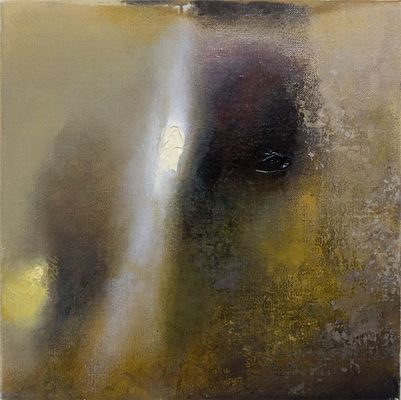
To return to Buckley’s fragment, the first two lines very much evoke how I paint nowadays. As you age, detail diminishes and patches of light become more luminous and float. I feel the most honest way of dealing with this is by smearing the oil paint on the canvas with the fingers and working close-up, blind. Only if the patches coalesce into an approaching image can the work gain a life.
-
Jonathan Walker was born in Melbourne, Australia and brought up on a dairy farm in Gippsland. In the 1970’s he studied painting at RMIT and won the Harold Wright Scholarship to the British Museum, London. During the 1980’s he exhibited at Pinacotheca Gallery, Richmond and had work shown at the NGV and Heidi City Art Gallery. Over the same period he designed the cover for the “Epigenesi” LP by Giancarlo Toniutti, Italy and conducted a mail exchange work with Achim Wollscheid, Germany. The work with artists through the post resulted in an article published in the bicentenary issue of Art and Australia 1988. He showed in artist run spaces such as WestSpace in the 90’s and 2000’s, and until 2012, taught painting at Victoria University, which is where we (Colleen Ahern and Lisa Radford) as organisers of the exhibition, among many others, had the privilege of being his student.
Walker’s knowledge was imparted to students through the careful selection of music, literature, and artists found in books that he himself had ordered for the library. Walker’s strategy was the generosity of sharing his vast knowledge with references specific to each student and their context.
Walker’s paintings share a similar focus and intimacy.
This exhibition presents a small selection of recent paintings alongside a publication that includes Walker’s writing. Observational and analytical, Walker’s work is a type of material notation — the time of day, colour and how it is blended, the both specific and fleeting location of a reflection on lino or the question of whether a chair leg should be included in a painting.
Please join us on Friday August 21 between 6-8pm to celebrate the opening of the exhibition.
Curated by Colleen Ahern and Lisa Radford.
B. Wurtz
Curated by Nic Tammens
March 26 - April 4, 2015
B.Wurtz works from a basement studio in his home on Manhattan’s Lower East Side.
This local fact is attested to by the plastic shopping bags and newsprint circulars that appear in his work. As formal objects, they don’t make loud claims about their origins but nonetheless transmit street addresses and places of business from the bottom of this long thin island. Like plenty of artists, Wurtz is affected by what is local and what is consumed. His work is underpinned by this ethic. It often speaks from a neighborhood or reads like the contents of a hamper:
“BLACK PLUMS $1.29 lb.”
“Food Bazaar”
“USDA Whole Pork Shoulder Picnic 99c lb.”
“RITE AID Pharmacy, with us it’s personal.”
“H. Brickman & Sons.”
“Sweet Yams 59c lb."
Most of the work in this exhibition was made while the artist was in residence at Dieu Donne, a workshop dedicated to paper craft in Midtown. Here Wurtz fabricated assemblages with paper and objects that are relatively lightweight, with the intention that they would be easily transportable to Australia. This consideration isn’t absolute in Wurtz’s work, but was prescriptive for making the current exhibition light and cheap. Packed in two boxes, these works were sent from a USPS post office on the Lower East Side and delivered to North Melbourne by Australia Post.
Wurtz appears courtesy of Metro Pictures, New York.
Thanks to Rob Halverson, Joshua Petherick, Sari de Mallory, Matt Hinkley, Helen Johnson, Fayen d'Evie, Ask Kilmartin, Lisa Radon, Ellena Savage, Yale Union, and "Elizabeth".
John Nixon
"Archive"
December 15 - January 20, 2014
The presentation of John Nixon's archive offered a rare showcase of this extensive collection of the artist's own publications, catalogues, posters, ephemera, editions and more, from the mid 1980s onwards, alongside a selection of his artworks.
Organized by John Nixon, Joshua Petherick and Matt Hinkley.
<a href=http://wfb.public-office.info/artist/john-nixon>All titles by John Nixon
"Habitat"
at Minerva, Sydney (organised by Joshua Petherick and Matt Hinkley)
November 15 - December 20, 2014
Lupo Borgonovo, Janet Burchill & Jennifer McCamley,
Lewis Fidock, HR Giger, Piero Gilardi, Veit Laurent Kurz,
Cinzia Ruggeri, Michael E. Smith, Lucie Stahl, Daniel Weil, Wols
Press Release:
“...It contained seven objects. The slender fluted bone, surely formed for flight, surely from the wing of some large bird. Three archaic circuitboards, faced with mazes of gold. A smooth white sphere of baked clay. An age-blackened fragment of lace. A fingerlength segment of what she assumed was bone from a human wrist, grayish white, inset smoothly with the silicon shaft of a small instrument that must once have ridden flush with the surface of the skin - but the thing’s face was seared and blackened.”
William Gibson, “Count Zero”, 1986
"Autumn Projects Archive"
Curated by Liza Vasiliou
March 6 - March 15, 2014
World Food Books, in conjunction with the Virgin Australia Melbourne Fashion Festival 2014, presented the Autumn Projects archive, consisting of a selection of early examples in Australian fashion with a particular interest in collecting designers and labels from the period beginning in the 1980’s, who significantly influenced the discourse of Australian Fashion.
Curated by Liza Vasiliou, the exhibition provided a unique opportunity to view pieces by designers Anthea Crawford, Barbara Vandenberg, Geoff Liddell and labels CR Australia, Covers, Jag along with early experimental collage pieces by Prue Acton and Sally Browne’s ‘Fragments’ collection, suspended throughout the functioning World Food Books shop in Melbourne.
H.B. Peace
presented by CENTRE FOR STYLE
November 14, 2013
"Hey Blinky, you say chic, I say same"
Anon 2013
H.B. Peace is a clothing collaboration between great friends Blake Barns and Hugh Egan Westland. Their pieces explore the divergences between 'character’ and ‘personality’ in garments....etc
Special Thanks to Joshua Petherick and Matt Hinkley of WFB and Gillian Mears
and a Very Special Thank you to Audrey Thomas Hayes for her shoe collaboration.
Janet Burchill & Jennifer McCamley
"Aesthetic Suicide"
May 10 - June 8, 2013
The first of our occasional exhibitions in the World Food Books office/shop space in Melbourne, "Aesthetic Suicide" presented a body of new and older works together by artists Janet Burchill & Jennifer McCamley, including videos, prints, a wall work, and publications.
During shop open hours videos played every hour, on the hour.
$.00 - Out of stock
The eternal clean out! New items weekly.
https://worldfoodbooks.com/category/sale
Published by World Food Books / Melbourne
$20.00 - In stock -
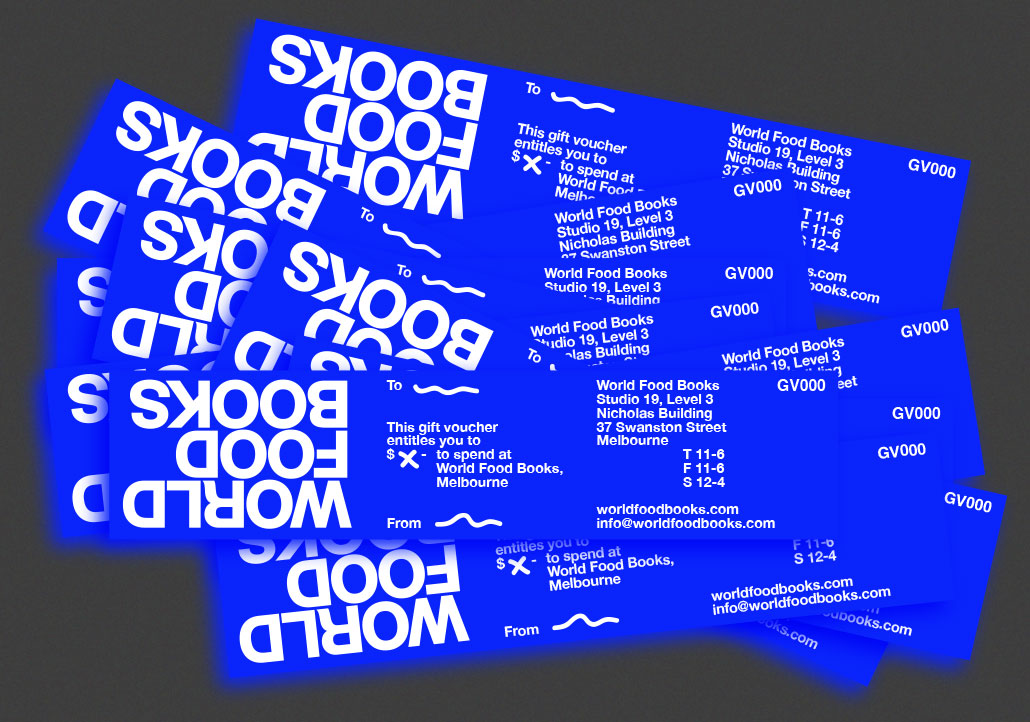
A World Food Books gift voucher is redeemable in our Melbourne bookshop or via our webshop (here). An e-voucher (printable pdf) will be sent to your purchase email address (please notify us if you wish to have the voucher sent to an alternate address and wish us to fill in the receiver's details on the card).
Gift vouchers can be purchased in increments of $20 (Australian Dollars) and the total amount can simply be added to by increasing the quantity in your shopping cart. eg. A quantity of 5 gift vouchers will result in an item total of $100 - a $100 gift voucher. Simply click "ADD TO CART" 5 times, or update your quantity in the shopping cart.
If you wish to purchase multiple, separate gift vouchers in one go, please just email us and we can personally prepare and email you a payment request.
Please note: Please select Pick-Up on gift voucher purchse to avoid any postage charges. Accidental postage charges will be refunded right away!
Thank you.
For any questions, please don't hesitate to email: [email protected]
1976, French
Hardcover (w. dust jacket), 136 pages, 21.5 x 21.5 cm
1st Edition, Out of print title / used / very good
$70.00 - In stock -
Lovely 1976 hardcover book published by Maeght Éditeur in Paris on Belgian-born French experimental poet, writer and painter Henri Michaux (1899–1984), richly illustrated with colour and b/w reproductions of Henri Michaux's artworks, accompanied by texts in French from French poet and art critic Jacques Dupin and French author Geneviève Bonnefoi. Michaux studied mysticism as a young man and traveled throughout South America and Asia in the ’20s and ’30s before settling in Paris. Michaux is renowned for his strange, highly original poetry and prose, and also for his art, when in the late ’50s he first showed paintings created under the influence of mescaline. In 1965, he was awarded the French National Prize for Letters, but refused the award, saying that it threatened his independence.
Maeght Éditeur was a printmaking studio and publishing house established in Paris in 1945 by Aimé and Marguerite Maeght. The studio was initially founded to produce fine art prints and illustrated books, but quickly expanded to include a gallery and exhibition space as well. The Maeghts worked closely with many renowned artists of the 20th century, including Joan Miró, Marc Chagall, Alexander Calder, and Georges Braque, among others.
VG in VG dust jacket, light wear/age.
2025, English
Softcover, 528 pages, 20.96 x 13.97 cm
Published by
n + 1 / New York
$48.00 - In stock -
“Today, the only critic I can think of is A. S. Hamrah.”
—Jean-Pierre Gorin
Longlisted for the National Book Critics Circle Award for Criticism
“Unerring” (Bookforum), “hilarious” (Dana Spiotta), “our age’s most irreplaceable critic” (Guernica), “a genius” (Kenyon Review), A. S. Hamrah returns with an extraordinary collection of his best film writing for n+1, The Baffler, the New York Review of Books, the Criterion Collection, and other publications. Algorithm of the Night assembles Hamrah’s essays on films and filmmakers and his inimitable, aphoristic reviews—a body of work that, taken together, presents a powerful alternative to a culture mired in publicity and stale convention. A journey through the overlapping dystopias of the Trump years, the Covid years, and the Trump years, Algorithm of the Night attends with remarkable style and precision to a film industry in self-imposed crisis, a chronicle of failures and occasional miracles from AI to The Zone of Interest. Against the tides of ignorance and solipsism, Algorithm of the Night is film criticism as literature and—perhaps—prophecy.
2004, English
Hardcover (clothbound w. illustrated obi strip), 160 pages, 22 x 30 cm
1st Edition, Out of print title / used / very good
Published by
Petit Gras / Japan
$220.00 - Out of stock
First edition of the long out-of-print 2004 hardcover monograph on the work of New York fashion designer/artist Susan Cianciolo. This extensive, profusely illustrated book features a photographic archive of Cianciolo's RUN collections, workshops, performances, exhibitions, collaborations and workshops from the mid 1990s into the early 2000s. An artist who expresses the DIY spirit in all mediums, this wonderful document is a must for any fan. Edited by Taka Kawauchi, includes texts by Aaron Rose.
For the past twenty years, Susan Cianciolo has moved between fields and formats including fashion, performance, installation and filmmaking. After working as an assistant for X-Girl led by Kim Gordon, she produced her critically acclaimed and commercially successful RUN collection (1995–2001), a fashion line of hand crafted clothing made from found or recycled garments and textiles. Cianciolo collections are regularly featured in museums and galleries internationally; her designs, artworks, and films have been included in recent solo exhibitions at Yale Union in Portland, Oregon, 356 Mission Road in Los Angeles, California, and Bridget Donahue in New York, as well as in group exhibitions at White Columns, Lisa Cooley, and MoMA PS1, among others. Cianciolo identifies as "a designer who also makes art, and a conceptual artist who occasionally designs clothes".
Very Good copy with original illustrated obi-strip, some light marking and wear to cloth and edges.
2026, English
Hardcover, 240 pages, 23.4 x 16 cm
Published by
Bloomsbury Academic / London
$270.00 - In stock -
Surveying the dynamic and collaborative activity of marginal fashion publishers of the 1990s onwards for the first time, Laura Gardner explores artistic and critical publishing at the fringes of the commercial system and their impact on the discourse and practice of fashion.
Putting these marginal practices at the centre of a discussion on fashion media, she explores their techniques, including makeshift production, parasitic economies, mirror forms, quasi-archives, pseudonymic writing, immaterial and fictional garments.
With a focus on artists' publishing and discourse on publishing in other creative fields, these projects and their radical approaches to production, content and dissemination, are examined in depth. Drawing on interviews and reproductions, this book puts forward fashion's history and active practice of experimental, performative and counter-cultural publishing, making the case that these projects - despite restrictions of scale, funding and geography - can critique, experiment with, and altogether reimagine the fashion system.
LAURA GARDNER is an academic and practitioner in the field of fashion communication and media. Her research and project focus on the histories, politics and practices of experimental fashion publishing. This includes a book she is currently working on, Marginal Fashion Publishing: Tactics, Practices and Market Forces (Bloomsbury, 2026), which surveys alternative publishing in fashion since the 1990s. She is also co-editor of Radical Fashion Exercises: a workbook of modes and methods, with Dr Daphne Mohajer va Pesaran and published by Valiz, founder of the small-press imprint Mode and Mode and works as a freelance editor, writer and curator.
1970, German
Softcover (w. dust jacket), 118 pages, 21 x 17 cm
Out of print title / used / very good
Published by
Studio 69 / Cologne
$100.00 - In stock -
First edition, edited and designed by Galerie Sydow's Heinrich Sydow-Zirkwitz, this beautiful book of Hans Bellmer's graphic works was published as a special project between Studio 69 in Cologne and Galerie Sydow in Frankfurt to accompany the exhibition "Ars Erotica" in 1970. Handsomely printed with spot-colour over-printing and illustrated throughout with Bellmer's graphic famous graphic series' "Bellmer à Sade" (1961), "Petite Traité de Morale" (1965) and illustrations for Georges Bataille's "Madame Edwarda" (1965). Includes text by Horst Albert Glaser. A very handsome collection and one of the nicest Bellmer books.
Very Good copy in Good dust jacket with light tanning to spine/edges, dustiness.
1983, Japanese
Hardcover (clothbound w. dustjacket), 152 pages, 20.5 x 30 cm
1st Edition, Out of print title / used / very good
Published by
Orion Press / Tokyo
$150.00 - In stock -
Exquisitely designed and produced book dedicated entirely to the photography of the German artist Hans Bellmer (1902—1975). Produced in French by Editions Filipacchi, Centre Georges Pompidou, and Musee National D'art Moderne in Paris in 1983, this scarce Japanese hardcover printing (produced and printed in Japan that same year) features a different cover, with translations to the Japanese language of the introductory essay and texts. A beautiful photo book densely illustrated with colour and black and white reproductions of Bellmer's infamous doll photography, his many studies of the female nude (including those of his wife, artist Unica Zürn), and rare photography of his objects and sculptural assemblages, his studio, and more, this volume captures an important Surrealist visionary and one of the most daring artists of the 20th century through his stunning photography. Features the wonderful "La Poupee" — Hans Bellmer's articulated, anatomically amorphous Surrealist doll, reconfigured and captured through Bellmer's intimate hand-painted photographic images. "La Poupee" acquired iconic status as perhaps the purest exemplification of the Surrealist ideal of "convulsive beauty." Bellmer constructed his first doll in the early 1930s. André Breton and Paul Eluard described it as "the first and only Surrealist object with a universal, provocative power".
German artist Hans Bellmer (1902—1975) was one of the most subversive artists associated with Surrealism, famous—notorious, even—for his erotic engravings, objects and photographs. Many of Bellmer's works were inspired by the literary works of Comte de Lautréamont, Marquis de Sade and Georges Bataille, amongst others.
Very Good copy in VG dust jacket with light wear/light foxing.
1977, German
Hardcover (clothbound w. screen-printed vinyl dust jacket in publisher's slipcase), 1330 pages, 44.5 x 33.5 cm
1st UK Edition, Out of print title / used / fine
Published by
S. Fischer Verlag / Frankfurt am Main
$400.00 - In stock -
The stunning 1977 hard cover, slip-cased facsimile reproduction of Schmidt's epic manuscript of Zettel's Traum (Bottom's Dream), comprising 1334 leaves and published by S. Fischer Verlag, Frankfurt am Main. Since its publication in 1970 Zettel’s Traum/Bottom’s Dream has been regarded as Arno Schimdt’s magnum opus, as the definitive work of a titan of postwar German literature. Schmidt's gargantuan novel was published in this collector's facsimile folio format just as Schmidt created it — the un-type-settable story is told mostly in three shifting columns, presenting the text in the form of collages, typewritten pages and marginalia. Bound in cloth hardcover with wrap-around thick vinyl dust jacket with screen-printed colour artwork, in publisher's original cardboard slipcase with attached paper spine label, this edition of Schmidt's "superbook" presents the reader with it's true character, beautifully reproduced on warm paper stock.
Bottom's Dream (German: Zettels Traum or ZETTEL'S TRAUM as the author wrote the title) is a novel published in 1970 by West German author Arno Schmidt. Schmidt began writing the novel in December 1963 while he and Hans Wollschläger were translating the works of Edgar Allan Poe into German. The novel was inspired by James Joyce's novel Finnegans Wake, particularly Schmidt's use of columns (his "SpaltenTechnik"), which Schmidt claimed was borrowed from the Wake. It tells the love story between the aging writer Daniel Pagenstecher and the sixteen-year-old Franziska Jacobi, and also tells the life and work of Edgar Allan Poe. He develops his own literary theory in the tradition of Sigmund Freud and, as if by chance, develops a new orthography. In Zettels' Dream, Arno Schmidt's efforts to create a modern prose form and an appropriate linguistic representation of human consciousness reach their preliminary climax.
Arno Schmidt, in full Arno Otto Schmidt, (b. 1914—1979), novelist, translator, and critic, whose experimental prose established him as the preeminent Modernist of 20th-century German literature. With roots in both German Romanticism and Expressionism, he attempted to develop modern prose forms that correspond more closely to the workings of the conscious and subconscious mind and to revitalize a literary language that he considered debased by Nazism and war. The influence of James Joyce and Sigmund Freud are apparent in both a collection of short stories, Kühe in Halbtrauer (1964; Country Matters), and, most especially, in Zettels Traum (1970; Bottom’s Dream)—a three-columned, more than 1,300-page, photo-offset typescript, centring on the mind and works of Poe. It was then that Schmidt developed his theory of “etyms,” the morphemes of language that betray subconscious desires. Two further works on the same grand scale are the “novella-comedy” Die Schule der Atheisten (1972; School for Atheists) and Abend mit Goldrand (1975; Evening Edged in Gold), a dream-scape that has as its focal point Hiëronymus Bosch’s Garden of Earthly Delights and that has come to be regarded as his finest and most mature work. Schmidt was a man of vast autodidactic learning and Rabelaisian humour. Though complex and sometimes daunting, his works are enriched by inventive language and imbued with a profound commitment to humanity’s intellectual achievements.
Near Fine copy in VG DJ, VG slipcase with light wear/toning.
BEWARE: This might be the heaviest book in our bookshop, so precise shipping costs will be applied if inaccurate.
2021, English
Softcover, 106 pages, 20.4 x 12.7 cm
Published by
Schism Press / World
$24.00 - In stock -
It is enough to glance at the footnotes - from masters of body horror like Cronenberg, Ballard and Barker to post-structuralist philosophers of the self like Derrida, Nancy and Deleuze - to grasp the intention of Snuff Memories. Unveiling like a tableau of ancient gods and deathly orgies, where “the universe is composed out of windowless monads each locked away and screaming,” this evocative novel is better called a theoretical installation. Each fragment documenting an erotic way to lose one’s humanity, this is a collection of nightmarish yet utopian miniature visions of sex, death, transformation, and pain, where human bodies are stretched beyond their capacity into mythical realms. Brutal and evocative, at once a prose poem and a theory of the limit, Snuff Memories creates a mythology of enticing and deadly encounters with mutants, matriarchs, and goddesses, documenting a multitude of ways in which one can be erotically and philosophically disemboweled.
– Bogna M. Konior, Research Fellow, NYU Shanghai, Interactive Media Arts department & AI and Culture Research Centre
Snuff Memories is Sadean. Not because of its commitment to detailing the minutiae of posthuman pornographic excess (although that is certainly an important part of the work) but because of its obsession with permutation. Everything is erected, demolished, decentred, and respooled, before being forced out to the limits once again. Bodies effervesce in fatal conjugations, topologies deform, fuzz out and remerge everted, like bad DOOM skins, covered in blood. The posthuman cannot be known before it is produced—so to know it, we must produce it. And until we really are swept up in these disorienting forces—merciless, murderous, erotic perhaps—we have literature. Snuff Memories is a book for anyone who ever secretly wanted to get dommed by fiction.
– Amy Ireland
Read less
2024, English
Softcover, 256 pages, 21.5 x 14 cm
Published by
Ↄalamari / Earth
$55.00 - In stock -
2024 redux edition of the long out-of-print 2002 cyberpunk cult classic
"A Finnegans Wake for the postdigital millennium, Kenji Siratori’s Blood Electric is probably the foundational text of the language-horror sub-genre: an evasive, esoteric and ultraexperimental writing style produced by the convergence of poetics and methods borrowed from avantgarde literature, electronic/noise music, synthetic abstract image generation, and severe—yet delicate—syntactic deconstruction. Siratori’s unique writing technique results in a hardcore-cyberpunk material account of a bio-techno singularity network in which flesh-code wetware and silicon-thriving software infold together into wave-multitudes of text-organisms. While most contemporary authors exploring the possibility of the blending of humans and machines focus on the extrapolation of logical and transcendental interactions (as in classical cyberpunk, from which Blood Electric initiates a radical breakup), Siratori’s language emanates directly from the contingent, rhizomatic, non-teleological, reciprocal disruption of several unstable and immanent modes of embodied (in)existence. In Blood Electric the text becomes an incantation demanding full abandonment, generating its own unpredictable rhythms as it enraptures you beyond reading, beyond yourself, like when participating in a rave."—Germán Sierra
"… Blood Electric is unreadable in anything other than short, migraine-inducing bursts."—The Guardian
"Following the publication of Kenji Siratori's Blood Electric, the Japanese cyberpunk writer perhaps pioneered a movement among all non-English speaking writers whose languages are radically dissociated from the dominant Latin-Anglo-Franco-German linguistic germ-line on the one hand, and are, on the other, enthusiastically seeking to contribute to the diversification of the English language whose centrality has already been sabotaged in the wake of emerging cyber-societies."—Reza Negarestani, in 3:AM Magazine
"Kenji is making rather more sense than usual. Perhaps the lad is finally coming into his own as the literary avatar of our times."—Bruce Sterling
"Kenji is a madman for sure, but if you scan his hallucinatory textual mashups in just the right frame of mind, they begin to make sense. And that's the scary part."—Douglas Rushkoff
"Contemporary Japan is exploding in slow-motion, and Kenji Siratori arranges the blood- and semen-encrusted deris with the finesse of a berserk Issey Miyake. Rendering English-language cyberpunk instantly redundant with his relenteless, murderous prose-drive, Siratori transmits his authentic, category-A hallucinogenic product direct to this reader’s cerebellum. A virulently warped amalgam of Tetsuo and cut-up era William Burroughs."—Stephen Barber (author of Tokyo Vertigo)
"Blood Electric is the black reverb of soft machine seppuku, a molten unspooling of sheet metal entrails and crucified memory banks into the howling void of violence. It is a cyborg crash nightmare of the new flesh, a final dispatch from mutant Hell where the embryo hunts in secret."—Jack Hunter (author of Eros in Hell)
"Siratori’s hypermodern project articulates the nonarticulation that currently dominates the substratum of much current discourse. Without the intense atomization of the individual, Siratori’s work does not resound. Yet, if we take pause, Siratori’s work resonates at a fever pitch, blaring at the limitless informational realm of our minds as it bursts the parameters of the skull. As a kind of accelerationist aesthetic, Siratori critiques technology by pushing it beyond its sensible potentiality; he cultivates alien cognitions where alternatives thrive, where semantic derangement is revolt, where epistemology uncoils. Ultimately, he uncompromisingly forces us to pause on the chaos of the glitch, to claim the instance where embodying the unquantifiable amounts to insurgency."—Andrew C. Wenaus, Author of The Literature of Exclusion: Dada, Data, and the Threshold of Electronic Literature
1962, German
Softcover, 190 pages, 21 x 16.8 cm
1st Edition, Out of print title / used / very good
Published by
Gerhardt Verlag / Berlin
$300.00 - Out of stock
Rare 1962 edition of Bellmer's "Die Puppe", published by Gerhardt Verlag in Berlin. German artist Hans Bellmer (1902-1975) was one of the most subversive artists associated with Surrealism, famous—notorious, even--for his erotic engravings, objects and photographs. This collectable first edition of Die Puppe (The Doll) comprises a series of Bellmer's hand-painted photographs in the form of 10 monochrome and 15 coloured tipped-in plates accompanying his remarkable texts, here published for the first time. Bellmer's hand-coloured photographs subsequently acquired an iconic status as perhaps the purest exemplification of the Surrealist ideal of "convulsive beauty." Bellmer weaves a remarkably disparate set of concepts and intuitions—from fields as diverse as mathematics, morphology, optics and psychology—into a theory of eroticism that provides a totally unexpected rationale for his uncompromising art. His ideas are, in the words of poet Joë Bousquet, a "scandal to reason." The book also contains many b/w drawings by Bellmer along with prose poems by Paul Eluard. A book like no other!
Very Good—Near Fine preserved copy of this stunning edition with the die-cut decal cover. Light corner bump, light block shelf wear.
2002, English
Softcover, 310 pages, 23 x 18 cm
1st Edition, Out of print title / used / very good
Published by
The MIT Press / Massachusetts
$100.00 - Out of stock
First 2002 paperback edition of this out-of-print study on Bellmer.
"The German-born surrealist Hans Bellmer (1902-1975), best known for his life-size pubescent dolls, devoted an artistic lifetime to creating sexualized images of the female body-distorted, dismembered, or menaced in sinister scenarios. In this book Sue Taylor draws on psychoanalytic theory to suggest why Bellmer was so driven by erotomania as well as a desire for revenge, suffering, and the safety of the womb. Tracing a repressed homoerotic attachment to his father, castration anxiety, and an unconscious sense of guilt, Taylor proposes that a feminine identification informs all the disquieting aspects of Bellmer's art.
Most scholarship to date has focused on Bellmer's work of the 1930s, especially the infamous dolls and the photographs he made of them. Taylor extends her discussion to the sexually explicit prints, drawings, paintings, and photographs he produced throughout the ensuing three decades. The book includes a color frontispiece and 121 black-and-white images (eight published here for the first time), as well as appendixes containing several significant texts by Bellmer previously unavailable in English.
Sue Taylor is Assistant Professor of Art History at Portland State University, Oregon.
"While ultimately subscribing to the conventional wisdom that the misogynist implications of Bellmer's many sinister images can never be altogether dismissed, [Taylor] insists that we look beyond their manifest content towards their latent meanings. Her tone and method is thus a long way from the punitive... literalism and crudity of much Bellmer criticism."—R. S. Short, Times Literary Supplement
"An impressive book by any standards. Every page displays intelligence, erudition and visual acuity."—Metapsychology
VG copy, light edge wear, faint edge tanning.
1995, Japanese
Hardcover (w. dust jacket and obi), 164 pages, 30 x 21 cm
1st Edition, Out of print title / used / very good
Published by
Treville / Tokyo
$350.00 - In stock -
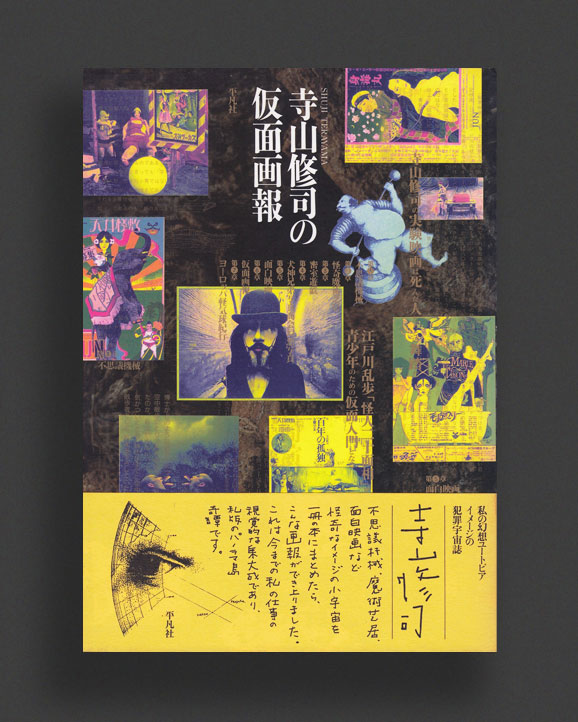
His erotic masterpiece, "Chimushi" is the first comprehensive collection of Toshio Saeki's erotic nightmare artwork, published in 1995 by Treville, only available in Japan, and now very collectible in every edition, but especially in this first hardcover edition. One of his most popular books, and certainly his most demented and sexually graphic, each page of Chimushi sees every darkest sexual depravity rendered in vibrant, explicit colour by the unmistakable hand of Saeki, all impeccably printed in Japan by Treville Editions. Although almost entirely packed with full-page and double-page artworks, the book includes a biography and several crucial essays in Japanese by Suehiro Tanemura, Teruhiko Kuze, Masami Akita, Suehiro Maruo, Keiji Ueshima, Shuji Terayama and Tatsuhiko Shibusawa (!!!)
Toshio Saeki (1945—2019) was an illusive Japanese illustrator and painter, and icon of 1970s Tokyo counterculture, known for combining Japanese folklore, Yōkai spirits and elements of Western art with his own sophisticated aesthetics to create a unique, sensational world of eros, dark humour, and horror. Given the title “Erotic Engineer” by Timothy Leary, Saeki's provocative art broke all sexual taboos, questioned Japanese ideology and traditional views on love, desire and gender roles. Saeki’s surgically-precise graphic work is closely related to the Japanese cultural phenomenon ‘Erotic, Grotesque, Nonsense’ (ero, guro, nansensu).
“Toshio Saeki conjures death with a pen”—Shūji Terayama, 1969.
Very Good—Near Fine copy, same dj, same obi. Light wear only.
2025, English
Softcover, 360 pages, 21.5 x 14 cm
Published by
University of Minnesota Press / Minnesota
Univocal Publishing / Minneapolis
$62.00 - In stock -
From 1970 until 1987, Gilles Deleuze held a weekly seminar at the Experimental University of Vincennes and, starting in 1980, at Saint-Denis. In the spring of 1981, he began a series of eight seminars on painting and its intersections with philosophy. The recorded sessions, newly transcribed and translated into English, are now available in their entirety for the first time. Extensively annotated by philosopher David Lapoujade, On Painting illuminates Deleuze's thinking on artistic creation, significantly extending the lines of thought in his book Francis Bacon.
Through paintings and writing by Rembrandt, Delacroix, Turner, Cezanne, Van Gogh, Klee, Pollock, and Bacon, Deleuze explores the creative process, from chaos to the pictorial fact. The introduction and use of color feature prominently as Deleuze elaborates on artistic and philosophical concepts such as the diagram, modulation, code, and the digital and the analogical. Through this scrutiny, he raises a series of profound and stimulating questions for his students: How does a painter ward off greyness and attain color? What is a line without contour? Why paint at all?
Written and thought in a rhizomatic manner that is thoroughly Deleuzian-strange, powerful, and novel-On Painting traverses both the conception of art history and the possibility of color as a philosophical concept.
Edited by David Lapoujade, translated by Charles J. Stivale.
2017, English
Softcover, 300 pages, 12.8 x 19.8 cm
Published by
Repeater Books / London
$30.00 - Out of stock
What exactly are the Weird and the Eerie? In this new essay, Mark Fisher argues that some of the most haunting and anomalous fiction of the 20th century belongs to these two modes. The Weird and the Eerie are closely related but distinct modes, each possessing its own distinct properties. Both have often been associated with Horror, yet this emphasis overlooks the aching fascination that such texts can exercise. The Weird and the Eerie both fundamentally concern the outside and the unknown, which are not intrinsically horrifying, even if they are always unsettling. Perhaps a proper understanding of the human condition requires examination of liminal concepts such as the weird and the eerie. These two modes will be analysed with reference to the work of authors such as H. P. Lovecraft, H. G. Wells, M.R. James, Christopher Priest, Joan Lindsay, Nigel Kneale, Daphne Du Maurier, Alan Garner and Margaret Atwood, and films by Stanley Kubrick, Jonathan Glazer and Christoper Nolan."
2022, English
Softcover, 264 pages, 14 x 21.6 cm
Published by
Zero Books / UK
$42.00 - In stock -
This collection of writings by Mark Fisher, author of acclaimed Capitalist Realism, argues that we are haunted by futures that failed to happen. Fisher searches for the traces of these lost futures in the work of David Peace, John Le Carre, Christopher Nolan, Joy Division, Burial and many others. THIS BRAND NEW EDITION FEATURES A NEW INTRODUCTION BY MATT COLQUHOUN AND NEW AFTERWORD BY SIMON REYNOLDS.
2014 / 2022, English
Softcover, 92 pages, 14.5 x 21.8 cm
Published by
Zero Books / UK
$29.00 - In stock -
After 1989, capitalism has presented itself as the only realistic political economic system. What effects has this 'capitalist realism' had on work, culture, education and mental health? Is it possible to imagine an alternative to capitalism that is not some throwback to discredited models of state control?
"The beauty of Mark Fisher's laser sharp critique of the destructive effects of life under Neo-Liberalism was that it spoke to ordinary people in plain language that went beyond the often hermetic intellectual world of Academia. He is greatly missed. We need voices like Mark's more than ever."—Bobby Gillespie, Primal Scream”
Mark Fisher is highly respected both as a music writer and a theorist. He writes regularly for The Wire, frieze, New Statesman, and Sight & Sound. He is a Visiting Fellow at Goldsmiths, University Of London, and maintains one of the most successful weblogs on cultural theory, k-punk (http://k-punk.abstractdynamics.org)
2025, English
Hardcover, 368 pages, 28 x 28 cm
Published by
Hauser & Wirth / Zurich
Hauser & Wirth / Los Angeles
$160.00 - In stock -
Hammons' body prints, flags and found-object sculptures come together in this artist's book documenting his thought-provoking conceptual exhibition.
This post-exhibition catalog revisits David Hammons’ 2019 show at Hauser & Wirth Los Angeles. A singular book created entirely under the artist’s direction, this publication illustrates the most expansive exhibition of this legendary artist’s work to date.
Said critic Jonathan Griffin of the original exhibition, "Alongside finished artworks, including framed examples of Hammons’s sublime drawings made with bounced basketballs and powdered Kool-Aid, there are plenty of apparently ad hoc, readymade interventions, installations in which it is unclear where one ends and the next begins. … Hammons, it seems, wants his viewers to relax, historiography be damned."
Born in 1943 in Springfield, Illinois, David Hammons moved to Los Angeles in 1963 at the age of 20 and began making his body prints several years later. He studied at Otis Art Institute with Charles White and became part of a younger generation of Black avant-garde artists loosely associated with the Black Arts Movement. In Los Angeles, Hammons was a cofounder of Studio Z, a group which included Senga Nengudi, Maren Hassinger, Joe Ray and others. Hammons has lived in New York since 1978.
2012, English / German
Hardcover (cloth-bound), 247 pages, 20.7 x 28.8 mm
Published by
Walther König / Köln
$55.00 - In stock -
Morgan Fisher became prominent in the early 1970s as an experimental filmmaker in the structuralist milieu, whose main interest was not the content of that depicted but rather the analysis of the medium itself. In the mid 90s Fisher turned to monochrome painting and the installation of monochrome paintings. Fundamental questions on the history and aesthetic of perception as well as its inscription in genres and technologies are central in all of Morgan Fisher's work. Forgoing the illusionism of narrative, Fisher reveals the conditions of perception in his films and reflects the creation and the nature of the filmic image. His post-conceptual painting deals with the relation between colour, size and form of an image, frames, the relationship of figure and ground as well as the observer's point of view - themes that have been contested since the abstraction of modernism and minimalism.
2024, English
Softcover, 208 pages, 20.32 x 13.18 cm
Published by
The New York Review of Books / New York
$36.00 - In stock -
In this delightful, cinema-inspired daydream of a novel, an identity-shifting protagonist uses the everyday inspirations of his life to catapult himself into the realm of imagination, blurring the boundaries between reality and fantasy.
The Skin of Dreams is a novel of waking dreams. Even as he lives his life, Jacques L'Aum ne, its hero, daydreams a hundred other possible lives. A few lines on a page, a chance encounter, a remark overheard in passing, any of these are enough to kick things into gear and send him off outside of himself to become a boxer, a general, a bishop, or a lord. He lives alongside his life with diligence and steadfastness; and the passage from real to dream is so natural for him that he no longer knows precisely which him he is. Eventually he becomes an actor in Hollywood, and the basis of countless dreams for others. This Jacques L'Aum ne, like the characters who surround him, has the same sort of haunting and fluid consistency as someone that we might dream of in our beds at night. And reverie, here, is born through the tale's humor, which is as gentle as it is cruel, as well as by way of a writing technique that is itself drawn from one of Queneau's great loves, the cinema.
Raymond Queneau (1903—1976) was a French novelist, poet, critic, editor and co-founder and president of Oulipo, notable for his wit and cynical humour. Born in the French town of Le Havre and educated at the Sorbonne, he then performed his military service in Morocco. An early association with the Surrealists ended in 1929, and after completing a scholarly study of literary madmen of the nineteenth century for which he was unable to find a publisher, Queneau turned to fiction, writing his first novel, Le Chiendent (Witch Grass), in Greece in the summer of 1932. Influenced by James Joyce and Lewis Carroll, Queneau sought to reinvigorate French literature, grown feeble through formalism, with a strong dose of language as really spoken. He further encouraged innovation by founding, with the mathematician François Le Lionnais, the famous group OULIPO (Ouvroir de Littérature Potentielle), which investigated literary composition based on the application of strict formal or mathematical procedures (members of the group included Italo Calvino, Georges Perec, and Harry Mathews). Queneau’s many books, which typically blur the boundaries between fiction, poetry, and the essay, include Pierrot mon ami, The Sunday of Life, Zazie in the Metro (made into a movie by Louis Malle), and Exercises in Style; under the name of Sally Mara, he published We Always Treat Women Too Well, a brilliant comic spoof on the excesses of smutty popular novels. Queneau was the editor of the Encyclopédie de la Pléiade as well as a fine poet, whose lyric “Si tu t’imagines” was a hit for the celebrated postwar chanteuse Juliette Gréco.
2002, English
Softcover, 320 pages, 19.7 x 13.4 cm
Published by
New Directions / New York
$36.00 - In stock -
The Hungarian master’s first work to appear in English, and still one of the best. Translated from Hungarian by George Szirtes.
"This is a book about a world into which the Leviathan has returned. The universality of its vision rivals that of Gogol's Dead Souls and far surpasses all the lesser concerns of contemporary writing."—W. G. Sebald
"Satantango and The Melancholy of Resistance are irresistible, unforgettable and required reading."—Eileen Battersby, The Irish Times
The Melancholy of Resistance, László Krasznahorkai's magisterial, surreal novel, depicts a chain of mysterious events in a small Hungarian town. A circus, promising to display the stuffed body of the largest whale in the world, arrives in the dead of winter, prompting bizarre rumors. Word spreads that the circus folk have a sinister purpose in mind, and the frightened citizens cling to any manifestation of order they can find —music, cosmology, fascism. The novel's characters are unforgettable: the evil Mrs. Eszter, plotting her takeover of the town; her weakling husband; and Valuska, our hapless hero with his head in the clouds, who is the tender center of the book, the only pure and noble soul to be found.
Compact, powerful and intense, The Melancholy of Resistance, as its enormously gifted translator George Szirtes puts it, "is a slow lava flow of narrative, a vast black river of type." And yet, miraculously, the novel, in the words of The Guardian, "lifts the reader along in lunar leaps and bounds."
László Krasznahorkai lives in the hills of Szentlászló. He has written five novels and won numerous prizes. New Directions also publishes his novels War and War and Satantango; another novel, Seiobo There Below, is forthcoming.
George Szirtes is a poet who was born in Budapest in 1948 and is now living in London.
His translations have won the European Translation Prize and the Gold Star Award for the Republic of Hungary.
Cover painting: James Ensor, "The Entry of Christ into Brussels in 1889" (detail)
2005, English
Softcover, 304 pages, 15 x 21.1 cm
Published by
Grove Press / New York
$39.00 - In stock -
Set largely on the pages of a website where gay male escorts are reviewed by their clients, and told through the postings, emails, and conversations of several dozen unreliable narrators, The Sluts chronicles the evolution of one young escort's date with a satisfied client into a metafiction of pornography, lies, half-truths, and myth. Explicit, shocking, comical, and displaying the author's signature flair for blending structural complexity with direct, stylish, accessible language, The Sluts is Cooper's most transgressive novel since Frisk, and one of his most innovative works of fiction to date.
Dennis Cooper (born 1953) is an American novelist, poet, critic, editor and performance artist who grew up in the Southern California. In 1976, he founded Little Caesar Magazine and Press, which he ran until 1982. In 1985, he moved to Amsterdam for two and a half years, where he began his ten year long project, The George Miles Cycle, an interconnected sequence of five novels that includes Closer, Frisk, Try, Guide, and Period. His post-George Miles Cycle novels include My Loose Thread, The Sluts and God, Jr. Other works include the short-story collections Wrong and Ugly Man, poetry collections The Dream Police and The Weaklings, as well as the recent Smothered in Hugs: Essays, Interviews, Feedback, and Obituaries.
Dennis Cooper currently spends his time between Los Angeles and Paris.
"Dennis Cooper, God help him, is a born writer"—William Burroughs
"Cooper’s language is at first intense, nearly minimal, then suddenly, it ascends into vision"—Kathy Acker
2025, English
Softcover, 130 pages, 20.3 x 17.8 cm
Published by
The New York Review of Books / New York
$34.00 - In stock -
Ancient Mesopotamia, the Zodiac, and the land of the dead feature in this wildly surrealistic adventure story—Leonora Carrington's revolutionary second novel, long out of print.
The Stone Door is an omen, an incantation, and an adventure story rolled into one. Built in layers like a puzzle box, it is the tale of two people, of love and the Zodiac and the Kabbalah, of Transylvania and Mesopotamia converging at the Caucasus, of a mad Hungarian King named Böles Kilary and of a woman's discovery of an initiatory code that leads to a Cyclopean obstacle, to love, self and awareness, to the great stone door of Kescke and beyond.
Written at the end of World War II but not published until 1977 and long unavailable, The Stone Door is at once a celebration of the union of the surrealist painter Leonora Carrington and her husband, the Hungarian-born photographer Chiki Weisz, and an argument for the unification of the male and the female as a means of liberating the human race.