World Food Books' programme is largely produced on Kulin Nation land. We acknowledge the Wurundjeri people of the Kulin Nation as the first and continuing custodians of this land, and pay respect to their Elders past, present, and emerging.
World Food Books is an arts and special interests bookshop in Naarm / Melbourne. Founded in 2010, World Food Books is devoted to the presentation of a rotating, hand-selection of international art, design, literary and counterculture publications with an emphasis on the anti-traditional, the experimental, the avant-garde, the heretic, the marginal.
Presenting new titles alongside rare and out-of-print books, catalogues and journals spanning the fields of modern and contemporary art, design, photography, illustration, film, literature, poetry, cultural theory, philosophy, sexuality, popular and underground culture in its many radical forms, World Food Books wishes to encourage adventurous, thoughtful and open-minded reading, looking, writing, and exchange of publishing and ideas, both current and historical.
As well as our bookshop, located in Melbourne's historical Nicholas Building, all of our inventory is available internationally via our online mail-order service.
World Food Books semi-regularly co-ordinates "Occasions", a programme of exhibits and events at the bookshop and in partnership with other hosts (such as museums and art galleries) that develop out of the activities, relationships and content of the bookshop itself.
World Food Books
The Nicholas Building
37 Swanston Street
Room 5, Level 6
Melbourne 3000
Australia
SHOP HOURS:
THU–SAT 12–6
WEB-SHOP OPEN 24/7
World Food Books
Postal Address:
PO Box 435
Flinders Lane
Victoria 8009
Australia
Art
Theory / Essay
Architecture / Interior
Graphic Design / Typography
Photography
Fashion
Eros
LGBTQ+
Fiction / Poetry
Weird / Speculative / Science Fiction / Horror
Transgressive / Visceral / Abject
Symbolism / Decadence / Fin de siècle
Film / Video
Painting
Sculpture / Installation
Performance / Dance / Theater
Drawing
Sound / Music
Curatorial
Group Shows / Collections
Periodicals
Out-of-print / Rare
Posters / Ephemera / Discs
Signed Books
World Food Books Gift Voucher
World Food Book Bag
Australian Art
Australian Fiction
Australian Science Fiction / Speculative Fiction
Australian Poetry
Australian Photography
Japanese Photography
Conceptual Art
Minimal Art
Dada
'Pataphysics / Oulipo
Fluxus
Concrete Poetry
Pop Art
Surrealism
Arte Povera
Arte Informale / Haute Pâte / Tachism
Nouveau Réalisme / Zero / Kinetic
Situationism / Lettrism
Collage / Mail Art / Xerox Art
Art Brut / Folk / Visionary / Fantastic
Illustration / Graphic Art / Bandes Dessinées
Furniture
Italian Radical Design / Postmodernism
Textiles
Ceramics / Glass
Counterculture
Protest / Revolt
Philosophy
Psychoanalysis
Anthropology
Anarchism
Socialism / Anarchism / Communism / Capitalism
Literary Theory / Semiotics / Language
Feminism / Women's Studies
Gender Studies / Sexuality
Anthropology
Fetishism / BDSM
Drugs / Psychedelia
Crime / Violence
Animal Rights / Veganism
Occult / Esoterica
Ecology / Earth / Alternative Living
Whole Earth / Crafts
All prices in AUD (Australian dollars)
Pick-Ups
Pick-up orders can be collected in our bookshop during opening hours after order date. Please collect any Pick-up orders within 2 weeks of ordering as we have limited storage space. Orders will be released back into stock if not collected within this time. No refunds can be made for pick-ups left un-collected. If you cannot make it in to the bookshop in this time-frame, please choose postage option.
Return Policy
All sales are final. We do accept returns (for refund or exchange) for items received in error. All our orders are packed with special care using heavy-duty padding and cardboard book-mailers or bubble mailers (for smaller books), using reinforcement where required. We cannot take responsibility for any lost, stolen or damaged parcels.
Insurance
Should you wish to insure your package, please email us directly after placing your order and we can organise this at a small extra expense. Although all standard/express tracked packages are very safe and dependable, we cannot take responsibility for any lost, stolen or damaged parcels. We recommend insurance on valuable orders.
Interested in selling your old books, catalogues, journals, magazines, comics, fanzines, ephemera? We are always looking for interesting, unusual and out-of-print books to buy. We only buy books in our fields of interest and specialty, and that we feel we can resell.
We base these prices on desirability, market value, in-print prices, condition and our current stock levels. We offer cash, store credit, and can take stock on consignment. All
about 25% of the price we expect to get when we sell them, or 30% in store credit. We base these prices on desirability, market value, in-print prices, condition and our current stock levels.
Sell your books any day of the week. You can drop them off and return later. If you have a lot of books, we can visit your Sydney home.
We buy books that we feel we can resell. We offer about 25 % of the price we expect to get when we sell them, or 30% in store credit. We base these prices on desirability, market value, in-print prices, condition and our current stock levels.
Philadelphia Wireman
03 August - 01 September, 2018
World Food Books is proud to announce our next Occasion, the first presentation of sculptures by Philadelphia Wireman in Australia.
The Philadelphia Wireman sculptures were found abandoned in an alley off Philadelphia’s South Street on trash night in 1982. Their discovery in a rapidly-changing neighbourhood undergoing extensive renovation, compounded with the failure of all attempts to locate the artist, suggests that the works may have been discarded after the maker’s death. Dubbed the "Philadelphia Wireman" during the first exhibition of this work, in 1985, the maker’s name, age, ethnicity, and even gender remain uncertain. The entire collection totals approximately 1200 pieces, all intricately bound together with tightly-wound heavy-gauge wire (along with a few small, abstract marker drawings, reminiscent both of Mark Tobey and J.B. Murry). The dense construction of the work, despite a modest range of scale and materials, is singularly obsessive and disciplined in design: a wire armature or exoskeleton firmly binds a bricolage of found objects including plastic, glass, food packaging, umbrella parts, tape, rubber, batteries, pens, leather, reflectors, nuts and bolts, nails, foil, coins, toys, watches, eyeglasses, tools, and jewellery.
Heavy with associations—anthropomorphic, zoomorphic, and socio-cultural responses to wrapped detritus—the totemic sculptures by Philadelphia Wireman have been discussed in the context of work created to fulfil the shamanistic needs of alternative religions in American culture. Curators, collectors, and critics have variously compared certain pieces to sculpture from Classical antiquity, Native American medicine bundles, African-American memory jugs, and African fetish objects. Reflecting the artist’s prolific and incredibly focused scavenging impulse, and despite—or perhaps enhanced by—their anonymity, these enigmatic objects function as urban artefacts and arbiters of power, though their origin and purpose is unknown. Philadelphia Wireman, whatever their identity, possessed an astonishing ability to isolate and communicate the concepts of power and energy through the selection and transformation of ordinary materials. Over the course of the past two decades, this collection has come to be regarded as an important discovery in the field of self-taught art and vernacular art.
Presented in collaboration with Fleisher-Ollman Gallery, Philadelphia, and Robert Heald, Wellington.
Susan Te Kahurangi King
02 February - 10 March, 2018
Susan Te Kahurangi King (24 February 1951 - ) has been a confident and prolific artist since she was a young child, drawing with readily available materials - pencils, ballpoint pens and felt-tip markers, on whatever paper is at hand. Between the ages of four and six Susan slowly ceased verbal communication. Her grandparents William and Myrtle Murphy had developed a special bond with Susan so they took on caring responsibilities for extended periods. Myrtle began informally archiving her work, carefully collecting and storing the drawings and compiling scrapbooks. No drawing was insignificant; every scrap of paper was kept. The King family are now the custodians of a vast collection containing over 7000 individual works, from tiny scraps of paper through to 5 meter long rolls.
The scrapbooks and diaries reveal Myrtle to be a woman of great patience and compassion, seeking to understand a child who was not always behaving as expected. She encouraged Susan to be observant, to explore her environment and absorb all the sights and sounds. Myrtle would show Susan’s drawings to friends and people in her community that she had dealings with, such as shopkeepers and postal workers, but this was not simply a case of a grandmother’s bias. She recognised that Susan had developed a sophisticated and unique visual language and sincerely believed that her art deserved serious attention.
This was an unorthodox attitude for the time. To provide some context, Jean Dubuffet coined the term Art Brut in 1945 to describe work created by self-taught artists – specifically residents of psychiatric institutions and those he considered to be visionaries or eccentrics. In 1972 Roger Cardinal extended this concept by adopting the term Outsider Art to describe work made by non-academically trained artists operating outside of mainstream art networks through choice or circumstance. Susan was born in Te Aroha, New Zealand in 1951, far from the artistic hubs of Paris and London that Dubuffet and Cardinal operated in. That Myrtle fêted Susan as a self-taught artist who deserved to be taken seriously shows how progressive her attitudes were.
Susan’s parents Doug and Dawn were also progressive. Over the years they had consulted numerous health practitioners about Susan’s condition, as the medical establishment could not provide an explanation as to why she had lapsed into silence. Dawn educated herself in the field of homeopathy and went on to treat all twelve of her children using these principles – basing prescriptions on her observations of their physical, mental and emotional state.
Doug was a linguist with an interest in philosophy who devoted what little spare time he had to studying Maori language and culture. To some extent their willingness to explore the fringes of the mainstream made them outsiders too but it was their commitment to living with integrity and their respect for individuality that ensured Susan’s creativity was always encouraged.
Even though Susan’s family supported her artistic pursuits, some staff in schools and hospitals saw it as an impediment to her assimilation into the community and discouraged it in a variety of ways. Her family was not always aware of this and therefore did not fully understand why Susan stopped drawing in the early 1990s. However, rather than dwell on the challenges that Susan faced in pursuit of her artistic practice, they prefer to highlight her achievements. In 2008 Susan began drawing again in earnest, after an almost 20 year interruption, and her work is now shown in galleries around the world.
Susan grew up without television and has been heavily influenced by the comics she read as a child. She is absolutely fearless in the appropriation of recognizable characters, such as Donald Duck and Mickey Mouse, in her work. She twists their limbs, contorts their faces, compresses them together, blends them into complex patterned backgrounds - always imbuing them with an incredible energy. Although Susan often used pop culture characters in her work they are not naive or childlike. These are drawings by a brilliant self-taught artist who has been creating exceptional work for decades without an audience in mind.
Mladen Stilinović
"Various Works 1986 - 1999"
02 February 16 - September 10, 2016
Various works 1986 - 1999, from two houses, from the collections of John Nixon, Sue Cramer, Kerrie Poliness, Peter Haffenden and Phoebe Haffenden.
Including: Geometry of Cakes (various shelves), 1993; Poor People’s Law (black and white plate), 1993; White Absence (glasses, ruler, set square, silver spoon, silver ladel with skin photograph and wooden cubes), 1990-1996; Exploitation of the Dead (grey and red star painting, wooden painting, black spoon with red table, red plate), 1984-1990; Money and Zeros (zero tie, paintings made for friends in Australia (Sue, John, Kerrie), numbers painting), 1991-1992; Words - Slogans (various t-shirts) - “they talk about the death of art...help! someone is trying to kill me”, “my sweet little lamb”, “work is a disease - Karl Marx”; Various artist books, catalogues, monographs, videos; Poster from exhibition Insulting Anarchy; "Circular" Croatian - Australian edition; Artist book by Vlado Martek (Dostoyevsky); more.
Thanks to Mladen Stilinović and Branka Stipančić.
Jonathan Walker
Always Will Need To Wear Winter Shirt Blue + Ochre Small Check Pattern
21 August - 21 September, 2015
Untitled
I am not a great reader of poetry but I always return to the work of Melbourne poet, Vincent Buckley (1925- 1988). Perhaps I find his most tantalising piece to be not a finished poem but a fragment left on a scrap of paper discovered on his desk after the poet’s death.
The poetry gathers like oil
In the word-core, and spreads
It has its music meet,
Its music is in movement.
This fragment is more the shell left behind from a volatile thought than a finished poem. I find the last two lines honest but awkward whereas the first two lines work like an arrow. Most likely he could not find a resolution so it was left. Still, in its present form, it remains an eloquent testimony to the ultimate failure of a medium to express mobile thought and sensation, in Buckley’s case, through verbal language. It’s an important matter because this is something all artists have to deal with regardless of the medium.
I have never written a poem, however, I am forever copying fragments from books on paper scraps in a vain effort to fix certain notions in my head. At first, they function as bookmarks that are sometimes returned to when I open the book. But before long, as they accumulate, they fall out littering the table interspersed with A4 photocopies, bills, books and medications.
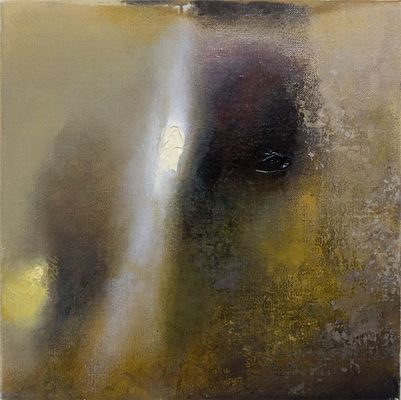
To return to Buckley’s fragment, the first two lines very much evoke how I paint nowadays. As you age, detail diminishes and patches of light become more luminous and float. I feel the most honest way of dealing with this is by smearing the oil paint on the canvas with the fingers and working close-up, blind. Only if the patches coalesce into an approaching image can the work gain a life.
-
Jonathan Walker was born in Melbourne, Australia and brought up on a dairy farm in Gippsland. In the 1970’s he studied painting at RMIT and won the Harold Wright Scholarship to the British Museum, London. During the 1980’s he exhibited at Pinacotheca Gallery, Richmond and had work shown at the NGV and Heidi City Art Gallery. Over the same period he designed the cover for the “Epigenesi” LP by Giancarlo Toniutti, Italy and conducted a mail exchange work with Achim Wollscheid, Germany. The work with artists through the post resulted in an article published in the bicentenary issue of Art and Australia 1988. He showed in artist run spaces such as WestSpace in the 90’s and 2000’s, and until 2012, taught painting at Victoria University, which is where we (Colleen Ahern and Lisa Radford) as organisers of the exhibition, among many others, had the privilege of being his student.
Walker’s knowledge was imparted to students through the careful selection of music, literature, and artists found in books that he himself had ordered for the library. Walker’s strategy was the generosity of sharing his vast knowledge with references specific to each student and their context.
Walker’s paintings share a similar focus and intimacy.
This exhibition presents a small selection of recent paintings alongside a publication that includes Walker’s writing. Observational and analytical, Walker’s work is a type of material notation — the time of day, colour and how it is blended, the both specific and fleeting location of a reflection on lino or the question of whether a chair leg should be included in a painting.
Please join us on Friday August 21 between 6-8pm to celebrate the opening of the exhibition.
Curated by Colleen Ahern and Lisa Radford.
B. Wurtz
Curated by Nic Tammens
March 26 - April 4, 2015
B.Wurtz works from a basement studio in his home on Manhattan’s Lower East Side.
This local fact is attested to by the plastic shopping bags and newsprint circulars that appear in his work. As formal objects, they don’t make loud claims about their origins but nonetheless transmit street addresses and places of business from the bottom of this long thin island. Like plenty of artists, Wurtz is affected by what is local and what is consumed. His work is underpinned by this ethic. It often speaks from a neighborhood or reads like the contents of a hamper:
“BLACK PLUMS $1.29 lb.”
“Food Bazaar”
“USDA Whole Pork Shoulder Picnic 99c lb.”
“RITE AID Pharmacy, with us it’s personal.”
“H. Brickman & Sons.”
“Sweet Yams 59c lb."
Most of the work in this exhibition was made while the artist was in residence at Dieu Donne, a workshop dedicated to paper craft in Midtown. Here Wurtz fabricated assemblages with paper and objects that are relatively lightweight, with the intention that they would be easily transportable to Australia. This consideration isn’t absolute in Wurtz’s work, but was prescriptive for making the current exhibition light and cheap. Packed in two boxes, these works were sent from a USPS post office on the Lower East Side and delivered to North Melbourne by Australia Post.
Wurtz appears courtesy of Metro Pictures, New York.
Thanks to Rob Halverson, Joshua Petherick, Sari de Mallory, Matt Hinkley, Helen Johnson, Fayen d'Evie, Ask Kilmartin, Lisa Radon, Ellena Savage, Yale Union, and "Elizabeth".
John Nixon
"Archive"
December 15 - January 20, 2014
The presentation of John Nixon's archive offered a rare showcase of this extensive collection of the artist's own publications, catalogues, posters, ephemera, editions and more, from the mid 1980s onwards, alongside a selection of his artworks.
Organized by John Nixon, Joshua Petherick and Matt Hinkley.
"Habitat"
at Minerva, Sydney (organised by Joshua Petherick and Matt Hinkley)
November 15 - December 20, 2014
Lupo Borgonovo, Janet Burchill & Jennifer McCamley,
Lewis Fidock, HR Giger, Piero Gilardi, Veit Laurent Kurz,
Cinzia Ruggeri, Michael E. Smith, Lucie Stahl, Daniel Weil, Wols
Press Release:
“...It contained seven objects. The slender fluted bone, surely formed for flight, surely from the wing of some large bird. Three archaic circuitboards, faced with mazes of gold. A smooth white sphere of baked clay. An age-blackened fragment of lace. A fingerlength segment of what she assumed was bone from a human wrist, grayish white, inset smoothly with the silicon shaft of a small instrument that must once have ridden flush with the surface of the skin - but the thing’s face was seared and blackened.”
William Gibson, “Count Zero”, 1986
"Autumn Projects Archive"
Curated by Liza Vasiliou
March 6 - March 15, 2014
World Food Books, in conjunction with the Virgin Australia Melbourne Fashion Festival 2014, presented the Autumn Projects archive, consisting of a selection of early examples in Australian fashion with a particular interest in collecting designers and labels from the period beginning in the 1980’s, who significantly influenced the discourse of Australian Fashion.
Curated by Liza Vasiliou, the exhibition provided a unique opportunity to view pieces by designers Anthea Crawford, Barbara Vandenberg, Geoff Liddell and labels CR Australia, Covers, Jag along with early experimental collage pieces by Prue Acton and Sally Browne’s ‘Fragments’ collection, suspended throughout the functioning World Food Books shop in Melbourne.
H.B. Peace
presented by CENTRE FOR STYLE
November 14, 2013
"Hey Blinky, you say chic, I say same"
Anon 2013
H.B. Peace is a clothing collaboration between great friends Blake Barns and Hugh Egan Westland. Their pieces explore the divergences between 'character’ and ‘personality’ in garments....etc
Special Thanks to Joshua Petherick and Matt Hinkley of WFB and Gillian Mears
and a Very Special Thank you to Audrey Thomas Hayes for her shoe collaboration.
Janet Burchill & Jennifer McCamley
"Aesthetic Suicide"
May 10 - June 8, 2013
The first of our occasional exhibitions in the World Food Books office/shop space in Melbourne, "Aesthetic Suicide" presented a body of new and older works together by artists Janet Burchill & Jennifer McCamley, including videos, prints, a wall work, and publications.
During shop open hours videos played every hour, on the hour.
$.00 - Out of stock
The eternal clean out! New items weekly.
https://worldfoodbooks.com/category/sale
Published by World Food Books / Melbourne
$20.00 - In stock -
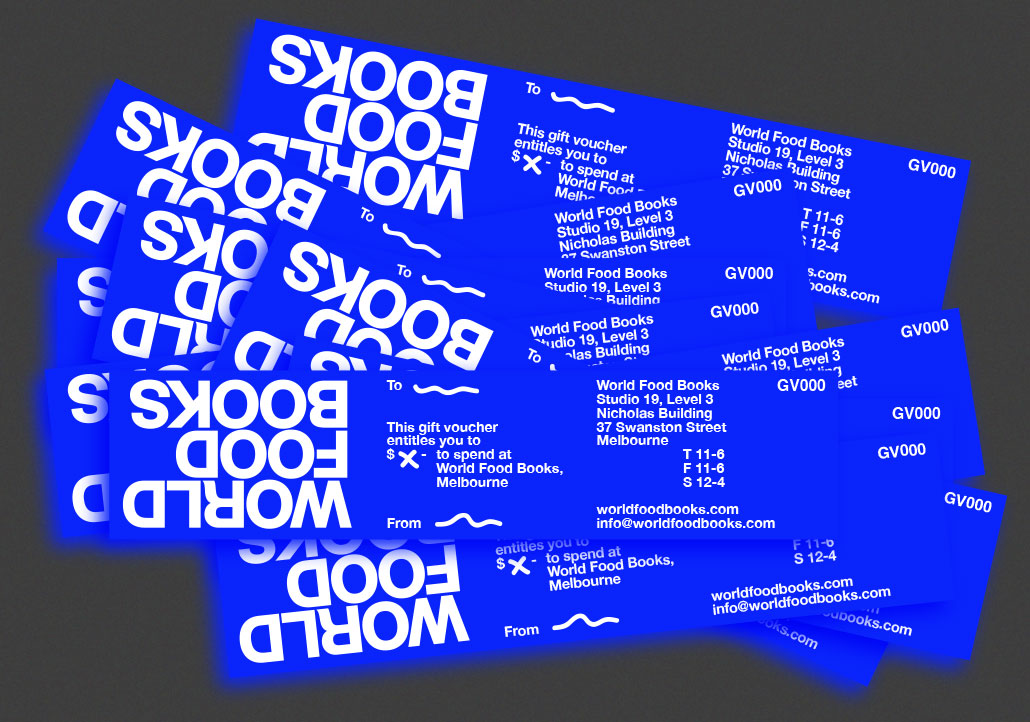
A World Food Books gift voucher is redeemable in our Melbourne bookshop or via our webshop (here). An e-voucher (printable pdf) will be sent to your purchase email address (please notify us if you wish to have the voucher sent to an alternate address and wish us to fill in the receiver's details on the card).
Gift vouchers can be purchased in increments of $20 (Australian Dollars) and the total amount can simply be added to by increasing the quantity in your shopping cart. eg. A quantity of 5 gift vouchers will result in an item total of $100 - a $100 gift voucher. Simply click "ADD TO CART" 5 times, or update your quantity in the shopping cart.
If you wish to purchase multiple, separate gift vouchers in one go, please just email us and we can personally prepare and email you a payment request.
Please note: Please select Pick-Up on gift voucher purchse to avoid any postage charges. Accidental postage charges will be refunded right away!
Thank you.
For any questions, please don't hesitate to email: [email protected]
2021, English
Hardcover, 76 Pages, 20 x 25 cm
Published by
Baron / UK
$70.00 - In stock -
Back in print! The first posthumous book by Japanese fetish artist Namio Harukawa (May 1947 – April 24, 2020), dedicated to Harukawa’s archive of rarely published work.
Creating a visionary language through the medium of pencil drawings, Harukawa worked for 60 years under a pseudonym, Namio Harukawa: formed from an anagram of “Naomi”, a reference to Jun’ichirō Tanizaki’s novel, and actress Masumi Harukawa, using it until his death in 2020.
Forniphilia and domination has fascinated and preoccupied Harukawa, in his artistic practice, and was central to his life work. His artwork typically featured voluptuous women dominating and humiliating smaller men. His work has been exhibited internationally and received critical praise, from Oniroku Dan to Madonna, and found new contemporary relevance on social networks, from feminists, to liberators.
The book also contains an essay by academic Pernilla Ellens, editor of Post Butt and The true meaning of S.M.H. and is designed by Sam Boxer, Art Director of Gut Magazine.
2000, English / Japanese
Softcover (w. obi), 256 pages, 25.5 x 17.5 cm
1st Edition, Out of print title / used / very good
Published by
Kondansha International / Tokyo
$70.00 - In stock -
"In Ohkura's stark vision Tokyo is an inorganic machine where everyone and everything exists only to serve the ringmaster of commerce. Activity, however frenetic, is futile. Work, leisure, love, pleasure, all are just forms of human bondage."—Giles Murray
Scarce first 2000 edition of Onkura's incredible Tokyo X — stark black and white imagery from the metropolis, published by Kondansha International. Texts in English and Japanese. With Afterword by Shunji Onkura.
The book ran into multiple print-runs, this is the first, stated within.
"Tokyo—exciting, flamboyant—is much, much more than that. It is nothing less than a monstrous hellhole inhabited by the most alienated people on the face of the earth. It is this city of eviscerated, hollow men and women that has been so unforgettably captured in the powerful photography of Tokyo X. Here, Tokyo, which the afterword declares to be the handiwork of "a demon-like ruler whose power is so vast that it envelopes the entire planet and transcends all human understanding and religion," is seen as the unfortunate future brought into an unprepared present. This is the world that Tarkovsky borrowed for the alien capital in "Solaris" and the location of Ridley Scott's "Blade Runner." It is the scene for Katsuhiro Otomo's "Akira." It is what perhaps awaits all mankind. This is the conclusion, after reading Tokyo X, that one is forced to draw. Shunji Ohkura, famous for his photography of Kabuki, fashion, and insects, was so moved by the plight of Tokyo in the 1990s that he forced himself to record the carnage in the 251 scenes revealed in this book. The photos, seemingly randomly arranged, in fact constitute a linked series of visual poems that resonate and reverberate throughout the mind until the dark shroud covering the city of Tokyo seems to cloud the whole of one's vision. Tokyo X must be seen to be believed."
Very Good copy with original obi. Light wear to obi and cover extremities, else Fine throughout.
1985, English
Softcover, 124 pages, 19.5 x 12.5 cm
1st Edition, Out of print title / used / very good
Published by
Marion Boyars / London
$50.00 - Out of stock
Rare 1985 English edition of Joko's Anniversary, a novel by well-known French satirist Roland Topor, tanslated by J. A. Underwood, first published in France in 1969. In Joko's Anniversary, Topor's simple and direct style conjures up a terrifying and grotesque picture of ultimate enslavement and a vicious satire on social conformity.
"Joko is on his way to work at the Plant one day when somebody jumps on his back. He shakes the person off and walks on, but then someone else jumps on his back! This person possesses a pair of beautiful female legs, but, even so, why should he carry her? On arrival at the plant, Joko is shunned and derided for his unwillingness to act as general conveyance (his would-be passengers are apparently delegates, attending a conference in town) and he decides that the only way to curry favour with his work-mates and the obviously very superior delegates is to become the best human horse available. The pace quickens until Joko, now completely submissive, finds himself involved in a nightmarish situation, with all the delegates glued to his back[...]"
More than a clever piece of black humour, for beneath the horrific veneer, Topor is urging the reader to a very serious consideration of the potential degradation of any individual by society.
"Maybe this obscure exercise in European absurdism doesn’t belong in a horror book review, but it does contain generous helpings of mutilation, cannibalism and demonic possession. Beginning like the most ludicrous SATURDAY NIGHT LIVE sketch ever and concluding with a grand guignol blow out worthy of De Sade, this tale is nothing if not unclassifiable. Whatever it is, it’s most definitely one of the strangest books I’ve ever read, and no surprise, as its author Roland Topor was a close associate of wacky cult figures like Alejandro Jodorowski and Fernando Arrabal. Topor also co-scripted the bizarre sci fi cartoon FANTASTIC PLANET and provided the source novel for Roman Polanski’s whacked-out classic THE TENANT."—The Bedlam Files
Roland Topor (1938—1997) was one of the most unique and versatile French artists of the second half of the 20th century, working prolifically as a provocative and spirited illustrator, author, humorist, satirist, poet, painter, performer, sculptor, playwright, film and TV writer, filmmaker and actor, and much more. A founder of the Panic Movement, an art collective formed by Fernando Arrabal, Alejandro Jodorowsky, and Roland Topor in Paris in 1962, Topor was known for the surreal and absurdist nature of his work.
Very Good copy with mild foxing to block edge.
1970, German
Softcover, unpaginated, 18 x 12 cm
1st Edition, Out of print title / used / very good
Published by
Kiepenheuer & Witsch / Köln
$100.00 - In stock -
Scarce first 1970 German edition of Roland Topor's famous book collection Die Masochisten (The Masochists), one of the finest examples of the artist's profound command of illustrated dark humour. Almost entirely made up of wordless b/w illustrations, with a foreword in german by German designer, illustrator and typographer, Hannes Jähn.
Roland Topor (1938—1997) was one of the most unique and versatile French artists of the second half of the 20th century, working prolifically as a provocative and spirited illustrator, author, humorist, satirist, poet, painter, performer, sculptor, playwright, film and TV writer, filmmaker and actor, and much more. A founder of the Panic Movement, an art collective formed by Fernando Arrabal, Alejandro Jodorowsky, and Roland Topor in Paris in 1962, Topor was known for the surreal and absurdist nature of his work.
Very Good copy. A crisp, solidly bound copy with some foxing/tanning to pages, usual spine edge tanning to bright fluro pink boards (most often bleached out).
1997, English
Softcover, 176 pages, 20 x 13 cm
1st Edition, Out of print title / used / very good
Published by
Black Spring Press / London
$60.00 - Out of stock
Rare 1997 Black Spring Press edition of Roland Topor's The Tenant with "mirrored" covers. A masterful psychological thriller, The Tenant tells the tale of Monsieur Trelkovsky, an ordinary man with ordinary desires against whom apparently ordinary circumstances conspire until he is enmeshed in an extraordinary and terrifying situation.
"Grotesque and harrowing. The Tenant is a powerful fable set in the twilight zone"—The Observer
With supreme skill and economy, Topor lures us into a nightmare world of paranoia, conspiracy, horrifying injury and suicide - a world which, we come to feel, is separated from the normality of everyday life by the merest sliver of sanity.
Originally published in French as Le Locataire Chimérique in 1964, The Tenant was the basis of a successful film by Roman Polanski.
Roland Topor (1938—1997) was one of the most unique and versatile French artists of the second half of the 20th century, working prolifically as a provocative and spirited illustrator, author, humorist, satirist, poet, painter, performer, sculptor, playwright, film and TV writer, filmmaker and actor, and much more. A founder of the Panic Movement, an art collective formed by Fernando Arrabal, Alejandro Jodorowsky, and Roland Topor in Paris in 1962, Topor was known for the surreal and absurdist nature of his work.
Very Good copy with mild tanning.
2003, English
Softcover, 150 pages, 31 x 31 cm
1st Edition, Out of print title / used / good
Published by
The Tate Gallery / London
$35.00 - In stock -
From May to October 2003 two enormous inflatable sculptures will loom above visitors to Tate Modern and those strolling along the riverbank. The first, Blockhead, revisits one of McCarthy's trademark characters, a mutant cartoon character with a Pinocchio nose emerging from its cuboid head. At 35 meters, it towers as high as the fourth level of Tate Modern. The second sculpture is named Daddies Bighead. This 16-meter high figure has a body constructed from a giant replica of a ketchup bottle. McCarthy has frequently used ketchup in his performances and installations as a stand-in for blood and other bodily excretions. Much of his work has courted controversy, dealing as it does with iconic imagery taken from childhood and popular culture combined with sexually charged and transgressive elements. McCarthy has exhibited widely across the United States, Europe and Japan, and has undertaken collaborations with artists including Mike Kelly and Jason Rhoades. His works are in numerous major collections.
A unique record of an artistic event, Paul McCarthy at Tate Modern includes a new interview with the artist, brand new dramatic installation photography, working drawings and models, and essays that will place this incredible work in the context of McCarthy's career.
Good copy with some wear to covers, tanning to spine edge.
1999, English
Softcover, unpaginated, 18.5 x 18.5 cm
Out of print title / used / very good
Published by
Charta / Milan
$120.00 - Out of stock
The great Propo artist's book by Paul McCarthy, published by Charta in 1999. Comprised entirely of photos of everyday objects, soiled, dirtied and ruined, shot against colourful backdrops that contrast with the mysterious nature of the decontextualized objects. Children's toys, condiment bottles, latex masks, dolls ... these objects are in fact props from McCarthy's legendary performances, and their visual inventory here reads like a book of modernity's detritus. A photo book document of residual sculptural objects of performance. One of his best books, like no other!
Born in Salt Lake City in 1945, Paul McCarthy has lived and worked in the Los Angeles area since 1970. Originally formally trained as a painter, McCarthy's main interest lies in everyday activities and the mess created by them. Much of his work in the late 1960s, such as Mountain Bowling (1969) and Hold an Apple in Your Armpit (1970), are similar to the work of Happenings founder Allan Kaprow, with whom McCarthy had a professional relationship. From 1982 to 2002 he taught performance, video, installation, and performance art history at the University of California, Los Angeles. McCarthy currently works mainly in video and sculpture. His work has been widely exhibited throughout Europe and the U.S. including the Museum of Contemporary Art, Los Angeles; the Whitney Museum of American Art and The Museum of Modern Art; and the Centre Georges Pompidou, Paris.
Very Good copy with only light wear.
1977, English
Softcover, 96 pages, 29 x 22 cm
1st Edition, Out of print title / used / good
Published by
Academy Editions / London
$45.00 - In stock -
1977 Academy Editions monograph on French painter and printmaker Marie Laurencin (1883 – 1956). She became an important figure in the Parisian avant-garde as a member of the Cubists associated with the Section d'Or, an intimate of the circle surrounding Picasso, Apollinaire, and Juan Gris. Profusely illustrated throughout in colour and b/w with her works accompanied by text by Charlotte Gere in English and French, plus a list of books illustrated by M. Laurencin.
Born on October 31, 1883, in Paris, Marie Laurencin initially learned porcelain painting at the Manufacture nationale de Sèvres before taking drawing courses with the City of Paris and at the Académie Humbert.
She was close to the French avant-garde artists of the Section d'Or movement, including Robert Delaunay, Jean Metzinger, and Francis Picabia. In 1907, she had her first solo exhibition and met Pablo Picasso (1881-1973) as well as the group of artists from the Bateau-Lavoir in Montmartre, and the poet and art critic Guillaume Apollinaire (1880-1918). Although influenced by Fauvism at one point, Marie Laurencin simplified and idealized forms under the influence of Cubist painters. Working mainly in a palette of neutral tones such as gray, pink, and pastels, her delicate portraits focused on young women and animals. In the 1920s, she began painting graceful, ethereal female figures, which she later revisited in pale-toned canvases, evoking an enchanted world.
Marie Laurencin created a style distinctively her own whilst expanding upon earlier periods and movements in both art and literature. She borrowed symbolic imagery, such as fans and deer, from Rococo painting, experimented with unusual color schemes as did the impressionists, and drew upon modern ideas of abstraction in stripping her images of extraneous detail. Her dreamlike sensibility, meanwhile, borrowed from Symbolist poetry.
Good copy with some wear and tanning to extremities.
1991, English
Softcover, 192 pages, 18 x 11 cm
1st Edition, Out of print title / used / very good
Published by
Annihilation Books / London
$80.00 - In stock -
Scarce copy of the 1991 Annihilation Press reprint of the The Velvet Underground — "the book that lent its name to the seminal New York rock'n'roll group, whose songs were to mirror its themes of sexual and social sickness". The Velvet Underground, a 1963 pulp paperback study by Michael Leigh, was "an exposé of the diseased underbelly of '60s Middle America, revealing a sadomasochistic demi-monde symptomatic of a whole generation's restless alienation; a classic bible of filth and degeneration, pinpointing the creeping sickness in American society that six years later would surface in the Apocalypse according to Charles Manson ..."
G—VG copy of the 1991 Annihilation Press edition, light corner/spine wear, block kinking from storage.
1985, English
Hardcover (w. slipcase), unpaginated, 22 x 16 cm
Out of print title / used / very good
Published by
Parlor / Tokyo
$180.00 - In stock -
1985 edition of Japanese illustrator Ken Katayama's masterpiece artbook, Beautiful Days, originally issued in this same hardcover, slipcased form in 1969 in a limited edition. Beautiful Days is the most crystallised embodiment of one of the most unique artistic visions of fantasy illustration one could ever find, and the first collection ever published by the artist, when, after discovering the erotic works on the fringe of Surrealism he gave up becoming a painter and gave himself over to the obscene impulses of drawing. "There, so to speak, masturbation became a picture. Until then, I never thought that masturbation could become a painting"—excerpt from Ken Katayama's 1985 postscript. Katayama's magnificently, obsessive graphite-rendered world-making is, like those of Lewis Carroll before him, made up almost entirely of children; children in states of blank-faced entrancement, possession and naked abandon; groping, lost and frozen in a psychosexual schoolhood theatre. Unlike anything else, aspects of Katayama's bewildering sadomasochistic fairytale visions recall the tales of de Sade, Balthus, Hans Bellmer, Carroll's Alice, the architectural dreamscapes of Delvaux or the Metaphysical painters and even fellow Japanese artist Yoshifumi Hayashi — a haunted landscape of eroticised adolescent memories with recurring motifs of free flowing urination and defecation, violently strewn newspapers, urinals, and apparitions of cat-people. Nothing like it! The work even inspired an experimental film of boyhood memories directed by the provocative film-maker Nakamura Masanobu in 1970.
"If you
keep your hands in your pockets
in your pocket
what are you hiding
that's how I got it
darkness in my pocket, days of dust
I opened the old album and showed
beautiful days other days"
Virtually unknown outside his native Japan, Katayama (b. 1940, Tokyo) studied at the Musahino Art University and in the 1960s and 1970s begin contributing illustrations to underground art and literary magazines such as Black Notebook, Featured Story and fetish magazines such as SM Select, amongst many others. He published art books such as Angel Hour, Lost Child's Top, Match Taker, The Cat in Boots, and many more, and went on to become a successful children's story book illustrator, publishing many works throughout the 1980s—90s.
Fine copy, beautifully preserved in Very Good slipcase.
1999, English/German
Softcover, 64 pages, 20.5 x 15.5 cm
1st Edition, Out of print title / used / fine
Published by
Oktagon Verlagsgesellschaft mbH / Cologne
Walther König / Köln
$180.00 - In stock -
Rare copy of British artist Stephen Willats' fabulous Multiple Clothing: Designs 1965-1999, published by Walther König in 2000, long out-of-print. Filled with extensive documentation of Willat's conceptual text based clothing designs and accompanied by his texts, with photographic documentation of performances, exhibitions and all original garment designs reproduced in full-colour.
"Since the early 1960s, Stephen Willats has devoted himself to the dialogue between the artwork and the viewer. His models from the series Multiple Clothing are specially made mix-and-match PVC garments. Each design is produced as an assemblage of clothing sections that contain either single words, or a range of letters. These can be built up within the framework of each design, indicating the state of mind of the wearer. This artist's book contains diagrams, drawings and photographs of the work alongside comment and text written by Willats himself."
‘I consider clothing as an important area of strategy in art, as a territory of expression that takes the artist right into the realm of reality that is very much a parameter to people’s experience of society. So the works I have developed as clothing are made to be worn, though there is a clear difference for the wearer with the clothes they might normally wear, so that the act of wearing my clothes differentiates the experience from normality in the surrounding world. My intention is that in wearing one of these clothes you yourself become an integral manifestation of the work, and your internalization of the meaning of the work is through that act of wearing it, and subsequently what happens to you as a result. The works alter your interpersonal relationship with the other people you come into contact with, and alter their relationship with you…..’—Multiple Clothing, Designs 1965 – 1999, Stephen Willats, Walther König, Cologne, 2000
Fine copy.
1988, English
Softcover, 56 pages, 27.5 x 21 cm
1st Edition, Out of print title / used / very good
Published by
Catalan Communications / New York
$60.00 - Out of stock
First English edition of Italian comic book artist Milo Manara's internationally acclaimed 'Click' ('Il Cioco' or 'Déclic'), initially published in Playmen in Italy and L'Écho des Savanes in France in 1983, it remains one of the most widely published erotic stories of our time. A master of storytelling and of the illustrated human form, Manara's 'Click' was (and still is) notorious for its erotic subject - a wealthy, beautiful but passionless woman is plunged into an scandalous, delirious sexual comedy when she is implanted with a remote-controlled chip able to unlock her inner lustfulness. But things are not as they seem. Manara's bacchanalian comic tale thumbs its nose at all manner of taboo in a way the likes of Walerian Borowczyk, Jess Franco or even Luis Buñuel did with cinema, whilst annihilating social graces and illusions of control through impeccable line-work.
Maurilio Manaro (b. 1945), known professionally as Milo Manara, is an Italian comic book writer and artist. His first work appeared in the 'Genius' pocket books in 1969, and in magazines like Terror, Telerompo, and the French magazines Alter-Linus and Charlie Mensuel. He also worked for various children's magazines, collaborating with Milo Milani. Manara illustrated five issues of the collection 'L'Histoire de France en Bandes Dessinées' for the French publisher Larousse between 1976 and 1978, and continued to work illustrating similar educational publications, such as 'La Découverte du Monde en Bandes Dessinées' (Larousse, 1979), 'L'Histoire de la Chine' (1980) and 'La Storia d'Italia a Fumetti' (Mondadori, 1978). Also in 1978, he cooperated with Alfredo Castelli on 'L'Uomo delle Nevi' for Cepim and he started with the series 'Giuseppe Bergman', the anti-hero graphic novels which are an ironic deconstruction of adventure stories and comic books as a medium. Manara briefly ventured into westerns with 'Quatre Doigts, L'Homme de Papier' in Pilote (1982), before establishing himself as one of the greatest creators of erotic comics. Manara's book 'Déclic' ('Il Cioco' or 'Click' in English, 1983), initially published in Playmen in Italy and L'Écho des Savanes in France, remains one of the most iconic, notorious and widely published erotic stories of our time. Throughout the 1980s and 1990s, Manara created a vast collection of erotic comic books, however he also kept on working in other genres. With the great Italian comic book artist Hugo Pratt, Manara worked on 'L'Été Indien' (in Corto Maltese) and 'El Gaucho' (in Il Grifo). Manara also worked with the film director Federico Fellini on 'Voyage à Tulum' (Corriere della Serra, 1986) and 'Le Voyage de G. Mastorna dit Fernet' (Il Grifo, 1992). In the 1990s-2000s Manara made books for Les Humanoïdes Associés, DC/Vertigo, Marvel Comics and teamed up with writer, film director Alejandro Jodorowsky.
Very Good copy.
2012, Japanese
Hardcover (w. dust jacket + obi + postcard), 128 pages, 30.5 x 22 cm
Out of print title / used / fine
Published by
Kawade Shobo Shinsha / Tokyo
$120.00 - In stock -
Revised 2012 hardcover edition of infamous Ero-guro master Suehiro Maruo's New Century SM Pictorial, a large format book first published in 2000, packed to the brim with Maruo's dark and surreal artworks, masterfully detailed and explicitly grotesque. This beautifully produced book collects so many of his iconic artworks in lush colour, it also contains a 26-page manga created by Maruo printed in black, white and red, photos of Maruo's personal manga & movie poster collection, a lot about Maruo obsession with movies, approximately 36 pages of monochrome artwork (blue/white or black/white), an article with many photographs (including a few rare pictures of Maruo himself), and a list of all works included, plus contributions by Japanese horror and mystery fiction author Katsuhiko Takahashi, legendary SF manga creator Kazumasa Hirai, Uchida Masaru, and a conversation between master Japanese manga artist Jiro Kuwata and Suehiro Maruo!
Includes Suehiro Maruo postcard insert.
Fine copy in F dust jacket with F obi. A most complete and preserved copy.
1962, German
Softcover, 190 pages, 21 x 16.8 cm
1st Edition, Out of print title / used / very good
Published by
Gerhardt Verlag / Berlin
$300.00 - In stock -
Rare 1962 edition of Bellmer's "Die Puppe", published by Gerhardt Verlag in Berlin. German artist Hans Bellmer (1902-1975) was one of the most subversive artists associated with Surrealism, famous—notorious, even--for his erotic engravings, objects and photographs. This collectable first edition of Die Puppe (The Doll) comprises a series of Bellmer's hand-painted photographs in the form of 10 monochrome and 15 coloured tipped-in plates accompanying his remarkable texts, here published for the first time. Bellmer's hand-coloured photographs subsequently acquired an iconic status as perhaps the purest exemplification of the Surrealist ideal of "convulsive beauty." Bellmer weaves a remarkably disparate set of concepts and intuitions—from fields as diverse as mathematics, morphology, optics and psychology—into a theory of eroticism that provides a totally unexpected rationale for his uncompromising art. His ideas are, in the words of poet Joë Bousquet, a "scandal to reason." The book also contains many b/w drawings by Bellmer along with prose poems by Paul Eluard. A book like no other!
Very Good—Near Fine preserved copy of this stunning edition with the die-cut decal cover. Light corner bump, light block shelf wear.
1986, Japanese
Softcover, 90 pages, 29.7 x 21 cm
1st UK Edition, Out of print title / used / very good
Published by
Keibunsha / Kyoto
$90.00 - In stock -
Rare copy of this 1986 special edition of Young Idol Now magazine devoted entirely to horror film. At the height of the home video revolution of the 1980s, no-one was more committed to covering the explosion of new American and European horror films than the Japanese. Vividly illustrated with graphic-saturated pages and awesome collage style articles similar to V-Zone magazine, this volume features Nightmare on Elm Street, Demons, Day of The Dead, Dreamscape, Manhattan Baby, Creep Show, The Deadly Spawn, Creature, Fright Night, Beyond, The House Behind The Cemetery, and so many more. Loads of gore and creature imagery, as well as VHS catalogue of reviews of many new (mid-1980's) horror videos, articles behind the scenes (Fangoria), and an essential chronology of horror films through the ages. Published Keibunsha in Japan only, of course.
Good copy with some light wear/bumping.
1996, English
Softcover (staple-bound), 84 pages, 27.5 x 21.5 cm
Signed by Wes Benscoter,
1st Edition, Out of print title / used / very good
Published by
Fresh Blood Studios / Texas
$180.00 - In stock -
Insanely rare copy of "The Deadliest Art Magazine Ever Unearthed", Drawing Blood, issue no. 3, Spring / Summer 1996, with cover art and hand-signed colour centrefold by Wes Benscoter (illustrator for Slayer, Mortician, Kreator, Deceased, Cattle Decapitation, etc). This short-lived underground dark fantasy art / death metal magazine was self-published and printed in Texas in the mid 1990s in very limited numbers, dedicating its pages to the demonic dark arts — a new generation of gothic horror fantasy artists, professional and unknown, lavishly reproducing their artworks in glossy colour and b/w galleries, alongside interviews with the artists. It also features a tremendous line-up of exclusive band interviews by the editors and fellow contributors — this issue has Cannibal Corpse, Celtic Frost, Napalm Death, Samael, At The Gates, Hypocrisy, Moonspell, Hellwitch, Horror of Horrors, Judecca, As The Sea Parts, Descend. Visual artists featured this issue include Wes Benscoter (cover and signed pin-up), Lars Fruth, Lorianne Crolla Mychajluk, Brian Viveros, Nina Kempf, Vincent Meyer, Alain Vourna, Nizin, Skott Kautman, Troy Dunmire, Ty Remy, Alan Clayton, Will Lee, Andy Knerr, Mark Riddick. Edited by S.C. Carr. Nothing else like it, and the best context for this work, before the great flattening of CG art and the internet.
Very Good copy, well preserved.
2011, English
Hardcover (clothbound), 216 pages, 24.5 x 16.6 cm
1st Edition, Out of print title / used / fine
Published by
Hatje Cantz / Berlin
$120.00 - In stock -
First 2011 English hardcover edition of Richard Prince's Collected Writings, published by Hatje Cantz. This book is the first collection of selected short works by American artist Richard Prince. Written between 1974 and 2009, these thirty-five pieces of prose explore everything from Franz Kline to Woodstock, and include revealing musings on the revolutionary approach to photography central to Prince's technique. A literary text by Jonathan Lethem, author of the currently much-talked-about novel Chronic City, rounds off this volume edited by Kristine McKenna.
Fine copy.
2009, English
Softcover, 32 pages, 25 x 17 cm
1st Edition, Out of print title / used / fine
Published by
Sadie Coles / London
The Journal / New York
$90.00 - In stock -
First edition published by Sadie Coles in conjunction with The Journal in 2009, "What's in My Library" is a limited-edition photo-book by Richard Prince, collecting his personal photography put to a series of Prince's most treasured books from his personal collection, reflecting his fascination with Americana, pop culture, and literary curiosities from his extensive collection, including first editions and inscribed books.
Fine copy.
1999, English
Softcover, 192 pages, 28 x 21.59 cm
1st Edition, Out of print title / used / very good
Published by
Creation Books / London
Velvet Publications / London
$140.00 - In stock -
First edition of 1999's long out-of-print "Body Probe: Mutant Flesh and Cyber Primitives," by Creation Books' Velvet imprint. The Torture Garden follows up its first, club-based book with the sequel Body Probe, an anthology of interviews, features and images exploring the boundaries of the human body at the edge of the new millennium. Edited by David Wood, contents include: David Cronenberg, Hermann Nitsch, Chapman Brothers, Orlan, Stelarc, Ron Athey, Della Grace, Nick Knight, Alex Binnie, plus alien abduction, sex in space, medical fetishism, robot art, mutation in fashion, self-made freaks, the cybernetic body and S/M art.
Body Probe confirms the Torture Garden's position at the cutting edge of the fetish, body art, and cyber technology scene. It contains over 100 black and white photographs, and over 50 full-colour plates.
Very Good copy, light wear.
1995, English / Japanese
Softcover (w. card slipcase and printed sticker), 159 pages, 26 x 18 cm
1st Edition, Out of print title / used / fine
Published by
Sezon Museum of Art / Tokyo
$100.00 - In stock -
Published in conjunction with the 1995 touring Japanese Museum retrospective of work by the pioneering late artist/ceramicist Peter Voulkos, this is the beautifully designed and printed first-edition Japanese catalogue from the Sezon Museum of Art, Tokyo (Jan 2 - Feb 20, 1995) and The National Museum of Modern Art, Kyoto. (Feb 28 - April 2, 1995), which comes housed in an elegant printed cardboard slipcase. A very rare volume, and in our opinion the most stunning of books on the work of Peter Voulkos. Profusely illustrated with wonderful colour photo documentation of his many works, accompanied by studio photographs and an essay by Rose Slivka.
Peter Voulkos (1924 – 2002) was an American artist of Greek descent. After teaching a ceramics course at Black Mountain College in the summer of 1953, Voulkos founded the Ceramic Center at Otis Art Institute in Los Angeles (1954), which gave birth to the West Coast Abstract Expressionist ceramics movement. He is known for his gestural sculptural objects, which crossed the traditional divide between ceramic crafts and fine art. While his early work was fired in electric and gas kilns, later in his career he primarily fired in the anagama kiln of Peter Callas, who had helped to introduce Japanese wood firing aesthetics in the United States. Voulkos became a highly influential educator at UC Berkeley from 1959, while continuing a vital career that included work in bronze sculpture and wood-fired stoneware.
Near Fine.
2019, English
Softcover, 384 pages, 14 x 21.6 cm
Published by
University of Minnesota Press / Minnesota
$69.00 - In stock -
An archive-based, in-depth analysis of the surreal nature and science movies of the pioneering French filmmaker Jean Painleve
Before Jacques-Yves Cousteau, there was Jean Painleve, a pioneering French scientific and nature filmmaker with a Surrealist's eye. Creator of more than two hundred films, his studies of strange animal worlds doubled as critical reimaginations of humanity. With an unerring eye for the uncanny and unexpected, Painleve and his assistant Genevieve Hamon captured oneiric octopuses, metamorphic crustaceans, erotic seahorses, mythic vampire bats, and insatiable predatory insects.
Zoological Surrealism draws from Painleve's early oeuvre to rethink the entangled histories of cinema, Surrealism, and scientific research in interwar France. Delving deeply into Painleve's archive, James Leo Cahill develops an account of "cinema's Copernican vocation"-how it was used to forge new scientific discoveries while also displacing and critiquing anthropocentric viewpoints.
From Painleve's engagements with Sergei Eisenstein, Georges Franju, and competing Surrealists to the historiographical dimensions of Jean Vigo's concept of social cinema, Zoological Surrealism taps never-before-examined sources to offer a completely original perspective on a cutting-edge filmmaker. The first extensive English-language study of Painleve's early films and their contexts, it adds important new insight to our understanding of film while also contributing to contemporary investigations of the increasingly surreal landscapes of climate change and ecological emergency.
1986, English
Softcover, 130 pages, 21 x 13.5 cm
1st Edition, Out of print title / used / very good
Published by
Quartet Books / London
$60.00 - In stock -
'(Bresson] is the French cinema, as Dostoyevsky is the Russian novel and Mozart is German music. Listen to him: "A good craftsman loves the board he planes"..' JEAN-LUC GODARD, CAHIERS DU CINÉMA
Scarce 1986 English edition of Robert Bresson's Notes on the Cinematographer, first published in 1977 and translated to English by Jonathan Griffin. This book collects the working memos which the great French director made for his own use. In all of them, Bresson reflects with a craftsman's insight on techniques and their philosophical and aesthetic implications. Not surprisingly, these acute reflections will not only sharpen a film-maker's sensibility but that of any artist in any medium.
Bresson makes some quite radical distinctions between what he terms 'cinematography and something quite different: 'cinema' - which is for him nothing but an attempt to photograph theatre and use it for the screen.
This timeless collection of Bresson's short aphorisms are accompanied by a preface by J.M. G. Le Clézio, written for this edition.
The author's most distinguished films include The Trial of Joan of Arc, Pickpocket, A Prisoner Escapes, Diary of a Country Priest and Money.
Very Good copy, light age/dustiness.