World Food Books' programme is largely produced on Kulin Nation land. We acknowledge the Wurundjeri people of the Kulin Nation as the first and continuing custodians of this land, and pay respect to their Elders past, present, and emerging.
World Food Books is an arts and special interests bookshop in Naarm / Melbourne. Founded in 2010, World Food Books is devoted to the presentation of a rotating, hand-selection of international art, design, literary and counterculture publications with an emphasis on the anti-traditional, the experimental, the avant-garde, the heretic, the marginal.
Presenting new titles alongside rare and out-of-print books, catalogues and journals spanning the fields of modern and contemporary art, design, photography, illustration, film, literature, poetry, cultural theory, philosophy, sexuality, popular and underground culture in its many radical forms, World Food Books wishes to encourage adventurous, thoughtful and open-minded reading, looking, writing, and exchange of publishing and ideas, both current and historical.
As well as our bookshop, located in Melbourne's historical Nicholas Building, all of our inventory is available internationally via our online mail-order service.
World Food Books semi-regularly co-ordinates "Occasions", a programme of exhibits and events at the bookshop and in partnership with other hosts (such as museums and art galleries) that develop out of the activities, relationships and content of the bookshop itself.
World Food Books
The Nicholas Building
37 Swanston Street
Room 5, Level 6
Melbourne 3000
Australia
SHOP HOURS:
Thu–Fri 12–6, Sat 12–5
WEB-SHOP OPEN 24/7
World Food Books
Postal Address:
PO Box 435
Flinders Lane
Victoria 8009
Australia
Art
Theory / Essay
Architecture / Interior
Graphic Design / Typography
Photography
Fashion
Eros
LGBTQ+
Fiction / Poetry
Weird / Speculative / Science Fiction / Horror
Transgressive / Visceral / Abject
Symbolism / Decadence / Fin de siècle
Film / Video
Painting
Sculpture / Installation
Performance / Dance / Theater
Drawing
Sound / Music
Curatorial
Group Shows / Collections
Periodicals
Out-of-print / Rare
Posters / Ephemera / Discs
Signed Books
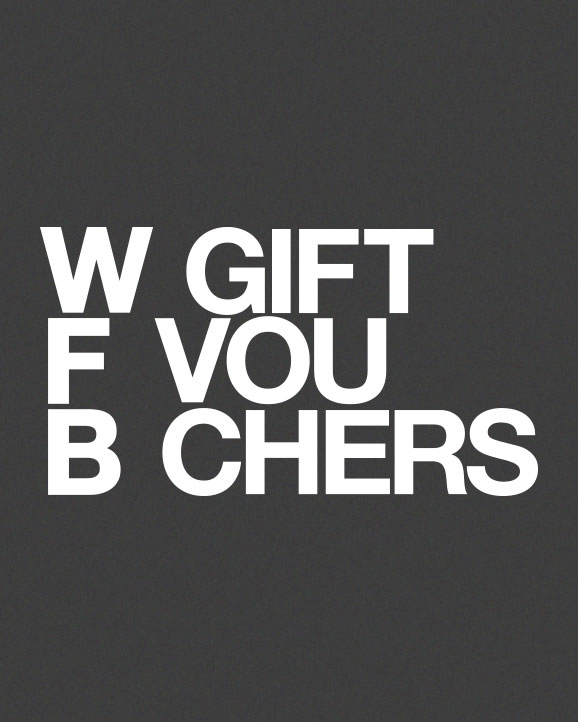
World Food Books Gift Voucher
World Food Book Bag
Australian Art
Australian Fiction
Australian Science Fiction / Speculative Fiction
Australian Poetry
Australian Photography
Japanese Photography
Conceptual Art
Minimal Art
Dada
'Pataphysics / Oulipo
Fluxus
Concrete Poetry
Pop Art
Surrealism
Arte Povera
Arte Informale / Haute Pâte / Tachism
Nouveau Réalisme / Zero / Kinetic
Situationism / Lettrism
Collage / Mail Art / Xerox Art
Art Brut / Folk / Visionary / Fantastic
Illustration / Graphic Art / Bandes Dessinées
Furniture
Italian Radical Design / Postmodernism
Textiles
Ceramics / Glass
Counterculture
Protest / Revolt
Philosophy
Psychoanalysis
Anthropology
Anarchism
Socialism / Anarchism / Communism / Capitalism
Literary Theory / Semiotics / Language
Feminism / Women's Studies
Gender Studies / Sexuality
Anthropology
Fetishism / BDSM
Drugs / Psychedelia
Crime / Violence
Animal Rights / Veganism
Occult / Esoterica
Ecology / Earth / Alternative Living
Whole Earth / Crafts
All prices in AUD (Australian dollars)
Pick-Ups
Pick-up orders can be collected in our bookshop during opening hours after order date. Please collect any Pick-up orders within 2 weeks of ordering as we have limited storage space. Orders will be released back into stock if not collected within this time. No refunds can be made for pick-ups left un-collected. If you cannot make it in to the bookshop in this time-frame, please choose postage option.
Return Policy
All sales are final. We do accept returns (for refund or exchange) for items received in error. All our orders are packed with special care using heavy-duty padding and cardboard book-mailers or bubble mailers (for smaller books), using reinforcement where required. We cannot take responsibility for any lost, stolen or damaged parcels.
Insurance
Should you wish to insure your package, please email us directly after placing your order and we can organise this at a small extra expense. Although all standard/express tracked packages are very safe and dependable, we cannot take responsibility for any lost, stolen or damaged parcels. We recommend insurance on valuable orders.
Interested in selling your old books, catalogues, journals, magazines, comics, fanzines, ephemera? We are always looking for interesting, unusual and out-of-print books to buy. We only buy books in our fields of interest and specialty, and that we feel we can resell.
We base these prices on desirability, market value, in-print prices, condition and our current stock levels. We offer cash, store credit, and can take stock on consignment. All
about 25% of the price we expect to get when we sell them, or 30% in store credit. We base these prices on desirability, market value, in-print prices, condition and our current stock levels.
Sell your books any day of the week. You can drop them off and return later. If you have a lot of books, we can visit your Sydney home.
We buy books that we feel we can resell. We offer about 25 % of the price we expect to get when we sell them, or 30% in store credit. We base these prices on desirability, market value, in-print prices, condition and our current stock levels.
Philadelphia Wireman
03 August - 01 September, 2018
World Food Books is proud to announce our next Occasion, the first presentation of sculptures by Philadelphia Wireman in Australia.
The Philadelphia Wireman sculptures were found abandoned in an alley off Philadelphia’s South Street on trash night in 1982. Their discovery in a rapidly-changing neighbourhood undergoing extensive renovation, compounded with the failure of all attempts to locate the artist, suggests that the works may have been discarded after the maker’s death. Dubbed the "Philadelphia Wireman" during the first exhibition of this work, in 1985, the maker’s name, age, ethnicity, and even gender remain uncertain. The entire collection totals approximately 1200 pieces, all intricately bound together with tightly-wound heavy-gauge wire (along with a few small, abstract marker drawings, reminiscent both of Mark Tobey and J.B. Murry). The dense construction of the work, despite a modest range of scale and materials, is singularly obsessive and disciplined in design: a wire armature or exoskeleton firmly binds a bricolage of found objects including plastic, glass, food packaging, umbrella parts, tape, rubber, batteries, pens, leather, reflectors, nuts and bolts, nails, foil, coins, toys, watches, eyeglasses, tools, and jewellery.
Heavy with associations—anthropomorphic, zoomorphic, and socio-cultural responses to wrapped detritus—the totemic sculptures by Philadelphia Wireman have been discussed in the context of work created to fulfil the shamanistic needs of alternative religions in American culture. Curators, collectors, and critics have variously compared certain pieces to sculpture from Classical antiquity, Native American medicine bundles, African-American memory jugs, and African fetish objects. Reflecting the artist’s prolific and incredibly focused scavenging impulse, and despite—or perhaps enhanced by—their anonymity, these enigmatic objects function as urban artefacts and arbiters of power, though their origin and purpose is unknown. Philadelphia Wireman, whatever their identity, possessed an astonishing ability to isolate and communicate the concepts of power and energy through the selection and transformation of ordinary materials. Over the course of the past two decades, this collection has come to be regarded as an important discovery in the field of self-taught art and vernacular art.
Presented in collaboration with Fleisher-Ollman Gallery, Philadelphia, and Robert Heald, Wellington.
Susan Te Kahurangi King
02 February - 10 March, 2018
Susan Te Kahurangi King (24 February 1951 - ) has been a confident and prolific artist since she was a young child, drawing with readily available materials - pencils, ballpoint pens and felt-tip markers, on whatever paper is at hand. Between the ages of four and six Susan slowly ceased verbal communication. Her grandparents William and Myrtle Murphy had developed a special bond with Susan so they took on caring responsibilities for extended periods. Myrtle began informally archiving her work, carefully collecting and storing the drawings and compiling scrapbooks. No drawing was insignificant; every scrap of paper was kept. The King family are now the custodians of a vast collection containing over 7000 individual works, from tiny scraps of paper through to 5 meter long rolls.
The scrapbooks and diaries reveal Myrtle to be a woman of great patience and compassion, seeking to understand a child who was not always behaving as expected. She encouraged Susan to be observant, to explore her environment and absorb all the sights and sounds. Myrtle would show Susan’s drawings to friends and people in her community that she had dealings with, such as shopkeepers and postal workers, but this was not simply a case of a grandmother’s bias. She recognised that Susan had developed a sophisticated and unique visual language and sincerely believed that her art deserved serious attention.
This was an unorthodox attitude for the time. To provide some context, Jean Dubuffet coined the term Art Brut in 1945 to describe work created by self-taught artists – specifically residents of psychiatric institutions and those he considered to be visionaries or eccentrics. In 1972 Roger Cardinal extended this concept by adopting the term Outsider Art to describe work made by non-academically trained artists operating outside of mainstream art networks through choice or circumstance. Susan was born in Te Aroha, New Zealand in 1951, far from the artistic hubs of Paris and London that Dubuffet and Cardinal operated in. That Myrtle fêted Susan as a self-taught artist who deserved to be taken seriously shows how progressive her attitudes were.
Susan’s parents Doug and Dawn were also progressive. Over the years they had consulted numerous health practitioners about Susan’s condition, as the medical establishment could not provide an explanation as to why she had lapsed into silence. Dawn educated herself in the field of homeopathy and went on to treat all twelve of her children using these principles – basing prescriptions on her observations of their physical, mental and emotional state.
Doug was a linguist with an interest in philosophy who devoted what little spare time he had to studying Maori language and culture. To some extent their willingness to explore the fringes of the mainstream made them outsiders too but it was their commitment to living with integrity and their respect for individuality that ensured Susan’s creativity was always encouraged.
Even though Susan’s family supported her artistic pursuits, some staff in schools and hospitals saw it as an impediment to her assimilation into the community and discouraged it in a variety of ways. Her family was not always aware of this and therefore did not fully understand why Susan stopped drawing in the early 1990s. However, rather than dwell on the challenges that Susan faced in pursuit of her artistic practice, they prefer to highlight her achievements. In 2008 Susan began drawing again in earnest, after an almost 20 year interruption, and her work is now shown in galleries around the world.
Susan grew up without television and has been heavily influenced by the comics she read as a child. She is absolutely fearless in the appropriation of recognizable characters, such as Donald Duck and Mickey Mouse, in her work. She twists their limbs, contorts their faces, compresses them together, blends them into complex patterned backgrounds - always imbuing them with an incredible energy. Although Susan often used pop culture characters in her work they are not naive or childlike. These are drawings by a brilliant self-taught artist who has been creating exceptional work for decades without an audience in mind.
Mladen Stilinović
"Various Works 1986 - 1999"
02 February 16 - September 10, 2016
Various works 1986 - 1999, from two houses, from the collections of John Nixon, Sue Cramer, Kerrie Poliness, Peter Haffenden and Phoebe Haffenden.
Including: Geometry of Cakes (various shelves), 1993; Poor People’s Law (black and white plate), 1993; White Absence (glasses, ruler, set square, silver spoon, silver ladel with skin photograph and wooden cubes), 1990-1996; Exploitation of the Dead (grey and red star painting, wooden painting, black spoon with red table, red plate), 1984-1990; Money and Zeros (zero tie, paintings made for friends in Australia (Sue, John, Kerrie), numbers painting), 1991-1992; Words - Slogans (various t-shirts) - “they talk about the death of art...help! someone is trying to kill me”, “my sweet little lamb”, “work is a disease - Karl Marx”; Various artist books, catalogues, monographs, videos; Poster from exhibition Insulting Anarchy; "Circular" Croatian - Australian edition; Artist book by Vlado Martek (Dostoyevsky); more.
Thanks to Mladen Stilinović and Branka Stipančić.
Jonathan Walker
Always Will Need To Wear Winter Shirt Blue + Ochre Small Check Pattern
21 August - 21 September, 2015
Untitled
I am not a great reader of poetry but I always return to the work of Melbourne poet, Vincent Buckley (1925- 1988). Perhaps I find his most tantalising piece to be not a finished poem but a fragment left on a scrap of paper discovered on his desk after the poet’s death.
The poetry gathers like oil
In the word-core, and spreads
It has its music meet,
Its music is in movement.
This fragment is more the shell left behind from a volatile thought than a finished poem. I find the last two lines honest but awkward whereas the first two lines work like an arrow. Most likely he could not find a resolution so it was left. Still, in its present form, it remains an eloquent testimony to the ultimate failure of a medium to express mobile thought and sensation, in Buckley’s case, through verbal language. It’s an important matter because this is something all artists have to deal with regardless of the medium.
I have never written a poem, however, I am forever copying fragments from books on paper scraps in a vain effort to fix certain notions in my head. At first, they function as bookmarks that are sometimes returned to when I open the book. But before long, as they accumulate, they fall out littering the table interspersed with A4 photocopies, bills, books and medications.
To return to Buckley’s fragment, the first two lines very much evoke how I paint nowadays. As you age, detail diminishes and patches of light become more luminous and float. I feel the most honest way of dealing with this is by smearing the oil paint on the canvas with the fingers and working close-up, blind. Only if the patches coalesce into an approaching image can the work gain a life.
-
Jonathan Walker was born in Melbourne, Australia and brought up on a dairy farm in Gippsland. In the 1970’s he studied painting at RMIT and won the Harold Wright Scholarship to the British Museum, London. During the 1980’s he exhibited at Pinacotheca Gallery, Richmond and had work shown at the NGV and Heidi City Art Gallery. Over the same period he designed the cover for the “Epigenesi” LP by Giancarlo Toniutti, Italy and conducted a mail exchange work with Achim Wollscheid, Germany. The work with artists through the post resulted in an article published in the bicentenary issue of Art and Australia 1988. He showed in artist run spaces such as WestSpace in the 90’s and 2000’s, and until 2012, taught painting at Victoria University, which is where we (Colleen Ahern and Lisa Radford) as organisers of the exhibition, among many others, had the privilege of being his student.
Walker’s knowledge was imparted to students through the careful selection of music, literature, and artists found in books that he himself had ordered for the library. Walker’s strategy was the generosity of sharing his vast knowledge with references specific to each student and their context.
Walker’s paintings share a similar focus and intimacy.
This exhibition presents a small selection of recent paintings alongside a publication that includes Walker’s writing. Observational and analytical, Walker’s work is a type of material notation — the time of day, colour and how it is blended, the both specific and fleeting location of a reflection on lino or the question of whether a chair leg should be included in a painting.
Please join us on Friday August 21 between 6-8pm to celebrate the opening of the exhibition.
Curated by Colleen Ahern and Lisa Radford.
B. Wurtz
Curated by Nic Tammens
March 26 - April 4, 2015
B.Wurtz works from a basement studio in his home on Manhattan’s Lower East Side.
This local fact is attested to by the plastic shopping bags and newsprint circulars that appear in his work. As formal objects, they don’t make loud claims about their origins but nonetheless transmit street addresses and places of business from the bottom of this long thin island. Like plenty of artists, Wurtz is affected by what is local and what is consumed. His work is underpinned by this ethic. It often speaks from a neighborhood or reads like the contents of a hamper:
“BLACK PLUMS $1.29 lb.”
“Food Bazaar”
“USDA Whole Pork Shoulder Picnic 99c lb.”
“RITE AID Pharmacy, with us it’s personal.”
“H. Brickman & Sons.”
“Sweet Yams 59c lb."
Most of the work in this exhibition was made while the artist was in residence at Dieu Donne, a workshop dedicated to paper craft in Midtown. Here Wurtz fabricated assemblages with paper and objects that are relatively lightweight, with the intention that they would be easily transportable to Australia. This consideration isn’t absolute in Wurtz’s work, but was prescriptive for making the current exhibition light and cheap. Packed in two boxes, these works were sent from a USPS post office on the Lower East Side and delivered to North Melbourne by Australia Post.
Wurtz appears courtesy of Metro Pictures, New York.
Thanks to Rob Halverson, Joshua Petherick, Sari de Mallory, Matt Hinkley, Helen Johnson, Fayen d'Evie, Ask Kilmartin, Lisa Radon, Ellena Savage, Yale Union, and "Elizabeth".
John Nixon
"Archive"
December 15 - January 20, 2014
The presentation of John Nixon's archive offered a rare showcase of this extensive collection of the artist's own publications, catalogues, posters, ephemera, editions and more, from the mid 1980s onwards, alongside a selection of his artworks.
Organized by John Nixon, Joshua Petherick and Matt Hinkley.
<a href=http://wfb.public-office.info/artist/john-nixon>All titles by John Nixon
"Habitat"
at Minerva, Sydney (organised by Joshua Petherick and Matt Hinkley)
November 15 - December 20, 2014
Lupo Borgonovo, Janet Burchill & Jennifer McCamley,
Lewis Fidock, HR Giger, Piero Gilardi, Veit Laurent Kurz,
Cinzia Ruggeri, Michael E. Smith, Lucie Stahl, Daniel Weil, Wols
Press Release:
“...It contained seven objects. The slender fluted bone, surely formed for flight, surely from the wing of some large bird. Three archaic circuitboards, faced with mazes of gold. A smooth white sphere of baked clay. An age-blackened fragment of lace. A fingerlength segment of what she assumed was bone from a human wrist, grayish white, inset smoothly with the silicon shaft of a small instrument that must once have ridden flush with the surface of the skin - but the thing’s face was seared and blackened.”
William Gibson, “Count Zero”, 1986
"Autumn Projects Archive"
Curated by Liza Vasiliou
March 6 - March 15, 2014
World Food Books, in conjunction with the Virgin Australia Melbourne Fashion Festival 2014, presented the Autumn Projects archive, consisting of a selection of early examples in Australian fashion with a particular interest in collecting designers and labels from the period beginning in the 1980’s, who significantly influenced the discourse of Australian Fashion.
Curated by Liza Vasiliou, the exhibition provided a unique opportunity to view pieces by designers Anthea Crawford, Barbara Vandenberg, Geoff Liddell and labels CR Australia, Covers, Jag along with early experimental collage pieces by Prue Acton and Sally Browne’s ‘Fragments’ collection, suspended throughout the functioning World Food Books shop in Melbourne.
H.B. Peace
presented by CENTRE FOR STYLE
November 14, 2013
"Hey Blinky, you say chic, I say same"
Anon 2013
H.B. Peace is a clothing collaboration between great friends Blake Barns and Hugh Egan Westland. Their pieces explore the divergences between 'character’ and ‘personality’ in garments....etc
Special Thanks to Joshua Petherick and Matt Hinkley of WFB and Gillian Mears
and a Very Special Thank you to Audrey Thomas Hayes for her shoe collaboration.
Janet Burchill & Jennifer McCamley
"Aesthetic Suicide"
May 10 - June 8, 2013
The first of our occasional exhibitions in the World Food Books office/shop space in Melbourne, "Aesthetic Suicide" presented a body of new and older works together by artists Janet Burchill & Jennifer McCamley, including videos, prints, a wall work, and publications.
During shop open hours videos played every hour, on the hour.
$.00 - Out of stock
The eternal clean out! New items weekly.
https://worldfoodbooks.com/category/sale
Published by World Food Books / Melbourne
$20.00 - In stock -
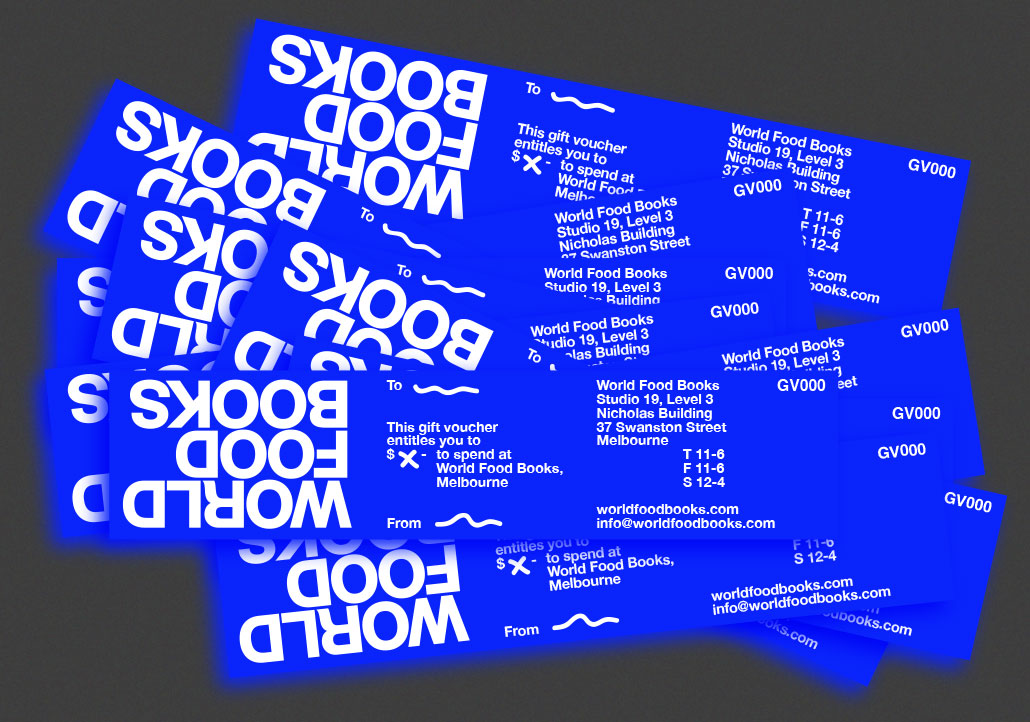
A World Food Books gift voucher is redeemable in our Melbourne bookshop or via our webshop (here). An e-voucher (printable pdf) will be sent to your purchase email address (please notify us if you wish to have the voucher sent to an alternate address and wish us to fill in the receiver's details on the card).
Gift vouchers can be purchased in increments of $20 (Australian Dollars) and the total amount can simply be added to by increasing the quantity in your shopping cart. eg. A quantity of 5 gift vouchers will result in an item total of $100 - a $100 gift voucher. Simply click "ADD TO CART" 5 times, or update your quantity in the shopping cart.
If you wish to purchase multiple, separate gift vouchers in one go, please just email us and we can personally prepare and email you a payment request.
Please note: Please select Pick-Up on gift voucher purchse to avoid any postage charges. Accidental postage charges will be refunded right away!
Thank you.
For any questions, please don't hesitate to email: [email protected]
1980, Enfglish
Softcover, 358 pages, 20 x 13.5 cm
1st Edition, Out of print title / used / good
Published by
Verso / London
$20.00 - In stock -
No post-war philosopher acquired such world-wide fame as Jean-Paul Sartre, or occupied such a commanding position within the difficult history of the European Left after the war.
Yet the very scale and variety of Sartre's writings has rendered an informed and balanced judgement of his achievement difficult. Ronald Aronson's book seeks to provide a set of keys to an overall understanding of it. After describing the historical and cultural conditions in which Sartre was formed in France, it proceeds to an analysis of his first text on 'The Imagination', and the evolution that led from it to 'Nausea' and Being and Nothingness'. Discussing the role of art as salvation in the work of this period, Aronson goes on to show how Sartre's theory of literature after the Liberation was the hinge of his transition from existentialism to socialism. He then assesses the actual results of Sartre's political commitment, as a dramatist and an essayist in the '50s and '60s. There follows the most cogent critical reflection on the Critique of Dialectical Reason' yet to have been written - one which includes, for the first time anywhere in the world, an account of the unpublished second volume of the work, largely on the history of the USSR.
Finally, Aronson surveys the miniature autobiography 'Words' and the monumental biography 'Flaubert', which formed the summum of Sartre's career.
"Jean-Paul Sartre - Philosophy in the World" is a tour de force of interpretative insight.
Good copy of first 1980 edition with some light creasing to cover and spine. Light general wear/age.
1991, English
Softcover, 416 pages, 23 x 15 cm
1st Edition, Out of print title / used / very good
Published by
The MIT Press / Massachusetts
$35.00 - In stock -
Bringing together the best critical essays on one of the most fascinating literary figures of our time, this book immediately takes its place as a major source for Benjamin scholarship. Hannah Arendt called Walter Benjamin "the outstanding literary critic of the twentieth century" when she introduced him to English-language readers in 1968 with the selection of essays entitled Illuminations. Since then, his life and work have entered the domain of literary legend. The seventeen essays collected here cover the full range of Benjamin's interests, from hashish to Goethe to the modern city. They include important critical essays by Gershom Scholem and Jürgen Habermas as well as several moving and evocative recollections of Benjamin by friends and colleagues such as Theodor Adorno and Ernst Bloch. Gary Smith served as coeditor of the seventh volume of Benjamin's Gesammelte Schriften and prepared both the German and English editions of Benjamin's Moscow Diary.
VG copy with some tanning to spine edge, light wear.
1996 / 2005, English
Softcover, 118 pages, 21.5 x 14 cm
1st Edition, Out of print title / used / fine
Published by
Stanford University Press / Palo Alto
$55.00 - In stock -
Translated by Peggy Kamuf
This book, by one of the most challenging contemporary thinkers, begins with an essay that introduces the principal concern sustained in the four succeeding ones: Why are there several arts and not just one? This question focuses on the point of maximal tension between the philosophical tradition and contemporary thinking about the arts: the relation between the plurality of the human senses—to which the plurality of the arts has most frequently been referred—and sense or meaning in general.
Throughout the five essays, Nancy’s argument hinges on the culminating formulation of this relation in Hegel’s Aesthetics and The Phenomenology of Spirit—art as the sensible presentation of the Idea. Demonstrating once again his renowned ability as a reader of Hegel, Nancy scrupulously and generously restores Hegel’s historical argument concerning art as a thing of the past, as that which is negated by the dialectic of Spirit in the passage from aesthetic religion to revealed religion to philosophy.
First 1996 edition, later print.
1997, English
Softcover, 206 pages, 23 x 15 cm
1st Edition, Out of print title / used / very good
Published by
University of Minnesota Press / Minnesota
$45.00 - In stock -
An essential exploration of sense and meaning.
Is there a “world” anymore, let alone any “sense” to it? Acknowledging the lack of meaning in our time, and the lack of a world at the center of meanings we try to impose, Jean-Luc Nancy presents a rigorous critique of the many discourses-from philosophy and political science to psychoanalysis and art history-that talk and write their way around these gaping absences in our lives.
In an original style befitting his search for a new mode of thought, Nancy offers fragmentary readings of writers such as Nietzsche, Hegel, Marx, Lévinas, Lacan, Derrida, and Deleuze insofar as their work reflects his concern with sense and the world. Rather than celebrate or bemoan the loss of meaning or attempt to install a new one, his book seeks to reposition both sense and the world between the presence and absence of meaning, between objectivity and subjectivity. Nancy’s project entails a reconception of the field of philosophy itself, a rearticulation of philosophical practice. Neither recondite nor abstract, it is concerned with the existence and experience of freedom-the actuality of existence as experienced by contemporary communities of citizens, readers, and writers.
Combining aesthetic, political, and philosophical considerations to convey a sense of the world between meaning and reality, ideal content and material form, this book offers a new way of understanding-and responding to-“the end of the world.”
Jean-Luc Nancy teaches at the University of Human Sciences in Strasbourg. His books in English include The Literary Absolute (with Philip Lacoue-Labarthe, 1988), The Inoperative Community (Minnesota, 1991), The Birth to Presence (1993), The Experience of Freedom (1993), and The Muses (1996).
Jeffrey S. Librett is associate professor of modern languages and literatures at Loyola University of Chicago.
First 1997 edition. VG copy, light wear.
1989, English
Softcover, 202 pages, 23.5 x 15.5 cm
1st Edition, Out of print title / used / good
Published by
Indiana University Press / Indiana
$25.00 - In stock -
To an extent rarely realized, Jurgen Habermas' thought is inseparable from his reading of Marx and Marxism. Tom Rockmore reconstructs and evaluates Habermas' philosophical position in terms of the lengthy but little-known debate with historical materialism from which it emerged. After an account of the background of Habermas' approach to Marx and Marxism in nineteenth-century German philosophy and in recent analytical philosophy of science, Rockmore describes the development of his reading of historical materialism in four interrelated phases. These include his initial interpretation of historical materialism, his subsequent critique of the theory from a quasi-Kantian perspective, an attempt at reconstruction, and, finally, rejection of historical materialism in favor of an alternative position better suited to achieve its intrinsic aim. Analysis of Habermas' reading of historical materialism builds toward a critical discussion of his view of the relevance of reason, an underlying theme of Rockmore's study. A final section evaluates Habermas' contribution to the Marxist theme of the relation of theory and practice, the key to which, Rockmore concludes, is the relevance of reason. Habermas on Historical Materialism contributes important new insights to the current discussion of Jurgen Habermas' thought.
TOM ROCKMORE is Professor and Chair of the Department of Philosophy at Duquesne University. His publications include Fichte, Marx, and German Philosophy and Hegel's Circular Epistemology.
Good copy, light bumping/wear. First edition.
1999, English
Softcover, 198 pages, 21.5 x 14 cm
1st Edition, Out of print title / used / fine
Published by
University of Texas Press / Texas
$45.00 - In stock -
French philosopher Luce Irigaray has become one of the twentieth century's most influential feminist thinkers. Among her many writings are three books (with a projected fourth) in which she challenges the Western tradition's construals of human beings' relations to the four elements-earth, air, fire, and water-and to nature. In answer to Heidegger's undoing of Western metaphysics as a "forgetting of Being," Irigaray seeks in this work to begin to think out the Being of sexedness and the sexedness of Being.This volume is the first English translation of L'oubli de l'air chez Martin Heidegger (1983). In this complex, lyrical, meditative engagement with the later work of the eminent German philosopher, Irigaray critiques Heidegger's emphasis on the element of earth as the ground of life and speech and his "oblivion" or forgetting of air.With the other volumes (Elemental Passions and Marine Lover of Friedrich Nietzsche, published elsewhere) in Irigaray's "elemental" series, The Forgetting of Air offers a fundamental rereading of basic tenets in Western metaphysics. And with its emphasis on dwelling and human habitation, it will be important reading not only in the humanities but also in architecture and the environmental sciences.
Near Fine copy of the first edition.
1975, Germn
Softcover, 184 pages, 21 x 16 cm
1st Edition, Out of print title / used / very good
Published by
Hatje Cantz / Berlin
$45.00 - In stock -
First 1975 edition.
Dense and profusely illustrated book published on the great German artist and satirist, George Grosz (1893—1959), to accompany a major touring German exhibition throughout 1975-1977, with 233 artworks in colour and b/w accompanied by many further reference illustrations, Grosz's own reference photographs, and historical/biographical photographs in the appendix "Pictorial History 1914-1932", plus texts in German by Georg Bussmann and Marina Schneede-Sczesny.
Very Good copy, only light wear.
2017, English
Softcover, 60 pages, 21.5 x 13.5 cm
1st Edition, Out of print title / as new
Published by
Amphetamine Sulphate / Austin
$65.00 - In stock -
Out-of-print. First print run.
English pioneer of power electronics, who formed the band Consumer Electronics in 1982 at the age of 14. He joined the group Whitehouse, led by William Bennett, in 1983. After a nine-year hiatus starting in 1984, Best rejoined and remained with the group until departing again in 2008.
2017 / 2019, English
Softcover (staple-bound), unpaginated, 21.5 x 13.5 cm
1st Edition, Out of print title / as new
Published by
Amphetamine Sulphate / Austin
$50.00 - In stock -
Out-of-print, 2019 print.
Introductory notes by Gabi Losoncy.
High quality art plates, exclusively designed and executed for THE RITA. My guess is that a lot of people reading this book know something personal about immersion.
The experience of watching meaning change over time solely for yourself, depth being equal to the ease with which you get information, the ability to 'read' that information, the extent to which you can invest yourself in that information.
Things you see, you can see over and over, because you love them. Love is best and most correct when you know something but you feel like you can never truly own it? no matter what, it is always outside of you.—Gabrielle Losoncy
2010, English
Softcover, 88 pages, 21.59 x 21.59 cm
Published by
Creation Books / London
$40.00 - In stock -
Often acclaimed as the finest Irish illustrator of all time, Harry Clarke (1889-1931) first turned his hand to depicting the works of Edgar Allan Poe around 1914. Poe's work was ideally suited to Clarke, who drew in an intricate style often reminiscent of Aubrey Beardsley, and was fascinated by the weird and macabre. By 1919 Clarke had produced 24 drawings to accompany a new edition of Poe's "Tales of Mystery and Imagination". It became a best-seller, and was reprinted in 1923 with an additional 8 full-colour plates by Clarke.
NIGHTMARES IN DECAY features full-page reproductions of all 32 of Clarke's Poe illustrations, including all 8 full colour plates, as well as vignettes and rare variations. It also includes a lengthy illustrated biographical introduction to Clarke, his life and his entire artistic oeuvre by D M Mitchell, making a total of over 50 illustrations.
2026, English
Softcover, 176 pages, 17.7 x 11.6 cm
Published by
Semiotext(e) / Los Angeles
$35.00 - In stock -
A call to imagine a less deadly future, written in the shadow of genocide and "ferocious optimism."
After Gaza, it is time to recognize that the attempt to humanize history has failed, and that there will not be a second try. It is time to recognize that the experiment called "civilization" has failed... The abyss is wide open and we cannot help but see it. We must gaze into the abyss, we must gauge the breadth and depth of the abyss. We must draw a map of the abyss, while precipitously falling into it.
"Thinking after Gaza" means recognizing the collapse of universal reason and democracy, the humanistic values that were the famed—and fragile—promise of modernity. But it also means searching for ways to escape the grim future awaiting those born in this disenchanted century: this century that promises to be the last, in which thought has lost all political power and the survival instinct struggles to withstand the ferocity of techno-military extermination machines. To the generation born in the twilight of Western civilization, we owe this last act of thinking, so as to imagine the desertion of our barbaric present, along pathways that have yet to be illuminated.
The latest essay by renowned Italian autonomist theorist Franco "Bifo" Berardi, Thinking After Gaza is a reflection on the multivalent consequences—political, philosophical, civilizational—of the current genocide in Gaza and the West Bank. Bearing sober witness to the conditions on the ground in the Occupied Territories, while tracking the "ferocious optimism" that has replaced Enlightenment ideals, this book is addressed not only to activists but also to pacifist philosophers, historians, and theologians.
2026, English
Softcover, 160 pages, 20.1 x 12.7 cm
Published by
The New York Review of Books / New York
$35.00 - In stock -
"Richard Hell is my hero"—Dennis Cooper
An outrageous spectacle of love between two untamed poets, a 27-year old man and a teenage boy, written by one of America's original punks and finest writers.
Based on Arthur Rimbaud and Paul Verlaine's notorious affair, but set in the epochal downtown poetry scene of filthy 1970s New York, Godlike is a tribute to poetry and the beauty and mess of art, desire, and New York City.
New York poet Paul Vaughn has a trick for enjoying poetry readings- he simply imagines the reader died a long time ago. Paul is twenty-seven, married, and an admired poet himself. R. T. Wode's mission is to give offense. He's also a poet, freshly landed in the city, and, at age sixteen, unknown.
Paul worships T. They embark on a tempestuous affair, dropping acid and crashing parties and perambulating the grit and grime of New York City ca. 1972 in pursuit of experience that is the nourishment for art. Paul is in love with T., but T. is in love with experience. Their relationship disintegrates.
A novel of compelling originality and transcendent beauty by legendary musician and poet Richard Hell, Godlike transposes the notorious romance between Paul Verlaine and Arthur Rimbaud to the East Village in its squalid, glorious '70s heyday. The book comprises a version of Paul's 1997 hospital notebooks- diaries amidst poems and essays, along with, most pertinently, the poet's third-person memoir-novelette of his youthful time with the now-famous T. Godlike is infused as well with evocations-and actual poems-of poets such as Ted Berrigan, James Schuyler, Rene Ricard, Edwin Denby, Ron Padgett, and Frank O'Hara. It achieves a lyricism both profane and profound as it conjures the frenetic vitality as well as the existential malaise of an era. It's a searching meditation on art, life, love and the impossibility of everything.
2026, English
Softcover, 72 pages, 17.8 x 11.5 cm
Published by
Wakefield Press / Cambridge
$32.00 - In stock -
“My literature is a cancer which attacks and destroys the literature of the past.”—Yumiko Kurahashi
Yumiko Kurahashi’s 1968 novella Scorpions takes the form of a transcript of a one-sided interview with L following the arrest and institutionalization of her twin brother K. The two have played a role in a series of horrifying deaths culminating in the murder of their mother. Through a first-person narrative that varies in tone from scientifically clinical to darkly humorous, mingling together references to the Bible and Greek mythology, odd bits of dialogue, and obtuse descriptions, we learn of K and L’s shocking crimes, the gruesome plight of their religion-obsessed mother, and the professional and personal entanglement of L and an older man they call the RED PIG, their mother’s former lover.
Scorpions remains, after more than half a century, a shockingly transgressive text, as well as an encapsulation of the work of an influential but woefully under-translated author. It bears allegiance to the most radical French fiction of its time, particularly the work of Jean Genet, an author Kurahashi admired, whose own novels explored the sanctification of criminal behavior.
Yumiko Kurahashi (1935–2005) was an influential Japanese writer of experimental fiction who explored—and questioned—societal norms and taboos. Although her career gave repeated rise to controversy over the years, she is today regarded as one of the more significant figures to emerge from the postwar Japanese literary scene.
“In under a hundred pages, Yumiko Kurahashi’s lurid, wicked, lascivious Scorpions pummels its readers with provocations that highlight, in Japan’s rich universe of (sub)cultures, a characteristic mixture of horror and sexiness.”—Xiao Yue Shan, Asymptote
?, French / Japanese
Hardcover, 48 pages (all heavy board), 18.5 x 10.5 cm
1st Edition, Out of print title / used / very good
Published by
? / Japan
$70.00 - In stock -
First and only edition of the Japanese Jean-Luc Godard "MADE IN U.S.A." film book. This photo souvenir book is printed on thick board pages and made up of full-colour stills from Godard's 1966 classic "MADE IN U.S.A.", starring Anna Karina, Jean-Pierre Léaud, László Szabó, Yves Afonso, and Marianne Faithfull. Includes text/dialogue fragments throughout in French; profiles on the actors, Godard, cinematographer Raoul Coutard, producer Georges de Beauregard; lyrics to Marianne Faithfull's featured "As Tears Go By"; comic strip; and other texts in Japanese and French.
A very special collectable Godard book.
"With its giddily complex noir plot and color-drenched widescreen images, Made in U.S.A was a final burst of exuberance from Jean-Luc Godard’s early sixties barrage of delirious movie-movies. Yet this chaotic crime thriller and acidly funny critique of consumerism—starring Anna Karina as the most brightly dressed private investigator in film history, searching for a former lover who might have been assassinated—also points toward the more political cinema that would come to define Godard. Featuring characters with names such as Richard Nixon, Robert McNamara, David Goodis, and Doris Mizoguchi, and appearances by a slapstick Jean-Pierre Léaud and a sweetly singing Marianne Faithfull, this piece of pop art is like a Looney Tunes rendition of The Big Sleep gone New Wave."
Very Good copy with some faint foxing/dustiness to pages.
2020, English
Hardcover, 148 pages, 21 x 16 cm
Published by
Film Desk Books / New York
$59.00 - In stock -
“This deceptively slim volume condenses a decade worth of vigorous activity into a few brief, yet enormously rich encounters.”—Sight & Sound
Introduction, afterword and footnotes by Cyril Béghin.
Translation by Nicholas Elliott.
Three dialogues between Marguerite Duras and Jean-Luc Godard from 1979, 1980 and 1987.
“The two demonstrate a profound shared passion, a way of literally being one with a medium and speaking about it with a dazzling lyricism interspersed with dryly ironic remarks, fueled by a conviction that inspires them to traverse history. Their point of intersection is obvious. Duras, a writer, is also a filmmaker, and Godard, a filmmaker, has maintained a distinctive relationship with literature, writing and speech.”—Cyril Béghin
1992, Japanese
Softcover (w. dust jacket), 208 pages, 21 x 14.8 cm
Out of print title / used / fine
Published by
Haga Bookstore / Japan
$80.00 $50.00 - In stock -
The wonderful Japanese photo-book / "Cine Album" that documents Jean-Luc Godard's film works through to 1983, from "Tous les garçons s'appellent Patrick" (1957 w. Eric Rohmer) to "Lettre à Freddy Buache" (1982), each film chapter profusely illustrated with lush colour and b/w photographs summarising the scenes of the film, and including behind the scenes images, photofiles on all Godard's "stars", everyone is here — Anna, Isabelle, Jean-Paul, Brigitte, Chantal, Jean-Pierre, Anne, Hanna, Mick, Eddie, Marina, Nathalie, Macha... Absolutely exploding with hundreds of images crammed into over 200 pages. Published by the great Haga Bookstore imprint.
Fine copy in dust jacket.
1987, English
Softcover, 352 pages, 27 x 22 cm
1st Edition, Out of print title / used / very good
Published by
Semiotext(e) / Los Angeles
Autonomedia / New York
$65.00 - Out of stock
Rare copy of one of the remarkable special book issues of the original Semiotext(e) journal — the notorious Semiotext(e) U.S.A., published in 1987, edited by Jim Fleming and Peter Lamborn Wilson (Hakim Bey), and designed by Sue Ann Harkley. Complete with the unprintable 4-pages, in still-sealed plastic pocket. ("Calling it "subversive" and "obscene," five book printers in the spring of 1987 refused to print Semiotext(e) USA. A sixth printer agreed to do all but four pages, which we have printed separately and included here.") Semiotext(e) U.S.A. is an absolute treasure and time-capsule of subcultural publishing in the 1980s—1990s, centering around Autonomedia and Semiotext(e). The original publisher's blurb says it all:
"THE JOURNAL DENOUNCED IN THE U.S. SENATE FOR ITS ADVOCACY OF "ANIMAL SEX" PRESENTS..."
"A huge compendium of works in AMERICAN PSYCHOTOPOGRAPHY Areas not found on the official map of consensus perception — Maps of energies, secret maps of the USA in the form of words and images.
We are amazed. We are NOT BORED. We have discarded the outworn charm of post-modern incommunicadismo. Passion and involvement, self-abandoned craziness, funny, sexy, dangerous, unabashedly precious, punk, loud and direct. SF, speculative fiction, weird fantasy — Pornography — Other mutated genres — Sermons, rants, broadsheets, crackpot pamphlets, manifestoes — Xerox and mimeo zines — Punkzines — Mail art — Kids' poetry — Subverted advertisements — American samizdat — Astounding rhetoric, elegant propaganda — Underground comix — Geographical documentation (maps, monuments, guides to weird places, photographs) — Stolen top secret documents — And a special feature: scores of personal and classified ads. each one with a box-number or address, to connect YOU with the edges of the USA — Anarchists, unidentified flying leftists, neo-pagans, secessionists, the lunatic fringe of survivalism, cults, foreign agents, mad bombers, ban-the-bombers, nudists, monarchists, children's liberation, tax resisters, zero-workers, mimeo poets, vampires, feuilletonistes, xerox pirates, prisoners, pataphysicians, unrepentant faggots, witches, hardcore youth, poetic terrorists...
For the realization of almost-unheard of desires"
Founded in 1974, Semiotext(e) began as a journal that emerged from a semiotics reading group led by Sylvère Lotringer at the Columbia University philosophy department. Initially, the magazine was devoted to readings of thinkers like Nietzsche and Saussure. In 1978, Lotringer and his collaborators published a special issue, Schizo-Culture, in the wake of a conference of the same name he had organized two years before at Columbia University. The magazine brought together artists and thinkers such as Gilles Deleuze, Kathy Acker, John Cage, Michel Foucault, Jack Smith, Martine Barrat and Lee Breuer. Schizo-Culture brought out connections between high theory and underground culture that had not yet been made, and forged the "high/low" aesthetic that remains central to the Semiotext(e) project.
Good—VG copy with some wear to extremities. Complete with still-sealed additional censored pages.
1995, English
Softcover + 7" Flexi Disc (Sonosheet), unpaginated, 21 x 28 cm
1st Edition, Out of print title / used / very good
Published by
Primary Information / New York
$400.00 - In stock -
Rare very first (black and gold) 1995 edition, hand-assembled and limited to 800 copies!
Destroy All Monsters started out as an anti-rock band: four midwestern art students — Jim Shaw, Mike Kelley, Cary Loren, and Niagara — with a mission to subvert the airwaves. Between 1975 and 1979, they produced six issues of DAM Magazine, a barrage of Kelley's perverse cartoons, Shaw and Loren's wild Xeroxed collages, and shots of the band; Niagara did a lot of the cover designs, and everything was crudely printed on cheap paper. "The images that drove us were the strange combinations of film noir, monster movies, psychedelia, thrift-shop values, and the relentless anarchy of an over-stimulated pop culture", recalls Cary Loren. This compilation is the definitive DAM document: hundreds of drawings, photos, Xeroxed artwork, collages, reviews, profiles, and personal manifestos, many works unpublished and unseen before — plus a flexi-record bound into the book (first printing and first pressing of this 1975 recording).
A total of three editions of “Geisha This” were produced and all are out-of-print. Each version was printed in different colours, with a different metallic cover and hand collated in a different sequence, containing new and different contents.
This version (the very first edition), has a cover design by Niagara printed in GOLD metallic ink on BLACK cardboard cover stock. The entire first printing was 800 copies, strikingly printed with dozen’s of multicoloured inks (fluros, metallics), silk-screened and spray-painted pages, with many paper stocks, all hand-assembled, printed, designed and edited by Cary Loren, with artwork and texts by Mike Kelley, Jim Shaw, Loren and Niagara.
Very Good copy of the first edition in black, a stunning document, complete with the brand new Flexi Disc (Sonosheet) in its first pressing.
2024, English
Hardcover, 192 pages, 30.5 x 22.9 cm
Published by
Fulgur Press / UK
$110.00 - In stock -
Sultry and gothic, Slinger’s legendary 1970s photomontage project returns to print with unpublished archival photos and text from the artist.
First published in 1977 and long out of print, Slinger's classic photobook, An Exorcism: A Photo Romance, explores the feminine psyche. Developed from a visit to Lilford Hall in 1970, Slinger provides us with a series of haunting images that chart a process of self-discovery and awakening. This new edition from Fulgur Press has been expanded with new images from the original series held in the artist’s archive and offers a previously unpublished narrative by Slinger.
Penny Slinger is a Los Angeles–based artist whose work investigates the feminine, the magical and the erotic. While studying at Chelsea College of Art in the late 1960s, Slinger encountered Max Ernst’s Une semaine de bonté (1934), initiating an enduring involvement with both the Surrealist movement and the medium of collage. She has published three books of provocative photo collage: 50% The Visible Woman, An Exorcism and Mountain Ecstasy. Her work is in many international museum collections, including Tate Britain.
2021, English / Italian
Softcover, 288 pages, 32 x 24 cm
1st Edition, Out of print title / as new
Published by
Mousse / Milan
$120.00 - In stock -
Out-of-print. A half-century of multimedia works from a protagonist of Italy's Radical Architecture movement.
Gianni Pettena was a founding member of the Radical architecture movement in the late 1960s, which included names like Archizoom, Remo Buti, 9999, UFO, Superstudio, and Zziggurat. Besides critiquing modernist functionalism, the self-proclaimed “anarchitect” became noted for a purposeful reluctance to actually design. The uniqueness of Pettena’s prolific career is informed by his rejection of discipline-based roles or methodologies, creating temporary works while constantly seeking alliances with radical design in other countries, as well as conceptual art, Land Art, and experimental music. This book covers almost all of his works, supported by an extensive anthology of his writings.
Edited by Luca Cerizza
Texts by Gianni Pettena, Stefano Pezzato, Christiane Rekade, Elisabetta Trincherini, and a conversation between Gianni Pettena, Hans Ulrich Obrist, and Luca Cerizza
“Gianni Pettena (born 1940, Bolzano, Italy) was a central figure in research regarding the boundary between architecture and art in the later 1960s—a movement Germano Celant dubbed “radical architecture.” Together with the Florentine groups Archizoom, Superstudio, and UFO, and Turinese groups like the Gruppo Strum, Pettena helped expand and redefine the limits of what could be described as architecture, making a fundamental contribution to the ferment that animated, at an international level, city planning debates in those years. Independently of his fellow radicals in Florence, Pettena took an anarchic and ironic attitude toward authority, whether exercised in politics, progress, or planning. Through an extraordinary variety of means, including installation, performance, photography, video, and design, he has remained “on strike out of his love of architecture” for more than fifty years. Rather than practice the discipline, he has chosen to challenge it through the language of art, critical and expository writing, and the medium of teaching. Within a practice filled with implications, attention to a respectful relationship with nature and its resources has been a constant characteristic of his work, and remains a crucial lesson in the context of the current environmental crisis.”—Luca Cerizza
As New.
2021, English
Hardcover, 200 pages, 30 x 22 cm
Published by
Walther König / Köln
Kunstforum / Vienna
$85.00 - In stock -
This extensive hardcover overview of Swiss Romanian artist Daniel Spoerri's (b. 1930) 60-year-long career, presents reproductions of archival material as well as rarely seen artworks from Spoerri's incredible artistic history of installations, assemblages, (including his famous "snare works"), performances, editions, and other activities as a protagonist of Fluxus, Nouveau réalisme and Eat Art. Includes texts by Ingried Brugger, Veronika Rudorfer, Hans Peter Hahn, Barbara Räderscheidt, Daniel Spoerri, Katerina Vatsella.
1998, German
Hardover (w. dust jacket), 140 pages, 30 x 23 cm
1st Edition, Out of print title / used / good
Published by
Prestel / Munich
$70.00 - In stock -
First edition of this excellent first German monograph on Swiss artist Daniel Spoerri, published by Prestel in 1998. Profusely illustrated with Spoerri's incredible artistic history of installations, performances, studio photos, editions, and other activities across important associations with Fluxus, Nouveau réalisme and Eat Art; works across sculpture, assemblage, action, and relief, including a great number of his iconic "snare works". Includes an exhibition history, bibliography and extensive text in German by Heidi E. Violand-Hobi.
Daniel Spoerri (b. 1930) is a Swiss artist and writer born in Romania. Spoerri is best known for his "snare-pictures". In 1960, Spoerri made his first "snare-picture": "objects found in chance positions, in order or disorder (on tables, in boxes, drawers, etc.) are fixed (‘snared’) as they are. Only the plane is changed: since the result is called a picture, what was horizontal becomes vertical. Example: remains of a meal are fixed to the table at which the meal was consumed and the table hung on the wall." His first "snare-picture", Kichka's Breakfast was created from his girlfriend's leftover breakfast. The piece is now in the collection in the Museum of Modern Art in New York. One snare-picture, made in 1964, consists of the remains of a meal eaten by Marcel Duchamp. He also is widely acclaimed for his book, Topographie Anécdotée* du Hasard (An Anecdoted Topography of Chance), a literary analog to his snare-pictures, in which he mapped all the objects located on his table at a particular moment, describing each with his personal recollections evoked by the object, with illustrations by the great Roland Topor. In the 1950s he was active in dance, studying classical dance with Olga Preobrajenska and in 1954 becoming the lead dancer at the State Opera of Bern, Switzerland. He later staged several avant-garde plays including Ionesco's The Bald Soprano and Picasso's surrealist Desire Trapped by the Tail. During that period he met a number of Surrealist artists, including Meret Oppenheim, Jean Tinguely, Marcel Duchamp and Man Ray, and also a number of artists subsequently associated with the Fluxus movement, including Robert Filliou, Dieter Roth and Emmett Williams. Closely associated with the Fluxus art movement, a movement "characterized by a strongly Dadaist attitude, [whose] participants were a divergent group of individualists whose most common theme was their delight in spontaneity and humor." It has been said that his Anecdoted Topography of Chance "seems perfectly to embody aspects of its spirit." Spoerri was also one of the original signers of the manifesto creating the Nouveau réalisme (New Realism) art movement, which involved artists such as Yves Klein, Arman, Martial Raysse, Pierre Restany, Niki de Saint Phalle, César, Jean Tinguely, Mimmo Rotella, Gérard Deschamps, and the Ultra-Lettrists, Francois Dufrêne, Raymond Hains, Jacques de la Villeglé, an avant garde endeavor begun in 1960. His use of everyday life as the main subject-matter of his art reflects his involvement in the New Realism movement. A major theme of Spoerri's artwork is food, and he has called this aspect of his work "Eat Art." This is seen not only in his snare-pictures of eaten meals, but in restaurant performance pieces, for which he cooks for guests and art-critics take on the role of waiters, playing on the idea of the critic bringing the art to the consumers and giving them an understanding of the work.
Good—Very Good copy with light wear and light fading to dust jacket edges.