World Food Books' programme is largely produced on Kulin Nation land. We acknowledge the Wurundjeri people of the Kulin Nation as the first and continuing custodians of this land, and pay respect to their Elders past, present, and emerging.
World Food Books is an arts and special interests bookshop in Naarm / Melbourne. Founded in 2010, World Food Books is devoted to the presentation of a rotating, hand-selection of international art, design, literary and counterculture publications with an emphasis on the anti-traditional, the experimental, the avant-garde, the heretic, the marginal.
Presenting new titles alongside rare and out-of-print books, catalogues and journals spanning the fields of modern and contemporary art, design, photography, illustration, film, literature, poetry, cultural theory, philosophy, sexuality, popular and underground culture in its many radical forms, World Food Books wishes to encourage adventurous, thoughtful and open-minded reading, looking, writing, and exchange of publishing and ideas, both current and historical.
As well as our bookshop, located in Melbourne's historical Nicholas Building, all of our inventory is available internationally via our online mail-order service.
World Food Books semi-regularly co-ordinates "Occasions", a programme of exhibits and events at the bookshop and in partnership with other hosts (such as museums and art galleries) that develop out of the activities, relationships and content of the bookshop itself.
World Food Books
The Nicholas Building
37 Swanston Street
Room 5, Level 6
Melbourne 3000
Australia
SHOP HOURS:
THU–SAT 12–6
WEB-SHOP OPEN 24/7
World Food Books
Postal Address:
PO Box 435
Flinders Lane
Victoria 8009
Australia
Art
Theory / Essay
Architecture / Interior
Graphic Design / Typography
Photography
Fashion
Eros
LGBTQ+
Fiction / Poetry
Weird / Speculative / Science Fiction / Horror
Transgressive / Visceral / Abject
Symbolism / Decadence / Fin de siècle
Film / Video
Painting
Sculpture / Installation
Performance / Dance / Theater
Drawing
Sound / Music
Curatorial
Group Shows / Collections
Periodicals
Out-of-print / Rare
Posters / Ephemera / Discs
Signed Books
World Food Books Gift Voucher
World Food Book Bag
Australian Art
Australian Fiction
Australian Science Fiction / Speculative Fiction
Australian Poetry
Australian Photography
Japanese Photography
Conceptual Art
Minimal Art
Dada
'Pataphysics / Oulipo
Fluxus
Concrete Poetry
Pop Art
Surrealism
Arte Povera
Arte Informale / Haute Pâte / Tachism
Nouveau Réalisme / Zero / Kinetic
Situationism / Lettrism
Collage / Mail Art / Xerox Art
Art Brut / Folk / Visionary / Fantastic
Illustration / Graphic Art / Bandes Dessinées
Furniture
Italian Radical Design / Postmodernism
Textiles
Ceramics / Glass
Counterculture
Protest / Revolt
Philosophy
Psychoanalysis
Anthropology
Anarchism
Socialism / Anarchism / Communism / Capitalism
Literary Theory / Semiotics / Language
Feminism / Women's Studies
Gender Studies / Sexuality
Anthropology
Fetishism / BDSM
Drugs / Psychedelia
Crime / Violence
Animal Rights / Veganism
Occult / Esoterica
Ecology / Earth / Alternative Living
Whole Earth / Crafts
All prices in AUD (Australian dollars)
Pick-Ups
Pick-up orders can be collected in our bookshop during opening hours after order date. Please collect any Pick-up orders within 2 weeks of ordering as we have limited storage space. Orders will be released back into stock if not collected within this time. No refunds can be made for pick-ups left un-collected. If you cannot make it in to the bookshop in this time-frame, please choose postage option.
Return Policy
All sales are final. We do accept returns (for refund or exchange) for items received in error. All our orders are packed with special care using heavy-duty padding and cardboard book-mailers or bubble mailers (for smaller books), using reinforcement where required. We cannot take responsibility for any lost, stolen or damaged parcels.
Insurance
Should you wish to insure your package, please email us directly after placing your order and we can organise this at a small extra expense. Although all standard/express tracked packages are very safe and dependable, we cannot take responsibility for any lost, stolen or damaged parcels. We recommend insurance on valuable orders.
Interested in selling your old books, catalogues, journals, magazines, comics, fanzines, ephemera? We are always looking for interesting, unusual and out-of-print books to buy. We only buy books in our fields of interest and specialty, and that we feel we can resell.
We base these prices on desirability, market value, in-print prices, condition and our current stock levels. We offer cash, store credit, and can take stock on consignment. All
about 25% of the price we expect to get when we sell them, or 30% in store credit. We base these prices on desirability, market value, in-print prices, condition and our current stock levels.
Sell your books any day of the week. You can drop them off and return later. If you have a lot of books, we can visit your Sydney home.
We buy books that we feel we can resell. We offer about 25 % of the price we expect to get when we sell them, or 30% in store credit. We base these prices on desirability, market value, in-print prices, condition and our current stock levels.
Philadelphia Wireman
03 August - 01 September, 2018
World Food Books is proud to announce our next Occasion, the first presentation of sculptures by Philadelphia Wireman in Australia.
The Philadelphia Wireman sculptures were found abandoned in an alley off Philadelphia’s South Street on trash night in 1982. Their discovery in a rapidly-changing neighbourhood undergoing extensive renovation, compounded with the failure of all attempts to locate the artist, suggests that the works may have been discarded after the maker’s death. Dubbed the "Philadelphia Wireman" during the first exhibition of this work, in 1985, the maker’s name, age, ethnicity, and even gender remain uncertain. The entire collection totals approximately 1200 pieces, all intricately bound together with tightly-wound heavy-gauge wire (along with a few small, abstract marker drawings, reminiscent both of Mark Tobey and J.B. Murry). The dense construction of the work, despite a modest range of scale and materials, is singularly obsessive and disciplined in design: a wire armature or exoskeleton firmly binds a bricolage of found objects including plastic, glass, food packaging, umbrella parts, tape, rubber, batteries, pens, leather, reflectors, nuts and bolts, nails, foil, coins, toys, watches, eyeglasses, tools, and jewellery.
Heavy with associations—anthropomorphic, zoomorphic, and socio-cultural responses to wrapped detritus—the totemic sculptures by Philadelphia Wireman have been discussed in the context of work created to fulfil the shamanistic needs of alternative religions in American culture. Curators, collectors, and critics have variously compared certain pieces to sculpture from Classical antiquity, Native American medicine bundles, African-American memory jugs, and African fetish objects. Reflecting the artist’s prolific and incredibly focused scavenging impulse, and despite—or perhaps enhanced by—their anonymity, these enigmatic objects function as urban artefacts and arbiters of power, though their origin and purpose is unknown. Philadelphia Wireman, whatever their identity, possessed an astonishing ability to isolate and communicate the concepts of power and energy through the selection and transformation of ordinary materials. Over the course of the past two decades, this collection has come to be regarded as an important discovery in the field of self-taught art and vernacular art.
Presented in collaboration with Fleisher-Ollman Gallery, Philadelphia, and Robert Heald, Wellington.
Susan Te Kahurangi King
02 February - 10 March, 2018
Susan Te Kahurangi King (24 February 1951 - ) has been a confident and prolific artist since she was a young child, drawing with readily available materials - pencils, ballpoint pens and felt-tip markers, on whatever paper is at hand. Between the ages of four and six Susan slowly ceased verbal communication. Her grandparents William and Myrtle Murphy had developed a special bond with Susan so they took on caring responsibilities for extended periods. Myrtle began informally archiving her work, carefully collecting and storing the drawings and compiling scrapbooks. No drawing was insignificant; every scrap of paper was kept. The King family are now the custodians of a vast collection containing over 7000 individual works, from tiny scraps of paper through to 5 meter long rolls.
The scrapbooks and diaries reveal Myrtle to be a woman of great patience and compassion, seeking to understand a child who was not always behaving as expected. She encouraged Susan to be observant, to explore her environment and absorb all the sights and sounds. Myrtle would show Susan’s drawings to friends and people in her community that she had dealings with, such as shopkeepers and postal workers, but this was not simply a case of a grandmother’s bias. She recognised that Susan had developed a sophisticated and unique visual language and sincerely believed that her art deserved serious attention.
This was an unorthodox attitude for the time. To provide some context, Jean Dubuffet coined the term Art Brut in 1945 to describe work created by self-taught artists – specifically residents of psychiatric institutions and those he considered to be visionaries or eccentrics. In 1972 Roger Cardinal extended this concept by adopting the term Outsider Art to describe work made by non-academically trained artists operating outside of mainstream art networks through choice or circumstance. Susan was born in Te Aroha, New Zealand in 1951, far from the artistic hubs of Paris and London that Dubuffet and Cardinal operated in. That Myrtle fêted Susan as a self-taught artist who deserved to be taken seriously shows how progressive her attitudes were.
Susan’s parents Doug and Dawn were also progressive. Over the years they had consulted numerous health practitioners about Susan’s condition, as the medical establishment could not provide an explanation as to why she had lapsed into silence. Dawn educated herself in the field of homeopathy and went on to treat all twelve of her children using these principles – basing prescriptions on her observations of their physical, mental and emotional state.
Doug was a linguist with an interest in philosophy who devoted what little spare time he had to studying Maori language and culture. To some extent their willingness to explore the fringes of the mainstream made them outsiders too but it was their commitment to living with integrity and their respect for individuality that ensured Susan’s creativity was always encouraged.
Even though Susan’s family supported her artistic pursuits, some staff in schools and hospitals saw it as an impediment to her assimilation into the community and discouraged it in a variety of ways. Her family was not always aware of this and therefore did not fully understand why Susan stopped drawing in the early 1990s. However, rather than dwell on the challenges that Susan faced in pursuit of her artistic practice, they prefer to highlight her achievements. In 2008 Susan began drawing again in earnest, after an almost 20 year interruption, and her work is now shown in galleries around the world.
Susan grew up without television and has been heavily influenced by the comics she read as a child. She is absolutely fearless in the appropriation of recognizable characters, such as Donald Duck and Mickey Mouse, in her work. She twists their limbs, contorts their faces, compresses them together, blends them into complex patterned backgrounds - always imbuing them with an incredible energy. Although Susan often used pop culture characters in her work they are not naive or childlike. These are drawings by a brilliant self-taught artist who has been creating exceptional work for decades without an audience in mind.
Mladen Stilinović
"Various Works 1986 - 1999"
02 February 16 - September 10, 2016
Various works 1986 - 1999, from two houses, from the collections of John Nixon, Sue Cramer, Kerrie Poliness, Peter Haffenden and Phoebe Haffenden.
Including: Geometry of Cakes (various shelves), 1993; Poor People’s Law (black and white plate), 1993; White Absence (glasses, ruler, set square, silver spoon, silver ladel with skin photograph and wooden cubes), 1990-1996; Exploitation of the Dead (grey and red star painting, wooden painting, black spoon with red table, red plate), 1984-1990; Money and Zeros (zero tie, paintings made for friends in Australia (Sue, John, Kerrie), numbers painting), 1991-1992; Words - Slogans (various t-shirts) - “they talk about the death of art...help! someone is trying to kill me”, “my sweet little lamb”, “work is a disease - Karl Marx”; Various artist books, catalogues, monographs, videos; Poster from exhibition Insulting Anarchy; "Circular" Croatian - Australian edition; Artist book by Vlado Martek (Dostoyevsky); more.
Thanks to Mladen Stilinović and Branka Stipančić.
Jonathan Walker
Always Will Need To Wear Winter Shirt Blue + Ochre Small Check Pattern
21 August - 21 September, 2015
Untitled
I am not a great reader of poetry but I always return to the work of Melbourne poet, Vincent Buckley (1925- 1988). Perhaps I find his most tantalising piece to be not a finished poem but a fragment left on a scrap of paper discovered on his desk after the poet’s death.
The poetry gathers like oil
In the word-core, and spreads
It has its music meet,
Its music is in movement.
This fragment is more the shell left behind from a volatile thought than a finished poem. I find the last two lines honest but awkward whereas the first two lines work like an arrow. Most likely he could not find a resolution so it was left. Still, in its present form, it remains an eloquent testimony to the ultimate failure of a medium to express mobile thought and sensation, in Buckley’s case, through verbal language. It’s an important matter because this is something all artists have to deal with regardless of the medium.
I have never written a poem, however, I am forever copying fragments from books on paper scraps in a vain effort to fix certain notions in my head. At first, they function as bookmarks that are sometimes returned to when I open the book. But before long, as they accumulate, they fall out littering the table interspersed with A4 photocopies, bills, books and medications.
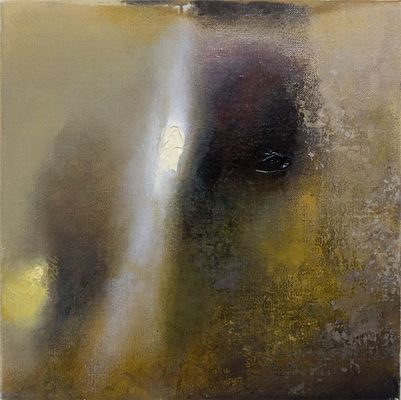
To return to Buckley’s fragment, the first two lines very much evoke how I paint nowadays. As you age, detail diminishes and patches of light become more luminous and float. I feel the most honest way of dealing with this is by smearing the oil paint on the canvas with the fingers and working close-up, blind. Only if the patches coalesce into an approaching image can the work gain a life.
-
Jonathan Walker was born in Melbourne, Australia and brought up on a dairy farm in Gippsland. In the 1970’s he studied painting at RMIT and won the Harold Wright Scholarship to the British Museum, London. During the 1980’s he exhibited at Pinacotheca Gallery, Richmond and had work shown at the NGV and Heidi City Art Gallery. Over the same period he designed the cover for the “Epigenesi” LP by Giancarlo Toniutti, Italy and conducted a mail exchange work with Achim Wollscheid, Germany. The work with artists through the post resulted in an article published in the bicentenary issue of Art and Australia 1988. He showed in artist run spaces such as WestSpace in the 90’s and 2000’s, and until 2012, taught painting at Victoria University, which is where we (Colleen Ahern and Lisa Radford) as organisers of the exhibition, among many others, had the privilege of being his student.
Walker’s knowledge was imparted to students through the careful selection of music, literature, and artists found in books that he himself had ordered for the library. Walker’s strategy was the generosity of sharing his vast knowledge with references specific to each student and their context.
Walker’s paintings share a similar focus and intimacy.
This exhibition presents a small selection of recent paintings alongside a publication that includes Walker’s writing. Observational and analytical, Walker’s work is a type of material notation — the time of day, colour and how it is blended, the both specific and fleeting location of a reflection on lino or the question of whether a chair leg should be included in a painting.
Please join us on Friday August 21 between 6-8pm to celebrate the opening of the exhibition.
Curated by Colleen Ahern and Lisa Radford.
B. Wurtz
Curated by Nic Tammens
March 26 - April 4, 2015
B.Wurtz works from a basement studio in his home on Manhattan’s Lower East Side.
This local fact is attested to by the plastic shopping bags and newsprint circulars that appear in his work. As formal objects, they don’t make loud claims about their origins but nonetheless transmit street addresses and places of business from the bottom of this long thin island. Like plenty of artists, Wurtz is affected by what is local and what is consumed. His work is underpinned by this ethic. It often speaks from a neighborhood or reads like the contents of a hamper:
“BLACK PLUMS $1.29 lb.”
“Food Bazaar”
“USDA Whole Pork Shoulder Picnic 99c lb.”
“RITE AID Pharmacy, with us it’s personal.”
“H. Brickman & Sons.”
“Sweet Yams 59c lb."
Most of the work in this exhibition was made while the artist was in residence at Dieu Donne, a workshop dedicated to paper craft in Midtown. Here Wurtz fabricated assemblages with paper and objects that are relatively lightweight, with the intention that they would be easily transportable to Australia. This consideration isn’t absolute in Wurtz’s work, but was prescriptive for making the current exhibition light and cheap. Packed in two boxes, these works were sent from a USPS post office on the Lower East Side and delivered to North Melbourne by Australia Post.
Wurtz appears courtesy of Metro Pictures, New York.
Thanks to Rob Halverson, Joshua Petherick, Sari de Mallory, Matt Hinkley, Helen Johnson, Fayen d'Evie, Ask Kilmartin, Lisa Radon, Ellena Savage, Yale Union, and "Elizabeth".
John Nixon
"Archive"
December 15 - January 20, 2014
The presentation of John Nixon's archive offered a rare showcase of this extensive collection of the artist's own publications, catalogues, posters, ephemera, editions and more, from the mid 1980s onwards, alongside a selection of his artworks.
Organized by John Nixon, Joshua Petherick and Matt Hinkley.
"Habitat"
at Minerva, Sydney (organised by Joshua Petherick and Matt Hinkley)
November 15 - December 20, 2014
Lupo Borgonovo, Janet Burchill & Jennifer McCamley,
Lewis Fidock, HR Giger, Piero Gilardi, Veit Laurent Kurz,
Cinzia Ruggeri, Michael E. Smith, Lucie Stahl, Daniel Weil, Wols
Press Release:
“...It contained seven objects. The slender fluted bone, surely formed for flight, surely from the wing of some large bird. Three archaic circuitboards, faced with mazes of gold. A smooth white sphere of baked clay. An age-blackened fragment of lace. A fingerlength segment of what she assumed was bone from a human wrist, grayish white, inset smoothly with the silicon shaft of a small instrument that must once have ridden flush with the surface of the skin - but the thing’s face was seared and blackened.”
William Gibson, “Count Zero”, 1986
"Autumn Projects Archive"
Curated by Liza Vasiliou
March 6 - March 15, 2014
World Food Books, in conjunction with the Virgin Australia Melbourne Fashion Festival 2014, presented the Autumn Projects archive, consisting of a selection of early examples in Australian fashion with a particular interest in collecting designers and labels from the period beginning in the 1980’s, who significantly influenced the discourse of Australian Fashion.
Curated by Liza Vasiliou, the exhibition provided a unique opportunity to view pieces by designers Anthea Crawford, Barbara Vandenberg, Geoff Liddell and labels CR Australia, Covers, Jag along with early experimental collage pieces by Prue Acton and Sally Browne’s ‘Fragments’ collection, suspended throughout the functioning World Food Books shop in Melbourne.
H.B. Peace
presented by CENTRE FOR STYLE
November 14, 2013
"Hey Blinky, you say chic, I say same"
Anon 2013
H.B. Peace is a clothing collaboration between great friends Blake Barns and Hugh Egan Westland. Their pieces explore the divergences between 'character’ and ‘personality’ in garments....etc
Special Thanks to Joshua Petherick and Matt Hinkley of WFB and Gillian Mears
and a Very Special Thank you to Audrey Thomas Hayes for her shoe collaboration.
Janet Burchill & Jennifer McCamley
"Aesthetic Suicide"
May 10 - June 8, 2013
The first of our occasional exhibitions in the World Food Books office/shop space in Melbourne, "Aesthetic Suicide" presented a body of new and older works together by artists Janet Burchill & Jennifer McCamley, including videos, prints, a wall work, and publications.
During shop open hours videos played every hour, on the hour.
$.00 - Out of stock
The eternal clean out! New items weekly.
https://worldfoodbooks.com/category/sale
Published by World Food Books / Melbourne
$20.00 - In stock -
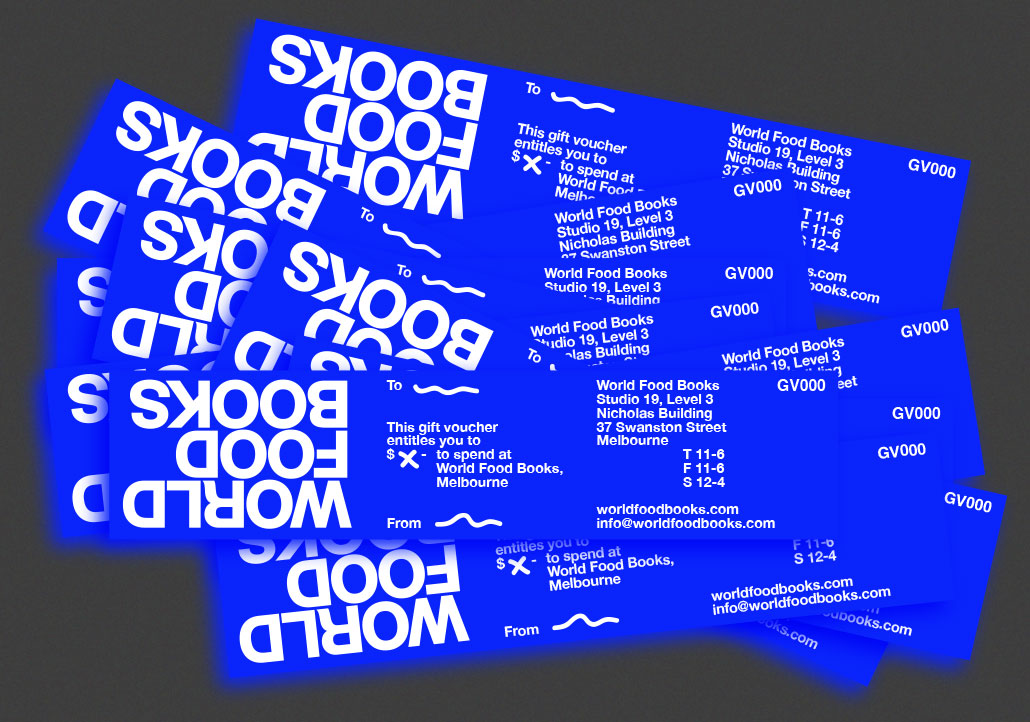
A World Food Books gift voucher is redeemable in our Melbourne bookshop or via our webshop (here). An e-voucher (printable pdf) will be sent to your purchase email address (please notify us if you wish to have the voucher sent to an alternate address and wish us to fill in the receiver's details on the card).
Gift vouchers can be purchased in increments of $20 (Australian Dollars) and the total amount can simply be added to by increasing the quantity in your shopping cart. eg. A quantity of 5 gift vouchers will result in an item total of $100 - a $100 gift voucher. Simply click "ADD TO CART" 5 times, or update your quantity in the shopping cart.
If you wish to purchase multiple, separate gift vouchers in one go, please just email us and we can personally prepare and email you a payment request.
Please note: Please select Pick-Up on gift voucher purchse to avoid any postage charges. Accidental postage charges will be refunded right away!
Thank you.
For any questions, please don't hesitate to email: [email protected]
1974, Japanese
Hardcover (w. dust jacket, slipcase, obi), 80 pages, 31 x 25 cm
1st Edition, Out of print title / used / good
Published by
Kawade Shobo Shinsha / Tokyo
$60.00 - In stock -
Wonderful 1974 slip-cased hardcover monograph on Belgian painter Paul Delvaux (1897—1994). Bound in blue cloth and wrapped in illustrated original dust-jacket, this heavily illustrated book surveys Delvaux's evocative paintings and drawings through beautiful colour and monochrome gravure reproductions, alongside various texts, biography, bibliography and portrait of the artist. Published as volume 7 of the deluxe La Septième Face du Dé series by Kawade Shobo Shinsha in Japan in the 1970s, all later re-printed in the 2000s. All editions now out-of-print.
Paul Delvaux (1897—1994) was a Belgian painter noted for his dream-like scenes of women, classical architecture, trains and train stations, and skeletons, often in combination. He is often considered a surrealist, although he only briefly identified with the Surrealist movement. He was influenced by the works of Giorgio de Chirico and René Magritte, but developed his own fantastical subjects and hyper-realistic styling, combining the detailed classical beauty of academic painting with the bizarre juxtapositions of surrealism. Throughout his long career, Delvaux explored "Nude and skeleton, the clothed and the unclothed, male and female, desire and horror, eroticism and death – Delvaux's major anxieties in fact, and the greater themes of his later work [...]".
Good copy in Good slipcase with foxing/tanning to block edge, dust jacket and box. VG obi and insert booklets all preserved.
1988, Japanese / English
Hardcover (w. dust jacket), 70 pages, 21 x 19 cm
1st Edition, Out of print title / used / very good
Published by
Atelier Peyotl / Tokyo
$100.00 - In stock -
Wonderful and very rarely seen hardcover Japanese publication on the work of the great Pierre Klossowski. Features an extensive selection of his paintings and drawings reproduced in full-colour and black and white, alongside texts, biography and photographic portraits of Klossowski. Published by Atelier Peyotl and printed in Tokyo in 1988 on the occasion of a major exhibition at The Seed Hall, Seibu Shibuya. First printing in original illustrated dust jacket.
Pierre Klossowski (1905-2001) was a significant and influential philosopher, writer, translator and artist who befriended Georges Bataille and formulated an original stance on many theological issues, as well as the philosophy of the Marquis de Sade. His first novel, Roberte, ce soir, appeared in 1954 as a limited edition containing six of his own erotic illustrations, after he rejected drawings by his younger brother, the painter Balthus. Following the encouragement of Robert Lebel, Andre Masson and Alberto Giacometti, Klossowski held his first exhibition in Paris in 1956, and subsequently produced numerous life-size drawings of erotic scenes imbued with mythological, allegorical and philosophical connotations. By the 1970s, he had won the acclaim of such eminent thinkers as Maurice Blanchot, Michel Butor, Gilles Deleuze, Michel Foucault and Felix Guattari. Of Klossowski, Gilles Deleuze once said, "That bodies speak has been known for a long time."
Very Good copy in Good dust jacket with some rubbing to front print, light wear.
2025, English
Softcover, 250 pages, 22.5 x 21 cm
Published by
Buxton Contemporary / Melbourne
$40.00 - In stock -
Catalogue published on the occasion of Hany Armanious — Stone Soup, Buxton Contemporary, 21 November 2025 – 11 April 2026, the artist’s largest exhibition to date, featuring more than 80 works spanning 15 years of practice, including a new commission and many works never before seen in Australia. The exhibition is curated by Laurence Sillars, Head of the Henry Moore Institute, with Samantha Comte, Head Curator, and Charlotte Day, Director of Art Museums, at the University of Melbourne, and builds on a recent presentation at the Henry Moore Institute in Leeds, UK. Richly illustrated with more than 100 works and featuring a major new essay by co-curator Laurence Sillars, this publication expands on Hany Armanious’ inventive practice and serves as the definitive companion to Stone Soup.
Curator Laurence Sillars says: “Armanious’s practice is not merely an exploration of the object, but an invitation to dwell in the uncertainty of perception itself – a quiet but radical challenge to the assumption that the world is a stable place. Throughout, there is joy, a celebration of being, touching, of looking so intently that the familiar becomes strange. In an age of synthetic realities, this is a profoundly generative act. Like stepping into a place where the language is unfamiliar and every word must be relearned, his sculptures offer the thrill and vertigo of finding one’s bearings in a newly translated world – a place where, in order to truly see, we must first allow ourselves to be lost.”
Published in an edition of 550 copies.
1999, English
Softcover, 60 pages, 27.1 x 23.4 cm
1st Edition, Out of print title / used / fine
Published by
Moet & Chandon Australian Art Foundation / Australia
$120.00 - In stock -
Wonderful early artist's book published in 1999 on the work of Australian sculptor Hany Armanious by Möet & Chandon Australian Art Foundation. Printed in France on textured heavy stock, this handsome volume documents works spanning 7-8 years of Hany's work, including sculptures, painting, installation, accompanied by captions and texts written by the artist to "walk" the reader through the works. As it should be. We think the best book on Armanious' work ever published, and now very rare to come by.
Hany Armanious (b. 1962 in Ismailia, Egypt. Lives and works Sydney, New South Wales) is a sculptor whose work is predominantly concerned with the magical properties of the casting process. Many of his works deal with the alchemical transformation of one object into another via what the artist has described as the ‘cult of casting’. Hany was a key figure in Sydney’s grunge scene of the early 1990s, and in 2011 was Australia’s representative at the Venice Biennale. His practice often deliberately skirts the fine line separating ‘something’ from ‘nothing’. While his works – as ‘things’ consciously, even meticulously, produced – are obviously never nothing, many nonetheless toy with notions of value and its contemporary ambiguities.
Near Fine copy.
1983, English
Hardcover (w. dust jacket), 380 pages (approx), 36 x 24 cm
1st Edition, Out of print title / used / very good
Published by
Abbeville Press / New York
$650.00 - In stock -
Very rare copy of the first 1983 Abbeville English hardcover edition of the ever mysterious Codex Seraphinianus by Italian artist and designer Luigi Serafini (1949—), a book like no-other. Ever since the Codex Seraphinianus was first published in Italy in limited edition by Franco Maria Ricci in 1981, the book has been recognized as one of the strangest and most beautiful art books ever made. This phantasmagorical visual encyclopedia of an unknown world written in an unknown language has fueled much debate over its meaning. Written for the information age and addressing the import of coding and decoding in genetics, literary criticism, and computer science, the Codex confused, fascinated, and enchanted a generation, including Roland Barthes and Italo Calvino. While its message may be unclear, its appeal is obvious: it is a most exquisite artifact. Blurring the distinction between art book and art object.
Very Good book in Very Good dust jacket with a couple of straches to edges and light wear, preserved in mylar wrap. Light wear to block edge on a few pages.
1924 / 1994, English
Hardcover (w. dust jacket), 116 pages, 22 x 15.5 cm
1st Edition, Out of print title / used / very good
Published by
Delectus / London
$65.00 - In stock -
"The erotic classic that waited seventy years for publication"
Rare copy of Delectus' 1994 hardcover edition of 'A Guide To The Correction Of Young Gentlemen: The Successful Administration of Physical Discipline to Males - by Females!'. Written in 1924, before it could be published all known copies were seized and destroyed. This is the first-ever publication of what has been described as a "Flagellation Cookbook" — the philosophy, equipment and techniques for the successful administration of physical discipline to males—by Females!
The author is thought to be Alice Kerr-Sutherland, a notorious Anglo-Scottish "governess" of the early years of this century, whose literary aspirations were encouraged by her close friend, publisher Gerald Hamer, believed to have illustrated the work in collaboration with her.
The introduction for this edition reveals the strange story of the book's publication and subsequent rediscovery by erotica specialist publisher Delectus.
"An exhaustive guide to female domination... Probably the most highly recommended piece of esoteric erotica I've read in a long time... The intensity doesn't let up for a minute... I found myself having to put it down on a number of occasions, simply to catch my breath. It's that good!"—DIVINITY
"Stands apart from all other flagellation literature currently available... For connoisseurs of vintage erotica and lovers of classroom discipline, it's a must!"—FORUM
"Her careful arrangement of subordinate clauses is truly masterful."—DAILY TELEGRAPH
"I regard this book as near biblical in stature."—THE NAUGHTY VICTORIAN (USA
"Delightfully obsessional little tome... The definitive work on corporal punishment... an absolute must... The author is a master of her craft."—F.F. Magazine
"The most comprehensive detailed guide to corporal punishment available... Essential reading for the modern enthusiast with taste."—SKIN TWO
"A wicked piece of writing... the lady guides us through the corporal stages with uncommon relish and an experienced eye to detail... An absolute gem of a book; a totally invigorating read."—ZEITGEIST
Very Good copy in VG dust jacket preserved under mylar wrap.
2019, Japanese
Softcover (staple-bound) + flyer, 22 pages, 26 x 18 cm
Out of print title / used / good
Published by
Vanilla Gallery / Tokyo
$40.00 - In stock -
Rare collected documents from the 2019 iteration of the Japanese exhibition of Serial Killer Art at Vanilla Gallery, Ginza, Tokyo, first staged 2016 and 2017, from the HN collection. From John Wayne Gacy, Ed Gein, Ted Bundy, Henry Lee Lucas, and Ronnie Clay, these exhibitions featured artworks, self-portraits, letters, and documents of serial killers in Europe and America whose heinous personalities and numerous crimes have served as models for novels and films, becoming known the world over.
"The world portrayed by murderers who committed crimes that make you want to look away is like a dreadful, lonely, impermanent feeling that looks into the depths of the viewer's heart, and is like when confronted with something unknown. It's full of tension."
Collected by Mr. HN (H. Nakajima), over 200 items were displayed in Tokyo on the occasion of these exhibits, with these pamphlets available at the exhibitions only. Illustrated with examples throughout in colour and b/w, texts in Japanese by film critic Kiichirō Yanashita, Orihara Ichi, and collector/curator H. Nakajima.
Killers included in the exhibitions: John Wayne Gacy, Henry Lee Lucas, Peter Sutcliffe, Danny Rowling, Keith Jasperson, James Earl Ray, Thomas Pitera, Henry Hill, Nicholas Crowe, Dorothy Puente, Haddon Clarke, Gerald Shaffer, Anthony Shore, James Munro, Gary Ray Balls, Hudson Graham, Carroll Bundy, Otis Toole, Charles Watson, Lawrence Bittaker, Herbert Mullin, Arthur Shawcross, Rod Ferrell, Ted Bundy, Jim Jones, Christa Pike, Harvard Baumeister, David Berkowitz, Richard Ramirez, Ronnie Clay, Irene Wuornos, Wayne Low, Dana Sue Gray, Roy Norris, Kenneth Bianchi, Michael Alig, Veronica Compton, Joe Roy Metheny, Gary Heidnik, Charles Manson, Jeremy Jones, Jack Trawick, Carl Drew, Wayne Harton, Rosemary West, Theodore Kaczynski, Thomas Heyer, Ed Gein, Ferrell Mykers, Douglas Clark, Richard Clarey, Ian Brady, Jack Kevorkian, Bonnie & Clyde, Philip Jacobinski, Daniel Siebert, Tommy Lynn Sells.
Good with only light wear. Includes flyer for the 2019 exhibition, folded as issued.
1985, Japanese
Softcover, 210 pages, 23 x 22.5 cm
1st Edition, Out of print title / used / very good
Published by
Yomiuri Shimbun / Tokyo
$140.00 - In stock -
Rare 1985 Japanese catalogue published on the occasion of Goya Complete Prints Exhibition, supervised by art critic Hideo Takumi. Profusely illustrated with Goya's Caprichos, Desastres, Tauromaquia, and Disparates, accompanied by catalogue, biography, technical illustrated essays on Goya's methodology, major texts by Alfonso E. Pérez-Sanchez and Hideo Takumi, translated to Japanese by Keizo Kamiyoshi, Yasujiro Otaka, Gyoji Yukiyama. A phenomenal catalogue of Goya's incredible works in print, some of the finest ever made. Printed in Japan, produced by Art Publishing Design Center, published by Yomiuri Shimbun, Art Resource Center.
This copy with original exhibition leaflet laid-in.
Very Good copy, only light wear, marks.
1988, Japanese
Hardcover in heavy, illustrated slipcase, 193 pages, 30.4 x 30 cm
1st Edition, Out of print title / used / very good
Published by
Bijutsu Shuppansha / Japan
$380.00 - In stock -
First edition of the most comprehensive, incredibly rare, and hands-down best book on the work of Japanese Surrealist painter Yamashita Kikuji (1919—1986), published in 1988 in this lavish hardcover, slipcased edition designed by the legendary Kiyoshi Awazu and Tokiko Nagayama for Bijutsu Shuppansha. Profusely illustrated with large-format reproductions of Yamashita's incredible phantasmagorical paintings and collages, accompanied by commentry and texts by Japanese poet and essayist Hiroshi Noma, Hideo Ishiguro, art critic Ichirō Hariu, lyricist Hajime Kijima, painter Koichi Tanigawa, Kikuji Yamashita himself, and many others, full catalogue of works, chronology, and more. Highly recommended!
Yamashita Kikuji (b. 1919, Tokushima, Shikoku Island, d. 1986) was a Japanese Surrealist painter, printmaker, collagist, activist and bird lover associated with the postwar avant-garde art movement in Japan who studied under the Japanese Surrealist painter Ichiro Fukuzawa in Tokyo. In 1939 he was drafted into the Japanese Imperial military to fight in China, and although he survived the war, feelings of guilt and traumatic memories of his wartime experience, including participating in the torture and murder of a Chinese prisoner, pervaded his ferocious postwar artistic vision and output. His work became emblematic of the ‘Reportage’ style of painting, whereby artists expressed Socialist concerns in a style combining Social Realism and Surrealism. As a young man he travelled to Europe where he was introduced to the works of artists including Max Ernst, Salvador Dali and Hieronymus Bosch. Yamashita transposes the perverse and fantastical imagery of Bosch into an explicitly Surrealist register. In Yamashita’s paintings, the human figure is fragmented and morphed into erotically suggestive, comical or abject guises. The nude body, and its potential to contort into something uncanny or grotesque, is a continual subject of Yamashita Kikuji’s phantasmagorical paintings. Although he continued to paint hundreds of canvases, he deliberately avoided seeking out commercial success, perhaps out of a sense of guilt, and was only able to survive as a full-time artist thanks to his devoted wife's earnings as a beautician. "He didn’t talk about it much, but he would cry out from his nightmares at night. He sounded like he was in such pain that I used to wake him. He didn’t tell me directly, but in 1970 he published an article, “A Peephole onto Discrimination.” In it, he wrote about how he had executed a prisoner of war in a very brutal fashion." He deeply regretted the fact that he couldn’t give his own life by refusing that order. He wanted to take responsibility for what he had done. That became the driving force behind his paintings. Yamashita was a bird lover—evident in the recurring image of birds in his paintings—and shared his home and studio with many birds, including owls and hawks. It is said that he would sometimes appear at an exhibition, disheveled and cheerful, accompanied by a small bird in his pocket that he would feed premasticated (pre‐chewed) food directly from his mouth.
Very Good book and slipcase — light wear to slipcase edge, light foxing to block edge.
2011, Japanese
Softcover (staple-bound), 26 pages, 29.5 x 21 cm
1st Edition, Out of print title / used / fine
Published by
The Museum of Modern Art / Kamakura
$45.00 - In stock -
Scarce exhibition catalogue on the Japanese Surrealist painter Kikuji Yamashita (1919—1986), a postwar painter who confronted the problem of the common people's consciousness and characterised the chaos of social realism with spectacular surrealist methods, inventing reportage paintings, and turning real-life incidents into provocative picture-story shows. Published on the occasion of an exhibition focussing on his lesser-known and equally breath-taking collage works at The Museum of Modern Art, Kamakura Annex, January 8 - March 27, 2011, organized by The Museum of Modern Art, Kamakura & Hayama. Bi-lingual introduction in English and Japanese, the catalogue is filled with his collages based on the theme of The Sayama Case Trials, which were donated to the museum in 2009, followed by a chronology.
Kikuji Yamashita (b. 1919, Tokushima, Shikoku Island, d. 1986) was a Japanese Surrealist painter, printmaker, collagist, activist and bird lover associated with the postwar avant-garde art movement in Japan who studied under the Japanese Surrealist painter Ichiro Fukuzawa in Tokyo. In 1939 he was drafted into the Japanese Imperial military to fight in China, and although he survived the war, feelings of guilt and traumatic memories of his wartime experience, including participating in the torture and murder of a Chinese prisoner, pervaded his ferocious postwar artistic vision and output. His work became emblematic of the ‘Reportage’ style of painting, whereby artists expressed Socialist concerns in a style combining Social Realism and Surrealism. As a young man he travelled to Europe where he was introduced to the works of artists including Max Ernst, Salvador Dali and Hieronymus Bosch. Yamashita transposes the perverse and fantastical imagery of Bosch into an explicitly Surrealist register. In Yamashita’s paintings, the human figure is fragmented and morphed into erotically suggestive, comical or abject guises. The nude body, and its potential to contort into something uncanny or grotesque, is a continual subject of Yamashita Kikuji’s phantasmagorical paintings. Although he continued to paint hundreds of canvases, he deliberately avoided seeking out commercial success, perhaps out of a sense of guilt, and was only able to survive as a full-time artist thanks to his devoted wife's earnings as a beautician. "He didn’t talk about it much, but he would cry out from his nightmares at night. He sounded like he was in such pain that I used to wake him. He didn’t tell me directly, but in 1970 he published an article, “A Peephole onto Discrimination.” In it, he wrote about how he had executed a prisoner of war in a very brutal fashion." He deeply regretted the fact that he couldn’t give his own life by refusing that order. He wanted to take responsibility for what he had done. That became the driving force behind his paintings. Yamashita was a bird lover—evident in the recurring image of birds in his paintings—and shared his home and studio with many birds, including owls and hawks. It is said that he would sometimes appear at an exhibition, disheveled and cheerful, accompanied by a small bird in his pocket that he would feed premasticated (pre‐chewed) food directly from his mouth.
Very Good copy.
1992, Japanese
Softcover (w. dust jacket + obi), 190 pages, 14.5 x 10.5 cm
1st Edition, Out of print title / used / very good
Published by
Fiction Inc. / Tokyo
Futami Shobo / Japan
$60.00 - In stock -
Amazing pocket art book of fetish masters John Willie and Eric Stanton. Bondage Comix was edited by Makoto Ohrui and Japanese novelist Mari Akasaka (both editors of SALE2/Fiction Inc.) and published in Tokyo Japan by Futami Shobo in 1992. Packed cover-to-cover with colour and b/w reproductions of classic artworks by Willie and Stanton, from "Sweet Gwendoline" to "From Girl to Pony" to "Beached", Fetish and Bizarre publications, John Willie's bondage photography, Stanton fashions, and much more. Perfectly compiled in the way SALE2 did so well, with elegant scrapbook style, dense with imagery, blown-up, full-bleed reproductions from many publications. Cover artwork and postcard insert by John Willie.
John Alexander Scott Coutts (1902—1962), better known by the pseudonym John Willie, was an artist, fetish photographer, editor and the publisher of the first 20 issues of the fetish magazine Bizarre, featuring his characters Sweet Gwendoline and Sir Dystic d'Arcy.
Eric Stanton (1926—1999) was an American underground cartoonist and fetish art pioneer. While Stanton began his career as a bondage fantasy artist for Irving Klaw, the majority of his later work depicted gender role reversal and proto-feminist female dominance scenarios.
Makoto Ohrui founded the publishing house Fiction Inc. (later Radical Silence Production), the magazine SALE2, the gallery THE deep in Tokyo, and the magazine THE International. Ohrui was art director for SALE2, Purple, Rockin' On, and designed many books.
Mari Akasaka (b. 1964) is a Japanese novelist. In 1999 her novel Vibrator was nominated for the Akutagawa Prize, which was adapted into a 2003 film directed by Ryūichi Hiroki. She was again nominated for the Akutagawa prize in 2000 for her novel, Muse, and won the Noma Literary Prize for New Writers for the same novel.
Very Good copy, with obi.
1991, Japanese
Softcover (w. dust jakcet + obi), 190 pages, 14.5 x 10.5 cm
1st Edition, Out of print title / used / very good
Published by
Futami Shobo / Japan
$60.00 - In stock -
Amazing pocket art book of Bizarre Bondage Fashion, edited by Makoto Ohrui and Japanese novelist Mari Akasaka (both editors of SALE2/Fiction Inc.) and published in Tokyo Japan by Futami Shobo in 1991. Packed cover-to-cover with colour and b/w reproductions of classic artworks by John Willie, Irving Klaw, ENEG, Carlo, Jim, Eric Stanton, E.K., Ruis, Betty Page, and many more garnered from the underground bounty of European and American Fetish and Bizarre publications. Perfectly compiled in the way SALE2 did so well, with elegant scrapbook style, dense with imagery, blown-up, full-bleed reproductions from many publications. Includes a multi-panel double-sided pull-out by John Willie.
Makoto Ohrui founded the publishing house Fiction Inc. (later Radical Silence Production), the magazine SALE2, the gallery THE deep in Tokyo, and the magazine THE International. Ohrui was art director for SALE2, Purple, Rockin' On, and designed many books.
Mari Akasaka (b. 1964) is a Japanese novelist. In 1999 her novel Vibrator was nominated for the Akutagawa Prize, which was adapted into a 2003 film directed by Ryūichi Hiroki. She was again nominated for the Akutagawa prize in 2000 for her novel, Muse, and won the Noma Literary Prize for New Writers for the same novel.
Very Good copy, with obi.
2025, English
Softcover, 113 pages, 17 x 11 cm
Published by
Index Journal / Melbourne
$30.00 - In stock -
The New Wave of the 1950s and 1960s opened two potential paths for French cinema to follow. The first would turn its youthful exuberance into a reproducible style, while the other would take up its principles of experimentation and self-reflexivity in new directions, and through an increasingly political and ethical interrogation of the image. This book explores the potentialities of that second path, with eight essays on films of the post-New Wave moment, focussed upon the principle of critical experimentation in particular—critique through experimentation, and experimentation through critique—that these films put at stake, through their difficult inheritance of the New Wave and the history of the image.
“From the metaphysics of Le Pont du Nord and the relation of Racine to L’Amour fou to the rich diversity of Marc’o’s career, not to mention the challenges of Jeanne Dielman, this is a compact illustration of the unrecognised brilliance and sheer liveliness of the best Australian film criticism.”—Jonathan Rosenbaum, film critic at the Chicago Reader 1987–2008
“French filmmakers who emerged in the ’50s and ’60s (including Chris Marker, Jean-Luc Godard and Agnès Varda) collectively proclaimed in 1967 that they were, in every sense, “far from Vietnam.” In Australia today, a like-minded group of film scholars and critics declare that they are geographically far from France, and especially far in time from its glorious Nouvelle Vague. So, their curiosity and intellectual inventiveness fastens, by identification, on the intriguingly “belated” phenomenon of post-New Wave French cinema: that loosely bundled generation including Chantal Akerman, Marc’o, Maurice Pialat, and Patrick Deval—without forgetting the post-68 experiments of Varda, Jacques Rivette, and François Truffaut—who forcefully questioned the limits of cinema and opened new ways of thinking and feeling. Far from the Masters is an indispensable assemblage of superbly written, inquisitive, and trail-blazing essays.”—Adrian Martin, Australian film critic far from Australia
“What does it mean to come “after”? Far from the Masters is a book marked by two belated arrivals: first, the generation of French filmmakers who emerged in the wake of the nouvelle vague, figures like Maurice Pialat, who extended and contested the work of his still better-known precursors; and second, a group of Australian critics who, two decades into the twenty-first century, took a collective look back at that earlier moment. Out of this temporal décalage, new perspectives open—not only on some of the most important French filmmakers of the era, but equally on a present moment of cinephilic community.”—Erika Balsom, Reader in Film Studies at King’s College, London
With texts by Conall Cash, Jake Wilson, Miranda Stanyon, Jack Keenan, Philippa Hawker, Scott Robinson, Michelle Huang, Corey P. Cribb
2025, English
Softcover, 176 pages, 19.8 x 12.9 cm
Published by
Silver Press / London
$55.00 - In stock -
When Ursula K. Le Guin started writing a new story, she would begin by drawing a map. The Word for World presents a selection of these images by the celebrated author, many of which have never been published before, to consider how her imaginary worlds enable us to re-envision our own.
Le Guin’s maps offer journeys of consciousness beyond conventional cartography, from the Rorschach-like archipelagos of Earthsea to the talismanic maps of Always Coming Home. Rather than remaining within known terrain, they open up paradigms of knowledge, exemplified by the map’s edges and how a map is read, made and re-made, together. The Word for World brings her maps together with poems, stories, interviews, recipes and essays by contributors from a variety of perspectives to enquire into the relationship between worlds and how they are represented and imagined.
Contributors: Federico Campagna, Theo Downes-Le Guin, Daniel Heath Justice, Bhanu Kapil, Canisia Lubrin, Una McCormack, David Naimon, Nisha Ramayya, Shoshone Collective, Standard Deviation, Marilyn Strathern.
Co-published by Spiral House and AA Publications to coincide with an exhibition of Ursula K. Le Guin’s maps at the Architectural Association, London, opening on 10 October 2025.
”One of the literary greats of the 20th century.” Margaret Atwood
”An anarchic destabilizer of established power structures and a ferocious critic of racist and sexist narratives.” Maria Dahvana Headley
“great teacher. great spirit.” adrienne maree brown
“A crafter of fierce, focused, fertile dreams.” David Mitchell
“A deepener and clarifier of possibility.” Nicola Griffith
“A literary icon.” Stephen King
2025, English
Softcover, 224 pages, 20 x 13.67 cm
Published by
Semiotext(e) / Los Angeles
$39.00 - Out of stock
A long-form dialogue—on cinema and survival—with the visionary French filmmaker.
"The virtuous always engage in a pseudoreligious morality. But there’s one thing they never say: the desire for pleasure is thought in motion. It’s what makes you transfigure a dull and repetitive sexual act into something that can bring you to ecstasy and an idea of eternity..."—Catherine Breillat to Murielle Joudet
Catherine Breillat has always told just one story: her own, the story of a young girl whose existence was forbidden, who was, from childhood, cut in half, split between her mind and her sexuality, marked by the shame of being born female. She became a filmmaker at a time when choosing that vocation meant disobeying the world.
During six months between September 2022 and March 2023, the film critic Murielle Joudet interviewed Catherine Breillat for thirty hours, often following up with further discussion over the phone. Joudet and Breillat discuss each of her films in chronological order, moving freely between Breillat’s cinematic vision, her life, and the situations, artworks, and thought that have inspired her films.
From A Real Young Girl (1975) to Last Summer (2023), Breillat has made films in an attempt to recover what she believes was stolen from her— the “unfilmable,” inexhaustible grey area of the feminine where shame, transgression, sensuality, disgust, and the search for oneself intertwine until they become indistinguishable. Her work proposes a haunting imperative to know oneself... and for her heroines, this spiritual search plays out as an open war with the opposite sex.
A conversation with Catherine Breillat is as much a cinema master class as it is a lesson in survival.
Catherine Breillat is a filmmaker and writer based in Paris. She is known not only for her films focusing on themes of sexuality but also for her bestselling novels.
Murielle Joudet is a film critic for Le Monde, as well as for TV and radio. She is the author of Isabelle Huppert- Vivre ne nous regarde pas (2018), Gena Rowlands- On aurait d dormir (2020), and La Seconde Femme- Ce que les actrices font la vieillesse (2022).
1977, English
Softcover, 396 pages, 18 x 11 cm
1st Edition, Out of print title / used / good
Published by
Penguin Books / London
$28.00 - In stock -
Scarce first 1977 Penguin paperback edition of the first 1973 English translation. Cover design by Tsutomu Harada.
In November 1970, Yukio Mishima committed suicide, in the old Japanese way by disembowelling himself. His last years were devoted to the completion of a quartet of novels, The Sea of Fertility, of which this is the second volume.
Isao is a young, engaging patriot, and a fanatical believer in the ancient samurai ethos. He turns terrorist, organising a violent plot against the new industrialists, who he believes are threatening the integrity of Japan and usurping the Emperor’s rightful power. As the conspiracy unfolds and unravels, Mishima brilliantly chronicles the conflicts of a decade that saw the fabric of Japanese life torn apart.
Mishima's own superlative literary qualities... include a complete control of complex nárrative, the ability to convey psychological depths often far removed from the everyday, and a sense of total commitment and response to the experience of life, all of which transcend the author's personal obsessions'—New Statesman
Yukio Mishima (1925—1970), one of the most spectacularly gifted writers in modern Japan, was born into a samurai family in 1925. Yukio Mishima was a Japanese author, poet, playwright, actor, model, Shintoist, nationalist, and founder of the Tatenokai ("Shield Society"), an unarmed civilian militia. Mishima is considered one of the most important Japanese authors of the 20th century. He was considered for the Nobel Prize in Literature in 1968. His works include the novels Confessions of a Mask and The Temple of the Golden Pavilion. Mishima's work is characterized by "its luxurious vocabulary and decadent metaphors, its fusion of traditional Japanese and modern Western literary styles, and its obsessive assertions of the unity of beauty, eroticism and death", according to author Andrew Rankin. In November 1970 he and his Tatenokai forced their way into a Self-Defense Force headquarters in Tokyo, where Mishima, after reading out a proclamation, committed ritual suicide with a young follower in the commanding officer's room. On the morning of his death, the last volume of Mishima's tetralogy, The Sea of Fertility (The Spring Snow, Runaway Horses, The Temple of Dawn, The Decay of the Angel) was delivered to his publisher.
Scarce first 1976 Penguin paperback edition of the first 1968 English translation. Cover design by Tsutomu Harada.
Shunsuké, an ageing novelist, hits on a brilliant plan to avenge himself on womankind, who, he believes, have blighted his life. He bribes a beautiful homosexual student, Yuichi, to marry. The plan works, Yuichi's wife is made miserable. And Shunsuké gets Yuichi to compromise two of his past tormentors, the blackmailing Mrs Kaburagi and Kyoko, a dizzy socialite. But Yuichi, now the toast of Tokyo's 'gay people' and free of all moral restraint, refuses to be further manipulated. Soon the old writer sees his protégé, his creation, turn into a monster dangerously out of control.
Mishima's own superlative literary qualities... include a complete control of complex nárrative, the ability to convey psychological depths often far removed from the everyday, and a sense of total commitment and response to the experience of life, all of which transcend the author's personal obsessions'—New Statesman
Yukio Mishima (1925—1970), one of the most spectacularly gifted writers in modern Japan, was born into a samurai family in 1925. Yukio Mishima was a Japanese author, poet, playwright, actor, model, Shintoist, nationalist, and founder of the Tatenokai ("Shield Society"), an unarmed civilian militia. Mishima is considered one of the most important Japanese authors of the 20th century. He was considered for the Nobel Prize in Literature in 1968. His works include the novels Confessions of a Mask and The Temple of the Golden Pavilion. Mishima's work is characterized by "its luxurious vocabulary and decadent metaphors, its fusion of traditional Japanese and modern Western literary styles, and its obsessive assertions of the unity of beauty, eroticism and death", according to author Andrew Rankin. In November 1970 he and his Tatenokai forced their way into a Self-Defense Force headquarters in Tokyo, where Mishima, after reading out a proclamation, committed ritual suicide with a young follower in the commanding officer's room. On the morning of his death, the last volume of Mishima's tetralogy, The Sea of Fertility (The Spring Snow, Runaway Horses, The Temple of Dawn, The Decay of the Angel) was delivered to his publisher.
Good copy with general wear and age, book block cocked from storage, tanning. Sample images only.
1977, English
Softcover, 288 pages, 18 x 11 cm
1st Edition, Out of print title / used / good
Published by
Penguin Books / London
$22.00 - In stock -
Scarce first 1977 Penguin paperback edition of the first 1973 English translation. Cover design by Tsutomu Harada.
The third novel in Mishima's final tetralogy, The Sea of Fertility.
In Bangkok, Honda discovers Princess Ying Chan, the second reincarnation of his friend Kiyoaki. Years later she reappears in Japan where the ageing Honda commits himself to establishing the mystical link between her and her predecessors.
'Once again Mishima displays all the gifts which made him by the time of his death one of the few writers whose greatness was unquestionable. The shattering beauty is still there, the humour, eroticism, sensuousness, the fusion of passion and imagery... Mishima's greatness transcends cultural barriers'—Janice Elliott in the Sunday Telegraph
'The present translation perfectly conveys the sharpness and selectivity of the author's descriptions, his wonderfully acute sense of social and historical placing, and above all that unsparing apprehension, almost lost to Western literature, of worldly vanity'—The Times Literary Supplement
Yukio Mishima (1925—1970), one of the most spectacularly gifted writers in modern Japan, was born into a samurai family in 1925. Yukio Mishima was a Japanese author, poet, playwright, actor, model, Shintoist, nationalist, and founder of the Tatenokai ("Shield Society"), an unarmed civilian militia. Mishima is considered one of the most important Japanese authors of the 20th century. He was considered for the Nobel Prize in Literature in 1968. His works include the novels Confessions of a Mask and The Temple of the Golden Pavilion. Mishima's work is characterized by "its luxurious vocabulary and decadent metaphors, its fusion of traditional Japanese and modern Western literary styles, and its obsessive assertions of the unity of beauty, eroticism and death", according to author Andrew Rankin. In November 1970 he and his Tatenokai forced their way into a Self-Defense Force headquarters in Tokyo, where Mishima, after reading out a proclamation, committed ritual suicide with a young follower in the commanding officer's room. On the morning of his death, the last volume of Mishima's tetralogy, The Sea of Fertility (The Spring Snow, Runaway Horses, The Temple of Dawn, The Decay of the Angel) was delivered to his publisher.
Good—Very Good copy with general light cover wear and age. No spine creases.
1977, English
Softcover, 206 pages, 18 x 11 cm
1st Edition, Out of print title / used / good
Published by
Penguin Books / London
$24.00 - In stock -
Scarce first 1977 Penguin paperback edition of the first 1974 English translation. Cover design by Tsutomu Harada.
With this short hovel Mishima concludes The Sea of Fertility, work he conceived as his own
literary monument: When he completed the manuscript, in November 1970, the author committed ritual suicide, thus giving a tragic climax to the themes thay shaped his life and work.
'Mishima's great novel... supremely eloquent, tragically obsessed with fantasy, magnificently written, this closing of the Honda-Mishima saga terminates a great and bitter achievement'—Ronald Blythe in the Sunday Times
'An unexpected and brilliant end... These four remarkable novels are the most complete version we have of Japan in the twentieth century'—Paul Theroux in The Times
Average—Good copy with cover wear and light back cover creasing, tanning to block.
1976, English
Softcover, 428 pages, 18 x 11 cm
1st Edition, Out of print title / used / very good
Published by
Penguin Books / London
$48.00 - In stock -
Scarce first 1976 Penguin paperback edition of the first 1968 English translation. Cover design by Tsutomu Harada.
Shunsuké, an ageing novelist, hits on a brilliant plan to avenge himself on womankind, who, he believes, have blighted his life. He bribes a beautiful homosexual student, Yuichi, to marry. The plan works, Yuichi's wife is made miserable. And Shunsuké gets Yuichi to compromise two of his past tormentors, the blackmailing Mrs Kaburagi and Kyoko, a dizzy socialite. But Yuichi, now the toast of Tokyo's 'gay people' and free of all moral restraint, refuses to be further manipulated. Soon the old writer sees his protégé, his creation, turn into a monster dangerously out of control.
Mishima's own superlative literary qualities... include a complete control of complex nárrative, the ability to convey psychological depths often far removed from the everyday, and a sense of total commitment and response to the experience of life, all of which transcend the author's personal obsessions'—New Statesman
Yukio Mishima (1925—1970), one of the most spectacularly gifted writers in modern Japan, was born into a samurai family in 1925. Yukio Mishima was a Japanese author, poet, playwright, actor, model, Shintoist, nationalist, and founder of the Tatenokai ("Shield Society"), an unarmed civilian militia. Mishima is considered one of the most important Japanese authors of the 20th century. He was considered for the Nobel Prize in Literature in 1968. His works include the novels Confessions of a Mask and The Temple of the Golden Pavilion. Mishima's work is characterized by "its luxurious vocabulary and decadent metaphors, its fusion of traditional Japanese and modern Western literary styles, and its obsessive assertions of the unity of beauty, eroticism and death", according to author Andrew Rankin. In November 1970 he and his Tatenokai forced their way into a Self-Defense Force headquarters in Tokyo, where Mishima, after reading out a proclamation, committed ritual suicide with a young follower in the commanding officer's room. On the morning of his death, the last volume of Mishima's tetralogy, The Sea of Fertility (The Spring Snow, Runaway Horses, The Temple of Dawn, The Decay of the Angel) was delivered to his publisher.
Good—Very Good copy with general light cover wear and age. No spine creases.
1967, English
Hardcover, 342 pages, 23.5 x 15.5 cm
1st Edition, Out of print title / used / very good
Published by
edition hansjörg meyer / Düsseldorf
$190.00 - Out of stock
Rare first 1967 European hardcover edition of An Anthology of Concrete Poetry, published by the legendary edition hansjörg meyer. The book's editor, Emmett Williams, "as one of the original practitioners of concrete poetry, has been in a unique position to observe the development of the movement since its beginnings, and the selection in this volume therefore reflects a view of this evolution from within the movement rather than from a distance." An Anthology of Concrete Poetry was the first anthology on the international movement of Concrete poetry, published subsequently by the legendary Something Else Press in 1967 in America. The movement itself began in the early 1950s, in Germany–through Eugen Gomringer, who borrowed the term “concrete” from the art of his mentor, Max Bill–and in Brazil, through the Noigandres group, which included the de Campos brothers and Decio Pignatari. Over the course of the 1960s it exploded across Europe, America and Japan, as other protagonists of the movement emerged, such as Dieter Roth, Öyvind Fahlström, Ernst Jandl, bpNichol, Mary Ellen Solt, Jackson Mac Low, Ian Hamilton Finlay, Bob Cobbing, Dom Sylvester Houédard, Pierre Garnier, Henri Chopin, Brion Gysin and Kitasono Katue. By the late 1960s, poet Jonathan Williams could proclaim: “If there is such a thing as a worldwide movement in the art of poetry, Concrete is it.” The work of the 77 writers collected in this anthology varies greatly in its aims and forms, but all can be said to emphasize the visual dimension of language, manipulating individual letters and minimal semantic units to produce poems that are for contemplating as much as for reading. Emmett Williams, the book’s editor, added explanatory commentary for the poems and biographies of their authors, making this volume–long out of print–the definitive anthology of this movement, which has so influenced artists and writers of subsequent generations.
Writers and artists included: Friedrich Achleitner, Alain Arias-Misson, H. C. Artmann, Ronaldo Azeredo, Stephen Bann, Carlo Belloli, Max Bense, Edgard Braga, Claus Bremer, Augusto de Campos, Haroldo de Campos, Henri Chopin, Carl Friedrich Claus, Bob Cobbing, Paul de Vree, Reinhard Döhl, Torsten Ekbom, Öyvind Fahlström, Carl Fernbach-Flarsheim, Ian Hamilton Finlay, Larry Freifeld, John Furnival, Heinz Gappmayr, Ilse and Pierre Garnier, Matthias Goeritz, Eugen Gomringer, Ludwig Gosewitz, Bohumila Grögerova and Josef Hiršal, José Lino Grünewald, Brion Gysin, Al Hansen, Václav Havel, Helmut Heissenbüttel, Åke Hodell, Dom Sylvester Houédard, Ernst Jandl, Bengt Emil Johnson, Ronald Johnson, Hiro Kamimura, Kitasono Katue, Jiri Kolar, Ferdinand Kriwet, Arrigo Lora-Totino, Jackson Mac Low, Hansjörg Mayer, Cavan McCarthy, Franz Mon, Edwin Morgan, Maurizio Nannucci, bp Nichol, Hans-Jørgen Nielsen, Seiichi Niikuni, Ladislav Novák, Yuksel Pazarkaya, Décio Pignatari, Vlademir Dias Pino, Luiz Angelo Pinto, Carl Fredrik Reuterswärd, Diter Rot, Gerhard Rühm, Aram Saroyan, John J. Sharkey, Edward Lucie Smith, Mary Ellen Solt, Adriano Spatola, Daniel Spoerri, Vagn Steen, Andre Thomkins, Enrique Uribe Valdivielso, Franz Van Der Linde, Franco Verdi, Emmett Williams, Jonathan Williams, Pedro Xisto and Fujitomi Yasuo.
"Emmett Williams, as one of the original practitioners of concrete poetry, has been in a unique position to observe the development of the movement since its beginnings, and the selection in this volume therefore reflects a view of this evolution from within the movement rather than from a distance. However it is far too soon to regard any anthology of Concrete Poetry as being definitive since the movement is extremely active and major new works have yet to appear in this most interesting of current poetry movements." -- from interior flap. Printed in black-and-white.
Very Good copy with some light edge wear to thick covers, general light age/tanning.
1990 / 1991, Japanese
Softcover (w. dust jacket), 210 pages, 21 x 14.8 cm
1st Edition, Out of print title / used / fine
Published by
Kubo Shoten / Japan
World Comics / Japan
$190.00 - In stock -
Very rare original first Japanese book collection of Bondage Fairies before they were known as "Bondage Fairies". The infamous cult classic eromanga first appeared in Japan in 1990 as "Insect Hunter", but it was quickly banned from sale by the Tokyo Metropolitan Ordinance. Here is the very first collection of "Insect Hunter" by Kondom, published by Kubo Shoten way back in 1990, collecting over 150 pages of the first of the original series, in the original Japanese language. Includes colour artwork galleries.
Created by manga artist Teruo Kakuta under the pen name "Kondom", a multilingual pun, meaning "little insect" in Japanese and "condom" in English, Bondage Fairies is an erotic series about highly sexual female forest fairies, who work as police officers protecting the forest, whilst engaging in a wild array of anthropomorphized, inter-species sexual acts. The series began in Japan in 1990 as Insect Hunter, but it was quickly banned from sale by the Tokyo Metropolitan Ordinance. Under a new title, the manga was serialized in manga magazine Lemon Kids. The series is among the earliest sexually explicit manga (eromanga) commercially translated and published uncensored in the United States where the earliest editions date from 1994 (Venus Press). Eros Comix subsequently published a multi-volume series of the collected Bondage Fairies, and subsequent stories, now all very collectible. Translated to Swedish, German, French, and Italian, Bondage Fairies is one of the most popular underground adult Japanese comics outside Japan.
Near Fine copy in original NF dust jacket. Second 1991 printing of the first 1990 edition.
1993 / 1995, Japanese
Softcover (w. dust jacket), 154 pages, 21 x 14.8 cm
1st Edition, Out of print title / used / fine
Published by
Kubo Shoten / Japan
World Comics / Japan
$160.00 - In stock -
Very rare original first Fairie Fetish Japanese book collection of the infamous cult classic eromanga Bondage Fairies before they were known as "Bondage Fairies" by Kondom, published by Kubo Shoten way back in 1993 and again in 1995. Bondage Fairies first appeared in Japan in 1990 as "Insect Hunter", but it was quickly banned from sale by the Tokyo Metropolitan Ordinance. Fairie Fetish revisits the first collection of "Insect Hunter" by Kondom from 1990, collecting over 150 pages of the first of the original series, in the original Japanese language. Includes colour artwork galleries.
Created by manga artist Teruo Kakuta under the pen name "Kondom", a multilingual pun, meaning "little insect" in Japanese and "condom" in English, Bondage Fairies is an erotic series about highly sexual female forest fairies, who work as police officers protecting the forest, whilst engaging in a wild array of anthropomorphized, inter-species sexual acts. The series began in Japan in 1990 as Insect Hunter, but it was quickly banned from sale by the Tokyo Metropolitan Ordinance. Under a new title, the manga was serialized in manga magazine Lemon Kids. The series is among the earliest sexually explicit manga (eromanga) commercially translated and published uncensored in the United States where the earliest editions date from 1994 (Venus Press). Eros Comix subsequently published a multi-volume series of the collected Bondage Fairies, and subsequent stories, now all very collectible. Translated to Swedish, German, French, and Italian, Bondage Fairies is one of the most popular underground adult Japanese comics outside Japan.
Near Fine copy in original NF dust jacket.