World Food Books' programme is largely produced on Kulin Nation land. We acknowledge the Wurundjeri people of the Kulin Nation as the first and continuing custodians of this land, and pay respect to their Elders past, present, and emerging.
World Food Books is an arts and special interests bookshop in Naarm / Melbourne. Founded in 2010, World Food Books is devoted to the presentation of a rotating, hand-selection of international art, design, literary and counterculture publications with an emphasis on the anti-traditional, the experimental, the avant-garde, the heretic, the marginal.
Presenting new titles alongside rare and out-of-print books, catalogues and journals spanning the fields of modern and contemporary art, design, photography, illustration, film, literature, poetry, cultural theory, philosophy, sexuality, popular and underground culture in its many radical forms, World Food Books wishes to encourage adventurous, thoughtful and open-minded reading, looking, writing, and exchange of publishing and ideas, both current and historical.
As well as our bookshop, located in Melbourne's historical Nicholas Building, all of our inventory is available internationally via our online mail-order service.
World Food Books semi-regularly co-ordinates "Occasions", a programme of exhibits and events at the bookshop and in partnership with other hosts (such as museums and art galleries) that develop out of the activities, relationships and content of the bookshop itself.
World Food Books
The Nicholas Building
37 Swanston Street
Room 5, Level 6
Melbourne 3000
Australia
SHOP HOURS:
Thu–Fri 12–6, Sat 12–5
WEB-SHOP OPEN 24/7
World Food Books
Postal Address:
PO Box 435
Flinders Lane
Victoria 8009
Australia
Art
Theory / Essay
Architecture / Interior
Graphic Design / Typography
Photography
Fashion
Eros
LGBTQ+
Fiction / Poetry
Weird / Speculative / Science Fiction / Horror
Transgressive / Visceral / Abject
Symbolism / Decadence / Fin de siècle
Film / Video
Painting
Sculpture / Installation
Performance / Dance / Theater
Drawing
Sound / Music
Curatorial
Group Shows / Collections
Periodicals
Out-of-print / Rare
Posters / Ephemera / Discs
Signed Books
World Food Books Gift Voucher
World Food Book Bag
Australian Art
Australian Fiction
Australian Science Fiction / Speculative Fiction
Australian Poetry
Australian Photography
Japanese Photography
Conceptual Art
Minimal Art
Dada
'Pataphysics / Oulipo
Fluxus
Concrete Poetry
Pop Art
Surrealism
Arte Povera
Arte Informale / Haute Pâte / Tachism
Nouveau Réalisme / Zero / Kinetic
Situationism / Lettrism
Collage / Mail Art / Xerox Art
Art Brut / Folk / Visionary / Fantastic
Illustration / Graphic Art / Bandes Dessinées
Furniture
Italian Radical Design / Postmodernism
Textiles
Ceramics / Glass
Counterculture
Protest / Revolt
Philosophy
Psychoanalysis
Anthropology
Anarchism
Socialism / Anarchism / Communism / Capitalism
Literary Theory / Semiotics / Language
Feminism / Women's Studies
Gender Studies / Sexuality
Anthropology
Fetishism / BDSM
Drugs / Psychedelia
Crime / Violence
Animal Rights / Veganism
Occult / Esoterica
Ecology / Earth / Alternative Living
Whole Earth / Crafts
All prices in AUD (Australian dollars)
Pick-Ups
Pick-up orders can be collected in our bookshop during opening hours after order date. Please collect any Pick-up orders within 2 weeks of ordering as we have limited storage space. Orders will be released back into stock if not collected within this time. No refunds can be made for pick-ups left un-collected. If you cannot make it in to the bookshop in this time-frame, please choose postage option.
Return Policy
All sales are final. We do accept returns (for refund or exchange) for items received in error. All our orders are packed with special care using heavy-duty padding and cardboard book-mailers or bubble mailers (for smaller books), using reinforcement where required. We cannot take responsibility for any lost, stolen or damaged parcels.
Insurance
Should you wish to insure your package, please email us directly after placing your order and we can organise this at a small extra expense. Although all standard/express tracked packages are very safe and dependable, we cannot take responsibility for any lost, stolen or damaged parcels. We recommend insurance on valuable orders.
Interested in selling your old books, catalogues, journals, magazines, comics, fanzines, ephemera? We are always looking for interesting, unusual and out-of-print books to buy. We only buy books in our fields of interest and specialty, and that we feel we can resell.
We base these prices on desirability, market value, in-print prices, condition and our current stock levels. We offer cash, store credit, and can take stock on consignment. All
about 25% of the price we expect to get when we sell them, or 30% in store credit. We base these prices on desirability, market value, in-print prices, condition and our current stock levels.
Sell your books any day of the week. You can drop them off and return later. If you have a lot of books, we can visit your Sydney home.
We buy books that we feel we can resell. We offer about 25 % of the price we expect to get when we sell them, or 30% in store credit. We base these prices on desirability, market value, in-print prices, condition and our current stock levels.
Philadelphia Wireman
03 August - 01 September, 2018
World Food Books is proud to announce our next Occasion, the first presentation of sculptures by Philadelphia Wireman in Australia.
The Philadelphia Wireman sculptures were found abandoned in an alley off Philadelphia’s South Street on trash night in 1982. Their discovery in a rapidly-changing neighbourhood undergoing extensive renovation, compounded with the failure of all attempts to locate the artist, suggests that the works may have been discarded after the maker’s death. Dubbed the "Philadelphia Wireman" during the first exhibition of this work, in 1985, the maker’s name, age, ethnicity, and even gender remain uncertain. The entire collection totals approximately 1200 pieces, all intricately bound together with tightly-wound heavy-gauge wire (along with a few small, abstract marker drawings, reminiscent both of Mark Tobey and J.B. Murry). The dense construction of the work, despite a modest range of scale and materials, is singularly obsessive and disciplined in design: a wire armature or exoskeleton firmly binds a bricolage of found objects including plastic, glass, food packaging, umbrella parts, tape, rubber, batteries, pens, leather, reflectors, nuts and bolts, nails, foil, coins, toys, watches, eyeglasses, tools, and jewellery.
Heavy with associations—anthropomorphic, zoomorphic, and socio-cultural responses to wrapped detritus—the totemic sculptures by Philadelphia Wireman have been discussed in the context of work created to fulfil the shamanistic needs of alternative religions in American culture. Curators, collectors, and critics have variously compared certain pieces to sculpture from Classical antiquity, Native American medicine bundles, African-American memory jugs, and African fetish objects. Reflecting the artist’s prolific and incredibly focused scavenging impulse, and despite—or perhaps enhanced by—their anonymity, these enigmatic objects function as urban artefacts and arbiters of power, though their origin and purpose is unknown. Philadelphia Wireman, whatever their identity, possessed an astonishing ability to isolate and communicate the concepts of power and energy through the selection and transformation of ordinary materials. Over the course of the past two decades, this collection has come to be regarded as an important discovery in the field of self-taught art and vernacular art.
Presented in collaboration with Fleisher-Ollman Gallery, Philadelphia, and Robert Heald, Wellington.
Susan Te Kahurangi King
02 February - 10 March, 2018
Susan Te Kahurangi King (24 February 1951 - ) has been a confident and prolific artist since she was a young child, drawing with readily available materials - pencils, ballpoint pens and felt-tip markers, on whatever paper is at hand. Between the ages of four and six Susan slowly ceased verbal communication. Her grandparents William and Myrtle Murphy had developed a special bond with Susan so they took on caring responsibilities for extended periods. Myrtle began informally archiving her work, carefully collecting and storing the drawings and compiling scrapbooks. No drawing was insignificant; every scrap of paper was kept. The King family are now the custodians of a vast collection containing over 7000 individual works, from tiny scraps of paper through to 5 meter long rolls.
The scrapbooks and diaries reveal Myrtle to be a woman of great patience and compassion, seeking to understand a child who was not always behaving as expected. She encouraged Susan to be observant, to explore her environment and absorb all the sights and sounds. Myrtle would show Susan’s drawings to friends and people in her community that she had dealings with, such as shopkeepers and postal workers, but this was not simply a case of a grandmother’s bias. She recognised that Susan had developed a sophisticated and unique visual language and sincerely believed that her art deserved serious attention.
This was an unorthodox attitude for the time. To provide some context, Jean Dubuffet coined the term Art Brut in 1945 to describe work created by self-taught artists – specifically residents of psychiatric institutions and those he considered to be visionaries or eccentrics. In 1972 Roger Cardinal extended this concept by adopting the term Outsider Art to describe work made by non-academically trained artists operating outside of mainstream art networks through choice or circumstance. Susan was born in Te Aroha, New Zealand in 1951, far from the artistic hubs of Paris and London that Dubuffet and Cardinal operated in. That Myrtle fêted Susan as a self-taught artist who deserved to be taken seriously shows how progressive her attitudes were.
Susan’s parents Doug and Dawn were also progressive. Over the years they had consulted numerous health practitioners about Susan’s condition, as the medical establishment could not provide an explanation as to why she had lapsed into silence. Dawn educated herself in the field of homeopathy and went on to treat all twelve of her children using these principles – basing prescriptions on her observations of their physical, mental and emotional state.
Doug was a linguist with an interest in philosophy who devoted what little spare time he had to studying Maori language and culture. To some extent their willingness to explore the fringes of the mainstream made them outsiders too but it was their commitment to living with integrity and their respect for individuality that ensured Susan’s creativity was always encouraged.
Even though Susan’s family supported her artistic pursuits, some staff in schools and hospitals saw it as an impediment to her assimilation into the community and discouraged it in a variety of ways. Her family was not always aware of this and therefore did not fully understand why Susan stopped drawing in the early 1990s. However, rather than dwell on the challenges that Susan faced in pursuit of her artistic practice, they prefer to highlight her achievements. In 2008 Susan began drawing again in earnest, after an almost 20 year interruption, and her work is now shown in galleries around the world.
Susan grew up without television and has been heavily influenced by the comics she read as a child. She is absolutely fearless in the appropriation of recognizable characters, such as Donald Duck and Mickey Mouse, in her work. She twists their limbs, contorts their faces, compresses them together, blends them into complex patterned backgrounds - always imbuing them with an incredible energy. Although Susan often used pop culture characters in her work they are not naive or childlike. These are drawings by a brilliant self-taught artist who has been creating exceptional work for decades without an audience in mind.
Mladen Stilinović
"Various Works 1986 - 1999"
02 February 16 - September 10, 2016
Various works 1986 - 1999, from two houses, from the collections of John Nixon, Sue Cramer, Kerrie Poliness, Peter Haffenden and Phoebe Haffenden.
Including: Geometry of Cakes (various shelves), 1993; Poor People’s Law (black and white plate), 1993; White Absence (glasses, ruler, set square, silver spoon, silver ladel with skin photograph and wooden cubes), 1990-1996; Exploitation of the Dead (grey and red star painting, wooden painting, black spoon with red table, red plate), 1984-1990; Money and Zeros (zero tie, paintings made for friends in Australia (Sue, John, Kerrie), numbers painting), 1991-1992; Words - Slogans (various t-shirts) - “they talk about the death of art...help! someone is trying to kill me”, “my sweet little lamb”, “work is a disease - Karl Marx”; Various artist books, catalogues, monographs, videos; Poster from exhibition Insulting Anarchy; "Circular" Croatian - Australian edition; Artist book by Vlado Martek (Dostoyevsky); more.
Thanks to Mladen Stilinović and Branka Stipančić.
Jonathan Walker
Always Will Need To Wear Winter Shirt Blue + Ochre Small Check Pattern
21 August - 21 September, 2015
Untitled
I am not a great reader of poetry but I always return to the work of Melbourne poet, Vincent Buckley (1925- 1988). Perhaps I find his most tantalising piece to be not a finished poem but a fragment left on a scrap of paper discovered on his desk after the poet’s death.
The poetry gathers like oil
In the word-core, and spreads
It has its music meet,
Its music is in movement.
This fragment is more the shell left behind from a volatile thought than a finished poem. I find the last two lines honest but awkward whereas the first two lines work like an arrow. Most likely he could not find a resolution so it was left. Still, in its present form, it remains an eloquent testimony to the ultimate failure of a medium to express mobile thought and sensation, in Buckley’s case, through verbal language. It’s an important matter because this is something all artists have to deal with regardless of the medium.
I have never written a poem, however, I am forever copying fragments from books on paper scraps in a vain effort to fix certain notions in my head. At first, they function as bookmarks that are sometimes returned to when I open the book. But before long, as they accumulate, they fall out littering the table interspersed with A4 photocopies, bills, books and medications.
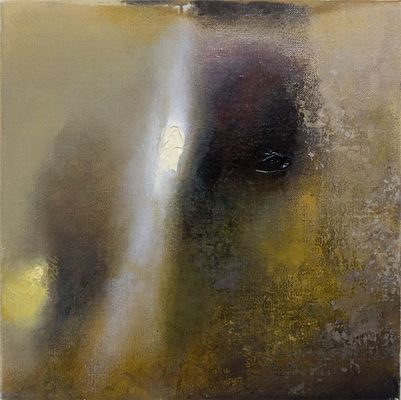
To return to Buckley’s fragment, the first two lines very much evoke how I paint nowadays. As you age, detail diminishes and patches of light become more luminous and float. I feel the most honest way of dealing with this is by smearing the oil paint on the canvas with the fingers and working close-up, blind. Only if the patches coalesce into an approaching image can the work gain a life.
-
Jonathan Walker was born in Melbourne, Australia and brought up on a dairy farm in Gippsland. In the 1970’s he studied painting at RMIT and won the Harold Wright Scholarship to the British Museum, London. During the 1980’s he exhibited at Pinacotheca Gallery, Richmond and had work shown at the NGV and Heidi City Art Gallery. Over the same period he designed the cover for the “Epigenesi” LP by Giancarlo Toniutti, Italy and conducted a mail exchange work with Achim Wollscheid, Germany. The work with artists through the post resulted in an article published in the bicentenary issue of Art and Australia 1988. He showed in artist run spaces such as WestSpace in the 90’s and 2000’s, and until 2012, taught painting at Victoria University, which is where we (Colleen Ahern and Lisa Radford) as organisers of the exhibition, among many others, had the privilege of being his student.
Walker’s knowledge was imparted to students through the careful selection of music, literature, and artists found in books that he himself had ordered for the library. Walker’s strategy was the generosity of sharing his vast knowledge with references specific to each student and their context.
Walker’s paintings share a similar focus and intimacy.
This exhibition presents a small selection of recent paintings alongside a publication that includes Walker’s writing. Observational and analytical, Walker’s work is a type of material notation — the time of day, colour and how it is blended, the both specific and fleeting location of a reflection on lino or the question of whether a chair leg should be included in a painting.
Please join us on Friday August 21 between 6-8pm to celebrate the opening of the exhibition.
Curated by Colleen Ahern and Lisa Radford.
B. Wurtz
Curated by Nic Tammens
March 26 - April 4, 2015
B.Wurtz works from a basement studio in his home on Manhattan’s Lower East Side.
This local fact is attested to by the plastic shopping bags and newsprint circulars that appear in his work. As formal objects, they don’t make loud claims about their origins but nonetheless transmit street addresses and places of business from the bottom of this long thin island. Like plenty of artists, Wurtz is affected by what is local and what is consumed. His work is underpinned by this ethic. It often speaks from a neighborhood or reads like the contents of a hamper:
“BLACK PLUMS $1.29 lb.”
“Food Bazaar”
“USDA Whole Pork Shoulder Picnic 99c lb.”
“RITE AID Pharmacy, with us it’s personal.”
“H. Brickman & Sons.”
“Sweet Yams 59c lb."
Most of the work in this exhibition was made while the artist was in residence at Dieu Donne, a workshop dedicated to paper craft in Midtown. Here Wurtz fabricated assemblages with paper and objects that are relatively lightweight, with the intention that they would be easily transportable to Australia. This consideration isn’t absolute in Wurtz’s work, but was prescriptive for making the current exhibition light and cheap. Packed in two boxes, these works were sent from a USPS post office on the Lower East Side and delivered to North Melbourne by Australia Post.
Wurtz appears courtesy of Metro Pictures, New York.
Thanks to Rob Halverson, Joshua Petherick, Sari de Mallory, Matt Hinkley, Helen Johnson, Fayen d'Evie, Ask Kilmartin, Lisa Radon, Ellena Savage, Yale Union, and "Elizabeth".
John Nixon
"Archive"
December 15 - January 20, 2014
The presentation of John Nixon's archive offered a rare showcase of this extensive collection of the artist's own publications, catalogues, posters, ephemera, editions and more, from the mid 1980s onwards, alongside a selection of his artworks.
Organized by John Nixon, Joshua Petherick and Matt Hinkley.
<a href=http://wfb.public-office.info/artist/john-nixon>All titles by John Nixon
"Habitat"
at Minerva, Sydney (organised by Joshua Petherick and Matt Hinkley)
November 15 - December 20, 2014
Lupo Borgonovo, Janet Burchill & Jennifer McCamley,
Lewis Fidock, HR Giger, Piero Gilardi, Veit Laurent Kurz,
Cinzia Ruggeri, Michael E. Smith, Lucie Stahl, Daniel Weil, Wols
Press Release:
“...It contained seven objects. The slender fluted bone, surely formed for flight, surely from the wing of some large bird. Three archaic circuitboards, faced with mazes of gold. A smooth white sphere of baked clay. An age-blackened fragment of lace. A fingerlength segment of what she assumed was bone from a human wrist, grayish white, inset smoothly with the silicon shaft of a small instrument that must once have ridden flush with the surface of the skin - but the thing’s face was seared and blackened.”
William Gibson, “Count Zero”, 1986
"Autumn Projects Archive"
Curated by Liza Vasiliou
March 6 - March 15, 2014
World Food Books, in conjunction with the Virgin Australia Melbourne Fashion Festival 2014, presented the Autumn Projects archive, consisting of a selection of early examples in Australian fashion with a particular interest in collecting designers and labels from the period beginning in the 1980’s, who significantly influenced the discourse of Australian Fashion.
Curated by Liza Vasiliou, the exhibition provided a unique opportunity to view pieces by designers Anthea Crawford, Barbara Vandenberg, Geoff Liddell and labels CR Australia, Covers, Jag along with early experimental collage pieces by Prue Acton and Sally Browne’s ‘Fragments’ collection, suspended throughout the functioning World Food Books shop in Melbourne.
H.B. Peace
presented by CENTRE FOR STYLE
November 14, 2013
"Hey Blinky, you say chic, I say same"
Anon 2013
H.B. Peace is a clothing collaboration between great friends Blake Barns and Hugh Egan Westland. Their pieces explore the divergences between 'character’ and ‘personality’ in garments....etc
Special Thanks to Joshua Petherick and Matt Hinkley of WFB and Gillian Mears
and a Very Special Thank you to Audrey Thomas Hayes for her shoe collaboration.
Janet Burchill & Jennifer McCamley
"Aesthetic Suicide"
May 10 - June 8, 2013
The first of our occasional exhibitions in the World Food Books office/shop space in Melbourne, "Aesthetic Suicide" presented a body of new and older works together by artists Janet Burchill & Jennifer McCamley, including videos, prints, a wall work, and publications.
During shop open hours videos played every hour, on the hour.
$.00 - Out of stock
The eternal clean out! New items weekly.
https://worldfoodbooks.com/category/sale
Published by World Food Books / Melbourne
$20.00 - In stock -
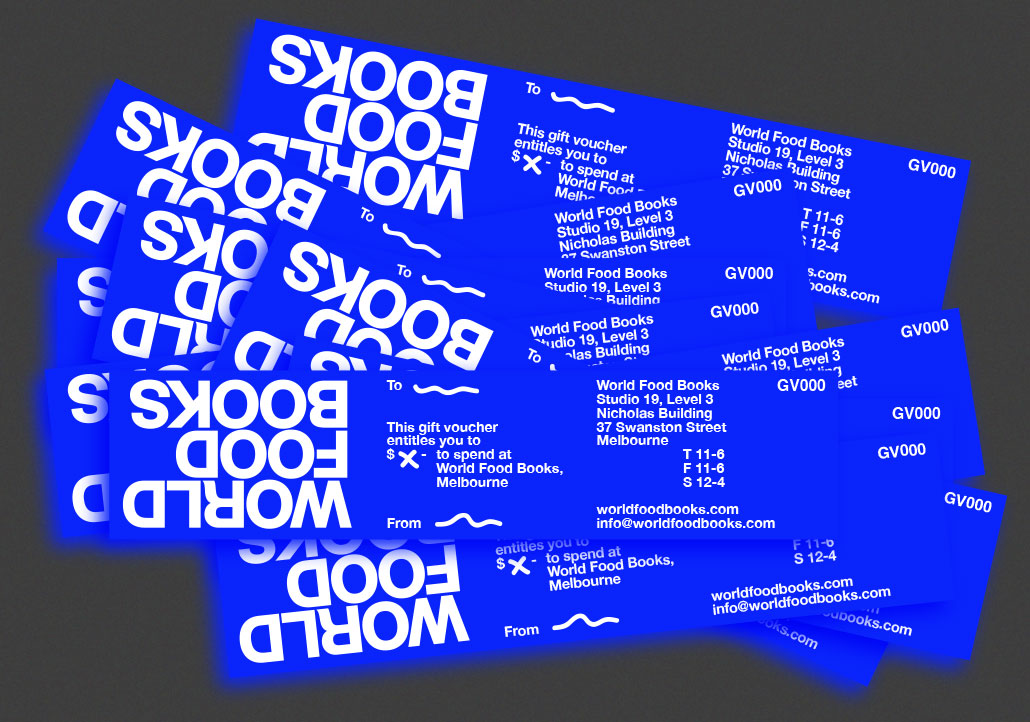
A World Food Books gift voucher is redeemable in our Melbourne bookshop or via our webshop (here). An e-voucher (printable pdf) will be sent to your purchase email address (please notify us if you wish to have the voucher sent to an alternate address and wish us to fill in the receiver's details on the card).
Gift vouchers can be purchased in increments of $20 (Australian Dollars) and the total amount can simply be added to by increasing the quantity in your shopping cart. eg. A quantity of 5 gift vouchers will result in an item total of $100 - a $100 gift voucher. Simply click "ADD TO CART" 5 times, or update your quantity in the shopping cart.
If you wish to purchase multiple, separate gift vouchers in one go, please just email us and we can personally prepare and email you a payment request.
Please note: Please select Pick-Up on gift voucher purchse to avoid any postage charges. Accidental postage charges will be refunded right away!
Thank you.
For any questions, please don't hesitate to email: [email protected]
2026, English / French / Italian
Hardcover, 192 pages, 28 x 24 cm
Published by
Five Continents Editions / Milan
$90.00 - In stock -
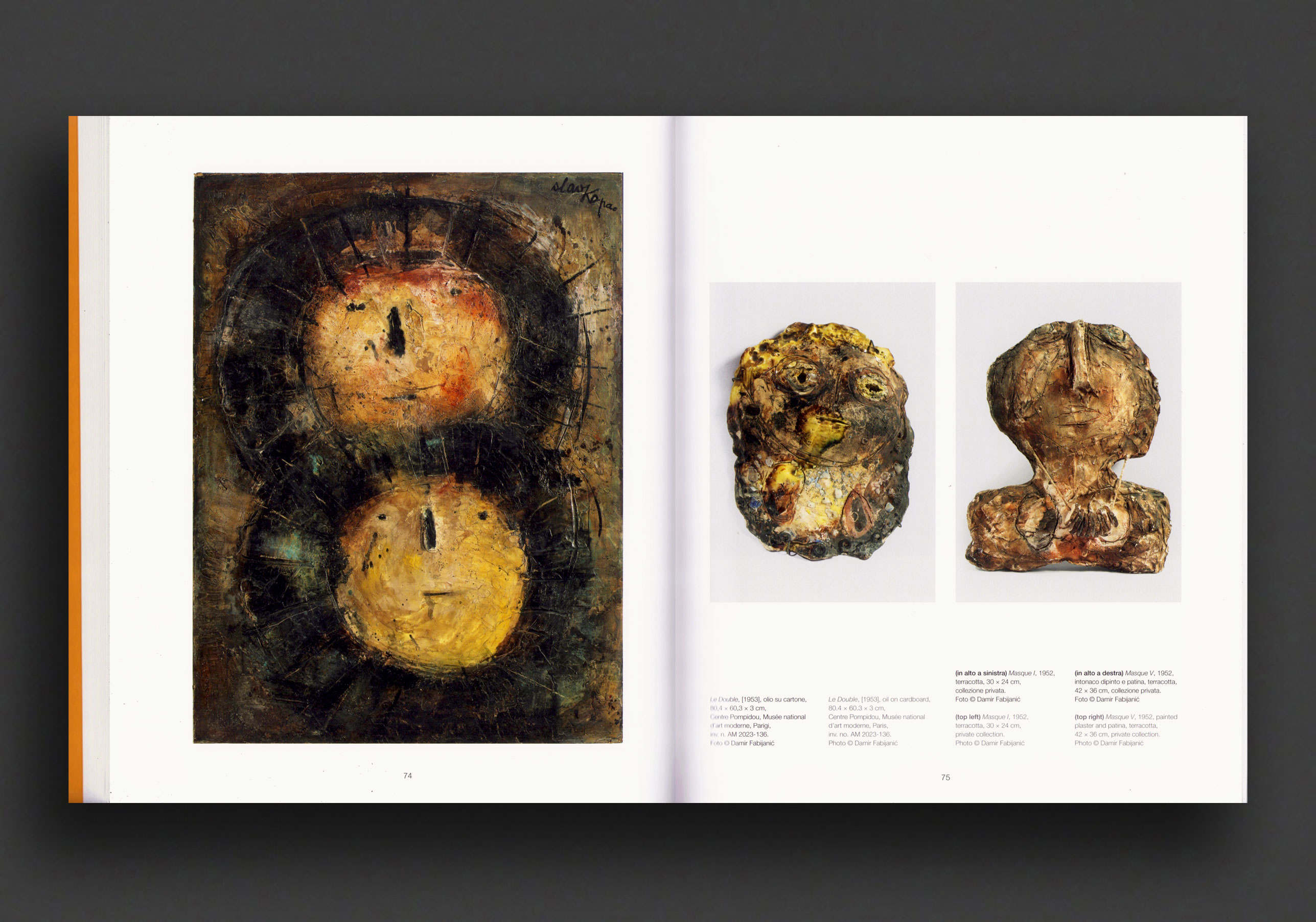
Hidden Treasure. Informal Art, Surrealism, Art Brut
Edited by Roberta Trapani. With an essay by Bernard Blistène. Texts by Cristina Acidini, Luca Macchi, Tamara Floričić, Roberta Trapani, Pietro Nocita, Susanna Ragionieri, Michele Amedei, Roberta Serpolli, Pauline Goutain, Déborah Lehot-Couette, Katharine Conley, Kent Mitchell Minturn, Fabrice Flahutez
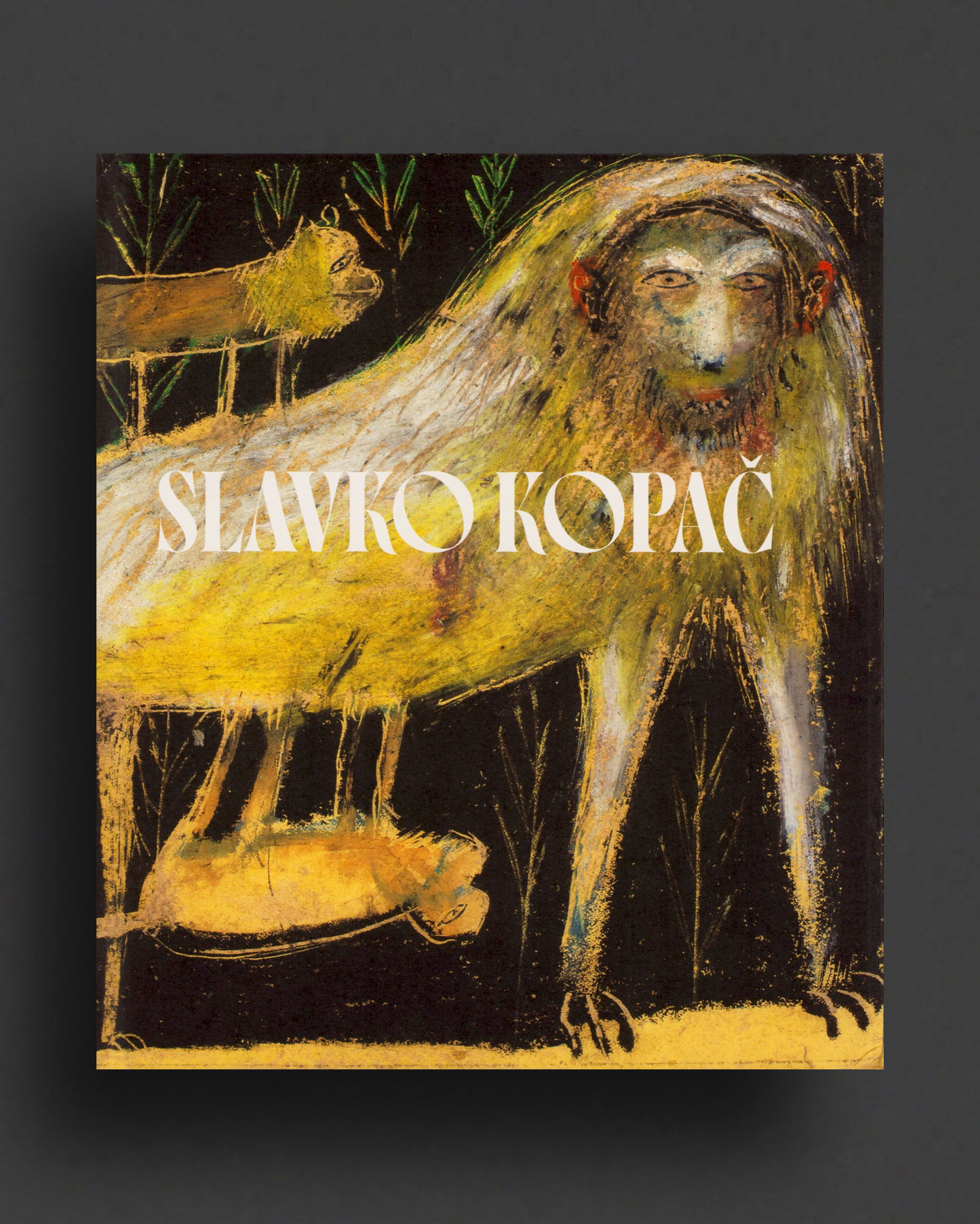
The volume accompanies the exhibition “Slavko Kopač. Il tesoro nascosto” (Accademia delle Arti del Disegno, Florence). With an introduction by Bernard Blistène, honorary director of the Centre Pompidou and advocate of the acquisition of twelve of Kopač’s works into the museum’s collection, the book explores a multifaceted artist, deeply connected to Surrealism, Informal Art, and Art Brut.
A key collaborator of Jean Dubuffet and the first curator of the Collection de l’Art Brut, Kopač played a fundamental part in its promotion and configuration. His magical, totemic universe captivated the Surrealists and led to a collaboration with André Breton. At the same time, critic Michel Tapié included him in Un art autre (1952), recognising his originality within the Informal Art movement.
He used painting, drawing, ceramics, sculpture, collage, and art books to explore materiality, intertwining reality and fantasy. The volume features contributions by leading international scholars and an extensive iconographic repertoire, including previously unpublished works and archival documents.
Exhibition: Accademia delle Arti del Disegno, Florence, 12 September – 13 November 2025
Bernard Blistène has been honorary director of the Centre Pompidou since 2021 and headed the institution from 2013 to 2021. He has left a significant mark on the museum’s profile through numerous exhibitions and retrospectives (Fontana, Twombly, Warhol, Baselitz, etc.), while also establishing museums in Marseille. He was a professor at the École du Louvre for twenty-five years and organiser of international biennials, conceiving and directing the Nouveau Festival at the Centre Pompidou and spearheading major projects, such as “Mondes Nouveaux”.
Roberta Trapani is a historian of contemporary art with a PhD awarded by Paris Nanterre and Palermo Universities in an international joint supervision programme. She is a cofounder of the Collective de réflexion autour de l’Art Brut (CrAB), the Kopač Commettee Association (Paris), and an associate researcher at ECLLA (University of Saint-Étienne), InTRU (University of Tours), and Osservatorio Outsider Art (Palermo). She has organised exhibitions in France, Belgium and Italy and published essays on twentieth- and twentyfirst-century artists and movements.
2026, English
Softcover, 118 pages, 24.1 x 29.8 cm
Published by
Gagosian / New York
$130.00 - In stock -
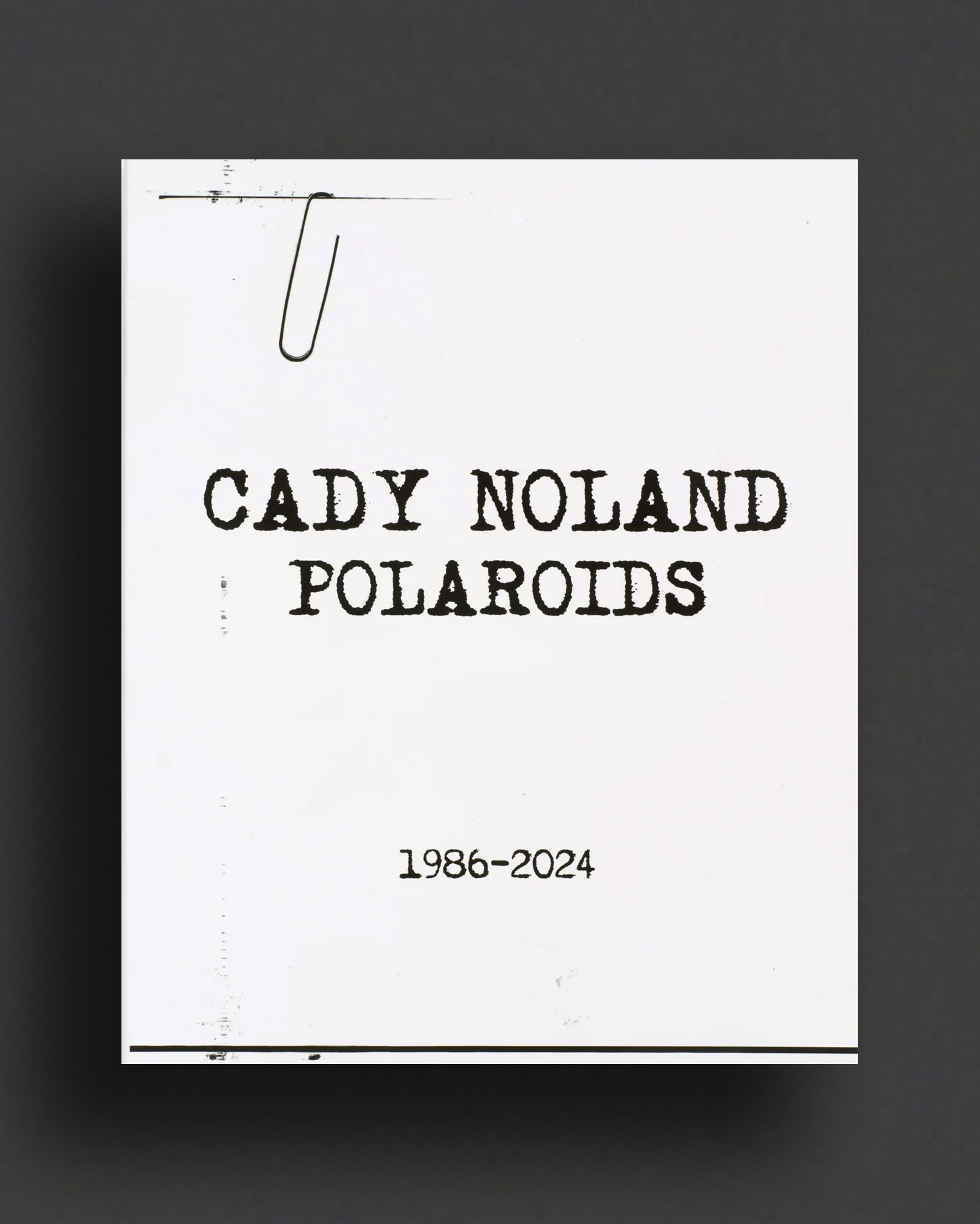
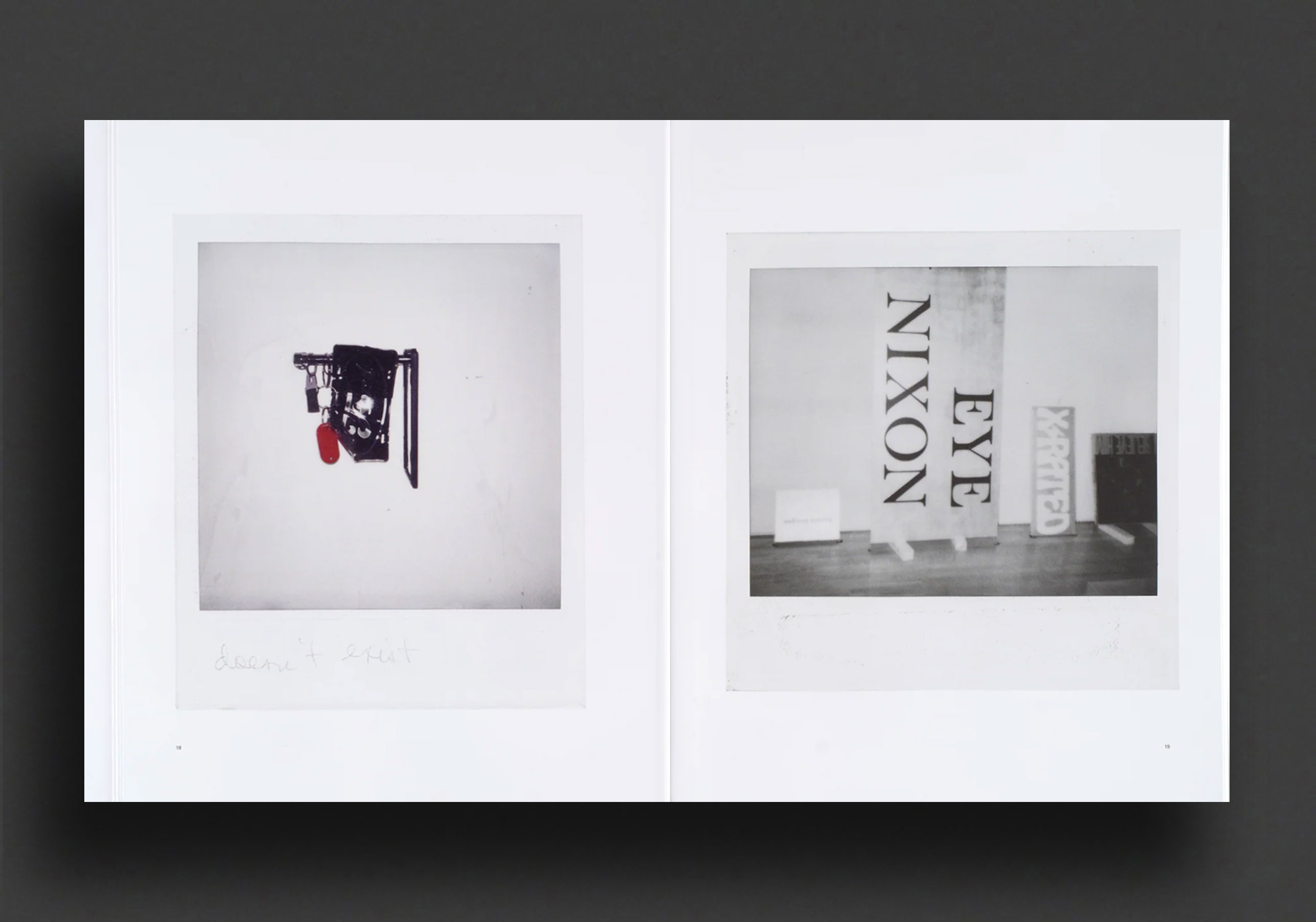
Conceived, designed, and edited by the artist, Cady Noland: Polaroids 1986–2024 is devoted to Polaroid photographs taken by Noland in the process of developing her sculptures and exhibitions. Published to coincide with a solo show of Noland’s new work at Gagosian, 555 West 24th Street, New York, this artist’s book reproduces nearly one hundred previously unpublished Polaroids from the course of her career, providing unique insight into her sculptural practice.
1975, English
Hardcover (w. dust jacket), 288 pages, 33 x 24.5 cm
1st Edition, Out of print title / used / very good
Published by
Leon Amiel / New York
$140.00 - Out of stock
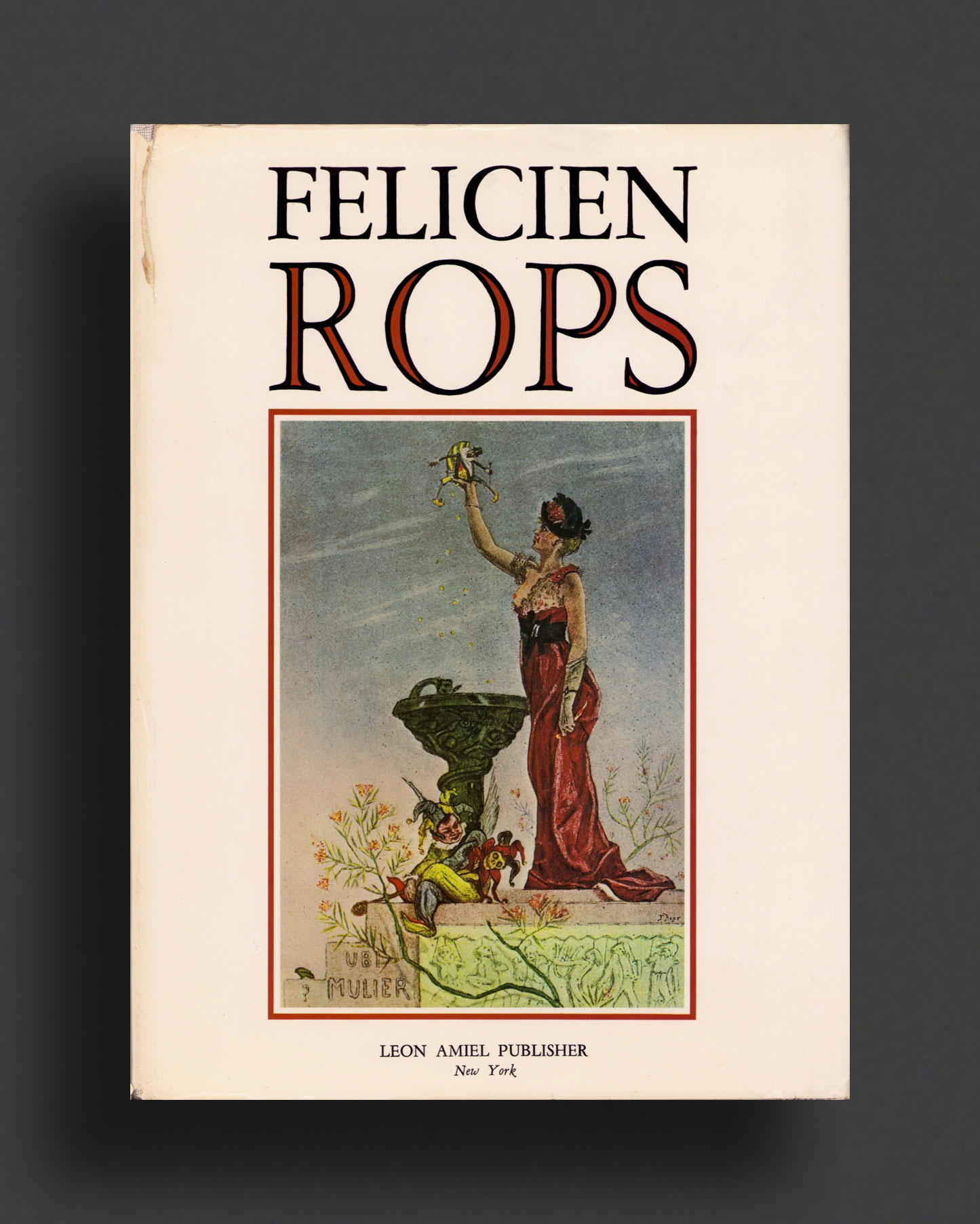
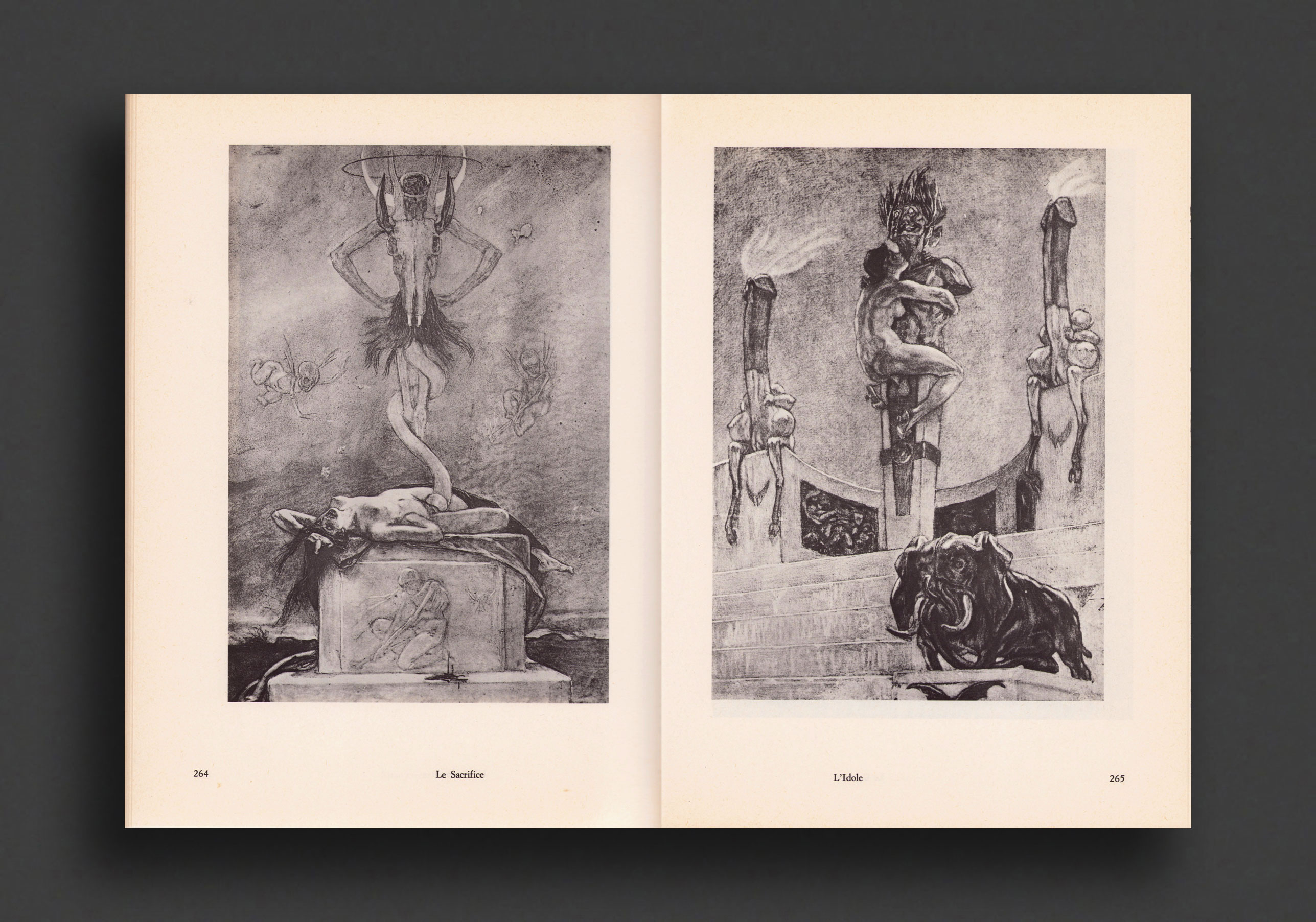
First 1975 English-language hardcover edition of The Graphic Works of Félicien Rops, one of the finest volumes on the artist's most tantalizing print works, published by Leon Amiel, New York. Almost entirely made up of graphic reproductions, the book also includes texts by J.K. Huysmans (Instrumentum Diaboli) and Lee Revens (Notes on the Life of Rops). Félicien Victor Joseph Rops was a Belgian artist associated with Symbolism, Decadence, and the Parisian fin de siècle, a member of the Les XX group. He was a painter, illustrator, caricaturist and a prolific and innovative print maker, particularly in intaglio, best known today for his prints and drawings illustrating erotic and occult literature of the period.
Very Good copy in VG dust jacket with a few closed tears/light chipping, now preserved in archival mylar wrap.
1995, English
Softcover, 156 pages, 23 x 14.6 cm
1st Edition, Out of print title / used / very good
Published by
Routledge / London
$15.00 - In stock -
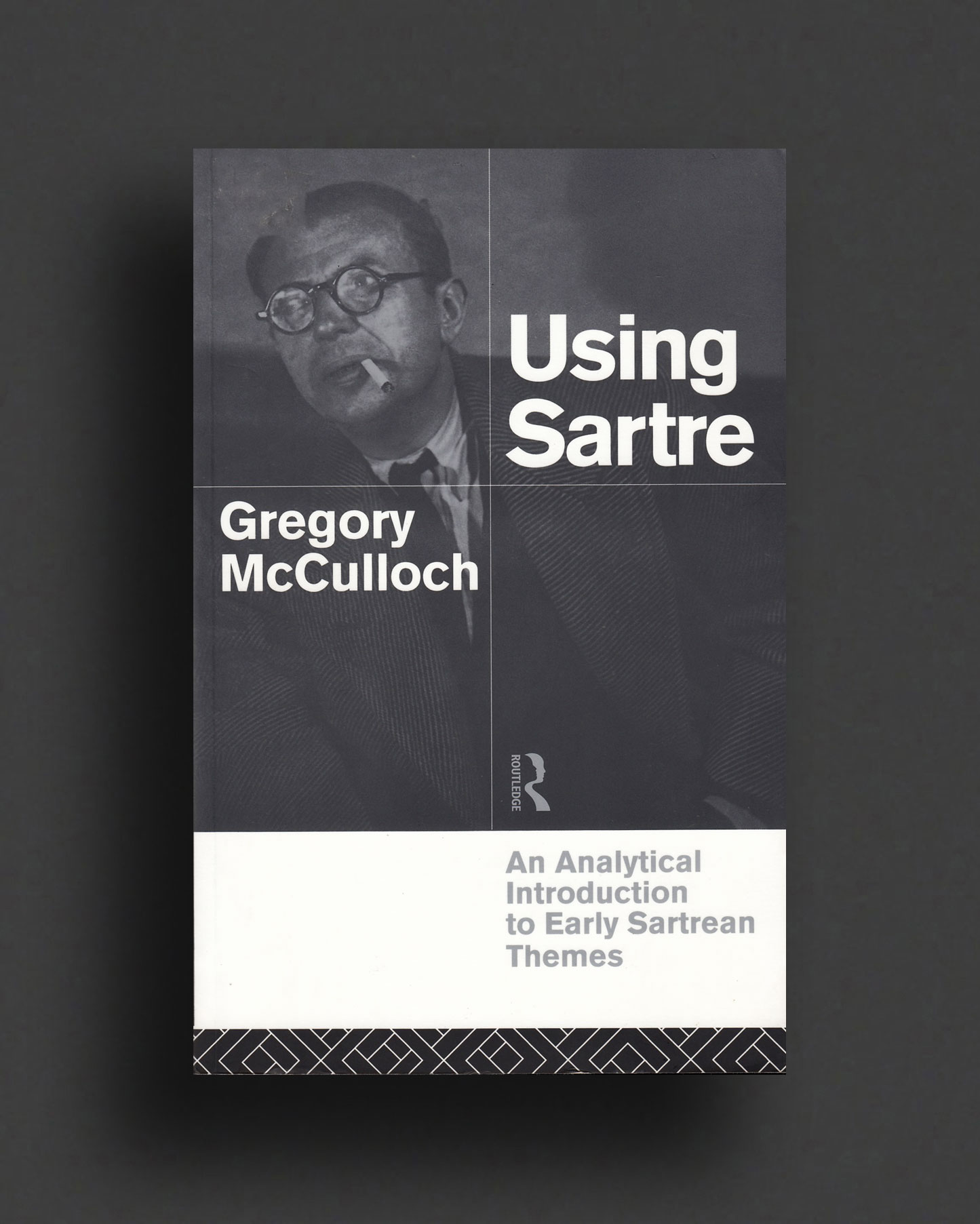
Using Sartre is an introduction to the philosophy of Jean-Paul Sartre, but it is not an ordinary introduction. It both promotes Sartrean views and adopts a consistently analytical approach to him. Concentrating on the early philosophy, up to and including Sarte's masterwork Being and Nothingness, Gregory McCulloch clearly shows how much analytical philosophy misses when it neglects Sartre and the continental tradition in philosophy.
In the classic spirit of analytical philosophy, this is a clear, simple and appealingly short exposition of the early work of Sartre. Written specifically for beginners and non-specialists, this book is sure to spark new interest in Sartre and the existentialists, while making a significant contribution to the development of analytical philosophy of mind as well.
"Using Sartre will be a welcome addition to the materials with the aid of which an analytically trained undergraduate can study Sartre's philosophy. The book immediately engages the reader with its directness and informality of style!"—John Compton, Vanderbilt University
Gregory McCulloch is Lecturer in Philosophy at the University of Nottingham. He is the author of The Game of the Name (1989) and of the forthcoming The Mind and Its World in the Routledge The Problems of Philosophy series.
1982, Japanese
Softcover, 138 pages, 22 x 29.5 cm
1st Edition, Out of print title / used / good
Published by
Kajima Institute Publishing / Tokyo
$70.00 - In stock -
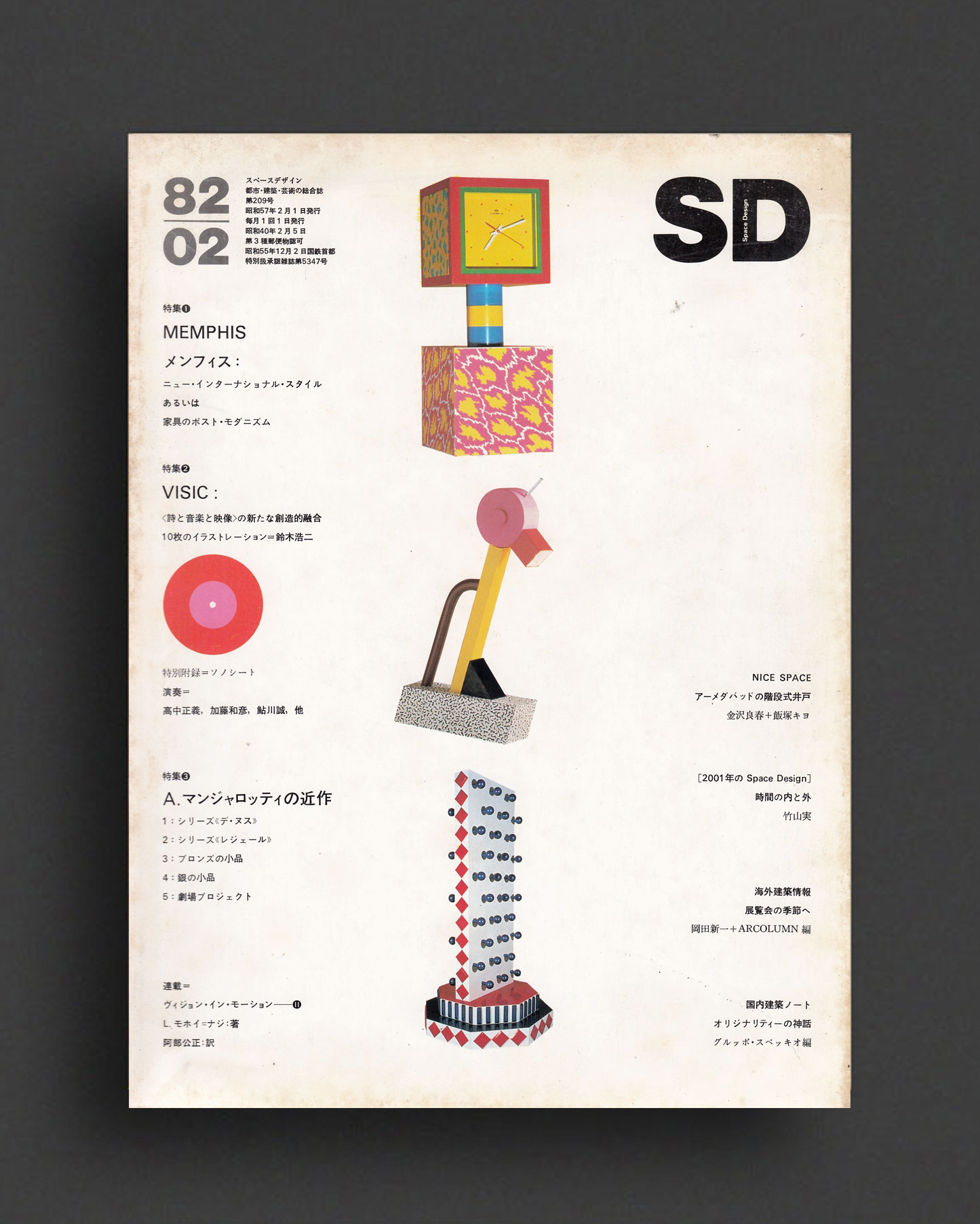
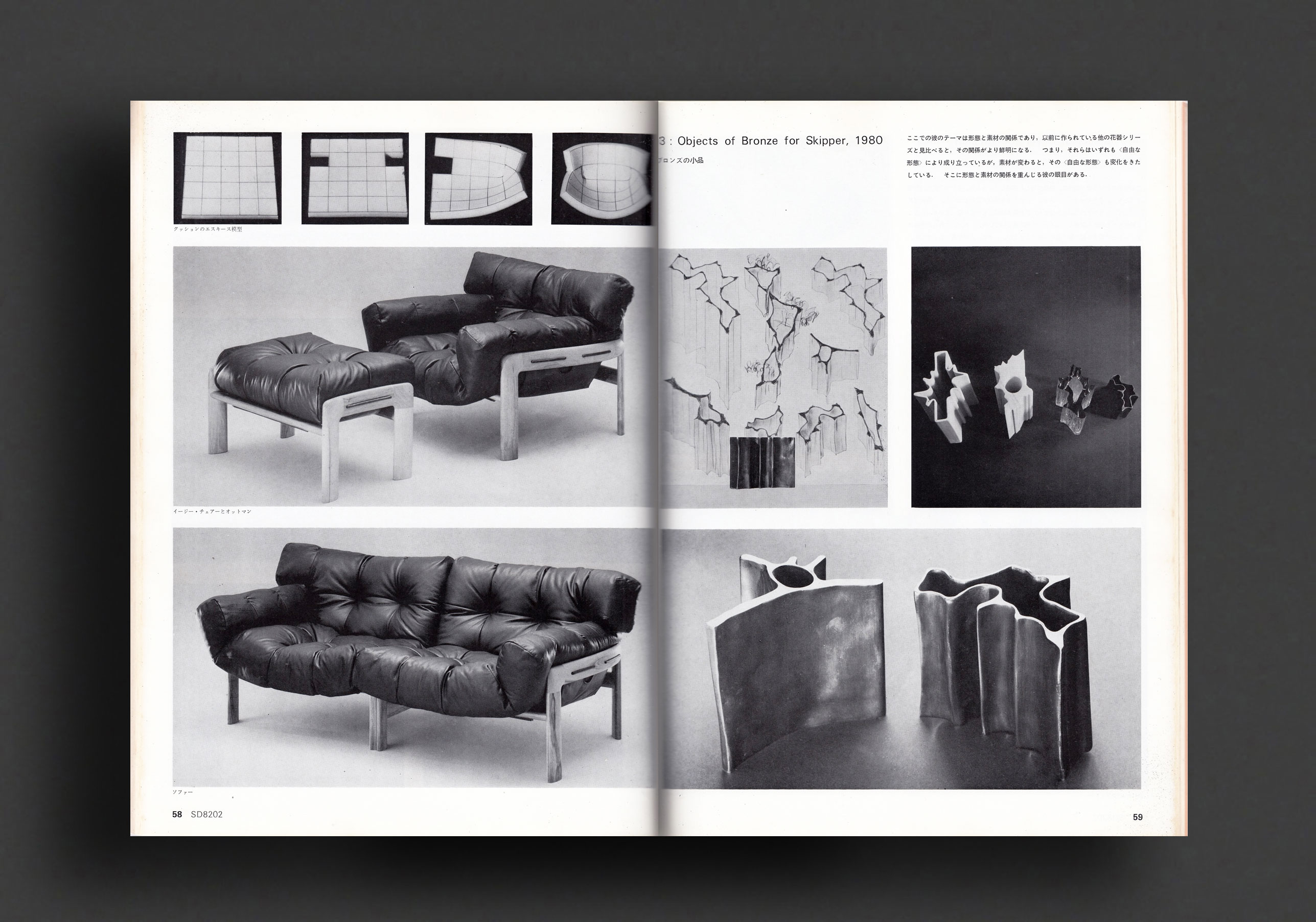
SD (Space Design) no. 222, 1983, featuring in-depth special feature on "MEMPHIS: New International Style or Post-Modernism in Furniture" by Barbara Radice including Michael Graves, Hans Hollein, Ettore Sottsass, Alessandro Mendini, Studio Alchymia, Arata Isozaki, Shiro Kuramata, Masanori Umeda, Nathalie du Pasquier, Matteo Thun, George Sowden, Marco Zanini, Marco Zanuso, Martine Bedin, Shiro Kuramata, etc., plus more works and contirbutions by Arata Isozaki, Masanori Umeda, Koji Suzuki, Shigesato Itoi, Yu Imai, Toshifumi Kawahara, Yuji Nunokawa, Angelo Mangiarotti, Osami Hamaguchi, and much more...
“SD” (Space Design) was founded in Japan in 1965; a comprehensive monthly magazine on architecture, urban problems and fine arts which was unique in the world and quickly became a leading, highly-esteemed journal of international modern design. In-depth articles, photo documents, plans, reports and interviews, SD is one of the finest journals dedicated to new design (architecture, furniture, interior, environmental, industrial...), becoming a much sought-after archival resource.
Good copy with foxing and age to extremities.
1993, Japanese / English
Hardcover (w. dust jacket), 144 pages, 23 x 31 cm
1st Edition, Out of print title / used / very good
Published by
Libro Port Publishing Co. Ltd. / Tokyo
$200.00 - In stock -
Never to be missed, the first 1993 over-sized hardcover edition of Araki's incredible Erotos photo book, our favourite of his books. In this provocative work, controversial and legendary Japanese photographer Nobuyoshi Araki makes a radical departure from his usual portraits and cityscapes, zooming his lens in on his evocative subjects. An exquisitely printed collection of arrestingly primal close-ups of parts of the human body, as well as pipes, fruit, wet sidewalks, flowers, snails—Erotos delves deep into the erotic subconscious. Reproduced in gorgeous glossy duotone full-page bleed, bound in heavy gloss red, foiled hardcovers. A stunning book! Araki at his most surrealist. Highest recommendation.
Nobuyoshi Araki is a prolific Japanese photographer who has produced thousands of photographs over the course of his career. He became famous for “Un Voyage Sentimental” (1971), a series of photos depicting both banal and deeply intimate scenes of his wife and lifelong muse, essayist Aoki Yoko (whom the artist credits for making him a photographer), during their honeymoon. To date the 75 year old has produced 450 photo books and counting. With a repertoire that knows no boundaries, Araki's diaristic style of photography has captured the world around him (his cat Chiro, the people and landscapes of Japan and his travels, flowers, family), though it is Araki’s intensely sexual imagery that has elicited particular controversy and fascination throughout his career. Similarly to Helmut Newton, Araki has often addressed subversive themes — such as bondage in the Japanese style Kinbaku — in his provocative depictions of female nudes. He typically works in black-and-white photography, and his hallmark style is deliberately casual. “Rather than shooting something that looks like a professional photograph, I want my work to feel intimate, like someone in the subject’s inner circle shot them,” he says. Pushing against the world of commercialised photography, he is celebrated for his history of self-publishing and distributing his work, beginning with his Xerox Photo Albums of 1970. Amongst many others, Araki has collaborated with American photographer Nan Goldin and Icelandic musician Björk.
Very Good copy in Very Good dust jacket with small amount of wear and tear.
1983, Japanese / English
Softcover (w. original plastic cover and obi band), 138 pages, 22 x 30 cm
1st Edition, Out of print title / used / very good
Published by
Asahi Shimbun / Japan
$240.00 - In stock -
Rare first edition of this compelling early 1980's photo book of violence and disaffection in American cities from Japanese photographer Shigemoto Nobi, printed by Asahi Shimbun in 1983.
Images of social unrest, gang warfare, prostitution, police precinct lockups, murder... the "poverty of the heart" real people must face behind the facade of America's boasted wealth of economic growth, something Japanese photographer Shigemoto Nobi (b. 1943) first encountered when he went to New York in his twenties to work as a freelance commercial photographer. Despite the implications of the title, Shigemoto Nobi visited and documented not only New York, but also Detroit, Chicago, Hawaii, the US/Mexican border and the Fort Apache Indian reservation, taking images primarily at night. Intense, lurid reportage on life in the United States of America in rich, saturated colour Kodochrome. File alongside Kiyotaka Tsurisaki, Seiji Kurata, or Bruce Davidson's "Subway".
First printing in original protective plastic sleeve with original obi band. Texts in Japanese and English.
Very Good copy with usual light damage/shrinkage to aged original plastic dust jacket cover/obi. Light edge wear.
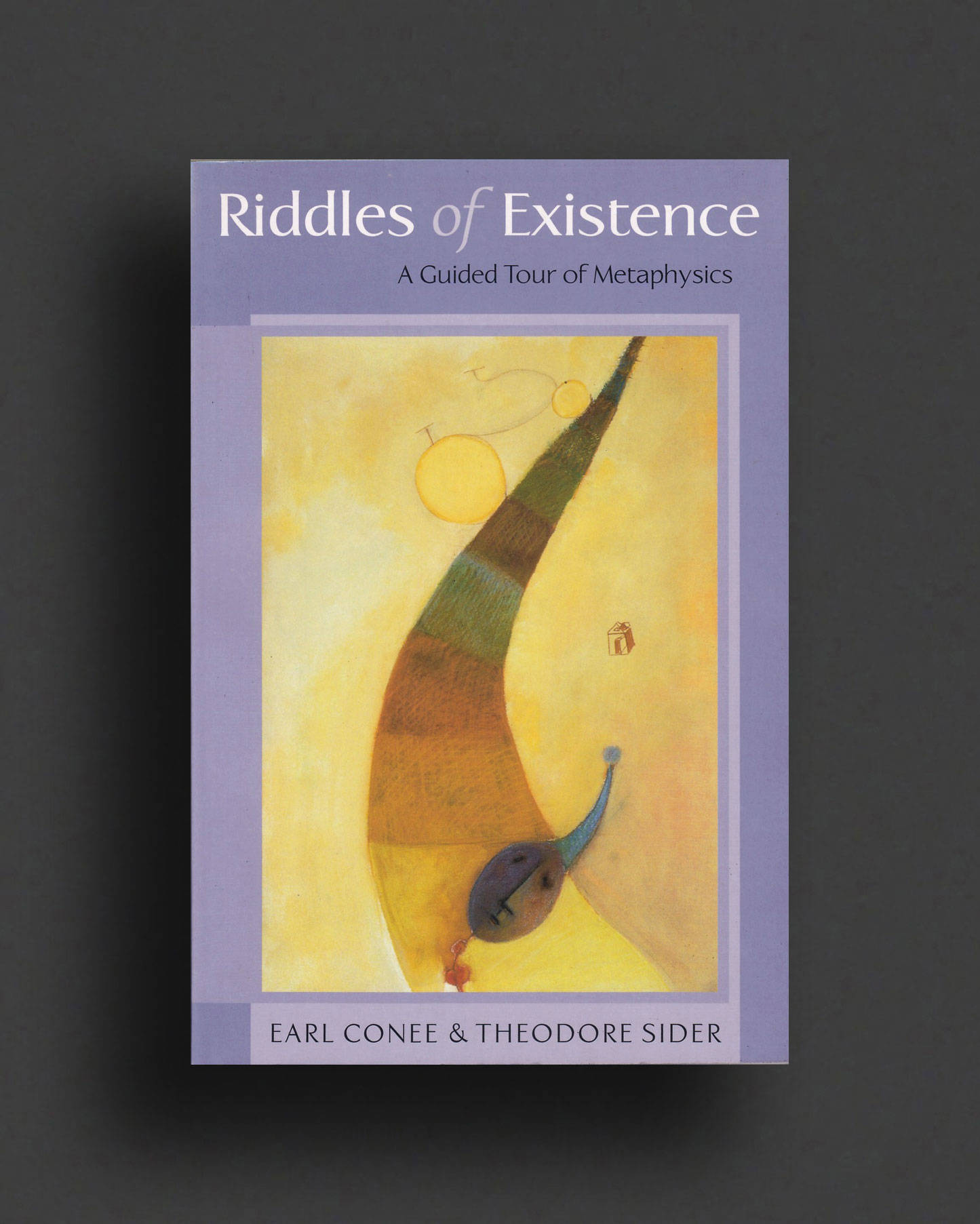
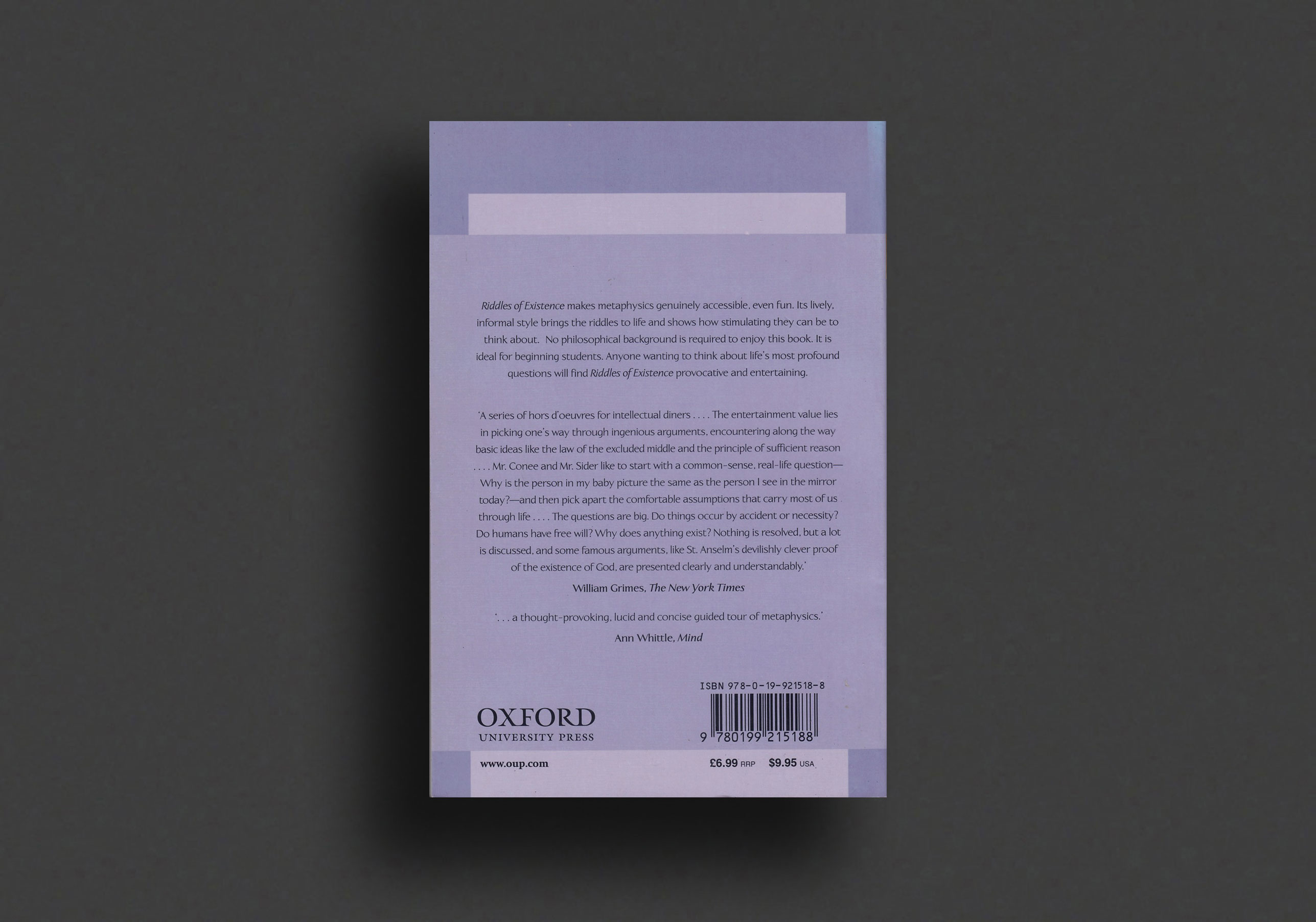
2005, English
Softcover,
1st Edition, Out of print title / used / very good
Published by
Oxford University Press / New York
$25.00 - In stock -
Riddles of Existence makes metaphysics genuinely accessible, even fun. Its lively, informal style brings the riddles to life and shows how stimulating they can be to think about. No philosophical background is required to enjoy this book. It is ideal for beginning students. Anyone wanting to think about life's most profound questions will find Riddles of Existence provocative and entertaining.
"A series of hors d'oeuvres for intellectual diners.... The entertainment value lies in picking one's way through ingenious arguments, encountering along the way basic ideas like the law of the excluded middle and the principle of sufficient reason .... Mr. Conee and Mr. Sider like to start with a common-sense, real-life question— Why is the person in my baby picture the same as the person I see in the mirror today?-and then pick apart the comfortable assumptions that carry most of us. through life.... The questions are big. Do things occur by accident or necessity? Do humans have free will? Why does anything exist? Nothing is resolved, but a lot is discussed, and some famous arguments, like St. Anselm's devilishly clever proof of the existence of God, are presented clearly and understandably."—William Grimes, The New York Times
*...a thought-provoking, lucid and concise guided tour of metaphysics."—Ann Whittle, Mind
VG copy with inscription by author to Australian artist Bernhard Sachs. First 2005 edition.
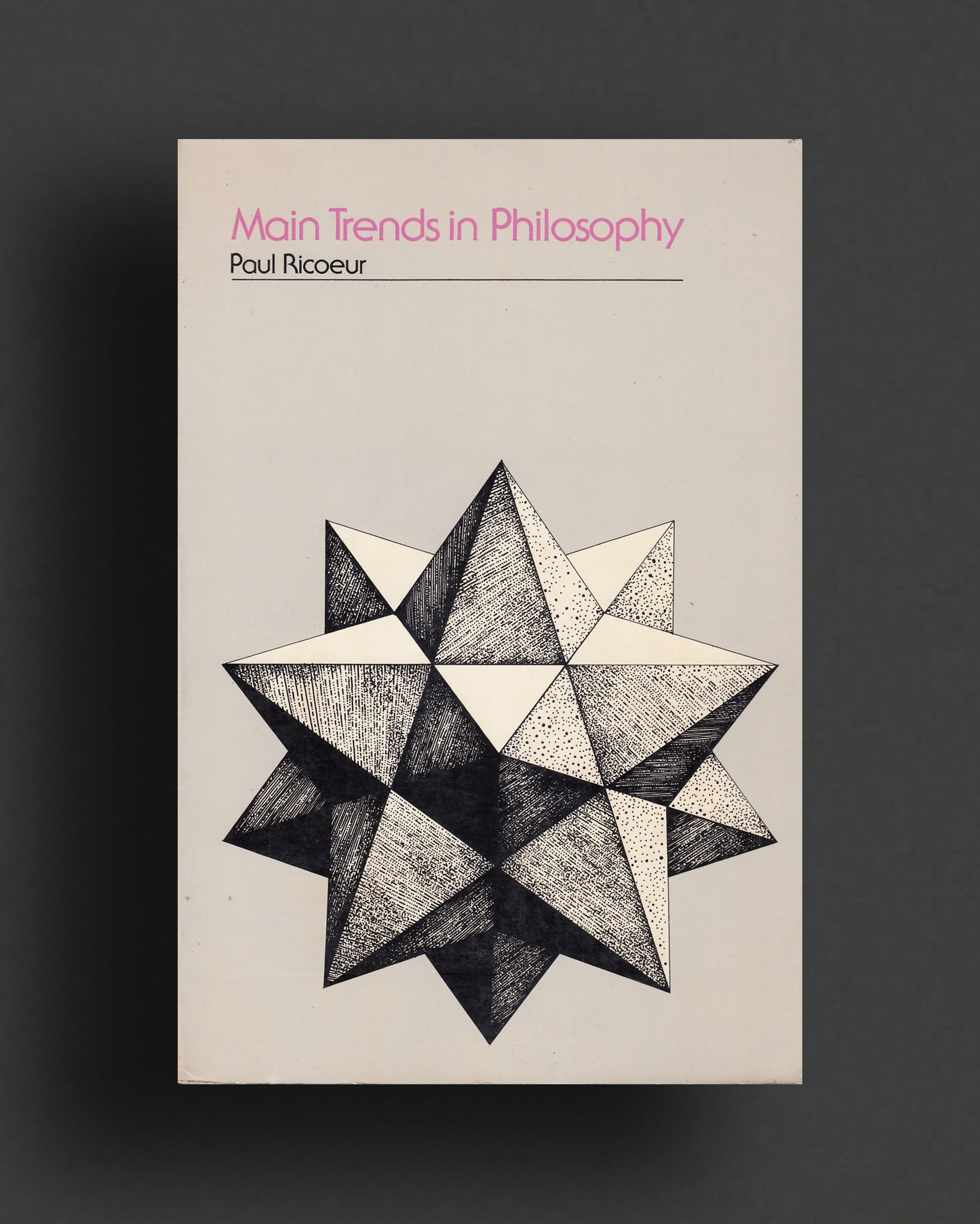
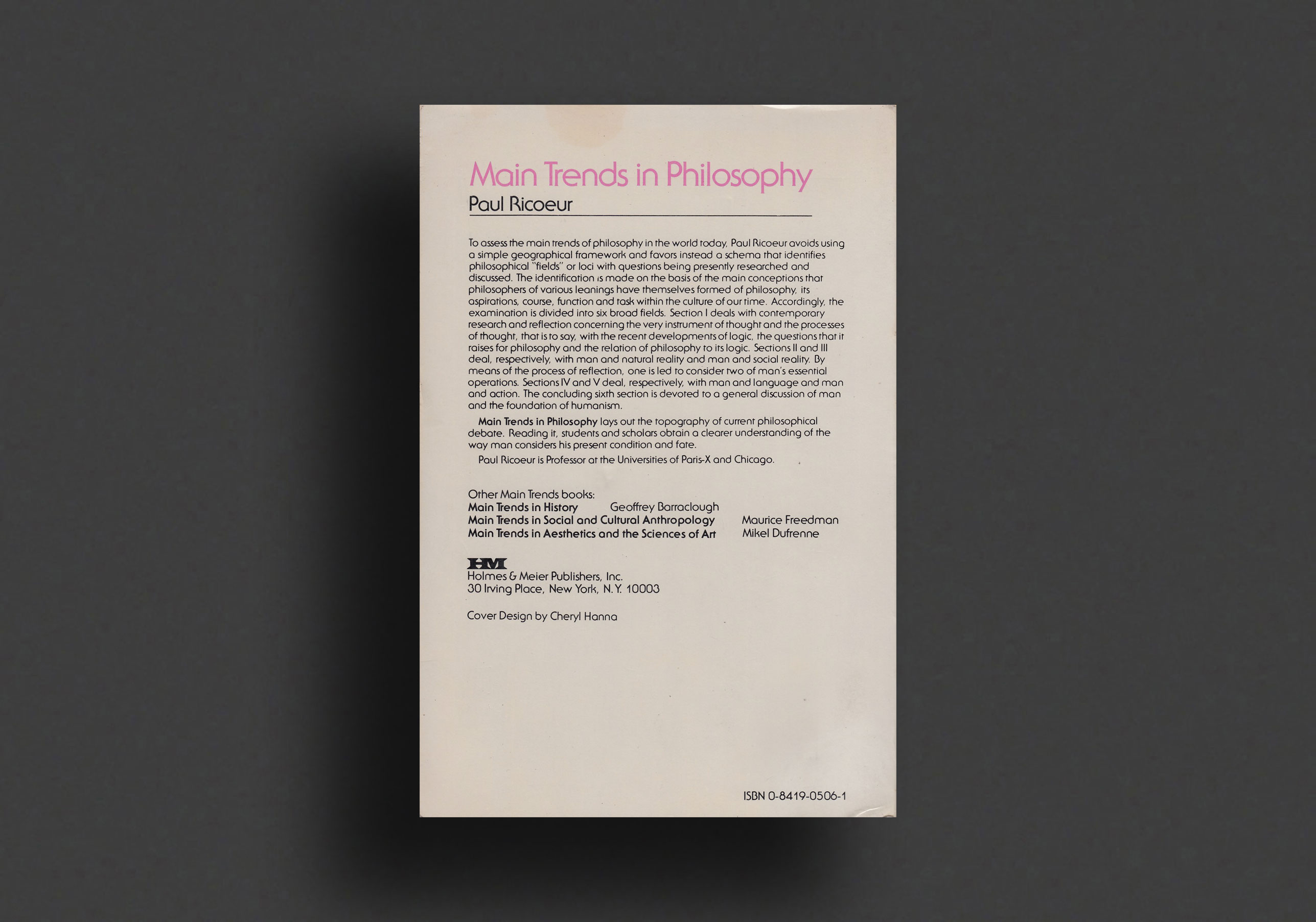
1979, English
Softcover,
1st Edition, Out of print title / used / very good
Published by
Holmes & Meier / New York
$18.00 - In stock -
To assess the main trends of philosophy in the world today, the author avoids using a simple geographical framework and favours instead a schema that identifies philosophical fields or loci with questions being presently researched and discussed. The identification is made on the basis of the main conceptions that philosophers of various leanings have themselves formed of philosophy, its aspirations, course, function and task within the culture of our time.
First 1979 edition, VG copy, light wear/age.
2023, English
Softcover (w. dust jacket) 330 pages, 21 x 14.9 cm
Published by
Treville / Tokyo
Pan-Exotica / Tokyo
$100.00 - In stock -
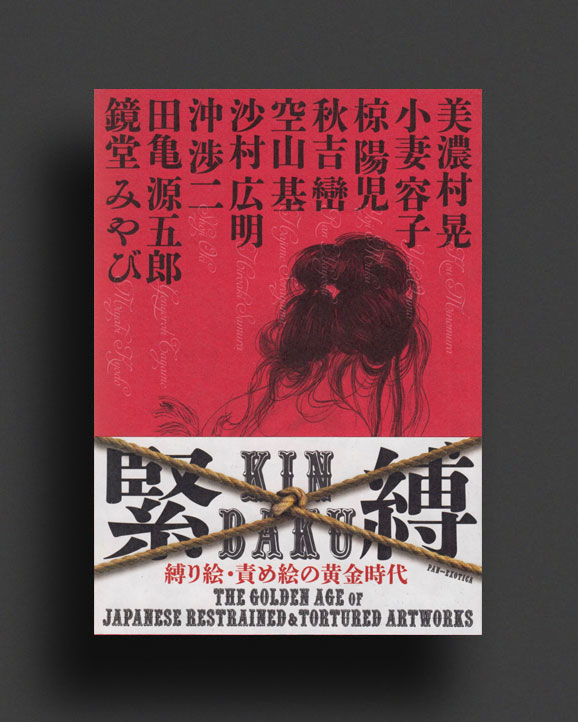
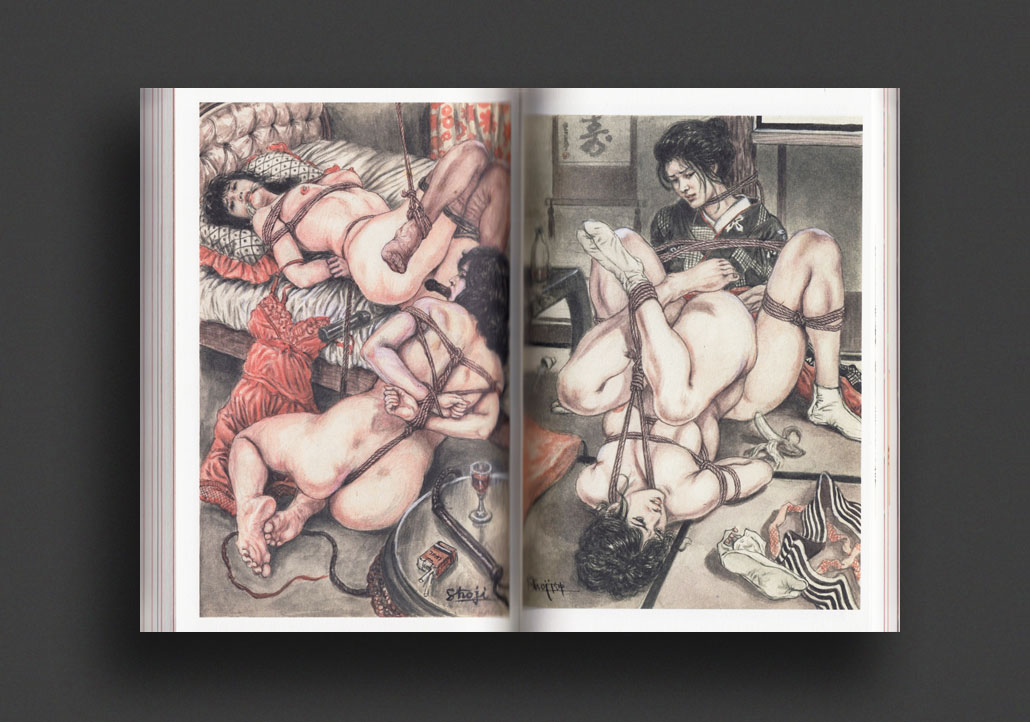
The first of its kind, "KINBAKU The Golden Age of Japanese Restrained & Tortured Artworks" collects the masters of Japanese kinbaku rope bondage and torture artworks by nine Japanese artists, spanning generations, artists who have refined the beauty of masochism and inherited the legacy of Japanese Shibari-e eroticism as pioneered by Seiu Ito. This book presents beautiful reproductions in colour and b/w of many extreme artworks by Kou Minomura, Yoko Ozuma, Yoji Muku, Ran Akiyoshi, Hajime Sorayama, Hiroaki Samura, Shoji Oki, Gengoroh Tagame, and Miyabi Kyodo. Each artist has bilingual introduction text, plus essays in Japanese by Akira Naka, Masakazu Tanaka, and Toshihi Soma.
Published on the occasion of the exhibition, The Essentials of KINBAKU ART, held at Vanilla Gallery, Tokyo, 16 March—9 April, 2023.
"After World War II, people who had been freed from the long curse of asceticism sought entertainment and freedom in easy "reading", and a multitude of magazines were launched into the world. Among the numerous magazines were the forbidden maniac magazines. These unique magazines raised people's sexual and even aesthetic interests in
2026, English
Softcover w. doll-handle, 100 pages, 21 x 14.8 cm
Published by
no more poetry / Naarm
$45.00 - In stock -
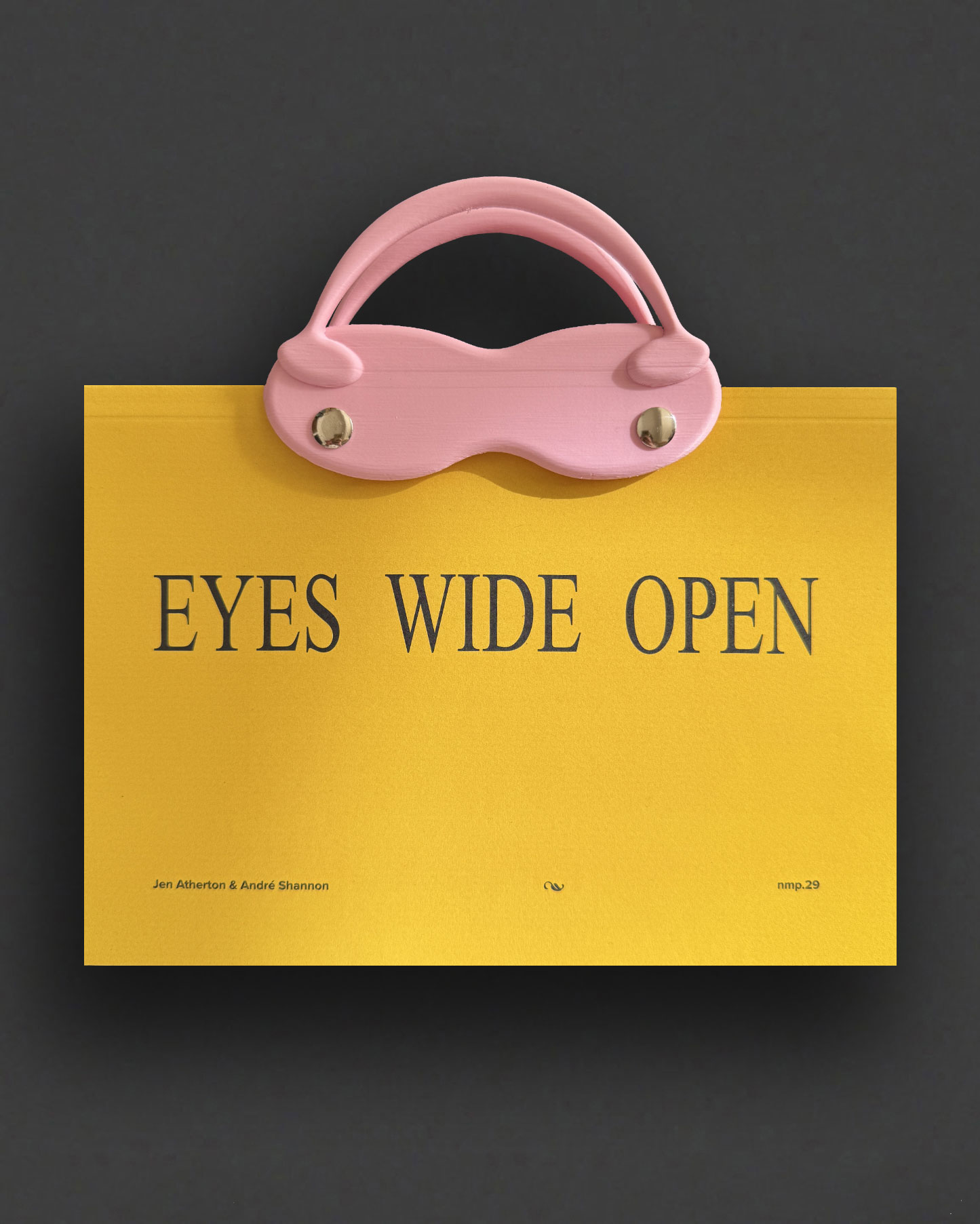
EYES WIDE OPEN is the debut co-authored publication by film makers Jen Atherton & André Shannon (collectively Garden Reflexxx).
a book about making films without pretending the “industry” is the only room available.
Have you got $4.20 and headlice? Addiction issues you want solved by concentrated work? A crippling need for attention? Learn by reading and working through our new disarmingly frank handbook EYES WIDE OPEN and craft your own cinema situation. Using principles of distributed cognition, talking to strangers, event planning, and audio-visual dieting we present to you an amalgamation of practiced techniques from years of radio interviews and failing-forward independent filmmaking to get you into the comfiest shoes you own to make posture-forward photegenic films. No firearms permitted, unless you’re shooting a movie.
“Go Harder”
— Martine
excerpts:
For eight years on and off we have talked about films on FBi Radio in Redfern. Our focus was to glean insights into the movie life that could be applicable to first time filmmakers. So much about filmmaking felt obtuse and unobtainable to us. When we began making films we had a meeting with Screen Australia where the commissioner told us all she was greenlighting was “Tim Winton adaptations”. It was a dark time. She told us we should try to move overseas; failing that, which we did, she said “build your own audience”, which turned out to be the best advice ever given us.
Our ultimate goal is to liberate films from staunch structures. By staunch structures we refer to biases towards quality. The rich image is dominant. What’s monied is considered normal. We fall into traps like agreed-upon image value, agreed-upon correctness. Deep down, cinema has pretty privilege… and it’s called ‘industry standard’. These certainly bad attitudes disempower filmmakers and reiterate film as a posh medium. We’re losing the next generation because they’re being brainwashed, aiming to make $3-5m indies. page.
2026, edition two, with doll handle — hand finished, editions vary.
1977, English
Softcover, 396 pages, 18 x 11 cm
1st Edition, Out of print title / used / good
Published by
Penguin Books / London
$28.00 - In stock -
Scarce first 1977 Penguin paperback edition of the first 1973 English translation. Cover design by Tsutomu Harada.
In November 1970, Yukio Mishima committed suicide, in the old Japanese way by disembowelling himself. His last years were devoted to the completion of a quartet of novels, The Sea of Fertility, of which this is the second volume.
Isao is a young, engaging patriot, and a fanatical believer in the ancient samurai ethos. He turns terrorist, organising a violent plot against the new industrialists, who he believes are threatening the integrity of Japan and usurping the Emperor’s rightful power. As the conspiracy unfolds and unravels, Mishima brilliantly chronicles the conflicts of a decade that saw the fabric of Japanese life torn apart.
Mishima's own superlative literary qualities... include a complete control of complex nárrative, the ability to convey psychological depths often far removed from the everyday, and a sense of total commitment and response to the experience of life, all of which transcend the author's personal obsessions'—New Statesman
Yukio Mishima (1925—1970), one of the most spectacularly gifted writers in modern Japan, was born into a samurai family in 1925. Yukio Mishima was a Japanese author, poet, playwright, actor, model, Shintoist, nationalist, and founder of the Tatenokai ("Shield Society"), an unarmed civilian militia. Mishima is considered one of the most important Japanese authors of the 20th century. He was considered for the Nobel Prize in Literature in 1968. His works include the novels Confessions of a Mask and The Temple of the Golden Pavilion. Mishima's work is characterized by "its luxurious vocabulary and decadent metaphors, its fusion of traditional Japanese and modern Western literary styles, and its obsessive assertions of the unity of beauty, eroticism and death", according to author Andrew Rankin. In November 1970 he and his Tatenokai forced their way into a Self-Defense Force headquarters in Tokyo, where Mishima, after reading out a proclamation, committed ritual suicide with a young follower in the commanding officer's room. On the morning of his death, the last volume of Mishima's tetralogy, The Sea of Fertility (The Spring Snow, Runaway Horses, The Temple of Dawn, The Decay of the Angel) was delivered to his publisher.
Scarce first 1976 Penguin paperback edition of the first 1968 English translation. Cover design by Tsutomu Harada.
Shunsuké, an ageing novelist, hits on a brilliant plan to avenge himself on womankind, who, he believes, have blighted his life. He bribes a beautiful homosexual student, Yuichi, to marry. The plan works, Yuichi's wife is made miserable. And Shunsuké gets Yuichi to compromise two of his past tormentors, the blackmailing Mrs Kaburagi and Kyoko, a dizzy socialite. But Yuichi, now the toast of Tokyo's 'gay people' and free of all moral restraint, refuses to be further manipulated. Soon the old writer sees his protégé, his creation, turn into a monster dangerously out of control.
Mishima's own superlative literary qualities... include a complete control of complex nárrative, the ability to convey psychological depths often far removed from the everyday, and a sense of total commitment and response to the experience of life, all of which transcend the author's personal obsessions'—New Statesman
Yukio Mishima (1925—1970), one of the most spectacularly gifted writers in modern Japan, was born into a samurai family in 1925. Yukio Mishima was a Japanese author, poet, playwright, actor, model, Shintoist, nationalist, and founder of the Tatenokai ("Shield Society"), an unarmed civilian militia. Mishima is considered one of the most important Japanese authors of the 20th century. He was considered for the Nobel Prize in Literature in 1968. His works include the novels Confessions of a Mask and The Temple of the Golden Pavilion. Mishima's work is characterized by "its luxurious vocabulary and decadent metaphors, its fusion of traditional Japanese and modern Western literary styles, and its obsessive assertions of the unity of beauty, eroticism and death", according to author Andrew Rankin. In November 1970 he and his Tatenokai forced their way into a Self-Defense Force headquarters in Tokyo, where Mishima, after reading out a proclamation, committed ritual suicide with a young follower in the commanding officer's room. On the morning of his death, the last volume of Mishima's tetralogy, The Sea of Fertility (The Spring Snow, Runaway Horses, The Temple of Dawn, The Decay of the Angel) was delivered to his publisher.
Good copy with general wear and age, book block cocked from storage, tanning. Sample images only.
1988, Japanese / English
Hardcover (w. dust jacket), 70 pages, 21 x 19 cm
1st Edition, Out of print title / used / very good
Published by
Atelier Peyotl / Tokyo
$100.00 - In stock -
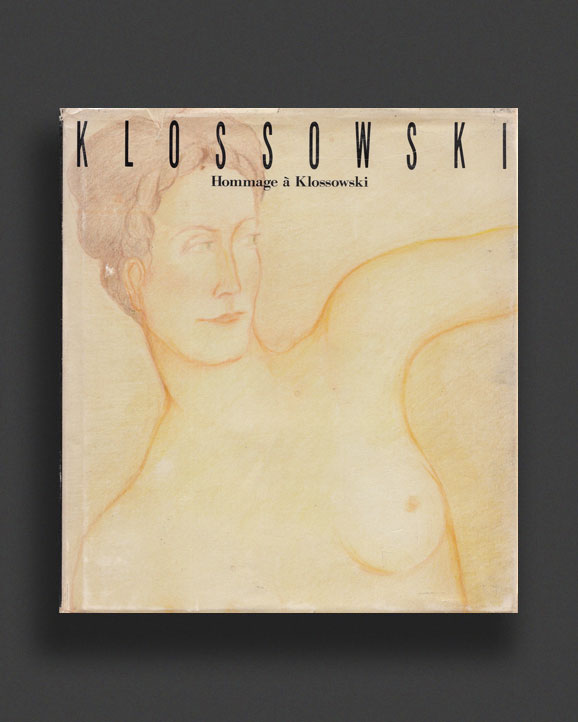
Wonderful and very rarely seen hardcover Japanese publication on the work of the great Pierre Klossowski. Features an extensive selection of his paintings and drawings reproduced in full-colour and black and white, alongside texts, biography and photographic portraits of Klossowski. Published by Atelier Peyotl and printed in Tokyo in 1988 on the occasion of a major exhibition at The Seed Hall, Seibu Shibuya. First printing in original illustrated dust jacket.
Pierre Klossowski (1905-2001) was a significant and influential philosopher, writer, translator and artist who befriended Georges Bataille and formulated an original stance on many theological issues, as well as the philosophy of the Marquis de Sade. His first novel, Roberte, ce soir, appeared in 1954 as a limited edition containing six of his own erotic illustrations, after he rejected drawings by his younger brother, the painter Balthus. Following the encouragement of Robert Lebel, Andre Masson and Alberto Giacometti, Klossowski held his first exhibition in Paris in 1956, and subsequently produced numerous life-size drawings of erotic scenes imbued with mythological, allegorical and philosophical connotations. By the 1970s, he had won the acclaim of such eminent thinkers as Maurice Blanchot, Michel Butor, Gilles Deleuze, Michel Foucault and Felix Guattari. Of Klossowski, Gilles Deleuze once said, "That bodies speak has been known for a long time."
Very Good copy in Good dust jacket with some rubbing to front print, light wear.
1974, Japanese
Hardcover (w. dust jacket, slipcase, obi), 80 pages, 31 x 25 cm
1st Edition, Out of print title / used / good
Published by
Kawade Shobo Shinsha / Tokyo
$65.00 - In stock -
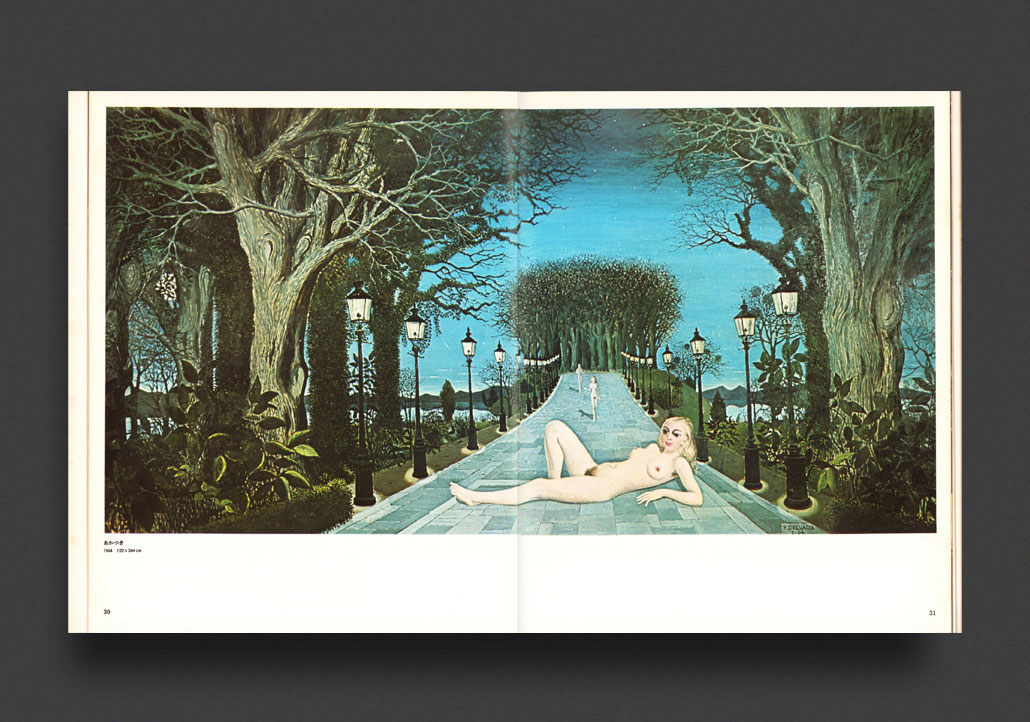
Wonderful 1974 slip-cased hardcover monograph on Belgian painter Paul Delvaux (1897—1994). Bound in blue cloth and wrapped in illustrated original dust-jacket, this heavily illustrated book surveys Delvaux's evocative paintings and drawings through beautiful colour and monochrome gravure reproductions, alongside various texts, biography, bibliography and portrait of the artist. Published as volume 7 of the deluxe La Septième Face du Dé series by Kawade Shobo Shinsha in Japan in the 1970s, all later re-printed in the 2000s. All editions now out-of-print.
Paul Delvaux (1897—1994) was a Belgian painter noted for his dream-like scenes of women, classical architecture, trains and train stations, and skeletons, often in combination. He is often considered a surrealist, although he only briefly identified with the Surrealist movement. He was influenced by the works of Giorgio de Chirico and René Magritte, but developed his own fantastical subjects and hyper-realistic styling, combining the detailed classical beauty of academic painting with the bizarre juxtapositions of surrealism. Throughout his long career, Delvaux explored "Nude and skeleton, the clothed and the unclothed, male and female, desire and horror, eroticism and death – Delvaux's major anxieties in fact, and the greater themes of his later work [...]".
Good copy in Good slipcase with foxing/tanning to block edge, dust jacket and box. VG obi and insert booklets all preserved.
1973, English
Softcover, 158 pages, 20.2 x 13.5 cm
Out of print title / used / good
Published by
Harper Collins / New York
$50.00 - In stock -
First published in 1955. ... Schorske's work is an achievement the significance of which extends far beyond its specific theme.... [He shows] a complete grasp of the sources and the literature... and ... a secure command of the research methods of economic and social history are here combined with impressive political and intellectual-historical analysis.... Schorske's book represents an impressive enrichment of the historical literature on parties... precisely because it poses problems for discussion in a decisive way."—Hans HERZFELD, Historische Zeitschrift
"Carl Schorske's [book] is a brilliant and formidable analysis of the Social Democratic party in the period immediately following its formal rejection of revisionism. The book is devoted to two main themes: first, that the schism which rent the party during the war represented, in ideas, tactics, and personnel, only a continuation and deepening of earlier controversies; second, that the nature of these controversies in the prewar decade was determined as much by the development of a new radical left as by the persistence of a reformist right faction even after the formal condemnation of revisionism. Schorske's book is an extraordinary synthesis of intellectual, political, and sociological history, and the author succeeds in placing the story of the SPD in the general framework of German internal and foreign politics. He has a special flair for the lucid statement of difficult ideas and combines this with a patience which has led him through endless materials..."KLAUS EPSTEIN, World Politics
Good copy of the scarce 1973 Harper Collins edition with some creasing to covers, and wear/age to extremities.
1989, English
Softcover, 844 pages, 21 x 14 cm
Reprint,
Out of print title / as new
Published by
Humanity Books / New York
$90.00 - In stock -
From its first appearance in 1812, Hegel's Science of Logic (some-times entitled the "Greater" or the "Major" Logic) has been recognized by both its admirers and its detractors alike as being the absolute foundation of Hegel's system. Most of the major schools of contemporary philosophy, from Marxism to Existentialism, are reactions to Hegelianism and all, if they are to be understood, require some understanding of Hegel's Logic. Even such a hard-headed practical revolutionary as Lenin understood that Hegelian theory could not be avoid-ed-and so he devoted himself to writing a commentary upon the Logic. Indeed, Hegel well recognized the significance of this work, for he had consciously prepared a way for it with a work of equal challenge and influencethe Phenomenology of Mind.
The first English translation was published in 1929 and remained the standard work for some years. Following the Second World War scholars began to see the need for a new translation. This work was undertaken by A.V. Miller, a scholar internationally recognized for his extensive and excellent translations of Hegel and was first published in 1969. It is his translation which appears in this edition.
This is the first paperback edition of the Science of Logic.
1989 edition, later reprint. As New.
2003, Japanese
Softcover, 160 pages, 24 x 18 cm
1st Edition, Out of print title / used / fine
Published by
Atelier Peyotl / Tokyo
$65.00 - In stock -
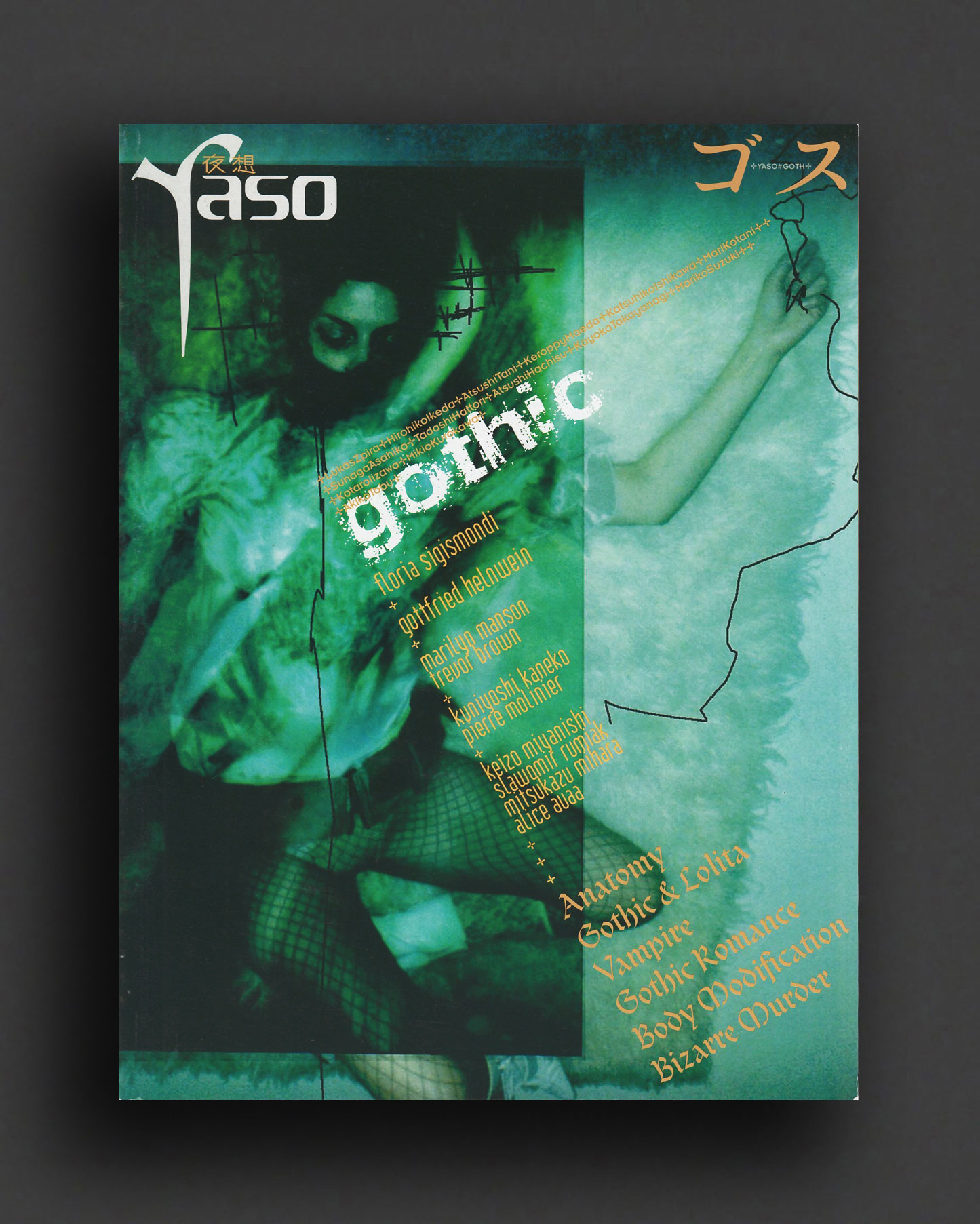
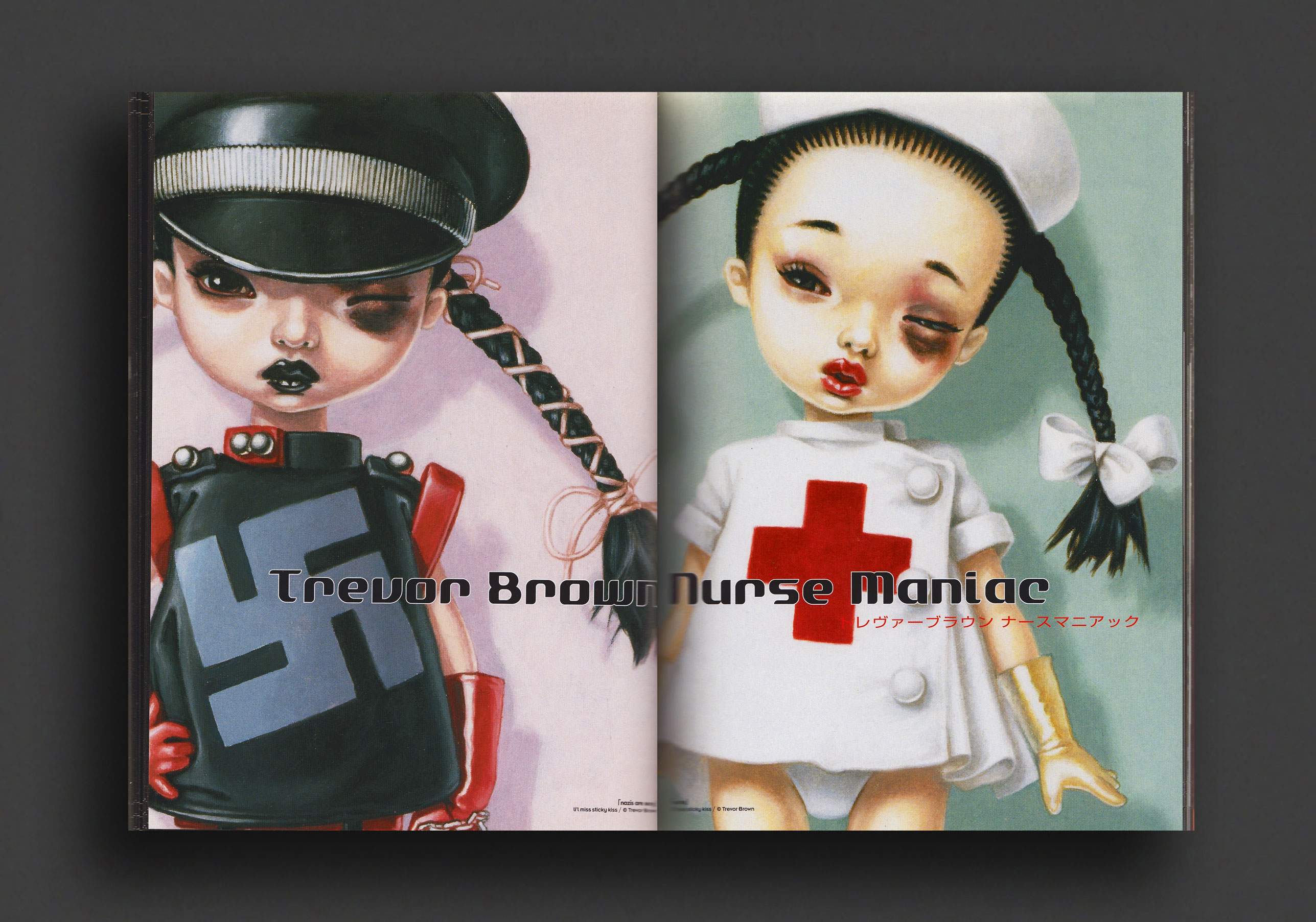
"Gothic" Special Feature Issue of cult Japanese underground magazine Yaso, published in 2003, edited by Yuichi Konno and Atelier Peyotl (publishers of Night Vision/Yaso/Peyotl/Wave/Silvester Club...). Heavily illustrated with texts in Japanese with in-depth profiles, interviews with and essays on Trevor Brown, Gottfried Helnwein, Kuniyoshi Kaneko, ero-manga master Keizo Miyanishi, influential Gothic Lolita illustrator Mitsukazu Mihara, Floria Sigismondi, Marilyn Manson, Alice Auaa, loads of "Modern Primitive" material (piercing, body modification, body performance, etc.), and much more...
Near Fine copy.
1999, Japanese / English / Spanish
Softcover (French Flaps), 170 pages, 29 x 20 cm
1st Edition, Out of print title / used / fine
Published by
Tokyo Shimbun / Tokyo
$140.00 - In stock -
Scarce, stunning Japanese catalogue on Spanish surrealist Remedios Varo, published on the occasion of a major touring retrospective of her work throughout Japan in 1999. Only available in the participating Japanese museums in the late 1990s and now long out-of-print, this book beautifully reproduces Varo's paintings and drawings (including preliminary sketches alongside final oils) with detailed captions and descriptions, accompanied by illustrated essays and other texts by Masayo Nonaka, Octavio Paz, Luis-Martin Lozano, and Walter Green, portraits of the artist, exhibition history, bibliography, work list and more.
Remedios Varo Uranga (1908 – 1963) was a Spanish surrealist artist. Born in Anglès (north of Catalonia), Spain in 1908, she studied at the Real Academia de Bellas Artes de San Fernando, Madrid. Varo spent her formative years between France and Barcelona and was greatly influenced by the surrealist movement. The summer of 1935 marked Varo's formal invitation into Surrealism when French surrealist Marcel Jean arrived in Barcelona. While still married to her first husband Gerardo Lizarraga, Varo met her second partner, the French surrealist poet Benjamin Péret, in Barcelona. During the Spanish Civil War she fled to Paris with Péret leaving Lizarraga behind (1937). It was through Peret that Remedios Varo met André Breton and the Surrealist circle, which included Leonora Carrington, Dora Maar, Roberto Matta, Wolfgang Paalen, and Max Ernst among others. Shortly after arriving in France, Varo took part in the International Surrealist exhibitions in Paris and in Amsterdam in 1938. She was forced into exile from Paris during the German occupation of France and moved to Mexico City at the end of 1941 when the Mexican president, Lázaro Cardenas, made it a policy to welcome Spanish and European refugees. In Mexico, she met native artists such as Frida Kahlo and Diego Rivera, but her strongest ties were to other exiles and expatriates, notably the English painter Leonora Carrington and the French pilot and adventurer, Jean Nicolle. However, because Mexican muralism still dominated the country's art scene, surrealism was not generally well received. She worked as an assistant to Marc Chagall with the design of the costumes for the production of the ballet Aleko, which premiered in Mexico City in 1942. In 1947, Péret returned to Paris, and Varo traveled to Venezuela, living there for two years. She returned to Mexico and began her third and last important relationship with Austrian refugee Walter Gruen, who had endured concentration camps before escaping Europe. Gruen believed fiercely in Varo, and he gave her the economic and emotional support that allowed her to fully concentrate on her painting. In 1955, Varo had her first solo exhibition at the Galería Diana in Mexico City. Buyers were put on waiting lists for her work. Even Diego Rivera was supportive. In 1960, her representative, Juan Martín, opened his own gallery and showed her work there, and opened a second in 1962. Only a year after that opening, at the height of her career, she died from a heart attack in Mexico City. Her work is well known in Mexico, but not as commonly known throughout the rest of the world.
Fine, As New copy.
1980, Enfglish
Softcover, 358 pages, 20 x 13.5 cm
1st Edition, Out of print title / used / good
Published by
Verso / London
$20.00 - In stock -
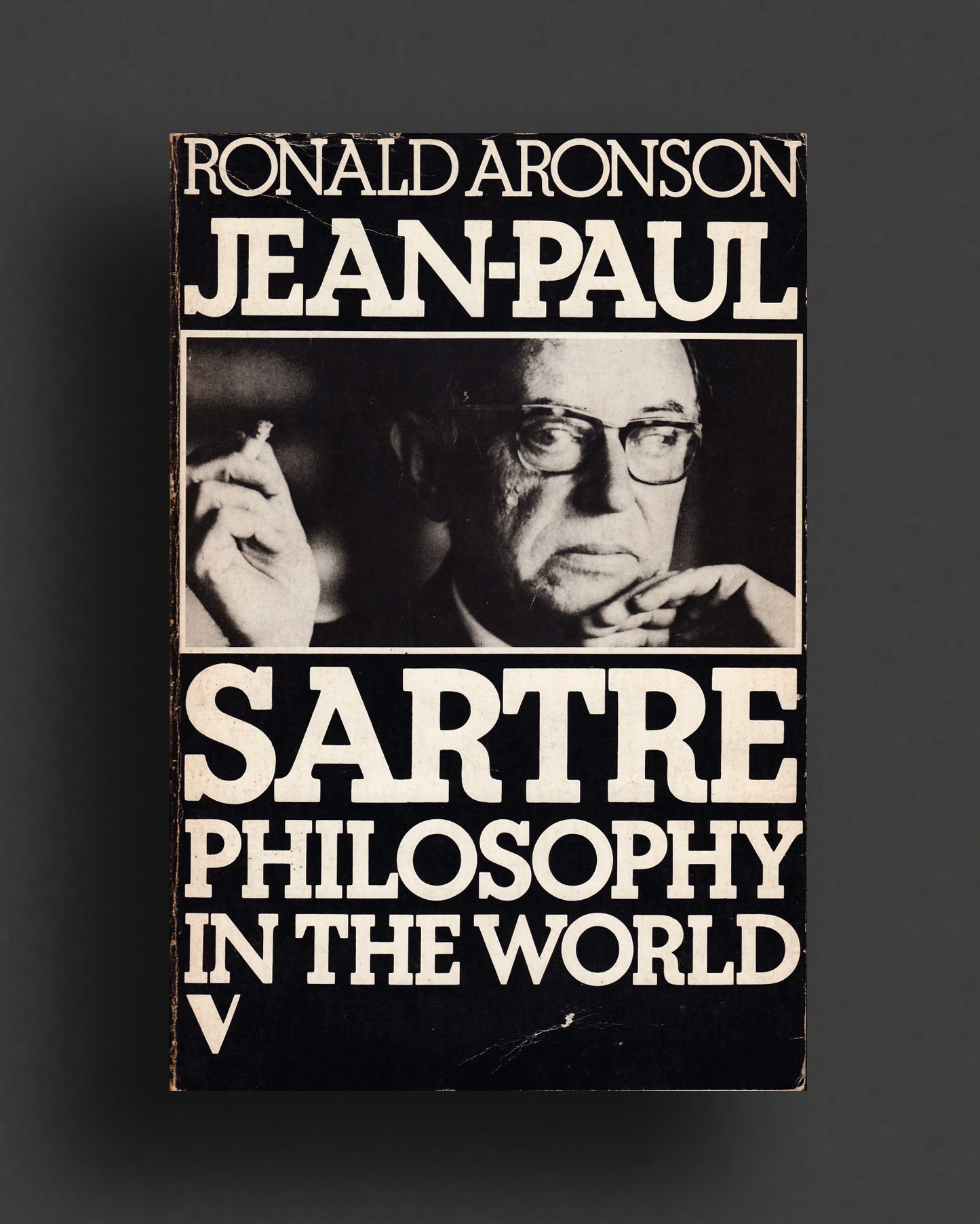
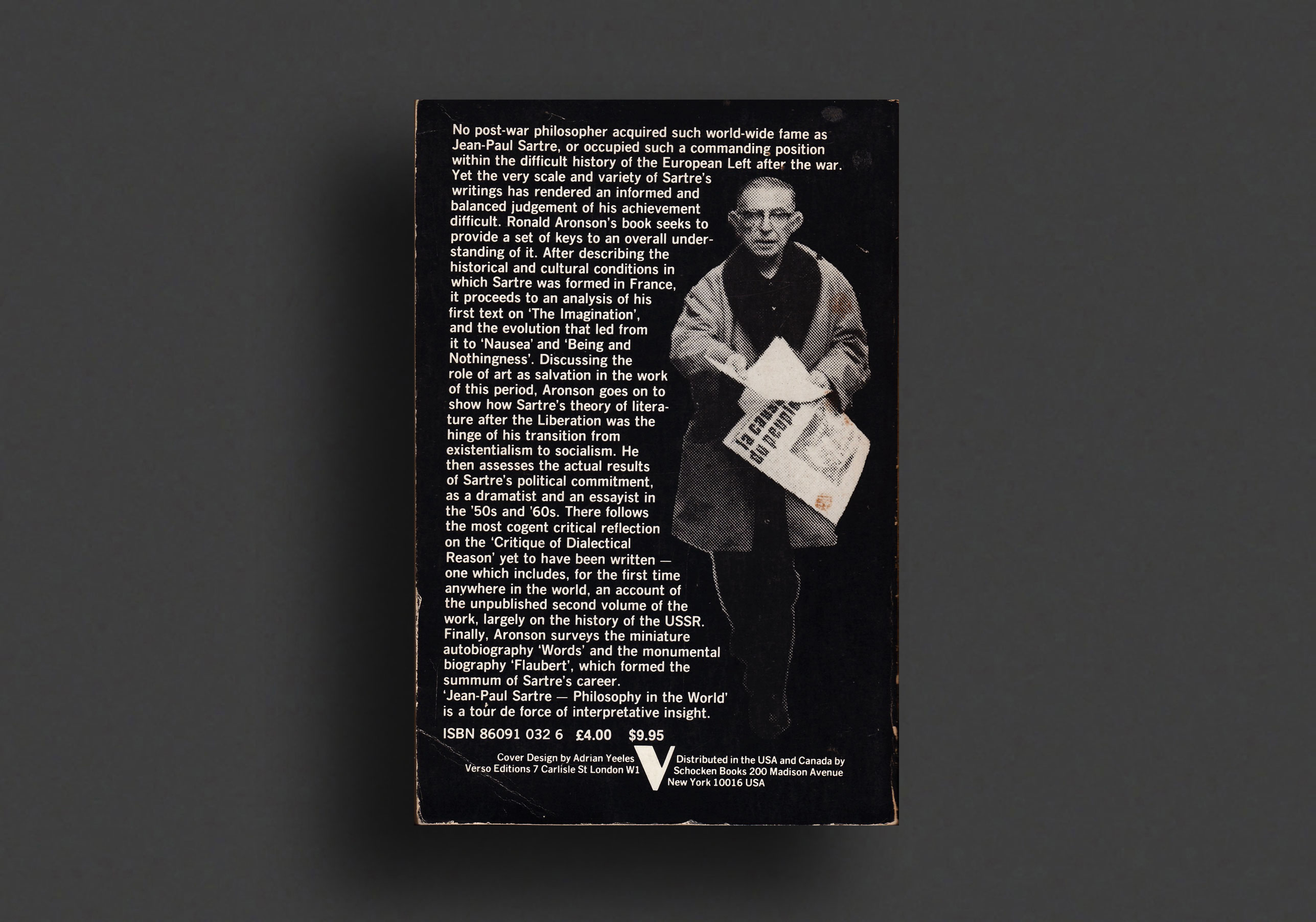
No post-war philosopher acquired such world-wide fame as Jean-Paul Sartre, or occupied such a commanding position within the difficult history of the European Left after the war.
Yet the very scale and variety of Sartre's writings has rendered an informed and balanced judgement of his achievement difficult. Ronald Aronson's book seeks to provide a set of keys to an overall understanding of it. After describing the historical and cultural conditions in which Sartre was formed in France, it proceeds to an analysis of his first text on 'The Imagination', and the evolution that led from it to 'Nausea' and Being and Nothingness'. Discussing the role of art as salvation in the work of this period, Aronson goes on to show how Sartre's theory of literature after the Liberation was the hinge of his transition from existentialism to socialism. He then assesses the actual results of Sartre's political commitment, as a dramatist and an essayist in the '50s and '60s. There follows the most cogent critical reflection on the Critique of Dialectical Reason' yet to have been written - one which includes, for the first time anywhere in the world, an account of the unpublished second volume of the work, largely on the history of the USSR.
Finally, Aronson surveys the miniature autobiography 'Words' and the monumental biography 'Flaubert', which formed the summum of Sartre's career.
"Jean-Paul Sartre - Philosophy in the World" is a tour de force of interpretative insight.
Good copy of first 1980 edition with some light creasing to cover and spine. Light general wear/age.
1991, English
Softcover, 416 pages, 23 x 15 cm
1st Edition, Out of print title / used / very good
Published by
The MIT Press / Massachusetts
$35.00 - In stock -
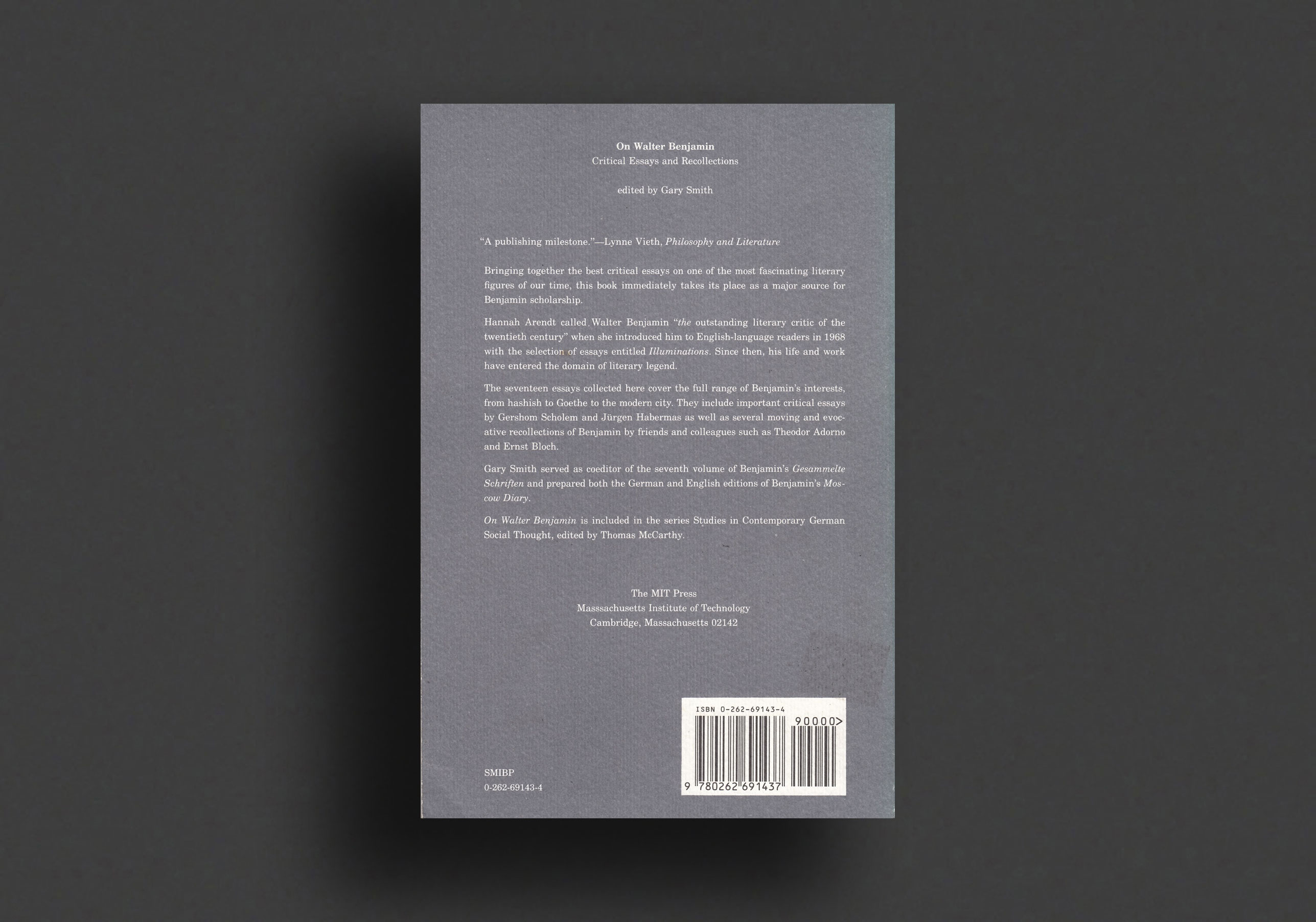
Bringing together the best critical essays on one of the most fascinating literary figures of our time, this book immediately takes its place as a major source for Benjamin scholarship. Hannah Arendt called Walter Benjamin "the outstanding literary critic of the twentieth century" when she introduced him to English-language readers in 1968 with the selection of essays entitled Illuminations. Since then, his life and work have entered the domain of literary legend. The seventeen essays collected here cover the full range of Benjamin's interests, from hashish to Goethe to the modern city. They include important critical essays by Gershom Scholem and Jürgen Habermas as well as several moving and evocative recollections of Benjamin by friends and colleagues such as Theodor Adorno and Ernst Bloch. Gary Smith served as coeditor of the seventh volume of Benjamin's Gesammelte Schriften and prepared both the German and English editions of Benjamin's Moscow Diary.
VG copy with some tanning to spine edge, light wear.
1996 / 2005, English
Softcover, 118 pages, 21.5 x 14 cm
1st Edition, Out of print title / used / fine
Published by
Stanford University Press / Palo Alto
$55.00 - In stock -
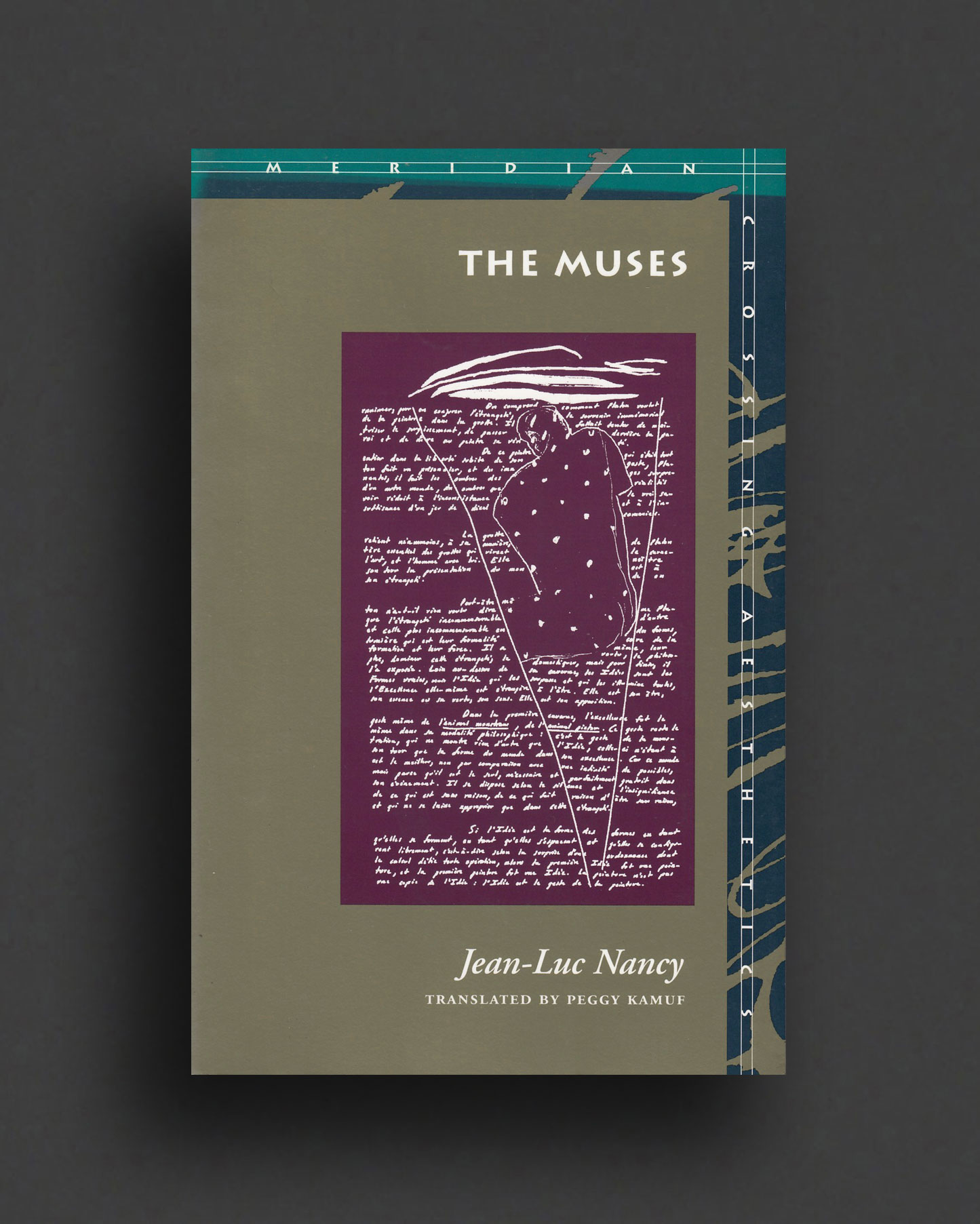
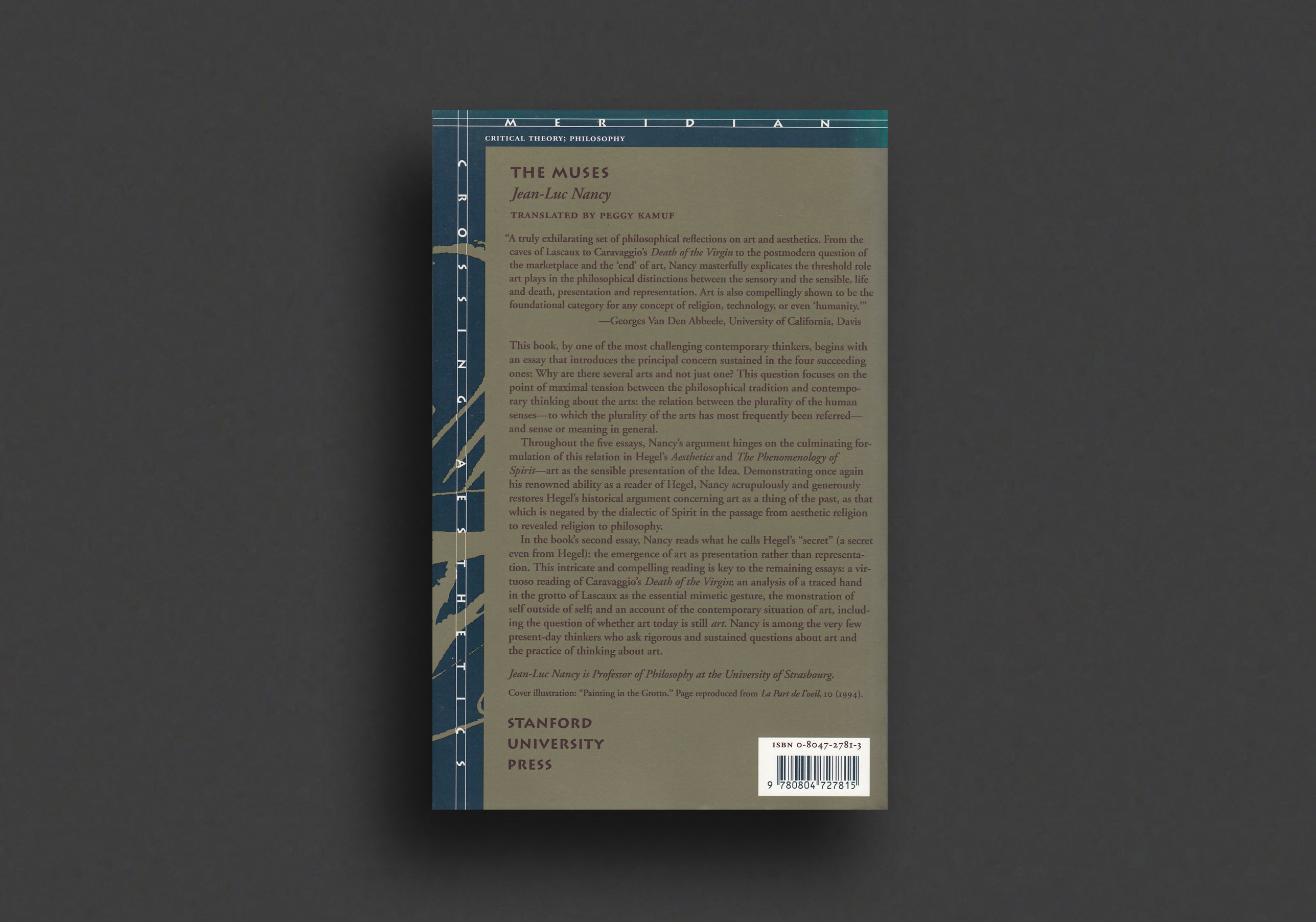
Translated by Peggy Kamuf
This book, by one of the most challenging contemporary thinkers, begins with an essay that introduces the principal concern sustained in the four succeeding ones: Why are there several arts and not just one? This question focuses on the point of maximal tension between the philosophical tradition and contemporary thinking about the arts: the relation between the plurality of the human senses—to which the plurality of the arts has most frequently been referred—and sense or meaning in general.
Throughout the five essays, Nancy’s argument hinges on the culminating formulation of this relation in Hegel’s Aesthetics and The Phenomenology of Spirit—art as the sensible presentation of the Idea. Demonstrating once again his renowned ability as a reader of Hegel, Nancy scrupulously and generously restores Hegel’s historical argument concerning art as a thing of the past, as that which is negated by the dialectic of Spirit in the passage from aesthetic religion to revealed religion to philosophy.
First 1996 edition, later print.
1997, English
Softcover, 206 pages, 23 x 15 cm
1st Edition, Out of print title / used / very good
Published by
University of Minnesota Press / Minnesota
$45.00 - In stock -
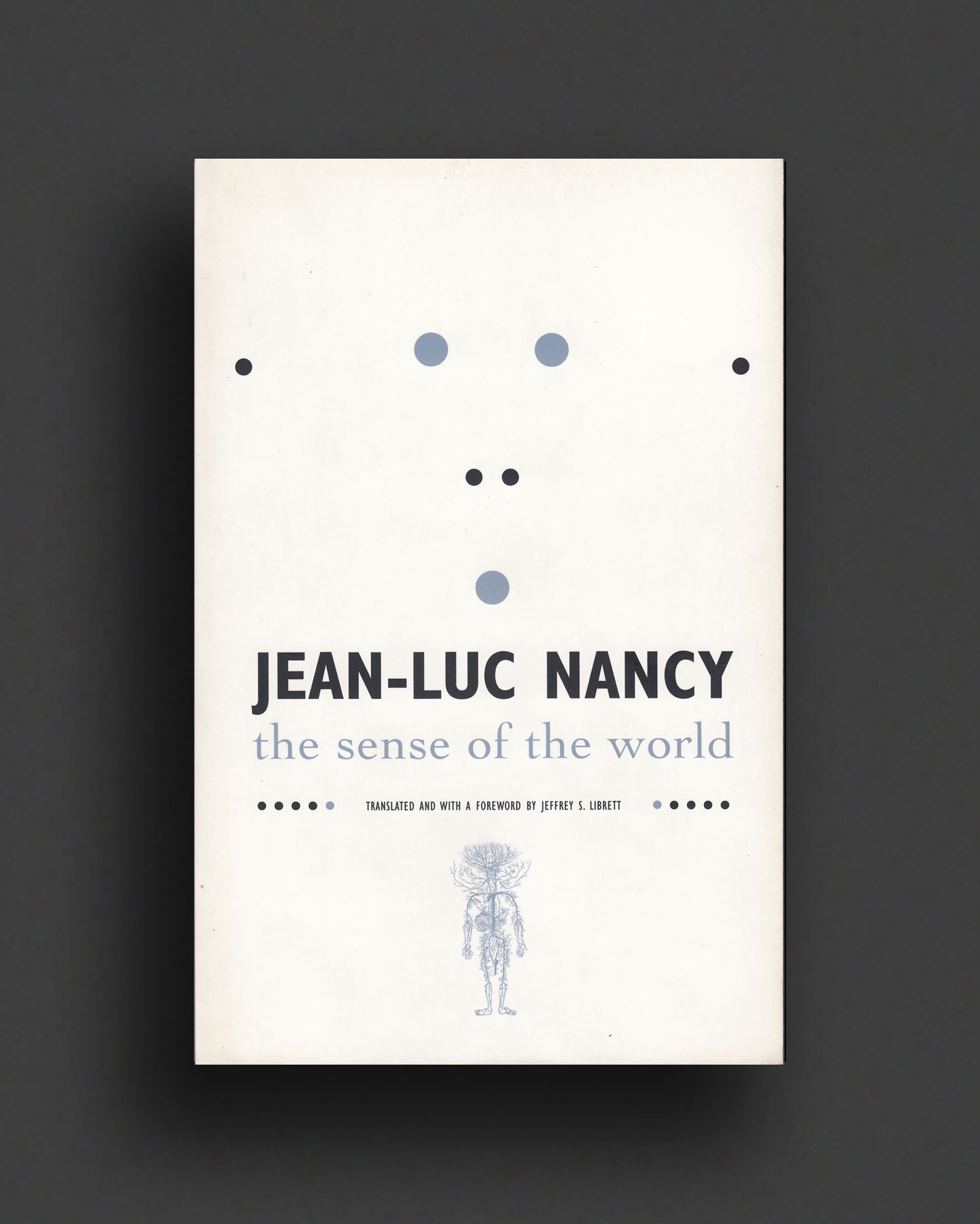
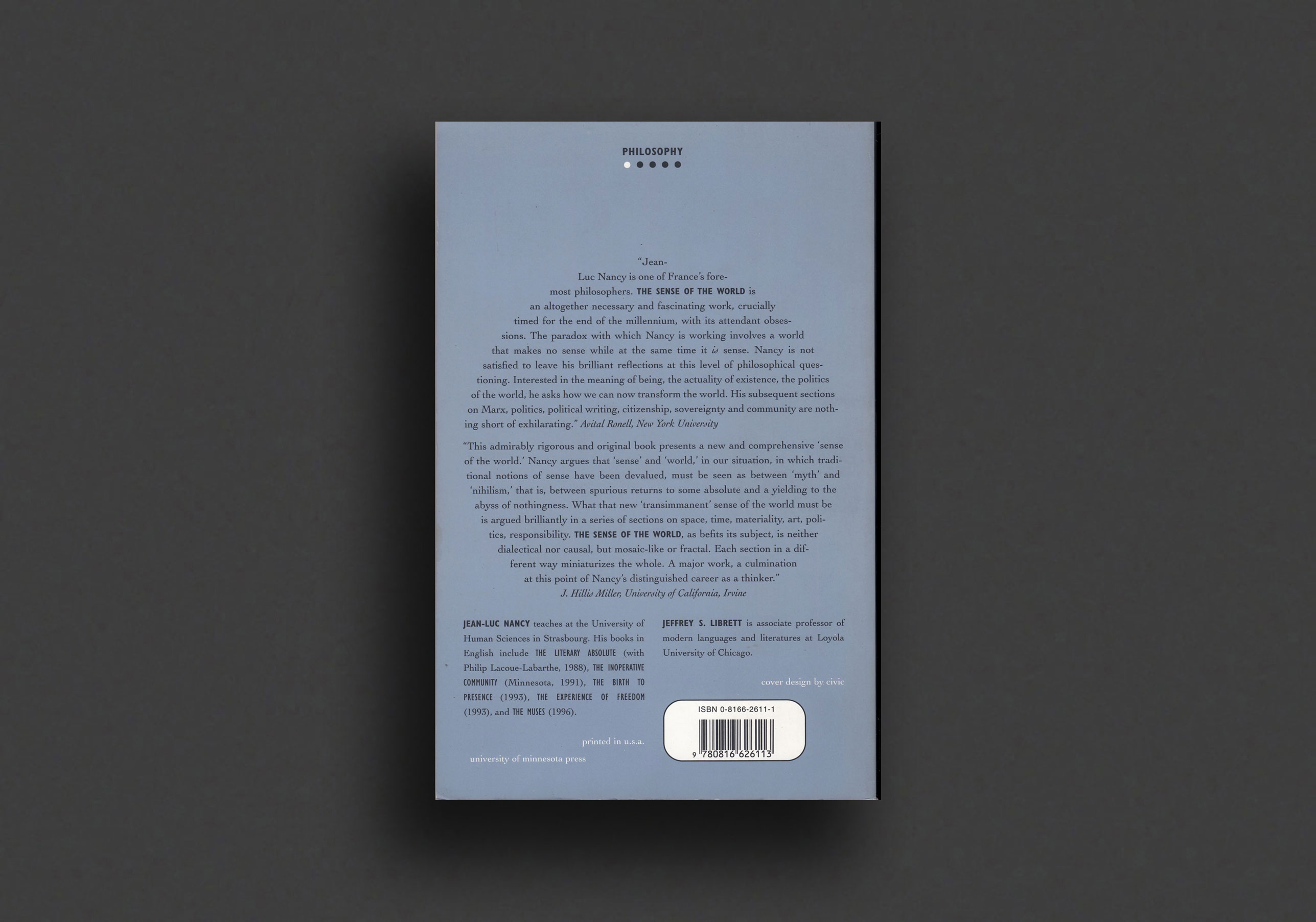
An essential exploration of sense and meaning.
Is there a “world” anymore, let alone any “sense” to it? Acknowledging the lack of meaning in our time, and the lack of a world at the center of meanings we try to impose, Jean-Luc Nancy presents a rigorous critique of the many discourses-from philosophy and political science to psychoanalysis and art history-that talk and write their way around these gaping absences in our lives.
In an original style befitting his search for a new mode of thought, Nancy offers fragmentary readings of writers such as Nietzsche, Hegel, Marx, Lévinas, Lacan, Derrida, and Deleuze insofar as their work reflects his concern with sense and the world. Rather than celebrate or bemoan the loss of meaning or attempt to install a new one, his book seeks to reposition both sense and the world between the presence and absence of meaning, between objectivity and subjectivity. Nancy’s project entails a reconception of the field of philosophy itself, a rearticulation of philosophical practice. Neither recondite nor abstract, it is concerned with the existence and experience of freedom-the actuality of existence as experienced by contemporary communities of citizens, readers, and writers.
Combining aesthetic, political, and philosophical considerations to convey a sense of the world between meaning and reality, ideal content and material form, this book offers a new way of understanding-and responding to-“the end of the world.”
Jean-Luc Nancy teaches at the University of Human Sciences in Strasbourg. His books in English include The Literary Absolute (with Philip Lacoue-Labarthe, 1988), The Inoperative Community (Minnesota, 1991), The Birth to Presence (1993), The Experience of Freedom (1993), and The Muses (1996).
Jeffrey S. Librett is associate professor of modern languages and literatures at Loyola University of Chicago.
First 1997 edition. VG copy, light wear.