World Food Books' programme is largely produced on Kulin Nation land. We acknowledge the Wurundjeri people of the Kulin Nation as the first and continuing custodians of this land, and pay respect to their Elders past, present, and emerging.
World Food Books is an arts and special interests bookshop in Naarm / Melbourne. Founded in 2010, World Food Books is devoted to the presentation of a rotating, hand-selection of international art, design, literary and counterculture publications with an emphasis on the anti-traditional, the experimental, the avant-garde, the heretic, the marginal.
Presenting new titles alongside rare and out-of-print books, catalogues and journals spanning the fields of modern and contemporary art, design, photography, illustration, film, literature, poetry, cultural theory, philosophy, sexuality, popular and underground culture in its many radical forms, World Food Books wishes to encourage adventurous, thoughtful and open-minded reading, looking, writing, and exchange of publishing and ideas, both current and historical.
As well as our bookshop, located in Melbourne's historical Nicholas Building, all of our inventory is available internationally via our online mail-order service.
World Food Books semi-regularly co-ordinates "Occasions", a programme of exhibits and events at the bookshop and in partnership with other hosts (such as museums and art galleries) that develop out of the activities, relationships and content of the bookshop itself.
World Food Books
The Nicholas Building
37 Swanston Street
Room 5, Level 6
Melbourne 3000
Australia
SHOP HOURS:
THU–SAT 12–6
WEB-SHOP OPEN 24/7
World Food Books
Postal Address:
PO Box 435
Flinders Lane
Victoria 8009
Australia
Art
Theory / Essay
Architecture / Interior
Graphic Design / Typography
Photography
Fashion
Eros
LGBTQ+
Fiction / Poetry
Weird / Speculative / Science Fiction / Horror
Transgressive / Visceral / Abject
Symbolism / Decadence / Fin de siècle
Film / Video
Painting
Sculpture / Installation
Performance / Dance / Theater
Drawing
Sound / Music
Curatorial
Group Shows / Collections
Periodicals
Out-of-print / Rare
Posters / Ephemera / Discs
Signed Books
World Food Books Gift Voucher
World Food Book Bag
Australian Art
Australian Fiction
Australian Science Fiction / Speculative Fiction
Australian Poetry
Australian Photography
Japanese Photography
Conceptual Art
Minimal Art
Dada
'Pataphysics / Oulipo
Fluxus
Concrete Poetry
Pop Art
Surrealism
Arte Povera
Arte Informale / Haute Pâte / Tachism
Nouveau Réalisme / Zero / Kinetic
Situationism / Lettrism
Collage / Mail Art / Xerox Art
Art Brut / Folk / Visionary / Fantastic
Illustration / Graphic Art / Bandes Dessinées
Furniture
Italian Radical Design / Postmodernism
Textiles
Ceramics / Glass
Counterculture
Protest / Revolt
Philosophy
Psychoanalysis
Anthropology
Anarchism
Socialism / Anarchism / Communism / Capitalism
Literary Theory / Semiotics / Language
Feminism / Women's Studies
Gender Studies / Sexuality
Anthropology
Fetishism / BDSM
Drugs / Psychedelia
Crime / Violence
Animal Rights / Veganism
Occult / Esoterica
Ecology / Earth / Alternative Living
Whole Earth / Crafts
All prices in AUD (Australian dollars)
Pick-Ups
Pick-up orders can be collected in our bookshop during opening hours after order date. Please collect any Pick-up orders within 2 weeks of ordering as we have limited storage space. Orders will be released back into stock if not collected within this time. No refunds can be made for pick-ups left un-collected. If you cannot make it in to the bookshop in this time-frame, please choose postage option.
Return Policy
All sales are final. We do accept returns (for refund or exchange) for items received in error. All our orders are packed with special care using heavy-duty padding and cardboard book-mailers or bubble mailers (for smaller books), using reinforcement where required. We cannot take responsibility for any lost, stolen or damaged parcels.
Insurance
Should you wish to insure your package, please email us directly after placing your order and we can organise this at a small extra expense. Although all standard/express tracked packages are very safe and dependable, we cannot take responsibility for any lost, stolen or damaged parcels. We recommend insurance on valuable orders.
Interested in selling your old books, catalogues, journals, magazines, comics, fanzines, ephemera? We are always looking for interesting, unusual and out-of-print books to buy. We only buy books in our fields of interest and specialty, and that we feel we can resell.
We base these prices on desirability, market value, in-print prices, condition and our current stock levels. We offer cash, store credit, and can take stock on consignment. All
about 25% of the price we expect to get when we sell them, or 30% in store credit. We base these prices on desirability, market value, in-print prices, condition and our current stock levels.
Sell your books any day of the week. You can drop them off and return later. If you have a lot of books, we can visit your Sydney home.
We buy books that we feel we can resell. We offer about 25 % of the price we expect to get when we sell them, or 30% in store credit. We base these prices on desirability, market value, in-print prices, condition and our current stock levels.
Philadelphia Wireman
03 August - 01 September, 2018
World Food Books is proud to announce our next Occasion, the first presentation of sculptures by Philadelphia Wireman in Australia.
The Philadelphia Wireman sculptures were found abandoned in an alley off Philadelphia’s South Street on trash night in 1982. Their discovery in a rapidly-changing neighbourhood undergoing extensive renovation, compounded with the failure of all attempts to locate the artist, suggests that the works may have been discarded after the maker’s death. Dubbed the "Philadelphia Wireman" during the first exhibition of this work, in 1985, the maker’s name, age, ethnicity, and even gender remain uncertain. The entire collection totals approximately 1200 pieces, all intricately bound together with tightly-wound heavy-gauge wire (along with a few small, abstract marker drawings, reminiscent both of Mark Tobey and J.B. Murry). The dense construction of the work, despite a modest range of scale and materials, is singularly obsessive and disciplined in design: a wire armature or exoskeleton firmly binds a bricolage of found objects including plastic, glass, food packaging, umbrella parts, tape, rubber, batteries, pens, leather, reflectors, nuts and bolts, nails, foil, coins, toys, watches, eyeglasses, tools, and jewellery.
Heavy with associations—anthropomorphic, zoomorphic, and socio-cultural responses to wrapped detritus—the totemic sculptures by Philadelphia Wireman have been discussed in the context of work created to fulfil the shamanistic needs of alternative religions in American culture. Curators, collectors, and critics have variously compared certain pieces to sculpture from Classical antiquity, Native American medicine bundles, African-American memory jugs, and African fetish objects. Reflecting the artist’s prolific and incredibly focused scavenging impulse, and despite—or perhaps enhanced by—their anonymity, these enigmatic objects function as urban artefacts and arbiters of power, though their origin and purpose is unknown. Philadelphia Wireman, whatever their identity, possessed an astonishing ability to isolate and communicate the concepts of power and energy through the selection and transformation of ordinary materials. Over the course of the past two decades, this collection has come to be regarded as an important discovery in the field of self-taught art and vernacular art.
Presented in collaboration with Fleisher-Ollman Gallery, Philadelphia, and Robert Heald, Wellington.
Susan Te Kahurangi King
02 February - 10 March, 2018
Susan Te Kahurangi King (24 February 1951 - ) has been a confident and prolific artist since she was a young child, drawing with readily available materials - pencils, ballpoint pens and felt-tip markers, on whatever paper is at hand. Between the ages of four and six Susan slowly ceased verbal communication. Her grandparents William and Myrtle Murphy had developed a special bond with Susan so they took on caring responsibilities for extended periods. Myrtle began informally archiving her work, carefully collecting and storing the drawings and compiling scrapbooks. No drawing was insignificant; every scrap of paper was kept. The King family are now the custodians of a vast collection containing over 7000 individual works, from tiny scraps of paper through to 5 meter long rolls.
The scrapbooks and diaries reveal Myrtle to be a woman of great patience and compassion, seeking to understand a child who was not always behaving as expected. She encouraged Susan to be observant, to explore her environment and absorb all the sights and sounds. Myrtle would show Susan’s drawings to friends and people in her community that she had dealings with, such as shopkeepers and postal workers, but this was not simply a case of a grandmother’s bias. She recognised that Susan had developed a sophisticated and unique visual language and sincerely believed that her art deserved serious attention.
This was an unorthodox attitude for the time. To provide some context, Jean Dubuffet coined the term Art Brut in 1945 to describe work created by self-taught artists – specifically residents of psychiatric institutions and those he considered to be visionaries or eccentrics. In 1972 Roger Cardinal extended this concept by adopting the term Outsider Art to describe work made by non-academically trained artists operating outside of mainstream art networks through choice or circumstance. Susan was born in Te Aroha, New Zealand in 1951, far from the artistic hubs of Paris and London that Dubuffet and Cardinal operated in. That Myrtle fêted Susan as a self-taught artist who deserved to be taken seriously shows how progressive her attitudes were.
Susan’s parents Doug and Dawn were also progressive. Over the years they had consulted numerous health practitioners about Susan’s condition, as the medical establishment could not provide an explanation as to why she had lapsed into silence. Dawn educated herself in the field of homeopathy and went on to treat all twelve of her children using these principles – basing prescriptions on her observations of their physical, mental and emotional state.
Doug was a linguist with an interest in philosophy who devoted what little spare time he had to studying Maori language and culture. To some extent their willingness to explore the fringes of the mainstream made them outsiders too but it was their commitment to living with integrity and their respect for individuality that ensured Susan’s creativity was always encouraged.
Even though Susan’s family supported her artistic pursuits, some staff in schools and hospitals saw it as an impediment to her assimilation into the community and discouraged it in a variety of ways. Her family was not always aware of this and therefore did not fully understand why Susan stopped drawing in the early 1990s. However, rather than dwell on the challenges that Susan faced in pursuit of her artistic practice, they prefer to highlight her achievements. In 2008 Susan began drawing again in earnest, after an almost 20 year interruption, and her work is now shown in galleries around the world.
Susan grew up without television and has been heavily influenced by the comics she read as a child. She is absolutely fearless in the appropriation of recognizable characters, such as Donald Duck and Mickey Mouse, in her work. She twists their limbs, contorts their faces, compresses them together, blends them into complex patterned backgrounds - always imbuing them with an incredible energy. Although Susan often used pop culture characters in her work they are not naive or childlike. These are drawings by a brilliant self-taught artist who has been creating exceptional work for decades without an audience in mind.
Mladen Stilinović
"Various Works 1986 - 1999"
02 February 16 - September 10, 2016
Various works 1986 - 1999, from two houses, from the collections of John Nixon, Sue Cramer, Kerrie Poliness, Peter Haffenden and Phoebe Haffenden.
Including: Geometry of Cakes (various shelves), 1993; Poor People’s Law (black and white plate), 1993; White Absence (glasses, ruler, set square, silver spoon, silver ladel with skin photograph and wooden cubes), 1990-1996; Exploitation of the Dead (grey and red star painting, wooden painting, black spoon with red table, red plate), 1984-1990; Money and Zeros (zero tie, paintings made for friends in Australia (Sue, John, Kerrie), numbers painting), 1991-1992; Words - Slogans (various t-shirts) - “they talk about the death of art...help! someone is trying to kill me”, “my sweet little lamb”, “work is a disease - Karl Marx”; Various artist books, catalogues, monographs, videos; Poster from exhibition Insulting Anarchy; "Circular" Croatian - Australian edition; Artist book by Vlado Martek (Dostoyevsky); more.
Thanks to Mladen Stilinović and Branka Stipančić.
Jonathan Walker
Always Will Need To Wear Winter Shirt Blue + Ochre Small Check Pattern
21 August - 21 September, 2015
Untitled
I am not a great reader of poetry but I always return to the work of Melbourne poet, Vincent Buckley (1925- 1988). Perhaps I find his most tantalising piece to be not a finished poem but a fragment left on a scrap of paper discovered on his desk after the poet’s death.
The poetry gathers like oil
In the word-core, and spreads
It has its music meet,
Its music is in movement.
This fragment is more the shell left behind from a volatile thought than a finished poem. I find the last two lines honest but awkward whereas the first two lines work like an arrow. Most likely he could not find a resolution so it was left. Still, in its present form, it remains an eloquent testimony to the ultimate failure of a medium to express mobile thought and sensation, in Buckley’s case, through verbal language. It’s an important matter because this is something all artists have to deal with regardless of the medium.
I have never written a poem, however, I am forever copying fragments from books on paper scraps in a vain effort to fix certain notions in my head. At first, they function as bookmarks that are sometimes returned to when I open the book. But before long, as they accumulate, they fall out littering the table interspersed with A4 photocopies, bills, books and medications.
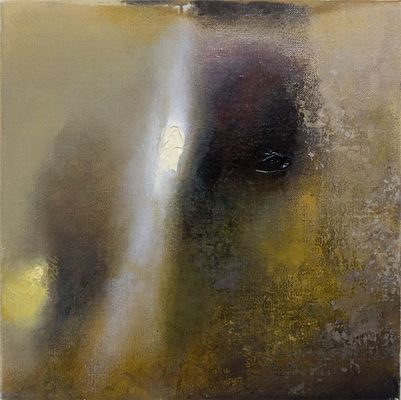
To return to Buckley’s fragment, the first two lines very much evoke how I paint nowadays. As you age, detail diminishes and patches of light become more luminous and float. I feel the most honest way of dealing with this is by smearing the oil paint on the canvas with the fingers and working close-up, blind. Only if the patches coalesce into an approaching image can the work gain a life.
-
Jonathan Walker was born in Melbourne, Australia and brought up on a dairy farm in Gippsland. In the 1970’s he studied painting at RMIT and won the Harold Wright Scholarship to the British Museum, London. During the 1980’s he exhibited at Pinacotheca Gallery, Richmond and had work shown at the NGV and Heidi City Art Gallery. Over the same period he designed the cover for the “Epigenesi” LP by Giancarlo Toniutti, Italy and conducted a mail exchange work with Achim Wollscheid, Germany. The work with artists through the post resulted in an article published in the bicentenary issue of Art and Australia 1988. He showed in artist run spaces such as WestSpace in the 90’s and 2000’s, and until 2012, taught painting at Victoria University, which is where we (Colleen Ahern and Lisa Radford) as organisers of the exhibition, among many others, had the privilege of being his student.
Walker’s knowledge was imparted to students through the careful selection of music, literature, and artists found in books that he himself had ordered for the library. Walker’s strategy was the generosity of sharing his vast knowledge with references specific to each student and their context.
Walker’s paintings share a similar focus and intimacy.
This exhibition presents a small selection of recent paintings alongside a publication that includes Walker’s writing. Observational and analytical, Walker’s work is a type of material notation — the time of day, colour and how it is blended, the both specific and fleeting location of a reflection on lino or the question of whether a chair leg should be included in a painting.
Please join us on Friday August 21 between 6-8pm to celebrate the opening of the exhibition.
Curated by Colleen Ahern and Lisa Radford.
B. Wurtz
Curated by Nic Tammens
March 26 - April 4, 2015
B.Wurtz works from a basement studio in his home on Manhattan’s Lower East Side.
This local fact is attested to by the plastic shopping bags and newsprint circulars that appear in his work. As formal objects, they don’t make loud claims about their origins but nonetheless transmit street addresses and places of business from the bottom of this long thin island. Like plenty of artists, Wurtz is affected by what is local and what is consumed. His work is underpinned by this ethic. It often speaks from a neighborhood or reads like the contents of a hamper:
“BLACK PLUMS $1.29 lb.”
“Food Bazaar”
“USDA Whole Pork Shoulder Picnic 99c lb.”
“RITE AID Pharmacy, with us it’s personal.”
“H. Brickman & Sons.”
“Sweet Yams 59c lb."
Most of the work in this exhibition was made while the artist was in residence at Dieu Donne, a workshop dedicated to paper craft in Midtown. Here Wurtz fabricated assemblages with paper and objects that are relatively lightweight, with the intention that they would be easily transportable to Australia. This consideration isn’t absolute in Wurtz’s work, but was prescriptive for making the current exhibition light and cheap. Packed in two boxes, these works were sent from a USPS post office on the Lower East Side and delivered to North Melbourne by Australia Post.
Wurtz appears courtesy of Metro Pictures, New York.
Thanks to Rob Halverson, Joshua Petherick, Sari de Mallory, Matt Hinkley, Helen Johnson, Fayen d'Evie, Ask Kilmartin, Lisa Radon, Ellena Savage, Yale Union, and "Elizabeth".
John Nixon
"Archive"
December 15 - January 20, 2014
The presentation of John Nixon's archive offered a rare showcase of this extensive collection of the artist's own publications, catalogues, posters, ephemera, editions and more, from the mid 1980s onwards, alongside a selection of his artworks.
Organized by John Nixon, Joshua Petherick and Matt Hinkley.
"Habitat"
at Minerva, Sydney (organised by Joshua Petherick and Matt Hinkley)
November 15 - December 20, 2014
Lupo Borgonovo, Janet Burchill & Jennifer McCamley,
Lewis Fidock, HR Giger, Piero Gilardi, Veit Laurent Kurz,
Cinzia Ruggeri, Michael E. Smith, Lucie Stahl, Daniel Weil, Wols
Press Release:
“...It contained seven objects. The slender fluted bone, surely formed for flight, surely from the wing of some large bird. Three archaic circuitboards, faced with mazes of gold. A smooth white sphere of baked clay. An age-blackened fragment of lace. A fingerlength segment of what she assumed was bone from a human wrist, grayish white, inset smoothly with the silicon shaft of a small instrument that must once have ridden flush with the surface of the skin - but the thing’s face was seared and blackened.”
William Gibson, “Count Zero”, 1986
"Autumn Projects Archive"
Curated by Liza Vasiliou
March 6 - March 15, 2014
World Food Books, in conjunction with the Virgin Australia Melbourne Fashion Festival 2014, presented the Autumn Projects archive, consisting of a selection of early examples in Australian fashion with a particular interest in collecting designers and labels from the period beginning in the 1980’s, who significantly influenced the discourse of Australian Fashion.
Curated by Liza Vasiliou, the exhibition provided a unique opportunity to view pieces by designers Anthea Crawford, Barbara Vandenberg, Geoff Liddell and labels CR Australia, Covers, Jag along with early experimental collage pieces by Prue Acton and Sally Browne’s ‘Fragments’ collection, suspended throughout the functioning World Food Books shop in Melbourne.
H.B. Peace
presented by CENTRE FOR STYLE
November 14, 2013
"Hey Blinky, you say chic, I say same"
Anon 2013
H.B. Peace is a clothing collaboration between great friends Blake Barns and Hugh Egan Westland. Their pieces explore the divergences between 'character’ and ‘personality’ in garments....etc
Special Thanks to Joshua Petherick and Matt Hinkley of WFB and Gillian Mears
and a Very Special Thank you to Audrey Thomas Hayes for her shoe collaboration.
Janet Burchill & Jennifer McCamley
"Aesthetic Suicide"
May 10 - June 8, 2013
The first of our occasional exhibitions in the World Food Books office/shop space in Melbourne, "Aesthetic Suicide" presented a body of new and older works together by artists Janet Burchill & Jennifer McCamley, including videos, prints, a wall work, and publications.
During shop open hours videos played every hour, on the hour.
$.00 - Out of stock
The eternal clean out! New items weekly.
https://worldfoodbooks.com/category/sale
Published by World Food Books / Melbourne
$20.00 - In stock -
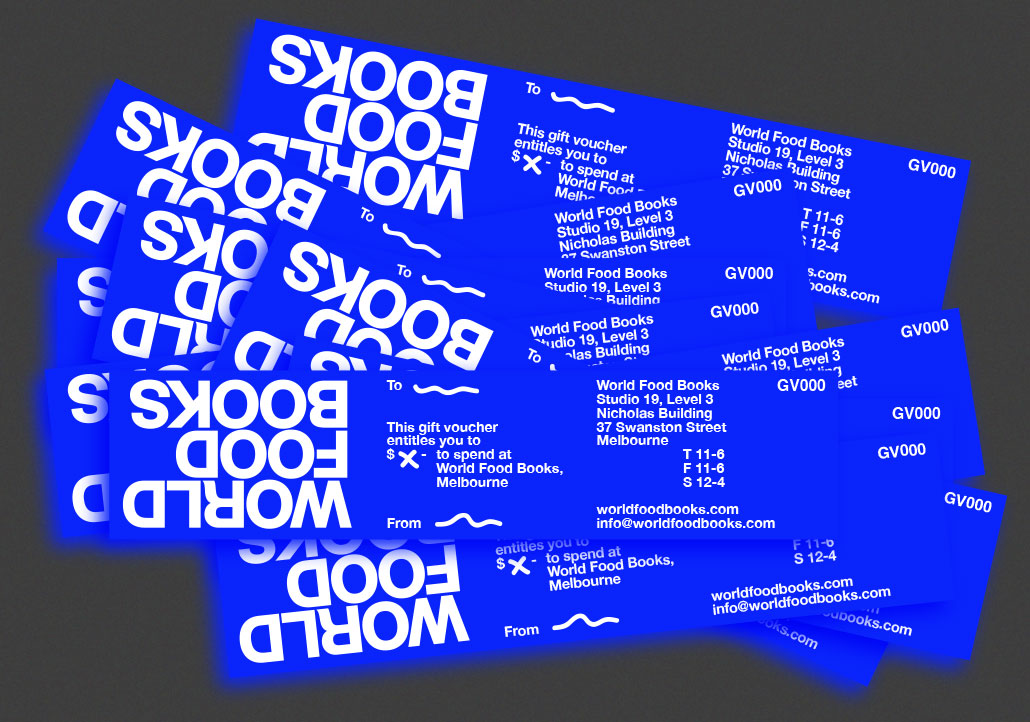
A World Food Books gift voucher is redeemable in our Melbourne bookshop or via our webshop (here). An e-voucher (printable pdf) will be sent to your purchase email address (please notify us if you wish to have the voucher sent to an alternate address and wish us to fill in the receiver's details on the card).
Gift vouchers can be purchased in increments of $20 (Australian Dollars) and the total amount can simply be added to by increasing the quantity in your shopping cart. eg. A quantity of 5 gift vouchers will result in an item total of $100 - a $100 gift voucher. Simply click "ADD TO CART" 5 times, or update your quantity in the shopping cart.
If you wish to purchase multiple, separate gift vouchers in one go, please just email us and we can personally prepare and email you a payment request.
Please note: Please select Pick-Up on gift voucher purchse to avoid any postage charges. Accidental postage charges will be refunded right away!
Thank you.
For any questions, please don't hesitate to email: [email protected]
1999, English
Softcover, 62 pages, 21 x 14 cm
Published by
Shearsman Books / Bristol
$26.00 - In stock -
Translated from French by Will Stone.
Introduced by Michael Hamburger, with a Preface by Anne Beresford & Notes and Afterword by Norma Rinsler.
Nerval (1808-1855) is one of the most important writers of nineteenth-century France, both in prose and in verse. A precursor of the symbolists and the surrealists, Nerval has fascinated many major literary figures, including Proust and Breton, Eliot and Apollinaire, Michaux and Leiris.
The great sonnet cycle, Les Chimères, in its marvellous combination of spell, quest and dream, continues to fascinate writers, readers, and that special category of writerly readers, translators. The translator of this volume is the gifted poet Will Stone, who explains his work in a strongly-worded essay: "like a partly submerged crocodile, with one amber eye half open the foreign line sits, waiting for the anxious translator to make a move." The book contains three other texts: a foreword by the poet, Anne Beresford, a general introduction to Nerval by Michael Hamburger (published for the first time in the previous edition of this book, some fifty years after it was written), and an afterword and notes on Les Chimères by Professor Norma Rinsler, the doyenne of English Nervaliens.
Published with the Menard Press.
2006, English
Softcover, 160 pages, 15.24 x 1.91 x 16.51 cm
Published by
Archipelago Books / New York
$39.00 - In stock -
Stroke by Stroke is a pairing of two of Henri Michaux's most suggestive texts, Stroke by Stroke (Par des traits, 1984) and Grasp (Saisir, 1979), written towards the end of his life. Michaux's ideogrammic ink drawings accompany his poetic explorations of animals, humans, and the origins of language. This series of verbal and pictorial gestures is at once explosive and contemplative. Michaux emerges at his most Zen.
"I first encountered Michaux's astonishing work in Stroke By Stroke, a physically and conceptually beautiful little book . . . Reading Stroke By Stroke, I felt invited to travel "toward greater ungraspability"—and in our uncertain times, Michaux's ease with that is deeply reassuring."—Martha Cooley, The Common
Henri Michaux (1899-1994) was born in Namur, Belgium. His travels throughout the Americas, Asia, and Africa inspired his first two books, Ecuador and A Barbarian in Asia. In 1948, after the death of his wife, he devoted himself increasingly to his distinctive calligraphic ink drawings. Averse to publicity of any sort, in 1965 he refused the French Grand Prix National des Lettres. Michaux's other works in English translation include Emergences-Resurgences (Skira, 2001), Darkness Moves: An Henri Michaux Anthology (California, 1997), Tent Posts (Sun and Moon, 1997), and A Barbarian in Asia (New Directions, 1986).
Richard Sieburth's translations include Georg Büchner's Lenz, Friedrich Holderlin's Hymns and Fragments, Walter Benjamin's Moscow Diary, Gérard de Nerval's Selected Writings, Henri Michaux's Emergences/Resurgences, Michel Leiris' Nights as Day, Days as Night, and Gershom Scholem's The Fullness of Time. His English edition of the Nerval won the 2000 PEN/ Book-of-the-Month-Club Translation Prize. His recent translation of Maurice Sceve's Délie was a finalist for the PENTranslation Prize and the Weidenfeld Prize.
1997, English
Softcover, 276 pages, 17.7 x 11.2 cm
1st Edition, Out of print title / used / very good
Published by
Semiotext(e) / Los Angeles
$120.00 - In stock -
Rare first 1997 edition of Chris Kraus' modern cult classic I Love Dick, published by Semiotext(e) in their Native Agents book series. Blurring the lines of fiction, essay and memoir, Chris Kraus's novel was a literary sensation when it was first published in 1997.
"Oh Dick, I want to be an intellectual like you."
In I Love Dick, published in 1997, Chris Kraus, author of Aliens & Anorexia, Torpor, and Video Green, boldly tore away the veil that separates fiction from reality and privacy from self-expression. It’s no wonder that I Love Dick instantly elicited violent controversies and attracted a host of passionate admirers.
The story is gripping enough: in 1994 a married, failed independent filmmaker, turning forty, falls in love with a well-known theorist and endeavors to seduce him with the help of her husband. But when the theorist refuses to answer her letters, the husband and wife continue the correspondence for each other instead, imagining the fling the wife wishes to have with Dick. What follows is a breathless pursuit that takes the woman across America and away from her husband—and far beyond her original infatuation into a discovery of the transformative power of first person narrative.
I Love Dick is a manifesto for a new kind of feminist who isn’t afraid to burn through her own narcissism in order to assume responsibility for herself and for all the injustice in world—and it’s a book you won’t put down until the author’s final, heroic acts of self-revelation and transformation.
Chris Kraus is a filmmaker and the author of I Love Dick and Aliens & Anorexia, and coeditor of Hatred of Capitalism: A Semiotext(e) Reader. Index called her “one of the most subversive voices in American fiction.” Her work has been praised for its damning intelligence, vulnerability and dazzling speed.
Very Good copy, with creasing to top-right corner of cover, some wear and a scratch to the cover.
1973, French
Hardcover (w. dust jacket), 288 pages, 25 x 32 cm
1st Edition, Out of print title / used / very good
Published by
Réalités - Hachette / Paris
$600.00 - In stock -
First and only printing of one of the heaviest hitters of interior design books ever, the enormous, lavishly illustrated "Decoration : Tradition et Renouveau" (Collection Connaissance des Arts) published in 1973. Without a doubt one of the most sought after interior design books and now extremely rare.
This heavy, prestigious, cloth-bound volume travels through some of the world's most incredible domestic interiors by the 20th century's top interior designers and decorators, including Francois Catroux, Serge Royaux, Gae Aulenti, Alberto Pinto, Maria Pergay, Charles Sevigny, Martine Dufour, Isabelle Hebey, Michel Boyer, David Mlinaric, Karl Lagerfeld, Quasar Khanh, Marc du Plantier, Yves Vidal, Jacques Grange, Valentino, Aldo Jacober, David Hicks, Piero Pinto, Henri Samuel, Nanda Vigo, John Stefanidis, Paolo Tommasi, and more, including the homes of major architects, fashion designers, art and antiquities collectors, celebrities, and interior designers themselves, showcasing objets d'art, historical artifacts, furniture and decor (from Mies van der Rohe, Lucio Fontana, Nicola L, Cesar, Jean Dubuffet, Pablo Picasso, Arman, Gae Aulenti, Marcel Breuer, Cy Twombly, Le Corbusier, François-Xavier Lalanne and Claude Lalanne, Quasar Khanh, Roger Tallon, Pierre Jeanneret, Enzo Mari, Pierre Paulin, Carla Venosta, Nanda Vigo, Michelangelo Pistoletto, Marcel Breuer, Ruth Francken, Afra + Tobia Scarpa, Charles Eames, Joe Columbo, Verner Panton, Bruno Munari, Mario Bellini, Henri Michaux, Jean Fautrier, Tom Wesselman, Sonia Delaunay, Marimekko, Superstudio, Man Ray... just to name a few) adorning decorated interiors ranging from "Tradition" ("a formula that allows one to integrate older items, furniture and artwork in a contemporary context"); "le Renouveau" (contemporary interiors of the 1970's and "a section dedicated to design of the time offering a selection of the finest furniture, objects and accessories created by top designers"); and "l'Avant-garde" (displaying some of the most experimental, idiosyncratic, and forward-thinking interiors that bring together modern materiality, pop art and space design to create inspired interior living architectural spaces).
"How to reconcile antique furniture and contemporary structures? Can we adapt modern furniture within a traditionally inspired framework? This book, illustrated with beautiful photographs, mostly in color, reproducing the finest achievements of the great contemporary designers, responds to these questions."
Preface by Francis Spar. All texts in French. Hundreds of beautiful photographs in vivid colour and b/w. A must-have for the interior design lover.
Very good, beautifully preserved copy, strong binding, and seldom now seen with original dust jacket (also VG).
1969, English
Hardcover, 186 page, 32 x 24.5 cm
1st US Edition, Out of print title / used / good
Published by
Reynal & Company / New York
$100.00 - In stock -
First English edition of this wonderful hardcover volume of European interiors from the 1960s, edited by L'ŒIL creators Georges and Rosamond Bernier. Profusely illustrated throughout, all the material in this volume was selected from the pages of France's L'ŒIL magazine. "This book leads the reader into some of the most distinguished and original homes of Europe. Here are glimpses into the lives of gifted, glamorous people whose taste sets style around the globe. Whether Lombard palazzo or Paris roof-top, highly diversified interiors are the source of stimulating ideas that can often be translated into American terms."
L'ŒIL (French: The Eye) is a French magazine created by Rosamond Bernier (née Rosenbaum) and her second husband, Georges Bernier, in 1955 to celebrate and reflect contemporary art creation. It was one of the finest documents of interior design, architecture, fine and applied arts and design in the 1950s-1970s, marrying the historical with the modern and profiling many artists and designers in France for the first time.
Includes large chapters on each of the following: the Villar Perosa villa of Signor & Signora Giovanni (Marella) Agnelli; London apartment of Mr & Mrs Stanley Rubin designed by Jon Bannenberg; a Milanese apartment designed by Marcello Pietrantoni & Carla Venosta; architect J. Anthony Cloughley's London apartment, designed with help from Rubin de C. Albrizzi; Karl Lagerfeld's Paris apartment; a one-story modern country house designed by Martine Dufour and Caumont & Collard for Monsieur & Madame Claude Labouret; The Villa Montecchia; decorator Isabelle Hebey's Marais apartment; Palazzo Brandolini in Venice (Renzo Mongiardino); Saint-Tropez apartment designed by Andree Putman; the Parisian apartment of Marc Bohan (of Christian Dior); The house of David Hicks in the South of France; Prince Bao-Long's Isabelle Hebey-designed apartment; Hugh Chisolm's Paris apartment (designed by Charles Sevigny); the Villa Fiorentina at St-Jean-Cap-Ferrat, belonging to Lady Kenmare & her son Roderick Cameron; Leonard Goulandris's London apartment designed by Jon Bannenberg; Van Day Truex's Vaucuse home; Philippe Guibourge's Paris apartment; Eugene Berman's Rome apartment; the Villa La Tana; Jacques Chazot's Paris apartment; Jacques & Andree Putman's Saint-Tropez home.
Good copy with foxing and wear to hardcover edges/corners.
2010, English / French
Hardcover, 160 pages, 28.5 x 21.2 cm
1st Edition, Out of print title / used / fine
Published by
Mark Batty / New York
$45.00 - In stock -
Certain hospitals in Paris contain illustrated phenomena that has remained unseen, by the French and the world at large, until now. In The Obscene Image, photographer Gilles Tondini reveals the frenzied frescos created by doctors and nurses who use hospital break rooms to let off steam and maintain as they work to save lives. In these rooms - known as salles de the rules of decorum observed throughout the rest of the hospital take a leave of absence in the name of relieving stress.
Graphic, sexually charged, saturated with color and lewd references, these images manifest all the frustrations, stresses, highs and lows that medical professionals anywhere must deal with their quests to keep people. These manic murals provide visually compelling insight into the medical professionals of 12 hospitals in the Paris greater area to keep themselves healthy. Along with all its sexy. content, the imagery in The Obscene Image draws from high and low cultures, from the Bible's Last Judgment and chivalric tales to comic book heroes and villains.
Near Fine copy.
2006, German
Hardcover (w. dust jacket), 280 pages, 28.5 x 23.7 cm
1st Edition, Out of print title / used / fine
Published by
Hatje Cantz / Berlin
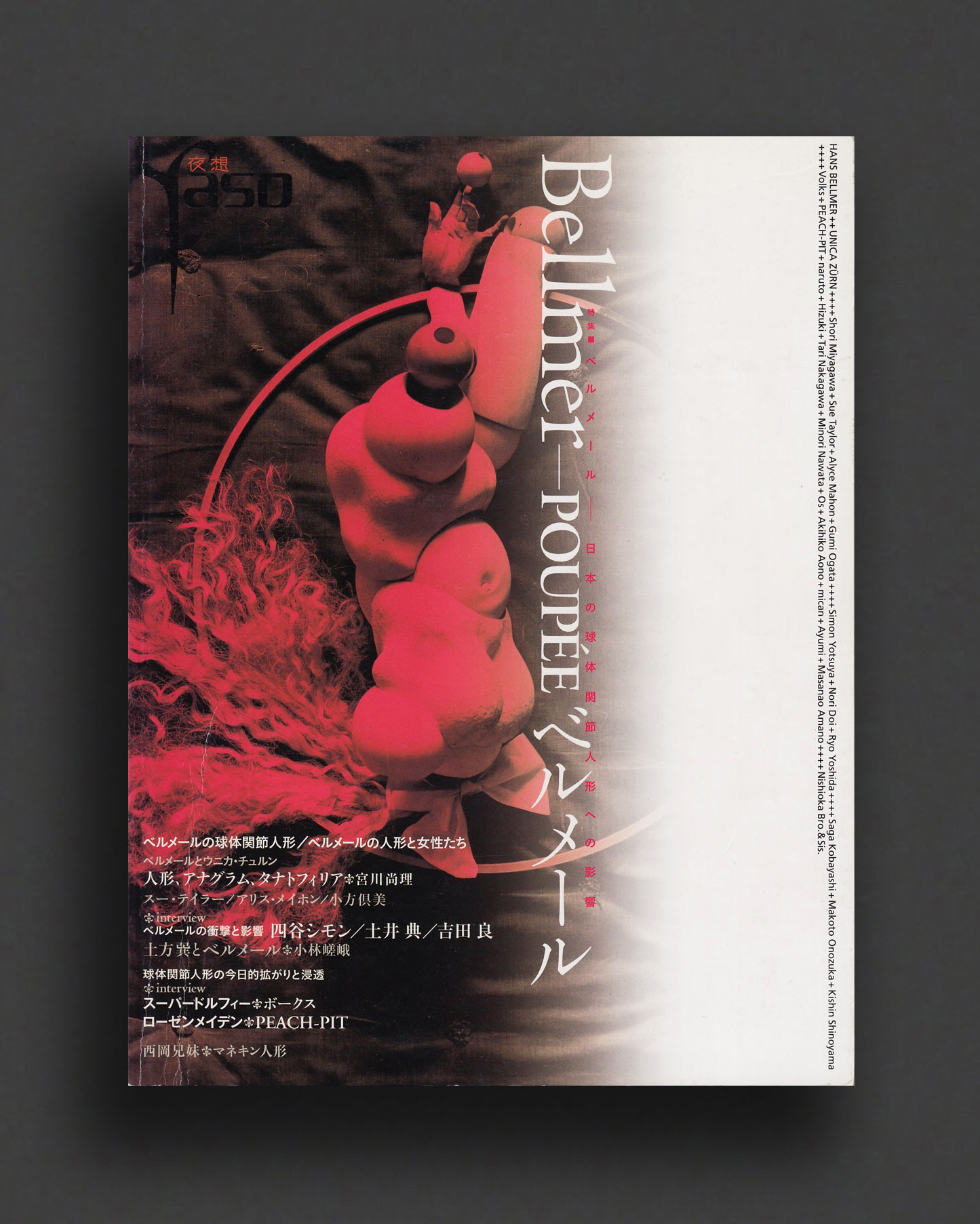
$180.00 - In stock -
"If the origin of my work is scandalous, it is because, for me, the world is a scandal."—Hans Bellmer
First hardcover edition of this lavish monograph on Hans Bellmer edited by Dr. Michael Semff and Anthony Spira to accompany the major retrospective exhibition at the Centre Georges Pompidou, Paris, March 1-May 22, 2006 · Staatliche Graphische Sammlung München, Munich, June 29-August 27, 2006·· Whitechapel Art Gallery, London, September 20-November 19, 2006.
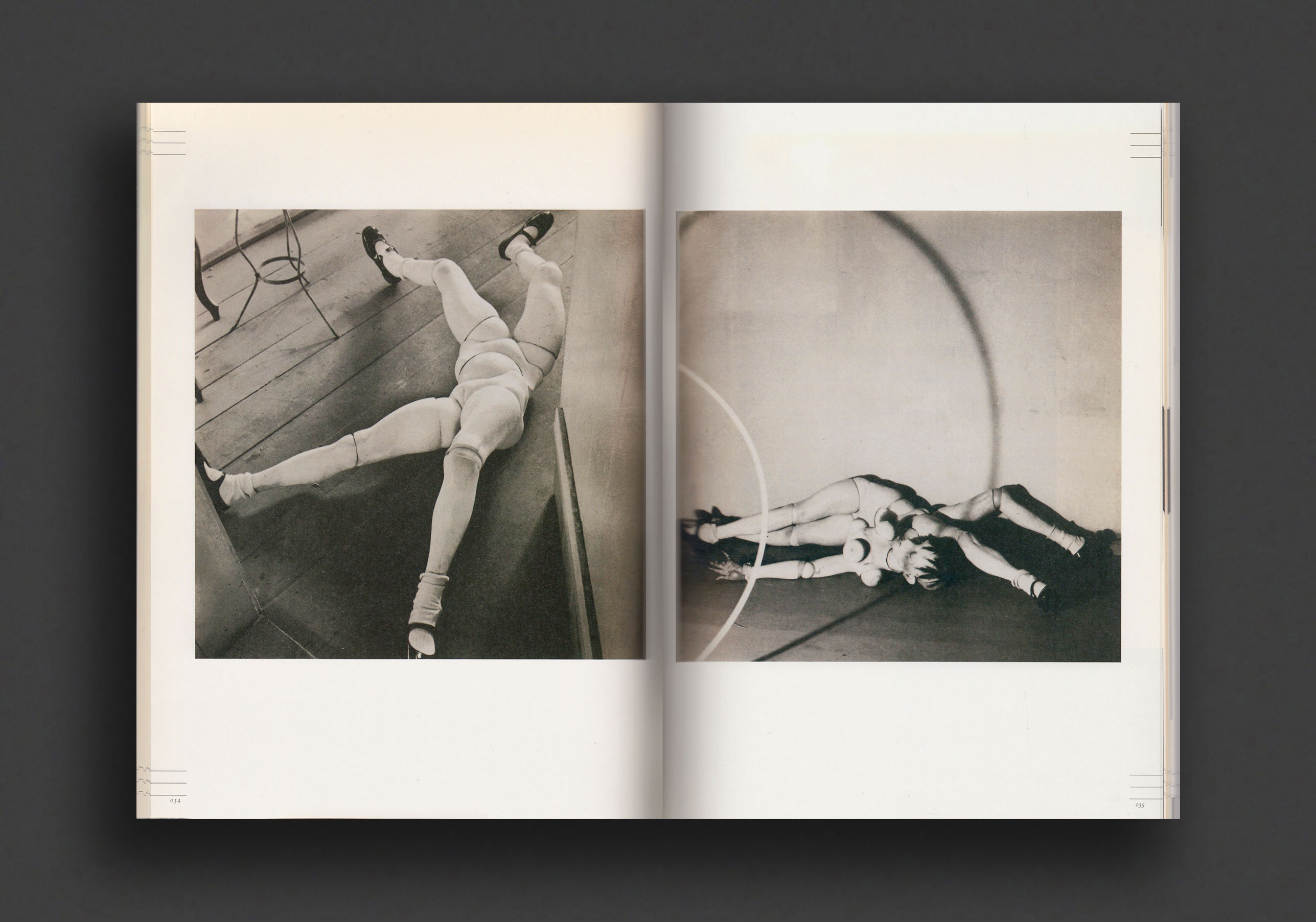
The Surrealists' fascination for dolls and machines resembling humans is especially evident in the work of Hans Bellmer (1902-1975), the subject of this comprehensive monograph. Rejecting the Nazis' Aryan ideals, the artist began in 1933 to create disturbing dolls out of wax, wood, flax, plaster, and glue, equipped with wigs and glass eyes. Photographs of these fetishistic objects were published in Minotaure, the Surrealists' magazine, and eagerly supported by members of André Breton's circle. After emmigrating to Paris, Bellmer developed his erotic obsessions through art, influenced by the writings of the Marquis de Sade and Georges Bataille, and collaborated with his companion, the German artist Unica Zürn. Deeply involved in Freudian discourse, his drawings, lithographs, and photographs investigate psychoanalytical theories around hysteria and transference, and reveal a singular exploration into the relationship between language and body.
Fine copy of the German edition.
2025, English
Softcover, 360 pages, 21.5 x 14 cm
Published by
University of Minnesota Press / Minnesota
Univocal Publishing / Minneapolis
$62.00 - In stock -
From 1970 until 1987, Gilles Deleuze held a weekly seminar at the Experimental University of Vincennes and, starting in 1980, at Saint-Denis. In the spring of 1981, he began a series of eight seminars on painting and its intersections with philosophy. The recorded sessions, newly transcribed and translated into English, are now available in their entirety for the first time. Extensively annotated by philosopher David Lapoujade, On Painting illuminates Deleuze's thinking on artistic creation, significantly extending the lines of thought in his book Francis Bacon.
Through paintings and writing by Rembrandt, Delacroix, Turner, Cezanne, Van Gogh, Klee, Pollock, and Bacon, Deleuze explores the creative process, from chaos to the pictorial fact. The introduction and use of color feature prominently as Deleuze elaborates on artistic and philosophical concepts such as the diagram, modulation, code, and the digital and the analogical. Through this scrutiny, he raises a series of profound and stimulating questions for his students: How does a painter ward off greyness and attain color? What is a line without contour? Why paint at all?
Written and thought in a rhizomatic manner that is thoroughly Deleuzian-strange, powerful, and novel-On Painting traverses both the conception of art history and the possibility of color as a philosophical concept.
Edited by David Lapoujade, translated by Charles J. Stivale.
2000, English
Softcover, 500 pages, 21.5 x 15.7 cm
1st Edition, Out of print title / used / very good
Published by
Purple Institute / Paris
$240.00 - In stock -
A rare early issue of the iconic Purple magazine, edited by Elein Fleiss and Olivier Zahm, this wonderful early edition features: Susan Cianciolo, Raf Simons, Jack Goldstein, Terry Richardson, Anders Edstrom, Chloe Sevigny, Wolfgang Tillmans, Martin Margiela, Rosemarie Trockel, Dominique Gonzalez-Foerster, General Idea, Mark Borthwick, Lewis Baltz, Lars Bang Larsen, Wolfgang Tillmans, Dominique Gonzalez-Foerster, Comme des Garçons, Michelle Grabner, Bless, Yohji Yamamoto, Dike Blair, Bernhard Willhelm, Gilles Deleuze, Karl Holmqvist, David Grubbs, Glenn O'Brian, Hans Ulrich Obrist, Bob Nickas, Sergio Guillen, Camille Vivier, Tan Lin, Olivier Zahm, Armin Linke, Amy Yao, Elein Fleiss, Henry Roy, Torbjorn Rodland, Chikashi Suzuki, Michael Smith, Lionel Bovier, Amy Sillman, Cerith Wyn Evans, Daniel Pflumm, Allen Rupperberg, Blake Rayne, Stephen Prina, Sture Johannesson, Franz Ackermann, Adrea Zittel, Jeremy Deller, Miu Miu, Dorothee Perret, Gaspard Yurkievich, Stanley Brouwn, Vija Celmins, Bas Jan Ader, Richard Prince, Tim Griffin, and so many more. One of the best issues!
In 1992, Elein Fleiss and Olivier Zahm started the magazine Purple Prose as a reaction against the superficial glamour of the 1980s; much as a part of the global counterculture at the time, inspired by magazines like Interview, Ray Gun, Nova, and Helmut Newton's Illustrated, but with the aesthetics of what usually is referred to as anti-fashion. Based on their personal interests and views; Purple was, and in a sense still is, made much in the same spirit of the fanzine. Started "without any means, and without any experience, because we wanted to make a magazine that was radically different. We wanted to support the artists around us that no one else supported, much less talked about."—Olivier Zahm. The magazine became associated with the "realism" of the new fashion photography of the 1990s, with names like Juergen Teller, Terry Richardson, Wolfgang Tillmans, Mark Borthwick, Corinne Day, and Mario Sorrenti. Soon after the birth of Purple Prose, Zahm and Fleiss created spin-off publications such as les cahiers purple, Purple Sexe, Purple Fiction, and of course, Purple Fashion, in which Zahm aimed at fusing together his two worlds, fashion and art. Now one of the most iconic and influential fashion magazines in history.
Very Good copy. Copy from the library of OMA (Office for Metropolitan Architecture)! OMA was founded in 1975 by Dutch architect Rem Koolhaas and Greek architect Elia Zenghelis, along with Madelon Vriesendorp and Zoe Zenghelis. Sticker to spine and sticker to front cover (re-movable, but let on due to noteworthiness)
2004, English
Softcover, 432 pages, 27.5 x 21 cm
1st Edition, Out of print title / used / very good
Published by
Purple Institute / Paris
$200.00 - In stock -
"ANIMALISTIC, ARROGANT, BLOODY, BIZARRE, CRUEL"
A very rare copy of the second issue of Purple Fashion wirth Angelina Lindvall in Balenciaga by Juergen Teller on the cover. Edited by Olivier Zahm, featuring Richard Prince, Mark Borthwick, Corinne Day, Juergen Teller, Imitation of Christ, Camille Vivier, Gus Van Sant, Anders Edström, Dominique Gonzales Foerster, Jeff Rian, Rita Ackermann, Heinz Peter Knes, Terry Richardson, Dike Blair, Elizabeth Peyton, Susan Cianciolo, Kim Gordon, Hermés, Giasco Bertoli, Junya Watanabe, Matthieu Orléan, Richard Kern, Maison Martin Margiela, Anuschka Blommers, François Laruelle, Niels Schumm, Comme des Garçons, Slavoj Zizek, Balenciaga, Maurizio Cattelan, Bless, Andrea Zittel, Gordon Matta-Clark, Thomas Hirschorn, Geoffrey Cruickshank-Hagenbuckle, Annette Aurell, Masafumi Sanai, Katja Rahlwes, Bettina Komenda, Mike Kelley, John Galliano, Kirsten Owen, Helmut Lang, Lutz, Issey Miyake, Rick Owens, Ann Demeuelemeester, Vava Ribeiro, Jean Leclercq, Maria Cornejo, Martine Sitbon, Cosmic Wonder, Justine Kurland, Wendy and Jim, John Armelder, Tim Griffin, Martynka Wawrzyniak, Ola Rindal, Yan Céh, David Armstrong, Fabien Baron, Lewis Baltz, Takashi Homma, Drew Jarett, Anne-Sofie Back, Marc Upson, Bettina Komenda, Alain Séchas, Gary Indiana, Justine Kurland, Christopher Wool, and many more... Art directed by Christophe Brunnquell.
In 1992, Elein Fleiss and Olivier Zahm started the magazine Purple Prose as a reaction against the superficial glamour of the 1980s; much as a part of the global counterculture at the time, inspired by magazines like Interview, Ray Gun, Nova, and Helmut Newton's Illustrated, but with the aesthetics of what usually is referred to as anti-fashion. Based on their personal interests and views; Purple was, and in a sense still is, made much in the same spirit of the fanzine. Started "without any means, and without any experience, because we wanted to make a magazine that was radically different. We wanted to support the artists around us that no one else supported, much less talked about."—Olivier Zahm. The magazine became associated with the "realism" of the new fashion photography of the 1990s, with names like Juergen Teller, Terry Richardson, Wolfgang Tillmans, Mark Borthwick, Corinne Day, and Mario Sorrenti. Soon after the birth of Purple Prose, Zahm and Fleiss created spin-off publications such as les cahiers purple, Purple Sexe, Purple Fiction, and of course, Purple Fashion, in which Zahm aimed at fusing together his two worlds, fashion and art. Now one of the most iconic and influential fashion magazines in history.
Very Good copy.
1985, English
Hardcover (w. dust jacket), 300 pages, 27.5 x 21 cm
1st Edition, Out of print title / used / very good
Published by
Quartet Books / London
$150.00 - In stock -
First 1985 hardcover edition of the first fundamental and comprehensive study of Hans Bellmer (1902—1975), the most provocative representative of Surrealism, authored by Peter Webb with Robert Short and published by Quartet in London. English edition. Heavily illustrated throughout with many rare images, in colour and b/w, many photographs and artworks, with bibliography, catalogue and references.
"Surrealism was one of the most exciting and influential of twentieth century art movements and much has been written about it since its great flowering in the 1930s. The lives and work of its leading figures (Ernst, Magritte, Dali and Miró) have been extensively researched, but Hans Bellmer, perhaps the most controversial and misunderstood of all the surrealists, has until now remained a mystery. Peter Webb, who interviewed Bellmer shortly before his death, has spent two years unravelling the story of this photographer, sculptor, painter, engraver and writer, and his book provides the first opportunity to evaluate Bellmer's considerable artistic achievement."—book jacket blurb
Very Good copy in VG dust jacket.
1990, English
Softcover, 160 pages, 18 x 11.5 cm
1st Edition, Out of print title / used / good
Published by
Semiotext(e) / Los Angeles
$35.00 - In stock -
First 1990 Semiotext(e) Foreign Agents English edition of "69 Ways to Play the Blues" by Jürg Laederach. Translated by Peter Wortsman, with a preface by Walter Abish.
"The phone refuses to ring. I sit here on 82nd Street: no, on 83rd: no, on 81st: I forget where I am. The phone refuses to ring, to tear me out of this enforced solitude, which I know only too well. This solitude that makes me sick and stirs me to tears, but surely not tears of compassion. A call is bound to come any minute now up from the Village and afford me the company I desperately desire. The phone isn't ringing. The bell doesn't work."
Written after the Swiss writer Jürg Laederach's third trip to New York in the late 1980s, 69 Ways was hailed by award-winning author Walter Abish as a text predictive of 'a Europe to come, when borders dissolve.' Like Alain-Robbe Grillet, Georges Perec, and the great Oulipo writers, Laederach constructs seamless narratives based on sly compositional strategies. The reader is only somewhat aware of the rules of the game. Transposed to America, Laederach's texts, Abish argues, 'function as a scanning device. Characters vanish, reappear. There is something relentless... Everything is transitory. No sentimentality. No clinging to the past. Everything is on the verge of being discarded. Everything is on the verge of dissolution. Everything resonates with imminent change.'
Good copy with age/light wear to block edge/cover edges.
1992, English
Softcover, 190 pages, 18 x 11.5 cm
1st Edition, Out of print title / used / good
Published by
Semiotext(e) / Los Angeles
$25.00 - In stock -
First 1992 Semiotext(e) Foreign Agents edition of "Sick Burn Cut (At Last the Reappearance of Our Lady of the Ugly Ones in Spokane, Washington)" by Deran Ludd.
"Mary is a 31-year-old man with a revolver in a cheap cotton dress."
Good copy with age/light wear to block edge/cover edges.
1990, English
Softcover, 182 pages, 18 x 11.5 cm
1st Edition, Out of print title / used / very good
Published by
Semiotext(e) / Los Angeles
$50.00 - In stock -
"The project: to rescue 'communism' from its own disrepute. Once invoked as the liberation of work through mankind's collective action, communism has instead stifled humanity. We who see in communism the liberation of both collective and individual possibilities must reverse that regimentation of thought and desire which terminates the individual."
Translated by Michael Ryan. Includes "Postscript, 1990" by Toni Negri.
Very Good copy.
2022, English
Softcover, 160 pages, 19.9 x 13.3 cm
1st Edition, Out of print title / used / fine
Published by
Continuum / London
$50.00 - In stock -
From the preface by Alain Badiou: It is no exaggeration to say that Quentin Meillassoux has opened up a new path in the history of philosophy, understood here as the history of what it is to know ... This remarkable "critique of critique" is introduced here without embellishment, cutting straight to the heart of the matter in a particularly clear and logical manner. It allows the destiny of thought to be the absolute once more.
"This work is one of the most important to appear in continental philosophy in recent years and deserves a wide readership at the earliest possible date ... Apres la finitude is an important book of philosophy by an authnted emerging voices in continental thought. Quentin Meillassoux deserves our close attention in the years to come and his book deserves rapid translation and widespread discussion in the English-speaking world. There is nothing like it."—Graham Harman in Philosophy Today
Quentin Meillassoux's remarkable debut makes a strikingly original contribution to contemporary French philosophy and is set to have a significant impact on the future of continental philosophy. Written in a style that marries great clarity of expression with argumentative rigour, After Finitude provides bold readings of the history of philosophy and sets out a devastating critique of the unavowed fideism at the heart of post-Kantian philosophy.
The exceptional lucidity and the centrality of argument in Meillassoux's writing should appeal to analytic as well as continental philosophers, while his critique of fideism will be of interest to anyone preoccupied by the relation between philosophy, theology and religion.
Meillassoux introduces a startlingly novel philosophical alternative to the forced choice between dogmatism and critique. After Finitude proposes a new alliance between philosophy and science and calls for an unequivocal halt to the creeping return of religiosity in contemporary philosophical discourse.
"Rarely do we encounter a book which not only meets the highest standards of thinking, but sets up itself new standards, transforming the entire field into which it intervenes. Quentin Meillassoux does exactly this."—Slavoj Zizek
Fine copy of first 2008 edition.
1958 / 1985, English
Softcover, 332 pages, 23 x 15 cm
1st Edition, Out of print title / used / good
Published by
University of California Press / Berkley
$55.00 - In stock -
First 1958 paperback edition, 1985 print of Hannah Arendt's "The Human Condition", published by the University of Chicago Press. A work of striking originality, The Human Condition is in many respects more relevant now than when it first appeared in 1958. In her study of the state of modern humanity, Hannah Arendt considers humankind from the perspective of the actions of which it is capable. The problems Arendt identified then—diminishing human agency and political freedom, the paradox that as human powers increase through technological and humanistic inquiry, we are less equipped to control the consequences of our actions—continue to confront us today.
A classic in political and social theory, The Human Condition is a work that has proved both timeless and perpetually timely.
Good copy with fading to spine light wear to extremities, very minimal (eraser-able) lead pencil marginalia. No spine creasing.
2006, English / German
Softcover, 88 pages, 21 x 27 cm
1st Edition, Out of print title / as new
Published by
Kunstverein Braunschweig / Germany
Sternberg Press / Berlin
$280.00 - In stock -
Edited by Karola Grässlin
Text by Helmut Draxler
Christopher Williams’ work operates within the conventions of advertising, the superficiality of surface, and, ultimately the history of Modernism. In photography, film, performance, sculpture, graphic design, and video, the process of reproduction is the artist’s point of entry; from there he exposes the flaws in a near-perfect, carefully constructed reality. Each image, whether architectural or figurative, natural or manufactured, is subject to the conditions of production and the inevitable boundaries of the pictorial surface.
By systematically building such provocative moments into his work, Christopher Williams to an extent kick-starts the process of perception and reception and at least points it in a certain direction. This approach, which oscillates between the work itself and the process of producing it, can now also be related to the genealogy of his own artistic methods, both in relation to and in contradistinction from Rephotography and Conceptual Art.
—Helmut Draxler
Accompanying the same-titled exhibition at the Kunstverein Braunschweig, this fully illustrated catalogue documents the show and contains a theoretical essay by Helmut Draxler.
As New copy. Out-of-print.
2010, English / Norwegian
Softcover, 80 pages, 20.3 x 25.4 cm
1st Edition, Out of print title / as new
Published by
Bergen Kunsthall / Norway
$140.00 - Out of stock
For over 20 years Christopher Williams has worked in the field between photography as art and the application of the photographic medium to documentation, advertising, and journalism. The works involve volumes of such subtexts and themes, which are rarely fully apparent, but are concealed behind layer upon layer of circumstances and references, connotations, and background stories. Williams is a decided storyteller, and builds up his narratives by way of an almost essayistic juxtaposition of photographs that stand in relation – not directly obvious – with one another.
The exhibition in Bergen Kunsthall was the first solo presentation of Williams's work in Scandinavia and the title hints at a specific angle of approach to the complex network of connections. For Example: Dix-Huit Leçons Sur La Société Industrielle suggests a course of lessons that covers the industrial preconditions of the spread of photography, and which can in turn be applied to society in a larger perspective. The accumulation of loosely related events in European culture (decolonization, industrialization, the revolution of ‘68) is paralleled with inventions from the same era which have influenced photographic technology. The same title has been used for several exhibitions in recent years, but often with an addition that indicates that each new exhibition is a new experiment: a new revision. The way the titles begin with “For Example” also indicates the same experimental attitude.
The exhibition in Bergen Kunsthall was not a retrospective in the traditional sense, but brought out various aspects of the artistic oeuvre through a selection of both recent photographs and older works. The exhibition itself thus constituted a new revision of Williams’s ongoing project.
The exhibition catalogue collects, for the first time, a selection of Williams’s own writing in the form of press releases for recent exhibitions, each containing only minor changes from one exhibition to the next. The book also presents two new essays on the work of Christopher Williams by John Kelsey and Diedrich Diederichsen.
Designed by Christopher Williams and Petra Hollenbach.
In the 1970s, Christopher Williams studied at the California Institute of the Arts under the first wave of West Coast conceptual artists, including John Baldessari and Douglas Huebler, only to become one of his generation’s leading conceptualists. Williams’s work is a critical investigation of the medium of photography and more broadly the vicissitudes of industrial culture, in particular its structures of representation and classification. Using the process of reproduction as a point of entry, the artist manipulates the conventions of advertising, the superficiality of surface, and ultimately the history of Modernism. Deeply political, historical, and sometimes personal, the photographs are meant to evoke a subtle shift in our perception by questioning the communication mechanisms and aesthetic conventions that influence our understanding of reality.
Now out-of-print.
1995, English
Softcover, 160 pages, 20.5 x 18 cm
1st Edition, Out of print title / used / very good
Published by
Grove Press / New York
$200.00 - In stock -
First 1995 edition of the Larry Clark's Kids book, original US edition published by Grove Press in New York to accompany the release of one of the most important movies of the decade. Profusely colour illustrated throughout with iconic full-page film stills, accompanied by the entire film script written by Harmony Korine at 19 years of age.
"If Clark never shoots another picture, he will be a cinematic immortal because of this one film"—Sight and Sound
"Well, i always wanted to make the teenage movie that I felt America never made. The great American teenage movie like the great American novel. That's why I always wanted to do. I remember back in the fifties when I was a kid, and the teenage movies were like City Across The River and Cassavetes was an actor in one and Tony Curtis was in one. And I would see these movies, and I would say, 'Those kids don't look like kids, they're all older people, they're all like grown-ups.' So right away they don't ring true. That's why some of the teenage movies that I do like — Over the Edge — the reason why I liked that movie was that they used kids the right age, they actually used kids. Real kids. I knew my film had to be from the inside, so I called this kid writer I knew through skateboarding, and he came over and I told him what I wanted, and he said, 'I've been waiting all my life to write this,' and he knocked out the screenplay in tree weeks. I think when you see the movie Kids that most of us — not all of us, but most of us — will say, 'Yeah, that's the way we were, that's the way kids are."—Larry Clark
Larry Clark is one of America's most important photographers whose 1971 photo book masterpiece, Tulsa, depicted youth culture in rural America.
Very Good copy, with discolouration to left edge of cover image from sun/storage. No spine or corner damage.
2001, English
Hardcover, 128 pages, 25 x 18 cm
1st Edition, Out of print title / used / good
Published by
Lars Müller / Zürich
$40.00 - In stock -
New Living (Das Neue Wohnen) was the title of an exceptional architectural propaganda film created in 1930 by German avant-garde artist and filmmaker Hans Richter. It showcased exemplary modernist buildings and furniture--some of which were on view shortly after in the prestigious exhibition The International Style--and contrasted them with the impractical, unhygenic living spaces that were the norm. Visually diverse and full of experimental montage techniques, New Living pioneered a radical method of portraying architecture on celluloid.
First English edition of this long out-of-print book by Lars Müller Publishers. Essays by Andres Jensen and Arthur Ruegg, and running commentary and extensive film sequences of each of Richter's films.
Hans Richter was born in Berlin in 1888. Throughout his career, he was involved with the Blue Rider group, the cubists, "Die Aktion", the Zurich Dadaists, the November group, and De Stijl. In 1921 he made the first abstract film, "Rhythme 21" and in 1957 finished "Dadascope". Richter died in 1976.
Good copy. Some shelf wear to hardcovers, light tanning to page edges, otherwise Very Good throughout.
1972, English / German
Softcover, 32 pages, 22 x 22 cm
1st Edition, Out of print title / used / very good
Published by
Goethe-Institute / Münich
$180.00 - Out of stock
Extremely rare, early publication on the work of director, actor, playwright and catalyst for the New German Cinema movement, Rainer Werner Fassbinder (1945–1982), published in 1972 by Goethe-Institute, Münich. Illustrated throughout with chronology of his prolific work to date, with each feature including a full-page film image, full cast listing, production, camera and music credits, along with bi-lingual texts in German and English for each film, including Love Is Colder Than Death (1969), Katzelmacher (1969), Why Does Herr R. Run Amok? (1970), The American Soldier (1970), The Niklashausen Journey (1970), Whity (1971), Beware of a Holy Whore (1971), The Merchant of Four Seasons (1972), and more, ending with his latest feature, The Bitter Tears of Petra von Kant (1972). Ten years before his untimely death in 1982, this gorgeous publication celebrates and documents the early achievements of one of cinema's greatest directors.
""He is", said Henri Langlois, director of the Paris Cinematheque during an Hommage a Rainer Werner Fassbinder, "the beginning of German post-war cinema". Indeed, Fassbinder is one of the most talked about and honored — and productive — moviemakers in West Germany. Not only 12 features in three years, but also five plays, a number of drama-adaptations, radio-plays and an eight-part-family-serial for television have made the 27 year-old director a unique phenomenon in the German cultural scene." (Wolfgang Limmer, opening of the introduction)
"Fassbinder's unique position in Germany is first of all the result of his fearless breaking of crusted cultural traditions, but also the result of the strong impression his enormous productivity has made on Germany's cultural industrie. Quickly he was captioned "German Warhol", "Kid-Genius", "Wunderkind . He is certainly none of those. Goethe's remark would fit here better: "His genius is deligence."" (Wolfgang Limmer, closing of the introduction)
Rainer Werner Fassbinder (1945–1982) was a West German filmmaker, actor, playwright and theatre director, who was a catalyst of the New German Cinema movement. Although Fassbinder's career lasted less than fifteen years, he was extremely productive. By the time of his death, Fassbinder had completed over forty films, two television series, three short films, four video productions, and twenty-four plays, often acting as well as directing. Fassbinder was also a composer, cameraman, and film editor. Fassbinder died on 10 June 1982 at the age of 37 from a lethal cocktail of cocaine and barbiturates.
Very Good copy, only light corner and spine wear.
1993, Japanese
Hardcover (w. dust jacket), 100 pages, 31 x 23 cm
1st Edition, Out of print title / used / very good
Published by
Futami Shobo / Japan
$150.00 - In stock -
Fetish! from 1993, a rare over-sized hardcover photo collection published in Japan by Futami to celebrate a "new radical eros" compiling the work "five ultra-inspired fetish/bondage photographers from Europe and the United States". Cover-to-cover full-bleed photography of Wolfgang Eichler, Robert Chouraqui, Eric Kroll, Karo, John Morrison.
Very Good—Fine copy in Vey Good—Fine DJ with obi strip (some small tears, creases, tanning to obi)