World Food Books' programme is largely produced on Kulin Nation land. We acknowledge the Wurundjeri people of the Kulin Nation as the first and continuing custodians of this land, and pay respect to their Elders past, present, and emerging.
World Food Books is an arts and special interests bookshop in Naarm / Melbourne. Founded in 2010, World Food Books is devoted to the presentation of a rotating, hand-selection of international art, design, literary and counterculture publications with an emphasis on the anti-traditional, the experimental, the avant-garde, the heretic, the marginal.
Presenting new titles alongside rare and out-of-print books, catalogues and journals spanning the fields of modern and contemporary art, design, photography, illustration, film, literature, poetry, cultural theory, philosophy, sexuality, popular and underground culture in its many radical forms, World Food Books wishes to encourage adventurous, thoughtful and open-minded reading, looking, writing, and exchange of publishing and ideas, both current and historical.
As well as our bookshop, located in Melbourne's historical Nicholas Building, all of our inventory is available internationally via our online mail-order service.
World Food Books semi-regularly co-ordinates "Occasions", a programme of exhibits and events at the bookshop and in partnership with other hosts (such as museums and art galleries) that develop out of the activities, relationships and content of the bookshop itself.
World Food Books
The Nicholas Building
37 Swanston Street
Room 5, Level 6
Melbourne 3000
Australia
SHOP HOURS:
Thu–Sat 11–5
WEB-SHOP OPEN 24/7
World Food Books
Postal Address:
PO Box 435
Flinders Lane
Victoria 8009
Australia
Art
Theory / Essay
Architecture / Interior
Graphic Design / Typography
Photography
Fashion
Eros
LGBTQ+
Fiction / Poetry
Weird / Speculative / Science Fiction / Horror
Transgressive / Visceral / Abject
Symbolism / Decadence / Fin de siècle
Film / Video
Painting
Sculpture / Installation
Performance / Dance / Theater
Drawing
Sound / Music
Curatorial
Group Shows / Collections
Periodicals
Out-of-print / Rare
Posters / Ephemera / Discs
Signed Books
World Food Books Gift Voucher
World Food Book Bag
Australian Art
Australian Fiction
Australian Science Fiction / Speculative Fiction
Australian Poetry
Australian Photography
Japanese Photography
Conceptual Art
Minimal Art
Dada
'Pataphysics / Oulipo
Fluxus
Concrete Poetry
Pop Art
Surrealism
Arte Povera
Arte Informale / Haute Pâte / Tachism
Nouveau Réalisme / Zero / Kinetic
Situationism / Lettrism
Collage / Mail Art / Xerox Art
Art Brut / Folk / Visionary / Fantastic
Illustration / Graphic Art / Bandes Dessinées
Furniture
Italian Radical Design / Postmodernism
Textiles
Ceramics / Glass
Counterculture
Protest / Revolt
Philosophy
Psychoanalysis
Anthropology
Anarchism
Socialism / Anarchism / Communism / Capitalism
Literary Theory / Semiotics / Language
Feminism / Women's Studies
Gender Studies / Sexuality
Anthropology
Fetishism / BDSM
Drugs / Psychedelia
Crime / Violence
Animal Rights / Veganism
Occult / Esoterica
Ecology / Earth / Alternative Living
Whole Earth / Crafts
All prices in AUD (Australian dollars)
Pick-Ups
Pick-up orders can be collected in our bookshop during opening hours after order date. Please collect any Pick-up orders within 2 weeks of ordering as we have limited storage space. Orders will be released back into stock if not collected within this time. No refunds can be made for pick-ups left un-collected. If you cannot make it in to the bookshop in this time-frame, please choose postage option.
Return Policy
All sales are final. We do accept returns (for refund or exchange) for items received in error. All our orders are packed with special care using heavy-duty padding and cardboard book-mailers or bubble mailers (for smaller books), using reinforcement where required. We cannot take responsibility for any lost, stolen or damaged parcels.
Insurance
Should you wish to insure your package, please email us directly after placing your order and we can organise this at a small extra expense. Although all standard/express tracked packages are very safe and dependable, we cannot take responsibility for any lost, stolen or damaged parcels. We recommend insurance on valuable orders.
Interested in selling your old books, catalogues, journals, magazines, comics, fanzines, ephemera? We are always looking for interesting, unusual and out-of-print books to buy. We only buy books in our fields of interest and specialty, and that we feel we can resell.
We base these prices on desirability, market value, in-print prices, condition and our current stock levels. We offer cash, store credit, and can take stock on consignment. All
about 25% of the price we expect to get when we sell them, or 30% in store credit. We base these prices on desirability, market value, in-print prices, condition and our current stock levels.
Sell your books any day of the week. You can drop them off and return later. If you have a lot of books, we can visit your Sydney home.
We buy books that we feel we can resell. We offer about 25 % of the price we expect to get when we sell them, or 30% in store credit. We base these prices on desirability, market value, in-print prices, condition and our current stock levels.
Philadelphia Wireman
03 August - 01 September, 2018
World Food Books is proud to announce our next Occasion, the first presentation of sculptures by Philadelphia Wireman in Australia.
The Philadelphia Wireman sculptures were found abandoned in an alley off Philadelphia’s South Street on trash night in 1982. Their discovery in a rapidly-changing neighbourhood undergoing extensive renovation, compounded with the failure of all attempts to locate the artist, suggests that the works may have been discarded after the maker’s death. Dubbed the "Philadelphia Wireman" during the first exhibition of this work, in 1985, the maker’s name, age, ethnicity, and even gender remain uncertain. The entire collection totals approximately 1200 pieces, all intricately bound together with tightly-wound heavy-gauge wire (along with a few small, abstract marker drawings, reminiscent both of Mark Tobey and J.B. Murry). The dense construction of the work, despite a modest range of scale and materials, is singularly obsessive and disciplined in design: a wire armature or exoskeleton firmly binds a bricolage of found objects including plastic, glass, food packaging, umbrella parts, tape, rubber, batteries, pens, leather, reflectors, nuts and bolts, nails, foil, coins, toys, watches, eyeglasses, tools, and jewellery.
Heavy with associations—anthropomorphic, zoomorphic, and socio-cultural responses to wrapped detritus—the totemic sculptures by Philadelphia Wireman have been discussed in the context of work created to fulfil the shamanistic needs of alternative religions in American culture. Curators, collectors, and critics have variously compared certain pieces to sculpture from Classical antiquity, Native American medicine bundles, African-American memory jugs, and African fetish objects. Reflecting the artist’s prolific and incredibly focused scavenging impulse, and despite—or perhaps enhanced by—their anonymity, these enigmatic objects function as urban artefacts and arbiters of power, though their origin and purpose is unknown. Philadelphia Wireman, whatever their identity, possessed an astonishing ability to isolate and communicate the concepts of power and energy through the selection and transformation of ordinary materials. Over the course of the past two decades, this collection has come to be regarded as an important discovery in the field of self-taught art and vernacular art.
Presented in collaboration with Fleisher-Ollman Gallery, Philadelphia, and Robert Heald, Wellington.
Susan Te Kahurangi King
02 February - 10 March, 2018
Susan Te Kahurangi King (24 February 1951 - ) has been a confident and prolific artist since she was a young child, drawing with readily available materials - pencils, ballpoint pens and felt-tip markers, on whatever paper is at hand. Between the ages of four and six Susan slowly ceased verbal communication. Her grandparents William and Myrtle Murphy had developed a special bond with Susan so they took on caring responsibilities for extended periods. Myrtle began informally archiving her work, carefully collecting and storing the drawings and compiling scrapbooks. No drawing was insignificant; every scrap of paper was kept. The King family are now the custodians of a vast collection containing over 7000 individual works, from tiny scraps of paper through to 5 meter long rolls.
The scrapbooks and diaries reveal Myrtle to be a woman of great patience and compassion, seeking to understand a child who was not always behaving as expected. She encouraged Susan to be observant, to explore her environment and absorb all the sights and sounds. Myrtle would show Susan’s drawings to friends and people in her community that she had dealings with, such as shopkeepers and postal workers, but this was not simply a case of a grandmother’s bias. She recognised that Susan had developed a sophisticated and unique visual language and sincerely believed that her art deserved serious attention.
This was an unorthodox attitude for the time. To provide some context, Jean Dubuffet coined the term Art Brut in 1945 to describe work created by self-taught artists – specifically residents of psychiatric institutions and those he considered to be visionaries or eccentrics. In 1972 Roger Cardinal extended this concept by adopting the term Outsider Art to describe work made by non-academically trained artists operating outside of mainstream art networks through choice or circumstance. Susan was born in Te Aroha, New Zealand in 1951, far from the artistic hubs of Paris and London that Dubuffet and Cardinal operated in. That Myrtle fêted Susan as a self-taught artist who deserved to be taken seriously shows how progressive her attitudes were.
Susan’s parents Doug and Dawn were also progressive. Over the years they had consulted numerous health practitioners about Susan’s condition, as the medical establishment could not provide an explanation as to why she had lapsed into silence. Dawn educated herself in the field of homeopathy and went on to treat all twelve of her children using these principles – basing prescriptions on her observations of their physical, mental and emotional state.
Doug was a linguist with an interest in philosophy who devoted what little spare time he had to studying Maori language and culture. To some extent their willingness to explore the fringes of the mainstream made them outsiders too but it was their commitment to living with integrity and their respect for individuality that ensured Susan’s creativity was always encouraged.
Even though Susan’s family supported her artistic pursuits, some staff in schools and hospitals saw it as an impediment to her assimilation into the community and discouraged it in a variety of ways. Her family was not always aware of this and therefore did not fully understand why Susan stopped drawing in the early 1990s. However, rather than dwell on the challenges that Susan faced in pursuit of her artistic practice, they prefer to highlight her achievements. In 2008 Susan began drawing again in earnest, after an almost 20 year interruption, and her work is now shown in galleries around the world.
Susan grew up without television and has been heavily influenced by the comics she read as a child. She is absolutely fearless in the appropriation of recognizable characters, such as Donald Duck and Mickey Mouse, in her work. She twists their limbs, contorts their faces, compresses them together, blends them into complex patterned backgrounds - always imbuing them with an incredible energy. Although Susan often used pop culture characters in her work they are not naive or childlike. These are drawings by a brilliant self-taught artist who has been creating exceptional work for decades without an audience in mind.
Mladen Stilinović
"Various Works 1986 - 1999"
02 February 16 - September 10, 2016
Various works 1986 - 1999, from two houses, from the collections of John Nixon, Sue Cramer, Kerrie Poliness, Peter Haffenden and Phoebe Haffenden.
Including: Geometry of Cakes (various shelves), 1993; Poor People’s Law (black and white plate), 1993; White Absence (glasses, ruler, set square, silver spoon, silver ladel with skin photograph and wooden cubes), 1990-1996; Exploitation of the Dead (grey and red star painting, wooden painting, black spoon with red table, red plate), 1984-1990; Money and Zeros (zero tie, paintings made for friends in Australia (Sue, John, Kerrie), numbers painting), 1991-1992; Words - Slogans (various t-shirts) - “they talk about the death of art...help! someone is trying to kill me”, “my sweet little lamb”, “work is a disease - Karl Marx”; Various artist books, catalogues, monographs, videos; Poster from exhibition Insulting Anarchy; "Circular" Croatian - Australian edition; Artist book by Vlado Martek (Dostoyevsky); more.
Thanks to Mladen Stilinović and Branka Stipančić.
Jonathan Walker
Always Will Need To Wear Winter Shirt Blue + Ochre Small Check Pattern
21 August - 21 September, 2015
Untitled
I am not a great reader of poetry but I always return to the work of Melbourne poet, Vincent Buckley (1925- 1988). Perhaps I find his most tantalising piece to be not a finished poem but a fragment left on a scrap of paper discovered on his desk after the poet’s death.
The poetry gathers like oil
In the word-core, and spreads
It has its music meet,
Its music is in movement.
This fragment is more the shell left behind from a volatile thought than a finished poem. I find the last two lines honest but awkward whereas the first two lines work like an arrow. Most likely he could not find a resolution so it was left. Still, in its present form, it remains an eloquent testimony to the ultimate failure of a medium to express mobile thought and sensation, in Buckley’s case, through verbal language. It’s an important matter because this is something all artists have to deal with regardless of the medium.
I have never written a poem, however, I am forever copying fragments from books on paper scraps in a vain effort to fix certain notions in my head. At first, they function as bookmarks that are sometimes returned to when I open the book. But before long, as they accumulate, they fall out littering the table interspersed with A4 photocopies, bills, books and medications.
To return to Buckley’s fragment, the first two lines very much evoke how I paint nowadays. As you age, detail diminishes and patches of light become more luminous and float. I feel the most honest way of dealing with this is by smearing the oil paint on the canvas with the fingers and working close-up, blind. Only if the patches coalesce into an approaching image can the work gain a life.
-
Jonathan Walker was born in Melbourne, Australia and brought up on a dairy farm in Gippsland. In the 1970’s he studied painting at RMIT and won the Harold Wright Scholarship to the British Museum, London. During the 1980’s he exhibited at Pinacotheca Gallery, Richmond and had work shown at the NGV and Heidi City Art Gallery. Over the same period he designed the cover for the “Epigenesi” LP by Giancarlo Toniutti, Italy and conducted a mail exchange work with Achim Wollscheid, Germany. The work with artists through the post resulted in an article published in the bicentenary issue of Art and Australia 1988. He showed in artist run spaces such as WestSpace in the 90’s and 2000’s, and until 2012, taught painting at Victoria University, which is where we (Colleen Ahern and Lisa Radford) as organisers of the exhibition, among many others, had the privilege of being his student.
Walker’s knowledge was imparted to students through the careful selection of music, literature, and artists found in books that he himself had ordered for the library. Walker’s strategy was the generosity of sharing his vast knowledge with references specific to each student and their context.
Walker’s paintings share a similar focus and intimacy.
This exhibition presents a small selection of recent paintings alongside a publication that includes Walker’s writing. Observational and analytical, Walker’s work is a type of material notation — the time of day, colour and how it is blended, the both specific and fleeting location of a reflection on lino or the question of whether a chair leg should be included in a painting.
Please join us on Friday August 21 between 6-8pm to celebrate the opening of the exhibition.
Curated by Colleen Ahern and Lisa Radford.
B. Wurtz
Curated by Nic Tammens
March 26 - April 4, 2015
B.Wurtz works from a basement studio in his home on Manhattan’s Lower East Side.
This local fact is attested to by the plastic shopping bags and newsprint circulars that appear in his work. As formal objects, they don’t make loud claims about their origins but nonetheless transmit street addresses and places of business from the bottom of this long thin island. Like plenty of artists, Wurtz is affected by what is local and what is consumed. His work is underpinned by this ethic. It often speaks from a neighborhood or reads like the contents of a hamper:
“BLACK PLUMS $1.29 lb.”
“Food Bazaar”
“USDA Whole Pork Shoulder Picnic 99c lb.”
“RITE AID Pharmacy, with us it’s personal.”
“H. Brickman & Sons.”
“Sweet Yams 59c lb."
Most of the work in this exhibition was made while the artist was in residence at Dieu Donne, a workshop dedicated to paper craft in Midtown. Here Wurtz fabricated assemblages with paper and objects that are relatively lightweight, with the intention that they would be easily transportable to Australia. This consideration isn’t absolute in Wurtz’s work, but was prescriptive for making the current exhibition light and cheap. Packed in two boxes, these works were sent from a USPS post office on the Lower East Side and delivered to North Melbourne by Australia Post.
Wurtz appears courtesy of Metro Pictures, New York.
Thanks to Rob Halverson, Joshua Petherick, Sari de Mallory, Matt Hinkley, Helen Johnson, Fayen d'Evie, Ask Kilmartin, Lisa Radon, Ellena Savage, Yale Union, and "Elizabeth".
John Nixon
"Archive"
December 15 - January 20, 2014
The presentation of John Nixon's archive offered a rare showcase of this extensive collection of the artist's own publications, catalogues, posters, ephemera, editions and more, from the mid 1980s onwards, alongside a selection of his artworks.
Organized by John Nixon, Joshua Petherick and Matt Hinkley.
<a href=http://wfb.public-office.info/artist/john-nixon>All titles by John Nixon
"Habitat"
at Minerva, Sydney (organised by Joshua Petherick and Matt Hinkley)
November 15 - December 20, 2014
Lupo Borgonovo, Janet Burchill & Jennifer McCamley,
Lewis Fidock, HR Giger, Piero Gilardi, Veit Laurent Kurz,
Cinzia Ruggeri, Michael E. Smith, Lucie Stahl, Daniel Weil, Wols
Press Release:
“...It contained seven objects. The slender fluted bone, surely formed for flight, surely from the wing of some large bird. Three archaic circuitboards, faced with mazes of gold. A smooth white sphere of baked clay. An age-blackened fragment of lace. A fingerlength segment of what she assumed was bone from a human wrist, grayish white, inset smoothly with the silicon shaft of a small instrument that must once have ridden flush with the surface of the skin - but the thing’s face was seared and blackened.”
William Gibson, “Count Zero”, 1986
"Autumn Projects Archive"
Curated by Liza Vasiliou
March 6 - March 15, 2014
World Food Books, in conjunction with the Virgin Australia Melbourne Fashion Festival 2014, presented the Autumn Projects archive, consisting of a selection of early examples in Australian fashion with a particular interest in collecting designers and labels from the period beginning in the 1980’s, who significantly influenced the discourse of Australian Fashion.
Curated by Liza Vasiliou, the exhibition provided a unique opportunity to view pieces by designers Anthea Crawford, Barbara Vandenberg, Geoff Liddell and labels CR Australia, Covers, Jag along with early experimental collage pieces by Prue Acton and Sally Browne’s ‘Fragments’ collection, suspended throughout the functioning World Food Books shop in Melbourne.
H.B. Peace
presented by CENTRE FOR STYLE
November 14, 2013
"Hey Blinky, you say chic, I say same"
Anon 2013
H.B. Peace is a clothing collaboration between great friends Blake Barns and Hugh Egan Westland. Their pieces explore the divergences between 'character’ and ‘personality’ in garments....etc
Special Thanks to Joshua Petherick and Matt Hinkley of WFB and Gillian Mears
and a Very Special Thank you to Audrey Thomas Hayes for her shoe collaboration.
Janet Burchill & Jennifer McCamley
"Aesthetic Suicide"
May 10 - June 8, 2013
The first of our occasional exhibitions in the World Food Books office/shop space in Melbourne, "Aesthetic Suicide" presented a body of new and older works together by artists Janet Burchill & Jennifer McCamley, including videos, prints, a wall work, and publications.
During shop open hours videos played every hour, on the hour.
$.00 - Out of stock
The eternal clean out! New items weekly.
https://worldfoodbooks.com/category/sale
Published by World Food Books / Melbourne
$20.00 - In stock -
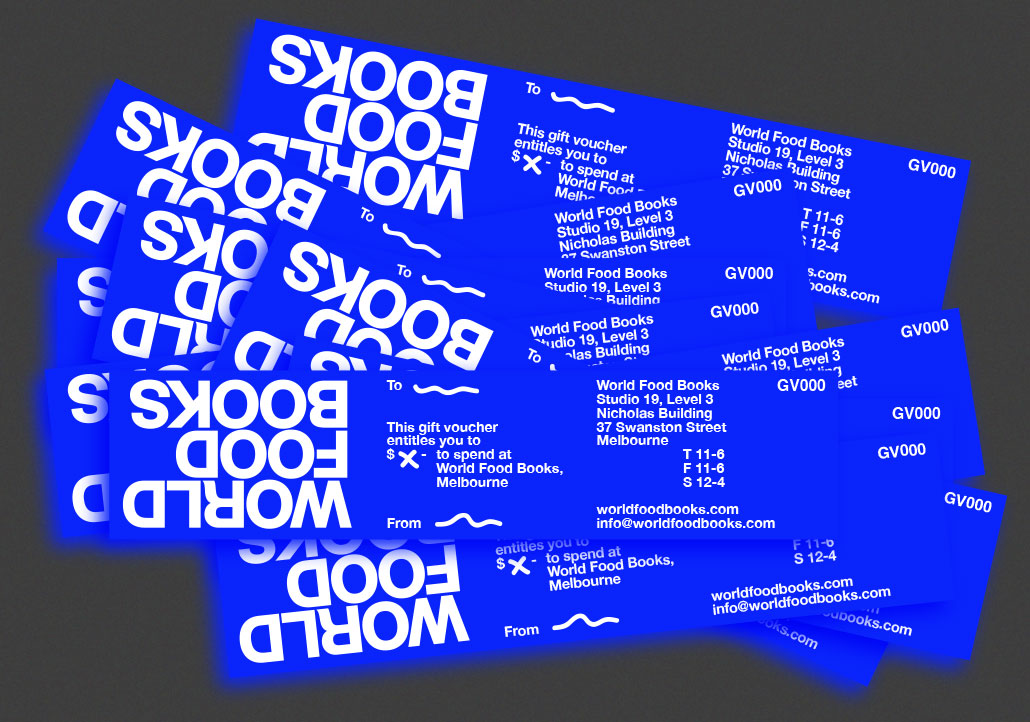
A World Food Books gift voucher is redeemable in our Melbourne bookshop or via our webshop (here). An e-voucher (printable pdf) will be sent to your purchase email address (please notify us if you wish to have the voucher sent to an alternate address and wish us to fill in the receiver's details on the card).
Gift vouchers can be purchased in increments of $20 (Australian Dollars) and the total amount can simply be added to by increasing the quantity in your shopping cart. eg. A quantity of 5 gift vouchers will result in an item total of $100 - a $100 gift voucher. Simply click "ADD TO CART" 5 times, or update your quantity in the shopping cart.
If you wish to purchase multiple, separate gift vouchers in one go, please just email us and we can personally prepare and email you a payment request.
Please note: Please select Pick-Up on gift voucher purchse to avoid any postage charges. Accidental postage charges will be refunded right away!
Thank you.
For any questions, please don't hesitate to email: [email protected]
1970, English
Softcover, 234 pages, 17.7 x 10.5 cm
Out of print title / used / very good
Published by
Ballantine Books / New York
$25.00 - Out of stock
First 1970 Ballantine edition of At the Edge of the World, a collection of thirty fantasy short stories by legendary Irish writer Lord Dunsany. Edited, introduction, notes and afterword by American author, editor and critic of science fiction and fantasy, Lin Carter.
“Dunsany’s stories are a priceless possession for any lover of fantasy. Like first-rate poetry, they are endlessly readable. Those who have not read them have something to look forward to, and an assortment of Dunsany is the foundation stone of any fantasy collection.”—L. Sprague de Camp
"Dunsany loves the vivid green of jade and of copper domes, and the delicate flush of sunset on the ivory minarets of impossible dream cities. To the truly imaginative he is a talisman and a key unlocking rich storehouses of dream."—H. P. Lovecraft
"Had I read Idle Days on the Yann when I was a boy, I had perhaps been changed... and looked to that first reading as the creation of my world."—William Butler Yeats
"The creative romanticist alone can engineer a satisfying evasion of workaday life. Thanks to these haphazard sorcerers, my life has been a marvellous affair. I have quested past the lair of Tharagavrug, to the steel gate, to The Porte Resonante, of the Fortress Unvanquishable; and I am now upon the point of going in to cut off, for the third or fourth time, Gaznaks Gaznak's evil head."—James Branch Cabell
Very Good—Near Fine copy, well preserved, unread, only toning to block edges.
1969, Japanese
Softcover, 128 pages, 21 x 15 cm
1st Edition, Out of print title / used / very good
Published by
Tenjō Sajiki / Tokyo
$290.00 - In stock -
Very rare copy of the first issue of Angura (Underground Theatre), the "Dramatic Theory Magazine", published in 1969 in Tokyo by Shūji Terayama's radical avant-garde theatre company Tenjō Sajiki. Strikingly designed by the great Japanese art director Ryōichi Enomoto, this issue's special feature is ‘Anti-Theater’, with contributions by Shūji Terayama, photographer Yoshihiro Tatsuki, artist Jiro Takamatsu, poet Tadaaki Mori, director and cinematographer Sakumi Hagiwara, critic Masaaki Hiraoka, critic Koichi Isoda, actor Shigeomi Satô, and many others. A very unique periodical that not only discusses in-depth the works of Angura theatre, but also the international avant-garde, inviting diverse critical perspectives on performance and anti- and living-theatre, sharing ground with Gutai and Fluxus. Illustrated throughout with drawings, diagrams and photographs, mixing themes of pop, protest, surrealism, and eros, plus texts and scripts in Japanese. A rare printed embodiment of Tenjō Sajiki, Terayama, Tadanori Yokoo and the Japanese underground.
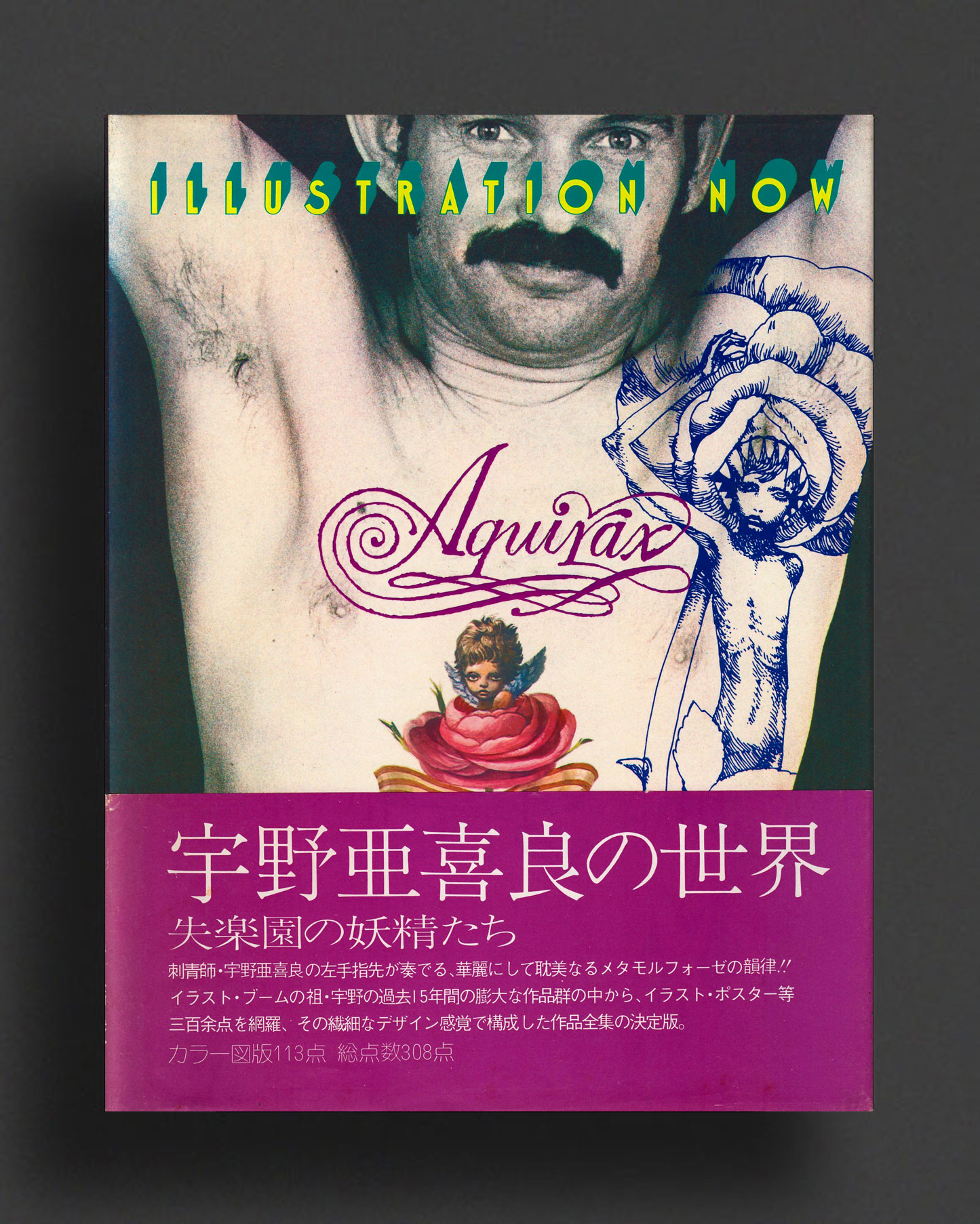
Tenjō Sajiki was a Japanese independent theater troupe co-founded by Shūji Terayama, Kujō Kyōko, Yutaka Higashi, Tadanori Yokoo, and Fumiko Takagi. Led by Japanese avant-garde poet, dramatist, writer, film director, and photographer Shūji Terayama, the prolific group was active between 1967 and 1983 (until Terayama's death). A major phenomenon on the Japanese Angura ("underground") theater scene, the group has produced a number of stage works marked by experimentalism, folklore influences, social provocation, grotesque eroticism and the flamboyant fantasy characteristic of Terayama's oeuvre. Tenjō Sajiki benefitted greatly from collaborations with a number of prominent artists, including musicians J. A. Seazer and Kan Mikami, and graphic designers Aquirax Uno and Tadanori Yokoo.
Shūji Terayama (1935 — 1983) was a Japanese avant-garde poet, dramatist, writer, film director, and photographer. His works range from radio drama, experimental television, underground (Angura) theatre, countercultural essays, to Japanese New Wave and "expanded" cinema. Terayama is considered one of the most productive and provocative creative artists to come out of Japan, with a wide-reaching influence on many artists from the 1970s onward.
Very Good copy.
1970, Japanese
Softcover, 300 pages, 21 x 15 cm
1st Edition, Out of print title / used / very good
Published by
Tenjō Sajiki / Tokyo
$220.00 - In stock -
Very rare copy of Angura (Underground Theatre) issue 3, 1970, the "Dramatic Theory Magazine" published in Tokyo by Shūji Terayama's radical avant-garde theatre company Tenjō Sajiki. With gorgeous graphic design and (Aleister Crowley) cover by graphic designer Heikichi Harata, this issue's special feature is ‘Eros and Theater’, edited by Shūji Terayama and Masahiko Akuta with contributions by Terayama, photographer Hajime Sawatari, writer Taruho Inagaki, director Takahiko Iimura, anthropologist Masao Yamaguchi, playwright Yasunari Takahashi, director and cinematographer Sakumi Hagiwara, film director Nobuhiro Kawanaka, playwright Rio Kishida, and many others. A very unique periodical that not only discusses in-depth the works of Angura theatre, but also the international avant-garde, inviting diverse critical perspectives on performance and anti- and living-theatre, sharing ground with Gutai and Fluxus. Illustrated throughout with drawings, diagrams and photographs, mixing themes of pop, protest, surrealism, and eros, plus texts and scripts in Japanese. A rare printed embodiment of Tenjō Sajiki, Terayama, Tadanori Yokoo and the Japanese underground.
Tenjō Sajiki was a Japanese independent theater troupe co-founded by Shūji Terayama, Kujō Kyōko, Yutaka Higashi, Tadanori Yokoo, and Fumiko Takagi. Led by Japanese avant-garde poet, dramatist, writer, film director, and photographer Shūji Terayama, the prolific group was active between 1967 and 1983 (until Terayama's death). A major phenomenon on the Japanese Angura ("underground") theater scene, the group has produced a number of stage works marked by experimentalism, folklore influences, social provocation, grotesque eroticism and the flamboyant fantasy characteristic of Terayama's oeuvre. Tenjō Sajiki benefitted greatly from collaborations with a number of prominent artists, including musicians J. A. Seazer and Kan Mikami, and graphic designers Aquirax Uno and Tadanori Yokoo.
Shūji Terayama (1935 — 1983) was a Japanese avant-garde poet, dramatist, writer, film director, and photographer. His works range from radio drama, experimental television, underground (Angura) theatre, countercultural essays, to Japanese New Wave and "expanded" cinema. Terayama is considered one of the most productive and provocative creative artists to come out of Japan, with a wide-reaching influence on many artists from the 1970s onward.
1972, Japanese
Softcover, 340 pages, 21 x 15 cm
1st Edition, Out of print title / used / good
Published by
Tenjō Sajiki / Tokyo
$100.00 - In stock -
Rare copy of Angura (Underground Theatre) issue 5, 1972, the "Dramatic Theory Magazine" published in Tokyo by Shūji Terayama's radical avant-garde theatre company Tenjō Sajiki. With iconic cover photography by Shūji Terayama, this issue's special feature is ‘City Drama / Human-powered airplane Solomon’, with contributions by Terayama, artsit Jiro Takamatsu, butoh dancer and choreographer Akira Kasai, actress Eiko Kujo, photographer Nobuyoshi Araki, film director Nobuhiro Kawanaka, playwright Yutaka Higashi, film critic Shigechika Sato, musician J. A. Seazer, musician Shigeo Takenaga, musician Norihito Inaba, photographer Hiroshi Yamazaki, and many others. A very unique periodical that not only discusses in-depth the works of Angura theatre, but also the international avant-garde, inviting diverse critical perspectives on performance and anti- and living-theatre, sharing ground with Gutai and Fluxus. Illustrated throughout with drawings, diagrams and photographs, mixing themes of pop, protest, surrealism, and eros, plus texts and scripts in Japanese. A rare printed embodiment of Tenjō Sajiki, Terayama, Tadanori Yokoo and the Japanese underground.
Tenjō Sajiki was a Japanese independent theater troupe co-founded by Shūji Terayama, Kujō Kyōko, Yutaka Higashi, Tadanori Yokoo, and Fumiko Takagi. Led by Japanese avant-garde poet, dramatist, writer, film director, and photographer Shūji Terayama, the prolific group was active between 1967 and 1983 (until Terayama's death). A major phenomenon on the Japanese Angura ("underground") theater scene, the group has produced a number of stage works marked by experimentalism, folklore influences, social provocation, grotesque eroticism and the flamboyant fantasy characteristic of Terayama's oeuvre. Tenjō Sajiki benefitted greatly from collaborations with a number of prominent artists, including musicians J. A. Seazer and Kan Mikami, and graphic designers Aquirax Uno and Tadanori Yokoo.
Shūji Terayama (1935 — 1983) was a Japanese avant-garde poet, dramatist, writer, film director, and photographer. His works range from radio drama, experimental television, underground (Angura) theatre, countercultural essays, to Japanese New Wave and "expanded" cinema. Terayama is considered one of the most productive and provocative creative artists to come out of Japan, with a wide-reaching influence on many artists from the 1970s onward.
1973, Japanese
Softcover, 340 pages, 21 x 15 cm
1st Edition, Out of print title / used / good
Published by
Tenjō Sajiki / Tokyo
$140.00 - In stock -
Very rare copy of Angura (Underground Theatre) issue 6, 1973, the "Dramatic Theory Magazine" published in Tokyo by Shūji Terayama's radical avant-garde theatre company Tenjō Sajiki. With iconic cover photography by Shūji Terayama, this issue's special feature is ‘New Trends in Overseas Theater’, with contributions by Terayama, musician J. A. Seazer, musician Norihito Inaba, photographer Nobuyoshi Araki, actor Hideaki Sasaki, producer and actress Eiko Kujo, artist Nobuo Sasaki, and many others. Includes in-depth features and interviews on the work of theatre directors Jérôme Savary, Robert Wilson, and Mario Ricci and photo-reports the activities of independent theatre companies around the world, including Teatro Abaco (Rome), Atelje 212 (Belgrade), Teatr Laboratorium (Wrocław), La Mamma Theatre (New York), Forum Theater (Berlin), Odin Teatret (Holstebro), Stichting Mickery Workshop (Antwerp), making it a very valuable resource on the subject. There are also photo reports and scripts on the performances of Tenjō Sajiki, including works performed overseas. Incredible rare performance documents. A very unique periodical that not only discusses in-depth the works of Angura theatre, but also the international avant-garde, inviting diverse critical perspectives on performance and anti- and living-theatre, sharing ground with Gutai and Fluxus. Illustrated throughout with drawings, diagrams and photographs, mixing themes of pop, protest, surrealism, and eros, plus texts and scripts in Japanese. A rare printed embodiment of Tenjō Sajiki, Terayama, Tadanori Yokoo and the Japanese underground.
Tenjō Sajiki was a Japanese independent theater troupe co-founded by Shūji Terayama, Kujō Kyōko, Yutaka Higashi, Tadanori Yokoo, and Fumiko Takagi. Led by Japanese avant-garde poet, dramatist, writer, film director, and photographer Shūji Terayama, the prolific group was active between 1967 and 1983 (until Terayama's death). A major phenomenon on the Japanese Angura ("underground") theater scene, the group has produced a number of stage works marked by experimentalism, folklore influences, social provocation, grotesque eroticism and the flamboyant fantasy characteristic of Terayama's oeuvre. Tenjō Sajiki benefitted greatly from collaborations with a number of prominent artists, including musicians J. A. Seazer and Kan Mikami, and graphic designers Aquirax Uno and Tadanori Yokoo.
Shūji Terayama (1935 — 1983) was a Japanese avant-garde poet, dramatist, writer, film director, and photographer. His works range from radio drama, experimental television, underground (Angura) theatre, countercultural essays, to Japanese New Wave and "expanded" cinema. Terayama is considered one of the most productive and provocative creative artists to come out of Japan, with a wide-reaching influence on many artists from the 1970s onward.
1977, Japanese
Softcover, 64 pages, 21 x 15 cm
1st Edition, Out of print title / used / good
Published by
Tenjō Sajiki / Tokyo
$100.00 - In stock -
Rare copy of Angura (Underground Theatre) issue 11, 1977, the "Dramatic Theory Magazine" published in Tokyo by Shūji Terayama's radical avant-garde theatre company Tenjō Sajiki. With iconic cover photography by Shūji Terayama, this issue's special feature is ‘Secret Drama (Absurd Ship)’, with contributions by Terayama, writer Taruho Inagaki, anthropologist Masao Yamaguchi, film director Nobuhiro Kawanaka, playwright Rio Kishida, and many others. A very unique periodical that not only discusses in-depth the works of Angura theatre, but also the international avant-garde, inviting diverse critical perspectives on performance and anti- and living-theatre, sharing ground with Gutai and Fluxus. Illustrated throughout with drawings, diagrams and photographs, mixing themes of pop, protest, surrealism, and eros, plus texts and scripts in Japanese. A rare printed embodiment of Tenjō Sajiki, Terayama, Tadanori Yokoo and the Japanese underground.
Tenjō Sajiki was a Japanese independent theater troupe co-founded by Shūji Terayama, Kujō Kyōko, Yutaka Higashi, Tadanori Yokoo, and Fumiko Takagi. Led by Japanese avant-garde poet, dramatist, writer, film director, and photographer Shūji Terayama, the prolific group was active between 1967 and 1983 (until Terayama's death). A major phenomenon on the Japanese Angura ("underground") theater scene, the group has produced a number of stage works marked by experimentalism, folklore influences, social provocation, grotesque eroticism and the flamboyant fantasy characteristic of Terayama's oeuvre. Tenjō Sajiki benefitted greatly from collaborations with a number of prominent artists, including musicians J. A. Seazer and Kan Mikami, and graphic designers Aquirax Uno and Tadanori Yokoo.
Shūji Terayama (1935 — 1983) was a Japanese avant-garde poet, dramatist, writer, film director, and photographer. His works range from radio drama, experimental television, underground (Angura) theatre, countercultural essays, to Japanese New Wave and "expanded" cinema. Terayama is considered one of the most productive and provocative creative artists to come out of Japan, with a wide-reaching influence on many artists from the 1970s onward.
1971, English
Softcover, 192 pages, 17.5 x 10.5 cm
1st Edition, Out of print title / used / good
Published by
Berkley Medallion / Berkley
$45.00 - In stock -
Very first 1971 edition of Vermilion Sands by J.G. Ballard, published by Berkley in this paperback edition 2 years before the Jonathan Cape hardcover. Vermilion Sands is a collection of surreal science fiction short stories by Ballard, one of his finest, all set in an imaginary vacation resort called Vermilion Sands which suggests, among other places, a latter-day Palm Springs. Vermillion Sands is a fully automated desert resort designed to fulfill the most exotic whims of the idle rich. But now it languishes in uneasy decay, populated only by forgotten movie stars, solitary impresarios, parasites, and artistic and literary failures, a place where love and lust pall before the stronger pull of evil.
Vermilion Sands embodies the languid decay of a tawdry dream. A desert resort designed to fulfill the most exotic whims of the sated rich, it now moulders in sleazy dilapidation, a haven for the remittance men of the artistic and literary world, and for the human lampreys that prey upon them. It is a lair for malice and hate and envy — and the more cancerous forms of madness; a place where sensitive pigments paint portraits for their masters in a grotesque parody of art; where poets press the buttons of mechanical versifiers; where sculptures grow like funguses, and plants respond to music; where psychosensitive houses are driven mad by their owners' neuroses; where love and affection, and even lust, are effete madrigals played in a minor and discordant key.
From the dark recesses of a superb imagination, J. G. Ballard has conjured up an elegant nightmare of decadence, a portrait of a future Gomorrah where a Nero might play an automated violin.
"Ballard is one of the brightest stars in post-war science fiction."—Kingsley Amis
Average—Good copy with wear, tanning to pages. Fragile binding. Japan's NW-SF bookshop stamp to title page.
1975, English
Softcover, 192 pages, 17.5 x 10.5 cm
1st Edition, Out of print title / used / good
Published by
Panther / London
$40.00 - In stock -
1975 first Panther edition of Vermilion Sands by J.G. Ballard, first published by Berkley in 1971. Vermilion Sands is a collection of surreal science fiction short stories by Ballard, one of his finest, all set in an imaginary vacation resort called Vermilion Sands which suggests, among other places, a latter-day Palm Springs. Vermillion Sands is a fully automated desert resort designed to fulfill the most exotic whims of the idle rich. But now it languishes in uneasy decay, populated only by forgotten movie stars, solitary impresarios, parasites, and artistic and literary failures, a place where love and lust pall before the stronger pull of evil.
Vermilion Sands embodies the languid decay of a tawdry dream. A desert resort designed to fulfill the most exotic whims of the sated rich, it now moulders in sleazy dilapidation, a haven for the remittance men of the artistic and literary world, and for the human lampreys that prey upon them. It is a lair for malice and hate and envy — and the more cancerous forms of madness; a place where sensitive pigments paint portraits for their masters in a grotesque parody of art; where poets press the buttons of mechanical versifiers; where sculptures grow like funguses, and plants respond to music; where psychosensitive houses are driven mad by their owners' neuroses; where love and affection, and even lust, are effete madrigals played in a minor and discordant key.
From the dark recesses of a superb imagination, J. G. Ballard has conjured up an elegant nightmare of decadence, a portrait of a future Gomorrah where a Nero might play an automated violin.
"Ballard is one of the brightest stars in post-war science fiction."—Kingsley Amis
Good—VG copy with light wear, tanning.
1976, English
Softcover, 192 pages, 18 x 11 cm
1st Edition, Out of print title / used / good
Published by
Penguin Books / London
$28.00 - In stock -
The Wind from Nowhere is British science fiction author J.G. Ballard's debut novel, first published in 1961. He had previously published only short stories. The novel was the first of a series of classic early Ballard novels dealing with scenarios of natural disaster. Here, civilization is reduced to ruins by mysterious prolonged worldwide hurricane force winds that devastate the surface of the earth. Some critics have suggested that his first four novels are based on elemental themes, showing global destruction by air, water, fire and earth. This is the 1976 paperback edition with David Pelham cover art.
James Graham Ballard (15 November 1930 – 19 April 2009) was an English novelist, short story writer, and essayist who first became associated with the New Wave of science fiction for his post-apocalyptic novels such as The Wind from Nowhere (1961) and The Drowned World (1962). In the late 1960s, he produced a variety of experimental short stories (or "condensed novels"), such as those collected in the controversial The Atrocity Exhibition (1970). In the mid 1970s, Ballard published several novels, among them the highly controversial Crash (1973), a story about symphorophilia and car crash fetishism, and High-Rise (1975), a depiction of a luxury apartment building's descent into violent chaos.
VG copy with tanning/discoloration to spine edge, page tanning, foxing. Tightly bound.
1964, English
Softcover, 160 pages, 18 x 11 cm
1st Edition, Out of print title / used / very good
Published by
Berkley Medallion / Berkley
$40.00 - In stock -
First 1964 Berkley edition of The Terminal Beach, a superb collection of science fiction short stories by British author J.G. Ballard, including "Billennium", "The Terminal Beach", "The Lost Leonardo" and "The Illuminated Man".
James Graham Ballard (15 November 1930 – 19 April 2009) was an English novelist, short story writer, and essayist who first became associated with the New Wave of science fiction for his post-apocalyptic novels such as The Wind from Nowhere (1961) and The Drowned World (1962). In the late 1960s, he produced a variety of experimental short stories (or "condensed novels"), such as those collected in the controversial The Atrocity Exhibition (1970). In the mid 1970s, Ballard published several novels, among them the highly controversial Crash (1973), a story about symphorophilia and car crash fetishism, and High-Rise (1975), a depiction of a luxury apartment building's descent into violent chaos.
G—VG copy with light wear, tanning to pages, tightly bound.
1999, English
Softcover, 300 pages, 17 x 24 cm
1st Edition, Out of print title / used / very good
Published by
Black Dog Publishing Ltd / London
$160.00 - Out of stock
Scarce first 1999 edition of this definitive resource on the work of COUM Transmissions and Throbbing Gristle.
"These people are the wreckers of civilisation", exclaimed the Conservative Member of Parliament Nicholas Fairbairn in 1976. His outburst was meant to describe four artists and musicians: Genesis P-Orridge, Cosey Fanni Tutti, Peter Christopherson and Chris Carter - members of the seminal band Throbbing Gristle. What "these people" had done to deserve such an epithet, and what they were about to do, is the subject of this book.
Throbbing Gristle are widely lauded as the band that invented industrial music, and their influence can be observed across today's musical landscape: from house and techno to industrial death metal. Wherever experimental electronic music is being made, Throbbing Gristle's influence can be felt.
"Wreckers of Civilisation recalls a time which despite volumes of print remains occluded, obdurate, even intimidating: that moment before the conservative reconstruction. To be awake in London in the late 1970s was to be plunged into turmoil: externally manifest in riot, internally within various forms of damage and depression and, if one felt brave or driven, extreme aesthetics. COUM Transmissions and Throbbing Gristle mark the furthest reach of that impulse: even more so than Punk, they plunged into a technological and personal examination of the dark side - the forbidden, the taboo, the dystopian future on the doorstep. Today this might seem like science fiction or deliberate shock tactics, but then it seemed like reportage, front line dispatches from a convulsed country."
Heavily illustrated and complete with a chronological list of actions, concerts and exhibitions, discography, filmography, bibliography and much more, this heavy volume has become an invaluable and sought after resource on TG, COUM Transmissions, and Industrial Records.
Simon Ford is a freelance writer and art historian. He was previously Research Associate in Craft and Design and Curator of the Design Council Slide Collection at Manchester Metropolitan University, as well as being a curator at the Victoria and Albert Museum. He received his PhD in the History of Art from the Courtauld Institute of Art in 2000. He is the author of Wreckers of Civilisation: The Story of COUM Transmissions and Throbbing Gristle (1999, 2017, Black Dog Publishing). His most recent book is The Situationist International: A User's Guide (2006, Black Dog).
Very Good copy.
1993, English
Softcover, 218 pages, 23.5 x 15.5 cm
1st Edition, Out of print title / used / very good
Published by
Indiana University Press / Indiana
$25.00 - Out of stock
First edition printed in 1993. Cover art by Remedios Varo.
" . . . a thorough, detailed, and critical analysis of the writings of Julia Kristeva." -Elizabeth Grosz
This first full-scale feminist interpretation of Kristeva's work situates her within the context of French feminism. Oliver guides her readers through Kristeva's intellectual formation in linguistics, Freud, Lacan, and poetics. This comprehensive introduction to Kristeva makes accessible her important contributions to philosophy, linguistics, and psychoanalytic feminism.
Kelly Oliver (b. 1958) is an American philosopher specializing in feminism, political philosophy and ethics. She is W. Alton Jones Professor of Philosophy at Vanderbilt University in Nashville, Tennessee. She is also a founder of the feminist philosophy journal philoSOPHIA.
Julia Kristeva (b. 1941) is a Bulgarian-French philosopher, literary critic, semiotician, psychoanalyst, feminist, and, most recently, novelist, who has lived in France since the mid-1960s. She has taught at Columbia University, and is now a professor emerita at Université Paris Cité.
Very Good copy, some light lead-pencil marginalia (easily erased).
1992 / 1999, English
Softcover, 330 pages, 23.5 x 15.5 cm
1st Edition, Out of print title / used / fine
Published by
Indiana University Press / Indiana
$35.00 - In stock -
Parmenides, a lecture course delivered by Martin Heidegger at the University of Freiburg in 1942-1943, presents a highly original interpretation of ancient Greek philosophy. A major contribution to Heidegger's provocative dialogue with the pre-Socratics, the book attacks some of the most firmly established conceptions of Greek thinking and of the Greek world. The central theme is the question of truth and the primordial understanding of truth to be found in Parmenides' "didactic poem." Heidegger highlights the contrast between Greek and Roman thought and the reflection of that contrast in language. He analyzes the decline in the primordial understanding of truth--and, just as importantly, of untruth--that began in later Greek philosophy and that continues, by virtue of the Latinization of the West, down to the present day. Beyond an interpretation of Greek philosophy, Parmenides (volume 54 of Heidegger's Collected Works) offers a strident critique of the contemporary world, delivered during a time that Heidegger described as "out of joint."
NF copy.
1988 / 1999, English
Softcover, 330 pages, 23.5 x 15.5 cm
1st Edition, Out of print title / used / fine
Published by
Indiana University Press / Indiana
$35.00 - In stock -
The text of Martin Heidegger's 1930-1931 lecture course on Hegel's Phenomenology of Spirit contains some of Heidegger's most crucial statements about temporality, ontological difference and dialectic, and being and time in Hegel. Within the context of Heidegger's project of reinterpreting Western thought through its central figures, Heidegger takes up a fundamental concern of Being and Time, "a dismantling of the history of ontology with the problematic of temporality as a clue." He shows that temporality is centrally involved in the movement of thinking called phenomenology of spirit.
NF copy.
1985 / 1999, English
Softcover, 330 pages, 23.5 x 15.5 cm
1st Edition, Out of print title / used / fine
Published by
Indiana University Press / Indiana
$50.00 - In stock -
Heidegger's lecture course at the University of Marburg in the summer of 1925, an early version of Being and Time (1927), offers a unique glimpse into the motivations that prompted the writing of this great philosopher's master work and the presuppositions that gave shape to it. The book embarks upon a provisional description of what Heidegger calls "Dasein," the field in which both being and time become manifest. Heidegger analyzes Dasein in its everydayness in a deepening sequence of terms: being-in-the-world, worldhood, and care as the being of Dasein. The course ends by sketching the themes of death and conscience and their relevance to an ontology that makes the phenomenon of time central. Theodore Kisiel's outstanding translation premits English-speaking readers to appreciate the central importance of this text in the development of Heidegger's thought.
NF copy.
1978, English
Softcover, 650 pages, 21.5 x 14 cm
Out of print title / used / good
Published by
Longman / London
$40.00 - In stock -
Scarce 1978 Longman Annotated English Poets edition of John Milton's Paradise Lost.
Milton's Paradise Lost is one of the great works of literature, of any time and in any language. Marked by Milton's characteristic erudition it is a work epic both in scale and, notoriously, in ambition. For nearly 350 years it has held generation upon generation of scholars, students and readers in rapt attention and its profound influence can be seen in almost every corner of Western culture.
First published in 1968, with John Carey's Complete Shorter Poems, Alastair Fowler's Paradise Lost is widely acknowledged to be the most authoritative edition of this compelling work.
An unprecedented amount of detailed annotation accompanies the full text of the first (1667) edition, providing a wealth of contextual information to enrich and enhance the reader's experience. Notes on composition and context are combined with a clear explication of the multitude allusions Milton called to the poem's aid. The notes also summarise and illuminate the vast body of critical attention the poem has attracted, synthesizing the ancient and the modern to provide a comprehensive account both of the poem's development and its reception. Meanwhile, Alastair Fowler's invigorating introduction surveys the whole poem and looks in detail at such matters as Milton's theology, metrical structure and, most valuably, his complex and imaginary astronomy. The result is an enduring landmark in the field of Milton scholarship and an invaluable guide for readers of all levels.
G—VG copy with light general age/wear, erasable lead pencil marginalia.
1985, English
Softcover, 224 pages, 21.5 x 14 cm
Reprint,
Published by
Dover / New York
$30.00 - Out of stock
"Gustav Meyrink uses this legend in a dream-like setting on the Other Side of the Mirror and he has invested it with a horror so palpable that it has remained in my memory all these years."—Jorge Luis Borge
First published in serial form as Der Golem in the periodical Die weissen Blätter in 1913–14, The Golem, also known as the Satan from Prague, is a haunting Gothic tale of stolen identity and persecution, set in a strange underworld peopled by fantastical characters. The red-headed prostitute Rosina; the junk-dealer Aaron Wassertrum; puppeteers; street musicians; and a deaf-mute silhouette artist.
Lurking in its inhabitants’ subconscious is the Golem, a creature of rabbinical myth. Supposedly a manifestation of all the suffering of the ghetto, it comes to life every 33 years in a room without a door. When the jeweller Athanasius Pernath, suffering from broken dreams and amnesia, sees the Golem, he realises to his terror that the ghostly man of clay shares his own face...
The Golem, though rarely seen, is central to the novel as a representative of the ghetto's own spirit and consciousness, brought to life by the suffering and misery that its inhabitants have endured over the centuries. Perhaps the most memorable figure in the story is the city of Prague itself, recognisable through its landmarks such as the Street of the Alchemists and the Castle.
"A superbly atmospheric story set in the old Prague ghetto featuring The Golem, [...] this extraordinary book combines uncanny psychology of doppelganger stories with expressionism and more than a little melodrama... Meyrink's old Prague - like Dicken's London - is one of the great creations of City writing, an eerie, claustrophobic and fantastical underworld where anything can happen."—Phil Baker, The Sunday Times
Gustav Meyrink (1868—1932) was the pseudonym of Gustav Meyer, an Austrian author, novelist, dramatist, translator, and banker, most famous for his novel The Golem. He has been described as the "most respected German language writer in the field of supernatural fiction".
1971, English
Softcover, 452 pages, 21.4 x 13.5 cm
1st Edition, Out of print title / used / very good
Published by
Dover / New York
$45.00 - Out of stock
First English 1971 edition of Herbert Silberer's examinations of alchemy and the occult, and his attempts to correlate the two crafts to the pursuit of psychoanalysis. First published in 1917, this text represents the extensive investigations Herbert Silberer undertook in order to map occurrences in the occult with the ascendant psychoanalytic disciplines present in the Vienna School of which he was part. This text is marked by its depth of research, with sources such as Hermes Trismegistus, Flamel, Lacinius, Michael Meier, Paracelsus, and Boehme quoted and drawn upon in service of Silberer's thesis. The support of alchemy as a spiritual movement, on the same level as the yoga traditions of the Indian subcontinent, is also notable.
Very Good copy.
1966 / 1969, English
Softcover (2 volumes), 534 + 688 pages, 21.5 x 13.8 cm
Out of print title / used / good
Published by
Dover / New York
$60.00 - In stock -
Arthur Schopenhauer's Die Welt als Wille und Vorstellung is one of the most important philosophical works of the 19th century, the basic statement of one important stream of post-Kantian thought.
It is without question Schopenhauer's greatest work, and, conceived and published before the philosopher was 30 and expanded 25 years later, it is the summation of a lifetime of thought.
For 70 years, the only unabridged English translation of this work was the Haldane-Kemp collaboration. In 1958, a new translation by E. F. J. Payne appeared which decisively supplanted the older one.
Payne's translation is superior because it corrects nearly 1,000 errors and omissions in the Haldane-Kemp translation, and it is based on the definitive 1937 German edition of Schopenhauer's work prepared by Dr. Arthur Hübscher. Payne's edition is the first to translate into English the text's many quotations in half a dozen languages, and Mr. Payne has provided a comprehensive index of 2,500 items.
It is thus the most useful edition for the student or teacher.
Unabridged, slightly corrected republication of Ist (1958) English edition, translated by E. F. J. Payne. Translator's introduction. Author's prefaces to 1st, 2nd, and 3rd editions.
G—VG copies both, with light general wear and age.
1996, English
Softcover, 630 pages, 19.5 x 13 cm
Out of print title / used / good
Published by
Penguin Books / London
$35.00 - In stock -
Translated with an introduction by Ian Maclean.
The traveller, aristocratic adventurer, political activist, ethnographer and publisher Count Jan Potocki (1761-1815) is a legendary figure in Poland, not least for his literary masterpiece, The Manuscript Found in Saragossa. Potocki's frame-tale novel written in French at the turn of 18th and 19th centuries is narrated from the time of the Napoleonic Wars, and depicts events several decades earlier, during the reign of King Philip V (r. 1700–46). The novel was adapted into a 1965 Polish-language film, The Saragossa Manuscript (Polish: Rękopis znaleziony w Saragossie), by director Wojciech Has, with Zbigniew Cybulski as Alphonse van Worden.
The novel's narrator, Alphonse van Worden, a young Walloon officer journeying to join his regiment in Madrid in 1739, is diverted into the Sierra Morena and mysteriously detained in the company of thieves, cabbalists, noblemen and gypsies, whose stories he records as he hears them, day by day over a period of sixty-six days.
The Manuscript Found in Saragossa, which has counted Alexander Pushkin among its many admirers, was published only in part in its author's lifetime, and thereafter has only been known fully through a Polish translation which appeared long after his death. A novel of stories-within-stories, it combines the picaresque with gothic horror and the supernatural, wit with erotic lyricism and inventiveness, and, like the Decameron and One Thousand and One Nights, it offers entertainment on an epic scale.
Good copy, light wear / tanning.
1990, English
Hardcover (w. dust jacket), 232 pages, 24 x 16.5 cm
1st Edition, Out of print title / used / good
Published by
Harvard University Press / Cambridge
$65.00 - In stock -
First 1990 hardcover edition.
"In a world where literary criticism is subject to the grossest forms of overproduction and where critical books that matter, and have something of general importance to say to our culture, are extremely rare, Bersani's will stand out as one of the half dozen or so by which its decade will be remembered."—MALCOLM BOWIE, University of London
In this frankly polemical book, Leo Bersani does battle with a pervasive view in modern culture: the idea that art can save us from the catastrophes of history and sexuality. Bersani questions this assumption. The art that thinks it can redeem life-make it whole, correct its errors, sublimate its passions - trivializes both life and, paradoxically, art. It is deceptive and dangerous.
Bersani ranges widely through modern literature (and its theorists), with fascinating comparisons:
Melanie Klein and Marcel Proust; the enigmatic and more unresolved works of Freud; Walter Benjamin, Baudelaire, and Nietzsche; André Malraux and Georges Bataille; Flaubert, Melville, Joyce, and Thomas Pynchon. If he has much to say against the intellectual gymnastics of Ulysses and much to say in favor of the metaphysical extravagances of Moby Dick, he writes about both major works with the same kind of brio: Bersani's criticism is never reduc-tionist, even with its clearly stated preference for the kind of literature that does not pretend to be superior to life, and does not mind being troubled.
Bersani is not telling us to put down Freud or Eliot or Proust or Joyce. But he is urging us to make new evaluations and to be aware of the enervating concealed morality of high modern culture. This is literary criticism of the first order - a defense of "the absolute singularity of human experience" - and deserves the widest readership among those who are devoted to literature but are suspicious of the redemptive role that has been assigned to it.
"With an interpretive mastery unexcelled in contemporary criticism, Leo Bersani's brilliant new book loosens the grip of a redemptive aesthetic which literature often accepts as its own, and puts us in touch with the more vital and mysterious powers of writing. This is a major innovative work by one of the most astute critics of our time."—RICHARD POIRIER, Editor, Raritan Quarterly
"There is wit, imagination, and a subtle and complex sensibility at work in this new study. I like the personal style, the many happy formula-tions, the elegant struggles with difficult concepts, and the great self-awareness that is the awareness of his own critical thrust."—VICTOR BROMBERT, Princeton University
"The Culture of Redemption is Leo Bersani's best book. With a Baudelairian mix of analytical sharpness and ethical commitment, Bersani expresses a pungent impatience with the modern consensus about art's edifying value and the collective bad faith on which this ceremonious self-congratulation relies."—DENIS HOLLIER, Yale University
VG copy in Average—Good dust jacket with closed tears and wear to edges.
1971, English
Softcover, 465 pages, 20.5 x 13.5 cm
1st Edition, Out of print title / used / good
Published by
Schocken Books / New York
$50.00 - In stock -
"In the famous eleventh edition of the Encyclopaedia Britannica, "anarchism" is defined as "the name given to the principle or theory of life and conduct under which society is conceived without government." To write the article on this subject, which customarily evoked lurid images of chaos in the public mind, the editors wisely chose. Peter Alexeivich Kropotkin, the noblest and best of all the anarchists that ever were.
Born in 1842 into an ancient military family of Russian princes, Peter Kropotkin was selected as a child for the elite Corps of Pages by Tsar Nicholas I himself. Shortly before his death in 1921, he had moved so far from his aristocratic beginnings and attained such stature as a libertarian leader that he could write with impunity to Lenin, "Vladimir Ilyich, your concrete actions are completely unworthy of the ideas you pretend to hold."
THE ANARCHIST PRINCE details the life that flowed between these two points in time-Kropotkin's rejection of an army career, his awakening to anarchist principles, his arrest and daring escape from Russia to the West, his impressive scientific achievements, his exile in England, and, most of all, his unfailing devotion to humanity.
The recent works of George Woodcock, a well-known Canadian author, include Anarchism, The British in the Far East, and biographies of Godwin and Proudhon. Ivan Avakumovic is Professor of History at the University of British Columbia and the author of History of the Communist Party of Yugoslavia (Vol. I, 1964)."
Good copy, general wear covers, spine, page toning.