World Food Books' programme is largely produced on Kulin Nation land. We acknowledge the Wurundjeri people of the Kulin Nation as the first and continuing custodians of this land, and pay respect to their Elders past, present, and emerging.
World Food Books is an arts and special interests bookshop in Naarm / Melbourne. Founded in 2010, World Food Books is devoted to the presentation of a rotating, hand-selection of international art, design, literary and counterculture publications with an emphasis on the anti-traditional, the experimental, the avant-garde, the heretic, the marginal.
Presenting new titles alongside rare and out-of-print books, catalogues and journals spanning the fields of modern and contemporary art, design, photography, illustration, film, literature, poetry, cultural theory, philosophy, sexuality, popular and underground culture in its many radical forms, World Food Books wishes to encourage adventurous, thoughtful and open-minded reading, looking, writing, and exchange of publishing and ideas, both current and historical.
As well as our bookshop, located in Melbourne's historical Nicholas Building, all of our inventory is available internationally via our online mail-order service.
World Food Books semi-regularly co-ordinates "Occasions", a programme of exhibits and events at the bookshop and in partnership with other hosts (such as museums and art galleries) that develop out of the activities, relationships and content of the bookshop itself.
World Food Books
The Nicholas Building
37 Swanston Street
Room 5, Level 6
Melbourne 3000
Australia
SHOP HOURS:
Thu–Fri 12–6, Sat 12–5
WEB-SHOP OPEN 24/7
World Food Books
Postal Address:
PO Box 435
Flinders Lane
Victoria 8009
Australia
Art
Theory / Essay
Architecture / Interior
Graphic Design / Typography
Photography
Fashion
Eros
LGBTQ+
Fiction / Poetry
Weird / Speculative / Science Fiction / Horror
Transgressive / Visceral / Abject
Symbolism / Decadence / Fin de siècle
Film / Video
Painting
Sculpture / Installation
Performance / Dance / Theater
Drawing
Sound / Music
Curatorial
Group Shows / Collections
Periodicals
Out-of-print / Rare
Posters / Ephemera / Discs
Signed Books
World Food Books Gift Voucher
World Food Book Bag
Australian Art
Australian Fiction
Australian Science Fiction / Speculative Fiction
Australian Poetry
Australian Photography
Japanese Photography
Conceptual Art
Minimal Art
Dada
'Pataphysics / Oulipo
Fluxus
Concrete Poetry
Pop Art
Surrealism
Arte Povera
Arte Informale / Haute Pâte / Tachism
Nouveau Réalisme / Zero / Kinetic
Situationism / Lettrism
Collage / Mail Art / Xerox Art
Art Brut / Folk / Visionary / Fantastic
Illustration / Graphic Art / Bandes Dessinées
Furniture
Italian Radical Design / Postmodernism
Textiles
Ceramics / Glass
Counterculture
Protest / Revolt
Philosophy
Psychoanalysis
Anthropology
Anarchism
Socialism / Anarchism / Communism / Capitalism
Literary Theory / Semiotics / Language
Feminism / Women's Studies
Gender Studies / Sexuality
Anthropology
Fetishism / BDSM
Drugs / Psychedelia
Crime / Violence
Animal Rights / Veganism
Occult / Esoterica
Ecology / Earth / Alternative Living
Whole Earth / Crafts
All prices in AUD (Australian dollars)
Pick-Ups
Pick-up orders can be collected in our bookshop during opening hours after order date. Please collect any Pick-up orders within 2 weeks of ordering as we have limited storage space. Orders will be released back into stock if not collected within this time. No refunds can be made for pick-ups left un-collected. If you cannot make it in to the bookshop in this time-frame, please choose postage option.
Return Policy
All sales are final. We do accept returns (for refund or exchange) for items received in error. All our orders are packed with special care using heavy-duty padding and cardboard book-mailers or bubble mailers (for smaller books), using reinforcement where required. We cannot take responsibility for any lost, stolen or damaged parcels.
Insurance
Should you wish to insure your package, please email us directly after placing your order and we can organise this at a small extra expense. Although all standard/express tracked packages are very safe and dependable, we cannot take responsibility for any lost, stolen or damaged parcels. We recommend insurance on valuable orders.
Interested in selling your old books, catalogues, journals, magazines, comics, fanzines, ephemera? We are always looking for interesting, unusual and out-of-print books to buy. We only buy books in our fields of interest and specialty, and that we feel we can resell.
We base these prices on desirability, market value, in-print prices, condition and our current stock levels. We offer cash, store credit, and can take stock on consignment. All
about 25% of the price we expect to get when we sell them, or 30% in store credit. We base these prices on desirability, market value, in-print prices, condition and our current stock levels.
Sell your books any day of the week. You can drop them off and return later. If you have a lot of books, we can visit your Sydney home.
We buy books that we feel we can resell. We offer about 25 % of the price we expect to get when we sell them, or 30% in store credit. We base these prices on desirability, market value, in-print prices, condition and our current stock levels.
Philadelphia Wireman
03 August - 01 September, 2018
World Food Books is proud to announce our next Occasion, the first presentation of sculptures by Philadelphia Wireman in Australia.
The Philadelphia Wireman sculptures were found abandoned in an alley off Philadelphia’s South Street on trash night in 1982. Their discovery in a rapidly-changing neighbourhood undergoing extensive renovation, compounded with the failure of all attempts to locate the artist, suggests that the works may have been discarded after the maker’s death. Dubbed the "Philadelphia Wireman" during the first exhibition of this work, in 1985, the maker’s name, age, ethnicity, and even gender remain uncertain. The entire collection totals approximately 1200 pieces, all intricately bound together with tightly-wound heavy-gauge wire (along with a few small, abstract marker drawings, reminiscent both of Mark Tobey and J.B. Murry). The dense construction of the work, despite a modest range of scale and materials, is singularly obsessive and disciplined in design: a wire armature or exoskeleton firmly binds a bricolage of found objects including plastic, glass, food packaging, umbrella parts, tape, rubber, batteries, pens, leather, reflectors, nuts and bolts, nails, foil, coins, toys, watches, eyeglasses, tools, and jewellery.
Heavy with associations—anthropomorphic, zoomorphic, and socio-cultural responses to wrapped detritus—the totemic sculptures by Philadelphia Wireman have been discussed in the context of work created to fulfil the shamanistic needs of alternative religions in American culture. Curators, collectors, and critics have variously compared certain pieces to sculpture from Classical antiquity, Native American medicine bundles, African-American memory jugs, and African fetish objects. Reflecting the artist’s prolific and incredibly focused scavenging impulse, and despite—or perhaps enhanced by—their anonymity, these enigmatic objects function as urban artefacts and arbiters of power, though their origin and purpose is unknown. Philadelphia Wireman, whatever their identity, possessed an astonishing ability to isolate and communicate the concepts of power and energy through the selection and transformation of ordinary materials. Over the course of the past two decades, this collection has come to be regarded as an important discovery in the field of self-taught art and vernacular art.
Presented in collaboration with Fleisher-Ollman Gallery, Philadelphia, and Robert Heald, Wellington.
Susan Te Kahurangi King
02 February - 10 March, 2018
Susan Te Kahurangi King (24 February 1951 - ) has been a confident and prolific artist since she was a young child, drawing with readily available materials - pencils, ballpoint pens and felt-tip markers, on whatever paper is at hand. Between the ages of four and six Susan slowly ceased verbal communication. Her grandparents William and Myrtle Murphy had developed a special bond with Susan so they took on caring responsibilities for extended periods. Myrtle began informally archiving her work, carefully collecting and storing the drawings and compiling scrapbooks. No drawing was insignificant; every scrap of paper was kept. The King family are now the custodians of a vast collection containing over 7000 individual works, from tiny scraps of paper through to 5 meter long rolls.
The scrapbooks and diaries reveal Myrtle to be a woman of great patience and compassion, seeking to understand a child who was not always behaving as expected. She encouraged Susan to be observant, to explore her environment and absorb all the sights and sounds. Myrtle would show Susan’s drawings to friends and people in her community that she had dealings with, such as shopkeepers and postal workers, but this was not simply a case of a grandmother’s bias. She recognised that Susan had developed a sophisticated and unique visual language and sincerely believed that her art deserved serious attention.
This was an unorthodox attitude for the time. To provide some context, Jean Dubuffet coined the term Art Brut in 1945 to describe work created by self-taught artists – specifically residents of psychiatric institutions and those he considered to be visionaries or eccentrics. In 1972 Roger Cardinal extended this concept by adopting the term Outsider Art to describe work made by non-academically trained artists operating outside of mainstream art networks through choice or circumstance. Susan was born in Te Aroha, New Zealand in 1951, far from the artistic hubs of Paris and London that Dubuffet and Cardinal operated in. That Myrtle fêted Susan as a self-taught artist who deserved to be taken seriously shows how progressive her attitudes were.
Susan’s parents Doug and Dawn were also progressive. Over the years they had consulted numerous health practitioners about Susan’s condition, as the medical establishment could not provide an explanation as to why she had lapsed into silence. Dawn educated herself in the field of homeopathy and went on to treat all twelve of her children using these principles – basing prescriptions on her observations of their physical, mental and emotional state.
Doug was a linguist with an interest in philosophy who devoted what little spare time he had to studying Maori language and culture. To some extent their willingness to explore the fringes of the mainstream made them outsiders too but it was their commitment to living with integrity and their respect for individuality that ensured Susan’s creativity was always encouraged.
Even though Susan’s family supported her artistic pursuits, some staff in schools and hospitals saw it as an impediment to her assimilation into the community and discouraged it in a variety of ways. Her family was not always aware of this and therefore did not fully understand why Susan stopped drawing in the early 1990s. However, rather than dwell on the challenges that Susan faced in pursuit of her artistic practice, they prefer to highlight her achievements. In 2008 Susan began drawing again in earnest, after an almost 20 year interruption, and her work is now shown in galleries around the world.
Susan grew up without television and has been heavily influenced by the comics she read as a child. She is absolutely fearless in the appropriation of recognizable characters, such as Donald Duck and Mickey Mouse, in her work. She twists their limbs, contorts their faces, compresses them together, blends them into complex patterned backgrounds - always imbuing them with an incredible energy. Although Susan often used pop culture characters in her work they are not naive or childlike. These are drawings by a brilliant self-taught artist who has been creating exceptional work for decades without an audience in mind.
Mladen Stilinović
"Various Works 1986 - 1999"
02 February 16 - September 10, 2016
Various works 1986 - 1999, from two houses, from the collections of John Nixon, Sue Cramer, Kerrie Poliness, Peter Haffenden and Phoebe Haffenden.
Including: Geometry of Cakes (various shelves), 1993; Poor People’s Law (black and white plate), 1993; White Absence (glasses, ruler, set square, silver spoon, silver ladel with skin photograph and wooden cubes), 1990-1996; Exploitation of the Dead (grey and red star painting, wooden painting, black spoon with red table, red plate), 1984-1990; Money and Zeros (zero tie, paintings made for friends in Australia (Sue, John, Kerrie), numbers painting), 1991-1992; Words - Slogans (various t-shirts) - “they talk about the death of art...help! someone is trying to kill me”, “my sweet little lamb”, “work is a disease - Karl Marx”; Various artist books, catalogues, monographs, videos; Poster from exhibition Insulting Anarchy; "Circular" Croatian - Australian edition; Artist book by Vlado Martek (Dostoyevsky); more.
Thanks to Mladen Stilinović and Branka Stipančić.
Jonathan Walker
Always Will Need To Wear Winter Shirt Blue + Ochre Small Check Pattern
21 August - 21 September, 2015
Untitled
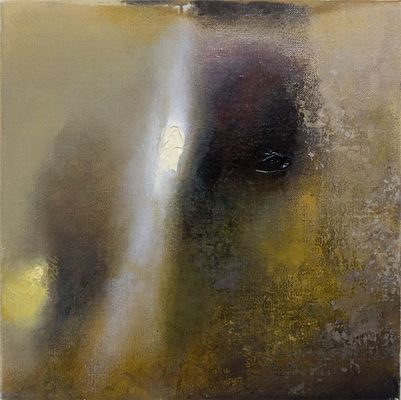
I am not a great reader of poetry but I always return to the work of Melbourne poet, Vincent Buckley (1925- 1988). Perhaps I find his most tantalising piece to be not a finished poem but a fragment left on a scrap of paper discovered on his desk after the poet’s death.
The poetry gathers like oil
In the word-core, and spreads
It has its music meet,
Its music is in movement.
This fragment is more the shell left behind from a volatile thought than a finished poem. I find the last two lines honest but awkward whereas the first two lines work like an arrow. Most likely he could not find a resolution so it was left. Still, in its present form, it remains an eloquent testimony to the ultimate failure of a medium to express mobile thought and sensation, in Buckley’s case, through verbal language. It’s an important matter because this is something all artists have to deal with regardless of the medium.
I have never written a poem, however, I am forever copying fragments from books on paper scraps in a vain effort to fix certain notions in my head. At first, they function as bookmarks that are sometimes returned to when I open the book. But before long, as they accumulate, they fall out littering the table interspersed with A4 photocopies, bills, books and medications.
To return to Buckley’s fragment, the first two lines very much evoke how I paint nowadays. As you age, detail diminishes and patches of light become more luminous and float. I feel the most honest way of dealing with this is by smearing the oil paint on the canvas with the fingers and working close-up, blind. Only if the patches coalesce into an approaching image can the work gain a life.
-
Jonathan Walker was born in Melbourne, Australia and brought up on a dairy farm in Gippsland. In the 1970’s he studied painting at RMIT and won the Harold Wright Scholarship to the British Museum, London. During the 1980’s he exhibited at Pinacotheca Gallery, Richmond and had work shown at the NGV and Heidi City Art Gallery. Over the same period he designed the cover for the “Epigenesi” LP by Giancarlo Toniutti, Italy and conducted a mail exchange work with Achim Wollscheid, Germany. The work with artists through the post resulted in an article published in the bicentenary issue of Art and Australia 1988. He showed in artist run spaces such as WestSpace in the 90’s and 2000’s, and until 2012, taught painting at Victoria University, which is where we (Colleen Ahern and Lisa Radford) as organisers of the exhibition, among many others, had the privilege of being his student.
Walker’s knowledge was imparted to students through the careful selection of music, literature, and artists found in books that he himself had ordered for the library. Walker’s strategy was the generosity of sharing his vast knowledge with references specific to each student and their context.
Walker’s paintings share a similar focus and intimacy.
This exhibition presents a small selection of recent paintings alongside a publication that includes Walker’s writing. Observational and analytical, Walker’s work is a type of material notation — the time of day, colour and how it is blended, the both specific and fleeting location of a reflection on lino or the question of whether a chair leg should be included in a painting.
Please join us on Friday August 21 between 6-8pm to celebrate the opening of the exhibition.
Curated by Colleen Ahern and Lisa Radford.
B. Wurtz
Curated by Nic Tammens
March 26 - April 4, 2015
B.Wurtz works from a basement studio in his home on Manhattan’s Lower East Side.
This local fact is attested to by the plastic shopping bags and newsprint circulars that appear in his work. As formal objects, they don’t make loud claims about their origins but nonetheless transmit street addresses and places of business from the bottom of this long thin island. Like plenty of artists, Wurtz is affected by what is local and what is consumed. His work is underpinned by this ethic. It often speaks from a neighborhood or reads like the contents of a hamper:
“BLACK PLUMS $1.29 lb.”
“Food Bazaar”
“USDA Whole Pork Shoulder Picnic 99c lb.”
“RITE AID Pharmacy, with us it’s personal.”
“H. Brickman & Sons.”
“Sweet Yams 59c lb."
Most of the work in this exhibition was made while the artist was in residence at Dieu Donne, a workshop dedicated to paper craft in Midtown. Here Wurtz fabricated assemblages with paper and objects that are relatively lightweight, with the intention that they would be easily transportable to Australia. This consideration isn’t absolute in Wurtz’s work, but was prescriptive for making the current exhibition light and cheap. Packed in two boxes, these works were sent from a USPS post office on the Lower East Side and delivered to North Melbourne by Australia Post.
Wurtz appears courtesy of Metro Pictures, New York.
Thanks to Rob Halverson, Joshua Petherick, Sari de Mallory, Matt Hinkley, Helen Johnson, Fayen d'Evie, Ask Kilmartin, Lisa Radon, Ellena Savage, Yale Union, and "Elizabeth".
John Nixon
"Archive"
December 15 - January 20, 2014
The presentation of John Nixon's archive offered a rare showcase of this extensive collection of the artist's own publications, catalogues, posters, ephemera, editions and more, from the mid 1980s onwards, alongside a selection of his artworks.
Organized by John Nixon, Joshua Petherick and Matt Hinkley.
<a href=http://wfb.public-office.info/artist/john-nixon>All titles by John Nixon
"Habitat"
at Minerva, Sydney (organised by Joshua Petherick and Matt Hinkley)
November 15 - December 20, 2014
Lupo Borgonovo, Janet Burchill & Jennifer McCamley,
Lewis Fidock, HR Giger, Piero Gilardi, Veit Laurent Kurz,
Cinzia Ruggeri, Michael E. Smith, Lucie Stahl, Daniel Weil, Wols
Press Release:
“...It contained seven objects. The slender fluted bone, surely formed for flight, surely from the wing of some large bird. Three archaic circuitboards, faced with mazes of gold. A smooth white sphere of baked clay. An age-blackened fragment of lace. A fingerlength segment of what she assumed was bone from a human wrist, grayish white, inset smoothly with the silicon shaft of a small instrument that must once have ridden flush with the surface of the skin - but the thing’s face was seared and blackened.”
William Gibson, “Count Zero”, 1986
"Autumn Projects Archive"
Curated by Liza Vasiliou
March 6 - March 15, 2014
World Food Books, in conjunction with the Virgin Australia Melbourne Fashion Festival 2014, presented the Autumn Projects archive, consisting of a selection of early examples in Australian fashion with a particular interest in collecting designers and labels from the period beginning in the 1980’s, who significantly influenced the discourse of Australian Fashion.
Curated by Liza Vasiliou, the exhibition provided a unique opportunity to view pieces by designers Anthea Crawford, Barbara Vandenberg, Geoff Liddell and labels CR Australia, Covers, Jag along with early experimental collage pieces by Prue Acton and Sally Browne’s ‘Fragments’ collection, suspended throughout the functioning World Food Books shop in Melbourne.
H.B. Peace
presented by CENTRE FOR STYLE
November 14, 2013
"Hey Blinky, you say chic, I say same"
Anon 2013
H.B. Peace is a clothing collaboration between great friends Blake Barns and Hugh Egan Westland. Their pieces explore the divergences between 'character’ and ‘personality’ in garments....etc
Special Thanks to Joshua Petherick and Matt Hinkley of WFB and Gillian Mears
and a Very Special Thank you to Audrey Thomas Hayes for her shoe collaboration.
Janet Burchill & Jennifer McCamley
"Aesthetic Suicide"
May 10 - June 8, 2013
The first of our occasional exhibitions in the World Food Books office/shop space in Melbourne, "Aesthetic Suicide" presented a body of new and older works together by artists Janet Burchill & Jennifer McCamley, including videos, prints, a wall work, and publications.
During shop open hours videos played every hour, on the hour.
1996, English
Softcover, 64 pages, 23 x 30 cm
1st Edition, Out of print title / used / very good
Published by
The Power Plant / Canada
$240.00 - Out of stock
The rare, excellent and infamous catalogue documenting the 1996 Canadian exhibition entitled "The American Trip". Organized by curator Philip Monk, "The American Trip looks at the continuing fascination of artists with the margins of American society. The exhibition is devoted to the persistence of the “theme of the outlaw” in the works of the contemporary artists Larry Clark, Nan Goldin, Cady Noland, and Richard Prince." This very substantial four person show was particularly notable as it represents one of Cady Noland's final authorized exhibitions before calculatedly withdrawing from the gallery and Museum system at the turn of the Century. Despite the fact that Cady Noland is increasingly seen as one of the most influential American artists of the period, there are no monographs on her work. This catalogue is one of the few books to include a critical text specific to Noland or to reproduce a significant number of works at the time, including her iconic contribution to the exhibition of nine free standing ink-on-aluminum pieces featuring imagery of Lee Harvey Oswald, Patty "Tanya" Hearst, and The Charles Manson Family. Additionally notable about the publication is that due to potential legal issues surrounding some of the Larry Clark photographs, the Power Plant was forced to obscure them by permanently glueing facing pages 20 and 21 together as an alternative to destroying the entire print run. A publisher's slip inserted declares: Due to legal issues, pages 20-21 have been permanently sealed. Profusely illustrated throughout with the works of all the artists (many unsealed, uncensored Clark photographs, Richard Prince's biker chicks series, Goldin's NY transgender photographs, et al) along with accompanying essay by Monk on American culture's fascination with the outlaw, outcasts, and margins of society. It recognizes the role artists have played in the dialogue between the mainstream and margins in normalizing the image of the outcast. The title refers to a constant theme in American cultural dynamics of the rejection of family and reformation of community, now expressed in the subcultures of the margins. What starts as a celebration by artists, is appropriated by the mainstream media and ends as a panic in the press. Nowhere is the fear greater than in the heart of the American family that the enemy is within and that the kids are not "alright." The images of individuals in the exhibition show them not to be traditional outlaws. They are, as the artists celebrate, the girl-or boy-next door.
Very Good copy.
2000, Japanese / English
Hardcover (w. dust jacket) in slipcase, 27.5 x 19.5 cm
1st Edition, Out of print title / used / fine
Published by
Taiyo books / Japan
$790.00 - Out of stock
Super rare, very collectible Namio Harukawa oversized hardcover art book, published in Japan in 2000 and long out-of-print. This deluxe art book is considered the first book devoted entirely to Harukawa's "Paradise under the grand hips" — his iconic big-girl-love-femdom-facesitting illustrations. Beautifully produced and lavishly illustrated heavy book full of the exceptional work of Namio Harukawa (1947—2020), a pseudonymous Japanese fetish artist best known for his masterful pencil works depicting female domination ("femdom"), with erotic asphyxiation through facesitting appearing as a frequent subject of his art. As well as an impeccably reproduced collection of Harukawa's works in full-bleed colour, the book features Harukawa's complete illustrated "lewd love story of a noble lady and a beast", a collection of many of his best known works beautifully reproduced alongside sado-masochist narratives. A stunning book and must for any Harukawa fan.
Namio Harukawa (1947—2020), a pseudonymous Japanese fetish artist best known for his masterful pencil works depicting female domination ("femdom"), with erotic asphyxiation through facesitting appearing as a frequent subject of his art. Born 1947 in Osaka, Japan, Harukawa’s distinctive penname combines the name of film actress Harukawa Masumi with an anagram of Naomi, the sadistic heroine in Tanizaki Jun’ichiro’s novel "Chijin no ai / A Fool’s Love". While in high school, Harukawa began contributing work to the readers’ column of leading postwar Japanese SM pulp magazine "Kitan Club". Since then, Harukawa’s drawings of male masochism have lovingly portrayed noble, voluptuously beautiful women and the men who serve them as human furniture. An extraordinary and prolific artist who remained committed to the regime of “absolute Ganmen Kijo Shugi (facesitting principle)” throughout his artistic life, Namio Harukawa passed away on April 2020, he was 72 years old.
Fine copy in original illustrated, gold foiled Near Fine dust jacket and Near Fine slipcase, only light wear. Hardcovers also illustrated. A well-preserved copy.
2023, English
Hardcover, 208 pages, 25.4 x 17.8 cm
Published by
DelMonico Books / US
Academy Museum of Motion Pictures / Los Angeles
$85.00 - Out of stock
French filmmaker Agnès Varda was a trailblazer who broke new artistic and cinematic ground for nearly seven decades. Although closely associated with the French New Wave, Varda established her groundbreaking visual style in her 1955 debut film La Pointe Courte, well before other milestone productions of the era. This title presents the first English-language visual showcase for Varda’s inspirations, art and personal life, incorporating original materials from her personal archive.Varda impacted cinema from her first feature film through her final works, with an expansive oeuvre that includes Cleo from 5 to 7 (1962), Vagabond (1985) and the Academy Award–nominated Faces Places (2017). The book covers Varda’s “three lives”—as photographer, filmmaker and visual artist—and features a previously unpublished interview Varda gave to the Academy of Motion Picture Arts and Sciences on the eve of receiving her Honorary Oscar in 2017. Essays by author Sasha Archibald and film critic Peter Debruge examine facets of Varda’s creative lives, and personal reflections by friends and colleagues illustrate what it was like to collaborate with and be inspired by Varda.
Agnès Varda (1928–2019) was a French filmmaker, photographer and visual artist, sometimes called the grandmother of the French New Wave. In 2018, her film with the French photographer and muralist known as JR, Faces Places, received an Academy Award nomination for Best Documentary Feature, and that same year she received an honorary Academy Award for lifetime achievement.
1961, French
Hardcover, 144 pages, 22.5 x 15 cm
1st Edition, Out of print title / used / good
Published by
Editions du Tempes / Paris
$200.00 - Out of stock
First edition of this wonderful, very scarce, delicate photobook by French film director Agnès Varda. Following Varda’s short documentary film ‘Du côté de la côte’ in 1958, this unique hardcover book comprises Varda's own photographs, film stills, texts (including quotes from Giradoux, Nietzsche, Dante, Zola, Colette, Apollinaire, and Flaubert) and found archival/historical material of the French Riviera (or Côte d'Azur) - the Mediterranean coast of southeastern France. This charming travelog photo album feels somewhat like a successor to her friend Chris Marker’s wonderful ‘Petite Planète’ series of travel guides from around the same time and perfectly reflects Varda's poignant social commentary and humour through documentary.
Very good copy of this beautiful book (light corner bumping, fragile cloth binding - most copies of this book have detached and lost pages, this copy is still intact but with some looseness and must be handled carefully).
Agnès Varda is a French film director, born in Belgium, who has spent most of her working life in France. Her films, photographs, and art exhibitions focus on documentary realism, feminist issues, and social commentary with a distinctive experimental style. Film historians have cited Varda's work as central to the development of the French New Wave film movement; her uses of location shooting and non-professional actors were unconventional in the context of 1950s French cinema.
1977, French
Hardcover (w. dust jacket), 340 pages, 28.5 X 34 cm
1st Edition, Out of print title / used / very good
Published by
Albin Michel / Paris
$200.00 - Out of stock
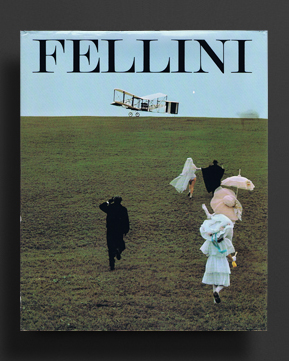
First edition of the one and only Fellini photo book.
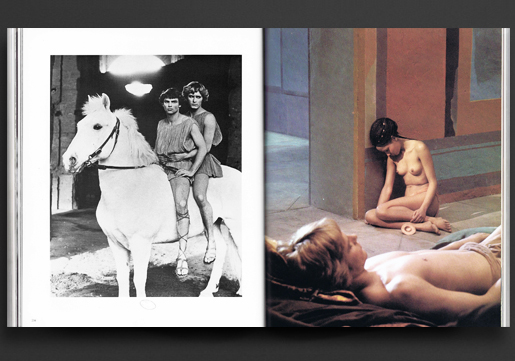
Published in Paris in 1977, this beautifully produced, heavy 340-page hardcover volume visually captures the exquisite vision of Italian film director and screenwriter, Federico Fellini, through four hundred memorable photographic stills (colour and black and white) from his fifteen and a half films, including La Dolce Vita (1960), 8½ (1963), Juliet of the Spirits (1965), Fellini's Satyricon (1969), Amarcord (1973), Fellini's Casanova (1976), and many more. Every major Fellini film is documented in these pages of lush images, accompanied by full cast listings, production details, and summaries and forwards written by Georges Simenon.
A must for any Fellini fan.
2012, English / Japanese
Softcover (w. dust jacket + obi), 169 pages, 21 x 14.5 cm
Signed by Namio Harukawa,
1st Edition, Out of print title / used / very good
Published by
Pot Publishing / Japan
$440.00 - Out of stock
Signed copy of the first edition of (the last?) of Namio Harukawa's illustrated story books, Garden of Domina, published in Japan in 2012. A bilingual (Japanese / English) story illustrated by 80 new femdom artworks rendered by Harukawa. "A gorgeous gluteus, a bounteous bottom, a robust rump, even an ample ass: there are many ways to describe the pleasures of the oshiri (pronounced o-shee-ree.) In Harukawa Namio's delicately conceived drawings and their accompanying story, there emerges a holy bond of lust and love between cosmetics company president Ohara Kana and the men who would serve her. Kana loves to abuse men with her tremendous buttocks, and they explore the cruel joys found beneath her stunning endowment. Eventually, Kana creates a Garden of Paradise where she, her fellow lusty ladies, and their slaves discover the most exquisite ecstasies of the ass. A leading Japanese SM illustrator who has dedicated his oeuvre to the glories of the glories of the glories of the glories of the glories of the ass, Namio Harukawa both amuses and arouses his reader in this charming tale."
Signed by Namio Harukawa in bold metallic ink to title page.
Sample of a story: "Yoshiko liberated Horoshi from her oshiri and fastened him by his two hands to a post in the room. 'It's so sweet you're crying. I'll make you cry some more.' Completely naked, Yoshiko straddled Horoshi from above and pressed her genitals into his face. A slender man, Horoshi arched backwards like a bow...."
Namio Harukawa (1947—2020), a pseudonymous Japanese fetish artist best known for his masterful pencil works depicting female domination ("femdom"), with erotic asphyxiation through facesitting appearing as a frequent subject of his art. Born 1947 in Osaka, Japan, Harukawa’s distinctive penname combines the name of film actress Harukawa Masumi with an anagram of Naomi, the sadistic heroine in Tanizaki Jun’ichiro’s novel "Chijin no ai / A Fool’s Love". While in high school, Harukawa began contributing work to the readers’ column of leading postwar Japanese SM pulp magazine "Kitan Club". Since then, Harukawa’s drawings of male masochism have lovingly portrayed noble, voluptuously beautiful women and the men who serve them as human furniture. An extraordinary and prolific artist who remained committed to the regime of “absolute Ganmen Kijo Shugi (facesitting principle)” throughout his artistic life, Namio Harukawa passed away on April 2020, he was 72 years old.
Very good—Near Fine with dust jacket and obi, Sgned by Namio Harukawa!
2020, English
Softcover, 200 pages, 20.5 x 13.5 cm
Published by
Semiotext(e) / Los Angeles
$34.00 - In stock -
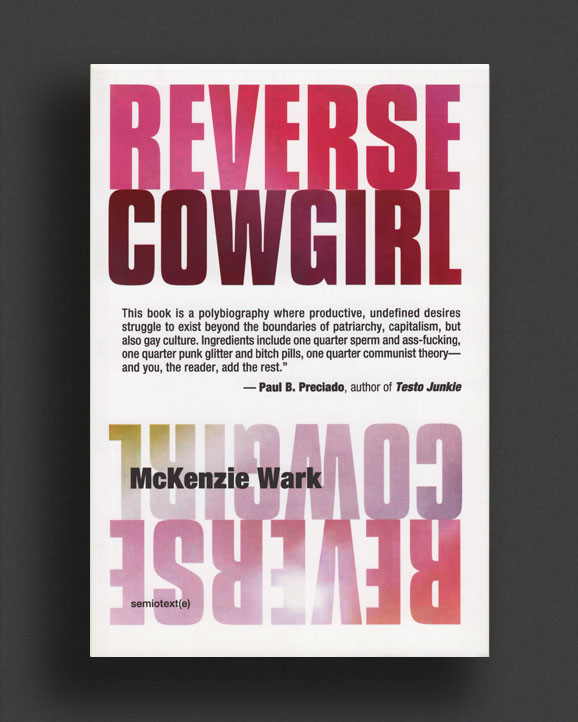
McKenzie Wark invents a new genre for another gender: not a memoir but an auto-ethnography of the opacity of the self.
Another genre for another gender.
What if you were trans and didn't know it? What if there were some hole in your life and you didn't even know it was there? What if you went through life not knowing why you only felt at home in your body at peak moments of drugs and sex? What if you expended your days avoiding an absence, a hole in being? Reverse Cowgirl is not exactly a memoir. The author doesn't, in the end, have any answers as to who she really is or was, although maybe she figures out what she could become.
Traveling from Sydney in the 1980s to New York today, Reverse Cowgirl is a comedy of errors, chronicling the author's failed attempts at being gay and at being straight across the shifting political and media landscapes of the late twentieth century. Finding that the established narratives of being transgender don't seem to apply to her, Wark borrows from the genres of autofiction, fictocriticism, and new narrative to create a writing practice that can discover the form of a life outside existing accounts of trans experience: an auto-ethnography of the opacity of the self.
2023, English
Softcover, 160 pages, 15 x 20 cm
Published by
Exact Change / Boston
$30.00 - Out of stock
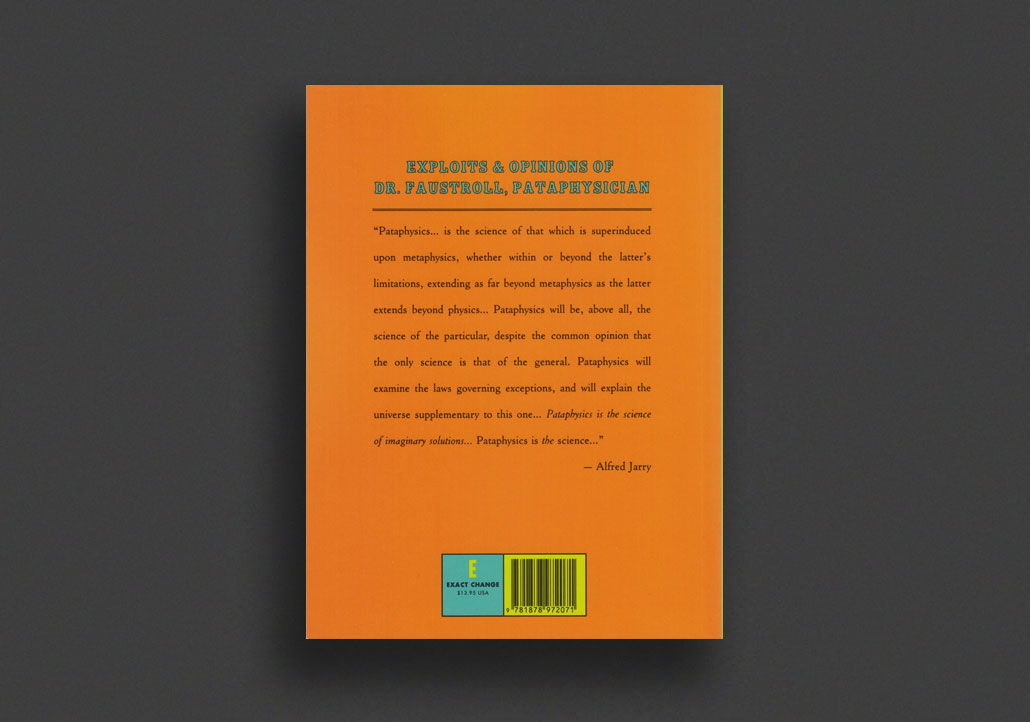
Jarry is best known as the author of the proto-Dada play Ubu Roi, but this anarchic novel of absurdist philosophy is widely regarded as the central work to his oeuvre. Written in 1898 and refused for publication in the author’s lifetime, Exploits and Opinions of Dr. Faustroll recounts the adventures of the inventor of ” ’Pataphysics… the science of imaginary solutions.” ’Pataphysics has since inspired artists as diverse as Marcel Duchamp and the ’60s rock band Soft Machine, as well as the mythic literary organization, the Collège de ’Pataphysique. Simon Watson Taylor’s superb annotated translation (which in turn inspired a new French edition of the text) was first published by Grove Press in 1965 as part of their now out-of-print collection, Selected Works of Alfred Jarry. As a result this most important novel by Jarry has never before been published under its own title in English.
“The complement to the Ubu plays… a stupendous effort to create out of the ruins Ubu had left behind a new system of values… Jarry would have found an audience more readily had he written simply a work of science fiction, a symbolist narrative, a bawdy tale, or a spiritual allegory. As it is, Faustroll is [all of these] at the same time”—Roger Shattuck, author of The Banquet Years
2023, English
Hardcover, 160 pages, 22.9 x 14.6 cm
Published by
Art issues Press / Los Angeles
$58.00 - In stock -
"If this book of shocking intelligence and moral hope is read widely and above all well, word for word, it will help the world."—Peter Schjeldahl
An expanded edition of Hickey's controversial and exquisitely written apologia for beauty—championed by artists, reviled by art critics, and as powerful as ever 30 years on.
The 30th anniversary cloth edition brings back into print Dragon's four essays on beauty and commingles them with newly discovered essays by the MacArthur Foundation "genius." Art by Caravaggio, Bellini, Velázquez, Raphael, Warhol and Mapplethorpe is complemented by Hickey's tributes to Dolly Parton and Richard Pryor, outing of John Rechy's gay novel Numbers, essays on the art of writing and witty analysis of paintings by Ed Ruscha. An afterword by Hickey's friend and Dragon's editor queers the brash, heterosexual gambler as it situates the creation of Dragon squarely within the AIDS plague. At the time, the book made beauty visible under the looming presence of death and bodily decay. Today, Hickey's prescient diagnosis of the "therapeutic institution" resonates even louder and artists respond by harnessing beauty as a source of meaning and of joy.
Dave Hickey (1938-2021) was one of the preeminent arts and cultural writers of the turn of the 21st century. A MacArthur "Genius" Fellow known as the "beauty guy" in the popular press, Hickey opened A Clean, Well-Lighted Place gallery in Austin, Texas, in the 1960s, before becoming executive editor at Art in America magazine. In the 1970s, he was a songwriter in Nashville, Tennessee, where he coined and helped create the "Outlaw country" music movement. By the 1990s, Hickey had made a home in Las Vegas, from where he regularly traveled to speak with audiences worldwide.
1997, English
Softcover, 224 pages, 15 x 23 cm
Published by
Art issues Press / Los Angeles
$40.00 - Out of stock
"Compared to enjoying Dave Hickey—who writes like a Raymond Chandler blessed with Giovanni Morelli's eye—reading any other art critic (and I mean any other art critic) is like doing your taxes'." — Peter Plagens
David Hickey (1938—2021), nicknamed "The Bad Boy of Art Criticism" and "The Enfant Terrible of Art Criticism", was a prolific American art critic and professor who wrote for many American publications including Artforum, Art in America, frieze, Parkett, Interview, The London Review of Books, ARTnews, Harper's Magazine, Vanity Fair, Rolling Stone, Nest, The New York Times, the Los Angeles Times, and many more.
Air Guitar is Dave Hickey's "memoir without tears"—23 essays or "love songs", a journey through the vernacular cultural landscape of the United States in the second half of the twentieth century. Looking back from the vantage-point of his adopted hometown of Las Vegas, Hickey speculates on everything from jazz and rock-and-roll to basketball and professional wrestling—from magic and psychedelia to gambling and the culture of "little stores"—from automotive design to series television to Saturday-morning cartoons. The emphasis in these 23 essays is on the way the arts function in the drift of everyday life, outside the venues of official culture, and on singular "lives in the arts," lived outside those venues, with meditations on the careers of Liberace, Hank Williams, Chet Baker, Andy Warhol, Johnny Mercer, Norman Rockwell, magicians Siegfried & Roy, and wrestler Lady Godiva. Underlying Hickey's writing is an abiding belief that cultural life in a democracy can (and occasionally does) function in a democratic manner, sustained by the whims of affection and the commerce of opinion.
2023, English
Softcover, 408 pages, 20 x 14 cm
Published by
Semiotext(e) / Los Angeles
$38.00 - Out of stock
The early writings of renowned poet and critical theorist Jackie Wang, drawn from her early zines, indie-lit crit, and prolific early 2000s blog.
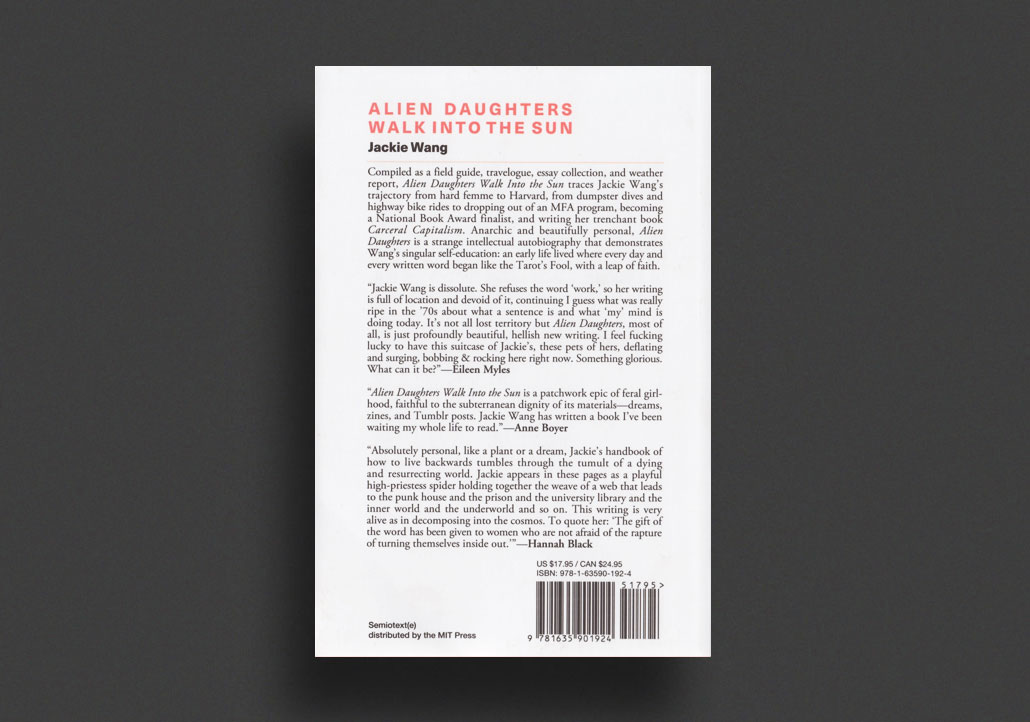
Compiled as a field guide, travelogue, essay collection, and weather report, Alien Daughters Walk into the Sun traces Jackie Wang's trajectory from hard femme to Harvard, from dumpster dives and highway bike rides to dropping out of an MFA program, becoming a National Book Award finalist, and writing her trenchant book Carceral Capitalism. Alien Daughters charts the dream-seeking misadventures of an "odd girl" from Florida who emerged from punk houses and early Tumblr to become the powerful writer she is today. Anarchic and beautifully personal, Alien Daughters is a strange intellectual autobiography that demonstrates Wang's singular self-education- an early life lived where every day and every written word began like the Tarot's Fool, with a leap of faith.
"Jackie Wang is dissolute. She refuses the word "work" so her writing is full of location and devoid of it, continuing I guess what was really ripe in the '70s about what a sentence is and what "my" mind is doing today. It's not all lost territory but Alien Daughters, most of all, is just profoundly beautiful, hellish new writing. I feel fucking lucky to have this suitcase of Jackie's, these pets of hers, deflating and surging, bobbing & rocking here right now. Something glorious. What can it be?"—Eileen Myles
"Alien Daughters Walk Into the Sun is a patchwork epic of feral girlhood, faithful to the subterranean dignity of its materials—dreams, zines, and Tumblr posts. Jackie Wang has written a book I've been waiting my whole life to read."—Anne Boyer
"Absolutely personal, like a plant or a dream, Jackie's handbook of how to live backwards tumbles through the tumult of a dying and resurrecting world. Jackie appears in these pages as a playful high-priestess spider holding together the weave of a web that leads to the punk house and the prison and the university library and the inner world and the underworld and so on. This writing is very alive as in decomposing into the cosmos. To quote her: “the gift of the word has been given to women who are not afraid of the rapture of turning themselves inside out."—Hannah Black
Jackie Wang is a poet, scholar, multimedia artist, and Assistant Professor of American Studies and Ethnicity at the University of Southern California. She is the author of the poetry collection The Sunflower Cast a Spell to Save Us from the Void (2021), which was a finalist for the National Book Award; the critical essay collection Carceral Capitalism (Semiotext(e), 2018); and the chapbooks The Twitter Hive Mind Is Dreaming (2018) and Tiny Spelunker of the Oneiro-Womb (2016). Her research is on racial capitalism, surveillance technology, and the political economy of prisons and police.
2023, English
Softcover, 184 pages, 23 x 31 cm
Published by
Bill / Brussels
$92.00 - Out of stock
‘Bill’ is annual magazine of photographic stories without any accompanying text to prioritise visual reading without distraction. Designed, edited, and produced by designer Julie Peeters and associate editor Elena Narbutaite, this issue contains 184 offset printed pages on thirteen different paper stocks. Contributions for this issue include George Tourkovasilis, Cinzia Ruggeri through the lenses of Ilvio Gallo and Occhiomagico, SC103’s first runway, Inge Grognard, Adrianna Glaviano, the contact sheets of Santi Caleca, Rosalind Nashashibi, as well as magazine spreads from Anders Edström, Curtis Cuffie, and Hans Hollein.
2023, English
Softcover, 180 pages, 12 x 19 cm
Published by
Uh Books / Amsterdam
KW Institute for Contemporary Art / Berlin
$25.00 - In stock -
Riffing off the title, this volume includes Catherine Damman interviewing Carolyn Lazard – an artist whose conceptual and often spare videos, sculptures, installations, and performances explore the full amplitude of relation, in addition a feature on contemporary artist Tishan Hsu, whose practice examines the “embodiment of technology”, plus contributions by time-based media artist Silvia Kolbowski, for whom political resistance, the unconscious, and structures of spectatorship are a central concern of all her projects; choreographer and dancer Yvonne Rainer; and science fiction author Octavia Butler. [...] Lee Lozano, Sturtevant, Margarethe Raspé, Jef Geys, Martin Wong, Bernadette Mayer, Louise Lawler, Sarah Rapson, Ketty La Rocca, Stanley Brouwn, Lutz Bacher, Hanne Darboven, Pope L., Silvia Kolbowski, Ilmari Kalkkinen, Henrik Olesen, Otto Wagner...
1989, Japanese / English
Softcover, 72 pages, 31 x 29 cm
Signed by Sarah Moon,
1st Edition, Out of print title / used / good
Published by
PPS Telecommunications Company / Tokyo
$180.00 - Out of stock
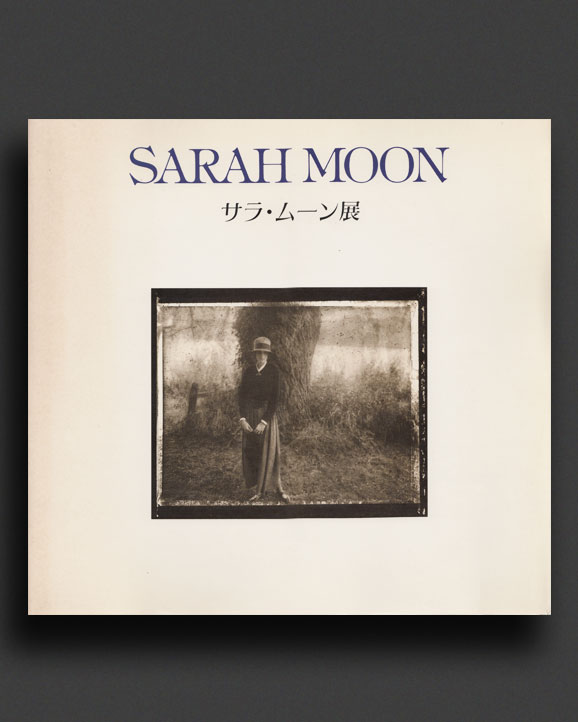
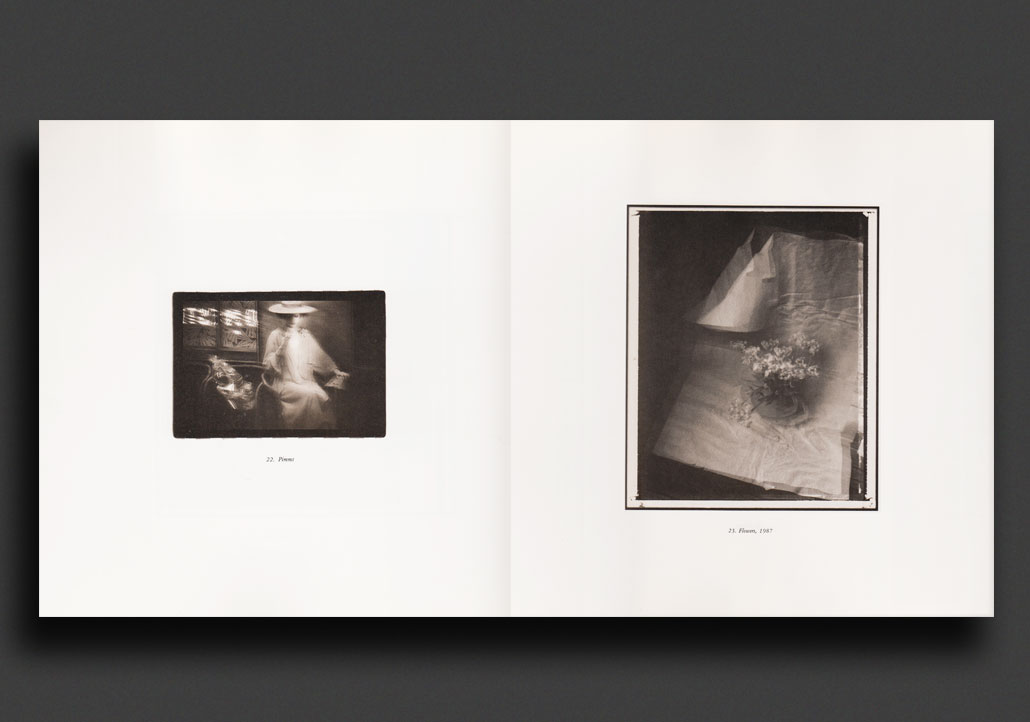
Gorgeous signed copy of this out-of-print over-sized Japanese Sarah Moon exhibition catalogue published in 1989 by Pacific Press Service, at the Photographic Society of Japan for an exhibition at Printemps Ginza in Tokyo and Daimaru Museum Umeda in Osaka. Profusely illustrated throughout with the French photographer's works for fashion, editorial and advertising, as well her personal collections, travel photography and studies, including her iconic work for Comme des Garçons, Cacharel, Vogue, Nova, Harper's Bazaar, Marie Claire, L'Oreal, Elle and more. Includes texts by Kazutaka Narahara, Shunji Ito and French photographer Frank Horvat. This scarce, collectible copy is signed by Sarah Moon herself on the lower title page in elegant marker script "Sarah Moon -".
Sarah Moon is a photographer born in 1941 in Vichy, France. Her Jewish family was forced to leave occupied France for England. As a teenager she studied drawing before working as a model in London and Paris (1960–1966) under the name Marielle Hadengue. She also became interested in photography, taking shots of her model colleagues. In 1970, she finally decided to spend all her time on photography rather than modelling, adopting Sarah Moon as her new name. In 1972, she shot the Pirelli calendar, the first woman to do so. After working for a long time with Cacharel, her reputation grew and she also received commissions from Chanel, Dior, Comme des Garçons and Vogue. In 1985, Moon moved into gallery and film work.
Good -VG copy with some general tanning to cover/edges and light general wear.
1979, Japanese
Hardcover (w. dust jacket), 120 pages, 30 x 21.5 cm
1st Edition, Out of print title / used / good
Published by
Haga Bookstore / Japan
$100.00 - In stock -
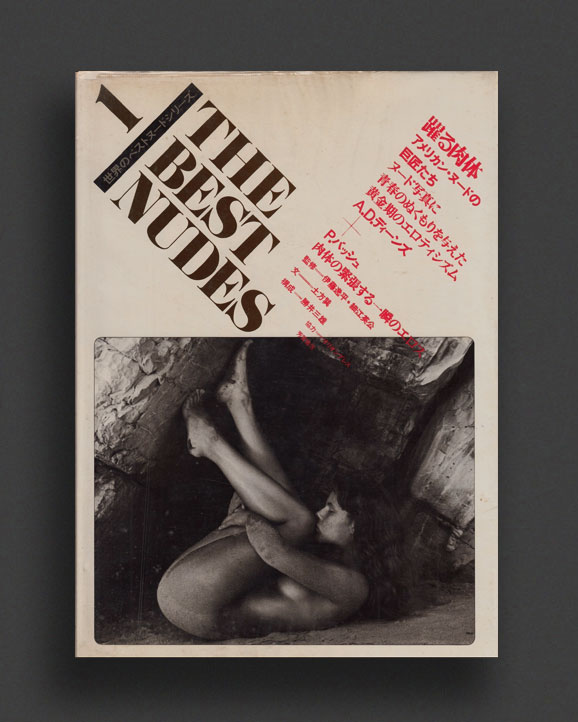
First volume of The Best Nudes hardcover photo book series published between 1979—1982 by the mighty Haga bookstore in Tokyo. This fist volume lavishly reproduces the celebrated nude works of Hungarian photographer Andor György Ikafalvi-Dienes, known as André de Dienes (1913—1985), and innovative German—American glamour photographer Peter Basch (1921—2004).
Good copy with original publisher's printed acetate jacket. Wear and light chipping to jacket, shelf rubbing to book base.
1979, Japanese
Hardcover (w. dust jacket), 120 pages, 30 x 21.5 cm
1st Edition, Out of print title / used / very good
Published by
Haga Bookstore / Japan
$140.00 - Out of stock
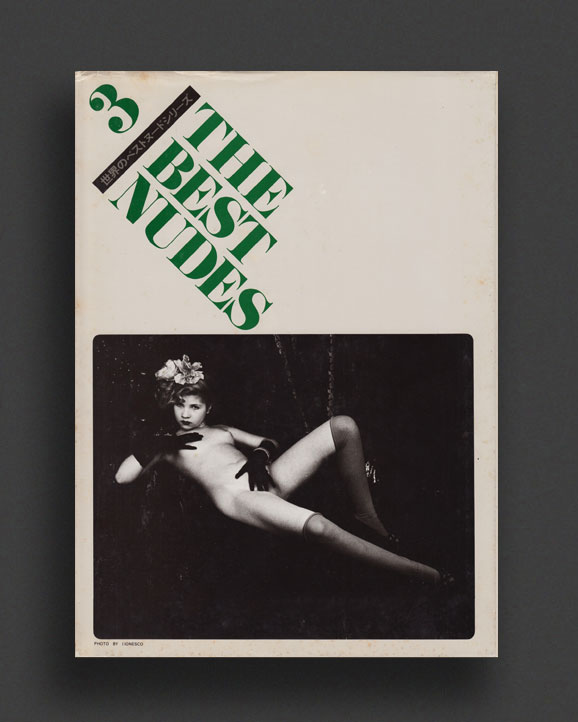
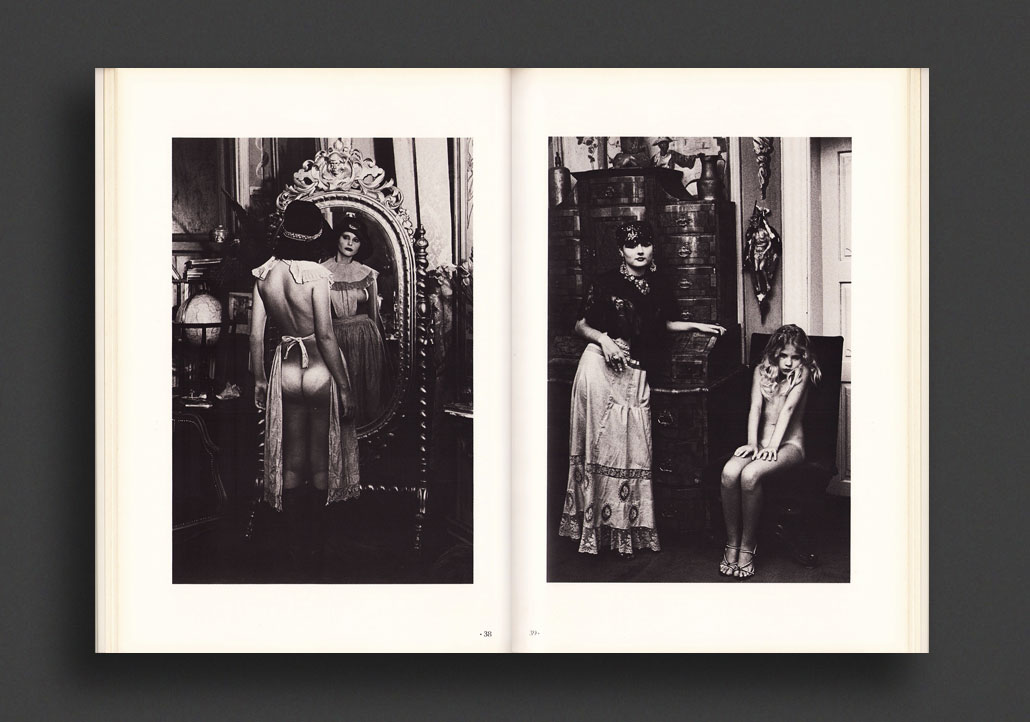
Volume 3 (the most sought after) of The Best Nudes hardcover photo book series published between 1979—1982 by the mighty Haga bookstore in Tokyo. This third volume lavishly reproduces in b/w and colour the celebrated nude works of French photographer Irina Ionesco (1930—2022) and German photographer Karin Szekessy (b. 1938). Both important European female photographers became prominent in the 1970s for their evocative, surreal painterly nude portraiture of women (and dolls). A beautiful collection of ethereal fantasies imbued with Ionesco's gothic provocations and Szekessy's arresting experimentation.
Very Good copy lacking publisher's printed acetate jacket. Light wear to dust jacket.
2023, English
Softcover, 200 pages, 21.6 x 15.2 cm
Published by
The Song Cave / New York
$55.00 - In stock -
Mystical and everyday reveries from the visionary American modernist.
In the early years of the 20th century, Charles Burchfield painted mystic and visionary landscapes, and with some of his contemporaries, including Edward Hopper, Georgia O'Keeffe and Grant Wood, can be seen to have built the foundations of a particularly North American sensibility that critic Dave Hickey said "continues to evoke an unrepentant, gnostic vision of this vast, rolling, abandoned continent—America without Europe—America without Americans—a massive, alluring kingdom."
For nearly his entire life, Burchfield also kept a journal. Over 54 years, he filled nearly 10,000 pages. To call this journal epic would be an understatement. A masterpiece whose bulk has remained unread, it is a handwritten tome that combines elements of the American nature journal with a dash of 19th-century spiritual autobiography. It is a record of a man who spent much of his life looking at and considering the sky.
In this comparatively small selection pulled from the original 62 volumes, we find Burchfield writing about sitting in the grass with his wife to nap and watch the sunset. He writes about the elation he feels at seeing the first flowers in the spring. He writes about the rain, wind and sun. There's the resentment of having a job; the depression that sneaks in as he gets older; sometimes, too, he writes about the state of human progress; and occasionally, thoughts about God. It is the tender record of a life devoted to the essences of earthly beauty.
"Burchfield would be proud"—Robert Gober
Best known for his romantic, often fantastic depictions of nature, watercolorist Charles Burchfield (1893-1967) developed a unique style of watercolor painting that reflected distinctly American subjects and his profound respect for nature.
2024, English
Softcover, 272 pages, 21.6 x 14.6 cm
Published by
The New York Review of Books / New York
$34.00 - Out of stock
A moving story about love, AIDS, grief, and memory by one of the most adventurous writers to come out of San Francisco's LGBTQ+ scene.
“I was a writer, but not the writer I needed to be. For that I had to become a different person,” Robert Glück, widely acclaimed as a novelist and as a theorist of “the new narrative,” recently told the Paris Review, in which a section of About Ed has appeared. About Ed is Glück’s portrait of the artist Ed Aulerich-Sugai, his sometime lover, met in the seventies in San Francisco, when gay life emerged unabashedly from the closet. “I wanted to find in Ed something to latch on to that was outside my egotism and fear, my threadbare relation to the world—a leap through Ed into lyric time,” Glück has said, and in this book that is both “a novel and my version of an AIDS memoir” he wanted to capture the full range of his feelings for Ed: “estranged from Ed, bored by him, moved by him.”
It is a book about the life they lived together—art and writing and family and sex and death—and, composed over many decades, it is also a book about how the past continues to change in memory and to charge the present. “What is the right question to ask about a life?” Glück asks, describing About Ed as a “collaborative project,” since “Ed helped me write this book.” Ed gave him “notes to fashion a chapter about the day he was diagnosed so I could describe his experience from the inside,” and “after Ed died, Daniel, Ed’s partner, lent me Ed’s dream journals. . . . He started writing them in 1970, the year that we met. We both used his journals, not as puzzles to solve the truth of a self but as a commons producing images that we harvested for paintings and poems. And fifty years later, there I was reading and copying out and running away from his dreams. Are they a condensed version of Ed? Shorthand? Distillation? Is he knowable and unknowable in the same degree sleeping or waking?”
About Ed is a challenging and beautiful book by one of America's finest and most adventurous writers.
2000, Japanese
Hardcover, 222 pages, 28 x 20 cm
1st Edition, Out of print title / used / fine
Published by
Oita City Art Museum / Oita
$160.00 - Out of stock
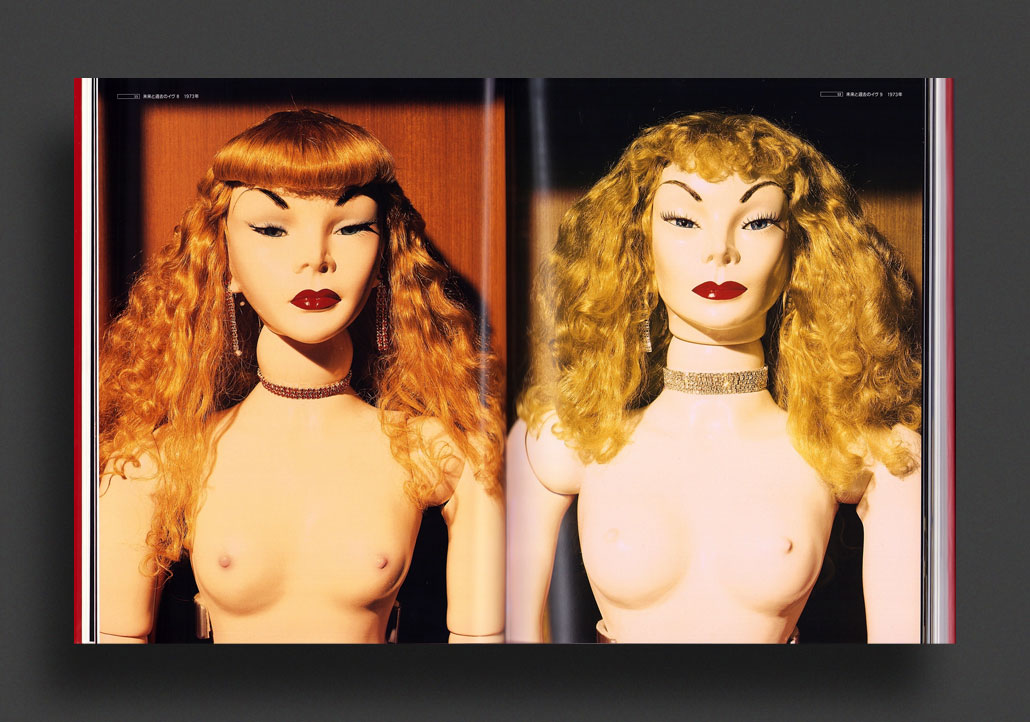
Scarce copy of the stunning hardcover survey of Japanese doll artist Simon Yotsuya, published on the occasion of a major retrospective that travelled Japan between 2000—2002. All the works of Simon Yotsuya are included, from his earliest examples to his latest works — his "Innocent Things: Young Boys and Girls," "Tempting Things: Women," "Automatic Things: Mechanical Devices," "Heavenly Things: Angels and Christ," "Creations of the Self: Simon," "Unfinished Things and Homage to Bellmer" — all beautifully photographed by Japan's leading photographers, including most by Simon's friend and master photographer Kishin Shinoyama, along with many photos of Simon Yotsuya in his parallel career as a female (doll) actor in the 1960s-70s Japanese avant-garde theatre scene. Along with essays, biography, bibliography, chronology, this comprehensive book includes important articles, magazines, and posters. A gorgeous book that will appeal to any fan. Despite his popularity in Japan, Simon Yotsuya's monographic books are surprisingly few in number.
Simon Yotsuya (b. 1944, Tokyo) started making dolls as a child, visiting exhibitions of dolls, and reads all the books he can find on the subject. In his mid-teens he visited Puppe Kawasaki, a doll maker and animator he greaty admired, devoting himself to the craft and becoming a poor high school student. In the early '60s, while working at a jazz coffee shop in Shinjuku, Yotsuya earned the nickname "Simon" (pronounced “Simone”), after his love for singer Nina Simone. He befriends Kuniyoshi Kaneko (painter) and Junko Koshino (fashion designer) and joins in the arts and literary scene. In 1965, he discovers the work of German Surrealist Hans Bellmer through an article authored by Tatsuhiko Shibusawa in the magazine “Shinfujin”, promptly abandoning his previous methods of doll-making to find his way as an artist, incorporating ball-joints into his dolls. Thereafter he becomes an admirer of Surrealism and immerses himself in the controversial Shibusawa's litterary works. In 1965, he also goes to see Tatsumi Hijikata's Butoh Performance for the first time. In the late 60s—early 70s Yotsuya pursued a parallel career to his doll-making as an actor and member of Juro Kara's legendary underground theater company Jokyo Gekijo, Situation Theater, regularly portraying a female doll. He appears in the movie "Diary of a Shinjuku Thief" directed by Nagisa Oshima with the actors of the Situation Theater, but by 1971 he leaves the stage to concentrate on his own work. Simon exhibited at Expo 1970 in Osaka, the Tokyo Biennale in 1974 and by the end of the decade had opened his own doll-making school in Harajuku.
Tatsuhiko Shibusawa (1928—1987), the author of the influential Bellmer article (and novelist, editor, art critic, and translator of Bataille and Marquis de Sade), become a life-long friend of Yotsuya's and his most important advocate, editing the first major book of Yotsuya's work, entitled Pygmalionisme, in 1985. Devastated by Shibusawa's death in 1987, Yotsuya found it impossible to work for nearly two years. He eventually found solace in the Eastern Orthodox Church and was inspired to make a series of angels, which he dedicated to Shibusawa, and straightforward images of Christ. Having carved out his own masterful and unique form of expression, today Yotsuya enjoys international renown as the first ball-jointed doll maker in Japan.
Very Good—Fine copy.
1968, English / German / French
Hardcover (cloth-bound), 166 pages, 22 x 28.5 cm
Out of print title / used / good
Published by
Studio Vista / London
$40.00 $20.00 - Out of stock
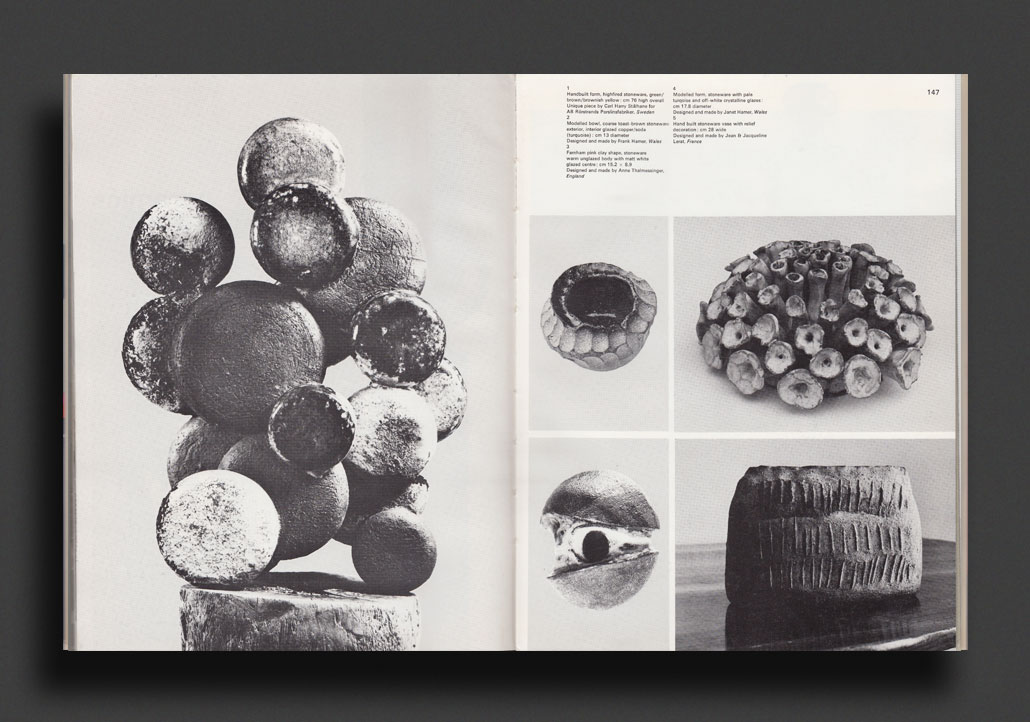
1967/68 edition of Decorative Art and Modern Interiors, one of the finest book series from Studio Vista (UK).
Each handsomely designed volume showcases a selection of the finest examples of new architecture, interior design, environmental design, textiles, furniture and product design, including profiles on highlighted architectural projects that are documented through beautiful colour and b&w photography, descriptive texts, and axonometric, plan and section drawings, plus "Trends in Furnishings and in the Decorative Arts", which gives fine examples of new design in furniture, lighting, ceramics, glassware, silverware, textiles, etc.
This 1967/68 edition includes work by architects, designers, manufacturers : Bruno Munari, Stig Lindberg, Sergio Asti, Enzo Mari, Gillian Lowndes, Raili Konttinen, Alexander Girard, Bent Severin, Sigurd Persson, Joe Colombo, Angelo Mangiarotti, Afra and Tobia Scarpa, Cassina, Emma Gismondi Schweinberger, Vico Magistretti, Eero Aarnio, Helmut Jacoby, George Ciancimino, Roberto Menghi, Rolf Middelboe, Jørn Utzon, Leo Venchiarutti, Lanfranco Bombelli, John C. Parkin, Esko Pajamies, Toivo Korhonen, Arflex, Raija Tuumi, Lucie Rie, Robert Welch, Arne Jacobsen, Børge Mogensen, Marco Zanuso, Claudio Salocchi, Cesare Casati, Tecno, Sormani, Gino Sarfatti, Robert Welch, Jo Hammerborg, Pierre Paulin, Ilmari Lappalainen, Marcel Breuer, Beisl leuchten, Bruno Morassutti, Anna Castelli, Vicke Lindstrand, Oiva Toikka, Bjørn Wiinblad, Annikki Hovisaari, Nanny Still, Josef Hurka, Kartell, Artemide, Hans-Agne Jakobsson, Mosuke Yoshitake, Søren Georg Jensen, Timo Sarpaneva, Danese, Emma Schweinberger, Carl Pott, and so many more; plus an introduction by editor Ella Moody. Translated from English to additional German and French.
An invaluable series of books on architecture, interior and product design from the 1960s-1980s.
Good copy, missing dust jacket, ex-library with usual stamps/markings, otherwise clean, good throughout.
1976, English
Softcover, 84 pages, 28.5 x 21 cm
1st Edition, Out of print title / used / good
Published by
Dover / New York
$35.00 - Out of stock
Perhaps the most famous of Grosz's collections is Ecce Homo (Berlin: Malik Verlag, 1923). The title echoes Pilate's presentation of Jesus as King of the Jews, beaten, with a crown of thorns, bloody and ready for crucifixion, and clearly not the Messiah he had been proclaimed to be six days earlier when he was greeted by rapturous crowds. Just so, the image of the heroic German, brave in war and moral in peacetime, took such a beating in Grosz's drawings, watercolors, and paintings, that he was prosecuted for "offences against public morality and for besmirching the values of the German people" (Kranzfelder, 59). Offering an unsparing vision of human nakedness, lust, greed and cruelty, Ecce Homo was found to be a slanderous attack upon the army, which won damages and the removal of 5 color plates and 17 black and white plates from the portfolio in a law suit. Grosz was also fined 6000 marks. Since Grosz had been attacking the Nazis since the early 1920s and since he had singled out Hitler in particular, it is not surprising that after the Nazi's took power in Germany, his works were singled out for ridicule and destruction. 285 of his works were removed from German collections and destroyed and the 1937 Munich Exhibition of Nazi-labelled "Degenerate Art" included five of his paintings, two watercolours, and thirteen drawings. After relocating to the U.S., Grosz wrote to J. B. Neuman concerning his own place in the history of art: "My drawings will naturally stay true–they are fireproof. They will later be seen as Goya's work [is]. They are not documents of the class struggle, but eternally living documents of human stupidity and brutality"
1976 Dover Edition.
Average—Good copy with previous owner gift inscription to front endpaper. General wear/marks.
2023, English
Softcover, 320 pages, 17.6 x 12.2 cm
Published by
Archway Editions / New York
$38.00 - In stock -
A gripping, unforgettable memoir from one of the best, most original writers of the 21st century. Blake Butler has changed the world of language with his mind-melting literary thrillers, and now he brings his abilities to bear on the emotional world.
“The most immediate feeling of life I've ever had reading a book—a life lived at the desk and out in the world, a life of openness and secrets. "Make art for me," Molly wrote to Blake. "I will read it all." I breathed along with every word.”—PATRICIA LOCKWOOD
"How to praise a book of such wounded beauty as Blake Butler's phenomenal Molly? The same way one would a life lost early: with love and sincerity and anger and wonder and lithely elegant and observant insights that remind us and inspire us, as Butler precisely does, to live and to love ourselves."—JOHN D'AGATA
“Molly is a brilliant and brutal book. Blake Butler fearlessly takes on love and grief and the mysteries of this world and the next.”—EMMA CLINE
“A dark miracle—actual evidence that what we can never know, what we could never imagine about the one we love, is what binds us to them, beyond death.”—MICHAEL W. CLUNE
"I was gripped from the start by this memoir's urgent honesty. Blake Butler turned a story that was almost unspeakable into a narrative at once brutal and loving, broken and solid."—CATHERINE LACEY
Blake Butler and Molly Brodak instantly connected, fell in love, married and built a life together. Both writers with deep roots in contemporary American literature, their union was an iconic joining of forces between two major and beloved talents.
Nearly three years into their marriage, grappling with mental illness and a lifetime of trauma, Molly took her own life. In the days and weeks after Molly’s death, Blake discovered shocking secrets she had held back from the world, fundamentally altering his view of their relationship and who she was.
A masterpiece of autobiography, Molly is a riveting journey into the darkest and most unthinkable parts of the human heart, emerging with a hard-won, unsurpassedly beautiful understanding that expands the possibilities of language to comprehend and express true love.
Unrelentingly clear, honest and concise, Molly approaches the impossible directly, with a total empathy that has no parallel or precedent. A supremely important work that will be taught, loved, relied on and passed around for years to come, Blake Butler affirms now beyond question his position at the very top rank of writers.
2023, English
Softcover (staplebound in sleeve),
Ed. of 150,
Published by
Animal House Books / Melbourne
$30.00 - In stock -
ZED is an artist book by Tim Woodward. The book documents an ongoing series of sculptures made from the steel components of an office desk called the Zed. The Zed was a Freedom Furniture product imported from Taiwan and sold in Australia and New Zealand from 1996 to 2011, a 15 year span aligned with the generation Z birth years.
Woodward’s sculptures re-code the Zed, turning it into a zigzagged orientation point of dense redirection. As George Egerton-Warburton writes in the essay ‘Z’, “...“Z” is a line in indecision, a line that changes course two times”. Through cutting channels and sinking legs into new formations, Woodward’s steel sculptures evoke the onomatopoeic limits of language and the comic book snooze. Desks are restructured and worker profiles ascend like confused drop shadows. Tempered tops are laid off, reflecting from the floor.
ZED is published by Animal House Books and designed by Ned Shannon. Incorporating the Zed desk’s original colourway, the book references the Zed desk as object, instruction, product catalogue and marketplace image. Each uniquely stamped edition includes documentation of Woodward’s exhibition ‘Z’, presented at Darren Knight Gallery, Sydney (2021) and ‘Inheritance’, at Animal House Fine Arts, Melbourne (2023). ZED features essays by George Egerton-Warburton and Rowan McNaught.
Edition of 150 copies.
2004, English / German
Softcover (stapled), 30 pages, 14.5 x 21cm
Published by
Daniel Buchholz Galerie / Köln
$55.00 - In stock -
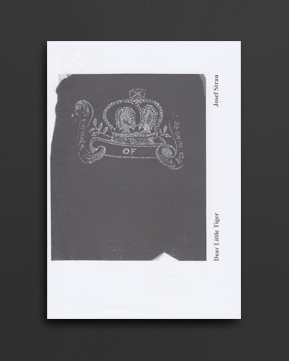
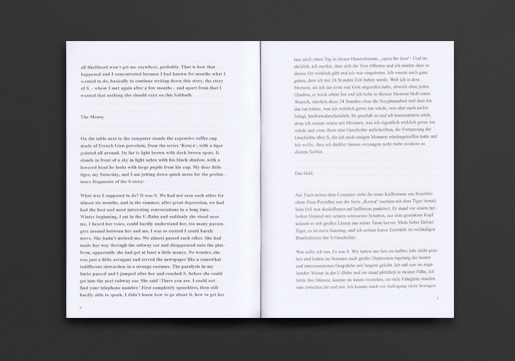
Xeroxed artist book by Josef Strau that was published on the occasion of the exhibition "Teil I: Müllberg" at Galerie Daniel Buchholz in Cologne. The brochure contains the second part of a narrative written by the artist under the title "Dear Little Tiger". The first part "White Nights" has been published in 2003 by the Danish publisher Pork Salad Press.
Out-of-print. As New.