World Food Books' programme is largely produced on Kulin Nation land. We acknowledge the Wurundjeri people of the Kulin Nation as the first and continuing custodians of this land, and pay respect to their Elders past, present, and emerging.
World Food Books is an arts and special interests bookshop in Naarm / Melbourne. Founded in 2010, World Food Books is devoted to the presentation of a rotating, hand-selection of international art, design, literary and counterculture publications with an emphasis on the anti-traditional, the experimental, the avant-garde, the heretic, the marginal.
Presenting new titles alongside rare and out-of-print books, catalogues and journals spanning the fields of modern and contemporary art, design, photography, illustration, film, literature, poetry, cultural theory, philosophy, sexuality, popular and underground culture in its many radical forms, World Food Books wishes to encourage adventurous, thoughtful and open-minded reading, looking, writing, and exchange of publishing and ideas, both current and historical.
As well as our bookshop, located in Melbourne's historical Nicholas Building, all of our inventory is available internationally via our online mail-order service.
World Food Books semi-regularly co-ordinates "Occasions", a programme of exhibits and events at the bookshop and in partnership with other hosts (such as museums and art galleries) that develop out of the activities, relationships and content of the bookshop itself.
World Food Books
The Nicholas Building
37 Swanston Street
Room 5, Level 6
Melbourne 3000
Australia
SHOP HOURS:
Thu–Sat 11–5
WEB-SHOP OPEN 24/7
World Food Books
Postal Address:
PO Box 435
Flinders Lane
Victoria 8009
Australia
Art
Theory / Essay
Architecture / Interior
Graphic Design / Typography
Photography
Fashion
Eros
LGBTQ+
Fiction / Poetry
Weird / Speculative / Science Fiction / Horror
Transgressive / Visceral / Abject
Symbolism / Decadence / Fin de siècle
Film / Video
Painting
Sculpture / Installation
Performance / Dance / Theater
Drawing
Sound / Music
Curatorial
Group Shows / Collections
Periodicals
Out-of-print / Rare
Posters / Ephemera / Discs
Signed Books
World Food Books Gift Voucher
World Food Book Bag
Australian Art
Australian Fiction
Australian Science Fiction / Speculative Fiction
Australian Poetry
Australian Photography
Japanese Photography
Conceptual Art
Minimal Art
Dada
'Pataphysics / Oulipo
Fluxus
Concrete Poetry
Pop Art
Surrealism
Arte Povera
Arte Informale / Haute Pâte / Tachism
Nouveau Réalisme / Zero / Kinetic
Situationism / Lettrism
Collage / Mail Art / Xerox Art
Art Brut / Folk / Visionary / Fantastic
Illustration / Graphic Art / Bandes Dessinées
Furniture
Italian Radical Design / Postmodernism
Textiles
Ceramics / Glass
Counterculture
Protest / Revolt
Philosophy
Psychoanalysis
Anthropology
Anarchism
Socialism / Anarchism / Communism / Capitalism
Literary Theory / Semiotics / Language
Feminism / Women's Studies
Gender Studies / Sexuality
Anthropology
Fetishism / BDSM
Drugs / Psychedelia
Crime / Violence
Animal Rights / Veganism
Occult / Esoterica
Ecology / Earth / Alternative Living
Whole Earth / Crafts
All prices in AUD (Australian dollars)
Pick-Ups
Pick-up orders can be collected in our bookshop during opening hours after order date. Please collect any Pick-up orders within 2 weeks of ordering as we have limited storage space. Orders will be released back into stock if not collected within this time. No refunds can be made for pick-ups left un-collected. If you cannot make it in to the bookshop in this time-frame, please choose postage option.
Return Policy
All sales are final. We do accept returns (for refund or exchange) for items received in error. All our orders are packed with special care using heavy-duty padding and cardboard book-mailers or bubble mailers (for smaller books), using reinforcement where required. We cannot take responsibility for any lost, stolen or damaged parcels.
Insurance
Should you wish to insure your package, please email us directly after placing your order and we can organise this at a small extra expense. Although all standard/express tracked packages are very safe and dependable, we cannot take responsibility for any lost, stolen or damaged parcels. We recommend insurance on valuable orders.
Interested in selling your old books, catalogues, journals, magazines, comics, fanzines, ephemera? We are always looking for interesting, unusual and out-of-print books to buy. We only buy books in our fields of interest and specialty, and that we feel we can resell.
We base these prices on desirability, market value, in-print prices, condition and our current stock levels. We offer cash, store credit, and can take stock on consignment. All
about 25% of the price we expect to get when we sell them, or 30% in store credit. We base these prices on desirability, market value, in-print prices, condition and our current stock levels.
Sell your books any day of the week. You can drop them off and return later. If you have a lot of books, we can visit your Sydney home.
We buy books that we feel we can resell. We offer about 25 % of the price we expect to get when we sell them, or 30% in store credit. We base these prices on desirability, market value, in-print prices, condition and our current stock levels.
Philadelphia Wireman
03 August - 01 September, 2018
World Food Books is proud to announce our next Occasion, the first presentation of sculptures by Philadelphia Wireman in Australia.
The Philadelphia Wireman sculptures were found abandoned in an alley off Philadelphia’s South Street on trash night in 1982. Their discovery in a rapidly-changing neighbourhood undergoing extensive renovation, compounded with the failure of all attempts to locate the artist, suggests that the works may have been discarded after the maker’s death. Dubbed the "Philadelphia Wireman" during the first exhibition of this work, in 1985, the maker’s name, age, ethnicity, and even gender remain uncertain. The entire collection totals approximately 1200 pieces, all intricately bound together with tightly-wound heavy-gauge wire (along with a few small, abstract marker drawings, reminiscent both of Mark Tobey and J.B. Murry). The dense construction of the work, despite a modest range of scale and materials, is singularly obsessive and disciplined in design: a wire armature or exoskeleton firmly binds a bricolage of found objects including plastic, glass, food packaging, umbrella parts, tape, rubber, batteries, pens, leather, reflectors, nuts and bolts, nails, foil, coins, toys, watches, eyeglasses, tools, and jewellery.
Heavy with associations—anthropomorphic, zoomorphic, and socio-cultural responses to wrapped detritus—the totemic sculptures by Philadelphia Wireman have been discussed in the context of work created to fulfil the shamanistic needs of alternative religions in American culture. Curators, collectors, and critics have variously compared certain pieces to sculpture from Classical antiquity, Native American medicine bundles, African-American memory jugs, and African fetish objects. Reflecting the artist’s prolific and incredibly focused scavenging impulse, and despite—or perhaps enhanced by—their anonymity, these enigmatic objects function as urban artefacts and arbiters of power, though their origin and purpose is unknown. Philadelphia Wireman, whatever their identity, possessed an astonishing ability to isolate and communicate the concepts of power and energy through the selection and transformation of ordinary materials. Over the course of the past two decades, this collection has come to be regarded as an important discovery in the field of self-taught art and vernacular art.
Presented in collaboration with Fleisher-Ollman Gallery, Philadelphia, and Robert Heald, Wellington.
Susan Te Kahurangi King
02 February - 10 March, 2018
Susan Te Kahurangi King (24 February 1951 - ) has been a confident and prolific artist since she was a young child, drawing with readily available materials - pencils, ballpoint pens and felt-tip markers, on whatever paper is at hand. Between the ages of four and six Susan slowly ceased verbal communication. Her grandparents William and Myrtle Murphy had developed a special bond with Susan so they took on caring responsibilities for extended periods. Myrtle began informally archiving her work, carefully collecting and storing the drawings and compiling scrapbooks. No drawing was insignificant; every scrap of paper was kept. The King family are now the custodians of a vast collection containing over 7000 individual works, from tiny scraps of paper through to 5 meter long rolls.
The scrapbooks and diaries reveal Myrtle to be a woman of great patience and compassion, seeking to understand a child who was not always behaving as expected. She encouraged Susan to be observant, to explore her environment and absorb all the sights and sounds. Myrtle would show Susan’s drawings to friends and people in her community that she had dealings with, such as shopkeepers and postal workers, but this was not simply a case of a grandmother’s bias. She recognised that Susan had developed a sophisticated and unique visual language and sincerely believed that her art deserved serious attention.
This was an unorthodox attitude for the time. To provide some context, Jean Dubuffet coined the term Art Brut in 1945 to describe work created by self-taught artists – specifically residents of psychiatric institutions and those he considered to be visionaries or eccentrics. In 1972 Roger Cardinal extended this concept by adopting the term Outsider Art to describe work made by non-academically trained artists operating outside of mainstream art networks through choice or circumstance. Susan was born in Te Aroha, New Zealand in 1951, far from the artistic hubs of Paris and London that Dubuffet and Cardinal operated in. That Myrtle fêted Susan as a self-taught artist who deserved to be taken seriously shows how progressive her attitudes were.
Susan’s parents Doug and Dawn were also progressive. Over the years they had consulted numerous health practitioners about Susan’s condition, as the medical establishment could not provide an explanation as to why she had lapsed into silence. Dawn educated herself in the field of homeopathy and went on to treat all twelve of her children using these principles – basing prescriptions on her observations of their physical, mental and emotional state.
Doug was a linguist with an interest in philosophy who devoted what little spare time he had to studying Maori language and culture. To some extent their willingness to explore the fringes of the mainstream made them outsiders too but it was their commitment to living with integrity and their respect for individuality that ensured Susan’s creativity was always encouraged.
Even though Susan’s family supported her artistic pursuits, some staff in schools and hospitals saw it as an impediment to her assimilation into the community and discouraged it in a variety of ways. Her family was not always aware of this and therefore did not fully understand why Susan stopped drawing in the early 1990s. However, rather than dwell on the challenges that Susan faced in pursuit of her artistic practice, they prefer to highlight her achievements. In 2008 Susan began drawing again in earnest, after an almost 20 year interruption, and her work is now shown in galleries around the world.
Susan grew up without television and has been heavily influenced by the comics she read as a child. She is absolutely fearless in the appropriation of recognizable characters, such as Donald Duck and Mickey Mouse, in her work. She twists their limbs, contorts their faces, compresses them together, blends them into complex patterned backgrounds - always imbuing them with an incredible energy. Although Susan often used pop culture characters in her work they are not naive or childlike. These are drawings by a brilliant self-taught artist who has been creating exceptional work for decades without an audience in mind.
Mladen Stilinović
"Various Works 1986 - 1999"
02 February 16 - September 10, 2016
Various works 1986 - 1999, from two houses, from the collections of John Nixon, Sue Cramer, Kerrie Poliness, Peter Haffenden and Phoebe Haffenden.
Including: Geometry of Cakes (various shelves), 1993; Poor People’s Law (black and white plate), 1993; White Absence (glasses, ruler, set square, silver spoon, silver ladel with skin photograph and wooden cubes), 1990-1996; Exploitation of the Dead (grey and red star painting, wooden painting, black spoon with red table, red plate), 1984-1990; Money and Zeros (zero tie, paintings made for friends in Australia (Sue, John, Kerrie), numbers painting), 1991-1992; Words - Slogans (various t-shirts) - “they talk about the death of art...help! someone is trying to kill me”, “my sweet little lamb”, “work is a disease - Karl Marx”; Various artist books, catalogues, monographs, videos; Poster from exhibition Insulting Anarchy; "Circular" Croatian - Australian edition; Artist book by Vlado Martek (Dostoyevsky); more.
Thanks to Mladen Stilinović and Branka Stipančić.
Jonathan Walker
Always Will Need To Wear Winter Shirt Blue + Ochre Small Check Pattern
21 August - 21 September, 2015
Untitled
I am not a great reader of poetry but I always return to the work of Melbourne poet, Vincent Buckley (1925- 1988). Perhaps I find his most tantalising piece to be not a finished poem but a fragment left on a scrap of paper discovered on his desk after the poet’s death.
The poetry gathers like oil
In the word-core, and spreads
It has its music meet,
Its music is in movement.
This fragment is more the shell left behind from a volatile thought than a finished poem. I find the last two lines honest but awkward whereas the first two lines work like an arrow. Most likely he could not find a resolution so it was left. Still, in its present form, it remains an eloquent testimony to the ultimate failure of a medium to express mobile thought and sensation, in Buckley’s case, through verbal language. It’s an important matter because this is something all artists have to deal with regardless of the medium.
I have never written a poem, however, I am forever copying fragments from books on paper scraps in a vain effort to fix certain notions in my head. At first, they function as bookmarks that are sometimes returned to when I open the book. But before long, as they accumulate, they fall out littering the table interspersed with A4 photocopies, bills, books and medications.
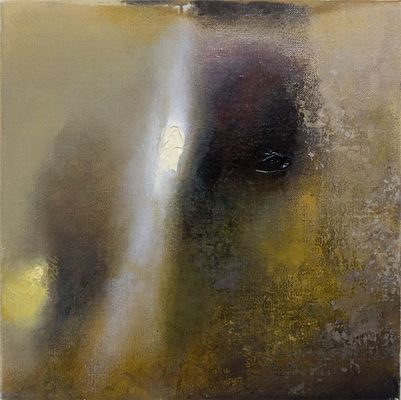
To return to Buckley’s fragment, the first two lines very much evoke how I paint nowadays. As you age, detail diminishes and patches of light become more luminous and float. I feel the most honest way of dealing with this is by smearing the oil paint on the canvas with the fingers and working close-up, blind. Only if the patches coalesce into an approaching image can the work gain a life.
-
Jonathan Walker was born in Melbourne, Australia and brought up on a dairy farm in Gippsland. In the 1970’s he studied painting at RMIT and won the Harold Wright Scholarship to the British Museum, London. During the 1980’s he exhibited at Pinacotheca Gallery, Richmond and had work shown at the NGV and Heidi City Art Gallery. Over the same period he designed the cover for the “Epigenesi” LP by Giancarlo Toniutti, Italy and conducted a mail exchange work with Achim Wollscheid, Germany. The work with artists through the post resulted in an article published in the bicentenary issue of Art and Australia 1988. He showed in artist run spaces such as WestSpace in the 90’s and 2000’s, and until 2012, taught painting at Victoria University, which is where we (Colleen Ahern and Lisa Radford) as organisers of the exhibition, among many others, had the privilege of being his student.
Walker’s knowledge was imparted to students through the careful selection of music, literature, and artists found in books that he himself had ordered for the library. Walker’s strategy was the generosity of sharing his vast knowledge with references specific to each student and their context.
Walker’s paintings share a similar focus and intimacy.
This exhibition presents a small selection of recent paintings alongside a publication that includes Walker’s writing. Observational and analytical, Walker’s work is a type of material notation — the time of day, colour and how it is blended, the both specific and fleeting location of a reflection on lino or the question of whether a chair leg should be included in a painting.
Please join us on Friday August 21 between 6-8pm to celebrate the opening of the exhibition.
Curated by Colleen Ahern and Lisa Radford.
B. Wurtz
Curated by Nic Tammens
March 26 - April 4, 2015
B.Wurtz works from a basement studio in his home on Manhattan’s Lower East Side.
This local fact is attested to by the plastic shopping bags and newsprint circulars that appear in his work. As formal objects, they don’t make loud claims about their origins but nonetheless transmit street addresses and places of business from the bottom of this long thin island. Like plenty of artists, Wurtz is affected by what is local and what is consumed. His work is underpinned by this ethic. It often speaks from a neighborhood or reads like the contents of a hamper:
“BLACK PLUMS $1.29 lb.”
“Food Bazaar”
“USDA Whole Pork Shoulder Picnic 99c lb.”
“RITE AID Pharmacy, with us it’s personal.”
“H. Brickman & Sons.”
“Sweet Yams 59c lb."
Most of the work in this exhibition was made while the artist was in residence at Dieu Donne, a workshop dedicated to paper craft in Midtown. Here Wurtz fabricated assemblages with paper and objects that are relatively lightweight, with the intention that they would be easily transportable to Australia. This consideration isn’t absolute in Wurtz’s work, but was prescriptive for making the current exhibition light and cheap. Packed in two boxes, these works were sent from a USPS post office on the Lower East Side and delivered to North Melbourne by Australia Post.
Wurtz appears courtesy of Metro Pictures, New York.
Thanks to Rob Halverson, Joshua Petherick, Sari de Mallory, Matt Hinkley, Helen Johnson, Fayen d'Evie, Ask Kilmartin, Lisa Radon, Ellena Savage, Yale Union, and "Elizabeth".
John Nixon
"Archive"
December 15 - January 20, 2014
The presentation of John Nixon's archive offered a rare showcase of this extensive collection of the artist's own publications, catalogues, posters, ephemera, editions and more, from the mid 1980s onwards, alongside a selection of his artworks.
Organized by John Nixon, Joshua Petherick and Matt Hinkley.
<a href=http://wfb.public-office.info/artist/john-nixon>All titles by John Nixon
"Habitat"
at Minerva, Sydney (organised by Joshua Petherick and Matt Hinkley)
November 15 - December 20, 2014
Lupo Borgonovo, Janet Burchill & Jennifer McCamley,
Lewis Fidock, HR Giger, Piero Gilardi, Veit Laurent Kurz,
Cinzia Ruggeri, Michael E. Smith, Lucie Stahl, Daniel Weil, Wols
Press Release:
“...It contained seven objects. The slender fluted bone, surely formed for flight, surely from the wing of some large bird. Three archaic circuitboards, faced with mazes of gold. A smooth white sphere of baked clay. An age-blackened fragment of lace. A fingerlength segment of what she assumed was bone from a human wrist, grayish white, inset smoothly with the silicon shaft of a small instrument that must once have ridden flush with the surface of the skin - but the thing’s face was seared and blackened.”
William Gibson, “Count Zero”, 1986
"Autumn Projects Archive"
Curated by Liza Vasiliou
March 6 - March 15, 2014
World Food Books, in conjunction with the Virgin Australia Melbourne Fashion Festival 2014, presented the Autumn Projects archive, consisting of a selection of early examples in Australian fashion with a particular interest in collecting designers and labels from the period beginning in the 1980’s, who significantly influenced the discourse of Australian Fashion.
Curated by Liza Vasiliou, the exhibition provided a unique opportunity to view pieces by designers Anthea Crawford, Barbara Vandenberg, Geoff Liddell and labels CR Australia, Covers, Jag along with early experimental collage pieces by Prue Acton and Sally Browne’s ‘Fragments’ collection, suspended throughout the functioning World Food Books shop in Melbourne.
H.B. Peace
presented by CENTRE FOR STYLE
November 14, 2013
"Hey Blinky, you say chic, I say same"
Anon 2013
H.B. Peace is a clothing collaboration between great friends Blake Barns and Hugh Egan Westland. Their pieces explore the divergences between 'character’ and ‘personality’ in garments....etc
Special Thanks to Joshua Petherick and Matt Hinkley of WFB and Gillian Mears
and a Very Special Thank you to Audrey Thomas Hayes for her shoe collaboration.
Janet Burchill & Jennifer McCamley
"Aesthetic Suicide"
May 10 - June 8, 2013
The first of our occasional exhibitions in the World Food Books office/shop space in Melbourne, "Aesthetic Suicide" presented a body of new and older works together by artists Janet Burchill & Jennifer McCamley, including videos, prints, a wall work, and publications.
During shop open hours videos played every hour, on the hour.
$.00 - Out of stock
The eternal clean out! New items weekly.
https://worldfoodbooks.com/category/sale
Published by World Food Books / Melbourne
$20.00 - In stock -
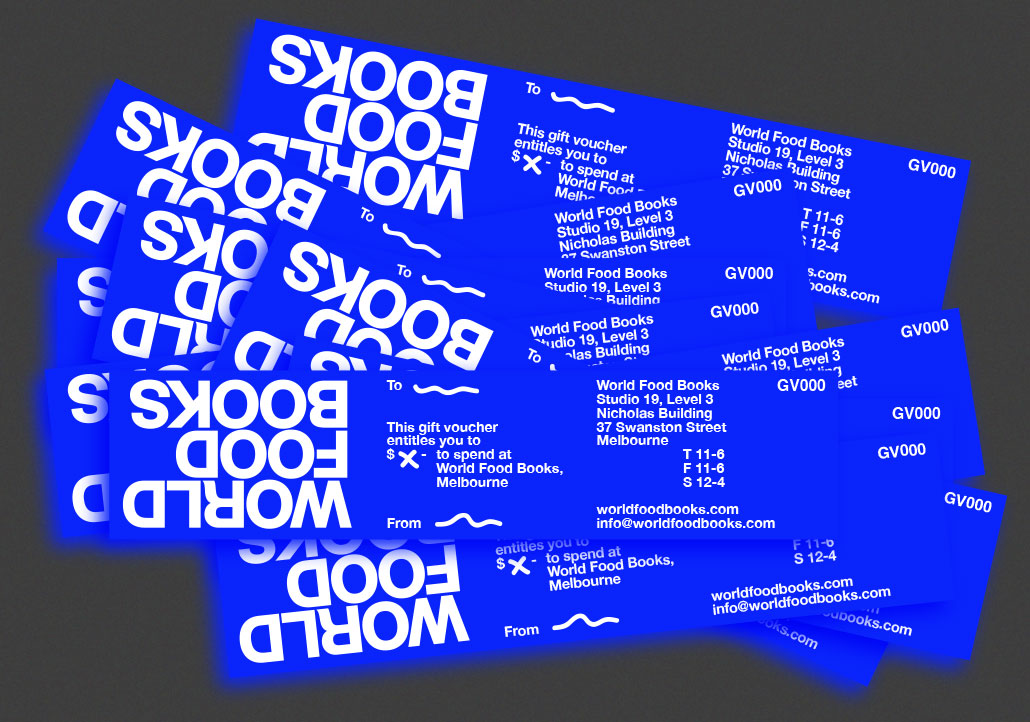
A World Food Books gift voucher is redeemable in our Melbourne bookshop or via our webshop (here). An e-voucher (printable pdf) will be sent to your purchase email address (please notify us if you wish to have the voucher sent to an alternate address and wish us to fill in the receiver's details on the card).
Gift vouchers can be purchased in increments of $20 (Australian Dollars) and the total amount can simply be added to by increasing the quantity in your shopping cart. eg. A quantity of 5 gift vouchers will result in an item total of $100 - a $100 gift voucher. Simply click "ADD TO CART" 5 times, or update your quantity in the shopping cart.
If you wish to purchase multiple, separate gift vouchers in one go, please just email us and we can personally prepare and email you a payment request.
Please note: Please select Pick-Up on gift voucher purchse to avoid any postage charges. Accidental postage charges will be refunded right away!
Thank you.
For any questions, please don't hesitate to email: [email protected]
1986, English
Hardcover (dust jacket), 384 pages, 24 x 15.5 cm
1st Edition, Out of print title / used / very good
Published by
Picador / USA
$40.00 - In stock -
First 1986 hardcover edition.
Dreams are traditionally seen as the key to our unconscious, where the unspoken speaks and the unthinkable is thought. But once we wake up, there is no such thing as a dream; what remains is like the summary of a novel from memory. Those who speak arrogantly of the meaning and interpretation of dreams are like critics who would extrapolate an aesthetic judgement on one of the Pictures From an Exhibition from Mussorgsky's musical commentary. In a sense, dreams do not exist because the only witness, the dreamer, cannot speak when he is isolated in the privacy of his dream. Literature adds yet another distorting mirror to the warped reproduction of the mute private world of the dreamer in the common language of the waking.
Almost every writer since the beginning of recorded history has invented or transcribed dreams. Thus Guido Almansi and Claude Béguin were confronted with an embarras de richesses. In the end they confined themselves to Western Europe and North America, with a few excursions towards Russia and more exotic places, choosing a wide range of texts- from the Bible to Kurt Vonnegut - for their representativeness, their psychological interest, their aesthetic value, their stylistic exuberance - but most of all for their capacity to titillate our curiosity and stimulate our reflections in this area.
The provocative introduction explores the nature of literary dreams and sets the background to this anthology. The material is divided into four categories: instinctive dreams, which seem to emerge from deep sources within us; real dreams, which are in close relation with the day world; symbolic dreams, where reality is transformed into what might be the metaphor for something else; and fantastic dreams, with a prevalence of the unreal element.
Bringing together a wide selection of dreams drawn from the literature of all ages and many cultures, some of which are translated into English for the first time, with every piece put in its literary and historical context, this is a hugely entertaining work of some of the most bizarre, imaginative and perplexing passages ever written.
GUIDO ALMANSI, Italian, is Professor of English and Comparative Literature at the University of East Anglia. He is interested in the dishonesty of literature, in the subterfuges used by language and its wily accomplice, the writer, in order not to say what they mean and not to mean. what they say. His favourite author is Shakespeare.
CLAUDE BÉGUIN, Swiss, teaches French at the University of Siena, Italy. She likes squarers of circles, writers who, though conscious of the devious nature of language, attempt to be straight. Her favourite author is Diderot.
When the wind changes, the descriptions of their interests can be reversed. Literary dreams were an area of possible collaboration since at night there is not enough light to distinguish between honesty and dishonesty.
Guido Almansi and Claude Béguin are husband and wife.
Very Good copy in NF dust jacket preserved under mylar wrap. Sticker to back cover. Tanning to paper stock.
1998, English
Softcover (2 volumes), 1290 pages, 21.5 x 14 cm
1st Edition, Out of print title / used / fine
Published by
Oxford University Press / New York
$150.00 - In stock -
The two volumes of the only English edition of Hegel's Aesthetics, the work in which he gives full expression to his seminal theory of art. The substantial Introduction is his best exposition of his general philosophy of art.
In Part I he considers the general nature of art as a spiritual experience, distinguishes the beauty of art and the beauty of nature, and examines artistic genius and originality. Part II surveys the history of art from the ancient world through to the end of the eighteenth century, probing the meaning and significance of major works. Part III (also in the second volume) deals individually with architecture, sculpture, painting, music, and literature; a rich array of examples makes vivid his exposition of his theory.
Both volumes (2 books) together in their 1998 prints. Both Near Fine copies.
1998, English
Softcover, 160 pages, 22.5 x 15 cm
1st Edition, Out of print title / used / very good
Published by
State University of New York Press / New York
$20.00 - In stock -
Hegel's Transcendental Induction challenges the orthodox account of Hegelian phenomenology as a hyper-rationalism, arguing that Hegel's insistence on the primacy of experience in the development of scientific knowledge amounts to a kind of empiricism, or inductive epistemology. While the inductive element does not exclude an emphasis on deductive demonstration as well, Hegel's phenomenological description of knowledge demonstrates why knowing becomes scientific only to the extent that it recognizes its dependence on experience.
Simpson's argument closely parallels Hegel's own in the Phenomenology of Spirit, highlighting those sections, like Hegel's analysis of mastery and slavery, that contribute to the argument that knowing is both vulnerable and responsive to the way in which experience resists our attempts to make sense of things. Simpson's argument connects his account of Hegelian phenomenology with traditional accounts of induction, and with a number of other commentators.
VG copy.
1994, English
Softcover, 250 pages, 23.5 x 15.5 cm
1st Edition, Out of print title / used / very good
$25.00 - In stock -
Martin Heidegger's impact on contemporary thought is important and controversial. However in France, the influence of this German philosopher is such that contemporary French thought cannot be properly understood without reference to Heidegger and his extraordinary influence.
Tom Rockmore examines the reception of Heidegger's thought in France. He argues that in the period after the Second World War, due to the peculiar nature of the humanist French Philosophical tradition, Heidegger became the master thinker of French philosophy. Perhaps most importantly, he contends that this reception - first as philosophical anthropology and later as postmetaphysical humanism - is systematically mistaken.
VG—NF copy. First ed.
1995, English
Softcover, 336 pages, 23 x 15.5 cm
1st Edition, Out of print title / used / fine
Published by
Northwestern University Press / Evanston
$25.00 - In stock -
At a time in which many philosophers have concluded that Husserl's philosophy is exhausted, but when the alternatives to Husserl appear to be exhausted as well, Anthony J. Steinbock presents an innovative approach to Husserlian phenomenol-ogy. Steinbock implicitly attacks the most fundamental criticism aimed at Husserl: that his philosophy is intrinsically formalistic, unable in principle to deal with concrete matters of life and how to live it. The "generation" which Steinbock traces through Husserl's writings-from static through genetic and finally to generative phenomena—is in part the generation of the lifeworld in and through various kinds of domesticity and alienness. Steinbock's systematic study of the problems and themes of a generative phenomenology, normality and abnor-mality, and the sociohistorical concepts of home-world and alienworld, and the steps he takes toward developing such a generative phenomenology, open new doors for a phenomenology of the social world while casting new light on work done by Husserl himself and by many philosophers working more or less in a Husserlian vein. Both critique and an appropriation of a large and diverse body of work, Home and Beyond: Generative Phenomenology after Husserl is a major contribution to contemporary Husserl scholarship.
"This is the most important and original piece of Husserl scholarship and of Husserl-inspired phenomenology to have appeared in many years."—Claude Evans, Washington University
Fine copy, first ed.
1996, English
Softcover, 262 pages, 23 x 15 cm
1st Edition, Out of print title / used / fine
Published by
Cornell Paperbacks / London
$35.00 - In stock -
An advance on recent revisionist thinking about Hegelian philosophy, this book interprets Hegel's achievement as part of a revolutionary modernization of ancient philosophical thought initiated by Kant. In particular, Paul Redding argues that Hegel's use of hermeneutics, an emerging way of thinking objectively about intentional human subjects, overcame the major obstacle encountered by Kant in his attempt to modernize philosophy. The result was the first genuinely modern, hermeneutic, and "nonmetaphysical" philosophy.
Redding describes Hegel's accomplishment in terms of a development of Kant's revolution in philosophy, a "Copernican" revolution analogous to that which initiated modern science. He shows how the heterodox pantheistic views and hermeneutic social thought that merged at the end of the eighteenth century provided a fruitful environment for the transformation that Kantian idealism underwent within the work of Schelling and the early Hegel. He argues that Hegel overcame Schelling's pantheistic metaphysics with the Phenomenology of Spirit and developed a postmetaphysical hermeneutic mode of philosophy.
Redding goes on to show how the social theory of Hegel's Philosophy of Right and the conceptual structures of his allegedly most metaphysical work, the Science of Logic, are systematically linked to the hermeneutic insights of the Phenomenology. Against this background, Hegel's works are freed from traditional misunderstandings. Redding demonstrates that Hegel's analyses of modernity and the modern state surpass the one-sided views of Adam Smith and Jean-Jacques Rousseau, providing a coherent framework for modern social and political thought.
"A significant contribution to Hegel scholarship. ... Well written, clear ... all in all, an impressive achievement."—Terry Pinkard, Georgetown University
"Paul Redding makes a major contribution to contemporary Hegel studies and to the plausibility of a quite general nonmetaphysical approach to the world."—Peter J. McCormick, University of Ottawa
PAUL REDDING is Senior Lecturer in the School of Philosophy at the University of Sydney.
NF copy of first 1996 ed.
1951 & 1955, English
Softcovers, 388 + 420 pages, 20.5 x 13.5 cm
1st Edition, Out of print title / used / very good
Published by
Dover / New York
$45.00 - Out of stock
1951 and 1955 English Dover editions of two important Spinoza companion volumes as lot — Theologico-Political Treatise and Political Treatise and On the Improvement of the Understanding - The Ethics Correspondence, together an unabridged reprint of the famous 1883 Bohn (Chief Works) edition, containing all of Spinoza's most important works and a generous selection of letters to contemporary philosophers and scientists. Translations and introductions by R. H. M. Elwes. Bibliographical notes by Francesco Cordasco.
One of the most original and penetrating philosophers of all time, Spinoza is also one of the clearest and easiest to understand as a whole. His work is nearly indispensable for an exact understanding of the ideas of such men as Goethe, Hegel, Schelling, Coleridge, Whitehead, Schopenhauer, Wittgenstein, and many others. It retains to the present day an endless wealth of careful and profound analyses of such concepts as God, the universe, pantheism, the role of society, revealed religion, the state, democracy, the mind, the emotions, freedom, and the stature of man.
In the "Theologico-Political Treatise" Spinoza presents an eloquent plea for religious liberty and demonstrates that true religion consists in the practice of simple piety, independent of philosophical speculation. Anticipating to a large extent the methods of the modern rationalists, he examines the Bible in some detail and shows that freedom of thought and speech is consistent with the religious life. In the unfinished "Political Treatise" he develops a theory of government founded on common consent.
In "On the Improvement of the Understanding" Spinoza sets forth the causes which prompted him to turn to philosophy. In "The Ethics" he develops a far-reaching deductive system based on his conception of all existence as a vast unity and on psychological insights of great depth. His letters to contemporary philosophers and scientists are filled with ideas and concern for political and religious reform.
Very Good copy. No idea what print, 1951 and 1955 editions, respectively.
1992, English
Softcover, 254 pages, 23 x 15 cm
1st Edition, Out of print title / used / good
Published by
Routledge / London
$25.00 - In stock -
First 1992 edition.
"The visual is essentially pornographic," writes Fredric Jameson, "films ask us to stare at the world as though it were a naked body." In Signatures of the Visible, one of America's most influential critics explores film and the culture surrounding it, interrogating the relationship between the imaginative screen world and the historical world onto which it is projected. By seeking the historical dimension of the visual, Jameson evaluates the power of the filmic form as a vehicle for the critique of culture and the diagnosis of social life. Jameson pursues this investigation through readings of politics, class, allegory, magic realism, and "the historical" in such films as Diva, The Shining, and Dog Day Afternoon. Throughout the book, he is concerned with the relationship between the achievements and limits of contemporary film theory itself, "a relationship," he argues, "which allows one to take the temperature of history itself."
Good copy with some horizontal crimping to the cover laminate and light cover curling.
2019, English
Softcover, 258 pages, 23 x 15.5 cm
1st Edition, Out of print title / used / fine
Published by
Fordham University Press / New York
$40.00 - In stock -
This book draws the work of Slavoj Žižek into conversation with the Christian mystical theological tradition in order to propose a materialist account of Christian identity as constituted by failure.
Everyone agrees that theology has failed, but the question of how to understand and respond to this failure is complex and contested. Against both the radical orthodox attempt to return to a time before theology's failure and the deconstructive theological attempt to open theology up to the hope of a future beyond failure, Rose proposes an account of Christian identity as constituted by, not despite, failure. Understanding failure as central to theology opens up new possibilities for confronting Christianity's violent and kyriarchal history and abandoning the attempt to discover a pure Christ outside of the grotesque materiality of the Church.
The Christian mystical tradition begins with Dionysius the Areopagite's uncomfortable but productive conjunction of Christian theology and Neoplatonism.
The tensions generated by this are central to Dionysius's legacy, visible not only in subsequent theological thought but also in much twentieth-century continental philosophy as it seeks to disentangle itself from its Christian ancestry. A Theology of Failure shows how the work of Slavoj Žižek represents an attempt to repeat the original move of Christian mystical theology, bringing together the themes of language, desire, and transcendence not with Neoplatonism but with a materialist account of the world. Tracing these themes through the work of Dionysius and Derrida and through contemporary debates about the gift, violence, and revolution, this book offers a critical theological engagement with Žižek's account of social and political transformation, showing how Zižek's work makes possible a materialist reading of apophatic theology and Christian identity.
MARIKA ROSE is Lecturer in Philosophical Theology at the University of Winchester.
An ambitious and significant project in continental philosophy and theology. Engaging Dionysius beyond the usual texts and reading that corpus through Zizek, Rose offers way of linking ontology, language, and theology--through failure--that is theologically productive.—Ellen Armour, Vanderbilt University
This is the best work I have ever read on Zizek in relation to theology, maybe the best such work possible. Rose's prose style is clear and engaging, and her project significantly advances our understanding of Christian apophaticism, of Zizek's project, and of the potential future stakes of theology for a secular world.—Adam Kotsko, author of Neoliberalism's Demons: On the Political Theology of Late Capital
Marika Rose is Lecturer in Philosophical Theology at the University of Winchester.
NF copy of first edition.
1995, English
Softcover, 410 pages, 23.5 x 15.5 cm
1st Edition, Out of print title / used / very good
Published by
Indiana University Press / Indiana
$25.00 - In stock -
First 1995 edition.
"This new critical edition includes Mark Musa's classic verse translation and provides students with a clear, readable text.
In addition, ten innovative interpretations of Dante's masterpiece offer diverse approaches to the first canticle of the Divine Comedy, including Virgil's importance to Dante as a source for mythological, historical, and political material as well as for structuring his poetic vision; the language, symbols, and extended meanings of Hell; Dante's revision of the concepts of Limbo and the Harrowing of Hell; the figure of Francesca, representative of Eve, and how the Pilgrim participates in her sin; how understanding political and church history of the period enhances a reading of the poem; and the history of Dante's interpretation and reception in Italian cinema.
The contributors include Lawrence Baldassaro, Joan M. Ferrante, Denise Heilbronn-Gaines, Robert Hollander, Amilcare A. Iannucci, Christopher Kleinhenz, Ricardo J. Quinones, Guy P. Raffa, John P. Welle, and Musa himself.
Mark Musa, Distinguished Professor of Italian at Indiana University, is well known for his translations of the Italian classics, including the works of Dante, Petrarch, Boccaccio, and Machiavelli.
G—VG copy with light bumping.
1981, English
Hardcover (w. dust jacket), 272 pages, 23.5 x 18.5 cm
1st Edition, Out of print title / used / fine
Published by
Michael Joseph / London
$30.00 - In stock -
First 1981 hardcover edition of "The Real Alice: Lewis Carroll's Dream Child " by Anne Clark, published by Michael Joseph, London.
"Together Lewis Carroll and his Alice have been eulogised, criticised, psycho-analysed. Their phantasmagoric dreamworld has fired the imaginations and fed the minds of poets, philosophers, musicians and artists the world over - they have proved inspirational to creators as diverse as James Joyce, Lennon and McCartney, W.H. Auden, Walter de la Mare, Arthur Rackham and Salvador Dali. Now, for the first time, Alice Liddell is the subject of a major biography.
Daughter of the powerful Dean of Christ Church, Oxford, Alice met not only Carroll but the most brilliant personalities of her day in all walks of life. A celebrated beauty, she was painted by Richmond and photographed by J.M. Cameron. Hubert Parry dedicated music to her. Herself a gifted artist, Alice was taught to paint by Ruskin, whose flirtatious letters to her are quoted in the book. Her hopeless romance with Prince Leopold, Queen Victoria's youngest son, is explored in depth with the help of the letters he wrote to her.
Alice's marriage to wealthy Reginald Hargreaves made her mistress of a splendid country mansion, but could not erase the trace of sorrow that was written permanently on her brow after the tragic early death of her younger sister Edith. That sorrow deepened when two of her three sons were killed in battle in the First World War. Widowhood left Alice impoverished, lonely and forgotten, but the sale of Carroll's manuscript and the centenary celebrations of his birth brought her again unexpectedly into the public eye.
Immaculately researched and enhanced by 150 fine illustrations, many of them previously unpublished or rare, The Real Alice sheds a fascinating new light on the person who was Lewis Carroll's dream-child and will give pleasure both as a biography and as an addition to the wealth of Carrolliana already in existence."
Near Fine copy in NF DJ, light foxing to block edge.
1975, English
Hardcover (w. dust jacket), 1000 pages, 23.5 x 16 cm
1st Edition, Out of print title / used / very good
Published by
Bell Publishing / New York
$45.00 - In stock -
First 1975 hardcover Bell edition.
"This long-awaited Second Series of RATIONALE OF THE DIRTY JOKE is based on thirty-five years of collecting and research both in America and abroad, with literary parallels throughout. Over 2000 jokes and folktales are presented and commented upon, selected from a raw collection of nearly three times as many (and 60,000 variants!) as being the most typical and significant.
Consciously patterned on Freud's WIT AND THE UNCONSCIOUS, the extraordinary format of this analytic study of erotic and scatologic humor gives equal emphasis to these folk-texts, authentically transcribed in all their innocent and sometimes violent unexpurgaiety, and to Mr. Legman's historical and socio-analytic discussion of what these jokes mean to the people who tell them, and to those who listen and laugh.
For the first time in the history of the subject, what this society frankly and appreciatively calls "dirty jokes" are arranged logically by subjects and themes, tracing their development from the harmless jests about children and talking dogs and parrots, through the daily tragedies of Men, Women & Marriage - and Adultery - to the purposely angry and outrageous humor of jokes on Homosexuality, Prostitution, Venereal Disease, Castration, Cursing & Insults, and the culminating explosions of Scat-ology, which, curiously enough, include most of the truly favorite jokes at the present time, such as the classic "Don't make any WAVES!"
The jokes of this Second Series have for that reason been called the "dirty dirty jokes," to distinguish them no doubt from the "clean dirty jokes" of the First Series, already published. Actually, as the author observes, "as with the similar distinction between black humor and good humor, such divisions are purely relative and to a degree meaningless.
In fact, the author maintains, "It may be stated as axiomatic that: A person's favorite joke is the key to that person's character, a rule-of-thumb all the more invariable in the case of highly neurotic people. The artless directness with which the joke-teller's deepest problem is sometimes expressed, under the transparent gauze of the 'favorite joke,' is like the acting out of a charade of self-unveiling, or like the sending of a psycho-telegraphic S.O.S. to the audience, whose sympathy and understanding are being unconsciously courted. For all the aggressiveness of most jokes, and the purposeful unpleasantness of many 'dirty' dirty jokes, which are strictly an assault on and exploitation of the listener as victim, the repetitive and compulsive nature of their telling marks them almost always with the unmistakable air of a bid for sympathy or a cry for help.
Your favorite joke is your psychological signature. The 'only' joke you know how to tell, is you... Tell me what you laugh at, and / will tell you what you are.'
VG copy in Good dust jacket w. closed tears and light wear to edges, preserved in mylar wrap.
1970, English
Hardcover (w. dust jacket), 566 pages, 22 x 15 cm
1st Edition, Out of print title / used / good
Published by
Jonathan Cape / London
$35.00 - In stock -
First 1970 Cape hardcover edition.
In The Horn Book, a leading specialist in erotic folklore and literature forcefully and eloquently pleads the need to preserve authentic folklore as a protection against the inhuman currents of modern life. This is the message which emerges from G. Legman's continuously interesting explorations of erotica. He describes at length some of the masterpieces of English erotic literature, and gives the reader an opportunity to sample these works by quoting from books usually inaccessible to the public and from his private library. He also deals with topics such as the problems of erotic bibliography, the great collectors of erotica, misconceptions in erotic folklore, bawdy songs and limericks. There is a fascinating chapter on the rediscovery by the author of Robert Burns's Merry Muses of Caledonia.
The Horn Book establishes the worth of unfettered folk art and analyses with humour, anger and discernment the displacement of sexual symbolism in our society. The censorship of folklore, or the simple refusal to publish it complete, is, in Legman's view, nothing less than forgery.
G. Legman is a scholar whose style is a masterly blend of erudition and a powerfully personal point of view. This style, combined with his great knowledge of and passionate concern for erotic folklore and literature, makes The Horn Book a unique reading experience.
Gershon Legman (1917-1999) was an American cultural critic and folklorist, best known for his books The Rationale of the Dirty Joke (1968) and The Horn Book: Studies in Erotic Folklore and Bibliography (1964).
G—VG copy in Good dust jacket w. closed tears and light wear to edges, preserved in mylar wrap.
1999, English
Softcover, 280 pages, 23.2 x 16.6 cm
1st Edition, Out of print title / used / very good
Published by
University of California Press / Berkley
$35.00 - In stock -
Tyrus Miller breaks new ground in this study of early twentieth-century literary and artistic culture. Whereas modernism studies have generally concentrated on the vital early phases of the modernist revolt, Miller focuses on the turbulent later years of the 1920s and 1930s, tracking the dissolution of modernism in the interwar years.
In the post-World War I reconstruction and the worldwide crisis that followed, Miller argues, new technological media and the social forces of mass politics opened fault lines in individual and collective experience, undermining the cultural bases of the modernist movement. He shows how late modernists attempted to discover ways of occupying this new and often dangerous cultural space. In doing so they laid bare the ruin of the modernist aesthetic at the same time as they transcended its limits.
In his wide-ranging theoretical and historical discussion, Miller relates developments in literary culture to tendencies in the visual arts, cultural and political criticism, mass culture, and social history. He excavates Wyndham Lewis's hidden borrowings from Al Jolson's The Jazz Singer; situates Djuna Barnes between the imagery of haute couture and the intellectualism of Duchamp; uncovers Beckett's affinities with Giacometti's surrealist sculptures and the Bolshevik clowns Bim-Bom; and considers Mina Loy as both visionary writer and designer of decorative lampshades. Miller's lively and engaging readings of culture in this turbulent period reveal its surprising anticipation of our own postmodernity.
VG copy, first ed.
1983, English
Softcover, 192 pages, 20.5 x13 cm
Out of print title / used / very good
Published by
Verso / London
$30.00 - In stock -
Walter Benjamin's classic study of the French lyric poet Charles Baudelaire has been out of print for many years.
"When the book was first published in English in 1973, it received wide critical acclaim. It is a standard text for all readers interested in Benjamin or Baudelaire, and for students of French literature.
Benjamin was probably not exaggerating when he told Adorno that each idea in his book on Baudelaire and nineteenth-century Paris 'had to be wrested away from a realm in which madness lies'"—Susan Sontag
Very Good copy.
1966, English
Softcover, 580 pages, 19.5 x 13 cm
Out of print title / used / good
Published by
Oxford University Press / UK
$20.00 - Out of stock
1966 Oxford edition of Milton's Poetical Works, featuring cover illustration from Gustave Doré's illustrations to Paradise Lost, 1882.
In this edition of Milton's complete poetical works, Douglas Bush has included all of his poetry in English, as well as in Latin, Greek, and Italian, including scraps of verse in the prose works which Milton did not include in his collected edition, and two important personal passages from the prose. The poems are printed in chronological order, so far as that is known; translations of the Greek, Latin, and Italian verse are by the editor and new to this edition. The text of the poems is modernized in spelling and sufficiently in punctuation to facilitate understanding; where the metre is not a guide to pronunciation, accents are used on a number of possibly puzzling words to indicate the stress.
This edition has been specially prepared with the student in mind. As well as his substantial Introduction dealing with Milton's life and thought and including an account of the prose works, Professor Bush provides headnotes to the individual poems, succinct explanatory notes, and a glossary of recurrent words and allusions in the poems.
Douglas Bush is Gurney Professor of English Literature, emeritus, at Harvard University. His critical books include two on the mythological tradition in English poetry, Science and English Poetry: A Historical Sketch, 1590-1950, and English Literature in the Earlier Seventeenth Century (Oxford History of English Literature)
Average copy.
1954 / 1955, English
Hardcover (w. dust jacket), 98 pages, 20.5 x 14.5 cm
1st Edition, Out of print title / used / very good
Published by
Methuen & Co. / London
$85.00 - In stock -
1954 hardcover Methuen edition (1955 printing) of Wyndham Lewis's The Demon of Progress in the Arts, a critique of modern art, arguing that the pursuit of extremism has led artists to abandon realism and objective skill for what he saw as "absurd abstractions" and "beggarly ideas". The book criticises what Lewis perceived as a "disease" in art that disguised a lack of true artistic ability, and he warned that this extremism could corrupt even great artists. Lewis championed artists with a strong sense of line and form, viewing them as the true inheritors of artistic tradition, as opposed to those who had succumbed to the "extremism" of his time.
When the innovating impulse is exploited, in isolation, in the fine arts, what at last emerges may be something truly appalling. Mr Wyndham Lewis analyses the psychology of exclusive innovation—of newness for newness' sake. He shows how two of the most dynamic principles in our century, revolution and technology, have galvanized the arts to their undoing.
The salvationist and crusading techniques of subversive politics on the one hand, and on the other the principle of automatic improvement imposed upon technology, both have disastrously infected with their habit of thought the painters' and sculptors' workshops. A machine mainly exists to be superseded. There are many people who regard a man as an analogue of the machine: but the breathless betterment from week-to-week of technology has no relation, in fact, with the natural changes in an art, because in art there is no problem of mechanical improvement, and nothing more. Indeed, there are changes of much greater significance, but it is false to speak of improvements.
Then the atmosphere of all movements in art has for long now been salvationist and crusading (in spite of the fact that there is nothing which the true artist is so repelled by as the salvationist temper).
The false innovations of today are what Mr Lewis analyses and attacks. This attack is not so much directed at the artists, who are misled, as at the crowd of middlemen and promoters who are ultimately responsible for the worst aberrations of this impoverished community.
The main case against these middlemen is that they sustain themselves on novelties, they excite and promote technical extremes in the arts; ultimately, the technical curiosity of the artist is pathologically stimulated, he is encouraged to indulge in 'daring' extremes which end in an insane zero. The 'Réalités Nouvelles' is instanced as a typical example of what occurs. And this is none the less true because somewhere on the road to such insane extremes the best work of our time has been done (in England, Bacon, Minton, Sutherland, Ayrton, etc.).
VG/VG with some tanning and minor chipping to dust jacket extremities, now preserved under mylar wrap.
1980, English
Softcover, 392 pages, 23.5 x 15.5 cm
1st Edition, Out of print title / used / good
Published by
Routledge & Kegan Paul / London
$45.00 - In stock -
First 1980 Routledge edition.
Nominated for the Duff Cooper Prize, this was the first biography of Wyndham Lewis and was based on extensive archival research and interviews. It narrates Lewis’ years at Rugby and the Slade, his bohemian life on the Continent, the creation of Vorticism and publication of Blast, and his experiences at Passchendaele, as well as his many love affairs, his bitter quarrels with Bloomsbury and the Sitwells, the suppressed books of the thirties, the evolution of his political ideas, his self-imposed exile in North America and creative resurgence during his final blindness. Jeffrey Meyers also describes Lewis’ relationships with Roy Campbell, D. H. Lawrence, Katherine Mansfield, T. E Lawrence, Hemingway, Huxley, Yeats, Auden, Spender, Orwell and McLuhan. As the self-styled Enemy emerges from the shadows, he is seen as an independent and courageous artist and one of the most controversial and stimulating figures in modern English art and literature.
Good copy with fading to spine edges, light wear.
1984, English
Softcover, 296 pages, 21.5 x 14 cm
1st Edition, Out of print title / used / average
Published by
University of Minnesota Press / Minnesota
$45.00 - In stock -
First 1984 edition.
Lukács's Theory of the Novel has long been a key work in the philosophy but not the sociology of literature. J. M. Bernstein shows that Theory of the Novel must be seen in conjunction with History and Class Consciousness as a major contribution to a Marxist hermeneutics. He ties the philosophy of Lukács to Kant, Hegel, and Marx and contends that the categories structuring the novel are the central concepts of Kant's philosophy and that, therefore, the novel is marked by the same antinomies that infect Kant's system.
Bernstein offers a concise account of dialectical theory and a telling analysis of Western (Hegelian) Marxism. He concludes with a critique of contemporary literary and critical practices, practices which only reinforce the antinomies already present in the novel.
The Philosophy of the Novel is "a very significant contribution to three fields: first, Lukács and in general critical Marxist studies; second, Marxist aesthetics, and third, post-modernist literary criticism (struc-turalism, semiotics, and deconstruction).
In clear, elegant, and precise terms, the author revives an earlier text of Lukács to illuminate Lukács's subsequent development, show what relevance The Theory of the Novel may have for contemporary debates on the autonomy of literature, and intimate what a Marxist aesthetic ought to look like today." Seyla Benhabib, Boston University.
J. M. Bernstein holds a Ph.D. in Philosophy from Edinburgh Univer-sity. He is Lecturer in Philosophy at the University of Essex.
Average—Good copy, some wear to covers, scratches to back cover, light fading to spine.
1990, English
Hardcover (w. dust jacket), 250 pages, 23.5 x 16 cm
1st Edition, Out of print title / used / very good
Published by
Columbia University Press / New York
$65.00 - In stock -
First 1990 hardcover edition.
In this highly original and provocative investigation of modernism and the cinema, P. Adams Sitney argues that both the act of vision and the centrality of visual experience are problematized in literary modernism. Sitney explores this idea through readings of sometimes neglected texts by Maurice Blanchot, Charles Olson, and Gertrude Stein. Following the principles that emerge from these readings as well as discussions of those authors' theories of vision, Sitney traces a history of modernism in cinema, providing compelling readings of a range of classic films made between 1925 and 1980 by such hilmmakers as Carl Dreyer, Robert Bresson, Ingmar Bergman, and Stan Brakhage.
Modernist Montage: The Obscurity of Vision in Cinema and Literature is unusual in its range of filmic reference, in its bold handling of the interrelationship of film and literature, and in Sitney's unconventional idea of literary modernism which he uses to define filmic modernism. This book confirms P. Adams Sitney as one of the most important, controversial and unique voices in film criticism today.
"P. Adams Sitney's Modernist Montage: The Obscurity of Vision in Cinema and Literature is one of the most provocative and challenging texts I have read about cinema in some time. It is unique in many respects. The range of his survey of filmmakers is extraordinary, quite unlike any book on cinema that comes to mind.
To his readings of many difficult but superb films, films central to the tradition of cinematic modernism, he brings an erudition and scope of reference unmatched by any other writer about cinema I know."—Stuart Liebman, Queens College and the Graduate Center, City University of New York
"A rich and complex text... at once an exacting scrutiny of a very select body of work and a very ambitious attempt to characterize the artistic practices of the varied creators of that work in a singularly provocative manner.... Mr. Sitney's interdisciplinary approach is not only in step with many new attempts to examine film within larger cultural and artistic contexts, it also argues most convincingly for the inter-relatedness of film and literature, and of the continuities of aesthetic and rhetorical expression."—Tony Pipolo, the Graduate Center, City University of New York
VG/VG in mylar wrap.
1969, English
Hardcover, 210 pages, 26 x 18 cm
1st Edition, Out of print title / used / good
Published by
Grove Press / New York
$35.00 - In stock -
First 1969 hardcover edition of The Other Face of Love by Raymond de Becker, published by Grove Press, New York. A definitive and profusely illustrated study of the history of homosexuality, through literature, mythology, psychology, religion, the arts, with chapters on Greece and Rome, the Moslem East, the latent Homosexual Structure of Christianity, the Renaissance and contemporary issues written before gay liberation. Through the arts and letters, the devil, the uncertainties of science, and much more, the world of same-sex love is illustrated with hundreds of illustrations, drawings, film stills, paintings, photographs and objets d'art. Translated from the French by Margaret Crosland and Alan Daventry. Includes bibliographical footnotes.
Good—VG copy w/o dust jacket, light foxing to block edges, light wear to extremities.
1986, English
Hardcover (w. dust jacket), 172 pages, 22 x 14.5 cm
1st Edition, Out of print title / used / very good
Published by
University of Iowa Press / Iowa
$20.00 - In stock -
First HC 1986 edition.
This compelling volume represents nothing less than a documentary history of the English Modernist movement in literature. The collection assembles— for the first time in one compact volume — the primary documents of the major novelists, poets, and critics of the period, revealing the basic concerns and origins of Modernism in England.
In his introduction, Faulkner provides a critical and historical framework for the study of the texts and examines many topics including the origins of English Modernism, whether it came to an end in 1930, and some of the most recent debates about the movement.
Faulkner chooses not to minimize the disagreements among the writers but to let each selection speak for itself. He includes letters from Henry James to Hugh Walpole, T. S. Eliot's "Tradition and the Individual Talent," Virginia Woolf's "Modern Fiction,' D. H. Lawrence's "Why the Novel Matters," and more. Read together, these key documents illuminate one another, especially in the context of their lesser known but critically important contemporaries.
Examining the writing of authors and critics between 1910 and 1930 is an important first step in understanding English literary history and the profound influence English Modernists had on twentieth-century literature. The English Modernist Reader is destined to be the standard reference work for all students of English and modern literature.
Peter Faulkner, Reader in the School of English at the University of Exeter, is the author of books on Modernism, William Morris, and Angus Wilson.
VG/VG copy.