World Food Books' programme is largely produced on Kulin Nation land. We acknowledge the Wurundjeri people of the Kulin Nation as the first and continuing custodians of this land, and pay respect to their Elders past, present, and emerging.
World Food Books is an arts and special interests bookshop in Naarm / Melbourne. Founded in 2010, World Food Books is devoted to the presentation of a rotating, hand-selection of international art, design, literary and counterculture publications with an emphasis on the anti-traditional, the experimental, the avant-garde, the heretic, the marginal.
Presenting new titles alongside rare and out-of-print books, catalogues and journals spanning the fields of modern and contemporary art, design, photography, illustration, film, literature, poetry, cultural theory, philosophy, sexuality, popular and underground culture in its many radical forms, World Food Books wishes to encourage adventurous, thoughtful and open-minded reading, looking, writing, and exchange of publishing and ideas, both current and historical.
As well as our bookshop, located in Melbourne's historical Nicholas Building, all of our inventory is available internationally via our online mail-order service.
World Food Books semi-regularly co-ordinates "Occasions", a programme of exhibits and events at the bookshop and in partnership with other hosts (such as museums and art galleries) that develop out of the activities, relationships and content of the bookshop itself.
World Food Books
The Nicholas Building
37 Swanston Street
Room 5, Level 6
Melbourne 3000
Australia
SHOP HOURS:
Thu–Fri 12–6, Sat 12–5
WEB-SHOP OPEN 24/7
World Food Books
Postal Address:
PO Box 435
Flinders Lane
Victoria 8009
Australia
Art
Theory / Essay
Architecture / Interior
Graphic Design / Typography
Photography
Fashion
Eros
LGBTQ+
Fiction / Poetry
Weird / Speculative / Science Fiction / Horror
Transgressive / Visceral / Abject
Symbolism / Decadence / Fin de siècle
Film / Video
Painting
Sculpture / Installation
Performance / Dance / Theater
Drawing
Sound / Music
Curatorial
Group Shows / Collections
Periodicals
Out-of-print / Rare
Posters / Ephemera / Discs
Signed Books
World Food Books Gift Voucher
World Food Book Bag
Australian Art
Australian Fiction
Australian Science Fiction / Speculative Fiction
Australian Poetry
Australian Photography
Japanese Photography
Conceptual Art
Minimal Art
Dada
'Pataphysics / Oulipo
Fluxus
Concrete Poetry
Pop Art
Surrealism
Arte Povera
Arte Informale / Haute Pâte / Tachism
Nouveau Réalisme / Zero / Kinetic
Situationism / Lettrism
Collage / Mail Art / Xerox Art
Art Brut / Folk / Visionary / Fantastic
Illustration / Graphic Art / Bandes Dessinées
Furniture
Italian Radical Design / Postmodernism
Textiles
Ceramics / Glass
Counterculture
Protest / Revolt
Philosophy
Psychoanalysis
Anthropology
Anarchism
Socialism / Anarchism / Communism / Capitalism
Literary Theory / Semiotics / Language
Feminism / Women's Studies
Gender Studies / Sexuality
Anthropology
Fetishism / BDSM
Drugs / Psychedelia
Crime / Violence
Animal Rights / Veganism
Occult / Esoterica
Ecology / Earth / Alternative Living
Whole Earth / Crafts
All prices in AUD (Australian dollars)
Pick-Ups
Pick-up orders can be collected in our bookshop during opening hours after order date. Please collect any Pick-up orders within 2 weeks of ordering as we have limited storage space. Orders will be released back into stock if not collected within this time. No refunds can be made for pick-ups left un-collected. If you cannot make it in to the bookshop in this time-frame, please choose postage option.
Return Policy
All sales are final. We do accept returns (for refund or exchange) for items received in error. All our orders are packed with special care using heavy-duty padding and cardboard book-mailers or bubble mailers (for smaller books), using reinforcement where required. We cannot take responsibility for any lost, stolen or damaged parcels.
Insurance
Should you wish to insure your package, please email us directly after placing your order and we can organise this at a small extra expense. Although all standard/express tracked packages are very safe and dependable, we cannot take responsibility for any lost, stolen or damaged parcels. We recommend insurance on valuable orders.
Interested in selling your old books, catalogues, journals, magazines, comics, fanzines, ephemera? We are always looking for interesting, unusual and out-of-print books to buy. We only buy books in our fields of interest and specialty, and that we feel we can resell.
We base these prices on desirability, market value, in-print prices, condition and our current stock levels. We offer cash, store credit, and can take stock on consignment. All
about 25% of the price we expect to get when we sell them, or 30% in store credit. We base these prices on desirability, market value, in-print prices, condition and our current stock levels.
Sell your books any day of the week. You can drop them off and return later. If you have a lot of books, we can visit your Sydney home.
We buy books that we feel we can resell. We offer about 25 % of the price we expect to get when we sell them, or 30% in store credit. We base these prices on desirability, market value, in-print prices, condition and our current stock levels.
Philadelphia Wireman
03 August - 01 September, 2018
World Food Books is proud to announce our next Occasion, the first presentation of sculptures by Philadelphia Wireman in Australia.
The Philadelphia Wireman sculptures were found abandoned in an alley off Philadelphia’s South Street on trash night in 1982. Their discovery in a rapidly-changing neighbourhood undergoing extensive renovation, compounded with the failure of all attempts to locate the artist, suggests that the works may have been discarded after the maker’s death. Dubbed the "Philadelphia Wireman" during the first exhibition of this work, in 1985, the maker’s name, age, ethnicity, and even gender remain uncertain. The entire collection totals approximately 1200 pieces, all intricately bound together with tightly-wound heavy-gauge wire (along with a few small, abstract marker drawings, reminiscent both of Mark Tobey and J.B. Murry). The dense construction of the work, despite a modest range of scale and materials, is singularly obsessive and disciplined in design: a wire armature or exoskeleton firmly binds a bricolage of found objects including plastic, glass, food packaging, umbrella parts, tape, rubber, batteries, pens, leather, reflectors, nuts and bolts, nails, foil, coins, toys, watches, eyeglasses, tools, and jewellery.
Heavy with associations—anthropomorphic, zoomorphic, and socio-cultural responses to wrapped detritus—the totemic sculptures by Philadelphia Wireman have been discussed in the context of work created to fulfil the shamanistic needs of alternative religions in American culture. Curators, collectors, and critics have variously compared certain pieces to sculpture from Classical antiquity, Native American medicine bundles, African-American memory jugs, and African fetish objects. Reflecting the artist’s prolific and incredibly focused scavenging impulse, and despite—or perhaps enhanced by—their anonymity, these enigmatic objects function as urban artefacts and arbiters of power, though their origin and purpose is unknown. Philadelphia Wireman, whatever their identity, possessed an astonishing ability to isolate and communicate the concepts of power and energy through the selection and transformation of ordinary materials. Over the course of the past two decades, this collection has come to be regarded as an important discovery in the field of self-taught art and vernacular art.
Presented in collaboration with Fleisher-Ollman Gallery, Philadelphia, and Robert Heald, Wellington.
Susan Te Kahurangi King
02 February - 10 March, 2018
Susan Te Kahurangi King (24 February 1951 - ) has been a confident and prolific artist since she was a young child, drawing with readily available materials - pencils, ballpoint pens and felt-tip markers, on whatever paper is at hand. Between the ages of four and six Susan slowly ceased verbal communication. Her grandparents William and Myrtle Murphy had developed a special bond with Susan so they took on caring responsibilities for extended periods. Myrtle began informally archiving her work, carefully collecting and storing the drawings and compiling scrapbooks. No drawing was insignificant; every scrap of paper was kept. The King family are now the custodians of a vast collection containing over 7000 individual works, from tiny scraps of paper through to 5 meter long rolls.
The scrapbooks and diaries reveal Myrtle to be a woman of great patience and compassion, seeking to understand a child who was not always behaving as expected. She encouraged Susan to be observant, to explore her environment and absorb all the sights and sounds. Myrtle would show Susan’s drawings to friends and people in her community that she had dealings with, such as shopkeepers and postal workers, but this was not simply a case of a grandmother’s bias. She recognised that Susan had developed a sophisticated and unique visual language and sincerely believed that her art deserved serious attention.
This was an unorthodox attitude for the time. To provide some context, Jean Dubuffet coined the term Art Brut in 1945 to describe work created by self-taught artists – specifically residents of psychiatric institutions and those he considered to be visionaries or eccentrics. In 1972 Roger Cardinal extended this concept by adopting the term Outsider Art to describe work made by non-academically trained artists operating outside of mainstream art networks through choice or circumstance. Susan was born in Te Aroha, New Zealand in 1951, far from the artistic hubs of Paris and London that Dubuffet and Cardinal operated in. That Myrtle fêted Susan as a self-taught artist who deserved to be taken seriously shows how progressive her attitudes were.
Susan’s parents Doug and Dawn were also progressive. Over the years they had consulted numerous health practitioners about Susan’s condition, as the medical establishment could not provide an explanation as to why she had lapsed into silence. Dawn educated herself in the field of homeopathy and went on to treat all twelve of her children using these principles – basing prescriptions on her observations of their physical, mental and emotional state.
Doug was a linguist with an interest in philosophy who devoted what little spare time he had to studying Maori language and culture. To some extent their willingness to explore the fringes of the mainstream made them outsiders too but it was their commitment to living with integrity and their respect for individuality that ensured Susan’s creativity was always encouraged.
Even though Susan’s family supported her artistic pursuits, some staff in schools and hospitals saw it as an impediment to her assimilation into the community and discouraged it in a variety of ways. Her family was not always aware of this and therefore did not fully understand why Susan stopped drawing in the early 1990s. However, rather than dwell on the challenges that Susan faced in pursuit of her artistic practice, they prefer to highlight her achievements. In 2008 Susan began drawing again in earnest, after an almost 20 year interruption, and her work is now shown in galleries around the world.
Susan grew up without television and has been heavily influenced by the comics she read as a child. She is absolutely fearless in the appropriation of recognizable characters, such as Donald Duck and Mickey Mouse, in her work. She twists their limbs, contorts their faces, compresses them together, blends them into complex patterned backgrounds - always imbuing them with an incredible energy. Although Susan often used pop culture characters in her work they are not naive or childlike. These are drawings by a brilliant self-taught artist who has been creating exceptional work for decades without an audience in mind.
Mladen Stilinović
"Various Works 1986 - 1999"
02 February 16 - September 10, 2016
Various works 1986 - 1999, from two houses, from the collections of John Nixon, Sue Cramer, Kerrie Poliness, Peter Haffenden and Phoebe Haffenden.
Including: Geometry of Cakes (various shelves), 1993; Poor People’s Law (black and white plate), 1993; White Absence (glasses, ruler, set square, silver spoon, silver ladel with skin photograph and wooden cubes), 1990-1996; Exploitation of the Dead (grey and red star painting, wooden painting, black spoon with red table, red plate), 1984-1990; Money and Zeros (zero tie, paintings made for friends in Australia (Sue, John, Kerrie), numbers painting), 1991-1992; Words - Slogans (various t-shirts) - “they talk about the death of art...help! someone is trying to kill me”, “my sweet little lamb”, “work is a disease - Karl Marx”; Various artist books, catalogues, monographs, videos; Poster from exhibition Insulting Anarchy; "Circular" Croatian - Australian edition; Artist book by Vlado Martek (Dostoyevsky); more.
Thanks to Mladen Stilinović and Branka Stipančić.
Jonathan Walker
Always Will Need To Wear Winter Shirt Blue + Ochre Small Check Pattern
21 August - 21 September, 2015
Untitled
I am not a great reader of poetry but I always return to the work of Melbourne poet, Vincent Buckley (1925- 1988). Perhaps I find his most tantalising piece to be not a finished poem but a fragment left on a scrap of paper discovered on his desk after the poet’s death.
The poetry gathers like oil
In the word-core, and spreads
It has its music meet,
Its music is in movement.
This fragment is more the shell left behind from a volatile thought than a finished poem. I find the last two lines honest but awkward whereas the first two lines work like an arrow. Most likely he could not find a resolution so it was left. Still, in its present form, it remains an eloquent testimony to the ultimate failure of a medium to express mobile thought and sensation, in Buckley’s case, through verbal language. It’s an important matter because this is something all artists have to deal with regardless of the medium.
I have never written a poem, however, I am forever copying fragments from books on paper scraps in a vain effort to fix certain notions in my head. At first, they function as bookmarks that are sometimes returned to when I open the book. But before long, as they accumulate, they fall out littering the table interspersed with A4 photocopies, bills, books and medications.
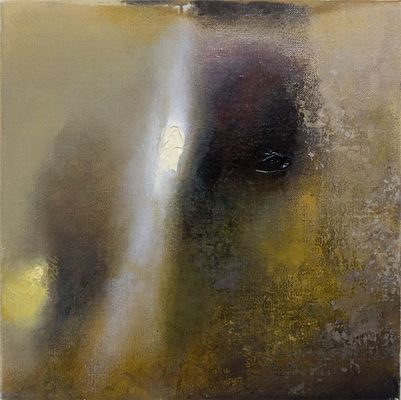
To return to Buckley’s fragment, the first two lines very much evoke how I paint nowadays. As you age, detail diminishes and patches of light become more luminous and float. I feel the most honest way of dealing with this is by smearing the oil paint on the canvas with the fingers and working close-up, blind. Only if the patches coalesce into an approaching image can the work gain a life.
-
Jonathan Walker was born in Melbourne, Australia and brought up on a dairy farm in Gippsland. In the 1970’s he studied painting at RMIT and won the Harold Wright Scholarship to the British Museum, London. During the 1980’s he exhibited at Pinacotheca Gallery, Richmond and had work shown at the NGV and Heidi City Art Gallery. Over the same period he designed the cover for the “Epigenesi” LP by Giancarlo Toniutti, Italy and conducted a mail exchange work with Achim Wollscheid, Germany. The work with artists through the post resulted in an article published in the bicentenary issue of Art and Australia 1988. He showed in artist run spaces such as WestSpace in the 90’s and 2000’s, and until 2012, taught painting at Victoria University, which is where we (Colleen Ahern and Lisa Radford) as organisers of the exhibition, among many others, had the privilege of being his student.
Walker’s knowledge was imparted to students through the careful selection of music, literature, and artists found in books that he himself had ordered for the library. Walker’s strategy was the generosity of sharing his vast knowledge with references specific to each student and their context.
Walker’s paintings share a similar focus and intimacy.
This exhibition presents a small selection of recent paintings alongside a publication that includes Walker’s writing. Observational and analytical, Walker’s work is a type of material notation — the time of day, colour and how it is blended, the both specific and fleeting location of a reflection on lino or the question of whether a chair leg should be included in a painting.
Please join us on Friday August 21 between 6-8pm to celebrate the opening of the exhibition.
Curated by Colleen Ahern and Lisa Radford.
B. Wurtz
Curated by Nic Tammens
March 26 - April 4, 2015
B.Wurtz works from a basement studio in his home on Manhattan’s Lower East Side.
This local fact is attested to by the plastic shopping bags and newsprint circulars that appear in his work. As formal objects, they don’t make loud claims about their origins but nonetheless transmit street addresses and places of business from the bottom of this long thin island. Like plenty of artists, Wurtz is affected by what is local and what is consumed. His work is underpinned by this ethic. It often speaks from a neighborhood or reads like the contents of a hamper:
“BLACK PLUMS $1.29 lb.”
“Food Bazaar”
“USDA Whole Pork Shoulder Picnic 99c lb.”
“RITE AID Pharmacy, with us it’s personal.”
“H. Brickman & Sons.”
“Sweet Yams 59c lb."
Most of the work in this exhibition was made while the artist was in residence at Dieu Donne, a workshop dedicated to paper craft in Midtown. Here Wurtz fabricated assemblages with paper and objects that are relatively lightweight, with the intention that they would be easily transportable to Australia. This consideration isn’t absolute in Wurtz’s work, but was prescriptive for making the current exhibition light and cheap. Packed in two boxes, these works were sent from a USPS post office on the Lower East Side and delivered to North Melbourne by Australia Post.
Wurtz appears courtesy of Metro Pictures, New York.
Thanks to Rob Halverson, Joshua Petherick, Sari de Mallory, Matt Hinkley, Helen Johnson, Fayen d'Evie, Ask Kilmartin, Lisa Radon, Ellena Savage, Yale Union, and "Elizabeth".
John Nixon
"Archive"
December 15 - January 20, 2014
The presentation of John Nixon's archive offered a rare showcase of this extensive collection of the artist's own publications, catalogues, posters, ephemera, editions and more, from the mid 1980s onwards, alongside a selection of his artworks.
Organized by John Nixon, Joshua Petherick and Matt Hinkley.
<a href=http://wfb.public-office.info/artist/john-nixon>All titles by John Nixon
"Habitat"
at Minerva, Sydney (organised by Joshua Petherick and Matt Hinkley)
November 15 - December 20, 2014
Lupo Borgonovo, Janet Burchill & Jennifer McCamley,
Lewis Fidock, HR Giger, Piero Gilardi, Veit Laurent Kurz,
Cinzia Ruggeri, Michael E. Smith, Lucie Stahl, Daniel Weil, Wols
Press Release:
“...It contained seven objects. The slender fluted bone, surely formed for flight, surely from the wing of some large bird. Three archaic circuitboards, faced with mazes of gold. A smooth white sphere of baked clay. An age-blackened fragment of lace. A fingerlength segment of what she assumed was bone from a human wrist, grayish white, inset smoothly with the silicon shaft of a small instrument that must once have ridden flush with the surface of the skin - but the thing’s face was seared and blackened.”
William Gibson, “Count Zero”, 1986
"Autumn Projects Archive"
Curated by Liza Vasiliou
March 6 - March 15, 2014
World Food Books, in conjunction with the Virgin Australia Melbourne Fashion Festival 2014, presented the Autumn Projects archive, consisting of a selection of early examples in Australian fashion with a particular interest in collecting designers and labels from the period beginning in the 1980’s, who significantly influenced the discourse of Australian Fashion.
Curated by Liza Vasiliou, the exhibition provided a unique opportunity to view pieces by designers Anthea Crawford, Barbara Vandenberg, Geoff Liddell and labels CR Australia, Covers, Jag along with early experimental collage pieces by Prue Acton and Sally Browne’s ‘Fragments’ collection, suspended throughout the functioning World Food Books shop in Melbourne.
H.B. Peace
presented by CENTRE FOR STYLE
November 14, 2013
"Hey Blinky, you say chic, I say same"
Anon 2013
H.B. Peace is a clothing collaboration between great friends Blake Barns and Hugh Egan Westland. Their pieces explore the divergences between 'character’ and ‘personality’ in garments....etc
Special Thanks to Joshua Petherick and Matt Hinkley of WFB and Gillian Mears
and a Very Special Thank you to Audrey Thomas Hayes for her shoe collaboration.
Janet Burchill & Jennifer McCamley
"Aesthetic Suicide"
May 10 - June 8, 2013
The first of our occasional exhibitions in the World Food Books office/shop space in Melbourne, "Aesthetic Suicide" presented a body of new and older works together by artists Janet Burchill & Jennifer McCamley, including videos, prints, a wall work, and publications.
During shop open hours videos played every hour, on the hour.
$.00 - Out of stock
The eternal clean out! New items weekly.
https://worldfoodbooks.com/category/sale
Published by World Food Books / Melbourne
$20.00 - In stock -
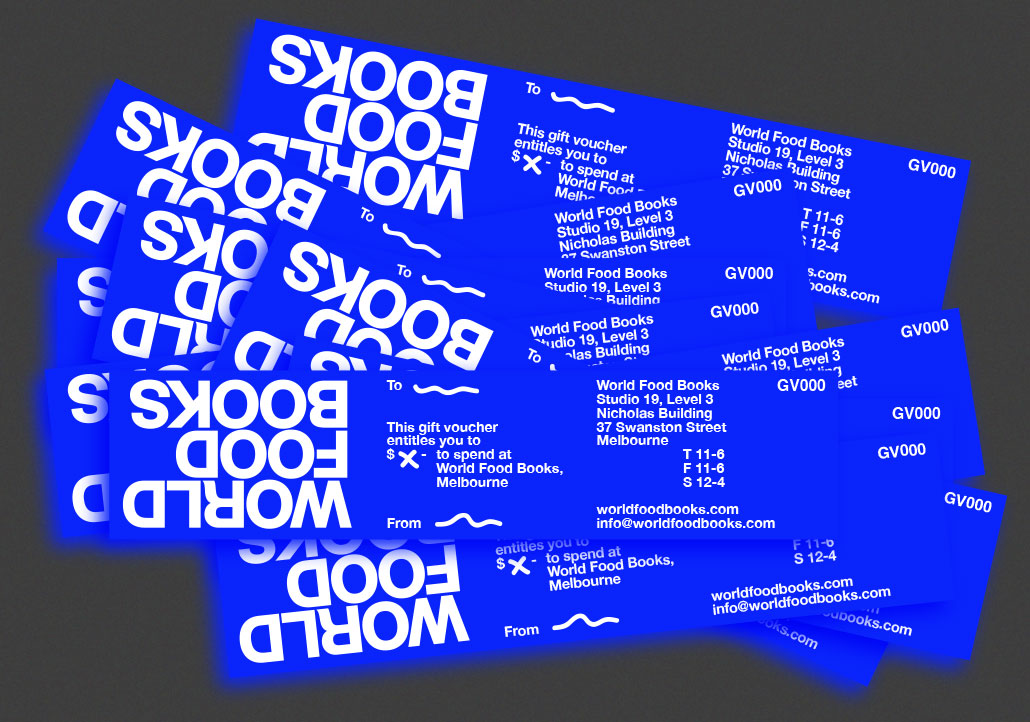
A World Food Books gift voucher is redeemable in our Melbourne bookshop or via our webshop (here). An e-voucher (printable pdf) will be sent to your purchase email address (please notify us if you wish to have the voucher sent to an alternate address and wish us to fill in the receiver's details on the card).
Gift vouchers can be purchased in increments of $20 (Australian Dollars) and the total amount can simply be added to by increasing the quantity in your shopping cart. eg. A quantity of 5 gift vouchers will result in an item total of $100 - a $100 gift voucher. Simply click "ADD TO CART" 5 times, or update your quantity in the shopping cart.
If you wish to purchase multiple, separate gift vouchers in one go, please just email us and we can personally prepare and email you a payment request.
Please note: Please select Pick-Up on gift voucher purchse to avoid any postage charges. Accidental postage charges will be refunded right away!
Thank you.
For any questions, please don't hesitate to email: [email protected]
2025, English
Softcover, 448 pages, 22.5 x 19.2 cm
Published by
FAB Press / UK
$80.00 - In stock -
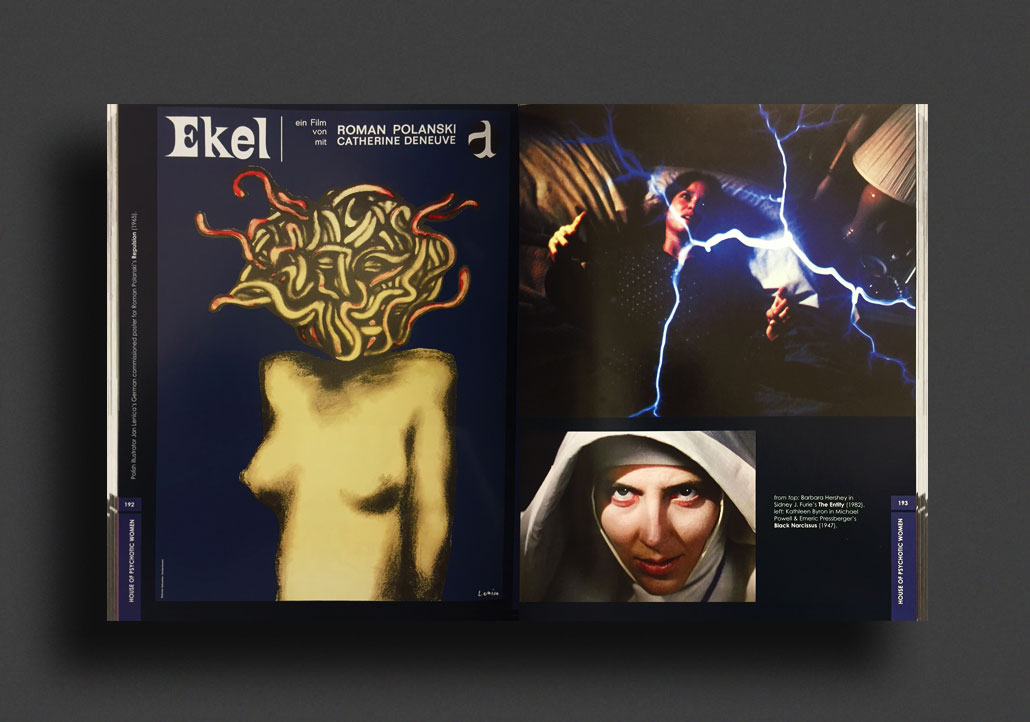
In 2012, a book debuted that would go on to canonical status and usher in a new way of writing about film. Kier-La Janisse's HOUSE OF PSYCHOTIC WOMEN is an autobiographical exploration of female neurosis in horror and exploitation films that examines hundreds of films through a daringly personal lens. In this pioneering work, anecdotes and memories interweave with film history, criticism, trivia and confrontational imagery to create a reflective personal history and a consideration of female madness, both onscreen and off.
To mark its 10th anniversary, Kier-La Janisse and FAB Press have reteamed to produce an expanded edition the book, featuring new writing on 100 more films - many of which were inspired in part by the book itself - and hundreds of new images. This hardcover expanded edition is now available in softcover.
Cinema is full of neurotic personalities, but few things are more transfixing than a woman losing her mind onscreen. Horror as a genre provides the most welcoming platform for these histrionics: crippling paranoia, desperate loneliness, masochistic death-wishes, dangerous obsessiveness, apocalyptic hysteria. Unlike her male counterpart - 'the eccentric' - the female neurotic lives a shamed existence, making these films those rare places where her destructive emotions get to play.
This sharply-designed book, including a 48-page full-colour section, is packed with 680 rare stills, posters, pressbooks and artwork throughout, that combine with family photos and artifacts to form a titillating sensory overload, with a filmography that traverses the acclaimed and the obscure in equal measure. Films covered include The Entity, The Corruption of Chris Miller, Singapore Sling, 3 Women, Toys Are Not for Children, Repulsion, Let's Scare Jessica to Death, The Haunting of Julia, Secret Ceremony, Cutting Moments, Out of the Blue, Mademoiselle, The Piano Teacher, Possession, Antichrist and hundreds more!
Compendium of Female Neurosis. A cross-section of horror and violent exploitation films that feature disturbed or neurotic women as primary or pivotal characters.
Alice, Sweet Alice; All the Colors of the Dark; Alucarda; Anima persa; Antichrist; Asylum; The Attic; Audition; Autopsy; The Baby; Bad Dreams; Bad Guy; Bas-fonds; Bedevilled; The Beguiled; La Belle Bête; The Bird with the Crystal Plumage; Black Narcissus; Black Swan; The Blood Spattered Bride; The Blue Eyes of the Broken Doll; Born Innocent; Boy Meets Girl; The Brave One; The Bride; The Brood; Burnt Offerings; Butcher, Baker, Nightmare Maker; Can Go Through Skin; A Candle for the Devil; Carrie; La casa muda; Cat People; La cérémonie; Children Shouldn't Play with Dead Things; Christiane F.; The Collector; The Corruption of Chris Miller; Les cousines; "Criminally Insane"; The Curse of the Cat People; Cutting Moments; Daddy; Dead Creatures; Defenceless: A Blood Symphony; Dementia; Descent; The Devil's Widow; The Devils; Diabel; Die! Die! My Darling!; The Dinner Party; Dirty Weekend; Dr. Jekyll and His Women; Don't Deliver Us from Evil; Don't Look Now; Don't Torture a Duckling; Doppelganger; Dracula's Daughter; Dream Home; The Entity; The Escapees; Eyes of a Stranger; Fatal Attraction; Feed; Five Across the Eyes; Footprints; Forbidden Photos of a Lady Above Suspicion; Four Flies on Grey Velvet; Freeze Me; The Frightened Woman; Frightmare; Funeral Home; Gently Before She Dies; The Geography of Fear; The Girl Next Door; The Glass Ceiling; Goodbye Gemini; A Gun for Jennifer; Handgun; Happy Birthday to Me; Hard Candy; The Haunting (1963); The Haunting (2009); The Haunting of Julia; Haute tension; Heavenly Creatures; The Honeymoon Killers; A Horrible Way to Die; I Never Promised You a Rose Garden; Images; In My Skin; The Innocents; Inside; The Isle; Julie Darling; Kichiku; The Killer Nun; Kissed; Knife of Ice; The Ladies Club; The Last Exorcism; The Legend of Lylah Clare; The Legend of the Wolf Woman; Let's Scare Jessica to Death; A Lizard in a Woman's Skin; Love Me Deadly; The Loved Ones; Macabre; The Mad Room; Mademoiselle; Madhouse (1974); Madhouse (1981); Madness; The Mafu Cage; Man, Woman and Beast; Marnie; Martyrs; Masks; May; Misery; Morris County; Morvern Callar; Mother's Day; Ms.45; Mumsy, Nanny, Sonny & Girly; Nabi: The Butterfly; Neighbor; Neither the Sea Nor the Sand; Nekromantik; Nekromantik 2; Next of Kin; The Night Porter; A Night to Dismember; Nightbirds; Nightmares; La nuit des traquées; The Other Hell; The Other Side of the Underneath; Out of the Blue; Paranoia; Paranormal Activity; The Perfume of the Lady in Black; Persona; Phenomena; The Piano Teacher; Pigs; Play Misty for Me; Possession; Pretty Poison; Prey; Psycho Girls; The Rapture; The Rats Are Coming! The Werewolves Are Here!; Rebecca; Red Desert; Red Sun; Red White & Blue; The Reincarnation of Peter Proud; Repulsion; Road to Salina; Roman's Bride; Santa Sangre; Schizo; Scissors; Scream 4; Séance on a Wet Afternoon; Secret Ceremony; The Secret Life of Sarah Sheldon; Shock; Singapore Sling; Sinner; Sisters (1973); Sisters (2006); Slaughter Hotel; The Snake Pit; Sombre; Spider Baby; The Stendhal Syndrome; Straight On Till Morning; Strait-Jacket; The Strange Possession of Mrs. Oliver; The Strange Vengeance of Rosalie; Symptoms; Szamanka; That Cold Day in the Park; They Call Her One Eye; 3 Women; To Let; Toys Are Not for Children; Trance; Trilogy of Terror; Trouble Every Day; Twin Peaks: Fire Walk with Me; The Uninvited; Venom; Venus Drowning; The Washing Machine; What Ever Happened to Baby Jane?; The Whip and the Body; Whoever Slew Auntie Roo?; Windows; The Witch Who Came from the Sea; The Woman; Woman Transformation; Wound PLUS MORE THAN 100 EXTRA FILM REVIEWS EXCLUSIVE TO THIS NEW EDITION
Kier-La Janisse is a film writer, programmer, producer and founder of The Miskatonic Institute of Horror Studies. She is the author of A Violent Professional: The Films of Luciano Rossi (2007) and has been an editor on numerous books including Warped & Faded: Weird Wednesday and the Birth of the American Genre Film Archive (2021), Yuletide Terror: Christmas Horror on Film and Television (2017) and Satanic Panic: Pop-Cultural Paranoia in the 1980s (2015). She was a producer on David Gregory’s Tales of the Uncanny (2020) and wrote, directed and produced the award-winning documentary Woodlands Dark and Days Bewitched: A History of Folk Horror (2021) for Severin Films, where she is a producer and editor of supplemental features. She is currently at work on several books including a monograph about Monte Hellman’s Cockfighter.
1987, Japanese
Softcover, 160 pages, 18.2 x 13 cm
1st Edition, Out of print title / used / very good
Published by
Fiction Inc. / Tokyo
$70.00 - In stock -
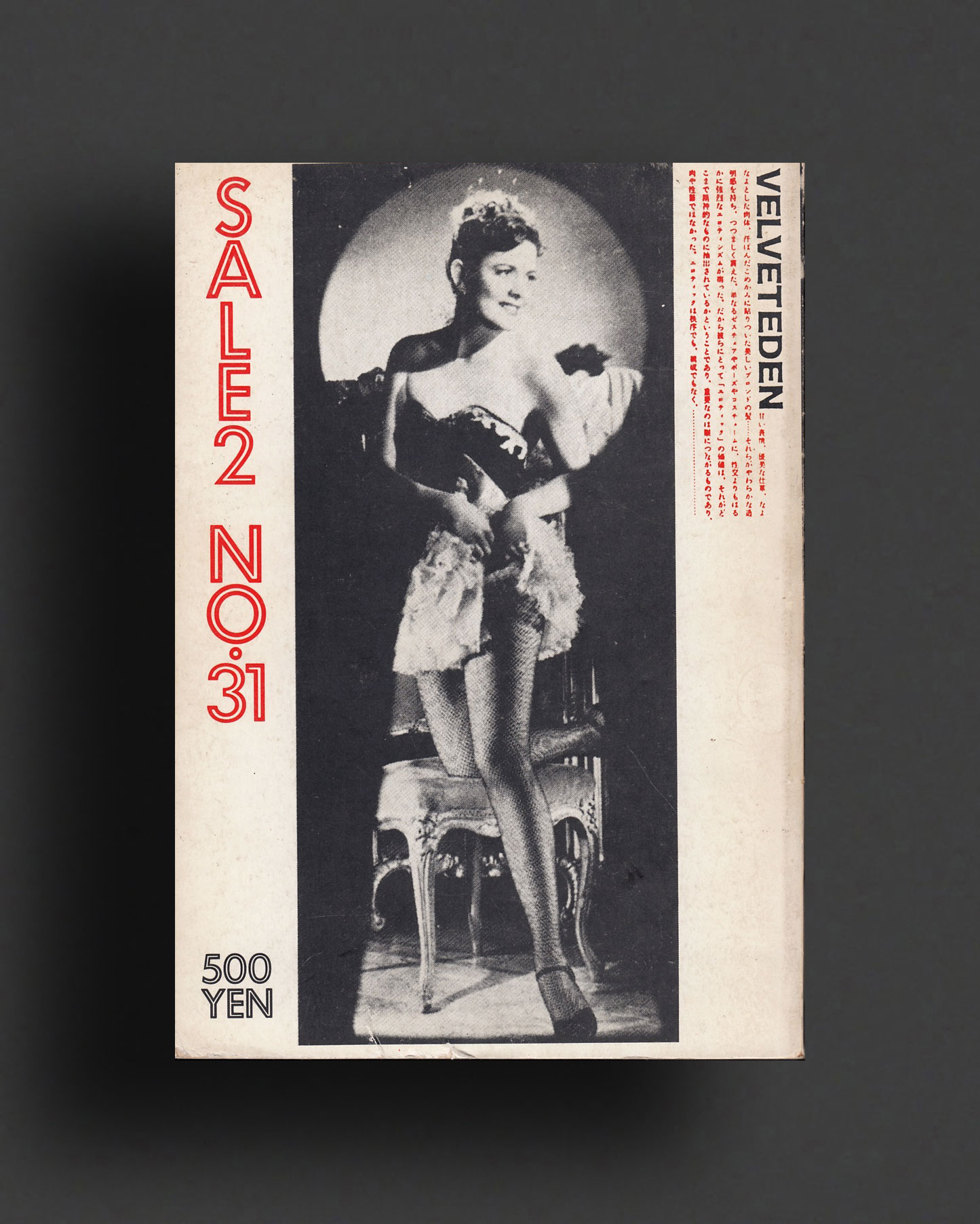
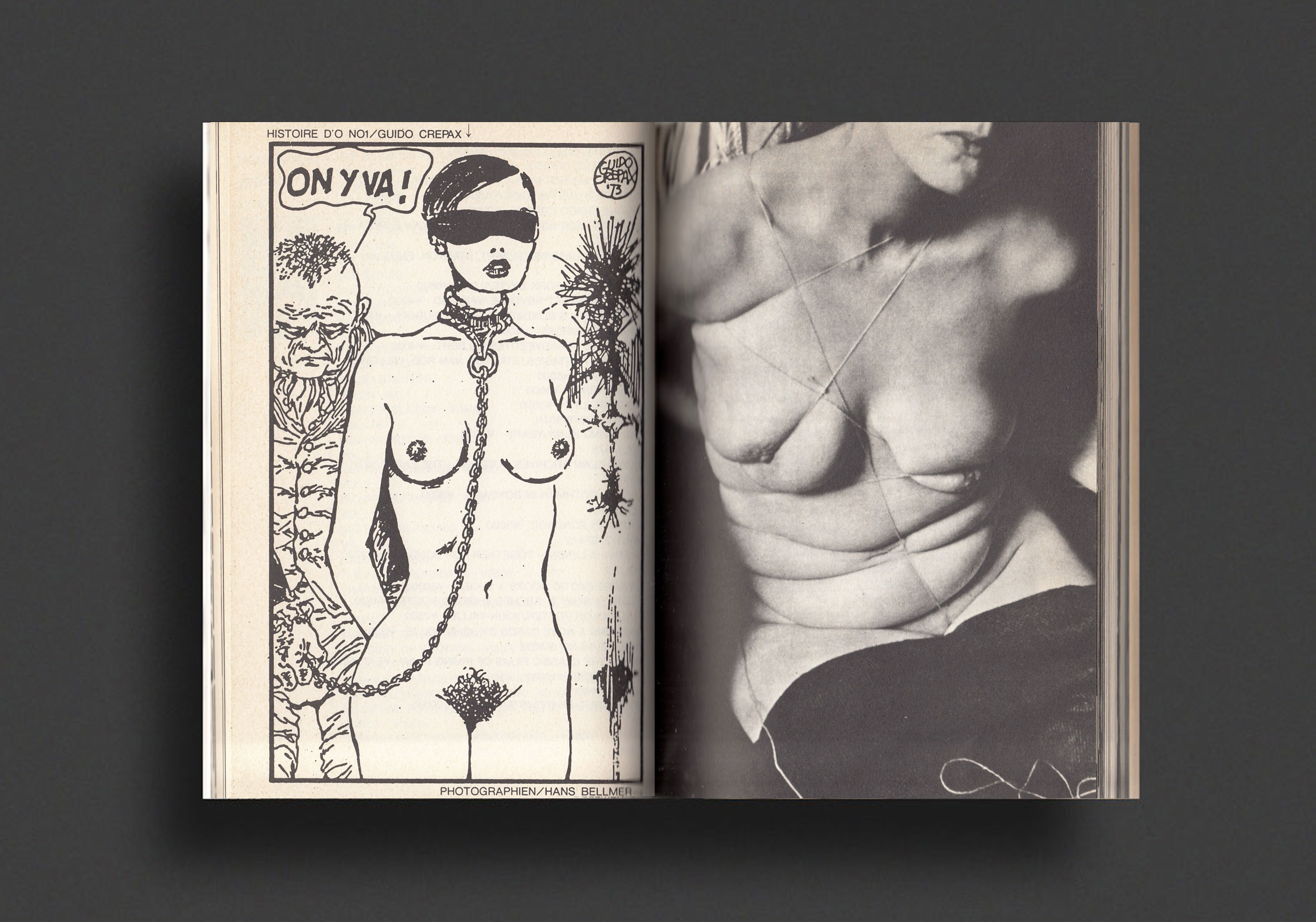
Issue No.31 of the great SALE2 periodical from Tokyo Japan, founded in 1984 by Makoto Orui, who later became art director for Purple magazine in France and Rockin’on magazine in Japan. SALE2 was active for about 14 years during the 1980s—1990s, published regularly as a sort-of fanzine/journal/catalogue/pocket-book by Fiction, Inc., a specialty shop and publisher of fetish and erotica in Tokyo in the 1980-90s. With Orui's distinct design SALE2 developed an exclusive curated editorial set on ‘erotisism and its spiritual philosophy’, with each issue exploring different themes and features, heavy on fetishism and erotic art.
Issue No.31, the "Velvet Eden" special issue with imagery and essays around the golden era of erotic photography and the Richard Merkin Collection of Erotic Photography from the first half of the 20th century. Profusely illustrated with drawings, photography, bondage illustrations, catalogue clippings, and artworks, including the work of John Willie, Hans Bellmer/Unica Zürn, Bernard Montorgueil, Bill Ward, ENEG, Guido Crepax, Jay, Carlo, Eric Stanton, Irving Claw, Betty Page, and periodicals such as Rubber Magazine, Amateur Bondage, Bizarre Comix, Bizarre Classix, Bizarre Fotos, Stiletto, and much more... Very heavily illustrated throughout with erotic photography and artwork, all texts in Japanese.
Very Good copy.
1989, Japanese
Softcover, 208 pages, 13 x 18 cm
1st Edition, Out of print title / used / very good
Published by
Fiction Inc. / Tokyo
$70.00 - In stock -
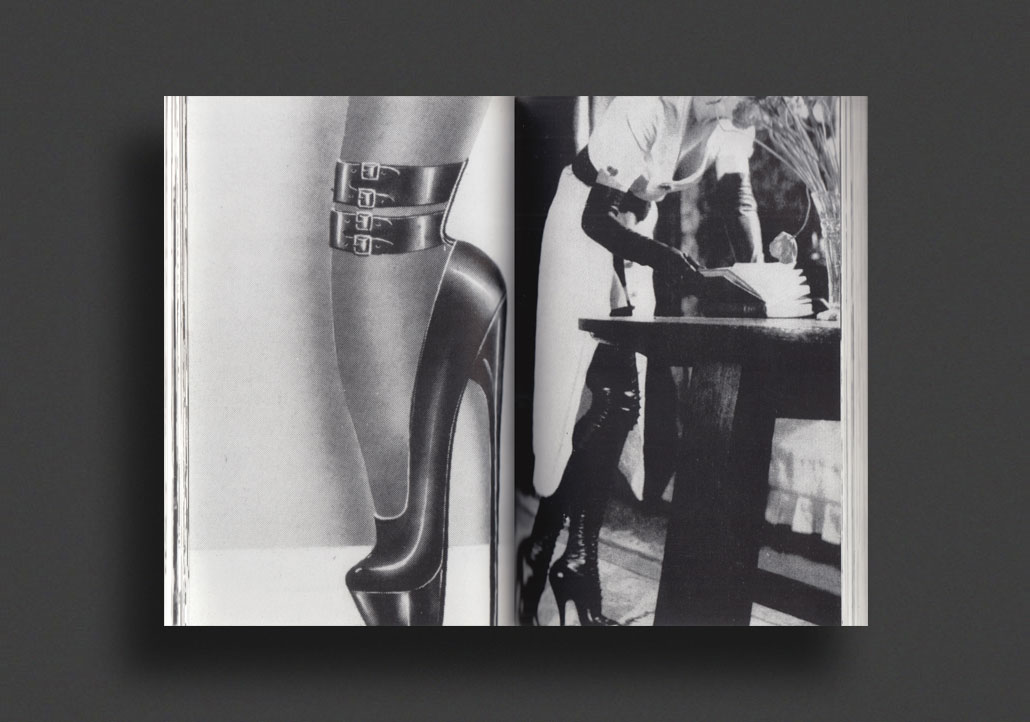
Issue No.36 of the great SALE2 periodical from Tokyo Japan, founded in 1984 by Makoto Orui, who later became art director for Purple magazine in France and Rockin’on magazine in Japan. SALE2 was active for about 14 years during the 1980s—1990s, published regularly as a sort-of fanzine/journal/catalogue/pocket-book by Fiction, Inc., a specialty shop and publisher of fetish and erotica in Tokyo in the 1980-90s. With Orui's distinct design SALE2 developed an exclusive curated editorial set on ‘erotisism and its spiritual philosophy’, with each issue exploring different themes and features, heavy on fetishism and erotic art.
Issue No.36, the "Female Foot Fetishism Special Issue" with the wonderful wraparound Pierre Molinier cover is packed with imagery and essays around the theme of "Foot and Fetish Heel" throughout history, literature, film and fetish publishing, etc. profusely illustrated with drawings, photography, bondage illustrations, film stills, catalogue clippings, and artworks, including works by Bill Ward, Pierre Molinier, Nobuyoshi Araki, and so many more. It also features the Fiction, Inc. section that samples a cross-section of content from catalogue publications including the work of John Willie, Bill Ward, Carlo, Eric Stanton, Irving Claw, Betty Page, and periodicals such as Rubber Magazine, Amateur Bondage, Bizarre Comix, Bizarre Classix, Bizarre Fotos, Stiletto, and much more... Very heavily illustrated throughout with erotic photography and artwork, all texts in Japanese.
Very Good copy.
1989, Japanese
Softcover, 176 pages, 13 x 18 cm
1st Edition, Out of print title / used / very good
Published by
Fiction Inc. / Tokyo
$70.00 - In stock -
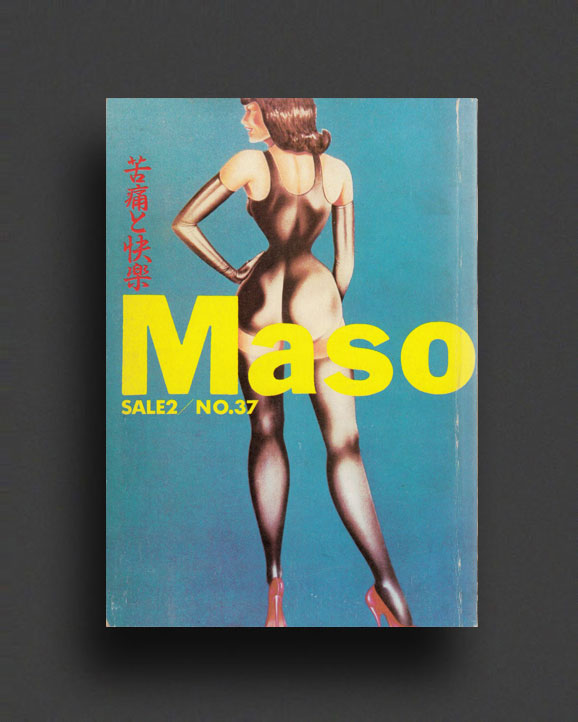
Issue No.37 of the great SALE2 periodical from Tokyo Japan, founded in 1984 by Makoto Orui, who later became art director for Purple magazine in France and Rockin’on magazine in Japan. SALE2 was active for about 14 years during the 1980s—1990s, published regularly as a sort-of fanzine/journal/catalogue/pocket-book by Fiction, Inc., a specialty shop and publisher of fetish and erotica in Tokyo in the 1980-90s. With Orui's distinct design SALE2 developed an exclusive curated editorial set on ‘erotisism and its spiritual philosophy’, with each issue exploring different themes and features, heavy on fetishism and erotic art.
Issue No.37, the Masochism issue features erotic writings and artwork throughout by Loic Dubigeon, Guido Crepax, David Bailey, Man Ray, Lucas Samaras, Annie Sprinkle's Bosom Ballet, Hans Bellmer, Paul Outerbridge, Leopold von Sacher-Masoch, Shinichi Kusamori on the paintings of Seiu Ito "the father of modern kinbaku", Yamaguchi Tsubaki, E. J. Bellocq, René Girard, Noriyuki Eda on Saint Sebastian, Edogawa Ranpo, Serge Nazarieff, Rieko Matsuura, Tetsuo Amano, Freud, Nietzsche, de Sade, interspersed with lots of mysterious vintage erotic imagery, bondage illustration, and catalogue/advertisments/clippings of Richard Cerf, Araki, Eric Stanton, Irving Klaw, Jim, John Willie, Bizarre Comix, and much more...
Very heavily illustrated throughout with erotic photography and artwork, all texts in Japanese.
Very Good copy, tanning with age.
1992, Japanese
Softcover, 192 pages, 13 x 18 cm
1st Edition, Out of print title / used / very good
Published by
Fiction Inc. / Tokyo
$70.00 - In stock -
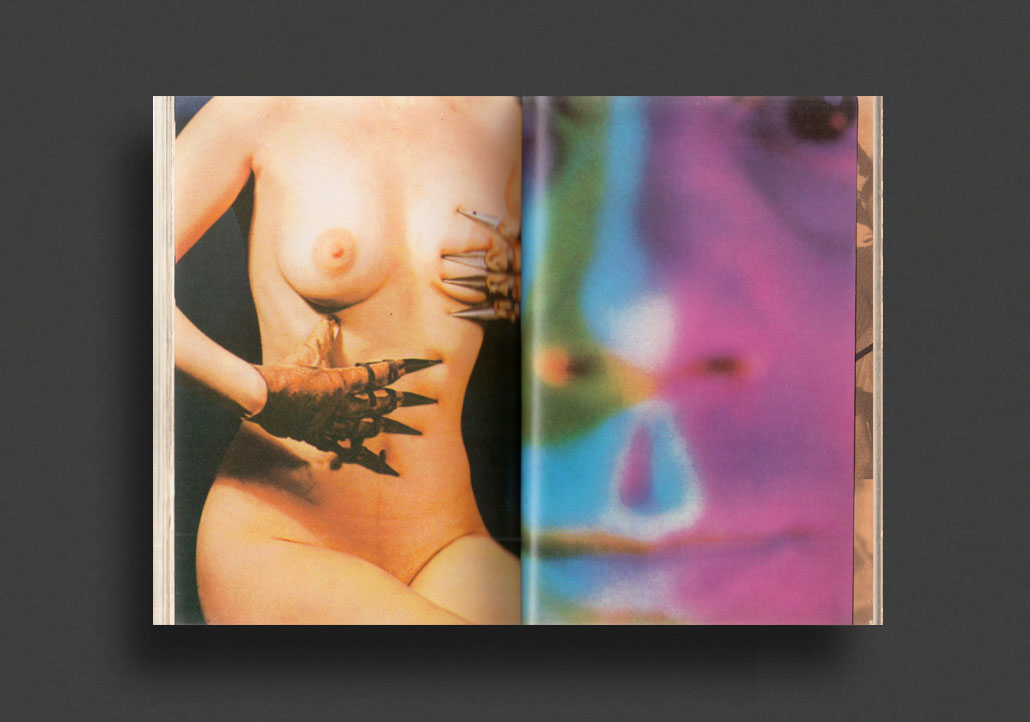
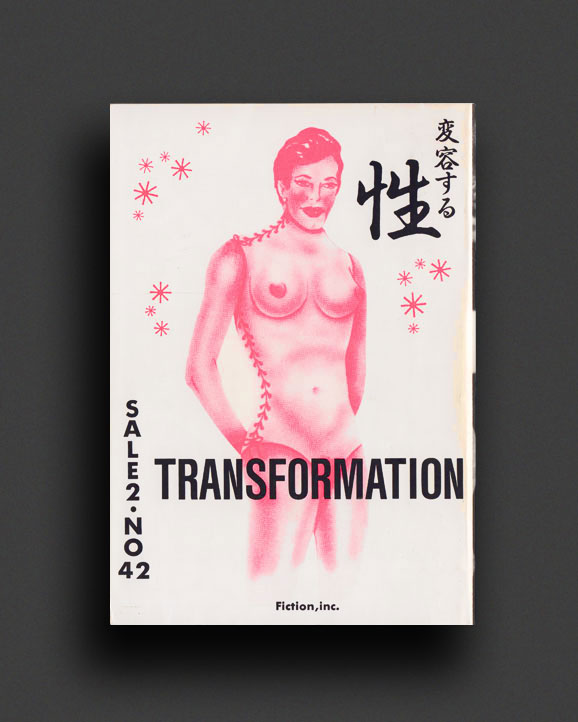
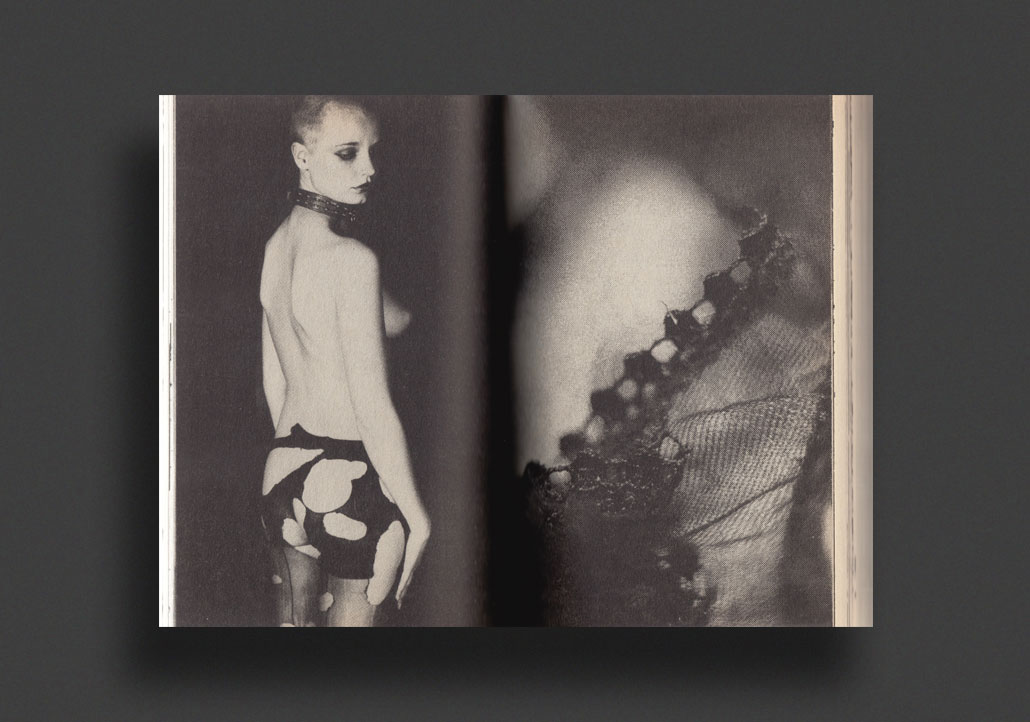
Issue No.42 of the great SALE2 periodical from Tokyo Japan, founded in 1984 by Makoto Orui, who later became art director for Purple magazine in France and Rockin’on magazine in Japan. SALE2 was active for about 14 years during the 1980s—1990s, published regularly as a sort-of fanzine/journal/catalogue/pocket-book by Fiction, Inc., a specialty shop and publisher of fetish and erotica in Tokyo in the 1980-90s. With Orui's distinct design SALE2 developed an exclusive curated editorial set on ‘erotisism and its spiritual philosophy’, with each issue exploring different themes and features, heavy on fetishism and erotic art.
Issue No.42, the "Transformation" issue features collected writings and images around the themes of body transformation, transsexuality, including Pierre Molinier, Mari Akasaka, Kyoko Okazaki, Toyen, Hans Bellmer and Unica Zürn, Henri Maccheroni, Robert Chouraqui, Greybuck's The Equestrians illustrations, Sophia Lamar, plus loads of other images/catalogues of bondage and fetish related arts, and much more...
Very heavily illustrated throughout with erotic photography and artwork, all texts in Japanese.
Very Good copy with tanning to pages.
1988, Japanese
Softcover, 208 pages, 13 x 18 cm
1st Edition, Out of print title / used / very good
Published by
Fiction Inc. / Tokyo
$70.00 - In stock -
Issue No.35 of the great SALE2 periodical from Tokyo Japan, founded in 1984 by Makoto Orui, who later became art director for Purple magazine in France and Rockin’on magazine in Japan. SALE2 was active for about 14 years during the 1980s—1990s, published regularly as a sort-of fanzine/journal/catalogue/pocket-book by Fiction, Inc., a specialty shop and publisher of fetish and erotica in Tokyo in the 1980-90s. With Orui's distinct design SALE2 developed an exclusive curated editorial set on ‘erotisism and its spiritual philosophy’, with each issue exploring different themes and features, heavy on fetishism and erotic art.
Issue No.35, the "EROTIK!!" issue features erotic writings and artwork throughout by Hans Bellmer, Dorothea Tanning, André Berg, Pierre Molinier, Max Ernst, Armando Calvelli, articles on vintage stag films, nude French postcards, interspersed with lots of mysterious vintage erotic imagery, bondage illustration, and catalogue/advertisments/clippings of Eric Stanton, Irving Klaw, Jim, John Willie, Bizarre Comix, and much more...
Very heavily illustrated throughout with erotic photography and artwork, all texts in Japanese.
Very Good copy, tanning to pages.
1986, Japanese
Softcover, 160 pages, 13 x 18 cm
1st Edition, Out of print title / used / very good
Published by
Fiction Inc. / Tokyo
$70.00 - In stock -
Issue No.28 of the great SALE2 periodical from Tokyo Japan, founded in 1984 by Makoto Orui, who later became art director for Purple magazine in France, published regularly as a sort-of fanzine/journal/catalogue/pocket-book by Fiction, Inc., a specialty bookshop and publisher of fetish and erotica in Tokyo in the 1980—90s. Each issue covers different themes and features, heavy on fetishism.
Issue No.28, the "Fetishism" issue features collected writings and images around the theme of fetish by John Willie, Bizarre Magazine, Pierre Molinier, Irina Ionesco, Bernard Faucon (his incredible Summer Camp series), Irwing Klaw, Centurians Publishing Inc. bondage catalogues, Andy Warhol and much more... What's more, this issue comes complete with a green synthetic feather to kickstart your own sensual adventures.
Very heavily illustrated throughout with erotic photography and artwork, all texts in Japanese.
1990, Japanese
Softcover, 176 pages, 13 x 18 cm
1st Edition, Out of print title / used / very good
Published by
Fiction Inc. / Tokyo
$70.00 - In stock -
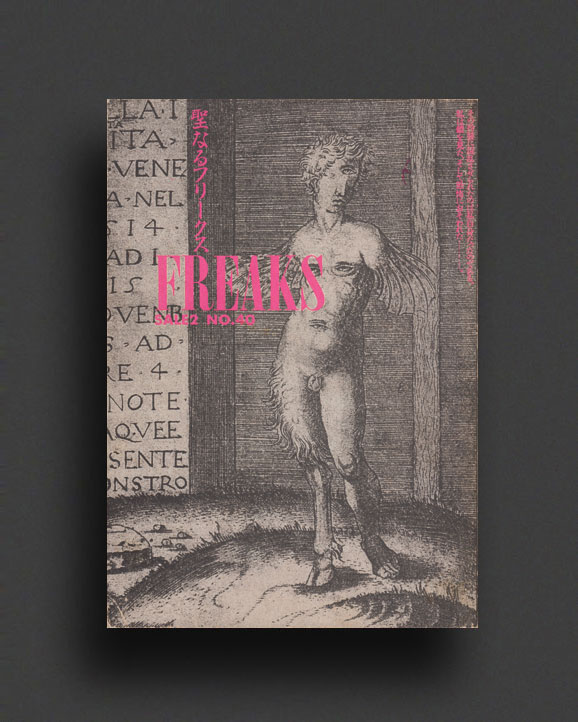
Issue No.40 of the great SALE2 periodical from Tokyo Japan, founded in 1984 by Makoto Orui, who later became art director for Purple magazine in France and Rockin’on magazine in Japan. SALE2 was active for about 14 years during the 1980s—1990s, published regularly as a sort-of fanzine/journal/catalogue/pocket-book by Fiction, Inc., a specialty shop and publisher of fetish and erotica in Tokyo in the 1980-90s. With Orui's distinct design SALE2 developed an exclusive curated editorial set on ‘eroticism and its spiritual philosophy’, with each issue exploring different themes and features, heavy on fetishism and erotic art.
Issue No.40, the "FREAKS" issue features writings and artwork throughout by Fictcryptokrimsographs by Les Krims, Amputee Love comic by Rich and Rene, Masami Akita (Merzbow), Odilon Redon, Joel-Peter Witkin, Hiromi Itō, Masaaki Oba, Diane Arbus, Erving Goffman, Pierre Molinier, lots of mysterious vintage "freak" and erotic imagery and illustration, and catalogue/advertisments/clippings of Eric Stanton, Irving Klaw, John Willie, Bizarre Comix, and much more...
Very heavily illustrated throughout with erotic photography and artwork, all texts in Japanese.
Very Good copy, tanning to pages and some wear to cover.
1991, Japanese
Softcover, 160 pages, 13 x 18 cm
1st Edition, Out of print title / used / very good
Published by
Fiction Inc. / Tokyo
$70.00 - In stock -
Issue No.40 of the great SALE2 periodical from Tokyo Japan during the late 1980s and early 1990s.
Published regularly as a sort-of fanzine/journal/catalogue/pocket-book by Fiction, Inc., a specialty shop and publisher of fetish and erotica in Tokyo in the 1980-90s. Each issue covers different themes and features, heavy on fetishism.
Issue No.40, the "Skin To Skin" issue features collected writings and images around the themes of body art, tattoo, piercing, bondage, "modern primitivism", etc. including Masami Akita (Merzbow), Mari Akasaka, Kyoko Okazaki, performance artist Fakir Musafar, Irving Klaw, Betty Page, many artists, plus imagery/advertisements/clippings/artworks by Carlo Mollino, Pierre Molinier, John Willie, Guido Crepax, more Irving Claw, more Betty Page, comix and periodicals such as Sweet Gwen's, Bizarre, Gwendoline, Rigorosa Disciplina, and much more...
Very heavily illustrated throughout with erotic photography and artwork, all texts in Japanese.
1992, Japanese
Softcover, 176 pages, 13 x 18 cm
1st Edition, Out of print title / used / very good
Published by
Fiction Inc. / Tokyo
$70.00 - In stock -
Issue No.43 of the great SALE2 periodical from Tokyo Japan during the late 1980s and early 1990s.
Published regularly as a sort-of fanzine/journal/catalogue/pocket-book by Fiction, Inc., a specialty shop and publisher of fetish and erotica in Tokyo in the 1980-90s. Each issue covers different themes and features, heavy on fetishism.
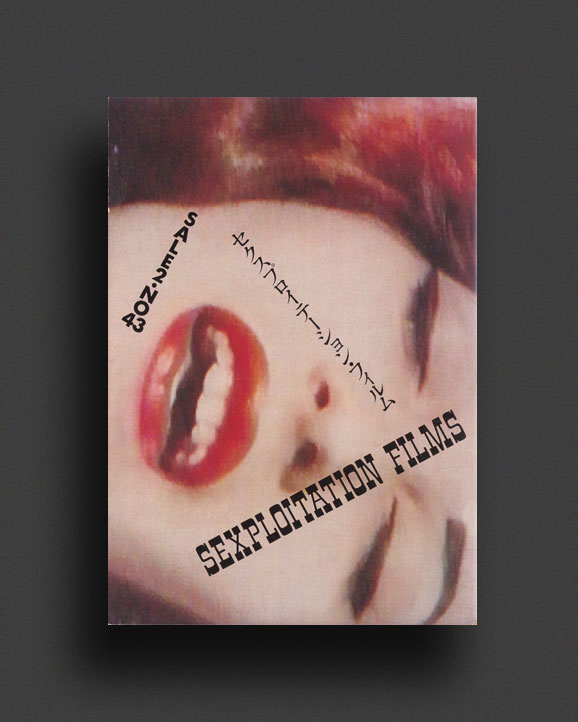
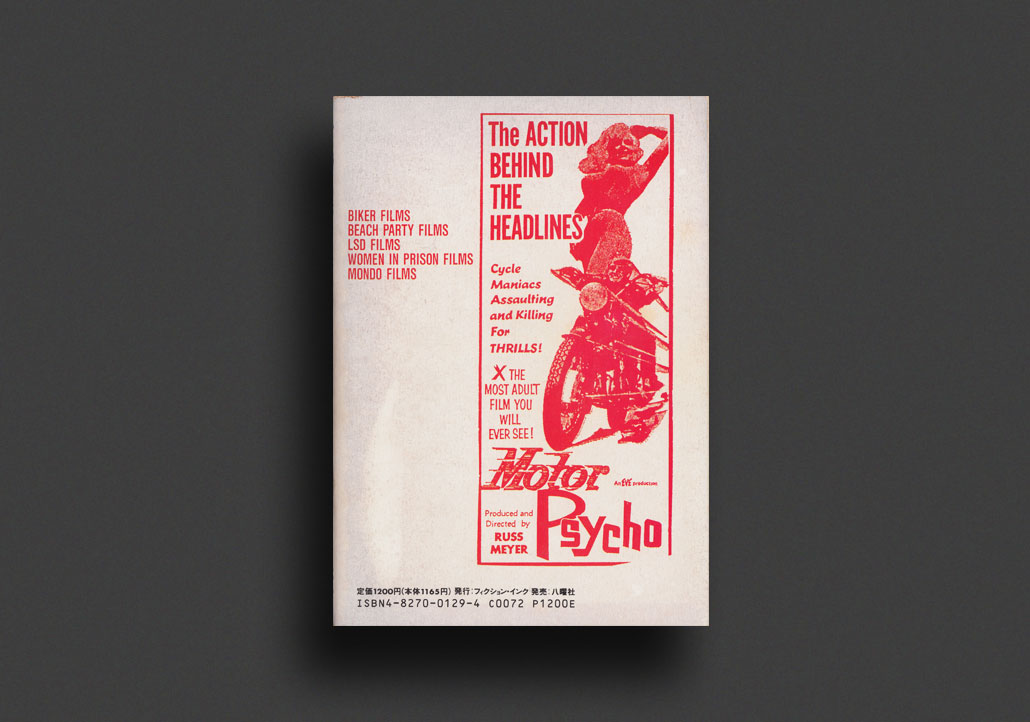
Issue No.43, the "Sexploitation Films" issue features "Biker Films, Beach Party Films, LSD Films, Women in Prison Films, Mondo Films...", a filmography from "A Taste of Flesh" (1967) to "The Wild, Wild World of Jayne Mansfield" (1968), a long interview with cult director Herschell Gordon Lewis, Russ Meyer, plus Carlo Mollino, Pierre Molinier, John Willie, Guido Crepax, Irving Claw, Betty Page, Gilles Berquet, and periodicals such as Sweet Gwen's, Bizarre, Gwendoline, Rigorosa Disciplina, and much more...
Very heavily illustrated throughout with erotic photography and artwork, all texts in Japanese.
1971, English
Hardcover (w. dust jacket), 470 pages, 22 x 14.5 cm
1st Edition, Out of print title / used / good
Published by
Macdonald / London
$35.00 - In stock -
First UK 1971 Hardcover edition of Siegfried Lenz's 'The German Lesson', one of the defining works of German post-war literature. Acclaimed author Siegfried Lenz published his novel in 1968 as a generation of Germans began confronting their parents about their involvement with the Nazi regime. Published by Macdonald & Co, London.
The German Lesson (original title: Deutschstunde) is a novel by the German writer Siegfried Lenz, published in 1968 in Germany. The English translation by Ernst Kaiser and Eithne Wilkins, titled The German Lesson, was first published in London by Macdonald & Co. in 1971 and later by New Directions in 1986. Deutschstunde was translated into several languages and is considered to be one of the defining works of German post-war literature.
Siggi Jepsen (the first-person narrator), an inmate of a juvenile detention center, is forced to write an essay with the title "The Joy of Duty." In the essay, Siggi describes his youth in Nazi Germany where his father, the "most northerly police officer in Germany," does his duty, even when he is ordered to debar his old childhood friend, the expressionist painter Max Nansen, from his profession, because the Nazis banned expressionism as "degenerate art" (entartete Kunst).
Siggi, however, is fascinated by Nansen's paintings, "the green faces, the Mongol eyes, these deformed bodies ... " and, without the knowledge of his father, manages to hide some of the confiscated paintings. Following the end of World War II, Jepsen senior is interned for a short time and later reinstalled as a policeman in rural Schleswig-Holstein. When he then obsessively continues to carry out his former orders, Siggi brings Nansen paintings that he believes to be in danger to safety. His father discovers his doings and dutifully turns him in for art theft.
When forced to write the essay on "The Joy of Duty" during his term in the juvenile detention center near Hamburg, the memories of his childhood come to the surface and he goes far beyond the "duty" of writing his essay by filling several notebooks with caustic recollections of this entire saga.
VG copy in Good dust jacket with wear to extremities and some marking. Protected under mylar wrap.
1977, English
Softcover, 244 pages, 22.5 x 15 cm
Reprint,
1st Edition, Out of print title / used / very good
Published by
University of California / Berkeley
$30.00 - In stock -
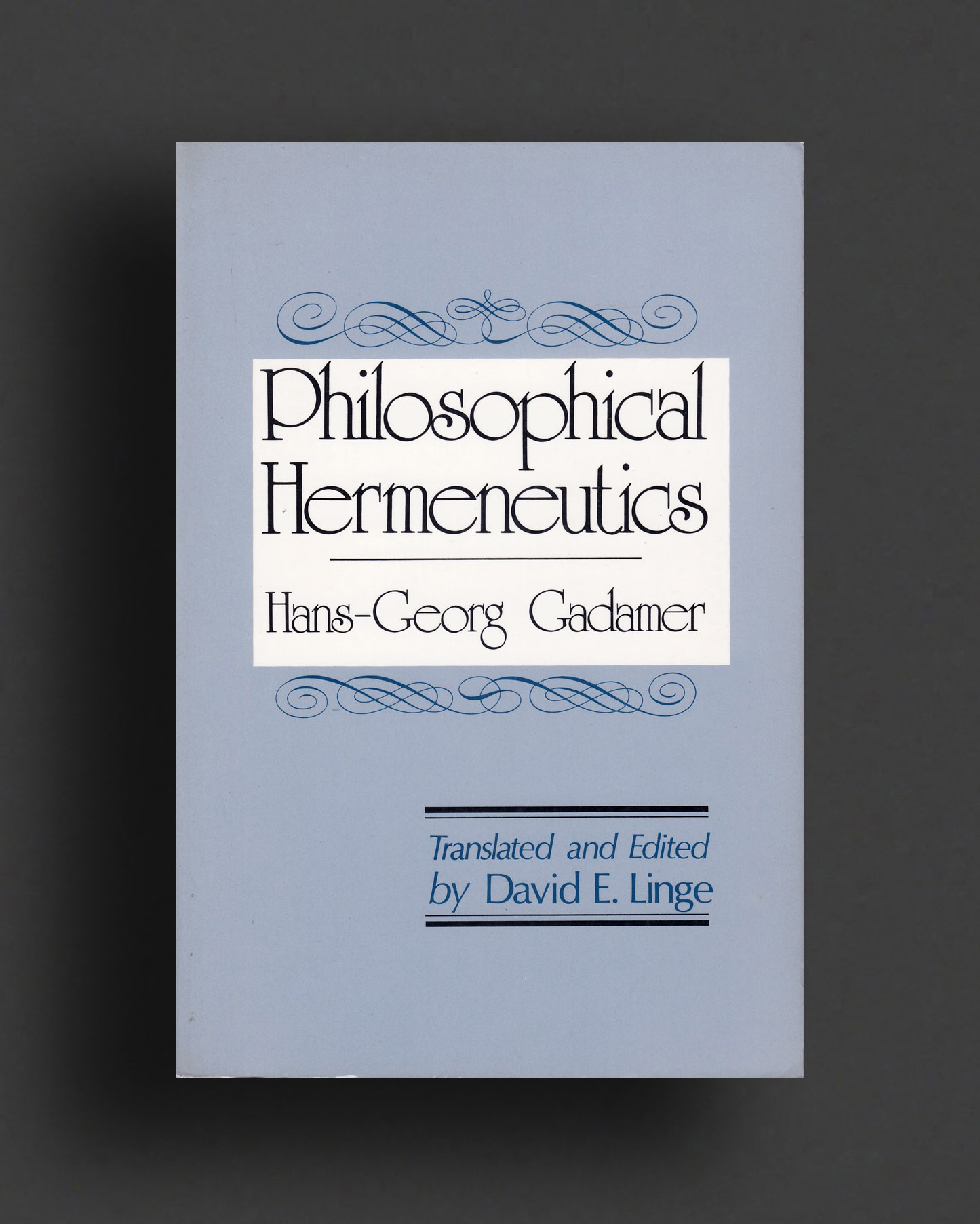
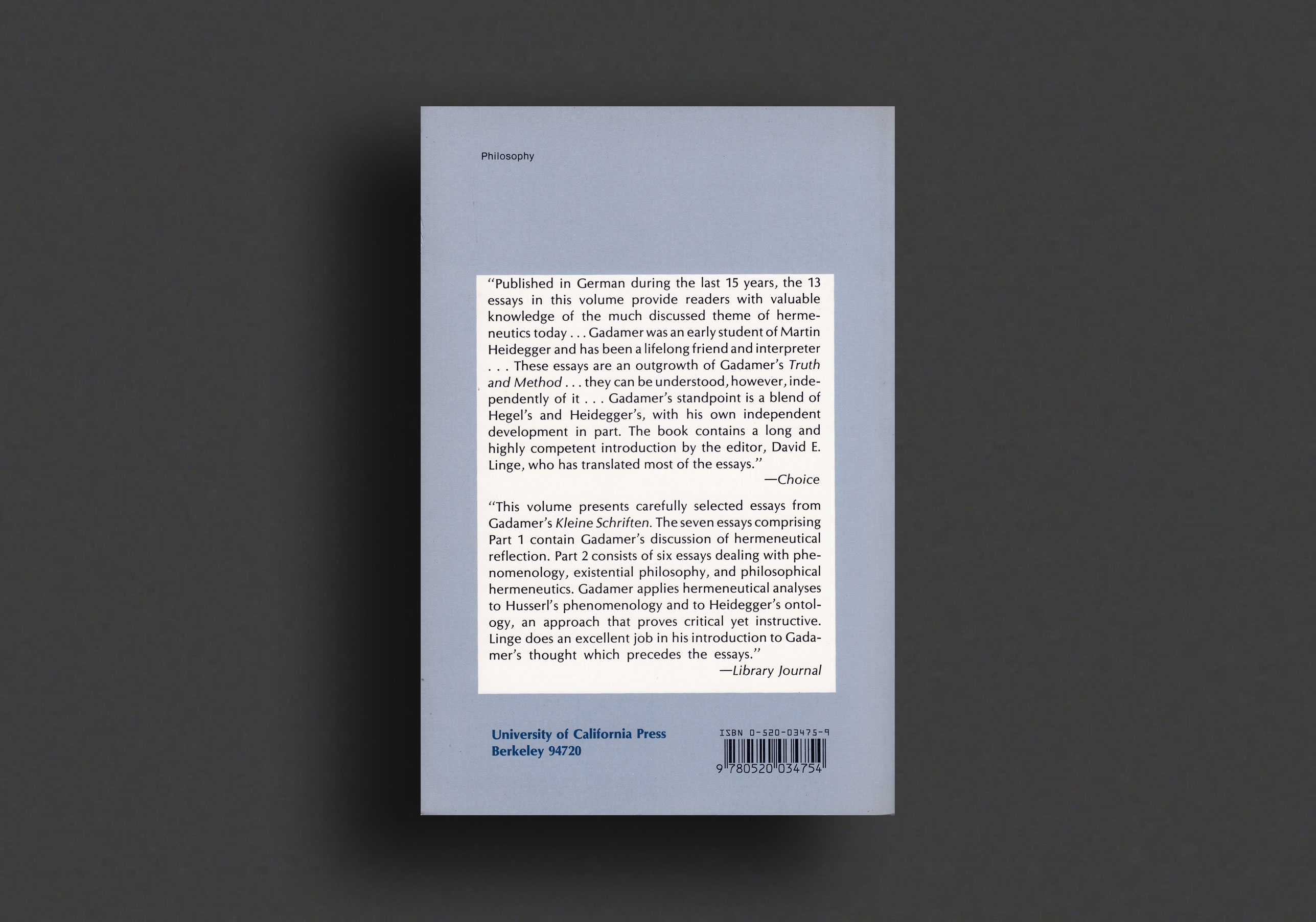
This excellent collection contains 13 essays from Gadamer's Kleine Schriften, dealing with hermeneutical reflection, phenomenology, existential philosophy, and philosophical hermeneutics. Gadamer applies hermeneutical analysis to Heidegger and Husserl's phenomenology, an approach that proves critical and instructive.
VG—NF copy, 1977 edition, later reprint.
1991 / 1996, English
Softcover, 356 pages, 22.5 x 15 cm
1st Edition, Out of print title / used / very good
Published by
Cambridge University Press / Cambridge
$35.00 - In stock -
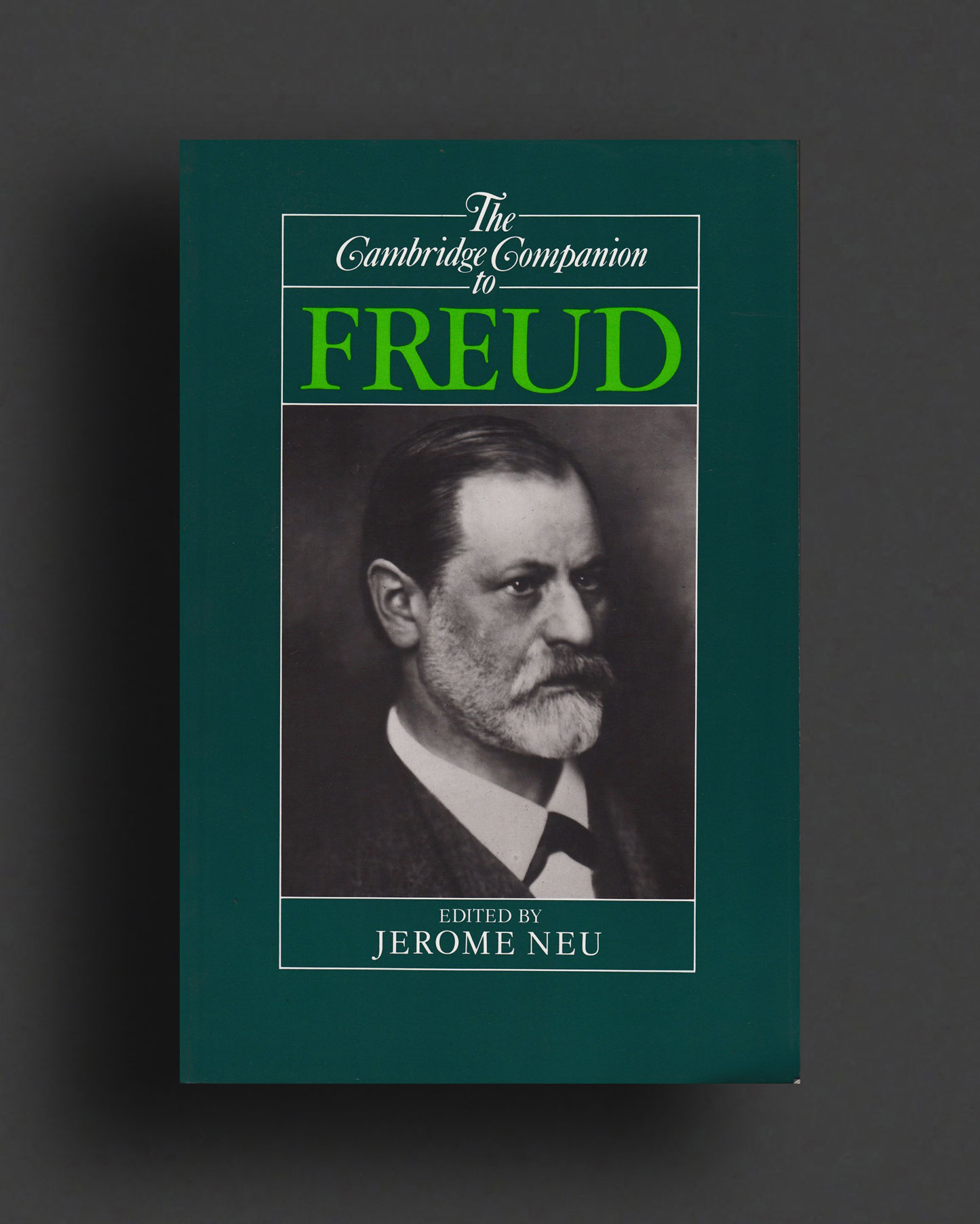
Does Freud still have something to teach us? The premise of this volume is that he most certainly does. Approaching Freud from not only the philosophical but also historical, psychoanalytical, anthropological, and sociological perspectives, the contributors show us how Freud gave us a new and powerful way to think about human thought and action. They consider the context of Freud's thought and the structure of his arguments to reveal how he made sense of ranges of experience generally neglected or misunderstood. All the central topics of Freud's work from sexuality and neurosis to morality, art, and culture are covered.
VG copy. First 1991 edition, 1996 print.
1986, English
Softcover, 246 pages, 21.5 x 14 cm
1st Edition, Out of print title / used / very good
Published by
Cambridge University Press / Cambridge
$20.00 - In stock -
In this major study Rhiannon Goldthorpe takes up the challenge of Sartre's diversity in an original and provocative way. Her detailed and comprehensive exploration of the relationship between the theoretical and literary works pays due attention to their characteristic complexity. The discussion of La Nausée, Les Mouches, Huis clos, Les Mains sales and Les Séquestrés e'Altona, for example, does not present these literary texts as mere 'illustrations' of Sartre's theories of consciousness, imagination and emotion, but as subtle philosophical and linguistic investigations in their own right. In addition, by reference to recently published fragments from Sartre's earlier work, Goldthorpe calls into question existing views of Sartre's intellectual development and provides a new history of the crucial Sartrean concept of 'commitment'.
VG copy. First 1986 edition.
1992, English
Softcover (french-folds), 144 pages, 28 x 22 cm
1st Edition, Out of print title / used / good
Published by
FAE Musee d'Art Contemporaine Pully / Lausanne
$160.00 - In stock -
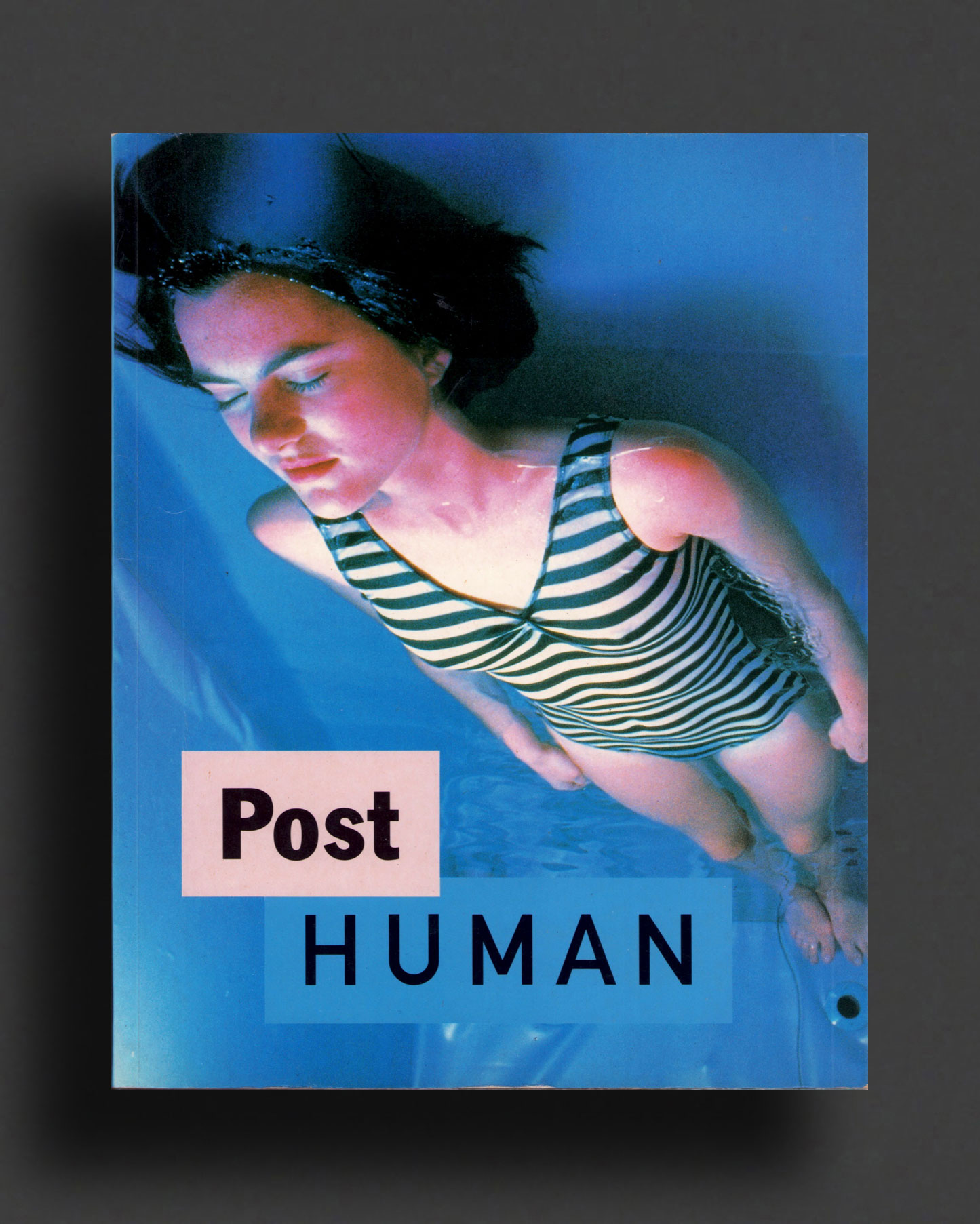
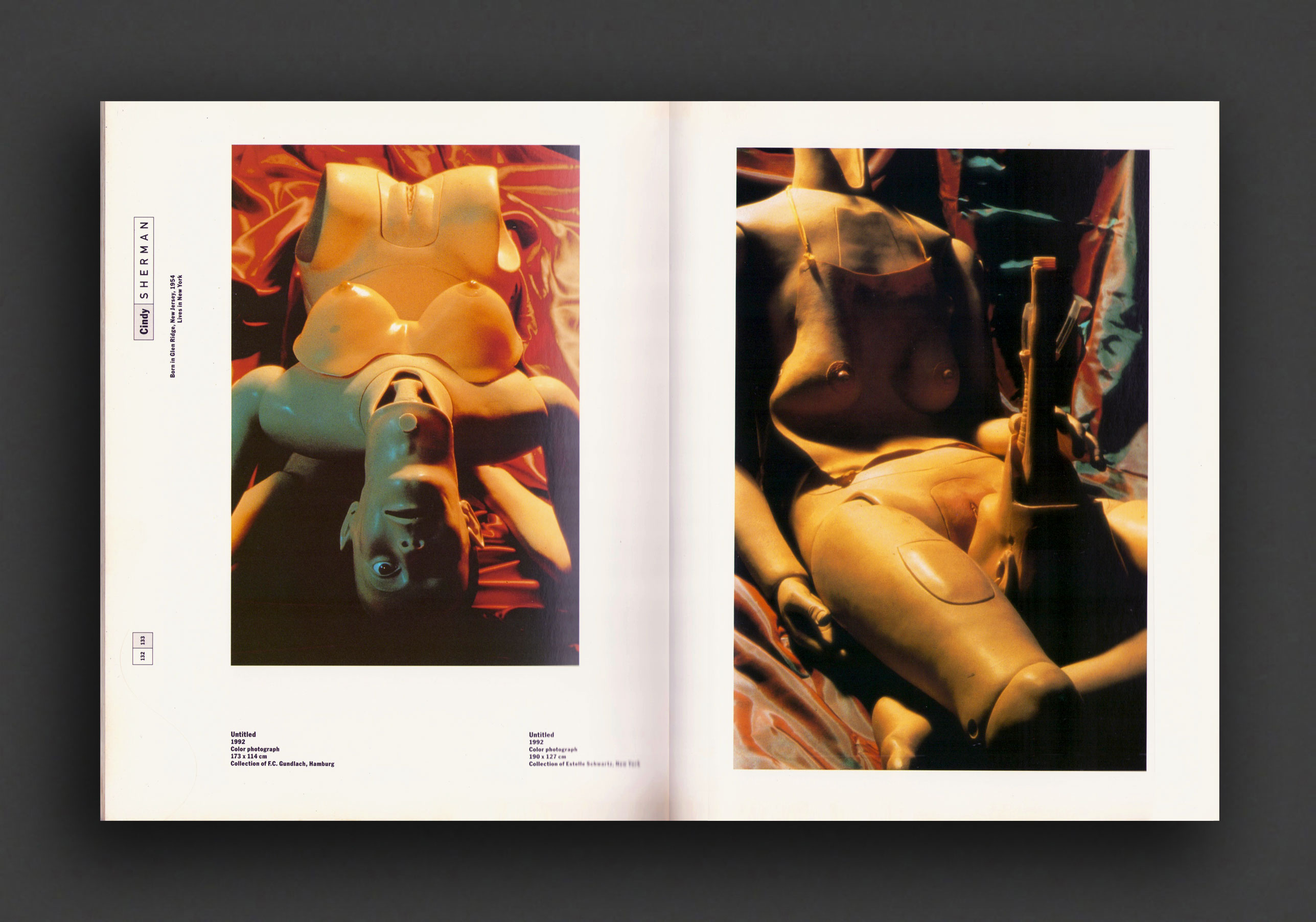
First 1992 English edition of the legendary Post Human exhibition catalogue, published on the occasion of the touring exhibition curated by Jeffrey Deitch, June 1992—October 1993. Post Human brought together the work of leading young international artists confronting a new artificial “real” world; a new figuration. The participating artists examine the media’s obsession with the “virtual reality” of the body beautiful through works that reveal the neuroses that plague contemporary society. In Deitch's words, this lavishly designed catalogue "explores the implications of genetic engineering, plastic surgery, mind expansion, and other forms of body alteration, to ask whether our society is developing a new model of the human being. It poses the question of whether our society is creating a new kind of post-human person that replaces previous constructions of the self. Images from the new technological and consumer culture and the new, conceptually oriented figurative art of thirty-six young artists will endeavor to give us a glimpse of the coming post-human world."
Featuring the work of Dennis Adams, Janine Antoni, John M Armleder, Stephan Balkenhol, Matthew Barney, Ashley Bickerton, Taro Chiezo, Clegg & Guttmann, Wim Delvoye, Suzan Etkin, Fischli / Weiss, Slyvie Fleury, Robert Gober, Felix Gonzalez-Torres, Damien Hirst, Martin Honert, Mike Kelley, Karen Kilimnik, Martin Kippenberger, Jeff Koons, George Lappas, Annette Lemieux, Christian Marclay, Paul McCarthy, Yasumasa Morimura, Kodai Nakahara, Cady Noland, Daniel Oates, Pruitt & Early, Charles Ray, Thomas Ruff, Cindy Sherman, Kiki Smith, Pia Stadtbäumer, Meyer Vaisman, Jeff Wall.
"Post Human was virtually a manifesto trumpeting a new art for a new breed of human. As Deitch’s text explained in the fragmented mottos that punctuated the billboard-style graphics of Dan Friedman’s catalogue design, “It is becoming routine for people to try to alter their appearance, their behavior, and their consciousness beyond what was once thought possible.” And we go on to read, “With the embrace of artificiality, Realism as we used to know it may no longer be possible.” The glossy color plates spoke volumes, whether the illustrations came from art or from “life.” The catalogue was to become something of a cult item that triggered the imaginations of many younger artists. Here was a permanent anthology of the “posthumanity” that surrounds us not only in galleries but on television, in magazines, even in real life, where the friendly androids among us chatter on about Botox and face-lifts. In the catalogue pages, one could see, for instance, four photos of Jane Fonda in four completely different but equally synthetic guises; Pat Buchanan being made up by a cosmetician for a TV appearance; computer morphs of once- human faces; before-and-after bellies and buttocks; and dead center, a profile view of Michael Jackson, clearly the sun god of this new solar system, who would later be deified by Jeff Koons.
This pure plastic environment, whether peopled by Ivana Trump or Barbie, set the stage for the artists in the show, whose works played perfectly in this parallel universe that was quickly replacing that old-fashioned thing called Nature. The result was a complete reshuffling of the contemporary-art deck, with an international mix of thirty-six artists (singles and pairs) that embraced Thomas Ruff and Jeff Wall, Clegg & Gutmann and Pruitt/Early, Damien Hirst and Cindy Sherman, Matthew Barney and Yasumasa Morimura, Charles Ray and Martin Kippenberger. A new dynasty had installed itself, and this ruling class demanded fitting ancestry."—Robert Rosenblum, Artforum (October 2004)
"Looked at from the point of view of being difficult cultural issues to a broader public than usual, the project Post Human could not have come about at a better time. (…) Deitch’s central thesis—that the voluntary manipulation of the human body through surgery, cosmetics and exercise, combined with recent technologies allowing us to simulate the experience of reality, have produced a culture in which the body no longer serves as a cohesive, organic reference point—fits well in an age in which pop starts, politicians and even artists themselves seem to delight in changing their physical identities to suit their purposes. No longer the domain of privacy and difference, the body has become a public crossroads where the merging of real and artificial, organic and synthetic, and even good and evil, is taking place right before our very (ahem) eyes."—Dan Cameron, Frieze (September–October 1992)
Good—Very Good copy of the sought after English language edition (the catalogue was produced in five languages) some wear to extremities, light light knocking/creasing to boards and spine, but overall a handsome copy.
2016, English
Hardcover, 232 pages, 23.1 x 17.5 cm
Published by
Walther König / Köln
Moderna Museet / Malmö
$75.00 - Out of stock
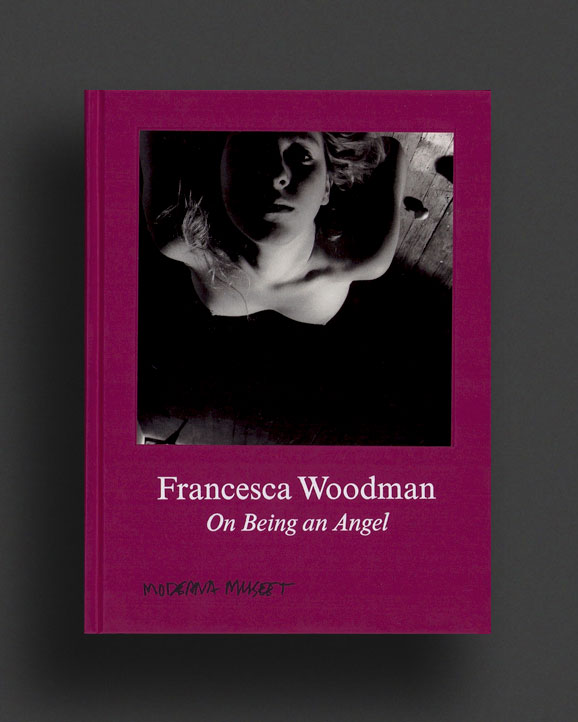
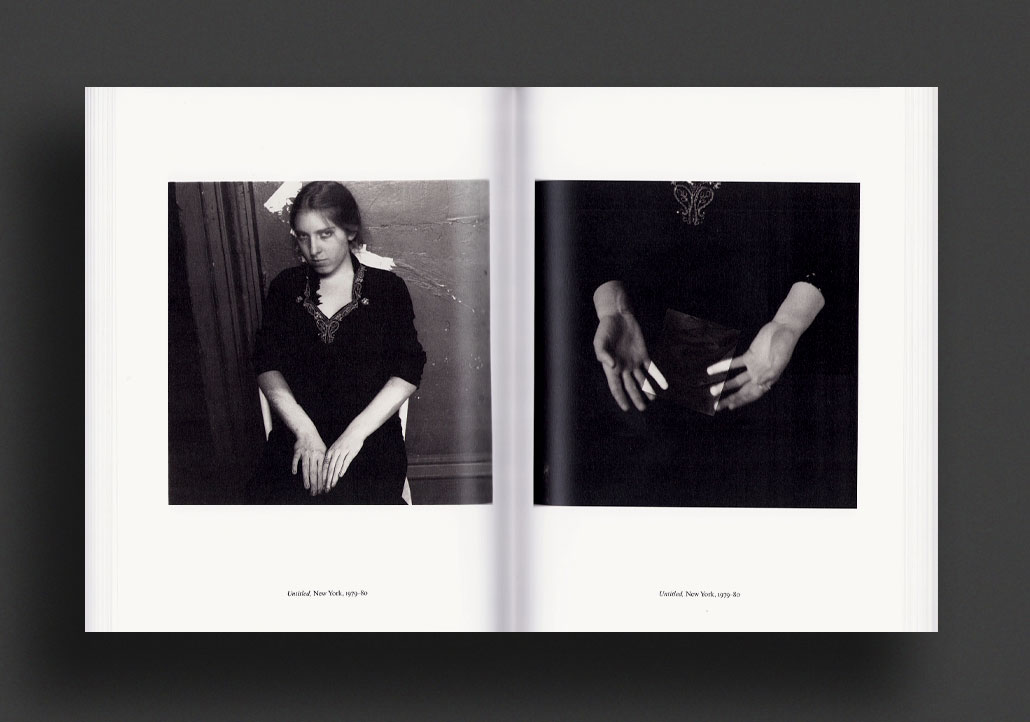
On Being an Angel takes its title from a caption the artist inscribed on two of her photographs—self-portraits with her head thrust back and her chest thrust forward. Typical of Woodman’s work in the way they cast the female body as simultaneously physical and immaterial, these photographs and the evocative title they share are apt choices to encapsulate the work of an artist whose legacy has been unavoidably colored by her tragic personal biography and her death, at age 22, by suicide. In less than a decade, Woodman produced a fascinating body of work—in black and white and in color—exploring gender, representation, sexuality and the body through the photographing of her own body and those of her friends. Since her death, Woodman’s influence continues to grow: her work has been the subject of numerous in-depth studies and exhibitions in recent years, and her photographs have inspired artists all over the world. Published to accompany a travelling exhibition of Woodman’s work, Francesca Woodman: On Being an Angel offers a comprehensive overview of Woodman’s oeuvre, organized chronologically, with texts by Anna Tellgren, Anna-Karin Palm and the artist’s father, George Woodman.
Francesca Woodman (1958–81) was born in Denver, Colorado, to an artistic family and began experimenting with photography as a teenager. In 1975 she attended the Rhode Island School of Design, and in 1979 she moved to New York to attempt to build a career in photography. Woodman’s working career was intense but brief, cut short by her death in 1981.
1977, English
Softcover, 222 pages, 19 x 11.5 cm
1st Edition, Out of print title / used / good
Published by
Seven Seas Books / Berlin
$35.00 - In stock -
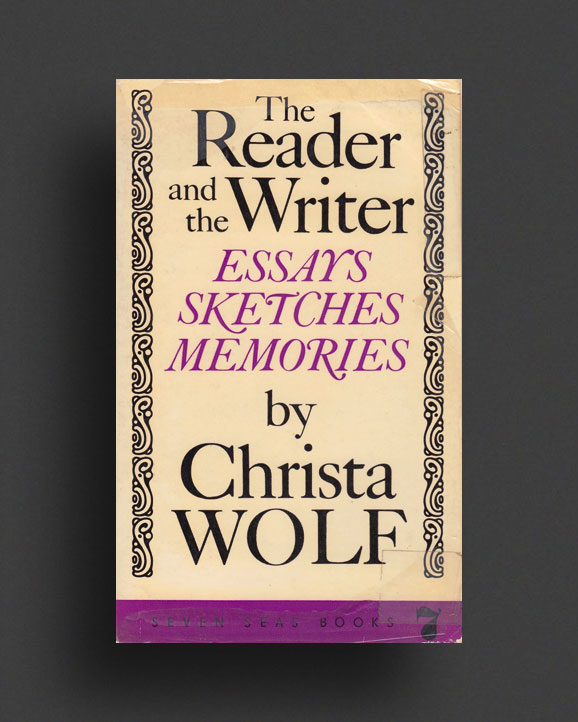
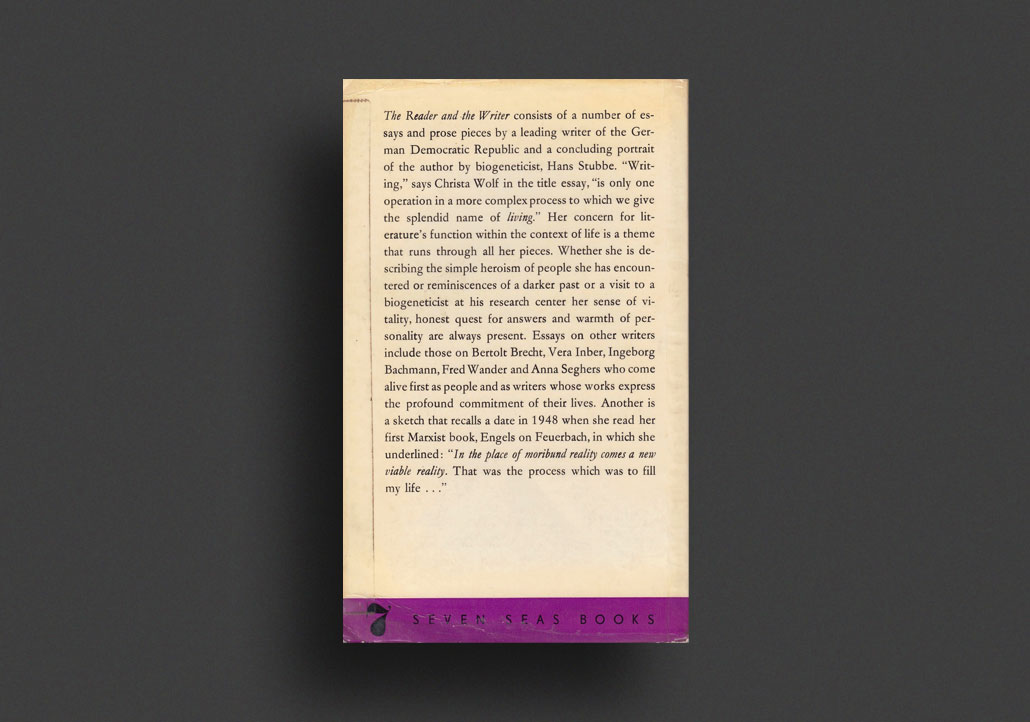
Rare first 1977 English edition of this collection of important essays by German novelist and essayist Christa Wolf (1929—2011) first published in German in 1973. Translated here by Joan Becker.
"The Reader and the Writer consists of a number of essays and prose pieces by a leading writer of the German Democratic Republic and a concluding portrait of the author by biogeneticist, Hans Stubbe. "Writing," says Christa Wolf in the title essay, "is only one operation in a more complex process to which we give the splendid name of living." Her concern for literature's function within the context of life is a theme that runs through all her pieces. Whether she is describing the simple heroism of people she has encountered or reminiscences of a darker past or a visit to a biogeneticist at his research center her sense of vitality, honest quest for answers and warmth of personality are always present. Essays on other writers include those on Bertolt Brecht, Vera Inber, Ingeborg Bachmann, Fred Wander and Anna Seghers who come alive first as people and as writers whose works express the profound commitment of their lives. Another is a sketch that recalls a date in 1948 when she read her first Marxist book, Engels on Feuerbach, in which she underlined: "In the place of moribund reality comes a new viable reality. That was the process which was to fill my life..."—publisher's blurb
Christa Wolf (1929—2011) was German novelist and essayist. She is considered one of the most important writers to emerge from the former East Germany. Wolf was a German writer of rare purity and sensitivity who grew up under nazism and became an adult under communism. Her work records the impact of these ideologies on individual lives. She was, as one critic put it, "a writer of scrupulous 'touchstone' honesty", and it is the pursuit and uncovering of truth, under the most beleaguered circumstances, that defines her.
Good—VG copy. Clear laminate peeling with age at cover edges, repaired by some pieces of tape, cover in tact with only light edge wear. Binding and interior VG throughout., a well preserved copy.
1982, English
Softcover, 186 pages, 20 x 13 cm
Out of print title / used / very good
Published by
Virago / London
$25.00 - In stock -
'Her secret, which I'd been looking for all the time we'd known one another, was a secret no longer. What she wanted, in her innermost depths, what she dreamed of and what she'd long ago begun to do, now lay open before me... She was trying out the possibilities of life until nothing should be left'
Christa is a young girl in Hitler's Germany; she survives to embrace the new order but her enthusiasm and idealism wither as crass materialists corrode its splendid dreams. A teacher in a village school, a student at Leipzig University, a wife and a mother, the life of Christa T., here recalled by her friend, is the life of an ordinary, intelligent, sensitive woman. But this famous novel is more than that. Christa's is the story of a whole generation, and a moving celebration of the unique value of each human being and all human life.
Christa Wolf, novelist, short story writer, essayist, critic, journalist and film dramatist has won many literary prizes. She is East Germany's most prestigious woman of letters, and lives in East Berlin.
"A sensitive writer of the purest water - an East German Virginia Woolf"—L. WEBB, Guardian
"Undoubtedly one of the few great novels in the German language since the war...In a desert - and the [East German] literary scene is a desert - you have to look out patiently for any sign of life, but the sight of a beautiful flower may suddenly overwhelm you. Such a book is The Quest for Christa T."—The Times
Good copy with some light wear and board creasing/age to pages.
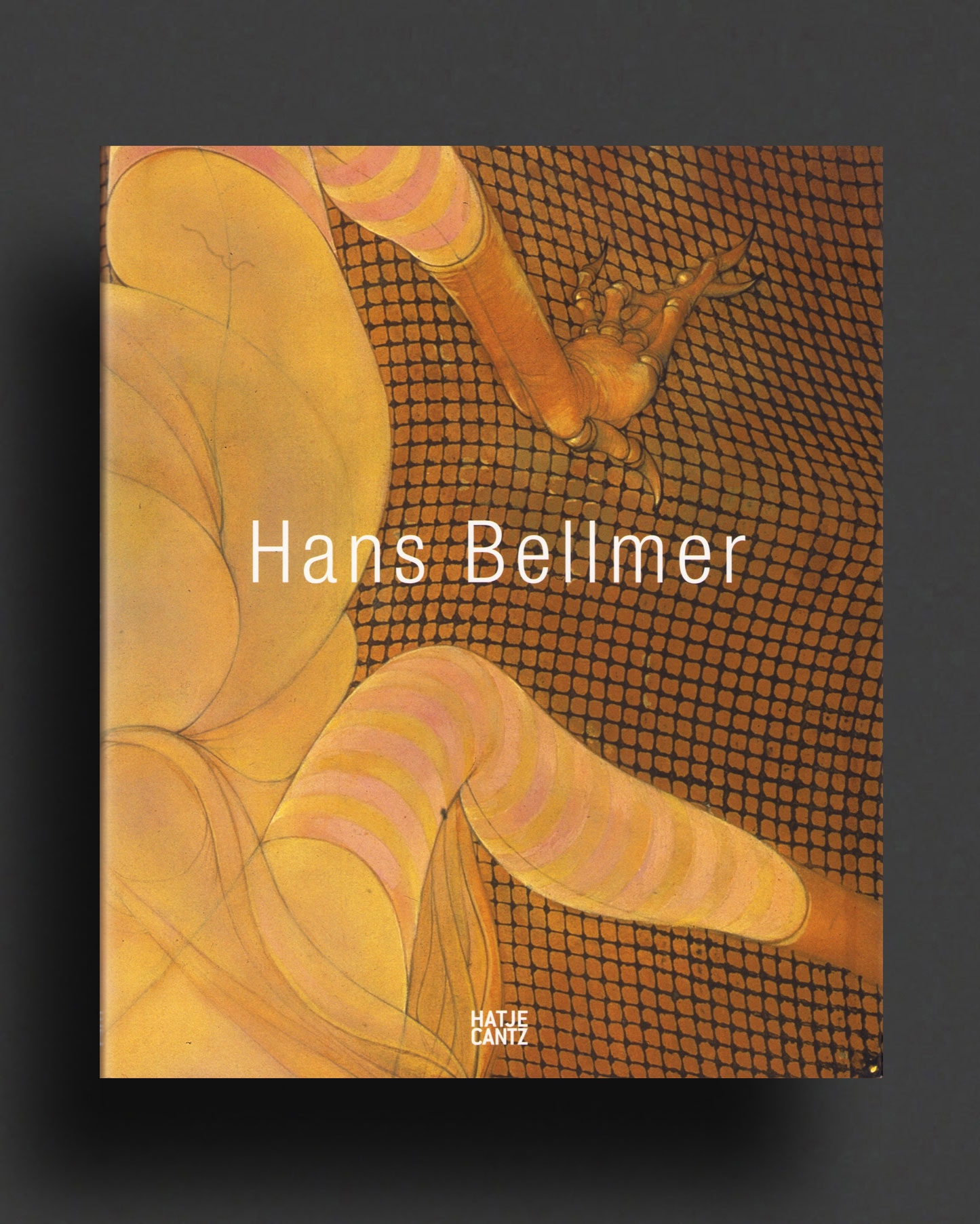
2006, German
Hardcover (w. dust jacket), 280 pages, 28.5 x 23.7 cm
1st Edition, Out of print title / used / fine
Published by
Hatje Cantz / Berlin
$180.00 - Out of stock
"If the origin of my work is scandalous, it is because, for me, the world is a scandal."—Hans Bellmer
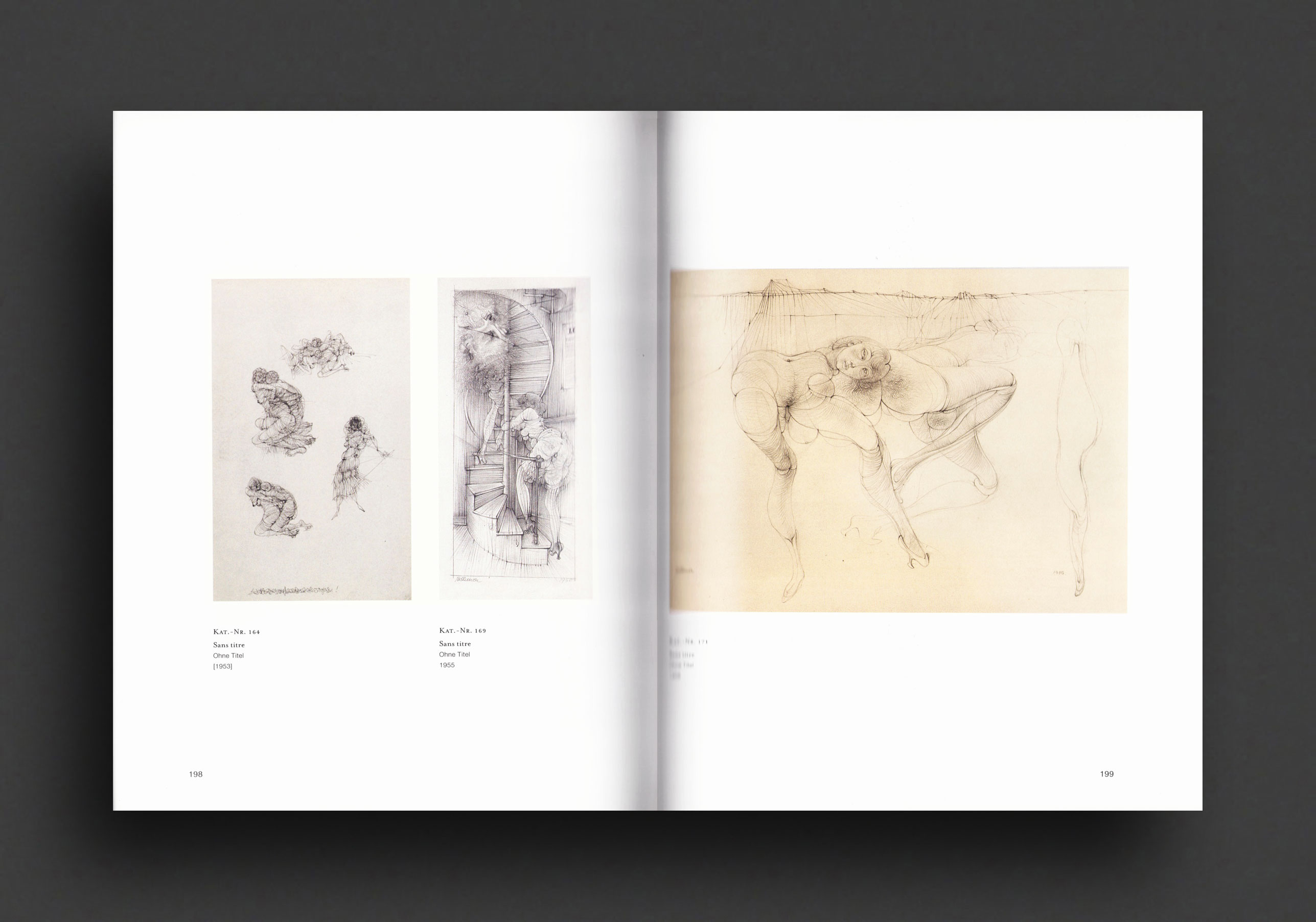
First hardcover edition of this lavish monograph on Hans Bellmer edited by Dr. Michael Semff and Anthony Spira to accompany the major retrospective exhibition at the Centre Georges Pompidou, Paris, March 1-May 22, 2006 · Staatliche Graphische Sammlung München, Munich, June 29-August 27, 2006·· Whitechapel Art Gallery, London, September 20-November 19, 2006.
The Surrealists' fascination for dolls and machines resembling humans is especially evident in the work of Hans Bellmer (1902-1975), the subject of this comprehensive monograph. Rejecting the Nazis' Aryan ideals, the artist began in 1933 to create disturbing dolls out of wax, wood, flax, plaster, and glue, equipped with wigs and glass eyes. Photographs of these fetishistic objects were published in Minotaure, the Surrealists' magazine, and eagerly supported by members of André Breton's circle. After emmigrating to Paris, Bellmer developed his erotic obsessions through art, influenced by the writings of the Marquis de Sade and Georges Bataille, and collaborated with his companion, the German artist Unica Zürn. Deeply involved in Freudian discourse, his drawings, lithographs, and photographs investigate psychoanalytical theories around hysteria and transference, and reveal a singular exploration into the relationship between language and body.
Fine copy of the German edition.
1993, English
Softcover, 456 pages, 23 x 15 cm
1st Edition, Out of print title / used / very good
Published by
University of California / Berkeley
$40.00 - Out of stock
Polish director Tadeusz Kantor, who died in 1990 at the age of 75, is widely recognized as one of the most important theatre artists of this century. Critics have ranked him with such influential directors as Stanislavsky, Meyerhold, Brecht, and Grotowski. Known in the United States primarily for his visually stunning productions, he is also highly regarded throughout Europe for his theoretically adventurous writings. Michal Kobialka, whom Kantor authorized to translate his work, provides us with the first collection of Kantor's essays in English, together with his analysis of the corpus of Kantor's work, both written and staged.
"Without a doubt Kobialka's work on Kantor is definitive. He explores every aspect of Kantor's search for a "truer reality" and leads the reader through the dense thicket of Kantor's explorations. Kobialka's prose is lucid, even though his subject is complex and at times almost ethereal. To those who have not seen a Kantor production, no better guide can be found than Kobialka's penetrating and exhaustive study."—World Literature Today
Tadeusz Kantor (1915–1990) was a Polish painter, assemblage and Happenings artist, set designer and theatre director. Kantor is renowned for his revolutionary theatrical performances in Poland and abroad.
Edited and Translated by Michael Kobialka.
VG copy with come cover corner wear.
2026, English / French / Italian
Hardcover, 192 pages, 28 x 24 cm
Published by
Five Continents Editions / Milan
$90.00 - In stock -
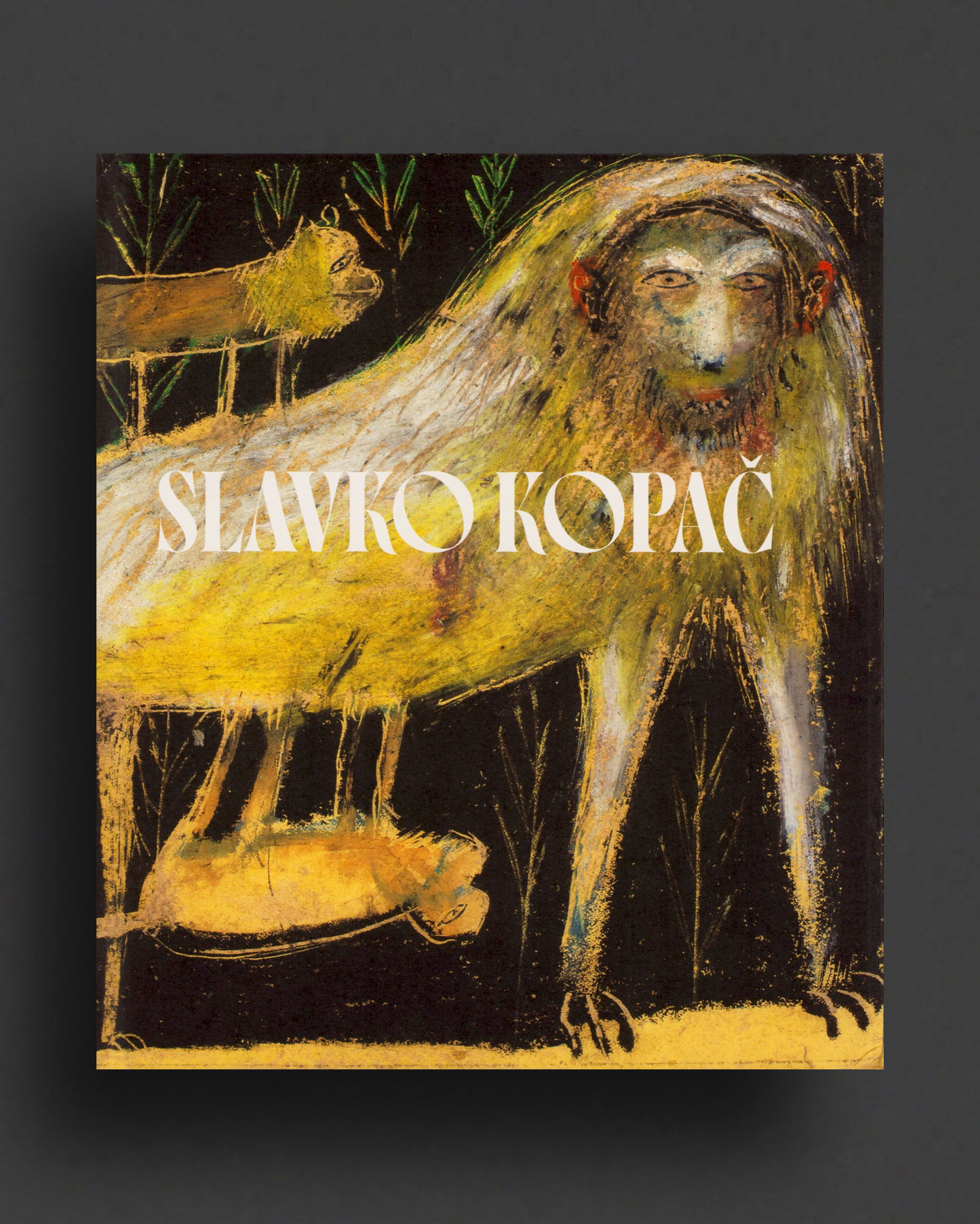
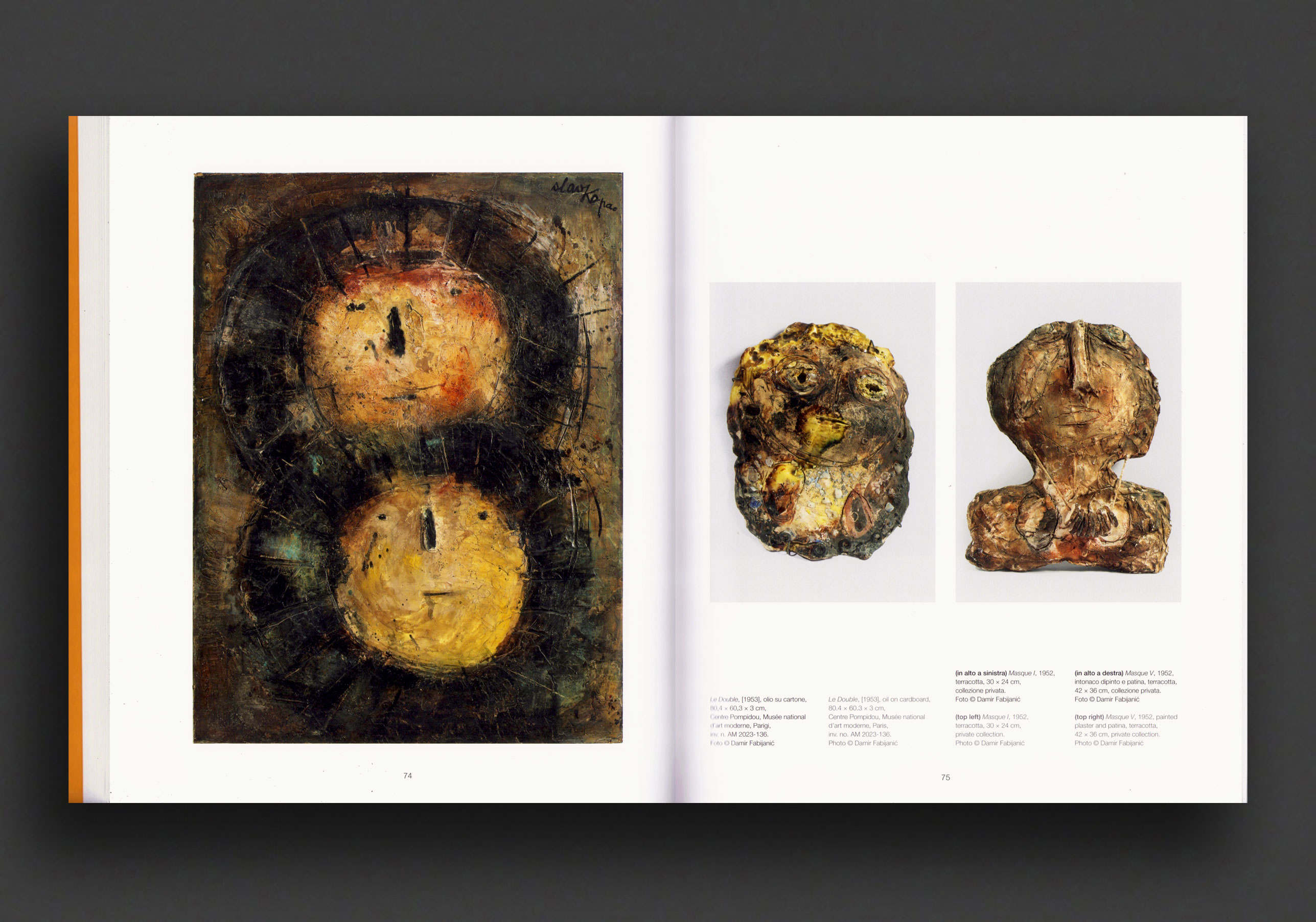
Hidden Treasure. Informal Art, Surrealism, Art Brut
Edited by Roberta Trapani. With an essay by Bernard Blistène. Texts by Cristina Acidini, Luca Macchi, Tamara Floričić, Roberta Trapani, Pietro Nocita, Susanna Ragionieri, Michele Amedei, Roberta Serpolli, Pauline Goutain, Déborah Lehot-Couette, Katharine Conley, Kent Mitchell Minturn, Fabrice Flahutez
The volume accompanies the exhibition “Slavko Kopač. Il tesoro nascosto” (Accademia delle Arti del Disegno, Florence). With an introduction by Bernard Blistène, honorary director of the Centre Pompidou and advocate of the acquisition of twelve of Kopač’s works into the museum’s collection, the book explores a multifaceted artist, deeply connected to Surrealism, Informal Art, and Art Brut.
A key collaborator of Jean Dubuffet and the first curator of the Collection de l’Art Brut, Kopač played a fundamental part in its promotion and configuration. His magical, totemic universe captivated the Surrealists and led to a collaboration with André Breton. At the same time, critic Michel Tapié included him in Un art autre (1952), recognising his originality within the Informal Art movement.
He used painting, drawing, ceramics, sculpture, collage, and art books to explore materiality, intertwining reality and fantasy. The volume features contributions by leading international scholars and an extensive iconographic repertoire, including previously unpublished works and archival documents.
Exhibition: Accademia delle Arti del Disegno, Florence, 12 September – 13 November 2025
Bernard Blistène has been honorary director of the Centre Pompidou since 2021 and headed the institution from 2013 to 2021. He has left a significant mark on the museum’s profile through numerous exhibitions and retrospectives (Fontana, Twombly, Warhol, Baselitz, etc.), while also establishing museums in Marseille. He was a professor at the École du Louvre for twenty-five years and organiser of international biennials, conceiving and directing the Nouveau Festival at the Centre Pompidou and spearheading major projects, such as “Mondes Nouveaux”.
Roberta Trapani is a historian of contemporary art with a PhD awarded by Paris Nanterre and Palermo Universities in an international joint supervision programme. She is a cofounder of the Collective de réflexion autour de l’Art Brut (CrAB), the Kopač Commettee Association (Paris), and an associate researcher at ECLLA (University of Saint-Étienne), InTRU (University of Tours), and Osservatorio Outsider Art (Palermo). She has organised exhibitions in France, Belgium and Italy and published essays on twentieth- and twentyfirst-century artists and movements.
2026, English
Softcover, 118 pages, 24.1 x 29.8 cm
Published by
Gagosian / New York
$130.00 - In stock -
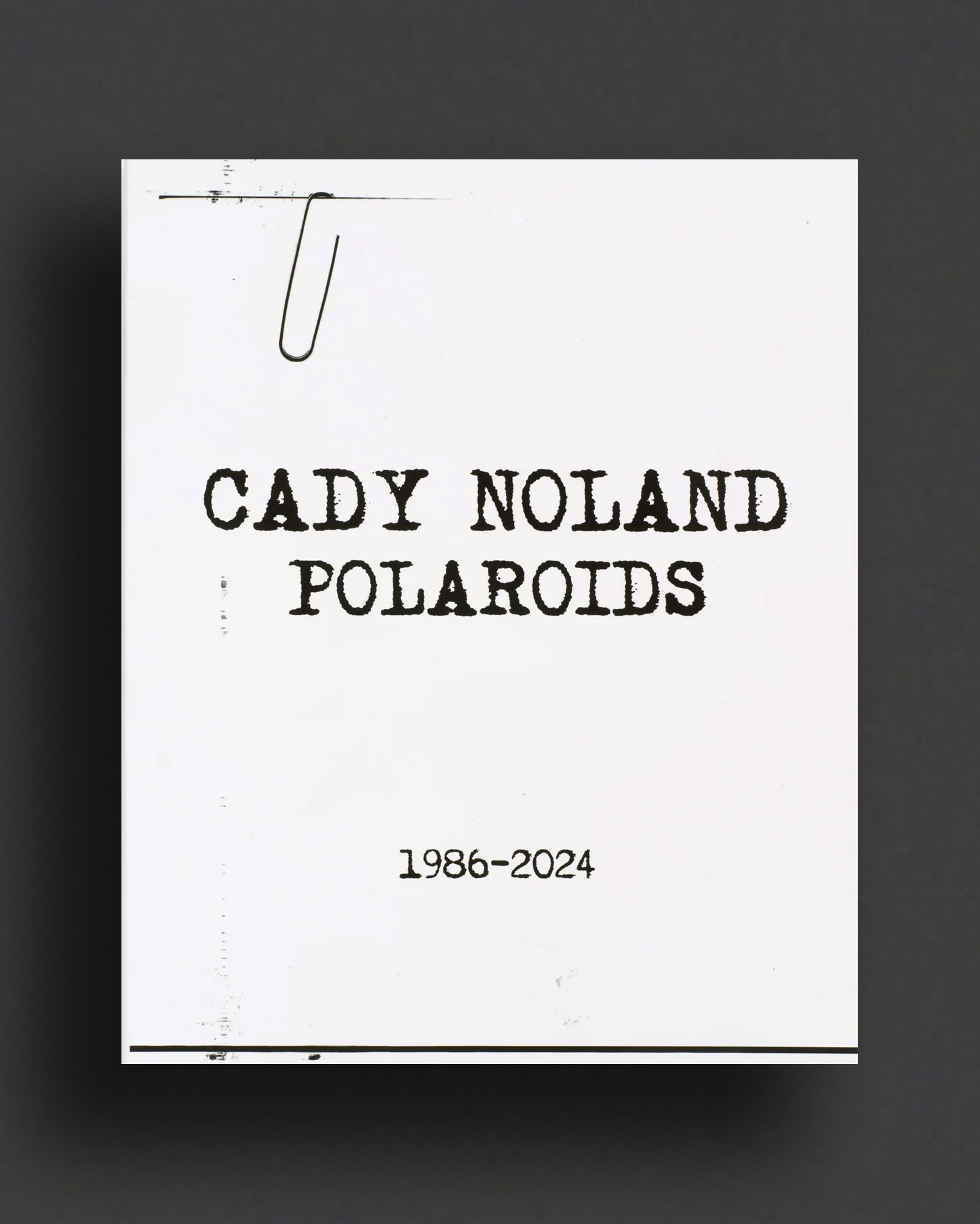
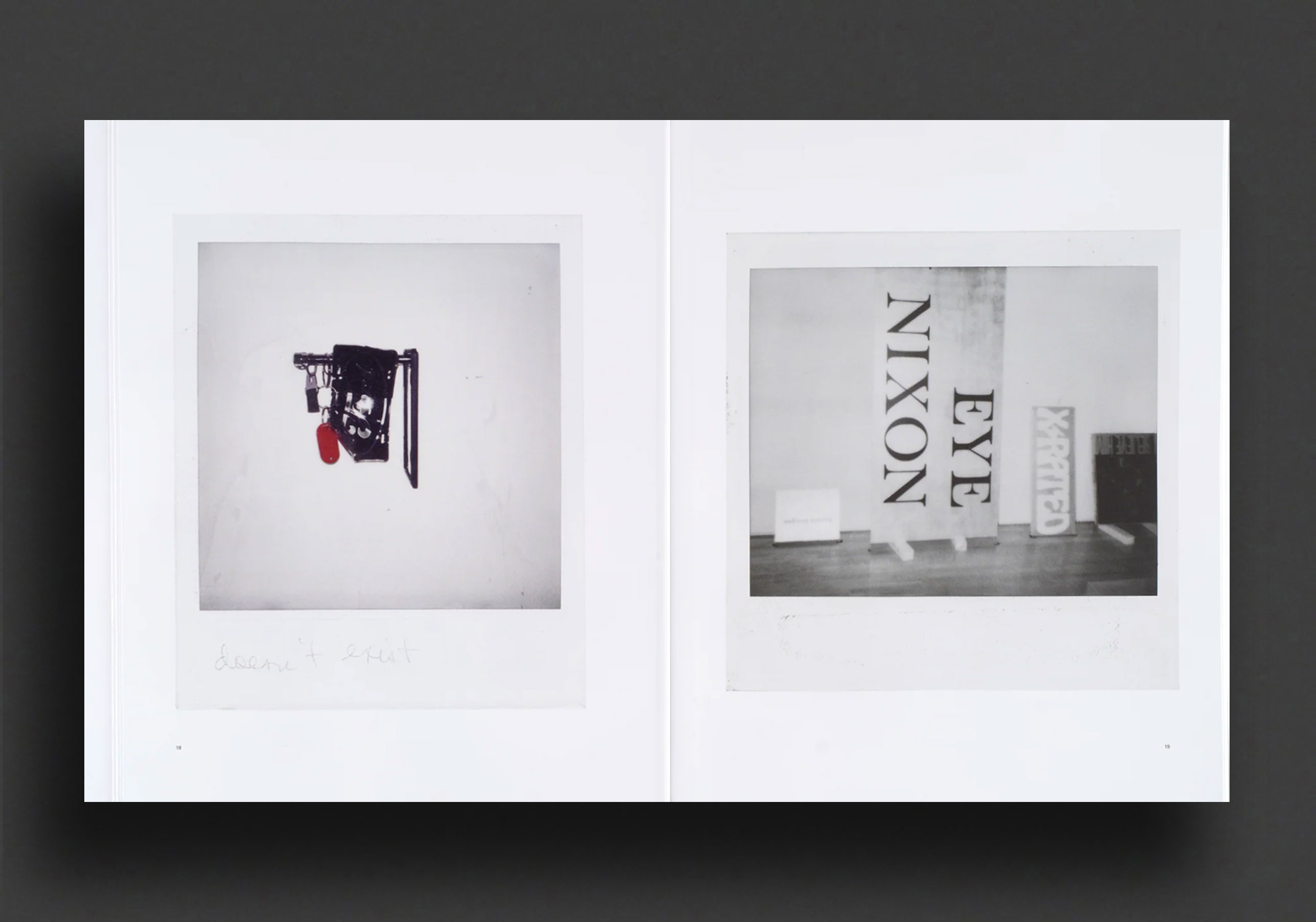
Conceived, designed, and edited by the artist, Cady Noland: Polaroids 1986–2024 is devoted to Polaroid photographs taken by Noland in the process of developing her sculptures and exhibitions. Published to coincide with a solo show of Noland’s new work at Gagosian, 555 West 24th Street, New York, this artist’s book reproduces nearly one hundred previously unpublished Polaroids from the course of her career, providing unique insight into her sculptural practice.