World Food Books' programme is largely produced on Kulin Nation land. We acknowledge the Wurundjeri people of the Kulin Nation as the first and continuing custodians of this land, and pay respect to their Elders past, present, and emerging.
World Food Books is an arts and special interests bookshop in Naarm / Melbourne. Founded in 2010, World Food Books is devoted to the presentation of a rotating, hand-selection of international art, design, literary and counterculture publications with an emphasis on the anti-traditional, the experimental, the avant-garde, the heretic, the marginal.
Presenting new titles alongside rare and out-of-print books, catalogues and journals spanning the fields of modern and contemporary art, design, photography, illustration, film, literature, poetry, cultural theory, philosophy, sexuality, popular and underground culture in its many radical forms, World Food Books wishes to encourage adventurous, thoughtful and open-minded reading, looking, writing, and exchange of publishing and ideas, both current and historical.
As well as our bookshop, located in Melbourne's historical Nicholas Building, all of our inventory is available internationally via our online mail-order service.
World Food Books semi-regularly co-ordinates "Occasions", a programme of exhibits and events at the bookshop and in partnership with other hosts (such as museums and art galleries) that develop out of the activities, relationships and content of the bookshop itself.
World Food Books
The Nicholas Building
37 Swanston Street
Room 5, Level 6
Melbourne 3000
Australia
SHOP HOURS:
Thu–Fri 12–6, Sat 12–5
WEB-SHOP OPEN 24/7
World Food Books
Postal Address:
PO Box 435
Flinders Lane
Victoria 8009
Australia
Art
Theory / Essay
Architecture / Interior
Graphic Design / Typography
Photography
Fashion
Eros
LGBTQ+
Fiction / Poetry
Weird / Speculative / Science Fiction / Horror
Transgressive / Visceral / Abject
Symbolism / Decadence / Fin de siècle
Film / Video
Painting
Sculpture / Installation
Performance / Dance / Theater
Drawing
Sound / Music
Curatorial
Group Shows / Collections
Periodicals
Out-of-print / Rare
Posters / Ephemera / Discs
Signed Books
World Food Books Gift Voucher
World Food Book Bag
Australian Art
Australian Fiction
Australian Science Fiction / Speculative Fiction
Australian Poetry
Australian Photography
Japanese Photography
Conceptual Art
Minimal Art
Dada
'Pataphysics / Oulipo
Fluxus
Concrete Poetry
Pop Art
Surrealism
Arte Povera
Arte Informale / Haute Pâte / Tachism
Nouveau Réalisme / Zero / Kinetic
Situationism / Lettrism
Collage / Mail Art / Xerox Art
Art Brut / Folk / Visionary / Fantastic
Illustration / Graphic Art / Bandes Dessinées
Furniture
Italian Radical Design / Postmodernism
Textiles
Ceramics / Glass
Counterculture
Protest / Revolt
Philosophy
Psychoanalysis
Anthropology
Anarchism
Socialism / Anarchism / Communism / Capitalism
Literary Theory / Semiotics / Language
Feminism / Women's Studies
Gender Studies / Sexuality
Anthropology
Fetishism / BDSM
Drugs / Psychedelia
Crime / Violence
Animal Rights / Veganism
Occult / Esoterica
Ecology / Earth / Alternative Living
Whole Earth / Crafts
All prices in AUD (Australian dollars)
Pick-Ups
Pick-up orders can be collected in our bookshop during opening hours after order date. Please collect any Pick-up orders within 2 weeks of ordering as we have limited storage space. Orders will be released back into stock if not collected within this time. No refunds can be made for pick-ups left un-collected. If you cannot make it in to the bookshop in this time-frame, please choose postage option.
Return Policy
All sales are final. We do accept returns (for refund or exchange) for items received in error. All our orders are packed with special care using heavy-duty padding and cardboard book-mailers or bubble mailers (for smaller books), using reinforcement where required. We cannot take responsibility for any lost, stolen or damaged parcels.
Insurance
Should you wish to insure your package, please email us directly after placing your order and we can organise this at a small extra expense. Although all standard/express tracked packages are very safe and dependable, we cannot take responsibility for any lost, stolen or damaged parcels. We recommend insurance on valuable orders.
Interested in selling your old books, catalogues, journals, magazines, comics, fanzines, ephemera? We are always looking for interesting, unusual and out-of-print books to buy. We only buy books in our fields of interest and specialty, and that we feel we can resell.
We base these prices on desirability, market value, in-print prices, condition and our current stock levels. We offer cash, store credit, and can take stock on consignment. All
about 25% of the price we expect to get when we sell them, or 30% in store credit. We base these prices on desirability, market value, in-print prices, condition and our current stock levels.
Sell your books any day of the week. You can drop them off and return later. If you have a lot of books, we can visit your Sydney home.
We buy books that we feel we can resell. We offer about 25 % of the price we expect to get when we sell them, or 30% in store credit. We base these prices on desirability, market value, in-print prices, condition and our current stock levels.
Philadelphia Wireman
03 August - 01 September, 2018
World Food Books is proud to announce our next Occasion, the first presentation of sculptures by Philadelphia Wireman in Australia.
The Philadelphia Wireman sculptures were found abandoned in an alley off Philadelphia’s South Street on trash night in 1982. Their discovery in a rapidly-changing neighbourhood undergoing extensive renovation, compounded with the failure of all attempts to locate the artist, suggests that the works may have been discarded after the maker’s death. Dubbed the "Philadelphia Wireman" during the first exhibition of this work, in 1985, the maker’s name, age, ethnicity, and even gender remain uncertain. The entire collection totals approximately 1200 pieces, all intricately bound together with tightly-wound heavy-gauge wire (along with a few small, abstract marker drawings, reminiscent both of Mark Tobey and J.B. Murry). The dense construction of the work, despite a modest range of scale and materials, is singularly obsessive and disciplined in design: a wire armature or exoskeleton firmly binds a bricolage of found objects including plastic, glass, food packaging, umbrella parts, tape, rubber, batteries, pens, leather, reflectors, nuts and bolts, nails, foil, coins, toys, watches, eyeglasses, tools, and jewellery.
Heavy with associations—anthropomorphic, zoomorphic, and socio-cultural responses to wrapped detritus—the totemic sculptures by Philadelphia Wireman have been discussed in the context of work created to fulfil the shamanistic needs of alternative religions in American culture. Curators, collectors, and critics have variously compared certain pieces to sculpture from Classical antiquity, Native American medicine bundles, African-American memory jugs, and African fetish objects. Reflecting the artist’s prolific and incredibly focused scavenging impulse, and despite—or perhaps enhanced by—their anonymity, these enigmatic objects function as urban artefacts and arbiters of power, though their origin and purpose is unknown. Philadelphia Wireman, whatever their identity, possessed an astonishing ability to isolate and communicate the concepts of power and energy through the selection and transformation of ordinary materials. Over the course of the past two decades, this collection has come to be regarded as an important discovery in the field of self-taught art and vernacular art.
Presented in collaboration with Fleisher-Ollman Gallery, Philadelphia, and Robert Heald, Wellington.
Susan Te Kahurangi King
02 February - 10 March, 2018
Susan Te Kahurangi King (24 February 1951 - ) has been a confident and prolific artist since she was a young child, drawing with readily available materials - pencils, ballpoint pens and felt-tip markers, on whatever paper is at hand. Between the ages of four and six Susan slowly ceased verbal communication. Her grandparents William and Myrtle Murphy had developed a special bond with Susan so they took on caring responsibilities for extended periods. Myrtle began informally archiving her work, carefully collecting and storing the drawings and compiling scrapbooks. No drawing was insignificant; every scrap of paper was kept. The King family are now the custodians of a vast collection containing over 7000 individual works, from tiny scraps of paper through to 5 meter long rolls.
The scrapbooks and diaries reveal Myrtle to be a woman of great patience and compassion, seeking to understand a child who was not always behaving as expected. She encouraged Susan to be observant, to explore her environment and absorb all the sights and sounds. Myrtle would show Susan’s drawings to friends and people in her community that she had dealings with, such as shopkeepers and postal workers, but this was not simply a case of a grandmother’s bias. She recognised that Susan had developed a sophisticated and unique visual language and sincerely believed that her art deserved serious attention.
This was an unorthodox attitude for the time. To provide some context, Jean Dubuffet coined the term Art Brut in 1945 to describe work created by self-taught artists – specifically residents of psychiatric institutions and those he considered to be visionaries or eccentrics. In 1972 Roger Cardinal extended this concept by adopting the term Outsider Art to describe work made by non-academically trained artists operating outside of mainstream art networks through choice or circumstance. Susan was born in Te Aroha, New Zealand in 1951, far from the artistic hubs of Paris and London that Dubuffet and Cardinal operated in. That Myrtle fêted Susan as a self-taught artist who deserved to be taken seriously shows how progressive her attitudes were.
Susan’s parents Doug and Dawn were also progressive. Over the years they had consulted numerous health practitioners about Susan’s condition, as the medical establishment could not provide an explanation as to why she had lapsed into silence. Dawn educated herself in the field of homeopathy and went on to treat all twelve of her children using these principles – basing prescriptions on her observations of their physical, mental and emotional state.
Doug was a linguist with an interest in philosophy who devoted what little spare time he had to studying Maori language and culture. To some extent their willingness to explore the fringes of the mainstream made them outsiders too but it was their commitment to living with integrity and their respect for individuality that ensured Susan’s creativity was always encouraged.
Even though Susan’s family supported her artistic pursuits, some staff in schools and hospitals saw it as an impediment to her assimilation into the community and discouraged it in a variety of ways. Her family was not always aware of this and therefore did not fully understand why Susan stopped drawing in the early 1990s. However, rather than dwell on the challenges that Susan faced in pursuit of her artistic practice, they prefer to highlight her achievements. In 2008 Susan began drawing again in earnest, after an almost 20 year interruption, and her work is now shown in galleries around the world.
Susan grew up without television and has been heavily influenced by the comics she read as a child. She is absolutely fearless in the appropriation of recognizable characters, such as Donald Duck and Mickey Mouse, in her work. She twists their limbs, contorts their faces, compresses them together, blends them into complex patterned backgrounds - always imbuing them with an incredible energy. Although Susan often used pop culture characters in her work they are not naive or childlike. These are drawings by a brilliant self-taught artist who has been creating exceptional work for decades without an audience in mind.
Mladen Stilinović
"Various Works 1986 - 1999"
02 February 16 - September 10, 2016
Various works 1986 - 1999, from two houses, from the collections of John Nixon, Sue Cramer, Kerrie Poliness, Peter Haffenden and Phoebe Haffenden.
Including: Geometry of Cakes (various shelves), 1993; Poor People’s Law (black and white plate), 1993; White Absence (glasses, ruler, set square, silver spoon, silver ladel with skin photograph and wooden cubes), 1990-1996; Exploitation of the Dead (grey and red star painting, wooden painting, black spoon with red table, red plate), 1984-1990; Money and Zeros (zero tie, paintings made for friends in Australia (Sue, John, Kerrie), numbers painting), 1991-1992; Words - Slogans (various t-shirts) - “they talk about the death of art...help! someone is trying to kill me”, “my sweet little lamb”, “work is a disease - Karl Marx”; Various artist books, catalogues, monographs, videos; Poster from exhibition Insulting Anarchy; "Circular" Croatian - Australian edition; Artist book by Vlado Martek (Dostoyevsky); more.
Thanks to Mladen Stilinović and Branka Stipančić.
Jonathan Walker
Always Will Need To Wear Winter Shirt Blue + Ochre Small Check Pattern
21 August - 21 September, 2015
Untitled
I am not a great reader of poetry but I always return to the work of Melbourne poet, Vincent Buckley (1925- 1988). Perhaps I find his most tantalising piece to be not a finished poem but a fragment left on a scrap of paper discovered on his desk after the poet’s death.
The poetry gathers like oil
In the word-core, and spreads
It has its music meet,
Its music is in movement.
This fragment is more the shell left behind from a volatile thought than a finished poem. I find the last two lines honest but awkward whereas the first two lines work like an arrow. Most likely he could not find a resolution so it was left. Still, in its present form, it remains an eloquent testimony to the ultimate failure of a medium to express mobile thought and sensation, in Buckley’s case, through verbal language. It’s an important matter because this is something all artists have to deal with regardless of the medium.
I have never written a poem, however, I am forever copying fragments from books on paper scraps in a vain effort to fix certain notions in my head. At first, they function as bookmarks that are sometimes returned to when I open the book. But before long, as they accumulate, they fall out littering the table interspersed with A4 photocopies, bills, books and medications.
To return to Buckley’s fragment, the first two lines very much evoke how I paint nowadays. As you age, detail diminishes and patches of light become more luminous and float. I feel the most honest way of dealing with this is by smearing the oil paint on the canvas with the fingers and working close-up, blind. Only if the patches coalesce into an approaching image can the work gain a life.
-
Jonathan Walker was born in Melbourne, Australia and brought up on a dairy farm in Gippsland. In the 1970’s he studied painting at RMIT and won the Harold Wright Scholarship to the British Museum, London. During the 1980’s he exhibited at Pinacotheca Gallery, Richmond and had work shown at the NGV and Heidi City Art Gallery. Over the same period he designed the cover for the “Epigenesi” LP by Giancarlo Toniutti, Italy and conducted a mail exchange work with Achim Wollscheid, Germany. The work with artists through the post resulted in an article published in the bicentenary issue of Art and Australia 1988. He showed in artist run spaces such as WestSpace in the 90’s and 2000’s, and until 2012, taught painting at Victoria University, which is where we (Colleen Ahern and Lisa Radford) as organisers of the exhibition, among many others, had the privilege of being his student.
Walker’s knowledge was imparted to students through the careful selection of music, literature, and artists found in books that he himself had ordered for the library. Walker’s strategy was the generosity of sharing his vast knowledge with references specific to each student and their context.
Walker’s paintings share a similar focus and intimacy.
This exhibition presents a small selection of recent paintings alongside a publication that includes Walker’s writing. Observational and analytical, Walker’s work is a type of material notation — the time of day, colour and how it is blended, the both specific and fleeting location of a reflection on lino or the question of whether a chair leg should be included in a painting.
Please join us on Friday August 21 between 6-8pm to celebrate the opening of the exhibition.
Curated by Colleen Ahern and Lisa Radford.
B. Wurtz
Curated by Nic Tammens
March 26 - April 4, 2015
B.Wurtz works from a basement studio in his home on Manhattan’s Lower East Side.
This local fact is attested to by the plastic shopping bags and newsprint circulars that appear in his work. As formal objects, they don’t make loud claims about their origins but nonetheless transmit street addresses and places of business from the bottom of this long thin island. Like plenty of artists, Wurtz is affected by what is local and what is consumed. His work is underpinned by this ethic. It often speaks from a neighborhood or reads like the contents of a hamper:
“BLACK PLUMS $1.29 lb.”
“Food Bazaar”
“USDA Whole Pork Shoulder Picnic 99c lb.”
“RITE AID Pharmacy, with us it’s personal.”
“H. Brickman & Sons.”
“Sweet Yams 59c lb."
Most of the work in this exhibition was made while the artist was in residence at Dieu Donne, a workshop dedicated to paper craft in Midtown. Here Wurtz fabricated assemblages with paper and objects that are relatively lightweight, with the intention that they would be easily transportable to Australia. This consideration isn’t absolute in Wurtz’s work, but was prescriptive for making the current exhibition light and cheap. Packed in two boxes, these works were sent from a USPS post office on the Lower East Side and delivered to North Melbourne by Australia Post.
Wurtz appears courtesy of Metro Pictures, New York.
Thanks to Rob Halverson, Joshua Petherick, Sari de Mallory, Matt Hinkley, Helen Johnson, Fayen d'Evie, Ask Kilmartin, Lisa Radon, Ellena Savage, Yale Union, and "Elizabeth".
John Nixon
"Archive"
December 15 - January 20, 2014
The presentation of John Nixon's archive offered a rare showcase of this extensive collection of the artist's own publications, catalogues, posters, ephemera, editions and more, from the mid 1980s onwards, alongside a selection of his artworks.
Organized by John Nixon, Joshua Petherick and Matt Hinkley.
<a href=http://wfb.public-office.info/artist/john-nixon>All titles by John Nixon
"Habitat"
at Minerva, Sydney (organised by Joshua Petherick and Matt Hinkley)
November 15 - December 20, 2014
Lupo Borgonovo, Janet Burchill & Jennifer McCamley,
Lewis Fidock, HR Giger, Piero Gilardi, Veit Laurent Kurz,
Cinzia Ruggeri, Michael E. Smith, Lucie Stahl, Daniel Weil, Wols
Press Release:
“...It contained seven objects. The slender fluted bone, surely formed for flight, surely from the wing of some large bird. Three archaic circuitboards, faced with mazes of gold. A smooth white sphere of baked clay. An age-blackened fragment of lace. A fingerlength segment of what she assumed was bone from a human wrist, grayish white, inset smoothly with the silicon shaft of a small instrument that must once have ridden flush with the surface of the skin - but the thing’s face was seared and blackened.”
William Gibson, “Count Zero”, 1986
"Autumn Projects Archive"
Curated by Liza Vasiliou
March 6 - March 15, 2014
World Food Books, in conjunction with the Virgin Australia Melbourne Fashion Festival 2014, presented the Autumn Projects archive, consisting of a selection of early examples in Australian fashion with a particular interest in collecting designers and labels from the period beginning in the 1980’s, who significantly influenced the discourse of Australian Fashion.
Curated by Liza Vasiliou, the exhibition provided a unique opportunity to view pieces by designers Anthea Crawford, Barbara Vandenberg, Geoff Liddell and labels CR Australia, Covers, Jag along with early experimental collage pieces by Prue Acton and Sally Browne’s ‘Fragments’ collection, suspended throughout the functioning World Food Books shop in Melbourne.
H.B. Peace
presented by CENTRE FOR STYLE
November 14, 2013
"Hey Blinky, you say chic, I say same"
Anon 2013
H.B. Peace is a clothing collaboration between great friends Blake Barns and Hugh Egan Westland. Their pieces explore the divergences between 'character’ and ‘personality’ in garments....etc
Special Thanks to Joshua Petherick and Matt Hinkley of WFB and Gillian Mears
and a Very Special Thank you to Audrey Thomas Hayes for her shoe collaboration.
Janet Burchill & Jennifer McCamley
"Aesthetic Suicide"
May 10 - June 8, 2013
The first of our occasional exhibitions in the World Food Books office/shop space in Melbourne, "Aesthetic Suicide" presented a body of new and older works together by artists Janet Burchill & Jennifer McCamley, including videos, prints, a wall work, and publications.
During shop open hours videos played every hour, on the hour.
1959, English
Hardcover (w. dust jacket), 215 pages, 22 x 15 cm
1st Edition, Out of print title / used / good
Published by
Rider / UK
$300.00 - In stock -
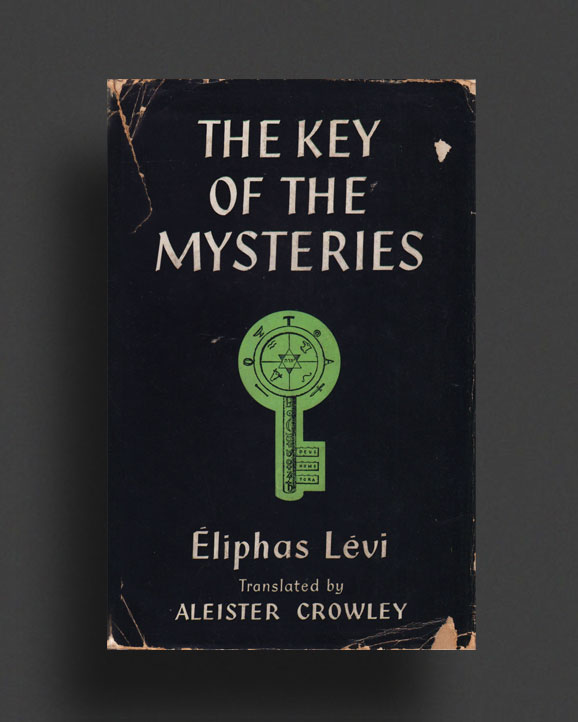
Very rare first 1959 hardcover edition, first printing of Eliphas Levi's grimoire masterwork, The Key of the Mysteries, translated from the French, with an introduction and notes by Aleister Crowley, published by Rider, UK.
Eliphas Levi (1810-1875), born Alphonse Louis Constant, was a sage, poet and author of over twenty esoteric books. He began writing at 22 years of age and was imprisoned twice for the critical nature of his work. Eliphas Levi was steeped in the Western occult tradition and a master of the Rosicrucian interpretation of the Qabalah, which forms the basis of magic as practiced in the West today. The "Key of the Mysteries" represents the culmination of Levi's thoughts and is written with subtle and delicate irony. It reveals the mysteries of religion and the secrets of the Qabalah, providing a sketch of the prophetic theology of numbers. The mysteries of nature, such as spiritualism and fluidic phantoms, are explored. Magical mysteries, the Theory of the Will with its 22 axioms are divulged. And finally it offers "the great practical secrets." The true greatness of this work, however, lies in its ability to place occult thought firmly in Western religious traditions. For Levi, the study of the occult was the study of a divine science, the mathematics of God.
Éliphas Lévi Zahed (1810—1875), born Alphonse Louis Constant, was a French esotericist, poet, and writer. Initially pursuing an ecclesiastical career in the Catholic Church, he abandoned the priesthood in his mid-twenties and became a ceremonial magician. At the age of 40, he began professing knowledge of the occult.
Good—Very Good copy in Good seldom preserved dust jacket. DJ has general wear and tear to extremities, chipping. Book G—VG with foxing to end papers/block edges, previous owner's name, light tanning. Preserved in mylar wrap.
1982, English
Softcover, 262 pages, 21 x 14.5 cm
1st Edition, Out of print title / used / good
Published by
University of Exeter / IK
$65.00 - In stock -
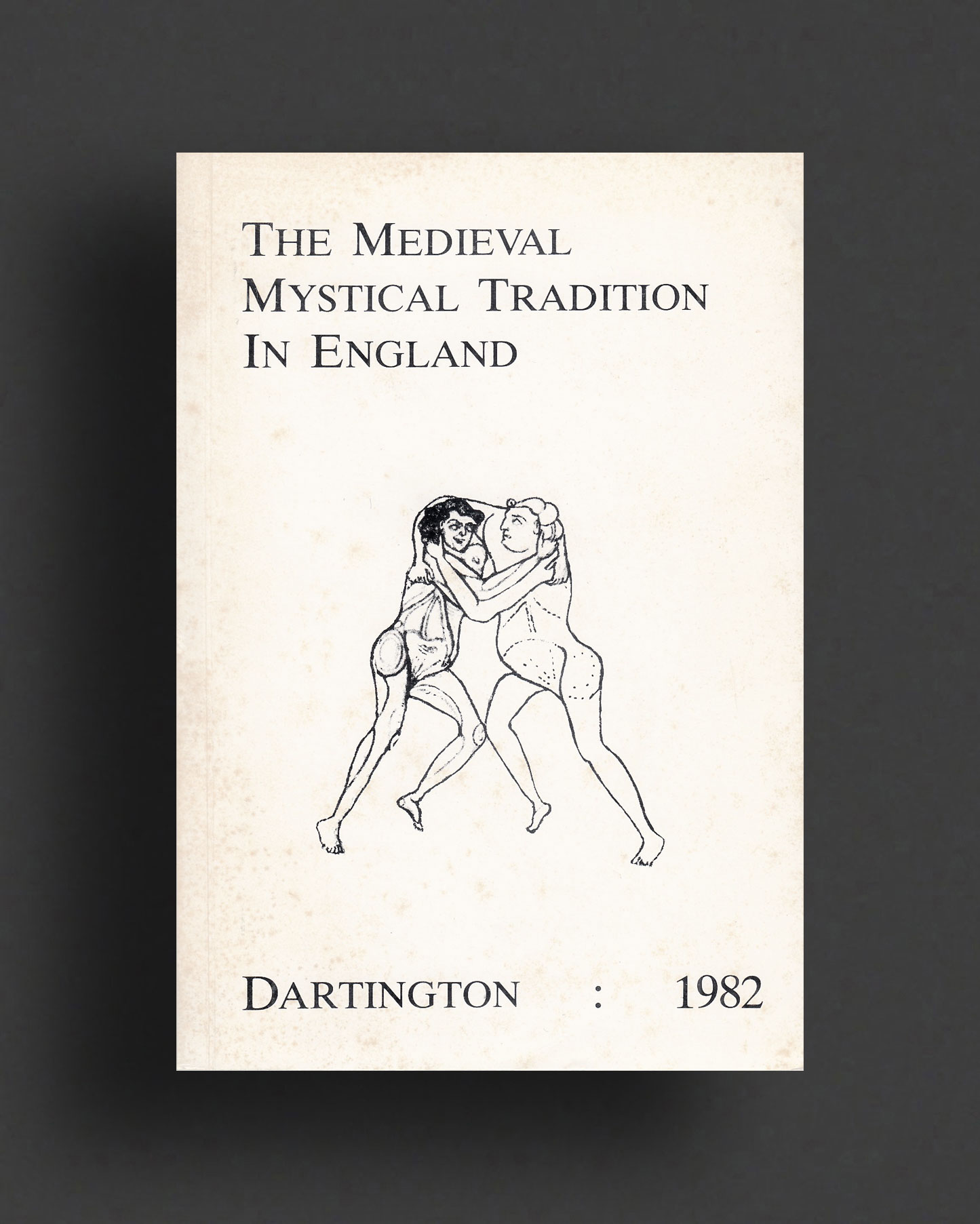
Very rare first 1982 edition of the first collection published by the University of Exeter, "The Medieval Mystical Tradition in England: Papers Read at Dartington Hall, July 1982", collecting scholarly essays exploring medieval mysticism through diverse academic disciplines. It covers significant figures and topics such as Henry Suso, the sources for The Cloud of Unknowing, and the contemplative traditions of figures like Julian of Norwich. The contributors approach medieval mysticism from a range of perspectives, including literary, historical, theological and psychological points of view.
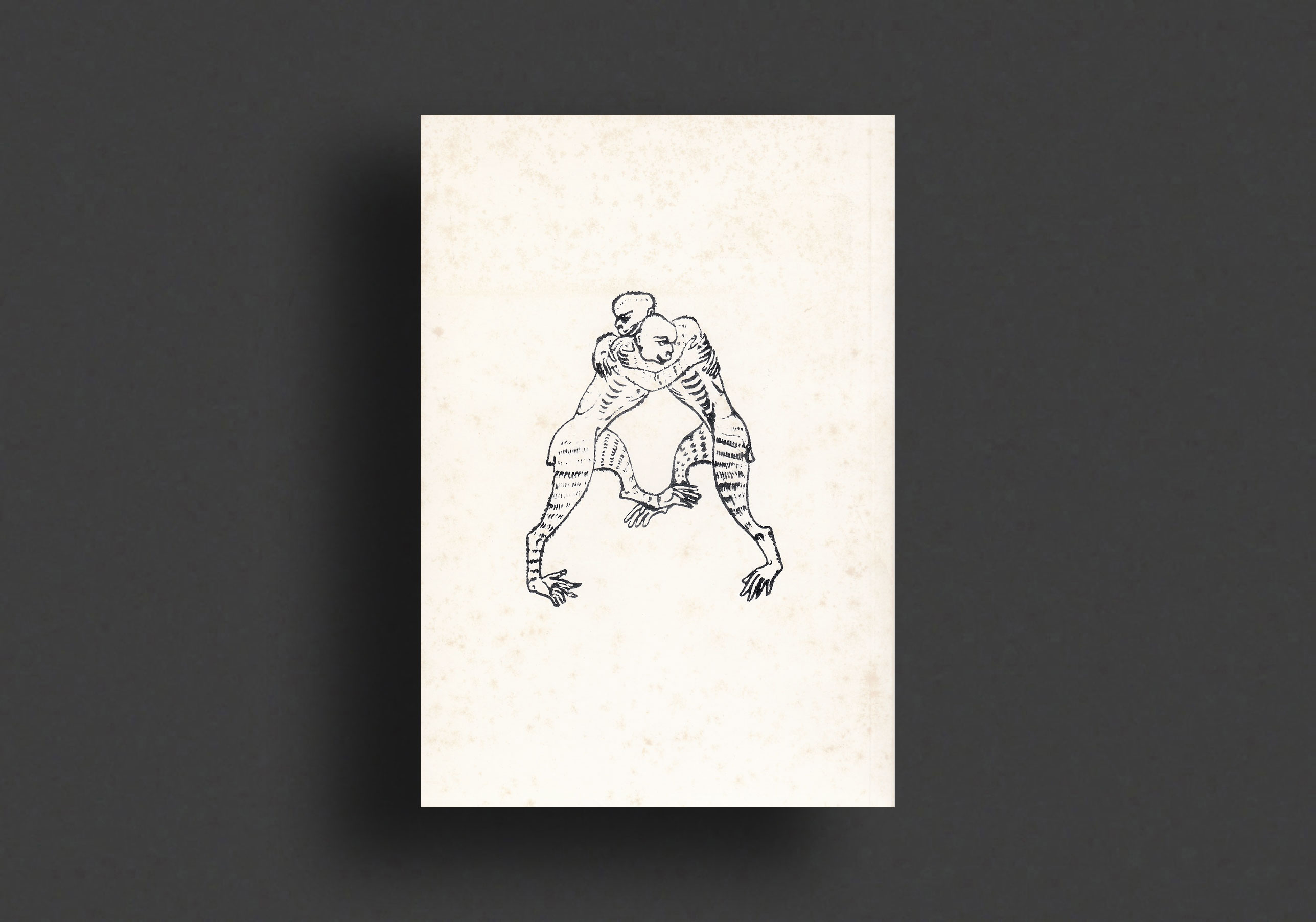
G—VG copy with light wear/foxing to spine edge, back cover. Original volume from 1982, not the print–on–demand version from the 2006 (Liverpool) or the later collections from 1984 of the 1990s. This first Exeter issue is rarely seen.
1986, English
Softcover, 337 pages, 23 x 15.3 cm
1st Edition, Out of print title / used / good
Published by
Syracuse University Press / Syracuse
$40.00 - Out of stock
First 1986 edtion.
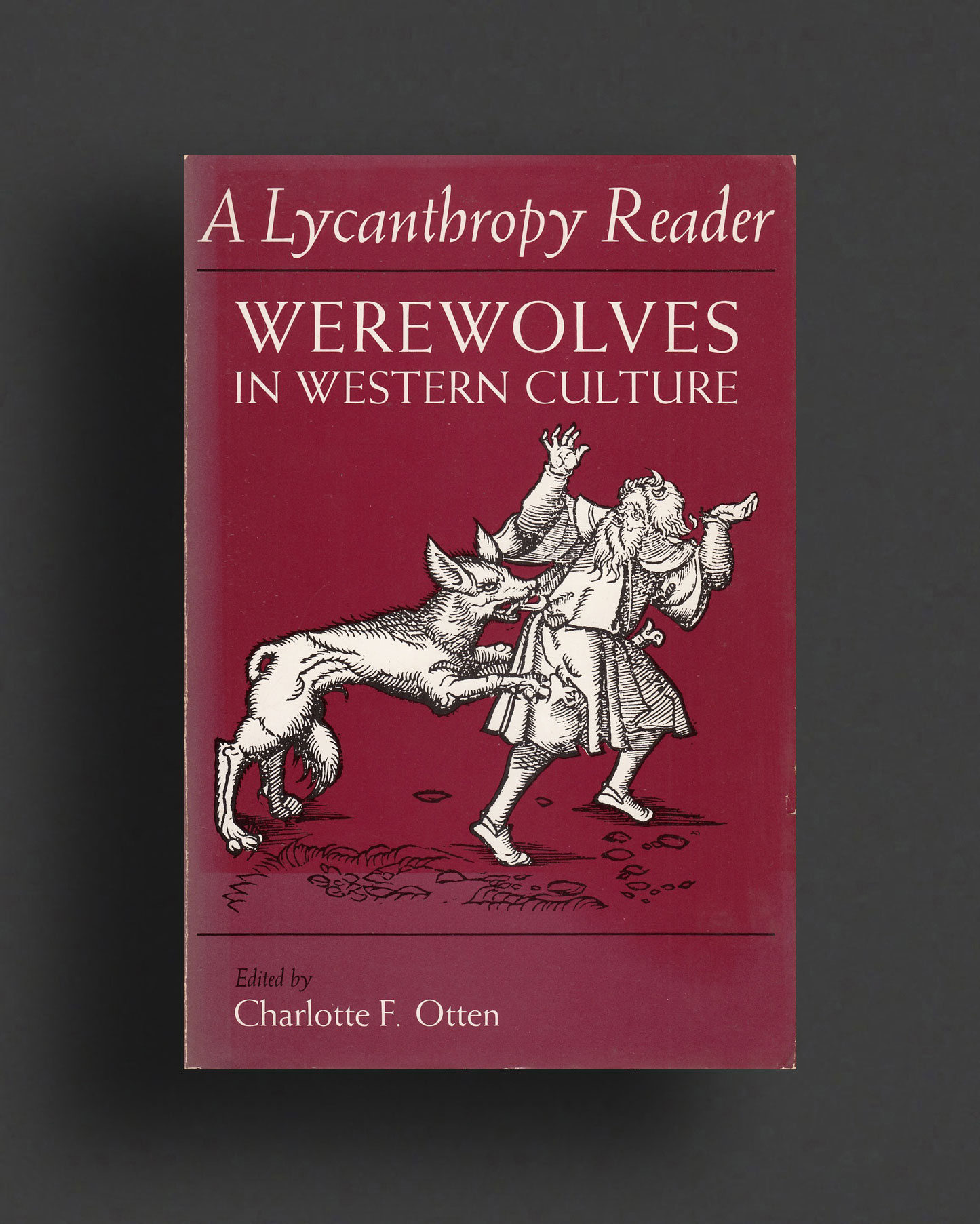
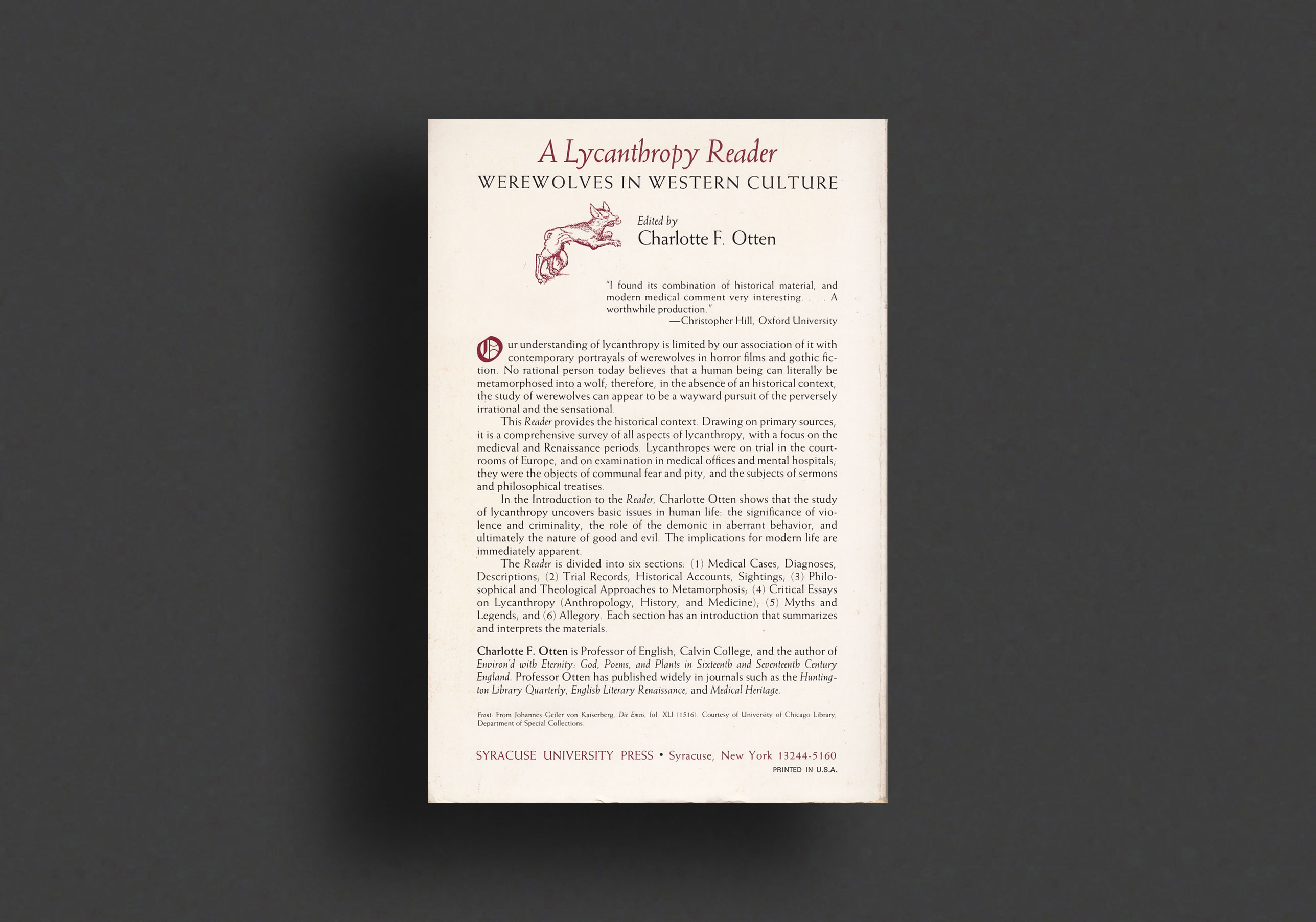
Our understanding of lycanthropy is limited by our association of it with contemporary portrayals of werewolves in horror films and gothic fiction. No rational person today believes that a human being can literally be metamorphosed into a wolf; therefore, in the absence of an historical context, the study of werewolves can appear to be a wayward pursuit of the perversely irrational and the sensational. This "Reader" provides the historical context. Drawing on primary sources, it is a comprehensive survey of all aspects of lycanthropy, with a focus on the medieval and Renaissance periods. Lycanthropes were on trial in the courtrooms of Europe, and on examination in medical offices and mental hospitals; they were the objects of communal fear and pity, and the subjects of sermons and philosophical treatises. In the Introduction to the "Reader," Charlotte Otten shows that the study of lycanthropy uncovers basic issues in human life the significance of violence and criminality, the role of the demonic in aberrant behavior, and ultimately the nature of good and evil. The implications for modern life are immediately apparent. The "Reader" is divided into six sections: (I) Medical Cases, Diagnoses, Descriptions; (2) Trial Records, Historical Accounts, Sightings; (3) Philosophical and Theological Approaches to Metamorphosis; (4) Critical Essays on Lycanthropy (Anthropology, History, and Medicine); (5) Myths and Legends; and (6) Allegory. Each section has an introduction that summarizes and interprets the materials.
Good copy with heavy foxing to block edges, some wear to extremities and spine.
1980, English
Hardcover (w. dust jacket), 394 pages, 23.5 x 16 cm
1st Edition, Out of print title / used / very good
Published by
Cambridge University Press / Cambridge
$80.00 - In stock -
Scarce first 1990 hardcover edition.
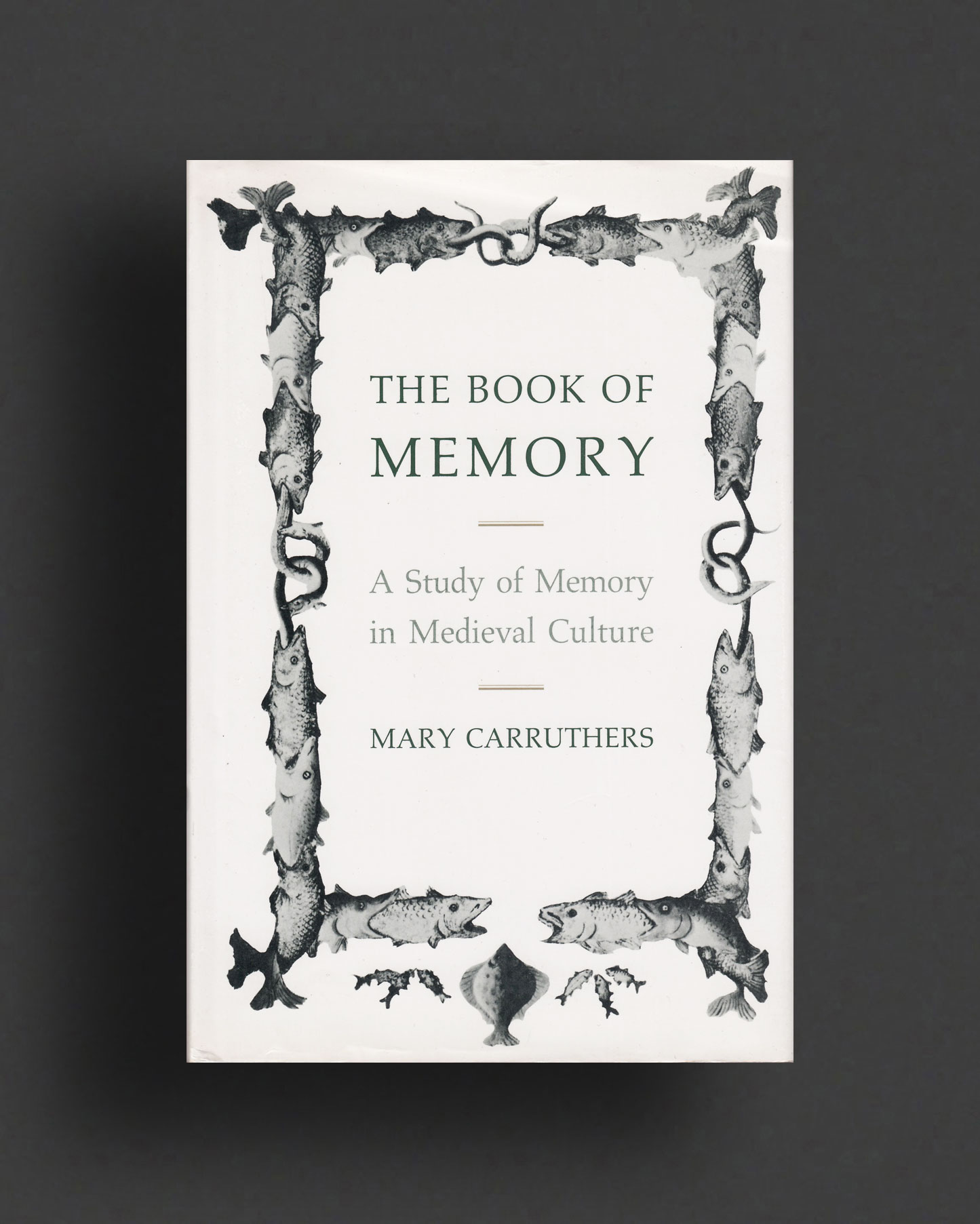
The Book of Memory is a magisterial and beautifully illustrated account of the workings and function of memory in medieval society. Memory was the psychological faculty valued above all others in the period stretching from late antiquity through the Renaissance. The prominence given to memory has profound implications for the contemporary understanding of all creative activity, and the social role of literature and art. Drawing on a range of fascinating examples from Dante, Chaucer, and Aquinas to the symbolism of illuminated manuscripts, this unusually wide-ranging book offers new insights into the medieval world.
Very Good—Near Fine copy in Very Good dust jacket. A crisp copy preserved in archival mylar wrap.
1975, English
Softcover, 78 pages ea., 27 x 21 cm
1st Edition, Out of print title / used / very good
Published by
Dallruth Publishing / London
$300.00 - Out of stock
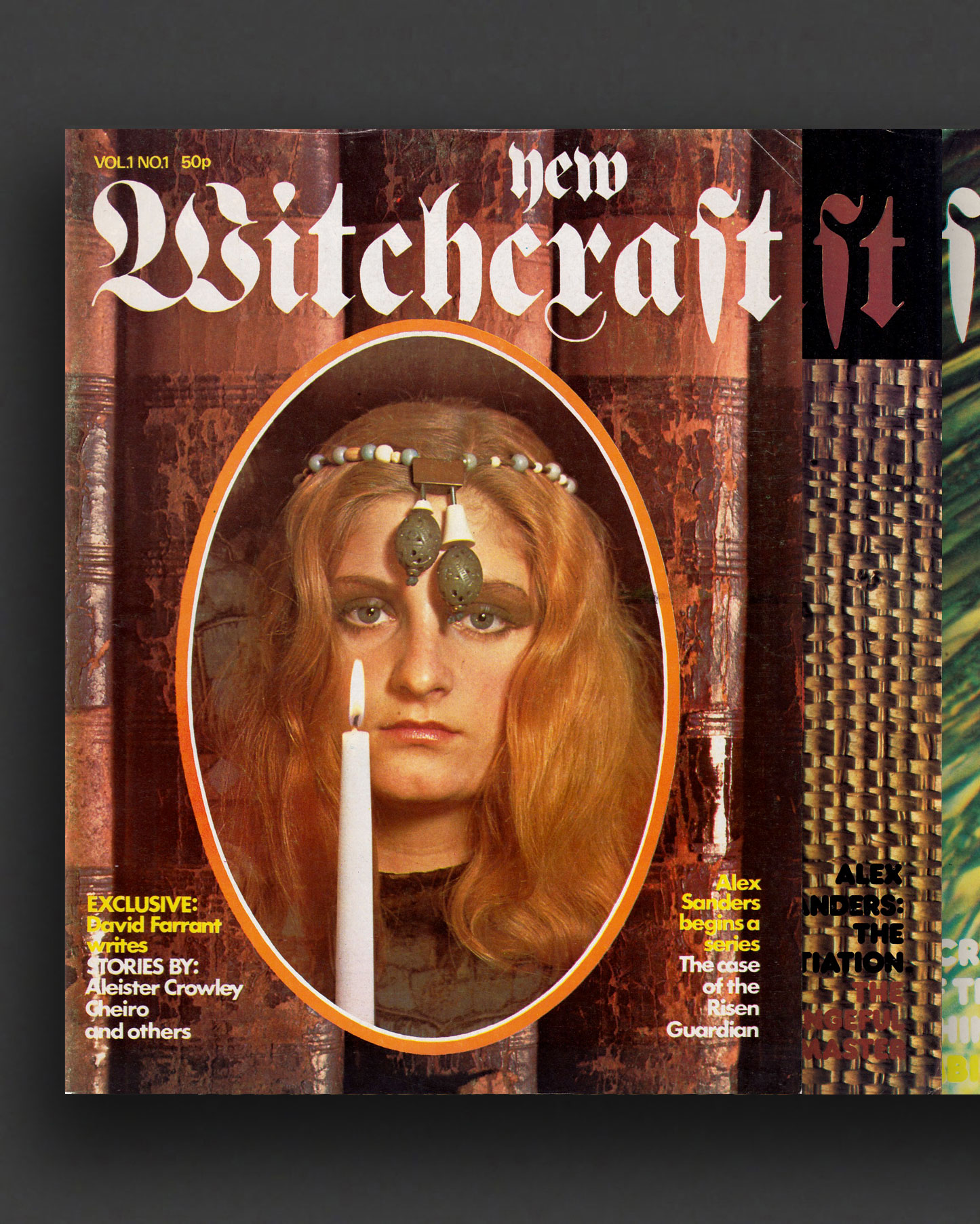
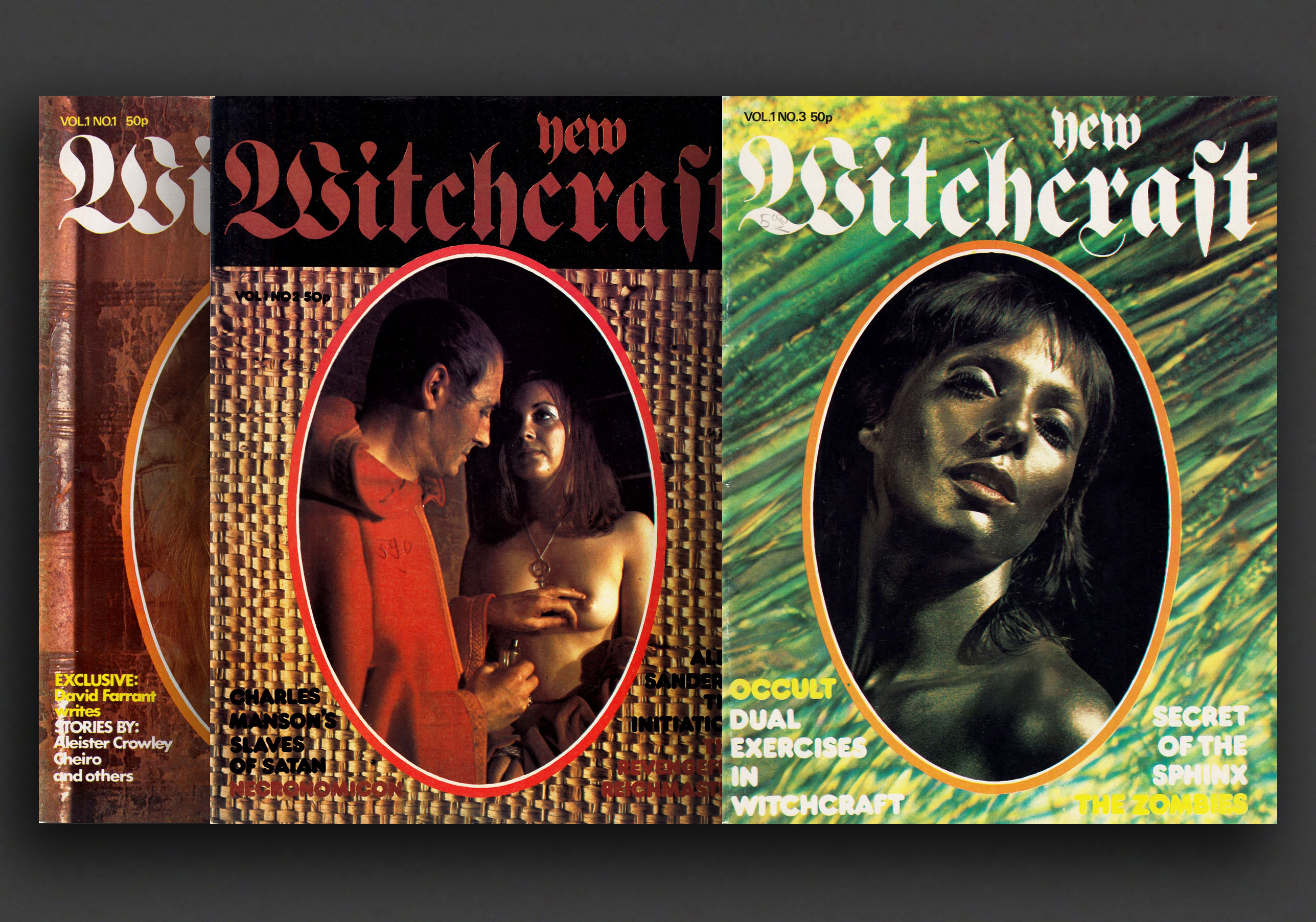
Lot of three very rare and collectible issues (of only four issues ever produced) of this short–lived 1970s British occult magazine, published by Dallruth Publishing (World of Horror) and edited by Brian Netscher. Published in 1975, New Witchcraft developed out an earlier magazine simply titled Witchcraft, and emerged during the 1970s boom of occult-focused magazines dealing with themes of modern witchcraft, magic, weird fiction, and the supernatural, catering to a growing mainstream interest in Wicca, neo-paganism, and the proliferation of Black Magic. New Witchcraft is an incredible time capsule of this newly liberated society — an incredibly visual magazine, full of lush glossy full–colour photography, illustrations and graphics, heavy with provocative sexual material. It featured grimoires, rituals, lost worlds, legend and lore, fantastic/weird/horror fiction, exclusive articles and interviews filled with rare insights into the secret world of the occult directly from the practitioners, with contributions from notable figures in the UK and international occult scene, including David Farrant, Aleister Crowley, Robert Bloch, Catherine Crowe, Patrick Sean Manchester, Alex Sanders, Emile C. Schurmacher, Gent Shaw, and many others, covering everything from Charles Manson to Alexandrian Witches, Rasputin to the Mau Mau witchcraft terrorists, Zombies to nazi occultism.
All Very Good copies, only light wear/rubbing to extremities/covers.
1974, English
Softcover, 304 pages, 20 x 13.5 cm
1st Edition, Out of print title / used / very good
Published by
New Directions / New York
$45.00 - Out of stock
First 1974 paperback edition of Hermetic Definition by H.D. published by New Directions.
"The poem is as easy to read as breathing: it could be danced, it could be sung, the clarity of image is so perfect… Tremendous suggestiveness and magnetic force radiate from the scenes… H. D.’s verse has the balance, the amplitude and the clean outlines of a Greek temple."—Nation
The fabulous beauty of Helen of Troy is legendary. But some say that Helen was never in Troy, that she had been conveyed by Zeus to Egypt, and that Greeks and Trojans alike fought for an illusion. A fifty-line fragment by the poet Stesichorus of Sicily (c. 640-555 B.C.), what survives of his Pallinode, tells us almost all we know of this other Helen, and from it H. D. wove her book-length poem. Yet Helen in Egypt is not a simple retelling of the Egyptian legend but a recreation of the many myths surrounding Helen, Paris, Achilles, Theseus, and other figures of Greek tradition, fused with the mysteries of Egyptian hermeticism.
An innovative modernist writer, Hilda Doolittle (1886–1961) wrote under her initials in a career that stretched from 1909 to 1961. Although she is most well known for her poetry—lyric and epic—H.D. also wrote novels, memoirs, short stories, essays, reviews, a children’s book, and translations. An American woman who lived her adult life abroad, H.D. was engaged in the formalist experimentation that preoccupied much of her generation. A range of thematic concerns resonates through her writing: the role of the poet, the civilian representation of war, material and mythologized ancient cultures, the role of national and colonial identity, lesbian and queer sexuality, and religion and spirituality.
Very Good copy.
1997, English
Softcover, 264 pages, 24 x 15.5 cm
1st Edition, Out of print title / used / very good
Published by
Reaktion books / London
$50.00 - In stock -
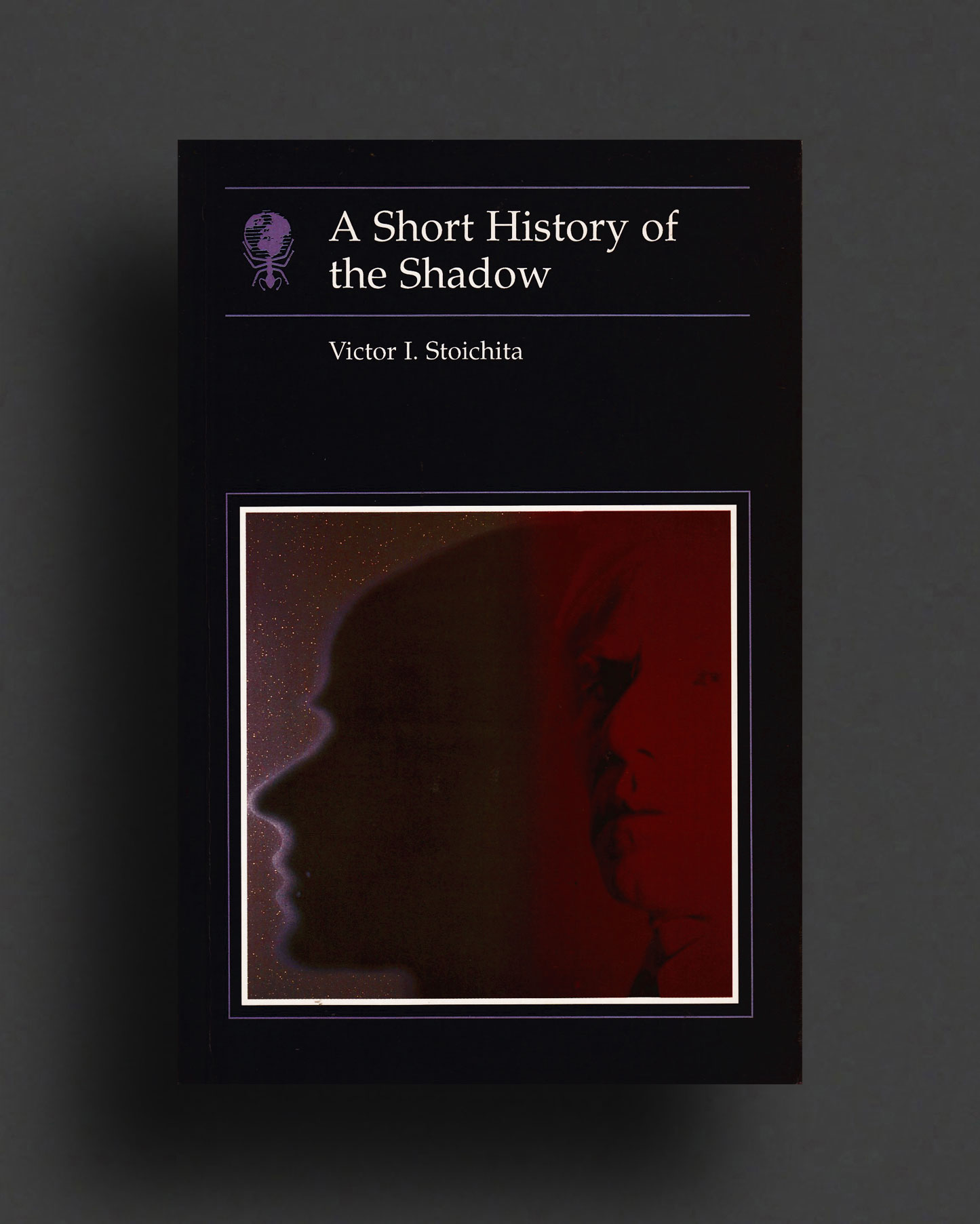
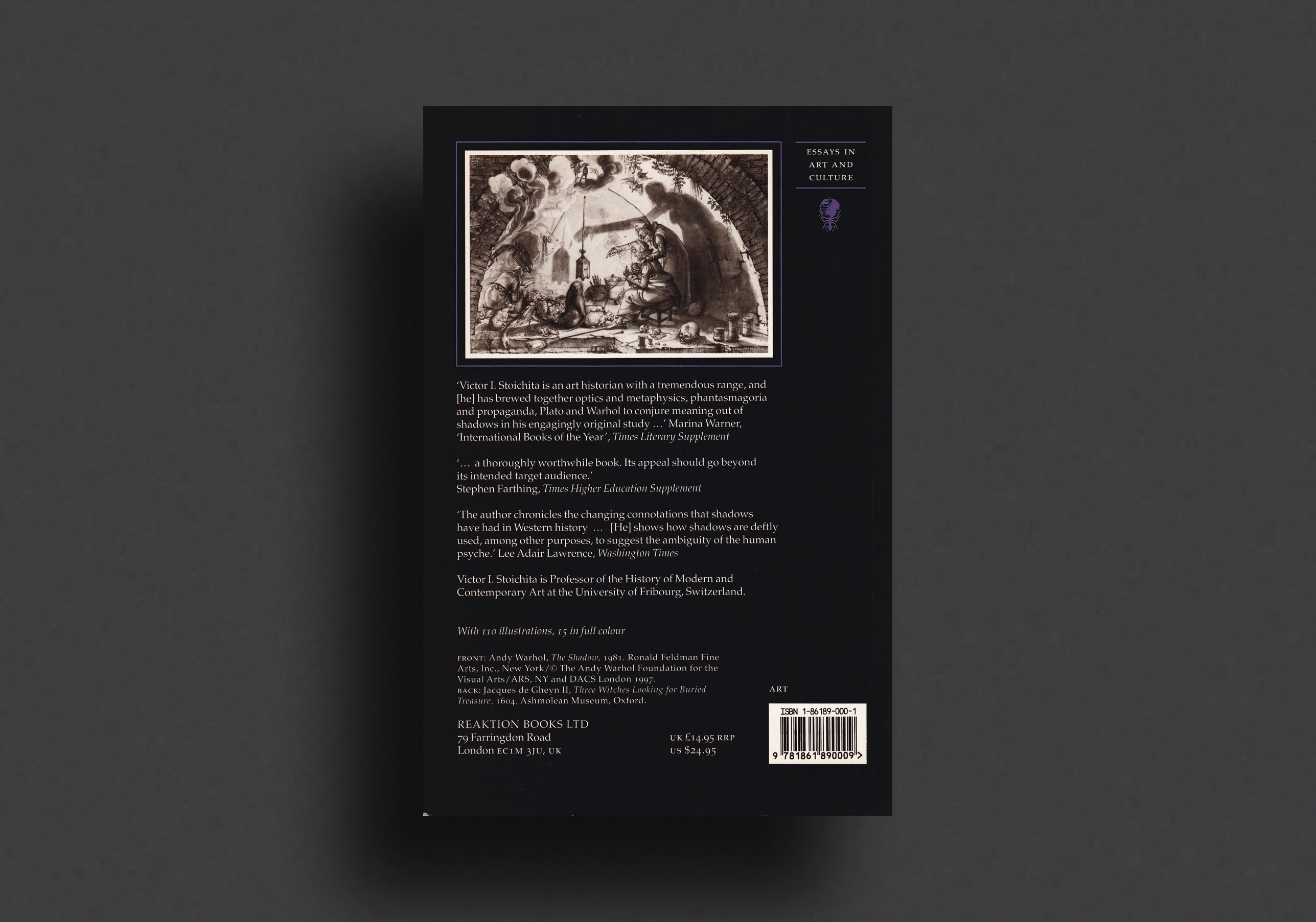
Stoichita's compelling account untangles the history of one of the most enduring challenges to beset Western art - the depiction and meanings of shadows.
"Victor I. Stoichita is an art historian with a tremendous range, and [he] has brewed together optics and metaphysics, phantasmagoria and propaganda, Plato and Warhol to conjure meaning out of shadows in his engagingly original study ...' Marina Warner, International Books of the Year', Times Literary Supplement
"... a thoroughly worthwhile book. Its appeal should go beyond its intended target audience!"—Stephen Farthing, Times Higher Education Supplement
"The author chronicles the changing connotations that shadows have had in Western history ... [He] shows how shadows are deftly used, among other purposes, to suggest the ambiguity of the human psyche."—Lee Adair Lawrence, Washington Times
Victor I. Stoichita is Professor of the History of Modern and Contemporary Art at the University of Fribourg, Switzerland.
VG—NF copy. First edition 1997.
1970, English
Softcover, 724 pages, 20.5 x 13.5 cm
1st Edition, Out of print title / used / good
Published by
Farrar Straus & Giroux / New York
$40.00 - In stock -
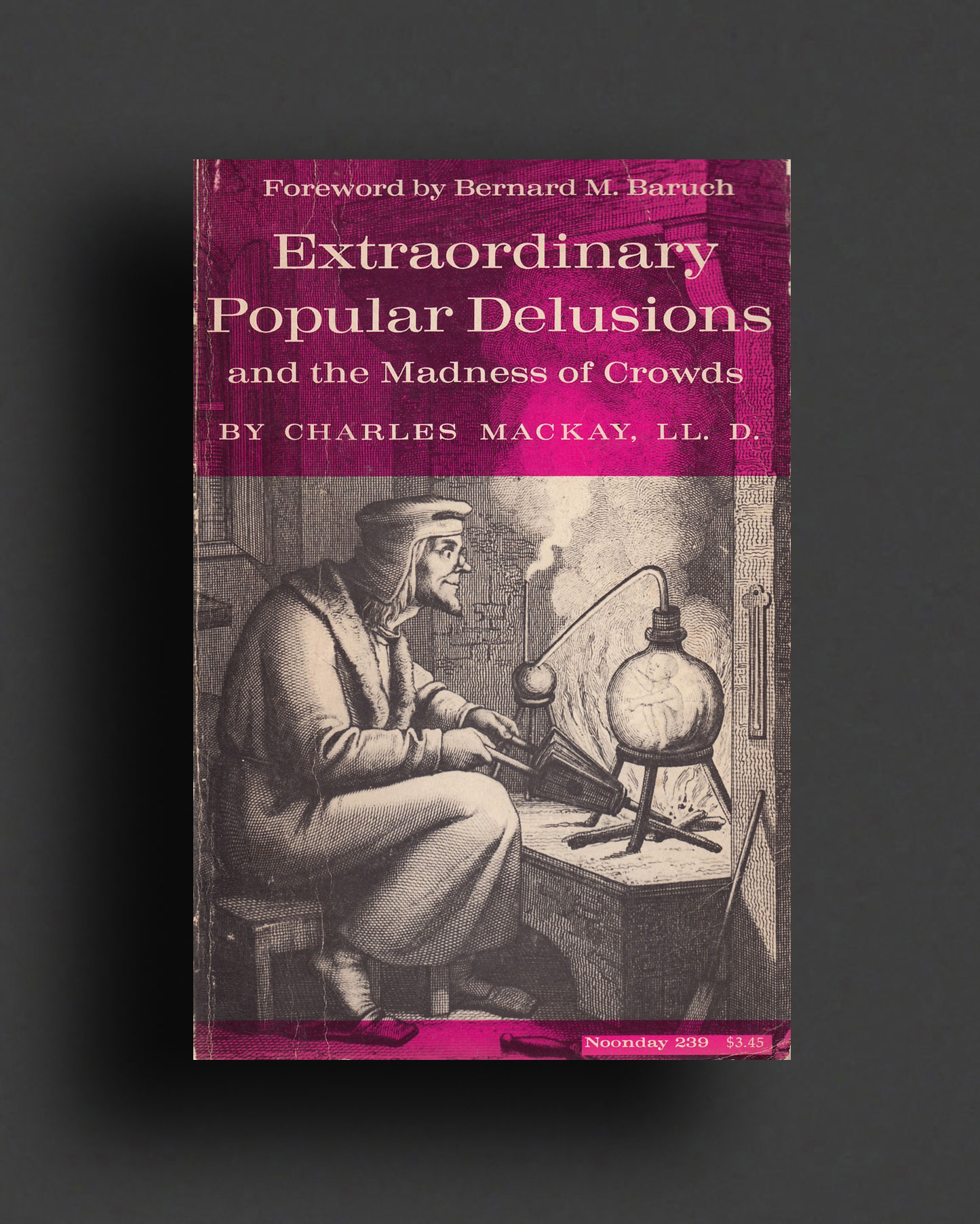
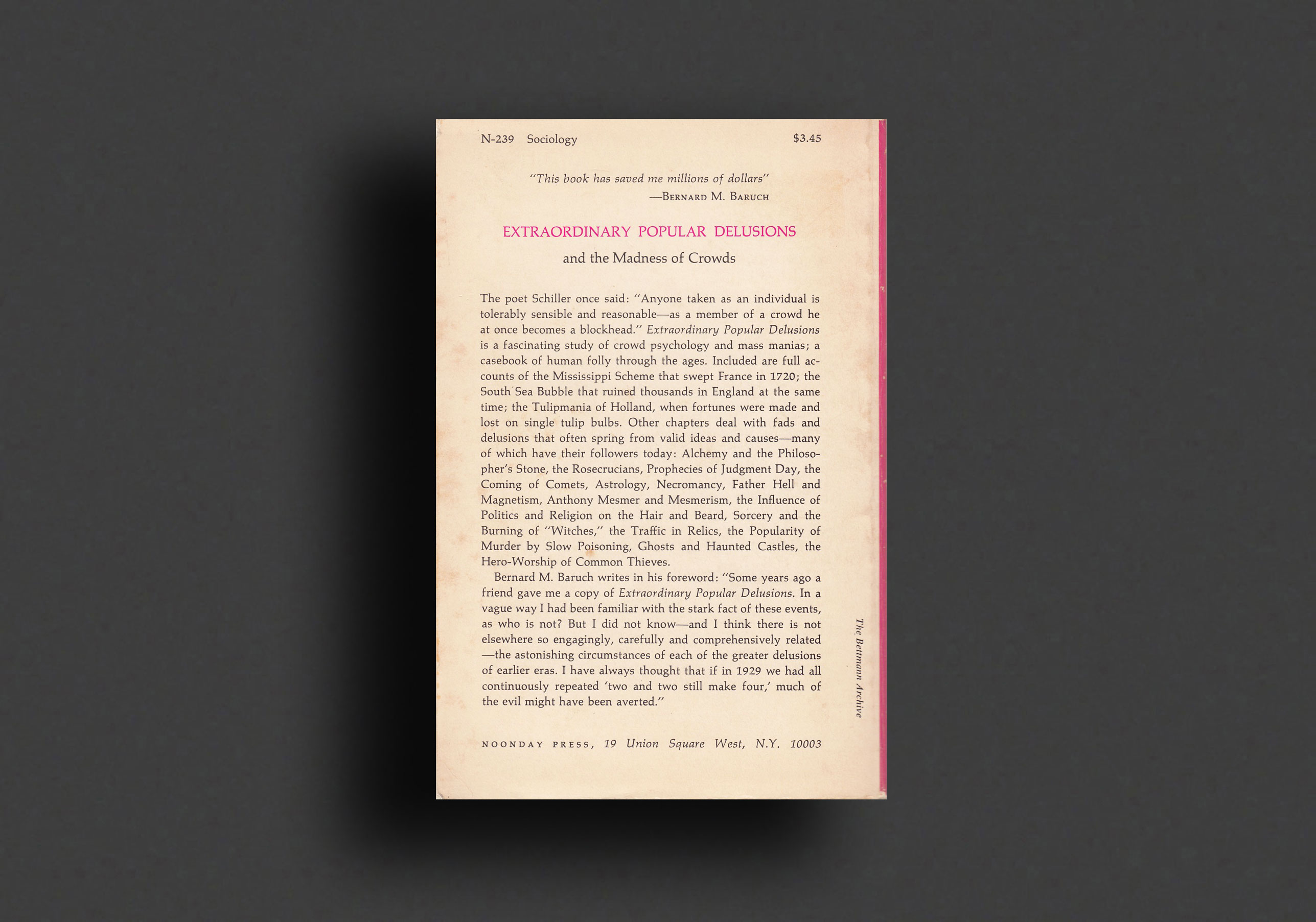
"This book has saved me millions of dollars"—BERNARD M. BARUCH
The poet Schiller once said: "Anyone taken as an individual is tolerably sensible and reasonable—as a member of a crowd he at once becomes a blockhead." Extraordinary Popular Delusions is a fascinating study of crowd psychology and mass manias; a casebook of human folly through the ages. Included are full accounts of the Mississippi Scheme that swept France in 1720; the South Sea Bubble that ruined thousands in England at the same time; the Tulipmania of Holland, when fortunes were made and lost on single tulip bulbs. Other chapters deal with fads and delusions that often spring from valid ideas and causes-many of which have their followers today: Alchemy and the Philosopher's Stone, the Rosecrucians, Prophecies of Judgment Day, the Coming of Comets, Astrology, Necromancy, Father Hell and Magnetism, Anthony Mesmer and Mesmerism, the Influence of Politics and Religion on the Hair and Beard, Sorcery and the Burning of "Witches," the Traffic in Relics, the Popularity of Murder by Slow Poisoning, Ghosts and Haunted Castles, the Hero-Worship of Common Thieves.
Bernard M. Baruch writes in his foreword: "Some years ago a friend gave me a copy of Extraordinary Popular Delusions. In a vague way I had been familiar with the stark fact of these events, as who is not? But I did not know—and I think there is not elsewhere so engagingly, carefully and comprehensively related—the astonishing circumstances of each of the greater delusions of earlier eras. I have always thought that if in 1929 we had all continuously repeated 'two and two still make four,' much of the evil might have been averted."
1970 edition, with facsimile title pages and reproductions from the editions of 1741 and 1852. Good—VG copy with some general light wear, spine creasing, foxing to block edge.
2025, English
Hardcover, 320 pages, 30 x 24 cm
Published by
Fulgur Press / UK
$165.00 - In stock -
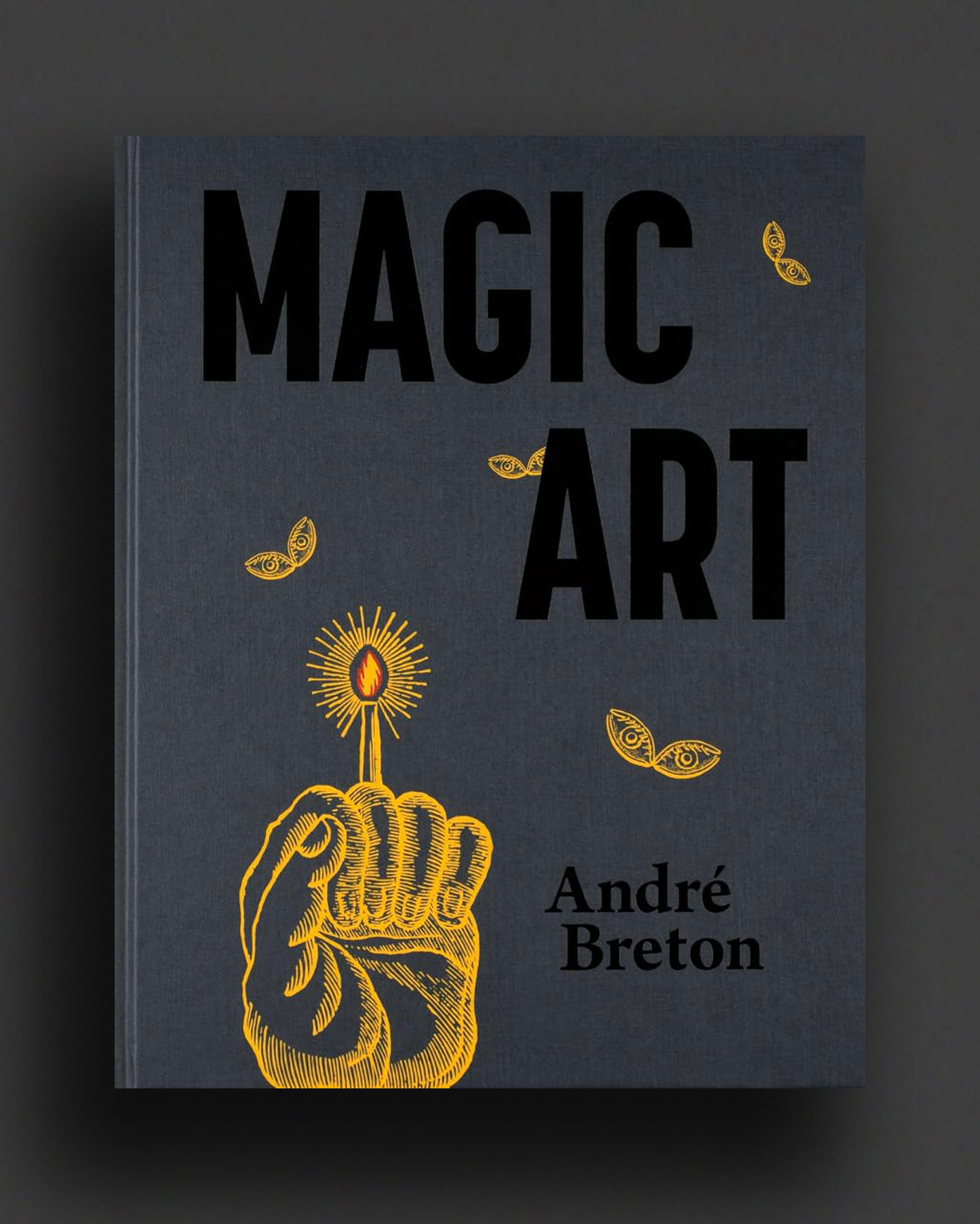
Breton's late treatise on magic and art appears for the first time in English, complete with citations, commentaries and a bibliography.
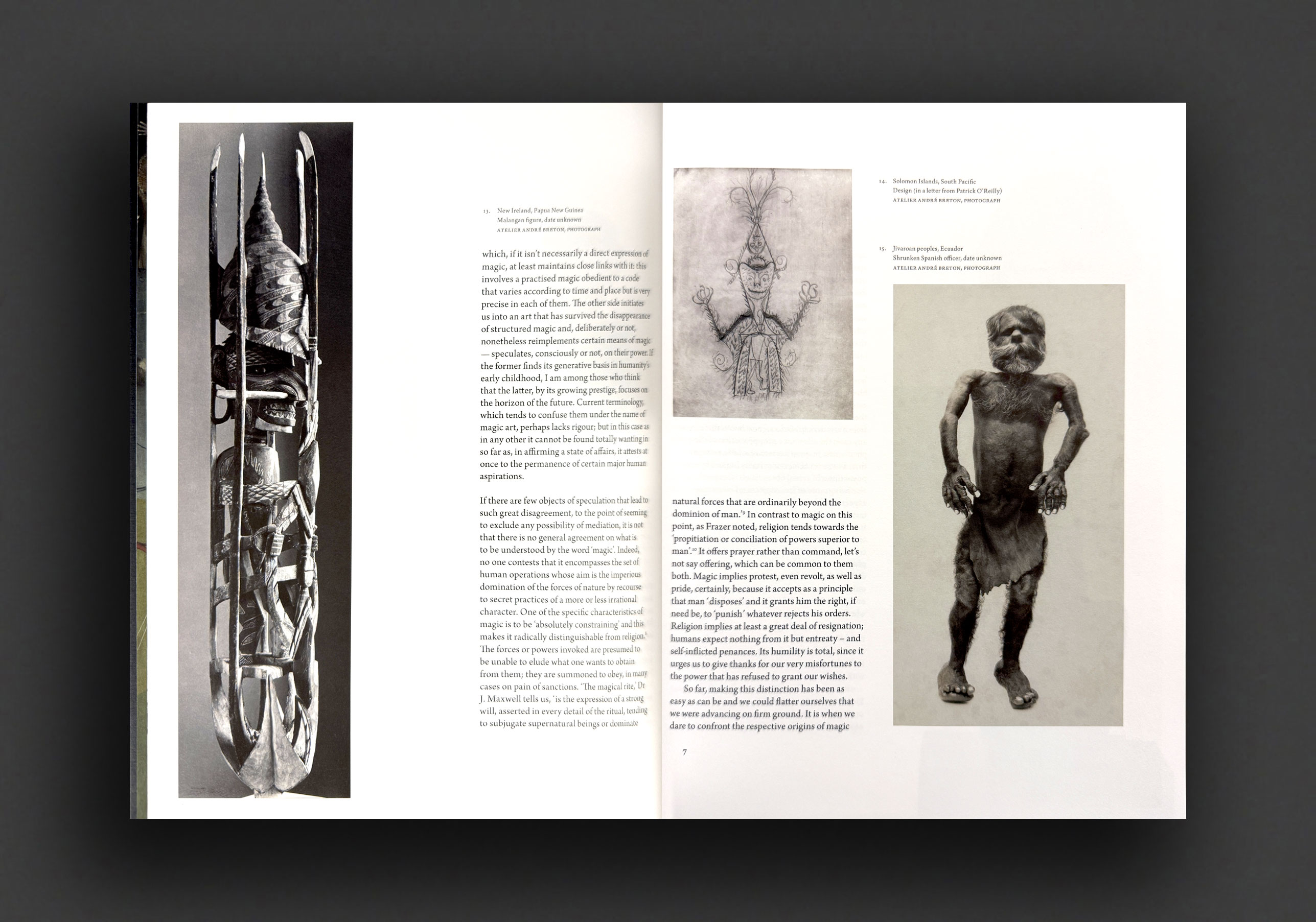
What is “Magic Art”? In 1953, André Breton, founder of the Surrealist movement, was invited by a prestigious French publisher to explore answers to this question. His resulting analysis is wide-ranging and evocative. Beginning with a literary review of magic and art, Breton draws upon Novalis and Baudelaire before considering the prehistoric rock art of Spain and France, the native art of the Pacific Northwest, the magical grimoires and alchemical symbolism of the Middle Ages, and the work of Hieronymus Bosch, Antoine Caron, Paolo Uccello, Gustav Moreau, Paul Gauguin and the Surrealists. Through these and other diverse sources, Breton traces a mystery that lies at the heart of our timeless fascination with otherness and seeks to place Surrealism as a successor to a magical sensibility that began with art itself.
First published in 1957 as L’Art magique, this important text is offered here as an English translation for the first time. Working from manuscript notes for the original project, this edition presents the iconographic content as Breton intended, together with more than 300 new citations and a comprehensive bibliography that emphasizes sources found in Breton’s own library.
André Breton (1896–1966) was one of the founders and most controversial exponents of Surrealism, defining the movement in his first Surrealist Manifesto as “pure psychic automatism.” Fleeing from Europe during World War II, Breton traveled throughout North America staging Surrealist exhibitions and lending his voice to several political movements.
With contributions by Gérard Legrand, Robert Shehu-Ansell, Merlin Cox, Krzysztof Fijalkowski, Dawn Ades, Anne Egger, Kristoffer Noheden.
1951, English
Hardcover (w. dust jacket), 250 pages, 19.2 x 12 cm
Out of print title / used / very good
Published by
Rider and Company / London
$180.00 - In stock -
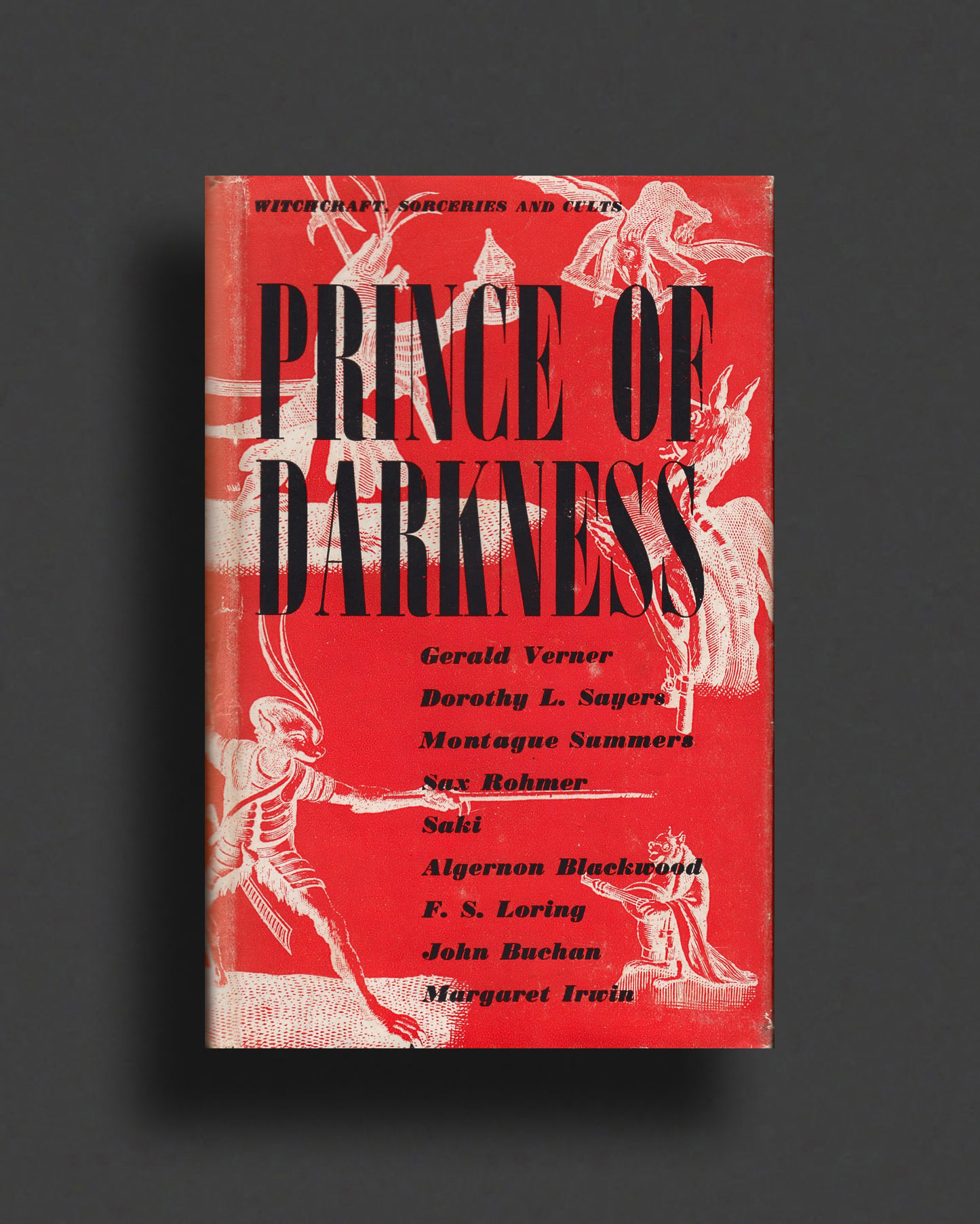
Rare 1951 hardcover edition of Prince of Darkness, a 1946/1951 anthology edited by Gerald Verner (pseudonym of John Robert Stuart Pringle). It gathers occult, horror fiction, and "factual" writings by scholars on witchcraft, the Black Mass, and the supernatural, illustrated throughout with demons from Jacques Callot's (1593-1636) 1614 engraving "The Temptation of St. Anthony". The book is divided into four sections: Witchcult, Satanism, Sorcery, and Lycanthropy. Stories and essays by Montague Summers, Cotton Mather, Margaret Irwin, Algernon Blackwood, John Buchan, Sax Rohmer, Dorothy L. Sayers, Saki, and F.G. Loring. Published by Rider and Company, London.
Very Good copy with G—VG dust jacket, some wear/light chipping to extremities, now preserved in mylar wrap. Book VG with some age toning.
2026, English
Hardcover, 292 pages, 30.5 x 22.9 cm
Published by
Fulgur Press / UK
$165.00 - In stock -
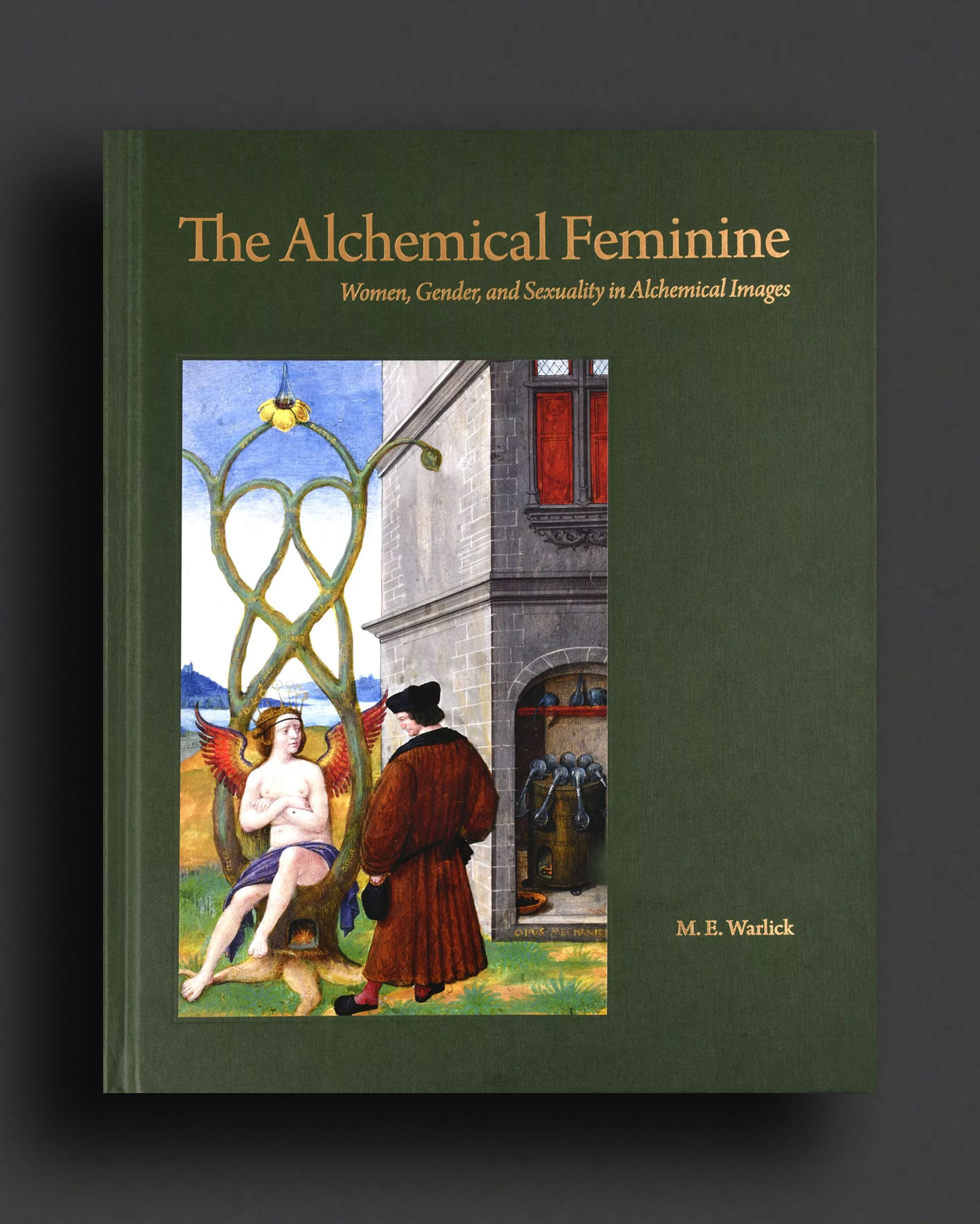
The images of women in this pioneering volume evolved from alchemical philosophy, in which gendered and sexualised concepts are used to describe physical matter and laboratory processes. When alchemical imagery arose in the late Middle Ages, images of women developed in ways that reflected wider social pressures. This title examines the transformations of alchemical images of women in the early modern period and the increasing masculinisation of earlier feminine imagery. When alchemy returned to the Latin West, metals were thought to be composed of hot, dry, fixed Philosophic Sulphur and cool, moist, volatile Philosophic Mercury. In the laboratory, these lovers fused in a “Chemical Wedding” that produced their child, the “Philosophers’ Stone,” a mysterious catalyst enabling the transformation of base metals into silver and gold. As alchemical imagery developed, women appeared as ancient philosophers, religious figures, royal queens, sexual partners, cosmological personifications, deities, allegorical symbols of Nature and the wives of fools. Herbal alchemy also had ancient roots and it is in this realm that women as alchemical practitioners can be found. Using abundant illustrations, this book examines the alchemical feminine and the thematic diversity of alchemical images of women.
M. E. Warlick, Ph.D., Professor of European Modern Art at the University of Denver, teaches classes on 18th through 20th century European art. She has received DU’s Distinguished Professor Award (1991), and served as University Professor of the Arts and Humanities (1997-2000). Her books include: Max Ernst and Alchemy (University of Texas Press, 2001) and The Philosopher’s Stones (1997), rev. ed. The Alchemy Stones (2002). She has published on surrealist art and the occult, and on alchemical imagery from antiquity through the mid-17th century, analysed through a feminist lens, with articles in the Art Journal, Art Bulletin, Glasgow Emblem Studies, Culture and Cosmos, and in several anthologies published by the Association for the Study of Esotericism. Her essay on “Surrealism and Alchemy,” appeared in the Art and Alchemy exhibition catalogue (Düsseldorf: Museum Kunstpalast, 2014). Her most recent book is entitled The Alchemical Feminine: Women, Gender, and Sexuality in Alchemical Imagery (Fulgur Press, 2025).
2026, English
Hardcover, 256 pages, 26 x 18 cm
Published by
Princeton University Press / New York
$69.00 - Out of stock
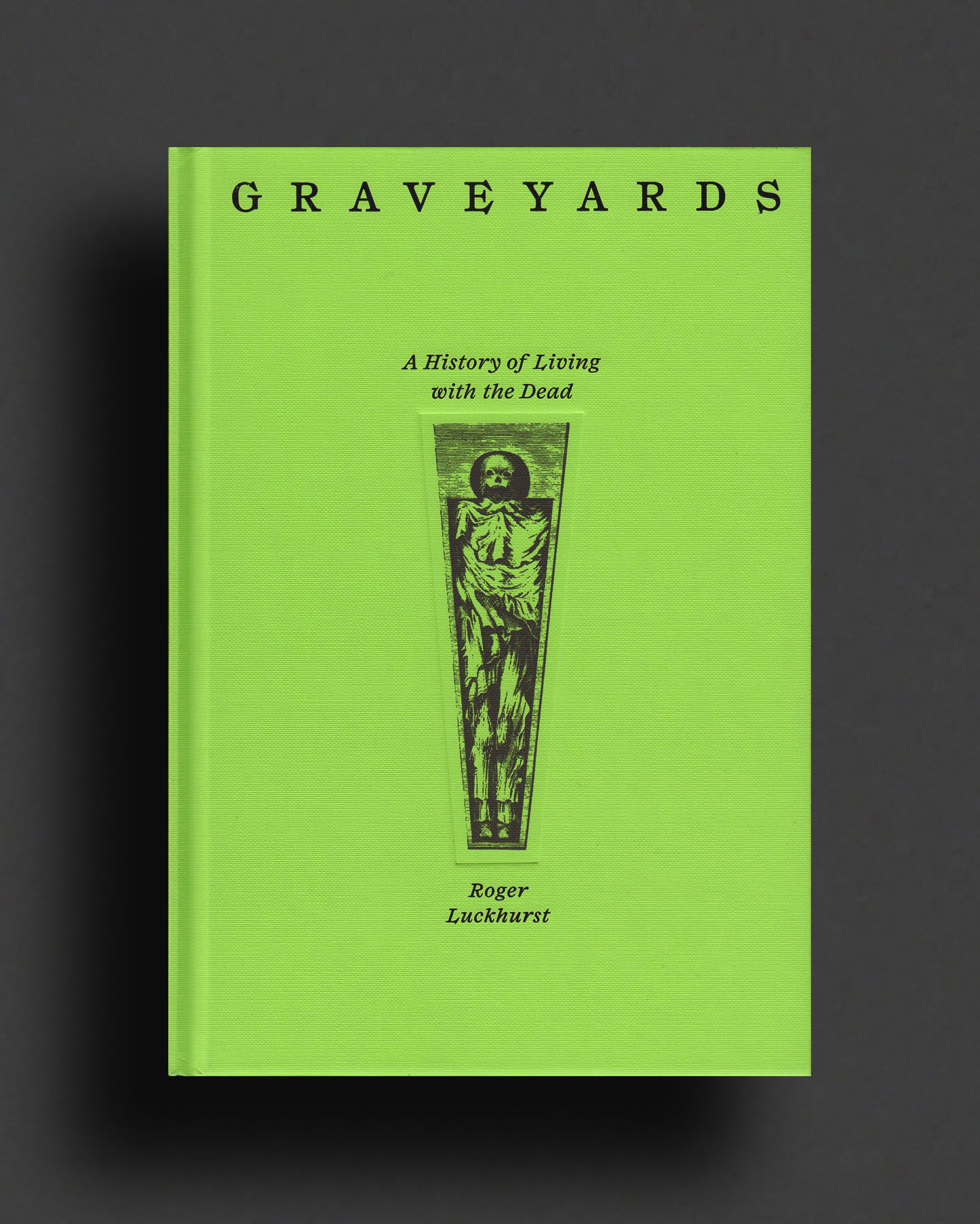
From the author of Gothic, a marvelously illustrated cultural history of graves and graveyards, from the earliest known burial sites to today’s green burials.
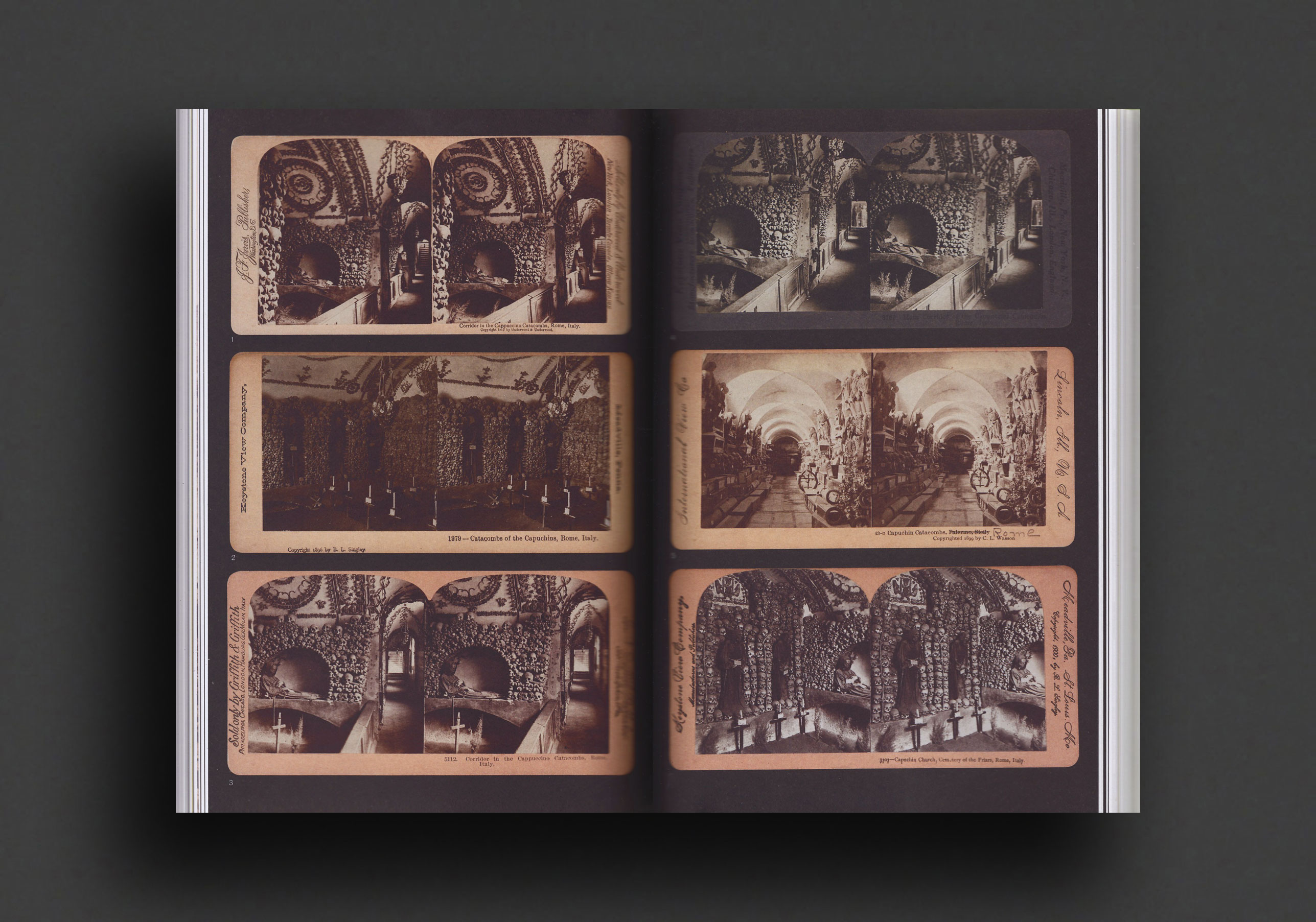
Why, how, and where do we inter our dead? How have people throughout history responded to the problem of laying their dead to rest? Roger Luckhurst sets out in search of answers in this arresting book. Taking readers on an unforgettable tour of the rich and unusual visual culture of the grave, he visits locales such as the pyramids of Giza, the catacombs and columbaria of Rome, and the cenotaphs erected to the world’s war dead. Along the way, he examines the diverse role of graveyards in literature, art, film, and television.
In engaging chapters that look at all aspects of the treatment of the dead, Luckhurst covers topics ranging from early burials and the emergence of necropolises and catacombs to grave robbing, garden cemeteries, the perilous overcrowding of the urban dead, and the emergence of modern funerary culture. Exploring the cultural afterlives of burial and memorial sites in the popular imagination, he shows how graves have served as guides to the underworld, poignant dedications to those we have lost, as reminders of our own mortality, and settings in gothic horror.
Blending lively storytelling with a wealth of stunning illustrations, Graveyards is a lyrical, frequently unexpected account of the grave as a signpost to the afterlife, a site of remembrance and self-reflection, and an object of enduring fascination.
1971, English
Softcover, 452 pages, 21.4 x 13.5 cm
1st Edition, Out of print title / used / very good
Published by
Dover / New York
$45.00 - Out of stock
First English 1971 edition of Herbert Silberer's examinations of alchemy and the occult, and his attempts to correlate the two crafts to the pursuit of psychoanalysis. First published in 1917, this text represents the extensive investigations Herbert Silberer undertook in order to map occurrences in the occult with the ascendant psychoanalytic disciplines present in the Vienna School of which he was part. This text is marked by its depth of research, with sources such as Hermes Trismegistus, Flamel, Lacinius, Michael Meier, Paracelsus, and Boehme quoted and drawn upon in service of Silberer's thesis. The support of alchemy as a spiritual movement, on the same level as the yoga traditions of the Indian subcontinent, is also notable.
Very Good copy.
1984, English
Softcover, 482 pages, 20 x 13.5 cm
Out of print title / used / very good
Published by
Schocken Books / New York
$25.00 - Out of stock
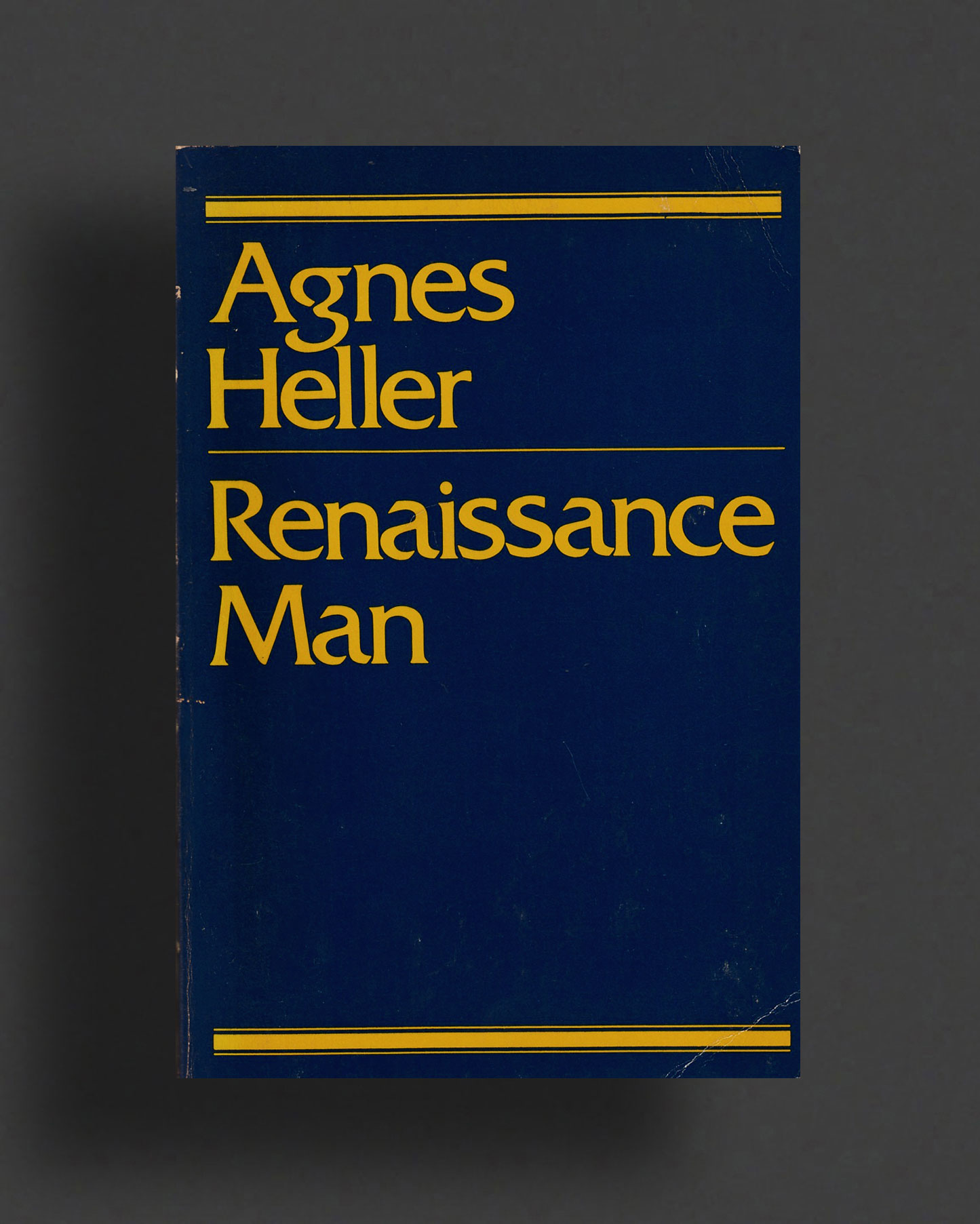
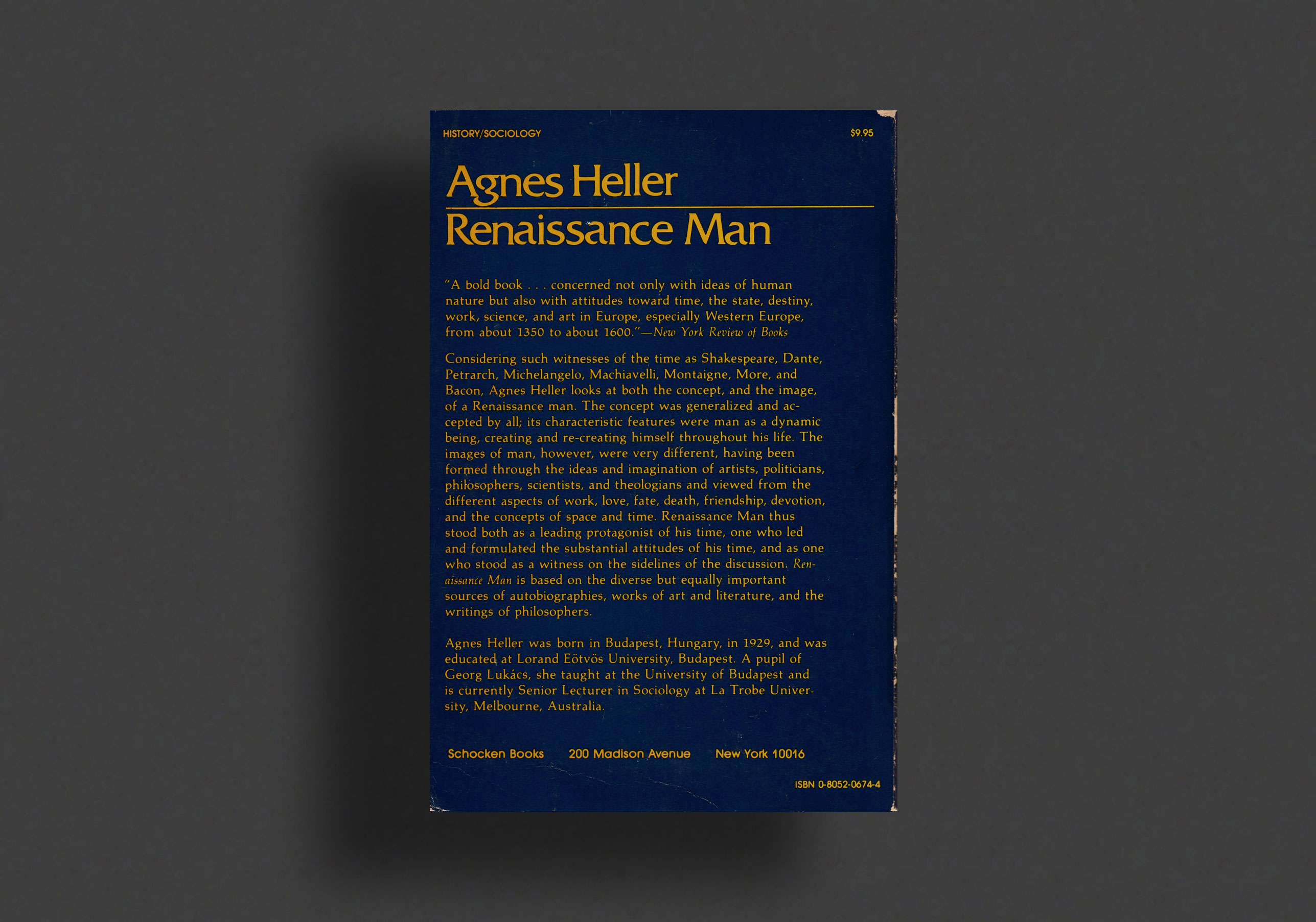
Considering such witnesses of the time as Shakespeare, Dante, Petrarch, Michelangelo, Machiavelli, Montaigne, More and Bacon, Agnes Heller looks at both the concept and the image of a Renaissance man. The concept was generalised and accepted by all; its characteristic features were man as a dynamic being, creating and re-creating himself throughout his life. The images of man, however, were very different, having been formed through the ideas and imagination of artists, politicians, philosophers, scientists and theologians and viewed from the different aspects of work, love, fate, death, friendship, devotion and the concepts of space and time. Renaissance Man thus stood as both as a leading protagonist of his time, one who led and formulated the substantial attitudes of his time, and as one who stood as a witness on the sidelines of the discussion. This book, first published in English in 1978, is based on the diverse but equally important sources of autobiographies, works of art and literature, and the writings of philosophers. Although she uses Florence as a starting point, Agnes Heller points out that the Renaissance was a social and cultural phenomenon common to all of Western Europe; her Renaissance Man is thus a figure to be found throughout Europe.
Ágnes Heller was a Hungarian philosopher and lecturer. She was a core member of the Budapest School philosophical forum in the 1960s and later taught political theory for 25 years at the New School for Social Research in New York City. She lived, wrote and lectured in Budapest.
Good copy.
1972, English
Softcover, 220 pages, 20 x 12.5 cm
Out of print title / used / good
Published by
Peregrine Books / UK
$18.00 - In stock -
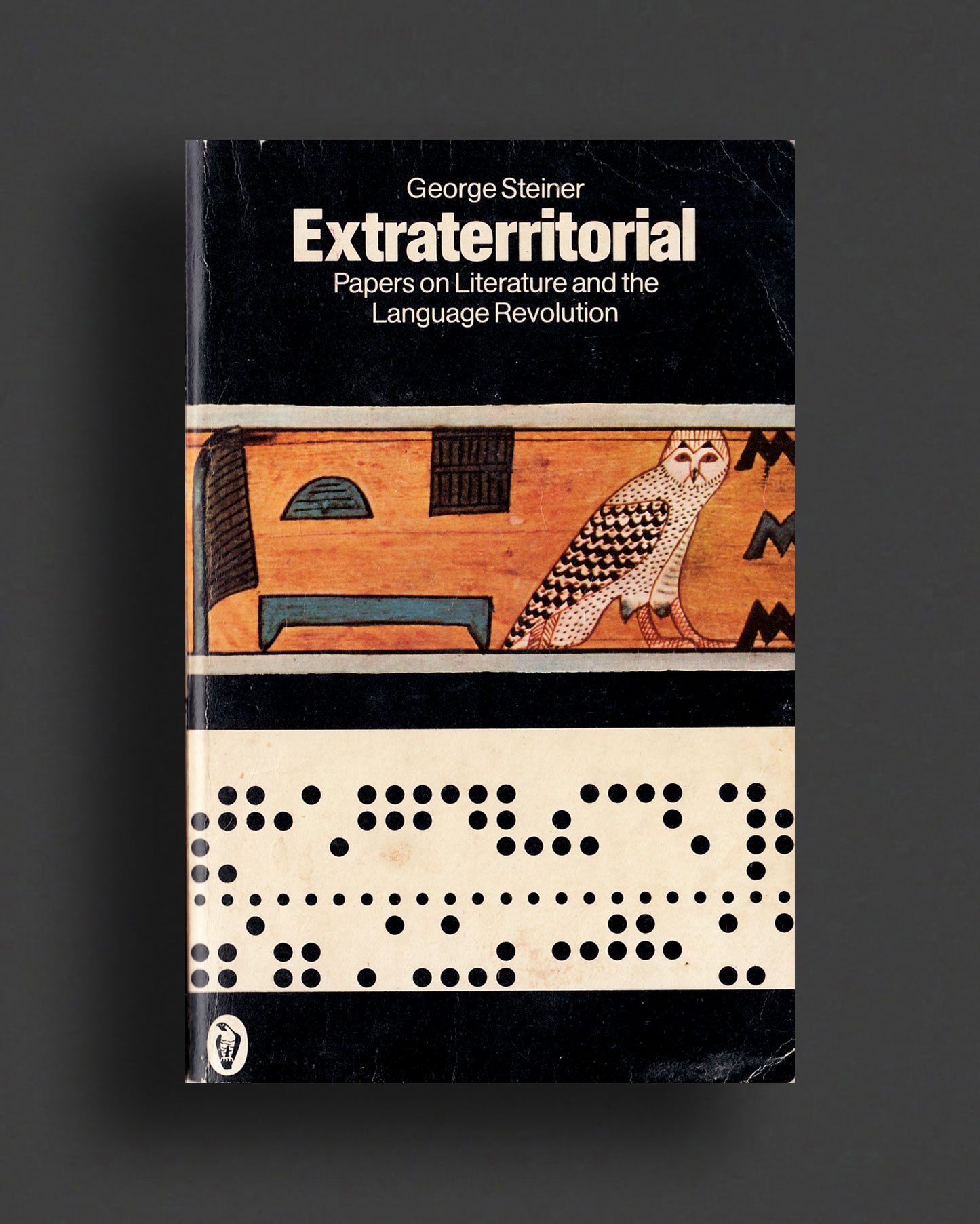
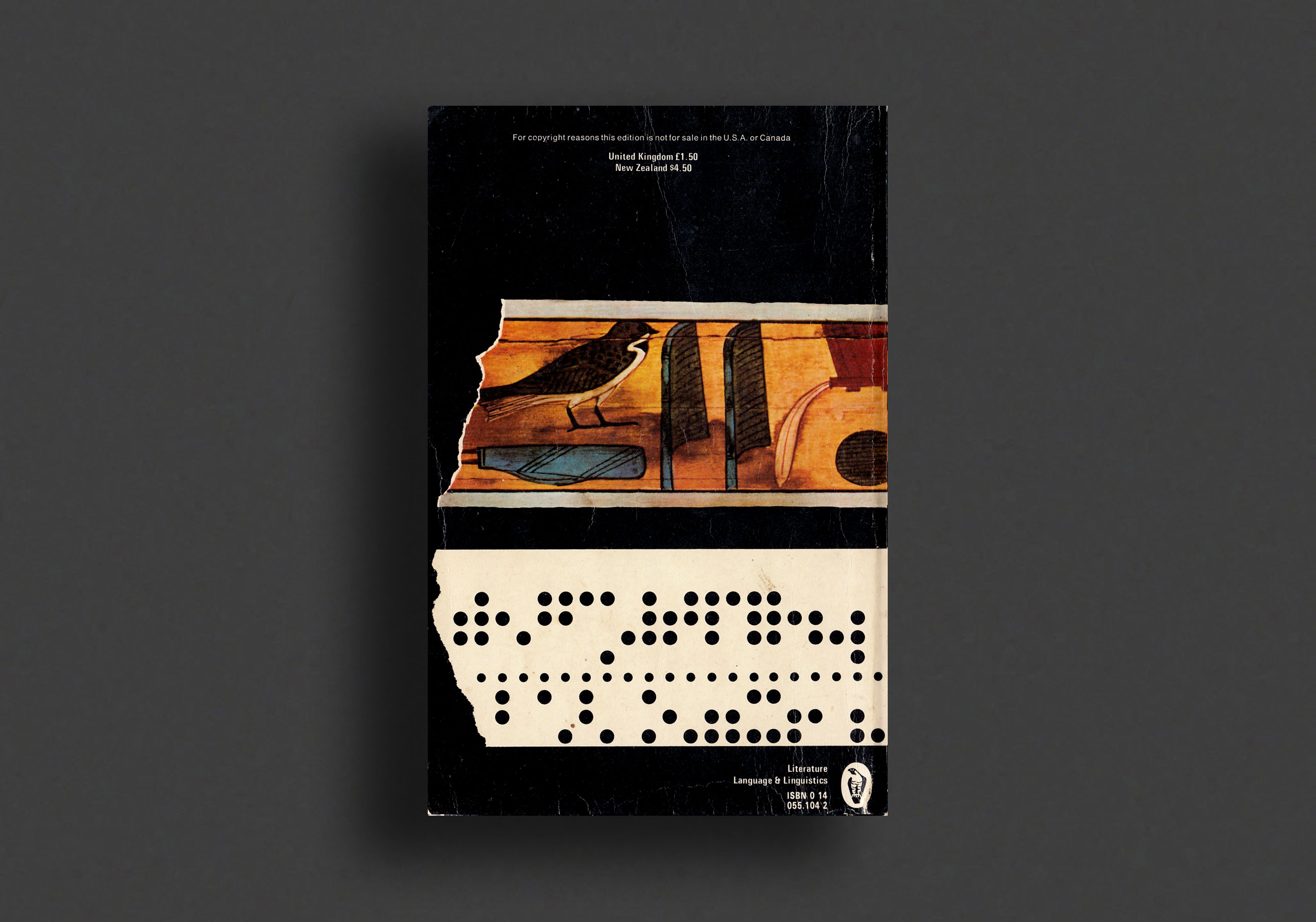
1972 Penguin (Peregrine) edition of Extraterritorial by George Steiner.
During the past thirty years linguistics, the scientific study of language, has assumed a central place in philosophy, psychology, anthropology and the social sciences.
In this collection of essays (first published in the New Yorker) George Steiner asks if linguistics has altered in any way our understanding and experience of literature. Has, for instance, our response to literature been influenced by new theories of grammar? And does the personal extraterritoriality of certain writers - Beckett, Borges, Nabokov - and their movements between different languages and cultures, represent a profound change in the relationship of the writer to his native speech?
The incorporation of the speculative forms of science into educated literacy and into the normal life of the imagination will, in George Steiner's view, revitalize our lives and the beliefs we cherish about our culture.
Born in Paris in 1929, George Steiner is now Extraordinary Fellow of Churchill College, Cambridge. He commutes often to the United States, where he has been Albert Schweitzer Visiting Professor in the Humanities at New York University, and where he has taught also at Stanford, Princeton, Harvard and Yale. After taking degrees at the University of Chicago and Harvard, where he won the Bell Prize in American Literature. Mr Steiner was a Rhodes Scholar at Oxford. He served on the editorial staff of the Economist in London from 1952 to 1956. At that time he became a member of the Institute for Advanced Study in Princeton. There he wrote Tolstoy or Dostoeusky and began The Death of Tragedy. These were followed by a volume of three novellas, Anno Domini, and Language and Silence. He returned to England in 1961. His many honours include an O. Henry Short Story award, Fulbright and Guggenheim Fellowships, and the first award of the Morton Zabel Prize by the National Institute of Arts and Letters in 1970. He is married, with two children. He is a present engaged on a full-scale study of the poetics and linguistics of multi-lingualism and of translation.
Good copy, general light edge wear / tanning to book block.
1998, English
Hardcover (w. dust jacket), 48 pages, 23 x 16.5 cm
1st Edition, Out of print title / used / fine
Published by
Thames and Hudson / London
$15.00 - Out of stock
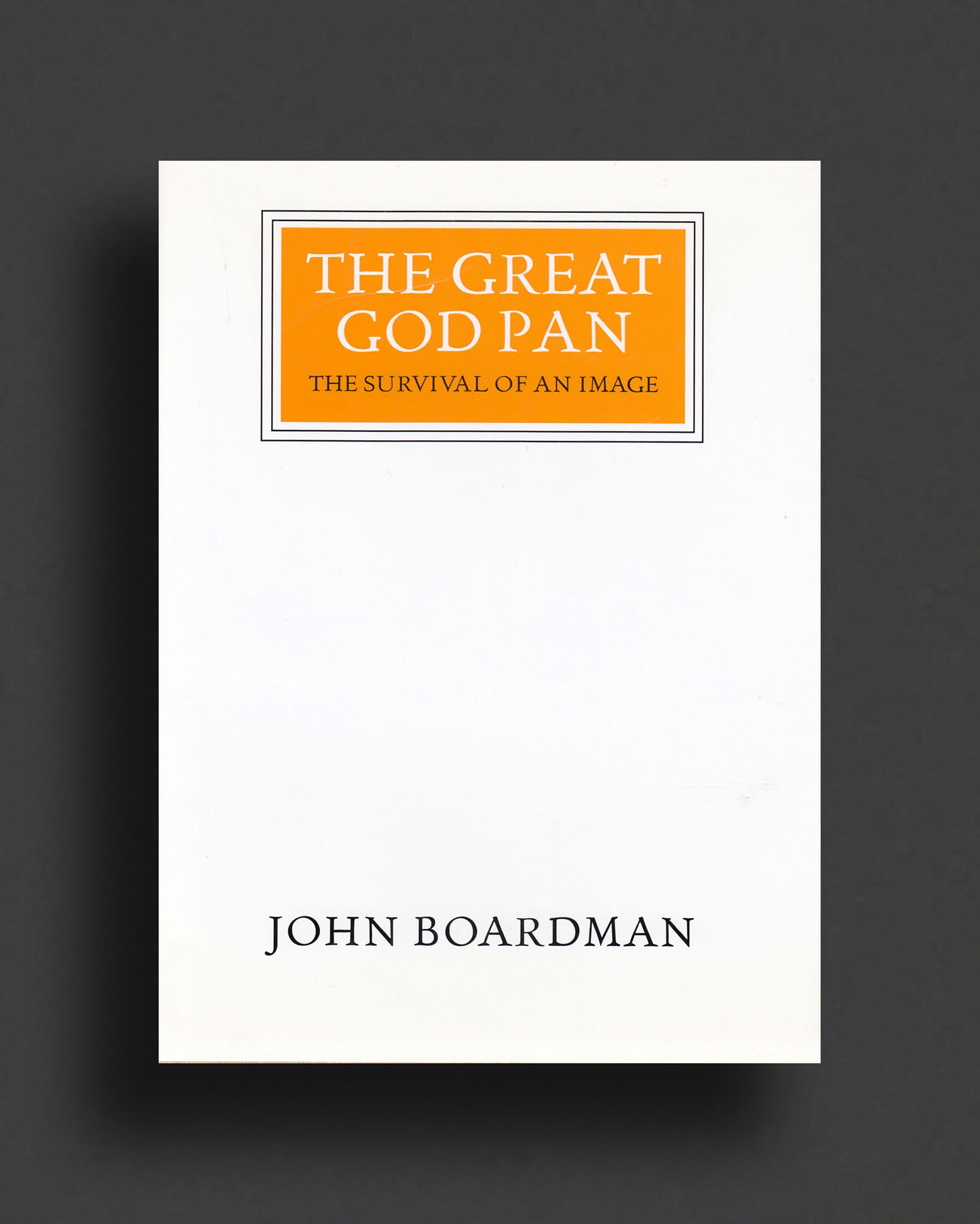
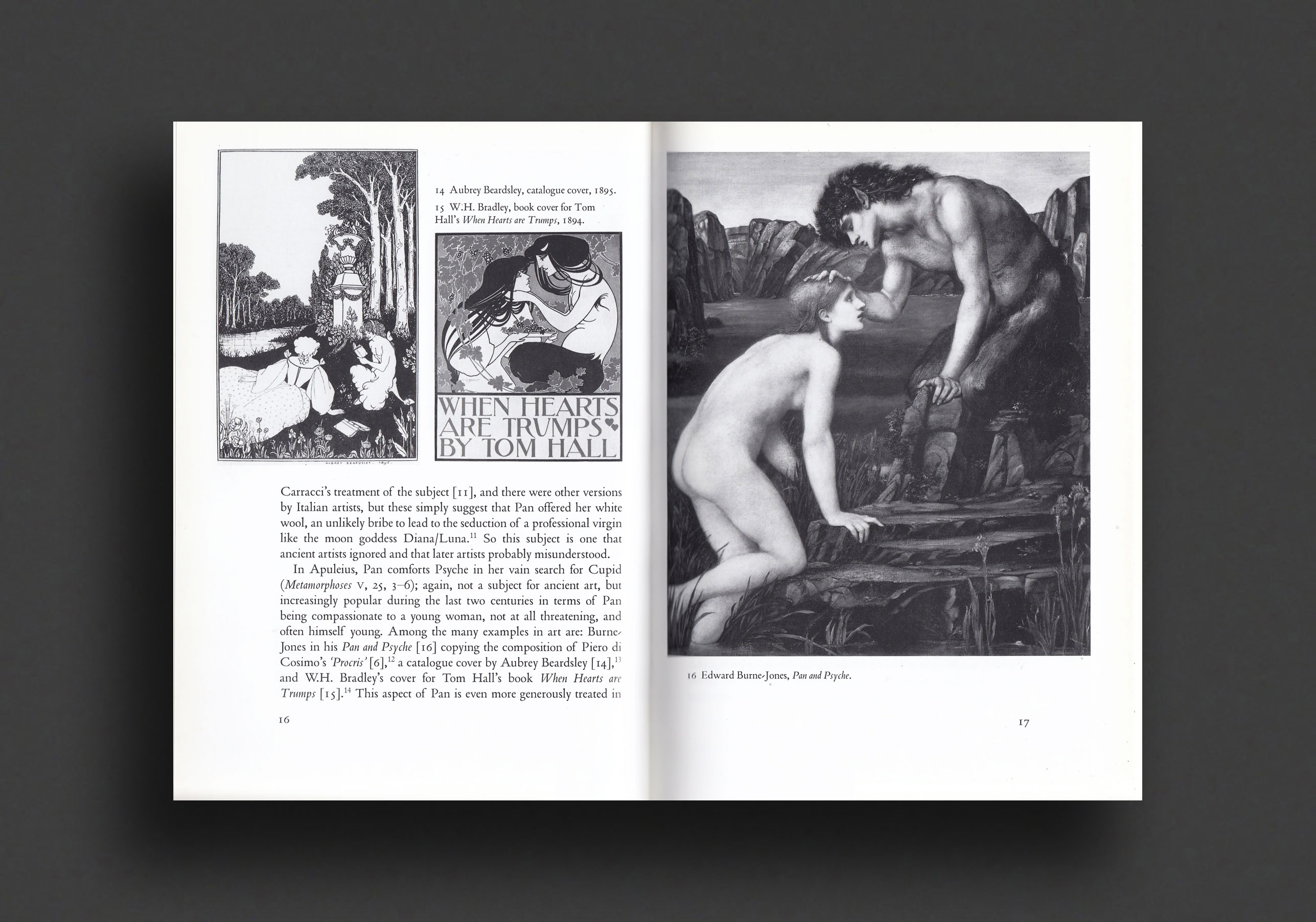
Among the gods of classical antiquity Pan - that distinctive figure combining the physical characteristics of man and goat - is one of the few to have retained a special place in the imaginations of writers and artists, even into modern times. In this, the twenty-ninth Walter Neurath Memorial Lecture, Sir John Boardman describes how the concept of Pan - originally a rustic deity associated with herdsmen in southern Greece - and his familiar pipes developed and was adapted in later times. Whether viewed as a personification of country ways, equated with the excesses of Bacchic revels or treated as a demon figure, the presence of Pan was felt in the literature and art of antiquity, the medieval period and notably in Renaissance and later paintings. More recently, in the nineteenth and twentieth centuries, he was adopted by many Romantic artists and writers and has also served as a medium for topical caricatures. Although the ideals which Pan represented in ancient Greece and Rome may have passed into history, the traditional image associated with his name remains as vivid as ever in the minds of modern man.
Sir John Boardman was born in 1927, and educated at Chigwell School and Magdalene College, Cambridge. He spent several years in Greece, three of them as Assistant Director of the British School of Archaeology at Athens, and he has excavated in Smyrna, Crete, Chios and Libya. For four years he was an Assistant Keeper in the Ashmolean Museum, Oxford, and he subsequently became Reader in Classical Archaeology and Fellow of Merton College, Oxford. He is now Lincoln Professor Emeritus of Classical Archaeology and Art in Oxford, and a Fellow of the British Academy, from whom he received the Kenyon Medal in 1995. He was awarded the Onassis Prize for Humanities in 2009. Professor Boardman has written widely on the art and archaeology of Ancient Greece.
Fine copy.
1985, Japanese
Softcover, 290 pages, 21 x 15 cm
1st Edition, Out of print title / used / fine
Published by
Sanwa / Tokyo
$450.00 - Out of stock
"People often talk about humanity and humanism, but what makes humans decisively different from animals is that they betray, deceive, and destroy others. Humanity means being cruel."—Masaaki Aoyama
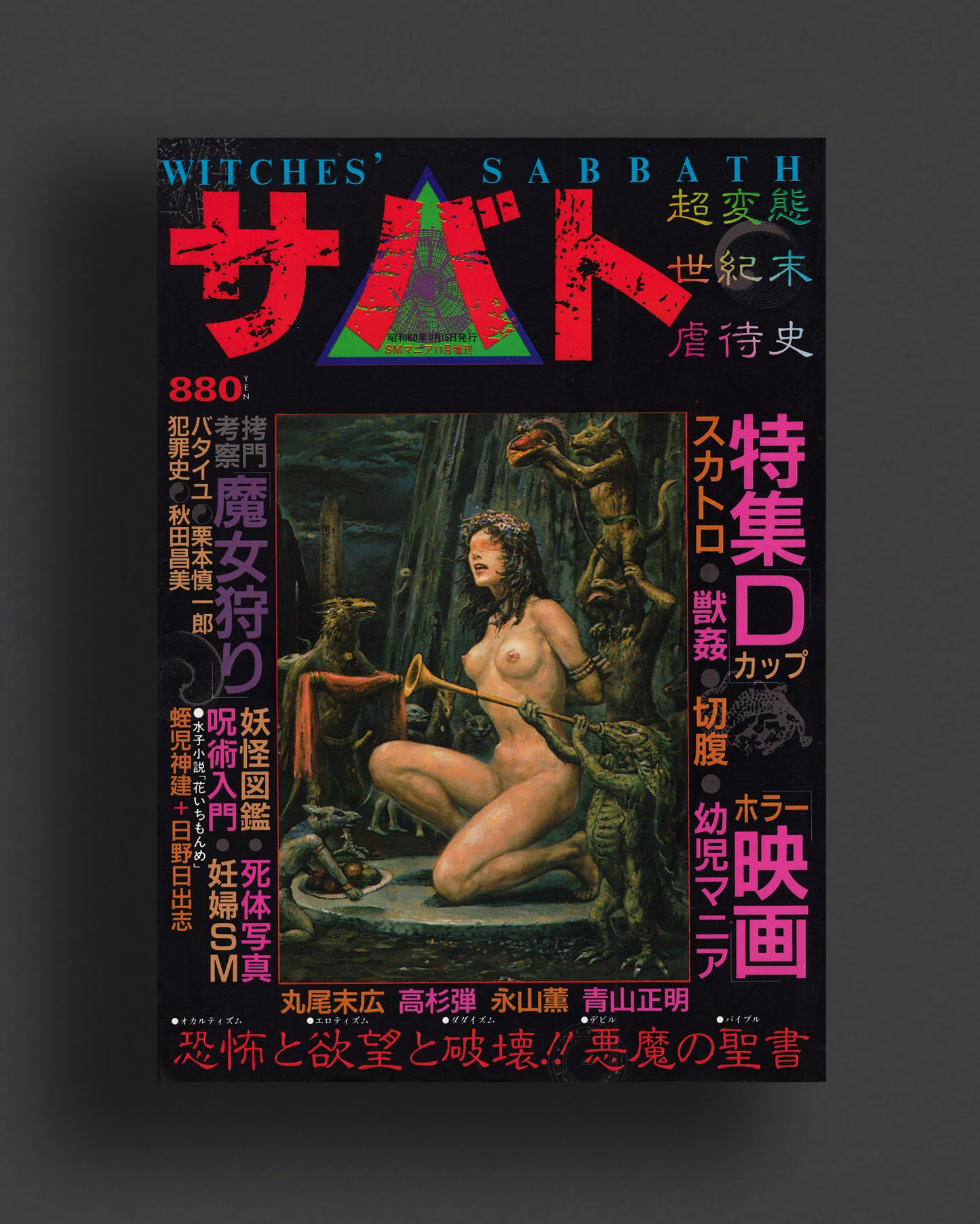
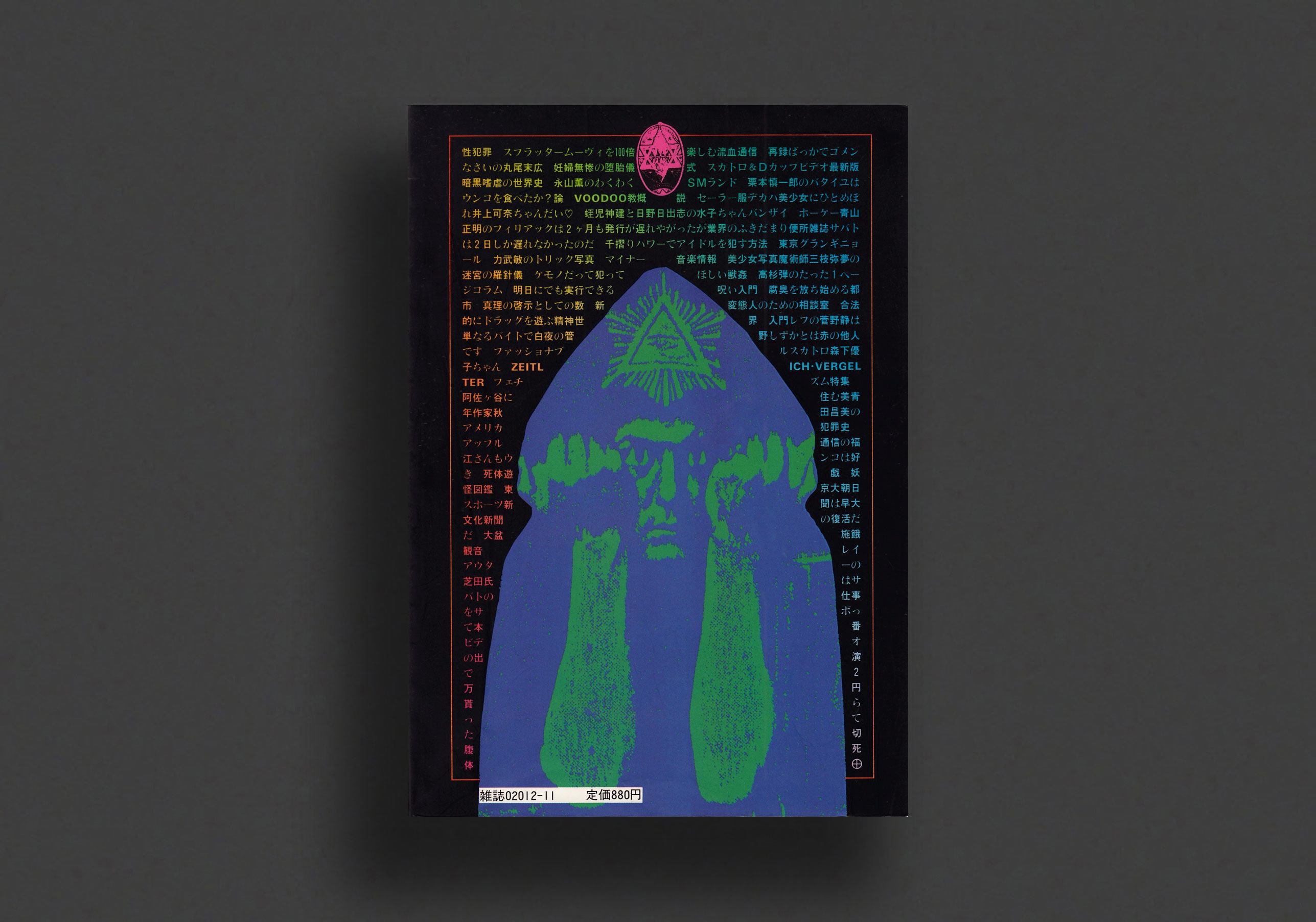
Super rare, first and only issue of cult magazine of erotic obscenity, Witches' Sabbath ("Super Pervert, End of the Century, Abuse History"), published in 1985 by Sanwa Publications as a special edition of SM Mania and edited by Masaaki Aoyama (1960-2001), a legendary cult writer, editor and pioneer in the genre of "Kichiku" (cruel) publishing who had a major influence on Japanese subculture in the 1980s and 1990s.
In 1995, after a prolific career in underground publishing, Aoyama edited the first issue of the "brutal" subculture magazine "Dangerous No. 1," which sparked a huge craze for bad taste culture in Japan, with the opening introduction declaring "There are no taboos when it comes to fantasies!". Ten years earlier, at 25 years old, he edited Witches' Sabbath, a call to "Destroy All Orders", a magazine devoted to "Decadence, Ultra-Abnormality, and Maltreatment"; Aoyama's unique, devilish manifestation of a particular convergence of subcultural 1980s Tokyo — punk and industrial music, splatter horror films, underground manga, SM publishing, and occultism. "The Worst Truth of the 20th Century".
Aoyama was deeply attracted to the culture of monsters, the world of the abnormal, the cruel and dark impulses of human-kind. His publishing ventures centred around his fascination with destructive and socially maladjusted people, perversions, social taboos, "freaks" and subjects turned against public order and morality. Profusely illustrated throughout with colour photo galleries, Aoyama, with contributors including Merzbow's Masami Akita, horror manga artists Suehiro Maruo and Hideshi (Guinea Pig) Hino, manga critic and activist Shinichiro Kurimoto, Hisao Nakano, Mongoose Nagayama, Dan Takasugi, Ken Hirukogami, and others, present features on all manner of heterodox culture, everything from an illustrated guide to corpse photography, splatter horror movies, scatology, how-to seppuku/harakiri (Japanese ritualistic suicide by disembowelment), horror manga (new artworks by Maruo, Hino, comic by Jimmie Morita, and others), infant mania, drugs, necrophilia, Industrial Records (Throbbing Gristle, Monte Cazazza, SPK, etc,), Zeitlich Vergelter, Ron Geesin, sadistic crime history, deformities, Georges Bataille, devil pregnancy kinbaku, sorcery, bestiality, witch hunting, SM readers confessions, the latest in fetish publishing, D-Cup extravaganza (big breast video and magazine publishing), and much more. A special Nazi issue was planned for the next issue, but the magazine was discontinued after this first issue.
An important publication in the history of Japan's "Kichiku" (cruel) publishing. Cover artwork by Ran Akiyoshi.
Not for the faint of heart. Strictly mature audiences only.
From the Editor's notes: "[...] That's because my original path was escapist fairy tales, and whether it was manga, photography, or bookmaking, what I wanted to depict was the world of children. There's no doubt that the purest things and madness are side by side... What is abnormal and what is normal? In this day and age when everything man has created is being torn down and all boundaries are being removed, humans are being led astray by the enormous concepts they have created. Is Witches' Sabbath just a pornographic book? Is Masaaki Aoyama just crazy? It has only just begun."
Masaaki Aoyama (1960-2001) was pioneer of the Japanese underground publishing scene. When he was in the third grade of elementary school, his father bought him a copy of Hiroshi Minamiyama's book "Supernatural Mysteries," which sparked his interest in the supernatural and the occult. Although he never studied, he displayed his prodigy qualities from an early age whilst simultaneously becoming addicted to masturbation. His intense quest for knowledge and perversion continued into his adult life. A self-proclaimed hedonist, Aoyama was hailed as a rare genius editor that had a profound, almost traumatic impact on people. Aoyama openly discussed and pursued a wide range of specialised topics, from drugs, lolicon, scat, and freaks to cult movies, progressive rock, punk, techno, the occult, heretical thought, and the spiritual world. He worked prolifically, editing and writing articles for mini-comics, books and magazines such as Hentai, Hey! Buddy, Billy, Witches' Sabbath, Philiac, Eccentric, amongst a seemingly endless list of fringe "pervert" publications that proliferated after the emergence of vending machine books in the 1970s. In 1992, Aoyama wrote Japan's first practical drug manual, "Dangerous Drugs," a "bible for junkies" which sold over 100,000 copies. In 1995, he edited the first issue of the "brutal" subculture magazine "Dangerous No. 1," which quoted the words of cult guru Hassan I-Sabah: "There is no truth. Everything is permitted." The magazine, which was packed with an exhaustive range of deviant, perverted, and bad taste content, became a huge hit, selling over 250,000 copies in total, sparking a craze for "Kichiku" (cruel) publishing in Japan in the late 19th century.
"No taboos in delusions"—Dangerous No. 1 introduction.
The trend of consuming things that are generally viewed as objects of loathing or pity from a mondo perspective was accelerated all over the world during the nihilist 1990's, but it was particularly popularised in Japan. From V-Zone video culture to comic books like Garo and the works of Kei (Takashi) Nemoto, Suehiro Maruo and Hideshi Hino, to subculture magazines that stimulated spectacle-based curiosity, crime and voyeurism, such as GON!, BUBKA, Sekimatsu Club, TOO NEGATIVE, End of the Century, Weekly Murder Casebook, Bessatsu Takarajima. Around the same time, Aoyama was diagnosed with multifocal posterior pigment epitheliopathy (MPPE), an extremely rare eye disease affecting around 50 people nationwide in Japan, which later became one of the factors that led him to become interested in spiritual matters. Aoyama, the mastermind behind this new genre of "Kichiku" (cruel), bad taste publishing, became disillusioned with the vulgar taste that was being mass-produced as a result of the boom. Aoyama felt the genre lost its substance as a counterculture or literary movement and had been absorbed into popular culture, the historical lineage of erotic underground publishing had become dissolved with the boom of extreme content on the internet. Without moralising, he had stared directly into the abyss. The dark truths he sought fed his own deviancy and addictions. Aoyama became depressed and reclusive. In 1997, Sakakibara Seito, an avid reader of Danger No. 1, committed the Kobe child murders. This led to bookstores removing all bad taste subculture books from their shelves. In 1999, "The Complete Works of Aoyama Masaaki” was published, marking the end of "Kichiku" publishing. Aoyama sought the light and pursued a new theory of happiness related to the spiritual world based on psychoneuroimmunology, molecular biology, and Buddhist resignation. In an interview with the magazine BURST, he declared, "the brutal genre is no longer fresh. From now on, I'll go for the soothing genre." He hanged himself at his home in Yokosuka, Kanagawa Prefecture on June 17, 2001, at the age of 40.
Near Fine collector's copy!
1981, English
Hardcover (w. dust jacket), 96 pages, 28.5 x 22.5 cm
1st Edition, Out of print title / used / very good
Published by
Liber / Fribourg
Crescent Books / New York
$35.00 - In stock -
Hardcover volume published in 1981, profusely illustrated throughout. Text by Marc de Smedt exploring the customs and traditions of human sexuality in Eastern Asian art.
The people of ancient China were fond of making love. They saw it as a way of harmonizing the energies of heaven and earth, and thus of continuing nature's cycle of creation. So love became an art, the art of living, the art of untying the body's knots. It was also an integral part of religion. Thus to the great indignation of their enemies, the Taoists combined sexual practices with their techniques of meditation. [...]
VG—VG dust jacket.
1981, English
Hardcover (w. dust jacket), 96 pages, 28.5 x 22.5 cm
Out of print title / used / very good
Published by
Liber / Fribourg
$30.00 - In stock -
Hardcover volume published in 1981, profusely illustrated throughout. Text by Bernard Soulié and translated by Evelyn Roissiter. 1983 print from Liber, Fribourg. English text.
"As radio cars and helicopters keep the crowd in order, an imposing procession of women follows a group of laughing priests, while expressionless police officers hold the onlookers back. This scene would be fairly commonplace were it not for the nature of the object in honor of which the procession is being held: the phallus. Finely sculpted specimens made of carefully polished wood are to be found in dozens of sanctuaries dedicated to the cult of Shinto, the ancient religion which preceded Buddhism and which still pervades Japan today.
Needless to say, in such a country there is no taboo on sexuality or sexual images. Sex has always been very much taken for granted. The place it occupies in literature and the arts is therefore not surprising. Graphic treatment of the subject in Japan has been abundant, of high quality and distinctly original, even when compared to the work of the Chinese masters. Japanese erotic art blends refinement of line with a brutally realistic depiction of the sexual act. The attendant commentary, often expressed by the protagonists themselves, gives an unabashed account of intimate anatomical and physiological details, while the sexual organs, particularly that of the male, are shown as being vastly larger than life during and just before intercourse. In many instances, however, the rest of the protagonists' bodies is clothed, and sumptuously so. Their finery and hairstyle, as well as the decor of the scene, provide clues as to their social background. Certain pictures include accessories designed to enhance pleasure, whether solitary or shared, such as the harigata (artificial penis) or the higo-miki (ring hastening erection). [...]
VG—VG dust jacket.
1992, English
Softcover, 302 pages, 24 x 16.5 cm
1st Edition, Out of print title / used / good
Published by
Cornell University Press / New York
$100.00 - Out of stock
First 1992 edition.
"This brilliant and substantial study will be required reading for critics of Gothic literature and for feminist theorists. Unlike other psychoanalytic readers who localize the 'horror' in Gothic fiction by interpreting it as an effect of repressed anxiety about motherhood or genital sexuality, Massé regards the horror as systemic and actual, and for this reason her study is far more radical, comprehensive, and satisfying. In the Name of Love is challenging and engaging reading that opens out onto new critical territory all the way through." -Claudia L. Johnson, Marquette University
"Massé handles an important topic in a thorough, clear, and interesting fashion. I especially liked the book's combination of theoretical analysis and original readings of texts. In the Name of Love will make a significant contribution in all the areas it treats-feminism, psychoanalysis, and literature."-Shirley Nelson Garner, Department of English, University of Minnesota
The Gothic woman is taught to believe that self-abnegation will be rewarded by love; her experience clearly proves otherwise. Although Gothic fiction has characteristically been written by and for women, this sophisticated and venturesome book is one of the first to examine the contradictions of the Gothic pact in the light of contemporary feminist and psychoanalytic theory. Michelle A. Massé looks at selected British and American novels from the eighteenth century to the present, focusing on the theme of masochism as an element of women's identity. Approaching the Gothic novel by way of psychoanalysis, she also identifies a Gothic plot within psychoanalytic theory itself.
In fiction that ranges from Charlotte Brontë's Jane Eyre, Charlotte Perkins Gilman's The Yellow Wallpaper, and Daphne de Maurier's Rebecca to Gloria Naylor's Linden Hills, Margaret Atwood's Lady Oracle, and Pauline Réage's Story of O, Massé explores the narrative of women being trained to embrace their own subordination. She begins by asserting that the stylistic and structural repetitions of the Gothic constitute both symptoms of this trauma and attempts to work it through. Massé delineates the pattern of women's ego formation in the courtship plot and discusses what she calls "marital Gothic." She then addresses the complicated issues raised by the classic beating fantasy in which the young girl must choose to accept the role of victim, aggressor, or spectator. In her conclusion, she con- siders modes of resistance to this triangular drama and to the related fantasy of romance.
In the Name of Love will be essential reading for scholars and students in the fields of gender studies, critical, psycho-analytic, and novel theory, as well as Victorian and contemporary fiction.
MICHELLE A. MASSÉ is Associate Professor of English at Louisiana State University, Baton Rouge. A graduate of Anna Maria College, she received her Ph.D. degree from Brown University.
Cover illustration: King Cophetua and the Beggar Maid, by Edward Burne-Jones. Tate Gallery, London/Art Resource, New York.
Good copy, light spine tanning/creasing, crease to front cover corner, light wear.
1982/1992, Japanese
Softcover, 192 pages, 21 x 14.5 cm
Out of print title / used / very good
Published by
Atelier Peyotl / Tokyo
$60.00 - Out of stock
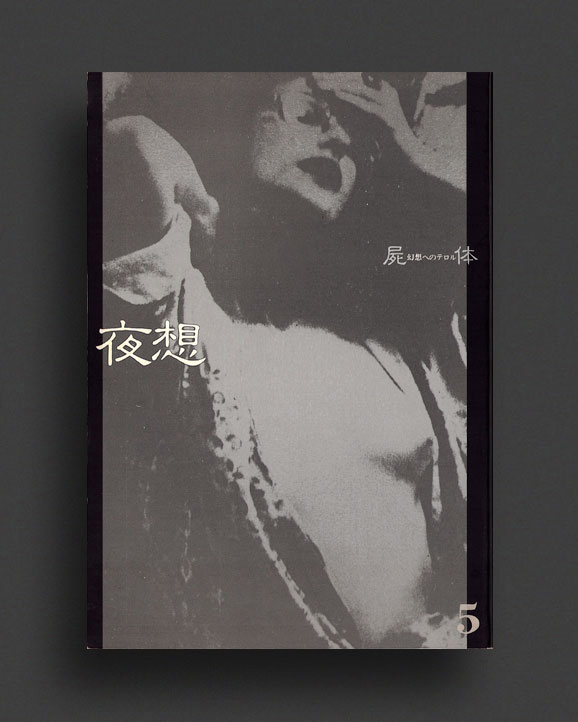
"Corpse" Special Feature Issue of cult Japanese underground magazine Yaso, first published in 1982, then re-printed in 1992, edited by Yuichi Konno and Atelier Peyotl (publishers of Night Vision/Yaso/Peyotl/Wave/Silvester Club...). Heavily illustrated with texts in Japanese that look at the theme of death and the dead in the arts, literature, occultism, ancient sciences, philosophy, mythology, poetry, film, crime, and much more. Features John Duncan, Tetsumi Kudo, Cosey Fanni Tutti, Masahisa Fukase, Franz Kafka, Johann Wolfgang von Goethe, Guillaume Apollinaire, Joe Potts (LAFMS), Takashi Ishii, Rudolf II — Holy Roman Emperor, Akinari Ueda, Marcel Duchamp, Chris Burden, Paul Celan, Alain Resnais, Gilyak Amagasaki, Shusaku Arakawa, Pieter Bruegel the Elder, Shuji Terayama, Andy Warhol, Charles Manson, Brian Wilson, Kyoko Endoh, Princess Yongtai, Salvador Dalí, Ono no Komachi, Kiyoshi Kasai, Caravaggio, Throbbing Gristle, Takizawa Bakin, Leno and Rosemary LaBianca, Manson Family, Fyodor Dostoevsky, Wu Zetian, Genesis P-Orridge, Yusuke Nakahara, Ranpo Lagrange, Mitsusada Fukasaku, Nakai Hideo, Richard Wagner, and many more.
Very Good copy.
1975, English
Softcover, 288 pages, 18 x 11 cm
1st Edition, Out of print title / used / very good
Published by
Tandem / London
$65.00 - Out of stock
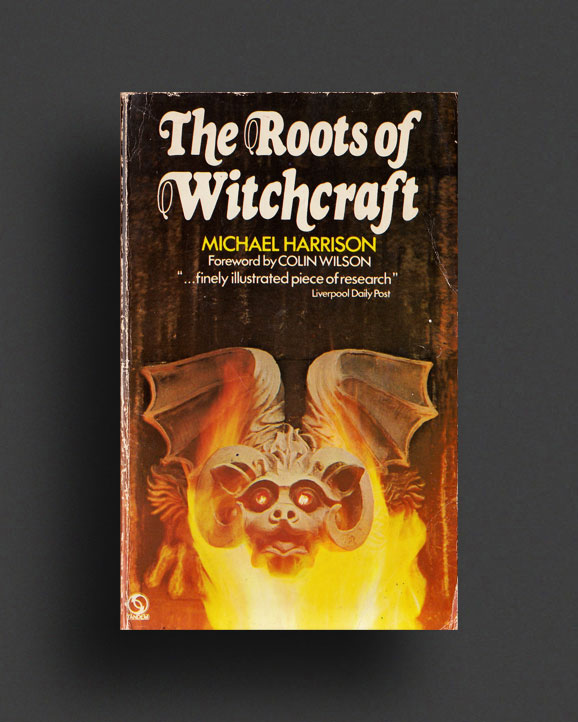
First 1975 paperback edition.
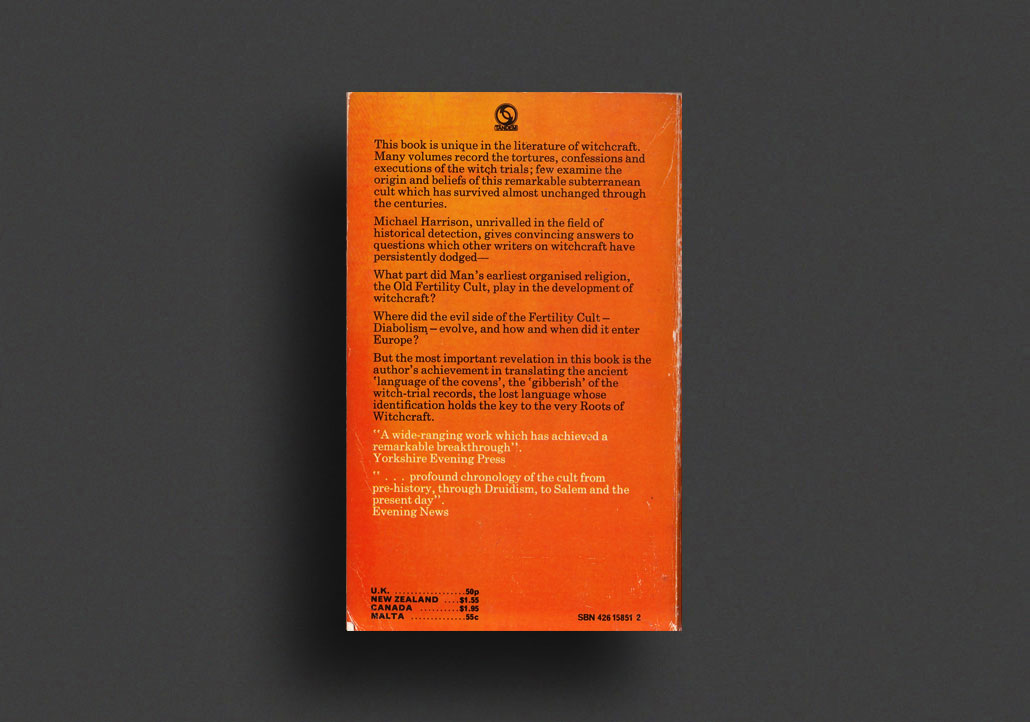
"This book is unique in the literature of witchcraft. Many volumes record the tortures, confessions and executions of the witch trials; few examine the origin and beliefs of this remarkable subterranean cult which has survived almost unchanged through the centuries.
Michael Harrison, unrivalled in the field of historical detection, gives convincing answers to questions which other writers on witchcraft have persistently dodged—What part did Man's earliest organised religion, the Old Fertility Cult, play in the development of witchcraft? Where did the evil side of the Fertility Cult- Diabolism - evolve, and how and when did it enter Europe?
But the most important revelation in this book is the author's achievement in translating the ancient 'language of the covens', the 'gibberish' of the witch-trial records, the lost language whose identification holds the key to the very Roots of Witchcraft.
"A wide-ranging work which has achieved a remarkable breakthrough".—Yorkshire Evening Press
"...profound chronology of the cult from pre-history, through Druidism, to Salem and the present day".—Evening News
VG copy with light general wear.
1998, Japanese
Softcover (w. dust jacket), 204 pages, 22 x 15 cm
1st Edition, Out of print title / used / very good
Published by
Isshusha / Japan
$45.00 - Out of stock
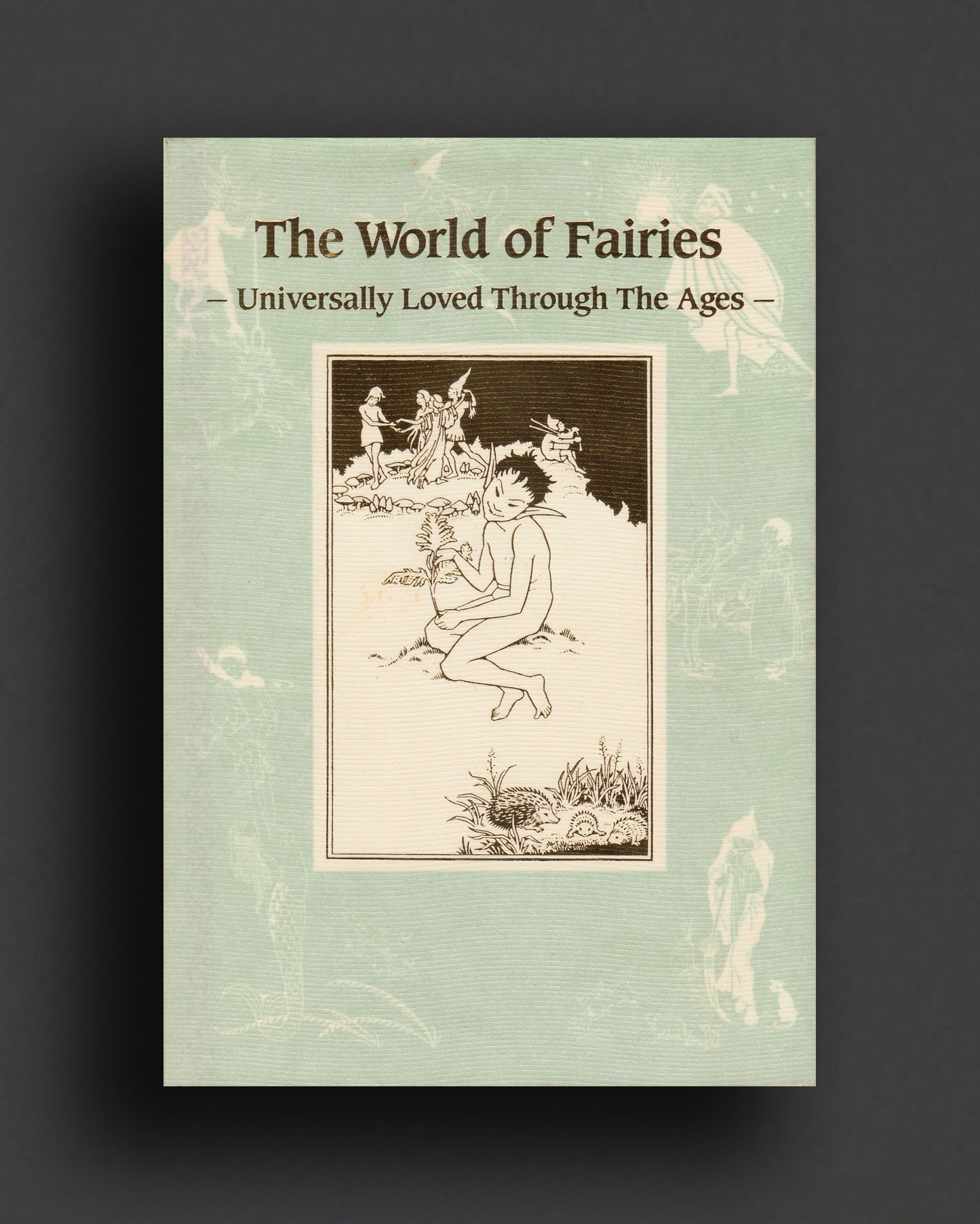
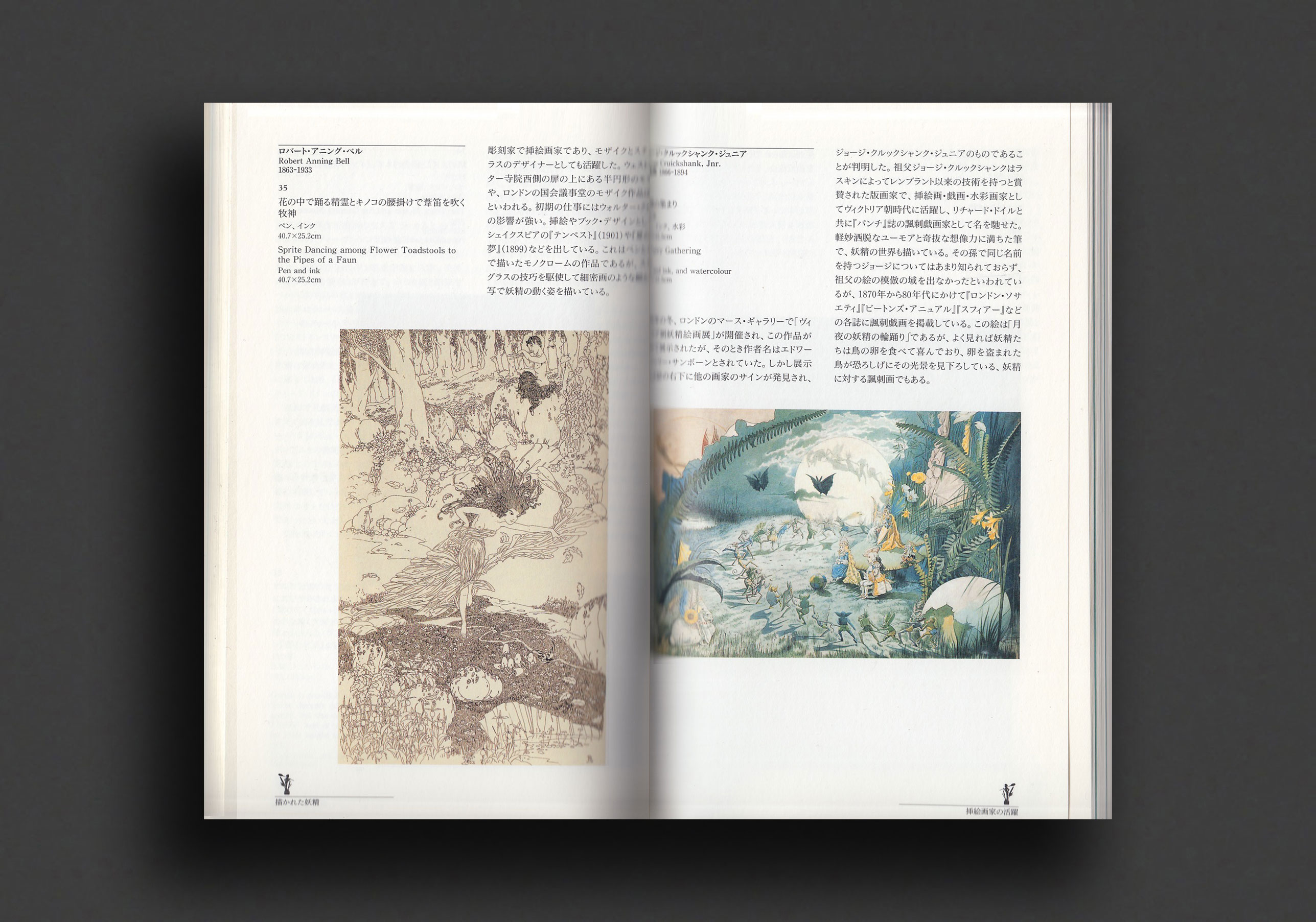
Catalogue and historical study by renowned Japanese fairy scholar Kimie Imura, published in Japan to accompany a travelling Japanese exhibition in 1998. Profusely illustrated throughout in full-colour, the book traces the history of the fairy in folk-lore and the arts, from Celtic mythology and Arthurian legend, to the danger of their depiction being rejected by Christianity as the descendants of pagan gods, through the Elizabethan era in the 16th century, where they regained their place in the world of literature and theatre, through the adoration of the 19th century Victorian period and future generations of artists in Japan all weaving the fairy legend into works of painting, music, ballet, literature, book illustration, costume, applied arts, sculpture, and much more. Features the work of George Cruickshank, Honor Charlotte Appleton, Arthur Rackham, Amelia Murray, Edmund Dulac, Joseph Payton, John Simmons, Joseph Zevan, The Doyle brothers, C. Wilhelm, Shigeru Mizuki, Yoshitaka Amano, Itsuko Azuma, Suzuko Makino, Akira Uno, Yukio Satsukime, Yuki Yuuki, Akiko Iwakiri, and many more.
Very Good—Near Fine copy in VG dust jacket with a few ballpoint marks to lower back.
2006, English
Softcover, 272 pages, 27.1 x 21.4 cm
Published by
Hayward Gallery Publishing / London
$75.00 - In stock -
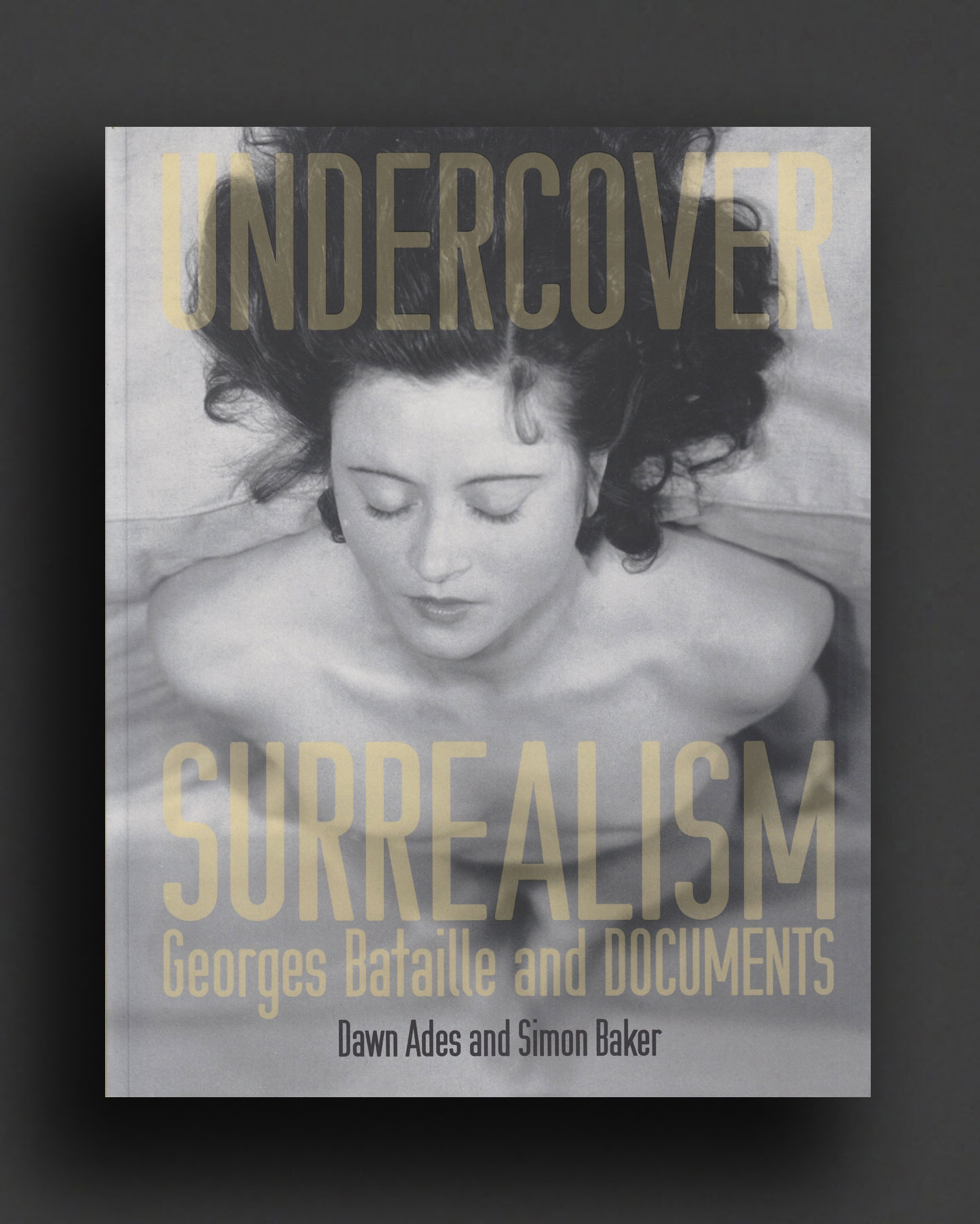
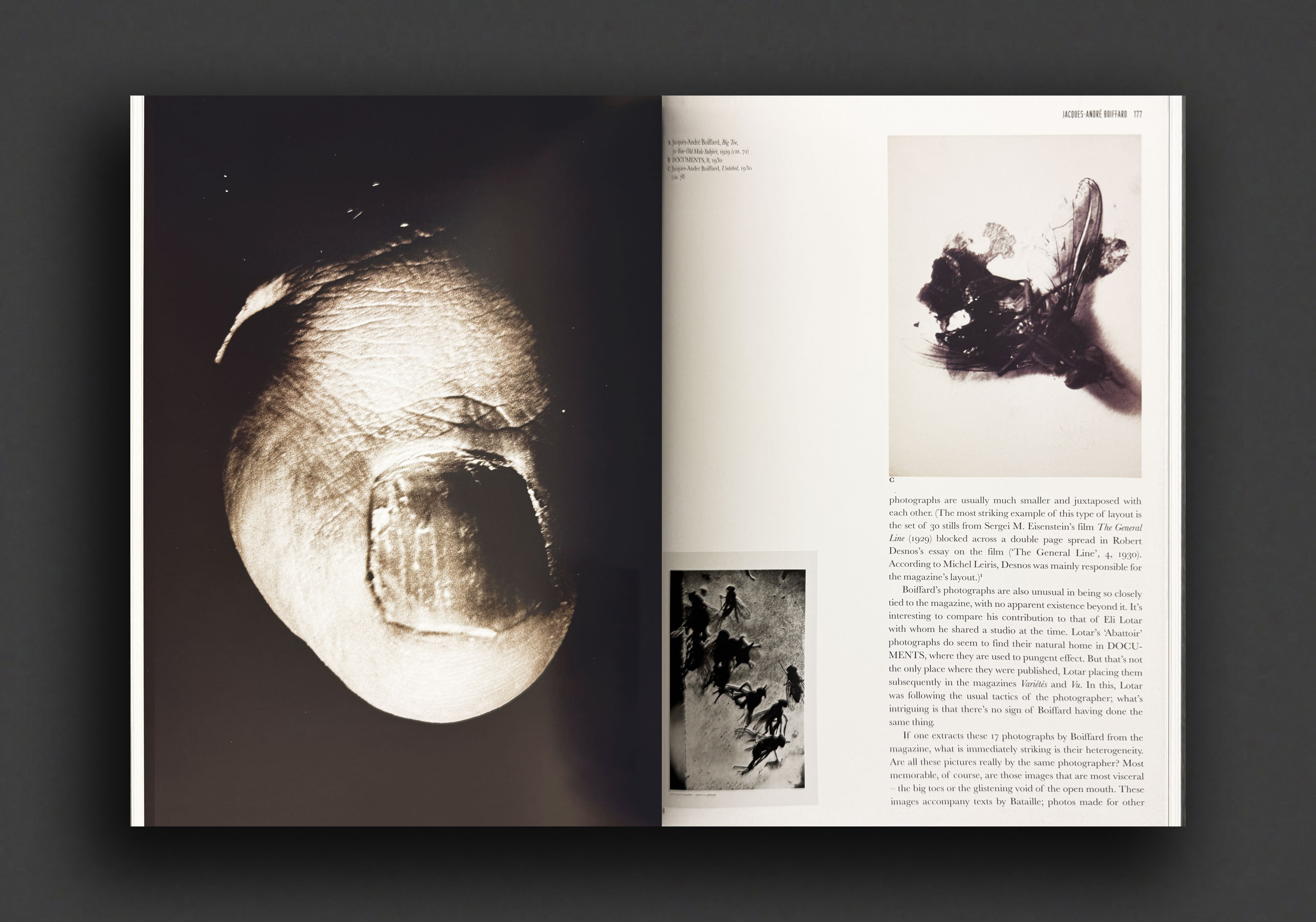
An exploration of the unsettling collisions of art and culture in Georges Bataille's revolutionary journal and a new consideration of twentieth-century masterpieces by Picasso, Miro, Dali, and others against the canvas of their renegade times.
In the Paris art world of the 1920s, Georges Bataille and his journal DOCUMENTS represented a dissident branch of surrealism. Bataille—poet, philosopher, writer, and self-styled "enemy within" surrealism—used DOCUMENTS to put art into violent confrontation with popular culture, ethnography, film, and archaeology. Undercover Surrealism, taking the visual richness of DOCUMENTS as its starting point, recovers the explosive and vital intellectual context of works by Picasso, Miro, Dali, Giacometti, and others in 1920s Paris.
Profusely illustrated (featuring 180 colour images) and filled with valuable English translations of original French texts from DOCUMENTS accompanied by essays and shorter descriptive texts, Undercover Surrealism recreates and recontextualizes Bataille's still unsettling approach to culture. Putting Picasso's Three Dancers back into its original context of sex, sacrifice, and violence, for example, then juxtaposing it with images of gang wars, tribal masks, voodoo ritual, Hollywood musicals, and jazz, makes the urgency and excitement of Bataille's radical ideas startlingly vivid to a twenty-first-century reader.