World Food Books' programme is largely produced on Kulin Nation land. We acknowledge the Wurundjeri people of the Kulin Nation as the first and continuing custodians of this land, and pay respect to their Elders past, present, and emerging.
World Food Books is an arts and special interests bookshop in Naarm / Melbourne. Founded in 2010, World Food Books is devoted to the presentation of a rotating, hand-selection of international art, design, literary and counterculture publications with an emphasis on the anti-traditional, the experimental, the avant-garde, the heretic, the marginal.
Presenting new titles alongside rare and out-of-print books, catalogues and journals spanning the fields of modern and contemporary art, design, photography, illustration, film, literature, poetry, cultural theory, philosophy, sexuality, popular and underground culture in its many radical forms, World Food Books wishes to encourage adventurous, thoughtful and open-minded reading, looking, writing, and exchange of publishing and ideas, both current and historical.
As well as our bookshop, located in Melbourne's historical Nicholas Building, all of our inventory is available internationally via our online mail-order service.
World Food Books semi-regularly co-ordinates "Occasions", a programme of exhibits and events at the bookshop and in partnership with other hosts (such as museums and art galleries) that develop out of the activities, relationships and content of the bookshop itself.
World Food Books
The Nicholas Building
37 Swanston Street
Room 5, Level 6
Melbourne 3000
Australia
SHOP HOURS:
Thu–Fri 12–6, Sat 12–5
WEB-SHOP OPEN 24/7
World Food Books
Postal Address:
PO Box 435
Flinders Lane
Victoria 8009
Australia
Art
Theory / Essay
Architecture / Interior
Graphic Design / Typography
Photography
Fashion
Eros
LGBTQ+
Fiction / Poetry
Weird / Speculative / Science Fiction / Horror
Transgressive / Visceral / Abject
Symbolism / Decadence / Fin de siècle
Film / Video
Painting
Sculpture / Installation
Performance / Dance / Theater
Drawing
Sound / Music
Curatorial
Group Shows / Collections
Periodicals
Out-of-print / Rare
Posters / Ephemera / Discs
Signed Books
World Food Books Gift Voucher
World Food Book Bag
Australian Art
Australian Fiction
Australian Science Fiction / Speculative Fiction
Australian Poetry
Australian Photography
Japanese Photography
Conceptual Art
Minimal Art
Dada
'Pataphysics / Oulipo
Fluxus
Concrete Poetry
Pop Art
Surrealism
Arte Povera
Arte Informale / Haute Pâte / Tachism
Nouveau Réalisme / Zero / Kinetic
Situationism / Lettrism
Collage / Mail Art / Xerox Art
Art Brut / Folk / Visionary / Fantastic
Illustration / Graphic Art / Bandes Dessinées
Furniture
Italian Radical Design / Postmodernism
Textiles
Ceramics / Glass
Counterculture
Protest / Revolt
Philosophy
Psychoanalysis
Anthropology
Anarchism
Socialism / Anarchism / Communism / Capitalism
Literary Theory / Semiotics / Language
Feminism / Women's Studies
Gender Studies / Sexuality
Anthropology
Fetishism / BDSM
Drugs / Psychedelia
Crime / Violence
Animal Rights / Veganism
Occult / Esoterica
Ecology / Earth / Alternative Living
Whole Earth / Crafts
All prices in AUD (Australian dollars)
Pick-Ups
Pick-up orders can be collected in our bookshop during opening hours after order date. Please collect any Pick-up orders within 2 weeks of ordering as we have limited storage space. Orders will be released back into stock if not collected within this time. No refunds can be made for pick-ups left un-collected. If you cannot make it in to the bookshop in this time-frame, please choose postage option.
Return Policy
All sales are final. We do accept returns (for refund or exchange) for items received in error. All our orders are packed with special care using heavy-duty padding and cardboard book-mailers or bubble mailers (for smaller books), using reinforcement where required. We cannot take responsibility for any lost, stolen or damaged parcels.
Insurance
Should you wish to insure your package, please email us directly after placing your order and we can organise this at a small extra expense. Although all standard/express tracked packages are very safe and dependable, we cannot take responsibility for any lost, stolen or damaged parcels. We recommend insurance on valuable orders.
Interested in selling your old books, catalogues, journals, magazines, comics, fanzines, ephemera? We are always looking for interesting, unusual and out-of-print books to buy. We only buy books in our fields of interest and specialty, and that we feel we can resell.
We base these prices on desirability, market value, in-print prices, condition and our current stock levels. We offer cash, store credit, and can take stock on consignment. All
about 25% of the price we expect to get when we sell them, or 30% in store credit. We base these prices on desirability, market value, in-print prices, condition and our current stock levels.
Sell your books any day of the week. You can drop them off and return later. If you have a lot of books, we can visit your Sydney home.
We buy books that we feel we can resell. We offer about 25 % of the price we expect to get when we sell them, or 30% in store credit. We base these prices on desirability, market value, in-print prices, condition and our current stock levels.
Philadelphia Wireman
03 August - 01 September, 2018
World Food Books is proud to announce our next Occasion, the first presentation of sculptures by Philadelphia Wireman in Australia.
The Philadelphia Wireman sculptures were found abandoned in an alley off Philadelphia’s South Street on trash night in 1982. Their discovery in a rapidly-changing neighbourhood undergoing extensive renovation, compounded with the failure of all attempts to locate the artist, suggests that the works may have been discarded after the maker’s death. Dubbed the "Philadelphia Wireman" during the first exhibition of this work, in 1985, the maker’s name, age, ethnicity, and even gender remain uncertain. The entire collection totals approximately 1200 pieces, all intricately bound together with tightly-wound heavy-gauge wire (along with a few small, abstract marker drawings, reminiscent both of Mark Tobey and J.B. Murry). The dense construction of the work, despite a modest range of scale and materials, is singularly obsessive and disciplined in design: a wire armature or exoskeleton firmly binds a bricolage of found objects including plastic, glass, food packaging, umbrella parts, tape, rubber, batteries, pens, leather, reflectors, nuts and bolts, nails, foil, coins, toys, watches, eyeglasses, tools, and jewellery.
Heavy with associations—anthropomorphic, zoomorphic, and socio-cultural responses to wrapped detritus—the totemic sculptures by Philadelphia Wireman have been discussed in the context of work created to fulfil the shamanistic needs of alternative religions in American culture. Curators, collectors, and critics have variously compared certain pieces to sculpture from Classical antiquity, Native American medicine bundles, African-American memory jugs, and African fetish objects. Reflecting the artist’s prolific and incredibly focused scavenging impulse, and despite—or perhaps enhanced by—their anonymity, these enigmatic objects function as urban artefacts and arbiters of power, though their origin and purpose is unknown. Philadelphia Wireman, whatever their identity, possessed an astonishing ability to isolate and communicate the concepts of power and energy through the selection and transformation of ordinary materials. Over the course of the past two decades, this collection has come to be regarded as an important discovery in the field of self-taught art and vernacular art.
Presented in collaboration with Fleisher-Ollman Gallery, Philadelphia, and Robert Heald, Wellington.
Susan Te Kahurangi King
02 February - 10 March, 2018
Susan Te Kahurangi King (24 February 1951 - ) has been a confident and prolific artist since she was a young child, drawing with readily available materials - pencils, ballpoint pens and felt-tip markers, on whatever paper is at hand. Between the ages of four and six Susan slowly ceased verbal communication. Her grandparents William and Myrtle Murphy had developed a special bond with Susan so they took on caring responsibilities for extended periods. Myrtle began informally archiving her work, carefully collecting and storing the drawings and compiling scrapbooks. No drawing was insignificant; every scrap of paper was kept. The King family are now the custodians of a vast collection containing over 7000 individual works, from tiny scraps of paper through to 5 meter long rolls.
The scrapbooks and diaries reveal Myrtle to be a woman of great patience and compassion, seeking to understand a child who was not always behaving as expected. She encouraged Susan to be observant, to explore her environment and absorb all the sights and sounds. Myrtle would show Susan’s drawings to friends and people in her community that she had dealings with, such as shopkeepers and postal workers, but this was not simply a case of a grandmother’s bias. She recognised that Susan had developed a sophisticated and unique visual language and sincerely believed that her art deserved serious attention.
This was an unorthodox attitude for the time. To provide some context, Jean Dubuffet coined the term Art Brut in 1945 to describe work created by self-taught artists – specifically residents of psychiatric institutions and those he considered to be visionaries or eccentrics. In 1972 Roger Cardinal extended this concept by adopting the term Outsider Art to describe work made by non-academically trained artists operating outside of mainstream art networks through choice or circumstance. Susan was born in Te Aroha, New Zealand in 1951, far from the artistic hubs of Paris and London that Dubuffet and Cardinal operated in. That Myrtle fêted Susan as a self-taught artist who deserved to be taken seriously shows how progressive her attitudes were.
Susan’s parents Doug and Dawn were also progressive. Over the years they had consulted numerous health practitioners about Susan’s condition, as the medical establishment could not provide an explanation as to why she had lapsed into silence. Dawn educated herself in the field of homeopathy and went on to treat all twelve of her children using these principles – basing prescriptions on her observations of their physical, mental and emotional state.
Doug was a linguist with an interest in philosophy who devoted what little spare time he had to studying Maori language and culture. To some extent their willingness to explore the fringes of the mainstream made them outsiders too but it was their commitment to living with integrity and their respect for individuality that ensured Susan’s creativity was always encouraged.
Even though Susan’s family supported her artistic pursuits, some staff in schools and hospitals saw it as an impediment to her assimilation into the community and discouraged it in a variety of ways. Her family was not always aware of this and therefore did not fully understand why Susan stopped drawing in the early 1990s. However, rather than dwell on the challenges that Susan faced in pursuit of her artistic practice, they prefer to highlight her achievements. In 2008 Susan began drawing again in earnest, after an almost 20 year interruption, and her work is now shown in galleries around the world.
Susan grew up without television and has been heavily influenced by the comics she read as a child. She is absolutely fearless in the appropriation of recognizable characters, such as Donald Duck and Mickey Mouse, in her work. She twists their limbs, contorts their faces, compresses them together, blends them into complex patterned backgrounds - always imbuing them with an incredible energy. Although Susan often used pop culture characters in her work they are not naive or childlike. These are drawings by a brilliant self-taught artist who has been creating exceptional work for decades without an audience in mind.
Mladen Stilinović
"Various Works 1986 - 1999"
02 February 16 - September 10, 2016
Various works 1986 - 1999, from two houses, from the collections of John Nixon, Sue Cramer, Kerrie Poliness, Peter Haffenden and Phoebe Haffenden.
Including: Geometry of Cakes (various shelves), 1993; Poor People’s Law (black and white plate), 1993; White Absence (glasses, ruler, set square, silver spoon, silver ladel with skin photograph and wooden cubes), 1990-1996; Exploitation of the Dead (grey and red star painting, wooden painting, black spoon with red table, red plate), 1984-1990; Money and Zeros (zero tie, paintings made for friends in Australia (Sue, John, Kerrie), numbers painting), 1991-1992; Words - Slogans (various t-shirts) - “they talk about the death of art...help! someone is trying to kill me”, “my sweet little lamb”, “work is a disease - Karl Marx”; Various artist books, catalogues, monographs, videos; Poster from exhibition Insulting Anarchy; "Circular" Croatian - Australian edition; Artist book by Vlado Martek (Dostoyevsky); more.
Thanks to Mladen Stilinović and Branka Stipančić.
Jonathan Walker
Always Will Need To Wear Winter Shirt Blue + Ochre Small Check Pattern
21 August - 21 September, 2015
Untitled
I am not a great reader of poetry but I always return to the work of Melbourne poet, Vincent Buckley (1925- 1988). Perhaps I find his most tantalising piece to be not a finished poem but a fragment left on a scrap of paper discovered on his desk after the poet’s death.
The poetry gathers like oil
In the word-core, and spreads
It has its music meet,
Its music is in movement.
This fragment is more the shell left behind from a volatile thought than a finished poem. I find the last two lines honest but awkward whereas the first two lines work like an arrow. Most likely he could not find a resolution so it was left. Still, in its present form, it remains an eloquent testimony to the ultimate failure of a medium to express mobile thought and sensation, in Buckley’s case, through verbal language. It’s an important matter because this is something all artists have to deal with regardless of the medium.
I have never written a poem, however, I am forever copying fragments from books on paper scraps in a vain effort to fix certain notions in my head. At first, they function as bookmarks that are sometimes returned to when I open the book. But before long, as they accumulate, they fall out littering the table interspersed with A4 photocopies, bills, books and medications.
To return to Buckley’s fragment, the first two lines very much evoke how I paint nowadays. As you age, detail diminishes and patches of light become more luminous and float. I feel the most honest way of dealing with this is by smearing the oil paint on the canvas with the fingers and working close-up, blind. Only if the patches coalesce into an approaching image can the work gain a life.
-
Jonathan Walker was born in Melbourne, Australia and brought up on a dairy farm in Gippsland. In the 1970’s he studied painting at RMIT and won the Harold Wright Scholarship to the British Museum, London. During the 1980’s he exhibited at Pinacotheca Gallery, Richmond and had work shown at the NGV and Heidi City Art Gallery. Over the same period he designed the cover for the “Epigenesi” LP by Giancarlo Toniutti, Italy and conducted a mail exchange work with Achim Wollscheid, Germany. The work with artists through the post resulted in an article published in the bicentenary issue of Art and Australia 1988. He showed in artist run spaces such as WestSpace in the 90’s and 2000’s, and until 2012, taught painting at Victoria University, which is where we (Colleen Ahern and Lisa Radford) as organisers of the exhibition, among many others, had the privilege of being his student.
Walker’s knowledge was imparted to students through the careful selection of music, literature, and artists found in books that he himself had ordered for the library. Walker’s strategy was the generosity of sharing his vast knowledge with references specific to each student and their context.
Walker’s paintings share a similar focus and intimacy.
This exhibition presents a small selection of recent paintings alongside a publication that includes Walker’s writing. Observational and analytical, Walker’s work is a type of material notation — the time of day, colour and how it is blended, the both specific and fleeting location of a reflection on lino or the question of whether a chair leg should be included in a painting.
Please join us on Friday August 21 between 6-8pm to celebrate the opening of the exhibition.
Curated by Colleen Ahern and Lisa Radford.
B. Wurtz
Curated by Nic Tammens
March 26 - April 4, 2015
B.Wurtz works from a basement studio in his home on Manhattan’s Lower East Side.
This local fact is attested to by the plastic shopping bags and newsprint circulars that appear in his work. As formal objects, they don’t make loud claims about their origins but nonetheless transmit street addresses and places of business from the bottom of this long thin island. Like plenty of artists, Wurtz is affected by what is local and what is consumed. His work is underpinned by this ethic. It often speaks from a neighborhood or reads like the contents of a hamper:
“BLACK PLUMS $1.29 lb.”
“Food Bazaar”
“USDA Whole Pork Shoulder Picnic 99c lb.”
“RITE AID Pharmacy, with us it’s personal.”
“H. Brickman & Sons.”
“Sweet Yams 59c lb."
Most of the work in this exhibition was made while the artist was in residence at Dieu Donne, a workshop dedicated to paper craft in Midtown. Here Wurtz fabricated assemblages with paper and objects that are relatively lightweight, with the intention that they would be easily transportable to Australia. This consideration isn’t absolute in Wurtz’s work, but was prescriptive for making the current exhibition light and cheap. Packed in two boxes, these works were sent from a USPS post office on the Lower East Side and delivered to North Melbourne by Australia Post.
Wurtz appears courtesy of Metro Pictures, New York.
Thanks to Rob Halverson, Joshua Petherick, Sari de Mallory, Matt Hinkley, Helen Johnson, Fayen d'Evie, Ask Kilmartin, Lisa Radon, Ellena Savage, Yale Union, and "Elizabeth".
John Nixon
"Archive"
December 15 - January 20, 2014
The presentation of John Nixon's archive offered a rare showcase of this extensive collection of the artist's own publications, catalogues, posters, ephemera, editions and more, from the mid 1980s onwards, alongside a selection of his artworks.
Organized by John Nixon, Joshua Petherick and Matt Hinkley.
<a href=http://wfb.public-office.info/artist/john-nixon>All titles by John Nixon
"Habitat"
at Minerva, Sydney (organised by Joshua Petherick and Matt Hinkley)
November 15 - December 20, 2014
Lupo Borgonovo, Janet Burchill & Jennifer McCamley,
Lewis Fidock, HR Giger, Piero Gilardi, Veit Laurent Kurz,
Cinzia Ruggeri, Michael E. Smith, Lucie Stahl, Daniel Weil, Wols
Press Release:
“...It contained seven objects. The slender fluted bone, surely formed for flight, surely from the wing of some large bird. Three archaic circuitboards, faced with mazes of gold. A smooth white sphere of baked clay. An age-blackened fragment of lace. A fingerlength segment of what she assumed was bone from a human wrist, grayish white, inset smoothly with the silicon shaft of a small instrument that must once have ridden flush with the surface of the skin - but the thing’s face was seared and blackened.”
William Gibson, “Count Zero”, 1986
"Autumn Projects Archive"
Curated by Liza Vasiliou
March 6 - March 15, 2014
World Food Books, in conjunction with the Virgin Australia Melbourne Fashion Festival 2014, presented the Autumn Projects archive, consisting of a selection of early examples in Australian fashion with a particular interest in collecting designers and labels from the period beginning in the 1980’s, who significantly influenced the discourse of Australian Fashion.
Curated by Liza Vasiliou, the exhibition provided a unique opportunity to view pieces by designers Anthea Crawford, Barbara Vandenberg, Geoff Liddell and labels CR Australia, Covers, Jag along with early experimental collage pieces by Prue Acton and Sally Browne’s ‘Fragments’ collection, suspended throughout the functioning World Food Books shop in Melbourne.
H.B. Peace
presented by CENTRE FOR STYLE
November 14, 2013
"Hey Blinky, you say chic, I say same"
Anon 2013
H.B. Peace is a clothing collaboration between great friends Blake Barns and Hugh Egan Westland. Their pieces explore the divergences between 'character’ and ‘personality’ in garments....etc
Special Thanks to Joshua Petherick and Matt Hinkley of WFB and Gillian Mears
and a Very Special Thank you to Audrey Thomas Hayes for her shoe collaboration.
Janet Burchill & Jennifer McCamley
"Aesthetic Suicide"
May 10 - June 8, 2013
The first of our occasional exhibitions in the World Food Books office/shop space in Melbourne, "Aesthetic Suicide" presented a body of new and older works together by artists Janet Burchill & Jennifer McCamley, including videos, prints, a wall work, and publications.
During shop open hours videos played every hour, on the hour.
1962, English
Hardcover (w. dust jacket) + 7" record, 128 pages, 30.2 x 24.2 cm
1st Edition, Out of print title / used / fine
Published by
Editions Du Griffon / Switzerland
$90.00 $60.00 - In stock -
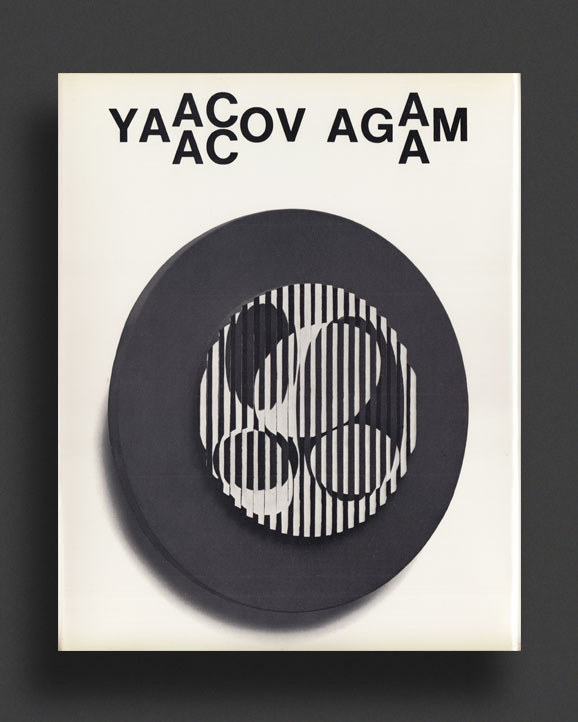
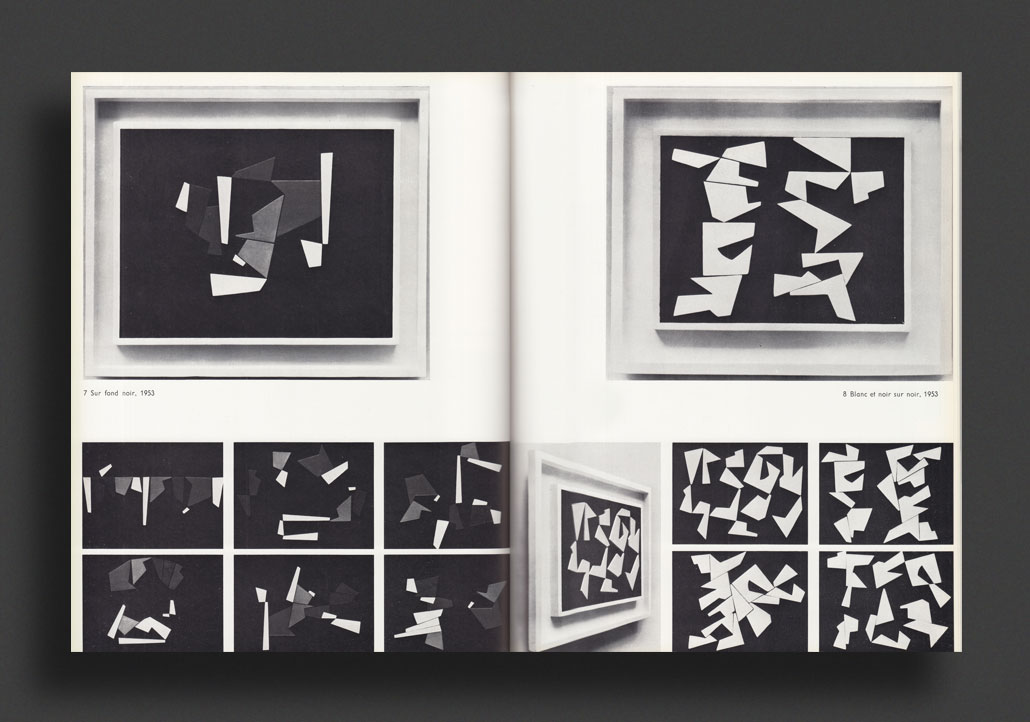
Beautiful first 1962 edition of this Swiss hardcover monograph/artist's book on Israeli sculptor and experimental artist Yaacov Agam (Hebrew: יעקב אגם) (b. 1928). Agam trained at the Bezalel Academy of Art and Design in Jerusalem, before moving to Zürich, Switzerland in 1949, where he studied under Johannes Itten (1888–1967) at the Kunstgewerbe Schule, and was also influenced by the painter and sculptor Max Bill (1908–1994). In 1951 Agam moved to Paris, France, where in 1955, he established himself as one of the leading pioneers of kinetic art at the Le Mouvement exhibition at the Galerie Denise René, Paris, alongside such artists as Jesús Rafael Soto, Carlos Cruz-Díez, Pol Bury, Alexander Calder and Jean Tinguely. Agam is widely known for his contributions to optical and kinetic art.
All texts by Yaacov Agam, in both English and Hebrew. Profusely illustrated throughout in black & white and colour, surveying his prolific work in op/kinetic sculpture. Includes 45rpm 7" record entitled "Musical Trans Forms", preserved and unplayed in original glassine wrapper and pocket inside the rear cover. 12" high X 9" wide, 126 pages. This book will be securely packed and shipped with tracking.
Fine, As New copy preserved since 1962.
1969, English
Hardcover (w. dust jacket), 240 pages, 21 x 22 cm
1st US Edition, Out of print title / used / very good
Published by
Praeger Publishers Inc. / New York
$250.00 - Out of stock
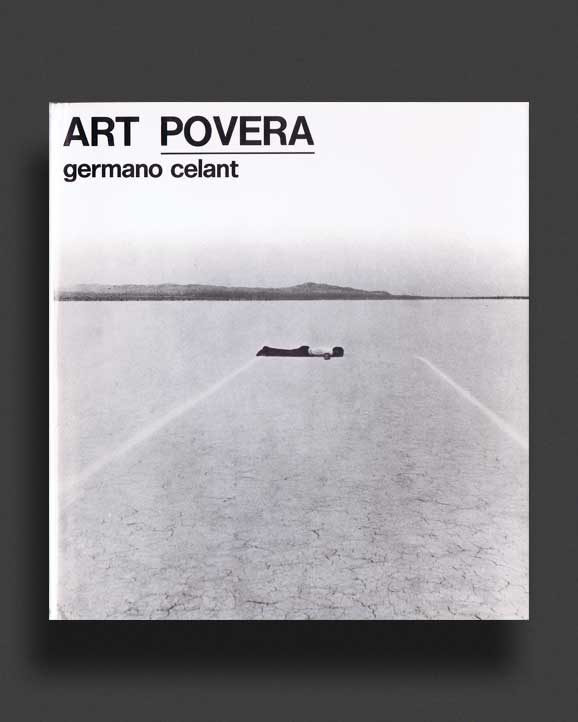
First US printing of "Art Povera", the now legendary critical/photographic book by Germano Celant (Italian art historian, critic and curator) documenting the so-called "Art Povera /Arte Povera" movement (meaning "poor art", coined by Celant in 1967) and published by Studio Vista, London in 1969 and Praeger, New York, the same year.
Includes profiles of major artists of the movement, including a short text followed by pages of full-page photographs for each artist.
Artists featured: Walter de Maria, Michelangelo Pisteletto, Stephen Kaltenbach, Richard Long, Mario Merz, Douglas Huebler, Joseph Beuys, Eva Hesse, Michael Heizer, Ger van Elk, Lawrence Weiner, Luciano Fabro, Bruce Nauman, Joseph Kosuth, Jan Dibbets, Giovanni Anselmo, Robert Barry, Pier Paolo Calzolari, Dennis Oppenheim, Barry Flanagan, Robert Smithson, Giulio Paolini, Reiner Ruthenbeck, Alighiero Boetti, Giuseppe Penone, Franz Erhard Walther, Hans Haacke, Gilberto Zorio, Robert Morris, Marinus Boezem, Carl Andre, Emilio Prini, Richard Serra.
"This book does not aim at being an objective and general analysis of the phenomenon of art or life, but is rather an attempt to flank (both art and life) as accomplices of the changes and attitudes in the development of their daily becoming. This book does not attempt to be objective since the awareness of objectivity is false consciousness. The book, made up of photographs and written documents, bases its critical and editorial assumptions on the knowledge that criticism and iconographic documents give limited vision and partial perception of artistic work. The book, when it reproduces the documents of artistic work, refutes the linguistic mediation of photography. The book, even though it wants to avoid the logic of consumption, is a consumer's item. ... This book produces a collection of already old material. ... In this book there is no need to reflect in order to seek a unitary and reassuring value, immediately refuted by the the authors themselves, rather there is the necessity to look into it for the changes, limits, precariousness and instability of artistic work." -- text from Celant's introduction "Stating That."
2017, English
Softcover, 256 pages, 21 x 29.8 cm
Published by
The MIT Press / Massachusetts
$65.00 $30.00 - Out of stock
Contemporary art and curatorial work, and the institutions that house them, have often been centers of power, hierarchy, control, value, and discipline. Even the most progressive among them face the dilemma of existing as institutionalized anti-institutions. This anthology–taking its title from Mary Douglas’s 1986 book, How Institutions Think–reconsiders the practices, habits, models, and rhetoric of the institution and the anti-institution in contemporary art and curating. Contributors reflect upon how institutions inform art, curatorial, educational, and research practices as much as they shape the world around us. They consider the institution as an object ofienquiry across many disciplines, including political theory, organizational science, and sociology.
Bringing together an international and multidisciplinary group of writers, How Institutions Think addresses such questions as whether institution building is still possible, feasible, or desirable; if there are emergent institutional models for progressive art and curatorial research practices; and how we can establish ethical principles and build our institutions accordingly. The first part, “Thinking via Institution,” moves from the particular to the general; the second part, “Thinking about Institution,” considers broader questions about the nature of institutional frameworks.
Contributors include
Nataša Petrešin Bachelez, Dave Beech, Mélanie Bouteloup, Nikita Yingqian Cai, Binna Choi and Annette Kraus, Céline Condorelli, Pip Day, Clémentine Deliss, Keller Easterling and Andrea Phillips, Bassam El Baroni, Charles Esche, Patricia Falguières, Patrick D. Flores, Marina Gržinić, Stefano Harney and Fred Moten, Alhena Katsof, Emily Pethick, Sarah Pierce, Moses Serubiri, Simon Sheikh, Mick Wilson
About the Editors
Paul O’Neill is an artist, curator, educator, and writer, and has cocurated more than fifty exhibition projects around the world. The author of The Culture of Curating and the Curating of Culture (MIT Press) and coeditor of The Curatorial Conundrum: What to Study? What to Research? What to Practice? (MIT Press), he is Artistic Director of Publics, Helsinki.
Lucy Steeds is Pathway Leader in Exhibition Studies at Central Saint Martins, University of the Arts, London, and editor of Exhibition (MIT Press/Whitechapel Gallery London). She is coeditor of The Curatorial Conundrum: What to Study? What to Research? What to Practice? (MIT Press).
Mick Wilson is an artist, educator, and writer based in Sweden and Ireland, and the first Head of the Valand Academy of Art, University of Gothenburg. He is coeditor of The Curatorial Conundrum: What to Study? What to Research? What to Practice?
1998, Japanese
Hardcover (w. dust jacket), 224 pages, 21.5 x 14.5 cm
1st Edition, Out of print title / used / very good
Published by
Futami Shobo / Japan
$100.00 - In stock -
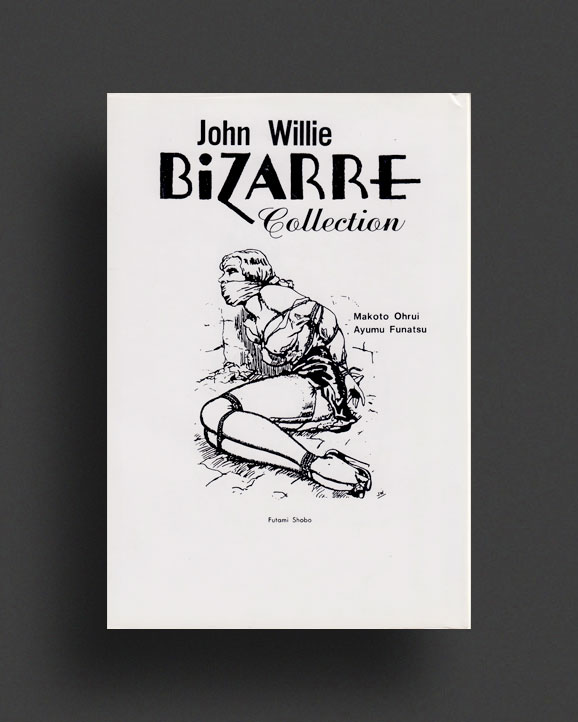
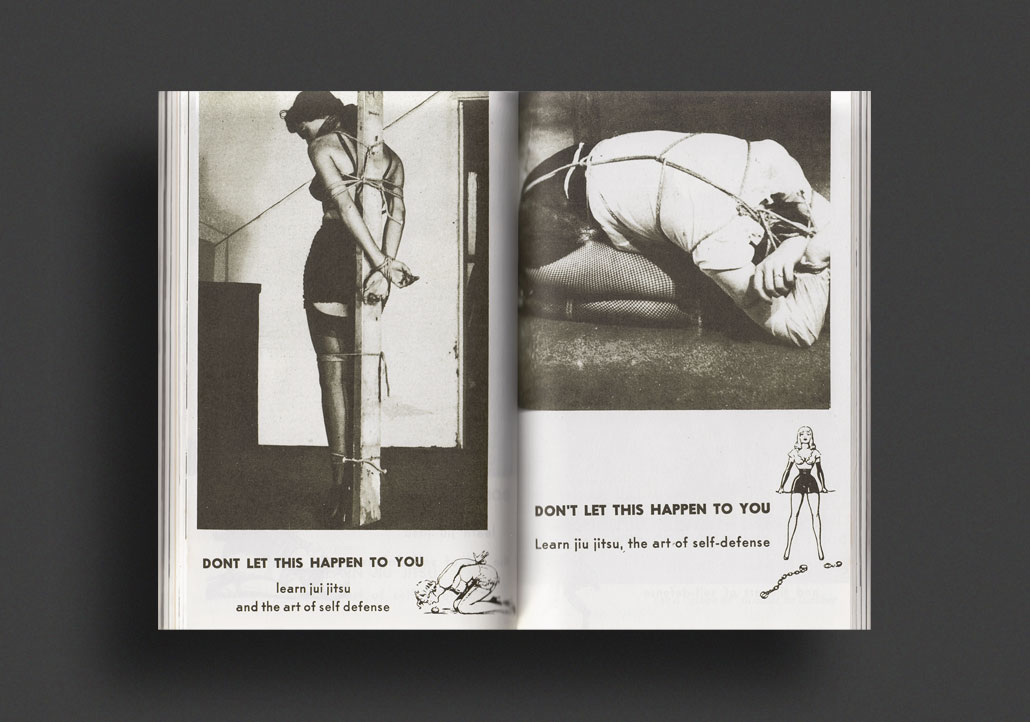
Rare first hardcover edition of this book collection of artwork by legendary fetish artist and publisher John Willie, compiled by SALE2/Fiction Inc. editor Makoto Ohrui and Ayumu Funatsu and published in Tokyo Japan by Futami Shobo in 1998. Packed cover-to-cover with colour and b/w reproductions of classic artworks by Willie and his famed Bizarre publications, John Willie's bondage photography, Bizarre fetish fashion illustrations and paintings, alongside his letters and writings translated into Japanese.
John Alexander Scott Coutts (1902—1962), better known by the pseudonym John Willie, was an artist, fetish photographer, editor and the publisher of the first 20 issues of the fetish magazine Bizarre, featuring his characters Sweet Gwendoline and Sir Dystic d'Arcy.
Makoto Ohrui founded the publishing house Fiction Inc. (later Radical Silence Production), the magazine SALE2, the gallery THE deep in Tokyo, and the magazine THE International. Ohrui was art director for SALE2, Purple, Rockin' On, and designed many books.
Very Good copy.
1962, German
Hardcover (w. dust jacket + signed lithograph), 58 pages, 21.5 x 21.5 cm
Signed,
1st Edition, Out of print title / used / very good
Published by
Sydow-Zirkwitz / Frankfurt
$90.00 - Out of stock
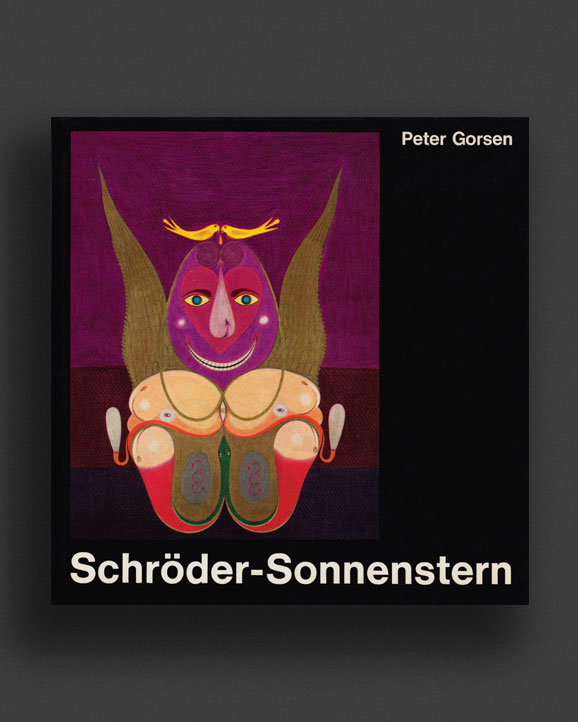
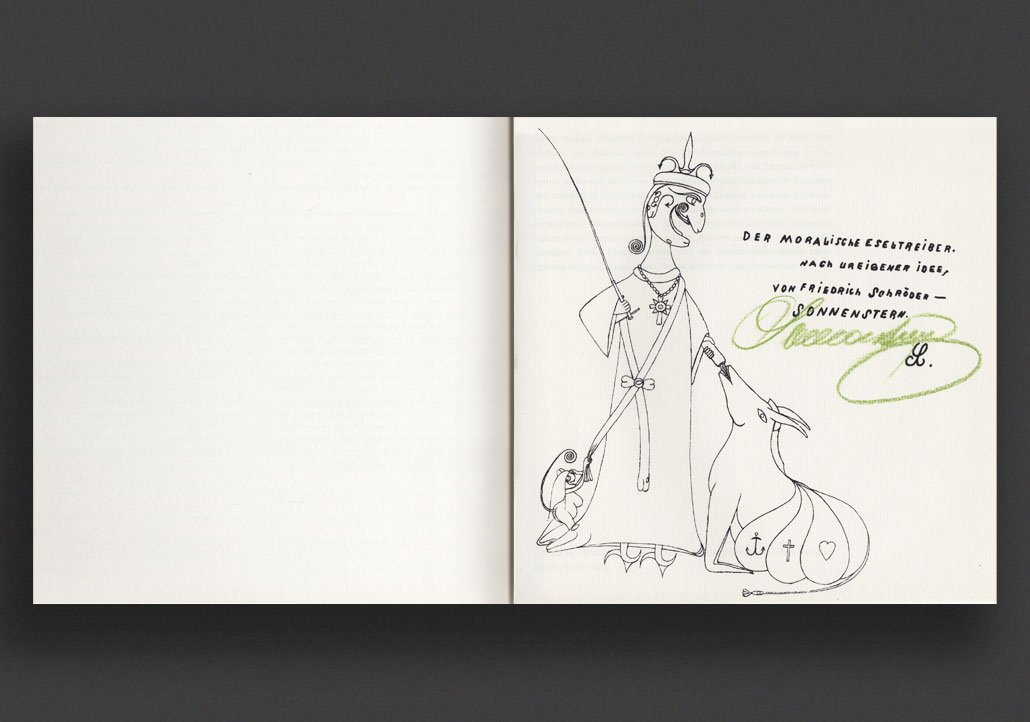
First 1962 hardcover edition of the first definitive study ("An Interpretation") of German artist Friedrich Schröder-Sonnenstern (1892—1982), considered one of the most important representatives of Art Brut or Outsider Art, by Austrian art historian Peter Gorsen (1933—2017) who studied under Theodor W. Adorno and Jürgen Habermas at the University of Frankfurt. This is one of 999 numbered copies from the limited first print edition of 1100, each with a loosely inserted original serigraph by the artist, boldly signed in green crayon. No. 750.
Friedrich Schröder-Sonnenstern was a draftsman, painter and poet-philosopher. Born in 1892 in East Prussia, one of thirteen children, all of whom apart from one other died shortly after birth. He was sent to a number of reform schools due to accusations of theft and violent behaviour and then, at the age of twenty-six, he was diagnosed with schizophrenia and committed to a sanatorium. His experiences as a child contributed to his lifelong hatred of authority. One year later he showed up in Berlin, where he occupied himself with occultism, divination and healing magnetism. He founded a sect and distributed its income in the form of bread rolls to poor children, earning him the title "Schrippenfürst of Schöneberg". He created the name Sonnenstern (English: Sun Star) for himself while working as a con-artist, posing as a Quack doctor in "natural health", calling himself Professor Dr. Eliot Gnass von Sonnenstern. This career path was cut off by the Nazis' interdiction of occult practices, and after being confined in psychiatric institutes and in a penal camp, Schröder-Sonnenstern reemerged in 1944, scavenging firewood in the bombed-out German capital. Only in his late fifties, in 1949, did he begin to draw, using coloured pencils to create allegorical grotesques stocked with a personal iconography. Although his art was rarely shown, he was championed in Surrealist and art brut circles; Jean Dubuffet and Hans Bellmer were among his admirers, and a few drawings were included in Marcel Duchamp and André Breton's 1959 "Exposition inteRnatiOnale du Surréalisme" in Paris. The demand for his pictures by collectors and gallerists rose rapidly and he resorted to employing assistants to produce his work for him. His success was short-lived when he began to paint less and less and became the victim of counterfeiting cliques by his assistants, destroying his position in the art market. He became increasingly dependent on alcohol following the death, in 1964, of his long-time companion, Martha Möller whom he called Aunt Martha. He died almost forgotten and impoverished in 1982 in Berlin.
Very Good copy in good dust jacket — back cover corner tear-off, otherwise VG.
1972, German
Softcover, 112 pages, 21 x 14.5 cm
Signed,
1st Edition, Out of print title / used / very good
Published by
Hanser / Münich
$90.00 - In stock -
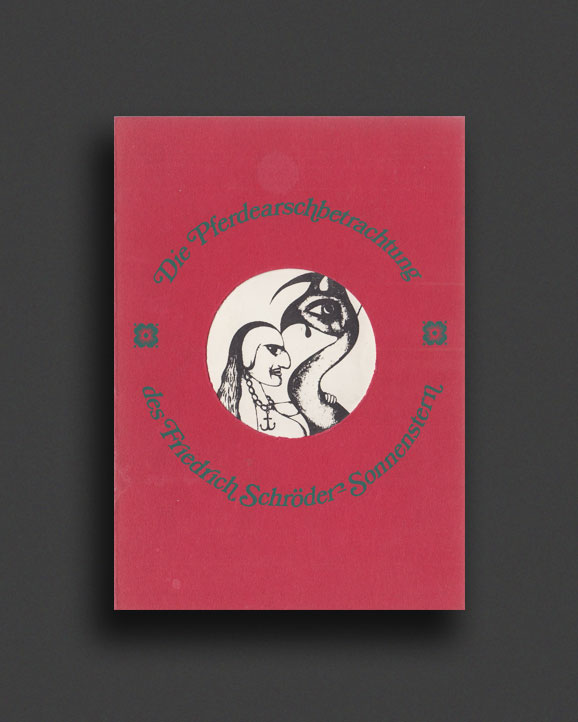
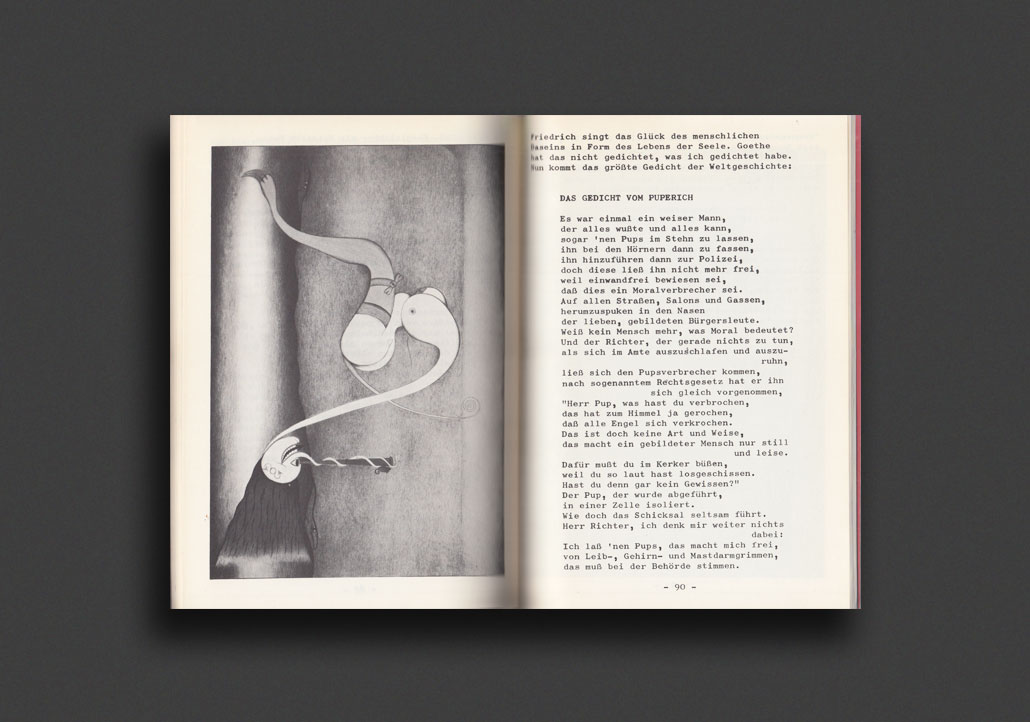
Lovely rare German book published in 1972 on Friedrich Schröder-Sonnenstern (1892-1982). First and only printing, this copy signed by the artist himself! With die-cut cover and illustrated throughout in black and white with Schröder-Sonnenstern's incredible drawings and paintings, this intimate book collects his tape-recorded monologues, autobiographical passages and literary texts, giving deep insight into one of the most important representatives of "Art Brut" or "Outsider Art". Schröder Sonnenstern's paintings depict erotic and fantastical figures with distorted body parts such as breasts and genitalia, part human and part monster. He used coloured pencil over a thin wash of paint to give depth to his line drawings. Notable works include the demonic Zynus Theory (1953), Vitanovaseturine (1951-2) and several works on the theme of the Fall of man, including Uschastelynore (1951) and The Snake Seduction (1955).
Friedrich Schröder-Sonnenstern was a draftsman, painter and poet-philosopher. Born in 1892 in East Prussia, one of thirteen children, all of whom apart from one other died shortly after birth. He was sent to a number of reform schools due to accusations of theft and violent behaviour and then, at the age of twenty-six, he was diagnosed with schizophrenia and committed to a sanatorium. His experiences as a child contributed to his lifelong hatred of authority. One year later he showed up in Berlin, where he occupied himself with occultism, divination and healing magnetism. He founded a sect and distributed its income in the form of bread rolls to poor children, earning him the title "Schrippenfürst of Schöneberg". He created the name Sonnenstern (English: Sun Star) for himself while working as a con-artist, posing as a Quack doctor in "natural health", calling himself Professor Dr. Eliot Gnass von Sonnenstern. This career path was cut off by the Nazis' interdiction of occult practices, and after being confined in psychiatric institutes and in a penal camp, Schröder-Sonnenstern reemerged in 1944, scavenging firewood in the bombed-out German capital. Only in his late fifties, in 1949, did he begin to draw, using coloured pencils to create allegorical grotesques stocked with a personal iconography. Although his art was rarely shown, he was championed in Surrealist and art brut circles; Jean Dubuffet and Hans Bellmer were among his admirers, and a few drawings were included in Marcel Duchamp and André Breton's 1959 "Exposition inteRnatiOnale du Surréalisme" in Paris. The demand for his pictures by collectors and gallerists rose rapidly and he resorted to employing assistants to produce his work for him. His success was short-lived when he began to paint less and less and became the victim of counterfeiting cliques by his assistants, destroying his position in the art market. He became increasingly dependent on alcohol following the death, in 1964, of his long-time companion, Martha Möller whom he called Aunt Martha. He died almost forgotten and impoverished in 1982 in Berlin.
Very Good copy, signed in pencil by Friedrich Schröder-Sonnenstern. Light tanning to the front cover and small shadow from former sticker.
1996, English
Softcover, 104 pages, 28 x 21.5 cm
1st Edition, Out of print title / used / very good
Published by
Stadtgalerie / Saarbrücken
$20.00 - In stock -
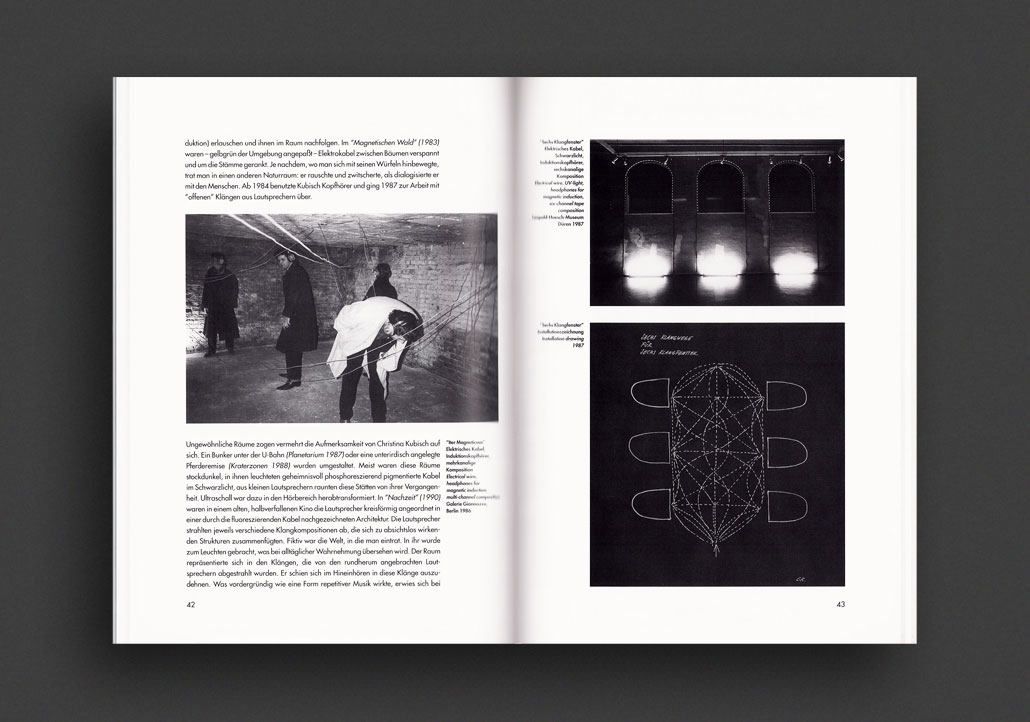
First 1996 edition catalogue published on the occasion of the exhibition of German installation/sound artist Christina Kubisch (b. 1948) at Stadtgalerie, Saarbrücken in 1996. Profusely illustrated in colour and b/w with many accompanying texts in bi-lingual English/German by Bernd Schulz, Wendy Steiner, Helga de la Motte-Haber, Michael Glasmeier, along with a bibliography and biography.
Christina Kubisch is a pioneering German sound artist and composer. Born in Bremen in 1948, she studied painting, composition, and electronic music in Hamburg, Graz, Zurich, and Milan. Her performances, concerts, electromagnetic sound installations, and projects with ultraviolet light incorporate different forms of sound technology and often invite audience participation. Christina has exhibited internationally in both solo and group shows and participated in the Venice Biennale and documenta 8, among many others. The recipient of many international awards, grants, and residencies, including a DAAD working scholarship, a German studio grant from the Senator for Cultural Affairs, the Heidelberg Artists Prize, and the Doual’art artist residency in Cameroon, she is also a member of the Akademie der Künste Berlin and has held professorships in Paris, Berlin, Saarbrücken, Vienna, and Oxford.
Very Good copy.
1985, German
Softcover, 24 pages, 24 x 16.5 cm
1st Edition, Out of print title / used / very good
Published by
GAK / Bremen
$20.00 - In stock -
Published in 1985 to accompany Christina Kubisch's Klanginstallationen : in d. Weserburg, 1—10, January 1985 at GAK, Bremen. The heavily illustrated catalogue documents the 1985 installation alongside a photographic history of Kubisch's "Klanginstallationen" installations spanning 1981—1984. Texts in German.
Very Good—Near Fine copy.
1984—85, German
Softcover (staple-bound), 28 pages, 20.5 x 15 cm
1st Edition, Out of print title / used / fine
Published by
Die Tödliche Doris / Berlin
$100.00 - In stock -
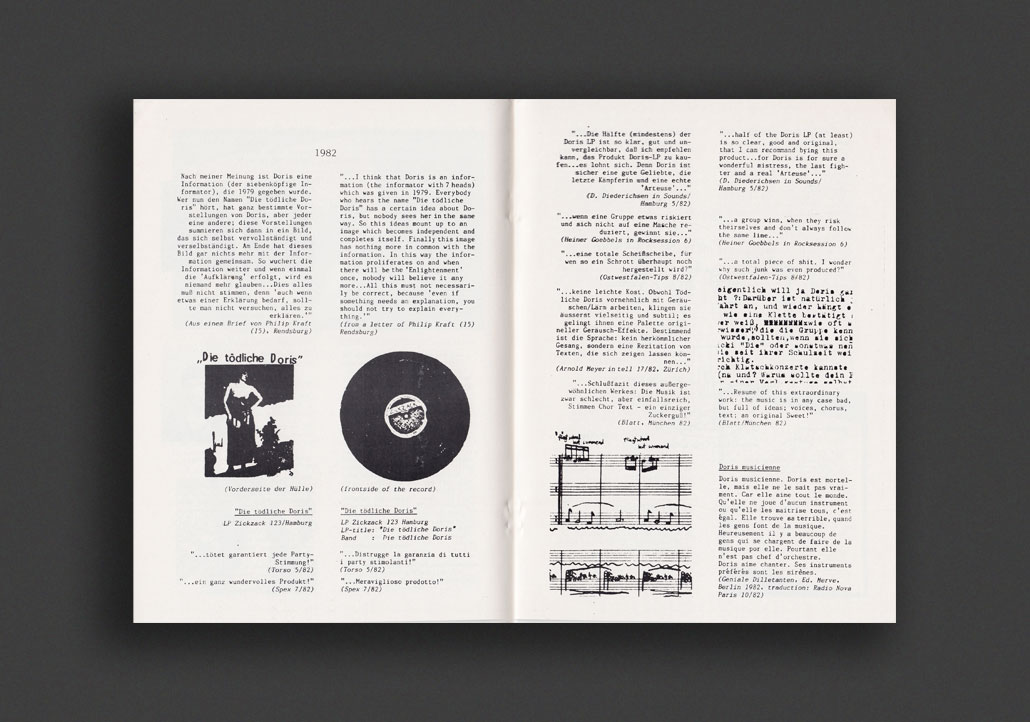
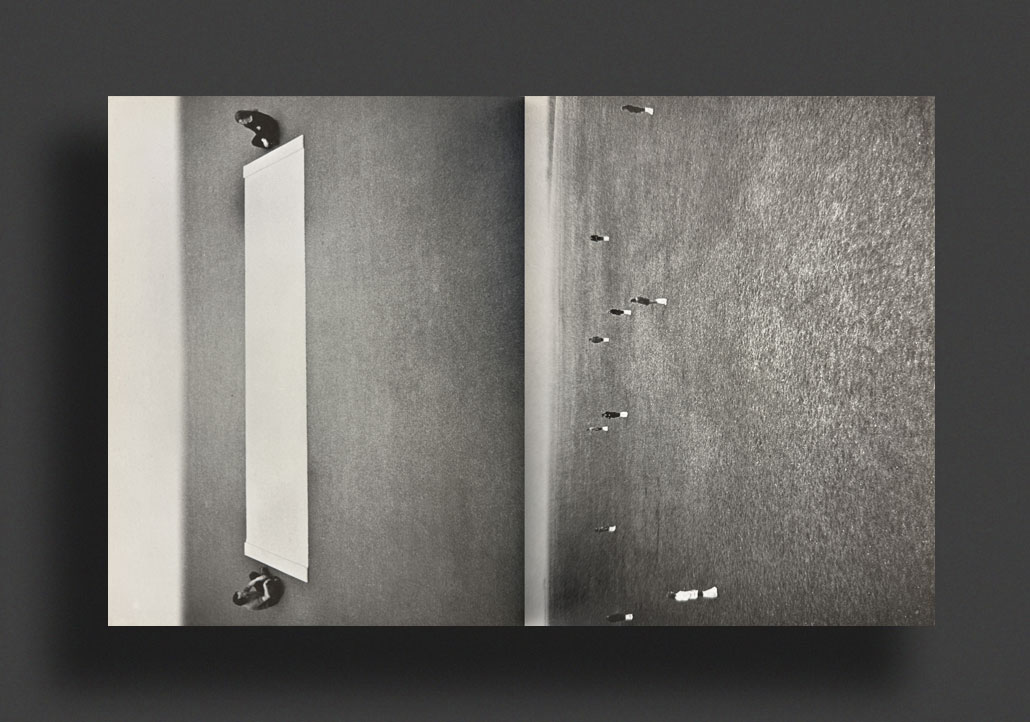
Very rare little publication issued privately by West German performance art and music group Die Tödliche Doris (Deadly Doris; a pun on tödliche Dosis, meaning lethal dose) around 1984—1985. A staple-bound and illustrated brochure cataloguing of the groups activities from 1980—1984. Cover drawing by Wolfgang Müller. Discography, filmography, performances, and exhibitions, all illustrated with tape and record artwork, performance photographs, drawings, exhibition documentation, press photographs, ephemera, and accompanied by further small texts. Includes a double-page photo illustration by Nan Goldin.
Die Tödliche Doris (Deadly Doris; a pun on tödliche Dosis, meaning lethal dose) was a performance art and music group based in West Berlin from 1980 to 1987. It was founded by band members Wolfgang Müller and Nikolaus Utermöhlen and later joined by Käthe Kruse. Rather than constructing a consistent identity, typically essential for pop music groups, Die Tödliche Doris challenged the notion of "convention" or "stereotype". Instead, they tried with each music piece and production not to follow a "style" or "image". Inspired by the post-structuralism of Baudrillard, Foucault, Guattarri and Lyotard, Die Tödliche Doris want to deConstruct ![sic] a sculpture, made by sounds. This musical, amusical or non-musical invisible sculpture should become the body of Doris itself.
Die Tödliche Doris was part of the Geniale Dilletanten movement (Ingenious Dilletantes (spelling error intentional)), which also included groups such as Einstürzende Neubauten, Die Tödliche Doris, Der Plan, Freiwillige Selbstkontrolle (F.S.K.), Palais Schaumburg, Ornament und Verbrechen, and the duo Deutsch Amerikanische Freundschaft (D.A.F.)
Berlin's gelbe MUSIK was the record store and gallery space run by Ursula Block between 1981 and 2014. During its tenure, the storefront exhibited work by artists and composers working at the intersection of art and sound, including Henning Christiansen, Maryanne Amacher, Akio Suzuki, Earle Brown and others
Near Fine copy.
1984, English / German
Softcover (w. 7" single-sided record), 38 pages, 22.5 x 21 cm
1st Edition, Out of print title / used / fine
Published by
Gelbe Musik / Berlin
$70.00 - In stock -
Limited edition 1984 book and single-sided 7" vinyl record by West German performance art and music group Die Tödliche Doris (Deadly Doris; a pun on tödliche Dosis, meaning lethal dose), published in an edition of 1000 by Ursula Block's Gelbe Musik, Berlin, to accompany the exhibition of Die Tödliche Doris's videos, objects, photographs, and texts. The 7" features recordings of a performance with the combustion of microphones, while the 38-page catalogue demonstrates how natural disasters can be created in your own home. "The instructions only require a few utensils: a few bells around the head, a couple of cups attached to the arms using household rubber bands, a thin offset sheet hung over the back, a metal lid between the knees, feet in water (of course, a puddle outside will do if the weather permits)."— Die Tödliche Doris. Illustrated throughout in colour and b/w. Text in English and German.
Die Tödliche Doris (Deadly Doris; a pun on tödliche Dosis, meaning lethal dose) was a performance art and music group based in West Berlin from 1980 to 1987. It was founded by band members Wolfgang Müller and Nikolaus Utermöhlen and later joined by Käthe Kruse. Rather than constructing a consistent identity, typically essential for pop music groups, Die Tödliche Doris challenged the notion of "convention" or "stereotype". Instead, they tried with each music piece and production not to follow a "style" or "image". Inspired by the post-structuralism of Baudrillard, Foucault, Guattarri and Lyotard, Die Tödliche Doris want to deConstruct ![sic] a sculpture, made by sounds. This musical, amusical or non-musical invisible sculpture should become the body of Doris itself.
Die Tödliche Doris was part of the Geniale Dilletanten movement (Ingenious Dilletantes (spelling error intentional)), which also included groups such as Einstürzende Neubauten, Die Tödliche Doris, Der Plan, Freiwillige Selbstkontrolle (F.S.K.), Palais Schaumburg, Ornament und Verbrechen, and the duo Deutsch Amerikanische Freundschaft (D.A.F.)
Berlin's gelbe MUSIK was the record store and gallery space run by Ursula Block between 1981 and 2014. During its tenure, the storefront exhibited work by artists and composers working at the intersection of art and sound, including Henning Christiansen, Maryanne Amacher, Akio Suzuki, Earle Brown and others
Near Fine copy.
1984, English
Softcover (staple-bound), 16 pages, 21 x 15 cm
1st Edition, Out of print title / used / fine
Published by
Edition Hundertmarkt / Cologne
$40.00 - Out of stock
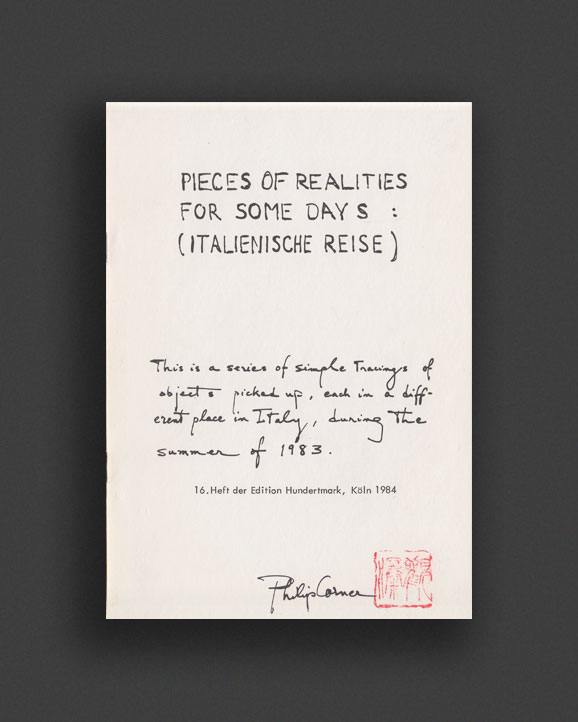
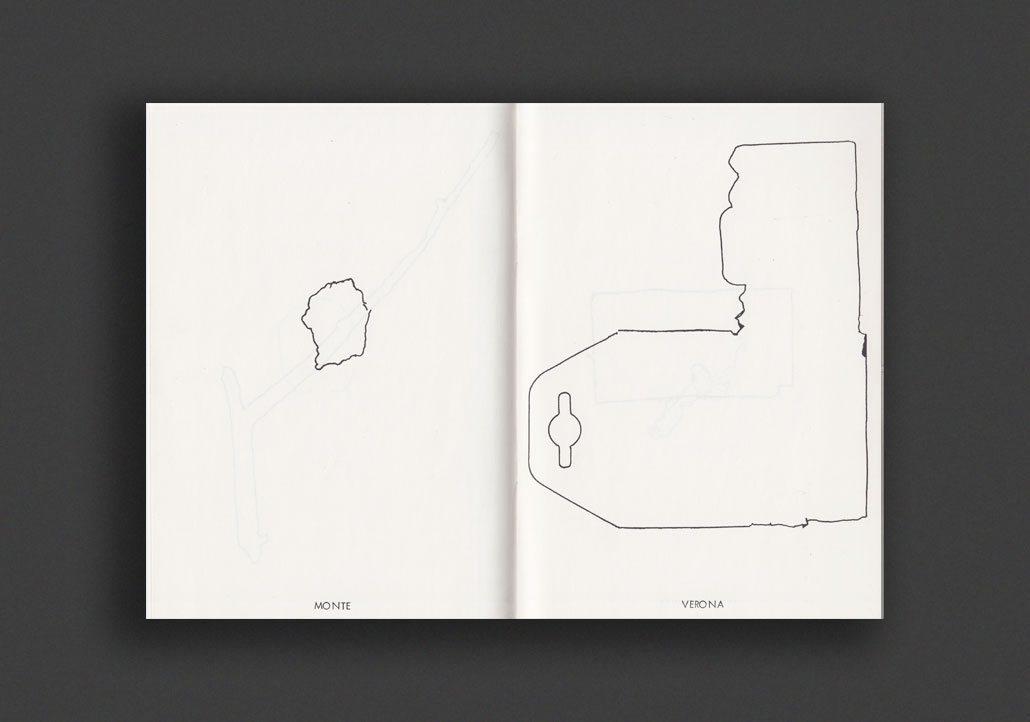
Published in Cologne in 1984 in an edition of 500 copies, Philip Corner's artist book “is a series of simple framings of objects picked up, each in a different place in Italy, during the summer of 1983”, outlines of mysterious objects, drawn in pen, each accompanied by an Italian placename, presumably describing where the objects were found.
Philip Corner (b. 1933) is an American composer, trombonist, alphornist, vocalist, pianist, music theorist, music educator, and visual artist.
Very Good—Near Fine copy.
1981, German
Softcover (staple-bound), 20 pages, 22 x 21 cm
1st Edition, Out of print title / used / very good
Published by
Nürnberg Archiv für bildende Kunst / Nürnberg
$60.00 - In stock -
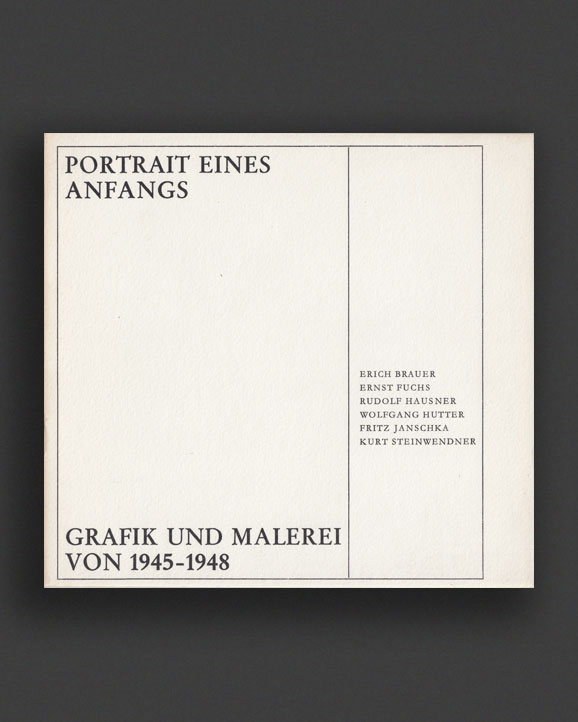
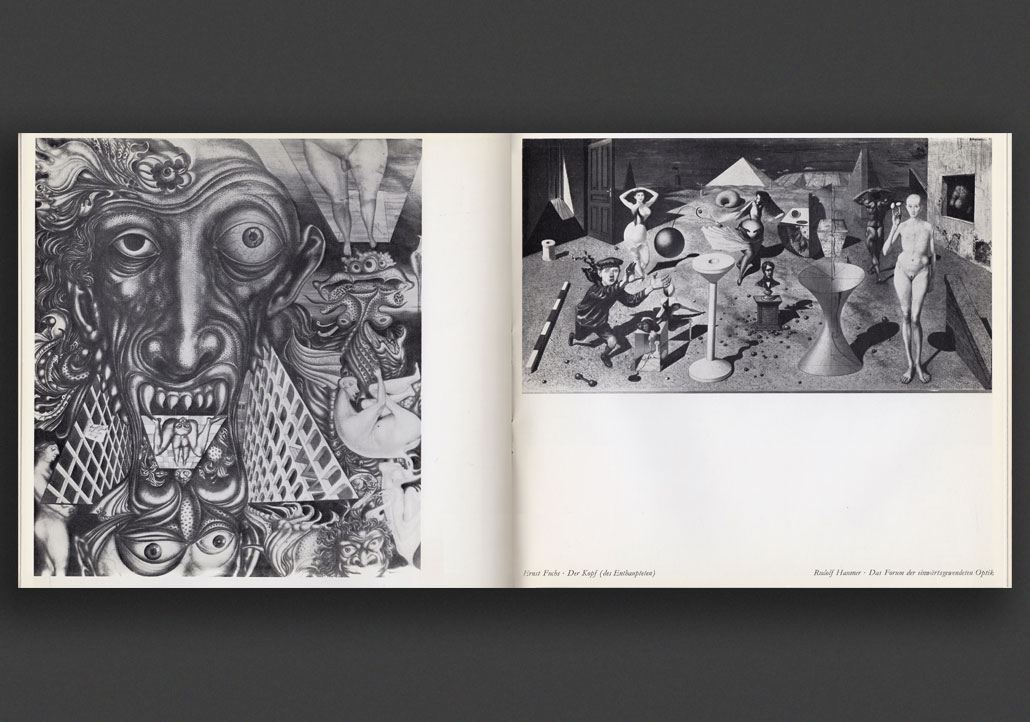
Lovely catalogue published in 1981 by Nürnberg Archiv für bildende Kunst, showcasing the early works of a number of the leading members of the Vienna School of Fantastic Realism — Erich Brauer, Ernst Fuchs, Rudolf Hausner, Wolfgang Hutter, Fritz Janschka, along with Austrian film director and avant-garde artist Kurt Steinwendner. A number of works are illustrated by the featured artists, in b/w. Includes essay by Austrian art critic Johann Muschik and full catalogue of the exhibited works by each artists.
The Vienna School of Fantastic Realism is a group of artists founded in Vienna in 1946. The group's name was coined in the 1950s by Johann Muskik, and the first exhibition was in 1959 at the Vienna Belvedere. This Austrian movement has similarities to Surrealism in its use of religious and esoteric symbolism and also the choice of a naturalistic style, countering the prevalence of abstract art movements at the time.
Artists include Ernst Fuchs, Maître Leherb (Helmut Leherb), Arik Brauer, Wolfgang Hutter, Anton Lehmden, and Israeli artist Zeev Kun, all students of Professor Albert Paris Gütersloh at the Vienna Academy of Fine Arts. Gütersloh's emphasis on the techniques of the Old Masters gave the "fantastic realist" painters a grounding in realism, similar to early Flemish artists such as Jan van Eyck.
Some older members of the group, including Rudolf Hausner, Kurt Regschek and Fritz Janschka, emigrated to the US in 1949, where Kurt Regschek helped organize the early exhibitions of the group in 1965. Hausner, Fuchs, Hutter, Brauer and Lehmden were referred to as "The Big Five" who subsequently held exhibitions internationally.
1973, German
Softcover, 68 pages, 30 x 21 cm
1st Edition, Out of print title / used / very good
Published by
Baukunst / Köln
$45.00 - Out of stock
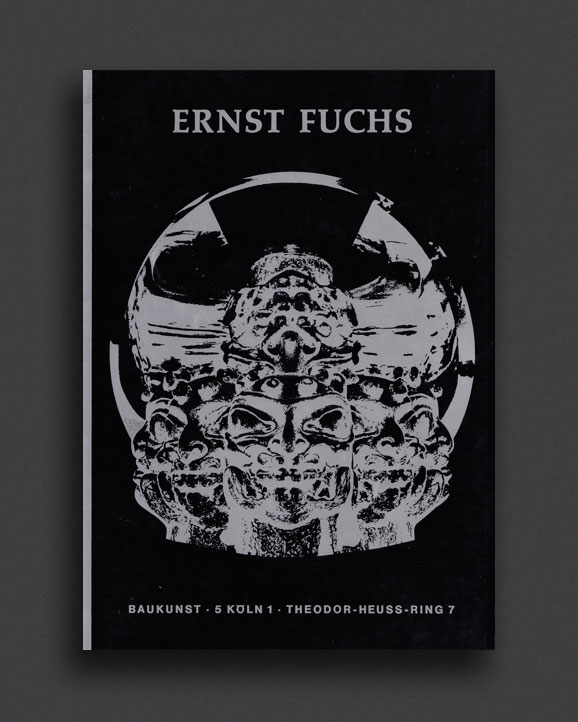
1973 Ernst Fuchs catalogue published on the occasion of the major exhibition at Baukunst-Galerie in Köln, February-March 1973. Illustrated throughout with examples of Fuchs fantastic paintings, graphics, sculptures and rarely seen furniture pieces, all reproduced in vivid colour and black and white, including fold-out spreads. Portrait, biography, list of exhibited works and introductory text by Gustav René Hocke.
Ernst Fuchs (1930 – 2015) was an Austrian artist and draughtsman of Jewish descent, engraver and sculptor, architect and stage designer, master of visionary painting and book illustration, as well as a composer and poet. At the Academy of Fine Arts in Vienna (1945), he met Arik Brauer, Rudolf Hausner, Fritz Janschka, Wolfgang Hutter, and Anton Lehmden, together with whom he later founded what has become known as the Vienna School of Fantastic Realism. He was also a founding member of the Art-Club (1946), as well as the Hundsgruppe, together with Friedensreich Hundertwasser and Arnulf Rainer. Between 1950 and 1961, Fuchs lived mostly in Paris, and made a number of journeys to the United States and Israel, his work informed by the sermons of Meister Eckehart, the symbolism of the alchemists and Jung's Psychology of Alchemy, along with the paintings of the Symbolists and the Old Masters. In 1958 he founded the Galerie Fuchs-Fischoff in Vienna to promote and support the younger painters of the Fantastic Realism school. Fuchs was a important influence on younger generations of artists including his student in Paris, Australian artist Vali Myers. Painters Mati Klarwein and H.R. Giger were also devoted followers of his work, Giger once saying "If I had not seen his work when I was young, I would never have begun to paint myself."
Very Good copy with light handling/corner wear.
1967, Japanese
Softcover, 6 page card fold-out w. insert, 23.8 x 23.8 cm
1st Edition, Out of print title / used / very good
Published by
Tokyo Gallery / Tokyo
$100.00 - In stock -
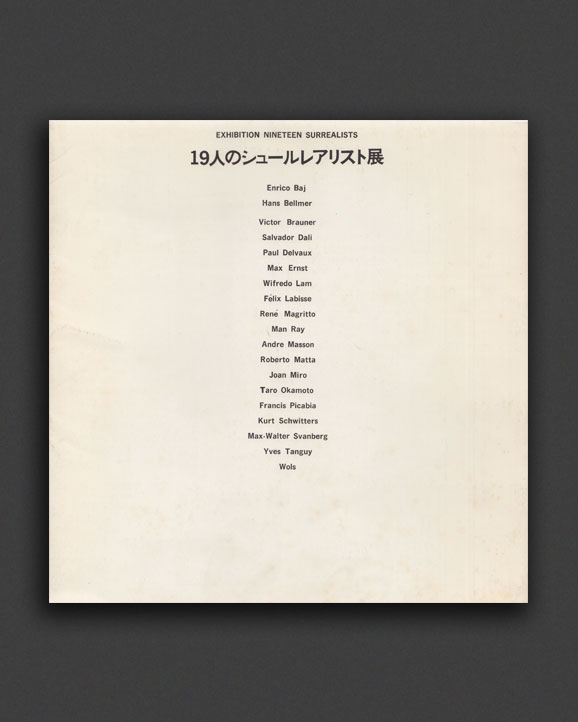
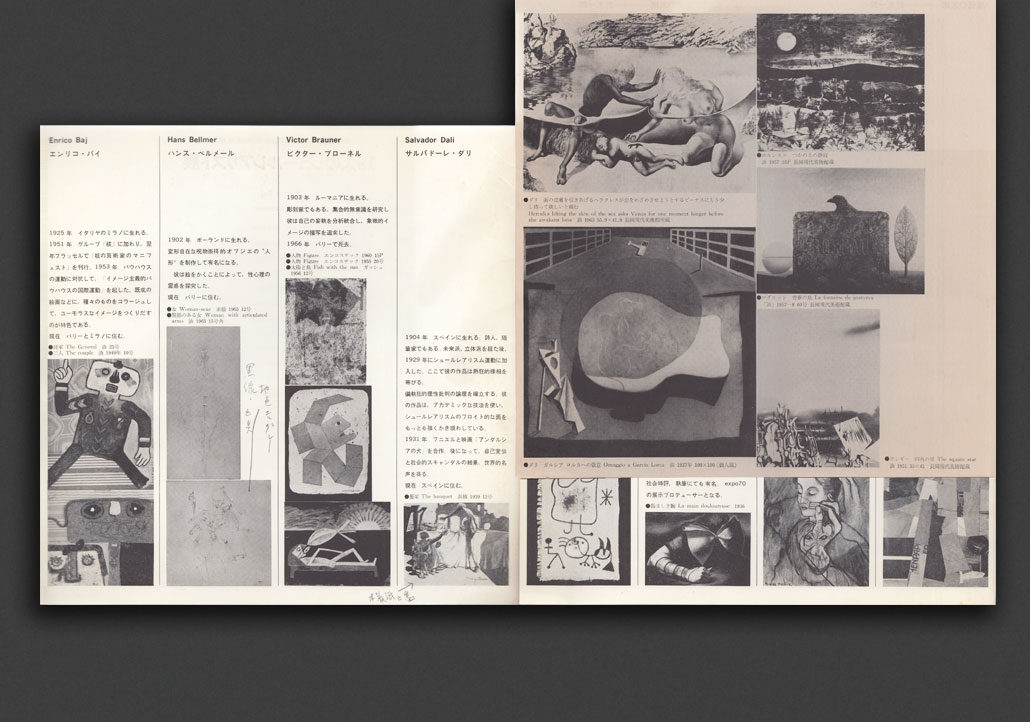
Incredibly scarce catalogue published on the occasion of the 1967 exhibition "19 Surrealists" held at Tokyo Gallery, Japan. Fold-out catalogue with insert, illustrated with the exhibited works (along with biographies in Japanese) by Enrico Baj, Hans Bellmer, Victor Brauner, Salvador Dali, Paul Delvaux, Max Ernst, Wifredo Lam, Felix Labisse, René Magritte, Man Ray, Andre Masson, Roberto Matta, Joan Miro, Taro Okamoto, Francis Picabia, Kurt Schwitters, Max-Walter Svanberg, Yves Tanguy, Wols.
Very Good with light wear and mild spotting and a couple of pencil notations in Japanese. Preserved in sleeve.
1993, Russian / English / German
Softcover, 192 pages, 29 x 24 cm
1st Edition, Out of print title / used / very good
Published by
Artograph Verlag / Düsseldorf
$90.00 - Out of stock
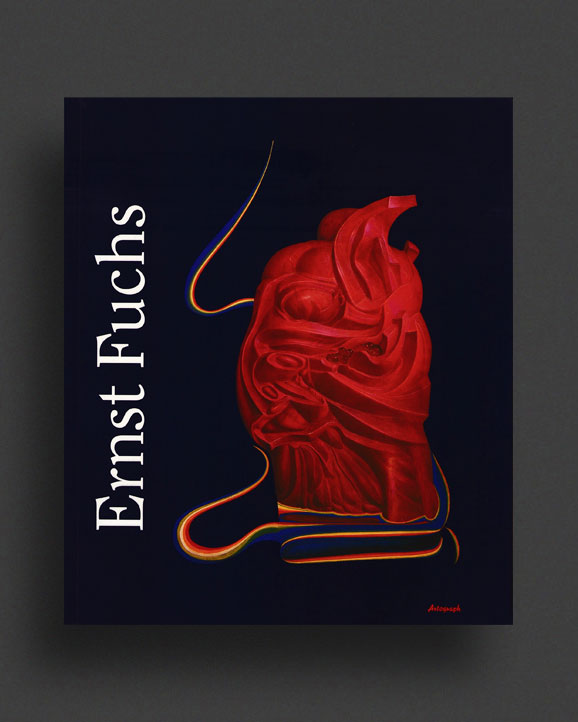
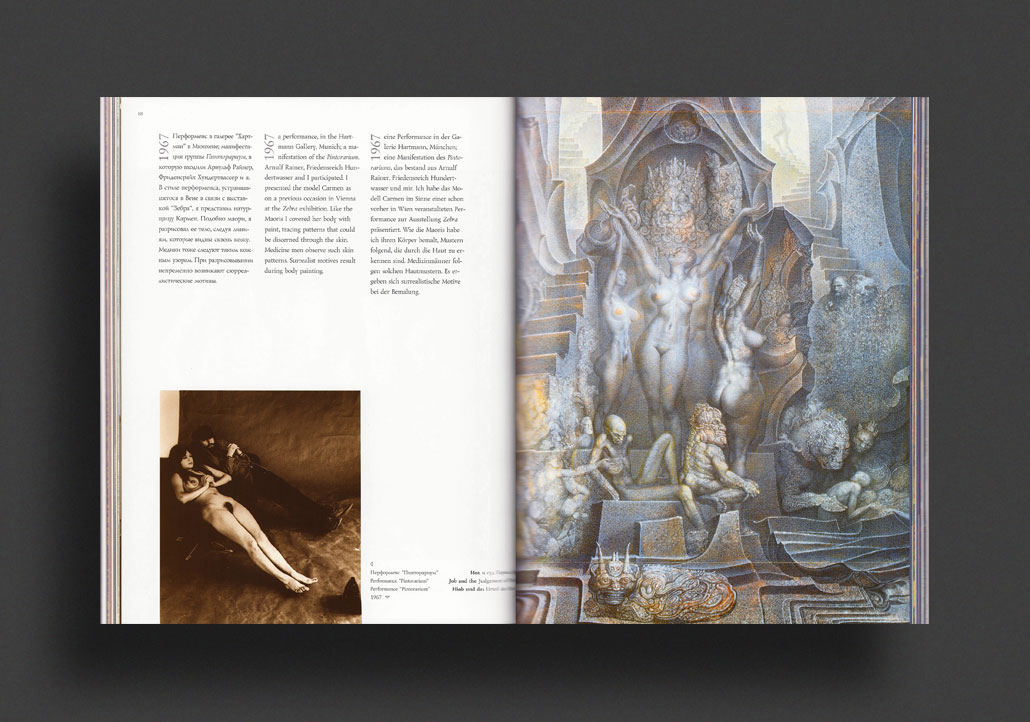
1993 monograph published on the occasion of the first Russian exhibition of works by leading representative of the "Vienna School of Fantastic Realism", the artist, poet, and philosopher Ernst Fuchs (1930 – 2015). Fantasia is lavishly illustrated throughout with bold colour examples and details of Fuchs fantastic paintings, drawings, graphics, sculptural and architectural works, surveying his entire life and career chronologically, including many photographic portraits of the artist, studio and home documentation, biography, with texts in English, Russian and German by Igor Jassenjawsky and Joseph Kiblitzky.
Ernst Fuchs (1930 – 2015) was an Austrian artist and draughtsman of Jewish descent, engraver and sculptor, architect and stage designer, master of visionary painting and book illustration, as well as a composer and poet. At the Academy of Fine Arts in Vienna (1945), he met Arik Brauer, Rudolf Hausner, Fritz Janschka, Wolfgang Hutter, and Anton Lehmden, together with whom he later founded what has become known as the Vienna School of Fantastic Realism. He was also a founding member of the Art-Club (1946), as well as the Hundsgruppe, together with Friedensreich Hundertwasser and Arnulf Rainer. Between 1950 and 1961, Fuchs lived mostly in Paris, and made a number of journeys to the United States and Israel, his work informed by the sermons of Meister Eckehart, the symbolism of the alchemists and Jung's Psychology of Alchemy, along with the paintings of the Symbolists and the Old Masters. In 1958 he founded the Galerie Fuchs-Fischoff in Vienna to promote and support the younger painters of the Fantastic Realism school. Fuchs was a important influence on younger generations of artists including his student in Paris, Australian artist Vali Myers. Painters Mati Klarwein and H.R. Giger were also devoted followers of his work, Giger once saying "If I had not seen his work when I was young, I would never have begun to paint myself."
Very Good copy with light wear.
1990, English
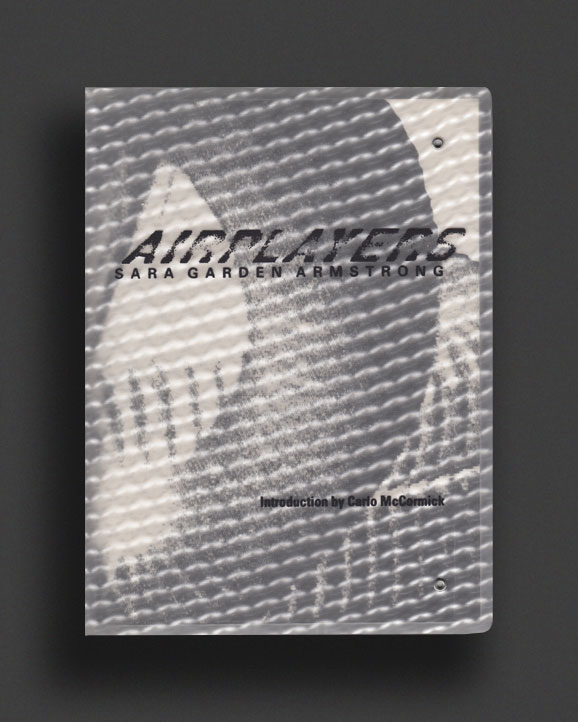
Hard vinyl optic silkscreened cover (many stocks, battery, light), 74 pages, 22 x 17 cm
Ed. of 1000,
Published by
Willis
Locker & Owens / New York
$50.00 - Out of stock
Perhaps the first book that comes with its own battery, Airplayers is a technological gem. Airplayers is the name which Sara Garden Armstrong has given to a series of ten room-sized kinetic sound sculptures that began in 1982. This rare and magnificent artist's book acts as a translation of the artist’s site-specific environments that deal with light, sound, movement, paint and forms; sound scores and photos documenting Armstrong’s room-sized kinetic sound sculptures. Airplayers is composed of 3M optical lenses, pages of ultra translucent paper, silk-screened vinyl envelopes, and a centerfold that lights up. An ingenious extension of the artist’s installation work with introduction by Carlo McCormick.
References: Nancy Princenthal, “Artist’s book beat,” Print collector’s newsletter
Sara Garden Armstrong is an American artist known for her work in digital/electronic multimedia and artist's books. Armstrong creates sculptures, paintings, drawings (from miniature to wall size), artist's books, multimedia artworks involving computers sound and light, and constructs permanent installations in atrium spaces.
Very Good copy. Battery will need replacing due to age but all instructions are included in the colophon.
1992, English
Stiff foil cover (w. xerox acetate dust jacket), vellum pages, 28 x 11.5 cm
Ed. of 200, signed,
1st Edition, Out of print title / used / fine
Published by
Sara Garden Armstrong / New York
$70.00 - In stock -
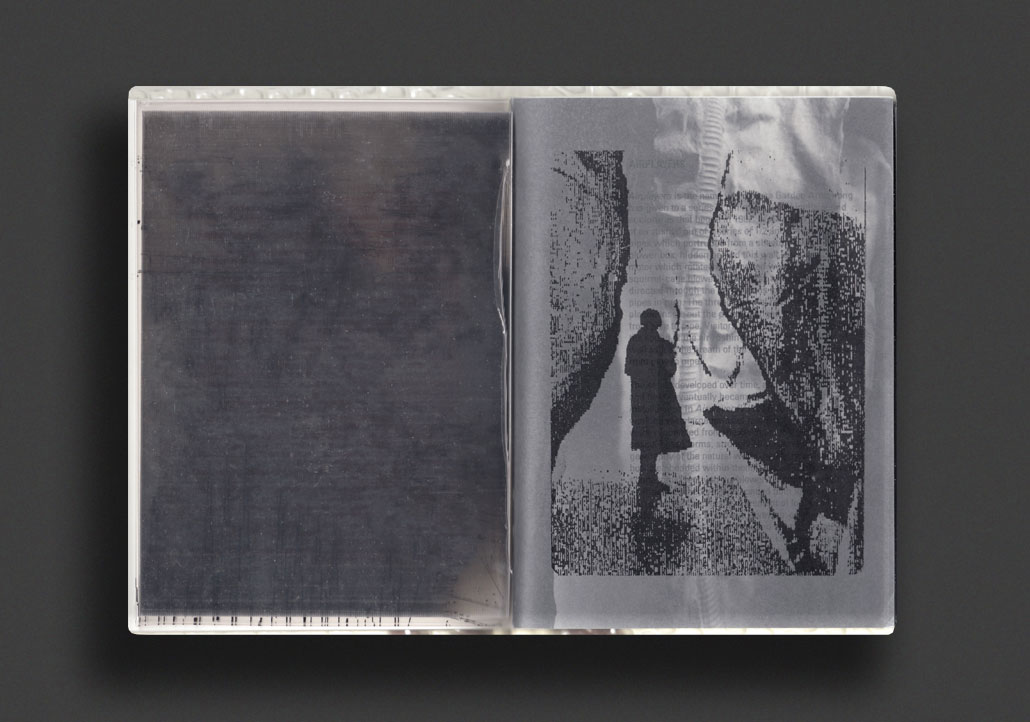
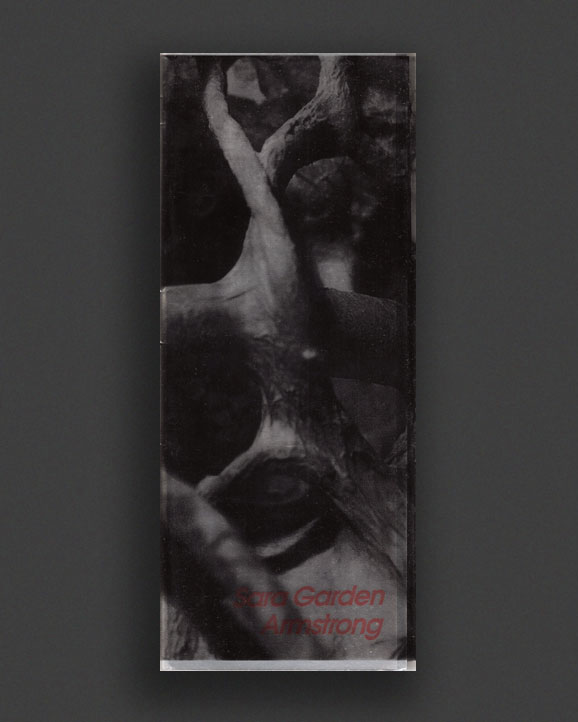
Artist's book, hand-made and signed in an edition of 200 copies by Sara Garden Armstrong. Photocopied and using various paperstocks throughout (foil card, uv ultra vellum, acetate), Armstrong documents her kinetic sound sculptures created from 1990-1992, through detailed photography and fragmented texts, with each page folding content into the next through the paper translucence. This copy no. 143/200.
Sara Garden Armstrong is an American artist known for her work in digital/electronic multimedia and artist's books. Armstrong creates sculptures, paintings, drawings (from miniature to wall size), artist's books, multimedia artworks involving computers sound and light, and constructs permanent installations in atrium spaces.
Fine copy.
1972, German / English
Softcover, 282 pages, 20 x 24.5 cm
1st Edition, Out of print title / used / very good
Published by
DuMont / Köln
Kunsthalle Tübingen / Köln
$100.00 - Out of stock
First 1972 edition of this profusely illustrated catalogue raisonné of German installation and conceptual artist known for his fabric objects and activations, Franz Erhard Walther, published in conjunction with show held at the Kunsthalle Tübingen, Germany, May 1972—July 1972, the same year as his participation in Harald Szeemann’s legendary Documenta 5. Very heavily illustrated with thorough documentation of his works from the 1960s and 1970s, textile works, paper works, performances, and more. Text in German with an English introduction.
Edited by Götz Adriani.
Text by Manfred Schmalriede.
Having participated in Harald Szeemann’s legendary When Attitudes Become Form (1969) and Documenta 5 (1972) as well as the Museum of Modern Art’s landmark Spaces (1970), Walther’s remarkable coupling of elementary forms with conceptual ideas and a radical rethinking of the relationship between sculpture and action, has become so influential to the contemporary practices of young artists today. The German conceptualist and sculptor Franz Erhard Walther counts among those artists who, in the 1960s, sought to undermine the authorial role of the artist in favour of a more democratic aesthetic dependent on the interaction of viewer and object; simple and individual acts such as folding and lying, leaning and stepping are either the source of his often minimal works or the means by which individual viewers may interact with them. His means of sculptural expression often involved the use of soft materials. His canvas sculptures are simply meant to be held, worn, lain in or stood under, usually by two or more people, creating strange moments of social intimacy and spatial awareness.
Very Good copy.
2024, English
Softcover, 124 pages, 20 x 14 cm
Published by
Twisted Spoon Press / Prague
$38.00 - In stock -
translated from the Polish by Ursula Phillips
collage artwork by Selena Kimball
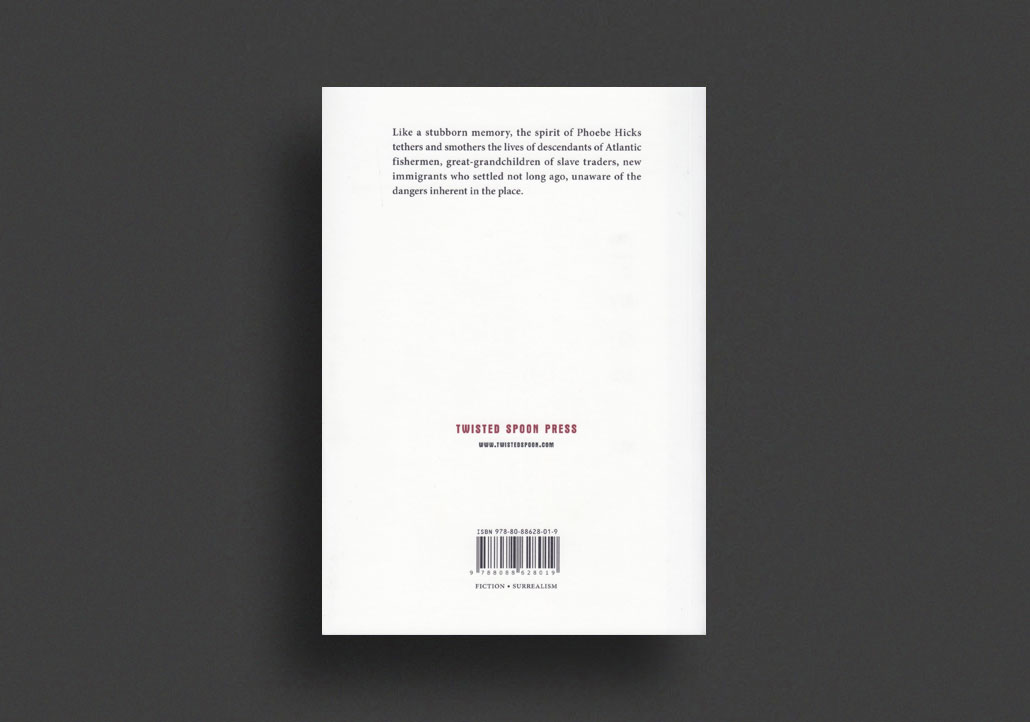
Phoebe Hicks owes her unexpected career as a spiritualist to a photograph taken of her through her bedroom window after having eaten spoiled clams. What comes out of her mouth is taken to be ectoplasm, and word spreads that she is able to commune with the dead. As the prototype for the medium, she establishes the standard for how a séance should be conducted during the sessions held in her Providence, Rhode Island, home where a growing number of curious participants witness materializations of such figures as Ivan the Terrible, Harry Houdini, Catherine the Great, Hatshepsut, Elizabeth Báthory, and a host of others. Told as a compilation of episodes conjoined with Selena Kimball’s haunting collages, The Unfinished Life of Phoebe Hicks is a feminist surrealist exploration of the rise of Spiritualism and the role of the medium in 19th-century America alongside the expectations, and constraints, imposed on women.
Frequent references to Victorian sexuality—from the corset to nocturnal emissions of ectoplasm—contribute to the work’s saucy sense of humor, as well as a larger statement about the role of Spiritualism in the history of women’s emancipation. As the narrator points out, seances and other such performances allowed women to speak publicly and subvert patriarchal social norms.—Jess Jensen Mitchell, Full Stop
This book – atmospherically interspersed with collages by Selena Kimball – stays with you long after the seance is over.—Mathilde Montpetit, The Berliner
Presented as a serious account—albeit with a healthy amount of wry humour—of the role of this somewhat mysterious medium in the early years of spiritualist practice, the portrait that emerges is of a woman for whom the boundary between the world of the spirit and the world of the flesh has become somewhat permeable.
—Joseph Schreiber, roughghosts
What is not strange, what feels contemporary about this fictionalized biography are the reasons why almost any woman without economic and social security would become a medium: In their “trance” stage, with spirits speaking through them, mediums could say things to their guests they otherwise couldn’t get away with. A woman could be “odd” and not have to worry satisfying a whole set of social conventions that otherwise would leave her destitute.—Tom Bowden, Book Beat
Surreal, funny, unnerving, thought-provoking and a wonderful read from beginning to end, The Unfinished Life of Phoebe Hicks is a marvellous book and I highly recommend it!—Kaggsy's Bookish Ramblings
Agnieszka Taborska, otherwise innocent, has, during her annual pilgrimage into “the murky back-streets of Providence,” shamelessly consorted with the spirits of such infamous locals as Poe, Lovecraft, and Hawkes, giving spiritual birth to the charmingly eerie nineteenth-century medium, Phoebe Hicks. Phoebe’s story, which, the author says, “seems to belong more to dream than reality,” is a delightful postmodernist mix of fiction and history, hovering delicately between parody and mystery. Taborska’s fictional character Leonora de la Cruz makes a guest appearance, Harry Houdini challenges Phoebe to a kind of duel, and Alain Resnais, we’re told, had intended to make Phoebe the heroine of his 20th-century film Providence, scared off perhaps by her “disturbing ambiguity.” Phoebe is by turns a genuine communicant with the spiritual world, a fraud, an artist, a feminist, a psychiatrist, a lunatic. She can also be, thanks to her ethereal deadpan humor, very funny.—Robert Coover
Agnieszka Taborska and artist Selena Kimball’s fictional heroines are clairvoyant women whose internal visions are projected externally through art and are conditioned by the scientific contexts of their eras.—New Literature from Europe
It turns out that spiritualism is not so far from surrealism as it might seem. The surrealists, using their imagination, tried to break the shackles of social order, abolish the binding rules, and get out of the roles imposed from above. This transgressive element is equally important in the case of spiritualist séances, as Taborska notes, such a séance could be for the medium "entering with impunity roles inaccessible to her in waking life."
—Sarah Nowicka, Art Papier
It is a story about women's powers, or the career paths available to women at that time. About the eroticism hidden behind Victorian morality. About our desire for the extraordinary.—Kinga Dunin, Journal of Opinions
The spirit of surreal eeriness seems to coexist quite well with the ghosts that haunt our heads as well.—Mark Zaleski, Biweekly.com
2024, English
Softcover, 196 pages, 20 x 140 cm
Published by
Twisted Spoon Press / Prague
$36.00 - Out of stock
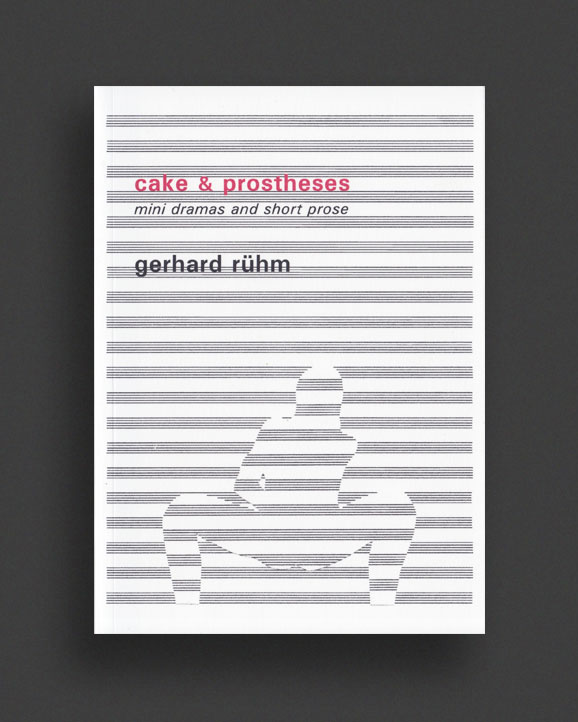
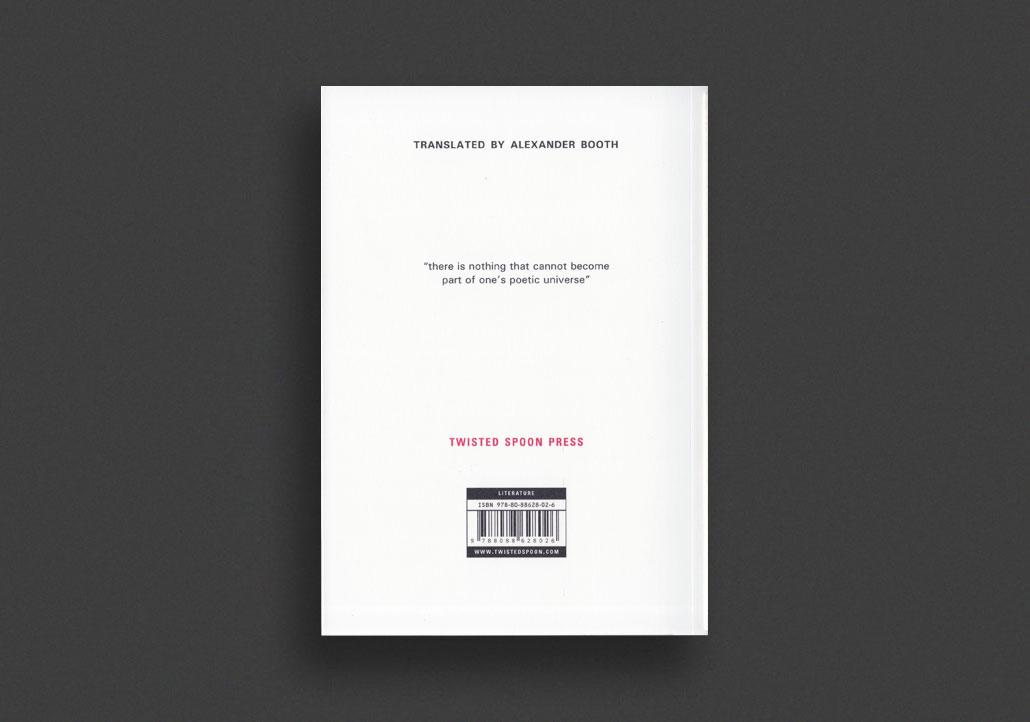
An inveterate experimenter with image and text and music, Gerhard Rühm is truly one of the major figures of the postwar European avant-garde. Yet reprehensibly little of his work has appeared in English. This edition brings together a selection of his work spanning the past seven decades, displaying a wide thematic range (as he has remarked, “there is nothing that cannot become part of one’s poetic universe”) and ingenious combinations of music, pornography, banality, humor, and mythology. The first section comprises “mini dramas,” the text often combined with images and musical notation to create sensorial episodes, the expression of a singular aesthetic perception. The second section is a wry deconstruction of Grillparzer’s play Hero and Leander that juxtaposes original passages with images from a swimming manual and with a more contemporary erotic retelling of the mythological tale. The final section presents 24 short prose pieces: 12 from the early 1950s and 12 from the past few years.
Recipient of the Austrian State Prize in 1991 and the America Award in Literature in 2022
I very much enjoyed Gerhard Rühm’s Cake & Prostheses (in translation by Alexander Booth) — sexy, surreal, silly, and profound. Lovely little thought experiments and longer meditations into the weird.—Biblioklept
Rühm has remained a radical experimenter, a restless explorer of traditions and genres, atomizing their elements in order to recompose them with conceptual precision and a multiplicity of compositional techniques.—Rosmarie Waldrop
Actionist word creator, anarchic alliterator, solid scholar and theoretician, composer, graphic artist, collagist, syllable-juggler, concrete poet, word sculptor, chronicler of the Vienna Group, and Trotskyite permanent revolutionary.—Ruth Rybarski, Profil
translated from the German by Alexander Booth
2024, English
Softcover, 400 pages, 25.0 x 18.5 cm
Published by
Hatje Cantz / Berlin
$130.00 - Out of stock
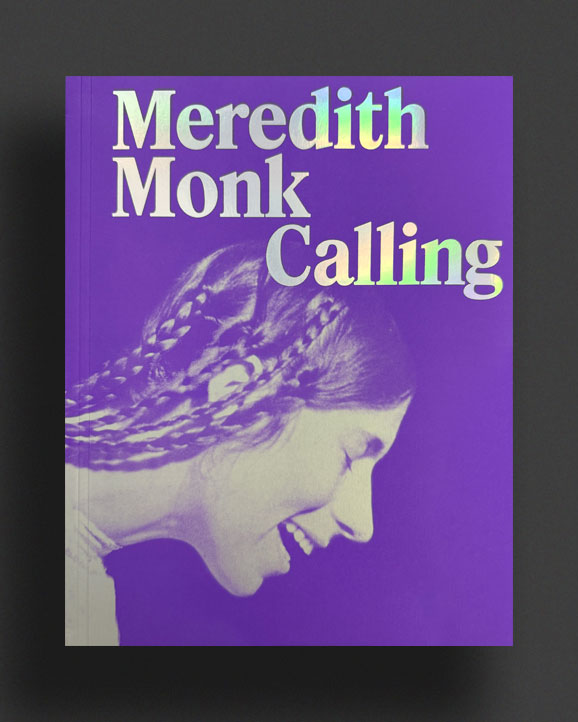
The first visual book on the massively influential musician and interdisciplinary artist whose six-decade oeuvre unites music, movement and art.
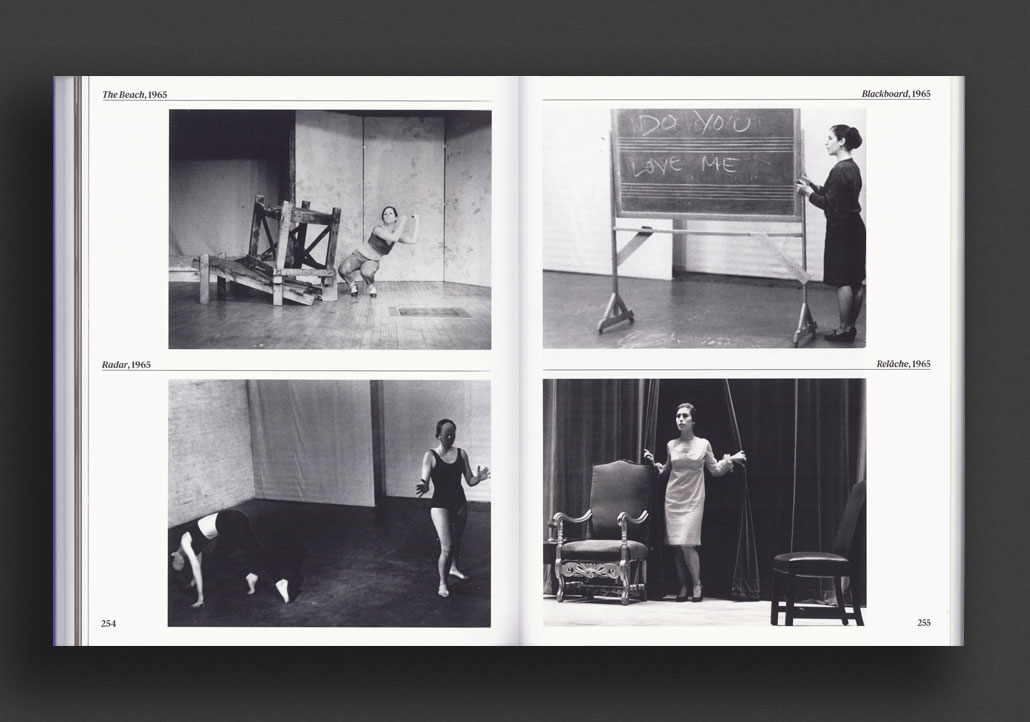
Composer, performer, director, vocalist, filmmaker and choreographer, Meredith Monk has united music, theater and dance to forge a new creative idiom exploring the human voice as instrument that has proved enormously influential for musicians and artists from Bruce Nauman and Terry Riley to Björk and John Zorn. Since the 1960s, she has created performances at the Guggenheim Museum rotunda (the first artist to do so), performed in public car parks and on opera stages, and recorded numerous acclaimed albums with ECM. Her music has been used in films by Jean-Luc Godard (Nouvelle Vague), the Coen Brothers (The Big Lebowski) and David Byrne (True Stories), and she has directed two films (Ellis Island and Book of Days).
This catalog is the first overview of her work, featuring previously unpublished archival material, scores, notations, drawings and photographs, as well as an insightful conversation with Monk and essays by acclaimed writers and curators such as Andrea Lissoni, Rick Moody, Timothy Morton, Teresa Retzer, Beatrix Ruf, Anna Schneider, Adam Shatz and Louise Steinman.
Meredith Monk (born 1942) was born in New York City, where she still lives. She began to explore the spectrum of the human voice through abstract vocal expression in the early 1960s, and developed what became known as "extended vocal technique" in numerous solo performances, using a three-octave range. In 1968 she founded The House to promote interdisciplinary performance, and 10 years later founded the Meredith Monk & Vocal Ensemble. In 2015, Monk was awarded the National Medal of Arts by Barack Obama.
2008, English
Hardcover (w. dust jacket), 400 pages, 31.5 x 24 cm
1st Edition, Out of print title / used / fine
Published by
Rizzoli / New York
$350.00 - In stock -
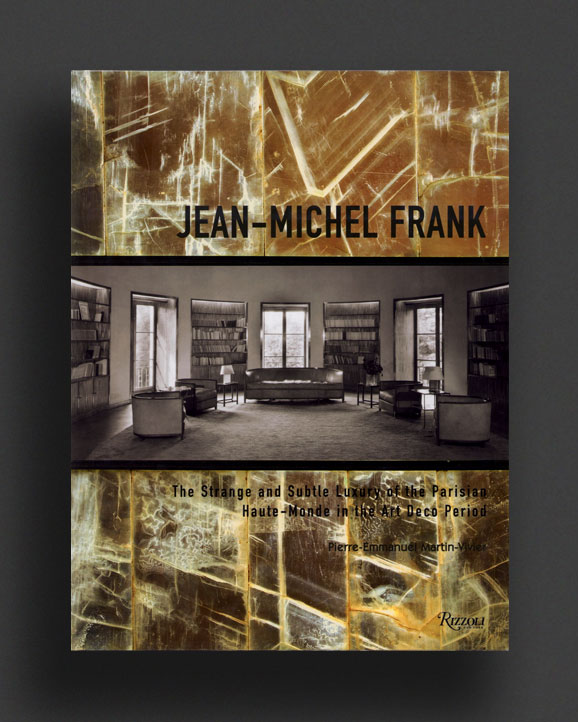
Rare first English hardcover edition of the immediately out-of-print, immediately collectible and invaluable monograph on visionary modern French designer Jean-Michel Frank, published by Rizzoli in 2008 after he original French edition by Norma in 2006. A beautifully printed hardcover book in original publisher's illustrated dust-jacket, profusely and lavishly illustrated in colour and b/w with hundreds of photographs including vintage shots of room settings and individual pieces. Preface by Bruno Foucart. Foreword by Alice Frank. Bibliography.
This monograph, now very scarce in English, examines both his life and work as a furniture and interior designer, and remains the key work on Frank.
"I wish one could more often see artists collaborating in arranging houses," said Frank, who admired the sets masterminded by the ballet impresario Sergey Diaghilev in conjunction with Picasso, Braque, Derain and Matisse. "The result would be, at the very least, something of our time, and alive."
Jean-Michel Frank (1895–1941) was perhaps the most influential Parisian designer and decorator of the 1930s and 1940s, a refugee desolated by the Nazi occupation of France who had a short and tragic life which ended in suicide in 1941. Frank established his reputation and signature look with his 1926–27 design for Marie-Laure and Charles de Noailles's hôtel particulier at 11 place des Etats-Unis in Paris. Man Ray's black-and-white images of the salon have become shorthand for le style Frank. The Noailles were leading progressives of their day and patrons of the major painters of Paris. Frank's style of understated luxury, vellum-sheathed walls, bleached leather, lacquer, quartz and shagreen perfectly complemented the Picassos and Braques on the walls. He collaborated with the artist Christian Bérard, the brothers Alberto and Diego Giacometti, Dali, and the architect-designer Emilio Terry. Frank's blocky, rectangular club chairs and sofas have been endlessly copied and produced by many admirers. He is credited for the design of the modern Parsons table, a stark form that Frank embellished with the most luxurious finish. His style continues to exert its influence through the powerful combination of the simplest forms and the most exquisite materials to produce objects that are truly noble and utterly modern. This book is a testimony to Frank's rigour and the timelessness of his design.
Pierre-Emmanuel Martin-Vivier is a noted art historian based in Paris whose specialty is twentieth-century applied arts. He is a frequent contributor to leading French publications including Connaissance des arts and Maison francaise.
Near Fine copy.
2002, English
Softcover (staple-bound), 96 pages, 17 x 25 cm
1st Edition, Out of print title / used / very good
Published by
Purple Books / Paris
Fiction Inc. / Tokyo
$200.00 - Out of stock
First and only edition of Purple Stars, a collection of portraits and fashion photographs of the stars of Purple magazine during those early definitive years of 90's anti-fashion and the establishment of one of the most important fashion magazines of our generation. Edited by Makoto Ohrui, Elein Fleiss and Oliver Zahm and published in Japan in 2002 by Purple Books & Fiction Inc, Purple Stars features the photography of Mark Borthwick, Juergen Teller, Camille Vivier, Wolfgang Tillmans, Laetitia Benat, Anders Edström, Takashi Homma, Jack Pierson, Anuschka Blommers & Niels Schumm, Richard Prince, Giasco Bertoli, Alex Antitch, Patterson Beckwith, Terry Richardson, Henry Roy, Vanina Sorrenti, Chikashi Suzuki, Mauricio Guillen, Marcelo Krasilcic, Serge Leblon, Armin Linke... with photographs of Hélène Fillières, Catherine Deneuve, Jutta Koether, Lou Doillon, Kim Gordon, Harmony Korine, Alex Bag, Kate Moss, Rita Ackermann, Colin de Land, Chloë Sevigny, Brad Pitt, Charlotte Rampling, Ludivine Sagnier, Camille Vivier, Cerith Wyn Evens, Yoshimi, Yukinori Maeda, Alexandra Bircken, Lizzie Bougatsos, Maurizio Cattelan, Susan Cianciolo, Elein Fleiss, Marieke Stolk, and many more.
A now very scarce compendium of some of the most iconic photographic images direct from the early pages of Purple.
Very Good copy, lacking glassine dust wrapper.
2003, English
Softcover, 418 pages, 27.5 x 21 cm
1st Edition, Out of print title / used / very good
Published by
Purple Institute / Paris
$220.00 - Out of stock
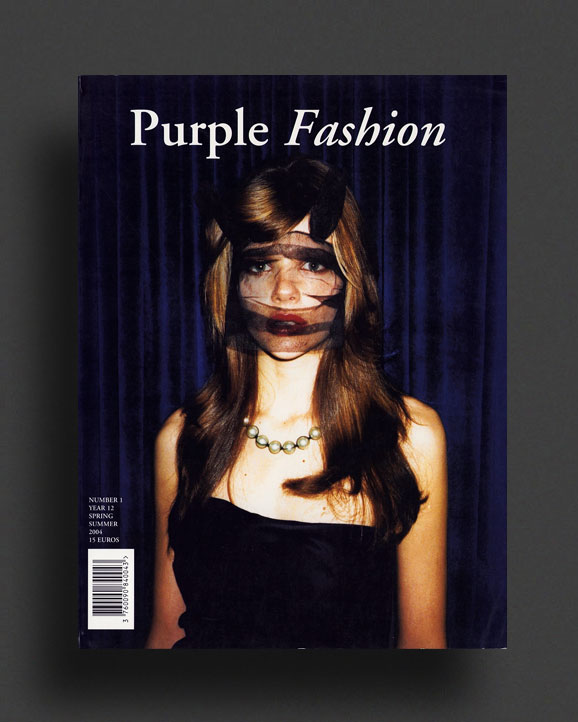
A very rare copy of the inaugural issue of Purple Fashion, edited by Olivier Zahm, featuring Richard Prince, Bruce Benderson, Gary Indiana, Paolo Roversi, Olivier Mosset, Camille Vivier, Mark Borthwick, Pierre Bailly, Elein Fleiss, Viviane Sassen, Helmut Lang, Kerry Hallihan, Antek Walczak, Marcelo Krasilcic, Michael Lonsdale, Maison Martin Margiela, Katja Rahlwes, Niels Schumm, Dike Blair, Vava Ribeiro, Monte Hellman, Comme des Garçons, Slavoj Zizek, Balenciaga, Tony Alva, Marina Faust, Wolfgang Tillmans, Terry Richardson, Dominique Gonzales Foerster, Jeff Rian, Noritoshi Hirakawa, Anuschka Blommers, François Laruelle, Yan Céh, Issey Miyake, Rick Owens, Susan Eldridge, John Galliano, Ann Demeuelemeester, Vava Ribeiro, Serge Leblon, Hiromix, Cecile Bortoletti, Vanessa Bruno, Takashi Suzuki, Miltos Manetas, Pascale Gatzen, Stéphanie Moisdon, Junya Watanabe, Ferdinand Gouzon, and many more...
In 1992, Elein Fleiss and Olivier Zahm started the magazine Purple Prose as a reaction against the superficial glamour of the 1980s; much as a part of the global counterculture at the time, inspired by magazines like Interview, Ray Gun, Nova, and Helmut Newton's Illustrated, but with the aesthetics of what usually is referred to as anti-fashion. Based on their personal interests and views; Purple was, and in a sense still is, made much in the same spirit of the fanzine. Started "without any means, and without any experience, because we wanted to make a magazine that was radically different. We wanted to support the artists around us that no one else supported, much less talked about."—Olivier Zahm. The magazine became associated with the "realism" of the new fashion photography of the 1990s, with names like Juergen Teller, Terry Richardson, Wolfgang Tillmans, Mark Borthwick, Corinne Day, and Mario Sorrenti. Soon after the birth of Purple Prose, Zahm and Fleiss created spin-off publications such as les cahiers purple, Purple Sexe, Purple Fiction, and of course, Purple Fashion, in which Zahm aimed at fusing together his two worlds, fashion and art. Now one of the most iconic and influential fashion magazines in history.
Very Good copy, some light wear to spine and extremities.