World Food Books' programme is largely produced on Kulin Nation land. We acknowledge the Wurundjeri people of the Kulin Nation as the first and continuing custodians of this land, and pay respect to their Elders past, present, and emerging.
World Food Books is an arts and special interests bookshop in Naarm / Melbourne. Founded in 2010, World Food Books is devoted to the presentation of a rotating, hand-selection of international art, design, literary and counterculture publications with an emphasis on the anti-traditional, the experimental, the avant-garde, the heretic, the marginal.
Presenting new titles alongside rare and out-of-print books, catalogues and journals spanning the fields of modern and contemporary art, design, photography, illustration, film, literature, poetry, cultural theory, philosophy, sexuality, popular and underground culture in its many radical forms, World Food Books wishes to encourage adventurous, thoughtful and open-minded reading, looking, writing, and exchange of publishing and ideas, both current and historical.
As well as our bookshop, located in Melbourne's historical Nicholas Building, all of our inventory is available internationally via our online mail-order service.
World Food Books semi-regularly co-ordinates "Occasions", a programme of exhibits and events at the bookshop and in partnership with other hosts (such as museums and art galleries) that develop out of the activities, relationships and content of the bookshop itself.
World Food Books
The Nicholas Building
37 Swanston Street
Room 5, Level 6
Melbourne 3000
Australia
SHOP HOURS:
Thu–Fri 12–6, Sat 12–5
WEB-SHOP OPEN 24/7
World Food Books
Postal Address:
PO Box 435
Flinders Lane
Victoria 8009
Australia
Art
Theory / Essay
Architecture / Interior
Graphic Design / Typography
Photography
Fashion
Eros
LGBTQ+
Fiction / Poetry
Weird / Speculative / Science Fiction / Horror
Transgressive / Visceral / Abject
Symbolism / Decadence / Fin de siècle
Film / Video
Painting
Sculpture / Installation
Performance / Dance / Theater
Drawing
Sound / Music
Curatorial
Group Shows / Collections
Periodicals
Out-of-print / Rare
Posters / Ephemera / Discs
Signed Books
World Food Books Gift Voucher
World Food Book Bag
Australian Art
Australian Fiction
Australian Science Fiction / Speculative Fiction
Australian Poetry
Australian Photography
Japanese Photography
Conceptual Art
Minimal Art
Dada
'Pataphysics / Oulipo
Fluxus
Concrete Poetry
Pop Art
Surrealism
Arte Povera
Arte Informale / Haute Pâte / Tachism
Nouveau Réalisme / Zero / Kinetic
Situationism / Lettrism
Collage / Mail Art / Xerox Art
Art Brut / Folk / Visionary / Fantastic
Illustration / Graphic Art / Bandes Dessinées
Furniture
Italian Radical Design / Postmodernism
Textiles
Ceramics / Glass
Counterculture
Protest / Revolt
Philosophy
Psychoanalysis
Anthropology
Anarchism
Socialism / Anarchism / Communism / Capitalism
Literary Theory / Semiotics / Language
Feminism / Women's Studies
Gender Studies / Sexuality
Anthropology
Fetishism / BDSM
Drugs / Psychedelia
Crime / Violence
Animal Rights / Veganism
Occult / Esoterica
Ecology / Earth / Alternative Living
Whole Earth / Crafts
All prices in AUD (Australian dollars)
Pick-Ups
Pick-up orders can be collected in our bookshop during opening hours after order date. Please collect any Pick-up orders within 2 weeks of ordering as we have limited storage space. Orders will be released back into stock if not collected within this time. No refunds can be made for pick-ups left un-collected. If you cannot make it in to the bookshop in this time-frame, please choose postage option.
Return Policy
All sales are final. We do accept returns (for refund or exchange) for items received in error. All our orders are packed with special care using heavy-duty padding and cardboard book-mailers or bubble mailers (for smaller books), using reinforcement where required. We cannot take responsibility for any lost, stolen or damaged parcels.
Insurance
Should you wish to insure your package, please email us directly after placing your order and we can organise this at a small extra expense. Although all standard/express tracked packages are very safe and dependable, we cannot take responsibility for any lost, stolen or damaged parcels. We recommend insurance on valuable orders.
Interested in selling your old books, catalogues, journals, magazines, comics, fanzines, ephemera? We are always looking for interesting, unusual and out-of-print books to buy. We only buy books in our fields of interest and specialty, and that we feel we can resell.
We base these prices on desirability, market value, in-print prices, condition and our current stock levels. We offer cash, store credit, and can take stock on consignment. All
about 25% of the price we expect to get when we sell them, or 30% in store credit. We base these prices on desirability, market value, in-print prices, condition and our current stock levels.
Sell your books any day of the week. You can drop them off and return later. If you have a lot of books, we can visit your Sydney home.
We buy books that we feel we can resell. We offer about 25 % of the price we expect to get when we sell them, or 30% in store credit. We base these prices on desirability, market value, in-print prices, condition and our current stock levels.
Philadelphia Wireman
03 August - 01 September, 2018
World Food Books is proud to announce our next Occasion, the first presentation of sculptures by Philadelphia Wireman in Australia.
The Philadelphia Wireman sculptures were found abandoned in an alley off Philadelphia’s South Street on trash night in 1982. Their discovery in a rapidly-changing neighbourhood undergoing extensive renovation, compounded with the failure of all attempts to locate the artist, suggests that the works may have been discarded after the maker’s death. Dubbed the "Philadelphia Wireman" during the first exhibition of this work, in 1985, the maker’s name, age, ethnicity, and even gender remain uncertain. The entire collection totals approximately 1200 pieces, all intricately bound together with tightly-wound heavy-gauge wire (along with a few small, abstract marker drawings, reminiscent both of Mark Tobey and J.B. Murry). The dense construction of the work, despite a modest range of scale and materials, is singularly obsessive and disciplined in design: a wire armature or exoskeleton firmly binds a bricolage of found objects including plastic, glass, food packaging, umbrella parts, tape, rubber, batteries, pens, leather, reflectors, nuts and bolts, nails, foil, coins, toys, watches, eyeglasses, tools, and jewellery.
Heavy with associations—anthropomorphic, zoomorphic, and socio-cultural responses to wrapped detritus—the totemic sculptures by Philadelphia Wireman have been discussed in the context of work created to fulfil the shamanistic needs of alternative religions in American culture. Curators, collectors, and critics have variously compared certain pieces to sculpture from Classical antiquity, Native American medicine bundles, African-American memory jugs, and African fetish objects. Reflecting the artist’s prolific and incredibly focused scavenging impulse, and despite—or perhaps enhanced by—their anonymity, these enigmatic objects function as urban artefacts and arbiters of power, though their origin and purpose is unknown. Philadelphia Wireman, whatever their identity, possessed an astonishing ability to isolate and communicate the concepts of power and energy through the selection and transformation of ordinary materials. Over the course of the past two decades, this collection has come to be regarded as an important discovery in the field of self-taught art and vernacular art.
Presented in collaboration with Fleisher-Ollman Gallery, Philadelphia, and Robert Heald, Wellington.
Susan Te Kahurangi King
02 February - 10 March, 2018
Susan Te Kahurangi King (24 February 1951 - ) has been a confident and prolific artist since she was a young child, drawing with readily available materials - pencils, ballpoint pens and felt-tip markers, on whatever paper is at hand. Between the ages of four and six Susan slowly ceased verbal communication. Her grandparents William and Myrtle Murphy had developed a special bond with Susan so they took on caring responsibilities for extended periods. Myrtle began informally archiving her work, carefully collecting and storing the drawings and compiling scrapbooks. No drawing was insignificant; every scrap of paper was kept. The King family are now the custodians of a vast collection containing over 7000 individual works, from tiny scraps of paper through to 5 meter long rolls.
The scrapbooks and diaries reveal Myrtle to be a woman of great patience and compassion, seeking to understand a child who was not always behaving as expected. She encouraged Susan to be observant, to explore her environment and absorb all the sights and sounds. Myrtle would show Susan’s drawings to friends and people in her community that she had dealings with, such as shopkeepers and postal workers, but this was not simply a case of a grandmother’s bias. She recognised that Susan had developed a sophisticated and unique visual language and sincerely believed that her art deserved serious attention.
This was an unorthodox attitude for the time. To provide some context, Jean Dubuffet coined the term Art Brut in 1945 to describe work created by self-taught artists – specifically residents of psychiatric institutions and those he considered to be visionaries or eccentrics. In 1972 Roger Cardinal extended this concept by adopting the term Outsider Art to describe work made by non-academically trained artists operating outside of mainstream art networks through choice or circumstance. Susan was born in Te Aroha, New Zealand in 1951, far from the artistic hubs of Paris and London that Dubuffet and Cardinal operated in. That Myrtle fêted Susan as a self-taught artist who deserved to be taken seriously shows how progressive her attitudes were.
Susan’s parents Doug and Dawn were also progressive. Over the years they had consulted numerous health practitioners about Susan’s condition, as the medical establishment could not provide an explanation as to why she had lapsed into silence. Dawn educated herself in the field of homeopathy and went on to treat all twelve of her children using these principles – basing prescriptions on her observations of their physical, mental and emotional state.
Doug was a linguist with an interest in philosophy who devoted what little spare time he had to studying Maori language and culture. To some extent their willingness to explore the fringes of the mainstream made them outsiders too but it was their commitment to living with integrity and their respect for individuality that ensured Susan’s creativity was always encouraged.
Even though Susan’s family supported her artistic pursuits, some staff in schools and hospitals saw it as an impediment to her assimilation into the community and discouraged it in a variety of ways. Her family was not always aware of this and therefore did not fully understand why Susan stopped drawing in the early 1990s. However, rather than dwell on the challenges that Susan faced in pursuit of her artistic practice, they prefer to highlight her achievements. In 2008 Susan began drawing again in earnest, after an almost 20 year interruption, and her work is now shown in galleries around the world.
Susan grew up without television and has been heavily influenced by the comics she read as a child. She is absolutely fearless in the appropriation of recognizable characters, such as Donald Duck and Mickey Mouse, in her work. She twists their limbs, contorts their faces, compresses them together, blends them into complex patterned backgrounds - always imbuing them with an incredible energy. Although Susan often used pop culture characters in her work they are not naive or childlike. These are drawings by a brilliant self-taught artist who has been creating exceptional work for decades without an audience in mind.
Mladen Stilinović
"Various Works 1986 - 1999"
02 February 16 - September 10, 2016
Various works 1986 - 1999, from two houses, from the collections of John Nixon, Sue Cramer, Kerrie Poliness, Peter Haffenden and Phoebe Haffenden.
Including: Geometry of Cakes (various shelves), 1993; Poor People’s Law (black and white plate), 1993; White Absence (glasses, ruler, set square, silver spoon, silver ladel with skin photograph and wooden cubes), 1990-1996; Exploitation of the Dead (grey and red star painting, wooden painting, black spoon with red table, red plate), 1984-1990; Money and Zeros (zero tie, paintings made for friends in Australia (Sue, John, Kerrie), numbers painting), 1991-1992; Words - Slogans (various t-shirts) - “they talk about the death of art...help! someone is trying to kill me”, “my sweet little lamb”, “work is a disease - Karl Marx”; Various artist books, catalogues, monographs, videos; Poster from exhibition Insulting Anarchy; "Circular" Croatian - Australian edition; Artist book by Vlado Martek (Dostoyevsky); more.
Thanks to Mladen Stilinović and Branka Stipančić.
Jonathan Walker
Always Will Need To Wear Winter Shirt Blue + Ochre Small Check Pattern
21 August - 21 September, 2015
Untitled
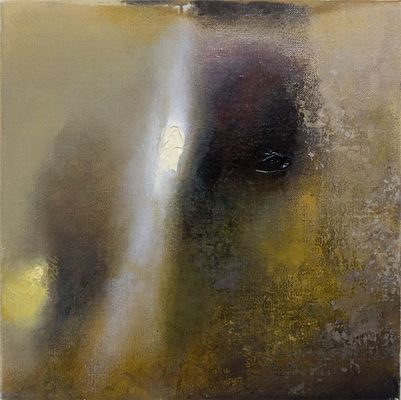
I am not a great reader of poetry but I always return to the work of Melbourne poet, Vincent Buckley (1925- 1988). Perhaps I find his most tantalising piece to be not a finished poem but a fragment left on a scrap of paper discovered on his desk after the poet’s death.
The poetry gathers like oil
In the word-core, and spreads
It has its music meet,
Its music is in movement.
This fragment is more the shell left behind from a volatile thought than a finished poem. I find the last two lines honest but awkward whereas the first two lines work like an arrow. Most likely he could not find a resolution so it was left. Still, in its present form, it remains an eloquent testimony to the ultimate failure of a medium to express mobile thought and sensation, in Buckley’s case, through verbal language. It’s an important matter because this is something all artists have to deal with regardless of the medium.
I have never written a poem, however, I am forever copying fragments from books on paper scraps in a vain effort to fix certain notions in my head. At first, they function as bookmarks that are sometimes returned to when I open the book. But before long, as they accumulate, they fall out littering the table interspersed with A4 photocopies, bills, books and medications.
To return to Buckley’s fragment, the first two lines very much evoke how I paint nowadays. As you age, detail diminishes and patches of light become more luminous and float. I feel the most honest way of dealing with this is by smearing the oil paint on the canvas with the fingers and working close-up, blind. Only if the patches coalesce into an approaching image can the work gain a life.
-
Jonathan Walker was born in Melbourne, Australia and brought up on a dairy farm in Gippsland. In the 1970’s he studied painting at RMIT and won the Harold Wright Scholarship to the British Museum, London. During the 1980’s he exhibited at Pinacotheca Gallery, Richmond and had work shown at the NGV and Heidi City Art Gallery. Over the same period he designed the cover for the “Epigenesi” LP by Giancarlo Toniutti, Italy and conducted a mail exchange work with Achim Wollscheid, Germany. The work with artists through the post resulted in an article published in the bicentenary issue of Art and Australia 1988. He showed in artist run spaces such as WestSpace in the 90’s and 2000’s, and until 2012, taught painting at Victoria University, which is where we (Colleen Ahern and Lisa Radford) as organisers of the exhibition, among many others, had the privilege of being his student.
Walker’s knowledge was imparted to students through the careful selection of music, literature, and artists found in books that he himself had ordered for the library. Walker’s strategy was the generosity of sharing his vast knowledge with references specific to each student and their context.
Walker’s paintings share a similar focus and intimacy.
This exhibition presents a small selection of recent paintings alongside a publication that includes Walker’s writing. Observational and analytical, Walker’s work is a type of material notation — the time of day, colour and how it is blended, the both specific and fleeting location of a reflection on lino or the question of whether a chair leg should be included in a painting.
Please join us on Friday August 21 between 6-8pm to celebrate the opening of the exhibition.
Curated by Colleen Ahern and Lisa Radford.
B. Wurtz
Curated by Nic Tammens
March 26 - April 4, 2015
B.Wurtz works from a basement studio in his home on Manhattan’s Lower East Side.
This local fact is attested to by the plastic shopping bags and newsprint circulars that appear in his work. As formal objects, they don’t make loud claims about their origins but nonetheless transmit street addresses and places of business from the bottom of this long thin island. Like plenty of artists, Wurtz is affected by what is local and what is consumed. His work is underpinned by this ethic. It often speaks from a neighborhood or reads like the contents of a hamper:
“BLACK PLUMS $1.29 lb.”
“Food Bazaar”
“USDA Whole Pork Shoulder Picnic 99c lb.”
“RITE AID Pharmacy, with us it’s personal.”
“H. Brickman & Sons.”
“Sweet Yams 59c lb."
Most of the work in this exhibition was made while the artist was in residence at Dieu Donne, a workshop dedicated to paper craft in Midtown. Here Wurtz fabricated assemblages with paper and objects that are relatively lightweight, with the intention that they would be easily transportable to Australia. This consideration isn’t absolute in Wurtz’s work, but was prescriptive for making the current exhibition light and cheap. Packed in two boxes, these works were sent from a USPS post office on the Lower East Side and delivered to North Melbourne by Australia Post.
Wurtz appears courtesy of Metro Pictures, New York.
Thanks to Rob Halverson, Joshua Petherick, Sari de Mallory, Matt Hinkley, Helen Johnson, Fayen d'Evie, Ask Kilmartin, Lisa Radon, Ellena Savage, Yale Union, and "Elizabeth".
John Nixon
"Archive"
December 15 - January 20, 2014
The presentation of John Nixon's archive offered a rare showcase of this extensive collection of the artist's own publications, catalogues, posters, ephemera, editions and more, from the mid 1980s onwards, alongside a selection of his artworks.
Organized by John Nixon, Joshua Petherick and Matt Hinkley.
<a href=http://wfb.public-office.info/artist/john-nixon>All titles by John Nixon
"Habitat"
at Minerva, Sydney (organised by Joshua Petherick and Matt Hinkley)
November 15 - December 20, 2014
Lupo Borgonovo, Janet Burchill & Jennifer McCamley,
Lewis Fidock, HR Giger, Piero Gilardi, Veit Laurent Kurz,
Cinzia Ruggeri, Michael E. Smith, Lucie Stahl, Daniel Weil, Wols
Press Release:
“...It contained seven objects. The slender fluted bone, surely formed for flight, surely from the wing of some large bird. Three archaic circuitboards, faced with mazes of gold. A smooth white sphere of baked clay. An age-blackened fragment of lace. A fingerlength segment of what she assumed was bone from a human wrist, grayish white, inset smoothly with the silicon shaft of a small instrument that must once have ridden flush with the surface of the skin - but the thing’s face was seared and blackened.”
William Gibson, “Count Zero”, 1986
"Autumn Projects Archive"
Curated by Liza Vasiliou
March 6 - March 15, 2014
World Food Books, in conjunction with the Virgin Australia Melbourne Fashion Festival 2014, presented the Autumn Projects archive, consisting of a selection of early examples in Australian fashion with a particular interest in collecting designers and labels from the period beginning in the 1980’s, who significantly influenced the discourse of Australian Fashion.
Curated by Liza Vasiliou, the exhibition provided a unique opportunity to view pieces by designers Anthea Crawford, Barbara Vandenberg, Geoff Liddell and labels CR Australia, Covers, Jag along with early experimental collage pieces by Prue Acton and Sally Browne’s ‘Fragments’ collection, suspended throughout the functioning World Food Books shop in Melbourne.
H.B. Peace
presented by CENTRE FOR STYLE
November 14, 2013
"Hey Blinky, you say chic, I say same"
Anon 2013
H.B. Peace is a clothing collaboration between great friends Blake Barns and Hugh Egan Westland. Their pieces explore the divergences between 'character’ and ‘personality’ in garments....etc
Special Thanks to Joshua Petherick and Matt Hinkley of WFB and Gillian Mears
and a Very Special Thank you to Audrey Thomas Hayes for her shoe collaboration.
Janet Burchill & Jennifer McCamley
"Aesthetic Suicide"
May 10 - June 8, 2013
The first of our occasional exhibitions in the World Food Books office/shop space in Melbourne, "Aesthetic Suicide" presented a body of new and older works together by artists Janet Burchill & Jennifer McCamley, including videos, prints, a wall work, and publications.
During shop open hours videos played every hour, on the hour.
1969, French
Hardcover (w. dust jacket), 92 pages, 20 x 19 cm
1st Edition, Out of print title / used / very good
Published by
Jean-Jacques Pauvert / Paris
$70.00 - Out of stock
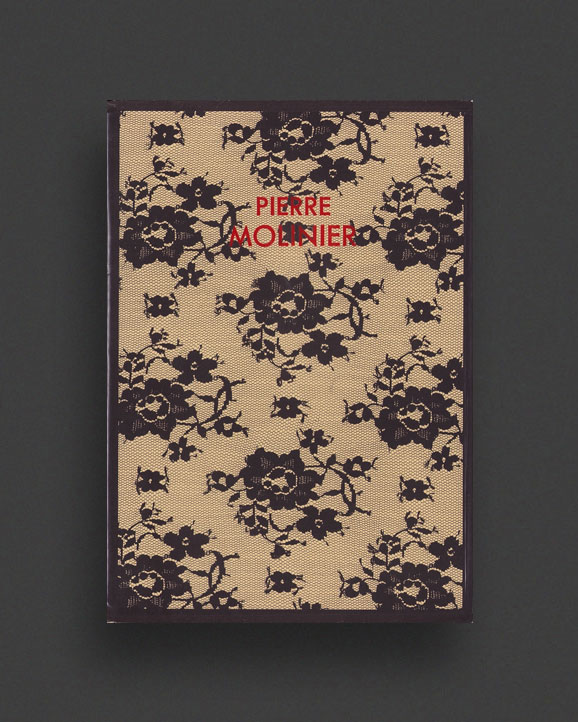
Excellent copy of the first monograph ever published on the work of Pierre Molinier, published by the great Jean-Jacques Pauvert in Paris, 1969. The only book published on his work while Molinier was alive. Profusely illustrated throughout in colour and b/w with Molinier's fetishistic gender-bending paintings, photomontages, drawings, and much more. Features texts by Andre Breton and Emmanuelle Arsan, also bibliography and biography. Texts in French.
Pierre Molinier (1900—1976) was a French painter, photographer and a forerunner of gender performance art and Body Art (Art corporel). Molinier spent much of his artistic life working in isolation in Bordeaux, exiled from local and national art scenes. Born in Agen, nothing had predestined Molinier to a life as an artist. Self-taught, from a working-class background, he followed in his father’s footsteps and started out as a house painter. He got married and had two children. Tired of his infidelities and provocative behaviour, his wife left their marital home an in 1950 and Molinier begun photographing himself seriously, staging his own death and erecting a fake gravestone proudly declaring himself ‘a man without morals’. He was thrown out of the Bordeaux Salon des Indépendants as early as 1951 amidst controversy over his orgiastic painting of the same year, Le Grand Combat. Stirring up an obsessive correspondence with the anarchic poet-founder of Surrealism, André Breton, Molinier was soon integrated into the Surrealist group with a solo exhibition at Breton’s Paris gallery in 1956. Molinier’s anti-moral project appealed to the group’s interest in repressed desires, fetishism, and the transgression of bourgeois morals. In 1959, he exhibited at the Exposition International du Surrealism in Paris. From the mid-1960s Molinier chronicled the exploration of his subconscious transsexual desires in "Cent Photographies Erotiques": graphically detailed images of pain and pleasure. Cut-up, reassembled, and manipulated, Molinier painstakingly created elaborate and sensual photomontages in which he assumed the roles of dominatrix and succuba previously taken by the women of his paintings. Either alone with doll-like mannequins or with female models such as German sadomasochist Hanel Koeck, Molinier, who considered himself fundamentally androgynous, appears as a transvestite, employing his body and that of his acquaintances to create visions of hybrid identity, where stockinged multi-limbed, multi-sexed beings imitate pagan figures, Hindu gods, and Masonic symbols, in a rejection of a Christian tradition which he argued, had repressed androgyny. Designed to shock, Molinier’s artwork represented a very intimate disclosure about his own sexual ambiguity, inviting the viewer to bring to the images his or her own response of excitement or disgust. The degree of his artistic perversity and blasphemous tendencies was deemed too much for the French cultural elite, and the man Breton dubbed the “magician of erotic art” was shunned from the art world. Molinier did not participate in the 1965 International Surrealist Exhibition. For the last 11 years of his life Molinier played out his own most profound moments in the 'theatre' of his Bordeaux 'boudoir – atelier'. He committed suicide in 1976, shooting himself with a pistol, something he had foreshadowed in his artwork, time and again. Essentially a leg fetishist, but also considering himself as a shaman, facetious and provocative, anti-bourgeois and anti-religious, Molinier enjoyed transgressing gender identification : his outstanding photographs greatly influenced the European and North American Body Art in the 1970s and continue to fascinate artists today.
Very Good copy in VG dust jacket, preserved under mylar wrap.
1997, Japanese
Softcover (w. dust jacket + obi), 192 pages, 15 x 23 cm
1st Edition, Out of print title / used / very good
Published by
Heibonsha / Tokyo
$130.00 - In stock -
First edition of one of the finest of Araki's photo books, dedicated entirely to his incredible Erotos series. Published as part of the Complete Works collection, in this work, controversial and legendary Japanese photographer Nobuyoshi Araki makes a radical departure from his usual portraits and cityscapes. A collection of arrestingly primal close-ups of parts of the body as well as various objects—pipes, fruit, wet sidewalks, flowers, snails—Erotos delves deep into the erotic subconscious. Reproduced in gorgeous glossy duotone and bound in the original jacket and publisher's obi-strip (not pictured). One our favourite bodies of work by Araki.
Nobuyoshi Araki was born in Tokyo in 1940. Given a camera by his father at the ripe age of twelve, Araki has been taking pictures ever since. He studied photography and film at Chiba University and went into commercial photography soon after graduating. In 1970 he created his famous Xeroxed Photo Albums, which he produced in limited editions and sent to friends, art critics, and people selected randomly from the telephone book. Over the years, his bold, unabashed photographs of his private life have been the object of a great deal of controversy and censorship (especially in his native Japan), a fact that has not fazed the artist nor diminished his influence. To date, Araki has published over 400 books of his work.
Very Good in VG dust jacket and obi. Sample image.
2016, English
Softcover, 118 pages, 20.5 x 12.7 cm
Published by
Blue Sky Press / Texas
$39.00 - Out of stock
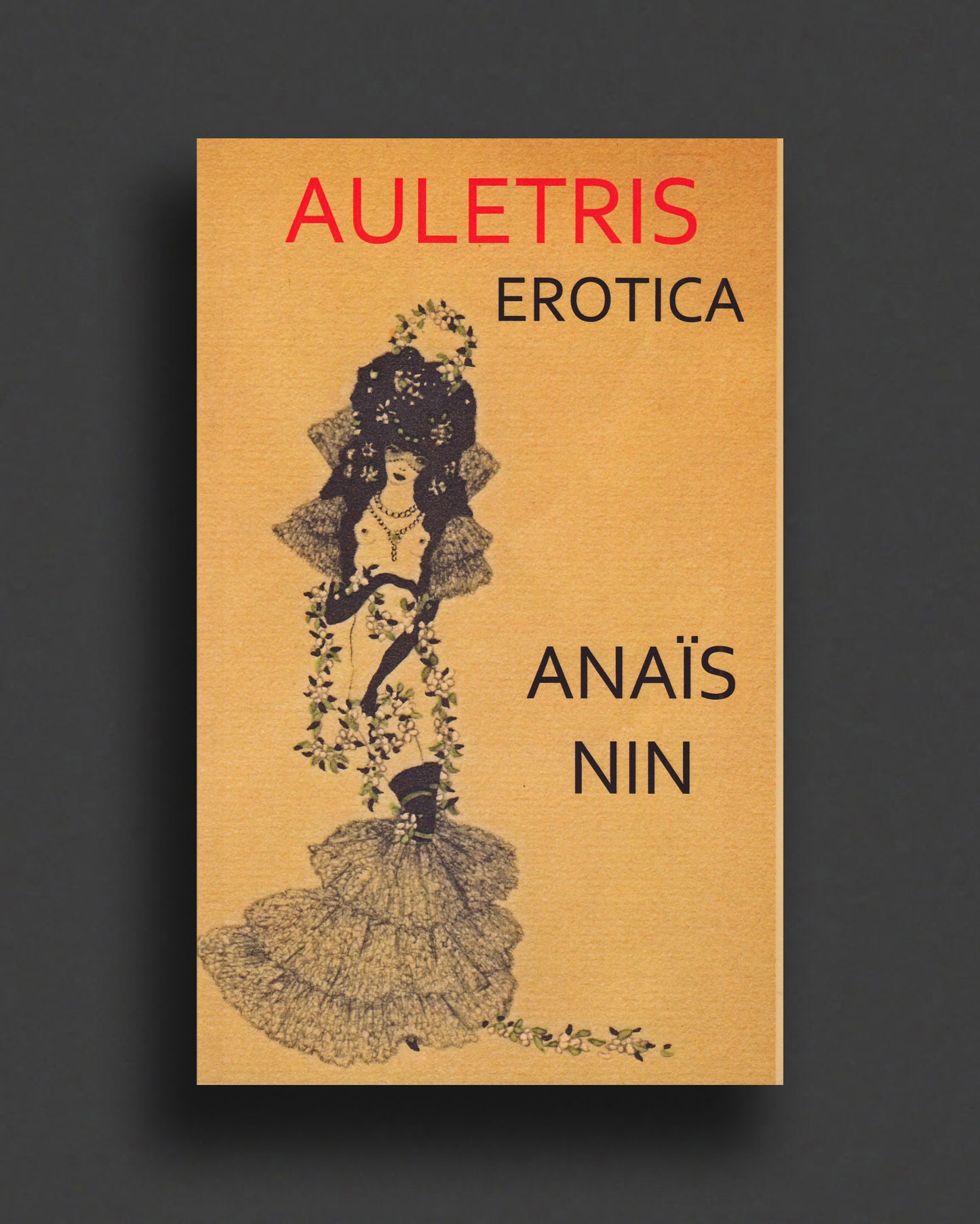
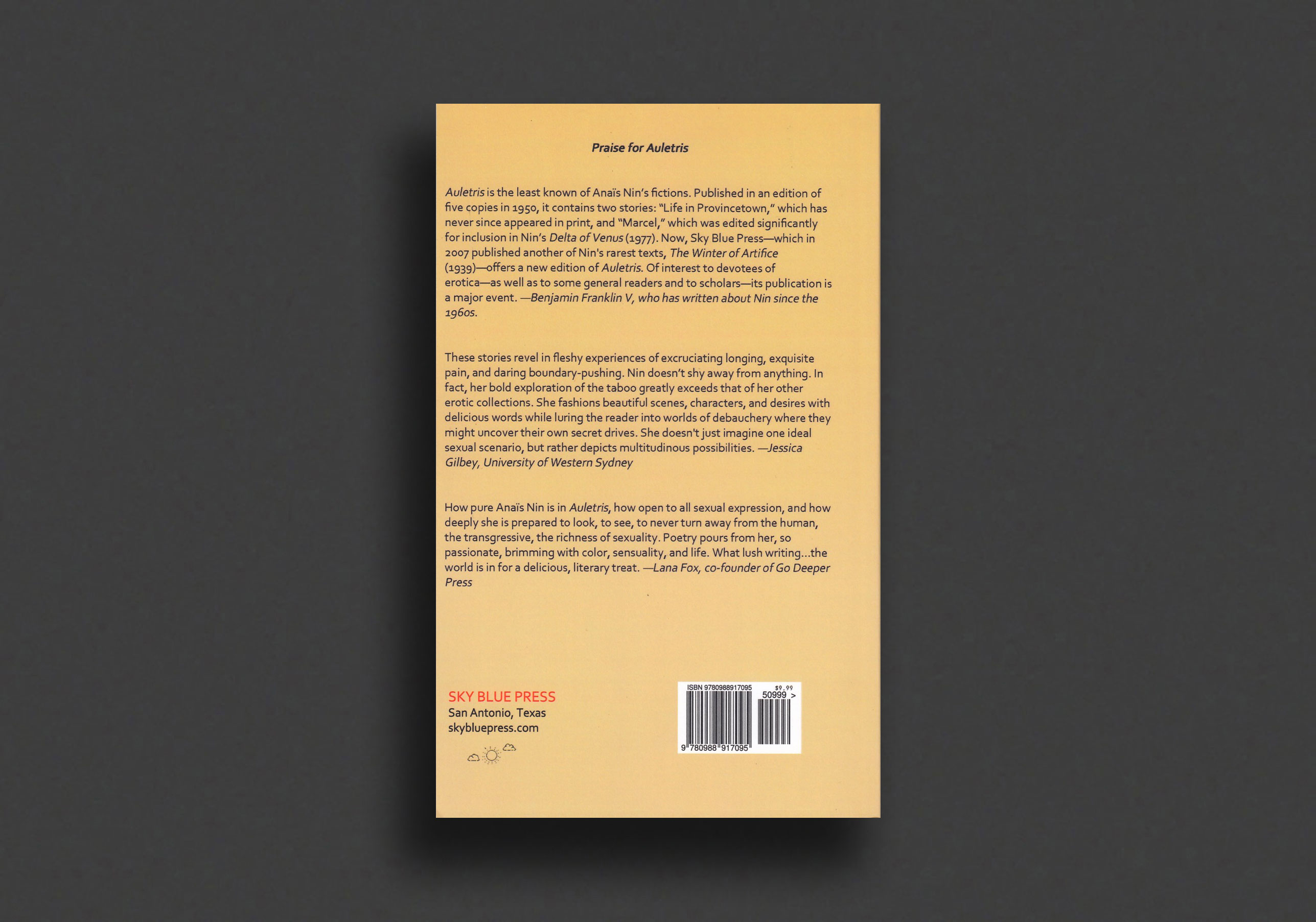
The unearthed, previously unpublished collection of erotic fiction by Anaïs Nin that Amazon black-listed and attempted to censor upon release. Auletris is a recently discovered, previously lost collection of erotica by Anaïs Nin, consisting of two major sections: "Life in Provincetown" and "Marcel." A drastically cut version of "Marcel" appears in Nin's bestselling Delta of Venus, and "Life in Provincetown" has never been published until now. Written in the early 1940s for a collector at a dollar a page, the erotica was also given to agents to sell far and wide. Auletris was sold to Milton Lubovitsky in 1950; Lubovitsky typed up five copies and sold them under the imprint of Press of the Sunken Eye to private buyers under the table. One of these copies surfaced when it was being offered in an auction, and it was then discovered that this collection had been lost to the public for decades. Once the authorship was verified, it was readied for true publication.
"Life in Provincetown" is a collection of interwoven stories set in one of Nin's favorite haunts and is populated with bohemian characters who engage in tabooed sexual behavior, all described in Nin's classic poetic prose. "Marcel" is another set of stories set mostly in Paris and is largely autobiographical, with many of the characters and situations taken directly from Nin's diaries. It is three times longer than the version in Delta of Venus and contains many lengthy passages, stories even, that were cut and never before published. Auletris is the first new Anaïs Nin collection of erotica since Little Birds in 1979.
This edition with the cover artwork by Baron Hans Henning Voigt (1887–1969), better known as Alastair, an image from an erotic card from Nin’s personal collection that Amazon also tried to censor.
Anaïs Nin (1903–1977) was a French-born American diarist, essayist, novelist, and writer of short stories and erotica, born in Paris to a Catalan father and a Danish mother, who spent many of her early years with Cuban relatives. Later a naturalized American citizen, she lived and worked in Paris, New York and Los Angeles. Author of avant-garde novels in the French surrealistic style and collections of erotica, she is best known for her life and times in The Diary of Anaïs Nin, Volumes I-VII (1966-1980).
1977, English
Softcover, 148 pages, 20.5 x 13.5 cm
Re-print,
Published by
Mariner Books / New York
$35.00 - Out of stock
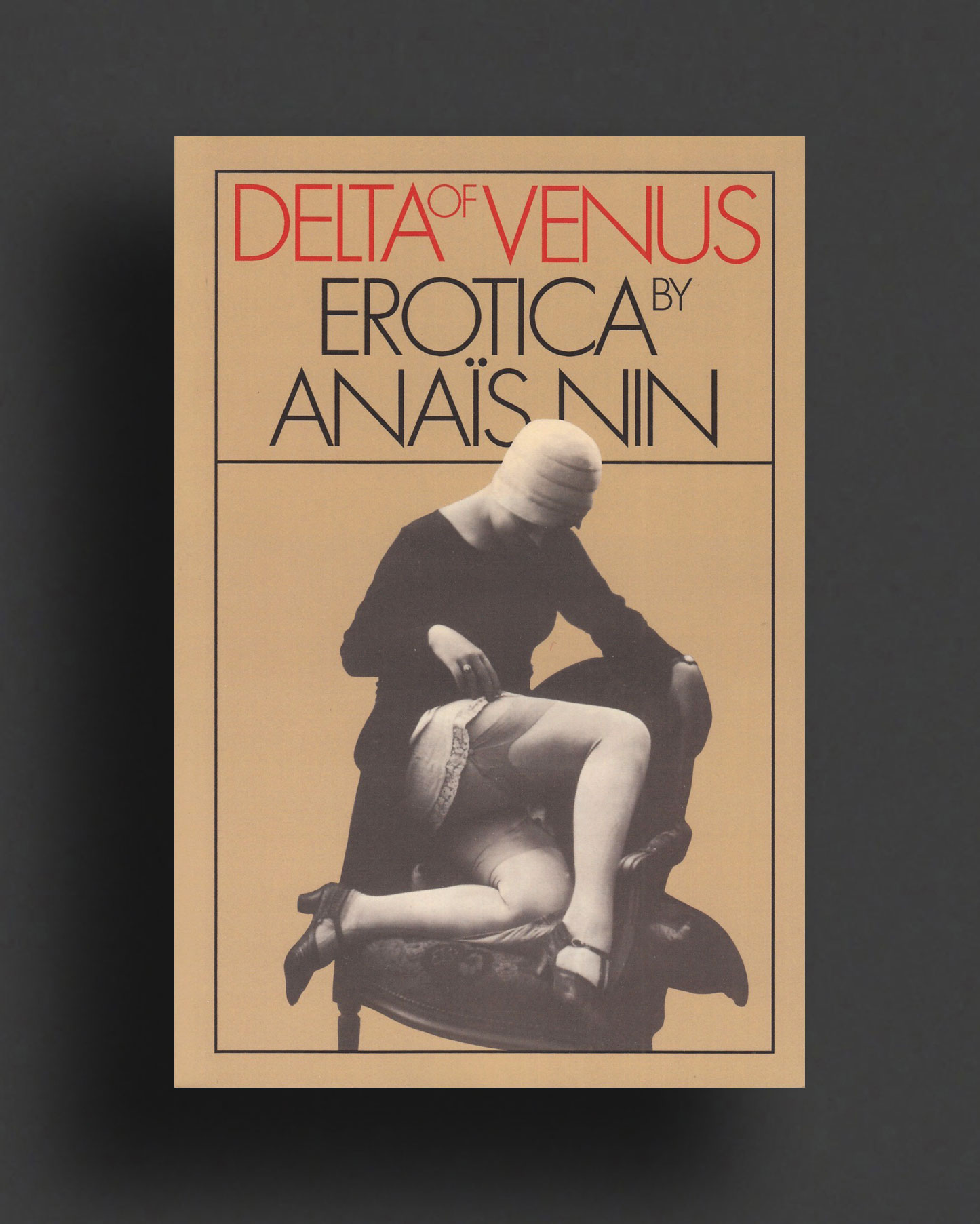
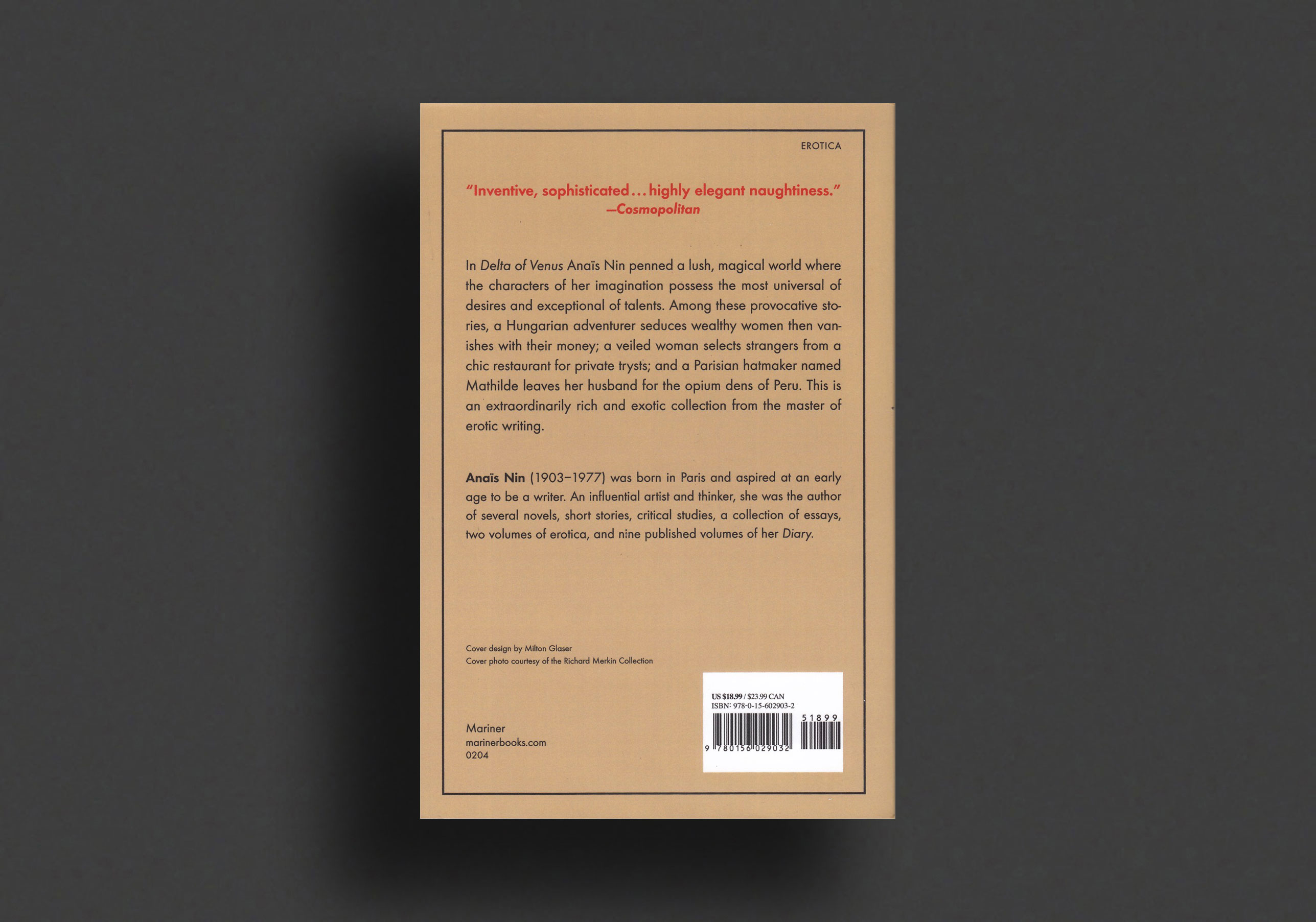
From influential feminist artist and essayist Anaïs Nin, Delta of Venus is one of the most important works of modern female erotica.
In this story collection, Anaïs Nin pens a lush, magical world where the characters of her imagination possess the most universal of desires and exceptional of talents. Among these provocative stories, a Hungarian adventurer seduces wealthy women then vanishes with their money; a veiled woman selects strangers from a chic restaurant for private trysts; and a Parisian hatmaker named Mathilde leaves her husband for the opium dens of Peru. This is an extraordinarily rich and exotic collection from a master of erotic writing.
Anaïs Nin (1903–1977) was a French-born American diarist, essayist, novelist, and writer of short stories and erotica.
1979, English
Softcover, 148 pages, 20.5 x 13.5 cm
Re-print,
Published by
Mariner Books / New York
$35.00 - Out of stock
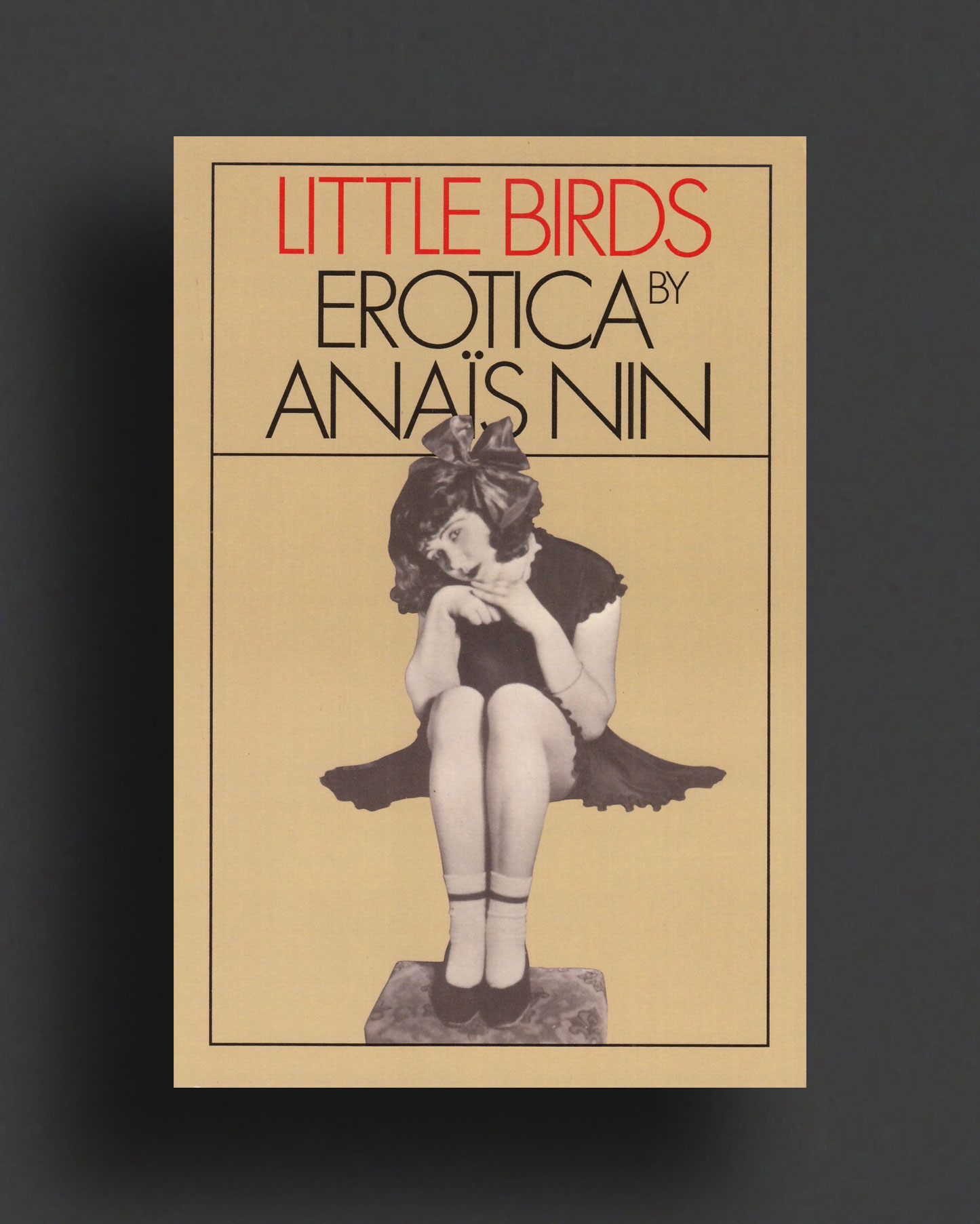
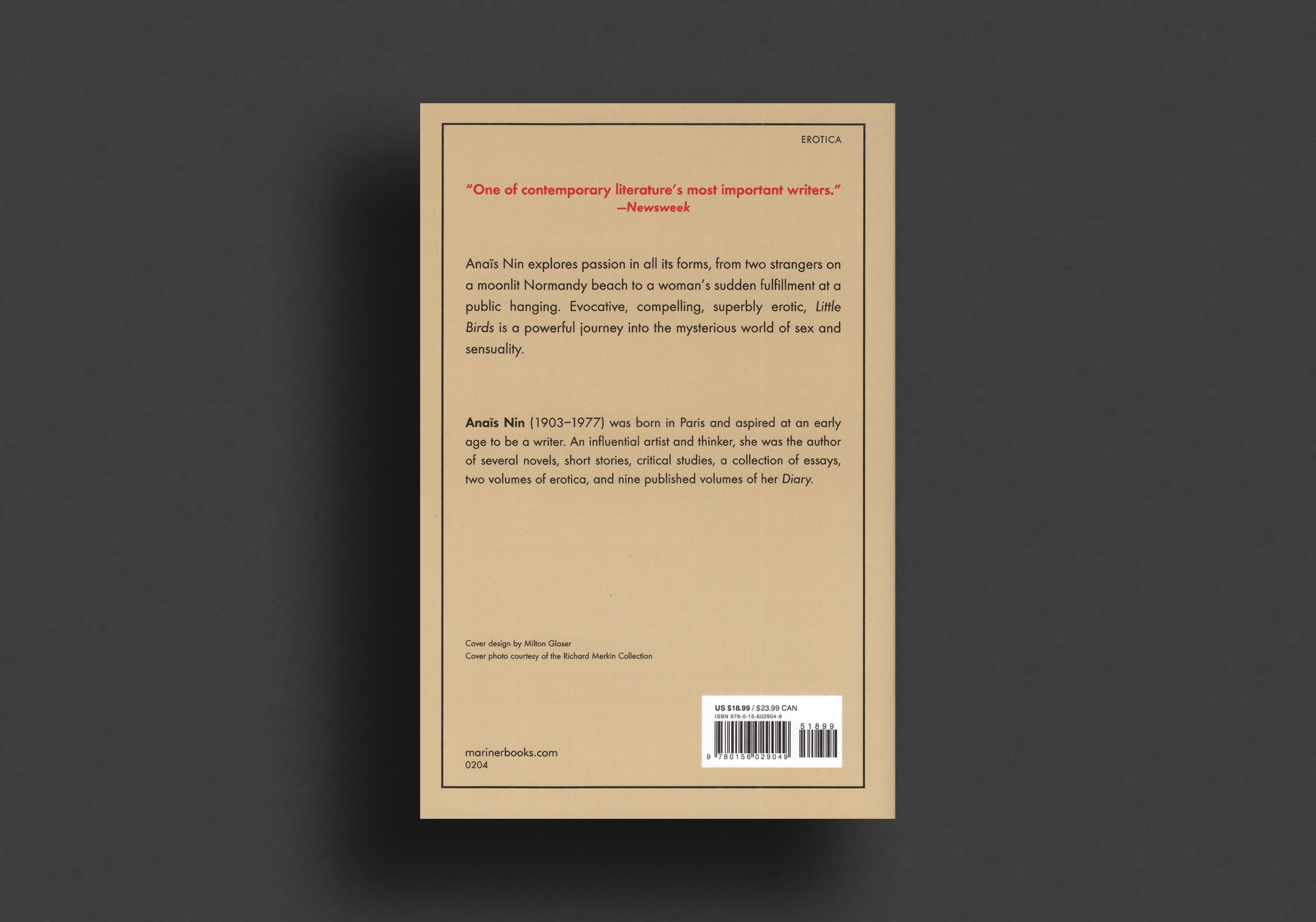
Evocative and superbly erotic, Little Birds is a powerful journey into the mysterious world of sex and sensuality. From the beach towns of Normandy to the streets of New Orleans, these thirteen vignettes introduce us to a covetous French painter, a sleepless wanderer of the night, a guitar-playing gypsy, and a host of others who yearn for and dive into the turbulent depths of romantic experience.
Anaïs Nin (1903–1977) was a French-born American diarist, essayist, novelist, and writer of short stories and erotica, born in Paris to a Catalan father and a Danish mother, who spent many of her early years with Cuban relatives. Later a naturalized American citizen, she lived and worked in Paris, New York and Los Angeles. Author of avant-garde novels in the French surrealistic style and collections of erotica, she is best known for her life and times in The Diary of Anaïs Nin, Volumes I-VII (1966-1980).
1986 / 2023, English
Softcover, 208 pages, 21.5 x 14 cm
Published by
Princeton University Press / New York
$33.00 - Out of stock
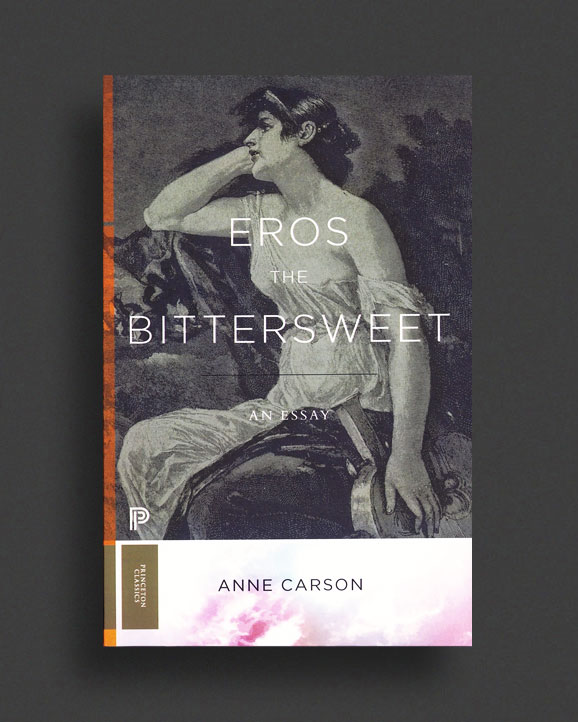
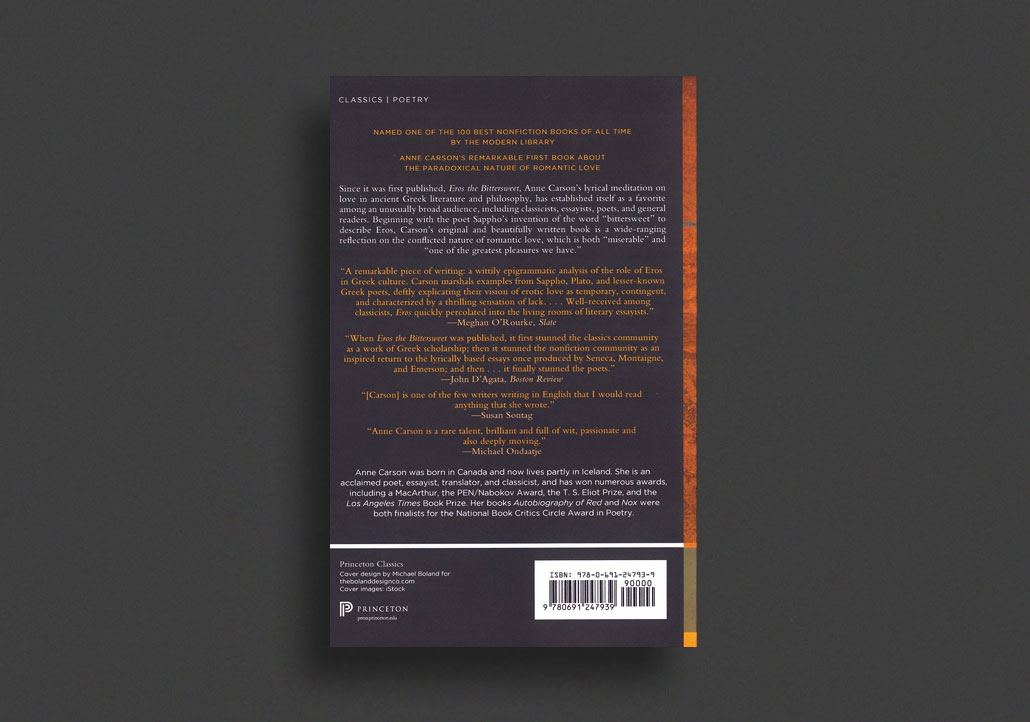
Named one of the 100 best nonfiction books of all time by the Modern Library. Anne Carson’s remarkable first book about the paradoxical nature of romantic love.
Since it was first published in 1986, Eros the Bittersweet, Anne Carson’s lyrical meditation on love in ancient Greek literature and philosophy, has established itself as a favourite among an unusually broad audience, including classicists, essayists, poets, and general readers. Beginning with the poet Sappho’s invention of the word “bittersweet” to describe Eros, Carson’s original and beautifully written book is a wide-ranging reflection on the conflicted nature of romantic love, which is both “miserable” and “one of the greatest pleasures we have.”
Originally published in 1986.
1962, English
Hardcover, 90 pages, 32.3 x 24.9 cm
1st Edition, Out of print title / used / good
Published by
Eros Magazine / New York
$50.00 - Out of stock
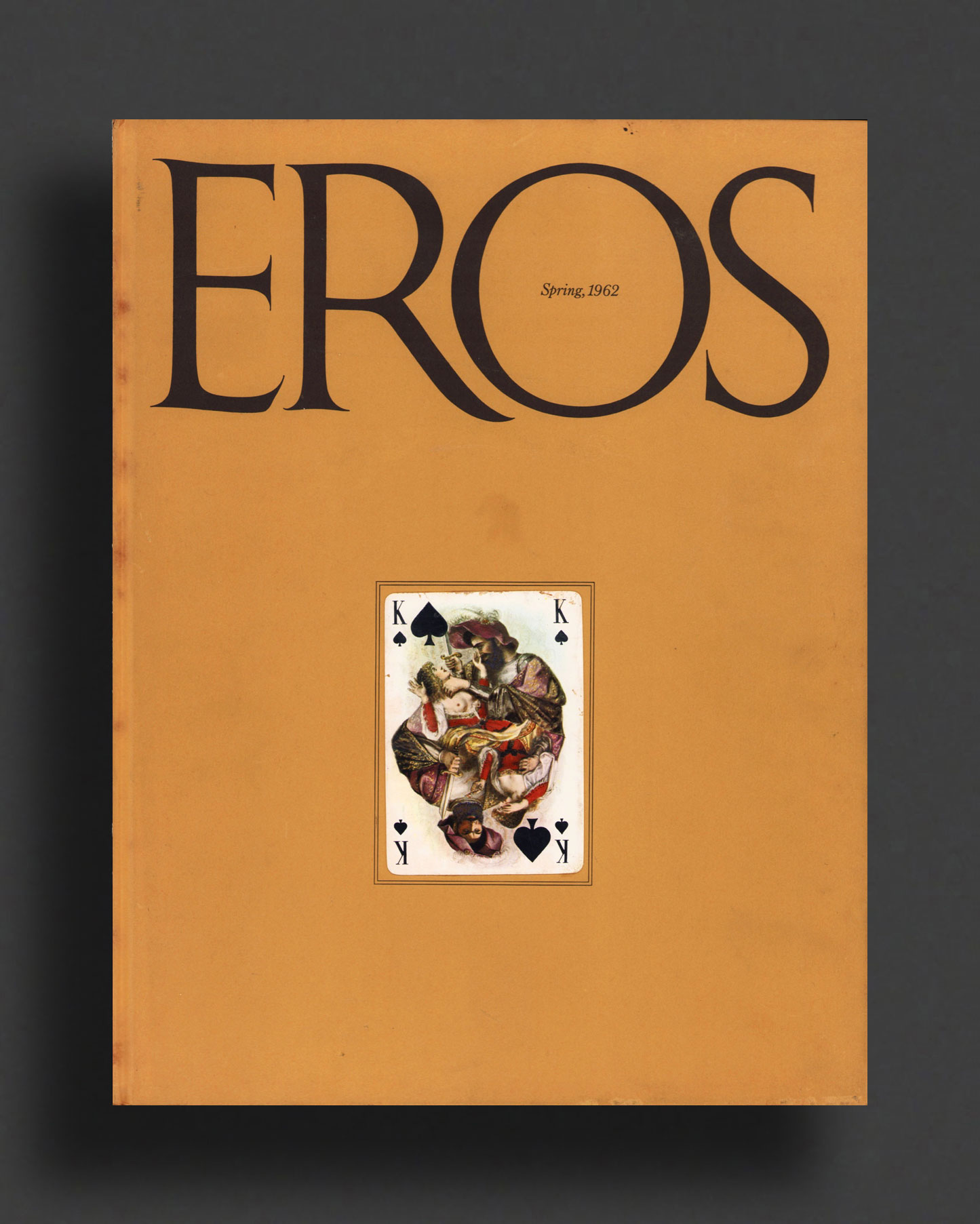
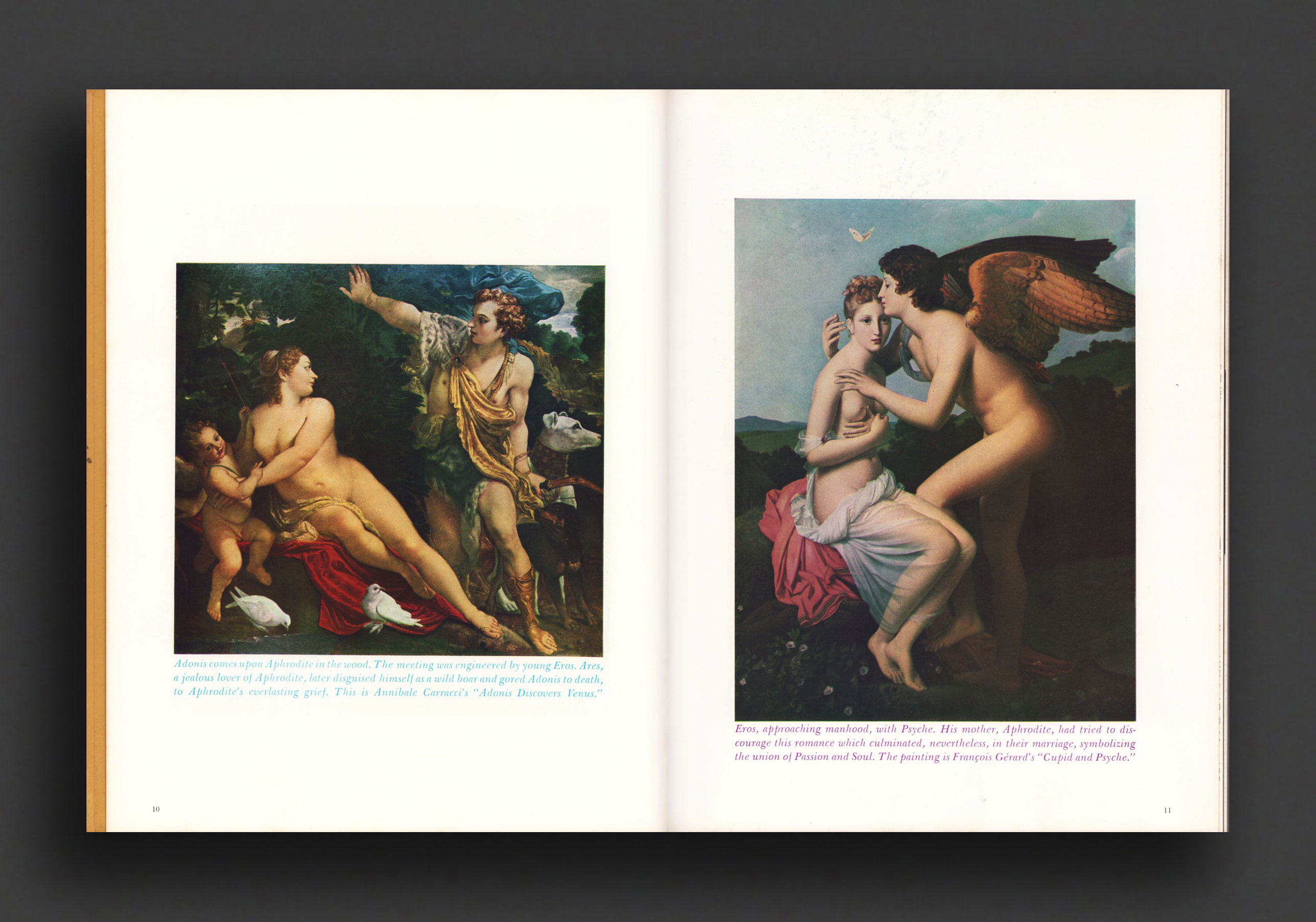
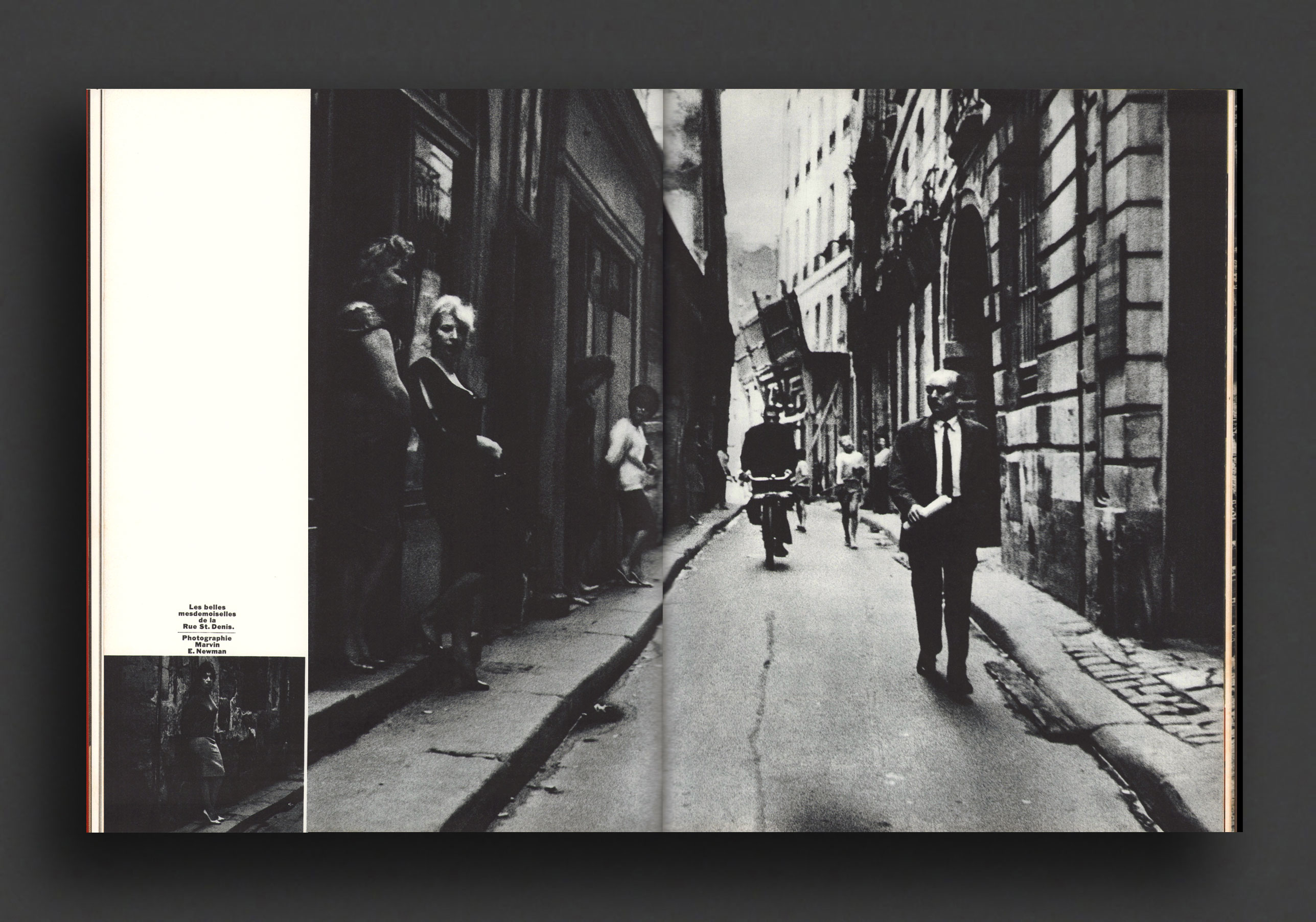
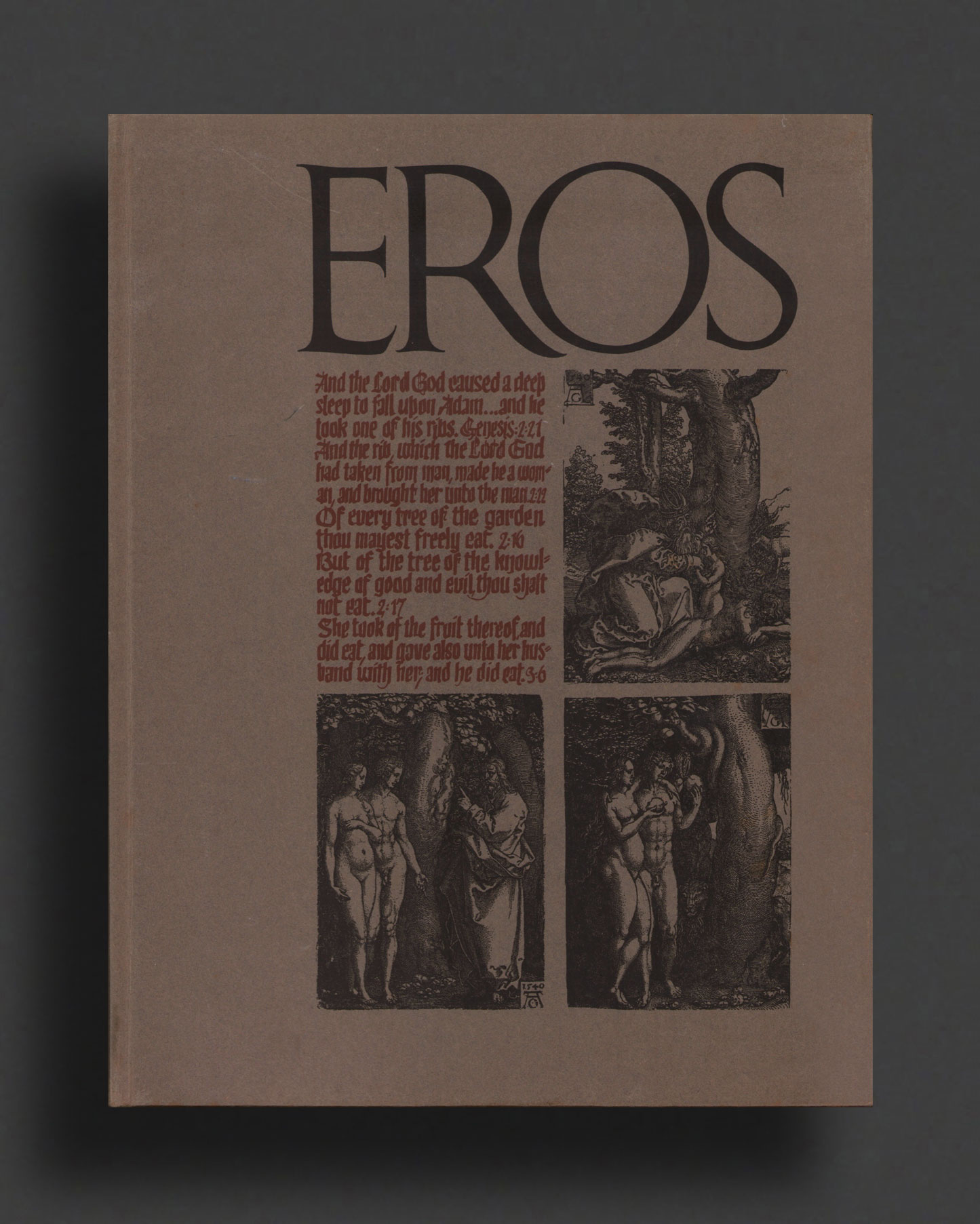
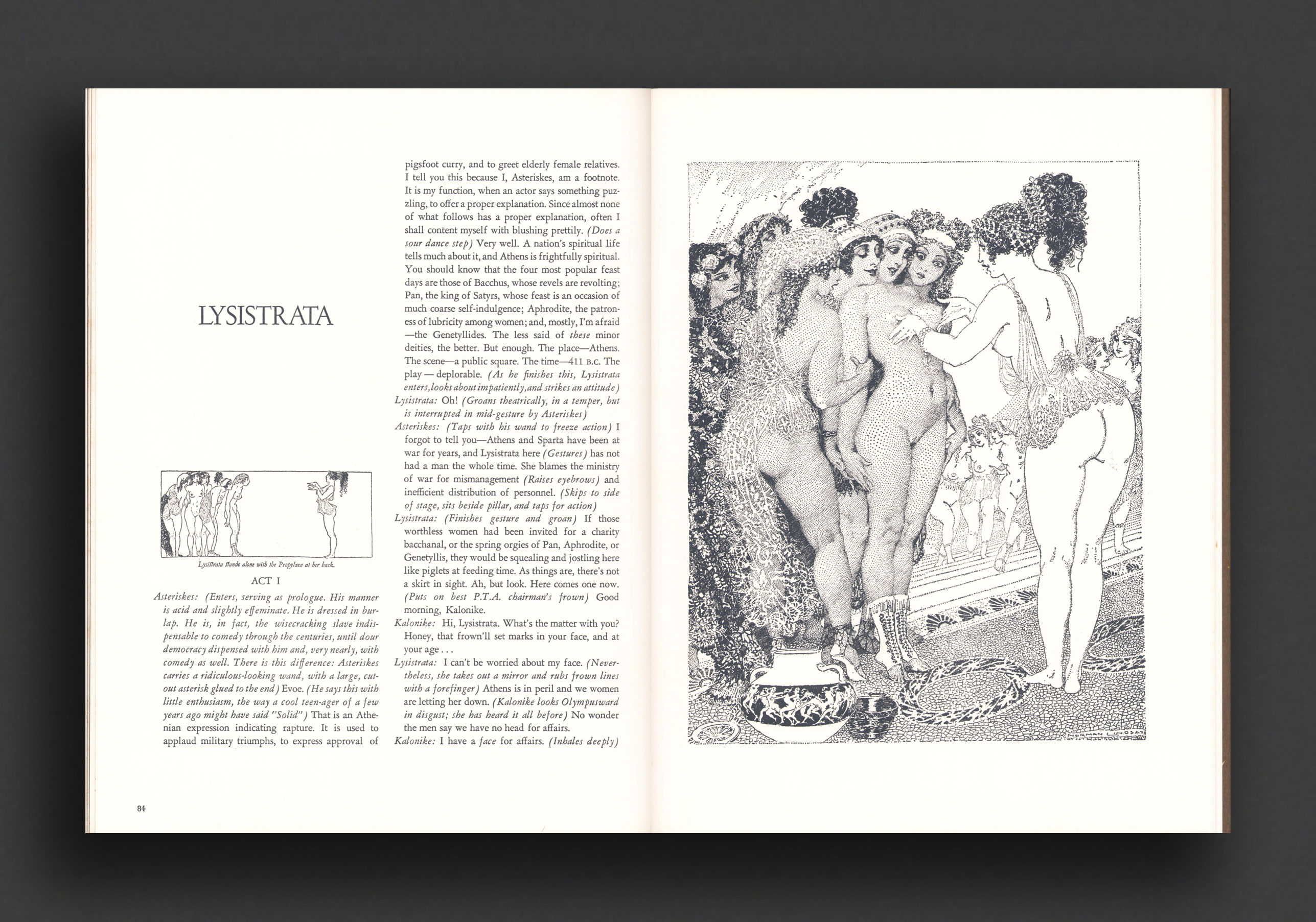
Volume One, No. 1, Spring 1962 issue of the legendary, short-lived and controversial Eros magazine, published by Ralph Ginzburg and art director Herb Lubalin, a quarterly and revolutionary hardbound periodical containing articles and photo-essays on love and sex. Besides the learned introductions and publication of classical erotica, Eros covered stories about sexual practices that were until then piously hidden from the public eye. Although there was hardly a hint of pornography in the journal, it was explicit enough to trigger fatally the puritanical reflexes rooted so deeply in American culture. Eros was beset by legal and financial problems. The magazine closed down after four issues, partly because it was so expensive to produce, but primarily because Ginsburg, as editor, was absurdly convicted under federal obscenity laws for the fourth issue, which featured a naked, bi-racial couple embracing.
Eros was one of a group of vanguard publications created by Ginzberg and Lubalin in the 1960s-1970s, including fact: and Avant-Garde, that became iconic in the history of graphic design, ushering in a new generation of artistic publishing that was intelligent, humorous and caustically critical of American society and government via the bold and sensitive typographical approach synonymous with the work of the great Lubalin.
Good copy with light wear to hardcovers, some wear to board edges, light foxing/toning.
1962, English
Hardcover, 90 pages, 32.3 x 24.9 cm
1st Edition, Out of print title / used / very good
Published by
Eros Magazine / New York
$50.00 - Out of stock
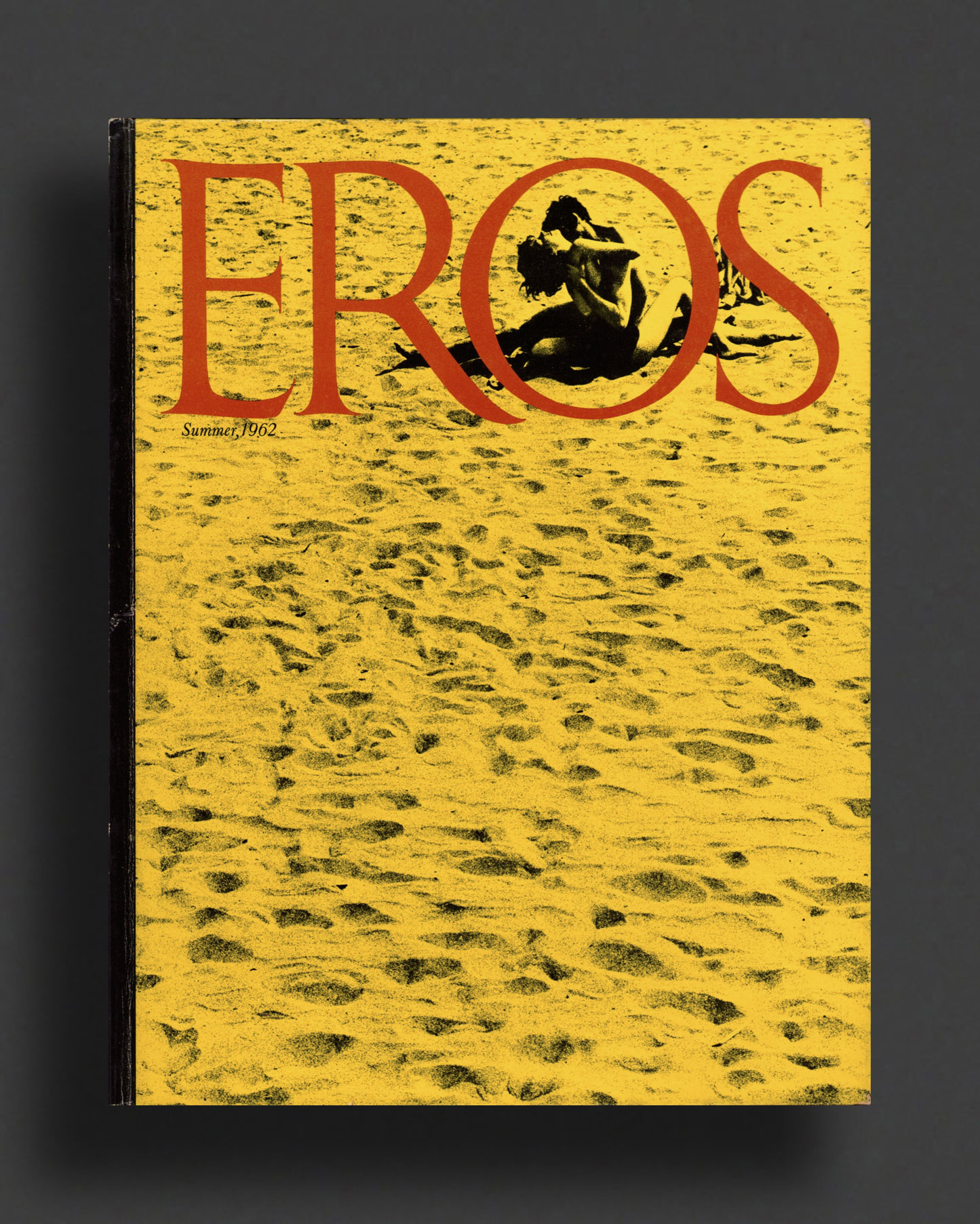
Volume One, No. 2, Summer 1962 issue of the legendary, short-lived and controversial Eros magazine, published by Ralph Ginzburg and art director Herb Lubalin, a quarterly and revolutionary hardbound periodical containing articles and photo-essays on love and sex. Besides the learned introductions and publication of classical erotica, Eros covered stories about sexual practices that were until then piously hidden from the public eye. Although there was hardly a hint of pornography in the journal, it was explicit enough to trigger fatally the puritanical reflexes rooted so deeply in American culture. Eros was beset by legal and financial problems. The magazine closed down after four issues, partly because it was so expensive to produce, but primarily because Ginsburg, as editor, was absurdly convicted under federal obscenity laws for the fourth issue, which featured a naked, bi-racial couple embracing.
Eros was one of a group of vanguard publications created by Ginzberg and Lubalin in the 1960s-1970s, including fact: and Avant-Garde, that became iconic in the history of graphic design, ushering in a new generation of artistic publishing that was intelligent, humorous and caustically critical of American society and government via the bold and sensitive typographical approach synonymous with the work of the great Lubalin.
Very Good copy with light foxing/toning.
1962, English
Hardcover, 90 pages, 32.3 x 24.9 cm
1st Edition, Out of print title / used / very good
Published by
Eros Magazine / New York
$50.00 - Out of stock
Volume One, No. 4, Winter 1962 issue of the legendary, short-lived and controversial Eros magazine, published by Ralph Ginzburg and art director Herb Lubalin, a quarterly and revolutionary hardbound periodical containing articles and photo-essays on love and sex. Besides the learned introductions and publication of classical erotica, Eros covered stories about sexual practices that were until then piously hidden from the public eye. Although there was hardly a hint of pornography in the journal, it was explicit enough to trigger fatally the puritanical reflexes rooted so deeply in American culture. Eros was beset by legal and financial problems. The magazine closed down after four issues, partly because it was so expensive to produce, but primarily because Ginsburg, as editor, was absurdly convicted under federal obscenity laws for the fourth issue, which featured a naked, bi-racial couple embracing.
Eros was one of a group of vanguard publications created by Ginzberg and Lubalin in the 1960s-1970s, including fact: and Avant-Garde, that became iconic in the history of graphic design, ushering in a new generation of artistic publishing that was intelligent, humorous and caustically critical of American society and government via the bold and sensitive typographical approach synonymous with the work of the great Lubalin.
Very Good copy with light foxing/toning.
2022, English
Softcover, 240 Pages, 21.6 x 14 cm
Published by
Divided Publishing / London
$36.00 - Out of stock
Never does the patient seem more ill than when they try to order associations into a logical tale. Classical analysis sees this in terms of a repudiation of sexuality: an attempt to avoid speaking from a place of desire. But why should psychoanalysis reduce everything to sex? If sex only ever achieves partial satisfactions, fragments of pleasure, its pursuit creates our subjectivity and our world. Disorganisation & Sex argues that the sexuality of psychoanalysis is not a reductive biologism, but an archaic remainder that cannot be colonised, endlessly disorienting meaning in our everyday lives. It is our proximity to this terrain that undoes our most tedious habits, and opens onto something revelatory.
"This book is a dare. By giving desire back to sex, Webster offers us a blueprint for talking about sex at a time when we’ve forgotten how to do so."—Ricky Varghese
"Putting her finger on the difficulty of sexuality, one of our savviest psychoanalytic commentators limns its impossibilities – but also its potential for inventing something new."—Tim Dean
"Being dragged into the orbit of Webster’s mind is like entering the Magic Mountain: you go in as a visitor, and stay as a patient."—Tom McCarthy
"Who knew the hole was what Freud had in mind when he invented psychoanalysis and wouldn’t stop saying ‘sex’. Take a tumble into Wonderland with Dr Webster and decide for yourself what counts as real."—Courtney Love
Jamieson Webster is a psychoanalyst in New York City. She is the author of The Life and Death of Psychoanalysis (Karnac, 2011) and Conversion Disorder (Columbia University Press, 2018); she also co-wrote, with Simon Critchley, Stay, Illusion! The Hamlet Doctrine (Pantheon, 2013). She contributes regularly to Artforum, Spike Art Magazine, Apology and the New York Review of Books.
1989, Japanese
Softcover, 208 pages, 13 x 18 cm
1st Edition, Out of print title / used / very good
Published by
Fiction Inc. / Tokyo
$70.00 - In stock -
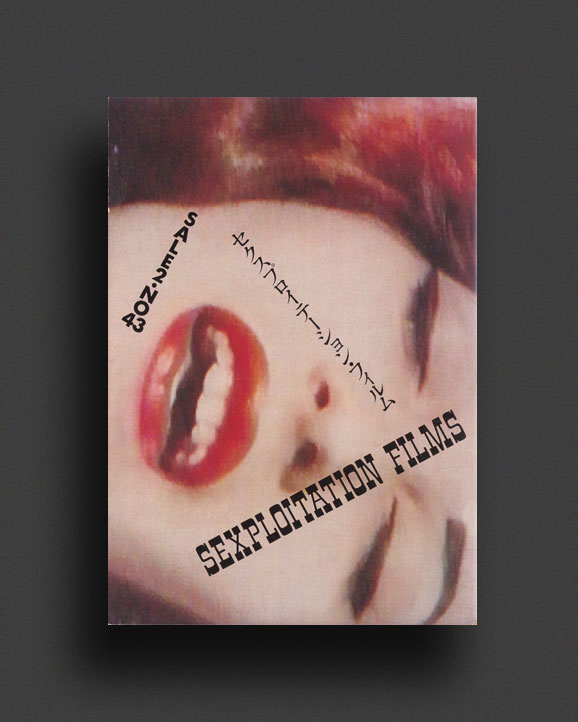
Issue No.36 of the great SALE2 periodical from Tokyo Japan, founded in 1984 by Makoto Orui, who later became art director for Purple magazine in France and Rockin’on magazine in Japan. SALE2 was active for about 14 years during the 1980s—1990s, published regularly as a sort-of fanzine/journal/catalogue/pocket-book by Fiction, Inc., a specialty shop and publisher of fetish and erotica in Tokyo in the 1980-90s. With Orui's distinct design SALE2 developed an exclusive curated editorial set on ‘erotisism and its spiritual philosophy’, with each issue exploring different themes and features, heavy on fetishism and erotic art.
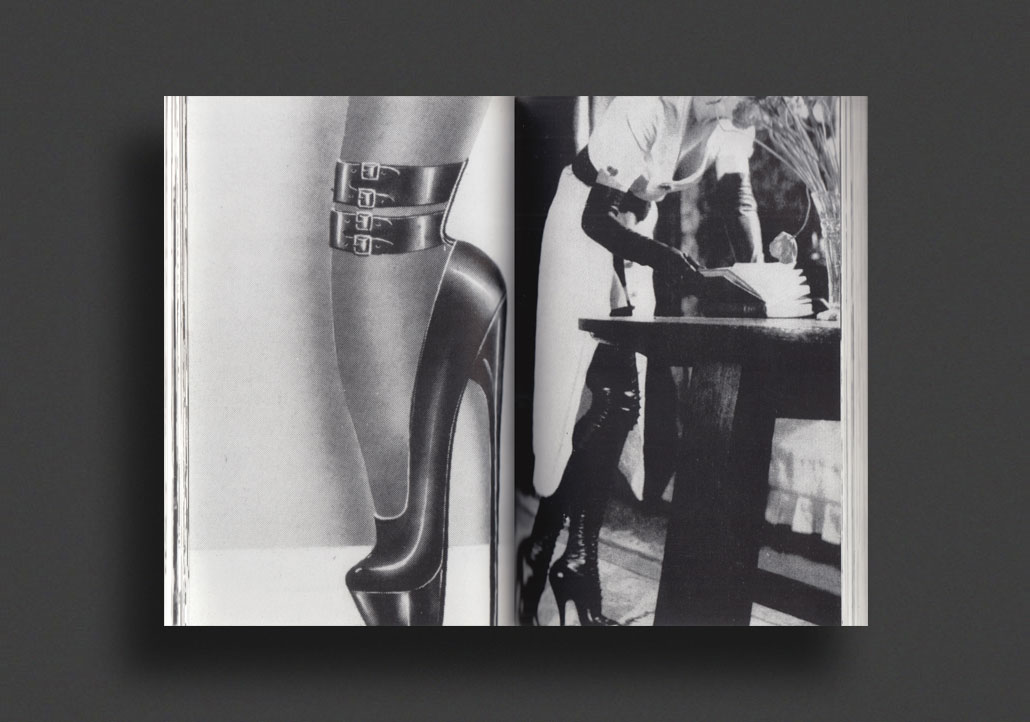
Issue No.36, the "Female Foot Fetishism Special Issue" with the wonderful wraparound Pierre Molinier cover is packed with imagery and essays around the theme of "Foot and Fetish Heel" throughout history, literature, film and fetish publishing, etc. profusely illustrated with drawings, photography, bondage illustrations, film stills, catalogue clippings, and artworks, including works by Bill Ward, Pierre Molinier, Nobuyoshi Araki, and so many more. It also features the Fiction, Inc. section that samples a cross-section of content from catalogue publications including the work of John Willie, Bill Ward, Carlo, Eric Stanton, Irving Claw, Betty Page, and periodicals such as Rubber Magazine, Amateur Bondage, Bizarre Comix, Bizarre Classix, Bizarre Fotos, Stiletto, and much more... Very heavily illustrated throughout with erotic photography and artwork, all texts in Japanese.
Very Good copy.
1992, Japanese
Softcover, 176 pages, 13 x 18 cm
1st Edition, Out of print title / used / very good
Published by
Fiction Inc. / Tokyo
$70.00 - In stock -
Issue No.43 of the great SALE2 periodical from Tokyo Japan during the late 1980s and early 1990s.
Published regularly as a sort-of fanzine/journal/catalogue/pocket-book by Fiction, Inc., a specialty shop and publisher of fetish and erotica in Tokyo in the 1980-90s. Each issue covers different themes and features, heavy on fetishism.
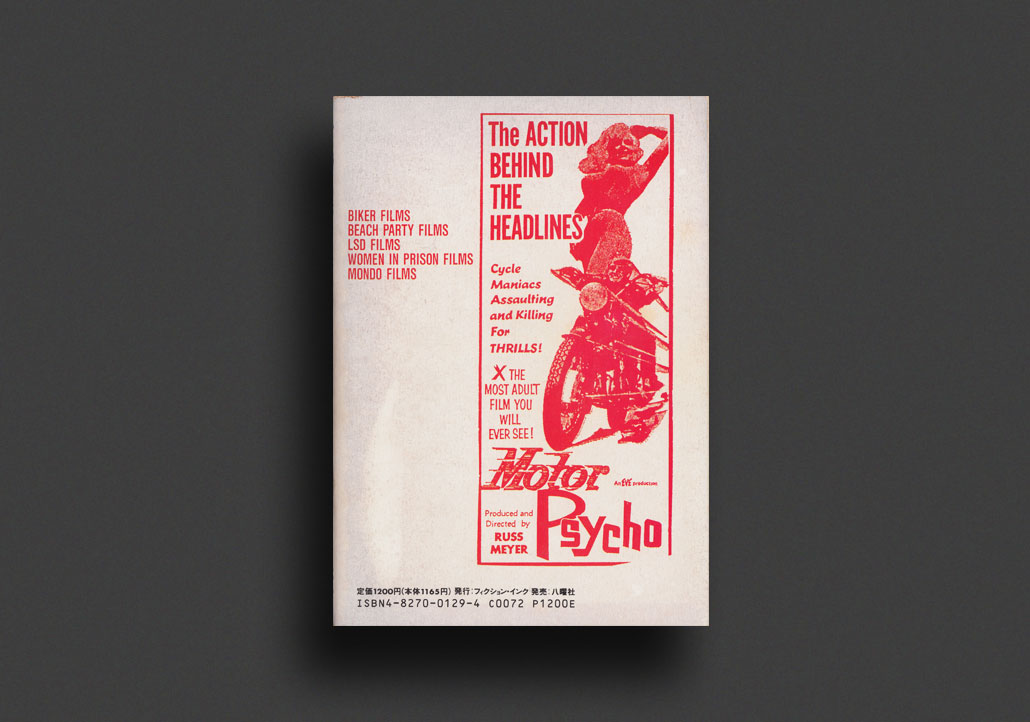
Issue No.43, the "Sexploitation Films" issue features "Biker Films, Beach Party Films, LSD Films, Women in Prison Films, Mondo Films...", a filmography from "A Taste of Flesh" (1967) to "The Wild, Wild World of Jayne Mansfield" (1968), a long interview with cult director Herschell Gordon Lewis, Russ Meyer, plus Carlo Mollino, Pierre Molinier, John Willie, Guido Crepax, Irving Claw, Betty Page, Gilles Berquet, and periodicals such as Sweet Gwen's, Bizarre, Gwendoline, Rigorosa Disciplina, and much more...
Very heavily illustrated throughout with erotic photography and artwork, all texts in Japanese.
1987, English
Softcover, 154 pages, 20 x 13 cm
Out of print title / used / very good
Published by
Virago Press / London
$20.00 - Out of stock
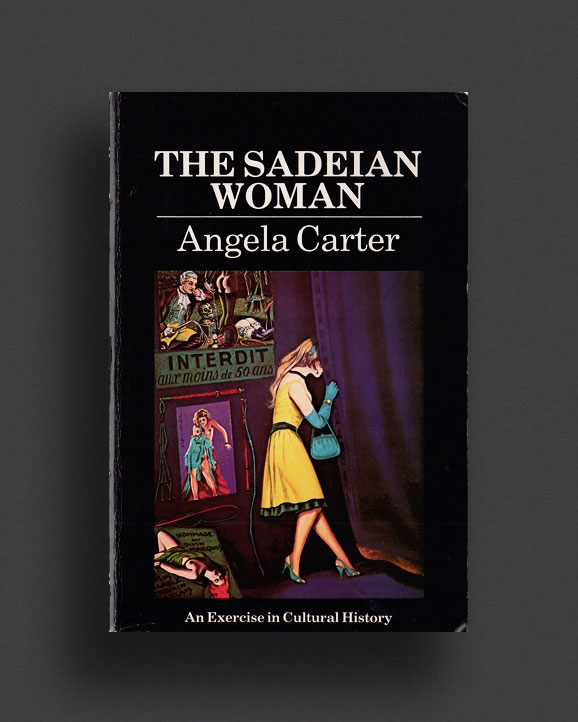
1987 Virago paperback edition of Angela Carter's 1979 classic, The Sadeian Woman, with Clovis Trouille artwork.
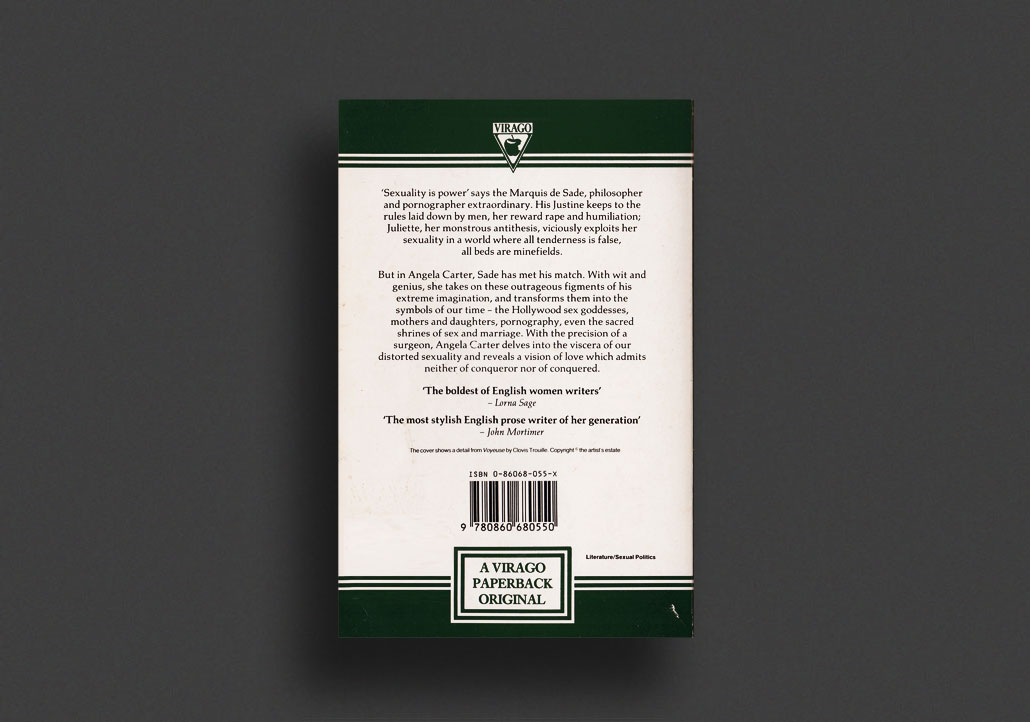
'Sexuality is power' says the Marquis de Sade, philosophe and pornographer extraordinary. His Justine keeps to th rules laid down by men, her reward rape and humiliatios Juliette, her monstrous antithesis, viciously exploits he sexuality in a world where all tenderness is false, all beds are minefields.
But in Angela Carter, Sade has met his match. With wit and genius, she takes on these outrageous figments of his extreme imagination, and transforms them into the symbols of our time - the Hollywood sex goddesses, mothers and daughters, pornography, even the sacred shrines of sex and marriage. With the precision of a surgeon, Angela Carter delves into the viscera of our distorted sexuality and reveals a vision of love which admits neither of conqueror nor of conquered.
"The boldest of English women writers"—Lorna Sage
"The most stylish English prose writer of her generation"—John Mortimer
Angela Olive Pearce (formerly Carter, 1940—1992), who published under the name Angela Carter, was an English novelist, short story writer, poet, and journalist, known for her feminist, magical realism, and picaresque works. She is mainly known for her book The Bloody Chamber (1979). In 1984, her short story "The Company of Wolves" was adapted into a film of the same name. In 2008, The Times ranked Carter tenth in their list of "The 50 greatest British writers since 1945"
Good copy.
1976, English
Hardcover (w. dust jacket), 184 pages, 21.5 x 14.5 cm
1st Edition, Out of print title / used / very good
Published by
Hill & Wang / New York
$70.00 - In stock -
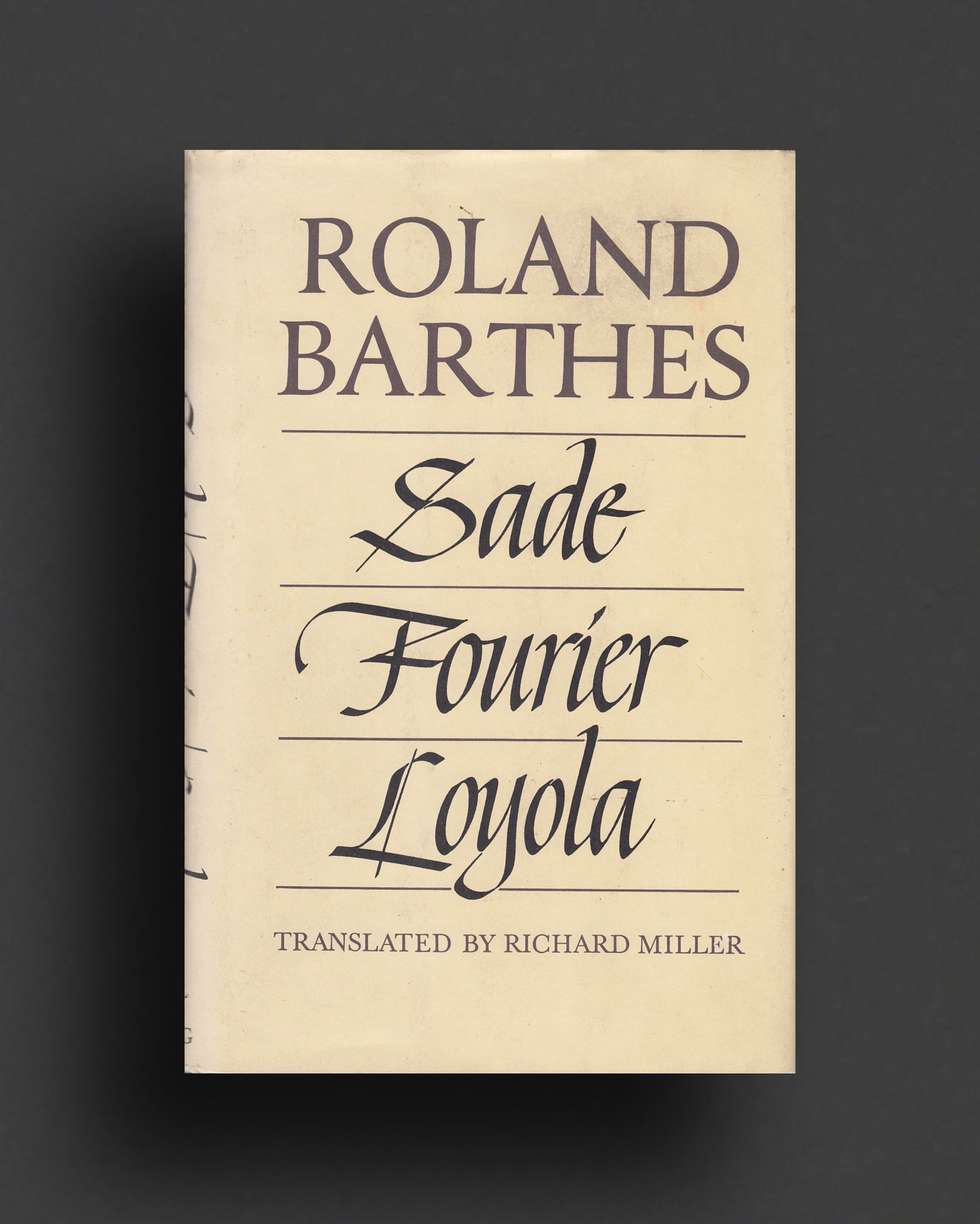
Rare first HC edition published by Hill and Wang, 1976.
A treatise on the nature of philosophical creation. Barthes examines the parallel impulses of Loyola, the Jesuit saint, Sade, the renowned and sometimes pornographic libertine philosopher, and Fourier, the utopian theorist. All three, he makes clear, have been founders of languages - Loyola the language of divine address: Sade, the language of erotic freedom: and Fourier, the language of social perfection and happiness. Each language is an all-enveloping system, a "secondary language" that isolates the adherent from the conventional world. The object of this book, is not to decipher the content of these respective works, but to consider Sade, Fourier, and Loyola as creators of text.
From book jacket:
"Barthes points out in this new series of studies that it is not out of some perverse desire to provoke the reader that he has collected in one and the same book Sade, Fourier, and Loyola: the forbidden writer, the utopian philosopher, and the Jesuit saint. It is because all three have been classifiers, founders of languages—a language of erotic pleasure, a language of social happiness, a language of divine address—and because each of them has expended, in the construction of this secondary language, all the energy of a passion.
The object of this book, for Barthes, is not to hover over the propositions of content ordinarily credited to these three men—i.e., a philosophy of evil, a utopian socialism, a mystique of obedience—but rather to consider Sade, Fourier, and Loyola as formulators, inventors of writing, wielders of a text: operators, as Barthes calls them.
Whereby Barthes pursues a project, suggested in all his other books, whose theoretical intention can be discerned in these concrete and specific studies: How far can one go with a text by speaking only of its writing? How is what it signifies suspended (historically, psycholog-ically, aesthetically) in order to release what it reveals materially? Is not the social action which a text achieves, Barthes asks, in the energies of its writing rather than in the commitment of its content?
What Barthes seeks here is to unite the old readerly (i.e., "cultural") text and the new commentary, for the sake of an eventual text that would be infinite, infinitely recommenced.
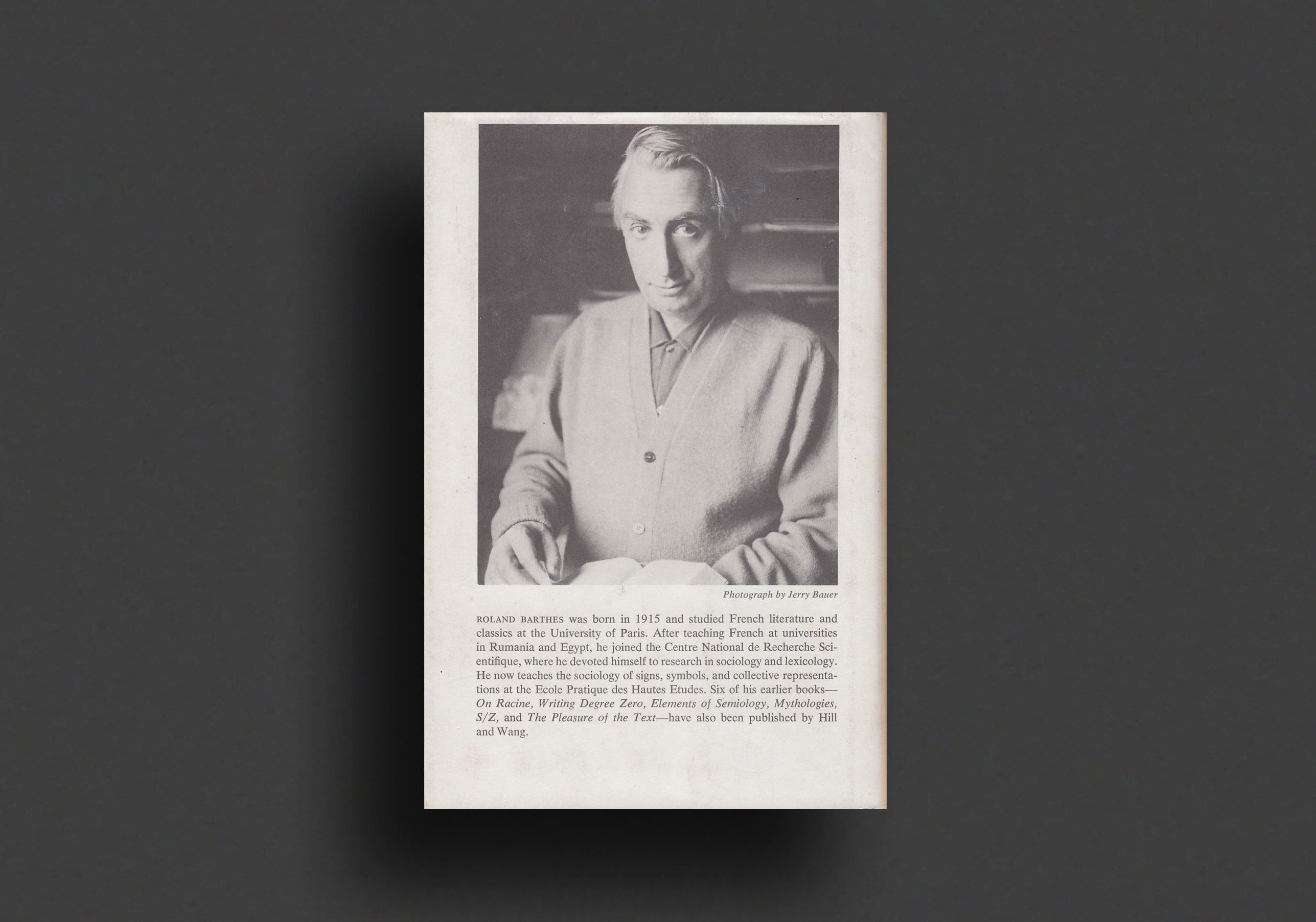
Roland Barthes was born in 1915 and studied French literature and classics at the University of Paris. After teaching French at universities in Rumania and Egypt, he joined the Centre National de Recherche Scientifique, where he devoted himself to research in sociology and lexicology. He was a professor of the Collège de France until his death in 1980.
VG copy in Good price-clipped DJ.
1993, English / German
Softcover (french-folds), 296 pages, 22.5 x 15.5 cm
1st Edition, Out of print title / used / fine
Published by
Verlag Ritter Klagenfurt / Austria
$50.00 - In stock -
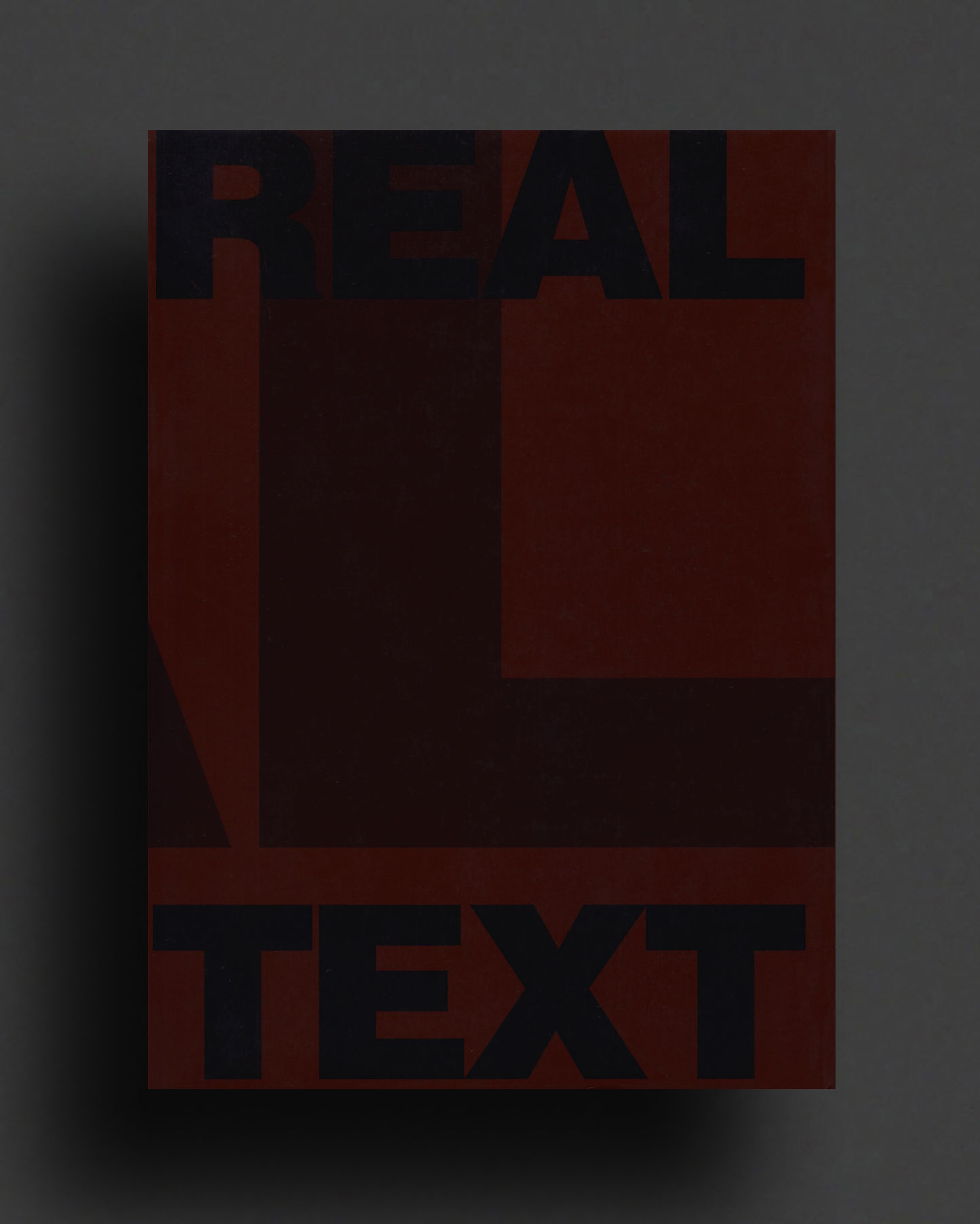
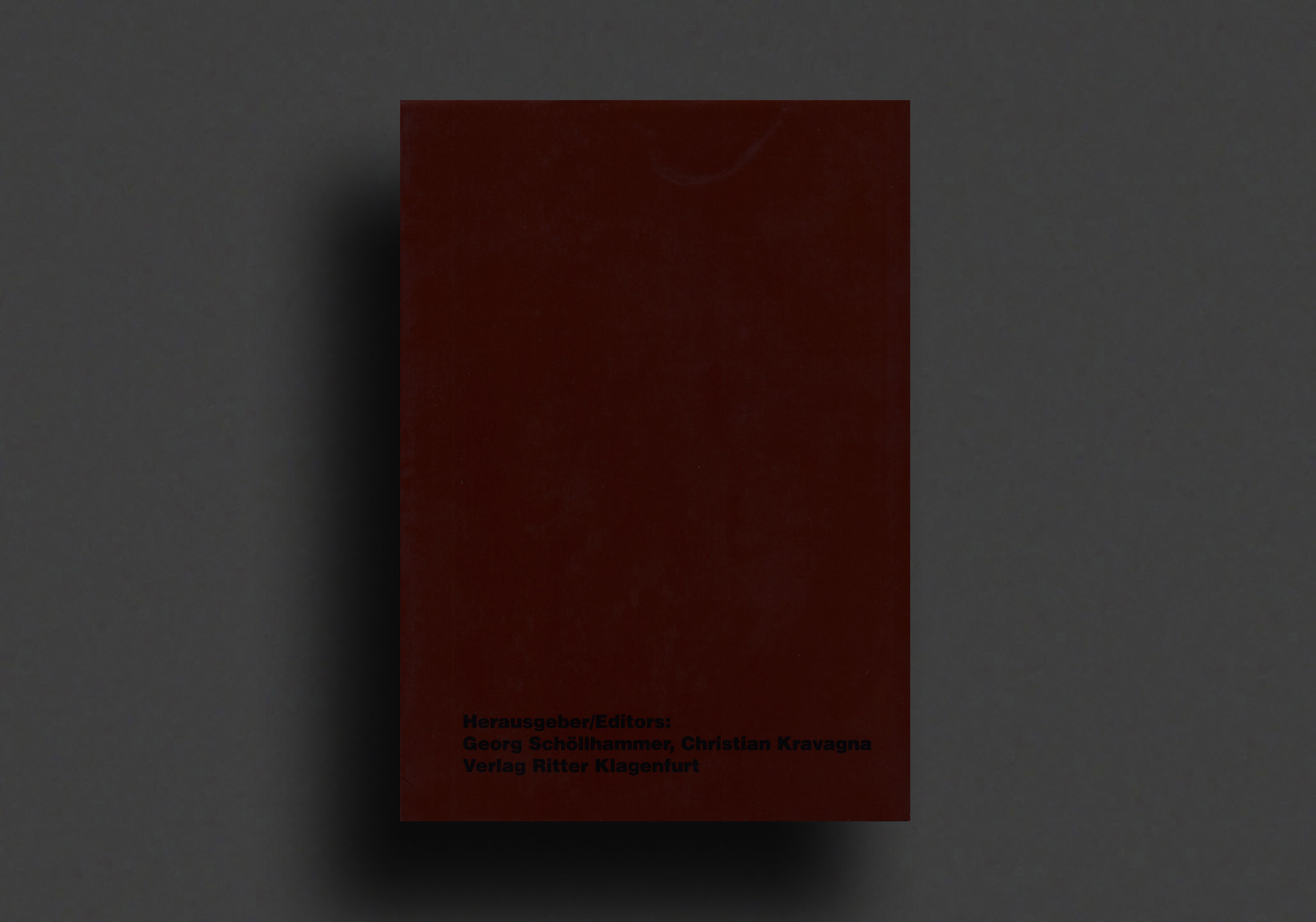
Scarce 1993 book compendium of critical theory edited by Georg Schöllhammer and Christian Kravagna, designed by Heimo Zobernig and Florian Pumhösl, featuring texts by Richard Rorty, Paul Freyerabend, Francisco J. Varela, Robert W. Witkin, Barbara Jaffee, Teresa de Lauretis, Jacqueline Rose, Amy Winter, Silvia Eiblmayr, Peter Gorsen, and Douglas Crimp. Text in English and German.
"REAL TEXT forms, so to speak, the "discursive bracket" between the individual parts of the exhibition (REAL SEX, REAL REAL, REAL AIDS). But it is also a separate exhibition part that, with a view to the consequences for art and aesthetics, outlines the philosophical, art historical and epistemological problem horizon of determining the self between the phantasm of identity and absorption into the structures of our highly differentiated society."—(From the foreword by Georg Schöllhammer and Christian Kravagna)
In bi-lingual English/German, contents include:
Richard Rorty: Trotsky and the Wild Orchids; Paul Feyerabend: Art as a natural product; Francisco J. Varela: The body thinks; Robert W. Witkin: From the touch of the ancients to the gaze of modern times; Barbara Jaffee: Modernity and the Promise of Autonomy; Teresa de Lauretis: drive and habit; Jacqueline Rose: Sexuality in View; Amy Winter: The Surrealismus, Lacan, and the metaphor of the woman without a head; Silvia Eiblmayr: The SurrealIstian eroticism with Hans Bellmer; Peter Gorsen: Hans Bellmer-Pierre Molinier; Douglas Crimp: Portraits of people with AIDS.
VG/NF copy.
2005, Japanese / English
Hardcover (w. dust jacket and obi), 80 pages, 19 x 27 cm
1st Edition, Out of print title / used / fine
Published by
Blue Interactions / Japan
$120.00 - Out of stock
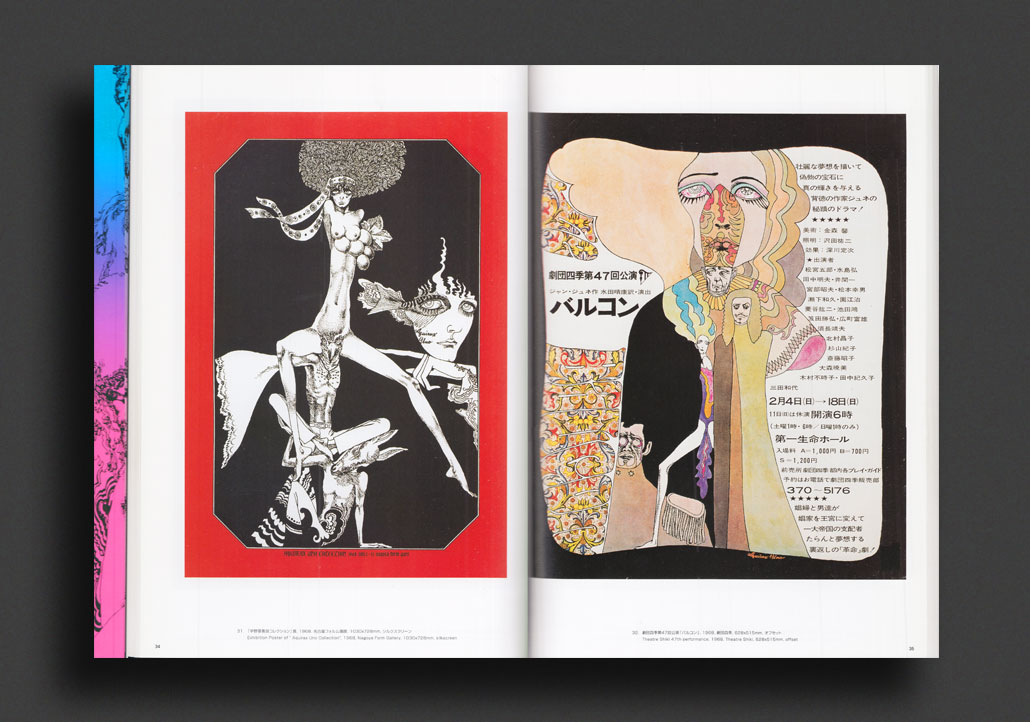
Wonderful hardcover collection of Aquirax Uno's poster work dating 1959-1975.
Aquirax Uno, also known as Akira Uno (b. 1934) is a Japanese graphic artist, illustrator and painter who was very influential in the 1960s and 1970s. His incredibly unique work is characterized by fantastic visuals, capricious and sensuous line flow, flamboyant (and occasionally grotesque) eroticism, and frequent use of collage and psychedelic bright colours. Uno was prominently involved with the Japanese underground art of the 1960s–1970s, and is particularly notable for his frequent collaborations with Shuji Terayama and his experimental theater Tenjo Sajiki.
Near Fine copy with dust jacket and obi.
1988, English
Hardcover (w. dust jacket), 112 pages, 36 x 28.5 cm
1st Edition, Out of print title / used / very good
Published by
Twelvetrees Press / California
$200.00 - Out of stock
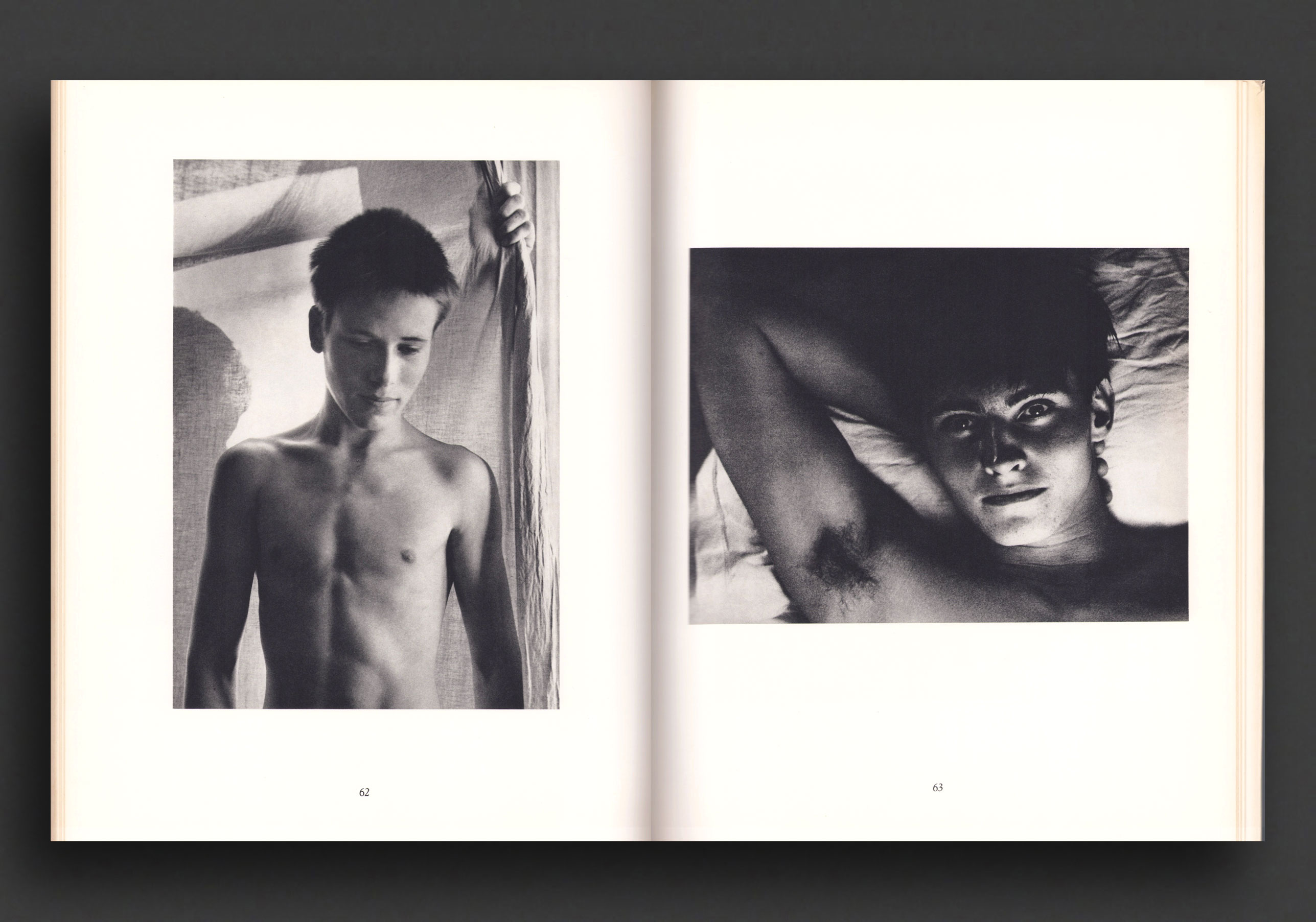
First 1988 Twelvetrees Press hardcover edition of Herbert List's classic Junge Männer.
Beginning in 1929, Herbert List (1903-1975), who had been given a Rolleiflex camera by Andreas Feininger, began to photograph the young men he knew and traveled with throughout Greece, Italy, and Germany. He captured the innocence of their beauty and physical prowess before Hitler’s politics commandeered those qualities for his own bleak purposes. He never published his male nudes in his own lifetime, and kept them hidden in his mother's house in a sack he called his 'poison bag'.
List, influenced by the Bauhaus and artists of the surrealist movements (Man Ray, Giorgio De Chirico, Max Ernst...), used male models, draped fabric, masks and double-exposures to depict dream states and fantastic imagery. He has explained that his metaphysical photos were "composed visions where [my] arrangements try to capture the magical essence inhabiting and animating the world of appearances."
In 1936, in response to the danger of Gestapo attention to his openly gay lifestyle and his Jewish heritage, List left Germany for Paris, where he met George Hoyningen-Huene with whom he travelled to Greece, deciding then to become a photographer. During 1937 he worked in a studio in London and held his first one-man show at Galerie du Chasseur d'Images in Paris. List's austere, classically posed black-and-white compositions, particularly his homoerotic male nudes, taken in Italy and Greece, were very influential in modern photography and contemporary fashion photography. List worked for Vogue, Harper's Bazaar, and Life, and was associated with Magnum Photos.
Introduction by Sir Stephen Spender.
Very Good copy in VG dust with toning to edges, light sunning/waving, some light wear and tear to extremities of dj.
1972, Japanese
Softcover (w. illustrated slipcase), 34 x 25 cm
1st Edition, Out of print title / used / very good
Published by
Haga Bookstore / Japan
$420.00 - In stock -
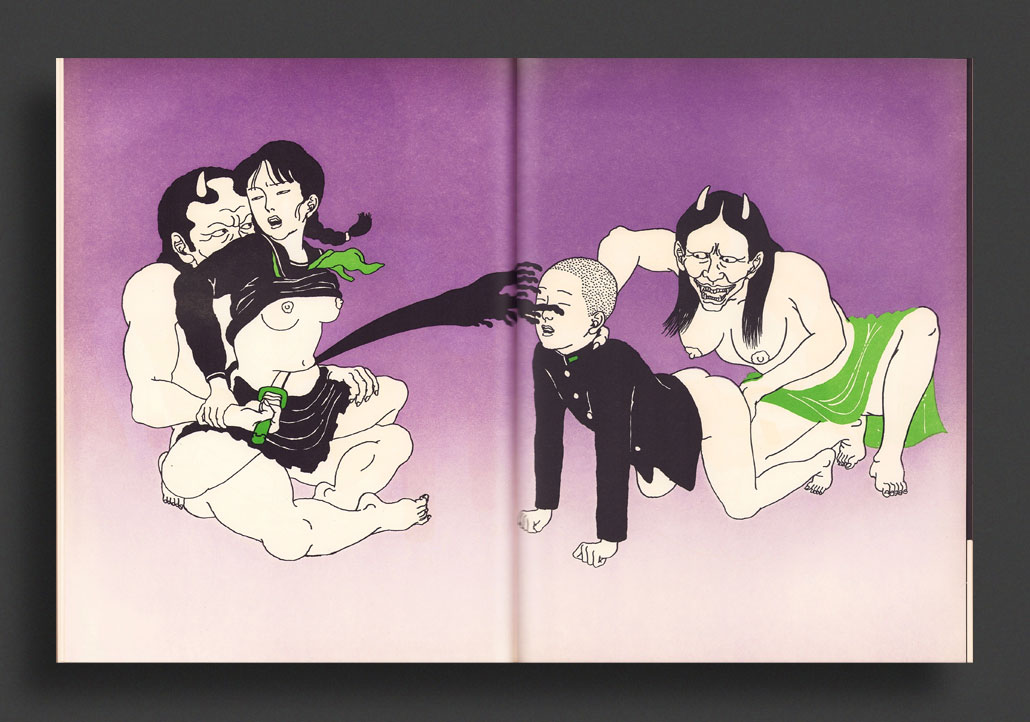
Very rare, complete first edition of this cult work by ero-guro master Toshio Saeki (1945—2019), an absolute favourite, published in 1972 in this over-sized slipcased edition by the legendary Haga Shoten. The most famous work by Toshio Saeki, Red box (Akai Hako) brings together over fifty illustrations drawn by Toshio Saeki in 1972, sublimely reproduced as large-format double-page spread artworks, captivating in their mania and gorgeous, vivid colour printing on matte stock. A stunning book to behold. A masterpiece! A must for any Saeki library.
Toshio Saeki (1945—2019) was an illusive Japanese illustrator and painter, and icon of 1970s Tokyo counterculture, known for combining Japanese folklore, Yōkai spirits and elements of Western art with his own sophisticated aesthetics to create a unique, sensational world of eros, dark humour, and horror. Given the title “Erotic Engineer” by Timothy Leary, Saeki's provocative art broke all sexual taboos, questioned Japanese ideology and traditional views on love, desire and gender roles. Saeki’s surgically-precise graphic work is closely related to the Japanese cultural phenomenon ‘Erotic, Grotesque, Nonsense’ (ero, guro, nansensu).
“Toshio Saeki conjures death with a pen”—Shūji Terayama, 1969.
Very Good copy with light wear/age, usual print buckling, VG—G slipcase with some light wear/age/marking, same dust jacket.
1990, English
Softcover, 362 pages, 21.6 x 24 cm
Reprint,
Out of print title / used / good
Published by
Feral House / Los Angeles
$45.00 - In stock -
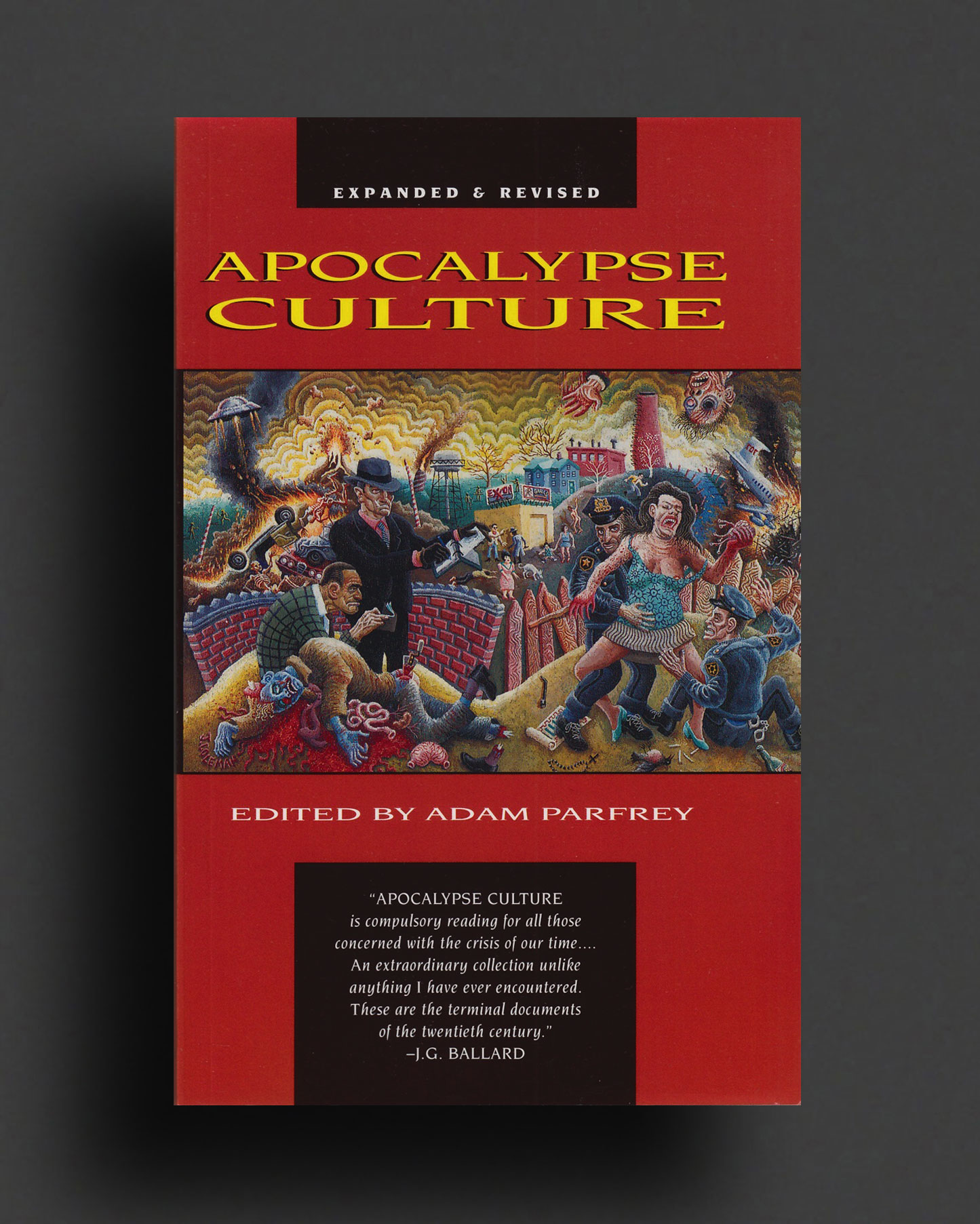
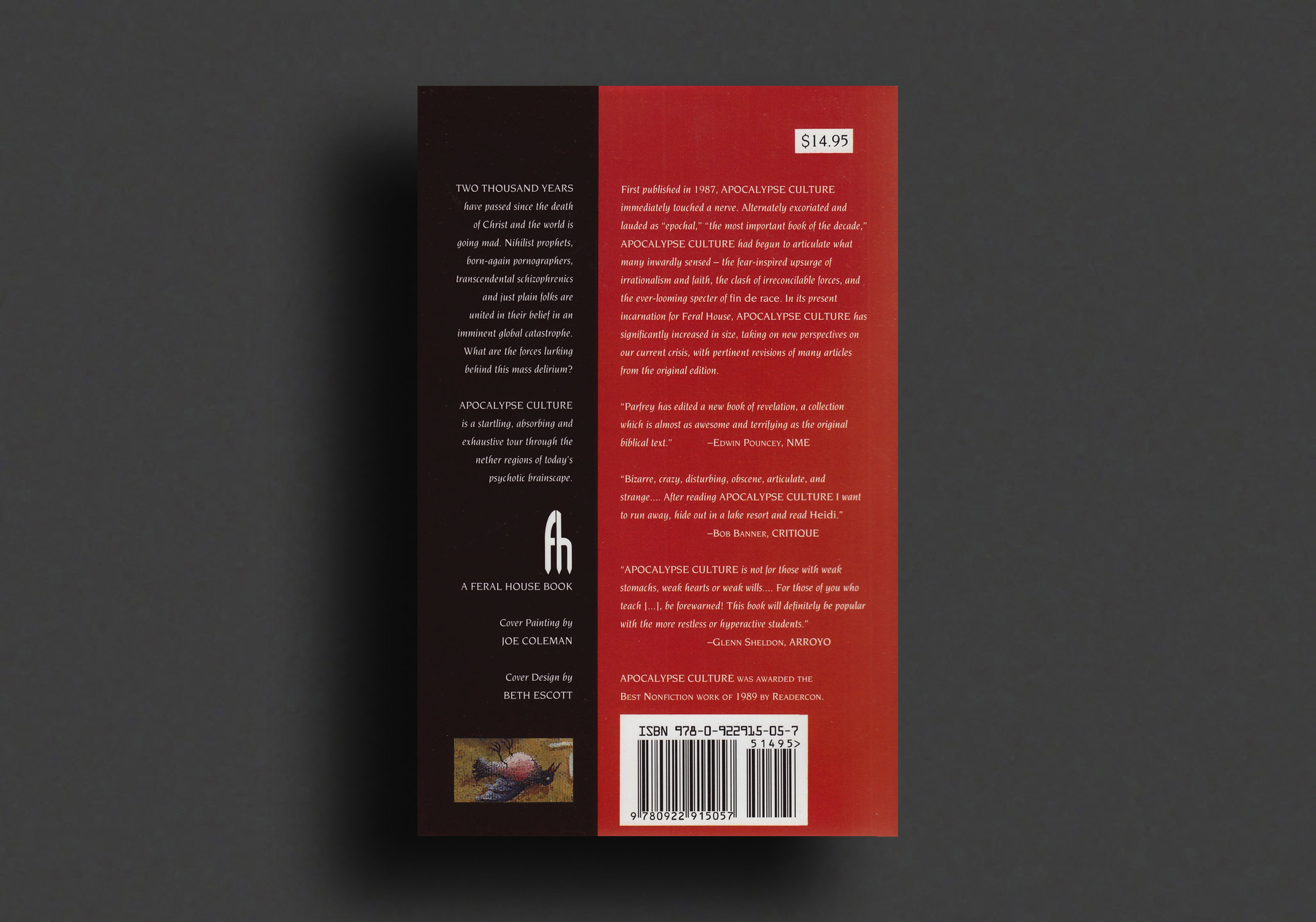
"Apocalypse Culture is compulsory reading for all those concerned with the crisis of our times. An extraordinary collection unlike anything I have ever encountered. These are the terminal documents of the twentieth century."—J.G. Ballard
Two thousand years have passed since the death of Christ and the world is going mad. Nihilist prophets, born-again pornographers, transcendental schizophrenics and just plain folks are united in their belief in an imminent global catastrophe. What are the forces lurking behind this mass delirium?
APOCALYPSE CULTURE is a startling, absorbing and exhaustive tour through the nether regions of today’s psychotic brainscape.
First published in 1987, APOCALYPSE CULTURE immediately touched a nerve. Alternately excoriated and lauded as “epochal”, “the most important book of the decade,” APOCALYPSE CULTURE had begun to articulate what many inwardly sensed — the-fear inspired irrationalism and faith, the clash of irreconcilable forces, and the ever-looming specter of fin de race. In its present incarnation for Feral House, APOCALYPSE CULTURE has significantly increased in size, taking on new perspectives on our current crisis, with pertinent revisions of many articles from the original edition.—burb from this expanded and revised 1990 edition.
As New.
2014, Japanese
Hardcase folio (w. pockets, 2 leporello booklets), unpaginated, 32 x 19.5 cm
1st Edition, Out of print title / used / very good
Published by
Amana / Japan
$130.00 - In stock -
This beautiful limited edition Balthus photobook was produced in Japan, containing a carefully selected collection photographs from approximately 2000 Polaroid photographs discovered after the death of the last master of the 20th century, Balthus (1908-2001). The elegant hardcase bookbinding, housing two folding screen-like Orihons (Japanese-accordian style book) enveloped in rich textile hues, is like a dedication to Balthus, who loved Japanese culture. The title "room 17" comes from the name of the room in the Swiss mansion Grand Chalet, where Balthus worked and photographed a young female model for eight years in study for his much loved paintings. A lovely selection of these photographic studies are collected in this touching tribute, alongside text by Nicola Page. Translation to Japanese by Tadashi Miyagi, book design by Daishiro Mori.
Very Good copy.
1998, English
Softcover, 576 pages, 20.96 x 15.24 cm
1st Edition, Out of print title / used / very good
Published by
Taschen / Cologne
$65.00 - In stock -
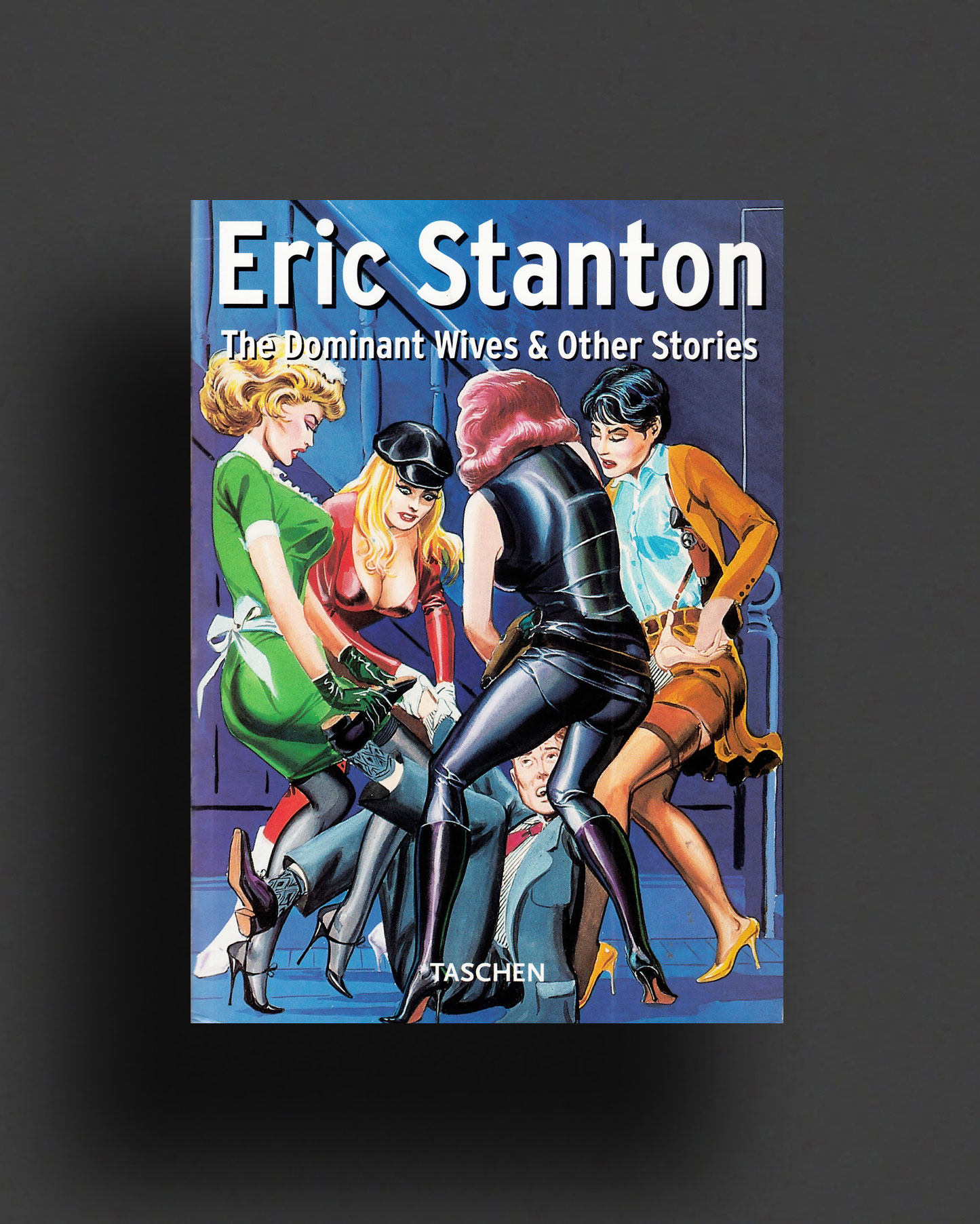
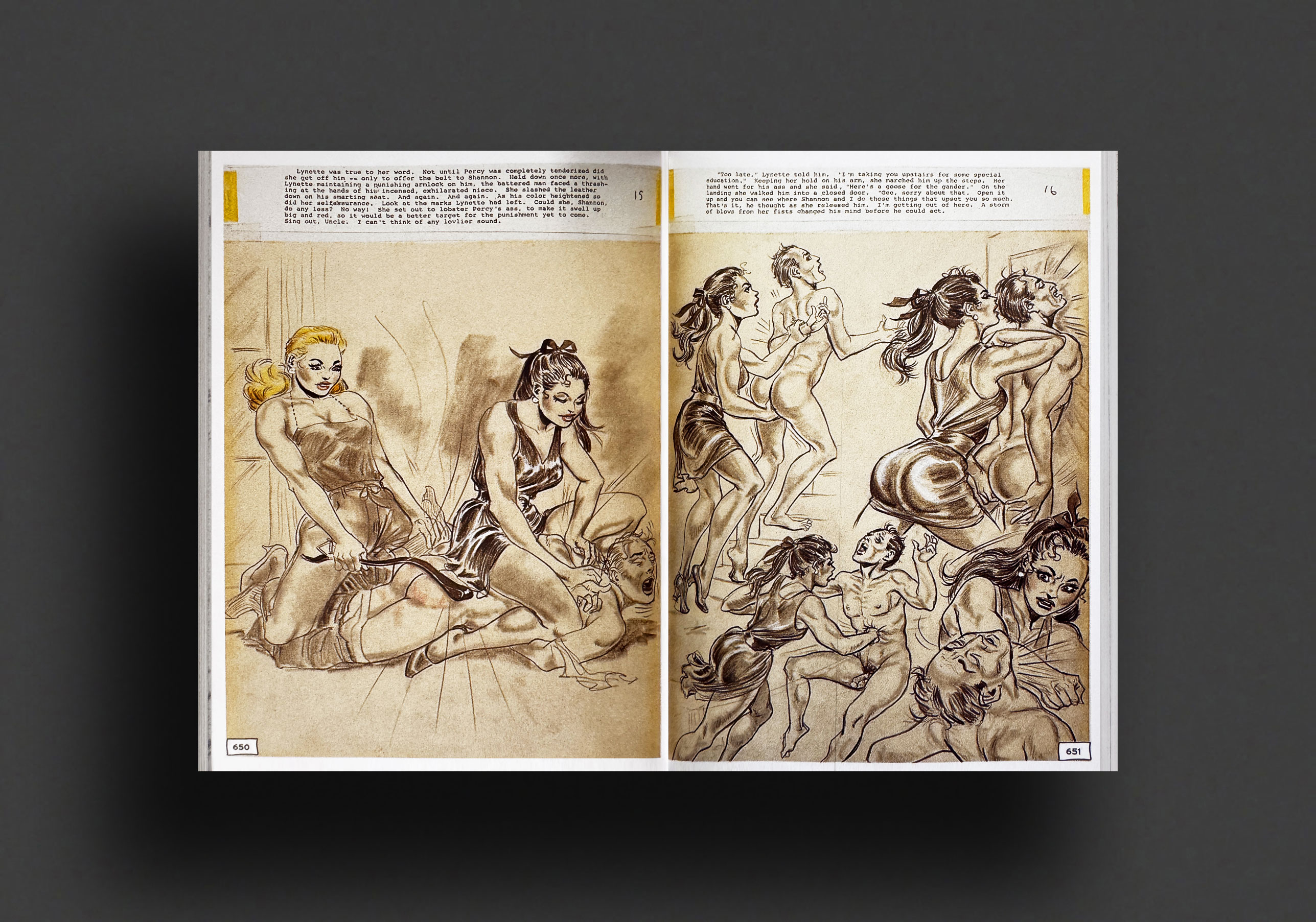
First 1998 English language edition of The Dominant Wives & Other Stories, Eric Stanton's brick-sized collection of his highly prized femdom Stantoons.
That bottom won’t spank itself!
20 stories from America’s premier fetish artist Eric Stanton (1926–1999) was America’s premier fetish artist, a man of very particular tastes, as all fetishists are. Most keep their work and sex preferences separate, but Stanton made his desires the center of his art, pouring his passions onto the page. These preferences included, in no particular order, female dominance, female fighting, mixed gender wrestling, and face sitting.
Perhaps if the man born Ernest Stanzoni in New York City, 1926, had grown taller, all would have been different. As happened, he topped out around 5’5” (165 cm), making him smaller and weaker than many women, and rather than bemoan this shortcoming, he chose to eroticize it. Then, like Robert Crumb and Tom of Finland to follow, he put his fantasies on paper.
Stanton produced paperback book covers, magazine illustrations, comics and even wrestling and smother videos, but what he is best known for is his Stantoons: self-published 16- to 28-page booklets produced between 1982 and his death in 1999. These booklets best represent Stanton’s rich and complex fantasy life, as well as the lives of his fans, whose fantasies he also incorporated. This new edition of The Dominant Wives & Other Stories, brings together the finest of the Stantoons, along with Stanton’s most famous series for Irving Klaw: Bound in Leather, parts 1 and 2. Done in pencil, pen and ink, gouache and mixed media, these 20 stories represent the best of Stanton, who himself represents the best of fetish.
Good—VG copy with some light edge wear an minor buckling (common due to size)
1980, Japanese / French
Softcover (w. dust jacket + lithograph + appendix), unpaginated, 25.5 x 17.6 cm
1st Edition, Out of print title / used / fine
Published by
Gakutokan / Japan
$200.00 - Out of stock
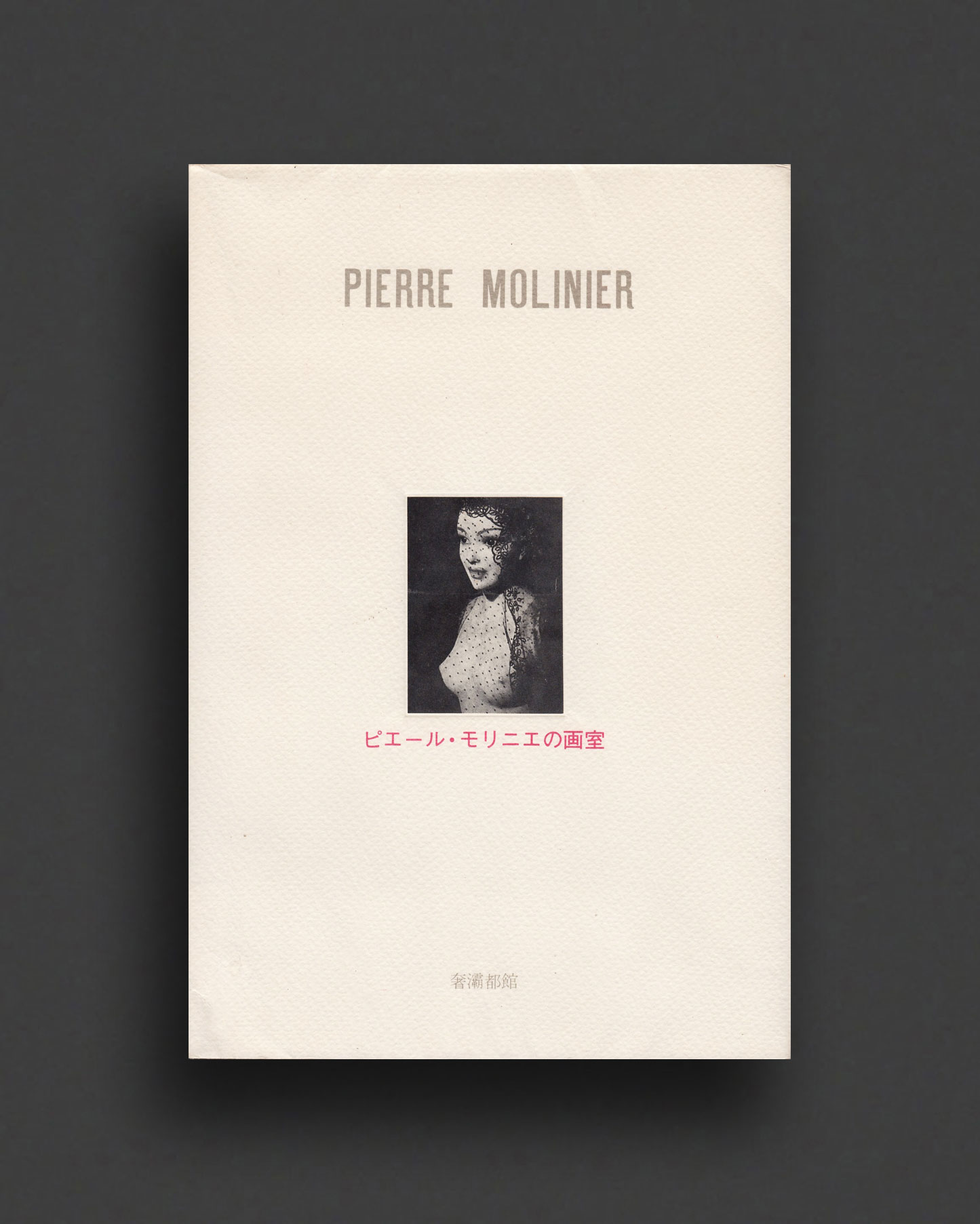
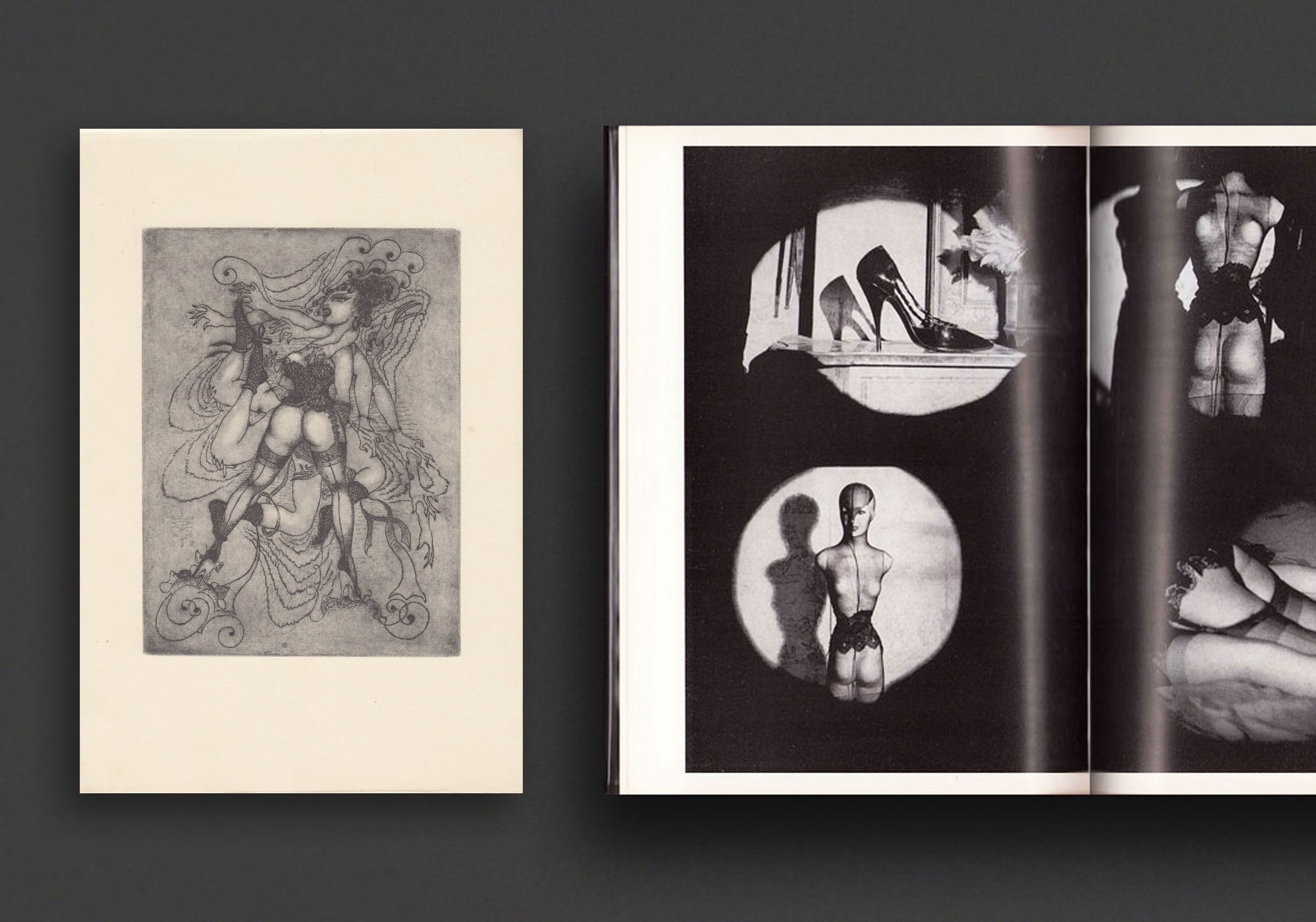
Rare 1980 hand-numbered, limited edition of Pierre Molinier's Studio, an exquisite book of Molinier's fetishistic gender-bending paintings, photomontages, and drawings, with texts by André Breton, translated from French to Japanese by Kosaku Ikuta, imagery from "Molinier" (1966) film by Raymond Borde, beautifully designed and printed in Japan where Molinier's artworks had a particular resonance. This hand-numbered edition (of 970 copies) features inlayed plate to dust-jacket, added appendix booklet, and the very rare lithographic insert of Molinier's "Réveil de l'Ange" etching, just as the first copies of André Breton and Raymond Borde's book published in 1964 by Terrain Vague included (dimension: (25.2 x 16.6 cm).
Pierre Molinier (1900—1976) was a French painter, photographer and a forerunner of gender performance art and Body Art (Art corporel). Molinier spent much of his artistic life working in isolation in Bordeaux, exiled from local and national art scenes. Born in Agen, nothing had predestined Molinier to a life as an artist. Self-taught, from a working-class background, he followed in his father’s footsteps and started out as a house painter. He got married and had two children. Tired of his infidelities and provocative behaviour, his wife left their marital home an in 1950 and Molinier begun photographing himself seriously, staging his own death and erecting a fake gravestone proudly declaring himself ‘a man without morals’. He was thrown out of the Bordeaux Salon des Indépendants as early as 1951 amidst controversy over his orgiastic painting of the same year, Le Grand Combat. Stirring up an obsessive correspondence with the anarchic poet-founder of Surrealism, André Breton, Molinier was soon integrated into the Surrealist group with a solo exhibition at Breton’s Paris gallery in 1956. Molinier’s anti-moral project appealed to the group’s interest in repressed desires, fetishism, and the transgression of bourgeois morals. In 1959, he exhibited at the Exposition International du Surrealism in Paris. From the mid-1960s Molinier chronicled the exploration of his subconscious transsexual desires in "Cent Photographies Erotiques": graphically detailed images of pain and pleasure. Cut-up, reassembled, and manipulated, Molinier painstakingly created elaborate and sensual photomontages in which he assumed the roles of dominatrix and succuba previously taken by the women of his paintings. Either alone with doll-like mannequins or with female models such as German sadomasochist Hanel Koeck, Molinier, who considered himself fundamentally androgynous, appears as a transvestite, employing his body and that of his acquaintances to create visions of hybrid identity, where stockinged multi-limbed, multi-sexed beings imitate pagan figures, Hindu gods, and Masonic symbols, in a rejection of a Christian tradition which he argued, had repressed androgyny. Designed to shock, Molinier’s artwork represented a very intimate disclosure about his own sexual ambiguity, inviting the viewer to bring to the images his or her own response of excitement or disgust. The degree of his artistic perversity and blasphemous tendencies was deemed too much for the French cultural elite, and the man Breton dubbed the “magician of erotic art” was shunned from the art world. Molinier did not participate in the 1965 International Surrealist Exhibition. For the last 11 years of his life Molinier played out his own most profound moments in the 'theatre' of his Bordeaux 'boudoir – atelier'. He committed suicide in 1976, shooting himself with a pistol, something he had foreshadowed in his artwork, time and again. Essentially a leg fetishist, but also considering himself as a shaman, facetious and provocative, anti-bourgeois and anti-religious, Molinier enjoyed transgressing gender identification : his outstanding photographs greatly influenced the European and North American Body Art in the 1970s and continue to fascinate artists today.
Very Good—Near Fine copy in VG dust jacket with VG-NF lithograph and appendix.
1989, Japanese
Softcover (w. dust jacket and original plastic wrap), 80 pages, 22.8 x 16.3 cm
1st Edition, Out of print title / used / very good
Published by
Gakutokan / Japan
$90.00 - Out of stock
First edition of The World of Pierre Molinier, published in 1989 in Japan. An exquisite book of Molinier's fetishistic gender-bending paintings, photomontages, and drawings, fittingly wrapped in "stocking" dust jacket, with texts by André Breton, translated from French to Japanese by Kosaku Ikuta, imagery from "Molinier" (1966) film by Raymond Borde, beautifully designed and printed in Japan where Molinier's artworks had a particular resonance.
Pierre Molinier (1900—1976) was a French painter, photographer and a forerunner of gender performance art and Body Art (Art corporel). Molinier spent much of his artistic life working in isolation in Bordeaux, exiled from local and national art scenes. Born in Agen, nothing had predestined Molinier to a life as an artist. Self-taught, from a working-class background, he followed in his father’s footsteps and started out as a house painter. He got married and had two children. Tired of his infidelities and provocative behaviour, his wife left their marital home an in 1950 and Molinier begun photographing himself seriously, staging his own death and erecting a fake gravestone proudly declaring himself ‘a man without morals’. He was thrown out of the Bordeaux Salon des Indépendants as early as 1951 amidst controversy over his orgiastic painting of the same year, Le Grand Combat. Stirring up an obsessive correspondence with the anarchic poet-founder of Surrealism, André Breton, Molinier was soon integrated into the Surrealist group with a solo exhibition at Breton’s Paris gallery in 1956. Molinier’s anti-moral project appealed to the group’s interest in repressed desires, fetishism, and the transgression of bourgeois morals. In 1959, he exhibited at the Exposition International du Surrealism in Paris. From the mid-1960s Molinier chronicled the exploration of his subconscious transsexual desires in "Cent Photographies Erotiques": graphically detailed images of pain and pleasure. Cut-up, reassembled, and manipulated, Molinier painstakingly created elaborate and sensual photomontages in which he assumed the roles of dominatrix and succuba previously taken by the women of his paintings. Either alone with doll-like mannequins or with female models such as German sadomasochist Hanel Koeck, Molinier, who considered himself fundamentally androgynous, appears as a transvestite, employing his body and that of his acquaintances to create visions of hybrid identity, where stockinged multi-limbed, multi-sexed beings imitate pagan figures, Hindu gods, and Masonic symbols, in a rejection of a Christian tradition which he argued, had repressed androgyny. Designed to shock, Molinier’s artwork represented a very intimate disclosure about his own sexual ambiguity, inviting the viewer to bring to the images his or her own response of excitement or disgust. The degree of his artistic perversity and blasphemous tendencies was deemed too much for the French cultural elite, and the man Breton dubbed the “magician of erotic art” was shunned from the art world. Molinier did not participate in the 1965 International Surrealist Exhibition. For the last 11 years of his life Molinier played out his own most profound moments in the 'theatre' of his Bordeaux 'boudoir – atelier'. He committed suicide in 1976, shooting himself with a pistol, something he had foreshadowed in his artwork, time and again. Essentially a leg fetishist, but also considering himself as a shaman, facetious and provocative, anti-bourgeois and anti-religious, Molinier enjoyed transgressing gender identification : his outstanding photographs greatly influenced the European and North American Body Art in the 1970s and continue to fascinate artists today.
Very Good copy in original plastic jacket.
1979, Japanese
Softcover, 240 pages, 25.5 x 18.5 cm
1st Edition, Out of print title / used / very good
Published by
Fool's Mate / Tokyo
$80.00 - In stock -
Rare "Special Stock" compendium book by the world's finest "Euro Rock Magazine", Fool's Mate, from Japan. In the 1970's—1980's, Fool's Mate (named after the 1971 Peter Hammill LP), edited by Masashi Kitamura with regular contributions by Masami Akita (Merzbow) and many other heads, was a vital conduit between emerging and metamorphosing avant-garde music cultures in Europe (Progressive Rock, Art Rock, Free Music, Electronic, Cosmic, Psychedelic Folk, Avant Pop, Rock in Opposition, Post Punk, Industrial, etc.) and Japan. No doubt responsible for the resonance of experimental contemporary music there during that period through to today, each issue of Fool's Mate during these early years was packed cover-to-cover with exclusive interviews with the artists, rare photographs and graphics, thematic genre/artist/label/artistic movement features, in-depth profiles/discographies/family-trees, catalogues, lyrics, letters, collage art, record, book, and live reviews, columns and an endless stream of concert and import/record store/label/venue/cafe adverts, all presented in a perfectly obsessive fanzine aesthetic manner, cut 'n' pasted across many paper stocks. The Americas and other realms, including new directions in Japanese alternative music, are all covered alongside their European counterparts, with many issues exploring key artistic and theoretical influences, such as Symbolism, Dadaism, Surrealism, Eros, Futurism, etc.
This special three issue collection combines Vol. 4 "Fantasy" + Vol. 6 "Eros" + Vol. 7 "Avant-Garde". Says it all really. Incredible in-depth, encyclopaedic features on Derek Bailey (full biography and discograohy), British avant-garde/free music/jazz/avant-rock/R.I.O./Canterbury (Bailey, Henry Cow, Daevid Allen/Gong, Lol Coxhill, Soft Machine, Company, Slapp Happy, Keith Tippett, National Health, Evan Parker, Art Bears, King Crimson, Hatfield and The North, Kew Rhone, National Health, Robert Wyatt, Spontaneous Music Ensemble, Incus Records, Ogun Records, etc.), R.I.O. expanded (Univers Zero, Art Zoyd, ZNR, The Residents, Albert Marcoeur, Stormy Six, Etron Fou Leloublan, Samla Mammas Manna, etc.), plus features and articles on Robert Fripp, Atoll, Annette Peacock, Italian Prog, Gloria Mundi, Peter Hammill, Ashra, Brian Eno, Tony Banks, Van Der Graaf, Genesis, Vangelis, Peter Gabriel, New Spanish Rock, and much more. Highly recommended to any fan of such things.
Very Good copy.